Question?
• Is it possible to leverage benefits of
  vertical data formats in combination
  with efficiencies of bitmap operations
  to mine association rules in a
  distributed environment.
Association Rule Mining??
• Finding Interesting Relationships
  between the variables.
• Finding the subset that is common to a
  chosen minimum number of the
  itemsets from the set of itemsets.
• Pattern Recognition.
• Explained By Market Basket Analysis.
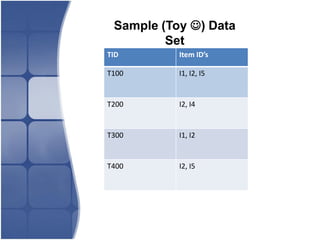
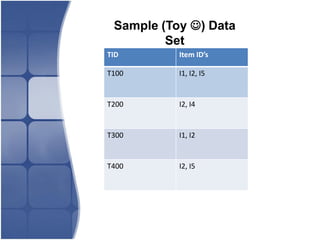
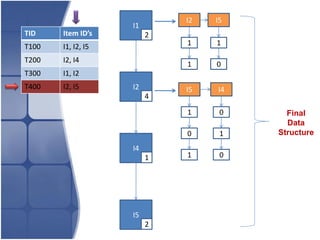
Sample (Toy ) Data
         Set
TID        Item ID’s

T100       I1, I2, I5


T200       I2, I4


T300       I1, I2


T400       I2, I5
Apriori
• Fundamental Algorithm for Association
  Rule Mining.
• Mines frequent patterns from a horizontal
  data format which represents the items
  categorized into particular transactions.
• i-th stage identifies all frequent i-element
  sets.
• Two steps:
• > Candidate generation.
• > Candidate counting.
Vertical Form
• Transactions categorized into particular items.
• Vertical format data mining only has to parse
  the dataset once to get the itemsets.
• For the itemset generation from the 2nd
  itemset it only needs to refer the previous
  itemset.
• Eliminates parsing through the dataset each
  time to count the frequency of itemsets, for
  each round.
• More efficient than its horizontal form.
BitMaps
•   Compactly store individual bits.
•   Exploit bit-level parallelism effectively.
•   0’s and 1’s.
•   1 indicates existence.
Combined?
• Algorithm takes a horizontal data set.
• With a one pass of the data set
  construct a bit map based data
  structure.
• This structure is in vertical format.
• The structure facilitates efficient mining
  of association rules.
Sample (Toy ) Data
         Set
TID        Item ID’s

T100       I1, I2, I5


T200       I2, I4


T300       I1, I2


T400       I2, I5
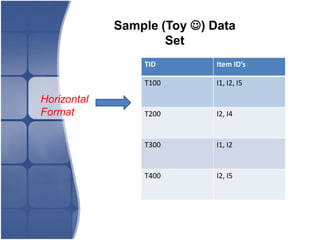
Sample (Toy ) Data
                     Set
                 TID         Item ID’s

                 T100        I1, I2, I5

Horizontal
Format           T200        I2, I4


                 T300        I1, I2


                 T400        I2, I5
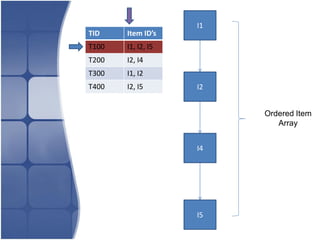
I1
TID    Item ID’s
T100   I1, I2, I5
T200   I2, I4
T300   I1, I2
T400   I2, I5       I2


                         Ordered Item
                            Array


                    I4


                    I5
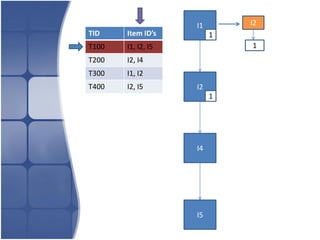
I1       I2
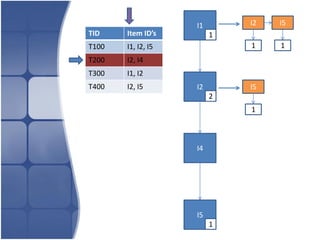
TID    Item ID’s         1
T100   I1, I2, I5            1
T200   I2, I4
T300   I1, I2
T400   I2, I5       I2
                         1


                    I4


                    I5
I1       I2   I5
TID    Item ID’s         1
T100   I1, I2, I5            1    1
T200   I2, I4
T300   I1, I2
T400   I2, I5       I2       I5
                         1
                             1


                    I4


                    I5
                         1
I1       I2     I5
TID    Item ID’s         1
T100   I1, I2, I5            1      1
T200   I2, I4
T300   I1, I2
T400   I2, I5       I2       I5
                         1
                             1


                    I4


                              Master Array

                    I5
                         1
I1       I2     I5
TID    Item ID’s         1
T100   I1, I2, I5            1      1
T200   I2, I4
                                  Associated
T300   I1, I2                     Items
T400   I2, I5       I2       I5
                         1
                             1


                    I4


                              Master Array

                    I5
                         1
I1       I2     I5
TID    Item ID’s         1
T100   I1, I2, I5            1      1
T200   I2, I4
                                  Associated
T300   I1, I2                     Items
T400   I2, I5       I2       I5
                         1
                             1


                    I4            Bitmap


                              Master Array

                    I5
                         1
I1       I2   I5
TID    Item ID’s         1
T100   I1, I2, I5            1    1
T200   I2, I4
T300   I1, I2
T400   I2, I5       I2       I5
                         2
                             1


                    I4


                    I5
                         1
I1       I2   I5
TID    Item ID’s         1
T100   I1, I2, I5            1    1
T200   I2, I4
T300   I1, I2
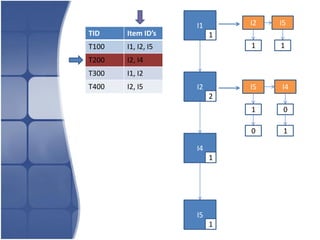
T400   I2, I5       I2       I5   I4
                         2
                             1     0

                             0     1

                    I4
                         1


                    I5
                         1
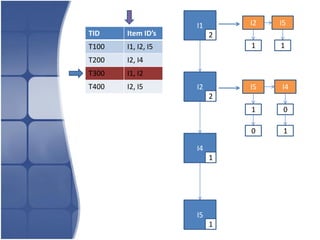
I1       I2   I5
TID    Item ID’s         2
T100   I1, I2, I5            1    1
T200   I2, I4
T300   I1, I2
T400   I2, I5       I2       I5   I4
                         2
                             1     0

                             0     1

                    I4
                         1


                    I5
                         1
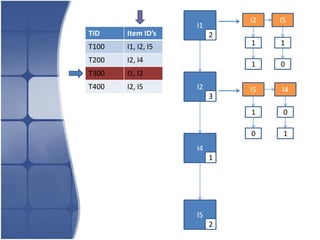
I2   I5
                    I1
TID    Item ID’s         2
T100   I1, I2, I5            1    1

T200   I2, I4
                             1    0
T300   I1, I2
T400   I2, I5       I2       I5   I4
                         3

                             1     0

                             0     1
                    I4
                         1


                    I5
                         2
I2   I5
                    I1
TID    Item ID’s         2
T100   I1, I2, I5            1    1

T200   I2, I4
                             1    0
T300   I1, I2
T400   I2, I5       I2       I5   I4
                         4

                             1     0     Final
                                         Data
                             0     1   Structure
                    I4
                         1   1     0


                    I5
                         2
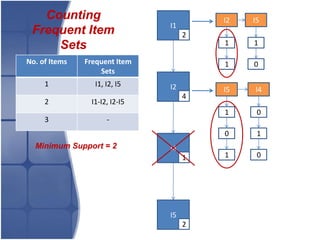
Counting                             I2   I5
                               I1
 Frequent Item                      2
     Sets                               1    1

No. of Items   Frequent Item            1    0
                   Sets
     1           I1, I2, I5    I2       I5   I4
                                    4
     2          I1-I2, I2-I5
                                        1     0
     3               -
                                        0     1
  Minimum Support = 2          I4
                                    1   1     0


                               I5
                                    2
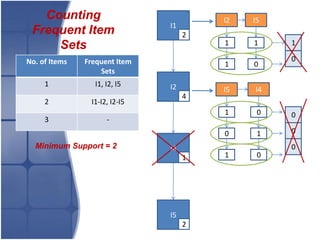
Counting                             I2   I5
                               I1
 Frequent Item                      2
     Sets                               1    1    1

No. of Items   Frequent Item                      0
                                        1    0
                   Sets
     1           I1, I2, I5    I2       I5   I4
                                    4
     2          I1-I2, I2-I5
                                        1     0   0
     3               -
                                        0     1   0
  Minimum Support = 2          I4                 0
                                    1   1     0


                               I5
                                    2
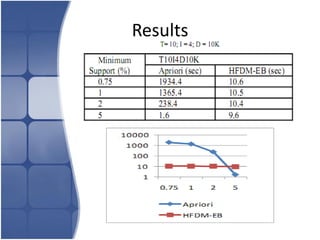
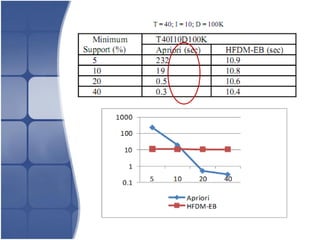
Results
Insights
• The algorithm performs better than
  Apriori in most scenarios.
• Data structure generation dominates
  the total time in most cases.
• As an aside…
• Can this be made to a distributed
  mining algorithm?
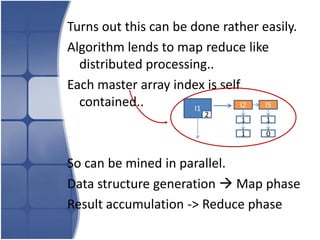
Turns out this can be done rather easily.
Algorithm lends to map reduce like
  distributed processing..
Each master array index is self
  contained..          I1      I2 I5
                        2
                               1   1
                               1   0


So can be mined in parallel.
Data structure generation  Map phase
Result accumulation -> Reduce phase
What Does Future Hold?
• Make this distributed.
• Java not the best of options. Use C so
  we can control memory allocations the
  way we want.
• Experiment with bitmap compression
  techniques.
Summary

Horizontal format data mining with extended bitmaps

  • 2.
    Question? • Is itpossible to leverage benefits of vertical data formats in combination with efficiencies of bitmap operations to mine association rules in a distributed environment.
  • 3.
    Association Rule Mining?? •Finding Interesting Relationships between the variables. • Finding the subset that is common to a chosen minimum number of the itemsets from the set of itemsets. • Pattern Recognition. • Explained By Market Basket Analysis.
  • 4.
    Sample (Toy )Data Set TID Item ID’s T100 I1, I2, I5 T200 I2, I4 T300 I1, I2 T400 I2, I5
  • 5.
    Apriori • Fundamental Algorithmfor Association Rule Mining. • Mines frequent patterns from a horizontal data format which represents the items categorized into particular transactions. • i-th stage identifies all frequent i-element sets. • Two steps: • > Candidate generation. • > Candidate counting.
  • 6.
    Vertical Form • Transactionscategorized into particular items. • Vertical format data mining only has to parse the dataset once to get the itemsets. • For the itemset generation from the 2nd itemset it only needs to refer the previous itemset. • Eliminates parsing through the dataset each time to count the frequency of itemsets, for each round. • More efficient than its horizontal form.
  • 7.
    BitMaps • Compactly store individual bits. • Exploit bit-level parallelism effectively. • 0’s and 1’s. • 1 indicates existence.
  • 8.
    Combined? • Algorithm takesa horizontal data set. • With a one pass of the data set construct a bit map based data structure. • This structure is in vertical format. • The structure facilitates efficient mining of association rules.
  • 9.
    Sample (Toy )Data Set TID Item ID’s T100 I1, I2, I5 T200 I2, I4 T300 I1, I2 T400 I2, I5
  • 10.
    Sample (Toy )Data Set TID Item ID’s T100 I1, I2, I5 Horizontal Format T200 I2, I4 T300 I1, I2 T400 I2, I5
  • 11.
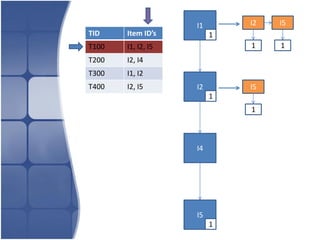
    I1 TID Item ID’s T100 I1, I2, I5 T200 I2, I4 T300 I1, I2 T400 I2, I5 I2 Ordered Item Array I4 I5
  • 12.
    I1 I2 TID Item ID’s 1 T100 I1, I2, I5 1 T200 I2, I4 T300 I1, I2 T400 I2, I5 I2 1 I4 I5
  • 13.
    I1 I2 I5 TID Item ID’s 1 T100 I1, I2, I5 1 1 T200 I2, I4 T300 I1, I2 T400 I2, I5 I2 I5 1 1 I4 I5 1
  • 14.
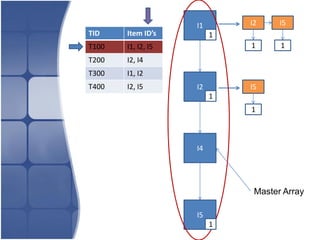
    I1 I2 I5 TID Item ID’s 1 T100 I1, I2, I5 1 1 T200 I2, I4 T300 I1, I2 T400 I2, I5 I2 I5 1 1 I4 Master Array I5 1
  • 15.
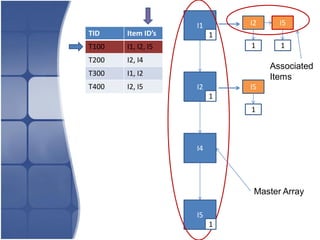
    I1 I2 I5 TID Item ID’s 1 T100 I1, I2, I5 1 1 T200 I2, I4 Associated T300 I1, I2 Items T400 I2, I5 I2 I5 1 1 I4 Master Array I5 1
  • 16.
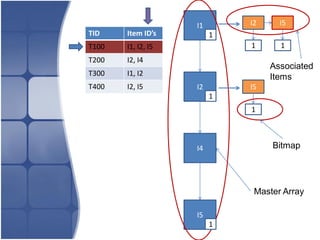
    I1 I2 I5 TID Item ID’s 1 T100 I1, I2, I5 1 1 T200 I2, I4 Associated T300 I1, I2 Items T400 I2, I5 I2 I5 1 1 I4 Bitmap Master Array I5 1
  • 17.
    I1 I2 I5 TID Item ID’s 1 T100 I1, I2, I5 1 1 T200 I2, I4 T300 I1, I2 T400 I2, I5 I2 I5 2 1 I4 I5 1
  • 18.
    I1 I2 I5 TID Item ID’s 1 T100 I1, I2, I5 1 1 T200 I2, I4 T300 I1, I2 T400 I2, I5 I2 I5 I4 2 1 0 0 1 I4 1 I5 1
  • 19.
    I1 I2 I5 TID Item ID’s 2 T100 I1, I2, I5 1 1 T200 I2, I4 T300 I1, I2 T400 I2, I5 I2 I5 I4 2 1 0 0 1 I4 1 I5 1
  • 20.
    I2 I5 I1 TID Item ID’s 2 T100 I1, I2, I5 1 1 T200 I2, I4 1 0 T300 I1, I2 T400 I2, I5 I2 I5 I4 3 1 0 0 1 I4 1 I5 2
  • 21.
    I2 I5 I1 TID Item ID’s 2 T100 I1, I2, I5 1 1 T200 I2, I4 1 0 T300 I1, I2 T400 I2, I5 I2 I5 I4 4 1 0 Final Data 0 1 Structure I4 1 1 0 I5 2
  • 22.
    Counting I2 I5 I1 Frequent Item 2 Sets 1 1 No. of Items Frequent Item 1 0 Sets 1 I1, I2, I5 I2 I5 I4 4 2 I1-I2, I2-I5 1 0 3 - 0 1 Minimum Support = 2 I4 1 1 0 I5 2
  • 23.
    Counting I2 I5 I1 Frequent Item 2 Sets 1 1 1 No. of Items Frequent Item 0 1 0 Sets 1 I1, I2, I5 I2 I5 I4 4 2 I1-I2, I2-I5 1 0 0 3 - 0 1 0 Minimum Support = 2 I4 0 1 1 0 I5 2
  • 24.
  • 26.
    Insights • The algorithmperforms better than Apriori in most scenarios. • Data structure generation dominates the total time in most cases. • As an aside… • Can this be made to a distributed mining algorithm?
  • 27.
    Turns out thiscan be done rather easily. Algorithm lends to map reduce like distributed processing.. Each master array index is self contained.. I1 I2 I5 2 1 1 1 0 So can be mined in parallel. Data structure generation  Map phase Result accumulation -> Reduce phase
  • 28.
    What Does FutureHold? • Make this distributed. • Java not the best of options. Use C so we can control memory allocations the way we want. • Experiment with bitmap compression techniques.
  • 29.