
1
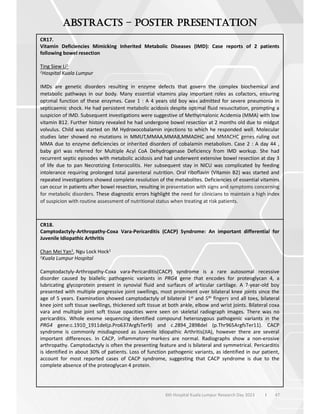
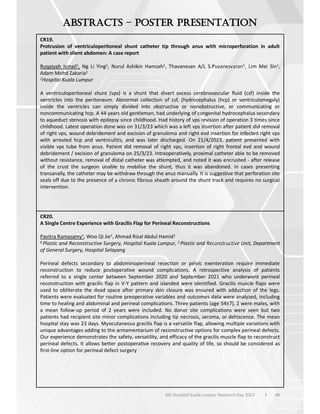
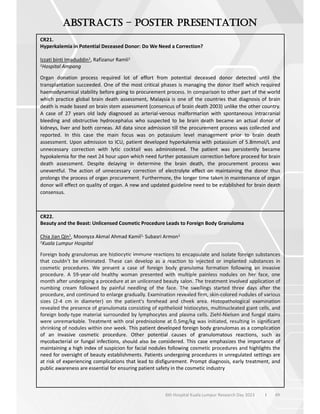
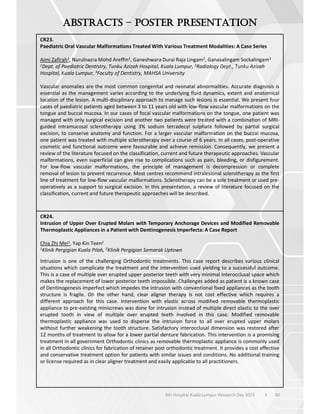
2
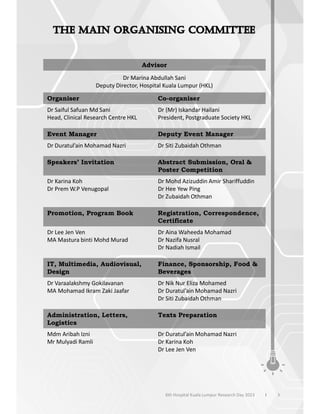
Advisor
Dr Marina Abdullah Sani
Deputy Director, Hospital Kuala Lumpur (HKL)
Organiser Co-organiser
Dr Saiful Safuan Md Sani
Head, Clinical Research Centre HKL
Dr (Mr) Iskandar Hailani
President, Postgraduate Society HKL
Event Manager Deputy Event Manager
Dr Duratul’ain Mohamad Nazri Dr Siti Zubaidah Othman
Speakers’ Invitation Abstract Submission, Oral &
Poster Competition
Dr Karina Koh
Dr Prem W.P Venugopal
Dr Mohd Azizuddin Amir Shariffuddin
Dr Hee Yew Ping
Dr Zubaidah Othman
Promotion, Program Book Registration, Correspondence,
Certificate
Dr Lee Jen Ven
MA Mastura binti Mohd Murad
Dr Aina Waheeda Mohamad
Dr Nazifa Nusral
Dr Nadiah Ismail
IT, Multimedia, Audiovisual,
Design
Finance, Sponsorship, Food &
Beverages
Dr Varaalakshmy Gokilavanan
MA Mohamad Ikram Zaki Jaafar
Dr Nik Nur Eliza Mohamed
Dr Duratul’ain Mohamad Nazri
Dr Siti Zubaidah Othman
Administration, Letters,
Logistics
Texts Preparation
Mdm Aribah Izni
Mr Mulyadi Ramli
Dr Duratul’ain Mohamad Nazri
Dr Karina Koh
Dr Lee Jen Ven
3
6th Hospital Kuala Lumpur Research Day 2023 l
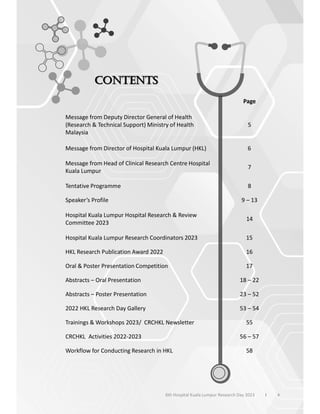
Page
Message from Deputy Director General of Health
(Research & Technical Support) Ministry of Health
Malaysia
5
Message from Director of Hospital Kuala Lumpur (HKL) 6
Message from Head of Clinical Research Centre Hospital
Kuala Lumpur
7
Tentative Programme 8
Speaker’s Profile 9 – 13
Hospital Kuala Lumpur Hospital Research & Review
Committee 2023
14
Hospital Kuala Lumpur Research Coordinators 2023 15
HKL Research Publication Award 2022 16
Oral & Poster Presentation Competition 17
Abstracts – Oral Presentation 18 – 22
Abstracts – Poster Presentation 23 – 52
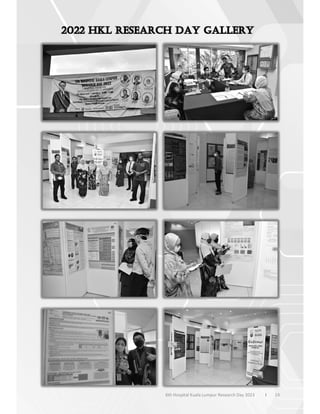
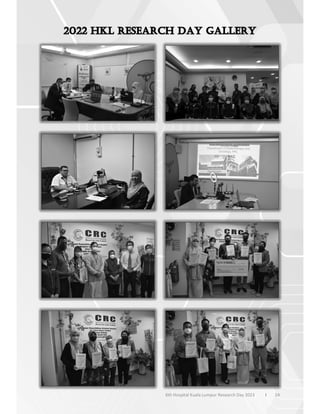
2022 HKL Research Day Gallery 53 – 54
Trainings & Workshops 2023/ CRCHKL Newsletter 55
CRCHKL Activities 2022-2023 56 – 57
Workflow for Conducting Research in HKL 58
4
6th Hospital Kuala Lumpur Research Day 2023 l
I would like to congratulate Clinical Research Centre Hospital Kuala Lumpur for generously
hosting on the 6th annual Hospital Kuala Lumpur Research Day, a celebration of
innovation, curiosity, and the pursuit of knowledge.
With the theme ‘Research today for the best healthcare tomorrow’, today’s programme
serves as a testament to the power of human intellect, our insatiable quest for
understanding, and on our unwavering commitment to pushing the boundaries of
knowledge. It is a platform that amplifies the remarkable work being done across diverse
fields, ranging from medicine and technology to social sciences and the humanities.
Today, HKL is the National Referral Centre whereby multiple disciplinary subspecialities
are situated to offer the best services in the country.
On top of that, HKL has progressed to be the favourite site for clinical trials by major
pharmaceutical companies worldwide as being the largest hospital in the country with
the biggest pool of patients. This in fact is a significant contribution to the world’s
research database where our esteemed researchers and dedicated patients are being part
of it. Well done!
As we embark on this journey of intellectual exploration today, let us embrace the
excitement of discovery, the joy of learning, and the power of collaboration. May this
Research Day inspire us all to continue our quest for knowledge, to never stop asking
questions, and to keep pushing the boundaries of what we thought was possible.
Keep up the great work and let the exploration begin!
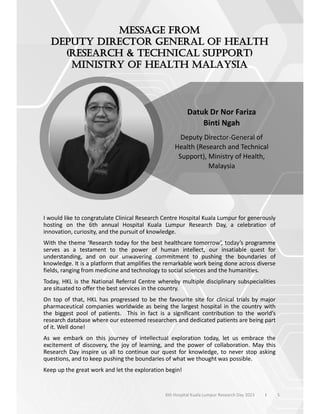
Datuk Dr Nor Fariza
Binti Ngah
Deputy Director-General of
Health (Research and Technical
Support), Ministry of Health,
Malaysia
5
6th Hospital Kuala Lumpur Research Day 2023 l
I am honoured to write a few words regarding the 6th HKL Research Day 2023. This annual
event is organized by Clinical Research Centre Hospital Kuala Lumpur (CRC HKL). HKL is
the largest tertiary public hospital in the country. HKL has always had an impressive
record of achievements in health and medical research, thanks to the dedication and hard
work of its clinicians and allied health team, who have all worked hard to make significant
contributions to the local and international research community.
Every year, HKL staff members are encouraged to share and present their research
findings, fostering a love for research within the community. Their commitment,
dedication and devotion have been the driving force behind the advancement of clinical
research in HKL.
It brings me immense pride to see how research is thriving at HKL. Last year, in 2022,
there were 263 Investigator-Initiated Research projects, 88 Industry-Sponsored Research
Initiatives, 219 publications and 360 poster or oral presentations. These statistics are not
mere numbers, but rather they represent the effort and dedication that HKL have put in
to promote evidence-based medicine in the hospital.
Moreover, collaborative research with industry partners, universities and MOH facilities is
highly encouraged to further expand and grow research efforts at HKL. I am optimistic
that this annual event will inspire more HKL staff to engage in research and contribute to
improving healthcare in the future.
I extend my warmest congratulations the Clinical Research Centre Hospital Kuala Lumpur
for organizing the 6th HKL Research Day 2023.
Thank you.
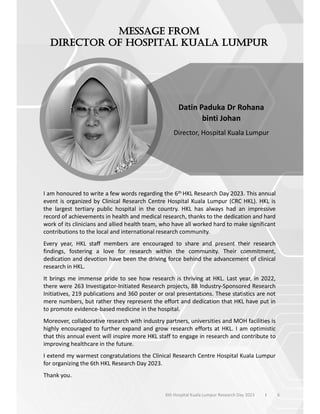
Datin Paduka Dr Rohana
binti Johan
Director, Hospital Kuala Lumpur
6
6th Hospital Kuala Lumpur Research Day 2023 l
On behalf of the organising team, it is my great pleasure to welcome everyone for joining
the 6th Hospital Kuala Lumpur Research Day 2023 with the theme “Research Today for the
Best Healthcare of Tomorrow”. We are proud to again host a physical event today. The
small dedicated team of CRCHKL is making progress in the field of research and
promoting research culture among new and ongoing researchers. Research consultations,
trainings and workshops are provided to nurture them along their research journey.
Hospital Kuala Lumpur Research Day brings together a wide spectrum of healthcare
professionals the opportunity to collaborate and update on the latest knowledge, clinical
skills as well as sharing of experiences. By practicing evidence-based medicine, we hope
to achieve an improved healthcare and better quality of life for the patients.
Healthcare is ever evolving from policies to patients and clinical research has a significant
influence on the development of health policy and delivery of patient-centered care. The
pandemic has further accelerated the adoption of digital technology in healthcare.
Therefore, we had eminent speakers on the agenda to address the power of Artificial
Intelligence on healthcare, how digital health is altering patient care, the importance of
translating research into policy, conducting meaningful research and the future of
decentralization clinical trials.
Finally, my heartfelt thanks to the main working committee for their well-coordinated
commitment in making this event a success. I would like to thank Deputy Director
General of Health (Research & Technical Support) Ministry of Health for officiating the
event, Director of Hospital Kuala Lumpur for the unwavering support, kind sponsorship
from Clinical Research Malaysia and Great Eastern and many individuals who had directly
or indirectly contributed towards this 6th Hospital Kuala Lumpur Research Day.
Thank you and best wishes!
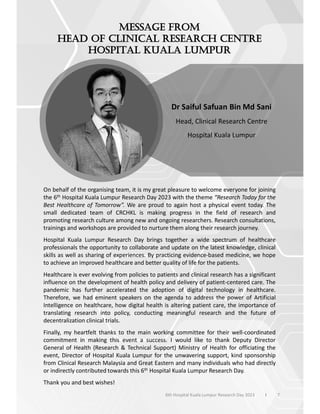
Dr Saiful Safuan Bin Md Sani
Head, Clinical Research Centre
Hospital Kuala Lumpur
7
6th Hospital Kuala Lumpur Research Day 2023 l
6th HOSPITAL KUALA LUMPUR RESEARCH DAY 2023
03 Aug 2023 (Thursday), 8.00 am – 5.00 pm l Main Auditorium, Hospital Kuala Lumpur
“Research Today for the Best Healthcare of Tomorrow”
Time Agenda
8.00am – 8.25am Registration
8.25am – 8.35am Arrival of Distinguished Guests & VIPs
8.35am – 8.45am Welcoming Address by Master of Ceremony
8.45am – 8.50am Prayer Recital
8.50am – 9.05am Welcoming Speech
Dr Saiful Safuan Bin Md Sani, Head of Clinical Research Centre, Hospital Kuala
Lumpur
9.05am – 9.25am Officiation of 6th Hospital Kuala Lumpur Research Day 2023
Datuk Dr. Nor Fariza Binti Ngah, Deputy Director - General of Health (Research &
Technical Support), Ministry of Health, Malaysia
9.25am – 9.30am Launching of 6th HKL Research Day 2023 Multimedia Presentation
9.30am – 9.50 am Presentation of Certificates of Appreciation to Hospital Research Review
Committee 2023
Datuk Dr. Nor Fariza Binti Ngah
HKL High Impact Factor (IF) Publication Award Giving Ceremony
Datin Dr. Sheamini Sivasampu, Director of Institute For Clinical Research,
National Institutes of Health
9.50am – 10.30am TEA BREAK & BOOTH VISIT (Main Lobby, Hospital Kuala Lumpur)
10.30am – 11.15am Advancing Precision Medicine: Harnessing the Power of AI
Prof Datuk Dr. A Rahman A Jamal, Founding Director of UKM Medical Molecular
Biology Institute (UMBI)
11.15am – 12.00pm Making Research Meaningful: Translating Research into Policy
Dato’ Dr. Amar Singh HSS, Consultant Paediatrician
12.00am – 1.15pm Oral Presentation Competition
1.15pm – 2.15pm LUNCH BREAK
BOOTH VISIT
2.15pm – 3.00pm Application of Digital Health in Patient Care
Mr William Law, Digital Health Research and Innovation Unit, Institute For
Clinical Research, National Institutes of Health
3.00pm – 3.45pm Patient-Centered Research: Maximizing the Benefits of Meaningful Research
Dr. Syazatul Syakirin Binti Sirol Aflah, Respiratory Physician, Institut Perubatan
Respiratori (IPR)
3.45pm – 4.30pm Decentralizing of Clinical Trials: Putting Patients First
Mdm Asha Thanabalan, Clinical Research Malaysia (CRM)
4.30pm – 5.00pm Prize Giving & Closing Ceremony
Datin Paduka Dr. Rohana binti Johan, Director of Hospital Kuala Lumpur
6th Hospital Kuala Lumpur Research Day 2023 l 8
Advancing Precision Medicine: Harnessing the Power of AI
Professor Datuk Dr. A. Rahman A. Jamal is the founding director of UKM Medical
Molecular Biology Institute (UMBI) and a professor of Paediatric Haematology, Oncology
and Molecular Biology. He has been helming the key research initiatives of UMBI since its
establishment in 2003. His vision for UMBI is to be the leader in precision medicine using
next generation sequencing technologies.
As an esteemed researcher, clinician and one of the key drivers of molecular medicine
research, he has more than 100 publications, awarded with numerous research grants
and supervised more than 50 postgraduate students.
He has a diverse research interest but his main focus is on cancers and blood disorders.
Together with his research team, they have discovered various important gene signatures
associated with the pathogenesis of colorectal cancer, glioma and leukaemia.
He sits in a good number of national key committees including being the Member and
Board of Directors of Clinical Research Malaysia Sdn Bhd, Melaka Biotechnology
Corporation and NanoMalaysia Sdn Bhd. He is also the Chairman of National Committee
for Ethics for Stem Cell Research and Therapy as well as Taskforce for Precision Medicine
under the Academy of Sciences Malaysia.
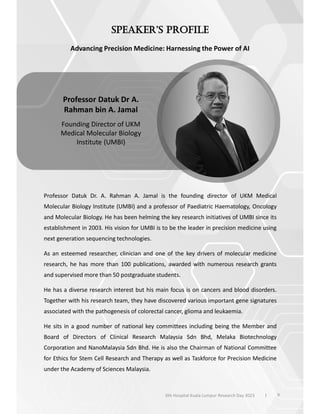
Professor Datuk Dr A.
Rahman bin A. Jamal
Founding Director of UKM
Medical Molecular Biology
Institute (UMBI)
9
6th Hospital Kuala Lumpur Research Day 2023 l
Making Research Meaningful: Translating Research into Policy
Dato’ Dr Amar-Singh HSS, Cert Theology (Aust, Hons), MBBS (Mal), MRCP (UK), FRCP
(Glasg), MSc Community Paediatrics (Ldn, distinction), is a Consultant Paediatrician. He
served the Malaysian civil service for 35 years and led both a regional Paediatric
Department and a Clinical Research Centre.
He is still active in research, has published a number of books including one on research
and has numerous local and international research publications and reports. He is keen
on Health Systems Research, Community & Applied Research and in assisting others to
conduct research.
He has used research evidence extensively to change the health care services in the
country and to implement new programmes. He is an active child and disability advocate
and is the recipient of the “Outstanding Asian Paediatrician Award” 2012, the “SENIA
Advocacy Award” 2016 and the “Rehabilitation International Centennial Award for
Significant Contributions” 2023. He is also an honorary Senior Fellow at the Galen Centre
for Health and Social Policy.
10
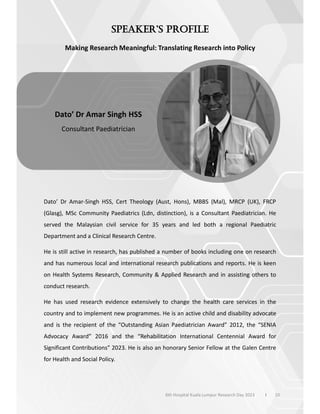
Dato’ Dr Amar Singh HSS
Consultant Paediatrician
6th Hospital Kuala Lumpur Research Day 2023 l
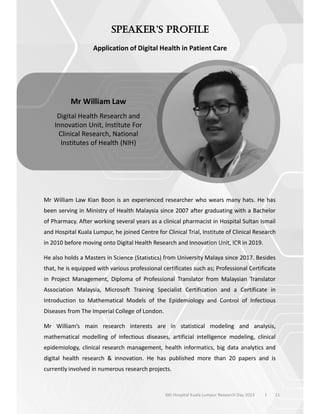
Application of Digital Health in Patient Care
Mr William Law Kian Boon is an experienced researcher who wears many hats. He has
been serving in Ministry of Health Malaysia since 2007 after graduating with a Bachelor
of Pharmacy. After working several years as a clinical pharmacist in Hospital Sultan Ismail
and Hospital Kuala Lumpur, he joined Centre for Clinical Trial, Institute of Clinical Research
in 2010 before moving onto Digital Health Research and Innovation Unit, ICR in 2019.
He also holds a Masters in Science (Statistics) from University Malaya since 2017. Besides
that, he is equipped with various professional certificates such as; Professional Certificate
in Project Management, Diploma of Professional Translator from Malaysian Translator
Association Malaysia, Microsoft Training Specialist Certification and a Certificate in
Introduction to Mathematical Models of the Epidemiology and Control of Infectious
Diseases from The Imperial College of London.
Mr William’s main research interests are in statistical modeling and analysis,
mathematical modelling of infectious diseases, artificial intelligence modeling, clinical
epidemiology, clinical research management, health informatics, big data analytics and
digital health research & innovation. He has published more than 20 papers and is
currently involved in numerous research projects.
11
Mr William Law
Digital Health Research and
Innovation Unit, Institute For
Clinical Research, National
Institutes of Health (NIH)
6th Hospital Kuala Lumpur Research Day 2023 l
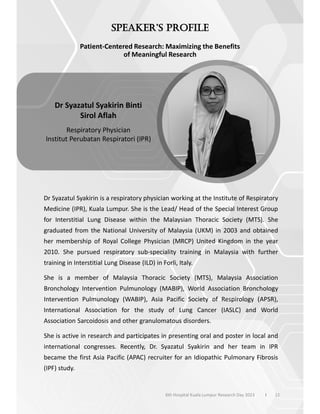
Patient-Centered Research: Maximizing the Benefits
of Meaningful Research
Dr Syazatul Syakirin is a respiratory physician working at the Institute of Respiratory
Medicine (IPR), Kuala Lumpur. She is the Lead/ Head of the Special Interest Group
for Interstitial Lung Disease within the Malaysian Thoracic Society (MTS). She
graduated from the National University of Malaysia (UKM) in 2003 and obtained
her membership of Royal College Physician (MRCP) United Kingdom in the year
2010. She pursued respiratory sub-speciality training in Malaysia with further
training in Interstitial Lung Disease (ILD) in Forli, Italy.
She is a member of Malaysia Thoracic Society (MTS), Malaysia Association
Bronchology Intervention Pulmunology (MABIP), World Association Bronchology
Intervention Pulmunology (WABIP), Asia Pacific Society of Respirology (APSR),
International Association for the study of Lung Cancer (IASLC) and World
Association Sarcoidosis and other granulomatous disorders.
She is active in research and participates in presenting oral and poster in local and
international congresses. Recently, Dr. Syazatul Syakirin and her team in IPR
became the first Asia Pacific (APAC) recruiter for an Idiopathic Pulmonary Fibrosis
(IPF) study.
12
Dr Syazatul Syakirin Binti
Sirol Aflah
Respiratory Physician
Institut Perubatan Respiratori (IPR)
6th Hospital Kuala Lumpur Research Day 2023 l
Decentralizing of Clinical Trials: Putting Patients First
Mdm Asha Thanabalan is a senior business development manager in Clinical Research
Malaysia (CRM). She has abundance of existing knowledge on the workings of healthcare,
especially in clinical research (Malaysian GCP certified) and expertise in managing
campaigns and promotional programs. Her strengths in communication skill, and frequent
engagement with existing and new stakeholders are keys to her success.
She Graduated with Bachelor’s Degree in Health Sciences (Biomedicine), University of
Science Malaysia (Health Campus) in 2005 and started her career as a research assistant
in University Malaya. Her key responsibilities include assisting in molecular parasitology
research projects involving Brugia pahangi. She then served as senior technical officer at
Brain Research Institute, Monash University for 3 years before joining CRM as assistant
manager, Medical Research & Ethics Committee.
Her current job is to strategies and contribute to Business Development operations in
accordance with company's key strategies and play an active role in networking and
searching for new business opportunities through identifying new markets/potential
clients.
13
Mdm Asha Thanabalan
Clinical Research Malaysia (CRM)
6th Hospital Kuala Lumpur Research Day 2023 l
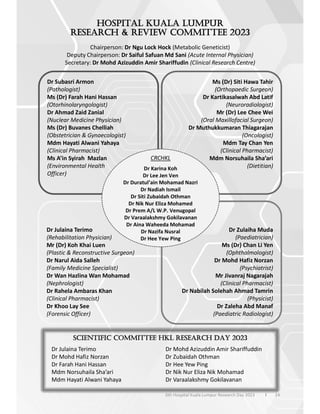
14
Dr Subasri Armon
(Pathologist)
Ms (Dr) Farah Hani Hassan
(Otorhinolaryngologist)
Dr Ahmad Zaid Zanial
(Nuclear Medicine Physician)
Ms (Dr) Buvanes Chelliah
(Obstetrician & Gynaecologist)
Mdm Hayati Alwani Yahaya
(Clinical Pharmacist)
Ms A’in Syirah Mazlan
(Environmental Health
Officer)
Ms (Dr) Siti Hawa Tahir
(Orthopaedic Surgeon)
Dr Kartikasalwah Abd Latif
(Neuroradiologist)
Mr (Dr) Lee Chee Wei
(Oral Maxillofacial Surgeon)
Dr Muthukkumaran Thiagarajan
(Oncologist)
Mdm Tay Chan Yen
(Clinical Pharmacist)
Mdm Norsuhaila Sha’ari
(Dietitian)
Dr Julaina Terimo
(Rehabilitation Physician)
Mr (Dr) Koh Khai Luen
(Plastic & Reconstructive Surgeon)
Dr Narul Aida Salleh
(Family Medicine Specialist)
Dr Wan Hazlina Wan Mohamad
(Nephrologist)
Dr Rahela Ambaras Khan
(Clinical Pharmacist)
Dr Khoo Lay See
(Forensic Officer)
Dr Zulaiha Muda
(Paediatrician)
Ms (Dr) Chan Li Yen
(Ophthalmologist)
Dr Mohd Hafiz Norzan
(Psychiatrist)
Mr Jivanraj Nagarajah
(Clinical Pharmacist)
Dr Nabilah Solehah Ahmad Tamrin
(Physicist)
Dr Zaleha Abd Manaf
(Paediatric Radiologist)
CRCHKL
Dr Karina Koh
Dr Lee Jen Ven
Dr Duratul’ain Mohamad Nazri
Dr Nadiah Ismail
Dr Siti Zubaidah Othman
Dr Nik Nur Eliza Mohamed
Dr Prem A/L W.P. Venugopal
Dr Varaalakshmy Gokilavanan
Dr Aina Waheeda Mohamad
Dr Nazifa Nusral
Dr Hee Yew Ping
Chairperson: Dr Ngu Lock Hock (Metabolic Geneticist)
Deputy Chairperson: Dr Saiful Safuan Md Sani (Acute Internal Physician)
Secretary: Dr Mohd Azizuddin Amir Shariffudin (Clinical Research Centre)
6th Hospital Kuala Lumpur Research Day 2023 l
Dr Julaina Terimo
Dr Mohd Hafiz Norzan
Dr Farah Hani Hassan
Mdm Norsuhaila Sha’ari
Mdm Hayati Alwani Yahaya
Dr Mohd Azizuddin Amir Shariffuddin
Dr Zubaidah Othman
Dr Hee Yew Ping
Dr Nik Nur Eliza Nik Mohamad
Dr Varaalakshmy Gokilavanan
15
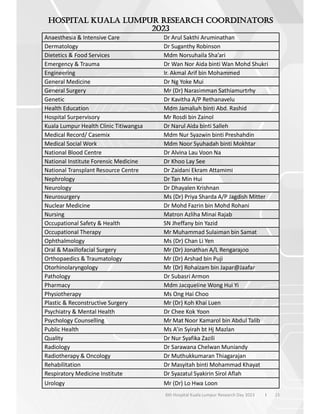
Anaesthesia & Intensive Care Dr Arul Sakthi Aruminathan
Dermatology Dr Suganthy Robinson
Dietetics & Food Services Mdm Norsuhaila Sha’ari
Emergency & Trauma Dr Wan Nor Aida binti Wan Mohd Shukri
Engineering Ir. Akmal Arif bin Mohammed
General Medicine Dr Ng Yoke Mui
General Surgery Mr (Dr) Narasimman Sathiamurtrhy
Genetic Dr Kavitha A/P Rethanavelu
Health Education Mdm Jamaliah binti Abd. Rashid
Hospital Surpervisory Mr Rosdi bin Zainol
Kuala Lumpur Health Clinic Titiwangsa Dr Narul Aida binti Salleh
Medical Record/ Casemix Mdm Nur Syazwin binti Preshahdin
Medical Social Work Mdm Noor Syuhadah binti Mokhtar
National Blood Centre Dr Alvina Lau Voon Na
National Institute Forensic Medicine Dr Khoo Lay See
National Transplant Resource Centre Dr Zaidani Ekram Attamimi
Nephrology Dr Tan Min Hui
Neurology Dr Dhayalen Krishnan
Neurosurgery Ms (Dr) Priya Sharda A/P Jagdish Mitter
Nuclear Medicine Dr Mohd Fazrin bin Mohd Rohani
Nursing Matron Azliha Minai Rajab
Occupational Safety & Health SN Jheffany bin Yazid
Occupational Therapy Mr Muhammad Sulaiman bin Samat
Ophthalmology Ms (Dr) Chan Li Yen
Oral & Maxillofacial Surgery Mr (Dr) Jonathan A/L Rengarajoo
Orthopaedics & Traumatology Mr (Dr) Arshad bin Puji
Otorhinolaryngology Mr (Dr) Rohaizam bin Japar@Jaafar
Pathology Dr Subasri Armon
Pharmacy Mdm Jacqueline Wong Hui Yi
Physiotherapy Ms Ong Hai Choo
Plastic & Reconstructive Surgery Mr (Dr) Koh Khai Luen
Psychiatry & Mental Health Dr Chee Kok Yoon
Psychology Counselling Mr Mat Noor Kamarol bin Abdul Talib
Public Health Ms A’in Syirah bt Hj Mazlan
Quality Dr Nur Syafika Zazili
Radiology Dr Sarawana Chelwan Muniandy
Radiotherapy & Oncology Dr Muthukkumaran Thiagarajan
Rehabilitation Dr Masyitah binti Mohammad Khayat
Respiratory Medicine Institute Dr Syazatul Syakirin Sirol Aflah
Urology Mr (Dr) Lo Hwa Loon
6th Hospital Kuala Lumpur Research Day 2023 l
16
6th Hospital Kuala Lumpur Research Day 2023 l
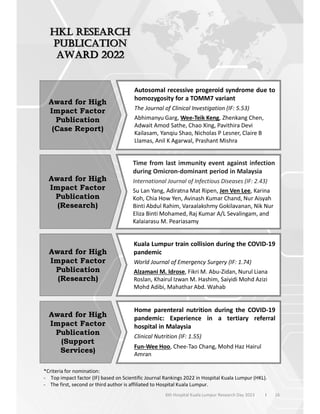
Award for High
Impact Factor
Publication
(Case Report)
Autosomal recessive progeroid syndrome due to
homozygosity for a TOMM7 variant
The Journal of Clinical Investigation (IF: 5.53)
Abhimanyu Garg, Wee-Teik Keng, Zhenkang Chen,
Adwait Amod Sathe, Chao Xing, Pavithira Devi
Kailasam, Yanqiu Shao, Nicholas P Lesner, Claire B
Llamas, Anil K Agarwal, Prashant Mishra
Award for High
Impact Factor
Publication
(Research)
Time from last immunity event against infection
during Omicron-dominant period in Malaysia
International Journal of Infectious Diseases (IF: 2.43)
Su Lan Yang, Adiratna Mat Ripen, Jen Ven Lee, Karina
Koh, Chia How Yen, Avinash Kumar Chand, Nur Aisyah
Binti Abdul Rahim, Varaalakshmy Gokilavanan, Nik Nur
Eliza Binti Mohamed, Raj Kumar A/L Sevalingam, and
Kalaiarasu M. Peariasamy
Award for High
Impact Factor
Publication
(Research)
Kuala Lumpur train collision during the COVID-19
pandemic
World Journal of Emergency Surgery (IF: 1.74)
Alzamani M. Idrose, Fikri M. Abu-Zidan, Nurul Liana
Roslan, Khairul Izwan M. Hashim, Saiyidi Mohd Azizi
Mohd Adibi, Mahathar Abd. Wahab
Award for High
Impact Factor
Publication
(Support
Services)
Home parenteral nutrition during the COVID-19
pandemic: Experience in a tertiary referral
hospital in Malaysia
Clinical Nutrition (IF: 1.55)
Fun-Wee Hoo, Chee-Tao Chang, Mohd Haz Hairul
Amran
*Criteria for nomination:
- Top impact factor (IF) based on Scientific Journal Rankings 2022 in Hospital Kuala Lumpur (HKL).
- The first, second or third author is affiliated to Hospital Kuala Lumpur.
17
6th Hospital Kuala Lumpur Research Day 2023 l
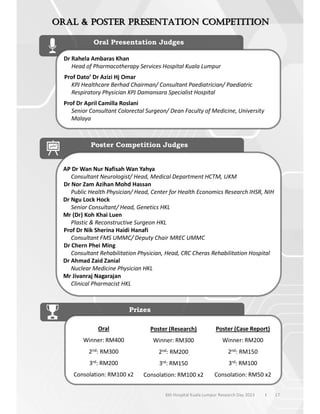
Oral Presentation Judges
Dr Rahela Ambaras Khan
Head of Pharmacotherapy Services Hospital Kuala Lumpur
Prof Dato’ Dr Azizi Hj Omar
KPJ Healthcare Berhad Chairman/ Consultant Paediatrician/ Paediatric
Respiratory Physician KPJ Damansara Specialist Hospital
Prof Dr April Camilla Roslani
Senior Consultant Colorectal Surgeon/ Dean Faculty of Medicine, University
Malaya
Poster Competition Judges
AP Dr Wan Nur Nafisah Wan Yahya
Consultant Neurologist/ Head, Medical Department HCTM, UKM
Dr Nor Zam Azihan Mohd Hassan
Public Health Physician/ Head, Center for Health Economics Research IHSR, NIH
Dr Ngu Lock Hock
Senior Consultant/ Head, Genetics HKL
Mr (Dr) Koh Khai Luen
Plastic & Reconstructive Surgeon HKL
Prof Dr Nik Sherina Haidi Hanafi
Consultant FMS UMMC/ Deputy Chair MREC UMMC
Dr Chern Phei Ming
Consultant Rehabilitation Physician, Head, CRC Cheras Rehabilitation Hospital
Dr Ahmad Zaid Zanial
Nuclear Medicine Physician HKL
Mr Jivanraj Nagarajan
Clinical Pharmacist HKL
Prizes
Oral
Winner: RM400
2nd: RM300
3rd: RM200
Consolation: RM100 x2
Poster (Research)
Winner: RM300
2nd: RM200
3rd: RM150
Consolation: RM100 x2
Poster (Case Report)
Winner: RM200
2nd: RM150
3rd: RM100
Consolation: RM50 x2
–
18
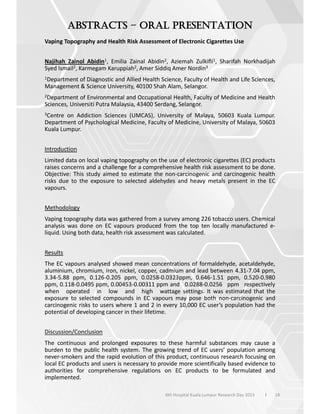
Vaping Topography and Health Risk Assessment of Electronic Cigarettes Use
Najihah Zainol Abidin1, Emilia Zainal Abidin2, Aziemah Zulkifli1, Sharifah Norkhadijah
Syed Ismail2, Karmegam Karuppiah2, Amer Siddiq Amer Nordin3
1Department of Diagnostic and Allied Health Science, Faculty of Health and Life Sciences,
Management & Science University, 40100 Shah Alam, Selangor.
2Department of Environmental and Occupational Health, Faculty of Medicine and Health
Sciences, Universiti Putra Malaysia, 43400 Serdang, Selangor.
3Centre on Addiction Sciences (UMCAS), University of Malaya, 50603 Kuala Lumpur.
Department of Psychological Medicine, Faculty of Medicine, University of Malaya, 50603
Kuala Lumpur.
Introduction
Limited data on local vaping topography on the use of electronic cigarettes (EC) products
raises concerns and a challenge for a comprehensive health risk assessment to be done.
Objective: This study aimed to estimate the non-carcinogenic and carcinogenic health
risks due to the exposure to selected aldehydes and heavy metals present in the EC
vapours.
Methodology
Vaping topography data was gathered from a survey among 226 tobacco users. Chemical
analysis was done on EC vapours produced from the top ten locally manufactured e-
liquid. Using both data, health risk assessment was calculated.
Results
The EC vapours analysed showed mean concentrations of formaldehyde, acetaldehyde,
aluminium, chromium, iron, nickel, copper, cadmium and lead between 4.31-7.04 ppm,
3.34-5.88 ppm, 0.126-0.205 ppm, 0.0258-0.0323ppm, 0.646-1.51 ppm, 0.520-0.980
ppm, 0.118-0.0495 ppm, 0.00453-0.00311 ppm and 0.0288-0.0256 ppm respectively
when operated in low and high wattage settings. It was estimated that the
exposure to selected compounds in EC vapours may pose both non-carcinogenic and
carcinogenic risks to users where 1 and 2 in every 10,000 EC user’s population had the
potential of developing cancer in their lifetime.
Discussion/Conclusion
The continuous and prolonged exposures to these harmful substances may cause a
burden to the public health system. The growing trend of EC users’ population among
never-smokers and the rapid evolution of this product, continuous research focusing on
local EC products and users is necessary to provide more scientifically based evidence to
authorities for comprehensive regulations on EC products to be formulated and
implemented.
6th Hospital Kuala Lumpur Research Day 2023 l
19
–
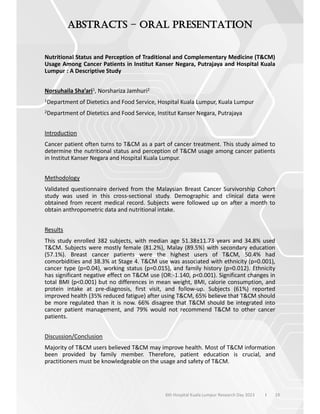
Nutritional Status and Perception of Traditional and Complementary Medicine (T&CM)
Usage Among Cancer Patients in Institut Kanser Negara, Putrajaya and Hospital Kuala
Lumpur : A Descriptive Study
Norsuhaila Sha’ari1, Norshariza Jamhuri2
1Department of Dietetics and Food Service, Hospital Kuala Lumpur, Kuala Lumpur
2Department of Dietetics and Food Service, Institut Kanser Negara, Putrajaya
Introduction
Cancer patient often turns to T&CM as a part of cancer treatment. This study aimed to
determine the nutritional status and perception of T&CM usage among cancer patients
in Institut Kanser Negara and Hospital Kuala Lumpur.
Methodology
Validated questionnaire derived from the Malaysian Breast Cancer Survivorship Cohort
study was used in this cross-sectional study. Demographic and clinical data were
obtained from recent medical record. Subjects were followed up on after a month to
obtain anthropometric data and nutritional intake.
Results
This study enrolled 382 subjects, with median age 51.38±11.73 years and 34.8% used
T&CM. Subjects were mostly female (81.2%), Malay (89.5%) with secondary education
(57.1%). Breast cancer patients were the highest users of T&CM, 50.4% had
comorbidities and 38.3% at Stage 4. T&CM use was associated with ethnicity (p=0.001),
cancer type (p=0.04), working status (p=0.015), and family history (p=0.012). Ethnicity
has significant negative effect on T&CM use (OR:-1.140, p<0.001). Significant changes in
total BMI (p<0.001) but no differences in mean weight, BMI, calorie consumption, and
protein intake at pre-diagnosis, first visit, and follow-up. Subjects (61%) reported
improved health (35% reduced fatigue) after using T&CM, 65% believe that T&CM should
be more regulated than it is now. 66% disagree that T&CM should be integrated into
cancer patient management, and 79% would not recommend T&CM to other cancer
patients.
Discussion/Conclusion
Majority of T&CM users believed T&CM may improve health. Most of T&CM information
been provided by family member. Therefore, patient education is crucial, and
practitioners must be knowledgeable on the usage and safety of T&CM.
6th Hospital Kuala Lumpur Research Day 2023 l
20
–
6th Hospital Kuala Lumpur Research Day 2023 l
Severe vs Non-Severe Dengue: Is There Any Association with the Genes?
Norfarhana Khairul Fahmy1, Saiful Safuan Md Sani2, Tengku Nurainna Fatihah Tengku
Abdullah3, Jamiila Ismail1, Koay Bee Tee1, Muhammad Zhafri Md Zakariah1, Ching Yee
Ming3, Shuwahida Shuib3, Nurhanani Muhammad Nor3, Erina Faizati Kadri3, Masita Arip3,
Norhazlin Mustafa1
1Transplantation Immunology Unit, Allergy & Immunology Research Centre, Institute for
Medical Research, National Institutes of Health (NIH) Malaysia
2Hospital Kuala Lumpur
3Autoimmune Unit, Allergy & Immunology Research Centre, Institute for Medical
Research, National Institutes of Health (NIH) Malaysia
Introduction
Dengue is a hyperendemic disease in Malaysia whereby the incidence rate continues to
increase exponentially over the years. Pathogenic factors that determine differences in
clinical manifestations are still not well understood, but multiple studies have highlighted
the involvement of host genetics as one contributing factor towards dengue severity. This
study aimed to identify genes that are associated with dengue severity within the
Malaysian population.
Methodology
This is a case-control study that includes 86 patients with dengue fever (DF) and 102
patients with severe dengue (SD). Patients were recruited from Hospital Kuala Lumpur
from year 2018-2020. Classification of dengue severity was made based on the WHO
2009 classification. DNA extracted from whole blood samples, were genotyped using
Infinium™ Asian Screening Array. Single variant association analysis was performed
following stringent quality control checking.
Results
Our results showed two suggestive variants that can be associated with dengue severity.
Both variants rs9872672 and rs148681490 that showed the odds ratio of 3.683 x 10⁻⁶
and 4.703 x 10⁻⁶, respectively, stand above the suggestive threshold value of p<5x10⁻⁶.
Discussion/Conclusion
Variant rs9872672 was identified at the intronic region of synaptoporin (SYNPR) gene
that is predicted to be an integral component of synaptic vesicle membrane. Variant
rs148681490 is predicted to encode for tetratricopeptide repeat domain 17 (TTC17)
protein, whose function is involved in the actin filament polymerization and cilium
organization. Although the potential roles of the suggestive variants are still uncertain,
the findings from this study support the notion that host genetic factor showed
association with disease pathogenicity of dengue severity.
21
6th Hospital Kuala Lumpur Research Day 2023 l
–
Prevalence of Hidradenitis Suppurativa in Kuala Lumpur, Malaysia: A Cross Sectional
Study
Moonyza Akmal Ahmad Kamil1, Azahirafairudi binti Abdul Rahim1, Lachoomii Piriya
Ganesan1
1Hospital Kuala Lumpur
Introduction
Hidradenitis Suppurativa (HS) is a debilitating inflammatory skin disease affecting the
apocrine gland bearing regions, based on typical lesion, topography and chronicity of the
symptoms. HS is associated with emotional distress leading to reduced quality of life.
This study aims to provide the prevalence of HS via a validated screening questionnaire
among healthy adults in Hospital Kuala Lumpur (HKL).
Methodology
All healthy adults, including hospital staff and those accompanying patients undergoing
care in HKL, were approached to answer the HS screening questions from December
2022 to April 2023. The basic socio-demographic data were obtained. Those screened
positive, were seen by dermatologist to confirm the diagnosis and further management.
Statistical analysis on point prevalent and the factors associated with HS were
performed.
Results
Seven were diagnosed with HS, out of 500 consented subjects, making the prevalence of
1.4%. 71%(n=5) were HS Hurley stage 1 and 29%(n=2) stage 2. HS was more prevalent in
males(n=4) and Chinese(n=3), but not statistically significant between subjects of HS
compared to non-HS, based on their age, gender, ethnicity, education level, income, BMI,
or smoking status (p>0.05).
Discussion/Conclusion
This questionnaire study yield a much higher prevalence rate compared to previous
studies as it actively screens for HS symptoms. Majority were in mild severity disease. No
significant difference in environmental and socio-demographic factors. In conclusion,
screening for HS enables early detection of HS and serve as a basis to a comprehensive
approach of diagnosis and treatment, thus preventing the complications due to the
diagnostic delay.
22
–
6th Hospital Kuala Lumpur Research Day 2023 l
A Retrospective Study on The Use of Continuous Clonidine Infusion for Sedation in
Critically Ill Paediatric Patients
Hooi Hoon Koay1, Jian Lynn Lee1, Mohd Makmor-Bakry2
1Pharmacy department, Hospital Tunku Azizah, Kuala Lumpur
2Faculty ot Pharmacy, Universiti Kebangsaan Malaysia, Perak
Introduction
The off-label use of clonidine as a sedative agent is gaining recognition as it has shown
favorable sedative and analgesic effect with lower risk of tolerance and dependence. This
study aimed to evaluate the effectiveness and safety of clonidine as an alternative
sedative agent in critically ill children and to identify factors for clonidine dose
requirements.
Methodology
A retrospective cohort study was conducted between June 2020 and April 2023 in the
paediatric intensive care unit (PICU) of Hospital Tunku Azizah.
Results
A total of 38 mechanically ventilated patients receiving continuous infusion of clonidine
for sedation were included. The median age of patients were 2.1 years (IQR 1.1 - 6.1).
Median dose of clonidine used was 0.58 mcg/kg/hr (IQR 0.39 - 0.79) at the first 24 hours
of infusion. There were significant reductions in the dose of midazolam (p=0.021) and
dexmedetomidine (p<0.001) with clonidine use. Patients who weigh less than 12kg were
9 times more likely to get a clonidine dose of 0.6 mcg/kg/hr at first 24 – hours of
continuous infusion (OR: 9.086; 95 % CI: 1.574 – 52.463; p=0.014). Whereas, patients
with longer PICU stay prior to the start of clonidine infusion were 13% less likely to
receive higher clonidine dose 0.6mcg/kg/hr) at the first 24 hours of infusion (OR:
0.874; 95% CI: 0.767 – 0.996; p=0.044).
Discussion/Conclusion
Clonidine is an effective and safe sedative agent in critically ill children. Patients’ weight
and length of PICU stay prior to starting clonidine were significant factors that affect
clonidine dose for the first 24 hours of infusion.
23
–
6th Hospital Kuala Lumpur Research Day 2023 l
RD1.
Magnetic Resonance Angiography (MRA) Study On Anatomical Variations Of The Circle Of Willis (COW)
In Kuala Lumpur Hospital
Hermizan Bin Halihanafiah1, Nurul Hafidzah Binti Rahim2
1Institut Latihan Kementerian Kesihatan Malaysia, Sg Buloh, 2Kuala Lumpur Hospital
The morphology and diameters of the circle of Willis (COW) arteries are thought to be important in
determining the optimal blood distribution and collateral potential of the COW. This study aimed to look
into the variations in COW morphology and their prevalence in Malaysian populations. This retrospective
study was carried out at Kuala Lumpur Hospital on 152 patients, including 92 males and 60 females. The
patients' average age was 43.8 years. These patients were drawn from the three major ethnic groups:
Malay, Chinese, and Indian. The variations in COW morphology are assessed using three-dimensional
Time-of-Flight Magnetic Resonance Angiography (3D-TOF MRA). The COW's completeness and variants
were investigated. Complete, partially complete, and incomplete configurations of the COW were
observed in 16.4%, 48.7%, and 34.9% of cases, respectively. In comparison to their group, the prevalence
of entirely complete configuration was higher in younger, female, and Chinese patients. The anterior part
of the COW had a complete configuration in 56.58 % of cases, with types A, G, and H being the most
common variants. Only 25% of cases had a complete configuration in the COW's posterior part, with
types E, A, D, F, and H becoming the most common variants. Understanding the normal pattern and the
variations the COW arteries is critical for explaining various neurological symptoms and completing
neurovascular surgery successfully. These variations must also be considered during radiological
interpretation and interventional radiology. These findings should be included in the most recent
anatomy textbook and discussed in anatomy classes.
RD2.
Geometric Morphometric Analysis based on Sacrum Landmarks among Malaysian Population
Lai Poh Soon1, Mohamad Helmee Mohamad Noor2,,Nurliza Abdullah1
1National Institute of Forensic Medicine, 2Radiology Department, Kuala Lumpur Hospital
Biological profiling in the anthropological approach comprises of sex, ancestry, stature and skeletal age
estimation. The 3D digitisation includes computed tomography (CT) scan has been applied for 3D
geometric morphometrics (GMM) in concurrent with statistical analysis. This study aims to conduct a
GMM analysis to explore the shape variations on sacrum within the Malaysian population. A total of 320
subjects were collected at Kuala Lumpur Hospital according to sex, ancestry and age among three main
ethnicities. The segmented sacral bones from CT images using Mimics Research 17.0 software were
marked with 19 raw points via IDAV Landmark 3.0 software. Their coordinates were being extracted into
Notepad++ 7.6.3 software and analysed with MorphoJ 1.06d software. GMM analysis showed that the
utmost degree of variations was observed on the transverse diameter of the S1 body, alae dimensions
and auricular surfaces. Sex discrimination function with cross validation success rate was between
84.47% up to 92.45%. Discrimination functions with cross validation success rate between Chinese and
Indian ranged from 64.22% up to 83.02%. Elderly individuals had bigger S1 body dimensions, alae antero-
posterior dimension and shorter sacral height compared to adolescents with varies cross validation
success rate up to 84.78%. Males had relatively more curved sacrum, longer sacral height and auricular
length, bigger S1 body dimensions but narrower alae compared to females. Chinese had generally higher
sacral basal width and sacral height compared to Malay and Indian. This population-specific study is
valuable for Malaysian experts in analysing the sacrum for biological profiling.
24
6th Hospital Kuala Lumpur Research Day 2023 l
–
RD3.
Volumetric Assessment of Canines using Post-Mortem Computed Tomography (PMCT) for Sex
Estimation in Malaysia Population
Mohd Hafizal bin Harudin1, Norhayati Jaffar1,Mohamad Helmee bin Mohamad Noor1,
Mohamad Azaini bin Ibrahim1
1Kuala Lumpur Hospital
Recent research has explored volumetric assessment in three-dimensional (3D) imaging procedures for
sexual dimorphism. The 3D techniques have enabled a more realistic, accurate and non-invasive
visualisation of sex-related anatomical parameters, such as the size and shape of human teeth. To
perform sexual dimorphism based on dental tissue volumes of left permanent maxillary and mandibular
canines in a Malaysian population. A cross-sectional study was carried out on 220 Post-Mortem
Computed Tomography (PMCT) scans of Malaysian subjects (114 males and 106 females) aged between
18 and 40 years old. The left permanent maxillary and mandibular canines were analysed based on their
volume of I) enamel cap, II) coronal dentine, and III) root, as well as the combination between the three
dental tissue volumes (DTV). 3D Slicer version 4.10.2 computer software was used to perform a semi-
automated segmentation of the anatomic regions of interest of each tooth. The DTV of left permanent
maxillary and mandibular canines showed sexual dimorphism as the males presented larger DTV than
females (p< 0.05). After binary logistic regression, the DTV revealed an overall sex classification rate of
60% to 74.1%. The DTV of the left permanent mandibular canine had more discriminant power to
correctly classify males and females compared to the left maxillary canine. Volumetric assessment of
dental tissue of left permanent maxillary and mandibular canines could discriminate sex in the Malaysian
population. Given the limited classification rate, this approach could act solely as a supplementary tool to
existing sex estimation methods.
RD4.
Gender Differences in the Prevalence of Cardiovascular Disease (CVD) Risk Factors Among Working-age
Population in Malaysia: Findings from the National Health and Morbidity Survey (NHMS) 2019
S Maria Awaluddin1, Noor Syaqilah Shawaluddin1, Tuan Mohd Amin Tuan Lah1, Thamil Arasu
Saminathan1, Nurhamizah Nasaruddin1, Nazirah Alias1, Lim Kuang Kuay1
1Institute for Public Health
There are gender differences in the prevalence of CVDs risk factors, however, data on the national
representative samples were inadequate. This article aims to determine the gender differences across
the prevalence of common CVD risk factors among working-age population in Malaysia. Data from the
national survey in 2019 was used in this study. A validated questionnaire was used, and clinical
procedures were conducted to measure the body mass index, blood pressure, and capillary blood for
glucose and cholesterol readings. The prevalence of eight CVD risk factors were calculated using IBM
SPSS version 25 and the gender differences were tested via chi-square test. A total of 3694 male and
4423 female respondents’ data were analysed. Female respondents had a significantly higher prevalence
of abdominal obesity (40.3% vs 29.0%), BMI of 25 kg/m2 and above (62.5% vs 39.8%) and being
physically inactive (25.4% vs 18.6%). In contrast, male respondents significantly showed a higher
prevalence of current tobacco smoking (45.3 vs 1.3%) and current alcohol drinking (18.2 vs 7.1%). The
prevalence of those with more than three CVD risk factors was significantly higher among males than
females (7.4 vs 4.7%). Gender differences were observed in the prevalence of abdominal obesity, BMI of
25 kg/m2 and above, physical inactivity, smoking and alcohol drinking. Thus, targeted interventions
according to gender, such as correcting the maladaptive behaviours of smoking and alcohol abuse among
males and increasing awareness among females to be more physically active and have an ideal BMI are
recommended.
25
6th Hospital Kuala Lumpur Research Day 2023 l
–
RD5.
Knowledge, Application and Practice of “Stop and mock Before You Block” among Anaesthetic Doctors
in Hospital Kuala Lumpur
Ng Jo Sheng1, Azrin Mohd Azidin1, Mohd Azizuddin Amir Shariffudin1
1Hospital Kuala Lumpur
Safe practice during regional anaesthesia is important to ensure avoidance of morbidity and mortality.
The Stop and Mock Before You Block is a safety initiative that is developed to prevent wrong sided and
site regional blocks. The study aims to identify the incidences of wrong side or site blocks and identify the
knowledge, application, and practice of anaesthetic doctors in Hospital Kuala Lumpur. This is an
observational descriptive study, where a questionnaire in the format of Google Form is distributed
among Anaesthetic doctors via Whatsapp. The data was then collected and analysed using SPSS to
generate frequencies and mean of responses. It was also used to analyse the relationship between the
variables and demographics using Fisher’s exact test. A total of 143 Anaesthetic doctors responded with
an incidence of 8 wrongly performed blocks. The respondents generally had poor knowledge (59.4%),
and moderate application (64.3%) and practice (79.6%) of the “Stop and Mock Before You Block” safety
initiative. There is significant correlation between years of practice with knowledge (p = 0.003) and
application (p = 0.005) component. There is also significant correlation between doctor’s grade to the
knowledge (p = 0.001) component. The study has identified 8 occurrences of wrong side or site block
that has occurred among the anaesthetic doctors in Hospital Kuala Lumpur. Based on the results of the
study, majority of the anaesthetic doctors had moderate to poor knowledge, application, and practice of
the Stop and Mock Before You Block safety initiative.
RD6.
Psychosocial Impact of Dental Aesthetics on Adolescent Patients in Klinik Pergigian Lanang
Loon Han Tan1,2, Shih Chia Pua1, Siong Ting Wong3
1Lanang Dental Clinic, Sarawak, 2Orthodontic Unit, Cahaya Suria Dental Clinic, Wilayah Persekutuan Kuala
Lumpur, 3Dental Public Health Specialist Unit, Jalan Oya Dental Clinic, Sarawak, Ministry of Health,
Malaysia
Malocclusion affects a person’s appearance and psychosocial well-being. Patient’s perspective should be
considered while assessing orthodontic treatment need. The research aims to study the psychosocial
impact of dental aesthetics (PIDA) on adolescent patients attending Klinik Pergigian Lanang (KPL), and
determine its relationship with self-perceived need of orthodontic treatment, gender, age and race. The
overall prevalence of PIDA was 95.2%. Prevalence was highest in dental self-confidence (DSC) domain,
followed by psychological impact (PI), social impact (SI) and aesthetic concern (AC). The prevalence in
DSC, SI, AC domains were significantly higher in subjects with self-perceived malocclusion. Those with
self-perceived malocclusion had significantly higher severity of impacts. Up to 34.7% of subjects reported
significant impact in all domains. Higher mean total PIDA score in older adolescents was not statistically
significant. Female subjects obtained significantly higher mean total PIDA scores. The effect of race on
PIDA was not significant. The prevalence, severity and extent of PIDA among adolescents were high.
Adolescents with selfperceived malocclusion had significantly higher severity of impacts.
26
6th Hospital Kuala Lumpur Research Day 2023 l
–
RD7. Renal Function Outcomes among Non-Valvular Atrial Fibrillation Patients on Warfarin and Non-
Vitamin K Oral Anticoagulants: Interim Analysis of a Multicenter, Propensity-Matched Retrospective
Analysis
Hock Peng Koh1, Jivanraj R. Nagarajah1, Szu Lynn Tay1, Jiaa Yinn Tang1, Yee Yin Hoo2, Sahimi Mohamed2,
Chelfi Zhi Fei Chua3, Sze Ling Tan4, Shi Jing Ong5, Shantini a/p Radhakrishnan6, Norzahidah Zamani7,
Pradeep Kumar Nair Arumugam8
1Pharmacy, Hospital Kuala Lumpur, 2Pharmacy, Hospital Serdang, 3Pharmacy, Pusat Jantung Sarawak,
4Pharmacy, Hospital Queen Elizabeth II, 5Pharmacy, Hospital Queen Elizabeth, 6Pharmacy, Hospital Tunku
Jaafar, 7Pharmacy, Hospital Tengku Ampuan Afzan, 8Medical, Hospital Kuala Lumpur
Evidence suggests that certain oral anticoagulant (OAC) may exert favorable renal outcomes in non-
valvular atrial fibrillation (NVAF) patients. We aimed to compare the renal function progression in NVAF
patients treated with warfarin and non-vitamin K OAC (NOAC). This multicenter retrospective study
analyzed NVAF patients initiated on OAC from 2013 to 2022 in eight tertiary hospitals in Malaysia.
Convenience sampling was used in this study. Based on propensity-score matching, 222 patients
receiving warfarin were matched against 222 patients receiving NOAC [apixaban (n=81), rivaroxaban
(n=67), and dabigatran (n=74)] by incorporating 13 variables that potentially affect the renal function.
Clinically significant (>30%) estimated glomerular filtration rate (eGFR) decline after OAC initiation was
the primary outcome measure. Secondary outcome measures include the incidence of ischemic
stroke/transient ischemic attack (TIA) and major bleeding. There was no significant difference in clinically
significant eGFR decline between the warfarin (n=33, 14.9%) and NOAC (n=28, 12.6%) groups (p=0.491).
The incidences of ischemic stroke/TIA [warfarin (n=8, 3.6%) versus NOAC (n=5, 2.3%), p=0.398] were
comparable between the two groups. The incidence of major bleeding was significantly higher in the
warfarin arm (p<0.030). Clinically significant eGFR decline is common among Malaysian NVAF patients on
OAC but not affected by choice of OAC.
RD8. Incidence and Predictors of Clinically Significant Renal Function Decline among Non-Valvular
Atrial Fibrillation Patients on Warfarin: A Retrospective, Multicenter Study
Hock Peng Koh1, Jivanraj R. Nagarajah1, Szu Lynn Tay1, Jiaa Yinn Tang1, Yee Yin Hoo2, Sahimi Mohamed2,
Sze Ling Tan3, Shi Jing Ong4, Shantini a/p Radhakrishnan5, Norzahidah Zamani6, Pradeep Kumar Nair
Arumugam7
1Pharmacy, Hospital Kuala Lumpur, 2Pharmacy, Hospital Serdang, 3Pharmacy, Hospital Queen Elizabeth II,
4Pharmacy, Hospital Queen Elizabeth, 5Pharmacy, Hospital Tunku Jaafar, 6Pharmacy, Hospital Tengku
Ampuan Afzan, 7Medical, Hospital Kuala Lumpur
Literature had reported worsening renal function with warfarin use. This study aimed to assess the
incidence of clinically significant renal function decline among non-valvular atrial fibrillation (NVAF)
patients on warfarin treatment and identify its predictors. This multicenter retrospective study analyzed
data on NVAF patients initiated on warfarin from 2013 to 2022 in six tertiary hospitals in Malaysia.
Convenience sampling was used in this study. Clinically significant (>30%) estimated glomerular filtration
rate (eGFR) decline after warfarin initiation was the primary outcome measure. Secondary outcome
measures include the incidence of ischemic stroke/ transient ischemic attack (TIA) and major bleeding.
Logistic regression analyses were used to assess independent predictors of clinically significant eGFR
decline. We analyzed 292 patients with a mean age of 67.7±10.2 years and predominantly male (n=155,
53.1%). Most (n=191, 65.4%) patients have underlying chronic kidney disease during warfarin initiation.
Clinically significant eGFR decline occurred in 74 (25.3%) patients. Nine (3.1%) patients developed
ischemic stroke/TIA. Major bleeding occurred in 8 (3.2%) patients. Overall, treatment duration (in years)
(aOR 1.260, p=0.037), time in therapeutic range (TTR) 60% (aOR 0.414, p=0.011), and insulin use (in
diabetic patients) (aOR 3.403, p=0.004) were the predictors of clinically significant eGFR decline in NVAF
patients on warfarin treatment. Lastly, clinically significant eGFR decline was not associated with ischemic
stroke/TIA (p=0.170), but significantly associated with major bleeding (p=0.015). Clinically significant
eGFR decline is common among Malaysian NVAF patients on warfarin treatment and was associated with
the treatment duration, TTR and diabetis on insulin therapy.
27
6th Hospital Kuala Lumpur Research Day 2023 l
–
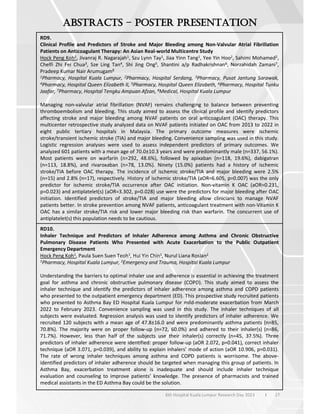
RD9.
Clinical Profile and Predictors of Stroke and Major Bleeding among Non-Valvular Atrial Fibrillation
Patients on Anticoagulant Therapy: An Asian Real-world Multicentre Study
Hock Peng Koh1, Jivanraj R. Nagarajah1, Szu Lynn Tay1, Jiaa Yinn Tang1, Yee Yin Hoo2, Sahimi Mohamed2,
Chelfi Zhi Fei Chua3, Sze Ling Tan4, Shi Jing Ong5, Shantini a/p Radhakrishnan6, Norzahidah Zamani7,
Pradeep Kumar Nair Arumugam8
1Pharmacy, Hospital Kuala Lumpur, 2Pharmacy, Hospital Serdang, 3Pharmacy, Pusat Jantung Sarawak,
4Pharmacy, Hospital Queen Elizabeth II, 5Pharmacy, Hospital Queen Elizabeth, 6Pharmacy, Hospital Tunku
Jaafar, 7Pharmacy, Hospital Tengku Ampuan Afzan, 8Medical, Hospital Kuala Lumpur
Managing non-valvular atrial fibrillation (NVAF) remains challenging to balance between preventing
thromboembolism and bleeding. This study aimed to assess the clinical profile and identify predictors
affecting stroke and major bleeding among NVAF patients on oral anticoagulant (OAC) therapy. This
multicenter retrospective study analyzed data on NVAF patients initiated on OAC from 2013 to 2022 in
eight public tertiary hospitals in Malaysia. The primary outcome measures were ischemic
stroke/transient ischemic stroke (TIA) and major bleeding. Convenience sampling was used in this study.
Logistic regression analyses were used to assess independent predictors of primary outcomes. We
analyzed 601 patients with a mean age of 70.0±10.3 years and were predominantly male (n=337, 56.1%).
Most patients were on warfarin (n=292, 48.6%), followed by apixaban (n=118, 19.6%), dabigatran
(n=113, 18.8%), and rivaroxaban (n=78, 13.0%). Ninety (15.0%) patients had a history of ischemic
stroke/TIA before OAC therapy. The incidence of ischemic stroke/TIA and major bleeding were 2.5%
(n=15) and 2.8% (n=17), respectively. History of ischemic stroke/TIA (aOR=6.605, p=0.007) was the only
predictor for ischemic stroke/TIA occurrence after OAC initiation. Non-vitamin K OAC (aOR=0.231,
p=0.023) and antiplatelet(s) (aOR=3.302, p=0.028) use were the predictors for major bleeding after OAC
initiation. Identified predictors of stroke/TIA and major bleeding allow clinicians to manage NVAF
patients better. In stroke prevention among NVAF patients, anticoagulant treatment with non-Vitamin K
OAC has a similar stroke/TIA risk and lower major bleeding risk than warfarin. The concurrent use of
antiplatelet(s) this population needs to be cautious.
RD10.
Inhaler Technique and Predictors of Inhaler Adherence among Asthma and Chronic Obstructive
Pulmonary Disease Patients Who Presented with Acute Exacerbation to the Public Outpatient
Emergency Department
Hock Peng Koh1, Paula Suen Suen Teoh1, Hui Yin Chin1, Nurul Liana Roslan2
1Pharmacy, Hospital Kuala Lumpur, 2Emergency and Trauma, Hospital Kuala Lumpur
Understanding the barriers to optimal inhaler use and adherence is essential in achieving the treatment
goal for asthma and chronic obstructive pulmonary disease (COPD). This study aimed to assess the
inhaler technique and identify the predictors of inhaler adherence among asthma and COPD patients
who presented to the outpatient emergency department (ED). This prospective study recruited patients
who presented to Asthma Bay ED Hospital Kuala Lumpur for mild-moderate exacerbation from March
2022 to February 2023. Convenience sampling was used in this study. The inhaler techniques of all
subjects were evaluated. Regression analysis was used to identify predictors of inhaler adherence. We
recruited 120 subjects with a mean age of 47.8±16.0 and were predominantly asthma patients (n=85,
70.8%). The majority were on proper follow-up (n=72, 60.0%) and adhered to their inhaler(s) (n=86,
71.7%). However, less than half of the subjects use their inhaler(s) correctly (n=45, 37.5%). Three
predictors of inhaler adherence were identified: proper follow-up (aOR 2.072, p=0.041), correct inhaler
technique (aOR 3.071, p=0.039), and ability to explain inhalers’ mode of action (aOR 10.906, p=0.031).
The rate of wrong inhaler techniques among asthma and COPD patients is worrisome. The above-
identified predictors of inhaler adherence should be targeted when managing this group of patients. In
Asthma Bay, exacerbation treatment alone is inadequate and should include inhaler technique
evaluation and counseling to improve patients’ knowledge. The presence of pharmacists and trained
medical assistants in the ED Asthma Bay could be the solution.
28
6th Hospital Kuala Lumpur Research Day 2023 l
–
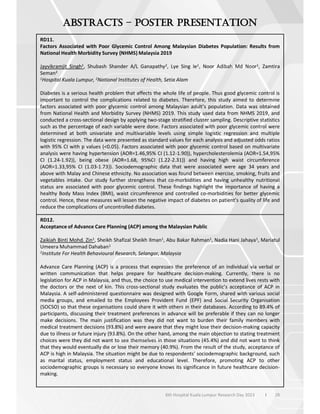
RD11.
Factors Associated with Poor Glycemic Control Among Malaysian Diabetes Population: Results from
National Health Morbidity Survey (NHMS) Malaysia 2019
Jayvikramjit Singh1, Shubash Shander A/L Ganapathy2, Lye Sing Ie1, Noor Adibah Md Noor1, Zamtira
Seman2
1Hospital Kuala Lumpur, 2National Institutes of Health, Setia Alam
Diabetes is a serious health problem that affects the whole life of people. Thus good glycemic control is
important to control the complications related to diabetes. Therefore, this study aimed to determine
factors associated with poor glycemic control among Malaysian adult’s population. Data was obtained
from National Health and Morbidity Survey (NHMS) 2019. This study used data from NHMS 2019, and
conducted a cross-sectional design by applying two-stage stratified cluster sampling. Descriptive statistics
such as the percentage of each variable were done. Factors associated with poor glycemic control were
determined at both univariate and multivariable levels using simple logistic regression and multiple
logistic regression. The data were presented as standard values for each analysis and adjusted odds ratios
with 95% CI with p values (<0.05). Factors associated with poor glycemic control based on multivariate
analysis were having hypertension (AOR=1.46,95% CI (1.12-1.90)), hypercholesterolemia (AOR=1.54,95%
CI (1.24-1.92)), being obese (AOR=1.68, 95%CI (1.22-2.31)) and having high waist circumference
(AOR=1.33,95% CI (1.03-1.73)). Sociodemographic data that were associated were age 34 years and
above with Malay and Chinese ethnicity. No association was found between exercise, smoking, fruits and
vegetables intake. Our study further strengthens that co-morbidities and having unhealthy nutritional
status are associated with poor glycemic control. These findings highlight the importance of having a
healthy Body Mass Index (BMI), waist circumference and controlled co-morbidities for better glycemic
control. Hence, these measures will lessen the negative impact of diabetes on patient’s quality of life and
reduce the complications of uncontrolled diabetes.
RD12.
Acceptance of Advance Care Planning (ACP) among the Malaysian Public
Zaikiah Binti Mohd. Zin1, Sheikh Shafizal Sheikh Ilman1, Abu Bakar Rahman1, Nadia Hani Jahaya1, Mariatul
Umeera Muhammad Dahaban1
1Institute For Health Behavioural Research, Selangor, Malaysia
Advance Care Planning (ACP) is a process that expresses the preference of an individual via verbal or
written communication that helps prepare for healthcare decision-making. Currently, there is no
legislation for ACP in Malaysia, and thus, the choice to use medical intervention to extend lives rests with
the doctors or the next of kin. This cross-sectional study evaluates the public’s acceptance of ACP in
Malaysia. A self-administered questionnaire was designed with Google Form, shared with various social
media groups, and emailed to the Employees Provident Fund (EPF) and Social Security Organisation
(SOCSO) so that these organisations could share it with others in their databases. According to 89.4% of
participants, discussing their treatment preferences in advance will be preferable if they can no longer
make decisions. The main justification was they did not want to burden their family members with
medical treatment decisions (93.8%) and were aware that they might lose their decision-making capacity
due to illness or future injury (93.8%). On the other hand, among the main objection to stating treatment
choices were they did not want to see themselves in those situations (45.4%) and did not want to think
that they would eventually die or lose their memory (40.9%). From the result of the study, acceptance of
ACP is high in Malaysia. The situation might be due to respondents’ sociodemographic background, such
as marital status, employment status and educational level. Therefore, promoting ACP to other
sociodemographic groups is necessary so everyone knows its significance in future healthcare decision-
making.
29
6th Hospital Kuala Lumpur Research Day 2023 l
–
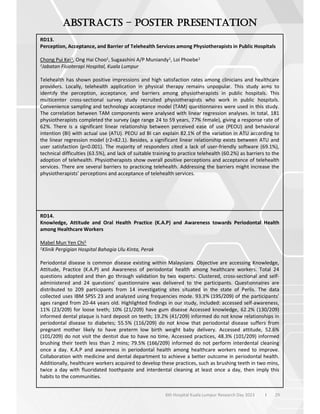
RD13.
Perception, Acceptance, and Barrier of Telehealth Services among Physiotherapists in Public Hospitals
Chong Pui Kei1, Ong Hai Choo1, Sugaashini A/P Muniandy1, Loi Phoebe1
1Jabatan Fisioterapi Hospital, Kuala Lumpur
Telehealth has shown positive impressions and high satisfaction rates among clinicians and healthcare
providers. Locally, telehealth application in physical therapy remains unpopular. This study aims to
identify the perception, acceptance, and barriers among physiotherapists in public hospitals. This
multicenter cross-sectional survey study recruited physiotherapists who work in public hospitals.
Convenience sampling and technology acceptance model (TAM) questionnaires were used in this study.
The correlation between TAM components were analysed with linear regression analyses. In total, 181
physiotherapists completed the survey (age range 24 to 59 years, 77% female), giving a response rate of
62%. There is a significant linear relationship between perceived ease of use (PEOU) and behavioral
intention (BI) with actual use (ATU). PEOU ad BI can explain 82.1% of the variation in ATU according to
the linear regression model (r2=82.1). Besides, a significant linear relationship exists between ATU and
user satisfaction (p<0.001). The majority of responders cited a lack of user-friendly software (69.1%),
technical difficulties (63.5%), and lack of suitable training to practice telehealth (60.2%) as barriers to the
adoption of telehealth. Physiotherapists show overall positive perceptions and acceptance of telehealth
services. There are several barriers to practicing telehealth. Addressing the barriers might increase the
physiotherapists’ perceptions and acceptance of telehealth services.
RD14.
Knowledge, Attitude and Oral Health Practice (K.A.P) and Awareness towards Periodontal Health
among Healthcare Workers
Mabel Mun Yen Chi1
1Klinik Pergigian Hospital Bahagia Ulu Kinta, Perak
Periodontal disease is common disease existing within Malaysians. Objective are accessing Knowledge,
Attitude, Practice (K.A.P) and Awareness of periodontal health among healthcare workers. Total 24
questions adopted and then go through validation by two experts. Clustered, cross-sectional and self-
administered and 24 questions’ questionnaire was delivered to the participants. Questionnaires are
distributed to 209 participants from 14 investigating sites situated in the state of Perlis. The data
collected uses IBM SPSS 23 and analyzed using frequencies mode. 93.3% (195/209) of the participants’
ages ranged from 20-44 years old. Highlighted findings in our study, included: accessed self-awareness,
11% (23/209) for loose teeth; 10% (21/209) have gum disease Accessed knowledge, 62.2% (130/209)
informed dental plaque is hard deposit on teeth; 19.2% (41/209) informed do not know relationships in
periodontal disease to diabetes; 55.5% (116/209) do not know that periodontal disease suffers from
pregnant mother likely to have preterm low birth weight baby delivery. Accessed attitude, 52.6%
(101/209) do not visit the dentist due to have no time. Accessed practices, 48.3% (101/209) informed
brushing their teeth less than 2 mins; 79.5% (166/209) informed do not perform interdental cleaning
once a day. K.A.P and awareness in periodontal health among healthcare workers need to improve.
Collaboration with medicine and dental department to achieve a better outcome in periodontal health.
Additionally, healthcare workers acquired to develop these practices, such as brushing teeth in two mins,
twice a day with fluoridated toothpaste and interdental cleaning at least once a day, then imply this
habits to the communities.
30
6th Hospital Kuala Lumpur Research Day 2023 l
–
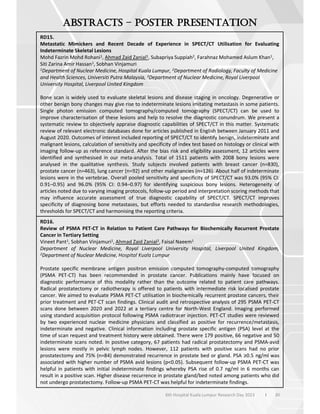
RD15.
Metastatic Mimickers and Recent Decade of Experience in SPECT/CT Utilisation for Evaluating
Indeterminate Skeletal Lesions
Mohd Fazrin Mohd Rohani1, Ahmad Zaid Zanial1, Subapriya Suppiah2, Farahnaz Mohamed Aslum Khan1,
Siti Zarina Amir Hassan1, Sobhan Vinjamuri
1Department of Nuclear Medicine, Hospital Kuala Lumpur, 2Department of Radiology, Faculty of Medicine
and Health Sciences, Universiti Putra Malaysia, 3Department of Nuclear Medicine, Royal Liverpool
University Hospital, Liverpool United Kingdom
Bone scan is widely used to evaluate skeletal lesions and disease staging in oncology. Degenerative or
other benign bony changes may give rise to indeterminate lesions imitating metastasis in some patients.
Single photon emission computed tomography/computed tomography (SPECT/CT) can be used to
improve characterisation of these lesions and help to resolve the diagnostic conundrum. We present a
systematic review to objectively appraise diagnostic capabilities of SPECT/CT in this matter. Systematic
review of relevant electronic databases done for articles published in English between January 2011 and
August 2020. Outcomes of interest included reporting of SPECT/CT to identify benign, indeterminate and
malignant lesions, calculation of sensitivity and specificity of index test based on histology or clinical with
imaging follow-up as reference standard. After the bias risk and eligibility assessment, 12 articles were
identified and synthesised in our meta-analysis. Total of 1511 patients with 2008 bony lesions were
analysed in the qualitative synthesis. Study subjects involved patients with breast cancer (n=830),
prostate cancer (n=463), lung cancer (n=92) and other malignancies (n=126). About half of indeterminate
lesions were in the vertebrae. Overall pooled sensitivity and specificity of SPECT/CT was 93.0% (95% CI:
0.91–0.95) and 96.0% (95% CI: 0.94–0.97) for identifying suspicious bony lesions. Heterogeneity of
articles noted due to varying imaging protocols, follow-up period and interpretation scoring methods that
may influence accurate assessment of true diagnostic capability of SPECT/CT. SPECT/CT improves
specificity of diagnosing bone metastases, but efforts needed to standardise research methodologies,
thresholds for SPECT/CT and harmonising the reporting criteria.
RD16.
Review of PSMA PET-CT in Relation to Patient Care Pathways for Biochemically Recurrent Prostate
Cancer in Tertiary Setting
Vineet Pant1, Sobhan Vinjamuri1, Ahmad Zaid Zanial2, Faisal Naeem1
Department of Nuclear Medicine, Royal Liverpool University Hospital, Liverpool United Kingdom,
2Department of Nuclear Medicine, Hospital Kuala Lumpur
Prostate specific membrane antigen positron emission computed tomography-computed tomography
(PSMA PET-CT) has been recommended in prostate cancer. Publications mainly have focused on
diagnostic performance of this modality rather than the outcome related to patient care pathways.
Radical prostatectomy or radiotherapy is offered to patients with intermediate risk localised prostate
cancer. We aimed to evaluate PSMA PET-CT utilisation in biochemically recurrent prostate cancers, their
prior treatment and PET-CT scan findings. Clinical audit and retrospective analysis of 295 PSMA PET-CT
scans done between 2020 and 2022 at a tertiary centre for North-West England. Imaging performed
using standard acquisition protocol following PSMA radiotracer injection. PET-CT studies were reviewed
by two experienced nuclear medicine physicians and classified as positive for recurrence/metastasis,
indeterminate and negative. Clinical information including prostate specific antigen (PSA) level at the
time of scan request and treatment history were obtained. There were 179 positive, 66 negative and 50
indeterminate scans noted. In positive category, 67 patients had radical prostatectomy and PSMA-avid
lesions were mostly in pelvic lymph nodes. However, 112 patients with positive scans had no prior
prostatectomy and 75% (n=84) demonstrated recurrence in prostate bed or gland. PSA 0.5 ng/ml was
associated with higher number of PSMA avid lesions (p<0.05). Subsequent follow-up PSMA PET-CT was
helpful in patients with initial indeterminate findings whereby PSA rise of 0.7 ng/ml in 6 months can
result in a positive scan. Higher disease recurrence in prostate gland/bed noted among patients who did
not undergo prostatectomy. Follow-up PSMA PET-CT was helpful for indeterminate findings.
31
6th Hospital Kuala Lumpur Research Day 2023 l
–
RD17.
Developing Malaysian Healthy Lifestyle Index Instrument
Khairulnissa Abdul Kadir1, Logeswary Krisnan Kaundan1
1Institutes for Health Behavioural Research, MOH
The goal of the Malaysian Healthy Lifestyle Index is to provide Malaysian with an easy-to-use health
behavior assessment tool. Involved in six stages; conceptualization, item generation, assessment of
comprehensibility or pre-testing, index calculation, pilot testing, and data analysis. A 136-item
questionnaire was developed and evaluated for content validity by an expert panel and then
administered to respondents. Validity and reliability results show that the overall questionnaire was
adequate. For face validity, in general, the respondents agreed that the MHLI covered relevant aspects of
a healthy lifestyle. Following experts’ evaluation calculation of the content validity index revealed an
average of 89% for all items. The instrument was developed with the aim of providing Malaysians with a
Healthy Lifestyle Index under the five domains of health behavior which are physical activity, smoking
behavior, alcohol intake, mental health, and eating behavior. Items were designed or chosen either for
their relevance to a healthy lifestyle or for their assessment of practicing a healthy lifestyle in general,
focusing on links between lifestyle and health.
RD18.
Attitude and Behavior towards Lean Healthcare Sustainability: A Scoping Review
Muniamal Krishnan1, Lum Kah Yee1, Zalina binti Libasin1, Ku Anis Shazura binti Indera Putera1, Nur Nadia
Renu binti Abdullah1, Intan Syafinaz binti Saimy1
1National Institutes of Health
Lean healthcare in Malaysia was first initiated in 2012 as part of an effort to reduce waiting time at MOH
hospitals. The Ministry of Health (MOH) is interested in expanding the accreditation of lean healthcare to
other MOH hospitals and empowering them to sustain lean implementations in the hospitals. This
presentation to address the attitude and behavior towards Lean healthcare sustainability in the MOH. A
scoping review of all types of research on the factors impacting lean sustainability in healthcare was
conducted for this review. Emerald Insight, Ovid Medline, Pubmed, and Google Scholar were the
databases used, along with backward citation searching. Thematic analysis was used to analyze the
obtained articles. There were forty publications found about what makes lean in healthcare sustainable.
The scoping review revealed eleven key topics, "Attitudes and behaviors" being one of them. This
presentation will concentrate on this theme. Subsequently, nine subthemes were discovered: (i) talent
recognition (ii) active participation (iii) adaptability (iv) commitment (v) support (vi) accountability (vii)
respect (viii) staff empowerment, and (ix) flexible work. The degree of Attitude and Behavior of
healthcare workers on implementation had a ripple effect on sustainability. This scoping review
emphasizes how crucial attitude and behavior are to maintaining lean in healthcare. This review may help
MOH to empower state health departments in Malaysia to sustain lean implementations in the hospitals
under their administration.
32
6th Hospital Kuala Lumpur Research Day 2023 l
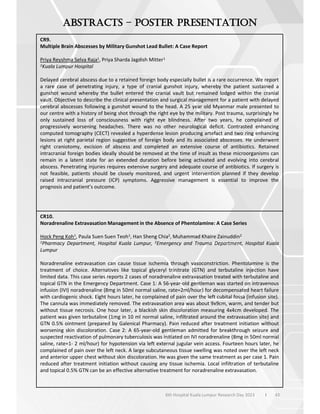
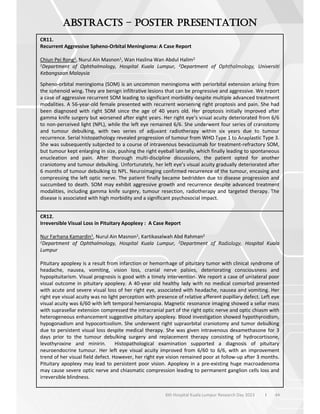
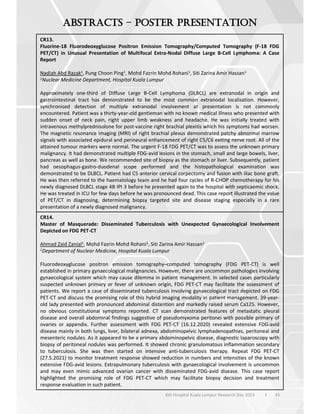
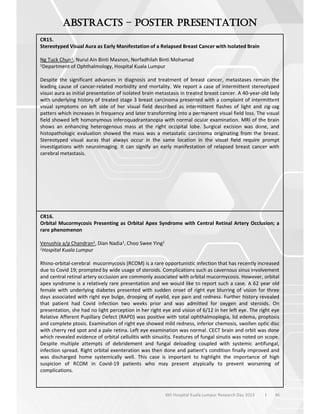
–
RD19.
Identification of Prognostic Gene Set Associated with Platelet Activation Pathway That are Predictive of
Severe Dengue
Jeyanthi Suppiah1, Saiful Safuan Md Sani2, Safiah Sabrina Hassan1,3,, Nur Iman Fasohah Nadzar1, Nor
Abidah Mohd Narawi2, Rozainanee Mohd Zain1, Ravindran Thayan1
1Institute for Medical Research, 2Hospital Kuala Lumpur, 3Clinical Research Malaysia
Thrombocytopenia is a hallmark in dengue virus (DENV) infection. Breakthrough studies have shown that
DENV binds to platelet receptors and hijacks their translational machinery to replicate but lacks in
demonstrating the impact to the platelets at the transcriptome level. This study aims to determine the
gene expression profile linked to the platelet activation pathway in dengue- infected patients. High-
throughput-RNA-sequencing was performed on total RNA and host platelet transcriptome profile was
successfully generated in 16 dengue patients recruited from Hospital Kuala Lumpur. Differentially
expressed genes (DEGs) and pathway enrichment data were filtered for identification of upregulated and
downregulated genes in the platelet activation pathway and compared them between healthy
individuals, non-severe dengue, and severe dengue patients. Ten genes related to platelet activation
were found to be expressed differently in individuals with dengue compared to healthy controls,
including MYLK2, MAPK12, CENPO, UQCC2, FAM98B, ADCY3, PLCG2, PRKCI, PIK3CG, and BTK. Among
these, the MYLK2 and BTK showed significant predictive values for severe dengue with five-fold
upregulation and -0.84-fold downregulation respectively, compared to non-severe cases. MYLK2 is a
myosin kinase exclusively expressed in adult skeletal muscle and prerequisite for ADP-induced platelet
aggregation. This clarifies the high expression in severe dengue cases manifested with bleeding.
Meanwhile, the downregulation of BTK may serve as a protective mechanism to reduce DENV binding to
platelets since it is crucial in signalling via the collagen receptor glycoprotein-VI. These genes could be
used as biomarkers to predict severe dengue and advance for point-of-care testing.
RD20.
Practice of Dietary Supplements and Its Influence Towards Treatment Adherence Among Diabetes
Mellitus Patients
Nor Hidayah Mohd Kamarulbhrin1, Anida Daud2, Noornazli Zahirah Abdullah2, Jamuna Sannassy3, Boey Yik
Ming3, Nabilah Mohamad4, Nurhazira Alang1
1Pejabat Kesihatan Putrajaya, 2Klinik Kesihatan Putrajaya Presint 9, 3Klinik Kesihatan Putrajaya Presint 18,
4Klinik Kesihatan Putrajaya Presint 14
Diabetes mellitus (DM) is a chronic disease that greatly impacts morbidity and mortality. Many patients
seek dietary supplements or other complementary and alternative medicine to improve their health and
treatment outcomes. Increasing awareness about the role of supplements has resulted in the extensive
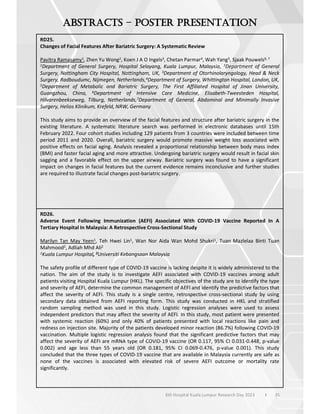
development of supplements and their consumption. Patients may underuse prescribed medication,
leading to issues with treatment adherence. The aim of this study was to explore the practice of dietary
supplements and its influence towards treatment adherence among patients with DM in Putrajaya Health
Clinics. The questionnaire used for this study consisted of 31 items that addressed three main areas:
social demographic characteristics, knowledge and attitude on dietary supplements and treatment
adherence. The questionnaire was distributed among 360 DM patients who received their medication at
the outpatient pharmacy under Putrajaya Health Clinics. Descriptive analysis was used for patients’
demographic background and statistical tests, including chi-square, t-test and Pearson’s correlation
coefficient, were used to explore relatedness between the studied variables. More than half of the
respondents preferred taking single supplement (n=247, 68.6%) rather than a combination of
supplements (n=113, 31.4%). Treatment adherence was not found to be associated with knowledge and
attitude towards supplements (p=0.248). However, there was a significant association between dietary
supplement intake and treatment adherence. Patients who took supplements, either single or
combination, showed lower treatment adherence (p=0.040). In conclusion, the practice of routine dietary
supplement intake may influence treatment adherence among DM patients in Putrajaya Health Clinics
and should be addressed during medication counselling sessions.
33
6th Hospital Kuala Lumpur Research Day 2023 l
–
RD21.
The association between warning signs and symptoms with severe dengue in adult patients
Muhammad Zhafri Bin Md Zakariah1, Saiful Safuan2, Norfarhana Binti Khairul Fahmy1, Ching Yee Ming1,
Shuwahida Binti Shuib1, Koay Bee Tee1, Jamiila Ismail1, Masita Binti Arip1, Norhazlin Binti Mustafa1
1Institute for Medical Research (IMR), NIH, 2Hospital Kuala Lumpur.
In Malaysia, dengue is a hyperendemic infectious disease. The difficulty in accurately identifying dengue
patients who may experience severe sickness is one of the difficulties in providing patient care. In this
study, we aim to investigate the association between severe dengue patients with the warning sign and
symptoms. The study involved 103 cases of severe dengue and 101 controls with non-severe dengue at
Hospital Kuala Lumpur. The data were analysed using statistical tests, and six warning signs and five
symptoms were identified in the study group. These included persistent vomiting or diarrhea, abdominal
pain, lethargy or confusion, tender liver, bleeding tendencies, high hematocrit levels with a rapid drop in
platelets, fever, body aches, nausea or vomiting, rashes, and low white blood cell count. In our study,
severe dengue patients generally had prolonged vomiting or diarrhoea (59.2%), abdominal discomfort
(33.0%), and elevated hematocrit with fast reduction in platelet (33.0%), though none of them were
statistically significant in association with severity of dengue. Fever is the most common symptom among
severe dengue patients (100%), followed by body pains (72.8%) and nausea or vomiting (65.0%),
however there is no significant differences were identified between the two groups (p > 0.05). In contrast
with other studies, our data demonstrate there is lack of correlation between warning signs and
symptoms in predicting severe dengue. Hence there is an additional value incorporating laboratory
diagnostics in overall management of severe dengue patients.
RD22.
Clinical Characteristics and Risk Factors of Progression to Severe Covid-19 Disease Among Patients
Admitted to Covid-19 Quarantine and Low-Risk Treatment Centre at the Malaysia Agro Exposition Park
Serdang (MAEPS) 2.0
Marzilawati Abd Rahman1, Ong Siaw Yen1, Yvonne Lim Poh Yoke2, Nurakmal Binti Baharum3, Poonam
Devi A/P Anoop Kumar4, Tunku Mahzuz bin Tunku Mutasim5, Muhamad Akmal bin Rosli6, Shaarwin
Rajaratnam7, Nurul Aishah Eliza Versluis binti Nurul Taufiq Anthonie1, Sarah Shaikh Abdul Karim6
1Hospital Kuala Lumpur, 2Klinik Aurora Bukit Jalil, 3Centre for Coordination Clinical Research Network,
4Hospital Serdang, 5Klinik Kesihatan Cheras, 6Hospital Sungai Buloh, 7Hospital Shah Alam
COVID-19 Quarantine and Low-Risk Treatment Centre MAEPS 2.0 was an effort by the Malaysian Ministry
of Health to accommodate the increasing number of COVID-19 cases. This study aims to identify clinical
characteristics and risk factors of progression to severe COVID-19 disease among patients initially
diagnosed with low-risk COVID-19 disease. This was a retrospective study involving patients above 12
years old admitted to our centre between October 1 till November 30, 2021. Patients' outcomes were
classified as those who did or did not progress to Category 4 COVID-19. A total of 8,419 patients' records
were analysed. Median age was 37 years. There were 8007 patients (95.1%) who received two doses of
vaccine. There were 7843 (93.1%) patients with Category 3 Covid-19, while 74 (0.9%) patients were
Category 4. There were 458 (5.4%) patients who progressed to Category 4 Covid-19. Unvaccinated
patients had sixfold higher risk (adjusted odds ratio (aOR) 6.23, P<0.001) compared to patients who
received two doses of Pfizer-BioNTech vaccine (aOR 1.09, P<0.001). Patients who received two doses of
Sinovac-CoronaVac vaccine had twofold risk of progression to Category 4 (aOR 2.44, P<0.001), compared
to two doses of Oxford-AstraZeneca vaccine which yielded similar risk as two doses of Pfizer-BioNTech
2 (aOR 2.53, P<0.001), presence of
respiratory symptoms (aOR 1.54, P<0.001), hypertension (aOR 1.41, P=0.007), diabetes mellitus (aOR
1.56, P=0.001), cardiovascular disease (aOR 1.62, P=0.037), increasing age and CRP level (P<0.001). The
findings in this study were comparable with other regional studies in Asia.
34
6th Hospital Kuala Lumpur Research Day 2023 l
–
RD23.
Outcomes of Methylprednisolone Use in Hospitalised COVID-19 Patients: A Retrospective Study
Nur Fatin Najwa Azemi1, Farida Hanim Islahudin2, Rahela Ambaras Khan1, Leong Chee Loon1
1Kuala Lumpur Hospital, 2Universiti Kebangsaan Malaysia
Recent trials have demonstrated benefits of corticosteroids including methylprednisolone in treatment of
coronavirus disease 2019 (COVID-19). However, data on optimal dose, duration and timing of
administration is limited. Retrospective cohort study on hospitalised, adult COVID-19 patients admitted
between June to August 2021 in general COVID-19 wards, treated with methylprednisolone. Clinical
outcomes evaluated include in-hospital mortality, thirty-day mortality, timing of initiation, trends of c-
reactive protein, total white blood cells and oxygen requirement at day-five and day-ten as well as
adverse events of methylprednisolone. Of 278 patients, 1 (0.4%) received weight-based dosing of
1mg/kg/day, 101 (36.3%) received weight-based dosing of 2mg/kg/day, 130 (46.8%) received fixed dosing
methylprednisolone 250mg/day and 46 (16.5%) received fixed dosing methylprednisolone 500mg/day.
There was a significant difference in in-hospital mortality rates following different methylprednisolone
doses (p = 0.023). In patients who received weight-based dose of either 1 or 2 mg/kg/day
methylprednisolone, 23 (22.5%) patients had in-hospital mortality. In those receiving fixed dose
250mg/day methylprednisolone, 42 (32.3%) patients had in-hospital mortality. In-hospital death and
discharge were the same in patients receiving fixed dose methylprednisolone of 500mg/day (n=18,
39.1%, respectively). On the other hand, there was no significant difference in 30-day mortality between
the three groups (p>0.05). The mean (SD) of timing of initiation of methylprednisolone was similar
between groups, 8.43 days (3.232). Clinical efficacy and safety were similar between the groups (p>0.05).
In hospitalised COVID-19 patients receiving methylprednisolone, the use of methylprednisolone up to
250mg/day is associated with lower in-hospital mortality without significant adverse effects.
RD24.
Effect of Aspirin on the International Normalized Ratio in Elderly Patients with Atrial Fibrillation on
Concurrent Warfarin Therapy
Pooncholai Poosary1, Tan Hung Kun2, Teo Kui Yuan1, Ahmad Riza Ahmad Nizam3
1Pharmacy, Hospital Tuanku Ampuan Najihah, 2Pharmacy Department, Klinik Kesihatan Salak Selatan,,
Pharmacy, Hospital Tuanku Ja’afar, Ministry of Health Malaysia
The initiation of aspirin in elderly patients with atrial fibrillation (AF) on warfarin therapy might influence
the International Normalized Ratio (INR). The aim of the study is to determine the changes in INR and the
prevalence of INR adherence before and after aspirin initiation in elderly patients with AF on warfarin
therapy. A cross-sectional study was conducted in the Anticoagulant Medication Therapy Adherence
Clinic in Hospital Tuanku Ampuan Najihah from January to March 2021. A total of 350 patients with AF
were screened for eligibility and we included 81 of them. A data collection form was used to collect their
demographic data and INR before and after aspirin initiation. Descriptive statistics summarised the
demographics and INR distribution. Paired t-test was used to assess the differences in INR before and
after aspirin initiation. Most of the patients were female (n=44, 54.3%), Malay (n=74, 91.4%), with a mean
age of 74.94±8.14 years old. There was a significant difference in the INR before and after aspirin
initiation, 2.27±0.79 and 3.59±0.70 respectively, P<0.001. Thirty-two patients (39.5%) achieved their
targeted INR range of 2.0 to 3.0, whereas more patients achieved subtherapeutic INR (40.7%) before
aspirin initiation. INR rose in 58 (71.6%) warfarin users after aspirin initiation. Moreover, INR increased
above 3.0 in 49 patients (60.5%) after aspirin use. This study showed that aspirin initiation increased the
INR significantly in elderly patients with AF on warfarin therapy. Thus, healthcare professionals should
monitor INR closely and make improvements in the patient counselling points checklist, to ensure optimal
health outcomes in elderly patients and prevent potential bleeding incidence.
35
6th Hospital Kuala Lumpur Research Day 2023 l
–
RD25.
Changes of Facial Features After Bariatric Surgery: A Systematic Review
Pavitra Ramasamy1, Zhen Yu Wong2, Koen J A O Ingels3, Chetan Parmar4, Wah Yang5, Sjaak Pouwels6, 7
1Department of General Surgery, Hospital Selayang, Kuala Lumpur, Malaysia, 2Department of General
Surgery, Nottingham City Hospital, Nottingham, UK, 3Department of Otorhinolaryngology, Head & Neck
Surgery, Radboudumc, Nijmegen, Netherlands,4Department of Surgery, Whittington Hospital, London, UK,
5Department of Metabolic and Bariatric Surgery, The First Affiliated Hospital of Jinan University,
Guangzhou, China, 6Department of Intensive Care Medicine, Elisabeth-Tweesteden Hospital,
Hilvarenbeekseweg, Tilburg, Netherlands,7Department of General, Abdominal and Minimally Invasive
Surgery, Helios Klinikum, Krefeld, NRW, Germany
This study aims to provide an overview of the facial features and structure after bariatric surgery in the
existing literature. A systematic literature search was performed in electronic databases until 15th
February 2022. Four cohort studies including 129 patients from 3 countries were included between time
period 2011 and 2020. Overall, bariatric surgery would promote massive weight loss associated with
positive effects on facial aging. Analysis revealed a proportional relationship between body mass index
(BMI) and faster facial aging and more attractive. Undergoing bariatric surgery would result in facial skin
sagging and a favorable effect on the upper airway. Bariatric surgery was found to have a significant
impact on changes in facial features but the current evidence remains inconclusive and further studies
are required to illustrate facial changes post-bariatric surgery.
RD26.
Adverse Event Following Immunization (AEFI) Associated With COVID-19 Vaccine Reported In A
Tertiary Hospital In Malaysia: A Retrospective Cross-Sectional Study
Marilyn Tan May Yeen1, Teh Hwei Lin1, Wan Nor Aida Wan Mohd Shukri1, Tuan Mazlelaa Binti Tuan
Mahmood2, Adliah Mhd Ali2
1Kuala Lumpur Hospital, 2Universiti Kebangsaan Malaysia
The safety profile of different type of COVID-19 vaccine is lacking despite it is widely administered to the
nation. The aim of the study is to investigate AEFI associated with COVID-19 vaccines among adult
patients visiting Hospital Kuala Lumpur (HKL). The specific objectives of the study are to identify the type
and severity of AEFI, determine the common management of AEFI and identify the predictive factors that
affect the severity of AEFI. This study is a single centre, retrospective cross-sectional study by using
secondary data obtained from AEFI reporting form. This study was conducted in HKL and stratified
random sampling method was used in this study. Logistic regression analyses were used to assess
independent predictors that may affect the severity of AEFI. In this study, most patient were presented
with systemic reaction (60%) and only 40% of patients presented with local reactions like pain and
redness on injection site. Majority of the patients developed minor reaction (86.7%) following COVID-19
vaccination. Multiple logistic regression analysis found that the significant predictive factors that may
affect the severity of AEFI are mRNA type of COVID-19 vaccine (OR 0.117, 95% CI 0.031-0.448, p-value
0.002) and age less than 55 years old (OR 0.181, 95% CI 0.069-0.476, p-value 0.001). This study
concluded that the three types of COVID-19 vaccine that are available in Malaysia currently are safe as
none of the vaccines is associated with elevated risk of severe AEFI outcome or mortality rate
significantly.
36
6th Hospital Kuala Lumpur Research Day 2023 l
–
RD27.
Pandemic Era Cross-Sectional Study on Impaired Work Productivity due to Sickness Among Security
Guards with Musculoskeletal Pain and Other Contributing Factors
Nur Faezah Che Mat1, Hanizah Mohd Yusoff2
1Klinik Kesihatan Putrajaya Presint 18, Jabatan Kesihatan Wilayah Persekutuan Kuala Lumpur dan
Putrajaya, 2Department of Community Health, Faculty of Medicine, Universiti Kebangsaan Malaysia
Medical Centre, Kuala Lumpur
Impaired work productivity within the context of sickness absenteeism (absent from work) and
presenteeism (present but unwell) reflects employee’s wellbeing. In view of their working nature,
security guards are exposed to physical and ergonomic hazards. They are vulnerable to develop
musculoskeletal (MS) pain. Limited data available on this matter. We aimed to study the impaired work
productivity and associated contributing factors among local public university security guards with MS
pain. A cross-sectional study was conducted in three campuses of Universiti Kebangsaan Malaysia (UKM)
between March and October 2020 involving 83 security guards with MS pain. Validated set of self-
reporting questionnaires including Nordic Musculoskeletal Questionnaire; Depression, Anxiety and Stress
Scale; Stanford Presenteeism Scale-6; and Penilaian Keterukan Stress Kerja were adopted. Statistical
evaluations using descriptive, bivariate, and multiple logistic regression analyses were applied
accordingly. Prevalence of absenteeism and presenteeism among security guards with MS pain was
25.3% and 42.2% respectively. Majority had multiple area of body pain (68.7%). About 33.7% of
respondents required medication for pain relief and were found to have 9.561 higher odds of developing
absenteeism. Emotional stress observed in 25.3% of respondents which was a significant associated
factor. Odds of having absenteeism and presenteeism among security guards with stress were 5.035 and
3.904 times of that of non-stress security guards. Those who worked for >10 years had 0.291 lower odds
of developing presenteeism. Significant percentage of security guards with MS pain reported
absenteeism and presenteeism. Pain medication use, emotional stress and length of services were
important associated factors.
RD28.
Experience in Using Intravenous (IV) Iron: A Retrospective Study on Effectiveness of IV Iron in Medical
Ward Tertiary Hospital
Merina Aw Kar Ling1, Hayati Alwani Yahaya1, Loh Weng Khean2, Nurul Ain Mohd Tahir3, Chandini Menon
Premakumar3
1Kuala Lumpur Hospital, 2Ampang Hospital, 3University Kebangsaan Malaysia
Oral iron is the first-line treatment for Iron Deficiency Anaemia (IDA). Given the proven safety and
efficacy of intravenous (IV) iron in various studies, the current practice needs to be revised. This study
aimed to evaluate the effectiveness of IV iron used in IDA in a medical setting. A single-centre
retrospective study was conducted from January to December 2021. All adult patients receiving IV iron in
the medical wards of Hospital Kuala Lumpur (HKL) were conveniently sampled in this study. For efficacy
outcome, the Hb and MCV levels were increased significantly from 8.283 g/dL (± 1.124) to 10.532 g/dL (±
1.760) and 77.305 fL (± 10.66) to 82.189 fL (± 9.044), respectively. 49.2% of patients achieved the
increment of Hb 2 g/dL, and 13.3% of the patient’s achieved normalization of Hb. There are only 2.8% of
patients experience adverse events. There are four significant predictors that will affect the use of IV iron
to achieve an increment of Hb 2 g/dL which were baseline Hb (aOR 0.541; 95% CI 0.348 – 0.843),
baseline ferritin 30 µg/dL (aOR 3.059; 95% CI 1.136 – 8.240), diabetes mellitus (aOR 0.317; 95% CI 0.130
– 0.772) and blood disorder (aOR 5.195; 95% CI 1.024 – 26.358). IV iron significantly increases the Hb and
MCV levels without causing significant adverse events. The predictors for achieving increment Hb 2 g/dL
were lower baseline Hb, baseline ferritin 30 µg/dL and underlying blood disorder. IV iron is a safe and
effective option to treat IDA in medical patients.
37
6th Hospital Kuala Lumpur Research Day 2023 l
–
RD29.
A study to Evaluate Clinical Judgement among Nurses in Public Hospital, Malaysia using SBARe tool: A
Preliminary Research
Azliha Minai Rajab1, Jheffany Yazid2, Aisyahton Suhaimi1, Zahidah Idris1, Yuzana Muhd Yusop3
1Nursing Unit, Hospital Kuala Lumpur, Jheffany Yazid, Occupational Health and Safety unit, Hospital Kuala
Lumpur, 3University Sultan Zainal Abidin, Kuala Nerus, Terengganu
Communication failure is a leading cause of patient harm and complaints against healthcare
services. Aim: To evaluate clinical judgment among nurses using the SBARe tool, explore their
views or comments towards using it during report handovers, understand its applicability in their routine,
and recognize the level of communication, knowledge, and readiness among nurses in using SBARe. This
qualitative study utilized the narrative method and the purposive sampling technique. The sample
included 15 nurse leaders who communicated using SBARe in Malaysia's largest public hospital. In-depth
interviews were conducted, and data were analyzed using the Thematic Analysis approach and ATLAS ti
for coding and theme identification. The study found that nurses in Malaysian public hospitals using the
SBARe tool were effective and efficient in clinical decision-making. The tool improved their analysis of
patient information, prioritized care, and informed their decisions. Nurses believed SBARe was efficient,
time-saving, and practical, and could improve communication and preparedness during report
handovers. The tool's results were simple, accurate, and compact, ensuring essential information
exchange and minimizing errors. This study recommends that the SBARe tool should be implemented in
all hospitals and continuously trained for nurses. It can optimize resource utilization and improve patient
outcomes by improving clinical decision-making, reducing errors, and saving time during report
handovers. Nurses' reaction to SBARe is a recommendation that should be implemented. All nurses
should use it because it's simple and straightforward, rather than writing lengthy reports.
RD30.
Measure of Physician Workload in Hospital Setting: A Narrative Review
Karina Koh¹, Lee Jen Ven¹, Varaalakshmy Gokilavanan¹, Aina Waheeda Mohamed¹, Siti Zulfa Zulfikli²,
Azahirafairud Abdul Rahim², Saiful Safuan Md Sani¹², Cheah Wee Kooi3, Shaun Lee Wen Huey4.
1Clinical Research Centre, Hospital Kuala Lumpur; 2Department of Medicine, Hospital Kuala Lumpur,
3Medicine, Clinical Research Centre of Taiping Hospital, Perak, 4Faculty of Pharmacy, Monash University
Currently there is a maldistribution of doctors in Malaysia. There is a need to equally distribute doctors to
hospitals according to workload requirements. Currently there is no standard tool to measure physician
workload. This study aims to identify the methods used to determine physician workload in hospital
settings. Literature searches of Medline, Emerald and Proquest were conducted from January 1, 2000 to
22 November 2022. Inclusion criteria for this review are physicians working in non-surgical based
specialty, hospital setting, measuring physician workload, any study design and in English language.
Eligible studies provided both objective and subjective measurements of physician workload. This review
was conducted in accordance with the PRISMA guidelines. Eighty-two studies were included for full text
review. Majority (69%) of current literature uses physician related measures to measure workload. In this
subgroup, the most common measure used is mental workload and perceived workload of physicians
(42%), followed by number of hours worked (40%). Patient related measures were also used as a proxy of
physician workload and the most commonly used measure is patient volume (75%) which is rather
intuitive. A standard tool to measure physician workload is still lacking. The availability of different tools
gives users the flexibility to tailor suits the measurement according to their needs and resources. Even
though majority of studies utilizes objective measures, subjective measures of physician workload should
not be disregarded.
38
6th Hospital Kuala Lumpur Research Day 2023 l
– POSTER PRESENTATION
RD31.
The Prevalence and Influencing Factors for Compassion Fatigue Among Nurses in Hospital Kuala
Lumpur: A Cross-Sectional Study
Tham Sin Wan1,2, Victor Hoe Chee Wai Bin Abdullah1, Mahmoud Danaee1
1University of Malaya, 2National Institutes of Health
Nursing is a caring profession where compassion is their core value. They may experience compassion
fatigue (CF) when providing patient care, which can affect their well-being and job performance. This
study aimed to determine the prevalence and factors associated with CF among nurses in Hospital Kuala
Lumpur (HKL). This research was a cross-sectional study among 174 nurses in HKL recruited via universal
sampling. Data were collected through an online survey which includes sociodemographic and the Malay
version of the Professional Quality of Life Scale (ProQOL-M). Data analysis consisted of descriptive
statistics, bivariate analysis, and linear regression at a 95% significance level using SPSS version 24. Of 174
nurses, the majority were female (93.1%), Malay (89.1%), married (76.4%), had work experience of more
than ten years (47.1%) and cared for COVID patients (67.2%). There were 37.9% of nurses experienced
moderate CF. The factors that associated with CF were age -.024, p = <0.001), work experience -
.140, p = 0.002), care for COVID patient -.276, p = 0.005), shift -.361, p = <0.001), position -.435,
p = 0.003) and traumatic event in past 12 month -.242, p = 0.010). One-third of nurses in HKL
experienced CF. Various factors contributed to CF. The hospital administrators need to explore and plan
strategies to create an excellent working atmosphere and safeguard the mental health of nurses in the
hospital. In turn, this can improve human resource management and achieve a sustainable quality of
patient care.
RD32.
Outcome And Safety of Shorter Versus Longer Regimen of Drug Resistant Tuberculosis Treatment in A
Tertiary Care Respiratory Center in Malaysia
Nager Devi Vampanan1, Shamala Balan2, Zamzurina Abu Bakar3, Lim Suat Yee3, Nurul Nabihah Hilmiyah3
1Kuala Lumpur Hospital, 2Tengku Ampuan Rahimah Hospital, 3National Respiratory Institute
Drug-resistant tuberculosis (DR-TB) remains a global threat in TB control. There is a scarcity of evidence
on the comparison of outcomes and safety between shorter and longer regimens for DR-TB treatment. A
retrospective cross-sectional study was conducted among adult DR-TB patients attending respiratory
clinic at the National Respiratory Centre from January 2017 to January 2021. Medical records were
screened for evaluation of DR-TB treatment outcome which were classified as successful outcomes and
unsuccessful outcomes. Safety profile was assessed from adverse drug reaction (ADR) reports. In total, 81
patients aged 18 to 68 years old (41.1±14.1) were included. The DR-TB treatment consists of 55.6%
(n=45) patients in longer and 44.4% (n=36) patients in shorter regimen. Overall, 24.7% (n=20) and 17.3%
(n=14) patients were categorised as having successful outcomes in the longer and shorter regimen,
respectively. About 79% (n=64) of patients experienced at least one ADR related to DR-TB treatment
resulting in 82 ADR cases. Most of the ADRs (53.1%, n=43) were reported among patients in the longer
regimen. Kanamycin was most commonly suspected to cause ADR. The causality assessments were
certain in 47.56% (n=39) cases, probable in 23.2% (n=19) cases and possible in 29.3% (n=24) cases.
Patients on the longer regimen of DR-TB treatment reported a greater rate of successful outcomes
despite experiencing a higher number of ADRs. Identification of risk factors associated with ADR among
patients on the longer regimen is essential in order to optimize the outcome and safety of DR-TB
treatment.
39
6th Hospital Kuala Lumpur Research Day 2023 l
–
CR1.
Edwardsiella hoshinae an unusual human pathogen isolated in a case of bacteraemia with acute
cholangitis
Nurhafiza Ishak1, Intan Suriani Safie1, Liang Shang Zhi1
1Microbiology Unit, Department of Pathology, Hospital Kuala Lumpur, Malaysia
Edwardsiella hoshinae has primarily been isolated from avians and reptiles. Its role as a human pathogen
has not been established. We report a case of bacteraemia in acute cholangitis patient caused by E.
hoshinae. 75-years-old gentleman with no co-morbid presented with fever and abdominal pain for 1
week. He was jaundice with right upper hypochondriac region tenderness. Blood investigations revealed
leucocytosis and hyperbilirubinemia. The liver enzymes and cancer antigen 19-9 were elevated. Blood
culture grew a gram-negative bacillus, non-lactose fermenter organism with fermentation of glucose,
sucrose, and lactose without hydrogen sulfide (h2s) formation. It was identified as Edwardsiella hoshinae
by Vitek GN and MALDI-TOF. The isolate was susceptible to majority of antimicrobial tested for
enterobacterales panel. The patient was treated with intravenous ceftriaxone for bacteraemia with acute
cholangitis. He had several radiological modality investigations to rule out the possibility hepatobiliary
malignancy. Edwardsiella spp. are gram-negative bacteria belongs to Enterobacteriaceae. Among three
Edwardsiella species that are known to exist, Edwardsiella hoshinae has not been established to cause
infections in human. Generally, gastroenteritis is the most frequently reported manifestation caused by
Edwardsiella tarda that known to be pathogenic for humans. Extraintestinal infection including
bacteraemia and cholangitis have rarely been reported. To the best of our knowledge, we described the
first case of bacteraemia due E.hoshinae in acute cholangitis patient with possibility of hepatobiliary
malignancy. Little is known about E. hoshinae therefore, the clinical spectrum, diagnosis, management,
and prognosis of infections due to E. hoshinae in human remain to be determined.
CR2.
Ocular Adnexal Mantle Cell Lymphoma: An Uncommon Tumour at a Common Site
Siti Aeisyah Ayob1, Kala Sumugam1, Asmawiza Awang1
1Kuala Lumpur Hospital
Eyelid mass is a common presentation in all levels of healthcare. The possible condition may be from an
array of diagnoses, from benign to the detrimental forms of malignancies. Detailed history including the
onset, duration, presence of pain, drop in visual acuity, associated symptoms followed by a
comprehensive systemic examination aids in identifying the correct diagnosis and preventing treatment
delay. A healthy 50-year-old man presented to the eye clinic with a 5 months history of painless bilateral
upper lid swelling. He denied having visual disturbances, fever, night sweats or weight loss. Examination
revealed multiple glandular enlargements in his submandibular, cervical and inguinal regions. Computed
Tomography (CT) scan showed a widespread of enlarged matted lymph nodes. Tumour marker CA-125
was also raised. Preliminary diagnosis was lymphoproliferative disorder, however, disseminated
tuberculosis and other malignancies must be excluded. Incisional biopsy of the lacrimal gland then
revealed SOX11 positive malignant lymphoid cells with Ki67 30% proliferative index, suggestive of
aggressive Mantle Cell Lymphoma (MCL). Upon establishment of diagnosis, he was referred to the
Haematology Department for further treatment. Malignant lacrimal gland lymphoma is rare, constituting
about 7-26% of ocular adnexal lymphomas. MCL, a form of B cell non Hodgkin lymphoma, is a rare
subtype accounting for about 11% of cases. Diagnosis is challenging due to the morphologic variants and
clinical presentations. Bilateral lid masses should raise the concern of malignancy especially when
associated with other systemic findings. Timely diagnosis is vital in order to initiate proper treatment.
40
6th Hospital Kuala Lumpur Research Day 2023 l
–
CR3.
A Case of Disseminated Herpes Zoster Infection
Yun Fei Liang1, Mardhiah Binti Hassan1
1Hospital Sultanah Nora Ismail Batu Pahat
Herpes zoster usually occurs unilaterally within the distribution of a single cranial or spinal sensory
nerve. Disseminated herpes zoster infection is defined as at least 20 skin lesions in multiple dermatomes.
Severe disseminated Varicella-Zoster-Virus (VZV) disease can be defined by encephalitis, hepatitis,
pneumonitis and/or diffuse rash over the body. Severe disease usually occurs in immune compromised
individual. A 61 years old gentleman, presented with painful skin lesions over the face for 3 days. It
started from periorbital and frontal region and then spread to nose region. Physical examination showed
coalesced skin eruptions forming large ulcers with crusted lesion and pustules. He was treated as Herpes
Zoster Ophthalmicus (HZO), started on oral acyclovir. On day 2 of admission, he became delirious. Oral
acyclovir was switched to intravenous acyclovir to cover for VZV encephalitis. Lumbar puncture was done,
initial CSF investigation showed raised protein level with normal cell count. On day 3 of admission, he
regained full consciousness and noted to have new skin lesion over anterior chest, thigh and forearm. He
was tested negative for HIV, and the result of polymerase chain reaction of cerebrospinal fluid (CSF) came
back later reported positive for VZV. He was diagnosed as severe disseminated VZV infection. Herpes
zoster is most often diagnosed clinically by the classic appearance of a vesicular dermatomal eruption.
However, in disseminated herpes zoster disease, atypical skin lesion with no dermatomal distribution can
be seen. Severe disease may be seen in immunocompetent host, although most cases occur in the
immune compromised.
CR4.
A Case of Barium Contrast Aspiration
Yun Fei Liang1, Hariz Ikhwan Bin Abd Rahman1, Sarina Binti Salim1
1Hospital Sultanah Nora Ismail Batu Pahat
Barium swallow study is used to evaluate disordered swallowing. It was reported to complicate with the
aspiration of barium contrast. In the acute phase, most of the patients were relatively asymptomatic,
despite life threatening condition that required intubation or even resulted in death are also well
documented. For barium contrast aspiration survivors, long-term prognosis is generally favourable due to
the inert character of barium sulphate, even though residual barium may be seen in chest radiograph. It
was also reported that, barium aspiration caused fibrosis changes in high resolution computed
tomography 1 year after the aspiration. A 75 years old gentleman, presented with swallowing difficulty 3
months associated with hoarseness of voice and loss of weight. He was arranged for barium swallow
study. Unfortunately, during the test, he had a choking episode and aspirated barium contrast. No
immediate discomfort such as shortness of breath or chest pain. Chest radiograph done post incident
showed radio opaque material in the trachea and left sided airways. He was admitted to ward for
observation. He remained well the next few days, and was discharged from hospital after completed one
course of prophylactic antibiotics. Barium contrast aspiration is a rare but well-recognized complication of
barium swallow study. This case report serves as a reminder to health care provider to include this
condition as potential complication when getting consent from patient for this study.
41
6th Hospital Kuala Lumpur Research Day 2023 l
–
CR5.
Disseminated Histoplasmosis, A Case from Non-endemic Locality
Intan Suriani Safie1, Nurzam Suhaila Che Hussin1
1 Kuala Lumpur Hospital
Histoplasmosis is an endemic fungal infection in United States. It caused by the environmental fungus,
Histoplasma capsulatum. A 47-year-old Malay male from Kuala Lumpur presented with five months
history of worsening dysphagia, odynophagia, intermittent fever and constitutional symptoms. He is a
chronic smoker and newly diagnosed with diabetes mellitus. Inflammatory parameters were raised.
Direct laryngoscopy showed moth eaten epiglottis with irregular fungating lesion. Histopathological
examination (HPE) of laryngeal tissue showed acute on chronic granulomatous inflammation likely fungal
infection. Budding yeasts were identified. No acid-fast bacilli were demonstrable. Tuberculosis (TB)
investigations were negatives. Histoplasma capsulatum was subsequently isolated from laryngeal tissue
culture. Computed tomography of thorax, abdomen and pelvis (CT TAP) showed the involvement of
larynx, lungs, spleen and lymph node. Intravenous (IV) amphotericin B was completed for two weeks and
the primary symptoms alleviated. The patient was discharged with oral itraconazole for one year
duration. However, the patient defaulted for subsequent follow-up. This is a disseminated form of
histoplasmosis in a middle-aged patient from non-endemic locality without significant risk factors. While
risk of exposure could not be determined, previous cases had reported the high inoculum of conidia
inhalation could be the cause. Recent published reports highlighted diabetes mellitus and smoking as risk
factors for the infection. Chronic granulomatous inflammation urged for further investigations to rule out
tuberculosis due to its endemicity in our country. The geographical distribution and risk factors for
Histoplasmosis have evolved. It might be under-reported worldwide. Thus, high suspicion of
histoplasmosis is required when considering fungal diagnoses.
CR6.
A Recurrent Case of Melioidosis from Non-endemic Locality
Intan Suriani Safie1, Nurzam Suhaila Che Hussin1
1 Kuala Lumpur Hospital
Melioidosis is an emerging tropical infectious disease caused by Burkholderia pseudomallei. A 53-year-old
male security guard with uncontrolled diabetes mellitus residing in Kuala Lumpur. He had recurrent
localized right elbow septic arthritis following history of fall at work area. Burkholderia pseudomallei was
recovered from pus culture sent following arthrotomy washout. No significant exposure could be elicited.
Radiologic investigation revealed non-liquefied splenic abscesses. He completed antibiotics accordingly.
Serial radiologic assessment for splenic abscesses showed reducing in size leaving only minimal residual
abscesses. The patient was clinically well and discharged. Fifteen months later, he presented with one
week history of intermittent high fever and productive cough. Blood culture was positive in keeping with
Burkholderia pseudomallei bacteremia. CT thorax, abdomen and pelvis showed the involvement of liver,
spleen, prostate, left kidney and bone. Treatment was given accordingly. The patient survived. This
report highlighted a case of recurrent melioidosis from non-endemic locality in Malaysia despite
adequate dose and duration of antimicrobial treatment and resolution of symptoms had been achieved.
In Malaysia, the reported rate of culture-confirmed clinical recurrence varied from 2.6% to 19%.
Recurrent melioidosis can result either from relapse due to failure to clear an infection or from
reinfection with a new B. pseudomallei strain. However, the proportion of relapse and reinfection has not
been specified to see the relatedness with the pathogenesis, risk factors and management. A
comprehensive national surveillance is needed to determine the cause of recurrence as relapse and re-
infection have different implications for disease control and clinical management.
42
6th Hospital Kuala Lumpur Research Day 2023 l
–
CR7.
Imaging of Hepatobiliary Langerhans Cell Histiocytosis - The Confusing Mimicker
Ng Chee Guan1, Cheng Quo Liang1, Che Zubaidah Che Daud1, Teh Kok Hoi2, Mohd Yusran Othman3, Siah
Hui Hui4
1Radiology Department, Hospital Tunku Azizah, 2Paediatric Oncology Department, Hospital Tunku Azizah,
3Paediatric Surgical Department, Hospital Tunku Azizah, 4Pathology Department, Hospital Kuala Lumpur
Langerhans Cell Histiocytosis (LCH) is a rare paediatric preponderance disease. It is due to abnormal
proliferation and infiltration of Langerhans Cells expressing CD1a, CD207 (Langerin) and S-100 protein, in
one or multiple organs. Due to its heterogeneous spectrum of presentation, it often poses diagnostic
challenge to both clinician and radiologist. We describe a case of paediatric Hepatobiliary LCH with
uncommon imaging findings. A 3-year-old boy presented with jaundice. Initial laboratory investigation
showed cholestasis features. Subsequent ultrasound abdomen and Computed Tomography (CT) abdomen
revealed a portal hepatis mass with periportal extension. The child underwent tumour excision and Roux-
En-Y Hepaticojejunostomy. Histopathological examination (HPE) confirmed Langerhans Cell Histiocytosis,
positive for CD1a, S100, CD68, Cyclin D1. Further imaging showed a lytic skull bone lesion. Currently, he is
undergoing chemotherapy. Radiological features of hepatobiliary LCH vary in different histological
phases, which include proliferative, granulomatous, xanthomatous and fibrous phases. The commonly
described imaging features in early phase are periportal band-like or nodular areas in the liver due to
periportal inflammatory changes and liver parenchymal nodule. In later phase, features of periductal
fibrosis, micronodular biliary cirrhosis and sclerosing cholangitis are more evident. Presence of portal
hepatis mass in this case made the diagnosis challenging as it is more frequently seen in diseases like
Rhadomyosarcoma, Cholangiocarcinoma and Lymphoma. In summary, imaging features of LCH might not
be classical as described in the literature. Recognition of hepatobiliary involvement is important, as it is a
‘risk organ’ in multisystem LCH.
CR8.
Ghosal Hematodiaphyseal Dysplasia: A Rare Cause of Skeletal Dysplasia with Early Onset Cytopenia
Ong Swee Gaik1, Ding Hui Jen1, Chan Mei Yan2, Loh Weng Khean3, Maizatul Jamny Mahmood4
1Department of Medicine, Hospital Kuala Lumpur, 2Department of Genetics, Hospital Kuala Lumpur,
3Department of Hematology, Hospital Ampang, 4Department of Radiology, Hospital Kuala Lumpur
Ghosal hematodiaphyseal dysplasia (GHDD) is a rare autosomal recessive disorder characterised by early
onset cytopenia and sclerosing bone dysplasia involving predominantly the long bones. Diagnosis is
established with molecular genetic testing by whole exome sequencing (WES). This case highlights the
importance of careful history taking and physical examination which led to the recognition of skeletal
dysplasia, thus prompting a genetic consult and the establishment of the diagnosis. A 21-year-old Indian
male from nonconsanguineous parents was referred for evaluation of ankle pain. History of cytopenia
since early childhood, knock-knee deformity, bony enlargement of the left ankle, and radiographic
findings of bilateral diaphyseal dysplasia with sclerosis of the long bones led to a suspicion of a genetic
condition. Mutational analysis by WES confirmed the diagnosis of GHDD. Our patient had anemia and
thrombocytopenia which was treated with danazol with good response. This is the first reported case of
GHDD in Malaysia where diagnosis was confirmed by WES. GHDD was first described by Ghosal et al. in
1988, and subsequently found to be a consequence of pathogenic variants in the TBXAS1 gene. The
ethnicity of our patient was consistent with the majority of GHDD cases reported, suggesting GHDD to be
more common among South Asians. Apart from corticosteroids, danazol can be considered an alternative
therapeutic option in the management of hematological abnormalities in GHDD. Although GHDD is a rare
disorder, physicians must be cognizant of this condition in patients with skeletal dysplasia and early-onset
cytopenia.
43
6th Hospital Kuala Lumpur Research Day 2023 l
–
CR9.
Multiple Brain Abscesses by Military Gunshot Lead Bullet: A Case Report
Priya Reyshma Selva Raja1, Priya Sharda Jagdish Mitter1
1Kuala Lumpur Hospital
Delayed cerebral abscess due to a retained foreign body especially bullet is a rare occurrence. We report
a rare case of penetrating injury, a type of cranial gunshot injury, whereby the patient sustained a
gunshot wound whereby the bullet entered the cranial vault but remained lodged within the cranial
vault. Objective to describe the clinical presentation and surgical management for a patient with delayed
cerebral abscesses following a gunshot wound to the head. A 25 year old Myanmar male presented to
our centre with a history of being shot through the right eye by the military. Post trauma, surprisingly he
only sustained loss of consciousness with right eye blindness. After two years, he complained of
progressively worsening headaches. There was no other neurological deficit. Contrasted enhancing
computed tomography (CECT) revealed a hyperdense lesion producing artefact and two ring enhancing
lesions at right parietal region suggestive of foreign body and its associated abscesses. He underwent
right craniotomy, excision of abscess and completed an extensive course of antibiotics. Retained
intracranial foreign bodies ideally should be removed at the time of insult as these microorganisms can
remain in a latent state for an extended duration before being activated and evolving into cerebral
abscess. Penetrating injuries requires extensive surgery and adequate course of antibiotics. If surgery is
not feasible, patients should be closely monitored, and urgent intervention planned if they develop
raised intracranial pressure (ICP) symptoms. Aggressive management is essential to improve the
prognosis and patient’s outcome.
CR10.
Noradrenaline Extravasation Management in the Absence of Phentolamine: A Case Series
Hock Peng Koh1, Paula Suen Suen Teoh1, Han Sheng Chia2, Muhammad Khaire Zainuddin2
1Pharmacy Department, Hospital Kuala Lumpur, 2Emergency and Trauma Department, Hospital Kuala
Lumpur
Noradrenaline extravasation can cause tissue ischemia through vasoconstriction. Phentolamine is the
treatment of choice. Alternatives like topical glyceryl trinitrate (GTN) and terbutaline injection have
limited data. This case series reports 2 cases of noradrenaline extravasation treated with terbutaline and
topical GTN in the Emergency Department. Case 1: A 56-year-old gentleman was started on intravenous
infusion (IVI) noradrenaline (8mg in 50ml normal saline, rate=2ml/hour) for decompensated heart failure
with cardiogenic shock. Eight hours later, he complained of pain over the left cubital fossa (infusion site).
The cannula was immediately removed. The extravasation area was about 9x9cm, warm, and tender but
without tissue necrosis. One hour later, a blackish skin discoloration measuring 4x4cm developed. The
patient was given terbutaline (1mg in 10 ml normal saline, infiltrated around the extravasation site) and
GTN 0.5% ointment (prepared by Galenical Pharmacy). Pain reduced after treatment initiation without
worsening skin discoloration. Case 2: A 65-year-old gentleman admitted for breakthrough seizure and
suspected reactivation of pulmonary tuberculosis was initiated on IVI noradrenaline (8mg in 50ml normal
saline, rate=1- 2 ml/hour) for hypotension via left external jugular vein access. Fourteen hours later, he
complained of pain over the left neck. A large subcutaneous tissue swelling was noted over the left neck
and anterior upper chest without skin discoloration. He was given the same treatment as per case 1. Pain
reduced after treatment initiation without causing any tissue ischemia. Local infiltration of terbutaline
and topical 0.5% GTN can be an effective alternative treatment for noradrenaline extravasation.
44
6th Hospital Kuala Lumpur Research Day 2023 l
–
CR11.
Recurrent Aggressive Spheno-Orbital Meningioma: A Case Report
Chiun Pei Rong1, Nurul Ain Masnon1, Wan Haslina Wan Abdul Halim2
1Department of Ophthalmology, Hospital Kuala Lumpur, 2Department of Ophthalmology, Universiti
Kebangsaan Malaysia
Spheno-orbital meningioma (SOM) is an uncommon meningioma with periorbital extension arising from
the sphenoid wing. They are benign infiltrative lesions that can be progressive and aggressive. We report
a case of aggressive recurrent SOM leading to significant morbidity despite multiple advanced treatment
modalities. A 56-year-old female presented with recurrent worsening right proptosis and pain. She had
been diagnosed with right SOM since the age of 40 years old. Her proptosis initially improved after
gamma knife surgery but worsened after eight years. Her right eye’s visual acuity deteriorated from 6/6
to non-perceived light (NPL), while the left eye remained 6/6. She underwent four series of craniotomy
and tumour debulking, with two series of adjuvant radiotherapy within six years due to tumour
recurrence. Serial histopathology revealed progression of tumour from WHO Type 1 to Anaplastic Type 3.
She was subsequently subjected to a course of intravenous bevacizumab for treatment-refractory SOM,
but tumour kept enlarging in size, pushing the right eyeball laterally, which finally leading to spontaneous
enucleation and pain. After thorough multi-discipline discussions, the patient opted for another
craniotomy and tumour debulking. Unfortunately, her left eye’s visual acuity gradually deteriorated after
6 months of tumour debulking to NPL. Neuroimaging confirmed recurrence of the tumour, encasing and
compressing the left optic nerve. The patient finally became bedridden due to disease progression and
succumbed to death. SOM may exhibit aggressive growth and recurrence despite advanced treatment
modalities, including gamma knife surgery, tumour resection, radiotherapy and targeted therapy. The
disease is associated with high morbidity and a significant psychosocial impact.
CR12.
Irreversible Visual Loss in Pituitary Apoplexy : A Case Report
Nur Farhana Kamardin1, Nurul Ain Masnon1, Kartikasalwah Abd Rahman2
1Department of Ophthalmology, Hospital Kuala Lumpur, 2Department of Radiology, Hospital Kuala
Lumpur
Pituitary apoplexy is a result from infarction or hemorrhage of pituitary tumor with clinical syndrome of
headache, nausea, vomiting, vision loss, cranial nerve palsies, deteriorating consciousness and
hypopituitarism. Visual prognosis is good with a timely intervention. We report a case of unilateral poor
visual outcome in pituitary apoplexy. A 40-year old healthy lady with no medical comorbid presented
with acute and severe visual loss of her right eye, associated with headache, nausea and vomiting. Her
right eye visual acuity was no light perception with presence of relative afferent pupillary defect. Left eye
visual acuity was 6/60 with left temporal hemianopia. Magnetic resonance imaging showed a sellar mass
with suprasellar extension compressed the intracranial part of the right optic nerve and optic chiasm with
heterogeneous enhancement suggestive pituitary apoplexy. Blood investigation showed hypothyroidism,
hypogonadism and hypocortisolism. She underwent right supraorbital craniotomy and tumor debulking
due to persistent visual loss despite medical therapy. She was given intravenous dexamethasone for 3
days prior to the tumour debulking surgery and replacement therapy consisting of hydrocortisone,
levothyroxine and minirin. Histopathological examination supported a diagnosis of pituitary
neuroendocrine tumour. Her left eye visual acuity improved from 6/60 to 6/6, with an improvement
trend of her visual field defect. However, her right eye vision remained poor at follow-up after 3 months.
Pituitary apoplexy may lead to persistent poor vision. Apoplexy in a pre-existing huge macroadenoma
may cause severe optic nerve and chiasmatic compression leading to permanent ganglion cells loss and
irreversible blindness.
45
6th Hospital Kuala Lumpur Research Day 2023 l
–
CR13.
Fluorine-18 Fluorodeoxyglucose Positron Emission Tomography/Computed Tomography (F-18 FDG
PET/CT) in Unusual Presentation of Multifocal Extra-Nodal Diffuse Large B-Cell Lymphoma: A Case
Report
Nadiah Abd Razak1, Pung Choon Ping1, Mohd Fazrin Mohd Rohani1, Siti Zarina Amir Hassan1
1Nuclear Medicine Department, Hospital Kuala Lumpur
Approximately one-third of Diffuse Large B-Cell Lymphoma (DLBCL) are extranodal in origin and
gastrointestinal tract has demonstrated to be the most common extranodal localisation. However,
synchronised detection of multiple extranodal involvement at presentation is not commonly
encountered. Patient was a thirty-year-old gentleman with no known medical illness who presented with
sudden onset of neck pain, right upper limb weakness and headache. He was initially treated with
intravenous methylprednisolone for post-vaccine right brachial plexitis which his symptoms had worsen.
The magnetic resonance imaging (MRI) of right brachial plexus demonstrated patchy abnormal marrow
signals with associated epidural and perineural enhancement of right C5/C6 exiting nerve root. All of the
attained tumour markers were normal. The urgent F-18 FDG PET/CT was to assess the unknown primary
malignancy. It had demonstrated multiple FDG-avid lesions in the stomach, small and large bowels, liver,
pancreas as well as bone. We recommended site of biopsy as the stomach or liver. Subsequently, patient
had oesophagus-gastro-duodenal scope performed and the histopathological examination was
demonstrated to be DLBCL. Patient had C5 anterior cervical corpectomy and fusion with iliac bone graft.
He was then referred to the haematology team and he had four cycles of R-CHOP chemotherapy for his
newly diagnosed DLBCL stage 4B IPI 3 before he presented again to the hospital with septicaemic shock.
He was treated in ICU for few days before he was pronounced dead. This case report illustrated the value
of PET/CT in diagnosing, determining biopsy targeted site and disease staging especially in a rare
presentation of a newly diagnosed malignancy.
CR14.
Master of Masquerade: Disseminated Tuberculosis with Unexpected Gynaecological Involvement
Depicted on FDG PET-CT
Ahmad Zaid Zanial1, Mohd Fazrin Mohd Rohani1, Siti Zarina Amir Hassan1
1Department of Nuclear Medicine, Hospital Kuala Lumpur
Fluorodeoxyglucose positron emission tomography–computed tomography (FDG PET-CT) is well
established in primary gynaecological malignancies. However, there are uncommon pathologies involving
gynaecological system which may cause dilemma in patient management. In selected cases particularly
suspected unknown primary or fever of unknown origin, FDG PET-CT may facilitate the assessment of
patients. We report a case of disseminated tuberculosis involving gynaecological tract depicted on FDG
PET-CT and discuss the promising role of this hybrid imaging modality in patient management. 39-year-
old lady presented with pronounced abdominal distention and markedly raised serum Ca125. However,
no obvious constitutional symptoms reported. CT scan demonstrated features of metastatic pleural
disease and overall abdominal findings suggestive of pseudomyxoma peritonei with possible primary of
ovaries or appendix. Further assessment with FDG PET-CT (16.12.2020) revealed extensive FDG-avid
disease mainly in both lungs, liver, bilateral adnexa, abdominopelvic lymphadenopathies, peritoneal and
mesenteric nodules. As it appeared to be a primary abdominopelvic disease, diagnostic laparoscopy with
biopsy of peritoneal nodules was performed. It showed chronic granulomatous inflammation secondary
to tuberculosis. She was then started on intensive anti-tuberculosis therapy. Repeat FDG PET-CT
(27.5.2021) to monitor treatment response showed reduction in numbers and intensities of the known
extensive FDG-avid lesions. Extrapulmonary tuberculosis with gynaecological involvement is uncommon
and may even mimic advanced ovarian cancer with disseminated FDG-avid disease. This case report
highlighted the promising role of FDG PET-CT which may facilitate biopsy decision and treatment
response evaluation in such patient.
46
6th Hospital Kuala Lumpur Research Day 2023 l
–
CR15.
Stereotyped Visual Aura as Early Manifestation of a Relapsed Breast Cancer with Isolated Brain
Ng Tuck Chun1, Nurul Ain Binti Masnon, Norfadhilah Binti Mohamad
1Department of Ophthalmology, Hospital Kuala Lumpur
Despite the significant advances in diagnosis and treatment of breast cancer, metastases remain the
leading cause of cancer-related morbidity and mortality. We report a case of intermittent stereotyped
visual aura as initial presentation of isolated brain metastasis in treated breast cancer. A 40-year-old lady
with underlying history of treated stage 3 breast carcinoma presented with a complaint of intermittent
visual symptoms on left side of her visual field described as intermittent flashes of light and zig-zag
patters which increases in frequency and later transforming into a permanent visual field loss. The visual
field showed left homonymous inferoquadrantanopia with normal ocular examination. MRI of the brain
shows an enhancing heterogenous mass at the right occipital lobe. Surgical excision was done, and
histopathologic evaluation showed the mass was a metastatic carcinoma originating from the breast.
Stereotyped visual auras that always occur in the same location in the visual field require prompt
investigations with neuroimaging. It can signify an early manifestation of relapsed breast cancer with
cerebral metastasis.
CR16.
Orbital Mucormycosis Presenting as Orbital Apex Syndrome with Central Retinal Artery Occlusion; a
rare phenomenon
Venushia a/p Chandran1, Dian Nadia1, Choo Swee Ying1
1Hospital Kuala Lumpur
Rhino-orbital-cerebral mucormycosis (RCOM) is a rare opportunistic infection that has recently increased
due to Covid 19; prompted by wide usage of steroids. Complications such as cavernous sinus involvement
and central retinal artery occlusion are commonly associated with orbital mucormycosis. However, orbital
apex syndrome is a relatively rare presentation and we would like to report such a case. A 62 year old
female with underlying diabetes presented with sudden onset of right eye blurring of vision for three
days associated with right eye bulge, drooping of eyelid, eye pain and redness. Further history revealed
that patient had Covid infection two weeks prior and was admitted for oxygen and steroids. On
presentation, she had no light perception in her right eye and vision of 6/12 in her left eye. The right eye
Relative Afferent Pupillary Defect (RAPD) was positive with total ophthalmoplegia, lid edema, proptosis
and complete ptosis. Examination of right eye showed mild redness, inferior chemosis, swollen optic disc
with cherry red spot and a pale retina. Left eye examination was normal. CECT brain and orbit was done
which revealed evidence of orbital cellulitis with sinusitis. Features of fungal sinutis was noted on scope.
Despite multiple attempts of debridement and fungal deloading coupled with systemic antifungal,
infection spread. Right orbital exenteration was then done and patient’s condition finally improved and
was discharged home systemically well. This case is important to highlight the importance of high
suspicion of RCOM in Covid-19 patients who may present atypically to prevent worsening of
complications.
47
6th Hospital Kuala Lumpur Research Day 2023 l
–
CR17.
Vitamin Deficiencies Mimicking Inherited Metabolic Diseases (IMD): Case reports of 2 patients
following bowel resection
Ting Siew Li1
1Hospital Kuala Lumpur
IMDs are genetic disorders resulting in enzyme defects that govern the complex biochemical and
metabolic pathways in our body. Many essential vitamins play important roles as cofactors, ensuring
optimal function of these enzymes. Case 1 : A 4 years old boy was admitted for severe pneumonia in
septicaemic shock. He had persistent metabolic acidosis despite optimal fluid resuscitation, prompting a
suspicion of IMD. Subsequent investigations were suggestive of Methylmalonic Acidemia (MMA) with low
vitamin B12. Further history revealed he had undergone bowel resection at 2 months old due to midgut
volvulus. Child was started on IM Hydroxocobalamin injections to which he responded well. Molecular
studies later showed no mutations in MMUT,MMAA,MMAB,MMADHC and MMACHC genes ruling out
MMA due to enzyme deficiencies or inherited disorders of cobalamin metabolism. Case 2 : A day 44 ,
baby girl was referred for Multiple Acyl CoA Dehydrogenase Deficiency from IMD workup. She had
recurrent septic episodes with metabolic acidosis and had underwent extensive bowel resection at day 3
of life due to pan Necrotizing Enterocolitis. Her subsequent stay in NICU was complicated by feeding
intolerance requiring prolonged total parenteral nutrition. Oral riboflavin (Vitamin B2) was started and
repeated investigations showed complete resolution of the metabolites. Deficiencies of essential vitamins
can occur in patients after bowel resection, resulting in presentation with signs and symptoms concerning
for metabolic disorders. These diagnostic errors highlight the need for clinicians to maintain a high index
of suspicion with routine assessment of nutritional status when treating at risk patients.
CR18.
Camptodactyly-Arthropathy-Coxa Vara-Pericarditis (CACP) Syndrome: An important differential for
Juvenile Idiopathic Arthritis
Chan Mei Yan1, Ngu Lock Hock1
1Kuala Lumpur Hospital
Camptodactyly-Arthropathy-Coxa vara-Pericarditis(CACP) syndrome is a rare autosomal recessive
disorder caused by biallelic pathogenic variants in PRG4 gene that encodes for proteoglycan 4, a
lubricating glycoprotein present in synovial fluid and surfaces of articular cartilage. A 7-year-old boy
presented with multiple progressive joint swellings, most prominent over bilateral knee joints since the
age of 5 years. Examination showed camptodactyly of bilateral 1st and 5th fingers and all toes, bilateral
knee joint soft tissue swellings, thickened soft tissue at both ankle, elbow and wrist joints. Bilateral coxa
vara and multiple joint soft tissue opacities were seen on skeletal radiograph images. There was no
pericarditis. Whole exome sequencing identified compound heterozygous pathogenic variants in the
PRG4 gene:c.1910_1911del(p.Pro637ArgfsTer9) and c.2894_2898del (p.Thr965ArgfsTer11). CACP
syndrome is commonly misdiagnosed as Juvenile Idiopathic Arthritis(JIA), however there are several
important differences. In CACP, inflammatory markers are normal. Radiographs show a non-erosive
arthropathy. Camptodactyly is often the presenting feature and is bilateral and symmetrical. Pericarditis
is identified in about 30% of patients. Loss of function pathogenic variants, as identified in our patient,
account for most reported cases of CACP syndrome, suggesting that CACP syndrome is due to the
complete absence of the proteoglycan 4 protein.
48
6th Hospital Kuala Lumpur Research Day 2023 l
–
CR19.
Protrusion of ventriculoperitoneal shunt catheter tip through anus with microperforation in adult
patient with silent abdomen: A case report
Ruqaiyah Ismail1, Ng Li Ying1, Nurul Ashikin Hamzah1, Thavanesan A/L S.Puvanesvaran1, Lim Mei Sin1,
Adam Mohd Zakaria1
1Hospital Kuala Lumpur
A ventriculoperitoneal shunt (vps) is a shunt that divert excess cerebrovascular fluid (csf) inside the
ventricles into the peritoneum. Abnormal collection of csf, (hydrocephalus (hcp) or ventriculomegaly)
inside the ventricles can simply divided into obstructive or nonobstructive, or communicating or
noncommunicating hcp. A 44 years old gentleman, had underlying of congenital hydrocephalus secondary
to aqueduct stenosis with epilepsy since childhood. Had history of vps revision of operation 3 times since
childhood. Latest operation done was on 31/3/23 which was a left vps insertion after patient did removal
of right vps, wound debridement and excision of granuloma and right evd insertion for infected right vps
with arrested hcp and ventriculitis, and was later discharged. On 21/4/2023, patient presented with
visible vps tube from anus. Patient did removal of right vps, insertion of right frontal evd and wound
debridement / excision of granuloma on 25/3/23. Intraoperatively, proximal catheter able to be removed
without resistance, removal of distal catheter was attempted, and noted it was encrusted - after release
of the crust the surgeon unable to mobilise the shunt, thus it was abandoned. In cases presenting
transanally, the catheter may be withdraw through the anus manually. It is suggestive that perforation site
seals off due to the presence of a chronic fibrous sheath around the shunt track and requires no surgical
intervention.
CR20.
A Single Centre Experience with Gracilis Flap for Perineal Reconstructions
Pavitra Ramasamy1, Woo Qi Jie1, Ahmad Rizal Abdul Hamid1
1 Plastic and Reconstructive Surgery, Hospital Kuala Lumpur, 2 Plastic and Reconstructive Unit, Department
of General Surgery, Hospital Selayang
Perineal defects secondary to abdominoperineal resection or pelvic exenteration require immediate
reconstruction to reduce postoperative wound complications. A retrospective analysis of patients
referred to a single center between September 2020 and September 2021 who underwent perineal
reconstruction with gracilis flap in V-Y pattern and islanded were identified. Gracilis muscle flaps were
used to obliterate the dead space after primary skin closure was ensured with adduction of the legs.
Patients were evaluated for routine preoperative variables and outcomes data were analyzed, including
time to healing and abdominal and perineal complications. Three patients (age 54±7), 2 were males, with
a mean follow-up period of 2 years were included. No donor site complications were seen but two
patients had recipient site minor complications including tip necrosis, seroma, or dehiscence. The mean
hospital stay was 23 days. Myocutaneous gracilis flap is a versatile flap, allowing multiple variations with
unique advantages adding to the armamentarium of reconstructive options for complex perineal defects.
Our experience demonstrates the safety, versatility, and efficacy of the gracilis muscle flap to reconstruct
perineal defects. It allows better postoperative recovery and quality of life, so should be considered as
first-line option for perineal defect surgery
49
6th Hospital Kuala Lumpur Research Day 2023 l
–
CR21.
Hyperkalemia in Potential Deceased Donor: Do We Need a Correction?
Izzati binti Imaduddin1, Rafizanur Ramli1
1Hospital Ampang
Organ donation process required lot of effort from potential deceased donor detected until the
transplantation succeeded. One of the most critical phases is managing the donor itself which required
haemodynamical stability before going to procurement process. In comparison to other part of the world
which practice global brain death assessment, Malaysia is one of the countries that diagnosis of brain
death is made based on brain stem assessment (consencus of brain death 2003) unlike the other country.
A case of 27 years old lady diagnosed as arterial-venous malformation with spontaneous intracranial
bleeding and obstructive hydrocephalus who suspected to be brain death became an actual donor of
kidneys, liver and both corneas. All data since admission till the procurement process was collected and
reported. In this case the main focus was on potassium level management prior to brain death
assessment. Upon admission to ICU, patient developed hyperkalemia with potassium of 5.8mmol/L and
unnecessary correction with lytic cocktail was administered. The patient was persistently became
hypokalemia for the next 24 hour upon which need further potassium correction before proceed for brain
death assessment. Despite delaying in determine the brain death, the procurement process was
uneventful. The action of unnecessary correction of electrolyte effect on maintaining the donor thus
prolongs the process of organ procurement. Furthermore, the longer time taken in maintenance of organ
donor will effect on quality of organ. A new and updated guideline need to be established for brain death
consensus.
CR22.
Beauty and the Beast: Unlicensed Cosmetic Procedure Leads to Foreign Body Granuloma
Chia Jian Qin1, Moonyza Akmal Ahmad Kamil1, Subasri Armon1
1Kuala Lumpur Hospital
Foreign body granulomas are histiocytic immune reactions to encapsulate and isolate foreign substances
that couldn’t be eliminated. These can develop as a reaction to injected or implanted substances in
cosmetic procedures. We present a case of foreign body granuloma formation following an invasive
procedure. A 59-year-old healthy woman presented with multiple painless nodules on her face, one
month after undergoing a procedure at an unlicensed beauty salon. The treatment involved application of
numbing cream followed by painful needling of the face. The swellings started three days after the
procedure, and continued to enlarge gradually. Examination revealed firm, skin-colored nodules of various
sizes (2-4 cm in diameter) on the patient's forehead and cheek area. Histopathological examination
revealed the presence of granulomata consisting of epithelioid histiocytes, multinucleated giant cells, and
foreign body-type material surrounded by lymphocytes and plasma cells. Ziehl-Nielsen and fungal stains
were unremarkable. Treatment with oral prednisolone at 0.5mg/kg was initiated, resulting in significant
shrinking of nodules within one week. This patient developed foreign body granulomas as a complication
of an invasive cosmetic procedure. Other potential causes of granulomatous reactions, such as
mycobacterial or fungal infections, should also be considered. This case emphasizes the importance of
maintaining a high index of suspicion for facial nodules following cosmetic procedures and highlights the
need for oversight of beauty establishments. Patients undergoing procedures in unregulated settings are
at risk of experiencing complications that lead to disfigurement. Prompt diagnosis, early treatment, and
public awareness are essential for ensuring patient safety in the cosmetic industry
50
6th Hospital Kuala Lumpur Research Day 2023 l
–
CR23.
Paediatric Oral Vascular Malformations Treated With Various Treatment Modalities: A Case Series
Aimi Zafirah1, Nurulnazra Mohd Areffin1, Ganeshwara Durai Raja Lingam2, Ganasalingam Sockalingam3
1Dept. of Paediatric Dentistry, Tunku Azizah Hospital, Kuala Lumpur, 2Radiology Dept., Tunku Azizah
Hospital, Kuala Lumpur, 3Faculty of Dentistry, MAHSA University
Vascular anomalies are the most common congenital and neonatal abnormalities. Accurate diagnosis is
essential as the management varies according to the underlying fluid dynamics, extent and anatomical
location of the lesion. A multi-discplinary approach to manage such lesions is essential. We present four
cases of paediatric patients aged between 3 to 11 years old with low-flow vascular malformations on the
tongue and buccal mucosa. In our cases of focal vascular malformations on the tongue, one patient was
managed with only surgical excision and another two patients were treated with a combination of MRI-
guided intramucosal sclerotherapy using 3% sodium tetradecyl sulphate followed by partial surgical
excision, to conserve anatomy and function. For a larger vascular malformation on the buccal mucosa,
one patient was treated with multiple sclerotherapy over a course of 6 years. In all cases, post-operative
cosmetic and functional outcome were favourable and achieve remission. Consequently, we present a
review of the literature focused on the classification, current and future therapeutic approaches. Vascular
malformations, even superficial can give rise to complications such as pain, bleeding, or disfigurement.
For low-flow vascular malformations, the principle of management is decompression or complete
removal of lesion to prevent recurrence. Most centres recommend intralesional sclerotherapy as the first
line of treatment for low-flow vascular malformations. Sclerotherapy can be a sole treatment or used pre-
operatively as a support to surgical excision. In this presentation, a review of literature focused on the
classification, current and future therapeutic approaches will be described.
CR24.
Intrusion of Upper Over Erupted Molars with Temporary Anchorage Devices and Modified Removable
Thermoplastic Appliances in a Patient with Dentinogenesis Imperfecta: A Case Report
Chia Zhi Mei1, Yap Kin Teen2
1Klinik Pergigian Kuala Pilah, 2Klinik Pergigian Semarak Uptown
Intrusion is one of the challenging Orthodontic treatments. This case report describes various clinical
situations which complicate the treatment and the intervention used yielding to a successful outcome.
This is a case of multiple over erupted upper posterior teeth with very minimal interocclusal space which
makes the replacement of lower posterior teeth impossible. Challenges added as patient is a known case
of Dentinogenesis imperfect which impedes the intrusion with conventional fixed appliances as the tooth
structure is fragile. On the other hand, clear aligner therapy is not cost effective which requires a
different approach for this case. Intervention with elastic across modified removable thermoplastic
appliance to pre-existing miniscrews was done for intrusion instead of multiple direct elastic to the over
erupted tooth in view of multiple over erupted teeth involved in this case. Modified removable
thermoplastic appliance was used to disperse the intrusion force to all over erupted upper molars
without further weakening the tooth structure. Satisfactory interocclusal dimension was restored after
12 months of treatment to allow for a lower partial denture fabrication. This intervention is a promising
treatment in all government Orthodontic clinics as removable thermoplastic appliance is commonly used
in all Orthodontic clinics for fabrication of retainer post orthodontic treatment. It provides a cost effective
and conservative treatment option for patients with similar issues and conditions. No additional training
or license required as in clear aligner treatment and easily applicable to all practitioners.
51
6th Hospital Kuala Lumpur Research Day 2023 l
–
CR25.
A Child With Presumed PHACE Syndrome: The Diagnostic Dilemma and Management of Oral
Complications
Habibah Jamaluddin1, Nurulnazra Mohd Areffin1, Raja Zarina Raja Shahardin1, Che Zubaidah Che Daud,
Ganeshwara Durai Raja Lingam
1Paediatric Dentistry, Hospital Tunku Azizah
Vascular anomalies are congenital aberrancies of vascular development which include tumours and
malformations of varying complexity. This case is about multi-disciplinary management of a boy who was
diagnosed with PHACE syndrome during infancy. At 1-year old, he presented to Dept of Paediatric
Dentistry with bleeding from a localized gingival growth surrounding erupting upper right molar, which
gradually increased in size. Similar growth was later found on lower gingiva at the same side. Excisional
biopsy of the gingiva revealed pyogenic granuloma. However, lesions in the oral cavity noted to become
rapidly growing with bleeding and functional disturbance. Similarly hemangioma on the facial region was
noted to be increasing in size. Due to conflicting radiological and clinical findings, biopsies were
performed. HPE of soft tissue lesion on scalp using special immunohistochemical staining reported
complex segmental vascular malformation. Cerebral angiogram was then performed, confirming extensive
capillary venous malformation affecting large area of facial and oral cavity. Lesions on the gingiva were
excised and bleeding successfully controlled with local measures. Immediate follow-up period was
uneventful, with no recurrence noted at one-year review The vascular malformations on the facial region
were managed with laser therapy by the Paediatric Dermatology team. This case possess challenges in
the diagnosis, due to multiple co-existing congenital abnormalities which raised suspicion of PHACE
syndrome. In the presence of diffuse area of facial vascular anomalies, it will be good practice for
clinicians to also examine the oral cavity which may possibly involved. In managing vascular anomalies,
correct classification and diagnosis is imperative to direct treatment. In complex cases, the role of
multidisciplinary team is essential to ensure coordinated management.
CR26.
Radiolabeled Gastric Emptying Scintigraphy in the Evaluation of Gastroparesis: A Case Series
Mohd Fazrin Mohd Rohani1, Ahmad Zaid Zanial1, Siti Zarina Amir Hassan1
1Department of Nuclear Medicine, Hospital Kuala Lumpur
Gastroparesis or delayed gastric emptying without mechanical obstruction is a chronic disorder which can
cause significant morbidity. Symptoms varies from early satiety, nausea, vomiting, postprandial fullness,
bloating, and abdominal discomfort. Its prevalence in Malaysia is unknown and it is often under
diagnosed. Accurate diagnosis of gastroparesis is important to reduce healthcare cost from patient
hospitalization, multiple diagnostic tests, and ineffective therapy. The gold standard in the assessment of
gastroparesis is gastric emptying scintigraphy (GES). We retrospectively reviewed the clinical data and
scan findings of patients referred to our department for GES. In this case series, we illustrate the different
findings on GES and how it influence patient’s management. Case 1: 32-year-old female with type I
diabetes mellitus, hypertension and dyslipidemia, complained of 1-year history of persistent nausea and
vomiting. GES showed normal gastric emptying study. Case 2: 68-year-old female with diabetes mellitus
and hyperlipidemia who presented with a 2-year history of bloating, heartburn and abdominal
discomfort. GES showed a rapid gastric emptying. Case 3: 26-year-old female with type I diabetes mellitus
and multiple admissions for vomiting. U/S abdomen and OGDS was normal. GES showed very severely
delayed gastric emptying. Patient with a normal GES may not benefit from prokinetic agents and other
therapy is advocated. GES can differentiate between gastroparesis and rapid gastric emptying as both
may have similar presentation. The grading of gastroparesis severity from GES can be used to assess
treatment response and point the clinicians towards the appropriate therapy.
52
6th Hospital Kuala Lumpur Research Day 2023 l
–
CR27.
Severe melting fungal corneal ulcer due to delayed Treatment of The Traumatic Aneurysm of the
Cavernous Internal Carotid Artery
Chua Ter Wei1, Muharliza Bt Musa, Nor Azita Binti Ahmad Tarmidzi1, Rosilah Binti Mohamad1, Syafinaz
Binti Khialdin2
1Hospital Kuala Lumpur, 2Hospital Canselor Tuanku Muhriz UKM
This is a case report of a missed internal carotid artery aneurysm causing severe right eye proptosis,
exposure keratopathy and subsequent melting corneal ulcer and permanent vision loss. A 31-year-old
Myanmar lady had an alleged motor vehicle accident, suffered severe traumatic brain injury with
multiple intracranial bleeds, multiple facial bone and base of skull fractures and limb fractures. She had
severe right eye proptosis with high ocular pressure and traumatic optic neuropathy. She was diagnosed
with a traumatic cavernous carotid fistula and lateral canthotomy and cantholysis was performed. The
patient was scheduled for an embolization of the fistula and during cerebral digital subtraction
angiography, a dissecting aneurysm instead was noted at the right internal carotid artery at the
cavernous segment. A cerebral Computed tomography angiography and venography showed right
cavernous sinus and right superior ophthalmic vein thrombosis. The patient was started on antiplatelet
agents and underwent successful stenting assisted coiling of the aneurysm and her right eye proptosis
gradually resolved. While awaiting definitive treatment of the aneurysm, the patient had severe
exposure keratopathy and despite intensive hydration and antimicrobial treatment, it later developed
into a fungal corneal ulcer. A temporary tarsorrhaphy was done and the ulcer gradually healed into a
significant corneal scar and the final visual acuity of her right eye was No Light Perceptionn. A thorough
assessment and the appropriate neuroimaging should be performed if the cause of proptosis is
suspected to be vascular in origin. This is in order to prevent delays to the correct diagnosis and definitive
treatment, and to prevent irreversible ocular morbidity.
CR28.
Caecal Fungal Perforation in a Term Infant of a mother with Vaginal Candidiasis: A Case Report
Khalilah Alhuda Kamilen1, Mohd Yusran Othman1
1Department of Paediatric Surgery, Hospital Tunku Azizah, Kuala Lumpur
Candida colonization in a newborn of a mother with vaginal candidiasis can lead to candida-infection in
the first days. Colonization of candida in the gastrointestinal tract of term newborns causing intestinal
perforation is very rare and never been reported before. A term baby boy of vaginal candidiasis mother
was born via vaginal delivery uneventfully and fed well on day one. He developed sudden abdominal
distension on the next day causing diaphragmatic splinting requiring high ventilator support.
Pneumoperitoneum on plain radiograph was seen and faecal material was seen upon abdominal drain
insertion. On-site laparotomy was performed and found to have a single caecal perforation. Primary
repair was performed with covering ileostomy. He had fungal growth in the blood and HPE of caecal edge
showed fungal infection. He was given a 28days of antifungal therapy and improved gradually. Once
confirmed normality of distal bowel, the ileostomy was closed and he was sent home well. Systemic
candidiasis with intestinal involvement is uncommon in term baby. 15% of neonates are colonised via
vertical transmission. Overgrowth candida colonisation with other risk factors predispose neonates to
local or widely disseminated disease. The heaviest colonisation was reported in caecum and colon but
correlation with intestinal perforation is scarce. More cases need to be reported to help in understanding
the main correlation and better management of such cases. Rapid diagnosis and appropriate antifungal
agents and duration is important to ensure good prognosis for the infants.
53
6th Hospital Kuala Lumpur Research Day 2023 l
54
6th Hospital Kuala Lumpur Research Day 2023 l
55
Scan the QR code to check out
our newsletter and more HKL
publications for 2022.
http://bit.ly/CRCHKL2022eNewsletter
6th Hospital Kuala Lumpur Research Day 2023 l
Feb
•NMRR
Mar
•Good Clinical Practice
Apr
•Research Protocol Development
May
•Critical Appraisal
Jun
• Ethics & Informed Consent in Clinical Research
• Questionnaire Development & Validation
July
• Research Methodology: Quantitative & Qualitative
• Good Clinical Practice
Aug
•6th HKL Research Day
•Introduction to Research
•Systematic Review & Meta Analysis
Sept
• Manuscript Analysis
• Submission of Research Protocol
Oct
• Critical Appraisal
• Good Clinical Practice
Nov
• NMRR
56
6th Hospital Kuala Lumpur Research Day 2023 l
Raya Celebrations Dr Hjh Salina’s Farewell
Dr Hjh Salina’s Farewell Basic Life Support Course
Meeting with Clinical Research Malaysia Meeting with Clinical Research Malaysia
KOSPEN WOW Programme Online Talk – Research Protocol Development
57
6th Hospital Kuala Lumpur Research Day 2023 l
Good Clinical Practice Workshop Good Clinical Practice Workshop
Critical Appraisal Workshop Ethics & Informed Consent Workshop
Ethics & Informed Consent Workshop Questionnaire Validation Workshop
VIGILANCE Study Visit VIGILANCE Study Visit Biobank
58
6th Hospital Kuala Lumpur Research Day 2023 l
THANK YOU!
CLINICAL RESEARCH CENTRE HOSPITAL KUALA
LUMPUR (CRCHKL )
ARAS 3, BANGUNAN PENTADBIRAN DAN
KEWANGAN, JALAN PAHANG,
50586 KUALA LUMPUR
03-2615 6262 / 03-2698 0310
crc.hkl@moh.gov.my
Contact us:

HKL Research Day 2023

  • 1.
  • 2.
  • 3.
    Advisor Dr Marina AbdullahSani Deputy Director, Hospital Kuala Lumpur (HKL) Organiser Co-organiser Dr Saiful Safuan Md Sani Head, Clinical Research Centre HKL Dr (Mr) Iskandar Hailani President, Postgraduate Society HKL Event Manager Deputy Event Manager Dr Duratul’ain Mohamad Nazri Dr Siti Zubaidah Othman Speakers’ Invitation Abstract Submission, Oral & Poster Competition Dr Karina Koh Dr Prem W.P Venugopal Dr Mohd Azizuddin Amir Shariffuddin Dr Hee Yew Ping Dr Zubaidah Othman Promotion, Program Book Registration, Correspondence, Certificate Dr Lee Jen Ven MA Mastura binti Mohd Murad Dr Aina Waheeda Mohamad Dr Nazifa Nusral Dr Nadiah Ismail IT, Multimedia, Audiovisual, Design Finance, Sponsorship, Food & Beverages Dr Varaalakshmy Gokilavanan MA Mohamad Ikram Zaki Jaafar Dr Nik Nur Eliza Mohamed Dr Duratul’ain Mohamad Nazri Dr Siti Zubaidah Othman Administration, Letters, Logistics Texts Preparation Mdm Aribah Izni Mr Mulyadi Ramli Dr Duratul’ain Mohamad Nazri Dr Karina Koh Dr Lee Jen Ven 3 6th Hospital Kuala Lumpur Research Day 2023 l
  • 4.
    Page Message from DeputyDirector General of Health (Research & Technical Support) Ministry of Health Malaysia 5 Message from Director of Hospital Kuala Lumpur (HKL) 6 Message from Head of Clinical Research Centre Hospital Kuala Lumpur 7 Tentative Programme 8 Speaker’s Profile 9 – 13 Hospital Kuala Lumpur Hospital Research & Review Committee 2023 14 Hospital Kuala Lumpur Research Coordinators 2023 15 HKL Research Publication Award 2022 16 Oral & Poster Presentation Competition 17 Abstracts – Oral Presentation 18 – 22 Abstracts – Poster Presentation 23 – 52 2022 HKL Research Day Gallery 53 – 54 Trainings & Workshops 2023/ CRCHKL Newsletter 55 CRCHKL Activities 2022-2023 56 – 57 Workflow for Conducting Research in HKL 58 4 6th Hospital Kuala Lumpur Research Day 2023 l
  • 5.
    I would liketo congratulate Clinical Research Centre Hospital Kuala Lumpur for generously hosting on the 6th annual Hospital Kuala Lumpur Research Day, a celebration of innovation, curiosity, and the pursuit of knowledge. With the theme ‘Research today for the best healthcare tomorrow’, today’s programme serves as a testament to the power of human intellect, our insatiable quest for understanding, and on our unwavering commitment to pushing the boundaries of knowledge. It is a platform that amplifies the remarkable work being done across diverse fields, ranging from medicine and technology to social sciences and the humanities. Today, HKL is the National Referral Centre whereby multiple disciplinary subspecialities are situated to offer the best services in the country. On top of that, HKL has progressed to be the favourite site for clinical trials by major pharmaceutical companies worldwide as being the largest hospital in the country with the biggest pool of patients. This in fact is a significant contribution to the world’s research database where our esteemed researchers and dedicated patients are being part of it. Well done! As we embark on this journey of intellectual exploration today, let us embrace the excitement of discovery, the joy of learning, and the power of collaboration. May this Research Day inspire us all to continue our quest for knowledge, to never stop asking questions, and to keep pushing the boundaries of what we thought was possible. Keep up the great work and let the exploration begin! Datuk Dr Nor Fariza Binti Ngah Deputy Director-General of Health (Research and Technical Support), Ministry of Health, Malaysia 5 6th Hospital Kuala Lumpur Research Day 2023 l
  • 6.
    I am honouredto write a few words regarding the 6th HKL Research Day 2023. This annual event is organized by Clinical Research Centre Hospital Kuala Lumpur (CRC HKL). HKL is the largest tertiary public hospital in the country. HKL has always had an impressive record of achievements in health and medical research, thanks to the dedication and hard work of its clinicians and allied health team, who have all worked hard to make significant contributions to the local and international research community. Every year, HKL staff members are encouraged to share and present their research findings, fostering a love for research within the community. Their commitment, dedication and devotion have been the driving force behind the advancement of clinical research in HKL. It brings me immense pride to see how research is thriving at HKL. Last year, in 2022, there were 263 Investigator-Initiated Research projects, 88 Industry-Sponsored Research Initiatives, 219 publications and 360 poster or oral presentations. These statistics are not mere numbers, but rather they represent the effort and dedication that HKL have put in to promote evidence-based medicine in the hospital. Moreover, collaborative research with industry partners, universities and MOH facilities is highly encouraged to further expand and grow research efforts at HKL. I am optimistic that this annual event will inspire more HKL staff to engage in research and contribute to improving healthcare in the future. I extend my warmest congratulations the Clinical Research Centre Hospital Kuala Lumpur for organizing the 6th HKL Research Day 2023. Thank you. Datin Paduka Dr Rohana binti Johan Director, Hospital Kuala Lumpur 6 6th Hospital Kuala Lumpur Research Day 2023 l
  • 7.
    On behalf ofthe organising team, it is my great pleasure to welcome everyone for joining the 6th Hospital Kuala Lumpur Research Day 2023 with the theme “Research Today for the Best Healthcare of Tomorrow”. We are proud to again host a physical event today. The small dedicated team of CRCHKL is making progress in the field of research and promoting research culture among new and ongoing researchers. Research consultations, trainings and workshops are provided to nurture them along their research journey. Hospital Kuala Lumpur Research Day brings together a wide spectrum of healthcare professionals the opportunity to collaborate and update on the latest knowledge, clinical skills as well as sharing of experiences. By practicing evidence-based medicine, we hope to achieve an improved healthcare and better quality of life for the patients. Healthcare is ever evolving from policies to patients and clinical research has a significant influence on the development of health policy and delivery of patient-centered care. The pandemic has further accelerated the adoption of digital technology in healthcare. Therefore, we had eminent speakers on the agenda to address the power of Artificial Intelligence on healthcare, how digital health is altering patient care, the importance of translating research into policy, conducting meaningful research and the future of decentralization clinical trials. Finally, my heartfelt thanks to the main working committee for their well-coordinated commitment in making this event a success. I would like to thank Deputy Director General of Health (Research & Technical Support) Ministry of Health for officiating the event, Director of Hospital Kuala Lumpur for the unwavering support, kind sponsorship from Clinical Research Malaysia and Great Eastern and many individuals who had directly or indirectly contributed towards this 6th Hospital Kuala Lumpur Research Day. Thank you and best wishes! Dr Saiful Safuan Bin Md Sani Head, Clinical Research Centre Hospital Kuala Lumpur 7 6th Hospital Kuala Lumpur Research Day 2023 l
  • 8.
    6th HOSPITAL KUALALUMPUR RESEARCH DAY 2023 03 Aug 2023 (Thursday), 8.00 am – 5.00 pm l Main Auditorium, Hospital Kuala Lumpur “Research Today for the Best Healthcare of Tomorrow” Time Agenda 8.00am – 8.25am Registration 8.25am – 8.35am Arrival of Distinguished Guests & VIPs 8.35am – 8.45am Welcoming Address by Master of Ceremony 8.45am – 8.50am Prayer Recital 8.50am – 9.05am Welcoming Speech Dr Saiful Safuan Bin Md Sani, Head of Clinical Research Centre, Hospital Kuala Lumpur 9.05am – 9.25am Officiation of 6th Hospital Kuala Lumpur Research Day 2023 Datuk Dr. Nor Fariza Binti Ngah, Deputy Director - General of Health (Research & Technical Support), Ministry of Health, Malaysia 9.25am – 9.30am Launching of 6th HKL Research Day 2023 Multimedia Presentation 9.30am – 9.50 am Presentation of Certificates of Appreciation to Hospital Research Review Committee 2023 Datuk Dr. Nor Fariza Binti Ngah HKL High Impact Factor (IF) Publication Award Giving Ceremony Datin Dr. Sheamini Sivasampu, Director of Institute For Clinical Research, National Institutes of Health 9.50am – 10.30am TEA BREAK & BOOTH VISIT (Main Lobby, Hospital Kuala Lumpur) 10.30am – 11.15am Advancing Precision Medicine: Harnessing the Power of AI Prof Datuk Dr. A Rahman A Jamal, Founding Director of UKM Medical Molecular Biology Institute (UMBI) 11.15am – 12.00pm Making Research Meaningful: Translating Research into Policy Dato’ Dr. Amar Singh HSS, Consultant Paediatrician 12.00am – 1.15pm Oral Presentation Competition 1.15pm – 2.15pm LUNCH BREAK BOOTH VISIT 2.15pm – 3.00pm Application of Digital Health in Patient Care Mr William Law, Digital Health Research and Innovation Unit, Institute For Clinical Research, National Institutes of Health 3.00pm – 3.45pm Patient-Centered Research: Maximizing the Benefits of Meaningful Research Dr. Syazatul Syakirin Binti Sirol Aflah, Respiratory Physician, Institut Perubatan Respiratori (IPR) 3.45pm – 4.30pm Decentralizing of Clinical Trials: Putting Patients First Mdm Asha Thanabalan, Clinical Research Malaysia (CRM) 4.30pm – 5.00pm Prize Giving & Closing Ceremony Datin Paduka Dr. Rohana binti Johan, Director of Hospital Kuala Lumpur 6th Hospital Kuala Lumpur Research Day 2023 l 8
  • 9.
    Advancing Precision Medicine:Harnessing the Power of AI Professor Datuk Dr. A. Rahman A. Jamal is the founding director of UKM Medical Molecular Biology Institute (UMBI) and a professor of Paediatric Haematology, Oncology and Molecular Biology. He has been helming the key research initiatives of UMBI since its establishment in 2003. His vision for UMBI is to be the leader in precision medicine using next generation sequencing technologies. As an esteemed researcher, clinician and one of the key drivers of molecular medicine research, he has more than 100 publications, awarded with numerous research grants and supervised more than 50 postgraduate students. He has a diverse research interest but his main focus is on cancers and blood disorders. Together with his research team, they have discovered various important gene signatures associated with the pathogenesis of colorectal cancer, glioma and leukaemia. He sits in a good number of national key committees including being the Member and Board of Directors of Clinical Research Malaysia Sdn Bhd, Melaka Biotechnology Corporation and NanoMalaysia Sdn Bhd. He is also the Chairman of National Committee for Ethics for Stem Cell Research and Therapy as well as Taskforce for Precision Medicine under the Academy of Sciences Malaysia. Professor Datuk Dr A. Rahman bin A. Jamal Founding Director of UKM Medical Molecular Biology Institute (UMBI) 9 6th Hospital Kuala Lumpur Research Day 2023 l
  • 10.
    Making Research Meaningful:Translating Research into Policy Dato’ Dr Amar-Singh HSS, Cert Theology (Aust, Hons), MBBS (Mal), MRCP (UK), FRCP (Glasg), MSc Community Paediatrics (Ldn, distinction), is a Consultant Paediatrician. He served the Malaysian civil service for 35 years and led both a regional Paediatric Department and a Clinical Research Centre. He is still active in research, has published a number of books including one on research and has numerous local and international research publications and reports. He is keen on Health Systems Research, Community & Applied Research and in assisting others to conduct research. He has used research evidence extensively to change the health care services in the country and to implement new programmes. He is an active child and disability advocate and is the recipient of the “Outstanding Asian Paediatrician Award” 2012, the “SENIA Advocacy Award” 2016 and the “Rehabilitation International Centennial Award for Significant Contributions” 2023. He is also an honorary Senior Fellow at the Galen Centre for Health and Social Policy. 10 Dato’ Dr Amar Singh HSS Consultant Paediatrician 6th Hospital Kuala Lumpur Research Day 2023 l
  • 11.
    Application of DigitalHealth in Patient Care Mr William Law Kian Boon is an experienced researcher who wears many hats. He has been serving in Ministry of Health Malaysia since 2007 after graduating with a Bachelor of Pharmacy. After working several years as a clinical pharmacist in Hospital Sultan Ismail and Hospital Kuala Lumpur, he joined Centre for Clinical Trial, Institute of Clinical Research in 2010 before moving onto Digital Health Research and Innovation Unit, ICR in 2019. He also holds a Masters in Science (Statistics) from University Malaya since 2017. Besides that, he is equipped with various professional certificates such as; Professional Certificate in Project Management, Diploma of Professional Translator from Malaysian Translator Association Malaysia, Microsoft Training Specialist Certification and a Certificate in Introduction to Mathematical Models of the Epidemiology and Control of Infectious Diseases from The Imperial College of London. Mr William’s main research interests are in statistical modeling and analysis, mathematical modelling of infectious diseases, artificial intelligence modeling, clinical epidemiology, clinical research management, health informatics, big data analytics and digital health research & innovation. He has published more than 20 papers and is currently involved in numerous research projects. 11 Mr William Law Digital Health Research and Innovation Unit, Institute For Clinical Research, National Institutes of Health (NIH) 6th Hospital Kuala Lumpur Research Day 2023 l
  • 12.
    Patient-Centered Research: Maximizingthe Benefits of Meaningful Research Dr Syazatul Syakirin is a respiratory physician working at the Institute of Respiratory Medicine (IPR), Kuala Lumpur. She is the Lead/ Head of the Special Interest Group for Interstitial Lung Disease within the Malaysian Thoracic Society (MTS). She graduated from the National University of Malaysia (UKM) in 2003 and obtained her membership of Royal College Physician (MRCP) United Kingdom in the year 2010. She pursued respiratory sub-speciality training in Malaysia with further training in Interstitial Lung Disease (ILD) in Forli, Italy. She is a member of Malaysia Thoracic Society (MTS), Malaysia Association Bronchology Intervention Pulmunology (MABIP), World Association Bronchology Intervention Pulmunology (WABIP), Asia Pacific Society of Respirology (APSR), International Association for the study of Lung Cancer (IASLC) and World Association Sarcoidosis and other granulomatous disorders. She is active in research and participates in presenting oral and poster in local and international congresses. Recently, Dr. Syazatul Syakirin and her team in IPR became the first Asia Pacific (APAC) recruiter for an Idiopathic Pulmonary Fibrosis (IPF) study. 12 Dr Syazatul Syakirin Binti Sirol Aflah Respiratory Physician Institut Perubatan Respiratori (IPR) 6th Hospital Kuala Lumpur Research Day 2023 l
  • 13.
    Decentralizing of ClinicalTrials: Putting Patients First Mdm Asha Thanabalan is a senior business development manager in Clinical Research Malaysia (CRM). She has abundance of existing knowledge on the workings of healthcare, especially in clinical research (Malaysian GCP certified) and expertise in managing campaigns and promotional programs. Her strengths in communication skill, and frequent engagement with existing and new stakeholders are keys to her success. She Graduated with Bachelor’s Degree in Health Sciences (Biomedicine), University of Science Malaysia (Health Campus) in 2005 and started her career as a research assistant in University Malaya. Her key responsibilities include assisting in molecular parasitology research projects involving Brugia pahangi. She then served as senior technical officer at Brain Research Institute, Monash University for 3 years before joining CRM as assistant manager, Medical Research & Ethics Committee. Her current job is to strategies and contribute to Business Development operations in accordance with company's key strategies and play an active role in networking and searching for new business opportunities through identifying new markets/potential clients. 13 Mdm Asha Thanabalan Clinical Research Malaysia (CRM) 6th Hospital Kuala Lumpur Research Day 2023 l
  • 14.
    14 Dr Subasri Armon (Pathologist) Ms(Dr) Farah Hani Hassan (Otorhinolaryngologist) Dr Ahmad Zaid Zanial (Nuclear Medicine Physician) Ms (Dr) Buvanes Chelliah (Obstetrician & Gynaecologist) Mdm Hayati Alwani Yahaya (Clinical Pharmacist) Ms A’in Syirah Mazlan (Environmental Health Officer) Ms (Dr) Siti Hawa Tahir (Orthopaedic Surgeon) Dr Kartikasalwah Abd Latif (Neuroradiologist) Mr (Dr) Lee Chee Wei (Oral Maxillofacial Surgeon) Dr Muthukkumaran Thiagarajan (Oncologist) Mdm Tay Chan Yen (Clinical Pharmacist) Mdm Norsuhaila Sha’ari (Dietitian) Dr Julaina Terimo (Rehabilitation Physician) Mr (Dr) Koh Khai Luen (Plastic & Reconstructive Surgeon) Dr Narul Aida Salleh (Family Medicine Specialist) Dr Wan Hazlina Wan Mohamad (Nephrologist) Dr Rahela Ambaras Khan (Clinical Pharmacist) Dr Khoo Lay See (Forensic Officer) Dr Zulaiha Muda (Paediatrician) Ms (Dr) Chan Li Yen (Ophthalmologist) Dr Mohd Hafiz Norzan (Psychiatrist) Mr Jivanraj Nagarajah (Clinical Pharmacist) Dr Nabilah Solehah Ahmad Tamrin (Physicist) Dr Zaleha Abd Manaf (Paediatric Radiologist) CRCHKL Dr Karina Koh Dr Lee Jen Ven Dr Duratul’ain Mohamad Nazri Dr Nadiah Ismail Dr Siti Zubaidah Othman Dr Nik Nur Eliza Mohamed Dr Prem A/L W.P. Venugopal Dr Varaalakshmy Gokilavanan Dr Aina Waheeda Mohamad Dr Nazifa Nusral Dr Hee Yew Ping Chairperson: Dr Ngu Lock Hock (Metabolic Geneticist) Deputy Chairperson: Dr Saiful Safuan Md Sani (Acute Internal Physician) Secretary: Dr Mohd Azizuddin Amir Shariffudin (Clinical Research Centre) 6th Hospital Kuala Lumpur Research Day 2023 l Dr Julaina Terimo Dr Mohd Hafiz Norzan Dr Farah Hani Hassan Mdm Norsuhaila Sha’ari Mdm Hayati Alwani Yahaya Dr Mohd Azizuddin Amir Shariffuddin Dr Zubaidah Othman Dr Hee Yew Ping Dr Nik Nur Eliza Nik Mohamad Dr Varaalakshmy Gokilavanan
  • 15.
    15 Anaesthesia & IntensiveCare Dr Arul Sakthi Aruminathan Dermatology Dr Suganthy Robinson Dietetics & Food Services Mdm Norsuhaila Sha’ari Emergency & Trauma Dr Wan Nor Aida binti Wan Mohd Shukri Engineering Ir. Akmal Arif bin Mohammed General Medicine Dr Ng Yoke Mui General Surgery Mr (Dr) Narasimman Sathiamurtrhy Genetic Dr Kavitha A/P Rethanavelu Health Education Mdm Jamaliah binti Abd. Rashid Hospital Surpervisory Mr Rosdi bin Zainol Kuala Lumpur Health Clinic Titiwangsa Dr Narul Aida binti Salleh Medical Record/ Casemix Mdm Nur Syazwin binti Preshahdin Medical Social Work Mdm Noor Syuhadah binti Mokhtar National Blood Centre Dr Alvina Lau Voon Na National Institute Forensic Medicine Dr Khoo Lay See National Transplant Resource Centre Dr Zaidani Ekram Attamimi Nephrology Dr Tan Min Hui Neurology Dr Dhayalen Krishnan Neurosurgery Ms (Dr) Priya Sharda A/P Jagdish Mitter Nuclear Medicine Dr Mohd Fazrin bin Mohd Rohani Nursing Matron Azliha Minai Rajab Occupational Safety & Health SN Jheffany bin Yazid Occupational Therapy Mr Muhammad Sulaiman bin Samat Ophthalmology Ms (Dr) Chan Li Yen Oral & Maxillofacial Surgery Mr (Dr) Jonathan A/L Rengarajoo Orthopaedics & Traumatology Mr (Dr) Arshad bin Puji Otorhinolaryngology Mr (Dr) Rohaizam bin Japar@Jaafar Pathology Dr Subasri Armon Pharmacy Mdm Jacqueline Wong Hui Yi Physiotherapy Ms Ong Hai Choo Plastic & Reconstructive Surgery Mr (Dr) Koh Khai Luen Psychiatry & Mental Health Dr Chee Kok Yoon Psychology Counselling Mr Mat Noor Kamarol bin Abdul Talib Public Health Ms A’in Syirah bt Hj Mazlan Quality Dr Nur Syafika Zazili Radiology Dr Sarawana Chelwan Muniandy Radiotherapy & Oncology Dr Muthukkumaran Thiagarajan Rehabilitation Dr Masyitah binti Mohammad Khayat Respiratory Medicine Institute Dr Syazatul Syakirin Sirol Aflah Urology Mr (Dr) Lo Hwa Loon 6th Hospital Kuala Lumpur Research Day 2023 l
  • 16.
    16 6th Hospital KualaLumpur Research Day 2023 l Award for High Impact Factor Publication (Case Report) Autosomal recessive progeroid syndrome due to homozygosity for a TOMM7 variant The Journal of Clinical Investigation (IF: 5.53) Abhimanyu Garg, Wee-Teik Keng, Zhenkang Chen, Adwait Amod Sathe, Chao Xing, Pavithira Devi Kailasam, Yanqiu Shao, Nicholas P Lesner, Claire B Llamas, Anil K Agarwal, Prashant Mishra Award for High Impact Factor Publication (Research) Time from last immunity event against infection during Omicron-dominant period in Malaysia International Journal of Infectious Diseases (IF: 2.43) Su Lan Yang, Adiratna Mat Ripen, Jen Ven Lee, Karina Koh, Chia How Yen, Avinash Kumar Chand, Nur Aisyah Binti Abdul Rahim, Varaalakshmy Gokilavanan, Nik Nur Eliza Binti Mohamed, Raj Kumar A/L Sevalingam, and Kalaiarasu M. Peariasamy Award for High Impact Factor Publication (Research) Kuala Lumpur train collision during the COVID-19 pandemic World Journal of Emergency Surgery (IF: 1.74) Alzamani M. Idrose, Fikri M. Abu-Zidan, Nurul Liana Roslan, Khairul Izwan M. Hashim, Saiyidi Mohd Azizi Mohd Adibi, Mahathar Abd. Wahab Award for High Impact Factor Publication (Support Services) Home parenteral nutrition during the COVID-19 pandemic: Experience in a tertiary referral hospital in Malaysia Clinical Nutrition (IF: 1.55) Fun-Wee Hoo, Chee-Tao Chang, Mohd Haz Hairul Amran *Criteria for nomination: - Top impact factor (IF) based on Scientific Journal Rankings 2022 in Hospital Kuala Lumpur (HKL). - The first, second or third author is affiliated to Hospital Kuala Lumpur.
  • 17.
    17 6th Hospital KualaLumpur Research Day 2023 l Oral Presentation Judges Dr Rahela Ambaras Khan Head of Pharmacotherapy Services Hospital Kuala Lumpur Prof Dato’ Dr Azizi Hj Omar KPJ Healthcare Berhad Chairman/ Consultant Paediatrician/ Paediatric Respiratory Physician KPJ Damansara Specialist Hospital Prof Dr April Camilla Roslani Senior Consultant Colorectal Surgeon/ Dean Faculty of Medicine, University Malaya Poster Competition Judges AP Dr Wan Nur Nafisah Wan Yahya Consultant Neurologist/ Head, Medical Department HCTM, UKM Dr Nor Zam Azihan Mohd Hassan Public Health Physician/ Head, Center for Health Economics Research IHSR, NIH Dr Ngu Lock Hock Senior Consultant/ Head, Genetics HKL Mr (Dr) Koh Khai Luen Plastic & Reconstructive Surgeon HKL Prof Dr Nik Sherina Haidi Hanafi Consultant FMS UMMC/ Deputy Chair MREC UMMC Dr Chern Phei Ming Consultant Rehabilitation Physician, Head, CRC Cheras Rehabilitation Hospital Dr Ahmad Zaid Zanial Nuclear Medicine Physician HKL Mr Jivanraj Nagarajan Clinical Pharmacist HKL Prizes Oral Winner: RM400 2nd: RM300 3rd: RM200 Consolation: RM100 x2 Poster (Research) Winner: RM300 2nd: RM200 3rd: RM150 Consolation: RM100 x2 Poster (Case Report) Winner: RM200 2nd: RM150 3rd: RM100 Consolation: RM50 x2
  • 18.
    – 18 Vaping Topography andHealth Risk Assessment of Electronic Cigarettes Use Najihah Zainol Abidin1, Emilia Zainal Abidin2, Aziemah Zulkifli1, Sharifah Norkhadijah Syed Ismail2, Karmegam Karuppiah2, Amer Siddiq Amer Nordin3 1Department of Diagnostic and Allied Health Science, Faculty of Health and Life Sciences, Management & Science University, 40100 Shah Alam, Selangor. 2Department of Environmental and Occupational Health, Faculty of Medicine and Health Sciences, Universiti Putra Malaysia, 43400 Serdang, Selangor. 3Centre on Addiction Sciences (UMCAS), University of Malaya, 50603 Kuala Lumpur. Department of Psychological Medicine, Faculty of Medicine, University of Malaya, 50603 Kuala Lumpur. Introduction Limited data on local vaping topography on the use of electronic cigarettes (EC) products raises concerns and a challenge for a comprehensive health risk assessment to be done. Objective: This study aimed to estimate the non-carcinogenic and carcinogenic health risks due to the exposure to selected aldehydes and heavy metals present in the EC vapours. Methodology Vaping topography data was gathered from a survey among 226 tobacco users. Chemical analysis was done on EC vapours produced from the top ten locally manufactured e- liquid. Using both data, health risk assessment was calculated. Results The EC vapours analysed showed mean concentrations of formaldehyde, acetaldehyde, aluminium, chromium, iron, nickel, copper, cadmium and lead between 4.31-7.04 ppm, 3.34-5.88 ppm, 0.126-0.205 ppm, 0.0258-0.0323ppm, 0.646-1.51 ppm, 0.520-0.980 ppm, 0.118-0.0495 ppm, 0.00453-0.00311 ppm and 0.0288-0.0256 ppm respectively when operated in low and high wattage settings. It was estimated that the exposure to selected compounds in EC vapours may pose both non-carcinogenic and carcinogenic risks to users where 1 and 2 in every 10,000 EC user’s population had the potential of developing cancer in their lifetime. Discussion/Conclusion The continuous and prolonged exposures to these harmful substances may cause a burden to the public health system. The growing trend of EC users’ population among never-smokers and the rapid evolution of this product, continuous research focusing on local EC products and users is necessary to provide more scientifically based evidence to authorities for comprehensive regulations on EC products to be formulated and implemented. 6th Hospital Kuala Lumpur Research Day 2023 l
  • 19.
    19 – Nutritional Status andPerception of Traditional and Complementary Medicine (T&CM) Usage Among Cancer Patients in Institut Kanser Negara, Putrajaya and Hospital Kuala Lumpur : A Descriptive Study Norsuhaila Sha’ari1, Norshariza Jamhuri2 1Department of Dietetics and Food Service, Hospital Kuala Lumpur, Kuala Lumpur 2Department of Dietetics and Food Service, Institut Kanser Negara, Putrajaya Introduction Cancer patient often turns to T&CM as a part of cancer treatment. This study aimed to determine the nutritional status and perception of T&CM usage among cancer patients in Institut Kanser Negara and Hospital Kuala Lumpur. Methodology Validated questionnaire derived from the Malaysian Breast Cancer Survivorship Cohort study was used in this cross-sectional study. Demographic and clinical data were obtained from recent medical record. Subjects were followed up on after a month to obtain anthropometric data and nutritional intake. Results This study enrolled 382 subjects, with median age 51.38±11.73 years and 34.8% used T&CM. Subjects were mostly female (81.2%), Malay (89.5%) with secondary education (57.1%). Breast cancer patients were the highest users of T&CM, 50.4% had comorbidities and 38.3% at Stage 4. T&CM use was associated with ethnicity (p=0.001), cancer type (p=0.04), working status (p=0.015), and family history (p=0.012). Ethnicity has significant negative effect on T&CM use (OR:-1.140, p<0.001). Significant changes in total BMI (p<0.001) but no differences in mean weight, BMI, calorie consumption, and protein intake at pre-diagnosis, first visit, and follow-up. Subjects (61%) reported improved health (35% reduced fatigue) after using T&CM, 65% believe that T&CM should be more regulated than it is now. 66% disagree that T&CM should be integrated into cancer patient management, and 79% would not recommend T&CM to other cancer patients. Discussion/Conclusion Majority of T&CM users believed T&CM may improve health. Most of T&CM information been provided by family member. Therefore, patient education is crucial, and practitioners must be knowledgeable on the usage and safety of T&CM. 6th Hospital Kuala Lumpur Research Day 2023 l
  • 20.
    20 – 6th Hospital KualaLumpur Research Day 2023 l Severe vs Non-Severe Dengue: Is There Any Association with the Genes? Norfarhana Khairul Fahmy1, Saiful Safuan Md Sani2, Tengku Nurainna Fatihah Tengku Abdullah3, Jamiila Ismail1, Koay Bee Tee1, Muhammad Zhafri Md Zakariah1, Ching Yee Ming3, Shuwahida Shuib3, Nurhanani Muhammad Nor3, Erina Faizati Kadri3, Masita Arip3, Norhazlin Mustafa1 1Transplantation Immunology Unit, Allergy & Immunology Research Centre, Institute for Medical Research, National Institutes of Health (NIH) Malaysia 2Hospital Kuala Lumpur 3Autoimmune Unit, Allergy & Immunology Research Centre, Institute for Medical Research, National Institutes of Health (NIH) Malaysia Introduction Dengue is a hyperendemic disease in Malaysia whereby the incidence rate continues to increase exponentially over the years. Pathogenic factors that determine differences in clinical manifestations are still not well understood, but multiple studies have highlighted the involvement of host genetics as one contributing factor towards dengue severity. This study aimed to identify genes that are associated with dengue severity within the Malaysian population. Methodology This is a case-control study that includes 86 patients with dengue fever (DF) and 102 patients with severe dengue (SD). Patients were recruited from Hospital Kuala Lumpur from year 2018-2020. Classification of dengue severity was made based on the WHO 2009 classification. DNA extracted from whole blood samples, were genotyped using Infinium™ Asian Screening Array. Single variant association analysis was performed following stringent quality control checking. Results Our results showed two suggestive variants that can be associated with dengue severity. Both variants rs9872672 and rs148681490 that showed the odds ratio of 3.683 x 10⁻⁶ and 4.703 x 10⁻⁶, respectively, stand above the suggestive threshold value of p<5x10⁻⁶. Discussion/Conclusion Variant rs9872672 was identified at the intronic region of synaptoporin (SYNPR) gene that is predicted to be an integral component of synaptic vesicle membrane. Variant rs148681490 is predicted to encode for tetratricopeptide repeat domain 17 (TTC17) protein, whose function is involved in the actin filament polymerization and cilium organization. Although the potential roles of the suggestive variants are still uncertain, the findings from this study support the notion that host genetic factor showed association with disease pathogenicity of dengue severity.
  • 21.
    21 6th Hospital KualaLumpur Research Day 2023 l – Prevalence of Hidradenitis Suppurativa in Kuala Lumpur, Malaysia: A Cross Sectional Study Moonyza Akmal Ahmad Kamil1, Azahirafairudi binti Abdul Rahim1, Lachoomii Piriya Ganesan1 1Hospital Kuala Lumpur Introduction Hidradenitis Suppurativa (HS) is a debilitating inflammatory skin disease affecting the apocrine gland bearing regions, based on typical lesion, topography and chronicity of the symptoms. HS is associated with emotional distress leading to reduced quality of life. This study aims to provide the prevalence of HS via a validated screening questionnaire among healthy adults in Hospital Kuala Lumpur (HKL). Methodology All healthy adults, including hospital staff and those accompanying patients undergoing care in HKL, were approached to answer the HS screening questions from December 2022 to April 2023. The basic socio-demographic data were obtained. Those screened positive, were seen by dermatologist to confirm the diagnosis and further management. Statistical analysis on point prevalent and the factors associated with HS were performed. Results Seven were diagnosed with HS, out of 500 consented subjects, making the prevalence of 1.4%. 71%(n=5) were HS Hurley stage 1 and 29%(n=2) stage 2. HS was more prevalent in males(n=4) and Chinese(n=3), but not statistically significant between subjects of HS compared to non-HS, based on their age, gender, ethnicity, education level, income, BMI, or smoking status (p>0.05). Discussion/Conclusion This questionnaire study yield a much higher prevalence rate compared to previous studies as it actively screens for HS symptoms. Majority were in mild severity disease. No significant difference in environmental and socio-demographic factors. In conclusion, screening for HS enables early detection of HS and serve as a basis to a comprehensive approach of diagnosis and treatment, thus preventing the complications due to the diagnostic delay.
  • 22.
    22 – 6th Hospital KualaLumpur Research Day 2023 l A Retrospective Study on The Use of Continuous Clonidine Infusion for Sedation in Critically Ill Paediatric Patients Hooi Hoon Koay1, Jian Lynn Lee1, Mohd Makmor-Bakry2 1Pharmacy department, Hospital Tunku Azizah, Kuala Lumpur 2Faculty ot Pharmacy, Universiti Kebangsaan Malaysia, Perak Introduction The off-label use of clonidine as a sedative agent is gaining recognition as it has shown favorable sedative and analgesic effect with lower risk of tolerance and dependence. This study aimed to evaluate the effectiveness and safety of clonidine as an alternative sedative agent in critically ill children and to identify factors for clonidine dose requirements. Methodology A retrospective cohort study was conducted between June 2020 and April 2023 in the paediatric intensive care unit (PICU) of Hospital Tunku Azizah. Results A total of 38 mechanically ventilated patients receiving continuous infusion of clonidine for sedation were included. The median age of patients were 2.1 years (IQR 1.1 - 6.1). Median dose of clonidine used was 0.58 mcg/kg/hr (IQR 0.39 - 0.79) at the first 24 hours of infusion. There were significant reductions in the dose of midazolam (p=0.021) and dexmedetomidine (p<0.001) with clonidine use. Patients who weigh less than 12kg were 9 times more likely to get a clonidine dose of 0.6 mcg/kg/hr at first 24 – hours of continuous infusion (OR: 9.086; 95 % CI: 1.574 – 52.463; p=0.014). Whereas, patients with longer PICU stay prior to the start of clonidine infusion were 13% less likely to receive higher clonidine dose 0.6mcg/kg/hr) at the first 24 hours of infusion (OR: 0.874; 95% CI: 0.767 – 0.996; p=0.044). Discussion/Conclusion Clonidine is an effective and safe sedative agent in critically ill children. Patients’ weight and length of PICU stay prior to starting clonidine were significant factors that affect clonidine dose for the first 24 hours of infusion.
  • 23.
    23 – 6th Hospital KualaLumpur Research Day 2023 l RD1. Magnetic Resonance Angiography (MRA) Study On Anatomical Variations Of The Circle Of Willis (COW) In Kuala Lumpur Hospital Hermizan Bin Halihanafiah1, Nurul Hafidzah Binti Rahim2 1Institut Latihan Kementerian Kesihatan Malaysia, Sg Buloh, 2Kuala Lumpur Hospital The morphology and diameters of the circle of Willis (COW) arteries are thought to be important in determining the optimal blood distribution and collateral potential of the COW. This study aimed to look into the variations in COW morphology and their prevalence in Malaysian populations. This retrospective study was carried out at Kuala Lumpur Hospital on 152 patients, including 92 males and 60 females. The patients' average age was 43.8 years. These patients were drawn from the three major ethnic groups: Malay, Chinese, and Indian. The variations in COW morphology are assessed using three-dimensional Time-of-Flight Magnetic Resonance Angiography (3D-TOF MRA). The COW's completeness and variants were investigated. Complete, partially complete, and incomplete configurations of the COW were observed in 16.4%, 48.7%, and 34.9% of cases, respectively. In comparison to their group, the prevalence of entirely complete configuration was higher in younger, female, and Chinese patients. The anterior part of the COW had a complete configuration in 56.58 % of cases, with types A, G, and H being the most common variants. Only 25% of cases had a complete configuration in the COW's posterior part, with types E, A, D, F, and H becoming the most common variants. Understanding the normal pattern and the variations the COW arteries is critical for explaining various neurological symptoms and completing neurovascular surgery successfully. These variations must also be considered during radiological interpretation and interventional radiology. These findings should be included in the most recent anatomy textbook and discussed in anatomy classes. RD2. Geometric Morphometric Analysis based on Sacrum Landmarks among Malaysian Population Lai Poh Soon1, Mohamad Helmee Mohamad Noor2,,Nurliza Abdullah1 1National Institute of Forensic Medicine, 2Radiology Department, Kuala Lumpur Hospital Biological profiling in the anthropological approach comprises of sex, ancestry, stature and skeletal age estimation. The 3D digitisation includes computed tomography (CT) scan has been applied for 3D geometric morphometrics (GMM) in concurrent with statistical analysis. This study aims to conduct a GMM analysis to explore the shape variations on sacrum within the Malaysian population. A total of 320 subjects were collected at Kuala Lumpur Hospital according to sex, ancestry and age among three main ethnicities. The segmented sacral bones from CT images using Mimics Research 17.0 software were marked with 19 raw points via IDAV Landmark 3.0 software. Their coordinates were being extracted into Notepad++ 7.6.3 software and analysed with MorphoJ 1.06d software. GMM analysis showed that the utmost degree of variations was observed on the transverse diameter of the S1 body, alae dimensions and auricular surfaces. Sex discrimination function with cross validation success rate was between 84.47% up to 92.45%. Discrimination functions with cross validation success rate between Chinese and Indian ranged from 64.22% up to 83.02%. Elderly individuals had bigger S1 body dimensions, alae antero- posterior dimension and shorter sacral height compared to adolescents with varies cross validation success rate up to 84.78%. Males had relatively more curved sacrum, longer sacral height and auricular length, bigger S1 body dimensions but narrower alae compared to females. Chinese had generally higher sacral basal width and sacral height compared to Malay and Indian. This population-specific study is valuable for Malaysian experts in analysing the sacrum for biological profiling.
  • 24.
    24 6th Hospital KualaLumpur Research Day 2023 l – RD3. Volumetric Assessment of Canines using Post-Mortem Computed Tomography (PMCT) for Sex Estimation in Malaysia Population Mohd Hafizal bin Harudin1, Norhayati Jaffar1,Mohamad Helmee bin Mohamad Noor1, Mohamad Azaini bin Ibrahim1 1Kuala Lumpur Hospital Recent research has explored volumetric assessment in three-dimensional (3D) imaging procedures for sexual dimorphism. The 3D techniques have enabled a more realistic, accurate and non-invasive visualisation of sex-related anatomical parameters, such as the size and shape of human teeth. To perform sexual dimorphism based on dental tissue volumes of left permanent maxillary and mandibular canines in a Malaysian population. A cross-sectional study was carried out on 220 Post-Mortem Computed Tomography (PMCT) scans of Malaysian subjects (114 males and 106 females) aged between 18 and 40 years old. The left permanent maxillary and mandibular canines were analysed based on their volume of I) enamel cap, II) coronal dentine, and III) root, as well as the combination between the three dental tissue volumes (DTV). 3D Slicer version 4.10.2 computer software was used to perform a semi- automated segmentation of the anatomic regions of interest of each tooth. The DTV of left permanent maxillary and mandibular canines showed sexual dimorphism as the males presented larger DTV than females (p< 0.05). After binary logistic regression, the DTV revealed an overall sex classification rate of 60% to 74.1%. The DTV of the left permanent mandibular canine had more discriminant power to correctly classify males and females compared to the left maxillary canine. Volumetric assessment of dental tissue of left permanent maxillary and mandibular canines could discriminate sex in the Malaysian population. Given the limited classification rate, this approach could act solely as a supplementary tool to existing sex estimation methods. RD4. Gender Differences in the Prevalence of Cardiovascular Disease (CVD) Risk Factors Among Working-age Population in Malaysia: Findings from the National Health and Morbidity Survey (NHMS) 2019 S Maria Awaluddin1, Noor Syaqilah Shawaluddin1, Tuan Mohd Amin Tuan Lah1, Thamil Arasu Saminathan1, Nurhamizah Nasaruddin1, Nazirah Alias1, Lim Kuang Kuay1 1Institute for Public Health There are gender differences in the prevalence of CVDs risk factors, however, data on the national representative samples were inadequate. This article aims to determine the gender differences across the prevalence of common CVD risk factors among working-age population in Malaysia. Data from the national survey in 2019 was used in this study. A validated questionnaire was used, and clinical procedures were conducted to measure the body mass index, blood pressure, and capillary blood for glucose and cholesterol readings. The prevalence of eight CVD risk factors were calculated using IBM SPSS version 25 and the gender differences were tested via chi-square test. A total of 3694 male and 4423 female respondents’ data were analysed. Female respondents had a significantly higher prevalence of abdominal obesity (40.3% vs 29.0%), BMI of 25 kg/m2 and above (62.5% vs 39.8%) and being physically inactive (25.4% vs 18.6%). In contrast, male respondents significantly showed a higher prevalence of current tobacco smoking (45.3 vs 1.3%) and current alcohol drinking (18.2 vs 7.1%). The prevalence of those with more than three CVD risk factors was significantly higher among males than females (7.4 vs 4.7%). Gender differences were observed in the prevalence of abdominal obesity, BMI of 25 kg/m2 and above, physical inactivity, smoking and alcohol drinking. Thus, targeted interventions according to gender, such as correcting the maladaptive behaviours of smoking and alcohol abuse among males and increasing awareness among females to be more physically active and have an ideal BMI are recommended.
  • 25.
    25 6th Hospital KualaLumpur Research Day 2023 l – RD5. Knowledge, Application and Practice of “Stop and mock Before You Block” among Anaesthetic Doctors in Hospital Kuala Lumpur Ng Jo Sheng1, Azrin Mohd Azidin1, Mohd Azizuddin Amir Shariffudin1 1Hospital Kuala Lumpur Safe practice during regional anaesthesia is important to ensure avoidance of morbidity and mortality. The Stop and Mock Before You Block is a safety initiative that is developed to prevent wrong sided and site regional blocks. The study aims to identify the incidences of wrong side or site blocks and identify the knowledge, application, and practice of anaesthetic doctors in Hospital Kuala Lumpur. This is an observational descriptive study, where a questionnaire in the format of Google Form is distributed among Anaesthetic doctors via Whatsapp. The data was then collected and analysed using SPSS to generate frequencies and mean of responses. It was also used to analyse the relationship between the variables and demographics using Fisher’s exact test. A total of 143 Anaesthetic doctors responded with an incidence of 8 wrongly performed blocks. The respondents generally had poor knowledge (59.4%), and moderate application (64.3%) and practice (79.6%) of the “Stop and Mock Before You Block” safety initiative. There is significant correlation between years of practice with knowledge (p = 0.003) and application (p = 0.005) component. There is also significant correlation between doctor’s grade to the knowledge (p = 0.001) component. The study has identified 8 occurrences of wrong side or site block that has occurred among the anaesthetic doctors in Hospital Kuala Lumpur. Based on the results of the study, majority of the anaesthetic doctors had moderate to poor knowledge, application, and practice of the Stop and Mock Before You Block safety initiative. RD6. Psychosocial Impact of Dental Aesthetics on Adolescent Patients in Klinik Pergigian Lanang Loon Han Tan1,2, Shih Chia Pua1, Siong Ting Wong3 1Lanang Dental Clinic, Sarawak, 2Orthodontic Unit, Cahaya Suria Dental Clinic, Wilayah Persekutuan Kuala Lumpur, 3Dental Public Health Specialist Unit, Jalan Oya Dental Clinic, Sarawak, Ministry of Health, Malaysia Malocclusion affects a person’s appearance and psychosocial well-being. Patient’s perspective should be considered while assessing orthodontic treatment need. The research aims to study the psychosocial impact of dental aesthetics (PIDA) on adolescent patients attending Klinik Pergigian Lanang (KPL), and determine its relationship with self-perceived need of orthodontic treatment, gender, age and race. The overall prevalence of PIDA was 95.2%. Prevalence was highest in dental self-confidence (DSC) domain, followed by psychological impact (PI), social impact (SI) and aesthetic concern (AC). The prevalence in DSC, SI, AC domains were significantly higher in subjects with self-perceived malocclusion. Those with self-perceived malocclusion had significantly higher severity of impacts. Up to 34.7% of subjects reported significant impact in all domains. Higher mean total PIDA score in older adolescents was not statistically significant. Female subjects obtained significantly higher mean total PIDA scores. The effect of race on PIDA was not significant. The prevalence, severity and extent of PIDA among adolescents were high. Adolescents with selfperceived malocclusion had significantly higher severity of impacts.
  • 26.
    26 6th Hospital KualaLumpur Research Day 2023 l – RD7. Renal Function Outcomes among Non-Valvular Atrial Fibrillation Patients on Warfarin and Non- Vitamin K Oral Anticoagulants: Interim Analysis of a Multicenter, Propensity-Matched Retrospective Analysis Hock Peng Koh1, Jivanraj R. Nagarajah1, Szu Lynn Tay1, Jiaa Yinn Tang1, Yee Yin Hoo2, Sahimi Mohamed2, Chelfi Zhi Fei Chua3, Sze Ling Tan4, Shi Jing Ong5, Shantini a/p Radhakrishnan6, Norzahidah Zamani7, Pradeep Kumar Nair Arumugam8 1Pharmacy, Hospital Kuala Lumpur, 2Pharmacy, Hospital Serdang, 3Pharmacy, Pusat Jantung Sarawak, 4Pharmacy, Hospital Queen Elizabeth II, 5Pharmacy, Hospital Queen Elizabeth, 6Pharmacy, Hospital Tunku Jaafar, 7Pharmacy, Hospital Tengku Ampuan Afzan, 8Medical, Hospital Kuala Lumpur Evidence suggests that certain oral anticoagulant (OAC) may exert favorable renal outcomes in non- valvular atrial fibrillation (NVAF) patients. We aimed to compare the renal function progression in NVAF patients treated with warfarin and non-vitamin K OAC (NOAC). This multicenter retrospective study analyzed NVAF patients initiated on OAC from 2013 to 2022 in eight tertiary hospitals in Malaysia. Convenience sampling was used in this study. Based on propensity-score matching, 222 patients receiving warfarin were matched against 222 patients receiving NOAC [apixaban (n=81), rivaroxaban (n=67), and dabigatran (n=74)] by incorporating 13 variables that potentially affect the renal function. Clinically significant (>30%) estimated glomerular filtration rate (eGFR) decline after OAC initiation was the primary outcome measure. Secondary outcome measures include the incidence of ischemic stroke/transient ischemic attack (TIA) and major bleeding. There was no significant difference in clinically significant eGFR decline between the warfarin (n=33, 14.9%) and NOAC (n=28, 12.6%) groups (p=0.491). The incidences of ischemic stroke/TIA [warfarin (n=8, 3.6%) versus NOAC (n=5, 2.3%), p=0.398] were comparable between the two groups. The incidence of major bleeding was significantly higher in the warfarin arm (p<0.030). Clinically significant eGFR decline is common among Malaysian NVAF patients on OAC but not affected by choice of OAC. RD8. Incidence and Predictors of Clinically Significant Renal Function Decline among Non-Valvular Atrial Fibrillation Patients on Warfarin: A Retrospective, Multicenter Study Hock Peng Koh1, Jivanraj R. Nagarajah1, Szu Lynn Tay1, Jiaa Yinn Tang1, Yee Yin Hoo2, Sahimi Mohamed2, Sze Ling Tan3, Shi Jing Ong4, Shantini a/p Radhakrishnan5, Norzahidah Zamani6, Pradeep Kumar Nair Arumugam7 1Pharmacy, Hospital Kuala Lumpur, 2Pharmacy, Hospital Serdang, 3Pharmacy, Hospital Queen Elizabeth II, 4Pharmacy, Hospital Queen Elizabeth, 5Pharmacy, Hospital Tunku Jaafar, 6Pharmacy, Hospital Tengku Ampuan Afzan, 7Medical, Hospital Kuala Lumpur Literature had reported worsening renal function with warfarin use. This study aimed to assess the incidence of clinically significant renal function decline among non-valvular atrial fibrillation (NVAF) patients on warfarin treatment and identify its predictors. This multicenter retrospective study analyzed data on NVAF patients initiated on warfarin from 2013 to 2022 in six tertiary hospitals in Malaysia. Convenience sampling was used in this study. Clinically significant (>30%) estimated glomerular filtration rate (eGFR) decline after warfarin initiation was the primary outcome measure. Secondary outcome measures include the incidence of ischemic stroke/ transient ischemic attack (TIA) and major bleeding. Logistic regression analyses were used to assess independent predictors of clinically significant eGFR decline. We analyzed 292 patients with a mean age of 67.7±10.2 years and predominantly male (n=155, 53.1%). Most (n=191, 65.4%) patients have underlying chronic kidney disease during warfarin initiation. Clinically significant eGFR decline occurred in 74 (25.3%) patients. Nine (3.1%) patients developed ischemic stroke/TIA. Major bleeding occurred in 8 (3.2%) patients. Overall, treatment duration (in years) (aOR 1.260, p=0.037), time in therapeutic range (TTR) 60% (aOR 0.414, p=0.011), and insulin use (in diabetic patients) (aOR 3.403, p=0.004) were the predictors of clinically significant eGFR decline in NVAF patients on warfarin treatment. Lastly, clinically significant eGFR decline was not associated with ischemic stroke/TIA (p=0.170), but significantly associated with major bleeding (p=0.015). Clinically significant eGFR decline is common among Malaysian NVAF patients on warfarin treatment and was associated with the treatment duration, TTR and diabetis on insulin therapy.
  • 27.
    27 6th Hospital KualaLumpur Research Day 2023 l – RD9. Clinical Profile and Predictors of Stroke and Major Bleeding among Non-Valvular Atrial Fibrillation Patients on Anticoagulant Therapy: An Asian Real-world Multicentre Study Hock Peng Koh1, Jivanraj R. Nagarajah1, Szu Lynn Tay1, Jiaa Yinn Tang1, Yee Yin Hoo2, Sahimi Mohamed2, Chelfi Zhi Fei Chua3, Sze Ling Tan4, Shi Jing Ong5, Shantini a/p Radhakrishnan6, Norzahidah Zamani7, Pradeep Kumar Nair Arumugam8 1Pharmacy, Hospital Kuala Lumpur, 2Pharmacy, Hospital Serdang, 3Pharmacy, Pusat Jantung Sarawak, 4Pharmacy, Hospital Queen Elizabeth II, 5Pharmacy, Hospital Queen Elizabeth, 6Pharmacy, Hospital Tunku Jaafar, 7Pharmacy, Hospital Tengku Ampuan Afzan, 8Medical, Hospital Kuala Lumpur Managing non-valvular atrial fibrillation (NVAF) remains challenging to balance between preventing thromboembolism and bleeding. This study aimed to assess the clinical profile and identify predictors affecting stroke and major bleeding among NVAF patients on oral anticoagulant (OAC) therapy. This multicenter retrospective study analyzed data on NVAF patients initiated on OAC from 2013 to 2022 in eight public tertiary hospitals in Malaysia. The primary outcome measures were ischemic stroke/transient ischemic stroke (TIA) and major bleeding. Convenience sampling was used in this study. Logistic regression analyses were used to assess independent predictors of primary outcomes. We analyzed 601 patients with a mean age of 70.0±10.3 years and were predominantly male (n=337, 56.1%). Most patients were on warfarin (n=292, 48.6%), followed by apixaban (n=118, 19.6%), dabigatran (n=113, 18.8%), and rivaroxaban (n=78, 13.0%). Ninety (15.0%) patients had a history of ischemic stroke/TIA before OAC therapy. The incidence of ischemic stroke/TIA and major bleeding were 2.5% (n=15) and 2.8% (n=17), respectively. History of ischemic stroke/TIA (aOR=6.605, p=0.007) was the only predictor for ischemic stroke/TIA occurrence after OAC initiation. Non-vitamin K OAC (aOR=0.231, p=0.023) and antiplatelet(s) (aOR=3.302, p=0.028) use were the predictors for major bleeding after OAC initiation. Identified predictors of stroke/TIA and major bleeding allow clinicians to manage NVAF patients better. In stroke prevention among NVAF patients, anticoagulant treatment with non-Vitamin K OAC has a similar stroke/TIA risk and lower major bleeding risk than warfarin. The concurrent use of antiplatelet(s) this population needs to be cautious. RD10. Inhaler Technique and Predictors of Inhaler Adherence among Asthma and Chronic Obstructive Pulmonary Disease Patients Who Presented with Acute Exacerbation to the Public Outpatient Emergency Department Hock Peng Koh1, Paula Suen Suen Teoh1, Hui Yin Chin1, Nurul Liana Roslan2 1Pharmacy, Hospital Kuala Lumpur, 2Emergency and Trauma, Hospital Kuala Lumpur Understanding the barriers to optimal inhaler use and adherence is essential in achieving the treatment goal for asthma and chronic obstructive pulmonary disease (COPD). This study aimed to assess the inhaler technique and identify the predictors of inhaler adherence among asthma and COPD patients who presented to the outpatient emergency department (ED). This prospective study recruited patients who presented to Asthma Bay ED Hospital Kuala Lumpur for mild-moderate exacerbation from March 2022 to February 2023. Convenience sampling was used in this study. The inhaler techniques of all subjects were evaluated. Regression analysis was used to identify predictors of inhaler adherence. We recruited 120 subjects with a mean age of 47.8±16.0 and were predominantly asthma patients (n=85, 70.8%). The majority were on proper follow-up (n=72, 60.0%) and adhered to their inhaler(s) (n=86, 71.7%). However, less than half of the subjects use their inhaler(s) correctly (n=45, 37.5%). Three predictors of inhaler adherence were identified: proper follow-up (aOR 2.072, p=0.041), correct inhaler technique (aOR 3.071, p=0.039), and ability to explain inhalers’ mode of action (aOR 10.906, p=0.031). The rate of wrong inhaler techniques among asthma and COPD patients is worrisome. The above- identified predictors of inhaler adherence should be targeted when managing this group of patients. In Asthma Bay, exacerbation treatment alone is inadequate and should include inhaler technique evaluation and counseling to improve patients’ knowledge. The presence of pharmacists and trained medical assistants in the ED Asthma Bay could be the solution.
  • 28.
    28 6th Hospital KualaLumpur Research Day 2023 l – RD11. Factors Associated with Poor Glycemic Control Among Malaysian Diabetes Population: Results from National Health Morbidity Survey (NHMS) Malaysia 2019 Jayvikramjit Singh1, Shubash Shander A/L Ganapathy2, Lye Sing Ie1, Noor Adibah Md Noor1, Zamtira Seman2 1Hospital Kuala Lumpur, 2National Institutes of Health, Setia Alam Diabetes is a serious health problem that affects the whole life of people. Thus good glycemic control is important to control the complications related to diabetes. Therefore, this study aimed to determine factors associated with poor glycemic control among Malaysian adult’s population. Data was obtained from National Health and Morbidity Survey (NHMS) 2019. This study used data from NHMS 2019, and conducted a cross-sectional design by applying two-stage stratified cluster sampling. Descriptive statistics such as the percentage of each variable were done. Factors associated with poor glycemic control were determined at both univariate and multivariable levels using simple logistic regression and multiple logistic regression. The data were presented as standard values for each analysis and adjusted odds ratios with 95% CI with p values (<0.05). Factors associated with poor glycemic control based on multivariate analysis were having hypertension (AOR=1.46,95% CI (1.12-1.90)), hypercholesterolemia (AOR=1.54,95% CI (1.24-1.92)), being obese (AOR=1.68, 95%CI (1.22-2.31)) and having high waist circumference (AOR=1.33,95% CI (1.03-1.73)). Sociodemographic data that were associated were age 34 years and above with Malay and Chinese ethnicity. No association was found between exercise, smoking, fruits and vegetables intake. Our study further strengthens that co-morbidities and having unhealthy nutritional status are associated with poor glycemic control. These findings highlight the importance of having a healthy Body Mass Index (BMI), waist circumference and controlled co-morbidities for better glycemic control. Hence, these measures will lessen the negative impact of diabetes on patient’s quality of life and reduce the complications of uncontrolled diabetes. RD12. Acceptance of Advance Care Planning (ACP) among the Malaysian Public Zaikiah Binti Mohd. Zin1, Sheikh Shafizal Sheikh Ilman1, Abu Bakar Rahman1, Nadia Hani Jahaya1, Mariatul Umeera Muhammad Dahaban1 1Institute For Health Behavioural Research, Selangor, Malaysia Advance Care Planning (ACP) is a process that expresses the preference of an individual via verbal or written communication that helps prepare for healthcare decision-making. Currently, there is no legislation for ACP in Malaysia, and thus, the choice to use medical intervention to extend lives rests with the doctors or the next of kin. This cross-sectional study evaluates the public’s acceptance of ACP in Malaysia. A self-administered questionnaire was designed with Google Form, shared with various social media groups, and emailed to the Employees Provident Fund (EPF) and Social Security Organisation (SOCSO) so that these organisations could share it with others in their databases. According to 89.4% of participants, discussing their treatment preferences in advance will be preferable if they can no longer make decisions. The main justification was they did not want to burden their family members with medical treatment decisions (93.8%) and were aware that they might lose their decision-making capacity due to illness or future injury (93.8%). On the other hand, among the main objection to stating treatment choices were they did not want to see themselves in those situations (45.4%) and did not want to think that they would eventually die or lose their memory (40.9%). From the result of the study, acceptance of ACP is high in Malaysia. The situation might be due to respondents’ sociodemographic background, such as marital status, employment status and educational level. Therefore, promoting ACP to other sociodemographic groups is necessary so everyone knows its significance in future healthcare decision- making.
  • 29.
    29 6th Hospital KualaLumpur Research Day 2023 l – RD13. Perception, Acceptance, and Barrier of Telehealth Services among Physiotherapists in Public Hospitals Chong Pui Kei1, Ong Hai Choo1, Sugaashini A/P Muniandy1, Loi Phoebe1 1Jabatan Fisioterapi Hospital, Kuala Lumpur Telehealth has shown positive impressions and high satisfaction rates among clinicians and healthcare providers. Locally, telehealth application in physical therapy remains unpopular. This study aims to identify the perception, acceptance, and barriers among physiotherapists in public hospitals. This multicenter cross-sectional survey study recruited physiotherapists who work in public hospitals. Convenience sampling and technology acceptance model (TAM) questionnaires were used in this study. The correlation between TAM components were analysed with linear regression analyses. In total, 181 physiotherapists completed the survey (age range 24 to 59 years, 77% female), giving a response rate of 62%. There is a significant linear relationship between perceived ease of use (PEOU) and behavioral intention (BI) with actual use (ATU). PEOU ad BI can explain 82.1% of the variation in ATU according to the linear regression model (r2=82.1). Besides, a significant linear relationship exists between ATU and user satisfaction (p<0.001). The majority of responders cited a lack of user-friendly software (69.1%), technical difficulties (63.5%), and lack of suitable training to practice telehealth (60.2%) as barriers to the adoption of telehealth. Physiotherapists show overall positive perceptions and acceptance of telehealth services. There are several barriers to practicing telehealth. Addressing the barriers might increase the physiotherapists’ perceptions and acceptance of telehealth services. RD14. Knowledge, Attitude and Oral Health Practice (K.A.P) and Awareness towards Periodontal Health among Healthcare Workers Mabel Mun Yen Chi1 1Klinik Pergigian Hospital Bahagia Ulu Kinta, Perak Periodontal disease is common disease existing within Malaysians. Objective are accessing Knowledge, Attitude, Practice (K.A.P) and Awareness of periodontal health among healthcare workers. Total 24 questions adopted and then go through validation by two experts. Clustered, cross-sectional and self- administered and 24 questions’ questionnaire was delivered to the participants. Questionnaires are distributed to 209 participants from 14 investigating sites situated in the state of Perlis. The data collected uses IBM SPSS 23 and analyzed using frequencies mode. 93.3% (195/209) of the participants’ ages ranged from 20-44 years old. Highlighted findings in our study, included: accessed self-awareness, 11% (23/209) for loose teeth; 10% (21/209) have gum disease Accessed knowledge, 62.2% (130/209) informed dental plaque is hard deposit on teeth; 19.2% (41/209) informed do not know relationships in periodontal disease to diabetes; 55.5% (116/209) do not know that periodontal disease suffers from pregnant mother likely to have preterm low birth weight baby delivery. Accessed attitude, 52.6% (101/209) do not visit the dentist due to have no time. Accessed practices, 48.3% (101/209) informed brushing their teeth less than 2 mins; 79.5% (166/209) informed do not perform interdental cleaning once a day. K.A.P and awareness in periodontal health among healthcare workers need to improve. Collaboration with medicine and dental department to achieve a better outcome in periodontal health. Additionally, healthcare workers acquired to develop these practices, such as brushing teeth in two mins, twice a day with fluoridated toothpaste and interdental cleaning at least once a day, then imply this habits to the communities.
  • 30.
    30 6th Hospital KualaLumpur Research Day 2023 l – RD15. Metastatic Mimickers and Recent Decade of Experience in SPECT/CT Utilisation for Evaluating Indeterminate Skeletal Lesions Mohd Fazrin Mohd Rohani1, Ahmad Zaid Zanial1, Subapriya Suppiah2, Farahnaz Mohamed Aslum Khan1, Siti Zarina Amir Hassan1, Sobhan Vinjamuri 1Department of Nuclear Medicine, Hospital Kuala Lumpur, 2Department of Radiology, Faculty of Medicine and Health Sciences, Universiti Putra Malaysia, 3Department of Nuclear Medicine, Royal Liverpool University Hospital, Liverpool United Kingdom Bone scan is widely used to evaluate skeletal lesions and disease staging in oncology. Degenerative or other benign bony changes may give rise to indeterminate lesions imitating metastasis in some patients. Single photon emission computed tomography/computed tomography (SPECT/CT) can be used to improve characterisation of these lesions and help to resolve the diagnostic conundrum. We present a systematic review to objectively appraise diagnostic capabilities of SPECT/CT in this matter. Systematic review of relevant electronic databases done for articles published in English between January 2011 and August 2020. Outcomes of interest included reporting of SPECT/CT to identify benign, indeterminate and malignant lesions, calculation of sensitivity and specificity of index test based on histology or clinical with imaging follow-up as reference standard. After the bias risk and eligibility assessment, 12 articles were identified and synthesised in our meta-analysis. Total of 1511 patients with 2008 bony lesions were analysed in the qualitative synthesis. Study subjects involved patients with breast cancer (n=830), prostate cancer (n=463), lung cancer (n=92) and other malignancies (n=126). About half of indeterminate lesions were in the vertebrae. Overall pooled sensitivity and specificity of SPECT/CT was 93.0% (95% CI: 0.91–0.95) and 96.0% (95% CI: 0.94–0.97) for identifying suspicious bony lesions. Heterogeneity of articles noted due to varying imaging protocols, follow-up period and interpretation scoring methods that may influence accurate assessment of true diagnostic capability of SPECT/CT. SPECT/CT improves specificity of diagnosing bone metastases, but efforts needed to standardise research methodologies, thresholds for SPECT/CT and harmonising the reporting criteria. RD16. Review of PSMA PET-CT in Relation to Patient Care Pathways for Biochemically Recurrent Prostate Cancer in Tertiary Setting Vineet Pant1, Sobhan Vinjamuri1, Ahmad Zaid Zanial2, Faisal Naeem1 Department of Nuclear Medicine, Royal Liverpool University Hospital, Liverpool United Kingdom, 2Department of Nuclear Medicine, Hospital Kuala Lumpur Prostate specific membrane antigen positron emission computed tomography-computed tomography (PSMA PET-CT) has been recommended in prostate cancer. Publications mainly have focused on diagnostic performance of this modality rather than the outcome related to patient care pathways. Radical prostatectomy or radiotherapy is offered to patients with intermediate risk localised prostate cancer. We aimed to evaluate PSMA PET-CT utilisation in biochemically recurrent prostate cancers, their prior treatment and PET-CT scan findings. Clinical audit and retrospective analysis of 295 PSMA PET-CT scans done between 2020 and 2022 at a tertiary centre for North-West England. Imaging performed using standard acquisition protocol following PSMA radiotracer injection. PET-CT studies were reviewed by two experienced nuclear medicine physicians and classified as positive for recurrence/metastasis, indeterminate and negative. Clinical information including prostate specific antigen (PSA) level at the time of scan request and treatment history were obtained. There were 179 positive, 66 negative and 50 indeterminate scans noted. In positive category, 67 patients had radical prostatectomy and PSMA-avid lesions were mostly in pelvic lymph nodes. However, 112 patients with positive scans had no prior prostatectomy and 75% (n=84) demonstrated recurrence in prostate bed or gland. PSA 0.5 ng/ml was associated with higher number of PSMA avid lesions (p<0.05). Subsequent follow-up PSMA PET-CT was helpful in patients with initial indeterminate findings whereby PSA rise of 0.7 ng/ml in 6 months can result in a positive scan. Higher disease recurrence in prostate gland/bed noted among patients who did not undergo prostatectomy. Follow-up PSMA PET-CT was helpful for indeterminate findings.
  • 31.
    31 6th Hospital KualaLumpur Research Day 2023 l – RD17. Developing Malaysian Healthy Lifestyle Index Instrument Khairulnissa Abdul Kadir1, Logeswary Krisnan Kaundan1 1Institutes for Health Behavioural Research, MOH The goal of the Malaysian Healthy Lifestyle Index is to provide Malaysian with an easy-to-use health behavior assessment tool. Involved in six stages; conceptualization, item generation, assessment of comprehensibility or pre-testing, index calculation, pilot testing, and data analysis. A 136-item questionnaire was developed and evaluated for content validity by an expert panel and then administered to respondents. Validity and reliability results show that the overall questionnaire was adequate. For face validity, in general, the respondents agreed that the MHLI covered relevant aspects of a healthy lifestyle. Following experts’ evaluation calculation of the content validity index revealed an average of 89% for all items. The instrument was developed with the aim of providing Malaysians with a Healthy Lifestyle Index under the five domains of health behavior which are physical activity, smoking behavior, alcohol intake, mental health, and eating behavior. Items were designed or chosen either for their relevance to a healthy lifestyle or for their assessment of practicing a healthy lifestyle in general, focusing on links between lifestyle and health. RD18. Attitude and Behavior towards Lean Healthcare Sustainability: A Scoping Review Muniamal Krishnan1, Lum Kah Yee1, Zalina binti Libasin1, Ku Anis Shazura binti Indera Putera1, Nur Nadia Renu binti Abdullah1, Intan Syafinaz binti Saimy1 1National Institutes of Health Lean healthcare in Malaysia was first initiated in 2012 as part of an effort to reduce waiting time at MOH hospitals. The Ministry of Health (MOH) is interested in expanding the accreditation of lean healthcare to other MOH hospitals and empowering them to sustain lean implementations in the hospitals. This presentation to address the attitude and behavior towards Lean healthcare sustainability in the MOH. A scoping review of all types of research on the factors impacting lean sustainability in healthcare was conducted for this review. Emerald Insight, Ovid Medline, Pubmed, and Google Scholar were the databases used, along with backward citation searching. Thematic analysis was used to analyze the obtained articles. There were forty publications found about what makes lean in healthcare sustainable. The scoping review revealed eleven key topics, "Attitudes and behaviors" being one of them. This presentation will concentrate on this theme. Subsequently, nine subthemes were discovered: (i) talent recognition (ii) active participation (iii) adaptability (iv) commitment (v) support (vi) accountability (vii) respect (viii) staff empowerment, and (ix) flexible work. The degree of Attitude and Behavior of healthcare workers on implementation had a ripple effect on sustainability. This scoping review emphasizes how crucial attitude and behavior are to maintaining lean in healthcare. This review may help MOH to empower state health departments in Malaysia to sustain lean implementations in the hospitals under their administration.
  • 32.
    32 6th Hospital KualaLumpur Research Day 2023 l – RD19. Identification of Prognostic Gene Set Associated with Platelet Activation Pathway That are Predictive of Severe Dengue Jeyanthi Suppiah1, Saiful Safuan Md Sani2, Safiah Sabrina Hassan1,3,, Nur Iman Fasohah Nadzar1, Nor Abidah Mohd Narawi2, Rozainanee Mohd Zain1, Ravindran Thayan1 1Institute for Medical Research, 2Hospital Kuala Lumpur, 3Clinical Research Malaysia Thrombocytopenia is a hallmark in dengue virus (DENV) infection. Breakthrough studies have shown that DENV binds to platelet receptors and hijacks their translational machinery to replicate but lacks in demonstrating the impact to the platelets at the transcriptome level. This study aims to determine the gene expression profile linked to the platelet activation pathway in dengue- infected patients. High- throughput-RNA-sequencing was performed on total RNA and host platelet transcriptome profile was successfully generated in 16 dengue patients recruited from Hospital Kuala Lumpur. Differentially expressed genes (DEGs) and pathway enrichment data were filtered for identification of upregulated and downregulated genes in the platelet activation pathway and compared them between healthy individuals, non-severe dengue, and severe dengue patients. Ten genes related to platelet activation were found to be expressed differently in individuals with dengue compared to healthy controls, including MYLK2, MAPK12, CENPO, UQCC2, FAM98B, ADCY3, PLCG2, PRKCI, PIK3CG, and BTK. Among these, the MYLK2 and BTK showed significant predictive values for severe dengue with five-fold upregulation and -0.84-fold downregulation respectively, compared to non-severe cases. MYLK2 is a myosin kinase exclusively expressed in adult skeletal muscle and prerequisite for ADP-induced platelet aggregation. This clarifies the high expression in severe dengue cases manifested with bleeding. Meanwhile, the downregulation of BTK may serve as a protective mechanism to reduce DENV binding to platelets since it is crucial in signalling via the collagen receptor glycoprotein-VI. These genes could be used as biomarkers to predict severe dengue and advance for point-of-care testing. RD20. Practice of Dietary Supplements and Its Influence Towards Treatment Adherence Among Diabetes Mellitus Patients Nor Hidayah Mohd Kamarulbhrin1, Anida Daud2, Noornazli Zahirah Abdullah2, Jamuna Sannassy3, Boey Yik Ming3, Nabilah Mohamad4, Nurhazira Alang1 1Pejabat Kesihatan Putrajaya, 2Klinik Kesihatan Putrajaya Presint 9, 3Klinik Kesihatan Putrajaya Presint 18, 4Klinik Kesihatan Putrajaya Presint 14 Diabetes mellitus (DM) is a chronic disease that greatly impacts morbidity and mortality. Many patients seek dietary supplements or other complementary and alternative medicine to improve their health and treatment outcomes. Increasing awareness about the role of supplements has resulted in the extensive development of supplements and their consumption. Patients may underuse prescribed medication, leading to issues with treatment adherence. The aim of this study was to explore the practice of dietary supplements and its influence towards treatment adherence among patients with DM in Putrajaya Health Clinics. The questionnaire used for this study consisted of 31 items that addressed three main areas: social demographic characteristics, knowledge and attitude on dietary supplements and treatment adherence. The questionnaire was distributed among 360 DM patients who received their medication at the outpatient pharmacy under Putrajaya Health Clinics. Descriptive analysis was used for patients’ demographic background and statistical tests, including chi-square, t-test and Pearson’s correlation coefficient, were used to explore relatedness between the studied variables. More than half of the respondents preferred taking single supplement (n=247, 68.6%) rather than a combination of supplements (n=113, 31.4%). Treatment adherence was not found to be associated with knowledge and attitude towards supplements (p=0.248). However, there was a significant association between dietary supplement intake and treatment adherence. Patients who took supplements, either single or combination, showed lower treatment adherence (p=0.040). In conclusion, the practice of routine dietary supplement intake may influence treatment adherence among DM patients in Putrajaya Health Clinics and should be addressed during medication counselling sessions.
  • 33.
    33 6th Hospital KualaLumpur Research Day 2023 l – RD21. The association between warning signs and symptoms with severe dengue in adult patients Muhammad Zhafri Bin Md Zakariah1, Saiful Safuan2, Norfarhana Binti Khairul Fahmy1, Ching Yee Ming1, Shuwahida Binti Shuib1, Koay Bee Tee1, Jamiila Ismail1, Masita Binti Arip1, Norhazlin Binti Mustafa1 1Institute for Medical Research (IMR), NIH, 2Hospital Kuala Lumpur. In Malaysia, dengue is a hyperendemic infectious disease. The difficulty in accurately identifying dengue patients who may experience severe sickness is one of the difficulties in providing patient care. In this study, we aim to investigate the association between severe dengue patients with the warning sign and symptoms. The study involved 103 cases of severe dengue and 101 controls with non-severe dengue at Hospital Kuala Lumpur. The data were analysed using statistical tests, and six warning signs and five symptoms were identified in the study group. These included persistent vomiting or diarrhea, abdominal pain, lethargy or confusion, tender liver, bleeding tendencies, high hematocrit levels with a rapid drop in platelets, fever, body aches, nausea or vomiting, rashes, and low white blood cell count. In our study, severe dengue patients generally had prolonged vomiting or diarrhoea (59.2%), abdominal discomfort (33.0%), and elevated hematocrit with fast reduction in platelet (33.0%), though none of them were statistically significant in association with severity of dengue. Fever is the most common symptom among severe dengue patients (100%), followed by body pains (72.8%) and nausea or vomiting (65.0%), however there is no significant differences were identified between the two groups (p > 0.05). In contrast with other studies, our data demonstrate there is lack of correlation between warning signs and symptoms in predicting severe dengue. Hence there is an additional value incorporating laboratory diagnostics in overall management of severe dengue patients. RD22. Clinical Characteristics and Risk Factors of Progression to Severe Covid-19 Disease Among Patients Admitted to Covid-19 Quarantine and Low-Risk Treatment Centre at the Malaysia Agro Exposition Park Serdang (MAEPS) 2.0 Marzilawati Abd Rahman1, Ong Siaw Yen1, Yvonne Lim Poh Yoke2, Nurakmal Binti Baharum3, Poonam Devi A/P Anoop Kumar4, Tunku Mahzuz bin Tunku Mutasim5, Muhamad Akmal bin Rosli6, Shaarwin Rajaratnam7, Nurul Aishah Eliza Versluis binti Nurul Taufiq Anthonie1, Sarah Shaikh Abdul Karim6 1Hospital Kuala Lumpur, 2Klinik Aurora Bukit Jalil, 3Centre for Coordination Clinical Research Network, 4Hospital Serdang, 5Klinik Kesihatan Cheras, 6Hospital Sungai Buloh, 7Hospital Shah Alam COVID-19 Quarantine and Low-Risk Treatment Centre MAEPS 2.0 was an effort by the Malaysian Ministry of Health to accommodate the increasing number of COVID-19 cases. This study aims to identify clinical characteristics and risk factors of progression to severe COVID-19 disease among patients initially diagnosed with low-risk COVID-19 disease. This was a retrospective study involving patients above 12 years old admitted to our centre between October 1 till November 30, 2021. Patients' outcomes were classified as those who did or did not progress to Category 4 COVID-19. A total of 8,419 patients' records were analysed. Median age was 37 years. There were 8007 patients (95.1%) who received two doses of vaccine. There were 7843 (93.1%) patients with Category 3 Covid-19, while 74 (0.9%) patients were Category 4. There were 458 (5.4%) patients who progressed to Category 4 Covid-19. Unvaccinated patients had sixfold higher risk (adjusted odds ratio (aOR) 6.23, P<0.001) compared to patients who received two doses of Pfizer-BioNTech vaccine (aOR 1.09, P<0.001). Patients who received two doses of Sinovac-CoronaVac vaccine had twofold risk of progression to Category 4 (aOR 2.44, P<0.001), compared to two doses of Oxford-AstraZeneca vaccine which yielded similar risk as two doses of Pfizer-BioNTech 2 (aOR 2.53, P<0.001), presence of respiratory symptoms (aOR 1.54, P<0.001), hypertension (aOR 1.41, P=0.007), diabetes mellitus (aOR 1.56, P=0.001), cardiovascular disease (aOR 1.62, P=0.037), increasing age and CRP level (P<0.001). The findings in this study were comparable with other regional studies in Asia.
  • 34.
    34 6th Hospital KualaLumpur Research Day 2023 l – RD23. Outcomes of Methylprednisolone Use in Hospitalised COVID-19 Patients: A Retrospective Study Nur Fatin Najwa Azemi1, Farida Hanim Islahudin2, Rahela Ambaras Khan1, Leong Chee Loon1 1Kuala Lumpur Hospital, 2Universiti Kebangsaan Malaysia Recent trials have demonstrated benefits of corticosteroids including methylprednisolone in treatment of coronavirus disease 2019 (COVID-19). However, data on optimal dose, duration and timing of administration is limited. Retrospective cohort study on hospitalised, adult COVID-19 patients admitted between June to August 2021 in general COVID-19 wards, treated with methylprednisolone. Clinical outcomes evaluated include in-hospital mortality, thirty-day mortality, timing of initiation, trends of c- reactive protein, total white blood cells and oxygen requirement at day-five and day-ten as well as adverse events of methylprednisolone. Of 278 patients, 1 (0.4%) received weight-based dosing of 1mg/kg/day, 101 (36.3%) received weight-based dosing of 2mg/kg/day, 130 (46.8%) received fixed dosing methylprednisolone 250mg/day and 46 (16.5%) received fixed dosing methylprednisolone 500mg/day. There was a significant difference in in-hospital mortality rates following different methylprednisolone doses (p = 0.023). In patients who received weight-based dose of either 1 or 2 mg/kg/day methylprednisolone, 23 (22.5%) patients had in-hospital mortality. In those receiving fixed dose 250mg/day methylprednisolone, 42 (32.3%) patients had in-hospital mortality. In-hospital death and discharge were the same in patients receiving fixed dose methylprednisolone of 500mg/day (n=18, 39.1%, respectively). On the other hand, there was no significant difference in 30-day mortality between the three groups (p>0.05). The mean (SD) of timing of initiation of methylprednisolone was similar between groups, 8.43 days (3.232). Clinical efficacy and safety were similar between the groups (p>0.05). In hospitalised COVID-19 patients receiving methylprednisolone, the use of methylprednisolone up to 250mg/day is associated with lower in-hospital mortality without significant adverse effects. RD24. Effect of Aspirin on the International Normalized Ratio in Elderly Patients with Atrial Fibrillation on Concurrent Warfarin Therapy Pooncholai Poosary1, Tan Hung Kun2, Teo Kui Yuan1, Ahmad Riza Ahmad Nizam3 1Pharmacy, Hospital Tuanku Ampuan Najihah, 2Pharmacy Department, Klinik Kesihatan Salak Selatan,, Pharmacy, Hospital Tuanku Ja’afar, Ministry of Health Malaysia The initiation of aspirin in elderly patients with atrial fibrillation (AF) on warfarin therapy might influence the International Normalized Ratio (INR). The aim of the study is to determine the changes in INR and the prevalence of INR adherence before and after aspirin initiation in elderly patients with AF on warfarin therapy. A cross-sectional study was conducted in the Anticoagulant Medication Therapy Adherence Clinic in Hospital Tuanku Ampuan Najihah from January to March 2021. A total of 350 patients with AF were screened for eligibility and we included 81 of them. A data collection form was used to collect their demographic data and INR before and after aspirin initiation. Descriptive statistics summarised the demographics and INR distribution. Paired t-test was used to assess the differences in INR before and after aspirin initiation. Most of the patients were female (n=44, 54.3%), Malay (n=74, 91.4%), with a mean age of 74.94±8.14 years old. There was a significant difference in the INR before and after aspirin initiation, 2.27±0.79 and 3.59±0.70 respectively, P<0.001. Thirty-two patients (39.5%) achieved their targeted INR range of 2.0 to 3.0, whereas more patients achieved subtherapeutic INR (40.7%) before aspirin initiation. INR rose in 58 (71.6%) warfarin users after aspirin initiation. Moreover, INR increased above 3.0 in 49 patients (60.5%) after aspirin use. This study showed that aspirin initiation increased the INR significantly in elderly patients with AF on warfarin therapy. Thus, healthcare professionals should monitor INR closely and make improvements in the patient counselling points checklist, to ensure optimal health outcomes in elderly patients and prevent potential bleeding incidence.
  • 35.
    35 6th Hospital KualaLumpur Research Day 2023 l – RD25. Changes of Facial Features After Bariatric Surgery: A Systematic Review Pavitra Ramasamy1, Zhen Yu Wong2, Koen J A O Ingels3, Chetan Parmar4, Wah Yang5, Sjaak Pouwels6, 7 1Department of General Surgery, Hospital Selayang, Kuala Lumpur, Malaysia, 2Department of General Surgery, Nottingham City Hospital, Nottingham, UK, 3Department of Otorhinolaryngology, Head & Neck Surgery, Radboudumc, Nijmegen, Netherlands,4Department of Surgery, Whittington Hospital, London, UK, 5Department of Metabolic and Bariatric Surgery, The First Affiliated Hospital of Jinan University, Guangzhou, China, 6Department of Intensive Care Medicine, Elisabeth-Tweesteden Hospital, Hilvarenbeekseweg, Tilburg, Netherlands,7Department of General, Abdominal and Minimally Invasive Surgery, Helios Klinikum, Krefeld, NRW, Germany This study aims to provide an overview of the facial features and structure after bariatric surgery in the existing literature. A systematic literature search was performed in electronic databases until 15th February 2022. Four cohort studies including 129 patients from 3 countries were included between time period 2011 and 2020. Overall, bariatric surgery would promote massive weight loss associated with positive effects on facial aging. Analysis revealed a proportional relationship between body mass index (BMI) and faster facial aging and more attractive. Undergoing bariatric surgery would result in facial skin sagging and a favorable effect on the upper airway. Bariatric surgery was found to have a significant impact on changes in facial features but the current evidence remains inconclusive and further studies are required to illustrate facial changes post-bariatric surgery. RD26. Adverse Event Following Immunization (AEFI) Associated With COVID-19 Vaccine Reported In A Tertiary Hospital In Malaysia: A Retrospective Cross-Sectional Study Marilyn Tan May Yeen1, Teh Hwei Lin1, Wan Nor Aida Wan Mohd Shukri1, Tuan Mazlelaa Binti Tuan Mahmood2, Adliah Mhd Ali2 1Kuala Lumpur Hospital, 2Universiti Kebangsaan Malaysia The safety profile of different type of COVID-19 vaccine is lacking despite it is widely administered to the nation. The aim of the study is to investigate AEFI associated with COVID-19 vaccines among adult patients visiting Hospital Kuala Lumpur (HKL). The specific objectives of the study are to identify the type and severity of AEFI, determine the common management of AEFI and identify the predictive factors that affect the severity of AEFI. This study is a single centre, retrospective cross-sectional study by using secondary data obtained from AEFI reporting form. This study was conducted in HKL and stratified random sampling method was used in this study. Logistic regression analyses were used to assess independent predictors that may affect the severity of AEFI. In this study, most patient were presented with systemic reaction (60%) and only 40% of patients presented with local reactions like pain and redness on injection site. Majority of the patients developed minor reaction (86.7%) following COVID-19 vaccination. Multiple logistic regression analysis found that the significant predictive factors that may affect the severity of AEFI are mRNA type of COVID-19 vaccine (OR 0.117, 95% CI 0.031-0.448, p-value 0.002) and age less than 55 years old (OR 0.181, 95% CI 0.069-0.476, p-value 0.001). This study concluded that the three types of COVID-19 vaccine that are available in Malaysia currently are safe as none of the vaccines is associated with elevated risk of severe AEFI outcome or mortality rate significantly.
  • 36.
    36 6th Hospital KualaLumpur Research Day 2023 l – RD27. Pandemic Era Cross-Sectional Study on Impaired Work Productivity due to Sickness Among Security Guards with Musculoskeletal Pain and Other Contributing Factors Nur Faezah Che Mat1, Hanizah Mohd Yusoff2 1Klinik Kesihatan Putrajaya Presint 18, Jabatan Kesihatan Wilayah Persekutuan Kuala Lumpur dan Putrajaya, 2Department of Community Health, Faculty of Medicine, Universiti Kebangsaan Malaysia Medical Centre, Kuala Lumpur Impaired work productivity within the context of sickness absenteeism (absent from work) and presenteeism (present but unwell) reflects employee’s wellbeing. In view of their working nature, security guards are exposed to physical and ergonomic hazards. They are vulnerable to develop musculoskeletal (MS) pain. Limited data available on this matter. We aimed to study the impaired work productivity and associated contributing factors among local public university security guards with MS pain. A cross-sectional study was conducted in three campuses of Universiti Kebangsaan Malaysia (UKM) between March and October 2020 involving 83 security guards with MS pain. Validated set of self- reporting questionnaires including Nordic Musculoskeletal Questionnaire; Depression, Anxiety and Stress Scale; Stanford Presenteeism Scale-6; and Penilaian Keterukan Stress Kerja were adopted. Statistical evaluations using descriptive, bivariate, and multiple logistic regression analyses were applied accordingly. Prevalence of absenteeism and presenteeism among security guards with MS pain was 25.3% and 42.2% respectively. Majority had multiple area of body pain (68.7%). About 33.7% of respondents required medication for pain relief and were found to have 9.561 higher odds of developing absenteeism. Emotional stress observed in 25.3% of respondents which was a significant associated factor. Odds of having absenteeism and presenteeism among security guards with stress were 5.035 and 3.904 times of that of non-stress security guards. Those who worked for >10 years had 0.291 lower odds of developing presenteeism. Significant percentage of security guards with MS pain reported absenteeism and presenteeism. Pain medication use, emotional stress and length of services were important associated factors. RD28. Experience in Using Intravenous (IV) Iron: A Retrospective Study on Effectiveness of IV Iron in Medical Ward Tertiary Hospital Merina Aw Kar Ling1, Hayati Alwani Yahaya1, Loh Weng Khean2, Nurul Ain Mohd Tahir3, Chandini Menon Premakumar3 1Kuala Lumpur Hospital, 2Ampang Hospital, 3University Kebangsaan Malaysia Oral iron is the first-line treatment for Iron Deficiency Anaemia (IDA). Given the proven safety and efficacy of intravenous (IV) iron in various studies, the current practice needs to be revised. This study aimed to evaluate the effectiveness of IV iron used in IDA in a medical setting. A single-centre retrospective study was conducted from January to December 2021. All adult patients receiving IV iron in the medical wards of Hospital Kuala Lumpur (HKL) were conveniently sampled in this study. For efficacy outcome, the Hb and MCV levels were increased significantly from 8.283 g/dL (± 1.124) to 10.532 g/dL (± 1.760) and 77.305 fL (± 10.66) to 82.189 fL (± 9.044), respectively. 49.2% of patients achieved the increment of Hb 2 g/dL, and 13.3% of the patient’s achieved normalization of Hb. There are only 2.8% of patients experience adverse events. There are four significant predictors that will affect the use of IV iron to achieve an increment of Hb 2 g/dL which were baseline Hb (aOR 0.541; 95% CI 0.348 – 0.843), baseline ferritin 30 µg/dL (aOR 3.059; 95% CI 1.136 – 8.240), diabetes mellitus (aOR 0.317; 95% CI 0.130 – 0.772) and blood disorder (aOR 5.195; 95% CI 1.024 – 26.358). IV iron significantly increases the Hb and MCV levels without causing significant adverse events. The predictors for achieving increment Hb 2 g/dL were lower baseline Hb, baseline ferritin 30 µg/dL and underlying blood disorder. IV iron is a safe and effective option to treat IDA in medical patients.
  • 37.
    37 6th Hospital KualaLumpur Research Day 2023 l – RD29. A study to Evaluate Clinical Judgement among Nurses in Public Hospital, Malaysia using SBARe tool: A Preliminary Research Azliha Minai Rajab1, Jheffany Yazid2, Aisyahton Suhaimi1, Zahidah Idris1, Yuzana Muhd Yusop3 1Nursing Unit, Hospital Kuala Lumpur, Jheffany Yazid, Occupational Health and Safety unit, Hospital Kuala Lumpur, 3University Sultan Zainal Abidin, Kuala Nerus, Terengganu Communication failure is a leading cause of patient harm and complaints against healthcare services. Aim: To evaluate clinical judgment among nurses using the SBARe tool, explore their views or comments towards using it during report handovers, understand its applicability in their routine, and recognize the level of communication, knowledge, and readiness among nurses in using SBARe. This qualitative study utilized the narrative method and the purposive sampling technique. The sample included 15 nurse leaders who communicated using SBARe in Malaysia's largest public hospital. In-depth interviews were conducted, and data were analyzed using the Thematic Analysis approach and ATLAS ti for coding and theme identification. The study found that nurses in Malaysian public hospitals using the SBARe tool were effective and efficient in clinical decision-making. The tool improved their analysis of patient information, prioritized care, and informed their decisions. Nurses believed SBARe was efficient, time-saving, and practical, and could improve communication and preparedness during report handovers. The tool's results were simple, accurate, and compact, ensuring essential information exchange and minimizing errors. This study recommends that the SBARe tool should be implemented in all hospitals and continuously trained for nurses. It can optimize resource utilization and improve patient outcomes by improving clinical decision-making, reducing errors, and saving time during report handovers. Nurses' reaction to SBARe is a recommendation that should be implemented. All nurses should use it because it's simple and straightforward, rather than writing lengthy reports. RD30. Measure of Physician Workload in Hospital Setting: A Narrative Review Karina Koh¹, Lee Jen Ven¹, Varaalakshmy Gokilavanan¹, Aina Waheeda Mohamed¹, Siti Zulfa Zulfikli², Azahirafairud Abdul Rahim², Saiful Safuan Md Sani¹², Cheah Wee Kooi3, Shaun Lee Wen Huey4. 1Clinical Research Centre, Hospital Kuala Lumpur; 2Department of Medicine, Hospital Kuala Lumpur, 3Medicine, Clinical Research Centre of Taiping Hospital, Perak, 4Faculty of Pharmacy, Monash University Currently there is a maldistribution of doctors in Malaysia. There is a need to equally distribute doctors to hospitals according to workload requirements. Currently there is no standard tool to measure physician workload. This study aims to identify the methods used to determine physician workload in hospital settings. Literature searches of Medline, Emerald and Proquest were conducted from January 1, 2000 to 22 November 2022. Inclusion criteria for this review are physicians working in non-surgical based specialty, hospital setting, measuring physician workload, any study design and in English language. Eligible studies provided both objective and subjective measurements of physician workload. This review was conducted in accordance with the PRISMA guidelines. Eighty-two studies were included for full text review. Majority (69%) of current literature uses physician related measures to measure workload. In this subgroup, the most common measure used is mental workload and perceived workload of physicians (42%), followed by number of hours worked (40%). Patient related measures were also used as a proxy of physician workload and the most commonly used measure is patient volume (75%) which is rather intuitive. A standard tool to measure physician workload is still lacking. The availability of different tools gives users the flexibility to tailor suits the measurement according to their needs and resources. Even though majority of studies utilizes objective measures, subjective measures of physician workload should not be disregarded.
  • 38.
    38 6th Hospital KualaLumpur Research Day 2023 l – POSTER PRESENTATION RD31. The Prevalence and Influencing Factors for Compassion Fatigue Among Nurses in Hospital Kuala Lumpur: A Cross-Sectional Study Tham Sin Wan1,2, Victor Hoe Chee Wai Bin Abdullah1, Mahmoud Danaee1 1University of Malaya, 2National Institutes of Health Nursing is a caring profession where compassion is their core value. They may experience compassion fatigue (CF) when providing patient care, which can affect their well-being and job performance. This study aimed to determine the prevalence and factors associated with CF among nurses in Hospital Kuala Lumpur (HKL). This research was a cross-sectional study among 174 nurses in HKL recruited via universal sampling. Data were collected through an online survey which includes sociodemographic and the Malay version of the Professional Quality of Life Scale (ProQOL-M). Data analysis consisted of descriptive statistics, bivariate analysis, and linear regression at a 95% significance level using SPSS version 24. Of 174 nurses, the majority were female (93.1%), Malay (89.1%), married (76.4%), had work experience of more than ten years (47.1%) and cared for COVID patients (67.2%). There were 37.9% of nurses experienced moderate CF. The factors that associated with CF were age -.024, p = <0.001), work experience - .140, p = 0.002), care for COVID patient -.276, p = 0.005), shift -.361, p = <0.001), position -.435, p = 0.003) and traumatic event in past 12 month -.242, p = 0.010). One-third of nurses in HKL experienced CF. Various factors contributed to CF. The hospital administrators need to explore and plan strategies to create an excellent working atmosphere and safeguard the mental health of nurses in the hospital. In turn, this can improve human resource management and achieve a sustainable quality of patient care. RD32. Outcome And Safety of Shorter Versus Longer Regimen of Drug Resistant Tuberculosis Treatment in A Tertiary Care Respiratory Center in Malaysia Nager Devi Vampanan1, Shamala Balan2, Zamzurina Abu Bakar3, Lim Suat Yee3, Nurul Nabihah Hilmiyah3 1Kuala Lumpur Hospital, 2Tengku Ampuan Rahimah Hospital, 3National Respiratory Institute Drug-resistant tuberculosis (DR-TB) remains a global threat in TB control. There is a scarcity of evidence on the comparison of outcomes and safety between shorter and longer regimens for DR-TB treatment. A retrospective cross-sectional study was conducted among adult DR-TB patients attending respiratory clinic at the National Respiratory Centre from January 2017 to January 2021. Medical records were screened for evaluation of DR-TB treatment outcome which were classified as successful outcomes and unsuccessful outcomes. Safety profile was assessed from adverse drug reaction (ADR) reports. In total, 81 patients aged 18 to 68 years old (41.1±14.1) were included. The DR-TB treatment consists of 55.6% (n=45) patients in longer and 44.4% (n=36) patients in shorter regimen. Overall, 24.7% (n=20) and 17.3% (n=14) patients were categorised as having successful outcomes in the longer and shorter regimen, respectively. About 79% (n=64) of patients experienced at least one ADR related to DR-TB treatment resulting in 82 ADR cases. Most of the ADRs (53.1%, n=43) were reported among patients in the longer regimen. Kanamycin was most commonly suspected to cause ADR. The causality assessments were certain in 47.56% (n=39) cases, probable in 23.2% (n=19) cases and possible in 29.3% (n=24) cases. Patients on the longer regimen of DR-TB treatment reported a greater rate of successful outcomes despite experiencing a higher number of ADRs. Identification of risk factors associated with ADR among patients on the longer regimen is essential in order to optimize the outcome and safety of DR-TB treatment.
  • 39.
    39 6th Hospital KualaLumpur Research Day 2023 l – CR1. Edwardsiella hoshinae an unusual human pathogen isolated in a case of bacteraemia with acute cholangitis Nurhafiza Ishak1, Intan Suriani Safie1, Liang Shang Zhi1 1Microbiology Unit, Department of Pathology, Hospital Kuala Lumpur, Malaysia Edwardsiella hoshinae has primarily been isolated from avians and reptiles. Its role as a human pathogen has not been established. We report a case of bacteraemia in acute cholangitis patient caused by E. hoshinae. 75-years-old gentleman with no co-morbid presented with fever and abdominal pain for 1 week. He was jaundice with right upper hypochondriac region tenderness. Blood investigations revealed leucocytosis and hyperbilirubinemia. The liver enzymes and cancer antigen 19-9 were elevated. Blood culture grew a gram-negative bacillus, non-lactose fermenter organism with fermentation of glucose, sucrose, and lactose without hydrogen sulfide (h2s) formation. It was identified as Edwardsiella hoshinae by Vitek GN and MALDI-TOF. The isolate was susceptible to majority of antimicrobial tested for enterobacterales panel. The patient was treated with intravenous ceftriaxone for bacteraemia with acute cholangitis. He had several radiological modality investigations to rule out the possibility hepatobiliary malignancy. Edwardsiella spp. are gram-negative bacteria belongs to Enterobacteriaceae. Among three Edwardsiella species that are known to exist, Edwardsiella hoshinae has not been established to cause infections in human. Generally, gastroenteritis is the most frequently reported manifestation caused by Edwardsiella tarda that known to be pathogenic for humans. Extraintestinal infection including bacteraemia and cholangitis have rarely been reported. To the best of our knowledge, we described the first case of bacteraemia due E.hoshinae in acute cholangitis patient with possibility of hepatobiliary malignancy. Little is known about E. hoshinae therefore, the clinical spectrum, diagnosis, management, and prognosis of infections due to E. hoshinae in human remain to be determined. CR2. Ocular Adnexal Mantle Cell Lymphoma: An Uncommon Tumour at a Common Site Siti Aeisyah Ayob1, Kala Sumugam1, Asmawiza Awang1 1Kuala Lumpur Hospital Eyelid mass is a common presentation in all levels of healthcare. The possible condition may be from an array of diagnoses, from benign to the detrimental forms of malignancies. Detailed history including the onset, duration, presence of pain, drop in visual acuity, associated symptoms followed by a comprehensive systemic examination aids in identifying the correct diagnosis and preventing treatment delay. A healthy 50-year-old man presented to the eye clinic with a 5 months history of painless bilateral upper lid swelling. He denied having visual disturbances, fever, night sweats or weight loss. Examination revealed multiple glandular enlargements in his submandibular, cervical and inguinal regions. Computed Tomography (CT) scan showed a widespread of enlarged matted lymph nodes. Tumour marker CA-125 was also raised. Preliminary diagnosis was lymphoproliferative disorder, however, disseminated tuberculosis and other malignancies must be excluded. Incisional biopsy of the lacrimal gland then revealed SOX11 positive malignant lymphoid cells with Ki67 30% proliferative index, suggestive of aggressive Mantle Cell Lymphoma (MCL). Upon establishment of diagnosis, he was referred to the Haematology Department for further treatment. Malignant lacrimal gland lymphoma is rare, constituting about 7-26% of ocular adnexal lymphomas. MCL, a form of B cell non Hodgkin lymphoma, is a rare subtype accounting for about 11% of cases. Diagnosis is challenging due to the morphologic variants and clinical presentations. Bilateral lid masses should raise the concern of malignancy especially when associated with other systemic findings. Timely diagnosis is vital in order to initiate proper treatment.
  • 40.
    40 6th Hospital KualaLumpur Research Day 2023 l – CR3. A Case of Disseminated Herpes Zoster Infection Yun Fei Liang1, Mardhiah Binti Hassan1 1Hospital Sultanah Nora Ismail Batu Pahat Herpes zoster usually occurs unilaterally within the distribution of a single cranial or spinal sensory nerve. Disseminated herpes zoster infection is defined as at least 20 skin lesions in multiple dermatomes. Severe disseminated Varicella-Zoster-Virus (VZV) disease can be defined by encephalitis, hepatitis, pneumonitis and/or diffuse rash over the body. Severe disease usually occurs in immune compromised individual. A 61 years old gentleman, presented with painful skin lesions over the face for 3 days. It started from periorbital and frontal region and then spread to nose region. Physical examination showed coalesced skin eruptions forming large ulcers with crusted lesion and pustules. He was treated as Herpes Zoster Ophthalmicus (HZO), started on oral acyclovir. On day 2 of admission, he became delirious. Oral acyclovir was switched to intravenous acyclovir to cover for VZV encephalitis. Lumbar puncture was done, initial CSF investigation showed raised protein level with normal cell count. On day 3 of admission, he regained full consciousness and noted to have new skin lesion over anterior chest, thigh and forearm. He was tested negative for HIV, and the result of polymerase chain reaction of cerebrospinal fluid (CSF) came back later reported positive for VZV. He was diagnosed as severe disseminated VZV infection. Herpes zoster is most often diagnosed clinically by the classic appearance of a vesicular dermatomal eruption. However, in disseminated herpes zoster disease, atypical skin lesion with no dermatomal distribution can be seen. Severe disease may be seen in immunocompetent host, although most cases occur in the immune compromised. CR4. A Case of Barium Contrast Aspiration Yun Fei Liang1, Hariz Ikhwan Bin Abd Rahman1, Sarina Binti Salim1 1Hospital Sultanah Nora Ismail Batu Pahat Barium swallow study is used to evaluate disordered swallowing. It was reported to complicate with the aspiration of barium contrast. In the acute phase, most of the patients were relatively asymptomatic, despite life threatening condition that required intubation or even resulted in death are also well documented. For barium contrast aspiration survivors, long-term prognosis is generally favourable due to the inert character of barium sulphate, even though residual barium may be seen in chest radiograph. It was also reported that, barium aspiration caused fibrosis changes in high resolution computed tomography 1 year after the aspiration. A 75 years old gentleman, presented with swallowing difficulty 3 months associated with hoarseness of voice and loss of weight. He was arranged for barium swallow study. Unfortunately, during the test, he had a choking episode and aspirated barium contrast. No immediate discomfort such as shortness of breath or chest pain. Chest radiograph done post incident showed radio opaque material in the trachea and left sided airways. He was admitted to ward for observation. He remained well the next few days, and was discharged from hospital after completed one course of prophylactic antibiotics. Barium contrast aspiration is a rare but well-recognized complication of barium swallow study. This case report serves as a reminder to health care provider to include this condition as potential complication when getting consent from patient for this study.
  • 41.
    41 6th Hospital KualaLumpur Research Day 2023 l – CR5. Disseminated Histoplasmosis, A Case from Non-endemic Locality Intan Suriani Safie1, Nurzam Suhaila Che Hussin1 1 Kuala Lumpur Hospital Histoplasmosis is an endemic fungal infection in United States. It caused by the environmental fungus, Histoplasma capsulatum. A 47-year-old Malay male from Kuala Lumpur presented with five months history of worsening dysphagia, odynophagia, intermittent fever and constitutional symptoms. He is a chronic smoker and newly diagnosed with diabetes mellitus. Inflammatory parameters were raised. Direct laryngoscopy showed moth eaten epiglottis with irregular fungating lesion. Histopathological examination (HPE) of laryngeal tissue showed acute on chronic granulomatous inflammation likely fungal infection. Budding yeasts were identified. No acid-fast bacilli were demonstrable. Tuberculosis (TB) investigations were negatives. Histoplasma capsulatum was subsequently isolated from laryngeal tissue culture. Computed tomography of thorax, abdomen and pelvis (CT TAP) showed the involvement of larynx, lungs, spleen and lymph node. Intravenous (IV) amphotericin B was completed for two weeks and the primary symptoms alleviated. The patient was discharged with oral itraconazole for one year duration. However, the patient defaulted for subsequent follow-up. This is a disseminated form of histoplasmosis in a middle-aged patient from non-endemic locality without significant risk factors. While risk of exposure could not be determined, previous cases had reported the high inoculum of conidia inhalation could be the cause. Recent published reports highlighted diabetes mellitus and smoking as risk factors for the infection. Chronic granulomatous inflammation urged for further investigations to rule out tuberculosis due to its endemicity in our country. The geographical distribution and risk factors for Histoplasmosis have evolved. It might be under-reported worldwide. Thus, high suspicion of histoplasmosis is required when considering fungal diagnoses. CR6. A Recurrent Case of Melioidosis from Non-endemic Locality Intan Suriani Safie1, Nurzam Suhaila Che Hussin1 1 Kuala Lumpur Hospital Melioidosis is an emerging tropical infectious disease caused by Burkholderia pseudomallei. A 53-year-old male security guard with uncontrolled diabetes mellitus residing in Kuala Lumpur. He had recurrent localized right elbow septic arthritis following history of fall at work area. Burkholderia pseudomallei was recovered from pus culture sent following arthrotomy washout. No significant exposure could be elicited. Radiologic investigation revealed non-liquefied splenic abscesses. He completed antibiotics accordingly. Serial radiologic assessment for splenic abscesses showed reducing in size leaving only minimal residual abscesses. The patient was clinically well and discharged. Fifteen months later, he presented with one week history of intermittent high fever and productive cough. Blood culture was positive in keeping with Burkholderia pseudomallei bacteremia. CT thorax, abdomen and pelvis showed the involvement of liver, spleen, prostate, left kidney and bone. Treatment was given accordingly. The patient survived. This report highlighted a case of recurrent melioidosis from non-endemic locality in Malaysia despite adequate dose and duration of antimicrobial treatment and resolution of symptoms had been achieved. In Malaysia, the reported rate of culture-confirmed clinical recurrence varied from 2.6% to 19%. Recurrent melioidosis can result either from relapse due to failure to clear an infection or from reinfection with a new B. pseudomallei strain. However, the proportion of relapse and reinfection has not been specified to see the relatedness with the pathogenesis, risk factors and management. A comprehensive national surveillance is needed to determine the cause of recurrence as relapse and re- infection have different implications for disease control and clinical management.
  • 42.
    42 6th Hospital KualaLumpur Research Day 2023 l – CR7. Imaging of Hepatobiliary Langerhans Cell Histiocytosis - The Confusing Mimicker Ng Chee Guan1, Cheng Quo Liang1, Che Zubaidah Che Daud1, Teh Kok Hoi2, Mohd Yusran Othman3, Siah Hui Hui4 1Radiology Department, Hospital Tunku Azizah, 2Paediatric Oncology Department, Hospital Tunku Azizah, 3Paediatric Surgical Department, Hospital Tunku Azizah, 4Pathology Department, Hospital Kuala Lumpur Langerhans Cell Histiocytosis (LCH) is a rare paediatric preponderance disease. It is due to abnormal proliferation and infiltration of Langerhans Cells expressing CD1a, CD207 (Langerin) and S-100 protein, in one or multiple organs. Due to its heterogeneous spectrum of presentation, it often poses diagnostic challenge to both clinician and radiologist. We describe a case of paediatric Hepatobiliary LCH with uncommon imaging findings. A 3-year-old boy presented with jaundice. Initial laboratory investigation showed cholestasis features. Subsequent ultrasound abdomen and Computed Tomography (CT) abdomen revealed a portal hepatis mass with periportal extension. The child underwent tumour excision and Roux- En-Y Hepaticojejunostomy. Histopathological examination (HPE) confirmed Langerhans Cell Histiocytosis, positive for CD1a, S100, CD68, Cyclin D1. Further imaging showed a lytic skull bone lesion. Currently, he is undergoing chemotherapy. Radiological features of hepatobiliary LCH vary in different histological phases, which include proliferative, granulomatous, xanthomatous and fibrous phases. The commonly described imaging features in early phase are periportal band-like or nodular areas in the liver due to periportal inflammatory changes and liver parenchymal nodule. In later phase, features of periductal fibrosis, micronodular biliary cirrhosis and sclerosing cholangitis are more evident. Presence of portal hepatis mass in this case made the diagnosis challenging as it is more frequently seen in diseases like Rhadomyosarcoma, Cholangiocarcinoma and Lymphoma. In summary, imaging features of LCH might not be classical as described in the literature. Recognition of hepatobiliary involvement is important, as it is a ‘risk organ’ in multisystem LCH. CR8. Ghosal Hematodiaphyseal Dysplasia: A Rare Cause of Skeletal Dysplasia with Early Onset Cytopenia Ong Swee Gaik1, Ding Hui Jen1, Chan Mei Yan2, Loh Weng Khean3, Maizatul Jamny Mahmood4 1Department of Medicine, Hospital Kuala Lumpur, 2Department of Genetics, Hospital Kuala Lumpur, 3Department of Hematology, Hospital Ampang, 4Department of Radiology, Hospital Kuala Lumpur Ghosal hematodiaphyseal dysplasia (GHDD) is a rare autosomal recessive disorder characterised by early onset cytopenia and sclerosing bone dysplasia involving predominantly the long bones. Diagnosis is established with molecular genetic testing by whole exome sequencing (WES). This case highlights the importance of careful history taking and physical examination which led to the recognition of skeletal dysplasia, thus prompting a genetic consult and the establishment of the diagnosis. A 21-year-old Indian male from nonconsanguineous parents was referred for evaluation of ankle pain. History of cytopenia since early childhood, knock-knee deformity, bony enlargement of the left ankle, and radiographic findings of bilateral diaphyseal dysplasia with sclerosis of the long bones led to a suspicion of a genetic condition. Mutational analysis by WES confirmed the diagnosis of GHDD. Our patient had anemia and thrombocytopenia which was treated with danazol with good response. This is the first reported case of GHDD in Malaysia where diagnosis was confirmed by WES. GHDD was first described by Ghosal et al. in 1988, and subsequently found to be a consequence of pathogenic variants in the TBXAS1 gene. The ethnicity of our patient was consistent with the majority of GHDD cases reported, suggesting GHDD to be more common among South Asians. Apart from corticosteroids, danazol can be considered an alternative therapeutic option in the management of hematological abnormalities in GHDD. Although GHDD is a rare disorder, physicians must be cognizant of this condition in patients with skeletal dysplasia and early-onset cytopenia.
  • 43.
    43 6th Hospital KualaLumpur Research Day 2023 l – CR9. Multiple Brain Abscesses by Military Gunshot Lead Bullet: A Case Report Priya Reyshma Selva Raja1, Priya Sharda Jagdish Mitter1 1Kuala Lumpur Hospital Delayed cerebral abscess due to a retained foreign body especially bullet is a rare occurrence. We report a rare case of penetrating injury, a type of cranial gunshot injury, whereby the patient sustained a gunshot wound whereby the bullet entered the cranial vault but remained lodged within the cranial vault. Objective to describe the clinical presentation and surgical management for a patient with delayed cerebral abscesses following a gunshot wound to the head. A 25 year old Myanmar male presented to our centre with a history of being shot through the right eye by the military. Post trauma, surprisingly he only sustained loss of consciousness with right eye blindness. After two years, he complained of progressively worsening headaches. There was no other neurological deficit. Contrasted enhancing computed tomography (CECT) revealed a hyperdense lesion producing artefact and two ring enhancing lesions at right parietal region suggestive of foreign body and its associated abscesses. He underwent right craniotomy, excision of abscess and completed an extensive course of antibiotics. Retained intracranial foreign bodies ideally should be removed at the time of insult as these microorganisms can remain in a latent state for an extended duration before being activated and evolving into cerebral abscess. Penetrating injuries requires extensive surgery and adequate course of antibiotics. If surgery is not feasible, patients should be closely monitored, and urgent intervention planned if they develop raised intracranial pressure (ICP) symptoms. Aggressive management is essential to improve the prognosis and patient’s outcome. CR10. Noradrenaline Extravasation Management in the Absence of Phentolamine: A Case Series Hock Peng Koh1, Paula Suen Suen Teoh1, Han Sheng Chia2, Muhammad Khaire Zainuddin2 1Pharmacy Department, Hospital Kuala Lumpur, 2Emergency and Trauma Department, Hospital Kuala Lumpur Noradrenaline extravasation can cause tissue ischemia through vasoconstriction. Phentolamine is the treatment of choice. Alternatives like topical glyceryl trinitrate (GTN) and terbutaline injection have limited data. This case series reports 2 cases of noradrenaline extravasation treated with terbutaline and topical GTN in the Emergency Department. Case 1: A 56-year-old gentleman was started on intravenous infusion (IVI) noradrenaline (8mg in 50ml normal saline, rate=2ml/hour) for decompensated heart failure with cardiogenic shock. Eight hours later, he complained of pain over the left cubital fossa (infusion site). The cannula was immediately removed. The extravasation area was about 9x9cm, warm, and tender but without tissue necrosis. One hour later, a blackish skin discoloration measuring 4x4cm developed. The patient was given terbutaline (1mg in 10 ml normal saline, infiltrated around the extravasation site) and GTN 0.5% ointment (prepared by Galenical Pharmacy). Pain reduced after treatment initiation without worsening skin discoloration. Case 2: A 65-year-old gentleman admitted for breakthrough seizure and suspected reactivation of pulmonary tuberculosis was initiated on IVI noradrenaline (8mg in 50ml normal saline, rate=1- 2 ml/hour) for hypotension via left external jugular vein access. Fourteen hours later, he complained of pain over the left neck. A large subcutaneous tissue swelling was noted over the left neck and anterior upper chest without skin discoloration. He was given the same treatment as per case 1. Pain reduced after treatment initiation without causing any tissue ischemia. Local infiltration of terbutaline and topical 0.5% GTN can be an effective alternative treatment for noradrenaline extravasation.
  • 44.
    44 6th Hospital KualaLumpur Research Day 2023 l – CR11. Recurrent Aggressive Spheno-Orbital Meningioma: A Case Report Chiun Pei Rong1, Nurul Ain Masnon1, Wan Haslina Wan Abdul Halim2 1Department of Ophthalmology, Hospital Kuala Lumpur, 2Department of Ophthalmology, Universiti Kebangsaan Malaysia Spheno-orbital meningioma (SOM) is an uncommon meningioma with periorbital extension arising from the sphenoid wing. They are benign infiltrative lesions that can be progressive and aggressive. We report a case of aggressive recurrent SOM leading to significant morbidity despite multiple advanced treatment modalities. A 56-year-old female presented with recurrent worsening right proptosis and pain. She had been diagnosed with right SOM since the age of 40 years old. Her proptosis initially improved after gamma knife surgery but worsened after eight years. Her right eye’s visual acuity deteriorated from 6/6 to non-perceived light (NPL), while the left eye remained 6/6. She underwent four series of craniotomy and tumour debulking, with two series of adjuvant radiotherapy within six years due to tumour recurrence. Serial histopathology revealed progression of tumour from WHO Type 1 to Anaplastic Type 3. She was subsequently subjected to a course of intravenous bevacizumab for treatment-refractory SOM, but tumour kept enlarging in size, pushing the right eyeball laterally, which finally leading to spontaneous enucleation and pain. After thorough multi-discipline discussions, the patient opted for another craniotomy and tumour debulking. Unfortunately, her left eye’s visual acuity gradually deteriorated after 6 months of tumour debulking to NPL. Neuroimaging confirmed recurrence of the tumour, encasing and compressing the left optic nerve. The patient finally became bedridden due to disease progression and succumbed to death. SOM may exhibit aggressive growth and recurrence despite advanced treatment modalities, including gamma knife surgery, tumour resection, radiotherapy and targeted therapy. The disease is associated with high morbidity and a significant psychosocial impact. CR12. Irreversible Visual Loss in Pituitary Apoplexy : A Case Report Nur Farhana Kamardin1, Nurul Ain Masnon1, Kartikasalwah Abd Rahman2 1Department of Ophthalmology, Hospital Kuala Lumpur, 2Department of Radiology, Hospital Kuala Lumpur Pituitary apoplexy is a result from infarction or hemorrhage of pituitary tumor with clinical syndrome of headache, nausea, vomiting, vision loss, cranial nerve palsies, deteriorating consciousness and hypopituitarism. Visual prognosis is good with a timely intervention. We report a case of unilateral poor visual outcome in pituitary apoplexy. A 40-year old healthy lady with no medical comorbid presented with acute and severe visual loss of her right eye, associated with headache, nausea and vomiting. Her right eye visual acuity was no light perception with presence of relative afferent pupillary defect. Left eye visual acuity was 6/60 with left temporal hemianopia. Magnetic resonance imaging showed a sellar mass with suprasellar extension compressed the intracranial part of the right optic nerve and optic chiasm with heterogeneous enhancement suggestive pituitary apoplexy. Blood investigation showed hypothyroidism, hypogonadism and hypocortisolism. She underwent right supraorbital craniotomy and tumor debulking due to persistent visual loss despite medical therapy. She was given intravenous dexamethasone for 3 days prior to the tumour debulking surgery and replacement therapy consisting of hydrocortisone, levothyroxine and minirin. Histopathological examination supported a diagnosis of pituitary neuroendocrine tumour. Her left eye visual acuity improved from 6/60 to 6/6, with an improvement trend of her visual field defect. However, her right eye vision remained poor at follow-up after 3 months. Pituitary apoplexy may lead to persistent poor vision. Apoplexy in a pre-existing huge macroadenoma may cause severe optic nerve and chiasmatic compression leading to permanent ganglion cells loss and irreversible blindness.
  • 45.
    45 6th Hospital KualaLumpur Research Day 2023 l – CR13. Fluorine-18 Fluorodeoxyglucose Positron Emission Tomography/Computed Tomography (F-18 FDG PET/CT) in Unusual Presentation of Multifocal Extra-Nodal Diffuse Large B-Cell Lymphoma: A Case Report Nadiah Abd Razak1, Pung Choon Ping1, Mohd Fazrin Mohd Rohani1, Siti Zarina Amir Hassan1 1Nuclear Medicine Department, Hospital Kuala Lumpur Approximately one-third of Diffuse Large B-Cell Lymphoma (DLBCL) are extranodal in origin and gastrointestinal tract has demonstrated to be the most common extranodal localisation. However, synchronised detection of multiple extranodal involvement at presentation is not commonly encountered. Patient was a thirty-year-old gentleman with no known medical illness who presented with sudden onset of neck pain, right upper limb weakness and headache. He was initially treated with intravenous methylprednisolone for post-vaccine right brachial plexitis which his symptoms had worsen. The magnetic resonance imaging (MRI) of right brachial plexus demonstrated patchy abnormal marrow signals with associated epidural and perineural enhancement of right C5/C6 exiting nerve root. All of the attained tumour markers were normal. The urgent F-18 FDG PET/CT was to assess the unknown primary malignancy. It had demonstrated multiple FDG-avid lesions in the stomach, small and large bowels, liver, pancreas as well as bone. We recommended site of biopsy as the stomach or liver. Subsequently, patient had oesophagus-gastro-duodenal scope performed and the histopathological examination was demonstrated to be DLBCL. Patient had C5 anterior cervical corpectomy and fusion with iliac bone graft. He was then referred to the haematology team and he had four cycles of R-CHOP chemotherapy for his newly diagnosed DLBCL stage 4B IPI 3 before he presented again to the hospital with septicaemic shock. He was treated in ICU for few days before he was pronounced dead. This case report illustrated the value of PET/CT in diagnosing, determining biopsy targeted site and disease staging especially in a rare presentation of a newly diagnosed malignancy. CR14. Master of Masquerade: Disseminated Tuberculosis with Unexpected Gynaecological Involvement Depicted on FDG PET-CT Ahmad Zaid Zanial1, Mohd Fazrin Mohd Rohani1, Siti Zarina Amir Hassan1 1Department of Nuclear Medicine, Hospital Kuala Lumpur Fluorodeoxyglucose positron emission tomography–computed tomography (FDG PET-CT) is well established in primary gynaecological malignancies. However, there are uncommon pathologies involving gynaecological system which may cause dilemma in patient management. In selected cases particularly suspected unknown primary or fever of unknown origin, FDG PET-CT may facilitate the assessment of patients. We report a case of disseminated tuberculosis involving gynaecological tract depicted on FDG PET-CT and discuss the promising role of this hybrid imaging modality in patient management. 39-year- old lady presented with pronounced abdominal distention and markedly raised serum Ca125. However, no obvious constitutional symptoms reported. CT scan demonstrated features of metastatic pleural disease and overall abdominal findings suggestive of pseudomyxoma peritonei with possible primary of ovaries or appendix. Further assessment with FDG PET-CT (16.12.2020) revealed extensive FDG-avid disease mainly in both lungs, liver, bilateral adnexa, abdominopelvic lymphadenopathies, peritoneal and mesenteric nodules. As it appeared to be a primary abdominopelvic disease, diagnostic laparoscopy with biopsy of peritoneal nodules was performed. It showed chronic granulomatous inflammation secondary to tuberculosis. She was then started on intensive anti-tuberculosis therapy. Repeat FDG PET-CT (27.5.2021) to monitor treatment response showed reduction in numbers and intensities of the known extensive FDG-avid lesions. Extrapulmonary tuberculosis with gynaecological involvement is uncommon and may even mimic advanced ovarian cancer with disseminated FDG-avid disease. This case report highlighted the promising role of FDG PET-CT which may facilitate biopsy decision and treatment response evaluation in such patient.
  • 46.
    46 6th Hospital KualaLumpur Research Day 2023 l – CR15. Stereotyped Visual Aura as Early Manifestation of a Relapsed Breast Cancer with Isolated Brain Ng Tuck Chun1, Nurul Ain Binti Masnon, Norfadhilah Binti Mohamad 1Department of Ophthalmology, Hospital Kuala Lumpur Despite the significant advances in diagnosis and treatment of breast cancer, metastases remain the leading cause of cancer-related morbidity and mortality. We report a case of intermittent stereotyped visual aura as initial presentation of isolated brain metastasis in treated breast cancer. A 40-year-old lady with underlying history of treated stage 3 breast carcinoma presented with a complaint of intermittent visual symptoms on left side of her visual field described as intermittent flashes of light and zig-zag patters which increases in frequency and later transforming into a permanent visual field loss. The visual field showed left homonymous inferoquadrantanopia with normal ocular examination. MRI of the brain shows an enhancing heterogenous mass at the right occipital lobe. Surgical excision was done, and histopathologic evaluation showed the mass was a metastatic carcinoma originating from the breast. Stereotyped visual auras that always occur in the same location in the visual field require prompt investigations with neuroimaging. It can signify an early manifestation of relapsed breast cancer with cerebral metastasis. CR16. Orbital Mucormycosis Presenting as Orbital Apex Syndrome with Central Retinal Artery Occlusion; a rare phenomenon Venushia a/p Chandran1, Dian Nadia1, Choo Swee Ying1 1Hospital Kuala Lumpur Rhino-orbital-cerebral mucormycosis (RCOM) is a rare opportunistic infection that has recently increased due to Covid 19; prompted by wide usage of steroids. Complications such as cavernous sinus involvement and central retinal artery occlusion are commonly associated with orbital mucormycosis. However, orbital apex syndrome is a relatively rare presentation and we would like to report such a case. A 62 year old female with underlying diabetes presented with sudden onset of right eye blurring of vision for three days associated with right eye bulge, drooping of eyelid, eye pain and redness. Further history revealed that patient had Covid infection two weeks prior and was admitted for oxygen and steroids. On presentation, she had no light perception in her right eye and vision of 6/12 in her left eye. The right eye Relative Afferent Pupillary Defect (RAPD) was positive with total ophthalmoplegia, lid edema, proptosis and complete ptosis. Examination of right eye showed mild redness, inferior chemosis, swollen optic disc with cherry red spot and a pale retina. Left eye examination was normal. CECT brain and orbit was done which revealed evidence of orbital cellulitis with sinusitis. Features of fungal sinutis was noted on scope. Despite multiple attempts of debridement and fungal deloading coupled with systemic antifungal, infection spread. Right orbital exenteration was then done and patient’s condition finally improved and was discharged home systemically well. This case is important to highlight the importance of high suspicion of RCOM in Covid-19 patients who may present atypically to prevent worsening of complications.
  • 47.
    47 6th Hospital KualaLumpur Research Day 2023 l – CR17. Vitamin Deficiencies Mimicking Inherited Metabolic Diseases (IMD): Case reports of 2 patients following bowel resection Ting Siew Li1 1Hospital Kuala Lumpur IMDs are genetic disorders resulting in enzyme defects that govern the complex biochemical and metabolic pathways in our body. Many essential vitamins play important roles as cofactors, ensuring optimal function of these enzymes. Case 1 : A 4 years old boy was admitted for severe pneumonia in septicaemic shock. He had persistent metabolic acidosis despite optimal fluid resuscitation, prompting a suspicion of IMD. Subsequent investigations were suggestive of Methylmalonic Acidemia (MMA) with low vitamin B12. Further history revealed he had undergone bowel resection at 2 months old due to midgut volvulus. Child was started on IM Hydroxocobalamin injections to which he responded well. Molecular studies later showed no mutations in MMUT,MMAA,MMAB,MMADHC and MMACHC genes ruling out MMA due to enzyme deficiencies or inherited disorders of cobalamin metabolism. Case 2 : A day 44 , baby girl was referred for Multiple Acyl CoA Dehydrogenase Deficiency from IMD workup. She had recurrent septic episodes with metabolic acidosis and had underwent extensive bowel resection at day 3 of life due to pan Necrotizing Enterocolitis. Her subsequent stay in NICU was complicated by feeding intolerance requiring prolonged total parenteral nutrition. Oral riboflavin (Vitamin B2) was started and repeated investigations showed complete resolution of the metabolites. Deficiencies of essential vitamins can occur in patients after bowel resection, resulting in presentation with signs and symptoms concerning for metabolic disorders. These diagnostic errors highlight the need for clinicians to maintain a high index of suspicion with routine assessment of nutritional status when treating at risk patients. CR18. Camptodactyly-Arthropathy-Coxa Vara-Pericarditis (CACP) Syndrome: An important differential for Juvenile Idiopathic Arthritis Chan Mei Yan1, Ngu Lock Hock1 1Kuala Lumpur Hospital Camptodactyly-Arthropathy-Coxa vara-Pericarditis(CACP) syndrome is a rare autosomal recessive disorder caused by biallelic pathogenic variants in PRG4 gene that encodes for proteoglycan 4, a lubricating glycoprotein present in synovial fluid and surfaces of articular cartilage. A 7-year-old boy presented with multiple progressive joint swellings, most prominent over bilateral knee joints since the age of 5 years. Examination showed camptodactyly of bilateral 1st and 5th fingers and all toes, bilateral knee joint soft tissue swellings, thickened soft tissue at both ankle, elbow and wrist joints. Bilateral coxa vara and multiple joint soft tissue opacities were seen on skeletal radiograph images. There was no pericarditis. Whole exome sequencing identified compound heterozygous pathogenic variants in the PRG4 gene:c.1910_1911del(p.Pro637ArgfsTer9) and c.2894_2898del (p.Thr965ArgfsTer11). CACP syndrome is commonly misdiagnosed as Juvenile Idiopathic Arthritis(JIA), however there are several important differences. In CACP, inflammatory markers are normal. Radiographs show a non-erosive arthropathy. Camptodactyly is often the presenting feature and is bilateral and symmetrical. Pericarditis is identified in about 30% of patients. Loss of function pathogenic variants, as identified in our patient, account for most reported cases of CACP syndrome, suggesting that CACP syndrome is due to the complete absence of the proteoglycan 4 protein.
  • 48.
    48 6th Hospital KualaLumpur Research Day 2023 l – CR19. Protrusion of ventriculoperitoneal shunt catheter tip through anus with microperforation in adult patient with silent abdomen: A case report Ruqaiyah Ismail1, Ng Li Ying1, Nurul Ashikin Hamzah1, Thavanesan A/L S.Puvanesvaran1, Lim Mei Sin1, Adam Mohd Zakaria1 1Hospital Kuala Lumpur A ventriculoperitoneal shunt (vps) is a shunt that divert excess cerebrovascular fluid (csf) inside the ventricles into the peritoneum. Abnormal collection of csf, (hydrocephalus (hcp) or ventriculomegaly) inside the ventricles can simply divided into obstructive or nonobstructive, or communicating or noncommunicating hcp. A 44 years old gentleman, had underlying of congenital hydrocephalus secondary to aqueduct stenosis with epilepsy since childhood. Had history of vps revision of operation 3 times since childhood. Latest operation done was on 31/3/23 which was a left vps insertion after patient did removal of right vps, wound debridement and excision of granuloma and right evd insertion for infected right vps with arrested hcp and ventriculitis, and was later discharged. On 21/4/2023, patient presented with visible vps tube from anus. Patient did removal of right vps, insertion of right frontal evd and wound debridement / excision of granuloma on 25/3/23. Intraoperatively, proximal catheter able to be removed without resistance, removal of distal catheter was attempted, and noted it was encrusted - after release of the crust the surgeon unable to mobilise the shunt, thus it was abandoned. In cases presenting transanally, the catheter may be withdraw through the anus manually. It is suggestive that perforation site seals off due to the presence of a chronic fibrous sheath around the shunt track and requires no surgical intervention. CR20. A Single Centre Experience with Gracilis Flap for Perineal Reconstructions Pavitra Ramasamy1, Woo Qi Jie1, Ahmad Rizal Abdul Hamid1 1 Plastic and Reconstructive Surgery, Hospital Kuala Lumpur, 2 Plastic and Reconstructive Unit, Department of General Surgery, Hospital Selayang Perineal defects secondary to abdominoperineal resection or pelvic exenteration require immediate reconstruction to reduce postoperative wound complications. A retrospective analysis of patients referred to a single center between September 2020 and September 2021 who underwent perineal reconstruction with gracilis flap in V-Y pattern and islanded were identified. Gracilis muscle flaps were used to obliterate the dead space after primary skin closure was ensured with adduction of the legs. Patients were evaluated for routine preoperative variables and outcomes data were analyzed, including time to healing and abdominal and perineal complications. Three patients (age 54±7), 2 were males, with a mean follow-up period of 2 years were included. No donor site complications were seen but two patients had recipient site minor complications including tip necrosis, seroma, or dehiscence. The mean hospital stay was 23 days. Myocutaneous gracilis flap is a versatile flap, allowing multiple variations with unique advantages adding to the armamentarium of reconstructive options for complex perineal defects. Our experience demonstrates the safety, versatility, and efficacy of the gracilis muscle flap to reconstruct perineal defects. It allows better postoperative recovery and quality of life, so should be considered as first-line option for perineal defect surgery
  • 49.
    49 6th Hospital KualaLumpur Research Day 2023 l – CR21. Hyperkalemia in Potential Deceased Donor: Do We Need a Correction? Izzati binti Imaduddin1, Rafizanur Ramli1 1Hospital Ampang Organ donation process required lot of effort from potential deceased donor detected until the transplantation succeeded. One of the most critical phases is managing the donor itself which required haemodynamical stability before going to procurement process. In comparison to other part of the world which practice global brain death assessment, Malaysia is one of the countries that diagnosis of brain death is made based on brain stem assessment (consencus of brain death 2003) unlike the other country. A case of 27 years old lady diagnosed as arterial-venous malformation with spontaneous intracranial bleeding and obstructive hydrocephalus who suspected to be brain death became an actual donor of kidneys, liver and both corneas. All data since admission till the procurement process was collected and reported. In this case the main focus was on potassium level management prior to brain death assessment. Upon admission to ICU, patient developed hyperkalemia with potassium of 5.8mmol/L and unnecessary correction with lytic cocktail was administered. The patient was persistently became hypokalemia for the next 24 hour upon which need further potassium correction before proceed for brain death assessment. Despite delaying in determine the brain death, the procurement process was uneventful. The action of unnecessary correction of electrolyte effect on maintaining the donor thus prolongs the process of organ procurement. Furthermore, the longer time taken in maintenance of organ donor will effect on quality of organ. A new and updated guideline need to be established for brain death consensus. CR22. Beauty and the Beast: Unlicensed Cosmetic Procedure Leads to Foreign Body Granuloma Chia Jian Qin1, Moonyza Akmal Ahmad Kamil1, Subasri Armon1 1Kuala Lumpur Hospital Foreign body granulomas are histiocytic immune reactions to encapsulate and isolate foreign substances that couldn’t be eliminated. These can develop as a reaction to injected or implanted substances in cosmetic procedures. We present a case of foreign body granuloma formation following an invasive procedure. A 59-year-old healthy woman presented with multiple painless nodules on her face, one month after undergoing a procedure at an unlicensed beauty salon. The treatment involved application of numbing cream followed by painful needling of the face. The swellings started three days after the procedure, and continued to enlarge gradually. Examination revealed firm, skin-colored nodules of various sizes (2-4 cm in diameter) on the patient's forehead and cheek area. Histopathological examination revealed the presence of granulomata consisting of epithelioid histiocytes, multinucleated giant cells, and foreign body-type material surrounded by lymphocytes and plasma cells. Ziehl-Nielsen and fungal stains were unremarkable. Treatment with oral prednisolone at 0.5mg/kg was initiated, resulting in significant shrinking of nodules within one week. This patient developed foreign body granulomas as a complication of an invasive cosmetic procedure. Other potential causes of granulomatous reactions, such as mycobacterial or fungal infections, should also be considered. This case emphasizes the importance of maintaining a high index of suspicion for facial nodules following cosmetic procedures and highlights the need for oversight of beauty establishments. Patients undergoing procedures in unregulated settings are at risk of experiencing complications that lead to disfigurement. Prompt diagnosis, early treatment, and public awareness are essential for ensuring patient safety in the cosmetic industry
  • 50.
    50 6th Hospital KualaLumpur Research Day 2023 l – CR23. Paediatric Oral Vascular Malformations Treated With Various Treatment Modalities: A Case Series Aimi Zafirah1, Nurulnazra Mohd Areffin1, Ganeshwara Durai Raja Lingam2, Ganasalingam Sockalingam3 1Dept. of Paediatric Dentistry, Tunku Azizah Hospital, Kuala Lumpur, 2Radiology Dept., Tunku Azizah Hospital, Kuala Lumpur, 3Faculty of Dentistry, MAHSA University Vascular anomalies are the most common congenital and neonatal abnormalities. Accurate diagnosis is essential as the management varies according to the underlying fluid dynamics, extent and anatomical location of the lesion. A multi-discplinary approach to manage such lesions is essential. We present four cases of paediatric patients aged between 3 to 11 years old with low-flow vascular malformations on the tongue and buccal mucosa. In our cases of focal vascular malformations on the tongue, one patient was managed with only surgical excision and another two patients were treated with a combination of MRI- guided intramucosal sclerotherapy using 3% sodium tetradecyl sulphate followed by partial surgical excision, to conserve anatomy and function. For a larger vascular malformation on the buccal mucosa, one patient was treated with multiple sclerotherapy over a course of 6 years. In all cases, post-operative cosmetic and functional outcome were favourable and achieve remission. Consequently, we present a review of the literature focused on the classification, current and future therapeutic approaches. Vascular malformations, even superficial can give rise to complications such as pain, bleeding, or disfigurement. For low-flow vascular malformations, the principle of management is decompression or complete removal of lesion to prevent recurrence. Most centres recommend intralesional sclerotherapy as the first line of treatment for low-flow vascular malformations. Sclerotherapy can be a sole treatment or used pre- operatively as a support to surgical excision. In this presentation, a review of literature focused on the classification, current and future therapeutic approaches will be described. CR24. Intrusion of Upper Over Erupted Molars with Temporary Anchorage Devices and Modified Removable Thermoplastic Appliances in a Patient with Dentinogenesis Imperfecta: A Case Report Chia Zhi Mei1, Yap Kin Teen2 1Klinik Pergigian Kuala Pilah, 2Klinik Pergigian Semarak Uptown Intrusion is one of the challenging Orthodontic treatments. This case report describes various clinical situations which complicate the treatment and the intervention used yielding to a successful outcome. This is a case of multiple over erupted upper posterior teeth with very minimal interocclusal space which makes the replacement of lower posterior teeth impossible. Challenges added as patient is a known case of Dentinogenesis imperfect which impedes the intrusion with conventional fixed appliances as the tooth structure is fragile. On the other hand, clear aligner therapy is not cost effective which requires a different approach for this case. Intervention with elastic across modified removable thermoplastic appliance to pre-existing miniscrews was done for intrusion instead of multiple direct elastic to the over erupted tooth in view of multiple over erupted teeth involved in this case. Modified removable thermoplastic appliance was used to disperse the intrusion force to all over erupted upper molars without further weakening the tooth structure. Satisfactory interocclusal dimension was restored after 12 months of treatment to allow for a lower partial denture fabrication. This intervention is a promising treatment in all government Orthodontic clinics as removable thermoplastic appliance is commonly used in all Orthodontic clinics for fabrication of retainer post orthodontic treatment. It provides a cost effective and conservative treatment option for patients with similar issues and conditions. No additional training or license required as in clear aligner treatment and easily applicable to all practitioners.
  • 51.
    51 6th Hospital KualaLumpur Research Day 2023 l – CR25. A Child With Presumed PHACE Syndrome: The Diagnostic Dilemma and Management of Oral Complications Habibah Jamaluddin1, Nurulnazra Mohd Areffin1, Raja Zarina Raja Shahardin1, Che Zubaidah Che Daud, Ganeshwara Durai Raja Lingam 1Paediatric Dentistry, Hospital Tunku Azizah Vascular anomalies are congenital aberrancies of vascular development which include tumours and malformations of varying complexity. This case is about multi-disciplinary management of a boy who was diagnosed with PHACE syndrome during infancy. At 1-year old, he presented to Dept of Paediatric Dentistry with bleeding from a localized gingival growth surrounding erupting upper right molar, which gradually increased in size. Similar growth was later found on lower gingiva at the same side. Excisional biopsy of the gingiva revealed pyogenic granuloma. However, lesions in the oral cavity noted to become rapidly growing with bleeding and functional disturbance. Similarly hemangioma on the facial region was noted to be increasing in size. Due to conflicting radiological and clinical findings, biopsies were performed. HPE of soft tissue lesion on scalp using special immunohistochemical staining reported complex segmental vascular malformation. Cerebral angiogram was then performed, confirming extensive capillary venous malformation affecting large area of facial and oral cavity. Lesions on the gingiva were excised and bleeding successfully controlled with local measures. Immediate follow-up period was uneventful, with no recurrence noted at one-year review The vascular malformations on the facial region were managed with laser therapy by the Paediatric Dermatology team. This case possess challenges in the diagnosis, due to multiple co-existing congenital abnormalities which raised suspicion of PHACE syndrome. In the presence of diffuse area of facial vascular anomalies, it will be good practice for clinicians to also examine the oral cavity which may possibly involved. In managing vascular anomalies, correct classification and diagnosis is imperative to direct treatment. In complex cases, the role of multidisciplinary team is essential to ensure coordinated management. CR26. Radiolabeled Gastric Emptying Scintigraphy in the Evaluation of Gastroparesis: A Case Series Mohd Fazrin Mohd Rohani1, Ahmad Zaid Zanial1, Siti Zarina Amir Hassan1 1Department of Nuclear Medicine, Hospital Kuala Lumpur Gastroparesis or delayed gastric emptying without mechanical obstruction is a chronic disorder which can cause significant morbidity. Symptoms varies from early satiety, nausea, vomiting, postprandial fullness, bloating, and abdominal discomfort. Its prevalence in Malaysia is unknown and it is often under diagnosed. Accurate diagnosis of gastroparesis is important to reduce healthcare cost from patient hospitalization, multiple diagnostic tests, and ineffective therapy. The gold standard in the assessment of gastroparesis is gastric emptying scintigraphy (GES). We retrospectively reviewed the clinical data and scan findings of patients referred to our department for GES. In this case series, we illustrate the different findings on GES and how it influence patient’s management. Case 1: 32-year-old female with type I diabetes mellitus, hypertension and dyslipidemia, complained of 1-year history of persistent nausea and vomiting. GES showed normal gastric emptying study. Case 2: 68-year-old female with diabetes mellitus and hyperlipidemia who presented with a 2-year history of bloating, heartburn and abdominal discomfort. GES showed a rapid gastric emptying. Case 3: 26-year-old female with type I diabetes mellitus and multiple admissions for vomiting. U/S abdomen and OGDS was normal. GES showed very severely delayed gastric emptying. Patient with a normal GES may not benefit from prokinetic agents and other therapy is advocated. GES can differentiate between gastroparesis and rapid gastric emptying as both may have similar presentation. The grading of gastroparesis severity from GES can be used to assess treatment response and point the clinicians towards the appropriate therapy.
  • 52.
    52 6th Hospital KualaLumpur Research Day 2023 l – CR27. Severe melting fungal corneal ulcer due to delayed Treatment of The Traumatic Aneurysm of the Cavernous Internal Carotid Artery Chua Ter Wei1, Muharliza Bt Musa, Nor Azita Binti Ahmad Tarmidzi1, Rosilah Binti Mohamad1, Syafinaz Binti Khialdin2 1Hospital Kuala Lumpur, 2Hospital Canselor Tuanku Muhriz UKM This is a case report of a missed internal carotid artery aneurysm causing severe right eye proptosis, exposure keratopathy and subsequent melting corneal ulcer and permanent vision loss. A 31-year-old Myanmar lady had an alleged motor vehicle accident, suffered severe traumatic brain injury with multiple intracranial bleeds, multiple facial bone and base of skull fractures and limb fractures. She had severe right eye proptosis with high ocular pressure and traumatic optic neuropathy. She was diagnosed with a traumatic cavernous carotid fistula and lateral canthotomy and cantholysis was performed. The patient was scheduled for an embolization of the fistula and during cerebral digital subtraction angiography, a dissecting aneurysm instead was noted at the right internal carotid artery at the cavernous segment. A cerebral Computed tomography angiography and venography showed right cavernous sinus and right superior ophthalmic vein thrombosis. The patient was started on antiplatelet agents and underwent successful stenting assisted coiling of the aneurysm and her right eye proptosis gradually resolved. While awaiting definitive treatment of the aneurysm, the patient had severe exposure keratopathy and despite intensive hydration and antimicrobial treatment, it later developed into a fungal corneal ulcer. A temporary tarsorrhaphy was done and the ulcer gradually healed into a significant corneal scar and the final visual acuity of her right eye was No Light Perceptionn. A thorough assessment and the appropriate neuroimaging should be performed if the cause of proptosis is suspected to be vascular in origin. This is in order to prevent delays to the correct diagnosis and definitive treatment, and to prevent irreversible ocular morbidity. CR28. Caecal Fungal Perforation in a Term Infant of a mother with Vaginal Candidiasis: A Case Report Khalilah Alhuda Kamilen1, Mohd Yusran Othman1 1Department of Paediatric Surgery, Hospital Tunku Azizah, Kuala Lumpur Candida colonization in a newborn of a mother with vaginal candidiasis can lead to candida-infection in the first days. Colonization of candida in the gastrointestinal tract of term newborns causing intestinal perforation is very rare and never been reported before. A term baby boy of vaginal candidiasis mother was born via vaginal delivery uneventfully and fed well on day one. He developed sudden abdominal distension on the next day causing diaphragmatic splinting requiring high ventilator support. Pneumoperitoneum on plain radiograph was seen and faecal material was seen upon abdominal drain insertion. On-site laparotomy was performed and found to have a single caecal perforation. Primary repair was performed with covering ileostomy. He had fungal growth in the blood and HPE of caecal edge showed fungal infection. He was given a 28days of antifungal therapy and improved gradually. Once confirmed normality of distal bowel, the ileostomy was closed and he was sent home well. Systemic candidiasis with intestinal involvement is uncommon in term baby. 15% of neonates are colonised via vertical transmission. Overgrowth candida colonisation with other risk factors predispose neonates to local or widely disseminated disease. The heaviest colonisation was reported in caecum and colon but correlation with intestinal perforation is scarce. More cases need to be reported to help in understanding the main correlation and better management of such cases. Rapid diagnosis and appropriate antifungal agents and duration is important to ensure good prognosis for the infants.
  • 53.
    53 6th Hospital KualaLumpur Research Day 2023 l
  • 54.
    54 6th Hospital KualaLumpur Research Day 2023 l
  • 55.
    55 Scan the QRcode to check out our newsletter and more HKL publications for 2022. http://bit.ly/CRCHKL2022eNewsletter 6th Hospital Kuala Lumpur Research Day 2023 l Feb •NMRR Mar •Good Clinical Practice Apr •Research Protocol Development May •Critical Appraisal Jun • Ethics & Informed Consent in Clinical Research • Questionnaire Development & Validation July • Research Methodology: Quantitative & Qualitative • Good Clinical Practice Aug •6th HKL Research Day •Introduction to Research •Systematic Review & Meta Analysis Sept • Manuscript Analysis • Submission of Research Protocol Oct • Critical Appraisal • Good Clinical Practice Nov • NMRR
  • 56.
    56 6th Hospital KualaLumpur Research Day 2023 l Raya Celebrations Dr Hjh Salina’s Farewell Dr Hjh Salina’s Farewell Basic Life Support Course Meeting with Clinical Research Malaysia Meeting with Clinical Research Malaysia KOSPEN WOW Programme Online Talk – Research Protocol Development
  • 57.
    57 6th Hospital KualaLumpur Research Day 2023 l Good Clinical Practice Workshop Good Clinical Practice Workshop Critical Appraisal Workshop Ethics & Informed Consent Workshop Ethics & Informed Consent Workshop Questionnaire Validation Workshop VIGILANCE Study Visit VIGILANCE Study Visit Biobank
  • 58.
    58 6th Hospital KualaLumpur Research Day 2023 l
  • 60.
    THANK YOU! CLINICAL RESEARCHCENTRE HOSPITAL KUALA LUMPUR (CRCHKL ) ARAS 3, BANGUNAN PENTADBIRAN DAN KEWANGAN, JALAN PAHANG, 50586 KUALA LUMPUR 03-2615 6262 / 03-2698 0310 crc.hkl@moh.gov.my Contact us: