POLITEKNIK SULTAN IDRIS SHAH
Architecture Unit, Department of Civil Engineering


            C 2329


                                                   History of
                                                    Modern
                                                Architecture
                    Lecture 02:

                    Modernism
                    • modern classicism
                    • expressionism
                    • cubism
                    • futurism


www.shahrilkhairi.com                                           Prepared by SKA
POLITEKNIK SULTAN IDRIS SHAH
Architecture Unit, Department of Civil Engineering   C 2329 History of Modern Architecture
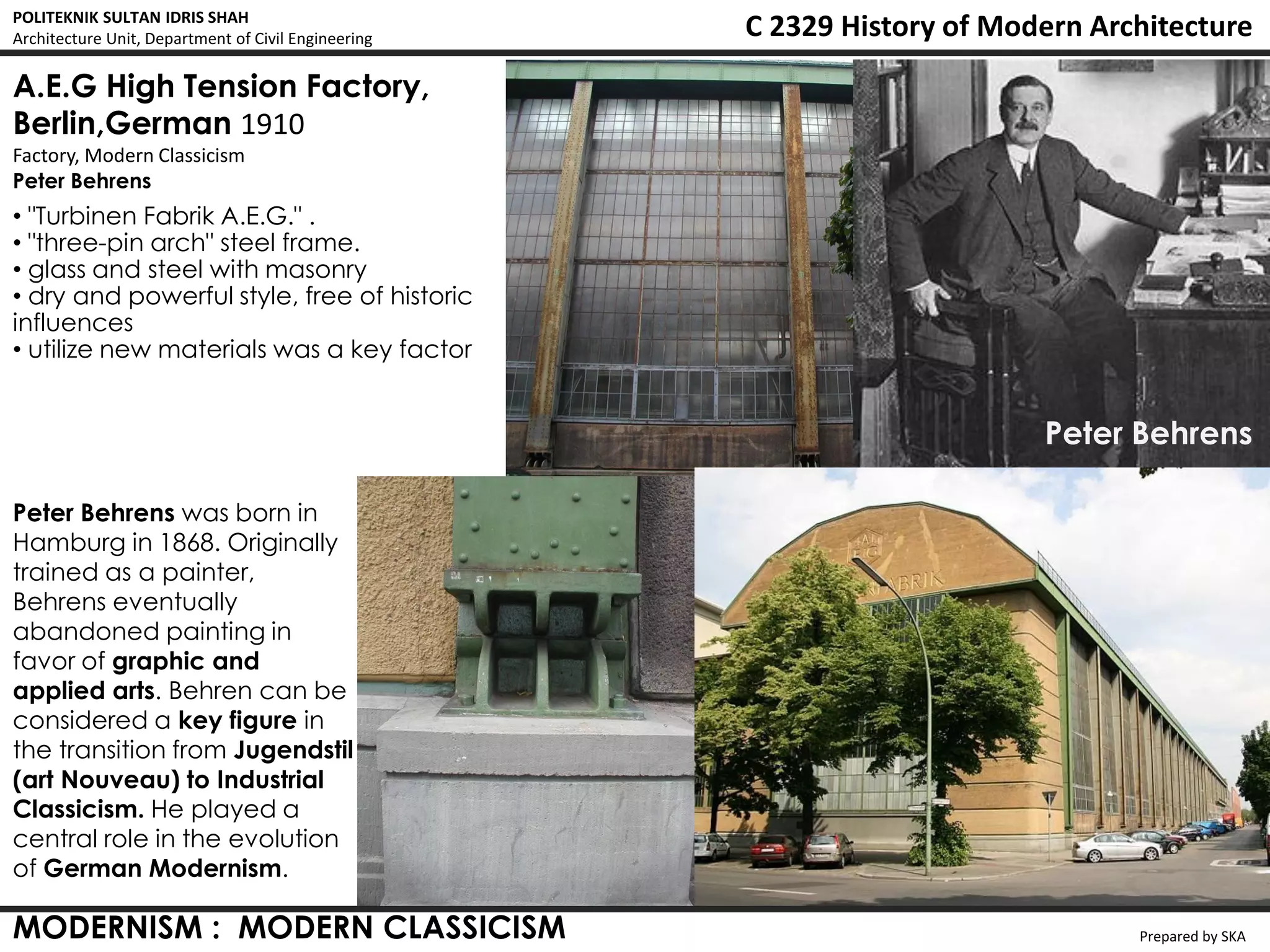
A.E.G High Tension Factory,
Berlin,German 1910
Factory, Modern Classicism
Peter Behrens
• "Turbinen Fabrik A.E.G." .
• "three-pin arch" steel frame.
• glass and steel with masonry
• dry and powerful style, free of historic
influences
• utilize new materials was a key factor


                                                                          Peter Behrens

Peter Behrens was born in
Hamburg in 1868. Originally
trained as a painter,
Behrens eventually
abandoned painting in
favor of graphic and
applied arts. Behren can be
considered a key figure in
the transition from Jugendstil
(art Nouveau) to Industrial
Classicism. He played a
central role in the evolution
of German Modernism.

MODERNISM : MODERN CLASSICISM                                                    Prepared by SKA
POLITEKNIK SULTAN IDRIS SHAH
Architecture Unit, Department of Civil Engineering            C 2329 History of Modern Architecture
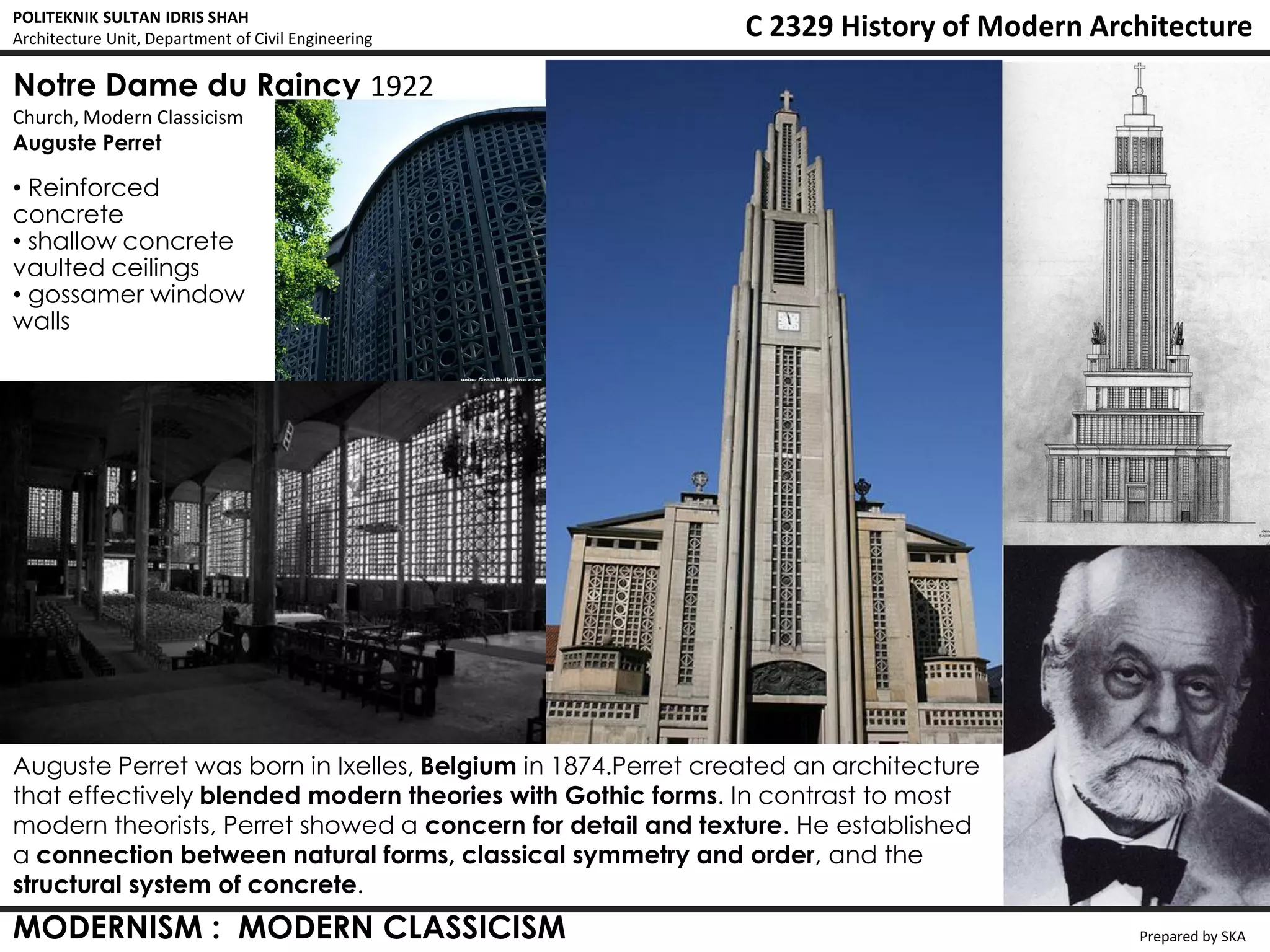
Notre Dame du Raincy 1922
Church, Modern Classicism
Auguste Perret

• Reinforced
concrete
• shallow concrete
vaulted ceilings
• gossamer window
walls


Auguste Perret was born in Ixelles, Belgium in 1874.Perret created an architecture
that effectively blended modern theories with Gothic forms. In contrast to most
modern theorists, Perret showed a concern for detail and texture. He established
a connection between natural forms, classical symmetry and order, and the
structural system of concrete.
MODERNISM : MODERN CLASSICISM                                                             Prepared by SKA
POLITEKNIK SULTAN IDRIS SHAH
Architecture Unit, Department of Civil Engineering           C 2329 History of Modern Architecture
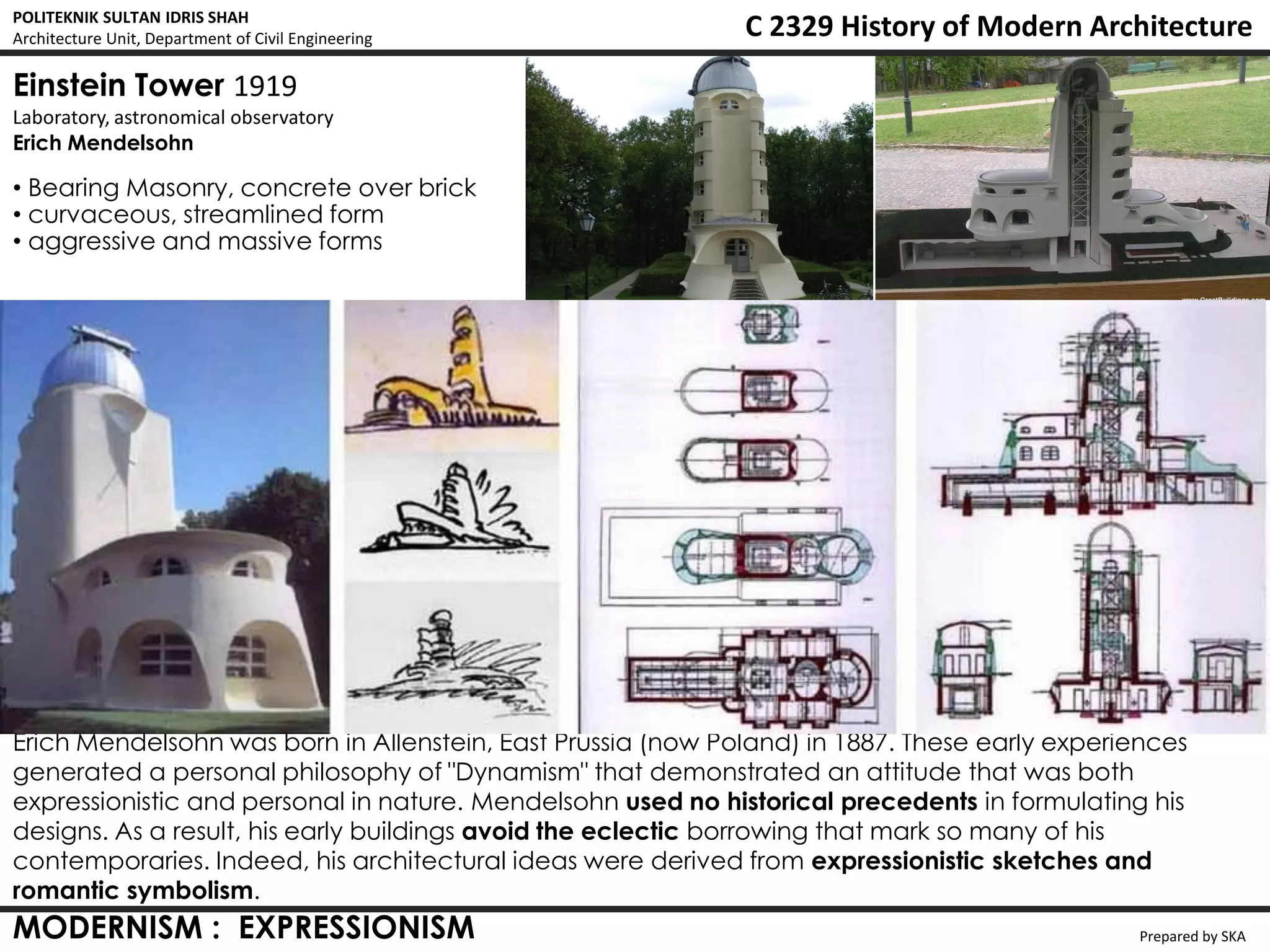
Einstein Tower 1919
Laboratory, astronomical observatory
Erich Mendelsohn

• Bearing Masonry, concrete over brick
• curvaceous, streamlined form
• aggressive and massive forms


Erich Mendelsohn was born in Allenstein, East Prussia (now Poland) in 1887. These early experiences
generated a personal philosophy of "Dynamism" that demonstrated an attitude that was both
expressionistic and personal in nature. Mendelsohn used no historical precedents in formulating his
designs. As a result, his early buildings avoid the eclectic borrowing that mark so many of his
contemporaries. Indeed, his architectural ideas were derived from expressionistic sketches and
romantic symbolism.
MODERNISM : EXPRESSIONISM                                                                     Prepared by SKA
POLITEKNIK SULTAN IDRIS SHAH
Architecture Unit, Department of Civil Engineering              C 2329 History of Modern Architecture
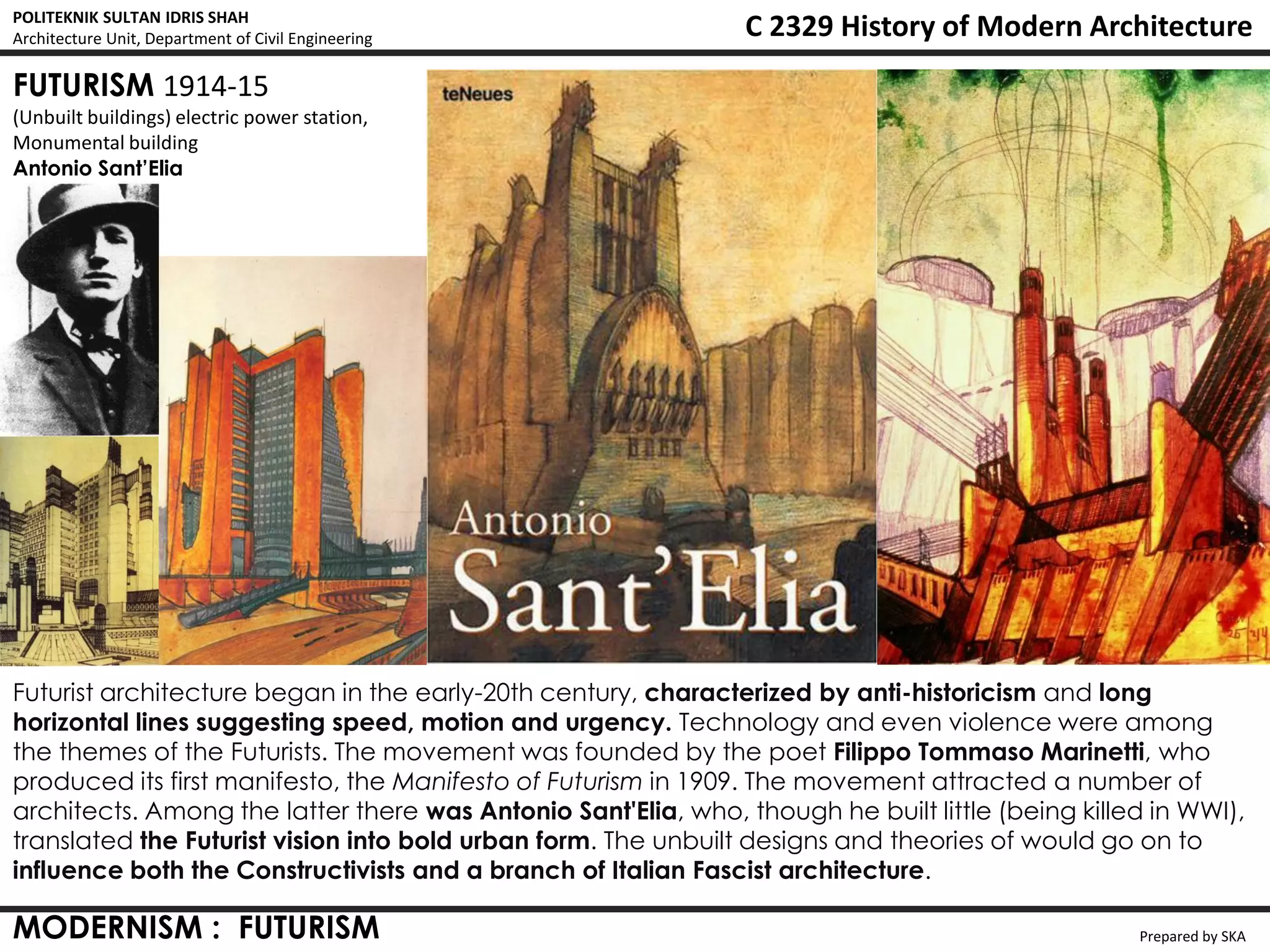
FUTURISM 1914-15
(Unbuilt buildings) electric power station,
Monumental building
Antonio Sant’Elia


Futurist architecture began in the early-20th century, characterized by anti-historicism and long
horizontal lines suggesting speed, motion and urgency. Technology and even violence were among
the themes of the Futurists. The movement was founded by the poet Filippo Tommaso Marinetti, who
produced its first manifesto, the Manifesto of Futurism in 1909. The movement attracted a number of
architects. Among the latter there was Antonio Sant'Elia, who, though he built little (being killed in WWI),
translated the Futurist vision into bold urban form. The unbuilt designs and theories of would go on to
influence both the Constructivists and a branch of Italian Fascist architecture.

MODERNISM : FUTURISM                                                                              Prepared by SKA
POLITEKNIK SULTAN IDRIS SHAH
Architecture Unit, Department of Civil Engineering           C 2329 History of Modern Architecture
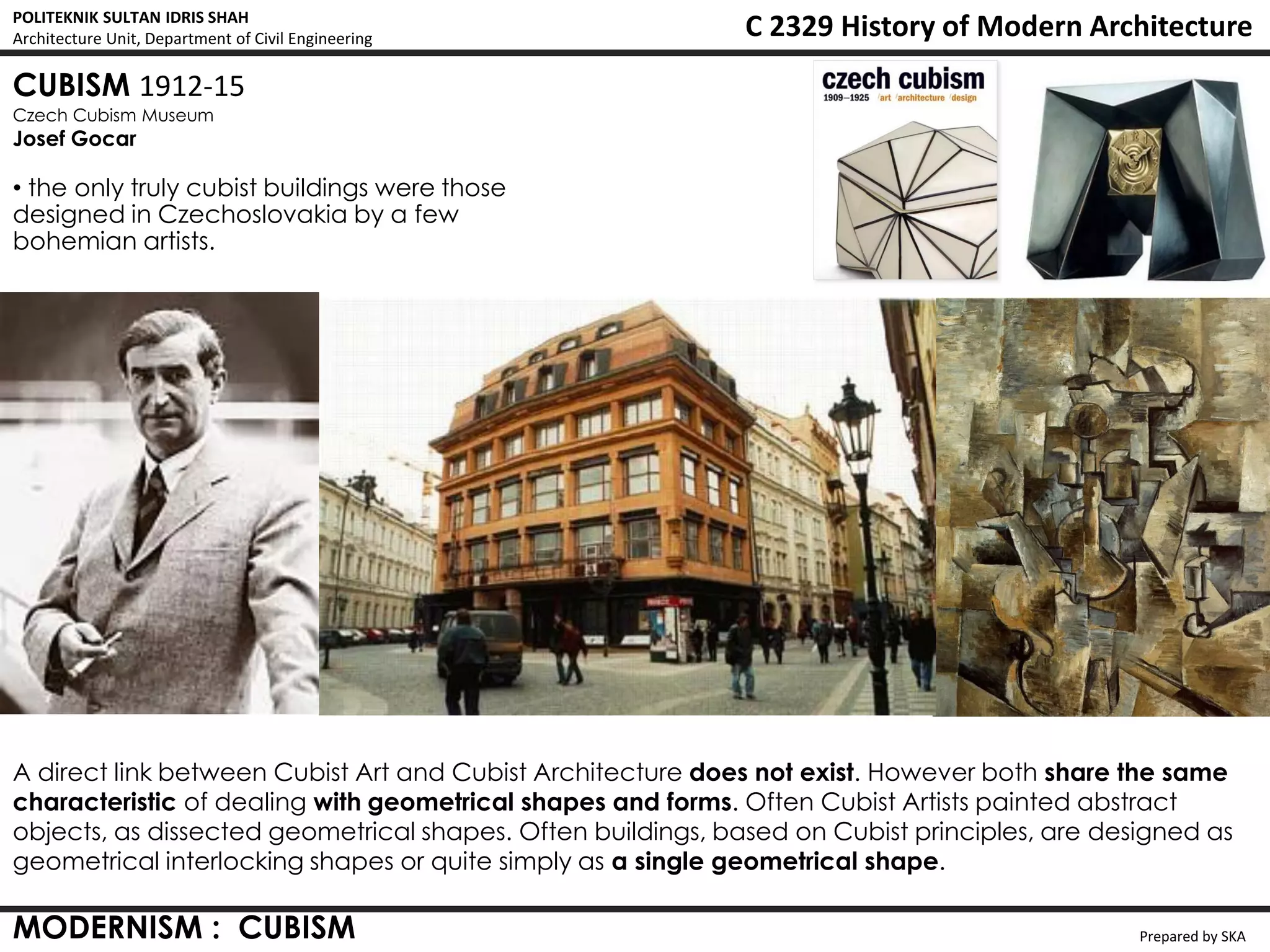
CUBISM 1912-15
Czech Cubism Museum
Josef Gocar

• the only truly cubist buildings were those
designed in Czechoslovakia by a few
bohemian artists.


A direct link between Cubist Art and Cubist Architecture does not exist. However both share the same
characteristic of dealing with geometrical shapes and forms. Often Cubist Artists painted abstract
objects, as dissected geometrical shapes. Often buildings, based on Cubist principles, are designed as
geometrical interlocking shapes or quite simply as a single geometrical shape.

MODERNISM : CUBISM                                                                            Prepared by SKA

history of modern architecture - lecture 2

  • 1.
    POLITEKNIK SULTAN IDRISSHAH Architecture Unit, Department of Civil Engineering C 2329 History of Modern Architecture Lecture 02: Modernism • modern classicism • expressionism • cubism • futurism www.shahrilkhairi.com Prepared by SKA
  • 3.
    POLITEKNIK SULTAN IDRISSHAH Architecture Unit, Department of Civil Engineering C 2329 History of Modern Architecture A.E.G High Tension Factory, Berlin,German 1910 Factory, Modern Classicism Peter Behrens • "Turbinen Fabrik A.E.G." . • "three-pin arch" steel frame. • glass and steel with masonry • dry and powerful style, free of historic influences • utilize new materials was a key factor Peter Behrens Peter Behrens was born in Hamburg in 1868. Originally trained as a painter, Behrens eventually abandoned painting in favor of graphic and applied arts. Behren can be considered a key figure in the transition from Jugendstil (art Nouveau) to Industrial Classicism. He played a central role in the evolution of German Modernism. MODERNISM : MODERN CLASSICISM Prepared by SKA
  • 4.
    POLITEKNIK SULTAN IDRISSHAH Architecture Unit, Department of Civil Engineering C 2329 History of Modern Architecture Notre Dame du Raincy 1922 Church, Modern Classicism Auguste Perret • Reinforced concrete • shallow concrete vaulted ceilings • gossamer window walls Auguste Perret was born in Ixelles, Belgium in 1874.Perret created an architecture that effectively blended modern theories with Gothic forms. In contrast to most modern theorists, Perret showed a concern for detail and texture. He established a connection between natural forms, classical symmetry and order, and the structural system of concrete. MODERNISM : MODERN CLASSICISM Prepared by SKA
  • 5.
    POLITEKNIK SULTAN IDRISSHAH Architecture Unit, Department of Civil Engineering C 2329 History of Modern Architecture Einstein Tower 1919 Laboratory, astronomical observatory Erich Mendelsohn • Bearing Masonry, concrete over brick • curvaceous, streamlined form • aggressive and massive forms Erich Mendelsohn was born in Allenstein, East Prussia (now Poland) in 1887. These early experiences generated a personal philosophy of "Dynamism" that demonstrated an attitude that was both expressionistic and personal in nature. Mendelsohn used no historical precedents in formulating his designs. As a result, his early buildings avoid the eclectic borrowing that mark so many of his contemporaries. Indeed, his architectural ideas were derived from expressionistic sketches and romantic symbolism. MODERNISM : EXPRESSIONISM Prepared by SKA
  • 6.
    POLITEKNIK SULTAN IDRISSHAH Architecture Unit, Department of Civil Engineering C 2329 History of Modern Architecture FUTURISM 1914-15 (Unbuilt buildings) electric power station, Monumental building Antonio Sant’Elia Futurist architecture began in the early-20th century, characterized by anti-historicism and long horizontal lines suggesting speed, motion and urgency. Technology and even violence were among the themes of the Futurists. The movement was founded by the poet Filippo Tommaso Marinetti, who produced its first manifesto, the Manifesto of Futurism in 1909. The movement attracted a number of architects. Among the latter there was Antonio Sant'Elia, who, though he built little (being killed in WWI), translated the Futurist vision into bold urban form. The unbuilt designs and theories of would go on to influence both the Constructivists and a branch of Italian Fascist architecture. MODERNISM : FUTURISM Prepared by SKA
  • 7.
    POLITEKNIK SULTAN IDRISSHAH Architecture Unit, Department of Civil Engineering C 2329 History of Modern Architecture CUBISM 1912-15 Czech Cubism Museum Josef Gocar • the only truly cubist buildings were those designed in Czechoslovakia by a few bohemian artists. A direct link between Cubist Art and Cubist Architecture does not exist. However both share the same characteristic of dealing with geometrical shapes and forms. Often Cubist Artists painted abstract objects, as dissected geometrical shapes. Often buildings, based on Cubist principles, are designed as geometrical interlocking shapes or quite simply as a single geometrical shape. MODERNISM : CUBISM Prepared by SKA