20th
Century Architecture
and Design into the 21st Century
Modern to Post-Modern
Modernism
• After 1900 artistic innovation in Europe and the US increased in a
rapid succession of movements, or “isms”. The modern movement
lasted through the first half of the 20th
Century.
• Modernism rejects old, traditional ideas and styles in art and design
• Although Modernist styles are diverse, art moved toward abstraction
based on line, color, shape, space, and texture
• Modern architecture and design moved toward abstraction and
rejected historical styles and ornamentation
• Modern architecture reveals rather than conceals the inner structure
of the building
Art Nouveau
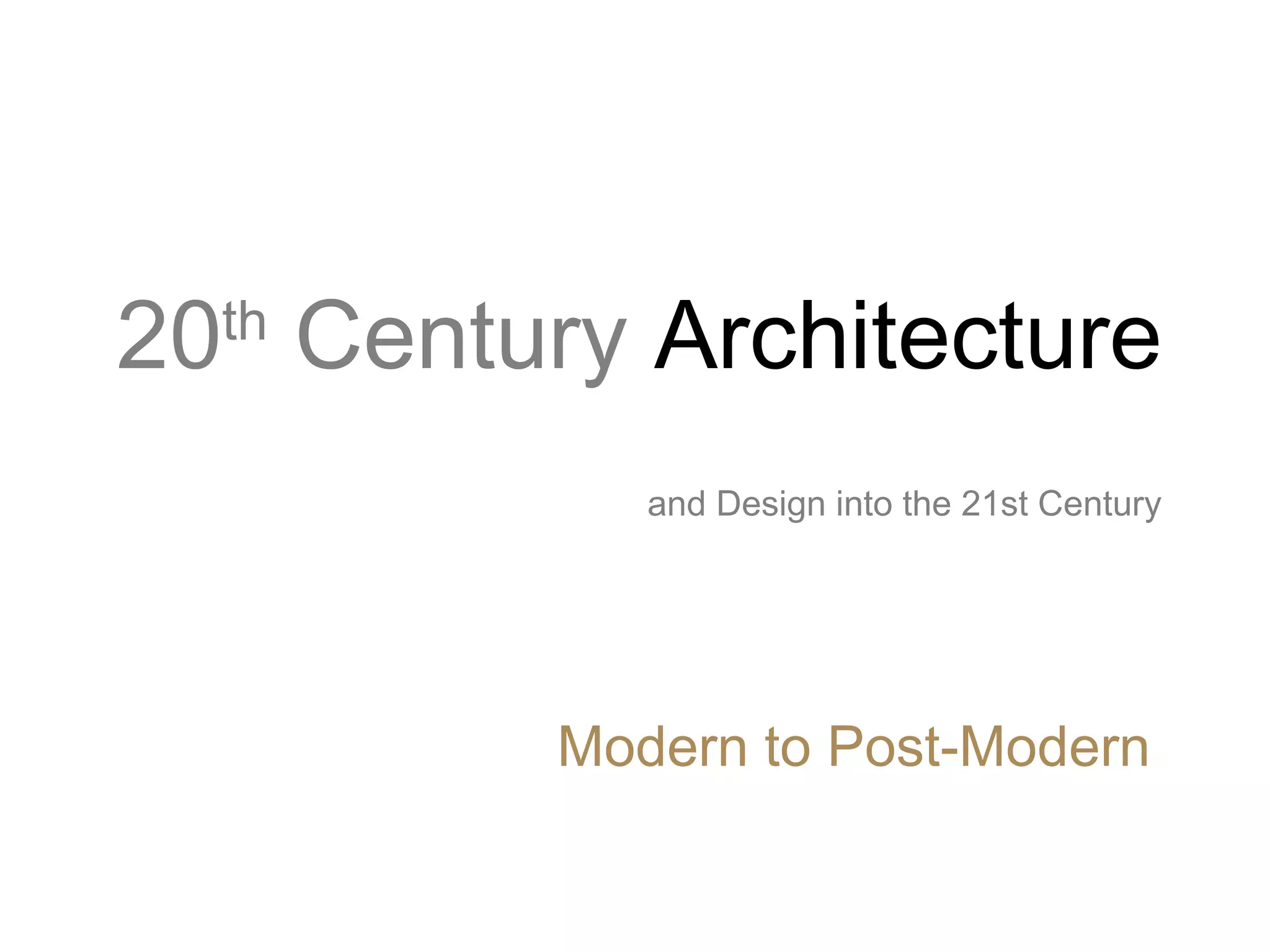
• Art Nouveau began in France
• (Late 19th
Century – Early 20th
Century)
• Art Nouveau incorporates Organic
and Natural Forms into the
decoration
• Architecture +Interior Design,
Fashion, Graphic Arts, Decorative
Arts
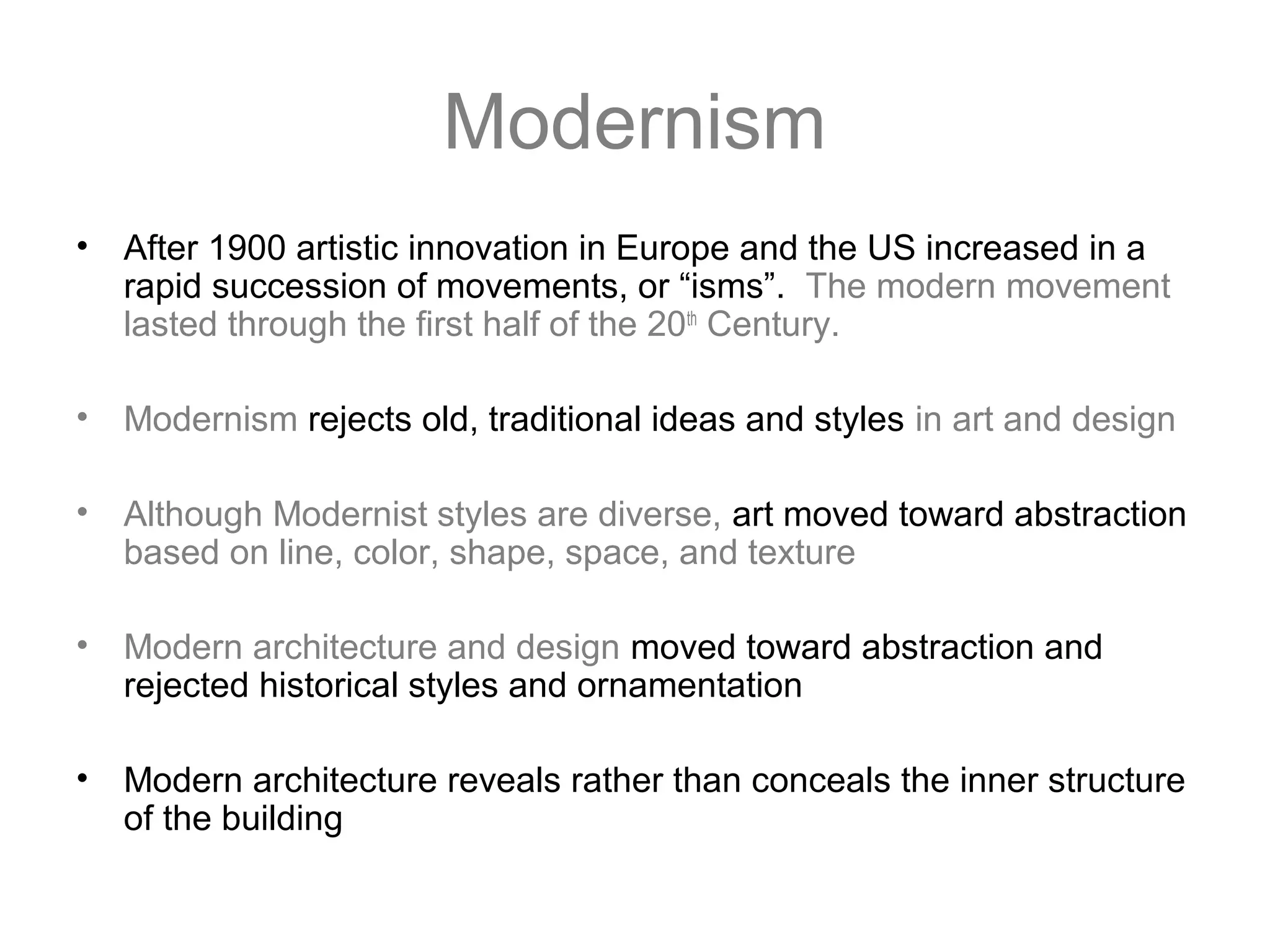
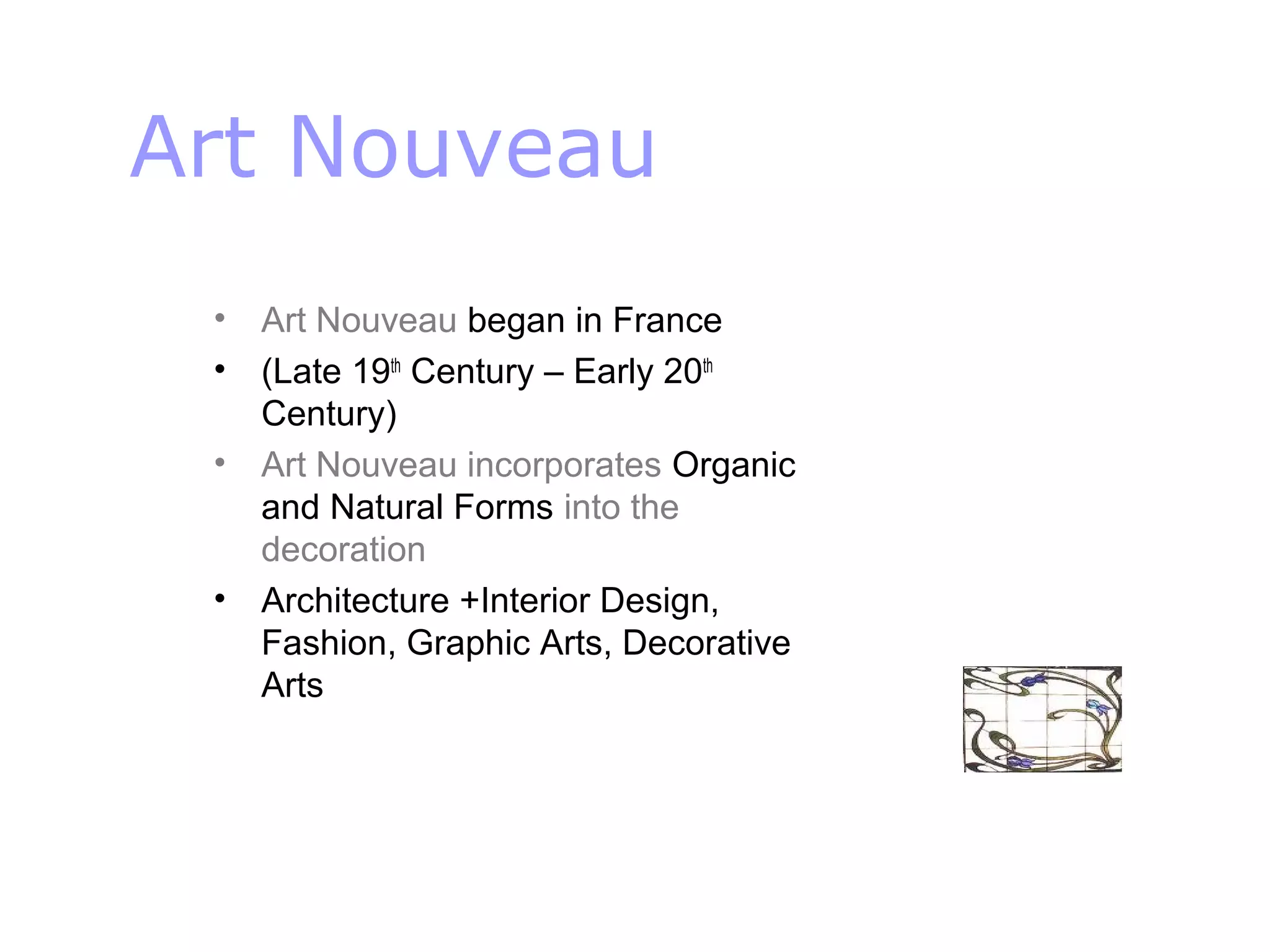
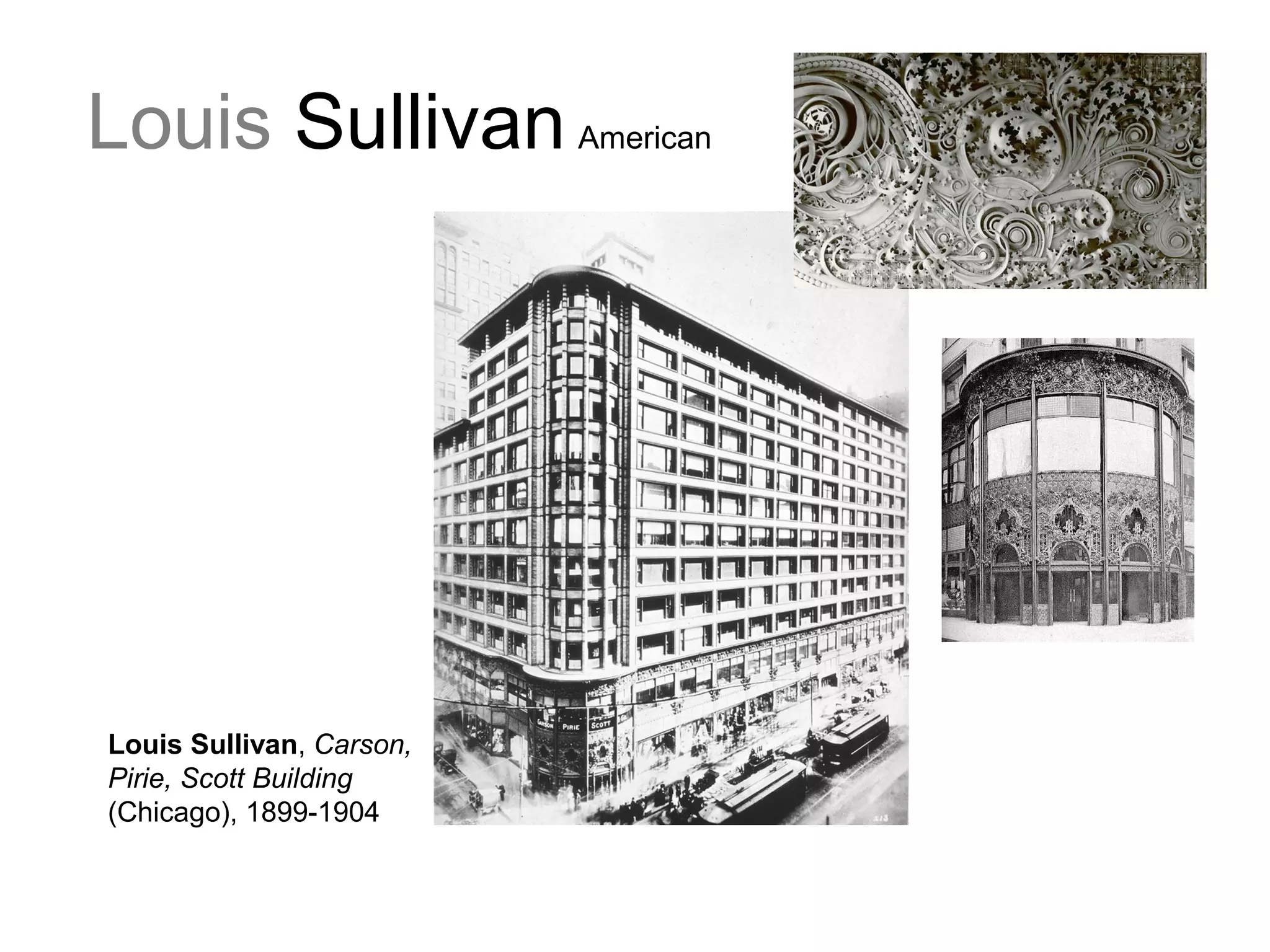
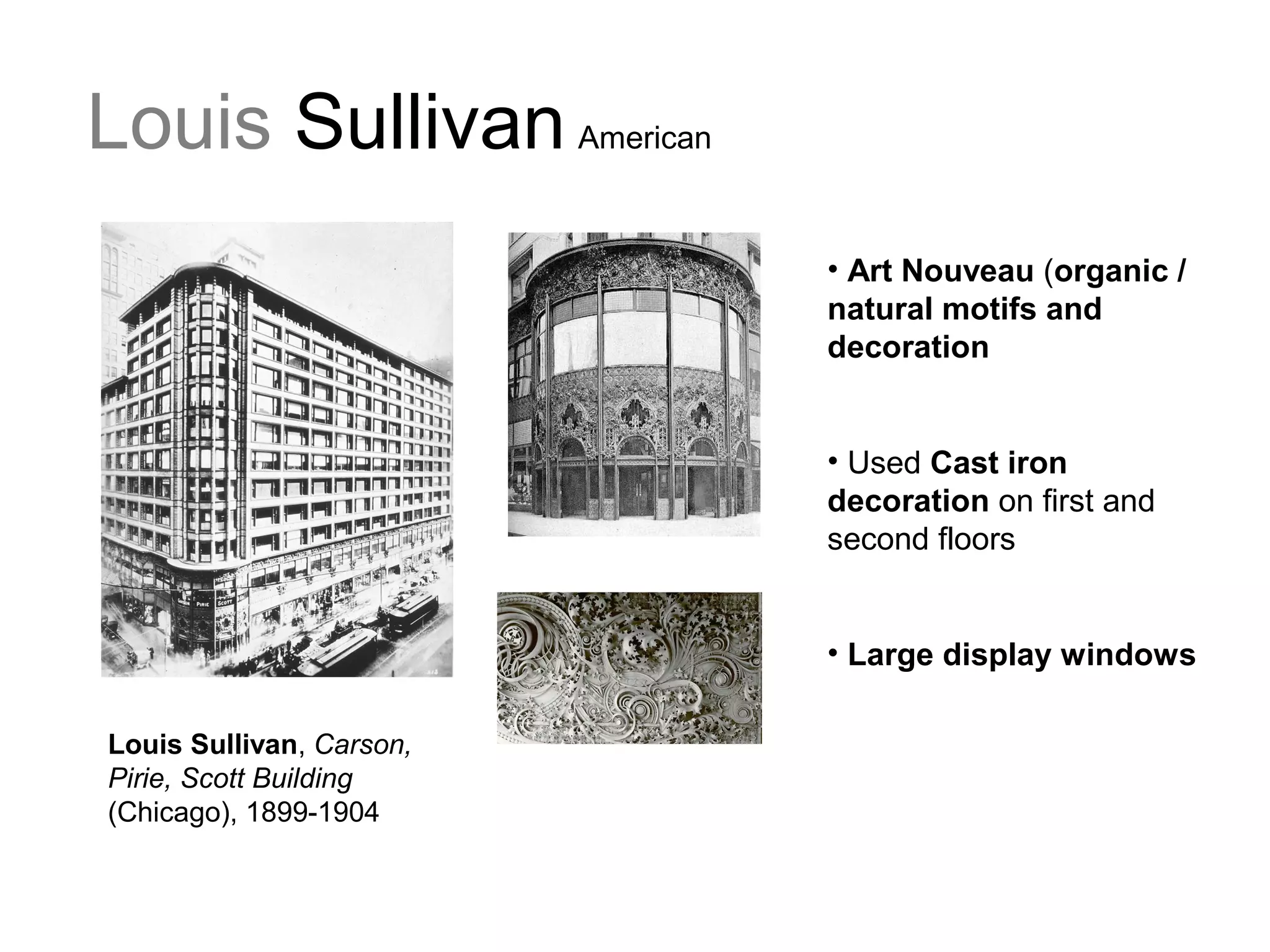
Louis Sullivan American
Louis Sullivan, Carson,
Pirie, Scott Building
(Chicago), 1899-1904
Louis Sullivan American
• Art Nouveau (organic /
natural motifs and
decoration
• Used Cast iron
decoration on first and
second floors
• Large display windows
Louis Sullivan, Carson,
Pirie, Scott Building
(Chicago), 1899-1904
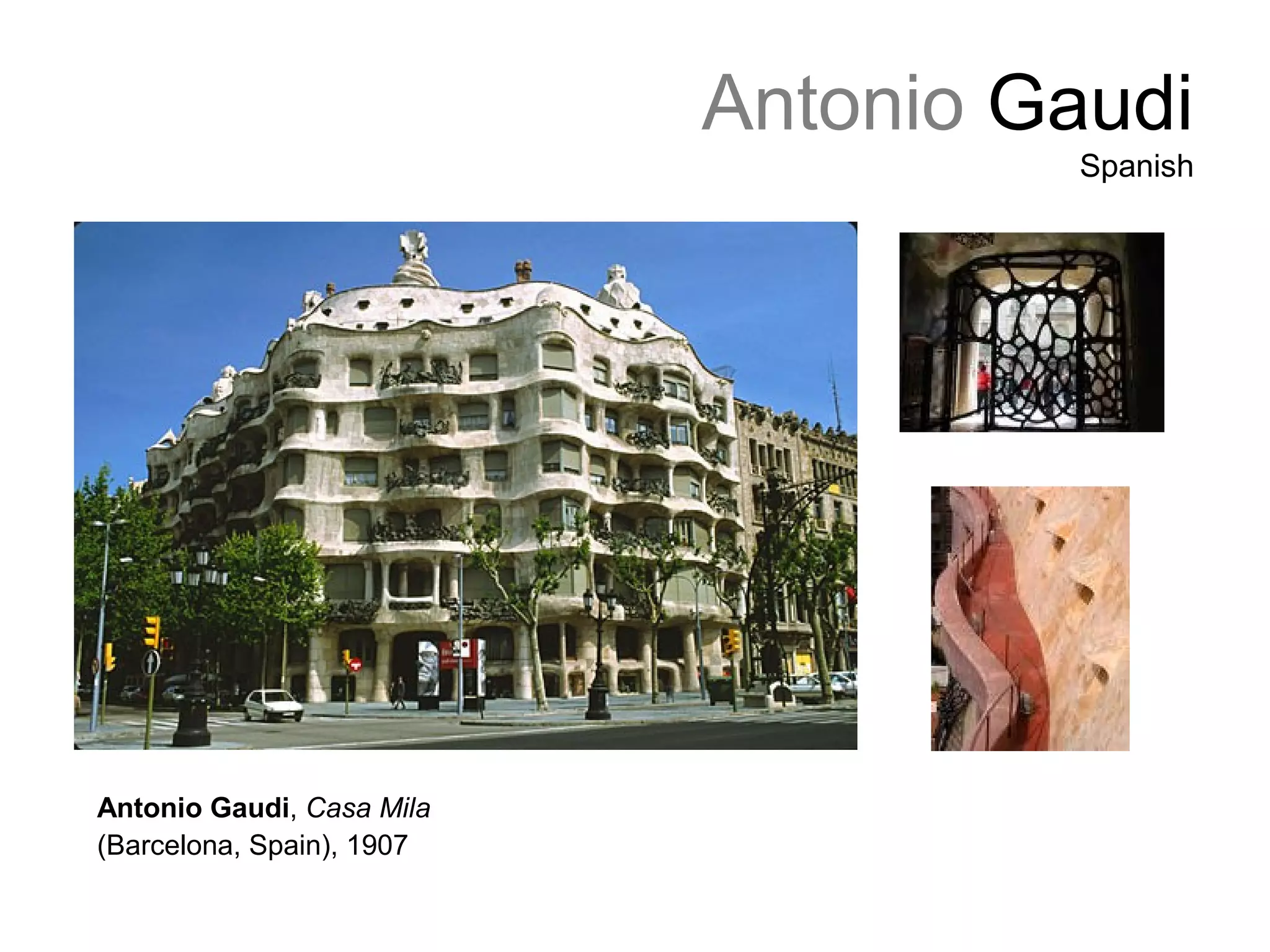
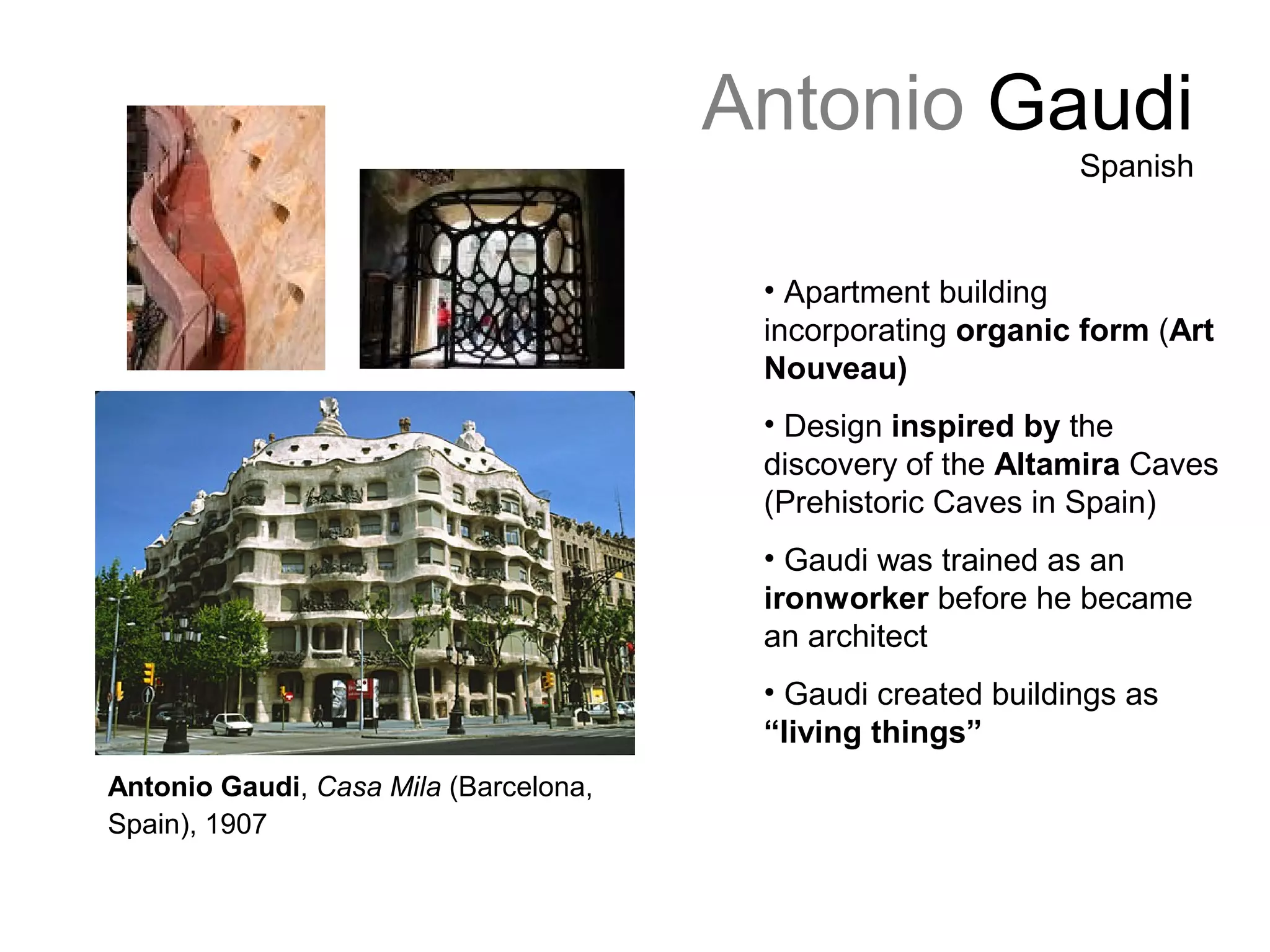
Antonio Gaudi
Spanish
Antonio Gaudi, Casa Mila
(Barcelona, Spain), 1907
Antonio Gaudi
Spanish
• Apartment building
incorporating organic form (Art
Nouveau)
• Design inspired by the
discovery of the Altamira Caves
(Prehistoric Caves in Spain)
• Gaudi was trained as an
ironworker before he became
an architect
• Gaudi created buildings as
“living things”
Antonio Gaudi, Casa Mila (Barcelona,
Spain), 1907
De Stijl (The Style)
• Began in 1917 by a group of artists in Holland
• “balance between individual and universal values”
• Integration of Art and Life
• Geometric Forms / “Purity” and Simplicity
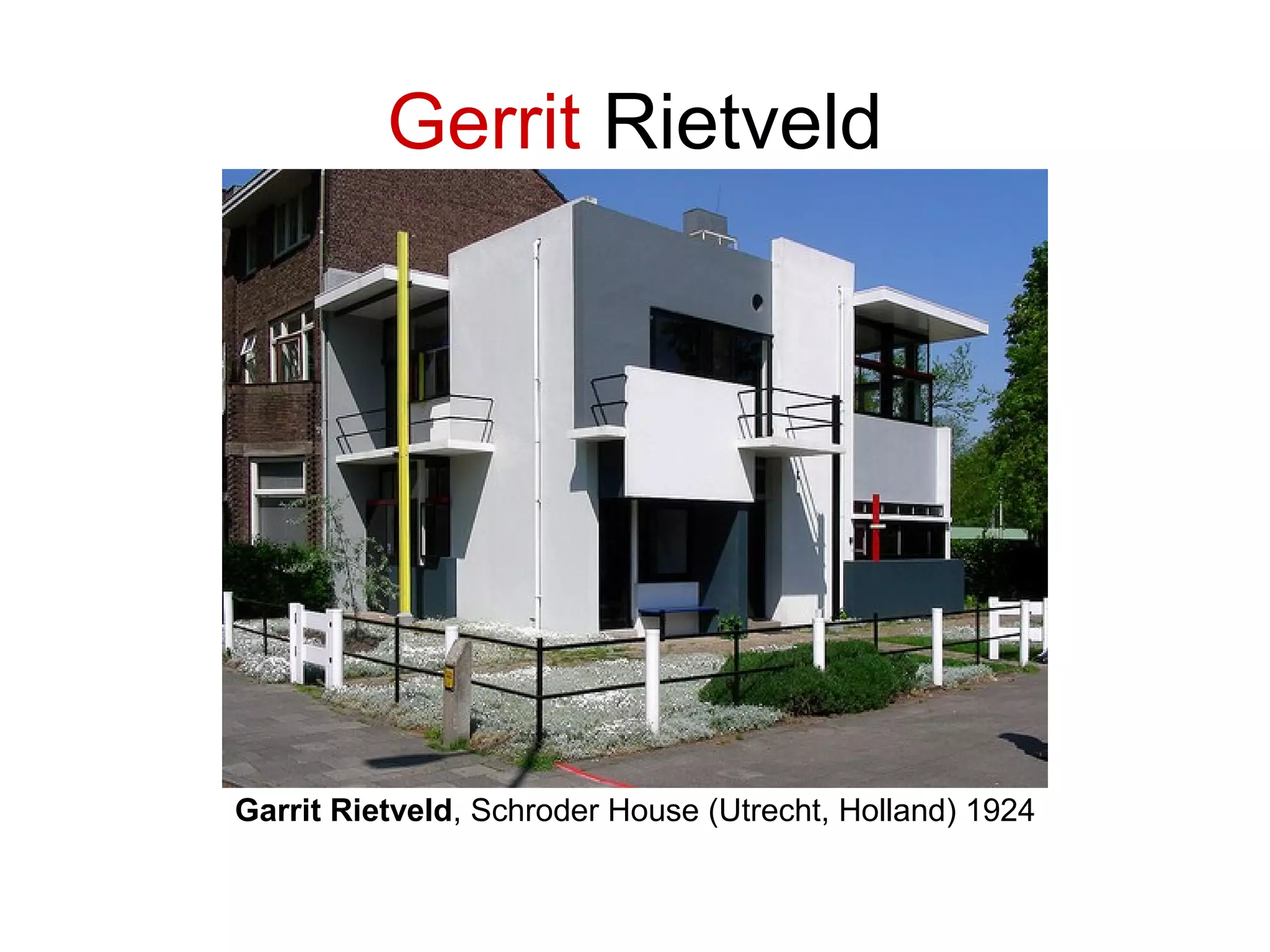
Gerrit Rietveld
Garrit Rietveld, Schroder House (Utrecht, Holland) 1924
Gerrit Rietveld
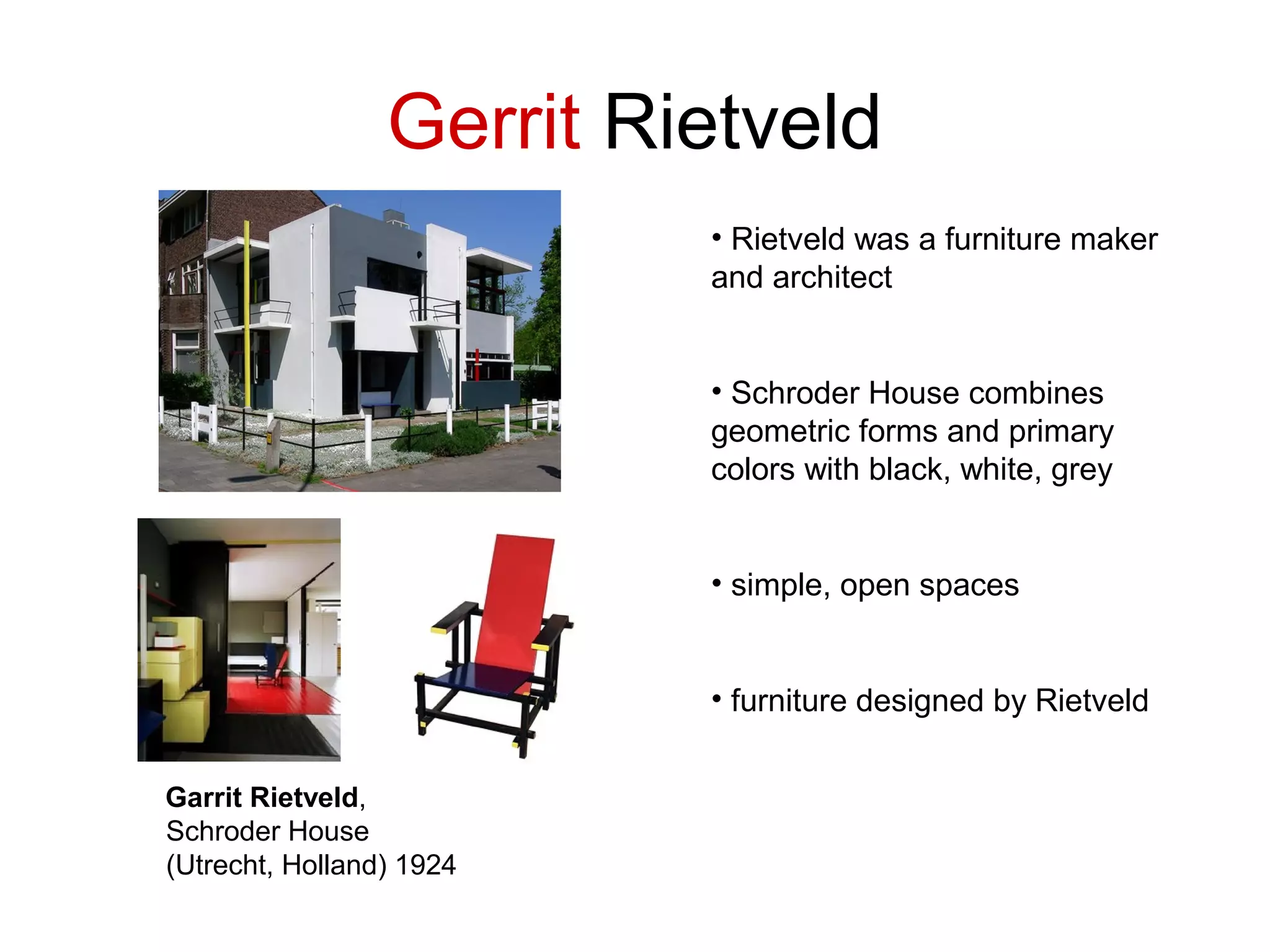
Garrit Rietveld,
Schroder House
(Utrecht, Holland) 1924
• Rietveld was a furniture maker
and architect
• Schroder House combines
geometric forms and primary
colors with black, white, grey
• simple, open spaces
• furniture designed by Rietveld
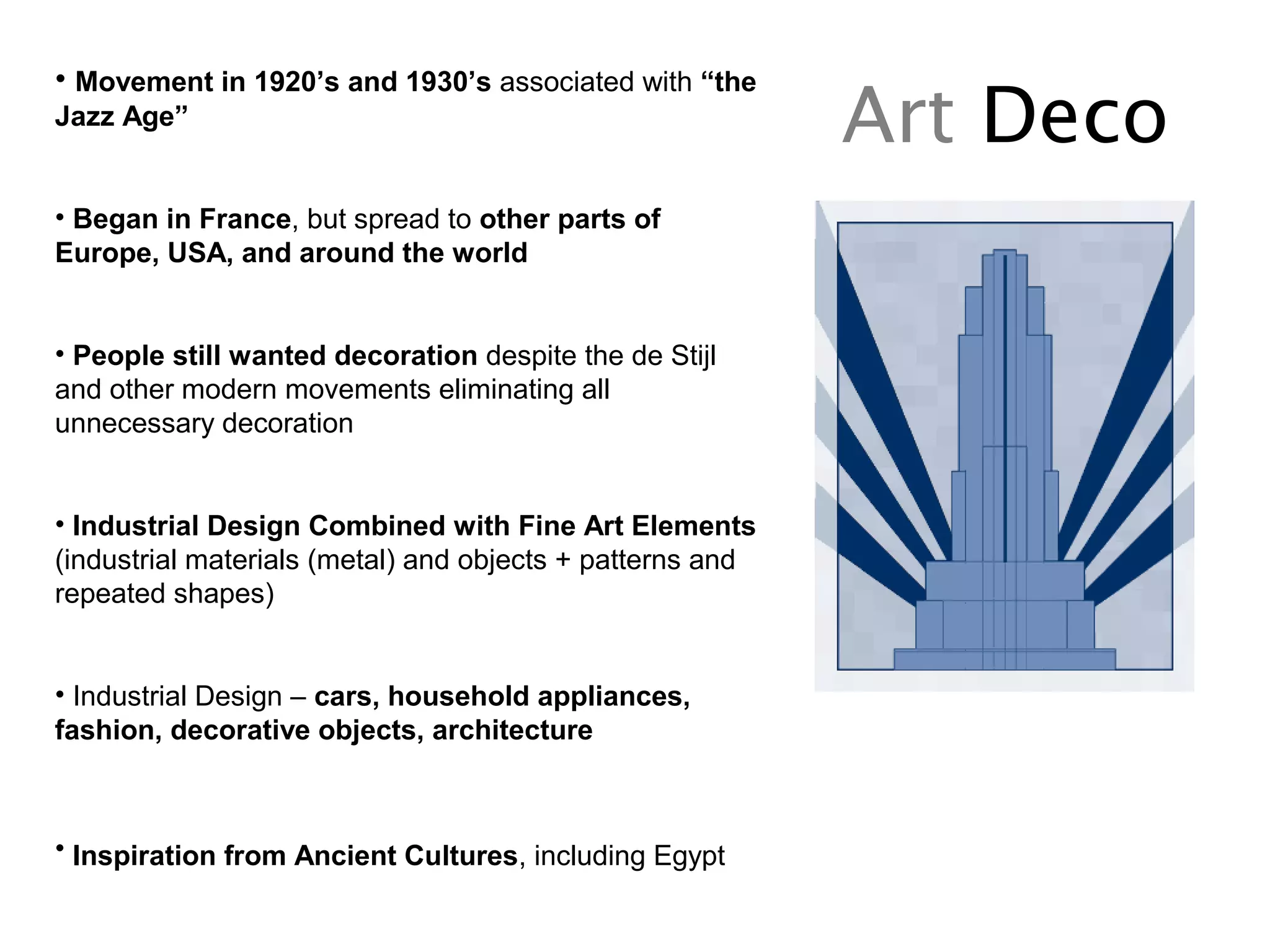
Art Deco
• Movement in 1920’s and 1930’s associated with “the
Jazz Age”
• Began in France, but spread to other parts of
Europe, USA, and around the world
• People still wanted decoration despite the de Stijl
and other modern movements eliminating all
unnecessary decoration
• Industrial Design Combined with Fine Art Elements
(industrial materials (metal) and objects + patterns and
repeated shapes)
• Industrial Design – cars, household appliances,
fashion, decorative objects, architecture
• Inspiration from Ancient Cultures, including Egypt
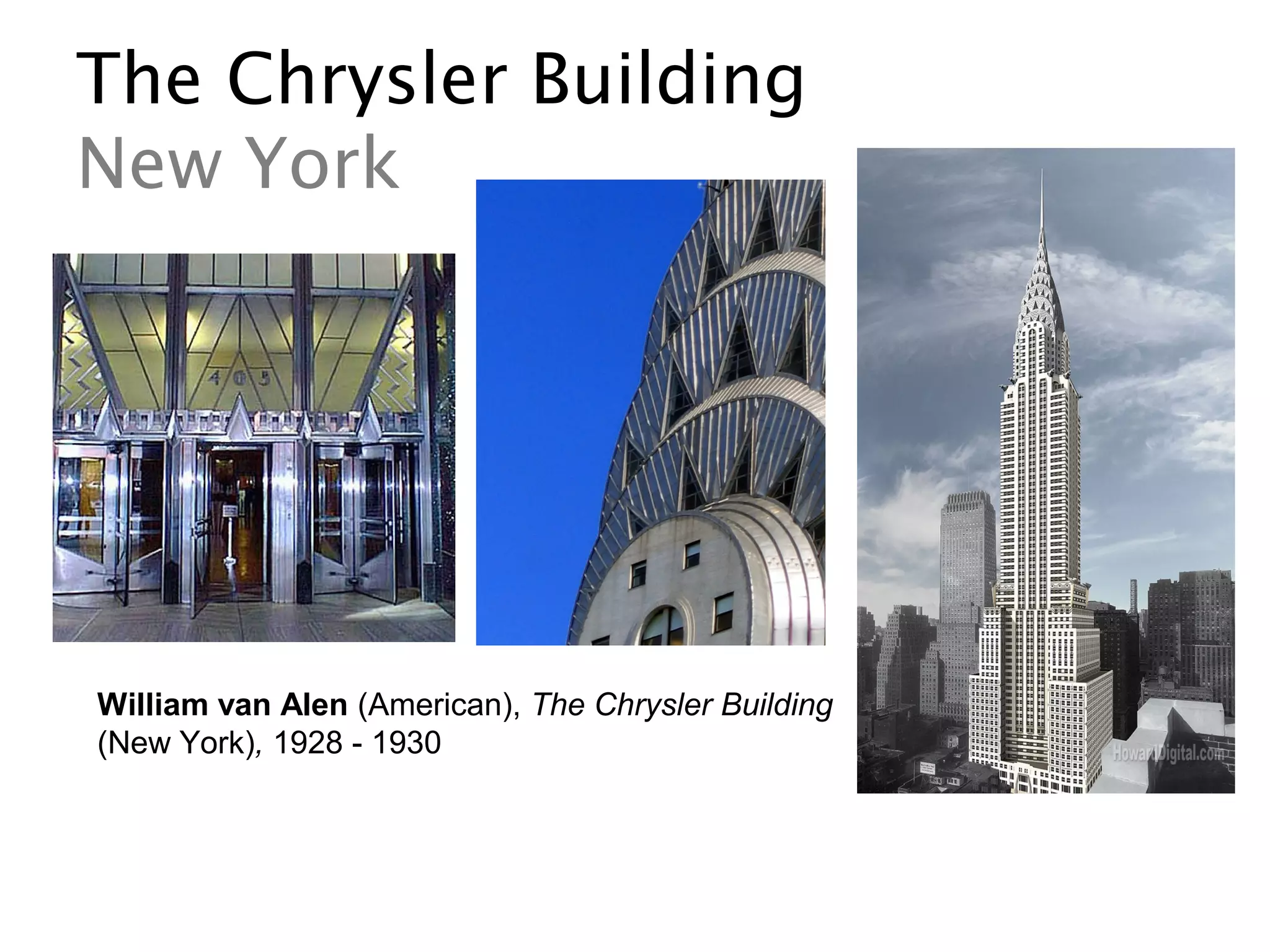
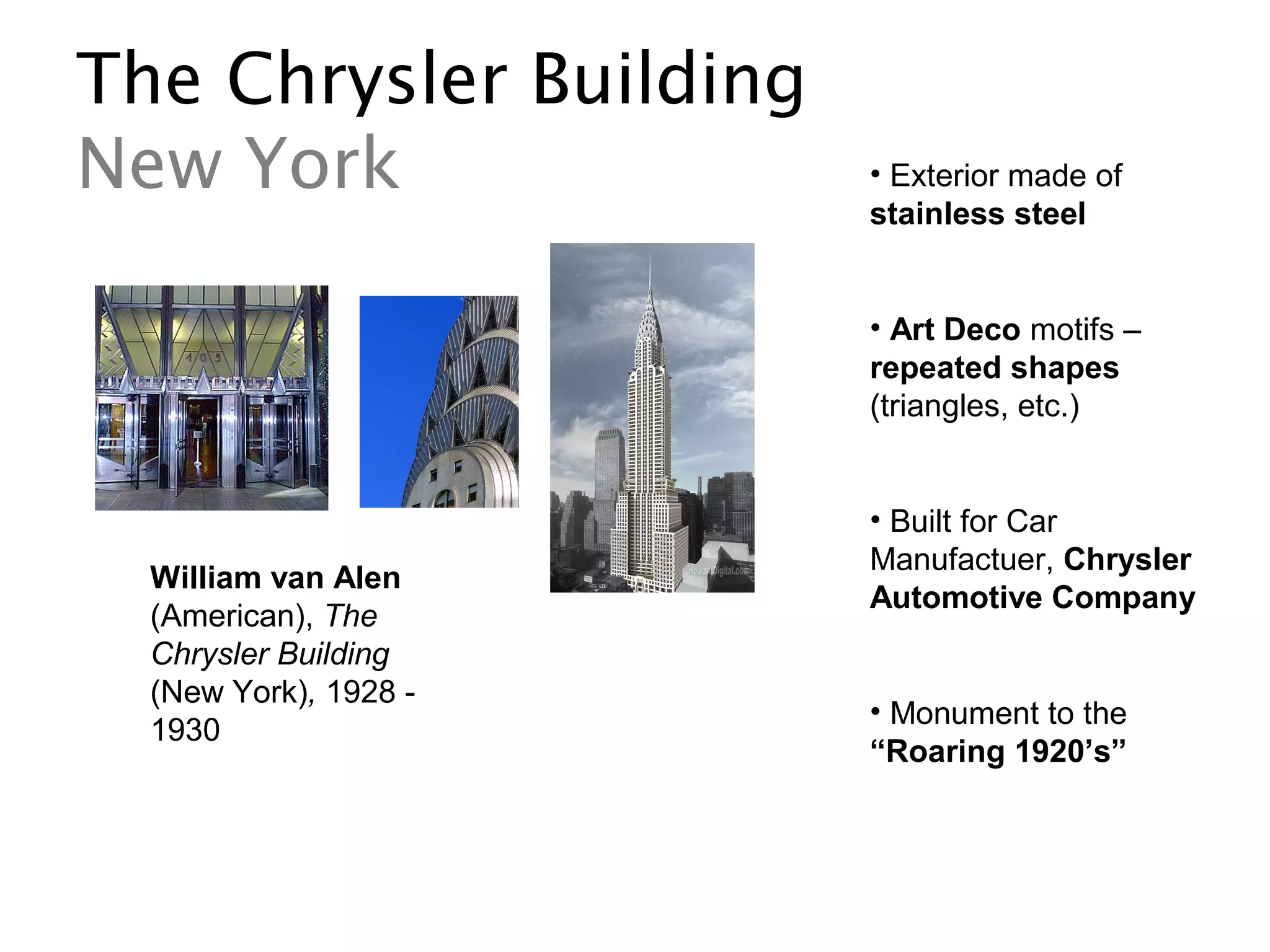
The Chrysler Building
New York
William van Alen (American), The Chrysler Building
(New York), 1928 - 1930
The Chrysler Building
New York
William van Alen
(American), The
Chrysler Building
(New York), 1928 -
1930
• Exterior made of
stainless steel
• Art Deco motifs –
repeated shapes
(triangles, etc.)
• Built for Car
Manufactuer, Chrysler
Automotive Company
• Monument to the
“Roaring 1920’s”
Prairie Style
• American Midwest Architect Frank Lloyd Wright invented the Prairie
Style in early 20th
Century
• Related to The Arts and Crafts Movement, using craft, including
stained glass windows, ceramics, and wood carpentry
• Wright preferred the countryside to the city
• Natural Materials / Natural Environment
• Inspired by Japanese Architecture (long, low buildings with open
interior spaces). Wright designed a hotel in Tokyo (now demolished)
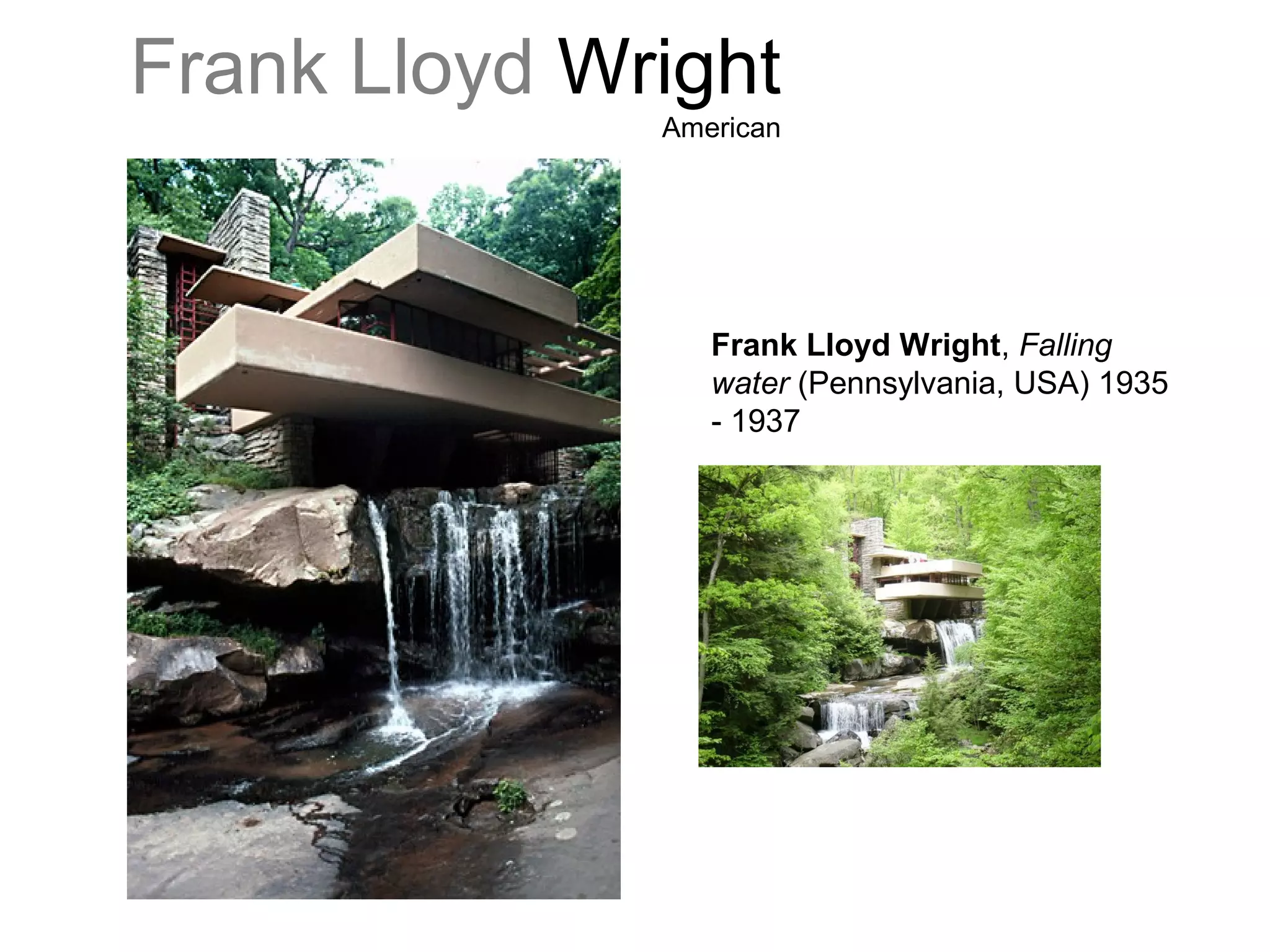
Frank Lloyd Wright
American
Frank Lloyd Wright, Falling
water (Pennsylvania, USA) 1935
- 1937
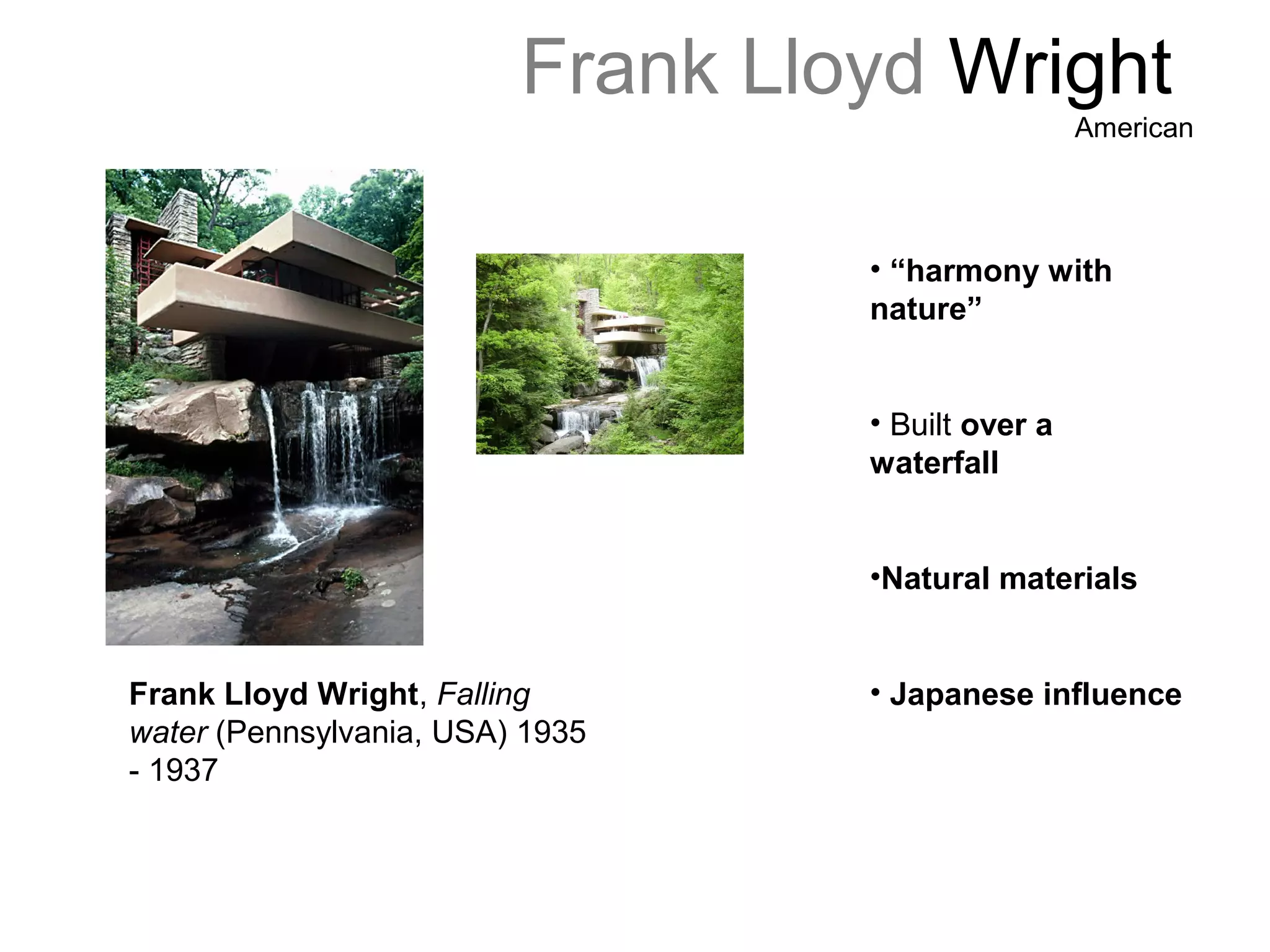
Frank Lloyd Wright
American
Frank Lloyd Wright, Falling
water (Pennsylvania, USA) 1935
- 1937
• “harmony with
nature”
• Built over a
waterfall
•Natural materials
• Japanese influence
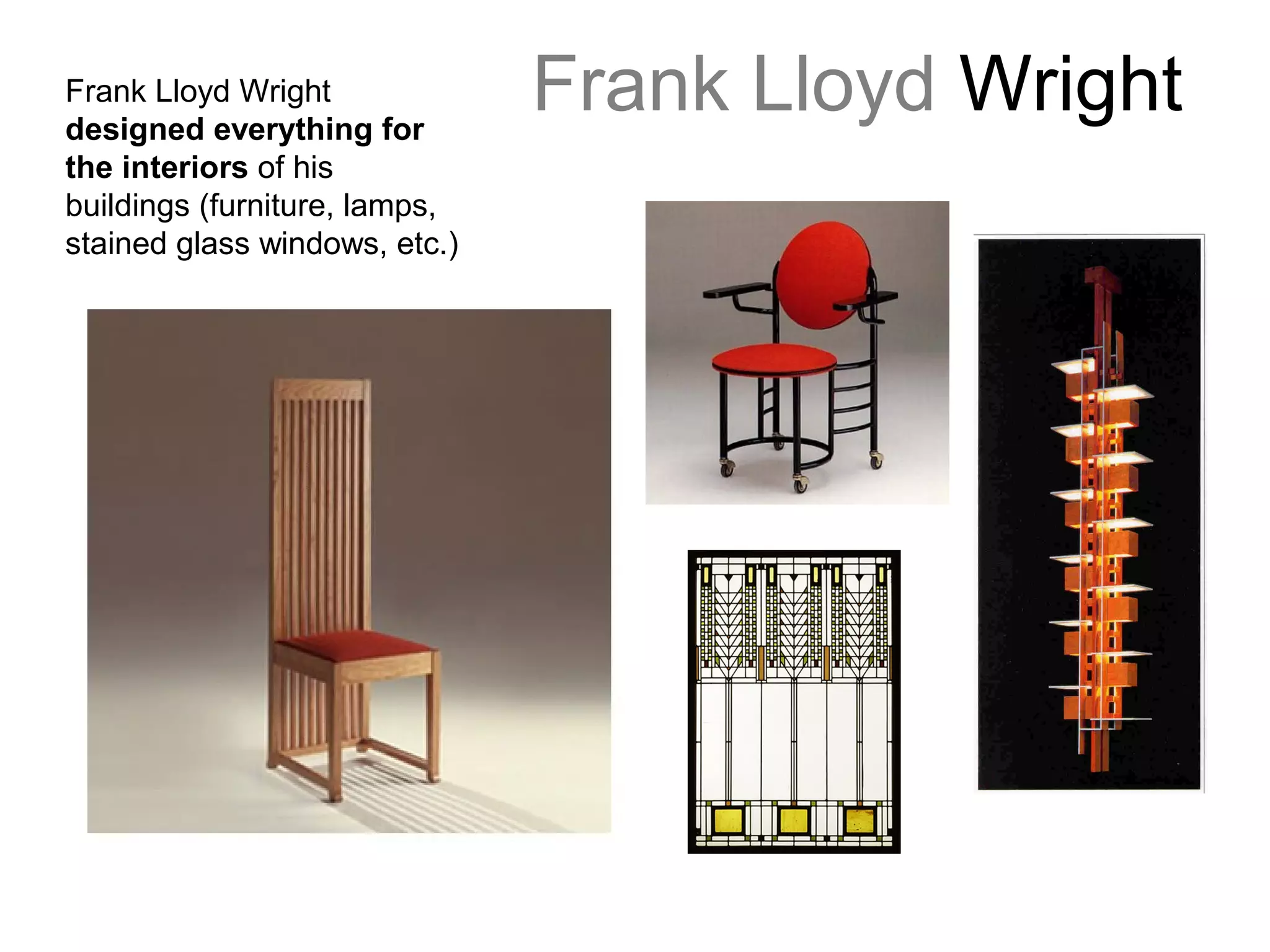
Frank Lloyd WrightFrank Lloyd Wright
designed everything for
the interiors of his
buildings (furniture, lamps,
stained glass windows, etc.)
The Bauhaus
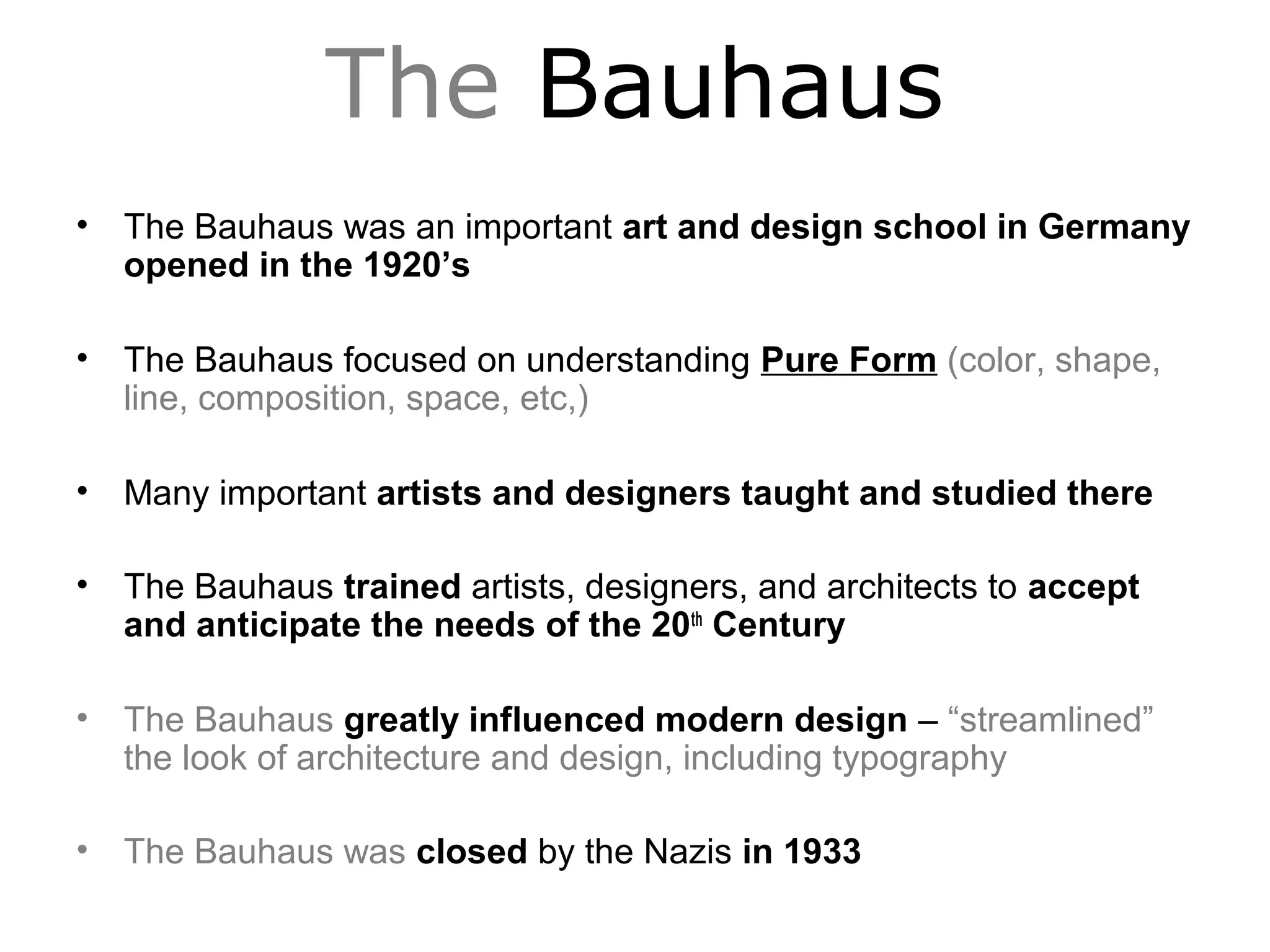
• The Bauhaus was an important art and design school in Germany
opened in the 1920’s
• The Bauhaus focused on understanding Pure Form (color, shape,
line, composition, space, etc,)
• Many important artists and designers taught and studied there
• The Bauhaus trained artists, designers, and architects to accept
and anticipate the needs of the 20th
Century
• The Bauhaus greatly influenced modern design – “streamlined”
the look of architecture and design, including typography
• The Bauhaus was closed by the Nazis in 1933
The Bauhaus
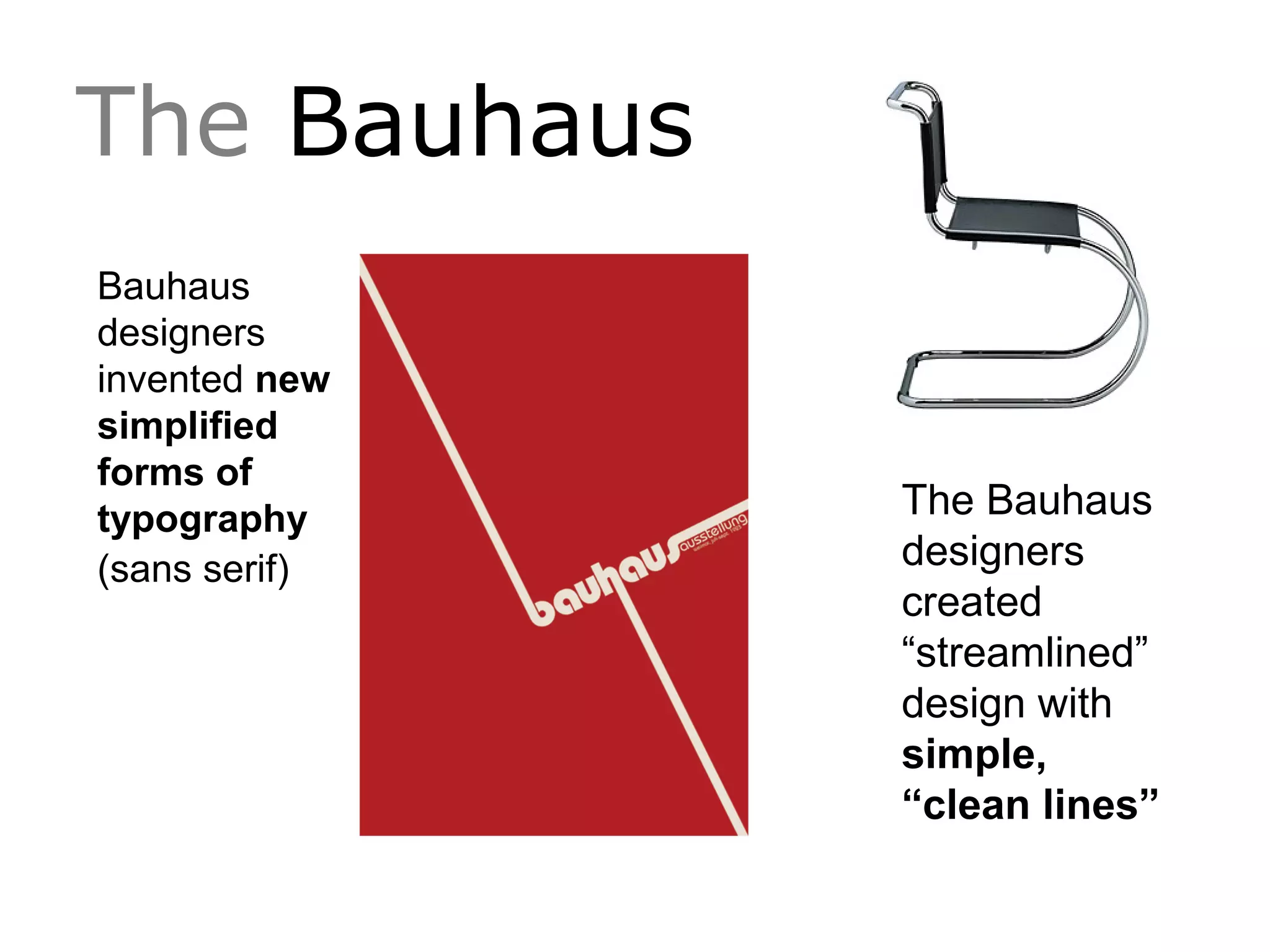
Bauhaus
designers
invented new
simplified
forms of
typography
(sans serif)
The Bauhaus
designers
created
“streamlined”
design with
simple,
“clean lines”
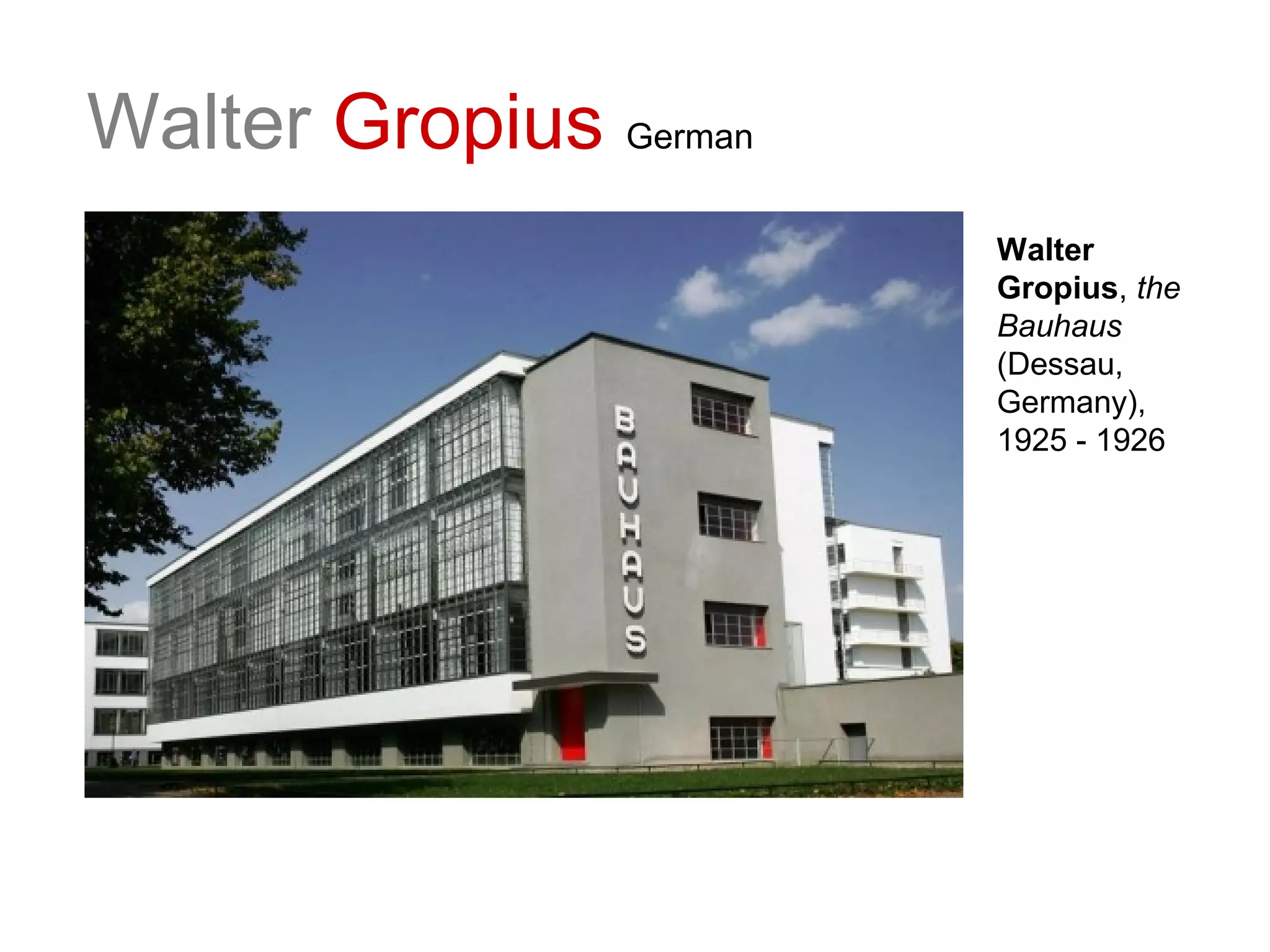
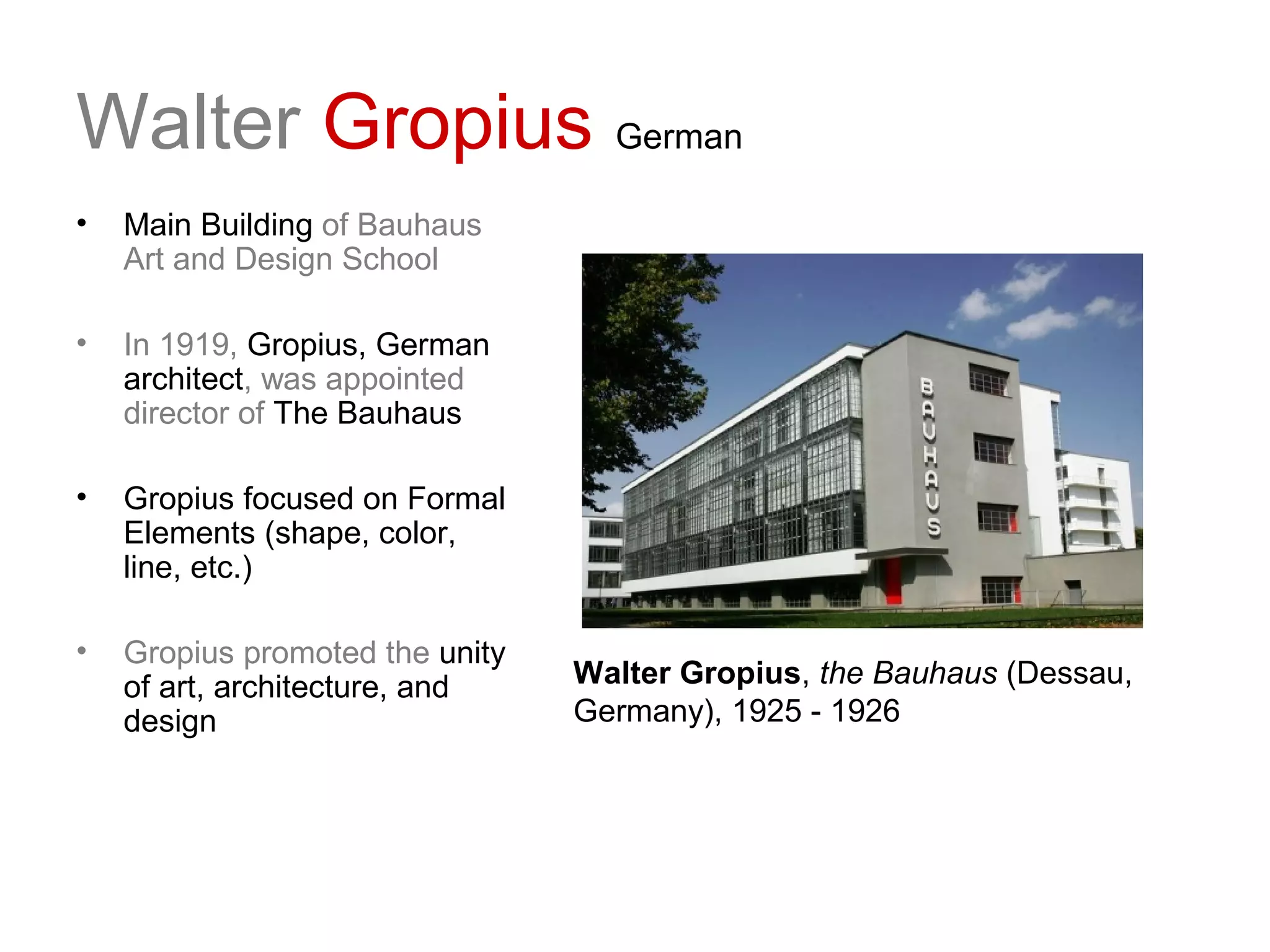
Walter Gropius German
Walter
Gropius, the
Bauhaus
(Dessau,
Germany),
1925 - 1926
Walter Gropius German
• Main Building of Bauhaus
Art and Design School
• In 1919, Gropius, German
architect, was appointed
director of The Bauhaus
• Gropius focused on Formal
Elements (shape, color,
line, etc.)
• Gropius promoted the unity
of art, architecture, and
design
Walter Gropius, the Bauhaus (Dessau,
Germany), 1925 - 1926
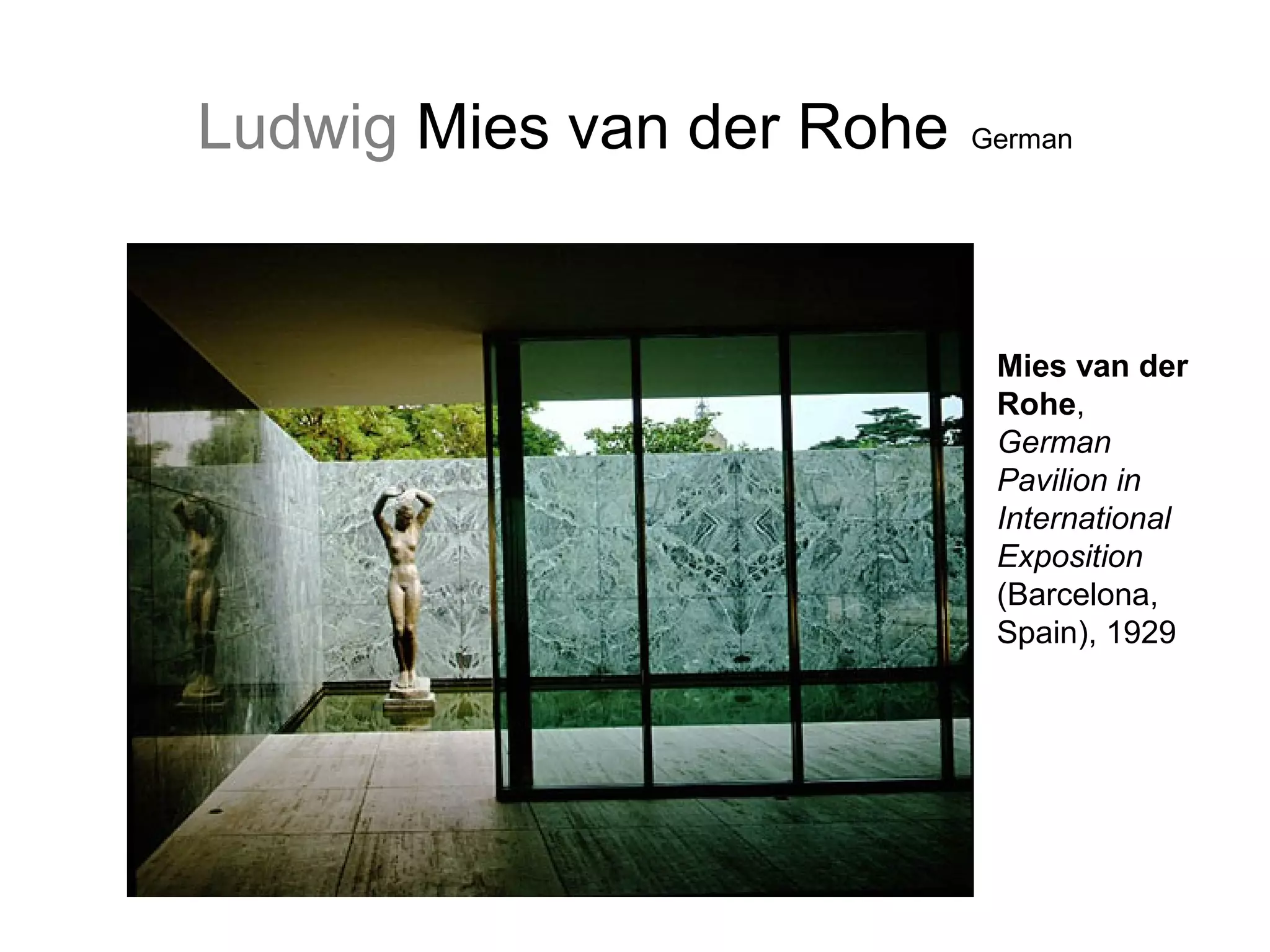
Ludwig Mies van der Rohe German
Mies van der
Rohe,
German
Pavilion in
International
Exposition
(Barcelona,
Spain), 1929
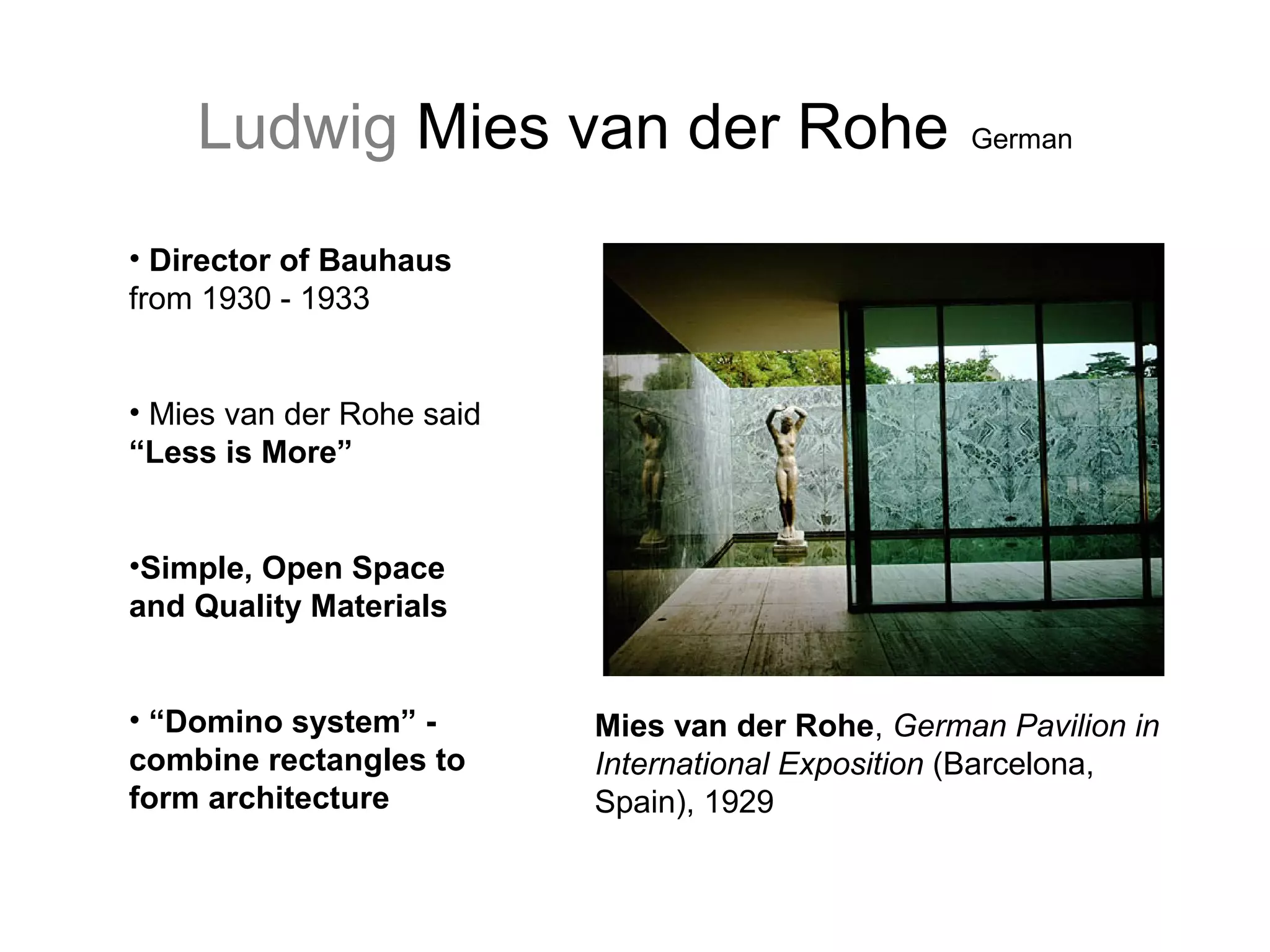
Ludwig Mies van der Rohe German
• Director of Bauhaus
from 1930 - 1933
• Mies van der Rohe said
“Less is More”
•Simple, Open Space
and Quality Materials
• “Domino system” -
combine rectangles to
form architecture
Mies van der Rohe, German Pavilion in
International Exposition (Barcelona,
Spain), 1929
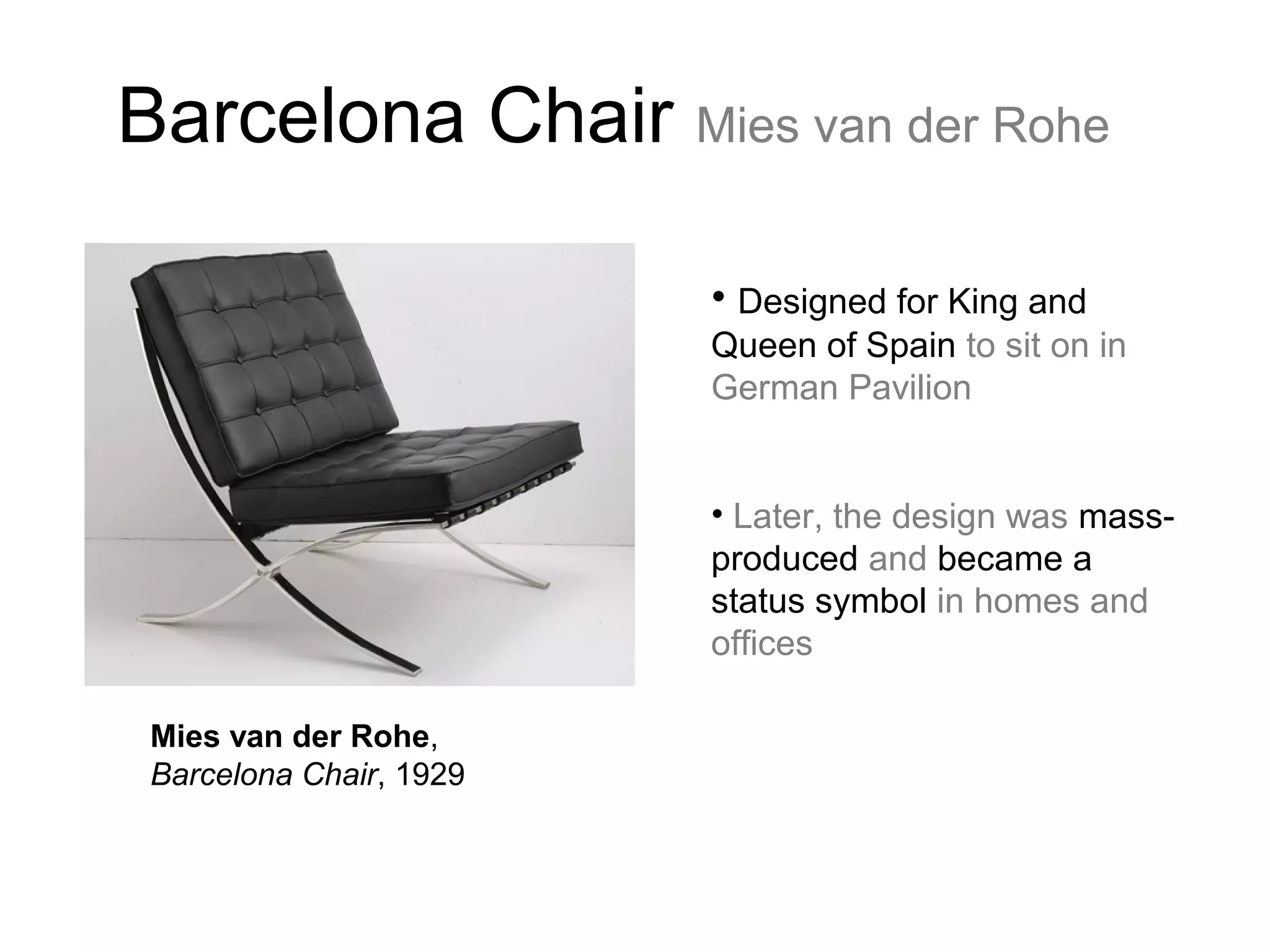
Barcelona Chair Mies van der Rohe
• Designed for King and
Queen of Spain to sit on in
German Pavilion
• Later, the design was mass-
produced and became a
status symbol in homes and
offices
Mies van der Rohe,
Barcelona Chair, 1929
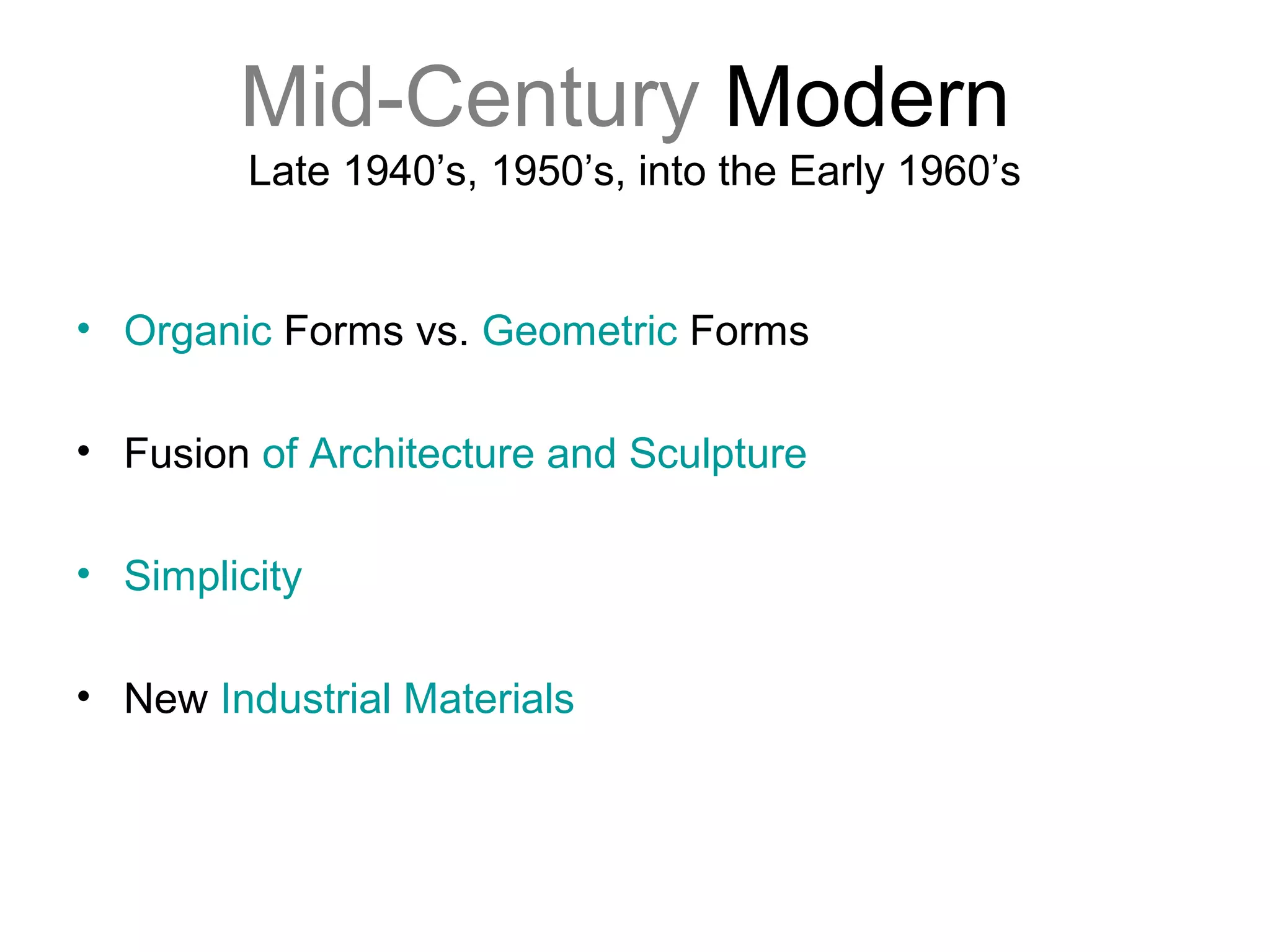
Mid-Century Modern
Late 1940’s, 1950’s, into the Early 1960’s
• Organic Forms vs. Geometric Forms
• Fusion of Architecture and Sculpture
• Simplicity
• New Industrial Materials
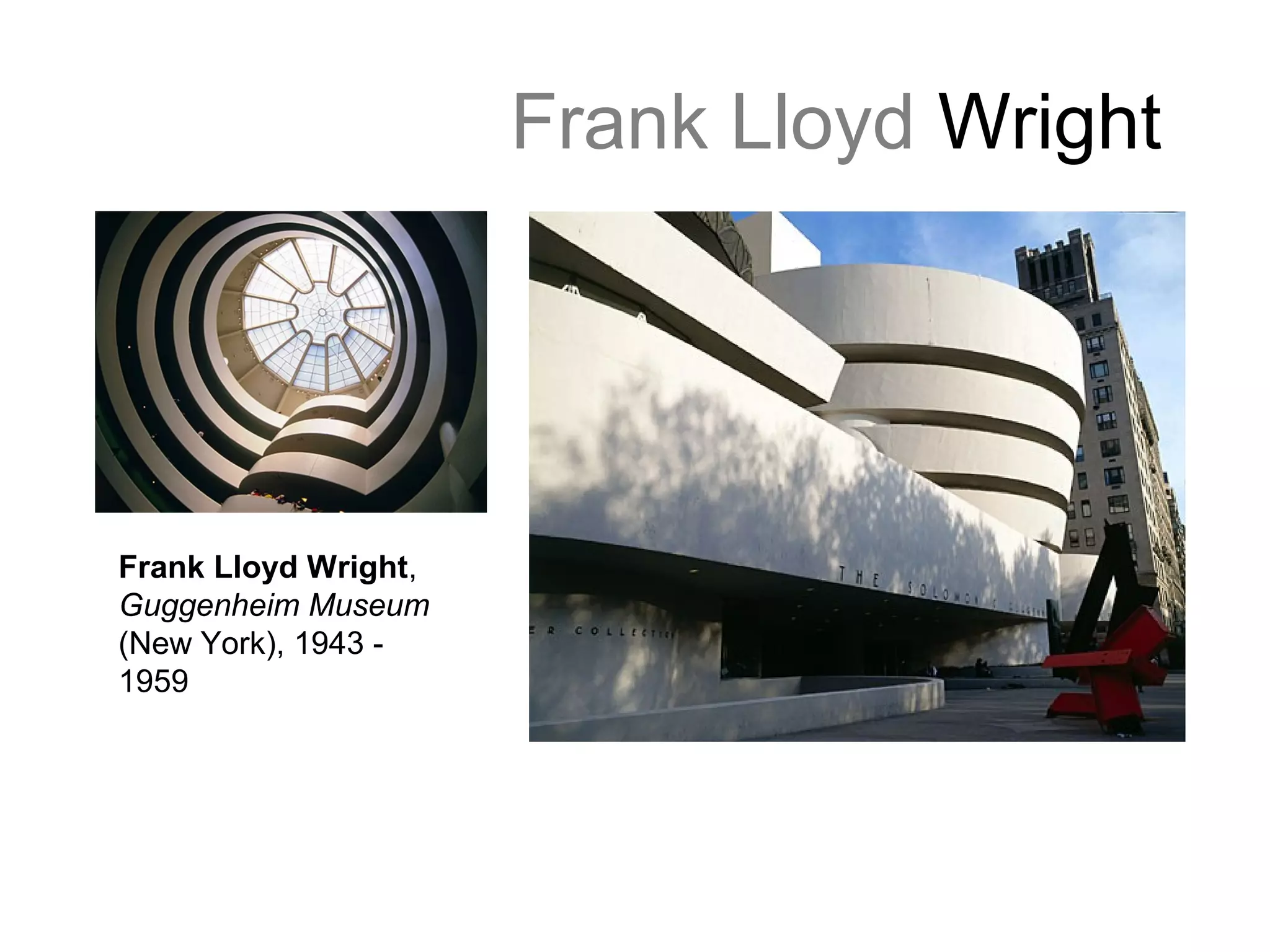
Frank Lloyd Wright
Frank Lloyd Wright,
Guggenheim Museum
(New York), 1943 -
1959
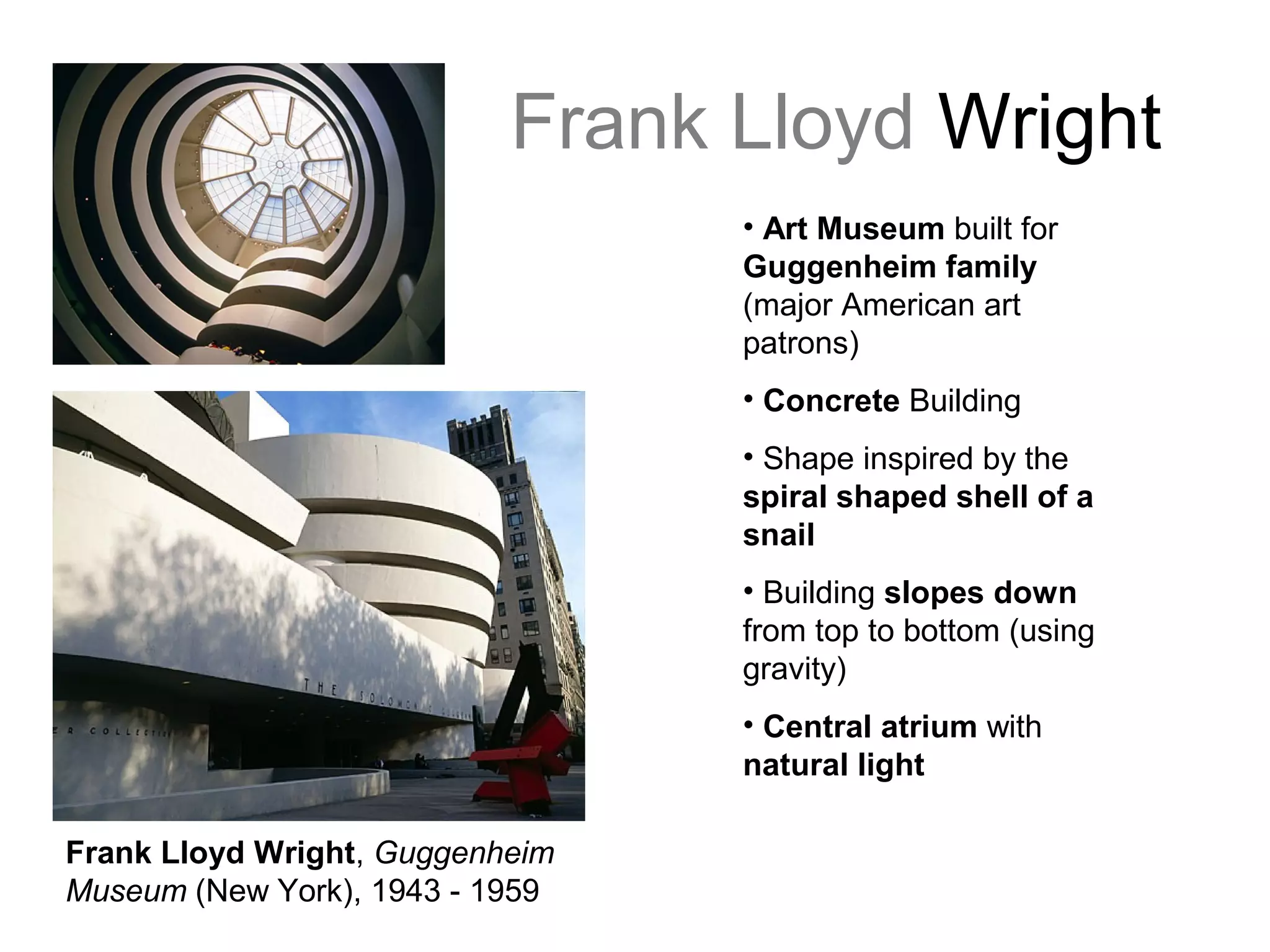
Frank Lloyd Wright
Frank Lloyd Wright, Guggenheim
Museum (New York), 1943 - 1959
• Art Museum built for
Guggenheim family
(major American art
patrons)
• Concrete Building
• Shape inspired by the
spiral shaped shell of a
snail
• Building slopes down
from top to bottom (using
gravity)
• Central atrium with
natural light
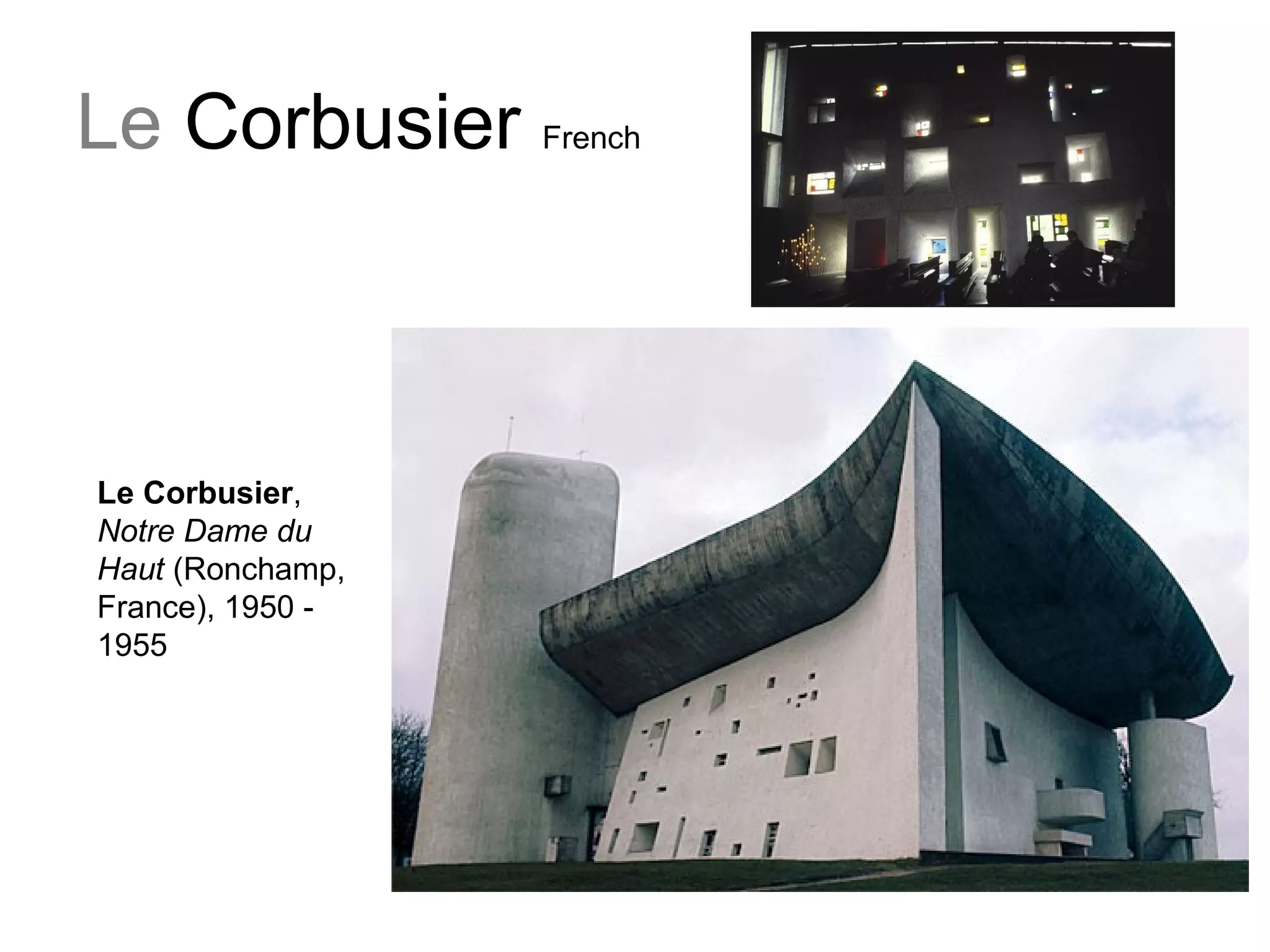
Le Corbusier French
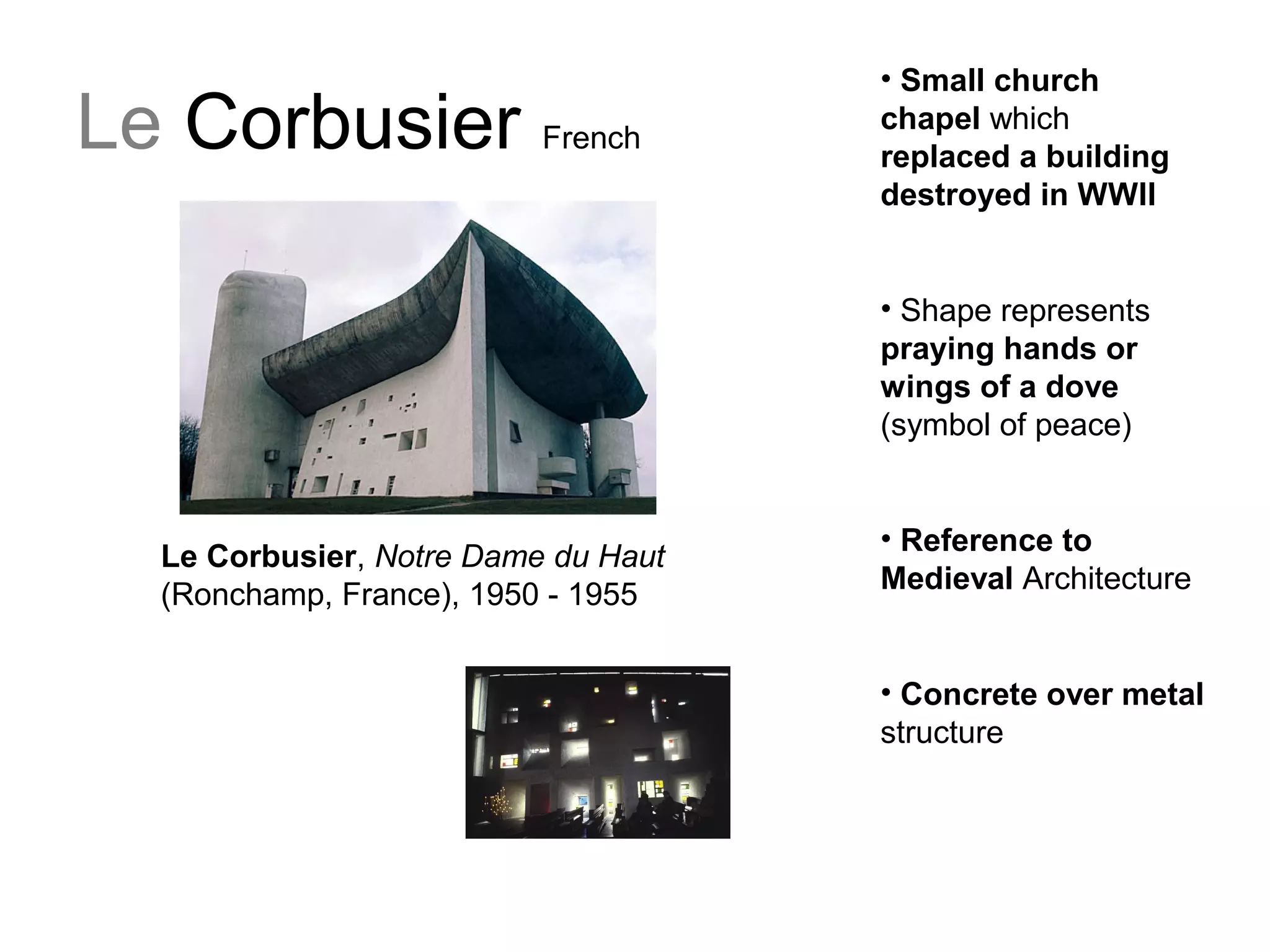
Le Corbusier,
Notre Dame du
Haut (Ronchamp,
France), 1950 -
1955
Le Corbusier French
Le Corbusier, Notre Dame du Haut
(Ronchamp, France), 1950 - 1955
• Small church
chapel which
replaced a building
destroyed in WWII
• Shape represents
praying hands or
wings of a dove
(symbol of peace)
• Reference to
Medieval Architecture
• Concrete over metal
structure
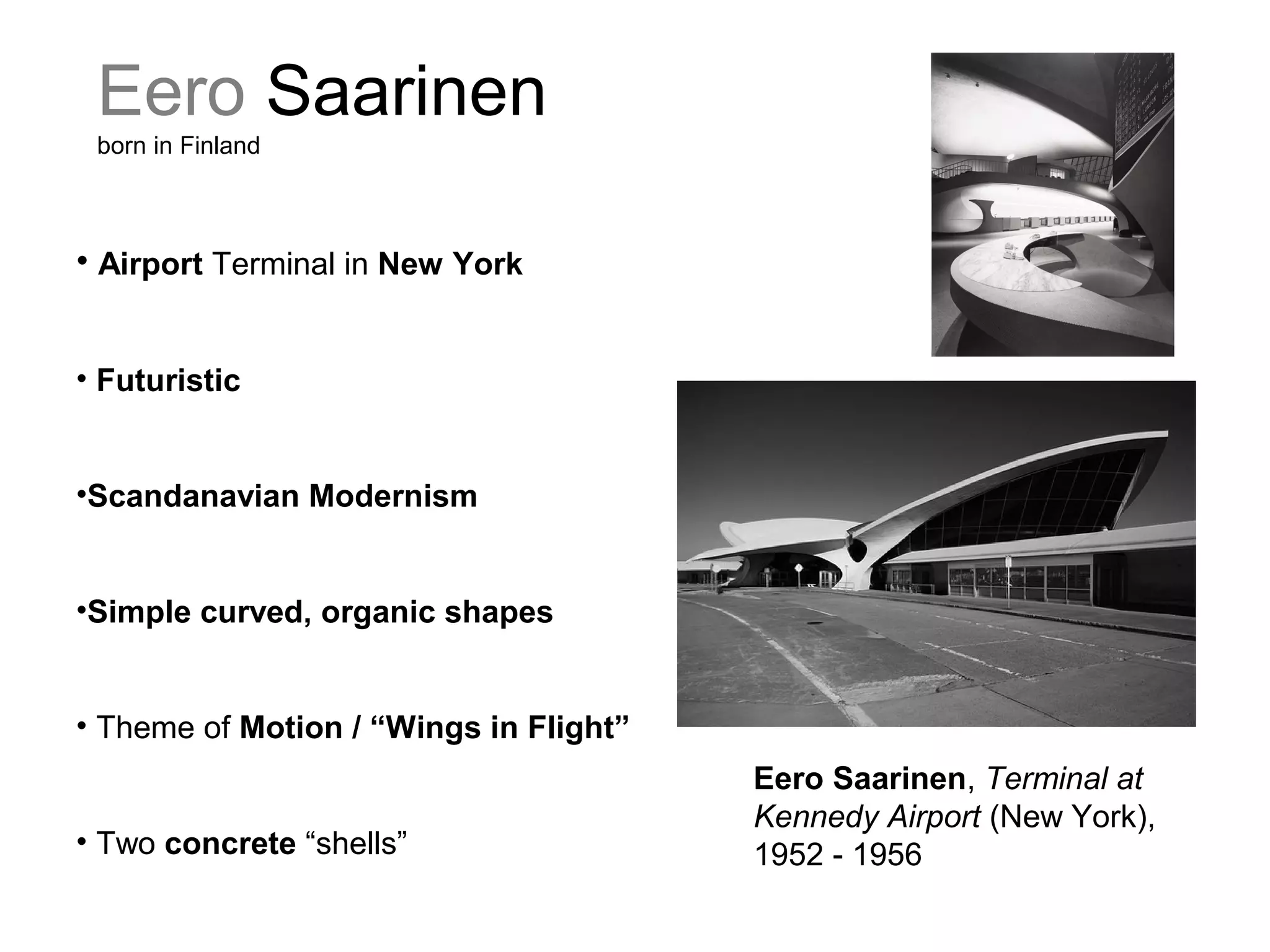
Eero Saarinen
born in Finland
Eero Saarinen, Terminal at
Kennedy Airport (New York),
1952 - 1956
• Airport Terminal in New York
• Futuristic
•Scandanavian Modernism
•Simple curved, organic shapes
• Theme of Motion / “Wings in Flight”
• Two concrete “shells”
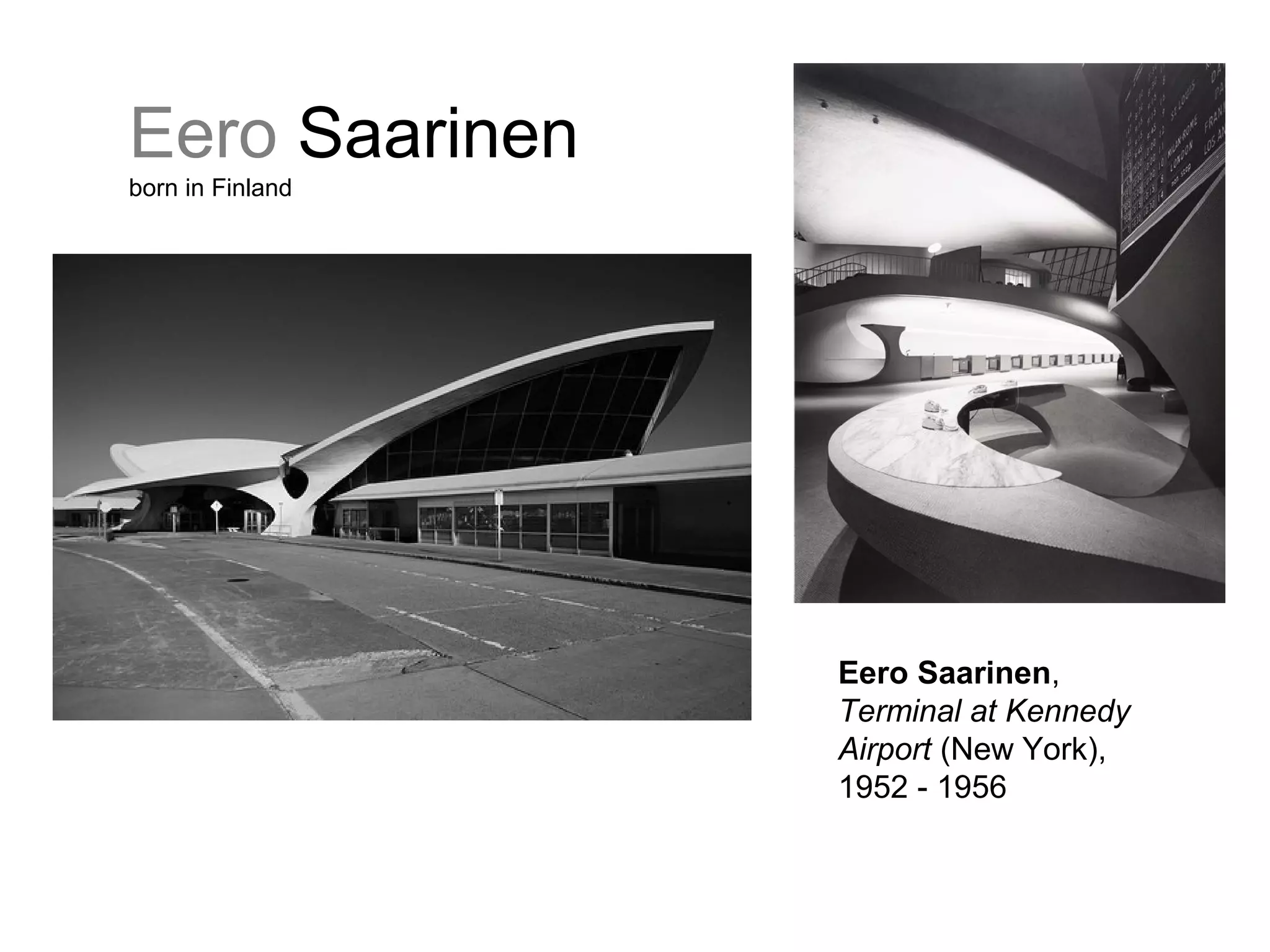
Eero Saarinen
born in Finland
Eero Saarinen,
Terminal at Kennedy
Airport (New York),
1952 - 1956
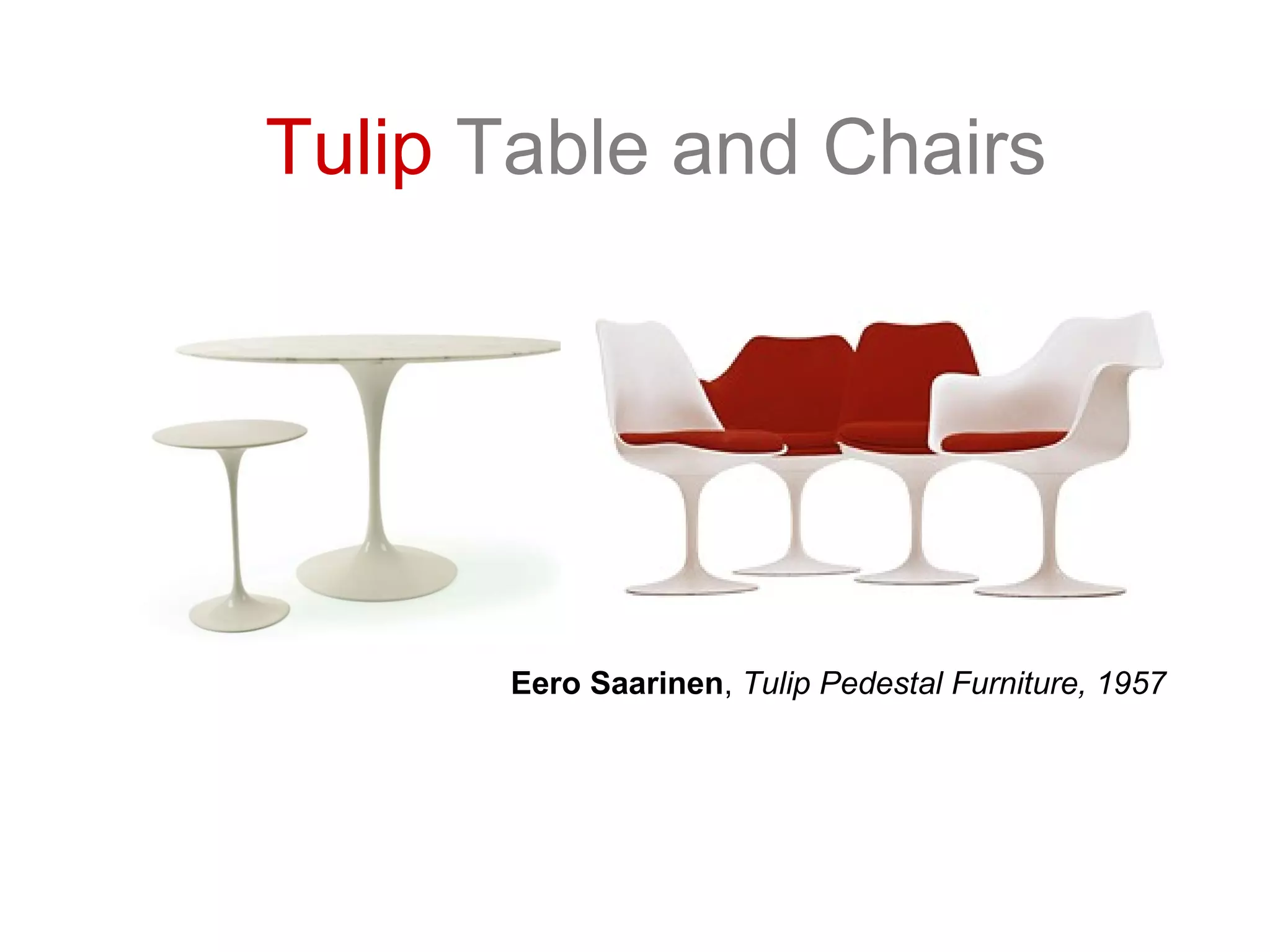
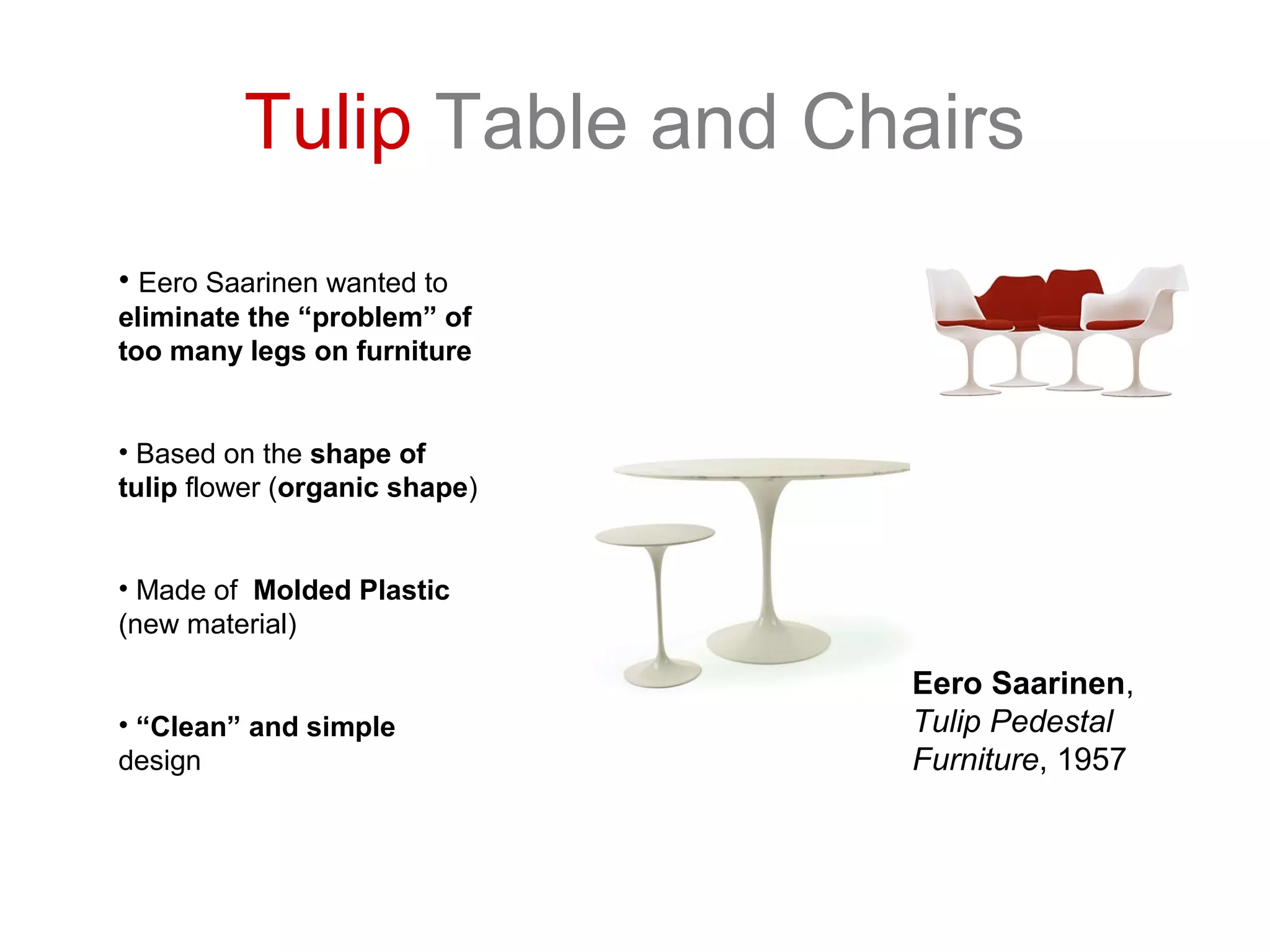
Eero Saarinen, Tulip Pedestal Furniture, 1957
Tulip Table and Chairs
• Eero Saarinen wanted to
eliminate the “problem” of
too many legs on furniture
• Based on the shape of
tulip flower (organic shape)
• Made of Molded Plastic
(new material)
• “Clean” and simple
design
Eero Saarinen,
Tulip Pedestal
Furniture, 1957
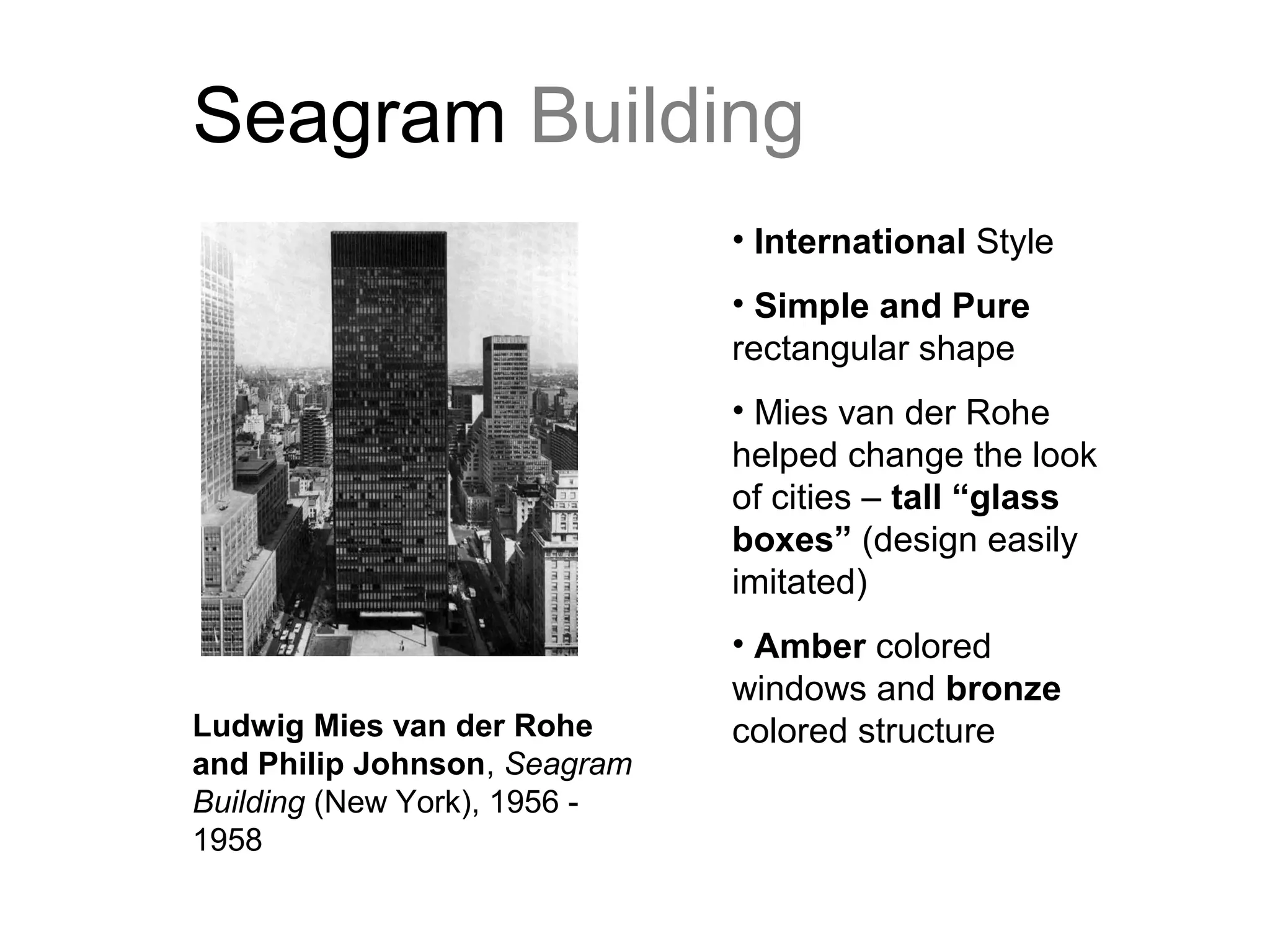
Seagram Building
• International Style
• Simple and Pure
rectangular shape
• Mies van der Rohe
helped change the look
of cities – tall “glass
boxes” (design easily
imitated)
• Amber colored
windows and bronze
colored structureLudwig Mies van der Rohe
and Philip Johnson, Seagram
Building (New York), 1956 -
1958
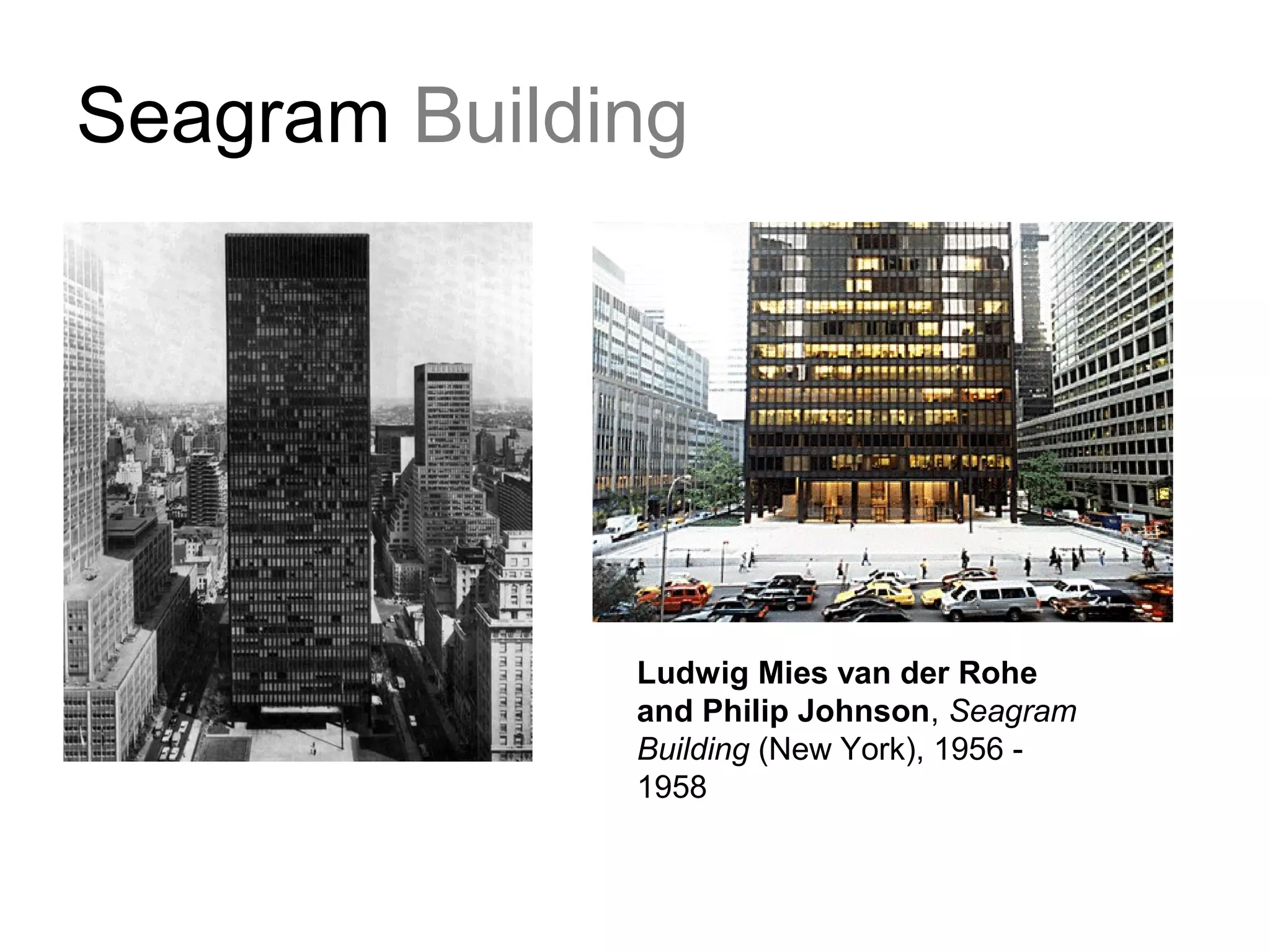
Seagram Building
Ludwig Mies van der Rohe
and Philip Johnson, Seagram
Building (New York), 1956 -
1958
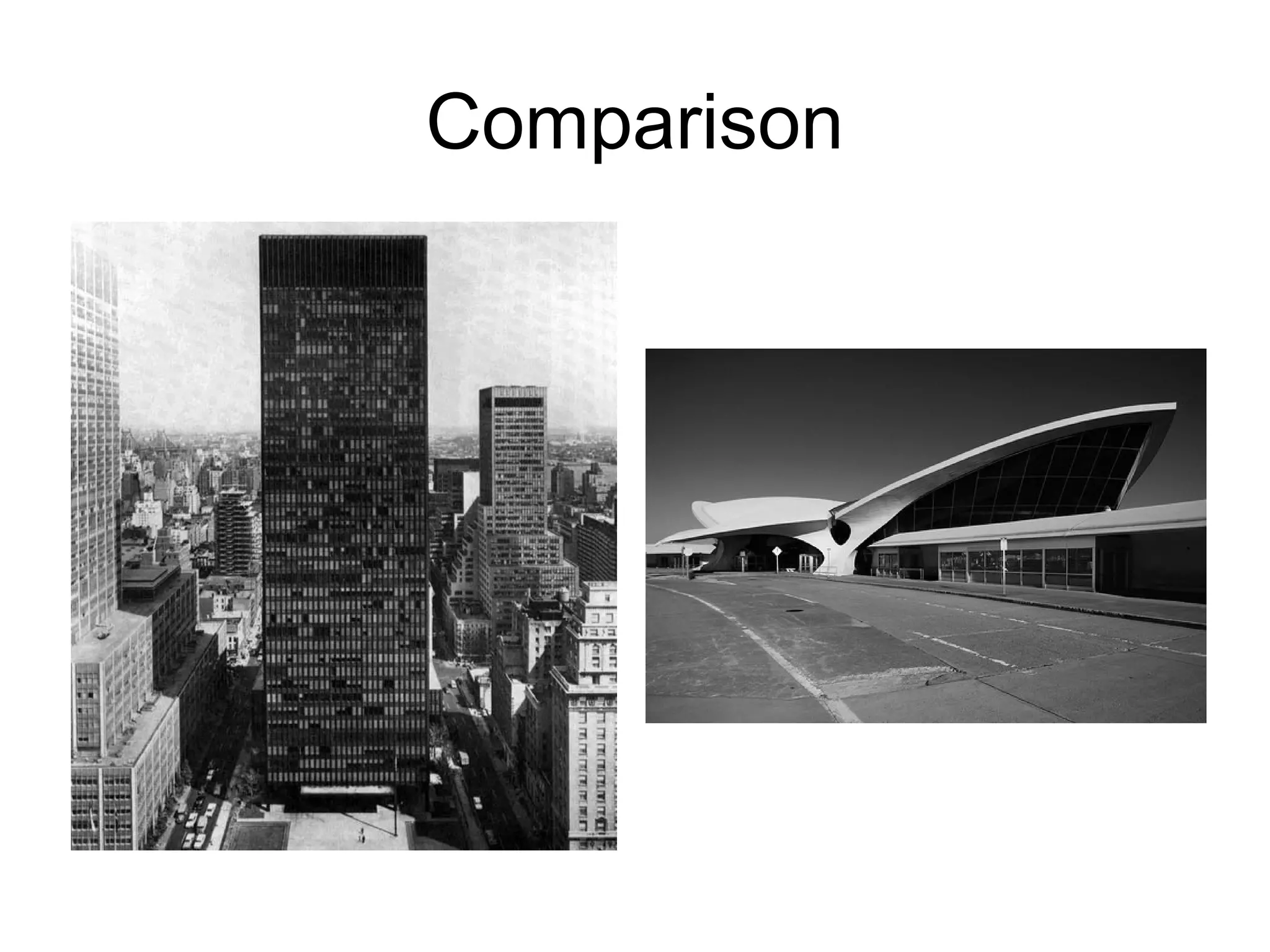
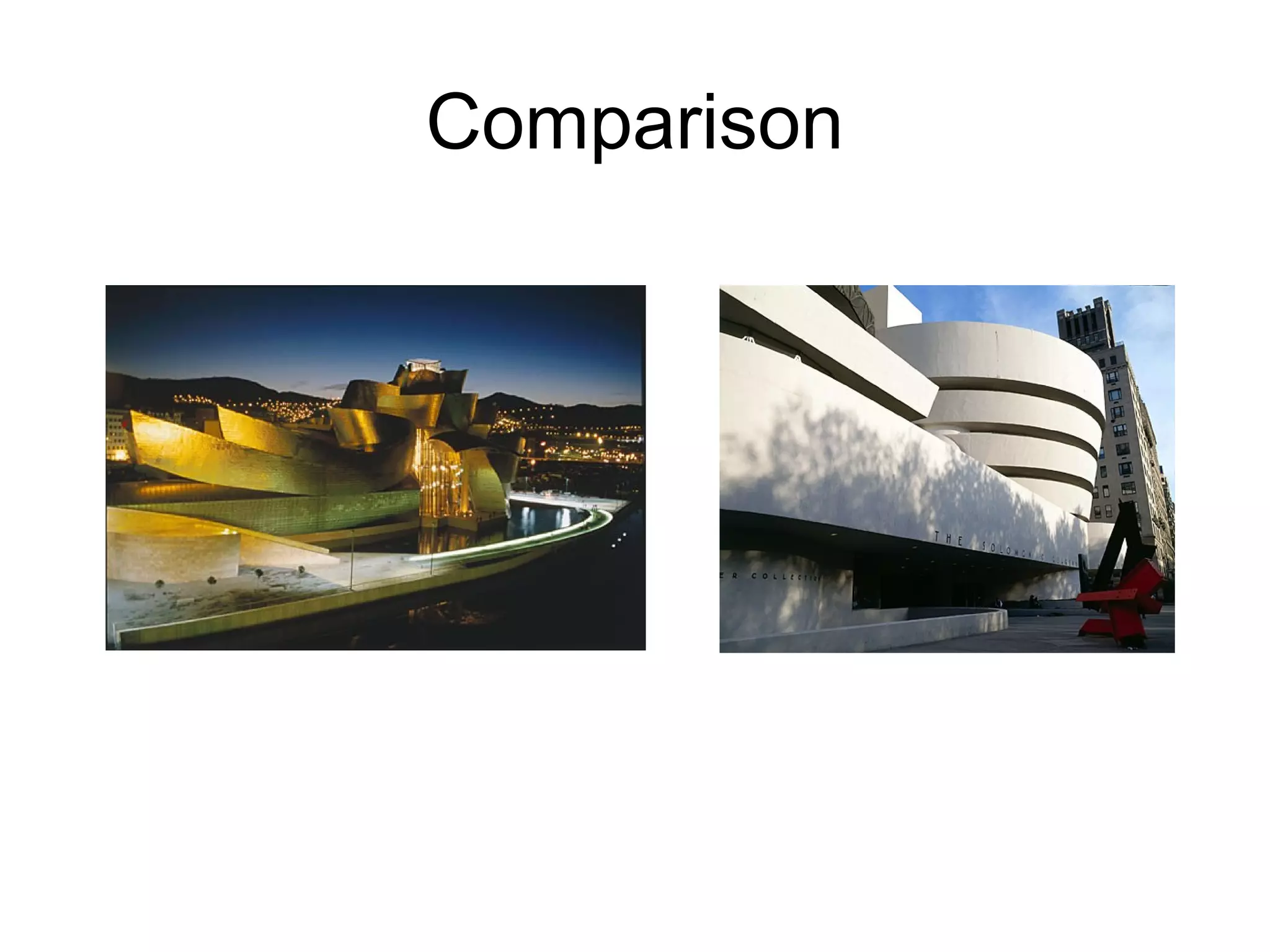
Comparison
Post-Modern Architecture
The Past 20 – 30 Years
• Belief that Early Modernist Architecture was impersonal and sterile
• Complex and Eclectic structures
• Post-Modern architecture accepts and embraces the “messy and
chaotic” nature of urban life
• References to architecture from the past
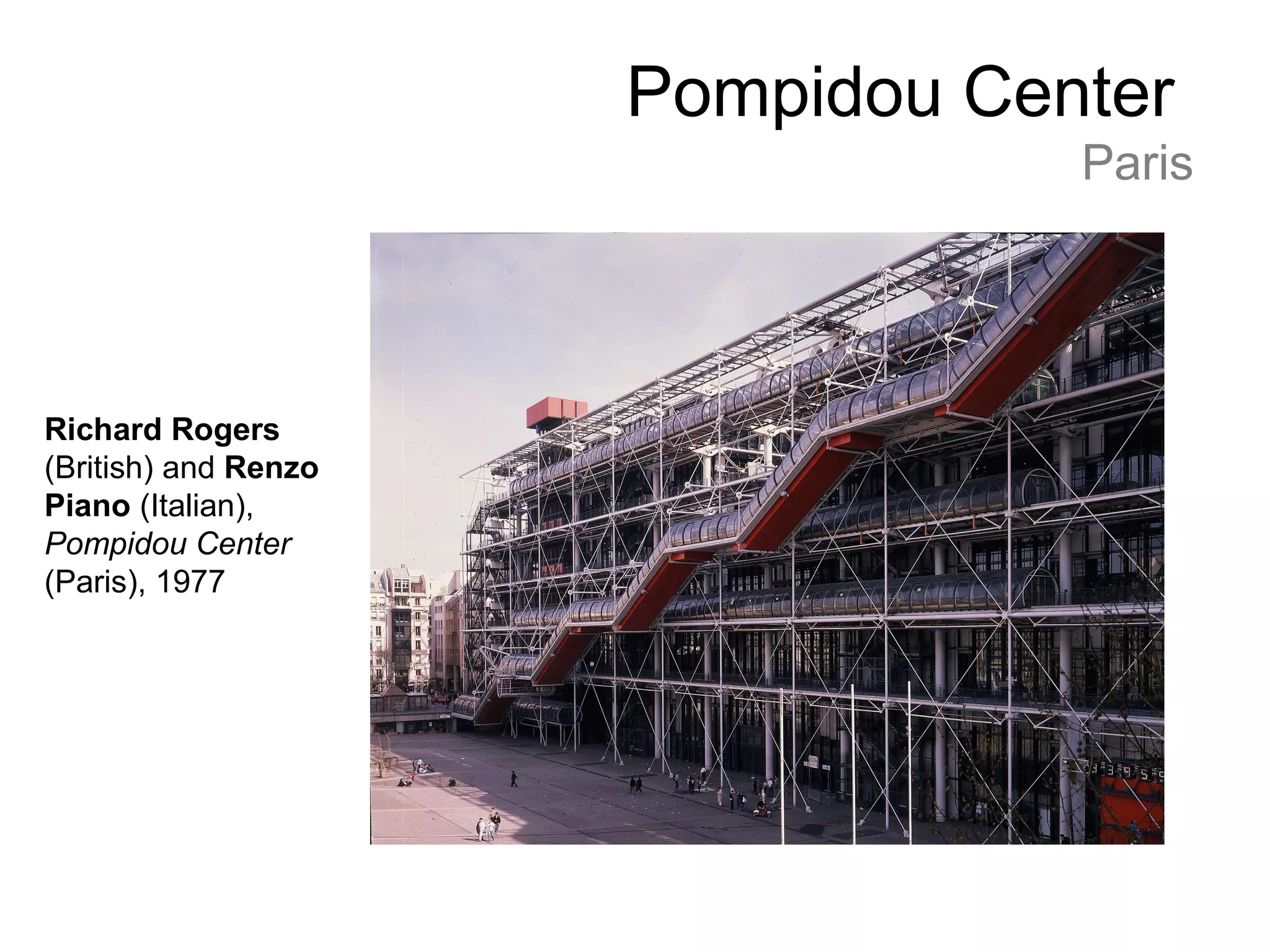
Pompidou Center
Paris
Richard Rogers
(British) and Renzo
Piano (Italian),
Pompidou Center
(Paris), 1977
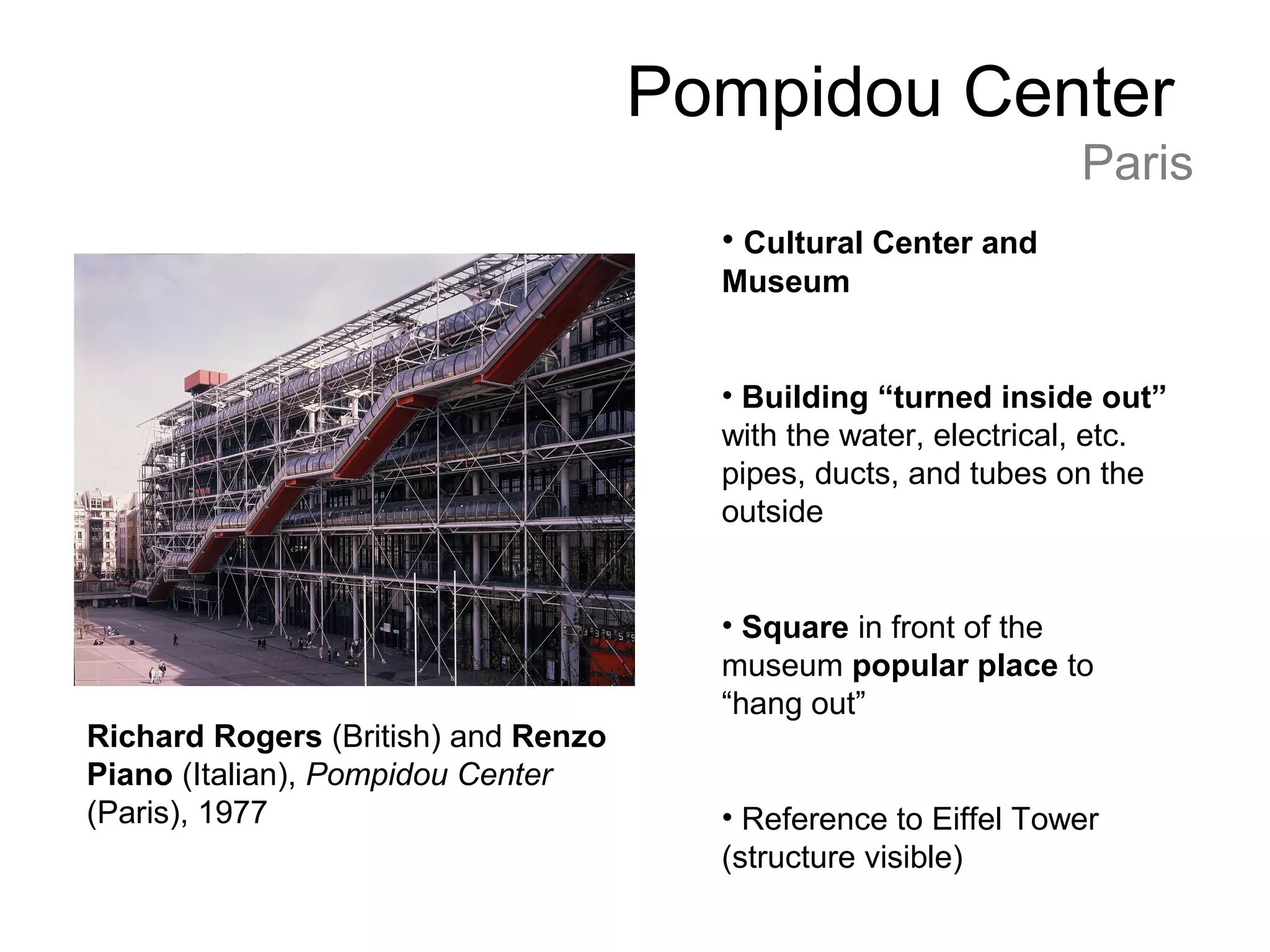
Pompidou Center
Paris
Richard Rogers (British) and Renzo
Piano (Italian), Pompidou Center
(Paris), 1977
• Cultural Center and
Museum
• Building “turned inside out”
with the water, electrical, etc.
pipes, ducts, and tubes on the
outside
• Square in front of the
museum popular place to
“hang out”
• Reference to Eiffel Tower
(structure visible)
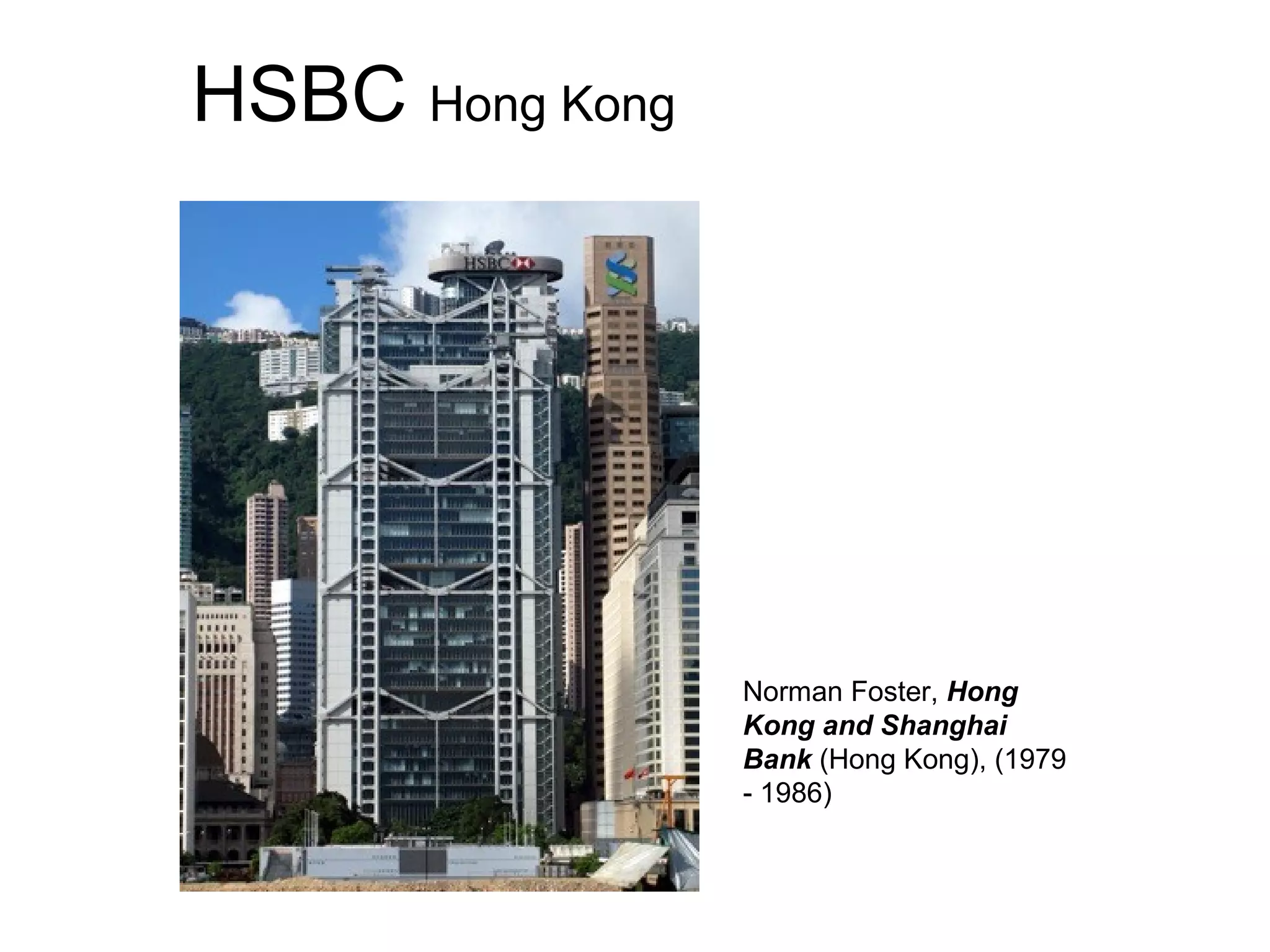
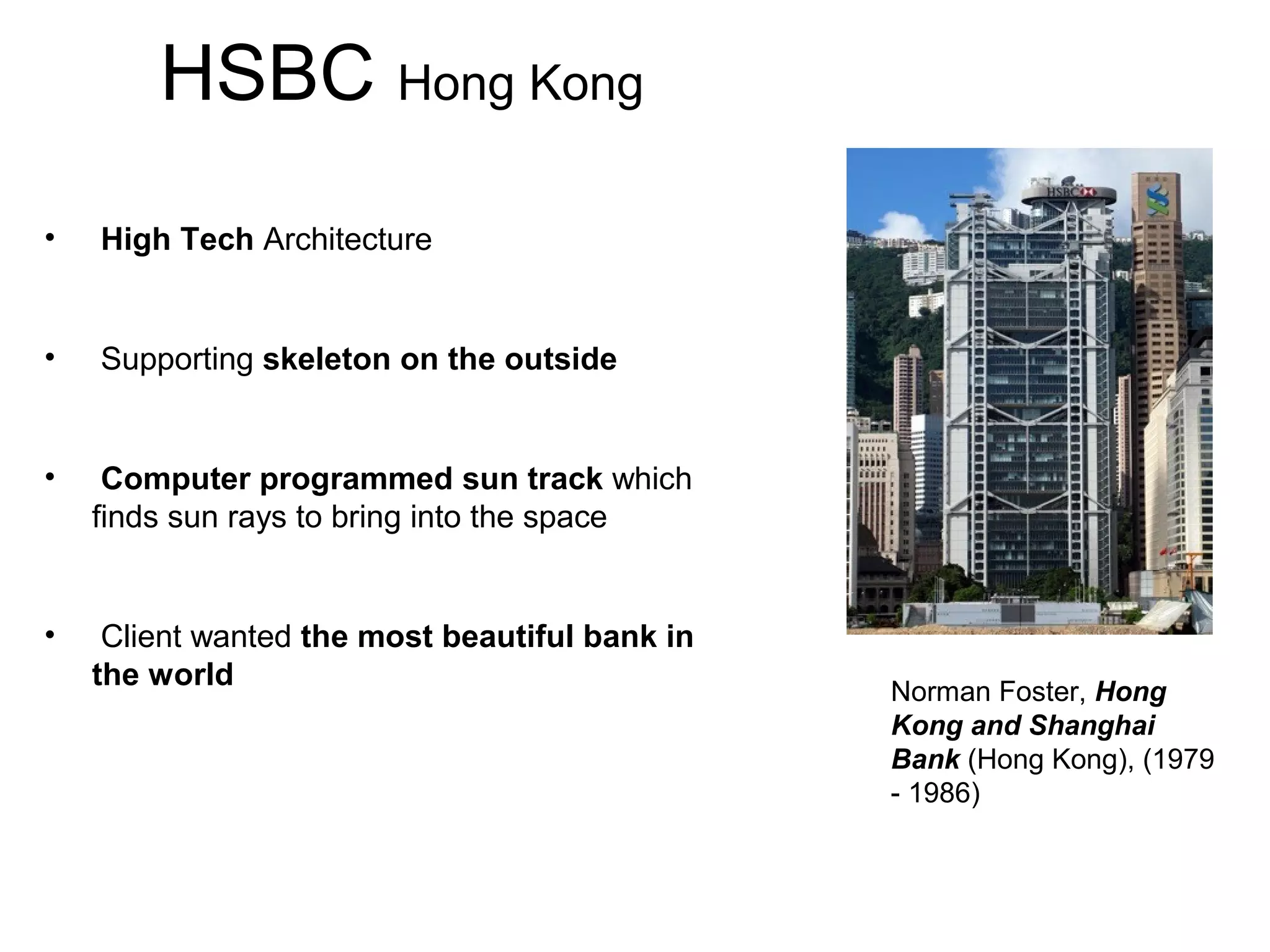
HSBC Hong Kong
Norman Foster, Hong
Kong and Shanghai
Bank (Hong Kong), (1979
- 1986)
HSBC Hong Kong
• High Tech Architecture
• Supporting skeleton on the outside
• Computer programmed sun track which
finds sun rays to bring into the space
• Client wanted the most beautiful bank in
the world
Norman Foster, Hong
Kong and Shanghai
Bank (Hong Kong), (1979
- 1986)
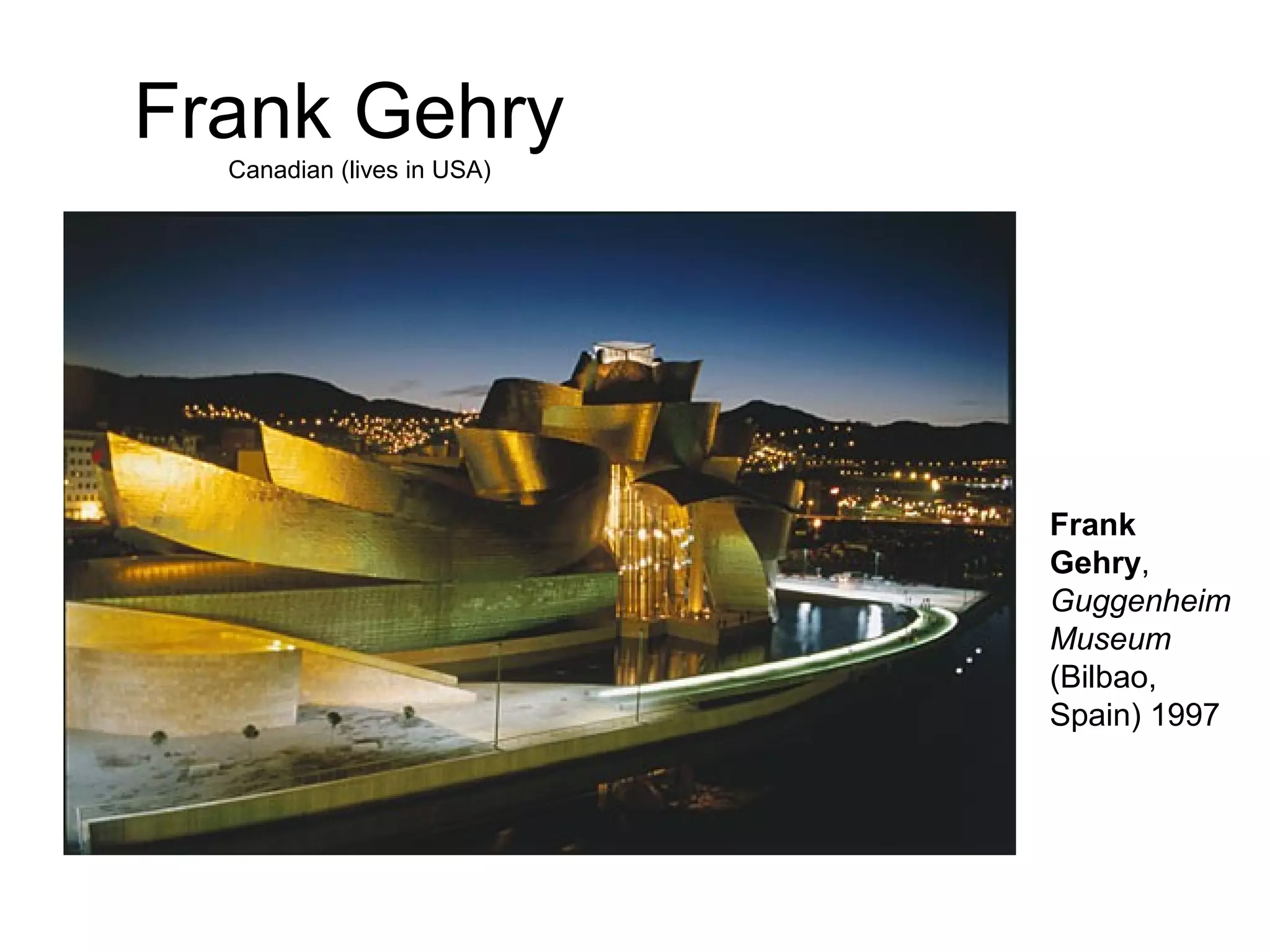
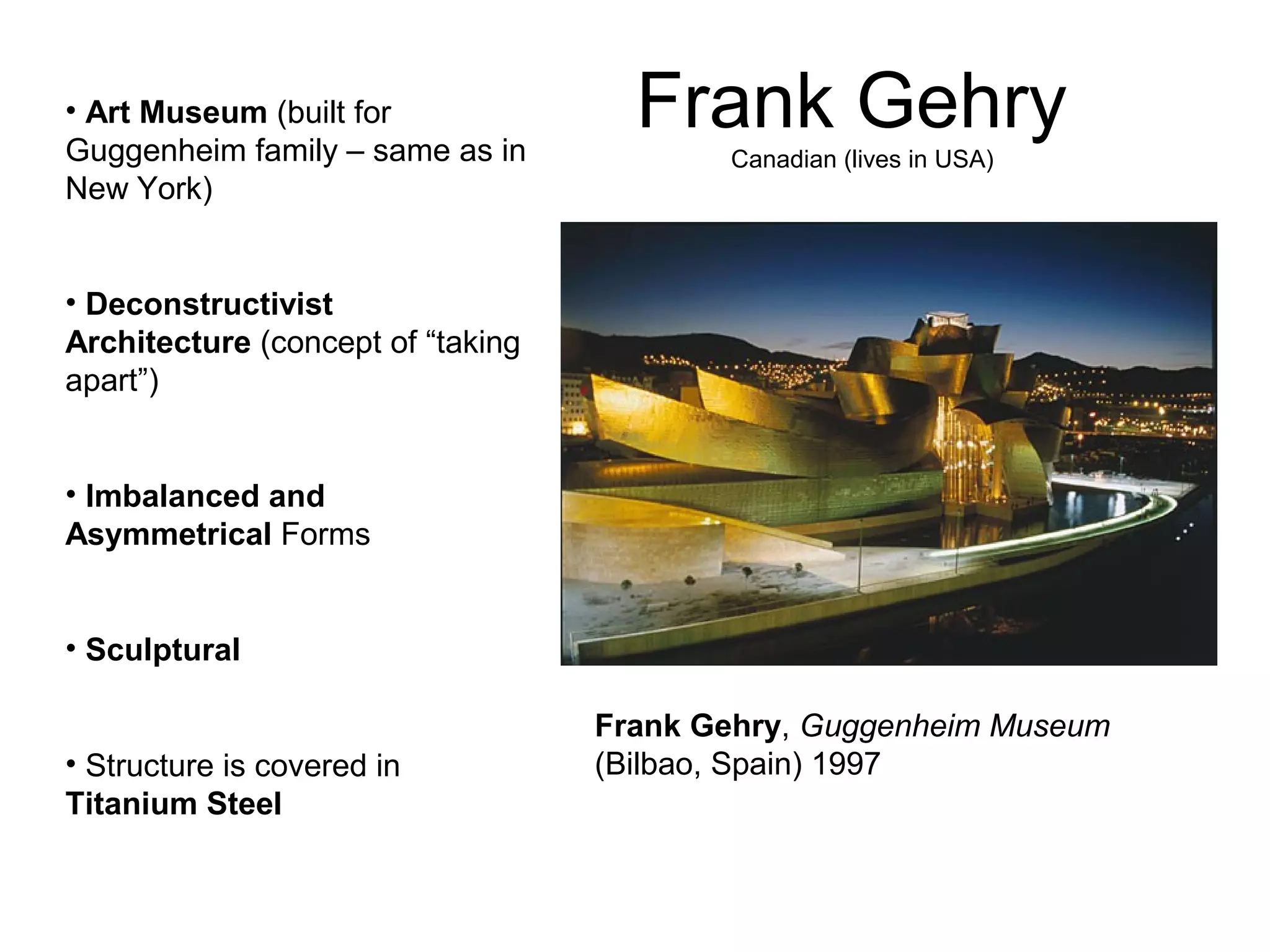
Frank Gehry
Canadian (lives in USA)
Frank
Gehry,
Guggenheim
Museum
(Bilbao,
Spain) 1997
Frank Gehry
Canadian (lives in USA)
Frank Gehry, Guggenheim Museum
(Bilbao, Spain) 1997
• Art Museum (built for
Guggenheim family – same as in
New York)
• Deconstructivist
Architecture (concept of “taking
apart”)
• Imbalanced and
Asymmetrical Forms
• Sculptural
• Structure is covered in
Titanium Steel
Comparison
Santiago Calatrava
Spanish
Santiago
Calatrava,
Milwaukee Art
Museum (USA),
2001
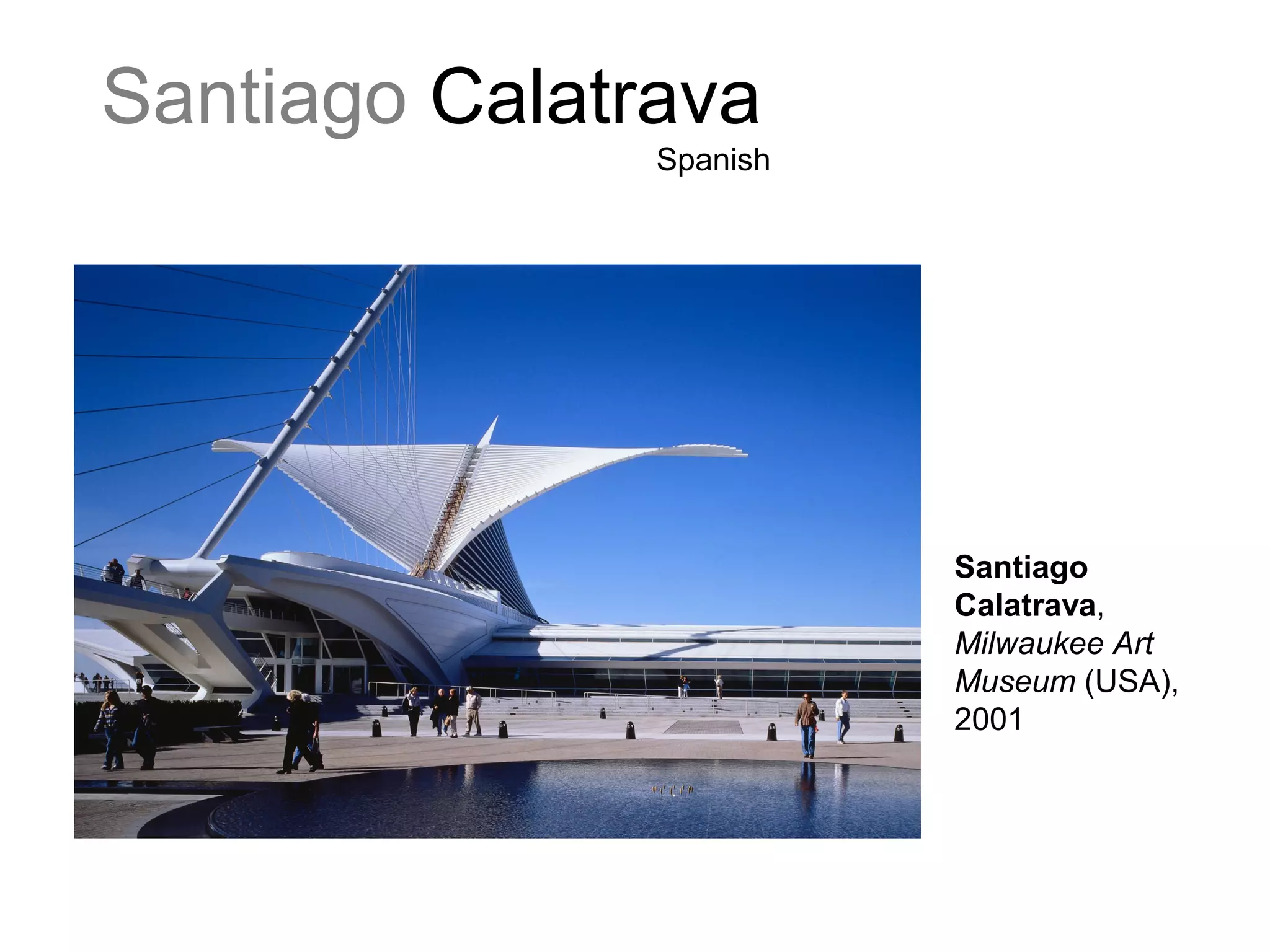
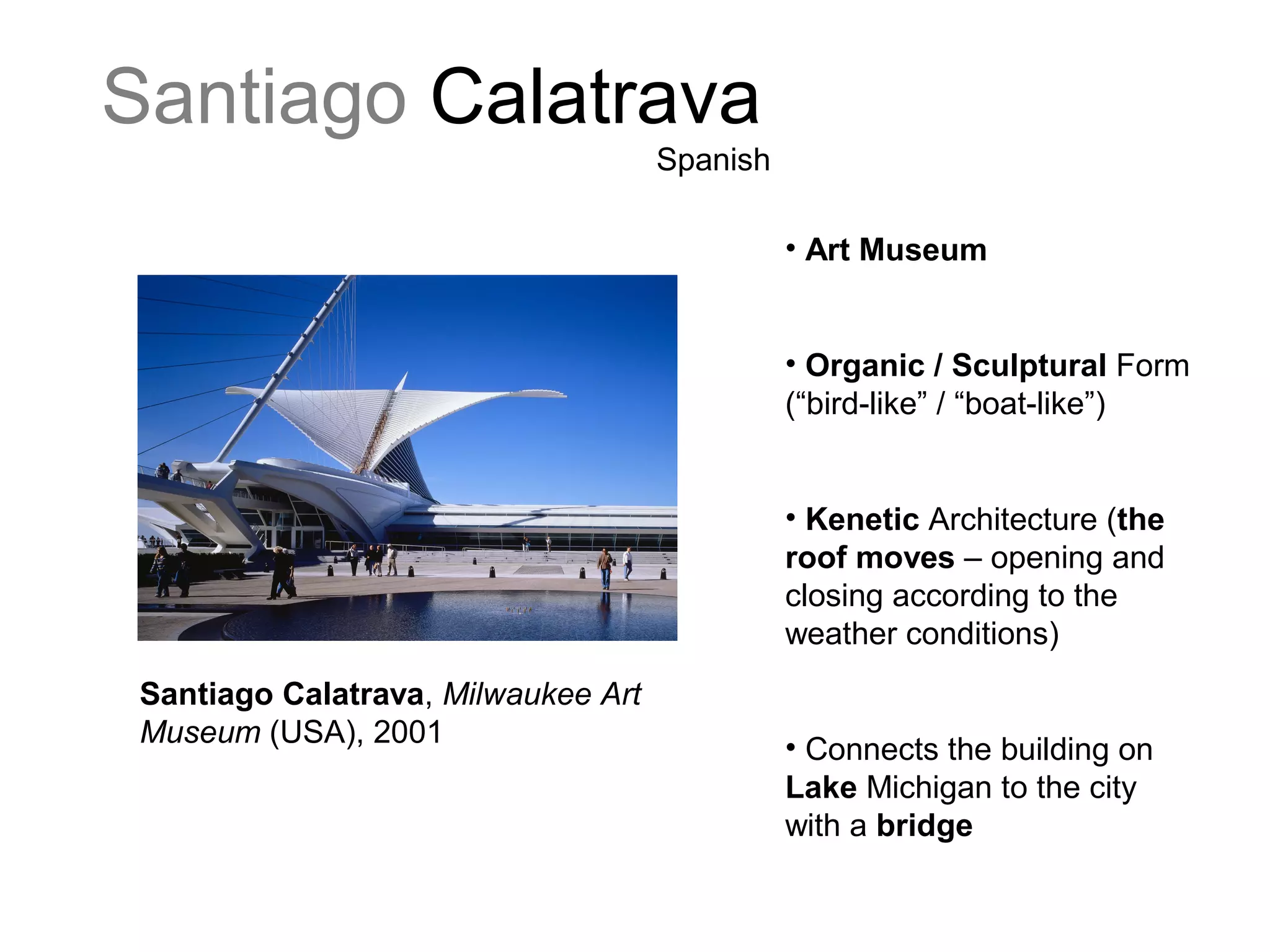
Santiago Calatrava
Spanish
Santiago Calatrava, Milwaukee Art
Museum (USA), 2001
• Art Museum
• Organic / Sculptural Form
(“bird-like” / “boat-like”)
• Kenetic Architecture (the
roof moves – opening and
closing according to the
weather conditions)
• Connects the building on
Lake Michigan to the city
with a bridge
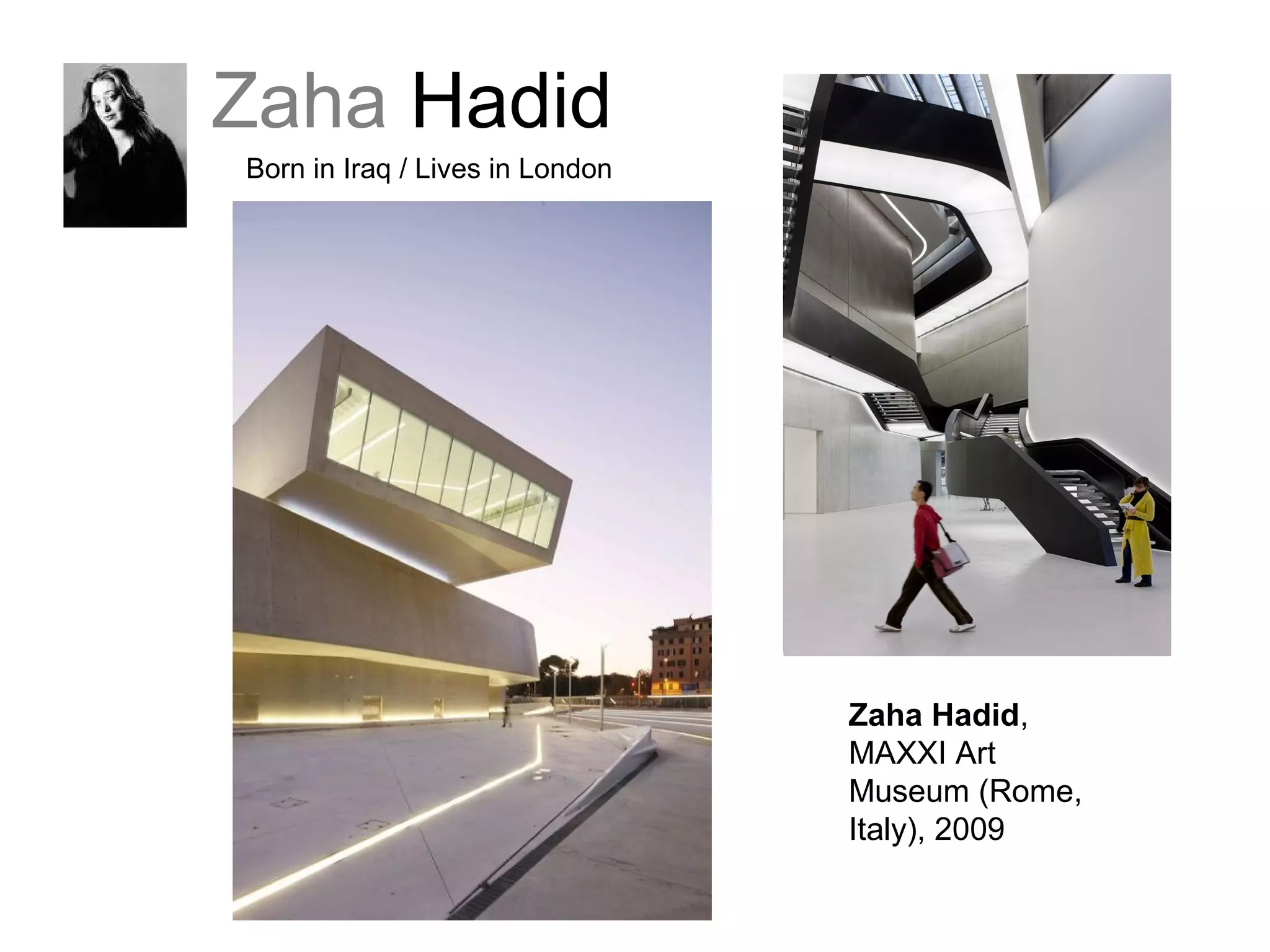
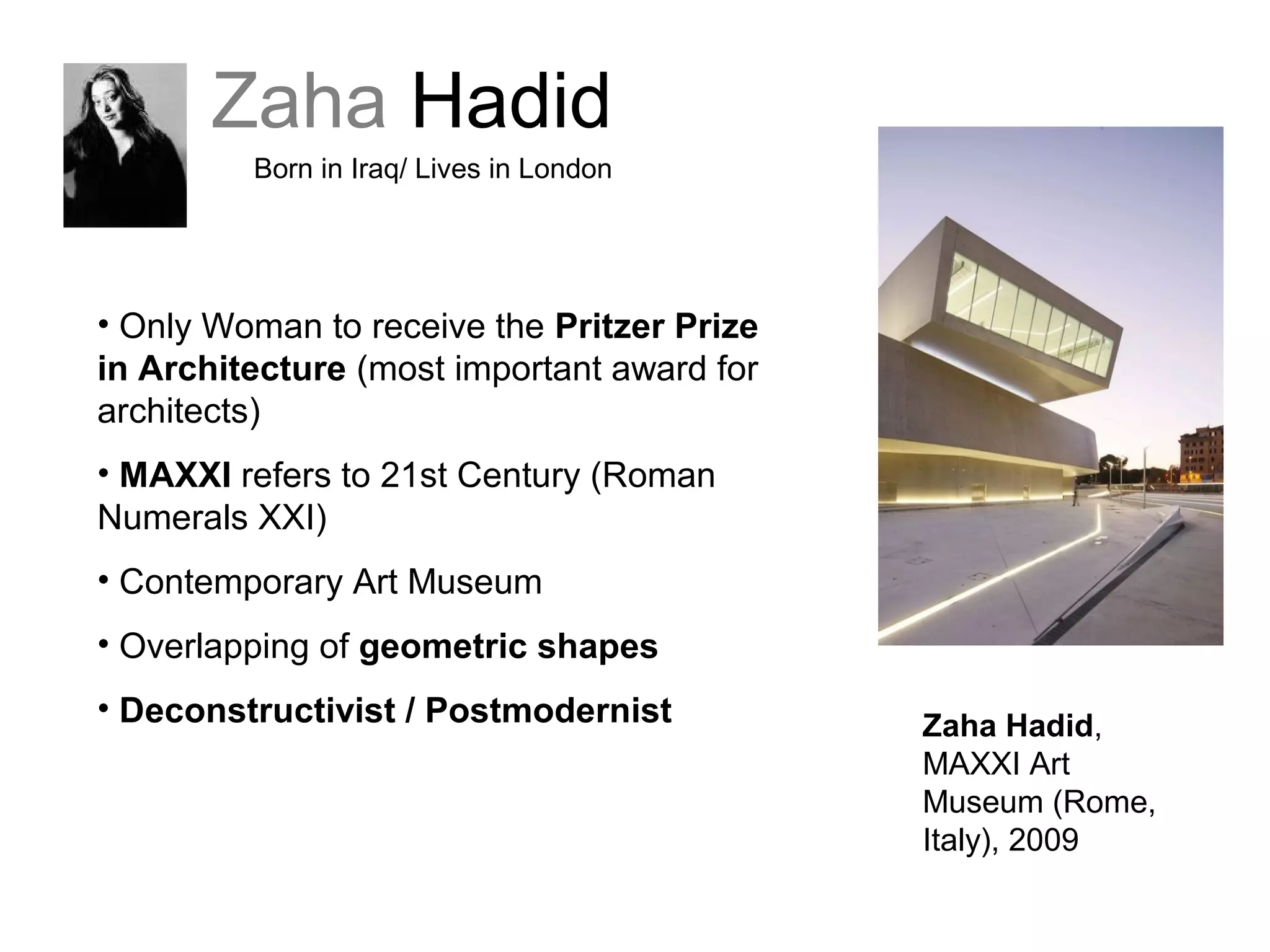
Zaha Hadid
Born in Iraq / Lives in London
Zaha Hadid,
MAXXI Art
Museum (Rome,
Italy), 2009
Zaha Hadid
Born in Iraq/ Lives in London
• Only Woman to receive the Pritzer Prize
in Architecture (most important award for
architects)
• MAXXI refers to 21st Century (Roman
Numerals XXI)
• Contemporary Art Museum
• Overlapping of geometric shapes
• Deconstructivist / Postmodernist Zaha Hadid,
MAXXI Art
Museum (Rome,
Italy), 2009

20thcenturyarchitecture 100607123527-phpapp02

  • 1.
    20th Century Architecture and Designinto the 21st Century Modern to Post-Modern
  • 2.
    Modernism • After 1900artistic innovation in Europe and the US increased in a rapid succession of movements, or “isms”. The modern movement lasted through the first half of the 20th Century. • Modernism rejects old, traditional ideas and styles in art and design • Although Modernist styles are diverse, art moved toward abstraction based on line, color, shape, space, and texture • Modern architecture and design moved toward abstraction and rejected historical styles and ornamentation • Modern architecture reveals rather than conceals the inner structure of the building
  • 3.
    Art Nouveau • ArtNouveau began in France • (Late 19th Century – Early 20th Century) • Art Nouveau incorporates Organic and Natural Forms into the decoration • Architecture +Interior Design, Fashion, Graphic Arts, Decorative Arts
  • 4.
    Louis Sullivan American LouisSullivan, Carson, Pirie, Scott Building (Chicago), 1899-1904
  • 5.
    Louis Sullivan American •Art Nouveau (organic / natural motifs and decoration • Used Cast iron decoration on first and second floors • Large display windows Louis Sullivan, Carson, Pirie, Scott Building (Chicago), 1899-1904
  • 6.
    Antonio Gaudi Spanish Antonio Gaudi,Casa Mila (Barcelona, Spain), 1907
  • 7.
    Antonio Gaudi Spanish • Apartmentbuilding incorporating organic form (Art Nouveau) • Design inspired by the discovery of the Altamira Caves (Prehistoric Caves in Spain) • Gaudi was trained as an ironworker before he became an architect • Gaudi created buildings as “living things” Antonio Gaudi, Casa Mila (Barcelona, Spain), 1907
  • 8.
    De Stijl (TheStyle) • Began in 1917 by a group of artists in Holland • “balance between individual and universal values” • Integration of Art and Life • Geometric Forms / “Purity” and Simplicity
  • 9.
    Gerrit Rietveld Garrit Rietveld,Schroder House (Utrecht, Holland) 1924
  • 10.
    Gerrit Rietveld Garrit Rietveld, SchroderHouse (Utrecht, Holland) 1924 • Rietveld was a furniture maker and architect • Schroder House combines geometric forms and primary colors with black, white, grey • simple, open spaces • furniture designed by Rietveld
  • 11.
    Art Deco • Movementin 1920’s and 1930’s associated with “the Jazz Age” • Began in France, but spread to other parts of Europe, USA, and around the world • People still wanted decoration despite the de Stijl and other modern movements eliminating all unnecessary decoration • Industrial Design Combined with Fine Art Elements (industrial materials (metal) and objects + patterns and repeated shapes) • Industrial Design – cars, household appliances, fashion, decorative objects, architecture • Inspiration from Ancient Cultures, including Egypt
  • 12.
    The Chrysler Building NewYork William van Alen (American), The Chrysler Building (New York), 1928 - 1930
  • 13.
    The Chrysler Building NewYork William van Alen (American), The Chrysler Building (New York), 1928 - 1930 • Exterior made of stainless steel • Art Deco motifs – repeated shapes (triangles, etc.) • Built for Car Manufactuer, Chrysler Automotive Company • Monument to the “Roaring 1920’s”
  • 14.
    Prairie Style • AmericanMidwest Architect Frank Lloyd Wright invented the Prairie Style in early 20th Century • Related to The Arts and Crafts Movement, using craft, including stained glass windows, ceramics, and wood carpentry • Wright preferred the countryside to the city • Natural Materials / Natural Environment • Inspired by Japanese Architecture (long, low buildings with open interior spaces). Wright designed a hotel in Tokyo (now demolished)
  • 15.
    Frank Lloyd Wright American FrankLloyd Wright, Falling water (Pennsylvania, USA) 1935 - 1937
  • 16.
    Frank Lloyd Wright American FrankLloyd Wright, Falling water (Pennsylvania, USA) 1935 - 1937 • “harmony with nature” • Built over a waterfall •Natural materials • Japanese influence
  • 17.
    Frank Lloyd WrightFrankLloyd Wright designed everything for the interiors of his buildings (furniture, lamps, stained glass windows, etc.)
  • 18.
    The Bauhaus • TheBauhaus was an important art and design school in Germany opened in the 1920’s • The Bauhaus focused on understanding Pure Form (color, shape, line, composition, space, etc,) • Many important artists and designers taught and studied there • The Bauhaus trained artists, designers, and architects to accept and anticipate the needs of the 20th Century • The Bauhaus greatly influenced modern design – “streamlined” the look of architecture and design, including typography • The Bauhaus was closed by the Nazis in 1933
  • 19.
    The Bauhaus Bauhaus designers invented new simplified formsof typography (sans serif) The Bauhaus designers created “streamlined” design with simple, “clean lines”
  • 20.
    Walter Gropius German Walter Gropius,the Bauhaus (Dessau, Germany), 1925 - 1926
  • 21.
    Walter Gropius German •Main Building of Bauhaus Art and Design School • In 1919, Gropius, German architect, was appointed director of The Bauhaus • Gropius focused on Formal Elements (shape, color, line, etc.) • Gropius promoted the unity of art, architecture, and design Walter Gropius, the Bauhaus (Dessau, Germany), 1925 - 1926
  • 22.
    Ludwig Mies vander Rohe German Mies van der Rohe, German Pavilion in International Exposition (Barcelona, Spain), 1929
  • 23.
    Ludwig Mies vander Rohe German • Director of Bauhaus from 1930 - 1933 • Mies van der Rohe said “Less is More” •Simple, Open Space and Quality Materials • “Domino system” - combine rectangles to form architecture Mies van der Rohe, German Pavilion in International Exposition (Barcelona, Spain), 1929
  • 24.
    Barcelona Chair Miesvan der Rohe • Designed for King and Queen of Spain to sit on in German Pavilion • Later, the design was mass- produced and became a status symbol in homes and offices Mies van der Rohe, Barcelona Chair, 1929
  • 25.
    Mid-Century Modern Late 1940’s,1950’s, into the Early 1960’s • Organic Forms vs. Geometric Forms • Fusion of Architecture and Sculpture • Simplicity • New Industrial Materials
  • 26.
    Frank Lloyd Wright FrankLloyd Wright, Guggenheim Museum (New York), 1943 - 1959
  • 27.
    Frank Lloyd Wright FrankLloyd Wright, Guggenheim Museum (New York), 1943 - 1959 • Art Museum built for Guggenheim family (major American art patrons) • Concrete Building • Shape inspired by the spiral shaped shell of a snail • Building slopes down from top to bottom (using gravity) • Central atrium with natural light
  • 28.
    Le Corbusier French LeCorbusier, Notre Dame du Haut (Ronchamp, France), 1950 - 1955
  • 29.
    Le Corbusier French LeCorbusier, Notre Dame du Haut (Ronchamp, France), 1950 - 1955 • Small church chapel which replaced a building destroyed in WWII • Shape represents praying hands or wings of a dove (symbol of peace) • Reference to Medieval Architecture • Concrete over metal structure
  • 30.
    Eero Saarinen born inFinland Eero Saarinen, Terminal at Kennedy Airport (New York), 1952 - 1956 • Airport Terminal in New York • Futuristic •Scandanavian Modernism •Simple curved, organic shapes • Theme of Motion / “Wings in Flight” • Two concrete “shells”
  • 31.
    Eero Saarinen born inFinland Eero Saarinen, Terminal at Kennedy Airport (New York), 1952 - 1956
  • 32.
    Eero Saarinen, TulipPedestal Furniture, 1957 Tulip Table and Chairs
  • 33.
    Tulip Table andChairs • Eero Saarinen wanted to eliminate the “problem” of too many legs on furniture • Based on the shape of tulip flower (organic shape) • Made of Molded Plastic (new material) • “Clean” and simple design Eero Saarinen, Tulip Pedestal Furniture, 1957
  • 34.
    Seagram Building • InternationalStyle • Simple and Pure rectangular shape • Mies van der Rohe helped change the look of cities – tall “glass boxes” (design easily imitated) • Amber colored windows and bronze colored structureLudwig Mies van der Rohe and Philip Johnson, Seagram Building (New York), 1956 - 1958
  • 35.
    Seagram Building Ludwig Miesvan der Rohe and Philip Johnson, Seagram Building (New York), 1956 - 1958
  • 36.
  • 37.
    Post-Modern Architecture The Past20 – 30 Years • Belief that Early Modernist Architecture was impersonal and sterile • Complex and Eclectic structures • Post-Modern architecture accepts and embraces the “messy and chaotic” nature of urban life • References to architecture from the past
  • 38.
    Pompidou Center Paris Richard Rogers (British)and Renzo Piano (Italian), Pompidou Center (Paris), 1977
  • 39.
    Pompidou Center Paris Richard Rogers(British) and Renzo Piano (Italian), Pompidou Center (Paris), 1977 • Cultural Center and Museum • Building “turned inside out” with the water, electrical, etc. pipes, ducts, and tubes on the outside • Square in front of the museum popular place to “hang out” • Reference to Eiffel Tower (structure visible)
  • 40.
    HSBC Hong Kong NormanFoster, Hong Kong and Shanghai Bank (Hong Kong), (1979 - 1986)
  • 41.
    HSBC Hong Kong •High Tech Architecture • Supporting skeleton on the outside • Computer programmed sun track which finds sun rays to bring into the space • Client wanted the most beautiful bank in the world Norman Foster, Hong Kong and Shanghai Bank (Hong Kong), (1979 - 1986)
  • 42.
    Frank Gehry Canadian (livesin USA) Frank Gehry, Guggenheim Museum (Bilbao, Spain) 1997
  • 43.
    Frank Gehry Canadian (livesin USA) Frank Gehry, Guggenheim Museum (Bilbao, Spain) 1997 • Art Museum (built for Guggenheim family – same as in New York) • Deconstructivist Architecture (concept of “taking apart”) • Imbalanced and Asymmetrical Forms • Sculptural • Structure is covered in Titanium Steel
  • 44.
  • 45.
  • 46.
    Santiago Calatrava Spanish Santiago Calatrava,Milwaukee Art Museum (USA), 2001 • Art Museum • Organic / Sculptural Form (“bird-like” / “boat-like”) • Kenetic Architecture (the roof moves – opening and closing according to the weather conditions) • Connects the building on Lake Michigan to the city with a bridge
  • 47.
    Zaha Hadid Born inIraq / Lives in London Zaha Hadid, MAXXI Art Museum (Rome, Italy), 2009
  • 48.
    Zaha Hadid Born inIraq/ Lives in London • Only Woman to receive the Pritzer Prize in Architecture (most important award for architects) • MAXXI refers to 21st Century (Roman Numerals XXI) • Contemporary Art Museum • Overlapping of geometric shapes • Deconstructivist / Postmodernist Zaha Hadid, MAXXI Art Museum (Rome, Italy), 2009