TAXATION IN THE
PHILIPPINES:
ITS HISTORICAL
DEVELOPMENT
WHAT ARE TAXES?
-Taxes are the enforced
proportional contributions from
person and property lived by the
state by virtue of sovereignty for
the support of the government
and for all the public needs and
purpose.
THE FOLLOWING
ARE THE IMPORTANT
CHARACTERISTICS
OF TAXES:
1. A tax is an enforced
proportional contribution
because imposition is not
based upon the will of the
person taxed.
2. A tax is generally payable in
the form of money, although the
law may provide payment in kind
3. A tax is laid by some rule
of apportionment which is
usually based on the ability
to pay.
4. A tax is levied on persons or
property and also on acts,
transactions, rights, or privileges.
In each case, however, it is the
person who pays the taxes
5. A tax is levied by the
State, which has
jurisdiction over the
person or property.
6. A tax is levied by the law-
making body of the State
because the power to tax is
an exclusive function of the
legislature, which in this
case, the Congress.
7.A tax is levied for public
purpose
THE THEORY
OF TAXATION
-The power of taxation proceeds
from the theory that without funds,
the Government cannot meet the
various essential expenses it
government to exist and function.
THE POWER OF
TAXATION
It is the power of the State to impose
and collect revenues for the
operation of the government. The
money generated from the people in
the form of different taxes shall be
used in the operations of
government, for infrastructure
programs, and other expenditures of
the State
THE PURPOSE
AND
IMPORTANCE OF
TAXATION
The purpose of taxation is
to raise revenues of funds
to support the
Government and its
services.
The importance of taxation
derives from the inevitable
obligation of the Government to
protect the people and extend
them benefits in the form of
public projects and services.
THE NATURE OF
TAXATION
1.The power of taxation is an
inherent power
2. The taxing power is essentially a
legislative function
THE
CONSTITUTIONAL
LIMITATIONS OF
TAXATION
1. OBSERVANCE OF DUE
PROCESS OF LAW
Section 1, Article III, Bill of Rights:
"No person shall be deprived of life,
liberty, or property without due
process of law, nor shall any person
be denied the equal protection of
the laws."
2. Observance of equal protection of
the laws
Section 1, Article III, Bill of Rights: "No
person shall be deprived of life,
liberty, or property without due
process of law, nor shall any person
be denied the equal protection of the
laws."
3. Prohibition against imprisonment for
non-payment of poll tax
Section 20, Article III, Bill of Rights: "No
person shall imprisoned for debt or non-
payment of a poll tax
4.Prohibition against
impairment of obligation of
contracts
Section 10, Article III, Bill of
Rights: "No law impairing
the obligation of contracts
shall be passed
 Requirement of uniformity and equity in taxation
 Section 28, Article VI, Legislative Department
 1. "The rule of taxation shall be uniform and equitable.
The Congress shall evolve a progressive system of
taxation.
 2. The Congress may, by law, authorize the President to fix
within specified limits, and subject to such limitations and
restrictions as it may impose, tariff rates, import and
export quotas, tonnage and wharf age dues, and other
duties or imposts within the framework of the national
development program of the Government.
 3. Charitable institutions, churches, and
parsonages or convents appurtenant thereto,
mosques, non-profit cemeteries, and all lands,
buildings, and improvements, actually, directly,
and exclusively used for religious, charitable, or
educational purposes shall be exempt from
taxation.
 4. No law granting any tax exemption shall be
passed without the concurrence of a majority of
all the Members of the Congress."
6. PROHIBITION AGAINST TAXATION
APPROPRIATION FOR RELIGIOUS PURPOSES
 Section 29, Paragraph 2, Article VI, Legislative
Department:
 2. "No public money or property shall be
appropriated, applied, paid, or employed, directly or
indirectly, for the use, benefit, or support of any
sect, church, denomination, sectarian institution, or
system of religion, or of any priest, preacher,
minister, other religious teacher, or dignitary as
such, except when such priest, preacher, minister,
or to any penal institution or government orphanage
or leprosarium
7. Prohibition against taxation of religions,
charitable and educational entities, be, religious
and charitable are exempt from property taxes
Institution
 Charitable institutions, churches, and parsonages
of cotivess appurtenant thereto, osques, non-
profit cemeteries, and all and buildings, and
improvements, actually, directly, and exclusively
wat for religious, charitable, or educational
purposes shall be exempt from taxation."
8. Prohibition against taxation of non-stock.non-
profit educational institutions, institutions, and
proprietary educational stock, non-profit
educational institutions, and educational
institutions are exempt from property and income
taxes as well as customs duties except income
derived from business activity not related to its
educational purpose.
Section 28, Article VI, Legislative Department:
 Charitable institutions, churches, and
parsonages or convent appurt Chart thereto,
mosques, non-profit and land bandings, and
improvements, actually, directly, and
exclusively used for religious, charitable, or
educational purposes shall be exempt from
taxation.
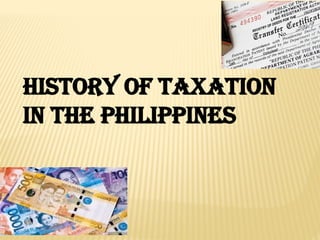
HISTORY OF TAXATION
IN THE PHILIPPINES
PRE SPANISH ERA
Pre-Spanish taxation in the
Philippines began with the
establishment of social structures
among indigenous communities,
particularly through the formation
of barangays, or small community
units, led by Datus.
FIVE KEY FORMS OF TAXES OR TRIBUTES IN PRE-SPANISH
PHILIPPINES:
1.Tribute (buwis)
2. Labor Tax (Corvée Labrade Tax)
3. Trade Tax (Customs and Tribute on Goods)
4. Marriage and Inheritance Fees
5. War Tribute (Slavery or Captives)
TAXATION, TAXES, AND
THE REVENUE SYSTEM
IN THE PHILIPPINES
DURING THE SPANISH
ERA
During the Spanish era in the
Philippines, which began in 1565 and
lasted until 1898, taxation became a
crucial part of colonial governance. The
Spanish authorities, including the
governor-general and local officials,
implemented a formalized taxation
system to fund colonial administration
and infrastructure projects.
LOCAL LEADERS IN SPANISH ERA
1.Cabeza de Barangay: As the head of a barangay
(small community), the cabeza de barangay was
appointed by the Spanish colonial authorities.
2. Goberndorcillo: In larger communities, the
gobernadorcillo served as a more senior local
leader, often overseeing multiple barangays. They
had greater administrative responsibilities and
were involved in tax collection and local
governance.
SOME TAXES DURING THE SPANISH
ERA
1. Tribute (Buwis)
2.Bandala(Forced Sales Tax)
3. Sanctorum Tax (Religious Tax)
4. Sedo (Land Tax)
5. Alcabala (Sales Tax)
THE VARIOUS TAXES
RAISED AND
COLLECTED
1) The direct taxes (contribuciones directas),
including the personal taxes and the income tax;
2.The indirect taxes (contribuciones indirectas), of
the custom
(3) The monopolies (rentas estancadas), including
at various times the stamp taxes and the sale of
quicksilver, salt, playing cards, corrosive sublimate,
gunpowder, spirituous liquors, tobacco, and opium;
(5) Public domain (bienes del estado);
(6) Miscellaneous and indeterminate revenues
(ingresos eventuales);
The direct taxes or contribuciones directas were
divided into two parts:
(1) the personal taxes, and
(2) the income tax
PERSONAL TAXES COLLECTED BY THE SPANISH
GOVERNMENT IN THE PHILIPPINES
1. Tribute from Natives- during the
Spanish era in the Philippines refers to
the mandatory taxes imposed on
indigenous people, known as "tributo."
This tax required Filipinos to pay a fixed
amount annually, either in cash or in
goods like rice and livestock.
2. Recognition of vassalage tax- The
recognition of vassalage tax during the
Spanish era in the Philippines refers to
the system where indigenous
communities acknowledged their
subservience to the Spanish crown by
paying mandatory taxes (tributo) in
cash or kind.
3. The Cedula Personales -The Cedula
Personal was a personal tax system
introduced during the Spanish colonial
period in the Philippines, starting in the
late 19th century. It required adult male
residents to obtain a cedula, or
identification certificate, which served
as proof of tax payment and civic duty.
PROPER CEDULA PERSONEL THAT
EXHIBIT IN OCCASSIONAL
1Upon taking up any commission or entering upon any
public ployment under the royal or insular authority:
(2) Upon entering upon any provincial or municipal
office;
(3) Upon the making of any contract, public or private;
(4) Upon presenting any claim, soliciting business or
appearing any puror in the to whe petty governors of
ministers of appearing pueblos towns;
 (5) Upon the bringing of any action before any
court of any thority or before any officer
 6) Upon enrollment or matriculation in any school
or institution learning,
 (7) Upon entering any employment in industry or
commerce, my profession, art or trade;
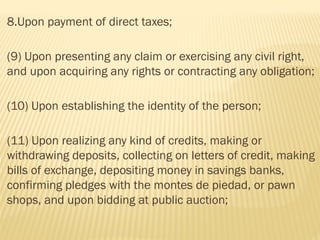
8.Upon payment of direct taxes;
(9) Upon presenting any claim or exercising any civil right,
and upon acquiring any rights or contracting any obligation;
(10) Upon establishing the identity of the person;
(11) Upon realizing any kind of credits, making or
withdrawing deposits, collecting on letters of credit, making
bills of exchange, depositing money in savings banks,
confirming pledges with the montes de piedad, or pawn
shops, and upon bidding at public auction;
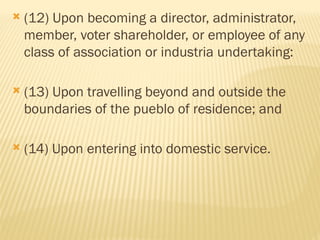
 (12) Upon becoming a director, administrator,
member, voter shareholder, or employee of any
class of association or industria undertaking:
 (13) Upon travelling beyond and outside the
boundaries of the pueblo of residence; and
 (14) Upon entering into domestic service.
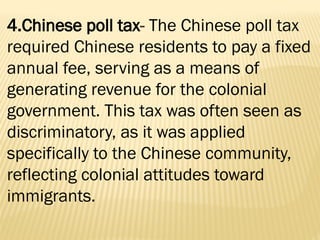
4.Chinese poll tax- The Chinese poll tax
required Chinese residents to pay a fixed
annual fee, serving as a means of
generating revenue for the colonial
government. This tax was often seen as
discriminatory, as it was applied
specifically to the Chinese community,
reflecting colonial attitudes toward
immigrants.
The eight different
classes of cedula
Class 1. Costing 30 pesos - for all male Chinese over
fourteen years of age whose annual contribution in the
form of direct taxes exclusive of surtaxes amounted to
400 pesos or more;
Class 2. Costing 25 pesos - for those whose direct
taxes were over 300 pesos but not over 400 pesos;
Class 3. Costing 20 pesos - for those whose direct
taxes were over 200 pesos but not over 300 pesos;
Class 4. Costing 15 pesos - for those whose direct
taxes were over 100 pesos but not over 200 pesos;
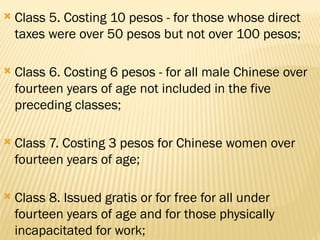
 Class 5. Costing 10 pesos - for those whose direct
taxes were over 50 pesos but not over 100 pesos;
 Class 6. Costing 6 pesos - for all male Chinese over
fourteen years of age not included in the five
preceding classes;
 Class 7. Costing 3 pesos for Chinese women over
fourteen years of age;
 Class 8. Issued gratis or for free for all under
fourteen years of age and for those physically
incapacitated for work;
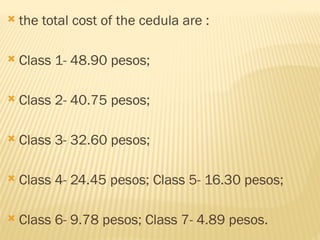
 the total cost of the cedula are :
 Class 1- 48.90 pesos;
 Class 2- 40.75 pesos;
 Class 3- 32.60 pesos;
 Class 4- 24.45 pesos; Class 5- 16.30 pesos;
 Class 6- 9.78 pesos; Class 7- 4.89 pesos.
THE URBANA TAX
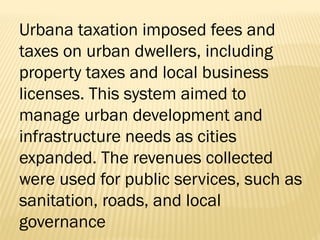
Urbana taxation imposed fees and
taxes on urban dwellers, including
property taxes and local business
licenses. This system aimed to
manage urban development and
infrastructure needs as cities
expanded. The revenues collected
were used for public services, such as
sanitation, roads, and local
governance
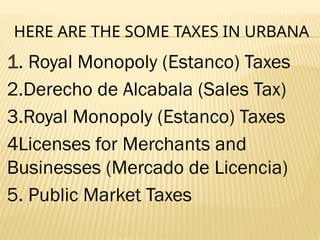
HERE ARE THE SOME TAXES IN URBANA
1. Royal Monopoly (Estanco) Taxes
2.Derecho de Alcabala (Sales Tax)
3.Royal Monopoly (Estanco) Taxes
4Licenses for Merchants and
Businesses (Mercado de Licencia)
5. Public Market Taxes
THE TAX ON
INDUSTRY
COMMERCE
 The tax on industry and commerce during the
Spanish colonial period in the Philippines refers
to taxes imposed on business activities, trade,
and commercial enterprises. These taxes were
designed to regulate economic activities and
generate revenue for the Spanish Crown, which
controlled much of the economic life of the
archipelago
 Tax Industry: This refers to the systems, practices,
and entities involved in the collection and
management of taxes. It encompasses
government agencies, tax professionals, and the
regulatory framework governing
 taxation.Commerce: This involves the activities
related to the buying, selling, and trading of goods
and services. It includes local markets,
international trade, and the overall economic
transactions that drive a society's economy.
TRIBUTE AS RESOURCES GENERATION
 Tribute refers to payments made by one entity
to another, often in the form of goods, services,
or labor. In historical contexts, particularly in
pre-colonial societies, tribute served as a
means of resource generation for local leaders
or governing bodies.
TAXATION IN GALLEON TRADE
 Taxation in the context of the galleon trade
refers to the system of levies, tariffs, and duties
imposed by governments on goods transported
via galleons during the trans-Pacific trade
between Asia and the Americas, particularly
between the Philippines and Mexico, from the
16th to the 19th centuries.
THE INCOME TAX AS A WHOLE
 income tax is a financial charge imposed by a
government on the income earned by
individuals, businesses, and other entities. It is
a crucial component of a country’s revenue
system and plays a significant role in funding
public services and government operations.
TAXATION
DURING
AMERICAN
PERIOD
 Taxation during the American period in the
Philippines (1898–1946) refers to the system of
taxes implemented by the United States colonial
government following its acquisition of the
Philippines after the Spanish-American War. This
period saw significant changes in tax policies and
administration, aimed at generating revenue for
the government and regulating the economy.
 1. William Howard Taft (Governor-General,
1901-1903)
 Francis Burton Harrison (Governor-General,
1913-1921)
HERE ARE THE SOME TAXES IN AMERICAN PERIOD
1.Income Tax (Personal and Corporate Taxes)
2. Excise Taxes (Sales and Consumption Taxes)
3. Property Taxes (Land and Real Estate
Taxes)Land Tax
4. Tariffs and Import-Export Duties
5. Franchise and License Taxes
TAXATION IN
JAPANESE
PERIOD
TAXATION DURING JAPANESE
OCCUPATION
 Taxation during the Japanese occupation of the
Philippines (1942–1945) refers to the system of
taxes imposed by the Japanese military
government on the Filipino population. This
period was marked by significant economic
hardship, and the taxation policies were aimed
at supporting the Japanese war effort and
managing the occupied territory.
SOME LEADERS
SOME TAXES
 Land Tax (Real Property Tax)
 Income tax
 Head Tax Poll Tax
TAXATION ON THE POST WAR
 Taxation in the post-war period refers to the
system of taxes implemented in the Philippines
following World War II, as the country sought to
rebuild its economy and address the
challenges faced after the war. This era was
characterized by significant changes in tax
policy, aimed at generating revenue for
reconstruction and development.
UNDER MARCOS ADMINISTRATION
 The Marcos administration in the Philippines,
which lasted from 1965 to 1986, was marked by
significant political and economic changes,
including a focus on tax policies that aimed to
support development initiatives and fund
government projects.
UNDER THE AQUINO ADMINISTRATION
 Under the Aquino administration" refers to the
period of governance in the Philippines from
1986 to 1992, led by President Corazon
Aquino. This era followed the ousting of
Ferdinand Marcos and was characterized by
significant political and economic reforms
aimed at restoring democracy and addressing
the challenges of a recovering nation.
UNDER ARROYO ADMINSTRATION
 Under the Arroyo administration" refers to the
period of governance in the Philippines from
2001 to 2010, led by President Gloria
Macapagal Arroyo. This administration followed
the ousting of President Joseph Estrada and
was marked by a mix of economic growth,
political controversies, and various reforms.
UNDER PNOY AQUINO
ADMINISTRATION
 Under the PNOY Aquino administration" refers
to the period of governance in the Philippines
from 2010 to 2016, led by President Benigno
"Noynoy" Aquino III. This administration focused
on transparency, anti-corruption measures, and
economic growth, building on the legacy of his
mother, Corazon Aquino.
history-234-1.pptxxxxxxxxxxxxxxxxxxxxxxxx

history-234-1.pptxxxxxxxxxxxxxxxxxxxxxxxx

  • 1.
    TAXATION IN THE PHILIPPINES: ITSHISTORICAL DEVELOPMENT
  • 2.
  • 3.
    -Taxes are theenforced proportional contributions from person and property lived by the state by virtue of sovereignty for the support of the government and for all the public needs and purpose.
  • 4.
    THE FOLLOWING ARE THEIMPORTANT CHARACTERISTICS OF TAXES:
  • 5.
    1. A taxis an enforced proportional contribution because imposition is not based upon the will of the person taxed.
  • 6.
    2. A taxis generally payable in the form of money, although the law may provide payment in kind
  • 7.
    3. A taxis laid by some rule of apportionment which is usually based on the ability to pay.
  • 8.
    4. A taxis levied on persons or property and also on acts, transactions, rights, or privileges. In each case, however, it is the person who pays the taxes
  • 9.
    5. A taxis levied by the State, which has jurisdiction over the person or property.
  • 10.
    6. A taxis levied by the law- making body of the State because the power to tax is an exclusive function of the legislature, which in this case, the Congress.
  • 11.
    7.A tax islevied for public purpose
  • 12.
  • 13.
    -The power oftaxation proceeds from the theory that without funds, the Government cannot meet the various essential expenses it government to exist and function.
  • 14.
  • 15.
    It is thepower of the State to impose and collect revenues for the operation of the government. The money generated from the people in the form of different taxes shall be used in the operations of government, for infrastructure programs, and other expenditures of the State
  • 16.
  • 17.
    The purpose oftaxation is to raise revenues of funds to support the Government and its services.
  • 18.
    The importance oftaxation derives from the inevitable obligation of the Government to protect the people and extend them benefits in the form of public projects and services.
  • 19.
  • 20.
    1.The power oftaxation is an inherent power 2. The taxing power is essentially a legislative function
  • 21.
  • 22.
    1. OBSERVANCE OFDUE PROCESS OF LAW Section 1, Article III, Bill of Rights: "No person shall be deprived of life, liberty, or property without due process of law, nor shall any person be denied the equal protection of the laws."
  • 23.
    2. Observance ofequal protection of the laws Section 1, Article III, Bill of Rights: "No person shall be deprived of life, liberty, or property without due process of law, nor shall any person be denied the equal protection of the laws."
  • 24.
    3. Prohibition againstimprisonment for non-payment of poll tax Section 20, Article III, Bill of Rights: "No person shall imprisoned for debt or non- payment of a poll tax
  • 25.
    4.Prohibition against impairment ofobligation of contracts Section 10, Article III, Bill of Rights: "No law impairing the obligation of contracts shall be passed
  • 26.
     Requirement ofuniformity and equity in taxation  Section 28, Article VI, Legislative Department  1. "The rule of taxation shall be uniform and equitable. The Congress shall evolve a progressive system of taxation.  2. The Congress may, by law, authorize the President to fix within specified limits, and subject to such limitations and restrictions as it may impose, tariff rates, import and export quotas, tonnage and wharf age dues, and other duties or imposts within the framework of the national development program of the Government.
  • 27.
     3. Charitableinstitutions, churches, and parsonages or convents appurtenant thereto, mosques, non-profit cemeteries, and all lands, buildings, and improvements, actually, directly, and exclusively used for religious, charitable, or educational purposes shall be exempt from taxation.  4. No law granting any tax exemption shall be passed without the concurrence of a majority of all the Members of the Congress."
  • 28.
    6. PROHIBITION AGAINSTTAXATION APPROPRIATION FOR RELIGIOUS PURPOSES  Section 29, Paragraph 2, Article VI, Legislative Department:  2. "No public money or property shall be appropriated, applied, paid, or employed, directly or indirectly, for the use, benefit, or support of any sect, church, denomination, sectarian institution, or system of religion, or of any priest, preacher, minister, other religious teacher, or dignitary as such, except when such priest, preacher, minister, or to any penal institution or government orphanage or leprosarium
  • 29.
    7. Prohibition againsttaxation of religions, charitable and educational entities, be, religious and charitable are exempt from property taxes Institution  Charitable institutions, churches, and parsonages of cotivess appurtenant thereto, osques, non- profit cemeteries, and all and buildings, and improvements, actually, directly, and exclusively wat for religious, charitable, or educational purposes shall be exempt from taxation."
  • 30.
    8. Prohibition againsttaxation of non-stock.non- profit educational institutions, institutions, and proprietary educational stock, non-profit educational institutions, and educational institutions are exempt from property and income taxes as well as customs duties except income derived from business activity not related to its educational purpose. Section 28, Article VI, Legislative Department:
  • 31.
     Charitable institutions,churches, and parsonages or convent appurt Chart thereto, mosques, non-profit and land bandings, and improvements, actually, directly, and exclusively used for religious, charitable, or educational purposes shall be exempt from taxation.
  • 32.
    HISTORY OF TAXATION INTHE PHILIPPINES
  • 33.
  • 34.
    Pre-Spanish taxation inthe Philippines began with the establishment of social structures among indigenous communities, particularly through the formation of barangays, or small community units, led by Datus.
  • 35.
    FIVE KEY FORMSOF TAXES OR TRIBUTES IN PRE-SPANISH PHILIPPINES: 1.Tribute (buwis) 2. Labor Tax (Corvée Labrade Tax) 3. Trade Tax (Customs and Tribute on Goods) 4. Marriage and Inheritance Fees 5. War Tribute (Slavery or Captives)
  • 36.
    TAXATION, TAXES, AND THEREVENUE SYSTEM IN THE PHILIPPINES DURING THE SPANISH ERA
  • 37.
    During the Spanishera in the Philippines, which began in 1565 and lasted until 1898, taxation became a crucial part of colonial governance. The Spanish authorities, including the governor-general and local officials, implemented a formalized taxation system to fund colonial administration and infrastructure projects.
  • 38.
    LOCAL LEADERS INSPANISH ERA 1.Cabeza de Barangay: As the head of a barangay (small community), the cabeza de barangay was appointed by the Spanish colonial authorities. 2. Goberndorcillo: In larger communities, the gobernadorcillo served as a more senior local leader, often overseeing multiple barangays. They had greater administrative responsibilities and were involved in tax collection and local governance.
  • 39.
    SOME TAXES DURINGTHE SPANISH ERA 1. Tribute (Buwis) 2.Bandala(Forced Sales Tax) 3. Sanctorum Tax (Religious Tax) 4. Sedo (Land Tax) 5. Alcabala (Sales Tax)
  • 40.
  • 41.
    1) The directtaxes (contribuciones directas), including the personal taxes and the income tax; 2.The indirect taxes (contribuciones indirectas), of the custom (3) The monopolies (rentas estancadas), including at various times the stamp taxes and the sale of quicksilver, salt, playing cards, corrosive sublimate, gunpowder, spirituous liquors, tobacco, and opium;
  • 42.
    (5) Public domain(bienes del estado); (6) Miscellaneous and indeterminate revenues (ingresos eventuales); The direct taxes or contribuciones directas were divided into two parts: (1) the personal taxes, and (2) the income tax
  • 43.
    PERSONAL TAXES COLLECTEDBY THE SPANISH GOVERNMENT IN THE PHILIPPINES 1. Tribute from Natives- during the Spanish era in the Philippines refers to the mandatory taxes imposed on indigenous people, known as "tributo." This tax required Filipinos to pay a fixed amount annually, either in cash or in goods like rice and livestock.
  • 44.
    2. Recognition ofvassalage tax- The recognition of vassalage tax during the Spanish era in the Philippines refers to the system where indigenous communities acknowledged their subservience to the Spanish crown by paying mandatory taxes (tributo) in cash or kind.
  • 45.
    3. The CedulaPersonales -The Cedula Personal was a personal tax system introduced during the Spanish colonial period in the Philippines, starting in the late 19th century. It required adult male residents to obtain a cedula, or identification certificate, which served as proof of tax payment and civic duty.
  • 46.
    PROPER CEDULA PERSONELTHAT EXHIBIT IN OCCASSIONAL 1Upon taking up any commission or entering upon any public ployment under the royal or insular authority: (2) Upon entering upon any provincial or municipal office; (3) Upon the making of any contract, public or private; (4) Upon presenting any claim, soliciting business or appearing any puror in the to whe petty governors of ministers of appearing pueblos towns;
  • 47.
     (5) Uponthe bringing of any action before any court of any thority or before any officer  6) Upon enrollment or matriculation in any school or institution learning,  (7) Upon entering any employment in industry or commerce, my profession, art or trade; 8.Upon payment of direct taxes;
  • 48.
    8.Upon payment ofdirect taxes; (9) Upon presenting any claim or exercising any civil right, and upon acquiring any rights or contracting any obligation; (10) Upon establishing the identity of the person; (11) Upon realizing any kind of credits, making or withdrawing deposits, collecting on letters of credit, making bills of exchange, depositing money in savings banks, confirming pledges with the montes de piedad, or pawn shops, and upon bidding at public auction;
  • 49.
     (12) Uponbecoming a director, administrator, member, voter shareholder, or employee of any class of association or industria undertaking:  (13) Upon travelling beyond and outside the boundaries of the pueblo of residence; and  (14) Upon entering into domestic service.
  • 50.
    4.Chinese poll tax-The Chinese poll tax required Chinese residents to pay a fixed annual fee, serving as a means of generating revenue for the colonial government. This tax was often seen as discriminatory, as it was applied specifically to the Chinese community, reflecting colonial attitudes toward immigrants.
  • 51.
  • 52.
    Class 1. Costing30 pesos - for all male Chinese over fourteen years of age whose annual contribution in the form of direct taxes exclusive of surtaxes amounted to 400 pesos or more; Class 2. Costing 25 pesos - for those whose direct taxes were over 300 pesos but not over 400 pesos; Class 3. Costing 20 pesos - for those whose direct taxes were over 200 pesos but not over 300 pesos; Class 4. Costing 15 pesos - for those whose direct taxes were over 100 pesos but not over 200 pesos;
  • 53.
     Class 5.Costing 10 pesos - for those whose direct taxes were over 50 pesos but not over 100 pesos;  Class 6. Costing 6 pesos - for all male Chinese over fourteen years of age not included in the five preceding classes;  Class 7. Costing 3 pesos for Chinese women over fourteen years of age;  Class 8. Issued gratis or for free for all under fourteen years of age and for those physically incapacitated for work;
  • 54.
     the totalcost of the cedula are :  Class 1- 48.90 pesos;  Class 2- 40.75 pesos;  Class 3- 32.60 pesos;  Class 4- 24.45 pesos; Class 5- 16.30 pesos;  Class 6- 9.78 pesos; Class 7- 4.89 pesos.
  • 55.
  • 56.
    Urbana taxation imposedfees and taxes on urban dwellers, including property taxes and local business licenses. This system aimed to manage urban development and infrastructure needs as cities expanded. The revenues collected were used for public services, such as sanitation, roads, and local governance
  • 57.
    HERE ARE THESOME TAXES IN URBANA 1. Royal Monopoly (Estanco) Taxes 2.Derecho de Alcabala (Sales Tax) 3.Royal Monopoly (Estanco) Taxes 4Licenses for Merchants and Businesses (Mercado de Licencia) 5. Public Market Taxes
  • 58.
  • 59.
     The taxon industry and commerce during the Spanish colonial period in the Philippines refers to taxes imposed on business activities, trade, and commercial enterprises. These taxes were designed to regulate economic activities and generate revenue for the Spanish Crown, which controlled much of the economic life of the archipelago
  • 60.
     Tax Industry:This refers to the systems, practices, and entities involved in the collection and management of taxes. It encompasses government agencies, tax professionals, and the regulatory framework governing  taxation.Commerce: This involves the activities related to the buying, selling, and trading of goods and services. It includes local markets, international trade, and the overall economic transactions that drive a society's economy.
  • 61.
    TRIBUTE AS RESOURCESGENERATION  Tribute refers to payments made by one entity to another, often in the form of goods, services, or labor. In historical contexts, particularly in pre-colonial societies, tribute served as a means of resource generation for local leaders or governing bodies.
  • 62.
    TAXATION IN GALLEONTRADE  Taxation in the context of the galleon trade refers to the system of levies, tariffs, and duties imposed by governments on goods transported via galleons during the trans-Pacific trade between Asia and the Americas, particularly between the Philippines and Mexico, from the 16th to the 19th centuries.
  • 64.
    THE INCOME TAXAS A WHOLE  income tax is a financial charge imposed by a government on the income earned by individuals, businesses, and other entities. It is a crucial component of a country’s revenue system and plays a significant role in funding public services and government operations.
  • 65.
  • 66.
     Taxation duringthe American period in the Philippines (1898–1946) refers to the system of taxes implemented by the United States colonial government following its acquisition of the Philippines after the Spanish-American War. This period saw significant changes in tax policies and administration, aimed at generating revenue for the government and regulating the economy.
  • 67.
     1. WilliamHoward Taft (Governor-General, 1901-1903)  Francis Burton Harrison (Governor-General, 1913-1921)
  • 68.
    HERE ARE THESOME TAXES IN AMERICAN PERIOD 1.Income Tax (Personal and Corporate Taxes) 2. Excise Taxes (Sales and Consumption Taxes) 3. Property Taxes (Land and Real Estate Taxes)Land Tax 4. Tariffs and Import-Export Duties 5. Franchise and License Taxes
  • 69.
  • 70.
    TAXATION DURING JAPANESE OCCUPATION Taxation during the Japanese occupation of the Philippines (1942–1945) refers to the system of taxes imposed by the Japanese military government on the Filipino population. This period was marked by significant economic hardship, and the taxation policies were aimed at supporting the Japanese war effort and managing the occupied territory.
  • 71.
  • 72.
    SOME TAXES  LandTax (Real Property Tax)  Income tax  Head Tax Poll Tax
  • 73.
    TAXATION ON THEPOST WAR  Taxation in the post-war period refers to the system of taxes implemented in the Philippines following World War II, as the country sought to rebuild its economy and address the challenges faced after the war. This era was characterized by significant changes in tax policy, aimed at generating revenue for reconstruction and development.
  • 75.
    UNDER MARCOS ADMINISTRATION The Marcos administration in the Philippines, which lasted from 1965 to 1986, was marked by significant political and economic changes, including a focus on tax policies that aimed to support development initiatives and fund government projects.
  • 77.
    UNDER THE AQUINOADMINISTRATION  Under the Aquino administration" refers to the period of governance in the Philippines from 1986 to 1992, led by President Corazon Aquino. This era followed the ousting of Ferdinand Marcos and was characterized by significant political and economic reforms aimed at restoring democracy and addressing the challenges of a recovering nation.
  • 79.
    UNDER ARROYO ADMINSTRATION Under the Arroyo administration" refers to the period of governance in the Philippines from 2001 to 2010, led by President Gloria Macapagal Arroyo. This administration followed the ousting of President Joseph Estrada and was marked by a mix of economic growth, political controversies, and various reforms.
  • 81.
    UNDER PNOY AQUINO ADMINISTRATION Under the PNOY Aquino administration" refers to the period of governance in the Philippines from 2010 to 2016, led by President Benigno "Noynoy" Aquino III. This administration focused on transparency, anti-corruption measures, and economic growth, building on the legacy of his mother, Corazon Aquino.