THE HIRE IMPERATIVE

Executive recruitment tools, practices and
viewpoints in the UK and Continental Europe
In just the past three years,
“     LinkedIn has moved from
          being used by 33% of
     managers and executives
              to search for a job,
          and only 10% of hiring
     managers to find them, to
         almost universal usage
                              a”
Contents


Introduction                                                           1

Survey Methodology                                                     2

Determination of Process for Recruiting Management & Executive Roles   3

Priorities and Issues Driving Recruitment                              5

Executive Transitions: Retention and Turnover                          8

Employee Retention                                                     10

Recruitment Methods                                                    13

Philosophy of Search: Broad or Narrow?                                 17

Motivation of New Employees                                            18

Experience and Viewpoint on Job Boards                                 19

Viewpoint on and Experience of Executive Recruitment Agencies          21

Selection of Recruitment Service Provider                              24

Social Media                                                           25

Measuring Recruitment                                                  28

Outlook on Future Executive / Management Hires                         30

Contextual Factors                                                     32

A War for Talent?                                                      33

Conclusion                                                             35
Introduction


                                                             The rapid pace of change in European               newspaper used to be a business worth tens
    clients, prospects and registered executive candidates

                                                             executive recruitment continues to accelerate.     of millions of pounds annually. Today,
    To inform our understanding of our clients’ habits and
    preferences, in 2012 Executives Online surveyed our


                                                             Twenty years ago, there were but a small           recruitment advertising is largely online and
                                                             handful of tried and trusted ways to recruit the   generates less than £10 million per year.
                                                             right senior manager or executive: run a print
                                                             ad in the most relevant business or trade          To inform our understanding of our clients’
                                                             journal; run a print ad in the national            habits and preferences, in 2012 Executives
                                                             newspapers’ “appointments” section; or             Online surveyed our clients, prospects and
                                                             engage an executive search firm. Job boards        registered executive candidates. The online
                                                             were on the scene, but more actively used on       questionnaire had over 30 questions
                                                             roles only up to middle management, for            and covered:
                                                             technical positions and in some non-European
                                                             parts of the globe.                                • The methods their company or
                                                                                                                   organisation uses to recruit managers
                                                             In just the past three years, LinkedIn has
                                                                                                                   and executives
                                                             moved from being used by 33% of managers
                                                                                                                • Employee retention methods
                                                             and executives to search for a job, and 10% of
                                                             hiring managers to find them, to almost            • Their priorities in executive recruitment
                                                             universal usage. Even Facebook’s role is on        • Their experience of job boards and
                                                             the rise among executives and the people              executive recruitment agencies / suppliers
                                                             who hire them. Other tools and methods,            • Use of social media
                                                             which a few years ago were in nascent stages,
                                                                                                                • Measuring recruitment effectiveness / ROI
                                                             continue to grow. Large global brands are
                                                             taking executive recruitment in-house and
                                                             building their own “candidate communities”;        Their answers are illuminating and in many
                                                             umbrella preferred supplier relationships          cases surprising.
                                                             govern all recruitment suppliers in many
                                                             organisations; outsourcing and other tactics       We hope you enjoy reading.
                                                             are also at work. In addition to the impact that
                                                             these new options are having within the
                                                             companies that choose them, the changes
                                                             have sent shockwaves through various entities
                                                             involved in sourcing talent. An example:           James O’Brien
                                                             Recruitment advertising at one international       Managing Director


1
Survey Methodology


Our surveys were conducted online in mid 2012,
among more than 1,200 senior executives across
Europe, who are either registered with us as
candidates for interim or permanent roles, or who
have used or enquired about our services. The
survey consisted of over 30 questions in which
respondents were asked their views on the priorities
and issues driving recruitment, executive retention
and turnover, various recruitment methods,
employee motivation, job boards, executive
recruitment service providers, social media,
measurement of recruitment, and their outlook for
the future.


The data were subsequently tabulated and analysed
to uncover insights by industry, role of responder,
country and performance in other metrics and
provide content for this narrative. This finished
report follows the order and structure of the
original survey.


                                                       2
Determination of Process for Recruiting Management & Executive Roles


    Because of their importance to the organisation, executive hires are     Asked to comment on whether the usual method is chosen via
    often the result of a collaborative process between the hiring           formal policies or on an ad-hoc basis, respondents answered more
    manager (usually the person the role reports to) and the company’s       strongly (in a ratio of 2:1) that policies were formal rather than ad
    Human Resources function. Control of the process, however, can           hoc. However, numerous comments also indicated that the process
    vary. To understand where decision-making on the recruitment             is flexible, and collaborative: “There are formal recruiting processes
    process and method resides, we asked our clients, prospects and          but the decision on the method to recruit is on a case by case
    registered executive candidates who decides the method and               basis at senior levels”, “[There is a] Formal underlying process with
    process for that recruitment, once the company or organisation has       flexibility depending on the role being recruited”, “Ultimately the
    decided to recruit a senior role.                                        decision lies with HR, but we always consult with the business to
                                                                             ensure an appropriate solution is reached”,“We have a formal
    In almost half of all companies, the HR / in-house recruitment           group wide policy, driven by group procurement, to ensure most
    function sets the process, with 47% of respondents answering that        economic solutions are deployed. Flexibility exists to recognise
    HR decides. In 36% of companies, the line / hiring manager               specialists and experts, but only to the extent they reduce fees to
    decides. Reflecting the collaborative process, fully 17% of              the level of the rest following market review. Preferred supplier
    respondents said that some other entity chooses how the                  panels are in place and strictly adhered to”.
    recruitment will proceed. The comments given by respondents in
    that 17% “Other” grouping indicate that, most often, the decision is     There is a strong correlation between company size and the role of
    made jointly by HR and line management, or driven directly from          HR in setting the recruitment process. The larger the company, the
    the top of the company, with the CEO or even the board deciding          more likely it is that HR decides the method and process
    how to proceed. In other situations, external service providers, such    for recruitment.
    as executive search consultants or external HR advisers,
    set the tone.


                                                                            Who decides recruitment process?


    “...executive hires are
    often the result of a
    collaborative process                                                                                         Hiring Manager*
                                                                                                                        36%
    between the hiring                                                                HR / In-house
                                                                                       Recruitment
    manager (usually the                                                                Function
                                                                                           47%
    person the role reports                                                                                           Other
                                                                                                                      17%
    to) and the company’s
    Human Resources
    function.”                                                                                     * the person to whom the new employee will report


3
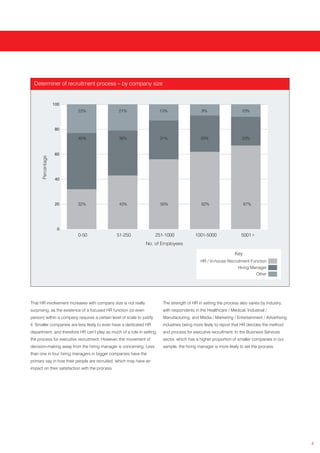
Determiner of recruitment process – by company size


                   100
                          23%                    21%                     13%                    9%                    10%


                   80

                          45%                    36%                     31%                    29%                    23%


                   60
      Percentage


                   40


                   20     32%                     43%                     56%                   62%                      67%


                    0
                          0-50                   51-250                 251-1000            1001-5000                 5001+
                                                                 No. of Employees

                                                                                                                   Key
                                                                                               HR / In-house Recruitment Function
                                                                                                                  Hiring Manager
                                                                                                                           Other


That HR involvement increases with company size is not really              The strength of HR in setting the process also varies by industry,
surprising, as the existence of a focused HR function (or even             with respondents in the Healthcare / Medical, Industrial /
person) within a company requires a certain level of scale to justify      Manufacturing, and Media / Marketing / Entertainment / Advertising
it. Smaller companies are less likely to even have a dedicated HR          industries being more likely to report that HR decides the method
department, and therefore HR can’t play as much of a role in setting       and process for executive recruitment. In the Business Services
the process for executive recruitment. However, the movement of            sector, which has a higher proportion of smaller companies in our
decision-making away from the hiring manager is concerning. Less           sample, the hiring manager is more likely to set the process.
than one in four hiring managers in bigger companies have the
primary say in how their people are recruited, which may have an
impact on their satisfaction with the process.


                                                                                                                                                4
Priorities and Issues Driving Recruitment


    Given a range of options related to desired employee profile, recruitment
    process execution and cost, respondents were invited to state what they
    considered to be the main priorities and issues that drove their
    recruitment practices – or say what “other” items are important to them
    (with no limits placed on the number of items they could indicate in their
    response.) Their responses are summarised in the table below.


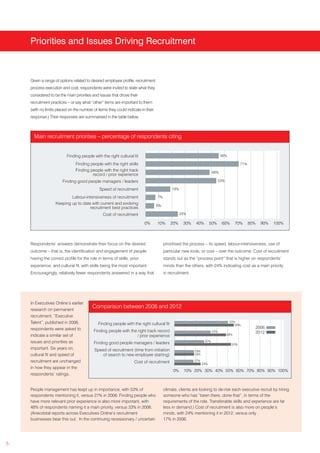
      Main recruitment priorities – percentage of respondents citing


                         Finding people with the right cultural fit                                                        56%

                               Finding people with the right skills                                                                      71%
                               Finding people with the right track                                                   48%
                                        record / prior experience
                       Finding good people managers / leaders                                                              53%

                                             Speed of recruitment                          18%

                           Labour-intensiveness of recruitment                   7%
                   Keeping up to date with current and evolving                  6%
                                     recruitment best practices
                                               Cost of recruitment                               24%

                                                                        0%       10%      20%     30%   40%         50%     60%        70%     80%   90%   100%


    Respondents’ answers demonstrate their focus on the desired                       prioritised the process – its speed, labour-intensiveness, use of
    outcome – that is, the identification and engagement of people                    particular new tools, or cost – over the outcome. Cost of recruitment
    having the correct profile for the role in terms of skills, prior                 stands out as the “process point” that is higher on respondents’
    experience, and cultural fit, with skills being the most important.               minds than the others, with 24% indicating cost as a main priority
    Encouragingly, relatively fewer respondents answered in a way that                in recruitment.


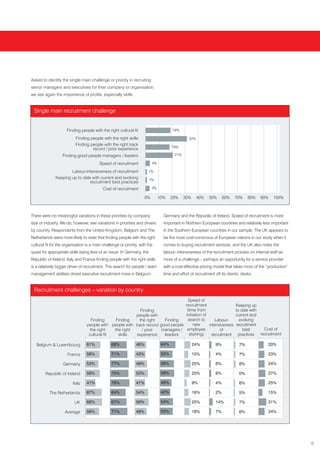
    In Executives Online’s earlier
    research on permanent
                                         Comparison between 2006 and 2012
    recruitment, “Executive
    Talent”, published in 2006,                                                                                                   50%
                                            Finding people with the right cultural fit                                               56%
    respondents were asked to                                                                                                                    2006
                                          Finding people with the right track record                                 33%                         2012
    indicate a similar set of                                    / prior experience                                              48%

    issues and priorities as              Finding good people managers / leaders                               27%
                                                                                                                                   53%
    important. Six years on,              Speed of recruitment (time from initiation                    18%
    cultural fit and speed of                 of search to new employee starting)                       18%

    recruitment are unchanged                                     Cost of recruitment                   17%
                                                                                                              24%
    in how they appear in the
                                                                                           0%     10% 20% 30% 40% 50% 60% 70% 80% 90% 100%
    respondents’ ratings.


    People management has leapt up in importance, with 53% of                         climate, clients are looking to de-risk each executive recruit by hiring
    respondents mentioning it, versus 27% in 2006. Finding people who                 someone who has “been there, done that”, in terms of the
    have more relevant prior experience is also more important, with                  requirements of the role. Transferable skills and experience are far
    48% of respondents naming it a main priority, versus 33% in 2006.                 less in demand.) Cost of recruitment is also more on people’s
    (Anecdotal reports across Executives Online’s recruitment                         minds, with 24% mentioning it in 2012, versus only
    businesses bear this out. In the continuing recessionary / uncertain              17% in 2006.


5
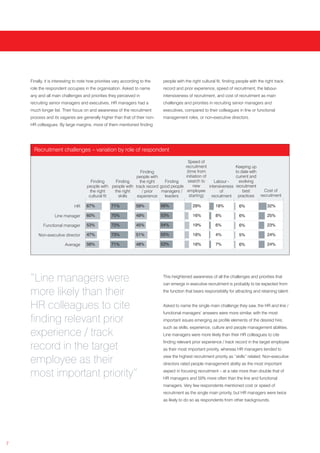
Asked to identify the single main challenge or priority in recruiting
senior managers and executives for their company or organisation,
we see again the importance of profile, especially skills:


 Single main recruitment challenge


                      Finding people with the right cultural fit                       19%

                           Finding people with the right skills                                  32%
                           Finding people with the right track
                                                                                       18%
                                    record / prior experience
                   Finding good people managers / leaders                               21%

                                          Speed of recruitment             4%

                       Labour-intensiveness of recruitment              1%
               Keeping up to date with current and evolving             1%
                                 recruitment best practices
                                            Cost of recruitment            3%

                                                                      0%        10%    20%    30%      40%   50%      60%    70%     80%   90%   100%


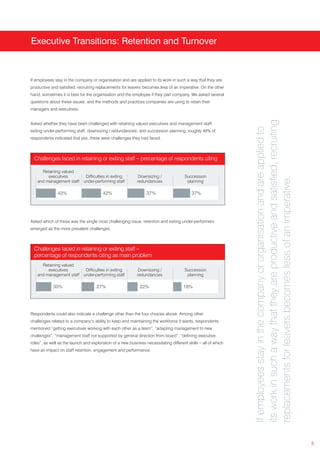
There were no meaningful variations in these priorities by company                Germany and the Republic of Ireland. Speed of recruitment is more
size or industry. We do, however, see variations in priorities and drivers        important in Northern European countries and relatively less important
by country. Respondents from the United Kingdom, Belgium and The                  in the Southern European countries in our sample. The UK appears to
Netherlands were more likely to state that finding people with the right          be the most cost-conscious of European nations in our study when it
cultural fit for the organisation is a main challenge or priority, with the       comes to buying recruitment services, and the UK also notes the
quest for appropriate skills being less of an issue. In Germany, the              labour- intensiveness of the recruitment process on internal staff as
Republic of Ireland, Italy and France finding people with the right skills        more of a challenge – perhaps an opportunity for a service provider
is a relatively bigger driver of recruitment. The search for people / team        with a cost-effective pricing model that takes more of the “production”
management abilities drives executive recruitment more in Belgium,                time and effort of recruitment off its clients’ desks.


 Recruitment challenges – variation by country
                                                                                     Speed of
                                                                                   recruitment                                Keeping up
                                                             Finding                (time from                                to date with
                                                          people with              initiation of                              current and
                                     Finding     Finding    the right    Finding     search to       Labour-                    evolving
                                  people with people with track record good people      new      intensiveness                recruitment
                                    the right   the right     / prior   managers / employee             of                        best     Cost of
                                   cultural fit   skills   experience    leaders      starting)    recruitment                 practices recruitment

   Belgium & Luxembourg           61%            68%            46%              64%                24%          9%             7%            20%

                      France      58%            71%            43%              52%                15%          4%             7%            23%

                   Germany        53%            77%            49%              58%                25%          6%             8%            24%

        Republic of Ireland       59%            75%            53%              59%                20%          8%             0%            27%

                         Italy    41%            79%            41%              48%                9%           4%             6%            25%

           The Netherlands        67%            64%            54%              42%                16%          2%             5%            15%

                          UK      68%            67%            56%              54%                25%          14%            7%            31%

                    Average       56%            71%            48%              53%                18%          7%             6%            24%


                                                                                                                                                            6
Finally, it is interesting to note how priorities vary according to the   people with the right cultural fit, finding people with the right track
    role the respondent occupies in the organisation. Asked to name           record and prior experience, speed of recruitment, the labour-
    any and all main challenges and priorities they perceived in              intensiveness of recruitment, and cost of recruitment as main
    recruiting senior managers and executives, HR managers had a              challenges and priorities in recruiting senior managers and
    much longer list. Their focus on and awareness of the recruitment         executives, compared to their colleagues in line or functional
    process and its vagaries are generally higher than that of their non-     management roles, or non-executive directors.
    HR colleagues. By large margins, more of them mentioned finding


      Recruitment challenges – variation by role of respondent

                                                                                        Speed of
                                                                                      recruitment                        Keeping up
                                                                Finding                (time from                        to date with
                                                             people with              initiation of                      current and
                                        Finding     Finding    the right    Finding     search to       Labour -           evolving
                                     people with people with track record good people      new      intensiveness        recruitment
                                       the right   the right     / prior   managers / employee             of                best     Cost of
                                      cultural fit   skills   experience    leaders      starting)    recruitment         practices recruitment

                             HR      67%           71%            59%         56%              29%           18%           6%               32%

                  Line manager       60%           70%            49%         53%              16%           8%            6%               25%

           Functional manager        53%           72%            45%         54%              19%           6%            6%               23%

        Non-executive director       47%           73%            51%         55%              18%           4%            5%               24%

                        Average      56%           71%            48%         53%              18%           7%            6%               24%


    “Line managers were                                                       This heightened awareness of all the challenges and priorities that
                                                                              can emerge in executive recruitment is probably to be expected from

    more likely than their                                                    the function that bears responsibility for attracting and retaining talent.


    HR colleagues to cite                                                     Asked to name the single main challenge they saw, the HR and line /
                                                                              functional managers’ answers were more similar, with the most
    finding relevant prior                                                    important issues emerging as profile elements of the desired hire,
                                                                              such as skills, experience, culture and people management abilities.
    experience / track                                                        Line managers were more likely than their HR colleagues to cite
                                                                              finding relevant prior experience / track record in the target employee
    record in the target                                                      as their most important priority, whereas HR managers tended to
                                                                              view the highest recruitment priority as “skills” related. Non-executive
    employee as their                                                         directors rated people management ability as the most important

    most important priority”                                                  aspect in focusing recruitment – at a rate more than double that of
                                                                              HR managers and 50% more often than the line and functional
                                                                              managers. Very few respondents mentioned cost or speed of
                                                                              recruitment as the single main priority, but HR managers were twice
                                                                              as likely to do so as respondents from other backgrounds.


7
Executive Transitions: Retention and Turnover


If employees stay in the company or organisation and are applied to its work in such a way that they are
productive and satisfied, recruiting replacements for leavers becomes less of an imperative. On the other
hand, sometimes it is best for the organisation and the employee if they part company. We asked several
questions about these issues, and the methods and practices companies are using to retain their
managers and executives.


                                                                                                                its work in such a way that they are productive and satisfied, recruiting
Asked whether they have been challenged with retaining valued executives and management staff;


                                                                                                                If employees stay in the company or organisation and are applied to
exiting under-performing staff; downsizing / redundancies; and succession planning, roughly 40% of
respondents indicated that yes, these were challenges they had faced.


  Challenges faced in retaining or exiting staff – percentage of respondents citing

     Retaining valued
        executives       Difficulties in exiting             Downsizing /              Succession


                                                                                                                replacements for leavers becomes less of an imperative.
   and management staff under-performing staff              redundancies                planning

               43%                      42%                      37%                       37%


Asked which of these was the single most challenging issue, retention and exiting under-performers
emerged as the more prevalent challenges.


  Challenges faced in retaining or exiting staff –
  percentage of respondents citing as main problem
     Retaining valued
        executives       Difficulties in exiting             Downsizing /              Succession
   and management staff under-performing staff              redundancies                planning

            30%                      27%                     22%                      18%


Respondents could also indicate a challenge other than the four choices above. Among other
challenges related to a company’s ability to keep and maintaining the workforce it wants, respondents
mentioned “getting executives working with each other as a team”, “adapting management to new
challenges”, “management staff not supported by general direction from board”, “defining executive
roles”, as well as the launch and exploration of a new business necessitating different skills – all of which
have an impact on staff retention, engagement and performance.


                                                                                                                                                                                            8
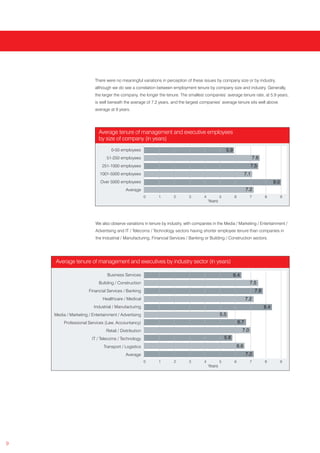
There were no meaningful variations in perception of these issues by company size or by industry,
                          although we do see a correlation between employment tenure by company size and industry. Generally,
                          the larger the company, the longer the tenure. The smallest companies’ average tenure rate, at 5.9 years,
                          is well beneath the average of 7.2 years, and the largest companies’ average tenure sits well above
                          average at 9 years.


                            Average tenure of management and executive employees
                            by size of company (in years)
                                   0-50 employees                                                     5.9
                                51-250 employees                                                                            7.6
                             251-1000 employees                                                                         7.5
                            1001-5000 employees                                                                       7.1
                             Over 5000 employees                                                                                         9.0
                                           Average                                                                    7.2
                                                        0    1       2        3       4           5         6           7          8           9
                                                                                          Years


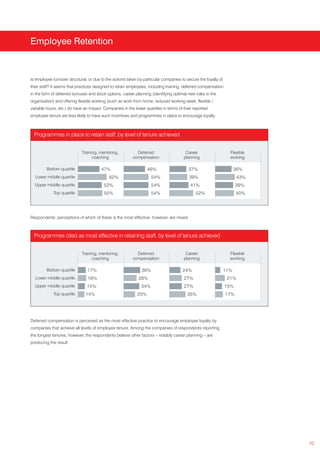
                          We also observe variations in tenure by industry, with companies in the Media / Marketing / Entertainment /
                          Advertising and IT / Telecoms / Technology sectors having shorter employee tenure than companies in
                          the Industrial / Manufacturing, Financial Services / Banking or Building / Construction sectors.


    Average tenure of management and executives by industry sector (in years)

                                Business Services                                                           6.4
                            Building / Construction                                                                     7.5
                      Financial Services / Banking                                                                           7.8
                              Healthcare / Medical                                                                    7.2
                         Industrial / Manufacturing                                                                                8.4
    Media / Marketing / Entertainment / Advertising                                               5.5
         Professional Services (Law, Accountancy)                                                               6.7
                                Retail / Distribution                                                             7.0
                        IT / Telecoms / Technology                                                    5.8
                              Transport / Logistics                                                             6.6
                                           Average                                                                    7.2
                                                        0    1       2        3       4           5         6           7          8           9
                                                                                          Years


9
Employee Retention


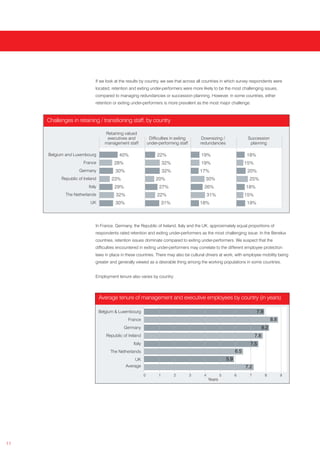
Is employee turnover structural, or due to the actions taken by particular companies to secure the loyalty of
their staff? It seems that practices designed to retain employees, including training, deferred compensation
in the form of deferred bonuses and stock options, career planning (identifying optimal next roles in the
organisation) and offering flexible working (such as work from home, reduced working week, flexible /
variable hours, etc.) do have an impact. Companies in the lower quartiles in terms of their reported
employee tenure are less likely to have such incentives and programmes in place to encourage loyalty.


  Programmes in place to retain staff, by level of tenure achieved


                             Training, mentoring,          Deferred                    Career                     Flexible
                                   coaching              compensation                 planning                    working

         Bottom quartile                47%                       46%                    37%                          36%
  Lower middle quartile                     62%                     54%                  39%                          43%
  Upper middle quartile                  53%                        54%                   41%                         39%
             Top quartile                55%                        54%                      52%                      40%


Respondents’ perceptions of which of these is the most effective, however, are mixed.


  Programmes cited as most effective in retaining staff, by level of tenure achieved


                             Training, mentoring,          Deferred                    Career                     Flexible
                                   coaching              compensation                 planning                    working

         Bottom quartile        17%                           36%                     24%                       11%
  Lower middle quartile         18%                          28%                      27%                        21%
  Upper middle quartile        15%                            34%                     27%                       15%
             Top quartile      14%                          25%                         35%                     17%


Deferred compensation is perceived as the most effective practice to encourage employee loyalty by
companies that achieve all levels of employee tenure. Among the companies of respondents reporting
the longest tenures, however, the respondents believe other factors – notably career planning – are
producing the result.


                                                                                                                             10
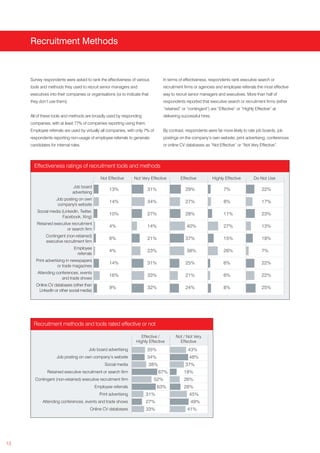
If we look at the results by country, we see that across all countries in which survey respondents were
                             located, retention and exiting under-performers were more likely to be the most challenging issues,
                             compared to managing redundancies or succession planning. However, in some countries, either
                             retention or exiting under-performers is more prevalent as the most major challenge.


     Challenges in retaining / transitioning staff, by country

                                   Retaining valued
                                    executives and             Difficulties in exiting        Downsizing /                 Succession
                                   management staff           under-performing staff         redundancies                   planning

     Belgium and Luxembourg                40%                      22%                      19%                          18%
                       France           28%                             32%                  19%                          15%
                    Germany              30%                            32%                  17%                           20%
           Republic of Ireland         23%                         20%                         30%                         25%
                         Italy          29%                          27%                       26%                        18%
             The Netherlands             32%                        22%                           31%                     15%
                          UK             30%                            31%                  18%                          19%


                             In France, Germany, the Republic of Ireland, Italy and the UK, approximately equal proportions of
                             respondents rated retention and exiting under-performers as the most challenging issue. In the Benelux
                             countries, retention issues dominate compared to exiting under-performers. We suspect that the
                             difficulties encountered in exiting under-performers may correlate to the different employee protection
                             laws in place in these countries. There may also be cultural drivers at work, with employee mobility being
                             greater and generally viewed as a desirable thing among the working populations in some countries.


                             Employment tenure also varies by country:


                                 Average tenure of management and executive employees by country (in years)

                                 Belgium & Luxembourg                                                                           7.9
                                                France                                                                                      8.8
                                              Germany                                                                                 8.2
                                    Republic of Ireland                                                                         7.8
                                                  Italy                                                                     7.5
                                      The Netherlands                                                               6.5
                                                    UK                                                        5.9
                                               Average                                                                    7.2
                                                          0         1         2          3    4           5         6      7           8          9
                                                                                                  Years


11
We also asked survey respondents to describe how, or if, they saw           look outside; but this may mean the organisation has failed to
the relationship between external recruitment and internal                  anticipate the change and looking for new talent outside may only
promotion changing. Their comments put some colour behind the               be a band-aid treatment. “
figures, with the consensus being that as there are valid reasons
for both recruitment and internal promotion and that organisations          “You have to measure the potential of internal and faithful people,
must do both successfully and master the challenges associated              giving them chances to develop their skills. But it isn't less
with each in order to thrive:                                               important to hire new people with wide experience outside the
                                                                            company in order to balance continuity with ‘fresh air’.”
  “All ways to get in touch with potential high value managers must
  be explored. So internal ways are still valuable to consider but        A recurrent theme was the notion that internal promotion is only
  compared to many other external sources.”                               possible when the organisation has strong people development
                                                                          plans in place, and that such programmes have too often fallen
  “Always promote internally as it carries less risk / more success       under the chopping block in cost reduction schemes – thus
  unless the business landscape has changed and requires a new            rendering the internal talent pool less suitable for promotion:
  strategy and therefore new people.”
                                                                            “As companies are leaner, there is less choice internally and the
  “Companies need a regular injection of outstanding talent from the        development of staff is less.”
  outside to keep fresh and to perpetually challenge themselves and
  their ‘eternal truths’.”                                                  “Companies in this period are folded upon themselves.
                                                                            Companies recruit external staff only for contingency reasons.
   “Both [recruitment and retention] are investigated. Mostly for high      Companies are not investing in talent at this time.”
  positions is it better incorporating someone from outside, bringing
  other practices and know-how.”                                            “Companies who skimp on internal training and development need
                                                                            to resort to the external recruitment of senior people at an overall
  “As far as I am concerned, the question of internal versus external       loss of efficiency and profitability.”
  remains. The challenge will always be if internal: how to gain the
  respect of the people you manage.”                                        “Lack of training, mentoring and succession planning has
                                                                            destroyed the promotional ladder. The economic climate dictates
  “A company needs to do both. To use a sporting analogy, most              cutbacks and all non-core activities suffer.”
  successful teams have a youth system and a transfer policy.“
                                                                            “External recruitment is a cost but also an enlarged source of value.
  “During a crisis I consider it important to engage external               Internal recruitment is a value if a company has a good school of
  recruitment of the highest experience (older candidates). Internal        management (ramping processes, succession plans) otherwise is
  promotion doesn't give new ideas.”                                        a way to pump up resources not yet fit and ready for these roles.”


  “[I am] Erring more towards internal promotion, which I believe is a       “[It] Depends on the organisation’s capability: some organisations
  policy most companies should follow. It also demonstrates to              have talent development capabilities, some simply go to market
  others that performance is recognised.”                                   when the need arises.”


  “[You] Need a balance depending on the organisation. We are               “Due to the recession, fewer internal staff with the appropriate skills
  growing globally at 40% year on year. Promoting from within was           are available. The best have gone, as they were too expensive and
  great when we were a young UK business, but we need more global           were not replaced like-for-like (reduced salary and quality).”
  experience from new senior managers, which cannot always be
  developed internally, until we become more established globally.”         “Succession planning is becoming more difficult as all levels of
                                                                            talent are moving. External recruitment is good for cultural
  “[I’m] Not sure it is changing. Our policy is always to promote from      innovation and enhancement.”
  within if the talent exists internally – if not, we look outside.”
  “This depends on the evolutionary stage of an organisation. If the
  talent does not exist internally to handle the task, the option is to


                                                                                                                                                      12
Recruitment Methods


     Survey respondents were asked to rank the effectiveness of various             In terms of effectiveness, respondents rank executive search or
     tools and methods they used to recruit senior managers and                     recruitment firms or agencies and employee referrals the most effective
     executives into their companies or organisations (or to indicate that          way to recruit senior managers and executives. More than half of
     they don’t use them).                                                          respondents reported that executive search or recruitment firms (either
                                                                                    “retained” or “contingent”) are “Effective” or “Highly Effective” at
     All of these tools and methods are broadly used by responding                  delivering successful hires.
     companies, with at least 77% of companies reporting using them.
     Employee referrals are used by virtually all companies, with only 7% of        By contrast, respondents were far more likely to rate job boards, job
     respondents reporting non-usage of employee referrals to generate              postings on the company’s own website, print advertising, conferences
     candidates for internal roles.                                                 or online CV databases as “Not Effective” or “Not Very Effective”.


       Effectiveness ratings of recruitment tools and methods

                                               Not Effective      Not Very Effective          Effective            Highly Effective       Do Not Use
                              Job board
                                                   13%                   31%                     29%                     7%                    22%
                              advertising
                    Job posting on own
                                                   14%                   34%                     27%                     8%                    17%
                     company's website
         Social media (LinkedIn, Twitter,
                                                   10%                   27%                     28%                     11%                   23%
                       Facebook, Xing)
        Retained executive recruitment
                                                   4%                    14%                      40%                    27%                   13%
                        or search firm
              Contingent (non-retained)
                                                   6%                    21%                     37%                     15%                   18%
              executive recruitment firm
                               Employee
                                                   4%                    23%                      38%                    26%                   7%
                                referrals
        Print advertising in newspapers
                                                   14%                   31%                     25%                     6%                    22%
                     or trade magazines
         Attending conferences, events
                                                   16%                   33%                     21%                     6%                    22%
                      and trade shows
        Online CV databases (other than
                                                   9%                    32%                     24%                     8%                    25%
         LinkedIn or other social media)


      Recruitment methods and tools rated effective or not

                                                                      Effective /          Not / Not Very
                                                                   Highly Effective          Effective
                                       Job board advertising             35%                      43%
                    Job posting on own company’s website                 34%                       48%
                                                 Social media                38%                 37%
               Retained executive recruitment or search firm                       67%          18%
       Contingent (non-retained) executive recruitment firm                   52%               26%
                                            Employee referrals                 63%              28%
                                              Print advertising         31%                        45%
            Attending conferences, events and trade shows               27%                         49%
                                       Online CV databases              33%                       41%


13
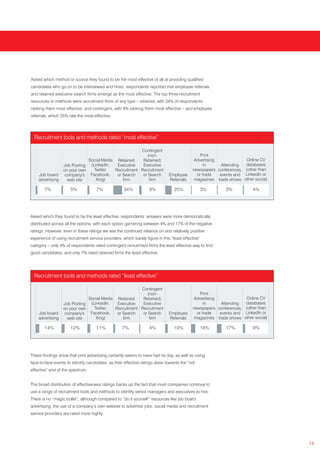
Asked which method or source they found to be the most effective of all at providing qualified
candidates who go on to be interviewed and hired, respondents reported that employee referrals
and retained executive search firms emerge as the most effective. The top three recruitment
resources or methods were recruitment firms of any type – retained, with 34% of respondents
ranking them most effective; and contingent, with 9% ranking them most effective – and employee
referrals, which 25% rate the most effective.


  Recruitment tools and methods rated “most effective”

                                                      Contingent
                                                         (non-                                 Print
                              Social Media Retained    Retained)                           Advertising              Online CV
                  Job Posting (LinkedIn,   Executive   Executive                                 in     Attending  databases
                  on your own   Twitter,  Recruitment Recruitment                          newspapers conferences, (other than
    Job board      company's Facebook,     or Search   or Search              Employee       or trade  events and LinkedIn or
    advertising     web site     Xing)        firm        firm                Referrals     magazines trade shows other social)

       7%             5%             7%             34%            9%            25%           3%         3%           4%


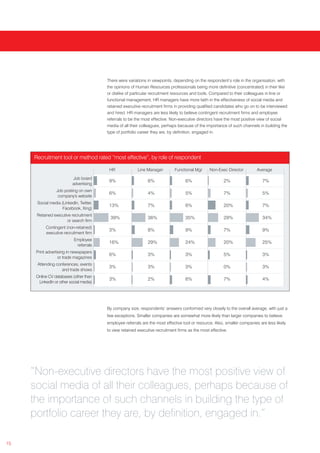
Asked which they found to be the least effective, respondents’ answers were more democratically
distributed across all the options, with each option garnering between 4% and 17% of the negative
ratings. However, even in these ratings we see the continued reliance on and relatively positive
experience of using recruitment service providers, which barely figure in this “least effective”
category – only 4% of respondents rated contingent recruitment firms the least effective way to find
good candidates, and only 7% rated retained firms the least effective.


  Recruitment tools and methods rated “least effective”

                                                      Contingent
                                                         (non-                                 Print
                              Social Media Retained    Retained)                           Advertising              Online CV
                  Job Posting (LinkedIn,   Executive   Executive                                 in     Attending  databases
                  on your own   Twitter,  Recruitment Recruitment                          newspapers conferences, (other than
    Job board      company's Facebook,     or Search   or Search              Employee       or trade  events and LinkedIn or
    advertising     web site     Xing)        firm        firm                Referrals     magazines trade shows other social)

       14%            12%            11%           7%              4%            10%           16%        17%          9%


These findings show that print advertising certainly seems to have had its day, as well as using
face-to-face events to identify candidates, as their effective ratings skew towards the “not
effective” end of the spectrum.


The broad distribution of effectiveness ratings backs up the fact that most companies continue to
use a range of recruitment tools and methods to identify senior managers and executives to hire.
There is no “magic bullet”, although compared to “do it yourself” resources like job board
advertising, the use of a company’s own website to advertise jobs, social media and recruitment
service providers are rated more highly.


                                                                                                                                  14
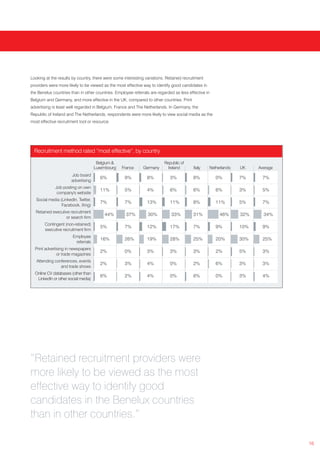
There were variations in viewpoints, depending on the respondent’s role in the organisation, with
                                         the opinions of Human Resources professionals being more definitive (concentrated) in their like
                                         or dislike of particular recruitment resources and tools. Compared to their colleagues in line or
                                         functional management, HR managers have more faith in the effectiveness of social media and
                                         retained executive recruitment firms in providing qualified candidates who go on to be interviewed
                                         and hired. HR managers are less likely to believe contingent recruitment firms and employee
                                         referrals to be the most effective. Non-executive directors have the most positive view of social
                                         media of all their colleagues, perhaps because of the importance of such channels in building the
                                         type of portfolio career they are, by definition, engaged in.


     Recruitment tool or method rated “most effective”, by role of respondent

                                          HR              Line Manager        Functional Mgr      Non-Exec Director         Average
                          Job board
                                          9%                   6%                   6%                    2%                   7%
                          advertising
                 Job posting on own
                                          6%                   4%                   5%                    7%                   5%
                  company's website
      Social media (LinkedIn, Twitter,
                                          13%                  7%                   6%                    20%                  7%
                    Facebook, Xing)
      Retained executive recruitment
                                          39%                  36%                  35%                   29%                  34%
                      or search firm
           Contingent (non-retained)
                                          3%                   8%                   9%                    7%                   9%
           executive recruitment firm
                           Employee
                                          16%                  29%                  24%                   20%                  25%
                            referrals
      Print advertising in newspapers
                                          6%                   3%                   3%                    5%                   3%
                   or trade magazines
      Attending conferences, events
                                          3%                   3%                   3%                    0%                   3%
                   and trade shows
      Online CV databases (other than
                                          3%                   2%                   6%                    7%                   4%
       LinkedIn or other social media)


                                         By company size, respondents’ answers conformed very closely to the overall average, with just a
                                         few exceptions. Smaller companies are somewhat more likely than larger companies to believe
                                         employee referrals are the most effective tool or resource. Also, smaller companies are less likely
                                         to view retained executive recruitment firms as the most effective.


     “Non-executive directors have the most positive view of
     social media of all their colleagues, perhaps because of
     the importance of such channels in building the type of
     portfolio career they are, by definition, engaged in.”

15
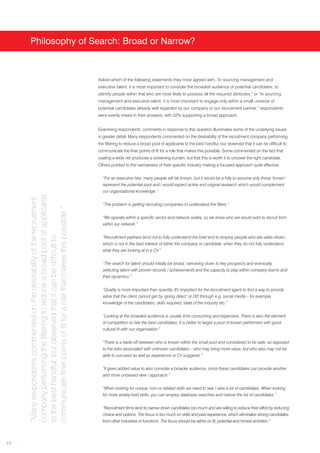
Looking at the results by country, there were some interesting variations. Retained recruitment
providers were more likely to be viewed as the most effective way to identify good candidates in
the Benelux countries than in other countries. Employee referrals are regarded as less effective in
Belgium and Germany, and more effective in the UK, compared to other countries. Print
advertising is least well regarded in Belgium, France and The Netherlands. In Germany, the
Republic of Ireland and The Netherlands, respondents were more likely to view social media as the
most effective recruitment tool or resource.


  Recruitment method rated “most effective”, by country

                                       Belgium &                          Republic of
                                      Luxembourg   France     Germany       Ireland       Italy    Netherlands   UK    Average
                       Job board
                                        6%          9%          8%           3%          8%           0%         7%      7%
                       advertising
              Job posting on own
                                        11%         5%          4%           6%          6%           6%         3%      5%
               company's website
   Social media (LinkedIn, Twitter,
                                        7%          7%          13%          11%         8%           11%        5%      7%
                 Facebook, Xing)
  Retained executive recruitment
                                          44%        37%        30%          33%         31%            46%      32%     34%
                  or search firm
        Contingent (non-retained)
                                        5%          7%          12%          17%         7%           9%         10%     9%
        executive recruitment firm
                        Employee
                                        16%         26%         19%          28%         25%          20%        30%     25%
                         referrals
  Print advertising in newspapers
                                        2%          0%          3%           3%          3%           2%         5%      3%
               or trade magazines
   Attending conferences, events
                                        2%          3%          4%           0%          2%           6%         3%      3%
                and trade shows
  Online CV databases (other than
                                        6%          2%          4%           0%          6%           0%         3%      4%
   LinkedIn or other social media)


“Retained recruitment providers were
more likely to be viewed as the most
effective way to identify good
candidates in the Benelux countries
than in other countries.”

                                                                                                                                 16
Philosophy of Search: Broad or Narrow?


                                                                             Asked which of the following statements they most agreed with, “In sourcing management and
                                                                             executive talent, it is most important to consider the broadest audience of potential candidates, to
                                                                             identify people within that who are most likely to possess all the required attributes,” or “In sourcing
                                                                             management and executive talent, it is most important to engage only within a small universe of
                                                                             potential candidates already well regarded by our company or our recruitment partner,” respondents
                                                                             were evenly mixed in their answers, with 52% supporting a broad approach.


                                                                             Examining respondents’ comments in response to this question illuminates some of the underlying issues
                                                                             in greater detail. Many respondents commented on the desirability of the recruitment company performing
                                                                             the filtering to reduce a broad pool of applicants to the best handful, but observed that it can be difficult to
                                                                             communicate the finer points of fit for a role that makes this possible. Some commented on the fact that
                                                                             casting a wide net produces a screening burden, but that this is worth it to uncover the right candidate.
                                                                             Others pointed to the narrowness of their specific industry making a focused approach quite effective.


                                                                               “For an executive hire, many people will be known, but it would be a folly to assume only those ‘known’
                                                                               represent the potential pool and I would expect active and original research which would complement
                                                                               our organisational knowledge.”
     company performing the filtering to reduce a broad pool of applicants
     “Many respondents commented on the desirability of the recruitment


                                                                               “The problem is getting recruiting companies to understand the filters.”
     communicate finer points of fit for a role that makes this possible.”


                                                                               “We operate within a specific sector and network widely, so we know who we would wish to recruit from
                                                                               within our network.”
     to the best handful, but observed that it can be difficult to


                                                                               “Recruitment partners tend not to fully understand the brief and to employ people who are sales driven,
                                                                               which is not in the best interest of either the company or candidate, when they do not fully understand
                                                                               what they are looking at in a CV.”


                                                                               “The search for talent should initially be broad, narrowing down to key prospects and eventually
                                                                               selecting talent with proven records / achievements and the capacity to play within company teams and
                                                                               their dynamics.”


                                                                               “Quality is more important than quantity. It's important for the recruitment agent to find a way to provide
                                                                               value that the client cannot get by ‘going direct’ or DIY through e.g. social media – for example,
                                                                               knowledge of the candidates, skills required, state of the industry etc.”


                                                                               “Looking at the broadest audience is usually time consuming and expensive. There is also the element
                                                                               of competition to hire the best candidates. It is better to target a pool of known performers with good
                                                                               cultural fit with our organisation.”


                                                                               “There is a trade-off between who is known within the small pool and considered to be safe, as opposed
                                                                               to the risks associated with unknown candidates – who may bring more value, but who also may not be
                                                                               able to succeed as well as experience or CV suggests.”


                                                                               “It gives added value to also consider a broader audience, since these candidates can provide another
                                                                               and more unbiased view / approach.”


                                                                               “When looking for unique, non-cv related skills we need to see / view a lot of candidates. When looking
                                                                               for more widely-held skills, you can employ database searches and narrow the list of candidates.”


                                                                               “Recruitment firms tend to narrow down candidates too much and are willing to reduce their effort by reducing
                                                                               choice and options. The focus is too much on skills and past experience, which eliminates strong candidates
                                                                               from other industries or functions. The focus should be rather on fit, potential and honest ambition.”


17
Motivation of New Employees


Making a move to a new role is a decision no manager or executive
undertakes lightly. Many factors interact to make an opportunity
appealing – issues ranging from financial compensation, flexible
working, lifestyle features such as length of commute, as well as the
fundamental attributes of the role in terms of the interest, challenge and
development potential it offers.


We asked our survey respondents to rank certain factors in terms of the
influence in a prospective employee accepting a job offer in their
company or organisation, where 1 = the most influential factor,
and 7 = not influential at all.


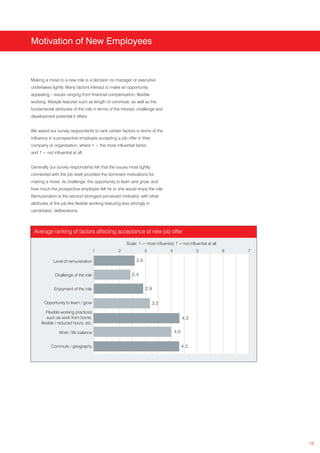
Generally our survey respondents felt that the issues most tightly
connected with the job itself provided the dominant motivations for
making a move: its challenge, the opportunity to learn and grow, and
how much the prospective employee felt he or she would enjoy the role.
Remuneration is the second strongest perceived motivator, with other
attributes of the job like flexible working featuring less strongly in
candidates’ deliberations.


 Average ranking of factors affecting acceptance of new job offer

                                                        Scale: 1 = most influential, 7 = not influential at all
                                       1           2                3             4               5               6   7

             Level of remuneration                            2.6

              Challenge of the role                        2.4

             Enjoyment of the role                                  2.9

       Opportunity to learn / grow                                       3.2
         Flexible working practices
          such as work from home,                                                           4.3
      flexible / reduced hours, etc.

                Work / life balance                                                   4.0


            Commute / geography                                                             4.3


                                                                                                                          18
Experience and Viewpoint on Job Boards


                                                                              Job boards – websites created specifically for the advertising of jobs – have been a prominent feature
                                                                              of the recruitment landscape since the mid 1990s. Newspapers were among the first organisations to
                                                                              launch job boards, taking the classified job advertising they’d always sold and providing it in the online
                                                                              space, followed by sites like Monster, Hotjobs and others – dedicated online businesses not backed by
                                                                              “bricks and mortar” companies.


                                                                              Anyone who worked in recruitment will remember the anguish over the concept of “disintermediation”:
                                                                              the idea that efficient, data-driven online sites would enable employers and candidates to connect with
                                                                              each other directly, and thus make recruitment service providers obsolete.
     through and recruiters calling us. It's better to focus on
     “There are a lot of people looking for jobs. Advertising
     on Monster simply results in hundreds of CVs coming


                                                                              What happened instead is that the ease with which employers and candidates could connect directly,
                                                                              actually made recruitment service providers more relevant. Despite rich databases of candidate
                                                                              registration data backing up the job boards, they still produce, in most cases, a surplus of imperfect
     the best ‘pre-qualifying’ routes to candidates.”


                                                                              candidates. In reality employers don’t want to see a long list of candidates for a role, they want to see a
                                                                              small number of highly suitable candidates.


                                                                              Far from being made obsolete, members of the recruitment industry adopted job boards as their own
                                                                              and began to use them to provide a better and more effective service to clients. Recruiters became
                                                                              expert at writing online adverts to attract the right sorts of candidates and used this to remove the
                                                                              screening and filtering burden – which still requires human eyes and assessment – from the
                                                                              employers. Job adverts run by recruitment companies therefore dominate the online space in the same
                                                                              way that recruiter ads used to dominate the broadsheet newspapers.


                                                                              The obsolescence wrought by the emergence of job boards has not been of the recruitment industry,
                                                                              but rather of the print medium as a recruitment advertising channel. This is a trend mirrored elsewhere,
                                                                              as advertising of all types has moved from print publications to online. Online advertising is highly
                                                                              trackable via click-through rates, cost per visit, cost per CV and associated measures, and this has
                                                                              enabled advertisers to measure their spend against the return they get. This focus on return has
                                                                              prompted a collapse in pricing, as advertising has moved from print, where measurement is more
                                                                              difficult, to online, where precise measurement is possible and the willingness to pay can be matched
                                                                              to the return. Recruitment advertising at one international newspaper used to be a business worth tens
                                                                              of millions of pounds annually; today, recruitment advertising is largely online and generates less than
                                                                              £10 million per year.


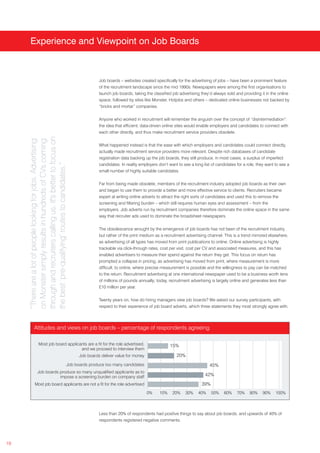
                                                                              Twenty years on, how do hiring managers view job boards? We asked our survey participants, with
                                                                              respect to their experience of job board adverts, which three statements they most strongly agree with.


          Attitudes and views on job boards – percentage of respondents agreeing

                 Most job board applicants are a fit for the role advertised,                                         15%
                                       and we proceed to interview them
                                                                    Job boards deliver value for money                   20%
                                                              Job boards produce too many candidates                                        45%
                Job boards produce so many unqualified applicants as to
                           impose a screening burden on company staff                                                                    42%
            Most job board applicants are not a fit for the role advertised                                                            39%
                                                                                                         0%     10%    20%    30%    40%     50%    60%    70%    80%     90%    100%


                                                                              Less than 20% of respondents had positive things to say about job boards, and upwards of 40% of
                                                                              respondents registered negative comments.


19
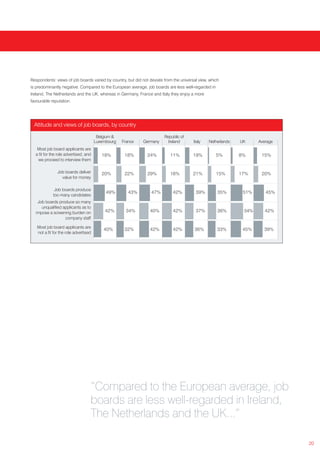
Respondents’ views of job boards varied by country, but did not deviate from the universal view, which
is predominantly negative. Compared to the European average, job boards are less well-regarded in
Ireland, The Netherlands and the UK, whereas in Germany, France and Italy they enjoy a more
favourable reputation.


  Attitude and views of job boards, by country

                                        Belgium &                       Republic of
                                       Luxembourg   France   Germany      Ireland       Italy   Netherlands   UK     Average
   Most job board applicants are
  a fit for the role advertised, and      18%        18%       24%         11%          19%         5%        8%      15%
   we proceed to interview them

               Job boards deliver         20%        22%       29%         16%          21%         15%       17%     20%
                 value for money

             Job boards produce
                                            49%        43%       47%         42%         39%         35%       51%      45%
            too many candidates
   Job boards produce so many
     unqualified applicants as to
  impose a screening burden on              42%       34%       40%          42%         37%         36%       54%      42%
                  company staff

   Most job board applicants are
                                           40%       32%        42%          42%        36%          33%       45%     39%
   not a fit for the role advertised


                                   “Compared to the European average, job
                                   boards are less well-regarded in Ireland,
                                   The Netherlands and the UK...”

                                                                                                                               20
Viewpoint on and Experience of Executive Recruitment Agencies


                                         The recruitment industry, including executive recruitment, remains highly fragmented. In the UK alone,
                                         there are thousands of executive recruitment companies, ranging from “one man bands” of
                                         independent recruiters and small boutiques up to major listed corporations employing thousands of
                                         recruitment consultants globally. As in any service industry, the nature and attributes of services
                                         provided vary by firm – according to its declared business process – and the individual within the firm
                                         providing the service.


                                         At a meta level, pricing and service fall into two main categories, retained and contingent service, with
                                         each having its pros and cons. Retained executive and management recruiters typically work on an
                                         exclusive basis, levy a fee to commence a search, occasionally charge fees at particular milestones
                                         along the way, and finally charge a completion fee when the new employee signs contracts or starts
                                         work. Contingent recruitment firms will work in competition with other agencies and don’t tend to
                                         charge in advance, earning their fee only as and when the chosen candidate starts work. Too much
                                         competition in the form of multiple agencies working on one role can create confusion in the talent
                                         marketplace, with candidates not knowing which agency to apply through, and with an over-advertised
                                         role looking tarnished (and perhaps a bit desperate). Commitment and competition are both desirable,
                                         yet are opposing dynamics in the recruitment process. Knowing this, some employers make use of
                                         both types of agencies on a role-by-role basis.


                                         We asked our survey respondents which factors were important (and most important) to them when
                                         choosing a recruitment service provider.


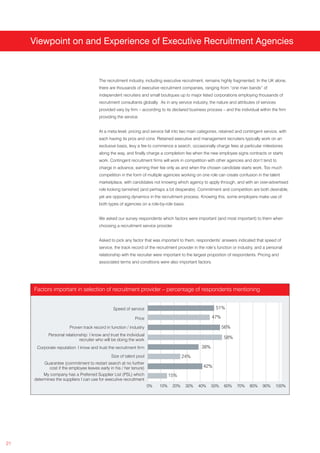
                                         Asked to pick any factor that was important to them, respondents’ answers indicated that speed of
                                         service, the track record of the recruitment provider in the role’s function or industry, and a personal
                                         relationship with the recruiter were important to the largest proportion of respondents. Pricing and
                                         associated terms and conditions were also important factors.


     Factors important in selection of recruitment provider – percentage of respondents mentioning


                                                 Speed of service                                          51%

                                                             Price                                       47%

                        Proven track record in function / industry                                             56%
             Personal relationship: I know and trust the individual
                              recruiter who will be doing the work
                                                                                                               58%

      Corporate reputation: I know and trust the recruitment firm                                  38%
                                                Size of talent pool                     24%
          Guarantee (commitment to restart search at no further
             cost if the employee leaves early in his / her tenure)                                 42%
          My company has a Preferred Supplier List (PSL) which                   15%
     determines the suppliers I can use for executive recruitment
                                                                      0%   10%    20%      30%   40%     50%   60%     70%    80%    90%     100%


21
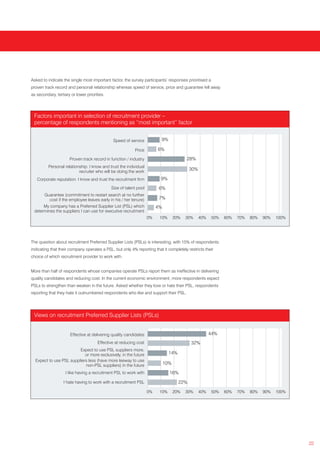
Asked to indicate the single most important factor, the survey participants’ responses prioritised a
proven track record and personal relationship whereas speed of service, price and guarantee fell away
as secondary, tertiary or lower priorities.


 Factors important in selection of recruitment provider –
 percentage of respondents mentioning as “most important” factor


                                               Speed of service           9%

                                                           Price         6%
                      Proven track record in function / industry                          28%
          Personal relationship: I know and trust the individual
                           recruiter who will be doing the work
                                                                                            30%

   Corporate reputation: I know and trust the recruitment firm            9%
                                              Size of talent pool         6%
      Guarantee (commitment to restart search at no further
         cost if the employee leaves early in his / her tenure)           7%
      My company has a Preferred Supplier List (PSL) which               4%
 determines the suppliers I can use for executive recruitment
                                                                    0%    10%       20%   30%     40%   50%   60%   70%   80%   90%   100%


The question about recruitment Preferred Supplier Lists (PSLs) is interesting, with 15% of respondents
indicating that their company operates a PSL, but only 4% reporting that it completely restricts their
choice of which recruitment provider to work with.


More than half of respondents whose companies operate PSLs report them as ineffective in delivering
quality candidates and reducing cost. In the current economic environment, more respondents expect
PSLs to strengthen than weaken in the future. Asked whether they love or hate their PSL, respondents
reporting that they hate it outnumbered respondents who like and support their PSL.


 Views on recruitment Preferred Supplier Lists (PSLs)


                       Effective at delivering quality candidates                                       44%
                                       Effective at reducing cost                           32%
                         Expect to use PSL suppliers more,
                            or more exclusively, in the future                  14%
  Expect to use PSL suppliers less (have more leeway to use
                            non-PSL suppliers) in the future                  10%
                    I like having a recruitment PSL to work with                16%
                   I hate having to work with a recruitment PSL                       22%
                                                                    0%    10%       20%   30%     40%   50%   60%   70%   80%   90%   100%


                                                                                                                                             22
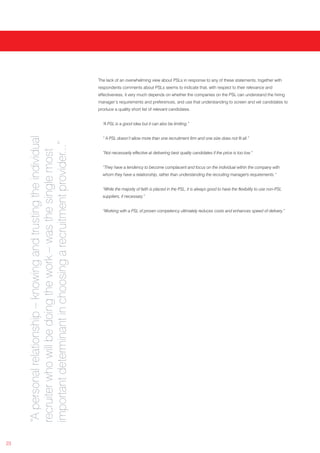
The lack of an overwhelming view about PSLs in response to any of these statements, together with
                                                                      respondents comments about PSLs seems to indicate that, with respect to their relevance and
                                                                      effectiveness, it very much depends on whether the companies on the PSL can understand the hiring
                                                                      manager’s requirements and preferences, and use that understanding to screen and vet candidates to
                                                                      produce a quality short list of relevant candidates.


                                                                        “A PSL is a good idea but it can also be limiting.”
     “A personal relationship – knowing and trusting the individual


                                                                        “ A PSL doesn’t allow more than one recruitment firm and one size does not fit all.”
     important determinant in choosing a recruitment provider...”
     recruiter who will be doing the work – was the single most


                                                                        “Not necessarily effective at delivering best quality candidates if the price is too low.”


                                                                        “They have a tendency to become complacent and focus on the individual within the company with
                                                                        whom they have a relationship, rather than understanding the recruiting manager's requirements.”


                                                                        “While the majority of faith is placed in the PSL, it is always good to have the flexibility to use non-PSL
                                                                        suppliers, if necessary.”


                                                                        “Working with a PSL of proven competency ultimately reduces costs and enhances speed of delivery.”


23
Selection of Recruitment Service Provider


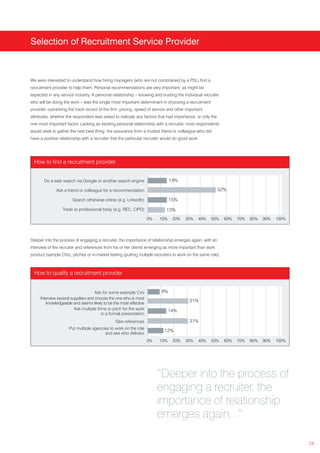
We were interested to understand how hiring managers (who are not constrained by a PSL) find a
recruitment provider to help them. Personal recommendations are very important, as might be
expected in any service industry. A personal relationship – knowing and trusting the individual recruiter
who will be doing the work – was the single most important determinant in choosing a recruitment
provider, outranking the track record of the firm, pricing, speed of service and other important
attributes, whether the respondent was asked to indicate any factors that had importance, or only the
one most important factor. Lacking an existing personal relationship with a recruiter, most respondents
would seek to gather the next best thing: the assurance from a trusted friend or colleague who did
have a positive relationship with a recruiter that the particular recruiter would do good work.


  How to find a recruitment provider


       Do a web search via Google or another search engine                     14%

              Ask a friend or colleague for a recommendation                                             52%

                       Search otherwise online (e.g. LinkedIn)                 15%
                  Trade or professional body (e.g. REC, CIPD)               13%
                                                                    0%   10%    20%    30%    40%    50%     60%   70%   80%   90%   100%


Deeper into the process of engaging a recruiter, the importance of relationship emerges again, with an
interview of the recruiter and references from his or her clients emerging as more important than work
product (sample CVs), pitches or in-market testing (putting multiple recruiters to work on the same role).


  How to qualify a recruitment provider


                                     Ask for some example CVs             9%
     Interview several suppliers and choose the one who is most
         knowledgeable and seems likely to be the most effective
                                                                                         31%
                         Ask multiple firms to pitch for the work              14%
                                         in a formal presentation
                                                Take references                          31%
                     Put multiple agencies to work on the role
                                                                           12%
                                        and see who delivers
                                                                    0%   10%    20%    30%    40%    50%     60%   70%   80%   90%   100%


                                                                         “Deeper into the process of
                                                                         engaging a recruiter, the
                                                                         importance of relationship
                                                                         emerges again...”

                                                                                                                                            24
Social Media


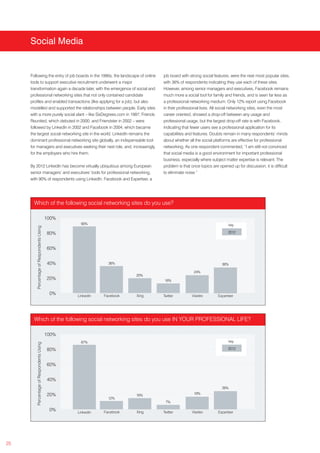
     Following the entry of job boards in the 1990s, the landscape of online   job board with strong social features, were the next most popular sites,
     tools to support executive recruitment underwent a major                  with 36% of respondents indicating they use each of these sites.
     transformation again a decade later, with the emergence of social and     However, among senior managers and executives, Facebook remains
     professional networking sites that not only contained candidate           much more a social tool for family and friends, and is seen far less as
     profiles and enabled transactions (like applying for a job), but also     a professional networking medium. Only 12% report using Facebook
     modelled and supported the relationships between people. Early sites      in their professional lives. All social networking sites, even the most
     with a more purely social slant – like SixDegrees.com in 1997; Friends    career oriented, showed a drop-off between any usage and
     Reunited, which debuted in 2000; and Friendster in 2002 – were            professional usage, but the largest drop-off rate is with Facebook,
     followed by LinkedIn in 2002 and Facebook in 2004, which became           indicating that fewer users see a professional application for its
     the largest social networking site in the world. LinkedIn remains the     capabilities and features. Doubts remain in many respondents’ minds
     dominant professional networking site globally, an indispensable tool     about whether all the social platforms are effective for professional
     for managers and executives seeking their next role, and, increasingly,   networking. As one respondent commented, “I am still not convinced
     for the employers who hire them.                                          that social media is a good environment for important professional
                                                                               business, especially where subject matter expertise is relevant. The
     By 2012 LinkedIn has become virtually ubiquitous among European           problem is that once topics are opened up for discussion, it is difficult
     senior managers’ and executives’ tools for professional networking,       to eliminate noise.”
     with 90% of respondents using LinkedIn. Facebook and Experteer, a


       Which of the following social networking sites do you use?

                                          100%
                                                  90%                                                               key
        Percentage of Respondents Using


                                          80%                                                                       2012


                                          60%


                                          40%                 36%                                               36%

                                                                                                24%
                                                                       20%
                                          20%                                  16%


                                           0%    LinkedIn   Facebook   Xing    Twitter         Viadeo         Experteer


       Which of the following social networking sites do you use IN YOUR PROFESSIONAL LIFE?

                                          100%
                                                  87%                                                               key
        Percentage of Respondents Using


                                          80%                                                                       2012


                                          60%


                                          40%
                                                                                                                26%
                                          20%                          16%                      18%
                                                              12%
                                                                                7%

                                           0%    LinkedIn   Facebook   Xing    Twitter         Viadeo         Experteer


25
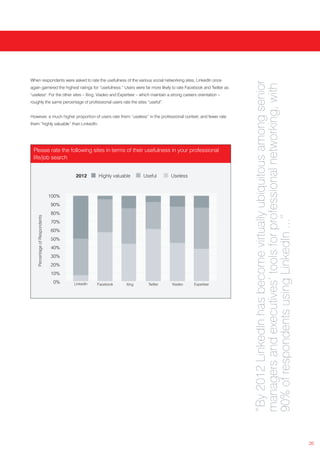
When respondents were asked to rate the usefulness of the various social networking sites, LinkedIn once


                                                                                                                  “By 2012 LinkedIn has become virtually ubiquitous among senior
                                                                                                                  managers and executives’ tools for professional networking, with
again garnered the highest ratings for “usefulness.” Users were far more likely to rate Facebook and Twitter as
"useless". For the other sites – Xing, Viadeo and Experteer – which maintain a strong careers orientation –
roughly the same percentage of professional users rate the sites “useful”.


However, a much higher proportion of users rate them “useless” in the professional context, and fewer rate
them “highly valuable” than LinkedIn.


 Please rate the following sites in terms of their usefulness in your professional
 life/job search


                                        2012      Highly valuable     Useful      Useless


                                100%
                                90%
                                80%


                                                                                                                  90% of respondents using LinkedIn ...”
    Percentage of Respondents


                                70%
                                60%
                                50%
                                40%
                                30%
                                20%
                                10%
                                 0%    LinkedIn   Facebook     Xing     Twitter   Viadeo    Experteer


                                                                                                                                                                                     26
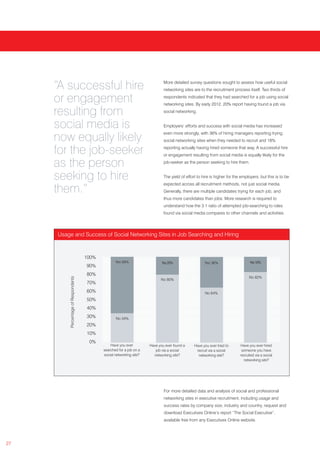
“A successful hire                                                        More detailed survey questions sought to assess how useful social
                                                                               networking sites are to the recruitment process itself. Two thirds of

     or engagement                                                             respondents indicated that they had searched for a job using social
                                                                               networking sites. By early 2012, 20% report having found a job via

     resulting from                                                            social networking.


     social media is                                                           Employers’ efforts and success with social media has increased
                                                                               even more strongly, with 36% of hiring managers reporting trying
     now equally likely                                                        social networking sites when they needed to recruit and 18%

     for the job-seeker                                                        reporting actually having hired someone that way. A successful hire
                                                                               or engagement resulting from social media is equally likely for the

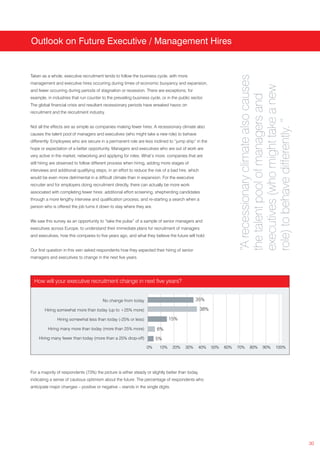
     as the person                                                             job-seeker as the person seeking to hire them.


     seeking to hire                                                           The yield of effort to hire is higher for the employers, but this is to be
                                                                               expected across all recruitment methods, not just social media.
     them.”                                                                    Generally, there are multiple candidates trying for each job, and
                                                                               thus more candidates than jobs. More research is required to
                                                                               understand how the 3:1 ratio of attempted job-searching to roles
                                                                               found via social media compares to other channels and activities.


     Usage and Success of Social Networking Sites in Job Searching and Hiring


                                      100%
                                                    Yes 66%                   Yes 20%                  Yes 36%                    Yes 18%
                                      90%
                                      80%
                                                                                                                                  No 82%
          Percentage of Respondents


                                                                             No 80%
                                      70%
                                      60%                                                              No 64%
                                      50%
                                      40%
                                      30%           No 34%
                                      20%
                                      10%
                                       0%
                                                 Have you ever         Have you ever found a     Have you ever tried to     Have you ever hired
                                             searched for a job on a      job via a social        recruit via a social       someone you have
                                             social networking site?     networking site?          networking site?         recruited via a social
                                                                                                                              networking site?


                                                                               For more detailed data and analysis of social and professional
                                                                               networking sites in executive recruitment, including usage and
                                                                               success rates by company size, industry and country, request and
                                                                               download Executives Online’s report “The Social Executive”,
                                                                               available free from any Executives Online website.


27
Measuring Recruitment


Any business process must lend itself to measurement, and
recruitment is no exception. Many metrics can be derived from
                                                                                           “The largest proportion
the recruitment process, at any stage: number of applications,
number of qualified candidates, candidate to interview ratio,
                                                                                           of respondents rated
interview to hire ratio, employee tenure, cost per hire, quality
of employee.
                                                                                           the quality of
Most companies do have systems in place to measure
                                                                                           candidate hired –
recruitment. Only 13% of respondents reported having no formal
measurement in place.
                                                                                           that is, the fact that the
As to what’s important to measure, reassuringly, the senior
                                                                                           person performs at or
managers and executives we surveyed for this report were not                               above expectations in
seduced by the statistics. The largest proportion of respondents
rated the quality of candidate hired – that is, the fact that the                          the role – as an
person performs at or above expectations in the role – as an
important measure. Half of respondents felt quality of                                     important measure. ”
applicants was important. Longevity, speed of recruitment and
cost per hire also garnered many votes, compared to the
metrics geared at quantity (of applicants, interviews).


 How to measure recruitment success – percentage of candidates mentioning


      Quality of candidate hired                                                                                 74%

   Longevity of candidate hired                                                 37%

            Quality of applicants                                                              50%

           Number of applicants                 7%
            Number of interviews                  9%
            Speed of recruitment                                         30%
                     Cost per hire                                 25%

                                      0%         10%        20%       30%        40%        50%      60%   70%    80%   90%   100%


  Key
  Exact wording of these questions were:
  Quality of candidate hired – person hired performs at or above expectations in the role
  Longevity of candidate hired – person hired is still in post after 12 months or other timescale
  Quality of candidates applying
  Number of applicants
  Number of interviews
  Speed of recruitment: time from brief / initiation of process to hire
  Cost per hire


                                                                                                                                     28
When we asked them to name the single most important measure,
     quality of employee stands out at an even greater margin compared
     to the other factors. For 64% of respondents, this remains the single
     most important measure, compared to the next most important,
     quality of applicants, at only 14% of respondents.


       How to measure recruitment success – percentage of candidates mentioning as single most important metric


                  Quality of candidate hired                                                         64%

               Longevity of candidate hired                10%

                       Quality of applicants                    14%

                      Number of applicants      0%
                       Number of interviews     1%
                       Speed of recruitment         3%
                               Cost per hire        2%
                                               0%         10%    20%         30%   40%   50%   60%    70%   80%   90%   100%


     “The single most important measure,
     quality of employee stands out at an
     even greater margin compared to
     the other factors.”

29
Outlook on Future Executive / Management Hires


                                                                                                                      “A recessionary climate also causes
Taken as a whole, executive recruitment tends to follow the business cycle, with more
management and executive hires occurring during times of economic buoyancy and expansion,


                                                                                                                      executives (who might take a new
and fewer occurring during periods of stagnation or recession. There are exceptions; for


                                                                                                                      the talent pool of managers and
example, in industries that run counter to the prevailing business cycle, or in the public sector.
The global financial crisis and resultant recessionary periods have wreaked havoc on
recruitment and the recruitment industry.


                                                                                                                      role) to behave differently. ”
Not all the effects are as simple as companies making fewer hires. A recessionary climate also
causes the talent pool of managers and executives (who might take a new role) to behave
differently. Employees who are secure in a permanent role are less inclined to “jump ship” in the
hope or expectation of a better opportunity. Managers and executives who are out of work are
very active in the market, networking and applying for roles. What’s more, companies that are
still hiring are observed to follow different process when hiring, adding more stages of
interviews and additional qualifying steps, in an effort to reduce the risk of a bad hire, which
would be even more detrimental in a difficult climate than in expansion. For the executive
recruiter and for employers doing recruitment directly, there can actually be more work
associated with completing fewer hires: additional effort screening, shepherding candidates
through a more lengthy interview and qualification process, and re-starting a search when a
person who is offered the job turns it down to stay where they are.


We saw this survey as an opportunity to “take the pulse” of a sample of senior managers and
executives across Europe, to understand their immediate plans for recruitment of managers
and executives, how this compares to five years ago, and what they believe the future will hold.


Our first question in this vein asked respondents how they expected their hiring of senior
managers and executives to change in the next five years.


  How will your executive recruitment change in next five years?


                                         No change from today                                 35%

        Hiring somewhat more than today (up to +25% more)                                          38%

               Hiring somewhat less than today (-25% or less)                  15%

         Hiring many more than today (more than 25% more)               6%
    Hiring many fewer than today (more than a 25% drop-off)            5%
                                                                  0%     10%     20%    30%    40%       50%   60%   70%    80%      90%      100%


For a majority of respondents (73%) the picture is either steady or slightly better than today,
indicating a sense of cautious optimism about the future. The percentage of respondents who
anticipate major changes – positive or negative – stands in the single digits.


                                                                                                                                                            30
By industry, we see that the more optimistic sectors include Financial Services and Healthcare / Medical, which are more likely to report
     hiring somewhat more than in the past. By contrast, the retail sector had more respondents than the average or other industries who
     reported expecting to hire less.


       How recruitment is expected to change, by industry
                                                                   Hiring              Hiring                Hiring               Hiring
                                              No change        somewhat more        somewhat less          many more            many fewer

                    Business Services            38%                  39%                 12%                  7%                   4%

                Building / Construction          38%                 33%                  19%                  7%                   3%

           Financial Services / Banking          29%                    51%               14%                  3%                   3%

                  Healthcare / Medical           29%                     54%              13%                  4%                   0%

             Industrial / Manufacturing          38%                 37%                  15%                  4%                   6%
                    Media / Marketing /
            Entertainment / Advertising          33%                  40%                 15%                  9%                   3%
            Professional Services (Law,
                         Accountancy)              48%               37%                  7%                   7%                   1%

                    Retail / Distribution        25%                 38%                  25%                  7%                   5%

            IT / Telecoms / Technology            42%                 42%                 10%                  6%                   0%

                   Transport / Logistics         33%                  41%                 14%                  8%                   4%

                               Average           35%                 38%                  15%                  6%                   5%


     By country, we see that hiring managers in Germany and the Republic of Ireland are more likely than in other countries (or the average) to
     expect stronger future hiring. In France and Italy, respondents were more likely to expect future hiring at levels somewhat less than today.


       How recruitment is expected to change, by country

                                                              Hiring somewhat      Hiring somewhat      Hiring many more Hiring many fewer
                                            No change from     more than today      less than today     than today (more  than today (more
                                                today        (up to +25% more)       (-25% or less)      than 25% more) than a 25% drop-off)

             Belgium and Luxembourg              31%                  41%                 16%                  7%                   5%

                                 France          39%                 28%                  20%                  6%                   7%

                              Germany            32%                   47%                10%                  9%                   2%

                    Republic of Ireland          31%                     55%              11%                  0%                   3%

                                    Italy        36%                 37%                  18%                  3%                   6%

                      The Netherlands             39%                35%                  15%                  11%                  0%

                                     UK          40%                 36%                  12%                  6%                   6%

                               Average           35%                 38%                  15%                  6%                   5%


31
Contextual Factors


The changing and difficult economic climate has required companies to adapt and change in order to
survive. Whether “recession management” skills can be explicitly identified and recruited for was not
universally agreed upon by the respondents to this survey. Only one-third of respondents felt that the
financial crisis and resultant recession had caused them to demand skills that are specifically aligned
to managing in recession.


  Searching for recession-specific skills in new hires


                                                                                                           explicitly identified and recruited for was not universally
                                                                                                           agreed upon by the respondents to this survey. ”
                                                                                                           “Whether ‘recession management’ skills can be
                                                  Yes
                                                  33%

                    No
                   67%


Asked about what recession-specific skills, most respondents commented that ability to understand
and implement cost control was important and that more flexibility was required to manage in
recession under leaner organisational structures:


  “Multi-tasking is now an essential part of office life and there is no room for inflexible attitudes.”


  “I recruited an experienced Financial Controller to better manage the business mix to mitigate lower
  unit revenues and higher unit costs.”


  “The focus has changed from top line jobs – sales, marketing – to bottom line cost control jobs such
  as operations and supply chain, and controlling – finance and admin – functions.”


  “Ability to deliver growth in a competitive marketplace and a strong understanding of cost control.”


                                                                                                                                                                         32
A War for Talent?


                                                                  The concept of a “War for Talent” was first posited by Steven Hankin
                                                                  of McKinsey & Company in 1997 and refers to an increasingly
                                                                  competitive landscape for recruiting and retaining talented
                                                                  employees. In a subsequent book published by Harvard Business
                                                                  Press, the authors suggest a mindset that emphasises the importance
                                                                  of talent to the success of organisations.


                                                                  Demographic trends underpin the competitiveness of the market for
                                                                  talent, particularly in the United States and Europe, as there are fewer
     workforces inherently less flexible, as depth of knowledge


                                                                  post baby-boom workers to replace baby-boomer retirement. The
     knowledge orientation has intensified this and has made
     “The evolution of work from a production orientation to a


                                                                  evolution of work from a production orientation to a knowledge
                                                                  orientation has intensified this and has made workforces inherently
                                                                  less flexible, as depth of knowledge is comparatively difficult to
                                                                  achieve and replace.
     is comparatively difficult to achieve and replace. “


                                                                  Respondents to our survey were mixed on the question of whether a
                                                                  war for talent persists today.


                                                                    War for talent exists


                                                                                                                 Yes
                                                                                                                 44%

                                                                                      No
                                                                                     56%


33
Their comments posed insightful questions on the nature of talent itself: whether it’s an absolute or
varies according to what the organisation or role requires:

  “It is never easy to find and keep good talent, but the most relevant problem is not to fight a war –
  many companies refrain from hiring managers during a recession phase – but to find out the profile
  with the right characteristics.”

  “You have to adapt the concept to the company’s size, culture and strategic fit.”

  “It is dependent on what the total scope of the job is, especially relevant when dealing with Business
  Services and the talent has broad knowledge of operating in both climates.”

  “With shrinking organisations in Europe and US there is plenty of talent on offer in these markets. Such
  excess often cannot be absorbed by growing economies because of cultural gaps and, in many cases,
  unavailability to relocate long distance for professionals of 40 years of age and older.”


Whether recession intensifies or alleviates the competition for talent was also the subject of some debate:

  “I think that in economic downturns, the fight for real talent is greater.”

  “Maybe the drop in ‘talent’ leaving organisations due to retirement is somewhat softened by the
  (structural) economic downturn, but it continues to be the people that make the difference!”

  “People in leadership really have to lead now. When times are good, everyone looks good; it's only in
  times like this when focused, inspirational, competent leaders can keep their heads and drive the
  business forward.”

  “[The war for talent applies] more than ever. Due to the economic downturn, baby boomers are
  massively leaving the market. When the economy picks up there will be a huge demand.”

  “Competition is tougher in crisis periods. Only the best succeed in a decreasing economy.”


Still others dismissed a war for talent as not relevant, now or ever:

  “There is a lot of talent available. The rat race is between egos is in my opinion, not the real talent pool.”

  “It's not a war, it's progress and natural evolution.”

  “At least as far as I can see, with the current economic crisis, the emphasis is off ‘talent’ and more on
  keeping good elements who do not cost too much and are super-performing.”

  “[The war for talent is ] too theoretical. Translation (on the floor) of talent into hands-on objectives is
  always difficult.”

  “[I] Never did consider business as a war – that creates a certain mentality we do not agree with.”


                                                                                                                   34
Conclusion


                                                                                  In the six years since our last report on permanent executive recruitment, the landscape has certainly
     “When choosing a recruitment provider, a personal relationship – knowing


                                                                                  changed, with numerous new tools and methods in use and the financial and economic crisis casting
     single most important determinant in choosing a recruitment provider...”
     and trusting the individual recruiter who will be doing the work – was the


                                                                                  its long shadow over employers’ plans. Print advertising is in long-term decline and social media on
                                                                                  the rise. The cost and measurement of recruitment is now more on people’s minds.


                                                                                  And yet, much has stayed the same: The fundamental challenges of identifying and engaging people –
                                                                                  leaders – to help drive an organisation’s success are the same as ever. Even the nuances and priorities
                                                                                  within the process of matching person to profile are strikingly similar: Finding people with the right
                                                                                  cultural fit and the speed of recruiting those people are as important now as then. Across the diverse
                                                                                  cultures and economies of greater Europe, there are differences in attitudes and experience on certain
                                                                                  aspects of executive recruitment – economic outlook, average employee tenure and attitudes towards
                                                                                  job boards, for example – yet consensus on the core priorities, such as job profile elements and the
                                                                                  candidate’s fit to them being the most important consideration in recruitment.


                                                                                  Our research confirms that most companies continue to use a range of recruitment tools and methods
                                                                                  to identify senior managers and executives to hire. There is no “magic bullet”. Online innovations such
                                                                                  as social networking sites and, before them, job boards, facilitate connections between prospective
                                                                                  employees and the companies that might hire them, but paradoxically this makes recruitment more
                                                                                  difficult, increasing the time and process invested in screening out the less promising applicants.


                                                                                  With the rise in new online tools, it is surprising to note the degree to which personal connections
                                                                                  continue to drive the recruitment process in most organisations. Employee referrals were rated as one
                                                                                  of the best ways to identify good people and personal relationships – knowing and trusting the
                                                                                  individual recruiter who will be doing the work – emerged as the single most important determinant in
                                                                                  choosing a recruitment provider, outranking the track record of the firm, pricing or speed of service.
                                                                                  Many respondents commented on the need for flexibility and to understand the context in undertaking
                                                                                  any recruitment or employee engagement task.


                                                                                  A majority of respondents dismissed the idea of a “War for Talent” as not so relevant any more, if it ever
                                                                                  was. They commented on the nature of talent itself: whether it’s an absolute or context-dependent, and
                                                                                  whether recession intensifies or alleviates the competition for talent. For a majority of participants in
                                                                                  our research, their plans for future recruitment indicate hiring levels that are either steady or slightly
                                                                                  better than today, indicating a sense of cautious optimism about the future.


                                                                                  ABOUT EXECUTIVES ONLINE
                                                                                  Founded in 2000, Executives Online is an executive recruitment company that harnesses the internet to
                                                                                  accelerate the search process. This delivers exactly the right candidates quickly, for interim or permanent
                                                                                  executive roles, in order to redress loss of competence and protect competitive advantage. What makes
                                                                                  Executives Online different is our award-winning online talent acquisition engine which can be deployed
                                                                                  instantly, worldwide, saving clients time and money. This builds Executives Online’s Global Talent Bank of
                                                                                  managers and executives seeking interim and permanent work, now numbering over 150,000 registered
                                                                                  candidates, and which all Executives Online recruiters draw upon in serving their clients.


                                                                                  Executives Online operates through 26 offices led by experienced business people who know their
                                                                                  local markets. That international network now extends to Australia, Belgium, France, Germany, Ireland,
                                                                                  Italy, Nigeria, Qatar, South Africa, The Netherlands and the UK. For more information or to speak to one
                                                                                  of our recruitment consultants about recruiting, call +44 (0)845 053 1188 or visit
                                                                                  www.ExecutivesOnline.com to find your nearest Executives Online office.


35
“
For a majority of respondents
   (73%) the picture for future
recruitment is either steady or
     slightly better than today,
         indicating a sense of
             cautious optimism
               about the future.
                            a”
London (HQ)                    South West                       Italy
Capital Tower                  1 Friary, Temple Quay            Via Senigallia 18/2 Torre A
91 Waterloo Road               Bristol, BS1 6EA                 20161 Milan
London, SE1 8RT                T: +44 (0) 117 344 5128          T: +39 (0) 2 6467 2632
T: +44 (0) 20 7936 9011
                               Wales                            The Netherlands
South of England               Haywood House North              Atrium gebouw
Staple House, 3rd Floor        Dumfries Place                   Strawinskylaan 3051
Staple Gardens, Winchester     Cardiff, CF10 3GA                1077 ZX Amsterdam
Hampshire, SO23 8SR            T: +44 (0) 2921 251 922          T: +31 (0)20 3012159
T: +44 (0) 1962 893 300                                         Additional office at Schiphol Airport.
                               Ireland
North of England               1st Floor, 43 Main Street        Qatar
2 Victoria Street, Wetherby    Rathfarnham, Dublin 14           Office No: 14
West Yorkshire, LS22 6RE       T: +353 (1) 492 5000             Al Mana Business Centre 2
T: +44 (0) 1937 581900                                          22 February Highway
                               Belgium                          Doha
North East of England          Jules Bordetlaan 160             T: +974 (0) 4432 4126
Rotterdam House                B-1140 Brussels
Quayside                       T: +32 (0) 475 580 333           Australia
Newcastle upon Tyne, NE1 3DY                                    Level 6, 77 Pacific Highway
T: +44 (0) 191 206 4113        France                           North Sydney, NSW 2060
                               17 rue du Maréchal Lyautey       T: +612 9923 8000
North West of England          95620 Parmain
82 King Street                 T: +33 1 34 24 66 77             South Africa
Manchester, M2 4WQ                                              102 4th Street
T: +44 (0) 161 935 8246        Germany                          Parkmore, Sandton
                               Dillenburger Strasse 71          Johannesburg 2196
Midlands                       51105 Cologne                    T: +27 (0) 10 591 3932
One Victoria Square            T: +49 (0) 221 8882 1660
                                                                Additional office in Cape Town.
Birmingham B1 1BD
                               Additional offices in Bremen,
T: +44 (0)121 632 2960
                               Dortmund, Dusseldorf,            Nigeria
                               Gummersbach, Hamburg, Limburg,   3a Ojora Road
Midlands (East)
                               Munich and Munster.              Ikoyi
West Walk Building
                                                                Lagos
110 Regent Road
                                                                T: +234 8098732581
Leicester, LE1 7LT
T: +44 (0) 845 604 6311

Hire imperative

  • 1.
    THE HIRE IMPERATIVE Executiverecruitment tools, practices and viewpoints in the UK and Continental Europe
  • 2.
    In just thepast three years, “ LinkedIn has moved from being used by 33% of managers and executives to search for a job, and only 10% of hiring managers to find them, to almost universal usage a”
  • 3.
    Contents Introduction 1 Survey Methodology 2 Determination of Process for Recruiting Management & Executive Roles 3 Priorities and Issues Driving Recruitment 5 Executive Transitions: Retention and Turnover 8 Employee Retention 10 Recruitment Methods 13 Philosophy of Search: Broad or Narrow? 17 Motivation of New Employees 18 Experience and Viewpoint on Job Boards 19 Viewpoint on and Experience of Executive Recruitment Agencies 21 Selection of Recruitment Service Provider 24 Social Media 25 Measuring Recruitment 28 Outlook on Future Executive / Management Hires 30 Contextual Factors 32 A War for Talent? 33 Conclusion 35
  • 4.
    Introduction The rapid pace of change in European newspaper used to be a business worth tens clients, prospects and registered executive candidates executive recruitment continues to accelerate. of millions of pounds annually. Today, To inform our understanding of our clients’ habits and preferences, in 2012 Executives Online surveyed our Twenty years ago, there were but a small recruitment advertising is largely online and handful of tried and trusted ways to recruit the generates less than £10 million per year. right senior manager or executive: run a print ad in the most relevant business or trade To inform our understanding of our clients’ journal; run a print ad in the national habits and preferences, in 2012 Executives newspapers’ “appointments” section; or Online surveyed our clients, prospects and engage an executive search firm. Job boards registered executive candidates. The online were on the scene, but more actively used on questionnaire had over 30 questions roles only up to middle management, for and covered: technical positions and in some non-European parts of the globe. • The methods their company or organisation uses to recruit managers In just the past three years, LinkedIn has and executives moved from being used by 33% of managers • Employee retention methods and executives to search for a job, and 10% of hiring managers to find them, to almost • Their priorities in executive recruitment universal usage. Even Facebook’s role is on • Their experience of job boards and the rise among executives and the people executive recruitment agencies / suppliers who hire them. Other tools and methods, • Use of social media which a few years ago were in nascent stages, • Measuring recruitment effectiveness / ROI continue to grow. Large global brands are taking executive recruitment in-house and building their own “candidate communities”; Their answers are illuminating and in many umbrella preferred supplier relationships cases surprising. govern all recruitment suppliers in many organisations; outsourcing and other tactics We hope you enjoy reading. are also at work. In addition to the impact that these new options are having within the companies that choose them, the changes have sent shockwaves through various entities involved in sourcing talent. An example: James O’Brien Recruitment advertising at one international Managing Director 1
  • 5.
    Survey Methodology Our surveyswere conducted online in mid 2012, among more than 1,200 senior executives across Europe, who are either registered with us as candidates for interim or permanent roles, or who have used or enquired about our services. The survey consisted of over 30 questions in which respondents were asked their views on the priorities and issues driving recruitment, executive retention and turnover, various recruitment methods, employee motivation, job boards, executive recruitment service providers, social media, measurement of recruitment, and their outlook for the future. The data were subsequently tabulated and analysed to uncover insights by industry, role of responder, country and performance in other metrics and provide content for this narrative. This finished report follows the order and structure of the original survey. 2
  • 6.
    Determination of Processfor Recruiting Management & Executive Roles Because of their importance to the organisation, executive hires are Asked to comment on whether the usual method is chosen via often the result of a collaborative process between the hiring formal policies or on an ad-hoc basis, respondents answered more manager (usually the person the role reports to) and the company’s strongly (in a ratio of 2:1) that policies were formal rather than ad Human Resources function. Control of the process, however, can hoc. However, numerous comments also indicated that the process vary. To understand where decision-making on the recruitment is flexible, and collaborative: “There are formal recruiting processes process and method resides, we asked our clients, prospects and but the decision on the method to recruit is on a case by case registered executive candidates who decides the method and basis at senior levels”, “[There is a] Formal underlying process with process for that recruitment, once the company or organisation has flexibility depending on the role being recruited”, “Ultimately the decided to recruit a senior role. decision lies with HR, but we always consult with the business to ensure an appropriate solution is reached”,“We have a formal In almost half of all companies, the HR / in-house recruitment group wide policy, driven by group procurement, to ensure most function sets the process, with 47% of respondents answering that economic solutions are deployed. Flexibility exists to recognise HR decides. In 36% of companies, the line / hiring manager specialists and experts, but only to the extent they reduce fees to decides. Reflecting the collaborative process, fully 17% of the level of the rest following market review. Preferred supplier respondents said that some other entity chooses how the panels are in place and strictly adhered to”. recruitment will proceed. The comments given by respondents in that 17% “Other” grouping indicate that, most often, the decision is There is a strong correlation between company size and the role of made jointly by HR and line management, or driven directly from HR in setting the recruitment process. The larger the company, the the top of the company, with the CEO or even the board deciding more likely it is that HR decides the method and process how to proceed. In other situations, external service providers, such for recruitment. as executive search consultants or external HR advisers, set the tone. Who decides recruitment process? “...executive hires are often the result of a collaborative process Hiring Manager* 36% between the hiring HR / In-house Recruitment manager (usually the Function 47% person the role reports Other 17% to) and the company’s Human Resources function.” * the person to whom the new employee will report 3
  • 7.
    Determiner of recruitmentprocess – by company size 100 23% 21% 13% 9% 10% 80 45% 36% 31% 29% 23% 60 Percentage 40 20 32% 43% 56% 62% 67% 0 0-50 51-250 251-1000 1001-5000 5001+ No. of Employees Key HR / In-house Recruitment Function Hiring Manager Other That HR involvement increases with company size is not really The strength of HR in setting the process also varies by industry, surprising, as the existence of a focused HR function (or even with respondents in the Healthcare / Medical, Industrial / person) within a company requires a certain level of scale to justify Manufacturing, and Media / Marketing / Entertainment / Advertising it. Smaller companies are less likely to even have a dedicated HR industries being more likely to report that HR decides the method department, and therefore HR can’t play as much of a role in setting and process for executive recruitment. In the Business Services the process for executive recruitment. However, the movement of sector, which has a higher proportion of smaller companies in our decision-making away from the hiring manager is concerning. Less sample, the hiring manager is more likely to set the process. than one in four hiring managers in bigger companies have the primary say in how their people are recruited, which may have an impact on their satisfaction with the process. 4
  • 8.
    Priorities and IssuesDriving Recruitment Given a range of options related to desired employee profile, recruitment process execution and cost, respondents were invited to state what they considered to be the main priorities and issues that drove their recruitment practices – or say what “other” items are important to them (with no limits placed on the number of items they could indicate in their response.) Their responses are summarised in the table below. Main recruitment priorities – percentage of respondents citing Finding people with the right cultural fit 56% Finding people with the right skills 71% Finding people with the right track 48% record / prior experience Finding good people managers / leaders 53% Speed of recruitment 18% Labour-intensiveness of recruitment 7% Keeping up to date with current and evolving 6% recruitment best practices Cost of recruitment 24% 0% 10% 20% 30% 40% 50% 60% 70% 80% 90% 100% Respondents’ answers demonstrate their focus on the desired prioritised the process – its speed, labour-intensiveness, use of outcome – that is, the identification and engagement of people particular new tools, or cost – over the outcome. Cost of recruitment having the correct profile for the role in terms of skills, prior stands out as the “process point” that is higher on respondents’ experience, and cultural fit, with skills being the most important. minds than the others, with 24% indicating cost as a main priority Encouragingly, relatively fewer respondents answered in a way that in recruitment. In Executives Online’s earlier research on permanent Comparison between 2006 and 2012 recruitment, “Executive Talent”, published in 2006, 50% Finding people with the right cultural fit 56% respondents were asked to 2006 Finding people with the right track record 33% 2012 indicate a similar set of / prior experience 48% issues and priorities as Finding good people managers / leaders 27% 53% important. Six years on, Speed of recruitment (time from initiation 18% cultural fit and speed of of search to new employee starting) 18% recruitment are unchanged Cost of recruitment 17% 24% in how they appear in the 0% 10% 20% 30% 40% 50% 60% 70% 80% 90% 100% respondents’ ratings. People management has leapt up in importance, with 53% of climate, clients are looking to de-risk each executive recruit by hiring respondents mentioning it, versus 27% in 2006. Finding people who someone who has “been there, done that”, in terms of the have more relevant prior experience is also more important, with requirements of the role. Transferable skills and experience are far 48% of respondents naming it a main priority, versus 33% in 2006. less in demand.) Cost of recruitment is also more on people’s (Anecdotal reports across Executives Online’s recruitment minds, with 24% mentioning it in 2012, versus only businesses bear this out. In the continuing recessionary / uncertain 17% in 2006. 5
  • 9.
    Asked to identifythe single main challenge or priority in recruiting senior managers and executives for their company or organisation, we see again the importance of profile, especially skills: Single main recruitment challenge Finding people with the right cultural fit 19% Finding people with the right skills 32% Finding people with the right track 18% record / prior experience Finding good people managers / leaders 21% Speed of recruitment 4% Labour-intensiveness of recruitment 1% Keeping up to date with current and evolving 1% recruitment best practices Cost of recruitment 3% 0% 10% 20% 30% 40% 50% 60% 70% 80% 90% 100% There were no meaningful variations in these priorities by company Germany and the Republic of Ireland. Speed of recruitment is more size or industry. We do, however, see variations in priorities and drivers important in Northern European countries and relatively less important by country. Respondents from the United Kingdom, Belgium and The in the Southern European countries in our sample. The UK appears to Netherlands were more likely to state that finding people with the right be the most cost-conscious of European nations in our study when it cultural fit for the organisation is a main challenge or priority, with the comes to buying recruitment services, and the UK also notes the quest for appropriate skills being less of an issue. In Germany, the labour- intensiveness of the recruitment process on internal staff as Republic of Ireland, Italy and France finding people with the right skills more of a challenge – perhaps an opportunity for a service provider is a relatively bigger driver of recruitment. The search for people / team with a cost-effective pricing model that takes more of the “production” management abilities drives executive recruitment more in Belgium, time and effort of recruitment off its clients’ desks. Recruitment challenges – variation by country Speed of recruitment Keeping up Finding (time from to date with people with initiation of current and Finding Finding the right Finding search to Labour- evolving people with people with track record good people new intensiveness recruitment the right the right / prior managers / employee of best Cost of cultural fit skills experience leaders starting) recruitment practices recruitment Belgium & Luxembourg 61% 68% 46% 64% 24% 9% 7% 20% France 58% 71% 43% 52% 15% 4% 7% 23% Germany 53% 77% 49% 58% 25% 6% 8% 24% Republic of Ireland 59% 75% 53% 59% 20% 8% 0% 27% Italy 41% 79% 41% 48% 9% 4% 6% 25% The Netherlands 67% 64% 54% 42% 16% 2% 5% 15% UK 68% 67% 56% 54% 25% 14% 7% 31% Average 56% 71% 48% 53% 18% 7% 6% 24% 6
  • 10.
    Finally, it isinteresting to note how priorities vary according to the people with the right cultural fit, finding people with the right track role the respondent occupies in the organisation. Asked to name record and prior experience, speed of recruitment, the labour- any and all main challenges and priorities they perceived in intensiveness of recruitment, and cost of recruitment as main recruiting senior managers and executives, HR managers had a challenges and priorities in recruiting senior managers and much longer list. Their focus on and awareness of the recruitment executives, compared to their colleagues in line or functional process and its vagaries are generally higher than that of their non- management roles, or non-executive directors. HR colleagues. By large margins, more of them mentioned finding Recruitment challenges – variation by role of respondent Speed of recruitment Keeping up Finding (time from to date with people with initiation of current and Finding Finding the right Finding search to Labour - evolving people with people with track record good people new intensiveness recruitment the right the right / prior managers / employee of best Cost of cultural fit skills experience leaders starting) recruitment practices recruitment HR 67% 71% 59% 56% 29% 18% 6% 32% Line manager 60% 70% 49% 53% 16% 8% 6% 25% Functional manager 53% 72% 45% 54% 19% 6% 6% 23% Non-executive director 47% 73% 51% 55% 18% 4% 5% 24% Average 56% 71% 48% 53% 18% 7% 6% 24% “Line managers were This heightened awareness of all the challenges and priorities that can emerge in executive recruitment is probably to be expected from more likely than their the function that bears responsibility for attracting and retaining talent. HR colleagues to cite Asked to name the single main challenge they saw, the HR and line / functional managers’ answers were more similar, with the most finding relevant prior important issues emerging as profile elements of the desired hire, such as skills, experience, culture and people management abilities. experience / track Line managers were more likely than their HR colleagues to cite finding relevant prior experience / track record in the target employee record in the target as their most important priority, whereas HR managers tended to view the highest recruitment priority as “skills” related. Non-executive employee as their directors rated people management ability as the most important most important priority” aspect in focusing recruitment – at a rate more than double that of HR managers and 50% more often than the line and functional managers. Very few respondents mentioned cost or speed of recruitment as the single main priority, but HR managers were twice as likely to do so as respondents from other backgrounds. 7
  • 11.
    Executive Transitions: Retentionand Turnover If employees stay in the company or organisation and are applied to its work in such a way that they are productive and satisfied, recruiting replacements for leavers becomes less of an imperative. On the other hand, sometimes it is best for the organisation and the employee if they part company. We asked several questions about these issues, and the methods and practices companies are using to retain their managers and executives. its work in such a way that they are productive and satisfied, recruiting Asked whether they have been challenged with retaining valued executives and management staff; If employees stay in the company or organisation and are applied to exiting under-performing staff; downsizing / redundancies; and succession planning, roughly 40% of respondents indicated that yes, these were challenges they had faced. Challenges faced in retaining or exiting staff – percentage of respondents citing Retaining valued executives Difficulties in exiting Downsizing / Succession replacements for leavers becomes less of an imperative. and management staff under-performing staff redundancies planning 43% 42% 37% 37% Asked which of these was the single most challenging issue, retention and exiting under-performers emerged as the more prevalent challenges. Challenges faced in retaining or exiting staff – percentage of respondents citing as main problem Retaining valued executives Difficulties in exiting Downsizing / Succession and management staff under-performing staff redundancies planning 30% 27% 22% 18% Respondents could also indicate a challenge other than the four choices above. Among other challenges related to a company’s ability to keep and maintaining the workforce it wants, respondents mentioned “getting executives working with each other as a team”, “adapting management to new challenges”, “management staff not supported by general direction from board”, “defining executive roles”, as well as the launch and exploration of a new business necessitating different skills – all of which have an impact on staff retention, engagement and performance. 8
  • 12.
    There were nomeaningful variations in perception of these issues by company size or by industry, although we do see a correlation between employment tenure by company size and industry. Generally, the larger the company, the longer the tenure. The smallest companies’ average tenure rate, at 5.9 years, is well beneath the average of 7.2 years, and the largest companies’ average tenure sits well above average at 9 years. Average tenure of management and executive employees by size of company (in years) 0-50 employees 5.9 51-250 employees 7.6 251-1000 employees 7.5 1001-5000 employees 7.1 Over 5000 employees 9.0 Average 7.2 0 1 2 3 4 5 6 7 8 9 Years We also observe variations in tenure by industry, with companies in the Media / Marketing / Entertainment / Advertising and IT / Telecoms / Technology sectors having shorter employee tenure than companies in the Industrial / Manufacturing, Financial Services / Banking or Building / Construction sectors. Average tenure of management and executives by industry sector (in years) Business Services 6.4 Building / Construction 7.5 Financial Services / Banking 7.8 Healthcare / Medical 7.2 Industrial / Manufacturing 8.4 Media / Marketing / Entertainment / Advertising 5.5 Professional Services (Law, Accountancy) 6.7 Retail / Distribution 7.0 IT / Telecoms / Technology 5.8 Transport / Logistics 6.6 Average 7.2 0 1 2 3 4 5 6 7 8 9 Years 9
  • 13.
    Employee Retention Is employeeturnover structural, or due to the actions taken by particular companies to secure the loyalty of their staff? It seems that practices designed to retain employees, including training, deferred compensation in the form of deferred bonuses and stock options, career planning (identifying optimal next roles in the organisation) and offering flexible working (such as work from home, reduced working week, flexible / variable hours, etc.) do have an impact. Companies in the lower quartiles in terms of their reported employee tenure are less likely to have such incentives and programmes in place to encourage loyalty. Programmes in place to retain staff, by level of tenure achieved Training, mentoring, Deferred Career Flexible coaching compensation planning working Bottom quartile 47% 46% 37% 36% Lower middle quartile 62% 54% 39% 43% Upper middle quartile 53% 54% 41% 39% Top quartile 55% 54% 52% 40% Respondents’ perceptions of which of these is the most effective, however, are mixed. Programmes cited as most effective in retaining staff, by level of tenure achieved Training, mentoring, Deferred Career Flexible coaching compensation planning working Bottom quartile 17% 36% 24% 11% Lower middle quartile 18% 28% 27% 21% Upper middle quartile 15% 34% 27% 15% Top quartile 14% 25% 35% 17% Deferred compensation is perceived as the most effective practice to encourage employee loyalty by companies that achieve all levels of employee tenure. Among the companies of respondents reporting the longest tenures, however, the respondents believe other factors – notably career planning – are producing the result. 10
  • 14.
    If we lookat the results by country, we see that across all countries in which survey respondents were located, retention and exiting under-performers were more likely to be the most challenging issues, compared to managing redundancies or succession planning. However, in some countries, either retention or exiting under-performers is more prevalent as the most major challenge. Challenges in retaining / transitioning staff, by country Retaining valued executives and Difficulties in exiting Downsizing / Succession management staff under-performing staff redundancies planning Belgium and Luxembourg 40% 22% 19% 18% France 28% 32% 19% 15% Germany 30% 32% 17% 20% Republic of Ireland 23% 20% 30% 25% Italy 29% 27% 26% 18% The Netherlands 32% 22% 31% 15% UK 30% 31% 18% 19% In France, Germany, the Republic of Ireland, Italy and the UK, approximately equal proportions of respondents rated retention and exiting under-performers as the most challenging issue. In the Benelux countries, retention issues dominate compared to exiting under-performers. We suspect that the difficulties encountered in exiting under-performers may correlate to the different employee protection laws in place in these countries. There may also be cultural drivers at work, with employee mobility being greater and generally viewed as a desirable thing among the working populations in some countries. Employment tenure also varies by country: Average tenure of management and executive employees by country (in years) Belgium & Luxembourg 7.9 France 8.8 Germany 8.2 Republic of Ireland 7.8 Italy 7.5 The Netherlands 6.5 UK 5.9 Average 7.2 0 1 2 3 4 5 6 7 8 9 Years 11
  • 15.
    We also askedsurvey respondents to describe how, or if, they saw look outside; but this may mean the organisation has failed to the relationship between external recruitment and internal anticipate the change and looking for new talent outside may only promotion changing. Their comments put some colour behind the be a band-aid treatment. “ figures, with the consensus being that as there are valid reasons for both recruitment and internal promotion and that organisations “You have to measure the potential of internal and faithful people, must do both successfully and master the challenges associated giving them chances to develop their skills. But it isn't less with each in order to thrive: important to hire new people with wide experience outside the company in order to balance continuity with ‘fresh air’.” “All ways to get in touch with potential high value managers must be explored. So internal ways are still valuable to consider but A recurrent theme was the notion that internal promotion is only compared to many other external sources.” possible when the organisation has strong people development plans in place, and that such programmes have too often fallen “Always promote internally as it carries less risk / more success under the chopping block in cost reduction schemes – thus unless the business landscape has changed and requires a new rendering the internal talent pool less suitable for promotion: strategy and therefore new people.” “As companies are leaner, there is less choice internally and the “Companies need a regular injection of outstanding talent from the development of staff is less.” outside to keep fresh and to perpetually challenge themselves and their ‘eternal truths’.” “Companies in this period are folded upon themselves. Companies recruit external staff only for contingency reasons. “Both [recruitment and retention] are investigated. Mostly for high Companies are not investing in talent at this time.” positions is it better incorporating someone from outside, bringing other practices and know-how.” “Companies who skimp on internal training and development need to resort to the external recruitment of senior people at an overall “As far as I am concerned, the question of internal versus external loss of efficiency and profitability.” remains. The challenge will always be if internal: how to gain the respect of the people you manage.” “Lack of training, mentoring and succession planning has destroyed the promotional ladder. The economic climate dictates “A company needs to do both. To use a sporting analogy, most cutbacks and all non-core activities suffer.” successful teams have a youth system and a transfer policy.“ “External recruitment is a cost but also an enlarged source of value. “During a crisis I consider it important to engage external Internal recruitment is a value if a company has a good school of recruitment of the highest experience (older candidates). Internal management (ramping processes, succession plans) otherwise is promotion doesn't give new ideas.” a way to pump up resources not yet fit and ready for these roles.” “[I am] Erring more towards internal promotion, which I believe is a “[It] Depends on the organisation’s capability: some organisations policy most companies should follow. It also demonstrates to have talent development capabilities, some simply go to market others that performance is recognised.” when the need arises.” “[You] Need a balance depending on the organisation. We are “Due to the recession, fewer internal staff with the appropriate skills growing globally at 40% year on year. Promoting from within was are available. The best have gone, as they were too expensive and great when we were a young UK business, but we need more global were not replaced like-for-like (reduced salary and quality).” experience from new senior managers, which cannot always be developed internally, until we become more established globally.” “Succession planning is becoming more difficult as all levels of talent are moving. External recruitment is good for cultural “[I’m] Not sure it is changing. Our policy is always to promote from innovation and enhancement.” within if the talent exists internally – if not, we look outside.” “This depends on the evolutionary stage of an organisation. If the talent does not exist internally to handle the task, the option is to 12
  • 16.
    Recruitment Methods Survey respondents were asked to rank the effectiveness of various In terms of effectiveness, respondents rank executive search or tools and methods they used to recruit senior managers and recruitment firms or agencies and employee referrals the most effective executives into their companies or organisations (or to indicate that way to recruit senior managers and executives. More than half of they don’t use them). respondents reported that executive search or recruitment firms (either “retained” or “contingent”) are “Effective” or “Highly Effective” at All of these tools and methods are broadly used by responding delivering successful hires. companies, with at least 77% of companies reporting using them. Employee referrals are used by virtually all companies, with only 7% of By contrast, respondents were far more likely to rate job boards, job respondents reporting non-usage of employee referrals to generate postings on the company’s own website, print advertising, conferences candidates for internal roles. or online CV databases as “Not Effective” or “Not Very Effective”. Effectiveness ratings of recruitment tools and methods Not Effective Not Very Effective Effective Highly Effective Do Not Use Job board 13% 31% 29% 7% 22% advertising Job posting on own 14% 34% 27% 8% 17% company's website Social media (LinkedIn, Twitter, 10% 27% 28% 11% 23% Facebook, Xing) Retained executive recruitment 4% 14% 40% 27% 13% or search firm Contingent (non-retained) 6% 21% 37% 15% 18% executive recruitment firm Employee 4% 23% 38% 26% 7% referrals Print advertising in newspapers 14% 31% 25% 6% 22% or trade magazines Attending conferences, events 16% 33% 21% 6% 22% and trade shows Online CV databases (other than 9% 32% 24% 8% 25% LinkedIn or other social media) Recruitment methods and tools rated effective or not Effective / Not / Not Very Highly Effective Effective Job board advertising 35% 43% Job posting on own company’s website 34% 48% Social media 38% 37% Retained executive recruitment or search firm 67% 18% Contingent (non-retained) executive recruitment firm 52% 26% Employee referrals 63% 28% Print advertising 31% 45% Attending conferences, events and trade shows 27% 49% Online CV databases 33% 41% 13
  • 17.
    Asked which methodor source they found to be the most effective of all at providing qualified candidates who go on to be interviewed and hired, respondents reported that employee referrals and retained executive search firms emerge as the most effective. The top three recruitment resources or methods were recruitment firms of any type – retained, with 34% of respondents ranking them most effective; and contingent, with 9% ranking them most effective – and employee referrals, which 25% rate the most effective. Recruitment tools and methods rated “most effective” Contingent (non- Print Social Media Retained Retained) Advertising Online CV Job Posting (LinkedIn, Executive Executive in Attending databases on your own Twitter, Recruitment Recruitment newspapers conferences, (other than Job board company's Facebook, or Search or Search Employee or trade events and LinkedIn or advertising web site Xing) firm firm Referrals magazines trade shows other social) 7% 5% 7% 34% 9% 25% 3% 3% 4% Asked which they found to be the least effective, respondents’ answers were more democratically distributed across all the options, with each option garnering between 4% and 17% of the negative ratings. However, even in these ratings we see the continued reliance on and relatively positive experience of using recruitment service providers, which barely figure in this “least effective” category – only 4% of respondents rated contingent recruitment firms the least effective way to find good candidates, and only 7% rated retained firms the least effective. Recruitment tools and methods rated “least effective” Contingent (non- Print Social Media Retained Retained) Advertising Online CV Job Posting (LinkedIn, Executive Executive in Attending databases on your own Twitter, Recruitment Recruitment newspapers conferences, (other than Job board company's Facebook, or Search or Search Employee or trade events and LinkedIn or advertising web site Xing) firm firm Referrals magazines trade shows other social) 14% 12% 11% 7% 4% 10% 16% 17% 9% These findings show that print advertising certainly seems to have had its day, as well as using face-to-face events to identify candidates, as their effective ratings skew towards the “not effective” end of the spectrum. The broad distribution of effectiveness ratings backs up the fact that most companies continue to use a range of recruitment tools and methods to identify senior managers and executives to hire. There is no “magic bullet”, although compared to “do it yourself” resources like job board advertising, the use of a company’s own website to advertise jobs, social media and recruitment service providers are rated more highly. 14
  • 18.
    There were variationsin viewpoints, depending on the respondent’s role in the organisation, with the opinions of Human Resources professionals being more definitive (concentrated) in their like or dislike of particular recruitment resources and tools. Compared to their colleagues in line or functional management, HR managers have more faith in the effectiveness of social media and retained executive recruitment firms in providing qualified candidates who go on to be interviewed and hired. HR managers are less likely to believe contingent recruitment firms and employee referrals to be the most effective. Non-executive directors have the most positive view of social media of all their colleagues, perhaps because of the importance of such channels in building the type of portfolio career they are, by definition, engaged in. Recruitment tool or method rated “most effective”, by role of respondent HR Line Manager Functional Mgr Non-Exec Director Average Job board 9% 6% 6% 2% 7% advertising Job posting on own 6% 4% 5% 7% 5% company's website Social media (LinkedIn, Twitter, 13% 7% 6% 20% 7% Facebook, Xing) Retained executive recruitment 39% 36% 35% 29% 34% or search firm Contingent (non-retained) 3% 8% 9% 7% 9% executive recruitment firm Employee 16% 29% 24% 20% 25% referrals Print advertising in newspapers 6% 3% 3% 5% 3% or trade magazines Attending conferences, events 3% 3% 3% 0% 3% and trade shows Online CV databases (other than 3% 2% 6% 7% 4% LinkedIn or other social media) By company size, respondents’ answers conformed very closely to the overall average, with just a few exceptions. Smaller companies are somewhat more likely than larger companies to believe employee referrals are the most effective tool or resource. Also, smaller companies are less likely to view retained executive recruitment firms as the most effective. “Non-executive directors have the most positive view of social media of all their colleagues, perhaps because of the importance of such channels in building the type of portfolio career they are, by definition, engaged in.” 15
  • 19.
    Looking at theresults by country, there were some interesting variations. Retained recruitment providers were more likely to be viewed as the most effective way to identify good candidates in the Benelux countries than in other countries. Employee referrals are regarded as less effective in Belgium and Germany, and more effective in the UK, compared to other countries. Print advertising is least well regarded in Belgium, France and The Netherlands. In Germany, the Republic of Ireland and The Netherlands, respondents were more likely to view social media as the most effective recruitment tool or resource. Recruitment method rated “most effective”, by country Belgium & Republic of Luxembourg France Germany Ireland Italy Netherlands UK Average Job board 6% 9% 8% 3% 8% 0% 7% 7% advertising Job posting on own 11% 5% 4% 6% 6% 6% 3% 5% company's website Social media (LinkedIn, Twitter, 7% 7% 13% 11% 8% 11% 5% 7% Facebook, Xing) Retained executive recruitment 44% 37% 30% 33% 31% 46% 32% 34% or search firm Contingent (non-retained) 5% 7% 12% 17% 7% 9% 10% 9% executive recruitment firm Employee 16% 26% 19% 28% 25% 20% 30% 25% referrals Print advertising in newspapers 2% 0% 3% 3% 3% 2% 5% 3% or trade magazines Attending conferences, events 2% 3% 4% 0% 2% 6% 3% 3% and trade shows Online CV databases (other than 6% 2% 4% 0% 6% 0% 3% 4% LinkedIn or other social media) “Retained recruitment providers were more likely to be viewed as the most effective way to identify good candidates in the Benelux countries than in other countries.” 16
  • 20.
    Philosophy of Search:Broad or Narrow? Asked which of the following statements they most agreed with, “In sourcing management and executive talent, it is most important to consider the broadest audience of potential candidates, to identify people within that who are most likely to possess all the required attributes,” or “In sourcing management and executive talent, it is most important to engage only within a small universe of potential candidates already well regarded by our company or our recruitment partner,” respondents were evenly mixed in their answers, with 52% supporting a broad approach. Examining respondents’ comments in response to this question illuminates some of the underlying issues in greater detail. Many respondents commented on the desirability of the recruitment company performing the filtering to reduce a broad pool of applicants to the best handful, but observed that it can be difficult to communicate the finer points of fit for a role that makes this possible. Some commented on the fact that casting a wide net produces a screening burden, but that this is worth it to uncover the right candidate. Others pointed to the narrowness of their specific industry making a focused approach quite effective. “For an executive hire, many people will be known, but it would be a folly to assume only those ‘known’ represent the potential pool and I would expect active and original research which would complement our organisational knowledge.” company performing the filtering to reduce a broad pool of applicants “Many respondents commented on the desirability of the recruitment “The problem is getting recruiting companies to understand the filters.” communicate finer points of fit for a role that makes this possible.” “We operate within a specific sector and network widely, so we know who we would wish to recruit from within our network.” to the best handful, but observed that it can be difficult to “Recruitment partners tend not to fully understand the brief and to employ people who are sales driven, which is not in the best interest of either the company or candidate, when they do not fully understand what they are looking at in a CV.” “The search for talent should initially be broad, narrowing down to key prospects and eventually selecting talent with proven records / achievements and the capacity to play within company teams and their dynamics.” “Quality is more important than quantity. It's important for the recruitment agent to find a way to provide value that the client cannot get by ‘going direct’ or DIY through e.g. social media – for example, knowledge of the candidates, skills required, state of the industry etc.” “Looking at the broadest audience is usually time consuming and expensive. There is also the element of competition to hire the best candidates. It is better to target a pool of known performers with good cultural fit with our organisation.” “There is a trade-off between who is known within the small pool and considered to be safe, as opposed to the risks associated with unknown candidates – who may bring more value, but who also may not be able to succeed as well as experience or CV suggests.” “It gives added value to also consider a broader audience, since these candidates can provide another and more unbiased view / approach.” “When looking for unique, non-cv related skills we need to see / view a lot of candidates. When looking for more widely-held skills, you can employ database searches and narrow the list of candidates.” “Recruitment firms tend to narrow down candidates too much and are willing to reduce their effort by reducing choice and options. The focus is too much on skills and past experience, which eliminates strong candidates from other industries or functions. The focus should be rather on fit, potential and honest ambition.” 17
  • 21.
    Motivation of NewEmployees Making a move to a new role is a decision no manager or executive undertakes lightly. Many factors interact to make an opportunity appealing – issues ranging from financial compensation, flexible working, lifestyle features such as length of commute, as well as the fundamental attributes of the role in terms of the interest, challenge and development potential it offers. We asked our survey respondents to rank certain factors in terms of the influence in a prospective employee accepting a job offer in their company or organisation, where 1 = the most influential factor, and 7 = not influential at all. Generally our survey respondents felt that the issues most tightly connected with the job itself provided the dominant motivations for making a move: its challenge, the opportunity to learn and grow, and how much the prospective employee felt he or she would enjoy the role. Remuneration is the second strongest perceived motivator, with other attributes of the job like flexible working featuring less strongly in candidates’ deliberations. Average ranking of factors affecting acceptance of new job offer Scale: 1 = most influential, 7 = not influential at all 1 2 3 4 5 6 7 Level of remuneration 2.6 Challenge of the role 2.4 Enjoyment of the role 2.9 Opportunity to learn / grow 3.2 Flexible working practices such as work from home, 4.3 flexible / reduced hours, etc. Work / life balance 4.0 Commute / geography 4.3 18
  • 22.
    Experience and Viewpointon Job Boards Job boards – websites created specifically for the advertising of jobs – have been a prominent feature of the recruitment landscape since the mid 1990s. Newspapers were among the first organisations to launch job boards, taking the classified job advertising they’d always sold and providing it in the online space, followed by sites like Monster, Hotjobs and others – dedicated online businesses not backed by “bricks and mortar” companies. Anyone who worked in recruitment will remember the anguish over the concept of “disintermediation”: the idea that efficient, data-driven online sites would enable employers and candidates to connect with each other directly, and thus make recruitment service providers obsolete. through and recruiters calling us. It's better to focus on “There are a lot of people looking for jobs. Advertising on Monster simply results in hundreds of CVs coming What happened instead is that the ease with which employers and candidates could connect directly, actually made recruitment service providers more relevant. Despite rich databases of candidate registration data backing up the job boards, they still produce, in most cases, a surplus of imperfect the best ‘pre-qualifying’ routes to candidates.” candidates. In reality employers don’t want to see a long list of candidates for a role, they want to see a small number of highly suitable candidates. Far from being made obsolete, members of the recruitment industry adopted job boards as their own and began to use them to provide a better and more effective service to clients. Recruiters became expert at writing online adverts to attract the right sorts of candidates and used this to remove the screening and filtering burden – which still requires human eyes and assessment – from the employers. Job adverts run by recruitment companies therefore dominate the online space in the same way that recruiter ads used to dominate the broadsheet newspapers. The obsolescence wrought by the emergence of job boards has not been of the recruitment industry, but rather of the print medium as a recruitment advertising channel. This is a trend mirrored elsewhere, as advertising of all types has moved from print publications to online. Online advertising is highly trackable via click-through rates, cost per visit, cost per CV and associated measures, and this has enabled advertisers to measure their spend against the return they get. This focus on return has prompted a collapse in pricing, as advertising has moved from print, where measurement is more difficult, to online, where precise measurement is possible and the willingness to pay can be matched to the return. Recruitment advertising at one international newspaper used to be a business worth tens of millions of pounds annually; today, recruitment advertising is largely online and generates less than £10 million per year. Twenty years on, how do hiring managers view job boards? We asked our survey participants, with respect to their experience of job board adverts, which three statements they most strongly agree with. Attitudes and views on job boards – percentage of respondents agreeing Most job board applicants are a fit for the role advertised, 15% and we proceed to interview them Job boards deliver value for money 20% Job boards produce too many candidates 45% Job boards produce so many unqualified applicants as to impose a screening burden on company staff 42% Most job board applicants are not a fit for the role advertised 39% 0% 10% 20% 30% 40% 50% 60% 70% 80% 90% 100% Less than 20% of respondents had positive things to say about job boards, and upwards of 40% of respondents registered negative comments. 19
  • 23.
    Respondents’ views ofjob boards varied by country, but did not deviate from the universal view, which is predominantly negative. Compared to the European average, job boards are less well-regarded in Ireland, The Netherlands and the UK, whereas in Germany, France and Italy they enjoy a more favourable reputation. Attitude and views of job boards, by country Belgium & Republic of Luxembourg France Germany Ireland Italy Netherlands UK Average Most job board applicants are a fit for the role advertised, and 18% 18% 24% 11% 19% 5% 8% 15% we proceed to interview them Job boards deliver 20% 22% 29% 16% 21% 15% 17% 20% value for money Job boards produce 49% 43% 47% 42% 39% 35% 51% 45% too many candidates Job boards produce so many unqualified applicants as to impose a screening burden on 42% 34% 40% 42% 37% 36% 54% 42% company staff Most job board applicants are 40% 32% 42% 42% 36% 33% 45% 39% not a fit for the role advertised “Compared to the European average, job boards are less well-regarded in Ireland, The Netherlands and the UK...” 20
  • 24.
    Viewpoint on andExperience of Executive Recruitment Agencies The recruitment industry, including executive recruitment, remains highly fragmented. In the UK alone, there are thousands of executive recruitment companies, ranging from “one man bands” of independent recruiters and small boutiques up to major listed corporations employing thousands of recruitment consultants globally. As in any service industry, the nature and attributes of services provided vary by firm – according to its declared business process – and the individual within the firm providing the service. At a meta level, pricing and service fall into two main categories, retained and contingent service, with each having its pros and cons. Retained executive and management recruiters typically work on an exclusive basis, levy a fee to commence a search, occasionally charge fees at particular milestones along the way, and finally charge a completion fee when the new employee signs contracts or starts work. Contingent recruitment firms will work in competition with other agencies and don’t tend to charge in advance, earning their fee only as and when the chosen candidate starts work. Too much competition in the form of multiple agencies working on one role can create confusion in the talent marketplace, with candidates not knowing which agency to apply through, and with an over-advertised role looking tarnished (and perhaps a bit desperate). Commitment and competition are both desirable, yet are opposing dynamics in the recruitment process. Knowing this, some employers make use of both types of agencies on a role-by-role basis. We asked our survey respondents which factors were important (and most important) to them when choosing a recruitment service provider. Asked to pick any factor that was important to them, respondents’ answers indicated that speed of service, the track record of the recruitment provider in the role’s function or industry, and a personal relationship with the recruiter were important to the largest proportion of respondents. Pricing and associated terms and conditions were also important factors. Factors important in selection of recruitment provider – percentage of respondents mentioning Speed of service 51% Price 47% Proven track record in function / industry 56% Personal relationship: I know and trust the individual recruiter who will be doing the work 58% Corporate reputation: I know and trust the recruitment firm 38% Size of talent pool 24% Guarantee (commitment to restart search at no further cost if the employee leaves early in his / her tenure) 42% My company has a Preferred Supplier List (PSL) which 15% determines the suppliers I can use for executive recruitment 0% 10% 20% 30% 40% 50% 60% 70% 80% 90% 100% 21
  • 25.
    Asked to indicatethe single most important factor, the survey participants’ responses prioritised a proven track record and personal relationship whereas speed of service, price and guarantee fell away as secondary, tertiary or lower priorities. Factors important in selection of recruitment provider – percentage of respondents mentioning as “most important” factor Speed of service 9% Price 6% Proven track record in function / industry 28% Personal relationship: I know and trust the individual recruiter who will be doing the work 30% Corporate reputation: I know and trust the recruitment firm 9% Size of talent pool 6% Guarantee (commitment to restart search at no further cost if the employee leaves early in his / her tenure) 7% My company has a Preferred Supplier List (PSL) which 4% determines the suppliers I can use for executive recruitment 0% 10% 20% 30% 40% 50% 60% 70% 80% 90% 100% The question about recruitment Preferred Supplier Lists (PSLs) is interesting, with 15% of respondents indicating that their company operates a PSL, but only 4% reporting that it completely restricts their choice of which recruitment provider to work with. More than half of respondents whose companies operate PSLs report them as ineffective in delivering quality candidates and reducing cost. In the current economic environment, more respondents expect PSLs to strengthen than weaken in the future. Asked whether they love or hate their PSL, respondents reporting that they hate it outnumbered respondents who like and support their PSL. Views on recruitment Preferred Supplier Lists (PSLs) Effective at delivering quality candidates 44% Effective at reducing cost 32% Expect to use PSL suppliers more, or more exclusively, in the future 14% Expect to use PSL suppliers less (have more leeway to use non-PSL suppliers) in the future 10% I like having a recruitment PSL to work with 16% I hate having to work with a recruitment PSL 22% 0% 10% 20% 30% 40% 50% 60% 70% 80% 90% 100% 22
  • 26.
    The lack ofan overwhelming view about PSLs in response to any of these statements, together with respondents comments about PSLs seems to indicate that, with respect to their relevance and effectiveness, it very much depends on whether the companies on the PSL can understand the hiring manager’s requirements and preferences, and use that understanding to screen and vet candidates to produce a quality short list of relevant candidates. “A PSL is a good idea but it can also be limiting.” “A personal relationship – knowing and trusting the individual “ A PSL doesn’t allow more than one recruitment firm and one size does not fit all.” important determinant in choosing a recruitment provider...” recruiter who will be doing the work – was the single most “Not necessarily effective at delivering best quality candidates if the price is too low.” “They have a tendency to become complacent and focus on the individual within the company with whom they have a relationship, rather than understanding the recruiting manager's requirements.” “While the majority of faith is placed in the PSL, it is always good to have the flexibility to use non-PSL suppliers, if necessary.” “Working with a PSL of proven competency ultimately reduces costs and enhances speed of delivery.” 23
  • 27.
    Selection of RecruitmentService Provider We were interested to understand how hiring managers (who are not constrained by a PSL) find a recruitment provider to help them. Personal recommendations are very important, as might be expected in any service industry. A personal relationship – knowing and trusting the individual recruiter who will be doing the work – was the single most important determinant in choosing a recruitment provider, outranking the track record of the firm, pricing, speed of service and other important attributes, whether the respondent was asked to indicate any factors that had importance, or only the one most important factor. Lacking an existing personal relationship with a recruiter, most respondents would seek to gather the next best thing: the assurance from a trusted friend or colleague who did have a positive relationship with a recruiter that the particular recruiter would do good work. How to find a recruitment provider Do a web search via Google or another search engine 14% Ask a friend or colleague for a recommendation 52% Search otherwise online (e.g. LinkedIn) 15% Trade or professional body (e.g. REC, CIPD) 13% 0% 10% 20% 30% 40% 50% 60% 70% 80% 90% 100% Deeper into the process of engaging a recruiter, the importance of relationship emerges again, with an interview of the recruiter and references from his or her clients emerging as more important than work product (sample CVs), pitches or in-market testing (putting multiple recruiters to work on the same role). How to qualify a recruitment provider Ask for some example CVs 9% Interview several suppliers and choose the one who is most knowledgeable and seems likely to be the most effective 31% Ask multiple firms to pitch for the work 14% in a formal presentation Take references 31% Put multiple agencies to work on the role 12% and see who delivers 0% 10% 20% 30% 40% 50% 60% 70% 80% 90% 100% “Deeper into the process of engaging a recruiter, the importance of relationship emerges again...” 24
  • 28.
    Social Media Following the entry of job boards in the 1990s, the landscape of online job board with strong social features, were the next most popular sites, tools to support executive recruitment underwent a major with 36% of respondents indicating they use each of these sites. transformation again a decade later, with the emergence of social and However, among senior managers and executives, Facebook remains professional networking sites that not only contained candidate much more a social tool for family and friends, and is seen far less as profiles and enabled transactions (like applying for a job), but also a professional networking medium. Only 12% report using Facebook modelled and supported the relationships between people. Early sites in their professional lives. All social networking sites, even the most with a more purely social slant – like SixDegrees.com in 1997; Friends career oriented, showed a drop-off between any usage and Reunited, which debuted in 2000; and Friendster in 2002 – were professional usage, but the largest drop-off rate is with Facebook, followed by LinkedIn in 2002 and Facebook in 2004, which became indicating that fewer users see a professional application for its the largest social networking site in the world. LinkedIn remains the capabilities and features. Doubts remain in many respondents’ minds dominant professional networking site globally, an indispensable tool about whether all the social platforms are effective for professional for managers and executives seeking their next role, and, increasingly, networking. As one respondent commented, “I am still not convinced for the employers who hire them. that social media is a good environment for important professional business, especially where subject matter expertise is relevant. The By 2012 LinkedIn has become virtually ubiquitous among European problem is that once topics are opened up for discussion, it is difficult senior managers’ and executives’ tools for professional networking, to eliminate noise.” with 90% of respondents using LinkedIn. Facebook and Experteer, a Which of the following social networking sites do you use? 100% 90% key Percentage of Respondents Using 80% 2012 60% 40% 36% 36% 24% 20% 20% 16% 0% LinkedIn Facebook Xing Twitter Viadeo Experteer Which of the following social networking sites do you use IN YOUR PROFESSIONAL LIFE? 100% 87% key Percentage of Respondents Using 80% 2012 60% 40% 26% 20% 16% 18% 12% 7% 0% LinkedIn Facebook Xing Twitter Viadeo Experteer 25
  • 29.
    When respondents wereasked to rate the usefulness of the various social networking sites, LinkedIn once “By 2012 LinkedIn has become virtually ubiquitous among senior managers and executives’ tools for professional networking, with again garnered the highest ratings for “usefulness.” Users were far more likely to rate Facebook and Twitter as "useless". For the other sites – Xing, Viadeo and Experteer – which maintain a strong careers orientation – roughly the same percentage of professional users rate the sites “useful”. However, a much higher proportion of users rate them “useless” in the professional context, and fewer rate them “highly valuable” than LinkedIn. Please rate the following sites in terms of their usefulness in your professional life/job search 2012 Highly valuable Useful Useless 100% 90% 80% 90% of respondents using LinkedIn ...” Percentage of Respondents 70% 60% 50% 40% 30% 20% 10% 0% LinkedIn Facebook Xing Twitter Viadeo Experteer 26
  • 30.
    “A successful hire More detailed survey questions sought to assess how useful social networking sites are to the recruitment process itself. Two thirds of or engagement respondents indicated that they had searched for a job using social networking sites. By early 2012, 20% report having found a job via resulting from social networking. social media is Employers’ efforts and success with social media has increased even more strongly, with 36% of hiring managers reporting trying now equally likely social networking sites when they needed to recruit and 18% for the job-seeker reporting actually having hired someone that way. A successful hire or engagement resulting from social media is equally likely for the as the person job-seeker as the person seeking to hire them. seeking to hire The yield of effort to hire is higher for the employers, but this is to be expected across all recruitment methods, not just social media. them.” Generally, there are multiple candidates trying for each job, and thus more candidates than jobs. More research is required to understand how the 3:1 ratio of attempted job-searching to roles found via social media compares to other channels and activities. Usage and Success of Social Networking Sites in Job Searching and Hiring 100% Yes 66% Yes 20% Yes 36% Yes 18% 90% 80% No 82% Percentage of Respondents No 80% 70% 60% No 64% 50% 40% 30% No 34% 20% 10% 0% Have you ever Have you ever found a Have you ever tried to Have you ever hired searched for a job on a job via a social recruit via a social someone you have social networking site? networking site? networking site? recruited via a social networking site? For more detailed data and analysis of social and professional networking sites in executive recruitment, including usage and success rates by company size, industry and country, request and download Executives Online’s report “The Social Executive”, available free from any Executives Online website. 27
  • 31.
    Measuring Recruitment Any businessprocess must lend itself to measurement, and recruitment is no exception. Many metrics can be derived from “The largest proportion the recruitment process, at any stage: number of applications, number of qualified candidates, candidate to interview ratio, of respondents rated interview to hire ratio, employee tenure, cost per hire, quality of employee. the quality of Most companies do have systems in place to measure candidate hired – recruitment. Only 13% of respondents reported having no formal measurement in place. that is, the fact that the As to what’s important to measure, reassuringly, the senior person performs at or managers and executives we surveyed for this report were not above expectations in seduced by the statistics. The largest proportion of respondents rated the quality of candidate hired – that is, the fact that the the role – as an person performs at or above expectations in the role – as an important measure. Half of respondents felt quality of important measure. ” applicants was important. Longevity, speed of recruitment and cost per hire also garnered many votes, compared to the metrics geared at quantity (of applicants, interviews). How to measure recruitment success – percentage of candidates mentioning Quality of candidate hired 74% Longevity of candidate hired 37% Quality of applicants 50% Number of applicants 7% Number of interviews 9% Speed of recruitment 30% Cost per hire 25% 0% 10% 20% 30% 40% 50% 60% 70% 80% 90% 100% Key Exact wording of these questions were: Quality of candidate hired – person hired performs at or above expectations in the role Longevity of candidate hired – person hired is still in post after 12 months or other timescale Quality of candidates applying Number of applicants Number of interviews Speed of recruitment: time from brief / initiation of process to hire Cost per hire 28
  • 32.
    When we askedthem to name the single most important measure, quality of employee stands out at an even greater margin compared to the other factors. For 64% of respondents, this remains the single most important measure, compared to the next most important, quality of applicants, at only 14% of respondents. How to measure recruitment success – percentage of candidates mentioning as single most important metric Quality of candidate hired 64% Longevity of candidate hired 10% Quality of applicants 14% Number of applicants 0% Number of interviews 1% Speed of recruitment 3% Cost per hire 2% 0% 10% 20% 30% 40% 50% 60% 70% 80% 90% 100% “The single most important measure, quality of employee stands out at an even greater margin compared to the other factors.” 29
  • 33.
    Outlook on FutureExecutive / Management Hires “A recessionary climate also causes Taken as a whole, executive recruitment tends to follow the business cycle, with more management and executive hires occurring during times of economic buoyancy and expansion, executives (who might take a new and fewer occurring during periods of stagnation or recession. There are exceptions; for the talent pool of managers and example, in industries that run counter to the prevailing business cycle, or in the public sector. The global financial crisis and resultant recessionary periods have wreaked havoc on recruitment and the recruitment industry. role) to behave differently. ” Not all the effects are as simple as companies making fewer hires. A recessionary climate also causes the talent pool of managers and executives (who might take a new role) to behave differently. Employees who are secure in a permanent role are less inclined to “jump ship” in the hope or expectation of a better opportunity. Managers and executives who are out of work are very active in the market, networking and applying for roles. What’s more, companies that are still hiring are observed to follow different process when hiring, adding more stages of interviews and additional qualifying steps, in an effort to reduce the risk of a bad hire, which would be even more detrimental in a difficult climate than in expansion. For the executive recruiter and for employers doing recruitment directly, there can actually be more work associated with completing fewer hires: additional effort screening, shepherding candidates through a more lengthy interview and qualification process, and re-starting a search when a person who is offered the job turns it down to stay where they are. We saw this survey as an opportunity to “take the pulse” of a sample of senior managers and executives across Europe, to understand their immediate plans for recruitment of managers and executives, how this compares to five years ago, and what they believe the future will hold. Our first question in this vein asked respondents how they expected their hiring of senior managers and executives to change in the next five years. How will your executive recruitment change in next five years? No change from today 35% Hiring somewhat more than today (up to +25% more) 38% Hiring somewhat less than today (-25% or less) 15% Hiring many more than today (more than 25% more) 6% Hiring many fewer than today (more than a 25% drop-off) 5% 0% 10% 20% 30% 40% 50% 60% 70% 80% 90% 100% For a majority of respondents (73%) the picture is either steady or slightly better than today, indicating a sense of cautious optimism about the future. The percentage of respondents who anticipate major changes – positive or negative – stands in the single digits. 30
  • 34.
    By industry, wesee that the more optimistic sectors include Financial Services and Healthcare / Medical, which are more likely to report hiring somewhat more than in the past. By contrast, the retail sector had more respondents than the average or other industries who reported expecting to hire less. How recruitment is expected to change, by industry Hiring Hiring Hiring Hiring No change somewhat more somewhat less many more many fewer Business Services 38% 39% 12% 7% 4% Building / Construction 38% 33% 19% 7% 3% Financial Services / Banking 29% 51% 14% 3% 3% Healthcare / Medical 29% 54% 13% 4% 0% Industrial / Manufacturing 38% 37% 15% 4% 6% Media / Marketing / Entertainment / Advertising 33% 40% 15% 9% 3% Professional Services (Law, Accountancy) 48% 37% 7% 7% 1% Retail / Distribution 25% 38% 25% 7% 5% IT / Telecoms / Technology 42% 42% 10% 6% 0% Transport / Logistics 33% 41% 14% 8% 4% Average 35% 38% 15% 6% 5% By country, we see that hiring managers in Germany and the Republic of Ireland are more likely than in other countries (or the average) to expect stronger future hiring. In France and Italy, respondents were more likely to expect future hiring at levels somewhat less than today. How recruitment is expected to change, by country Hiring somewhat Hiring somewhat Hiring many more Hiring many fewer No change from more than today less than today than today (more than today (more today (up to +25% more) (-25% or less) than 25% more) than a 25% drop-off) Belgium and Luxembourg 31% 41% 16% 7% 5% France 39% 28% 20% 6% 7% Germany 32% 47% 10% 9% 2% Republic of Ireland 31% 55% 11% 0% 3% Italy 36% 37% 18% 3% 6% The Netherlands 39% 35% 15% 11% 0% UK 40% 36% 12% 6% 6% Average 35% 38% 15% 6% 5% 31
  • 35.
    Contextual Factors The changingand difficult economic climate has required companies to adapt and change in order to survive. Whether “recession management” skills can be explicitly identified and recruited for was not universally agreed upon by the respondents to this survey. Only one-third of respondents felt that the financial crisis and resultant recession had caused them to demand skills that are specifically aligned to managing in recession. Searching for recession-specific skills in new hires explicitly identified and recruited for was not universally agreed upon by the respondents to this survey. ” “Whether ‘recession management’ skills can be Yes 33% No 67% Asked about what recession-specific skills, most respondents commented that ability to understand and implement cost control was important and that more flexibility was required to manage in recession under leaner organisational structures: “Multi-tasking is now an essential part of office life and there is no room for inflexible attitudes.” “I recruited an experienced Financial Controller to better manage the business mix to mitigate lower unit revenues and higher unit costs.” “The focus has changed from top line jobs – sales, marketing – to bottom line cost control jobs such as operations and supply chain, and controlling – finance and admin – functions.” “Ability to deliver growth in a competitive marketplace and a strong understanding of cost control.” 32
  • 36.
    A War forTalent? The concept of a “War for Talent” was first posited by Steven Hankin of McKinsey & Company in 1997 and refers to an increasingly competitive landscape for recruiting and retaining talented employees. In a subsequent book published by Harvard Business Press, the authors suggest a mindset that emphasises the importance of talent to the success of organisations. Demographic trends underpin the competitiveness of the market for talent, particularly in the United States and Europe, as there are fewer workforces inherently less flexible, as depth of knowledge post baby-boom workers to replace baby-boomer retirement. The knowledge orientation has intensified this and has made “The evolution of work from a production orientation to a evolution of work from a production orientation to a knowledge orientation has intensified this and has made workforces inherently less flexible, as depth of knowledge is comparatively difficult to achieve and replace. is comparatively difficult to achieve and replace. “ Respondents to our survey were mixed on the question of whether a war for talent persists today. War for talent exists Yes 44% No 56% 33
  • 37.
    Their comments posedinsightful questions on the nature of talent itself: whether it’s an absolute or varies according to what the organisation or role requires: “It is never easy to find and keep good talent, but the most relevant problem is not to fight a war – many companies refrain from hiring managers during a recession phase – but to find out the profile with the right characteristics.” “You have to adapt the concept to the company’s size, culture and strategic fit.” “It is dependent on what the total scope of the job is, especially relevant when dealing with Business Services and the talent has broad knowledge of operating in both climates.” “With shrinking organisations in Europe and US there is plenty of talent on offer in these markets. Such excess often cannot be absorbed by growing economies because of cultural gaps and, in many cases, unavailability to relocate long distance for professionals of 40 years of age and older.” Whether recession intensifies or alleviates the competition for talent was also the subject of some debate: “I think that in economic downturns, the fight for real talent is greater.” “Maybe the drop in ‘talent’ leaving organisations due to retirement is somewhat softened by the (structural) economic downturn, but it continues to be the people that make the difference!” “People in leadership really have to lead now. When times are good, everyone looks good; it's only in times like this when focused, inspirational, competent leaders can keep their heads and drive the business forward.” “[The war for talent applies] more than ever. Due to the economic downturn, baby boomers are massively leaving the market. When the economy picks up there will be a huge demand.” “Competition is tougher in crisis periods. Only the best succeed in a decreasing economy.” Still others dismissed a war for talent as not relevant, now or ever: “There is a lot of talent available. The rat race is between egos is in my opinion, not the real talent pool.” “It's not a war, it's progress and natural evolution.” “At least as far as I can see, with the current economic crisis, the emphasis is off ‘talent’ and more on keeping good elements who do not cost too much and are super-performing.” “[The war for talent is ] too theoretical. Translation (on the floor) of talent into hands-on objectives is always difficult.” “[I] Never did consider business as a war – that creates a certain mentality we do not agree with.” 34
  • 38.
    Conclusion In the six years since our last report on permanent executive recruitment, the landscape has certainly “When choosing a recruitment provider, a personal relationship – knowing changed, with numerous new tools and methods in use and the financial and economic crisis casting single most important determinant in choosing a recruitment provider...” and trusting the individual recruiter who will be doing the work – was the its long shadow over employers’ plans. Print advertising is in long-term decline and social media on the rise. The cost and measurement of recruitment is now more on people’s minds. And yet, much has stayed the same: The fundamental challenges of identifying and engaging people – leaders – to help drive an organisation’s success are the same as ever. Even the nuances and priorities within the process of matching person to profile are strikingly similar: Finding people with the right cultural fit and the speed of recruiting those people are as important now as then. Across the diverse cultures and economies of greater Europe, there are differences in attitudes and experience on certain aspects of executive recruitment – economic outlook, average employee tenure and attitudes towards job boards, for example – yet consensus on the core priorities, such as job profile elements and the candidate’s fit to them being the most important consideration in recruitment. Our research confirms that most companies continue to use a range of recruitment tools and methods to identify senior managers and executives to hire. There is no “magic bullet”. Online innovations such as social networking sites and, before them, job boards, facilitate connections between prospective employees and the companies that might hire them, but paradoxically this makes recruitment more difficult, increasing the time and process invested in screening out the less promising applicants. With the rise in new online tools, it is surprising to note the degree to which personal connections continue to drive the recruitment process in most organisations. Employee referrals were rated as one of the best ways to identify good people and personal relationships – knowing and trusting the individual recruiter who will be doing the work – emerged as the single most important determinant in choosing a recruitment provider, outranking the track record of the firm, pricing or speed of service. Many respondents commented on the need for flexibility and to understand the context in undertaking any recruitment or employee engagement task. A majority of respondents dismissed the idea of a “War for Talent” as not so relevant any more, if it ever was. They commented on the nature of talent itself: whether it’s an absolute or context-dependent, and whether recession intensifies or alleviates the competition for talent. For a majority of participants in our research, their plans for future recruitment indicate hiring levels that are either steady or slightly better than today, indicating a sense of cautious optimism about the future. ABOUT EXECUTIVES ONLINE Founded in 2000, Executives Online is an executive recruitment company that harnesses the internet to accelerate the search process. This delivers exactly the right candidates quickly, for interim or permanent executive roles, in order to redress loss of competence and protect competitive advantage. What makes Executives Online different is our award-winning online talent acquisition engine which can be deployed instantly, worldwide, saving clients time and money. This builds Executives Online’s Global Talent Bank of managers and executives seeking interim and permanent work, now numbering over 150,000 registered candidates, and which all Executives Online recruiters draw upon in serving their clients. Executives Online operates through 26 offices led by experienced business people who know their local markets. That international network now extends to Australia, Belgium, France, Germany, Ireland, Italy, Nigeria, Qatar, South Africa, The Netherlands and the UK. For more information or to speak to one of our recruitment consultants about recruiting, call +44 (0)845 053 1188 or visit www.ExecutivesOnline.com to find your nearest Executives Online office. 35
  • 39.
    “ For a majorityof respondents (73%) the picture for future recruitment is either steady or slightly better than today, indicating a sense of cautious optimism about the future. a”
  • 40.
    London (HQ) South West Italy Capital Tower 1 Friary, Temple Quay Via Senigallia 18/2 Torre A 91 Waterloo Road Bristol, BS1 6EA 20161 Milan London, SE1 8RT T: +44 (0) 117 344 5128 T: +39 (0) 2 6467 2632 T: +44 (0) 20 7936 9011 Wales The Netherlands South of England Haywood House North Atrium gebouw Staple House, 3rd Floor Dumfries Place Strawinskylaan 3051 Staple Gardens, Winchester Cardiff, CF10 3GA 1077 ZX Amsterdam Hampshire, SO23 8SR T: +44 (0) 2921 251 922 T: +31 (0)20 3012159 T: +44 (0) 1962 893 300 Additional office at Schiphol Airport. Ireland North of England 1st Floor, 43 Main Street Qatar 2 Victoria Street, Wetherby Rathfarnham, Dublin 14 Office No: 14 West Yorkshire, LS22 6RE T: +353 (1) 492 5000 Al Mana Business Centre 2 T: +44 (0) 1937 581900 22 February Highway Belgium Doha North East of England Jules Bordetlaan 160 T: +974 (0) 4432 4126 Rotterdam House B-1140 Brussels Quayside T: +32 (0) 475 580 333 Australia Newcastle upon Tyne, NE1 3DY Level 6, 77 Pacific Highway T: +44 (0) 191 206 4113 France North Sydney, NSW 2060 17 rue du Maréchal Lyautey T: +612 9923 8000 North West of England 95620 Parmain 82 King Street T: +33 1 34 24 66 77 South Africa Manchester, M2 4WQ 102 4th Street T: +44 (0) 161 935 8246 Germany Parkmore, Sandton Dillenburger Strasse 71 Johannesburg 2196 Midlands 51105 Cologne T: +27 (0) 10 591 3932 One Victoria Square T: +49 (0) 221 8882 1660 Additional office in Cape Town. Birmingham B1 1BD Additional offices in Bremen, T: +44 (0)121 632 2960 Dortmund, Dusseldorf, Nigeria Gummersbach, Hamburg, Limburg, 3a Ojora Road Midlands (East) Munich and Munster. Ikoyi West Walk Building Lagos 110 Regent Road T: +234 8098732581 Leicester, LE1 7LT T: +44 (0) 845 604 6311