
Hinduism                   The world's "oldest extant religion"
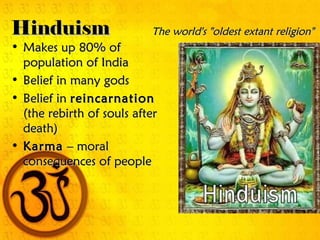
• Makes up 80% of
  population of India
• Belief in many gods
• Belief in reincarnation
  (the rebirth of souls after
  death)
• Karma – moral
  consequences of people
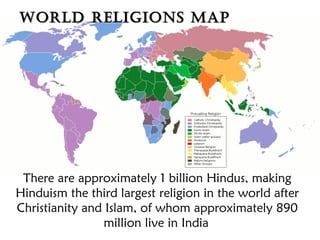
World religions Map


 There are approximately 1 billion Hindus, making
Hinduism the third largest religion in the world after
Christianity and Islam, of whom approximately 890
                million live in India
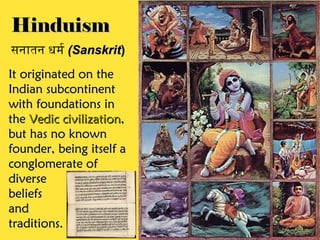
Hinduism
सनातन धर्म र (Sanskrit)
It originated on the
Indian subcontinent
with foundations in
the Vedic civilization,
but has no known
founder, being itself a
conglomerate of
diverse
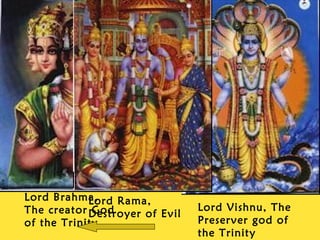
beliefs
and
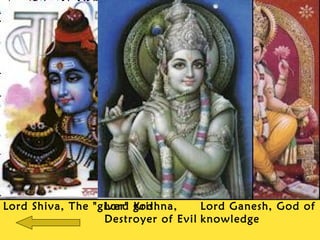
traditions.
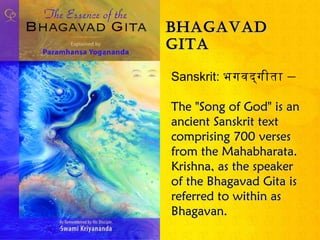
Bhagavad
gita

Sanskrit: भगवद् ‌ग ीता –

The "Song of God" is an
ancient Sanskrit text
comprising 700 verses
from the Mahabharata.
Krishna, as the speaker
of the Bhagavad Gita is
referred to within as
Bhagavan.
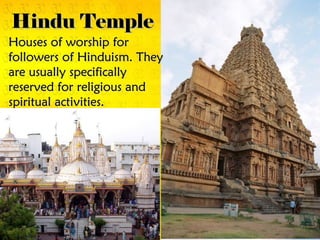
Hindu Temple
Houses of worship for
followers of Hinduism. They
are usually specifically
reserved for religious and
spiritual activities.
Who is Hindu?
When we think of the Hindu religion, we find it
difficult, if not impossible, to define Hindu religion or
even adequately describe it. Unlike other religions in the
world, the Hindu religion does not claim any one
prophet; it does not worship any one God; it does not
subscribe to any one dogma; it does not believe in any
one philosophic concept; it does not follow any one set
of religious rites or performances; in fact, it does not
appear to satisfy the narrow traditional features of any
religion of creed. It may broadly be described as a way
of life and nothing more.
                          - Chief Justice P. B. Gajendragadkar
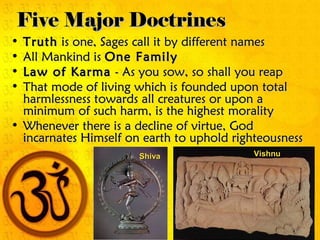
Five Major Doctrines
• Truth is one, Sages call it by different names
• All Mankind is One Family
• Law of Karma - As you sow, so shall you reap
• That mode of living which is founded upon total
  harmlessness towards all creatures or upon a
  minimum of such harm, is the highest morality
• Whenever there is a decline of virtue, God
  incarnates Himself on earth to uphold righteousness
                       Shiva                Vishnu
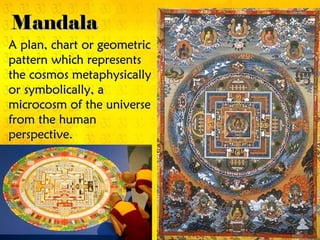
Mandala
A plan, chart or geometric
pattern which represents
the cosmos metaphysically
or symbolically, a
microcosm of the universe
from the human
perspective.
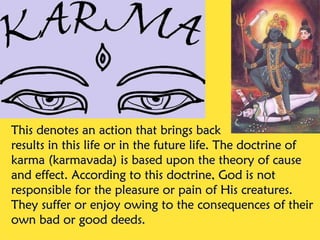
This denotes an action that brings back
results in this life or in the future life. The doctrine of
karma (karmavada) is based upon the theory of cause
and effect. According to this doctrine, God is not
responsible for the pleasure or pain of His creatures.
They suffer or enjoy owing to the consequences of their
own bad or good deeds.
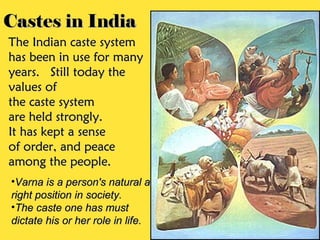
Castes in India
The Indian caste system
has been in use for many
years.  Still today the
values of
the caste system
are held strongly. 
It has kept a sense
of order, and peace
among the people. 
•Varna is a person's natural and
right position in society.
•The caste one has must
dictate his or her role in life.
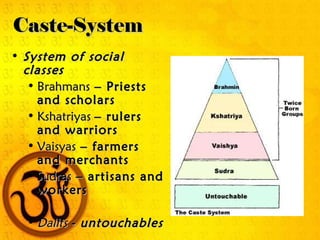
Caste-System
• System of social
  classes
   • Brahmans – Priests
     and scholars
   • Kshatriyas – rulers
     and warriors
   • Vaisyas – farmers
     and merchants
   • Sudras – artisans and
     workers

  • Dalits - untouchables
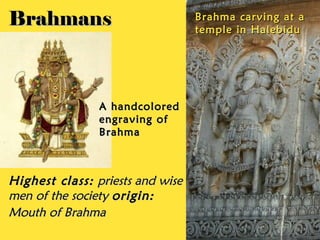
Brahmans                          Brahma carving at a
                                  temple in Halebidu


                A handcolored
                engraving of
                Brahma


Highest class: priests and wise
men of the society origin:
Mouth of Brahma
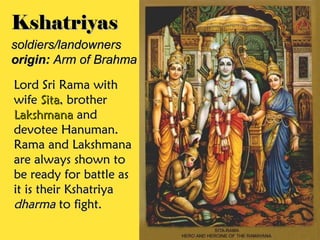
Kshatriyas
soldiers/landowners
origin: Arm of Brahma

Lord Sri Rama with
wife Sita, brother
Lakshmana and
devotee Hanuman.
Rama and Lakshmana
are always shown to
be ready for battle as
it is their Kshatriya
dharma to fight.
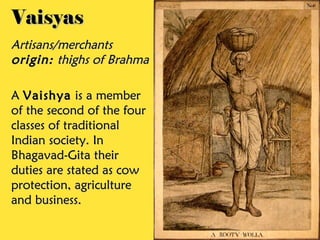
Vaisyas
Artisans/merchants
origin: thighs of Brahma

A Vaishya is a member
of the second of the four
classes of traditional
Indian society. In
Bhagavad-Gita their
duties are stated as cow
protection, agriculture
and business.
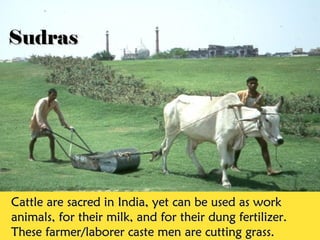
Sudras


Cattle are sacred in India, yet can be used as work
animals, for their milk, and for their dung fertilizer.
These farmer/laborer caste men are cutting grass.
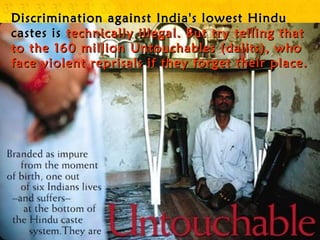
Discrimination against India's lowest Hindu
castes is technically illegal. But try telling that
to the 160 million Untouchables (dalits), who
face violent reprisals if they forget their place.
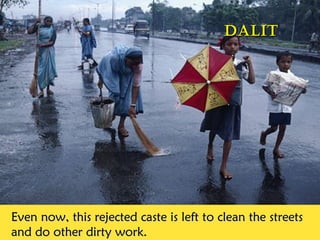
Dalit


Even now, this rejected caste is left to clean the streets
and do other dirty work.
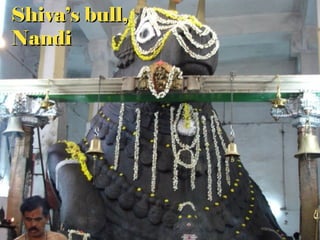
Shiva’s bull,
Nandi
Bull temple
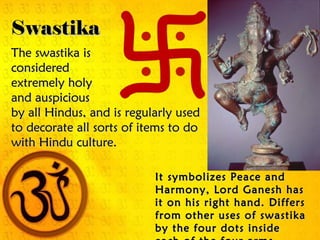
Swastika
The swastika is
considered
extremely holy
and auspicious
by all Hindus, and is regularly used
to decorate all sorts of items to do
with Hindu culture.

                           It symbolizes Peace and
                           Harmony, Lord Ganesh has
                           it on his right hand. Differs
                           from other uses of swastika
                           by the four dots inside
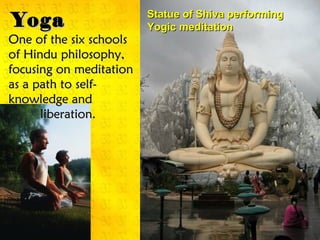
Yoga                     Statue of Shiva performing
                         Yogic meditation
One of the six schools
of Hindu philosophy,
focusing on meditation
as a path to self-
knowledge and
      liberation.
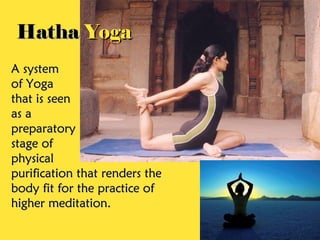
Hatha Yoga
A system
of Yoga
that is seen
as a
preparatory
stage of
physical
purification that renders the
body fit for the practice of
higher meditation.
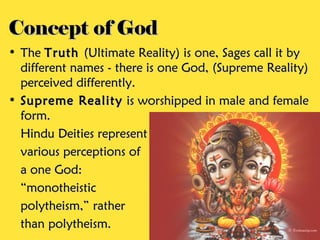
Concept of God
• The Truth (Ultimate Reality) is one, Sages call it by
  different names - there is one God, (Supreme Reality)
  perceived differently.
• Supreme Reality is worshipped in male and female
  form.
  Hindu Deities represent
  various perceptions of
  a one God:
  “monotheistic
  polytheism,” rather
  than polytheism.
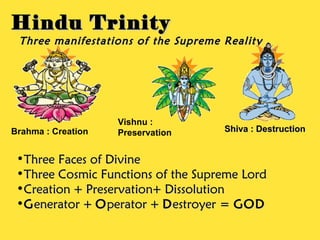
Hindu Trinity
 Three manifestations of the Supreme Reality


                    Vishnu :
Brahma : Creation   Preservation     Shiva : Destruction


 •Three Faces of Divine
 •Three Cosmic Functions of the Supreme Lord
 •Creation + Preservation+ Dissolution
 •G enerator + O perator + D estroyer = GOD
Lord Brahma,Lord Rama,
The creator Destroyer of Evil
             God                Lord Vishnu, The
of the Trinity                  Preserver god of
                                the Trinity
Lord Shiva, The "giver" god.
                  Lord Krishna,     Lord Ganesh, God of
                  Destroyer of Evil knowledge
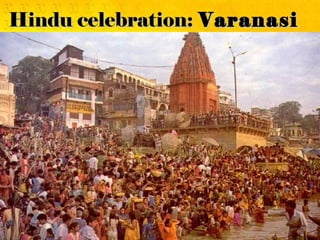
Hindu celebration: Varanasi
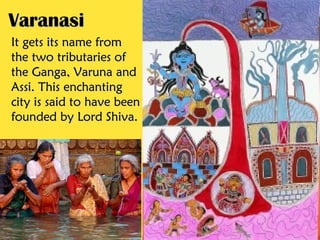
Varanasi
It gets its name from
the two tributaries of
the Ganga, Varuna and
Assi. This enchanting
city is said to have been
founded by Lord Shiva.
Ten Great Observances
•   Patience, firmness and stability
•   Forgiveness
•   Self-control and contentment
•   Not to steal or conceal, or be selfish
•   Cleanliness, purity and honesty
•   Control over senses and sexual energy
•   Right knowledge of the scripture
•   Material and spiritual knowledge or study
•   Truth
•   Absence of anger
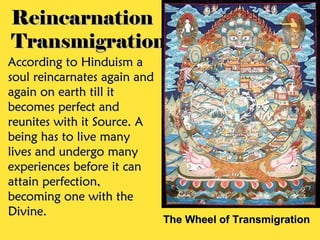
Reincarnation
Transmigration
According to Hinduism a
soul reincarnates again and
again on earth till it
becomes perfect and
reunites with it Source. A
being has to live many
lives and undergo many
experiences before it can
attain perfection,
becoming one with the
Divine.
                              The Wheel of Transmigration
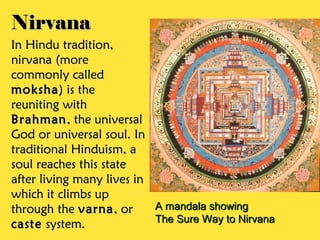
Nirvana
In Hindu tradition,
nirvana (more
commonly called
moksha ) is the
reuniting with
Brahman , the universal
God or universal soul. In
traditional Hinduism, a
soul reaches this state
after living many lives in
which it climbs up
through the varna , or     A mandala showing
                           The Sure Way to Nirvana
caste system.
What is meant by this quote?

"Just as a man discards worn out clothes and puts on
new clothes, the soul discards worn out bodies and
wears new ones."
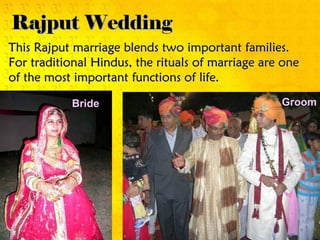
Rajput Wedding
This Rajput marriage blends two important families.
For traditional Hindus, the rituals of marriage are one
of the most important functions of life.

            Bride                                  Groom
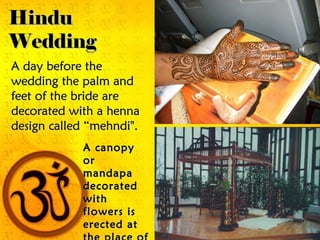
Hindu
Wedding
A day before the
wedding the palm and
feet of the bride are
decorated with a henna
design called “mehndi".
            A canopy
            or
            mandapa
            decorated
            with
            flowers is
            erected at
Hinduism

Hinduism

  • 1.
    Hinduism The world's "oldest extant religion" • Makes up 80% of population of India • Belief in many gods • Belief in reincarnation (the rebirth of souls after death) • Karma – moral consequences of people
  • 2.
    World religions Map There are approximately 1 billion Hindus, making Hinduism the third largest religion in the world after Christianity and Islam, of whom approximately 890 million live in India
  • 3.
    Hinduism सनातन धर्म र(Sanskrit) It originated on the Indian subcontinent with foundations in the Vedic civilization, but has no known founder, being itself a conglomerate of diverse beliefs and traditions.
  • 4.
    Bhagavad gita Sanskrit: भगवद् ‌गीता – The "Song of God" is an ancient Sanskrit text comprising 700 verses from the Mahabharata. Krishna, as the speaker of the Bhagavad Gita is referred to within as Bhagavan.
  • 5.
    Hindu Temple Houses ofworship for followers of Hinduism. They are usually specifically reserved for religious and spiritual activities.
  • 7.
    Who is Hindu? Whenwe think of the Hindu religion, we find it difficult, if not impossible, to define Hindu religion or even adequately describe it. Unlike other religions in the world, the Hindu religion does not claim any one prophet; it does not worship any one God; it does not subscribe to any one dogma; it does not believe in any one philosophic concept; it does not follow any one set of religious rites or performances; in fact, it does not appear to satisfy the narrow traditional features of any religion of creed. It may broadly be described as a way of life and nothing more. - Chief Justice P. B. Gajendragadkar
  • 8.
    Five Major Doctrines •Truth is one, Sages call it by different names • All Mankind is One Family • Law of Karma - As you sow, so shall you reap • That mode of living which is founded upon total harmlessness towards all creatures or upon a minimum of such harm, is the highest morality • Whenever there is a decline of virtue, God incarnates Himself on earth to uphold righteousness Shiva Vishnu
  • 9.
    Mandala A plan, chartor geometric pattern which represents the cosmos metaphysically or symbolically, a microcosm of the universe from the human perspective.
  • 10.
    This denotes anaction that brings back results in this life or in the future life. The doctrine of karma (karmavada) is based upon the theory of cause and effect. According to this doctrine, God is not responsible for the pleasure or pain of His creatures. They suffer or enjoy owing to the consequences of their own bad or good deeds.
  • 11.
    Castes in India TheIndian caste system has been in use for many years.  Still today the values of the caste system are held strongly.  It has kept a sense of order, and peace among the people.  •Varna is a person's natural and right position in society. •The caste one has must dictate his or her role in life.
  • 12.
    Caste-System • System ofsocial classes • Brahmans – Priests and scholars • Kshatriyas – rulers and warriors • Vaisyas – farmers and merchants • Sudras – artisans and workers • Dalits - untouchables
  • 13.
    Brahmans Brahma carving at a temple in Halebidu A handcolored engraving of Brahma Highest class: priests and wise men of the society origin: Mouth of Brahma
  • 14.
    Kshatriyas soldiers/landowners origin: Arm ofBrahma Lord Sri Rama with wife Sita, brother Lakshmana and devotee Hanuman. Rama and Lakshmana are always shown to be ready for battle as it is their Kshatriya dharma to fight.
  • 15.
    Vaisyas Artisans/merchants origin: thighs ofBrahma A Vaishya is a member of the second of the four classes of traditional Indian society. In Bhagavad-Gita their duties are stated as cow protection, agriculture and business.
  • 16.
    Sudras Cattle are sacredin India, yet can be used as work animals, for their milk, and for their dung fertilizer. These farmer/laborer caste men are cutting grass.
  • 17.
    Discrimination against India'slowest Hindu castes is technically illegal. But try telling that to the 160 million Untouchables (dalits), who face violent reprisals if they forget their place.
  • 18.
    Dalit Even now, thisrejected caste is left to clean the streets and do other dirty work.
  • 19.
  • 20.
    Swastika The swastika is considered extremelyholy and auspicious by all Hindus, and is regularly used to decorate all sorts of items to do with Hindu culture. It symbolizes Peace and Harmony, Lord Ganesh has it on his right hand. Differs from other uses of swastika by the four dots inside
  • 21.
    Yoga Statue of Shiva performing Yogic meditation One of the six schools of Hindu philosophy, focusing on meditation as a path to self- knowledge and liberation.
  • 22.
    Hatha Yoga A system ofYoga that is seen as a preparatory stage of physical purification that renders the body fit for the practice of higher meditation.
  • 23.
    Concept of God •The Truth (Ultimate Reality) is one, Sages call it by different names - there is one God, (Supreme Reality) perceived differently. • Supreme Reality is worshipped in male and female form. Hindu Deities represent various perceptions of a one God: “monotheistic polytheism,” rather than polytheism.
  • 24.
    Hindu Trinity Threemanifestations of the Supreme Reality Vishnu : Brahma : Creation Preservation Shiva : Destruction •Three Faces of Divine •Three Cosmic Functions of the Supreme Lord •Creation + Preservation+ Dissolution •G enerator + O perator + D estroyer = GOD
  • 25.
    Lord Brahma,Lord Rama, Thecreator Destroyer of Evil God Lord Vishnu, The of the Trinity Preserver god of the Trinity
  • 26.
    Lord Shiva, The"giver" god. Lord Krishna, Lord Ganesh, God of Destroyer of Evil knowledge
  • 27.
  • 28.
    Varanasi It gets itsname from the two tributaries of the Ganga, Varuna and Assi. This enchanting city is said to have been founded by Lord Shiva.
  • 29.
    Ten Great Observances • Patience, firmness and stability • Forgiveness • Self-control and contentment • Not to steal or conceal, or be selfish • Cleanliness, purity and honesty • Control over senses and sexual energy • Right knowledge of the scripture • Material and spiritual knowledge or study • Truth • Absence of anger
  • 30.
    Reincarnation Transmigration According to Hinduisma soul reincarnates again and again on earth till it becomes perfect and reunites with it Source. A being has to live many lives and undergo many experiences before it can attain perfection, becoming one with the Divine. The Wheel of Transmigration
  • 31.
    Nirvana In Hindu tradition, nirvana(more commonly called moksha ) is the reuniting with Brahman , the universal God or universal soul. In traditional Hinduism, a soul reaches this state after living many lives in which it climbs up through the varna , or A mandala showing The Sure Way to Nirvana caste system.
  • 32.
    What is meantby this quote? "Just as a man discards worn out clothes and puts on new clothes, the soul discards worn out bodies and wears new ones."
  • 33.
    Rajput Wedding This Rajputmarriage blends two important families. For traditional Hindus, the rituals of marriage are one of the most important functions of life. Bride Groom
  • 34.
    Hindu Wedding A day beforethe wedding the palm and feet of the bride are decorated with a henna design called “mehndi". A canopy or mandapa decorated with flowers is erected at

Editor's Notes

  • #15 Rama is shown having blue skin which is a characteristic of Vishnu
  • #23 introduced by Yogi Swatmarama, a sage of 15th century India, and compiler of the Hatha Yoga Pradipika. In this treatise Swatmarama introduces Hatha Yoga as 'a stairway to the heights of Raja Yoga', hence