HERO PPT Template.pptx Updated orientation about community extension
1.
THE SAFE SPACESACT (R.A.11313): STUDENTS AWARENESS
AND ADHERENCE IN A PRIVATE HIGHER
EDUCATION INSTITUTION
Authors:
Ralph Arjay C. Dela Cruz, RN LPT MAEd MAN
Jhoniel C. Samoling, RPm, CHRA
Danilo R. Tubeo Jr., LPT
THE SAFE SPACESACT (R.A.11313): STUDENTS AWARENESS AND ADHERENCE IN A PRIVATE HIGHER EDUCATION
INSTITUTION
S A I N T F R A N C I S O F A S S I S I C O L L E G E H I G H E R E D U C A T I O N R E S E A R C H O F F I C E
Authored by: Dela Cruz RA. ,Samoling J.,and Tubeo D.
• The Safe Spaces Act (Republic Act 11313) or Bawal Bastos Law was enforced
and implemented by the Commission on Higher Education to both public and
private higher education institutions.
• Saint Francis of Assisi College, as a private higher education institution, is also
committed to upholding the Safe Spaces Act. Understanding the level of student
awareness and adherence within the institution is essential to improving the
effectiveness of its policies and programs.
• Most studies focus on public universities, leaving gaps in understanding how
private institutions enforce the law and how students perceive and comply with it.
S A IN T F R A N C I S O F A S S I S I C O L L E G E H I G H E R E D U C A T I O N R E S E A R C H O F F I C E
2.1 Research Design
• Utilized the descriptive-correlational research
design
2.2 Research Locale
• Saint Francis of Assisi College, a private higher
education institution, situated at 45 Admiral Village,
Talon Tres, Las Piñas City, Metro Manila.
2.3 Research Participants
• Using the Slovin formula, a sample size of 228
respondents was taken from the general population
of 531 enrolled students to obtain a statistically
reliable result considering a 0.05 margin of error.
THE SAFE SPACES ACT (R.A.11313): STUDENTS AWARENESS AND ADHERENCE IN A PRIVATE HIGHER EDUCATION
INSTITUTION
Authored by: Dela Cruz RA. ,Samoling J.,and Tubeo D.
6.
S A IN T F R A N C I S O F A S S I S I C O L L E G E H I G H E R E D U C A T I O N R E S E A R C H O F F I C E
2.4 Research Instrument
• Adapted questionnaire from Borito and Yango
(2022), Awareness, Attitude, and Compliance with
RA 11313 – Safe Spaces Act Among College
Students in a Higher Education Institution in
Laguna, International Journal of Multidisciplinary
Research and Analysis.
• Checked its validity and reliability through Cronbach
alpha test with validated and reliability results of
88% that is interpreted as Good.
• Measurement used was the 4-likert scale format.
THE SAFE SPACES ACT (R.A.11313): STUDENTS AWARENESS AND ADHERENCE IN A PRIVATE HIGHER EDUCATION
INSTITUTION
Authored by: Dela Cruz RA. ,Samoling J.,and Tubeo D.
7.
S A IN T F R A N C I S O F A S S I S I C O L L E G E H I G H E R E D U C A T I O N R E S E A R C H O F F I C E
2.4 Research Instrument
• Mean and Frequency was utilized to determine the
level of awareness and level of adherence of the
respondents to the Safe Spaces Act
• Pearson’s R Correlation for the relationship between
the level of awareness and level of adherehnce
THE SAFE SPACES ACT (R.A.11313): STUDENTS AWARENESS AND ADHERENCE IN A PRIVATE HIGHER EDUCATION
INSTITUTION
Authored by: Dela Cruz RA. ,Samoling J.,and Tubeo D.
8.
S A IN T F R A N C I S O F A S S I S I C O L L E G E H I G H E R E D U C A T I O N R E S E A R C H O F F I C E
2.5 Data Gathering
• A survey questionnaire was used to gather the
study results. A permission from the administrators
were secured. Consent were placed and signed by
the respondents. The researcher ensured that the
identity of the respondents was kept private. After
the respondents completed the questionnaires, The
data gathered were tallied, tabulated, analyzed, and
interpreted.
THE SAFE SPACES ACT (R.A.11313): STUDENTS AWARENESS AND ADHERENCE IN A PRIVATE HIGHER EDUCATION
INSTITUTION
Authored by: Dela Cruz RA. ,Samoling J.,and Tubeo D.
9.
S A IN T F R A N C I S O F A S S I S I C O L L E G E H I G H E R E D U C A T I O N R E S E A R C H O F F I C E
2.6 Ethical Consideration
• Approval from the executive heads of Saint Francis
of Assisi College.
• Informed consent form together with the survey
questionnaire
• Anonymity and confidentiality
2.7 Hypothesis
• There is no significant relationship between the
respondents’ level of awareness and level of
adherence.
THE SAFE SPACES ACT (R.A.11313): STUDENTS AWARENESS AND ADHERENCE IN A PRIVATE HIGHER EDUCATION
INSTITUTION
Authored by: Dela Cruz RA. ,Samoling J.,and Tubeo D.
S A IN T F R A N C I S O F A S S I S I C O L L E G E H I G H E R E D U C A T I O N R E S E A R C H O F F I C E
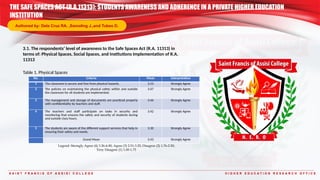
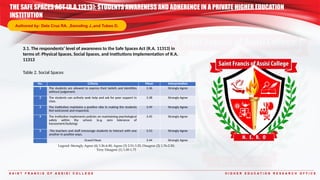
3.1. The respondents’ level of awareness to the Safe Spaces Act (R.A. 11313) in
terms of: Physical Spaces, Social Spaces, and Institutions Implementation of R.A.
11313
Table 1. Physical Spaces
THE SAFE SPACES ACT (R.A.11313): STUDENTS AWARENESS AND ADHERENCE IN A PRIVATE HIGHER EDUCATION
INSTITUTION
Authored by: Dela Cruz RA. ,Samoling J.,and Tubeo D.
No. Criteria Mean Interpretation
1 The classroom is secure and free from physical hazards. 3.53 Strongly Agree
2 The policies on maintaining the physical safety within and outside
the classroom for all students are implemented.
3.47 Strongly Agree
3 The management and storage of documents are practiced properly
with confidentiality by teachers and staff.
3.46 Strongly Agree
4 The teachers and staff participate on tasks in security and
monitoring that ensures the safety and security of students during
and outside class hours.
3.42 Strongly Agree
5 The students are aware of the different support services that help in
ensuring their safety and needs.
3.30 Strongly Agree
Grand Mean 3.43 Strongly Agree
Legend: Strongly Agree (4) 3.26-4.00; Agree (3) 2.51-3.25; Disagree (2) 1.76-2.50;
Very Disagree (1) 1.00-1.75
12.
S A IN T F R A N C I S O F A S S I S I C O L L E G E H I G H E R E D U C A T I O N R E S E A R C H O F F I C E
3.1. The respondents’ level of awareness to the Safe Spaces Act (R.A. 11313) in
terms of: Physical Spaces, Social Spaces, and Institutions Implementation of R.A.
11313
Table 2. Social Spaces
THE SAFE SPACES ACT (R.A.11313): STUDENTS AWARENESS AND ADHERENCE IN A PRIVATE HIGHER EDUCATION
INSTITUTION
Authored by: Dela Cruz RA. ,Samoling J.,and Tubeo D.
Legend: Strongly Agree (4) 3.26-4.00; Agree (3) 2.51-3.25; Disagree (2) 1.76-2.50;
Very Disagree (1) 1.00-1.75
No. Criteria Mean Interpretation
1 The students are allowed to express their beliefs and identities
without judgement.
3.36 Strongly Agree
2 The students can actively seek help and ask for peer support in
class.
3.38 Strongly Agree
3 The institution maintains a positive vibe in making the students
feel welcomed and respected.
3.49 Strongly Agree
4 The institution implements policies on maintaining psychological
safety within the school. (e.g. zero tolerance of
harassment/bullying)
3.45 Strongly Agree
5 The teachers and staff encourage students to interact with one
another in positive ways.
3.53 Strongly Agree
Grand Mean 3.44 Strongly Agree
13.
S A IN T F R A N C I S O F A S S I S I C O L L E G E H I G H E R E D U C A T I O N R E S E A R C H O F F I C E
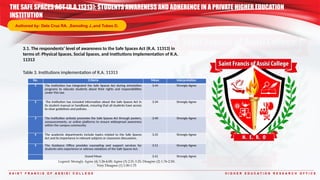
3.1. The respondents’ level of awareness to the Safe Spaces Act (R.A. 11313) in
terms of: Physical Spaces, Social Spaces, and Institutions Implementation of R.A.
11313
Table 3. Institutions implementation of R.A. 11313
THE SAFE SPACES ACT (R.A.11313): STUDENTS AWARENESS AND ADHERENCE IN A PRIVATE HIGHER EDUCATION
INSTITUTION
Authored by: Dela Cruz RA. ,Samoling J.,and Tubeo D.
Legend: Strongly Agree (4) 3.26-4.00; Agree (3) 2.51-3.25; Disagree (2) 1.76-2.50;
Very Disagree (1) 1.00-1.75
No. Criteria Mean Interpretation
1 The institution has integrated the Safe Spaces Act during orientation
programs to educate students about their rights and responsibilities
under this law.
3.44 Strongly Agree
2 The institution has included information about the Safe Spaces Act in
its student manual or handbook, ensuring that all students have access
to clear guidelines and policies.
3.34 Strongly Agree
3 The institution actively promotes the Safe Spaces Act through posters,
announcements, or online platforms to ensure widespread awareness
within the campus community.
3.40 Strongly Agree
4 The academic departments include topics related to the Safe Spaces
Act and its importance in relevant subjects or classroom discussions.
3.35 Strongly Agree
5 The Guidance Office provides counseling and support services for
students who experience or witness violations of the Safe Spaces Act.
3.51 Strongly Agree
Grand Mean 3.41 Strongly Agree
14.
S A IN T F R A N C I S O F A S S I S I C O L L E G E H I G H E R E D U C A T I O N R E S E A R C H O F F I C E
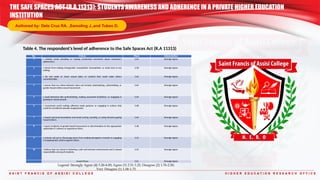
Table 4. The respondent’s level of adherence to the Safe Spaces Act (R.A 11313)
THE SAFE SPACES ACT (R.A.11313): STUDENTS AWARENESS AND ADHERENCE IN A PRIVATE HIGHER EDUCATION
INSTITUTION
Authored by: Dela Cruz RA. ,Samoling J.,and Tubeo D.
Legend: Strongly Agree (4) 3.26-4.00; Agree (3) 2.51-3.25; Disagree (2) 1.76-2.50;
Very Disagree (1) 1.00-1.75
No. Criteria Mean Interpretation
1 I actively avoid catcalling or making unsolicited comments about someone's
appearance.
3.63 Strongly Agree
2 I refrain from making misogynistic, transphobic, homophobic, or sexist slurs in any
setting.
3.58 Strongly Agree
3 I do not make or share sexual jokes or content that could make others
uncomfortable.
3.62 Strongly Agree
4 I ensure that my online behavior does not include cyberbullying, cyberstalking, or
gender-based online sexual harassment.
3.69 Strongly Agree
5 I avoid behaviors like wolf-whistling, making unwanted invitations, or engaging in
groping or sexual assault.
3.69 Strongly Agree
6 I consciously avoid making offensive body gestures or engaging in actions that
could be considered sexually inappropriate.
3.68 Strongly Agree
7 I respect personal boundaries and avoid cursing, taunting, or using intrusive gazing
toward others.
3.64 Strongly Agree
8 I report incidents of gender-based harassment or discrimination to the appropriate
authorities if I witness or experience them.
3.48 Strongly Agree
9 I actively call out or discourage peers from making derogatory remarks or engaging
in inappropriate actions against others.
3.53 Strongly Agree
10 I believe that my school is fostering a safe and inclusive environment and is shared
responsibility among all students.
3.55 Strongly Agree
Grand Mean 3.61 Strongly Agree
15.
S A IN T F R A N C I S O F A S S I S I C O L L E G E H I G H E R E D U C A T I O N R E S E A R C H O F F I C E
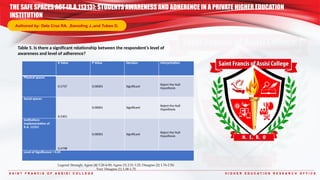
Table 5. Is there a significant relationship between the respondent’s level of
awareness and level of adherence?
THE SAFE SPACES ACT (R.A.11313): STUDENTS AWARENESS AND ADHERENCE IN A PRIVATE HIGHER EDUCATION
INSTITUTION
Authored by: Dela Cruz RA. ,Samoling J.,and Tubeo D.
Legend: Strongly Agree (4) 3.26-4.00; Agree (3) 2.51-3.25; Disagree (2) 1.76-2.50;
Very Disagree (1) 1.00-1.75
R Value P Value Decision Interpretation
Physical spaces
0.5737 0.00001 Significant
Reject the Null
Hypothesis
Social spaces
0.5301
0.00001 Significant
Reject the Null
Hypothesis
Institutions
implementation of
R.A. 11313
0.4798
0.00001 Significant
Reject the Null
Hypothesis
Level of Significance = 0.05
16.
S A IN T F R A N C I S O F A S S I S I C O L L E G E H I G H E R E D U C A T I O N R E S E A R C H O F F I C E
4.0 Discussion and Conclusion
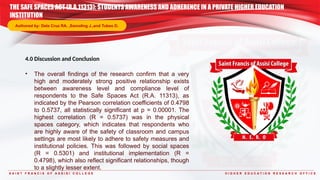
• The overall findings of the research confirm that a very
high and moderately strong positive relationship exists
between awareness level and compliance level of
respondents to the Safe Spaces Act (R.A. 11313), as
indicated by the Pearson correlation coefficients of 0.4798
to 0.5737, all statistically significant at p = 0.00001. The
highest correlation (R = 0.5737) was in the physical
spaces category, which indicates that respondents who
are highly aware of the safety of classroom and campus
settings are most likely to adhere to safety measures and
institutional policies. This was followed by social spaces
(R = 0.5301) and institutional implementation (R =
0.4798), which also reflect significant relationships, though
to a slightly lesser extent.
THE SAFE SPACES ACT (R.A.11313): STUDENTS AWARENESS AND ADHERENCE IN A PRIVATE HIGHER EDUCATION
INSTITUTION
Authored by: Dela Cruz RA. ,Samoling J.,and Tubeo D.
17.
S A IN T F R A N C I S O F A S S I S I C O L L E G E H I G H E R E D U C A T I O N R E S E A R C H O F F I C E
4.0 Discussion and Conclusion
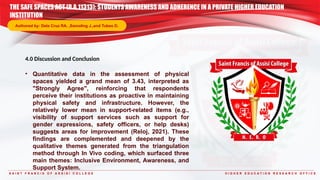
• Quantitative data in the assessment of physical
spaces yielded a grand mean of 3.43, interpreted as
"Strongly Agree", reinforcing that respondents
perceive their institutions as proactive in maintaining
physical safety and infrastructure. However, the
relatively lower mean in support-related items (e.g.,
visibility of support services such as support for
gender expressions, safety officers, or help desks)
suggests areas for improvement (Reloj, 2021). These
findings are complemented and deepened by the
qualitative themes generated from the triangulation
method through In Vivo coding, which surfaced three
main themes: Inclusive Environment, Awareness, and
Support System.
THE SAFE SPACES ACT (R.A.11313): STUDENTS AWARENESS AND ADHERENCE IN A PRIVATE HIGHER EDUCATION
INSTITUTION
Authored by: Dela Cruz RA. ,Samoling J.,and Tubeo D.
18.
S A IN T F R A N C I S O F A S S I S I C O L L E G E H I G H E R E D U C A T I O N R E S E A R C H O F F I C E
5.0 Recommendations
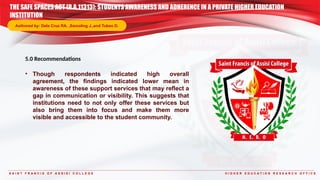
• Though respondents indicated high overall
agreement, the findings indicated lower mean in
awareness of these support services that may reflect a
gap in communication or visibility. This suggests that
institutions need to not only offer these services but
also bring them into focus and make them more
visible and accessible to the student community.
THE SAFE SPACES ACT (R.A.11313): STUDENTS AWARENESS AND ADHERENCE IN A PRIVATE HIGHER EDUCATION
INSTITUTION
Authored by: Dela Cruz RA. ,Samoling J.,and Tubeo D.
19.
S A IN T F R A N C I S O F A S S I S I C O L L E G E H I G H E R E D U C A T I O N R E S E A R C H O F F I C E
• The research verifies a distinct and statistically
established correlation between awareness and
observance of the Safe Spaces Act. The institutions is
encouraged to reinforce inclusive practice, maintain
awareness programs, and enhance the visibility and
responsiveness of support mechanisms. The Institution
must reinforce three key areas; these are: Report
mechanism, information dissemination through
manuals and orientations, and Gender and
Development Office and Coordinator establishment.
This will not only continue to ensure the safety of the
students but also develop a culture of respect, equality,
and responsibility, strong pillars of the Safe Spaces Act.
These interventions, based on data and students' lived
realities, are critical in creating a safe, inclusive, and
caring environment.
THE SAFE SPACES ACT (R.A.11313): STUDENTS AWARENESS AND ADHERENCE IN A PRIVATE HIGHER EDUCATION
INSTITUTION
Authored by: Dela Cruz RA. ,Samoling J.,and Tubeo D.
20.
S A IN T F R A N C I S O F A S S I S I C O L L E G E H I G H E R E D U C A T I O N R E S E A R C H O F F I C E
THANK
YOU!
THE SAFE SPACES ACT (R.A.11313): STUDENTS AWARENESS AND ADHERENCE IN A PRIVATE HIGHER EDUCATION
INSTITUTION
Authored by: Dela Cruz RA. ,Samoling J.,and Tubeo D.