Chapter 9
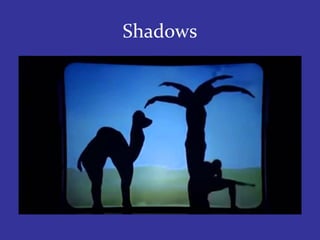
Shadows
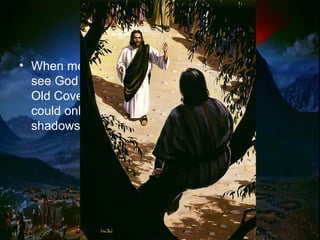
• When men tried to
see God under the
Old Covenant they
could only see
shadows.
The Veil of the First
Ministry
The Unveiling of the
Second Ministry
An earthly service— "of this
world." V.1
A heavenly service— "not of this
creation." V.11
Human equipment— "there was a
tabernacle constructed." V. 2
Divine equipment— "not made
with hands."
External effects— "cannot as
touching the conscience make the
worshipper perfect." V. 9
Internal effects— "cleanse your
conscience from dead works to serve
the living God." V. 14
Temporary in nature— "carnal
regulations set up pending a time of
reconstruction." V. 10
Permanent in nature— "the
promise of the eternal inheritance."
V. 12
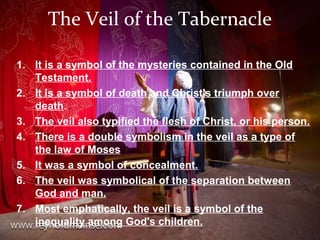
The Veil of the Tabernacle
1. It is a symbol of the mysteries contained in the Old
Testament.
2. It is a symbol of death and Christ's triumph over
death.
3. The veil also typified the flesh of Christ, or his person.
4. There is a double symbolism in the veil as a type of
the law of Moses
5. It was a symbol of concealment.
6. The veil was symbolical of the separation between
God and man.
7. Most emphatically, the veil is a symbol of the
inequality among God's children.
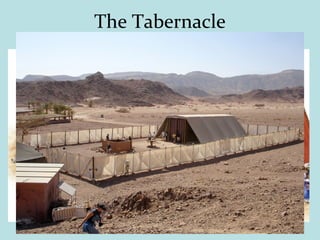
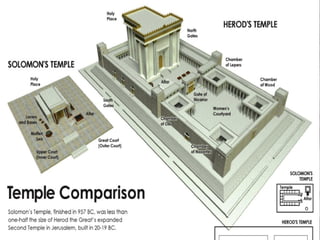
The Tabernacle
• Wilderness
• Solomon’s
• Zerubbel’s
• Herod’s
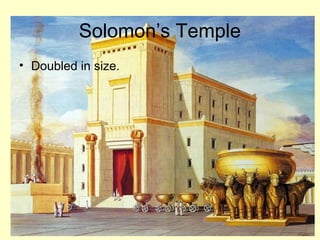
Solomon’s Temple
• Doubled in size.
Zerubbel’s Temple
• No descriptive terms other than, “But
many of the priests and the Levites
and heads of the father’s houses, old
men who had seen the first temple,
wept with a loud voice when the
foundation of this temple was laid
before their eyes.” (Ezra 3:12)
Herod’s Temple
Christian’s Temple?
• “Not of this earth”
• Author of Hebrews did not
focus on a temple but rather
the sacrifice.
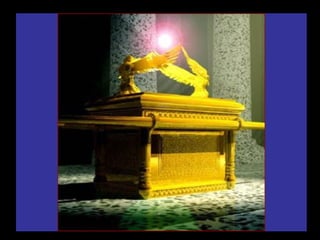
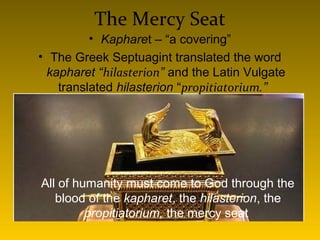
The Mercy Seat
• Kapharet – “a covering”
• The Greek Septuagint translated the word
kapharet “hilasterion” and the Latin Vulgate
translated hilasterion “propitiatorium.”
All of humanity must come to God through the
blood of the kapharet, the hilasterion, the
propitiatorium, the mercy seat
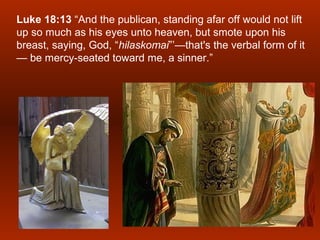
Luke 18:13 “And the publican, standing afar off would not lift
up so much as his eyes unto heaven, but smote upon his
breast, saying, God, “hilaskomai”’—that's the verbal form of it
— be mercy-seated toward me, a sinner.”
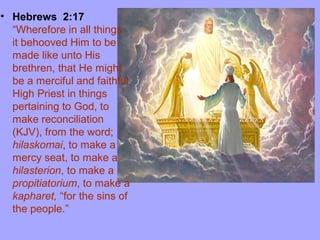
• Hebrews 2:17
“Wherefore in all things
it behooved Him to be
made like unto His
brethren, that He might
be a merciful and faithful
High Priest in things
pertaining to God, to
make reconciliation
(KJV), from the word;
hilaskomai, to make a
mercy seat, to make a
hilasterion, to make a
propitiatorium, to make a
kapharet, “for the sins of
the people.”
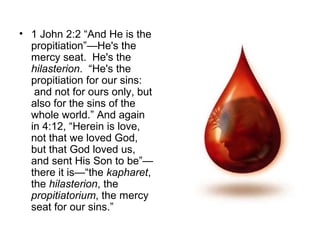
• 1 John 2:2 “And He is the
propitiation”—He's the
mercy seat. He's the
hilasterion. “He's the
propitiation for our sins:
and not for ours only, but
also for the sins of the
whole world.” And again
in 4:12, “Herein is love,
not that we loved God,
but that God loved us,
and sent His Son to be”—
there it is—“the kapharet,
the hilasterion, the
propitiatorium, the mercy
seat for our sins.”
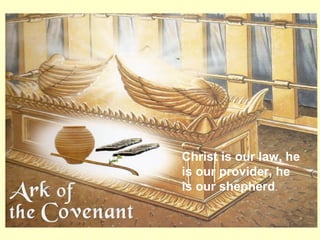
Christ is our law, he
is our provider, he
is our shepherd.
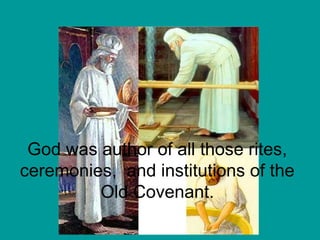
God was author of all those rites,
ceremonies, and institutions of the
Old Covenant.
The Reformation
• Subject of the Reformation
• Notice that the whole section is set in
the past tense – “The first covenant
had ordinances” (v. 1)
• Imposed on them until the time of
reformation.

"For if I build again the things which I
destroyed, I make myself a
transgressor" (Gal. 2:18).
Substance of the Reformation
• The first covenant
• The worldly sanctuary
• The priestly service
• The appointed days and ceremonies
• The blood sacrifices
• The washings
• The dietary restrictions
• Miscellaneous carnal ordinances
"let no man judge you in meat, or in drink, or in
respect of an holy day, or of the new moon, or of
the Sabbath days: which are a shadow of things
to come; but the body is of Christ" (Col. 2:16, 17).
The Effect of the Reformation
• "But Christ being come an high priest of good things to
come, by a greater and more perfect tabernacle, not made
with hands, that is to say, not of this building; neither by the
blood of goats and calves, but by his own blood he entered
in once into the holy place, having obtained eternal
redemption for us" (Heb. 9:11, 12).
Notice the verb tense in this passage:
• Christ being come (historical present, describing past
events in the present voice)
• Entered by his blood (past tense)
• Having obtained eternal redemption (perfect tense,
showing completed action in the past)
In other words, the whole substance of the law looked to
the work of Christ upon the cross, and was fulfilled in
his death, burial, and resurrection.
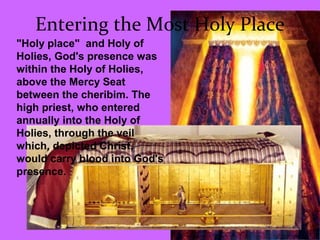
Entering the Most Holy Place
"Holy place" and Holy of
Holies, God's presence was
within the Holy of Holies,
above the Mercy Seat
between the cheribim. The
high priest, who entered
annually into the Holy of
Holies, through the veil
which, depicted Christ,
would carry blood into God's
presence.
"What is the conscience?"
• The conscience is defined as that part of the
human psyche that induces mental anguish and
feelings of guilt when we violate it and feelings
of pleasure and well-being when our actions,
thoughts and words are in conformity to our
value systems.
• , meaning “moral awareness”
or “moral consciousness.”
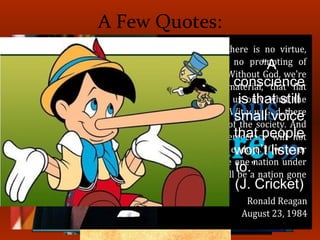
A Few Quotes:
“A
conscience
is that still
small voice
that people
won’t listen
to.”
(J. Cricket)
Do Atheists have a conscience?
• “You don't have to be a person of faith or
religious background to be able to tell the
difference between good and evil,
between right and wrong. Even in
countries that are officially atheistic, their
laws will reflect norms of fundamental
ethics, for example, that murder, rape, and
larceny are wrong, that patriotism, honesty
under oath, and philanthropy are good.”
The Animal Kingdom, Do They
Possess A Conscience?
• There are signals that they possess
inherent roles for maintaining balance
in existence with one another such as
one species warning another about
predators or how elephants and rhino’s
coexist. But these notions are not
signals of conscience for the greater
good or a willingness to organize
against a species which has become
detrimental to their existence or
habitat.
What the Conscience is Not:
• Conscience is not personal opinion: It should be
judgment based upon provable facts.
• Conscience is not what is socially acceptable: Social
norms vary from culture to culture.
• Conscience is not the right to do as you please: That
is lawlessness.
• Conscience is not freedom from the teachings of the
Bible: Unbelievers have conscience of rights and wrongs.
• Conscience is not independently determining what is
good and evil: “I know what’s right for myself” or the
philosophy, “Just follow your heart” is not wise counsel.
• Conscience is not freedom of opinion: It is more than
just having the privilege of free speech. Free speech is
not the same as making public law.
• Conscience is not “being at peace with oneself”
What Can We Say About the Bible
and the Conscience?
Scriptures teach
that the conscience:
• Can be evil (Hebrews 10:22);
• seared (1 Timothy 4:2);
• defiled (Titus 1:15);
• ignorant (1 Timothy 1:13);
• and choked with dead works
(Hebrews 9:14).
• Conscience must be
informed!
Three Major N.T. Truths About the
Conscience
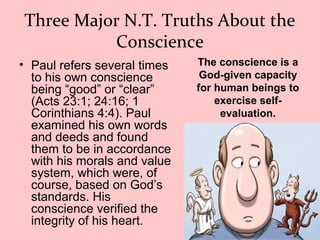
• Paul refers several times
to his own conscience
being “good” or “clear”
(Acts 23:1; 24:16; 1
Corinthians 4:4). Paul
examined his own words
and deeds and found
them to be in accordance
with his morals and value
system, which were, of
course, based on God’s
standards. His
conscience verified the
integrity of his heart.
The conscience is a
God-given capacity
for human beings to
exercise self-
evaluation.
Three Major N.T. Truths About the
Conscience
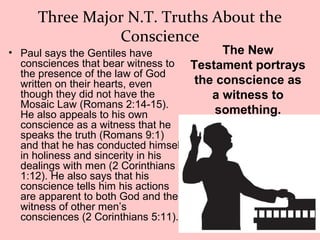
• Paul says the Gentiles have
consciences that bear witness to
the presence of the law of God
written on their hearts, even
though they did not have the
Mosaic Law (Romans 2:14-15).
He also appeals to his own
conscience as a witness that he
speaks the truth (Romans 9:1)
and that he has conducted himself
in holiness and sincerity in his
dealings with men (2 Corinthians
1:12). He also says that his
conscience tells him his actions
are apparent to both God and the
witness of other men’s
consciences (2 Corinthians 5:11).
The New
Testament portrays
the conscience as
a witness to
something.
Three Major N.T. Truths About the
Conscience
• The conscience is a servant of the
individual’s value system.
• Therefore, violating the conscience is a sin in itself
bringing legitimate guilt for a real offense against God (1
Cor. 8:12; cf. Romans 14:23).
• An immature or weak value system produces a weak
conscience, while a fully informed value system produces
a strong sense of right and wrong.
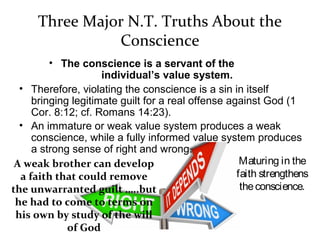
Maturing in the
faith strengthens
theconscience.
A weak brother can develop
a faith that could remove
the unwarranted guilt …..but
he had to come to terms on
his own by study of the will
of God
Summary
• Respond to your conscience, even if it's weak,
and then continue to inform your conscience with
God's Word so it can begin to function with
reliable data.
• 1 John 3:20-22
The new covenant has provided a way by which man's
conscience can be truly cleansed, and the basis of that
cleansing is shown in the Hebrew text to indicate that it
is by means of the blood of Christ.
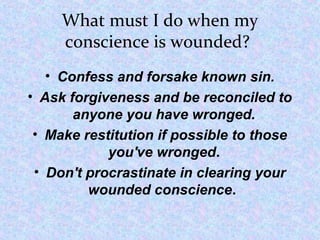
What must I do when my
conscience is wounded?
• Confess and forsake known sin.
• Ask forgiveness and be reconciled to
anyone you have wronged.
• Make restitution if possible to those
you've wronged.
• Don't procrastinate in clearing your
wounded conscience.
Hebrews chapter 9

Hebrews chapter 9

  • 1.
  • 3.
  • 4.
    • When mentried to see God under the Old Covenant they could only see shadows.
  • 5.
    The Veil ofthe First Ministry The Unveiling of the Second Ministry An earthly service— "of this world." V.1 A heavenly service— "not of this creation." V.11 Human equipment— "there was a tabernacle constructed." V. 2 Divine equipment— "not made with hands." External effects— "cannot as touching the conscience make the worshipper perfect." V. 9 Internal effects— "cleanse your conscience from dead works to serve the living God." V. 14 Temporary in nature— "carnal regulations set up pending a time of reconstruction." V. 10 Permanent in nature— "the promise of the eternal inheritance." V. 12
  • 6.
    The Veil ofthe Tabernacle 1. It is a symbol of the mysteries contained in the Old Testament. 2. It is a symbol of death and Christ's triumph over death. 3. The veil also typified the flesh of Christ, or his person. 4. There is a double symbolism in the veil as a type of the law of Moses 5. It was a symbol of concealment. 6. The veil was symbolical of the separation between God and man. 7. Most emphatically, the veil is a symbol of the inequality among God's children.
  • 7.
    The Tabernacle • Wilderness •Solomon’s • Zerubbel’s • Herod’s
  • 8.
  • 9.
    Zerubbel’s Temple • Nodescriptive terms other than, “But many of the priests and the Levites and heads of the father’s houses, old men who had seen the first temple, wept with a loud voice when the foundation of this temple was laid before their eyes.” (Ezra 3:12)
  • 10.
  • 11.
    Christian’s Temple? • “Notof this earth” • Author of Hebrews did not focus on a temple but rather the sacrifice.
  • 13.
    The Mercy Seat •Kapharet – “a covering” • The Greek Septuagint translated the word kapharet “hilasterion” and the Latin Vulgate translated hilasterion “propitiatorium.” All of humanity must come to God through the blood of the kapharet, the hilasterion, the propitiatorium, the mercy seat
  • 14.
    Luke 18:13 “Andthe publican, standing afar off would not lift up so much as his eyes unto heaven, but smote upon his breast, saying, God, “hilaskomai”’—that's the verbal form of it — be mercy-seated toward me, a sinner.”
  • 15.
    • Hebrews 2:17 “Whereforein all things it behooved Him to be made like unto His brethren, that He might be a merciful and faithful High Priest in things pertaining to God, to make reconciliation (KJV), from the word; hilaskomai, to make a mercy seat, to make a hilasterion, to make a propitiatorium, to make a kapharet, “for the sins of the people.”
  • 16.
    • 1 John2:2 “And He is the propitiation”—He's the mercy seat. He's the hilasterion. “He's the propitiation for our sins: and not for ours only, but also for the sins of the whole world.” And again in 4:12, “Herein is love, not that we loved God, but that God loved us, and sent His Son to be”— there it is—“the kapharet, the hilasterion, the propitiatorium, the mercy seat for our sins.”
  • 17.
    Christ is ourlaw, he is our provider, he is our shepherd.
  • 18.
    God was authorof all those rites, ceremonies, and institutions of the Old Covenant.
  • 19.
    The Reformation • Subjectof the Reformation • Notice that the whole section is set in the past tense – “The first covenant had ordinances” (v. 1) • Imposed on them until the time of reformation. "For if I build again the things which I destroyed, I make myself a transgressor" (Gal. 2:18).
  • 20.
    Substance of theReformation • The first covenant • The worldly sanctuary • The priestly service • The appointed days and ceremonies • The blood sacrifices • The washings • The dietary restrictions • Miscellaneous carnal ordinances "let no man judge you in meat, or in drink, or in respect of an holy day, or of the new moon, or of the Sabbath days: which are a shadow of things to come; but the body is of Christ" (Col. 2:16, 17).
  • 21.
    The Effect ofthe Reformation • "But Christ being come an high priest of good things to come, by a greater and more perfect tabernacle, not made with hands, that is to say, not of this building; neither by the blood of goats and calves, but by his own blood he entered in once into the holy place, having obtained eternal redemption for us" (Heb. 9:11, 12). Notice the verb tense in this passage: • Christ being come (historical present, describing past events in the present voice) • Entered by his blood (past tense) • Having obtained eternal redemption (perfect tense, showing completed action in the past) In other words, the whole substance of the law looked to the work of Christ upon the cross, and was fulfilled in his death, burial, and resurrection.
  • 22.
    Entering the MostHoly Place "Holy place" and Holy of Holies, God's presence was within the Holy of Holies, above the Mercy Seat between the cheribim. The high priest, who entered annually into the Holy of Holies, through the veil which, depicted Christ, would carry blood into God's presence.
  • 23.
    "What is theconscience?" • The conscience is defined as that part of the human psyche that induces mental anguish and feelings of guilt when we violate it and feelings of pleasure and well-being when our actions, thoughts and words are in conformity to our value systems. • , meaning “moral awareness” or “moral consciousness.”
  • 24.
    A Few Quotes: “A conscience isthat still small voice that people won’t listen to.” (J. Cricket)
  • 25.
    Do Atheists havea conscience? • “You don't have to be a person of faith or religious background to be able to tell the difference between good and evil, between right and wrong. Even in countries that are officially atheistic, their laws will reflect norms of fundamental ethics, for example, that murder, rape, and larceny are wrong, that patriotism, honesty under oath, and philanthropy are good.”
  • 26.
    The Animal Kingdom,Do They Possess A Conscience? • There are signals that they possess inherent roles for maintaining balance in existence with one another such as one species warning another about predators or how elephants and rhino’s coexist. But these notions are not signals of conscience for the greater good or a willingness to organize against a species which has become detrimental to their existence or habitat.
  • 27.
    What the Conscienceis Not: • Conscience is not personal opinion: It should be judgment based upon provable facts. • Conscience is not what is socially acceptable: Social norms vary from culture to culture. • Conscience is not the right to do as you please: That is lawlessness. • Conscience is not freedom from the teachings of the Bible: Unbelievers have conscience of rights and wrongs. • Conscience is not independently determining what is good and evil: “I know what’s right for myself” or the philosophy, “Just follow your heart” is not wise counsel. • Conscience is not freedom of opinion: It is more than just having the privilege of free speech. Free speech is not the same as making public law. • Conscience is not “being at peace with oneself”
  • 28.
    What Can WeSay About the Bible and the Conscience? Scriptures teach that the conscience: • Can be evil (Hebrews 10:22); • seared (1 Timothy 4:2); • defiled (Titus 1:15); • ignorant (1 Timothy 1:13); • and choked with dead works (Hebrews 9:14). • Conscience must be informed!
  • 29.
    Three Major N.T.Truths About the Conscience • Paul refers several times to his own conscience being “good” or “clear” (Acts 23:1; 24:16; 1 Corinthians 4:4). Paul examined his own words and deeds and found them to be in accordance with his morals and value system, which were, of course, based on God’s standards. His conscience verified the integrity of his heart. The conscience is a God-given capacity for human beings to exercise self- evaluation.
  • 30.
    Three Major N.T.Truths About the Conscience • Paul says the Gentiles have consciences that bear witness to the presence of the law of God written on their hearts, even though they did not have the Mosaic Law (Romans 2:14-15). He also appeals to his own conscience as a witness that he speaks the truth (Romans 9:1) and that he has conducted himself in holiness and sincerity in his dealings with men (2 Corinthians 1:12). He also says that his conscience tells him his actions are apparent to both God and the witness of other men’s consciences (2 Corinthians 5:11). The New Testament portrays the conscience as a witness to something.
  • 31.
    Three Major N.T.Truths About the Conscience • The conscience is a servant of the individual’s value system. • Therefore, violating the conscience is a sin in itself bringing legitimate guilt for a real offense against God (1 Cor. 8:12; cf. Romans 14:23). • An immature or weak value system produces a weak conscience, while a fully informed value system produces a strong sense of right and wrong. Maturing in the faith strengthens theconscience. A weak brother can develop a faith that could remove the unwarranted guilt …..but he had to come to terms on his own by study of the will of God
  • 32.
    Summary • Respond toyour conscience, even if it's weak, and then continue to inform your conscience with God's Word so it can begin to function with reliable data. • 1 John 3:20-22 The new covenant has provided a way by which man's conscience can be truly cleansed, and the basis of that cleansing is shown in the Hebrew text to indicate that it is by means of the blood of Christ.
  • 33.
    What must Ido when my conscience is wounded? • Confess and forsake known sin. • Ask forgiveness and be reconciled to anyone you have wronged. • Make restitution if possible to those you've wronged. • Don't procrastinate in clearing your wounded conscience.