Health  Literacy:Costs, Consequences, and Clinical ImplicationsPeggy Sissel-Phelan, Ed.D.Community Health Centers of Arkansas Annual ConferenceJune 14 – 15, 2010
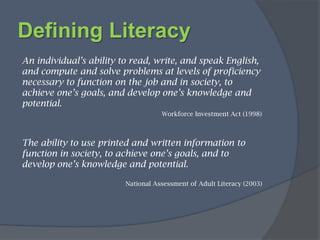
Defining LiteracyAn individual’s ability to read, write, and speak English, and compute and solve problems at levels of proficiency necessary to function on the job and in society, to achieve one’s goals, and develop one’s knowledge and potential.Workforce Investment Act (1998)  The ability to use printed and written information to function in society, to achieve one’s goals, and to develop one’s knowledge and potential.		                     National Assessment of Adult Literacy (2003)
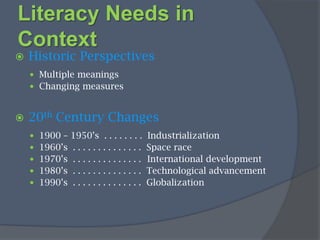
Literacy Needs in ContextHistoric PerspectivesMultiple meaningsChanging measures20th Century Changes1900 – 1950’s  . . . . . . . .  Industrialization  1960’s  . . . . . . . . . . . . . .  Space race1970’s  . . . . . . . . . . . . . .	  International development1980’s  . . . . . . . . . . . . . .  Technological advancement1990’s  . . . . . . . . . . . . . .  Globalization
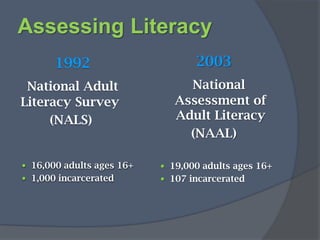
Assessing Literacy 2003National Assessment of Adult Literacy(NAAL)19,000 adults ages 16+107 incarcerated 1992National Adult Literacy Survey           (NALS)  16,000 adults ages 16+1,000 incarcerated
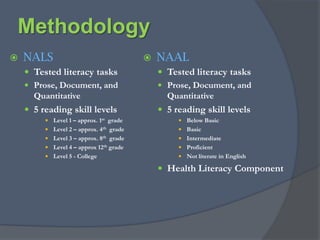
MethodologyNAALTested literacy tasksProse, Document, and Quantitative 5 reading skill levelsBelow BasicBasicIntermediateProficientNot literate in EnglishHealth Literacy Component NALSTested literacy tasksProse, Document, and Quantitative 5 reading skill levelsLevel 1 – approx. 1st  gradeLevel 2 – approx. 4th  gradeLevel 3 – approx. 8th  gradeLevel 4 – approx 12th grade Level 5 - College
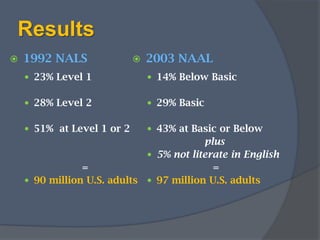
Results  2003 NAAL 14% Below Basic29% Basic43% at Basic or Belowplus5% not literate in English =97 million U.S. adults1992 NALS 23% Level 128% Level 2 51%  at Level 1 or 2 =90 million U.S. adults
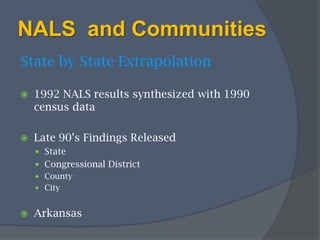
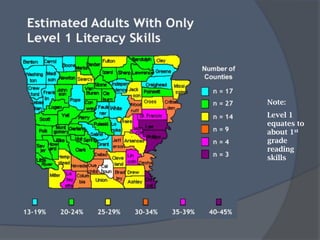
NALS  and CommunitiesState by State Extrapolation1992 NALS results synthesized with 1990 census dataLate 90’s Findings ReleasedStateCongressional DistrictCounty	CityArkansas
Note:  Level 1 equates to about 1st grade reading skills
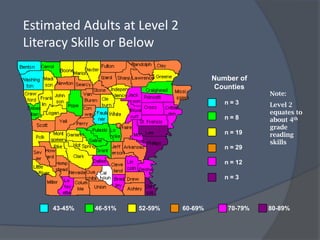
Estimated Adults at Level 2 Literacy Skills or BelowNumber of CountiesNote:  Level 2 equates to about 4th grade reading skillsn = 3n = 8n = 19n = 29n = 12n = 3   43-45%            46-51%             52-59%             60-69%              70-79%           80-89%
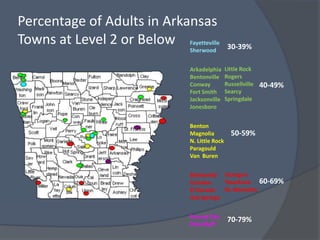
Percentage of Adults in Arkansas Towns at Level 2 or BelowFayettevilleSherwoodArkadelphia Bentonville Conway Fort SmithJacksonville Jonesboro  Benton MagnoliaN. Little RockParagouldVan  Buren BlythevilleCamdenEl DoradoHot Springs  Forrest CityPine Bluff30-39%	40-49%  50-59%	60-69%70-79%           Little Rock Rogers RussellvilleSearcySpringdale  StuttgartTexarkanaW. Memphis 
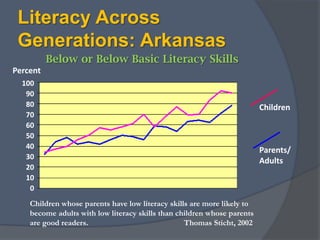
Literacy Across Generations: ArkansasBelow or Below Basic Literacy SkillsPercent1009080706050403020100ChildrenParents/AdultsChildren whose parents have low literacy skills are more likely to become adults with low literacy skills than children whose parents are good readers.		                             Thomas Sticht, 2002
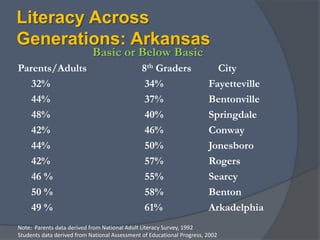
Literacy Across Generations: Arkansas                        Basic or Below BasicParents/Adults 	           8th Graders          City	32%			34%		Fayetteville	44%			37%		Bentonville 	48%			40%		Springdale 	42%			46%		Conway	44%			50%		Jonesboro	42% 			57%		Rogers 	46 %			55%		Searcy	50 %			58%		Benton	49 %		 	61%		ArkadelphiaNote:  Parents data derived from National Adult Literacy Survey, 1992Students data derived from National Assessment of Educational Progress, 2002
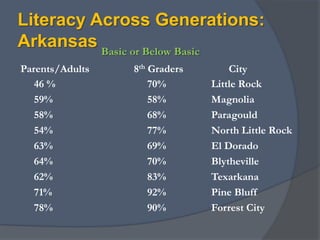
Basic or Below Basic            Parents/Adults 	       8th Graders                 City	46 %			70%		Little Rock	59%			58%		Magnolia	58%			68%		Paragould	54%			77%		North Little Rock	63%			69%		El Dorado 	64%			70%		Blytheville	62%			83%		Texarkana	71%			92%		Pine Bluff	78%			90%		Forrest CityLiteracy Across Generations: Arkansas
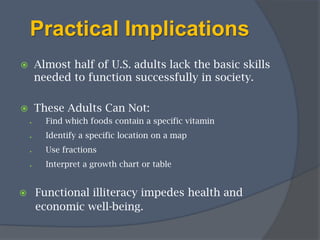
Almost half of U.S. adults lack the basic skills needed to function successfully in society.These Adults Can Not:Find which foods contain a specific vitamin
Identify a specific location on a map
Use fractions
Interpret a growth chart or tableFunctional illiteracy impedes health and         economic well-being. Practical Implications
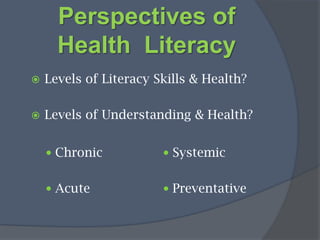
Perspectives ofHealth  Literacy Levels of Literacy Skills & Health?Levels of Understanding & Health? ChronicAcuteSystemic
PreventativePerspectives ofHealth  Literacy Levels of Literacy Skills & Health?Chronic – persistent in daily livingSystemic – resistance and culture of medical 			settingsLevels of Understanding & Health? Acute – situationalPreventative - cultural
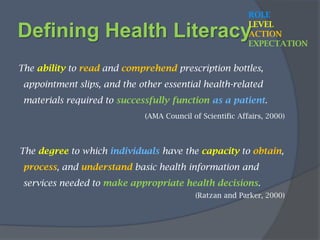
Defining Health LiteracyROLELEVELACTIONEXPECTATIONThe ability to read and comprehend prescription bottles, appointment slips, and the other essential health-related materials required to successfully function as a patient.     (AMA Council of Scientific Affairs, 2000)   The degree to which individualshave the capacity to obtain, process, and understand basic health information and services needed to make appropriate health decisions. (Ratzan and Parker, 2000)
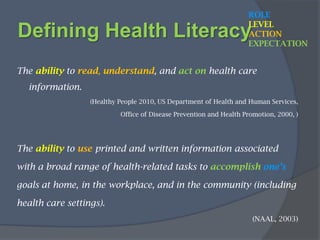
Defining Health LiteracyROLE    LEVELACTIONEXPECTATIONThe ability to read, understand, and act on health care information. 		(Healthy People 2010, US Department of Health and Human Services, Office of Disease Prevention and Health Promotion, 2000, )The ability to use printed and written information associated with a broad range of health-related tasks to accomplishone’sgoals at home, in the workplace, and in the community (includinghealth care settings). (NAAL, 2003)
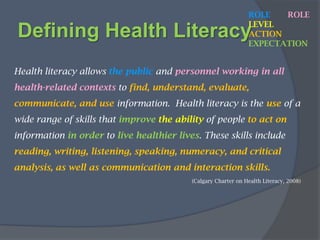
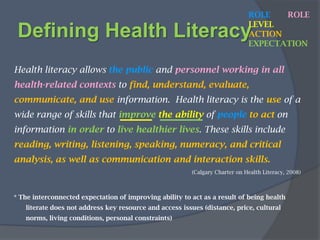
Defining Health LiteracyROLE       ROLELEVELACTIONEXPECTATIONHealth literacy allows the public andpersonnel working in all health-related contextsto find, understand, evaluate, communicate, and use information.  Health literacy is the use of a wide range of skills that improvethe ability of people to act on informationin order tolive healthier lives. These skills include reading, writing, listening, speaking, numeracy, and critical analysis, as well as communication and interaction skills. (Calgary Charter on Health Literacy, 2008)
Defining Health LiteracyROLE       ROLELEVELACTIONEXPECTATIONHealth literacy allows the public andpersonnel working in all health-related contextsto find, understand, evaluate, communicate, and use information.  Health literacy is the use of a wide range of skills that improvethe ability of peopleto act on informationin order to live healthier lives. These skills include reading, writing, listening, speaking, numeracy, and critical analysis, as well as communication and interaction skills. (Calgary Charter on Health Literacy, 2008)* The interconnected expectation of improving ability to act as a result of being health literate does not address key resource and access issues (distance, price, cultural norms, living conditions, personal constraints)
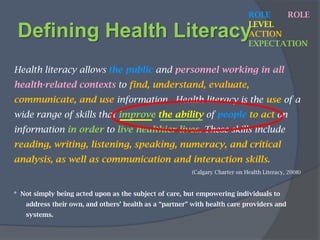
Defining Health LiteracyROLE       ROLELEVELACTIONEXPECTATIONHealth literacy allows the public andpersonnel working in all health-related contextsto find, understand, evaluate, communicate, and use information.  Health literacy is the use of a wide range of skills that improvethe ability of peopleto act on information in order to live healthier lives. These skills include reading, writing, listening, speaking, numeracy, and critical analysis, as well as communication and interaction skills. (Calgary Charter on Health Literacy, 2008)*  Not simply being acted upon as the subject of care, but empowering individuals to address their own, and others’ health as a “partner” with health care providers and systems.
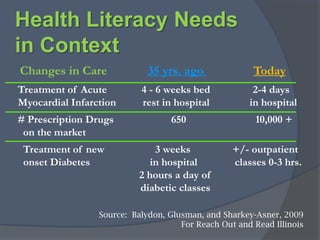
Health Literacy Needs in Context   Changes in Care35 yrs. ago Today     Treatment of Acute             4 - 6 weeks bed                2-4days    Myocardial Infarction          rest in hospital               in hospital                 # Prescription Drugs       	 650                          10,000 +on the market       Treatment of new      	3 weeks      	  +/- outpatient onset Diabetes 		       in hospital              classes 0-3 hrs. 2 hours a day of                                                   diabetic classesSource:  Balydon, Glusman, and Sharkey-Asner, 2009For Reach Out and Read Illinois
NAAL Health Literacy Component  Health literacy and relationship to prose, document, and quantitative skill.Address deficiencies in health literacy skillsPoliciesProgramsDevelopment of appropriate health information Health Literacy Component
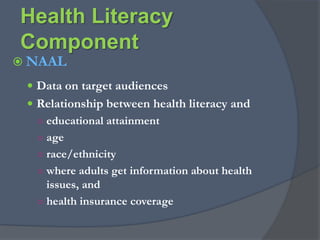
Health Literacy ComponentNAALData on target audiences Relationship between health literacy and educational attainmentagerace/ethnicity where adults get information about health issues, and health insurance coverage
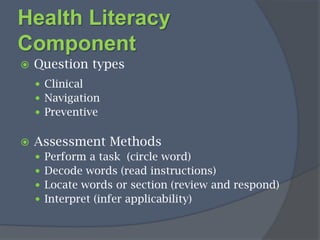
Health Literacy ComponentQuestion typesClinicalNavigationPreventiveAssessment MethodsPerform a task  (circle word)Decode words (read instructions)Locate words or section (review and respond)Interpret (infer applicability)
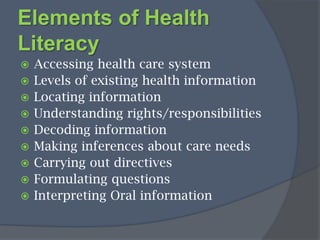
Elements of Health LiteracyAccessing health care systemLevels of existing health informationLocating information Understanding rights/responsibilitiesDecoding information Making inferences about care needsCarrying out directives Formulating questionsInterpreting Oral information
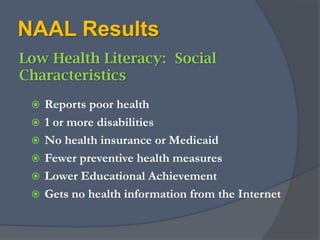
NAAL Results  Low Health Literacy:  Social CharacteristicsReports poor health1 or more disabilitiesNo health insurance or MedicaidFewer preventive health measuresLower Educational AchievementGets no health information from the Internet
NAAL Results  Low Health Literacy:  Social CharacteristicsPovertyRacial and ethnic minoritiesEnglish as a Second LanguageSingle Parent FamiliesOlder adults Prison inmates
Consequences of Low LiteracyAccessMisunderstanding DiagnosisUnable to Read Patient Education MaterialsUnderstanding and Following Health Related Instructions, compliance issues
Low Literacy Affects AccessLocating, obtaining, navigatingie: 84% of Medicaid patients do not understand rules and regulations of the application formAdhering to and accepting careWhile still in the clinic 26% did not understand when return appointment was scheduledCultural and beliefs stress no need for careFeelings of rejection, abuse, by health care staff
Consequences of Low LiteracyMedication ErrorsPoor Outcomes2 x more likely to be hospitalized Higher rates of medication and treatment errorsLink: Low literacy, poor health, and early deathRelated factors: housing, diet, addiction, violence
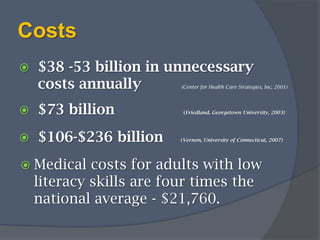
Costs$38 -53 billion in unnecessary costs annually         (Center for Health Care Strategies, Inc, 2001)$73 billion 		 (Friedland, Georgetown University, 2003)$106-$236 billion    (Vernon, University of Connecticut, 2007)Medical costs for adults with low literacy skills are four times the national average - $21,760.
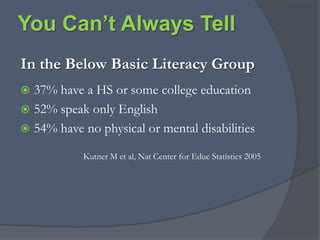
You Can’t Always TellIn the Below Basic Literacy Group37% have a HS or some college education52% speak only English54% have no physical or mental disabilitiesKutner M et al, Nat Center for Educ Statistics 2005
The Stigma	Patients who have never told:					 %Supervisor		91%Spouse		68%Children		53%Anyone		19%Parikh N, et al., Patient EducCouns,  1996.
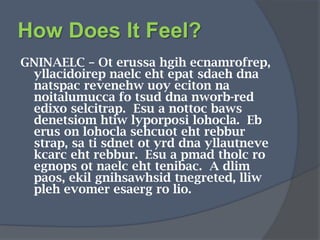
How Does It Feel?The following passage simulates what a reader with below basic general literacy sees on the printed page.Read the entire passage out loud.You have 1 minute to read.Hint:  The words are written backwards and the first word is “cleaning”
How Does It Feel?GNINAELC – Oterussahgihecnamrofrep, yllacidoirepnaelcehtepatsdaehdnanatspacrevenehwuoyecitonnanoitalumuccafotsuddnanworb-red edixoselcitrap.  Esu a nottocbawsdenetsiomhtiwlyporposilohocla.  Eberus on lohoclasehcuotehtrebbur strap, satisdnetotyrddnayllautnevekcarcehtrebbur.  Esu a pmadtholcroegnopsotnaelcehttenibac.  A dlimpaos, ekilgnihsawhsidtnegreted, lliwplehevomeresaergrolio.
How Does It Feel?How do you clean the capstan?
Red Flags: What to Look forUnable to name medications, or explain purpose or timing of administrationDifficulty explaining medical concernsDetour, letting doctor miss the concernHave no questionsIncomplete registration formsFrequently missed appointmentsSkipped tests and referralsNon-compliant with meds
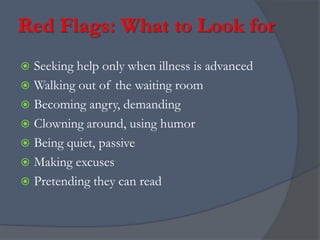
Red Flags: What to Look forSeeking help only when illness is advanced Walking out of the waiting roomBecoming angry, demandingClowning around, using humorBeing quiet, passiveMaking excusesPretending they can read
Or . . “I forgot my glasses.  I’ll read this when I get home.”“Let me bring this home so I can discuss it with my husband.”
Strategies: Make ChangesLessen stigma: Approach all patients the same wayBe non-judgmental.There is no one correct way to askThere are natural times in the history during which you can bring this upNever ask “do you have questions”Use, what kind of questions do you have?
Strategies: Enhance CommunicationAttitude of helpfulness, caring and respect by all staffConduct patient-centered visitsExplain things clearly in plain languageFocus on key messages and repeatUse a “teach back” or “show me” technique to check for understandingUse patient-friendly educational     materials to enhance interaction
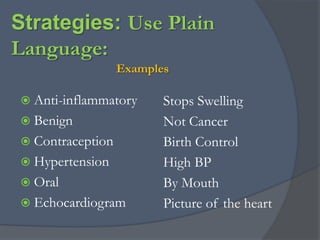
Strategies: Use Plain Language: ExamplesStops SwellingNot CancerBirth ControlHigh BPBy MouthPicture of the heartAnti-inflammatoryBenign		       Contraception	Hypertension           Oral                             Echocardiogram
Plain Language: It’s not just medical terms!We are disseminating information about….We are giving outinformation about…How do you administer the medication?How do you givethe medicine?Have you ever purchased generic medications?Do you ever buystore brand medicine?This product has an extensive list of symptoms that it treats…Thismedicinecan help with many thingslike fever, or pain, etc….
Strategies: Use Patients’ Social HistoryHow far did you go in school?Did you ever have any difficulty in school? Has reading ever been a problem for you?Other possible ways to ask:Have you ever had difficulty reading materials the doctor gave you?Has a doctor ever been unclear when they explained things to you?
D.I.R.E.C.T.D- 	Do you have any Difficulty readingI-	     Are you interested in ImprovingR-We have Referrals/resources availableE-	Ask EveryoneC- 	This is a Common problemT- Take down the barriers to obtaining the resources and take down current barriers to providing effective careSource:  Balydon, Glusman, and Sharkey-Asner, 2009For Reach Out and Read Illinois
Strategies: Written materialsSimple words (1-2 syllables)Short sentences (4-6 words)Short paragraphs (2-3 sentences)No medical jargonHeadings and bulletsLots of white space
Strategies: Teach BackAsk patient to demonstrate understanding“What will you tell your spouse about your child’s condition?”“I want to be sure I explained everything clearly, so can you please explain it back to me so I can be sure I did.”Academic settings can use the resident or student/attending interaction to do thisDo not ask, “Do you understand?”
Strategies: Use VisualsShow or draw simple picturesFocus only on key pointsEmphasize what the patient should do Minimize information about anatomy and physiologyBe sensitive to cultural preferencesVisual aids can include handouts, pictures, models etc.
System ChangeIdentify patientsIdentify the barriers faced by both patients and cliniciansIdentify and implement strategies to enhance health literacyAdvocate for system change

Health Literacy June 10

  • 1.
    Health Literacy:Costs,Consequences, and Clinical ImplicationsPeggy Sissel-Phelan, Ed.D.Community Health Centers of Arkansas Annual ConferenceJune 14 – 15, 2010
  • 2.
    Defining LiteracyAn individual’sability to read, write, and speak English, and compute and solve problems at levels of proficiency necessary to function on the job and in society, to achieve one’s goals, and develop one’s knowledge and potential.Workforce Investment Act (1998)  The ability to use printed and written information to function in society, to achieve one’s goals, and to develop one’s knowledge and potential. National Assessment of Adult Literacy (2003)
  • 3.
    Literacy Needs inContextHistoric PerspectivesMultiple meaningsChanging measures20th Century Changes1900 – 1950’s . . . . . . . . Industrialization 1960’s . . . . . . . . . . . . . . Space race1970’s . . . . . . . . . . . . . . International development1980’s . . . . . . . . . . . . . . Technological advancement1990’s . . . . . . . . . . . . . . Globalization
  • 4.
    Assessing Literacy 2003NationalAssessment of Adult Literacy(NAAL)19,000 adults ages 16+107 incarcerated 1992National Adult Literacy Survey (NALS) 16,000 adults ages 16+1,000 incarcerated
  • 5.
    MethodologyNAALTested literacy tasksProse,Document, and Quantitative 5 reading skill levelsBelow BasicBasicIntermediateProficientNot literate in EnglishHealth Literacy Component NALSTested literacy tasksProse, Document, and Quantitative 5 reading skill levelsLevel 1 – approx. 1st gradeLevel 2 – approx. 4th gradeLevel 3 – approx. 8th gradeLevel 4 – approx 12th grade Level 5 - College
  • 6.
    Results 2003NAAL 14% Below Basic29% Basic43% at Basic or Belowplus5% not literate in English =97 million U.S. adults1992 NALS 23% Level 128% Level 2 51% at Level 1 or 2 =90 million U.S. adults
  • 7.
    NALS andCommunitiesState by State Extrapolation1992 NALS results synthesized with 1990 census dataLate 90’s Findings ReleasedStateCongressional DistrictCounty CityArkansas
  • 8.
    Note: Level1 equates to about 1st grade reading skills
  • 9.
    Estimated Adults atLevel 2 Literacy Skills or BelowNumber of CountiesNote: Level 2 equates to about 4th grade reading skillsn = 3n = 8n = 19n = 29n = 12n = 3   43-45% 46-51% 52-59% 60-69% 70-79% 80-89%
  • 10.
    Percentage of Adultsin Arkansas Towns at Level 2 or BelowFayettevilleSherwoodArkadelphia Bentonville Conway Fort SmithJacksonville Jonesboro  Benton MagnoliaN. Little RockParagouldVan Buren BlythevilleCamdenEl DoradoHot Springs  Forrest CityPine Bluff30-39% 40-49% 50-59% 60-69%70-79% Little Rock Rogers RussellvilleSearcySpringdale  StuttgartTexarkanaW. Memphis 
  • 11.
    Literacy Across Generations:ArkansasBelow or Below Basic Literacy SkillsPercent1009080706050403020100ChildrenParents/AdultsChildren whose parents have low literacy skills are more likely to become adults with low literacy skills than children whose parents are good readers. Thomas Sticht, 2002
  • 12.
    Literacy Across Generations:Arkansas Basic or Below BasicParents/Adults 8th Graders City 32% 34% Fayetteville 44% 37% Bentonville 48% 40% Springdale 42% 46% Conway 44% 50% Jonesboro 42% 57% Rogers 46 % 55% Searcy 50 % 58% Benton 49 % 61% ArkadelphiaNote: Parents data derived from National Adult Literacy Survey, 1992Students data derived from National Assessment of Educational Progress, 2002
  • 13.
    Basic or BelowBasic Parents/Adults 8th Graders City 46 % 70% Little Rock 59% 58% Magnolia 58% 68% Paragould 54% 77% North Little Rock 63% 69% El Dorado 64% 70% Blytheville 62% 83% Texarkana 71% 92% Pine Bluff 78% 90% Forrest CityLiteracy Across Generations: Arkansas
  • 14.
    Almost half ofU.S. adults lack the basic skills needed to function successfully in society.These Adults Can Not:Find which foods contain a specific vitamin
  • 15.
    Identify a specificlocation on a map
  • 16.
  • 17.
    Interpret a growthchart or tableFunctional illiteracy impedes health and economic well-being. Practical Implications
  • 18.
    Perspectives ofHealth Literacy Levels of Literacy Skills & Health?Levels of Understanding & Health? ChronicAcuteSystemic
  • 19.
    PreventativePerspectives ofHealth Literacy Levels of Literacy Skills & Health?Chronic – persistent in daily livingSystemic – resistance and culture of medical settingsLevels of Understanding & Health? Acute – situationalPreventative - cultural
  • 20.
    Defining Health LiteracyROLELEVELACTIONEXPECTATIONTheability to read and comprehend prescription bottles, appointment slips, and the other essential health-related materials required to successfully function as a patient. (AMA Council of Scientific Affairs, 2000) The degree to which individualshave the capacity to obtain, process, and understand basic health information and services needed to make appropriate health decisions. (Ratzan and Parker, 2000)
  • 21.
    Defining Health LiteracyROLE LEVELACTIONEXPECTATIONThe ability to read, understand, and act on health care information. (Healthy People 2010, US Department of Health and Human Services, Office of Disease Prevention and Health Promotion, 2000, )The ability to use printed and written information associated with a broad range of health-related tasks to accomplishone’sgoals at home, in the workplace, and in the community (includinghealth care settings). (NAAL, 2003)
  • 22.
    Defining Health LiteracyROLE ROLELEVELACTIONEXPECTATIONHealth literacy allows the public andpersonnel working in all health-related contextsto find, understand, evaluate, communicate, and use information. Health literacy is the use of a wide range of skills that improvethe ability of people to act on informationin order tolive healthier lives. These skills include reading, writing, listening, speaking, numeracy, and critical analysis, as well as communication and interaction skills. (Calgary Charter on Health Literacy, 2008)
  • 23.
    Defining Health LiteracyROLE ROLELEVELACTIONEXPECTATIONHealth literacy allows the public andpersonnel working in all health-related contextsto find, understand, evaluate, communicate, and use information. Health literacy is the use of a wide range of skills that improvethe ability of peopleto act on informationin order to live healthier lives. These skills include reading, writing, listening, speaking, numeracy, and critical analysis, as well as communication and interaction skills. (Calgary Charter on Health Literacy, 2008)* The interconnected expectation of improving ability to act as a result of being health literate does not address key resource and access issues (distance, price, cultural norms, living conditions, personal constraints)
  • 24.
    Defining Health LiteracyROLE ROLELEVELACTIONEXPECTATIONHealth literacy allows the public andpersonnel working in all health-related contextsto find, understand, evaluate, communicate, and use information. Health literacy is the use of a wide range of skills that improvethe ability of peopleto act on information in order to live healthier lives. These skills include reading, writing, listening, speaking, numeracy, and critical analysis, as well as communication and interaction skills. (Calgary Charter on Health Literacy, 2008)* Not simply being acted upon as the subject of care, but empowering individuals to address their own, and others’ health as a “partner” with health care providers and systems.
  • 25.
    Health Literacy Needsin Context Changes in Care35 yrs. ago Today Treatment of Acute 4 - 6 weeks bed 2-4days Myocardial Infarction rest in hospital in hospital # Prescription Drugs 650 10,000 +on the market Treatment of new 3 weeks +/- outpatient onset Diabetes in hospital classes 0-3 hrs. 2 hours a day of diabetic classesSource: Balydon, Glusman, and Sharkey-Asner, 2009For Reach Out and Read Illinois
  • 26.
    NAAL Health LiteracyComponent Health literacy and relationship to prose, document, and quantitative skill.Address deficiencies in health literacy skillsPoliciesProgramsDevelopment of appropriate health information Health Literacy Component
  • 27.
    Health Literacy ComponentNAALDataon target audiences Relationship between health literacy and educational attainmentagerace/ethnicity where adults get information about health issues, and health insurance coverage
  • 28.
    Health Literacy ComponentQuestiontypesClinicalNavigationPreventiveAssessment MethodsPerform a task (circle word)Decode words (read instructions)Locate words or section (review and respond)Interpret (infer applicability)
  • 29.
    Elements of HealthLiteracyAccessing health care systemLevels of existing health informationLocating information Understanding rights/responsibilitiesDecoding information Making inferences about care needsCarrying out directives Formulating questionsInterpreting Oral information
  • 30.
    NAAL Results Low Health Literacy: Social CharacteristicsReports poor health1 or more disabilitiesNo health insurance or MedicaidFewer preventive health measuresLower Educational AchievementGets no health information from the Internet
  • 31.
    NAAL Results Low Health Literacy: Social CharacteristicsPovertyRacial and ethnic minoritiesEnglish as a Second LanguageSingle Parent FamiliesOlder adults Prison inmates
  • 32.
    Consequences of LowLiteracyAccessMisunderstanding DiagnosisUnable to Read Patient Education MaterialsUnderstanding and Following Health Related Instructions, compliance issues
  • 33.
    Low Literacy AffectsAccessLocating, obtaining, navigatingie: 84% of Medicaid patients do not understand rules and regulations of the application formAdhering to and accepting careWhile still in the clinic 26% did not understand when return appointment was scheduledCultural and beliefs stress no need for careFeelings of rejection, abuse, by health care staff
  • 34.
    Consequences of LowLiteracyMedication ErrorsPoor Outcomes2 x more likely to be hospitalized Higher rates of medication and treatment errorsLink: Low literacy, poor health, and early deathRelated factors: housing, diet, addiction, violence
  • 35.
    Costs$38 -53 billionin unnecessary costs annually (Center for Health Care Strategies, Inc, 2001)$73 billion (Friedland, Georgetown University, 2003)$106-$236 billion (Vernon, University of Connecticut, 2007)Medical costs for adults with low literacy skills are four times the national average - $21,760.
  • 36.
    You Can’t AlwaysTellIn the Below Basic Literacy Group37% have a HS or some college education52% speak only English54% have no physical or mental disabilitiesKutner M et al, Nat Center for Educ Statistics 2005
  • 37.
    The Stigma Patients whohave never told: %Supervisor 91%Spouse 68%Children 53%Anyone 19%Parikh N, et al., Patient EducCouns, 1996.
  • 38.
    How Does ItFeel?The following passage simulates what a reader with below basic general literacy sees on the printed page.Read the entire passage out loud.You have 1 minute to read.Hint: The words are written backwards and the first word is “cleaning”
  • 39.
    How Does ItFeel?GNINAELC – Oterussahgihecnamrofrep, yllacidoirepnaelcehtepatsdaehdnanatspacrevenehwuoyecitonnanoitalumuccafotsuddnanworb-red edixoselcitrap. Esu a nottocbawsdenetsiomhtiwlyporposilohocla. Eberus on lohoclasehcuotehtrebbur strap, satisdnetotyrddnayllautnevekcarcehtrebbur. Esu a pmadtholcroegnopsotnaelcehttenibac. A dlimpaos, ekilgnihsawhsidtnegreted, lliwplehevomeresaergrolio.
  • 40.
    How Does ItFeel?How do you clean the capstan?
  • 41.
    Red Flags: Whatto Look forUnable to name medications, or explain purpose or timing of administrationDifficulty explaining medical concernsDetour, letting doctor miss the concernHave no questionsIncomplete registration formsFrequently missed appointmentsSkipped tests and referralsNon-compliant with meds
  • 42.
    Red Flags: Whatto Look forSeeking help only when illness is advanced Walking out of the waiting roomBecoming angry, demandingClowning around, using humorBeing quiet, passiveMaking excusesPretending they can read
  • 43.
    Or . .“I forgot my glasses. I’ll read this when I get home.”“Let me bring this home so I can discuss it with my husband.”
  • 44.
    Strategies: Make ChangesLessenstigma: Approach all patients the same wayBe non-judgmental.There is no one correct way to askThere are natural times in the history during which you can bring this upNever ask “do you have questions”Use, what kind of questions do you have?
  • 45.
    Strategies: Enhance CommunicationAttitudeof helpfulness, caring and respect by all staffConduct patient-centered visitsExplain things clearly in plain languageFocus on key messages and repeatUse a “teach back” or “show me” technique to check for understandingUse patient-friendly educational materials to enhance interaction
  • 46.
    Strategies: Use PlainLanguage: ExamplesStops SwellingNot CancerBirth ControlHigh BPBy MouthPicture of the heartAnti-inflammatoryBenign Contraception Hypertension Oral Echocardiogram
  • 47.
    Plain Language: It’snot just medical terms!We are disseminating information about….We are giving outinformation about…How do you administer the medication?How do you givethe medicine?Have you ever purchased generic medications?Do you ever buystore brand medicine?This product has an extensive list of symptoms that it treats…Thismedicinecan help with many thingslike fever, or pain, etc….
  • 48.
    Strategies: Use Patients’Social HistoryHow far did you go in school?Did you ever have any difficulty in school? Has reading ever been a problem for you?Other possible ways to ask:Have you ever had difficulty reading materials the doctor gave you?Has a doctor ever been unclear when they explained things to you?
  • 49.
    D.I.R.E.C.T.D- Do youhave any Difficulty readingI- Are you interested in ImprovingR-We have Referrals/resources availableE- Ask EveryoneC- This is a Common problemT- Take down the barriers to obtaining the resources and take down current barriers to providing effective careSource: Balydon, Glusman, and Sharkey-Asner, 2009For Reach Out and Read Illinois
  • 50.
    Strategies: Written materialsSimplewords (1-2 syllables)Short sentences (4-6 words)Short paragraphs (2-3 sentences)No medical jargonHeadings and bulletsLots of white space
  • 51.
    Strategies: Teach BackAskpatient to demonstrate understanding“What will you tell your spouse about your child’s condition?”“I want to be sure I explained everything clearly, so can you please explain it back to me so I can be sure I did.”Academic settings can use the resident or student/attending interaction to do thisDo not ask, “Do you understand?”
  • 52.
    Strategies: Use VisualsShowor draw simple picturesFocus only on key pointsEmphasize what the patient should do Minimize information about anatomy and physiologyBe sensitive to cultural preferencesVisual aids can include handouts, pictures, models etc.
  • 53.
    System ChangeIdentify patientsIdentifythe barriers faced by both patients and cliniciansIdentify and implement strategies to enhance health literacyAdvocate for system change