BURNOUT
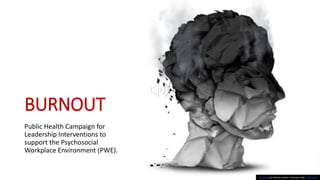
Public Health Campaign for
Leadership Interventions to
support the Psychosocial
Workplace Environment (PWE).
This Photo by Unknown Author is licensed under CC BY-SA-NC
We are facing a
global occupational
health stress
epidemic
(Mohamad et. al.,
2022).
Stress management
is a public health
need and burnout is
impacting the
physiological and
psychosocial
workplace
environment (PWE).
The health cost of
burnout impacts the
organization and the
individual as found in
a study of US general
surgery residents
estimated that 43.2%
experienced burnout
weekly (Edú-Valsania,
2022).
.
Global impact on
economy as seen in the
World Health
Organization (WHO) ICD-
11 Mortality Tooling
classifies Burnout as a
syndrome in disease
classification specific to
the occupational context.
(https://www.who.int/ne
ws/item/31-08-2022-icd-
11-mortality-rule-
digitalization-workshop).
BURNOUT
IN THE
BODY
Emotional exhaustion
Mental health
Cynacism
Reduced personal achievement
Disease
Insomnia
Anxiety
This Photo by Unknown Author is licensed under CC BY-SA-NC
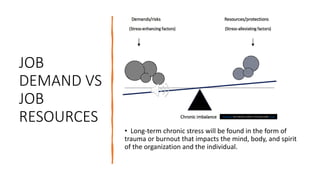
JOB
DEMAND VS
JOB
RESOURCES
• Long-term chronic stress will be found in the form of
trauma or burnout that impacts the mind, body, and spirit
of the organization and the individual.
This Photo by Unknown Author is licensed under CC BY
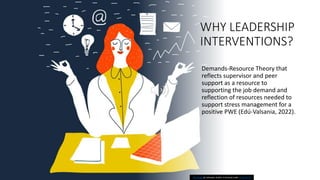
WHY LEADERSHIP
INTERVENTIONS?
Demands-Resource Theory that
reflects supervisor and peer
support as a resource to
supporting the job demand and
reflection of resources needed to
support stress management for a
positive PWE (Edú-Valsania, 2022).
This Photo by Unknown Author is licensed under CC BY-SA-NC
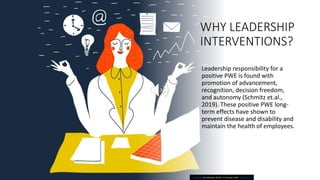
WHY LEADERSHIP
INTERVENTIONS?
Leadership responsibility for a
positive PWE is found with
promotion of advancement,
recognition, decision freedom,
and autonomy (Schmitz et.al.,
2019). These positive PWE long-
term effects have shown to
prevent disease and disability and
maintain the health of employees.
This Photo by Unknown Author is licensed under CC BY-SA-NC
WHY LEADERSHIP
INTERVENTIONS?
Leadership behavior used as a
prevention action could
significantly improve mental
health in the workforce (Stuber
et.al., 2021).
This Photo by Unknown Author is licensed under CC BY-SA-NC
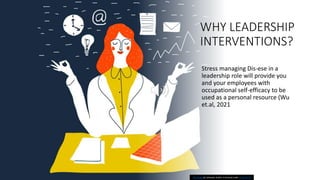
WHY LEADERSHIP
INTERVENTIONS?
Stress managing Dis-ese in a
leadership role will provide you
and your employees with
occupational self-efficacy to be
used as a personal resource (Wu
et.al, 2021
This Photo by Unknown Author is licensed under CC BY-SA-NC
LEADERSHIP INTERVENTIONS
Teaching and training employees how
stress managing Burnout to prevent
disease in the body, mind, and spirit of
the workplace will improve the QOL of
the individual and the organization.
This Photo by Unknown Author is licensed under CC BY
LEADERSHIP INTERVENTIONS
The leader that addresses burnout will
have a return on investment in
productivity, mental health,
commitment, and immune health.
This Photo by Unknown Author is licensed under CC BY
LEADERSHIP INTERVENTIONS
The impact will be found for the leader,
team, and customer through
development, reflection, and
interaction with a positive PWE.
This Photo by Unknown Author is licensed under CC BY
LEADERSHIP INTERVENTIONS
The ability for leaders to teach, role
model, and reflect on the mental and
physical health of the PWE will increase
employee morale and attendance, and
lower prevalence for mental or physical
disease in individual health.
This Photo by Unknown Author is licensed under CC BY
LEADERSHIP INTERVENTIONS
The responsibility and interventions of
successful occupational health leaders
today will encompass the role of stress
management in physical, psychosocial,
and cultural role-modeling in the
workplace environment.
This Photo by Unknown Author is licensed under CC BY
This Photo by Unknown Author is licensed under CC BY-SA
A LEADER IS IN CONTROL OF THE PWE
• The impact of our mental and physical health impacts
careers and our teams.
• PWE is a critical component in maximizing work
outcomes for the organization and the individual
(Schmitz et.al., 2019).
• Leadership interventions used as a prevention action
could significantly improve organizational and
behavioral support of mental health in the workforce
(Stuber et.al., 2021).
This Photo by Unknown Author is licensed under CC BY-SA-NC
REFERENCES
Centers for Disease Control and Prevention (2022, March 10) Training websites. Centers for Disease Control and Prevention. https://www.cdc.gov/training/learning/websites.html
Edú-Valsania, S., Laguía, A., & Morano, J. A. (2022). Burnout: A Review of Theory and Measurement. International journal of environmental research and public health, 19(3), 1780.
https://doi-org.ezproxy1.lib.asu.edu/10.3390/ijerph19031780
Mohamed, A. F., Isahak, M., Awg Isa, M. Z., & Nordin, R. (2022). The effectiveness of workplace health promotion program in reducing work-related depression, anxiety and stress among
manufacturing workers in Malaysia: mixed-model intervention. International Archives of Occupational & Environmental Health, 95(5), 1113–1127. https://doi-
org.ezproxy1.lib.asu.edu/10.1007/s00420-022-01836-w
O’Sullivan, G., Yonkler, J., Morgan, W., Merritt, A. (2003). A field guide to designing a health communication strategy. John Hopkins University.
Schmitz, L. L., McCluney, C. L., Sonnega, A., & Hicken, M. T. (2019). Policy Levers May Improve Older Workers’ Perceptions of Their Psychosocial Work Environment: Research findings show
that workplace policies can play a crucial role in the quality of older worker’s health and job longevity. Generations, 43(3), 78–85.
Stuber, F., Seifried-Dübon, T., Rieger, M.A. et al. The effectiveness of health-oriented leadership interventions for the improvement of mental health of employees in the health care sector: a
systematic review. Int Arch Occup Environ Health 94, 203–220 (2021). https://doi.org/10.1007/s00420-020-01583-w
Wu, Roemer, E. C., Kent, K. B., Ballard, D. W., & Goetzel, R. Z. (2021). Organizational Best Practices Supporting Mental Health in the Workplace. Journal of Occupational and Environmental
Medicine., 63(12), e925–e931. https://doi.org/10.1097/JOM.0000000000002407
Yan, Y.-X., Dong, J., Liu, Y.-Q., Zhang, J., Song, M.-S., He, Y., & Wang, W. (2015). Association of suboptimal health status with psychosocial stress, plasma cortisol and mRNA expression of
glucocorticoid receptor α/ β in lymphocyte. Stress: The International Journal on the Biology of Stress, 18(1), 29–34. https://doi-org.ezproxy1.lib.asu.edu/10.3109/10253890.2014.999233
All online picture from Bing.

health campaign sample.pptx

  • 1.
    BURNOUT Public Health Campaignfor Leadership Interventions to support the Psychosocial Workplace Environment (PWE). This Photo by Unknown Author is licensed under CC BY-SA-NC
  • 2.
    We are facinga global occupational health stress epidemic (Mohamad et. al., 2022).
  • 3.
    Stress management is apublic health need and burnout is impacting the physiological and psychosocial workplace environment (PWE).
  • 4.
    The health costof burnout impacts the organization and the individual as found in a study of US general surgery residents estimated that 43.2% experienced burnout weekly (Edú-Valsania, 2022). .
  • 5.
    Global impact on economyas seen in the World Health Organization (WHO) ICD- 11 Mortality Tooling classifies Burnout as a syndrome in disease classification specific to the occupational context. (https://www.who.int/ne ws/item/31-08-2022-icd- 11-mortality-rule- digitalization-workshop).
  • 6.
    BURNOUT IN THE BODY Emotional exhaustion Mentalhealth Cynacism Reduced personal achievement Disease Insomnia Anxiety This Photo by Unknown Author is licensed under CC BY-SA-NC
  • 7.
    JOB DEMAND VS JOB RESOURCES • Long-termchronic stress will be found in the form of trauma or burnout that impacts the mind, body, and spirit of the organization and the individual. This Photo by Unknown Author is licensed under CC BY
  • 8.
    WHY LEADERSHIP INTERVENTIONS? Demands-Resource Theorythat reflects supervisor and peer support as a resource to supporting the job demand and reflection of resources needed to support stress management for a positive PWE (Edú-Valsania, 2022). This Photo by Unknown Author is licensed under CC BY-SA-NC
  • 9.
    WHY LEADERSHIP INTERVENTIONS? Leadership responsibilityfor a positive PWE is found with promotion of advancement, recognition, decision freedom, and autonomy (Schmitz et.al., 2019). These positive PWE long- term effects have shown to prevent disease and disability and maintain the health of employees. This Photo by Unknown Author is licensed under CC BY-SA-NC
  • 10.
    WHY LEADERSHIP INTERVENTIONS? Leadership behaviorused as a prevention action could significantly improve mental health in the workforce (Stuber et.al., 2021). This Photo by Unknown Author is licensed under CC BY-SA-NC
  • 11.
    WHY LEADERSHIP INTERVENTIONS? Stress managingDis-ese in a leadership role will provide you and your employees with occupational self-efficacy to be used as a personal resource (Wu et.al, 2021 This Photo by Unknown Author is licensed under CC BY-SA-NC
  • 12.
    LEADERSHIP INTERVENTIONS Teaching andtraining employees how stress managing Burnout to prevent disease in the body, mind, and spirit of the workplace will improve the QOL of the individual and the organization. This Photo by Unknown Author is licensed under CC BY
  • 13.
    LEADERSHIP INTERVENTIONS The leaderthat addresses burnout will have a return on investment in productivity, mental health, commitment, and immune health. This Photo by Unknown Author is licensed under CC BY
  • 14.
    LEADERSHIP INTERVENTIONS The impactwill be found for the leader, team, and customer through development, reflection, and interaction with a positive PWE. This Photo by Unknown Author is licensed under CC BY
  • 15.
    LEADERSHIP INTERVENTIONS The abilityfor leaders to teach, role model, and reflect on the mental and physical health of the PWE will increase employee morale and attendance, and lower prevalence for mental or physical disease in individual health. This Photo by Unknown Author is licensed under CC BY
  • 16.
    LEADERSHIP INTERVENTIONS The responsibilityand interventions of successful occupational health leaders today will encompass the role of stress management in physical, psychosocial, and cultural role-modeling in the workplace environment. This Photo by Unknown Author is licensed under CC BY
  • 17.
    This Photo byUnknown Author is licensed under CC BY-SA
  • 18.
    A LEADER ISIN CONTROL OF THE PWE • The impact of our mental and physical health impacts careers and our teams. • PWE is a critical component in maximizing work outcomes for the organization and the individual (Schmitz et.al., 2019). • Leadership interventions used as a prevention action could significantly improve organizational and behavioral support of mental health in the workforce (Stuber et.al., 2021). This Photo by Unknown Author is licensed under CC BY-SA-NC
  • 19.
    REFERENCES Centers for DiseaseControl and Prevention (2022, March 10) Training websites. Centers for Disease Control and Prevention. https://www.cdc.gov/training/learning/websites.html Edú-Valsania, S., Laguía, A., & Morano, J. A. (2022). Burnout: A Review of Theory and Measurement. International journal of environmental research and public health, 19(3), 1780. https://doi-org.ezproxy1.lib.asu.edu/10.3390/ijerph19031780 Mohamed, A. F., Isahak, M., Awg Isa, M. Z., & Nordin, R. (2022). The effectiveness of workplace health promotion program in reducing work-related depression, anxiety and stress among manufacturing workers in Malaysia: mixed-model intervention. International Archives of Occupational & Environmental Health, 95(5), 1113–1127. https://doi- org.ezproxy1.lib.asu.edu/10.1007/s00420-022-01836-w O’Sullivan, G., Yonkler, J., Morgan, W., Merritt, A. (2003). A field guide to designing a health communication strategy. John Hopkins University. Schmitz, L. L., McCluney, C. L., Sonnega, A., & Hicken, M. T. (2019). Policy Levers May Improve Older Workers’ Perceptions of Their Psychosocial Work Environment: Research findings show that workplace policies can play a crucial role in the quality of older worker’s health and job longevity. Generations, 43(3), 78–85. Stuber, F., Seifried-Dübon, T., Rieger, M.A. et al. The effectiveness of health-oriented leadership interventions for the improvement of mental health of employees in the health care sector: a systematic review. Int Arch Occup Environ Health 94, 203–220 (2021). https://doi.org/10.1007/s00420-020-01583-w Wu, Roemer, E. C., Kent, K. B., Ballard, D. W., & Goetzel, R. Z. (2021). Organizational Best Practices Supporting Mental Health in the Workplace. Journal of Occupational and Environmental Medicine., 63(12), e925–e931. https://doi.org/10.1097/JOM.0000000000002407 Yan, Y.-X., Dong, J., Liu, Y.-Q., Zhang, J., Song, M.-S., He, Y., & Wang, W. (2015). Association of suboptimal health status with psychosocial stress, plasma cortisol and mRNA expression of glucocorticoid receptor α/ β in lymphocyte. Stress: The International Journal on the Biology of Stress, 18(1), 29–34. https://doi-org.ezproxy1.lib.asu.edu/10.3109/10253890.2014.999233 All online picture from Bing.

Editor's Notes

  • #3 LEADERSHIP IS A JOB RESOURCE FOR JOB DEMAND- LEAD YOUR TEAM AWAY FROM STRESS.
  • #4 LEADERSHIP IS A JOB RESOURCE FOR JOB DEMAND- LEAD YOUR TEAM AWAY FROM STRESS.
  • #6 LEADERSHIP IS A JOB RESOURCE FOR JOB DEMAND- LEAD YOUR TEAM AWAY FROM STRESS.