Health Issues
NHSStarted in 1948Beveridge report had identified poor healthcare as a problem during WWII (along with education and social security)Labour government made it a priority to eradicate “Want, Disease, Ignorance, Squalor and Idleness”The free market system before 1948 had not worked well as a lot of the population did not have healthcare
Health care pre 1948Charging for healthcare led to this being under-consumedWhat problems may this under-consumption have caused?
Health as an externalityHealthcare has positive externalities Income is redistributedLess is wasted because of ill health e.g. productivityDisease is not so easily spread because of vaccinationLess will need to be paid out through sickness benefits
Problems since the start…Medical advances including new treatments and better diagnosis have led to a massive increase in demand for the NHSEducation was not delivered well e.g. eating, smoking, drinking alcohol Drugs were developed which are expensive to the NHSThe government initially thought that the cost of the NHS would FALL after a period as health improved!
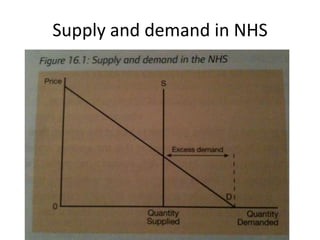
Supply and demandWhen the price is zero, demand is unlimitedThere will always be excess demand, unless funding is unlimitedSupply is determined by the budget for the NHS and, potentially, through equipment and staffing
Supply and demand in NHS
How do you deal with unlimited demand?Waiting lists were the traditional way – and to some extent still areIntroduce charges (prescription, dental, optician) for those who can affordSet up NICE – National Institute for Clinical ExcellenceEncourage prevention – obesity, smoking, drugs, alcoholMedicare Australia – AU$60 for visiting GP
NICEAims to spend money where there is the biggest benefitAn economic decision is made whether or not to approve a drug or procedure on the NHSThis is not a quick process and NICE tries to balance this by looking at how productive people would be, could they recover?High cost, little benefit treatments are usually not given approval
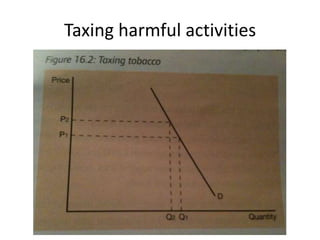
Taxing harmful activities
Taxing….Aims to reduce consumptionReduce negative externalities by internalising theseCan alcohol be treated the same as smoking tobacco?
Tobacco and alcoholAlcohol is less inelastic (more elastic)Tobacco is always harmfulModerate alcohol is not!Thousands of jobs related to alcohol (and tax revenue)
DiscussionShould the government be involved in our lives by saying what we should and should not do?Should fat patients be made to wait for treatment?Should we be doing more to reduce alcohol consumption? Should healthcare be provided free at the point of care?What are the failures of UK healthcare?How could these failures be eradicated?
Environment
EnvironmentThere is discussion about the effects on the environment of human activityIt is generally accepted that humans have caused damageMost damage is done by developed nationsSome developing countries are rising fast to become big polluters, and many more are likely to follow
Who should pay?Developing nations argue that developed nations should pay  for the damage as they are causing most of it, and that developing nations have little resources to deal with the issue
Potential solutions
KyotoSigned in 1997Developed nations aimed to reduce carbon emissions by 5.2% below 1990 levels by 2008-2012 (recession analysis point)141 countries ratified the agreementEU chose a ‘market’ solution – tradable permits – buy and sell permits as required with financial gain or loss – still a generous allowance but (analysis) the scheme is in place so allowances may fall and it may have more of an impact
Kyoto and the non-signersUS and Australia refused to signAustralia has since signedUS sees Kyoto (and Copenhagen, 2009) as a serious threat to the development of its economyAnalysis – if the US does not reduce and there are serious environmental problems in the US, who is to blame?Could the oil spill in the Gulf of Mexico be a consequence
The problem with ChinaChina has had a growing economy for a long time and this is having an impact on its emissionThe growing economy has led to an increase in demand for raw materials and consumer goods, which all have a polluting effectIn addition, cars and airplane journeys are increasing which create more pollution
China
China¼ of the country is now desertEvery major river system has been affected by untreated sewage70% of the world’s discarded computers end up in China, some parts reused and the rest dumped in landfill sites – toxic effectAcid rain causes problems in neighbouring countries Much development has not taken account of the environmental (or social) impact of these – causing negative externalities which will last for years
ChinaThe demand for resources has led to forests being destroyed in the Philippines, Thailand and CambodiaIn order to get resources from Africa, the Chinese have helped to build dams, roads and bridges in Africa without care and consideration for the environment
DiscussionShould the US and China have signed up to Kyoto and why?How can UK consumers/government help to convince China and the US to be more environmentally aware?Do the negative externalities only affect one country?Is the carbon trading scheme in the EU the best way to go about reducing pollution?Have we learned anything since the ozone crisis in the late 1980s?

Health and environment issues

  • 1.
  • 2.
    NHSStarted in 1948Beveridgereport had identified poor healthcare as a problem during WWII (along with education and social security)Labour government made it a priority to eradicate “Want, Disease, Ignorance, Squalor and Idleness”The free market system before 1948 had not worked well as a lot of the population did not have healthcare
  • 3.
    Health care pre1948Charging for healthcare led to this being under-consumedWhat problems may this under-consumption have caused?
  • 4.
    Health as anexternalityHealthcare has positive externalities Income is redistributedLess is wasted because of ill health e.g. productivityDisease is not so easily spread because of vaccinationLess will need to be paid out through sickness benefits
  • 5.
    Problems since thestart…Medical advances including new treatments and better diagnosis have led to a massive increase in demand for the NHSEducation was not delivered well e.g. eating, smoking, drinking alcohol Drugs were developed which are expensive to the NHSThe government initially thought that the cost of the NHS would FALL after a period as health improved!
  • 6.
    Supply and demandWhenthe price is zero, demand is unlimitedThere will always be excess demand, unless funding is unlimitedSupply is determined by the budget for the NHS and, potentially, through equipment and staffing
  • 8.
  • 9.
    How do youdeal with unlimited demand?Waiting lists were the traditional way – and to some extent still areIntroduce charges (prescription, dental, optician) for those who can affordSet up NICE – National Institute for Clinical ExcellenceEncourage prevention – obesity, smoking, drugs, alcoholMedicare Australia – AU$60 for visiting GP
  • 10.
    NICEAims to spendmoney where there is the biggest benefitAn economic decision is made whether or not to approve a drug or procedure on the NHSThis is not a quick process and NICE tries to balance this by looking at how productive people would be, could they recover?High cost, little benefit treatments are usually not given approval
  • 11.
  • 12.
    Taxing….Aims to reduceconsumptionReduce negative externalities by internalising theseCan alcohol be treated the same as smoking tobacco?
  • 13.
    Tobacco and alcoholAlcoholis less inelastic (more elastic)Tobacco is always harmfulModerate alcohol is not!Thousands of jobs related to alcohol (and tax revenue)
  • 14.
    DiscussionShould the governmentbe involved in our lives by saying what we should and should not do?Should fat patients be made to wait for treatment?Should we be doing more to reduce alcohol consumption? Should healthcare be provided free at the point of care?What are the failures of UK healthcare?How could these failures be eradicated?
  • 15.
  • 16.
    EnvironmentThere is discussionabout the effects on the environment of human activityIt is generally accepted that humans have caused damageMost damage is done by developed nationsSome developing countries are rising fast to become big polluters, and many more are likely to follow
  • 17.
    Who should pay?Developingnations argue that developed nations should pay for the damage as they are causing most of it, and that developing nations have little resources to deal with the issue
  • 18.
  • 19.
    KyotoSigned in 1997Developednations aimed to reduce carbon emissions by 5.2% below 1990 levels by 2008-2012 (recession analysis point)141 countries ratified the agreementEU chose a ‘market’ solution – tradable permits – buy and sell permits as required with financial gain or loss – still a generous allowance but (analysis) the scheme is in place so allowances may fall and it may have more of an impact
  • 20.
    Kyoto and thenon-signersUS and Australia refused to signAustralia has since signedUS sees Kyoto (and Copenhagen, 2009) as a serious threat to the development of its economyAnalysis – if the US does not reduce and there are serious environmental problems in the US, who is to blame?Could the oil spill in the Gulf of Mexico be a consequence
  • 21.
    The problem withChinaChina has had a growing economy for a long time and this is having an impact on its emissionThe growing economy has led to an increase in demand for raw materials and consumer goods, which all have a polluting effectIn addition, cars and airplane journeys are increasing which create more pollution
  • 22.
  • 23.
    China¼ of thecountry is now desertEvery major river system has been affected by untreated sewage70% of the world’s discarded computers end up in China, some parts reused and the rest dumped in landfill sites – toxic effectAcid rain causes problems in neighbouring countries Much development has not taken account of the environmental (or social) impact of these – causing negative externalities which will last for years
  • 24.
    ChinaThe demand forresources has led to forests being destroyed in the Philippines, Thailand and CambodiaIn order to get resources from Africa, the Chinese have helped to build dams, roads and bridges in Africa without care and consideration for the environment
  • 25.
    DiscussionShould the USand China have signed up to Kyoto and why?How can UK consumers/government help to convince China and the US to be more environmentally aware?Do the negative externalities only affect one country?Is the carbon trading scheme in the EU the best way to go about reducing pollution?Have we learned anything since the ozone crisis in the late 1980s?