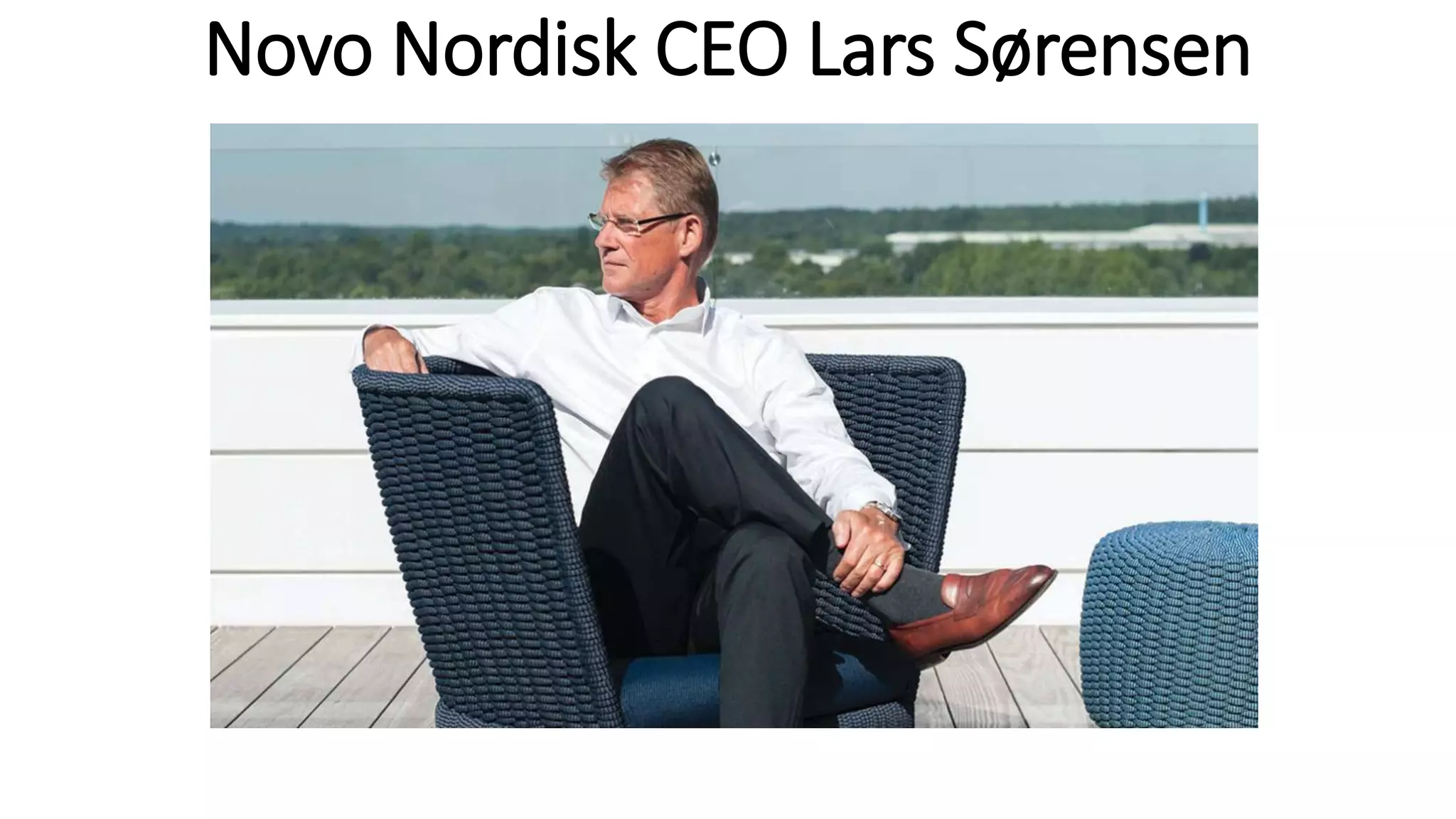
Novo Nordisk CEO Lars Sørensen
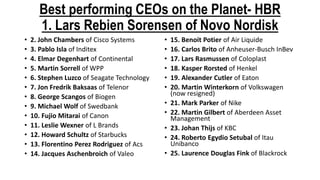
Best performing CEOs on the Planet- HBR
1. Lars Rebien Sorensen of Novo Nordisk
• 2. John Chambers of Cisco Systems
• 3. Pablo Isla of Inditex
• 4. Elmar Degenhart of Continental
• 5. Martin Sorrell of WPP
• 6. Stephen Luzco of Seagate Technology
• 7. Jon Fredrik Baksaas of Telenor
• 8. George Scangos of Biogen
• 9. Michael Wolf of Swedbank
• 10. Fujio Mitarai of Canon
• 11. Leslie Wexner of L Brands
• 12. Howard Schultz of Starbucks
• 13. Florentino Perez Rodriguez of Acs
• 14. Jacques Aschenbroich of Valeo
• 15. Benoit Potier of Air Liquide
• 16. Carlos Brito of Anheuser-Busch InBev
• 17. Lars Rasmussen of Coloplast
• 18. Kasper Rorsted of Henkel
• 19. Alexander Cutler of Eaton
• 20. Martin Winterkorn of Volkswagen
(now resigned)
• 21. Mark Parker of Nike
• 22. Martin Gilbert of Aberdeen Asset
Management
• 23. Johan Thijs of KBC
• 24. Roberto Egydio Setubal of Itau
Unibanco
• 25. Laurence Douglas Fink of Blackrock
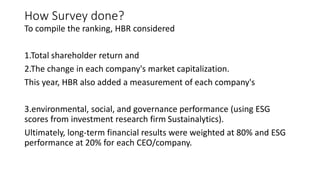
How Survey done?
To compile the ranking, HBR considered
1.Total shareholder return and
2.The change in each company's market capitalization.
This year, HBR also added a measurement of each company's
3.environmental, social, and governance performance (using ESG
scores from investment research firm Sustainalytics).
Ultimately, long-term financial results were weighted at 80% and ESG
performance at 20% for each CEO/company.
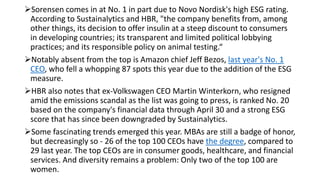
Sorensen comes in at No. 1 in part due to Novo Nordisk's high ESG rating.
According to Sustainalytics and HBR, "the company benefits from, among
other things, its decision to offer insulin at a steep discount to consumers
in developing countries; its transparent and limited political lobbying
practices; and its responsible policy on animal testing.“
Notably absent from the top is Amazon chief Jeff Bezos, last year's No. 1
CEO, who fell a whopping 87 spots this year due to the addition of the ESG
measure.
HBR also notes that ex-Volkswagen CEO Martin Winterkorn, who resigned
amid the emissions scandal as the list was going to press, is ranked No. 20
based on the company's financial data through April 30 and a strong ESG
score that has since been downgraded by Sustainalytics.
Some fascinating trends emerged this year. MBAs are still a badge of honor,
but decreasingly so - 26 of the top 100 CEOs have the degree, compared to
29 last year. The top CEOs are in consumer goods, healthcare, and financial
services. And diversity remains a problem: Only two of the top 100 are
women.
His Profile
Mr Sørensen has an MSc in Forestry from the Royal Veterinary and
Agricultural University, Denmark (now the Faculty of Science of the
University of Copenhagen) from 1981
BSc in International Economics from the Copenhagen Business School from
1983.
Mr Sørensen received the French award Chevalier de l'Ordre National de la
Légion d'Honneur in 2005.
In October 2007, Mr Sørensen became an adjunct professor at the Faculty of
Life Sciences of the University of Copenhagen.
Mr Sørensen is a Danish national, born October 1954.
Lars Rebien Sørensen joined Novo Nordisk’s Enzymes Marketing in 1982.
Over the years, he has completed several overseas postings, including in the
Middle East and the US. Mr Sørensen was appointed a member of Corporate
Management in May 1994, and in December 1994 he was given special
responsibility within Corporate Management for Health Care. He was
appointed president and chief executive officer in November 2000.
1. HBR: Is your company too dependent on treating a single disease?
Sørensen: Outsiders sometimes come in and say, “You’re dependent on
diabetes for 80% of your revenue—you should diversify.” But I’ve always
believed that you should do things that you know something about, that
you’re good at. We’ve tried a lot of diversification strategies in the past, but
we’ve failed because of the inherent scientific and commercial uncertainty
and our own naïveté. So our expansion has been completely organic.
2. HBR:What about diversifying into adjacent areas?
Since I joined the company, 33 years ago, I’ve been part of some of the most
stupid mistakes. One of the worst was trying to get into glucose monitoring.
Everybody said, “This makes sense. You’re a diabetes company; you should
get into glucose monitoring to offer more products to your customer.” But
the technology for blood glucose monitoring is different. The regulatory
framework is different. The sales and distribution are different. We would
not have been successful. I could share many, many similar examples. So
over the past 20 years, we’ve been narrowly focused on the thing we’re
really good at.
3.What happens to your business if diabetes is eventually cured?
• After I became CEO, in 2000, I predicted we would cure diabetes in 15
years. We’re still 15 years away. But that is the big goal. I tell my
employees, “If we wind up curing diabetes, and it destroys a big part of our
business, we can be proud, and you can get a job anywhere. We’ll have
worked on the greatest social service of any pharmaceutical company, and
that would be a phenomenal thing.”
4. You sell a lifesaving drug at different prices all around the world. How do
you manage that?
• When I took charge of the company, the pharmaceutical industry was going
through a major PR catastrophe in South Africa over how it priced HIV-AIDS
drugs. We didn’t sell those drugs, but the problem made me consider:
What if the conflict had been over diabetes drugs? How would we have
responded? One of our answers was to create an independent nonprofit
organization called the World Diabetes Foundation. Its objective is building
capacity in countries where diabetes is poorly treated. We take a slice of
revenue from each vial of insulin we sell and put it into the foundation. The
foundation makes grants in such places as East Asia, some Latin American
countries, and Africa. After its creation, criticisms that NGOs had been
directing at us completely vanished.
5. Your strategy of selling both generic and highly differentiated
products is unusual.
• Consultants will tell you companies shouldn’t do that—it won’t work.
But this strategy ensures our reputation. It’s to our advantage to have
high-quality generic products, human insulin, for countries and
populations that can’t afford most of the advanced products that
more-affluent patients want.
6. Why do you measure results using a triple bottom line?
• Our philosophy is that corporate social responsibility is nothing but
maximizing the value of your company over a long period of time,
because in the long term, social and environmental issues become
financial issues. There is really no hocus-pocus about this. And Novo
Nordisk is part-owned by a Danish foundation that obliges us to
maximize the value of the company for the long term.
7. How do social and environmental issues become financial issues over
time?
• If we keep polluting, stricter regulations will be imposed, and energy
consumption will become more costly. The same thing applies on the
social side. If we don’t treat employees well, if we don’t behave as
good corporate citizens in our local communities, and if we don’t
provide inexpensive products for poorer countries, governments will
impose regulations on us that will end up being very costly.
Some people believe it’s impossible to measure corporate social
responsibility and that it’s a mistake to try to quantify such behaviors.
The public is divided about that. There are individuals trying to push
this agenda, and very helpful academics, such as Michael Porter with
his idea of shared value, are trying to develop measurements and
make them more credible.
8. Why don’t more companies manage for the long term?
• They feel shareholder pressure to create short-term value, as opposed to
strengthening the long-term sustainability of the company. Shareholders
can move their capital around with a flick of a finger, yet in pharmaceutical
research it can take more than 20 years to develop a new product.
9. Would you tell other CEOs to ignore those short-term pressures?
• As a U.S. CEO, you cannot ignore responsibilities to shareholders. You can
say, “I’m going to increase shareholder value over 15 years, so hang on
with me—it’s going to be a little tight the next couple of years.” But unless
you have block ownership and can convince shareholders they’re going to
be richer in 15 years than if they sell the stock now, then someone will walk
in with a successful offer to buy the company, because you’re not
performing. The only way to change this, if society wants to change it, is to
see pension funds behave differently with their investments.
10. How has your leadership style changed in your 15 years as CEO?
• I came from the operational side, so I had to change my personal
perspective on what my job was—to be less operational and more
involved in setting the direction of the company. I had to focus more
on establishing the tone and the values and personally
communicating with our employees and stakeholders. That was a big
transition for me because I was more comfortable running the
business, selling stuff, manufacturing stuff. Recently, I’ve become
more involved with the research side, because I have to direct
resources. This is the most exciting thing—the science. Even though
I’m not a scientist, I understand a little biology, and our scientists have
been patient with me—they’ve taught me a lot over the years.
11. What makes a great business leader?
• It’s very contextual. It depends on the nature of the company, its
history, its ambitions, its financial resources, its other resources, and
the social context.
12. How do you describe your leadership style?
• I have a Scandinavian leadership style, which is consensus-oriented.
That principle is enshrined in our management procedures. I’m
obliged to reach consensus with my colleagues on all decisions, and if
we can’t, any objection needs to be reported to the board. However, I
spent six years in the United States earlier in my career, and that
influenced me tremendously. I’m slightly more aggressive than the
typical Scandinavian business leader.
13.How do you keep employees engaged?
• People like to do exciting things. They like to be part of the journey in
which we’re saving people’s lives. So we bring patients in to see
employees. We illuminate the big difference we’re making. Without
our medication, 24 million people would suffer. There is nothing more
motivating for people than to go to work and save people’s lives.
14. Most companies aren’t saving lives, so how do they motivate
employees?
• That’s much more difficult. I have enormous respect for people who
make steel or mattresses or whatever. How on earth can they get
employees engaged at a very high level? That is a much more difficult
task.
15. What can other companies learn from your innovation strategy?
• You need to be painfully honest in answering three questions: What
are our strengths, what are our capabilities, and what risks do we
dare take? Then, based on all of that, see if you can create some
vision that is ambitious but not unreachable. It requires in-depth
understanding of the particular industry and marketplace you want to
serve.
16. Any other lessons to share?
• I should have said at the beginning that I
don’t like this notion of the “best-
performing CEO in the world.” That’s an
American perspective—you lionize
individuals. I would say I’m leading a team
that is collectively creating one of the
world’s best-performing companies. That’s
different from being the world’s best-
performing CEO—it’s a very big difference,
especially in a business in which the
timelines are 20 or 25 years. You inherit
the situation from your predecessor. You
may be the best CEO in the world, but you
might inherit a bad business. Or the last
guy spent 15 years creating a better
business, and when the next guy takes
over, he becomes a hero.

HBR BEST CEOs-2015

  • 1.
    Novo Nordisk CEOLars Sørensen
  • 2.
    Best performing CEOson the Planet- HBR 1. Lars Rebien Sorensen of Novo Nordisk • 2. John Chambers of Cisco Systems • 3. Pablo Isla of Inditex • 4. Elmar Degenhart of Continental • 5. Martin Sorrell of WPP • 6. Stephen Luzco of Seagate Technology • 7. Jon Fredrik Baksaas of Telenor • 8. George Scangos of Biogen • 9. Michael Wolf of Swedbank • 10. Fujio Mitarai of Canon • 11. Leslie Wexner of L Brands • 12. Howard Schultz of Starbucks • 13. Florentino Perez Rodriguez of Acs • 14. Jacques Aschenbroich of Valeo • 15. Benoit Potier of Air Liquide • 16. Carlos Brito of Anheuser-Busch InBev • 17. Lars Rasmussen of Coloplast • 18. Kasper Rorsted of Henkel • 19. Alexander Cutler of Eaton • 20. Martin Winterkorn of Volkswagen (now resigned) • 21. Mark Parker of Nike • 22. Martin Gilbert of Aberdeen Asset Management • 23. Johan Thijs of KBC • 24. Roberto Egydio Setubal of Itau Unibanco • 25. Laurence Douglas Fink of Blackrock
  • 3.
    How Survey done? Tocompile the ranking, HBR considered 1.Total shareholder return and 2.The change in each company's market capitalization. This year, HBR also added a measurement of each company's 3.environmental, social, and governance performance (using ESG scores from investment research firm Sustainalytics). Ultimately, long-term financial results were weighted at 80% and ESG performance at 20% for each CEO/company.
  • 4.
    Sorensen comes inat No. 1 in part due to Novo Nordisk's high ESG rating. According to Sustainalytics and HBR, "the company benefits from, among other things, its decision to offer insulin at a steep discount to consumers in developing countries; its transparent and limited political lobbying practices; and its responsible policy on animal testing.“ Notably absent from the top is Amazon chief Jeff Bezos, last year's No. 1 CEO, who fell a whopping 87 spots this year due to the addition of the ESG measure. HBR also notes that ex-Volkswagen CEO Martin Winterkorn, who resigned amid the emissions scandal as the list was going to press, is ranked No. 20 based on the company's financial data through April 30 and a strong ESG score that has since been downgraded by Sustainalytics. Some fascinating trends emerged this year. MBAs are still a badge of honor, but decreasingly so - 26 of the top 100 CEOs have the degree, compared to 29 last year. The top CEOs are in consumer goods, healthcare, and financial services. And diversity remains a problem: Only two of the top 100 are women.
  • 5.
    His Profile Mr Sørensenhas an MSc in Forestry from the Royal Veterinary and Agricultural University, Denmark (now the Faculty of Science of the University of Copenhagen) from 1981 BSc in International Economics from the Copenhagen Business School from 1983. Mr Sørensen received the French award Chevalier de l'Ordre National de la Légion d'Honneur in 2005. In October 2007, Mr Sørensen became an adjunct professor at the Faculty of Life Sciences of the University of Copenhagen. Mr Sørensen is a Danish national, born October 1954. Lars Rebien Sørensen joined Novo Nordisk’s Enzymes Marketing in 1982. Over the years, he has completed several overseas postings, including in the Middle East and the US. Mr Sørensen was appointed a member of Corporate Management in May 1994, and in December 1994 he was given special responsibility within Corporate Management for Health Care. He was appointed president and chief executive officer in November 2000.
  • 6.
    1. HBR: Isyour company too dependent on treating a single disease? Sørensen: Outsiders sometimes come in and say, “You’re dependent on diabetes for 80% of your revenue—you should diversify.” But I’ve always believed that you should do things that you know something about, that you’re good at. We’ve tried a lot of diversification strategies in the past, but we’ve failed because of the inherent scientific and commercial uncertainty and our own naïveté. So our expansion has been completely organic. 2. HBR:What about diversifying into adjacent areas? Since I joined the company, 33 years ago, I’ve been part of some of the most stupid mistakes. One of the worst was trying to get into glucose monitoring. Everybody said, “This makes sense. You’re a diabetes company; you should get into glucose monitoring to offer more products to your customer.” But the technology for blood glucose monitoring is different. The regulatory framework is different. The sales and distribution are different. We would not have been successful. I could share many, many similar examples. So over the past 20 years, we’ve been narrowly focused on the thing we’re really good at.
  • 7.
    3.What happens toyour business if diabetes is eventually cured? • After I became CEO, in 2000, I predicted we would cure diabetes in 15 years. We’re still 15 years away. But that is the big goal. I tell my employees, “If we wind up curing diabetes, and it destroys a big part of our business, we can be proud, and you can get a job anywhere. We’ll have worked on the greatest social service of any pharmaceutical company, and that would be a phenomenal thing.” 4. You sell a lifesaving drug at different prices all around the world. How do you manage that? • When I took charge of the company, the pharmaceutical industry was going through a major PR catastrophe in South Africa over how it priced HIV-AIDS drugs. We didn’t sell those drugs, but the problem made me consider: What if the conflict had been over diabetes drugs? How would we have responded? One of our answers was to create an independent nonprofit organization called the World Diabetes Foundation. Its objective is building capacity in countries where diabetes is poorly treated. We take a slice of revenue from each vial of insulin we sell and put it into the foundation. The foundation makes grants in such places as East Asia, some Latin American countries, and Africa. After its creation, criticisms that NGOs had been directing at us completely vanished.
  • 8.
    5. Your strategyof selling both generic and highly differentiated products is unusual. • Consultants will tell you companies shouldn’t do that—it won’t work. But this strategy ensures our reputation. It’s to our advantage to have high-quality generic products, human insulin, for countries and populations that can’t afford most of the advanced products that more-affluent patients want. 6. Why do you measure results using a triple bottom line? • Our philosophy is that corporate social responsibility is nothing but maximizing the value of your company over a long period of time, because in the long term, social and environmental issues become financial issues. There is really no hocus-pocus about this. And Novo Nordisk is part-owned by a Danish foundation that obliges us to maximize the value of the company for the long term.
  • 9.
    7. How dosocial and environmental issues become financial issues over time? • If we keep polluting, stricter regulations will be imposed, and energy consumption will become more costly. The same thing applies on the social side. If we don’t treat employees well, if we don’t behave as good corporate citizens in our local communities, and if we don’t provide inexpensive products for poorer countries, governments will impose regulations on us that will end up being very costly. Some people believe it’s impossible to measure corporate social responsibility and that it’s a mistake to try to quantify such behaviors. The public is divided about that. There are individuals trying to push this agenda, and very helpful academics, such as Michael Porter with his idea of shared value, are trying to develop measurements and make them more credible.
  • 10.
    8. Why don’tmore companies manage for the long term? • They feel shareholder pressure to create short-term value, as opposed to strengthening the long-term sustainability of the company. Shareholders can move their capital around with a flick of a finger, yet in pharmaceutical research it can take more than 20 years to develop a new product. 9. Would you tell other CEOs to ignore those short-term pressures? • As a U.S. CEO, you cannot ignore responsibilities to shareholders. You can say, “I’m going to increase shareholder value over 15 years, so hang on with me—it’s going to be a little tight the next couple of years.” But unless you have block ownership and can convince shareholders they’re going to be richer in 15 years than if they sell the stock now, then someone will walk in with a successful offer to buy the company, because you’re not performing. The only way to change this, if society wants to change it, is to see pension funds behave differently with their investments.
  • 11.
    10. How hasyour leadership style changed in your 15 years as CEO? • I came from the operational side, so I had to change my personal perspective on what my job was—to be less operational and more involved in setting the direction of the company. I had to focus more on establishing the tone and the values and personally communicating with our employees and stakeholders. That was a big transition for me because I was more comfortable running the business, selling stuff, manufacturing stuff. Recently, I’ve become more involved with the research side, because I have to direct resources. This is the most exciting thing—the science. Even though I’m not a scientist, I understand a little biology, and our scientists have been patient with me—they’ve taught me a lot over the years.
  • 12.
    11. What makesa great business leader? • It’s very contextual. It depends on the nature of the company, its history, its ambitions, its financial resources, its other resources, and the social context. 12. How do you describe your leadership style? • I have a Scandinavian leadership style, which is consensus-oriented. That principle is enshrined in our management procedures. I’m obliged to reach consensus with my colleagues on all decisions, and if we can’t, any objection needs to be reported to the board. However, I spent six years in the United States earlier in my career, and that influenced me tremendously. I’m slightly more aggressive than the typical Scandinavian business leader.
  • 13.
    13.How do youkeep employees engaged? • People like to do exciting things. They like to be part of the journey in which we’re saving people’s lives. So we bring patients in to see employees. We illuminate the big difference we’re making. Without our medication, 24 million people would suffer. There is nothing more motivating for people than to go to work and save people’s lives. 14. Most companies aren’t saving lives, so how do they motivate employees? • That’s much more difficult. I have enormous respect for people who make steel or mattresses or whatever. How on earth can they get employees engaged at a very high level? That is a much more difficult task.
  • 14.
    15. What canother companies learn from your innovation strategy? • You need to be painfully honest in answering three questions: What are our strengths, what are our capabilities, and what risks do we dare take? Then, based on all of that, see if you can create some vision that is ambitious but not unreachable. It requires in-depth understanding of the particular industry and marketplace you want to serve.
  • 15.
    16. Any otherlessons to share? • I should have said at the beginning that I don’t like this notion of the “best- performing CEO in the world.” That’s an American perspective—you lionize individuals. I would say I’m leading a team that is collectively creating one of the world’s best-performing companies. That’s different from being the world’s best- performing CEO—it’s a very big difference, especially in a business in which the timelines are 20 or 25 years. You inherit the situation from your predecessor. You may be the best CEO in the world, but you might inherit a bad business. Or the last guy spent 15 years creating a better business, and when the next guy takes over, he becomes a hero.