Hacking parse.y
   Tatsuhiro UJIHISA
Me

• Ruby experience: 4 years
 • Rails application
 • Data mining tool
• Learning English here: 5 mths
• Looking for a job!
Me


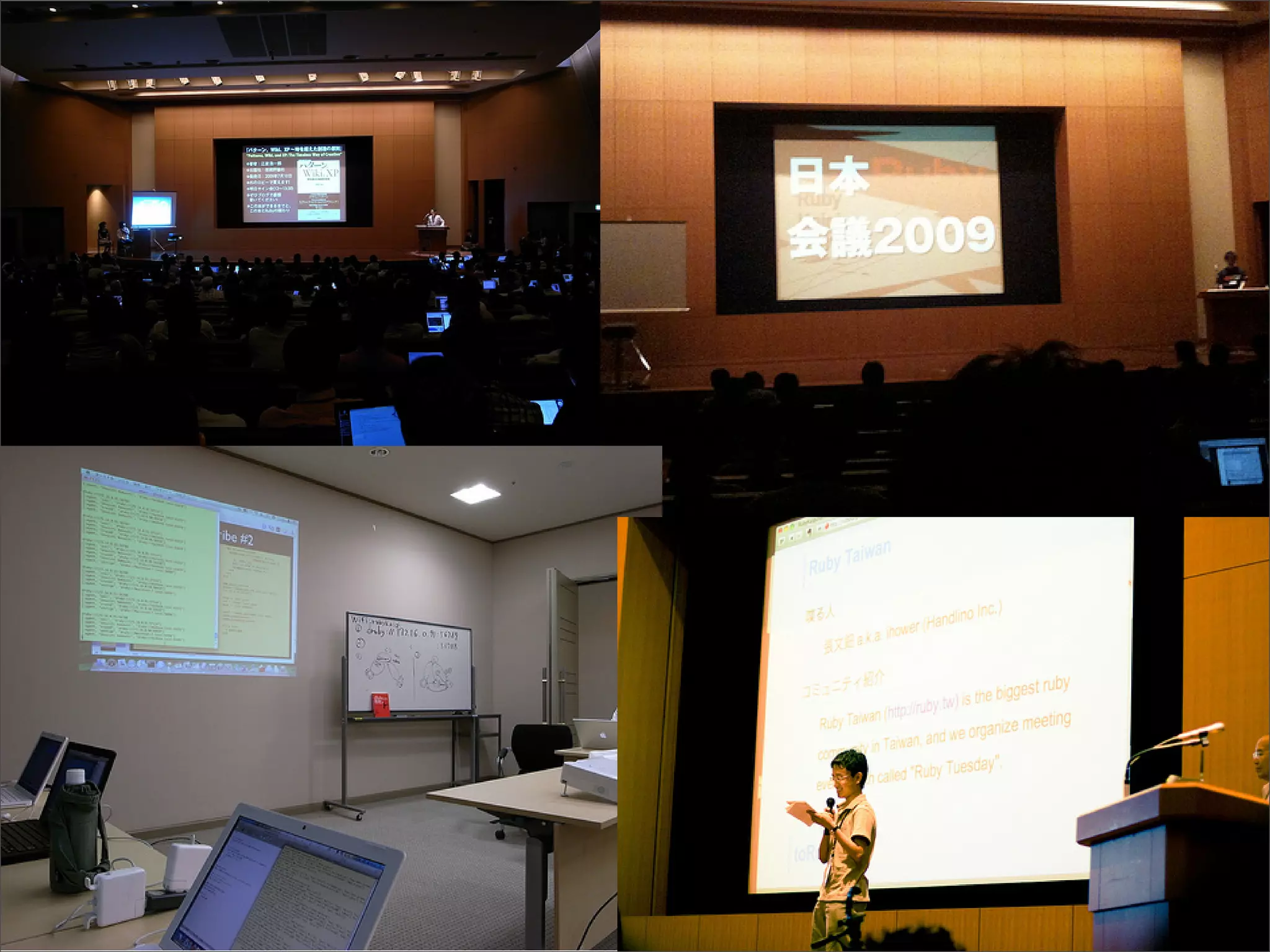
• Presentations in Japan
 • Kansai Ruby Workshop
 • RubyKaigi2008, 2009
This is my first English
    presentation.
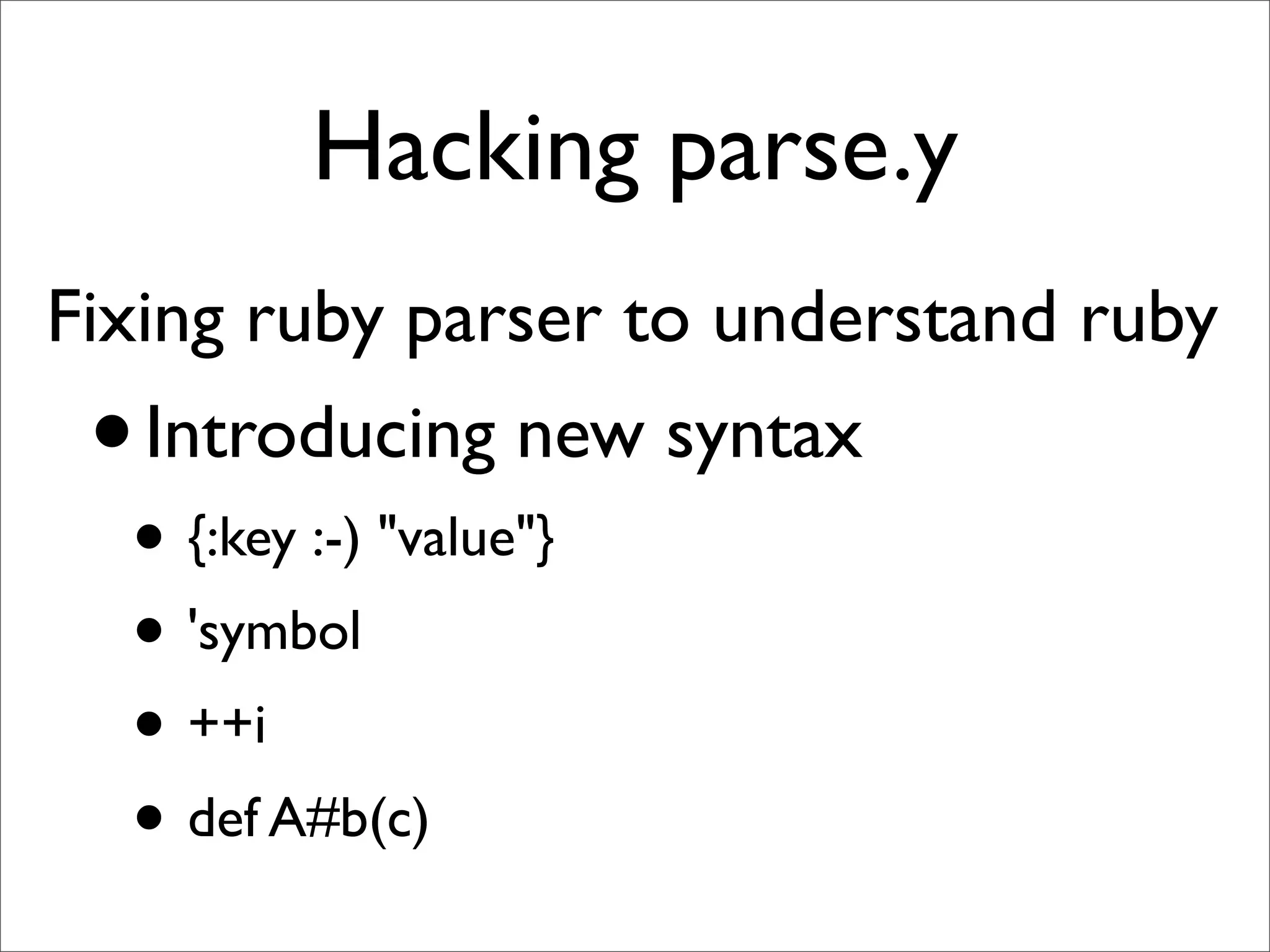
Hacking parse.y
Fixing ruby parser to understand ruby
 • Introducing new syntax
  • {:key :-) "value"}
  • 'symbol
  • ++i
  • def A#b(c)
MRI Inside

• MRI (Matz Ruby Implementation)
• $ ruby -v
  ruby 1.9.2dev (2009-08-05 trunk 24397) [i386-darwin9.7.0]


• Written in C
 • array.c, vm.c, gc.c, etc...
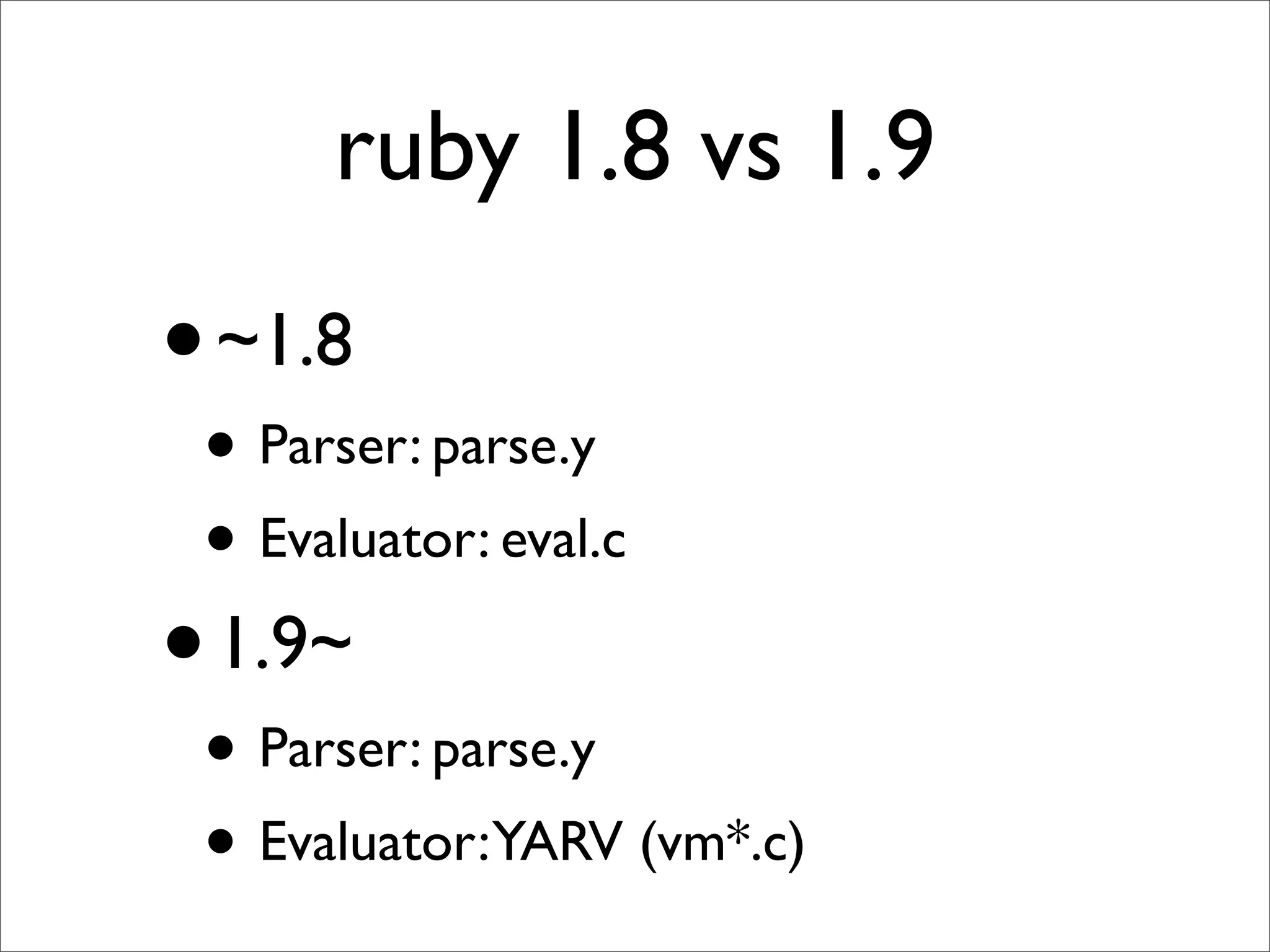
ruby 1.8 vs 1.9

• ~1.8
 • Parser: parse.y
 • Evaluator: eval.c
• 1.9~
 • Parser: parse.y
 • Evaluator:YARV (vm*.c)
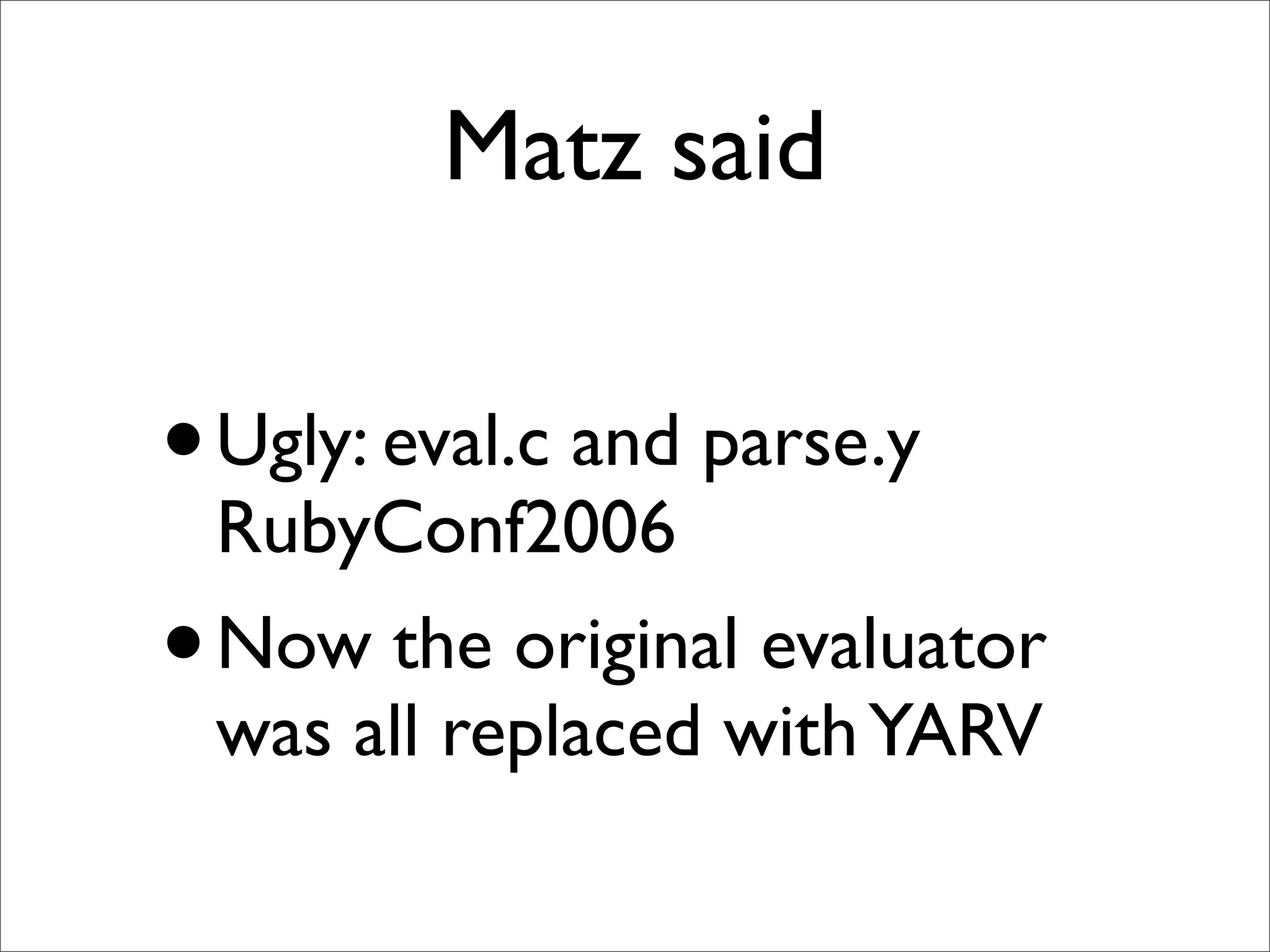
Matz said

• Ugly: eval.c and parse.y
 RubyConf2006
• Now the original evaluator
 was all replaced with YARV
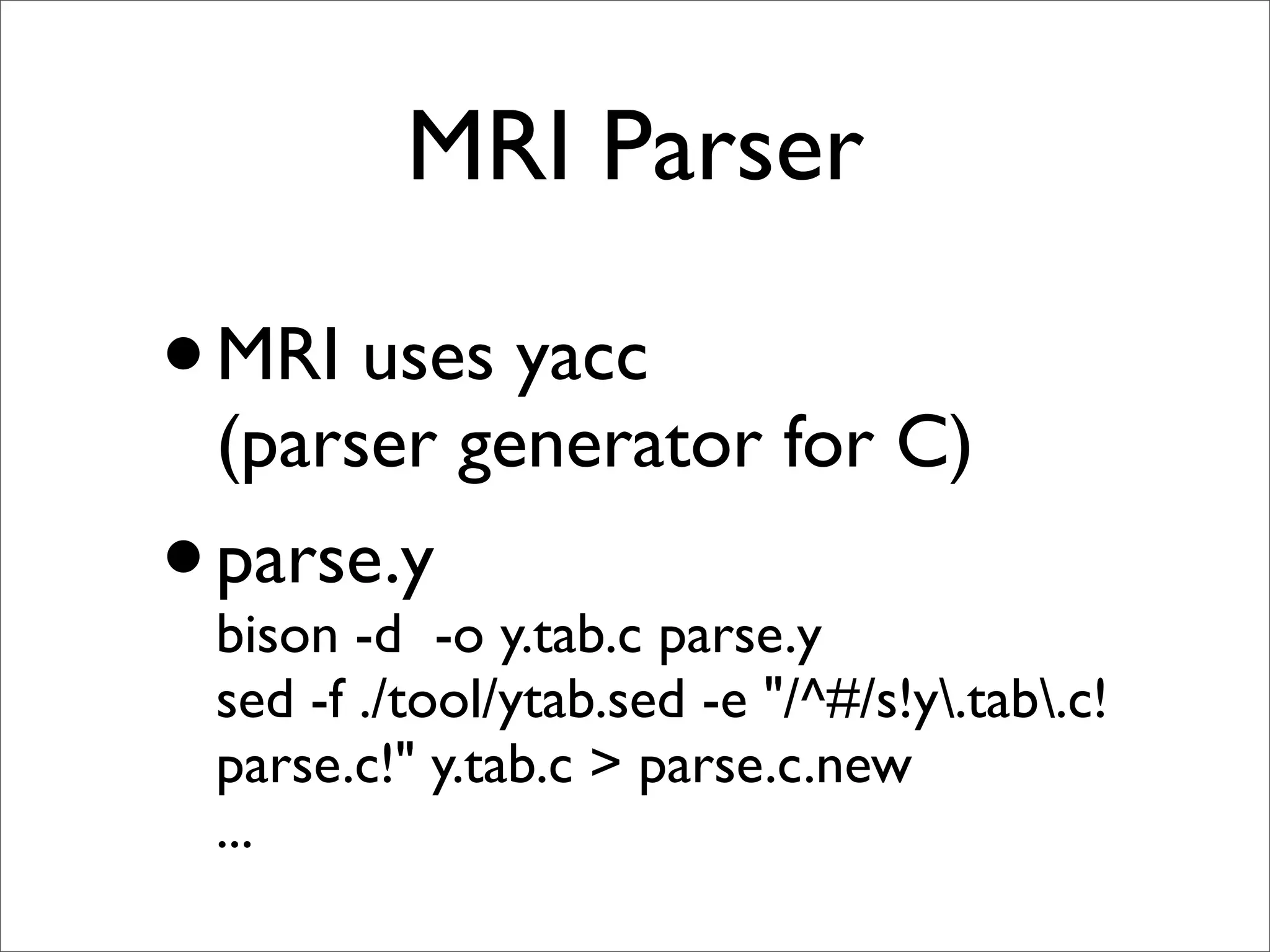
MRI Parser

• MRI uses yacc
  (parser generator for C)
• parse.y-o y.tab.c parse.y
  bison -d
  sed -f ./tool/ytab.sed -e "/^#/s!y.tab.c!
  parse.c!" y.tab.c > parse.c.new
  ...
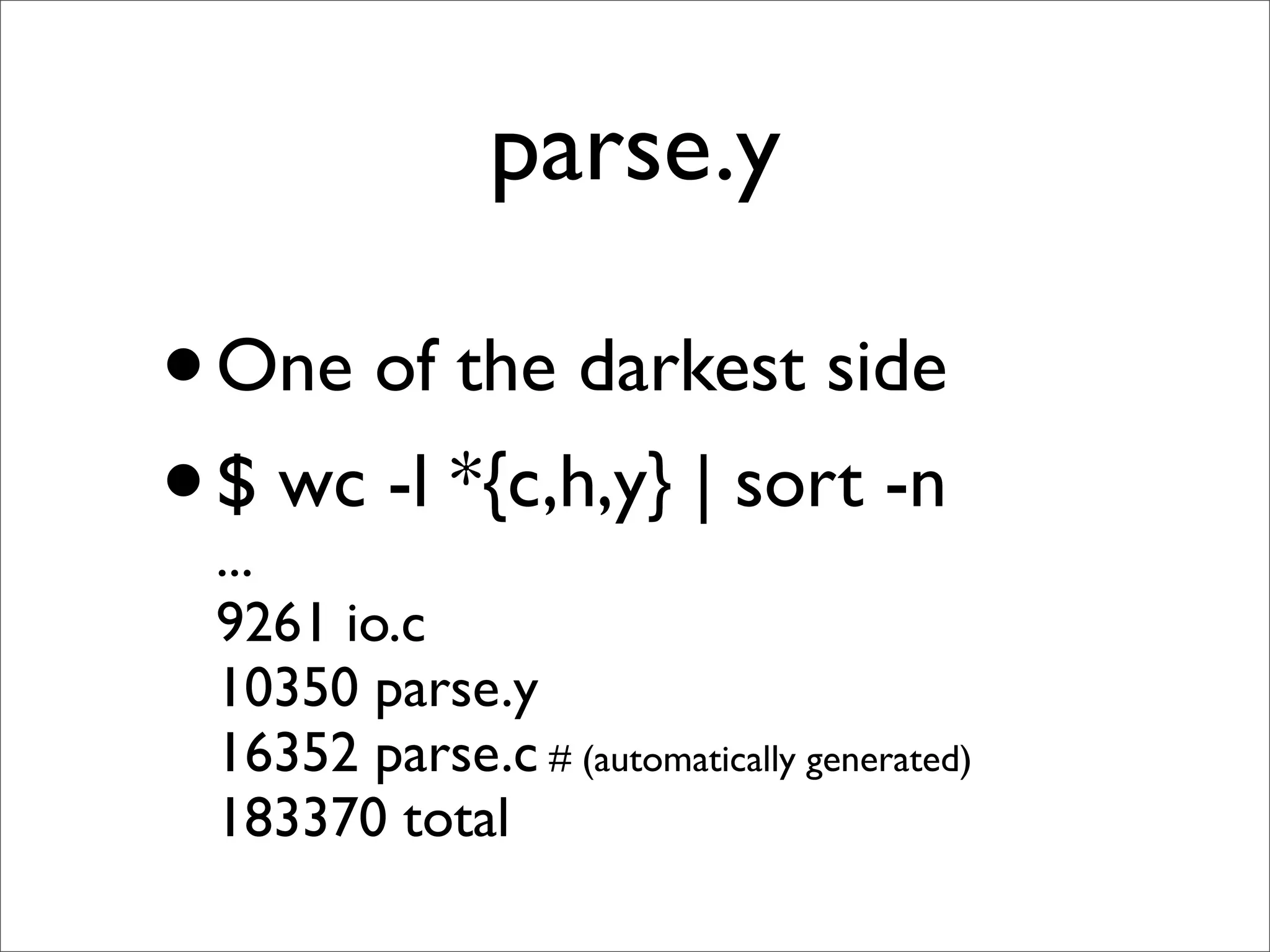
parse.y

• One of the darkest side
• $ wc -l *{c,h,y} | sort -n
  ...
 9261 io.c
 10350 parse.y
 16352 parse.c # (automatically generated)
 183370 total
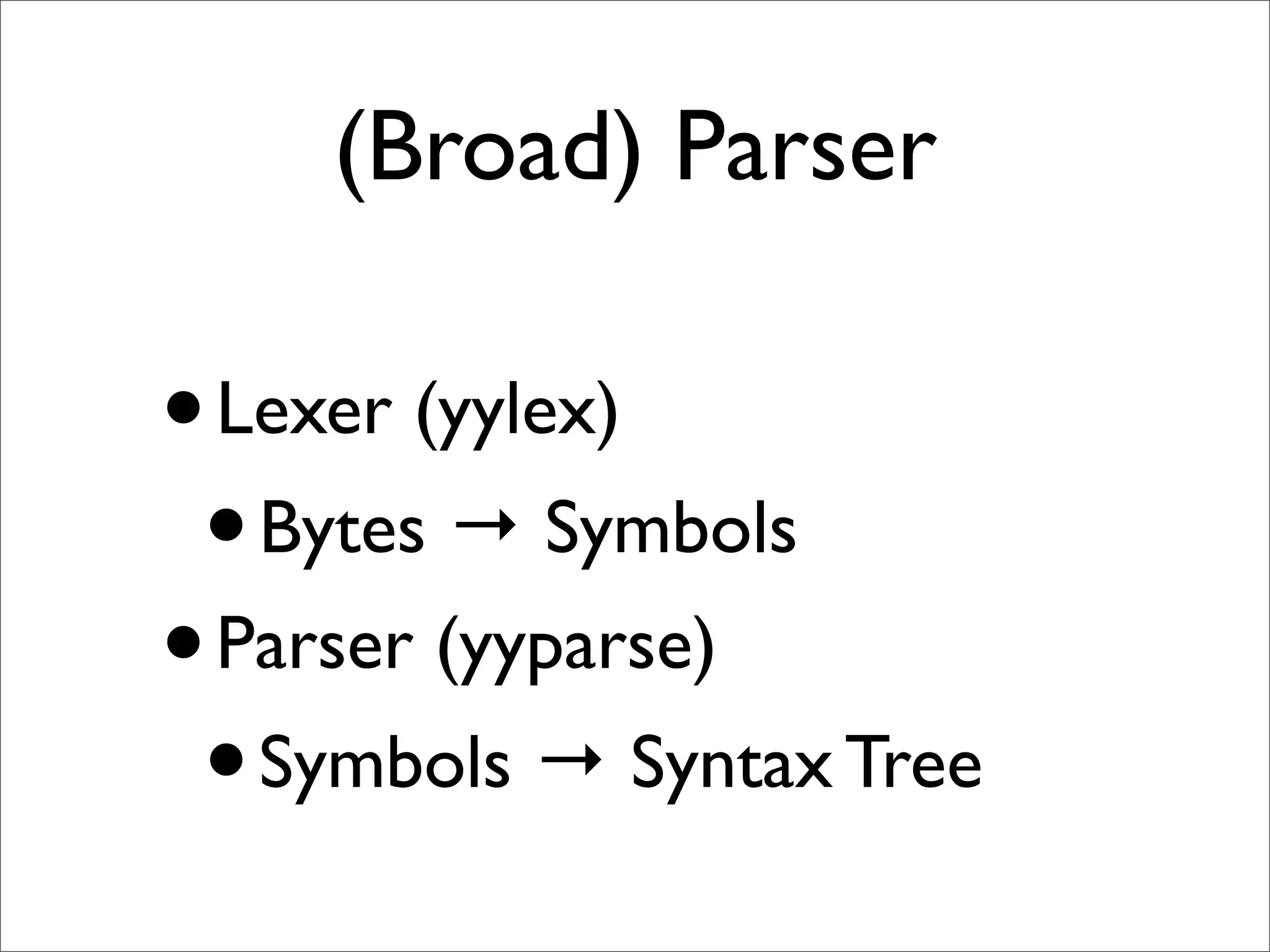
(Broad) Parser

• Lexer (yylex)
 • Bytes → Symbols
• Parser (yyparse)
 • Symbols → Syntax Tree
Tokens in Lexer
                                           %token <id> tOP_ASGN /* +=, -= et
%token   tUPLUS     /* unary+ */           %token tASSOC       /* => */
%token   tUMINUS    /* unary- */           %token tLPAREN      /* ( */
%token   tPOW /* ** */                     %token tLPAREN_ARG /* ( */
%token   tCMP /* <=> */                    %token tRPAREN      /* ) */
%token   tEQ     /* == */                  %token tLBRACK      /* [ */
%token   tEQQ /* === */                    %token tLBRACE      /* { */
%token   tNEQ /* != */                     %token tLBRACE_ARG /* { */
%token   tGEQ /* >= */                     %token tSTAR    /* * */
%token   tLEQ /* <= */                     %token tAMPER       /* & */
%token   tANDOP tOROP /* && and || */      %token tLAMBDA      /* -> */
%token   tMATCH tNMATCH/* =~ and !~ */     %token tSYMBEG tSTRING_BEG tXSTRING_
%token   tDOT2 tDOT3 /* .. and ... */      tWORDS_BEG tQWORDS_BEG
%token   tAREF tASET /* [] and []= */      %token tSTRING_DBEG tSTRING_DVAR tST
%token   tLSHFT tRSHFT /* << and >> */
%token   tCOLON2    /* :: */
%token   tCOLON3    /* :: at EXPR_BEG */
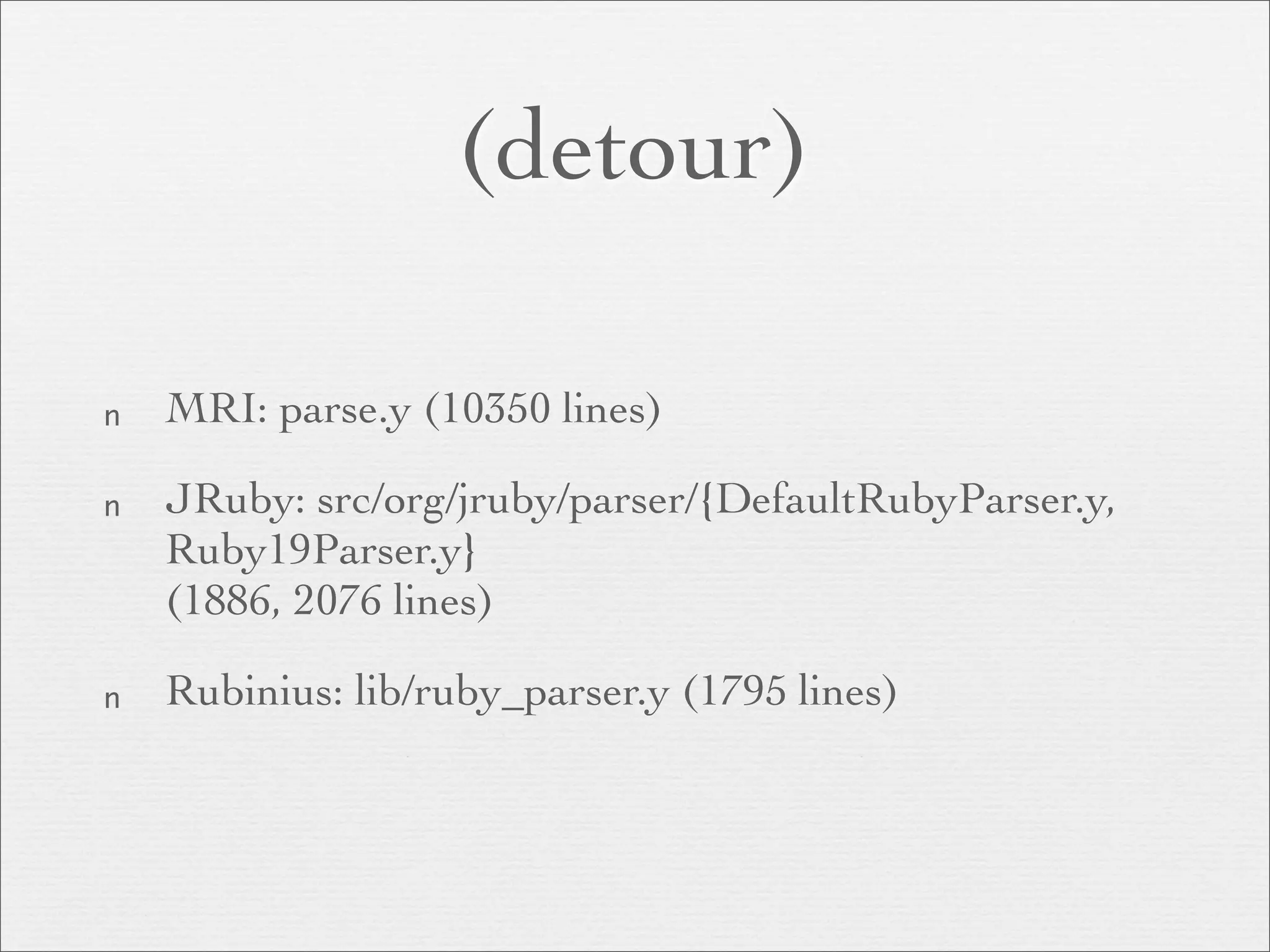
(detour)

n   MRI: parse.y (10350 lines)

n   JRuby: src/org/jruby/parser/{DefaultRubyParser.y,
    Ruby19Parser.y}
    (1886, 2076 lines)

n   Rubinius: lib/ruby_parser.y (1795 lines)
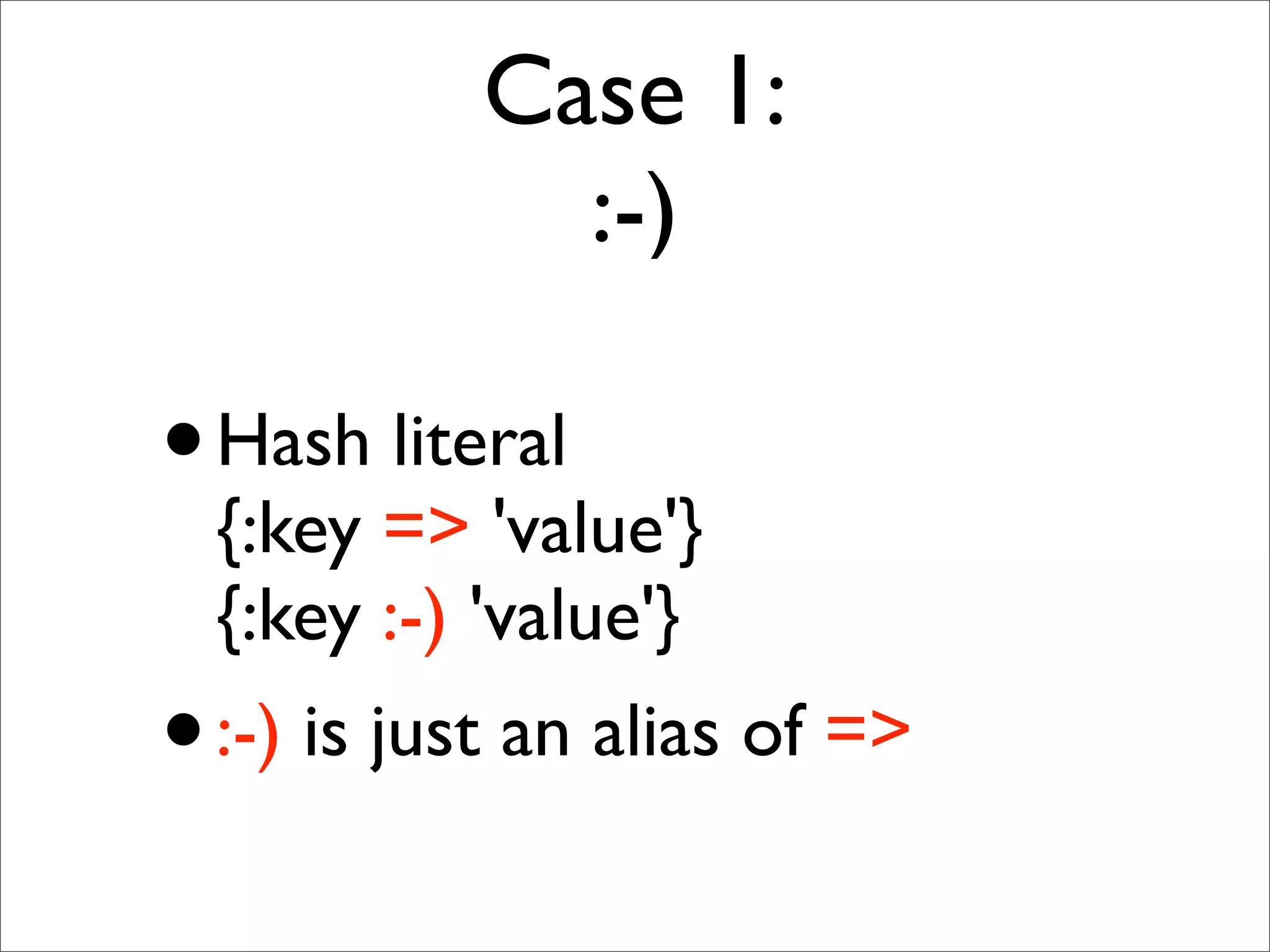
Case 1:
             :-)

• Hash literal
  {:key => 'value'}
  {:key :-) 'value'}
• :-) is just an alias of =>
Mastering “Colon”
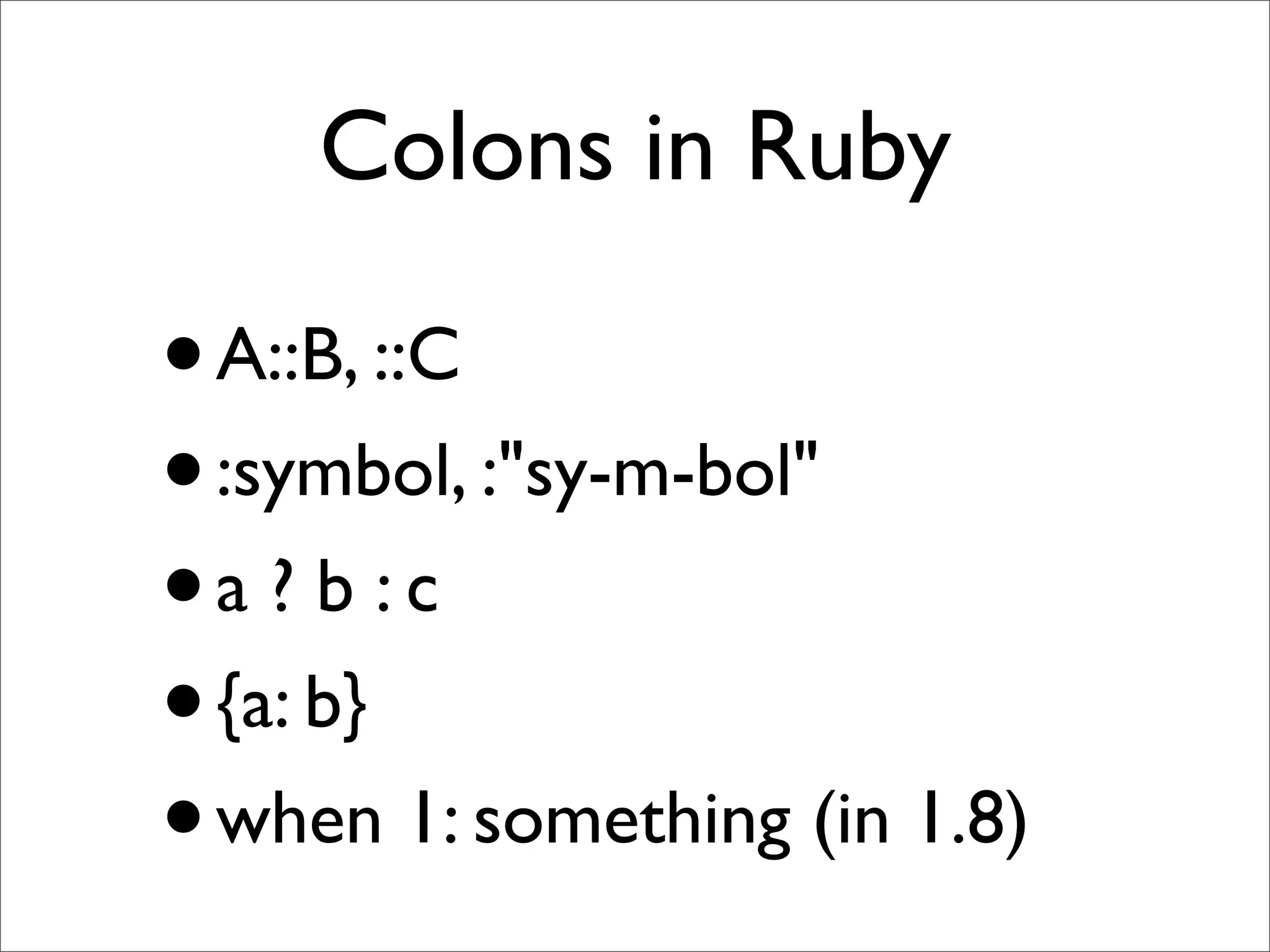
Colons in Ruby

• A::B, ::C
• :symbol, :"sy-m-bol"
•a ? b : c
• {a: b}
• when 1: something (in 1.8)
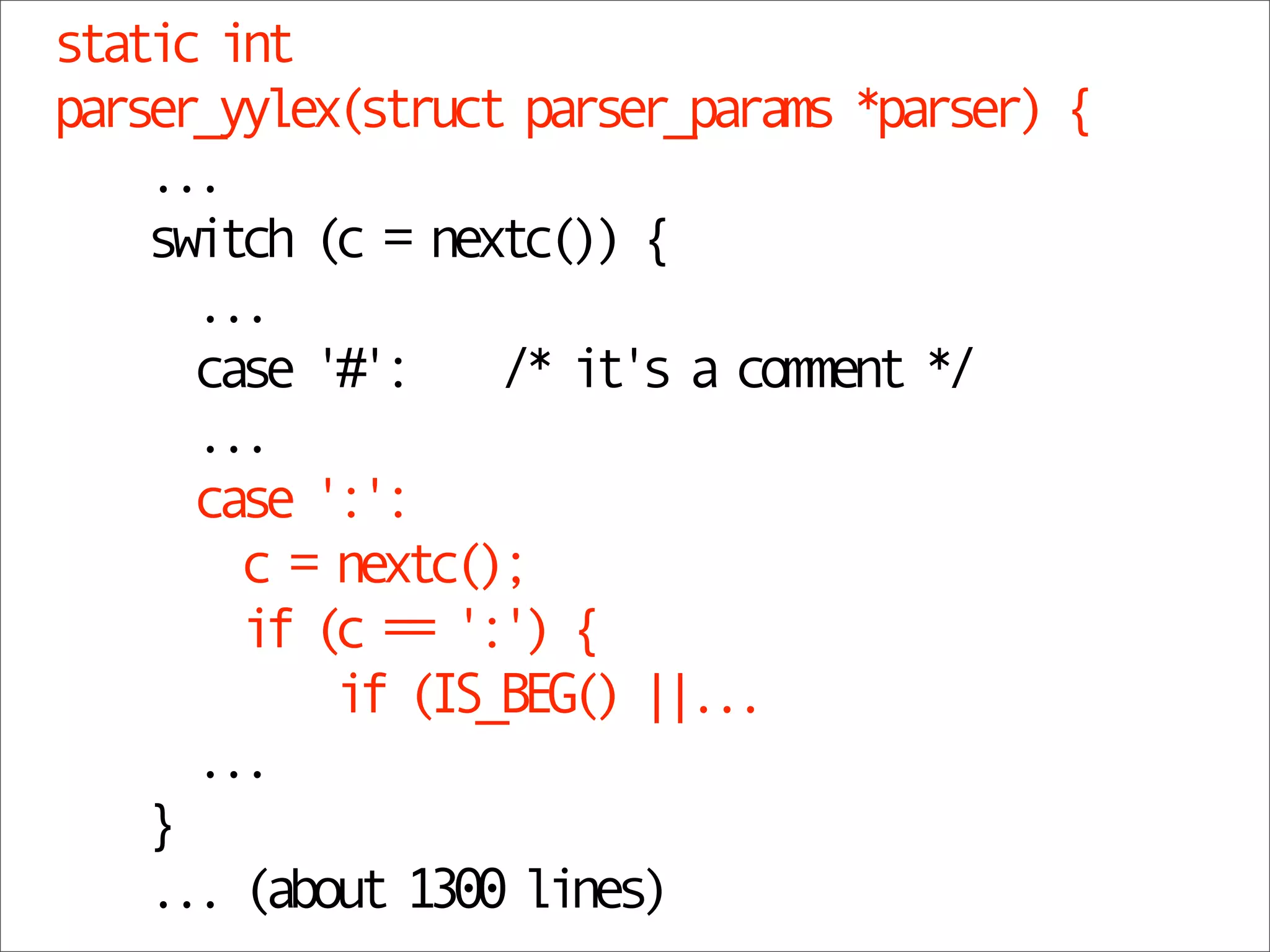
static int
parser_yylex(struct parser_params *parser) {
    ...
    switch (c = nextc()) {
      ...
      case '#': /* it's a comment */
      ...
      case ':':
        c = nextc();
        if (c == ':') {
            if (IS_BEG() ||...
      ...
    }
    ... (about 1300 lines)
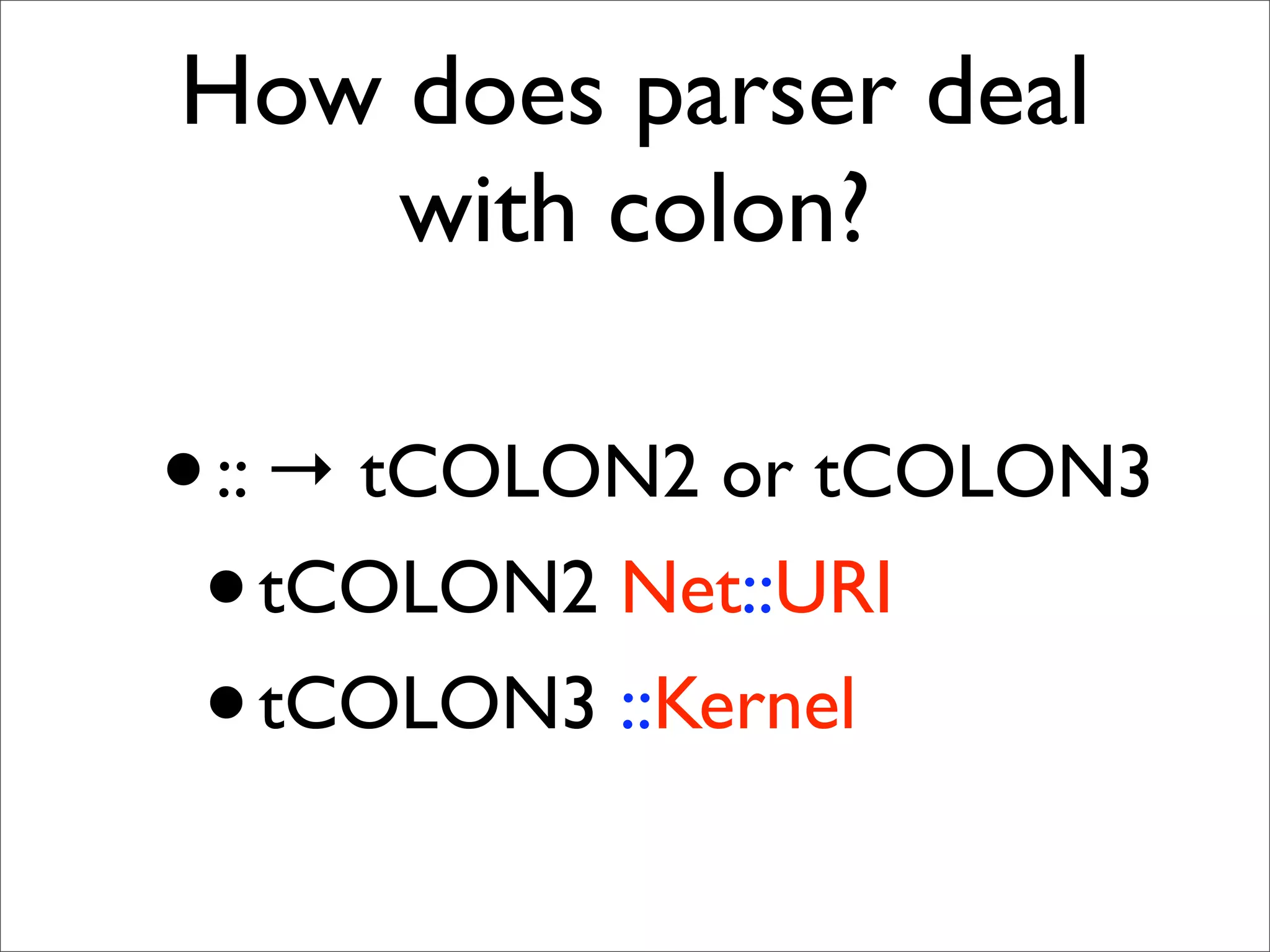
How does parser deal
    with colon?

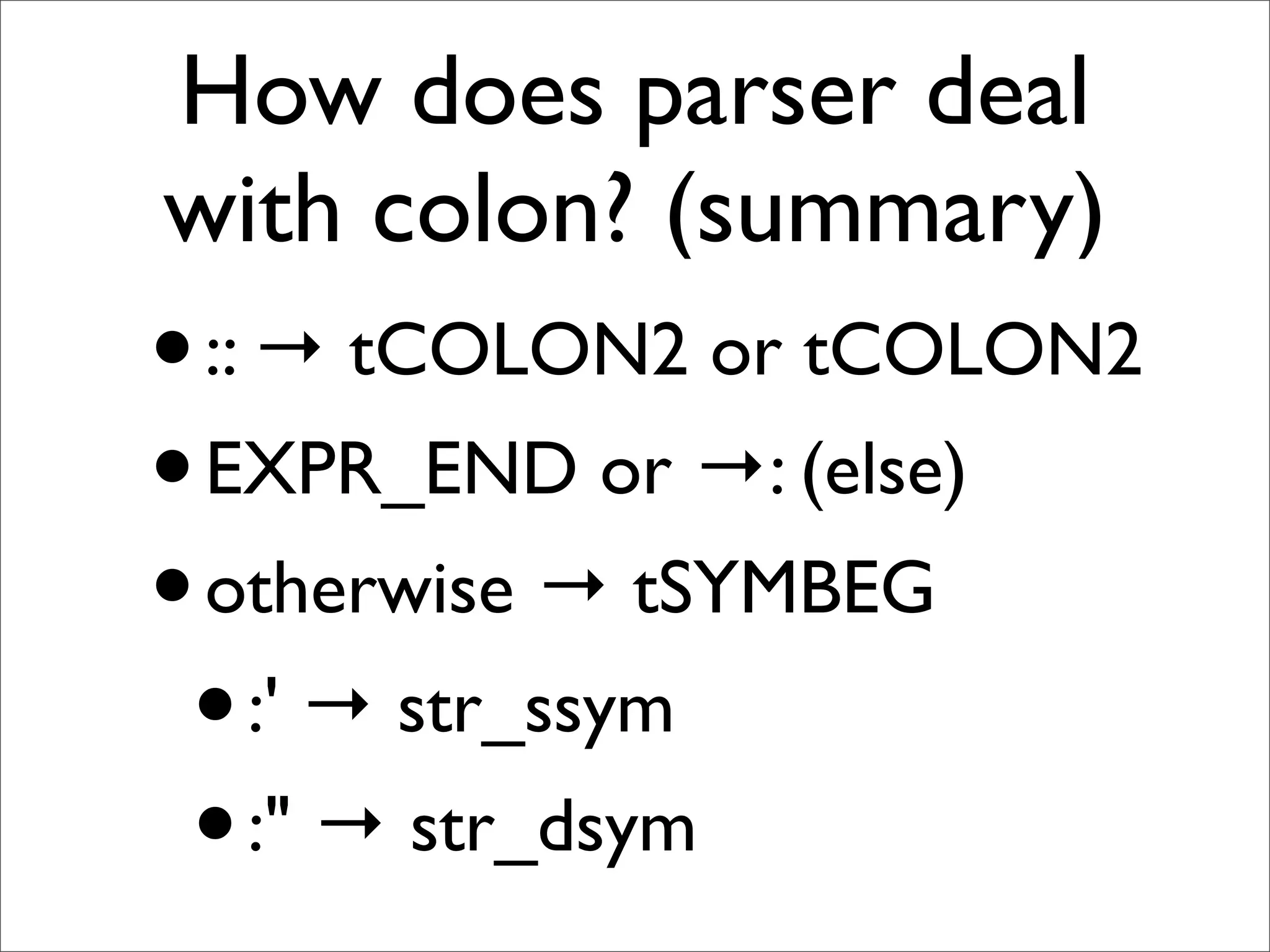
• :: → tCOLON2 or tCOLON3
 • tCOLON2 Net::URI
 • tCOLON3 ::Kernel
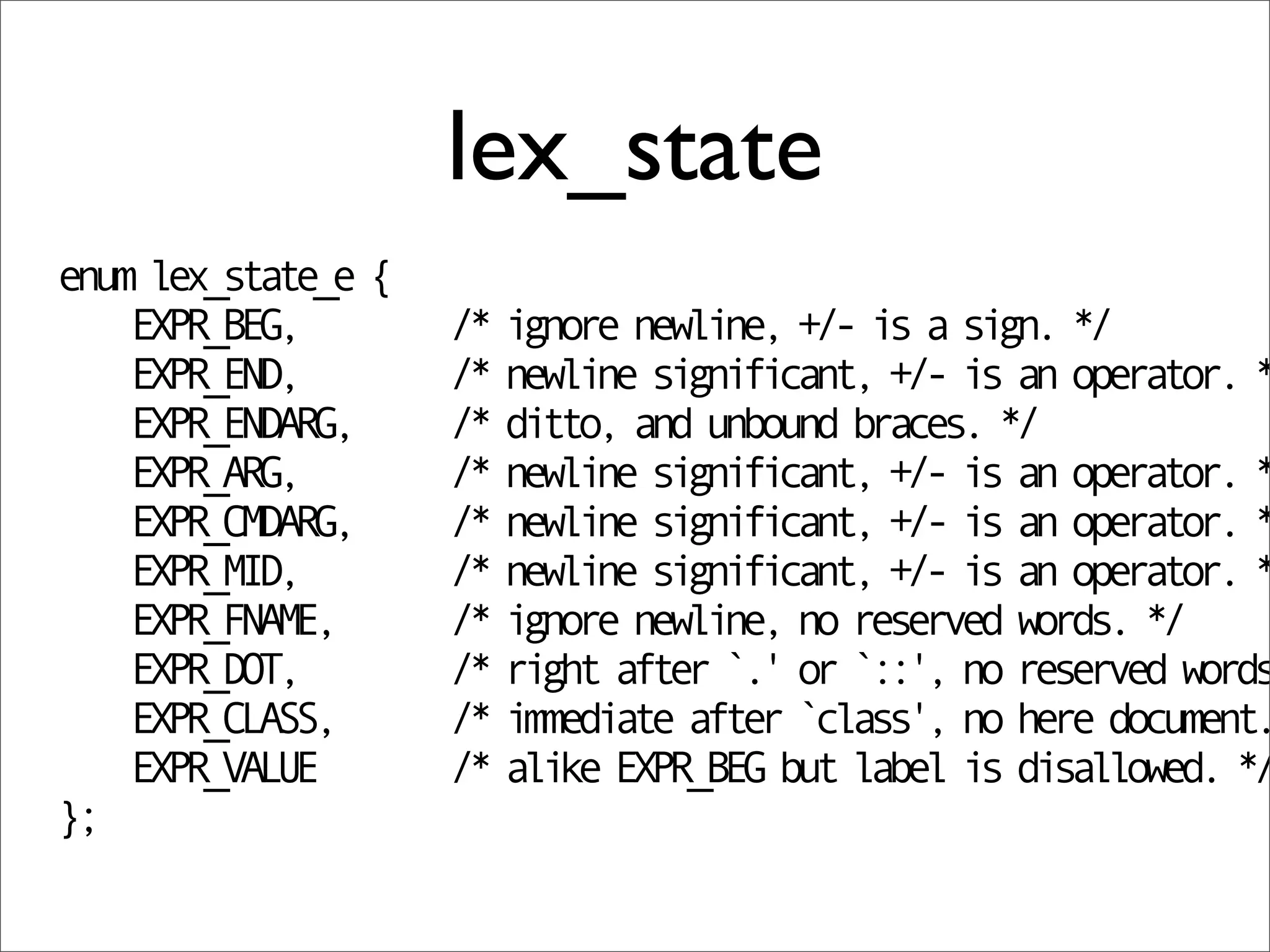
lex_state
enum lex_state_e {
    EXPR_BEG,        /* ignore newline, +/- is a sign. */
    EXPR_END,        /* newline significant, +/- is an operator. *
    EXPR_ENDARG,     /* ditto, and unbound braces. */
    EXPR_ARG,        /* newline significant, +/- is an operator. *
    EXPR_CMDARG,     /* newline significant, +/- is an operator. *
    EXPR_MID,        /* newline significant, +/- is an operator. *
    EXPR_FNAME,      /* ignore newline, no reserved words. */
    EXPR_DOT,        /* right after `.' or `::', no reserved words
    EXPR_CLASS,      /* immediate after `class', no here document.
    EXPR_VALUE       /* alike EXPR_BEG but label is disallowed. */
};
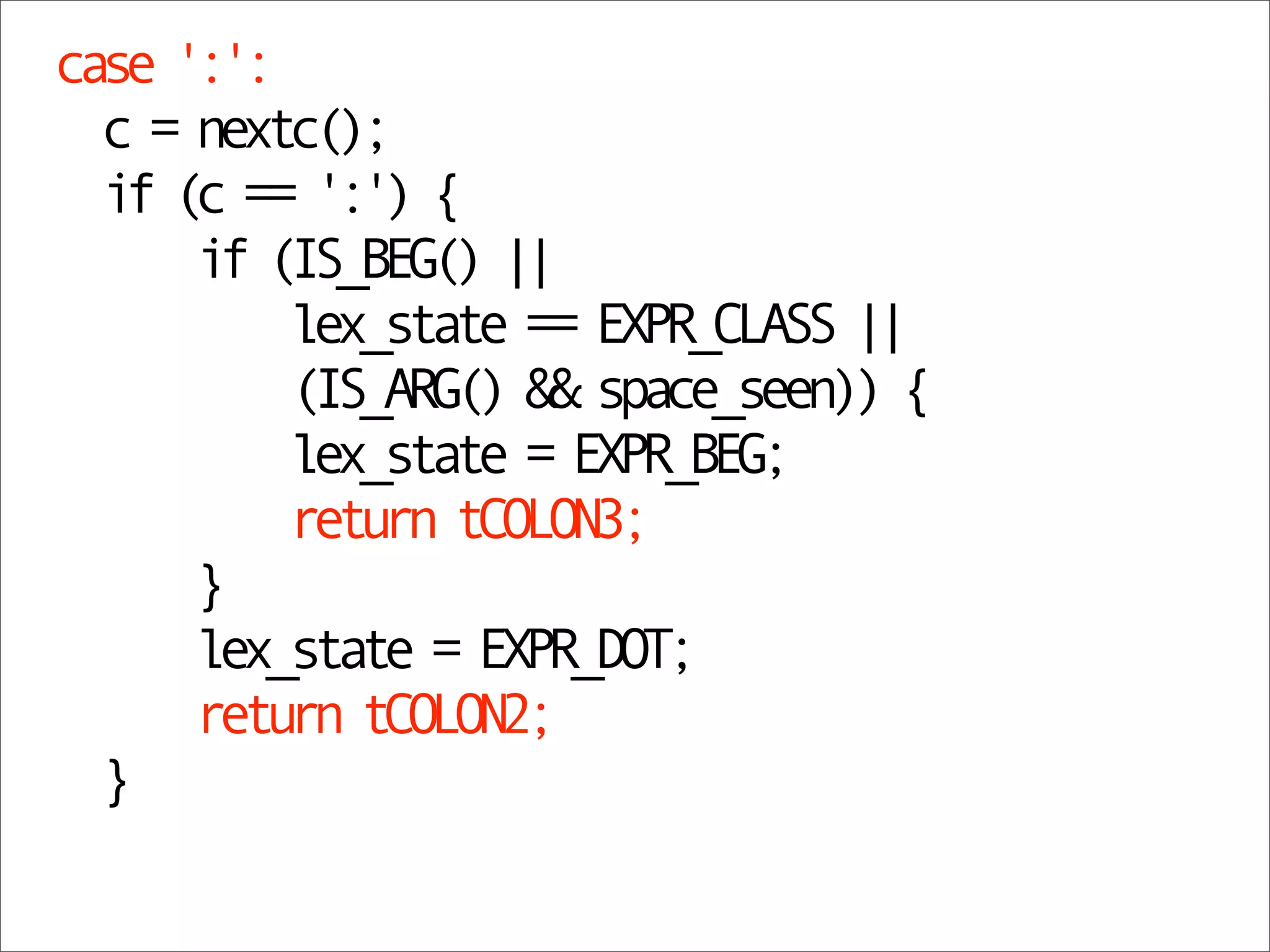
case ':':
  c = nextc();
  if (c == ':') {
      if (IS_BEG() ||
          lex_state == EXPR_CLASS ||
          (IS_ARG() && space_seen)) {
          lex_state = EXPR_BEG;
          return tCOLON3;
      }
      lex_state = EXPR_DOT;
      return tCOLON2;
  }
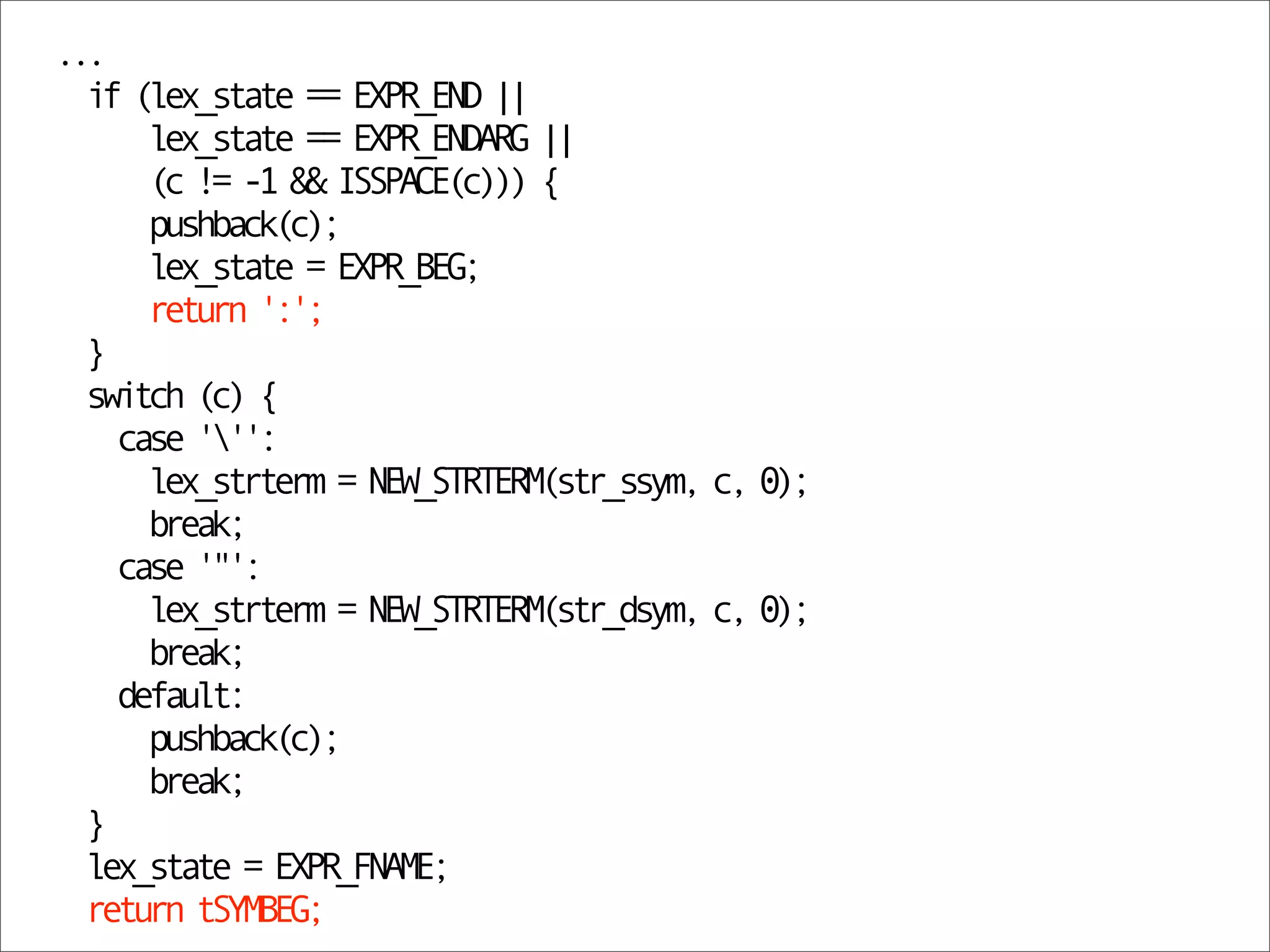
...
  if (lex_state == EXPR_END ||
      lex_state == EXPR_ENDARG ||
      (c != -1 && ISSPACE(c))) {
      pushback(c);
      lex_state = EXPR_BEG;
      return ':';
  }
  switch (c) {
    case ''':
      lex_strterm = NEW_STRTERM(str_ssym, c, 0);
      break;
    case '"':
      lex_strterm = NEW_STRTERM(str_dsym, c, 0);
      break;
    default:
      pushback(c);
      break;
  }
  lex_state = EXPR_FNAME;
  return tSYMBEG;
How does parser deal
with colon? (summary)
• :: → tCOLON2 or tCOLON2
• EXPR_END or →: (else)
• otherwise → tSYMBEG
 • :' → str_ssym
 • :" → str_dsym
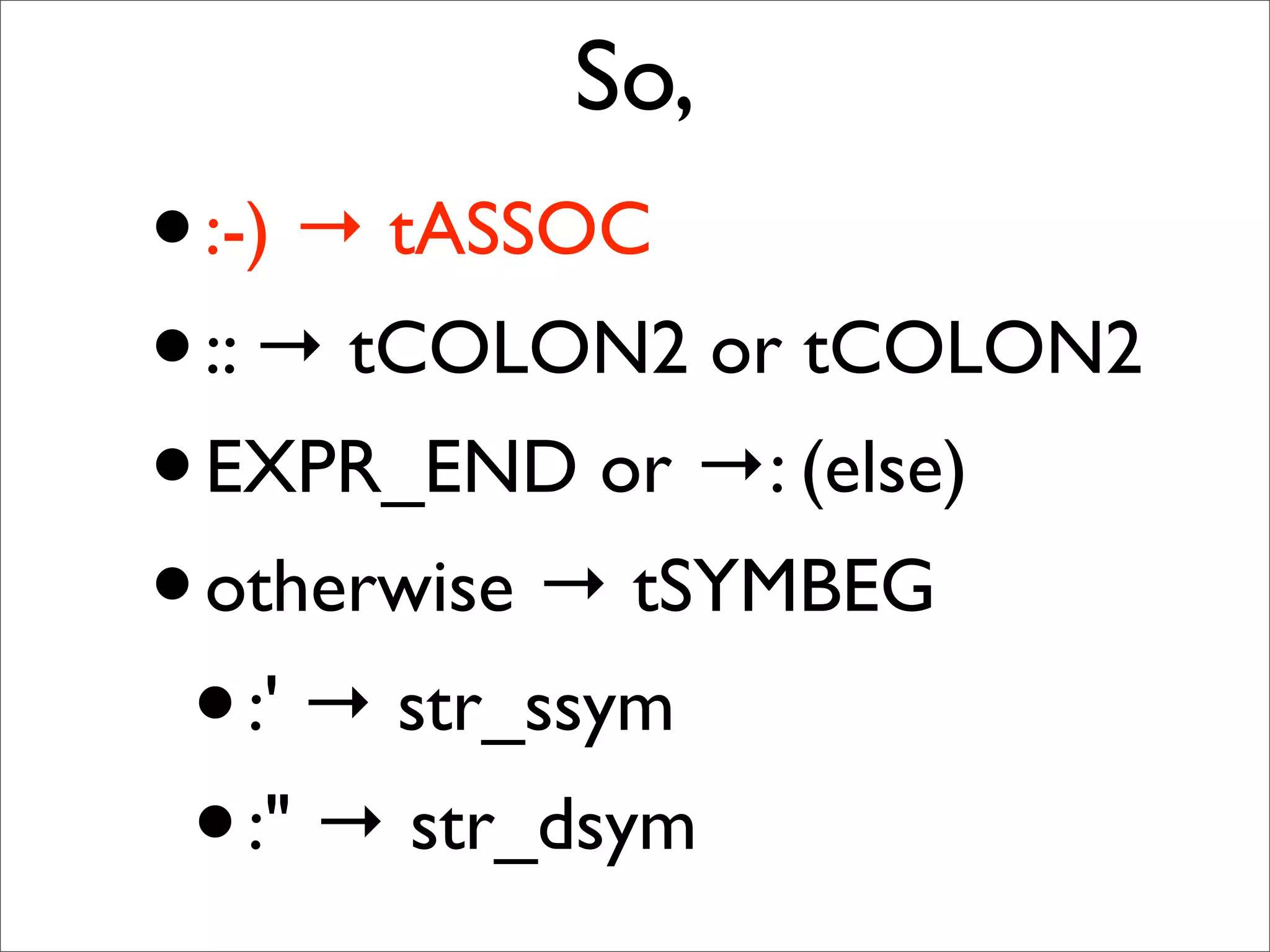
So,
• :-) → tASSOC
• :: → tCOLON2 or tCOLON2
• EXPR_END or →: (else)
• otherwise → tSYMBEG
 • :' → str_ssym
 • :" → str_dsym
:-)
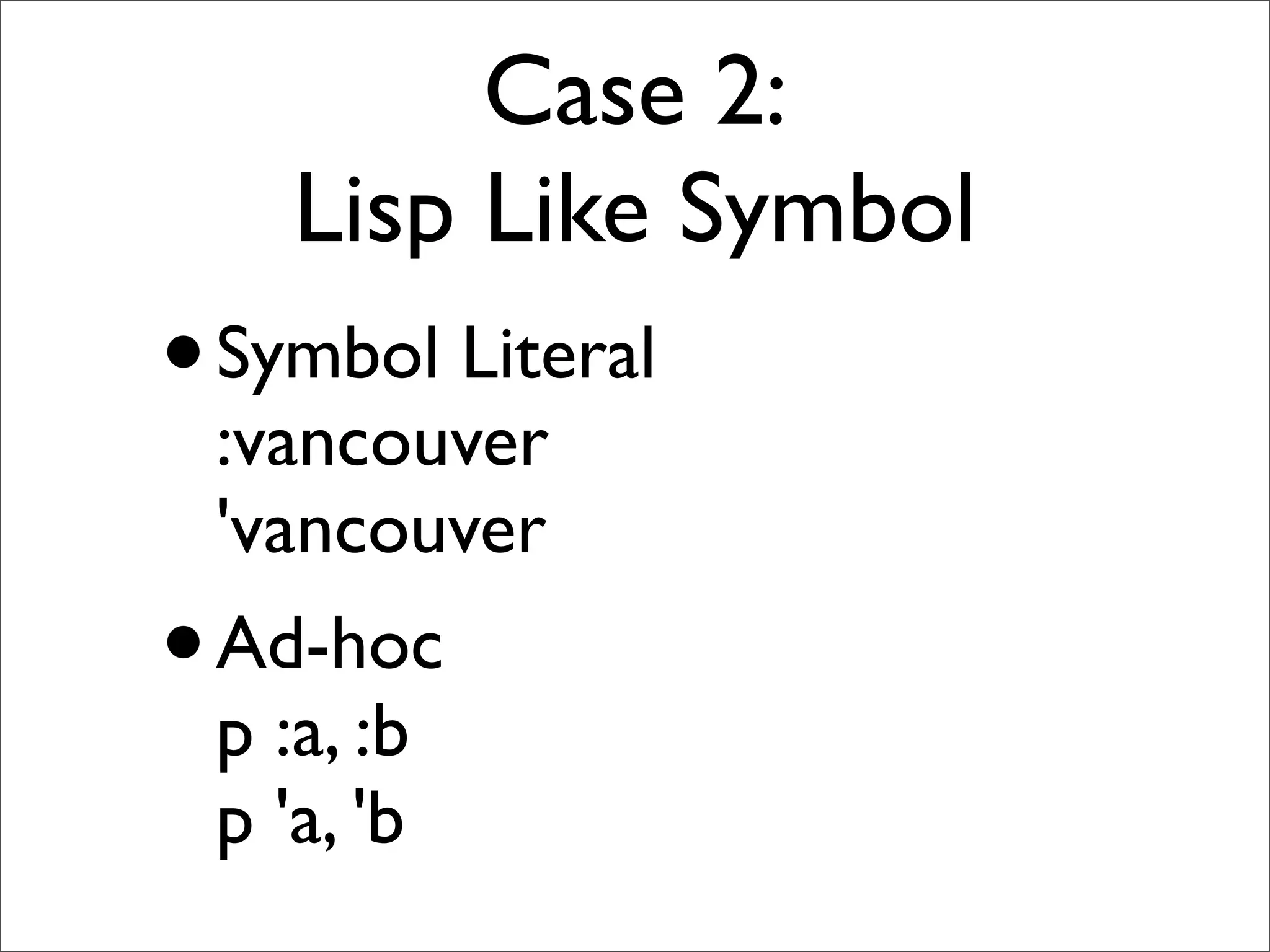
Case 2:
    Lisp Like Symbol
• Symbol Literal
 :vancouver
 'vancouver
• Ad-hoc
 p :a, :b
 p 'a, 'b
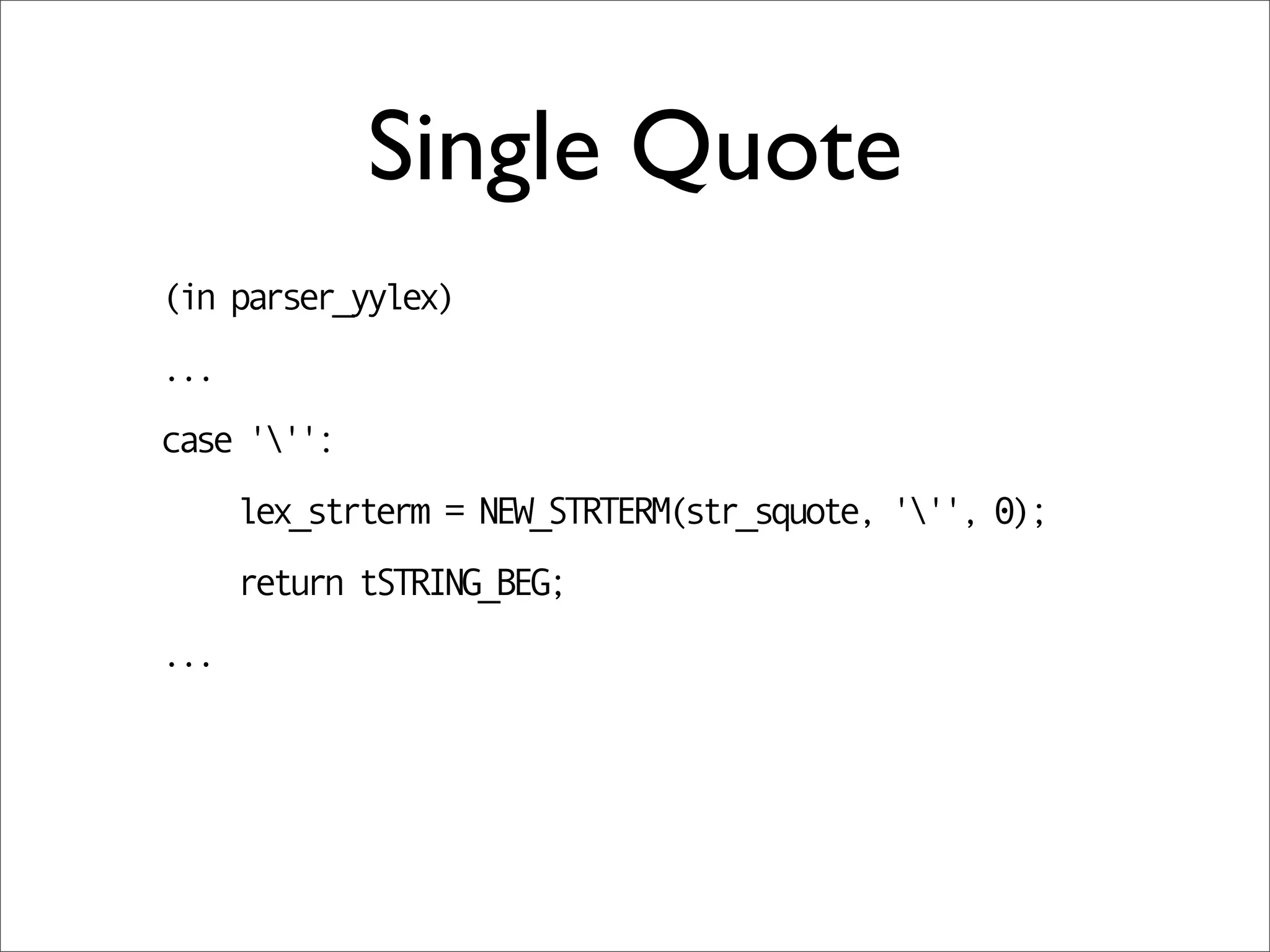
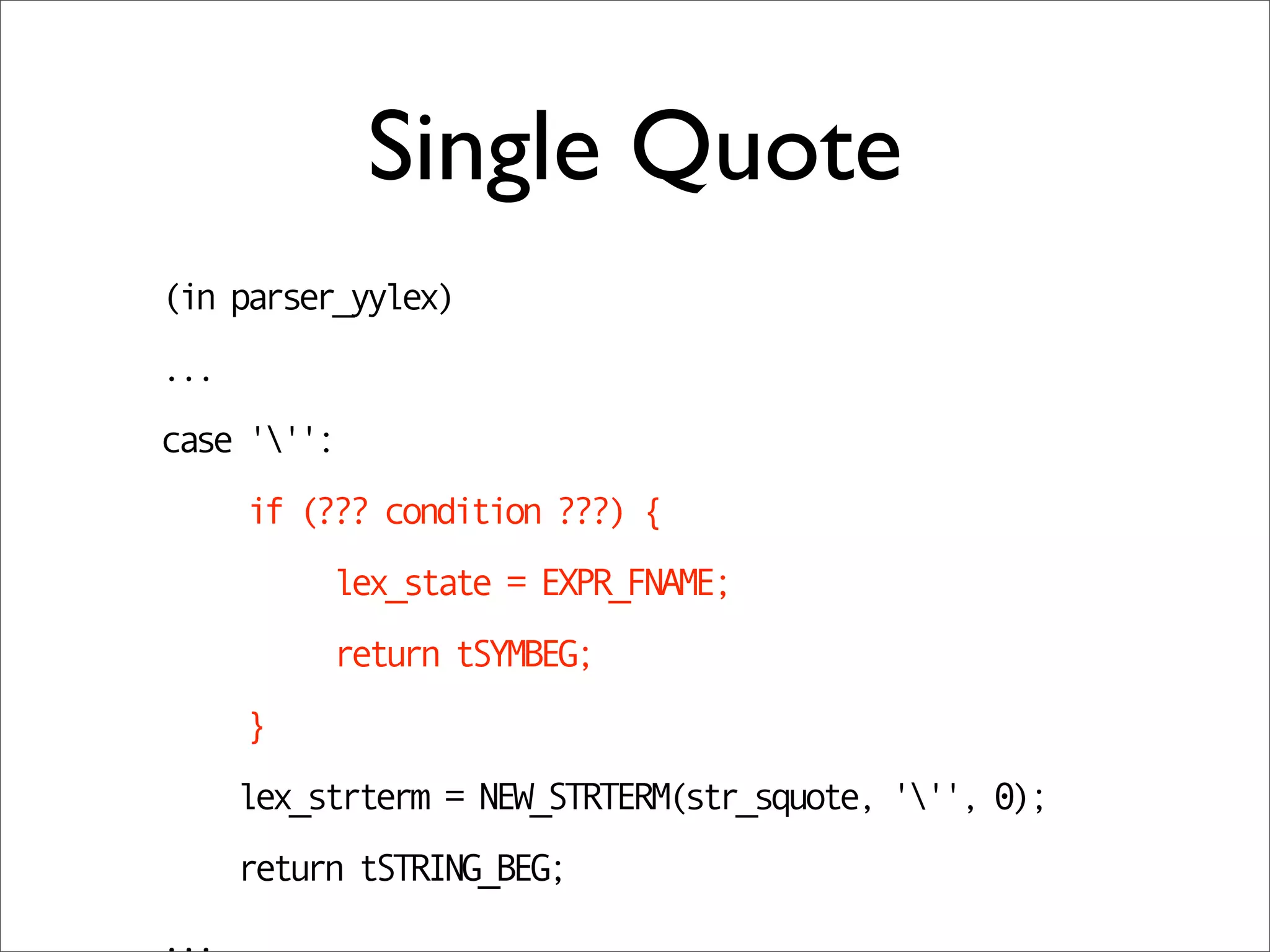
Single Quote
(in parser_yylex)
...
case ''':
      lex_strterm = NEW_STRTERM(str_squote, ''', 0);
      return tSTRING_BEG;
...
Single Quote
(in parser_yylex)
...
case ''':
      if (??? condition ???) {
           lex_state = EXPR_FNAME;
           return tSYMBEG;
      }
      lex_strterm = NEW_STRTERM(str_squote, ''', 0);
      return tSTRING_BEG;
...
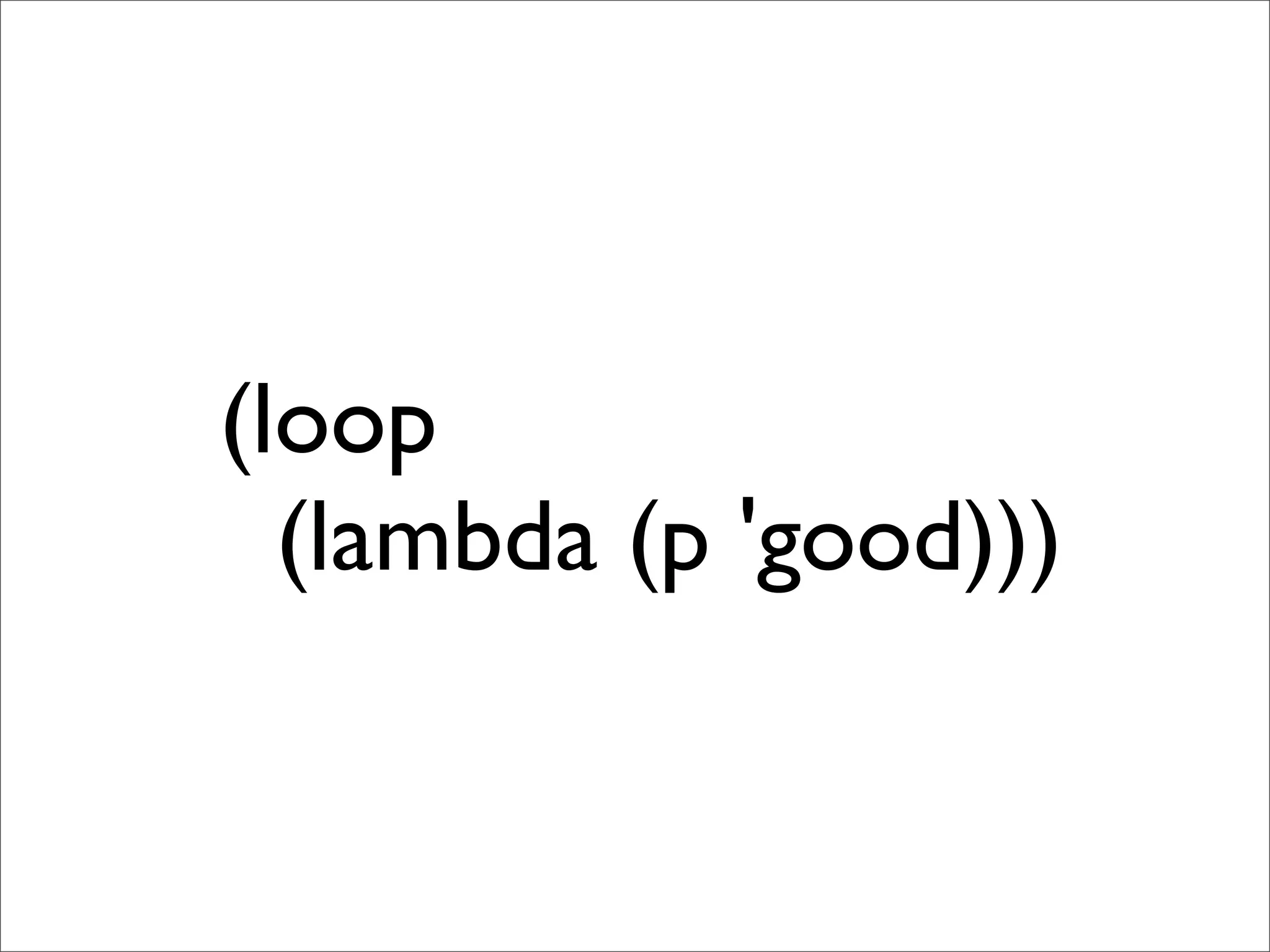
(loop
  (lambda (p 'good)))
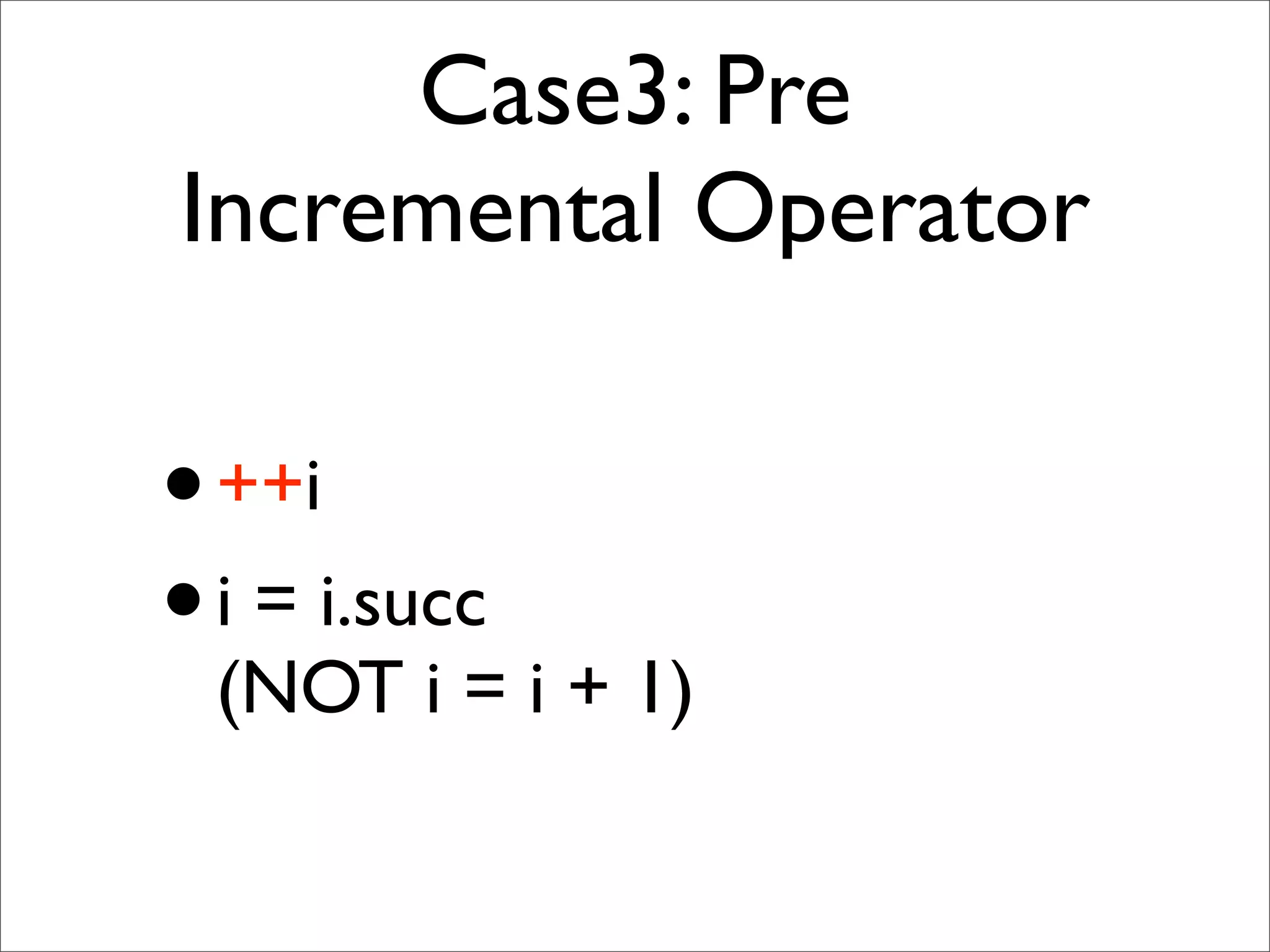
Case3: Pre
Incremental Operator

• ++i
• i = i.succ
  (NOT i = i + 1)
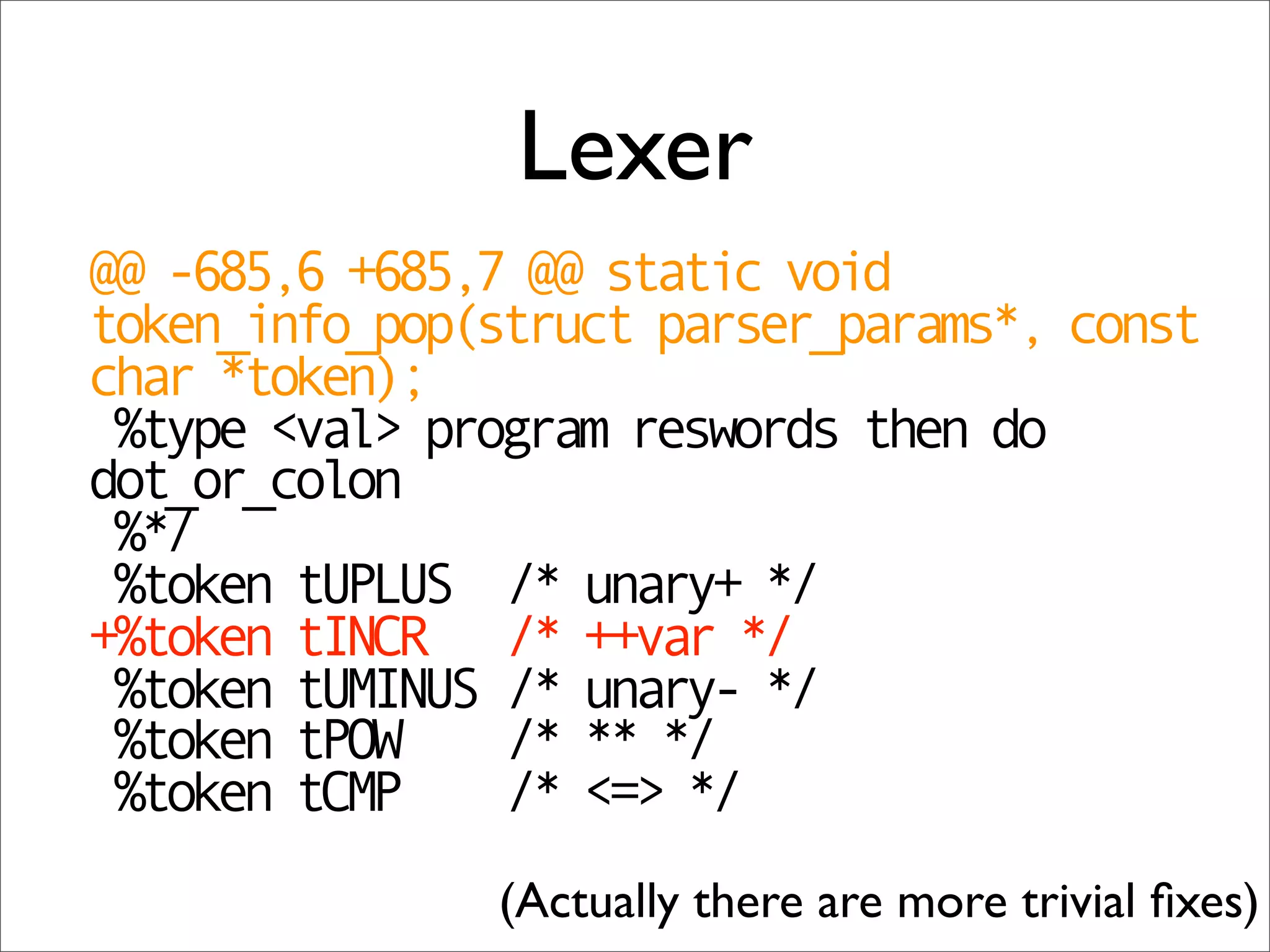
Lexer
@@ -685,6 +685,7 @@ static void
token_info_pop(struct parser_params*, const
char *token);
 %type <val> program reswords then do
dot_or_colon
 %*/
 %token tUPLUS /* unary+ */
+%token tINCR /* ++var */
 %token tUMINUS /* unary- */
 %token tPOW    /* ** */
 %token tCMP    /* <=> */
               (Actually there are more trivial fixes)
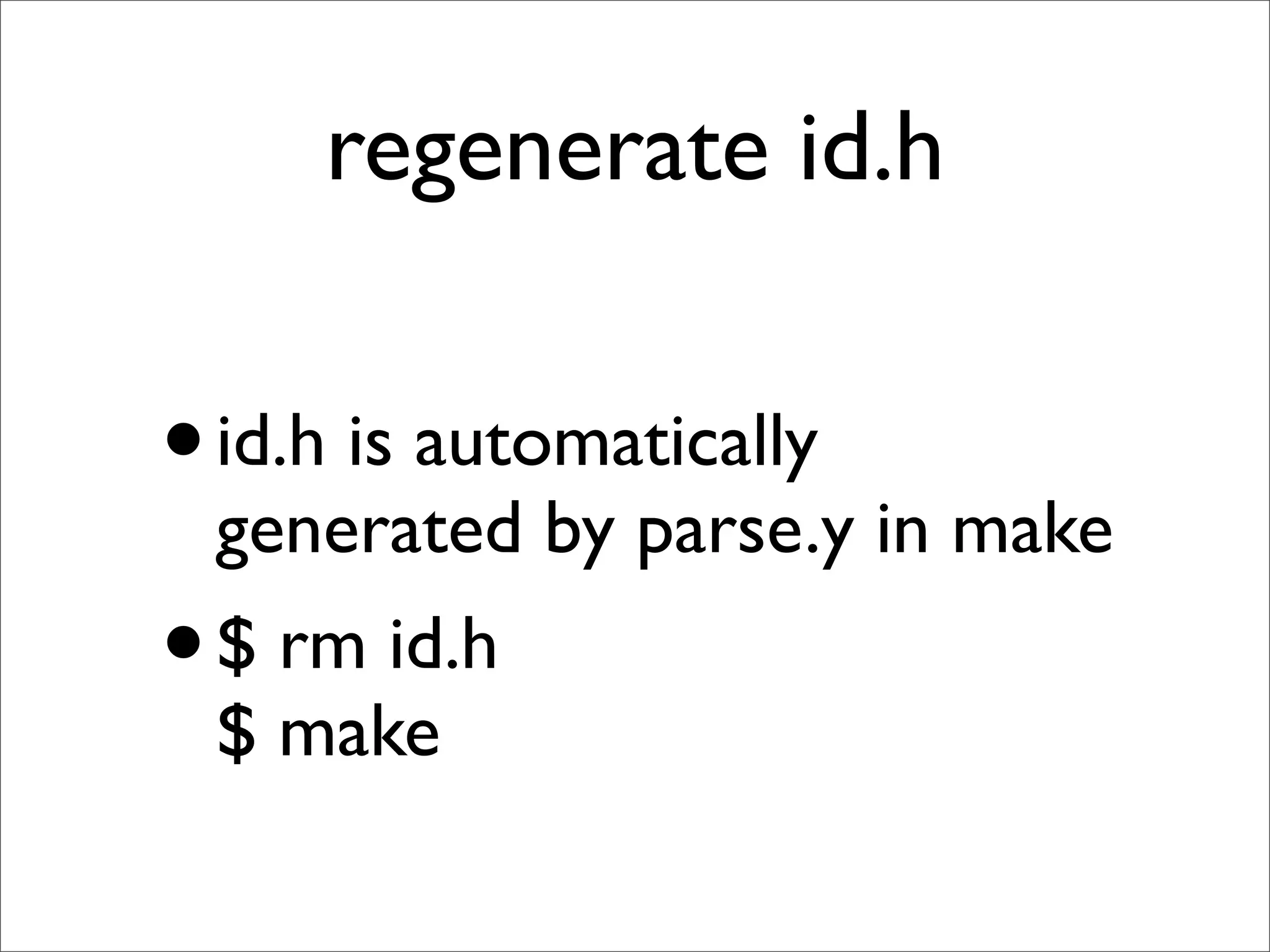
regenerate id.h

• id.h is automatically
 generated by parse.y in make
• $ rm id.h
 $ make
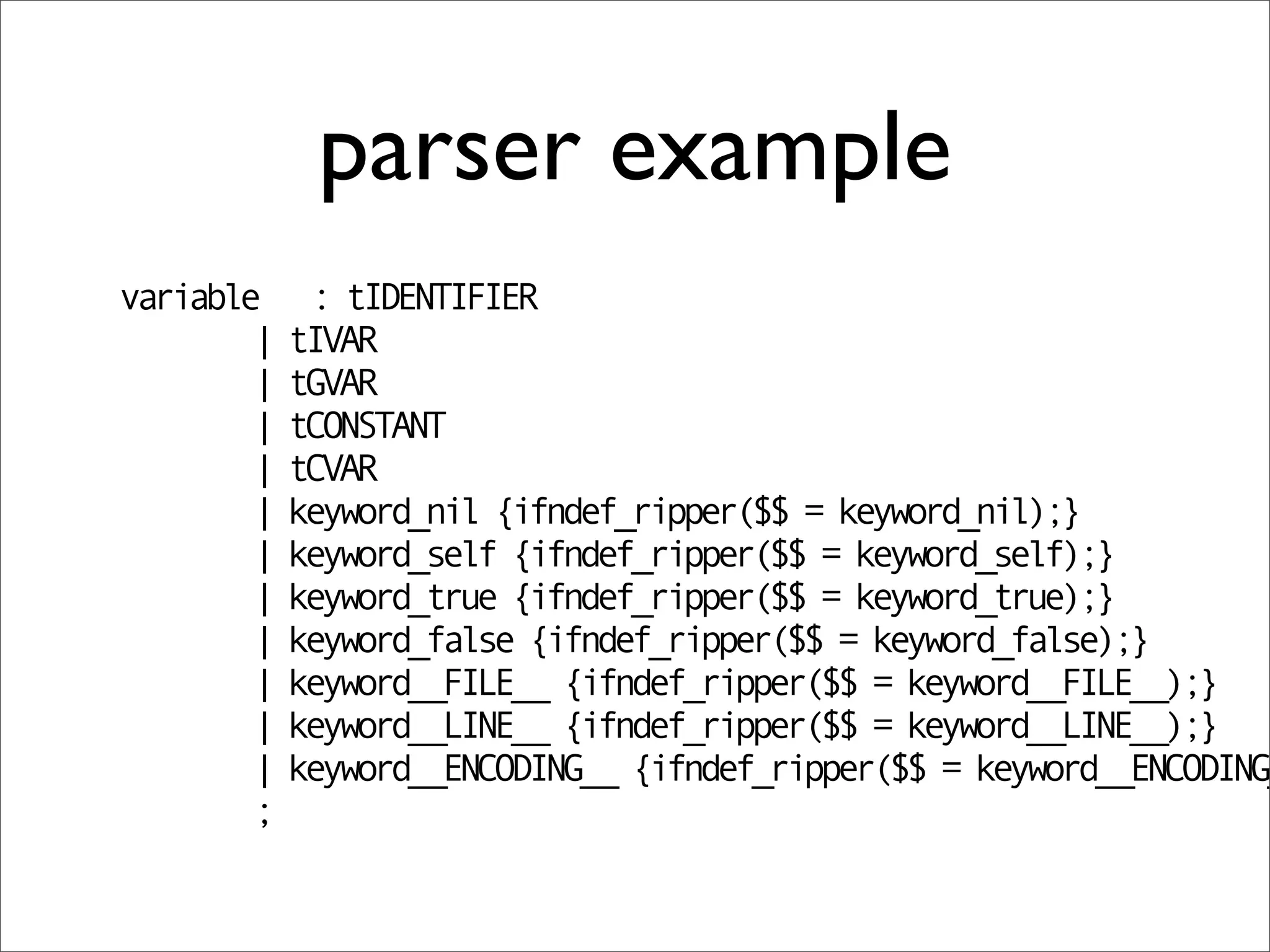
parser example
variable     : tIDENTIFIER
        |   tIVAR
        |   tGVAR
        |   tCONSTANT
        |   tCVAR
        |   keyword_nil {ifndef_ripper($$ = keyword_nil);}
        |   keyword_self {ifndef_ripper($$ = keyword_self);}
        |   keyword_true {ifndef_ripper($$ = keyword_true);}
        |   keyword_false {ifndef_ripper($$ = keyword_false);}
        |   keyword__FILE__ {ifndef_ripper($$ = keyword__FILE__);}
        |   keyword__LINE__ {ifndef_ripper($$ = keyword__LINE__);}
        |   keyword__ENCODING__ {ifndef_ripper($$ = keyword__ENCODING_
        ;
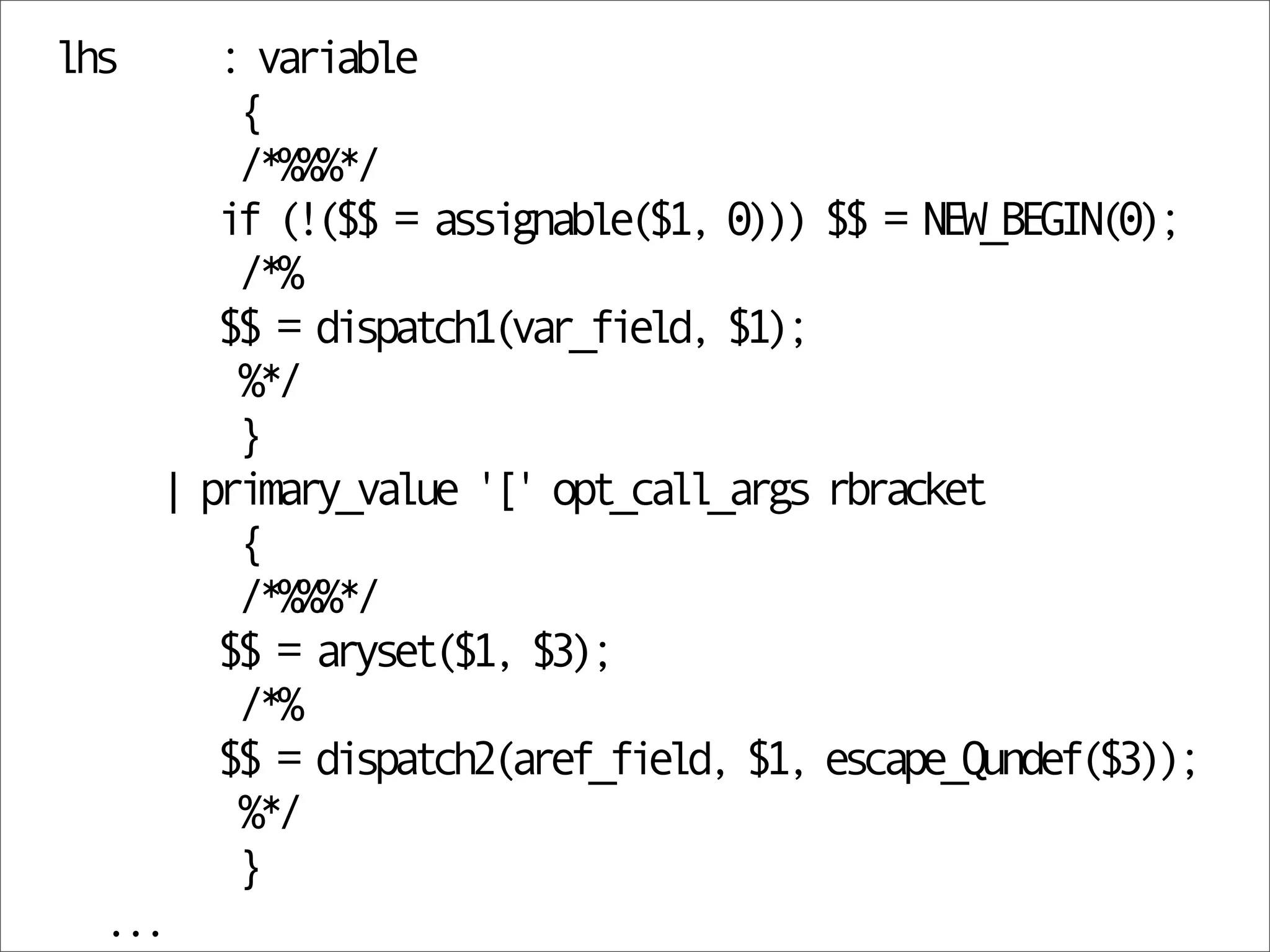
lhs     : variable
         {
         /*%%%*/
        if (!($$ = assignable($1, 0))) $$ = NEW_BEGIN(0);
         /*%
        $$ = dispatch1(var_field, $1);
         %*/
         }
     | primary_value '[' opt_call_args rbracket
         {
         /*%%%*/
        $$ = aryset($1, $3);
         /*%
        $$ = dispatch2(aref_field, $1, escape_Qundef($3));
         %*/
         }
  ...
BNF (part)
program    : compstmt             arg       : lhs '=' arg
                                            | var_lhs tOP_ASGN arg
compstmt   : stmts opt_terms                | primary_value '[' aref_args ']' tOP

stmts      : none
           | stmt                           | arg '?' arg ':' arg
           | stmts terms stmt               | primary

stmt       : kALIAS fitem fitem   primary   : literal
           | kALIAS tGVAR tGVAR             | strings


           | expr                           | tLPAREN_ARG expr ')'
                                            | tLPAREN compstmt ')'
expr       : kRETURN call_args
           | kBREAK call_args
                                            | kREDO
                                            | kRETRY
           | '!' command_call
           | arg
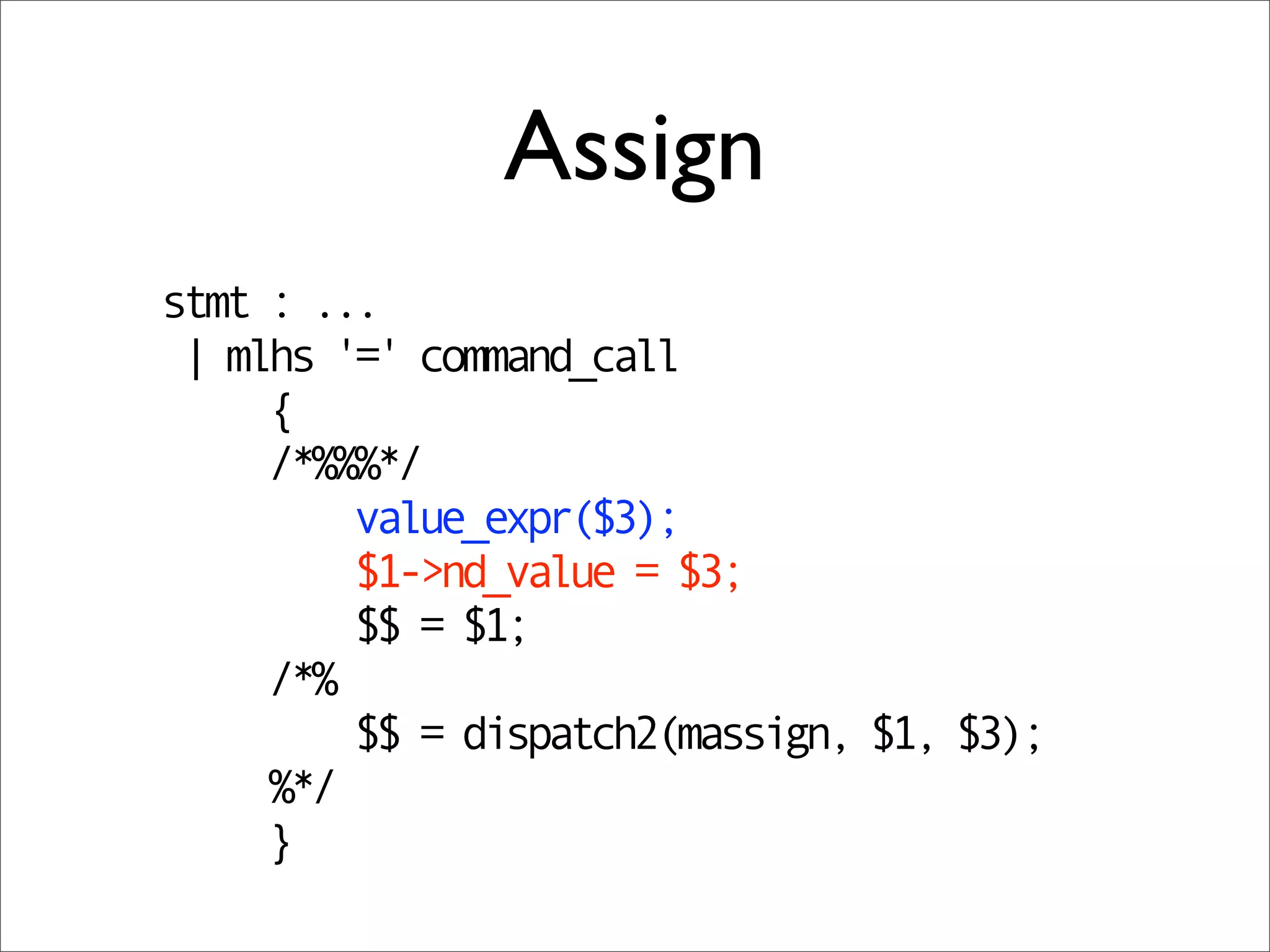
Assign
stmt : ...
 | mlhs '=' command_call
     {
     /*%%%*/
         value_expr($3);
         $1->nd_value = $3;
         $$ = $1;
     /*%
         $$ = dispatch2(massign, $1, $3);
     %*/
     }
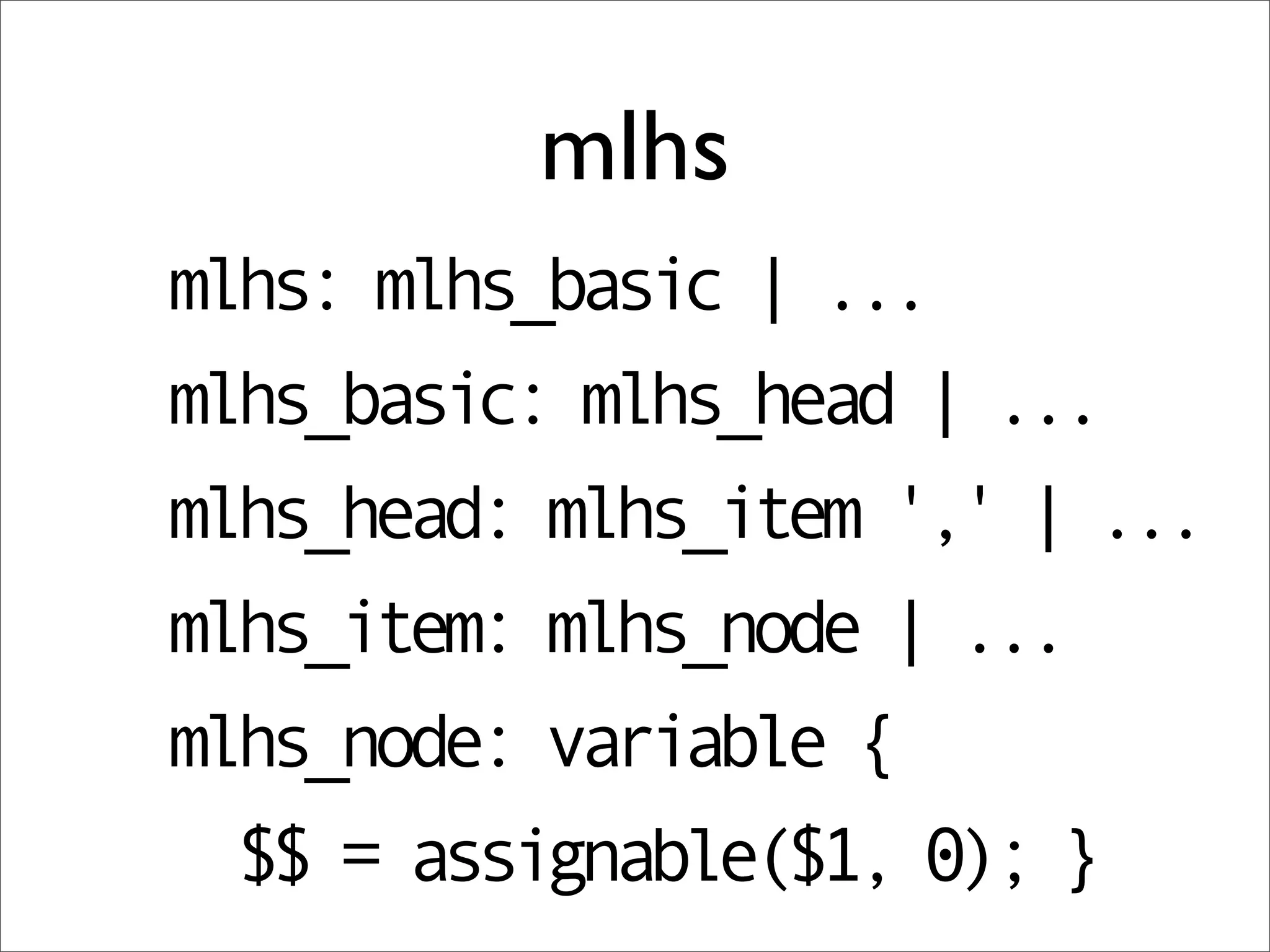
mlhs
mlhs: mlhs_basic | ...
mlhs_basic: mlhs_head | ...
mlhs_head: mlhs_item ',' | ...
mlhs_item: mlhs_node | ...
mlhs_node: variable {
  $$ = assignable($1, 0); }
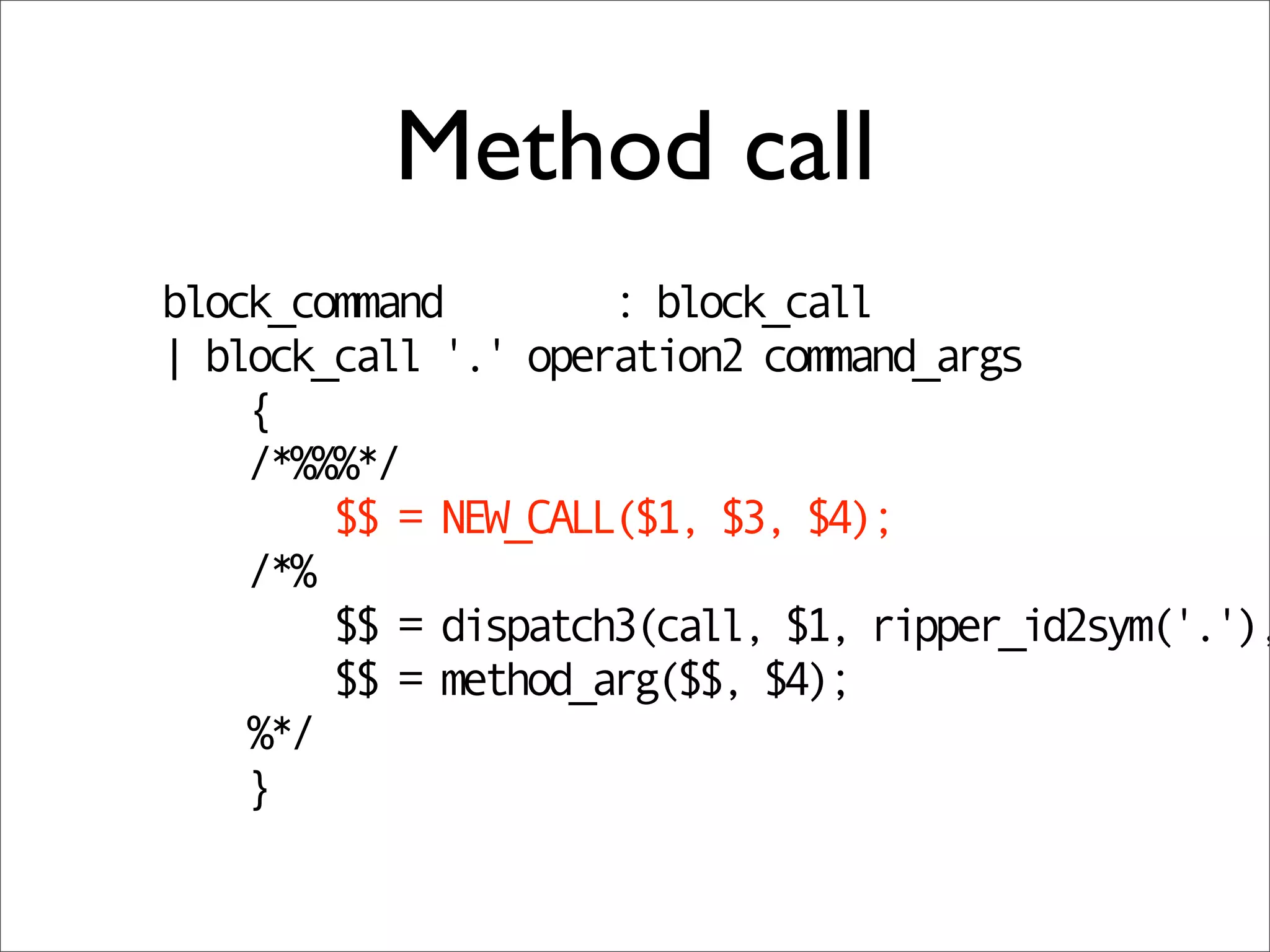
Method call
block_command        : block_call
| block_call '.' operation2 command_args
    {
    /*%%%*/
        $$ = NEW_CALL($1, $3, $4);
    /*%
        $$ = dispatch3(call, $1, ripper_id2sym('.'),
        $$ = method_arg($$, $4);
    %*/
    }
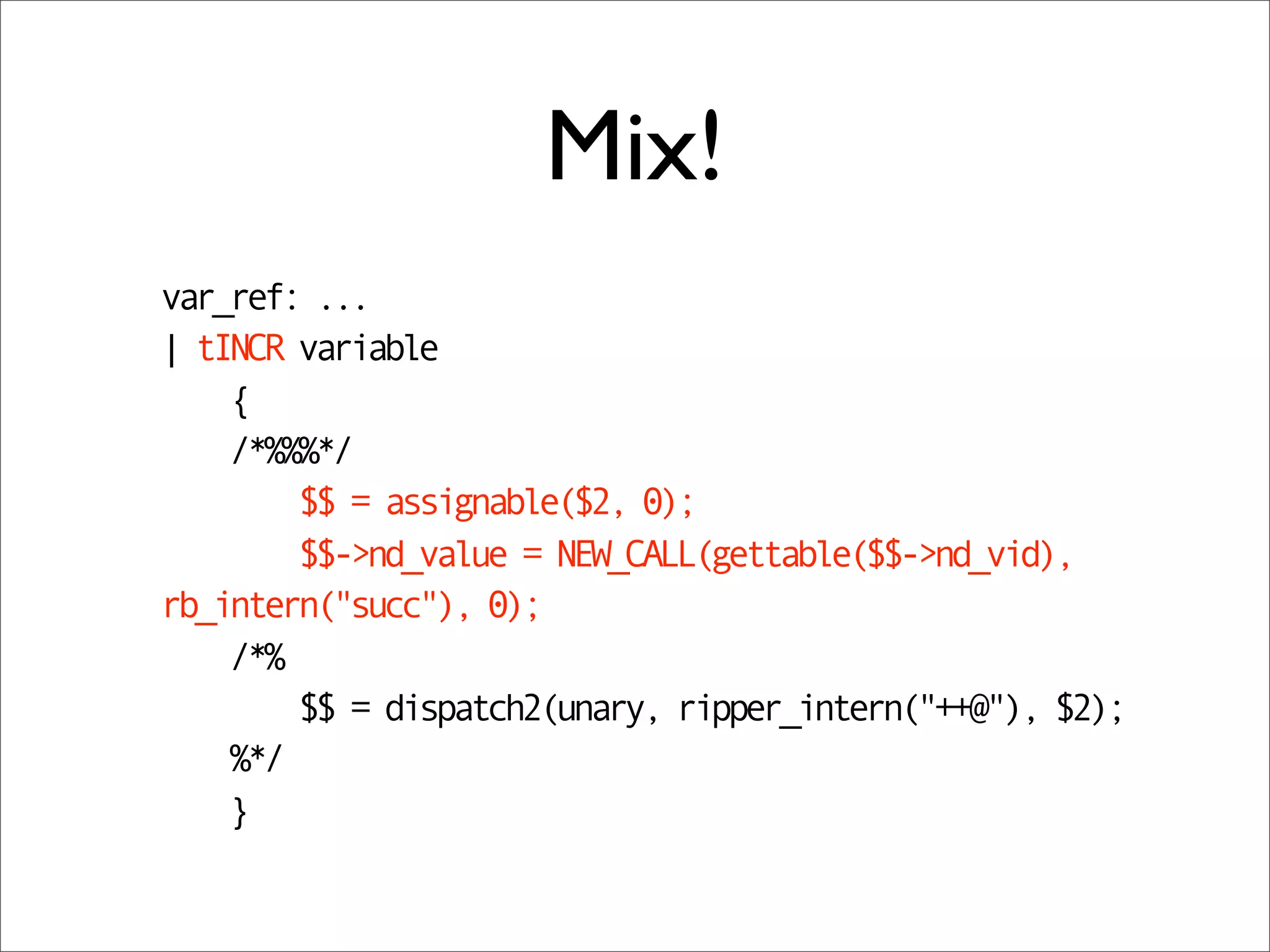
Mix!
var_ref: ...
| tINCR variable
    {
    /*%%%*/
        $$ = assignable($2, 0);
        $$->nd_value = NEW_CALL(gettable($$->nd_vid),
rb_intern("succ"), 0);
    /*%
        $$ = dispatch2(unary, ripper_intern("++@"), $2);
    %*/
    }
++ruby
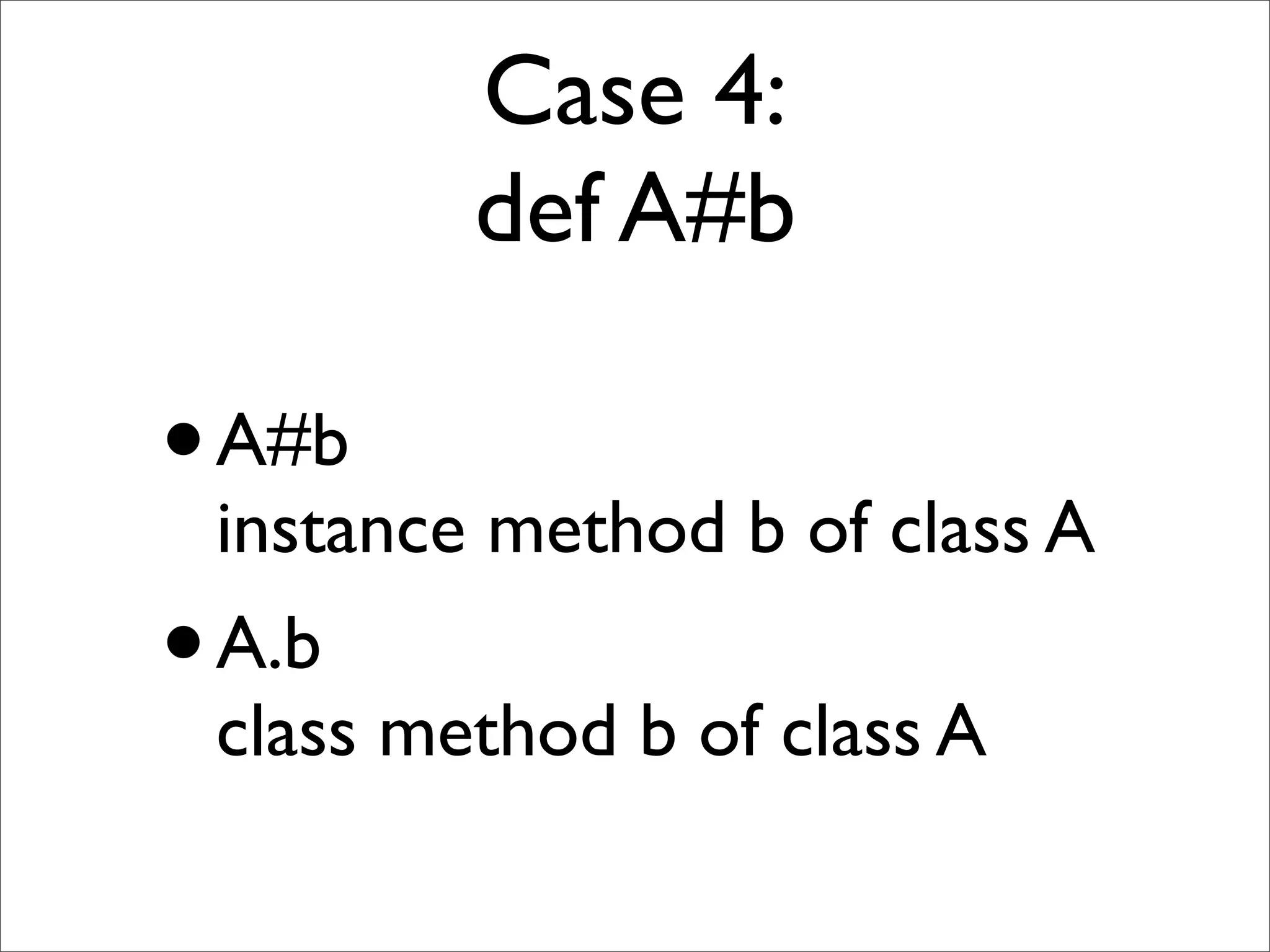
Case 4:
         def A#b

• A#b
 instance method b of class A
• A.b
 class method b of class A
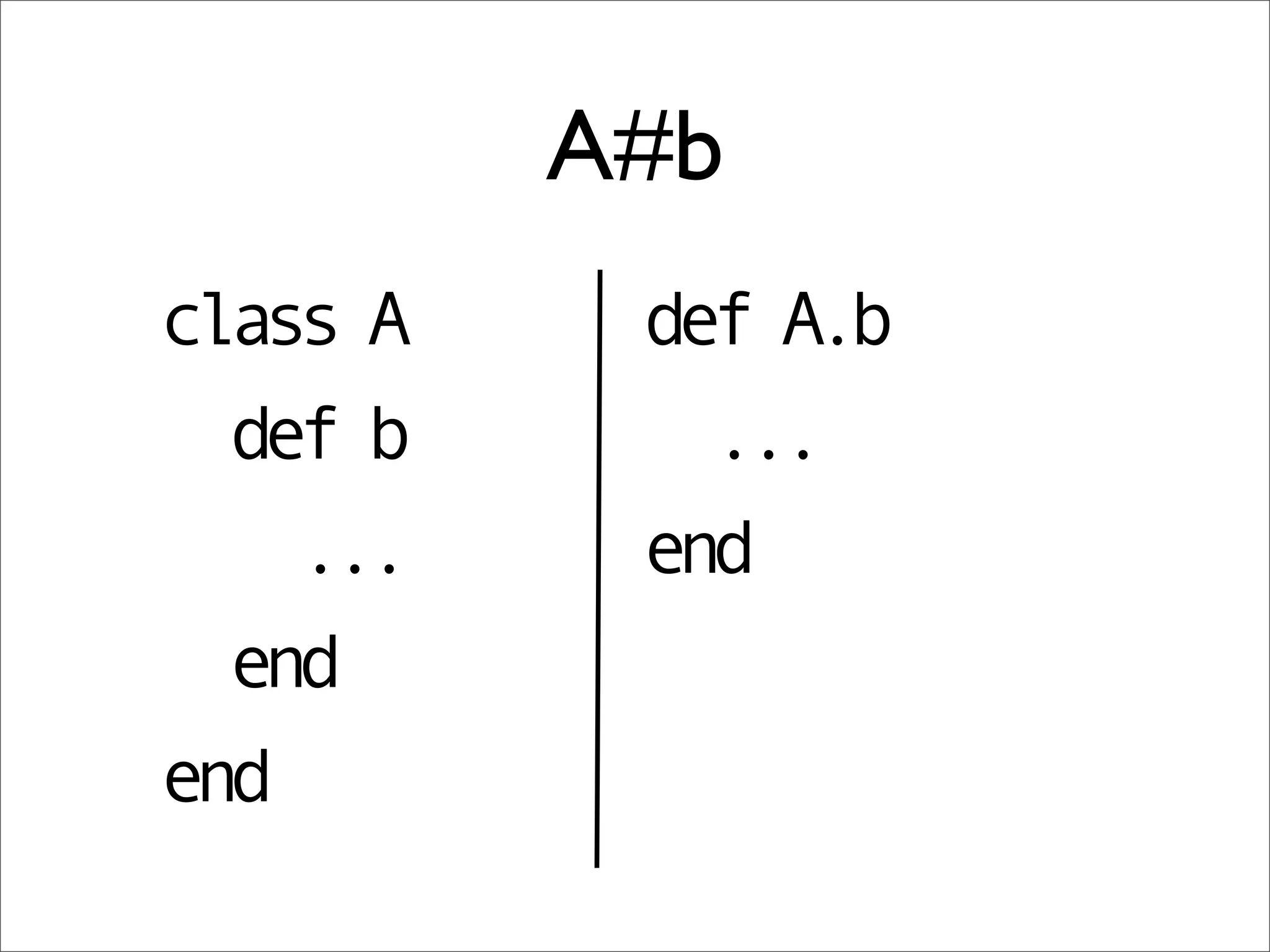
A#b
class A    def A.b
  def b      ...
    ...    end
  end
end
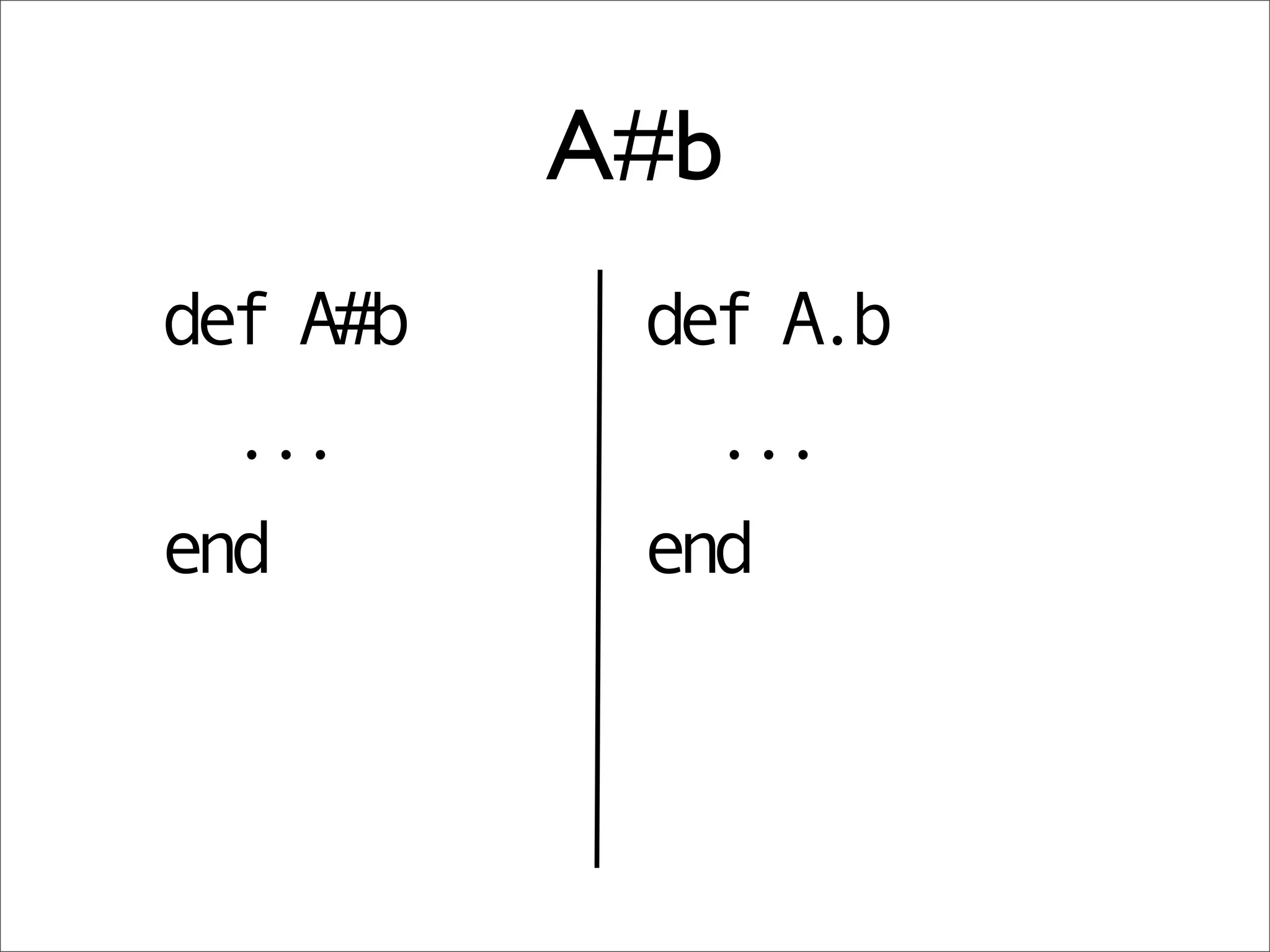
A#b
def A#b    def A.b
  ...        ...
end        end
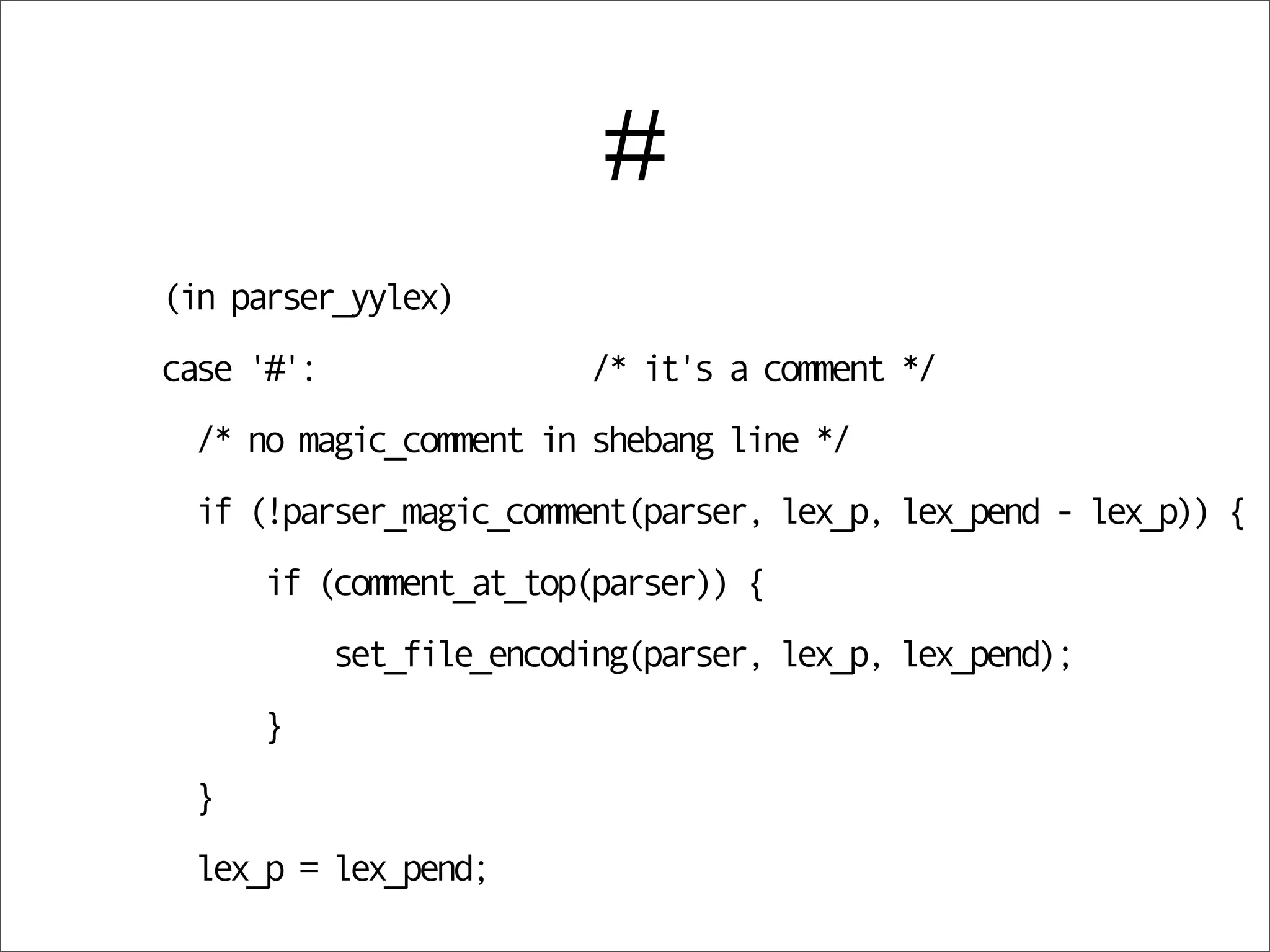
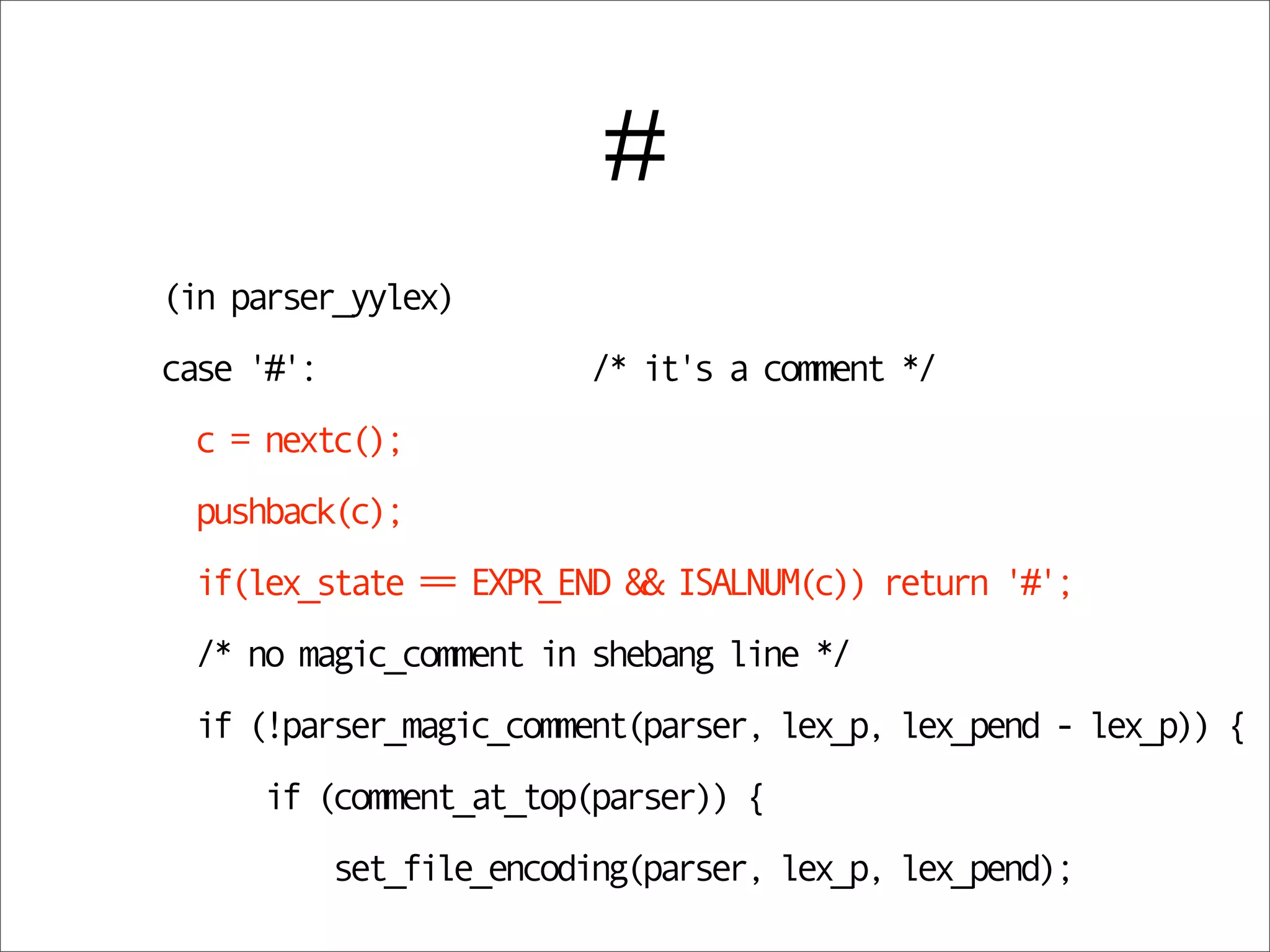
#
(in parser_yylex)
case '#':                 /* it's a comment */
 /* no magic_comment in shebang line */
 if (!parser_magic_comment(parser, lex_p, lex_pend - lex_p)) {
     if (comment_at_top(parser)) {
            set_file_encoding(parser, lex_p, lex_pend);
     }
 }
 lex_p = lex_pend;
#
(in parser_yylex)
case '#':                 /* it's a comment */
 c = nextc();
 pushback(c);
 if(lex_state == EXPR_END && ISALNUM(c)) return '#';
 /* no magic_comment in shebang line */
 if (!parser_magic_comment(parser, lex_p, lex_pend - lex_p)) {
     if (comment_at_top(parser)) {
            set_file_encoding(parser, lex_p, lex_pend);
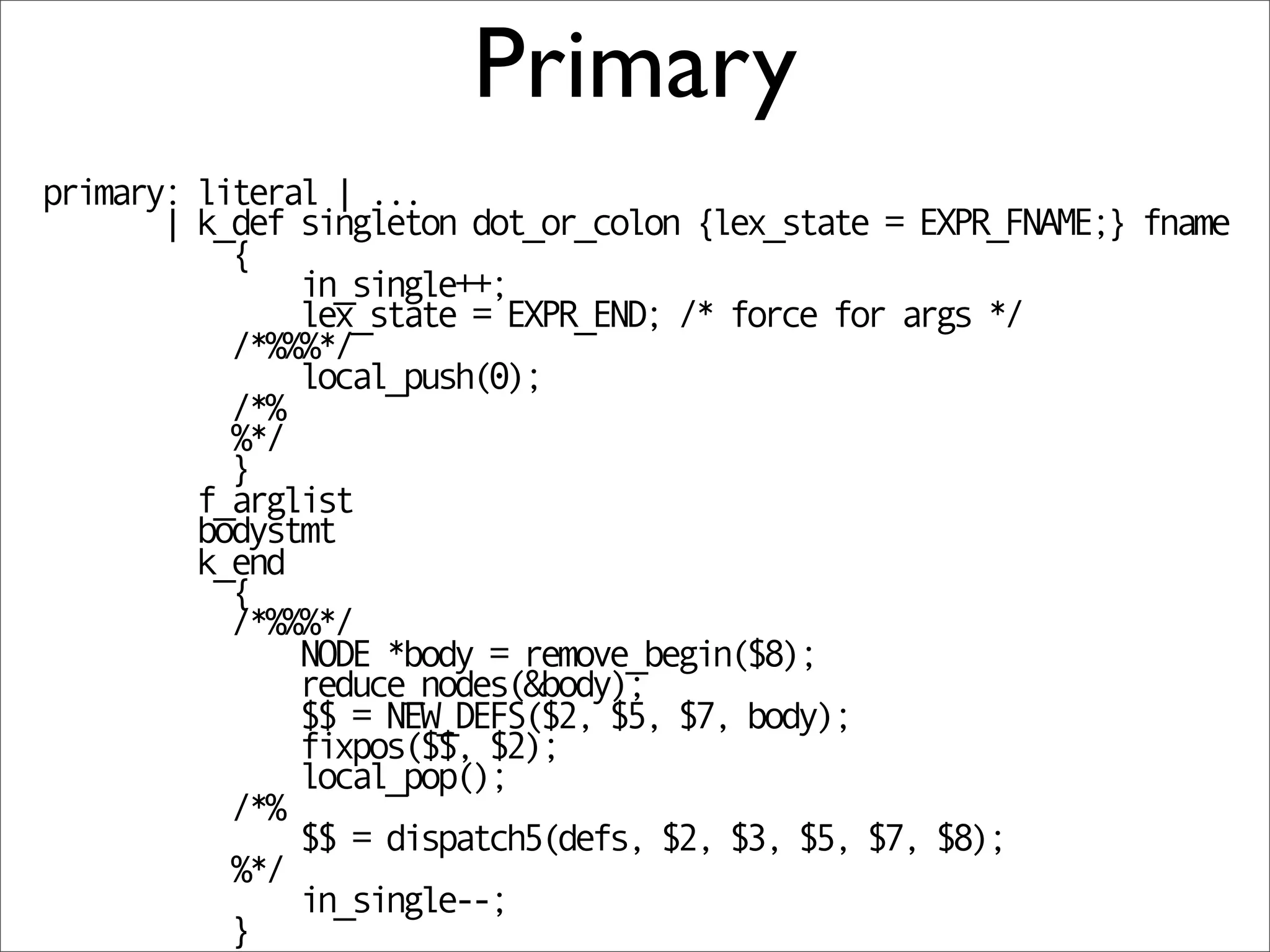
Primary
primary: literal | ...
       | k_def singleton dot_or_colon {lex_state = EXPR_FNAME;} fname
           {
               in_single++;
               lex_state = EXPR_END; /* force for args */
           /*%%%*/
               local_push(0);
           /*%
           %*/
           }
         f_arglist
         bodystmt
         k_end
           {
           /*%%%*/
               NODE *body = remove_begin($8);
               reduce_nodes(&body);
               $$ = NEW_DEFS($2, $5, $7, body);
               fixpos($$, $2);
               local_pop();
           /*%
               $$ = dispatch5(defs, $2, $3, $5, $7, $8);
           %*/
               in_single--;
           }
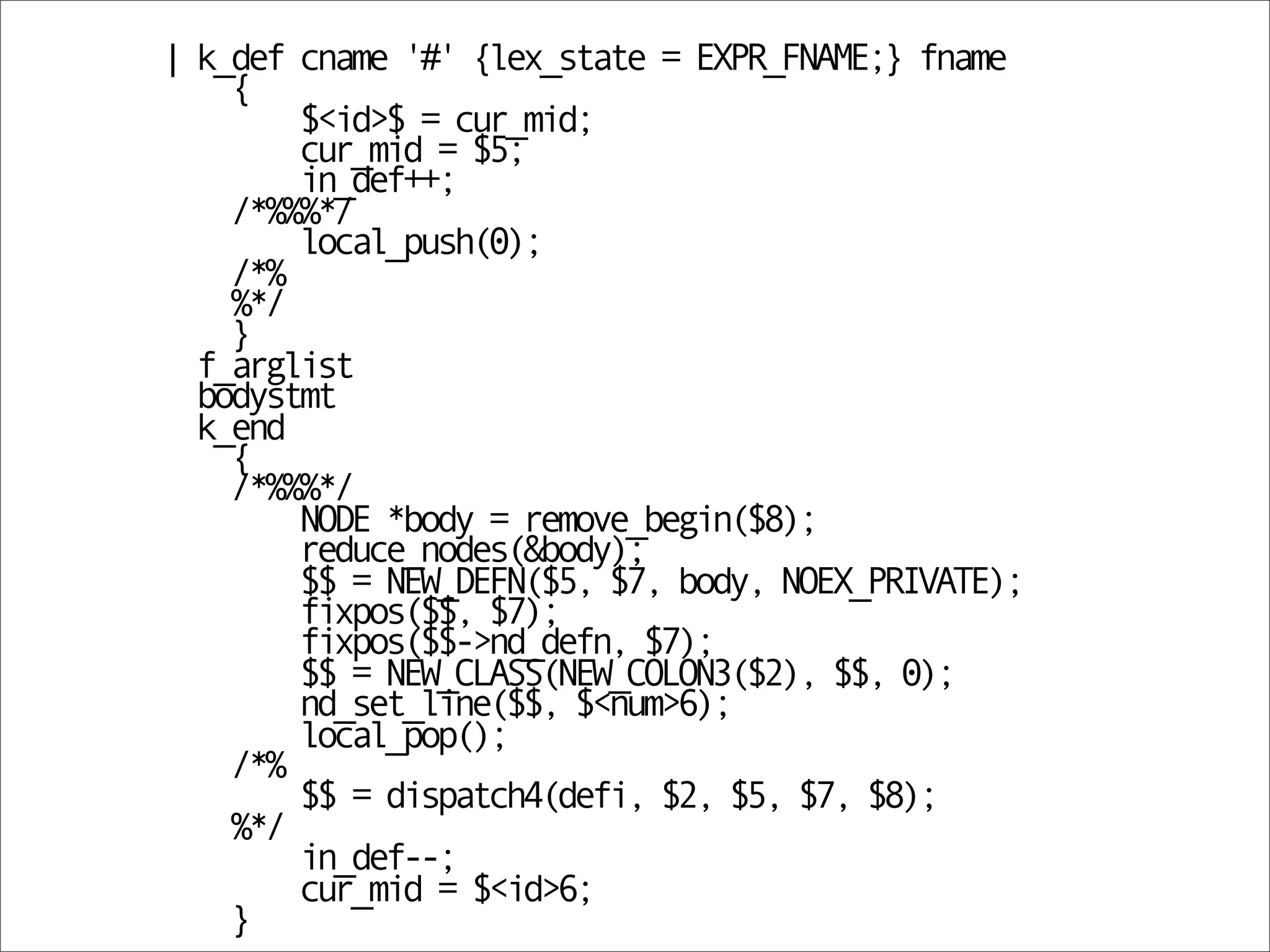
| k_def cname '#' {lex_state = EXPR_FNAME;} fname
    {
        $<id>$ = cur_mid;
        cur_mid = $5;
        in_def++;
    /*%%%*/
        local_push(0);
    /*%
    %*/
    }
  f_arglist
  bodystmt
  k_end
    {
    /*%%%*/
        NODE *body = remove_begin($8);
        reduce_nodes(&body);
        $$ = NEW_DEFN($5, $7, body, NOEX_PRIVATE);
        fixpos($$, $7);
        fixpos($$->nd_defn, $7);
        $$ = NEW_CLASS(NEW_COLON3($2), $$, 0);
        nd_set_line($$, $<num>6);
        local_pop();
    /*%
        $$ = dispatch4(defi, $2, $5, $7, $8);
    %*/
        in_def--;
        cur_mid = $<id>6;
    }
Reference
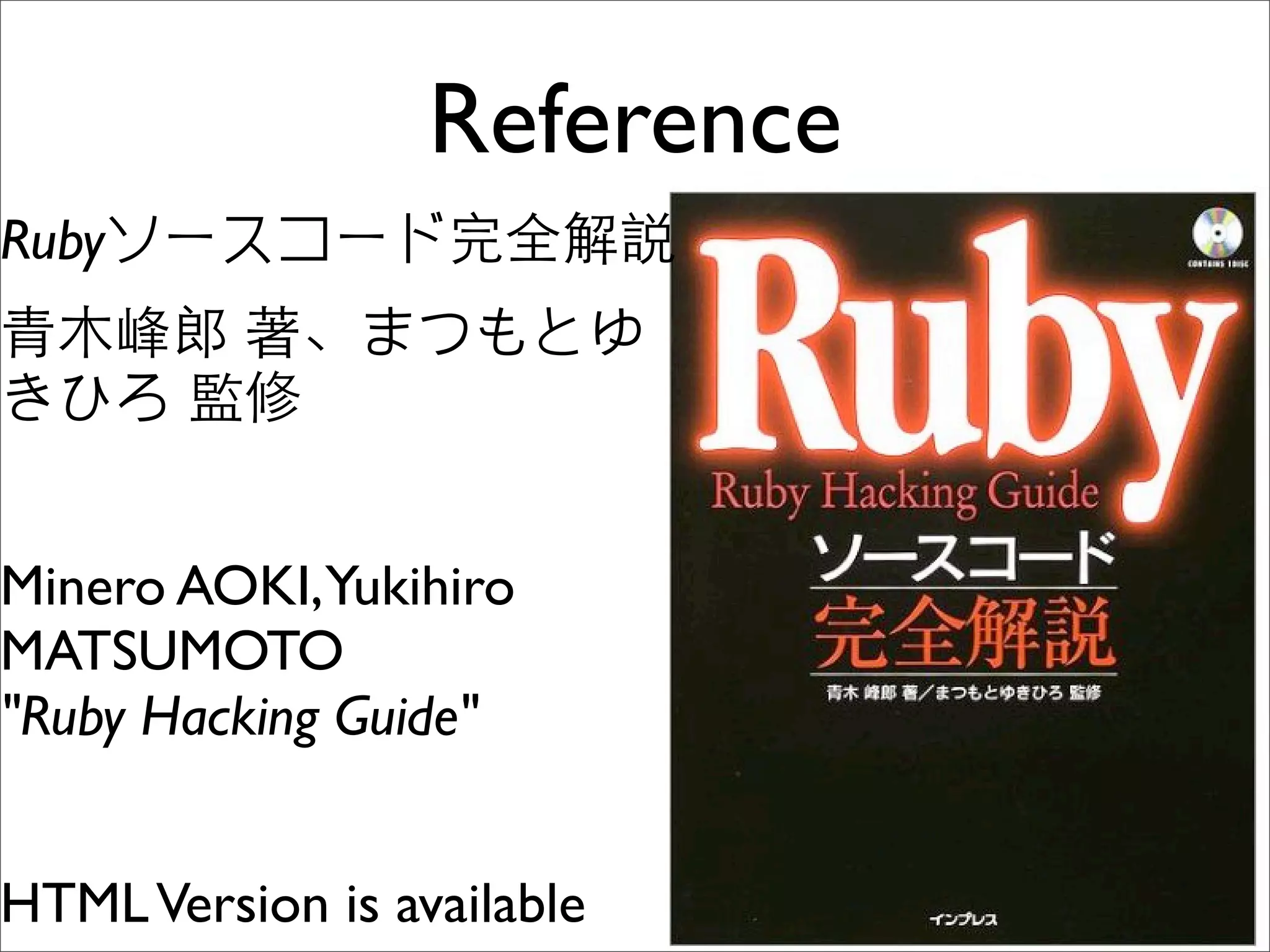
Ruby


Minero AOKI,Yukihiro
MATSUMOTO
"Ruby Hacking Guide"


HTML Version is available
Reference


• My blog
 http://ujihisa.blogspot.com
• All patches I showed are there
end
Appendix:
Imaginary Numbers
• Matz wrote a patch in
 [ruby-dev:38843]
• translation:
 [ruby-core:24730]
• It won't be accepted
Appendix:
 Imaginary Numbers

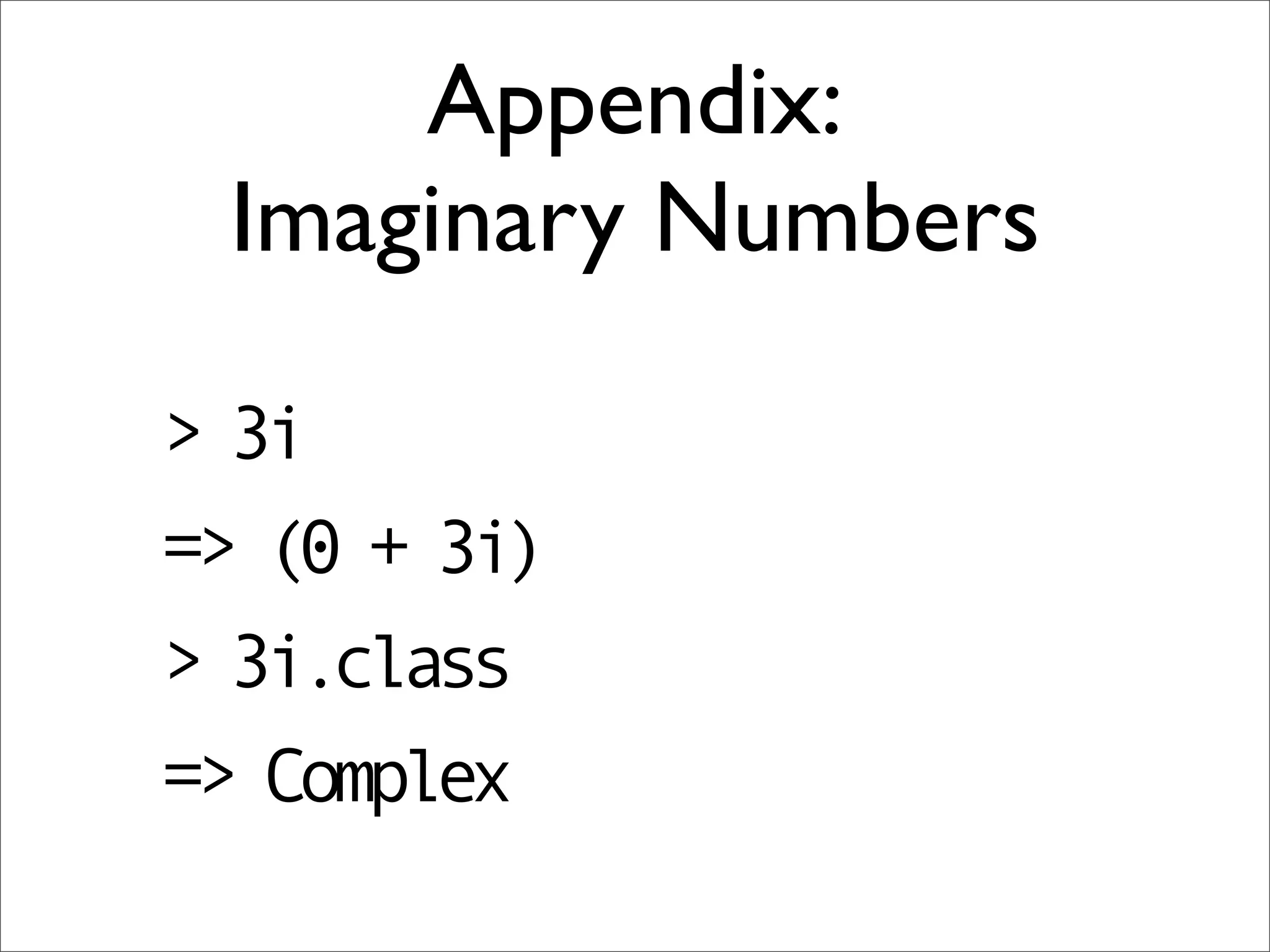
> 3i
=> (0 + 3i)
> 3i.class
=> Complex
Applendix2:
  I'm looking for job!
• ujihisa at gmail com
• Ruby, Rails, Merb, Sinatra, etc
• C, JavaScript,Vim script,
 HTML, Java, Haskell, Scheme
• Fluent in Japanese

Hacking Parse.y with ujihisa

  • 1.
    Hacking parse.y Tatsuhiro UJIHISA
  • 2.
    Me • Ruby experience:4 years • Rails application • Data mining tool • Learning English here: 5 mths • Looking for a job!
  • 3.
    Me • Presentations inJapan • Kansai Ruby Workshop • RubyKaigi2008, 2009
  • 5.
    This is myfirst English presentation.
  • 6.
    Hacking parse.y Fixing rubyparser to understand ruby • Introducing new syntax • {:key :-) "value"} • 'symbol • ++i • def A#b(c)
  • 7.
    MRI Inside • MRI(Matz Ruby Implementation) • $ ruby -v ruby 1.9.2dev (2009-08-05 trunk 24397) [i386-darwin9.7.0] • Written in C • array.c, vm.c, gc.c, etc...
  • 8.
    ruby 1.8 vs1.9 • ~1.8 • Parser: parse.y • Evaluator: eval.c • 1.9~ • Parser: parse.y • Evaluator:YARV (vm*.c)
  • 9.
    Matz said • Ugly:eval.c and parse.y RubyConf2006 • Now the original evaluator was all replaced with YARV
  • 10.
    MRI Parser • MRIuses yacc (parser generator for C) • parse.y-o y.tab.c parse.y bison -d sed -f ./tool/ytab.sed -e "/^#/s!y.tab.c! parse.c!" y.tab.c > parse.c.new ...
  • 11.
    parse.y • One ofthe darkest side • $ wc -l *{c,h,y} | sort -n ... 9261 io.c 10350 parse.y 16352 parse.c # (automatically generated) 183370 total
  • 12.
    (Broad) Parser • Lexer(yylex) • Bytes → Symbols • Parser (yyparse) • Symbols → Syntax Tree
  • 13.
    Tokens in Lexer %token <id> tOP_ASGN /* +=, -= et %token tUPLUS /* unary+ */ %token tASSOC /* => */ %token tUMINUS /* unary- */ %token tLPAREN /* ( */ %token tPOW /* ** */ %token tLPAREN_ARG /* ( */ %token tCMP /* <=> */ %token tRPAREN /* ) */ %token tEQ /* == */ %token tLBRACK /* [ */ %token tEQQ /* === */ %token tLBRACE /* { */ %token tNEQ /* != */ %token tLBRACE_ARG /* { */ %token tGEQ /* >= */ %token tSTAR /* * */ %token tLEQ /* <= */ %token tAMPER /* & */ %token tANDOP tOROP /* && and || */ %token tLAMBDA /* -> */ %token tMATCH tNMATCH/* =~ and !~ */ %token tSYMBEG tSTRING_BEG tXSTRING_ %token tDOT2 tDOT3 /* .. and ... */ tWORDS_BEG tQWORDS_BEG %token tAREF tASET /* [] and []= */ %token tSTRING_DBEG tSTRING_DVAR tST %token tLSHFT tRSHFT /* << and >> */ %token tCOLON2 /* :: */ %token tCOLON3 /* :: at EXPR_BEG */
  • 14.
    (detour) n MRI: parse.y (10350 lines) n JRuby: src/org/jruby/parser/{DefaultRubyParser.y, Ruby19Parser.y} (1886, 2076 lines) n Rubinius: lib/ruby_parser.y (1795 lines)
  • 15.
    Case 1: :-) • Hash literal {:key => 'value'} {:key :-) 'value'} • :-) is just an alias of =>
  • 16.
  • 17.
    Colons in Ruby •A::B, ::C • :symbol, :"sy-m-bol" •a ? b : c • {a: b} • when 1: something (in 1.8)
  • 18.
    static int parser_yylex(struct parser_params*parser) { ... switch (c = nextc()) { ... case '#': /* it's a comment */ ... case ':': c = nextc(); if (c == ':') { if (IS_BEG() ||... ... } ... (about 1300 lines)
  • 19.
    How does parserdeal with colon? • :: → tCOLON2 or tCOLON3 • tCOLON2 Net::URI • tCOLON3 ::Kernel
  • 20.
    lex_state enum lex_state_e { EXPR_BEG, /* ignore newline, +/- is a sign. */ EXPR_END, /* newline significant, +/- is an operator. * EXPR_ENDARG, /* ditto, and unbound braces. */ EXPR_ARG, /* newline significant, +/- is an operator. * EXPR_CMDARG, /* newline significant, +/- is an operator. * EXPR_MID, /* newline significant, +/- is an operator. * EXPR_FNAME, /* ignore newline, no reserved words. */ EXPR_DOT, /* right after `.' or `::', no reserved words EXPR_CLASS, /* immediate after `class', no here document. EXPR_VALUE /* alike EXPR_BEG but label is disallowed. */ };
  • 21.
    case ':': c = nextc(); if (c == ':') { if (IS_BEG() || lex_state == EXPR_CLASS || (IS_ARG() && space_seen)) { lex_state = EXPR_BEG; return tCOLON3; } lex_state = EXPR_DOT; return tCOLON2; }
  • 22.
    ... if(lex_state == EXPR_END || lex_state == EXPR_ENDARG || (c != -1 && ISSPACE(c))) { pushback(c); lex_state = EXPR_BEG; return ':'; } switch (c) { case ''': lex_strterm = NEW_STRTERM(str_ssym, c, 0); break; case '"': lex_strterm = NEW_STRTERM(str_dsym, c, 0); break; default: pushback(c); break; } lex_state = EXPR_FNAME; return tSYMBEG;
  • 23.
    How does parserdeal with colon? (summary) • :: → tCOLON2 or tCOLON2 • EXPR_END or →: (else) • otherwise → tSYMBEG • :' → str_ssym • :" → str_dsym
  • 24.
    So, • :-) →tASSOC • :: → tCOLON2 or tCOLON2 • EXPR_END or →: (else) • otherwise → tSYMBEG • :' → str_ssym • :" → str_dsym
  • 25.
  • 26.
    Case 2: Lisp Like Symbol • Symbol Literal :vancouver 'vancouver • Ad-hoc p :a, :b p 'a, 'b
  • 27.
    Single Quote (in parser_yylex) ... case''': lex_strterm = NEW_STRTERM(str_squote, ''', 0); return tSTRING_BEG; ...
  • 28.
    Single Quote (in parser_yylex) ... case''': if (??? condition ???) { lex_state = EXPR_FNAME; return tSYMBEG; } lex_strterm = NEW_STRTERM(str_squote, ''', 0); return tSTRING_BEG; ...
  • 29.
    (loop (lambda(p 'good)))
  • 30.
    Case3: Pre Incremental Operator •++i • i = i.succ (NOT i = i + 1)
  • 31.
    Lexer @@ -685,6 +685,7@@ static void token_info_pop(struct parser_params*, const char *token); %type <val> program reswords then do dot_or_colon %*/ %token tUPLUS /* unary+ */ +%token tINCR /* ++var */ %token tUMINUS /* unary- */ %token tPOW /* ** */ %token tCMP /* <=> */ (Actually there are more trivial fixes)
  • 32.
    regenerate id.h • id.his automatically generated by parse.y in make • $ rm id.h $ make
  • 33.
    parser example variable : tIDENTIFIER | tIVAR | tGVAR | tCONSTANT | tCVAR | keyword_nil {ifndef_ripper($$ = keyword_nil);} | keyword_self {ifndef_ripper($$ = keyword_self);} | keyword_true {ifndef_ripper($$ = keyword_true);} | keyword_false {ifndef_ripper($$ = keyword_false);} | keyword__FILE__ {ifndef_ripper($$ = keyword__FILE__);} | keyword__LINE__ {ifndef_ripper($$ = keyword__LINE__);} | keyword__ENCODING__ {ifndef_ripper($$ = keyword__ENCODING_ ;
  • 34.
    lhs : variable { /*%%%*/ if (!($$ = assignable($1, 0))) $$ = NEW_BEGIN(0); /*% $$ = dispatch1(var_field, $1); %*/ } | primary_value '[' opt_call_args rbracket { /*%%%*/ $$ = aryset($1, $3); /*% $$ = dispatch2(aref_field, $1, escape_Qundef($3)); %*/ } ...
  • 35.
    BNF (part) program : compstmt arg : lhs '=' arg | var_lhs tOP_ASGN arg compstmt : stmts opt_terms | primary_value '[' aref_args ']' tOP stmts : none | stmt | arg '?' arg ':' arg | stmts terms stmt | primary stmt : kALIAS fitem fitem primary : literal | kALIAS tGVAR tGVAR | strings | expr | tLPAREN_ARG expr ')' | tLPAREN compstmt ')' expr : kRETURN call_args | kBREAK call_args | kREDO | kRETRY | '!' command_call | arg
  • 36.
    Assign stmt : ... | mlhs '=' command_call { /*%%%*/ value_expr($3); $1->nd_value = $3; $$ = $1; /*% $$ = dispatch2(massign, $1, $3); %*/ }
  • 37.
    mlhs mlhs: mlhs_basic |... mlhs_basic: mlhs_head | ... mlhs_head: mlhs_item ',' | ... mlhs_item: mlhs_node | ... mlhs_node: variable { $$ = assignable($1, 0); }
  • 38.
    Method call block_command : block_call | block_call '.' operation2 command_args { /*%%%*/ $$ = NEW_CALL($1, $3, $4); /*% $$ = dispatch3(call, $1, ripper_id2sym('.'), $$ = method_arg($$, $4); %*/ }
  • 39.
    Mix! var_ref: ... | tINCRvariable { /*%%%*/ $$ = assignable($2, 0); $$->nd_value = NEW_CALL(gettable($$->nd_vid), rb_intern("succ"), 0); /*% $$ = dispatch2(unary, ripper_intern("++@"), $2); %*/ }
  • 40.
  • 41.
    Case 4: def A#b • A#b instance method b of class A • A.b class method b of class A
  • 42.
    A#b class A def A.b def b ... ... end end end
  • 43.
    A#b def A#b def A.b ... ... end end
  • 44.
    # (in parser_yylex) case '#': /* it's a comment */ /* no magic_comment in shebang line */ if (!parser_magic_comment(parser, lex_p, lex_pend - lex_p)) { if (comment_at_top(parser)) { set_file_encoding(parser, lex_p, lex_pend); } } lex_p = lex_pend;
  • 45.
    # (in parser_yylex) case '#': /* it's a comment */ c = nextc(); pushback(c); if(lex_state == EXPR_END && ISALNUM(c)) return '#'; /* no magic_comment in shebang line */ if (!parser_magic_comment(parser, lex_p, lex_pend - lex_p)) { if (comment_at_top(parser)) { set_file_encoding(parser, lex_p, lex_pend);
  • 46.
    Primary primary: literal |... | k_def singleton dot_or_colon {lex_state = EXPR_FNAME;} fname { in_single++; lex_state = EXPR_END; /* force for args */ /*%%%*/ local_push(0); /*% %*/ } f_arglist bodystmt k_end { /*%%%*/ NODE *body = remove_begin($8); reduce_nodes(&body); $$ = NEW_DEFS($2, $5, $7, body); fixpos($$, $2); local_pop(); /*% $$ = dispatch5(defs, $2, $3, $5, $7, $8); %*/ in_single--; }
  • 47.
    | k_def cname'#' {lex_state = EXPR_FNAME;} fname { $<id>$ = cur_mid; cur_mid = $5; in_def++; /*%%%*/ local_push(0); /*% %*/ } f_arglist bodystmt k_end { /*%%%*/ NODE *body = remove_begin($8); reduce_nodes(&body); $$ = NEW_DEFN($5, $7, body, NOEX_PRIVATE); fixpos($$, $7); fixpos($$->nd_defn, $7); $$ = NEW_CLASS(NEW_COLON3($2), $$, 0); nd_set_line($$, $<num>6); local_pop(); /*% $$ = dispatch4(defi, $2, $5, $7, $8); %*/ in_def--; cur_mid = $<id>6; }
  • 49.
  • 50.
    Reference • My blog http://ujihisa.blogspot.com • All patches I showed are there
  • 51.
  • 52.
    Appendix: Imaginary Numbers • Matzwrote a patch in [ruby-dev:38843] • translation: [ruby-core:24730] • It won't be accepted
  • 53.
    Appendix: Imaginary Numbers >3i => (0 + 3i) > 3i.class => Complex
  • 54.
    Applendix2: I'mlooking for job! • ujihisa at gmail com • Ruby, Rails, Merb, Sinatra, etc • C, JavaScript,Vim script, HTML, Java, Haskell, Scheme • Fluent in Japanese