Introducing of Bison天官2011-09-151
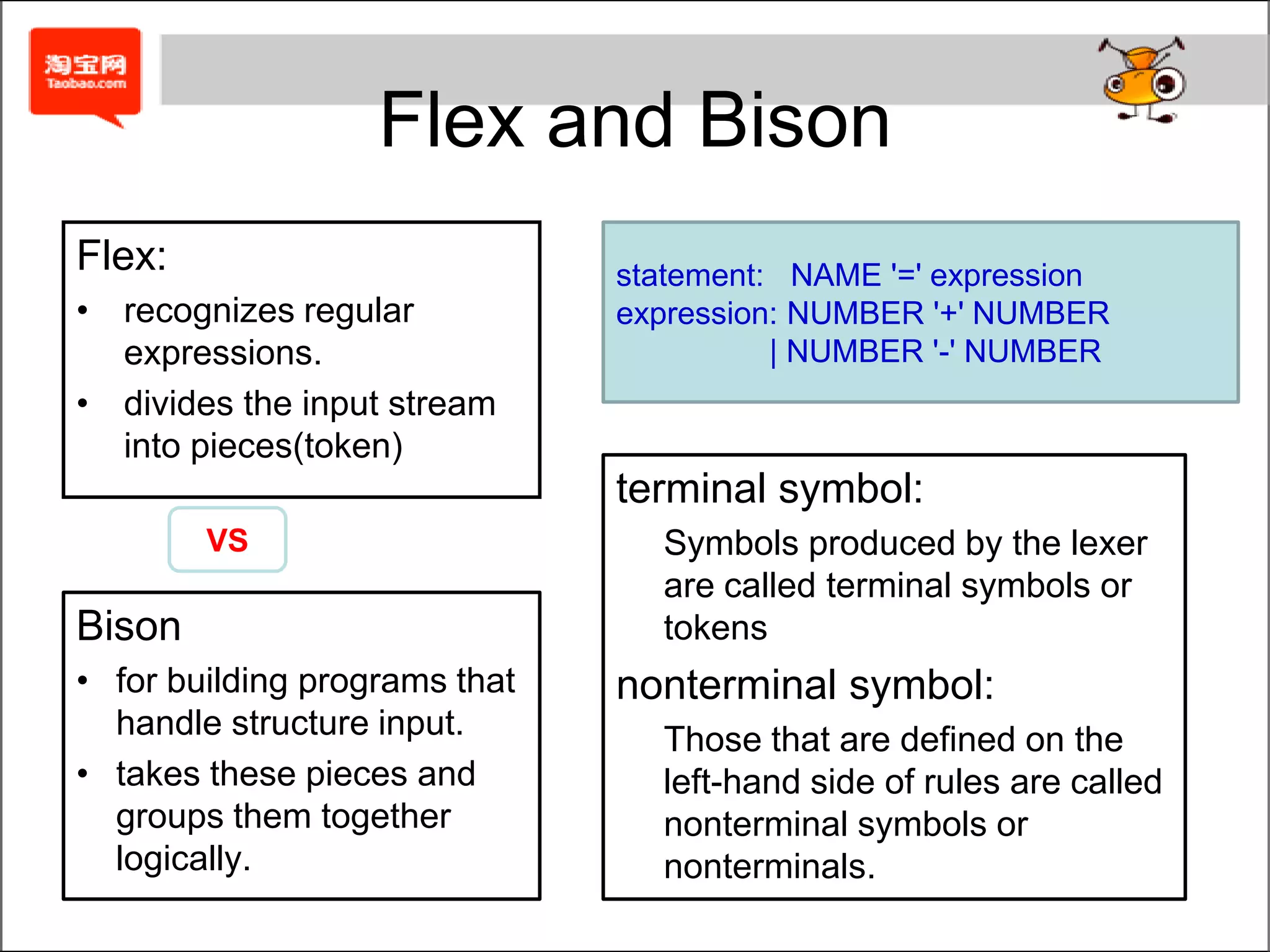
Flex and Bisonstatement:   NAME '=' expressionexpression: NUMBER '+' NUMBER	   | NUMBER '-' NUMBERFlex:recognizes regular expressions.divides the input stream into pieces(token)terminal symbol:	Symbols produced by the lexer are called terminal symbols or tokensnonterminal symbol:Those that are defined on the left-hand side of rules are called nonterminal symbols or nonterminals.VSBisonfor building programs that handle structure input.
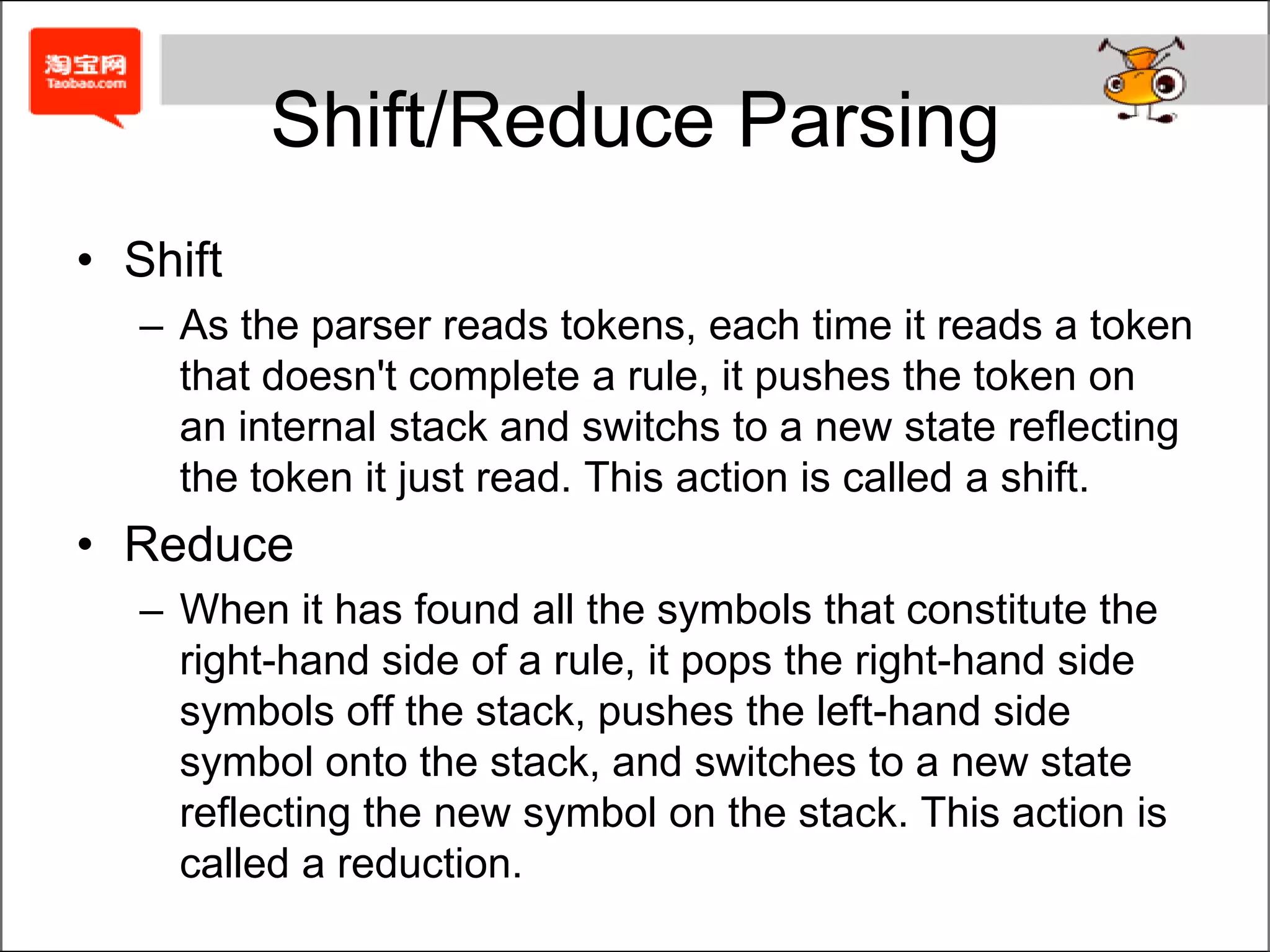
takes these pieces and groups them together logically.Shift/Reduce ParsingShiftAs the parser reads tokens, each time it reads a token that doesn't complete a rule, it pushes the token on an internal stack and switchs to a new state reflecting the token it just read. This action is called a shift.ReduceWhen it has found all the symbols that constitute the right-hand side of a rule, it pops the right-hand side symbols off the stack, pushes the left-hand side symbol onto the stack, and switches to a new state reflecting the new symbol on the stack. This action is called a reduction.
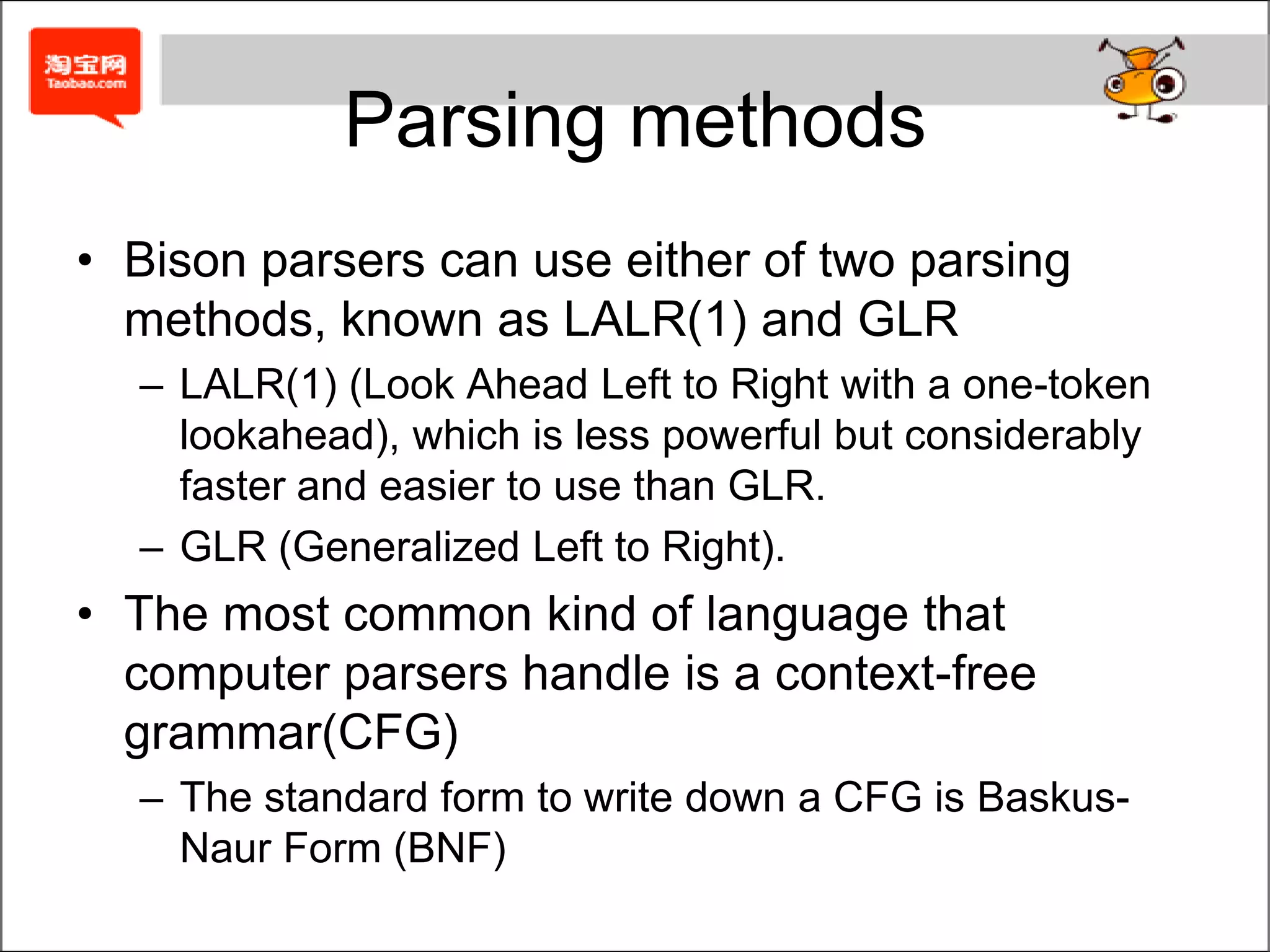
Parsing methodsBison parsers can use either of two parsing methods, known as LALR(1) and GLRLALR(1) (Look Ahead Left to Right with a one-token lookahead), which is less powerful but considerably faster and easier to use than GLR.GLR (Generalized Left to Right).The most common kind of language that computer parsers handle is a context-free grammar(CFG)The standard form to write down a CFG is Baskus-Naur Form (BNF)
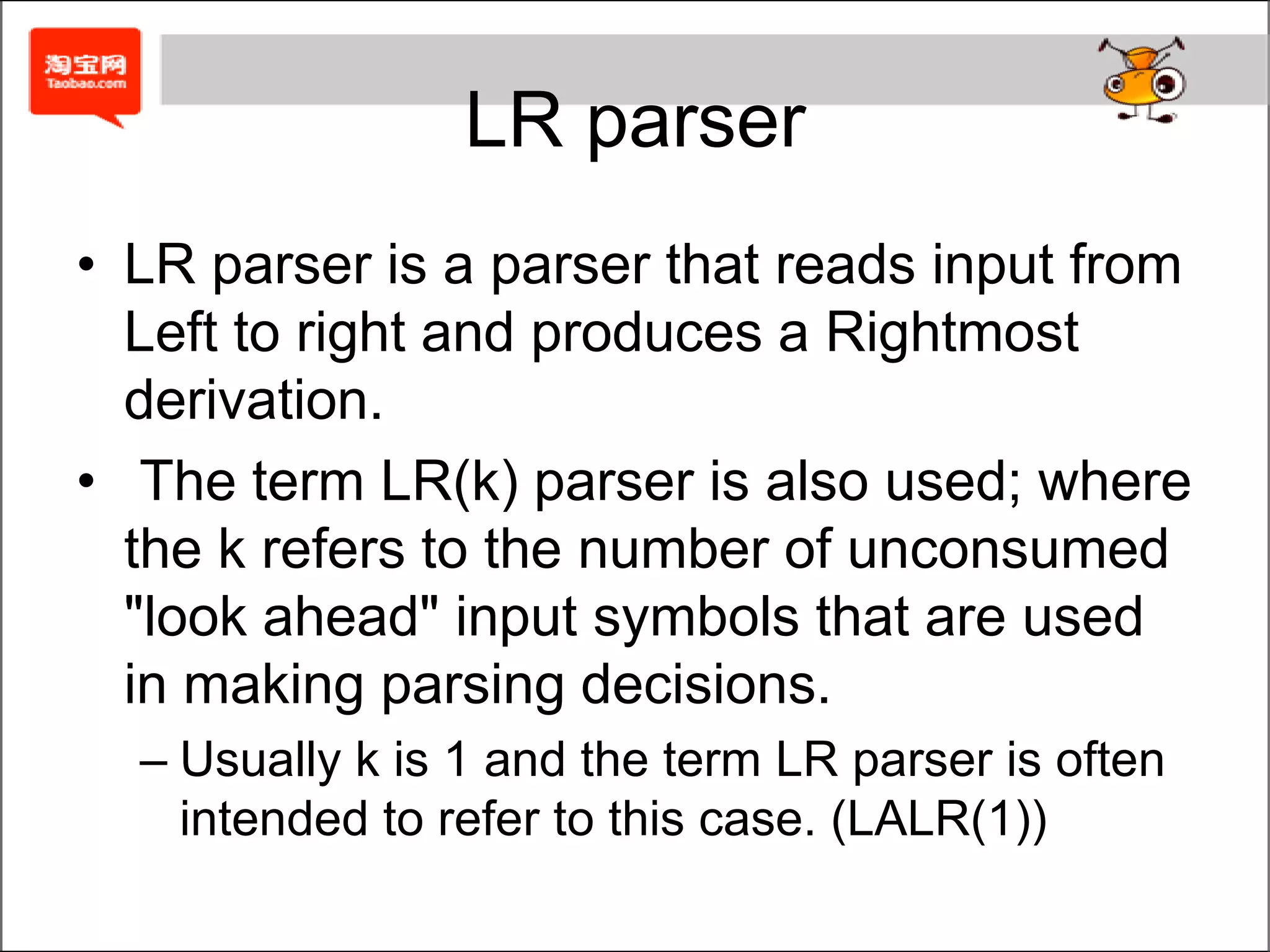
LR parserLR parser is a parser that reads input from Left to right and produces a Rightmost derivation. The term LR(k) parser is also used; where the k refers to the number of unconsumed "look ahead" input symbols that are used in making parsing decisions.Usually k is 1 and the term LR parser is often intended to refer to this case. (LALR(1))
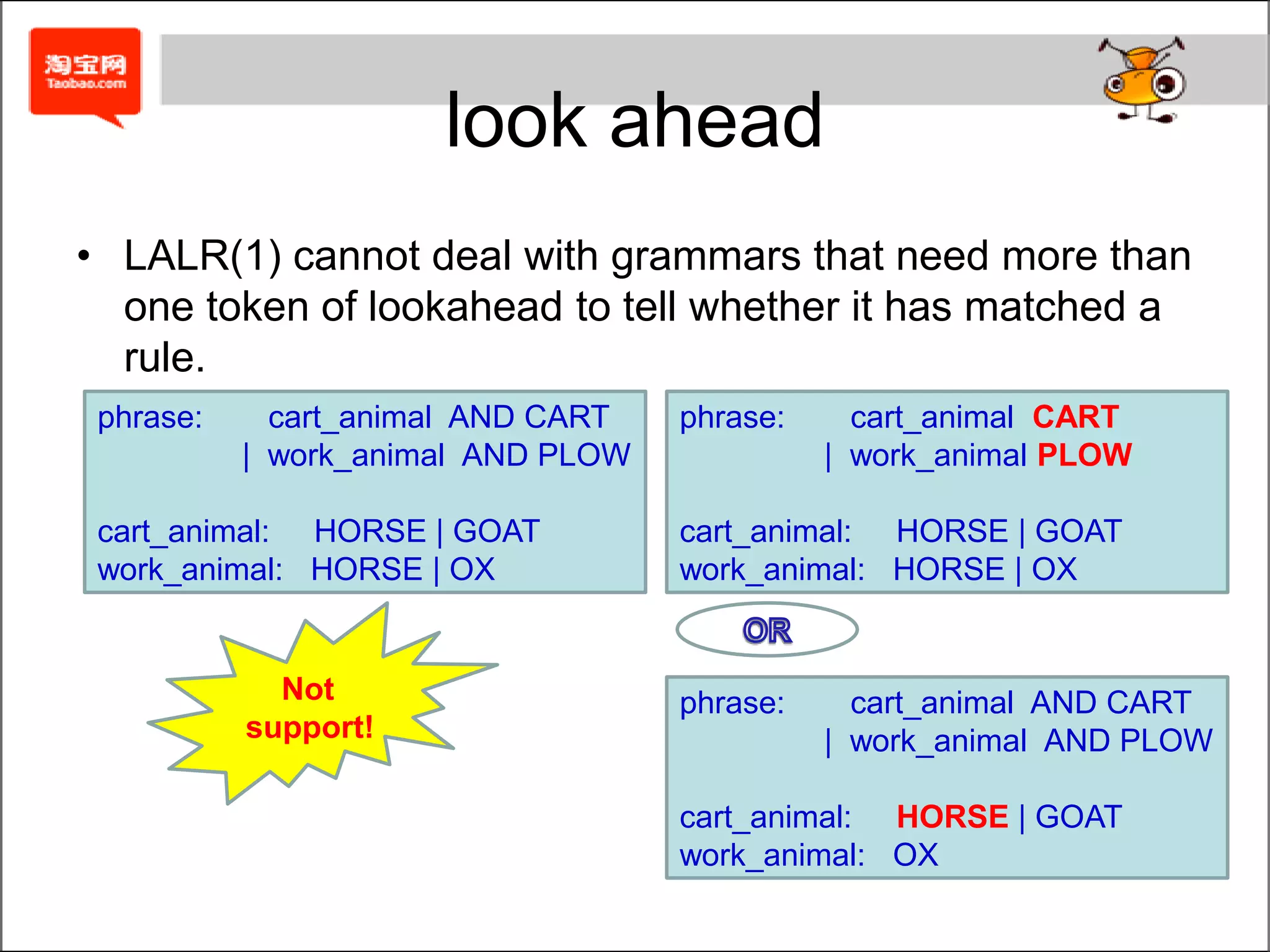
look aheadLALR(1) cannot deal with grammars that need more than one token of lookahead to tell whether it has matched a rule.phrase:	     cart_animal  AND CART	  |  work_animal  AND PLOWcart_animal:     HORSE | GOATwork_animal:   HORSE | OXphrase:	     cart_animalCART	  |  work_animalPLOWcart_animal:     HORSE | GOATwork_animal:   HORSE | OXNot support!ORphrase:	     cart_animal  AND CART	  |  work_animal  AND PLOWcart_animal:     HORSE | GOATwork_animal:   OX
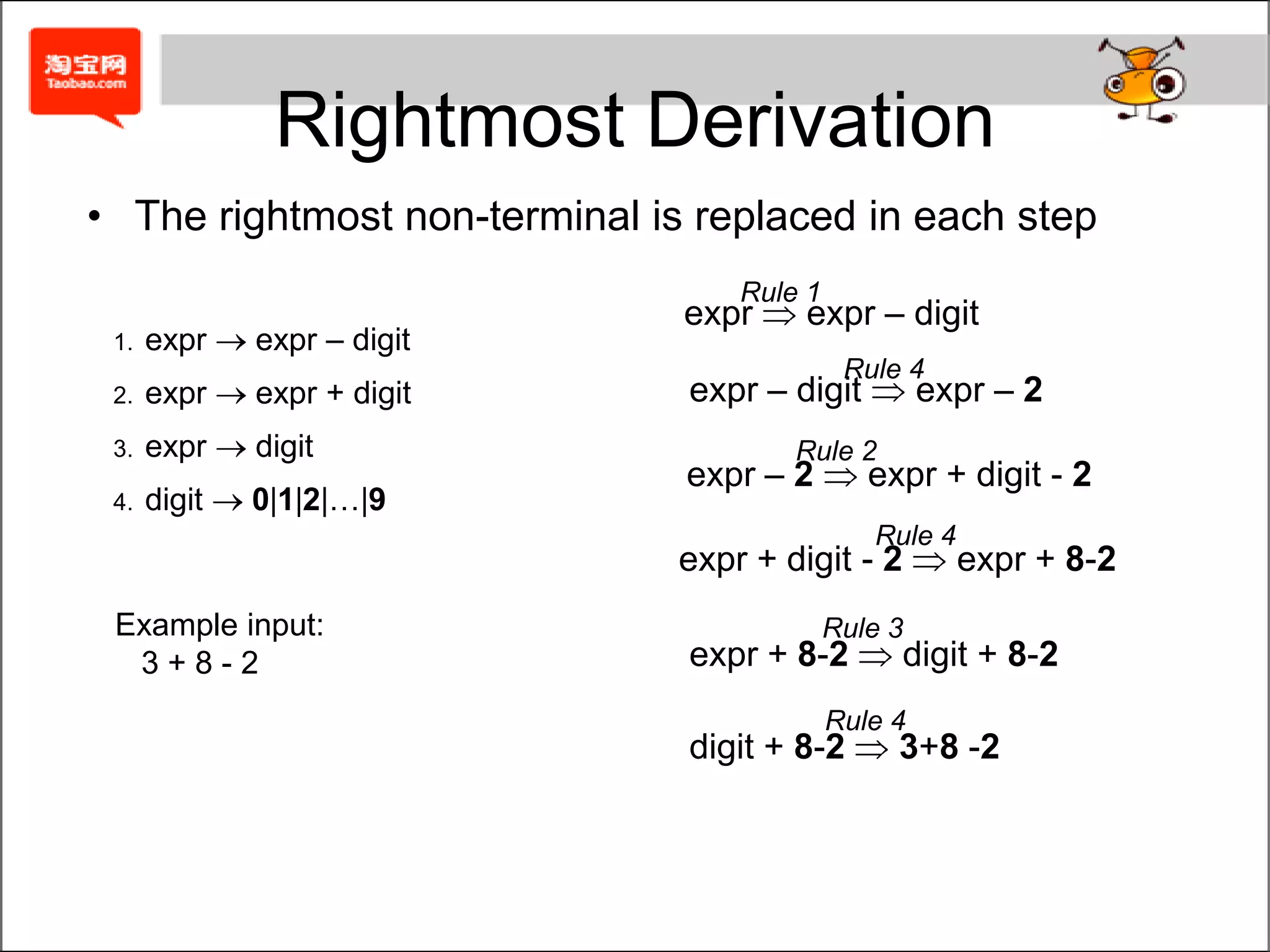
Rightmost DerivationRule 1expr  expr – digitexprexpr – digitexprexpr + digitexpr digitdigit 0|1|2|…|9Example input:   3 + 8 - 2The rightmost non-terminal is replaced in each stepRule 4expr – digit  expr – 2Rule 2expr – 2 expr + digit - 2Rule 4expr + digit - 2  expr + 8-2Rule 3expr + 8-2 digit + 8-2Rule 4digit + 8-23+8 -2
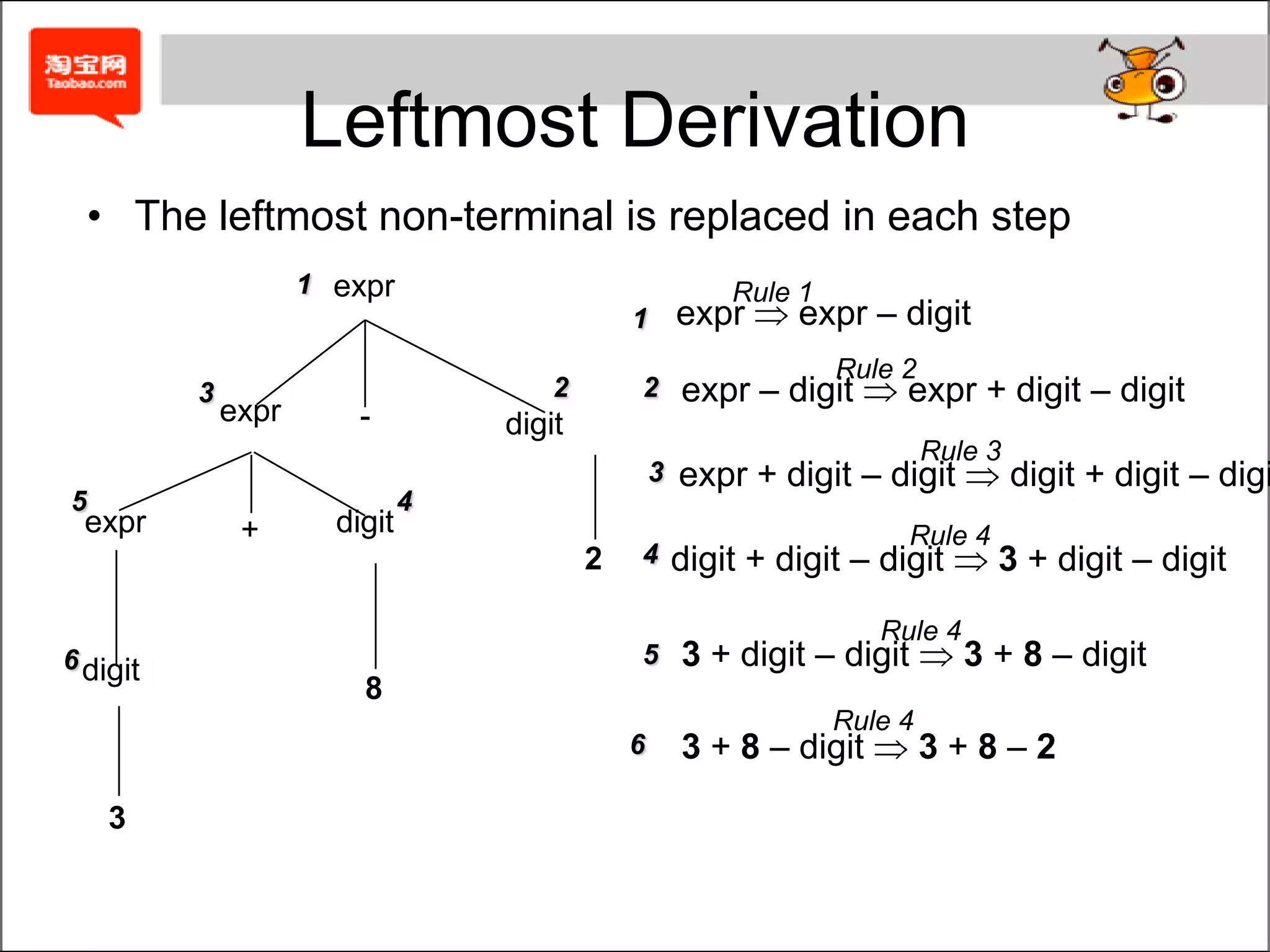
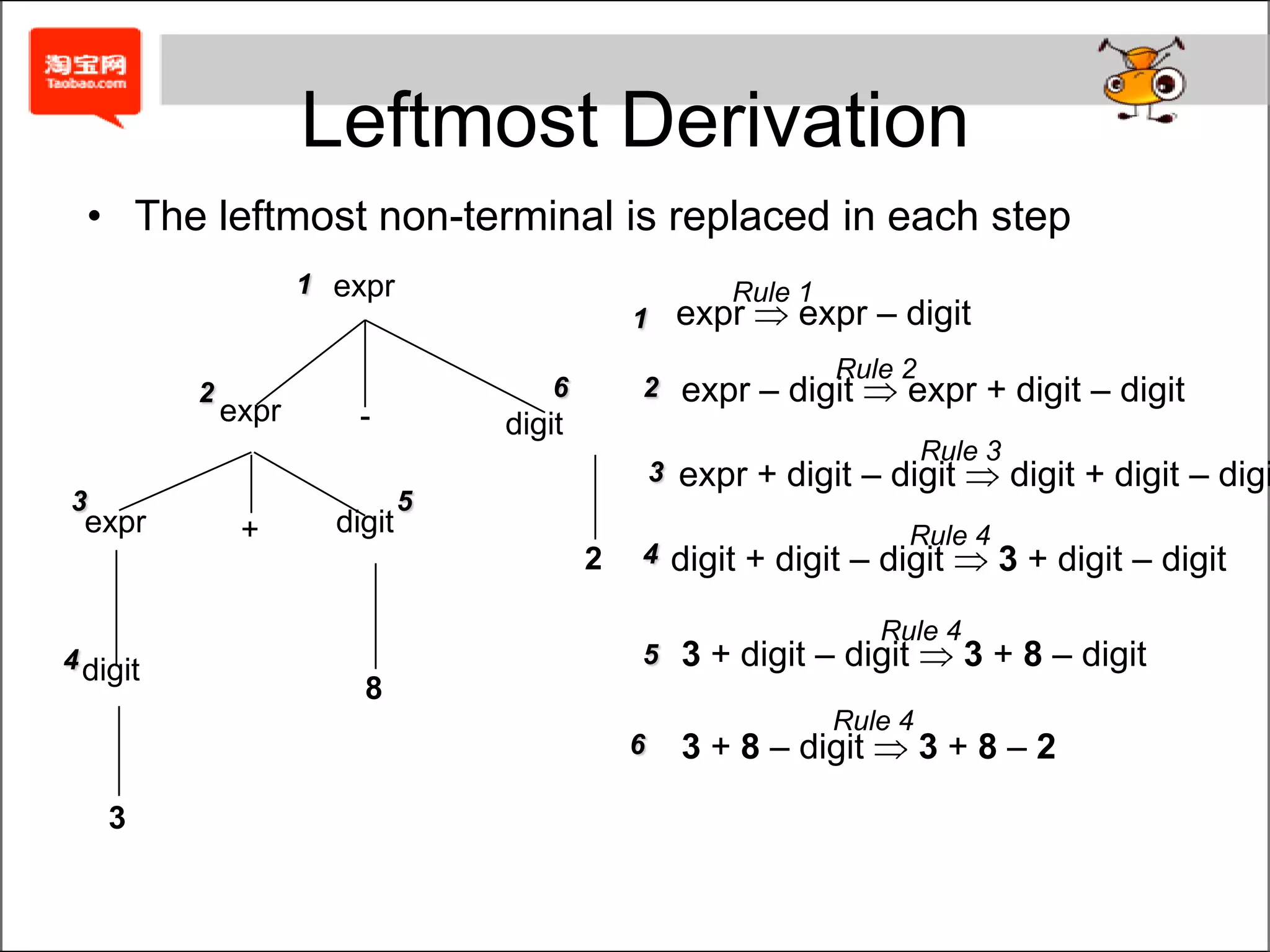
Leftmost DerivationRule 1expr  expr – digitThe leftmost non-terminal is replaced in each stepexpr11Rule 2expr – digit  expr + digit – digit223expr-digitRule 3expr + digit – digit  digit + digit – digit354exprdigit+Rule 44digit + digit – digit3 + digit – digit2Rule 43 + digit – digit 3 + 8 – digit56digit8Rule 43 + 8 – digit 3 + 8 – 263
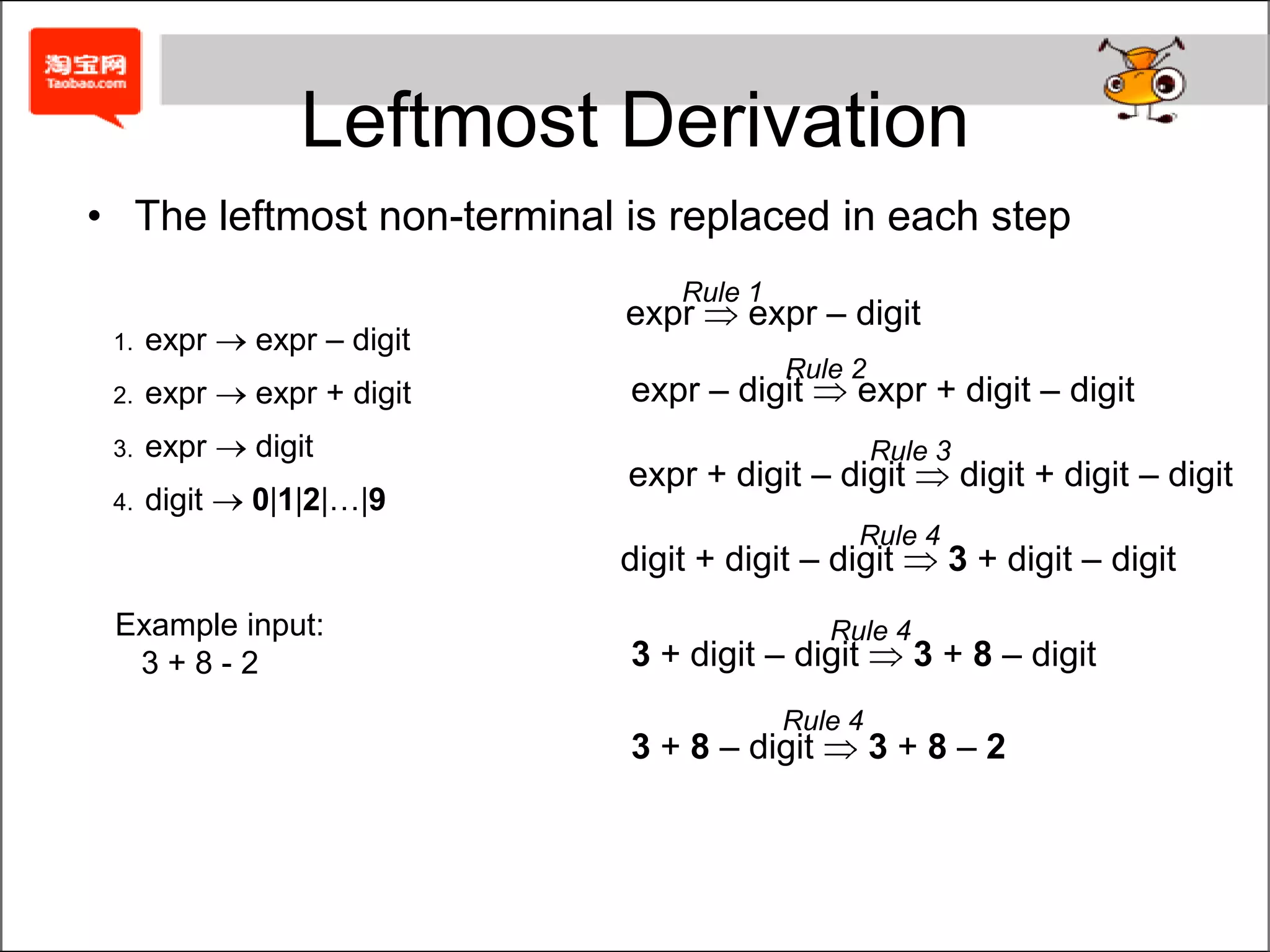
Leftmost DerivationRule 1expr  expr – digitexpr  expr – digitexpr  expr + digitexpr  digitdigit 0|1|2|…|9Example input:   3 + 8 - 2The leftmost non-terminal is replaced in each stepRule 2expr – digit  expr + digit – digitRule 3expr + digit – digit  digit + digit – digitRule 4digit + digit – digit3 + digit – digitRule 43 + digit – digit 3 + 8 – digitRule 43 + 8 – digit 3 + 8 – 2
Leftmost DerivationRule 1expr  expr – digitThe leftmost non-terminal is replaced in each stepexpr11Rule 2expr – digit  expr + digit – digit622expr-digitRule 3expr + digit – digit  digit + digit – digit335exprdigit+Rule 44digit + digit – digit3 + digit – digit2Rule 43 + digit – digit 3 + 8 – digit54digit8Rule 43 + 8 – digit 3 + 8 – 263
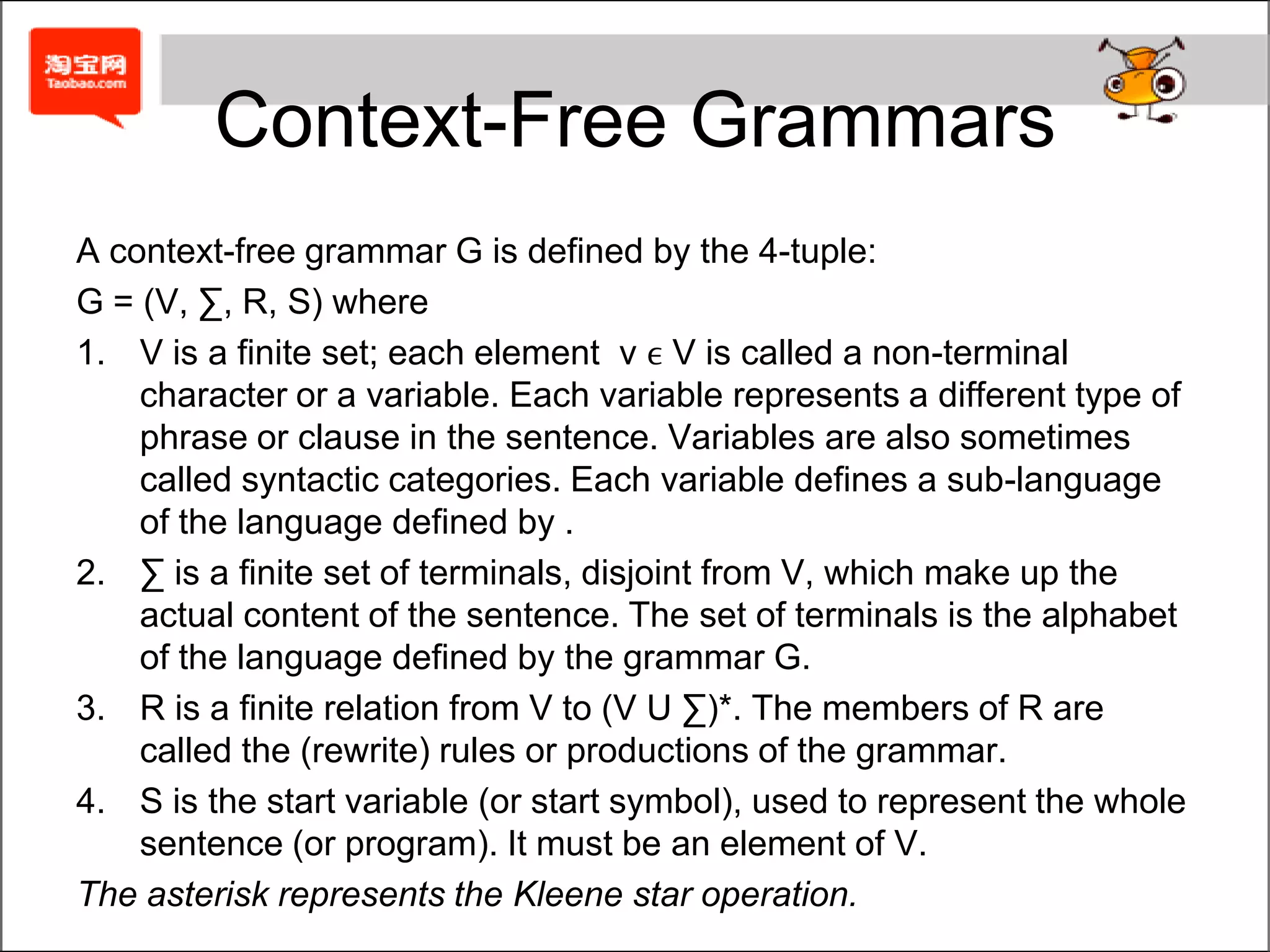
Context-Free GrammarsA context-free grammar G is defined by the 4-tuple:G = (V, ∑, R, S) whereV is a finite set; each element  v ϵ V is called a non-terminal character or a variable. Each variable represents a different type of phrase or clause in the sentence. Variables are also sometimes called syntactic categories. Each variable defines a sub-language of the language defined by .∑ is a finite set of terminals, disjoint from V, which make up the actual content of the sentence. The set of terminals is the alphabet of the language defined by the grammar G.R is a finite relation from V to (V U ∑)*. The members of R are called the (rewrite) rules or productions of the grammar.S is the start variable (or start symbol), used to represent the whole sentence (or program). It must be an element of V.The asterisk represents the Kleene star operation.
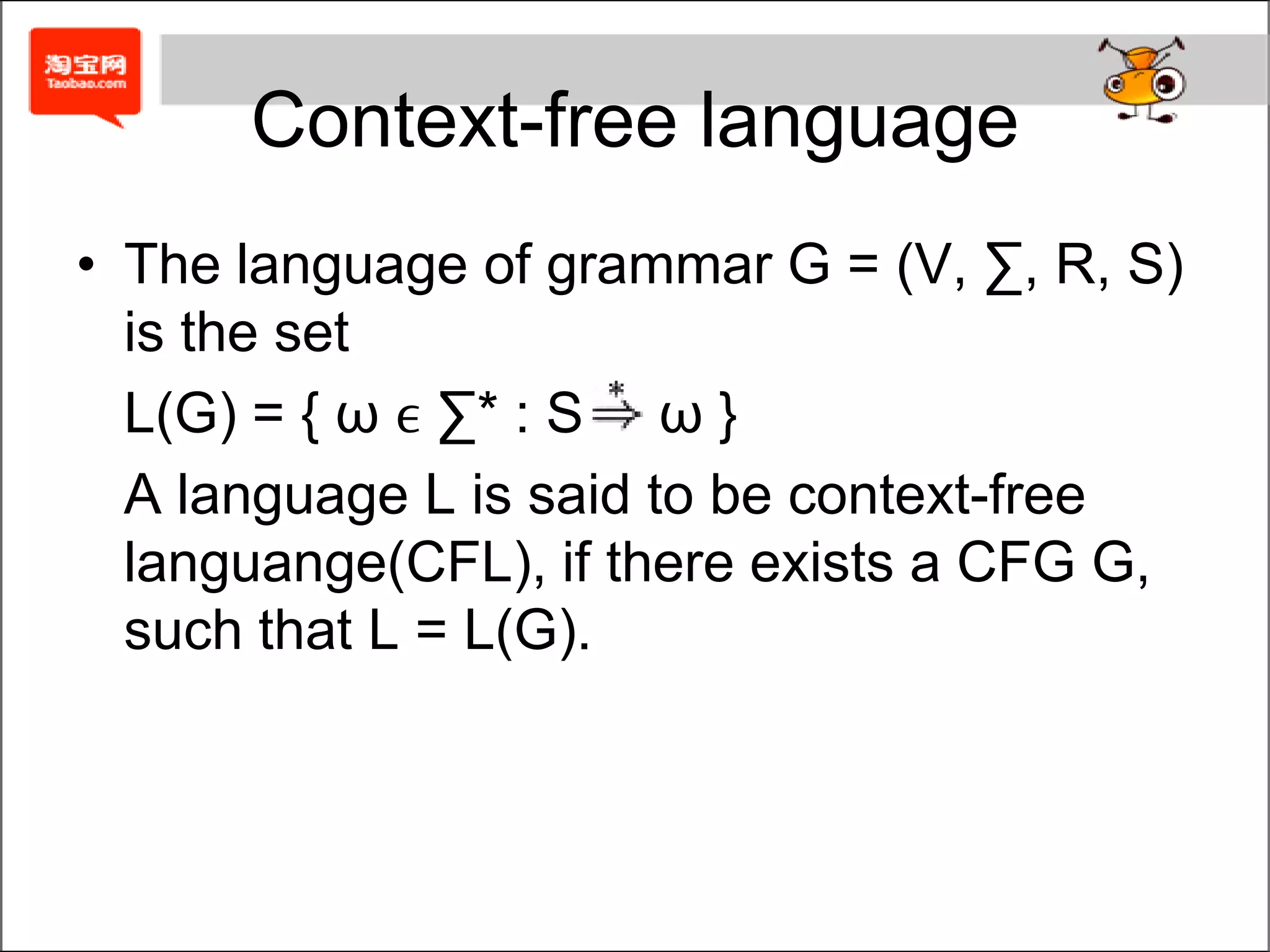
Context-free languageThe language of grammar G = (V, ∑, R, S) is the set	L(G) = { ωϵ ∑* : S ωω }	A language L is said to be context-free languange(CFL), if there exists a CFG G, such that L = L(G).
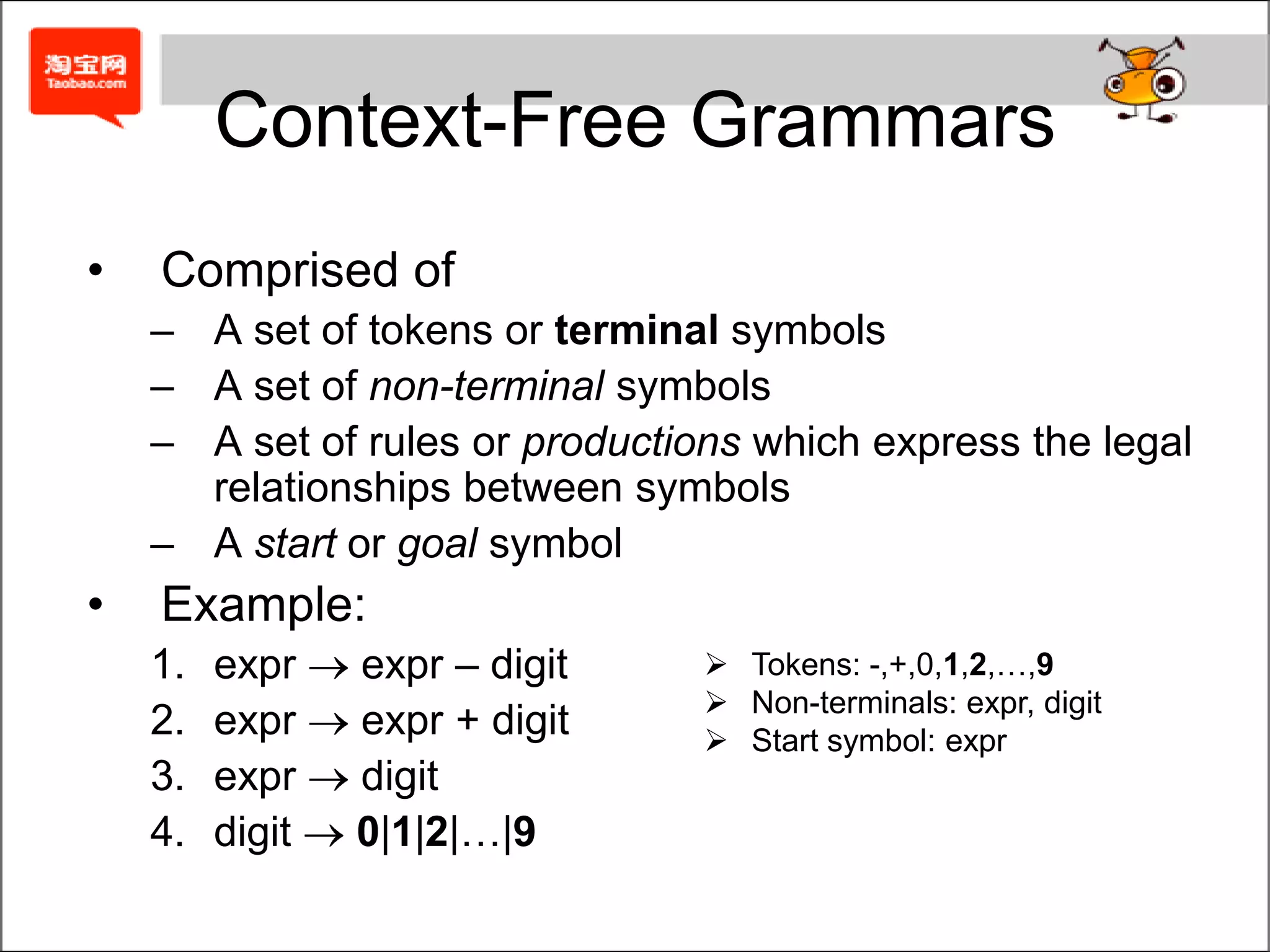
Context-Free GrammarsComprised ofA set of tokens or terminal symbolsA set of non-terminal symbolsA set of rules or productions which express the legal relationships between symbolsA start or goal symbolExample:exprexpr – digitexprexpr + digitexpr digitdigit 0|1|2|…|9Tokens: -,+,0,1,2,…,9
Non-terminals: expr, digit
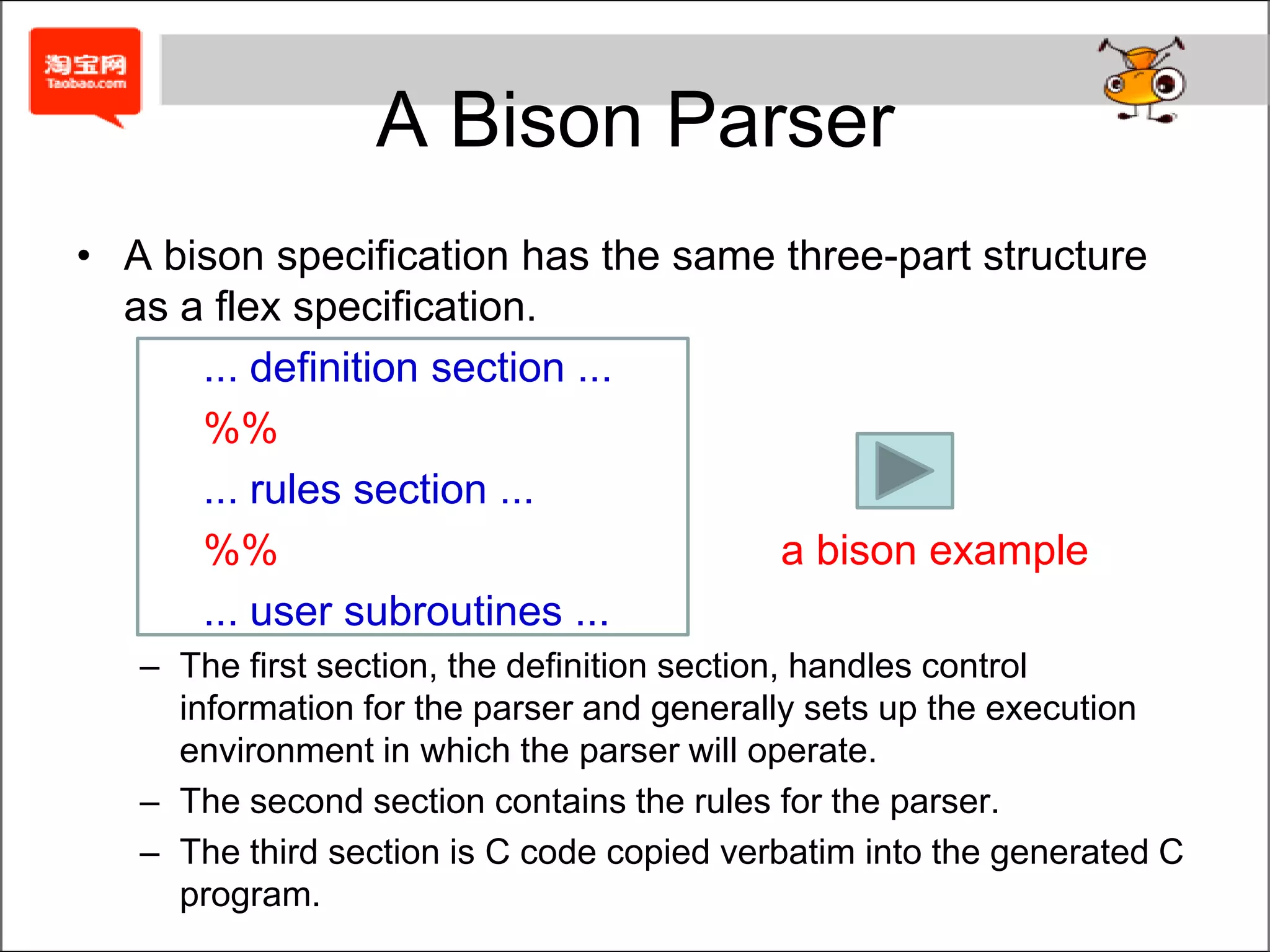
Start symbol: exprA Bison ParserA bison specification has the same three-part structure as a flex specification.... definition section ...%%... rules section ...%%                                           a bison example... user subroutines ...The first section, the definition section, handles control information for the parser and generally sets up the execution environment in which the parser will operate.The second section contains the rules for the parser.The third section is C code copied verbatim into the generated C program.
TermsSymbols are strings of letters, digits, periods, and underscores that do not start with a digit.error is reserved for error recovery.Do not use C reserved words or bison's own symbols such as yyparse.Symbols produced by the lexer are called terminal symbols or tokensThose that are defined on the left-hand side of rules are called nonterminal symbols or nonterminals.
Structure of a Bison Specification... definition section ...	%%	... rules section ...	%%	... user subroutines ...
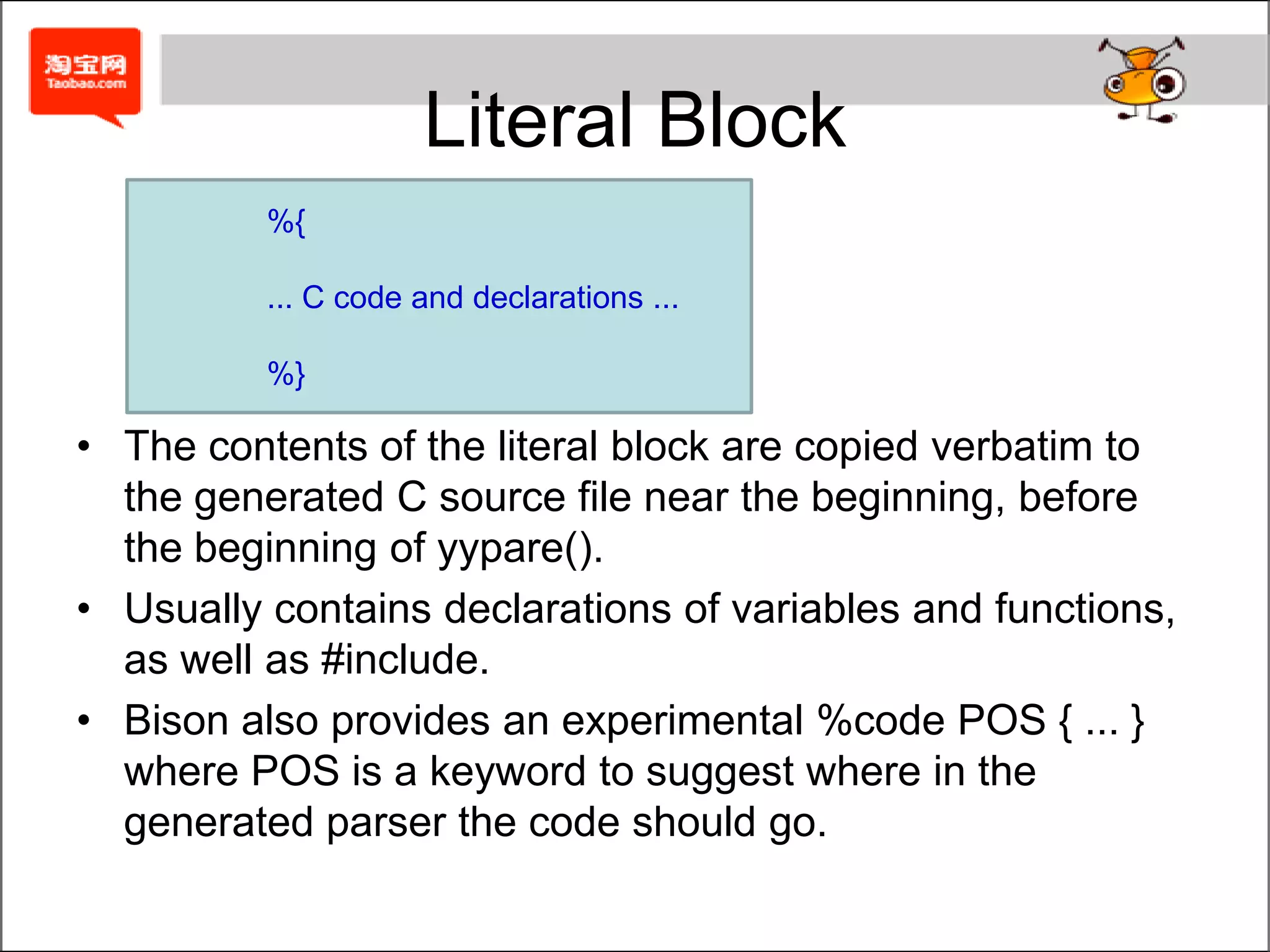
Literal Block	%{	... C code and declarations ...	%}The contents of the literal block are copied verbatim to the generated C source file near the beginning, before the beginning of yypare().Usually contains declarations of variables and functions, as well as #include.Bison also provides an experimental %code POS { ... } where POS is a keyword to suggest where in the generated parser the code should go.
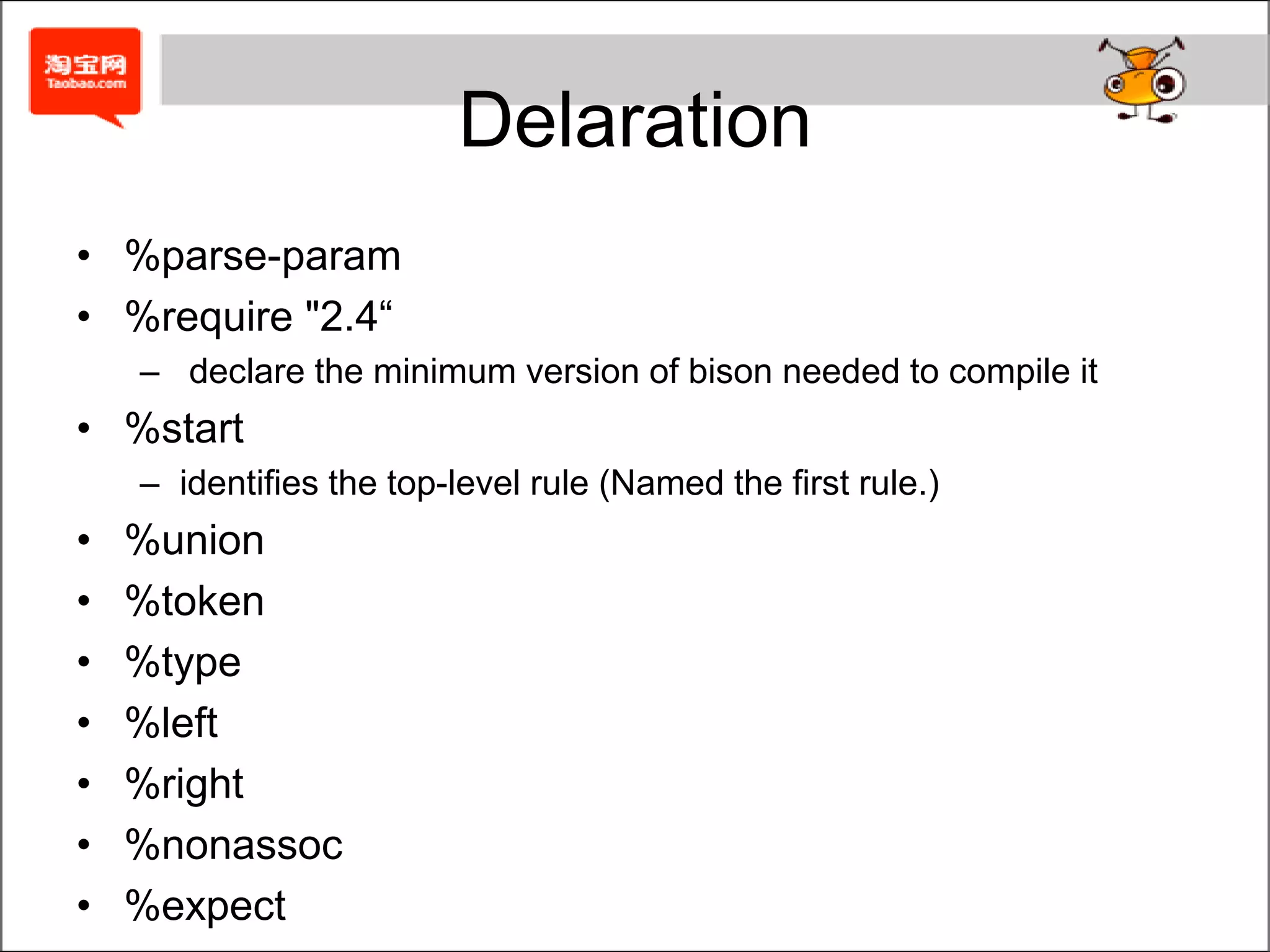
Delaration%parse-param%require "2.4“ declare the minimum version of bison needed to compile it%startidentifies the top-level rule (Named the first rule.)%union%token%type%left%right%nonassoc%expect
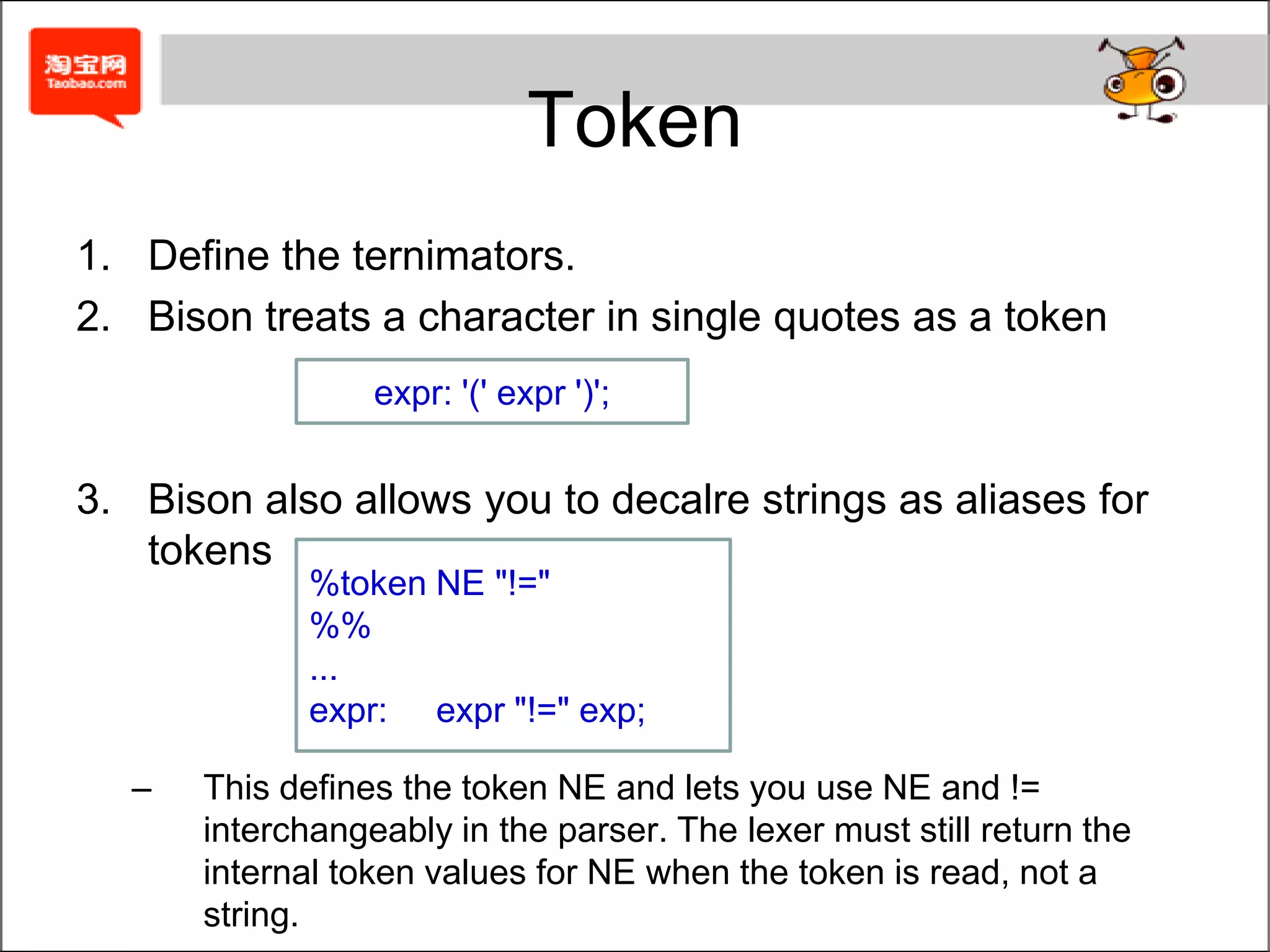
TokenDefine the ternimators.Bison treats a character in single quotes as a tokenBison also allows you to decalre strings as aliases for tokensThis defines the token NE and lets you use NE and != interchangeably in the parser. The lexer must still return the internal token values for NE when the token is read, not a string.expr: '(' expr ')';%token NE "!="%%...expr:	expr "!=" exp;
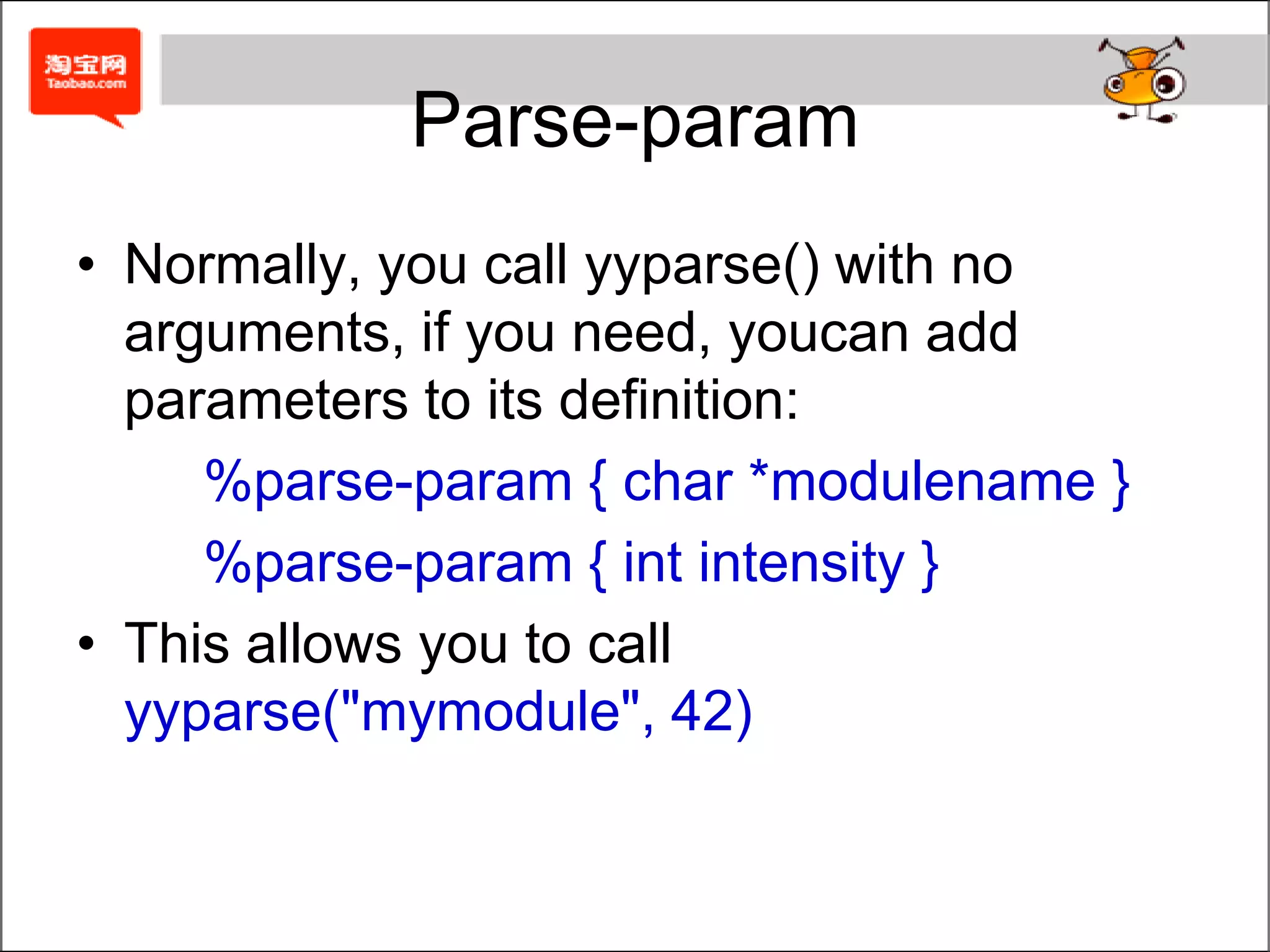
Parse-paramNormally, you call yyparse() with no arguments, if you need, youcan add parameters to its definition:%parse-param { char *modulename }		%parse-param { int intensity }This allows you to call yyparse("mymodule", 42)
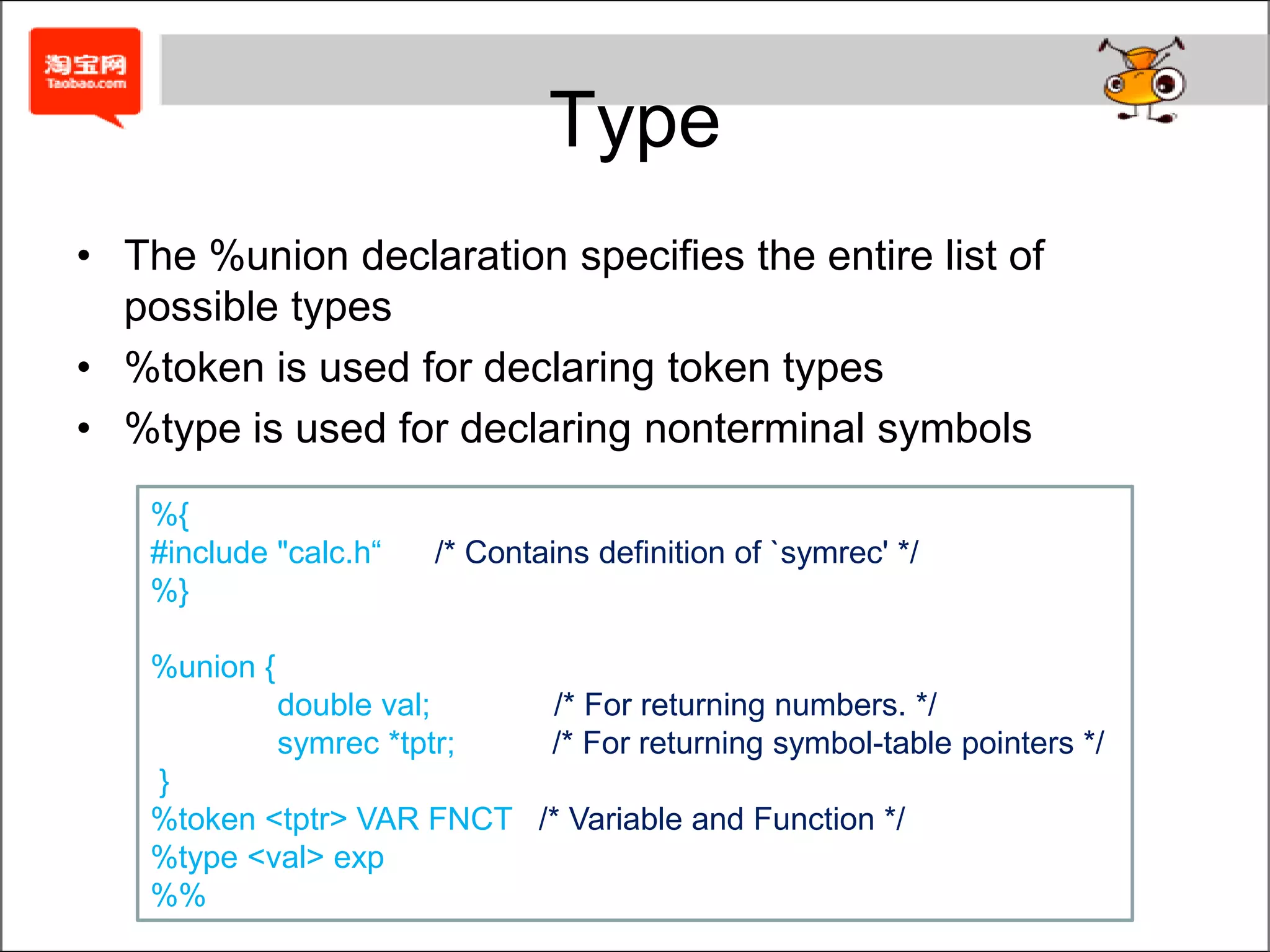
TypeThe %union declaration specifies the entire list of possible types%token is used for declaring token types%type is used for declaring nonterminal symbols%{#include "calc.h“      /* Contains definition of `symrec' */ %} %union { 	double val;              /* For returning numbers. */ symrec *tptr;           /* For returning symbol-table pointers */ } %token <tptr> VAR FNCT   /* Variable and Function */ %type <val> exp %%
Structure of a Bison Specification	... definition section ...	%%... rules section ...	%%	... user subroutines ...
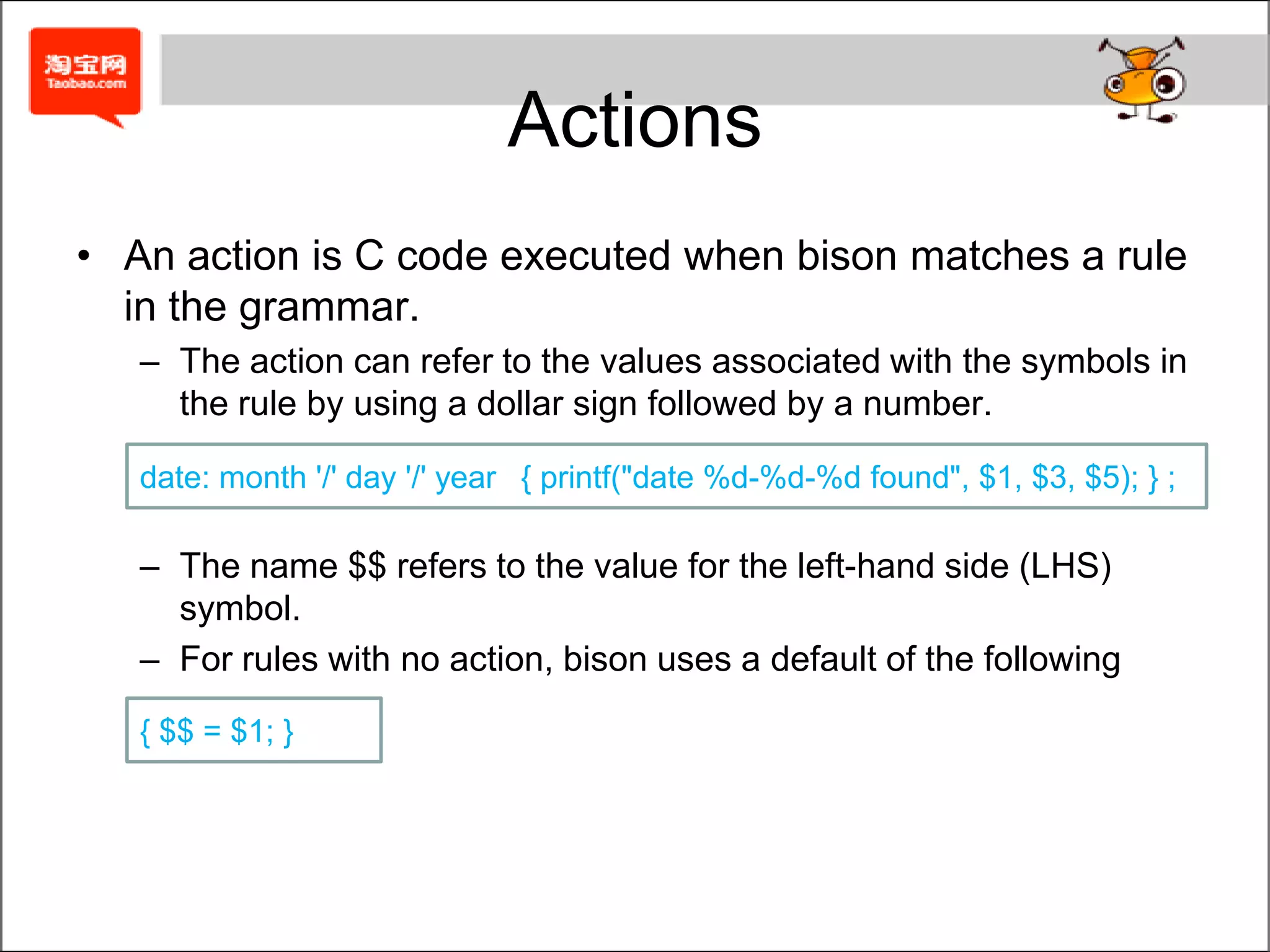
ActionsAn action is C code executed when bison matches a rule in the grammar.The action can refer to the values associated with the symbols in the rule by using a dollar sign followed by a number.The name $$ refers to the value for the left-hand side (LHS) symbol.For rules with no action, bison uses a default of the followingdate: month '/' day '/' year	{ printf("date %d-%d-%d found", $1, $3, $5); } ;{ $$ = $1; }
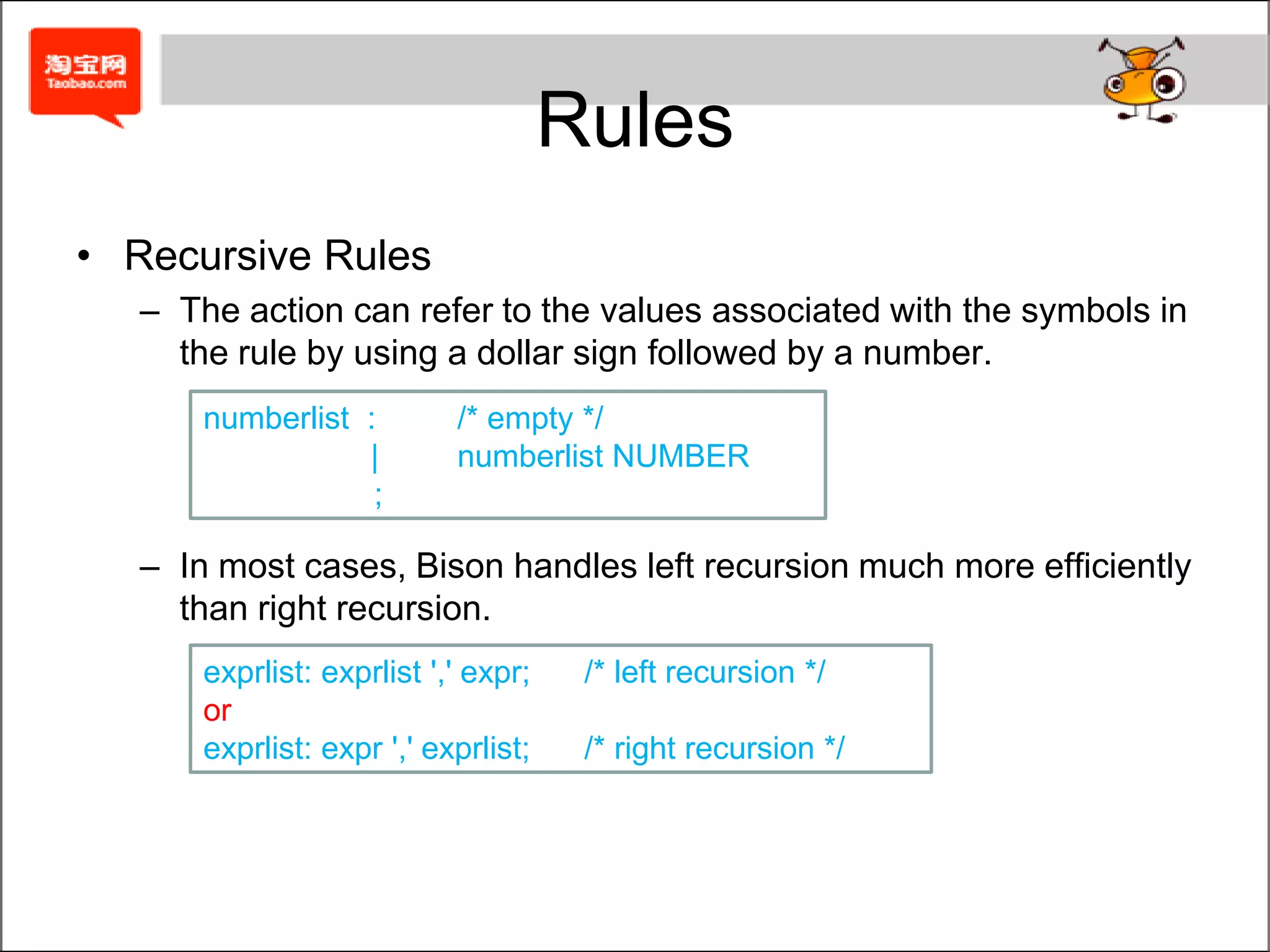
RulesRecursive RulesThe action can refer to the values associated with the symbols in the rule by using a dollar sign followed by a number.In most cases, Bison handles left recursion much more efficiently than right recursion.numberlist  :	/* empty */                   |	numberlist NUMBER	     ;exprlist: exprlist ',' expr;	/* left recursion */orexprlist: expr ',' exprlist;	/* right recursion */
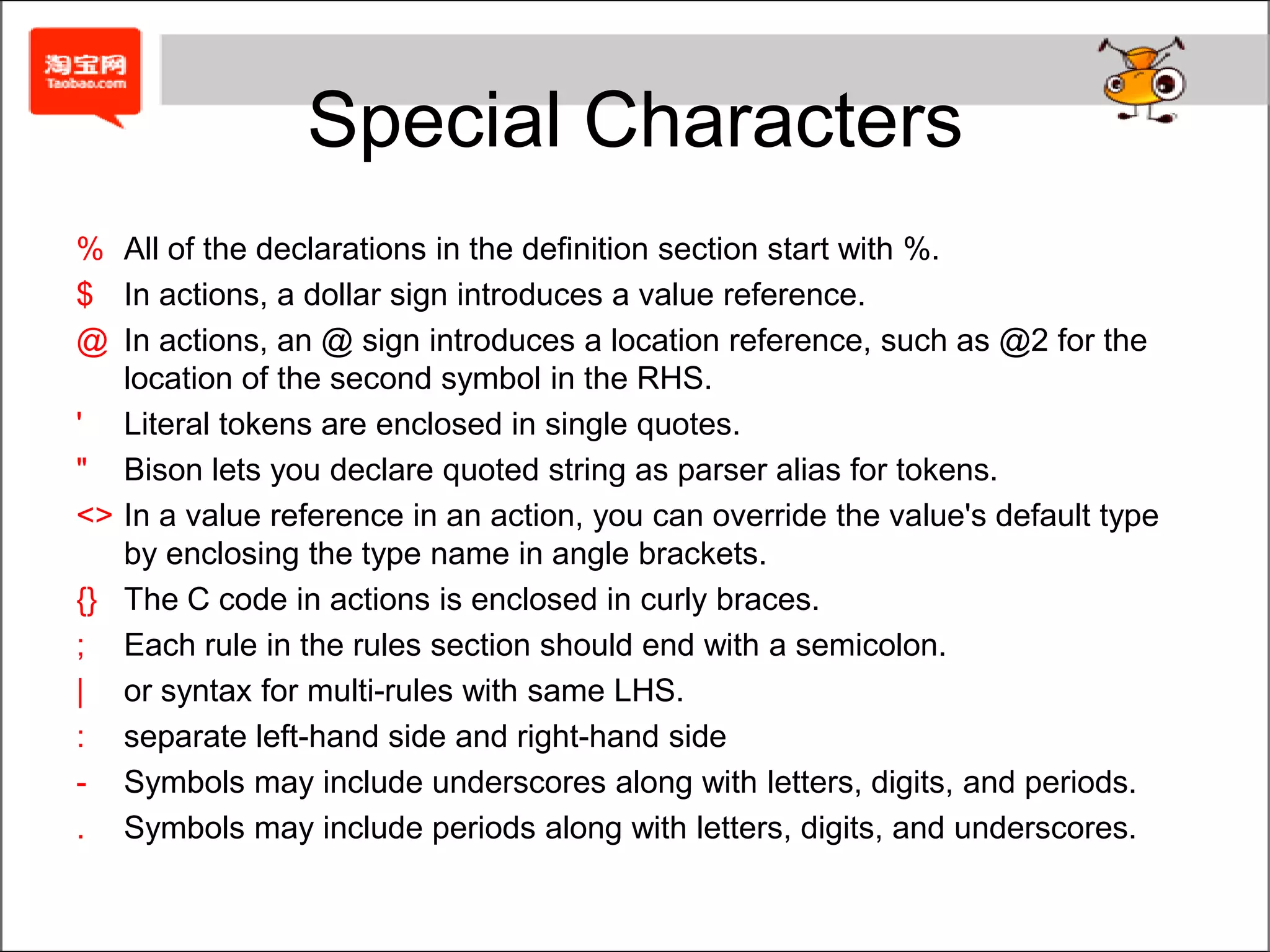
Special Characters%	All of the declarations in the definition section start with %.$	In actions, a dollar sign introduces a value reference.@	In actions, an @ sign introduces a location reference, such as @2 for the location of the second symbol in the RHS.'	Literal tokens are enclosed in single quotes."	Bison lets you declare quoted string as parser alias for tokens.<>	In a value reference in an action, you can override the value's default type by enclosing the type name in angle brackets.{}	The C code in actions is enclosed in curly braces.;	Each rule in the rules section should end with a semicolon.|	or syntax for multi-rules with same LHS.:	separate left-hand side and right-hand side-	Symbols may include underscores along with letters, digits, and periods..	Symbols may include periods along with letters, digits, and underscores.
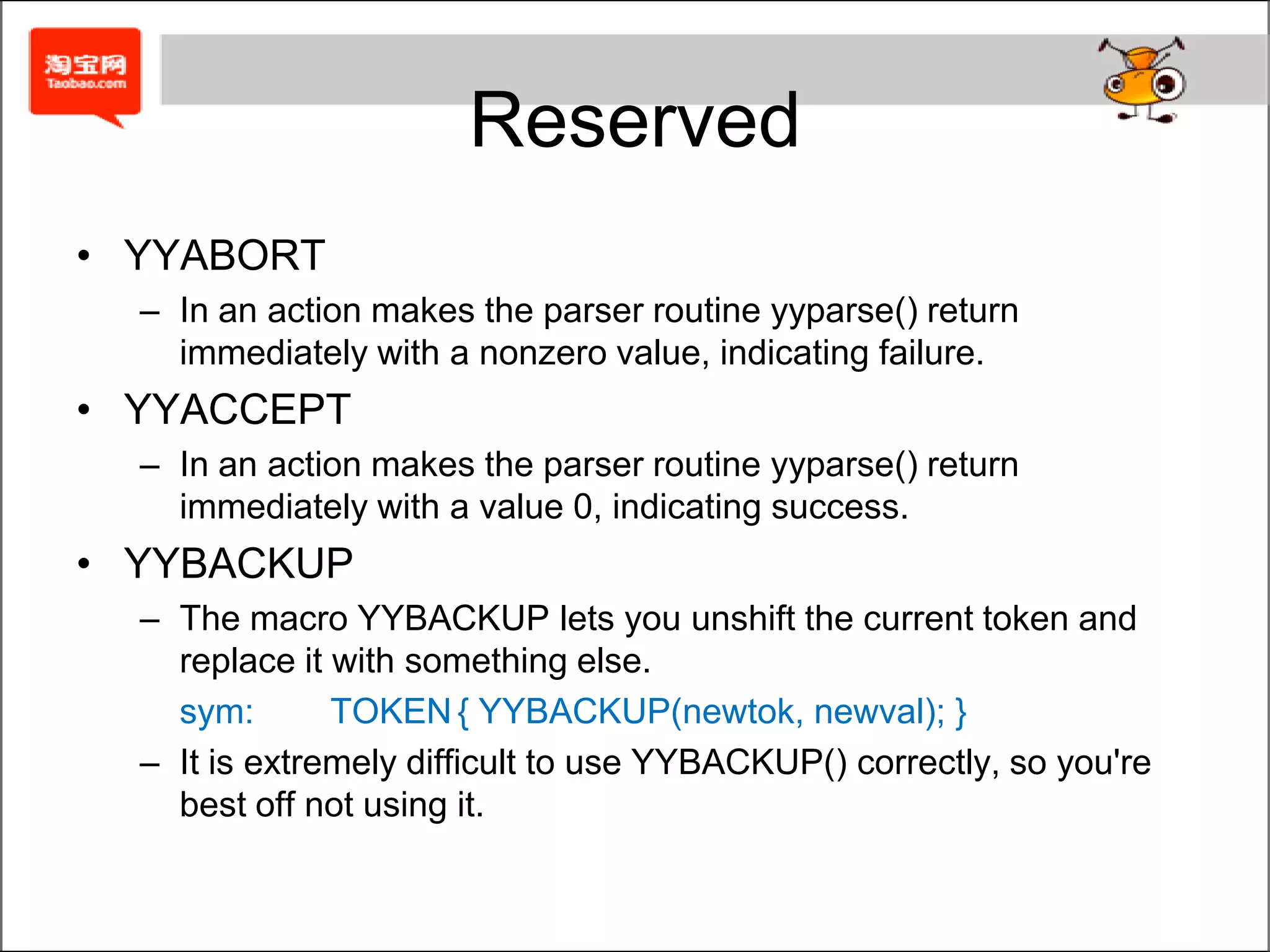
ReservedYYABORTIn an action makes the parser routine yyparse() return immediately with a nonzero value, indicating failure.YYACCEPTIn an action makes the parser routine yyparse() return immediately with a value 0, indicating success.YYBACKUPThe macro YYBACKUP lets you unshift the current token and replace it with something else.sym:	TOKEN	{ YYBACKUP(newtok, newval); }It is extremely difficult to use YYBACKUP() correctly, so you're best off not using it.
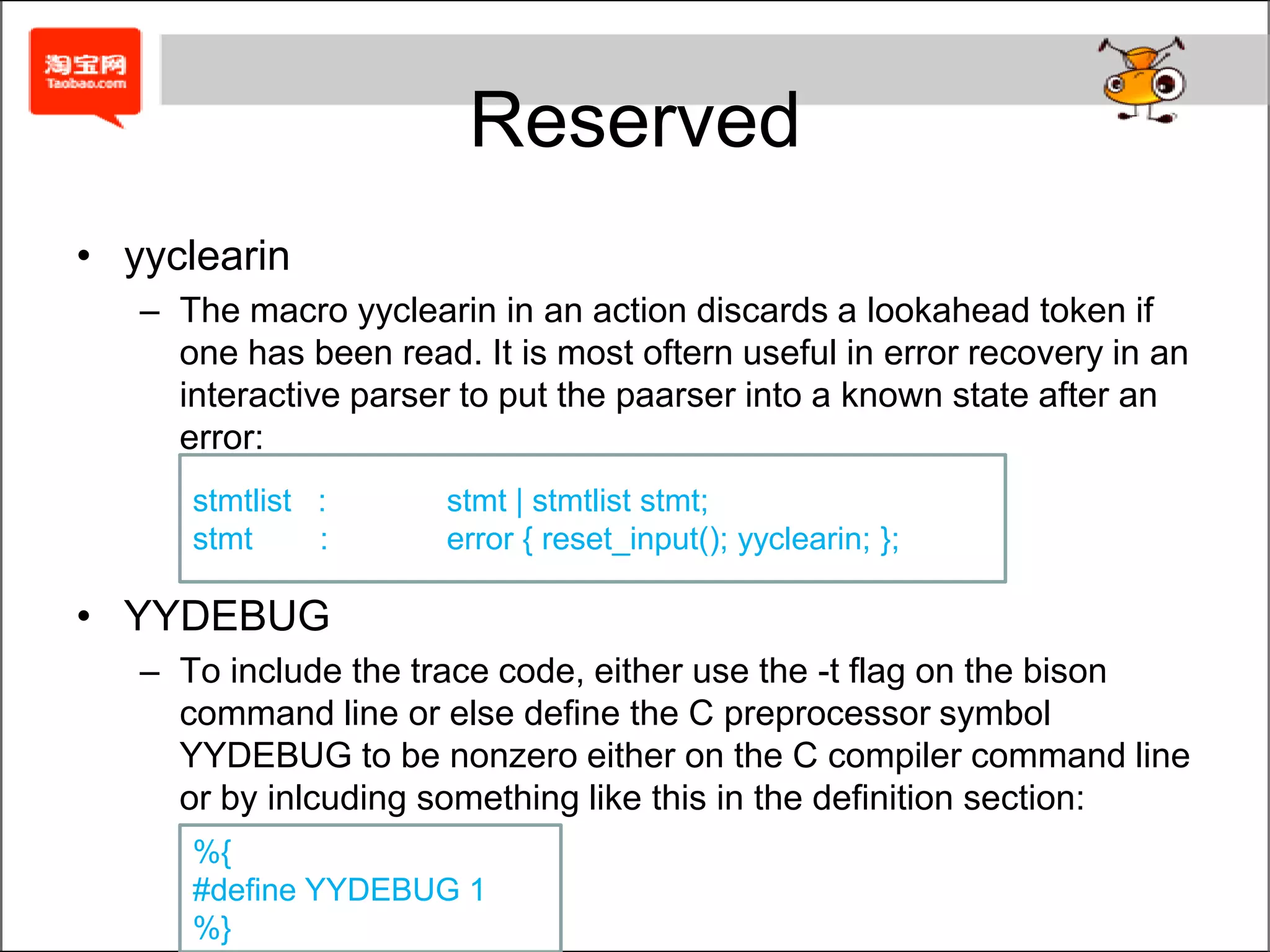
ReservedyyclearinThe macro yyclearin in an action discards a lookahead token if one has been read. It is most oftern useful in error recovery in an interactive parser to put the paarser into a known state after an error:YYDEBUGTo include the trace code, either use the -t flag on the bison command line or else define the C preprocessor symbol YYDEBUG to be nonzero either on the C compiler command line or by inlcuding something like this in the definition section:stmtlist   :	stmt | stmtlist stmt;stmt	:	error { reset_input(); yyclearin; };%{#define YYDEBUG 1%}
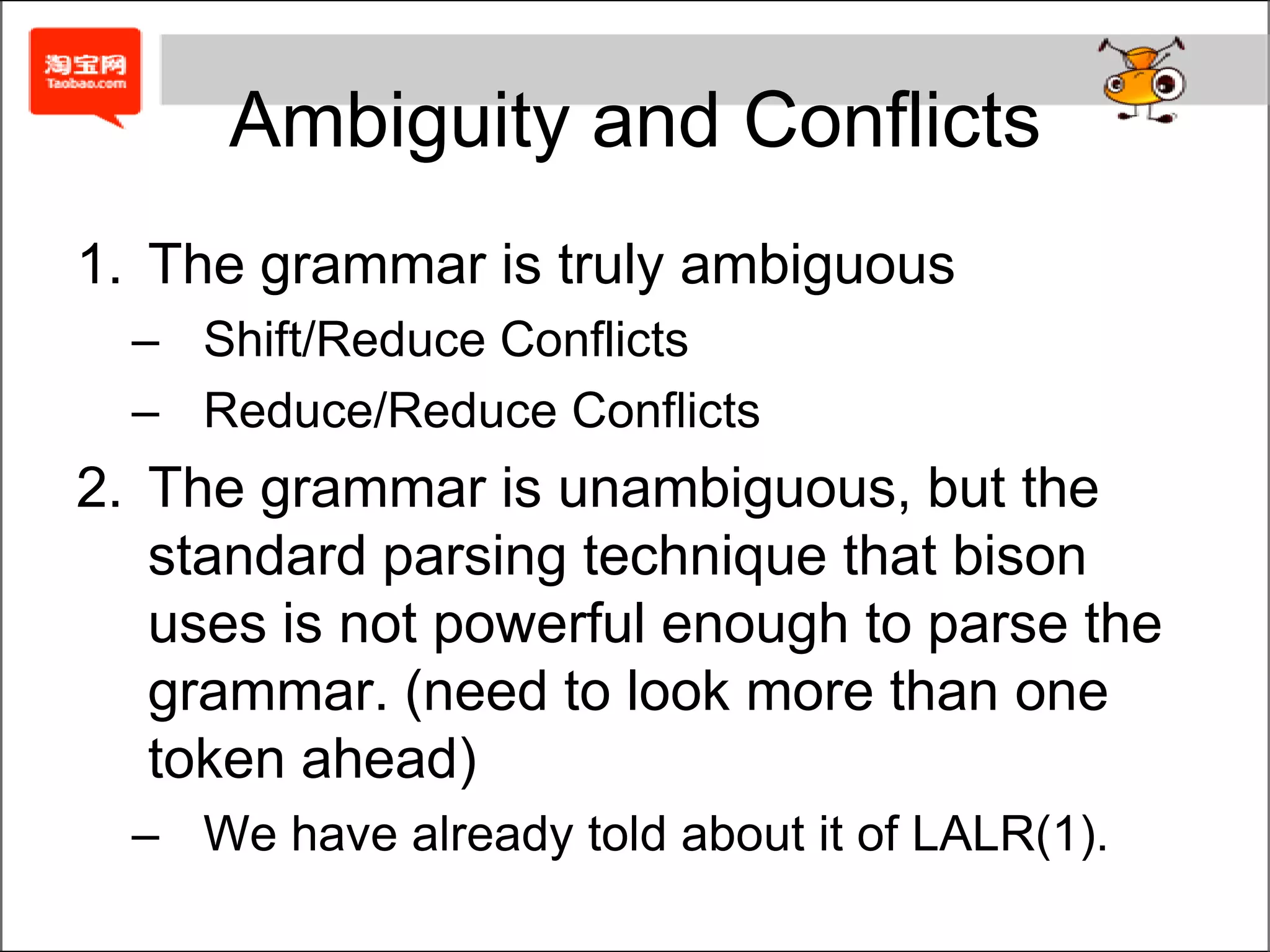
Ambiguity and ConflictsThe grammar is truly ambiguousShift/Reduce ConflictsReduce/Reduce ConflictsThe grammar is unambiguous, but the standard parsing technique that bison uses is not powerful enough to parse the grammar. (need to look more than one token ahead)We have already told about it of LALR(1).
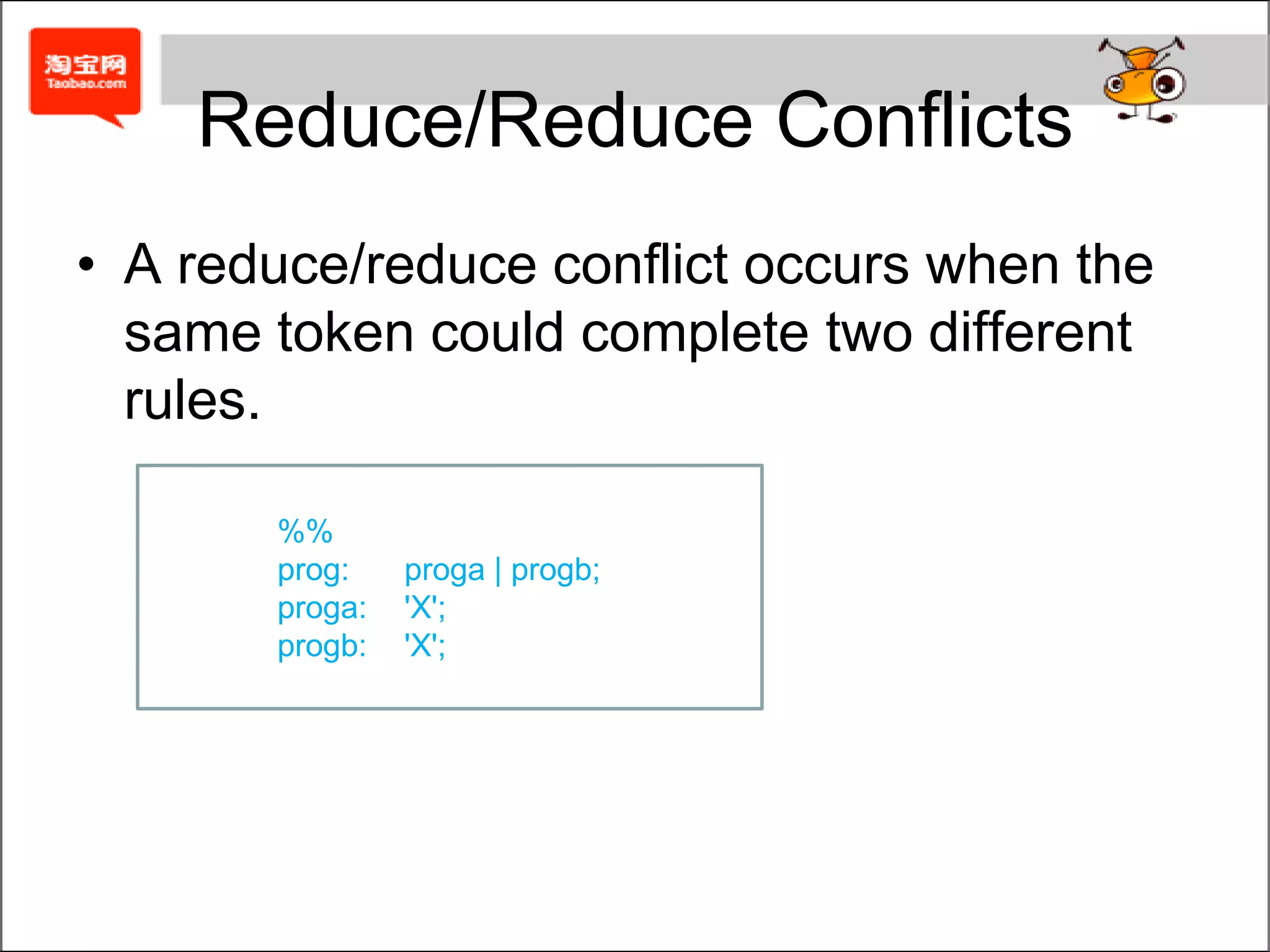
Reduce/Reduce ConflictsA reduce/reduce conflict occurs when the same token could complete two different rules.	%%	prog:	proga | progb;	proga:	'X';	progb:	'X';
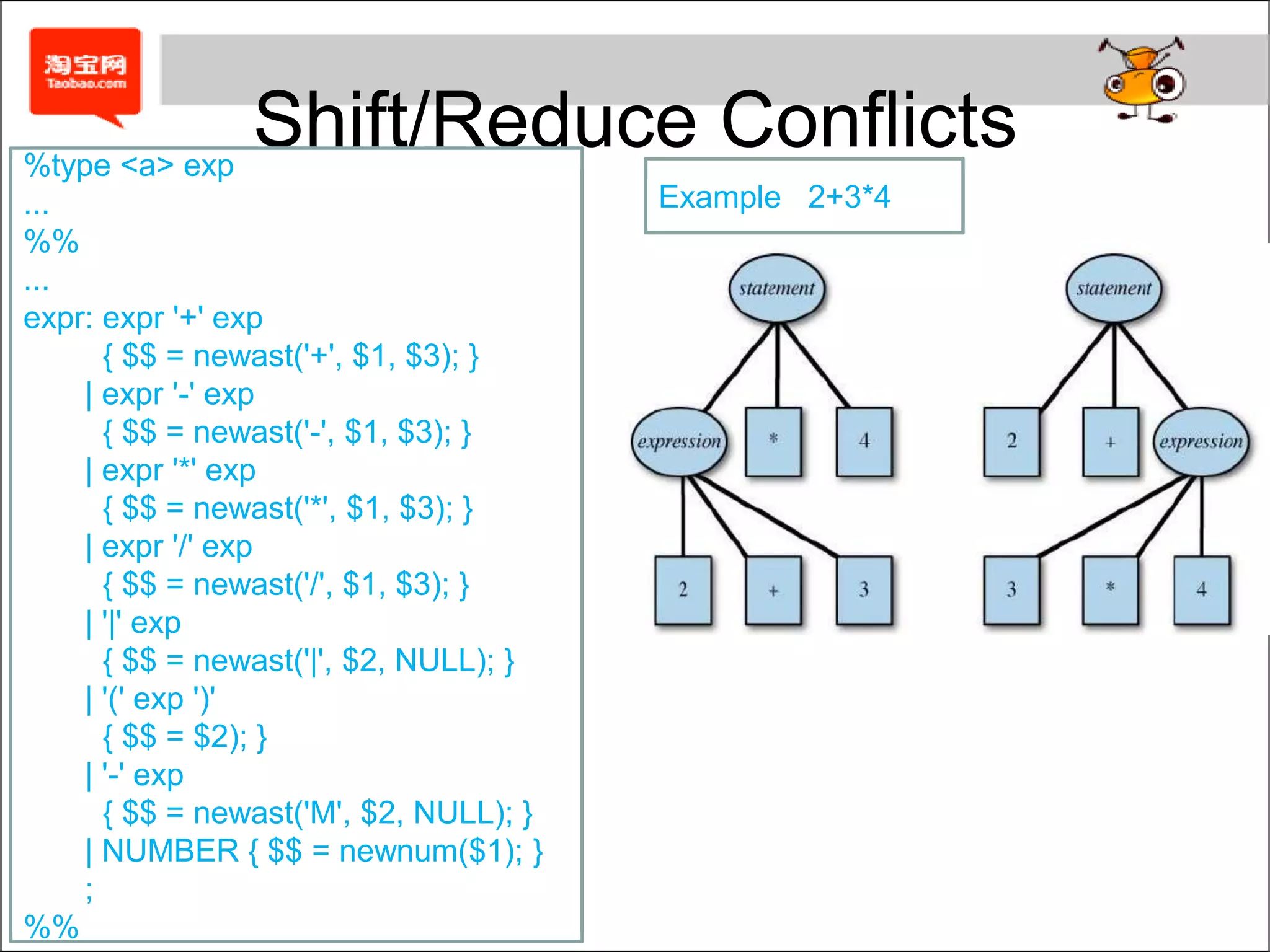
Shift/Reduce Conflicts%type <a> exp...%%...expr: expr '+' exp         { $$ = newast('+', $1, $3); }       | expr '-' exp          { $$ = newast('-', $1, $3); }       | expr '*' exp          { $$ = newast('*', $1, $3); }       | expr '/' exp          { $$ = newast('/', $1, $3); }       | '|' exp          { $$ = newast('|', $2, NULL); }       | '(' exp ')'          { $$ = $2); }       | '-' exp          { $$ = newast('M', $2, NULL); }       | NUMBER { $$ = newnum($1); }       ;%%Example   2+3*4
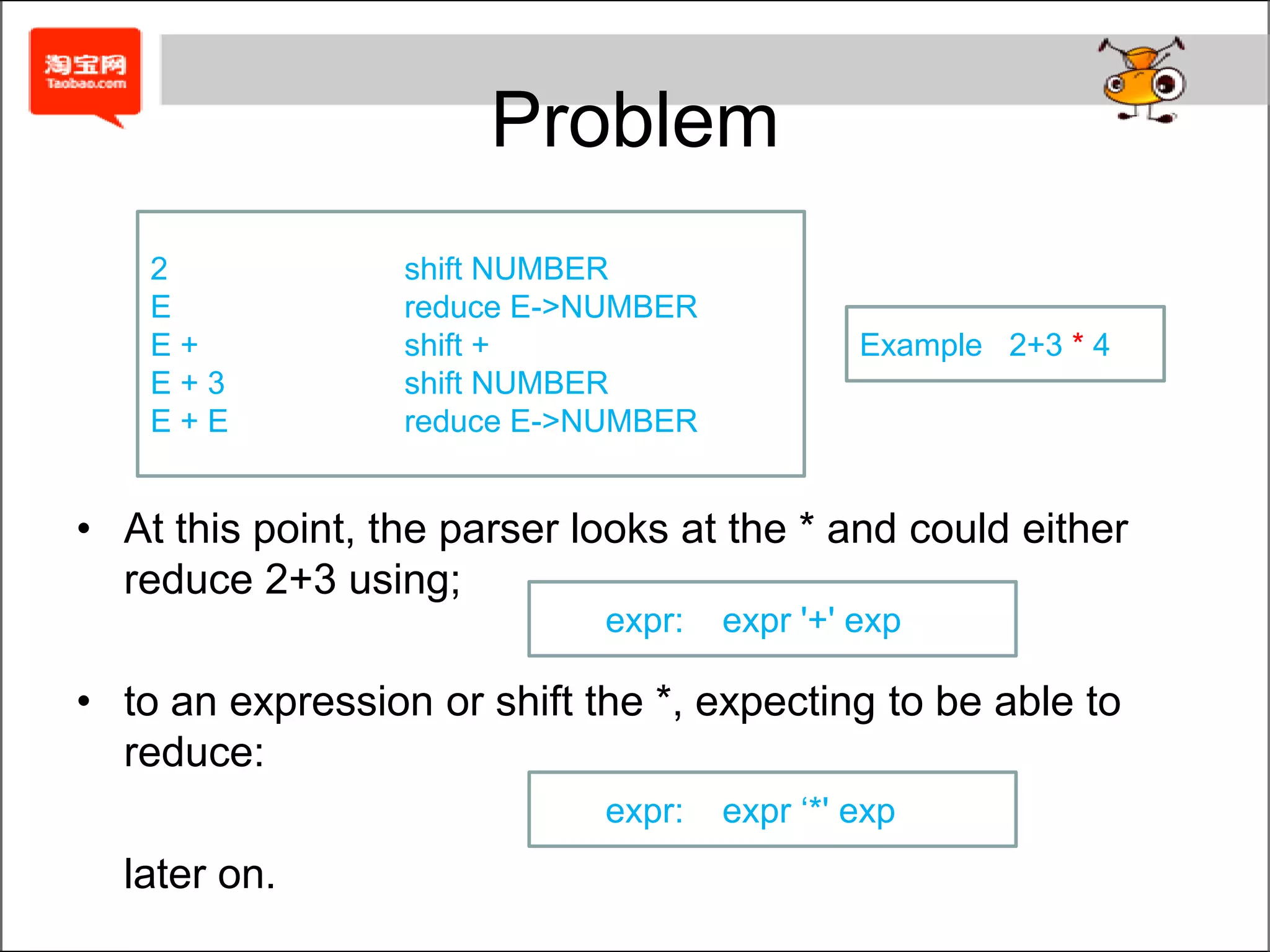
ProblemAt this point, the parser looks at the * and could either reduce 2+3 using;to an expression or shift the *, expecting to be able to reduce:	later on.2		shift NUMBERE		reduce E->NUMBERE +		shift +E + 3		shift NUMBERE + E		reduce E->NUMBERExample   2+3 * 4expr:    expr '+' expexpr:    expr ‘*' exp
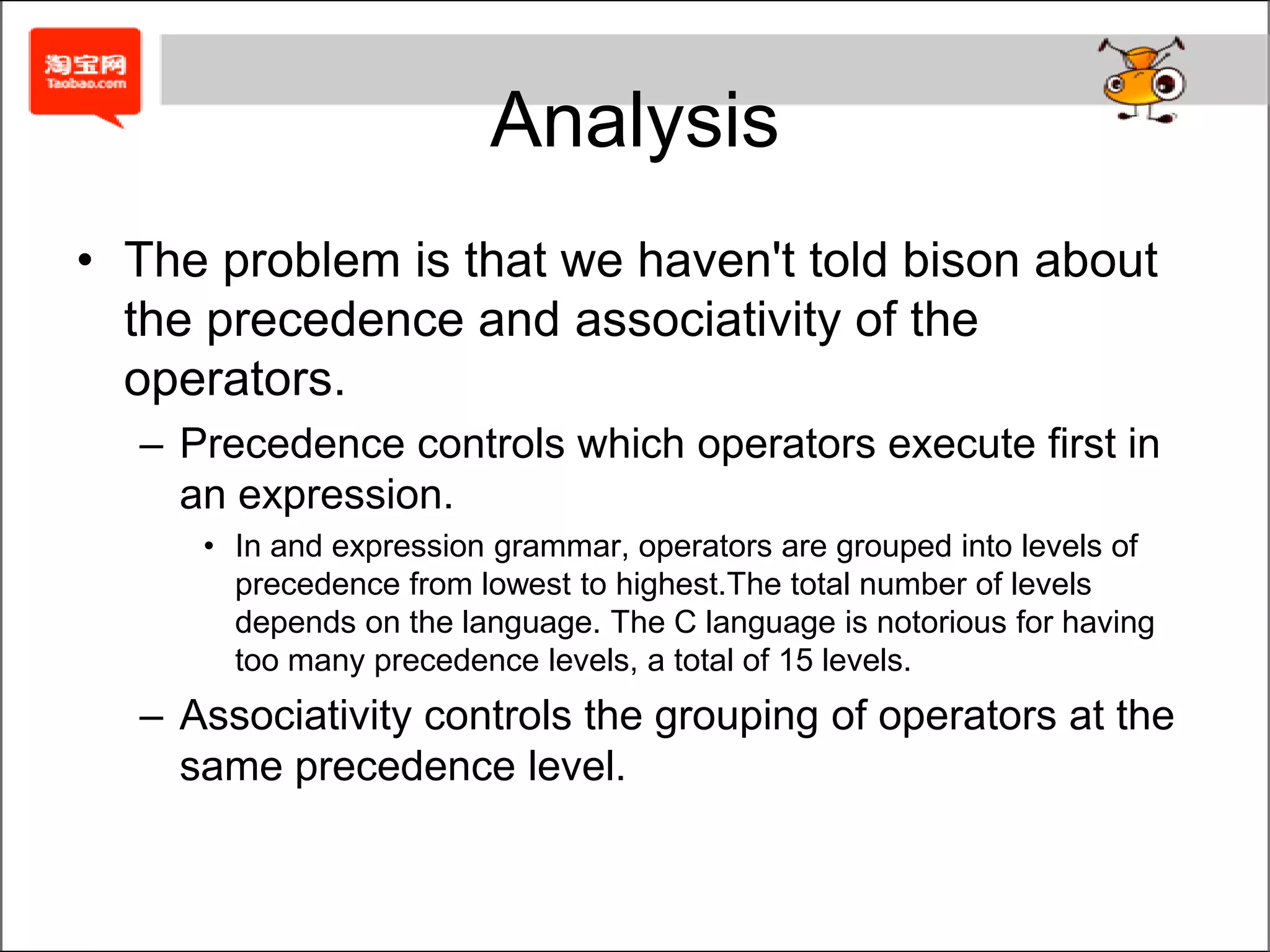
AnalysisThe problem is that we haven't told bison about the precedence and associativity of the operators.Precedence controls which operators execute first in an expression.In and expression grammar, operators are grouped into levels of precedence from lowest to highest.The total number of levels depends on the language. The C language is notorious for having too many precedence levels, a total of 15 levels.Associativity controls the grouping of operators at the same precedence level.
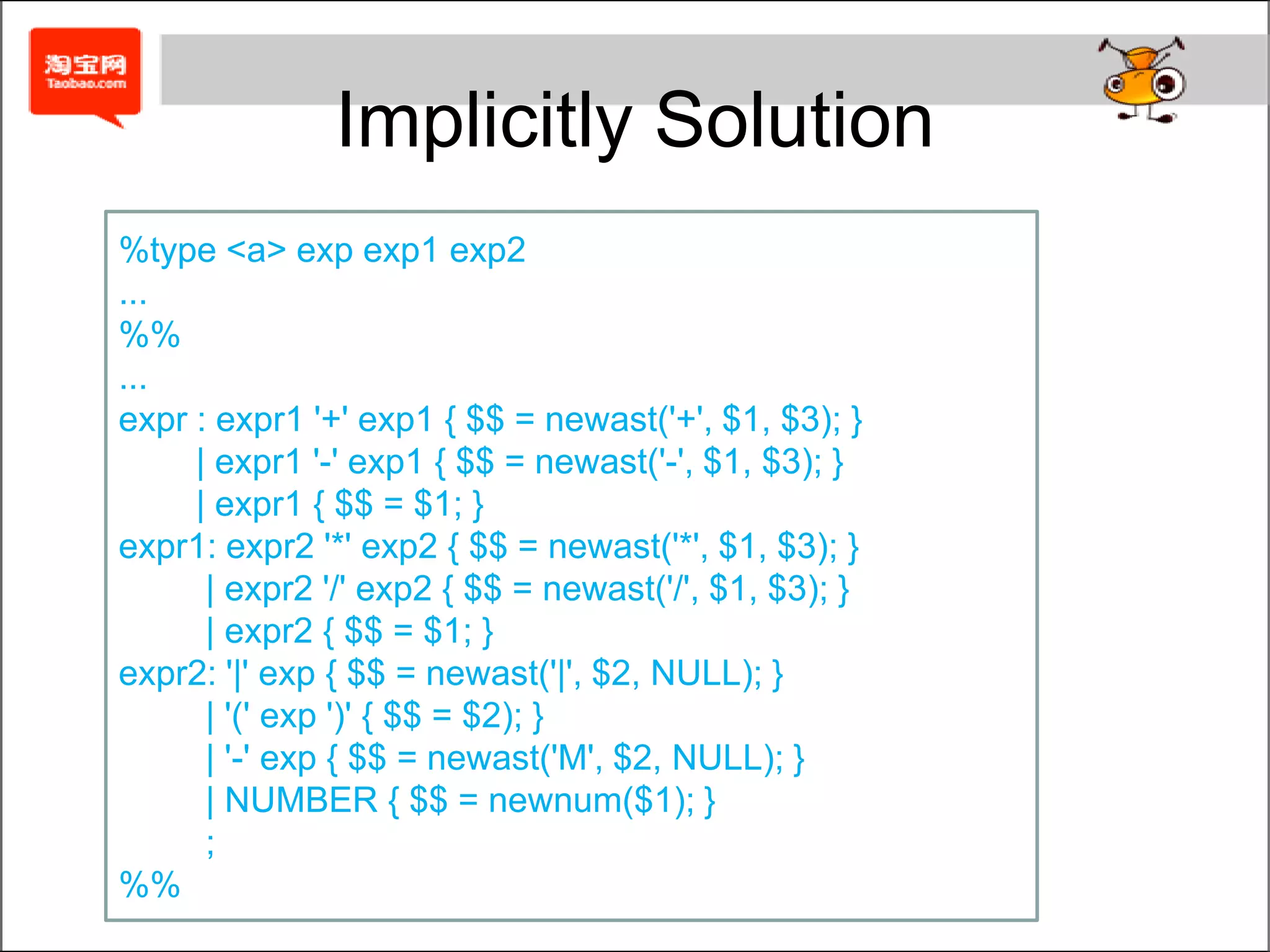
Implicitly Solution%type <a> exp exp1 exp2...%%...expr : expr1 '+' exp1 { $$ = newast('+', $1, $3); }        | expr1 '-' exp1 { $$ = newast('-', $1, $3); }        | expr1 { $$ = $1; }expr1: expr2 '*' exp2 { $$ = newast('*', $1, $3); }         | expr2 '/' exp2 { $$ = newast('/', $1, $3); }         | expr2 { $$ = $1; }expr2: '|' exp { $$ = newast('|', $2, NULL); }         | '(' exp ')' { $$ = $2); }         | '-' exp { $$ = newast('M', $2, NULL); }         | NUMBER { $$ = newnum($1); }         ;%%
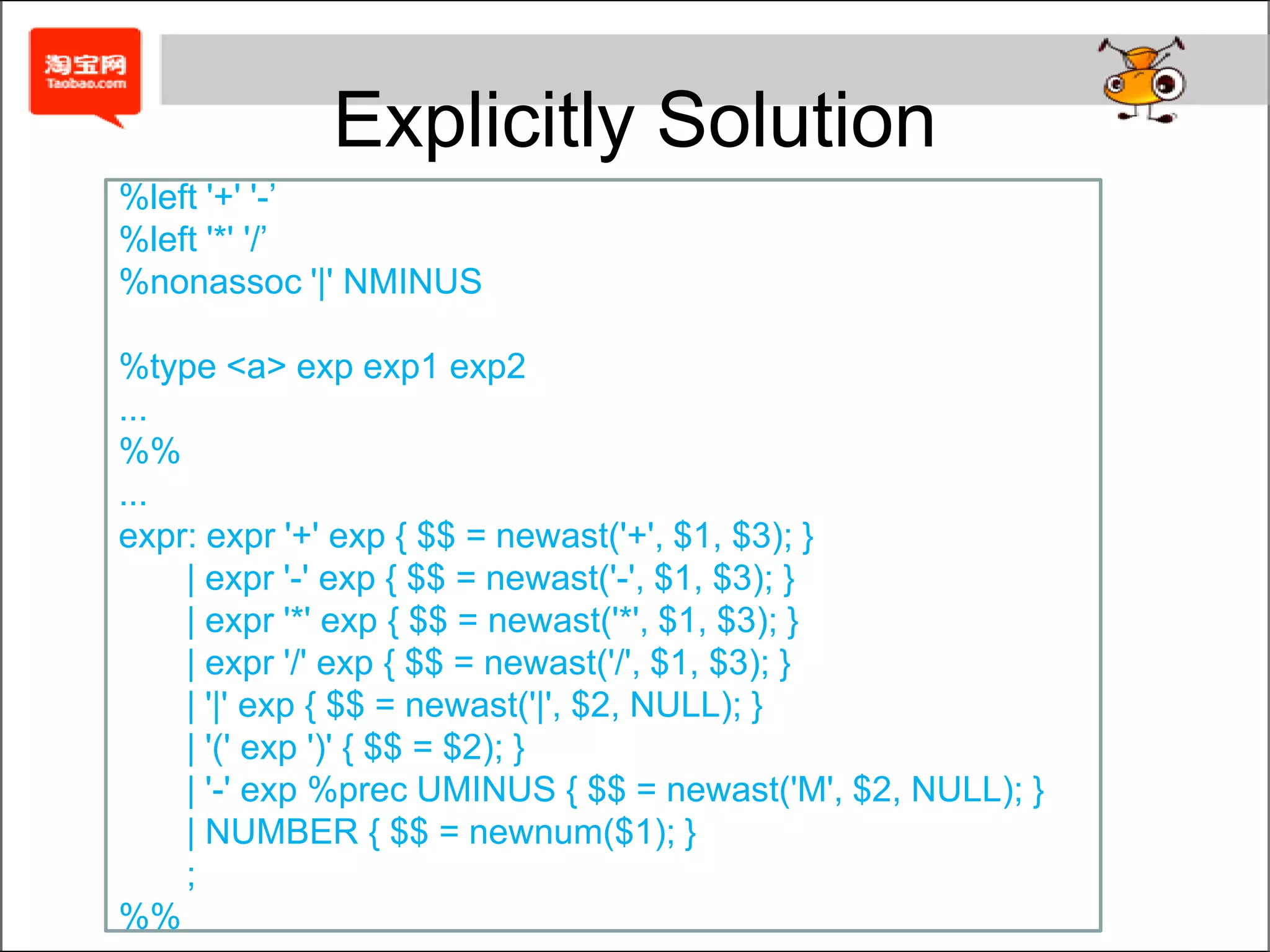
Explicitly Solution%left '+' '-’%left '*' '/’%nonassoc '|' NMINUS%type <a> exp exp1 exp2...%%...expr: expr '+' exp { $$ = newast('+', $1, $3); }       | expr '-' exp { $$ = newast('-', $1, $3); }       | expr '*' exp { $$ = newast('*', $1, $3); }       | expr '/' exp { $$ = newast('/', $1, $3); }       | '|' exp { $$ = newast('|', $2, NULL); }       | '(' exp ')' { $$ = $2); }       | '-' exp %prec UMINUS { $$ = newast('M', $2, NULL); }       | NUMBER { $$ = newnum($1); }       ;%%
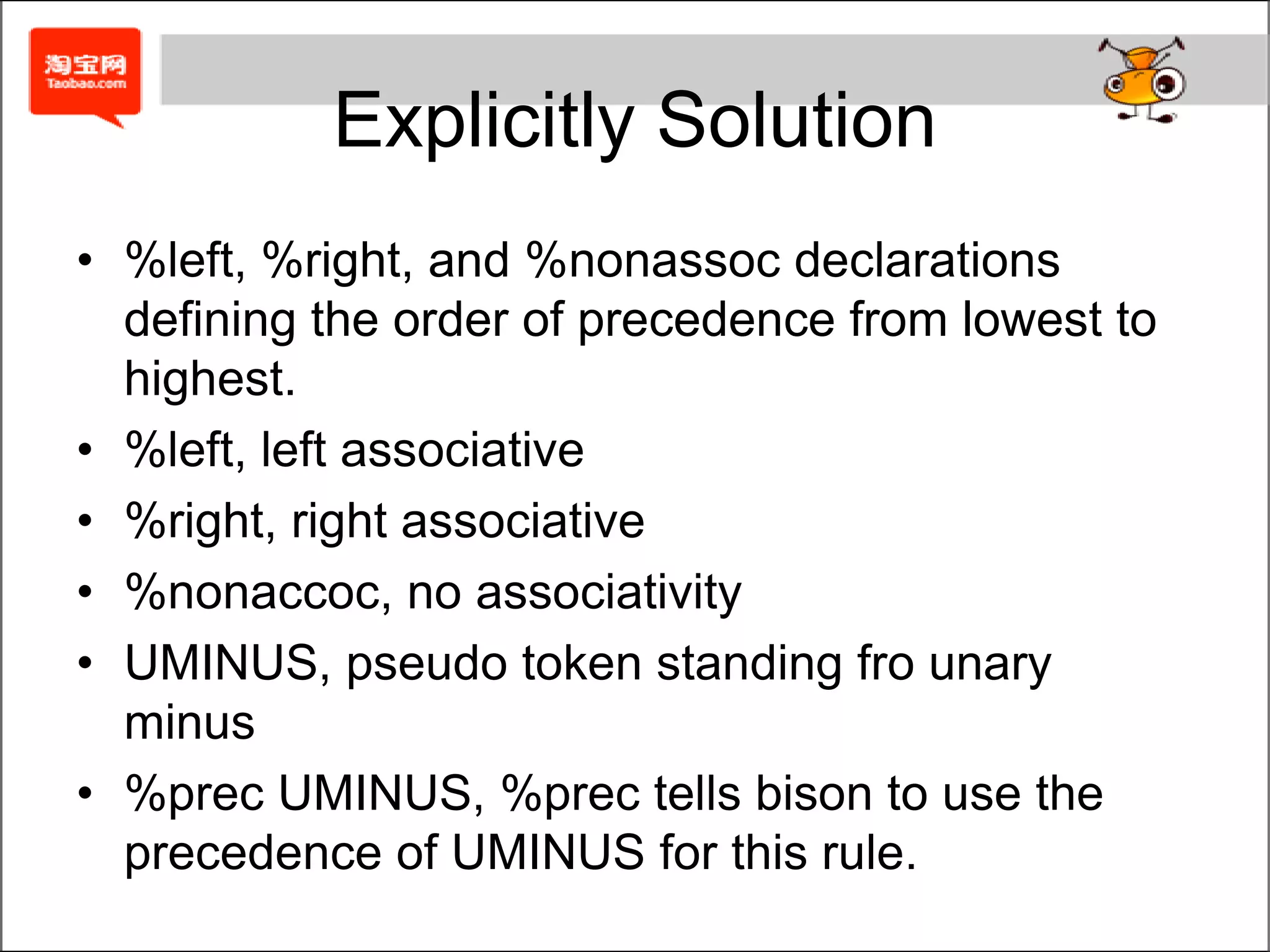
Explicitly Solution%left, %right, and %nonassoc declarations defining the order of precedence from lowest to highest.%left, left associative%right, right associative%nonaccoc, no associativityUMINUS, pseudo token standing fro unary minus%prec UMINUS, %prec tells bison to use the precedence of UMINUS for this rule.
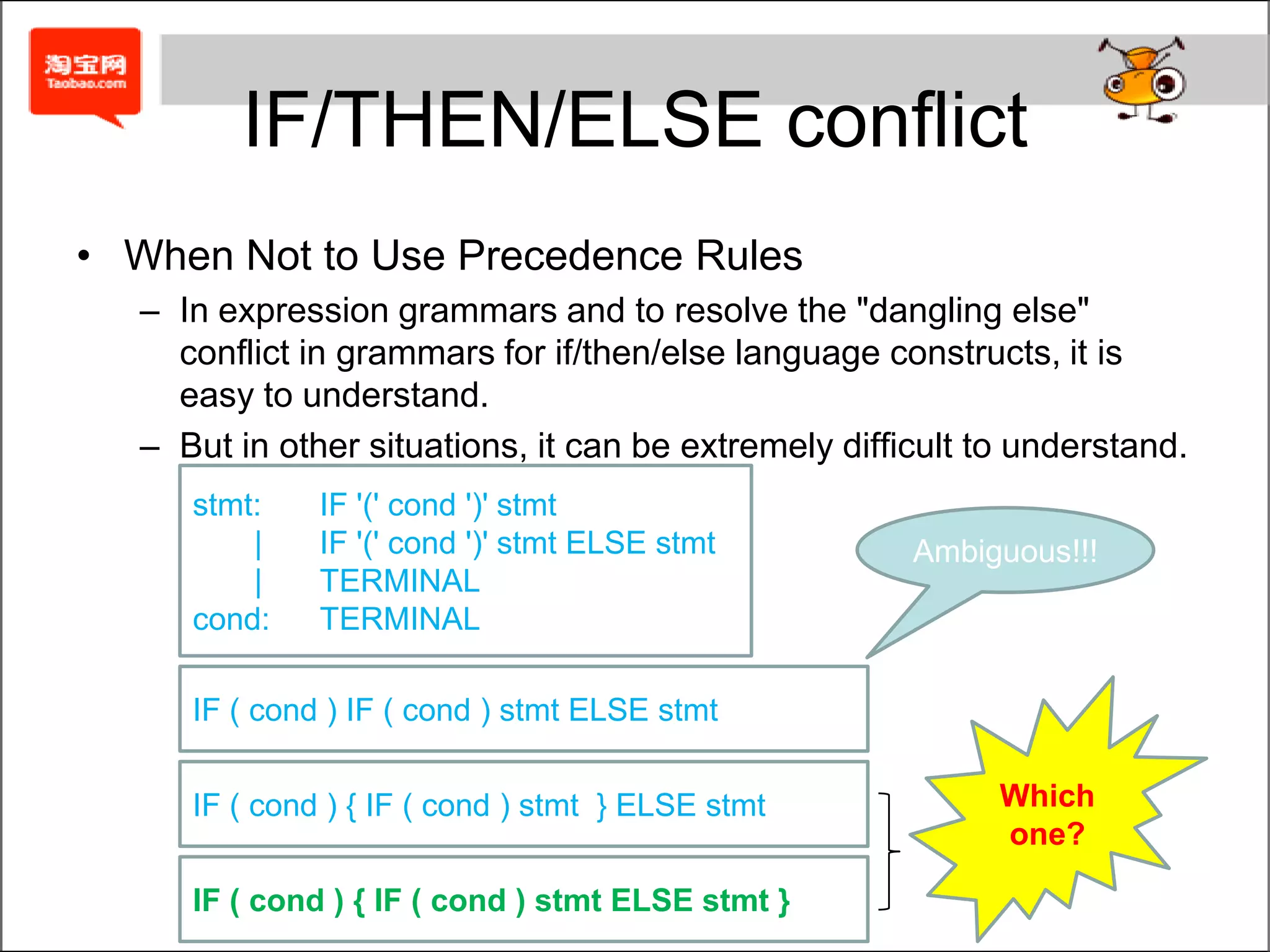
IF/THEN/ELSE conflictWhen Not to Use Precedence RulesIn expression grammars and to resolve the "dangling else" conflict in grammars for if/then/else language constructs, it is easy to understand.But in other situations, it can be extremely difficult to understand.stmt:	IF '(' cond ')' stmt       |	IF '(' cond ')' stmt ELSE stmt       |	TERMINALcond:	TERMINALAmbiguous!!!IF ( cond ) IF ( cond ) stmt ELSE stmtWhich one?IF ( cond ) { IF ( cond ) stmt  } ELSE stmtIF ( cond ) { IF ( cond ) stmt ELSE stmt }
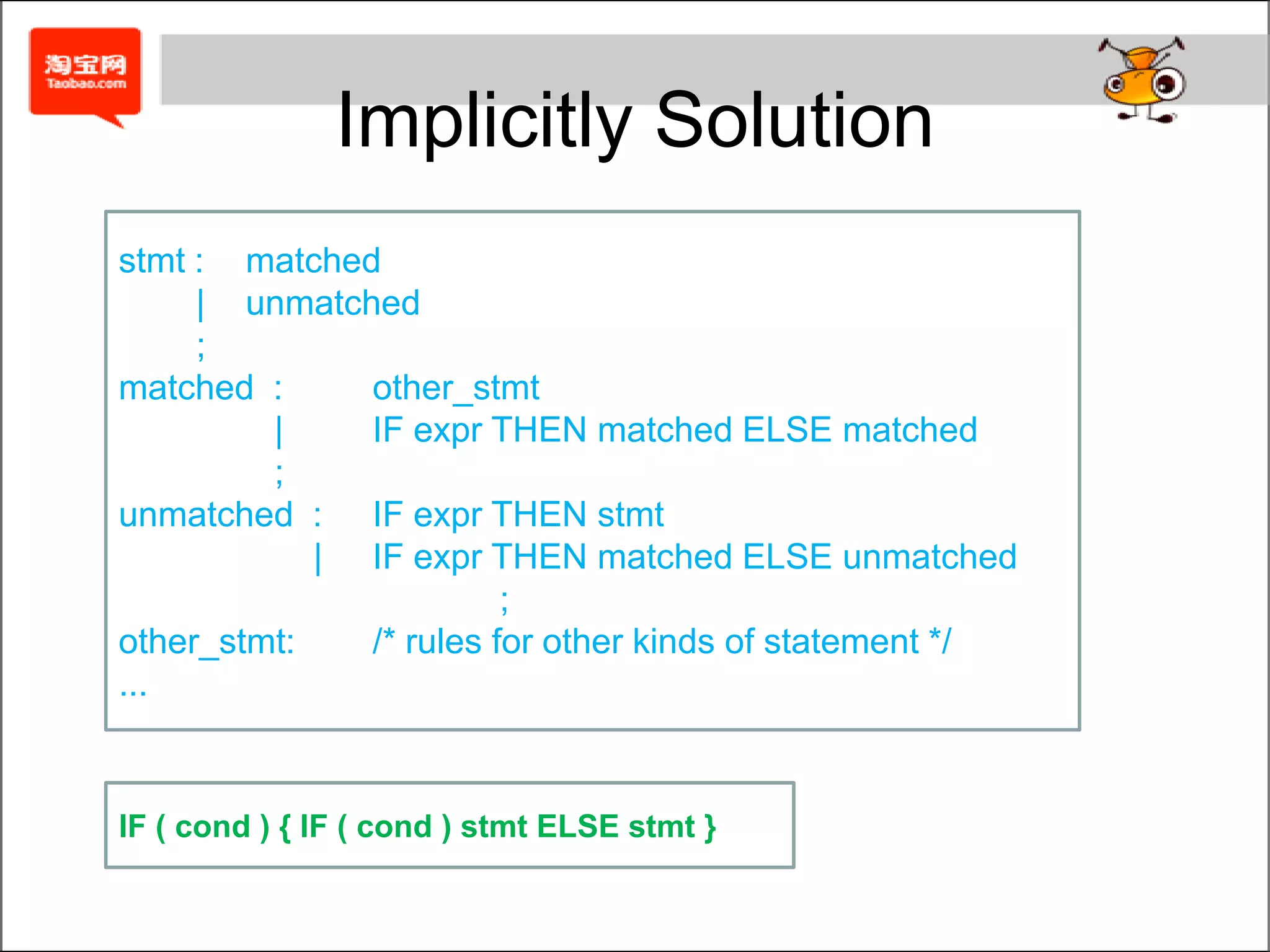
Implicitly Solutionstmt :matched       |	unmatched        ;matched  :other_stmt   |	IF expr THEN matched ELSE matched   ;unmatched  :	IF expr THEN stmt       |	IF expr THEN matched ELSE unmatched			;other_stmt:	/* rules for other kinds of statement */...IF ( cond ) { IF ( cond ) stmt ELSE stmt }
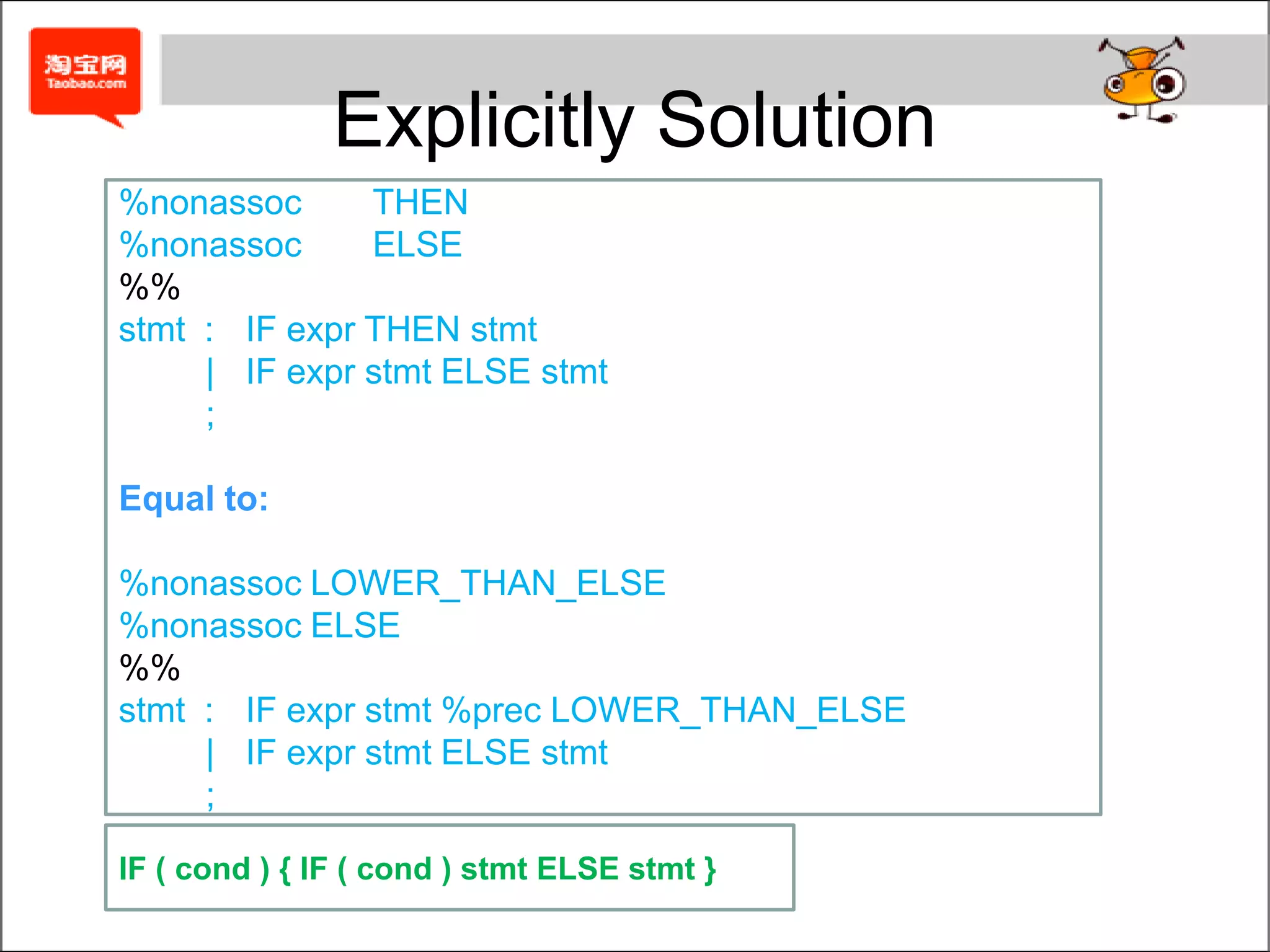
Explicitly Solution%nonassoc	THEN%nonassoc	ELSE%%stmt  :	IF expr THEN stmt         |	IF expr stmt ELSE stmt         ;Equal to:%nonassoc LOWER_THAN_ELSE%nonassoc ELSE%%stmt  :	IF expr stmt %prec LOWER_THAN_ELSE         |	IF expr stmt ELSE stmt        ;IF ( cond ) { IF ( cond ) stmt ELSE stmt }
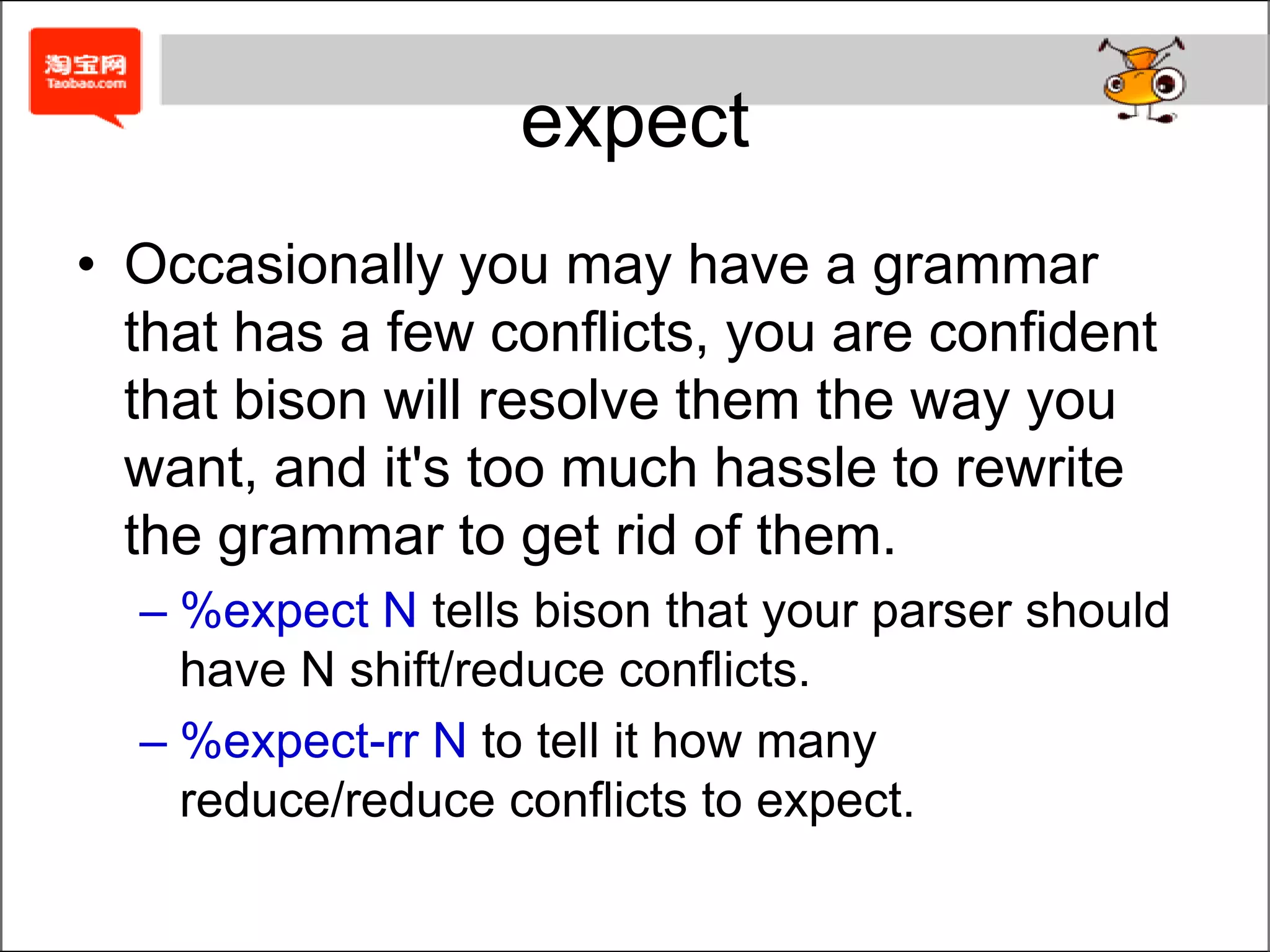
expectOccasionally you may have a grammar that has a few conflicts, you are confident that bison will resolve them the way you want, and it's too much hassle to rewrite the grammar to get rid of them.%expect N tells bison that your parser should have N shift/reduce conflicts.%expect-rr N to tell it how many reduce/reduce conflicts to expect.
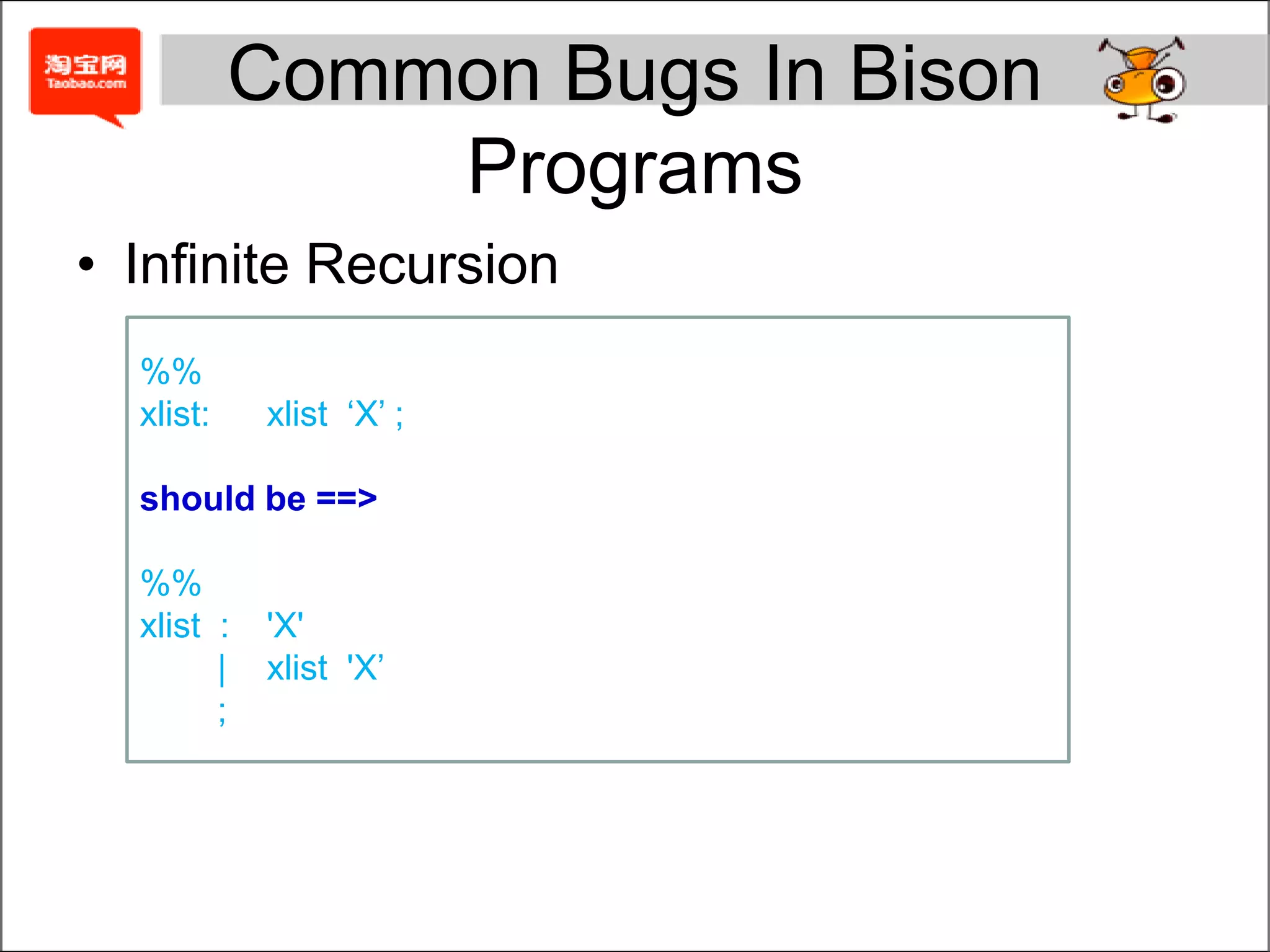
Common Bugs In Bison ProgramsInfinite Recursion%%xlist:	xlist  ‘X’ ;should be ==>%%xlist  :	'X'|	xlist  'X’       ;
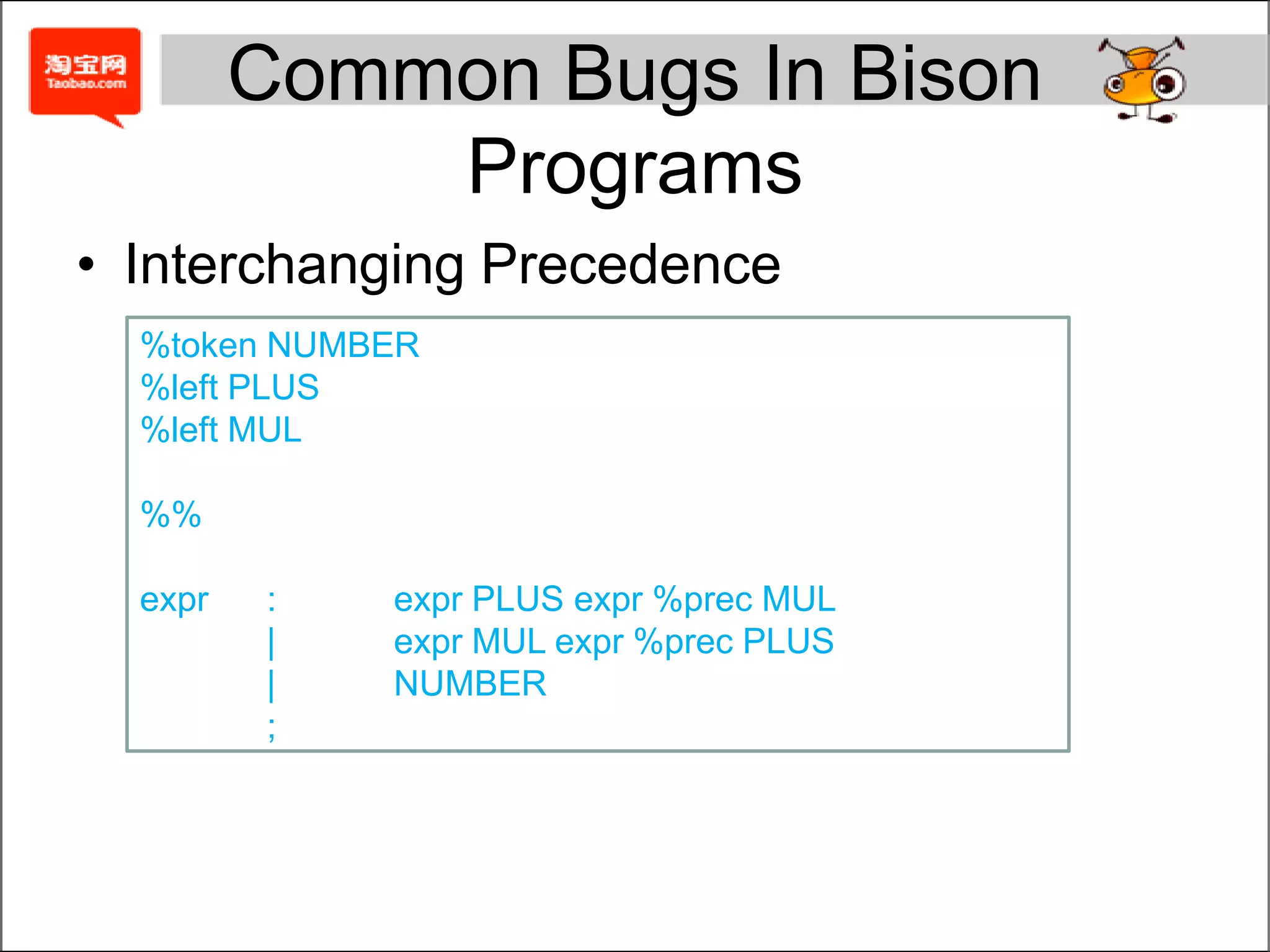
Common Bugs In Bison ProgramsInterchanging Precedence%token NUMBER%left PLUS%left MUL%%expr	:	expr PLUS expr %prec MUL	|	expr MUL expr %prec PLUS	|	NUMBER	;
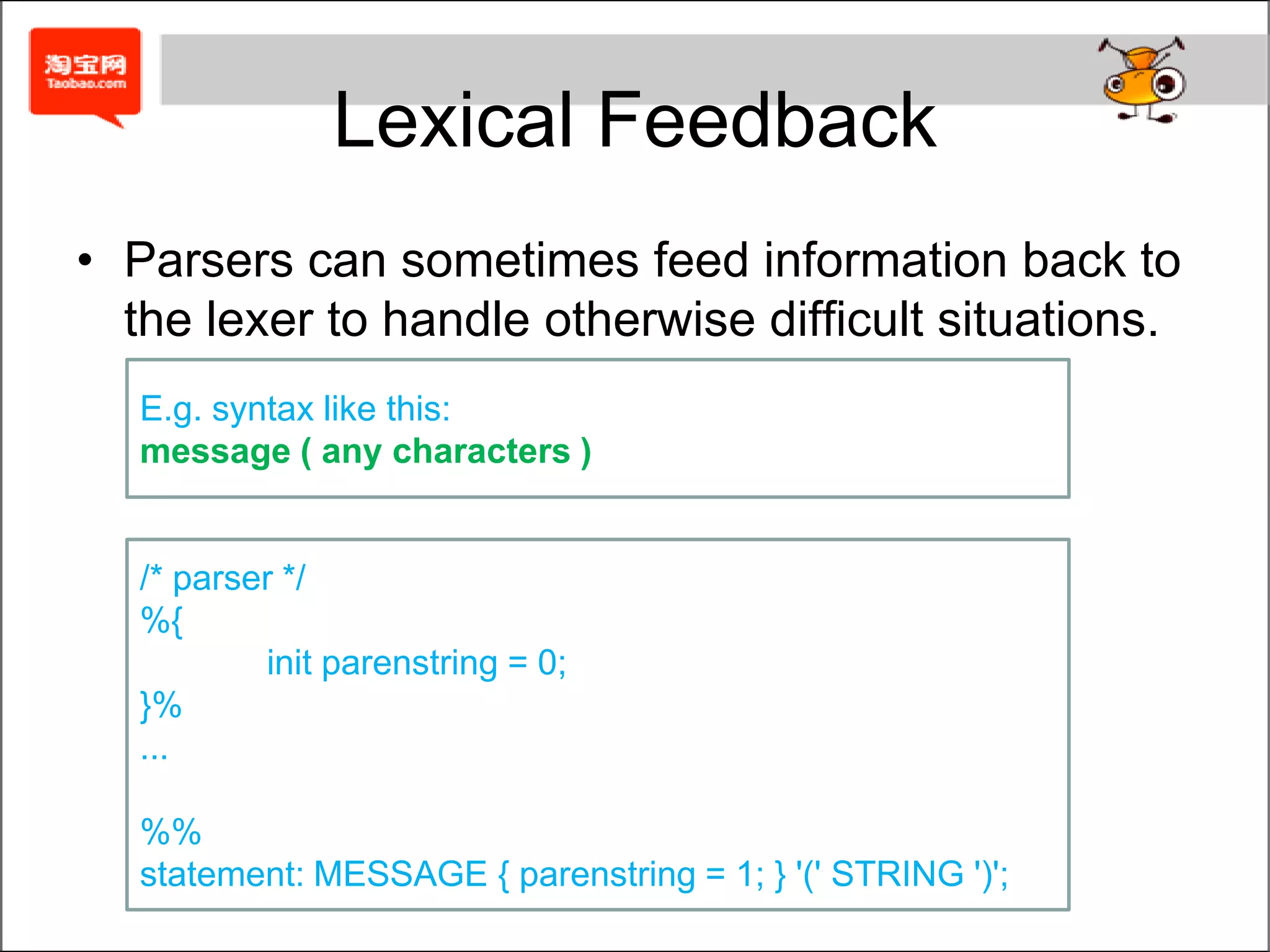
Lexical FeedbackParsers can sometimes feed information back to the lexer to handle otherwise difficult situations. E.g. syntax like this:message ( any characters )/* parser */%{	init parenstring = 0;}%...%%statement: MESSAGE { parenstring = 1; } '(' STRING ')';
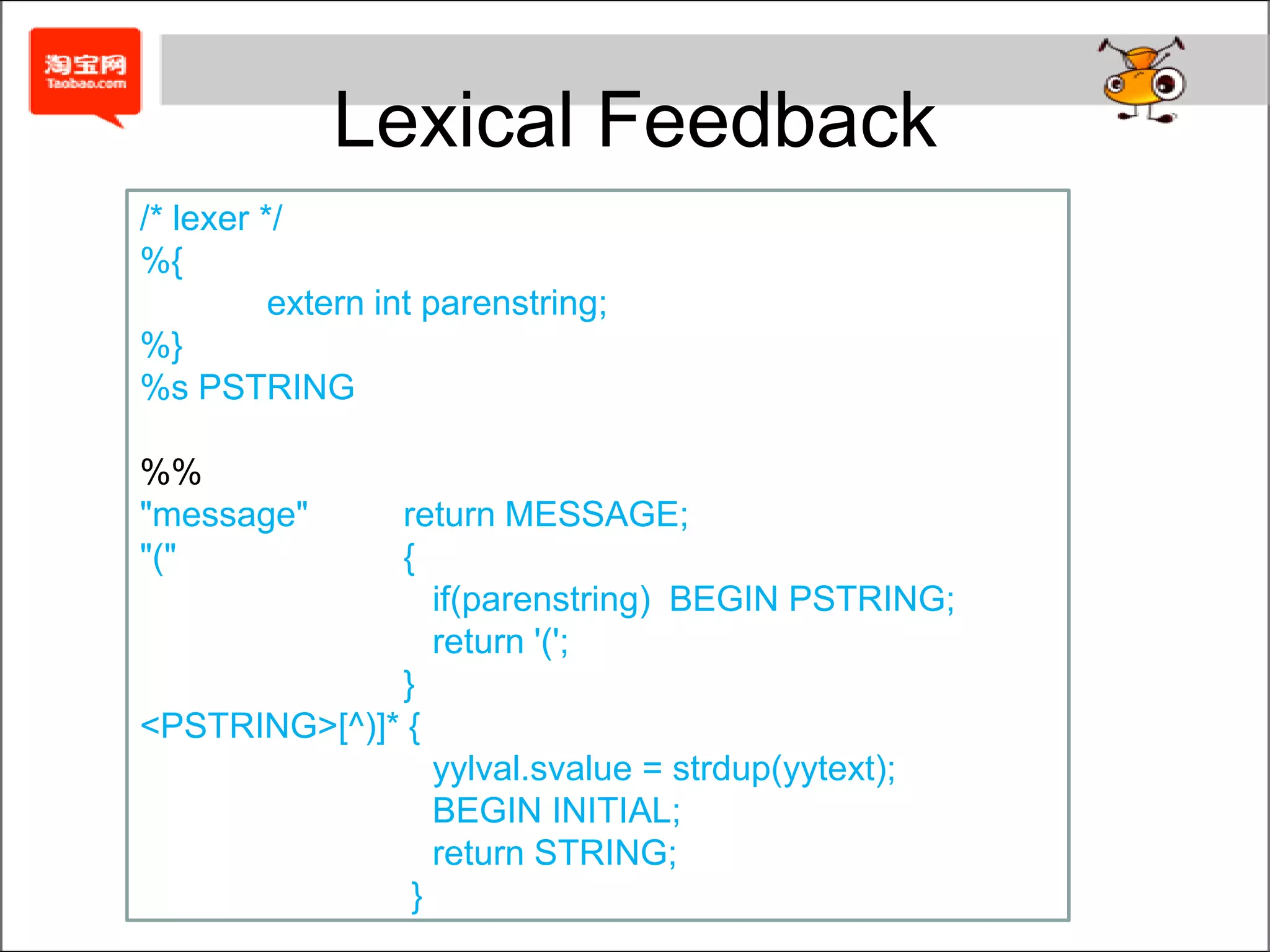
Lexical Feedback/* lexer */%{	extern int parenstring;%}%s PSTRING%%"message"	 return MESSAGE;"(" {    if(parenstring)  BEGIN PSTRING;    return '('; }<PSTRING>[^)]* {    yylval.svalue = strdup(yytext);     BEGIN INITIAL;    return STRING;                            }
Structure of a Bison Specification	... definition section ...	%%	... rules section ...	%%... user subroutines ...
User subroutines SectionThis section typically includes routines called from the actions.Nothing special.

Introduction of bison

  • 1.
  • 2.
    Flex and Bisonstatement: NAME '=' expressionexpression: NUMBER '+' NUMBER | NUMBER '-' NUMBERFlex:recognizes regular expressions.divides the input stream into pieces(token)terminal symbol: Symbols produced by the lexer are called terminal symbols or tokensnonterminal symbol:Those that are defined on the left-hand side of rules are called nonterminal symbols or nonterminals.VSBisonfor building programs that handle structure input.
  • 3.
    takes these piecesand groups them together logically.Shift/Reduce ParsingShiftAs the parser reads tokens, each time it reads a token that doesn't complete a rule, it pushes the token on an internal stack and switchs to a new state reflecting the token it just read. This action is called a shift.ReduceWhen it has found all the symbols that constitute the right-hand side of a rule, it pops the right-hand side symbols off the stack, pushes the left-hand side symbol onto the stack, and switches to a new state reflecting the new symbol on the stack. This action is called a reduction.
  • 4.
    Parsing methodsBison parserscan use either of two parsing methods, known as LALR(1) and GLRLALR(1) (Look Ahead Left to Right with a one-token lookahead), which is less powerful but considerably faster and easier to use than GLR.GLR (Generalized Left to Right).The most common kind of language that computer parsers handle is a context-free grammar(CFG)The standard form to write down a CFG is Baskus-Naur Form (BNF)
  • 5.
    LR parserLR parseris a parser that reads input from Left to right and produces a Rightmost derivation. The term LR(k) parser is also used; where the k refers to the number of unconsumed "look ahead" input symbols that are used in making parsing decisions.Usually k is 1 and the term LR parser is often intended to refer to this case. (LALR(1))
  • 6.
    look aheadLALR(1) cannotdeal with grammars that need more than one token of lookahead to tell whether it has matched a rule.phrase: cart_animal AND CART | work_animal AND PLOWcart_animal: HORSE | GOATwork_animal: HORSE | OXphrase: cart_animalCART | work_animalPLOWcart_animal: HORSE | GOATwork_animal: HORSE | OXNot support!ORphrase: cart_animal AND CART | work_animal AND PLOWcart_animal: HORSE | GOATwork_animal: OX
  • 7.
    Rightmost DerivationRule 1expr expr – digitexprexpr – digitexprexpr + digitexpr digitdigit 0|1|2|…|9Example input: 3 + 8 - 2The rightmost non-terminal is replaced in each stepRule 4expr – digit  expr – 2Rule 2expr – 2 expr + digit - 2Rule 4expr + digit - 2  expr + 8-2Rule 3expr + 8-2 digit + 8-2Rule 4digit + 8-23+8 -2
  • 8.
    Leftmost DerivationRule 1expr expr – digitThe leftmost non-terminal is replaced in each stepexpr11Rule 2expr – digit  expr + digit – digit223expr-digitRule 3expr + digit – digit  digit + digit – digit354exprdigit+Rule 44digit + digit – digit3 + digit – digit2Rule 43 + digit – digit 3 + 8 – digit56digit8Rule 43 + 8 – digit 3 + 8 – 263
  • 9.
    Leftmost DerivationRule 1expr expr – digitexpr  expr – digitexpr  expr + digitexpr  digitdigit 0|1|2|…|9Example input: 3 + 8 - 2The leftmost non-terminal is replaced in each stepRule 2expr – digit  expr + digit – digitRule 3expr + digit – digit  digit + digit – digitRule 4digit + digit – digit3 + digit – digitRule 43 + digit – digit 3 + 8 – digitRule 43 + 8 – digit 3 + 8 – 2
  • 10.
    Leftmost DerivationRule 1expr expr – digitThe leftmost non-terminal is replaced in each stepexpr11Rule 2expr – digit  expr + digit – digit622expr-digitRule 3expr + digit – digit  digit + digit – digit335exprdigit+Rule 44digit + digit – digit3 + digit – digit2Rule 43 + digit – digit 3 + 8 – digit54digit8Rule 43 + 8 – digit 3 + 8 – 263
  • 11.
    Context-Free GrammarsA context-freegrammar G is defined by the 4-tuple:G = (V, ∑, R, S) whereV is a finite set; each element v ϵ V is called a non-terminal character or a variable. Each variable represents a different type of phrase or clause in the sentence. Variables are also sometimes called syntactic categories. Each variable defines a sub-language of the language defined by .∑ is a finite set of terminals, disjoint from V, which make up the actual content of the sentence. The set of terminals is the alphabet of the language defined by the grammar G.R is a finite relation from V to (V U ∑)*. The members of R are called the (rewrite) rules or productions of the grammar.S is the start variable (or start symbol), used to represent the whole sentence (or program). It must be an element of V.The asterisk represents the Kleene star operation.
  • 12.
    Context-free languageThe languageof grammar G = (V, ∑, R, S) is the set L(G) = { ωϵ ∑* : S ωω } A language L is said to be context-free languange(CFL), if there exists a CFG G, such that L = L(G).
  • 13.
    Context-Free GrammarsComprised ofAset of tokens or terminal symbolsA set of non-terminal symbolsA set of rules or productions which express the legal relationships between symbolsA start or goal symbolExample:exprexpr – digitexprexpr + digitexpr digitdigit 0|1|2|…|9Tokens: -,+,0,1,2,…,9
  • 14.
  • 15.
    Start symbol: exprABison ParserA bison specification has the same three-part structure as a flex specification.... definition section ...%%... rules section ...%% a bison example... user subroutines ...The first section, the definition section, handles control information for the parser and generally sets up the execution environment in which the parser will operate.The second section contains the rules for the parser.The third section is C code copied verbatim into the generated C program.
  • 16.
    TermsSymbols are stringsof letters, digits, periods, and underscores that do not start with a digit.error is reserved for error recovery.Do not use C reserved words or bison's own symbols such as yyparse.Symbols produced by the lexer are called terminal symbols or tokensThose that are defined on the left-hand side of rules are called nonterminal symbols or nonterminals.
  • 17.
    Structure of aBison Specification... definition section ... %% ... rules section ... %% ... user subroutines ...
  • 18.
    Literal Block %{ ... Ccode and declarations ... %}The contents of the literal block are copied verbatim to the generated C source file near the beginning, before the beginning of yypare().Usually contains declarations of variables and functions, as well as #include.Bison also provides an experimental %code POS { ... } where POS is a keyword to suggest where in the generated parser the code should go.
  • 19.
    Delaration%parse-param%require "2.4“ declarethe minimum version of bison needed to compile it%startidentifies the top-level rule (Named the first rule.)%union%token%type%left%right%nonassoc%expect
  • 20.
    TokenDefine the ternimators.Bisontreats a character in single quotes as a tokenBison also allows you to decalre strings as aliases for tokensThis defines the token NE and lets you use NE and != interchangeably in the parser. The lexer must still return the internal token values for NE when the token is read, not a string.expr: '(' expr ')';%token NE "!="%%...expr: expr "!=" exp;
  • 21.
    Parse-paramNormally, you callyyparse() with no arguments, if you need, youcan add parameters to its definition:%parse-param { char *modulename } %parse-param { int intensity }This allows you to call yyparse("mymodule", 42)
  • 22.
    TypeThe %union declarationspecifies the entire list of possible types%token is used for declaring token types%type is used for declaring nonterminal symbols%{#include "calc.h“ /* Contains definition of `symrec' */ %} %union { double val; /* For returning numbers. */ symrec *tptr; /* For returning symbol-table pointers */ } %token <tptr> VAR FNCT /* Variable and Function */ %type <val> exp %%
  • 23.
    Structure of aBison Specification ... definition section ... %%... rules section ... %% ... user subroutines ...
  • 24.
    ActionsAn action isC code executed when bison matches a rule in the grammar.The action can refer to the values associated with the symbols in the rule by using a dollar sign followed by a number.The name $$ refers to the value for the left-hand side (LHS) symbol.For rules with no action, bison uses a default of the followingdate: month '/' day '/' year { printf("date %d-%d-%d found", $1, $3, $5); } ;{ $$ = $1; }
  • 25.
    RulesRecursive RulesThe actioncan refer to the values associated with the symbols in the rule by using a dollar sign followed by a number.In most cases, Bison handles left recursion much more efficiently than right recursion.numberlist : /* empty */ | numberlist NUMBER ;exprlist: exprlist ',' expr; /* left recursion */orexprlist: expr ',' exprlist; /* right recursion */
  • 26.
    Special Characters% All ofthe declarations in the definition section start with %.$ In actions, a dollar sign introduces a value reference.@ In actions, an @ sign introduces a location reference, such as @2 for the location of the second symbol in the RHS.' Literal tokens are enclosed in single quotes." Bison lets you declare quoted string as parser alias for tokens.<> In a value reference in an action, you can override the value's default type by enclosing the type name in angle brackets.{} The C code in actions is enclosed in curly braces.; Each rule in the rules section should end with a semicolon.| or syntax for multi-rules with same LHS.: separate left-hand side and right-hand side- Symbols may include underscores along with letters, digits, and periods.. Symbols may include periods along with letters, digits, and underscores.
  • 27.
    ReservedYYABORTIn an actionmakes the parser routine yyparse() return immediately with a nonzero value, indicating failure.YYACCEPTIn an action makes the parser routine yyparse() return immediately with a value 0, indicating success.YYBACKUPThe macro YYBACKUP lets you unshift the current token and replace it with something else.sym: TOKEN { YYBACKUP(newtok, newval); }It is extremely difficult to use YYBACKUP() correctly, so you're best off not using it.
  • 28.
    ReservedyyclearinThe macro yyclearinin an action discards a lookahead token if one has been read. It is most oftern useful in error recovery in an interactive parser to put the paarser into a known state after an error:YYDEBUGTo include the trace code, either use the -t flag on the bison command line or else define the C preprocessor symbol YYDEBUG to be nonzero either on the C compiler command line or by inlcuding something like this in the definition section:stmtlist : stmt | stmtlist stmt;stmt : error { reset_input(); yyclearin; };%{#define YYDEBUG 1%}
  • 29.
    Ambiguity and ConflictsThegrammar is truly ambiguousShift/Reduce ConflictsReduce/Reduce ConflictsThe grammar is unambiguous, but the standard parsing technique that bison uses is not powerful enough to parse the grammar. (need to look more than one token ahead)We have already told about it of LALR(1).
  • 30.
    Reduce/Reduce ConflictsA reduce/reduceconflict occurs when the same token could complete two different rules. %% prog: proga | progb; proga: 'X'; progb: 'X';
  • 31.
    Shift/Reduce Conflicts%type <a>exp...%%...expr: expr '+' exp { $$ = newast('+', $1, $3); } | expr '-' exp { $$ = newast('-', $1, $3); } | expr '*' exp { $$ = newast('*', $1, $3); } | expr '/' exp { $$ = newast('/', $1, $3); } | '|' exp { $$ = newast('|', $2, NULL); } | '(' exp ')' { $$ = $2); } | '-' exp { $$ = newast('M', $2, NULL); } | NUMBER { $$ = newnum($1); } ;%%Example 2+3*4
  • 32.
    ProblemAt this point,the parser looks at the * and could either reduce 2+3 using;to an expression or shift the *, expecting to be able to reduce: later on.2 shift NUMBERE reduce E->NUMBERE + shift +E + 3 shift NUMBERE + E reduce E->NUMBERExample 2+3 * 4expr: expr '+' expexpr: expr ‘*' exp
  • 33.
    AnalysisThe problem isthat we haven't told bison about the precedence and associativity of the operators.Precedence controls which operators execute first in an expression.In and expression grammar, operators are grouped into levels of precedence from lowest to highest.The total number of levels depends on the language. The C language is notorious for having too many precedence levels, a total of 15 levels.Associativity controls the grouping of operators at the same precedence level.
  • 34.
    Implicitly Solution%type <a>exp exp1 exp2...%%...expr : expr1 '+' exp1 { $$ = newast('+', $1, $3); } | expr1 '-' exp1 { $$ = newast('-', $1, $3); } | expr1 { $$ = $1; }expr1: expr2 '*' exp2 { $$ = newast('*', $1, $3); } | expr2 '/' exp2 { $$ = newast('/', $1, $3); } | expr2 { $$ = $1; }expr2: '|' exp { $$ = newast('|', $2, NULL); } | '(' exp ')' { $$ = $2); } | '-' exp { $$ = newast('M', $2, NULL); } | NUMBER { $$ = newnum($1); } ;%%
  • 35.
    Explicitly Solution%left '+''-’%left '*' '/’%nonassoc '|' NMINUS%type <a> exp exp1 exp2...%%...expr: expr '+' exp { $$ = newast('+', $1, $3); } | expr '-' exp { $$ = newast('-', $1, $3); } | expr '*' exp { $$ = newast('*', $1, $3); } | expr '/' exp { $$ = newast('/', $1, $3); } | '|' exp { $$ = newast('|', $2, NULL); } | '(' exp ')' { $$ = $2); } | '-' exp %prec UMINUS { $$ = newast('M', $2, NULL); } | NUMBER { $$ = newnum($1); } ;%%
  • 36.
    Explicitly Solution%left, %right,and %nonassoc declarations defining the order of precedence from lowest to highest.%left, left associative%right, right associative%nonaccoc, no associativityUMINUS, pseudo token standing fro unary minus%prec UMINUS, %prec tells bison to use the precedence of UMINUS for this rule.
  • 37.
    IF/THEN/ELSE conflictWhen Notto Use Precedence RulesIn expression grammars and to resolve the "dangling else" conflict in grammars for if/then/else language constructs, it is easy to understand.But in other situations, it can be extremely difficult to understand.stmt: IF '(' cond ')' stmt | IF '(' cond ')' stmt ELSE stmt | TERMINALcond: TERMINALAmbiguous!!!IF ( cond ) IF ( cond ) stmt ELSE stmtWhich one?IF ( cond ) { IF ( cond ) stmt } ELSE stmtIF ( cond ) { IF ( cond ) stmt ELSE stmt }
  • 38.
    Implicitly Solutionstmt :matched | unmatched ;matched :other_stmt | IF expr THEN matched ELSE matched ;unmatched : IF expr THEN stmt | IF expr THEN matched ELSE unmatched ;other_stmt: /* rules for other kinds of statement */...IF ( cond ) { IF ( cond ) stmt ELSE stmt }
  • 39.
    Explicitly Solution%nonassoc THEN%nonassoc ELSE%%stmt : IF expr THEN stmt | IF expr stmt ELSE stmt ;Equal to:%nonassoc LOWER_THAN_ELSE%nonassoc ELSE%%stmt : IF expr stmt %prec LOWER_THAN_ELSE | IF expr stmt ELSE stmt ;IF ( cond ) { IF ( cond ) stmt ELSE stmt }
  • 40.
    expectOccasionally you mayhave a grammar that has a few conflicts, you are confident that bison will resolve them the way you want, and it's too much hassle to rewrite the grammar to get rid of them.%expect N tells bison that your parser should have N shift/reduce conflicts.%expect-rr N to tell it how many reduce/reduce conflicts to expect.
  • 41.
    Common Bugs InBison ProgramsInfinite Recursion%%xlist: xlist ‘X’ ;should be ==>%%xlist : 'X'| xlist 'X’ ;
  • 42.
    Common Bugs InBison ProgramsInterchanging Precedence%token NUMBER%left PLUS%left MUL%%expr : expr PLUS expr %prec MUL | expr MUL expr %prec PLUS | NUMBER ;
  • 43.
    Lexical FeedbackParsers cansometimes feed information back to the lexer to handle otherwise difficult situations. E.g. syntax like this:message ( any characters )/* parser */%{ init parenstring = 0;}%...%%statement: MESSAGE { parenstring = 1; } '(' STRING ')';
  • 44.
    Lexical Feedback/* lexer*/%{ extern int parenstring;%}%s PSTRING%%"message" return MESSAGE;"(" { if(parenstring) BEGIN PSTRING; return '('; }<PSTRING>[^)]* { yylval.svalue = strdup(yytext); BEGIN INITIAL; return STRING; }
  • 45.
    Structure of aBison Specification ... definition section ... %% ... rules section ... %%... user subroutines ...
  • 46.
    User subroutines SectionThissection typically includes routines called from the actions.Nothing special.
  • 47.