DM_PPT_NP_v01SESIP_0715_GH3
His Expert’s Voice
Gerd Heber
The HDF Group
Champaign Illinois USA
This work was supported by NASA/GSFC under
Raytheon Co. contract number NNG10HP02C
Community Conventions and Expert Systems
DM_PPT_NP_v01SESIP_0715_GH3
Outline
• Expert Systems Recap
• Typical Example
• An Expert System-centric View of the HDF
Product Designer (HPD)
• Status
• Work in Progress
2July 14 – 17, 2015
DM_PPT_NP_v01SESIP_0715_GH3
Conventions (Idealized)
A data model convention defines the structure and intended meaning of data.
However, it should also be noted that a data model convention is restrictive
rather than permissive.
Let me illustrate this with an old joke (well I’ve been telling it for a long time)
about the differences between different European cultures. It goes like this:
“What is the difference between the British, the Germans, and the Italians?”
“I don’t know, what is the difference?”
“Well, for the British it is allowed unless it is forbidden, for the Germans it is
forbidden unless it is allowed, and for the Italians it is allowed especially if it
is forbidden.”
Well data models conventions are like the Germans. It is forbidden unless it is
allowed. So if you have not provided the necessary entity types, relationship
types, and attributes, then the data cannot be held.
3July 14 – 17, 2015
Source: Developing High Quality Data Models by Matthew West, Elsevier 2011.
DM_PPT_NP_v01SESIP_0715_GH3
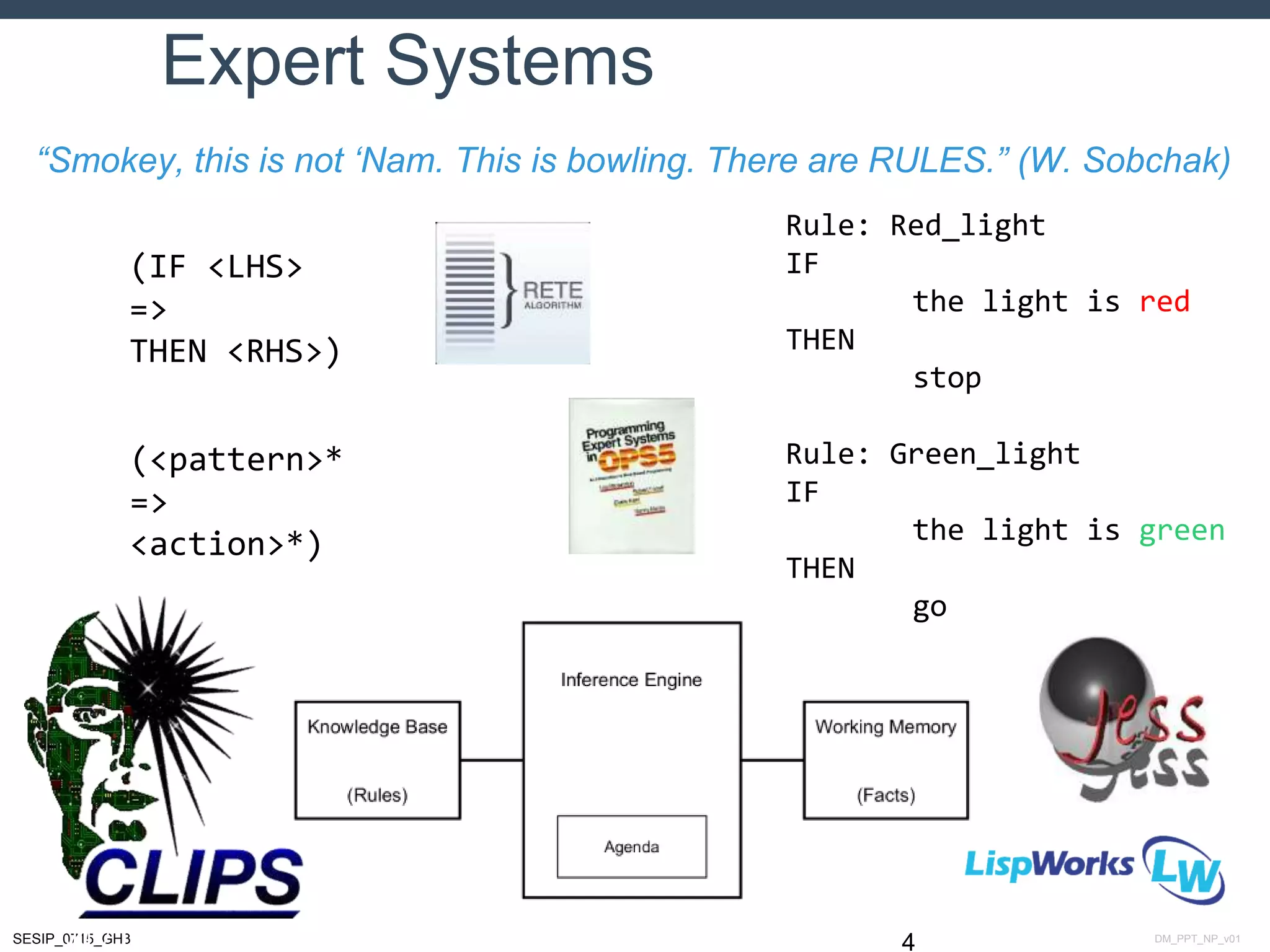
Expert Systems
4July 14 – 17, 2015
“Smokey, this is not ‘Nam. This is bowling. There are RULES.” (W. Sobchak)
(IF <LHS>
=>
THEN <RHS>)
(<pattern>*
=>
<action>*)
Rule: Red_light
IF
the light is red
THEN
stop
Rule: Green_light
IF
the light is green
THEN
go
DM_PPT_NP_v01SESIP_0715_GH3
Conway’s Game of Life
1. A cell adjacent to exactly 2 or 3 other living
cells continues to live.
2. Any living cell adjacent to less than 2 or
greater than 3 other living cells will die.
3. Any dead cell adjacent to 3 other living
cells comes to life.
5July 14 – 17, 2015
X X
X X X X
X X
X
X X
X X X
X X
Gen. N Gen. N+1
DM_PPT_NP_v01SESIP_0715_GH3
Example (CLIPS Syntax)
6July 14 – 17, 2015
(deffacts control-information
(phase assessment)
(phase-after assessment death)
(phase-after death birth)
(phase-after birth relaxation)
(phase-after relaxation assessment))
(deftemplate cell
“A live cell”
(slot row (type INTEGER) (range 0 4))
(slot col (type INTEGER) (range 0 4)))
(defrule deaths
“Living cells with live neighbor count <2 or >3 die”
(phase death)
?cell <- (cell (row ?row) (col ?col))
?count <- (live-neighbor-count (row ?row) (col ?col)
(val ?val&~2&~3))
=>
(printout t “Deleting cell [” ?row “,” ?col “]” crlf)
(retract ?cell))
Ordered Facts ->
<- Fact Template
Rule ->
DM_PPT_NP_v01SESIP_0715_GH3
Convention Knowledge
Organization
7July 14 – 17, 2015
HPD
Design
Cycle
Interop
Convention 1
Convention 2
DM_PPT_NP_v01SESIP_0715_GH3
HPD: Expert System-Centric View
8July 14 – 17, 2015
CLIPS rules and fact templates
provided by domain expert(s)
(MVC: Model-View-Controller pattern)
DM_PPT_NP_v01SESIP_0715_GH3
Status and Challenges
• Conventions in HPD:
– HDF-EOS w/ ACCD
– NUG w/ ACCD
– CF w/ ACDD
– Custom (experimental)
• CLIPS integration with a Python-based
HPD client via PyCLIPS (unmaintained!)
• State management (UI, design, facts)
• The Expert System development process is
different from traditional SW development
9July 14 – 17, 2015
DM_PPT_NP_v01SESIP_0715_GH3
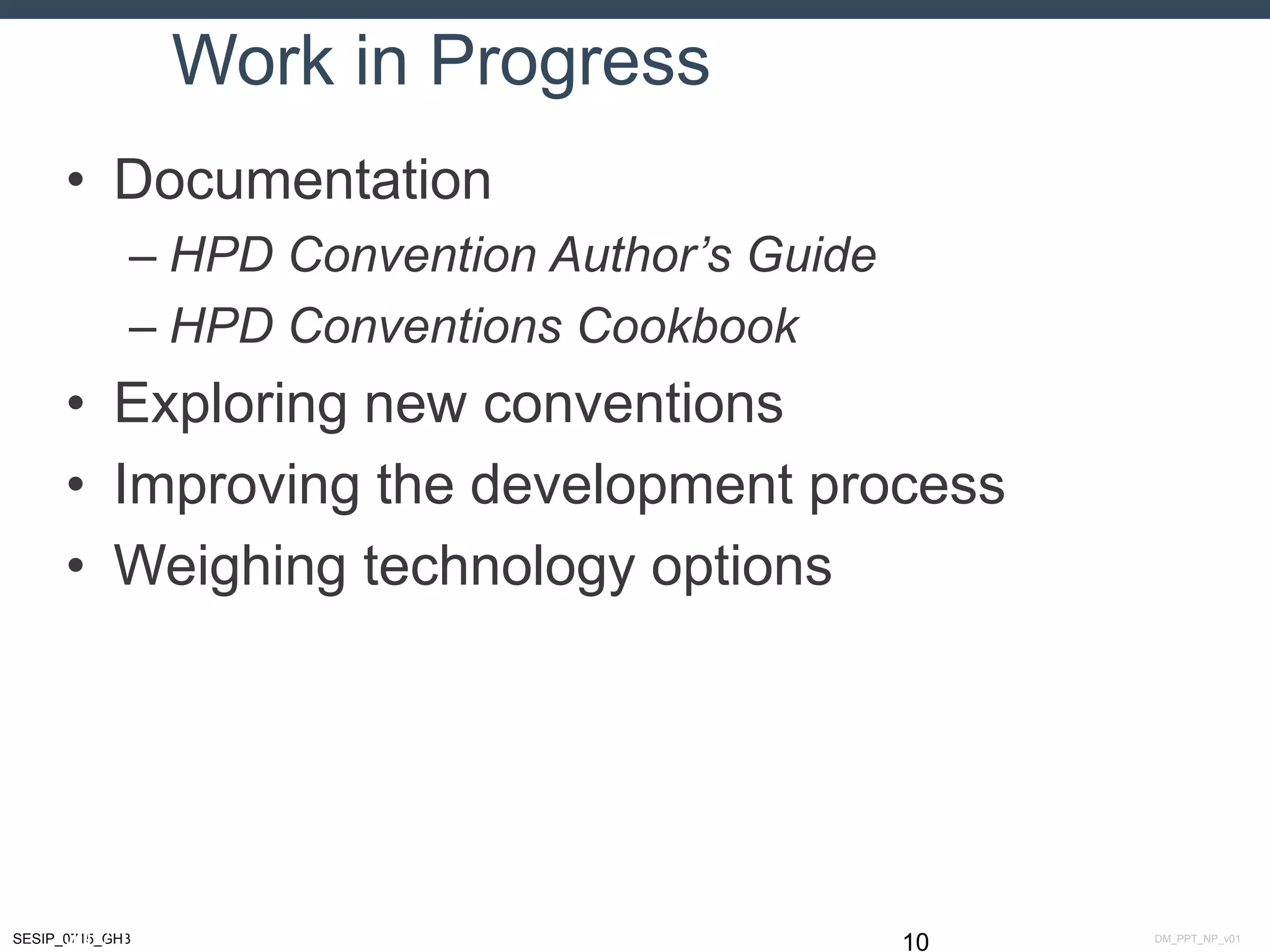
Work in Progress
• Documentation
– HPD Convention Author’s Guide
– HPD Conventions Cookbook
• Exploring new conventions
• Improving the development process
• Weighing technology options
10July 14 – 17, 2015
DM_PPT_NP_v01SESIP_0715_GH3
References
11July 14 – 17, 2015
[Book1] J.C. Giarratano and G.D. Riley: Expert Systems: Principles and
Programming, Fourth Edition, Course Technology, 2004.
[Book2] C. Nikolopoulos: Expert Systems, Marcel Dekker, 1997.
[CLIPS] http://clipsrules.sourceforge.net/
[Forgy198
2]
Charles Forgy (1982). "Rete: A Fast Algorithm for the Many
Pattern/Many Object Pattern Match Problem". Artificial
Intelligence 19: 17–37. doi:10.1016/0004-3702(82)90020-0
[Jess] http://herzberg.ca.sandia.gov/
[Lisa] http://lisa.sourceforge.net/
[LispWork
s]
http://www.lispworks.com/
[PyCLIPS] http://pyclips.sourceforge.net/web/
DM_PPT_NP_v01SESIP_0715_GH3
12
DM_PPT_NP_v01SESIP_0715_GH3
13
This work was supported by
NASA/GSFC under Raytheon Co.
contract number NNG10HP02C

His Expert's Voice

  • 1.
    DM_PPT_NP_v01SESIP_0715_GH3 His Expert’s Voice GerdHeber The HDF Group Champaign Illinois USA This work was supported by NASA/GSFC under Raytheon Co. contract number NNG10HP02C Community Conventions and Expert Systems
  • 2.
    DM_PPT_NP_v01SESIP_0715_GH3 Outline • Expert SystemsRecap • Typical Example • An Expert System-centric View of the HDF Product Designer (HPD) • Status • Work in Progress 2July 14 – 17, 2015
  • 3.
    DM_PPT_NP_v01SESIP_0715_GH3 Conventions (Idealized) A datamodel convention defines the structure and intended meaning of data. However, it should also be noted that a data model convention is restrictive rather than permissive. Let me illustrate this with an old joke (well I’ve been telling it for a long time) about the differences between different European cultures. It goes like this: “What is the difference between the British, the Germans, and the Italians?” “I don’t know, what is the difference?” “Well, for the British it is allowed unless it is forbidden, for the Germans it is forbidden unless it is allowed, and for the Italians it is allowed especially if it is forbidden.” Well data models conventions are like the Germans. It is forbidden unless it is allowed. So if you have not provided the necessary entity types, relationship types, and attributes, then the data cannot be held. 3July 14 – 17, 2015 Source: Developing High Quality Data Models by Matthew West, Elsevier 2011.
  • 4.
    DM_PPT_NP_v01SESIP_0715_GH3 Expert Systems 4July 14– 17, 2015 “Smokey, this is not ‘Nam. This is bowling. There are RULES.” (W. Sobchak) (IF <LHS> => THEN <RHS>) (<pattern>* => <action>*) Rule: Red_light IF the light is red THEN stop Rule: Green_light IF the light is green THEN go
  • 5.
    DM_PPT_NP_v01SESIP_0715_GH3 Conway’s Game ofLife 1. A cell adjacent to exactly 2 or 3 other living cells continues to live. 2. Any living cell adjacent to less than 2 or greater than 3 other living cells will die. 3. Any dead cell adjacent to 3 other living cells comes to life. 5July 14 – 17, 2015 X X X X X X X X X X X X X X X X Gen. N Gen. N+1
  • 6.
    DM_PPT_NP_v01SESIP_0715_GH3 Example (CLIPS Syntax) 6July14 – 17, 2015 (deffacts control-information (phase assessment) (phase-after assessment death) (phase-after death birth) (phase-after birth relaxation) (phase-after relaxation assessment)) (deftemplate cell “A live cell” (slot row (type INTEGER) (range 0 4)) (slot col (type INTEGER) (range 0 4))) (defrule deaths “Living cells with live neighbor count <2 or >3 die” (phase death) ?cell <- (cell (row ?row) (col ?col)) ?count <- (live-neighbor-count (row ?row) (col ?col) (val ?val&~2&~3)) => (printout t “Deleting cell [” ?row “,” ?col “]” crlf) (retract ?cell)) Ordered Facts -> <- Fact Template Rule ->
  • 7.
    DM_PPT_NP_v01SESIP_0715_GH3 Convention Knowledge Organization 7July 14– 17, 2015 HPD Design Cycle Interop Convention 1 Convention 2
  • 8.
    DM_PPT_NP_v01SESIP_0715_GH3 HPD: Expert System-CentricView 8July 14 – 17, 2015 CLIPS rules and fact templates provided by domain expert(s) (MVC: Model-View-Controller pattern)
  • 9.
    DM_PPT_NP_v01SESIP_0715_GH3 Status and Challenges •Conventions in HPD: – HDF-EOS w/ ACCD – NUG w/ ACCD – CF w/ ACDD – Custom (experimental) • CLIPS integration with a Python-based HPD client via PyCLIPS (unmaintained!) • State management (UI, design, facts) • The Expert System development process is different from traditional SW development 9July 14 – 17, 2015
  • 10.
    DM_PPT_NP_v01SESIP_0715_GH3 Work in Progress •Documentation – HPD Convention Author’s Guide – HPD Conventions Cookbook • Exploring new conventions • Improving the development process • Weighing technology options 10July 14 – 17, 2015
  • 11.
    DM_PPT_NP_v01SESIP_0715_GH3 References 11July 14 –17, 2015 [Book1] J.C. Giarratano and G.D. Riley: Expert Systems: Principles and Programming, Fourth Edition, Course Technology, 2004. [Book2] C. Nikolopoulos: Expert Systems, Marcel Dekker, 1997. [CLIPS] http://clipsrules.sourceforge.net/ [Forgy198 2] Charles Forgy (1982). "Rete: A Fast Algorithm for the Many Pattern/Many Object Pattern Match Problem". Artificial Intelligence 19: 17–37. doi:10.1016/0004-3702(82)90020-0 [Jess] http://herzberg.ca.sandia.gov/ [Lisa] http://lisa.sourceforge.net/ [LispWork s] http://www.lispworks.com/ [PyCLIPS] http://pyclips.sourceforge.net/web/
  • 12.
  • 13.
    DM_PPT_NP_v01SESIP_0715_GH3 13 This work wassupported by NASA/GSFC under Raytheon Co. contract number NNG10HP02C