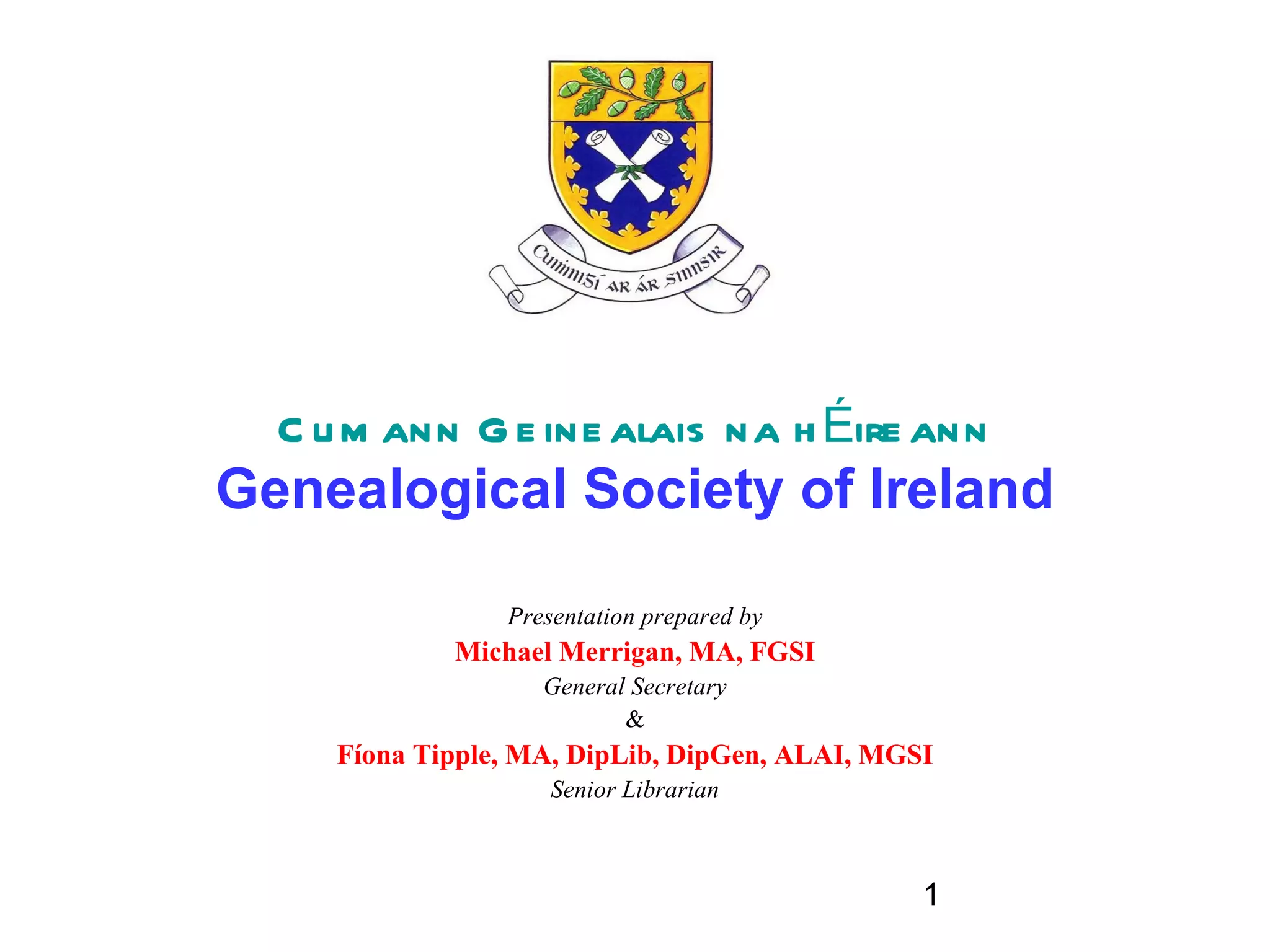
C u m ann G e ine alais na h Éire ann
Genealogical Society of Ireland

                 Presentation prepared by
             Michael Merrigan, MA, FGSI
                    General Secretary
                           &
     Fíona Tipple, MA, DipLib, DipGen, ALAI, MGSI
                     Senior Librarian


                                                1
Introduction to the Society
•   Founded in 1990 in Dún Laoghaire
•   Adopted present name in 1999
•   Incorporated in 2000
•   Received a Grant of Arms in 2001
•   Nominating Body for Seanad Éireann
•   Registered Educational Charity
•   Irish and international membership

                                   2
Objective & Activities
• To promote the study of genealogy, heraldry and
  social history as open access educational leisure
  pursuits available to all ... through
• 12 Lectures and 11 discussion groups
• Publications – monthly, annual & occasional
• Archive & Research Centre – An Daonchartlann
• Courses – weekend genealogy courses
• Group projects – Irish DNA Atlas & others
• Advocacy – legislative matters & accessibility

                                          3
Public Policy Principle
• At its 1997 AGM the Society adopted the
  important ‘Principle of Public Ownership and
  Right of Access’ to our genealogical heritage.

• This is now accepted as the bedrock of good
  practice by progressive institutions throughout
  the State.


                                     4
Legislative Issues
Advocacy on legislative matters relating to genealogical
 records and heritage issues since 1992 and covering
 circa 20 Bills, including:

    Statistics Act (1993)

    Heritage Act (1995)

    National Cultural Institutions Act (1997)

    Civil Registration Act (2004)

    Genealogy & Heraldry Bill (2006)

    National Cultural Institutions (Amendment) Bill (2008)

    Statistics (Heritage Amendment) Bill (2011)

    Proposed integration of NAI, IMC and NLI

    and many others.

                                                 5
Legislative Programme
• The Society welcomes the inclusion in the Programme for
  Government of commitments on the release of the 1926
  census and the reform of the delivery of heraldic services.

• The National Archives Act, 1986 and the National Cultural
  Institutions Act, 1997 require updating to meet the current and
  future requirements of the institutions.

• Opportunity for the legislative integration of the NAI, IMC
  and NLI in a new National Cultural & Archival Institutions
  Bill which maintains these bodies as separate institutions.


                                                 6
Genealogy – Resource or Product?

• The fundamental question!
• As a product genealogy benefits the few –
  those who can afford to buy it and those
  selling it.
• As a national resource genealogy has the
  potential to benefit important sectors of the
  economy and many communities throughout
  the country in a sustainable manner.

                                     7
Sustainable National Resource
• Our genealogical heritage is part of what we are as a people
  and it’s the cherished inheritance of over 70 million people
  throughout the world.
• Genealogy is the ‘gateway’ or ‘introduction’ to Ireland and its
  culture, heritage, goods and services for millions of potential
  customers, clients, visitors and investors around the world.
• Genealogy is a sustainable national resource.
• To successfully compete with the growing trend towards ‘pay
  for view’ genealogy, we should concentrate on developing and
  marketing internationally accessible ‘free to view’ on-line
  genealogical resources.

                                                 8
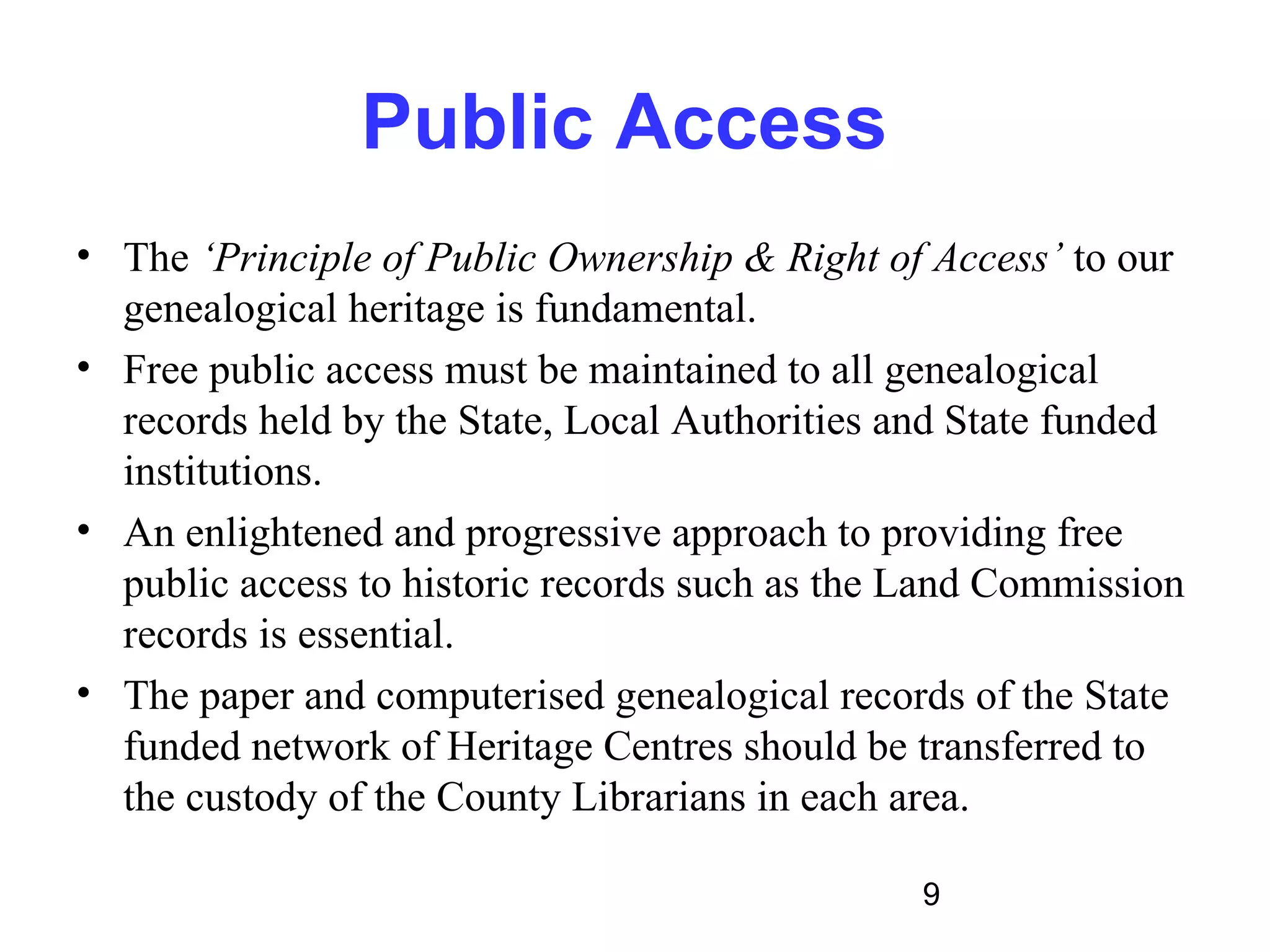
Public Access
• The ‘Principle of Public Ownership & Right of Access’ to our
  genealogical heritage is fundamental.
• Free public access must be maintained to all genealogical
  records held by the State, Local Authorities and State funded
  institutions.
• An enlightened and progressive approach to providing free
  public access to historic records such as the Land Commission
  records is essential.
• The paper and computerised genealogical records of the State
  funded network of Heritage Centres should be transferred to
  the custody of the County Librarians in each area.

                                                9
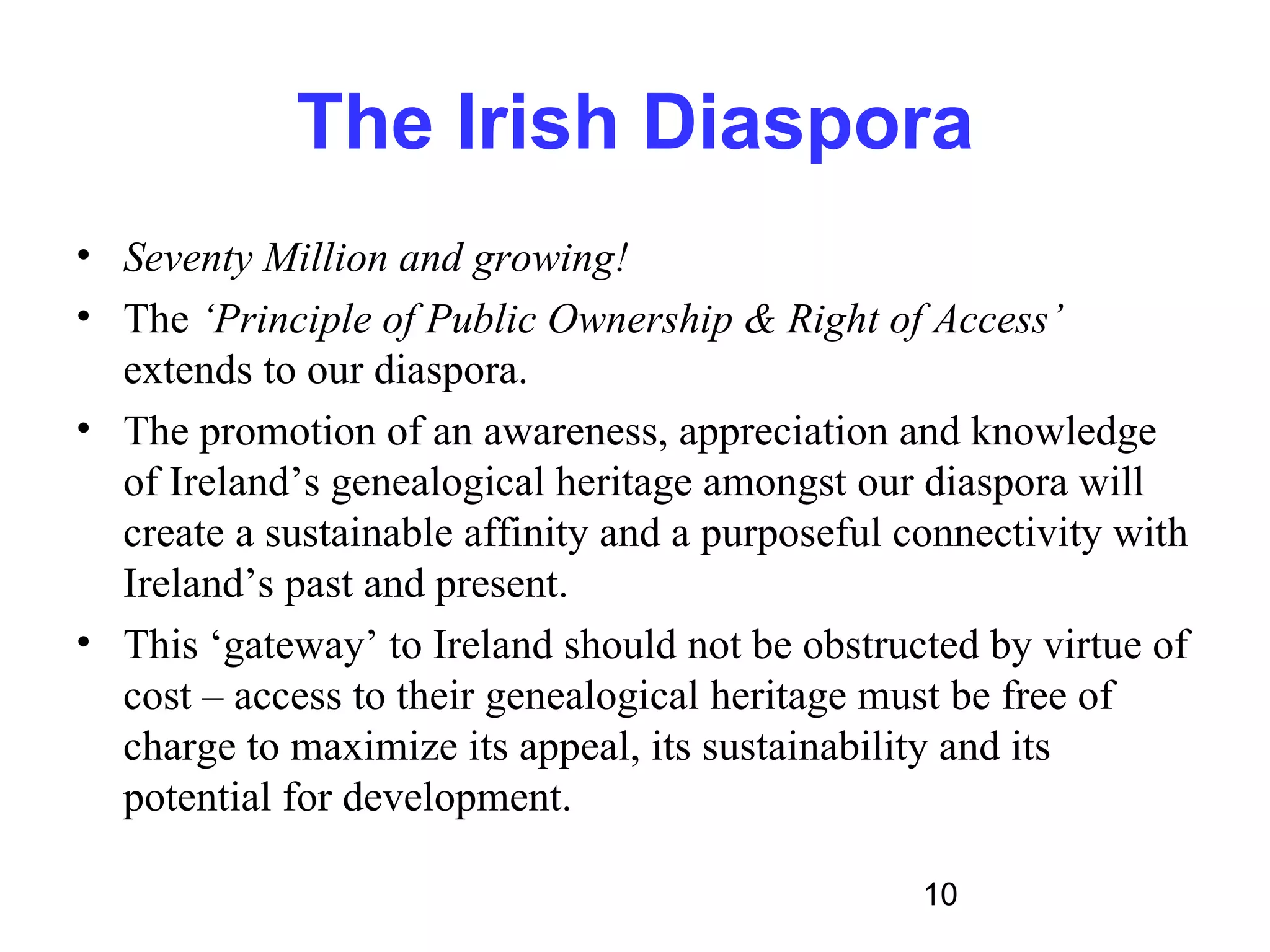
The Irish Diaspora
• Seventy Million and growing!
• The ‘Principle of Public Ownership & Right of Access’
  extends to our diaspora.
• The promotion of an awareness, appreciation and knowledge
  of Ireland’s genealogical heritage amongst our diaspora will
  create a sustainable affinity and a purposeful connectivity with
  Ireland’s past and present.
• This ‘gateway’ to Ireland should not be obstructed by virtue of
  cost – access to their genealogical heritage must be free of
  charge to maximize its appeal, its sustainability and its
  potential for development.

                                                  10
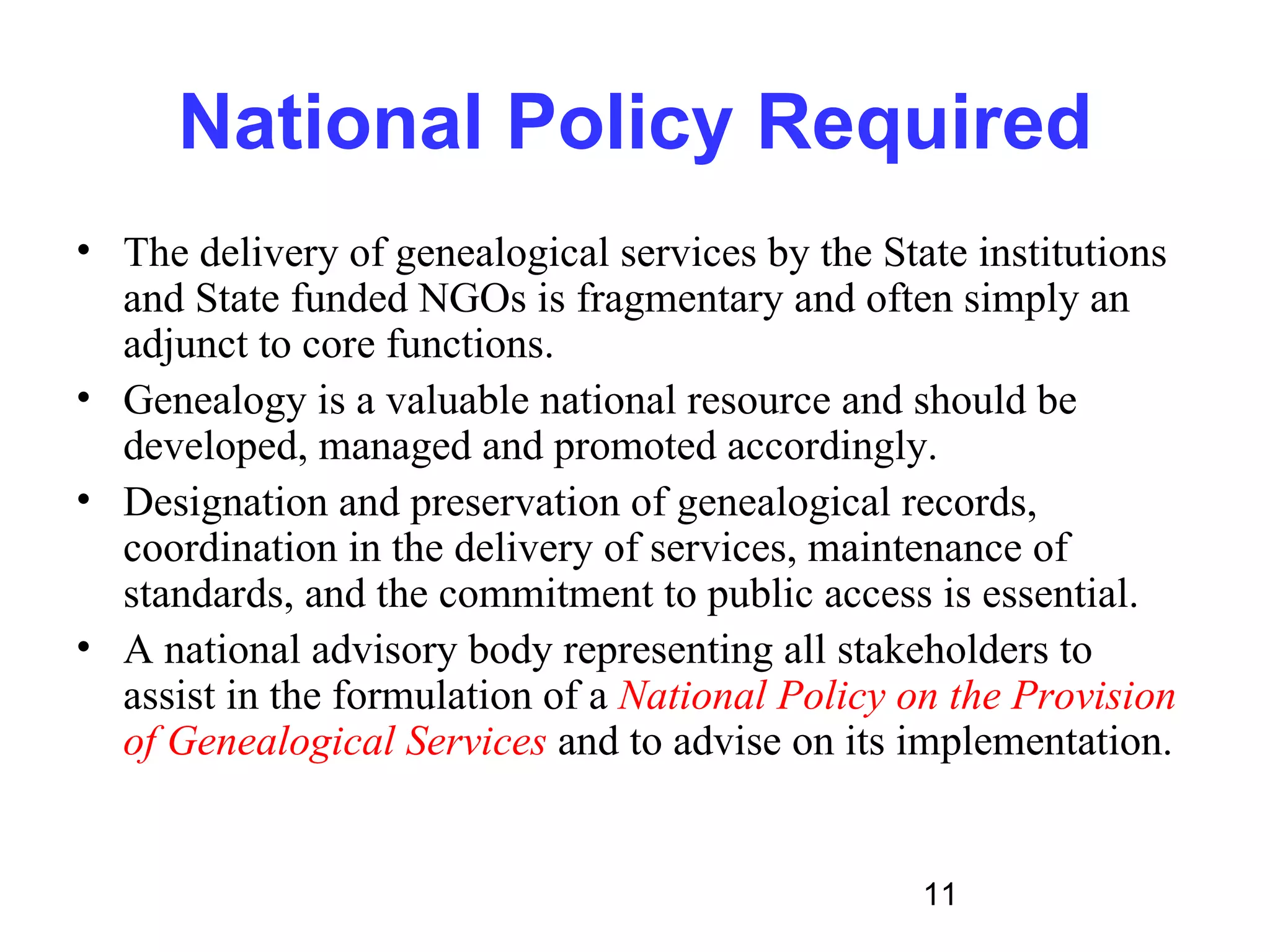
National Policy Required
• The delivery of genealogical services by the State institutions
  and State funded NGOs is fragmentary and often simply an
  adjunct to core functions.
• Genealogy is a valuable national resource and should be
  developed, managed and promoted accordingly.
• Designation and preservation of genealogical records,
  coordination in the delivery of services, maintenance of
  standards, and the commitment to public access is essential.
• A national advisory body representing all stakeholders to
  assist in the formulation of a National Policy on the Provision
  of Genealogical Services and to advise on its implementation.


                                                  11
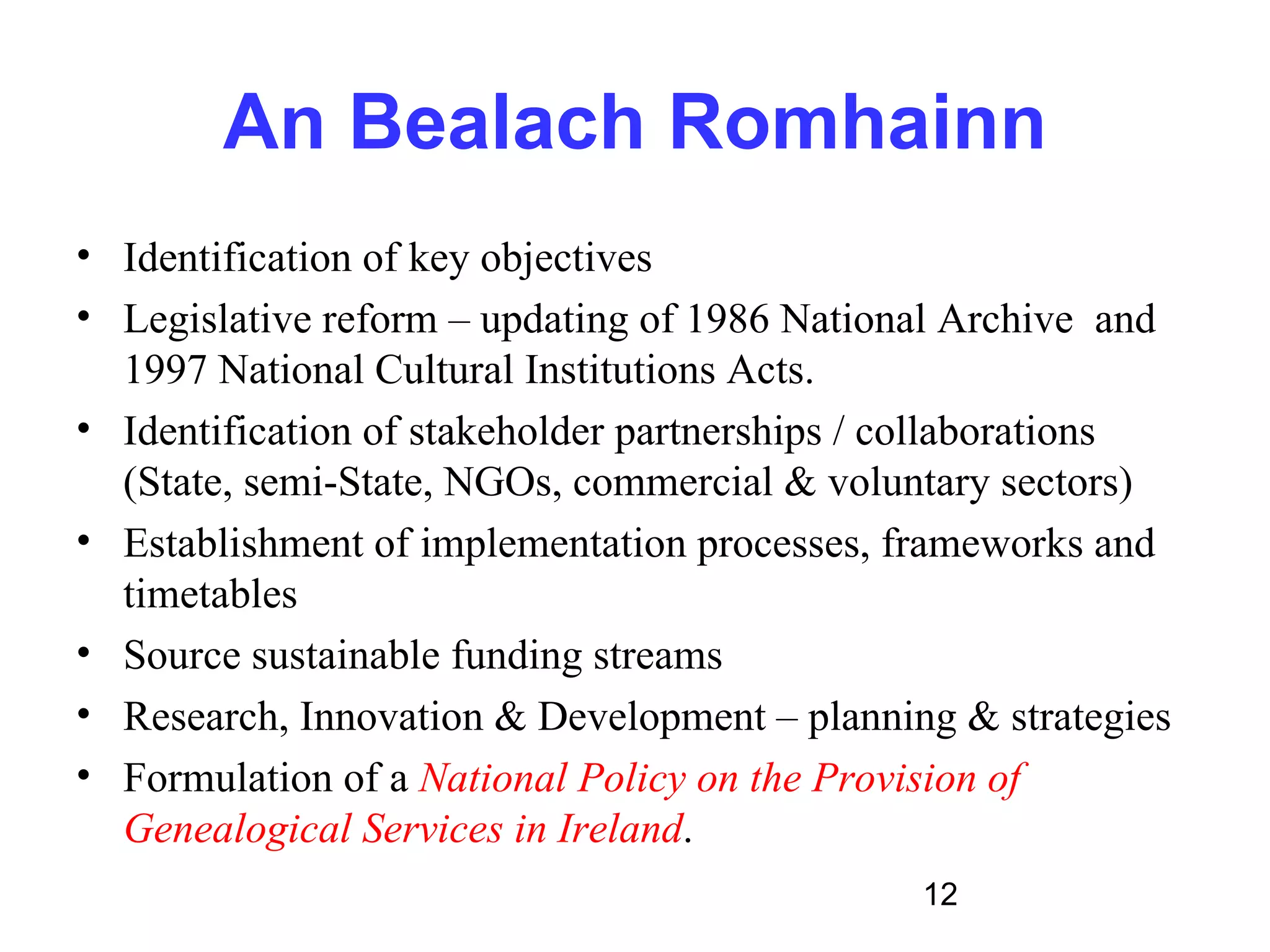
An Bealach Romhainn
• Identification of key objectives
• Legislative reform – updating of 1986 National Archive and
  1997 National Cultural Institutions Acts.
• Identification of stakeholder partnerships / collaborations
  (State, semi-State, NGOs, commercial & voluntary sectors)
• Establishment of implementation processes, frameworks and
  timetables
• Source sustainable funding streams
• Research, Innovation & Development – planning & strategies
• Formulation of a National Policy on the Provision of
  Genealogical Services in Ireland.
                                               12

Genealogical Services in Ireland - 07 Sept. 2011

  • 1.
    C u mann G e ine alais na h Éire ann Genealogical Society of Ireland Presentation prepared by Michael Merrigan, MA, FGSI General Secretary & Fíona Tipple, MA, DipLib, DipGen, ALAI, MGSI Senior Librarian 1
  • 2.
    Introduction to theSociety • Founded in 1990 in Dún Laoghaire • Adopted present name in 1999 • Incorporated in 2000 • Received a Grant of Arms in 2001 • Nominating Body for Seanad Éireann • Registered Educational Charity • Irish and international membership 2
  • 3.
    Objective & Activities •To promote the study of genealogy, heraldry and social history as open access educational leisure pursuits available to all ... through • 12 Lectures and 11 discussion groups • Publications – monthly, annual & occasional • Archive & Research Centre – An Daonchartlann • Courses – weekend genealogy courses • Group projects – Irish DNA Atlas & others • Advocacy – legislative matters & accessibility 3
  • 4.
    Public Policy Principle •At its 1997 AGM the Society adopted the important ‘Principle of Public Ownership and Right of Access’ to our genealogical heritage. • This is now accepted as the bedrock of good practice by progressive institutions throughout the State. 4
  • 5.
    Legislative Issues Advocacy onlegislative matters relating to genealogical records and heritage issues since 1992 and covering circa 20 Bills, including:  Statistics Act (1993)  Heritage Act (1995)  National Cultural Institutions Act (1997)  Civil Registration Act (2004)  Genealogy & Heraldry Bill (2006)  National Cultural Institutions (Amendment) Bill (2008)  Statistics (Heritage Amendment) Bill (2011)  Proposed integration of NAI, IMC and NLI  and many others. 5
  • 6.
    Legislative Programme • TheSociety welcomes the inclusion in the Programme for Government of commitments on the release of the 1926 census and the reform of the delivery of heraldic services. • The National Archives Act, 1986 and the National Cultural Institutions Act, 1997 require updating to meet the current and future requirements of the institutions. • Opportunity for the legislative integration of the NAI, IMC and NLI in a new National Cultural & Archival Institutions Bill which maintains these bodies as separate institutions. 6
  • 7.
    Genealogy – Resourceor Product? • The fundamental question! • As a product genealogy benefits the few – those who can afford to buy it and those selling it. • As a national resource genealogy has the potential to benefit important sectors of the economy and many communities throughout the country in a sustainable manner. 7
  • 8.
    Sustainable National Resource •Our genealogical heritage is part of what we are as a people and it’s the cherished inheritance of over 70 million people throughout the world. • Genealogy is the ‘gateway’ or ‘introduction’ to Ireland and its culture, heritage, goods and services for millions of potential customers, clients, visitors and investors around the world. • Genealogy is a sustainable national resource. • To successfully compete with the growing trend towards ‘pay for view’ genealogy, we should concentrate on developing and marketing internationally accessible ‘free to view’ on-line genealogical resources. 8
  • 9.
    Public Access • The‘Principle of Public Ownership & Right of Access’ to our genealogical heritage is fundamental. • Free public access must be maintained to all genealogical records held by the State, Local Authorities and State funded institutions. • An enlightened and progressive approach to providing free public access to historic records such as the Land Commission records is essential. • The paper and computerised genealogical records of the State funded network of Heritage Centres should be transferred to the custody of the County Librarians in each area. 9
  • 10.
    The Irish Diaspora •Seventy Million and growing! • The ‘Principle of Public Ownership & Right of Access’ extends to our diaspora. • The promotion of an awareness, appreciation and knowledge of Ireland’s genealogical heritage amongst our diaspora will create a sustainable affinity and a purposeful connectivity with Ireland’s past and present. • This ‘gateway’ to Ireland should not be obstructed by virtue of cost – access to their genealogical heritage must be free of charge to maximize its appeal, its sustainability and its potential for development. 10
  • 11.
    National Policy Required •The delivery of genealogical services by the State institutions and State funded NGOs is fragmentary and often simply an adjunct to core functions. • Genealogy is a valuable national resource and should be developed, managed and promoted accordingly. • Designation and preservation of genealogical records, coordination in the delivery of services, maintenance of standards, and the commitment to public access is essential. • A national advisory body representing all stakeholders to assist in the formulation of a National Policy on the Provision of Genealogical Services and to advise on its implementation. 11
  • 12.
    An Bealach Romhainn •Identification of key objectives • Legislative reform – updating of 1986 National Archive and 1997 National Cultural Institutions Acts. • Identification of stakeholder partnerships / collaborations (State, semi-State, NGOs, commercial & voluntary sectors) • Establishment of implementation processes, frameworks and timetables • Source sustainable funding streams • Research, Innovation & Development – planning & strategies • Formulation of a National Policy on the Provision of Genealogical Services in Ireland. 12