LAUNCH PLAN AND STRATEGY FOR
VISTARA - THE NEW TATA AIRLINE
IN INDIA
SUBMITTED BY:-
AAKANKSHA VARUDE (01)
ASHUTOSH PHADKE (10)
HARSH SANGHAVI (19)
MIHIR BHAVSAR (28)
RASIKA DAFLAPURKAR (37)
SNEHAL KALE (46)
VENUGOPAL NAIR (55)
MARKETING MANAGEMENT
POST GRADUATE PROGRAM IN BUSINESS ADMINISTRATION (PGPBA)
INDO-GERMAN TRAINING CENTRE,
Mumbai
2014 – 16
1 | P a g e
TABLE OF CONTENTS
SR.NO. TITLE PAGE NO.
1 EXECUITVE SUMMARY
i. VISION
ii. MISSION
3
2 COMPETITIVE ANALYSIS
i. INDUSTRY OVERVIEW
ii. MARKET SUMMARY
iii. SWOT ANALYSIS
iv. SERVICE OFFERING
v. GOVERNMENT REGULATIONS
vi. ISSUES FACED BY VISTARA
4
3 MARKETING STRATEGY
i. MARKETING MIX
ii. TARGET MARKETS
iii. BRAND "VISTARA"
11
4 FINANCIALS 16
5 OPERATIONS PLAN
i. DISTRIBUTION
19
6 FLEET DETAILS
i. AIRCRAFT SELECTION
ii. ROUTE STRUCTURE
iii. FLIGHT SCHEDULE
22
2 | P a g e
7 MANAGEMENT TEAM
i. LABOR
ii. ORGANISATIONAL CHART
25
8 VISTARA TIMELINE 26
3 | P a g e
1. EXECUTIVE SUMMARY
With the aim to establish a niche customer market, Tata Sons Ltd. along with Singapore
Airlines Ltd. (SIA) has entered into a joint venture (JV) and has named their new airline
‘Vistara’. It is a low cost carrier which will be more focused on point-to-point travellers.
Vistara brings together Tata’s and SIA’s legendary hospitality and renowned service excellence
to launch a full service carrier in India aimed at creating memorable flying experiences for its
customers.
Why SIA? There is the long history of the Tata’s and SIA wanting to launch aviation
business in India. In the nineties, the Tata’s tried to enter aviation by starting an airline in
collaboration with Singapore International Airlines (SIA). Again, when they wanted to
participate in the strategic disinvestment of Air India, Ratan Tata wanted to collaborate with SIA.
But both times, he was thwarted by vested interests in Indian aviation industry. The proposal
made to the FIPB is that of a 51:49 ratio joint venture between Tata Sons and SIA.
Tata Sons will fully participate in the management and operations of the airline. The
belief that there is a huge untapped, potential market in India is a huge driving factor for Tata’s
to come up with a new low cost carrier – Vistara. Obsessed with quality, the company aims to set
new standards in the aviation industry in India, with international best practices and state-of-the-
art technology in the Indian air transport sector.
i. VISION BEHIND VISTARA
Vistara is instituted to provide reliable, cost-effective and hassle-free travel
experience to every traveller based on the principles of service and value creation. Vistara
will be committed to creating enriching travel experiences for every traveler, through
dedicated professionals rendering quality services and customized turn-key travel
solutions. Vistara’s philosophy is to continuously create enriching travel experiences for
every traveler in the most professional, ethical and friendly manner.
ii. MISSION OF THE JOINT VENTURE
The airline aims to nurture a brand personality that exudes an elegant and refined
spiritedness, reflective of a service experience that will be tech savvy, meticulous, and
authentic. The core values, which form the framework of brand Vistara, include
excellence that surpasses customer expectations, thoughtfulness that demonstrates
empathy and understanding, trust that upholds integrity, fairness and transparency,
innovation to deliver operational excellence and cost leadership, and teamwork to build
collaboration and diversity.
Airline's core belief is "Athithi Devo Bhava" (guest must be treated like God).
Vistara aims to anticipate the needs and desires of its customers such that they are
imbued with the experience of a welcome guest rather than a seat number. . To
revolutionize India’s corporate travel market with insightful and creative solutions,
through service excellence, technology adoption for enabling ease of access to
customized travel products & services and value-based partnerships.
4 | P a g e
2. COMPETITIVE ANALYSIS
i. INDUSTRY OVERVIEW
The Indian civil aviation industry is among the top 10 globally with a size of
around US$ 16 billion, as per a KPMG report. In 2014, almost 6.1 crore flew within the
country. Air transport in India today supports 1.7 million jobs – with a further 7.1 million
employed in other sectors including tourism through the catalytic effects of aviation, and
produces over US$ 2.2 trillion of the global gross domestic product (GDP). Air passenger
traffic is also increasing at a healthy rate, a development driven by modern facilities and
infrastructure. India would be the third largest aviation market by 2020, as per Mr. Ajit
Singh, Minister for Civil Aviation, Government of India.
According to a rough estimate, nearly 99.5 percent of India, nearly 40 percent of
which is the upwardly mobile middle class have NOT seen the insides of an aircraft.
India is currently the one of the most under-penetrated aviation markets in the world.
According to data shared by Air Asiax Group while releasing financials in Dec, 2012,
India has a fleet of around 422 aircraft for a population of 1.2 billion. In comparison,
China has a fleet of 1,981 aircraft for 1.3 billion citizens.
Knowing these details, (TSAL) Tata SIA Airlines Limited CEO Phee Teik Yeoh
said, "From our consumer research we saw a clear demand for personalized service and
seamless travel... We will delight our guests with a personalized experience."
ii. MARKET SUMMARY
While 2.2 crore flew AI and Jet Airways (FSC Kingfisher is grounded for almost
two years now), 3.9 crore flew low-cost airlines IndiGo, SpiceJet, GoAir and the now-
disbanded JetLite/Konnect, according to Centre for Asia Pacific Aviation (CAPA). There
is a limited market for FSCs but a hybrid model (which has features of both full service
and budget airlines) with a right cost base is more suitable.
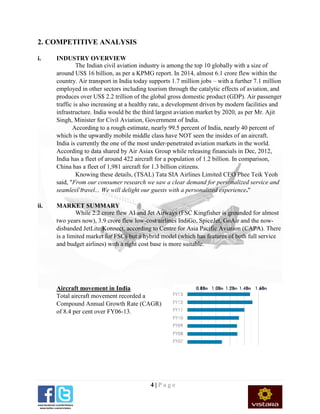
Aircraft movement in India
Total aircraft movement recorded a
Compound Annual Growth Rate (CAGR)
of 8.4 per cent over FY06-13.
5 | P a g e
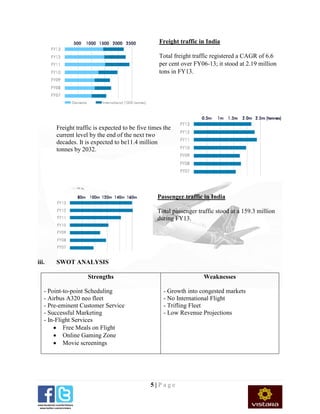
Freight traffic in India
Total freight traffic registered a CAGR of 6.6
per cent over FY06-13; it stood at 2.19 million
tons in FY13.
Freight traffic is expected to be five times the
current level by the end of the next two
decades. It is expected to be11.4 million
tonnes by 2032.
Passenger traffic in India
Total passenger traffic stood at a 159.3 million
during FY13.
iii. SWOT ANALYSIS
Strengths
- Point-to-point Scheduling
- Airbus A320 neo fleet
- Pre-eminent Customer Service
- Successful Marketing
- In-Flight Services
 Free Meals on Flight
 Online Gaming Zone
 Movie screenings
Weaknesses
- Growth into congested markets
- No International Flight
- Trifling Fleet
- Low Revenue Projections
6 | P a g e
Opportunities
- Expansion in International destinations
- In-flight Wi-Fi
- Live sports
- Provision of Charging Points
- Massage-booths in Flight
- Integration with Boeing 737s
Threats
- Fuel Price Volatility
- Fading Advantage as Low-Cost Carrier
- Government Regulations
- India’s Economic Condition
- Terrorism
STRENGTHS
 Vistara is a low-cost carrier that operates on point-to-point routes, rather than the
traditional hub-and-spoke strategy of the legacy airlines. This allows Vistara to be
more flexible in selecting profitable routes.
 Furthermore, they tend to Tier-II cities and focuses on improvement of on-time
reliability, an important aspect of customer relations.
 Vistara aims for 30 minute turnarounds at the gate – another perennial feature of its
touted customer service. This allows for standardize maintenance procedures, and
faster service.
 Tata carries the legacy of maintaining good customer relations which it aims to carry
ahead aided with efficient and educated marketing campaigns. Their policy of ‘Atithi
Devo Bhavo’- passenger’s experience first. The amalgamation of customer reputation
and company policy has been instrumental in their continued growth.
 To provide various in-flight services such as Free Meals on Flight, Online Gaming
Zone and Movies
WEAKNESSES
Vistara launches itself as a flight that lures a price-sensitive customer to experience the
extra-ordinary in-flight services. It brings a number of congested markets which pose
both opportunities for growth and potential challenges. Any combination of the following
factors could force Vistara to revise its low-cost strategy.
 There are also always possible challenges when expanding operations
internationally, such as compliance with international laws.
 The integration of the various airline unions (Pilots, Maintenance, etc.) could pose
problems to a smooth transition.
OPPORTUNITIES
 Diversification of the routes nationally as well as internationally, with new
destinations such as Singapore, US and Europe.
 Further opportunities involve varied methods of generating additional revenue,
such as by adding in-flight Wi-Fi (wireless internet)
 Also offer live viewership of Cricket, Football games during flights.
7 | P a g e
 Vistara also plans to lease single-aisle narrow body Boeing 737s and Airbus A-
320s, respectively in the future.
THREATS
If Vistara are unable to compete as they grow into busier, more congested markets, or
internationally, then it might have to witness diminishing growth. There are also a
number of industry-wide threats such as Terrorism and extempore change in Government
policies that could impact Vistara’s profit margin.
 Any new regulation via aviation or environmentally – would hurt Vistara’s
pricing ability.
 Fuel prices are notoriously volatile, especially with the jet fuel price fluctuating
sometimes independently from the crude oil price. The airline as a whole is
vulnerable to these swings.
iv. SERVICE OFFERING
Vistara aims to tap the domestic market by providing a single travel class service to
its customers with premium service. In-flight services will include free hot meals on
flight along with one beverage and bottled water, In-flight entertainment (IFE) includes
online gaming zone and movie screenings, along with Duty-free in-flight shopping –
options available through the travel magazine amongst the many exciting offers. Vistara
believes that division of travel class is not the apt criteria to differentiate services
extended to its customers. Hence it pledges to extend its full services to customers who
plan to travel from one point to another, be it corporate class or otherwise.
Ticket bookings can be made through the online website and Android app, subject to
which the airline aims to give its nascent customers offers like Group-on discount
coupons and discounts on the base charge of the tickets. The airline plans to plant two
Kiosks per airport terminal for easy check-ins.
In the initial week the airline aims to maintain the ticket rates at discounts such as:
 Since the launch date for Vistara is 14-11-2014, the ticket rates for all locations are
maintained at Rs.1414/- flat.
 For the upcoming week the discounts would still be given at Rs.1514/- , Rs.1614/-
and so on up to 20-11-2014
 Post that the rates will range between RS.2500/- to Rs.9000/- depending on the place
of travel.
 Airport lounges will also contain Taj outlets and Massage parlors for entertaining the
customers as they wait for their flights.
 Customer loyalty program (FF program) will include a PayPal card that will 10 credit
points on every Rs.100 purchase. These points can be redeemed to order food items
(other than the free meals) on flight or for future ticket reservations.
The central headquarters of Vistara is based in Mumbai. The initial plan is to begin
services in eleven cities within a year of operation. The airline will have 150 weekly flights
and these will link Mumbai with Delhi, Hyderabad, Pune, Ahmedabad, Srinagar, Coimbatore
and many such domestic Tier-I and Tier – II cities.
8 | P a g e
v. GOVERNMENT REGULATIONS
POLICY GUIDELINES FOR STARTING SCHEDULED/ NON-SCHEDULED
AIR TRANSPORT SERVICES
Scheduled Air Transport Service:
Scheduled Air Transport Service means an air transport service undertaken between the
two or more places and operated according to a published time table or with flights so
regular or frequent that they constitute a recognizably systematic series, each flight be ing
open to use by members of the public. Detailed requirements are specified in Civil
Aviation Requirements (CAR) Section 3 Air Transport Series ‘C’ Part II dated 1st March
1994.
Non-Scheduled Services:
Non-Scheduled Operation means an air transport service other than scheduled air
transport service and that may be on charter basis and/or non-scheduled basis. The
operator is not permitted to publish time schedule and issue tickets to passengers.
Detailed requirements are specified in Civil Aviation Requirements (CAR).
FOREIGN EQUITY PARTICIPATION IN AIR TRANSPORT SERVICES
Foreign equity up to 49% and NRI investment up to 100% is permissible in the domestic
air transport services through the automatic route;
Equity from foreign airlines is not allowed, directly or indirectly, in the domestic air
transport services.
PROCEDURE FOR STARTING SCHEDULED/NON-SCHEDULED AIR
TRANSPORT SERVICES
An Aircraft Acquisition Committee (AAC) considers proposals for grant of permission to
operate scheduled/non-scheduled air transport services. The present composition of the
Committee is:
- Joint Secretary, Ministry of Civil Aviation - Convenor
- Financial Advisor, Ministry of Civil Aviation - Member
- Chairman, Airports Authority India - Member
- Director General of Civil Aviation - Member
- Commissioner of Civil Aviation Security, Bureau of Civil Aviation Security - Member
The three-stage clearance procedure laid down for starting Air Transport Services is as
under: (1) Issue of NOC for Scheduled/ Non-Scheduled services - The competence and
viability of the company to operate safe and reliable air transport service is considered at
this stage. (2) Import permission for aircraft - The details of specific types of aircraft,
their airworthiness, seating capacity, mode of acquisition and arrangements of security
programme, training facilities for crew and engineers, Operations Manual, maintenance
facilities, etc. are looked into by the Committee. (3) Issue of permit for Scheduled/Non-
Scheduled air services - Permit is issued by DGCA after completion of all requirements
laid down in the regulations/guidelines.
9 | P a g e
 Applications for NOC to operate scheduled/ non-scheduled air services as well as for
import of aircraft (by all operators) are required to be submitted by applicants in the
prescribed forms.
 On receipt, the applications are scrutinized in the DT (Domestic Transport) Section of
the Ministry for any, prima-facie, and deficiency.
 After the application is found complete in all respects, it is circulated to the Members
of the Committee for comments.
 The applications are considered in the meeting of the Committee, which is usually
held on a monthly basis.
 The Committee is empowered to decide all applications for issue of NOC for
nonscheduled services and for import of aircraft by both scheduled/non-scheduled
operators. In case of NOC for scheduled services, the recommendations of the
Committee are submitted to the Secretary (Civil Aviation) for approval.
The final decision is, thereafter, communicated to the applicant by the Ministry/
DGCA. NOC holder for Scheduled/Non-Scheduled Operations is given permit by
DGCA after completion of all requirements laid down in the guidelines/instructions.
ROUTE DISPERSAL GUIDELINES
With a view to achieving better regulation of air transport services and taking into
account the need for air transport services of different regions in the country, the
Government vide order dated 1.3.94 have laid down Route Dispersal Guidelines.
According to these guidelines, all scheduled operators are required to deploy in the North
Eastern region, Jammu & Kashmir, Andaman & Nicobar Islands and Lakshadweep
(Category-II routes) at least 10% of their deployed capacity on trunk routes (Category-I
routes). Further, at least 10% of the capacity thus required to be deployed on Category-II
routes, is required to be deployed for connectivity exclusively within these regions.
50% of the capacity deployed on Category-I routes is to be deployed on routes other than
Category-I and Category-II routes i.e. Category-III routes.
All airlines are free to operate anywhere in the country subject to compliance with the
Route Dispersal Guidelines.
CATEGORY-I
MUMBAI-BENGALURU KOLKATA-DELHI
MUMBAI-KOLKATA KOLKATA-BENGALURU
MUMBAI-DELHI KOLKATA-CHENNAI
MUMBAI-HYDERABAD DELHI-BENGALURU
MUMBAI-CHENNAI DELHI-HYDERABAD
MUMBAI-TRIVANDRUM DELHI-CHENNAI
10 | P a g e
CATEGORY-II
Routes connecting stations in North Eastern region, Jammu & Kashmir, Andaman &
Nicobar and Lakshadweep.
CATEGORY-III
Routes other than those in Category-I and Category-II. Anyone who operates schedule air
transport service on one or more of the routes under Category-I, shall be required to
provide such service in Categories-II & III as indicated below: The operator will deploy
on routes in Category-II at least 10% of the capacity he deploys on routes in Category-I
and of the capacity thus required to be deployed on Category-II routes, at least 10%
would be deployed on service or segments thereof operated exclusively within the North-
Eastern region, Jammu & Kashmir, Andaman & Nicobar and Lakshadweep. The operator
will deploy on routes in Category-III, at least 50% of the capacity he deploys on routes in
Category-I.
vi. ISSUES FACED BY VISTARA
The objections against Tata-SIA came from the Federation of Indian airlines (FIA, an
umbrella organization of existing domestic carriers) and an individual on three grounds
— the FDI policy allowing foreign airlines to invest in Indian carriers was meant for
investing in existing airlines.
 DGCA chief Prabhat Kumar disposed off all of these objections. He said the airline meets
all the three basic requirements of a JV airline — it is registered and has its place of
business in India; the chairman and two-thirds of directors are Indian and that the
substantial ownership and effective control is with Indian nationals.
 This will, however, change once the government abolishes the five-year 20 aircraft
minimum flying eligibility norm for international flying.
 Recently it was reported that the Directorate General of Civil Aviation (DGCA) has
asked the upcoming Tata-SIA JV carrier to ensure that its operational staff is present at
all regulatory meetings to avoid delay in launching operation.
 Tata SIA Airlines is owned 51% by Tata Sons, and the remainder by Singapore Airlines.
 Tata has another new airline, AirAsia India Pvt., with Malaysia's AirAsia Bhd. and
India's Telestra Tradeplace Pvt. which started offering flights in June.
 Companies and analysts predict that Asia's third-largest economy will grow to become
one of the biggest aviation markets in the world by 2020.
11 | P a g e
3. MARKETING STRATEGY
i. MARKETING MIX
PRODUCTS
 Our core products are our flights. We will provide full meals(vegetarian and non-
vegetarian) during the flight. The meals will have an item of local cuisine
depending on the source of the flight. For example: A flight from Mumbai to
Pune will contain a local specialty like “Shrikhand” in the meal. These local
specialties will be bought from upcoming startups, helping us save on costs.
Additionally snacks, refreshments and fruit juices, etc. will also be available.
 Drinking Water will be available for free for all passengers.
 Vistara is a low cost airline and there is electronic in-flight entertainment on the
flight.
 Vistara will an offer e-magazine to the passengers so that can browse through
latest news, upcoming trends, etc. and also avail various discounts on product and
services offered in the magazine.
PROMOTION
Print ads in newspapers
The brand campaign will promote Vistara
with the tagline 'High Standards,
Economically!' The airline will roll out print
campaigns across all leading newspapers. The
idea is to target the people of all walks of life
who want a unique experience and value for
money.
Print ads in magazines
Primarily in corporate magazine like
“Business Today”, “India Today” and “Forbes India.”
Promotional Ads in TV commercials at prime time between 8pm to 11pm. Vistara will
promote on News channels like NDTV Profit and CNN IBN, also on Entertainment
channels like Colours, Sony, etc.
Movies as a medium of theatre promotion
Outdoor channels like hoardings at prime locations.
12 | P a g e
Vistara will also be using the Volvo buses plying
long distances between cities as a mode of
promotion and is already in talks with
Maharashtra State Road Transport Corporation
(MSRTC), Karnataka State Road Transport
Corporation (KSRTC) and also private bus
players.
Vistara will also have promotional ads on local
modes of transportation like buses, trains, etc.
PEOPLE
People at Vistara strive to provide excellent service. The airhostesses will work towards
creating a helpful and warm welcoming ambience.
The front line staff will ensure that all the services are delivered to the customers as
promised. Vistara will employ a team of skilled & professionally trained pilots, ground
staff, flight attendants, freight movers and packers, security personnel, management
decision makers. Vistara will also work towards learning changing trends in customer
needs and will implement those changes immediately.
Vistara will continue improving its services in the coming years and will provide the best
in-class facilities.
PROCESS
Customers can book their tickets in the following ways:-
 By logging in to the website www.tatavistara.in. Customers can choose from
available flights, select the flight, agree to the terms and conditions, fill in their
particulars, complete the payment process and finally an itinerary will be
generated. The tickets will finally be sent to the customer’s mobile phones and
email id.
 By logging at associated web portals like Makemytrip, Goibibo and Cleartrip.
 From any of Vistara travel agents by paying an extra 2% non-refundable
transaction fee.
 At facilities at the airport, the baggage handling, flight information kiosk etc also
would help us delivering quality service and making travel a pleasure to our
13 | P a g e
customers. In the flight, the meal service, in-flight entertainment, reading
material, amenities etc. enable the travelers to have an enjoyable and convenient
travel. We also provide special services like assisting disabled passengers and
unaccompanied minors, Baggage services from the main entrance to the flight
(charged extra) and the Vistara Air lounge at selected airports.
PLACE
 Sales offices
 Call centers
 Self-service check-in Kiosks
 Website
 Mobile Application
 Social Media
 Traditional travel agents
 On-line travel agents Expedia, Makemytrip
 Tour operators and consolidators
PHYSICAL ENVIRONMENT
On the ground: - This includes everything customers will experiences on ground
 Booking Offices or ticket counters: - Customers can book tickets from Vistara
offices and also at Vistara Kiosks on airports.
 Vistara Air lounge: - Customers will get access to the best in class. Also sleeping
arena for transit passengers.
On the flight: - Vistara planes are designed with customers in mind and Vistara will
great seating arrangements
 Entertainment Facilities: - Customers can enjoy music on the go and also watch
movies of their choice.
 Interior-Exteriors: - Well-furnished interiors with comfortable seats and
baggage cabin to ensure clients have a comfortable journey.
ii. BRAND “VISTARA”
The logo is derived from a ‘yantra’, a perfect mathematical
form that reflects the unbounded universe. Its fluid
interconnecting lines reflect the seamless experience the
airline wants to offer its customers. The eight-pointed star at
the center of the logo reflects the high standards Vistara is
committed to the excellence that will be a hallmark of the
airline.
The name Vistara is derived from the Sanskrit word ‘Vistaar’,
which means ‘limitless expanse’, and draws inspiration from
the brand’s domain -- the ‘limitless’ sky. The golden yellow
14 | P a g e
color represents “wealth” & “royalty”. The maroon brick red color, also
called “Temptress” represents the “soil” and “earth”, giving a sense of "belonging, to our home,
to India.
The core values, which form the framework of brand Vistara, include excellence that surpasses
customer expectations, thoughtfulness that demonstrates empathy and understanding, trust that
upholds integrity, fairness and transparency, innovation to deliver operational excellence and
cost leadership, and teamwork to build collaboration and diversity.
The brand personality exudes an elegant and refined spiritedness reflective of a service
experience that will be tech savvy, meticulous, and authentic. Vistara aims to anticipate the
needs and desires of its customers such that they are imbued with the experience of a welcome
guest rather than a seat number.
The uniforms of crew and staff have been designed by Abraham & Thakore and are based on the
primary colors of Vistara.
15 | P a g e
The livery of the Vistara A320s will be clean. All white with the geometric “yantra” pattern
in golden yellow on the tail on the maroon brick red background.
iii. TARGET MARKETS
The travelers who travel through trains and have a pre conceived notion of the airplanes
being costly than the trains.
Potential customers from the various other airlines which are not happy with the price
and the service they get from the respective airlines.
The target market demographics are approximately 60% official travelers and rest 40%
includes all types of travelers from metropolitans of India, Delhi, Mumbai, Bangalore and
Chennai. Not ignoring the fact that the 2-tier cities also have the potential to yield profit.
The consumers are sub divided depending on their age, profession, family size, and
language.
This segmentation mainly deals with the lifestyles, attitudes and personalities of people.
The psychographic targeting is for people who travel through trains in first class and have
an annual income of more than 300,000 Indian rupees.
16 | P a g e
4. FINANCIALS
Opportunities, Risks, Concerns and Threats
Demand for air travel has risen steadily over the years, and posted a 5% growth
over the last fiscal. This however, by any means is nowhere close to the true potential of
this market. With the new buoyancy in the markets and the formation of a majority
government, industrial activity has increased which will give rise to increased travel.
Additionally, the lifting of economic gloom will generate additional general travel of
visiting friends & relatives, off -site family vacations. These are evident from the current
trends. It is expected that the demand should grow around 8-9% year on year for this
fiscal; and if this feel-good factor along with increased economic activity stays around 6-
7% in terms of GDP growth, this industry has the potential to grow around 9-10%.
The underlying risks and concerns emanate from (a) the high cost structure posed
due to the fuel prices and its taxation thereof, and due to the rising foreign exchange rates
and (b) fragile nature of demand which is sensitive to the prices. Fuel prices has been a
big concern over the years. It’s time that the government takes a consideration of these
facts that arrest the growth of this industry; India has one of the highest taxes on Aviation
Turbine Fuel unlike other countries where aviation has evolved. Of course there are
indications that there may be a rethink during the next fiscal – hence it remains a clear
obstacle towards airline profitability.
With the emergence of new airlines, and the advantages inherent to a couple of
airlines who have come under the new FDI regulations, we will have to wait and see on
what their strategies are going to be. If they start expanding too fast and in the process
load this market with over capacity, just when the incumbent airlines are lifting itself on
an increasing demand in travel, the realisations by way of load factors will be lower and
hence profitability will be challenged. This will be a threat which needs to be countered.
Reforms by the new government:
Developing a consensus on reducing VAT on jet fuel across the states to 4%; Currently,
VAT on jet fuel (a state subject) is around 28-30% in most states;
Making loans available to airlines at lower rates to help them meet challenges like access
to the working capital;
Identification of 50 locations for developing new airports in smaller cities and towns
across the country.
Furthermore, the gap between rail and air fares has narrowed down further after the
14.2% rail tariff hike announced in the Rail Budget for FY 2014-15, an event that could
encourage some railway passengers to shift to air travel. As per CAPA estimates,
domestic traffic is expected to increase by 6-8%, while International traffic is expected to
strengthen to ~10% in FY 2014-15.
India's Ministry of Civil Aviation (MoCA) has introduced some far-reaching reforms.
These include:
a) Handing over airport management of leading airports to private players on a PPP basis
17 | P a g e
b) Foreign airlines allowed to invest up to 49% in Indian carriers. This would not only
facilitate funds infusion, but will also bring in global best practices and synergy benefits.
c) In addition to the Greenfield airports at Navi Mumbai, Goa, Kannur and Kushinagar,
six AAI airports have been identified for handover to private management under the PPP
route following the successful implementation of PPP models like Delhi, Mumbai,
Bangalore, Hyderabad, Cochin. There are reports of another 14 AAI airports being
considered for PPP.
d) All Indian carriers are now allowed to fly to foreign locations subject to the 5/20 Rule.
The discriminatory 5/20 Rule itself is likely to be abolished. This has led to an increase in
share of Indian carriers in the growing international traffic to and from India.
e) 51 new low-cost airports in tier 3-4 cities have been planned in order to improve
regional connectivity
f) Direct import of ATF to offset the high sales tax imposed on it.
g) Introduction of 24x7 customs facility at the cargo terminals at leading airports.
h) Extension of duty-free period for parts and testing equipment imported for
Maintenance, Repairs and Overhaul (MRO) from three months to one year.
i) Maintenance, Repairs and Overhaul' operations included under the airport
infrastructure category, in a view to facilitate external commercial borrowings (ECB) for
the sector.
Based on CAPA (Centre for Asia Pacific Aviation) data for 2012, the number of
domestic airline seats per capita is very low in India, at just 0.07. This compares with
3.35 for Australia, 2.49 for the US, 1.38 for Canada and 1.05 for Japan. Forecasts by AAI
for the next 5 years have projected a sustainable growth rate of 16% for international and
20% for domestic aviation sector.
According to Ministry of Civil Aviation, overall air traffic is expected to grow at an
annual average growth rate of 10.1 percent in this decade.
Domestic traffic is expected to grow at 11.4 percent and international traffic is expected
to grow at 9.5 percent for the next ten years. Oxford Economics report commissioned by
IATA indicates that Aviation accounts for 1.5% of India’s GDP. As per the 12th Five
Year Plan (2012-2017), improving air connectivity in tier-2 and tier-3 cities in India is
one of the key priorities of the government.
The foreign direct investment (FDI) inflows in air transport (including air freight) during
April 2000 to March 2014 stood at US$ 495.24 million, as per data released by
Department of Industrial Policy and Promotion (DIPP). As India's economy grows,
disposable incomes rise and the value of time increases, the air travel penetration is
expected to grow exponentially. The Reserve Bank of India (RBI) announced that foreign
institutional investors might have shareholdings more than the limited 49% in the
domestic sector.
Airports
 Foreign equity up to 100% is allowed by the means of automatic approvals pertaining
to establishment of Greenfield airports
 Foreign equity up to 74% is allowed by the means of automatic approvals pertaining
to the existing airports
18 | P a g e
 Foreign equity up to 100% is allowed by the means of special permission from
Foreign Investment Promotion Board, Ministry of Finance, pertaining to the existing
airports
Air Transport Services
Up to 49% of foreign equity is allowed by the means of automatic approvals pertaining to
the domestic air transport services
Up to 100% of NRI investment is allowed by the means of automatic approvals
pertaining to the domestic air transport services
SALES & EXPENSE FORECAST
Variable & Fixed Costs are as in this link:- FINANCIAL PLAN
19 | P a g e
5. OPERATIONS PLAN
i. DISTRIBUTION
Direct
Direct distribution allows customers to come directly to your reservation system to book
flights providing you with a direct relationship with the public, travel agents and
corporate customers.
 Sales offices
 Call centers
 Self-service check-in Kiosks
 Website
Website as a tool to provide value-added services and enhance communications
Send weekly promotional e-mails to subscribers
Members of frequent flyer program receive their monthly balances and other
information by e-mail
Web-based check-in service allowing passengers to obtain their boarding passes
from their home or office
 Mobile Application
Book ticket, check the status of flights, and get the PNR for journey, and
exclusive deals for people using the mobile app
Live updates, notifications for deals and discounts, special offers and bookings
Travelogues with entries for all destinations where the airline flies
Flat discounts for mobile app users
 Social Media
95% of airlines have a Facebook presence, followed by 74% on Twitter and 40%
on LinkedIn. Just 17% are currently active on Google+, but this will rise to 40%
in the next 12 months. Payment method to allow customers to make payments
through Facebook or Twitter.
Passengers can book flights, make seat reservations and arrange extra baggage
exclusively through Facebook or Twitter. Sends a link to the customer in a private
message. The customer then selects their preferred method of payment and
completes the transaction. Vistara then receives a message to say that payment
has been received and the customer in turn receives confirmation of the payment.
Vistara is present on the following social media websites:
www.facebook.com/AirVistara
www.twitter/airvistara
Indirect
 Traditional travel agents
Travel agents obtain airline travel information and issue airline tickets through
Global Distribution Systems, or GDSs, that enable them to make reservations on
flights from a large number of airlines. Participate actively in all major
20 | P a g e
international GDSs, including Sabre, Amadeus, Galileo and Worldspan. In return
for access to these systems, transaction fees are to be paid that are generally based
on the number of reservations booked through each system. Global Distribution
System (GDS) is worldwide computerized reservation network used as a single
point of access for reserving airline seats, hotel rooms, rental cars, and other travel
related items by travel agents, online reservation sites, and large corporations.
Vistara will partner with Amadeus, a global leader in technology solutions for the
travel industry.
 On-line travel agents Expedia, Makemytrip
 Tour operators and consolidators
21 | P a g e
22 | P a g e
6. FLEET DETAILS
i. AIRCRAFT SELECTION
The new full-service Vistara airline which will compete with other players in aviation
industry will have five Airbus 320 single-aisle seating capacity 180 passengers.
Vistara will increase the fleet size to 20 planes in five years which would include 7
Airbus 320 planes and 13 Airbus Neo jets.
The Airbus A320neo family is a family of aircraft under development by Airbus
replacing the predecessor A320 family.
The letters "neo" stand for "New Engine Option" and are the last step of the
modernisation programme A320 Enhanced (or A320E) which was started in 2006.
The Modernisation programme of neo also includes such improvements as:
- Aerodynamic refinements
- Large curved winglets (Sharklets)
- Weight savings
- A new cabin with larger luggage spaces
- An improved air purification system
This improvement will bring about the following results:
- 15% less fuel consumption per aircraft
- 8% lower operating costs
- Less noise production
- A reduction of NOx emissions by at least 10% compared to the A320 series
- An increase in range of approximately 500 nautical miles
- A rearranged cabin allows up to 20 more passengers enabling in total over
20% less fuel consumption per seat.
In addition to this, Vistara will have the Boeing 787 that has full flat business class
and bigger economy seats each with its own in-flight entertainment system
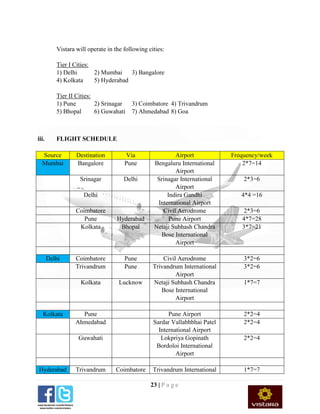
ii. ROUTE STRUCTURE
As Tata Group owns 30% stake in Air Asia India, we will try not to compete on the same
routes.
Air Asia India currently operates in following destinations in India:
City Airport
Bangalore Bengaluru International Airport
Chennai Chennai International Airport
Goa Goa International Airport
Kochi Kochi International Airport
Jaipur Jaipur International Airport
Chandigarh Chandigarh Airport
23 | P a g e
Vistara will operate in the following cities:
Tier I Cities:
1) Delhi 2) Mumbai 3) Bangalore
4) Kolkata 5) Hyderabad
Tier II Cities:
1) Pune 2) Srinagar 3) Coimbatore 4) Trivandrum
5) Bhopal 6) Guwahati 7) Ahmedabad 8) Goa
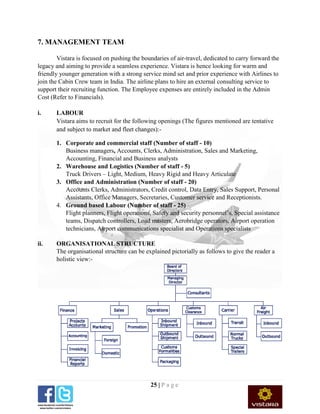
iii. FLIGHT SCHEDULE
Source Destination Via Airport Frequency/week
Mumbai Bangalore Pune Bengaluru International
Airport
2*7=14
Srinagar Delhi Srinagar International
Airport
2*3=6
Delhi Indira Gandhi
International Airport
4*4 =16
Coimbatore Civil Aerodrome 2*3=6
Pune Hyderabad Pune Airport 4*7=28
Kolkata Bhopal Netaji Subhash Chandra
Bose International
Airport
3*7=21
Delhi Coimbatore Pune Civil Aerodrome 3*2=6
Trivandrum Pune Trivandrum International
Airport
3*2=6
Kolkata Lucknow Netaji Subhash Chandra
Bose International
Airport
1*7=7
Kolkata Pune Pune Airport 2*2=4
Ahmedabad Sardar Vallabhbhai Patel
International Airport
2*2=4
Guwahati Lokpriya Gopinath
Bordoloi International
Airport
2*2=4
Hyderabad Trivandrum Coimbatore Trivandrum International 1*7=7
24 | P a g e
Airport
Delhi Indira Gandhi
International Airport
3*7=21
Goa Mumbai Chatrapati Shivaji
International Airport
2*4=8
Pune Pune Airport 2*4=8
iv. MAINTENANCE
Aircraft maintenance checks are periodic inspections that have to be done on all commercial/civil
aircraft after a certain amount of time or usage; military aircraft normally follow specific
maintenance programmes which may or may not be similar to those of commercial/civil operators.
A Check:
This is performed approximately every 500 - 800 flight hours or 200 - 400 cycles. It needs about 20
- 50 man-hours and is usually performed overnight at an airport gate or hangar. The occurrence can
be delayed by the airline if certain predetermined conditions are met.
B Check:
This is performed approximately every 4–6 months. It needs about 150 man-hours and is usually
performed within 1–3 days at an airport hangar. A similar occurrence schedule applies to the B
check as to the A check. B checks may be incorporated into successive A checks, i.e.: A-1 through
A-10 to complete all the B check items.
C Check:
This is performed approximately every 20–24 months or a specific amount of actual flight hours
(FH) or as defined by the manufacturer. This maintenance check is much more extensive than a B
Check, requiring a large majority of the aircraft's components to be inspected. This check puts the
aircraft out of service and until it is completed, the aircraft must not leave the maintenance site. It
also requires more space than A and B Checks—usually a hangar at a maintenance base. The time
needed to complete such a check is generally 1–2 weeks and the effort involved can require up to
6000 man-hours.
D Check:
This is by far the most comprehensive and demanding check for an airplane. It is also known as a
Heavy Maintenance Visit (HMV). This check occurs approximately every 6 years. It is a check that,
more or less, takes the entire airplane apart for inspection and overhaul. Also, if required, the paint
may need to be completely removed for further inspection on the fuselage metal skin. Such a check
can usually demand up to 50,000 man-hours and it can generally take up to 2 months to complete,
depending on the aircraft and the number of technicians involved. It also requires the most space of
all maintenance checks, and as such must be performed at a suitable maintenance base.
25 | P a g e
7. MANAGEMENT TEAM
Vistara is focused on pushing the boundaries of air-travel, dedicated to carry forward the
legacy and aiming to provide a seamless experience. Vistara is hence looking for warm and
friendly younger generation with a strong service mind set and prior experience with Airlines to
join the Cabin Crew team in India. The airline plans to hire an external consulting service to
support their recruiting function. The Employee expenses are entirely included in the Admin
Cost (Refer to Financials).
i. LABOUR
Vistara aims to recruit for the following openings (The figures mentioned are tentative
and subject to market and fleet changes):-
1. Corporate and commercial staff (Number of staff - 10)
Business managers, Accounts, Clerks, Administration, Sales and Marketing,
Accounting, Financial and Business analysts
2. Warehouse and Logistics (Number of staff - 5)
Truck Drivers – Light, Medium, Heavy Rigid and Heavy Articulate
3. Office and Administration (Number of staff - 20)
Accounts Clerks, Administrators, Credit control, Data Entry, Sales Support, Personal
Assistants, Office Managers, Secretaries, Customer service and Receptionists.
4. Ground based Labour (Number of staff - 25)
Flight planners, Flight operations, Safety and security personnel’s, Special assistance
teams, Dispatch controllers, Load masters, Aerobridge operators, Airport operation
technicians, Airport communications specialist and Operations specialists
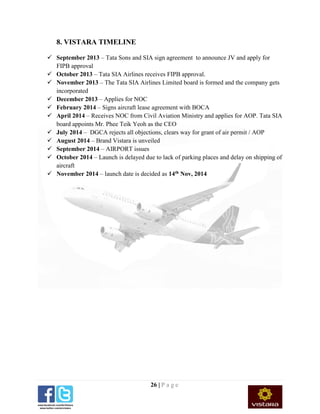
ii. ORGANISATIONAL STRUCTURE
The organisational structure can be explained pictorially as follows to give the reader a
holistic view:-
26 | P a g e
8. VISTARA TIMELINE
 September 2013 – Tata Sons and SIA sign agreement to announce JV and apply for
FIPB approval
 October 2013 – Tata SIA Airlines receives FIPB approval.
 November 2013 – The Tata SIA Airlines Limited board is formed and the company gets
incorporated
 December 2013 – Applies for NOC
 February 2014 – Signs aircraft lease agreement with BOCA
 April 2014 – Receives NOC from Civil Aviation Ministry and applies for AOP. Tata SIA
board appoints Mr. Phee Teik Yeoh as the CEO
 July 2014 – DGCA rejects all objections, clears way for grant of air permit / AOP
 August 2014 – Brand Vistara is unveiled
 September 2014 – AIRPORT issues
 October 2014 – Launch is delayed due to lack of parking places and delay on shipping of
aircraft
 November 2014 – launch date is decided as 14th Nov, 2014

GROUP_1_Marketing Management

  • 1.
    LAUNCH PLAN ANDSTRATEGY FOR VISTARA - THE NEW TATA AIRLINE IN INDIA SUBMITTED BY:- AAKANKSHA VARUDE (01) ASHUTOSH PHADKE (10) HARSH SANGHAVI (19) MIHIR BHAVSAR (28) RASIKA DAFLAPURKAR (37) SNEHAL KALE (46) VENUGOPAL NAIR (55) MARKETING MANAGEMENT POST GRADUATE PROGRAM IN BUSINESS ADMINISTRATION (PGPBA) INDO-GERMAN TRAINING CENTRE, Mumbai 2014 – 16
  • 2.
    1 | Pa g e TABLE OF CONTENTS SR.NO. TITLE PAGE NO. 1 EXECUITVE SUMMARY i. VISION ii. MISSION 3 2 COMPETITIVE ANALYSIS i. INDUSTRY OVERVIEW ii. MARKET SUMMARY iii. SWOT ANALYSIS iv. SERVICE OFFERING v. GOVERNMENT REGULATIONS vi. ISSUES FACED BY VISTARA 4 3 MARKETING STRATEGY i. MARKETING MIX ii. TARGET MARKETS iii. BRAND "VISTARA" 11 4 FINANCIALS 16 5 OPERATIONS PLAN i. DISTRIBUTION 19 6 FLEET DETAILS i. AIRCRAFT SELECTION ii. ROUTE STRUCTURE iii. FLIGHT SCHEDULE 22
  • 3.
    2 | Pa g e 7 MANAGEMENT TEAM i. LABOR ii. ORGANISATIONAL CHART 25 8 VISTARA TIMELINE 26
  • 4.
    3 | Pa g e 1. EXECUTIVE SUMMARY With the aim to establish a niche customer market, Tata Sons Ltd. along with Singapore Airlines Ltd. (SIA) has entered into a joint venture (JV) and has named their new airline ‘Vistara’. It is a low cost carrier which will be more focused on point-to-point travellers. Vistara brings together Tata’s and SIA’s legendary hospitality and renowned service excellence to launch a full service carrier in India aimed at creating memorable flying experiences for its customers. Why SIA? There is the long history of the Tata’s and SIA wanting to launch aviation business in India. In the nineties, the Tata’s tried to enter aviation by starting an airline in collaboration with Singapore International Airlines (SIA). Again, when they wanted to participate in the strategic disinvestment of Air India, Ratan Tata wanted to collaborate with SIA. But both times, he was thwarted by vested interests in Indian aviation industry. The proposal made to the FIPB is that of a 51:49 ratio joint venture between Tata Sons and SIA. Tata Sons will fully participate in the management and operations of the airline. The belief that there is a huge untapped, potential market in India is a huge driving factor for Tata’s to come up with a new low cost carrier – Vistara. Obsessed with quality, the company aims to set new standards in the aviation industry in India, with international best practices and state-of-the- art technology in the Indian air transport sector. i. VISION BEHIND VISTARA Vistara is instituted to provide reliable, cost-effective and hassle-free travel experience to every traveller based on the principles of service and value creation. Vistara will be committed to creating enriching travel experiences for every traveler, through dedicated professionals rendering quality services and customized turn-key travel solutions. Vistara’s philosophy is to continuously create enriching travel experiences for every traveler in the most professional, ethical and friendly manner. ii. MISSION OF THE JOINT VENTURE The airline aims to nurture a brand personality that exudes an elegant and refined spiritedness, reflective of a service experience that will be tech savvy, meticulous, and authentic. The core values, which form the framework of brand Vistara, include excellence that surpasses customer expectations, thoughtfulness that demonstrates empathy and understanding, trust that upholds integrity, fairness and transparency, innovation to deliver operational excellence and cost leadership, and teamwork to build collaboration and diversity. Airline's core belief is "Athithi Devo Bhava" (guest must be treated like God). Vistara aims to anticipate the needs and desires of its customers such that they are imbued with the experience of a welcome guest rather than a seat number. . To revolutionize India’s corporate travel market with insightful and creative solutions, through service excellence, technology adoption for enabling ease of access to customized travel products & services and value-based partnerships.
  • 5.
    4 | Pa g e 2. COMPETITIVE ANALYSIS i. INDUSTRY OVERVIEW The Indian civil aviation industry is among the top 10 globally with a size of around US$ 16 billion, as per a KPMG report. In 2014, almost 6.1 crore flew within the country. Air transport in India today supports 1.7 million jobs – with a further 7.1 million employed in other sectors including tourism through the catalytic effects of aviation, and produces over US$ 2.2 trillion of the global gross domestic product (GDP). Air passenger traffic is also increasing at a healthy rate, a development driven by modern facilities and infrastructure. India would be the third largest aviation market by 2020, as per Mr. Ajit Singh, Minister for Civil Aviation, Government of India. According to a rough estimate, nearly 99.5 percent of India, nearly 40 percent of which is the upwardly mobile middle class have NOT seen the insides of an aircraft. India is currently the one of the most under-penetrated aviation markets in the world. According to data shared by Air Asiax Group while releasing financials in Dec, 2012, India has a fleet of around 422 aircraft for a population of 1.2 billion. In comparison, China has a fleet of 1,981 aircraft for 1.3 billion citizens. Knowing these details, (TSAL) Tata SIA Airlines Limited CEO Phee Teik Yeoh said, "From our consumer research we saw a clear demand for personalized service and seamless travel... We will delight our guests with a personalized experience." ii. MARKET SUMMARY While 2.2 crore flew AI and Jet Airways (FSC Kingfisher is grounded for almost two years now), 3.9 crore flew low-cost airlines IndiGo, SpiceJet, GoAir and the now- disbanded JetLite/Konnect, according to Centre for Asia Pacific Aviation (CAPA). There is a limited market for FSCs but a hybrid model (which has features of both full service and budget airlines) with a right cost base is more suitable. Aircraft movement in India Total aircraft movement recorded a Compound Annual Growth Rate (CAGR) of 8.4 per cent over FY06-13.
  • 6.
    5 | Pa g e Freight traffic in India Total freight traffic registered a CAGR of 6.6 per cent over FY06-13; it stood at 2.19 million tons in FY13. Freight traffic is expected to be five times the current level by the end of the next two decades. It is expected to be11.4 million tonnes by 2032. Passenger traffic in India Total passenger traffic stood at a 159.3 million during FY13. iii. SWOT ANALYSIS Strengths - Point-to-point Scheduling - Airbus A320 neo fleet - Pre-eminent Customer Service - Successful Marketing - In-Flight Services  Free Meals on Flight  Online Gaming Zone  Movie screenings Weaknesses - Growth into congested markets - No International Flight - Trifling Fleet - Low Revenue Projections
  • 7.
    6 | Pa g e Opportunities - Expansion in International destinations - In-flight Wi-Fi - Live sports - Provision of Charging Points - Massage-booths in Flight - Integration with Boeing 737s Threats - Fuel Price Volatility - Fading Advantage as Low-Cost Carrier - Government Regulations - India’s Economic Condition - Terrorism STRENGTHS  Vistara is a low-cost carrier that operates on point-to-point routes, rather than the traditional hub-and-spoke strategy of the legacy airlines. This allows Vistara to be more flexible in selecting profitable routes.  Furthermore, they tend to Tier-II cities and focuses on improvement of on-time reliability, an important aspect of customer relations.  Vistara aims for 30 minute turnarounds at the gate – another perennial feature of its touted customer service. This allows for standardize maintenance procedures, and faster service.  Tata carries the legacy of maintaining good customer relations which it aims to carry ahead aided with efficient and educated marketing campaigns. Their policy of ‘Atithi Devo Bhavo’- passenger’s experience first. The amalgamation of customer reputation and company policy has been instrumental in their continued growth.  To provide various in-flight services such as Free Meals on Flight, Online Gaming Zone and Movies WEAKNESSES Vistara launches itself as a flight that lures a price-sensitive customer to experience the extra-ordinary in-flight services. It brings a number of congested markets which pose both opportunities for growth and potential challenges. Any combination of the following factors could force Vistara to revise its low-cost strategy.  There are also always possible challenges when expanding operations internationally, such as compliance with international laws.  The integration of the various airline unions (Pilots, Maintenance, etc.) could pose problems to a smooth transition. OPPORTUNITIES  Diversification of the routes nationally as well as internationally, with new destinations such as Singapore, US and Europe.  Further opportunities involve varied methods of generating additional revenue, such as by adding in-flight Wi-Fi (wireless internet)  Also offer live viewership of Cricket, Football games during flights.
  • 8.
    7 | Pa g e  Vistara also plans to lease single-aisle narrow body Boeing 737s and Airbus A- 320s, respectively in the future. THREATS If Vistara are unable to compete as they grow into busier, more congested markets, or internationally, then it might have to witness diminishing growth. There are also a number of industry-wide threats such as Terrorism and extempore change in Government policies that could impact Vistara’s profit margin.  Any new regulation via aviation or environmentally – would hurt Vistara’s pricing ability.  Fuel prices are notoriously volatile, especially with the jet fuel price fluctuating sometimes independently from the crude oil price. The airline as a whole is vulnerable to these swings. iv. SERVICE OFFERING Vistara aims to tap the domestic market by providing a single travel class service to its customers with premium service. In-flight services will include free hot meals on flight along with one beverage and bottled water, In-flight entertainment (IFE) includes online gaming zone and movie screenings, along with Duty-free in-flight shopping – options available through the travel magazine amongst the many exciting offers. Vistara believes that division of travel class is not the apt criteria to differentiate services extended to its customers. Hence it pledges to extend its full services to customers who plan to travel from one point to another, be it corporate class or otherwise. Ticket bookings can be made through the online website and Android app, subject to which the airline aims to give its nascent customers offers like Group-on discount coupons and discounts on the base charge of the tickets. The airline plans to plant two Kiosks per airport terminal for easy check-ins. In the initial week the airline aims to maintain the ticket rates at discounts such as:  Since the launch date for Vistara is 14-11-2014, the ticket rates for all locations are maintained at Rs.1414/- flat.  For the upcoming week the discounts would still be given at Rs.1514/- , Rs.1614/- and so on up to 20-11-2014  Post that the rates will range between RS.2500/- to Rs.9000/- depending on the place of travel.  Airport lounges will also contain Taj outlets and Massage parlors for entertaining the customers as they wait for their flights.  Customer loyalty program (FF program) will include a PayPal card that will 10 credit points on every Rs.100 purchase. These points can be redeemed to order food items (other than the free meals) on flight or for future ticket reservations. The central headquarters of Vistara is based in Mumbai. The initial plan is to begin services in eleven cities within a year of operation. The airline will have 150 weekly flights and these will link Mumbai with Delhi, Hyderabad, Pune, Ahmedabad, Srinagar, Coimbatore and many such domestic Tier-I and Tier – II cities.
  • 9.
    8 | Pa g e v. GOVERNMENT REGULATIONS POLICY GUIDELINES FOR STARTING SCHEDULED/ NON-SCHEDULED AIR TRANSPORT SERVICES Scheduled Air Transport Service: Scheduled Air Transport Service means an air transport service undertaken between the two or more places and operated according to a published time table or with flights so regular or frequent that they constitute a recognizably systematic series, each flight be ing open to use by members of the public. Detailed requirements are specified in Civil Aviation Requirements (CAR) Section 3 Air Transport Series ‘C’ Part II dated 1st March 1994. Non-Scheduled Services: Non-Scheduled Operation means an air transport service other than scheduled air transport service and that may be on charter basis and/or non-scheduled basis. The operator is not permitted to publish time schedule and issue tickets to passengers. Detailed requirements are specified in Civil Aviation Requirements (CAR). FOREIGN EQUITY PARTICIPATION IN AIR TRANSPORT SERVICES Foreign equity up to 49% and NRI investment up to 100% is permissible in the domestic air transport services through the automatic route; Equity from foreign airlines is not allowed, directly or indirectly, in the domestic air transport services. PROCEDURE FOR STARTING SCHEDULED/NON-SCHEDULED AIR TRANSPORT SERVICES An Aircraft Acquisition Committee (AAC) considers proposals for grant of permission to operate scheduled/non-scheduled air transport services. The present composition of the Committee is: - Joint Secretary, Ministry of Civil Aviation - Convenor - Financial Advisor, Ministry of Civil Aviation - Member - Chairman, Airports Authority India - Member - Director General of Civil Aviation - Member - Commissioner of Civil Aviation Security, Bureau of Civil Aviation Security - Member The three-stage clearance procedure laid down for starting Air Transport Services is as under: (1) Issue of NOC for Scheduled/ Non-Scheduled services - The competence and viability of the company to operate safe and reliable air transport service is considered at this stage. (2) Import permission for aircraft - The details of specific types of aircraft, their airworthiness, seating capacity, mode of acquisition and arrangements of security programme, training facilities for crew and engineers, Operations Manual, maintenance facilities, etc. are looked into by the Committee. (3) Issue of permit for Scheduled/Non- Scheduled air services - Permit is issued by DGCA after completion of all requirements laid down in the regulations/guidelines.
  • 10.
    9 | Pa g e  Applications for NOC to operate scheduled/ non-scheduled air services as well as for import of aircraft (by all operators) are required to be submitted by applicants in the prescribed forms.  On receipt, the applications are scrutinized in the DT (Domestic Transport) Section of the Ministry for any, prima-facie, and deficiency.  After the application is found complete in all respects, it is circulated to the Members of the Committee for comments.  The applications are considered in the meeting of the Committee, which is usually held on a monthly basis.  The Committee is empowered to decide all applications for issue of NOC for nonscheduled services and for import of aircraft by both scheduled/non-scheduled operators. In case of NOC for scheduled services, the recommendations of the Committee are submitted to the Secretary (Civil Aviation) for approval. The final decision is, thereafter, communicated to the applicant by the Ministry/ DGCA. NOC holder for Scheduled/Non-Scheduled Operations is given permit by DGCA after completion of all requirements laid down in the guidelines/instructions. ROUTE DISPERSAL GUIDELINES With a view to achieving better regulation of air transport services and taking into account the need for air transport services of different regions in the country, the Government vide order dated 1.3.94 have laid down Route Dispersal Guidelines. According to these guidelines, all scheduled operators are required to deploy in the North Eastern region, Jammu & Kashmir, Andaman & Nicobar Islands and Lakshadweep (Category-II routes) at least 10% of their deployed capacity on trunk routes (Category-I routes). Further, at least 10% of the capacity thus required to be deployed on Category-II routes, is required to be deployed for connectivity exclusively within these regions. 50% of the capacity deployed on Category-I routes is to be deployed on routes other than Category-I and Category-II routes i.e. Category-III routes. All airlines are free to operate anywhere in the country subject to compliance with the Route Dispersal Guidelines. CATEGORY-I MUMBAI-BENGALURU KOLKATA-DELHI MUMBAI-KOLKATA KOLKATA-BENGALURU MUMBAI-DELHI KOLKATA-CHENNAI MUMBAI-HYDERABAD DELHI-BENGALURU MUMBAI-CHENNAI DELHI-HYDERABAD MUMBAI-TRIVANDRUM DELHI-CHENNAI
  • 11.
    10 | Pa g e CATEGORY-II Routes connecting stations in North Eastern region, Jammu & Kashmir, Andaman & Nicobar and Lakshadweep. CATEGORY-III Routes other than those in Category-I and Category-II. Anyone who operates schedule air transport service on one or more of the routes under Category-I, shall be required to provide such service in Categories-II & III as indicated below: The operator will deploy on routes in Category-II at least 10% of the capacity he deploys on routes in Category-I and of the capacity thus required to be deployed on Category-II routes, at least 10% would be deployed on service or segments thereof operated exclusively within the North- Eastern region, Jammu & Kashmir, Andaman & Nicobar and Lakshadweep. The operator will deploy on routes in Category-III, at least 50% of the capacity he deploys on routes in Category-I. vi. ISSUES FACED BY VISTARA The objections against Tata-SIA came from the Federation of Indian airlines (FIA, an umbrella organization of existing domestic carriers) and an individual on three grounds — the FDI policy allowing foreign airlines to invest in Indian carriers was meant for investing in existing airlines.  DGCA chief Prabhat Kumar disposed off all of these objections. He said the airline meets all the three basic requirements of a JV airline — it is registered and has its place of business in India; the chairman and two-thirds of directors are Indian and that the substantial ownership and effective control is with Indian nationals.  This will, however, change once the government abolishes the five-year 20 aircraft minimum flying eligibility norm for international flying.  Recently it was reported that the Directorate General of Civil Aviation (DGCA) has asked the upcoming Tata-SIA JV carrier to ensure that its operational staff is present at all regulatory meetings to avoid delay in launching operation.  Tata SIA Airlines is owned 51% by Tata Sons, and the remainder by Singapore Airlines.  Tata has another new airline, AirAsia India Pvt., with Malaysia's AirAsia Bhd. and India's Telestra Tradeplace Pvt. which started offering flights in June.  Companies and analysts predict that Asia's third-largest economy will grow to become one of the biggest aviation markets in the world by 2020.
  • 12.
    11 | Pa g e 3. MARKETING STRATEGY i. MARKETING MIX PRODUCTS  Our core products are our flights. We will provide full meals(vegetarian and non- vegetarian) during the flight. The meals will have an item of local cuisine depending on the source of the flight. For example: A flight from Mumbai to Pune will contain a local specialty like “Shrikhand” in the meal. These local specialties will be bought from upcoming startups, helping us save on costs. Additionally snacks, refreshments and fruit juices, etc. will also be available.  Drinking Water will be available for free for all passengers.  Vistara is a low cost airline and there is electronic in-flight entertainment on the flight.  Vistara will an offer e-magazine to the passengers so that can browse through latest news, upcoming trends, etc. and also avail various discounts on product and services offered in the magazine. PROMOTION Print ads in newspapers The brand campaign will promote Vistara with the tagline 'High Standards, Economically!' The airline will roll out print campaigns across all leading newspapers. The idea is to target the people of all walks of life who want a unique experience and value for money. Print ads in magazines Primarily in corporate magazine like “Business Today”, “India Today” and “Forbes India.” Promotional Ads in TV commercials at prime time between 8pm to 11pm. Vistara will promote on News channels like NDTV Profit and CNN IBN, also on Entertainment channels like Colours, Sony, etc. Movies as a medium of theatre promotion Outdoor channels like hoardings at prime locations.
  • 13.
    12 | Pa g e Vistara will also be using the Volvo buses plying long distances between cities as a mode of promotion and is already in talks with Maharashtra State Road Transport Corporation (MSRTC), Karnataka State Road Transport Corporation (KSRTC) and also private bus players. Vistara will also have promotional ads on local modes of transportation like buses, trains, etc. PEOPLE People at Vistara strive to provide excellent service. The airhostesses will work towards creating a helpful and warm welcoming ambience. The front line staff will ensure that all the services are delivered to the customers as promised. Vistara will employ a team of skilled & professionally trained pilots, ground staff, flight attendants, freight movers and packers, security personnel, management decision makers. Vistara will also work towards learning changing trends in customer needs and will implement those changes immediately. Vistara will continue improving its services in the coming years and will provide the best in-class facilities. PROCESS Customers can book their tickets in the following ways:-  By logging in to the website www.tatavistara.in. Customers can choose from available flights, select the flight, agree to the terms and conditions, fill in their particulars, complete the payment process and finally an itinerary will be generated. The tickets will finally be sent to the customer’s mobile phones and email id.  By logging at associated web portals like Makemytrip, Goibibo and Cleartrip.  From any of Vistara travel agents by paying an extra 2% non-refundable transaction fee.  At facilities at the airport, the baggage handling, flight information kiosk etc also would help us delivering quality service and making travel a pleasure to our
  • 14.
    13 | Pa g e customers. In the flight, the meal service, in-flight entertainment, reading material, amenities etc. enable the travelers to have an enjoyable and convenient travel. We also provide special services like assisting disabled passengers and unaccompanied minors, Baggage services from the main entrance to the flight (charged extra) and the Vistara Air lounge at selected airports. PLACE  Sales offices  Call centers  Self-service check-in Kiosks  Website  Mobile Application  Social Media  Traditional travel agents  On-line travel agents Expedia, Makemytrip  Tour operators and consolidators PHYSICAL ENVIRONMENT On the ground: - This includes everything customers will experiences on ground  Booking Offices or ticket counters: - Customers can book tickets from Vistara offices and also at Vistara Kiosks on airports.  Vistara Air lounge: - Customers will get access to the best in class. Also sleeping arena for transit passengers. On the flight: - Vistara planes are designed with customers in mind and Vistara will great seating arrangements  Entertainment Facilities: - Customers can enjoy music on the go and also watch movies of their choice.  Interior-Exteriors: - Well-furnished interiors with comfortable seats and baggage cabin to ensure clients have a comfortable journey. ii. BRAND “VISTARA” The logo is derived from a ‘yantra’, a perfect mathematical form that reflects the unbounded universe. Its fluid interconnecting lines reflect the seamless experience the airline wants to offer its customers. The eight-pointed star at the center of the logo reflects the high standards Vistara is committed to the excellence that will be a hallmark of the airline. The name Vistara is derived from the Sanskrit word ‘Vistaar’, which means ‘limitless expanse’, and draws inspiration from the brand’s domain -- the ‘limitless’ sky. The golden yellow
  • 15.
    14 | Pa g e color represents “wealth” & “royalty”. The maroon brick red color, also called “Temptress” represents the “soil” and “earth”, giving a sense of "belonging, to our home, to India. The core values, which form the framework of brand Vistara, include excellence that surpasses customer expectations, thoughtfulness that demonstrates empathy and understanding, trust that upholds integrity, fairness and transparency, innovation to deliver operational excellence and cost leadership, and teamwork to build collaboration and diversity. The brand personality exudes an elegant and refined spiritedness reflective of a service experience that will be tech savvy, meticulous, and authentic. Vistara aims to anticipate the needs and desires of its customers such that they are imbued with the experience of a welcome guest rather than a seat number. The uniforms of crew and staff have been designed by Abraham & Thakore and are based on the primary colors of Vistara.
  • 16.
    15 | Pa g e The livery of the Vistara A320s will be clean. All white with the geometric “yantra” pattern in golden yellow on the tail on the maroon brick red background. iii. TARGET MARKETS The travelers who travel through trains and have a pre conceived notion of the airplanes being costly than the trains. Potential customers from the various other airlines which are not happy with the price and the service they get from the respective airlines. The target market demographics are approximately 60% official travelers and rest 40% includes all types of travelers from metropolitans of India, Delhi, Mumbai, Bangalore and Chennai. Not ignoring the fact that the 2-tier cities also have the potential to yield profit. The consumers are sub divided depending on their age, profession, family size, and language. This segmentation mainly deals with the lifestyles, attitudes and personalities of people. The psychographic targeting is for people who travel through trains in first class and have an annual income of more than 300,000 Indian rupees.
  • 17.
    16 | Pa g e 4. FINANCIALS Opportunities, Risks, Concerns and Threats Demand for air travel has risen steadily over the years, and posted a 5% growth over the last fiscal. This however, by any means is nowhere close to the true potential of this market. With the new buoyancy in the markets and the formation of a majority government, industrial activity has increased which will give rise to increased travel. Additionally, the lifting of economic gloom will generate additional general travel of visiting friends & relatives, off -site family vacations. These are evident from the current trends. It is expected that the demand should grow around 8-9% year on year for this fiscal; and if this feel-good factor along with increased economic activity stays around 6- 7% in terms of GDP growth, this industry has the potential to grow around 9-10%. The underlying risks and concerns emanate from (a) the high cost structure posed due to the fuel prices and its taxation thereof, and due to the rising foreign exchange rates and (b) fragile nature of demand which is sensitive to the prices. Fuel prices has been a big concern over the years. It’s time that the government takes a consideration of these facts that arrest the growth of this industry; India has one of the highest taxes on Aviation Turbine Fuel unlike other countries where aviation has evolved. Of course there are indications that there may be a rethink during the next fiscal – hence it remains a clear obstacle towards airline profitability. With the emergence of new airlines, and the advantages inherent to a couple of airlines who have come under the new FDI regulations, we will have to wait and see on what their strategies are going to be. If they start expanding too fast and in the process load this market with over capacity, just when the incumbent airlines are lifting itself on an increasing demand in travel, the realisations by way of load factors will be lower and hence profitability will be challenged. This will be a threat which needs to be countered. Reforms by the new government: Developing a consensus on reducing VAT on jet fuel across the states to 4%; Currently, VAT on jet fuel (a state subject) is around 28-30% in most states; Making loans available to airlines at lower rates to help them meet challenges like access to the working capital; Identification of 50 locations for developing new airports in smaller cities and towns across the country. Furthermore, the gap between rail and air fares has narrowed down further after the 14.2% rail tariff hike announced in the Rail Budget for FY 2014-15, an event that could encourage some railway passengers to shift to air travel. As per CAPA estimates, domestic traffic is expected to increase by 6-8%, while International traffic is expected to strengthen to ~10% in FY 2014-15. India's Ministry of Civil Aviation (MoCA) has introduced some far-reaching reforms. These include: a) Handing over airport management of leading airports to private players on a PPP basis
  • 18.
    17 | Pa g e b) Foreign airlines allowed to invest up to 49% in Indian carriers. This would not only facilitate funds infusion, but will also bring in global best practices and synergy benefits. c) In addition to the Greenfield airports at Navi Mumbai, Goa, Kannur and Kushinagar, six AAI airports have been identified for handover to private management under the PPP route following the successful implementation of PPP models like Delhi, Mumbai, Bangalore, Hyderabad, Cochin. There are reports of another 14 AAI airports being considered for PPP. d) All Indian carriers are now allowed to fly to foreign locations subject to the 5/20 Rule. The discriminatory 5/20 Rule itself is likely to be abolished. This has led to an increase in share of Indian carriers in the growing international traffic to and from India. e) 51 new low-cost airports in tier 3-4 cities have been planned in order to improve regional connectivity f) Direct import of ATF to offset the high sales tax imposed on it. g) Introduction of 24x7 customs facility at the cargo terminals at leading airports. h) Extension of duty-free period for parts and testing equipment imported for Maintenance, Repairs and Overhaul (MRO) from three months to one year. i) Maintenance, Repairs and Overhaul' operations included under the airport infrastructure category, in a view to facilitate external commercial borrowings (ECB) for the sector. Based on CAPA (Centre for Asia Pacific Aviation) data for 2012, the number of domestic airline seats per capita is very low in India, at just 0.07. This compares with 3.35 for Australia, 2.49 for the US, 1.38 for Canada and 1.05 for Japan. Forecasts by AAI for the next 5 years have projected a sustainable growth rate of 16% for international and 20% for domestic aviation sector. According to Ministry of Civil Aviation, overall air traffic is expected to grow at an annual average growth rate of 10.1 percent in this decade. Domestic traffic is expected to grow at 11.4 percent and international traffic is expected to grow at 9.5 percent for the next ten years. Oxford Economics report commissioned by IATA indicates that Aviation accounts for 1.5% of India’s GDP. As per the 12th Five Year Plan (2012-2017), improving air connectivity in tier-2 and tier-3 cities in India is one of the key priorities of the government. The foreign direct investment (FDI) inflows in air transport (including air freight) during April 2000 to March 2014 stood at US$ 495.24 million, as per data released by Department of Industrial Policy and Promotion (DIPP). As India's economy grows, disposable incomes rise and the value of time increases, the air travel penetration is expected to grow exponentially. The Reserve Bank of India (RBI) announced that foreign institutional investors might have shareholdings more than the limited 49% in the domestic sector. Airports  Foreign equity up to 100% is allowed by the means of automatic approvals pertaining to establishment of Greenfield airports  Foreign equity up to 74% is allowed by the means of automatic approvals pertaining to the existing airports
  • 19.
    18 | Pa g e  Foreign equity up to 100% is allowed by the means of special permission from Foreign Investment Promotion Board, Ministry of Finance, pertaining to the existing airports Air Transport Services Up to 49% of foreign equity is allowed by the means of automatic approvals pertaining to the domestic air transport services Up to 100% of NRI investment is allowed by the means of automatic approvals pertaining to the domestic air transport services SALES & EXPENSE FORECAST Variable & Fixed Costs are as in this link:- FINANCIAL PLAN
  • 20.
    19 | Pa g e 5. OPERATIONS PLAN i. DISTRIBUTION Direct Direct distribution allows customers to come directly to your reservation system to book flights providing you with a direct relationship with the public, travel agents and corporate customers.  Sales offices  Call centers  Self-service check-in Kiosks  Website Website as a tool to provide value-added services and enhance communications Send weekly promotional e-mails to subscribers Members of frequent flyer program receive their monthly balances and other information by e-mail Web-based check-in service allowing passengers to obtain their boarding passes from their home or office  Mobile Application Book ticket, check the status of flights, and get the PNR for journey, and exclusive deals for people using the mobile app Live updates, notifications for deals and discounts, special offers and bookings Travelogues with entries for all destinations where the airline flies Flat discounts for mobile app users  Social Media 95% of airlines have a Facebook presence, followed by 74% on Twitter and 40% on LinkedIn. Just 17% are currently active on Google+, but this will rise to 40% in the next 12 months. Payment method to allow customers to make payments through Facebook or Twitter. Passengers can book flights, make seat reservations and arrange extra baggage exclusively through Facebook or Twitter. Sends a link to the customer in a private message. The customer then selects their preferred method of payment and completes the transaction. Vistara then receives a message to say that payment has been received and the customer in turn receives confirmation of the payment. Vistara is present on the following social media websites: www.facebook.com/AirVistara www.twitter/airvistara Indirect  Traditional travel agents Travel agents obtain airline travel information and issue airline tickets through Global Distribution Systems, or GDSs, that enable them to make reservations on flights from a large number of airlines. Participate actively in all major
  • 21.
    20 | Pa g e international GDSs, including Sabre, Amadeus, Galileo and Worldspan. In return for access to these systems, transaction fees are to be paid that are generally based on the number of reservations booked through each system. Global Distribution System (GDS) is worldwide computerized reservation network used as a single point of access for reserving airline seats, hotel rooms, rental cars, and other travel related items by travel agents, online reservation sites, and large corporations. Vistara will partner with Amadeus, a global leader in technology solutions for the travel industry.  On-line travel agents Expedia, Makemytrip  Tour operators and consolidators
  • 22.
    21 | Pa g e
  • 23.
    22 | Pa g e 6. FLEET DETAILS i. AIRCRAFT SELECTION The new full-service Vistara airline which will compete with other players in aviation industry will have five Airbus 320 single-aisle seating capacity 180 passengers. Vistara will increase the fleet size to 20 planes in five years which would include 7 Airbus 320 planes and 13 Airbus Neo jets. The Airbus A320neo family is a family of aircraft under development by Airbus replacing the predecessor A320 family. The letters "neo" stand for "New Engine Option" and are the last step of the modernisation programme A320 Enhanced (or A320E) which was started in 2006. The Modernisation programme of neo also includes such improvements as: - Aerodynamic refinements - Large curved winglets (Sharklets) - Weight savings - A new cabin with larger luggage spaces - An improved air purification system This improvement will bring about the following results: - 15% less fuel consumption per aircraft - 8% lower operating costs - Less noise production - A reduction of NOx emissions by at least 10% compared to the A320 series - An increase in range of approximately 500 nautical miles - A rearranged cabin allows up to 20 more passengers enabling in total over 20% less fuel consumption per seat. In addition to this, Vistara will have the Boeing 787 that has full flat business class and bigger economy seats each with its own in-flight entertainment system ii. ROUTE STRUCTURE As Tata Group owns 30% stake in Air Asia India, we will try not to compete on the same routes. Air Asia India currently operates in following destinations in India: City Airport Bangalore Bengaluru International Airport Chennai Chennai International Airport Goa Goa International Airport Kochi Kochi International Airport Jaipur Jaipur International Airport Chandigarh Chandigarh Airport
  • 24.
    23 | Pa g e Vistara will operate in the following cities: Tier I Cities: 1) Delhi 2) Mumbai 3) Bangalore 4) Kolkata 5) Hyderabad Tier II Cities: 1) Pune 2) Srinagar 3) Coimbatore 4) Trivandrum 5) Bhopal 6) Guwahati 7) Ahmedabad 8) Goa iii. FLIGHT SCHEDULE Source Destination Via Airport Frequency/week Mumbai Bangalore Pune Bengaluru International Airport 2*7=14 Srinagar Delhi Srinagar International Airport 2*3=6 Delhi Indira Gandhi International Airport 4*4 =16 Coimbatore Civil Aerodrome 2*3=6 Pune Hyderabad Pune Airport 4*7=28 Kolkata Bhopal Netaji Subhash Chandra Bose International Airport 3*7=21 Delhi Coimbatore Pune Civil Aerodrome 3*2=6 Trivandrum Pune Trivandrum International Airport 3*2=6 Kolkata Lucknow Netaji Subhash Chandra Bose International Airport 1*7=7 Kolkata Pune Pune Airport 2*2=4 Ahmedabad Sardar Vallabhbhai Patel International Airport 2*2=4 Guwahati Lokpriya Gopinath Bordoloi International Airport 2*2=4 Hyderabad Trivandrum Coimbatore Trivandrum International 1*7=7
  • 25.
    24 | Pa g e Airport Delhi Indira Gandhi International Airport 3*7=21 Goa Mumbai Chatrapati Shivaji International Airport 2*4=8 Pune Pune Airport 2*4=8 iv. MAINTENANCE Aircraft maintenance checks are periodic inspections that have to be done on all commercial/civil aircraft after a certain amount of time or usage; military aircraft normally follow specific maintenance programmes which may or may not be similar to those of commercial/civil operators. A Check: This is performed approximately every 500 - 800 flight hours or 200 - 400 cycles. It needs about 20 - 50 man-hours and is usually performed overnight at an airport gate or hangar. The occurrence can be delayed by the airline if certain predetermined conditions are met. B Check: This is performed approximately every 4–6 months. It needs about 150 man-hours and is usually performed within 1–3 days at an airport hangar. A similar occurrence schedule applies to the B check as to the A check. B checks may be incorporated into successive A checks, i.e.: A-1 through A-10 to complete all the B check items. C Check: This is performed approximately every 20–24 months or a specific amount of actual flight hours (FH) or as defined by the manufacturer. This maintenance check is much more extensive than a B Check, requiring a large majority of the aircraft's components to be inspected. This check puts the aircraft out of service and until it is completed, the aircraft must not leave the maintenance site. It also requires more space than A and B Checks—usually a hangar at a maintenance base. The time needed to complete such a check is generally 1–2 weeks and the effort involved can require up to 6000 man-hours. D Check: This is by far the most comprehensive and demanding check for an airplane. It is also known as a Heavy Maintenance Visit (HMV). This check occurs approximately every 6 years. It is a check that, more or less, takes the entire airplane apart for inspection and overhaul. Also, if required, the paint may need to be completely removed for further inspection on the fuselage metal skin. Such a check can usually demand up to 50,000 man-hours and it can generally take up to 2 months to complete, depending on the aircraft and the number of technicians involved. It also requires the most space of all maintenance checks, and as such must be performed at a suitable maintenance base.
  • 26.
    25 | Pa g e 7. MANAGEMENT TEAM Vistara is focused on pushing the boundaries of air-travel, dedicated to carry forward the legacy and aiming to provide a seamless experience. Vistara is hence looking for warm and friendly younger generation with a strong service mind set and prior experience with Airlines to join the Cabin Crew team in India. The airline plans to hire an external consulting service to support their recruiting function. The Employee expenses are entirely included in the Admin Cost (Refer to Financials). i. LABOUR Vistara aims to recruit for the following openings (The figures mentioned are tentative and subject to market and fleet changes):- 1. Corporate and commercial staff (Number of staff - 10) Business managers, Accounts, Clerks, Administration, Sales and Marketing, Accounting, Financial and Business analysts 2. Warehouse and Logistics (Number of staff - 5) Truck Drivers – Light, Medium, Heavy Rigid and Heavy Articulate 3. Office and Administration (Number of staff - 20) Accounts Clerks, Administrators, Credit control, Data Entry, Sales Support, Personal Assistants, Office Managers, Secretaries, Customer service and Receptionists. 4. Ground based Labour (Number of staff - 25) Flight planners, Flight operations, Safety and security personnel’s, Special assistance teams, Dispatch controllers, Load masters, Aerobridge operators, Airport operation technicians, Airport communications specialist and Operations specialists ii. ORGANISATIONAL STRUCTURE The organisational structure can be explained pictorially as follows to give the reader a holistic view:-
  • 27.
    26 | Pa g e 8. VISTARA TIMELINE  September 2013 – Tata Sons and SIA sign agreement to announce JV and apply for FIPB approval  October 2013 – Tata SIA Airlines receives FIPB approval.  November 2013 – The Tata SIA Airlines Limited board is formed and the company gets incorporated  December 2013 – Applies for NOC  February 2014 – Signs aircraft lease agreement with BOCA  April 2014 – Receives NOC from Civil Aviation Ministry and applies for AOP. Tata SIA board appoints Mr. Phee Teik Yeoh as the CEO  July 2014 – DGCA rejects all objections, clears way for grant of air permit / AOP  August 2014 – Brand Vistara is unveiled  September 2014 – AIRPORT issues  October 2014 – Launch is delayed due to lack of parking places and delay on shipping of aircraft  November 2014 – launch date is decided as 14th Nov, 2014