Few Select Works of
Swamy Vivekananda
Presented By - Group F1
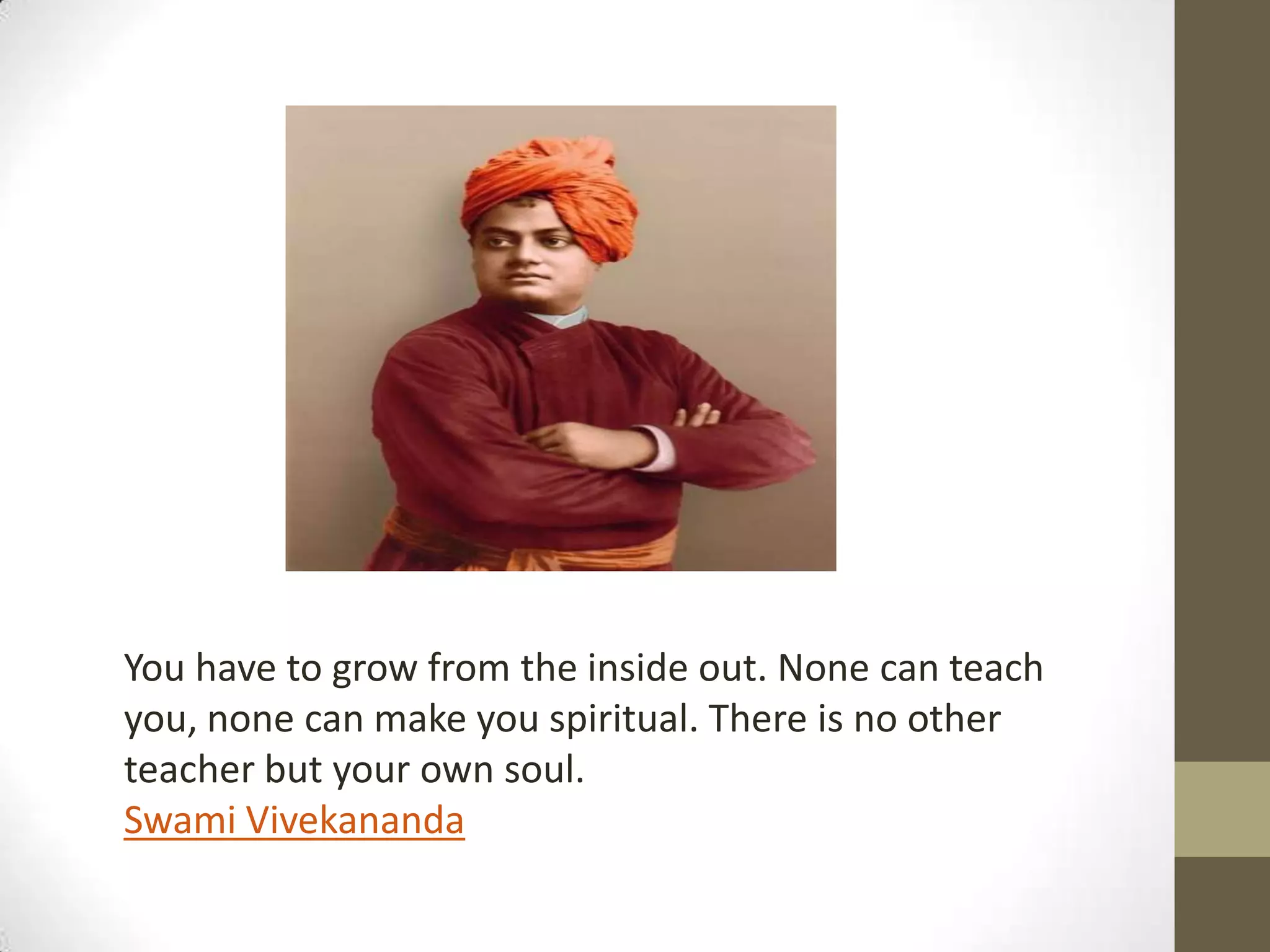
You have to grow from the inside out. None can teach
you, none can make you spiritual. There is no other
teacher but your own soul.
Swami Vivekananda
Swamy Vivekananda(1863-1902)
• A spiritual genius of commanding intellect and power
• Criss-crossed India as a wandering monk
• Represented Hinduism at Chicago’s Parliament of Religions
1893
• For 3 years he taught Vedanta philosophy and Religion in
America and England
• He Wakened India to a new national concsiousness
• His Lectures and writings have been gathered into Nine
volumes
Concentration And Breathing
• Difference between Man and Animal – Power of Concentration
• We all concentrate upon things we love
• We do not control the mind it controls us
• Our minds are concentrated upon various things, in spite of
ourselves
Can Concentration be developed ? “The Yogis say Yes”
• We must learn not only to attach but also to detach our mind
• The very essence of education is concentration of mind and
not collecting of facts
• We should put our minds on things: they should not draw our
attention
• It requires special training
Breathing
• In training the mind the first step is to begin with breathing
• The first thing to consider is – Asana (Posture of the body)
• The Mind acts on the body and the body in turn acts upon the
mind
• Its easier to control the body than your mind
• The science of breathing is working through your body to
reach the mind
• We feel the finer working of the body and then the mind
• You feel the operation of the mind on your body
• You feel the working of one half of the mind upon the other,
You feel the mind operating along the nerve currents
• Thus the mind is brought under control – by regular
systematic breathing
Teamwork and Jealousy
“Team work is truly possible only when the team members not
only have respect and love for each other but also learn to operate
with a high level of trust, reciprocity and interdependence. This is
possible only when there is absence of jealousy and suspicion”
He wrote that three things will make an organization and a Nation
great
(1) Absence of jealousy and suspicion
(2) Conviction in the power of goodness
(3) Doing good and helping all those who want to do good
“Brother, We can get rid of everything but not of Cursed Jealousy
…”– Swami Vivekananda
Leadership Values
• Leader is born one in life. Holding different people together along the line
of their common sympathies
• Selfishness we must seek to eliminate
• Partiality is the chief cause of all evil
• A servant of servants – must accommodate a thousand minds
• A Leader must be impersonal
• Do not try to lead your brothers, but serve them
• Kill Self first if you want to succeed
On Intellect/Reason Vs
Heart/Emotions/Feelings
• Intellect is the policeman - not a positive necessity for the
workings of a society
• Intellect is like limbs without the power of locomotion
• It is only when feeling enters and gives them motion that they
move and work on others
• It is the Heart that takes one to the highest place, which
intellect can never reach
• It goes Beyond intellect and reaches what is called inspiration
Group f1 -_etcg_ppt

Group f1 -_etcg_ppt

  • 1.
    Few Select Worksof Swamy Vivekananda Presented By - Group F1
  • 2.
    You have togrow from the inside out. None can teach you, none can make you spiritual. There is no other teacher but your own soul. Swami Vivekananda
  • 3.
    Swamy Vivekananda(1863-1902) • Aspiritual genius of commanding intellect and power • Criss-crossed India as a wandering monk • Represented Hinduism at Chicago’s Parliament of Religions 1893 • For 3 years he taught Vedanta philosophy and Religion in America and England • He Wakened India to a new national concsiousness • His Lectures and writings have been gathered into Nine volumes
  • 4.
    Concentration And Breathing •Difference between Man and Animal – Power of Concentration • We all concentrate upon things we love • We do not control the mind it controls us • Our minds are concentrated upon various things, in spite of ourselves Can Concentration be developed ? “The Yogis say Yes” • We must learn not only to attach but also to detach our mind • The very essence of education is concentration of mind and not collecting of facts • We should put our minds on things: they should not draw our attention • It requires special training
  • 5.
    Breathing • In trainingthe mind the first step is to begin with breathing • The first thing to consider is – Asana (Posture of the body) • The Mind acts on the body and the body in turn acts upon the mind • Its easier to control the body than your mind • The science of breathing is working through your body to reach the mind • We feel the finer working of the body and then the mind • You feel the operation of the mind on your body • You feel the working of one half of the mind upon the other, You feel the mind operating along the nerve currents • Thus the mind is brought under control – by regular systematic breathing
  • 6.
    Teamwork and Jealousy “Teamwork is truly possible only when the team members not only have respect and love for each other but also learn to operate with a high level of trust, reciprocity and interdependence. This is possible only when there is absence of jealousy and suspicion” He wrote that three things will make an organization and a Nation great (1) Absence of jealousy and suspicion (2) Conviction in the power of goodness (3) Doing good and helping all those who want to do good “Brother, We can get rid of everything but not of Cursed Jealousy …”– Swami Vivekananda
  • 7.
    Leadership Values • Leaderis born one in life. Holding different people together along the line of their common sympathies • Selfishness we must seek to eliminate • Partiality is the chief cause of all evil • A servant of servants – must accommodate a thousand minds • A Leader must be impersonal • Do not try to lead your brothers, but serve them • Kill Self first if you want to succeed
  • 8.
    On Intellect/Reason Vs Heart/Emotions/Feelings •Intellect is the policeman - not a positive necessity for the workings of a society • Intellect is like limbs without the power of locomotion • It is only when feeling enters and gives them motion that they move and work on others • It is the Heart that takes one to the highest place, which intellect can never reach • It goes Beyond intellect and reaches what is called inspiration

Editor's Notes

  • #4 A spiritual genius of commanding intellect and power, Vivekananda crammed immense labor and achievement into his short life, 1863-1902. Born in the Datta family of Calcutta, the youthful Vivekananda embraced the agnostic philosophies of the Western mind along with the worship of science. At the same time, vehement in his desire to know the truth about God, he questioned people of holy reputation, asking them if they had seen God. He found such a person in Sri Ramakrishna, who became his master, allayed his doubts, gave him God vision, and transformed him into sage and prophet with authority to teach. After Sri Ramakrishna's death, Vivekananda renounced the world and criss-crossed India as a wandering monk. His mounting compassion for India's people drove him to seek their material help from the West. Accepting an opportunity to represent Hinduism at Chicago's Parliament of Religions in 1893, Vivekananda won instant celebrity in America and a ready forum for his spiritual teaching. For three years he spread the Vedanta philosophy and religion in America and England and then returned to India to found the Ramakrishna Math and Mission. Exhorting his nation to spiritual greatness, he wakened India to a new national consciousness. He died July 4, 1902, after a second, much shorter sojourn in the West. His lectures and writings have been gathered into nine volumes.