Global
Economy
What we'll discuss
Topic
Topic
Topic
Topic 2
Topic 2
Topic 2
Global Economy/ Economic Globalization
Sustainable Development
Understand the definitions of Global Economy and Sustainable Development.
Understand and identify the two types of Economic Globalization.
Enumerate the factors affecting the Global Economy.
Define the Sustainable Development.
Identify the four dimensions to Sustainable Development.
Know the importance of Sustainable Development.
At the end of the lesson, the students should be able to:
1.
2.
3.
4.
5.
6.
Learning Objectives
What is Global Economy?
Global Economy is one giant entity.
It is all the economy of the world, the economy of every
country which we consider together as one giant
economic system. It includes we buy, sell, and own in
this world.
Refers to the interconnected worldwide economic activities that take
place between multiple countries. These economic activities can have
either a positive or negative impact on the countries involved.
It may also mean as the free movement of goods, capital, services,
technology, information, and capital across borders.
Economic globalization is a worldwide
phenomenon wherein countries’ economic
situations can depend significantly on other
countries. Many allied countries would
supply resources to each other that the other
countries do not have. These resources can
cover imported products, technology, and
even human labor. Many people have
observed that this phenomenon may lead to
a “one-world government,” which consists
of a centralized government for all nations.
Economic Globalization
There are two types of economic globalization-
protectionism and trade liberalization.
Protectionism
Protectionism is a policy that protects domestic
industries from unfair foreign competition. There
are two primary tools used in trade protectionism
tariffs and quota.
A quota is a government-imposed trade restriction
that limits the number or monetary value of goods
that a country can import or export during a
particular period. Countries use quotas in
international trade to help regulate the volume of
trade between them and other countries.
Tariffs are taxes or duties imposed on imports. Tariffs increase the price of
imported goods in the domestic market, which, consequently, reduces the demand
for them.
Trade Liberalization/ Free Trade
Trade liberalization refers to eliminating or easing trade barriers between
countries to promote free trade of goods and services. Trade liberalization
involves reducing tarrifs, eliminating quotas, and reducing non-tariff barriers.
It introduces various goods and services at
reasonable prices.
When countries collaborate, they introduce their
cultures which is an important element in
developing a healthy community.
Promoting free trade leads to the reallocation of
government funds initially spent on factors like
subsidies.
Advantages of Trade Liberalization
It may lead to overdependence on foreign
products and services.
It can affect indigenous people. For example,
relaxed regulations can encourage and ease
the acquisition of indigenous people’s land for
corporate use.
Disadvantages of Trade Liberalization
Although governments do hold power
over countries' economies, it is the big
banks and large corporations that
control and essentially fund these
governments. This means that the
global economy is dominated by large
financial institutions.
Who controls the Global Economy?
Presentations are
communication tools.
Presentations are
communication tools.
Natural resources
Infrastructure
Population
Labor
Human capital
Technology
Law
According to the latest economic news, here are
some of the key factors that influence and affect
how well the global economy works:
Factors affecting the Global Economy
Topic 2: Sustainable Development
What is Sustainable development?
Sustainable development can be defined as an
approach to the economic development of a
country without compromising with the quality
of the environment for future generations. In
the name of economic development, the price
of environmental damage is paid in the form of
land degradation, soil erosion, air and water
pollution, deforestation, etc. This damage may
surpass the advantages of having more quality
output of goods and services.
The continuous production of the world’s natural resources, such as water
and fossil fuels which allow humanity to discover and innovate many things.
We were able to utilize energy, discover new technologies, and make
advancements in transportation and communication.
There are four dimensions to sustainable development –
society, environment, culture, and economy
society, environment, culture, and economy – which are intertwined, not
– which are intertwined, not
separate. Sustainability is a paradigm for thinking about the future in which
environmental, societal, and economic considerations are balanced in the
pursuitof an improved quality of life. For example, a prosperous society relies on

a healthy environment to provide food and resources, safe drinkingwater and
clean air for its citizens.
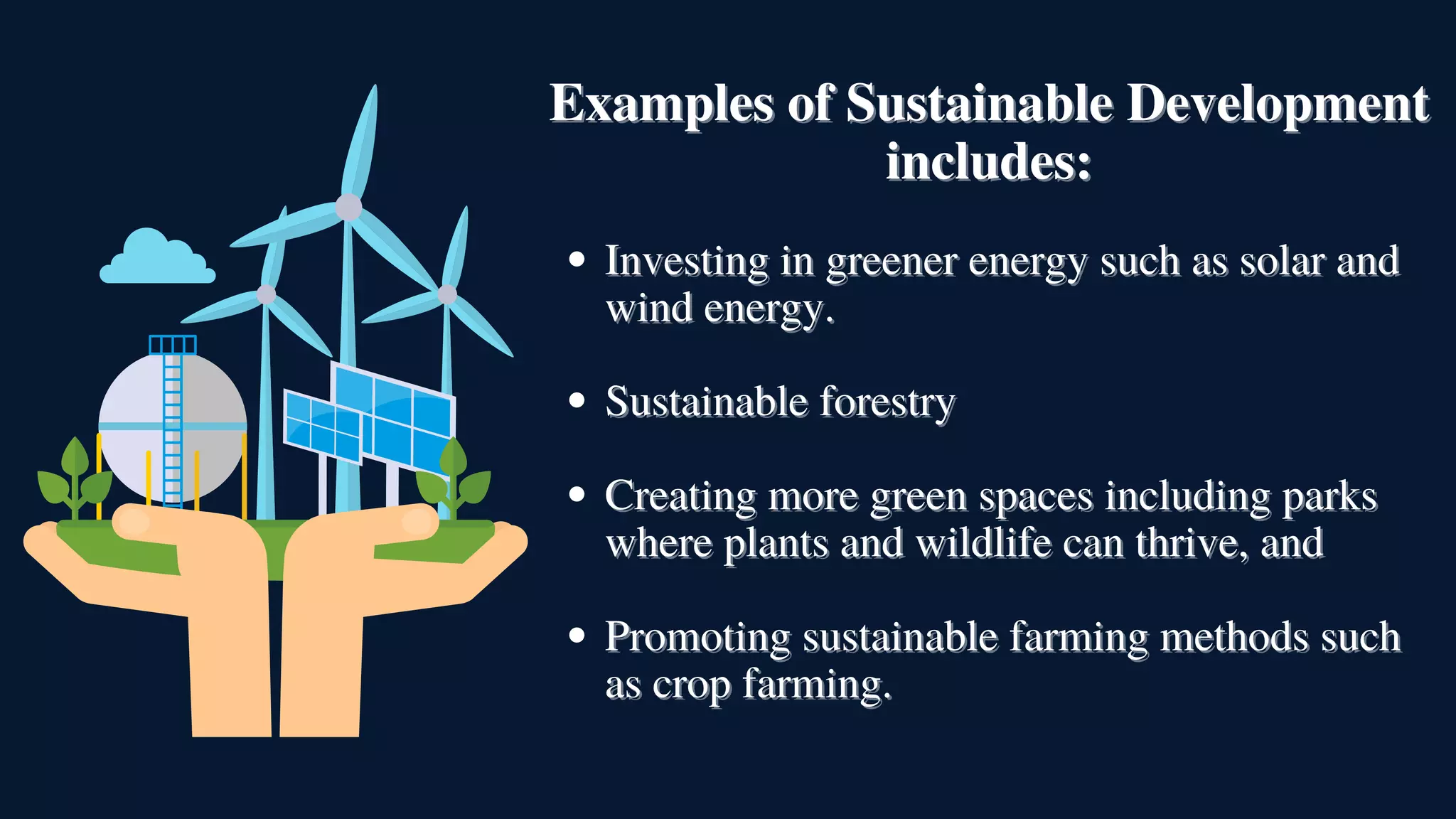
Investing in greener energy such as solar and
wind energy.
wind energy.
Sustainable forestry
Creating more green spaces including parks
where plants and wildlife can thrive, and
Promoting sustainable farming methods such
as crop farming.
as crop farming.
Examples of Sustainable Development
includes:
includes:
Achieving Sustainable Development
Sustainable development can be achieved if we follow the following points:
It can be achieved by restricting human activities.
Technological development should be input effective and not input utilizing.
The rate of consumption should not surpass the rate of salvation.
For renewable resources, the rate of consumption should not surpass the rate
of production of renewable substitutes.
All types of pollution should be minimized.
It can be achieved by sensible use of natural resources
The world is facing serious environmental challenges including climate change,
freshwater depletion, ocean over-fishing, deforestation, water and air pollution, and
hunger. Sustainable development is very important as it focuses on improving
human-environment interaction by prioritizing the management and protection of the
earth’s natural resources for future generations, as well as for the millions of other
species who live on our planet.
Why is sustainable development important?
By promoting stable economic growth, conservation of natural resources,
environmental protection and social progress and equality, we can conserve and
enhance our natural resources so that all countries can meet basic needs of
employment, food, energy, water, and sanitation.
Thank you!
For listening

GROUP 1.pdf

  • 1.
  • 2.
    What we'll discuss Topic Topic Topic Topic2 Topic 2 Topic 2 Global Economy/ Economic Globalization Global Economy/ Economic Globalization Global Economy/ Economic Globalization Sustainable Development Sustainable Development Sustainable Development
  • 3.
    Understand the definitionsof Global Economy and Sustainable Development. Understand and identify the two types of Economic Globalization. Enumerate the factors affecting the Global Economy. Define the Sustainable Development. Identify the four dimensions to Sustainable Development. Know the importance of Sustainable Development. At the end of the lesson, the students should be able to: 1. 2. 3. 4. 5. 6. Learning Objectives
  • 4.
    What is GlobalEconomy? Global Economy is one giant entity. It is all the economy of the world, the economy of every country which we consider together as one giant economic system. It includes we buy, sell, and own in this world. Refers to the interconnected worldwide economic activities that take place between multiple countries. These economic activities can have either a positive or negative impact on the countries involved. It may also mean as the free movement of goods, capital, services, technology, information, and capital across borders.
  • 5.
    Economic globalization isa worldwide phenomenon wherein countries’ economic situations can depend significantly on other countries. Many allied countries would supply resources to each other that the other countries do not have. These resources can cover imported products, technology, and even human labor. Many people have observed that this phenomenon may lead to a “one-world government,” which consists of a centralized government for all nations. Economic Globalization There are two types of economic globalization- protectionism and trade liberalization.
  • 6.
    Protectionism Protectionism is apolicy that protects domestic industries from unfair foreign competition. There are two primary tools used in trade protectionism tariffs and quota. A quota is a government-imposed trade restriction that limits the number or monetary value of goods that a country can import or export during a particular period. Countries use quotas in international trade to help regulate the volume of trade between them and other countries. Tariffs are taxes or duties imposed on imports. Tariffs increase the price of imported goods in the domestic market, which, consequently, reduces the demand for them.
  • 7.
    Trade Liberalization/ FreeTrade Trade liberalization refers to eliminating or easing trade barriers between countries to promote free trade of goods and services. Trade liberalization involves reducing tarrifs, eliminating quotas, and reducing non-tariff barriers. It introduces various goods and services at reasonable prices. When countries collaborate, they introduce their cultures which is an important element in developing a healthy community. Promoting free trade leads to the reallocation of government funds initially spent on factors like subsidies. Advantages of Trade Liberalization It may lead to overdependence on foreign products and services. It can affect indigenous people. For example, relaxed regulations can encourage and ease the acquisition of indigenous people’s land for corporate use. Disadvantages of Trade Liberalization
  • 8.
    Although governments dohold power over countries' economies, it is the big banks and large corporations that control and essentially fund these governments. This means that the global economy is dominated by large financial institutions. Who controls the Global Economy? Presentations are communication tools. Presentations are communication tools.
  • 9.
    Natural resources Infrastructure Population Labor Human capital Technology Law Accordingto the latest economic news, here are some of the key factors that influence and affect how well the global economy works: Factors affecting the Global Economy
  • 10.
    Topic 2: SustainableDevelopment What is Sustainable development? What is Sustainable development? Sustainable development can be defined as an Sustainable development can be defined as an approach to the economic development of a approach to the economic development of a country without compromising with the quality country without compromising with the quality of the environment for future generations. In of the environment for future generations. In the name of economic development, the price the name of economic development, the price of environmental damage is paid in the form of of environmental damage is paid in the form of land degradation, soil erosion, air and water land degradation, soil erosion, air and water pollution, deforestation, etc. This damage may pollution, deforestation, etc. This damage may surpass the advantages of having more quality surpass the advantages of having more quality output of goods and services. output of goods and services.
  • 11.
    The continuous productionof the world’s natural resources, such as water The continuous production of the world’s natural resources, such as water and fossil fuels which allow humanity to discover and innovate many things. and fossil fuels which allow humanity to discover and innovate many things. We were able to utilize energy, discover new technologies, and make We were able to utilize energy, discover new technologies, and make advancements in transportation and communication. advancements in transportation and communication. There are four dimensions to sustainable development – There are four dimensions to sustainable development – society, environment, culture, and economy society, environment, culture, and economy – which are intertwined, not – which are intertwined, not separate. Sustainability is a paradigm for thinking about the future in which separate. Sustainability is a paradigm for thinking about the future in which environmental, societal, and economic considerations are balanced in the environmental, societal, and economic considerations are balanced in the pursuitof an improved quality of life. For example, a prosperous society relies on pursuitof an improved quality of life. For example, a prosperous society relies on a healthy environment to provide food and resources, safe drinkingwater and a healthy environment to provide food and resources, safe drinkingwater and clean air for its citizens. clean air for its citizens.
  • 12.
    Investing in greenerenergy such as solar and Investing in greener energy such as solar and wind energy. wind energy. Sustainable forestry Sustainable forestry Creating more green spaces including parks Creating more green spaces including parks where plants and wildlife can thrive, and where plants and wildlife can thrive, and Promoting sustainable farming methods such Promoting sustainable farming methods such as crop farming. as crop farming. Examples of Sustainable Development Examples of Sustainable Development includes: includes:
  • 13.
    Achieving Sustainable Development AchievingSustainable Development Sustainable development can be achieved if we follow the following points: Sustainable development can be achieved if we follow the following points: It can be achieved by restricting human activities. It can be achieved by restricting human activities. Technological development should be input effective and not input utilizing. Technological development should be input effective and not input utilizing. The rate of consumption should not surpass the rate of salvation. The rate of consumption should not surpass the rate of salvation. For renewable resources, the rate of consumption should not surpass the rate For renewable resources, the rate of consumption should not surpass the rate of production of renewable substitutes. of production of renewable substitutes. All types of pollution should be minimized. All types of pollution should be minimized. It can be achieved by sensible use of natural resources It can be achieved by sensible use of natural resources
  • 14.
    The world isfacing serious environmental challenges including climate change, The world is facing serious environmental challenges including climate change, freshwater depletion, ocean over-fishing, deforestation, water and air pollution, and freshwater depletion, ocean over-fishing, deforestation, water and air pollution, and hunger. Sustainable development is very important as it focuses on improving hunger. Sustainable development is very important as it focuses on improving human-environment interaction by prioritizing the management and protection of the human-environment interaction by prioritizing the management and protection of the earth’s natural resources for future generations, as well as for the millions of other earth’s natural resources for future generations, as well as for the millions of other species who live on our planet. species who live on our planet. Why is sustainable development important? By promoting stable economic growth, conservation of natural resources, By promoting stable economic growth, conservation of natural resources, environmental protection and social progress and equality, we can conserve and environmental protection and social progress and equality, we can conserve and enhance our natural resources so that all countries can meet basic needs of enhance our natural resources so that all countries can meet basic needs of employment, food, energy, water, and sanitation. employment, food, energy, water, and sanitation.
  • 15.