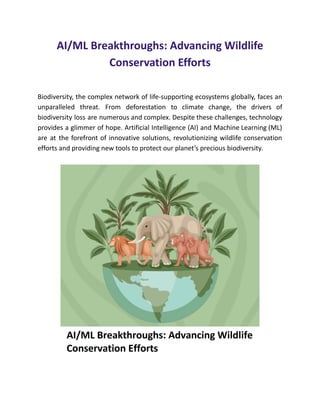
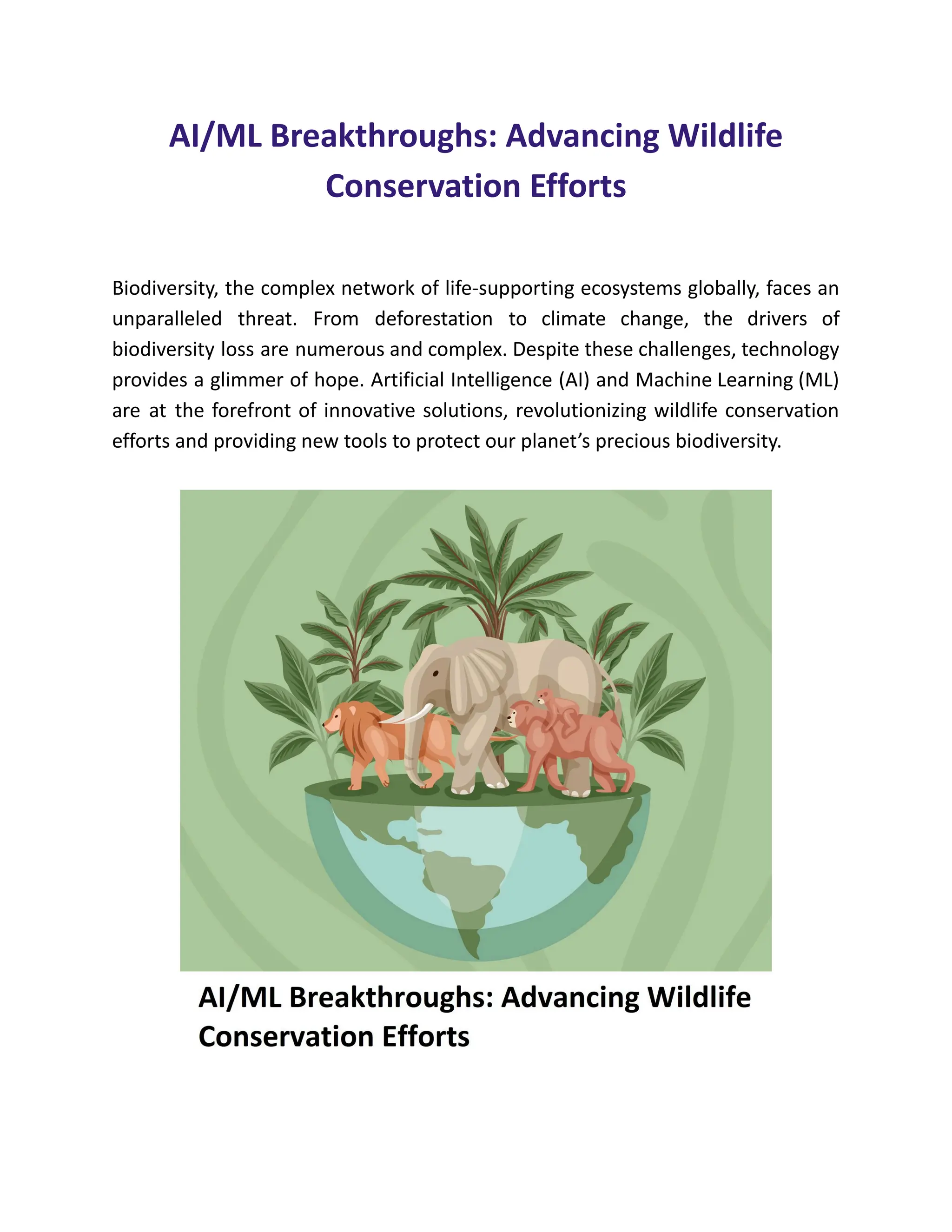
AI/ML Breakthroughs: Advancing Wildlife
Conservation Efforts
Biodiversity, the complex network of life-supporting ecosystems globally, faces an
unparalleled threat. From deforestation to climate change, the drivers of
biodiversity loss are numerous and complex. Despite these challenges, technology
provides a glimmer of hope. Artificial Intelligence (AI) and Machine Learning (ML)
are at the forefront of innovative solutions, revolutionizing wildlife conservation
efforts and providing new tools to protect our planet’s precious biodiversity.
The Urgency Of Protecting Biodiversity
Recent reports highlight the urgent and precarious situation of global biodiversity.
According to the World Wildlife Fund’s (WWF) Living Planet Report 2022, there
has been a nearly 69% decline in global wildlife populations since 1970. This stark
statistic highlights the urgent need for effective conservation strategies.
Biodiversity is not just about preserving the beauty of nature; it is essential for
ecosystem stability, climate regulation, and human well-being.
The Role Of AI And ML In Wildlife Conservation
1. AI And ML In Wildlife Monitoring
A) Enhancing Species Identification
AI-powered tools are enhancing species identification, which is vital for
monitoring biodiversity. AI and ML algorithms can process large volumes of data
from camera traps, audio sensors, and drones to identify species. For example,
Microsoft’s AI for Earth program has developed tools that use computer vision to
identify and count animal species from images captured by camera traps​
(Gartner)​
.
Machine learning algorithms can examine audio recordings of bird songs or whale
calls, accurately identifying different species. The Cornell Lab of Ornithology’s
BirdNET project uses AI to identify over 3,000 bird species from audio recordings.
Such innovations enable scientists and citizen scientists to contribute to
biodiversity monitoring on an unprecedented scale.
B) Monitoring And Data Collection
Traditional methods of tracking animal populations are labor-intensive and often
invasive. AI-enhanced camera traps and drones utilizing computer vision
algorithms can autonomously detect and enumerate species within their natural
environments.
For instance, the Zoological Society of London (ZSL) utilizes AI to analyze millions
of images captured by camera traps in the Serengeti, and organizations like
Conservation Metrics use AI algorithms to analyze audio recordings from
rainforests, identifying species by their vocalizations. This technology not only
accelerates data collection but also improves accuracy, enabling more precise
population estimates and allowing for real-time monitoring of biodiversity.
2. Predictive Analytics And Conservation Planning
A) Poaching Prevention
Poaching continues to be a major threat to endangered species. AI-powered
surveillance systems are being deployed in protected areas to combat this issue.
The SMART (Spatial Monitoring and Reporting Tool) platform integrates AI to
analyze data from ranger patrols, camera traps, and even drones, identifying
poaching hotspots and predicting future incidents.
According to the SMART Partnership, this technology has already led to a
significant reduction in poaching activities in several key conservation areas. The
PAWS (Protection Assistant for Wildlife Security) system, developed by the
University of Southern California, employs ML to optimize ranger patrol routes
and reduce poaching incidents in protected areas​(FinDev Gateway).
B) Habitat Mapping And Restoration
AI and ML play a crucial role in efforts to map and restore habitats. Satellite
images and AI algorithms are utilized to generate comprehensive maps of
ecosystems, pinpointing regions in need of conservation efforts. The Global Forest
Watch, powered by AI, provides up-to-date information on forest cover changes,
enabling timely interventions.
Additionally, AI-driven models predict the success of habitat restoration efforts by
analyzing factors such as soil quality, climate conditions, and historical data,
ensuring that reforestation initiatives are more successful. For instance, Google’s
TensorFlow has been used to predict the impacts of climate change on various
species’ habitats, allowing for more informed conservation strategies​(Gartner)​
.
Latest Statistics And Reports
A report by McKinsey & Company in 2023 highlights the potential economic
impact of AI in conservation, estimating that AI-driven solutions could save the
global economy up to $300 billion annually by mitigating the effects of biodiversity
loss. Moreover, a study published in Nature Communications in 2023 found that
AI-enhanced conservation strategies could increase the effectiveness of protected
areas by up to 40%.
Enhancing Conservation Through Data Integration
1. Biodiversity Databases
AI and ML can integrate data from multiple sources, such as satellite imagery, field
observations, and genetic data, to create comprehensive biodiversity databases.
These databases offer a comprehensive perspective on ecosystems and enable the
monitoring of biodiversity shifts over time. The Global Biodiversity Information
Facility (GBIF) uses AI to aggregate and analyze biodiversity data from around the
world, supporting global conservation efforts​(Gartner)​
.
2. Citizen Science And Crowdsourcing
AI-powered platforms can harness the power of citizen science by analyzing data
submitted by volunteers. These platforms use image recognition and other AI
techniques to validate and process large amounts of data, enabling the public to
contribute to wildlife monitoring efforts. Projects like iNaturalist use AI to help
users identify species from photographs, enhancing public engagement in
conservation​(FinDev Gateway)​
.
Case Studies And Success Stories
1. Project DeepMind And Elephants
In collaboration with the David Sheldrick Wildlife Trust, DeepMind developed an
AI system to track elephant movements using drone footage and GPS data. The AI
models can predict elephant migration patterns, helping conservationists to
allocate resources more effectively and prevent human-wildlife conflicts. This
project has been instrumental in reducing elephant poaching incidents in Kenya by
80% since its inception.
2. The Zebra Counting AI
In a groundbreaking study, researchers from the University of Oxford developed
an AI system capable of identifying individual zebras through their unique stripe
patterns. This technology has enabled more accurate population estimates and
tracking of zebra movements across the African savannah, providing critical data
for conservation planning.
Challenges That Need Addressal
While AI and ML offer significant potential for wildlife conservation, several
challenges remain:
● Data Quality And Availability: High-quality, comprehensive datasets
are essential for training accurate AI models. In many regions, data on
wildlife populations and habitats are sparse or unreliable, limiting the
effectiveness of AI applications. Collaborative efforts between governments,
NGOs, and research institutions are needed to improve data collection and
sharing.
● Ethical Considerations: The use of AI in wildlife conservation raises
ethical questions, such as the potential for surveillance technologies to be
misused or the impact of drone monitoring on animal behavior.
Conservationists must carefully consider these issues and develop
guidelines to ensure ethical AI use.
● Interdisciplinary Collaboration: Effective implementation of AI and
ML in conservation requires collaboration between technologists,
ecologists, and local communities. Interdisciplinary approaches can ensure
that AI tools are tailored to the specific needs of conservation projects and
are culturally appropriate.
The Future Of AI/ML In Wildlife Conservation
The potential of AI and ML in wildlife conservation is immense and continually
evolving. As these technologies become more sophisticated, their applications will
expand, offering even more precise and effective tools for conservationists. One
promising area is the use of AI in genetic analysis, where machine learning
algorithms can identify genetic diversity and health indicators within wildlife
populations, aiding in the preservation of genetic diversity.
AI For Good: The Path Forward
The integration of AI and ML into wildlife conservation is not without challenges.
Issues such as data privacy, the need for extensive computational resources, and
the ethical implications of AI deployment in natural environments must be
addressed. However, the benefits far outweigh the drawbacks, and the continued
advancement of AI and ML technologies holds the promise of a brighter future for
global biodiversity.
Conclusion
In the battle to combat biodiversity loss, AI and ML emerge as formidable allies.
From monitoring and data collection to poaching prevention and habitat
restoration, these technologies are revolutionizing wildlife conservation. By
embracing these innovations, we can better protect our planet’s precious
biodiversity and ensure a sustainable future for all species.
As we move forward, we must continue to invest in and develop these
technologies, fostering a harmonious relationship between nature and
technology. Protecting biodiversity through AI and ML is not just a possibility; it’s a
necessity. The time to act is now. EnFuse Solutions is at the forefront of this
transformation, leveraging cutting-edge AI/ML techniques to support biodiversity
conservation. Learn more about our innovative solutions today!
Read More: From Recruitment To Retention: The Role Of AI/ML In Modern HR
Practices

AI/ML Breakthroughs: Advancing Wildlife Conservation Efforts

  • 1.
    AI/ML Breakthroughs: AdvancingWildlife Conservation Efforts Biodiversity, the complex network of life-supporting ecosystems globally, faces an unparalleled threat. From deforestation to climate change, the drivers of biodiversity loss are numerous and complex. Despite these challenges, technology provides a glimmer of hope. Artificial Intelligence (AI) and Machine Learning (ML) are at the forefront of innovative solutions, revolutionizing wildlife conservation efforts and providing new tools to protect our planet’s precious biodiversity.
  • 2.
    The Urgency OfProtecting Biodiversity Recent reports highlight the urgent and precarious situation of global biodiversity. According to the World Wildlife Fund’s (WWF) Living Planet Report 2022, there has been a nearly 69% decline in global wildlife populations since 1970. This stark statistic highlights the urgent need for effective conservation strategies. Biodiversity is not just about preserving the beauty of nature; it is essential for ecosystem stability, climate regulation, and human well-being. The Role Of AI And ML In Wildlife Conservation 1. AI And ML In Wildlife Monitoring A) Enhancing Species Identification AI-powered tools are enhancing species identification, which is vital for monitoring biodiversity. AI and ML algorithms can process large volumes of data from camera traps, audio sensors, and drones to identify species. For example, Microsoft’s AI for Earth program has developed tools that use computer vision to identify and count animal species from images captured by camera traps​ (Gartner)​ . Machine learning algorithms can examine audio recordings of bird songs or whale calls, accurately identifying different species. The Cornell Lab of Ornithology’s BirdNET project uses AI to identify over 3,000 bird species from audio recordings. Such innovations enable scientists and citizen scientists to contribute to biodiversity monitoring on an unprecedented scale.
  • 3.
    B) Monitoring AndData Collection Traditional methods of tracking animal populations are labor-intensive and often invasive. AI-enhanced camera traps and drones utilizing computer vision algorithms can autonomously detect and enumerate species within their natural environments. For instance, the Zoological Society of London (ZSL) utilizes AI to analyze millions of images captured by camera traps in the Serengeti, and organizations like Conservation Metrics use AI algorithms to analyze audio recordings from rainforests, identifying species by their vocalizations. This technology not only accelerates data collection but also improves accuracy, enabling more precise population estimates and allowing for real-time monitoring of biodiversity. 2. Predictive Analytics And Conservation Planning A) Poaching Prevention Poaching continues to be a major threat to endangered species. AI-powered surveillance systems are being deployed in protected areas to combat this issue. The SMART (Spatial Monitoring and Reporting Tool) platform integrates AI to analyze data from ranger patrols, camera traps, and even drones, identifying poaching hotspots and predicting future incidents. According to the SMART Partnership, this technology has already led to a significant reduction in poaching activities in several key conservation areas. The PAWS (Protection Assistant for Wildlife Security) system, developed by the University of Southern California, employs ML to optimize ranger patrol routes and reduce poaching incidents in protected areas​(FinDev Gateway).
  • 4.
    B) Habitat MappingAnd Restoration AI and ML play a crucial role in efforts to map and restore habitats. Satellite images and AI algorithms are utilized to generate comprehensive maps of ecosystems, pinpointing regions in need of conservation efforts. The Global Forest Watch, powered by AI, provides up-to-date information on forest cover changes, enabling timely interventions. Additionally, AI-driven models predict the success of habitat restoration efforts by analyzing factors such as soil quality, climate conditions, and historical data, ensuring that reforestation initiatives are more successful. For instance, Google’s TensorFlow has been used to predict the impacts of climate change on various species’ habitats, allowing for more informed conservation strategies​(Gartner)​ . Latest Statistics And Reports A report by McKinsey & Company in 2023 highlights the potential economic impact of AI in conservation, estimating that AI-driven solutions could save the global economy up to $300 billion annually by mitigating the effects of biodiversity loss. Moreover, a study published in Nature Communications in 2023 found that AI-enhanced conservation strategies could increase the effectiveness of protected areas by up to 40%. Enhancing Conservation Through Data Integration 1. Biodiversity Databases AI and ML can integrate data from multiple sources, such as satellite imagery, field observations, and genetic data, to create comprehensive biodiversity databases. These databases offer a comprehensive perspective on ecosystems and enable the monitoring of biodiversity shifts over time. The Global Biodiversity Information Facility (GBIF) uses AI to aggregate and analyze biodiversity data from around the world, supporting global conservation efforts​(Gartner)​ .
  • 5.
    2. Citizen ScienceAnd Crowdsourcing AI-powered platforms can harness the power of citizen science by analyzing data submitted by volunteers. These platforms use image recognition and other AI techniques to validate and process large amounts of data, enabling the public to contribute to wildlife monitoring efforts. Projects like iNaturalist use AI to help users identify species from photographs, enhancing public engagement in conservation​(FinDev Gateway)​ . Case Studies And Success Stories 1. Project DeepMind And Elephants In collaboration with the David Sheldrick Wildlife Trust, DeepMind developed an AI system to track elephant movements using drone footage and GPS data. The AI models can predict elephant migration patterns, helping conservationists to allocate resources more effectively and prevent human-wildlife conflicts. This project has been instrumental in reducing elephant poaching incidents in Kenya by 80% since its inception. 2. The Zebra Counting AI In a groundbreaking study, researchers from the University of Oxford developed an AI system capable of identifying individual zebras through their unique stripe patterns. This technology has enabled more accurate population estimates and tracking of zebra movements across the African savannah, providing critical data for conservation planning.
  • 6.
    Challenges That NeedAddressal While AI and ML offer significant potential for wildlife conservation, several challenges remain: ● Data Quality And Availability: High-quality, comprehensive datasets are essential for training accurate AI models. In many regions, data on wildlife populations and habitats are sparse or unreliable, limiting the effectiveness of AI applications. Collaborative efforts between governments, NGOs, and research institutions are needed to improve data collection and sharing. ● Ethical Considerations: The use of AI in wildlife conservation raises ethical questions, such as the potential for surveillance technologies to be misused or the impact of drone monitoring on animal behavior. Conservationists must carefully consider these issues and develop guidelines to ensure ethical AI use. ● Interdisciplinary Collaboration: Effective implementation of AI and ML in conservation requires collaboration between technologists, ecologists, and local communities. Interdisciplinary approaches can ensure that AI tools are tailored to the specific needs of conservation projects and are culturally appropriate. The Future Of AI/ML In Wildlife Conservation The potential of AI and ML in wildlife conservation is immense and continually evolving. As these technologies become more sophisticated, their applications will expand, offering even more precise and effective tools for conservationists. One promising area is the use of AI in genetic analysis, where machine learning algorithms can identify genetic diversity and health indicators within wildlife populations, aiding in the preservation of genetic diversity.
  • 7.
    AI For Good:The Path Forward The integration of AI and ML into wildlife conservation is not without challenges. Issues such as data privacy, the need for extensive computational resources, and the ethical implications of AI deployment in natural environments must be addressed. However, the benefits far outweigh the drawbacks, and the continued advancement of AI and ML technologies holds the promise of a brighter future for global biodiversity. Conclusion In the battle to combat biodiversity loss, AI and ML emerge as formidable allies. From monitoring and data collection to poaching prevention and habitat restoration, these technologies are revolutionizing wildlife conservation. By embracing these innovations, we can better protect our planet’s precious biodiversity and ensure a sustainable future for all species. As we move forward, we must continue to invest in and develop these technologies, fostering a harmonious relationship between nature and technology. Protecting biodiversity through AI and ML is not just a possibility; it’s a necessity. The time to act is now. EnFuse Solutions is at the forefront of this transformation, leveraging cutting-edge AI/ML techniques to support biodiversity conservation. Learn more about our innovative solutions today! Read More: From Recruitment To Retention: The Role Of AI/ML In Modern HR Practices