1) Green Lantern was first created in 1940 and has since been reimagined multiple times with different characters taking on the mantle of Green Lantern.
2) The Green Lantern gets their powers from a power ring fueled by willpower that allows them to affect physical objects and fly. They are part of an intergalactic police force.
3) In the 1970s, Green Lantern comics addressed social issues of the time when he teamed up with Green Arrow, though this run did not last long. The character and titles have fluctuated in popularity over the decades.
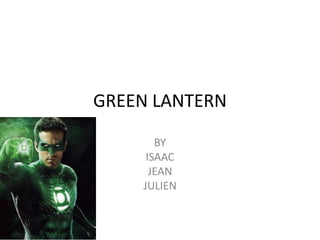
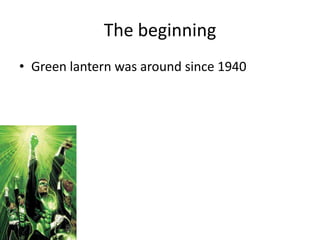
![About the green lantern a power ring and power lantern that gives the user great control over the physical world as long as the wielder has sufficient willpower and strength to wield it. The ring is one of the most powerful weapons in the universe, and can be very dangerous. While the ring of the Golden Age Green Lantern (Alan Scott) was magically powered, the rings worn by all subsequent Lanterns were technological creations of the Guardians of the Universe, who granted such rings to worthy candidates. These individuals made up the intergalactic police force known as the Green Lantern Corps.[1] After World War II, when sales of superhero comic books generally declined, DC ceased publishing new adventures of Alan Scott as the Green Lantern. In 1959, at the beginning of the Silver Age of Comic Books, DC editor Julius Schwartz assigned writer John Broome and artist Gil Kane to revive the Green Lantern character, this time as test pilot Hal Jordan, who became a founding member of the Justice League of America. In 1970, writer Denny O'Neil and artist Neal Adams teamed Green Lantern with archer Green Arrow in groundbreaking, socially conscious, and award-winning stories that pitted the sensibilities of the law-and-order-oriented Lantern with the populist Green Arrow. Several cosmically themed series followed, as did occasional different individuals in the role of Earth's Green Lantern. Most prominent of these are Hal Jordan, John Stewart, Guy Gardner, and Kyle Rayner.](https://image.slidesharecdn.com/greenlantern-110628145008-phpapp01/85/Green-lantern-3-320.jpg)
![The comic This Green Lantern's real name was Alan Scott, a railroad engineer who, after a railway crash, came into possession of a magic lantern which spoke to him and said it would bring power. From this, he crafted a magic ring which gave him a wide variety of powers. The limitations of the ring were that it had to be "charged" every 24 hours by touching it to the lantern for a time, and that it did not work on non-metals like wood. With issue #76 (April 1970), the series made a radical stylistic departure. Editor Schwartz, in one of the company's earliest efforts to provide more than fantasy, worked with the writer-artist team of Denny O'Neil and Neal Adams to spark new interest in the comic and address a perceived need for social relevance. They added the character Green Arrow (with the cover though not the official name retitledGreen Lantern Co-Starring Green Arrow) and had the pair travel through America encountering "real world" issues, to which they reacted in different ways — Green Lantern as fundamentally a lawman, Green Arrow as a liberal iconoclast. Additionally during this run, the groundbreaking "Snowbirds Don't Fly" story was published (issues #85 and #86) in which Green Arrow's teen sidekick Speedy (the later grownup hero Red Arrow) developed a heroin addiction that he was forcibly made to quit. The stories were critically acclaimed, with publications such as The New York Times, The Wall Street Journal, and Newsweek citing it as an example of how comic books were "growing up".[3] However, the O'Neil/Adams run was not a commercial success, and after only 14 issues, the two left the title, which was cancelled.The title would know a number of revivals and cancellations. Its title would change to Green Lantern Corps at one point as the popularity rose and waned. During a time there were two regular titles, each with a Green Lantern, and a third member in the Justice League. A new character, Kyle Rayner, was created to become the feature while Hal Jordan first became the villain Parallax, then died and came back as the Specter.In the wake of The New Frontier, writer Geoff Johns returned Hal Jordan as Green Lantern in Green Lantern: Rebirth (2004–05). Johns began to lay groundwork for "Blackest Night" (released July 13, 2010[4]), viewing it as the third part of the trilogy started by Rebirth. Expanding on the Green Lantern mythology in the second part, "Sinestro Corps War" (2007), Johns, with artist Ethan van Sciver, found wide critical acclaim and commercial success with the series, which promised the introduction of a spectrum of colored "lanterns". Currently, all four "current" Green Lanterns have stories being told in simultaneously published series: Green Lantern (primarily Jordan), Green Lantern Corps (primarily Rayner and Stewart), and Green Lantern: Emerald Warriors (primarily Gardner).](https://image.slidesharecdn.com/greenlantern-110628145008-phpapp01/85/Green-lantern-4-320.jpg)


![Man of steel [autosaved] [autosaved]](https://cdn.slidesharecdn.com/ss_thumbnails/manofsteelautosavedautosaved-121017225658-phpapp01-thumbnail.jpg?width=640&height=640&fit=bounds)


