GRE: ANALYSIS OF AN
ARGUMENT
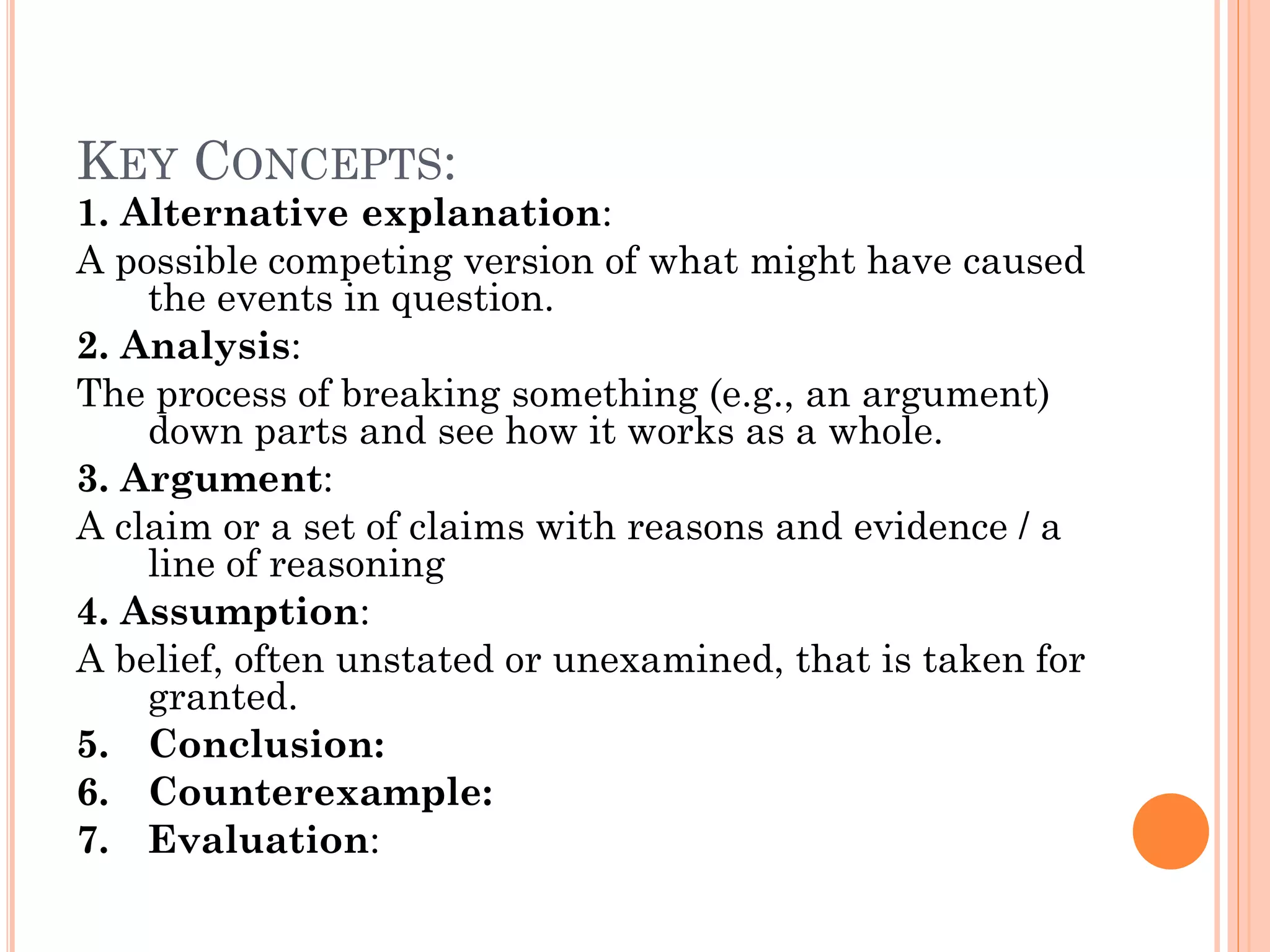
KEY CONCEPTS:
1. Alternative explanation:
A possible competing version of what might have caused
the events in question.
2. Analysis:
The process of breaking something (e.g., an argument)
down parts and see how it works as a whole.
3. Argument:
A claim or a set of claims with reasons and evidence / a
line of reasoning
4. Assumption:
A belief, often unstated or unexamined, that is taken for
granted.
5. Conclusion:
6. Counterexample:
7. Evaluation:
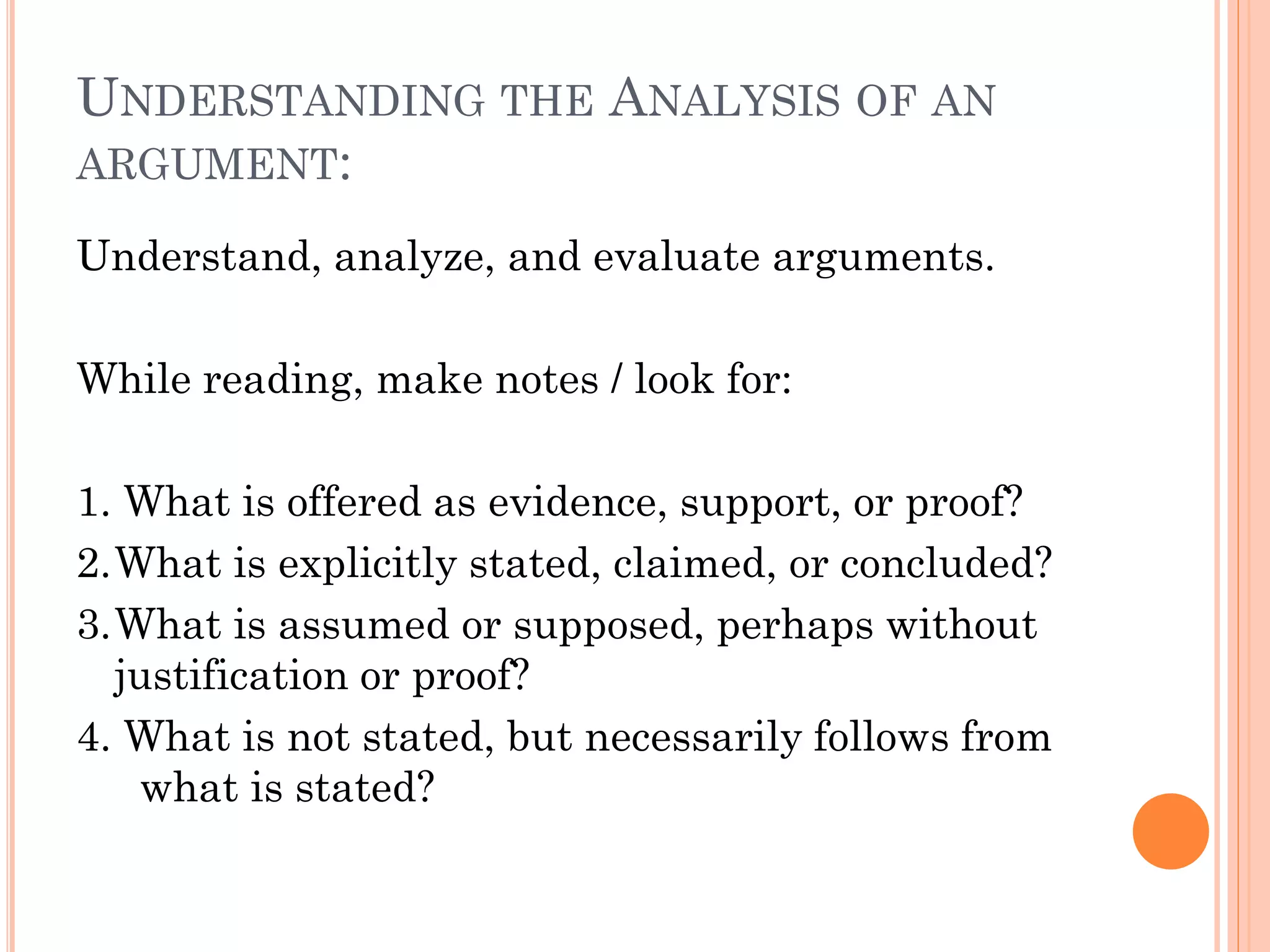
UNDERSTANDING THE ANALYSIS OF AN
ARGUMENT:
Understand, analyze, and evaluate arguments.
While reading, make notes / look for:
1. What is offered as evidence, support, or proof?
2.What is explicitly stated, claimed, or concluded?
3.What is assumed or supposed, perhaps without
justification or proof?
4. What is not stated, but necessarily follows from
what is stated?
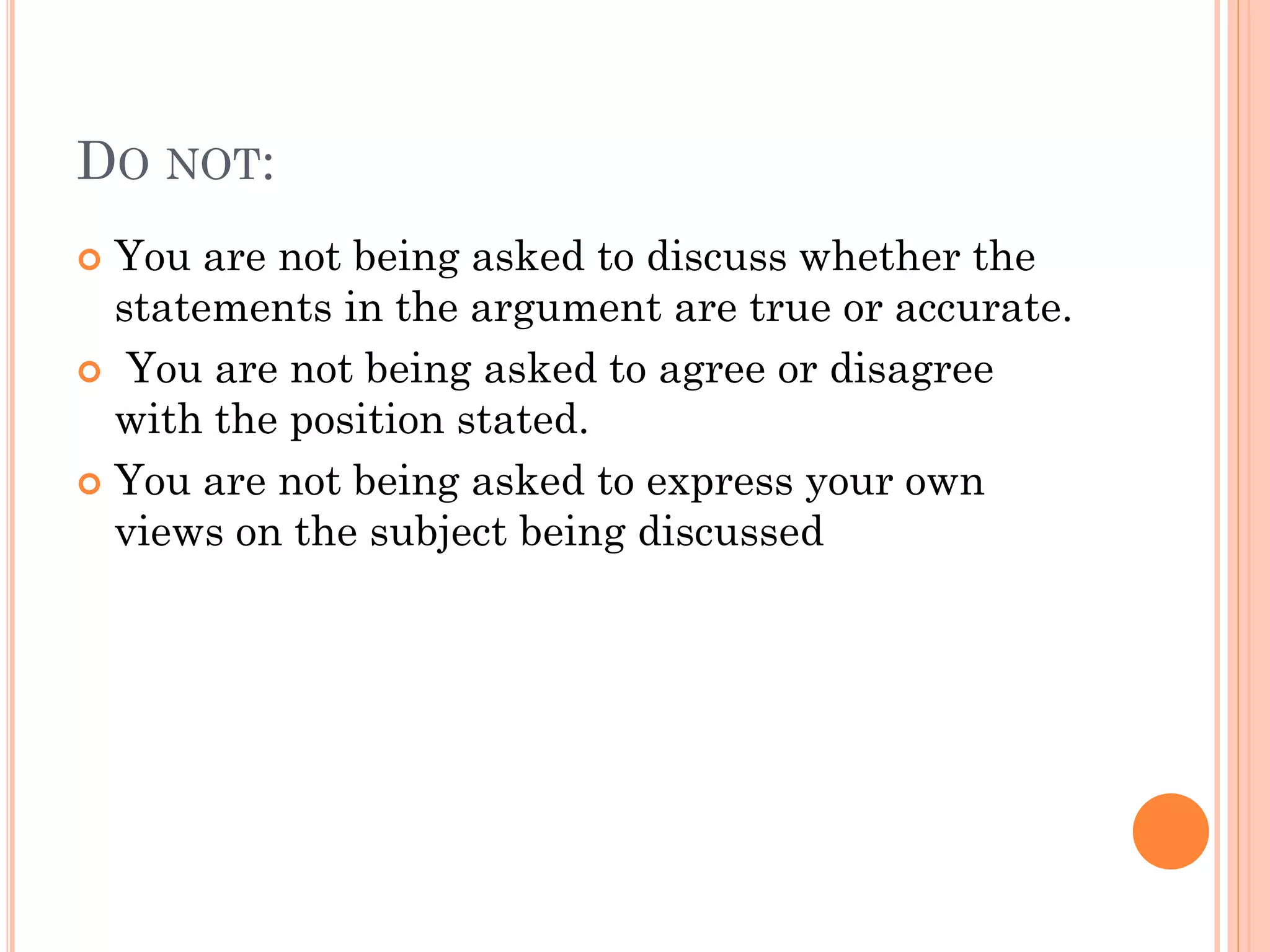
DO NOT:
 You are not being asked to discuss whether the
statements in the argument are true or accurate.
 You are not being asked to agree or disagree
with the position stated.
 You are not being asked to express your own
views on the subject being discussed
DO:
1.Carefully read the argument and the specific
instructions—you might want to read them over
more than once.
2.Identify as many of the argument’s claims,
conclusions, and underlying assumptions as
possible, and evaluate their quality.
3.Think of as many alternative explanations and
counterexamples as you can.
4.Think of what specific additional evidence might
weaken or lend support to the claims.
5.Ask yourself what changes in the argument
would make the reasoning more sound.
TYPES OF SPECIFIC INSTRUCTION:
1.Discuss what specific evidence is needed to evaluate
the argument and explain how the evidence would
weaken or strengthen the argument.
2.Discuss the unstated assumptions of the argument,
how the argument depends on the assumptions, and
what the implications are if the assumptions prove
unwarranted.
3.Discuss what questions would need to be answered in
order to evaluate the argument’s soundness or
validity properly.
4.Discuss what alternative explanations could
challenge the argument’s explanation of a certain
phenomenon and demonstrate how the alternatives
would do so.
SAMPLE TASK:
 In surveys Mason City residents rank water sports
(swimming, boating, and fishing) among their favorite
recreational activities. The Mason River flowing
through the city is rarely used for these pursuits,
however, and the city park department devotes little of
its budget to maintaining riverside recreational
facilities. For years there have been complaints from
residents about the quality of the river’s water and the
river’s smell. In response, the state has recently
announced plans to clean up the Mason River. Use of
the river for water sports is, therefore, sure to increase.
The city government should for that reason devote
more money in this year’s budget to riverside
recreational facilities.
 Write a response in which you examine the stated and
unstated assumptions of the argument. Be sure to explain
how the argument depends on the assumptions and what
the implications are if the assumptions prove
unwarranted.
THE ASSUMPTIONS
1) people who rank water sports “among their
favorite recreational activities” are actually likely
to participate in them. (It is possible that they
just like to watch them.) This assumption
underlies the claim that use of the river for water
sports is sure to increase after the state cleans up
the Mason River and that the city should for that
reason devote more money to riverside
recreational facilities.
THE ASSUMPTIONS:
2. The assumption that what residents say in
surveys can be taken at face value. (It is possible
that survey results exaggerate the interest in
water sports.) This assumption underlies the
claim that use of the river for water sports is sure
to increase after the state cleans up the Mason
River and that the city should for that reason
devote more money to riverside recreational
facilities.
THE ASSUMPTIONS:
3. The assumption that Mason City residents
would actually want to do water sports in the
Mason River. (As recreational activities, it is
possible that water sports are regarded as
pursuits for vacations and weekends away from
the city.) This assumption underlies the claim
that use of the river for water sports is sure to
increase after the state cleans up the Mason
River and that the city should for that reason
devote more money to riverside recreational
facilities.
THE ASSUMPTIONS:
4. The assumption that the park department
devoting little of its budget to maintaining
riverside recreational facilities means that these
facilities are inadequately maintained. This
assumption underlies the claim that the city
should devote more money in this year’s budget
to riverside recreational facilities. If current
facilities are adequately maintained, then
increased funding might not be needed even if
recreational use of the river does increase.
THE ASSUMPTION
5.The assumption that the riverside recreational
facilities are facilities designed for people who
participate in water sports and not some other
recreational pursuit. This assumption underlies
the claim that the city should devote more money
in this year’s budget to riverside recreational
facilities.
THE ASSUMPTION
6.The assumption that the dirtiness of the river is
the cause of its being little used and that
cleaning up the river will be sufficient to increase
recreational use of the river. (Residents might
have complained about the water quality and
smell even if they had no desire to boat, swim, or
fish in the river.) This assumption underlies the
claim that the state’s plan to clean up the river
will result in increased use of the river for water
sports.
THE ASSUMPTION
7.The assumption that the complaints about the
river are numerous and significant. This
assumption motivates the state’s plan to clean up
the river and underlies the claim that use of the
river for water sports is sure to increase.
(Perhaps the complaints are coming from a very
small minority; in which case, cleaning the river
might be a misuse of state funds.)
THE ASSUMPTION
8.The assumption that the state’s cleanup will
occur soon enough to require adjustments to this
year’s budget. This assumption underlies the
claim that the city should devote more money in
this year’s budget to riverside recreational
facilities.
THE ASSUMPTION
9.The assumption that the cleanup, when it
happens, will benefit those parts of the river
accessible from the city’s facilities. This
assumption underlies the claim that the city
should devote more money to riverside
recreational facilities.
THE ASSUMPTION
10. The assumption that the city government
ought to devote more attention to maintaining a
recreational facility if demand for that facility
increases.
11. The assumption that the city should finance
the new project and not some other agency or
group (public or private).
Should any of the above assumptions prove
unwarranted, the implications are:
1.The logic of the argument falls apart/is invalid/is
unsound.
2.The state and city are spending their funds
unnecessarily.
ARGUMENT ESSAY 1
 Woven baskets characterized by a particular
distinctive pattern have previously been found only in
the immediate vicinity of the prehistoric village of
Palea and therefore were believed to have been made
only by the Palean people. Recently, however,
archaeologists discovered such a "Palean" basket in
Lithos, an ancient village across the Brim River from
Palea. The Brim River is very deep and broad, and so
the ancient Paleans could have crossed it only by
boat, and no Palean boats have been found. Thus it
follows that the so-called Palean baskets were not
uniquely Palean.
 Write a response in which you discuss what specific
evidence is needed to evaluate the argument and
explain how the evidence would weaken or strengthen
the argument.

Gre analysis of an argument

  • 1.
    GRE: ANALYSIS OFAN ARGUMENT
  • 2.
    KEY CONCEPTS: 1. Alternativeexplanation: A possible competing version of what might have caused the events in question. 2. Analysis: The process of breaking something (e.g., an argument) down parts and see how it works as a whole. 3. Argument: A claim or a set of claims with reasons and evidence / a line of reasoning 4. Assumption: A belief, often unstated or unexamined, that is taken for granted. 5. Conclusion: 6. Counterexample: 7. Evaluation:
  • 3.
    UNDERSTANDING THE ANALYSISOF AN ARGUMENT: Understand, analyze, and evaluate arguments. While reading, make notes / look for: 1. What is offered as evidence, support, or proof? 2.What is explicitly stated, claimed, or concluded? 3.What is assumed or supposed, perhaps without justification or proof? 4. What is not stated, but necessarily follows from what is stated?
  • 4.
    DO NOT:  Youare not being asked to discuss whether the statements in the argument are true or accurate.  You are not being asked to agree or disagree with the position stated.  You are not being asked to express your own views on the subject being discussed
  • 5.
    DO: 1.Carefully read theargument and the specific instructions—you might want to read them over more than once. 2.Identify as many of the argument’s claims, conclusions, and underlying assumptions as possible, and evaluate their quality. 3.Think of as many alternative explanations and counterexamples as you can. 4.Think of what specific additional evidence might weaken or lend support to the claims. 5.Ask yourself what changes in the argument would make the reasoning more sound.
  • 6.
    TYPES OF SPECIFICINSTRUCTION: 1.Discuss what specific evidence is needed to evaluate the argument and explain how the evidence would weaken or strengthen the argument. 2.Discuss the unstated assumptions of the argument, how the argument depends on the assumptions, and what the implications are if the assumptions prove unwarranted. 3.Discuss what questions would need to be answered in order to evaluate the argument’s soundness or validity properly. 4.Discuss what alternative explanations could challenge the argument’s explanation of a certain phenomenon and demonstrate how the alternatives would do so.
  • 7.
    SAMPLE TASK:  Insurveys Mason City residents rank water sports (swimming, boating, and fishing) among their favorite recreational activities. The Mason River flowing through the city is rarely used for these pursuits, however, and the city park department devotes little of its budget to maintaining riverside recreational facilities. For years there have been complaints from residents about the quality of the river’s water and the river’s smell. In response, the state has recently announced plans to clean up the Mason River. Use of the river for water sports is, therefore, sure to increase. The city government should for that reason devote more money in this year’s budget to riverside recreational facilities.  Write a response in which you examine the stated and unstated assumptions of the argument. Be sure to explain how the argument depends on the assumptions and what the implications are if the assumptions prove unwarranted.
  • 8.
    THE ASSUMPTIONS 1) peoplewho rank water sports “among their favorite recreational activities” are actually likely to participate in them. (It is possible that they just like to watch them.) This assumption underlies the claim that use of the river for water sports is sure to increase after the state cleans up the Mason River and that the city should for that reason devote more money to riverside recreational facilities.
  • 9.
    THE ASSUMPTIONS: 2. Theassumption that what residents say in surveys can be taken at face value. (It is possible that survey results exaggerate the interest in water sports.) This assumption underlies the claim that use of the river for water sports is sure to increase after the state cleans up the Mason River and that the city should for that reason devote more money to riverside recreational facilities.
  • 10.
    THE ASSUMPTIONS: 3. Theassumption that Mason City residents would actually want to do water sports in the Mason River. (As recreational activities, it is possible that water sports are regarded as pursuits for vacations and weekends away from the city.) This assumption underlies the claim that use of the river for water sports is sure to increase after the state cleans up the Mason River and that the city should for that reason devote more money to riverside recreational facilities.
  • 11.
    THE ASSUMPTIONS: 4. Theassumption that the park department devoting little of its budget to maintaining riverside recreational facilities means that these facilities are inadequately maintained. This assumption underlies the claim that the city should devote more money in this year’s budget to riverside recreational facilities. If current facilities are adequately maintained, then increased funding might not be needed even if recreational use of the river does increase.
  • 12.
    THE ASSUMPTION 5.The assumptionthat the riverside recreational facilities are facilities designed for people who participate in water sports and not some other recreational pursuit. This assumption underlies the claim that the city should devote more money in this year’s budget to riverside recreational facilities.
  • 13.
    THE ASSUMPTION 6.The assumptionthat the dirtiness of the river is the cause of its being little used and that cleaning up the river will be sufficient to increase recreational use of the river. (Residents might have complained about the water quality and smell even if they had no desire to boat, swim, or fish in the river.) This assumption underlies the claim that the state’s plan to clean up the river will result in increased use of the river for water sports.
  • 14.
    THE ASSUMPTION 7.The assumptionthat the complaints about the river are numerous and significant. This assumption motivates the state’s plan to clean up the river and underlies the claim that use of the river for water sports is sure to increase. (Perhaps the complaints are coming from a very small minority; in which case, cleaning the river might be a misuse of state funds.)
  • 15.
    THE ASSUMPTION 8.The assumptionthat the state’s cleanup will occur soon enough to require adjustments to this year’s budget. This assumption underlies the claim that the city should devote more money in this year’s budget to riverside recreational facilities.
  • 16.
    THE ASSUMPTION 9.The assumptionthat the cleanup, when it happens, will benefit those parts of the river accessible from the city’s facilities. This assumption underlies the claim that the city should devote more money to riverside recreational facilities.
  • 17.
    THE ASSUMPTION 10. Theassumption that the city government ought to devote more attention to maintaining a recreational facility if demand for that facility increases. 11. The assumption that the city should finance the new project and not some other agency or group (public or private). Should any of the above assumptions prove unwarranted, the implications are: 1.The logic of the argument falls apart/is invalid/is unsound. 2.The state and city are spending their funds unnecessarily.
  • 18.
    ARGUMENT ESSAY 1 Woven baskets characterized by a particular distinctive pattern have previously been found only in the immediate vicinity of the prehistoric village of Palea and therefore were believed to have been made only by the Palean people. Recently, however, archaeologists discovered such a "Palean" basket in Lithos, an ancient village across the Brim River from Palea. The Brim River is very deep and broad, and so the ancient Paleans could have crossed it only by boat, and no Palean boats have been found. Thus it follows that the so-called Palean baskets were not uniquely Palean.  Write a response in which you discuss what specific evidence is needed to evaluate the argument and explain how the evidence would weaken or strengthen the argument.