UNITED STATES DEPARTMENT OF THE INTERIOR
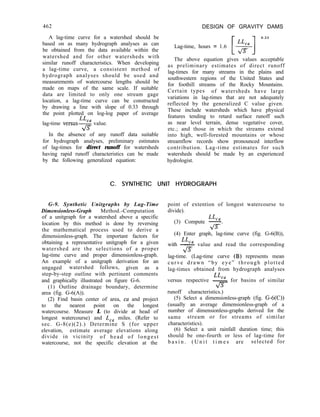
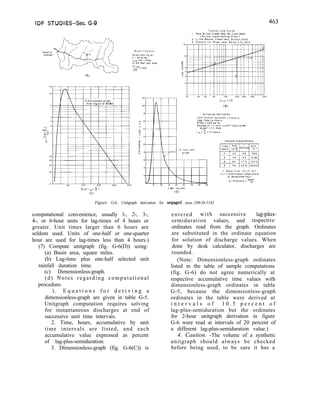
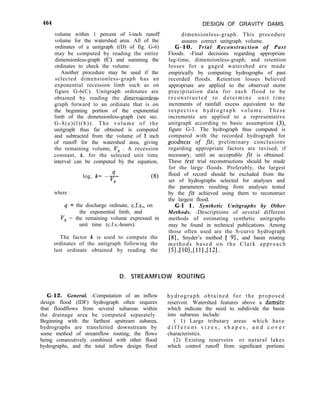
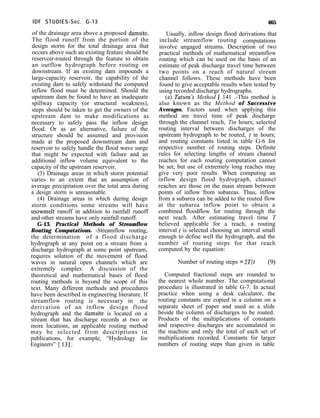
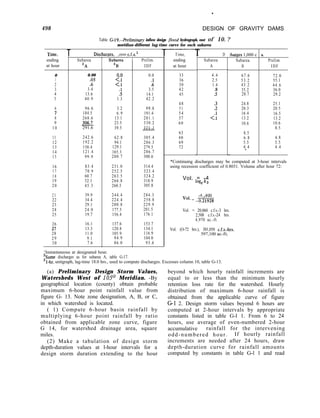
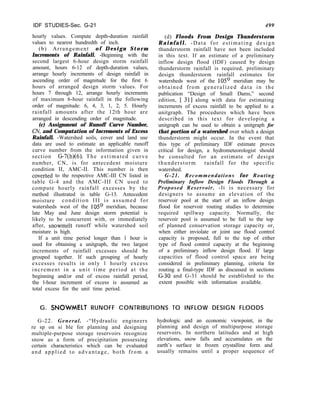
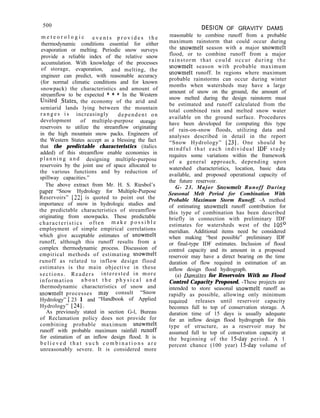
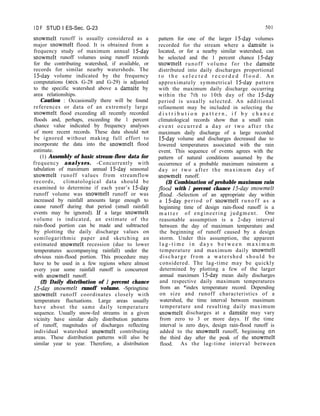
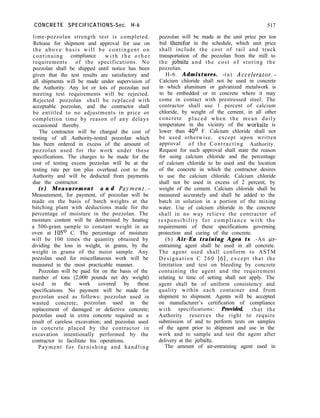
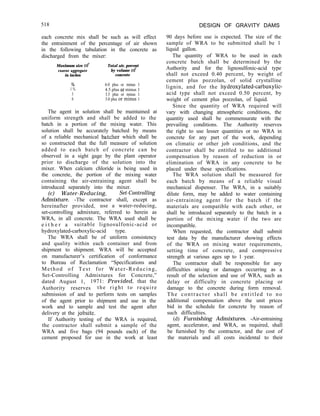
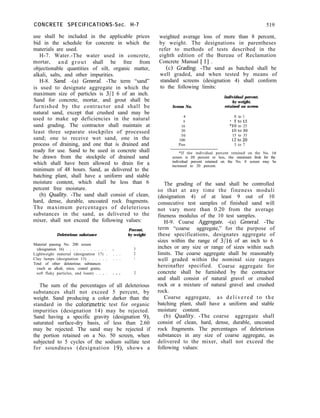
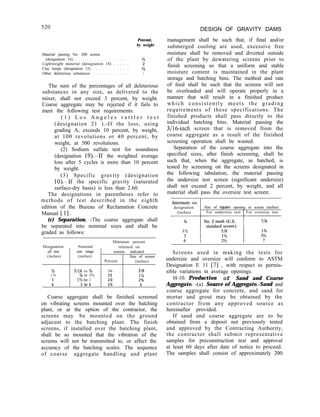
BUREAU OF RECLAMATION
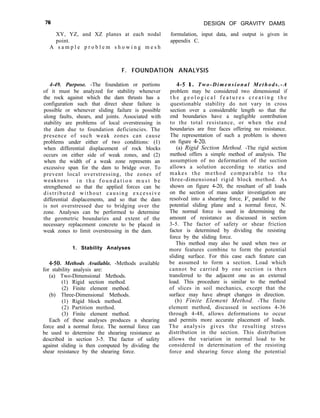
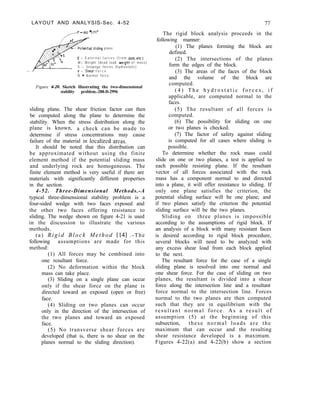
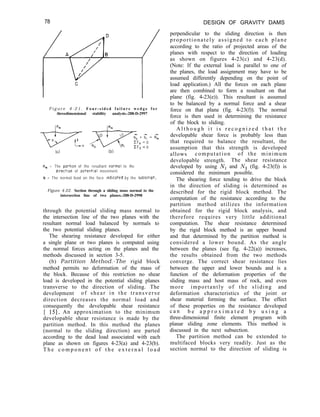
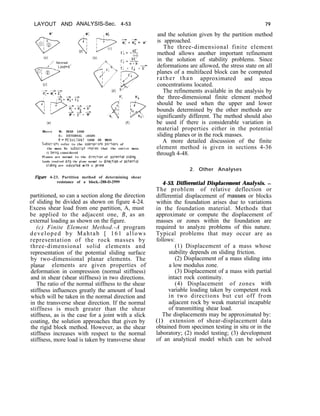
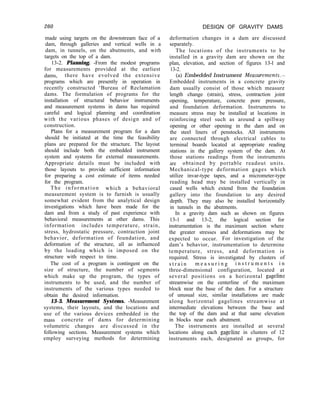
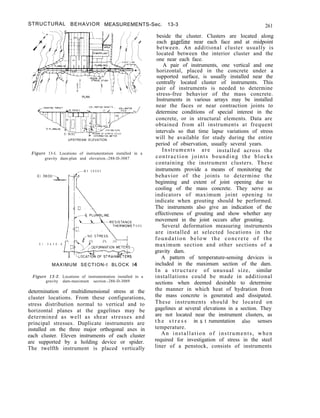
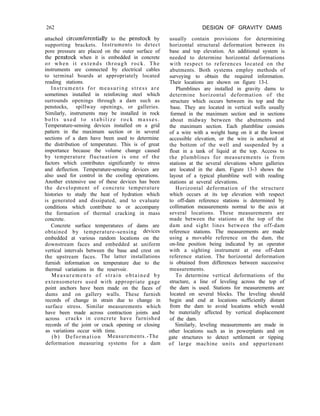
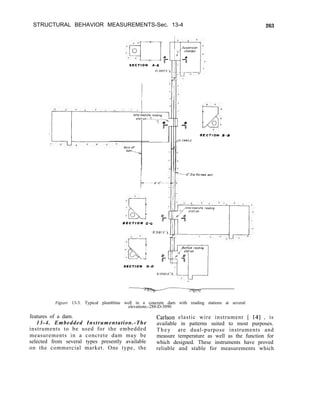
DESIGN
OF
GRAVITY
DAMS
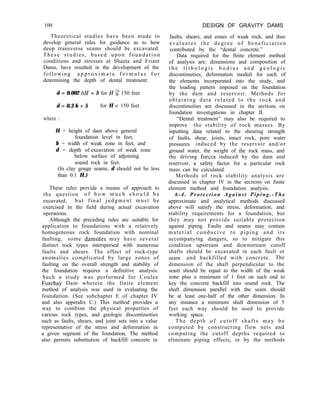
DESIGN MANUAL FOR CONCRETE GRAVITY DAMS
A Water Resources Technical Publication
Denver, Colorado
1976
As the Nation’s principal conservation agency, the Department of the
Interior has responsibility for most of our nationally owned public
lands and natural resources.
This includes fostering the wisest use of our land and water
resources, protecting our fish and wildlife, preserving the environmental
and cultural values of our national parks and historical places, and
providing for the enjoyment of life through outdoor recreation.
The Department assesses our energy and mineral resources and works
to assure that their development is in the best interests of all our
people.
The Department also has a major responsibility for American Indian
reservation communities and for people who live in Island Territories
under U.S. administration.
UNITED STATES GOVERNMENT PRINTING OFFICE
DENVER : 1976
For sale by the Superintendent of Documents, U.S. Government Printing Office, Washington, U.C. 20402.
and the Bureau of Reclamation, Engineering and Kesearch Center, Attention: 922, P.O. Box 25007,
Denver F‘ederal Center, Denver, Colorado 80225.
Stock Number 024-003-00102-3
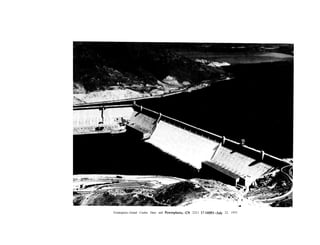
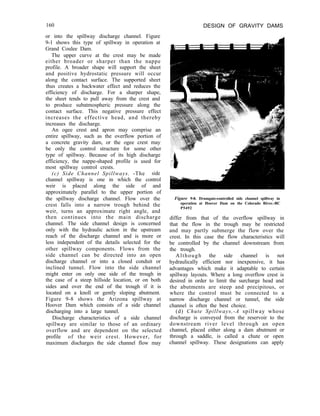
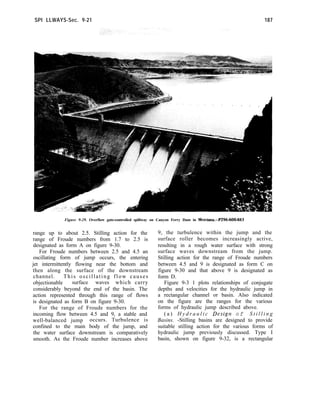
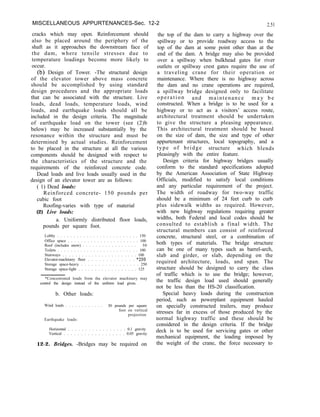
Frontispiece.-Grand Coulee Dam and Powerplants.-CN 222-l 17-14091-July 22, 1975
This manual presents instructions, examples,
procedures, and standards for use in the design
of concrete gravity dams. It serves as a guide to
sound engineering practices in the design of
concrete gravity dams and provides the
technically trained, qualified design engineer
with specialized and technical information that
can be readily used in the design of such a dam.
The manual came into being because of the
numerous requests made to the Bureau for its
latest concepts on the design of concrete dams.
A companion Bureau manual “Design of Arch
Dams” is also being prepared and will soon be
published.
“Design of Gravity Dams” was prepared to
cover all heights of concrete gravity dams
except small dams under 50 feet which are
c o v e r e d i n “Design of Small Dams.”
Foundations for the design of dams discussed
in this book are assumed to be rock.
The material used in this book from “Design
of Small Dams” has been revised to make it
applicable to larger concrete gravity dams.
Although most of this text is related
exclusively to the design of dams and
appurtenant structures, it is important that the
designer be familiar with the purpose of the
project of whicll the dam is a part, the
considerations ilzj7uencing its justificatioq and
the mamxr of arriving at the size and type of
structure to be built. Factors which affect the
selection of the type of dam and its location
are discussed in chapter II, “Design
Considerations.” Chapter XV discusses the
ecological and environmental considerations
required in constructing a dam. The integrity
of the structural design requires strict
adherence to specifications for the concrete
and to the practice of good workmanship in
concrete production. Therefore, a summary of
Bureau of Reclamation concrete construction
practices or methods is included in chapter
XIV, “Concrete Construction.”
The manual should be of service to all
concerned with the plamring and designing of
water storage projects, but it cannot relieve the
agency or person using it of the responsibility
for a safe and adequate design. The limitations
stated in the design procedures should be
heeded.
This book was prepared by engineers of the
Bureau of Reclamation, U.S. Department of
the Interior, at the Engineering and Research
Center, Denver, Colorado, under the direction
of H. G. Arthur, Director of Design and
Construction, and Dr. J. W. Hilf,* Chief,
Division of Design. The text was written by
members of the Concrete Dams Section,
Hydraulic Structures Branch, Division of
Design, except for Appendix G “Inflow Design
Flood Studies,” which was written by D. L.
Miller, * of the Flood and Sedimenation
Section, Water and Management Planning
Branch, Division of Planning Coordination.
Members of the Concrete Dams Section who
made substantial contributions to the text
include: M. D. Copen,” J . Legas, E. A.
Lindholm, G. S. Tarbox, F. D. Reed,* C. L.
*Retired
V
VI PREFACE
Townsend,* J. S. Conrad,* R. 0. Atkinson, R.
R. Jones, M. A. Kramer, C. W. Jones,* J. L.
Von Thun, G. F. Bowles, and J. T.
R i c h a r d s o n . * T h e m a j o r e d i t i n g a n d
coordinating of the test was done by E. H.
Larson,* and the final preparation of the text
for printing was done by R. E. Haefele and J.
M. Tilsley, all of the Publications Section,
Technical Services and Publications Branch,
Division of Engineering Support. The authors
and editors wish to express their appreciation
to the personnel in the General Services Branch
for their contributions and to the technicians
of Concrete Dams Section and Drafting Branch
who prepared charts, tables, and drawings for
use in the text.
The methods of design and analysis were
developed through the efforts of dedicated
Bureau engineers during the many years the
Bureau of Reclamation has been designing and
constructing concrete gravity dams. Their
efforts are gratefully acknowledged.
T h e r e a r e occasional references to
proprietary materials or products in this
publication. These must not be construed in
any way as an endorsement of the Bureau of
Reclamation since such endorsement cannot be
made for proprietary products or processes of
manufacturers or the services of commercial
firms for advertising, publicity, sales, or other
purposes.
Contents
PREFACE . . . . . . . . . . . .
Chapter I-Introduction
Section
l-l. scope . . . . . . . . .
1-2. Classifications . . . . . .
l-3. General dimensions . . . . .
l-4. Gravity dam definitions . . .
I-5. Bibliography . . . . . . .
Chapter II-Design
Considerations
A. LOCAL CONDITIONS
2- 1. General . . . . . . .
2-2. Data to be submitted’ . . .
6. MAPS AND PHOTOGRAPHS
2-3. General . . . . . . . . .
2-4. Survey control . . . . . .
2-5. Data to be submitted . . .
C. HYDROLOGIC DATA
2-6. Data to be submitted . . . .
2-7. Hydrologic investigations . .
D. RESERVOIR CAPACITY AND
OPERATION
2-8. General _ . . _ . _ . .
2-9. Reservoir allocation
definitions . . . . . . .
(a) General
(b) Water surface elevation’ ’ ’
definitions . . . . . .
(c) Capacity definitions . . .
2-10. Data to be submitted . . . .
Page
V
1
1
1
2
2
3
3
3
3
4
4
5
7
7
7
7
9
10
Chapter II-Design
Considerations-Continued
Section
2-l 1.
2-12.
E. CLIMATIC EFFECTS
Page
General . . . . . . . . . 10
Data to be submitted . . . . 10
F. CONSTRUCTION MATERIALS
2-13.
2-14.
2-15.
Concrete aggregates .
Water for construction
purposes . . . . .
Data to be submitted .
G. SITE SELECTION
. . . 11
. . . 11
. . . 11
2-16. General . . . . . .
2-l 7. Factors in site selection
H. CONFIGURATION OF
. . . 11
. , . 12
DAM
2-18. Nonoverflow section . . . . 12
2-19. Overflow section . . . * . 12
I. FOUNDATION INVESTIGATIONS
2-20. Purpose . . . . . . .
2-21. Field investigations . .
(a) Appraisal invcsti-
gation . . . .
(b) Feasibility investigation
(c) Final design data . .
2-22. Construction geology . .
2-23. Foundation analysis
methods . . . . . .
2-24. In situ testing . . . .
2-25. Laboratory testing . . .
2-26. Consistency of presentation
of data . . . . . . .
13
13
13
13
15
15
15
16
16
16
VII
VIII CONTENTS
Chapter II-Design Chapter lll- Design Data and
Considerations-Continued Criteria-Continued
J. CONSTRUCTION ASPECTS D. LOADS-Continued
Section Pa&!
2-27. General . . . . . . . . . 1’7
2-28. Construction schedule . . . . 17
SeCtiOn Page
3-10. Deadload . . . . . . . . 28
3-11. Ice . . . . . . . . . . 28
3-12. Silt . . . . . . . . . . 29
3-13. Earthquake . . . . . . . 29
K. MISCELLANEOUS CONSIDERATIONS
2-29. Data to be submitted . . . . 17
2-30. Other considerations . . . . 18
L. BIBLIOGRAPHY
2-3 1. Bibliography . . . . . . . 20
Chapter Ill- Design Data and
Criteria
A. INTRODUCTION
3-l Basic assumptions . . . . . 2
B. CONCRETE
3-2 Concrete properties .
(a) Strength
(b) Elastic propkrties’ :
(c) Thermal properties
(d) Dynamic properties
(e) Other properties .
(f) Average concrete
properties . . .
. . . 21
. . . 21
. . . 22
. . . 22
. . . 22
. . . 22
. . . 22
C. FOUNDATION
3-3
3-4
Introduction . . . . . . . 23
Foundation deformation . . . 23
3-5. Foundation strength . . . . 24
3-6. Foundation permeability . . 26
D. LOADS
3-7. Reservoir and tailwater . . . 26
3-8. Temperature . . . . . . . 26
3-9. In ternal hydrostatic
pressures . . . . . . . . 27
E. LOADING COMBINATIONS
3-14. General . . . . . . . . 30
3-l 5. Usual loading combination . . 30
3- 16. Unusual and extreme loading
combinations . . _ . . . 30
3-17. Other studies and investi-
gations . . . . . . . . . 30
F. FACTORS OF SAFETY
3-18. General _ . . . . . . . . 30
3-19. Allowable stresses . . . . . 31
3-20. Sliding stability . . . . . . 3 1
3-21. Cracking , . . . . . . 32
3-22. Foundation stability . . . . 33
G. BIBLIOGRAPHY
3-23. Bibliography . . . . . . . 33
Chapter IV--Layout and
Ana I ysis
4-l. Introduction . . . . . . . 35
(a) Level of design . . . . , 36
A. LAYOUT
4-2. Nonoverflow section . . . , 36
4-3. Spillway section . . . . . . 36
4-4. Freeboard . . . . . . . . 36
B. THE GRAVITY METHOD OF STRESS
AND STABILITY ANALYSIS
4-5. Description and use . . . . 37
4-6. Assumptions . . . . . . . 37
CONTENTS
Chapter W-layout and
Analysis-Continued
B. THE GRAVITY METHOD OF STRESS
AND STABILITY ANALYSIS-Continued
Section Page
4-7. Notations for normal
reservoir loading . . .
4-8. Notations for horizontal
earthquake . . . . .
4-9. Forces and moments acting
on cantilever elements .
4- 10. Stress and stability
equations . . . . . .
37
39
40
40
C. TRIAL-LOAD METHODS OF ANALYSIS
1. Trial-Load Twist Method of Arlalysis,
Joints Ungrouted
4- 11. Introduction . . . . . . . 43
4-12. Theory . . . , . . . 44
4-13. Notations . . . . . . . 45
4-14. Foundation constants . . . . 47
4-1.5. Selection of elements . . . . 54
4- 16. Loads, forces, and
moments . . . . . . . . 54
4-17. Initial and unit deflections
of cantilevers . . . . . . 54
4- 18. Unit rotations of vertical
elements of twisted
structure due to unit
twisting couple , . . . . 54
4 19. Unit deflections of horizontal
elements of twisted
structure . . . , . . . . 57
4-20. Trial loads . . . . . . . . 58
4-2 1. Angular rotation of vertical
twisted elements due to
trial loads on horizontal
elements . . . . . . . . 60
4-22. Deflections of twisted
structure . . . . . . . . 60
4-23. Deflections of cantilever
structure . . . . . . . 60
4-24. Stresses and stability
factors . . . . . . . . . 60
iX
Chapter W-layout and
Analysis-Continued
C. TRIAL-LOAD METHODS OF
ANALYSIS-Continued
Section Pa&p
2. Trial-Load Twist Method of Analysis,
Joints Grouted
4-25, Description of method . . . 61
4-26. Assumptions . . . . . . . 64
4-27. Horizontal beam elements . . 64
4-28. Notations . . . . . . . . 64
4-29. Equations . . . . . . . . 64
(a) Triangular load . . . . . 65
(b) Uniform load . . . . . 66
(c) Concentrated moment at
free end of beam
(d) Concentrated normal load .
67
at free end of beam . . 67
3. Alzalysis of Curved Gravity Dams
4-30. Method of analysis . . . . . 68
D. DYNAMIC ANALYSIS
4-3 1. Introduction . . . . .
4-32. Natural frequencies and
mode shapes . . , . .
4-33. Response to an earthquake
4-34. Loads due to horizontal
earthquake acceleration .
4-35. Effects of vertical earth-
quake accelerations . .
68
68
69
70
70
E. THE FINITE ELEMENT METHOD
4-36. Introduction . . . . . . . 70
1. Two-Dimensional Finite Element
Program
4-37. Purpose . . . . . . . . . 72
4-38. Method . . . . . . . . . 72
4-39. Input . . . . . . . . . . 73
4-40. output . . . . . . . . . 73
4-41. Capabilities . . . . . . . 73
X
Chapter IV-Layout and
Analysis-Continued
E. THE FINITE ELEMENT METHOD-Continued
Section
4-42.
4-43.
4-44.
Page
Limitations . . . . . . . 73
Approximations . . . . . . 73
Application to gravity
dams . . . . . . . . . 74
2. Three-Dimensional Finite Element
Program
4-45. Application . . . . . . . 74
4-46. Capabilities and limitations . . 74
4-47. Input . . . . . . . . . . 75
4-48. output . . . . . . . . . 75
F. FOUNDATION ANALYSIS
4-49. Purpose . . . . . . . . . 76
I. Stability Analyses
4-50. Methods available . . . . . 76
(a) Two-dimensional
methods
( 1) Rigid section ’ ’ f ’
76
4-51.
method . . . . 76
(2) Finite element
method . . . . . 76
(b) Three-dimensional
methods . . . . . . . 76
(1) Rigid block method . 76
(2) Partition method . . 76
(3) Finite element
method . . . . . 76
Two-dimensional
methods
(a) Rigid section ’ ’ ’ ’ * ’
76
4-52.
method . . . . . . . 76
(b) Finite element
method . . . . . . . 76
Three-dimensional
methods . . . . . . . . 77
(a) Rigid block method . . . 77
(b) Partition method . . . . 78
CONTENTS
Chapter IV-Layout and
Analysis-Continued
F. FOUNDATION ANALYSIS-Continued
Section Page
(c) Finite element
method . . . . . . . 79
2. 0 tlzer Analyses
4-53. Differential displacement
analysis . . . . . . . . 79
4-54. Analysis of stress concen-
trations due to bridging . . . 80
G. BIBLIOGRAPHY
4-55. Bibliography . . . . . . . 80
Chapter V-River Diversion
5-l.
5-2.
5-3.
5-4.
5-5.
General . . . . . . . . . 83
Characteristics of stream-
flow . . . . . . . . . 83
Selection of diversion
flood . . . . . . . . . 83
Regulation by an existing
upstream dam . . . . . . 84
Turbidity and water
pollution control . . . . . 84
B. METHODS OF DIVERSION
5-6. ’ General . . . . . . . . . 85
5-7. Tunnels . . . . . . . . . 85
5-8. Conduits through dam . . . 88
5-9. Flumes . . . . . . . . . 88
5-10. Multiple-stage diversion . . . 92
5-l 1. Cofferdams . . . . . . . 92
A. DIVERSION REQUIREMENTS
C. SPECIFICATIONS REQUIREMENTS
5-l 2. Contractor’s responsibilities . . 95
5-l 3. Designer’s responsibilities . . 95
CONTENTS
Chapter VI-Foundation
Treatment
A. EXCAVATION
Section Page
6-l. General . . . . . . . . . 97
6-2. Shaping . . . . . . . . . 97
6-3. Dental treatment . . . . . 97
6-4. Protection against piping . . . 100
B. GROUTING
6-5. General . . . . . . . . . 101
6-6. Consolidation grouting . . . 101
6-7. Curtain grouting . . . . . . 104
C. DRAINAGE
6-8. Foundation drainage . . . . 105
D. BIBLIOGRAPHY
6-9. Bibliography . . . . . . . 106
Chapter VII-Temperature
7-l. Purposes . . . I . . . . 107
7-2. Volumetric changes . . . . 107
7-3. Factors to be considered . . . 108
7-4. Design data . . . . . . . 108
7-5. Cracking . . . . . . . . 109
B. METHODS OF TEMPERATURE
CONTROL
7-6. Precooling . . _ _ . _ . . 111
7-7. Postcooling . . . . . . . 112
7-8. Amount and type of
7-9.
cement . . . . . . . . 112
Use of pozzolans . . . . . 113
Control of Concrete
A. INTRODUCTION
7-l 0. Miscellaneous measures . . . 113
(a) Shallow construction
lifts 113
(b) Water curing . : : : : : 113
(c) Retarding agents . . . . 113
(d) Surface treatments . . . 113
Xi
Chapter VII-Temperature
Control of Concrete-
Continued
B. METHODS OF TEMPERATURE
Section
CONTROL-Continued
Page
(e) Rate of temperature
drop . . . . . . . . 114
C. TEMPERATURE STUDIES
7-l 1.
7-12.
7-13.
7-14.
7-15.
7-16.
General scope of studies . . . 114
Range of concrete tempera-
tures . . . . . . . . . 114
(a) Ambient air temperatures . 115
(b) Reservoir water tempera-
tures . . . . . . . + 115
(c) Solar radiation effect . . 115
(d) Amplitudes of concrete
temperatures . . . . . 116
Temperature gradients . . . 116
Temperature rise . . . . . 118
Artificial cooling . . . . . 120
Miscellaneous studies . . . . 125
D. DESIGN CONSIDERATIONS
7-17. Placing temperatures . . . . 125
7-18. Closure temperature . . . . 125
7-19. Size of construction
7-20.
7-21.
7-22.
7-23.
7-24.
block . . . . . . . . . 126
(a) Length of construction
block . . . . . . . 126
(b) Width of construction
block . . . . . . . 127
Concrete cooling systems . . 127
Height differentials , . . I , 130
Lift thickness . . . . . . , 130
Delays between placements . . 13 1
Closure slots . . . . . . . 13 1
E. CONSTRUCTION OPERATIONS
7-25. Temperature control
operations . . . . . . . 131
(a) Initial cooling
7-26.
(b) Intermediate and’final . ’ .
132
cooling . . . . . . . 133
(c) Warming operations . . . 133
Foundation irregularities . . . 134
XII CONTENTS
Chapter VII-Temperature Chapter IX-Spillways-
Control of Concrete-
Continued
E. CONSTRUCTION OPERATIONS-Continued
Section Page
7-27. Openings in dam . . . . . 134
7-28. Forms and form removal . . . 134
7-29. Curing . . . . . . . . . 135
7-30. Insulation . . . . . . , . 135
F. BIBLIOGRAPHY
7-3 1. Bibliography . . . . . . . 13 5
Chapter VIII-Joints in
8-l.
8-2.
8-3.
8-4.
8-5.
8-6.
8-7.
8-8.
8-9.
8-10.
Structures
Purpose . . . . . . .
Contraction joints . . .
Expansion joints . . . .
Construction joints . . .
Spacing of joints . . . .
Keys . . . . . . . .
Seals . . . . . . . .
(a) Metal seals
(b) Polyvinyl chloride seals
(c) Other seals . . . .
Joint drains . . . . .
Grouting systems . . .
Grouting operations . .
. . 137
. . 137
. . 138
. . 138
. . 138
. . 141
. . 143
. . 143
. . 143
. . 143
. . 145
. . 145
. . 146
Chapter IX-Spillways
A. GENERAL DESIGN CONSIDERATIONS
9-l. Function . . . . . . . . 149
9-2. Selection of inflow design
flood . . . . . . . . . 149
(a) General considerations . . 149
(b) Inflow design flood
hydrograph . . . . . 1.51
9-3 Relation of surcharge
storage to spillway
capacity . . . . . . . . 151
9-4. Flood routing . . . . . . . 15 1
9-5. Selection of spillway size
and type . . . . . . . . 154
Continued
A. GENERAL DESIGN CONSlDERA-
TIONS-Continued
Section Page
(a) General considerations . . 154
(b) Combined service and aux-
iliary spillways . . . . 156
B. DESCRIPTION OF SPILLWAYS
9-6. Selection of spillway layout . . 156
9-7. Spillway components . . . . 157
(a) Control structure . . . . 157
(b) Discharge channel . . . . 157
(c) Terminal structure . . . 158
(d) Entrance and outlet
channels . . . ...158
9-8. Spillway types . . . . . . 159
Free fall spillways . . . . 159
Ogee (overflow)
spillways . . . . . . 159
Side channel spillways . . 160
Chute spillways . . . . 160
Tunnel spillways . . . . 161
Morning glory spillways . . 161
9-9. Controls for crests . . .
(a) Flashboards and
stoplogs . . . . .
(b) Rectangular lift gates
(c) Radial gates . . . .
(d) Drum gates . . . .
(e) Ring gates . . . .
C. CONTROL STRUCTURES
. 162
. 163
. 163
. 164
. 164
. 164
9- 10. Shape for uncontrolled
ogce crest . . . . . . . . 164
9-l 1. Discharge over an uncon-
trolled overflow ogee
crest 165
(a) Coefficient of discharge : : 165
(b) Effect of depth of
approach
(c) Effect of upstream ’ ’ ’ ’
168
face slope
(d) Effect of downstream ’ . ’
169
apron interference and
downstream submer-
gence . . , . . . . 169
CONTENTS
Chapter IX-Spillways-
Continued
C. CONTROL STRUCTURES-Continued
Section Page
(e) Effect of heads dif-
fering from design
head . . . . . . . . 171
(f) Pier and abutment
effects . . . . . . . 17 1
9- 12. Uncontrolled ogee crests
designed for less than
maximum head . . . . . . 174
9- 13. Gate-controlled ogee
crests . . . . . . . . . 174
9- 14. Discharge over gate-
controlled ogee
crests . . . . . . . . . 174
9-15. Orifice control structures . . . 17.5
(a) Shape 175
(b) Hydraulics * : : : : : : 175
9-l 6. Side channel control
structures . . . . . . . 176
(a) Layout 176
(b) Hydraulics : : : : : : 178
D. HYDRAULICS OF DISCHARGE
CHANNELS
9-17. General . . . . . . . . . 180
9-18. Open channels . . . . . . 181
(a) Profile . . . . . . . . 181
(b) Convergence and diver-
gence . . . . . . . 183
(c) Channel freeboard . . . 183
9- 19. Tunnel channels . . . . . . 185
(a) Profile . . . . . . . . 185
(b) Tunnel cross section . . . 185
9-20. Cavitation erosion of
concrete surfaces . . . . . 186
E. HYDRAULICS OF TERMINAL
STRUCTURES
9-2 1. Hydraulic jump stilling
basins
(a) Hydraulic design ’
. . . . 186
of stilling
basins . . . . . . . 187
XIII
Chapter IX-Spillways-
Continued
E. HYDRAULICS OF TERMINAL
STRUCTURES-Continued
Section Page
(b) Rectangular versus
trapezoidal stilling
basin . . . . . . . . 192
(c) Basin depths by approxi-
mate methods . . . . 195
(d) Tailwater considera-
tions . . . . . . . . 195
(e) Stilling basin freeboard . . 198
9-22. Deflector buckets . . . . . 198
9-23. Submerged bucket energy
dissipators . . . . . . . 199
9-24. Plunge pools . . . . . . . 201
F. HYDRAULICS OF MORNING GLORY
( D R O P INLET) SPILLWAYS
9-25. General characteristics . . . . 201
9-26. Crest discharge . . . . . . 203
9-27. Crest profiles . . . . . . . 206
9-28. Orifice control . . . . . . 207
9-29. Tunnel design . . . . . . . 213
G. STRUCTURAL DESIGN
9-30. Genera1 . . . . . . . . . 2 14
H. BIBLIOGRAPHY
9-3 1. Bibliography . . . . . . . 2 15
Chapter X-Outlet Works
and Power Outlets
A. INTRODUCTION
10-l. Typesand purposes . . . . 217
B. OUTLET WORKS OTHER THAN
POWER OUTLETS
10-2. General . . . . . . . . . 218
10-3. Layout . . . . . . . . . 218
10-4. Intake structures . . . . . 220
XIV
Chapter X-Outlet Works
and Power Outlets-
Continued
B. OUTLET WORKS OTHER THAN
POWER OUTLETS-Continued
Set tion Page
(a) Trashrack . . . . 220
(b) Entrance and transition : : 221
10-5. Conduits . . . . . . . . 221
10-6. Gates and outlet controls . . 221
(a) Location of control
devices
(b) Types of gates’anh * * ’ ’
224
valves . . . . . . . 225
10-7. Energy dissipating devices . . 225
1. Hydraulic Design of
Outlet Works
10-8. General considerations . . . . 226
10-9. Pressure flow in outlet
conduits . . . . . . . . 226
lo- 10. Pressure flow losses in
conduits . . . . . . . . 228
(a) Friction losses . . . . . 228
(b) Trashrack losses . . . . 229
(c) Entrance losses . . . . . 229
(d) Bend losses . . . . . . 231
(e) Transition losses 231
(f) Gate and valve losses’ : : : 231
(g) Exit losses . . . . . . 232
10-l 1. Transition shapes . . . . . 232
(a) Entrances . . . . . . . 232
(b) Contractions and
expansions . . . . . . 233
10-l 2. Energy dissipating devices . . 233
(a) Hydraulic jump basins . . 233
(b) Plunge pools . . . . . 234
10-13. Open channel flow in
outlet works . . . . . . . 234
2. Structural Design of
Outlet Works
10-14. General . . . . . . . . . 234
10-15. Trashrack . . . . . . . . 235
10-16. Conduit . . . . . . . . . 235
Chap
CONTENTS
ter X-Outlet Works
and Power Outlets-
Continued
B. OUTLET WORKS OTHER THAN
POWER OUTLETS-Continued
Section Page
10-17. Valve or gate house . . . . . 235
lo- 18. Energy dissipating
devices . . . . . . . . . 235
C. POWER OUTLETS
10-19. General . . . . . . . . . 236
10-20. Layout . . . . . . . . . 236
10-21. Intake structures . . . . . 236
(a) Trashracks 237
(b) Bellmouth entrance. : : : 240
(c) Transition . . . . . . 240
10-22. Penstocks . . . . . . . . 240
1 O-23. Gates or valves . . . . . . 240
10-24. Hydraulic design of
power outlets . . . . . . 240
(a) Size determination of
penstock 241
(b) Intake structure * : : : : 241
1 O-25. Structural design of
power outlets . . . . . . 242
(a) Trashrack . . . . . . . 242
(b) Penstocks . . . . . . 242
D. BIBLIOGRAPHY
1 O-26. Bibliography . . . . . . . 242
Chapter Xl-Galleries and
Adits
1 l-l. General . . . . . . . . . 243
11-2. Purpose . . . . . . . . . 243
11-3. Location and size . . . . . 243
(a) Foundation gallery . . . 243
(b) Drainage gallery . . . . 243
(c) Gate galleries and
chambers 243
(d) Grouting galleries : : : : 247
(e) Visitors’ galleries . . . . 247
(f) Cable galleries . . . . . 247
CONTENTS
Chapter XI-Galleries and
Adits-Continued
Section Page
(g) Inspection galleries . . . 247
1 l-4. Drainage gutter . . . . . . 247
1 l-5. Formed drains . . . . . . 247
1 l-6. Reinforcement . . . . . . 247
1 l-7. Services and utilities . . . . 248
1 l-8. Miscellaneous details . . . . 248
Chapter XII-Miscellaneous
Appurtenances
12-l. Elevator tower and shaft . . . 249
(a) Design of shaft . . . . . 249
(b) Design of tower . . . . 251
12-2. Bridges . . . . . . . . . 25 1
12-3. Top of dam . . . . . . . 254
12-4. Fishways . . . . . . . . 255
12-5. Restrooms . . . . . . . . 255
12-6. Service installations . . . . 255
(a) Electrical services . . . . 257
(b) Mechanical services . . . 258
(c) Other service instal-
lations . . . . . . . 258
Chapter XIII-Structural
Behavior Measurements
13-1. Scope and purpose . . . . . 259
(a) Development of
methods . . . . . . . 259
(b) Two general methods . . 259
13-2. Planning . . . . . . . . 260
13-3. Measurement systems . . . . 260
(a) Embedded instrument
measurements
(b) Deformation measure-. . ’
260
ments . . . . . . . 262
13-4. Embedded instrumenta-
tion . . . . . . . . . . 263
13-5. Supplementary laboratory
tests . . . . . . . . . 270
13-6. Deformation instrumenta-
tion . . . . . . . . . . 270
13-7. Other measurements . . . . 274
xv
Chapter XIII-Structural
Behavior Measurements-
Continued
section
13-8.
13-9.
13-10.
13-11.
page
(a) Uplift pressure
measurements . . . . 275
(b) Drainage flow measure-
ments . . . . . . . 275
Measurement program
management . . . . . . . 276
Data processing . . . . . . 279
Results . . . . . . . . . 279
Bibliography . . . . . . . 280
Chapter XIV-Concrete
Construction
14 1. General . . . . . . . . . 281
14-2. Design requirements . . . . 281
14-3. Composition of concrete . . . 282
14-4. Batching and mixing . . . . 283
14-5. Preparations for placing . . . 283
14-6. Placing . . . . . . . . . 284
14-7. Curing and protection . . . . 284
14-8. Finishes and finishing . . . . 284
14-9. Tolerances . . . . . . . . 285
14-10. Repair of concrete . . . . . 285
Chapter XV- Ecological and
Environmental
Considerations
A. INTRODUCTION
15-1. General considerations . . . 287
15-2. Planning operations . . . . 288
B. FISH AND WILDLIFE
CONSIDERATIONS
15-3. General . . . . . . . . . 288
15-4. Ecological and environ-
mental considerations
for fish . . . . . . . . 288
15-5. Environmental considera-
tions for wildlife . . . . . 291
X V I CONTENTS
Chapter XV-Ecological and
Environmental
Considerations-Continued
Appendix B-Trial-load
Twist Analysis-Joints
Grouted-Continued
C. RECREATIONAL CONSIDERATIONS
Section Page
15-6. General . . . . . . . . . 293
15-7. Recreational development . . 293
D. DESIGN CONSIDERATIONS
15-8. General . . . . . . . . . 293
15-9. Landscape considerations . . 295
15-10. Protective considerations . . . 296
15- 11. Construction considera-
tions . . . , . . . . . 296
section Page
B-6. Trial-load distribution . . . . 323
B-7. Cantilever deflections . . . . 323
B-8. Twisted-structure deflec-
tions . . . . . . . . . 335
B-9. Beam-structure deflec-
tions . . . . . . . . . 335
B-10. Total deflections . . . . . 340
B- 11. Moment and shear due to
trial loads on beams . . . . 340
B-l 2. Beam stresses . . . . . . . 340
B- 13. Cantilever stresses . . . . . 340
B- 14. Final results . . . . . . . 343
E. BIBLIOGRAPHY
Appendix C- Finite Element
15-l 2. Bibliography . . . . . . . 297
Appendix A-The Gravity
Method of Stress and
Stability Analysis
Method of Analysis
A. TWO-DIMENSIONAL FINITE
ELEMENT ANALYSIS
A-l. Example of gravity anal-
ysis-Friant Dam . . . . . 299
A-2. List of conditions
studied . . . . . . . . 299
A-3. Computations and forms . . . 302
A-4. Final results . . . . . . . 302
A-5. Summary and conclusions . . 302
C-l.
c-2.
c-3.
c-4.
c-5.
Introduction . . . . . . . 3 5 1
Description of problem . . . 35 1
Grid and numbering
system . . . . . . . . . 351
Input . . . . . . . . . . 351
output . . . . . . . . . 351
B. THREE-DIMENSIONAL FINITE
ELEMENT ANALYSIS
Appendix B-Trial-Load
Twist Analysis-Joints
Grouted
C-6. Introduction . . . . . . . 358
c-7. Layout and numbering
C-8.
c-9.
system . . . . . . . . . 358
Input . . . . . . . . . . 358
Output . . . . . . . . . 361
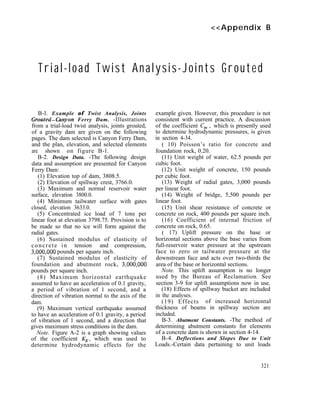
B-l. Example of twist anal-
ysis, joints grouted-
Canyon Ferry Dam . . . . 321
B-2. Design data . . . . . . . 321
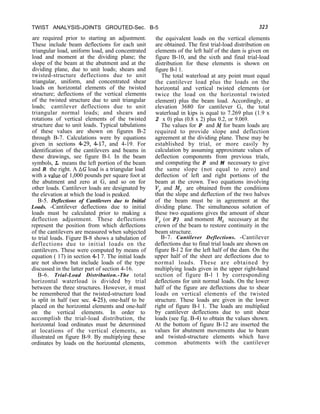
B-3. Abutment constants . . . . 321
B-4. Deflections and slopes
due to unit loads . . . . . 321
B-5. Deflections of canti-
levers due to initial
Appendix D-Special
Methods of Nonlinear Stress
Analysis
D-l. Introduction . . . . . . . 37 1
D-2. Slab analogy method . . . . 371
D-3. Lattice analogy metnod . . . 372
(a) Conditions to be
loads . . . . . . . . . 323 satisfied . . . . . . . 372
CONTENTS
Appendix D-Special
Methods of Nonlinear Stress
Analysis-Continued
XVII
Appendix F-Hydraulic Data
and Tables-Continued
Set tion
(b) Solution . . . .
(c) Equations
(d) Boundary conditi’ons
(e) Stresses
(f) Applications and * *
limitations . . .
D-4. Experimental models .
(a) Three-dimensional
models . . . .
(b) Two-dimensional dis-
placement models
D-5. Photoelastic models .
Page
. . . 374
. . . 374
. . 374
. . . 375
. . . 376
. . . 376
. . . 376
. . . 377
. . . 377
Appendix E-Comparison of
Results by Gravity and Trial-
Load Methods
E-l. Stresses and stability
factors . . . . . . . . . 381
E-2. Structural characteristics
of dams and maximum
stresses calculated
by the gravity and
trial-load methods . . . . . 381
Appendix F-Hydraulic Data
and Tables
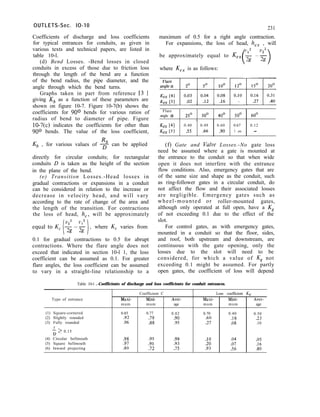
F-l. Lists of symbols and
conversion factors . . .
F-2. Flow in open channels .
(a) Energy and head . .
(b) Critical flow . . . .
(c) Manning formula . .
(d) Bernoulli theorem .
(e) Hydraulic and energy
gradients . . . .
(f) Chart for approximating
friction losses in
chutes . . . . .
F-3. Flow in closed conduits .
(a) Partly full flow in
conduits . . . .
. . 415
. . 417
. . 417
. . 420
. . 423
. . 425
. . 425
. . 426
. . 426
. . 426
Section Page
(b) Pressure flow in
conduits . . . . . . 429
(c) Energy and pressure
gradients . . . ...431
(d) Friction losses . . . . . 431
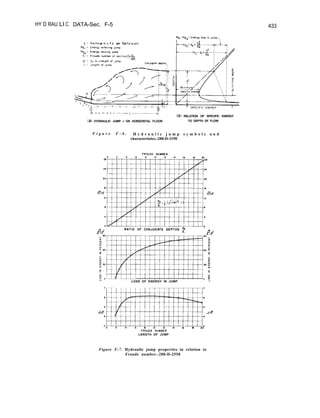
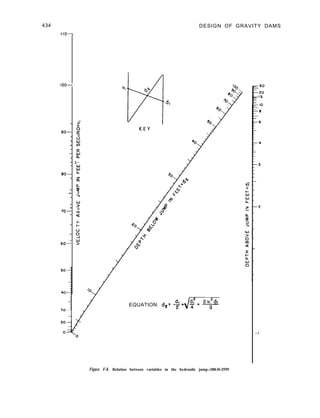
F-4. Hydraulic jump . . . . . . 431
F-5. Bibliography . . . . . . . 432
Appendix G-Inflow Design
Flood Studies
G-l. Introduction 435
(a) Items to be &lu&ed ’ : : 435
(b) Discussions in this
text . . . . . . . . 436
A. COLLECTION OF HYDROLOGIC
DATA FOR USE IN
ESTIMATING FLOODFLOWS
G-2. General . . . . . . . . . 43 7
G-3. Streamflow data . . . . . . 437
G-4. Precipitation data . . . . . 438
G-5. Watershed data . . . . . . 439
B. ANALYSES OF BASIC
HYDROLOGIC DATA
G-6. General . . . . . . .
G-7. Estimating runoff from
rainfall . . . . . . .
(a) General . . . . .
(b) Analysis of observed
rainfall data . . .
(1) Mass curves of
rainfall
(2) Isohyetal maps’ :
(3) Average rainfall
by Thiessen
polygons
(4) Determination bf ’
rainfall excess .
(5) Discussion of
observed rain-
fall analyses
procedures . .
. 439
. 440
. 440
. 441
. 441
. 441
. 443
. 444
. 445
XVIII
Appendix G-Inflow Design
Flood Studies-Continued
B. ANALYSES OF BASIC
HYDROLOGIC DATA-Continued
SeCtiOn
(6) Method of esti-
mating retention
losses . . . . .
(I) Hydrologic soil
groups . .
(II) Land use and
treatment
classes
(III) Hydrologic’ *
soil-cover
complexes .
(IV) Rainfall-runoff
curves for
estimating
direct runoff
a m o u n t s .
(V) Antecedent
moisture
conditions .
G-8. Analyses of streamflow
data . . . . . . . . .
(a) Unit hydrograph (unit-
graph) principles . .
(b) Selection of hydro-
graphs to analyze
(c) Hydrograph analyses- ’
.
base flow separation .
(d) Hydrograph analysis
of direct runoff-
need for synthetic
unit hydrographs . .
(e) Hydrograph analysis
of direct runoff-
dimensionless-graph
computations and
lag-time estimates . .
(1) Procedures
(2) Lag-time curves 1 1
Page
. 446
. 446
. 447
. 448
. 448
. 448
. 450
. 453
. 455
. 455
, 455
. 457
. 458
. 459
C. SYNTHETIC UNIT HYDROGRAPH
G-9. Synthetic unitgraphs by
lag-time dimensionless-
graph method . . . . . . 462
CONTENTS
Appendix G-Inflow Design
Flood Studies-Continued
C. SYNTHETIC UNIT HYDRO-
GRAPH-Continued
Section Pa&?
G-1 0. Trial reconstruction of
past floods . . . . . . . 464
G 11. Synthetic unitgraphs by
other methods . . . . . . 464
D. STREAMFLOW ROUTING
G-l 2. General . . . . . . . . . 464
G-l 3. Practical methods of
streamflow routing
computations 465
(a) Tatum’s method . : : : : 465
(b) Translation and storage
method . . . . . . . 466
(c) Comparison of
methods . . . . . . . 468
E. DESIGN STORM STUDIES
G-14. General . . . . . . . . . 468
(a) Probably maximum
precipitation (PMP) . 468
(b) Probable maximum
storm (PMS) . . . . . 468
(c) Design storm 469
(d) Additional references ’ : : 469
G 15. Probable maximum storm
considerations . . . . . . 470
G- 16. Procedure for storm
maximization, plains-
type terrain . . . . . . . 47 1
(a) Maximization of a
storm in place of
occurrence . . . . . . 471
(b) Maximization of
transposed storm . . . 472
G- 17. Design storm-probable
maximum precipitation
(PMP) or probable
maximum storm (PMS)
estimates for a
watershed . . . . . . 473
(a) Example of a design
storm study . . . . . 473
CONTENTS X I X
Appendix G-Inflow Design Appendix G-Inflow Design
Flood Studies-Continued
E. DESIGN STORM STUDIES-Continued
Section Page
(b) Generalized precipita-
tion charts . . . . . . 477
F. PRELIMINARY INFLOW DESIGN
FLOOD, RAINFALL ONLY
G-1 8. General . . . . . . . . . 480
G- 19. Example-preliminary
inflow design flood
hydrographs, watersheds
east of 105O meridian . . . 481
(a) Basin description . . . . 481
(b) Dimensionless-graph
selection . . . . . . 486
(c) Lag-times . . . . . . . 486
(d) Preliminary design
storm values . . . . . 488
(e) Arrangement of design
storm rainfall incre-
ments and computation
of increments of
rainfall excess
(f) Computation of prelk . .
488
inary inflow design
flood hydrographs . . . 492
G-20. Preliminary inflow design
flood estimates,
watersheds west of
105O meridian
(a) Preliminary design . ’ . ’
496
storm values, water-
sheds west of 105O
meridian . . . . . . 498
(b) Arrangement of design
storm increments of
rainfall
(c) Assignment of-runoff ’ ’
. 499
curve number, CN,
and computation
of increments of
excess rainfall
(d) Floods from design * . . ’
499
thunderstorm rainfall . . 499
Flood Studies-Continued
F. PRELIMINARY INFLOW DESIGN
FLOOD, RAINFALL ONLY-Continued
Section Page
G-2 1. Recommendations for
routing preliminary
inflow design floods
through a proposed
reservoir . . . . . . . . 499
G. SNOWMELT RUNOFF CONTRIBUTIONS
TO INFLOW DESIGN FLOODS
G-22. General . . . . , . .
G-23. Major snowmelt runoff
during seasonal melt
period for combination
with probable maximum
storm runoff . . . .
(a) Damsites for reservoirs
with no flood control
capacity proposed .
(b) Damsites for reservoirs
with proposed joint
use flood control
capacity . . . .
G-24. Probable maximum snow-
melt floods to be
combined with major
rain floods . . . . .
(a) General . . . . .
(b) Considerations for
estimates of probable
maximum snowmelt
floods . . . . .
(c) Springtime seasonal
. 499
. 500
. 500
. 502
. 502
. 502
. . 502
probable maximum snow-
melt flood estimates . . 503
(d) Major rain-flood esti-
mates for combination
with probable maximum
snowmelt runoff . . . 504
G-25. Probable maximum
rain-on-snow IDF
estimates . . . . . . . . 504
G-26. Special situations . . . . . 505
xx
Appendix G-Inflow Design
Flood Studies-Continued
G. SNOWMELT RUNOFF CONTRIBUTIONS
TO INFLOW DESIGN FLOODS-Continued
Section Page
(a) Frozen ground . . . . . 505
(b) Snowmelt in the Great
Plains region of
the United States . . . 505
H. ENVELOPE CURVES
G-27. General . . . . . . . . . 505
I. STATISTICAL ANALYSES-ESTIMATES
OF FREQUENCY OF OCCURRENCE
OF FLOODS
G-28. General . . . . . . . . . 506
G-29. Hydrographs for esti-
mating diversion
requirements during
construction . . . . . . . 506
J. FINAL-TYPE INFLOW DESIGN
FLOOD STUDIES
G-30. General . . . . . . . . . 507
G-31. Flood routing criteria . . . . 507
(a) Preceding storms . . . . 507
(b) Seasonal flood
hydrograph 507
(c) Operational criteria ’ 1 1 1 507
K. BIBLIOGRAPHY
G-32. Bibliography . . . . . . . 508
Appendix H-Sample
Specifications for Concrete
H- 1. Introduction . . . . . . . 5 11
H-2. Contractor’s plants,
equipment, and con-
struction procedures . . . . 511
H-3. Composition . . . . . . . 5 12
(a) General . . . . . . . 512
CONTENTS
Appendix H-Sample
Specifications for Concrete-
Continued
Section
H-4.
H-5.
H-6.
H-7.
H-8.
H-9.
H-10.
H-l 1.
H-12.
(b) Maximum size of
aggregate . . . .
(c) Mix proportions . .
(d) Consistency . . . .
(e) Tests . . . . . .
Cement . . . . . . .
(a) General . . . . .
(b) Inspection . . . .
(c) Measurement and pay-
ment . . . . . .
Pozzolan . . . . . .
(a) General . . . . .
(b) Inspection . . . .
(c) Measurement and pay-
ment . . . . . .
Admixtures
(a) Accelerator. : : : :
(b) Air-entraining agents .
(c) Water-reducing, set-
controlling admixture
(d) Furnishing admixtures
Water . . . . . . .
Sand . . . . . . . .
(a) General . . . . .
(b) Quality . . . . .
(c) Grading . . . . .
Coarse Aggregate . . .
(a) General . . . . .
(b) Quality . . . . .
(c) Separation . . . .
Production of sand and
coarse aggregate . . .
(a) Source of aggregate .
(b) Developing aggregate
deposit . . . . .
(c) Processing raw
materials . . . .
(d) Furnishing aggregates
Batching . . . . . .
(a) General . . . . .
(b) Equipment . . . .
Mixing . . . . . . .
(a) General . . . . .
Page
. . 513
. . 513
. . 514
. . 514
. . 514
. . 514
. . 515
. . 515
. . 516
. . 516
. . 516
. . 517
. . 517
. . 517
. . 517
. . 518
. . 518
. . 519
. . 519
. . 519
. . 519
. . 519
. . 519
. . 519
. . 519
. . 520
. . 520
. . 520
. . 521
. . 521
. . 521
. . 522
. . 522
. . 522
. . 524
. . 524
(b) Central mixers . . . . . 524
CONTENTS
Appendix H-Sample
Specifications for Concrete-
Continued
Section Page
(c) Truck mixers . . . . . 524
H-13. Temperature of concrete . . . 525
H-14. Forms . . . . . . . . . 525
(a) General . . . . . . . 525
(b) Form sheathing and
lining . . . . . . . 526
(c) Form ties . . . . . . . 527
(d) Cleaning and oiling of
forms . . . . . . . 527
(e) Removal of forms . . . . 527
H- 15. Tolerances for concrete
construction . . . . . . . 527
(a) General
(b) Tolerances for’dam . ’ . ’
527
structures . . . . . . 528
(c) Tolerances for tunnel
lining
(d) Tolerances for placing . ’ ’
529
reinforcing bars and
fabric . . . . . . . 529
H- 16. Reinforcing bars and
fabric . . . . . . . . . 529
(a) Furnishing . . . . . . 529
(b) Placing . . . . . . . 529
(c) Reinforcement drawings
to be prepared by
the contractor . . . . 530
(d) Measurement and pay-
ment . . . . . . . . 530
H-l 7. Preparations for placing . . . 53 1
(a) General . . . . . . . 531
(b) Foundation surfaces . . . 531
(c) Surfaces of construction
and contraction joints . . 531
H-18. Placing . . . . . . . . . 532
(a) Transporting . . . . . 532
(b) Placing . . . . . . . 532
(c) Consolidation . . . . . 534
H-19. Repair of concrete . . . . . 534
H-20. Finishes and finishing . . . . 535
(a) General . . . . . . . 535
(b) Formed surfaces . . . . 535
(c) Unformed surfaces . . . 536
H-21. Protection . . . . . . . . 536
xxi
Appendix H-Sample
Specifications for Concrete-
Continued
Section
(a) Mass concrete _ . .
(b) Concrete other than
mass concrete . .
(c) Use of unventcd heaters
H-22. Curing . . . . . . .
(a) General
(b) Water curing . : : :
(c) Wax base curing
compound . . . .
(d) Costs . . . . . .
H-23. Measurement of concrete
H-24. Payment for concrete . .
H-25. Bibliography . . . . .
Page
. . 536
. . 537
. 537
. . 537
. . 537
. . 537
. . 538
. . 538
. . 538
. . 539
. . 539
Appendix I-Sample
Specifications for
Water and Air
I-l. Scope . . . .
Controlling
Pollution
. . . . . 541
A. PREVENTION OF WATER
POLLUTION
I-2.
I-3.
I-4.
I-5.
General . . . . . . . . . 54 1
Control of turbidity . . . . 542
Turbidity control methods . . 542
(a) General . _ . . . . . 542
(b) Requirements for
turbidity control
during construction
at the damsite . . . . 542
(c) Bureau’s methods of
turbidity control
at the damsite
(d) Sampling and testing * ’ ’
543
of water quality . . . . 543
Payment . . . . . . . . 543
B. ABATEMENT OF AIR POLLUTION
I-6. General . . . . . . . . . 544
I-7. Dust abatement . . . . . . 544
INDEX . . . . . . . . . . . . . 545
XXIJ CONTENTS
TABLES
Table Page
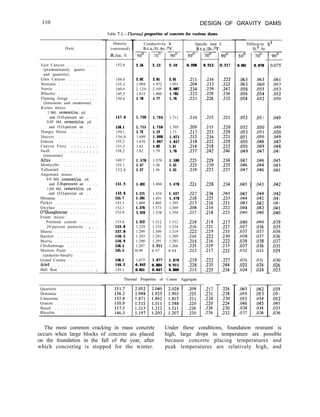
7-l. Thermal properties of concrete for various dams . . . . . . . . . . . . 110
7-2. Computation of temperature stress . . . . . . . . . . . . . . . . 12 1
7-3. Values of D, D2, and 1t2f for pipe cooling . . . . . . . . . . . . . . 124
7-4. Temperature treatment versus block length . . . . . . . . . . . . . 127
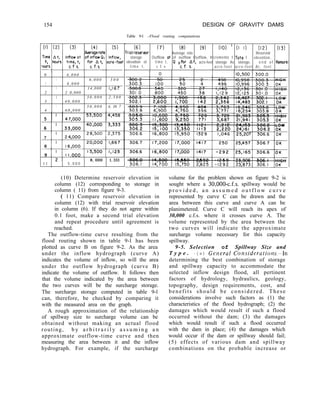
9-l. Flood routing computations . . . . . . . . . . . . . . . . . . . 154
9-2.
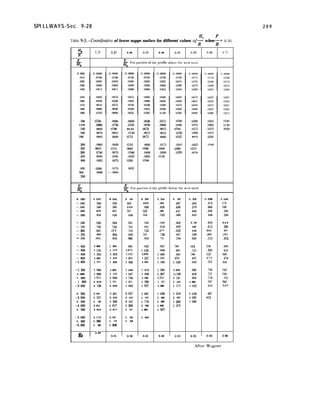
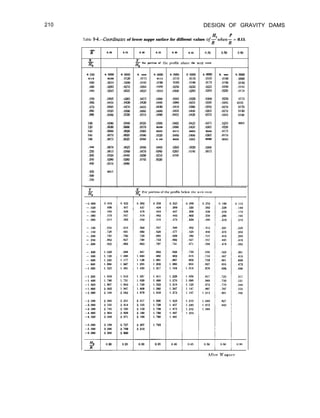
Hs
Coordinates of lower nappe surface for different values of x
when;=2 . . . . . . . . . . . . . . . . . . . . . . .
Coordinates of lower nappe surface for different values of %
when$=0.30 . . . . . . . . . . . . . . . . . . . . . .
Coordinates of lower nappe surface for different values of+
when$=0.15 . . . . . . . . . . . . . . . . . . . . . .
9-3.
9-4.
208
209
210
10-l. Coefficients of discharge and loss coefficients for conduit
entrances . . . . . . . . . . . . . . . . . . . . . . . . 231
TABLES IN APPENDICES
Table
A-l.
D-l.
E-l.
E-2.
F-l.
F-2.
F-3.
F-4.
F-S.
G-1.
G-2.
G-3.
G-4.
G-5.
G-6.
G-7.
G-8.
G9.
G-10.
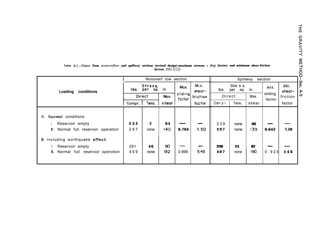
Friant Dam, nonoverflow and spillway sections (revised design-maximum
stresses, sliding factors, and minimum shear-friction factors . . . . . . . 3 19
Maximum nonlinear stress effects in sections of various dams . . . . . . . 373
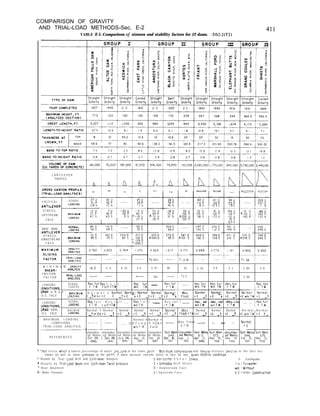
Comparison of stresses and stability factors for 12 dams . . . . . . . . . 411
Maximum effects of twist action in some gravity dams with principal
dimensions of twisted structure . . . . . . . . . . . . . . . . . 4 13
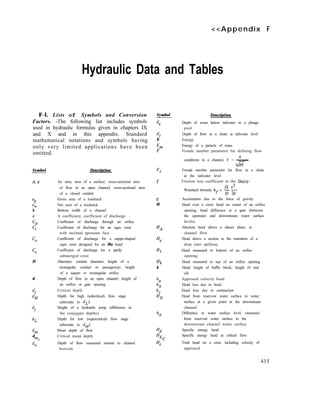
Conversion factors and formulas . . . . . . . . . . . . . . . . . 4 18
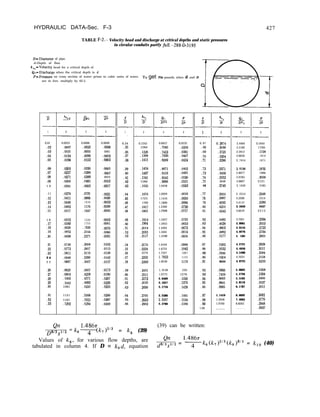
Velocity head and discharge at critical depths and static pressures in
circular conduits partly full
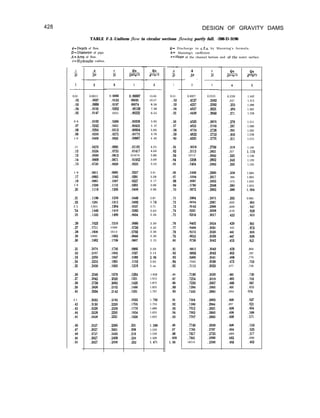
Uniform flow in circular sections flowing partly’full . : 1
. . . . . . . . 427
. . . . . . . . 428
Velocity head and discharge at critical depths and static pressures in
horseshoe conduits partly full . . . . . . . . . . . . . . . . . . 429
Uniform flow in horseshoe sections flowing partly full . . . . . . . . . 430
Computation of rainfall increments . . . . . . . . . . . . . . . . 444
Computation of rainfall excess . . . . . . . . . . . . . . . . . . 445
Hydrologic soil-cover complexes and respective curve numbers (CN) . . . . . 449
Curve numbers, constants, and seasonal rainfall limits . . . . . . . . . . 452
Hydrograph analysis computations . . . . . . . . . . . . . . . . 460
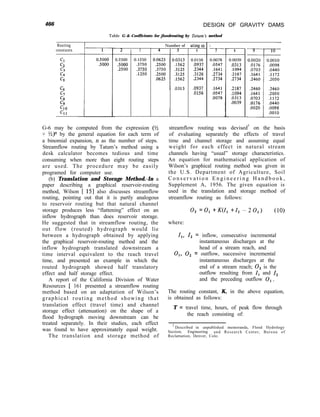
Coefficients for floodrouting by Tatum’s method . . . . . . . . . . . 466
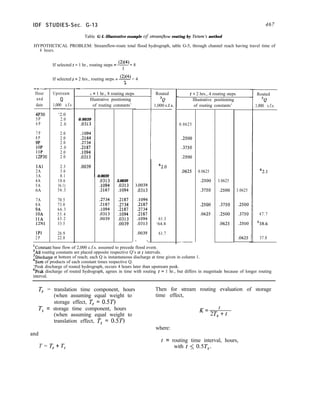
Illustrative example of streamflow routing by Tatum’s method . . . . . . 467
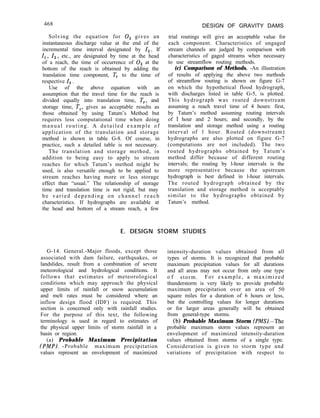
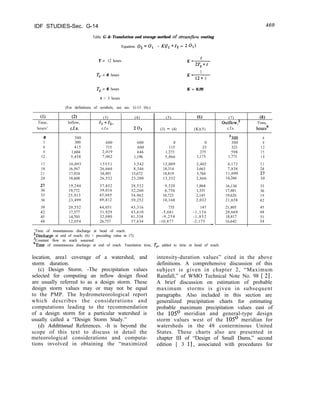
Translation and storage method of streamflow routing . . . . . . . . . 469
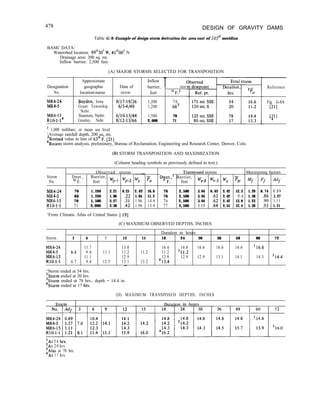
Example of design storm derivation for area east of 105’ meridian . . . . . 478
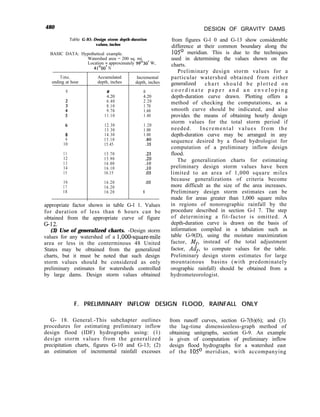
Design storm depth-duration values, inches . . . . . . . . . . . . . . 480
CONTENTS XXIII
Table
G-1 1.
G-12.
G-13.
G-14.
G-15.
G-16.
G-17.
G-18.
G-19.
Figure
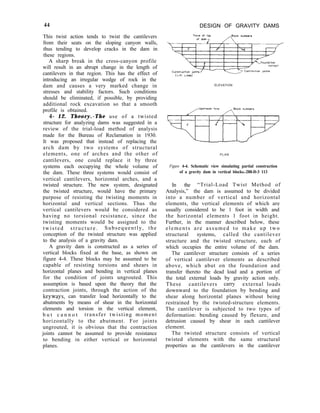
2-1.
2-2.
2-3.
2-4.
2-5.
3-l.
3-2.
3-3.
4-l.
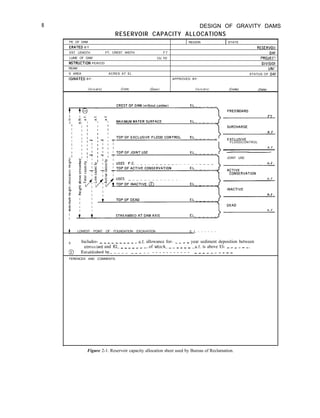
Reservoir capacity allocation sheet used by Bureau of Reclamation . . .
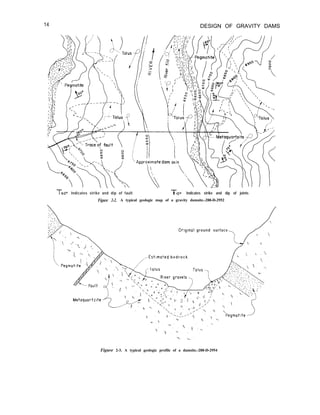
A typical geologic map of a gravity damsite . . . . . . . . . . .
A typical geologic profile of a damsite
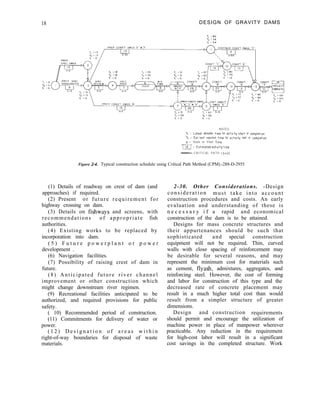
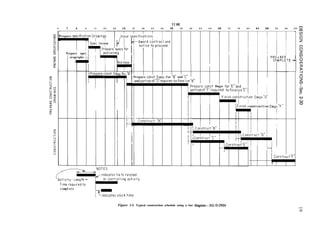
Typical construction schedule using Critical Path Method (CPM)’ 1 1 1 :
Typical construction schedule using a bar diagram . . . . . . . . .
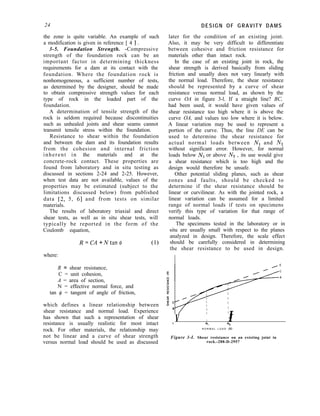
Shear resistance on an existing joint in rock . . . . . . . . . . .
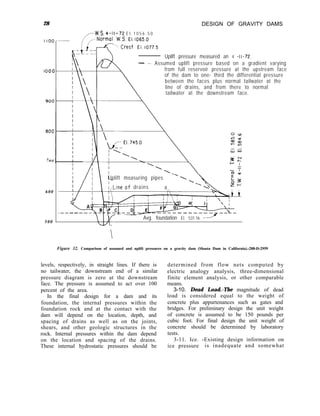
Comparison of assumed and uplift pressures on a gravity dam (Shasta
Dam in California) . . . . . . . . . . . . . . . . . . . .
Foundation base pressures for a gravity dam . . . . . . . . . . .
Cross section of a parallel-side cantilever showing usual loading
combination . . . . . . . . . . . . . . . . . . . . . .
Derivation of stress formulae for a concrete gravity dam . . . . . . .
Stresses in straight gravity dams . . . . . . . . . . . . . . . .
Schematic view simulating partial construction of a gravity dam in
vertical blocks . . . . . . . . . . . . . . . . . . . . .
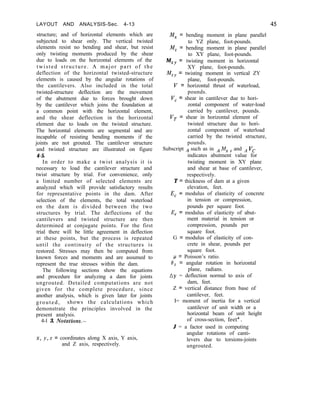
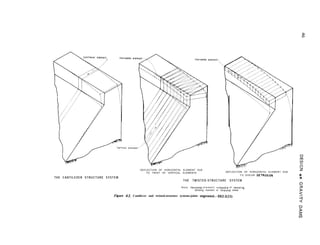
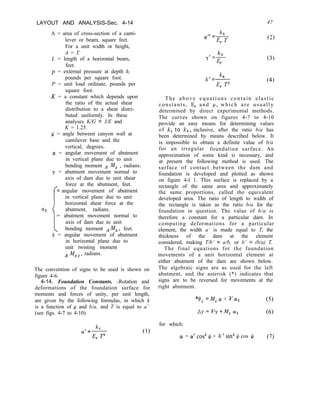
Cantilever and twisted-structure systems-joints ungrouted . . . . . .
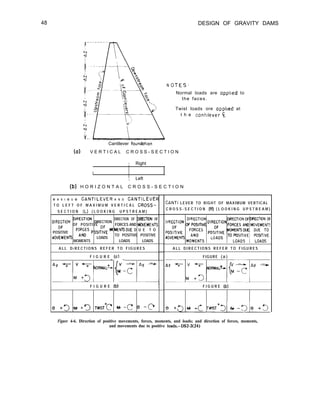
Direction of positive movements, forces, moments, and loads; and
direction of forces, moments, and movements due to positive loads . .
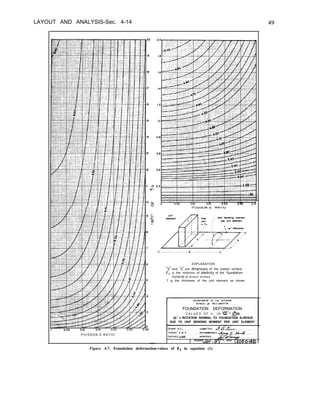
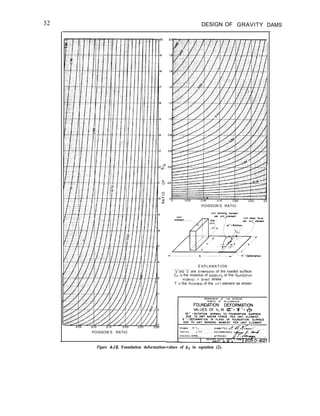
Foundation deformation-values of kr in equation (1) . . . . . . .
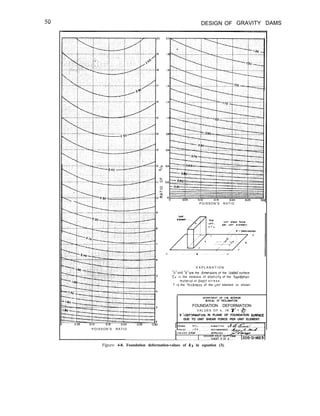
Foundation deformation-values of k3 in equation (3) . . . . . . .
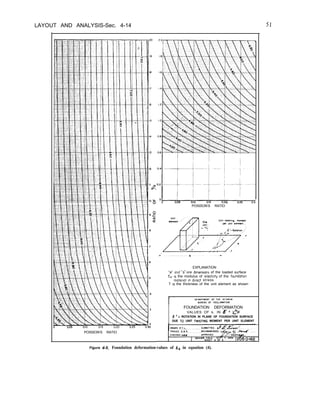
Foundation deformation-values of k4 in equation (4) . . . . . . .
Foundation deformation-values of k5 in equation (2) . . . . . . .
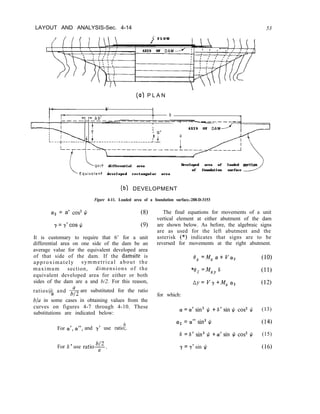
Loaded area of a foundation surface . . . . . . . . . . . . . .
Page
8
. 14
. 14
. 18
. 19
. 24
. 28
. 33
4-2.
4-3.
4-4.
. 38
. 41
. 42
4-5.
4-6.
. 44
. 46
. 48
. 49
. 50
. 51
. 52
. 53
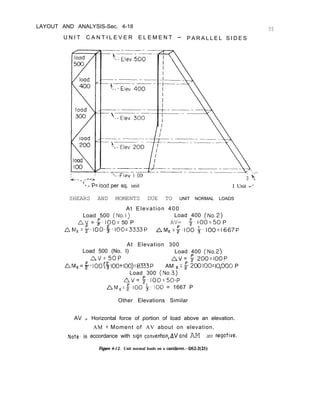
4-l 2. Unit normal loads on a cantilever . . . . . . . . . . . . . . . . 55
4-7.
48.
4-9.
4-10.
4-l 1.
Constants for extending 6-hour general-type design-storm values west of
105’ meridian to longer duration periods . . . . . . . . . .
Preliminary design storm estimate for hypothetical watershed, east of
105’ meridian . . . . . . . . . . . . . . . . . . .
Preliminary design storm east of 105o meridian-arrangement of
incremental rainfall; computation of incremental excesses,
AP,,forsubareasAandB . . . . . . . . . . . . . . . .
Minimum retention rates for hydrologic soil groups . . . . . . . .
Simulated automatic data processing printout-preliminary inflow design
flood (IDF) contribution, subarea A . . . . . . . . . . . .
Simulated automatic data processing printout-preliminary inflow design
flood (IDF) contribution, subarea B . . . . . . . . . . .
Preliminary inflow design flood hydrograph, east of 105o meridian-same
lag-time curve for both subareas . . . . . . . . . , . . . .
Preliminary inflow design flood, east of 105’ meridian-computation of
incremental excesses, AP,, considering basin as a whole, and using
an area1 weighted CN and minimum loss rate . . . . . . . . .
Preliminary inflow design flood hydrograph east of 105’ meridian-
different lag-time curve for each subarea . . . . . . . . . . .
FIGURES
Page
. . . 485
. . . 488
. . . 490
. . . 491
. . . 493
. . . 493
. # . 494
. . . 496
. . . 498
XXIV CONTENTS
Figure
4-13.
4-14.
4-l 5.
4-16.
4-17.
4-18.
4-19.
4-20.
4-21.
4-22.
4-23.
4-24.
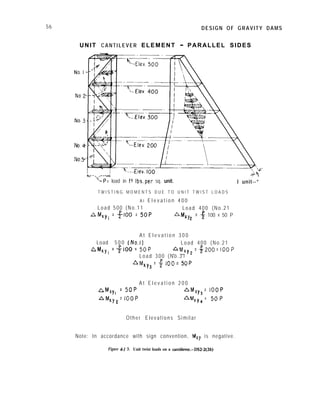
4-25.
5-l.
5-2.
5-3.
5-4.
5-5.
5-6.
5-7.
5-8.
5-9.
6-l.
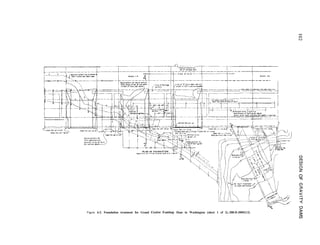
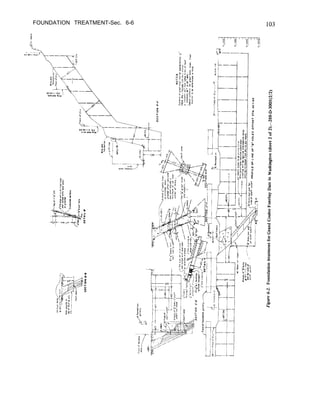
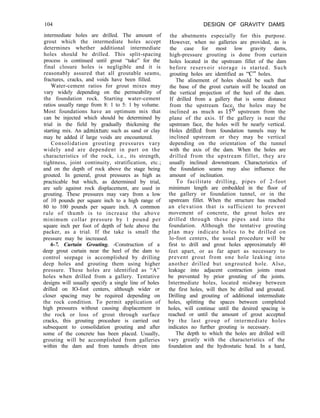
6-2.
7-1.
7-2.
7-3.
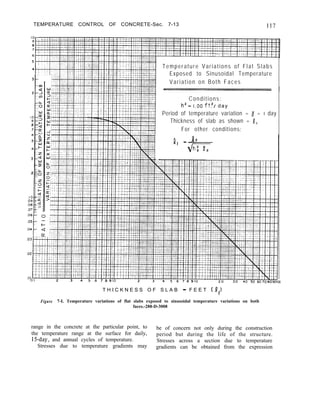
7-4.
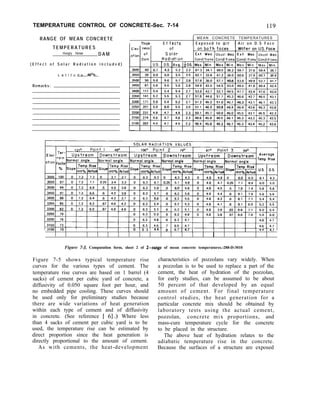
7-5.
7-6.
7-7.
7-8.
7-9.
7-10.
7-l 1.
7-12.
7-13.
Page
Unit twist loads on a cantilever . . . . . . . . . . . . . . . . . . 56
Graph for determining J factor due to twist of a shaft of
rectangular cross section . . . . . . . . . . . . . . . . . . . 58
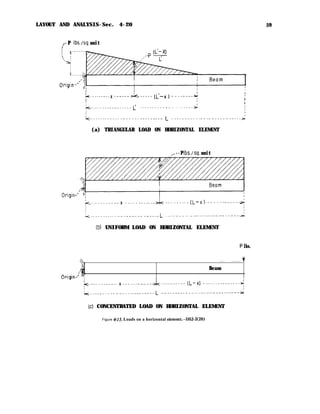
Loads on a horizontal element . . . . . . . . . . . . . . . . . . 59
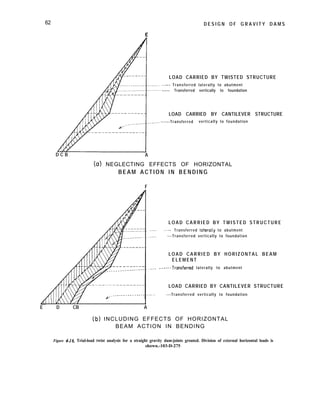
Trial-load twist analysis for a straight gravity dam-joints grouted . . . . . . 62
Twisted-structure loads . . . . . . . . . . . . . . . . . . . . . 63
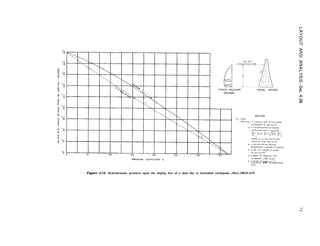
Hydrodynamic pressures upon the sloping face of a dam due to horizontal
earthquake effect . . . . . . . . . . . . . . . . . . . . . . 7 1
A finite element with nodal point numbers and coordinate axes . . . . . . 75
Sketch illustrating the two-dimensional stability problem . . . . . . . . 77
Four-sided failure wedge for three-dimensional stability analysis . . . . . . 78
Section through a sliding mass normal to the intersection line of two
planes . . . . . . . . . . . . . . . . . . . . . . . . . . 78
Partition method of determining shear resistance of a block . . . . . . . . 79
Partition method extended to multifaced blocks . . . . . . . . . . . . 80
Stress distribution near a low-modulus zone . . . . . . . . . . . . . 80
View from right abutment of partially completed Monticello Dam in
California, showing water flowing over low blocks . . . . . . . . . . 84
Diversion of the river during construction of Folsom Dam and Powerplant
in California . . . . . . . . . . . . . . . . . . . . . . . . 86
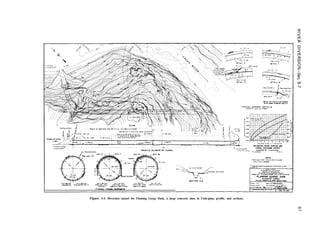
Diversion tunnel for Flaming Gorge Dam, a large concrete dam in
Utah-plan, profile, and sections . . . . . . . . . . . . . . . . . 87
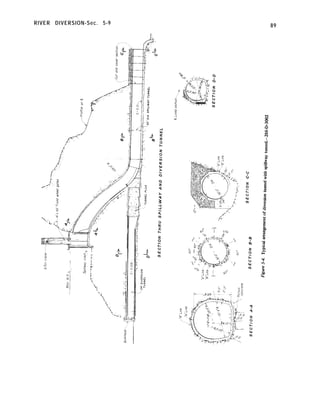
Typical arrangement of diversion tunnel with spillway tunnel . . . . . . . 89
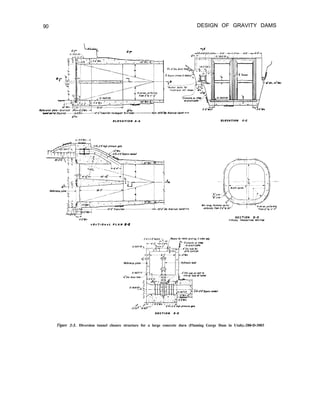
Diversion tunnel closure structure for a large concrete dam (Flaming
Gorge Dam in Utah) . . . . . . . . . . . . . . . . . . . . . 90
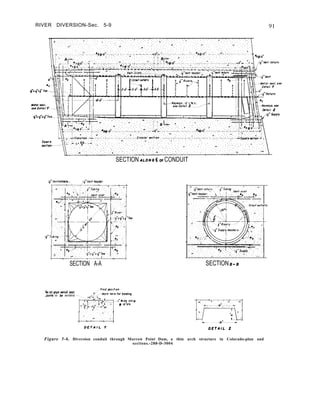
Diversion conduit through Morrow Point Dam, a thin arch structure in
Colorado-plan and sections . . . . . . . . . . . . . . . . . . 9 1
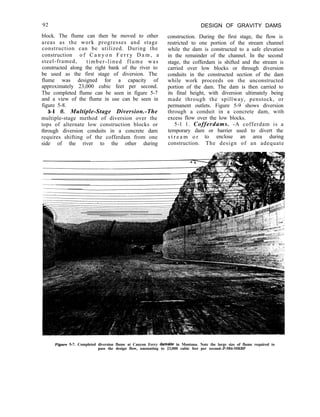
Completed diversion flume at Canyon Ferry damsite in Montana . . . . . . 92
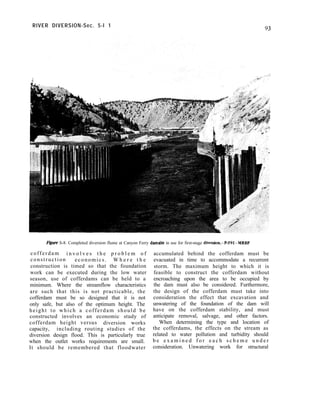
Completed diversion flume at Canyon Ferry damsite in use for
first-stage diversion . . . . . . . . . . . . . . . . . . . . . 93
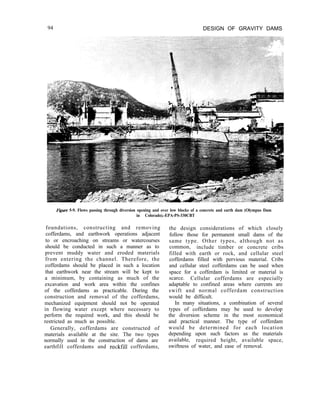
Flows passing through diversion opening and over low blocks of a
concrete and earth dam (Olympus Dam in Colorado) . . . . . . . . . 94
Excavation layout for Pueblo Dam and spillway in Colorado-a concrete
buttress-type structure . . . . . . . . . . . . . . . . . . . . 98
Foundation treatment for Grand Coulee Forebay Dam in Washington . . . . 102
Temperature variations of flat slabs exposed to sinusoidal temperature
variations on both faces . . . . . . . . . . . . . . . . . . . . 117
Computation form, sheet 1 of 2-range of mean concrete temperatures . . . . 118
Computation form, sheet 2 of 2-range of mean concrete temperatures . . . . 119
Temperature variations with depth in semi-infinite solid . . . . . . . . . 120
Temperature rise in mass concrete for various types of cement . . . . . . . 120
Pipe cooling of concrete-values of X . . . . . . . . . . . . . . . . 122
Pipe cooling of concrete-values of Y . . . . . . . . . . . . . . . . 123
Artificial cooling of concrete-effect of cooling water temperature . . . . . 124
Artificial cooling of concrete-effect of coil length . . . . . . . . . . . 124
Artificial cooling of concrete-effect of horizontal spacing of pipe . . . . . 124
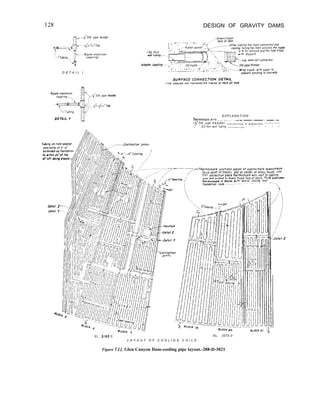
Glen Canyon Dam-cooling pipe layout . . . . . . . . . . . . . . . 128
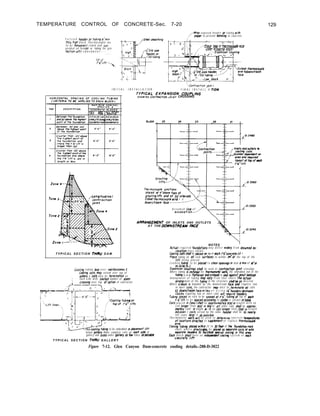
Glen Canyon Dam-concrete cooling details . . . . . . . . . . . . . 129
Temperature history of artificially cooled concrete . . . . . . . . . . . 132
CONTENTS x x v
Figure
8-1.
8-2.
8-3.
8-4.
8-5.
9-l.
9-2.
9-3.
9-4.
9-5.
9-6.
9-7.
9-8.
9-9.
9-10.
9-l 1.
9-12.
9-13.
9-14.
9-15.
9-16.
9-17.
9-18.
9-19.
9-20.
9-21.
9-22.
9-23.
9-24.
9-25.
9-26.
9-27.
9-28.
9-29.
9-3 0.
9-3 1.
9-32.
9-33.
9-34.
Page
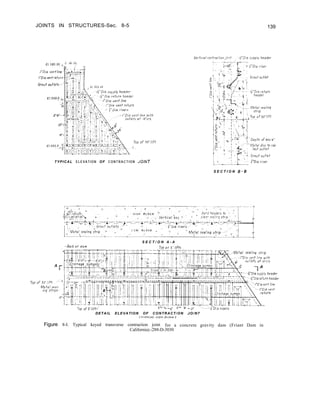
Typical keyed transverse contraction joint for a concrete gravity dam
(Friant Dam in California) . . . . . . . . . . . . . . . . . . . 139
Typical unkeyed transverse contraction joint (Grand Coulee Forebay Dam
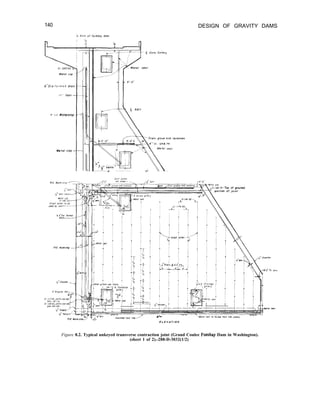
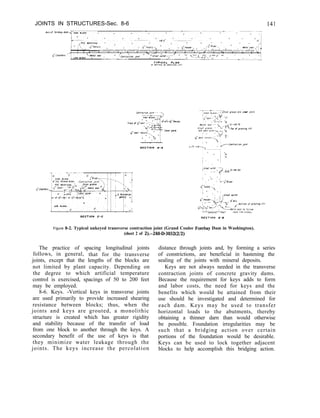
in Washington) . . . . . . . . . . . . . . . . . . . . . . . 140
Typical longitudinal contraction joint for a concrete gravity dam
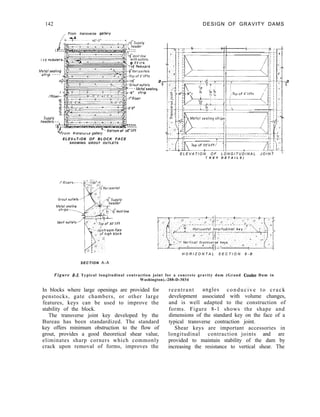
(Grand Coulee Dam in Washington) . . . . . . . . . . . . . . . 142
Metal seals and connections at contraction joints . . . . . . . . . . . 144
Grouting system details . . . . . . . . . . . . . . . . . . . . . 147
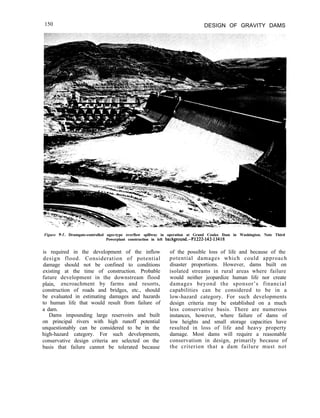
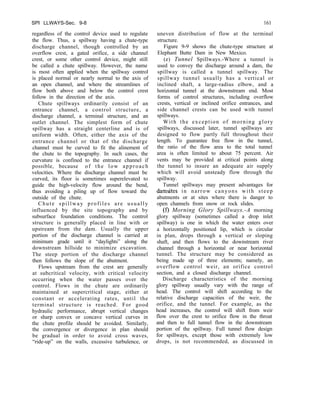
Drumgate-controlled ogee-type overflow spillway in operation at Grand
Coulee Dam in Washington . . . . . . . . . . . . . . . . . . . 150
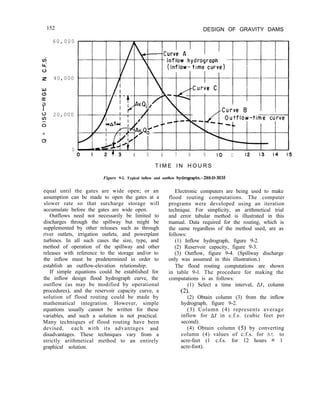
Typical inflow and outflow hydrographs . . . . . . . . . . . . . . 152
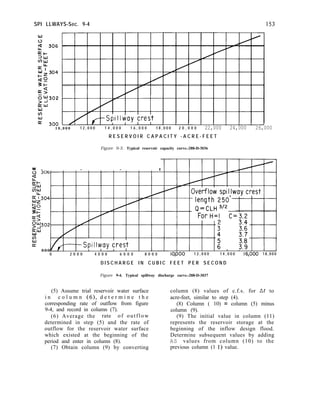
Typical reservoir capacity curve . . . . . . . . . . . . . . . . . . 153
Typical spillway discharge curve . . . . . . . . . . . . . . . . . 153
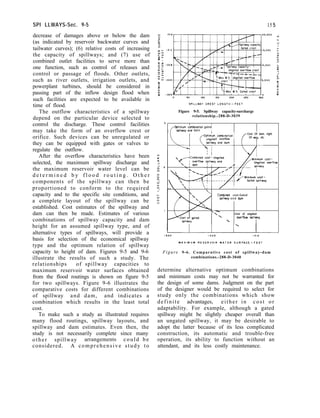
Spillway capacity-surcharge relationship . . . . . . . . . . . . . . 155
Comparative cost of spillway-dam combinations . . . . . . . . . . . . 155
Circular crest for morning glory spillway at Hungry Horse Dam in
Montana . . . . . . . . . . . . . . . . . . . . . . . . . 157
Drumgate-controlled side channel spillway in operation at Hoover Dam on
the Colorado River . . . . . . . . . . . . . . . . . . . . . 160
Chute type spillway (left) at Elephant Butte Dam in New Mexico . . . . . . 162
A simple ogee crest shape with a vertical upstream face . . . . . . . . . 165
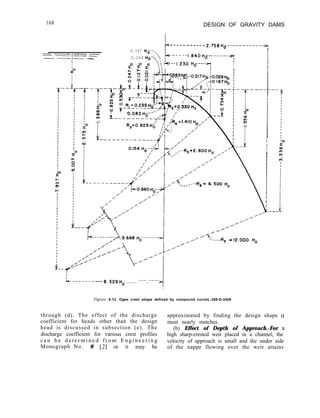
Factors for definition of nappe-shaped crest profiles . . . . . . . . . . 166
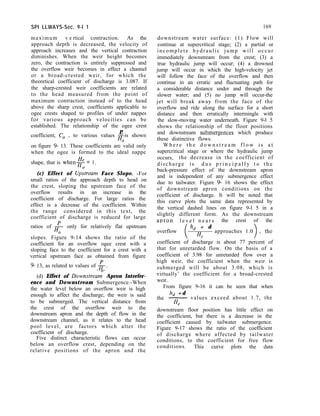
Ogee crest shape defined by compound curves . . . . . . . . . . . . 168
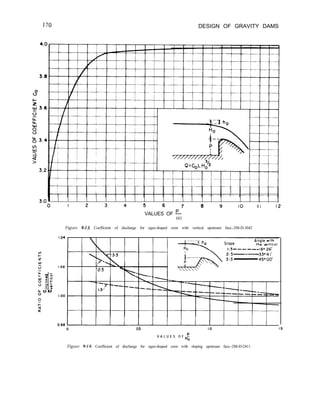
Coefficient of discharge for ogee-shaped crest with vertical upstream
face . . . . . . . . . . . . . . . . . . . . . . . . . . . 170
Coefficient of discharge for ogee-shaped crest with sloping upstream
face . . . . . . . . . . . . . . . . . . . . . . . . . . . 170
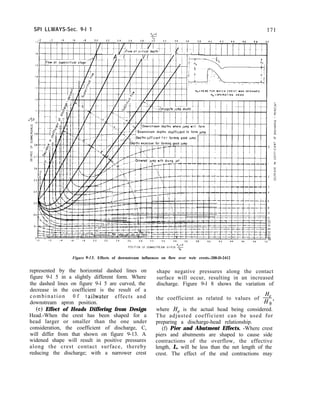
Effects of downstream influences on flow over weir crests . . . . . . . . 171
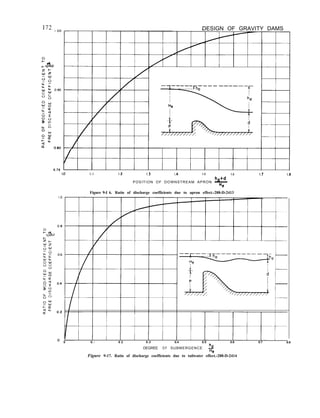
Ratio of discharge coefficients due to apron effect . . . . . . . . . . . 172
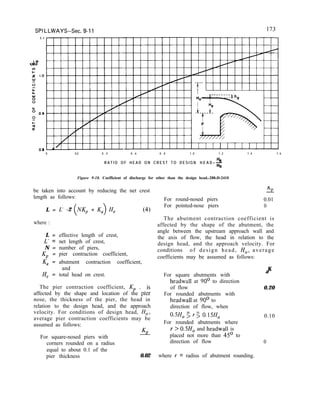
Ratio of discharge coefficients due to tailwater effect . . . . . . . . . . 172
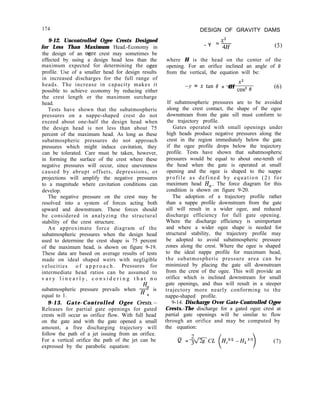
Coefficient of discharge for other than the design head . . . . . . . . . 173
Subatmospheric crest pressures for a 0.75 ratio ofH, to He . . . . . . . . 175
Subatmospheric crest pressures for undershot gate flow . . . . . . . . . 175
Coefficient of discharge for flow under a gate (orifice flow) . . . . . . . . 176
Typical orifice control structures . . . . . . . . . . . . . . . . . 177
Comparison of side channel cross sections . . . . . . . . . . . . . . 178
Side charmel flow characteristics . . . . . . . . . . . . . . . . . 179
Sketch illustrating flow in open channels . . . . . . . . . . . . . . 18 1
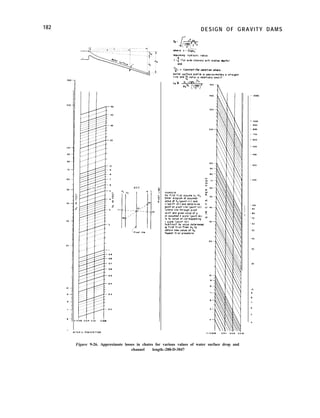
Approximate losses in chutes for various values of water surface drop
and channel length . . . . . . . . . . . . . . . . . . . . . 182
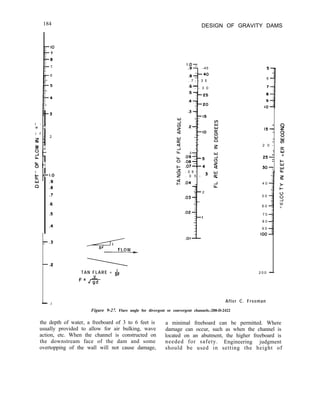
Flare angle for divergent or convergent channels . . . . . . . . . . . . 184
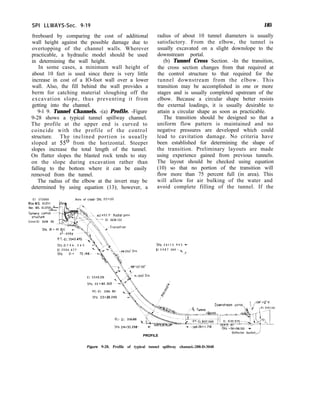
Profile of typical tunnel spillway channel . . . . . . . . . . . . . . 185
Overflow gate-controlled spillway on Canyon Ferry Dam in Montana . . . . 187
Characteristic forms of hydraulic jump related to the Froude number . . . . 188
Relations between variables in hydraulic jumps for rectangular channels . . . 189
Type I stilling basin characteristics . . . . . . . . . . . . . . . . . 190
Stilling basin characteristics for Froude numbers between 2.5 and 4.5 . . . . 191
Stilling basin characteristics for Froude numbers above 4.5 where
incoming velocity does not exceed 50 feet per second . . . . . . . . . 193
XXVI CONTENTS
Figure
9-35.
9-36.
9-37.
9-38.
Page
9-39.
9-40.
9-41.
9-42.
9-43.
9-44.
9-45.
9-46.
9-47.
9-48.
9-49.
9-50.
9-51.
9-52.
10-l.
1 o-2.
10-3.
1 o-4.
10-5.
10-6.
10-7.
1 O-8.
1 o-9.
Stilling basin characteristics for Froude numbers above 4.5 . . . . . . . . 194
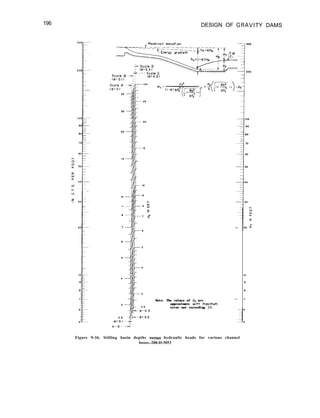
Stilling basin depths versus hydraulic heads for various channel losses . . . . 196
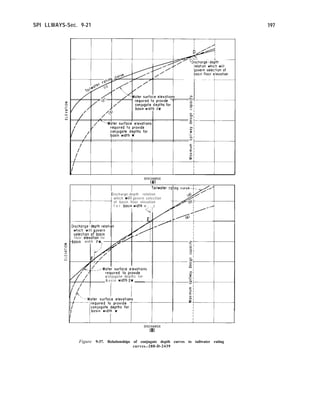
Relationships of conjugate depth curves to tailwater rating curves . . . . . 197
Deflector bucket in operation for the spillway at Hungry Horse Dam in
Montana . . . . . . . . . . . . . . . . . . . . . . . . . 200
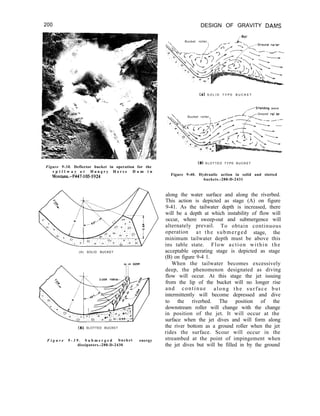
Submerged bucket energy dissipators . . . . . . . . . . . . . . . . 200
Hydraulic action in solid and slotted buckets . . . . . . . . . . . . . 200
Flow characteristics in a slotted bucket . . . . . . . . . . . . . . . 201
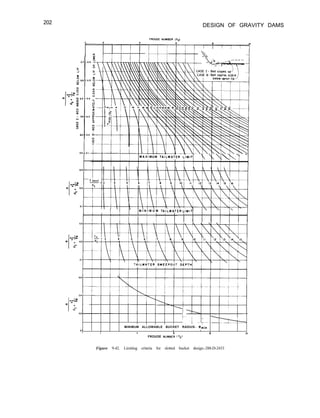
Limiting criteria for slotted bucket design . . . . . . . . . . . . . . 202
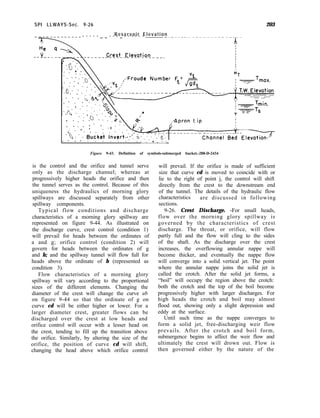
Definition of symbols-submerged bucket . . . . . . . . . . . . . . 203
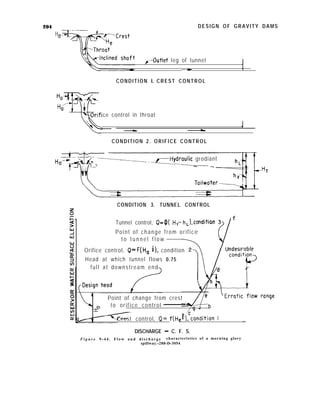
Flow and discharge characteristics of a morning glory spillway . . . . . . . 204
Elements of nappe-shaped profile for a circular crest . . . . . . . . . . 205
Relationship of circular crest coefficient C, to: for different
s
approach depths (aerated nappe) . . . . . . . . . . . . . . . . 206
Circular crest coefficient of discharge for other than design head . . . . . . 207
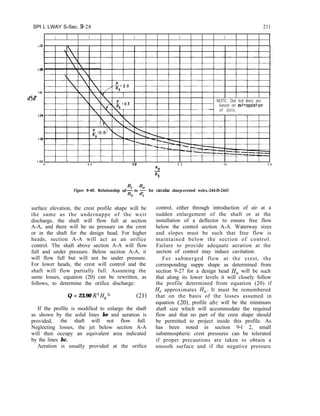
H
Relationship of g to -$ for circular sharp-crested weirs . . . . . . . . 211
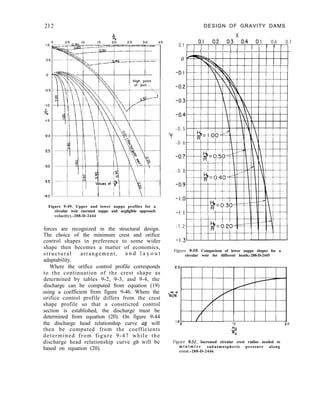
Upper and lower nlppe pr:files for a circular weir (aerated nappe and
negligible approach velocity) . . . . . . . . . . . . . . . . . . 2 12
Comparison of lower nappe shapes for a circular weir for different heads . . . 2 12
Increased circular crest radius needed to minimize subatmospheric
pressure along crest . . . . . . . . . . . . . . . . . . . . . 2 12
Comparison of crest profile shape with theoretical jet profile . . . . . . . 213
Typical river outlet works with stilling basin . . . . . . . . . . . . . 2 17
Typical power outlet and canal outlet works . . . . . . . . . . . . . 2 17
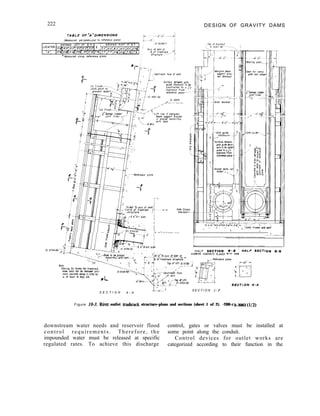
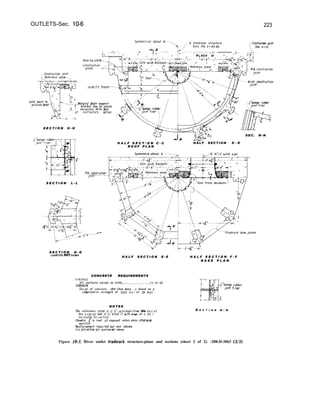
River outlet trashrack structure-plans and sections . . . . . . . . . . . 222
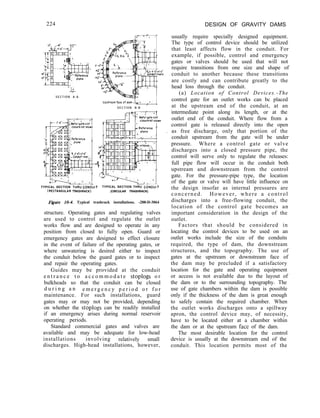
Typical trashrack installations . . . . . . . . . . . . . . . . . . 224
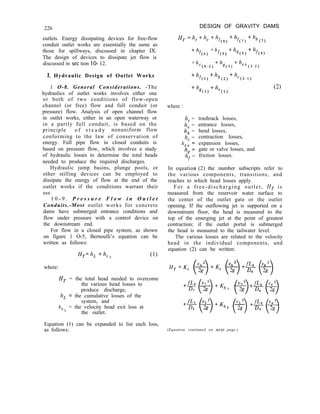
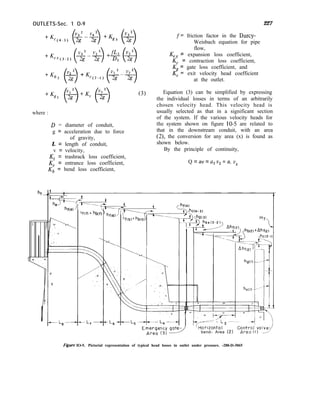
Pictorial representation of typical head losses in outlet under pressure . . . . 227
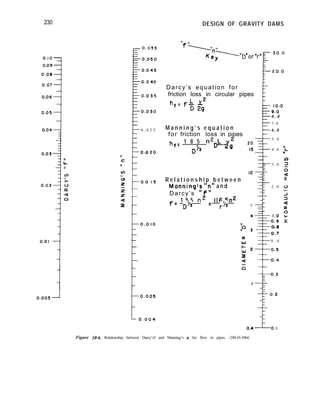
Relationship between Darcy’sfand Manning’s y1 for flow in pipes . . . . . 230
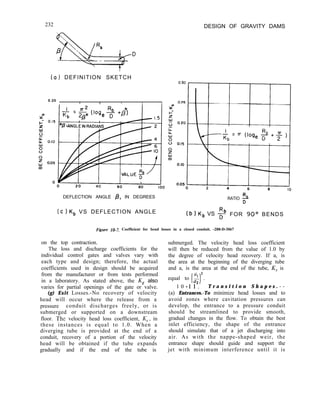
Coefficient for bend losses in a closed conduit . . . . . . . . . . . . 232
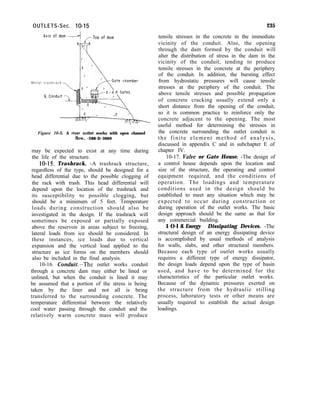
A river outlet works with open channel flow . . . . . . . . . . . . . 235
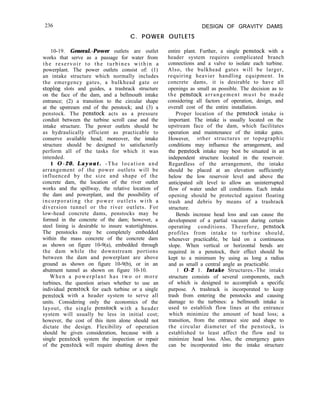
Typical penstock installations . . . . . . . . . . . . . . . . . . 237
lo- 10. Embedded penstock in abutment tunnel . . . . . . . . . . . . .
IO- 11. Typical concrete trashrack structure for a penstock . . . . . . . . . .
IO- 12. Typical fixed-wheel gate installation at upstream face of dam . . . . . .
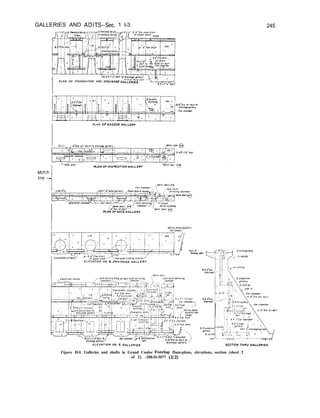
1 l-l. Galleries and shafts in Grand Coulee Forebay Dam-plans, elevations,
section . . . . . . . . . . . . . . . . . . . . . . . . .
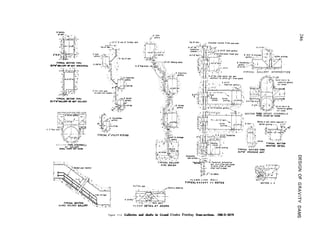
1 l-2. Galleries and shafts in Grand Coulee Forebay Dam-sections . . . . . .
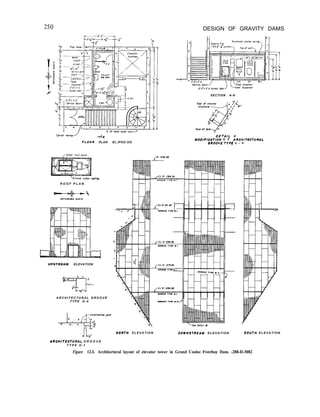
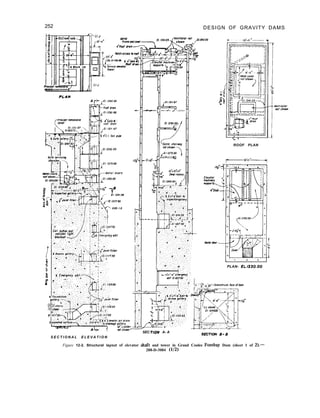
12-1. Architectural layout of elevator tower in Grand Coulee Forebay Dam . . .
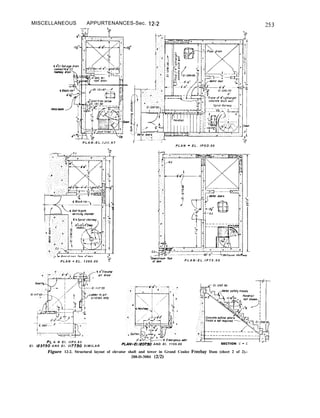
12-2. Structural layout of elevator shaft and tower in Grand Coulee Forebay
Dam . . . . . . . . . . . . . . . . . . . . . . . . . .
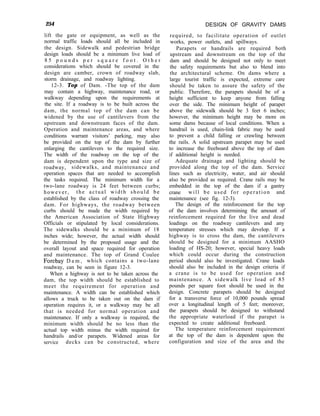
12-3. Typical arrangement at top of a gravity dam (Grand Coulee Forebay Dam) .
13-1. Locations of instrumentation installed in a gravity dam-plan and
elevation . . . . . . . . . . . . . . . . . . . . . . . .
13-2. Locations of instrumentation installed in a gravity dam-maximum
section . . . . . . . . . . . . . . . . . . . . . . . . .
237
238
241
244
246
250
252
256
261
261
CONTENTS XXVII
Figure Page
13-3. Typical plumbline well in a concrete dam with reading stations at
several elevations . . . . . . . . . . . . . . . . . . . . . . 263
13-4. A cluster of strain meters supported on a “spider” and ready for
embedment in concrete . . . . . . . . . . . . . . . . . . . . 264
13-5. A stress meter partially embedded in concrete . . . . . . . . . . . . 264
13-6. A joint meter in position at a contraction joint . . . . . . . . . . . . 265
13-7. An instrument terminal board and cover box . . . . . . . . . . . . . 265
13-8. A special portable wheatstone bridge test set for reading strain meters . . . . 265
13-9. “No-stress” strain meter installation . . . . . . . . . . . . . . . . 266
13-10. Meter group comprising strain meters and stress meters . . . . . . . . . 267
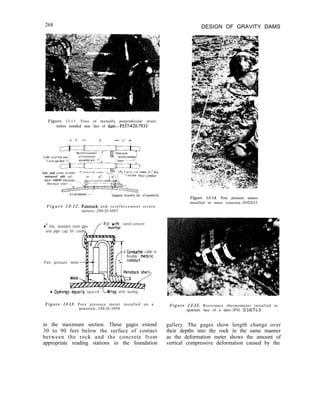
13- 11. Trios of mutually perpendicular strain meters installed near face of dam . . . 268
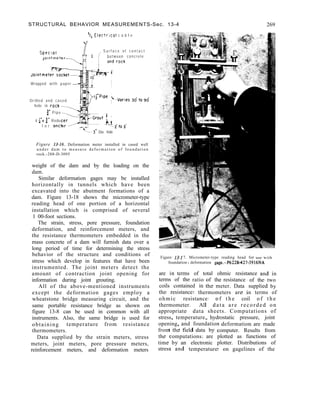
13-l 2. Penstock and reinforcement strain meters . . . . . . . . . . . . . . 268
13-13. Pore pressure meter installed on a penstock . . . . . . . . . . . . . 268
13- 14. Pore pressure meters installed in mass concrete . . . . . . . . . . . . 268
13-15. Resistance thermometer installed at upstream face of a dam . . . . . . . 268
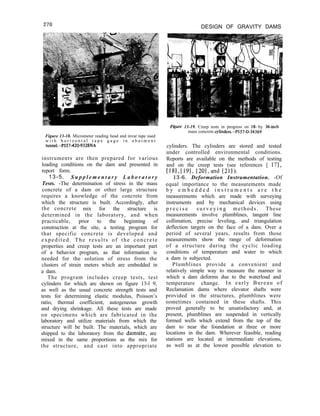
13- 16. Deformation meter installed in cased well under dam to measure
deformation of foundation rock . . . . . . . . . . . . . . . . . 269
13-17. Micrometer-type reading head for use with foundation deformation gage . . . 269
13- 18. Micrometer reading head and invar tape used with horizontal tape gage in
abutment tunnel . . . . . . . . . . . . . . . . . . . . . . 270
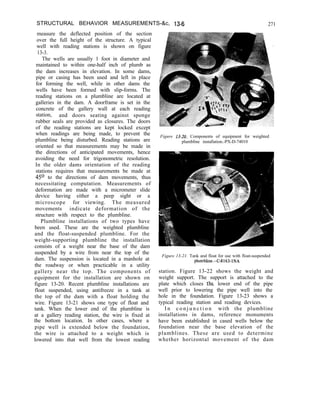
13-19. Creep tests in progress on 18- by 36-inch mass concrete cylinders . . . . . . 270
13-20. Components of equipment for weighted plumbline installation . . . . . . 271
13-21. Tank and float for use with float-suspended plumbline . . . . . . . . . 271
13-22. Anchorage for float-suspended plumbline . . . . . . . . . . . . . . 272
13-23. Typical plumbline reading station and reading devices . . . . . . . . . . 272
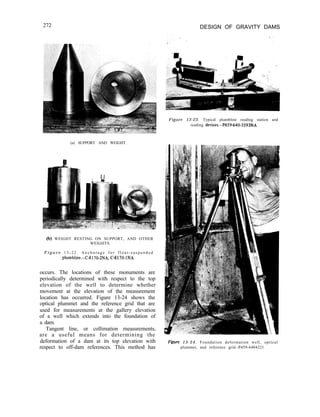
13-24. Foundation deformation well, optical plummet, and reference grid . . . . . 272
13-25. An instrument pier for use with collimation or triangulation systems . . . . 273
13-26. A reference sighting target for use in obtaining collimation
measurements . . . . . . . . . . . . . . . . . . . . . . . 273
13-27. A movable collimation target at a measuring station on top of a dam . . . . 274
13-28. A collimation system layout for a gravity dam . . . . . . . . . . . . 274
13-29. A triangulation system layout for a gravity dam . . . . . . . . . . . . 274
13-30. A tensioning device used with a tape for precise baseline measurements . . . 275
13-3 1. A pier plate, pier targets, and dam deformation targets . . . . . . . . . 275
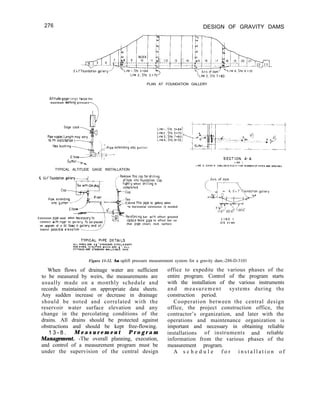
13-32. An uplift pressure measurement system for a gravity dam . . . . . . . . 276
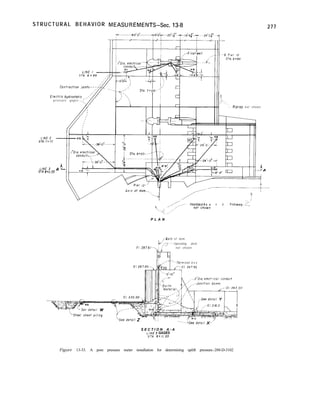
13-33. A pore pressure meter installation for determining uplift pressure . . . . . . 277
13-34. Details of pore pressure meter installation illustrated on figure 13-33 . . . . 278
15-1. Selective withdrawal outlet at Pueblo Dam in Colorado . . . . . . . . . 289
15-2. Selective withdrawal outlet at Folsom Dam in California . . . . . . . . . 290
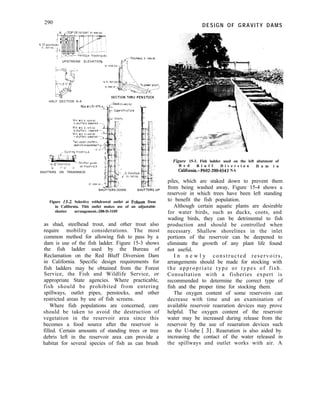
15-3. Fish ladder used on the left abutment of Red Bluff Diversion Dam in
California . . . . . . . . . . . . . . . . . . . . . . . . . 290
15-4. An aerial view of a small reservoir with trees left at the water’s edge
to provide a fish habitat . . . . . . . . . . . . . . . . . . . . 291
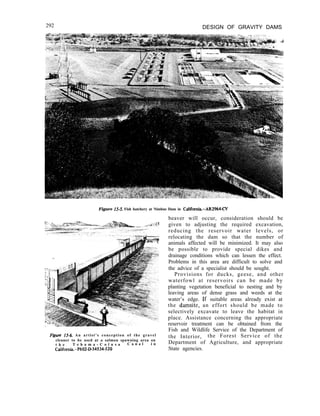
15-5. Fish hatchery at Nimbus Dam in California . . . . . . . . . . . . . 292
15-6. An artist’s conception of the gravel cleaner to be used at a salmon
spawning area on the Tehama-Colusa Canal in California . . . . . . . . 292
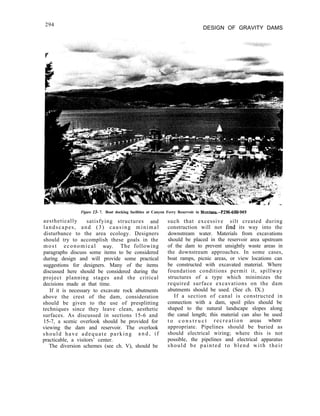
15-7. Boat docking facilities at Canyon Ferry Reservoir in Montana . . . . . . . 294
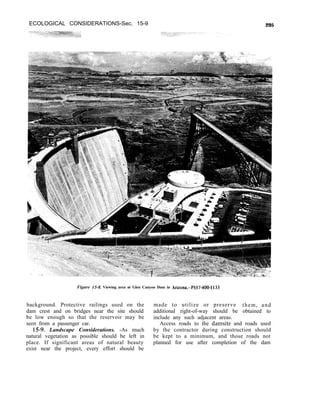
15-8. Viewing area at Glen Canyon Dam in Arizona . . . . . . . . . . . . . 295
15-9. Chipping operations at Pueblo Dam in Colorado . . . . . . . . . . . . 297
X X V I I I CONTENTS
FIGURES IN APPENDICES
Figure
A-l.
A-2.
A-3.
A-4.
A-5.
A-4.
A-7.
A-8.
A-9.
A-10.
A-l 1.
A-12.
A-13.
A-14.
A-15.
A-16.
A-17.
A-18.
B-l.
B-2.
B-3.
B-4.
B-5.
B-6.
B-7.
B-8.
B-9.
B-10.
B-l 1.
B-12.
B-13.
B-14.
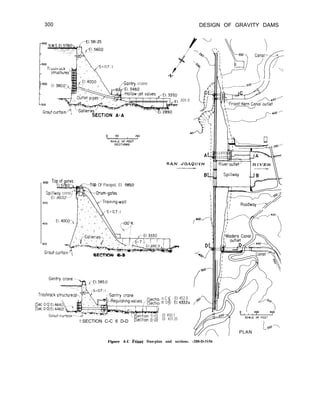
Friant Dam-plan and sections . . . . . . . . . . . . . . . . . .
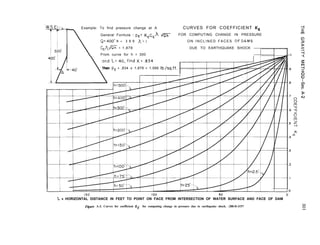
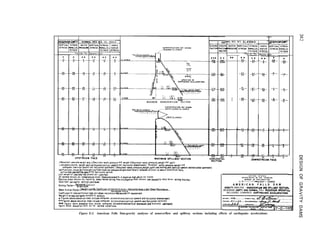
Curves for coefficient KE for computing change in pressure due to
earthquake shock . . . . . . . . . . . . . . . . . . . . . .
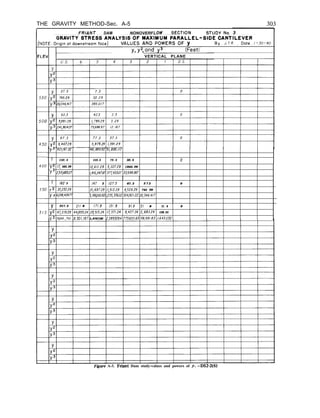
Friant Dam study-values and powers of y . . . . . . . . . . . . . .
Friant Dam study-normal stresses on horizontal planes . . . . . . . . .
Friant Dam study-shear stresses on horizontal and vertical planes . . . . .
Friant Dam study-partial derivatives for obtaining uy . . . . . . . . . .
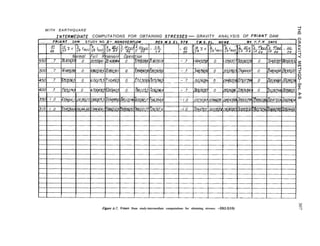
Friant Dam study-intermediate computations for obtaining stresses . . . .
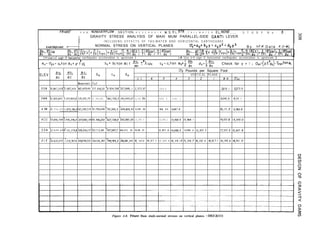
Friant Dam study-normal stresses on vertical planes . . . . . . . . . .
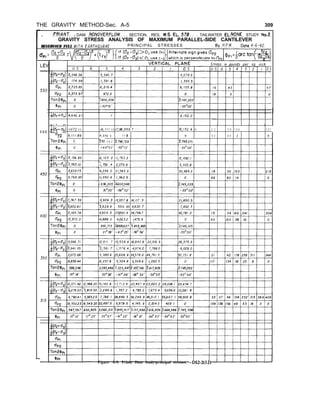
Friant Dam study-principal stresses . . . . . . . . . . . . . . . .
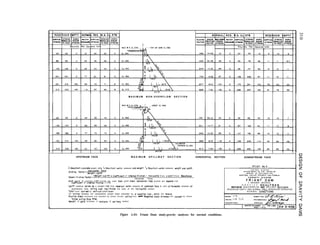
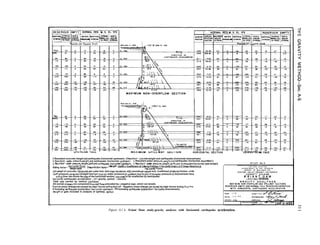
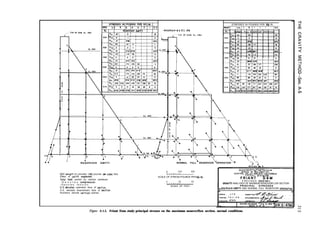
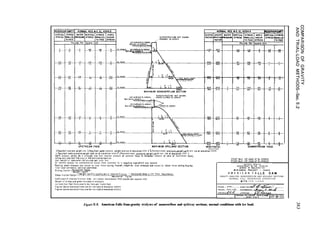
Friant Dam study-gravity analyses for normal conditions . . . . . . . .
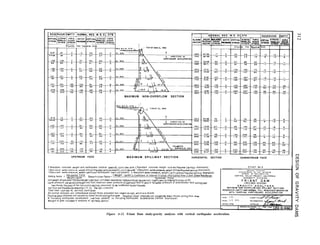
Friant Dam Study-gravity analyses with horizontal earthquake
acceleration . . . . . . . . . . . . . . . . . . . . . . . .
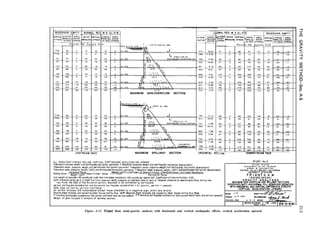
Friant Dam study-gravity analyses with vertical earthquake
acceleration . . . . . . . . . . . . . . . . . . . . . . . .
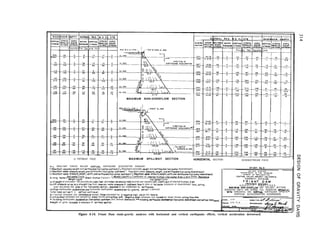
Friant Dam study-gravity analyses with horizontal and vertical
earthquake effects, vertical acceleration upward . . . . . . . . . . .
Friant Dam study-gravity analyses with horizontal and vertical
earthquake effects, vertical acceleration downward . . . . . . . . . .
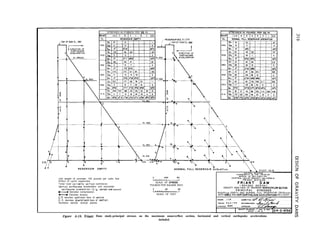
Friant Dam study-principal stresses on the maximum nonoverflow section,
normal conditions . . . . . . . . . . . . . . . . . . . . . .
Friant Dam study-principal stresses on the maximum nonoverflow section,
horizontal and vertical earthquake accelerations included . . . . . . . .
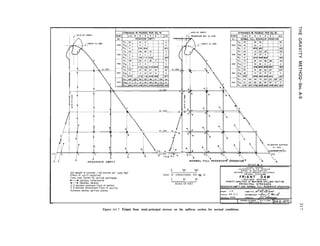
Friant Dam study-principal stresses on the spillway section for normal
conditions . . . . . . . . . . . . . . . . . . . . . . . .
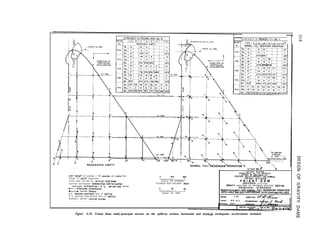
Friant Dam study-principal stresses on the spillway section, horizontal
and vertical earthquake accelerations included . . . . . . . . . . . .
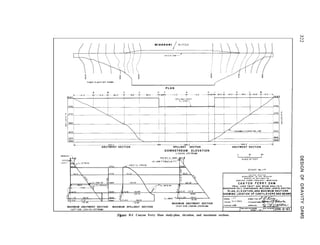
Canyon Ferry Dam study-plan, elevation, and maximum sections . . . . .
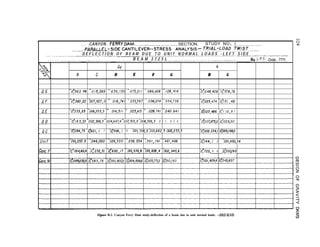
Canyon Ferry Dam study-deflection of a beam due to unit normal loads . .
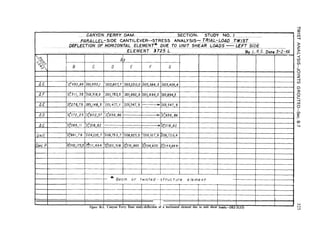
Canyon Ferry Dam study-deflection of a horizontal element due to unit
shear loads . . . . . . . . . . . . . . . . . . . . . . . .
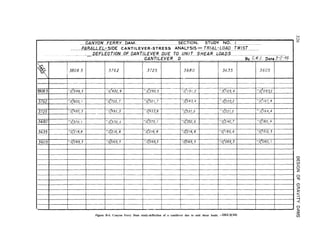
Canyon Ferry Dam study-deflection of a cantilever due to unit shear
loads . . . . . . . . . . . . . . . . . . . . . . . . . .
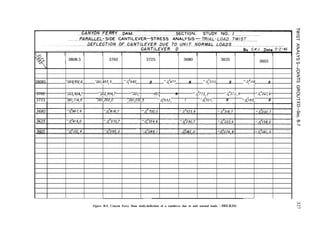
Canyon Ferry Dam study-deflection of a cantilever due to unit normal
loads . . . . . . . . . . . . . . . . . . . . . . . . . .
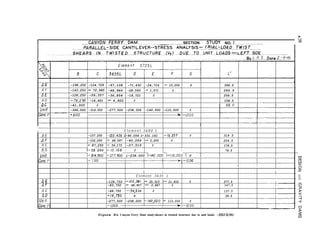
Canyon Ferry Dam study-shears in twisted structure due to unit loads . . .
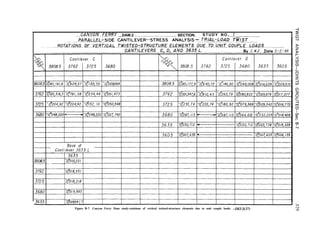
Canyon Ferry Dam study-rotations of vertical twisted-structure elements
due to unit couple loads . . . . . . . . . . . . . . . . . . . .
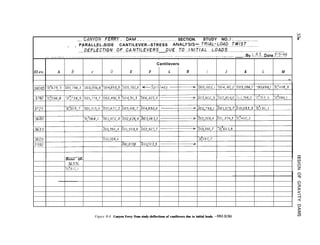
Canyon Ferry Dam study-deflection of cantilevers due to initial loads . . . .
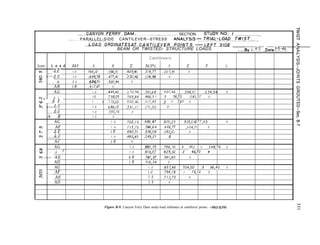
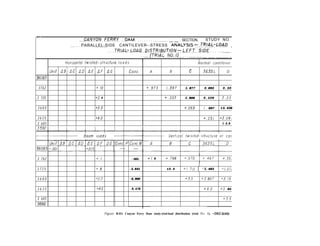
Canyon Ferry Dam Study-load ordinates at cantilever points . . . . . . .
Canyon Ferry Dam study-trial-load distribution (trial No. 1) . . . . . . .
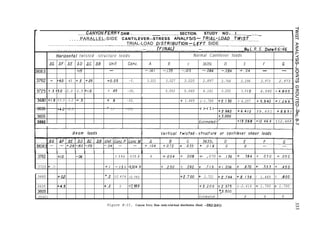
Canyon Ferry Dam study-trial-load distribution (final) . . . . . . . . .
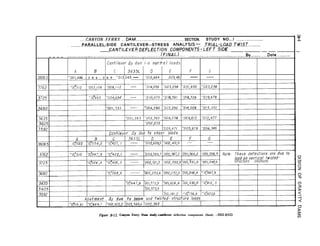
Canyon Ferry Dam study--cantilever deflection components (final) . . . . .
Canyon Ferry Dam study-total deflections (final) . . . . . . . . . . .
Canyon Ferry Dam study-shears in horizontal elements and rotations of
vertical elements due to twisted-structure load (final) . . . . . . . . .
Page
300
301
303
304
305
306
307
308
309
310
311
312
313
314
315
316
317
318
322
324
325
326
327
328
329
330
331
332
333
334
336
337
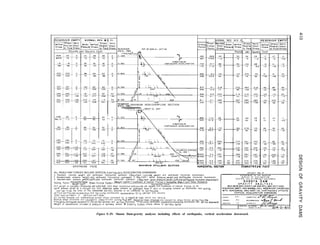
CONTENTS X X I X
Figure
B-15.
B-16.
B-17.
B-18.
B-19.
B-20.
B-21.
B-22.
B-23.
B-24.
B-25.
C-l.
c-2.
c-3.
c-4.
c-5.
C-6.
c-7.
C-8.
c-9.
c-10.
c-11.
C-l 2.
c-13.
c-14.
c-15.
C-16.
Page
Canyon Ferry Dam study-twisted-structure deflection due to rotations of
vertical element, and twisted-structure deflection due to beam loads
(final) . . . . . . . . . . . . . . . . . . . . . . . . . . 338
Canyon Ferry Dam study-beam deflection due to beam loads and abutment
rotations, and deflection of horizontal elements due to twisted-
structure loads (final) . . . . . . . . . . . . . . . . . . . . 339
Canyon Ferry Dam study-total beam and twisted-structure deflections
(final) . . . .
Canyon Ferry Dam study-bending moments in’beam due to trial loads ’ . ’ ’
341
(final), and total shear in horizontal elements due to trial loads
(final) . . . . . . . . . . . . . . . . . . . . . . . . . 342
Force normal to an inclined abutment plane . . . . . . . . . . . . . 343
Canyon Ferry Dam study-load distribution and adjustment on horizontal
elements . . . . . . . . . . . . . . . . . . . . . . . . . 344
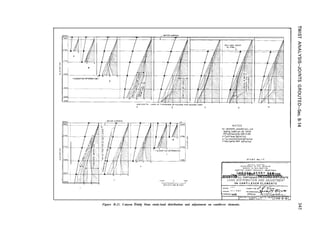
Canyon Ferry Dam study-load distribution and adjustment on cantilever
elements . . . . . . . . . . . . . . . . . . . . . . . . . 345
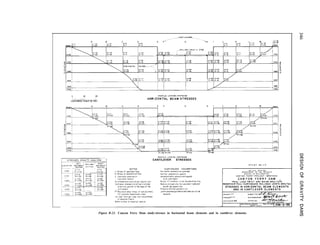
Canyon Ferry Dam study-stresses in horizontal beam elements and in
cantilever elements . . . . . . . . . . . . . . . . . . . . . 346
Canyon Ferry Dam study-principal stresses at upstream face of dam . . . . 347
Canyon Ferry Dam study-principal stresses at downstream face of
dam . . . . . . . . . . . . . . . . . . . . . . . . . . . 348
Canyon Ferry Dam study-sliding factors and shear-friction factors of
safety for trial-load and gravity analyses . . . . . . . . . . . . . . 349
Grid layout for section DG of Grand Coulee Forebay Dam, including
excavated cut slope along canyon wall at right . . . . . . . . . . . . 352
Two-dimensional input data-control data and material properties . . . . . 353
Two-dimensional input data-loading and description of section by nodal
points . . . . . . . . . . . . . . . . . . . . . . . . . . 354
Two-dimensional input data-elements defined by nodal points with
material . . . . . . . . . . . . . . . . . . . . . . . . . 355
Nodal point displacements (no treatment) . . . . . . . . . . . . . . 356
Nodal point displacements (25-foot treatment) . . . . . . . . . . . . 357
Stresses in elements (no treatment) . . . . . . . . . . . . . . . 359
Stresses in elements (25-foot treatment) . . . . . . . . . . . . . . . 360
Grand Coulee Forebay Dam foundation study-microfilm printout showing
principal stresses (no treatment) . . . . . . . . . . . . . . . . . 36 1
Grand Coulee Forebay Dam study-microfilm printout showing principal
stresses (25-foot treatment) . . . . . . . . . . . . . . .
Grand Coulee Forebay Dam study-microfilm printout showing vertical
361
stresses (25-foot treatment) . . . . . . . . . . . . . . . . . . 362
Grand Coulee Forebay Dam study-microfilm printout showing horizontal
stresses (25-foot treatment) . . . . . . . . . . . . . . . . . . 362
Grand Coulee Forebay Dam study-microfilm printout showing shear stresses
(25-foot treatment) . . . . . . . . . . . . . . . . . . . . . 363
Grand Coulee Forebay Dam study-three-dimensional finite element
grid . . . . . . . . . . . . . . . . . . . . . . . . . . . 364
Three-dimensional input data-control data and material properties . . . . . 365
Three-dimensional input data-description of section by nodal points . . . . 366
xxx CONTENTS
Figure
c-17.
C-18.
c-19.
D-l.
D-2.
D-3.
E-l.
E-2.
E-3.
E-4.
E-5.
E-6.
E-7.
E-8.
E-9.
E-10.
E-l 1.
E-12.
E-13.
E-14.
E-15.
E-16.
E-17.
E-18.
E-19.
E-20.
E-21.
E-22.
E-23.
E-24.
E-25.
E-26.
E-27.
Page
Three-dimensional input data-elements defined by nodal points with
material . . . . . . . . . . . . . . . . . . . . . . . . . 367
Three-dimensional input data-load vectors . . . . . . . . . . . . . 368
Grand Coulee Forebay Dam study-stresses at nodal points . . . . . . . . 369
Lattice analogy-equations for displacement of joint 0 . . . . . . . . . 375
Photoelastic study of foundation fault seam near downstream face of
Shasta Dam-reservoir full . . . . . . . . . . . . . . . . . . . 379
Relation of stress at toe of dam to depth and location of fault zone . . . . . 380
American Falls Dam gravity analyses of nonoverflow and spillway sections
including effects of earthquake accelerations . . . . . . . . . . . . 382
American Falls Dam-gravity analyses of nonoverflow and spillway
sections, normal conditions with ice load . . . . . . . . . . . . . . 383
Altus Dam-gravity analyses of maximum abutment and nonoverflow sections . 384
Altus Dam-gravity analyses of spillway sections . . . . . . . . . . . . 385
Keswick Powerplant Dam-gravity analyses of penstock section including
effects of earthquake accelerations . . . . . . . . . . . . . . . . 386
East Park Dam-plan, elevation, and maximum section . . . . . . . . . 387
East Park Dam-gravity analyses of maximum nonoverflow section . . . . . 388
East Park Dam-stresses, load distribution, and radial deflections from
trial-load analysis . . . . . . . . . . . . . . . . . . . . . . 389
Angostura Dam-plan, profile, and maximum section . . . . . . . . . . 390
Angostura Dam-stresses from trial-load beam and cantilever analysis . . . . 391
Angostura Dam-stability factors from trial-load beam and cantilever
analysis . . . . . . . . . . . . . . . . . . . . . . . . . 392
Black Canyon Diversion Dam-stresses for normal conditions from gravity
analyses . . . . . . . . . . . . . . . . . . . . . . . . . 393
Black Canyon Diversion Dam-gravity analyses including effects of
earthquake, vertical acceleration upward . . . . . . . . . . . . . . 394
Black Canyon Diversion Dam-gravity analyses including effects of
earthquake, vertical acceleration downward . . . . . . . . . . . . . 395
Kortes Dam-plan, elevation, and maximum section . . . . . . . . . . 396
Kortes Dam-stresses and load distribution from trial-load twist
analysis . . . . . . . . . . . . . . . . . . . . . . . . . 397
Kortes Dam-stability factors from trial-load twist analysis . . . . . . . . 398
Marshall Ford Dam-plan, elevation, and maximum sections . . . . . . . 399
Marshall Ford Dam-gravity analyses for normal conditions . . . . . . . . 400
Marshall Ford Dam-gravity analyses including effects of earthquake,
vertical acceleration upward . . . . . . . . . . . . . . . . . . 40 1
Marshall Ford Dam-gravity analyses including effects of earthquake,
vertical acceleration downward . . . . . . . . . . . . . . . . . 402
Elephant Butte Dam-gravity analyses for maximum flood condition . . . . 403
Elephant Butte Dam-gravity analyses including effects of earthquake
accelerations . . . . . . . . . . . . . . . . . . . . . . . . 404
Grand Coulee Dam-plan, elevation, and maximum sections . . . . . . . . 405
Grand Coulee Dam-stresses from trial-load twist and beam analysis . . . . . 406
Grand Coulee Dam-stability factors from trial-load twist and beam
analysis . . . . . . . . . . . . . . . . . . . . . . . . . 407
Shasta Dam-gravity analyses for normal conditions . . . . . . . . . . 408
CONTENTS xxx1
Fi&re
E-28.
E-29.
F-l.
F-2.
F-3.
F-4.
F-5.
F-6.
F-7.
F-8.
G-1.
G-2.
G-3.
G-4.
G-5.
G-6.
G-7.
G-8.
G-9.
G-10.
G-11.
G-12.
G-13.
G-14.
G-15.
G-16.
c-17.
G-18.
Shasta Dam-gravity analyses including effects of earthquake, vertical
acceleration upward . . . . . . . . . . . . . . . . .
Shasta Dam-gravity analyses including effects of earthquake, vertical
acceleration downward . . . . . . . . . . . . . . . .
Characteristics of open-channel flow . . . . . . . . . . . .
Depth of flow and specific energy for rectangular section in open
channel . . . . . . . . . . . . . . . . . . . . .
Energy-depth curves for rectangular and trapezoidal channels . . .
Critical depth in trapezoidal section . . . . . . . . . . . .
Characteristics of pressure flow in conduits . . . . . . . . .
Hydraulic jump symbols and characteristics . . . . . . . . .
Hydraulic jump properties in relation to Froude number . . . . .
Relation between variables in the hydraulic jump . . . . . . .
Analysis of observed rainfall data . . . . . . . . . . . . .
Rainfall-runoff curves-solution of runoff equation, Q =
(P - o.2s)2
p + 0,8s
(U.S. Soil Conservation Service) . . . . . . . . . . . . . .
Unit hydrograph principles . . . . . . . . . . . . . . . .
Three common approaches for estimating base flow discharges . . . .
Hydrograph analysis . . . . . . . . . . . . . . . . . . .
Unitgraph derivation for ungaged area . . . . . . . . . . . .
Comparison of results of streamflow routings . . . . . . . . . .
Example of summary sheet, “Storm Rainfall in the U.S.” . . . . .
Design storm-depth-duration values . . . . . . . . . . . . .
Probable maximum precipitation (inches) east of the 105’ meridian for
an area of 10 square miles and 6 hours’ duration . . . . . . . .
Depth-area-duration relationships-percentage to be applied to 10 square
miles, 6-hour probable maximum precipitation values . . . . . .
Distribution of 6-hour rainfall for area west of 105’ meridian (see
fig. G- 13 for area included in each zone) . . . . . . . . . . .
Probable maximum B-hour point precipitation values in inches for
general-type storms west of the 105’ meridian . . . . . . . . .
General-type storm-conversion ratio from 6-hour point rainfall to area
rainfall for area west of 10.5’ meridian . . . . . . . . . . .
Basin map-example of preliminary inflow design flood computation .
Preliminary design storm-depth-duration curve . . . . . . . . .
Example of preliminary inflow design flood hydrographs-same lag-time
curve for all unitgraphs . . . . . . . . . . . . . . . . .
Example of preliminary inflow design flood hydrograph-different lag-time
curve for each subarea . . . . . . . . . . . . . . . . .
Page
. . . 409
. . . 410
. . . 420
. . . 421
. . . 422
. . . 424
. . . 432
. . . 433
. . . 433
. . . 434
. . . 442
. . 450
. . . 454
. . . 456
. . . 458
. . . 463
. . . 470
. . . 474
. . . 479
. . 481
. . 482
. . 483
. . , 484
. . , 485
. . . 486
. . 489
. . . 495
. . . 497
<<Chapter I
Introduction
l-l. Scope.-A concrete gravity dam, as
discussed in this manual, is a solid concrete
structure so designed and shaped that its
weight is sufficient to ensure stability against
the effects of all imposed forces. Other types
of dams exist which also maintain their
stability through the principle of gravity, such
as buttress and hollow gravity dams, but these
are outside the scope of this book. Further,
discussions in this manual are limited to dams
on rock foundations and do not include smaller
dams generally less than 50 feet high which are
discussed in the Bureau of Reclamation
publication “Design of Small Dams”] 11 ’ .
The complete design of a concrete gravity
dam includes not only the determination of the
most efficient and economical proportions for
the water impounding structure, but also the
determination of the most suitable appurtenant
structures for the control and release of the
impounded water consistent with the purpose
or function of the project. This manual
presents the basic assumptions, design
considerations, methods of analysis, and
procedures used by designers within the
Engineering and Research Center, Bureau of
Reclamation, for the design of a gravity dam
and its appurtenances.
1-2. Classifications. -Gravity dams may be
classified by plan as straight gravity dams and
curved gravity dams, depending upon the axis
alinement. The principal difference in these
two classes is in the method of analysis.
Whereas a straight gravity dam would be
analyzed by one of the gravity methods
discussed in this manual (ch. IV), a curved
‘Numbers in brackets refer to items in the bibliography, sec.
l-5.
gravity dam would be analyzed as an arch dam
structure, as discussed in the Bureau’s manual
“Design of Arch Dams”[ 21 . For statistical
purposes, gravity dams are classified with
reference to their structural height. Dams up to
100 feet high are generally considered as low
dams, dams from 100 to 300 feet high as
medium-height dams, and dams over 300 feet
high as high dams.
l-3. General Dimensions. -For uniformity
within the Bureau of Reclamation, certain
general dimensions have been established and
are defined as follows:
The structural height of a concrete gravity
dam is defined as the difference in elevation
between the top of the dam and the lowest
point in the excavated foundation area,
exclusive of such features as narrow fault
zones. The top of the dam is the crown of the
roadway if a roadway crosses the dam, or the
level of the walkway if there is no roadway.
Although curb and sidewalk may extend higher
than the roadway, the level of the crown of the
roadway is considered to be the top of the
dam.
The hydraulic height, or height to which the
water rises behind the structure, is the
difference in elevation between the lowest
point of the original streambed at the axis of
the dam and the maximum controllable water
surface.
The length of the dam is defined as the
distance measured along the axis of the dam at
the level of the top of the main body of the
dam or of the roadway surf:iLs, on the crest,
from abutment contact to sbutment contact,
exclusive of abutment spillway; provided that,
if the spillway lies wholly within the dam and
1
2 DESIGN OF GRAVITY DAMS
would appear if cut by a plane. A beam section
is taken horizontally through the dam. A
cantilever section is a vertical section taken
normal to the axis and usually oriented with
the reservoir to the left.
A beum element, or beam, is a portion of a
gravity dam bounded by two horizontal planes
1 foot apart. For purposes of analysis the edges
of the elements are assumed to be vertical.
A cantilever element, or cantilever, is a
portion of a gravity dam bounded by two
vertical planes normal to the axis and 1 foot
apart,
A twisted structure consists of vertical
elements with the same structural properties as
the cantilevers, and of horizontal elements with
the same properties as the beams. The twisted
structure resists torsion in both the vertical and
horizontal planes.
The height of a cantilever is the vertical
distance between the base elevation of the
cantilever section and the top of the dam.
The thickness of a dam at any point is the
distance between upstream and downstream
faces along a line normal to the axis through
the point.
The abutment of a beam element is the
surface, at either end of the beam, which
contacts the rock of the canyon wall.
The crest of a dam is the top of the dam.
l-5. Bibliography.
[I] “Design of Small Dams,” second edition, Bureau of
Reclamation, 1973.
[2] “ D e s i g n o f A r c h D a m s , ” f i r s t e d i t i o n , B u r e a u o f
Reclamation, 1976.
not in any area especially excavated for the
spillway, the length is measured along the axis
extended through the spillway to the abutment
contacts.
The volume of a concrete dam should
include the main body of the dam and all mass
concrete appurtenances not separated from the
dam by construction or contraction joints.
Where a powerplant is constructed on the
downstream toe of the dam, the limit of
concrete in the dam should be taken as the
downstream face projected to the general
excavated foundation surface.
l-4. Gravity Dam Definitions. -Terminology
relating to the design and analysis of gravity
dams and definitions of the parts of gravity
dams as used in this manual are as follows:
A plan is an orthographic projection on a
horizontal plane, showing the main features of
a dam and its appurtenant works with respect
to the topography and available geological
data. A plan should be oriented so that the
direction of streamflow is toward the top or
toward the right of the drawing.
A profile is a developed elevation of the
intersection of a dam with the original ground
surface, rock surface, or excavation surface
along the axis of the dam, the upstream face,
the downstream face, or other designated
location.
The axis of the dam is a vertical reference
plane usually defined by the upstream edge of
the top of the dam.
A section is a representation of a dam as it
<<Chapter II
Design Considerations
2-1. General. -Although not of immediate
concern to the designer of a dam and its
appurtenances, the early collection of data on
local conditions which will eventually relate to
the design, specifications, and construction
stages is advisable. Local conditions are not
only needed to estimate construction costs, but
may be of benefit when considering alternative
designs and methods of construction. Some of
these local conditions will also be used to
determine the extent of the project designs,
including such items as access roads, bridges,
and construction camps.
2-2. Data to be Submitted.-Local
conditions should be described and submitted
as part of the design data as follows:
(1) The approximate distance from the
nearest railroad shipping terminal to the
structure site; load restrictions and physical
A. LOCAL CONDITIONS
inadequacies of existing roads and structures
a n d a n estimate of improvements to
accommodate construction hauling; an
estimate of length and major structures for
access roads; and possible alternative means for
delivering construction materials and
equipment to the site.
(2) Local freight or trucking facilities and
rates.
(3) Availability of housing and other
facilities in the nearest towns; requirements for
a construction camp; and need for permanent
buildings for operating personnel.
(4) Availability or accessibility of public
facilities or utilities such as water supply,
sewage d i s p o s a l , e l e c t r i c p o w e r f o r
construction purposes, and telephone service.
( 5 ) L o c a l l a b o r p o o l a n d g e n e r a l
occupational fields existing in the area.
B. MAPS AND PHOTOGRAPHS
2-3. General.-Maps and photographs are of
prime importance in the planning and design of
a concrete dam and its appurtenant works.
From these data an evaluation of alternative
l a y o u t s c a n be made preparatory to
determining the final location of the dam, the
type and location of its appurtenant works,
a n d t h e n e e d f o r r e s t o r a t i o n a n d / o r
development of the area.
2-4. Survey Control. -Permanent horizontal
and vertical survey control should be
established at the earliest possible time. A grid
coordinate system for horizontal control
should be established with the origin located so
that all of the features (including borrow areas)
at d major structure will be in one quadrant.
The coordinate system should be related to a
State or National coordinate system, if
practicable. All previous survey work, including
topography and location and ground surface
elevation of subsurface exploration holes,
should be corrected to agree with the
permanent control system; and all subsequent
survey work, including location and ground
3
4
surface elevations, should be based on the
permanent control,
2-5. Data to be Submitted. -A general area
map should be obtained locating the general
area within the State, together with county and
township lines. This location map should show
existing towns, highways, roads, railroads, and
shipping points. A vicinity map should also be
obtained using such a scale as to show details
on the following:
(1) The structure site and alternative
sites.
(2) Public utilities.
(3) Stream gaging stations.
(4) Existing manmade works affected
by the proposed development.
(5) Locations of potential construction
access roads, sites for a Government camp
and permanent housing area, and sites for
the contractor’s camp and construction
facilities.
(6) Sources of natural construction
materials.
(7) Existing or potential areas or
features having a bearing on the design,
construction, operation, or management
of project features such as recreational
areas, fish and wildlife areas, building
areas, and areas of ecological interest.
The topography of the areas where the dam
and any of its appurtenant works are to be
located is of prime concern to the designer.
DESIGN OF GRAVITY DAMS
Topography should be submitted covering an
area sufficient to accommodate all possible
arrangements of dam, spillway, outlet works,
diversion works, construction access, and other
facilities; and should be based on the
permanently established horizontal and vertical
survey control. A scale of 1 inch equals 50 feet
and a contour interval of 5 feet will normally
be adequate. The topography should extend a
m i n i m u m o f 5 00 feet upstream and
downstream from the estimated positions of
the heel and toe of the dam and a sufficient
distance beyond each end of the dam crest to
include road approaches. The topography
should also cover the areas for approach and
exit channels for the spillway. The topography
should extend to an elevation sufficiently high
to permit layouts of access roads, spillway
structures, and visitor facilities.
Ground and aerial photographs are beneficial
and can be used in a number of ways. Their
principal value is to present the latest data
relating to the site in such detail as to show
conditions affecting the designs. Close-up
ground photographs, for example, will often
give an excellent presentation of local geology
t o s u p p l e m e n t that obtained from a
topographic map. Where modifications are to
be made to a partially completed structure,
such photographs will show as-constructed
details which may not show on any drawings.
C. HYDROLOGIC DATA
2-6. Data to be Submitted.-In order to
determine the potential of a site for storing
water, generating power, or other beneficial
use, a thorough study of hydrologic conditions
must be made. Necessary hydrologic data will
include the following:
(1) Streamflow records, including daily
discharges, monthly volumes, and
momentary peaks.
(2) Streamflow and reservoir yield.
(3) Project water requirements,
including allowances for irrigation and
power, conveyance losses, reuse of return
flows, and stream releases for fish; and
dead storage requirements for power,
recreation, fish and wildlife, etc.
(4) Flood studies, including inflow
design floods and floods to be expected
during periods of construction.
(5) Sedimentation and water quality
studies, including sediment measurements,
analysis of dissolved solids, etc.
(6) Data on ground-water tables in the
vicinity of the reservoir and damsite.
(7) Water rights, including interstate
compacts and international treaty effects,
DESIGN CONSIDERATIONS-Sec. 2-7
and contractual agreements with local
d i s t r i c t s , p o w e r c o m p a n i e s , a n d
individuals for subordination of rights,
etc.
Past records should be used as a basis for
predicting conditions which will develop in the
future. Data relating to streamflow may be
obtained from the following sources:
( 1 ) W a t e r s u p p l y p a p e r s - U . S .
Department of the Interior, Geological
Survey, Water Resources Division.
(2) Reports of state engineers.
(3) Annual reports-International
Boundary and Water Commission, United
States and Mexico. .
(4) Annual reports-various interstate
compact commissions.
(5) Water right filings, permits-state
engineers, county recorders.
(6) Water right decrees-district courts.
Data on sedimentation may be obtained
from:
( 1 ) W a t e r s u p p l y p a p e r s - U . S .
Department of the Interior, Geological
Survey, Quality of Water Branch.
(2) Reports-U.S. Department of the
Interior, Bureau of Reclamation; and U.S.
Department of Agriculture, Soil
Conservation Service.
Data for determining the quality of the
water may be obtained from:
( 1 ) W a t e r s u p p l y p a p e r s - U . S .
Department of the Interior, Geological
Survey, Quality of Water Branch.
(2) Reports-U.S. Department of
Health, Education, and Welfare, Public
Health Service, and Environmental
Protection Agency, Federal Water Control
Administration.
(3) Reports-state public health
departments.
2-7. Hydrologic Investigations. -Hydrologic
investigations which may be required for
project studies include the determination of
the following: yield of streamflow, reservoir
yield, water requirements for project purposes,
sediment which will be deposited in the
reservoir, f loodflows, and ground-water
conditions.
The most accurate estimate possible must be
5
prepared of the portion of the streamflow yield
that is surplus to senior water rights, as the
basis of the justifiable storage. Reservoir
storage will supplement natural yield of
streamflow during low-water periods. Safe
reservoir yield will be the quantity of water
which can be delivered on a firm basis through
a critical low-water period with a given
reservoir capacity. Reservoir capacities and safe
reservoir yields may be prepared from mass
curves of natural streamflow yield as related to
fixed water demands or from detailed reservoir
operation studies, depending upon the study
detail which is justified. Reservoir evaporation
and other incidental losses should be accounted
for before computation of net reservoir yields.
The critical low-water period may be one
drought year or a series of dry years during the
period of recorded water history. Water
shortages should not be contemplated when
considering municipal and industrial water use.
For other uses, such as irrigation, it is usually
permissible to assume tolerable water shortages
during infrequent drought periods and thereby
increase water use during normal periods with
consequent greater project development. What
would constitute a tolerable irrigation water
shortage will depend upon local conditions and
the crops to be irrigated. If the problem is
complex, the consulting advice of an
experienced hydrologist should be secured.
The annual rate at which sediment will be
deposited in the reservoir should be ascertained
to ensure that sufficient sediment storage is
provided in the reservoir so that the useful
functions of the reservoir will not be impaired
by sediment deposition within the useful life of
the project or the period of economic analysis,
say 50 to 100 years. The expected elevation of
the sediment deposition may also influence the
design of the outlet works, necessitating a type
of design which will permit raising the intake
of the outlet works as the sediment is
deposited.
Water requirements should be determined
for all purposes contemplated in the project.
For irrigation, consideration should be given to
climatic conditions, soil types, type of crops,
crop distribution, irrigation efficiency and
conveyance losses, and reuse of return flows.
6 D E S I G N O F G R A V I T Y D A M S
evapotranspiration are also used in assessing the
disposition of water in an irrigation project,
evaluating the irrigation water-management
efficiency, a n d p r o j e c t i n g d r a i n a g e
requirements.
Reliable rational equations are available for
estimating evapotranspiration when basic
meteorological parameters such 2lS net
radiation, vapor pressure and temperature
gradients, wind speed at a prescribed elevation
above the crops or over a standard surface, and
soil heat flux are available. When information
on these parameters is not available, which is
the usual case, recourse is made to empirical
methods. Numerous equations, both empirical
and partially based on theory, have been
d e v e l o p e d f o r e s t i m a t i n g potential
evapotranspiration. Estimates from these
methods are generally accepted as being of
suitable accuracy for planning and developing
water resources. Probably the methods most
widely used at this time are the BlaneyCriddle
method shown in reference [ 11’ and the Soil
Conservation Service adaptation of the
Blaney-Criddle method, shown in reference
121.
A more recent method, nearly developed
sufficiently for general usage, is the
Jensen-Haise solar radiation method shown in
reference [ 31 . In general terms, these methods
utilize climatic data to estimate a climatic
index. Then coefficients, reflecting the stage of
growth of individual crops and their actual
water requirement in relationship to the
climatic index, are used t o e s t i m a t e the
consumptive use requirements for selected
crops.
Project studies must include estimates of
floodflows, as these are essential to the
de termination of the spillway capacity.
Consideration should also be given to annual
minimum and mean discharges and to the
magnitudes of relatively common floods having
20-, lo-, and 4-percent chances of occurrence,
as this knowledge is essential for construction
purposes such as diverting the stream,
providing cofferdam protection, and scheduling
‘Numbers in brackets refer to items in the bibliography, sec.
2-31.
For municipal and industrial water supplies,
the anticipated growth of demand over the life
of the project must be considered. For power
generation, the factors to be considered are
load requirements and anticipated load growth.
Knowledge of consumptive uses is important
in the design and operation of a large irrigation
project, and especially for river systems as a
whole. However, of equal and perhaps more
importance to an individual farm or project is
the efficiency with which the water is
conveyed, distributed, and applied. The losses
incidental to application on the farm and the
conveyance system losses and operational
waste may, in many instances, exceed the
water required by the growing crops. In actual
operation, the amount of loss is largely a
matter of economics. In areas where water is
not plentiful and high-value crops are grown,
the use of pipe or lined conveyance systems
and costly land preparation or sprinkler
systems can be afforded to reduce losses to a
minimum. A part of the lost water may be
consumed nonbeneficially by nonproductive
areas adjacent to the irrigated land or in
drainage channels. Usually most of this water
eventually returns to a surface stream or drain
and is referred to as return flow.
I n p l a n n i n g irrigation projects, two
consumptive use values are developed. One,
composed of monthly or seasonal values, is
u s e d w i t h a n adjustment for effective
precipitation and anticipated losses mentioned
above to determine the total water requirement
for appraising the adequacy of the total water
supply and determining reservoir storage
requirements. The other, a peak use rate, is
used for sizing the canal and lateral system.
Evapotranspiration, commonly called
consumptive use, is defined as the sum of
evaporation from plant and soil surfaces and
transpiration from plants and is usually
expressed in terms of depth (volume per unit
area). Crop consumptive use is equal to
evapotranspiration plus water required for
plant tissue, but the two are usually considered
the same. Predictions or estimates of
evapotranspiration are basic parameters for the
engineer or agronomist involved in planning
and developing water resources. Estimates of
DESIGN CONSIDERATIONS-Sec. 2-8
operations. Methods of arriving at estimates of
floodflows are discussed in appendix G. If the
feasibility studies are relatively complete, the
flood determination may be sufficient for
design purposes. If, however, floodflows have
been computed for purposes of the feasibility
study without making full use of all available
data, these studies should be carefully reviewed
and extended in detail before the actual design
of the structure is undertaken. Frequently, new
data on storms, floods, and droughts become
available between the time the feasibility
studies are made and construction starts. Where
such changes are significant, the flood studies
should be revised and brought up to date.
7
Project studies should also include a
ground-water study, which may be limited
largely to determining the effect of ground
water on construction methods. However,
some ground-water situations may have an
important bearing on the choice of the type of
dam to be constructed and on the estimates of
t h e c o s t o f f o u n d a t i o n s . I m p o r t a n t
ground-water information sometimes can be
obtained in connection with subsurface
investigations of foundation conditions.
As soon as a project appears to be feasible,
steps should be taken in accordance with State
water laws to initiate a project water right.
D. RESERVOIR CAPACITY AND OPERATION
2-8. General. -Dam designs and reservoir
operating criteria are related to the reservoir
capacity and anticipated reservoir operations.
The loads and loading combinations to be
applied to the dam are derived from the several
standard reservoir water surface elevations.
Reservoir operations are an important
consideration in the safety of the structure and
should not be overlooked in the design.
Similarly, the reservoir capacity and reservoir
operations are used to properly size the
spillway and outlet works. The reservoir
capacity is a major factor in flood routings and
may determine the size and crest elevation of
the spillway. The reservoir operation and
reservoir capacity allocations will dctcrmine
the location and size of outlet works for the
controlled release of water for downstream
requirements and flood control.
Reservoir area-capacity tables should be
prepared before the final designs and
specifications are completed. These
area-capacity tables should be based upon the
best available topographic data and should be
the official document for final design and
administrative purposes until superseded by a
reservoir r e survey. Electronic computer
programs are an aid in preparation of reservoir
area and capacity data. These computers enable
the designer to quickly have the best results
obtainable from the original field data.
2-9. Reservoir Allocation DefinitiompTo
ensure uniform reporting of data for design and
construction, the following standard
designations of water surface elevations and
reservoir capacity allocations are used by the
Bureau of Reclamation:
(a) General. Dam design and reservoir
operation utilize reservoir capacity and water
surface elevation data. To ensure uniformity in
the establishment, use, and publication of these
data, the following standard definitions of
water surface elevations and reservoir capacities
shall be used. Reservoir capacity as used here is
exclusive of bank storage capacity.
(b) Water Surface Elevation Definitions.
(Refer to fig. 2-l .)
(1) Maximum Water Surface is the
highest ‘acceptable water surface elevation
with all factors affecting the safety of the
structure considered. Normally, it is the
highest water surface elevation resulting
from a computed routing of the inflow
design flood through the reservoir on the
basis of established operating criteria. It is
the top of surcharge capacity.
(2) Top of Exclusive Flood Control
Capacity is the reservoir water surface
elevation at the top of the reservoir capacity
allocated to exclusive use for regulation of
8 DESIGN OF GRAVITY DAMS
RESERVOIR CAPACITY ALLOCATIONS
PE OF DAM
ERATED B Y
EST LENGTH FT; CREST WIDTH
LUME OF DAM
NSTRUCTION PERIOD
REAM
S AREA ACRES AT EL
IGINATED BY:
1 REGION 1 STATE
RESERVOII
F T DA1
CU YD PROJECl
DIVISIOI
UNI-
STATUS OF DAI
APPROVED BY:
(Code) (Date) (Code) (Date)
FLOODCONTROL
A.F.
JOINT USE
A.F.
A.F.
A.F.
A.F.
b LOWEST POINT OF FOUNDATION EXCAVATION E L - - - - - -
0 Includes- _ _ _ _ _ _ _ _ _ _ a.f. allowance for- ._ _ _ _ year sediment deposition between
strearl,bed and EL _ _ _ _ _ _ _, of which- _ _ _ _ _ _ -a.f’. is above El- - - - _ - -.
@ Establishedby----- ----_ - - - - - - - - - - - ----_-----
FERENCES AND COMMENTS:
Figure 2-1. Reservoir capacity allocation sheet used by Bureau of Reclamation.
DESIGN CONSIDERATIONS-Sec. 2-9 9
flood i n f l o w s t o r e d u c e d a m a g e
downstream.
(3) Maximum Controllable Water
Surface Elevation is the highest reservoir
water surface elevation at which gravity
flows from the reservoir can be completely
shut off.
(4) Top of Joint Use Capacity is the
reservoir water surface elevation at the top
of the reservoir capacity allocated to joint
use, i.e., flood control and conservation
purposes.
(5) Top of Active Conservation
Capacity is the reservoir water surface
elevation at the top of the capacity allocated
to the storage of water for conservation
purposes only.
(6) Top of Inactive Capacity is the
reservoir water surface elevation below
which the reservoir will not be evacuated
under normal conditions.
(7) Top of Dead Capacity is the lowest
elevation in the reservoir from which water
can bc drawn by gravity.
(8) Streambed at the Dam Axis is the
elevation of the lowest point in the
streambed at the axis of the dam prior to
construction. This elevation normally
defines the zero for the area-capacity tables.
(c) Capacity Definitions.
(1) Surcharge Capacity is reservoir
capacity provided for use in passing the
inflow design flood through the reservoir. It
is the reservoir capacity between the
maximum water surface elevation and the
highest of the following elevations:
a. Top of exclusive flood control
capacity.
b. Top of joint use capacity.
c. Top of active conservation
capacity.
(2) Total Capacity is the reservoir
capacity below the highest of the elevations
representing the top of exclusive flood
control capacity, the top of joint use
capacity, or the top of active conservation
capacity. In the case of a natural lake which
has been enlarged, the total capacity
includes the dead capacity of the lake. If the
dead capacity of the natural lake has not
been measured, specific mention of this fact
should be made. Total capacity is used to
express the total quantity of water which
can be impounded and is exclusive of
surcharge capacity.
(3) Live Capacity is that part of the
total capacity from which water can be
withdrawn by gravity. It is equal to the total
capacity less the dead capacity.
(4) Active Capacity is the reservoir
capacity normally usable for storage and
regulation of reservoir inflows to meet
established reservoir operating requirements.
Active capacity extends from the highest of
the top of exclusive flood control capacity,
the top of joint use capacity, or the top of
active conservation capacity, to the top of
inactive capacity. It is the total capacity less
the sum of the inactive and dead capacities.
(5) Exclusive Flood Control Capucity
is the reservoir capacity assigned to the sole
purpose of regulating flood inflows to
reduce flood damage downstream. In some
instances the top of exclusive flood control
capacity is above the maximum controllable
water surface elevation.
(6) Joint Use Capacity is the reservoir
capacity assigned to flood control purposes
during certain periods of the year and to
conservation purposes during other periods
of the year.
(7) Active Conservation Capacity is the
reservoir capacity assigned to regulate
reservoir inflow for irrigation, power,
municipal and industrial use, fish and
wildlife, navigation, recreation, water
quality, and other purposes. It does not
include exclusive flood control or joint use
capacity. The active conservation capacity
extends from the top of the active
conservation capacity to the top of the
inactive capacity.
(8) Inactive Capacity is the reservoir
capacity exclusive of and above the dead
capacity from which the stored water is
normally not available because of operating
agreements or physical restrictions. Under
abnormal conditions, such as a shortage of
water or a requirement for structural repairs,
water may be evacuated from this space
10
after obtaining proper authorization. The
highest applicable water surface elevation
described below usually determines the top
of inactive capacity.
a . T h e l o w e s t w a t e r s u r f a c e
elevation at which the planned minimum
rate of release for water supply purposes
can be made to canals, conduits, the river,
or other downstream conveyance. This
elevation is normally established during
the planning and design phases and is the
elevation at the end of extreme drawdown
periods.
b. The established minimum water
surface elevation for fish and wildlife
purposes.
c. The established minimum water
surface elevation for recreation purposes.
d. The minimum water surface
elevation as set forth in compacts and/or
agreements with political subdivisions.
e. The minimum water surface
elevation at which the powerplant is
designed to operate.
f. The minimum water surface
elevation to which the reservoir can be
d r a w n u s i n g established operating
procedures without endangering the dam,
appurtenant structures, or reservoir
shoreline.
g. The minimum water surface
elevation or the top of inactive capacity
established by legislative action.
(9) Dead Capacity is the reservoir
capacity from which stored water cannot be
evacuated by gravity.
2-10. Data to be Submitted.-To complete
DESIGN OF GRAVITY DAMS
the designs of the dam and its appurtenant
works, the following reservoir design data
should be submitted:
( 1) Area-capacity curves and/or tables
computed to an elevation high enough to allow
for storage of the spillway design flood.
(2) A topographic map of the reservoir site
prepared to an appropriate scale.
(3) Geological information pertinent to
reservoir tightness, locations of mines or
mining claims, locations of oil and natural gas
wells.
(4) Completed reservoir storage allocations
and corresponding elevations.
(5) Required outlet capacities for respective
reservoir water surfaces and any required sill
elevations. Give type and purpose of reservoir
releases and the time of year these must be
made. Include minimum releases required.
(6) Annual periodic fluctuations of reservoir
levels shown by tables or charts summarizing
reservoir operation studies.
(7) Method of reservoir operation for flood
control and maximum permissible releases
consistent with safe channel capacity.
(8) Physical, economic, or legal limitations
to maximum reservoir water surface.
(9) Anticipated occurrence and amounts of
ice (thickness) and floating debris, and possible
effect on reservoir outlets, spillway, and other
appurtenances.
(10) Extent of anticipated wave action,
including a discussion of wind fetch.
(11) Where maintenance of flow into
existing canals is required, determine maximum
and probable carrying capacity of such canal,
and time of year when canals are used.
E. CLIMATIC EFFECTS
2- 1 1. General. -The climatic conditions since weather affects the rate of construction
which are to be encountered at the site affect and the overall construction schedule.
the design and construction of the dam. Accessibility of the site during periods of
Measures which should be employed during the inclement weather affects the construction
construction period to prevent cracking of schedule and should be investigated.
concrete must be related to the ambient 2-12. Data to be Submitted.-The following
temperatures encountered at the site. data on climatic conditions should be
Construction methods and procedures may also submitted as part of the design data:
be dependent upon the weather conditions, ( 1) Weather Service records of mean
DESIGN CONSIDERATIONS-Sec. 2-13 II
monthly maximum, mean monthly minimum, (3) Daily readings of maximum and
and mean monthly air temperatures for the minimum river water temperatures should be
nearest station to the site. Data on river water submitted as soon as a station can be
temperatures at various times of the year established at the site.
should also be obtained. (4) Amount and annual variance in rainfall
( 2) Daily readings of maximum and and snowfall.
minimum air temperatures should be submitted (5) Wind velocities and prevailing direction.
as soon as a station can be established at the
site.
F. CONSTRUCTION MATERIALS
2- 1 3 . C o n c r e t e A g g r e g a t e s . - T h e
construction of a concrete dam requires the
availability of suitable aggregates in sufficient
quantity to construct the dam and its
appurtenant structures. Aggregates are usually
processed from natural deposits of sand, gravel,
and cobbles. However, if it is more practical,
they may be crushed from suitable rock. For
small dams, the aggregates may be obtained
from existing commercial sources. If the
aggregates are obtained from borrow pits or
rock quarries, provisions should be made to
landscape and otherwise restore the areas to
minimize adverse environmental effects. If
aggregates are available from the reservoir area,
particularly below minimum water surface,
their adverse effects would be minimized.
However, any early storage in the reservoir,
prior to completion of the dam, may rule out
the use of aggregate sources in the reservoir.
2 - 1 4 . W a t e r f o r C o n s t r u c t i o n
Purposes.-For large rivers, this item is
relatively unimportant except for quality of
the water. For small streams and offstream
reservoirs, water for construction purposes may
be difficult to obtain. An adequate supply of
water for construction purposes such as
washing aggregates and cooling and batching
concrete should be assured to the contractor,
and the water rights should be obtained for
him. If necessary to use ground water,
information on probable sources and yields
should be obtained. Information on locations
and yields of existing wells in the vicinity,
restrictions if any on use of ground water, and
necessary permits should also be obtained.
2-l 5. Data to be Submitted. -In addition to
the data on concrete aggregates and water for
construction purposes, the following data on
construction materials should be obtained:
(1) An earth materials report containing
information on those potential sources of soils,
sand, and gravel which could be used for
backfill and bedding materials.
(2) Information on riprap for protection of
slopes.
(3) Information on sources and character of
acceptable road surfacing materials, if required.
(4) References to results of sampling,
testing, and analysis of construction materials.
(5) Photographs of sources of construction
materials.
(6) Stbtement of availability of lumber for
structural work.
G. SITE SELECTION
2 - 1 6 . General.-A water resources Once the purpose and the service area are
development project is designed to perform a defined, a preliminary site selection can be
certain function and to serve a particular area. made.
12
Following the determination of the
adequacy of the water supply as discussed in
subchapter C, the two most important
considerations in selecting a damsite are: (1)
ilie site must be adequate to support the dam
and the appurtenant structures, and (2) the
area upstream from the site must be suitable
for a reservoir. There are often several suitable
sites along a river where the dam can be
located.
The site finally selected should be that
where the dam and reservoir can be most
economically constructed with a minimum of
interfcrencc with local conditions and still
serve their intended purpose. An experienced
engineer can usually eliminate some of the sites
from further consideration. Cost estimates may
be required to determine which of the
remaining sites will provide the most
economical structure.
2-17. Factors in Site Selection. -In selecting
a damsite the following should be considered:
Topography A narrow site will minimize the
amount of material in the dam
thus reducing its cost, but
such a site may be adaptable
to an arch dam and this pos-
sibility should be investi-
gated.
Geology The foundation of the dam
should be relatively free of
DESIGN OF GRAVITY DAMS
major faults and shears. If
these are present, they may
require expensive foundation
treatment to assure an ade-
quate foundation.
Appurtenant While the cost of these struc-
Structures tures is usually less than
the cost of the dam, economy
in design may be obtained by
considering their effect at
the time of site selection.
For example, if a river has
a large flow, a large spill-
way and diversion works will
be required. Selecting a
site which will better accom-
modate these appurtenances
will reduce the overall cost.
Local Some sites may have roads, rail-
Conditions roads, powerlines, canals,
etc., which have to be relo-
cated, thus increasing the
overall costs.
Access Accessibility of the site has
a very definite effect on the
total cost. Difficult access
may require the construction
of expensive roads. An area
suitable for the contractor’s
plant and equipment near the
site will reduce the contrac-
tor’s construe tion costs.
H. CONFIGURATION OF DAM
2-l 8. Nonoverflow Section. -A gravity dam
is a concrete structure designed so that its
weight and thickness insure stability against all
the imposed forces. The downstream face will
usually be a uniform slope which, if extended,
would intersect the vertical upstream face at or
near the maximum reservoir water level. The
upper portion of the dam must be thick
enough to resist the shock of floating objects
and to provide space for a roadway or other
required access. The upstream face will
normally be vertical. This concentrates most of
the concrete weight near the upstream face
where it will be most effective in overcoming
tensile stresses due to the reservoir water
loading. The thickness is also an important
factor in resistance to sliding and may dictate
the slope of the downstream face. Thickness
may also be increased in the lower part of the
dam by an upstream batter.
2-19. Overflow Section.-The spillway may
be located either in the abutment or on the
dam. If it is located on a portion of the dam,
the section should be similar to the abutment
section but modified at the top to
accommodate the crest and at the toe to
DESIGN CONSIDERATIONS-Sec. 2-20 13
accommodate the energy dissipator. The may involve some changes from the theoretical
elevation of the crest and its shape will be hydraulic shapes. Hydraulic design of the
determined by hydraulic requirements, and the overflow section is discussed fully in chapter
shaping at the toe by the energy dissipator. IX. For structural design of the dam see
Stability requirements for the overflow section chapters III and IV.
I. FOUNDATION INVESTIGATIONS
2 - 2 0 . P u r p o s e . - T h e p u r p o s e o f a
foundation investigation is to provide the data
necessary to properly evaluate a foundation. A
properly sequenced and organized foundation
investigation will provide the data necessary to
evaluate and analyze the foundation at any
stage of investigation.
2-21. Field Investigations.-The collection,
study, and evaluation of foundation data is a
continuing program from the time of the
appraisal investigation to the completion of
construction. The data collection begins with
an appraisal and continues on a more detailed
basis through the design phase. Data are also
collected continuously during construction to
correlate with previously obtained information
and to evaluate the need for possible design
changes.
(a) Appraisal Investigation.-The appraisal
investigation includes a preliminary selection of
the site and type of dam. All available geologic
and topographic maps, photographs of the site
area, and data from field examinations of
natural outcrops, road cuts, and other surface
conditions should be utilized in the selection of
the site and preliminary evaluation of the
foundation.
The amount of investigation necessary for
appraisal will vary with the anticipated
difficulty of the foundation. In general, the
investigation should be sufficient to define the
major geologic conditions with emphasis on
those which will affect design. A typical
geologic map and profile are shown on figures
2-2 and 2-3.
The geologic history of a site should be
thoroughly studied, particularly where the
geology is complex. Study of the history may
a s s i s t i n recognizing and adequately
investigating hidden but potentially dangerous
foundation conditions.
Diamond core drilling during appraisal
investigations may be necessary in more
complex foundations and for the foundations
for larger dams. The number of drill holes
required will depend upon the area1 extent and
complexity of the foundation. Some
foundations may require as few as three or four
drill holes to define an uncertain feature.
Others may require substantially more drilling
to determine foundation treatment for a
potentially dangerous foundation condition.
Basic data that should be obtained during
the appraisal investigation, with refinement
continuing until the construction is complete,
are :
(1) Dip, strike, thickness, composition, and
extent of faults and shears.
(2) Depth of overburden.
(3) Depth of weathering.
(4) Joint orientation and continuity.
(5) Lithology throughout the foundation.
(6) Physical properties tests of the
foundation rock. Tests performed on similar
foundation materials may be used for
estimating the properties in the appraisal
phase.
(b) Feasibility Investigation. -During the
feasibility phase, the location of the dam is
usually finalized and the basic design data are
firmed up. The geologic mapping and sections
are reviewed and supplemented by additional
data such as new surveys and additional drill
holes. The best possible topography should be
used. In most cases, the topography is easily
obtained by aerial photogrammetry to almost
any scale desired.
The drilling program is generally the means
14 DESIGN OF GRAVITY DAMS
Two Indicates strike and dip of fault -flOO Indicates strike and dip of joints
Figure 2-2. A typical geologic map of a gravity damsite.-288-D-2952
Orlginal ground surface
-~Estlmated b e d r o c k
Figure 2-3. A typical geologic profile of a damsite.-288-D-2954
DESIGN CONSIDERATIONS-Sec. 2-22 15
of obtaining the additional data required for
the feasibility stage. The program takes
advantage of any knowledge of special
conditions revealed during the appraisal
investigation. The drill holes become more
specifically oriented and increased in number
to better define the foundation conditions and
determine the amount of foundation treatment
required.
The rock specimens for laboratory testing
during the feasibility investigations are usually
nominal, as the actual decision for construction
of the dam has not yet been made. Test
specimens should be obtained to determine
more accurately physical properties of the
foundation rock and for petrographic
examination. Physical properties of joint or
fault samples may be estimated by using
conservative values from past testing of similar
materials. The similarity of materials can be
judged from the cores retrieved from the
drilling.
(c) Final Design Da&.-Final design data
are required prior to the preparation of the
specifications. A detailed foundation
investigation is conducted to obtain the final
design data. This investigation involves as many
drill holes as are necessary to accurately define
the following items:
(1) Strike, dip, thickness, continuity,
and composition of all faults and shears in
the foundation.
(2) Depth of overburden.
(3) Depth of weathering throughout
the foundation.
(4) Joint orientation and continuity.
(5) Lithologic variability.
( 6 ) P h y s i c a l p r o p e r t i e s o f t h e
foundation rock, including material in the
faults and shears.
The foundation investigation may involve,
besides diamond core drilling, detailed mapping
of surface geology and exploration of dozer
trenches and exploratory openings such as
tunnels, drifts, and shafts. The exploratory
openings can be excavated by contract prior to
issuing final specifications. These openings
provide the best possible means of examining
the foundation. In addition, they provide
excellent in situ testing locations and areas for
test specimen collection.
I n a d d i t i o n t o t e s t s p e c i m e n s f o r
determining the physical properties, specimens
may be required for final design for use in
determining the shear strength of the rock
types, healed joints, and open joints. This
information may be necessary to determine the
stability of the foundation and is discussed as
the shear-friction factor in subchapter F of
chapter III.
Permeability tests should be performed as a
routine matter during the drilling program. The
information obtained can be utilized in
establishing flow nets which will aid in
studying uplift conditions and establishing
drainage systems. The permeability testing
methods presently used by the Bureau of
Reclamation are described in designation E-18
of the Earth Manual [4] and the report
entitled “Drill Hole Water Tests-Technical
Instructions,” published by the Bureau of
Reclamation in July 1972.
2-22. Construction Geology. -The geology
as encountered in the excavation should be
defined and compared with the preexcavation
geology. Geologists and engineers should
consider carefully any geologic change and
check its relationship to the design of the
structure.
As-built geology drawings should be
developed even though revisions in design may
n o t b e r e q u i r e d by changed geologic
conditions, since operation and maintenance
problems may develop requiring de tailed
foundation information.
2-23. Foundation Analysis Methods. -In
most instances, a gravity dam is keyed into the
foundation so that the foundation will
normally be adequate if it has enough bearing
capacity to resist the loads from the dam.
However, a foundation may have faults, shears,
seams, joints, or zones of inferior rock that
could develop unstable rock masses when acted
on by the loads of the dam and reservoir. The
safety of the dam against sliding along a joint,
fault, or seam in the foundation can bc
determined by computing the shear-friction
factor of safety. This method of analysis is
16 DESIGN OF GRAVITY DAMS
Manual [4] and the report entitled “Drill Hole
Water Tests-Technical Instructions,”
published by the Bureau of Reclamation in
July 1972.
2-25. Laboratory Testing. -The following
laboratory tests are standard and the methods
and test interpretations should not vary
substantially from one laboratory to another.
A major problem involved with laboratory
testing is obtaining representative samples.
Sample size is often dictated by the laboratory
equipment and is a primary consideration.
Following is a list of laboratory tests:
explained in subchapter F of chapter III. If
there are several joints, faults, or seams along
which failure can occur, the potentially
unstable rock mass can be analyzed by a
method called rigid block analysis. This
method is explained in detail in subchapter F
of chapter IV. These methods of analysis may
also be applied to slope stability problems.
The data required for these two methods of
analysis are :
(1) Physical properties.
(2) Shearing and sliding strengths of
the discontinuities and the rock.
(3) Dip and strike of the faults, shears,
seams, and joints.
(4) Limits of the potentially unstable
rock mass.
(5) Uplift pressures on the failure
surfaces.
(6) Loads to be applied to the rock
mass.
When a foundation is interspersed by many
faults, shears, joints, seams, and zones of
inferior rock, the finite element method of
analysis can be used to determine the bearing
capacity and the amount of foundation
treatment required to reduce or eliminate areas
of tension in the foundation. The description
of this method can be found in subchapter E of
chapter IV. In addition to the data required for
the rigid block analysis, the finite element
analysis requires the deformation moduli of the
various parts of the foundation.
2-24. In Situ Testing.-In situ shear tests
[ 51 are more expensive than similar laboratory
tests; consequently, comparatively few can be
run. The advantage of a larger test surface may
require that a few in situ tests be supplemented
by a greater number of laboratory tests. The
shearing strength relative to both horizontal
and vertical movement should be obtained by
either one or a combination of both methods.
Foundation permeability tests may be run in
conjunction with the drilling program or as a
special program. The tests should be performed
according to designation E-18 of the Earth
Physical Properties Tests
(1) Compressive strength
(2) Elastic modulus
(3) Poisson’s ratio
(4) Bulk specific gravity
(5) Porosity
(6) Absorption
Shear Tests
(1) Direct shear 1 Perform on intact
specimens and
(2) Triaxial shear I those with healed
joints
(3) Sliding friction Perform on open
joints
Other Tests
(1) Solubility
(2) Petrographic analysis
2 - 2 6. Consistency of Presentation of
Data. It is important that the design engineers,
laboratory personnel, and geologists be able to
d r a w t h e s a m e conclusions from the
information presented in the investigations.
T h e s t a n d a r d i z a t i o n o f t h e g e o l o g i c
information and laboratory test results is
therefore essential and is becoming increasingly
so with the newer methods of analysis.
DESIGN CONSIDERATIONS-Sec. 2-27
J. CONSTRUCTION ASPECTS
17
2-27. General.-The construction problems
that may be encountered by the contractor in
constructing the dam and related features
should be considered early in the design stage.
One of the major problems, particularly in
narrow canyons, is adequate area for the
contractor’s construction plant and equipment
and for storage of materials in the proximity of
the dam. Locating the concrete plant to
minimize handling of the concrete and the
aggregates and cement can materially reduce
the cost of the concrete.
Permanent access roads should be located to
facilitate the contractor’s activities as much as
practicable. This could minimize or eliminate
unsightly abandoned construction roads.
Structures should be planned to accommodate
an orderly progression of the work. The length
of the construction season should be
considered. In colder climates and at higher
elevations it may be advantageous to suspend
all or part of the work during the winter
months. Adequate time should be allowed for
construction so that additional costs for
expedited work are not encountered.
2 - 28. Construction Schedule. -The
contractor’s possible methods and timing of
construction should be considered at all times
during the design of the dam and its
appurtenant structures. Consideration of the
problems which may be encountered by the
contractor can result in significant savings in
the cost of construction. By developing an
anticipated construction schedule, potential
problems in the timing of construction of the
various parts can be identified. If practicable,
revisions in the design can be made to eliminate
or minimize the effect of the potential
problems. The schedule can be used to program
supply contracts and other construction
contracts on related features of the project. It
is also useful as a management tool to the
designer in planning his work so that
specifications and construction drawings can be
provided when needed.
The construction schedule can be made by
several methods such as Critical Path Method
(CPM), Program Evaluation and Review
Technique (PERT), and Bar Diagram. Figure
2-4 shows a network for a portion of a
hypothetical project for a CPM schedule. Data
concerning the time required for various parts
of the work and the interdependencies of parts
of the work can be programmed into a
computer which will calculate the critical path.
It will also show slack time or areas which are
not critical. In this example, there are two
paths of activities. The path which is critical is
the preparation of specifications, awarding of
contract, and the construction of “A,” “B,”
and “ D ” . The second path through
construction of “C” and “E” is not critical. As
the work progresses, the current data on the
status of all the phases of work completed and
in progress can be fed back into the computer.
The computer will then recompute the critical
path, thus establishing a new path if another
phase of the work has become critical, and will
point out any portion of the work that is
falling behind the required schedule.
Figure 2-5 shows the construction schedule
for the hypothetical project on a bar diagram.
This diagram is made by plotting bars to the
length of time required for each portion of the
work and fitting them into a time schedule,
checking visually to make sure interrelated
activities are properly sequenced.
K. MISCELLANEOUS CONSIDERATIONS
2-29. Data to be Submitted.-Many items the adequacy and accuracy of the data should
not covered above affect the design and contemplate their possible subsequent utility
construction of a dam. Some of these are noted for expansion into specifications design data.
below. In securing and preparing design data,
18 DESIGN OF GRAVITY DAMS
NOTES
TL = Lotest allowable time for actlwty s+or+ or completion
TE = Earllest expected time for octlwty start or completion
s = Slack or Float Time
[ = Estimated actfv~ty +!me
- C R I T I C A L P A T H (S=O)
Figure 2-4. Typical construction schedule using Critical Path Method (CPM).-288-D-2955
(1) Details of roadway on crest of dam (and
approaches) if required.
(2) Present or future requirement for
highway crossing on dam.
(3) Details on fishways and screens, with
recommendations of appropriate fish
authorities.
(4) Existing works to be replaced by
incorporation into dam.
( 5 ) F u t u r e p o w e r p l a n t o r p o w e r
development .
(6) Navigation facilities.
(7) Possibility of raising crest of dam in
future.
(8) Anticipated future river channel
improvement or other construction which
might change downstream river regimen.
(9) Recreational facilities anticipated to be
authorized, and required provisions for public
safety.
( 10) Recommended period of construction.
(11) Commitments for delivery of water or
power.
( 1 2 ) D e s i g n a t i o n o f a r e a s w i t h i n
right-of-way boundaries for disposal of waste
materials.
2-30. Other Considerations. -Design
consideration must take into account
construction procedures and costs. An early
evaluation and understanding of these is
n e c e s s a r y i f a rapid and economical
construction of the dam is to be attained.
Designs for mass concrete structures and
their appurtenances should be such that
sophisticated and special construction
equipment will not be required. Thin, curved
walls with close spacing of reinforcement may
be desirable for several reasons, and may
represent the minimum cost for materials such
as cement, flyash, admixtures, aggregates, and
reinforcing steel. However, the cost of forming
and labor for construction of this type and the
decreased rate of concrete placement may
result in a much higher total cost than would
result from a simpler structure of greater
dimensions.
Design and construction requirements
should permit and encourage the utilization of
machine power in place of manpower wherever
practicable. Any reduction in the requirement
for high-cost labor will result in a significant
cost savings in the completed structure. Work
TIME
0 4 8 12 16 20 24 26 32 36 40 44 46 52 56 60 64 66 72 76 80 64 68 92 96 100 0
Ill
I I I I I
Prepare speclflcotton Drowlngs
I
Prepare spe
oragrophs
Cl
I I
I
L-L
I Prepore'
T
c
rgs f
r
I
c
z
or
' PR(
cc
Prepare const.Dwgs for "B" and "C"
and portlon of"D"reaulred to finollze "B"
7
I
I
4
Construct "A"
F
complete
lndlcotes slack time
D Prepore const Dwgs for"E"ond 1
1 portlonof"F"requlred toflnallze"E"/
t
1
I
:
I
t
i Flnlsh construction Dwgs"F"
I
ECT
IPLETE-
1
1
I1 Construct'F'
I I /
Figure 2-5. Typical construction schedule using a bar diagram.-2CG-D-2956
20
areas involved in a high labor use include the
placing, compaction, and curing of the
concrete, the treatment and cleanup of
construction joints, and the repair and finishing
of the concrete surfaces.
Forming is a significant cost in concrete
structures. Designs should permit the simpler
forms to be used, thus facilitating fabrication,
DESIGN OF GRAVITY DAMS
installation, and removal of the forms.
Repetitive use of forms will materially reduce
forming costs. Although wooden forms are
lower in initial cost, they can only be used a
limited number of times before they warp and
fail to perform satisfactorily. The reuse of steel
forms is limited only by the designs and the
demands of the construction schedule.
L. BIBLIOGRAPHY
ill
[21
131
141
2-3 1. Bibliography [51
U.S. Department of Agriculture, Agricultural Research
Service, “Determining Consumptive Use and Irrigation [61
Water Requirements,” Technical Bulletin No. 1275,
December 1962.
U.S. Department of Agriculture, Soil Conservation
Service, “Irrigation Water Requirements,” Technical
Release No. 21, April 1967.
Jensen, M. E., “Water Consumption by Agricultural
Plants,” Water Deficits and Plant Growth, vol. II,
(71
[sl
Academic Press, New York, N.Y., 1968, pp. l-22.
“Field Permeability Tests in Boreholes,” Earth Manual,
Designation E-18, Bureau of Reclamation, 1974.
“Morrow Point Dam Shear and Sliding Friction Tests,”
Concrete Laboratory Report No. C-1161, Bureau of
Reclamation, 1965.
Wallace, G. B., Slebir, E. J., and Anderson, F. A., “Radial
Jacking Test for Arch Dams,” Tenth Rock Mechanics
Symposium, University of Texas, Austin, Tex., 1968.
Wallace, G. B., Slebir, E. J., and Anderson, F. A., “In Situ
Methods for Determining Deformation Modulus Used by
the Bureau of Reclamation,” Winter Meeting, American
Society for Testing and Materials, Denver, Colo., 1969.
Wallace, G. B., Slebir, E. J., and Anderson, F. A.,
“Foundation Testing for Auburn Dam,” Eleventh
Symposium on Rock Mechanics, University of California,
Berkeley, Calif., 1969.
<<Chapter III
Design Data and Criteria
A. INTRODUCTION
3 - 1. Basic Assumptions. -Computational
methods require some basic assumptions for
the analysis of a gravity dam. The assumptions
which cover the continuity of the dam and its
foundation, competency of the concrete in the
dam, adequacy of the foundation, and
variation of stresses across the sections of the
dam are as follows:
(1) Rock formations at the damsite are, or
will be after treatment, capable of carrying the
loads transmitted by the dam with acceptable
stresses.
(2) The dam is thoroughly bonded to the
foundation rock throughout its contact with
the canyon.
(3) The c o n c r e t e i n the dam is
homogeneous, uniformly elastic in all
directions, and strong enough to carry the
applied loads with stresses below the elastic
limit.
(4) Contraction joints that are keyed and
grouted may be considered to create a
monolithic structure, and loads may be
transferred horizontally to adjacent blocks by
both bending and shear. If the joints are keyed
but not grouted, loads may be transferred
horizontally to adjacent blocks by shear across
the keys. Where joints are neither keyed nor
grouted, the entire load on the dam will be
transferred vertically to the foundation. If
joints are grouted, they will be grouted before
the reservoir loads are applied so that the
structure acts monolithically.
(5) Horizontal and vertical stresses vary
linearly from the upstream face to the
downstream face.
(6) Horizontal shear stresses have a
parabolic variation from the upstream face to
the downstream face.
B. CONCRETE
3-2. Concrete Properties. -A gravity dam Tests must be made on specimens using the
must be constructed of concrete which will full mass mix and the specimens must be of
meet the design criteria for strength, durability, sufficient age to adequately evaluate the
permeability, and other properties. Although strength and elastic properties which will exist
mix proportions are usually controlled by for the concrete in the dam [ 1 I 1 .
strength and/or durability requirements, the (a) Strength.-The strength of concrete
cement content should be held to an should satisfy early load and construction
acceptable minimum in order to minimize the requirements, and at some specific age should
heat of hydration. Properties of concrete vary
with age and with proportions and types of ‘Numbers in brackets refer to items in the bibliography,
ingredients. sec. 3-23.
21
22
have the specified compressive strength as
determined by the designer. This specific age is
often 365 days but may vary from one
structure to another.
Tensile strength of the concrete mix should
be determined as a companion test series using
the direct tensile test method.
Shear strength is a combination of internal
friction, which varies with the normal
compressive stress, and cohesive strength.
Companion series of shear strength tests should
be conducted at several different normal stress
values covering the range of normal stresses to
be expected in the dam. These values should be
used to obtain a curve of shear strength versus
normal stress.
(b) Elastic Properties.-Concrete is not a
truly elastic material. When concrete is
subjected to a sustained load such as may be
expected in a dam, the deformation produced
by that load may be divided into two
parts-the elastic deformation, which occurs
immediately due to the instantaneous modulus
of elasticity; and the inelastic deformation, or
creep, which develops gradually and continues
for an indefinite time. To account for the
effects of creep, the sustained modulus of
elasticity is used in the design and analysis of a
concrete dam.
The stress-strain curve is, for all practical
purposes, a straight line within the range of
usual working stresses. Although the modulus
of elasticity is not directly proportional to the
strength, the high strength concretes usually
have higher moduli. The usual range of the
instantaneous modulus of elasticity for
concrete at 28-day age is between 2.0 x 10”
and 6.0 x lo6 pounds per square inch.
(c) Thermal Properties.-The effects of
temperature change on a gravity dam are
dependent on the thermal properties of the
concrete. Thermal properties necessary for the
evaluation of temperature effects are the
coefficient of thermal expansion, thermal
conductivity, and specific heat [7]. The
coefficient of thermal expansion is the length
change per unit length per degree temperature
change. Thermal conductivity is the rate of
heat conduction through a unit thickness over
a unit area of the material subjected to a unit
DESIGN OF GRAVITY DAMS
temperature difference between faces. The
specific heat is defined as the amount of heat
required to raise the temperature of a unit mass
of the material 1 degree. Diffusivity of
concrete is an index of the facility with which
concrete will undergo temperature change.
Diffusivity is a function of the values of
specific heat, thermal conductivity, and
density.
(d) Dynamic Properties.-Concrete, when
subjected to dynamic loadings, may exhibit
characteristics unlike those occurring during
static loadings. Testing is presently underway
in the Bureau’s laboratory to determine the
properties of concrete when subjected to
dynamic loading. Until sufficient test data are
available, static strengths and the instantaneous
modulus of elasticity should be used.
(e) Other Properties.-In addition to the
strength, elastic modulus, and thermal
properties, several other properties of concrete
should be evaluated during the laboratory
testing program. These properties, which must
b e d e t e r m i n e d f o r c o m p u t a t i o n s o f
deformations and stresses in the concrete
sfrucfures, are Poisson’s ratio, unit weight, and
any autogenous growth or drying shrinkage.
(f) Average Concrete Properties.-For
preliminary studies until laboratory test data
are available, the necessary values may be
estimated from published data [2] for similar
tests. Until long-term load tests are made to
determine the effects of creep, the sustained
modulus of elasticity should be taken as 60 to
70 percent of the laboratory value of the
instantaneous modulus of elasticity.
If no tests or published data are available,
the following may be assumed for preliminary
studies:
Specified compressive strength = 3,000 to
5,000 p.s.i.
Tensile strength = 4 to 6 percent of the
compressive strength
Shear strength:
Cohesion = 10 percent of the compressive
strength
Coefficient of internal friction = 1 .O
Sustained modulus of elasticity = 3.0 x lo6
p.s.i. (static load including effects of
creep)
DESIGN DATA AND CRITERIA-Sec. 3-3
Instantaneous modulus of elasticity = 5.0 x
lo6 p.s.i. (dynamic or short time load)
Coefficient of thermal expansion = 5.0 x
1 Om6 per degree F.
23
Poisson’s ratio = 0.20
Unit weight of concrete = 150 pounds per
cubic foot.
C. FOUNDATION
3-3. Introduction.-Certain information
concerning the foundation is required for
design of the gravity dam section. The design
of the dam and any treatment to the
foundation (see sec. 6-3) to improve its
properties are considered separate problems. If
treatments are applied to the foundation, the
data used for the design of the dam should be
based on the properties of the foundation after
treatment. A geologic investigation is required
to determine the general suitability of the site
and to identify the types and structures of the
materials to be encountered. After these
identifications have been made the following
three parameters should be determined:
(1) For each material the shear strengths of
intact portions, the sliding friction strengths of
discontinuities, and the shear strength at each
interface with a different material (including
the strength at the interface of concrete and
the material exposed on the completed
excavated surface).
(2) The permeability of each material.
(3) The deformation modulus of the
foundation.
The discussion of foundation investigation in
chapter II (sets. 2-20 through 2-26) lists the
physical properties normally required and the
samples desired for various foundation
materials.
3 -4. Foundation Deformation. -Accurate
knowledge of the modulus of deformation of
the foundation of a gravity dam is required to:
( 1) Determine the extent of relative
deformation between locations where physical
properties vary along the foundation in the
vertical or horizontal directions.
(2) Determine the stress concentrations in
the dam or foundation due to local low
modulus regions adjacent to or below the dam.
(3) Determine the stress distribution to be
used in detailed stability studies.
The foundation investigation should provide
information related to or giving deformation
moduli and elastic moduli. (Deformation
modulus is the ratio of stress to elastic plus
inelastic strain. Elastic modulus is the ratio of
stress to elastic strain.) The information
includes elastic modulus of drill core
specimens, elastic modulus and deformation
modulus from in situ jacking tests, deformation
modulus of fault or shear zone material, and
logs of the jointing occurring in recovered drill
cores. Knowledge of the variation in materials
and their relative prevalence at various
locations along the foundation is provided by
the logs of drill holes and by any tunnels in the
foundation.
When the composition of the foundation is
nearly uniform over the extent of the dam
contact, has a regular jointing pattern, and is
free of low modulus seams, the three
conditions listed above do not exist and thus
an accurate deformation modulus is not
required. An estimate based on reduction of
the elastic modulus of drill core specimens will
suffice. However, when a variation of materials,
an irregular jointing pattern, and fault and
shear zones exist, the deformation moduli of
each type of material in the foundation will be
required for design. The analysis of the
interaction of the dam and foundation may be
accomplished by using finite element analysis.
The moduli values are determined by
laboratory or in situ testing, and if necessary
are modified to account for factors not
included in the initial testing. The modification
to the modulus value of rock may be
determined according to the rock quality index
[3] or joint shear index [4]. Modification of
the moduli values for shear or fault zone
material may be required if the geometry of
24 DESIGN OF GRAVITY DAMS
later for the condition of an existing joint.
Also, it may be very difficult to differentiate
between cohesive and friction resistance for
materials other than intact rock.
In the case of an existing joint in rock, the
shear strength is derived basically from sliding
friction and usually does not vary linearly with
the normal load. Therefore, the shear resistance
should be represented by a curve of shear
resistance versus normal load, as shown by the
curve OA in figure 3-l. If a straight line? BC,
had been used, it would have given values of
shear resistance too high where it is above the
curve OA, and values too low where it is below.
A linear variation may be used to represent a
portion of the curve. Thus, the line DE can be
used to determine the shear resistance for
actual normal loads between Nr and Nz
without significant error. However, for normal
loads below N1 or above Nz , its use would give
a shear resistance which is too high and the
design would therefore be unsafe.
Other potential sliding planes, such as shear
zones and faults, should be checked to
determine if the shear resistance should be
linear or curvilinear. As with the jointed rock, a
linear variation can be assumed for a limited
range of normal loads if tests on specimens
verify this type of variation for that range of
normal loads.
The specimens tested in the laboratory or in
situ are usually small with respect to the planes
analyzed in design. Therefore, the scale effect
should be carefully considered in determining
the shear resistance to be used in design.
the zone is quite variable. An example of such
a modification is given in reference [ 4 1 .
3-5. Foundation Strength. -Compressive
strength of the foundation rock can be an
important factor in determining thickness
requirements for a dam at its contact with the
foundation. Where the foundation rock is
nonhomogeneous, a sufficient number of tests,
as determined by the designer, should be made
to obtain compressive strength values for each
type of rock in the loaded part of the
foundation.
A determination of tensile strength of the
rock is seldom required because discontinuities
such as unhealed joints and shear seams cannot
transmit tensile stress within the foundation.
Resistance to shear within the foundation
and between the dam and its foundation results
from the cohesion and internal friction
inherent in the materials and at the
concrete-rock contact. These properties are
found from laboratory and in situ testing as
discussed in sections 2-24 and 2-25. However,
when test data are not available, values of the
properties may be estimated (subject to the
limitations discussed below) from published
data [2, 5, 61 and from tests on similar
materials.
The results of laboratory triaxial and direct
shear tests, as well as in situ shear tests, will
typically be reported in the form of the
Coulomb equation,
R=CA+Ntan@ (1)
where:
R = shear resistance,
C = unit cohesion,
A = area of section,
N = effective normal force, and
tan @ = tangent of angle of friction,
which defines a linear relationship between
shear resistance and normal load. Experience
has shown that such a representation of shear
resistance is usually realistic for most intact
rock. For other materials, the relationship may
not be linear and a curve of shear strength
versus normal load should be used as discussed
V I
1 I
0 NI ‘42
N O R M A L L O A D (Nl
Figure 3-I. Shear resistance on an existing joint in
rock.-288-D-2957
DESIGN DATA AND CRITERIA-Sec. 3-5
Among the factors to be considered in
determining the scale effect at each site are the
following:
( 1) Comparisons of tests of various sizes.
(2) Geological variations along the potential
sliding planes.
(3) Current research on scale effect.
When a foundation is nonhomogeneous, the
potential sliding surface may be made up of
different materials. The total resistance can be
determined by adding the shear resistances
offered by the various materials, as shown in
the following equation:
R, =R1 +R, +R, +.*-..R, (2)
where :
R, = total resistance, and
R, , R, , R3, etc. = resistance offered by
the various materials.
When determining the shear resistance
offered by the various materials, the effect of
deformation should be considered. The shear
resistance given by the Coulomb equation or
the curves of shear resistance versus normal
load are usually the maximum for the test
specimen without regard to deformation. Some
materials obtain their maximum resistance with
less deformation than others. For example,
intact rock will not deform as much as a joint
in rock or a sheared zone when maximum shear
resistance of the material is reached.
The following example illustrates the
importance of including the effect of
deflection in determining the resistance offered
b y e a c h material in nonhomogeneous
foundations. This example has only 5 percent
intact rock to emphasize that a small quantity
of high-strength intact rock can make a
significant contribution to the total resistance.
Such a situation is not normally encountered
but can and has occurred.
Example: Determine the shear resistance on
a potential sliding plane which is 1,000 square
feet in area for the following conditions:
(1) Normal load, N = 10,000 kips.
(2) The plane is 5 percent intact rock (A, =
50 square feet), 20 percent sheared material
25
(A, = 200 square feet), and 75 percent joint
(Ai = 750 square feet).
(3) The values of cohesion and tan @ for
each material are as follows:
(4) The normal load on each material is:
Intact rock N, = 2,000 kips
Sheared material N, = 1,000 kips
Joint Ni = 7,000 kips
The shear resistance is determined as follows:
Rr = 2oo,ooo(50) + 1 8(2 000)
1,000 . ’
= 13,600 kips
Rs = 3’ooo(200) + 0 3( 1
1.000 . ’
000)
= 900 kips
Ri =w+ 0.75(7,000)
3
= 5,250 kips
R, = 13,600 + 900 + 5,250
= 19,750 kips
For this example, an analysis of the shear
strength versus deflection shows that the
movement of the intact rock at failure is 0.02
inch. At this deflection the sheared material
will have developed only 50 percent of its
strength and the joint only 5 percent.
Therefore, the actual developed strength at the
time the rock would fail is:
13,600 + 900 x 0.50 + 5,250 x 0.05
= 14,312 kips.
26
This is about 70 percent of the maximum shear
strength computed above without considering
deformation.
In some situations, the potential sliding
surface comprised of several different materials
may exhibit greater total shear resistance after
any intact materials are sheared. For example,
if the cohesive strength of intact rock is low
but the normal load acting on the total surface
is large, the sliding friction strength of the
combined materials can exceed the shear
resistance determined before the rock is
sheared. For this reason, a second analysis
should be performed which considers only the
sliding friction strength of the surfaces.
3-6. Foundation Permeability. -The design
of a gravity dam and its foundation requires a
knowledge of the hydrostatic pressure
distribution throughout the foundation. The
exit gradient for shear zone materials that
DESIGN OF GRAVITY DAMS
surface near the downstream toe of the dam
should also be determined to check against the
possibility of piping (see sec. 6-4).
The laboratory values for permeability of
sample specimens are applicable only to that
portion or portions of the foundation which
they represent. The permeability is controlled
by a network of geological features such as
joints, faults, and shear zones. The
permeability of the geologic features can be
determined best by in situ testing. Pressure
distributions for design should include the
appropriate influences of the permeability and
extent of all the foundation materials and
geologic features. Such a determination may be
made by several methods including two- and
three-dimensional physical models, two- and
three-dimensional finite element models, and
electric analogs.
D. LOADS
3-7. Reservoir and Tailwater. -Reservoir and
tailwater loads to be applied to the structure
are obtained from reservoir operation studies
and tailwater curves. These studies are based on
operating and hydrologic data such as reservoir
capacity, storage allocations, streamflow
records, flood hydrographs, and reservoir
releases for all purposes. A design reservoir can
be derived from these operation studies which
will reflect a normal high water surface.
The hydrostatic pressure at any point on the
dam is equal to the hydraulic head at that
point times the unit weight of water (62.4 lb.
per cu. ft.).
The normal design reservoir elevation is the
highest elevation that water is normally stored.
It is the Top of Joint Use Capacity, if joint use
capacity is included. If not, it is the Top of
Active Conservation Capacity. For definitions
of reservoir capacities, see section 2-9.
Maximum design reservoir elevation is the
highest anticipated water surface elevation and
usually occurs in conjunction with the routing
of the inflow design flood through the
reservoir.
The tailwater elevation used with a
particular reservoir elevation should be the
minimum that can be expected to occur with
that reservoir elevation.
3-8. Temperature. -Volumetric changes due
to temperature change [7] will transfer load
across transverse contraction joints if the joints
are grouted. These horizontal thrusts will then
result in twist effects and in additional loading
of the abutments. These effects may or may
not be beneficial from a stress and stability
standpoint and should be investigated using the
“Trial-Load Twist Method of Analysis”
discussed in chapter IV (sets. 4-25 through
4-29).
When making studies to determine concrete
temperature loads, varying weather conditions
can be applied. Similarly, a widely fluctuating
reservoir water surface will affect the concrete
temperatures. In determining temperature
loads, t h e f o l l o w i n g conditions and
temperatures are used:
( 1) Usual weather conditions.-The
combination of daily air temperatures, a
l-week cycle representative of the cold
DESIGN DATA AND CRITERIA-Sec. 3-9
(hot) periods associated with barometric
pressure changes, and the mean monthly
air temperatures. This condition will
account for temperatures which are
halfway between the mean monthly air
temperatures and the minimum
(maximum) recorded air temperatures at
the site.
(2) Usual concrete temperatures.-The
average concrete temperatures between
the upstream and downstream faces which
will result from usual air temperatures,
reservoir water temperatures associated
with the design reservoir operation, and
solar radiation.
Secondary strcsscs c a n o c c u r a r o u n d
openings and at the faces of the dam due to
temperature differentials. These temperature
differentials are caused by differences in the
temperature of the concrete surfaces due to
ambient air and water temperature variations,
solar radiation, temperature of air or water in
openings, and temperature of the concrete
mass. These secondary stresses are usually
localized near the faces of the dam and may
produce cracks which give an unsightly
appearance. If stress concentrations occur
around openings, cracking could lead to
progressive deterioration. Openings filled with
water, such as outlets, are of particular concern
since cracks, once formed, would fill with
water which could increase the uplift or pore
pressure within the dam.
3-9. Internal Hydrostatic Pressures.-
Hydrostatic pressures from reservoir water and
tailwater act on the dam and occur within the
dam and foundation as internal pressures in the
pores, cracks, joints, and seams. The
distribution of pressure through a horizontal
section of the dam is assumed to vary linearly
from full hydrostatic head at the upstream face
to zero or tailwater pressure at the downstream
face, provided the dam has no drains or unlined
water passages. When formed drains are
constructed, the internal pressure should be
modified in accordance with the size, location,
and spacing of the drains. Large unlined
penstock transitions or other large openings in
dams will require special modification of
internal pressure patterns. Pressure distribution
27
in the foundation may be modified by the
ground water in the general area.
The internal pressure distribution through
the foundation is dependent on drain size,
depth, location, and spacing; on rock porosity,
jointing, faulting; and to some extent on the
grout curtain. Determination of such pressure
distribution can be made from flow nets
computed by several methods including two-
and three-dimensional physical models, two-
and three-dimensional finite element models,
and electric analogs. Such a flow net, modified
by effects of drainage and grouting curtains,
should be used to determine internal pressure
distribution. However, the jointing, faulting,
variable permeability, and other geologic
features which may further modify the flow
net should be given full consideration.
The component of internal hydrostatic
pressure acting to reduce the vertical
compressive stresses in the concrete on a
horizontal section through the dam or at its
base is referred to as uplift or pore pressure.
Records are kept of the pore pressure
measurements in most Bureau of Reclamation
dams. Figure 3-2 illustrates actual measured
uplift pressures at the concrete-rock contact as
compared with design assumptions for Shasta
Dam.
Laboratory tests indicate that for practical
purposes pore pressures act over 100 percent of
the area of any section through the concrete.
Because of possible penetration of water along
construction joints, cracks, and the foundation
contact, internal pressures should be
considered to act throughout the dam. It is
assumed that the pressures are not affected by
earthquake acceleration because of the
transitory nature of such accelerations.
Internal hydrostatic pressures should be used
for analyses of the foundation, the dam, and
overall stability of the dam at its contact with
the foundation.
For preliminary design purposes, uplift
pressure distribution in a gravity dam is
assumed to have an intensity at the line of
drains that exceeds the tailwater pressure by
one-third the differential between headwater
and tailwater levels. The pressure gradient is
then extended to headwater and tailwater
28
8OC
7oc
600
500
DESIGN OF GRAVITY DAMS
W.S. 4-11-72E l . 1 0 5 6 . 5 0
Uplift pressure measured an 4 -11-72.
- -- Assumed uplift pressure based on a gradient varying
from full reservoir pressure at the upstream face
of the dam to one- third the differential pressure
between the faces plus normal tailwater at the
line of drains, and from there to normal
tailwater at the downstream face.
Uplift measuring pipes E
a
‘sr’
drains ZG
Avg. foundation El. 531.16 A

Figure 32. Comparison of assumed and uplift pressures on a gravity dam (Shasta Dam in California).-288-D-2959
levels, respectively, in straight lines. If there is
no tailwater, the downstream end of a similar
pressure diagram is zero at the downstream
face. The pressure is assumed to act over 100
percent of the area.
In the final design for a dam and its
foundation, the internal pressures within the
foundation rock and at the contact with the
dam will depend on the location, depth, and
spacing of drains as well as on the joints,
shears, and other geologic structures in the
rock. Internal pressures within the dam depend
on the location and spacing of the drains.
These internal hydrostatic pressures should be
determined from flow nets computed by
electric analogy analysis, three-dimensional
finite element analysis, or other comparable
means.
3-10. Dead Load.-The magnitude of dead
load is considered equal to the weight of
concrete plus appurtenances such as gates and
bridges. For preliminary design the unit weight
of concrete is assumed to be 150 pounds per
cubic foot. For final design the unit weight of
concrete should be determined by laboratory
tests.
3-11. Ice. -Existing design information on
ice pressure is inadequate and somewhat
DESIGN DATA AND CRITERIA-Sec. 3-12
approximate. Good analytical procedures exist
for computing ice pressures, but the accuracy
of results is dependent upon certain physical
data which must come from field and
laboratory tests [8].
Ice pressure is created by thermal expansion
of the ice and by wind drag. Pressures caused
by thermal expansion are dependent on the
temperature rise of the ice, the thickness of the
ice sheet, the coefficient of expansion, the
elastic modulus, and the strength of the ice.
Wind drag is dependent on the size and shape
of the exposed area, the roughness of the
surface, and the direction and velocity of the
wind. Ice loads are usually transitory. Not all
dams will be subjected to ice pressure, and the
designer should decide after consideration of
the above factors whether an allowance for ice
pressure is appropriate. The method of
Monfore and Taylor [9] may be used to
determine the anticipated ice pressure. An
acceptable estimate of ice load to be expected
on the face of a structure may be taken as
10,000 pounds per linear foot of contact
between the ice and the dam, for an assumed
ice depth of 2 feet or more when basic data are
not available to compute pressures.
3-12. Sift.-Not all dams will be subjected to
silt pressure, and the designer should consider
all available hydrologic data before deciding
whether an allowance for silt pressure is
necessary. Horizontal silt pressure is assumed
to be equivalent to that of a fluid weighing 85
pounds per cubic foot. Vertical silt pressure is
determined as if silt were a soil having a wet
density of 120 pounds per cubic foot, the
magnitude of pressure varying directly with
depth. These values include the effects of water
within the silt.
3- 13. Earthquake. -Concrete dams are
elastic structures which may be excited to
resonance w h e n subjected to seismic
disturbances. Two steps are necessary to obtain
loading on a concrete dam due to such a
disturbance. First, an estimate of magnitude
and location must be made of the earthquake
to which the dam will be subjected and the
resulting rock motions at the site determined.
The second step is the analysis of the response
of the dam to the earthquake by either the
29
response spectrum or time-history method.
Most earthquakes are caused by crustal
movements of the earth along faults. Geologic
examinations of the area should be made to
locate any faults, determine how recently they
have been active, and estimate the probable
length of fault. Seismological records should
also be studied to determine the magnitude and
location of any earthquakes recorded in the
area. Based on these geological and historical
data, hypothetical earthquakes usually of
magnitudes greater than the historical events
are estimated for any active faults in the area.
These earthquakes are considered to be the
most severe earthquakes associated with the
faults and are assumed to occur at the point on
the fault closest to the site. This defines the
Maximum Credible Earthquake and its location
in terms of Richter Magnitude M and distance
d to the causative fault.
Methods of determining a design earthquake
that represents an operating-basis event are
under development . These methods should
consider historical records to obtain frequency
of occurrence versus magnitude, useful life of
the structure, and a statistical approach to
determine probable occurrence of various
magnitude earthquakes during the life of the
structure. When future developments produce
such methods, suitable safety factors will be
included in the criteria.
The necessary parameters to be determined
at the site using attenuation methods [ 101 are
acceleration, predominant period, duration of
shaking, and frequency content.
Attenuation from the fault to the site is
generally included directly in the formulas used
to compute the basic data for response spectra.
A response spectrum graphically represents the
maximum response of a structure with one
degree of freedom having a specific damping
and subjected to a particular excitation. A
response spectrum should be determined for
each magnitude-distance relationship by each
of three methods as described in appendix D of
reference [ 101. The design response spectrum
of a structure at a site is the composite of the
above spectra.
Time-history analyses of a dam are sometimes
desirable. The required accelerograms may be
30 DESIGN OF GRAVITY DAMS
produced by appropriate adjustment of existing recorded accelerograms.
or artificially generated accelerograms. The The analytical methods used to compute
previously mentioned parameters are necessary material frequencies, mode shapes, and
considerations in the development of synthetic structural response are discussed in chapter IV.
accelerograms or in the adjustment of actual
E. LOADING COMBINATIONS
3-14. General.-Designs should be based on
the most adverse combination of probable load
conditions, but should include only those loads
having reasonable probability of simultaneous
occurrence. Combinations of transitory loads,
each of which has only remote probability of
occurrence at any given time, have negligible
probability of simultaneous occurrence and
should not be considered as a reasonable basis
for design. Temperature loadings should be
included when applicable (see sec. 3-8).
Gravity dams should be designed for the
appropriate loading combinations which
follow, using the safety factors prescribed in
sections 3-19 through 3-22.
3- 15. Usual Loading Combination. -
(1) Normal design reservoir elevation, with
appropriate dead loads, uplift, silt, ice, and
tailwater. If temperature loads are applicable,
use minimum usual temperatures.
3- 16. Unusual and Extreme Loading
Combinations. -
(1) Unusual Loading Combination.-Maxi-
mum design reservoir elevation, with
appropriate dead loads, uplift, silt, minimum
temperatures occurring at that time if
applicable, and tailwater.
( 2 ) E x t r e m e L o a d i n g Combination.-
Normal design reservoir elevation, with
appropriate dead loads, uplift, silt, ice, usual
minimum temperatures if applicable, and
tailwater, plus the effects of the Maximum
Credible Earthquake.
3-l 7. Other Studies and Investigations. -
(1) Maximum design reservoir elevation,
with appropriate dead loads, silt, minimum
temperature occurring at that time if
applicable, and tailwater, plus uplift with
drains inoperative.
(2) Dead load.
(3) Any of the above loading combinations
for foundation stability.
(4) Any other loading combination which,
in the designer’s opinion, should be analyzed
for a particular dam.
F. FACTORS OF SAFETY
3-18. General.-All design loads should be
chosen to represent as nearly as can be
determined the actual loads which will act on
the structure during operation. Methods of
determining load-resisting capacity of the dam
should be the most accurate available. All
uncertainties regarding loads or load-carrying
capacity must be resolved as far as practicable
by field or laboratory tests, thorough
exploration and inspection of the foundation,
good concrete control, and good construction
practices. On this basis, the factor of safety will
be as accurate an evaluation as possible of the
capacity of the structure to resist applied loads.
All safety factors listed are minimum values.
Dams, like other important structures,
should be frequently inspected. In particular,
where uncertainties exist regarding such factors
as loads, resisting capacity, or characteristics of
the foundation, it is expected that adequate
DESIGN DATA AND CRITERIA-Sec. 3-19
observations and measurements will be made of
the structural behavior of the dam and its
foundation to assure that the structure is at all
times behaving as designed.
The factors of safety for the dam are based
on the “Gravity Method of Stress and Stability
Analysis” (sets. 4-5 through 4-10). Although
lower safety factors may be permitted for
limited local areas within the foundation,
overall safety factors for the dam and its
foundation (after beneficiation) should meet
the requirements for the loading combination
being analyzed. Somewhat higher safety factors
should be used for foundation studies because
of the greater amount of uncertainty involved
in assessing foundation load resisting capacity.
For other loading combinations where safety
factors are not specified, the designer is
responsible for selection of safety factors
consistent with those for loading combination
categories discussed in sections 3-14 through
3-17.
3-19. Allowable .Stresses.-The maximum
allowable compressive stress in the concrete for
the Usual Loading Combinations should be not
greater than the specified compressive strength
divided by a safety factor of 3.0. Under no
circumstances s h o u l d t h e a l l o w a b l e
compressive stress exceed 1,500 pounds per
square inch for Usual Loading Combinations.
In the case of Unusual Loading Combinations,
the maximum allowable compressive stress
should be determined by dividing the specified
compressive strength by a safety factor of 2.0.
The maximum allowable compressive stress for
the Unusual Loading Combinations should, in
no case, exceed 2,250 pounds per square inch.
The allowable compressive stress for the
Extreme Loading Combination shall be
determined in the same way using a factor of
safety greater than 1 .O.
In order not to exceed the allowable tensile
stress, the minimum allowable compressive
stress computed without internal hydrostatic
pressure should be determined from the
following expression, which takes into account
the tensile strength of the concrete at lift
surfaces:
Uzn=pwh-$
31
(3)
where :
%I
= minimum allowable compressive
stress at the upstream face,
p = a reduction factor to account for
drains,
w = unit weight of water,
h = depth below reservoir surface,
ft = tensile strength of concrete at
lift surfaces, and
s = safety factor.
All parameters must be specified using
consistent units.
The value of p should be 1 .O if drains are not
present and 0.4 if drains are used. The value of
s should be 3.0 for Usual and 2.0 for Unusual
Loading Combinations. The allowable value of
u for the usual loading combination should
n%er be less than zero. Cracking should be
assumed to occur if the stress at the upstream
face is less than uZu computed from the above
equation with a value for s of 1.0 for the
Extreme Loading Combination. The structure
may be deemed safe for this loading if, after
cracking has been included, stresses in the
structure do not exceed specified strengths and
sliding stability is maintained.
The maximum allowable compressive stress
in the foundation shall be less than the
compressive strength of the foundation
material divided by safety factors of 4.0, 2.7,
and 1.3 for the Usual, Unusual, and Extreme
Loading Combinations, respectively.
3-20. Sliding Stability. -The shear-friction
factor of safety, Q, as computed using equation
(4), is a measure of the safety against sliding or
shearing on any section. It applies to any
section of the structure or its contact with the
foundation. For gravity dams the shear-friction
factor of safety should be greater than 3.0 for
Usual Loading Combinations, 2.0 for Unusual
Loading Combinations, and 1.0 for the
Extreme Loading Combination.
The shear-friction factor of safety, Q, is the
ratio of resisting to driving forces as computed
by the expression:
32 DESIGN OF GRAVITY DAMS
Q=
CA+(XN+XU)tan@
ZV (4)
where :
C = unit cohesion,
A = area of the section considered,
ZN = summation of normal forces,
2 U = summation of uplift forces,
tan f$ = coefficient of internal friction,
and
x I’ = summation of shear forces.
All parameters must be specified using
consistent units and with proper signs
according to the convention shown in figure
4-l.
Values of cohesion and internal friction
should be determined by actual tests of the
foundation materials and the concrete
proposed for use in the dam.
3-21. Cracking. -Cracking is assumed to
occur in a gravity dam if the vertical normal
stress (computed without uplift) at the
upstream face is less than the minimum
required stress as computed by equation (3).
Such cracking is not permitted in new designs
except for the Extreme Loading Combination.
However, for existing dams, cracking may be
permitted for the condition of maximum water
surface with drains inoperative in addition to
the Extreme Loading Combination.
When checking the stability of an existing
dam for the loading condition of maximum
water surface with drains inoperative, the uplift
(or internal hydrostatic) pressure is assumed to
vary linearly from full reservoir level at the
upstream face to tailwater level at the
downstream face. If cracking occurs the
foundation pressure diagram is assumed to be
as shown in figure 3-3(D). The foundation
pressure diagram is determined by the
following procedure:
(1) A horizontal crack is assumed to extend
from the upstream face to a point where the
vertical stress is equal to the uplift pressure at
the upstream face, point 4 on figure 3-3(D).
(2) From figures 3-3(A) and (D), taking
moments about the center of gravity of the
base, the following equations are obtained:
and
T1 =3 -$d
( >
(6)
where :
e’ = eccentricity of the stress diagram
after cracking,
IZM = summation of moments of all
forces,
Z W = summation of vertical forces,
A 3 = internal hydrostatic pressure at the
upstream face,
T = thickness of section, and
T, = remaining untracked portion of the
thickness.
Therefore the stress at the downstream face,
B, is:
B7=2(cW-A3T) +A3
(7)
Because of the rapidly cycling changes in
stress during earthquakes, it should be assumed
that the internal hydrostatic pressures are zero
in the cracks caused by the extreme loading.
Equations (5) and (7) should be revised to
account for the zero internal hydrostatic
pressure in the crack. For these computations,
T should be taken as the thickness of the
untracked portion shown as T1 in equations
(6) and (7). The value of n should be the
uplift pressure at the end of the crack in the
untracked portion and ZM should include the
moment of the altered uplift pressures taken
about the center of gravity of the original
section. The T in equation (6) is the full
thickness of the original section. The value of
T1 to be used as T in equation (5) must be
e s t i m a t e d f o r t h e f i r s t c o m p u t a t i o n .
Thereafter, for succeeding computations of e’,
the value obtained for T1 in equation (6)
should be used. Several cycles of computation
D E S I G N D A T A AND CRITERIA--Sec. 3-22 33
Reservoir w a t e r s u r f a c e - :
“l-l
c e n t e r o f grovlty o f
8
(A) VERTICAL CROSS-SECTION
Al
“-----1,
(B) PRESSURE DIAGRAM WITHOUT UPLIFT
:t.-ril--
8
4
(C) UPLIFT PRESSURE DIAGRAM
T
<-
3
(D) COMBINED PRESSURE DIAGRAM
D I A G R A M S O F B A S E P R E S S U R E S
A C T I N G O N A G R A V I T Y D A M
Figure 3-3. Foundation base pressures for a gravity
dam.-288-D-25 10
using equations (5) and (6) may be required to
obtain adequate agreement between the value
used for T in equation (5) and the value
computed for T1 in equation (6).
The untracked area of the base is substituted
for A in equation (4). The section is considered
satisfactory for any of these loading conditions
if the stress at the downstream face, from
equation (7), does not exceed the allowable
stress, and the shear-friction factor of safety is
sufficient to ensure stability. A shear-friction
factor of safety greater than 2.0 would be
con sidered satisfactory for the Unusual
Loading Combination and greater than 1.0 for
the Extreme Loading Combination.
A gravity dam should be considered safe
against overturning if B5, the ordinate in figure
3-3(D), is less than the allowable stresses in the
concrete and the foundation rock for the
appropriate loading combinations.
3-22. Foundation Stability. Joints, shears,
and faults which form identifiable blocks of
rock are often present in the foundation.
Effects of such planes of weakness on the
stability of the foundation should be carefully
evaluated. Methods of analysis for foundation
stab ilitv under these circumstances are
discussed in section 4-50. The determination of
effective shear resistance for such foundation
conditions is given in detail in section 3-5.
The factor of safety against sliding failure of
these foundation blocks, as determined by the
shear-friction factor, Q, using equation (4),
should be greater than 4.0 for the Usual
Loading Combination, 2.7 for the Unusual
Loading Combination, and 1.3 for the Extreme
Loading Combination. If the computed safety
factor is less than required, foundation
treatment can be included to increase the
safety factor to the required value.
Treatment to accomplish specific stability
objectives such as prevention of differential
displacements (see sec. 4-51) or stress
concentrations due to bridging (see sec. 4-52)
should be designed to produce the safety factor
required for the loading combination being
analyzed.
G. BIBLIOGRAPHY
3-23. Bibliography. -
[ 1] “Concrete Manual,” Bureau of Reclamation, eighth
edition, 1975.
[2] “Properties of Mass Concrete in Bureau of Reclamation
Dams,” Concrete Laboratory Report No. C-1009,
Bureau of Reclamation, 1961.
34 DESIGN OF GRAVITY DAMS
[3] Stagg, K. G., and Zienkiewicz, 0. C., “Rock Mechanics
in Engineering Practice,” John Wiley & Sons, London,
England, 1968.
[4] Von Thun, J. L., and Tarbox, G. S., “Deformation
Moduli Determined by Joint Shear Index and Shear
Catalog,” Proceedings, International Symposium on
Rock Mechanics, Nancy, France, 197 1.
[S] “Physical Properties of Some Typical Foundation
Rocks,” Concrete Laboratory Report No. SP-39, Bureau
of Reclamation, 1953.
[6] Link, Harald, “The Sliding Stability of Dams,” Water
Power-Part I, March 1969; Part II, April 1969; Part III,
May 1969, London, England.
[7] Townsend, C. L., “Control of Cracking in Mass Concrete
Structures,” Engineering Monograph No. 34, Bureau of
Reclamation, 1965.
[8] Monfore, G. E., “Experimental Investigations by the
Bureau of Reclamation,” Trans. ASCE, vol. 119, 1954,
p. 26.
[9] Monfore, G. E., and Taylor, F. W., “The Problem of an
E x p a n d i n g I c e Sheet,” B u r e a u o f Reclamation
Memorandum, March 18, 1948.
[lo] Boggs, H. L., Campbell, R. B., Klein, I. E., Kramer, R.
W., McCafferty, R. M., and Roehm, L. H., “Methods for
Estimating Design Earthquake Rock Motions,” Bureau
of Reclamation, April 1972.
[ 111 “Design of Small Dams,” Bureau of Reclamation, second
edition, 1973.
<<Chapter IV
layout and Analysis
4-l. Introduction. -A brief discussion of
guidelines for making a gravity dam layout is
given in sections 4-2 through 4-4. The layout
represents the initial step in the design
procedure for a new structure. After a layout is
completed, a stress and stability analysis of the
structure must be made to determine the stress
distributions and magnitudes and the stability
factor. If the analytical results do not fall
within the established allowable limits or the
stress distributions are not satisfactory because
of stress concentrations, modifications to
improve the design must be made by reshaping
the structure. The design of a gravity dam is
accomplished by making successive layouts,
each one being progressively improved based
on the results of a stress analysis. It is difficult
to discuss layouts without discussing analysis
and vice versa, because each operation is
essential to the other.
Stress analyses of gravity dams fall into two
classifications-those analyses based on gravity
action and those based on the trial-load
method. (See also sec. 4-30.) The “Gravity
Method of Analysis,” which is discussed in
considerable detail in sections 4-5 through
4-l 0, provides a two-dimensional solution for
straight gravity dams. The method is based on
the assumptions that a straight gravity dam is
comprised of a number of vertical elements,
each of which carries its load to the foundation
without any transfer of the load from or to
adjacent vertical elements and that vertical
stresses vary linearly. It is usually sufficient to
compute stresses and stability factors at the
base elevation and selected elevations above the
base for both a maximum overflow section and
a maximum nonoverflow section. This method
of analysis is used for designing straight gravity
concrete dams in which the transverse
contraction joints are neither keyed nor
grouted.
The stress analysis of a straight gravity dam
in which the transverse contraction joints are
keyed, whether grouted or not, is a
three-dimensional problem. One method used
by the Bureau is the “Trial-Load Method of
Analysis” in which it is assumed that the dam
is comprised of three systems of elements each
occupying the entire volume of the structure
and independent of the others. These systems
are the vertical cantilevers, the horizontal
beams, and the twisted elements. The loads on
the dam are divided between these systems in
such a manner as to produce equal deflections
and rotations at conjugate points.
The more recently developed “Finite
Element Method”, which can be used for
two-dimensional studies to determine the stress
distributions and for the three-dimensional
studies for grouted joints, is discussed in
sections 4-36 through 448. An example of its
use is presented in appendix C.
Analytical methods of determining the
response of gravity dams to earthquake ground
accelerations are presented in sections 4-3 1
through 4-35. The response of a structure is
defined as its behavior as a result of an
earthquake disturbance. The response is usually
represented as a measure of the structure’s
displacement acceleration or velocity. Either
the time variation of a particular response or its
maximum value during the disturbance may be
of interest. The determination of natural
frequencies and mode shapes is a fundamental
part of dynamic analysis. Dynamic analyses are
35
36
used in stress analysis methods to determine
loadings for computing stresses due to
earthquake.
A discussion of foundation analyses is given
in sections 4-49 through 4-52. A dam is no
better than its foundation, and therefore an
evaluation of the foundation behavior is
necessary to ensure a competent load-bearing
system consisting of the dam and the
foundation. Analytical methods are presented
to evaluate foundation stability and local
overstressing due to foundation deficiencies.
Certain special, rigorous methods of analysis,
such as the “Slab Analogy Method” [ I] ’ and
DESIGN OF GRAVITY DAMS
“Lattice Analogy Method” [2], which may be
used for the determination of nonlinear stress
distributions are included in lesser detail in
appendix D along with photoelastic model
studies.
(a) Level of Design, -The level of design for
a gravity dam, whether appraisal, feasibility, or
final, differs only by the level of investigation
used to determine design data. Details of these
levels of investigation in the field are discussed
in section 2-21. The levels of investigations in
the laboratory are usually dependent on the
levels of field investigations.
A. LAYOUT
4-2. Nonoverflow Section. -The shape of
the maximum nonoverflow section is
determined by the prescribed loading
conditions, the shear resistance of the rock,
and the height of the maximum section. The
upstream face of a gravity dam is usually made
vertical to concentrate the concrete weight at
the upstream face where it acts to overcome
the effects of the reservoir waterload. Except
where additional thickness is required at the
crest, as discussed below, the downstream face
will usually have a uniform slope which is
determined by both stress and stability
requirements at the base. This slope will be
adequate to meet the stress and stability
requirements at the higher elevations unless a
large opening is included in the dam. The crest
thickness may be dictated by roadway or other
access requirements, but in any case it should
be adequate to withstand possible ice pressures
and the impact of floating objects. When
additional crest thickness is used, the
downstream face should be vertical from the
downstream edge of the crest to an intersection
with the sloping downstream face.
A batter may be used on the lower part of
the upstream face to increase the thickness at
the base to improve the sliding safety of the
base. However, unacceptable stresses may
develop at the heel of the dam because of the
‘Numbers in brackets refer to items in the bibliography, sec.
4-55.
change in moment arm for the concrete weight
about the center of gravity of the base. If a
batter is used, stresses and stability should be
checked where the batter intersects the vertical
upstream face. The dam should be analyzed at
any other changes in slope on either face.
4-3. Spillway Section. -The overflow or
spillway section should be designed in a similar
manner to the nonoverflow section. The curves
describing the spillway crest and the junction
of the slope with the energy dissipator are
designed to meet hydraulic requirements
discussed in chapter IX. The slope joining these
curves should be tangent to each curve and, if
practicable, parallel to the downstream slope
on the nonoverflow section. The spillway
section should be checked for compliance with
stress and stability requirements. An upstream
batter may be used on the spillway section
under the same conditions as for the
nonoverflow section. Figure B-l in appendix B
is a typical layout drawing of a gravity dam
showing a nonoverflow section, a typical
spillway section, a plan, and a profile.
4-4. Freeboard.-Current Bureau practice is
to allow the maximum water surface elevation
to be coincident with the top of the
nonoverflow section of the dam, and to
consider that the standard 3.5-foot-high solid
parapet acts as a freeboard. Exceptional cases
may point to a need for more freeboard,
depending on the anticipated wave height.
LAYOUT AND ANALYSIS--Sec. 4-5
B. THE GRAVITY METHOD OF STRESS AND STABILITY ANALYSIS
37
4-5. Description and Use. -The “Gravity
Method of Stress and Stability Analysis” is
used a great deal for preliminary studies of
gravity dams, depending on the phase of design
and the information required. The gravity
method is also used for final designs of straight
gravity dams in which the transverse
contraction joints are neither keyed nor
grouted. For dams in which the transverse
joints are keyed and grouted, the “Trial-Load
Twist Analsysis” including the beam structure
should be used. If the joints are keyed but left
ungrouted, the “Trial-Load Twist Analysis”
should omit the beam structure.
The gravity method provides an approximate
means for determination of stresses in a cross
section of a gravity dam. It is applicable to the
general case of a gravity section with a vertical
upstream face and with a constant downstream
slope and to situations where there is a variable
slope on either or both faces. Equations are
given with standard forms and illustrations
showing calculation of normal and shear
stresses on horizontal planes, normal and shear
stresses on vertical planes, and principal
stresses, for both empty-reservoir and
full-reservoir conditions, including the effects
of tailwater and earthquake shock. Uplift
pressures on a horizontal section are usually
not included with the contact pressures in the
computation of stresses, and are considered
separately in the computation of stability
fat tors.
The formulas shown for calculating stresses
are based on the assumption of a trapezoidal
distribution of vertical stress and a parabolic
distribution of horizontal shear stress on
horizontal planes. These formulas provide a
direct method of calculating stresses at any
point within the boundaries of a transverse
section of a gravity dam. The assumptions are
substantially correct, except for horizontal
planes near the base of the dam where the
effects of foundation yielding are reflected in
the stress distributions. At these locations the
stress changes which occur due to foundation
yielding are usually small in dams of low or
medium height but they may be important in
high dams. Stresses near the base of a high
masonry dam should therefore be checked by
the “Finite Element Method” or other
comparable methods of analysis.
The analysis of overflow sections presents no
added difficulties. Usually, the dynamic effect
of overflowing water is negligible and any
additional head above the top of the section
can be included as an additional vertical load
on the dam. In some cases some increase in
horizontal load may be justified for impact. An
example of the gravity method of analysis is
given in appendix A.
4-6. Assumptions. -Design criteria are given
in chapter III. However, those assumptions
peculiar to the gravity analysis are listed below:
( 1 ) The concrete in the dam is a
homogeneous, isotropic, and uniformly elastic
material.
(2) There are no differential movements
which occur at the damsite due to waterloads
on the reservoir walls and floors.
(3) All loads are carried by the gravity
action of vertical, parallel-side cantilevers
which receive no support from the adjacent
elements on either side.
(4) Unit vertical pressures, or normal
stresses on horizontal planes, vary uniformly as
a straight line from the upstream face to the
downstream face.
(5) Horizontal shear stresses have a
parabolic variation across horizontal planes
from the upstream face to the downstream face
of the dam.
4-7. Notations for Normal Reservoir
Loadirzg.-Symbols and definitions for normal
reservoir loading are given below. This loading
includes full-reservoir load and usual tailwater
loads on the dam, as shown on figure 4-l. The
“section” referred to is one formed by a
horizontal plane through the cantilever
element, except when otherwise specified.
Properties and Dimensions.
0 = origin of coordinates, at down-
stream edge of section.
38 DESIGN OF GRAVITY DAMS
Positive Shears
<+
tyz JOE z
1;ZY Y
R e s e r v o i r W a t e r Surface---‘+
_ _ _ _
- I +l-
Positive Forces and Moments
Y+
3 +
_ I - 
k----L--&-d
y --t--1- ,
a!
I- B a s e of section
Z
(CI) V E R T I C A L C R O S S S E C T I O N
Ib) H O R I Z O N T A L C R O S S S E C T I O N
Figure 4-1. Cross section of a parallel-side cantilever showing usual loading
combination.-DS2-2(l)
LAYOUT AND ANALYSIS-Sec. 4-8 39
Q, = angle between face of element
and the vertical.
T = horizontal distance from up-
stream edge to downstream
edge of section.
c = horizontal distance from center
of gravity of section to
either upstream or down-
stream edge, equal to T/2.
A = area of section, equal to T.
I= moment of inertia of section
about center of gravity,
equal to T3 / 12.
gravity. It is equal to
M, +M, +M; +MP +M;. A
positive moment produces
compression on the section at
the upstream face. All
positive normal stresses are
compressive.
U = total uplift force on horizontal
section.
Positive horizontal forces act in the
upstream direction.
Stresses.
% = unit weight of concrete or
masonry.
o = unit weight of water.
h or h’ = vertical distance from reservoir
or tailwater surface,
respectively, to section.
p or p’ = reservoir water or tailwater
pressure, respectively, at
section. It is equal to
wh or wh’.
% = normal stress on horizontal
plane.
uY = normal stress on vertical plane.
rzY = ryz = shear stress on vertical or
horizontal plane. A positive
shear stress is shown by the
sketch in the upper left of
figure 4- 1.
a,a,,a,,b,bl,b2,c,,c2,d2=constants.
Forces and Moments.
WC = dead-load weight above base of
section under consideration.
MC = moment of W, about center of
gravity of section.
W, or Wk = vertical component of reservoir
or tailwater load, respectively,
on face above section.
M, or Mk = moment of W, or Wh about
center of gravity of section.
V or V” = horizontal component of reservoir
or tailwater load, respectively,
on face above section. This
OP 1
= first principal stress.
OP2
= second principal stress.
@P 1
= angle between up 1 and the
vertical. It is positive in a
clockwise direction.
Subscripts.
= upstream face.
1 = downstream face.
w = vertical water component.
p = horizontal water component.
4-8. N o t a t i o n s f o r H o r i z o n t a l
Earthquake. -The hydrodynamic pressures due
to horizontal rock motions from earthquakes
are computed using the method introduced in
section 4-3 1. The notation is as follows:
oh2
is equal to-
2
MP or ML: = moment of V or V’ about center
of gravity of section, equal to
oh3 w(hy3
-Or-z-.
6
c W = resultant vertical force above sec-
tion, equal to WC + W, + Wk.
C V = resultant horizontal force above
section, equal to V + V’.
ZM = resultant moment of forces
ps = pressure normal to face.
-
(y = horizontal earthquake acceleration ,
acceleration of gravity
varies by elevation as computed
in section 4-33.
z = depth of reservoir at section
above section about center of being studied.
40 DESIGN OF GRAVITY DAMS
to produce an acceleration of the mass of the
dam and water in direct proportion to the
value of (Y. This is equivalent to increasing or
decreasing the density of concrete and water,
depending on direction of shock.
4-9. Forces and Moments Acting on
Cantilever Element. -Forces acting on the
cantilever element, including uplift, are shown
for normal loading conditions on figure 4-l.
Reservoir and tailwater pressure diagrams are
shown for the portion of the element above the
horizontal cross section 0 Y. Positive forces,
moments, and shears are indicated by the
directional arrows.
Hydrodynamic and concrete inertia forces
acting on the cantilever element for a
horizontal earthquake shock are in addition to
those forces shown on figure 4-l. The forces
are negative for a foundation acceleration
acting in an upstream direction and positive for
a foundation acceleration acting in a
downstream direction.
Forces and moments for static loads are
easily computed for each section by
determining areas and moment arms of the
triangular pressure diagrams and the area and
eccentricity of vertical sections. However, to
evaluate the quantities VpE, ViE, IV,, , and
WhE for hydrodynamic effects of earthquake
shock, it is necessary to use the procedure
outlined in sections 4-3 1 through 4-35.
4-10. Stress and Stability Equations. -A
summary of the equations for stresses
computed by the gravity method is given on
figures 4-2 and 4-3. These equations include
those for normal stresses on horizontal planes,
shear stresses on horizontal and vertical planes,
normal stresses on vertical planes, and direction
and magnitude of principal stresses, for any
point within the boundaries of the cantilever
element. In the equations of figure 4-3, terms
that are due to earthquake are preceded by the
algebraic signs, plus or minus (2). The correct
sign to use is indicated by accompanying notes.
Effects of earthquake shocks on stresses may
be excluded merely by omitting the terms
preceded by the plus or minus (+) signs from
the equations, which results in the correct
equations for computing stresses for normal
loading conditions.
h = vertical distance from the
reservoir surface to the
elevation in question.
C, = a dimensionless pressure
coefficient obtained from
figure 4- 18.
wWE Or whE = change in vertical component
of reservoir water load or
tailwater load on face above
section due to horizontal
earthquake loads.
MWE orMbE =momentof Ww, or WhE
about center of gravity of
section.
V, = horizontal inertia force of
concrete weight above
section.
ME = moment of V, about center
of gravity of section.
vpE Or v;E = change in horizontal compo-
nent of reservoir or
tailwater load on face above
section due to horizontal
earthquake loads.
MpE OrM;E = moment Of vpE Or I$E about
center of gravity of
section.
Z W = resultant vertical force above
section, equal to
w,+w,+w;
*WW E ’ wi’E.
2 V’= resultant horizontal force
above section, equal to
I/+ v’f v,
f vpE f v;E.
CM = resultant moment of forces
above horizontal section
about center of gravity.
It is equal to M, + M,
+Md+M,+Mi*ME
*MWE +MiJE f”pE
*MdE.
The algebraic signs of the terms with subscript
E in the earthquake equations for C W, C I’, and
EM depend upon the direction assumed for the
horizontal earthquake acceleration of the
foundation.
No notation is given for vertical earthquake
shock. A vertical earthquake shock is assumed
LAYOUT AND ANALYSIS-Sec. 4-10
DERIVATION OF STRESS FORMULAE
(HORIZONTAL E A R T H Q U A K E U P S T R E A M )
From Figure o
To molntoin rotational equilibrium about A.
(1
ZYU
dy)k = (r
2 yzudz) +
Tzyu = 1 yzu
To mointoin vertical equilibrium,
(P+P)E)dy-ozudy -fyzudz = 0
2 = ton+”
lyzu = 1 zyu = - [uzU - p - PE] tonhJ
F r o m F i g u r e b
To mointain rototionol equilibrium about B,
(-Tzyody)+ =(-ryzodz)+-
I[- ZYD = TyzD
To mointoin vertical equilibrium,
(P’-p;)dy - 4ody -( -Tyzo)dz = 0
TyzDdZ = OZD dy - ( P ’ - P ; ) dy
TyzD = bZD- (P’- P;)] d y
d z
--ryZO=~~y0=[~~0- p’+ PIE] ton@D
(a)- FORCES ACTING ON
DIFFERENTIAL ELEMENT AT
UPSTREAM FACE
F r o m F i g u r e C
To molntoin rototionol equilibrium obout C,
(rIudr)!$ =O
-rI”=o
To maintain vertical equilibrium,
qudy-[(pfpE)ds]sln@u - (OIudr)cos~,f(Zrudr)sin~u=O
%u =
uzudy -[(P + p,)ds]sin@u
d r cos+u
d s = d y sin&
d r = d y cos@u
01, =
Uzudy - ( P + PE )dY sin’%
d y cos*@u
Then :
uIll
= Uzu secz Qu- ( p + p,)ton* 0~
In 0 similor manner:
DID= ozD Set’ QD- (PI- &)ton*@D
(b)- FORCES ACTING ON
DIFFERENTIAL ELEMENT AT
DOWNSTREAM FACE
(c) - D I F F E R E N T I A L E L E M E N T
AT UPSTREAM FACE
41
Figure 4-2. Derivation of stress formulae for a concrete gravity dam.-DS2-2(4)
42
N O R M A L S T R E S S
O N H O R I Z O N T A L P L A N E
O N “ERTlCAL P L A N E
N O R M A L S T R E S S
O N YERTICAL P L A N E
DESIGN OF GRAVITY DAMS
STRESSES IN STRAIGHT GRAVITY DAMS, INCLUDING EFFECTS OF
TAILWATER AND HORIZONTAL EARTHQUAKE
IU*=a+by
NORMAL STRESS ON HORIZONTAL PLANE, bz
al~az==w-fzE
T TZ
b= 12rM
TJ
SHEAR STRESS ON HORIZONTALOR VERTICAL PLANE,& = TSru
II Tzy = “tyz - (I, + b,y + c,y*
a,=TCZ D = (a,, - PI?* P:) t a n 00
b,=-$(+ 2~Zyu+4~zyo)
Ct=~(y+3Tzy" + 3fzyD i
Check at face for y = T, Zzy”=-(u~“-P~fPE)tonQ”
Note.(‘“se I+1 slg” If horlzontol acceleration of foundation IS “Pstreom )
(t “se (-I stgn f hori~ontoi acceleratmn of foundaimn is upstream.)
NORMAL STRESS ON VERTICAL PLANE, Uy
III.~y==o,+blytc~y’+d~y’
o,=cJyy,=a,ton~,+P’~f PIE ; bt = b,+an@o + 2 t’ ,.WG
(0 W to be omltted If tall&voter is absent1
t a n $J” - ian6l;
az= A Z
j$= ~~(~)-~(~+6~YU+6T~Y~)l+~[3(~)+3(~)]
Check at face f o r y = T, uyu = ( P ’ PE -Tryu+anm”)
MAGNITUDE OF PRINCIPAL STRESSES, Up,,(Tp2
Alternate s,gn gives Up* which
Check ot upstream face either Up, Or OP = 5 sec2@‘“-(P’*Pr)+~nz@u
Check at downstream foCe either UP, or d 8&sec24%-( p’?‘pdton%
pe =
DIRECTION OF FIRST PRINCIPAL STRESS, 6p,
p *Pt”i OTC tan (-&I {
,f +a" zap, = (+), 0.~ "p,< C t45") Measured from Vertical
If +onz@p, = (-j (-45=v@p,c 0
, } ClockwIse positive.
I.
2.
3 .
4 .
5 .
6 .
7
8 .
9 .
/ I
Check at ups+ream:nd downstream face, 0p, =@, or(90’=0)
METHOD OF CONSTRUCTING LINES OF PRINCIPAL STRESS
From the ,n+ersec+,on of o chose” ver+,cal plow and thebase of thecontllever cross-Section,
mecsure $0, ot thoi Point and draw ianqent I-2 half way to the horizontal section d-8 next above.
At tne two bolnts on section A-B between which +he line must pass, iay off the angles wh~chgive
the d#rec+lon of the pr~ncipol s1ress being considered and prolong thel~nestothelrpointof mtel-sectlo”
Setween th,s pot”, of ,n+ersec+ion a.>d point 2 of the tangent /- 2, draw tongent 2-3 half way to
the horizontal section C-D nexi above A-D.
Con+,n”e the,nterpolo+,o” unth thesuccess~on of tongenis has reached either Of the fOC’2sor the
top of the cantilever cross-section (I+ may be necessary to Interpolate betweenanqles ot the
,n+ersect,one of successive horizontol sections and 0 vertito, plone)
Through the po,n+s of ,“+erse‘:,on of these tangents and the hOrIzo”+oi seCtIons(or YertlCOI planes),
draw the curves or lines of princlpai stress. Draw sufficient hnes to Include the whole section.
From +he Intersectfonofo horlzontol sectton and the uostreom facetor from the ~ntersectionofo
vertical plow and the base), measure the angle of the stress complementary to the oneju~r drown
and draw tinoent 5-6 from the wstreom face half way to the first hne of principal stress alreadydrawn
From 6, drowtorgent 6-7 perpendlculor to the first lone of pr~nc~pol stress andextending halfway
to the next line of principal sfress.
Continue the construction of the tangents perpendicular to the lines of principal stress already
drown until the too. bose.ordownstreom face of the cont~lever cross-section ~sreached.
Connect the pofnts of int&sect!on of these tangents and the lines of principal s+ress first drown
with curves or lines of complementary principal stress. Draw sufflclent curves to include the whole
SectIon.
NOTE
The f,gures on +h,s sheetore for illustrative ~“rposes only. They donot represent results
for any speuflc condltlon of loodlng.
:. The value of the quont,ty IS to be de;ernined ot o hor,zon+ul plane n Z distance abcve the
horlzontol sect>on under cons,dera+,on
Figure 4-3. Stresses in straight gravity dams.-288-D-3152
LAYOUT AND ANALYSIS-Sec. 4-l 1
The shear-friction factor, Q, for horizontal
planes, is the ratio of resisting to driving forces
as computed by the expression:
Q=CA+(ZN+XU)tanQ
CV (4)
where:
C = unit cohesion,
A = area of horizontal section considered,
CN = summation of normal forces,
C U = summation of uplift forces,
tan @ = coefficient of internal friction, and
Z V = summation of shear forces.
All parameters must be specified using
consistent units and with proper signs
according to the convention shown in figure
4-l.
Shear-friction factors are computed for each
respective elevation for which stresses are
calculated in the cantilever element for the
same condition of loading. All possible
conditions of loading should be investigated. It
should be noted that high stability is indicated
43
by high shear-friction factors. The allowable
minimum value for this factor for use in design
is given in section 3-20.
The factor of safety for overturning is not
usually tabulated with other stability factors
for Bureau dams, but may be calculated if
desired by dividing the total resisting moments
by the total moments tending to cause
overturning about the downstream toe. Thus:
[
Overturning safety = moments resisting
factor 1 moments overturning
Before bodily overturning of a gravity dam
can take place, other failures may occur such as
crushing of the toe material, and cracking of
the upstream material with accompanying
increases in uplift pressure and reduction of the
shear resistance. However, it is desirable to
provide an adequate factor of safety against the
o v e r t u r n i n g t e n d e n c y . T h i s m a y b e
accomplished by specifying the maximum
allowable stress at the downstream face of the
dam. Because of their oscillatory nature,
earthquake forces are not considered as
contributing to the overturning tendency.
C. TRIAL-LOAD METHODS OF ANALYSIS
1. Trial-Load Twist Method of
Analysis, Joints Ungrouted
4-11. Introduction. -A gravity dam may be
considered to be made up of a series of vertical
cantilever elements from abutment to
abutment. If the cross-canyon profile is narrow
with steep sloping walls, each cantilever from
the center of the dam towards the abutments
will be shorter than the preceding one.
Consequently, each cantilever will be deflected
less by the waterload than the preceding one
and more than the succeeding one. If the
transverse contraction joints in the dam are
keyed, and regardless of whether grouted or
ungrouted, the movements of each cantilever
will be restrained by the adjacent ones. The
longer cantilever will tend to pull the adjacent
shorter cantilever forward and the shorter
cantilever will tend to hold it back. This
interaction between adjacent cantilever
elements causes torsional moments, or twists,
which materially affect the manner in which
the waterload is distributed between the
cantilever elements in the dam. This changes
the stress distribution from that found by the
ordinary gravity analysis in which the effects of
twist, as well as deformation of the foundation
rock, are neglected. All straight gravity dams
having keyed transverse contraction joints
s h o u l d t h e r e f o r e b e t r e a t e d a s
three-dimensional structures and designed on
that basis.
If the canyon is wide and flat, the cantilevers
in the central portion of the dam are of about
the same length and the effects of twist are
usually negligible. However, twist effects may
be important in the abutment regions where
the length of the cantilevers changes rapidly.
44 DESIGN OF GRAVITY DAMS
This twist action tends to twist the cantilevers
from their seats on the sloping canyon walls,
thus tending to develop cracks in the dam in
these regions.
A sharp break in the cross-canyon profile
will result in an abrupt change in the length of
cantilevers in that region. This has the effect of
introducing an irregular wedge of rock in the
dam and causes a very marked change in
stresses and stability factors. Such conditions
should be eliminated, if possible, by providing
additional rock excavation so that a smooth
profile is obtained.
4- 12. Theory.-The use of a twisted
structure for analyzing dams was suggested in a
review of the trial-load method of analysis
made for the Bureau of Reclamation in 1930.
It was proposed that instead of replacing the
arch dam by two systems of structural
elements, one of arches and the other of
cantilevers, one could replace it by three
systems each occupying the whole volume of
the dam. These three systems would consist of
vertical cantilevers, horizontal arches, and a
twisted structure. The new system, designated
the twisted structure, would have the primary
purpose of resisting the twisting moments in
horizontal and vertical sections. Thus the
vertical cantilevers would be considered as
having no torsional resistance, since the
twisting moments would be assigned to the
twisted structure. Subsequently, the
conception of the twisted structure was applied
to the analysis of a gravity dam.
A gravity dam is constructed as a series of
vertical blocks fixed at the base, as shown on
figure 4-4. These blocks may be assumed to be
capable of resisting torsions and shears in
horizontal planes and bending in vertical planes
for the condition of joints ungrouted. This
assumption is based upon the theory that the
contraction joints, through the action of the
keyways, can transfer load horizontally to the
abutments by means of shear in the horizontal
elements and torsion in the vertical element,
b u t c a n n o t transfer twisting moment
horizontally to the abutment. For joints
ungrouted, it is obvious that the contraction
joints cannot be assumed to provide resistance
to bending in either vertical or horizontal
planes.
ELEVATION
PLAN
Figure 4-4. Schematic view simulating partial construction
of a gravity dam in vertical blocks.-288-D-3 113
In the “Trial-Load Twist Method of
Analysis,” the dam is assumed to be divided
into a number of vertical and horizontal
elements, the vertical elements of which are
usually considered to be 1 foot in width and
the horizontal elements 1 foot in height.
Further, in the manner described below, these
elements are assumed to make up two
structural systems, called the cantilever
structure and the twisted structure, each of
which occupies the entire volume of the dam.
The cantilever structure consists of a series
of vertical cantilever elements as described
above, which abut on the foundation and
transfer thereto the dead load and a portion of
the total external loads by gravity action only.
These cantilevers carry external loads
downward to the foundation by bending and
shear along horizontal planes without being
restrained by the twisted-structure elements.
The cantilever is subjected to two types of
deformation: bending caused by flexure, and
detrusion caused by shear in each cantilever
element.
The twisted structure consists of vertical
twisted elements with the same structural
properties as the cantilevers in the cantilever
LAYOUT AND ANALYSIS-Sec. 4-13
structure; and of horizontal elements which are
subjected to shear only. The vertical twisted
elements resist no bending and shear, but resist
only twisting moments produced by the shear
due to loads on the horizontal elements of the
twisted structure. A major part of the
deflection of the horizontal twisted-structure
elements is caused by the angular rotations of
the cantilevers. Also included in the total
twisted-structure deflection are the movement
of the abutment due to forces brought down
by the cantilever which joins the foundation at
a common point with the horizontal element,
and the shear deflection in the horizontal
element due to loads on the twisted structure.
The horizontal elements are segmental and are
incapable of resisting bending moments if the
joints are not grouted. The cantilever structure
and twisted structure are illustrated on figure
4-5.
In order to make a twist analysis it is
necessary to load the cantilever structure and
twist structure by trial. For convenience, only
a limited number of selected elements are
analyzed which will provide satisfactory results
for representative points in the dam. After
selection of the elements, the total waterload
on the dam is divided between the two
structures by trial. The deflections of the
cantilevers and twisted structure are then
determined at conjugate points. For the first
trial there will be little agreement in deflection
at these points, but the process is repeated
until the continuity of the structures is
restored. Stresses may then be computed from
known forces and moments and are assumed to
represent the true stresses within the dam.
The following sections show the equations
and procedure for analyzing a dam for joints
ungrouted. Detailed computations are not
given for the complete procedure, since
another analysis, which is given later for joints
grouted, shows the calculations which
demonstrate the principles involved in the
present analysis.
4-l 3. Notations.-
x, y, z = coordinates along X axis, Y axis,
and Z axis, respectively.
M, = bending moment in plane parallel
to YZ plane, foot-pounds.
M, = bending moment in plane parallel
to XY plane, foot-pounds.
MXY = twisting moment in horizontal
XY plane, foot-pounds.
MZY
= twisting moment in vertical ZY
plane, foot-pounds.
V = horizontal thrust of waterload,
pounds.
V, = shear in cantilever due to hori-
zontal component of water-load
carried by cantilever, pounds.
I’, = shear in horizontal element of
twisted structure due to hori-
zontal component of waterload
carried by the twisted structure,
pounds.
Subscript A such as in *Mx y and A VC
indicates abutment value for
twisting moment in XY plane
and shear at base of cantilever,
respectively.
T = thickness of dam at a given
elevation, feet.
E, = modulus of elasticity of concrete
in tension or compression,
pounds per square foot.
E, = modulus of elasticity of abut-
ment material in tension or
compression, pounds per
square foot.
G = modulus of elasticity of con-
crete in shear, pounds per
square foot.
p = Poisson’s ratio.
19~ = angular rotation in horizontal
plane, radians.
LJY = deflection normal to axis of
dam, feet.
Z = vertical distance from base of
cantilever, feet.
I= moment of inertia for a vertical
cantilever of unit width or a
horizontal beam of unit height
of cross-section, feet4.
J = a factor used in computing
angular rotations of canti-
levers due to torsions-joints
ungrouted.
THE CANTILEVER STRUCTURE SYSTEM
DEFLECTION OF HORIZONTAL ELEMENT DUE
TO TWIST OF VERTICAL ELEMENTS DEFLECTION OF HORIZONTAL ELEMENT DUE
T O S H E A R DETRUSION
THE TWISTED-STRUCTURE SYSTEM
N o t e . Horizontal e l e m e n t rncapable o f resisting
bending moment or torsional shear.
F&u-e 4-5. Cantilever and twisted-structure systems-joints ungrouted.-DS2-2(23)
0
n
LAYOUT AND ANALYSIS-Sec. 4-14
A = area of cross-section of a canti-
lever or beam, square feet.
For a unit width or height,
A = T.
L = length of a horizontal beam,
feet.
p = external pressure at depth h,
pounds per square foot.
P = unit load ordinate, pounds per
square foot.
K = a constant which depends upon
the ratio of the actual shear
distribution to a shear distri-
buted uniformly. In these
analyses K/G = 3/E and
K = 1.25.
$ = angle between canyon wall at
cantilever base and the
vertical, degrees.
(Y = angular movement of abutment
in vertical plane due to unit
bending moment A I%!, , radians.
y = abutment movement normal to
axis of dam due to unit shear
=
I
force at the abutment, feet.
angular movement of abutment
in vertical plane due to unit
horizontal shear force at the
a2 abutment, radians.
= abutment movement normal to
axis of dam due to unit
bending moment AMx, feet.
6 = angular movement of abutment
in horizontal plane due to
unit twisting moment
A Mxv, radians.
The convention of signs to be used is shown on
figure 4-6.
4-14. Foundation Constants. -Rotation and
deformations of the foundation surface for
moments and forces of unity, per unit length,
are given by the following formulas, in which k
is a function of p and b/a, and T is equal to a’
(see figs. 4-7 to 4-10).
(1)
II - k,
QI
-q--F
k3
y’=F-
r
k,
6’ =-
4 p
47
(2)
(3)
(4)
The above equations contain elastic
constants, E, and P, which are usually
determined by direct experimental methods.
The curves shown on figures 4-7 to 4-10
provide an easy means for determining values
of k, to k,, inclusive, after the ratio b/a has
been determined by means described below. It
is impossible to obtain a definite value of b/a
for an irregular foundation surface. An
approximation of some kind is necessary, and
at present the following method is used. The
surface of contact between the dam and
foundation is developed and plotted as shown
on figure 4-l 1. This surface is replaced by a
rectangle of the same area and approximately
the same proportions, called the equivalent
developed area. The ratio of length to width of
the rectangle is taken as the ratio b/a for the
foundation in question. The value of b/a is
therefore a constant for a particular dam. In
computing deformations for a particular
element, the width a’ is made equal to T, the
thickness of the dam at the element
considered, making T/b’ = a/b, or b’ = (b/a) T.
The final equations for the foundation
movements of a unit horizontal element at
either abutment of the dam are shown below.
The algebraic signs are as used for the left
abutment, and the asterisk (*) indicates that
signs are to be reversed for movements at the
right abutment.
*5 =M, CI + V/cr2 (5)
ny=V,y+MZcw2 (6)
for which:
a! = a’ cos3 J/ + 6 ’ sin’ $ cos $J (7)
48 DESIGN OF GRAVITY DAMS
N OTES:
Normal loads are applied to
the faces.
Twist loads ore applred at
t h e contllever $
Cantilever foundation
(a) V E R T I C A L C R O S S - S E C T I O N
1 Right
I
, Left
(b) H O R I Z O N T A L C R O S S - S E C T I O N
M A X I M U M CANTlLEvER A N D CANTILEVER
T O L E F T O F M A X I M U M V E R T I C A L CROSS-
S E C T I O N (L) ( L O O K I N G U P S T R E A M )
D’REGTloN DIRECTION
D’R;yloN OF POSITIVE oF
DIRECTION OF DIWZTION OF
FORCES AND WEMENTS
POSITIVE
tiOVEMENTS
Fy;;S POS,TIVE MOMENRDUE D U E T O
LOADS
TO POSITIVE POSITIVE
MOMENTS LOADS LOADS
A L L D I R E C T I O N S R E F E R T O F I G U R E S
F I G U R E (al
- -
F I G U R E (b)
8 +3 +3 TWlST+c ‘M-c 0 -c*
CANTI LEVER TO RIGHT OF MAXIMUM VERTICAL
C R O S S - S E C T I O N (R) ( L O O K I N G U P S T R E A M )
A L L D I R E C T I O N S R E F E R T O F I G U R E S
FIGURE (a)
“I‘il,“g=
F I G U R E (b)
Figure 4-6. Direction of positive movements, forces, moments, and loads; and direction of forces, moments,
and movements due to positive loads.-DS2-2(24)
LAYOUT AND ANALYSIS-Sec. 4-14
0
5
a
EXPLANATION
“0” and “b” ore dimensions of the loaded surface
E, IS the modulus of elasticity of the foundotlon
materla I” direct stress
T IS the thickness of the unit element as shown
FOUNDATION DEFORMATION
V A L U E S O F k , I N aC’- &
a;’ - ROTATION NORMAL TO FOUNDATION SURFACE
DUE TO UNIT BENDING MOMENT PER UNIT ELEMENT
P O I S S O N ’ S R A T I O
-
Figure 4-7. Foundation deformation-values of /cl in equation (1).
DESIGN OF GRAVITY DAMS
P O I S S O N ’ S R A T I O
E X P L A N A T I O N
“a”and “b”are the dimensions of the lo&c surface
Er IS the modulus of elasticity of the foundation
material ID direct s t r e s s
T 1s the thickness of the untt element OS shown
DEPIRTMENT OF THE ,NTERlOR
BUREAU OF RECLAMATION
FOUNDATION DEFORMATION
V A L U E S O F k , I N 7’ = e
P’=DEFORMATION IN PLANE OF FOUNDATION SVRFACE
DUE TO UNIT SHEAR FORCE PER UNIT ELEMENT.
Figure 4-8. Foundation deformation-values of k3 in equation (3).
LAYOUT AND ANALYSIS-Sec. 4-14
POISSON’S RATIO
POISSON’S RATIO
EXPLANATION
“a” o&b” ore dimensions of the loaded surface
E, 1s the modulus of elostnty of the foundotlon
moterlal I” drect stress
T 1s the thickness of the unit element as shown
FOUNDATION DEFORMATION
VALUES OF k. IN # = +r
6 ’ = ROTATION IN PLANE OF FOUNDATION SURFACE
DUE TO UNIT TWSTING MOMENT PER UNIT ELEMENT
Figure 4.9. Foundation deformation-values of k4 in equation (4).
DESIGN OF GRAVITY DAMS
POISSON’S RATIO
POISSON’S RATIO
EXPLANATION
“a”and “b” are d~menslons of the loaded surface
Er 1s the modulus of elastlclty of the foundation
materlot in direct stress
T IS the thickness of the unit element as shown
Figure 4-10. Foundation deformation-values of k5 in equation (2).
LAYOUT AND ANALYSIS-Sec. 4-14 53
F L O W
1 : AXIS OF DAM--l 1 I , ,
(a) P L A N
b'
b
-----L-- ---------- -_
1
I
I a'
AXIS OF DAM>
I / a
 Unit differential area Developed area of loaded portion
of foundation surface
Equlvolent developed rectangular area
(b) DEVELOPMENT
Figure 4-11. Loaded area of a foundation surface.-288-D-3153
ff2 = a” cos2 I// (8)
y = y’ cos $J (9)
It is customary to require that 6’ for a unit
differential area on one side of the dam be an
average value for the equivalent developed area
of that side of the dam. If the damsite is
approximately symmetrical about the
maximum section, dimensions of the
equivalent developed area for either or both
sides of the dam are a and b/2. For this reason,
ratios@ and & are substituted for the ratio
a
b/a in some cases in obtaining values from the
curves on figures 4-7 through 4-10. These
substitutions are indicated below:
For a’, a”,
b
and y’ use ratio;.
For 6 ’ use ratio%.
u
The final equations for movements of a unit
vertical element at either abutment of the dam
are shown below. As before, the algebraic signs
are as used for the left abutment and the
asterisk (*> indicates that signs are to be
reversed for movements at the right abutment.
ex =M, a+ vaa[2 (10)
*e z ‘Mxy 6 (11)
Ay= Vy+M, a2 (12)
for which:
a=a’sin3 $ +6’sinJ/ cos2 $J (13)
a2 = a” sin’ $ (14)
6 =6’ sin3 J/ +e’sin ti cos’ IL (15)
y = y’ sin ICI (16)
54 DESIGN OF GRAVITY DAMS
trial-load deflections, as explained later.
4- 17. Initial and Unit Deflections of
Cantilevers. -Prior to starting an adjustment, it
is necessary to determine the properties of the
cantilevers and calculate initial and unit
deflections of cantilevers due to initial loads
and unit normal loads, respectively.
The calculation of unit forces and moments
due to unit normal loads is illustrated on figure
4-12. These loads are a system of triangular
loads having a unit value of P, generally 1,000
pounds per square foot, at each respective
elevation and decreasing uniformly to zero at
elevations above and below the point of
application.
Normal deflections of each cantilever due to
initial loads and those due to unit normal loads
are calculated by the equation,
4-15. Selection of Elements. -If the dam is
symmetrical, only half of the dam need be
analyzed. If it is not symmetrical, the dam is
divided at a convenient plane near the center
where the canyon floor is relatively flat, or
where it is expected that little twist action is
likely to exist. Each part of a nonsymmetrical
dam is analyzed separately and continuity is
established by bringing deflections into
agreement at the dividing plane. For analyzing
one-half of a symmetrical dam, usually five to
seven horizontal elements and from four to
seven vertical elements are selected to represent
the structure. For a nonsymmetrical dam,
usually nine to eleven vertical elements are
required. Along a steeply sloping abutment and
at points of irregularity, additional vertical
elements may be required. Horizontal and
vertical elements should be selected so that
t h e y h a v e c o m m o n a b u t m e n t s a n d
foundations. Occasionally, this may not be
possible for one or two vertical elements which
must be placed at critical locations. The closest
spacing of elements should be in the region of
greatest twist.
4-16. Loads, Forces, and Moments. -Forces
and moments due to dead load, waterload,
earthquake shock, and other loads, and
notations are determined as indicated in
sections 4-7, 4-8, and 4-9. The concrete weight
is assigned to the cantilevers entirely, since it is
assumed that deflections due to weight take
place gradually during construction of the dam
prior to grouting of contraction joints. The
position assumed by the cantilevers due to
concrete weight is the zero position from
which subsequent movements of the structure
are measured. Stresses due to concrete weight
are added to those determined from the
trial-load adjustment. The calculation of
deflections due to concrete weight is not
required in the analysis.
It is convenient to assign certain loads
initially to the cantilevers. These include
h o r i z o n t a l a n d v e r t i c a l e a r t h q u a k e
concrete-inertia loads, vertical silt load,
superstructure load, horizontal ice load, and
static and hydrodynamic vertical waterloads.
The deflections caused by these initial loads
must be considered subsequently along with
K vc
+AMx a2 +(z-----
t GA
AZ+. v, r> (17)
I
in which the symbols have the meanings given
in section 4-13. Unit abutment movements (Y,
Q(~, and y, for use in the above equation, are
determined for each cantilever by means of
equations and curves given in section 4-14. The
underlined portion of equation ( 17) represents
deflection due to shear, while the remainder
represents deflection due to bending. No
special attention need be given the underlined
portion of the equation when used for the
analysis with joints ungrouted, but it will be
referred to in the explanation for the analysis
with joints grouted.
4-18. Unit Rotations of Vertical Elements
of Twisted Structure Due to Unit Twisting
Couple. -Unit rotations of vertical twisted
elements due to unit triangular twisting-couple
loads are illustrated on figure 4-l 3. As
previously stated, the vertical elements have
the same structural characteristics as the
cantilevers.
As shown on the figure, each twisting-couple
load has a unit value of P, usually 1,000
foot-pounds per square foot, at the elevation at
LAYOUT AND ANALYSIS-Sec. 4-18 55
U N I T C A N T I L E V E R E L E M E N T - P A R A L L E L S I D E S
i 00 3 t
‘&-
‘4T--21
.- P=lood per sq. unit I Unit -’
SHEARS AND MOMENTS DUE TO UNIT NORMAL LOADS
At Elevation 400
Load 500 (No.1)
AV = $. lOO= 50 P
Load 400 (No.2)
AMx =~~100+100=3333P
AV= :.lOO=5OP
AMx =;~100+100~1667P
At Elevation 300
Load 500 (No. I) Load 400 (No.21
nv= 5OP
fiMx = ~~IOO(~lOOtlOO)~8333P
nv = ~~2oo=looP
AM x = 5 200~100=10,000 P
Load 300 (No.3)
nv = +00=5o*P
AM,=;-100 +. 100 = 1667 P
Other Elevations Similar
AV q Horizontal force of portion of load above an elevation.
AM = Moment of AV about on elevation.
Note: In accordance with sign convention,AVand AM are negative.
Figure 4-12. Unit normal loads on a cantilever.-DS2-2(25)
56 DESIGN OF GRAVITY DAMS
UNIT CANTILEVER ELEMENT - PARALLEL SIDES
“-P= load in ft Ibs.per sq. unit. I unit--”
T W I S T I N G M O M E N T S D U E T O U N I T T W I S T L O A D S
A t E l e v a t i o n 4 0 0
Load 500 (No.11 Load 400 (No.21
Aby, = + IO0 - 5OP aMxy, - +i 100 = 50 P
A t E l e v a t i o n 3 0 0
Load 5 0 0 (No.11
A”XY, =+oo= 5OP
Load 400 (No.21
AMxy, - $200~ IOOP
Load 300 (No.31
A”XY3 = 3 roe= 5OP
A t E l e v a t i o n 2 0 0
A”XY, z 5OP A”XY3 = IOOP
A”xY * - 1OOP nMxyq= 5OP
Other Elevations Similar
Note: In accordance with sign convention, Mxy is negative.
Figure 4-I 3. Unit twist loads on a cantilever.-DS2-2(26)
LAYOUT AND ANALYSIS-Sec. 4-19 57
which the load is applied, which decreases
uniformly to zero at elevations of horizontal
elements above and below the point of
application. The value of the twisting moment
at any elevation due to a given unit load is
equal to the volume of the portion of the
wedge representing that load, above the given
elevation, as may be seen by the calculations
given on figure 4-l 3. Unit rotations of a
vertical element on the left side of the dam are
calculated by substitution of the above twisting
moments in the equation which follows, where
the symbols have the meanings given in section
4-13.
elevation at which J’is to be computed, the
value of P is determined from the curve. This
value of P, together with the values of b and c,
is then substituted in equation (19) and J
computed for that elevation. This procedure is
repeated for each elevation analyzed. The
values of J thus computed are for a block
having a width equal to the distance between
the ungrouted contraction joints. To determine
J for an element 1 foot wide, the computed
values are divided by the distance between the
contraction joints.
The values of J determined by the above
method will hold for any unit element within
this block or similar blocks having the same
distance between the contraction joints and the
same thickness at each elevation. However, if
there are other blocks in the dam that have
different distances between the contraction
joints, thus changing the ratio of b/c at
different beam elevations, values of J for these
blocks must also be determined. Care should be
taken to assign the proper values to b and c in
each computation, b being the longer side of
the rectangular cross section of the block at the
elevation under consideration and c the shorter
side.
(18)
In the above, J is a factor for determining
twist in a shaft of uniform cross section. The
values of J are computed [3] from the
equation,
J=/3bc3 (19)
where:
b = longer side of horizontal cross section
of element. (In this case the element
is the block between two ungrouted
contraction joints.)
c = shorter side of horizontal cross
section of element.
The following tabulation gives values of 0 for
various ratios of b/c:
To facilitate determining the proper values
of J for the different elevations of each vertical
element, the data in the above tabulation have
been plotted and a curve drawn as shown on
figure 4-14. The ordinates of the curve are the
values of /3 and the abscissas are the
corresponding ratios of b/c from the above
table. Using the computed ratio of b/c for the
Equation (19) was developed for shafts or
beams of uniform cross section, and the values
of J computed from this equation for the
vertical elements in the dam are therefore only
approximately correct since the cross sections
are not uniform.
4- 19. Unit Deflections of Horizontal
Elements of Twisted Structure.-Unit
deflections of horizontal elements due to shear
are used in calculating deflections for each
adjustment. Unit loads are applied to the
horizontal elements by means of triangular
loads which have a value of P pounds per
square foot at the abutment and vary as a
straight line to zero at the intersections of each
respective vertical element with the horizontal
element. The shear deflections due to a
uniform load and those due to a unit
concentrated load at the vertical dividing plane
are also computed (see fig. 4-15). The
concentrated load is used to provide deflection
agreement of the two portions of the dam. The
general equation used to compute the above
deflection is:
58 DESIGN OF GRAVITY DAMS
Dota f o r d e t e r m i n i n g f a c t o r “J” d u e t o twist o f
o s h a f t o f r e c t o n g u l o r c r o s s sectjon.
“ S t r e n g t h o f Materiali;
O*
0 2 4 6 6
R A T I O S O F ft
Figure 4-14. Graph for determining J factor due to twist of a shaft of rectangular cross section.-288-D-3154
ay =
J
K ‘T
mdx +A VT Y cw
in which the symbols have the meanings given
in section 4-13.
Using K = 1.25 and G = E/2( 1 + P), the
general equation reduces to the following,
where L is the length of the half-element, L’ is
the length of the loaded portion, measured
from the abutment, and x is the distance from
the abutment to the point where deflection is
desired. For a unit triangular load,
P
ny=-2EAL’ [
3 (L’)2 x - 3 L’ x* +x3
1
+ v, Y (21)
For a uniform load,
AY=-~EA
-x- [2Lx-x’] + VA y ( 2 2 )
For a unit concentrated load,
3 P x
AY=- EA +f’--/j ‘Y (23)
Shear forces are equal to the area under the
unit-load diagram from the dividing plane of
the dam to the cantilever points under
consideration, and are negative in sign.
Values for unit deflections due to shear in
horizontal elements are tabulated for
convenient use in the adjustments.
4 - 2 0 . T r i a l L o a d s . - F o l l o w i n g t h e
computation of unit-load deflections and
LAYOUT AND ANALYSIS-Sec. 4-20
/-P Ibs./sq. unit
I
59
I
k--------X .___--
I I
I
(a) TRIANGULAR LOAD ON HORIZONTAL ELEMENT
*- --PIbs./sq. unit
(b) UNIFORM LOAD ON HORIZONTAL ELEMENT
P Ibs.
Beam
(cl CONCENTRATED LOAD ON HORIZONTAL ELEMENT
Figure 4-15. Loads on a horizontal element.-DS2-2(28)
60 DESIGN OF GRAVITY DAMS
of the twisted-structure deflection. The other
part is shear detrusion due to trial loads on the
horizontal elements, which is computed by
summating the respective products of the loads
and the unit deflections of horizontal elements
due to shear (see sec. 4-19). The sum of these
two parts is the total twisted-structure
deflection due to trial loads. However, for
comparison with cantilever deflections as to
agreement at conjugate points, there must be
added to the twisted-structure deflections the
abutment movement of the particular vertical
element of the cantilever structure (herein
termed the conjugate vertical element) which
has an abutment common with the horizontal
element of the twisted structure.
4 - 2 3 . D e f l e c t i o n s o f C a n t i l e v e r
Structure. -Cantilever deflections due to trial
loads are calculated by summating the
respective products of these loads and the
cantilever deflections due to unit normal loads
(see sec. 4-17). To these deflections are added
algebraically the deflections due to initial
loads, and, for comparison with the total
twisted-structure deflections, are also added
the movement at the base of the cantilever due
to shear at the abutment of the conjugate
horizontal element of the twisted structure.
For cantilevers in a relatively flat canyon
bottom where the foundations do not coincide
with the ends of horizontal elements, this latter
abutment movement is usually assumed equal
to zero.
4-24. Stresses and Stability Factors. -After
satisfactory continuity of the structure, or
agreement of deflections at conjugate points,
has been obtained by trial, the total shears and
moments at various points in the cantilevers
may be computed from the established trial
loads. This is done by summating the products
of the trial loads and the unit moments and
shears, respectively, due to l,OOO-pound unit
loads. Stresses are then calculated for trial
loads and added algebraically to stresses
calculated for concrete weight at the faces of
the dam. Stress equations are given in a later
section. Stability factors are calculated in the
usual manner.
rotations of horizontal and vertical elements,
the next step in the analysis is the trial division
of horizontal waterload between the cantilever
structure and the twisted structure. This
depends a great deal on experience and
judgment. An examination of unit deflections
is frequently of help in revealing the relative
elasticity of the elements. Generally the
cantilevers carry the greater proportion of load,
especially in the middle portion of the dam.
Near the abutments, however, the twisted
structure usually carries the greater proportion
of load, depending on the size of dam, shape of
canyon, and elastic properties of the concrete
and rock. One part of the total water-load is
placed on the cantilever structure and the other
part on the horizontal elements of the twisted
structure. No external waterload is placed
directly on the vertical twisted elements.
4-21. Angular Rotation of Vertical Twisted
Elements due to Trial Loads on Horizontal
Elements. -The shear force due to trial normal
loads on a horizontal element, at the location
of any vertical element, is equal to the area
under the load diagram from the dividing plane
to the vertical element under consideration. A
twisting couple is produced in the vertical
element as a result of the shear force in the
horizontal element at that point. Since the
width of the vertical element is unity, the
twisting couple in the cantilever is numerically
equal to the shear in the horizontal element.
Since couple loads are in thousands of
foot-pounds per square foot, shear forces must
be expressed in thousands of pounds units. The
general sign convention must be followed. By
summating the respective products of these
couple loads and the rotations of vertical
twisted elements due to unit twist loads, the
angular rotations in the vertical elements due
to shear forces on the horizontal elements are
obtained.
4 - 2 2 . D e f l e c t i o n s of T w i s t e d
Structure. -The deflections of the twisted
structure due to angular rotations of vertical
elements are obtained by integrating the
angular rotations along the horizontal elements
from the abutment to the dividing plane of the
dam. This, however, gives only one component
LAYOUT AND ANALYSIS-Sec. 4-25
2. Trial-Load Twist Method of
Analysis, Joints Grouted
61
figure 4-16(b). It should be noted that one-half
of the twisted-structure load is carried to the
foundation by the vertical twisted elements
and one-half to the abutment by the horizontal
twisted elements. That such a distribution may
be assumed for the twisted-structure load was
shown by H. M. Westergaard in 1930 in his
review of the trial-load analysis of arch dams.
The principle will be explained by illustration.
Figure 4-17(a) shows a triangular dam, 5 units
high and 10 units along the crest from the
dividing plane of symmetry to the left
abutment. The vertical cross sections in planes
normal to the plane of the paper are assumed
to be of unit uniform thickness from the top to
the base. Rigid foundations are assumed, hence
abutment and foundation rotations are omitted
from the analysis. A twisted-structure load
applied at a point xs , zl,, produces angular
rotations in the beams and cantilevers of the
twisted structure. The calculations on figure
4-17 show that if these rotations are integrated
along their respective planes from beam
abutment and cantilever foundation to the
point of application of the load, the resulting
deflections at the latter point are equal [4],
from which it can be concluded that equal
amounts of load are transferred vertically and
horizontally by the twisted structure. It should
be noted that, while the assumption of an
equal load distribution is correct for a
uniform-thickness section, it is only
approximately true for a variable-thickness
section.
By hypothesis, the beam and cantilever
structures can resist only bending and shear,
while the twisted structure can resist only twist
and shear. Figure 4-l 7(b) illustrates an element
of the beam structure subjected to load. Any
portion of this element, AND, which may also
be considered as part of a cantilever element, is
seen to be in equilibrium due to moments and
shears set up by load P. The total clockwise
moment acting on the element is P multiplied
by the arm of 10 feet, plus a couple consisting
of the shear P multiplied by an arm of 1 foot,
which is balanced by a counterclockwise
resisting moment of P multiplied by 11 feet.
Therefore, the load on the beam does not
require a resisting twist in the cantilever
4-25. Description of Method. -The grouting
of contraction joints welds the vertical blocks
of the dam into a monolithic structure. In this
case the dam has a different action under load
than when joints are ungrouted. Grouting
reduces the deflections of the structure for a
given loading, since both horizontal and
vertical elements of the dam are subject to
bending and twisting in both horizontal and
vertical planes. For very small dams, say under
50 feet in height, the effect of bending in the
horizontal elements is very small and may be
neglected; for higher dams, however, it is
usually included. The general procedure is
similar to that used for joints ungrouted, but
an additional structure, designated the beam
structure, is introduced for resistance to
bending in horizontal elements. For this
analysis, then, we have the cantilever structure,
the twisted structure, and the beam structure,
or three structures instead of two, the twisted
structure being composed of both vertical and
horizontal elements as previously described.
If the dam acts as a monolith, as assumed,
the deflections of the cantilevers, horizontal
beams, and twisted structure-due to trial
divisions of waterload between the three
systems-must be brought into agreement in all
parts of the dam. Furthermore, for complete
continuity, the longitudinal slopes of the
cantilever must equal the transverse slopes of
horizontal elements, and the longitudinal
slopes of the horizontal elements must equal
the transverse slopes of the cantilevers. A
general slope adjustment is not necessary,
however, since the adjustment of deflections in
the horizontal elements of the twisted
structure produces agreement of the
longitudinal slopes of the horizontal elements
with the transverse slopes of the cantilevers.
The adjustment is more complicated than
for joints ungrouted, since three structures are
used instead of two. As an initial step in the
analysis, the waterload is divided by trial
between the three structures, as illustrated
diagrammatically for a cantilever element on
62 D E S I G N O F G R A V I T Y D A M S
LOAD CARRIED BY TWISTED STRUCTURE
~~--- Transferred laterally to abutment
------ Transferred vertically to foundation
LOAD CARRIED BY CANTILEVER STRUCTURE
------Transferred vertically to foundation
D C B A
(a) NEGLECTING EFFECTS OF HORIZONTAL
B E A M A C T I O N I N B E N D I N G
F
LOAD CARRIED BY TWISTED STRUCTURE
-- Transferred laterally to abutment
---Transferred vertically to foundation
___-
LOAD CARRIED BY HORIZONTAL BEAM
E L E M E N T
--Tronsferred laterally to abutment
LOAD CARRIED BY CANTILEVER STRUCTURE
---Transferred vertically to foundation
I I I
E D CB A
(b) INCLUDING EFFECTS OF HORIZONTAL
BEAM ACTION IN BENDING
Figure 4-16. Trial-load twist analysis for a straight gravity dam-joints grouted. Division of external horizontal loads is
shown.-103-D-275
LAYOUT AND ANALYSIS-Sec. 4-25 63
p---------Horizontal Twisted Structure (HTSI------------w
*Axis
:
of Symmetry of Dam
‘-x F
kc---- _________________.___ 10 “ni+ spaces(l)------------------------~,
/-Y--Axis
(a) DISTRIBUTION OF TWISTED- STRUCTURE LtiD
BASIC ASSUMPTIONS
Dam is symmetrical in triangular site about axis L,,,. Vertical cross-sectms
in plones normal to plane of paper are of umt uniform thickness
from top to base of dam. ~GI : unity. Half length of dam,l,= twice height,
h. Abutment and foundation deformations not included,shear detrusions omitted.
Let a unit twisted-structure load of P intensity be applied at a pomt
xI, q. in the dam. Let the angular rotations in both the xy and yz
planes due to unit twisting moments - I per unit length. Assume one-half
the twisted- structure load is carried horizontally to abutments and
one-half carried vertically to foundation, by twist action.
In HTS Myz:g ,----- ByZ:f.x ,---- - AY=fB,, dz
I n V T S M,, =F, _____ 8xy=$z, _____ AY=/9,, dx
For HTS AY at point x5 zlo, Z = 5
’
. . AY= dXz i?if
c 1lo z 12,5p
a 0
For VTS AY at point x~z,~,X=~Z
:. AY&‘; -2z dz= [?]I = 12.5P
I
(c) TWISTED- STRUCTURE ELEMENT
Figure 4-I 7. Twisted-structure loads.-DS2-2(30)
64
element for equilibrium. Similarly, the load
carried by a cantilever requires no resisting
twist in the beam element.
Figure 4-17(c) illustrates an element of the
twisted structure subjected to load. Any
portion of this element, ABCD, which may also
be considered as part of a vertical
twisted-structure element, is subjected to a
resultant shear couple of amount P with an arm
of 1 foot. Therefore, for equilibrium, a load on
the horizontal element of the twisted structure
requires a resisting twist in the vertical element,
and similarly a load on the vertical element
requires a resisting twist in the horizontal
element.
4-26. Assumptions. -From the foregoing
considerations, the structural action of the
elements of the dam may be assumed as
follows:
(1) The cantilever elements resist shears in
horizontal planes and bending in vertical
planes.
(2) The horizontal beam elements resist
shears in vertical planes and bending in
horizontal planes.
(3) The twisted structure resists twisting
moments and shears in horizontal and vertical
planes.
4 - 2 7. Horizontal Beam Elements. -The
horizontal beam elements are assumed to be 1
foot in vertical thickness with horizontal top
and bottom faces and vertical upstream and
downstream faces. Calculations of deflections
are made by the ordinary theory of flexure for
beams, with contributions from abutment
yielding included. The same types of unit loads
as described in section 4-19 for horizontal
elements of the twisted structure are used for
calculating unit deflections of each horizontal
DESIGN OF GRAVITY DAMS
beam. In addition, however, there is included a
concentrated moment load at the “free end” or
“crown” of the beam, that is, at the dividing
plane, and also a concentrated normal load at
the same free end. Unit slopes are calculated
for the crown and the abutment. Unit slopes of
the beams at the abutment are used to obtain
the effect of beam abutment forces on rotation
of the base of the conjugate vertical twisted
element, and unit slopes at the crown are used
to establish slope agreement at the dividing
plane between beams in the left half and beams
in the right half of the dam.
4 - 2 8 . N o t a t i o n s . - I n a d d i t i o n t o
nomenclature given in section 4-13, the
following terms are given for equations used
for movement in horizontal beams. Figure
4- 15, used for illustrating horizontal elements
of the twist structure, is also illustrative of
horizontal beams.
x = distance from abutment to any
point under load.
xP = distance from abutment to any
point on beam where
deflection is desired.
L’ = distance from abutment to end
of load.
L = length of beam from abutment
to crown.
ML, V, = moment and shear, respectively,
at any point due to external
load to right of point, for
left half of beam. For right
half of beam use subscript R .
Subscript:
T = twisted structure.
4-29. Equations. -Equation (17) is used for computing cantilever deflections due to initial loads
and due to unit normal loads. The underlined portions of equation (17) and subsequent equations
give cantilever deflections due to unit shear loads. The deflection of the cantilever due to the
portion of load carried by vertical elements of the twisted structure may be dctcrmincd by use of
these unit-shear deflection equations. The following equation is used in place of equation (18) for
calculating the angular rotations of cantilevers in horizontal planes:
LAYOUT AND ANALYSIS-Sec. 4-29 65
The general equations for rotation and deflection at any point in a horizontal beam element,
including effects of bending, shear, and abutment movement, are as follows:
(25)
-+MA crx+MAa,+V/, r+VA azx (26)
(a) Triangular Load.-Slopes and deflections due to a triangular normal load may be calculated
at any point along the centerline of a beam in the left half of the dam by means of the equations
given in this subsection. Equations for the right half of the dam are the same except for a reversal
in the sign of slopes. Equations for moment and shear are:
./M=-p(L’-x)3=-p
P
6L’ 6L’
-
3 (L’)2 x + 3 L’ x2
-
x3
1
v=-P(L’-x)2- p
2L’ --7j-p
- 2 L’x+x2 1
The equation for slope at any point is:
/
xP
e =
0
F=-6hL, FL’)3 Lx’ dx-3(L’)2 I ” x d x
+3Lrlxp x2dx- i”x3dx]
P
24EIL’ [
4 (L’)3 xp - 6 (L’)2 xp2 + 4 L’xp3 -xp4
I
+M/, a+ VA cx2
For
xp = L’ tax, = L,
e=-$-g+MA a+vA a2
(27)
(28)
(29)
(30)
66 DESIGN OF GRAVITY DAMS
The equation for deflection at any point is:
xP xP
Ay =
/
wxp -xl
EI
dx + 3
V d x
Cl I
0 EA
P
=-
120EIL’ [
IO (L’)” xp2 - lO(L’)2 xp” -I- 5Lk,4 -xp5
1
P
-2EAL’ 3 (L’)2 xp - 3 L’x,2 fXP3 + v, r+M/j a2
i
[ 3
I
+ MA’y+VAcv2
c 3
xp
When
xP
= L’,
Ay =-x-w+ VA y+MA ct2 + PA a + VA a21 xp
For
(31)
(32)
xp >L’tox, =L,
ny=-$f$$-$&g(xp -L’) -I-V, y+M/, a2 + [M/, a+V
I
A 2
a
1 Xp (33)
I I
(b) Uniform Load.-The equations for moment and shear due to a uniform normal load on a
horizontal beam are:
j,+,= -‘CL -x)2
2 (34)
v = -P(L -x)
The equation for slope at any point is:
s
xP
e= M dx
0
(35)
(36)
P
-
‘=-6EI C
3L2xp -3Lxp2 +xp3
1 sMA a+V, (y2 (37)
LAYOUT AND ANALYSIS-Sec. 4-29 67
When
xP
=L,
PL3
e=-6EI
-+MA cw+ VA a2
The equation for deflection at any point is:
/
xP
Ay =
M(xp -x)dx
E I +3 -
0 /
xP
Vdx
E A
0
= -&- FLZxp? -4Lxp3 +x,4] --uf- FLX, -xpq
2EA
i
+V, y+MA a,+
I I 1 xp
When
xP
=L,
PL4 3PL2
Ay=-mEI-
2EA
+V, r+MA a2+ cv2 + V, 1y2 L
1 1
(38)
(39)
(40)
(c) Concentrated Moment at Free End of Beam.-The equations for moment, shear, slope, and
deflection for this condition are:
M = - P v = o
‘xp
e=-EI +MA” (41)
PxpZ
nY=-2EI +MA (~2 +MA cYxp (42)
For xp = L, the latter value is substituted in the above equations.
(d) Concentrated Normal Load at Free End of Beam.-The equations for moment, shear, and
slope for this condition are:
M = - P ( L - x ) v = - P
8 =-&$2r.X, -Xp2)+MA cY+ VA a2 (43)
68 DESIGN OF GRAVITY DAMS
WhenxP = L,
PL2
’ = - 2 E I
-+MA cy+ VA cc2 (44)
The equation for deflection is:
Ay=-& (3Lx,2 -xl,+$+
I , [
MA a + VA a2
1 x,+4, a2+I/A Y (45)
I I
WhenxP = L,
PL3
-~
‘Y=-3EI a+ vA a2
1
L+MA 012 +VA 7
t I
(46)
The underlined portions of the preceding equations are equivalent to expressions for unit
cantilever deflections obtained by equations (21) to (23), inclusive. Therefore, by keeping separate
the underlined portions of equations (33), (40), and (46), shear deflections due to unit shear loads
on horizontal elements are obtained at the same time as beam deflections due to unit normal
loads. An example of a twist analysis of a gravity dam with joints grouted is shown in appendix B.
3. Analysis of Curved Gravity Dams
4-30. Method of Analysis.-If a gravity dam is curved in plan only for convenience in locating
the structure on the existing topography and contraction joints are not grouted, the analyses
should be made as described for straight gravity dams. However, if the joints are grouted and the
dam is curved, arch action is an important factor in the reliability of the structure. Under these
circumstances, it is desirable to analyze such a structure by an arch dam analysis method rather
than by the gravity method described earlier. The arch dam analysis, including computerized
application, is described in the Bureau of Reclamation publication “Design of Arch Dams” [ 171 .
D. DYNAMIC ANALYSIS
4-31. Introduction. -The following method for dynamic analysis of concrete gravity dams can
be described as a lumped mass, generalized coordinate method using the principle of mode
superposition [5]. Application of the method is done by computer, and matrix methods of
structural analysis are used. The method is similar to that proposed by Chopra [6] .
4-32. Natural Frequencies and Mode Shapes.-The section analyzed is a two-dimensional cross
section of the dam. The section is represented by finite elements [7] with the concrete mass
lumped at the nodal points. The natural frequencies fr , f2, f3, etc., and the corresponding mode
shapes (Qi), , (Gi), , (Gi), (where i indicates the assigned number of the mass point) are found by
the simultaneous solution of equations of dynamic equilibrium for free vibration. There is one
equation for each lumped mass. This problem is known as an eigenvalue problem. There are
standard computer solutions available for the eigenvalue problem.
The input that will be required for the solution of the eigenvalue problem will be the stiffness
matrix [K] and the mass matrix [Ml. A typical element in the stiffness matrix, Kii, represents the
force at i due to a unit deflection of j with all other points remaining fixed. The mass matrix is a
LAYOUT AND ANALYSIS-Sec. 4-33
69
diagonal matrix of the lumped masses. Each lumped mass includes the mass of the concrete
associated with that point. To represent the effect of the water against the dam on the frequencies
and mode shapes, a mass of water is divided appropriately between the mass points. The volume of
water assumed to be vibrating with the dam is given by an equation developed by Westergaard [ 81.
The equation is:
b = 718 + (47)
where:
b = the dimension of the water measured horizontally from the upstream face,
z = the depth of water at the section being studied, and
h = the distance from the water surface to the point in question.
4-33. Response to an Earthquake.-Given the natural frequencies, mode shapes, and an
acceleration record of an earthquake, the following equation expresses the acceleration of point i
in mode ~1, ii,., , as a function of time:
. . ‘i Mi @in 2n
Xin = @in
2 I zn J
t
Z.M.@T Tn 0
ig(7)e sin-$ (t - T) dr
n
(48)
where:
T,=f,
h = viscous damping factor,
;;,(T) = the acceleration of the ground as a function of time, digitized for the numerical
evaluation of the integral,
# = nodal displacement,
M = mass,
7 = time, and
t = a particular time, T = t.
Little data are available on the damping in concrete gravity dams, expressed as h in equation
(48). Chopra [9] indicates that a reasonable assumption for h in a concrete gravity structure is
0.05.
Equation (48) is evaluated at chosen increments of time. An increment of 0.01 second has been
used. At the end of each of these time increments, the accelerations for all node points in all the
modes being considered are summed as in the following equation:
,. = ~ j;i,
‘ T O T A L n
(49)
The response history is scanned for the time of the maximum value of acceleration at the crest.
The .xiT0 TA L at this time is the acceleration for the dam. These values can be divided by the
acceleration of gravity to give Cyi.
70 DESIGN OF GRAVITY DAMS
After the acceleration ratios, ai, are determined for the necessary elevations in the dam, the
resulting loads on the structure should be calculated as described in the following paragraphs.
4-34. Loads Due to Horizontal Earthquake Acceleration.-For dams with vertical or sloping
upstream faces, the variation of hydrodynamic earthquake pressure with depth is given by the
equations below [ 101 :
PE =c(Ywz (50)
(51)
where:
pE = pressure normal to the face,
C = a dimensionless pressure coefficient,
(y = horizontal earthquake acceleration
acceleration of gravity ’
w = unit weight of water,
z = depth of reservoir at section being studied,
h = vertical distance from the reservoir surface to the elevation in question, and
C, = the maximum value of C for a given slope, as obtained from figure 4-18.
For dams with combination vertical and sloping face, if the height of the vertical portion of the
upstream face of the dam is equal to or greater than one-half the total height of dam, analyze as if
vertical throughout.
If the height of the vertical portion of the upstream face of the dam is less than one-half the
total height of the dam, use the pressure which would occur assuming that the upstream face has a
constant slope from the water surface elevation to the heel of the dam.
Values of vPE or VPi and MPE or MPL should be computed for each increment of elevation
selected for the study and the totals obtained by summation because of the nonlinear response.
The inertia forces for concrete in the dam should be computed for each increment of height, using
the average acceleration factor for that increment. The inertia forces to be used in considering an
elevation in the dam are the summation of all the incremental forces above that elevation and the
total of their moments about the center of gravity at the elevation being considered.
The horizontal concrete inertia force (YE) and its moment (ME) can be calculated using
Simpson’s rule.
4-35. Effects of Vertical Earthquake Accelerations. -The effects of vertical accelerations may
be determined using the appropriate forces, moments, and the vertical acceleration factor. The
forces and moments due to water pressure normal to the faces of the dam and those due to the
dead loads should be multiplied by the appropriate acceleration factors to determine the increase
(or decrease) caused by the vertical accelerations.
E. THE FINITE ELEMENT METHOD
4-3 6. Introduction. -The finite element body may be considered an assemblage of
method utilizes the idea that a continuous distinct elements connected at their corners.
TYPICAL PRES
DIAGRAM
SURE TYPICAL SECTION
D
eievot~o” under cons,dero+,on
(ftl
Figure 4-18. Hydrodynamic pressures upon the sloping face of a dam due to horizontal earthquake effect.-288-D-3155
72 DESIGN OF GRAVITY DAMS
This computerized method has become a
widely used and accepted means of stress
analysis in the last decade. The literature of the
past few years contains numerous examples of
specialized uses of the finite element method.
The reason for the ready acceptance and
tremendous amount of use of this method is
that it made possible the approximate solution
of many problems which engineers had been
neglecting, overdesigning, or grossly
approximating. The inclusion of complex
geometrical and physical property variations
prior to adaption of the finite element method
and the modern high-speed digital computer
was simply beyond the realm of reality. The
finite element method permits a very close
approximation of the actual geometry and
extensive variations of material properties
simply and inexpensively. The formulation and
theory of the finite element method are given
in several publications including those by
Clough [ 111 and Zienkiewicz [ 121.
Because of the ability of the method to
analyze special situations, this is the area in
which the most application has been made. The
two-dimensional finite element method is
capable of analyzing the majority of problems
associated with variations in the geometry of
sections of the dam. Three-dimensional effects
c a n b e a p p r o x i m a t e d b y m a k i n g a
two-dimensional analysis in more than one
plane. The two-dimensional finite element
method is capable of solving for stresses
economically even when great detail is
necessary to attain sufficient accuracy.
When the structure or loading is such that
plane stress or strain conditions may not be
assumed, the three-dimensional finite element
method may be used. The applicability of this
method to problems with extensive detail is
limited by computer storage capacity and
economics. However, the method is often used
for problems with near uniform cross section
or where only the general state of stress is
desired. Additionally, the three-dimensional
method finds application when the effect of an
eccentric load or member is to be found.
Many two- and three-dimensional finite
element programs with varying accuracy and
capability have been written. The programs
used by the Bureau for analyses connected
with gravity dams are discussed below.
1. Two-Dimensional
Finite Element Program
4-37. Purpose.-The purpose of this
c o m p u t e r p r o g r a m i s t o d e t e r m i n e
d e f o r m a t i o n s a n d s t r e s s e s w i t h i n
two-dimensional plane stress structures of
arbitrary shape. The structure may be loaded
bY concentrated forces, gravity, and
temperature, or by given displacements.
Materials whose properties vary in compression
and tension may be included by successive
approximations.
4-38. Method.-The structure is divided into
elements of arbitrary quadrilateral or triangular
shape. The verticies of these shapes form nodal
points. The deflections at the nodal points due
to various stresses applied to each element are a
function of the element geometry and material
properties. The coefficient matrix relating this
deflection of the element to the load applied is
the individual element stiffness matrix. These
stiffnesses are combined with the stiffnesses of
all the other elements to form a global stiffness
matrix. The loads existing at each node are
determined. The deflections of each node in
two directions are unknown. The same number
of equations relating stiffness coefficients times
unknown deflections to existing loads (right
hand members) have been generated. The very
1 arge coefficient matrix is banded and
symmetric. Advantage of this fact is taken into
account in the storage of this matrix. The
equations are solved by Gauss elimination.
I n t h i s m e t h o d e a c h u n k n o w n i s
progressively solved for in terms of the other
unknowns existing in the equation. This value
is then substituted into the next equation. The
last equation then is expressible in only one
unknown. The value of this unknown is
determined and used in the solution of the
previous equation w h i c h h a s o n l y t w o
unknowns. This process of back substitution
continues until all unknowns are evaluated.
The known deflections, the stiffness of the
individual elements, and the equations relating
strain and stress for the element are then used
LAYOUT AND ANALYSIS-Sec. 4-39
to calculate the stress condition for the
element.
4-39. Input.-The problem is defined by a
card input that describes the geometry and
boundary conditions of the structure, the
material properties, the loads, the control
information for plotting, and the use of
options in the program. Mesh generation, load
generation, and material property generation
are incorporated in the system.
4-40. Output.-The output of this program
consists primarily of a print of the input data
and the output of displacements at each node
and stresses within each element. In addition, a
microfilm display of the mesh and of portions
of the mesh with stresses plotted on the display
is available. Some punched card output is also
available for special purposes of input
preparation or output analysis.
4-4 1. Capabilities. -
(1) Loading. -External forces, temperature,
and known displacements are shown, and
accelerations given as a percentage of the
acceleration due to gravity in the X and Y
directions.
( 2) Ph y sica I property variations. -The
program allows reading-in changes in modulus,
density, r e f e r e n c e t e m p e r a t u r e , a n d
accelerations after each analysis. Stresses and
displacements may then be computed with the
n e w p r o p e r t i e s .and l o a d i n g w i t h o u t
redefinition of the structure.
(3) Plotting. -A microfilm plot of the entire
grid or details of it may be obtained. The
detailed plot may be blank or can be given with
principal, horizontal, vertical, and shear
stresses. Either plot may also be obtained with
the material number identification given within
each element.
(4) Bilinear material properties. -The
program allows for input of a modulus in
compression and in tension. The tension
m o d u l u s i s i n c l u d e d i n successive
approximations after the determination of
tension in an element has been made.
(5) Openings. -An opening may be
simulated in the structure by assigning a
material number of zero to any element or by
actually defining the structure with the
opening not included in the definition. The
former method allows for optimum use of
73
mesh generation and allows for considerably
more flexibility.
(6) Checking and deck preparation. -Several
options exist that allow for checking and
facilitating input preparation.
(7) Shear stiffness.-The effect of shear
stiffness in the third dimension may be
included.
(8) Units. -The program output units match
the input units. In general, these units are not
shown on the output. The option exists,
however, that allows units to be given on the
output in feet and pounds per square inch
provided that the input was in feet and kips.
(9) Normal stress and shear stress on a
plane.-The normal stress and the shear stress
on any given plane can be computed. In
addition, given the angle of internal friction
and the cohesion for the plane, the factor of
safety against sliding can be computed.
(10) Reference temperature. -Temperature
loads are applied with respect to a given
reference temperature for the entire problem.
If certain portions of the problem have
different reference temperatures, these may be
input on the material properties card and
would override the overall reference
temperature for that material only.
(11) External forces may be applied using
boundary pressures. The program calculates
concentrated loads at the nodes based on these
pressures.
(12) The input coordinates may be prepared
by digitizing a scale drawing of the problem.
The actual scale can be adjusted for within the
program by inputting a scale factor on the
control card. The coordinates used by the
program are the input coordinates times the
scale factor. If no scale factor is involved, the
coordinates are used as they are given.
4-42. Limitations. -
(1) Nodes, 999; elements, 949; materials,
100.
(2) Bandwidth (maximum difference
between nodes of any element) = 42.
(3) Maximum number of rows in a detailed
plot section = 25.
4-43. Approximations. -
(1) Linear deflection distribution between
nodes.
(2) Curved surface has to be approximated
74 DESIGN OF GRAVITY DAMS
simplify the stiffness formulation for the
element. The displacements are also assumed to
vary linearly between the nodes. Thus the same
interpolation functions can be used for
displacements. This common relationship of
geometry and displacement is the reason for
the name isoparametric element.
Once the displacement functions have been
established, the element strains can be
formulated. The nodal point displacements are
related to the element strains in the
strain-displacement relations. The element
stress is related to strain using the stress-strain
relations for an elastic solid. Energy
considerations (either minimum potential
energy or virtual work) are used to establish
t h e r e l a t i o n s h i p between nodal point
displacements and nodal point forces. The
relationship is a function of the stress-strain
and the strain-displacement characteristics.
This function, by definition, is the element
stiffness.
The element stiffness is the key feature in
the finite element solution. Each element
stiffness is combined into a global stiffness
matrix. In this matrix the stiffness at each node
is obtained by summing the contribution from
each element which contains that node. A set
of equations for the entire system is obtained
by equating the products of the unknown
displacements times the stiffnesses to the
known forces at each nodal point.
Nodal displacements are determined by
solving this set of equations. Stresses are
computed dt the nodes of each element, using
the same strain-displacement and stress-strain
relations used in the formulation of the
element stiffness. The stresses at a node are
taken as the average of the contributions from
all the elements meeting at that node.
4-46. Capabilities and Limitations. -The
p r o g r a m i s a b l e t o a n a l y z e a n y
three-dimensional elastic structure. The linear
displacement assumption, however, limits the
efficient use of the program to problems where
bending is not the primary method of load
resistance. Accurate modeling of bending
requires the use of several elements (three have
been shown to work fairly well) across the
bending section. When acceptance of load is by
by a series of straight lines.
(3) Points of fixity must be established on
the boundaries.
(4) Two-dimensional plane stress.
4-44. A p p l i c a t i o n t o G r a v i t y
Dams. -Two-dimensional finite element
analysis is adaptable to gravity dam analysis
when the assumption of planarity is used. The
stress results for loading of typical transverse
sections (perpendicular to the axis) are directly
applicable. Sections including auxiliary works
can be analyzed to determine their stress
distribution. Both transverse and longitudinal
sections should be prepared and analyzed for
local areas with extensive openings. The results
of the stress distributions are combined to
approximate the three-dimensional state of
stress.
The two-dimensional finite element analysis
allows the foundation with its possible wide
variation in material properties to be included
with the dam in the analysis. Zones of tension
cracks and weak seams of material can be
included in the foundation. The internal
hydrostatic pressure can be included as loads
on the section to be analyzed.
Foundation treatment requirements for
achieving suitable stresses and deformations
can be determined with acceptable accuracy
using this two-dimensional finite element
program.
An example is given in appendix C which
i l l u s t r a t e s t h e a p p l i c a t i o n o f t h e
two-dimensional finite element method to
analysis of a gravity dam and its foundation.
2. Three-Dimensional
Finite Element Program
4-45. Application. -This computer program,
which was developed by the University of
C a l i f o r n i a a t B e r k e l e y , u s e s t h e
Z i e n k i e w i c z - I r o n s i s o p a r a m e t r i c
eight-nodal-point (hexahedron) element to
analyze three-dimensional elastic solids [ 121 .
The elements use the local or natural
coordinate system which is related to the
X-Y-Z system by a set of linear interpolation
functions. These local coordinates greatly
LAYOUT AND ANALYSIS--Sec. 4-47 75
shear and/or normal displacement along with
bending, the element is capable of modeling
the displacement efficiently. A comparison of
the accuracy of elements by Clough [ 131
demonstrates this point with several sample
problems.
Nodal point number
T h e p r o g r a m c a p a c i t y f o r a
65,000-word-storage computer is 900 elements,
2,000 nodal points, and a maximum bandwidth
of 264. The bandwidth is defined as three
times the maximum difference between any
two node numbers on an element plus 3. On a
CDC 6400 electronic computer the time for
analysis in seconds is approximately:
coordinate
me5
For a problem which uses the full program
capacity, this is equal to:
0.024(2,000) + 0.45(900)
+ 1oo(2’ooo) x 3 x
775
or about 105 minutes.
T h e c o s t o f o p e r a t i n g i n c r e a s e s
approximately as the square of the bandwidth.
This economic consideration often restricts the
user to a relatively coarse mesh.
Capability for use of mesh generation,
concentrated loads, automatic uniform or
hydrostatic load application, and varying
material properties exists in the program.
The elements (see fig. 4-19) are arbitrary
six-faced solids formed by connecting the
appropriate nodal points by straight lines.
Nonrectangular solid elements, however,
require additional time for stiffness
formulation because of the necessity of
increased numerical integration.
4-47. Input.-The structure to be analyzed
is approximated by an assemblage of elements.
The finest mesh (smallest sized elements) are
located in the region of greatest stress change
Figure 4-19. A finite element with nodal point numbers
and coordinate axes.-288-D-2994
t o a l l o w f o r a c c u r a t e m o d e l i n g o f
deformations. The division is also made such
that the minimum bandwidth is possible, and
the nodes and elements are numbered with this
consideration in mind. The program requires
the following basic information:
(1) Operational data such as title,
number of jobs, number of elements,
m a x i m u m b a n d w i d t h , n u m b e r o f
materials, etc.
(2) The conditions of restraint on the
boundary.
(3) The material description of the
elements.
(4) The accuracy of integration
required for each element.
(5) The X-Y-Z coordinates of each
nodal point and the eight nodal point
numbers forming each element (mesh
generation can be used to accomplish
these functions).
(6) Applied forces (it is possible to use
automatic load generation).
4-48. Output.-The program output consists
of:
(1) A reprint of all input information
including the information automatically
generated.
(2) The displacements in the X, Y, and
2 directions for each of the nodal points.
(3) The normal stress in the X, Y, and
2 directions and the shear stress in the
76 DESIGN OF GRAVITY DAMS
XY, YZ, and XZ planes at each nodal formulation, input data, and output is given in
point. appendix C.
A s a m p l e p r o b l e m s h o w i n g m e s h
F. FOUNDATION ANALYSIS
4-49. Purpose. -The foundation or portions
of it must be analyzed for stability whenever
the rock against which the dam thrusts has a
configuration such that direct shear failure is
possible or whenever sliding failure is possible
along faults, shears, and joints. Associated with
stability are problems of local overstressing in
the dam due to foundation deficiencies. The
presence of such weak zones can cause
problems under either of two conditions: (1)
when differential displacement of rock blocks
occurs on either side of weak zones, and (2)
when the width of a weak zone represents an
excessive span for the dam to bridge over. To
prevent local overstressing, the zones of
weakness i n t h e f o u n d a t i o n m u s t b e
strengthened so that the applied forces can be
distributed without causing excessive
differential displacements, and so that the dam
is not overstressed due to bridging over the
zone. Analyses can be performed to determine
the geometric boundaries and extent of the
necessary replacement concrete to be placed in
weak zones to limit overstressing in the dam.
1. Stability Analyses
4-50. Methods Available. -Methods available
for stability analysis are:
(a) Two-Dimensional Methods.
(1) Rigid section method.
(2) Finite element method.
(b) Three-Dimensional Methods.
(1) Rigid block method.
(2) Partition method.
(3) Finite element method.
Each of these analyses produces a shearing
force and a normal force. The normal force can
be used to determine the shearing resistance as
described in section 3-5. The factor of safety
against sliding is then computed by dividing the
shear resistance by the shearing force.
4-5 1. Two-Dimensional Methods.-A
problem may be considered two dimensional if
t h e g e o l o g i c a l f e a t u r e s c r e a t i n g t h e
questionable stability do not vary in cross
section over a considerable length so that the
end boundaries have a negligible contribution
to the total resistance, or when the end
boundaries are free faces offering no resistance.
The representation of such a problem is shown
on figure 4-20.
(a) Rigid Section Method. -The rigid section
method offers a simple method of analysis. The
assumption of no deformation of the section
allows a solution according to statics and
makes the method comparable to the
three-dimensional rigid block method. As
shown on figure 4-20, the resultant of all loads
on the section of mass under investigation are
resolved into a shearing force, V, parallel to the
potential sliding plane and a normal force, N.
The normal force is used in determining the
amount of resistance as discussed in section
3-5. The factor of safety or shear friction
factor is determined by dividing the resisting
force by the sliding force.
This method may also be used when two or
more features combine to form the potential
sliding surface. For this case each feature can
be assumed to form a section. Load which
cannot be carried by one section is then
transferred to the adjacent one as an external
load. This procedure is similar to the method
of slices in soil mechanics, except that the
surface may have abrupt changes in direction.
(b) Finite Element Method. -The finite
element method, discussed in sections 4-36
through 4-48, allows deformations to occur
and permits more accurate placement of loads.
The analysis gives the resulting stress
distribution in the section. This distribution
allows the variation in normal load to be
considered in determination of the resisting
force and shearing force along the potential
LAYOUT AND ANALYSIS-Sec. 4-52
,/J=ltlO */t/ft3
77
ential slidmg plane
E = E x t e r n a l f o r c e s ( f r o m dam.etc)
W= Weight (dead load wght of mass)
S = Seepoge forces (hydrostatic)
V = Sheor f o r c e
N = Normal force
Figure 4-20. Sketch illustrating the two-dimensional
stability problem.-288-D-2996
sliding plane. The shear friction factor can then
be computed along the plane to determine the
stability. When the stress distribution along the
plane is known, a check can be made to
determine if stress concentrations may cause
failure of the material in localized arcas.
It should be noted that this distribution can
be approximated without using the finite
element method if the potential sliding mass
and underlying rock are homogeneous. The
finite element method is very useful if there are
materials with significantly different properties
in the section.
4-52. Three-Dimensional Methods.-A
typical three-dimensional stability problem is a
four-sided wedge with two faces exposed and
the other two faces offering resistance to
sliding. The wedge shown on figure 4-21 is used
in the discussion to illustrate the various
methods.
(a) Rigid Block Method 1141 .-The
following assumptions are made for this
method:
(1) All forces may be combined into
one resultant force.
(2) No deformation within the block
mass can take place.
(3) Sliding on a single plane can occur
only if the shear force on the plane is
directed toward an exposed (open or free)
face.
(4) Sliding on two planes can occur
only in the direction of the intersection of
the two planes and toward an exposed
face.
(5) No transverse shear forces are
developed (that is, there is no shear on the
planes normal to the sliding direction).
The rigid block analysis proceeds in the
following manner:
(1) The planes forming the block are
defined.
(2) The intersections of the planes
form the edges of the block.
(3) The areas of the faces of the block
and the volume of the block are
computed.
( 4 ) T h e h y d r o s t a t i c f o r c e s , i f
applicable, are computed normal to the
faces.
(5) The resultant of all forces is
computed.
(6) The possibility for sliding on one
or two planes is checked.
(7) The factor of safety against sliding
is computed for all cases where sliding is
possible.
To determine whether the rock mass could
slide on one or two planes, a test is applied to
each possible resisting plane. If the resultant
vector of all forces associated with the rock
mass has a component normal to and directed
into a plane, it will offer resistance to sliding. If
only one plane satisfies the criterion, the
potential sliding surface will be one plane; and
if two planes satisfy the criterion the potential
sliding surface will be the two planes.
Sliding on three planes is impossible
according to the assumptions of rigid block. If
an analysis of a block with many resistant faces
is desired according to rigid block procedure,
several blocks will need to be analyzed with
any excess shear load from each block applied
to the next.
The resultant force for the case of a single
sliding plane is resolved into one normal and
one shear force. For the case of sliding on two
planes, the resultant is divided into a shear
force along the intersection line and a resultant
force normal to the intersection line. Forces
normal to the two planes are then computed
such that they are in equilibrium with the
resultant normal force. As a result of
assumption (5) at the beginning of this
subsection, these normal loads are the
maximum that can occur and the resulting
shear resistance developed is a maximum.
Figures 4-22(a) and 4-22(b) show a section
78 DESIGN OF GRAVITY DAMS
perpendicular to the sliding direction is then
proportionately assigned to each plane
according to the ratio of projected areas of the
planes with respect to the direction of loading
as shown on figures 4-23(c) and 4-23(d).
(Note: If the external load is parallel to one of
the planes, the load assignment may have to be
assumed differently depending on the point of
load application.) All the forces on each plane
are then combined to form a resultant on that
plane (fig. 4-23(e)). This resultant is assumed
to be balanced by a normal force and a shear
force on that plane (fig. 4-23(f)). The normal
force is then used in determining the resistance
of the block to sliding.
F i g u r e 4 - 2 1 . F o u r - s i d e d f a i l u r e w e d g e f o r
threedimensional stability analysis.-288-D-2997
(b)
R, = The portlon of the resultant narmal to the
dIrectIon of potent101 movement.
N = The normal load on the face lndlcoted by the subscrtpt.
Figure 4-22. Section through a sliding mass normal to the
intersection line of two planes.-288-D-2998
through the potential sliding mass normal to
the intersection line of the two planes with the
resultant normal load balanced by normals to
the two potential sliding planes.
The shearing resistance developed for either
a single plane or two planes is computed using
the normal forces acting on the planes and the
methods discussed in section 3-5.
(b) Partition Method.-The rigid block
method permits no deformation of the mass of
the block. Because of this restriction no shear
load is developed in the potential sliding planes
transverse to the direction of sliding. The
development of shear in the transverse
direction decreases the normal load and
consequently the developable shear resistance
[ 151, An approximation to the minimum
developable shear resistance is made by the
partition method. In this method the planes
(normal to the sliding direction) are parted
according to the dead load associated with each
plane as shown on figures 4-23(a) and 4-23(b).
T h e c o m p o n e n t o f t h e e x t e r n a l l o a d
A l t h o u g h i t i s r e c o g n i z e d t h a t t h e
developable shear force is probably less than
that required to balance the resultant, the
assumption that this strength is developed
allows computation of the minimum
developable strength. The shear resistance
developed by using N, and Nz (fig. 4-23(f)) is
considered the minimum possible.
The shearing force tending to drive the block
in the direction of sliding is determined as
described for the rigid block method. The
computation of the resistance according to the
partition method utilizes the information
obtained for the rigid block analysis, and
therefore requires very little additional
computation. The shear resistance determined
by the rigid block method is an upper bound
and that determined by the partition method is
considered a lower bound. As the angle
between the planes (see fig. 4-22(a)) increases,
the results obtained from the two methods
converge. The correct shear resistance lies
between the upper and lower bounds and is a
function of the deformation properties of the
sliding mass and host mass of rock, and even
more importantly of the sliding and
deformation characteristics of the joint or
shear material forming the surface. The effect
of these properties on the resistance developed
c a n b e a p p r o x i m a t e d b y u s i n g a
three-dimensional finite element program with
planar sliding zone elements. This method is
discussed in the next subsection.
The partition method can be extended to
multifaced blocks very readily. Just as the
section normal to the direction of sliding is
LAYOUT AND ANALYSIS-Sec. 4-53 79
W'
I t
c7
01 @
(a)
/ External
R'= E' + W'
--
w; + w; =
E’=aE’
’ o+b
E’=bE’
2 o + b
- -
E', + E; =
(d) b’
!‘I
W’
(e-1
Where W= DEAD LOAD
E= EXTERNAL LOADS
R=RESULTANT LOAD ON MASS
SubscrIpts refer to the opproprlate portlons of
the mass No subscrlpt implles that the entire moss
IS being considered
Planes are normal to the dIrectton of potentlol shdlng
Loods resolved Into the plone normal to dlrection of potentlal
sliding are Indicated wth o prime
Figure 4-23. Partition method of determining shear
resistance of a block.-288-D-2999
partitioned, so can a section along the direction
of sliding be divided as shown on figure 4-24.
Excess shear load from one partition, A, must
be applied to the adjacent one, R, as an
external loading as shown on the figure.
(c) Finite Element Method.-A program
developed by Mahtab [ 161 allows
representation of the rock masses by
three-dimensional solid elements and
representation of the potential sliding surface
by two-dimensional planar elements. The
planar elements are given properties of
deformation in compression (normal stiffness)
and in shear (shear stiffness) in two directions.
The ratio of the normal stiffness to the shear
stiffness influences greatly the amount of load
which will be taken in the normal direction and
in the transverse shear direction. If the normal
stiffness is much greater than the shear
stiffness, as is the case for a joint with a slick
coating, the solution approaches that given by
the rigid block method. However, as the shear
stiffness increases with respect to the normal
stiffness, more load is taken by transverse shear
and the solution given by the partition method
is approached.
The three-dimensional finite element
method allows another important refinement
in the solution of stability problems. Since
deformations are allowed, the stress state on all
planes of a multifaced block can be computed
rather than approximated and stress
concentrations located.
The refinements available in the analysis by
the three-dimensional finite element method
should be used when the upper and lower
bounds determined by the other methods are
significantly different. The method should also
be used if there is considerable variation in
material properties either in the potential
sliding planes or in the rock masses.
A more detailed discussion of the finite
element method is given in sections 4-36
through 4-48.
2. Other Analyses
4-53. Differential Displacement Analysis. -
The problem of relative deflection or
differential displacement of masses or blocks
within the foundation arises due to variations
in the foundation material. Methods that
approximate or compute the displacement of
masses or zones within the foundation are
required to analyze problems of this nature.
Typical problems that may occur are as
follows:
(1) Displacement of a mass whose
stability depends on sliding friction.
(2) Displacement of a mass sliding into
a low modulus zone.
(3) Displacement of a mass with partial
intact rock continuity.
(4) Displacement of zones with
variable loading taken by competent rock
in two directions but cut off from
adjacent rock by weak material incapable
of transmitting shear load.
The displacements may be approximated by:
(1) extension of shear-displacement data
obtained from specimen testing in situ or in the
laboratory; (2) model testing; (3) development
of an analytical model which can be solved
DESIGN OF GRAVITY DAMS
distribution, and permits representation of
treatment necessary to obtain acceptable
displacements.
4-54. Analysis of Stress Concentrations Due
to Bridging.-A stress concentration may occur
in the dam due to the presence of a
low-modulus zone within the foundation as
shown on figure 4-25. To minimize the buildup
of stress in the dam, a portion of the weak
material in the low-modulus zone may be
replaced with concrete. The depth of
replacement required is determined as the
depth when stresses in the dam and
foundation are within allowable limits. The
two-dimensional finite element method,
discussed in sections 4-37 through 4-44, is an
excellent method for solving this problem.
,,-MultIfaced block
SECTION B-B
SECTION C-C
NOTE: Circled numbers refer tc foCeS
Circled letters refer to blocks
R,,= The porttan afthe resultant osslgned to a face
Thesub-subscript mdlcotes the face number
F&=The portion of the resultant normal to the
dlrectlon of patentlol movement of a black.
The sub-subscrlpt refers to the black.
Rn =Resultant external load acting on block A
Figure 4-24. Partition method extended to multifaced
blocks.-288-D-3000
manually; or (4) two- or three-dimensional
finite element methods.
Although the method used depends on the
particular problem, it should be noted that the
finite element method offers considerable
advantage over the other procedures. The finite
element method allows accurate material
property representation, gives stress
,,,.Applied l o a d
g h e r vertical s
region and possible
‘tress
ess
horizontal tension zone
Low-modulus zone
Figure 4-25. Stress distribution near a low-modulus
zone.-288-D-3001
G. BIBLIOGRAPHY
4-5 5. Bibliography
[l] Westergaard, H. M., “Computations of Stresses in Bridge
Slabs Due to Wheel Loads,” Public Roads, vol. II, March
1930, pp. 1-23.
[2] McHenry, Douglas, “A Lattice Analogy for the Solution
of Stress Problems,” Institution of Civil Engineers, Paper
5350, vol. 21, December 1943, pp. 59-82.
[3] Timoshenko, S., “Strength of Materials,” Part I, p. 270,
1956.
[4] Timoshenko, S., “Theory of Elastic Stability,” Chapter
6,196l.
[5] Clough, R. W., “Earthquake Response of Structures,”
Chapter 12 of Earthquake Engineering (R. L. Wiegel,
coordinating editor), Prentice-Hall, Englewood Cliffs,
N.J., 1970.
[6] Chopra, A. K., and Chakrabarti, P., “A Computer
Solution for Earthquake Analysis of Dams,” Report No.
EERC70-5, Earthquake Engineering Research Center,
University of California, Berkeley, Calif., 1970.
[7] Morgan, E. D., and Anderson, H. W., “Stress Analysis
Using Finite Elements,” Report No. SA-1, Bureau of
Reclamation, 1969.
[8] Westergaard, H. M., “Water Pressures on Dams During
Earthquakes,” Transactions, American Society of Civil
Engineers, vol. 98, 1933.
LAYOUT AND ANALYSIS-Sec. 4-55 81
[9] Chopra, A. K., and Chakrabarti, P., “The Koyna
Earthquake of December 11,1967, and the Performance
of Koyna Dam,” Report No. EERC-71-1, Earthquake
Engineering Research Center, University of California,
Berkeley, Calif., p. 28, 1971.
[lo] Zanger, C. N., “Hydrodynamic Pressures on Dams Due
t o H o r i z o n t a l E a r t h q u a k e E f f e c t s , ” B u r e a u o f
Reclamation, Special Assignments Section Report No.
21, October is,-1950. -
I1 11 Cloueh. Rav W.. “The Finite Element Method in Plane
. a
Stresi ‘Analysis;” ASCE Conference Papers (Second
Conference on Electronic Computation, September
1960).
[12] Zienkiewicz, 0. C., “The Finite Element in Structural
and Continuum Mechanics,” McGraw-Hill, London,
1967.
[ 131 Clough, R. W., “Comparison of Three-Dimensional
Finite Elements,” Proceedings of the Symposium on the
Application of Finite Element Methods in Civil
Eneineering, Vanderbilt University, Nashville, Tenn.,
November 13-14,1969.
[14] Londe, P., (1965), Une Methode d’Analyze o’trois
dimensions de la stabilite d’une rive rocheme, Annls
Ponts Chaus. No. 1 37-60.
[ 151 Guzina, Bosko, and Tucovic, Ignjat, “Determining the
Minimum Three-Dimensional Stability of a Rock
Wedge,” Water Power, London, October 1969.
[16] M a h t a b , M . A . , a n d G o o d m a n , R . E . , “Three-
Dimensional Finite Element Analysis of Jointed Rock
Slopes,” Final Report to Bureau of Reclamation,
contract No. 14-06-D-6639, December 31,1969.
[17] “Design of Arch Dams,” Bureau of Reclamation, 1976.
<<Chapter V
River Diversion
A. DIVERSION REQUIREMENTS
5-1. General. -The design for a dam which is
to be constructed across a stream channel must
consider diversion of the streamflow around or
through the damsite during the construction
period. The extent of the diversion problem
will vary with the size and flood potential of
the stream; at some damsites diversion may be
costly and time-consuming and may affect the
scheduling of construction activities, while at
other sites it may not offer any great
difficulties. However, a diversion problem will
exist to some extent at all sites except those
located offstream, and the selection of the
most appropriate scheme for handling the flow
of the stream during construction is important
to obtain economy in the cost of the dam. The
scheme selected ordinarily will represent a
compromise between the cost of the diversion
facilities and the amount of risk involved. The
proper diversion plan will minimize serious
potential flood damage to the work in progress
at a minimum of expense. The following
factors should be considered in a study to
determine the best diversion scheme:
(1) Characteristics of streamflow.
(2) Size and frequency of diversion flood.
(3) Regulation by existing upstream dam.
(4) Methods of diversion.
(5) Specifications requirements.
(6) Turbidity and water pollution control.
5-2. Characteristics of Streamflow.-
Streamflow records provide the most reliable
information regarding stream characteristics,
and should be consulted whenever available.
Depending upon the geographical location of
the drainage area, floods on a stream may be
the result of snowmelt, rain on snow, seasonal
rains, or cloudbursts. Because these types of
runoff have their peak flows and their periods
of low flow at different times of the year, the
nature of runoff will influence the selection of
the diversion scheme. A site subject mainly to
snowmelt or rain on snow floods will not have
to be provided with elaborate measures for use
later in the construction season. A site where
seasonal rains may occur will require only the
minimum of diversion provisions for the rest of
the year. A stream subject to cloudbursts
which may occur at any time is the most
unpredictable and probably will require the
most elaborate diversion scheme, since the
contractor must be prepared to handle both
the low flows and floodflows at all times
during the construction period.
5-3. Selection of Diversion Flood.-It is not
economically feasible to plan on diverting the
largest flood that has ever occurred or may be
expected to occur at the site, and consequently
some lesser requirement must be decided upon.
This, therefore, brings up the question as to
how much risk to the partially completed work
is involved in the diversion scheme under
consideration. Each site is different and the
extent of damage done by flooding is
dependent upon the area of foundation and
structure excavation that would be involved,
and the time and cost of cleanup and
reconstruction that would be required.
In selecting the flood to be used in the
diversion designs, consideration should be given
to the following:
(1) How long the work will be under
83
84 DESIGN OF GRAVITY DAMS
construction, to determine the number of
flood seasons which will be encountered.
(2) The cost of possible damage to
work c o m p l e t e d o r s t i l l u n d e r
construction if it is flooded.
(3) The cost of delay to completion of
the work, including the cost of forcing the
contractor’s equipment to remain idle
while the flood damage is being repaired.
(4) The safety of workmen and
possibly the safety of downstream
inhabitants in case the failure of diversion
works results in unnatural flooding.
After an analysis of these factors is made,
the cost of increasing the protective works to
handle progressively larger floods can be
compared to the cost of damages resulting if
such floods occurred without the increased
protective work. Judgment can then be used in
determining the amount of risk that is
warranted. Figure 5-l shows a view from the
right abutment of Monticello Dam with a
major flood flowing over the low blocks and
flooding the construction site. This flood did
not damage the dam and caused only nominal
damage to the contractor’s plant.
The design diversion flood for each dam is
dependent upon so many factors that rules
cannot be established to cover every situation.
Generally, however, for small dams which will
be constructed in a single season, only the
floods which may occur for that season need
be considered. For most small dams, involving
at the most two construction seasons, it should
be sufficiently conservative to provide for a
flood with a probability of occurrence of 20
percent. For larger dams involving more than a
2-year construction season, a design diversion
flood with a probability of occurrence of
anywhere between 20 and 4 percent may be
established depending on the loss risk and the
completion time for the individual dam.
Floods may be recurrent; therefore, if the
diversion scheme involves temporary storage of
cloudburst-type runoff, facilities must be
provided to evacuate such storage within a
reasonable period of time, usually a few days.
5-4. Regulation by an Existing Upstream
Dam.-If the dam is to be built on a stream
below an existing dam or other control
structure, it is sometimes possible to modify
the characteristics of the streamflow by
planned operation of the existing structure.
During the construction period, a modified
program of operation of the existing structure
may be used to reduce the peak of the flood
outflow hydrograph and reduce the diversion
requirements at the construction site.
Upstream control can also be utilized to reduce
flow during the construction of cofferdams,
plugging of diversion systems and the removal
of cofferdams.
S-5. Turbidity and Water Pollution
Control. -One of the more important factors to
be considered in determining the diversion
scheme is how the required construction work
affects the turbidity and pollution of the
stream. A scheme that limits the turbidity,
present in all diversion operations, to the
shortest practicable period and creates less
total effect on the stream should be given
Figure 5-I. View from right abutment of partially
completed Monticello Dam in California, showing
water flowing over low blocks.-SO-1446-R2
RIVER DIVERSION-Sec. 5-6 85
much consideration. Factors which contribute
to turbidity in the stream during diversion are
the construction and removal of cofferdams,
required earthwork in or adjacent to the
stream, pile driving, and the dumping of waste
material. Therefore, all diversion schemes
should be reviewed for the effect of pollution
a n d t u r b i d i t y o n t h e s t r e a m d u r i n g
construction and removal of the diversion
works, as well as the effect on the stream
during the time construction is carried on
between the cofferdams. Sample specifications
for the control of turbidity and pollution are
shown in appendix I.
B. METHODS OF DIVERSION
5-6. Gene&.-The method or scheme of
diverting floods during construction depends
on the magnitude of the flood to be diverted;
the physical characteristics of the site; the size
and shape of dam to be constructed; the nature
of the appurtenant works, such as the spillway,
penstocks, and outlet works; and the probable
sequence of construction operations. The
objective is to select the optimum scheme
considering practicability, cost, turbidity and
pollution control, and the risks involved. The
diversion works should be such that they may
be incorporated into the overall construction
program with a minimum of loss, damage, or
delay.
Diverting streams during construction
utilizes one or a combination of the following
provisions: tunnels driven through the
abutments, flumes or conduits through the
dam area, or multiple-stage diversion over the
tops of alternate construction blocks of the
dam. On a small stream the flow may be
bypassed around the site by the installation of
a temporary wood or metal flume or pipeline,
or the flow may be impounded behind the dam
during its construction, pumps being used if
necessary to control the water surface. In any
case, barriers are constructed across or along
the stream channel in order that the site, or
portions thereof, may be unwatered and
construction can proceed without interruption.
A common problem is the meeting of
downstream requirements when the entire flow
of the stream is stopped following closure of
the diversion works. Downstream requirements
may demand that a small flow be maintained at
all times. In this case the contractor must
provide the required flow by pumping or by
other means (bypasses or siphons) until water
is stored in the reservoir to a sufficient
elevation so that releases may be made through
the outlet works.
Figure 5-2 shows how diversion of the river
was accomplished during the construction of
Folsom Dam and Powerplant on the American
River in California. This photograph is included
because it illustrates many of the diversion
principles discussed in this chapter. The river,
flowing from top to bottom in the picture, is
being diverted through a tunnel; “a” and “b”
mark the inlet and outlet portals, respectively.
Construction is proceeding in the original river
channel between earthfill cofferdams “c” and
“d.” Discharge from pipe “e” at the lower left
in the photograph is from unwatering of the
foundation. Since it was impracticable to
provide sufficient diversion tunnel capacity to
handle the large anticipated spring floods, the
contractor made provisions to minimize
damage that would result from overtopping of
the cofferdam. These provisions included the
following:
(1) Placing concrete in alternate low blocks
in the dam “f’ to permit overflowing with a
minimum of damage.
(2) Construction of an auxiliary rockfill and
cellular steel sheet-piling cofferdam “g” t o
protect the powerplant excavation “h” from
being flooded by overtopping of the cofferdam.
(3) Early construction of the permanent
training wall “i” to take advantage of the
protection it affords.
5-7. Tunnels.-It is usually not feasible to
do a significant amount of foundation work in
a narrow canyon until the stream is diverted. If
the lack of space or a planned power-plant or
other feature eliminates diversion through the
construction area by flume or conduit, a tunnel
86 DESIGN OF GRAVITY DAMS
Figure 5-2. Diversion of the river during construction of Folsom Dam and Powerplant in California.-AR-16270.
may prove the most feasible means of
diversion. The streamflow may be bypassed
around the construction area through tunnels
in one or both abutments. A diversion tunnel
should be of a length that it bypasses the
construction area. Where suitable area required
b y t h e contractor for shops, storage,
fabrication, etc., is not readily available, it may
be advantageous to lengthen the tunnel to
provide additional work area in the streambed.
However, the tunnel should be kept as short as
practicable for economic and hydraulic
reasons. Figure 5-3 shows such a tunnel which
was constructed at Flaming Gorge Dam site, a
relatively narrow canyon, to permit diversion
through the abutment.
The diversion system must be designed to
bypass, possibly also contain part of, the design
diversion flood. The size of the diversion
tunnel will thus be dependent on the
magnitude of the diversion flood, the height of
the upstream cofferdam (the higher the head,
the smaller the tunnel needs to be for a given
discharge), and the size of the reservoir formed
by the cofferdam if this is appreciable. An
economic study of cofferdam height versus
tunnel size may be involved to establish the
most economical relationship.
The advisability of lining the diversion
tunnel will be influenced by the cost of a lined
tunnel compared with that of a larger unlined
tunnel of equal carrying capacity; the nature of
the rock in the tunnel, as to whether it can
stand unsupported and unprotected during the
passage of the diversion flows; and the
permeability of the material through which the
tunnel is carried, as it will affect the amount of
leakage through or around the abutment.
If tunnel spillways are provided in the
design, it usually proves economical to utilize
’
Figure 5-3. Diversion tunnel for Flaming Gorge Dam, a large concrete dam in Utah-plan, profile, and sections.
88 DESIGN OF GRAVITY DAMS
them in the diversion plan. When the proposed
spillway tunnel consists of a high intake and a
sloping tunnel down to a near horizontal
portion of tunnel close to streambed elevation,
a diversion tunnel can be constructed between
the near horizontal portion of tunnel and the
channel elevation upstream to effect a
streambed bypass. Figure 5-4 shows such a
typical diversion tunnel which will permit
diversion through the lower, nearly horizontal
portion of the spillway tunnel. Provisions for
the final plugging, such as excavation of
keyways, grouting, etc., should be incorporated
into the initial construction phase of the
diversion tunnel.
Some means of shutting off diversion flows
must be provided; in addition, some means of
regulating the flow through the diversion
tunnel may be necessary. Closure devices may
consist of a timber, concrete, or steel bulkhead
gate; a slide gate; or stoplogs. Regulation of
flow to satisfy downstream needs after storage
of water in the reservoir has started can be
accomplished by the use of a slide gate on a
temporary bypass until the water surface in the
reservoir reaches the level of the outlet works
intake. Figure 5-5 shows the closure structure
constructed at Flaming Gorge Dam, which was
incorporated in the upstream SO-foot length of
the diversion tunnel. A high-pressure slide gate
on a small conduit was provided in the left side
of the closure structure to bypass required
flows while filling the reservoir to the elevation
of the river outlet.
Permanent closure of the diversion tunnel is
made by placing a concrete plug in the tunnel.
If the tunnel passes close to and under the
dam, the plug should be located near the
upstream face in line with the grout curtain
cutoff or it may extend entirely under the
dam, depending on the stresses from the dam
and the condition of the foundation. If the
diversion tunnel joins a permanent tunnel, the
plug is usually located immediately upstream
from the intersection as indicated in figure 5-4.
Keyways may be excavated into rock or
formed into the lining to insure adequate shear
resistance between the plug and the rock or
lining. After the plug has been placed and the
concrete cooled, grout is forced through
previously installed grout connections into the
contact between the plug and the surrounding
rock or concrete lining to insure a watertight
joint.
5 -8. Conduits Through Dam. -Diversion
conduits at stream level are sometimes
provided through a dam. These conduits may
be constructed solely for the purpose of
diversion or they may be conduits which later
will form part of the outlet works or power
penstock systems. As with tunnels, some means
of shutting off the flow at the end of the
diversion period and a method of passing
downstream water requirements during the
filling of the reservoir must be incorporated
into the design of the conduit. The most
common procedure for closing the diversion
conduit before the placement of the permanent
plug is by lowering bulkheads down the
upstream face of the dam which will seal
against the upstream face. Figure 5-6 shows
typical details of a conduit through a dam.
After serving their purpose, all diversion
conduits must be filled with concrete for their
entire length. This is accomplished with the
bulkheads in place. The conduit should be
provided with keyways, metal seals, and
grouting systems within the initial construction
to assure a satisfactory permanent seal. The
shrinkage and temperature of the plug concrete
should be controlled by the installation of a
cooling system.
5-9. Flumes.-In a wide canyon, an
economical method of diversion may be the use
of a flume to carry the streamflow around the
construction area. A flume may also be used to
carry the streamflow over a low block and
through the construction area. The flume
should be designed to accommodate the design
diversion flood, or a portion thereof if the
flume is used in conjunction with another
method of diversion. The most economical
scheme can be found by comparing costs of
various cofferdam heights versus the
corresponding flume capacity. Large flumes
may be of steel or timber frame with a timber
lining, and smaller flumes may be of timber or
metal construction, pipe, etc.
The flume is usually constructed around one
side or the other of the damsite or over a low
RIVER DIVERSION-Sec. 5-9 89
90 DESIGN OF GRAVITY DAMS
CL
E L E V A T I O N A - A ELEVATION C-C
3’dl”
S E C T I O N A L P L A N 0-B
S E C T I O N E - E
Figure 5-5. Diversion tunnel closure structure for a large concrete darn (Flaming Gorge Dam in Utah).-288-D-3003
RIVER DIVERSION-Sec. 5-9
SECTION ALONG c OF CONDUIT
1i’Vent return.. .,;‘Vent header
,
SECTION A-A SECTION B-8
No 20 qopr metal seal.
Jomtr to be welded:
Figure 5-6. Diversion conduit through Morrow Point Dam, a
sections.-288-D-3004
OETAIL 2
thin arch structure in Colorado-plan and
92
block. The flume can then be moved to other
areas as the work progresses and stage
construction can be utilized. During the
construction o f C a n y o n F e r r y D a m , a
steel-framed, timber-lined flume was
constructed along the right bank of the river to
be used as the first stage of diversion. The
flume was designed for a capacity of
approximately 23,000 cubic feet per second.
The completed flume can be seen in figure 5-7
and a view of the flume in use can be seen in
figure 5-8.
5-l 0. Multiple-Stage Diversion.-The
multiple-stage method of diversion over the
tops of alternate low construction blocks or
through diversion conduits in a concrete dam
requires shifting of the cofferdam from one
side of the river to the other during
DESIGN OF GRAVITY DAMS
construction. During the first stage, the flow is
restricted to one portion of the stream channel
while the dam is constructed to a safe elevation
in the remainder of the channel. In the second
stage, the cofferdam is shifted and the stream is
carried over low blocks or through diversion
conduits in the constructed section of the dam
while work proceeds on the unconstructed
portion of the dam. The dam is then carried to
its final height, with diversion ultimately being
made through the spillway, penstock, or
permanent outlets. Figure 5-9 shows diversion
through a conduit in a concrete dam, with
excess flow over the low blocks.
5-l 1. Cofferdams. -A cofferdam is a
temporary dam or barrier used to divert the
s t r e a m o r to enclose an area during
construction. The design of an adequate
Figure 5-7. Completed diversion flume at Canyon Ferry damsite in Montana. Note the large size of flume required to
pass the design flow, amounting to 23,000 cubic feet per second.-P-584-MRBP
RIVER DIVERSION-Sec. 5-l 1
Rgure S-8. Completed diversion flume at Canyon Ferry damsite in use for first-stage diversion.-P-591-MRBP
cofferdam i n v o l v e s t h e p r o b l e m o f
construction economics. W h e r e t h e
construction is timed so that the foundation
work can be executed during the low water
season, use of cofferdams can be held to a
minimum. Where the streamflow characteristics
are such that this is not practicable, the
cofferdam must be so designed that it is not
only safe, but also of the optimum height. The
height to which a cofferdam should be
constructed involves an economic study of
cofferdam height versus diversion works
capacity, including routing studies of the
diversion design flood. This is particularly true
when the outlet works requirements are small.
It should be remembered that floodwater
accumulated behind the cofferdam must be
evacuated in time to accommodate a recurrent
storm. The maximum height to which it is
feasible to construct the cofferdam without
encroaching upon the area to be occupied by
the dam must also be considered. Furthermore,
the design of the cofferdam must take into
consideration the effect that excavation and
unwatering of the foundation of the dam will
have on the cofferdam stability, and must
anticipate removal, salvage, and other factors.
When determining the type and location of
the cofferdams, the effects on the stream as
related to water pollution and turbidity should
b e e x a m i n e d f o r e a c h s c h e m e u n d e r
consideration. Unwatering work for structural
94 DESIGN OF GRAVITY DAMS
Figwe 5-9. Flows passing through diversion opening and over low blocks of a concrete and earth dam (Olympus Dam
in Colorado).-EPA-PS-330CBT
foundations, constructing and removing
cofferdams, and earthwork operations adjacent
to or encroaching on streams or watercourses
should be conducted in such a manner as to
prevent muddy water and eroded materials
from entering the channel. Therefore, the
cofferdams should be placed in such a location
that earthwork near the stream will be kept to
a minimum, by containing as much of the
excavation and work area within the confines
of the cofferdams as practicable. During the
construction and removal of the cofferdams,
mechanized equipment should not be operated
in flowing water except where necessary to
perform the required work, and this should be
restricted as much as possible.
Generally, cofferdams are constructed of
materials available at the site. The two types
normally used in the construction of dams are
earthfill cofferdams and rockfill cofferdams,
the design considerations of which closely
follow those for permanent small dams of the
same type. Other types, although not as
common, include timber or concrete cribs
filled with earth or rock, and cellular steel
cofferdams filled with pervious material. Cribs
and cellular steel cofferdams can be used when
space for a cofferdam is limited or material is
scarce. Cellular cofferdams are especially
adaptable to confined areas where currents are
swift and normal cofferdam construction
would be difficult.
In many situations, a combination of several
types of cofferdams may be used to develop
the diversion scheme in the most economical
and practical manner. The type of cofferdam
would be determined for each location
depending upon such factors as the materials
available, required height, available space,
swiftness of water, and ease of removal.
RIVER DIVERSION-Sec. 5-12
C. SPECIFICATIONS REQUIREMENTS
95
5-12. Contractor% Responsibilities. -It is
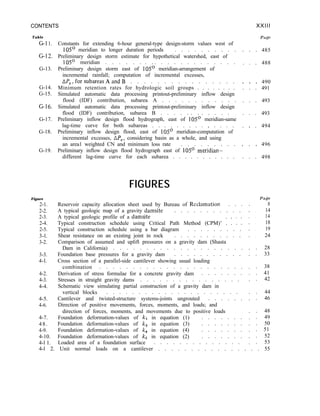
general practice to require the contractor to
assume responsibility for the diversion of the
stream during construction of the dam and
appurtenant structures. The requirement
should be defined by appropriate paragraphs in
the specifications which describe the
contractor’s responsibilities and inform him as
to what provisions, if any, have been
incorporated in the design to facilitate
construction. Usually the specifications should
not prescribe the capacity of the diversion
works, nor the details of the diversion method
to be used; but hydrographs prepared from
streamflow records, if available, should be
included. Also, the specifications usually
require that the contractor’s diversion plan be
subject to the owner’s approval.
In some cases the entire diversion scheme
might be left in the contractor’s hands, with
the expectation that the flexibility afforded to
the contractor’s operations by allowing him to
choose the scheme of diversion will be
reflected in low bids. Since various contractors
will usually present different schemes, the
schedule of bids in such instances should
require diversion of the river to be included as
a lump-sum bid. Sometimes a few pertinent
paragraphs are appropriate in the specifications
giving stipulations which affect the contractor’s
construction procedures. For example,
restriction from certain diversion schemes may
be specified because of safety requirements,
geology, ecology, or time and space limitations.
The contractor may also be required to have
the dam constructed to a certain elevation or
have the channel or other downstream
construction completed before closure of the
diversion works is permitted.
These or similar restrictions tend to guide
the contractor toward a safe diversion plan.
However, to further define the contractor’s
responsibility, other statements should be
made to the effect that the contractor shall be
responsible for and shall repair at his expense
any damage to the foundation, structures, or
any other part of the work caused by flood,
water, or failure of any part of the diversion or
protective works. The contractor should also
be cautioned concerning the use of the
hydrographs, by a statement to the effect that
the contracting authority does not guarantee
the reliability or accuracy of any of the
hydrographs and assumes no responsibility for
any deductions, conclusions, or interpretations
that may be made from them.
5-13. Designer’s Responsibilities. -For
difficult and/or hazardous diversion situations,
it may prove economical for the owner to
assume the responsibility for the diversion
plan. One reason for this is that contractors
tend to increase bid prices for diversion of the
stream if the specifications contain many
restrictions and there is a large amount of risk
involved. A definite scheme of cofferdams and
tunnels might be specified where the loss of life
and property damage might be heavy if a
cofferdam built at the contractor’s risk were to
fail.
Another consideration is that many times
the orderly sequence of constructing various
stages of the entire project depends on a
particular diversion scheme being used. If the
responsibility for diversion rests on the
contractor, he may pursue a different diversion
scheme, with possible delay to completion of
the entire project. This could result in a delay
in delivery of irrigation water or in generation
of power, or both, with a subsequent loss in
revenue.
If the owner assumes responsibility for the
diversion scheme, it is important that the
diversion scheme be realistic in all respects, and
compatible with the probable ability and
capacity of the contractor’s construction plant.
<<Chapter VI
Foundation Treatment
A. EXCAVATION
6-l . General. -The entire area to be
occupied by the base of the concrete dam
should be excavated to firm material capable of
withstanding the loads imposed by the dam,
reservoir, and appurtenant structures.
Considerable attention must be given to
blasting operations to assure that excessive
blasting does not shatter, loosen, or otherwise
adversely affect the suitability of the
foundation rock. All excavations should
conform to the lines and dimensions shown on
the construction drawings where practicable;
however, it may be necessary or even desirable
to vary dimensions or excavation slopes due to
local conditions.
Foundations such as shales, chalks,
mudstones, and siltstones may require
protection against air and water slaking, or in
some environments, against freezing. Such
excavations can be protected by leaving a
temporary cover of several feet of unexcavated
material, by immediately applying a minimum
of 12 inches of pneumatically applied mortar
to the exposed surfaces, or by any other
method that will prevent damage to the
foundation.
6-2. Shaping.-If the canyon profile for a
damsite is relatively narrow with steep sloping
walls, each vertical section of the dam from the
center towards the abutments is shorter in
height than the preceding one. Consequently
sections closer to the abutments will be
deflected less by the reservoir load and sections
closer toward the center of the canyon will be
deflected more. Since most gravity dams are
keyed at the contraction joints, the result is a
torsional effect in the dam that is transmitted
to the foundation rock.
A sharp break in the excavated profile of
the canyon will result in an abrupt change in
the height of the dam. The effect of the
irregularity of the foundation rock causes a
marked change in stresses in both the dam and
foundation, and in stability factors. For this
reason, the foundation should be shaped so
that a uniformly varying profile is obtained
free of sharp offsets or breaks.
Generally, a foundation surface will appear
a s h o r i z o n t a l i n t h e t r a n s v e r s e
(upstream-downstream) direction. However,
where an increased resistance to sliding is
desired, particularly for structures founded on
sedimentary rock foundations, the surface can
be sloped upward from heel to toe of the dam.
The foundation excavation for Pueblo Dam
(fig. 6-l), a massive head buttress-type gravity
dam, is an example of an excavation sloped in
the transverse direction. Figure 6-l also
represents a special type of situation wherein
the foundation excavation is shaped to the
configuration of the massive head buttress.
6-3. Dental Treatment.-Very often the
exploratory drilling or final excavation
uncovers faults, seams, or shattered or inferior
rock extending to such depths that it is
impracticable to attempt to clear such areas
out entirely. These conditions require special
treatment in the form of removing the weak
material and backfilling the resulting
excavations with concrete. This procedure of
reinforcing and stabilizing such weak zones is
frequently called “dental treatment.”
97
98 DESIGN OF GRAVITY DAMS
FOUNDATION TREATMENT-Sec. 6-3 99
‘
‘
100 DESIGN OF GRAVITY DAMS
Theoretical studies have been made to
develop general rules for guidance as to how
deep transverse seams should be excavated.
These studies, based upon foundation
conditions and stresses at Shasta and Friant
Dams, have resulted in the development of the
following a p p r o x i m a t e f o r m u l a s f o r
determining the depth of dental treatment:
d = 0.002 bH + 5 for H 1 150 feet
d = 0.3 b + 5 for H < 150 feet
where :
H = height of dam above general
foundation level in feet,
b = width of weak zone in feet, and
d = depth of excavation of weak zone
below surface of adjoining
sound rock in feet.
(In clay gouge seams, d should not be less
than 0.1 H.)
These rules provide a means of approach to
the question o f h o w m u c h s h o u l d b e
excavated, but final judgment must be
exercised in the field during actual excavation
operations.
Although the preceding rules are suitable for
application to foundations with a relatively
homogeneous rock foundation with nominal
faulting, some damsites may have several
distinct rock types interspersed with numerous
faults and shears. The effect of rock-type
anomalies complicated by large zones of
faulting on the overall strength and stability of
the foundation requires a definitive analysis.
Such a study was performed for Coulee
Forebay Dam wherein the finite element
method of analysis was used in evaluating the
foundation. (See subchapter E of chapter IV
and also appendix C.) This method provides a
way to combine the physical properties of
various rock types, and geologic discontinuities
such as faults, shears, and joint sets into a value
representative of the stress and deformation in
a given segment of the foundation. The method
also permits substitution of backfill concrete in
faults, shears, and zones of weak rock, and thus
evaluates the degree of beneficiation
contributed by the “dental concrete.”
Data required for the finite element method
of analysis are: dimensions and composition of
t h e l i t h o l o g i c b o d i e s a n d g e o l o g i c
discontinuities, deformation moduli for each of
the elements incorporated into the study, and
the loading pattern imposed on the foundation
by the dam and reservoir. Methods for
obtaining data related to the rock and
discontinuities are discussed in the sections on
foundation investigations in chapter II.
“Dental treatment” may also be required to
improve the stability of rock masses. By
inputting data related to the shearing strength
of faults, shear, joints, intact rock, pore water
pressures induced by the reservoir and/or
ground water, the weight of the rock mass, and
the driving forces induced by the dam and
reservoir, a safety factor for a particular rock
mass can be calculated.
Methods of rock stability analysis are
discussed in chapter IV in the sections on finite
element method and foundation analysis.
6-4. Protection Against Piping.-The
approximate and analytical methods discussed
above will satisfy the stress, deformation, and
stability requirements for a foundation, but
they may not provide suitable protection
against piping. Faults and seams may contain
material conducive to piping and its
accompanying dangers, so to mitigate this
condition upstream and downstream cutoff
shafts should be excavated in each fault or
seam and backfilled with concrete. The
dimension of the shaft perpendicular to the
seam should be equal to the width of the weak
zone plus a minimum of 1 foot on each end to
key the concrete backfill into sound rock. The
shaft dimension parallel with the seam should
be at least one-half of the other dimension. In
any instance a minimum shaft dimension of 5
feet each way should be used to provide
working space.
The depth of cutoff shafts may be
computed by constructing flow nets and
computing the cutoff depths required to
eliminate piping effects, or by the methods
FOUNDATION TREATMENT-Sec. 6-5 101
outlined by Khosla in reference [ 11.’ These
two methods are particularly applicable for
Other adverse foundation conditions may be
medium to high dams. For low head dams, the
due to horizontally bedded clay and shale
seams, caverns, or springs. Procedures for
weighted creep method for determining cutoff
depths as shown in chapter VIII of “Design of
treating these conditions will vary and will
depend upon field studies of the characteristics
Small Dams” [2] may be used. of the particular condition to be remedied.
B. GROUTING
6-5. General. -The principal objectives of
grouting in a rock foundation are to establish
an effective barrier to seepage under the dam
and to consolidate the foundation. Spacing,
length, and orientation of grout holes and the
procedure to be followed in grouting a
foundation are dependent on the height of the
structure and the geologic characteristics of the
foundation. Since the characteristics of a
foundation will vary for each site, the grouting
plan must be adapted to suit field conditions.
Grouting operations may be performed
from the surface of the excavated foundation,
from the upstream fillet of the dam, from the
top of concrete placements for the dam, from
galleries within the dam, and from tunnels
driven into the abutments, or any combination
of these locations.
T h e g e n e r a l p l a n f o r g r o u t i n g t h e
foundation rock of a dam provides for
preliminary low-pressure, shallow consolidation
grouting to be followed by high-pressure, deep
curtain grouting. As used here, “high pressure”
and “low pressure” are relative terms. The
actual pressures used are usually the maximum
that will result in filling the cracks and voids as
completely as practicable without causing any
uplift or lateral displacement of foundation
rock.
6-6. Consolidation Grouting. -Low-pressure
grouting to fill voids, fracture zones, and cracks
at and below the surface of the excavated
foundation is accomplished by drilling and
grouting relatively shallow holes, called “B”
holes. The extent of the area grouted and the
depth of the holes will depend on local
conditions.
‘Numbers in brackets refer to items in the bibliography,
sec. 6-9.
Usually for structures 100 feet and more in
height, a preliminary program will call for lines
of holes parallel to the axis of the dam
extending from the heel to the toe of the dam
and spaced approximately 10 to 20 feet apart.
Holes are staggered on alternate lines to
provide better coverage of the area. The depths
of the holes vary from 20 to 50 feet depending
on local conditions and to some extent on the
height of the structure. For structures less than
100 feet in height and depending on local
conditions, “B” hole grouting has been applied
only in the area of the heel of the dam. In this
case the upstream line of holes should lie at or
near the heel of the dam to furnish a cutoff for
leakage of grout from the high-pressure holes
drilled later in the same general location. “B”
holes are drilled normal to the excavated surface
unless it is desired to intersect known faults,
shears, fractures, joints, and cracks. Drilling is
usually accomplished from the excavated
surface, although in some cases drilling and
grouting to consolidate steep abutments has
been accomplished from the tops of concrete
placements in the dam to prevent “slabbing” of
the rock. In rarer cases, consolidation grouting
has been performed from foundation galleries
within the dam after the concrete placement
has reached a certain elevation. This method of
consolidation grouting requires careful control
of grouting pressures and close inspection of
the foundation to assure that the structure is
not being disbonded from the foundation.
Figure 6-2 illustrates a typical spacing and
length pattern for “B” hole grouting.
In the execution of the consolidation
grouting program, holes with a minimum
diameter of 1% inches are drilled and grouted
40 to 80 feet apart before split-spaced
-+---
-I
-- -----
v---
---i-- -
-I
.-._
4
0
n
Figure 6-2. Foundation treatment for Grand Co&e Forebay Dam in Washington (sheet 1 of 2).-288-D-3005(1/2)
FOUNDATION TREATMENT-Sec. 6-6
104 DESIGN OF GRAVITY DAMS
the abutments especially for this purpose.
However, when no galleries are provided, as is
the case for most low gravity dams,
high-pressure grouting is done from curtain
holes located in the upstream fillet of the dam
before reservoir storage is started. Such
grouting holes are identified as “C” holes.
The alinement of holes should be such that
the base of the grout curtain will be located on
the vertical projection of the heel of the dam.
If drilled from a gallery that is some distance
from the upstream face, the holes may be
inclined as much as 15’ upstream from the
plane of the axis. If the gallery is near the
upstream face, the holes will be nearly vertical.
Holes drilled from foundation tunnels may be
inclined upstream or they may be vertical
depending on the orientation of the tunnel
with the axis of the dam. When the holes are
drilled from the upstream fillet, they are
usually inclined downstream. Characteristics of
the foundation seams may also influence the
amount of inclination.
To facilitate drilling, pipes of 2-foot
minimum length are embedded in the floor of
the gallery or foundation tunnel, or in the
upstream fillet. When the structure has reached
an elevation that is sufficient to prevent
movement of concrete, the grout holes are
drilled through these pipes and into the
foundation. Although the tentative grouting
plan may indicate holes to be drilled on
lo-foot centers, the usual procedure will be
first to drill and grout holes approximately 40
feet apart, or as far apart as necessary to
prevent grout from one hole leaking into
another drilled but ungrouted hole. Also,
leakage into adjacent contraction joints must
be prevented by prior grouting of the joints.
Intermediate holes, located midway between
the first holes, will then be drilled and grouted.
Drilling and grouting of additional intermediate
holes, splitting the spaces between completed
holes, will continue until the desired spacing is
reached or until the amount of grout accepted
by the last group of intermediate holes
indicates no further grouting is necessary.
The depth to which the holes are drilled will
vary greatly with the characteristics of the
foundation and the hydrostatic head. In a hard,
intermediate holes are drilled. The amount of
grout which the intermediate holes accept
determines whether additional intermediate
holes should be drilled. This split-spacing
process is continued until grout “take” for the
final closure holes is negligible and it is
reasonably assured that all groutable seams,
fractures, cracks, and voids have been filled.
Water-cement ratios for grout mixes may
vary widely depending on the permeability of
the foundation rock. Starting water-cement
ratios usually range from 8: 1 to 5: 1 by volume.
Most foundations have an optimum mix that
can be injected which should be determined by
trial in the field by gradually thickening the
starting mix. An admixture such as sand or clay
may be added if large voids are encountered.
Consolidation grouting pressures vary
widely and are dependent in part on the
characteristics of the rock, i.e., its strength,
tightness, joint continuity, stratification, etc.;
and on the depth of rock above the stage being
grouted. In general, grout pressures as high as
practicable but which, as determined by trial,
are safe against rock displacement, are used in
grouting. These pressures may vary from a low
of 10 pounds per square inch to a high range of
80 to 100 pounds per square inch. A common
rule of thumb is to increase the above
minimum collar pressure by 1 pound per
square inch per foot of depth of hole above the
packer, as a trial. If the take is small the
pressure may be increased.
6-7. Curtain Grouting. -Construction of a
deep grout curtain near the heel of the dam to
control seepage is accomplished by drilling
deep holes and grouting them using higher
pressure. These holes are identified as “A”
holes when drilled from a gallery. Tentative
designs will usually specify a single line of holes
drilled on IO-foot centers, although wider or
closer spacing may be required depending on
the rock condition. To permit application of
high pressures without causing displacement in
the rock or loss of grout through surface
cracks, this grouting procedure is carried out
subsequent to consolidation grouting and after
some of the concrete has been placed. Usually,
grouting will be accomplished from galleries
within the dam and from tunnels driven into
FOUNDATION TREATMENT-Sec. 6-8
dense foundation, the depth may vary from 30
to 40 percent of the head. In a poor
foundation the holes will be deeper and may
reach as deep as 70 percent of the head. During
the progress of the grouting, local conditions
may determine the actual or final depth of
grouting. Supplementary grouting may also be
required after the waterload has come on the
dam and observations have been made of the
rate of seepage and the accompanying uplift.
For high dams where foundation galleries
are located at a relatively long distance from
the upstream face, as at Grand Coulee Dam,
“A” hole grouting may be augmented by a line
of “C” holes, drilled from the upstream face of
the dam and inclined downstream in order to
supplement the main grout curtain. The depth
of these holes is usually about 75 feet and their
spacing is usually the same as for the “A”
holes. The supplementary grout curtain formed
by grouting this line of holes serves as an
upstream barrier for subsequent “A” hole
grouting, permitting higher “A” hole grout
pressures with less chance of excessive
upstream grout travel.
Usually the foundation will increase in
density and tightness of seams as greater depths
are reached, and the pressure necessary to force
grout into the tight joints of the deep planes
may be sufficient to cause displacements of the
upper zones. Two general methods of grouting
are used, each permitting the use of higher
pressures in the lower zones.
(I) Descending stage grouting consists
of drilling a hole to a limited depth or to
its intersection with an open seam,
105
grouting to that depth, cleaning out the
hole after the grout has taken its initial
set, and then drilling and grouting the
next stage. To prevent backflow of grout
during this latter operation, a packer is
seated at the bottom of the previously
grouted stage. This process is repeated,
using higher pressures for each
succeeding stage until the final depth is
reached.
(2) Ascending stage grouting consists
of drilling a hole to its final depth and
grouting the deepest high-pressure stage
first by use of a packer which is seated at
the top of this stage. The packer limits
grout injection to the desired stage and
prevents the grout from rising into the
hole above the packer. After grouting
this stage, the grout pipe is raised so that
the packer is at the top of the next stage
which is subsequently grouted using
somewhat lower pressure. This stage
process is repeated, working upward until
the hole is completely grouted.
Ascending stage grouting is becoming
more generally used, as it reduces the
chances for displacement of the
foundation rock, gives better control as
to the zones of injection, and expedites
the drilling.
The discussion in section 6-6 concerning
grout pressures applies in general to curtain
grouting. An exception is that higher initial
collar pressures are permitted, depending on
the height of concrete above the hole.
C. DRAINAGE
6-8. Foundation Drainage. -Although a
well-executed grouting program may materially
reduce the amount of seepage, some means
must be provided to intercept the water which
will percolate through and around the grout
curtain, and, if not removed, may build
prohibitive hydrostatic pressures on the base of
the structure. Drainage is usually accomplished
by drilling one or more lines of holes
downstream from the high-pressure grout
curtain. The size, spacing, and depth of these
holes are assumed on the basis of judgment of
the physical characteristics of the rock. Holes
are usually 3 inches in diameter (NX size).
Spacing, depth, and orientation are all
influenced by the foundation conditions.
Usually the holes are spaced on lo-foot centers
with depths dependent on the grout curtain
106 DESIGN OF GRAVITY DAMS
and reservoir depths. As a general rule, hole
depths vary from 20 to 40 percent of the
reservoir depth and 35 to 75 percent of the
deep curtain grouting depth.
Drain holes should be drilled after all
foundation grouting has been completed in the
area. They can be drilled from foundation and
drainage galleries within the dam, or from the
downstream face of the dam if no gallery is
provided. Frequently drainage holes are drilled
from foundation grouting and drainage tunnels
excavated into the abutments.
In some instances where the stability of a
rock foundation may be beneficiated by
reducing the hydrostatic pressure along planes
of potentially unstable rock masses, drainage
holes have been introduced to alleviate this
condition. A collection system for such
drainages should be designed so that flows can
be gathered and removed from the area.
D. BIBLIOGRAPHY
6-9. Bibliography.
[l] K h o s l a , A . N . , “ D e s i g n o f D a m s o n P e r m e a b l e
Foundations,” Central Board of Irrigation, India,
September 1936.
[ 21 “Design of Small Dams,” Bureau of Reclamation, second
edition, 1973.
<<Chapter VII
Temperature Control of Concrete
A. INTRODUCTION
7-l. Purposes. -Temperature control
measures are employed in mass concrete dams
to (1) facilitate construction of the structure,
(2) minimize and/or control the size and
spacing of cracks in the concrete, and (3)
permit completion of the structure during the
construction period. The measures and degree
of temperature control to be employed are
determined by studies of the structure, its
method of construction, and its temperature
environment.
Cracking in mass concrete structures is
u n d e s i r a b l e b e c a u s e i t a f f e c t s t h e
watertightness, internal stresses, durability, and
appearance of the structures. Cracking will
occur when tensile stresses are developed which
exceed the tensile strength of the concrete.
These tensile stresses may occur because of
imposed loads on the structure, but more often
occur because of restraint against volumetric
change. The largest volumetric change in mass
concrete results from change in temperature.
The cracking tendencies which occur as a result
of temperature changes and temperature
differentials can be reduced to acceptable
levels, in most instances, by the use of
a p p r o p r i a t e d e s i g n a n d c o n s t r u c t i o n
procedures.
Temperature control measures which
minimize volumetric changes make possible the
use of larger construction blocks, thereby
resulting in a more rapid and economical
construction. One of these measures, post
cooling, is also necessary if contraction joint
grouting is to be accomplished. A gravity dam
with longitudinal joints must have a monolithic
section in an upstream-downstream direction.
Therefore, provision for the construction of
gravity dams with longitudinal contraction
joints must include measures by which the
concrete is cooled and contraction joints are
closed by grouting before the reservoir loads
are applied.
Complete temperature treatments, over and
above the use of precooling measures and
embedded pipe cooling systems, have been
used in some structures. In these instances,
reductions were made in the amount of cement
used, low-heat cements were specified, and
effective use was made of pozzolan to replace a
part of the cement. Glen Canyon Dam, because
of the size of the construction blocks and the
relatively low grouting temperature, was
constructed with a 50’ F. maximum placing
temperature, embedded cooling coils, a type II
cement, and a mix containing 2 sacks of
cement and 1 sack of pozzolan per cubic yard
of concrete.
7-2. Volumetric Changes. -Mass concrete
structures undergo volumetric changes which,
because of the dimensions involved, are of
concern to the designer. The changes in volume
due to early-age temperature changes can be
con trolled within reasonable limits and
incorporated into the design of the structure.
The final state of temperature equilibrium
depends upon site conditions, and little if any
degree of control over the subsequent periodic
volumetric changes can be effected.
The ideal condition would be simply to
eliminate any temperature drop. This could be
achieved by placing concrete at such a low
107
108 DESIGN OF GRAVITY DAMS
temperature that the temperature rise due to
hydration of the cement would be just
sufficient to bring the concrete temperature up
to its final stable state. Most measures for the
prevention of temperature cracking, however,
can only approach this ideal condition. The
degree of success is related to site conditions,
economics, and the stresses in the structure.
The volumetric changes of concern are those
caused by the temperature drop from the peak
temperature, occurring shortly after placement,
to the final stable temperature of the structure.
A degree of control over the peak temperature
can be attained by limiting the placing
temperature of the fresh concrete and by
minimizing the temperature rise after
placement. The placing temperature can be
varied, within limits, by precooling measures
which lower the temperatures of one or more
of the ingredients of the mix before batching.
The temperature rise in newly placed concrete
can be restrained by use of embedded pipe
cooling systems, placement in shallow lifts with
delays between lifts, and the use of a concrete
mix designed to limit the heat of hydration.
These measures will reduce the peak
temperature which otherwise would have been
attained. Proportionately, this reduction in
peak temperature will reduce the subsequent
volumetric change and the accompanying
crack-producing tendencies.
7-3. Factors to be Considered. -The
methods and degree of temperature control
should be related to the site conditions and the
structure itself. Such factors as exposure
conditions during and after construction, final
stable temperature of the concrete mass,
seasonal temperature variations, the size and
type of structure, composition of the concrete,
construction methods, and rate of construction
should be studied and evaluated in order to
select effective, yet economical, temperature
control measures. The construction schedule
and design requirements must also be studied
to determine those procedures necessary to
produce favorable temperature conditions
during construction. Such factors as thickness
of lifts, time interval between lifts, height
differentials between blocks, and seasonal
limitations on placing of concrete should be
evaluated. Study of the effect of these variables
will permit the determination of the most
favorable construction schedules consistent
with the prevention of cracking from
temperature stresses.
Some structures favor the use of a particular
method of temperature control. Since open
longitudinal contraction joints would prevent a
block from carrying its load as a monolith,
gravity dams with longitudinal joints must
provide for contraction joint grouting of the
longitudinal joints. This normally requires
cooling by means of an embedded pipe cooling
system and grouting of the joints before the
reservoir load is applied. The gravity-type dam
with no longitudinal contraction joints requires
only that degree of temperature control
necessary to prevent structural cracking
circumferentially across the block as the block
cools and approaches its final stable
temperature. Precooling of aggregates and the
use of low-heat cements, reduced cement
content, and pozzolans are normally adopted
as temperature control measures for gravity
dams containing no longitudinal joints.
While longitudinal contraction joints must
always be grouted, any decision to grout
transverse contraction joints in straight gravity
dams depends upon the magnitude of load
transfer across the joint. Since this load
transfer depends largely upon the height and
axis profile shape of the dam, no specific
criteria can be made for all straight gravity
dams. If these transverse joints are to be
grouted, an embedded pipe cooling system will
normally be required.
7-4. Design Data.-The collection of design
data should start at the inception of the project
and should be continued through the
construction period. Data primarily associated
with the determination of temperature control
measures include the ambient air temperatures
at the site, river water temperatures,
a n t i c i p a t e d reservoir and tailwater
temperatures, and the diffusivity of the
concrete in the dam.
The estimate of air temperatures which will
occur in the future at a given site is based on
air temperatures which have occurred in the
past, either at that location or one in the near
TEMPERATURE CONTROL OF CONCRETE-Sec. 7-5 109
vicinity. The U.S. Weather Service has collected
climatological data at a great number of
locations, and long-time records from one or
more of these nearby locations may be selected
and adjusted to the site. For this adjustment,
an increase of 250 feet in elevation can be
assumed to decrease the air temperature lo F.
Similarly, an increase of 1.4’ in latitude can be
assumed to decrease the temperature lo F.
River water temperatures and streamflow data
c a n b e o b t a i n e d f r o m v a r i o u s
hydrometeorological and water supply reports
and papers. A program for obtaining actual
maximum and minimum daily air and river
water temperatures at the site should be
instituted as soon as possible to verify or adjust
t h e d a t a a s s u m e d f o r e a r l y s t u d i e s .
Representative wet- and dry-bulb temperatures
should also be obtained throughout the year.
The best estimate of the future reservoir
water temperatures would be one based on
water temperatures recorded at nearby
reservoirs of similar depth and with similar
inflow and outflow conditions. The Bureau of
Reclamation has obtained reservoir water
temperatures over a period of several years in a
number of reservoirs. From these data,
maximum ranges of temperature for the
operating con ditions encountered were
determined. When no data are available on
nearby reservoirs, the next best estimate of the
reservoir temperatures can be obtained by the
principle of heat continuity. This method takes
into c o n s i d e r a t i o n t h e q u a n t i t y a n d
temperature of the water entering and leaving
the reservoir, and the heat transfer across the
reservoir surface. These heat budget
computations, though accurate in themselves,
are based on estimates of evaporation,
conduction, absorption and reflection of solar
radiation, and reradiation-which in turn are
related to cloud cover, air temperatures, wind
velocities, and relative humidity. Because of
these variables, any forecast of temperature
conditions in a reservoir based on the principle
of heat continuity can only be considered as an
estimate.
The diffusivity of concrete, h2, is an index
of the facility with which concrete will
undergo temperature change. Although
desirable from the heat standpoint, it is not
practicable to select aggregate, sand, and
cement for a concrete on the basis of heat
characteristics. The thermal properties of the
concrete must therefore be accepted for what
they are. The value of the diffusivity of
concrete is expressed in square feet per hour,
and can be determined from the relationship,
where:
h2 =-$
K = conductivity in B.t.u. per foot per
hour per ’ F.,
C = specific heat in B.t.u. per pound
per ’ F., and
p = density in pounds per cubic foot.
Values of the diffusivity for a given concrete
are determined from laboratory tests, although
they must normally be estimated for early
studies. As the thermal characteristics of the
coarse aggregate largely govern the thermal
characteristics of the concrete, the earliest of
these estimates can be based upon the probable
type of coarse aggregate to be used in the
concrete. Table 7-l gives the thermal properties
of concretes in Bureau of Reclamation dams
and representative values for several rock types.
7-5. Cracking.-Temperature cracking in
mass concrete occurs as tensile stresses are
developed when a temperature drop takes place
in the concrete and some degree of restraint
exists against this volumetric change. The
stresses developed are related to the amount
and rate of the temperature drop, the age of
the concrete when the temperature drop takes
place,,and the elastic and inelastic properties of
the particular concrete. The restraint may be
external, such as the restraint exerted by the
foundation of a structure; or it may be
internal, such as the restraint exerted by a mass
upon its surface. Tensile stresses also occur
when a nonlinear temperature variation occurs
across a section of the structure. Because of the
inelastic properties of concrete, the stresses
developed are related to the temperature
history of the structure.
110 DESIGN OF GRAVITY DAMS
Dam
East Canyon . . . . . . . . . .
(predominately quartz
and quartzite)
Glen Canyon . . . . . . . . . .
Seminoe . . . . . . . . . . . . .
Norris . . . . . . . . . . . . . .
Wheeler . . . . . . . . . . . . .
Flaming Gorge . . . . . . . . .
(limestone and sandstone)
Kortes mixes:
1 bbl. cement/cu. yd.
and O.O-percent air . . . .
0.85 bbl. cement/cu. yd.
and O.O-percent air . . . .
Hungry Horse . . . . . . . . .
Hoover . . . . . . . . . . . . .
Gibson . . . . . . . . . . . . .
Canyon Ferry
Swift . . . . . : 1: 1: 1: 1:
(limestone)
Alms . . . . . . . . . . . . . .
Monticello . . . . . . . . . . .
Yellowtail . . . . . . . . . . . .
Angostura mixes:
0.9 bbl. cement/cu. yd.
and 3.0-percent air . . . .
1.04 bbl. cement/cu. yd.
and O.O-percent air . . . .
Hiwassee . . . . . . . . . . . .
Parker . . . . . . . . . . . . . .
Owyhee . . . . . . . . . . . . .
O’Shaughnessy . . . . . . . . .
Friant mixes:
Portland cement . . . . . .
20-percent pumicite . _ . .
Shasta . . . . . . . . . . . . . .
Bartlett . . . . . . . . . . . . .
Morris . . . . . . . . . . . . . .
Chickamauga . . . . . . . . . .
Morrow Point . . . . . . . . .
(andesite-basalt)
Grand Coulee . . . . . . . . . .
Ariel . . . . . . . . . . . . . . .
Bull Run . . . . . . . . . . . :
Quartzite . . . . . . . . . . . .
Dolomite . . . . . . . . . . . .
Limestone . . . . . . . . . . .
Granite . . . . . . . . . . . . .
Basalt . . . . . . . . . . . . . .
Rhyolite . . . . . . . . . . . .
Table I-I.-Thermal properties of concrete for various dams.
Density
(saturated)
Ib./cu. ft.
152.9 2.56 2.53 2.50 0.208 0.213 I3.217
148.4 2.02 2.01 2.01 .211 .216 .222
155.3 1.994 1.972 1.951 .204 .213 .222
160.6 2.120 2.105 2.087 .234 .239 .241
145.5 1.815 1.800 1.785 .223 .229 .236
150.4 1.78 1.77 1.76 .221 .226 .232
157.6 1.736 .210 .215 .221
158.1 1.715
150.1 1.72
156.0 1.699
155.2 1.676
151.3 1.63
158.2 1.82
1.724 1.711
1.710 1.705
1.12 1.71
1.688 1.671
1.667 1.657
1.62 1.61
1.79 1.76
1.579 1.580
1.56 1.55
1.56 1.55
.209 .215 .220
.217 .223 .229
.212 .216 .221
.218 .222 .229
.214 .218 .222
.237 .242 .246
149.7 1.578
153.1 1.57
152.8 1.57
.225 .229 ,234
.225 .230 .235
.219 .223 .221
151.2 1.491 .221
1.484 1.478
1.554 1.537
1.491 1.478
1.402 1.395
1.373 1.369
1.338 1.354
1.312 1.312
1.232 1.234
1.309 1.319
1.291 1.289
1.291 1.293
1.211 1.266
0.97 0.94
1.077 1.079
0.884 0.915
0.847 0.860
Thermal Properties of Coarse Aggregate
.228 .234
152.6
155.7
155.1
152.1
152.8
1.571
1.505
1.409
1.376
1.316
.221
.218
.213
.208
.217
.234 .240
.225 .233
.216 .221
.214 .222
,218 .223
153.6
153.8
157.0
156.3
156.9
156.5
145.5
1.312
1.229
1.299
1.293
1.290
1.287
0.99
.214
.216
.222
.216
.214
.225
.212
.214 .217
.221 ,227
.229 .235
.222 .230
.216 ,222
.229 .233
.211 .222
158.1
146.2
159.1
1.075
0.842
0.835
.219
.228
.215
.222 .227
.235 .244
.225 .234
T Conductivity K
B.t.u./ft.-hr.-OF,
-
I
500 900
700 500
Specific heat C
B.t.u./lb.-OF.
L
7o"
I
.211
.231
.224
.220
.226
.226
I
.226
.238
,230
.224
.230
.232
0.081 0.078
.065 .063
.063 .060
.056 .055
.056 .054
.054 .052
.052 .05 1
.052 .050
.053 .051
.051 .050
.050 .048
.050 .049
,049 .047
.047 .046
.046 .044
.047 .046
.045 .044
.044 .042
.043 ,042
.044 .042
,040 .040
.040 .040
.037 ,036
.037 .037
.038 .037
.039 .038
.037 ,036
.032 .031
.031 .031
.025 .026
.024 .024
.065
.055
,055
.046
.034
.037
.062
.053
.054
.045
.034
.036
Diffusivity hZ
ft.2 /hr.
.061
.057
.053
.052
.050
.049
.050
.049
.047
,048
.04 1
.042
.042
.04 1
.04 1
,041
.040
.039
,035
.036
,036
.037
.035
,029
.030
.026
.023
,059
.05 1
.052
.045
.033
.036
The most common cracking in mass concrete Under these conditions, foundation restraint is
occurs when large blocks of concrete are placed high, large drops in temperature are possible
on the foundation in the fall of the year, after because concrete placing temperatures and
which concreting is stopped for the winter. peak temperatures are relatively high, and
TEMPERATURE CONTROL OF CONCRETE-Sec. 7-6 111
concrete temperatures will be dropping quite that part of the block below the elevation of
rapidly due to exposure conditions. For blocks the adjacent blocks may remain at the same
not larger than 50 by 50 feet, cracking under t e m p e r a t u r e o r may possibly rise in
these conditions has no particular pattern. In temperature depending upon its age.
larger blocks, and where the length-to-width Surface cracking which occurs because of
ratio is over 2, cracking under the above internal restraint seldom follows any particular
conditions often occurs at or near the third pattern. The most general cracking is along the
points of the longer side. Generally, if the horizontal construction joints where the tensile
blocks are not placed more than 10 or 15 feet strength is low. Such cracking normally occurs
off the foundation, cracking will start at the when wood or insulated steel forms are used
exposed top edge of the block and progress and then removed when exposure temperatures
into the block and down the side to within a are low. Upon removal of the forms, the
few feet of the foundation. Such cracks vary surface is subjected to a thermal drop which
from extremely small or hairline surface cracks sets up a severe temperature gradient between
which penetrate only a few inches into the the surface and the interior. Practically all of
mass, to irregular structural cracks of varying these cracks are from hairline width to l/64
width which completely cross the construction inch in thickness. Aside from the horizontal
block. The maximum crack width is at the top construction joints, most other surface
edge and normally will be from l/32 to l/64 c r a c k i n g i s evidenced by vertical or
inch in width. near-vertical cracks associated with surface
Similar cracking across the full width of a irregularities such as openings, reentrant
block can occur during the colder months of corners, or construction discontinuities which
the year in a high block which has been occurred during placement. Most of these
constructed well off the foundation and which cracks do not progress beyond the one
is 25 to 50 feet higher than the adjacent placement lift, but those that do often are the
blocks. In this instance, the upper part of the beginning of the cracks described above.
block will cool at a relatively fast rate while
B. METHODS OF TEMPERATURE CONTROL
7-6. tiecooling.-One of the most effective
and positive temperature control measures is
that which reduces the placing temperature of
the concrete. Methods of reducing the placing
temperature which would otherwise be
obtained at a site can be varied from restricting
concrete placement during the hotter part of
the day or the hotter months of the year, to a
full treatment of refrigerating the various parts
of the concrete mix to obtain a predetermined,
maximum concrete placing temperature.
The method or combination of methods
used to reduce concrete placing temperatures
will vary with the degree of cooling required
and the contractor’s equipment and previous
experience. For some structures, sprinkling and
shading of the coarse aggregate piles may be
the only precooling measures required. The
benefits of sprinkling depend largely on the
temperature of the applied water and on the
contractor’s operations at the stockpile. A
secondary benefit, evaporative cooling, can also
be obtained but is restricted to areas with a low
relative humidity. Insulating and/or painting
the surfaces of the batching plant, water lines,
etc., with reflective paint can also be beneficial.
Mixing water can be cooled to varying
degrees, the more common temperatures being
from 32’ to 40’ F. Adding slush or crushed ice
to the mix is an effective method of cooling
because it takes advantage of the latent heat of
fusion of ice. The addition of large amounts of
ice, however, may not be very practical in some
instances. For example, if the coarse aggregate
and sand both contain appreciable amounts of
free water, the amount of water to be added to
112 DESIGN OF GRAVITY DAMS
the mix may be so small that replacement of
part of the added water with ice would not be
appreciable.
Cooling of the coarse aggregates to about
35’ F. can be accomplished in several ways.
One method is to chill the aggregate in large
tanks of refrigerated water for a given period of
time. Relatively effective cooling of coarse
aggregate can also be attained by forcing
refrigerated air through the aggregate while the
aggregate is draining in stockpiles, while it is on
a conveyor belt and while it is passing through
the bins of the batching plant. Spraying with
cold water will also cool the aggregate. Sand
may be cooled by passing it through vertical
tubular heat exchangers. Cold air jets directed
on the sand as it is transported on conveyor
belts can also be used. Immersion of sand in
cold water is not practical because of the
difficulty in removing the free water from the
sand after cooling.
Cooling of the cement is seldom practicable.
Bulk cement in the quantities used for dams is
almost always obtained at relatively high
temperatures, generally from 140’ to 180’ F.
Seldom will it cool naturally and lose a sizable
portion of the excess heat before it is used.
Use of the above treatments has resulted in
concrete placing temperatures of 50’ F. in a
n u m b e r of instances. Concrete placing
temperatures as low as 45’ F. have been
attained, but these can usually be achieved
only at a considerable increase in cost. The
temperature of the concrete at the mixing
plant should be 3’ to 4’ F. lower than the
desired placing temperature. This will
compensate for the heat developed and
absorbed by the concrete during mixing and
transporting.
7-7. Postcooling.-Postcooling of mass
concrete in gravity dams is used primarily to
prevent cracking during construction. It is also
required where longitudinal contraction joints
are used and where grouting of transverse
contraction joints is required, in order to
reduce the temperature of the concrete to the
desired value prior to grouting. The layout of
embedded cooling systems used in postcooling
mass concrete is described in section 7-20.
Postcooling is an effective means of crack
control. Artificially cooling mass concrete by
circulating cold water through embedded
cooling coils on the top of each construction
lift will materially reduce the peak temperature
of the concrete below that which would
otherwise be attained. However, these
embedded coils will not actually prevent a
temperature rise in the concrete, because of the
high rate of heat development during the first
few days after placement and the relatively low
conductivity of the concrete. The use of an
embedded pipe system affords flexibility in
cooling through operation of the system. Any
desired degree of cooling may be accomplished
at any place at any time. This can minimize the
formation of large temperature gradients from
the warm interior to the colder exterior. The
formation of such gradients in the fall and
winter is particularly conducive to cracking.
7-8. Amount and Type of Cement.--Mass
concrete structures require lesser amounts of
cement than the ordinary size concrete
structures because of a lower strength
requirement. Because of their dimensions,
however, less heat is lost to the surfaces and a
greater maximum temperature is attained.
Since the heat generated within the concrete is
directly proportional to the amount of cement
used per cubic yard, the mix selected should be
that one which will provide the required
strength and durability with the lowest cement
content. The cement content in mass concrete
structures has varied in the past from 4 to 6
sacks of cement per cubic yard, but
present-day structures contain as low as 2 sacks
of cement plus other cementing materials.
The heat-producing characteristics of cement
play an important role in the amount of
temperature rise. Although cements are
classified by type as type I, type II, etc., the
heat generation within each type may vary
widely because of the chemical compounds in
the cement. Types II and IV were developed
for use in mass concrete construction. Type II
cement is commonly referred to as modified
cement, and is used where a relatively low heat
generation is desirable. Type IV cement is a
low-heat cement characterized by its low rate
of heat generation during early age.
Specifications for portland cement generally
TEMPERATURE CONTROL OF CONCRETE-Sec. 7-9 113
do not state within what limits the heat of
hydration shall be for each type of cement.
They do, however, place maximum percentages
on certain chemical compounds in the cement.
They further permit the purchaser to
specifically request maximum h e a t o f
hydration requirements of 70 or 80 calories per
gram at ages 7 and 28 days, respectively, for
type II cement; and 60 or 70 calories per gram
at ages 7 and 28 days, respectively, for type IV
cement.
In most instances, type II cement will
produce concrete temperatures which are
acceptable. In the smaller structures, type I
cement will often be entirely satisfactory.
Other factors being equal, type II cement
should be selected because of its better
resistance to sulfate attack, better workability,
and lower permeability. Type IV cement is
now used only where an extreme degree of
temperature control is required. For example,
it would be beneficial near the base of long
blocks where a high degree of restraint exists.
Concrete made with type IV cement requires
more curing than concrete made with other
types of cement, and extra care is required at
early ages to prevent damage to the concrete
from freezing during cold weather. Often, the
run-of-the-mill cement from a plant will meet
the requirements of a type II cement, and the
benefits of using this type of cement can be
obtained at little or no extra cost. Type IV
cement, because of its special composition, is
obtained at premium prices.
7-9. Use of Pozzolans.-Pozzolans are used
in concrete for several reasons, one of which is
to reduce the peak temperature due to heat of
hydration from the cementing materials in the
mix. This is possible because pozzolans develop
heat of hydration at a much lower rate than do
portland cements. Pozzolans can also be used
as a replacement for part of the portland
cement to improve workability, effect
economy, and obtain a better quality concrete.
The more common pozzolans used in mass
concrete include calcined clays, diatomaceous
earth, volcanic tuffs and pumicites, and fly ash.
The actual type of pozzolan to be used is
normally determined by cost and availability.
7- 10. Miscellaneous Measures. -(a) Shallow
Construction Lifts. -Shallow construction or
placement lifts can result in a greater
percentage of the total heat generated in the
lift being lost to the surface. Such a
temperature benefit exists only during periods
of time when the exposure temperatures are
lower than the concrete temperature as
described in section 7-22. Unless the site
conditions are such that a sizable benefit can
be obtained, shallow placement lifts are
generally limited to placements over
construction joints which have experienced
prolonged exposure periods, or over
foundation irregularities where they are helpful
in the prevention of settlement cracks.
(b) Water Curing.-Water curing on the top
and sides of each construction lift will reduce
the temperature rise in concrete near the
surfaces as described in section 7-29. Proper
application of water to the surfaces will cause
the surface temperature to approximate the
curing water temperature instead of the
prevailing air temperatures. In areas of low
humidity, the effect of evaporative cooling
may result in a slightly lower surface
temperature than the temperature of the curing
water.
(c) Retarding Age&S.-Retarding agents
added to the concrete mix will provide a
temperature benefit when used in conjunction
with pipe cooling. The retarding agents reduce
the early rate of heat generation of the cement,
so that the total temperature rise during the
first 2 or 3 days will be 2’ or perhaps 3’ F.
lower than for a similar mix without retarder.
The actual benefit varies with the type and
amount of retarder used. The percentage of
retarder by weight of cement is generally about
one-fourth to one-third of 1 percent.
Percentages higher than this may give added
t e m p e r a t u r e b e n e f i t b u t c a n c r e a t e
construction problems such as delay in form
removal, increased embedment of form ties
required, etc.
(d) Surface Treatments.-If the near-surface
concrete of a mass concrete structure can be
made to set at a relatively low temperature and
can be maintained at this temperature during
the early age of the concrete, say, for the first
2 weeks, cracking at the surface can be
114
minimized. Under this condition, tensions at
the surface are reduced or the surface may even
be put into compression when the interior mass
of the concrete subsequently drops in
temperature. Such surface cooling can be
accomplished by circulating water in closely
spaced embedded cooling-pipe coils placed
adjacent to and parallel with the exposed
surfaces, by use of cold water sprays on
noninsulated steel forms and on the exposed
concrete surfaces, or by use of special
refrigerated forms.
( e ) R a t e o f T e m p e r a t u r e D r o p . -
Temperature stresses and the resultant
tendency to crack in mass concrete can be
minimized by controlling the rate of
temperature drop and the time when this drop
occurs, In thick sections with no artificial
cooling, the temperature drop will normally be
slow enough as to present no problem. In thin
DESIGN OF GRAVITY DAMS
sections with artificial cooling, however, the
temperature can drop quite rapidly and the
drop may have to be controlled. This can be
accomplished by reducing the amount of
cooling water circulated through the coils or by
raising the cooling water temperature. The
operation of the cooling systems, and the
layout of the header systems to supply cooling
water to the individual cooling coils, should be
such that each coil can be operated
independently. No-cooling periods should also
be utilized where necessary. In thin sections
where no artificial cooling is employed, the
temperature drop during periods of cold
weather can be controlled by the use of
insulated forms and insulation placed on
exposed surfaces. Such measures not only
reduce the rate of change, but also reduce the
temperature gradients near the surface resulting
in a definite reduction in cracking.
C. TEMPERATURE STUDIES
7- 11. General Scope of Studies. -The
measures required to obtain a monolithic
structure and the measures necessary to reduce
cracking tendencies to a minimum are
determined by temperature control studies. In
addition to the climatic conditions at the site,
the design requirements of the structure and
the probable construction procedures and
schedules require study to determine the
methods and degree of temperature control for
the structure.
Early design studies and specification
requirements are based on existing data and on
a possible construction schedule. The ambient
temperatures a n d p r o b a b l e c o n c r e t e
temperatures are then related to the
dimensions of the structure, the conditions
arising during construction, and the desired
design stresses. As a result of these studies, a
maximum concrete placing temperature may
be determined, measures taken to limit the
initial temperature rise within the concrete,
and protective measures planned to alleviate
cracking c on ditions arising during the
construction period. Actual exposure
conditions, w a t e r t e m p e r a t u r e s , a n d
construction progress may vary widely from
the assumed conditions, and adjustments
should be made during the construction period
to obtain the best structure possible consistent
with economy and good construction practices.
The following discussions cover the more
c o m m o n temperature investigations and
studies. In all of these studies, certain
conditions must be assumed. Since any heat
flow computation is dependent on the validity
of the assumed exposure conditions and
concrete properties, experience and good
judgment are essential.
7-l 2. Range of Concrete Temperatures. -
The ranges or amplitudes of the mean concrete
temperature at various elevations of a gravity
dam are used in several studies of stresses
within the dam. This range of mean concrete
temperature is determined from the air and
water temperatures at the site, as modified by
the effects of solar radiation. For preliminary
studies, t h e r a n g e o f m e a n c o n c r e t e
temperature can be obtained in a short
computation by applying the air and water
TEMPERATURE CONTROL OF CONCRETE-Sec. 7-12 115
exposure temperatures as sinusoidal waves with
applicable periods of 1 day, 1 week or 2 weeks
depending upon the severity of the weather to
be used for the design, and 1 year. Solar
radiation is then added to obtain the final
range of mean concrete temperature.
For average (mean) weather conditions, the
ambient air temperatures are obtained from a
plotting of the mean monthly air temperatures
on a year scale. For usual and extreme weather
conditions, the above ambient air temperatures
are adjusted for a 7-day period and a 14-day
period, respectively, at the high and low points
of the annual curve. The amount of the
adjustment for these weather conditions is
described in subsection (a) below.
The thickness of section for these studies is
measured along lines normal to the exposed
surfaces, the intersection of the normals being
equidistant from the two faces.
(a) Ambient Air Temperatures. -When
computing the range of mean concrete
temperature, mean daily, mean monthly, and
mean annual air temperatures are used. The
theory applies the daily and annual air
t em peratures as sinusoidal variations of
temperature, even though the cycles are not
true sine waves. The annual and daily
amplitudes are assumed to be the same for all
weather conditions.
To account for the maximum and minimum
recorded air temperatures, a third and
somewhat arbitrary temperature cycle is
assumed. This temperature variation is
associated with the movements of barometric
pressures and storms across the country. Plots
throughout the western part of the United
States show from one to two cycles per month.
Arbitrarily, this third temperature variation is
assumed as a sine wave with either a 7-day or
14-day period for usual weather conditions and
extreme weather conditions, respectively. For
extreme weather conditions, the amplitudes of
the arbitrary cycle are assigned numerical
values which, when added to the amplitudes of
the daily and annual cycles, will account for
the actual maximum and minimum recorded
air temperatures at the site. For usual weather
conditions, these amplitudes are assigned values
which account for temperatures halfway
b e t w e e n t h e m e a n m o n t h l y m a x i m u m
(minimum) and the maximum (minimum)
recorded. When computing the mean concrete
temperature condition, no third cycle is used.
(b) Reservoir Water Temperatures. -The
reservoir water temperatures used in
determining the range of mean concrete
temperature for a proposed dam are those
temperatures which will occur after the
reservoir is in operation. These reservoir water
temperatures vary with depth, and for all
practical purposes can be considered to have
only an annual cycle. For preliminary studies,
the range of mean concrete temperature with
full reservoir is the normal condition. For final
designs, stage construction should be taken into
consideration and the design reservoir
operation used. When the reservoir is to be
filled or partially filled before concrete
temperatures have reached their final stage of
temperature equilibrium, further studies are
needed for the particular condition.
( c ) S o l a r R a d i a t i o n E f f e c t . - T h e
downstream face of a dam, and the upstream
face when not covered by water, receives an
appreciable amount of radiant heat from the
sun. This has the effect of warming the
concrete surface above the surrounding air
temperature. The amount of this temperature
rise above the air temperature was recorded on
the faces of several dams in the western portion
of the United States. These data were then
correlated with theoretical studies which took
into consideration varying slopes, orientation
of the exposed faces, and latitudes. The results
of these studies are presented in reference [ 11 .l
These theoretical temperature rises due to solar
radiation should be corrected by a terrain
factor obtained from an east-west profile of the
site terrain. This is required because the
theoretical computations assumed a horizontal
plane at the base of the structure, and the
effect of the surrounding terrain is to block out
some hours of sunshine. This terrain factor will
vary with elevation and from abutment to
abutment.
‘Numbers in brackets refer to items in bibliography, sec.
7-31.
116
DESIGN OF GRAVITY DAMS
7-13. Temperature Gradients. -Temperature
distributions in a mass where boundary
conditions vary with time are easily determined
by the Schmidt method. (See references [ 11,
[23, [3], [4] .) This method is generally used
for temperature studies of mass concrete
structures when the temperature gradient or
distribution across the section is desired. The
depth of freezing, and temperature distribution
after placement are typical of the solutions
which can be obtained by this step-by-step
method. Different exposure temperatures on
the two faces of the theoretical slab and the
autogenous heat of hydration are easily taken
into consideration.
An early objection to the Schmidt method
of temperature computation was the time
required to complete the step-by-step
computation. This has been overcome by the
use of electronic data processing machines
which save many man-hours of work. Programs
have been developed which will take into
consideration any thickness of section, varying
exposures on the two faces of the slab, variable
initial temperatures, a varying heat of
hydration with respect to time, and increasing
the thickness of slab at regular intervals as
would occur when lifts of concrete are placed
on previously placed lifts.
A s e c o n d m e t h o d o f t e m p e r a t u r e
computation in mass concrete which is
particularly adaptable to thick walls and
placement lifts near the rock foundation was
devised by R. W. Carlson. This method is
described in reference [ 51. It, like the Schmidt
method, is essentially a step-by-step integration
which can be simplified by selection of certain
variables. Conditions such as initial
temperature distributions, diffusivity, and
adiabatic temperature rise must be known or
assumed. Carlson’s method can also be
modified to take into account the flow of heat
between different materials. This would be the
case where insulated or partially insulated
forms are used, or where concrete lifts are
placed on rock foundations.
T h e v a r i a t i o n i n t e m p e r a t u r e i n a
semi-infinite solid at any particular point can
also be estimated from figure 7-4. This
illustration gives the ratio of the temperature
(d) Amplitudes of Concrete Temperatures.-
T h e r a n g e o r a m p l i t u d e o f c o n c r e t e
temperatures is determined by applying the
above-described external sinusoidal air and
water temperatures to the edges of a
theoretical flat slab, the width of the slab being
equal to the thickness of the dam at the
elevation under consideration. The problem is
idealized by assuming that no heat flows in a
direction normal to the slab. The law of
superposition is used in that the final
amplitude in the concrete slab is the sum of the
amplitudes obtained from the different
sinusoidal variations.
To apply the theoretical heat flow in a
practical manner, unit values are assumed for
the several variables and a curve is drawn to
show the ratio of the variation of the mean
temperature of the slab to the variation of the
external temperature. Figure 7-1 shows the
relationship thus derived for temperature
variations in flat slabs exposed to sinusoidal
variations for h* = 1.00 square foot per day, a
period of 1 day, and a thickness of slab of II . A
correlation equation is given to take into
account the actual thickness of dam, diffusivity
constant, a n d p e r i o d of time. The
computations are shown in figures 7-2 and
7-3.* For the actual thickness of dam, I,, a
value of I, is obtained from the correlation
equation for each of the air temperature cycles.
For each value of I, , a ratio of the variation of
mean concrete temperature to the variation of
external temperature is obtained. The sums of
the products of these ratios and their respective
amplitudes are algebraically added to and
subtracted from the mean annual air
temperature to obtain mean concrete
temperatures for the condition of air on both
faces. Mean concrete temperatures are then
obtained in the same manner for a fictitious
condition of water on both faces, and the two
conditions are simply averaged together to
obtain the condition of air on one face and
water on the other. Solar radiation values are
then added to obtain the final range of mean
concrete temperatures.
2
These and sev~al other figures and tables in this chapter
were reprinted from Bureau of Reclamation Engineering
Monograph No. 34, listed as reference ] 11 in the bibliography,
sec. 7-3 1.
TEMPERATURE CONTROL OF CONCRETE-Sec. 7-13
Temperature Variations of Flat Slabs
Exposed to Sinusoidal Temperature
Variation on Both Faces
Conditions:
h2= 1.00 ft.2/ day
Period of temperature variation = I( = I day
Thickness of slab as shown = 1,
For other conditions:
T H I C K N E S S O F S L A B - F E E T (1,)
Figure 7-I. Temperature variations of flat slabs exposed to sinusoidal temperature variations on both
faces.-288-D-3008
range in the concrete at the particular point, to
the temperature range at the surface for daily,
be of concern not only during the construction
15day, and annual cycles of temperature.
period but during the life of the structure.
Stresses due to temperature gradients may
Stresses across a section due to temperature
gradients can be obtained from the expression
118 DESIGN OF GRAVITY DAMS
RANGE OF MEANCONCRETE TEMPERATURES
Hunsrv How DAM
( E f f e c t o f s o l a r r o d i a t i o n n o t i n c l u d e d )
e,- e2
For yearly change PI=- -dm = ~ L
0.0464 fJ
e,
F o r 365-h,. change .!, = o.o53x M5 = &?LL&
For daily change L=, ez = 0.867 e,
0.053124
Remarks: Aor temperatures taken from 34 war record ar Columbia
Falls, Montana. h2 = 0.053 fro,,, laborator” data
Thick- Due to Due to Dus t o
~,a”- n666 Yearly Rangexs-hcRon Daily Rorqe EX
I4501 811 3 . 7 6 1 .215[18.39 ,043 7184 .Olll 6.1 1 6.8]49.3[36.4 1 5.71 5.6 146.9137.4 4 7 . 5 3 9 . 5 43.01 4.51 1 . 2 144.2/41.8 146.7139.1 46.6 39.6
34001 1111 5.151 .156125.X+ .0321 1 - 14.41 4.9147.6138.3 14.1 14.1 147.3139.1 146.aj39.0142.a~ 3.01 0.5 j42.5]41.5145.0]39.7 144.9 40.3
3350 1 ‘41 1 6.541 .122[32.011 .0251 1 1 1
3.4 3.9 146.6 139.3 1 3.2 1 3.2 146.4 140.0 143.0 j 141.0;
39.0 2.01 0.2 / 1 4 0 . 8 I43.9140.0
41.2 143.8 4 0 . 4
3300 ( ‘ 7 ’ 1 7.931 .‘wl38.82/ .0211 1 1 2.8 1 3.2 146.0 140.0 j 2.6 1 2.7 145.6 140.5 143.0 139.0 j j
4 1 . 0 2.01 0.2 141.2 140.8 143.6140.4 143.5 140.6
37501 20’1 9.331 .065]45.631 .a’81 1 1 241 2.7 145.6 140.5 1 2.2 1 2.3 145.4 140.9 143.0139.0141.01 2.01 0.2 141.2 140.8 143.4140.6 143.3 140.8
NOT ES: e, = Thickness of dam, ft.
Curve referred to is ‘Temperature
Variations of Flat Slabs Exposed
to Sinusoidal Temperature Variations
o n B o t h Faces:
Figure 7-2. Computation form, sheet 1 of 2-range of mean concrete temperatures.-288-D-3009
eE
a’ = b3(1+)
+ 3(2x-b) b (2x-b)T(x)dx-b3 T(x)
1
where:
e = thermal coefficient of expansion,
E = modulus of elasticity,
p = Poisson’s ratio, and
b = thickness of section with a tempera-
ture distribution T(x).
Where the temperature variation, T(x), cannot
be expressed analytically, the indicated
integrations can be performed numerically by
the use of Simpson’s rule. For example, using b
= 30 feet, e = 6.0 x 10e6, E = 2,500,OOO
pounds per square inch, p = 0.20, and an
assumed T(x), the stresses would be computed
as shown in table 7-2.
The above expression for stress is not valid
in all essentials for those temperature gradients
which occur during the first few days after
placement, because the extreme creep
characteristics of the concrete during this age
result in a highly indeterminate condition of
stress. The expression is also not valid where
external restraints occur such as near the
foundation of a block or structure.
7 - I 4. Temperature Rise. -Newly placed
concrete undergoes a rise in temperature due to
the exothermic reaction of the cementing
materials in the concrete. Early temperature
rise studies may be based on past experience
records with the type of cement to be used.
TEMPERATURE CONTROL OF CONCRETE-Sec. 7-14
RANGE OF MEAN CONCRETE
T E M P E R A T U R E S
Hungry Horse D A M
( E f f e c t o f S o l a r R a d i a t i o n i n c l u d e d )
L a t i t u d e 48%
Remarks:
I
1 MEAN CONCRETE TEMPERATURES
Thick- E f fects 1 E x p o s e d t o air 1 A i r o n D . S F a c e
31001 70 1 I I I I I 0 1 6 3 1 4.4 1 6.7 1 4.7 I 4.4 4.7
I I I
Figure 7-3. Computation form, sheet 2 of 2-range of mean concrete temperatures.-288-D-3010
Figure 7-5 shows typical temperature rise characteristics of pozzolans vary widely. When
curves for the various types of cement. The a pozzolan is to be used to replace a part of the
temperature rise curves are based on 1 barrel (4 cement, the heat of hydration of the pozzolan,
sacks) of cement per cubic yard of concrete, a for early studies, can be assumed to be about
diffusivity of 0.050 square foot per hour, and 50 percent of that developed by an equal
no embedded pipe cooling. These curves should amount of cement. For final temperature
be used only for preliminary studies because control studies, the heat generation for a
there are wide variations of heat generation particular concrete mix should be obtained by
within each type of cement and of diffusivity laboratory tests using the actual cement,
in concrete. (See reference [ 61.) Where less pozzolan, concrete mix proportions, and
than 4 sacks of cement per cubic yard is to be mass-cure temperature cycle for the concrete
used, the temperature rise can be estimated by to be placed in the structure.
direct proportion since the heat generation is The above heat of hydration relates to the
directly proportional to the amount of cement. adiabatic temperature rise in the concrete.
As with cements, the heat-development Because the surfaces of a structure are exposed
DESIGN OF GRAVITY DAMS
T-
40
SEMI- I N F I N I T E SOL10 4
/,
TEMPERATURE RANGE IN CONCRETE
RAT’o TEMPERATURE RANGE AT SURFACE
Figure 7-4. Temperature variations with depth in
semi-infinite solid.-288-D-301 1
or in contact with inert or near-inert bodies, a
flow of heat will take place through these
surfaces and the actual temperature rise in the
concrete will be affected accordingly. The loss
or gain of heat to the surface due to exposure
conditions, and the loss or gain of heat from an
underlying lift or to the foundation are
illustrated in reference [ 71. Schmidt’s method
or Carlson’s method can also be used to
determine the actual temperature rise.
Several difficulties are encountered in the
conditions given in reference [ 71. For example,
the theoretical equation for the adiabatic
temperature rise is given as T = To (l-e- mt ),
of standard ceme
Cement content- I bbl per cu yd
Dlff”s,“Ity- 0 050 ft’/ hr
Figure 7-5. Temperature rise in mass concrete for various
types of cement.-288-D-3013
and To and m are selected to make the
theoretical curve fit the laboratory data. Any
variance between the theoretical and actual
curves will result in some error in the
theoretical heat loss in the heat-generating lift.
The loss from the inert lift does not take into
consideration a varying surface temperature,
which also introduces an error. A third error
may be introduced when a new lift is placed on
an older lift which is still generating heat.
Depending upon the age of the older lift, the
heat generated may still be enough to be
considered.
7-15. Artificial Cooling.-The design of an
artificial cooling system requires a study of
each structure, its environment, and the
maximum temperatures which are acceptable
from the standpoint of crack control. The
temperature effects of various heights of
placement lifts and such layout variables as
size, spacing, and length of embedded coils
should be investigated. Variables associated
with the operation of the cooling systems, such
as rate of water circulation a n d t h e
TEMPERATURE CONTROL OF CONCRETE-Sec. 7-15 121
fi.
0
3
6
9
12
15
18
2 1
2 4
27
30
b
-
--
_-
-
0. 0
8. 3
15. 8
22. 7
29. 1
35. 1
40. 7
46. 0
50. 9
55. 6
60. 0
1003. 8
-
--
--
-
Table I-2.-Computation of temperature stress.
0
- 199
- 284
- 272
- 1 7 5
0
244
552
916
1334
1800
8862
-
-
For the given conditions:
eE
br(l=OJ
~,=0.1[(900)(1003.8)
+ 3(22- 30) (8862)
-(30)3T(41
Simplifying:
a,=5317z-2700T(z)
+ 10,584
temperature differential between the cooling
water and the concrete being cooled, are
studied concurrently. All of these factors
should be considered in arriving at an
economical cooling system which can achieve
the desired temperature control.
The theory for the removal of heat from
concrete by embedded cooling pipes was first
developed for use in Hoover Dam. (See
reference [7] .) From these studies, a number
of curves and nomographs were prepared for a
vertical spacing (height of placement lift) of 5
feet. The concrete properties and a single rate
of flow of water were also used as constants.
Subsequent to the earlier studies, the theory
was developed using dimensionless parameters.
Nomographs were then prepared on the basis
of a ratio of b/a of 100, where b is the radius
of the cooled cylinder and a is the radius of the
cooling pipe. Actual cooling pipe spacings are
nominal spacings and will seldom result in a b/a
ratio of 100. In order to take the actual
horizontal and vertical spacings into
consideration, a fictitious diffusivity constant
can be used which is based on tests of concrete
made with similar aggregates. Table 7-3 gives
the values of D, 02, and hzf for various
spacings of cooling pipe. The b/a ratios of the
spacings shown vary from about 34 to 135.
Within these limits, the values of h2f may be
used with sufficient accuracy.
Figures 7-6 and 7-7 are used for pipe cooling
computations. In these illustrations,
-
--
-
IbP/it.’
10,584
4, 125
- 1 7 4
- 2 , 8 5 3
-4, 182
- 4 , 4 3 1
- 3,600
- 1,959
762
4,023
8.094
-
_-
-
lb.%.2
7 4
29
- 1
- 2 0
- 2 9
- 3 1
- 2 5
- 1 4
5
2 8
5 6
Difference between mean temper-
1
ature of the concrete and temner-
ature of the cooling water- I
itial temperature difference
between the concrete and the 1
L cooling water J
r 1
y=
Initial temperature difference
K = conductivity of the concrete,
L = length of cooling coil,
CW = specific heat of water,
Pw = density of water,
4w = volume of water flowing through
the coil,
t = time from start of cooling,
0, = diameter of the cooling cylinder,
and
h2 = diffusivity of the concrete.
Consistent units of time and distance must be
used throughout.
The curves in figures 7-6 and 7-7 are used in
a straight-forward manner as long as no
appreciable heat of hydration is occurring in
the concrete during the period of time under
consideration. When the effect of artificial
cooling is desired during the early age of the
122 DESIGN OF GRAVITY DAMS
TEMPERATURE CONTROL OF CONCRETE-SW . 7-15 123
124 DESIGN OF GRAVITY DAMS
Table l-3.- Values of D, D2, and h”f for pipe cooling.
fJPWing
Vertkal Horl?.ontal
(f@w (f-t)
2% 2%
5 2%
5 3
5 4
5 5
5 6
D D: WI
2. 82 7. 95 1. 31h2
3. 99 15. 92 1. 19h’
4. 35 18.92 1. 10
5. 02 25.20 1. 12
5. 64 31.81 1. 09
6. 18 38. 19 1. 07
- ~
7%
7%
7%
7%
7%
7%
2%
4
5
6
7%
9
4. 88 23.81 1. 13hs
6. 15 37.82 1. 07
6. 86 47. 06 1. 04
7. 54 56.85 1. 02
8. 46 71.57 1. 00
9. 26 85.75 0. 98
10
I
10 11.284 127. 33 0. 94hs
concrete, a step-by-step computation is
required which takes into consideration heat
increments added at uniform time intervals
during the period.
Varying the temperature of the water
circulated through the coil, the length of the
embedded coil, and the horizontal spacing of
the pipe are effective means of varying the
cooling operation to obtain the desired results.
Figures 7-8, 7-9, and 7-lo3 show how these
variables affect the concrete temperatures.
These studies were made using 4 sacks of type
II cement per cubic yard, a diffusivity of 0.050
square foot per hour, a flow of 4 gallons per
minute through l-inch outside-diameter pipe,
5-foot placement lifts, and a 3-day exposure of
each lift. Figures 7-9 and 7- 10 were derived
using the adiabatic temperature rise shown in
figure 7-8. In general, cooling coil lengths of
800 to 1,200 feet are satisfactory. Spacings
varying from 2% feet on the rock foundation
to 6 feet on tops of 7%foot lifts have been
used. The temperature of the cooling water has
varied from a refrigerated brine at about 30’ F.
to river water with temperatures as high as
75’ F.
3
These three illustrations are reprinted from an article
“Control of Temperature Cracking in Mass Concrete,” by C. L.
Townsend, published in AC1 Publication SP-20, “Causes,
Mechanism, and Control of Cracking in Concrete,” 1968.
A G E - D A Y S
Figure 7-8. Artificial cooling of concrete-effect of
cooling water temperature. (From AC1 Publication
SP-20.)-288-D-3017
” . ._ .- --
AGE- DAYS
Figure 7-9. Artificial cooling of concrete-effect of coil
length. (From AC1 Publication SP-20.)-288-D-3018
I I I I I I
4 8 12 16 20 24
A G E - D A Y S
Figure 7-10. Artificial cooling of concrete-effect of
horizontal spacing of pipe. (From AC1 Publication
SP-20.)-288-D-3019
TEMPERATURE CONTROL OF CONCRETE-Sec. 7-16 125
Varying the size of the embedded pipe will o f t h e t h e o r y in practical applications.
affect the cooling results but is uneconomical Temperature distributions and gradients in
as compared to the other methods of varying semi-infinite solids are given for both constant
the cooling. The use of l-inch outside-diameter exposure and variable exposure temperature
metal pipe or tubing is common practice. conditions. Natural cooling of slabs, cylinders,
Although black steel pipe is cheaper in material and spheres is discussed using initial uniform
cost, aluminum tubing has been used in many temperature distributions, uniformly varying
instances because it can be furnished in coils initial temperatures, constant exposure
and will result in a lower installation cost. temperatures, and variable e x p osure
Increasing the rate of flow through l-inch pipe temperatures.
will give a marked improvement of Studies for the insulation requirements on
performance up to a rate of 4 gallons per concrete structures as a protection against
minute. However, doubling the flow to 8 freezing and to minimize the formation of
gallons per minute decreases the time required extreme temperature gradients are discussed in
for cooling by only 20 to 25 percent for reference [ 81.
average conditions, whereas it doubles the Although specific methods of cooling are
capacity requirements, increases the friction n o r m a l l y l e f t t o t h e c o n t r a c t o r , t h e
losses, and more than doubles the power costs. requirements for cooling the various parts of a
7-16. Miscellaneous Studies. -Solutions for concrete mix to obtain a predetermined placing
idealized heat flow problems associated with temperature can require a detailed study. The
the design and construction of mass concrete various considerations for such an operation
dams are given in reference 171. Illustrative are discussed in an article by F. B. Kinley in
examples are given which demonstrate the use reference [ 91 .
D. DESIGN CONSIDERATIONS
7- 17. Placing Temperatures. -The maximum
temperature attained in mass concrete is
determined to a large extent by the
temperature of the concrete as it is placed in
the structure. This makes the placing
temperature of the concrete of concern
because (1) lower concrete temperatures will
minimize temperature differentials near the
surface, and (2) a measure of control over the
subsequent temperature drop from the
maximum concrete temperature to the
grouting or final stable state temperature can
be achieved.
When no special provisions are employed,
concrete placing temperatures will approximate
the mean monthly air temperature, ranging
from 4’ to 6’ F. higher than the mean air
temperature in the wintertime and this same
amount lower than the mean air temperature in
the summertime. The actual temperature of the
concrete mix depends upon the temperatures,
batch weights, and specific heats of the
separate materials going into the concrete mix.
The placing temperature of the concrete may
be lowered by reducing the temperatures of
one or more of the separate materials. The
computation for determining the temperature
of a mix, both with and without precooling
measures, is illustrated in references [ 11 and
191.
Minimal tensile stresses at the base of a
placement lift will be developed if the placing
temperature of the concrete is at or slightly
below the temperature of the foundation and if
the temperature rise is minimized. These tensile
stresses resulting after dlacement will be lower
if successive lift placements in a block are made
at regular, periodic intervals with the shortest
practicable time between lifts. Form removal
and lifting of forms, installation of required
metalwork, and construction joint cleanup will
normally require a minimum of almost 3 days
between lifts.
7- 18. Closure Temperature. -One design
consideration related to temperature control is
the grouting or closure temperature of the
126 DESIGN OF GRAVITY DAMS
contraction joints in the dam. Normally, the
closure temperature in a gravity dam is the
minimum mean concrete temperature during
operation, but the actual temperature may be
i n f l u e n c e d b y p r a c t i c a l o r e c o n o m i c
considerations. The designer often has to make
a design decision whether to use only the river
water available to cool the concrete, thereby
losing the benefit of 2’ to 5’ F. additional
cooling which could be obtained by artificial
methods, or to obtain the desired temperature
reduction by requiring mechanically refrigerated
water to perform the cooling.
From the practical standpoint, it is possible
to cool the concrete by means of an embedded
pipe cooling system to within 4’ or 5’ F. of
the mean temperature of the cooling water.
Concrete temperatures as low as 35’ F. have
been obtained with a refrigerating plant using
brine as the coolant. Where cooling is
accomplished with river water, concrete
temperatures attainable depend on the mean
river water temperature. At Hungry Horse
Dam, river water at 32’ to 34’ F. was available
during the colder months of the year, and final
cooling was accomplished to 38’ F. with this
river water. Where river water is limited in
quantity and is relatively warm, refrigeration of
the cooling water will be required.
7-19. Size of Construction Block.-
Temperature cracking in mass concrete
structures is related to the dimensions and
shape of the construction blocks in the
structure and to the climatic conditions
occurring during the construction period.
Generally, a block with a length of 50 feet or
less can be placed with only a minimum of
control. Likewise, blocks up to 200 feet long
can be placed with normal temperature control
measures and have no more than nominal
cracking. The location of appurtenances
generally controls the spacing between
transverse contraction joints, but this spacing
should be guided to some extent by the shape
of the block as it progresses from the
foundation to the top of the dam.
(a) Length of Construction Block.-For a
given site and given loading conditions, the
thickness of a dam is determined by gravity
analyses. Where this thickness is large, the
section can be broken into two or more
construction blocks separated by longitudinal
joints, or it can be constructed as a single block
by applying rigid temperature control
measures. Normally, a 25’ to 30’ F.
temperature drop can be permitted in blocks of
the size commonly used before tensile stresses
are developed which will be great enough to
cause cracking across the block. In low
temperature climates, special precautions are
needed to avoid high differential temperatures
caused by sudden temperature drops.
The length of a construction block is not
governed by the capacity of the concrete
mixing plant, since each block is first
constructed to its full width and height at the
downstream end of the block and then
progressively placed to the upstream face. More
generally, the length of block is related to the
tensile stresses which tend to develop within
the block between the time the block is placed
and the time it reaches its final temperature.
The stresses are subject to some degree of
control by operations affecting the overall
t e m p e r a t u r e d r o p f r o m the m a x i m u m
t e m p e r a t u r e t o t h e f i n a l o r c l o s u r e
temperature, the rate of temperature drop, the
thermal coefficient of expansion, and the age
of the concrete when it is subjected to the
temperature change. Factors in addition to
temperature which affect the stresses in the
block are the effective modulus of elasticity
between the block and its foundation, the
elastic and inelastic properties of the concrete,
and the degree of external restraint.
The actual stresses will further vary between
rather wide limits because of conditions
occurring during the construction period which
introduce localized stress conditions. Tensile
stresses and resulting cracks may occur because
the larger blocks, by reason of their greater
area, will have a greater number of stress
concentrations arising from the physical
irregularities and variable composition of the
foundation. Cracks may also occur because of
delays in the construction schedule and
construction operations. Longer blocks are
more likely to have cold joints created during
TEMPERATURE CONTROL OF CONCRETE-Sec. 7-20 127
placement of the concrete, and these cold
joints are definite planes of weakness. A special
problem exists with respect to the longer
blocks at the base of the dam. These will
normally be exposed for longer periods of time
because concrete placement is always slow at
the start of a job. Under this condition,
extreme temperature gradients may form near
the surfaces. The stresses caused by these steep
temperature gradients may then cause cracks to
form along any planes of weakness which exist
as a result of construction operations.
U n l i k e o r d i n a r y structural members
undergoing temperature change, the stresses
induced in mass concrete structures by
temperature changes are not capable of being
defined with any high degree of accuracy. The
indeterminate degree of restraint and the
varying elastic and inelastic properties of the
concrete, particularly during the early age of
the concrete, make such an evaluation an
estimate at best. Field experiences on other
jobs should guide the designer to a great
extent. Such experiences are reflected in table
7-4 which can be used as a guide during the
early stages of design.
(b) Width of Construction Block.-
Contraction joints are normally spaced about
50 feet apart, but may be controlled in some
parts of the dam by the spacing and location of
penstocks and river outlets, or by definite
breaks and irregularities of the foundation.
Although a uniform spacing of joints is not
necessary, it is desirable so that the contraction
joint openings will be essentially uniform at the
time of contraction joint grouting. Spacings
have varied from 30 to 80 feet as measured
along the axis of the dam. When the blocks are
30 feet or less in width, a larger temperature
drop than would otherwise be necessary may
be required to obtain a groutable opening of
the contraction joint. This temperature drop
should be compatible with the permissible drop
for the long dimension of the block.
A further consideration is the maximum
length-to-width ratio of the blocks which will
exist as construction of a block progresses from
its foundation to the top of the dam. If the
ratio of the longer dimension to the shorter
dimension is much over 21/, cracking at
Table l-4.-Temperature treatment versus block length.
Block length
Over 200 feet
150 to 200 feet-
120 to 150 feet-
90 to 120 feet- -
60to90feet--m
Up to 60 feet. _
-
-.
-.
i
-_
-
Treatment
use longitudinal joint. Stagger longitudinal jolIlts
in adjoining blocks by minimum of 30 feet
Temperature drop from maximum concrete tern-
per&ore to grouting tempersture-°F.
Foundation H=02L to 0.u 1
a H=O.ZL 1
-I
2 5 3 5
30 40
3 5 4 5
40 No restriction
4 5 No restriction
over Hs0.5L 1
40
4 5
No restriction
No restriction
No restriction
1 n=heigbt above foundation; G-block length.
approximate third points of the block can be
expected. Ratios of 2 to 1 or less are desirable,
if practicable.
7-20. Concrete Cooling Systems.-The
layout of the concrete cooling systems consists
of pipe or tubing placed in grid-like coils over
the top surface of each lift of concrete after
the concrete has hardened. Coils are formed by
joining together lengths of thin-wall metal pipe
or tubing. The number of coils in a block
depends upon the size of the block and the
horizontal spacing. Supply and return headers,
with m a n i f o l d s t o p e r m i t individual
connections to each coil, are normally placed
on the downstream face of the dam. In some
instances, cooling shafts, galleries, and
embedded header systems can be used to
advantage. Figures 7-l 1 and 7-l 2 show cooling
details for Glen Canyon Dam.
The velocity of flow of the cooling water
through the embedded coils is normally
required to be not less than 2 feet per second,
or about 4 gallons per minute for the
commonly used l-inch pipe or tubing. Cooling
water is usually pumped through the coils,
although a gravity system has at times been
used. When river water is used, the warmed
water is usually wasted after passing through
the coils. River water having a high percentage
of solids should be avoided as it can clog the
cooling systems. When refrigerated water is
used, the warmed water is returned to the
D E T A I L I
DESIGN OF GRAVITY DAMS
*--- Std p,pe thread
E X P L A N A T I O N
Thermocwple wfre.. _. ._.~. . .._ __.~. - .-
l$‘Std pipe h e a d e r .._.__._.__ - ----_- - - - - - - - - - -
, O”,h!” v/o,, tubing _._.._._____ - - - - - -
Detoll z-----
----Controctmn joints-,
--‘--‘-----~~.-Thermocouple ,unc+,ens placed at o&?ror,mots downst
,’
I’
th,rd pm, of blacks, and at center of every fourth
For ,,ro,e~,,on ,,,DCB th.9,moco”plo W,,F r,e,t to coOh
IS trwnr luco ul bbck. Plots ad
EL. 3195 0 EL. 3375.0
L A Y O U T O F C O O L I N G C O I L S
Figure 7.11. Glen Canyon Dam-cooling pipe layout.-288-D-3021
TEMPERATURE CONTROL OF CONCRETE-Sec. 7-20 129
E x t e n d beoderor tubmg b’mm
thru high block Thermocouple we
t o b e temporonl coded and sus-
pended on heoder or tubmg for pro-
techononttl e m b e d m e n t - - . -
- - - . .
TOP of
7’6”/,ff -..
x.
I N I T I A L I N S T A L L A T I O N
T Y P I C A L S E C T I O N fHRlJ D A M
,,-Wrap exposed heoder w t u b m g wth
,‘ paper to prevent b+ndmg to concrete
~-Co"troct,o" ,0/n t
F I N A L I N S T A L L A TION
’ thermocoupC
downsheom
rYPfCAL EXPANSfON COUPLfNG
SHOWlN‘ CO”m4CIION JO!YT CROSSING
coohq t u b m g loid o v e r ranforcemen t.
Cwllng cods may extend over top of
gallerya cods m o y b e terminated on
: each s/de with /muted number of popes
i
crossmgover top, at opttonof contractor
---V&olhg
tduqto be embedded II) pkxement lift
below qoftery Make complete coils on each stde of
gallery ond aossunder gallery os fe* times osposSak
T Y P I C A L S E C T I O N THRU G A L L E R Y
grouhnglift5
Extendlhermocoupfe wre t o
downstream face-------------
A s s u m e d /me o f
ercovotion---’
ARRANyiEMENT OF INLETS AN0 OUTLETS
AT THE DSWNSTREAM MCE
NOTES
/
Actual required foundottons moy differ wtdely from assumed er-
covotion lines shown
Coobnq COTS shallbe placed artop of wch 7’6*concrete /if t
Place tubing on o/l rock surfaces to within 24’01 the top of the
lift being placed
C o o b n q tubm
?
t o b e placedt o clear openmgs111 dom o nun of @‘or
m drrecc d
-- - -- --.
Expons~oncouplmgs shall be used ot controctron faint crossings
Where tubmg ,s instollti for thernwmehrw/Is, the embedded end of the
tubingis to be flattened ondcrimpedto SW/ ogoinst gmut leokoqe
Anonqement of tubmg may wry f r o m t h o t s h o r n The octuof
orronement of the tubinqin the structure sb!be os directed.
Where o d
ock IS bounded by the downstream tote and requires two
or more cods. the contractor may elect to termmote o/l coils
o
f
dornstreom face ~1 heuo f u s i n g Ih’heodersLprlrwm
b ocks requiring two or more cods w/I reqmre headers
Tubmg placed on rock to be spaced ot 2!6’; tubing at top of each
Cods
7:6’hft t o b e spaced occord!rlg
t o zones O S shown m table
placed !n Zare I shall be opprorimotely eoo’a l e n g t h w i t h n o
cod longer t h a n SQO’ m fen
@e/y 1200’ m length w tB
th. o/l other cods shall be oppror-
no co!/lonqer t h o n I3W’m l e n g t h
Adfocen t tolls served by the some header shall be OS nearly
the some /en
Thermometer I
t h OS possible
we/ 5 WI// b e u s e d t o determme c o n c r e t e teqmtotwes
(I! locotlons dwected t o swkment or replace thermomuple
Cool,?&b,np pieced wrthn 25 to 30 f&t of the foondotron
nyc
s h a l l , w h e r e proctrc&le.be piad os sepomte cods w wr))r
Each
sewrote bedse to facdilbk rpCcro/ codq ,n thrs opw
b l o c k shall h o v e o n adepcndcnt cwhq s y s t e m o t each
cfmcrete I~ft
Figure 7-12. Glen Canyon Dam-concrete cooling details.-288-D-3022
130 DESIGN OF GRAVITY DAMS
water coolers in the refrigerating plant,
retooled, and recirculated.
For control of - the cooling operations,
electrical resistance-type thermometers can be
embedded at midlift and the electrical cable
extended to a terminal board where readings
can be taken whenever desired. Thermometer
tubes can also be embedded in the concrete.
Insert-type thermometers are inserted into
these tubes when readings are desired. In many
installations thermocouples have been used and
are not as costly as the thermometer
installations. The thermocouples are placed in
the fresh concrete at midlift and at least 10
feet from an exposed face, with the lead wires
from the thermocouples carried to readily
accessible points on the downstream face.
Varying the length of the embedded coil, the
horizontal spacing of the pipe, and the
temperature of the water circulated through
the coil can be done during the construction
period to meet changed conditions. The effect
of these variables is given in section 7-15.
S p e c i f i c a t i o n r e q u i r e m e n t s f o r t h e
installation and operation of the cooling
systems should provide for the cooling systems
to be water tested prior to embedment to
assure the operation of each individual coil.
The arrangement of the pipe headers and
connections to the individual cooling coils
should be such as to insure dependable and
continuous operation. Provisions should be
made in the pumping or header systems for
reversing the flow of water in the individual
coils once each day. This is necessary to obtain
a uniform cooling across the block. Because of
varying construction schedules and progress
a n d v a r y i n g climatic conditions, the
specifications should also provide that the
times when cooling is to be performed in the
individual cooling coils be as directed by the
contracting officer. This will permit the
operation of the cooling systems to be such as
to minimize adverse conditions of temperature
drops and temperature gradients which could
lead to undesirable cracking.
7-21. Height Differentials.-A maximum
height differential between adjacent blocks is
norm ally s p e c i f i e d i n construction
specifications for concrete dams. From a
temperature standpoint, an even temperature
distribution throughout the structure will be
obtained when all blocks in the dam are placed
in a uniform and continuous manner. This even
temperature distribution is desirable because of
the subsequent uniform pattern of contraction
joint openings. Extreme temperature gradients
on the exposed sides of blocks will also be
lessened when each lift is exposed for a
minimum length of time.
Minimizing the overall height differential
between the highest and lowest blocks in the
dam will cause construction of the dam to
progress uniformly up from the bottom of the
canyon. Contraction joints can then be grouted
in advance of a rising reservoir, thus permitting
storage at earlier times than would be possible
if construction progress were concentrated in
selected sections of the dam.
The height differential specified is a
compromise between the uniform temperature
conditions and construction progress desired,
and the contractor’s placement program. In
practice, the maximum height differential
between adjacent blocks is usually 25 feet
when 5-foot lifts are used or 30 feet when
7X-foot lifts are used. The maximum
differential between the highest block in the
dam and the lowest block is usually limited to
40 feet when 5-foot lifts are used and 52.5 feet
when 7X-foot lifts are used.
If cold weather is to be expected during any
part of the construction period, height
differentials between adjacent blocks should be
limited to those needed for construction. If
concrete placement is to be discontinued
during winter months, the height differentials
should be reduced to practical minimums
before the shutdown period.
7-22. Lift Thickness. -Economy of
construction should be considered in
determining the heights of placement lifts in
mass concrete. Shallow lifts not only slow up
c o n s t r u c t i o n b u t r e s u l t i n i n c r e a s e d
construction joints which have to be cleaned
and prepared for the next placement lift.
Secondarily, the thickness of lift should be
considered and related to the temperature
control measures proposed for the structure.
When no precooling measures are used, the
TEMPERATURE CONTROL OF CONCRETE-Sec. 7-23 131
placing temperature of the concrete will
approximate the ambient temperature at the
site. With this condition, a considerable portion
of the total heat of hydration in a placement
lift can be lost through the top exposed surface
before the next lift is placed. Shallow lifts and
longer delays between placement lifts will
result in the minimum temperature rise in the
concrete under these conditions. The opposite
condition may occur, and should be studied,
when precooling measures are used. During the
summer months, the ambient temperatures will
norm ally be higher than the concrete
temperatures for the first few days after
placement and a heat gain will result. Under
these conditions, higher placement lifts and
minimum periods of time between placements
would be beneficial.
7 - 2 3 . D e l a y s B e t w e e n Placements-
Construction of mass concrete blocks by
placement lifts incurs periodic time delays
between lifts. Depending upon ambient
temperatures, these delays can be beneficial or
harmful. The minimum elapsed time between
placing of successive lifts in any one block is
usually restricted to 72 hours, but temperature
studies should be made to relate heat loss or
heat gain to the placement lifts. These studies
should take into account the anticipated
temperature control measures and the seasonal
effects to be met during the construction
period. Delays between placements, and lift
thicknesses should be studied simultaneously
to take these variables into consideration as
discussed in section 7-22.
The size and number of construction blocks
in the dam will influence the time between
placement lifts. Normal construction
operations will require a minimum of 2 or 3
days between lifts. On the larger dams,
however, an average placement time of about 6
or 7 days between successive lifts in a block
will elapse because of the large number of
construction blocks and the concrete yardage
involved.
7-24. Chure Slots.-Closure slots are 2- to
4-foot-wide openings left in the dam between
adjacent blocks during construction. Closure is
made by filling the slot with concrete at a time
when temperature conditions are favorable,
usually during the late winter months of the
construction period when the adjacent blocks
are at minimum temperature. The use of
closure slots will often expedite construction
and will result in economy of labor and
materials. Adverse stress conditions resulting
from an unusual valley profile or undesirable
temperature effects may be noted during the
design or construction phases of a dam, which
can often be overcome or reduced to safe
proportions by the use of open joints or slots
during the construction period.
E. CONSTRUCTION OPERATIONS
7-25. Temperature Control Operations. -
The typical temperature history of artificially
cooled concrete is shown on figure 7-13. Owing
to hydration of the cement, a temperature rise
will take place in the concrete after placement.
After the peak temperature is reached, the
temperature will decline depending upon the
thickness of section, the exposure conditions,
the rate and amount of continued heat of
hydration, and whether or not artificial cooling
is continued. The peak temperature is generally
reached between ages 7 and 20 days in massive
concrete sections where no artificial cooling is
employed. These sections may maintain this
maximum temperature for several weeks, after
which the temperature will drop slowly over a
period of several years. In thin structures or
when artificial cooling is employed, the peak
temperature is generally reached at about age
2% to 6 days, after which the temperature can
drop at a fairly rapid rate. With artificial
cooling, the rate of temperature drop is usually
limited to So to lo F. per day, exposure
conditions permitting. In thin structures
exposed to very low air temperatures, the
exposure conditions alone may cause
temperatures to decline as much as 3’ to 4’ F.
per day.
132 DESIGN OF GRAVITY DAMS
k ------- ----~------------------->k-----------~------------~ ----- ----->
I Initial c o o l i n g I No pipe cooling. Period varies 1 intermediate and 1 Requires fram 2 or 3 i Final annual
from I or 2 months to about I final cooling I yeors to 20 yeors I temperoture
I year, depending on grouting i cycle
0 PkICing iT?mperOture varies from 40°F. to SOoF.
unless restricted to an intermediate temperature
0
because of length of block.
Temperature history between cooling periods
dependent on exposure temperatures,thickness
of section,diffusivity of concrete,ond type
and amount of cement.
@ Range of mean concrete temperoture.
Figure 7.13. Temperature history of artificially cooled concrete.-288-D-3024
Initial cooling is normally accomplished with
water not warmer than that obtainable from
the river. Intermediate and final cooling may
be accomplished with either river water or
refrigerated water, depending upon the
temperatures involved. River water will usually
be sufficient if its temperature is 4’ to 5’ F.
below the grouting temperature and if such a
temperature persists for a minimum of about 2
months. The main objection to refrigerated
water is its high cost. Advantages, however,
include its availability at any time of the year
and the wide range of temperatures possible.
Timely operation of the embedded cooling
system will reduce the tendency of the
concrete to crack during the construction
period. The effects of unanticipated changes
such as a change in the type or amount of
cement used or the curing method employed,
exposure temperatures varying from those
assumed, or any other factor which influences
concrete temperatures are normally taken into
account by varying the period of flow and the
temperature and rate of flow of the cooling
water. Intermittent cooling periods can be used
to lower interior temperatures prior to
exposure of the concrete to cold weather.
During cold weather placement, the normal
period of initial cooling may be shortened
considerably to prevent forcing too rapid a
drop in temperature. Depending upon the
dimensions of the structure and the exposures
expected, insulating the exposed surfaces while
artificially cooling the interior may be
necessary to control temperature cracking. This
is especially true for areas near corners of the
construction blocks where temperatures can
drop very rapidly.
(a) Initial Cooling. -Artificial cooling is
employed for a limited period of time initially.
Upon completion of this initial cooling period,
temperatures within the concrete may continue
to drop but at a slower rate, they may hold
steady at about the same temperature, or they
may start rising again. This part of the
temperature history is primarily dependent
upon the thickness of section and the exposure
conditions existing at the time. Continued heat
of hydration at this age may also affect the
concrete but would be of lesser importance.
TEMPERATURE CONTROL OF CONCRETE-Sec. 7-25 133
The normal initial cooling period is from 10
to 16 days. During this initial cooling period,
the concrete temperatures are reduced from
the maximum concrete temperature to such a
value that, upon stoppage of the flow of water
through the cooling system, the continued heat
of hydration of the cement will not result in
temperatures higher than the maximum
previously obtained. The rate of cooling is
controlled so that the tensions in the concrete
caused by the drop in temperature will not
exceed the tensile strength of the concrete for
that age of concrete.
In the early spring and late fall months when
exposure temperatures may be low, the length
of the initial cooling period and the rate of
temperature drop can be critical in thin
concrete sections. In these sections, pipe
cooling, combined with the low exposure
temperatures, can cause the concrete
temperature to drop too fast. During these
seasons, artificial cooling should be stopped
shortly after the peak temperature is reached
and the concrete then allowed to cool in a
natural manner. In structures with thicker
sections, the exposure temperatures have less
effect on the immediate temperature drop, and
the initial cooling period can be continued with
the primary purpose of controlling the
differential temperature between the exposed
faces and the interior.
(b) Intermediate and Final Cooling.-
Subsequent to the initial cooling period,
intermediate and final cooling periods are
employed to obtain desired temperature
distributions or desired temperatures prior to
contraction joint grouting. Final cooling for
contraction joint grouting is normally
accomplished just prior to grouting the
contraction joints, the program of cooling
being dictated by construction progress,
method of cooling, season of the year, and any
reservoir filling criteria.
As indicated in figure 7- 13, cooling prior to
grouting the contraction joints is normally
started after the concrete has attained an age of
2 months to 1 year. Cooling is normally
performed by grout lifts. In the smaller
construction blocks, final cooling may be
accomplished in a single, continuous cooling
period. In the larger blocks, however, the final
cooling should be performed in two steps to
reduce the vertical temperature gradient
between grout lifts. The first of these steps is
commonly referred to as the intermediate
cooling period and the second step as the final
cooling period.
In practice, the intermediate cooling period
for a grout lift lowers the temperature of the
concrete in that lift to approximately halfway
between the temperature existing at the start
of the cooling period and the desired final
temperature. Each grout lift, in succession,
undergoes this intermediate cooling period
before the final cooling of the next lower grout
lift is undertaken.
Depending upon the temperature drop and
final temperature to be obtained, the season of
the year when this cooling is accomplished, and
the temperature of the cooling water, the
intermediate and final cooling periods will
require a total of from 30 to 60 days. The rate
of temperature drop should be held to not
more than lo F. per day, and a rate of so to
3/40 F. per day is preferable.
It is theoretically possible to compute the
required temperature drop to obtain a desired
joint opening. The theoretical joint opening
does not occur, however, because some
compression is built up in the block as the
temperature increases during the first few days
after placement. A temperature drop of 4’ to
8O F. from the maximum temperature,
depending on the creep properties of the
concrete, may be required to relieve this
compression before any contraction joint
opening will occur. Measured joint openings in
Hungry Horse Dam averaged 75 percent of the
theoretical. Other experiences with arch dams
having block widths of approximately 50 feet
have indicated that a minimum temperature
drop o f 25’ F . f r o m t h e m a x i m u m
temperature to the grouting temperature is
desirable, and will result in groutable
contraction joint openings of 0.06 to 0.10
inch. For the wider blocks with 70 feet or
m o r e b e t w e e n con traction joints, a
temperature drop of 20’ F. will usually be
sufficient .
(c) Warming Operations.-Prolonged
134 DESIGN OF GRAVITY DAMS
exposure of horizontal construction joints will
often result in poor bond of the construction
lifts. Horizontal leafing cracks may occur
between the older and newer concretes,
extending from the face of the structure into
the interior. Cracks of this type quite often
lead to freezing and thawing deterioration of
the concrete. Preventive steps should be
directed toward obtaining a better than average
bond between the old concrete and the new
concrete. This includes minimizing the
temperature differential between the old and
the new concrete. Several shallow placement
lifts placed over the cold construction joint
may be sufficient. For lifts exposed over a
winter season, treatment may include warming
the top 10 to 15 feet of the old concrete to the
placing temperature of the new concrete. This
will reduce the temperature gradient which will
occur. The warming operation can be
performed by circulating warm water through
the embedded cooling coils. Warming
operations should immediately precede the
placement of the new concrete. If exposure
temperatures are extremely low at the time
placement is to be resumed, insulation should
be placed over the tops of the lifts during the
warming operations.
7-26. Foundation Irregularities. -Although
the designs assume relatively uniform
foundation and abutment excavations, the final
excavation may vary widely from that
assumed. Faults or crush zones are often
uncovered during excavation, and the
excavation of the unsound rock leaves
depressions or holes which must be filled with
concrete. Unless this backfill concrete has
undergone most of its volumetric shrinkage at
the time overlying concrete is placed, cracks
can occur in the overlying concrete near the
boundaries of the backfill concrete as loss of
support occurs due to continuing shrinkage of
the backfill concrete. Where the area of such
dental work is extensive, the backfill concrete
should be placed and cooled before additional
concrete is placed over the area.
Similar conditions exist where the
foundation has abrupt changes in slope. At the
break of slope, cracks often occur because of
the differential movement which takes place
between concrete held in place by rock, and
concrete held in place by previously placed
concrete which has not undergone its full
volumetric shrinkage. A forced cooling of the
concrete adjacent to and below the break in
slope, and a delay in placement of concrete
over the break in slope, can be employed to
minimize cracking at these locations. If
economical, the elimination of these points of
high stress concentration is worthwhile. Such
cracks in lifts near the abutments very often
develop leakage and lead to spalling and
deterioration of the concrete.
7-27. Openings in Dam. -Because openings
concentrate stresses at their corners, all
possible means should be used to minimize
stresses at the surfaces of such openings. Proper
curing methods should be used at all times. The
en trances to such openings should be
bulkheaded and kept closed, with self-closing
doors where traffic demands, to prevent the
circulation of air currents through the
openings. Such air currents not only tend to
dry out the surfaces but can cause the
formation of extreme temperature gradients
during periods of cold weather.
7-28. Forms and Form Removal.-The time
of removal of forms from mass concrete
structures is important in reducing the
tendency to crack at the surface. This is
especially true when wooden forms or
insulated steel forms are used. If exposure
temperatures are low and if the forms are left
in place for several days, the temperature of
the concrete adjacent to the form will be
relatively high when the forms are stripped,
and the concrete will be subjected to a thermal
shock which may cause cracking. From the
temperature standpoint, these forms should
either be removed as early as practicable or
should remain in place until the temperature of
the mass has stabilized. In the latter case, a
uniform temperature gradient will be
established between the interior mass and the
surface of the concrete, and removal of the
forms, except in adverse exposure conditions,
will have no harmful results.
When the ordinary noninsulated steel form is
used, the time of form removal may or may
not be important. The use of steel forms which
TEMPERATURE CONTROL OF CONCRETE-Sec. 7-29 135
are kept cool by continuous water sprays will
tend to cause the near-surface concrete to set
at a lower temperature than the interior of the
mass. Form removal can then be accomplished
with no detrimental effects. If, however, water
sprays are not used to modify the temperature
of the steel forms, the early-age temperature
variation of the fact concrete may be even
greater than the daily cycle of air temperature
because of absorbed heat from solar radiation
and reradiation.
7-29. Curing.-Drying shrinkage can cause,
as a skin effect, hairline cracks on the surface
of a mass concrete structure. The primary
objection to these random hairline cracks of
limited depth is that they are usually the
beginning of further and more extensive
cracking and spalling under adverse exposure
conditions. Following the removal of forms,
proper curing is important if drying shrinkage
and resulting surface cracking are to be
avoided. Curing compounds which prevent the
loss of moisture to the air are effective in this
respect, but lack the cooling benefit which can
be obtained by water curing. In effect, water
curing obtains a surface exposure condition
more beneficial than the fluctuating daily air
temperature. With water curing, the daily
exposure cycle is dampened because the daily
variation of the water temperature is less than
that of the air temperature.
A benefit also occurs from the evaporative
cooling effect of the water on the surface. The
evaporative cooling effect is maximized by
intermittent sprays which maintain the surface
of the concrete in a wet to damp condition
with some free water always available.
In general, water curing should be used
instead of membrane curing on mass concrete
structures. Where appearance is of prime
importance, other methods of curing may be
considered because water curing will often
result in stains on the faces. Water curing
during periods of cold weather also can be a
safety problem because of icing hazards.
7-30. Insulation.-During the fall of the year
when placing temperatures are still relatively
high, and during periods of cold weather, the
temperature of the surface concrete tends to
drop rapidly to the exposure temperature. This
may occur while the interior concrete is still
rising in temperature. Such conditions will
cause high tensile stresses to form at the
surface. Surface treatments previously
de scribed can reduce these temperature
gradients, particularly when used in
conjunction with artificial cooling, but the use
of insulation will give greater protection. Such
insulation may be obtained by measures
varying from simply leaving wooden or
insulated forms in place, to the use of
commercial-type insulation applied to the
forms or to the surfaces of the exposed
concrete. Tops of blocks can be protected with
sand or sawdust when an extended exposure
period is anticipated.
Unless required immediately after placement
to prevent surface freezing, the insulation
should be placed after the maximum
temperature is reached in the lift. This permits
loss of heat to the surface and will cause the
near-surface concrete to set at a relatively low
temperature. Normally, during periods of cold
weather, the insulation is removed at such time
as required for placement of the next lift.
Otherwise, it may be removed when the cold
w e a t h e r h a s a b a t e d o r w h e n i n t e r i o r
temperatures have been reduced substantially
below the peak temperatures.
Whatever the type of insulation, measures
should be taken to exclude as much moisture
from the insulation as practicable. The
insulation should also be as airtight as possible.
For a short period of exposure, small space
heaters may be used, either by themselves or in
conjunction with work enclosures. Care should
be taken when using space heaters in enclosed
areas to avoid drying out the concrete surfaces.
F. BIBLIOGRAPHY
7-3 1. Bibliography. Engineering Monograph No. 34, Water Resources
[l] “Control of Cracking in Mass Concrete Structures,” Technical Publication, Bureau of Reclamation, 1965.
136
[2] Schack, Alfred, “Industrial Heat Transfer,” John Wiley &
Sons, New York, N.Y., 1933.
[3] Jakob, Max, “Heat Transfer,” vol. I, pp. 373-375, John
Wiley & Sons, New York, N.Y., 1949.
[4] Grinter, L . E . , “Numerical Methods of Analysis in
E’ngineering.” p. 86, Macmillan Co., New York, N.Y.,
1949.
[5] “A Simple Method for the Computation of Temperatures
in Concrete Structures,” AC1 Proceedings, vol. 34
(November-December 1937 AC1 Journal).
DESIGN OF GRAVITY DAMS
[6] “Thermal Properties of Concrete,” Part VII, Bulletin No.
1, Boulder Canyon Project Final Reports, Bureau of
Reclamation, 1940.
[7] “Cooling of Concrete Dams,” Part VII, Bulletin No. 3,
Boulder Canyon Project Final Reports, Bureau of
Reclamation, 1949.
[8] “Insulation Facilitates Winter Concreting,” Engineering
Monograph No. 22, Bureau of Reclamation, 1955.
[9] Kinley, F. B., “Refrigeration for Cooling Concrete Mix,”
Air Conditioning, Heating and Ventilating, March 1955.
<<Chapter VIII
Joints in Structures
8-l. Purpose.-Cracking in concrete dams is
undesirable because cracking in random
locations can destroy the monolithic nature of
t h e s t r u c t u r e , t h e r e b y i m p a i r i n g i t s
serviceability and leading to an early
deterioration of the concrete. Joints placed in
mass concrete dams are essentially designed
cracks, located where they can be controlled
and treated to minimize any undesirable
effects. The three principal types of joints used
in concrete dams are contraction, expansion,
and construction joints.
C 0 ntrac tion and expansion joints are
p r o v i d e d i n c o n c r e t e s t r u c t u r e s t o
accommodate volumetric changes which occur
in the structure after placement. Contraction
joints are provided in a structure to prevent the
formation of tensile cracks as the structure
undergoes a volumetric shrinkage due to a
temperature drop. Expansion joints are
provided in a unit-structure to allow for the
expansion (a volumetric increase due to
temperature rise) of the unit in such a manner
as not to change the stresses in, or the position
of, an adjacent unit or structure. Construction
joints are placed in concrete structures to
facilitate construction, to reduce initial
shrinkage stresses, to permit installation of
embedded metalwork, or to allow for the
subsequent placing of other concrete, including
backfill and second-stage.
8-2. Contraction Joints.-In order to control
the formation of cracks in mass concrete dams,
current practice is to construct the dam in
blocks separated by transverse contraction
joints. These contraction joints are vertical and
normally extend from the foundation to the
top of the dam. Transverse joints are normal to
the axis of the dam and are continuous from
the upstream face to the downstream face.
Depending upon the size of the structure, it
may also be necessary to provide longitudinal
contraction joints in the blocks formed by the
transverse contraction joints. If longitudinal
contraction joints are provided, construction of
the dam will consist of placing a series of
adjoining columnar blocks, each block free to
undergo its own volume change without
restraint from the adjoining blocks. The
longitudinal contraction joints are also vertical
and parallel to the axis of the dam. The joints
are staggered a minimum of 25 feet at the
transverse joints. Generally, both transverse
and longitudinal joints pass completely through
the structure. As the longitudinal joint nears
the sloping downstream face, and in the
upstream sections of dams with sloping
upstream faces, either the direction of the joint
is changed from the vertical to effect a
perpendicular intersection with the face, with
an offset of 3 to 5 feet, or the joint is
terminated at the top of a lift when it is within
15 to 20 feet of the face. In the latter case,
strict temperature control measures will be
required to prevent cracking of the concrete
directly above the termination of the joint.
Typical transverse contraction joints can be
seen on figures 8-l and 8-2, and a typical
longitudinal contraction joint can be seen on
figure 8-3.
Contraction joints should be constructed so
that no bond exists between the concrete
blocks separated by the joint. Reinforcement
should not extend across a contraction joint.
The intersection of the joints with the faces of
the dam should be chamfered to give a
137
138 DESIGN OF GRAVITY DAMS
concrete placing operations. Treatment and
preparation of construction joints are discussed
in chapter XIV.
8-5. Spacing of Joints.-The location and
spacing of transverse contraction joints should
be governed by the physical features of the
damsite, details of the structures associated
with the dam, results of temperature studies,
placement methods, and the probable concrete
mixing plant capacity.
Foundation defects and major irregularities
in the rock are conducive to cracking and this
can sometimes be prevented by judicious
location of the joints. Although cracks may
develop normal to the canyon wall, it is not
p r a c t i c a b l e t o f o r m i n c l i n e d j o i n t s .
Consideration should be given to the canyon
profile in spacing the joints so that the
tendency for such cracks to develop is kept to
a minimum.
Outlets, penstocks, spillway gates, or bridge
piers may affect the location of joints and
consequently influence their spacing.
Consideration of other factors, however, may
lead to a possible relocation of these
appurtenances to provide a spacing of joints
which is more satisfactory to the dam as a
whole. Probably the most important of these
considerations is the permissible spacing of the
joints determined from the results of concrete
temperature control studies. If the joints are
too far apart, excessive shrinkage stresses will
produce cracks in the blocks. On the other
hand, if the joints are too close together,
shrinkage may be so slight that the joints will
not open enough to permit effective grouting.
Data on spacing of joints as related to the
degree of temperature control are discussed in
chapter VII.
Contraction joints should be spaced close
enough so that, with the probable placement
methods, plant capacity, and the type of
concrete being used, batches of concrete placed
in a lift can always be covered while the
concrete is still plastic. For average conditions,
a spacing of 50 feet has proved to be
satisfactory. In dams where pozzolan and
retarders are used, spacings up to 80 feet have
been acceptable. An effort should be made to
keep the spacing uniform throughout the dam.
desirable appearance and to minimize spalling.
In order to standardize block identilication on
all future dams, a criterion has recently been
established which calls for the designation of
blocks in the longitudinal direction by number,
starting with block 1 on the right abutment
(looking downstream). The blocks in each
transverse row are to be designated by letter
starting with the upstream block as the “A”
block.
8-3. Expansion Joints. -Expansion joints are
provided in concrete structures primarily to
accommodate volumetric change due to
temperature rise. In addition, these joints
frequently are installed to prevent transferal of
stress from one structure to another. Notable
examples are: (1) powerplants constructed
adjacent to the toe of a dam, wherein the
powerplant and the mass of the dam are
separated by a vertical expansion joint; and (2)
outlet conduits encased in concrete and
extending downstream from the dam, in which
case an expansion joint is constructed near the
toe of the dam separating the encasement
concrete from the dam.
Like contraction joints, previously discussed,
expansion joints are constructed so that no
bond exists between the adjacent concrete
structures. A corkboard, mastic, sponge rubber,
or other compressible-type filler usually
separates the joint surfaces to prevent stress or
load transferal. The thickness of the
compressible material will depend on the
magnitude of the anticipated deformation
induced by the load.
8-4. Construction Joints.-A construction
joint in concrete is defined as the surface of
previously placed concrete upon or against
which new concrete is to be placed and to
which the new concrete is to adhere when the
previously placed concrete has attained its
initial set and hardened to such an extent that
the new concrete cannot be incorporated
integrally with the earlier placed concrete by
vibration. Although most construction joints
are planned and made a part of the design of
the structure, some construction joints are
expedients used by a contractor to facilitate
construction. Construction joints may also be
required because of inadvertent delays in
JOINTS IN STRUCTURES-Sec. 8-5 139
TYPICAL ELEVATION OF C O N T R A C T I O N JO/NT
S E C T I O N B-6
.-AXIS o f d a m
S E C T / O N A - A
TOO o f 5’ iiffs
-Metal seoiing strrp
DETAIL ELEVATION OF CONTRACT/ON JO/N7
I ill” ..,,I” “,Y” YLVLI.,
Figure 8-I. Typical keyed transverse contraction joint for a concrete gravity dam (Friant Dam in
California).-288-D-3030
DESIGN OF GRAVITY DAMS
140
6”Dto f o r m e d drorn
i f ” Vent ~-
P v c w01ers10p

r.’
-_
I
1
Metal cop -
Figure 8.2. Typical unkeyed transverse contraction joint (Grand Coulee Forebay Dam in Washington).
(sheet 1 of 2).-288-D-3032(1/2)
JOINTS IN STRUCTURES-Sec. 8-6
Figure 8-2. Typical unkeyed transverse contraction joint (Grand Coulee Forebay Dam in Washington).
(sheet 2 of 2).-288~D3032(2/2)
The practice of spacing longitudinal joints
follows, in general, that for the transverse
joints, except that the lengths of the blocks are
not limited by plant capacity. Depending on
the degree to which artificial temperature
control is exercised, spacings of 50 to 200 feet
may be employed.
8-6. Keys. -Vertical keys in transverse joints
are used primarily to provide increased shearing
resistance between blocks; thus, when the
joints and keys are grouted, a monolithic
structure is created which has greater rigidity
and stability because of the transfer of load
from one block to another through the keys. A
secondary benefit of the use of keys is that
they minimize water leakage through the
joints. The keys increase the percolation
distance through joints and, by forming a series
of constrictions, are beneficial in hastening the
sealing of the joints with mineral deposits.
Keys are not always needed in the transverse
contraction joints of concrete gravity dams.
Because the requirement for keys adds to form
and labor costs, the need for keys and the
benefits which would be attained from their
use should be investigated and determined for
each dam. Keys may be used to transfer
horizontal loads to the abutments, thereby
obtaining a thinner darn than would otherwise
be possible. Foundation irregularities may be
such that a bridging action over certain
portions of the foundation would be desirable.
Keys can be used to lock together adjacent
blocks to help accomplish this bridging action.
142 DESIGN OF GRAVITY DAMS
,, From transverse qullery
Mefal sealmg
shp - - - -
/3;
1 ’
/‘Riser--
.T
0
g-
2.
SUPPY
headers.-.-:
+ ---__
----_
c
Vrrom transvrrse gallery
O’liff
ELEV A T I ON OF BLOCK FACE
SHOWING GROUT OUTLETS
E L E V A T I O N O F L O N G I T U D I N A L J O I N T i
( K E Y D E T A I L S )
H O R I Z O N T A L S E C T I O N 8 - B
SECTION A-A
Figure 8-3. Typical longitudinal contraction joint for a concrete gravity dam (Grand Coulee Dam in
Washington).-288-D-3034
In blocks where large openings are provided for
penstocks, gate chambers, or other large
features, keys can be used to improve the
stability of the block.
The transverse joint key developed by the
Bureau has been standardized. The standard
key offers minimum obstruction to the flow of
grout, provides a good theoretical shear value,
eliminates sharp corners which commonly
crack upon removal of forms, improves the
reentrant angles conducive to crack
development associated with volume changes,
and is well adapted to the construction of
forms. Figure 8-1 shows the shape and
dimensions of the standard key on the face of a
typical transverse contraction joint.
Shear keys are important accessories in
longitudinal contraction joints and are
provided to maintain stability of the dam by
increasing the resistance to vertical shear. The
JOINTS IN STRUCTURES-Sec. 8-7 143
key faces are inclined to make them conform
approximately with the lines of principal stress
for full waterload. Inasmuch as the direction of
principal stresses varies from the upstream face
to the downstream face of the dam and from
the foundation to the crest, an unlimited
number of key shapes with resulting high
forming costs would be required if close
conformity were considered necessary. In order
to simplify keyway forms, a single key shape,
determined largely by the general direction of
the lines of principal stress in the lower,
downstream portion of the dam where the
vertical shear is at a maximum, has been
adopted for standard use. Details of the shape
and dimensions of longitudinal keys used on
Grand Coulee Dam are shown on figure 8-3.
These keys are proportioned to accommodate
the 5-foot concrete placement lifts used on
that dam.
8-7. Seals. -The opening of transverse
contraction joints between construction blocks
provides passages through the dam which,
unless sealed, would permit the leakage of
water from the reservoir to the downstream
face. To prevent this leakage, seals are installed
in the joints adjacent to the upstream face.
Seals are also required on both transverse and
longitudinal joints during grouting operations
to confine the fluid grout in the joint. Figure
8-4 illustrates typical seals used in contraction
joints.
For seals to be effective in the contraction
joints of concrete dams, installation is of
greater importance than shape or material.
Good workmanship in making connections,
adequate protection to keep them from
becoming tom prior to embedment, and
careful placement and consolidation of the
concrete around the seals are of primary
importance.
(a) Metal Se&-The most common type of
seal used in concrete dams has been a metal
seal embedded in the concrete across the joint.
Metal seals are similar in design whether used as
water or grout seals. Bureau practice has
standardized two shapes-the Z-type and the
M-type. The Z-type seal is of simpler design, is
easily installed and spliced, but will
accommodate only small lateral movements.
Such a seal is well adapted to joints which are
to be grouted, since grouting tends to
consolidate the two blocks and restrict any
movement. The M-type seal is more difficult to
splice, but its shape accommodates greater
movement of the joint. This shape is well
adapted for use as a water seal in ungrouted
joints. Figure 8-4 shows the general dimensions
and connections for the Z- and M-type seals.
Metal seals are made from a 12- or 15-inch
strip of corrosion-resistant metal, usually
copper or stainless steel. No. 20 gage United
States Standard (0.0375~inch thick) stainless
steel has proved satisfactory. The stainless steel
is more rigid and will stay in position during
embedment better than the more ductile
copper. It is harder to weld, however, and is
generally higher in initial cost. Copper strip can
be furnished in rolls and will minimize the
number of connections which have to be made.
(b) Polyvinyl Chloride Seals.-Recent
advancements in the specifications for and
manufacture of materials have resulted in the
acceptance of polyvinyl chloride (PVC) as a
suitable material for joint seals. This material
can be manufactured in a number of shapes
and sizes. The 12-inch seal having a %-inch
thickness, serrations, and a center bulb is
acceptable for high dams. The 9-inch similar
seal is satisfactory for low dams.
(c) Other Seals.-Rubber seals have been
used in special joints in concrete sections of
dams and appurtenant works where it is desired
to provide for greater movement at the joint
than can be accommodated by metal seals.
Rubber seals have been used successfully in
contraction joints between piers and the
cantilevers of drum gate crests, to permit
unrestrained deflection of the cantilevers and
prevent leakage from the reservoir into the
drum gate chamber. They can also be used in
expansion and contraction joints of thin
cantilever walls in stilling basins to prevent
objectionable leakage caused by unequal
deflection and settlement of the walls. A
similar use would be in ungrouted contraction
joints of low diversion dams to prevent
e x c essive leakage caused by differential
settlement.
Asphalt seals have not proved satisfactory
144 DESIGN OF GRAVITY DAMS
Figure 8-4. Metal seals and connections at contraction joints.-288-D-3200
JOINTS IN STRUCTURES-Sec. 8-8 145
for sealing contraction joints in concrete dams,
and they are no longer used.
8-8. Joint Drains. -Drainage of contraction
joints is desirable to prevent development of
excessive pressure in the joints during the
construction period and seepage of reservoir
water through the joints during operation.
Where contraction joints are to be ungrouted,
5- or 6-inch-diameter formed joint drains are
constructed on the joints. These joint drains
discharge the seepage water into the gallery
drainage system. Where joint grouting systems
are installed, the joints can be drained
effectively during the construction period by
utilizing the piping for the grouting system.
Effective grouting when the joints are opened
their widest will normally obviate any further
need for drainage of the joint. Since provision
for open joint drains makes effective grouting
difficult, joint drains are usually omitted on
Bureau dams where contraction joint grouting
is to be performed.
8-9. Grouting Systems.-The purpose of
contraction joint grouting is to bind the blocks
together so that the structure will act as a
monolithic mass. In some cases, the stability of
the dam does not require the entire mass to act
as a monolith and the transverse contraction
joints need not be grouted. Longitudinal
contraction joints must be grouted so that
blocks in a transverse row act monolithically.
Also, grouting of transverse construction joints
may be required only in the lower portion of
the joint as shown on figure 8-2.
In order to make the individual blocks act as
a monolith, a grout mixture of portland
cement and water is forced into each joint
under pressure. Upon setting, the mixture will
form a cement mortar which fills the joint. The
means of introducing grout into the joint is
through an embedded pipe system. Typical
pipe systems are shown on figures 8-1, 8-2, and
8-3.
In order to insure complete grouting of a
contraction joint before the grout begins to set,
and to prevent excessive pressure on the seals,
the joint is normally grouted in lifts 50 to 60
feet in height, although heights to about 75
feet have been used. Such a grouting lift in a
transverse joint consists of an area bounded on
the sides by seals adjacent to the upstream and
downstream faces of the dam, and on the top
and bottom by seals normally 50 to 60 feet
apart. Since the longitudinal joints are
staggered, the grouting area of a longitudinal
joint is bounded by vertical seals placed close
to the adjacent transverse joints and horizontal
seals placed at 50- to 60-foot intervals in
elevation. Each area of a transverse or
longitudinal joint is sealed off from adjacent
areas and has its own piping system
independent of all other systems.
The layout of a piping system for transverse
joints is illustrated on figures 8-l and 8-2. A
h o r i z o n t a l l%-inch-diameter l o o p e d
supply-header-return is embedded in the
concrete adjacent to the lower boundary of the
lift. One-half-inch-diameter embedded vertical
risers take off from the header at
approximately 6-foot intervals and terminate
near the top of the lift or near the downstream
face of the dam. Grout outlets are connected
to the risers at IO-foot staggered intervals to
give better coverage of the joint. The looped
supply-header-return permits the delivery of
grout to the various ?&inch riser pipes from
either or both ends of the header, as may be
desired, and provides reasonable assurance that
grout will be admitted to all parts of the joint
area. The top of each grout lift is vented to
permit the escape of air, water, and thin grout
which rises in the joint as grouting proceeds. A
triangular grout groove can be formed in the
face of the high block and covered with a metal
plate which serves as a form for the concrete
when the adjacent low block is placed. Vent
pipes are connected to each end of the groove,
thereby providing venting in either direction
which will allow venting to continue if an
obstruction is formed at any one point in the
system. In some cases, a row of vent outlets
may be used in lieu of a grout groove as shown
on figure 8-1.
The piping arrangement for longitudinal
joints is illustrated on figure 8-3. A horizontal
l?&nch-diameter looped supply-header-return
line from either the downstream face or the
gallery system is embedded in the concrete
adjacent to the lower boundary of the lift. The
1%inch supply line conveys the grout to the
146 DESIGN OF GRAVITY DAMS
opening equal to the joint opening is provided
for grout injection.
The grout grooves, formed in contraction
joints and used for venting air, water, and thin
grout, are covered with metal cover plates
which act as forms when the concrete is placed
in the low block. Details of the installation of
the metal cover plates and the grout grooves
are shown on figure 8-5. Before the cover
plates are placed, the grooves are cleaned
thoroughly of all concrete, dirt, and other
foreign substances. At the upper edges of the
cover plates, the joint between the cover plate
and the concrete is covered with dry cement
mortar or with asphalt emulsion to prevent
mortar from the concrete from plugging the
groove.
8-10. Grouting Operations. -Before any lift
of a joint is grouted, the lift is washed
thoroughly with air and water under pressure,
the header and vent systems are tested to
determine that they are unobstructed, and the
joint is allowed to remain filled with water for
a period of 24 hours. Immediately prior to
being grouted, the water is drained from the
joint lifts to be grouted. During the grouting
operations, the lifts in two or more ungrouted
adjacent joints at the same level are filled with
water to the level of the top of the lift being
grouted. As the grouting of the lift of the joint
nears completion, the grouting lift of the joint
immediately above the lift being grouted is
filled with water. Immediately after a grouting
operation is completed, the water is drained
from the joints in the lift above, but the water
is not drained from the adjacent ungrouted
joint lifts at the same level until 6 hours after
completion of the grouting operation.
The material used in grouting contraction
joints is a mixture of cement and water, the
consistency of which varies from thin to thick
as the operation proceeds. Usually, a 2 to I
mixture by volume of water and cement is used
at the start of the grouting operation to assure
grout travel and the filling of small cracks. As
the grouting proceeds the mixture is thickened
to a 1 to 1 water-cement ratio to fill the grout
system and joint. If the joint is wide and
accepts grout readily, grout of 0.7 to 0.8
water-cement ratio by volume may be used to
piping at each longitudinal joint. At each side
of the grouting lift, a l-inch-diameter riser
takes off from the header and extends nearly
to the top of the lift. The return line aids in the
release of entrapped air and water in the
system, and may be used for grouting the joint
in the event the supply line becomes plugged.
One-half-inch-diameter horizontal distribution
pipes are connected between these risers spaced
at 5 feet or 7 feet 6 inches, conforming to the
height of the placement lifts. Grout outlets are
attached to the horizontal distribution pipes at
approximately staggered IO-foot intervals. As
in the case of transverse joints, grout grooves or
vent outlets are provided at the top of each lift
and are connected to 1%inch-diameter vent
pipes which lead to the downstream face or to
a gallery.
The location of the inlets and outlets of the
supply-header-return and vents varies with
conditions. Normally, these piping systems
terminate at the downstream face of the dam.
Under some conditions, these systems can be
arranged to terminate in galleries. In order that
the exposed ends of these systems will not be
exposed after grouting operations have been
completed, the pipes are terminated with a
protruding pipe nipple which is wrapped with
paper to prevent bonding to the concrete. This
nipple is removed when no longer needed and
the holes thus formed are dry-packed with
mortar.
Typical grout outlets are shown on figure
8-5. The metal fitting alternative consists of
two conduit boxes connected to the riser by a
standard pipe tee. The blockout alternative is a
blockout with a galvanized sheet steel cover.
The riser goes through the blockout and a
2-inch section of the pipe is cut out. In
erection, the box or blockout is placed in the
high or first placed block and secured to the
form. After the concrete has hardened and the
forms have been removed, the cover box or
sheet steel cover is placed in position and
firmly held in place by wire or nails. A metal
strap fastened to the cover serves as an anchor
to fasten the cover to the second or low block
so that the cover moves with it. When the two
blocks contract upon cooling, the covers and
the box or blockout are pulled apart and an
JOINTS IN STRUCTURES-Sec. 8-10 147
148 DESIGN OF GRAVITY DAMS
takes its set in the grouting system, but the lift
is not grouted so rapidly that the grout will not
settle in the joint. In no case is the time
consumed in filling any lift of a joint less than
2 hours.
When thick grout flows from the vent
outlets, injection is stopped for awhile to allow
the grout to settle. After several repetitions of
a showing of thick grout, the valves on the
outlets are closed. The pressure on the supply
line is then increased to the allowable limit for
the particular joint to force grout into all small
openings of the joint and to force the excess
water into the pores of the concrete, leaving a
grout film of lower water-cement ratio and
higher density in the joint. The limiting
pressure, usually from 30 to 50 pounds per
square inch as measured at the vent, must be
low enough to avoid deflecting the block
excessively or causing opening of the grouted
portion of the joint below. This maximum
pressure is maintained until no more grout can
be forced into the joint, and the system is then
sealed off.
finish the operation. Normally, the supply line
from the grout pump is connected to the
supply so that grout first enters the joint
through outlets in the most remote riser pipe,
thereby setting up conditions most favorable
for the expulsion of air, water, and diluted
grout as the grouting operations proceed. If the
grout introduced in the normal way makes a
ready appearance at the return, the indications
are that the header system is unobstructed and
the return header can be capped. Grout from
the header is forced up the risers and into the
joint through the grout outlets, while air and
water is forced up to the vent groove above.
Grouting of contraction joints in a dam is
normally done in groups and in separate
successive lifts, beginning at the foundation
and finishing at the top of the dam. The grout
is applied in rotation from joint to joint by
batches in such quantities and with such time
delays as necessary to allow the grout to settle
in the joint. Each joint is filled at
approximately the same rate. The grouting of
each joint lift is completed before the grout
<<Chapter IX
Spillways
A. GENERAL DESIGN CONSIDERATIONS
9-l. Function.-Spillways are provided at.
storage and detention dams to release surplus
or floodwater which cannot be contained in
the allotted storage space, and at diversion
dams to bypass flows exceeding those which
are turned into the diversion system.
Ordinarily, the excess is drawn from the top of
the pool created by the dam and released
through a spillway back to the river or to some
natural drainage channel. Figure 9-l shows the
spillway at Grand Coulee Dam in operation.
The importance of a safe spillway cannot be
overemphasized; many failures of dams have
been caused by improperly designed spillways
or by spillways of insufficient capacity.
However, concrete dams usually will be able to
withstand moderate overtopping. Generally,
the increase in cost of a larger spillway is not
directly proportional to increase in capacity.
Very often the cost of a spillway of ample
capacity will be only moderately higher than
that of one which is obviously too small.
In addition to providing sufficient capacity,
the spillway must be hydraulically and
structurally adequate and must be located so
that spillway discharges will not erode or
undermine the downstream toe or abutments
of the dam. The spillway’s flow surfaces must
be erosion resistant to withstand the high
scouring velocities created by the drop from
the reservoir surface to tailwater, and usually
some device will be required for dissipation of
energy at the bottom of the drop.
The frequency of spillway use will be
determined by the runoff characteristics of the
drainage area and by the nature of the
development. Ordinary riverflows are usually
stored in the reservoir, used for power
generation, diverted through headworks, or
released through outlets, and the spillway is
not required to function. Spillway flows will
result during floods or periods of sustained
high runoff when the capacities of other
facilities are exceeded. Where large reservoir
storage is provided, or where large outlet or
diversion capacity is available, the spillway will
be utilized infrequently. Where storage space is
limited and outlet releases or diversions are
relatively small compared to normal riverflows,
the spillway will be used frequently.
9-2. Selection of Inflow Design Flood.-
(a) Gen era1 Considerations. -When floods
occur in an unobstructed stream channel, it is
considered a natural event for which no
individual or group assumes responsibility.
However, when obstructions are placed across
the channel, it becomes the responsibility of
the sponsors either to make certain that
hazards to downstream interests are not
appreciably increased or to obligate themselves
for damages resulting from operation or failure
of such structures. Also, the loss of the facility
and the loss of project revenue occasioned by a
failure should be considered.
If danger to the structures alone were
involved, the sponsors of many projects would
prefer to rely on the improbability of an
extreme flood occurrence rather than to incur
the expense necessary to assure complete
safety. However, when the risks involve
downstream interests, including widespread
damage and loss of life, a conservative attitude
149
150 DESIGN OF GRAVITY DAMS
Figure 9-I. Drumgate-controlled ogee-type overflow spillway in operation at Grand Coulee Dam in Washington. Note Third
Powerplant construction in left background.-P1222-142-13418
is required in the development of the inflow
design flood. Consideration of potential
damage should not be confined to conditions
existing at the time of construction. Probable
future development in the downstream flood
plain, encroachment by farms and resorts,
construction of roads and bridges, etc., should
be evaluated in estimating damages and hazards
to human life that would result from failure of
a dam.
Dams impounding large reservoirs and built
on principal rivers with high runoff potential
unquestionably can be considered to be in the
high-hazard category. For such developments,
conservative design criteria are selected on the
basis that failure cannot be tolerated because
of the possible loss of life and because of the
potential damages which could approach
disaster proportions. However, dams built on
isolated streams in rural areas where failure
would neither jeopardize human life nor create
damages beyond the sponsor’s financial
capabilities can be considered to be in a
low-hazard category. For such developments
design criteria may be established on a much
less conservative basis. There are numerous
instances, however, where failure of dams of
low heights and small storage capacities have
resulted in loss of life and heavy property
damage. Most dams will require a reasonable
conservatism in design, primarily because of
the criterion that a dam failure must not
SPI LLWAYS-Sec. 9-3 151
present a serious hazard to human life.
(b) Inflow Design Flood Hydrograph. -
Concrete dams are usually built on rivers from
major drainage systems and impound large
reservoirs. Because of the magnitude of the
damage which would result from a failure of
the dam, the probable maximum flood is used
as the inflow design flood. The hydrograph for
this flood is based on the hydrometeorological
approach, which requires estimates of storm
potential and the amount and distribution of
runoff. The derivation of the probable
maximum flood is discussed in appendix G.
The probable maximum flood is based on a
rational consideration of the chances of
simultaneous occurrence of the maximum of
the several elements or conditions which
contribute to the flood. Such a flood is the
largest that reasonably can be expected and is
ordinarily accepted as the inflow design flood
for dams where failure of the structure would
increase the danger to human life. The inflow
design flood is determined by evaluating the
hydrographs of the following situations to
ascertain the most critical flood:
(1) A probable maximum rainstorm in
conjunction with a severe, but not uncommon,
antecedent condition.
(2) A probable maximum rainstorm in
conjunction with a major snowmelt flood
somewhat smaller than the probable maximum.
(3) A probable maximum snowmelt flood in
conjunction with a major rainstorm less severe
than the probable maximum for that season.
9-3. Relation of Surcharge Storage to
Spillway Capacity.-The inflow design flood is
normally represented in the form of a
hydrograph, which charts the rate of flow in
relation to time. A typical hydrograph
representing a storm runoff is illustrated in
figure 9-2, curve A. The flow into a reservoir at
any time and the momentary peak can be read
from this curve. The area under the curve is the
volume of the inflow, since it represents the
product of rate of flow and time.
Where no surcharge storage is allowed in the
reservoir, the spillway capacity must be
sufficiently large to pass the peak of the flood.
The peak rate of inflow is then of primary
interest and the total volume in the flood is of
lesser importance. However, where a relatively
large storage capacity above normal reservoir
level can be made available economically by
constructing a higher dam, a portion of the
flood volume can be retained temporarily in
reservoir surcharge space and the spillway
capacity can be reduced considerably.
In many projects involving reservoirs,
economic considerations will necessitate a
design utilizing surcharge. The most
economical combination of surcharge storage
and spillway capacity requires flood routing
studies and economic studies of the costs of
spillway-dam combinations, subsequently
described.
9 - 4 . F l o o d R o u t i n g . - T h e s t o r a g e
accumulated in a reservoir depends on the
difference between the rates of inflow and
outflow. For an interval of time At, this
relationship can be expressed by the equation:
AS = Q,At - Q,At (1)
where:
AS = storage accumulated during At,
Qi = average rate of inflow during
At, and
Q, = average rate of outflow during
At.
Referring to figure 9-2, the rate of inflow at
any time, t, is shown by the inflow design
flood hydrograph; the rate of outflow may be
obtained from the curve of spillway discharge
versus reservoir water surface elevation; and
storage is shown by the curve of reservoir
capacity versus reservoir water surface
elevation.
The quantity of water a spillway can
discharge depends on the size and type of
spillway. For a simple overflow crest the flow
will vary with the head on the crest, and the
surcharge will increase with an increase in
spillway discharge. For a gated spillway,
however, outflow can be varied with respect to
reservoir head by operation of the gates. For
example, one assumption for an operation of a
gate-controlled spillway might be that the gates
will be regulated so that inflow and outflow are
152 DESIGN OF GRAVITY DAMS
60,000
rJ+
L
0:
2 40,000
w
(3
lx
a
I
(-$ 20,000
0
II
0
0
273 4 5 6 7 8 9 10 II
T I M E I N H O U R S
Figure 9-2. Typical inflow and outflow hydrographs.-288-D-3035
equal until the gates are wide open; or an
assumption can be made to open the gates at a
slower rate so that surcharge storage will
accumulate before the gates are wide open.
Outflows need not necessarily be limited to
discharges through the spillway but might be
supplemented by other releases such as through
river outlets, irrigation outlets, and powerplant
turbines. In all such cases the size, type, and
method of operation of the spillway and other
releases with reference to the storage and/or to
the inflow must be predetermined in order to
establish an outflow-elevation relationship.
If simple equations could be established for
the inflow design flood hydrograph curve, the
outflow (as may be modified by operational
procedures), and the reservoir capacity curve, a
solution of flood routing could be made by
mathematical integration. However, simple
equations usually cannot be written for these
variables, and such a solution is not practical.
Many techniques of flood routing have been
devised, each with its advantages and
disadvantages. These techniques vary from a
strictly arithmetical method to an entirely
graphical solution.
Electronic computers are being used to make
flood routing computations. The computer
programs were developed using an iteration
technique. For simplicity, an arithmetical trial
and error tabular method is illustrated in this
manual. Data required for the routing, which is
the same regardless of the method used, are as
follows:
(1) Inflow hydrograph, figure 9-2.
(2) Reservoir capacity, figure 9-3.
(3) Outflow, figure 9-4. (Spillway discharge
only was assumed in this illustration.)
The flood routing computations are shown
in table 9-l. The procedure for making the
computations is as follows:
(1) Select a time interval, At, column
(2).
(2) Obtain column (3) from the inflow
hydrograph, figure 9-2.
(3) Column (4) represents average
inflow for At in c.f.s. (cubic feet per
second).
(4) Obtain column (5) by converting
column (4) values of c.f.s. for At to
acre-feet (1 c.f.s. for 12 hours = 1
acre-foot).
SPI LLWAYS-Sec. 9-4
1 0 , 0 0 0 1 2 , 0 0 0 1 4 , 0 0 0 1 6 , 0 0 0 1 8 , 0 0 0 2 0 , 0 0 0 22,000 24,000 26,000
R E S E R V O I R C A P A C I T Y - A C R E - F E E T
Figure 9-3. Typical reservoir capacity curve.-288-D-3036
W - - - I
v-w
0 2 0 0 0 4 0 0 0 6 0 0 0 8 0 0 0 l0,000 1 2 , 0 0 0 1 4 , 0 0 0 16,000 1 8 , 0 0 0
D I S C H A R G E I N C U B I C F E E T P E R S E C O N D
Figure 9-4. Typical spillway discharge curve.-288-D-3037
(5) Assume trial reservoir water surface
i n c o l u m n (6), d e t e r m i n e t h e
corresponding rate of outflow from figure
9-4, and record in column (7).
(6) Average the rate of outflow
determined in step (5) and the rate of
outflow for the reservoir water surface
which existed at the beginning of the
period and enter in column (8).
(7) Obtain column (9) by converting
column (8) values of c.f.s. for At to
acre-feet, similar to step (4).
(8) Column ( 10) = column (5) minus
column (9).
(9) The initial value in column (11)
represents the reservoir storage at the
beginning of the inflow design flood.
Determine subsequent values by adding
AS values from column (10) to the
previous column (1 1) value.
154 DESIGN OF GRAVITY DAMS
Table 9-l .-Flood routing computations
(6) (7) (8) (9) (IO) ’ (I I) (12) (13)
rriol reserwr Averoge rote Reservoir
storoge Outflow ot of outflow Outflow, lncremento I Toto I
elevotion ot
elevotion,
time t, e n d o f Remark:
t i m e t , c. f. s
Q 0:; et, acre-feet storoge As, storoge,
acre-feet acre-feet At, feet
0 4 , 0 0 0
I 6 , 0 0 0 5 0 0
I 8 , 0 0 0
I 14,000 I,T
2 2 0,000
I 3 0 , 0 0 0 2 , 5 0 0
3 4 0 , 0 0 0
I
4 6 0 . 0 0 0
5 0 , 0 0 0 4, I6 7
2.
I I 5 , 0 0 0
8,000 1,333
t
(10) Determine reservoir elevation in
column (12) corresponding to storage in
column ( 11) from figure 9-3.
( 11) Compare reservoir elevation in
column (12) with trial reservoir elevation
in column (6). If they do not agree within
0.1 foot, make a second trial elevation
and repeat procedure until agreement is
reached.
The outflow-time curve resulting from the
flood routing shown in table 9-l has been
plotted as curve B on figure 9-2. As the area
under the inflow hydrograph (curve A)
indicates the volume of inflow, so will the area
under the outflow hydrograph (curve B)
indicate the volume of outflow. It follows then
that the volume indicated by the area between
the two curves will be the surcharge storage.
The surcharge storage computed in table 9-l
can, therefore, be checked by comparing it
with the measured area on the graph.
A rough approximation of the relationship
of spillway size to surcharge volume can be
obtained without making an actual flood
routing, b y a r b i t r a r i l y a s s u m i n g a n
approximate outflow-time curve and then
measuring the area between it and the inflow
hydrograph. For example, if the surcharge
volume for the problem shown on figure 9-2 is
sought where a 30,000-c.f.s. spillway would be
p r o v i d e d , a n a s s u m e d o u t f l o w c u r v e
represented by curve C can be drawn and the
area between this curve and curve A can be
planimetered. Curve C will reach its apex of
30,000 c.f.s. where it crosses curve A. The
volume represented by the area between the
two curves will indicate the approximate
surcharge volume necessary for this capacity
spillway.
9-5. Selection of Spillway Size and
T y p e . - ( a ) Gelzeral Corzsideratiom-In
determining the best combination of storage
and spillway capacity to accommodate the
selected inflow design flood, all pertinent
factors of hydrology, hydraulics, geology,
topography, design requirements, cost, and
benefits should be considered. These
considerations involve such factors as (1) the
characteristics of the flood hydrograph; (2) the
damages which would result if such a flood
occurred without the dam; (3) the damages
which would result if such a flood occurred
with the dam in place; (4) the damages which
would occur if the dam or spillway should fail;
(5) effects of various dam and spillway
combinations on the probable increase or
SPI LLWAYS-Sec. 9-5
decrease of damages above or below the dam
(as indicated by reservoir backwater curves and
tailwater curves); (6) relative costs of increasing
the capacity of spillways; and (7) use of
combined outlet facilities to serve more than
one function, such as control of releases and
control or passage of floods. Other outlets,
such as river outlets, irrigation outlets, and
powerplant turbines, should be considered in
passing part of the inflow design flood when
such facilities are expected to be available in
time of flood.
The outflow characteristics of a spillway
depend on the particular device selected to
control the discharge. These control facilities
may take the form of an overflow crest or
orifice. Such devices can be unregulated or
they can be equipped with gates or valves to
regulate the outflow.
After the overflow characteristics have been
selected, the maximum spillway discharge and
the maximum reservoir water level can be
d e t e r m i n e d b y f l o o d r o u t i n g . O t h e r
components of the spillway can then be
proportioned to conform to the required
capacity and to the specific site conditions, and
a complete layout of the spillway can be
established. Cost estimates of the spillway and
dam can then be made. Estimates of various
combinations of spillway capacity and dam
height for an assumed spillway type, and of
alternative types of spillways, will provide a
basis for selection of the economical spillway
type and the optimum relation of spillway
capacity to height of dam. Figures 9-5 and 9-6
illustrate the results of such a study. The
relationships of spillway capacities to
maximum reservoir water surfaces obtained
from the flood routings is shown on figure 9-5
for two spillways. Figure 9-6 illustrates the
comparative costs for different combinations
of spillway and dam, and indicates a
combination which results in the least total
cost.
To make such a study as illustrated requires
many flood routings, spillway layouts, and
spillway and dam estimates. Even then, the
study is not necessarily complete since many
other spillway arrangements could be
considered. A comprehensive study to
15 5
Figure 9-5. Spillway capacity-surcharge
relationship.-288-D-3039
I I
f
Optimum combmatmn gated
SPIIIWOY and darn II
I -“^*~-I comb,nat,on
I f
Cost Of dam. right
d overflow Of w9y. etc.
 ‘i 1 / I
Combined cost-Gated
sp!llwoy o n d dam
-


-Cost of ungated
Overflow splllwoy

I
I‘ I
Figure 9-6. Comparative cost of spillway-dam
combinations.-288-D-3040
determine alternative optimum combinations
and minimum costs may not be warranted for
the design of some dams. Judgment on the part
of the designer would be required to select for
study only the combinations which show
definite advantages, either in cost or
adaptability. For example, although a gated
spillway might be slightly cheaper overall than
an ungated spillway, it may be desirable to
adopt the latter because of its less complicated
construction, its automatic and trouble-free
operation, its ability to function without an
attendant, and its less costly maintenance.
156
(b) Combined Service and Auxiliary
Spillways. -Where site conditions are favorable,
the possibility of gaining overall economy by
utilizing an auxiliary spillway in conjunction
with a smaller service-type structure should be
considered. In such cases the service spillway
should be designed to pass floods likely to
occur frequently and the auxiliary spillway
control set to operate only after such small
floods are exceeded. In certain instances the
outlet works may be made large enough to
serve also as a service spillway. Conditions
favorable for the adoption of an auxiliary
spillway are the existence of a saddle or
depression along the rim of the reservoir which
leads into a natural waterway, or a gently
sloping abutment where an excavated channel
can be carried sufficiently beyond the dam to
avoid the possibility of damage to the dam or
other structures.
Because of the infrequency of use, it is not
necessary to design the entire auxiliary spillway
for the same degree of safety as required for
DESIGN OF GRAVITY DAMS
other structures; however, at least the control
portion must be designed to forestall failure,
since its breaching would release large flows
from the reservoir. For example, concrete
lining may be omitted from an auxiliary
spillway channel excavated in rock which is not
easily eroded. Where the channel is excavated
through less competent material, it might be
lined but terminated above the river channel
with a cantilevered lip rather than extending to
a stilling basin at river level. The design of
auxiliary spillways is often based on the
premise that some damage to portions of the
structure from passage of infrequent flows is
permissible. Minor damage by scour to an
unlined channel, by erosion and undermining
at the downstream end of the channel, and by
creation of an erosion pool downstream from
the spillway might be tolerated.
An auxiliary spillway can be designed with a
fixed crest control, or it can be stoplogged or
gated to increase the capacity without
additional surcharge head.
B. DESCRIPTION OF SPILLWAYS
9-6. Selection of Spillway Layout.-The
design of a spillway, including all of its
components, can be prepared by properly
considering the various factors influencing the
spillway size and type, and correlating
alternatively selected components. Many
combinations of components can be used in
forming a complete spillway layout. After the
hydraulic size and outflow characteristics of a
spillway are determined by routing of the
design flood, the general dimensions of the
control can be selected. Then, a specific
spillway layout can be developed by
considering the topography and foundation
conditions, and by fitting the control structure
and the various components to the prevailing
conditions.
Site conditions greatly influence the
selection of location, type, and components of
a spillway. Factors that must be considered in
t h e s e l e c t i o n a r e t h e p o s s i b i l i t y o f
incorporating the spillway into the dam, the
steepness of the terrain that would be traversed
by a chute-type spillway, the amount of
excavation required and the difficulty of its
disposal, the chances of scour of the flow
surfaces and the need for lining the spillway
channel, the permeability and bearing capacity
of the foundation, the stability of the
excavated slopes, and the possible use of a
tunnel-type spillway.
The adoption of a particular size or
a r r a n g e m e n t f o r o n e o f t h e s p i l l w a y
components may influence the selection of
other components. For example, a wide
control structure with the crest placed normal
to the centerline of the spillway would require
a long converging transition to join it to a
narrow discharge channel or to a tunnel; a
better alternative might be the selection of a
narrower gated control structure or a side
channel control arrangement. Similarly, a wide
stilling basin may not be feasible for use with a
cut-and-cover conduit or tunnel, because of the
SPI LLWAYS-Sec. 9-7
long, diverging transition needed.
A spillway may be an integral part of a dam
such as an overflow section of a concrete dam,
or it may be a separate structure. In some
instances, it may be integrated into the river
diversion plan for economy. Thus, the location,
type, and size of other appurtenances are
factors which may influence the selection of a
spillway location or its arrangement. The final
plan will be governed by overall economy,
hydraulic sufficiency, and structural adequacy.
The components of a spillway and common
types of spillways are described and discussed
herein. Hydraulic design criteria and
procedures are discussed in sections 9-10
through 9-29.
9-7. Spillway Components. -(a) Control
Structure. -A major component of a spillway is
the control device, since it regulates and
controls the outflows from the reservoir. This
control limits or prevents outflows below fixed
reservoir levels, and it also regulates releases
when the reservoir rises above these levels. The
control structure is usually located at the
upstream end of the spillway and consists of
some form of overflow crest or orifice.
Sometimes the configuration of the spillway
downstream from the control structure is such
that with higher discharges the structure no
longer controls the flow. For example, with the
morning glory spillway, shown on figure 9-44,
the tunnel rather than the crest or orifice
usually controls the flow at higher discharges
(see sec. 9-25).
Control structures may take various forms in
both positioning and shape. In plan, overflow
crests can be straight, curved, semicircular,
U-shaped, or circular. Figure 9-7 shows the
circular crest for the morning glory spillway at
Hungry Horse Dam. Orifice controls can be
placed in a horizontal, inclined, or vertical
position. The orifice can be circular, square,
rectangular, triangular, or varied in shape.
An overflow can be sharp crested, ogee
shaped, broad crested, or of varied cross
section. Orifices can be sharp edged, round
edged, or bellmouth shaped, and can be placed
so as to discharge with a fully contracted jet or
with a suppressed jet. They may discharge
freely or discharge partly or fully submerged.
figure 9-7. Circular crest for morning glory spillway at
Hungry Horse Dam in Montana.-P447-105-5587
(b) Discharge Channel. -Flow released
through the control structure usually is
conveyed to the streambed below the dam in a
discharge channel or waterway. Exceptions are
where the discharge falls free from an arch dam
crest or where the flow is released directly
along the abutment hillside to cascade down
the abutment face. The conveyance structure
may be the downstream face of a concrete
dam, an open channel excavated along the
ground surface on one abutment, or a tunnel
excavated through an abutment. The profile
may be variably flat or steep; the cross section
may be variably rectangular, trapezoidal,
circular, or of other shape; and the discharge
channel may be wide or narrow, long or short.
Discharge channel dimensions are governed
primarily by hydraulic requirements, but the
selection of profile, cross-sectional shape,
width, length, etc., is influenced by the
geologic and topographic characteristics of the
site. Open channels excavated in the abutment
usually follow the ground surface profile; steep
158 DESIGN OF GRAVITY DAMS
the end of the spillway structure to prevent it
from being undermined.
Where serious erosion to the streambed is to
be avoided, the high energy of the flow must
be dissipated before the discharge is returned
to the stream channel. This can be
accomplished by the use of an energy
dissipating device, such as a hydraulic jump
basin, a roller bucket, an apron, a basin
incorporating impact baffles and walls, or some
similar energy absorber or dissipator.
(d) Entrance and Outlet Channels. -
Entrance channels serve to draw water from
the reservoir and convey it to the control
structure. Where a spillway draws water
immediately from the reservoir and delivers it
directly back into the river, as in the case with
an overflow spillway over a concrete dam,
entrance and outlet channels are not required.
However, in the case of spillways placed
through abutments or through saddles or
ridges, channels leading to the spillway control
and away from the spillway terminal structure
may be required.
Entrance velocities should be limited and
channel curvatures and transitions should be
made gradual, in order to minimize head loss
through the channel (which has the effect of
reducing the spillway discharge) and to obtain
uniformity of flow over the spillway crest.
Effects of an uneven distribution of flow in the
entrance channel might persist through the
spillway structure to the extent that
undesirable erosion could result in the
downstream river channel. Nonuniformity of
head on the crest may also result in a reduction
in the discharge.
The approach velocity and depth below crest
level each have important influences on the
discharge over an overflow crest. As discussed
in section 9-1 l(b), a greater approach depth
with the accompanying reduction in approach
velocity will result in a larger discharge
coefficient. Thus, for a given head over the
crest, a deeper approach will permit a shorter
crest length for a given discharge. Within the
limits required to secure satisfactory flow
conditions and nonscouring velocities, the
determination of the relationship of entrance
channel depth to channel width is a matter of
canyon walls usually make a tunnel desirable.
In plan, open channels may be straight or
curved, with sides parallel, convergent,
divergent, or a combination of these. Discharge
channels must be cut through or lined with
material which is resistant to the scouring
action of the high velocities, and which is
structurally adequate to withstand the forces
from backfill, uplift, waterloads, etc.
(c) Terminal Structure. -When water flows
in a spillway from reservoir pool level to
downstream river level, the static head is
converted to kinetic energy. This energy
manifests itself in the form of high velocities
which if impeded result in large pressures.
Means of returning the flow to the river
without serious scour or erosion of the toe of
the dam or damage to adjacent structures must
usually be provided.
In some cases the discharge may be delivered
at high velocities directly to the stream where
the energy is absorbed along the streambed by
impact, turbulence, and friction. Such an
a r r a n g e m e n t i s satisfactory where
erosion-resistant bedrock exists at shallow
depths in the channel and along the abutments
or where the spillway outlet is sufficiently
removed from the dam or other appurtenances
to avoid damage by scour, undermining, or
abutment sloughing. The discharge channel
may be terminated well above the streambed
level or it may be continued to or below
streambed.
Up turned deflectors, cantilevered
extensions, or flip buckets can be provided to
project the jet some distance downstream from
the end of the structure. Often, erosion of the
streambed in the area of impact of the jet can
be minimized by fanning the jet into a thin
sheet by the use of a flaring deflector.
Where severe scour at the point of jet
impingement is anticipated, a plunge pool can
be excavated in the river channel and the sides
and bottom lined with riprap or concrete. It
may be expedient to perform a minimum of
excavation and to permit the flow to erode a
natural pool; protective riprapping or concrete
lining may be later provided to halt the scour if
necessary. In such arrangements an adequate
cutoff or other protection must be provided at
SPI LLWAYS-Sec. 9-8
economics. When the spillway entrance channel
is excavated in material that will be eroded by
the approach velocity, a zone of riprap is often
provided immediately upstream from the inlet
lining to prevent scour of the channel floor and
side slope adjacent to the spillway concrete.
Outlet channels convey the spillway flow
from the terminal structure to the river channel
below the dam. An outlet channel should be
excavated to an adequate size to pass the
anticipated flow without forming a control
which will affect the tailwater stage in the
stilling device.
The outlet channel dimensions and its need
for protection by lining or riprap will depend
on the nature of the material through which
the channel is excavated and its susceptibility to
scouring. Although stilling devices are
provided, it may be impossible to reduce
resultant velocities below the natural velocity
in the original stream; and some scouring of the
riverbed, therefore, may not be avoidable.
Further, under natural conditions the beds of
many streams are scoured during the rising
stage of a flood and filled during the falling
stage by deposition of material carried by the
flow. After creation of a reservoir the spillway
will normally discharge clear water and the
material scoured by the high velocities will not
be replaced by deposition. Consequently, there
will be a gradual retrogression o f t h e
downstream riverbed, which will lower the
tailwater stage-discharge relationship.
Conversely, scouring where only a pilot
channel is provided may build up bars and
islands downstream, thereby effecting an
aggradation of the downstream river channel
which will raise the tailwater elevation with
respect to discharges. The dimensions and
erosion-protective measures at the outlet
channel may be influenced by these
considerations.
9-8. Spillway Types. -Spillways are
ordinarily classified according to their most
distinguishing feature, either as it pertains to
the control, to the discharge channel, or to
some other component. Spillways often are
referred to as controlled or uncontrolled,
depending on whether they are gated or
ungated. Common types are the free fall, ogee
159
(overflow), side channel, chute or open
channel, tunnel, and morning glory spillways.
(a> Free Fall Spillways.-A free fall spillway
is one in which the flow drops freely, usually
into the streambed. Flows may be free
discharging, as with a sharp-crested weir or
orifice control, or they may be supported part
way down the face of the dam and then
trajected away from the dam by a flip bucket.
Where no artificial protection is provided at
the base, scour will occur in some streambeds
and will form a deep plunge pool. The volume
and depth of the hole are related to the range
of discharges, the height of the drop, and the
depth of tailwater. The erosion-resistant
properties of the streambed material including
bedrock have little influence on the size of the
hole, the only effect being the time necessary
to scour the hole to its full depth. Probable
depths of scour are discussed in section 9-24.
Where erosion cannot be tolerated, a plunge
pool can be created by constructing an
auxiliary dam downstream from the main
structure, or by excavating a basin which is
then provided with a concrete apron or bucket.
If tailwater depths are sufficient, a hydraulic
jump will form when a free fall jet falls upon a
flat apron. It has been demonstrated that the
momentum equation for the hydraulic jump
may be applied to the flow conditions at the
base of the fall to determine the elements of
the jump.
(b) Ogee (Overflow) Spillways. -The ogee
spillway has a control weir which is ogee- or
S-shaped in profile. The upper curve of the
ogee ordinarily is made to conform closely to
the profile of the lower nappe of a ventilated
sheet of water falling from a sharp-crested weir.
Flow over the crest is made to adhere to the
face of the profile by preventing access of air
to the underside of the sheet. For discharges at
designed head, the flow glides over the crest
with minimum interference from the boundary
surface and attains near-maximum discharge
efficiency. The profile below or downstream of
the upper curve of the ogee is continued
tangent along a slope to support the flowing
sheet on the face of the weir. A reverse curve at
the bottom of the slope turns the flow onto
the apron of a stilling basin, into a flip bucket,
160 DESIGN OF GRAVITY DAMS
or into the spillway discharge channel. Figure
9-1 shows this type of spillway in operation at
Grand Coulee Dam.
The upper curve at the crest may be made
either broader or sharper than the nappe
profile. A broader shape will support the sheet
and positive hydrostatic pressure will occur
along the contact surface. The supported sheet
thus creates a backwater effect and reduces the
efficiency of discharge. For a sharper shape,
the sheet tends to pull away from the crest and
to produce subatmospheric pressure along the
contact surface. This negative pressure effect
increases the effective head, and thereby
increases the discharge.
An ogee crest and apron may comprise an
entire spillway, such as the overflow portion of
a concrete gravity dam, or the ogee crest may
be only the control structure for some other
type of spillway. Because of its high discharge
efficiency, the nappe-shaped profile is used for
most spillway control crests.
(c) Side Channel Spillways. -The side
channel spillway is one in which the control
weir is placed along the side of and
approximately parallel to the upper portion of
the spillway discharge channel. Flow over the
crest falls into a narrow trough behind the
weir, turns an approximate right angle, and
then continues into the main discharge
channel. The side channel design is concerned
only with the hydraulic action in the upstream
reach of the discharge channel and is more or
less independent of the details selected for the
other spillway components. Flows from the
side channel can be directed into an open
discharge channel or into a closed conduit or
inclined tunnel. Flow into the side channel
might enter on only one side of the trough in
the case of a steep hillside location, or on both
sides and over the end of the trough if it is
located on a knoll or gently sloping abutment.
Figure 9-8 shows the Arizona spillway at
Hoover Dam which consists of a side channel
discharging into a large tunnel.
Discharge characteristics of a side channel
spillway are similar to those of an ordinary
overflow and are dependent on the selected
profile of the weir crest. However, for
maximum discharges the side channel flow may
Figure 9-8. Drumgate-controlled side channel spillway in
operation at Hoover Dam on the Colorado River.-BC
P5492
differ from that of the overflow spillway in
that the flow in the trough may be restricted
and may partly submerge the flow over the
crest. In this case the flow characteristics will
be controlled by the channel downstream from
the trough.
Although the side channel is not
hydraulically efficient nor inexpensive, it has
advantages which make it adaptable to certain
spillway layouts. Where a long overflow crest is
desired in order to limit the surcharge head and
the abutments are steep and precipitous, or
where the control must be connected to a
narrow discharge channel or tunnel, the side
channel is often the best choice.
(d) Chute Spillways,-A spillway whose
discharge is conveyed from the reservoir to the
downstream river level through an open
channel, placed either along a dam abutment or
through a saddle, is called a chute or open
channel spillway. These designations can apply
SPI LLWAYS-Sec. 9-8 161
regardless of the control device used to regulate
the flow. Thus, a spillway having a chute-type
discharge channel, though controlled by an
overflow crest, a gated orifice, a side channel
crest, or some other control device, might still
be called a chute spillway. However, the name
is most often applied when the spillway control
is placed normal or nearly normal to the axis of
an open channel, and where the streamlines of
flow both above and below the control crest
follow in the direction of the axis.
Chute spillways ordinarily consist of an
entrance channel, a control structure, a
discharge channel, a terminal structure, and an
outlet channel. The simplest form of chute
spillway has a straight centerline and is of
uniform width. Often, either the axis of the
entrance channel or that of the discharge
channel must be curved to fit the alinement of
the chute to the topography. In such cases, the
curvature is confined to the entrance channel if
possible, because of the low approach
velocities. Where the discharge channel must be
curved, its floor is sometimes superelevated to
guide the high-velocity flow around the bend,
thus avoiding a piling up of flow toward the
outside of the chute.
Chute spillway profiles are usually
influenced by the site topography and by
subsurface foundation conditions. The control
structure is generally placed in line with or
upstream from the dam. Usually the upper
portion of the discharge channel is carried at
minimum grade until it “daylights” along the
downstream hillside to minimize excavation.
The steep portion of the discharge channel
then follows the slope of the abutment.
Flows upstream from the crest are generally
at subcritical velocity, with critical velocity
occurring when the water passes over the
control. Flows in the chute are ordinarily
maintained at supercritical stage, either at
constant or accelerating rates, until the
terminal structure is reached. For good
hydraulic performance, abrupt vertical changes
or sharp convex or concave vertical curves in
the chute profile should be avoided. Similarly,
the convergence or divergence in plan should
be gradual in order to avoid cross waves,
“ride-up” on the walls, excessive turbulence, or
uneven distribution of flow at the terminal
structure.
Figure 9-9 shows the chute-type structure at
Elephant Butte Dam in New Mexico.
(e) Tunnel Spillways.-Where a tunnel is
used to convey the discharge around a dam, the
spillway is called a tunnel spillway. The
spillway tunnel usually has a vertical or
inclined shaft, a large-radius elbow, and a
horizontal tunnel at the downstream end. Most
forms of control structures, including overflow
crests, vertical or inclined orifice entrances, and
side channel crests can be used with tunnel
spillways.
With the exception of morning glory
spillways, discussed later, tunnel spillways are
designed to flow partly full throughout their
length. To guarantee free flow in the tunnel,
the ratio of the flow area to the total tunnel
area is often limited to about 75 percent. Air
vents may be provided at critical points along
the tunnel to insure an adequate air supply
which will avoid unsteady flow through the
spillway.
Tunnel spillways may present advantages for
damsites in narrow canyons with steep
abutments or at sites where there is danger to
open channels from snow or rock slides.
(f) Morning Glory Spillways.-A morning
glory spillway (sometimes called a drop inlet
spillway) is one in which the water enters over
a horizontally positioned lip, which is circular
in plan, drops through a vertical or sloping
shaft, and then flows to the downstream river
channel through a horizontal or near horizontal
tunnel. The structure may be considered as
being made up of three elements; namely, an
overflow control weir, an orifice control
section, and a closed discharge channel.
Discharge characteristics of the morning
glory spillway usually vary with the range of
head. The control will shift according to the
relative discharge capacities of the weir, the
orifice, and the tunnel. For example, as the
head increases, the control will shift from weir
flow over the crest to orifice flow in the throat
and then to full tunnel flow in the downstream
portion of the spillway. Full tunnel flow design
for spillways, except those with extremely low
drops, is not recommended, as discussed in
162 DESIGN OF GRAVITY DAMS
Figure 9-9. Chute type spillway (left) at Elephant Butte Dam in New Mexico.-P24-500-1250
section 9-29.
A morning glory spillway can be used
advantageously at damsites in narrow canyons
where the abutments rise steeply or where a
diversion tunnel is available for use as the
downstream leg. Another advantage of this
type of spillway is that near maximum capacity
is attained at relatively low heads; this
characteristic makes the spillway ideal for use
where the maximum spillway outflow is to be
limited. This characteristic also may be
considered disadvantageous, in that there is
little increase in capacity beyond the designed
heads, should a flood larger than the selected
inflow design flood occur. This would not be a
disadvantage if this type of spillway were used
as a service spillway in conjunction with an
auxiliary spillway.
9-9. Controls for Crests. -The simplest form
of control for a spillway is the free or
u n c on trolled overflow crest which
automatically releases water whenever the
reservoir water surface rises above crest level.
The advantages of the uncontrolled crest are
the elimination of the need for constant
attendance and regulation of the control device
by an operator, and the freedom from
maintenance and repairs of the device.
A regulating device or movable crest must be
employed if a sufficiently long uncontrolled
crest or a large enough surcharge head cannot
be obtained for the required spillway capacity.
Such control devices will also be required if the
spillway is to release storages below the normal
reservoir water surface. The type and size of
the selected control device may be influenced
by such conditions as discharge characteristics
of a particular device, climate, frequency and
nature of floods, winter storage requirements,
flood control storage and outflow provisions,
the need for handling ice and debris, and
special operating requirements. Whether an
SPI LLWAYS-Sec. 9-9 163
operator will be in attendance during periods
of flood, and the availability of electricity,
operating mechanisms, operating bridges, etc.,
are other factors which will influence the type
of control device employed.
Many types of crest control have been
devised. The type selected for a specific
installation should be based on a consideration
of the factors noted above as well as economy,
adaptability, reliability, and efficiency. In the
classification of movable crests are such devices
as flashboards and stoplogs. Regulating devices
include vertical and inclined rectangular lift
gates, radial gates, drum gates, and ring gates.
These may be controlled manually or
automatically. Automatic gates may be either
mechanical or hydraulic in operation. The gates
are often raised automatically to follow a rising
water surface, then lowered if necessary to
provide sufficient spillway capacity for larger
floods.
(a) Flashboards and Stoplogs. -Flashboards
and stoplogs provide a means of raising the
reservoir storage level above a fixed spillway
crest level, when the spillway is not needed for
releasing floods. Flashboards usually consist of
individual boards or panels supported by
vertical pins or stanchions anchored to the
crest; stoplogs are boards or panels spanning
horizontally between grooves recessed into
supporting piers. In order to provide adequate
spillway capacity, the flashboards or stoplogs
must be removed before the floods occur, or
they must be designed or arranged so that they
can be removed while being overtopped.
Various arrangements of flashboards have
been devised. Some must be placed and
removed manually, some are designed to fail
after being overtopped, and others are arranged
to drop out of position either automatically or
by being manually triggered after the reservoir
exceeds a certain stage. Flashboards provide a
simple economical type of movable crest
device, and they have the advantage that an
unobstructed crest is provided when the
flashboards and their supports are removed.
They have numerous disadvantages, however,
which greatly limit their adaptability. Among
these disadvantages are the following: (1) They
present a hazard if not removed in time to pass
floods, especially where the reservoir area is
small and the stream is subject to flash floods;
(2) they require the attendance of an operator
or crew to remove them, unless they are
designed to fail automatically; (3) if they are
designed to fail when the water reaches certain
stages their operation is uncertain, and when
they fail they release sudden and undesirably
large outflows; (4) ordinarily they cannot be
restored to position while flow is passing over
the crest; and (5) if the spillway functions
frequently the repeated replacement of
flashboards may be costly.
Stoplogs are individual beams or girders set
one upon the other to form a bulkhead
supported in grooves at each end of the span.
The spacing of the supporting piers will depend
on the material from which the stoplogs are
constructed, the head of water acting against
the stoplogs, and the handling facilities
provided for installing and removing them.
Stoplogs which are removed one by one as the
need for increased discharge occurs are the
simplest form of a crest gate.
Stoplogs may be an economical substitute
for more elaborate gates where relatively close
spacing of piers is not objectionable and where
removal is required only infrequently. Stoplogs
which must be removed or installed in flowing
water may require such elaborate hoisting
mechanisms that this type of installation may
prove to be as costly as gates. A stoplogged
spillway requires the attendance of an
operating crew for removing and installing the
stoplogs. Further, the arrangement may present
a hazard to the safety of the dam if the
reservoir is small and the stream is subject to
flash floods, since the stoplogs must be
removed in time to pass the flood.
(b) Rectangular Lift Gates.-Rectangular lift
gates span horizontally between guide grooves
in supporting piers. Although these gates may
be made of wood or concrete, they are often
made of metal (cast iron or steel). The support
guides may be placed either vertically or
inclined slightly downstream. The gates are
raised or lowered by an overhead hoist. Water
is released by undershot orifice flow for all gate
openings.
For sliding gates the vertical side members of
164
the gate frame bear directly on the guide
members; sealing is effected by the contact
pressure. The size of this type of installation is
limited by the relatively large hoisting capacity
required to operate the gate because of the
sliding friction that must be overcome.
Where larger gates are needed, wheels can be
mounted along each side of the rectangular lift
gates to carry the load to a vertical track on the
downstream side of the pier groove. The use of
wheels greatly reduces the amount of friction
and thereby permits the use of a smaller hoist.
(c) Radial Gates.-Radial gates are usually
constructed of steel. They consist of a
cylindrical segment which is attached to
supporting bearings by radial arms. The face
segment is made concentric to the supporting
pins so that the entire thrust of the waterload
passes through the pins; thus, only a small
moment need be overcome in raising and
lowering the gate. Hoisting loads then consist
of the weight of the gate, the friction between
the side seals and the piers, and the frictional
resistance at the pins. The gate is often
counterweighted to partially counterbalance
the effect of its weight, which further reduces
the required capacity of the hoist.
The small hoisting effort needed to operate
radial gates makes hand operation practical on
small installations which otherwise might
require power. The small hoisting forces
involved also make the radial gate more
DESIGN OF GRAVITY DAMS
adaptable to operation by relatively simple
automatic control apparatus. Where a number
of gates are used on a spillway, they might be
arranged to open automatically at successively
increasing reservoir levels, or only one or two
might be equipped with automatic controls,
while the remaining gates would be operated
by hand or power hoists.
( d ) D r u m G a t e s . - D r u m g a t e s are
constructed of steel plate and, since they are
hollow, are buoyant. Each gate is triangular in
section and is hinged to the upstream lip of a
hydraulic chamber in the weir structure, in
which the gate floats. Water introduced into or
drawn from the hydraulic chamber causes the
gate to swing upwards or downwards. Controls
governing the flow of water into and out of the
hydraulic chamber are located in the piers
adjacent to the chambers. Figure 9-8 shows the
drum gates on the Arizona spillway at Hoover
Dam, which are automatic in operation.
(e) Ring Gates.-A ring gate consists of a
full-circle hollow steel ring with streamlined
top surface which blends with the surface of a
morning glory inlet structure. The bottom
portion of the ring is contained within a
circular hydraulic chamber. Water admitted to
or drawn from the hydraulic chamber causes
the ring to move up or down in the vertical
direction. Figure 9-7 shows the morning glory
spillway for Hungry Horse Dam with the ring
gate in the closed position.
C. CONTROL STRUCTURES
9 - 1 0 . S h a p e f o r Uncontrolled Ogee
Crest. -Crest shapes which approximate the
profile of the under nappe of a jet flowing over
a sharp-crested weir provide the ideal form for
obtaining optimum discharges. The shape of
such a profile depends upon the head, the
inclination of the upstream face of the
overflow section, and the height of the
overflow section above the floor of the
entrance channel (which influences the velocity
of approach to the crest).
A simple scheme suitable for most dams
with a vertical upstream face is to shape the
upstream surface (in section) to an arc of a
circle and the downstream surface to a
parabola. The necessary information for
defining the shape is shown on figure 9-10.
This method will define a crest which
approximates the more refined shape discussed
below. It is suitable for preliminary estimates
and for final designs when a refined shape is
not required.
Crest shapes have been studied extensively in
t h e B u r e a u of Reclamation hydraulic
laboratories, and data from which profiles for
overflow crests can be obtained have been
SPI LLWAYS-Sec. 9-l 1 165
of coordinates
Figure 9-10. A simple ogee crest shape with
a vertical upstream face.-288-D-3041
published [ 11 .l For most conditions the data
can be summarized according to the form
shown on figure 9-11 (A), where the profile is
defined as it relates to axes at the apex of the
crest. That portion upstream from the origin is
defined as either a single curve and a tangent or
as a compound circular curve. The portion
downstream is defined by the equation:
x=-K + n
4 0
0
(2)
in which K and n are constants whose values
depend on the upstream inclination and on the
velocity of approach. Figure 9- 11 gives values
of these constants for different conditions.
The approximate profile shape for a crest
with a vertical upstream face and negligible
velocity of approach is shown on figure 9-l 2.
The profile is constructed in the form of a
compound circular curve with radii expressed
in terms of the design head, Ho. This definition
is simpler than that shown on figure 9-l 1, since
it avoids the need for solving an exponential
equation; further, it is presented in a form
easily used by a layman for constructing forms
or templates. For ordinary conditions of design
of spillways where the approach height, P (fig.
9-l l(A)), is equal to or greater than one-half
the maximum head on the crest, this profile is
sufficiently accurate to avoid seriously reduced
‘Numbers in brackets refer to items in the bibliography,
sec. 9-31.
crest pressures and does not materially alter the
hydraulic efficiency of the crest. When the
approach height is less than one-half the
maximum head on the crest, the profile should
be determined from figure 9- 11.
In some cases, it is necessary to use a crest
shape other than that indicated by the above
design. Information from model studies
performed on many spillways has been
accumulated and a compilation of the
coefficient data has been made. This
i n f o r m a t i o n i s shown in Engineering
Monograph No. 9 [ 21. In this monograph, the
crests are plotted in a dimensionless form with
the design head, Ho, equal to 1. By plotting
other crests to the same scale, comparisons
with model-tested crest shapes can be made.
9 - 11. Discharge Over an Uncontrolled
Overflow Ogee Crest. -The discharge over an
ogee crest is given by the formula:
Q = CLHe3’= (3)
where:
Q = discharge,
C = a variable coefficient of
discharge,
L = effective length of crest, and
H, = total head on the crest, including
velocity of approach head, h,.
The total head on the crest, H,, does not
include allowances for approach channel
fkction losses or other losses due to curvature
of the upstream channel, entrance loss into the
inlet section, and inlet or transition losses.
Where the’ design of the approach channel
results in appreciable losses, they must be
added to H, to determine reservoir elevations
corresponding to the discharges given by the
above equation.
(a) Coefficient of Discharge. -The discharge
coefficient, C, is influenced by a number of
factors, such as (1) the depth of approach, (2)
relation of the actual crest shape to the ideal
nappe shape, (3) upstream face slope, (4)
downstream apron interference, and (5)
downstream submergence. The effect of these
various factors is discussed in subsections (b)
166 DESIGN OF
surface upstream from weir drawdawn
GRAVITY DAMS
(A) ELEMENTS OF NAPPE-SHAPED CREST PROFILES
!!4
0 00. 00s “0 0 I* 0 IS
0 ss
0s
Y
0.s
014
Figure 9-11. Factors for definition of nappe-shaped crest profiles (sheet I of 2).-288-D-2406
SPI LLWAYS-Sec. 9-l 1 167
I i
Figure 9-11. Factors for definition of nappe-shaped crest profiles (sheet 2 of 2).-288-D-2407
168 DESIGN OF GRAVITY DAMS
-~--
0.147 Ho-.,
--I--
- -,- -
-----,.640HF-------y
, 0.264 Hk-*‘.:,
I I
-_____--__-2.758 “6------------: 1
1 *---I.230 H<---7 I
. I
I I /
10
I -r-------Q-,~
0I1---------ia
/
/
,/' ----*, =12.000 Ho
/
/ /’
//’
/
/
/ A’
,‘,-
/’
/,
6
L------- --__ 8.329 H& ____ ---_----
Figure 9-12. Ogee crest shape defined by compound curves.-288-D-2408
through (d). The effect of the discharge approximated by finding the design shape
coefficient for heads other than the design most nearly matches.
head is discussed in subsection (e). The (b) Effect of Depth of Approach.-For
discharge coefficient for various crest profiles high sharp-crested weir placed in a channel, the
c a n b e d e t e r m i n e d f r o m E n g i n e e r i n g velocity of approach is small and the under side
Monograph No. 9 [21 or it may be of the nappe flowing over the weir attains
SPI LLWAYS-Sec. 9-l 1 169
maximum v e rtical contraction. As the
approach depth is decreased, the velocity of
approach increases and the vertical contraction
diminishes. When the weir height becomes
zero, the contraction is entirely suppressed and
the overflow weir becomes in effect a channel
or a broad-crested weir, for which the
theoretical coefficient of discharge is 3.087. If
the sharp-crested weir coefficients are related
to the head measured from the point of
maximum contraction instead of to the head
above the sharp crest, coefficients applicable to
ogee crests shaped to profiles of under nappes
for various approach velocities can be
established. The relationship of the ogee crest
P
coefficient, C, , to various values of-is shown
Ho
on figure 9- 13. These coefficients are valid only
when the ogee is formed to the ideal nappe
shape, that is when+ = 1.
downstream water surface: (1) Flow will
continue at supercritical stage; (2) a partial or
incomplete hydraulic jump will occur
immediately downstream from the crest; (3) a
true hydraulic jump will occur; (4) a drowned
jump will occur in which the high-velocity jet
will follow the face of the overflow and then
continue in an erratic and fluctuating path for
a considerable distance under and through the
slower water; and (5) no jump will occur-the
jet will break away from the face of the
overflow and ride along the surface for a short
distance and then erratically intermingle with
the slow-moving water underneath. Figure 9-l 5
shows the relationship of the floor positions
and downstream submergences which produce
these distinctive flows.
(c) Effect of Up;tream Face Slope. -For
small ratios of the approach depth to head on
the crest, sloping the upstream face of the
overflow results in an increase in the
coefficient of discharge. For large ratios the
effect is a decrease of the coefficient. Within
the range considered in this text, the
coefficient of discharge is reduced for large
ratios of p only for relatively flat upstream
Ho
slopes. Figure 9-14 shows the ratio of the
coefficient for an overflow ogee crest with a
sloping face to the coefficient for a crest with a
vertical upstream face as obtained from figure
9 13, as related to values of g.
W h e r e t h e d o w n s t r e a m f l o w i s a t
supercritical stage or where the hydraulic jump
occurs, the decrease in the coefficient of
discharge is d u e p r i n c i p a l l y t o t h e
back-pressure effect of the downstream apron
and is independent of any submergence effect
due to tailwater. Figure 9- 16 shows the effect
of downstream apron conditions on the
coefficient of discharge. It will be noted that
this curve plots the same data represented by
the vertical dashed lines on figure 9-l 5 in a
slightly different form. As the downstream
apron l e v e l n e a r s the crest of the
overflow
h, + d
4
approaches 1.0
(d) Effect of Downstreai Apron Interfer-
ence and Downstream Submergence.-When
the water level below an overflow weir is high
enough to affect the discharge, the weir is said
to be submerged. The vertical distance from
the crest of the overflow weir to the
downstream apron and the depth of flow in the
downstream channel, as it relates to the head
pool level, are factors which alter the
coefficient of discharge.
coefficient of discharge is about 77 percent of
that for unretarded flow. On the basis of a
coefficient of 3.98 for unretarded flow over a
high weir, the coefficient when the weir is
submerged will be about 3.08, which is
virtually’ the coefficient for a broad-crested
weir.
From figure 9-16 it can be seen that when
the
h, + d
~ values exceed about 1.7, the
4
Five distinct characteristic flows can occur
below an overflow crest, depending on the
relative positions of the apron and the
downstream floor position has little effect on
the coefficient, but there is a decrease in the
coefficient caused by tailwater submergence.
Figure 9-17 shows the ratio of the coefficient
of discharge where affected by tailwater
conditions, to the coefficient for free flow
conditions. This curve plots the data
DESIGN OF GRAVITY DAMS
3.2
3.0
0 I 2 3 4 3 6 7 8 9 IO I I 12
VALUES OF !?-
HO
Figure 9-13. Coefficient of discharge for ogee-shaped crest with vertical upstream face.-288-D-3042
1.04
0.98
‘2:3
0 0.5 1.0 I.5
V A L U E S O F p
HO
Figure 9-14. Coefficient of discharge for ogee-shaped crest with sloping upstream face.-288-D-2411
Fig. 9-13 in Design of Gravity Dams and Design of Arch Dams is
incorrect, especially for low values of P/Ho = 0 to 3. Errors were introduced
while modifying the figure to show P/Ho values in the range of 3-12, which
are typical of high arch and gravity dams. The correct figure appears in
Design of Small Dams (Fig. 9-23), but only covers P/Ho values from 0 to 3.
For P/Ho > 3, the coefficient Co is essentially constant and equal to 3.95.
SPI LLWAYS-Sec. 9-l 1
/ 1 I,,
I I A I I
I ,,I ! I I
_I
V I I I I l/l
deot
Downstream depths lnsufflctent to form
epths sufflclent f o r formm
Figure 9-15. Effects of downstream influences on flow over weir crests.-288-D-2412
represented by the horizontal dashed lines on
figure 9-l 5 in a slightly different form. Where
the dashed lines on figure 9-l 5 are curved, the
decrease in the coefficient is the result of a
combination 0 f t ailwater effects and
downstream apron position.
(e) Effect of Heads Differing from Design
Head.-When the crest has been shaped for a
head larger or smaller than the one under
consideration, the coefficient of discharge, C,
will differ from that shown on figure 9-13. A
widened shape will result in positive pressures
along the crest contact surface, thereby
reducing the discharge; with a narrower crest
shape negative pressures along the contact
surface will occur, resulting in an increased
discharge. Figure 9-l 8 shows the variation of
He
the coefficient as related to values of H,
0
where H, is the actual head being considered.
The adjusted coefficient can be used for
preparing a discharge-head relationship.
(f) Pier and Abutment Effects. -Where crest
piers and abutments are shaped to cause side
contractions of the overflow, the effective
length, L, will be less than the net length of the
crest. The effect of the end contractions may
0.76
DESIGN OF GRAVITY DAMS
I.0 IL1 1.2 I.3 I .4 1.5 1.6 I .7 I.8
h,,td
POSITION OF DOWNSTREAM APRON -
“e
Figure 9-I 6. Ratio of discharge coefficients due to apron effect.-288-D-2413
0 0. I 0 2 0.3 0.4 0.5 0.6
DEGREE O F SUBMERGENCE 5
He
Figure 9-17. Ratio of discharge coefficients due to tailwater effect.-288-D-2414
0.7 0.6
o.S”““““““‘,““““““““’
0 0.2 0 . 4 0 . 6 0 . 0 1 . 0 1 . 2 1 . 4 1 . 6
R A T I O O F H E A D O N C R E S T T O D E S I G N H E A D =
Figure 9-18. Coefficient of discharge for other than the design head.-288-D-2410
be taken into account by reducing the net crest
length as follows:
L = L’ -2 (NKp + Ku) He (4)
where :
L =
L’ =
N =
Kp =
K, =
He =
effective length of crest,
net length of crest,
number of piers,
pier contraction coefficient,
abutment contraction coefficient,
and
total head on crest.
The pier contraction coefficient, Kp , .is
affected by the shape and location of the pier
nose, the thickness of the pier, the head in
relation to the design head, and the approach
velocity. For conditions of design head, H,,
average pier contraction coefficients may be
assumed as follows:
For square-nosed piers with
corners rounded on a radius
equal to about 0.1 of the
pier thickness
JL
0.02
Kp
For round-nosed piers 0.01
For pointed-nose piers 0
The abutment contraction coefficient is
affected by the shape of the abutment, the
angle between the upstream approach wall and
the axis of flow, the head in relation to the
design head, and the approach velocity. For
conditions of design head, Ho, average
coefficients may be assumed as follows:
For square abutments with
headwall at 90’ to direction
of flow
For rounded abutments with
headwall at 90’ to
direction of flow, when
OSH, 5 Y$. O.l5H,
For rounded abutments where
Y > 0.5H, and headwall is
placed not more than 45’ to
direction of flow
where Y = radius of abutment rounding.
K
a
0.20
0.10
0
174 DESIGN OF GRAVITY DAMS
9-12. Uncontrolled Ogee Crests Designed
for Less Than Maximum Head.-Economy in
the design of an ogee crest may sometimes be
effected by using a design head less than the
maximum expected for determining the ogee
profile. Use of a smaller head for design results
in increased discharges for the full range of
heads. The increase in capacity makes it
possible to achieve economy by reducing either
the crest length or the maximum surcharge
head.
Tests have shown that the subatmospheric
pressures on a nappe-shaped crest do not
exceed about one-half the design head when
the design head is not less than about 75
percent of the maximum head. As long as these
subatmospheric pressures do not approach
pressures which might induce cavitation, they
can be tolerated. Care must be taken, however,
in forming the surface of the crest where these
negative pressures will occur, since unevenness
caused by abrupt offsets, depressions, or
projections will amplify the negative pressures
to a magnitude where cavitation conditions can
develop.
The negative pressure on the crest may be
resolved into a system of forces acting both
upward and downstream. These forces should
be considered in analyzing the structural
stability of the crest structure.
An approximate force diagram of the
subatmospheric pressures when the design head
used to determine the crest shape is 75 percent
of the maximum head, is shown on figure 9-19.
These data are based on average results of tests
made on ideal shaped weirs with negligible
velocities o f a p p r o a c h . Pressures for
intermediate head ratios can be assumed to
v a r y l i n e a r l y , c o n s i d e r i n g t h a t n o
H,
subatmospheric pressure prevails when H is
equal to 1. e
9-13. Gate-Controlled Ogee Crests.-
Releases for partial gate openings for gated
crests will occur as orifice flow. With full head
on the gate and with the gate opened a small
amount, a free discharging trajectory will
follow the path of a jet issuing from an orifice.
For a vertical orifice the path of the jet can be
expressed by the parabolic equation:
X2
- Y =q.j- (5)
where H is the head on the center of the
opening. For an orifice inclined an angle of 0
from the vertical, the equation will be:
X2
-Y = x kin 0 + 4H cos2 e (6)
If subatmospheric pressures are to be avoided
along the crest contact, the shape of the ogee
downstream from the gate sill must conform to
the trajectory profile.
Gates operated with small openings under
high heads produce negative pressures along the
crest in the region immediately below the gate
if the ogee profile drops below the trajectory
profile. Tests have shown that subatmospheric
pressures would be equal to about one-tenth of
the head when the gate is operated at small
opening and the ogee is shaped to the nappe
profile as defined by equation (2) for
maximum head H,. The force diagram for this
condition is shown on figure 9-20.
The adoption of a trajectory profile rather
than a nappe profile downstream from the gate
sill will result in a wider ogee, and reduced
discharge efficiency for full gate opening.
Where the discharge efficiency is unimportant
and where a wider ogee shape is needed for
structural stability, the trajectory profile may
be adopted to avoid subatmospheric pressure
zones along the crest. Where the ogee is shaped
to the ideal nappe profile for maximum head,
the subatmospheric pressure area can be
minimized by placing the gate sill downstream
from the crest of the ogee. This will provide an
orifice which is inclined downstream for small
gate openings, and thus will result in a steeper
trajectory more nearly conforming to the
nappe-shaped profile.
9-14. Discharge Over Gate-Controlled Ogee
Crests.-The discharge for a gated ogee crest at
partial gate openings will be similar to flow
through an orifice and may be computed by
the equation:
Q = +CL H1312 -Hz312
)
(7)
SPI LLWAYS-Sec. 9-14 17.5
Figure 9-19. Subatmospheric crest pressures for a 0.75
ratio of II, to He.-288-D-3043
Figure 9-20. Subatmospheric crest pressures for
undershot gate flow.-288-D-3044
where H, and H2 are the total heads (including
the velocity head of approach) to the bottom
and top of the orifice, respectively. The
coefficient, C, will differ with different gate
and crest arrangements; it is influenced by the
approach and downstream conditions as they
affect the jet contractions. Thus, the top
contraction for a vertical leaf gate will differ
from that for a curved, inclined radial gate; the
upstream floor profile will affect the bottom
contraction of the issuing jet; and the
downstream profile will affect the back
pressure and consequently the effective head.
Figure 9-21 shows coefficients of discharge for
orifice flows for various ratios of gate opening
to total head. The curve represents averages
determined for the various approach and
downstream conditions described and is
sufficiently reliable for determining discharges
for most spillway structures. The curve is for a
gate at the apex of the ogee crest, and so long
as the bottom of the gate when closed is less
than 0.03 H, vertically from the apex the
coefficient should not change significantly.
9-l 5. Orifice Control Structures. -Orifice
control structures are often incorporated into a
concrete gravity dam, one or more orifices
being formed through the dam. If the invert of
the orifice is below normal water surface the
orifice must be gated. If the invert is at or
above normal water surface the orifice may be
either gated or ungated. Figure 9-22 shows
typical orifice control structures.
(a) Shape.-The entrance to the orifice must
be streamlined to eliminate negative pressures.
Portions of ellipses are used to streamline the
entrances. The major axis of the ellipse is equal
to the height or width of the oritice H or W in
figure 9-22, and the minor axis is one-third of
this amount. Orifices may be horizontal or
they may be inclined downward to change the
location of the impingement area in the case of
a free fall spillway, or to provide improved
alinement into a discharge channel. If inclined
downward, the bottom of the orifice should be
shaped similar to an ogee crest to eliminate
negative pressures. The top should be made
parallel to or slightly converging with the
bottom.
(b) Hydraulics-The discharge characteris-
tics of an orifice flowing partially full with the
upper nappe not in contact with the orifice are
similar to those of an ogee crest, and the
discharge can be computed by use of equation
(3). The discharge coefficient, C, can be
determined as described in section 9-10 for an
overflow crest. Where practicable, a model
study should be made to confirm the value of
the coefficient. An orifice flowing full will
function similar to a river outlet, and the
discharge can be determined using the same
procedures as for river outlets discussed in
chapter X.
176 DESIGN OF GRAVITY DAMS
kK 0 . 6 8
20
WK
00
-L
t
:
v 0 . 6 6
0.6 4
0 0.1 0.2 0.3 0.4 0.8 0.6 0.7
R A T I O -$
I
Figure 9-21. Coefficient of discharge for flow under a gate (orifice flow).-288-D-3045
9-16. Side Channel Control Structures. -The
side channel control structure consists of an
ogee crest to control releases from the
reservoir, and a channel immediately
downstream of and parallel to the crest to
carry the water to the discharge channel.
(a) Layout.-The ogee crest is designed by
the methods in section 9-10 if the crest is
uncontrolled or section 9-13 if it is controlled.
The cross-sectional shape of the side channel
trough will be influenced by the overflow crest
on the one side and by the bank conditions on
the opposite side. Because of turbulences and
vibrations inherent in side channel flow, a side
channel design is ordinarily not considered
except where a competent foundation such as
rock exists. The channel sides will, therefore,
usually be a concrete lining placed on a slope
and anchored directly to the rock. A
trapezoidal cross section is the one most often
employed for the side channel trough. The
width of such a channel in relation to the
depth should be considered. If the width to
depth ratio is large, the depth of flow in the
channel will be shallow, similar to that
depicted by the cross section abfg on figure
9-23. It is evident that for this condition a poor
diffusion of the incoming flow with the
channel flow will result. A cross section with a
minimum width-depth ratio will provide the
best hydraulic performance, indicating that a
cross section approaching that depicted as adj
on the figure would be the ideal choice both
from the standpoint of hydraulics and
economy. Minimum bottom widths are
required, however, to avoid construction
difficulties due to confined working space.
Furthermore, the stability of the structure and
the hillside which might be jeopardized by an
extremely deep cut in the abutment must also
be considered. Therefore, a minimum bottom
width must be selected which is commensurate
SPI LLWAYS-Sec. 9-16
TYPICAL HORIZONTAL ORIFICE SEC. A-A
TYPICAL INCLINED ORIFICE I
F i g u r e 9 - 2 2 . T y p i c a l o r i f i c e c o n t r o l
structures.-288-D-3046
with both the practical and structural aspects
of the problem.
The slope of the channel profile is arbitrary;
however, a relatively flat slope will provide
greater depths and slower velocities and
consequently will ensure better intermingling of
flows at the upstream end of the channel and
avoid the possibility of accelerating or
supercritical flows occurring in the channel for
smaller discharges.
A control section is usually constructed
downstream from the side channel trough. It is
achieved by constricting the channel sides or
elevating the channel bottom to produce a
point of critical flow. Flows upstream from the
control will be at the subcritical stage and will
provide a maximum of depth in the side
channel trough. The side channel bottom and
control dimensions are then selected so that
flow in the trough immediately downstream
from the crest will be at the greatest depth
possible without excessively submerging the
177
flow over the crest. Flow in the discharge
channel downstream from the control will be
the same as that in an ordinary channel or
chute type spillway. If a control section is not
provided, the depth of water and its velocity in
the side channel will depend upon either the
slope of the side channel trough floor or the
backwater effect of the discharge channel.
Figure 9-24(A) illustrates the effect of a
control section and the slope of the side
channel trough floor on the water surface
profile. When the bottom of the side channel
trough is selected so that its depth below the
hydraulic gradient is greater than the minimum
specific energy depth, flow will be either at the
subcritical or supercritical stage, depending on
the relation of the bottom profile to critical
slope or on the influences of a downstream
control section. If the slope of the bottom is
greater than critical and a control section is not
established below the side channel trough,
supercritical flow will prevail throughout the
length of the channel. For this stage, velocities
will be high and water depths will be shallow,
resulting in a relatively high fall from the
reservoir water level to the water surface in the
trough. This flow condition is illustrated by
profile B’ on figure 9-24(A). Conversely, if a
control section is established downstream from
the side channel trough to increase the
upstream depths, the channel can be made to
flow at the subcritical stage. Velocities at this
stage will be less than critical and the greater
depths will result in a smaller drop from the
reservoir water surface to the side channel
water surface profile. The condition of flow for
subcritical depths is illustrated on figure
9-24(A) by water surface profile A’.
The effect of the fall distance from the
reservoir to the channel water surface for each
type of flow is depicted on figure 9-24(B). It
can be seen that for the subcritical stage, the
incoming flow will not develop high transverse
velocities because of the low drop before it
meets the channel flow, thus effecting a good
diffusion with the water bulk in the trough.
Since both the incoming velocities and the
channel velocities will be relatively slow, a
fairly complete intermingling of the flows will
take place, thereby producing a comparatively
178 DESIGN OF GRAVITY DAMS
Figure 9-23. Comparison of side channel cross sections.-288-D-2419
smooth flow in the side channel. Where the
channel flow is at the supercritical stage, the
channel velocities will be high, and the
intermixing of the high-energy transverse flow
with the channel stream will be rough and
turbulent. The transverse flows will tend to
sweep the channel flow to the far side of the
channel, producing violent wave action with
attendant vibrations. It is thus evident that
flows should be maintained at subcritical stage
for good hydraulic performance. This can be
achieved by establishing a control section
downstream from the side channel trough.
Variations in the design can be made by
assuming different bottom widths, different
channel slopes, and varying control sections. A
proper and economical design can usually be
achieved after comparing several alternatives.
(b) Hydraulics.-The theory of flow in a
side channel [3] is based principally on the law
of conservation of linear momentum, assuming
that the only forces producing motion in the
channel result from the fall in the water surface
in the direction of the axis. This premise
assumes that the entire energy of the flow over
the crest is dissipated through its intermingling
with the channel flow and is therefore of no
assistance in moving the water along the
channel. Axial velocity is produced only after
the incoming water particles join the channel
stream.
For any short reach of channel Ax, the
change in water surface, Ay, can be determined
by either of the following equations:
@ =$;;‘y; )) Iv2 -vl ) + lJz (Q2iQl)] C8)
1 2 1
ay = e, (Vl +vz 1 VI (Q,-Q,)
g (Q,+Q,> (v2-v1) + Q, 1 (9)
where Q, and v1 are values at the beginning of
the reach and Q, and v2 are the values at the
end of the reach. The derivation of these
formulas can be found in reference [ 31.
By use of equation (8) or (9), the water
surface profile can be determined for any
particular side channel by assuming successive
short reaches of channel once a starting point is
found. The solution of equation (8) or (9) is
obtained by a trial-and-error procedure. For a
reach of length Ax in a specific location, Q,
and Q, will be known.
SPI LLWAYS-Sec. 9-16
179
.,-Reservoir water surfoce
‘Side channel trough floor profile
(A) SIDE CHANNEL PROFILE
( B ) S I D E C H A N N E L C R O S S S E C T I O N
Figure 9-24. Side channel flow characteristics.-288-D-2418
180 DESIGN OF GRAVITY DAMS
section, the water surface at the downstream
end of the side channel can be determined by
routing the water between the two points. With
the depth of water at the downstream point
known, depths for successive short reaches can
be computed as previously described. It is
assumed that a maximum of two-thirds
submergence of the crest can be tolerated
without affecting the water surface profile.
A s i n o t h e r w a t e r s u r f a c e p r o f i l e
determinations, the depth of flow and the
hydraulic characteristics of the flow will be
affected by backwater influences from some
control point, or by critical conditions along
the reach of the channel under consideration.
A control section is usually constructed at the
downstream end of the side channel. After
determining the depth of water at the control
D. HYDRAULICS OF DISCHARGE CHANNELS
9-l 7. General. -Discharge generally passes
through the critical stage in the spillway
control structure and enters the discharge
channel as supercritical or shooting flow. To
avoid a hydraulic jump below the control, the
flow must remain at the supercritical stage
throughout the length of the channel. The flow
in the channel may be uniform or it may be
accelerated or decelerated, depending on the
slopes and dimensions of the channel and on
the total drop. Where it is desired to minimize
the grade to reduce excavation at the upstream
end of a channel, the flow might be uniform or
decelerating, followed by accelerating flow in
the steep drop leading to the downstream river
level. Flow at any point along the channel will
depend upon the specific energy, (d + k,),
available at that point. This energy will equal
the total drop from the reservoir water level to
the floor of the channel at the point under
consideration, less the head losses accumulated
to that point. The velocities and depths of flow
along the channel can be fixed by selecting the
grade and the cross-sectional dimensions of the
channel.
The velocities and depths of free surface
flow in a channel, whether an open channel or
a tunnel, conform to the principle of the
conservation of energy as expressed by the
Bernoulli’s theorem, which states: “The
absolute energy of flow at any cross section is
equal to the absolute energy at a downstream
section plus intervening losses of energy.” As
applied to figure 9-25 this relationship can be
expressed as follows:
AZ+d, +k,l =d2 +kv2 +Ak, (10)
When the channel grades are not too steep, for
practical purposes the normal depth d, can be
considered equal to the vertical depth d, and
AL can be considered to be the horizontal
distance. The term Ah, includes all losses
which occur in the reach of channel, such as
friction, turbulence, impact, and transition
losses. Since in most channels changes are made
gradually, ordinarily all losses except those due
to friction can be neglected. The friction loss
can then be expressed as:
AAL = S A L (11)
where s is the average friction slope expressed
by either the Chezy or the Manning formula.
For the reach AL, the head loss can be
expressed as Ah,
= Y’ : “?>
AL. From the
Manning formula, as given in section F-2(c) of
appendix F,
i 1
2
s =
1.4iY3-2’3
The coefficient of roughness, ~1, will depend
on the nature of the channel surface. For
conservative design the frictional loss should be
maximized when evaluating depths of flow and
minimized when evaluating the energy content
of the flow. For a concrete-lined channel, a
conservative value of y1, varying from 0.0 14 for
a channel with good alinement and a smooth
finish to 0.018 for a channel with poor
SPI LLWAYS-Sec. 9-18 181
L-Reservoir Water Surface
, F-Datum L i n e
A
+,
A
II
i(Ah,
_ --_---- - - - - - - __---- - - - - - - - - - - - - - - - - - - - - - - - - - - - - - - - -
I n
I
I ‘---.SloW O f Gradient: s
Energy Gradient----
4- ;
AhL 1
h’
v2
Figure 9-25. Sketch illustrating flow in open channels.-288-D-2421
alinement and some unevenness in the finish,
should be used in estimating the depth of flow.
For determining specific energies of flow
needed for designing the dissipating device, a
value of n of about 0.008 should be assumed.
Where only rough approximations of depths
and velocities of flow in a discharge channel are
desired, the total head loss E(Ah, ) to any
point along the channel might be expressed in
terms of the velocity head. Thus, at any section
the relationship can be stated: Reservoir water
surface elevation minus floor grade elevation =
d + h, + Kh, . For preliminary spillway layouts,
K can be assumed as approximately 0.2 for
determining depths of flow and 0.1 or less for
evaluating the energy of flow. Rough
approximations of losses can also be obtained
from figure 9-26. The assumptions used in
determining the losses in figure 9-26 are
discussed in section F-2(f) of appendix F.
9- 18. Open Channels. -(a) Profile-The
profile of an open channel is usually selected to
conform to topographic and geologic site
conditions. It is generally defined as straight
reaches joined by vertical curves. Sharp convex
and concave vertical curves should be avoided
to prevent unsatisfactory flows in the channel.
Convex curves should be flat enough to
maintain positive pressures and thus avoid the
tendency for separation of the flow from the
floor. Concave curves should have a sufficiently
long radius of curvature to minimize the
182
K E Y
DESIGN OF GRAVITY DAMS


i

Figure 9-26. Approximate losses in chutes for various values of water surface drop and
channel length.-288-D-3047
SPI LLWAYS-Sec. 9-18
dynamic forces on the floor brought about by
the centrifugal force which results from a
change in the direction of flow.
To avoid the tendency for the water to
spring away from the floor and thereby reduce
the surface contact pressure, the floor shape
for convex curvature should be made
substantially flatter than the trajectory of a
free-discharging jet issuing under a head equal
to the specific energy of flow as it enters the
curve. The curvature should approximate a
shape defined by the equation:
183
radii of not less than 5d have been found
acceptable.
(b) Convergence and Divergence. -The best
hydraulic performance in a discharge channel is
obtained when the confining sidewalls are
parallel and the distribution of flow across the
channel is maintained uniform. However,
economy may dictate a channel section
narrower or wider than either the crest or the
terminal structure, thus requiring converging or
diverging transitions to fit the various
components together. Sidewall convergence
must be made gradual to avoid cross waves,
“ r i d e u p s ” o n the walls, and uneven
distribution of flow across the channel.
Similarly, the rate of divergence of the
sidewalls must be limited or else the flow will
not spread to occupy the entire width of the
channel uniformly, which may result in
undesirable flow conditions at the terminal
structure.
The inertial and gravitational forces of
streamlined kinetic flow in a channel can be
expressed by the Froude number parameter,
2. Variations from streamlined flow due to
da
outside interferences which cause an expansion
or a contraction of the flow also can be related
to this parameter. Experiments have shown
that an angular variation of the flow
boundaries not exceeding that produced by the
equation,
X2
-’ = x tane +K[4(d+h,)cos2 e] (12)
where 0 is the slope angle of the floor upstream
from the curve. Except for the factor K, the
equation is that of a free-discharging trajectory
issuing from an inclined orifice. To assure
positive pressure along the entire contact
surface of the curve, K should be equal to or
greater than 1 S.
For the concave curvature, the pressure
exerted upon the floor surface by the
centrifugal force of the flow will vary directly
with the energy of the flow and inversely with
the radius of curvature. An approximate
relationship of these criteria can be expressed
in the equations:
R = % or R - 2dv2
P P
where :
R = the minimum radius of curvature
measured in feet,
4 = the discharge in c.f.s. per foot of
width,
v = the velocity in feet per second,
d = the depth of flow in feet, and
p = the normal dynamic pressure exerted
on the floor, in pounds per square
foot.
An assumed value of p = 100 will normally
produce an acceptable radius; however, a
minimum radius of 1 Od is usually used. For the
reverse curve at the lower end of the ogee crest,
will provide an acceptable transition for either
a contracting or an expanding channel. In this
equation, F = -
&
and (Y is the angular
variation of the sidewall with respect to the
channel centerline; v and d are the averages of
the velocities and depths at the beginning and
at the end of the transition. Figure 9-27 is a
nomograph from which the tangent of the flare
angle or the flare angle in degrees may be
obtained for known values of depth and
velocity of flow.
(c) Channel Freeboard.-In addition to
using a conservative value for y1 in determining
184
IO
9
8
7
6
l - -
w :
i f -
- 2
2 -
- _
3 1
s-
LL -
B-
I
+ Y-1.0
5 .9
0 .a
.7
.6
.5
.4
r.3
-.2
- .I
d
FLOW
<
TAN FLARE = &
F=J+
DESIGN OF GRAVITY DAMS
‘:L -45
.6,--o
. 7 - - 3 5
.6 -
- - 3 0
I- .07--4 a
$ . 0 6 -
is . 0 5 - 3 a
kz
:! -I
.04
LL
2
.03
6
- 0
I5 -
- zi
- t:
- u-l
2 0 -
1 2
- a
251
- k
30: :
IL
z
4 0
z
5 0
z
6 0
W
>
7 0
8 0
9 0
100
2 0 0 -
After C. Freeman
Figure 9-27. Flare angle for divergent or convergent channels.-288-D-2422
the depth of water, a freeboard of 3 to 6 feet is
usually provided to allow for air bulking, wave
a minimal freeboard can be permitted. Where
damage can occur, such as when the channel is
action, etc. When the channel is constructed on
the downstream face of the dam and some
located on an abutment, the higher freeboard is
needed for safety. Engineering judgment
overtopping of the wall will not cause damage, should be used in setting the height of
SPI LLWAYS-Sec. 9-19 185
freeboard by comparing the cost of additional
wall height against the possible damage due to
overtopping of the channel walls. Wherever
practicable, a hydraulic model should be used
in determining the wall height.
In some cases, a minimum wall height of
about 10 feet is used since there is very little
increase in cost of a IO-foot wall over a lower
wall. Also, the fill behind the wall provides a
berm for catching material sloughing off the
excavation slope, thus preventing it from
getting into the channel.
9-l 9. Tunnel Channels. -(a) Profile. -Figure
9-28 shows a typical tunnel spillway channel.
The profile at the upper end is curved to
coincide with the profile of the control
structure. The inclined portion is usually
sloped at 55’ from the horizontal. Steeper
slopes increase the total length of the tunnel.
On flatter slopes the blasted rock tends to stay
on the slope during excavation rather than
falling to the bottom where it can be easily
removed from the tunnel.
The radius of the elbow at the invert may be
determined by using equation (13); however, a
radius of about 10 tunnel diameters is usually
satisfactory. From the elbow, the tunnel is
usually excavated on a slight downslope to the
downstream portal.
(b) Tunnel Cross Section. -In the transition,
the cross section changes from that required at
the control structure to that required for the
tunnel downstream from the elbow. This
transition may be accomplished in one or more
stages and is usually completed upstream of the
elbow. Because a circular shape better resists
the external loadings, it is usually desirable to
attain a circular shape as soon as practicable.
The transition should be designed so that a
uniform flow pattern is maintained and no
negative pressures are developed which could
lead to cavitation damage. No criteria have
been established for determining the shape of
the transition. Preliminary layouts are made
using experience gained from previous tunnels.
The layout should be checked using equation
(10) so that no portion of the transition will
flow more than 75 percent full (in area). This
will allow for air bulking of the water and
avoid complete filling of the tunnel. If the
El 373000
Mox.WS. El.3711
Nor. WS. El.37
SpIllway control
structure
Crest-El 3648 00
sto. 20 i 45 0
Axis of crest-SW. 20+00
‘ x 5 2 . 5 ’ Radial gate
~~ El 3638.122
PT.-~1.3543.470
sta 21 f 4 6 . 3 6 5
El 3 5 0 6 . 6 7 7
sto. 21t 72.14&
%a. 2 6 t 1 2 . 9 4 3 -
El 3 4 8 7 363--
,d
PC.-El. 3286 611
Sto. 23t26.240
Downstream portal
,?I.- El. 3136.000
Sta 24+30.298-
(1,26+,,,7,s
StO. 36+96.00- 1
PROFILE
Deflector bucket
Figure 9-28. Profile of typical tunnel spillway channel.-288-D-3048
186 DESIGN OF GRAVITY DAMS
high-velocity flow must be protected from
cavitation erosion. Cavitation will occur when,
due to some irregularities in the geometry of
the flow surface, the pressure in the flowing
water is reduced to the vapor pressure, about
0.363 pound per square inch absolute at 70° F.
As the vapor cavities move with the flowing
water into a region of higher pressure, the
cavities collapse causing instantaneous positive
water pressures of many thousands of pounds
per square inch. These extremely high localized
pressures will cause damage to any flow surface
adjacent to the collapsing cavities (reference
[41)-
Protection against cavitation damage may
include (1) use of surface finishes and
alinements devoid of irregularities which might
produce cavitation, (2) use of construction
materials which are resistant to cavitation
damage, or (3) admission of air into the
flowing water to cushion the damaging high
pressures of collapsing cavities. (See reference
[51 .I
tunnel were to flow full, the control could
move from the control structure and cause
surging in the tunnel.
Downstream of the elbow, generally the
slope of the energy gradient (equivalent to the
friction slope, S) is greater than the slope of the
tunnel invert (see fig. 9-25). This condition
causes the velocity of the water to decrease and
the depth of the water to increase. Usually it is
not economically feasible to change the tunnel
size downstream of the elbow, and therefore
the conditions at the downstream end of the
tunnel determine the size of the tunnel. This
portion of the tunnel is frequently used as a
part of the diversion scheme. If diversion flows
are large, it may be economical to make the
tunnel larger than required for the spillway
flows. Because proper function of the spillway
is essential, consideration should be given in
these instances to checking of the final layout
in a hydraulic model.
9-20. Cavitation Erosion of Concrete
Surfaces. -Concrete surfaces adjacent to
E. HYDRAULICS OF TERMINAL STRUCTURES
9-2 1. Hydraulic Jump Stilling Basins. -
Where the energy of flow in a spillway must be
dissipated before the discharge is returned to
the downstream river channel, the hydraulic
jump basin is an effective device for reducing
the exit velocity to a tranquil state. Figure 9-29
shows a hydraulic-jump stilling basin in
operation at Canyon Ferry Dam in Montana.
The jump which will occur in a stilling basin
has distinctive characteristics and assumes a
definite form, depending on the energy of flow
which must be dissipated in relation to the
depth of the flow. Comprehensive tests have
been performed by the Bureau of Reclamation
161 in connection with the hydraulic jump.
The jump form and the flow characteristics can
be related to the Froude number parameter,
2. In this context v and d are the velocity
m
and depth, respectively, before the hydraulic
jump occurs, and g is the acceleration due to
gravity. Forms of the hydraulic jump
phenomena for various ranges of the Froude
number are illustrated on figure 9-30. The
depth d, , shown on the figure, is the
downstream conjugate depth, or the minimum
tailwater depth required for the formation of a
hydraulic jump. The actual tailwater depth
may be somewhat greater than this, as
discussed in subsection (d).
When the Froude number of the incoming
flow is equal to 1.0, the flow is at critical depth
and a hydraulic jump cannot form. For Froude
numbers from 1.0 up to about 1.7, the
incoming flow is only slightly below critical
depth, and the change from this low stage to
the high stage flow is gradual and manifests
itself only by a slightly ruffled water surface.
As the Froude number approaches 1.7, a series
of small rollers begin to develop on the surface,
which become more intense with increasingly
higher values of the number. Other than the
surface roller phenomena, relatively smooth
flows prevail throughout the Froude number
SPI LLWAYS-Sec. 9-21 187
Figure 9-29. Overflow gate-controlled spillway on Canyon Ferry Dam in Moatana.-P296-600-883
range up to about 2.5. Stilling action for the
range of Froude numbers from 1.7 to 2.5 is
designated as form A on figure 9-30.
For Froude numbers between 2.5 and 4.5 an
oscillating form of jump occurs, the entering
jet intermittently flowing near the bottom and
then along the surface of the downstream
channel. This oscillating flow causes
objectionable surface waves which carry
considerably beyond the end of the basin. The
action represented through this range of flows
is designated as form B on figure 9-30.
For the range of Froude numbers for the
incoming flow between 4.5 and 9, a stable and
well-balanced jump occurs. Turbulence is
confined to the main body of the jump, and
the water surface downstream is comparatively
smooth. As the Froude number increases above
9, the turbulence within the jump and the
surface roller becomes increasingly active,
resulting in a rough water surface with strong
surface waves downstream from the jump.
Stilling action for the range of Froude numbers
between 4.5 and 9 is designated as form C on
figure 9-30 and that above 9 is designated as
form D.
Figure 9-3 1 plots relationships of conjugate
depths and velocities for the hydraulic jump in
a rectangular channel or basin. Also indicated
on the figure are the ranges for the various
forms of hydraulic jump described above.
( a ) H y d r a u l i c Design o f S t i l l i n g
Basins. -Stilling basins are designed to provide
suitable stilling action for the various forms of
hydraulic jump previously discussed. Type I
basin, shown on figure 9-32, is a rectangular
F , B E T W E E N 1 . 7 A N D 2 . 5
F O R M A - P R E - J U M P S T A G E
F , B E T W E E N 2 . 5 A N D 4 . 5
FORM B- TRANSITION STAGE
F, B E T W E E N 4 . 5 A N D 9 . 0
FORM C-RANGE OF WELL BALANCED JUMPS
F, H I G H E R TtiAN 9 . 0
F O R M D - E F F E C T I V E J U M P B U T
ROUGH SURFACE DOWNSTREAM
Figure 9-B). Characteristic forms of hydraulic jump
related to the Froude number.-288-D-2423
channel without any accessories such as baffles
or sills and is designed to confine the entire
length of the hydraulic jump. Seldom are
stilling basins of this type designed since it is
possible to reduce the length and consequently
the cost of the basin by the installation of
baffles and sills, as discussed later for types II,
III, and IV basins. The type of basin best suited
for a particular situation will depend upon the
Froude number.
(1) Basins for Froude numbers less than
I. 7.-For a Froude number of 1.7 the
conjugate depth dz is about twice the incoming
depth, or about 40 percent greater than the
critical depth. The exit velocity v2 is about
one-half the incoming velocity, or 30 percent
less than the critical velocity. No special stilling
basin is needed to still flows where the
incoming flow Froude factor is less than 1.7,
except that the channel lengths beyond the
DESIGN OF GRAVITY DAMS
point where the depth starts to change should
be not less than about 4d,. No baffles or other
dissipating devices are needed.
(2) Basins for Froude numbers between 1.7
and 2.5. -Flow phenomena for basins where
the incoming flow factors are in the Froude
number range between 1.7 and 2.5 will be in
the form designated as the prejump stage, as
illustrated on figure 9-30. Since such flows are
not attended by active turbulence, baffles or
sills are not required. The basin should be a
type I basin as shown on figure 9-32 and it
should be sufficiently long and deep to contain
the flow prism while it is undergoing
retardation. Depths and lengths shown on
figure 9-3 2 will provide acceptable basins.
(3) Basins for Froude numbers between 2.5
and 4.5. -Jump phenomena where the
incoming flow factors are in the Froude
number range between 2.5 and 4.5 are
designated as transition flow stage, since a true
hydraulic jump does not fully develop. Stilling
basins to accommodate these flows are the
least effective in providing satisfactory
dissipation, since the attendant wave action
ordinarily cannot be controlled by the usual
basin devices. Waves generated by the flow
phenomena will persist beyond the end of the
basin and must often be dampened by means
of wave suppressors.
Where a stilling device must be provided to
dissipate flows for this range of Froude
number, the basin shown on figure 9-33 which
is designated as type IV basin, has proved to be
relatively effective for dissipating the bulk of
the energy of flow. However, the wave action
propagated by the oscillating flow cannot be
entirely dampened. Auxiliary wave dampeners
or wave suppressors must sometimes be
employed to provide smooth surface flow
downstream. Because of the tendency of the
jump to sweep out and as an aid in suppressing
wave action, the water depths in the basin
should be about 10 percent greater than the
computed conjugate depth.
Often the need for utilizing the type IV
basin in design can be avoided ‘by selecting
stilling basin dimensions which will provide
flow conditions which fall outside the range of
transition flow. For example, with an 800-c.f.s.
SPI LLWAYS-Sec. 9-21 189
Figure 9-31. Relations between variables in hydraulic jumps for rectangular
channels.-288-D-2424
190 DESIGN OF GRAVITY DAMS
- - - I I-.-
(A) T Y P E I B A S I N DIMENSIDN~
FROUDE N U M B E R
26
2 4
6
7
6
6
F ROIJDE NUMBER
SPI LLWAYS-Sec. 9-21 191
7 ,---Chute blocks
[A) TYPE JS! BASIN DIMENSIONS
F A O U D E N U M B E R
1
F R O U O E N U M B E R
Figure 9-33. Stilling basin characteristics for Froude numbers between 2.5
and 4.5.-288-D-3050
192 DESIGN OF GRAVITY DAMS
A = the area of the up-
stream face of the
block, and
(~‘1 + h, 1 > = the specific energy
of the flow entering
the basin.
capacity spillway where the specific energy at
the upstream end of the basin is about 1.5 feet
and the velocity into the basin is about 30 feet
per second, the Froude number will be 3.2 for
a basin width of 10 feet. The Froude number
can be raised to 4.6 by widening the basin to
20 feet. The selection of basin width then
becomes a matter of economics as well as
hydraulic performance.
(4) Busins for Froude numbers higher than
4..5.-For basins where the Froude number
value of the incoming flow is higher than 4.5, a
true hydraulic jump will form. The installation
of accessory devices such as blocks, baffles, and
sills along the floor of the basin produces a
stabilizing effect on the jump, which permits
shortening the basin and provides a factor of
safety against sweep-out due to inadequate
tailwater depth.
The basin shown on figure 9-34, which is
designated as a type III basin, can be adopted
where incoming velocities do not exceed 50
feet per second. This basin utilizes chute
blocks, impact baffle blocks, and an end sill to
shorten the jump length and to dissipate the
high-velocity flow within the shortened basin
length. This basin relies on dissipation of
energy by the impact blocks and also on the
turbulence of the jump phenomena for its
effectiveness. Because of the large impact
forces to which the baffles are subjected by the
impingement of high incoming velocities and
because of the possibility of cavitation along
the surfaces of the blocks and floor, the use of
this basin must be limited to heads where the
velocity does not exceed 50 feet per second.
Cognizance must be taken of the added
loads placed upon the structure floor by the
dynamic force brought against the upstream
face of the baffle blocks. This dynamic force
will approximate that of a jet impinging upon a
plane normal to the direction of flow. The
force, in pounds, may be expressed by the
formula:
Force = 2wA(d, + h, 1 1 (15)
where:
w = the unit weight of
water,
Negative pressure on the back face of the
blocks will further increase the total load.
However, since the baffle blocks are placed a
distance equal to 0.8d2 beyond the start of the
jump, there will be some cushioning effect by
the time the incoming jet reaches the blocks
and the force will be less than that indicated by
the above equation. If the full force computed
by equation (15) is used, the negative pressure
force may be neglected.
Where incoming velocities exceed 50 feet per
second, or where impact baffle blocks are not
employed, the basin designated as type II on
figure 9-35 can be adopted. Because the
dissipation is accomplished primarily by
hydraulic jump action, the basin length will be
greater than that indicated for the type III
basin. However, the chute blocks and dentated
end sill will still be effective in reducing the
length from that which would be necessary if
they were not used. Because of the reduced
margin of safety against sweep-out, the water
depth in the basin should be about 5 percent
greater than the computed conjugate depth.
(b) Rectangular Versus Trapezoidal Stilling
Basin. -The utilization of a trapezoidal stilling
basin in lieu of a rectangular basin may often
be proposed where economy favors sloped side
lining over vertical wall construction. Model
tests have shown, however, that the hydraulic
jump action in a trapezoidal basin is much less
complete and less stable than it is in the
rectangular basin. In the trapezoidal basin the
water in the triangular areas along the sides of
the basin adjacent to the jump is not opposed
by the incoming high-velocity jet. The jump,
which tends to occur vertically, cannot spread
sufficiently to occupy the side areas.
Consequently, the jump will form only in the
central portion of the basin, while areas along
t h e o u t s i d e w i l l b e o c c u p i e d b y
upstream-moving flows which ravel off the
jump or come from the lower end of the basin.
SPI LLWAYS-Sec. 9-21 193
F R O U D E N U M B E R
.^ 12
24 24
(Al TYPE IUI BASIN DIMENSIONS
4 !~llil~lllllll~lll~l~ 4
Ill IIll III
F R O U D E N U M B E R
Figure 9-34. Stilling basin characteristics for Froude numbers above 4.5 where
incoming velocity does not exceed 50 feet per second.-288-D-3051
194 DESIGN OF GRAVITY DAMS
(A) TYPE II BASIN DIMENSIONS
F R O U D E N U M B E R
2 4
3 3
4 6 8 IO 12 14 16 18
F R O U D E N U M B E R
Figure 9-35. Stilling basin characteristics for Froude numbers
above 4.5.-288-D-3052
SPI LLWAYS-Sec. 9-21 195
The eddy or horizontal roller action resulting
from this phenomenon tends to interfere and
interrupt the jump action to the extent that
there is incomplete dissipation of the energy
and severe scouring can occur beyond the
basin. For good hydraulic performance, the
sidewalls of a stilling basin should be vertical or
as near vertical as is practicable.
(c) Basin Depths by Approximate
Methods.-The nomograph shown on figure
9-36 will aid in determining approximate basin
depths for various basin widths and for various
differences between reservoir and tailwater
levels. Plottings are shown for the condition of
no loss of head to the upstream end of the
stilling basin, and for 10, 20, and 30 percent
loss. (These plottings are shown on the
nomographs as scales A, B, C, and D,
respectively.) The required conjugate depths,
d, , will depend on the specific energy available
at the entrance of the basin, as determined by
the procedure discussed in section 9-17. Where
only a rough determination of basin depths is
needed, the choice of the loss to be applied for
various spillway designs may be generalized as
follows:
(1) For a design of an overflow
spillway where the basin is directly
downstream from the crest, or where the
chute is not longer than the hydraulic
head, consider no loss of head.
(2) For a design of a channel spillway
where the channel length is between one
and five times the hydraulic head,
consider 10 percent loss of head.
(3) For a design of a spillway where
the channel length exceeds five times the
hydraulic head, consider 20 percent loss
of head.
The nomograph on figure 9-36 gives values
of 4 > the conjugate depth for the hydraulic
jump. Tailwater depths for the various types of
basin described in subsection (a) above should
be increased as noted in that subsection.
(d) Tailwater Considerations. -The tailwater
rating curve, which gives the stage-discharge
relationship of the natural stream below the
dam, is dependent on the natural conditions
along the stream and ordinarily cannot be
altered by the spillway design or by the release
characteristics. As discussed in section 9-7(d),
retrogression or aggradation of the river below
the dam, which will affect the ultimate
stage-discharge conditions, must be recognized
in selecting the tailwater rating curve to be
used for stilling basin design. Usually riverflows
which approach the maximum design
discharges have never occurred, and an estimate
of the tailwater rating curve must either be
extrapolated from known conditions or
computed on the basis of assumed or empirical
criteria. Thus, the tailwater rating curve at best
is only approximate, and factors of safety to
compensate for variations in tailwater must be
included in the design.
For a given stilling basin design, the tailwater
depth for each discharge seldom corresponds to
the conjugate depth needed to form a perfect
jump. The basin floor level must therefore be
selected to provide tailwater depths which
most nearly agree with the conjugate depths.
Thus, the relative shapes and relationships of
the tailwater curve to the conjugate depth
curve will determine the required minimum
depth to the basin floor. This is illustrated on
figure 9-37. The tailwater rating curve is shown
in (A) as curve 1, and a conjugate depth versus
discharge curve for a basin of a certain width,
W, is represented by curve 3. Since the basin
must be made deep enough to provide for
conjugate depth (or some greater depth to
include a factor of safety) at the maximum
spillway design discharge, the curves will
intersect at point D. For lesser discharges the
tailwater depth will be greater than the
conjugate depth, thus providing an excess of
tailwater which is conducive to the formation
of a so-called drowned jump. (With the
drowned jump condition, instead of achieving
g o o d j u m p - t y p e d i s s i p a t i o n b y t h e
intermingling of the upstream and downstream
flows, the incoming jet plunges to the bottom
and carries along the entire length of the basin
floor at high velocity.) If the basin floor is
made higher than indicated by the position of
curve 3 on the figure, the depth curve and
tailwater rating curve will intersect to the left
of point D, thus indicating an excess of
tailw ater for smaller discharges and a
deficiency of tailwater for higher discharges.
196 DESIGN OF GRAVI
Note: The values of d2 are
-
approximate with maximum
error not exceeding 2%
TY DAMS
Figure 9-36. Stilling basin depths vcmus hydraulic heads for various channel
losses.-288-D-3053
SPI LLWAYS-Sec. 9-21 197
DISCHARGE
lb)
I I
4-t
iotlwater r(
Discharge-depth relation
which will govern selectton
of basin floor elevation
f o r bastn wtdth w - , /
floor elevotton for
bostn width
conjugate depths for
b a s i n wtdth 2~ ~
I I
DISCHARGE
03)
Itit
Figure 9-37. Relationships of conjugate depth curves to tailwater rating
curves.-288-D-2439
198 DESIGN OF GRAVITY DAMS
As an alternative to the selected basin which
is represented by curve 3, a wider basin might
be considered for which the conjugate depth
curve 2 will apply. This design will provide a
shallower basin, in which the conjugate depths
will more nearly match the tailwater depths for
all discharges. The choice of basin widths, of
course, involves consideration of economics, as
well as hydraulic performance.
Where a tailwater rating curve shaped similar
to that represented by curve 4 on figure
9-37(B) is encountered, the level of the stilling
basin floor must be determined for some
discharge other than the maximum design
capacity. If the tailwater rating curve were
made to intersect the required water surface
elevation at the maximum design capacity, as
in figure 9-37(A), there would be insufficient
tailwater depth for most smaller discharges. In
this case the basin floor elevation is selected so
that there will be sufficient tailwater depth for
all discharges. For the basin of width W whose
required tailwater depth is represented by
curve 5, the position of the floor would be
selected so that the two curves would coincide
at the discharge represented by point E on the
figure. For all other discharges the tailwater
depth will be in excess of that needed for
forming a satisfactory jump. Similarly, if a
basin width of 2W were considered, the basin
floor level would be selected so that curve 6
would intersect the tailwater rating curve at
point F. Here also, the selection of basin
widths should be based on economic aspects as
well as hydraulic performance.
Where exact conjugate depth conditions for
forming the jump cannot be attained, the
question of the relative desirability of having
insufficient tailwater depth as compared to
having excessive tailwater depth should be
considered. With insufficient tailwater the back
pressure will be deficient and sweep-out of the
basin will occur. With an excess of tailwater the
jump will be formed and energy dissipation
within the basin will be quite complete until
the drowned jump phenomenon becomes
critical. Chute blocks, baffles, and end sills will
further assist in energy dissipation, even with a
drowned jump.
(e) Stilling Basin Freeboard. -A freeboard
of 5 to 10 feet is usually provided to allow for
surging and wave action in the stilling basin.
For smaller, low-head basins, the required
freeboard will be nearer the lower value,
whereas the higher value will normally be used
for larger, high-head spillways. A minimum
freeboard may be used if overtopping by the
waves will not cause significant damage.
Engineering judgment should be used in setting
the height of freeboard by comparing the cost
of additional wall height against possible
damage caused by overflow of the stilling basin
walls. Wherever practical, a hydraulic model
should be used in determining the amount of
freeboard.
9-22. Deflector Buckets.-Where the
spillway discharge may be safely delivered
directly to the river without providing an
energy dissipating or stilling device, the jet is
often projected beyond the structure by a
deflector bucket or lip. Flow from these
d e f l e c t o r s l e a v e s t h e s t r u c t u r e a s a
free-discharging upturned jet and falls into the
stream channel some distance from the end of
the spillway. The path the jet assumes depends
on the energy of flow available at the lip and
the angle at which the jet leaves the bucket.
With the origin of the coordinates taken at
the end of the lip, the path of the trajectory is
given by the equation:
y = x tan /3 - __
X2
K[4(d + h,) cos2 81
(16)
where:
0 = the angle between the curve of the
bucket at the lip and the
horizontal (or lip angle), and
K = a factor, equal to 1 for the
theoretical jet.
To compensate for loss of energy and velocity
reduction due to the effect of air resistance,
internal turbulences, and disintegration of the
jet, a value for K of about 0.85 should be
assumed.
The horizontal range of the jet at the level of
the lip is obtained by making y in equation
(16) equal to zero. Then:
SPI LLWAYS-Sec. 9-23 199
figure 9-39. The general nature of the
dissipating action for each type is represented
on figure 9-40. Hydraulic action of the two
buckets has the same characteristics, but
distinctive features of the flow differ to the
extent that each has certain limitations. The
high-velocity flow leaving the deflector lip of
the solid bucket is directed upward. This
creates a high boil on the water surface and a
violent ground roller moving clockwise
downstream from the bucket. This ground
roller continuously pulls loose material back
towards the lip of the bucket and keeps some
of the intermingling material in a constant state
of agitation. In the slotted bucket the
high-velocity jet leaves the lip at a flatter angle,
and only a part of the high-velocity flow finds
its way to the surface. Thus, a less violent
surface boil occurs and there is a better
dispersion of flow in the region above the
g r o u n d r o l l e r w h i c h r e s u l t s i n l e s s
concentration of high-energy flow throughout
the bucket and a smoother downstream flow.
Use of a solid bucket dissipator may be
objectionable because of the abrasion on the
concrete surfaces caused by material which is
swept back along the lip of the deflector by the
ground roller. In addition, the more turbulent
surface roughness induced by the severe surface
;oil carries farther down the river, causing
objectionable eddy currents which contribute
to riverbank sloughing. Although the slotted
bucket provides better energy dissipation with
less severe surface and streambed disturbances,
it is more sensitive to sweep-out at lower
tailwaters and is conducive to a diving and
scouring action at excessive tailwaters. This is
not the case with the solid bucket. Thus, the
tailwater range which will provide good
performance with the slotted bucket is much
narrower than that of the solid bucket. A solid
bucket dissipator should not be used wherever
the tailwater limitations of the slotted bucket
can be met. Therefore, only the design of the
slotted bucket will be discussed.
Flow characteristics of the slotted bucket
are illustrated on figure 9-41. For deficient
tailwater depths the incoming jet will sweep
the surface roller out of the bucket and will
produce a high-velocity flow downstream, both
X=4K(d+h,) tan0 co? 8
= 2K(d+h,) sin 28 (17)
The maximum value of x will be equal to
2K (d + h,) when 0 is 45’. The lip angle is
influenced by the bucket radius and the height
of the lip above the bucket invert. It usually
varies from 20’ to 4.5’, with 30’ being the
preferred angle.
The bucket radius should be made long
enough to maintain concentric flow as the
water moves around the curve. The rate of
curvature must be limited similar to that of a
vertical curve in a discharge channel (sec. 9-18),
so that the floor pressures will not alter the
streamline distribution of the flow. The
minimum radius of curvature can be
determined from equation (13), except that
values of p not exceeding 500 pounds per
square foot will produce values of the radius
which have proved satisfactory in practice.
However, the radius should not be less than
five times the depth of water. Structurally, the
cantilever bucket must be of sufficient strength
to withstand this normal dynamic force in
addition to the other applied forces.
Figure 9-38 shows the deflector at the end
of the spillway tunnel at Hungry Horse Dam in
operation.
9 - 2 3 . Su b merged Bucket Energy
Dissipators.-When the tailwater depth is too
great for the formation of a hydraulic jump,
dissipation of the high energy of flow can be
effected by the use of a submerged bucket
deflector. The hydraulic behavior in this type
of dissipator is manifested primarily by the
formation of two rollers; one is on the surface
moving counterclockwise (if flow is to the
right) and is contained within the region above
the curved bucket, and the other is a ground
roller moving in a clockwise direction and is
situated downstream from the bucket. The
movements of the rollers, along with the
intermingling of the incoming flows, effectively
dissipate the high energy of the water and
prevent excessive scouring downstream from
the bucket.
Two types of roller bucket have been
developed and model tested [6] . Their shape
and dimensional arrangements are shown on
200 DESIGN OF GRAVITY DAMS
,,-BoiI
Bucket roller.
(A) S O L I D T Y P E B U C K E T
/---Standrag wave
Bucket roller.
:
_- -Ground ml ler
Figure 9-38. Deflector bucket in operation for the
s p i l l w a y a t H u n g r y H o r s e D a m i n
Montana.-P447-105-5924
(B) S L O T T E D T Y P E B U C K E T
Figure 9-40. Hydraulic action in solid and slotted
buckets.-288-D-2431
(A) SOLID BUCKET
along the water surface and along the riverbed.
This action is depicted as stage (A) on figure
9-41. As the tailwater depth is increased, there
will be a depth at which instability of flow will
occur, where sweep-out and submergence will
alternately prevail. To obtain continuous
operation at the submerged stage, the
minimum tailwater depth must be above this
ins table state. Flow action within the
acceptable operating stage is depicted as stage
(B) on figure 9-4 1.
When the tailwater becomes excessively
deep, the phenomenon designated as diving
flow will occur. At this stage the jet issuing
from the lip of the bucket will no longer rise
and continue along the surface but
intermittently will become depressed and dive
to the riverbed. The position of the
downstream roller will change with the change
in position of the jet. It will occur at the
surface when the jet dives and will form along
(6) SLOTTED BUCKET the river bottom as a ground roller when the jet
rides the surface. Scour will occur in the
F i g u r e 9 - 3 9 . S u b m e r g e d bucket energy streambed at the point of impingement when
dissipators.-288-D-2430 the jet dives but will be filled in by the ground
SPI LLWAYS-Sec. 9-24 201
Tallwater--_
-.
Tailwater below mlnimum. Flaw sweeps out
STAGE (A)
Tailwater below average but above minimum,
Within nom-101 operating range.
STAGE (6) ---0riainol channel bed
Tailwater above mox~mum. Flow diving from
apron scours channel
STAGE (C)
Origmol channel bed--.,
Tailwater same as in C. Diving jet is lifted by ground
roller. Scour hale backfills similar to 6. Cycle repeats.
STAGE (D)
Figure 9-41. Flow characteristics in a slotted
bucket.-288-D-2432
roller when the jet rides. The characteristic
flow pattern for the diving stage is depicted in
(C) and (D) of figure 9-41. Maximum tailwater
depths must be limited to forestall the diving
flow phenomenon.
The design of the slotted bucket involves
determination of the radius of curvature of the
bucket and the allowable range of tailwater
depths. These criteria, as determined from
experimental results, are plotted on figure 9-42
in relation to the Froude number parameter.
The Froude number values are for flows at the
point where the incoming jet enters the bucket.
Symbols are defined on figure 9-43.
9-24. Plunge Pools. -When a free-falling
overflow nappe drops almost vertically into a
pool in a riverbed, a plunge pool will be
scoured to a depth which is related to the
height of the fall, the depth of tailwater, and
the concentration of the flow [7]. Depths of
scour are influenced initially by the erodibility
of the stream material or the bedrock and by
the size or the gradation of sizes of any
armoring material in the pool. However, the
armoring or protective surfaces of the pool will
be progressively reduced by the abrading action
of the churning material to a size which will be
scoured out, and the ultimate scour depth will,
for all practical considerations, stabilize at a
limiting depth irrespective of the material size.
An empirical approximation based on
experimental data has been developed by
Veronese [8] for limiting scour depths, as
follows:
where :
d, = 1.32 @.225 qo.s4 (18)
d, = the maximum depth of scour
below tailwater level
in feet,
H, = the head from reservoir level to
tailwater level in feet,
and
4 = the discharge in c.f.s. per
foot of width.
Three Bureau of Reclamation dams which
have plunge pools for energy dissipators have
been tested in hydraulic models. Reports of the
results of these tests are given in references
[91, [lOl,and [ill.
F. HYDRAULICS OF MORNING GLORY (DROP INLET) SPILLWAYS
9 - 25. General Characteristics. -The flow respect that, in normal operation, the control
conditions and discharge characteristics of a changes as the head changes. As brought out in
morning glory spillway are unique in the the following discussion, at low heads the crest
202 DESIGN OF GRAVITY DAMS
MAX’IMljti TAl;WA;ER
I ! ! !
’
! 1’
M I N I M U M TAlLWATiR L’lMlT
 
“1 I I
I
I-- I . 1 '
c m-l--~ ~- ---k-------z
MINIMUM ALLOWABLE BUCKET RADIUS- Rmln
O,
I I
2 l 6 (I 10
FROUOE NUMBER ‘Ft’
Figure 9-42. Limiting criteria for slotted bucket design.-288-D-2433
203
. :
* .
.
. . ..- .
. .
.* .- . . . . . . . ..‘o..
Figure 9-43. Definition of symbols-submerged bucket.-288-D-2434
SPI LLWAYS-Sec. 9-26
Reservoir Elevation
- - - - - _ _ - - - _ - - - - - -
is the control and the orifice and tunnel serve
only as the discharge channel; whereas at
progressively higher heads the orifice and then
the tunnel serves as the control. Because of this
uniqueness the hydraulics of morning glory
spillways are discussed separately from other
spillway components.
Typical flow conditions and discharge
characteristics of a morning glory spillway are
represented on figure 9-44. As illustrated on
the discharge curve, crest control (condition 1)
will prevail for heads between the ordinates of
a and g; orifice control (condition 2) will
govern for heads between the ordinates of g
and h; and the spillway tunnel will flow full for
heads above the ordinate of h (represented as
condition 3).
Flow characteristics of a morning glory
spillway will vary according to the proportional
sizes of the different elements. Changing the
diameter of the crest will change the curve ab
on figure 9-44 so that the ordinate of g on
curve cd will be either higher or lower. For a
larger diameter crest, greater flows can be
discharged over the crest at low heads and
orifice control will occur with a lesser head on
the crest, tending to fill up the transition above
the orifice. Similarly, by altering the size of the
orifice, the position of curve cd will shift,
changing the head above which orifice control
will prevail. If the orifice is made of sufficient
size that curve cd is moved to coincide with or
lie to the right of point j, the control will shift
directly from the crest to the downstream end
of the tunnel. The details of the hydraulic flow
characteristics are discussed in following
sections.
9-26. Crest Discharge. -For small heads,
flow over the morning glory spillway is
governed by the characteristics of crest
discharge. The throat, or orifice, will flow
partly full and the flow will cling to the sides
of the shaft. As the discharge over the crest
increases, the overflowing annular nappe will
become thicker, and eventually the nappe flow
will converge into a solid vertical jet. The point
where the annular nappe joins the solid jet is
called the crotch. After the solid jet forms, a
“boil” will occupy the region above the crotch:
both the crotch and the top of the boil become
progressively higher with larger discharges. For
high heads the crotch and boil may almost
flood out, showing only a slight depression and
eddy at the surface.
Until such time as the nappe converges to
form a solid jet, free-discharging weir flow
prevails. After the crotch and boil form,
submergence begins to affect the weir flow and
ultimately the crest will drown out. Flow is
then governed either by the nature of the
DESIGN OF GRAVITY DAMS
204
H
r-0utlet leg of tunnel
-
CONDITION 1. CREST CONTROL
ce control in throat
- d
CONDITION 2. ORIFICE CONTROL
- -b--7>ydroulic grodiant
---5__ _
CONDITION 3. TUNNEL CONTROL
Tunnel control, Q-@( H,-
Point of change from orifice
t o t u n n e l f l o w
Orifice control, Q=F(Ha i), condition
Head at which tunnel flows 0.75
full at downstream end
Point of change from crest
to orifice control
Crest control, Q= f(He
DISCHARGE - C. F. S.
F i g u r e 9 - 4 4 . F l o w a n d d i s c h a r g e characteristics of a morning glory
spillway.-288-D-3054
SPI LLWAYS-Sec. 9-26 205
contracted jet which is formed by the overflow
entrance, or by the shape and size of the throat
as determined by the crest profile if it does not
conform to the jet shape. Vortex action must
be minimized to maintain converging flow into
the inlet. Guide piers are often employed along
the crest for this purpose [ 12, 13, 141.
If the crest profile conforms to the shape of
the lower nappe of a jet flowing over a
sharp-crested circular weir, the discharge
characteristics for flow over the crest and
through the throat can be expressed as:
Q = CLH3” (3)
where H is the head measured either to the
apex of the under nappe of the overflow, to
the spring point of the circular sharp-crested
weir, or to some other established point on the
overflow. Similarly, the choice of the length L
is r e l a t e d t o s o m e specific point of
measurement such as the length of the circle at
the apex, along the periphery at the upstream
face of the crest, or along some other chosen
reference line. The value of C will change with
different definitions of L and H. If L is taken
at the outside periphery of the overflow crest
(the origin of the coordinates in figure 9-45)
and if the head is measured to the apex of the
overflow shape, equation (3) can be written:
Q = Co(2nR,)Ho3~2 (19)
It will be apparent that the coefficient of
discharge for a circular crest differs from that
flow
Figure 9-45. Elements of nappe-shaped profile for a
circular crest.-288-D-2440
for a straight crest because of the effects of
submergence and back pressure incident to the
joining of the converging flows. Thus, C, must
be related to both Ho and R,, and can be
Ho
expressed in terms ofF. The relationship of
C, , as determined from ‘model tests [ 151 , to
Ho
values ofx for three conditions of approach
d e p t h i s klotted o n figure 9-46. These
coefficients are valid only if the crest profile
conforms to that of the jet flowing over a
sharp-crested circular weir at Ho head and if
aeration is provided so that subatmospheric
pressures do not exist along the lower nappe
surface contact.
When the crest profile conforms to the
profile of the under nappe shape for an Ho
head over the crest, free flow prevails for?
s
ratios up to approximately 0.45, and crest
Ho
control governs. As the -
Rs
ratio increases
above 0.45 the crest partly submerges and flow
showing characteristics of a submerged crest is
Ho
the controlling condition. When the R ratio
s
approaches 1.0 the water surface above the
crest is completely submerged. For this and
higher stages of? the flow phenomena is that
of orifice flow. T/e weir formula Q = CLH3’*
is used as the measure of flow over the cres;
regardless of the submergence, by using a
coefficient which reflects the flow conditions
through the various g ranges. Thus, from
figure 9-46 it will bes seen that the crest
coefficient is only slightly changed from that
Ho
normally indicated for values of- less than
RS
Ho
0.45, but reduces rapidly for the higher R
S
ratios.
It will be noted that for most conditions of
flow over a circular crest the coefficient of
discharge increases with a reduction of the
206 DESIGN OF GRAVITY DAMS
42
I6
34
I30
26
22
18
14
IO
0.0 04 06 12 I6 20
!!L
Rs
Figure 9-46. Relationship of circular crest coefficient CO to$-
’ for different approach depths (aerated
nappe).-288-D-2441 s
approach depth, whereas the opposite is true
for a straight crest. For both crests a shallower
approach lessens the upward vertical velocity
component and consequently suppresses the
contraction of the nappe. However, for the
circular crest the submergence effect is reduced
because of a depressed upper nappe surface,
giving the jet a quicker downward impetus,
which lowers the position of the crotch and
increases the discharge.
Coefficients for partial heads of He on the
crest can be determined from figure 9-47 to
prepare a discharge-head relationship. The
designer must be cautious in applying the
above criteria, since subatmospheric pressure or
submergence effects may alter the flow
conditions differently for variously shaped
profiles. These criteria, therefore, should not
be applied for flow conditions where -$
s
exceeds 0.4.
9-27. Crest fiofiles. -In this discussion, the
crest profile is considered to extend from the
crest to the orifice control, and forms the
transition to the orifice. Values of coordinates
to define the shape of the lower surface of a
nappe flowing over an aerated sharp-crested
P
circular weir for various conditions of -and
Rs
Hs
R are shown in tables 9-2, 9-3, and 9-4. These
s
SPI LLWAYS-Sec. 9-28 207
maximum. If subatmospheric pressures are to
be avoided along the crest profile, the crest
shape should be selected so that it will give
support to the overflow nappe for the smaller
He
-ratios. Figure 9-51 shows the approximate
4
increase in radius required to minimize
subatmospheric pressures on the crest. The
crest shape for the enlarged crest radius is then
based on agratio of 0.3.
9-28. Ori& Control.-The diameter of a jet
issuing from a horizontal orifice can be
determined for any point below the water
surface if it is assumed that the continuity
equation, Q = av, is valid and if friction and
other losses are neglected.
For a circular jet the area is equal to nR*.
The discharge is equal to av = nR2 4%
Q, ’
Solving for R, R = 5H, ‘/4 where H, is equal to
the difference between the water surface and
the elevation under consideration. The
diameter of the jet thus decreases indefinitely
with the distance of the vertical fall for normal
design applications.
If an assumed total loss (to allow for jet
contraction losses, friction losses, velocity
losses due to direction change, etc.) is taken as
0. lH,, the equation for determining the
approximate radius of the circular jet can be
written:
c--
Figure 9-47. Circular crest coefficient of discharge for
other than design head.-288-D-2446
data are based on experimental tests [ 151
conducted by the Bureau of Reclamation. The
relationships of H, to Ho are shown on figure
9-48. Typical upper and lower nappe profiles
4
for various values ofRare plotted on figure
s
9-49 in terms ofgand&for the condition of
s s
P
R, = 2.0*
Illustrated on figure 9-50 are typical lower
nappe profiles, plotted for various values of H,
for a given value of R,. In contrast to the
straight crest where the nappe springs farther
from the crest as the head increases, it will be
seen from figure 9-50 that the lower nappe
profile for the circular crest springs farther
only in the region of the high point of the
Hs
profile, and then only for R values up to
s
about 0.5. The profiles become increasingly
suppressed for larger gvalues. Below the high
point of the profile, tShe paths cross and the
shapes for the higher heads fall inside those for
the lower heads. Thus, if the crest profile is
designed for heads where $ exceeds about
0.25 to 0.3, it appears that3 subatmospheric
pressure will occur along some portion of the
profile when heads are less than the designed
Q”
R = o.204 47%
(20)
Since this equation is for the shape of the
jet, its use for determining the theoretical size
and shape of a shaft in the area of the orifice
would result in the minimum size shaft which
would not restrict the flow and would not
develop pressures along the sides of the shaft.
A theoretical jet profile or shaft as
determined by equation (20) is shown by the
d o t - d a s h l i n e s a b c o n f i g u r e 9 - 5 2 .
Superimposed on the jet of that figure is an
overflow crest with a radius R,, which serves as
an entrance to the shaft. If both the crest and
the shaft are designed for the same water
208 DESIGN OF GRAVITY DAMS
Hs P
Table 9-2. -Coordinates of lower nappe surface for different values of F when ;= 2
[Negligible approach velocity and aerated nappel
1
0. “al
,010
,020
,030
,040
,050 .0575
.ow .0650
,070 .0710
.0&t .0765
,090 .0820
100
,120
,140
,160
.180
.086”
0940
lmll
.1045
.1080
2ccl
,250
,300
,350
,400
,450
ml
:550
,600
,650
.I105
.lln,
.1105
.1060
.0970
.0845
OiCKl
.052u
.0320
.cao
IL.
HS
0 ” “ ” 0.668
- 020 io5
-.040 ,742
-.OW .777
-.08” .808
-. 100
-. 150
-. 290
--.250
-3w
-.400
-.5””
-.6w
--.am
-l.ooO
,338
,913
,978
1.040
1. 1w
- 1 XXI
- 1 400
-1.600
-1.800
-2.m
-2. 500
-3. ow
-3. 500
-4. ooo
-4. 5lx
-5.wm
-5.503
-6.ooO
1 207
1.308
1.397
1.563
1.713
1.846
1 9iO
2 085
2. lY6
2 302
2.557
2. ii8
3
R
0. 0”
2. al
I I I I I I I I
For portion of the pro6le above the weir crest
0. “am
.0116
.0213
0289
.0351
D. cm0
.0112
.om2
.0270
.0324
.0402 .036a
.0448 .0404
.0487 .0432
.0521 .0455
0549 04il
05io .0482
.0596 .0483
.0599 .04fxl
.0585 .0418
0559 .0361
.0521
.0380
.0174
.0292
.0068
1. OaKJ 0. OOCQ 0. woo
.0104 .0095 co86
.0180 .0159 .0140
.0231 .0198 .016a
.OZlM .0220 Oli6
.0292
0305
.0308
.0301
.0287
.0264
OlY5
.OlOl
022% .016a
.022Q .0147
0201 .0114
.0172 o o i o
.0135 .0018
““89
-
I. CKJOQ 0. woo
.0145 .0133
.0265 oml
.0365 .“35”
.0460 .0435
3. ooo0
.0130
.0243
.0337
.0417
T
,
L
( 0. al""
0125
.OWl
.0317
.0389
3. cm”
.0122
.0225
.0303
.0377
t.am”
.0119
.022U
.0299
.0363
I. OCMXI
On77
.0115
.0126
.0117
.0535 .OYX
.0605 .0570
.0665 .0627
.0710 .0677
.0765 .0722
.0487
.0550
.Ow5
06.55
.0696
.0454
.0510
.0560
.0603
.“+40
.0436
.0489
.0537
.0578
.0613
.04m
,047”
.0514
.05xl
.0581
.0092
.0”53
.a301
,081” .0762
,088” .0826
.0935 .0872
.o?wJ .OQfJ5
1010 .OY27
Oi34
07Yo
-0829
OR55
.0872
.0672
-0720
Oi50
,076:
OX6
.0642
.“683
.o 05
.0710
oio5
0. o”oc
On70
.oo9”
.0085
.wso
1025 .0938
1035 .“926
loo0 .0850
(0936 .07xJ
.0830 .“6al
.0877
,085o
Oi64
.0650
.05&l
.0756 .0888
.0633 .0596
.0559 .0446
,041” 0280
0220 :KhXt
0611
.0495
.0327
.0125
0450
.0250
.oQm
,031”
.OlOQ
1. ooo"
.0128
.0236
.0327
.0403
.0471
.0531
.0584
,063”
.0670
.0705
.07x
Oi92
.0812
.082n
.0819
.07i3
.0668
,054”
.0365
.0170 .ooo
For portion of the profile below the weir crest
- -
0.615 0 554 0. 526 0 487 0 450 0 413 0 3i6 0 334 0 262 0 158 0.116 0 093 0 OiO 0 04R
,652 ,592 .sMl ,526 488 452 ,414 36Y .293 185 145 ,120 096 o i 4
,688 ,627 ,596 ,563 524 487 ,448 ,400 320 212 165 140 ,115 ,088
iZtl ,660 ,630 ,596 557 519 .4;8 ,428 342 232 182 155 129 loo
752 ,692 ,662 ,628 ,589 .549 ,54x? .454 363 250 tsi ,169 140 ,110
.784 722 692 657 .618 5i7 ,532 478 381 ,266 210 l%l 150 118
,857 i Y 3 i62 ,725 .686 ,641 5PY 531 423 299 238 204 1TO .132
,925 ,860 ,826 Xl i 4 5 .698 640 5i5 ,459 ,326 264l 224 181 .144
,985 919 ,883 .a47 ,801 ,750 ,683 613 490 ,348 280 ,239 ,196 153
1.043 Yi6 ,941 ,900 ,852 iY7 i 2 2 648 518 .36R 296 251 .206 .16il
1 150 l.Oi9 1.041 l.Mx) ,944 880 ,791 iO6 .5fx2
1. 246 1.172 1.131 1.08; 1.027 951 849
1 335 1.260 1. 215 1 167 1.102 1.012 : 898
753 598
33 627
1sM) 1.422 1.369 1.312 1.231 1.112 ,974 ,854 6i3
1 646 1. 564 1 508 1.440 1 33i I. 189 1 n30 ,899 710
,400 ,322 2il ,226 16R
.42i 342 28i 232 li3
,449 ,359 ,300 ,240 179
482 384 ,320 ,253 184
.m ,402 ,332 2fA 188
1.780 1.691 1 635 1 653 1.422 I. 248 1.074 933 i3Y ,528
1.903 1.808 1. i48 1. 653 1 492 1.293 1.108 ,963 7ffl 542
2. 020 1.918 1.855 1.742 1. 548 1.330 1.133 ,988 .78” 553
2.130 2 024 1.957 1. 821 1. 591 1.358 1 158 1.008 i97 5fI3
2. 234 2 126 2.053 1. x91 1. 630 1.381 1 180 1 025 810 5;2
417
423
430
,433
340
344
26fi
2.4i5 2.354 2 266
2. 700 2.559 2.428
2 Yl6 2. 749 2.541
3.114 2.914 2.620
3.306 3.053 2. 682
3.488 3.178 2. 734
3. 653 3.794 2.779
3.820 3.405 2.812
2.027 1.701 1.430
2.11Y 1. i48 1.4fl3
2.171 1.7i7 1.489
2.201 1.796 l..XNl
2. 220 1.806 1. 509
1.221
1.252
1. 26i
I.280
1.059
1.086
1.102
,838
8.53
588
0. 10 020 0. 25
I
2. 227
2. 229
2. 232
1.811
0. 30
Hs
‘The t,ahulation for2 =O.lO was obtained by interpolation hetween--0 and 0.20.
R
SPI LLWAYS-Sec. 9-28 2 0 9
Hs p
Table 9-3.-Coordinates of lower nappe surface for different values ofF when z= 0.30.
!!2 0.20 0.25 0.30 II.35 0.40 0.45 Il.slL ,,.I;0 0 "I,
R
.100 Oi40 .0690 .06w .062u .0575 0540 .05(K) 03YS O~W
1 2 0 .oMKl .0750 .0705 .0659 .06w ,,5Fu lJ.511J 1,3X" 1,12l,
.I40 .0840 Oi90 Oi35 OfiiO .0615 0569 1,515 .03% I"120
,160 08iO .0810 .0750 .06i5 .9610 05,sO 0.500 0310
I80 .0,8X5 .08x, Oi55 Mii5 ocdYI (153.5 0475 ,SZY,
,203 .0xX5 .0X20 (Ii45 ,"i,XJ .05;5 0505 .0435 OIXO
,250 on55 OX.5 0685 0511) 04x0 03yO lJ2iO
,300 Oiw) .06iO .05X0 .0460 ,034O .0220 IX154l
,350 .wiE* .0540 .0425 .02Y5 I,lM
.4w .I,495 .03io lJ24CJ IJIIYJ
.4x, .03w .,J17,J ~"JZS
.xJo .ww -.OOW
.550
-0. WI 0 51Y 0 4M 0. 455 0 422 I,. 3x4 0. 34Y 0. 310 0 238 0 144
--.02U .560 ,528 4'95 4 6 2 ,423 .38i ,345 .2i2 Ii4
--.040 .5Y&l ,566 5 3 2 488 ,458 .42u .3iR .3W IYX
-.0+X, 632 .(*)I 56i 532 ,491 ,451 ,406 ,324 ,220
-.080 ,664 .M4 rw 5&i .?I22 ,480 ,432 348 ,238
-. 1*, .6Y3 ,664 .I!!1 SY4 ,552 ,508 4.56 .36&l 2 5 4
-.I50 .x3 .i34 .iOl ,661 .fil8 ,569 510 ,412 ,290
-.a0 .a1 .iYY .763 .i23 ,677 ,622 558 451 317
-.250 893 ,864 ,821; i81 .i29 .64X .5Y9 ,483 ,341
- 300 ,953 ,918 .M ,832 7iY .X8 ti34 .510 ,362
-.4w I.060 I. 024 .9X, .Y32 ,867 Xl ti!u 5.x 3Mi
-.%B 1. 1% I. 119 1.072 l.OZll ,938 ,841 .i4S ,595 I'24
--.6oiJ 1.2C~ I. 203 1.153 I.098 1 Ooo .8Yl ix0 62i 441;
--.&lo 1.403 I 359 1 301 1 2% I. 101 Y70 .M45 6 7 2 .4i”
-I.cim I. MY 1.4Y8 I. 4m 1.333 1. I&w I.028 .!W .7Oi 504
-1.m 1.w 1.622 1 543 ,.41Y I.240 I.070 .93U .X3 524
-1.400 IMNI 1. i39 1. 647 1.4n9 I. 267 1,106 .Y59 iSi 540
-1. twu 1.912 l.84Y I. i40 1.546 I.323 I I31 ,983 .iiX .551
- 1 en0 2.018 I. 951 I. 821 I. 590 1. 353 I. 155 1.005 .7Yi 560
-2.cKm 2. I20 2.049 l.Xy’L 1.62i 1.380 I. IiS 1. w!! 810 5 6 9
-2. ml 2.351 2. 261 2.02i I. 69i 1.42n I 21n 1.05Y .X3;
-3.wJ 2. 55i 2.423 2 113 1. i47 I. 464 I. 247 I 081 "52
-3. mu 2. 748 2. 536 2 16i 1. 7i8 I. 489 I. 263 1 099
-4.fxx 2.911 2. 617 2. m I. 796 1.499 I. 2i4
-4. xii 3.052 2.677 2. 217 1.805 I. 5u7
-5.ooo 3.173 2.731 2. 223 I. 810
-5. MO 3. ml 2. 773 2. 228
-6.OMl 3. 400 2. 808
Es
R ) o2o 0.25 , U.30 , 0.35 0.40 , 0.41, O.MJ , 0.W 0.w)
Aftw v:I~ller
210 DESIGN OF GRAVITY DAMS
4 p
Table 9-4-Coordinates of lower nappe surface for different values ofF when2 = 0.15.
HS 0.20 0.25 0.30
7i- 0.35 0.40 0.45 0.50 O.GO 080
X
G
y For portion of the profik nhow the wair crest
ffs
0 ooo 0. OWJ 0 OO(M 0. oooo 0. owl 0. OWJ 0 owe 0. MXXI 0. woo 0. ,wuu
0 1 0 0120 .OIZO .Ull5 0115 .UllO .0110 .OlO.5 ."I00 .wJY,,
.020 .0210 .ozwJ .OlY5 .OlYO 0185 .OlM .OliO .UI60 .Ol40
,030 .0285 .0270 .ozG5 O!!M
,040 ,034s .0335 .w25 :0310
.02,50 .0235 .0225 .lMJo .Olli5
.0300 ,028s .OZA5 .0230 .OliO
,050 .0405 .W85 .Wi5 .03GO .0345 .OJ20 .WJIJ o!!su OliO
,060 .045u .0430 .04m .04M .0380 .0355 .0X30 : OX,5 "lti5
,070 .04Y5 .0470 .0455 .0430 .0410 .0380 .0350 ,027" YISO
.ofm .0525 .05lnJ ,048s .04M .0435 .04im .0365 .0270 0130
.oYo .05M .0530 .05lO .0480 .0455 .042U UJ70 .OZti5 : "100
100 .05YO .05M .0535 .0500 .0465 .0425 .tJJi5 .0255 wl5
I20 .0630 .lnwo .0570 0520 .0480 .0435 .03ti5 .0220
I40 .oiwJ .o+m .0585 0525 0475 0425 0345 .0175
IMl .0670 .oG35 .05YO .0520 .04+X .04W .0305 .OllO
I80 .0675 .OG35 oat40 0.500 0435 03&5 0260 cm40
,200 .OGiO .0X325 .05M U4&5 .OJY5 .032U .0200
,250 .ct615 .0560 .0470 .0360 .0265 .OIW .OOl5
.3(M .0520 (0440 .0330 .OZlO .YlOO
.3,54l .03Ro .0%5 .Ol65 .0030
.4Ou .OZlO .w90
,450 ml5
,500
,550
4
SPI L LWAY S-Sec. 9-28 211
I I I I I I I I
, m
1.06
I” I I I I I
NOTE: Dot ted lines are
based on extropolotion
- of data.
0 0.4 0.0 I. 2 1.6 2.0
“0
Figure 9-48. Relationship of-;;- to ‘;;- for circulat sharp-crested weirs.-244-D-2443
surface elevation, the crest profile shape will be
the same as the undernappe of the weir
discharge, the shaft will flow full at section
A-A, and there will be no pressure on the crest
or in the shaft for the design head. For higher
heads, section A-A will act as an orifice
control. The shaft above section A-A will flow
full and under pressure. Below section A-A, it
will flow full but will not be under pressure.
For lower heads, the crest will control and the
shaft will flow partially full. Assuming the
same losses, equation (20) can be rewritten, as
follows, to determine the orifice discharge:
Q = 23.90 R2H,” (21)
If the profile is modified to enlarge the shaft
as shown by the solid lines be and aeration is
provided, the shaft will not flow full.
Neglecting losses, the jet below section A-A
will then occupy an equivalent area indicated
by the lines bc.
Aeration is usually provided at the orifice
control, either through introduction of air at a
sudden enlargement of the shaft or at the
installation of a deflector to ensure free flow
below the control section A-A. Waterway sizes
and slopes must be such that free flow is
maintained below the section of control.
Failure to provide adequate aeration at the
section of control may induce cavitation.
For submerged flow at the crest, the
corresponding nappe shape as determined from
section 9-27 for a design head Ho will be such
that along its lower levels it will closely follow
the profile determined from equation (20) if
H, approximates Ho. It must be remembered
that on the basis of the losses assumed in
equation (20) profile ubc will be the minimum
shaft size which will accommodate the required
flow and that no part of the crest shape should
be permitted to project inside this profile. As
has been noted in section 9-l 2, small
subatmospheric crest pressures can be tolerated
if proper precautions are taken to obtain a
smooth surface and if the negative pressure
DESIGN OF GRAVITY DAMS
X
0.2 0.3 0.4 0.
0.1 ny+-mnl
I ! ! ! ! ! ! ! ! ! 1
5 0.6 0.7
I I I I
0
-2.5
-3.0
-3.5
-4.0
I
High point
of boil-...
1
Qs----
/ I
- 0 . 5
Y
- 0 . 6
- 0 . 8
I
Figure 9-49. Upper and lower nappe profiles for a
circular weir (aerated nappe and negligible approach
velocity).-288-D-2444
-1.2
forces are recognized in the structural design.
The choice of the minimum crest and orifice
control shapes in preference to some wider
shape then becomes a matter of economics,
structural arrangement, a n d l a y o u t
adaptability.
Where the orifice control profile corresponds
to the continuation of the crest shape as
determined by tables 9-2, 9-3, and 9-4, the
discharge can be computed from equation (19)
using a coefficient from figure 9-46. Where the
orifice control profile differs from the crest
shape profile so that a constricted control
section is established, the discharge must be
determined from equation (20). On figure 9-44
the discharge head relationship curve ag will
then be computed from the coefficients
determined from figure 9-47 while the
discharge head relationship curve gh will be
based on equation (20).
-I .3
Figure 9-50. Comparison of lower nappe shapes for a
circular weir for different heads.-288-D-2445
*.O1l
-; (r”
I
0
1.0
Ho
RS
Figure 9-51. Increased circular crest radius needed to
m i n i m i z e subatmospheric pressure along
crest.-288-D-2446
SPI LLWAYS-Sec. 9-29 213
rWater surface
--
Crest profile
shape 1
A -
-Ha 4
v Jet profile 1
C
-4
b
C
I e
I
/
7,
L
fspillway
crest
7
-Crest profile
shape
- A
Figure 9-52. Comparison of crest profile shape with theoretical jet profile.-288-D-3058
9-29. Tunnel Design.-If, for a designated losses is flatter than the slope of the tunnel, the
discharge, the tunnel of a morning glory flow will accelerate and the tunnel could
spillway were to flow full without being under decrease in size. When the tunnel slope
pressure, the required size would vary along its becomes flatter than the slope of the hydraulic
length. So long as the slope of the hydraulic gradient, flow will decelerate and a larger
gradient which is dictated by the hydraulic tunnel may be required. All points along the
214
tunnel will act simultaneously to control the
rate of flow. For heads in excess of that used
to proportion the tunnel, it will flow under
pressure with the control at the downstream
end; for heads less than that used to determine
the size, the tunnel will flow partly full for its
entire length and the control will remain
upstream. On figure 9-44 the head at which the
tunnel just flows full is represented by point h.
At heads above point h the tunnel flows full
under pressure; at heads less than h the tunnel
flows partly full with controlling conditions
dictated by the crest or orifice control design.
Because it is impractical to build a tunnel
with a varying diameter, it is ordinarily made
of a constant diameter. Thus the tunnel from
the control point to the downstream end will
have an excess of area. If atmospheric pressure
can be maintained along the portion of the
tunnel flowing partly full, the tunnel will
continue to flow at that stage even though the
downstream end fills. Progressively greater
discharges will not alter the part full flow
condition in the upper part of the tunnel, but
full flow conditions under pressure will occupy
increasing lengths of the downstream end of
the tunnel. At the discharge represented by
point h on figure 9-44, the full flow condition
has moved back to the throat control section
and the tunnel will flow full for its entire
length.
If the tunnel flows at such a stage that the
downstream end flows full, both the inlet and
outlet will be sealed. To forestall siphon action
DESIGN OF GRAVITY DAMS
by the withdrawal of air from the tunnel would
require an adequate venting system. Unless
venting is effected over the entire length of
tunnel, it may prove inadequate to prevent
subatmospheric pressures along some portion
of the length because of the possibility of
sealing at any point by surging, wave action, or
eddy turbulences. Thus, if no venting is
provided or if the venting is inadequate, a
make-and-break siphon action will attend the
flow in the range of discharges approaching full
flow conditions. This action is accompanied by
erratic discharges, by thumping and vibrations,
and by surges at the entrance and outlet of the
spillway. This is an undesirable condition and
should be avoided.
To avoid the possibility of siphonic flow, the
downstream tunnel size for ordinary designs
(and especially for those for higher heads) is
chosen so that the tunnel will never flow full
beyond the throat. To allow for air bulking,
surging, etc., the tunnel is selected of such a
size that its area will not flow more than 75
percent full at the downstream end at
maximum discharges. Under this limitation, air
ordinarily will be able to pass up the tunnel
from the downstream portal and thus prevent
the formation of subatmospheric pressure
along the tunnel length. Precautions must be
taken, however, in selecting vertical or
horizontal curvature of the tunnel profile and
alinement to prevent sealing along some
portion by surging or wave action.
G. STRUCTURAL DESIGN
9-30. Gerteral.-The structural design of a
spillway and the selection of specific structural
details follow the determination of the spillway
type and arrangement of components and the
completion of the hydraulic design. The design
criteria for each component part should be
established for any condition which may exist
at any time during the life of the structure.
Design loads are different for each type of
spillway. Each component should be carefully
analyzed for loads that can be applied to it.
Structures in or on the dam should be
designed for the stresses in the dam due to
external loadings and temperatures, as well as
the hydraulic load and other loads applied
directly to the structure. Slabs, walls, and ogee
crests should be designed for dead load and
hydraulic pressures plus any other loads such as
fill, surcharge, and control or operating
equipment. Appurtenant structures not built
on the dam which are subject to uplift due to
the reservoir water and tailwater should be
designed accordingly.
Because of the velocities involved, dynamic
SPI LLWAYS-Sec. 9-31 215
water pressures should be considered in Normal methods of design should be used
addition to the static water pressures in all for walls, slabs, etc. Where special design
cases. Wherever practicable, laboratory model problems are encountered, the finite element
tests should be used to determine hydraulic method of analysis (appendix F) can be used to
loads, particularly dynamic loads. determine the stresses.
H. BIBLIOGRAPHY
9-3 1. Bibliography.
[l] Bureau of Reclamation, “Studies of Crests of Overfall
Dams,” Bulletin 3, Part VI, Hydraulic Investigations,
Boulder Canyon Project Final Reports, 1948.
[2] Bureau of Reclamation, “Discharge Coefficients For
Irregular Overfall Spillways,” Engineering Monograph
No. 9,1952.
[3] Hinds, Julian, “Side Channel Spillways,” Trans. ASCE,
vol. 89, 1926, p. 881.
[4] Ball, J. W., “Construction Finishes and High-Velocity
Flow ))’ Journal of the Construction Division, ASCE
Proceedings, September 1963.
[5] Colgate, D. M., “Hydraulic Model Studies of Aeration
Devices For Yellowtail Dam Spillway Tunnel,”
Pick-Sloan Missouri River Basin Program, Montana,
REC-ERC-7147,197l.
[6] Bureau of Reclamation, “Hydraulic Design of Stilling
Basin and Bucket Energy Dissipators,” Engineering
Monograph No. 25,1964. -
[7] Doddiah, D., Albertson, M. L., and Thomas, R. A.,
“Scour From Jets,” Proceedings, Minnesota
International Association for Hydraulic Research and
Hydraulics Division, ASCE, Minneapolis, Minn., August
1953,~. 161.
[B] Scimemi, Ettore, “Discussion of Paper ‘Model Study of
Brown Canyon Debris Barrier’ by Bermeal and Sanks,”
Trans. ASCE, vol. 112,1947,p. 1016.
191 Bureau of Reclamation, “Hydraulic Model Studies of
Morrow Point Dam Spillway, Outlet Works and
Powerplant Tailrace,” Report No. HYD-557. 1966.
[lo] Bureau of Reclamation, “Hydraulic Model Studies of the
Pueblo Dam Spillway and Plunge Basin,”
REC-ERC-71-18, 1971.
[ll] Bureau of Reclamation, “Hydraulic Model Studies of
Crystal Dam Spillway and Outlet Works,”
REC-ERC-72-01, 1972.
[12] Peterka, A. J., “Morning-Glory Shaft Spillways,” Trans.
ASCE, vol. 121,1956, p. 385.
[13] Bradley, J. N., “Morning-Glory Shaft Spillways:
Prototype Behavior,” Trans. ASCE, vol. 121, 1956, p.
312.
[14] Blaisdell. F. W., “Hydraulics of Closed Conduit
Spillways-Parts II through VII-Results of Tests on
Several Forms of the SuiIlwav.” University of
Minnesota, Saint Anthony Falls Hydraulic Laboratory,
Technical Paper No. 18, series B, March 1958.
[15] Wagner, W. E., “Morning Glory Shaft Spillways:
Determination of Pressure-Controlled Profiles,” Trans.
ASCE, vol. 121,1956,p. 345.
<<Chapter X
Outlet Works and Power Outlets
A. INTRODUCTION
10-l. Types and Purposes. -An outlet works
is a combination of structures and equipment
required for the safe operation and control of
water released from a reservoir to serve various
purposes. Outlet works are usually classified
according to their purpose such as river outlets,
which serve to regulate flows to the river and
control the reservoir elevation; irrigation or
municipal water supply outlets, which control
the flow of water into a canal, pipeline, or river
to satisfy specified needs; or power outlets
which provide passage of water to the turbines
for power generation. Each damsite has its own
requirements as to the type and size of outlet
works needed. The outlet works may be
designed to satisfy a single requirement or a
combination of multipurpose requirements.
Typical outlet works installations are shown on
figures lo- 1 and 1 O-2.
C A N Y O N F E R R Y DAM
MONTANA
S E C T I O N T H R U R I V E R O U T L E T S
T y p i c a l rave? outlet works which discharges Into
spillway stlllmg basin This o u t l e t conslstsof
o condwt through the dam ond o regulating gate
controlled from o chamber in the dam. The
lntoke and trashrack ore on the upstream face
o f d a m
Figure 10-l. Typical river outlet works with stilling basin.-
288-D-3060
S E C T I O N T H R U P E N S T O C K S
(0)
(01 Typ~col power outlet with
penstock through dom
2-91’ DIO outlet p,pes
78’ ha needle valves
S E C T I O N T H R U C A N A L O U T L E T
(bl
(b) Typical conal outlet works cons,st,ng
Of conduits through the do”, w,th
needle valves A trashrack IS M the
upstream face and o hydroullc hump
Sttllmg basm 15 utlllred t o disslpote
the energy downstream.
Figure 10-2. Spical power outlet and canal outlet
works. -288-D-3062
D o w n s t r e a m w a t e r r e q u i r e m e n t s ,
preservation of aquatic life, abatement of
stream pollution, and emergency evacuation of
the reservoir are some of the factors that
influence the design of a river outlet. In certain
instances, the river outlet works may be used
to increase the flow past the dam in
conjunction with the normal spillway
discharge. It may also act as a flood control
regulator to release waters temporarily stored
217
218
in flood control storage space or to evacuate
storage in anticipation of flood inflows.
Further, the river outlet works may serve to
empty the reservoir to permit inspection, to
make needed repairs, or to maintain the
upstream face of the dam or other structures
normally inundated.
The general details of operation and design
of irrigation or municipal and industrial outlets
are similar to those for river outlets. The
quantity of irrigation water is determined from
project or agricultural needs and is related to
the anticipated use and to any special water
requirements of the irrigation system. The
quality and quantity of water for domestic use
is determined from the commercial, industrial,
and residential water needs of the area served.
The number and size of irrigation and
DESIGN OF GRAVITY DAMS
municipal and industrial outlet works will
depend on the capacity requirements with the
reservoir at a predetermined elevation, and on
the amount of control required as the elevation
of the reservoir fluctuates.
Power outlets provide for the passage of
water to the powerplant; therefore, they
should be designed to minimize hydraulic
losses and to obtain the maximum economy in
construction and operation. If the powerplant
can be located at the toe of the dam, a layout
with the penstocks embedded through the dam
usually is most economical. Where the
powerplant must be located away from the toe
of the dam, the penstocks can be located in
tunnels or embedded in the dam in the upper
portion of their length and run exposed down
the abutment to the powerplant.
B. OUTLET WORKS OTHER THAN POWER OUTLETS
10-2. Gene&-An outlet works consists of
the equipment and structures which together
release the required water for a given purpose
or combination of purposes. The flows through
river outlets and canal or pipeline outlets vary
throughout the year and may involve a wide
range of discharges under varying heads. The
accuracy and ease of control are major
considerations, and a great amount of planning
may be justified in determining the type of
control devices that can be best utilized.
Ordinarily in a concrete dam, the most
economical outlet works consists of an intake
structure, a conduit or series of conduits
through the dam, discharge flow control
devices, and an energy dissipating device where
required downstream of the dam. The intake
structure includes a trashrack, an entrance
transition, and stoplogs or an emergency gate.
The control device can be placed (1) at the
intake on the upstream face, (2) at some point
along the conduit and be regulated from
galleries inside the dam, or (3) at the
downstream end of the conduit with the
operating controls placed in a gatehouse on the
downstream face of the dam. When there is a
powerplant or other structure near the face of
the dam, the outlet conduits can be extended
further downstream to discharge into the river
channel beyond these features. In this case, a
control valve may be placed in a gate structure
at the end of the conduit.
10-3. Layout.-The layout of a particular
outlet works will be influenced by many
conditions relating to the hydraulic
requirements, the height and shape of dam, the
site adaptability, and the relationship of
the outlet works to the construction
procedures and to other appurtenances of the
development. An outlet works leading to a
high-level canal or into a closed pipeline will
differ from one emptying into the river.
Similaily, a scheme in which the outlet works
is used for diversion may vary from one where
diversion is effected by other methods. In
certain instances, the proximity of the spillway
may permit combining some of the outlet
works and spillway components into a single
structure. As an example, the spillway and
outlet works layout might be arranged so that
discharges from both structures will empty into
a common stilling basin.
The topography and geology of a site will
have a great influence on the layout. The
OUTLETS-Sec. 10-3 219
downstream location of the channel, the
nearby location of any steep cliffs, and the
width of the canyon are all factors affecting
the selection of the most suitable type and
location of outlet works. The river outlets
should be located close to the river channel to
minimize the downstream excavation. Geology,
such as the location, type, and strength of
bedrock, is also an important factor to consider
when making the layout of an outlet works. An
unfavorable foundation such as deep
overburden or inferior foundation rock
requires special consideration when selecting an
impact area; with a weak foundation, a stilling
basin may be required to avoid erosion and
damage to the channel.
An outlet works may be used for diverting
the riverflow or portion thereof during a phase
of the construction period, thus avoiding the
necessity for supplementary installations for
that purpose. The outlet structure size dictated
by this use rather than the size indicated for
ordinary outlet requirements may determine
the final outlet works capacity.
The establishment of the intake level is
influenced by several considerations such as
maintaining the required discharge at the
minimum reservoir operating elevation,
establishing a silt retention space, and allowing
selective withdrawal to achieve suitable water
temperature and/or quality. Dams which will
impound waters for irrigation, domestic use, or
other conservation purposes must have the
outlet works low enough to be able to draw the
water down to the bottom of the allocated
storage space. Further, if the outlets are to be
used to evacuate the reservoir for inspection or
repair of the dam, they should be placed as low
as practicable, However, it is usual practice to
make an allowance in a reservoir for inactive
storage for silt deposition, fish and wildlife
conservation, and recreation.
Reservoirs become thermally stratified and
taste and odor vary between elevations;
therefore, the outlet intake should be
established at the best elevation to achieve
satisfactory water quality for the purpose
in tended. Downstream fish and wildlife
requirements may determine the temperature
at which the outlet releases should be made.
Municipal and industrial water use increases the
emphasis on water quality and requires the
water to be drawn from the reservoir at the
elevation which produces the most satisfactory
combination of odor, taste, and temperature.
Mineral concentrations, algae growth, and
temperature are factors which influence the
quality of the water and should be taken into
consideration when establishing the intake
elevation. Water supply releases can be made
through separate outlet works at different
elevations if the requirements for the individual
water uses are not the same and the reservoir is
stratified in temperature and quality of water.
Downstream water requirements may
c h a n g e t h r o u g h o u t t h e y e a r a n d t h e
stratifications of water temperature and quality
may fluctuate within the reservoir; therefore,
the elevation at which the water should be
drawn from the reservoir may vary. Selective
withdrawal can be accomplished by a
multilevel outlet arrangement in which the
stratum of water that is most desirable can be
released through the outlet works. Two
schemes of multilevel outlet works are
common. The first consists of a series of river
outlet conduits through the dam at various
elevations, and the second consists of a single
outlet through the dam with a shutter
arrangement on the trashrack structure. The
shutters can be adjusted to allow selective
withdrawal from the desired reservoir
elevation. Figure 15-1 in chapter XV shows an
example of a multilevel outlet works consisting
of four outlet conduit intakes at different
elevations, and figure 15-2 shows a typical
example of a shutter arrangement on a
trashrack structure.
Another factor to consider in determining a
layout for an outlet works is the effect of a
particular scheme on construction progress. A
scheme which slows down or interferes with
the normal construction progress of the
concrete dam should be avoided if possible.
Usually a horizontal conduit through the dam
has the least effect on construction progress;
however, sometimes other conditions restrict
its use. Generally speaking, the fewer conduit
or other outlet works components that must be
installed within the mass concrete, the more
220
rapid the rate of construction.
10-4. Intake Structures. -In addition to
forming the entrance into the outlet works, an
intake structure may accommodate control
devices. It also supports necessary auxiliary
appurtenances (such as trashracks, fish screens,
and bypass devices), and it may include
temporary diversion openings and provisions
for installation of bulkhead or stoplog closure
devices.
An intake structure may take one of many
forms, depending on the functions it must
serve, the range in reservoir head under which
it must operate, the discharge it must handle,
the frequency of reservoir drawdown, the trash
conditions in the reservoir, the reservoir ice
conditions, and other considerations.
An intake structure for a concrete dam
usually consists of a submerged structure on
the upstream face of the dam; however, intake
towers in the reservoir have been used in some
instances. The most common intake structure
consists of a bellmouth intake, a transition
between the bellmouth and conduit if required,
a trashrack structure on the upstream face of
the dam, and guides to be used with a bulkhead
gate or stoplogs to seal off the conduit for
maintenance and repair. The bulkhead gate or
stoplogs are usually installed and removed by
use of either a gantry or a mobile crane
operating on top of the dam or from a barge in
the reservoir.
(a) Trashrack.-A trashrack is used to keep
trash and other debris from entering the outlet
conduit and causing damage or fouling of the
control device. Two basic types of trashracks
are used for outlet works. One type is a
concrete or metal frame structure on which
metal trashracks are placed, and the other is an
all-concrete structure that consists of relatively
large openings formed in the concrete and is
without metal racks. The metal trashrack type
of structure provides for the screening of small
debris when protection is needed to prevent
damage to the conduit or control devices.
Metal trashracks usually consist of relatively
thin, flat steel bars which are placed on edge
from 2 to 9 inches apart and assembled in rack
sections. The required area of the trashrack is
fixed by a limiting velocity through the rack,
which in turn depends on the nature of the
DESIGN OF GRAVITY DAMS
trash which must be excluded. Where the
trashracks are inaccessible for cleaning, the
velocity through the racks ordinarily should
not exceed 2 feet per second. A velocity up to
approximately 5 feet per second may be
tolerated for racks which are accessible for
cleaning.
An example of a concrete trashrack
structure with metal racks is shown on figure
10-3. The concrete frame structure consists of
a base cantilevered from the upstream face of
the dam on which the trashrack structure is
supported, a series of columns placed in a
semicircle around the centerline of the intake,
and a series of horizontal ribs spaced along the
full height of the structure. The spacing
between columns is dependent upon the
structural requirements for the head
differential that may be applied to the
trashracks and the size of the metal rack
section that can conveniently be fabricated and
shipped. The vertical height of the trashrack
structure is divided into a series of bays by
arch-shaped ribs that are attached to the face
of the dam and give lateral support to the
columns. A solid concrete slab is usually
constructed as a top for the structure with a
slot formed, where required, to allow for
placement and removal of the stoplogs or
bulkhead gate. Grooves are formed into the
vertical columns to hold the metal trashracks
which are lowered into position from the top.
When the intakes are deeply submerged, it may
be desirable to remove and install the metal
trashracks from the reservoir water surface.
Guides can be supported on a curved concrete
wall or “silo” which will facilitate the removal
and installation of the trashrack sections.
An all-metal trashrack structure contains
horizontal steel arches spaced along the height
of the structure with vertical steel supports
between the arches. The structure can be
constructed so that the racks slide into the
metal frame similar to the system used with the
concrete frame, or the frame and trashracks
can be fabricated into composite units and
these arch-trashrack sections assembled to
create the final structure. The top of the
all-metal structure usually consists of trashrack
bars supported as required and containing the
slot required for placement and removal of the
OUTLETS-Sec. 1 O-5
stoplogs or bulkhead gate.
When small trash is of no consequence and
can be washed through the outlet works
without damage to the conduit or control
device, an all-concrete structure having only
formed openings in the concrete can be used.
The height and size of this trashrack structure,
as well as the size of the formed openings, are
dependent upon the desired discharge, the
velocity at the intake, and the size and amount
of debris in the reservoir. The openings for this
type of trashrack usually range from 12 inches
to 3 feet. The shape of the trashrack structure
in plan can be rectangular, circular, or built in
chords for ease of construction as shown on
figure 1 O-4.
The frame used to support metal trashracks
requires considerable construction time when
formed of concrete; therefore, the use of a
metal frame is often desirable because of the
shorter construction time required for
installation. This type also interferes least with
the rapid placement of concrete in a dam.
Where winter reservoir storage is maintained
in cold climates, the effect of possible icing
conditions on the intake structure must be
considered. Where reservoir surface ice can
freeze around an intake structure, there is
danger to the structure not only from the ice
pressure acting laterally, but also from the
uplift forces if a filling reservoir lifts the ice
mass vertically. These effects should be
considered in the design of the trashrack and
the inlet structure, and may be a factor in
determining the height of the trashrack
structure. If practicable, the structure should
be submerged at all times. However, if the
structure will likely be above the reservoir
water surface at times and ice loadings will
present a hazard, an air bubbling system can be
installed around the structure to circulate the
warmer water from lower in the reservoir
which will keep the surface area adjacent to the
structure free of ice. Such a system will require
a constant supply of compressed air and must
be operated continuously during the winter
months.
(b) Entmnce and Transition.-The entrance
to a conduit should be streamlined and provide
smooth, gradual changes in the direction of
221
flow to minimize head losses and to avoid
zones where cavitation pressures can develop.
Any abrupt change in the cross section of a
conduit or any projection into the conduit,
such as a gate frame, creates turbulence in the
flow which increases in intensity as the velocity
increases. These effects can be minimized by
shaping the entrance to conform to the shape
of a jet issuing from a standard orifice. These
bellmouth entrances, as they are called, are
discussed in section 10-I 1. Any time that a
change in cross section of the outlet works is
required, such as where the outlet changes
from the size and shape of the entrance to that
of the conduit, a smooth gradual transition
should be utilized.
1 O-5. Conduits. -The outlet conduits
through a concrete dam are the passageways
that carry the water from the reservoir
downstream to the river, canal, or pipeline. A
conduit may consist of a formed opening
through or a steel liner embedded in the mass
concrete. The shape may be rectangular or
round, or it may transition from one shape to
the other depending on the shape of the intake
entrance and on the type and location of the
control equipment. The outlet works may
contain one or more conduits depending on the
discharge requirements for a predetermined
reservoir water surface elevation. Two smaller
conduits are preferable to one larger one, so
that one outlet can be operated while the other
is shut down for inspection and maintenance.
The design of the conduits required to pass
a given discharge through a concrete dam is
based upon the head, velocity of flow, type of
control, length of conduit, and the associated
economic considerations. Generally, the most
economical conduit for an outlet is one that is
horizontal and passes through the narrowest
portion of the dam; however, most outlet
works require that the conduit inlet and outlet
be at different elevations to meet controlling
requirements upstream and downstream. The
number of bends required in an outlet conduit
should be minimized and all the radii should be
made as long as practicable to reduce head loss.
10-6. Gates and Outlet ControkpThe
discharges from a reservoir outlet works vary
throughout the year depending upon
222 DESIGN OF GRAVITY DAMS
HALF SECTION
5HOllNG CO”CRETE PLACED
‘ O N B - B
S E C T I O N A - A
S E C T I O N J - J
Figure 10-3. Iii!ver outlet trashrack structure-plans and sections (sheet 1 of 2). -288-r b-3063 (l/2)
downstream water needs and reservoir flood control, gates or valves must be installed at
control requirements. Therefore, the some point along the conduit.
impounded water must be released at specific Control devices for outlet works are
regulated rates. To achieve this discharge categorized according to their function in the
OUTLETS-Sec. 10-6 223
Constructlo" ,
,*,"ts . . . . .-r'..
;CO"StrUCtlO" JOl"t
Jomt,F3 h"!sh-----.
Jololnt, Pant to
prevent bond
_I !
--.?.+Morgi"oi beam support
.i- 7
bracket may be Placed
monolithx wrth dam
Of co"troctort optron
S E C T I O N H - H
S E C T I O N L - L
S E C T I O N G - G
CHLlMFERS NOT SHWN
Rib cmstructlon
J*l"t--------
:h Construction
l"lnt
-, ry ,y
1
 >,' 4
H A L F S E C T / O N C - C
R O O F P L A N
H A L F S E C T I O N D - D
Symmetrical about E-.-----..4
S E C . N - N
H A L F S E C T I O N E - E H A L F S E C T I O N F - F
B A S E P L A N
CONCRETE REQUIREMENTS
FlNiSHES
Ail surfaces except os noted-..--..-----~....Fz or UP
STRENGTH
Desi9n of concrete. other thon moss. is based on o
compressive strength of 3000 Ps, ot PB days
i"SPWe rubber
JON f,,,er
N O T E S
The reference plane is i~~o’upstreom from the oxis ot S E C T I O N M - M
Sto 5+8zso ond at Ei 6049 17 w,th slope of 0 130 I
horizonto, to verticoi
Chamfer a” or tool o/l exposed corners unless otherwe
specified
Remforcement requrred out not shown
ice preventm air system cat shown
Figure 10-S. River outlet trashrack structure-plans and sections (sheet 2 of 2). -288-D-3063 (2/2)
224 DESIGN OF GRAVITY DAMS
L
S E C T I O N A - A
S E C T I O N B - B
TYPICAL SECTION THdU CONOblT TYPICAL SECTION THRU C6NOUlT
(RECTANGULAR TRASHRACK) (CIRCULAR TRASHRACK)
F&we 10-4. Typical trashrack installations. -288-D-3064
structure. Operating gates and regulating valves
are used to control and regulate the outlet
works flow and are designed to operate in any
position from closed to fully open. Guard or
emergency gates are designed to effect closure
in the event of failure of the operating gates, or
where unwatering is desired either to inspect
the conduit below the guard gates or to inspect
and repair the operating gates.
Guides may be provided at the conduit
e n t r a n c e t o a c c o m m o d a t e stoplogs o r
bulkheads so that the conduit can be closed
d u r i n g a n e m e r g e n c y p e r i o d o r f o r
maintenance. For such installations, guard
gates may or may not be provided, depending
on whether the stoplogs can be readily installed
if an emergency arises during normal reservoir
operating periods.
Standard commercial gates and valves are
available and may be adequate for low-head
installations involving relatively small
discharges. High-head installations, however,
usually require specially designed equipment.
The type of control device should be utilized
that least affects flow in the conduit. For
example, if possible, control and emergency
gates or valves should be used that will not
require transitions from one size and shape of
conduit to another because these transitions
are costly and can contribute greatly to the
head loss through the conduit.
(a) Location of Control Devices.-The
control gate for an outlet works can bc placed
at the upstream end of the conduit, at an
intermediate point along its length, or at the
outlet end of the conduit. Where flow from a
control gate is released directly into the open
as free discharge, only that portion of the
conduit upstream from the gate will be under
pressure. Where a control gate or valve
discharges into a closed pressure pipe, the
control will serve only to regulate the releases:
full pipe flow will occur in the conduit both
upstream and downstream from the control
gate. For the pressure-pipe type, the location
of the gate or valve will have little influence on
the design insofar as internal pressures are
concerned. However, where a control
discharges into a free-flowing conduit, the
location of the control gate becomes an
important consideration in the design of the
outlet.
Factors that should be considered in
locating the control devices to be used on an
outlet works include the size of the conduits
required, the type of dam, the downstream
structures, and the topography. The use of
gates at the upstream or downstream face of
the dam may be precluded if a satisfactory
location for the gate and operating equipment
or access is not available due to the layout of
the dam or to the surrounding topography. The
use of gate chambers within the dam is possible
only if the thickness of the dam is great enough
to safely contain the required chamber. When
the outlet works discharges onto a spillway
apron, the control device may, of necessity,
have to be located either at a chamber within
the dam or at the upstream face of the dam.
The most desirable location for the control
device is usually at the downstream end of the
conduit. This location permits most of the
OUTLETS-Sec. 1 O-7
energy to be dissipated outside of the conduit,
removing a possible cause of cavitation and
vibration from the conduit. By eliminating gate
operation at the entrance and within the
conduit, better flow conditions can be
maintained throughout the entire conduit
length. Also, the size of the intake structure
can sometimes be reduced if the control gate is
not incorporated into the structure, and this
may give the downstream location an
additional advantage of economy.
(b) Types of Gates and Valves. -Many types
of valves and gates are available for the control
of outlet works. Each outlet works plan
requires gates or valves that are well suited for
the operating conditions and the characteristics
of that plan. The location of the control device
along the conduit, the amount of head applied,
and the size and shape of conduit are all factors
used in determining the type of control device
considered likely to be most serviceable. Some
types of gates and valves operate well at any
opening, thus can be used as control gates,
while others operate satisfactorily only at full
open and can be used only as emergency or
guard gates.
Where the control device is located at the
outlet works intake and is to be operated under
low head, the most commonly used device
would be a slide gate. If the control is at an
intermediate point along the conduit, control
devices such as high-pressure slide gates,
butterfly valves, or fixed-wheel gates can be
used for the discharge control. Control at the
downstream end of the outlet conduit may be
accomplished by the use of a high-pressure
slide gate, a jet-flow gate, or a hollow-jet valve
discharging into the channel or stiliing device.
These are control devices that are commonly
used; other types of gates or valves can be
utilized if found to be more suitable for a
particular situation.
Emergency or guard gates or valves are
installed in the outlets upstream from the
control device, to provide an emergency means
of closing the conduit. These emergency
devices may consist of a fixed-wheel gate to
close the entrance to the conduit, a duplicate
of the control gate or valve in tandem and
operated from a chamber or gallery in the dam
225
or in a control house on the downstream face,
or a gate such as a ring-follower gate in tandem
with the control gate. A ring-follower gate is
well suited to serve as an emergency or guard
gate (which operates either fully open or fully
closed), since the ring-follower gate when fully
open is the same size and shape as the conduit
and causes little disturbance to the flow.
Stoplogs or a bulkhead gate on the face of
the dam can be used to permit unwatering of
the entire waterway and both are usually
designed to operate under balanced pressure.
Either device is lowered into place over the
entrance with the control gate or an emergency
gate closed and the conduit is then unwatered.
A means of bypassing water from the reservoir
into the conduit to balance the pressure on
both sides of the stoplogs or bulkhead gate
before they are raised must be provided.
Adequate air passageways should be provided
immediately downstream from the stoplogs or
bulkhead gate, to prevent air from being
trapped and compressed when the water is
admitted to the conduit through the filling
bypasses, and to reduce or eliminate negative
pressure during unwatering.
IO- 7. Energy Dissipating Devices. -The
discharge from an outlet, whether through
gates, valves, or free-flow conduits, will emerge
at a high velocity, usually in a near horizontal
direction. The discharge may be released
directly into the channel or riverbed if
downstream structures are not endangered by
the high-velocity flow and if the geology and
topography are such that excessive erosion will
not occur. However, if scouring and erosion are
likely to be present, some means of dissipating
the energy of the flow should be incorporated
in the design. This may be accomplished by the
construction of a stilling basin or other energy
dissipating structure immediately downstream
of the outlet.
The two types of energy dissipating devices
most commonly used in conjunction with
outlet works on concrete dams are hydraulic
jump stilling basins and plunge pools. On some
dams, it is possible to arrange the outlet works
in conjunction with the spillway to utilize the
spillway stilling device for dissipating the
energy of the water discharging from the river
226 DESIGN OF GRAVITY DAMS
outlets. Energy dissipating devices for free-flow
conduit outlet works are essentially the same as
those for spillways, discussed in chapter IX.
The design of devices to dissipate jet flow is
discussed in set tion lo- 12.
H, =h,th, +hs
(8)
+hf
(7)
+h,
(7)
1. Hydraulic Design of Outlet Works
1 O-8. General Considerations. -The
hydraulics of outlet works involves either one
or both of two conditions of flow-open
channel (or free) flow and full conduit (or
pressure) flow. Analysis of open channel flow
in outlet works, either in an open waterway or
in a partly full conduit, is based on the
principle o f s t e a d y nonuniform flow
conforming to the law of conservation of
energy. Full pipe flow in closed conduits is
based on pressure flow, which involves a study
of hydraulic losses to determine the total heads
needed to produce the required discharges.
+h
f(6)
+h
fu 1
+h, +hf
(5) (4)
+h
C(4-3)
+h +h
g(3) ex(3-2)
+h
f(2)
+h, +h,
(2) (2-I)
+h +h
g(l) “(1)
(2)
where :
h, =
he =
h, =
h, =
h
g:
h”r =
trashrack losses,
entrance losses,
bend losses,
contraction losses,
expansion losses,
gate or valve losses, and
friction losses.
Hydraulic jump basins, plunge pools, or
other stilling devices can be employed to
dissipate the energy of flow at the end of the
outlet works if the conditions warrant their
use.
In equation (2) the number subscripts refer to
the various components, transitions, and
reaches to which head losses apply.
1 0 - 9 . P r e s s u r e F l o w i n O u t l e t
Conduits.-Most outlet works for concrete
dams have submerged entrance conditions and
flow under pressure with a control device on
the downstream end.
For flow in a closed pipe system, as shown
on figure 1 O-5, Bernoulli’s equation can be
written as follows:
For a free-discharging outlet, H, is
measured from the reservoir water surface to
the center of the outlet gate or the outlet
opening. If the outflowing jet is supported on a
downstream floor, the head is measured to the
top of the emerging jet at the point of greatest
contraction; if the outlet portal is submerged
the head is measured to the tailwater level.
The various losses are related to the velocity
head in the individual components, and
equation (2) can be written:
H,=h, +hvl (1)
where:
H, = the total head needed to overcome
the various head losses to
produce discharge,
h, = the cumulative losses of the
system, and
h
Vl
= the velocity head exit loss at
the outlet.
Equation (1) can be expanded to list each loss,
as follows: (Equation continued on next page.)
OUTLETS-Sec. 1 O-9
where :
D = diameter of conduit,
g = acceleration due to force
of gravity,
L = length of conduit,
v = velocity,
Kt = trashrack loss coefficient,
K, = entrance loss coefficient,
Kb = bend loss coefficient,
(3)
227
f= friction factor in the Darcy-
Weisbach equation for pipe
flow,
K = expansion loss coefficient,
EC = contraction loss coefficient,
K = gate loss coefficient, and
I(= exit velocity head coefficient
at the outlet.
Equation (3) can be simplified by expressing
the individual losses in terms of an arbitrarily
chosen velocity head. This velocity head is
usually selected as that in a significant section
of the system. If the various velocity heads for
the system shown on figure 10-5 are related to
that in the downstream conduit, with an area
(2), the conversion for any area (x) is found as
shown below.
By the principle of continuity,
Q = av = a2 v2 = a, v,
ht-”
I
Ic
‘I
0
‘Q
-L,--
c===-+-7
If(n + hbm-) 7t
t-c<- L2-
Horlzontol
bend- Area (2)
Figure IO-5. Pictorial representation of typical head losses in outlet under pressure. -288-D-3065
DESIGN OF GRAVITY DAMS
1 0 - 1 0 . P r e s s u r e F l o w L o s s e s i n
Conduits. -Head losses in outlet works
conduits are caused primarily by the frictional
resistance to flow along the conduit sidewalls.
Additional losses result from trashrack
interferences, entrance contractions,
contractions and expansions at gate
installations, b e n d s , g a t e a n d v a l v e
constrictions, and other interferences in the
conduit. For a conservative design, greater than
average loss coefficients should be assumed for
computing required conduit and component
sizes, and smaller loss coefficients should be
used for computing energies of flow at the
outlet. The major contributing losses of a
conduit or pipe system are discussed in the
remainder of this section.
(a) Friction Losses.-For flow in large
pipes, the Darcy-Weisbach formula is most
often employed to determine the energy losses
due to frictional resistances of the conduit. The
loss of head is stated by the equation:
228
where :
Q = discharge,
a = cross-sectional area of conduit, and
v = velocity.
Then :
aZ2 vz2 = ax2 rlX2, and
az2 v,’ ax2 vx2
-=-
2g 2g
from which:
vx2 _ a, 2 v22
o-
T$- a, 2g
Equation (3) then can be written
HT =$[(q (q +($)’ (Ke +EJ
+(.)’ (%+Kb) +()‘($
+($.(% +K,J +(-$ (g -%.J
+z 2
i >(KC(4-3) tKg3 +Kex(3.2) 1
ex(3.2) tK - K
b2 -1
C(Z-I)
(4)
If the bracketed part of the expression is
represented by KL, the equation can be
written:
Then :
Q=a, ‘$
i
(5)
(6)
h =a v2
f D 2g
(7)
where f’is the friction loss coefficient and other
symbols are as previously defined. This
coefficient varies with the conduit surface
roughness and with the Reynolds number. The
latter is a function of the diameter of the pipe
and the velocity, viscosity, and density of the
fluid flowing through it. Data and procedures
for evaluating the loss coefficient are presented
in Engineering Monograph No. 7 [ 11 .I Since f
is not a fixed value, many engineers are
unfamiliar with its variations and would rather
use Manning’s coefficient of roughness, n,
which has been more widely defined. If the
influence of the Reynolds number is neglected,
and if the roughness factor in relation to the
pipe size is assumed constant, the relation ofJ
in the Darcy-Weisbach equation to y2 in the
Manning equation will be:
f= 1 16.5n2 = 185~2~
r1/3
D”j
(8)
‘Numbers in brackets refer to items in the bibliography, sec.
10-26.
OUTLETS-Sec. IO-I 0
where : In the above:
229
Y = hydraulic radius, and
D = conduit diameter.
Relationships between the Darcy-Weisbach and
Manning’s coefficients can be determined
graphically from figure 10-6.
Where the conduit cross section is
rectangular in shape, the Darcy-Weisbach
formula does not apply because it is for
circular pipes, and the Manning equation may
be used to compute the friction losses.
Manning’s equation (see sec. F-2(c) in appendix
F) as applied to closed conduit flow is:
L*
hf= 29.111~ 7 2g
Maximum and minimum values of y1 which may
be used to determine the conduit size and the
energy of flow are as follows:
Conduit material
Maximum Minimum
n n
Concrete pipe or
cast-in-place
conduit
Steel pipe with
welded joints
0.014 0.008
.012 .008
Kt = the trashrack loss coefficient
(empirical),
% = the net area through the rack
bars,
57 = the gross area of the racks and
supports, and,
“n = the velocity through the net
trashrack area.
Where maximum loss values are desired,
assume that 50 percent of the net rack area is
clogged. This will result in twice the velocity
through the trashrack. For minimum trashrack
losses, assume no clogging of the openings
when computing the loss coefficient, or neglect
the loss entirely.
(c) Entrance Losses.-The loss of head at
the entrance of a conduit is comparable to the
loss in a short tube or in a sluice. If H is the
head producing the discharge, C is the
coefficient of discharge, and a is the area, the
discharge is
Q=Ca m
and the velocity is
v=cl/qg
(b) Trushruck Losses. -Trashrack structures
which consist of widely spaced structural
members without rack bars will cause very
fJ’lv2
c2 2g
(11)
little head loss, and trashrack losses in such a
case might be neglected in computing conduit
losses. When the trash structure consists of
Since H is the sum of the velocity head k, and
racks of bars, the loss will depend on the bar
the head loss at the entrance k,, equation (11)
thickness, depth, and spacing. As shown in
may be written:
reference [ 21, an average approximation can be
obtained from the equation: --+h =ebts
V2
2&Y e C’2g
Loss = K 1::
* 2
or
where: Then :
2
K, = 1.45 - 0.45Q: - 2
0 K,= b-1 (12)
230 DESIGN OF GRAVITY DAMS
0 . 0 2 5
Darcy’s equation for
friction loss in circular pipes
L v2
hf= f- -
D 2g
IO.0
9-o
0 . 0
7 . 0
M a n n i n g ’ s e q u a t i o n
for friction loss in pipes
6 . 0
hf- 1 8 5 t-b2 L2
2. 5 . 0
0% D 2g 4 . 0
15 ;L
v)
3 . 0 2
IO
0
a
R e l a t i o n s h i p b e t w e e n a
MannimgIs”n” a n d 2 . 0 0
Darcy’s ‘If” i
f= 1 8 5 n2 = l16.5n2 5)
093 $3 5
a
a
a
w 0 . 6
Figure 10-6. Relationship between Darcy’sf and Manning’s n for flow in pipes. -288-D-3066
OUTLETS-Sec. IO-10
Coefficients of discharge and loss coefficients
for typical entrances for conduits, as given in
various texts and technical papers, are listed in
table 10-l.
(d) Bend Losses. -Bend losses in closed
conduits in excess of those due to friction loss
through the length of the bend are a function
of the bend radius, the pipe diameter, and the
angle through which the bend turns.
Graphs taken in part from reference [3 I
giving Kb as a function of these parameters are
shown on figure 10-7. Figure 10-7(b) shows the
coefficients for 900 bends for various ratios of
radius of bend to diameter of pipe. Figure
10-7(c) indicates the coefficients for other than
900 bends. The value of the loss coefficient,
Rb
Kb , for various values of 7 can be applied
directly for circular conduits; for rectangular
conduits D is taken as the height of the section
in the plane of the bend.
(e) Transition Losses.-Head losses in
gradual contractions or expansions in a conduit
can be considered in relation to the increase or
decrease in velocity head, and will vary
according to the rate of change of the area and
the length of the transition. For contractions
the loss of head, h,, will be approximately
, where Kc varies from
0.1 for gradual contractions to 0.5 for abrupt
contractions. Where the flare angle does not
exceed that indicated in section 10-l 1, the loss
coefficient can be assumed as 0.1. For greater
flare angles, the loss coefficient can be assumed
to vary in a straight-line relationship to a
231
maximum of 0.5 for a right angle contraction.
For expansions, the loss of head, h,, , will
be approximately equal to &, z -VG
( >
where K,, is as follows:
Flare
angle (Y 25’ 30’ 40’ 50’ 60’
I I I
Kex [41 0.40 0.49 0.60 0.67 0.12
Kex [51 .55 .66 .90 1 .oo -
(f) Gate and Vulve Losses.-No gate loss
need be assumed where a gate is mounted at
the entrance to the conduit so that when wide
open it does not interfere with the entrance
flow conditions. Also, emergency gates that are
of the same size and shape as the conduit, such
as ring-follower gates in a circular conduit, do
not affect the flow and their associated losses
are negligible. Emergency gates such as
wheel-mounted or roller-mounted gates,
although only operated at full open, have a Kg
of not exceeding 0.1 due to the effect of the
slot.
For control gates, as with emergency gates,
mounted in a conduit so that the floor, sides,
and roof, both upstream and downstream, are
continuous with the gate opening, only the
losses due to the slot will need to be
considered, for which a value of Kg not
exceeding 0.1 might be assumed. For partly
open gates, the coefficient of loss will depend
Table 10-l .-Coefficients of discharge and loss coefficients for conduit entrances.
Coefficient C Loss coefficient K,
Type of entrance Maxi- Mini- Aver- Maxi- Mini- Aver-
mum mum age mum mum age
(1) Square-cornered 0.85 0.77 0.82 0.70 0.40 0.50
(2) Slightly rounded .92 .79 .90 .60 .18 .23
(3) Fully rounded .96 .88 .95 .27 .08 .10
; 2 0.15
(4) Circular bellmouth .98 .95 .98 .lO .04 .05
(5) Square bellmouth .97 .91 .93 .20 .07 .16
(6) Inward projecting .80 .72 .75 .93 .56 .80
232 DESIGN OF GRAVITY DAMS
a) DEFINITION SKETCH
0.20
I I I I
DEFLECTION ANGLE @, IN DEGREES Rb
RATIO D
(c)K, VS DEFLECTION ANGLE (b) K, VS 2 FOR 90° BENDS
Figure 10-7. Coefficient for bend losses in a closed conduit. -288-D-3067
on the top contraction.
The loss and discharge coefficients for the
individual control gates and valves vary with
each type and design; therefore, the actual
coefficients used in design should be acquired
from the manufacturer or from tests performed
in a laboratory. As stated above, the Kg also
varies for partial openings of the gate or valve.
(g) Exit Losses.-No recovery of velocity
head will occur where the release from a
pressure conduit discharges freely, or is
submerged or supported on a downstream
floor. The velocity head loss coefficient, K,, in
these instances is equal to 1.0. When a
diverging tube is provided at the end of a
conduit, recovery of a portion of the velocity
head will be obtained if the tube expands
gradually and if the end of the tube is
submerged. The velocity head loss coefficient
will then be reduced from the value of 1.0 by
the degree of velocity head recovery. If a, is
the area at the beginning of the diverging tube
and a, is the area at the end of the tube, K, is
2
equal to z+ .
I I
n
1 0 - 17. T r a n s i t i o n S h a p e s . - -
(a) Entrances.-To minimize head losses and to
avoid zones where cavitation pressures can
develop, the entrance to a pressure conduit
should be streamlined to provide smooth,
gradual changes in the flow. To obtain the best
inlet efficiency, the shape of the entrance
should simulate that of a jet discharging into
air. As with the nappe-shaped weir, the
entrance shape should guide and support the
jet with minimum interference until it is
OUTLETS-Sec. lo-12
contracted to the dimensions of the conduit. If
the entrance curve is too sharp or too short,
subatmospheric pressure areas may develop
which can induce cavitation. A bellmouth
entrance which conforms to or slightly
encroaches upon the free-jet profile will
provide the best entrance shape. For a circular
entrance, this shape can be approximated by an
elliptical entrance curve represented by the
equation:
2
(OFiD) +
2
co:5Dy =l
where x and y are coordinates whose x-x axis is
parallel to and 0.650 from the conduit
centerline and whose y-y axis is normal to the
conduit centerline and 0.5D downstream from
the entrance face. The factor D is the diameter
of the conduit at the end of the entrance
transition.
The jet issuing from a square or rectangular
opening is not as easily defined as one issuing
from a circular opening; the top and bottom
curves may differ from the side curves both in
length and curvature. Consequently, it is more
difficult to determine a transition for a square
or rectangular opening which will eliminate
subatmospheric pressures. An elliptical curved
entrance which will tend to minimize the
negative pressure effects is defined by the
equation:
x2 + AL3 = ]
D2 ( 0 . 3 3 0 ) (14)
where D is the vertical height of the conduit
for defining the top and bottom curves, and is
the horizontal width of the conduit for
defining the side curves. The major and minor
axes are positioned similarly to those indicated
for the circular bellmouth.
( b) Con tractions and Expansions. -To
minimize head losses and to avoid cavitation
tendencies along the conduit surfaces,
contraction and expansion transitions to and
from gate control sections in a pressure conduit
should be gradual. For contractions, the
maximum convergent angle should not exceed
that indicated by the relationship:
tan Q! = t
233
(15)
where :
(Y = the angle of the conduit wall
surfaces with respect to its
centerline, and
U = an arbitrary parameter = -
The values of v and D are the averages of the
velocities and diameters at the beginning and
end of the transition.
Expansions should be more gradual than
contractions because of the danger of
cavitation where sharp changes in the side walls
occur. Furthermore, as has been indicated in
s e c t i o n 10-10(e), loss coefficients for
expansions increase rapidly after the flare angle
exceeds about loo. Expansions should be
based on the relationship:
1
tan (Y = 2u (16)
The notations are the same as for equation
(15). For usual installations, the flare angle
should not exceed about loo.
The criteria for establishing maximum
contraction and expansion angles for conduits
flowing partly full are the same as those for
open channel flow, as given in section 9-18(b)
of chapter IX.
1 0 - 1 2 . E n e r g y D i s s i p a t i n g
Devices. -Whenever practicable, the outlet
works should be located so that the spillway
energy dissipating structures can also be used
to still the flow of the outlet works. Deflector
buckets and hydraulic jump basins are
commonly designed for stilling both outlet
works and spillway flows when the outlet
works flow can be directed into the spillway
stilling basin. The hydraulic design for
free-flow spillways and outlet works is
discussed in chapter IX. Plunge pools and
hydraulic jump stilling basins designed only for
outlet works are discussed below.
(a) Hydraulic Jump Basins.-Where the
outlet works discharge consists of jet flow, the
234 DESIGN OF GRAVITY DAMS
been developed by Veronese [8] for limiting
scour depths, as follows:
open-channel flow hydraulic jump stilling
basins mentioned above are not applicable. The
jet flow either has to be directed onto the
transition floor approaching the basin so it will
become u n i f o r m l y d i s t r i b u t e d , t h u s
establishing open-channel flow conditions at
the basin, or a special basin has to be designed.
The design of such a basin that will work
well at all discharges is difficult using
theoretical calculations, and model tests should
be conducted to finalize all designs if
practicable. The Bureau of Reclamation
hydraulic laboratory has developed generalized
designs of several kinds of basins based upon
previously run model tests. General design rules
are presented so that the necessary dimensions
for a particular structure may be easily and
quickly determined. One such example is the
design of a hydraulic jump basin to still the jet
flow from a hollow-jet valve. This basin is
about 50 percent shorter than a conventional
basin. The stilling basin is designed to take
advantage of the hollow-jet shape, so solid jets
cannot be used. The general design procedure
can be found in Engineering Monograph No. 25
161.
(b) Plunge Pools.-Where the flow of an
outlet conduit issues from a downstream
control valve or freely discharging pipe, a
riprap- or concrete-lined plunge pool might be
utilized. Such a pool should be employed only
where the jet discharges into the air and then
plunges downward into the pool.
When a free-falling overflow nappe drops
vertically into a pool in a riverbed, a plunge
pool will be scoured to a depth which is related
to the height of the fall, the depth of tailwater,
and the concentration of the flow [ 71. Depths
of scour are influenced initially by the
erodibility of the stream material or the
bedrock and by the size or the gradation of
sizes of any armoring material in the pool.
However, the armoring or protective surfaces
of the pool will be progressively reduced by the
abrading action of the churning material to a
size which will be scoured out and the ultimate
scour d e p t h w i l l , f o r a l l p r a c t i c a l
considerations, stabilize at a limiting depth
irrespective of the material size. An empirical
approximation based on experimental data has
d, = 1.32 H;2== q”es (17)
where :
d,, = the maximum depth of scour
below tailwater level in feet,
H, = the head from the reservoir to
tailwater levels in feet, and
q = the discharge in cubic feet per
second per foot of width. (The
width used for a circular
valve or discharge pipe should
be the diameter.)
Plunge pools used as energy dissipators
should be tested in hydraulic models or, if
possible, compared with similar designs in use
or previously tested in a hydraulic model.
10-13. Open Channel Flow in Outlet
Works.-If the outlet control gate or valve is at
the upstream end or at some point along the
conduit, open channel flow may exist
downstream of the control; however, upstream
of the control the flow is under pressure and
the analysis is similar to that discussed in
previous sections. The conduit downstream of
the control may be enlarged or flared to assure
nonpressure conditions, if desired. When open
channel flow conditions exist, the design
procedures are similar to those for open
channel spillway flow discussed in chapter IX.
An example of an outlet works with open
channel flow downstream of the control gate is
shown on figure 1 O-8.
2. Strucforal Design of Outlet Works
10-14. General.-The structural design of an
outlet works is dependent upon the actual
characteristics of that feature, the head, where
the outlet works are incorporated in the dam
the stresses in the dam due to externa;
loadings, and temperature. The design criteria
for each component of the outlet works should
be established for the conditions which exist or
OUTLETS-Sec. lo-15 235
M e t a l t r a s h r a c k
Figure 10-S. A river outlet works with open channel
fhv. -288-D-3069
may be expected to exist at any time during
the life of the structure.
10-15. Trashrack. -A trashrack structure,
regardless of the type, should be designed for a
head differential due to the possible clogging of
the rack with trash. This head differential will
depend upon the location of the trashrack and
its susceptibility to possible clogging, but
should be a minimum of 5 feet. Temperature
loads during construction should also be
investigated in the design. If the trashrack will
sometimes be exposed or partially exposed
above the reservoir in areas subject to freezing,
lateral loads from ice should be considered. In
these instances, ice loads due to vertical
expansion and the vertical load applied to the
structure as ice forms on the members should
also be included in the final analysis.
10-16. Con&&-The outlet works conduit
through a concrete dam may either be lined or
unlined, but when the conduit is lined it may
be assumed that a portion of the stress is being
taken by the liner and not all is being
transferred to the surrounding concrete. The
temperature differential between the relatively
cool water passing through the conduit and the
relatively warm concrete mass will produce
tensile stresses in the concrete in the immediate
vicinity of the conduit. Also, the opening
through the dam formed by the conduit will
alter the distribution of stress in the dam in the
vicinity of the conduit, tending to produce
tensile stresses in the concrete at the periphery
of the conduit. In addition, the bursting effect
from hydrostatic pressures will cause tensile
stresses at the periphery of the conduit. The
above tensile stresses and possible propagation
of concrete cracking usually extend only a
short distance from the opening of the conduit,
so it is common practice to reinforce only the
concrete adjacent to the opening. The most
useful method for determining the stresses in
the concrete surrounding the outlet conduit is
the finite element method of analysis,
discussed in appendix C and in subchapter E of
chapter IV.
10-17. Valve or Gate House. -The design of
a control house depends upon the location and
size of the structure, the operating and control
equipment required, and the conditions of
operation. The loadings and temperature
conditions used in the design should be
established to meet any situation which may be
expected to occur during construction or
during operation of the outlet works. The basic
design approach should be the same as that for
any commercial building.
1 O-l 8. Energy Dissipating Devices. -The
structural design of an energy dissipating device
is accomplished by usual methods of analysis
for walls, slabs, and other structural members.
Because each type of outlet works usually
requires a different type of energy dissipator,
the design loads depend upon the type of basin
used, and have to be determined for the
characteristics of the particular outlet works.
Because of the dynamic pressures exerted on
the structure from the hydraulic stilling
process, laboratory tests or other means are
usually required to establish the actual design
loadings.
236 DESIGN OF GRAVITY DAMS
C. POWER OUTLETS
10-19. General.-Power outlets are outlet
works that serve as a passage for water from
the reservoir to the turbines within a
powerplant. The power outlets consist of: (1)
an intake structure which normally includes
the emergency gates, a bulkhead gate or
stoplog slots and guides, a trashrack structure
on the face of the dam, and a bellmouth intake
entrance; (2) a transition to the circular shape
at the upstream end of the penstock; and (3) a
penstock. The penstock acts as a pressure
conduit between the turbine scroll case and the
intake structure. The power outlets should be
as hydraulically efficient as practicable to
conserve available head; moreover, the intake
structure should be designed to satisfactorily
perform all of the tasks for which it was
intended.
1 O-20. Layout. -The location and
arrangement of the power outlets will be
influenced by the size and shape of the
concrete dam, the location of the river outlet
works and the spillway, the relative location of
the dam and powerplant, and the possibility of
incorporating the power outlets with a
diversion tunnel or the river outlets. For
low-head concrete dams, penstocks may be
formed in the concrete of the dam; however, a
steel lining is desirable to insure watertightness.
The penstocks may be completely embedded
within the mass concrete of the concrete dam
as shown on figure 10-9(a), embedded through
the dam while the downstream portions
between the dam and powerplant are above
ground as shown on figure 10-9(b), or in an
abutment tunnel as shown on figure 10-10.
When a powerplant has two or more
turbines, the question arises whether to use an
individual penstock for each turbine or a single
penstock with a header system to serve all
units. Considering only the economics of the
layout, the single penstock with a header
system will usually be less in initial cost;
however, the cost of this item alone should not
dictate the design. Flexibility of operation
should be given consideration, because with a
single penstock system the inspection or repair
of the penstock will require shutting down the
entire plant. Further, a single penstock with a
header system requires complicated branch
connections and a valve to isolate each turbine.
Also, the bulkhead gates will be larger,
requiring heavier handling equipment. In
concrete dams, it is desirable to have all
openings as small as possible. The decision as to
the penstock arrangement must be made
considering all factors of operation, design, and
overall cost of the entire installation.
Proper location of the penstock intake is
important. The intake is usually located on the
upstream face of the dam, which facilitates
operation and maintenance of the intake gates.
However, other structures or topographic
conditions may influence the arrangement, and
the penstock intake may best be situated in an
independent structure located in the reservoir.
Regardless of the arrangement, the intake
should be placed at an elevation sufficiently
below the low reservoir level and above the
anticipated silt level to allow an uninterrupted
flow of water under all conditions. Each intake
opening should be protected against floating
trash and debris by means of a trashrack
structure.
Bends increase head loss and can cause the
development of a partial vacuum during certain
operating conditions. Therefore, penstock
profiles from intake to turbine should,
whenever practicable, be laid on a continuous
slope. When vertical or horizontal bends are
required in a penstock, their effect should be
kept to a minimum by using as long a radius
and as small a central angle as practicable.
1 O-2 1. Intake Structures.-The intake
structure consists of several components, each
of which is designed to accomplish a specific
purpose. A trashrack is incorporated to keep
trash from entering the penstocks and causing
damage to the turbines: a bellmouth intake is
used to establish flow lines at the entrance
which minimize the amount of head loss; a
transition, from the entrance size and shape to
the circular diameter of the penstock, is
established to least affect the flow and to
minimize head loss. Also, the emergency gates
can be incorporated into the intake structure
O U T L E T S - S e c . lo-21 237
to close off the flow through the penstock.
Stoplogs are provided upstream of the
emergency gates to unwater the entrance area
and the emergency gate seats and guides for
inspection and maintenance.
The velocity of flow in power intakes is
usually much less than that in high-velocity
river outlet works. For this reason, a smaller
and less costly entrance structure can usually
be designed for a power intake than for a river
outlet works of equivalent physical size.
(a) Rushracks. -The trashrack structures
for power intakes are similar to those required
for other outlet works. However, because of
the possible damage to the turbine and other
hydraulic machinery, metal trashracks
consisting of closely spaced bars are almost
always required on power outlets to prevent
the passage of even small trash and debris. With
the lower velocity of flow through power
outlets, large bellmouth openings at the intakes
are not needed, and the length that the
trashrack structure is required to span may be
less than that for a high-velocity outlet works
of equivalent physical size. The structure on
which the trashracks are placed may consist of
structlrral steel or of reinforced concrete as
shown on figure 10-l 1. The determination of
the type of trashrack structure depends not
only upon the comparison of costs between the
various structures but also upon the influence
on the total time of construction for each
scheme. Construction time may be reduced in
some instances by using an all-metal or precast
concrete structure instead of a cast-in-place
structure.
Submerged trashracks should be used, if at
all possible, because fully submerged racks
normally require less maintenance than those
which are alternately wet and dry. Experience
has shown that steel will last longer if fully
submerged. However, by bolting the all-metal
trashrack structure to the concrete with
stainless steel bolts, the racks can be replaced
by divers if necessary.
When the reservoir surface fluctuates above
and below the top of the trashrack structure,
trash can accumulate on top of the structure
and create a continuous maintenance problem.
Normally, in large reservoirs submerged
L-AXIS of dom
(ai Penstock encased I” m o s s
concrete of o dam
unit trashrack
Mock o,r Inlet (b) A penstock embedded m the
mass concrete of o dom ot the
upstream end and exposed above
ground between dam and power
Figure 10-q. Typical penstock installations. -288-D-3071
.
Bulkhead gate .’
Figure IO-IO. Embedded penstock in abutment tunnel.-
,288-D-3073
238 DESIGN OF GRAVITY DAMS
S E C T I O N B - B S E C T I O N C - C
i-
SHOWING CONmErE PLlCED
_. Upstreom face o f dam
WIT” DAM
S E C T I O N A - A ”
Figure IO-II. Typical concrete trashrack structure for a penstock (sheet 1 of 2). -288-D-3074 (l/2)
trashracks do not have to be raked as a result prevented by the installation of an air bubbling
of trash accumulations, except during the system around the structure. This system
initial filling. Ice loads must be considered if circulates the warmer water from lower in the
the trashrack structure is above the reservoir at reservoir around the structure to keep the
times during cold winters. Ice loadings may be members ice free.
OUTLETS-Sec. lo-21 239
E/594000-- ] , ,)& 1 -’ 1
o/one ._ 1,
H A L F S E C T I O N D - D H A L F S E C T I O N E - E
Symmetr~coi a b o u t @
‘fq(&
-Tl
k---No chomfe!
S E C T I O N J - J
: - No chamfer
S E C T I O N H - H
CONCRETE FINISHES
Ail streomhned surface of ribs and columns ~40r UJ
A l l o t h e r rurfoces Q or~2
base piotes
N O T E S
The reference plane is 8’.6”upstreom of ox~s at @ of trashrock
structure at El 604500 wrth o slope of 0 172.1 -horn? to vert
Chamfer f’or tool al/exposed corners unless otherwse specihed
H A L F S E C T I O N F - F H A L F S E C T I O N G - G
To reference
S E C T I O N L - L S E C T I O N P - P SECTION K-K
reference
Figure 10-11. Typical concrete trashrack structure for a penstock (sheet 2 of 2). -288-D-3074 (2/2)
240 DESIGN OF GRAVITY DAMS
The trash bars usually consist of relatively
thin, flat steel bars which are placed on edge
from 2 to 9 inches apart and assembled in rack
sections. The spacing between the bars is
related to the size of trash in the reservoir and
the size of trash that can safely be passed
through the turbines without damage. The
required area of the trashrack is fixed by a
limiting velocity through the rack, which in
turn depends on the nature of the trash which
must be excluded. Where the trashracks are
inaccessible for cleaning, the velocity should
not exceed approximately 2 feet per second;
however, a velocity up to approximately 5 feet
per second may be tolerated for racks
accessible for cleaning.
(b) Bellmouth Entrance.-It was brought
out in section 10-l 1 that the entrance to a river
outlet should be streamlined to provide
smooth, gradual changes in the flow, thus
minimizing head losses and avoiding
disturbances of the flow in the conduit. This is
also true for power outlets; however, because
the velocities in penstocks are considerably
lower, the bellmouths do not have to be as
streamlined as those designed for the
high-velocity river outlets. Experience on
hydraulic models has shown that relatively
simple rounding of corners eliminates most of
the entrance losses when velocities are low.
With the low velocities, pressure gradients in
the bellmouth area are less critical.
(c) Transition. -alike the bellmouth
entrance, the transition for the power outlets
does not need to be as gradual as does the
transition for the high-velocity river outlet
works. The area throughout the transition can
remain approximately the same, changing only
from the shape of the gate to that of the
penstock, with the gate area nearly equal to
that of the penstock.
1 0 - 2 2 . Penstocks.-The penstock i s t h e
pressure conduit which carries the water from
the reservoir to the powerplant. The penstock
for a low-head concrete dam may be formed in
the mass concrete; however, a steel shell or
lining is normally used to assure watertightness
and prevent leakage into a gallery or chamber
or to the downstream face. In large concrete
dams under a high-head condition, steel
penstock liners are always used to provide the
required watertightness in the concrete.
Penstocks can be embedded in concrete dams,
encased in concrete, or installed in tunnels and
backfilled with concrete. The penstocks should
be as short as practicable and should be
designed hydraulically to keep head loss to a
minimum. The size of the penstock is
determined from economic and engineering
studies that determine the most efficient
diameter for overall operation.
10-23. Gates or Valves. -Emergency gates
or valves are used only to completely shut off
the flow in the penstocks for repair, inspection,
maintenance, or emergency closure. The wicket
gates of the turbines act to throttle the flow in
normal operation. The gates or valves, then,
need to be designed only for full open
operation. Many types of gates or valves can be
utilized in the power outlets. Common
emergency gates used in a concrete dam are
fixed-wheel gates either at the face of the dam
and controlled from the top of dam (see fig.
lo-12), or in a gate slot in the dam and
controlled from a chamber beneath the
roadway.
An in-line control device, such as a butterfly
valve, can be used anywhere along the length of
the penstock and can be controlled from a
chamber or control house. Also, in-line
controls should be used on each individual
penstock if more than one penstock branches
off the main power outlet header, to permit
the closure o f e a c h penstock w i t h o u t
interfering with the flow of the others. In
addition to butterfly valves, other types of
in-line control devices that can be used to close
off the flow include gate valves, ring-follower
gates, and sphere valves. A determination of
the type of valve or gate to be used is
influenced by many factors such as the size of
penstocks, the location best suited for controls
and operators, the operating head, and the
general layout of the power outlets. Another
factor to consider in determining the control
device to be used is the amount of head loss
through each alternative type of gate or valve.
10-24. Hydraulic Design of Power
Outlets. -The hydraulics of power outlets
involves pressure flow through a closed
OUTLETS-Sec. 1 O-24
.‘. .
. .
C Penstock
Figure 10-12. Typical fixed-wheel gate installation at
upstream face of dam. -288-D-3075
241
conduit. The methods of hydraulic analysis are
similar to those required for other outlet
works. A power outlet is designed to carry
water to a turbine with the least loss of head
consistent with the overall economy of
installation. An economic study will size a
penstock from a monetary standpoint, but the
final diameter should be determined from
combined engineering and monetary
considerations.
(a) Size Determination of Penstock.-A
method for determining the economic diameter
o f a penstock i s g i v e n i n E n g i n e e r i n g
Monograph No. 3 [91. All the variables used in
this economic study must be obtained from the
most reliable sources available, so as to predict
as accurately as possible the average variables
for the life of the project. The designer must
assure himself that all related costs of
construction are considered during the
economic study.
The head losses used in the economic study
for the power outlet are similar to the losses in
other outlet works. Because of the lower
velocities, these losses are usually small. But
over a long period, even a small loss of head
can mean a sizable loss of power revenue. The
various head losses which occur between
reservoir and turbine are as follows:
( 1) Trashrack losses.
(2) Entrance losses.
(3) Losses due to pipe friction.
(4) Bend losses.
(5) Contraction losses (if applicable).
(6) Losses in gate or valve.
Engineering Monograph No. 3 gives a
complete discussion of these losses and how
they should be used in the determination of
the economic size of a penstock.
(b) Intake Structure.-As stated in earlier
sections, the lower velocity through a power
outlet requires less streamlining of the intake
structure to achieve economically acceptable
hydraulic head losses. The gate can be made
smaller, the bellmouths can be designed with
sharper curvature, and the transition need not
be made as gradual as for a high-velocity river
outlet works. The design of the trashrack
structure is similar to that for the river outlet
works, discussed in section 10-4(a).
242
10-25. Structural Design of Power
Outlets.-The structural design of a power
o u t l e t i s d e p e n d e n t u p o n t h e a c t u a l
characteristics of the power outlet works: the
head; and where applicable, the stresses within
the dam, due to temperature, gravity, and
external loads. The design criteria for power
outlet works should be established for the
conditions which exist or may be expected to
exist at any time during the operation or life of
the structure.
(a) Trashrack.-The design of a trashrack
structure for a power outlet should be based on
a head differential of 5 feet due to partial
clogging of trash. This small head differential
minimizes power loss and is sufficient for the
low velocities at which the power outlets
operate. Ice loads should be applied in cold
climates if the trashrack is exposed or partially
exposed above the reservoir. Temperature loads
during construction should also be investigated
in the design procedures.
(b) Penstocks. -The penstocks through a
concrete dam are usually lined with a steel
DESIGN OF GRAVITY DAMS
shell; however, for low heads, penstocks may be
simply a formed opening through the dam.
Most penstock linings begin downstream from
the transition. Therefore, when designing
reinforcement around the penstocks, two
conditions, lined and unlined, are usually
present. In the area through which the
penstocks are lined, a reasonable portion of the
stresses may be assumed to be taken by the
liner and not transferred to the surrounding
concrete. Hydrostatic bursting pressures,
concentration of the stresses within the dam,
and temperature differentials between the
water in the penstock and the mass concrete all
may create tensile stresses in the concrete at
the periphery of the penstock. Reinforcement
is therefore placed around the penstock within
the areas of possible tensile stress. A common
method of analysis to determine the stresses in
the concrete is a finite element study using a
computer for the computations. Bursting
pressures, dam loadings, and temperature
variations can all be incorporated into this
analysis to design the required reinforcement.
D. BIBLIOGRAPHY
[l
[2
] Bradley, J. N., and Thompson, L. R., “Friction Factors
for Large Conduits Flowing Full,” Engineering
Monograph No, 7, Bureau of Reclamation, March 1951.
] Creager, W . P . , a n d J u s t i n , J . D . , “ H y d r o e l e c t r i c
H,andbook.” second edition. John Wilev & Sons. Inc..
10-26. Bibliography.
New York:N. Y., 1954.
[3] “Hydraulic Design Criteria, Sheet 228-1, Bend Loss
Coefficients,” Waterways Experiment Station, U.S. Army
Engineers, Vicksburg, Miss.
[4] King, W. H., “Handbook of Hydraulics,” fourth edition,
McGraw Hill Book Co., Inc., New York, N. Y., 1954.
[5] Rouse, Hunter, “Engineering Hydraulics,” John Wiley &
Sons, Inc., New York, N. Y., 1950.
[6] “Hydraulic Design of Stilling Basins and Energy
Dissipators,” Engineering Monograph No. 25, Bureau of
Reclamation, 1964.
[7] Doddiah, D., Albertson, M. L., and Thomas, R. A., “Scour
From Jets,” Proceedings, Minnesota International
Hydraulics Convention (Joint Meeting of International
Association for Hydraulic Research and Hydraulics
Division, ASCE), Minneapolis, Minn., August 1953, p.
161.
[8] Scimemi, Ettore, “Discussion of Paper ‘Model Study of
Brown Canyon Debris Barrier’ by Bermeal and Sanks,”
Trans. ASCE,vol. 112,1947, p. 1016.
[9] “Welded Steel Penstocks,” Engineering Monograph No. 3,
Bureau of Reclamation, 1967.
<<Chapter XI
Galleries and Adits
1 l-l. General.-A gallery is an opening
within the dam that provides access into or
through the dam. Galleries may run either
transversely or longitudinally and may be
either horizontal or on a slope. Where used as a
connecting passageway between other galleries
or to other features such as powerplants,
elevators, and pump chambers, the gallery is
usually called an adit. Where a gallery is
enlarged to permit the installation of
equipment, it is called a chamber or vault.
1 l-2. Purpose. -The need for galleries varies
from dam to dam. Some of the more common
uses or purposes of galleries are:
(1) To provide a drainageway for water
percolating through the upstream face or
seeping through the foundation.
(2) To provide space for drilling and
grouting the foundation.
(3) To provide space for headers and
equipment used in artificially cooling the
concrete blocks and grouting contraction
joints.
(4) To provide access to the interior of
the structure for observing its behavior
after completion.
(5) To provide access to, and room for,
mechanical and electrical equipment such
as that used for the operation of gates in
the spillways and outlet works.
(6) To provide access through the dam
for control cables and/or power cables.
(7) To provide access routes for
visitors.
Other galleries may be required in a particular
dam to fulfill a special requirement.
Galleries are named to be descriptive of their
location or use in the dam; for example, the
foundation gallery is the gallery that follows
the foundation of the dam, and the gate gallery
is the gallery for servicing the gates. A typical
gallery layout is shown on figures 1 l-l and
11-2.
1 l-3. Location and Size. -The location and
size of a gallery will depend upon its intended
use or purpose. Some of the more common
types of galleries are:
(a) Foundation Gallery. -The foundation
gallery generally extends the length of the dam
near the foundation rock surface, conforming
in elevation to the transverse profile of the
canyon; in plan it is near the upstream face and
approximately parallel to the axis of the dam.
It is from this gallery that the holes for the
main grout curtain are drilled and grouted and
from which the foundation drain holes are
drilled. Its size, normally 5 feet wide by 7%
feet high, is sufficient to accommodate a drill
rig. There should be a minimum of 5 feet of
concrete between the floor of the gallery and
the foundation rock.
(b) Drainage Gallery.-In high dams a
supplementary drainage gallery is sometimes
located further downstream, about two-thirds
of the base width from the upstream face, for
the purpose of draining the downstream
portion of the foundation. This gallery usually
extends only through the deepest portion of
the dam. Drainage holes may be drilled from
this gallery, so the .5- by 7%-foot size is usually
adopted.
(c) Gate Galleries and Chambers.-Gate
galleries and chambers are placed in dams to
provide access to, and room for, the
mechanical and electrical equipment required
243
GALLERIES AND ADITS-Sec. 1 l-3 245
PLAN OF FOUNDATION AN0 ORAINAOE CA”;;‘;
PLAN OFAOCESS OALLERY
+EtT)ON THR” GALLER,ES
Figure II-I. Galleries and shafts in Grand Coulee Forebay Dam-plans, elevations, section (sheet 2
of 2). -288-D-3077 (2/2)
a, Do * r .;
T Y P I C A L G A L L E R Y I N T E R S E C T I O N
:
.’
h
.,t,:
.‘.’
(I
9, SECTION TNRU OFFSET STAIRWELLS
SW”.‘ ,,a,“* *or ,“01”
TYPICAL 3”VTllITY PfPING
S E C T I O N W&i STNRWE“
AT GALLERY
,,,“.a1 IT.,“* IO7 IYO””
P L U M B - L I N E W E L L
TYPICAL E X C E P T A S NO7EO SECTION A- A
TIPIC”‘ SECTION
ALONG INCLINED 6ALLERY F L O O R OETAIL AT.DOORS
Figure 11-2. Galleries and shafts in Grand Co&e Forebay Dam-sections. -288-D-3079
GALLERIES AND SHAFTS-Sec. 1 l-4 247
for the operation of gates for outlets, power
penstocks, or the spillway. Their size will
depend on the size of the gates to be served.
(d) Grouting Galleries. -If it is impracticable
to grout contraction joints from the face of the
dam, the grout-piping system should be
arranged so as to locate the supply, return, and
vent headers in galleries placed near the top of
each grout lift. The piping system for artificial
cooling of the blocks may also be arranged to
terminate in these galleries.
Transverse galleries or adits may be required
for foundation consolidation grouting.
(e) Visitors’ Galleries. -Visitors’ galleries are
provided to allow visitors into points of
interest or as part of a tour route between
visitors’ facilities and the powerplant. The size
would depend upon the anticipated number of
visitors.
(f) Cu ble Galleries.-Galleries may be
utilized, in conjunction with tunnels, cut and
cover sections or overhead lines, as a means to
carry control cables or power cables from the
powerplant to the switchyard or spreader yard.
The size of the gallery will depend upon the
number of cables, the space required for each
cable, and the space required for related
equipment .
(g) Inspection Galleries. -Inspection
galleries are located in a dam to provide access
to the interior of the mass in order to inspect
the structure and take measurements which are
used to monitor the structural behavior of the
dam after completion. All the galleries
discussed above, which are located primarily
for other specific purposes, also serve as
inspection galleries.
As mentioned previously, galleries are
usually made rectangular and 5 feet wide by
7% feet high with a 12-inch-wide gutter along
the upstream face for drainage. The 4-foot
width is a comfortable width for walking and
the 7%-foot height corresponds with the
7%-foot placement lift in mass concrete.
Experience has shown that this size of gallery
will provide adequate work area and access for
equipment for normal maintenance except
where special equipment is required such as at
gate chambers. Galleries as narrow as 2 feet
have been used; however, a minimum of 3 feet
is recommended.
1 l-4. Drainage Gutter. -All galleries should
have gutters to carry away any seepage which
gets into the gallery. On horizontal runs, the
depth of gutter may vary from 9 to 15 inches
to provide a drainage slope. Pipes should
collect the water at low points in the gutter
and take it to lower elevations where it will
eventually go to the pump sump or drain
directly to the downstream face by gravity.
11-5. Formed Drains. -Five-inch-diameter
drains are formed in the mass concrete to
intercept water which may be seeping into the
dam along joints or through the concrete. By
intercepting the water, the drains minimize the
hydrostatic pressure which could develop
within the dam. They also minimize the
amount of water that could leak through the
dam to the downstream face where it would
create an unsightly appearance.
The drains are usually located about 10 feet
from the upstream face and are parallel to it.
They are spaced at approximately IO-foot
centers along the axis of the dam. The lower
ends of the drains extend to the gallery, or are
connected to the downstream face near the
fillet through a horizontal drainpipe or header
system if there are no galleries. The tops of the
drains are usually located in the crest of the
dam to facilitate cleaning when required.
Where the top of the dam is thin, the drains
may be terminated at about the level of the
normal reservoir water surface. A 1%inch pipe
then connects the top of the drain with the
crest of the dam and can be used to flush the
drains.
1 l-6. Reinforcement.-Reinforcement is
usually required around galleries in a dam only
where high tensile stresses are produced, such
as around large openings, openings whose
configuration produces high tensile stress
concentrations, and openings which are located
in areas where the surrounding concrete is in
tension due to loads on the dam or
temperature or shrinkage. Reinforcement
should also be utilized where conditions are
such that a crack could begin at the gallery and
propagate through the dam to the reservoir.
248 DESIGN OF GRAVITY DAMS
Stresses around openings can be determined
using the finite element method for various
loading assumptions such as dam stresses,
t e m p e r a t u r e , a n d s h r i n k a g e l o a d s .
Reinforcement is usually not required if the
tensile stresses in the concrete around the
opening are less than 5 percent of the
compressive strength of the concrete. If tensile
stresses are higher than 5 percent of the
compressive strength, reinforcement should be
placed in these areas to limit cracking. Each
gallery should be studied individually using the
appropriate dam section and loads.
In areas of high stress or where the stresses
are such that a crack once started could
propagate, reinforcement should be used. If
unreinforced, such a crack could propagate to
the surface where it would be unsightly and/or
admit water to the gallery. It could also
threaten the structure safety. The stresses
determined by the finite element analysis can
be used to determine the amount of
reinforcement required around the opening to
control the cracking.
In some cases, reshaping or relocating the
gallery can reduce or eliminate the tensile
stresses.
1 l-7. Services and Utilities. -Service lines,
such as air and water lines, can be installed in
the gallery to facilitate operation and
maintenance after the dam has been
completed. To supply these lines, utility pipe
should be embedded vertically between the
galleries and from the top gallery to the top of
the dam. This will enable the pipe at the top of
the dam to be connected with an air
compressor, for example, and deliver
compressed air to any gallery. The number and
size of the utility piping would depend upon
anticipated usage.
Galleries should have adequate lighting and
ventilation so as not to present a safety hazard
to persons working in the galleries. The
ventilation system should be designed to
prevent pockets of stale air from accumulating.
Telephones s h o u l d b e i n s t a l l e d a t
appropriate locations in the gallery for use in
an emergency and for use of operations and
maintenance personnel.
The temperature of the air in the gallery
should be about the same as that of the
surrounding mass concrete to minimize
temperature stresses. This may require heating
of incoming fresh air, particularly in colder
climates. Galleries used for high-voltage power
cables may require cooling since the cables give
off considerable heat.
1 l-8. Miscellaneous Details.-Horizontal
runs of galleries, where practicable, should be
set with the floor at the top of a placement lift
in the dam for ease of construction. Galleries
on a slope should provide a comfortable slope
for walking on stairs. A 7% to 10 slope is
reasonable for stairs, yet is steep enough to
follow most abutments. A slope of 7% to 9 has
been used on steeper abutments. Ramp slopes
may be used where small or gradual changes in
elevation are required. Ramp slopes should be
less than loo but can be up to 15O if special
nonslip surfaces and handrails are provided.
Spiral stairs in a vertical shaft are used where
the abutments are steeper than can be followed
by sloping galleries. These shafts are usually
made 6 feet 3 inches in diameter to
accommodate commercially available metal
stairs.
To minimize the possibility of a crack
developing between the upstream face of the
dam and a gallery which would leak water,
galleries are usually located a minimum
distance of 5 percent of the reservoir head on
the gallery from the upstream face. A
minimum of 5 feet clear distance should be
used between galleries and the faces of the dam
and contraction joints, to allow room for
placement of mass concrete and to minimize
stress concentrations.
<<Chapter XII
Miscellaneous Appurtenances
12-1. Elevator Tower and Shaft. -Elevators
are placed in concrete dams to provide access
between the top of the dam and the gallery
system, equipment and control chambers, and
powerplant. The elevators can also be used by
the visiting public for tours through the dam.
The elevator structure consists of an elevator
shaft that is formed within the mass concrete,
and a tower at the crest of the dam. The shaft
should have connecting adits which provide
access into the gallery system and into
operation and maintenance chambers. These
adits should be located to provide access to the
various galleries and to all locations at which
monitoring and inspection of the dam or
maintenance and control of equipment may be
required. Stairways and/or emergency adits to
the gallery system should be incorporated
between elevator stops to provide an
emergency exit.
The tower provides a sheltered entrance at
the top of the dam and houses the elevator
operating machinery and equipment. Moreover,
the tower may be designed to provide space for
utilities, storage, and offices. Tourist
concession and information space may also be
provided in the tower at the top of the dam, if
the project is expected to have a large tourist
volume. The height of the tower above the
roadway is dependent upon the number of
floors needed to fulfill the space requirements
of the various functions for which the tower is
intended. On large dams more than one
elevator may be incorporated into the design to
make access more available. Moreover, separate
elevators may be constructed for visitors other
than the elevators provided for operation and
maintenance. Since the towers provide the
entrance to the interior of the structure and are
used by most visitors, they are a focal point of
interest and their architectural considerations
should be an important factor in their design
and arrangement. The architectural objective
should be simplicity and effectiveness blending
with the massiveness of the dam to present a
pleasing and finished appearance to the
structure.
The machinery and equipment areas should
include sufficient space for the required
equipment and adequate additional space for
maintenance and operation activities.
Electrical, telephone, water, air, and any other
services which may be required should be
provided to the appropriate areas. Restrooms
for visitors as well as those for maintenance
personnel may also be included in the layout of
the tower. Stairways, either concrete or metal,
are usually included for access to machinery
and equipment floors to facilitate maintenance
and repair. Stairways can also be provided as
emergency access between levels. An example
of the layout of a typical elevator shaft and
tower can be seen on figures 12- 1 and 12-2.
(a) Design o f S h a f t . - T h e design of
r e i n f o r c e m e n t a r o u n d a s h a f t c a n b e
accomplished by the use of finite element
studies, with the appropriate loads applied to
the structure. The stresses within the dam near
the shaft and any appropriate temperature
loads should be analyzed to determine if
tension can develop at the shaft and be of such
magnitude that reinforcement would be
required. A nominal amount of reinforcement
should be placed around the shaft if it is near
any waterway or the upstream face of the dam
to minimize any chance of leakage through any
249
R O O F P L A N
UPSTREAM ELEVATION
A R C H I T E C T U R A L G R O O V E
T Y P E G - 4
PLAN EL.IPSO.OO
DESIGN OF GRAVITY DAMS
SECTION A-A
DETAIL A
Y00lFlCATION O F AROHIZt?C+URAL
01100VE rYPE o - 4
ARGHITEOTURAL O R O O V E
T Y P E O - f
NORTM E L E V A T I O N OOWNSTREAM E L E V A T I O N SOUTH E L E V A T I O N
Figure 12-I. Architectural layout of elevator tower in Grand Coulee Forebay Dam. -288-D-3082
MISCELLANEOUS APPURTENANCES-Sec. 12-2 2.51
cracks which may open. Reinforcement should
also be placed around the periphery of the
shaft as it approaches the downstream face of
the dam, where tensile stresses due to
temperature loadings become more likely to
occur.
(b) Design of Tower. -The structural design
of the elevator tower above mass concrete
should be accomplished by using standard
design procedures and the appropriate loads
that can be associated with the structure. Live
loads, dead loads, temperature loads, wind
loads, and earthquake loads should all be
included in the design criteria. The magnitude
of earthquake load on the tower (see (2)b
below) may be increased substantially by the
resonance within the structure and must be
determined by actual studies. Reinforcement
to be placed in the structure at all the various
components should be designed with respect to
the characteristics of the structure and the
requirements of the reinforced concrete code.
Dead loads and live loads usually used in the
design of an elevator tower are as follows:
( 1) Dead loads:
Reinforced concrete- 150 pounds per
cubic foot
Roofing-varies with type of material
(2) Live loads:
a. Uniformly distributed floor loads,
pounds per square foot.
Lobby . . . . . . . . . . . . . . . . . . . . . . . . . 150
Office space . . . . . . . . . . . . . . . . . . . . . . 100
Roof (includes snow) . . . . . . . . . . . . . . . . . 50
Toilets . . . . . . . . . . . . . . . . . . . . . . . . . 100
Stairways . . . . . . . . . . . . . . . . . . . . . . . 100
Elevator-machinery floor . . . . . . . . . . . . . *250
Storage space-heavy . . . . . . . . . . . . . . . . . 250
Storage space-light . . . . . . . . . . . . . . . . . . 125
*Concentrated loads from the elevator machinery may
control the design instead of the uniform load given.
b. Other loads:
Wind loads . . . . . . . . . . . . 30 pounds per square
foot on vertical
projection
Earthquake loads:
Horizontal . . . . . . . . . . . . . . . . . 0.1 gravity
Vertical . . . . . . . . . . . . . . . . . . 0.05 gravity
12-2. Bridges. -Bridges may be required on
the top of the dam to carry a highway over the
spillway or to provide roadway access to the
top of the dam at some point other than at the
end of the dam. A bridge may also be provided
over a spillway when bulkhead gates for river
outlets or spillway crest gates require the use of
a traveling crane for their operation or
maintenance. Where there is no highway across
the dam and no crane operations are required,
a spillway bridge designed only to facilitate
operation and maintenance m a y b e
constructed. When a bridge is to be used for a
highway or to act as a visitors’ access route,
architectural treatment should be undertaken
to give the structure a pleasing appearance.
This architectural treatment should be based
on the size of dam, the size and type of other
appurtenant structures, local topography, and a
type of bridge structure which blends
pleasingly with the entire feature.
Design criteria for highway bridges usually
conform to the standard specifications adopted
by the American Association of State Highway
Officials, modified to satisfy local conditions
and any particular requirement of the project.
The width of roadway for two-way traffic
should be a minimum of 24 feet curb to curb
plus sidewalk widths as required. However,
with new highway regulations requiring greater
widths, both Federal and local codes should be
consulted to establish a final width. The
structural members can consist of reinforced
concrete, structural steel, or a combination of
both types of materials. The bridge structure
can be one of many types such as barrel-arch,
slab and girder, or slab, depending on the
required architecture, loads, and span. The
structure should be designed to carry the class
of traffic which is to use the bridge; however,
the traffic design load used should generally
not be less than the HS-20 classification.
Special heavy loads during the construction
period, such as powerplant equipment hauled
on specially constructed trailers, may produce
stresses far in excess of those produced by the
normal highway traffic and these should be
considered in the design criteria. If the bridge
deck is to be used for servicing gates or other
mechanical equipment, the loading imposed by
the weight of the crane, the force necessary to
252 DESIGN OF GRAVITY DAMS
E r’Golr w, ,
roof dram
:.; :::. .
:.‘&I, btioi’ond.’ .’
:.., ::. :.:,.
.,i.,.:.,. .‘,.‘. .:
: .c Emcrqency ad!
D :::’ ‘-
,,I ; ,: .*,A. ‘,;
g .:_ ..:::..
::
_....., ,..., .(,.
.. ..,... .‘;.,: ..,.. ‘.:’
.::. ., :
-90//ery,..’ ‘.‘:‘.:.‘,‘.:
l.. ~.,:: :.‘;X’.
Metal starw;;. :;::y
notshow
3?
L.;::‘., ‘.,.? ,
yy!~~ ’
S E C T I O N A L E L E V A T I O N
.
s
.
‘. -1:
1:
1
,.---
5
1.’
..’
..:..
.C’,
.:i,.
:
. .
.,
: ‘.’
ROOF PLAN
PLAN- EL.IS30.00
SEC t/ON A- A
Figure 12-2. Structural layout of elevator shaft and tower in Grand Coulee Forebay Dam (sheet 1 of 2).-
288-D-3084 (l/2)
MISCELLANEOUS APPURTENANCES-Sec.
6=pi*,
P L A N - E L . I J l l . 6 7 I -
P L A N - E L . 1 2 6 0 . 0 0 c
PL A N E l . t l P 5 . 6 3
El. IPJZSO A N 0 E l . ll7b50 S I M I L A R
P L A N - E L . I P S O . 0 0
~;~A-~orn face
P L A N - E L . I P 7 5 . 0 0
PLAN-EI.IPOT50 AND El. 1155.00
‘. P
SECTION C - C
Figure 12-2. Structural layout of elevator shaft and tower in Grand Coulee Forebay Dam (sheet 2 of 2).-
288-D-3084 (2/2)
254 DESIGN OF GRAVITY DAMS
lift the gate or equipment, as well as the
normal traffic loads should all be included in
the design. Sidewalk and pedestrian bridge
design loads should be a minimum live load of
8 5 p o u n d s p e r s q u a r e f o o t . O t h e r
considerations which should be covered in the
design are camber, crown of roadway slab,
storm drainage, and roadway lighting.
12-3. Top of Dam. -The top of the dam
may contain a highway, maintenance road, or
walkway depending upon the requirements at
the site. If a roadway is to be built across the
dam, the normal top of the dam can be
widened by the use of cantilevers from the
upstream and downstream faces of the dam.
Operation and maintenance areas, and where
conditions warrant visitors’ parking, may also
be provided on the top of the dam by further
enlarging the cantilevers to the required size.
The width of the roadway on the top of the
dam is dependent upon the type and size of
roadway, sidewalks, and maintenance and
operation spaces that are needed to accomplish
the tasks required. The minimum width for a
two-lane roadway is 24 feet between curbs;
however, the actual width should be
established by the class of roadway crossing the
dam. For highways, the roadway between
curbs should be made the width required by
the American Association of State Highway
Officials or stipulated by local considerations.
The sidewalks should be a minimum of 18
inches wide; however, the actual width should
be determined by the proposed usage and the
overall layout and space required for operation
and maintenance. The top of Grand Coulee
Forebay D a m , which contains a two-lane
roadway, can be seen in figure 12-3.
When a highway is not to be taken across the
dam, the top width should be established to
meet the requirement for operation and
maintenance. A width can be established which
allows a truck to be taken out on the dam if
operation requires it, or a walkway may be all
that is needed for normal operation and
maintenance. If only a walkway is required, the
minimum width should be no less than the
actual top width minus the width required for
handrails and/or parapets. Widened areas for
service decks can be constructed, where
required, to facilitate operation of outlet
works, power outlets, and spillways.
Parapets or handrails are required both
upstream and downstream on the top of the
dam and should be designed not only to meet
the safety requirements but also to blend into
the architectural scheme. On dams where a
large tourist traffic is expected, extreme care
should be taken to assure the safety of the
public. Therefore, the parapets should be of a
height sufficient to keep anyone from falling
over the side. The minimum height of parapet
above the sidewalk should be 3 feet 6 inches;
however, the minimum height may be more on
some dams because of local conditions. When a
handrail is used, chain-link fabric may be used
to prevent a child falling or crawling between
the rails. A solid upstream parapet may be used
to increase the freeboard above the top of dam
if additional height is needed.
Adequate drainage and lighting should be
provided along the top of the dam. Service
lines such as electricity, water, and air should
also be provided as required. Crane rails may be
embedded in the top of the dam if a gantry
crane will be used for operation and
maintenance (see fig. 12-3).
The design of the reinforcement for the top
of the dam involves determining the amount of
reinforcement required for the live and dead
loadings on the roadway cantilevers and any
temperature stresses which may develop. If a
highway is to cross the dam, the cantilevers
should be designed for a minimum AASHO
loading of HS-20; however, special heavy loads
which could occur during the construction
period should also be investigated. Crane loads
should also be included in the design criteria if
a crane is to be used for operation and
maintenance. A sidewalk live load of 85
pounds per square foot should be used in the
design. Concrete parapets should be designed
for a transverse force of 10,000 pounds spread
over a longitudinal length of 5 feet; moreover,
the parapets should be designed to withstand
the appropriate waterload if the parapet is
expected to create additional freeboard.
The temperature reinforcement requirement
at the top of the dam is dependent upon the
configuration and size of the area and the
MISCELLANEOUS APPURTENANCES-Sec. 12-4
temperature conditions which may occur at the
site. Many dams have a gallery or chamber
below the roadway, which complicates the
analysis and increases the amount of
reinforcement needed to resist stresses caused
by variations between the outside air
temperature and the temperature within the
opening in the dam. All temperature studies
should be based on historic temperature data
from that area and the temperatures occurring
in galleries or chambers within the dam. After
the temperature distributions are determined
by studies, the temperature stresses that occur
can be analyzed by the use of finite element
methods.
12-4. Fishways.-The magnitude of the
fishing industry in various localities has
resulted in Federal, State, and local regulations
controlling construction activities which
interfere with the upstream migration and
natural spawning of anadromous fish. All dams
constructed on rivers subject to fish runs must
be equipped with facilities enabling the adult
fish to pass the obstruction on their way
u p s t r e a m , o r o t h e r m e t h o d s o f f i s h
conservation must be substituted. Since it is
required that all facilities for fish protection
designed by Federal agencies be approved by
the U.S. Fish and Wildlife Service, this agency
and similar State or local agencies should be
consulted prior to the final design stage.
Low dams offer little difficulty in providing
adequate means for handling fish. High dams,
however, create difficulties not only in
providing passage for adult fish on their way
upstream, but also in providing safe passage for
the young fish on their journey downstream.
Fish ladders for high dams may require such
length and size as to become impracticable.
Large reservoirs created by high dams may
cause flooding of the spawning areas. The
velocity and turbulence of the flow over the
spillway or the sudden change in pressure in
passing through the outlet works may result in
heavy mortality for the young fish. These
difficulties often necessitate the substitution of
artificial propagation of fish in lieu of
installation of fishways.
Several types of fishways have been
developed, the most common of which is the
fish ladder. In its simplest form, it consists of
an inclined flume in which vertical baffles are
constructed to form a series of weirs and pools.
The slope of the flume is usually 10 horizontal
to 1 vertical. The difference in elevation of
successive pools and the depth of water flowing
over the weirs are made such that the fish are
induced to swim rather than leap from pool to
pool, thereby insuring that the fish will stay in
the ladder for its entire length. The size of the
structure is influenced by the size of the river,
height of dam, size of fish, and magnitude of
the run.
Another type of fishway in common use is
the fish lock. This structure consists of a
vertical water chamber, gate-controlled
entrance and exit, and a system of valves for
alternately filling and draining the chamber.
Fish locks are usually provided with a
horizontal screen which can be elevated,
thereby forcing the fish to rise in the chamber
to the exit elevation.
12-5. Restrooms. -Restrooms should be
placed throughout a dam and its appurtenant
works at convenient locations. The number
required depends on the size of dam, ease of
access from all locations, and the estimated
amount of usage. At least one restroom should
be provided at all dams for the use of operation
and maintenance personnel. Separate restrooms
should be provided for tourists at dams which
may attract visitors. In larger dams, restrooms
should be placed at convenient locations
throughout the gallery system as well as in
appurtenant structures such as elevator towers
and gate houses.
12-6. Service Installations. -Various
utilities, equipment, and services are required
for the operation and maintenance of
mechanical and electrical features of the dam,
outlet works, spillway, and other appurtenant
structures. Other utilities and services are
required for the convenience of operating
personnel and visitors. The amount and type of
services to be provided will vary with the
requirements imposed by the size, complexity,
and function of the various appurtenant
structures. The elaborateness of installations
for personal convenience will depend on the
size of the operating forces and the number of
256 DESIGN OF GRAVITY DAMS
Match he
-4
Figure 12-3. Typical arrangement at top of a gravity dam (Grand Coulee Forebay Dam) (sheet 1 of 2).-
285-D-3085 (l/2)
MISCELLANEOUS APPURTENANCES-Sec. 12-6 257
Figure 12-3. Typical arrangement at top of a gravity dam (Grand Coulee Forebay Dam) (sheet 2 of 2).-
285-D-3085 (2/2)
tourists attracted to the project. lighting systems. Adequate lighting should be
(a) Electrical Services. -Electrical services to installed along the top of the dam, at all service
be installed include such features as the power and maintenance yards, and internally in the
supply lines to gate operating equipment, galleries, tunnels, and appurtenant structures.
drainage pumps, elevators, crane hoists, and all Power outlet receptacles should be provided at
258
the top of the dam, in all appurtenant
structures, throughout the gallery system and
at any location which may require a power
source.
(b) Mechanical Services. -Mechanical
installations and equipment that may be
required include such features as overhead
traveling cranes in gate or valve houses, gantry
cranes on top of the dam for gate operation
and trashrack servicing, hoisting equipment for
accessories located inside the dam, and the
elevator equipment. Compressed air lines
should be run into the gallery system, into
service and maintenance chambers, into
appurtenant structures, and anywhere else
where compressed air could be utilized.
(c) Other Service Installations. -Chambers
or recesses in the dam may be provided for the
storage of bulkhead gates when these are not in
use. Adequate storage areas should be provided
throughout the dam such as in the gallery
system, elevator towers, gate or valve house,
and o t h e r a p p u r t e n a n t structures for
maintenance and operation supplies and
equipment. If gantry cranes are to be installed
at a dam, recesses in the canyon walls may be
provided for housing them when they are not
in use. The gallery system and all appurtenant
structures should be supplied with a heating
and ventilating system where required.
A telephone or other communication system
DESIGN OF GRAVITY DAMS
should be established at most concrete dams
for use in emergency and for normal operation
and maintenance communication. The
complexity of the system will depend on the
size of the dam, the size of the operating force,
a n d t h e a m o u n t of mechanical control
equipment. Telephones are usually placed
throughout the gallery system for ease of
access and safety in case of an emergency such
as flooding or power failure. Telephones are
also placed near mechanical equipment such as
in gate or valve houses, elevator towers,
machinery rooms, and other areas in which
maintenance may be required. Telephones
should also be placed at convenient locations
along the top of the dam.
Water lines should be installed to provide a
water source throughout the dam and the
appurtenant structures. Water for operation
and maintenance should be taken into the
gallery system at the various levels of the
galleries and into the appurtenant structures
where required. The water for operation and
maintenance can come from the river or
reservoir but water for restrooms and drinking
fountains requires a potable water source.
Drinking fountains should be placed at
convenient locations that are readily accessible
to both maintenance personnel and tourist
traffic.
<<Chapter XIII
Structural Behavior Measurements
13-1. Scope and Purpose. -Knowledge of
the behavior of a concrete gravity dam and its
foundation may be gained by studying the
service action of the dam and the foundation,
using measurements of an external and an
internal nature. Of primary importance is the
information by which a continuing assurance
of the structural safety of the dam can be
gaged. Of secondary importance is information
on structural behavior and the properties of
concrete that may be used to give added
criteria for use in the design of future concrete
gravity dams.
In order to determine the manner in which a
dam and its foundation behave during the
periods of construction, reservoir filling, and
service operations, measurements are made on
the structure and on the foundation to obtain
actual values of behavior criteria in terms of
strain, temperature, stress, deflection, and
deformation of the foundation. Properties of
the concrete from which the dam is
constructed, such as temperature coefficient,
modulus of elasticity, Poisson’s ratio, and
creep, are determined in the laboratory.
( a ) D e v e l o p m e n t o f M e t h o d s . - T h e
investigations of the behavior of concrete dams
began at least 50 years ago, and have included
scale model and prototype structures. Reports
on the investigations are available in references
[ 1 I, [2], and [31 .I Along with the
development of instruments [4] to use for
measurements, and the instrumentation
programs, there was the development of a
suitable method for converting strain, as
determined in the concrete which creeps under
‘Numbers in brackets refer to items in the bibliography sec.
13-l 1.
load [5], to stresses that are caused by the
measured deformation [6] . The basic method,
which departs from simple Hooke’s law
relationships obtained for elastic materials, has
been presented in reference [7] with later
refinements presented in other publications
[8, 91. As analyses of the behavioral data from
dams were completed, reports on the results of
the investigations became available [ 10, 11 I .
Similarly, reports on the results of
investigations of foundation behavior have
become available [ 12, 131.
(b) Two General Methods.-At a major
concrete dam, two general methods -of
measurement are used to gain the essential
behavioral information, each method having a
separate function in the overall program.
The first method of measurement involves
several types of instruments that are embedded
in the mass concrete of the structure and on
features of the dam and appurtenances to the
dam. Certain types of instruments are installed
at the rock-concrete interfaces on the
abutments and at the base of the dam for
measuring deformation of the foundation.
Others are installed on the steel liners of
penstocks for measuring deformation from
which stress is determined, and at the outer
surface of the penstocks for measuring
hydrostatic head near the conduit. This type of
instrumentation may also be used with rock
bolts in walls of underground openings such as
a powerplant or tunnel and in reinforcement
steel around penstocks and spillway openings
to measure deformation from which stress is
determined.
The second method involves several types of
precise surveying measurements which are
259
260 DESIGN OF GRAVITY DAMS
made using targets on the downstream face of a
dam, through galleries and vertical wells in a
dam, in tunnels, on the abutments, and with
targets on the top of a dam.
13-2. Planning. -From the modest programs
for measurements provided at the earliest
dams, there have evolved the extensive
programs which are presently in operation in
recently constructed ‘Bureau of Reclamation
dams. The formulation of programs for the
installation of structural behavior instruments
and measurement systems in dams has required
careful and logical planning and coordination
with the various phases of design and of
construction.
Plans for a measurement program for a dam
should be initiated at the time the feasibility
plans are prepared for the structure. The layout
should include both the embedded instrument
system and systems for external measurements.
Appropriate details must be included with
those layouts to provide sufficient information
for preparing a cost estimate of items needed
for the program.
The information which a behavioral
measurement system is to furnish is usually
somewhat evident from the analytical design
investigations which have been made for the
dam and from a study of past experience with
behavioral measurements at other dams. This
information includes temperature, strain,
stress, hydrostatic pressure, contraction joint
behavior, deformation of foundation, and
deformation of the structure, all as influenced
by the loading which is imposed on the
structure with respect to time.
The cost of a program is contingent on the
size of structure, the number of segments
which make up the program, the types of
instruments to be used, and the number of
instruments of the various types needed to
obtain the desired information.
13-3. Measurement Systems. -Measurement
systems, their layouts, and the locations and
use of the various devices embedded in the
mass concrete of dams for determining
volumetric changes are discussed in the
following sections. Measurement systems which
employ surveying methods for determining
deformation changes in a dam are discussed
separately.
The locations of the instruments to be
installed in a gravity dam are shown on the
plan, elevation, and section of figures 13-l and
13-2.
(a) Embedded Instrument Measurements-
Embedded instruments in a concrete gravity
dam usually consist of those which measure
length change (strain), stress, contraction joint
opening, temperature, concrete pore pressure,
and foundation deformation. Instruments to
measure stress may be installed at locations in
reinforcing steel such as around a spillway
opening or other opening in the dam and on
the steel liners of penstocks. All instruments
are connected through electrical cables to
terminal boards located at appropriate reading
stations in the gallery system of the dam. At
those stations readings from the instruments
are obtained by portable readout units.
Mechanical-type deformation gages which
utilize invar-type tapes, and a micrometer-type
reading head may be installed vertically in
cased wells which extend from the foundation
gallery into the foundation to any desired
depth. They may also be installed horizontally
in tunnels in the abutments.
In a gravity dam such as shown on figures
13-1 and 13-2, the logical section for
instrumentation is the maximum section where
the greater stresses and deformations may be
expected to occur. For investigation of the
dam’s behavior, instrumentation to determine
temperature, stress, and deformation is
required. Stress is investigated by clusters of
s t r a i n m e a s u r i n g i n s t r u m e n t s i n
three-dimensional configuration, located at
several positions on a horizontal gageline
streamwise on the centerline of the maximum
block near the base of the dam. For a structure
of unusual size, similar installations are made
along horizontal gagelines streamwise at
intermediate elevations between the base and
the top of the dam and at that same elevation
in blocks near each abutment.
The instruments are installed at several
locations along each gageline in clusters of 12
instruments each, designated as groups, for
STRUCTURAL BEHAVIOR MEASUREMENTS-Sec. 13-3 261
PLAN
UPSTREAM ELEVATION
Figure 13-I. Locations of instrumentation installed in a
gravity dam-plan and elevation.-288-D-3087
E l 3 8 0 8 5
E l 3 6 3 0 - d
E R S
MAXIMUM SECTION-t BLOCK 14
Figure 13-2. Locations of instrumentation installed in a
gravity dam-maximum section.-288-D-3089
determination of multidimensional stress at the
cluster locations. From these configurations,
stress distribution normal to vertical and to
horizontal planes at the gagelines may be
determined as well as shear stresses and
principal stresses. Duplicate instruments are
installed on the three major orthogonal axes in
each cluster. Eleven instruments of each cluster
are supported by a holding device or spider.
The twelfth instrument is placed vertically
beside the cluster. Clusters are located along
each gageline near each face and at midpoint
between. An additional cluster usually is
located between the interior cluster and the
one near each face.
A pair of instruments, one vertical and one
horizontal, placed in the concrete under a
supported surface, is usually installed near the
centrally located cluster of instruments. This
pair of instruments is needed to determine
stress-free behavior of the mass concrete.
Instruments in various arrays may be installed
near the faces or near contraction joints to
determine conditions of special interest in the
concrete, or in structural elements. Data are
obtained from all instruments at frequent
intervals so that time lapse variations of stress
will be available for study during the entire
period of observation, usually several years.
Instruments are installed across the
contraction joints bounding the blocks
containing the instrument clusters. These
instruments provide a means of monitoring the
behavior of the joints to determine the
beginning and extent of joint opening due to
cooling of the mass concrete. They serve as
indicators of maximum joint opening to
indicate when grouting should be performed.
The instruments also give an indication of the
effectiveness of grouting and show whether any
movement in the joint occurs after grouting.
Several deformation measuring instruments
are installed at selected locations in the
foundation below the concrete of the
maximum section and other sections of a
gravity dam.
A pattern of temperature-sensing devices is
included in the maximum section of the dam.
In a structure of unusual size, similar
installations could be made in additional
sections when deemed desirable to determine
the manner in which heat of hydration from
the mass concrete is generated and dissipated.
These instruments should be located on
gagelines at several elevations in a section. They
are not located near the instrument clusters, as
t h e s t r e s s in s t rumentation also senses
temperature.
An installation of instruments, when
required for investigation of stress in the steel
liner of a penstock, consists of instruments
262
attached circumferentially to the penstock by
supporting brackets. Instruments to detect
pore pressure are placed on the outer surface of
the penstock when it is embedded in concrete
or when it extends through rock. The
instruments are connected by electrical cables
to terminal boards at appropriately located
reading stations.
Instruments for measuring stress are
sometimes installed in reinforcing steel which
surrounds openings through a dam such as
penstocks, spillway openings, or galleries.
Similarly, instruments may be installed in rock
bolts used to stabilize rock masses.
Temperature-sensing devices installed on a grid
pattern in the maximum section or in several
sections of a dam have been used to determine
the distribution of temperature. This is of great
importance because the volume change caused
by temperature fluctuation is one of the
factors which contributes significantly to stress
and deflection. Temperature-sensing devices are
also used for control in the cooling operations.
Another extensive use of these devices has been
the development of concrete temperature
histories to study the heat of hydration which
is generated and dissipated, and to evaluate
conditions which contribute to or accompany
the formation of thermal cracking in mass
concrete.
Concrete surface temperatures of dams are
obtained by temperature-sensing devices
embedded at various random locations on the
downstream faces and embedded at uniform
vertical intervals between the base and crest on
the upstream faces. The latter installations
furnish information on temperature due to the
thermal variations in the reservoir.
Measurements of strain obtained by
extensometers used with appropriate gage
point anchors have been made on the faces of
dams and on gallery walls. These furnish
records of change in strain due to change in
surface stress. Similar measurements which
have been made across contraction joints and
across cracks in concrete have furnished
records of the joint or crack opening or closing
as variations occur with time.
(b) Deformation Measurements.-The
DESIGN OF GRAVITY DAMS
usually contain provisions for determining
horizontal structural deformation between its
base and top elevation. An additional system is
needed to determine horizontal deformations
with respect to references located on the
abutments. Both systems employ methods of
surveying to obtain the required information.
Their locations are shown on figure 13-l.
Plumblines are installed in gravity dams to
determine horizontal deformation of the
structure which occurs between its top and the
base. They are located in vertical wells usually
formed in the maximum section and in sections
about midway between the abutments and
the maximum section. Each plumbline consists
of a wire with a weight hung on it at the lowest
accessible elevation, or the wire is anchored at
the bottom of the well and suspended by a
float in a tank of liquid at the top. Access to
the plumblines for measurements is from
stations at the several elevations where galleries
are located in the dam. Figure 13-3 shows the
layout of a typical plumbline well with reading
stations at several elevations.
Horizontal deformation of the structure
which occurs at its top elevation with respect
to off-dam reference stations is determined by
collimation measurements normal to the axis at
several locations. These measurements are
made between the stations at the top of the
dam and sight lines between the off-dam
reference stations. The measurements are made
using a movable reference on the dam, the
on-line position being indicated by an operator
with a sighting instrument at one off-dam
reference station. The horizontal deformation
is obtained from differences between successive
measurements.
To determine vertical deformations of the
structure, a line of leveling across the top of
the dam is used. Stations for measurements are
located on several blocks. The leveling should
begin and end at locations sufficiently distant
from the dam to avoid locations which would
be materially affected by vertical displacement
of the dam.
Similarly, leveling measurements are made in
other locations such as in powerplants and on
gate structures to detect settlement or tipping
deformation measuring systems for a dam of large machine units and appurtenant
STRUCTURAL BEHAVIOR MEASUREMENTS-Sec. 13-4
S E C T I O N A-A
S E C T I O N C-G I
E, 3181 YI(
S E C T I O N O - O
Figure 13-3. Typical plumbline well in a concrete dam with reading stations at several
elevations.-288-D-3090
263
features of a dam.
13-4. Embedded Instrumentation.-The
Carlson elastic wire instrument [ 141 , is
instruments to be used for the embedded
available in patterns suited to most purposes.
They are dual-purpose instruments and
measurements in a concrete dam may be measure temperature as well as the function for
selected from several types presently available
on the commercial market. One type, the
which designed. These instruments have proved
reliable and stable for measurements which
264 DESIGN OF GRAVITY DAMS
cxtcnd OVC~ long periods of time. Installations
have been made in many Bureau of
Reclamation dams and experience with the
instruments covers a period of many years. The
description of the instruments, their operation,
and the manner in which they have been
installed appear in other publications [4, 15,
161. Foreign made instruments have been used
occasionally, as they were more applicable to
particular installations than the Carlson-type
instruments. Satisfactory results have been
furnished by those instruments.
For locations where only temperature
measurements which are a part of the behavior
program are desired, resistance thermometers
are used. Temperature measurements of a
special nature and of short duration such as for
concrete cooling operations are made with
thermocouples.
The instruments which are used for
determining stress in a gravity or other type
concrete dam are strain meters in groups of 12.
Eleven strain meters are supported by a
framework, or “spider,” and installed in a
cluster as shown on figure 13-4. The twelfth
strain meter is placed vertically adjacent to the
cluster.
Stress meters as shown on figure 13-5 are
used for some special applications such as
determining vertical stress at the base of the
maximum section for comparison and to check
Figure 13-4. A cluster of strain meters supported on a
“ s p i d e r ” a n d r e a d y f o r e m b e d m e n t i n
concrete.-P557420-05870
Figure 13-5. A stress meter partially embedded in
Concrete.-PX-D-74011
results from strain meters. Contraction joint
openings are measured by joint meters as
shown on figure 13-6. Temperatures are
measured by resistance thermometers, and
foundation deformation is measured by a
special joint meter which has a range of
movement greater than that of the joint meter
used on a contraction joint. Investigation of
hydrostatic pressure is made by means of pore
pressure meters.
The meters are terminated through electrical
cables which connect the instruments to
terminal boards as shown on figure 13-7,
located at appropriate reading stations in the
system of galleries throughout the dam. At
each station, readings from the instruments are
obtained with special type portable wheatstone
bridge test sets shown on figure 13-8.
Mechanical deformation gages which utilize
an invar tape and a micrometer reading head
may be installed vertically in each of several
cased wells which extend from the foundation
gallery to distances of 30, 60, 90 feet, or more
below the base of the dam, usually at locations
in the maximum section. The locations of the
instruments are shown on figures 13-1 and
13-2.
Groups of strain meters in multidimensional
configuration as shown on figure 13-4 are
embedded in the mass concrete on the
gagelines through the dam as shown on figure
13-1 to measure volume changes from which
the stresses can be computed. The strain meters
also measure temperature. The gagelines of
strain meter groups usually are identical to the
STRUCTURAL BEHAVIOR MEASUREMENTS-Sec. 13-4 265
Figure 13-6. A joint meter in
p o s i t i o n a t a c o n t r a c t i o n
joint.-P591-421-3321
Figure 13-7. An instrument terminal board and cover
box.-PX-D-74012
centerlines of the construction blocks. In the
maximum section of a dam, gagelines of meter
groups in addition to the gageline at the block
centerline may be installed near each
contraction joint at the elevation of the meter
groups on the block centerline. The three
gagelines of meter groups permit more
Figure 13-8. A special portable wheatstone bridge test set
for reading strain meters.-C-8343-2
extensive determination of stress distributions
within the block than those resulting from a
single gageline.
Vertical and horizontal stresses are
determined at the base of the maximum
section where maximum cantilever stresses may
be expected. Vertical and horizontal stresses
are also determined at other locations in the
dam.
Data regarding the volume changes in the
concrete that take place in the absence of
loading are required for analysis of stress.
“No-stress” strain meters as shown on figure
13-9(a) are installed to supply this information.
A pair of “no-stress” strain meters are installed
near each gageline of strain meter groups on
the block centerline. These strain meters are
installed in a truncated cone of mass concrete
as shown on figure 13-9(b) under a free surface
at the interior of the dam so that the
instruments are not affected by vertical or
horizontal loads.
In some instrumentation layouts, stress
meters may be installed companion to each
strain meter of a selected strain meter group as
shown on figure 13-10. Strain meters in groups
indicate length changes which are used to
compute structural stresses. The stress meters
indicate stress conditions from which stresses
are obtained with only a minimum of
computation. These serve as a check on results
from the strain meters.
266 DESIGN OF GRAVITY DAMS
In designs where stress in reinforcement steel
is to be investigated, reinforcement meters as
shown on figure 13-l 2 are installed in the
reinforcement placed around a penstock,
spillway, or other opening. The instruments are
placed on at least one bar of each row of
reinforcement at selected locations around the
opening to measure deformation in the
reinforcement from which stress is determined.
Where stress in the steel liners of penstocks
is to be investigated, strain meters are attached
to the outer surface of a penstock by
supporting brackets also shown on figure
13-I 2. The instruments are installed at each of
three equally spaced circumferential locations
and at two or more elevations on a steel liner.
At each location of a penstock strain meter
installation, pore pressure meters shown on
figure 13-l 3 are installed at the outer surface
of the steel liner to measure possible
hydrostatic pressure which may develop
between the liner and the surrounding
concrete. The pore pressure meters are
particularly useful in cases where backfill
concrete is placed around a penstock in a
tunnel.
Pore pressure meters as shown on figure
13-l 4 are sometimes placed at several locations
at the same elevation in the concrete on the
centerline of a block near the base of the
maximum section to measure hydrostatic
pressure in pores of the concrete if it develops.
The meters usually are spaced 1, 3, 6, 10, 15,
20, 30, and 40 to 50 feet from the upstream
face of the dam.
Resistance thermometers as shown on figure
13-15, spaced at equal vertical intervals
between the base and top elevations of the dam
at the upstream face, are installed in the
maximum section to record reservoir water
temperature at various depths. Resistance
thermometers usually are installed at two
elevations at the downstream face of a dam in
the maximum section to record temperature of
the concrete caused by solar heat.
At several general locations between the
foundation and the mass concrete at the base
of a dam, deformation meters as shown on
figure 13-l 6 are installed. These meters employ
a joint meter as the measuring device and are
3-d Dto steel cover plate Pxls of truncated cone
2’Plpe droln t o
gutter In gallery
or to nearest
f o r m e d dra,n

iStralnmeters
(a) STRAIN METER LAYOUT.-288-D-3091
TOP
-
o f llfl
(b) TRUNCATED CONE OF MASS CONCRETE
CONTAINING STRAIN METERS.-P622427-3434NA
Figure 13-9. “No-stress” strain meter installation.
Trios of mutually perpendicular strain
meters are sometimes installed as shown on
figure 13-l 1 near the upstream and the
downstream face of a dam to determine strain
gradients near the surfaces. The trios of strain
meters are located on the gagelines of strain
meter groups, and are installed at distances of
2, 4, and 6 feet from the upstream and
downstream faces of a dam.
Gagelines of strain meter groups may be
installed near large openings which extend
through a dam such as a spillway. Each gageline
usually contains two meter groups from which
the stress distribution near those openings is
determined .
In conjunction with the installations of
strain meter groups and stress meter arrays at
the various locations throughout a dam, joint
meters as shown on figure 13-6 are placed on
the radial contraction joints at the same
elevations as the groups of strain meters and
the stress meters.
STRUCTURAL BEHAVIOR MEASUREMENTS-Sec. 13-4
CP182
CPI83 CPIBJZ
P L A N
I
Topof lift -.
‘(
- Ctcn,nmotor cplder
CPl82 and trace ofCP182YJ
u,, U,l,,,,L,C, .A
CPl85
T-
cb
CP184
allow at least 6"clearance
between cable and adjacent
stressmeter.
4
$-6"Mlll
261
“CPi85 and trace of CPl84
E L E V A T I O N
Figure 13-10. Meter group comprising strain meters and stress meters.-288-D-3092
installed in cased holes to detect deformation downstream boundaries of the blocks. In areas
of the foundation rock, usuahy over depths of such as beside foundation and other galleries in
30 to 90 feet below the rock-concrete contact the base of the dam, where access is available at
surface.2 a blockout on a gallery wall or floor location, a
Ordinarily, two deformation meters are mechanical-type deformation gage is installed
i n s t a l l e d b e t w e e n t h e u p s t r e a m a n d in place of a deformation meter.
‘Depths of 200 feet are planned for the deformation meters
to be installed at Crystal Dam, currently under construction in
Colorado (1973).
The deformation gages, which utilize
invar-type tapes and micrometer-type reading
heads as shown on figure 13-17, are installed
vertically in cased wells in the base of the dam
268 DESIGN OF GRAVITY DAMS
Figure 13-11. Trios of mutually perpendicular strain
meters installed near face of dam.-P557420-7933
Tack weld c
waterproof with cut-
back asphalt em”ls,o”-.
able I” ~“d~a
eel condutt
-Support bracket for stralnmeter
F i g u r e 13-12. Penstock a n d r e i n f o r c e m e n t s t r a i n
meters.-288-D-3093
4” Dia. standard steel pipe
fF~l~~j~;r sand-cement
and pipe cap for cover
nl
4 Conductor cable in
flexible metalic
Pore pressure meter
4 Openings’equally spaced’ L-Wrap with burlop ’
Figure 13-13. Pore pressure meter installed on a
penstock.-288-D-3094
Figure 13-15. Resistance thermometer installed at
upstream face of a dam.-3PXl 3/10/71-3
in the maximum section. These gages extend
30 to 90 feet below the surface of contact
between the rock and the concrete from
appropriate reading stations in the foundation
Figure 13-14. Pore pressure meters
installed in mass concrete.-HH2653
gallery. The gages show length change over
their depths into the rock in the same manner
as the deformation meter shows the amount of
vertical compressive deformation caused by the
STRUCTURAL BEHAVIOR MEASUREMENTS-Sec. 13-4 269
‘/C ElectrIcal c a b l e
S u r f a c e o f c o n t a c t
between concrete
Wrapped with paper
Drilled and cased
hole in rock-
f” P i p e
I f”x f” Redu
f o r anch
t3” Dia. hole
Figure 13-16. Deformation meter installed in cased well
u n d e r d a m t o m e a s u r e d e f o r m a t i o n o f f o u n d a t i o n
rock.-288-D-3095
weight of the dam and by the loading on the
dam.
Similar deformation gages may be installed
horizontally in tunnels which have been
excavated into the abutment formations of a
dam. Figure 13-18 shows the micrometer-type
reading head of one portion of a horizontal
installation which is comprised of several
1 00-foot sections.
The strain, stress, pore pressure, foundation
deformation, and reinforcement meters, and
the resistance thermometers embedded in the
mass concrete of a dam will furnish data over a
long period of time for determining the stress
behavior of the structure and conditions of
stress which develop in features that have been
instrumented. The joint meters detect the
amount of contraction joint opening for
information during joint grouting.
All of the above-mentioned instruments
except the deformation gages employ a
wheatstone bridge measuring circuit, and the
same portable resistance bridge as shown on
figure 13-8 can be used in common with all
instruments. Also, the same bridge is used for
obtaining temperature from resistance
thermometers.
Data supplied by the strain meters, stress
meters, joint meters, pore pressure meters,
reinforcement meters, and deformation meters
Figure 13-I 7. Micrometer-type reading head for use with
foundation deformation gage.-P622B427-3916NA
are in terms of total ohmic resistance and in
terms of the ratio of the resistance of the two
coils contained in the meter. Data supplied by
the resistance thermometers are in terms of
ohmic resistance o f t h e coil o f t h e
thermometer. All data are recorded on
appropriate data sheets. Computations of
stress, temperature, hydrostatic pressure, joint
opening, and foundation deformation are made
from the field data by computer. Results from
the computations are plotted as functions of
time by an electronic plotter. Distributions of
stress and temperature on gagelines of the
270 DESIGN OF GRAVITY DAMS
Figure 13-18. Micrometer reading head and invar tape used
w i t h h o r i z o n t a l t a p e g a g e i n a b u t m e n t
tunnel.-P557-420-9328NA
instruments are then prepared for various
loading conditions on the dam and presented in
report form.
13-5. S u p p l e m e n t a r y L a b o r a t o r y
Tests. -The determination of stress in the mass
concrete of a dam or other large structure
requires a knowledge of the concrete from
which the structure is built. Accordingly, after
the concrete mix for the structure is
determined in the laboratory, and when
practicable, prior to the beginning of
construction at the site, a testing program for
that specific concrete is developed and
expedited. The results of the concrete
properties and creep tests are an important part
of a behavior program, as that information is
needed for the solution of stress from the
clusters of strain meters which are embedded in
a dam.
The program includes creep tests, test
cylinders for which are shown on figure 13-l 9,
as well as the usual concrete strength tests and
tests for determining elastic modulus, Poisson’s
ratio, thermal coefficient, autogeneous growth
and drying shrinkage. All these tests are made
on specimens which are fabricated in the
laboratory and utilize materials from which the
structure will be built. The materials, which are
shipped to the laboratory from the damsite, are
mixed in the same proportions as the mix for
the structure, and cast into appropriate
F&we 13-19. Creep tests in progress on 18- by 36-inch
mass concrete cylinders.-P557-D-34369
cylinders. The cylinders are stored and tested
under controlled environmental conditions.
Reports are available on the methods of testing
and on the creep tests (see references [ 171,
[181, [191, [20l,and [211).
13-6. Deformation Instrumentation. -Of
equal importance to the measurements made
b y e m b e d d e d i n s t r u m e n t s a r e t h e
measurements which are made with surveying
instruments and by mechanical devices using
p r e c i s e s u r v e y i n g methods. These
measurements involve plumblines, tangent line
collimation, precise leveling, and triangulation
deflection targets on the face of a dam. Over a
period of several years, results from those
measurements show the range of deformation
of a structure during the cyclic loading
conditions of temperature and water to which
a dam is subjected.
Plumblines provide a convenient and
relatively simple way to measure the manner in
which a dam deforms due to the waterload and
temperature change. In early Bureau of
Reclamation dams where elevator shafts were
provided in the structures, plumblines were
sometimes contained in these shafts. This
proved generally to be unsatisfactory and, at
present, plumblines are suspended in vertically
formed wells which extend from the top of the
dam to near the foundation at three or more
locations in the dam. Wherever feasible, reading
stations are located at intermediate elevations,
as well as at the lowest possible elevation to
STRUCTURAL BEHAVIOR MEASUREMENTS-&c, 13-6
measure the deflected position of the section
over the full height of the structure. A typical
well with reading stations is shown on figure
13-3.
271
The wells are usually 1 foot in diameter and
maintained to within one-half inch of plumb as
the dam increases in elevation. In some dams,
pipe or casing has been used and left in place
for forming the well, while in other dams the
wells have been formed with slip-forms. The
reading stations on a plumbline are located at
galleries in the dam. A doorframe is set in the
concrete of the gallery wall at each reading
station, and doors seating against sponge
rubber seals are provided as closures. The doors
of the reading stations are kept locked except
when readings are being made, to prevent the
plumbline being disturbed. Reading stations are
Figure 13-20. Components of equipment for weighted
oriented so that measurements may be made in
plumbline installation.-PX-D-74010
the directions of anticipated movements, hence
avoiding the need for trigonometric resolution.
In the older dams orientation of the reading
stations requires that measurements be made at
4S” to the directions of dam movements, thus
necessitating computation. Measurements of
deformation are made with a micrometer slide
device having either a peep sight or a
microscope for viewing. The measured
movements indicate deformation of the
structure with respect to the plumbline.
Plumbline installations of two types have
been used. These are the weighted plumbline
and the float-suspended plumbline. For the
weight-supporting plumbline the installation
consists of a weight near the base of the dam
suspended by a wire from near the top of the
dam. The suspension is located in a manhole at
Figure 13-21. Tank and float for use with float-suspended
the roadway or when practicable in a utility
plumbline.-C-8163-1NA
gallery near the top. The components of station. Figure 13-22 shows the weight and
equipment for the installation are shown on weight support. The support is attached to the
figure 13-20. Recent plumbline installations are plate which closes the lower end of the pipe
float suspended, using antifreeze in a tank at well prior to lowering the pipe well into the
the top of the dam with a float holding the hole in the foundation. Figure 13-23 shows a
wire. Figure 13-21 shows one type of float and typical reading station and reading devices.
tank. When the lower end of the plumbline is I n c o n j u n c t i o n with the plumbline
at a gallery reading station, the wire is fixed at installations in dams, reference monuments
the bottom location. In other cases, where a have been established in cased wells below the
pipe well is extended below the foundation, foundation near the base elevation of the
the wire is attached to a weight which is plumblines. These are used to determine
lowered into that well from the lowest reading whether horizontal movement of the dam
272 DESIGN OF GRAVITY DAMS
(a) SUPPORT AND WEIGHT.
(b) WEIGHT RESTING ON SUPPORT, AND OTHER
WEIGHTS.
F i g u r e 1 3 - 2 2 . A n c h o r a g e f o r f l o a t - s u s p e n d e d
plumbline.-C-8170-2NA, C-8170-INA
occurs. The locations of these monuments are
periodically determined with respect to the top
elevation of the well to determine whether
movement at the elevation of the measurement
location has occurred. Figure 13-24 shows the
optical plummet and the reference grid that are
used for measurements at the gallery elevation
of a well which extends into the foundation of
a dam.
Tangent line, or collimation measurements,
are a useful means for determining the
deformation of a dam at its top elevation with
respect to off-dam references. This method has
Figure 13-23. Typical plumbline reading station and
reading devices.-P459-640-3593NA
Figure 13-24. Foundation deformation well, optical
plummet, and reference grid.-P459-6404221
STRUCTURAL BEHAVIOR MEASUREMENTS-Sec. 13-6 273
been used for measuring the deflection at the
top of some Bureau of Reclamation gravity and
arch dams. It is also used at major structures
and is convenient for measurement at small
dams that have no assigned survey personnel,
since the survey can usually be conducted by
two persons.
Collimation measurements are made with a
theodolite or jig-transit. An instrument pier as
shown on figure 13-25 is constructed on one
reservoir bank on the axis and at a higher
elevation than the dam. A reference target as
shown on figure 13-26 is installed on the
opposite reservoir bank on the axis and at
about the same elevation as the pier. The target
and pier locations are selected so that a sight
line between them will be approximately on
the axis or parallel to it at the location of a
Figure 13-25. An instrument pier for use with collimation
or triangulation systems.-P526400-7877
Figure 13-26. A reference sighting target for use in
obtaining collimation measurements.-P526-400-7852
movable measuring target as shown on figure
13-27 on the top of the dam. Progressive
differences in the position of the movable
target from the sight line indicate the
deformation change in fractions of an inch at
the measurement station. Usually three to four
stations on a dam are sufficient to obtain the
desired information. The results are correlated
with plumbline measurements to provide
sufficient data for charting the deformation
behavior of the structure. A typical layout for
a collimation system and locations of the items
of equipment are shown on figure 13-28.
A more elaborate installation, and one that
requires experienced and trained personnel, is
that of triangulation targets on the face of a
dam from off-dam references. Although the
installation is better suited for an arch dam
than for a gravity dam, a minimal installation is
entirely satisfactory for gravity dam
deformation measurements. The layout of
targets on the face of the dam is made
compatible with the layout of the embedded
instruments. Targets are located on the
gagelines of instruments, and on the locations
of plumbline reading stations projected radially
from the plane of the axis.
This system requires a net of instrument
piers and a baseline downstream from the dam.
The configuration is laid out to provide the
greatest strength of the geometrical figures
[22] and to afford sight lines to each target
from as many instrument piers as is feasible.
The nature of the terrain and the topography
274 DESIGN OF GRAVITY DAMS
Figure 13-27. A movable collimation target at a measuring
station on top of a dam-PX-D-74009
PLAN 
UPSTREAM ELEVATION
Figure 13-28. A collimation system layout for a gravity
dam-288-D-3097
of the area are governing factors in the size of
the net layout. The measurements are made
using first-order equipment, methods, and
procedures insofar as feasible. The results from
these measurements show deformation of a
dam with respect to off-dam references and
deformation of the canyon downstream from a
dam in the streamwise and cross-stream
directions. The layout of a system and
locations of items of equipment are shown on
figure 13-29. Figure 13-25 shows a pier suitable
Figure 13-29. A triangulation system layout for a gravity
dam.-288-D-3099
for theodolite stations. Figure 13-30 shows the
tensioning device used with the tape for precise
baseline measurements, and figure 13-3 1 shows
targets used on the face of a dam and on the
theodolite piers.
Leveling measurements are used to
determine vertical displacements of a structure
with respect to off-dam references. These
measurements employ first-order equipment
and procedures [23]. Base references for the
measurements should be far enough from the
dam to assure that they are unaffected by
vertical displacement caused by the dam and
reservoir.
Combinations of the several precise
surveying-method measurements are included
in the behavior measurement layouts for new
dams. Except for plumbline and deformation
well measurements, all are readily adaptable to
older dams, should monitoring of behavior
become desirable.
13 -7. Other Measurements. -Under this
general category may be included types of
measurements which are related to and have an
i n f l u e n c e o n the structural behavior
measurements, but which are not included as a
part of the program for those measurements.
The measurements of primary interest are
those of air temperature as recorded at an
official weather station, air temperature as may
be recorded at certain locations on a project,
STRUCTURAL BEHAVIOR MEASUREMENTS-Sec. 13-7 275
Figure 13-30. A tensioning device used with a tape for
precise baseline measurements.-P557-D-58714
Figure 13-31. A pier plate, pier targets, and dam
deformation targets.-P557-D-58717
river water temperature, concrete temperature
during the construction of a dam, reservoir
water elevation, uplift pressure under a dam,
and flow of water from drainage systems. The
latter two items are discussed more fully.
(a) Uplift Pressure Measurements.-A
system of piping is installed in several blocks at
the contact between the foundation rock and
the concrete of a gravity dam as shown on
figure 13-32. The piping is installed to
d e t e r m i n e w h e t h e r a n y h y d r a u l i c
underpressures may be present at the base of
the dam due to percolation or seepage of water
along underlying foundation seams or joint
systems after filling the reservoir. Measured
values of uplift pressure also may indicate the
effectiveness of foundation grouting and of
drainage. The uplift pressure gradient through
the section of a dam used for design is an
assumed variation between the upstream and
downstream faces of a dam as shown in
reference [24] and in section 3-9 of this
manual.
Uplift pressures are determined by pressure
gages or by soundings. When a pipe is under
pressure, the pressure is measured by a
Bourdon-type pressure gage calibrated in feet,
attached through a gage cock to the pipe. When
zero pressure is indicated at a pipe, the water
level in the pipe is determined by sounding.
Another system for measuring uplift
pressure at the base of a structure where no
galleries are included near the foundation into
which a piping system may be routed is to
install pore pressure cells at the locations to be
investigated. Electrical cables may be routed
from the cell locations to appropriate reading
stations on the downstream face or top of the
structure where measurements can be obtained.
The installation of pore pressure cells is
particularly applicable to installations beneath
concrete apron slabs downstream from an
overflow section of a dam, spillway training
walls, and powerhouse structures. A typical
pressure cell installation is shown on figure
13-33. Details on figure 13-34 show the
manner in which contraction joints can be
crossed by electrical instrument cable which is
encased in electrical conduit.
(b) Drainage Flo w Measurements. -A
system of foundation drains is installed during
the construction of a gravity dam. The drainage
system usually consists of 3- or 4-inch-diameter
pipes placed on approximately lo-foot centers
in the axis direction, in the floors of the
foundation gallery and foundation tunnels.
Periodic measurements of flow from the
individual drains should be made and recorded.
When flows from drains are minimal,
measurements may be made using any suitable
container of known volume and noting the
number of containers filled per minute. When
flows are too great to measure by that method,
measuring weirs may be installed as needed in
the drainage gutters of the galleries and adits of
a dam. Weirs should be located as required to
measure flows from specific zones in a dam.
276 DESIGN OF GRAVITY DAMS
PLAN AT FOUNDATION GALLERY
Altitude gage range twice the
maximum workmg pressure
ta fit instollotlon - -
He’ ““‘““:~,pe
extendmg Into g u t t e r
GUlk
TYPICAL ALTITUDE GAGE INSTALLATION
E 5’~7’Foundotton goller
tly when drllllng IS
tend this pope to gallery when
o horizontal extension IS needed
Extension pipe used when n
connect with riser to ga
on upgrade of o 02 towa
lowest possible elevate
ReInforcIng bar with offset grouted
mplace Weld pipe to offset bar so
that pope clears rock surface
L I N E I
ST* 1C84
Figure 13-32. An uplift pressure measurement system for a gravity dam.-288-D-3101
When flows of drainage water are sufficient office to expedite the various phases of the
to be measured by weirs, the measurements are entire program. Control of the program starts
usually made on a monthly schedule and with the installation of the various instruments
records maintained on appropriate data sheets. and measurement systems during the
Any sudden increase or decrease in drainage construction period.
should be noted and correlated with the Cooperation between the central design
reservoir water surface elevation and any office, the project construction office, the
change in the percolating conditions of the contractor’s organization, and later with the
drains. All drains should be protected against operations and maintenance organization is
obstructions and should be kept free-flowing. important and necessary in obtaining reliable
1 3 - 8 . M e a s u r e m e n t P r o g r a m installations of instruments and reliable
Management. -The overall planning, execution, information from the various phases of the
and control of a measurement program must be measurement program.
under the supervision of the central design A s c h e d u l e f o r i n s t a l l a t i o n o f
STRUCTURAL BEHAVIOR 277
pressure gages--_-
-- Riprop not shown
ST1 8W.33
Heodworks a n d fishway-. ~.
P L A N
,-Axis of dam
k:,y-- Operating deck
Fl P876,--. not shown
“-Term,nol b o x
‘----1See defo,i X-’
S E C T I O N A - A
LlNE 3 GAGES
ST* Bfll.3.3
Figure 13-33. A pore pressure meter installation for determining uplift pressure.-288-D-3102
278 DESIGN OF GRAVITY DAMS
Electric hydrostotrc
pressore gage and
hoid;nq fu'ture-.-.-we.-->
/.-Air vent
;',-i"Dio,eieclricai conduit
,
Electric hydrostatic
pressure gage and holding
fixture.---_
.-A!r vent
-Tee in conduitrun OS req'd
req'd. for grout!"g.
for groutrng
Holding fixture placed
Holdrng fixture placed ,,,'
in concrete sand---
D E T A I L W DETA/L X
1Typ'col nstollot'o" -12" siabl Typtco! ~nstolloiton ~-slobs over 12')
&cure conduit to reinforcement
/' lls necessoiy -~'D~o,holes for O,P Vents
,' L)
TV .~,ock out (pock with burlap1
 ~"Electrrcol condurt--,
,,-Type "~"rubber waterstop
-. : ,--i'"eiosflc filler
-.._
Tee for grouting- Tee for
-Tee for grouting
groutrng
Plug ends ofconduitoround
(rubber hose attached
'.-Tee for grouting.~, -‘,‘~;a electrlcel conduit
with steel bonds); -...
_I.' cabletopreventgroutfrom
DETA,‘ Z enterrng exponsro" couplrng.
‘-Plug ends ofco"durtarou"d
cable to prevent grout from
entering expansion coupling.
/YETA/L Y
(Typical ]ornt crossrng - 12' sfabsl
(T~~,co; ,oint crossing-slabs over 12'1
F&we 13-34. Details of pore pressure meter installation illustrated on figure 13-33.-288-D-3103
instrumentation and for obtaining readings at a
new dam begins almost with the placement of
the first bucket of concrete, continues through
the construction period, and then extends into
t h e o p e r a t i n g s t a g e , p o s s i b l y f o r a n
undetermined period of time.
The information which is obtained is
forwarded to the design office in the form of a
report prepared at monthly intervals as
explained in reference [25]. It includes all
tabulations of instrument readings obtained
during the prior month and other pertinent
information, such as daily records of air and
water temperature, reservoir and tailwater
elevations when the operating period is
reached, any other data which may have an
effect on the structural action of a dam, and
comments concerning the operation of
i n s t r u m e n t s o r measurement devices.
Photographs and sketches should be used freely
to convey information.
The schedules for obtaining data from
structural behavior installations are somewhat
varied. Embedded instrument readings are
required more frequently immediately after
embedment than at later periods. The reading
frequency is usually weekly or every 10 days
during construction and semimonthly after
construction.
In some cases, instrument readings at
monthly intervals can be allowed, Although the
wider spread of intervals is not desirable for
strain meters, it is satisfactory for stress meters,
reinforcement meters, joint meters, pressure
cells, and thermometers. During periods of
reservoir filling or rapid drawdown, readings at
more frequent intervals are preferred. In this
case, schedules for readings may be accelerated
for the periods of time involved.
Data from deflection measuring devices such
as plumblines and collimation are preferred
weekly. During events of special interest, such
as a rapidly rising or falling reservoir, readings
at closer intervals may be desired.
Data from uplift pressure measurement
systems may be obtained monthly except
during the initial filling of a reservoir when
data are obtained at weekly or lo-day intervals.
STRUCTURAL BEHAVIOR MEASUREMENTS-Sec. 13-9 279
Pore pressure gages may be read monthly. At
dams where drain flow is of a sufficient
quantity to be measure, these data should be
obtained at monthly intervals.
T h e t a r g e t d e f l e c t i o n a n d p i e r n e t
triangulation measurements should be
conducted at least semiannually during the
periods of minimum and maximum air
temperature so as to obtain the furthest
downstream and upstream deformed positions
of a dam. During the early stages of reservoir
filling and operation, additional measurements
are desirable and are made approximately
midway between those of minimum and
maximum air temperature conditions. These
latter data are useful in noting deformation
trends and for correlating collimation and
plumbline information.
Periodic leveling should be conducted in the
vicinity of and across the top of a dam to
detect possible vertical displacement of the
structure.
The planned program for measurements
should cover a time period which will include a
full reservoir plus two cycles of reservoir
operation, after which a major portion of the
measurements are suspended. After the
suspension of a major portion of readings,
some types of measurements, such as those
from plumblines, collimation, foundation
deformation meters and gages, and from
certain clusters of embedded meters which are
considered essential for long-time structural
surveillance, are continued indefinitely. For
these measurements, the intervals between
successive readings may be lengthened.
13-9. Data Processing. -The installations of
instruments and measurement systems in dams
and the associated gathering of quantities of
data require that a program for processing be
planned in advance. This requires definitely
established schedules and adherence to the
processing plan. Otherwise, seemingly endless
masses of data can accumulate from behavior
instrumentation and become overwhelming
with no apparent end point in sight. Careful
planning with provisions for the execution of
such a program, possibly during a period of
several years, cannot be too strongly
emphasized.
For some measurements, computations and
plots can be made and used to advantage by
construction or operating personnel at a
damsite. Under this category are data from
resistance thermometers, joint meters,
extensometers, Bourdon pressure gages, and
the less complex systems for measuring
deformation, such as collimation and
plumblines. X-Y hand plotting of these data
can be maintained with relative ease, as
required.
F o r m e a s u r e m e n t s f r o m t h e o t h e r
instruments such as strain meters, stress meters,
and reinforcement meters, the obtaining of
results is complex and time consuming.
The methods and details for computing
which are used to reduce the instrument data
to temperature, stress, and deflection are
completely described in separate reports (see
references [6], 181, [26], and [27]). The
results of the Bureau’s laboratory creep test
program, which covers a period of more than
20 years, are described in references [ 51, [ 181,
[28], and [291.
The processing of large masses of raw data is
efficiently and economically handled by
computer methods. The instrument and
deformation data are processed in the Bureau’s
E&R Center in Denver. Processing of the
majority of these data is presently done by
punched cards, magnetic tape, and electronic
computers, using programs of reference [26]
for the computing which have been devised for
the specific purposes. Plotted results are from
output material which is fed into an electronic
X-Y plotter. Reports are prepared from these
results.
13-10. Results. -The interpretation of data
and compiled results includes the careful
examination of the measurements portion of
the program as well as examination of other
influencing effects, such as reservoir operation,
air temperature, precipitation, drain flow and
leakage around a structure, contraction joint
grouting, concrete placement schedule,
seasonal shutdown during construction,
concrete testing data, and periodic instrument
evaluations. All of these effects must be
reviewed and, when applicable, fitted into the
interpretation. The presentation of results,
280
both tabular and graphical, must be simple,
forceful, and readily understood.
The interpretation of the measurement
results, as shown in references [ 271, [30], and
[ 311 , progresses along with the processing of
the gathered data. Progress reports usually
cover the findings which are noted during the
periods of construction and initial reservoir
filling stages for a dam. The resume of findings,
as a final report, is usually not forthcoming
until several years after completion of the
structure, since the factors of a full reservoir,
its seasonal operating cycle, the seasonal range
of concrete temperature, and local effects of
temperature on concrete are all time-governed.
13-l 1. Bibliography.
[II
VI
[31
]41
[51
[61
[71
181
[91
“Arch Dam Investigation,” vol. I, Engineering Foundation
Committee on Arch Dam Investigation, ASCE, 1927.
“Arch Dam Investigation,” vol. II, Committee on Arch
Dam Investigation, The Engineering Foundation, 1934.
“Arch Dam Investigation,” vol. Ill, Committee on Arch
Dam Investigation, The Engineering Foundation, 1933.
Raphael, J. M., and Carlson, R. H., “Measurement of
Structural Action in Dams,” James J. Gillick and Co.,
Berkeley, Calif., 1956.
McHenry, Douglas, “A New Aspect of Creep in Concrete
and its Application to Design,” Proc. ASTM, vol. 43, pp.
1069-1087, 1943.
Jones, Keith, “Calculations of Stress from Strain in
Concrete,” Engineering Monograph No. 25, Bureau of
Reclamation, October 29,196l.
R a p h a e l , J . M . , “ D e t e r m i n a t i o n o f S t r e s s f r o m
Measurements in Concrete Dams,” Question No. 9,
Report 54, Third Congress on Large Dams, ICOLD,
Stockholm, Sweden, 1948,
Roehm, L. H., and Jones, Keith, “Structural Behavior
Analysis of Monticello Dam for the Period September
1955 to September 1963,” Technical Memorandum No.
622, with Appendixes I and II, Bureau of Reclamation,
September 1964.
Carlson, R. W., “Manual for the Use of Stress Meters,
Strain Meters, and Joint Meters in Mass Concrete,” second
edition, 1958, R. W. Carlson, 55 Maryland Avenue,
Berkeley, Calif.
[lo] Raphael, J. M., “The Development of Stress m Shasta
Dam,“Trans. ASCE, vol. 118, pp. 289-321, 1953.
[ 111 Copen, M. D., and Richardson, J. T., “Comparison of the
Measured and the Computed Behavior of Monticello
(Arch) Dam,” Question No. 29, Report 5, 8th Congress
on Large Dams, ICOLD, Edinburgh, Scotland, 1964.
[12] R i c e , 0 . L . , “In Situ Testing of Foundation and
Abutment Rock on Large Dams,” Question No. 28,
R e p o r t 5 , 8 t h C o n g r e s s o n L a r g e D a m s , ICOLD,
Edinburgh, Scotland, 1964.
[ 131 Rouse, G. C., Richardson, J. T., and Misterek, D. L.,
DESIGN OF GRAVITY DAMS
“Measurement of Rock Deformations in Foundations on
M a s s C o n c r e t e D a m s , ” A S T M S y m p o s i u m ,
Instrumentation and Apparatus for Soil and Rock, 68th
Annual Meeting, Purdue University, 1965.
(141 Technical Bulletin Series, Bulletins 16 through 23,
Terrametrics Division of Earth Sciences, Teledyne Co.,
Golden, Colo., 1972.
[15 ] Technical Record of Design and Construction, “Glen
Canyon Dam and Powerplant,” Bureau of Reclamation,
pp. 117-138 and 449453, and p. 464, December 1970.
[ 161 Technical Record of Design and Construction, “Flaming
Gorge Dam and Powerplant,” Bureau of Reclamation,
1968.
1171 Hickey, K. B., “Effect of Stress Level on Creep and
Creep Recovery of Lean Mass Concrete,” Report
REC-OCE-69-6, Bureau of Reclamation, December 1969.
[18] “A Loading System for Compressive Creep Studies on
Concrete Cylinders,” Concrete Laboratory Report No.
C-1033, Bureau of Reclamation, June 1962.
[ 191 Best, C. H., Pirtz, D., and Polivka, M., “A Loading
System for Creep Studies of Concrete,” ASTM Bulletin
No. 224, pp. 44-47, September 1957.
(201 “A IO-Year Study of Creep Properties of Concrete,”
Concrete Laboratory Report No. SP-38, Bureau of
Reclamation. July 1953.
1211 Hickey, K. B., “Stress Studies of Carlson Stress Meters in
C o n c r e t e . ” Reuort REC-ERC-71-19. Bureau of
Reclamation, Aprii1971.
[22] “Manual of Geodetic Triangulation,” Special Publication
No. 247, Coast and Geodetic Survey, Department of
Commerce, Washington, D.C., 1950.
[23] “Manual of Geodetic Leveling,” Special Publication No.
239, Coast and Geodetic Survey, Department of
Commerce, Washington, D.C., 1948.
[24] Design Criteria for Concrete Gravity and Arch Dams,”
Engineering Monograph No. 19, Bureau of Reclamation,
p. 3, December 1960.
[ 251 Reclamation Instructions, Part 175, Reports of
Construction and Structural Behavior (L-21 Report)
Bureau of Reclamation, 1972.
[26] “Calculations of Deflections Obtained by Plumblines,”
Electronic Computer Description No. C-114, Bureau of
Reclamation, 1961.
[27] Roehm, L. H., “Investigation of Temperature Stresses
and Deflections in Flaming Gorge Dam,” Technical
Memorandum 667, Bureau of Reclamation, 1967.
[28] “Twenty-Year Creep Test Results on Shasta Dam
Concrete.” Laboratorv Report No. C-805A, Bureau of
Reclamation, February 1962.
[29] “Properties of Mass Concrete in Bureau of Reclamation
Dams,” Laboratory Report No. C-1009, Bureau of
Reclamation, December 196 1.
[30] Roehm, L. H., “Deformation Measurements of Flaming
Gorge Dam,” Proc. ASCE, Journal of the Surveying and
Mapping Division, vol. 94, No. SUl, pp. 37-48, January
1968.
(311 Richardson, J. T., “Measured Deformation Behavior of
Glen Canyon Dam,” Proc. A S C E , J o u r n a l o f t h e
Surveying and Mapping Division, vol. 94, No. SU2, pp.
149-168, September 1968.
<<Chapter XIV
Concrete Construction
14-l. General. -Concrete control and
concrete construction operations are of vital
concern to the designer of a concrete structure.
The ideal situation would be to have the
engineer responsible for the design of a
structure go to the site and personally supervise
the construction to assure its intended
performance. Since this is not practicable, it
falls on the construction engineer and his
inspection staff, the design engineer’s closest
contact with the work, to assure that the
concrete meets the requirements of the design.
The safety of any structure is related to
certain design criteria which include factors of
safety. Only when all concrete control and
construction operations are of high quality will
the factors of safety be valid for the completed
structure. Whereas steel used for structures can
be tested for material requirements and
structural properties, with the full knowledge
that another piece of that same steel will react
in the same manner, concrete is mixed and
placed under varying conditions. Concrete is
placed in the structure knowing what it has
done in the past under similar circumstances.
From experience, we know what concrete cayl
do. Time alone will tell if it will do this. A high
assurance that it will can be obtained by the
concrete inspector by making certain that the
concrete is mixed and placed, and the structure
is completed, in full compliance with the
specifications.
Appendix H covers those specifications
paragraphs relating to concrete that are
normally required for construction of concrete
dams.
14-2. Design Requirements. -Basically, a
c oncrete structure must be capable of
performing its intended use for what may be an
unknown but usually long period of time. To
serve its purpose, the concrete in the structure
must be of such strength and have such
physical properties as are necessary to carry the
design loads in a safe and efficient manner. The
concrete throughout the structure must be of
uniform quality because a structure is only as
strong as its weakest part. The concrete must
be durable and resistant to weathering,
chemical attack, and erosion. The structure
must be relatively free of surface and structural
cracks. Because of increasing environmental
demands, the final completed structure must
be pleasing in appearance. And, last but not
least, the construction processes and
procedures should reflect an economical design
and use of materials, manpower, and
construction effort.
A number of the above design requirements
are the responsibility of the designer. These
include the determination of the configuration
and dimensions of the structure, the sizes and
positioning of reinforcing bars, and the finishes
necessary to minimize erosion and cavitation
on the surfaces of the structure. Additional
design requirements are determined from field
investigations of the site conditions, including
such items as the type and condition of the
foundation for the structure, and the
availability of sand and coarse aggregates.
Other design requirements may be obtained
from concrete laboratory investigations on the
concrete mix, from hydraulic laboratory model
studies, and from environmental studies on the
desired appearance of the structure. The
fulfillment of all design requirements is
dependent upon actual construction processes
281
282
and procedures. A continuing effort must
therefore be made by all inspection personnel
to assure the satisfactory construction of the
desired structure.
Aggregates for use in concrete should be of
good quality and reasonably well graded.
Usually, an aggregate source has been selected
a n d t e s t e d d u r i n g p r e c o n s t r u c t i o n
investigations. Also, in some cases, concrete
mix design studies have been made as part of
the preconstruction investigations using the
aggregates from the deposit concerned. When
good quality natural sand and coarse aggregate
are available, use of crushed sand and/or coarse
aggregate is generally limited to that needed to
make up deficiencies in the natural materials,
as crushing generally increases the cost of the
aggregates and resulting concrete. In these
instances, crushing is usually restricted to
crushing of oversize materials and/or the excess
of any of the individual sizes of coarse
aggregate. Where little or no natural coarse
aggregate is available in a deposit, it may be
necessary to use crushed coarse aggregate from
a good quality quarry rock.
14-3. Composition of Concrete.-The
concrete for a specific concrete structure is
proportioned to obtain a given strength and
durability. Concrete with a higher strength
than required could be designed by adding
more cement, and perhaps admixtures, but this
higher strength concrete is not desirable from
the standpoint of economy of design. In cold
climates, where frequent cycles of freezing and
thawing often occur, it may be advantageous to
use a special mix for the face concrete of the
dam to assure adequate durability. A higher
cement content and lower water to portland
cement ratio, or when the mix contains
pozzolan a lower water to portland cement
plus pozzolan ratio, is often used in these outer
portions of the dam. On the larger and more
important Bureau of Reclamation structures,
trial mixes are made in the laboratories at the
Engineering and Research Center not only to
obtain an economical and workable mix but to
assure that the required strength and durability
can be obtained with the cement and
aggregates proposed for the construction.
Adjustments in the field are sometimes
DESIGN OF GRAVITY DAMS
necessary to obtain a workable mix. These may
be occasioned by variations in aggregate
characteristics within the deposit being
worked, or by a change in the characteristics of
the cement being used.
The amount of cement to be used per cubic
yard of concrete is determined by mix
investigations which are primarily directed
toward obtaining the desired strength and
durability of the concrete. The type of cement,
however, may be determined by other design
considerations.
Considerable bad experience has been
encountered where alkali reactive aggregates
are used in concrete. Where field and
laboratory investigations of aggregate sources
indicate that alkali reactive aggregates will be
encountered, a low-alkali cement is normally
required to protect against disruptive
expansion of the concrete which may occur
due to alkali-aggregate reaction (a chemical
reaction between alkalies in the cement and the
reactive aggregates) . Another means of
controlling alkali-reactive aggregates is by use
of a suitable fly ash or natural pozzolan. If a
highly reactive aggregate is to be used, it may
be necessary to use both low-alkali cement and
a pozzolan.
Another design consideration is the type of
cement to be used. Type II cement is normally
used by the Bureau of Reclamation in mass
concrete dams. Limitations on the heat of
hydration of this cement are specified when
determined necessary to minimize cracking in
the concrete structure. Use of a type II cement
will generally reduce the heat of hydration to
an acceptable level, particularly since type II
cement is usually used in conjunction with
other methods of heat reduction. These include
use of lower cement contents, inclusion of a
pozzolan as part of the cementitious material,
use of a pipe cooling system, and use of a
specified maximum placing temperature of the
concrete, which may be as low as 50’ F. Use of
all or some of these methods will usually
reduce or eliminate the need for stringent
limitations on the heat of hydration of the
cement. However, a limitation of 58 percent on
the tricalcium aluminate plus tricalcium silicate
(CBA + C3 S) content of the type II cement
CONCRETE CONSTRUCTION-Sec. 14-4
may be required where heat of hydration of
cement must be kept low. Further limitation
on the heat of hydration, if more stringent
control of heat is needed, can be obtained with
a type II cement by providing a maximum
limitation on the cement of 70 calories per
gram at 7 days or 80 calories per gram at 28
days, or both.
If the above measures are insufficient, use of
type IV cement, an extremely low heat of
hydration cement, may be specified. This type
of cement, referred to as low-heat cement, was
developed many years ago for mass concrete
when thick, very massive, high-cement-content
concrete dams were being built. Maximum
limitations on heat of hydration of type IV
cement are 60 calories per gram at 7 days and
70 calories per gram at 28 days. The amount
and type of cement used must be compatible
with strength, durability, and temperature
requirements.
Admixtures are incorporated into the mix
design as needed to obtain economy,
workability, or certain other desired objectives
such as permitting placement over extended
periods of time. Admixtures have varying
effects on concretes, and should be employed
only after a thorough evaluation of their
effects. Most commonly used admixtures are
a c c e l e r a t o r s ; air-entraining agents;
water-reducing, set-controlling admixtures
NW; and pozzolans. Calcium chloride
should not be used as an accelerator where
aluminum or galvanized metalwork is
embedded. When accelerators are used, added
care will be necessary to prevent cold joints
during concrete placing operations.
Air-entraining agents should be used to increase
the durability of the concrete, especially if the
structure will be exposed to cycles of freezing
and thawing. Use of a WRA will expedite the
placing of concrete under difficult conditions,
such as for large concrete placements in hot
weather. Also, use of a WRA will aid in
achieving economy by producing higher
strengths with a given cement content.
Good quality pozzolans can be used as a
replacement for cement in the concrete
without sacrificing later-age strength. Pozzolan
is generally less expensive than cement and
will, as previously indicated, aid in reducing
283
heat of hydration. Since the properties of
pozzolans vary widely, if a pozzolan is to be
used in a concrete dam it is necessary to obtain
one that will not introduce adverse qualities
into the concrete. Pozzolan, if used in face
concrete of the dam, must provide adequate
durability to the exposed surfaces. Concrete
containing pozzolan requires thorough curing
to assure good resistance to freezing and
thawing.
The water used in the concrete mix should
be reasonably free of silt, organic matter,
alkali, salts, and other impurities. Water
containing objectionable amounts of chlorides
or sulfates is particularly undesirable, because
these salts prevent the full development of the
desired strength.
14-4. Batching and Mixing. -Inherently,
concrete is not a homogeneous material. An
approach to a “homogeneous” concrete is
made by careful and constant control of
batching and mixing operations which will
result in a concrete of uniform quality
throughout the structure. Because of its effect
on strength, the amount of water in the mix
must be carefully controlled. This control
should start in the stockpiles of aggregate
where an effort must be made to obtain a
uniform and stable moisture content. Water
should be added to the mix by some method
which will assure that the correct amount of
water is added to each batch.
Close control of the mixing operation is
required to obtain the desired uniform mix.
Sand, rock, and cement pockets will result in a
structure weaker in some sections than in
others. A nonuniform concrete mix will also
result in stress concentrations which cause a
redistribution of stresses within the structure.
These redistributed stresses may or may not be
detrimental depending on where the stresses
occur.
Segregation of sand and coarse aggregates
can also result in surface defects such as rock
pockets, surface scaling and crazing, and sand
streaks. These are not only unsightly but are
the beginning of surface deterioration in
structures subjected to severe weathering.
14-S. Preparations for Placing.-The
integrity of a concrete structure is dependent
to a large extent on the proper preparation of
284 DESIGN OF GRAVITY DAMS
construction joints before placing fresh
concrete upon the construction joint surfaces.
Bond is desired between the old and new
concretes and every effort must be directed
toward obtaining this bond. All laitance and
inferior surface concrete must be removed
from the old surface with air and water jets and
wet sandblasting as necessary. All surfaces
should be washed thoroughly prior to placing
the new concrete, but should be surface dry at
the time they are covered with the fresh
concrete. Rock surfaces to be covered with
concrete must be sound and free of loose
material and should also be saturated, but
surface dry, when covered with fresh concrete
or mortar. Mortar should be placed only on
those rock surfaces which are highly porous or
are horizontal or nearly horizontal absorptive
surfaces.
14-6. Placing. -Mass concrete placement can
result in a nonuniform concrete when the
concrete is dropped too great a distance or in
the wrong manner. The same effect will occur
when vibrators are used to move the concrete
into its final position. All discharge and
succeeding handling methods should therefore
be carefully watched to see that the uniformity
obtained in mixing will not be destroyed by
separation.
Thorough vibration and revibration is
necessary to obtain the dense concrete desired
for structures. Mass concrete is usually placed
in 5 or X-foot lifts and each of these lifts is
made up of 18- to 20-inch layers. Each
successive layer must be placed while the next
lower layer is still plastic. The vibrators must
penetrate through each layer and revibrate the
concrete in the upper portion of the underlying
layer to obtain a dense monolithic concrete
throughout the lift. Such a procedure will also
prevent cold joints within the placement lift.
14-7. Curing and Protection.-One of the
major causes of variation in attained concrete
strength is the lack of proper curing.
Laboratory tests show that strength of poorly
cured concrete can be as much as one-third less
than that of well-cured concrete. This variance
is more for some cements than for others.
Curing of concrete is therefore important if
high quality is to be obtained. The full
effectiveness of water curing requires that it be
a continuous, not intermittent, operation.
Curing compounds, if used, must be applied as
soon as the forms are stripped, and must be
applied to completely cover all exposed
surfaces.
Poor curing often results in the formation of
surface cracking. These cracks affect the
durability of the structure by permitting
weathering and freeze-thaw actions to cause
deterioration of the surface. The larger
structural cracks often begin with the cracks
caused by poor curing.
Protection of the newly placed concrete
against freezing is important to the designer,
since inadequate protective measures will be
reflected by lower strength and durability of
the concrete. Protective measures include
addition of calcium chloride to the mix and
maintaining a minimum 40’ F. placement
temperature. Although calcium chloride in a
quantity of not to exceed 1 percent, by weight
of cement, is normally required when weather
conditions in the area of the work will permit a
drop in temperature to freezing, its use should
not preclude the application of more positive
means to assure that early age concrete will not
freeze. When freezing temperatures may occur,
enclosures and surface insulation should also be
required. One of the most important factors
associated with protection of concrete is
advance preparation for the placement of
concrete in cold weather. Arrangements for
covering, insulating, or o.therwise protecting
newly placed concrete must be made in
advance of placement and should be adequate
to maintain the temperature and moisture
conditions recommended for good curing.
14-8. Finishes and Finishing. -Suitable
finishing of concrete surfaces is of particular
concern to the designer. Some surfaces of
concrete, because of their intended function,
can be rough and of varying texture and
evenness; whereas, others in varying degree
m u s t b e s m o o t h a n d u n i f o r m , s o m e
necessitating stringent allowable irregularity
limits. The Bureau of Reclamation uses a
letter-number system to differentiate between
CONCRETE CONSTRUCTION-Sec. 14-9
the different types of finishes, using F 1, F2,
F3, and F4 for formed surfaces and Ul, U2,
and U3 for unformed surfaces. Each finish is
defined as to allowable abrupt and gradual
irregularities. For formed surfaces, the
particular forming materials permitted are also
related to the letter-number system.
Finish Fl applies to formed surfaces that
will be covered by fill material or concrete,
which includes vertical construction and
contraction joints, and upstream faces of mass
concrete dams that are below the minimum
water pool. Finish F2 applies to formed
surfaces that will be permanently exposed to
view but which do not require any special
architectural appearance or treatment, or
which do not involve surfaces that are subject
to high-velocity waterflow. Finish F3 is used
for formed surfaces for which, because of
prominent exposure to public view, an aesthetic
appearance from an architectural standpoint is
considered desirable. Finish F4 is for formed
flow surfaces of hydraulic structures where
accurate alinement and evenness of surfaces are
required to eliminate destructive effects of
high-velocity water.
Finish Ul applies to unformed surfaces that
will be covered by fill material or concrete.
This is a screeded surface where considerable
roughness can be tolerated. Screeding of an
unformed surface is preliminary to the
application of a U2 finish. The U2 finish is a
wood-floated finish. This finish applies to all
exposed unformed surfaces, and is a
preliminary to applying a U3 finish, which
requires steel troweling. A U3 finish is required
on high-velocity flow surfaces of spillway
tunnels and elsewhere where a steel-troweled
surface is considered desirable.
When finishing the surfaces of newly placed
concrete, overtroweling is to be avoided in all
instances. Surfaces which are overtroweled are
susceptible to weathering and erosion and
usually result in a requirement for early repair
measures on the structure.
14-9. Tolerances. -The prescribed tolerances
on all structures should be maintained at all
times. Some of these tolerances are placed in
the specifications to control the overall
construction and are necessary if the structure
28.5
is to be completed as designed. Some
tolerances are for appearances and others are to
minimize future maintenance of the structure.
For example, near-horizontal surfaces with
very slight slopes are hard to finish without
leaving depressions in the surface. These
depressions collect moisture and usually begin
weathering at an early age.
14- 10. Repair of Concrete. -Repair of
concrete covers not only the patching of holes
remaining after construction operations but
also the repair of cracks and damaged concrete.
Repair of concrete in Bureau of Reclamation
structures is required to conform to the
Bureau’s “Standard Specifications for Repair
of Concrete.” These specifications generally
provide for concrete to be repaired with
concrete, dry pack or portland cement mortar,
or, at the option of the contractor, with
epoxy-bonded concrete or epoxy-bonded
epoxy mortar, where and as permitted by the
specifications for the particular repair to be
made. Repairs to high-velocity flow surfaces of
concrete in hydraulic structures are required to
b e m a d e with concrete, epoxy-bonded
concrete, or epoxy-bonded epoxy mortar.
Concrete is used for areas of extensive repair
which exceed 6 inches in depth, while
epoxy-bonded concrete is used for areas having
depths of 1% to 6 inches. Epoxy-bonded epoxy
mortar is used for shallow surface repairs for
depths ranging from 1% inches to featheredges.
Before making any repair, all deteriorated
and defective concrete must be removed.
Unsound or questionable concrete may negate
the successful repair of any concrete. Removal
of the defective concrete should be followed
by a thorough washing of the surfaces. A
surface-dry condition should exist at the time
replacement concrete is placed.
Cracks should not be repaired until all
evidences indicate that the crack has stablized.
The cause of the crack should also be
investigated and, if possible, corrective
measures initiated so that the crack will not
reopen. All repairs should be thoroughly cured
to minimize drying shrinkage in the repair
concrete. Except where repairs are made with
epoxy-bonded epoxy mortar, featheredges
should be avoided in all repair of concrete.
<<Chapter XV
Ecological and Environmental Considerations
A. INTRODUCTION
15-l. General Considerations. -The rapid
increase in world population and the increasing
demands this population has made on the
planet’s natural resources have called into
question the long-term effect of man upon his
environment. The realization that man is an
integral part of nature, and that his interaction
with the fragile ecological systems which
surround him is of paramount importance to
his continued survival, is prompting a
reevaluation of the functional relationships
that exist between the environment, its
ecology, and man.
Of increasing concern is the effect which
man’s structures have upon the ecosystems in
which they are placed, and especially on the
fish, wildlife, and human inhabitants adjacent
to these structures. The need to store water for
use through periods of drought, to supply
industry and agriculture with water for
material goods and foodstuffs, to provide
recreational opportunity in ever-increasing
amounts, and to meet the skyrocketing electric
power demand has required the development
of water resources projects involving the
construction and use of dams and other related
structures. These structures help man and yet
at the same time cause problems in the
environment and in the ecosystems into which
they are placed. Many of these problems are
exceedingly complex, and few answers which
encompass the total effect of a structure on its
environment are readily available.
Included in the answer to these problems
must be the development and protection of a
quality environment which serves both the
demands of nature for ecological balance and
the demands of man for social and
psychological balance. The present challenge is
to develop and implement new methods of
design and construction which minimize
environmental disturbances, while also creating
aesthetic and culturally pleasing conditions
under which man can develop his most
desirable potentialities. This challenge can only
be answered by the reasoned, pragmatic
approach of sensitive, knowledgeable human
beings.
The purpose of this chapter is to provide
practical s o l u t i o n s t o s o m e o f t h e
environmental and ecological problems which
confront the designer. This discussion is not
exhaustive and it is hoped that the reader will
consult the references at the end of this
chapter (and numerous others available on this
topic) for a more extensive coverage. The
amount of scientific data concerning the
environment and man’s relation to it is
expanding rapidly, and new design methods
should become available soon. The practical
information presented here can provide a
useful introduction to the designer and a basis
for maximizing the project’s benefits and
minimizing its negative environmental and
ecological effects.
Recognizing the importance of man’s
environment, the 9 1st Congress passed the
National Environmental Policy Act of 1969.
This act established a three-member Council on
Environmental Quality in the Executive Office
of the President. Before beginning construction
of a project, an Environmental Impact
287
288
Statement must be prepared by the agency
having jurisdiction over project planning and
submitted through proper channels to
appropriate governmental agencies and
interested private entities for review and
comments.
The term environment is meant here to
include the earth resources of land, water, air,
and vegetation and manmade structures which
surround or are directly related to the
proposed structure, The term ecology is meant
to encompass the pattern of relationships that
exist between organisms (plant, animal, and
human) and their environment.
15-2. Planning Operations. -One of the
most important aspects of dealing correctly
and completely with the ecological and
environmental impact of any structure is
proper planning. If possible, an environmental
team should be formed consisting of
representatives from groups who will be
affected by the structure and experts from
various scientific fields who can contribute
their ideas and experience. The team approach
w i l l h e l p assure that environmental
DESIGN OF GRAVITY DAMS
considerations are placed in proper perspective
with other vital issues such as reliability, cost,
and safety, and that the relative advantages and
disadvantages of each proposal are carefully
weighed. It should also assure that the project
is compatible with the natural environment. A
suggested list of participants is given below:
(1) Concerned local and community
officials.
(2) Design personnel.
(3) Environment and ecology experts.
(4) Fish biologists and wildlife experts.
(5) Building architects.
(6) Landscape architects.
(7) Recreational consultants.
This team should be responsible for the
submittal of an ecological and environmental
report to the designers with a list of criteria
which the designs should encompass. Some of
the topics which should be discussed in the
report are covered briefly in this chapter. Since
each site will present unique problems, only a
general outline of the most important
considerations is provided herein.
B. FISH AND WILDLIFE CONSIDERATIONS
15-3. General.-The placement of a dam and
its reservoir within the environment should be
done with due consideration to the effects on
the fish and wildlife populations of the specific
area. These considerations often involve
complex problems of feeding patterns and
mobility, and where possible an expert in this
field should be consulted. The Fish and
Wildlife Service of the Department of the
Interior, the Forest Service of the Department
of Agriculture, and appropriate State agencies
can supply considerable expertise on the
environmental impact of a proposed structure.
It should be remembered that dams and
reservoirs can be highly advantageous in that
they provide a year-round supply of drinking
water for wildlife, breeding grounds for
waterfowl, and spawning areas for fish. At the
time of design, as many benefits as practicable
to fish, wildlife, and waterfowl populations
should be included and provisions should be
made for the future protection of these
populations. The following sections discuss
some of the items which affect fish and wildlife
and outline what can be done to aid them.
15-4. Ecological and Environmental
Considerations for Fish. -Critically important
to the survival of fish population are three
items: (1) water quality, (2) water
temperature, and (3) mobility. Water quality is
obviously important to the survival of fish, and
an effort should be made to see that the
quantity of pollutants which enter the stream
during construction and the reservoir after
completion is kept to the minimum. Strict
regulations concerning pollutants should be
instituted and enforced. Quantities of
degradable, soluble, or toxic pollutants should
not be left within the reservoir area after
construction. Heavy pesticide runoffs can cause
ECOLOGICAL CONSIDERATIONS-Sec. 15-4
fish kills, and some means such as a holding
pond or contour ditches should be used to
reduce their presence and steps taken to
eventually eliminate them. Substances that can
cloud or darken the water interfere with the
ability of sight-feeding fish to forage, and
should not be allowed to enter the water.
In mining areas where heavy erosion often
occurs, careful consideration must be given to
the effects of siltation which may rapidly
reduce the reservoir capacity. Consideration
must also be given to the acidic character of
the water since it can cause fish kills. Control
dams may be the solution, and in one case the
Bureau of Reclamation has constructed an
off-reservoir dam to reduce the rapid
sedimentation of the main reservoir and to
limit the amount of acidic inflow to an
acceptable level.
The temperature of the water controls
timing of migration, breeding, and hatching
and affects the appetite, growth, rate of
heartbeat, and oxygen requirements of all fish.
Each species of fish has an optimum
temperature range within which it can survive,
and consideration must be given to the
temperature range which will exist both in the
reservoir and in the stream below the dam due
to the resefioir releases. For example, if a low
dam is constructed in a mountainous area, the
cool water entering the shallow reservoir can be
warmed by the sun during the summer months
to an undesirable extent. The warm
temperatures of the shallow water within the
lake and also of the downstream releases could
then prevent the spawning of cold water
species of fish such as trout.
To remedy this problem, care must be taken
to provide sufficiently deep reservoir areas
where cold water will remain, and to use an
outlet works which is capable of selectively
withdrawing the colder water from the lower
reservoir depths. Federal and State fish and
wildlife agencies should be consulted as to the
correct depth for the outlets in a specific area.
Figure 15-l shows the selective withdrawal
outlet works to be used at Pueblo Dam in
Colorado. Figure 15-2 shows a selective
withdrawal outlet works used at Folsom Dam
in California. Movable shutters were placed
289
Trashracks.
seats.ond
qmdes not
shorn
8
P L A N - F I S H H A T C H E R Y O U T L E T W O R K S
....-I
S E C T I O N A - A
Figure 15-I. Selective withdrawal outlet at Pueblo Dam
in Colorado. Water can be withdrawn at any of four
levels.-288-D-3104
upstream from the trashracks. By manipulation
of the shutters water may be drawn from the
desired level. The Bureau of Reclamation has
used selective withdrawal outlet works at
several locations to create favorable
temperatures for fish spawning downstream of
the dam. Further information concerning these
structures is available in references [ 1 I and
[2] .l Another reason for providing adequate
reservoir depth, in addition to creating
favorable conditions for spawning, is to prevent
fish kill in the winter due to extreme cold.
However, shallow reservoir areas are sometimes
required to develop a warm water fishery or for
waterfowl habitats.
Although salmon are commonly thought of
as the only migrators, other species of fish such
‘Numbers in brackets refer to items in the bibliography,
section 15-l 2.
290
, A ,--TOP Of oaraoet
DESIGN OF GRAVITY DAMS
tack trashrockS
UPSTREAM ELEVATION
HALF SECTION A-A
Max w s El 475 I
Deck EI 18050
- superstructure
SHUTTERS ON TRASHRACK
SHGTTiRS DOWN SHCiTTERSUP
Figure 15-2. Selective withdrawal outlet at Folsom Dam
in California. This outlet makes use of an adjustable
shutter arrangement.-288-D-3105
as shad, steelhead trout, and other trout also
require mobility considerations. The most
common method for allowing fish to pass by a
dam is use of the fish ladder. Figure 15-3 shows
the fish ladder used by the Bureau of
Reclamation on the Red Bluff Diversion Dam
in California. Specific design requirements for
fish ladders may be obtained from the Forest
Service, the Fish and Wildlife Service, or
appropriate State agencies. Where practicable,
fish should be prohibited from entering
spillways, outlet pipes, penstocks, and other
restricted areas by use of fish screens.
Where fish populations are concerned, care
should be taken to avoid the destruction of
vegetation in the reservoir area since this
becomes a food source after the reservoir is
filled. Certain amounts of standing trees or tree
debris left in the reservoir area can provide a
habitat for several species of fish as can brush
Figure 15-3. Fish ladder used on the left abutment of
R e d B l u f f D i v e r s i o n D a m i n
California.-P602-200-4543NA
piles, which are staked down to prevent them
from being washed away, Figure 15-4 shows a
reservoir in which trees have been left standing
to benefit the fish population.
Although certain aquatic plants are desirable
for water birds, such as ducks, coots, and
wading birds, they can be detrimental to fish
production and should be controlled when
necessary. Shallow shorelines in the inlet
portions of the reservoir can be deepened to
eliminate the growth of any plant life found
not useful.
I n n e w l y constructed reservoirs,
arrangements should be made for stocking with
the appropriate type or types of fish.
Consultation with a fisheries expert is
recommended to determine the correct type of
fish and the proper time for stocking them.
The oxygen content of some reservoirs can
decrease with time and an examination of
available reservoir reaeration devices may prove
helpful. The oxygen content of the reservoir
water may be increased during release from the
reservoir by the use of reaeration devices such
as the U-tube [ 31. Reaeration is also aided by
increasing the contact of the water released in
the spillways and outlet works with air. A
ECOLOGICAL CONSIDERATIONS-Sec. 15-5 291
Figure 15-4. An aerial view of a small reservoir with trees left at the water’s edge to provide a fish
habitat.-288-D-2869
bibliography of reaeration devices compiled by feeding areas, (2) loss of habitat, and (3)
the Bureau of Reclamation is contained in limitation of mobility. The severity of each of
reference [4] . these effects can be significantly reduced.
In some cases, fish hatcheries can be built in
conjunction with the dam. Figure 15-5 shows
the hatchery below Nimbus Dam in California.
Canals also may provide spawning areas for
fish, although considerable cost and special
equipment may be required. Figure 15-6 shows
an artist’s conception of the “grave1 cleaner”
which will be provided at a salmon spawning
area in the Tehama-Colusa Canal in California.
Special gravel and special gravel sizes were
required in the canal bottom to facilitate
spawning.
15 -5. Environmental Considerations for
Wildlife. -Three common detrimental effects of
reservoirs on wildlife involve: (1) removal of
When reservoirs inundate wildlife feeding
areas, new areas should be planted to lessen the
impact and, if possible, new types of grasses
which are suitable and which provide more
food per unit area should be planted. In
addition, the new feeding areas can sometimes
be irrigated with reservoir water to cause rapid,
heavy growth. If the reservoir water is not
immediately needed for irrigation, the water
level can be left below the normal water
surface to allow sufficient time for the feeding
areas which are to be flooded to be replaced by
areas of new growth.
Where flooding of the homes of a large
number of smaller animals such as muskrat and
292 DESIGN OF GRAVITY DAMS
Figure 15.5. Fish hatchery at Nimbus Dam in California.-AR2964-W
Figure 15-6. An artist’s conception of the gravel
cleaner to be used at a salmon spawning area on
t h e T e h a m a - C o l u s a C a n a l i n
California.-P602-D54534-520
beaver will occur, consideration should be
given to adjusting the required excavation,
reducing the reservoir water levels, or
relocating the dam so that the number of
animals affected will be minimized. It may also
be possible to provide special dikes and
drainage conditions which can lessen the effect.
Problems in this area are difficult to solve and
the advice of a specialist should be sought.
Provisions for ducks, geese, and other
waterfowl at reservoirs can be made by
planting vegetation beneficial to nesting and by
leaving areas of dense grass and weeds at the
water’s edge. If suitable areas already exist at
the damsite, an effort should be made to
selectively excavate to leave the habitat in
place. Assistance concerning the appropriate
reservoir treatment can be obtained from the
Fish and Wildlife Service of the Department of
the Interior, the Forest Service of the
Department of Agriculture, and appropriate
State agencies.
ECOLOGICAL CONSIDERATIONS-Sec. 15-6
C. RECREATIONAL CONSIDERATIONS
293
15-6. General. -The nation’s increase in
population, the decrease in working hours, and
the great mobility of large numbers of people
have caused a significant increase in the use of
reservoirs for recreational activities. These
activities include fishing, boating, water skiing,
swimming, scuba diving, camping, picnicking,
and just simply enjoying the outdoor
experience of the reservoir setting. Many of the
reservoirs constructed in past years have
become the recreation centers of the present,
and this will undoubtedly be repeated in the
future. Provisions should be made to obtain the
maximum recreational benefits from the
completed reservoir, and a future development
plan should provide for area modifications as
the recreation use increases.
15 - 7 . Recreational Development. -
Considerations for recreational development
should start when project planning is begun
and should be integrated into the total site
plan. Areas of significant natural beauty should
be left intact if possible, and recreational
facilities should be developed around them.
Boat ramps and boat docking facilities are
beneficial to-most reservoir areas and should be
constructed at the same time as the dam.
Figure 15-7 shows the docking facilities at the
Bureau of Reclamation’s Canyon Ferry
Reservoir in Montana. Camping facilities for
truck campers, trailers, and tenters, and
picnicking areas can often be provided at
reasonably low costs.
Trash facilities should be provided at
convenient locations to help in litter control,
and the excessive use of signs and billboards
near the reservoir area should be prohibited.
The signs which are used should be blended
with the surroundings. Toilet facilities should
be available at all camping grounds and proper
sewage disposal facilities should be installed,
especially where the possibility of reservoir
pollution exists.
If the reservoir is near a population center it
may prove advantageous to provide bicycle
paths, equestrian paths, and foot paths for
public use. At the damsite or nearby, a
reservoir viewing location and possibly a
visitors’ center should be built. Exhibits
showing the history of the project, local
history, or other appropriate exhibits can
enhance the visitors’ enjoyment of the
reservoir. These centers should be aesthetically
designed to fit the location. Figure 15-8
shows a viewing area at Glen Canyon Dam.
Buildings adjacent to the reservoir should be
of low profile and blend with the reservoir
surroundings; however, in some cases it may be
desirable to contrast the buildings with their
surroundings.
Fishing benefits can be maximized by
stocking the reservoir with several types of fish
and by replenishing these stocks yearly.
Proper maintenance requirements for the
recreation areas should be instituted after
completion of the dam and reservoir complex,
and should include repair of broken and
damaged equipment, repainting, and rebuilding
to meet expanded facility demands. Trash
should be removed from the campgrounds and
adjacent recreation facilities at regular
intervals, and the possibility of recycling
aluminum and other metal products should be
explored. Recreational areas which are
overused should be rotated to prevent their
deterioration, and single areas which receive
exceptionally heavy use should be fenced off
completely for short intervals to prevent their
ruination. Protection of the reservoir banks
from sloughing may be required for steep
slopes, and excessive erosion at any part of the
site should be prevented.
D. DESIGN CONSIDERATIONS
15-8. General. -Design requirements should goals: (1) keeping the natural beauty of the
be devoted to the accomplishment of three surrounding area intact, (2) creating
294
DESIGN OF GRAVITY DAMS
Figure 15 7. Boat docking facilities at Canyon Ferry Reservoir in Montana.-P296-600-949
aesthetically satisfying structures and
landscapes, and (3) causing minimal
disturbance to the area ecology. Designers
should try to accomplish these goals in the
most economical way. The following
paragraphs discuss some items to be considered
during design and will provide some practical
suggestions for designers. Many of the items
discussed here should be considered during the
project planning stages and the critical
decisions made at that time.
If it is necessary to excavate rock abutments
above the crest of the dam, consideration
should be given to the use of presplitting
techniques since they leave clean, aesthetic
surfaces. As discussed in sections 15-6 and
15-7, a scenic overlook should be provided for
viewing the dam and reservoir. The overlook
should have adequate parking a n d , i f
practicable, a visitors’ center.
The diversion schemes (see ch. V), should be
such that excessive silt created during
construction will not find its way into the
downstream water. Materials from excavations
should be placed in the reservoir area upstream
of the dam to prevent unsightly waste areas in
the downstream approaches. In some cases,
boat ramps, picnic areas, or view locations can
be constructed with excavated material. Where
foundation conditions permit it, spillway
structures of a type which minimizes the
required surface excavations on the dam
abutments should be used. (See ch. IX.)
If a section of canal is constructed in
connection with a dam, spoil piles should be
shaped to the natural landscape slopes along
the canal length; this material can also be used
t o c o n s t r u c t recreation areas where
appropriate. Pipelines should be buried as
should electrical wiring; where this is not
possible, the pipelines and electrical apparatus
should be painted to blend with their
ECOLOGICAL CONSIDERATIONS-Sec. 15-9 295
Figure 1.5-8. Viewing area at Glen Canyon Dam in Arizona.-P557400-1133
background. Protective railings used on the made to utilize or preserve them, and
dam crest and on bridges near the site should additional right-of-way should be obtained to
be low enough so that the reservoir may be include any such adjacent areas.
seen from a passenger car. Access roads to the damsite and roads used
15-9. Landscape Considerations. -As much by the contractor during construction should
natural vegetation as possible should be left in be kept to a minimum, and those roads not
place. If significant areas of natural beauty planned for use after completion of the dam
exist near the project, every effort should be
296
should be obliterated and replanted with grass
or other natural vegetation. Access roads
subject to excessive erosion should have
protective surfacing. Roads which are required
for maintenance of the dam or appurtenant
works should be protectively fenced if
excessive visitor usage will cause erosion.
Erosion control should be started at the
beginning of the job. Roads and cut slopes
should be provided with terraces, berms, or
other check structures if excessive erosion is
likely. Exploratory trenches which are adjacent
to the damsite should be refilled and reseeded.
Quarry operations and rock excavations
should be performed with care. The minimum
amount of material should be removed, correct
blasting techniques should be used, unsightly
waste areas should not be left, and final rock
slopes for the completed excavation should be
shaped to have a pleasing appearance.
Presplitting and/or controlled blasting should
be considered for final slope cutting to permit
a clean, pleasing view.
Road relocations near the dam can often
eliminate deep cuts in hillsides, allow scenic
alinements, and provide reservoir viewing
locations. Adequate road drainage should be
used and slopes should be cut so that reseeding
operations will be convenient. For projects
where power transmission lines will be required
the publications “Environmental Criteria for
Electric Transmission Systems” [ 51 and
“Environmental Considerations in Design of
Transmission Lines” [61 will provide many
helpful suggestions which will lessen their
environmental impact.
1 S-10. Protective Considerations.-At
locations where accidents are most likely to
occur, protective devices and warning systems
should be installed. The most dangerous
locations at a damsite are near the spillway
(especially if it is a chute type), the outlet
works intake tower, and the stilling basins of
both the spillway and outlet works. Any
portion of the spillway and outlet works
stilling basins which might prove hazardous
should be fenced off and marked by warning
signs.
Canals with steep side slopes which prevent a
person or an animal from climbing out are
DESIGN OF GRAVITY DAMS
extremely dangerous, as also are siphons.
Considerable information concerning canal
safety is contained in the Bureau’s publication
“Reducing Hazards to People and Animals on
Reclamation Canals”[ 71 .
W h e n t h e p r o j e c t e n c o m p a s s e s t h e
generation of electricity, the problems of
providing adequate safety precautions are
considerably increased and the advice of an
expert in that field should be sought.
15 - 11. Construction Considerations. -The
e n v i r o n m e n t a l a n d ecological design
requirements presented in the specifications are
converted from an abstraction into a reality by
the builder. The contractor and his personnel
should be informed that this is a most
important step in the planning, design, and
construction sequence. In this regard, a
preconstruction conference may be invaluable
in assuring an understanding of the job
requirements by the builder and in enlisting his
cooperation. The owner should insure
compliance by having competent inspectors
and by having specifications which clearly spell
out the construction requirements. Excessive
air and water pollution during construction
should be prevented, and specifications
covering these items are included in appendix I;
they should provide a framework for the
inclusion of other important environmental
provisions. The builder should also institute
safety precautions during construction, and the
publication “Safety and Health Regulations for
Construction” [ 81 will provide helpful
information. The builder should be encouraged
to bring forward any obvious defects in the
environmental considerations which he
encounters during construction and to suggest
improvements.
Construction campsites should be placed
within the reservoir area below normal water
level. All trees, shrubs, and grassland areas
which are to be protected should be staked or
roped off. Any operations which would affect
a large wildlife population should be moved to
a different location if at all possible. Large
volumes of water should not be taken from the
stream if there are prior downstream
commitments, and the water going downstream
should be muddied as little as possible and kept
ECOLOGICAL CONSIDERATIONS-Sec. 15-12 297
pollution free; siltation ponds may be needed
in extreme cases. The builder should be
required to remove or bury all trash and debris
collected during the construction period and to
remove all temporary buildings. Every
opportunity should be taken to use the timber
in the reservoir area for commercial operations.
The burning of trees cleared within the
reservoir area should be prevented if excessive
air pollution will result or if State laws prevent
it. At Pueblo Dam in Colorado, the Bureau
required that all brush and timber smaller than
7 inches in diameter be chipped into mulch and
stockpiled for future use on the reseeded areas.
The chipping operation at Pueblo Dam is
shown in figure 15-9. Slightly larger timber can
be cut into firewood for use at camping and
recreation areas, and still larger timber can be
channeled into some commercial use such as
production of lumber, wallboard, or boxes.
A temporary viewing site for the project,
having signs which show the completed project
and explain its purpose, is helpful in promoting
good community relations.
[II
f21
131
[41
[51
161
[71
Figure 15-9. Chipping operations at Pueblo Dam in
Colorado. All brush and timber smaller than 7 inches
in diameter are chipped and stored for use as a mulch
on reseeded areas.-P382-700-790 NA
E. BIBLIOGRAPHY
15-12. Bibliography.
“Register of Selective Withdrawal Works in United
States,” Task Committee on Outlet Works, Committee on
Hydraulic Structures, Journal of the Hydraulics Division,
ASCE, vol. 96, No. HY9, September 1970, pp.
1841-1872.
Austin, G. H., Gray, D. A., and Swain, D. G., “Multilevel
Outlet Works at Four Existing Reservoirs,” Journal of the
Hydraulics Division, ASCE, vol. 95, No. HY6, November
1970, pp. 1793-1808.
Speece, R. E., and Orosco, R., “Design of U-Tube
Aeration Systems,” Journal of the Sanitary Engineering
Division, ASCE, vol. 96, No. SA3, June 1970, pp.
715-725.
K i n g , D . L . , “ R e a e r a t i o n o f S t r e a m s a n d
Reservoirs-Analysis and Bibliography,” REC-OCE-70-55,
Bureau of Reclamation, December 1970.
U.S. Department of the Interior and U.S. Department of
Agriculture, “Environmental Criteria for Electric
Transmission Systems,” Government Printing Office,
Washington. D.C., 1970.
Brenman, H., and Covington, D. A., “Environmental
Considerations in Design of Transmission Lines,” ASCE
N a t i o n a l M e e t i n g on Transportation Engineering,
Washington, D.C., July 1969.
Latham. H. S.. and Verzuh. J. M.. “Reducing Hazards to
P e o p l e ’ a n d A n i m a l s o n R e c l a m a t i o n C a n a l s , ”
REC-OCE-70-2, Bureau of Reclamation, January 1970.
[8] Bureau of Reclamation, “Safety and Health Regulations
l for Construction,” latest edition.
-> “Environmental Quality-Preservation and
Enhancement.” Reclamation Instructions. Series 350,
Part 376. 1969.
U.S. DepartmentoftheInterior,“Man-AnEndangeredSpecies,”
Government Printing Office, Washington, D.C., 1968.
“River of Life, Water: The Environmental Challenge,”
Government Printing Office, Washington, D.C., 1970.
-, “The Population Challenge-What It Means to
America,” Government Printing Office, Washington, D.C.,
1966.
“The Third Wave,”
Thington, D.C., 1967.
Government Printing Office,
Benson, N. G. (editor), “A Century of Fisheries in North
America,” American Fisheries Society, Washington, D.C.,
1970.
Clawson, M., and Knetsch, J. L., “Economics of Outdoor
Recreation,” The John Hopkins Press, Baltimore, Md.,
1966.
Dasmann, R. E., “Environmental Conservation,” John Wiley &
Sons, Inc., New York, N.Y., 1968.
Dober, R. P., “Environmental Design,” Van Nostrand Reinhold
Co., New York, N.Y., 1969.
“Environmental Quality,” First annual report of the Council
on Environmental Quality, Government Printing Office,
Washington, D.C., August 1970.
*References without numbers are not mentioned in text.
298 DESIGN OF GRAVITY DAMS
Flawn, P. T., “Environmental Geology: Conservation,
Land-Use Planning, and Resources Management,” Harper
&Row, New York, N.Y., 1970.
McCullough, C. A., and Nicklen, R. R., “Control of Water
Pollution During Dam Construction,” Journal of the
Sanitary Engineering Division, ASCE, vol. 97, No. SAL,
February 1971, pp. 81-89.
Prokopovich, N. P., “Siltation and Pollution Problems in
Spring Creek, Shasta County, California,” Journal of
American Water Works Association, vol. 57, No. 8,
August 1965, pp. 986-995.
Reid, G. K., “Ecology of Inland Water and Estuaries,” Van
Nostrand Reinhold Co., New York, N.Y., 1961.
“Report of the Committee on Water Quality Criteria,” U.S.
Department of the Interior, Federal Water Pollution
Control Administration, April 1, 1968.
Seaman, E. A., “Small Fish Pond Problem-Management Chart,”
Technical Publication No. 2, West Virginia Conservation
Commission, Charleston, W. Va.
Smith, G. (editor), “Conservation of Natural Resources,” third
edition, John Wiley & Sons, Inc., New York, N.Y., 1965.
“Transactions,” American Fisheries Society, Washington, D.C.
U.S. Department of the Interior, “Quest for Quality,”
Government Printing Office, Washington, D.C., 1965.
Vernberg, .I. F., and Vernberg, W. B., “The Animal and the
Environment,” Holt, Reinhart & Winston. Inc.. New
York, N.Y. 1970.
Watt, K. E., “Ecology and Resources Management; A
Qualitative Approach,” McGraw-Hill, New York, N.Y.,
1968.
Wing, L. W., “Practice of Wildlife Conservation,” John Wiley &
Sons, New York, N.Y., 1951.
<<Appendix A
The Gravity Method of Stress
and Stability Analysis
A- 1. Example of Gravity Analysis- Frian t
Dam. -The example presented in this appendix
was taken from the gravity analysis of the
revised Friant Dam. Friant Dam was
constructed during the period 1939 to 1942
and is located in the Central Valley of
California. A plan, elevation, and sections of
the dam are shown on figure A- 1.
The assumptions and constants used for the
analysis are given below:
(1) Unit weight of water = 62.5 pounds per
cubic foot.
(2) Unit weight of concrete = 150 pounds
per cubic foot.
(3) Unit shear resistance of both concrete
and rock = 450 pounds per square inch.
(4) Coefficient of internal friction of
concrete, or of concrete on rock = 0.65.
(5) Weight of l&foot drumgate = 5,000
pounds per linear foot.
(6) Top of nonoverflow section, elevation
582.
(7) Crest of spillway section, elevation 560.
(8) Normal reservoir water surface,
elevation 578.
(9) Tailwater surface, elevation 305.
(10) Horizontal component of assumed
earthquake has an acceleration of 0.1 gravity, a
period of vibration of 1 second, and a direction
which is at right angles to axis of dam.
Note. Figure A-2 is a graph showing values
of the coefficient KE, which was used to
determine hydrodynamic effects for the
example given. However, this procedure is not
consistent with current practice. A discussion
of the coefficient C, , which is presentIy used
to determine hydrodynamic pressures, is given
in set tion 4-3 4.
( 1 1) Vertical component of assumed
earthquake shock has an acceleration of 0.1
gravity and a period of 1 second.
(12) For combined effects, horizontal and
vertical accelerations are assumed to occur
simultaneously.
(13) Uplift pressure on the base or on any
horizontal section varies from full-reservoir
pressure at the upstream face to zero, or
tailwater pressure, at the downstream face, and
is considered to act over two-thirds the area of
the section. Uplift is assumed to be unaffected
by earthquake shock, and to have no effect on
stresses in the interior of the dam.
Note. This uplift assumption is no longer
used by the Bureau of Reclamation. See
section 3-9 for uplift assumptions now in use.
A-2. List of Conditions Studied. -A list of
conditions studied for Friant Dam for both the
nonoverflow and the overflow section is
tabulated below:
( 1) Reservoir empty.
(2) Reservoir full.
(3) Reservoir empty plus earthquake.
(4) Reservoir full plus earthquake.
Loads for reservoir empty are dead loads
consisting of the weight of the dam and gates.
Loads for full-reservoir operation include, in
addition to dead loads, the vertical and
horizontal components of normal waterloads
on the faces of the dam.
Loads for earthquake effects with reservoir
empty include inertia forces caused by
acceleration of the mass of dead loads. Loads
for earthquake effects with reservoir full
include, in addition to the above, the inertia
force of the mass of water and the
hydrodynamic force caused by the movement
299
300 DESIGN OF GRAVITY DAMS
t‘O” El. 38001-,q
”

f
. : +
:,-Gantry crane
600 TOP
Spillway crest,
r, c,-nn ,’
OP Of Parapet, El. 5850
305.0
Grout.c”rtainT-m’y
SECTION B-B
DAL
-r
‘d
Trashmck-structure(sb,
n C-C El. 452.0
n D-D El.433.2t
El 450.1
SECTION C-C 6 D-D
El 431.25
v-- )I ’
li Roadway---*y/
PLAN
Figure A-I. Friant Dan-plan and sections. -288-D-3156
-7
Example: To find pressure change at A CURVES FOR COEFFICIENT K,

General Formula : pE= K,c,A m FOR COMPUTING CHANGE IN PRESSURE
Q=400’ h = 3 0 0 A =.I O N I N C L I N E D F A C E S OFDAMS
c,lGiT = 1,878 DUE TO EARTHQUAKE SHOCK
From curve for h = 300 I
‘nd L= 40, find K= .834
then pE = ,834 x 1,878 = 1,566 Ib./sq.ft.
I. = HORIZONTAL DISTANCE IN FEET TO POINT ON FACE FROM INTERSECTION OF WATER SURFACE AND FACE OF DAM
Figure A-2. Curves for coefficient KE for computing change in pressure due to earthquake shock. -288-D-3157
302
of the dam against the water of the reservoir.
Uplift forces are assumed to be unaffected by
earthquake shocks.
The effects of earthquake were studied for
each of the following directions of the
acceleration:
(1) Horizontal upstream.
(2) Horizontal downstream.
(3) Vertical upward.
(4) Vertical downward.
(5) Horizontal upstream plus vertical
upward.
(6) Horizontal upstream plus vertical
downward.
(7) Horizontal downstream plus vertical
up ward.
(8) Horizontal downstream plus vertical
downward.
A-3. Computations and Forms. -Computa-
tions for the gravity analysis of the
nonoverflow section of Friant Dam are shown
as figures A-3 to A-9, inclusive. These are for
reservoir-full conditions with earthquake
accelerations upstream and upward. Equations
used are shown at the top of the forms.
Standard forms are used.
A-4. Final Results. -Final results are given
on figures A-l 0 to A- 18, inclusive, which show
normal and shear stresses, stability factors, and
principal stresses for each loading condition on
the overflow and nonoverflow sections.
A-5. Summary and Conclusions. -Following
is a summary of results and conclusions
obtained from the gravity analysis of Friant
Dam. These are presented for the purpose of
showing the type of information usually
obtained from such an analysis.
( 1 ) T h e a n a l y s e s o f t h e m a x i m u m
nonoverflow and spillway sections of Friant
Dam indicate stresses and stability factors
within safe limits for all loading conditions.
(2) The maximum compressive stress,
maximum horizontal shear stress, and
DESIGN OF GRAVITY DAMS
minimum shear-friction factor all occur for
normal full-reservoir operation during
earthquake accelerations “horizontal
upstream” and “vertical upward.”
(3) The maximum tensile stress occurs for
reservoir-empty conditions combined with
e a r t h q u a k e acceleration “horizontal
downstream” acting alone or in conjunction
with earthquake acceleration “vertical
upward. ”
(4) The maximum sliding factor occurs for
normal full-reservoir conditions combined with
earthquake accelerations “horizontal
upstream” and “vertical downward.”
(5) Points of application of resultant forces
on the bases and horizontal sections of the
nonoverflow and spillway sections are well
within the middle-third for most loading
conditions.
(6) Maximum stresses occur at the
downstream face of the maximum nonoverflow
section; the maximum compressive and shear
stresses occur at the base elevation, and the
maximum tensile stress occurs at elevation 400.
Maximum direct stresses all act parallel to the
face.
(7) The maximum sliding factor occurs at
elevation 400 and the minimum shear-friction
factor occurs at the base elevation of the
nonoverflow section.
(8) The maximum compressive stress is 409
pounds per square inch and the maximum
tensile stress is 46 pounds per square inch.
(9) The maximum horizontal shear stress is
192 pounds per square inch. The maximum
sliding factor is 0.999, and the minimum
shear-friction factor is 5.45.
(10) Since tensile stresses occur at points
not subjected to water pressure, the possibility
of uplift forces acting in tension cracks is
eliminated.
Complete results for nonoverflow and
spillway sections are tabulated in table A-l.
THE GRAVITY METHOD-Sec. A-5
FRIANT DAM NONOVERF
VERTICAL PLANE
)I3 921,167.32 46/,88992 51, 895.117
Y 132.3 112.3 72.3 32.3 0
y2 I( 503.29 /2,6//.29 5,22729 (043.29
Y3 2,3/5,68527 /,416,24287 37/:93307 33,698.267
Y I82 3 I47 3 I073 67.3 2 7 3 0
y 2 y233.29 Z/,69729 l/,51329 4,529.29 745 29
y 3 6>058,428.77 3,/96,0/0,82/,235,376.02 304,821.22 20,346.4/7
y 217.3 211 8 171.8 131.8 918 51 8 Il. 8 0
)I2 4<2/9.29 44,85924 29,5/5.24 l(371.24 8,42724 2,683.24 139.24
V3 10260 752 9.501.1875.0707182 2.289529.4 773620.63138.99183 1.643.032
Figure A-3. Friant Dam study-values and powers of y. -DS2-2(6)
FRIANT D A M NONOL!ERFLL?W. S E C T I O N . R E S E R V O I R W . S . EL..578. ._ T A I L W A T E R E L . .NONE.. S T U D Y N o , ..z
GRAVITY STRESS ANALYSIS OF MAXIMUM PARALLEL-SIDE CANTILEVER
INCLUDING EFFECTS OF TAILWATER AND HORIZONTAL EARTHQUAKE
EARTHQUAKE NORMAL STRESS ON HORIZONTAL PLANES &=a+by By..J.T.R Date.?r5:.94.
./SP ,.
a=0
0 = .434,03
,,=f(ZW)- + (ZM)
I I I c I I_ I I I I CT7 Pounds
b =+M) Check: (for y =T), 0,” = +(,IW) t -$xM)
I
ELEV. T
tJ IC _ --..-a. per Square Foot
7 T3
xw EM b ’ V E R T I C A L P L A N E
us. 6 5 4 3 2 I 0.s cr,,-
Reservoir Fuli
.036~630,036i008,05~55~2.0~56589,784,4 ili,R80 - 1 7 0 , 7 0 0 /00676,20 2,7084 4 , 7 3 3 5 5438 2,7‘?394
__--__ _~_
500 .016,05/,364 .00(545877,7 0>%4L?626,&Y3 481r490 2,945200 i&60,38 3> I22 5 6 6 , 0 4 2 8 2
11,983 12,285 3,i7256
450 .OlO,277,492 0,3633,76,,04 0,%13,026,948 1,139,800 14,328,OOO ESSSO,/l 2,618 75 6,344 8 13,896 8 20,144 2,633 76
400 .00<25~57~CLl~342,792,70 $as;l82,05(3 2,086,900 -39,701,OOO 205732,62 78 4 7
2,115 9244 14,101 22,758O 29,204 2,164 78
350 L-__----------
l6,llE.O 23,
005,~5;163,5.0~~8~54i~66 O)Ol~Yl?J7ll,6 3,594,OOO 86>900,000 1%123,84 4,028 66 10,070 0 I650 30,213.Y 35,246 4,025 67
315 .004,60/,932,8.0~2~066,7/ $00l,169,4504,925,000 732,780,OOO ~5+?86,875,740.60 6,646 7 lZ,889.2 19,132.6 2~5/76~/ 3i,Pi9 37704 I 3gs275 5,792.60
Figure A-4. Friant Dam study-normal stresses on horizontal planes. -DS2-2(7)
F.!?IANT.. D A M NONOVERFLOW. S E C T I O N . R E S E R V O I R W . S . EL..5?8 TAILWATER E L . N.QlvE. ., S T U D Y N o . . ? . .
’ 2
GRAVITY STRESS ANALYSIS OF MAXIMUM PARALLEL-SIDE CANTILEVER m
-A
INCLUDING EFFECTS OF TAILWATER AND HORIZONTAL EARTHQUAKE G)
EA R TH WA KE SHEAR STRESS ON HORIZONTAL AND VERTICAL PLANES Tzy =Tyz = a,+ b,y + c,y2 By.. J..!.!?.. ..Dote .?.mr.6rW.
Tzyv=- (9”-P’*PE)tan9, a, = Tzy,= (ozo- p’k’tp: 1 tan QD b, = - [ ~~(“)+q(~~yu’t~(~~yDl] Cl = +Jw)+$~~~y,) t $(T~yo)
z
=I
I I :
I (t Use (t) sign if horizontal earthquake acceleration is upstream.) (ruse t-J siqn if horizontal earthquake acceleration is upstream.)
Q=..
-137 432,33 -/36,314,55 0 3,4/55 9,919 3 /5, ///
w
Figure A-5. Friant Dam study-shear stresses on horizontal and vertical planes. -DS2-2(8) z
.F.R!AN.?- .DAM NONOVE:RFCOW. S E C T I O N . RESERVOIR W.S. EL. .5.?.8.. TAILWATER EL. .!??!!6.. _. S T U D Y N O . .3
(&= 150 GRAVITY STRESS ANALYSIS OF MAXIMUM PARALLEL-SIDE CANTILEVER
W
0
0 = ..4%?3.J INCLUDING EFFECTS OFTAILWATER AND HORIZONTAL EARTHQUAKE
m
EARTHQUAKE (ACGELI PARTIAL DERIVATIVES FOR OBTAINING CJy By. H. .9 W Date .?.: !? r.40.
T[tUse(t)sign if horizonfol eorthquoke occelerotion is upstream) ftUse(-)sign if horizontol eorthquoke occelerotion is upstream) ( *W -omitted if water oh face is absent)
1
* = tan@, (0
@ auzu +* a a tan cu
)+ a2 ( P -0s” +_tpE)
atan
D
- -
a2 - a2 az
I
a ton% _ A tonQu
- _ atan@D Atan@D ah _ PE
A a P’E = A P’r
a2 A Z a2 A Z -5-T' A Z a2 A Z
ELEV + + + -$ + -$ +- K, K, F K, K,
ado;0 apE atOn+ aT
--‘+J*y$!?xp& h(&+&L
a2 az
Reservocr Fuii
5 5 0 - 70/.140'43i55/8,/53 0 0 0 %8Ei;293 7 I5 T 2,783. 47
Note. K, , K2 a n d K3 n o t r e q u i r e d a b o v e
+ +
5 0 0
Ei 4 0 0 because U.5 Face IS vertlcai - - - - 642,47(85/51476,99 0 0 0 62.283>693 7 15 T 5046 36
+
4 5 0 - - - - 668224>~Wl5675<77 0
+
0 0 65976935 7 l5T q/9.45
--__-. - c
4 0 0 - - 682646/68l56580,5?
L
- - - 0 0 0 65.854399 7 15T 15,354 50
Figure A-6. Friant Dam study-partial derivatives for obtaining 0~. -DS2-2(9)
WITH EARTHQUAKE 2
ZNTERMEDIATE COMPUTATIONS FOR OBTAINING STRESSES- GRAVITY ANALYSIS OF FRIANT DAM
m
FigureA-7. Friant Dam study-intermediate computations for obtaining stresses. -DSZ-2(10) z
~RWT D A M NONOVERFLOW..SECTION. R E S E R V O I R W.S. EL.??.. T A I L W A T E R EL.MY?JE .,.. S T U D Y N o . 3..
i
GRAVITY STRESS ANALYSIS OF MAXI MUM PARALLEL-SIDE CANTI LEVER
I N C L U D I N G E F F E C T S O F T A I L W A T E R A N D H O R I Z O N T A L E A R T H Q U A K E
EARTHQUAKE -X
NORMAL STRESS ON VERTICAL PLANES Cy=a2+ b,y + c2y2 + d,y3 B y . H.PW D a t e P:?-40.,
aa, a
3T;' a2
s=-g y4 xv t+ &zyu
[ ( ) (
(*Use(t) sign If horuontol earthquake occelerotion is upstream ) (% Use (-) sign if horizontal earthquake acceleration is upstream )
1 a,= Up= a,tan *,+ p’?*pL b = b tan+
2 I 0 t da, +‘Aho
az- c
c,= c,tan @ ti *
D 2 a2
Check far y = T ; a,“=( P **&Zyutan9,
abl
ELEV. 2 az ac,
0y Pounds per Square Foot
az
b, CL? d, VERTICAL PLANE
u s 6 5 T 4 3 2 I D S Fyu
Reservoir Fu//
5 5 0 -?5.887,293~1.807,619 -683,605>49 177.356,02 32 304,768-227,868, 5 2>373.97 1914.9 2,619. 5 2373.9
5 0 0 +62.203,893 +2.957,829,61b31,935,70 23 349,901 t861,795,3 010,645,07 6,142 86 6143 9 5,941. 2 6,042.5 6,111 9
4 50 ;5 976,939 1.875,786,3 bl3,285>57935.754.699if752,996,4 -004,428,53 9,759 95 906 9.5 9,667.6 10,171.5 9.760.0
4 00 +65856,399 %436,296,4 -007,680,134i5.346,232 +627,728,0 :002,560,05 13,393 0 13,594.1 13,493.g 13r494 5 i4,lOC8 13,370.o
3 5 0 37 f ~006,934,037~05.710,09
4 3 9 , 6 9 5 516,354,8 ?957,897,7 002,311, 35 15,110 75 15,KJ5.4 14,988.3 13,896 6 15,105 9 17,120.9 15.907.8
3 I 5 &620,433 lf219,767 005,044,313 &,099,lS3
,4 .?99,784,2 .ti,681,44 18, 127.0 18,127 7 1 7 , 1 2 1 4 16,114.lJ 15,109.7 16,/12 8 18J27.1 19,135.g 18,351.O
-
Figure A-8. Friant Dam study-normal stresses on vertical planes. -DS2-2(11)
THE GRAVITY METHOD-Sec. A-5 309
LE
-
55c
. .F.!?!4.N?.. . DAM. .hQ’K?W?F4.QH!, . . SECTION. RES. W.S. E1.3.W. . . TAILWATER EL.&%?!‘E. STUDY No.3.
GRAVITY STRESS ANALYSIS OF MAXIMUM PARALLEL-SIDE CANTILEVER
RESERVOIR FULL WlTH EARTHGUAKE PRINCIPAL STRESSES SY..H.P.W. Dote.4.~,6:68.
5 0 0
9
&;fj 7,4693,
I72 56 65 2,847
6,/l/ -14.05 217,841 2,988
8,959.7 6 5 b
3,/32.6 304
I I I I I 1 I
I&7, 2 2 2 0 1 2 4 127
UP2 6,//1.&?6 9,376 6 77 8 0 4 2 6 5 I 0
Ton2iepjI 0 b32 3 6 2 1-2745.07, I
Figure A-9. Friant Dam study-principal stresses. -DS2-2(12)
M A X I M U M N O N - O V E R F L O W S E C T I O N
UPSTREAM FACE M A X I M U M S P I L L W A Y S E C T I O N HORIZONTAL SECTION DOWNSTREAM FACE
1 Resulton+-concrete weight only. Resultant-water pressure and weaght. ‘, Resultant-wok pressure, weight and uploft.
S,,ding f,,ctor; Horlmntal Force
Weight-UplIft
Sheor-fr,ct,on Factor= (Weight-UplIft) x Coefficient of Internal Fr~ctaon + Horlzontol Areo I Umt Shear Rerlrtonce
Horizontal Force
Unat weight of concrete =I% pounds per cubic foot. Unit sheor rewstonce ‘450 pounds per square inch.
Coefflclent of Internal frlctlon = 0 65
Upllft pressure varies 0s a straight line from reservoir water pressure ot upstream face to zero ortollwoter pressure ot
downstream face, octang over two-thards the area of the horIzonto section.
Total l o a d corrled by vertlcol con+,lever
1 REVISED DESIGN)
G R A V I T Y &NALYSES
MAXIMVM NON-OVERFLOW AND SPILLWAY SECTlONS
RESERVOIR EMPTY AND NORMAL FVLL RESERVOIR OPERATION
N O R M A L CONDITIONS
All norm01 stresses ore compressive except those preceded by o negative r~gn, which ore tens!le.
Positive sheor stresses ore caused by shear forces octlng thus P Negatwe sheor stress.% ore caused by shear
forces octmg th”I -.
Weight of gate included in onolya~a of sp~ilroy section
Figure A-IO. Friant Dam study-gravity analyses for normal conditions.
NORMAL RES. W. S. EL. 578 IOR
-
MAL RES.W. S. EL. 578
-----yj
Pounds oer “are Inch
)OWNSTREA
 Resultant-concrete weight and earthquake (horizontal upstream).  Resuitoti-mncnte weight and earthquake (horizontal downstream)
 Aesulfont-&r pressure,w$ght,ond earthquake (horizontal upstream)
i ~su~tOnt-WoHkd,~~~,~o~~g~,u~i~,U~ earthquake (hor~zon~f Upstim).
 Resultant-water pessure, ueight,and earthquake (horizontal dounslrwm).
& Resultant- voter pressure,~eight,uplift,ond ~arthquake!horlzontol dcwnstreom).
Sliding factor= Weigh-Uplift
Shrehidion Fahrz(Wagi+ Uplift) x Coefficient of Interml Friction + Hcwontol Are0 x Unit Sheor Res&.mce
Horizoniul Force
Unitveightof concrete : 150 pounds per cubic foot. Unit sheor rewstance 2 450 pounds persquze inch. Coefficient d inten-4 friction = 0.65
Upl~fl pressure varies 05 o straight line from reserwir water pressure otupstrmm face to zero or toilwater pressure ot downstream face,
acting Over two-thuds the oreo of the horizontal section; assumed to be unaffected by earthquake
Horizontal earthquake acceleration : 0.1 gravity, period: I second.
Total load carried by vertical cantilever
All normal stresses ore compressive exceptthose preceded by o negative sign, which ore tensile.
Posltlve shear stressesore caused by shear forces atlng thus e. Negative shear st~~~sesoremused by shear forces acting thus-.
* Including wrihquohe occelertion (horizontal upstrewn). ** Including wr+i?quake ocseleratnon (tnrizcntol downstream).
Weightof gate included in analysis of spillway section.
F R I A N T D A M
lRE”lSED DESIGN)
Figure A-l 1. Friant Dam study-gravity analyses with horizontal earthquake acdeleration.
r
:h
NORMAL RES. W.S. EL.576 RESERVOIR EMPTY
HORU. “EW,CC. STRESS “ORll
STRE.33 PARClLEL SHEAl
TOt=ACE STRES
Pounds Pounds ‘Per Sauore Inch
MAXIMUM NON-OVERFLOW SECTION
c
UPSTREAM FACE MAXIMUM SPILLWAY SECTION HORIZONTAL SECTION DOWNSTREAM FACE
b Resultant -concrete weight and earthquake (vertical upward),colncldes with 1 Resultant -concrete weight and earthquake (vertlcol downward).
rResultont-waterpress”re,welgM and eorthquoke(vertlcoI upward),coincldes wtt,  Resultant-woterprea”Te.welgh+ and ear+hquoke(vert,cal downward).
jReSult~“t-woterpressure,welght,upllft,and earthquake (vertical upward). i Resultant-woterpresure,veight,uplift,pndearthqu~ke(vert~col &wnvard)
Sliding factor =
Honzontol Force
Waghi-Upllft
Shear-fr,ct,on Factor = ( Weight -UPlift) x Coefficient of Internal Frlctlon +Horizontol Area x Unit SheorResistonce.
Horizontal Force
Unitwetght ofconcrete= poundspercubtcfoot. UnltsheOrreslstanCe’45Opoundspersquore~nch.Coefficientof lnternol friction =O 65.
UplIft pressure vor~es oso strolght line from reservoir water pressure atupstreom face to zero or tollwater pressure ot downstream face octlng over
two-thirds theoreo of the horlzontal sectton; assumed to be unaffected byearthquake.
Vertical eorthquoke occeieration = 0 I g , Perlod = I second
Total load cowled by vertlcol contllever
All normal stresses are Compressive except those preceded byo negotlve sign, whlchare tensile
Posltlve sheor stresses ore caused by shear forces acting thus _ Negative shear Stresses ore caused by sheor forces octlng thus +===
+ lncludmg eorthquoke acceleration lverticai upward). xx lncludlng earthquake acceleration (vertical downward)
Weight of gote ancluded in analysis of spillway sectton.
Figure A-12. Friant Dam study-gravity analyses with vertical earthquake acceleration.
RESERVOIR EMPTY / NORMAL RES. W.S. EL.578 1 3MAL RES. W. S. EL.? 17E
L
m ; Pi
I
1 MAXIMUM NON-OVERFLOW SECTION
i
jEl
z+s
3RIZONTAL !
A 1 243.29’
MAXIMUM SPILLWAY SECTION DOWNSTREAM FACE
STUDY NO.5
ALL RESULTANT FORCES INCLUDE VERTICAL EARTHQUAKE ACCELERATION UPWARD.
I~
~Resultant-Concrete weight and eorthquake(horlrontol upstream). i Resultant-concrete weight and earthquake (horizontal downstream)
IResultant-water pressure, weight,and earthquake (horizontal upstream). >Resultant-water pressure weight and earthquake (horizontal downstream).
{Resultant-water pressure, weight, uplift,and earthquoke(horizontal upstreoml. ‘+Resultant-voter pr&re, ieight, uplift, and earthquake (horizontal downstream).
Horizontal Force (Weight-Uplift)xCoefficient of Internal Friction +Horizontal Area x Unit Sheor Resistance
CENTRAL VlLLEY PROJECT-CILIFORWIA
Sliding factor = Weight-Up,ift Shear-friction Factor ;- -
KENNETT DlVlSlON
Horizontal Force
Unit weight of concrete =I50 pounds per cubic foot. Unit shear resistonce ‘450 pounds per square Inch. Coefficient of internal friction = 0.65.
Uplift pressure varies 0s 0 straight line from reservoir water pressure at upstream face to zero or tailwater pressure ot downstream face, acting over
FRIANT D A M
( REVISED DESIGN 1
GRAVITY ANALYSES
two-thirds the ores of the horizontal section; assumed to be unaffected by eorthquoke. MAXINUN NON-OVERFLOW AND SPILLWAY SECTIONS
Vertical eorthquoke acceleration and horizontal earthquake occelerotion = 0.1 gravity, period = I second. RESERVOIR EMPTY AND NORMAL FULL RESERVOIR OPERATIC
Total load catraed by vertical contllever.
W&T” “ORIZONTAL ,ND VERTICAL EARTHQUAKE EFFECTS
All normal stresses ore compressive except those preceded by 0 negative sag”, which ore tenslIe.
“ERTtCAL ACCELERATION UPWARD
Positive shear stresses ore caused by sheor forces acting thus d Negative sheor stresses ore caused by sheor forces acting thus L
*Including earthquake occelerot~on (horuontal upstream and vertlcol upword). Dn*w*
,T” U.IITlS0.d~‘
Weight of gote included in analysis of spillway section.
**Including earthquake occelerotion (horizontal downstream and vertical upward).
T”.CSD. .?! * .D?.’ “LCO”Ys*oco
C”fCILD..$CW.. . . . . “OYLD
1 DE..*..c0~Lo~~~~*rr.. l.l..O 1 2j4-D-4,
IN
61
Figure A-13. Friant Dam study-gravity analyses with horizontal and vertical earthquake effects, vertical acceleration upward.
Pounds Per Sauc Ire Inch
MAXIMUM NON-OVERFLOW SECTION
i
mI
f
MAXIMUM SPILLWAY SECTION HORIZONTAL SECTION
U PSTREAY FACE DOWNSTREAM FACE
.L RESULTANT FORCES INCLUDE VERTICAL EARTHQUAKE ACCELERATION DOWNWARD.
qesultont-concrete welqht ond eorthquoke ihor~zontol upstream)!. Resultant-concrete weight and earthquake (horirontol downstream).
iesultant-water pressure,wght,ond earthquake (horlzontol upstream):. Resultant-water prerrure,we~ght,and earthquake (hor~zontol downrtreom)
iesultant-water pressure,weight, uplift,ond ear+hquake(honzontal upstreoml.? Rerultont-rater pressure,veight,uplin,ond eorthquoke(hon~ntol downe+reoml
Horizontal Force
idlw factor= Weight-Up,,ft Shear-frltilon Factor= - -
( Weight-Uplift) I Coefficient of lnternol Frxtion+Hor!zontol Area x Unit Shear ResIstonce
Hor~zontol Force
rlt weaght of concrete= 150 pounds per cublcfmt. Unit sheor res1etance=450 pounds per square Inch. Co&went of internal fr&on=0.65.
llif+ presewe vorles (IS o strolght llne from resewow water pressure at uprtreom face to zero or tollwater pressure ot downstream tote, octlng
over two-thirds the oreo of the horizontal sectlo”; oewmed to be unaffected by earthquake.
!TticoI earthquake occelerotion and horizontal earthquake accelemtion=O.l grovtty , penod = I second.
)tol load carried b y vertlcol contllever.
II normal stresses ore compresswe except there preceded by o “egotlve r,gn, which ore tenslIe.
,s,twe sheor stresses ore caused by sheor forces octmg thee =c=. Negotwe sheor stresses ore caused by shear forces acting thus w
.lnclJdlng earthquake occelemtion lhorlzontol up&earn ond vertical do*n*ordl.**Includlng earthquake occ&&iinlhonzontol da&mom ondvertial do-r
Icdght of gote lnclvded I” onolysns of rp~llwoy sectlo”.
G R A V I T Y A N A L Y S E S
YAxlMuu NON-OVERFLOW AND SPILLWAY SECTIONS
RESERVOIR EMPTY AND NORMAL FULL RESERVOIR OPERATIO,
WITH HORIZONTAL AND VERTICAL EARTHQUAKE EFFECTS
VERTICAL ACCELERATION DOWNWARD
62
Figure A-14. Friant Dam study-gravity analyses with horizontal and vertical earthquake effects, vertical acceleration downward.
STRESSES IN POUNDS PER SO IN.
WIN “.S 6 s 4 1 2 1 0,s
EL 1 RESLRVOIR EYPTY .-RESERVOIR w s E L 518
IO.. I a. I I I. I I I Ia
RESERVOIR EMPTY NORMAL FULL RESERVOIR OPERATION ’  
STRESSES IN POUNDS PER $4 IN.
POINTI I us.1 6 I 5 1 4 I 3 I 2 I I IDS
Unit weight of concrete =I50 pounds per cub,c foot,
Effect of upllft neglected.
Total load carried by vertical cantilever.
- D e n o t e s compressnon.
- D e n o t e s t e n s i o n .
U.S.denotes upstream face of sectlon.
D.S. denotes downstream face of sectlon
Numbers denote vertlcol planes.
0 3 0 0 600
1 1 1 1 I I I I
SCALE OF STRESS-POUNDS PER SP.,N.
0 3 0 6 0
Cl 1 1 1 1 1 I
SCALE OF FEET
OEP.“TYL”T OF 7°C II(,LI,OI
a”IF.” OF “ECL.“.TIO”
CENTRALVALLE” PROJECT-CALIFORNIA
FRIANT DlVlSlON
F R I A N T
( R E V I S E D OES?G!?
GRAVlI-f ANALYSES OF MAXIMUM NONOVERFLOW SECTION
PRINCIPAL STRESSES
ESERVOIR EMPTY AND NORMAL FULL RESERVOIR OPERATIO,
Figure A-1.5. Friant Dam study-principal stresses on the maximum nonoverflow section, normal conditions.
STRESSES IN POUNDS PER SQ. IN.
POINTI us.1 6 S 4 3 2 I OS.
EL. 1 RESERVOlR ENPTY ~-RESERVOIR W.S. EL.578
/TOP OF DAM EL. se1
NORMAL FULL RESERVOI R
- .
2’
4
RESERVOIR EMPTY
Unit weight of concrete: 150 pounds per cubic foot
Effect of uplift neglected.
Total load carried by vertical cantilever.
Vertical earthauoke acceleration ond horizontal
0a
SCALE OF STRESS
POUNDS PER SQUARE INCH
earthquoke’acceleratlon: O.lg , period=one second
w Denotes compression.
C--, Denotes tension
U.S denotes upstream face of s&ion
0
SCALE OF FEET
D. S. denotes downstream face of sect6on.
Numbers denote vertical planes
OP ER ATI O N
STUDY No.3
““ITED ,,.,E,
GRAVITY ANALYSES OF MAXIMUM NONOVERFu,WSECT,ON
P R I N C I P A L STRESSES
RESERVOIR EMPTY AND NORMAL FULL RESERVOIR OPERATION
WITH HORIZ AND VERT EARTHOUAKE ACCELERAllONS INCLUDED
Figure ~-16. Friant Dam study-principal stresses on the maximum nonoverflow section, horizontal and vertical earthquake accelerations
included.
+
NORMAL FULL RESERVOIR 6PERATION ’  
Unit wght of concrete = 150 pounds per cubic Foot
Effect of uplIFt neqlected
Total load carried by vertical cantMever.
- Denotes compresslo”
t-+ Denotes tensIon
U S denotes upstream Face of section.
0 S denotes downstream Face of sectton.
Numbers denote vertical planes.
0 300 600
I I I
SCALE OF STRESS-POUNDS PER so IN.
0
a
SCALE OF FEET
Figure A-l 7. Friant Dam study-principal stresses on the spillway section for normal conditions.
!
3-3
STRESSES IN POUNDS PER sa IN
I
1.5.
RESERVOIR EMPTY NORMAL FULL I~ESERVOIR OPERATION 
- 
unit weight of concrete = 150 pounds per WbOC foot.
Effect of uplIft neglected.
Total load carried by vcrtncol contblever.
Vertical earthquake occelerotion end horuzontol.
earthquake 0CCClC~,tl0n = 0 Ig , per,od=onc second.
0
4
SCALE OF STRESS
-Denotes compre*s,o”.
*----c Denotes tensmn.
U S. denotes upstream face of section.
D S. denotes downstream face of eectbon.
Numbers denote vertlcol planer.
POUNDS PER SQUARE INCH
au
SCALE OF FEET
STVDY NO 3 .
“NlTFO S~.IL,
OIP.“TYL”T or T”E ,“rL”,oI
lUlLA” OF “LCL.“.TIOY
CENTRAL “ALLEY PROJECT-GALIFORNIA
FRIANT DlYlSlON
F R I A N T D A M
(REVISED D E S I G N )
GRAVITY ANALYSES OF MAXIMUM SPILLWAY SECTlOt,
PRINCIPAL STRESSES
RESERVOIREMPTY AND NORMAL FULL RESERVOIR OPERATION
WITH HORIZ ANDVERTEARTHQUAKE ACCELERATlWS ,NCLUDED
o”aw* J.1.R. S”.“IITTO H&7&
Figure A-18. Friant Dam study-principal stresses on the spillway section, horizontal and verticai earthquake accelerations included.
Table A-I.-Friant Dam, nonoverflow and spillway sections (revised design)-maximum stresses, s
factors. DS2-2(22)
I Nonoverf low section
Loading conditions
A. Normal conditions:
I. Reservoir empty 2 3 2 2 64 - -
2. Normal full reservoir operation 2 9 7 none I40 0.704 7. 50
8. Including eorthquake effect:
I. Reservoir empty 291 46 80- -
2. Normal full reservoir operotion 4 0 9 none I92 0.999 545
ding factors, and minimum shear-friction
Spillwoy section
Stre s s,
Ibs. per sq. in.
MOX. Min.
shear-
I Direct Max.
sliding
factor
friction
Corn p r. Tens. shear factor
2 3 9 none 66 - -
2 9 7 none 139 0.643 7.59
298 24 82 - -
4 0 7 none I90 0 . 9 2 6 5 4 6
<<Appendix B
Trial-load Twist Analysis-Joints Grouted
B-l. Example of Twist Analysis, Joints
Grouted-Gmyon Ferry Dam. -Illustrations
from a trial-load twist analysis, joints grouted,
of a gravity dam are given on the following
pages. The dam selected is Canyon Ferry Dam,
and the plan, elevation, and selected elements
are shown on figure B-l.
B-2. Design Data. -The following design
data and assumption are presented for Canyon
Ferry Dam:
(1) Elevation top of dam, 3808.5.
(2) Elevation of spillway crest, 3766.0.
(3) Maximum and normal reservoir water
surface, elevation 3800.0.
(4) Minimum tailwater surface with gates
closed, elevation 3633.0.
(5) Concentrated ice load of 7 tons per
linear foot at elevation 3798.75. Provision is to
be made so that no ice will form against the
radial gates.
(6) Sustained modulus of elasticity of
concrete in tension and compression,
3,000,OOO pounds per square inch.
(7) Sustained modulus of elasticity of
foundation and abutment rock, 3,000,OOO
pounds per square inch.
(8) Maximum horizontal earthquake
assumed to have an acceleration of 0.1 gravity,
a period of vibration of 1 second, and a
direction of vibration normal to the axis of the
dam.
(9) Maximum vertical earthquake assumed
to have an acceleration of 0.1 gravity, a period
of vibration of 1 second, and a direction that
gives maximum stress conditions in the dam.
Note. Figure A-2 is a graph showing values
of the coefficient KE, which was used to
determine hydrodynamic effects for the
example given. However, this procedure is not
consistent with current practice. A discussion
of the coefficient C, , which is presently used
to determine hydrodynamic pressures, is given
in section 4-34.
( 10) Poisson’s ratio for concrete and
foundation rock, 0.20.
(11) Unit weight of water, 62.5 pounds per
cubic foot.
(12) Unit weight of concrete, 150 pounds
per cubic foot.
(13) Weight of radial gates, 3,000 pounds
per linear foot.
(14) Weight of bridge, 5,500 pounds per
linear foot.
(15) Unit shear resistance of concrete or
concrete on rock, 400 pounds per square inch.
(16) Coefficient of internal friction of
concrete on rock, 0.65.
( 17) Uplift pressure on the base or
horizontal sections above the base varies from
full-reservoir water pressure at the upstream
face to zero or tailwater pressure at the
downstream face and acts over two-thirds the
area of the base or horizontal sections.
Note. This uplift assumption is no longer
used by the Bureau of Reclamation. See
section 3-9 for uplift assumptions now in use.
(18) Effects of spillway bucket are included
in the analyses.
(19) Effects of increased horizontal
thickness of beams in spillway section are
included.
B-3. Abutment Constants. -The method of
determining abutment constants for elements
of a concrete dam is shown in section 4-14.
B-4. Deflections and Slopes Due to Unit
Loads.-Certain data pertaining to unit loads
321
M I S S O U R I
P L A N
ABUTMENT SECTION SPILLWAY SECTION
DOWNSTREAM ELEVATION
,100KIN‘ UPSTREAM,
/ 172 95 I7295
MAXIMUM ABUTMENT SECTION
MAXIMUM ABUTMENT SECTION MAXIMUM SPILLWAY SECTION (RIGHT SlDE LOOKING “PSTREIY,
ABUTMENT SECTION
F&ure B-I. Canyon Ferry Dam study-plan, elevation, and maximum sections. g
TWIST ANALYSIS-JOINTS GROUTED-Sec. B-5 323
are required prior to starting an adjustment.
These include beam deflections for each unit
triangular load, uniform load, and concentrated
load and moment at the dividing plane; the
slope of the beam at the abutment and at the
dividing plane, due to unit loads; shears and
twisted-structure deflections due to unit
triangular, uniform, and concentrated shear
loads on horizontal elements of the twisted
structure; deflections of the vertical elements
of the twisted structure due to unit triangular
loads; cantilever deflections due to unit
triangular normal loads; and shears and
rotations of vertical elements of the twisted
structure due to unit loads. Typical tabulations
of these values are shown on figures B-2
through B-7. Calculations were by equations
given in sections 4-29, 4-17, and 4-19. For
identification of the cantilevers and beams in
these drawings, see figure B-l. In the beam
symbols, L means the left portion of the beam
and R the right. A aG load is a triangular load
with a value.of 1,000 pounds per square foot at
the abutment and zero at G, and so on for
other loads. Cantilever loads are designated by
the elevation at which the load is peaked.
B-5. Deflections of Cantilevers due to Initial
Loads. -Cantilever deflections due to initial
loads must be calculated prior to making a
deflection adjustment. These deflections
represent the position from which deflections
of the cantilevers are measured when subjected
to trial loads. Figure B-8 shows a tabulation of
deflections due to initial loads on the
cantilevers. These were computed by means of
equation ( 17) in section 4-l 7. The initial loads
are not shown but include loads of the type
discussed in the latter part of section 4-16.
B-6. Trial-Load Distribution.-The total
horizontal waterload is divided by trial
between the three structures. However, it must
be remembered that the twisted-structure load
is split in half (see sec. 4-25), one-half to be
placed on the horizontal elements and one-half
on the vertical elements. In order to
accomplish the trial-load distribution, the
horizontal load ordinates must be determined
at locations of the vertical elements, as
illustrated on figure B-9. By multiplying these
ordinates by loads on the horizontal elements,
the equivalent loads on the vertical elements
are obtained. The first trial-load distribution on
elements of the left half of the dam is given on
figure B-10, and the sixth and final trial-load
distribution for these elements is shown on
figure B-l 1.
The total waterload at any point must equal
the cantilever load plus the loads on the
horizontal and vertical twisted elements (or
twice the load on the horizontal twisted
element) plus the beam load. Accordingly, at
elevation 3680 for cantilever G, the total
waterload in kips is equal to 7.269 plus (1.9 x
2 x 0) plus (0.8 x 2) plus 0.2, or 9.069.
The values for P and M for beam loads are
required to provide slope and deflection
agreement at the dividing plane. These may be
established by trial, or more easily by
calculation by assuming approximate values of
deflection components from previous trials,
and computing the P and M necessary to give
the same slope (not equal to zero) and
deflection of left and right portions of the
beam at the crown. Two equations involving
V, and M, are obtained from the conditions
that the slope and deflection of the two halves
of the beam must be in agreement at the
dividing plane. The simultaneous solution of
these two equations gives the amount of shear
I’, (or P) and moment MC necessary at the
crown of the beam to restore continuity in the
beam structure.
B-7. Cantilever Deflections. -Cantilever
deflections due to final trial loads are shown on
figure B-l 2 for the left half of the dam. On the
upper half of the sheet are deflections due to
normal loads. These are obtained by
multiplying loads given in the upper right-hand
section of figure B-l 1 by corresponding
deflections for unit normal loads. On the lower
half of the figure are deflections due to shear
loads on vertical elements of the twisted
structure. These loads are given in the lower
right of figure B-l 1. The loads are multiplied
by cantilever deflections due to unit shear
loads (see fig. B-4) to obtain the values shown.
At the bottom of figure B-12 are inserted the
values for abutment movements due to beam
and twisted-structure elements which have
common abutments with the cantilever
t
CANYON FERRY PAM..* .___________.____ __..______._ SECTION. STUDY NO I
. . . _ . . . . . . . . . . . ._.__________.___________
_._____. PA.RAL.LEL.r.S~DE CANT~LEVER--STRESS ANALYSlS -rr.-~~!A--L.clA.r2.TWISr...~ _.._
D E F L E C T I O N O F B E A M D U E T O U N I T N O R M A L L O A D S - L E F T S I D E
.._. __.______________._ ____._.__.__ . . . ._ . . . ...______.______________._..____...____ ______._ _____.__ _ _...______.__._.__...............~..~~.-_ _ . ...-_..-..._ ._....F_.-._--- --.I--_-.
B E A M 3 7 2 5 L
. . . . . _...._-__-.._. ______.__-___ _....__. ___._-...._.-.-....-_ . ...I__-...-... _.._-_-_ .---.. -.-~..---.-.------.._....--.....-..~-----. _______By.&:!??: .-Dote...???!..
QY 4
B G D E F G B G
i
QG -Of562 79 1015,269 -.039,130 -.07j;211 -.086,60% :128,414 ~0~048,408 :0,*379,7t3
OF :0;380,22 bO7,927,0 - .018,741 -.033,597 -.038,074 -.054,736 :0;025,474 :0,=151 ,48
OE :0;333,95 :006,335,5 - .014,5/l - .025,413 - .026.741 -.040.941 :0;020,486 -0;I IO,9 I
,A0 :0:193,j3 -002,368,3 :004,647,4 TOO;: 519,9 :008,399,3 - 0 1 1 , 6 2 4 -0foo~975,o:o,3o29,3ll
_ QG ,0;094,75 -.(SOl, 4 7 :Cf998, 3 9 :OOl, 506,9 :OOl,662,5 .002,233,3 :0:002 234) :0@5,188,6
Unif :OU/,257.5 -,OSS,OOO ,126,530 y258.534 :30/,761 :46!,466 @44, 2 3 :001,450,34
Cone. P :@04,169,4 :0:232,51 -.Of692,17 :cOl,534,8 :OOl,@t3,4 :002,945$ :0,6722, 4 6 :O;OlO,l90
Figure B-2. Canyon Ferry Dam study-deflection of a beam due to unit normal loads. -DS2-2(32)
Figure B-3. Canyon Ferry Dam study-deflection of a horizontal element due to unit shear loads.-DS2-2(33)
PHMLLEL-SIDE CANTILEVER-STRESS
. . . . . . . . ._ . ..__._...._ _ .._._
. __.!?EELE~~T?ON~ _ OF .ca! T!
Figure B-4. Canyon Ferry Dam study-deflection of a cantilever due to unit shear loads. -DS2-2(34)
I 3605
3808.5 3762 3725 3680 3635 2
Y
&
z
38085 ,003,552,6 :ool,a53,5 -.0,'9tJ2, 3 -.0,'477, 6 -.0:220, 3 -.o,3/19, 5 2l
c)
3762 TOO3,904,7 :002,444,7 TOOI, 49/: 9 -.$773,3 -.Of370,9 -.0,"20<6 - z
3725 ml,7/6,5 700/,352,0 T001,032,5 -@632, I -.0,'327, 2 -.0,793, 3 5
Figure B-5. Canyon Ferry Dam study-deflection of a cantilever due to unit normal loads. -DS2-2(35)
W
I
h,
____ CANY.C?N...KRR.Y . ..DAM . .._..__.... _.._ ____ _.. ._ _. ___. SECTION. STUQY NO. l_.______. _ __._________
cc
I
AG -198,250 -124,729 -97,108 -71,430 -24,716 - 15,259 0 396.5
A F -143,250 - 72,985 -48,964 -28,593 - 1,571 0 286.5
AE -128,250 -59,357 -36,854 -18,721 0 256.5
A D -,79,250 -18,461 - 4,922 0 158.5 - ^.
oc -41,000 0
llnif -396,500 -314,500 -277,500 -238,000 -140,000 -110,000 0
-I_
Cont. P - ~000. 3 --1ooo
l----t- I
I
II I
, I I I I
i---l
I / I
- E l e m e n t 3 6 8 0 L I
At;
I
-157.250 -M2.426 l-90.054 I-331.161 -19.237 0 319 5
2 -102,250 - 68,597 -40,059 - 2,200 0 204.5
A E - 87,250 - 54,173 -27,519 0 174.5
Al7 l-38 250 -/lo./98 I 0 I 76.5
I llnif l-3/4.500 ~-277.500 i-238.000 I--140.000 I--110.000 ! 0 /
-. -...
Cont. P
I
I- 1,000. I w 1- 1.000 I -
I I r/
I I I I
E l e m e n t 3 6 3 5 L I
AG -138,750 -/02,06/ - 35,315 - 21,802 0 277.5 I
OF -83,750 - 48,907 - 2,687 0 167.5 ----J-
A E -68,750 -34‘9 24 0 137.5
4D - 19,750 0 39.5
Un if. -277,500 -238,000 -/40,000 - 110,000 0
v)
n
z
0
n
(Cont. P 1 I--1,000. ) I I
I I *I-lOO0. )
Figure B-6. Canyon Ferry Dam study-shears in twisted structure due to unit loads. -DS2-2(36)
CANYON FERRY DAM.2 ___.__________________________ SECTION. STUDY NO I
. . . . . . _ . . . . . _ . . . . ._. * . ...- ___.._. ~_ ._..__._.
Figure B-7. Canyon Ferry Dam study-rotations of vertical twisted-structure elements due to unit couple loads. -D,Q-2(37)
.___ C.A.NYQ.l!..FERffY . ..DAM . . . .._...._. .__......_._ SECTION. STUDY NO..! . ..____.____...__._
PARALLEL-SIDE CANTILEVER--STRESS ANALYSIS_-.~.~~AL_LOAD..-T.~!ST:..-..-...
_ _ _ _ _ .
..__.D.~FLECTI!!N..OF..CA.I!T!LE.VERS____5!u.E.-To.-!.N!.!:!.AL...r_oaos ______._____.________.______________ _____.
__. ..__.__._ _ ~._~______~______.~.~~______~___~.__._~_~~~~__.__.~.~..............~~..~~. ------...---.--.-- _ . . _. . . . - . . - - . . - . ____...13y..&mf?e?I .
..Date???!6
I I
Cantilevers
Elev. A B c D E F G H I J K L M
-
Bose of-
36351.
:0:5/7, I
Figure B-8. Canyon Ferry Dam study-deflections of cantilevers due to initial loads. -DS2-2(38)
w
w
0
.__.__ CAN.VQN...F.ER.R.Y.-.DAM .._........_ _._. ._.. __.. __..._.. SECTION. STUDY NO.../. _____.____.___._.___
CANTILEVER--STRESS
I.. PARALLEL-SIDE
. .. . . . . . . . ..._..._._.._.. ANALYSIS_.TRlAL--.C.OAD ?-J’!-:.r
.__. ____.__
.__..
LQA.D..QRDiNA.T:ES...A7:._CA.N.TILE~E.R~..~.OJ~.T.S..~.LE.~.T...SlD.E ____________ ___ ____ __________ ______
BEAM OR TWISTED- STRUCTURE LOADS .._._.By-.L:fil.S~..Date3-5.~f.6.
Cantilevers
3eam L o a d Abf. A B c 3635L D E F G
n 4-Ew 1 . 0 765,i2 .596,5! .405,Bl .319,77 .227,9/ 0
-~.
cd dD 1 . 0 .‘2
o- .695,78 .477,41 30,42 J/8,98 0
z AC 1. 0 604,70 .320,94 0
AB 1. 0 .4 17,87 0
AG 1 . 0 .845,42 .591,68
6 70,58 ,507,46 .298,5/ .234,54 0
cl - - - A L - /.0 .7 98,05 .569,64 .466,5 7 .3 56,55 .083,57 0
co .-..-4 E 1 . 0 .‘7~E3 .530,40 .4/7,93 .2 9 7,87 0
h
v---- 4-D 1 . 0 .666,15 .33/,/7 .171,00 0
--AC 1 . 0 .530,74 0
A B 1 . 0 G
AG 1 . 0 .793,/5 .699,87 .6@0,25 .277,43 0
353,09
Ir, AF 1 . 0 .713,75 .584,64 .446,77 ,104,71 0
(1 IJE 1. 0
h .680,3l .536,06 .3 0
82,0/
m .-AD 1 . 0 .482,65 .249,2 1 0
AC 1. 0 0
AG 1 . 0 .882,35 .756,:6 .4 15,i 5 .349,76 0
0
2 - - A F 1 . 0 B/9,07 .625,92 .I 46,70 0
v ----- AE I. 0 .787,97 , .56/,60 0
AD I. 0 .516,34 0
AG 1 . 0 .657,66 .504,50 .3 96,40 0
G AF I. 0 .764,/a .I 79,/o 0
...~
g AE 1. 0
- - .712,73 0
AD 1. 0 0
Figure B-9. Canyon Ferry Dam study-load ordinates at cantilever points. -DS2-2(39)
-
.__. GU!‘.??i?N...F.E!?.t?Y ...DAM . . . . . . . . .._. _... _._ __ __ . SECTION. STUDY NO.
PARALLEL-SIDE CANTILEVER--STRESS ANALYSIS_.T~!ALTLOAD _
...- . . . . . . . . . . . . . . . ..___.....
. . ..TR!AL:.LOADMs ~!.5‘TR!.~.~L!C!N_.I,EF.T...S!~!E . . . . . .._.__.
. ..__ mc!A.L...NO..!2. _ _. . . _ _ _ _. __.. __ ___ ______ __
1 I
Horizontal twisted-structure l o a d s 1
Normal cant/lever loads
Unif OB’OC dD OE AF LIG Cone, A B G 36351. D
38085
3762 + 1.0 +,973 1.397 1.877 2.093 2.324
3 725 +2 4 +.203 I.806 2.529 3.30/
3 6 8 0 +3.5 +.069 I. 697 t3.436
3 6 3 5 1t4.0 +.25/ t3.081
3 605 I i-3.0
t
3 762 +.I -565. + 1. 0 1.798 +.570 +.467 +.357
I
3 7 2 5 +a -3,645 t2.4 +I.713 1 'I.403 +1.072
3 6 8 0 c2.0 -6,060 +3.5 f2.867 +2.191
3 6 3 5 +40 -9,478 +4.0 +3 057
3 605 +35
3592 I
Figure B-IO. Canyon Ferry Dam study-trial-load distribution (trial NO. 1). -DS2-2(40)
r CANYON FERRY DAM ..__....___.____ ____ __.__ _ ._____ SECTION.
-..._. . . . . . ~ . . . . . . . . . . . . . . . . . . . . ._. STUDY NO I
* . . .___._ ._.. ___.______
PARALLEL-SIDE CANTILEVER--STRESS ANALYSIS--.-T.~!AL_LOAD.-.~W!.~T-~..--..
“1
. . . . - . . . . _ _ _. _ _ _ _. . -I
TRIAL-LOAD DISTRISUTION-LEFT SIDE
. . . . . . . . . . . ...~....~~.......~.........
_ ...-_ .-....-._....- _ __-......--........ (FiNAi)-..-...--.- _ .-... _ __................._._____________.__.__._..____._ ___.._________
. . . ~___________~..____.____.~~~.....~~._ _.-_._.-..-...... _ _.... ---.... ---.-_-_..__.--_..----_ . . ...-...---... -..--__-_ .-.-.-_ ---._.-- .---.
By.C..R;.S,..Date.4.16.46
2
Horizonfol twisted -structure loods Normal Cantilever loads
-2
LIG .!lF’DE AD 1lC bB Unif Cont. A B c 3635L D E F ts
G I
3808.5 +.I5 - --./61 -.I35 -.I05 -.066 -.024 +.04 - - &
3762 - t4.0 -4.5 t.2 +.25 +o.os -5. 3.033 3.027 3.020 2.897 2.766 2.296 2.973
-?
2.973 cn
4 -_
37251+.3 $3.0 -2.0 -2.5 +l.O + .45 -30. 5.053 5.060 4.161 3.200 3.9 10 4.595 +
II I I
3680 t1.9 t3.5 -3.0 - .5 + .e -50. t 1.469 i-1.789 i2.130 + 4.257 +5.940 +..--- ,,,
3635 +4.0 -2.5 + 1.7 --I/O. -+I 151 7
+2.662 -+6.4/Z
3605
f8.651 +8.65/ f+
t,3.000 r,
3592 Esttmated-” i/5.288 t12.469 t12.469 z
3762 t.10 -.06 t . 5 9 6 - 5 7 0 . 8 0 +.004 + ,008 + ,070 + ,136 + .384 -t .050 +.050
3725 f. 15 +.I -.I3 6 -5.324.3, t ,250 t ,262 t ,719 jl.206 f .a70 t ,533 + .450
3680 +w +.2 t 2 . 4 7 4 - 1 2 , 7 9 3 +2.700 f- 2.721 +2.744 +2.159 t 1.465 t .800
3635 +4.5 i.2 0 -I;:953 t3.200 t2.975 t-2.416 + 1.700 + 1.700
3605
35921
c,3.500
i E s t i m a t e d - . ’ 0 0 0
Figure B-II. Canyon Ferry Dam study-trial-load distribution (final) -DS2-2(41)
,W
CANYON FERRY . ..DAM . . . . . . . . .._....._... ._____.____. SECTION. STUDY NO...! ______._____________.
w
P
._........._......._..____.____.
PARALLEL-SIDE CANTILEVER--STRESS ANALYSIS~T: _______________....
TRIAL-LOAD.TW!eST
__..______
.._..._ . . . ..___...... _. ._..
______
UNTILE.VeER.
..~-~.~~.ECTlON-.COM~(!NEN.~~-rLEE.T..S!DE. _______ _________ ___ ____ __________ __
-__.
(FINAL)
_ _ _ _ .__._._._.________ _ _________._._._________._____....________...__________________. .____._._. .____...__..._._... _ ._._...._ . ..By __._._ . . ...Date...._._.-...
I I I
Canfilever Oy due i-o norirol loads
A 6 C 3635L D E F G
3808.5 !7lO~SS - 3 0 6 , 3 0 9 -J/3,045 - :019,684 .029,482 ~ -
I
structure element.
F&we ~-12. Canyon Ferry Dam study-cantilever deflection components (final). -DSZ-2(42)
2
TWIST ANALYSIS-JOINTS GROUTED-Sec. B-8 335
structure. The three component deflections
given on figure B-12 represent the deflections
due to trial loads on the structure which must
be added algebraically to the deflections due to
initial loads (see fig. B-8) to obtain the total
deflection of the cantilever structure. These
values are shown on Figure B-l 3. It should be
noted at this point that the abutment
movements of each structure are equal.
B-8. Twisted-Structure Deflections. -Shears
due to loads on the horizontal elements of the
twisted structure and angular rotations of
vertical elements due to these shears are shown
on figure B-14. Loads on horizontal twisted
elements in the upper left of figure B-l 1
operate on unit shears to give the shear at each
point in the horizontal twisted-structure
element. The shear is divided by negative 1,000
to get units of twist load to operate on the unit
rotations given on figure B-7 because the
maximum ordinate for a unit twist load was
assumed to be minus 1,000 foot-pounds per
square foot. At each point where the vertical
element and beam have a common base and
abutment, it is desirable to note the value of
abutment rotation of the vertical element due
to load on the beam. These values are obtained
for each element from figure B-l 6 and are
indicated by asterisks (*) on figure B-14. At
the base of element D there is no beam and a
value is estimated.
In the upper half of figure B-l 5, rotations of
vertical elements are integrated from the
abutment to the crown using values calculated
in figure B-14. Here the abutment rotations of
the beams have been included. These are
deflections of the horizontal elements due to
rotation of vertical elements and abutment
rotation of the beams. In the lower half of the
figure are given the shear detrusions of
horizontal elements due to loads on the beams
(see the lower left-hand section of figure B-l 1).
Detrusions are obtained by using deflections
due to unit shear loads on horizontal elements
as shown on figure B-3.
The lower half of figure B-16 shows values
of shear detrusions due to twisted-structure
loads. These are calculated by using deflections
due to unit shear loads on horizontal elements,
from figure B-3. Not only are these values
components o f t h e twisted-structure
deflections, but they are also components of
deflections of the beam structure, as will be
shown later.
At the base of the deflection columns for
cantilevers A to D, inclusive, on the lower half
of figure B-16, the abutment movements of the
cantilever and of the beam due to moment
only, Jh, are entered for inclusion in the
total twisted-structure deflection. Thus, the
abutment movement at the base of cantilever A
is equal to -.03 ,023 (fig. B-15) plus -.03 ,086,
plus -.03 ,430 (fig. B-16) or equal to
-.03 ,539. This is equal to the abutment
movement at the base of the cantilever
structure at A (see fig. B-13). Final
twisted-structure deflections are given on figure
B-13. These are compared with beam and
cantilever deflections given on this same sheet.
B - 9. Beam-Structure Deflections. -
Deflections of beams due to bending are
calculated in the upper half of figure B-16.
These are determined by means of beam loads
given on figure B-l 1 and unit deflections given
on figure B-2. Slopes at the abutment and at
the crown are also shown. Slopes at the crown
include rotation of the common abutment due
to twist loads on the vertical elements, but the
slope shown at the abutment is only the
rotation due to beam loads. Immediately above
each deflection due to bending, the deflection
of the beam due to rotation of the vertical
element at the abutment is entered. Deflections
are calculated by multiplying the slope at the
abutment by the horizontal distance to each
cantilever. At the abutment of each beam there
are also additional movements due to initial,
trial normal, and trial shear loads on the
cantilevers which are entered at the bottom of
figure B-16. Another component of the total
beam deflection is due to shear detrusion for
twisted-structure loads on horizontal elements.
These values were previously calculated for the
twisted structure and are shown in the lower
half of figure B-16. Total deflections of beams
may now be calculated by adding deflections
due to bending, rotation, shear detrusion, and
abutment movement. For example, the total
deflection at the abutment of beam 3762,
which coincides with the base of cantilever A,
___. ~.~.N.‘CI!N...F~.~.~Y...DAM._____........______._....____._ SECTION. STUDY NO...!
PARALLEL-SIDE CANTILEVER--STRESS ANALYSIS-
. . .____ _. . . . _ _ __._ _... TR!AL.a?mTW!SI.
._. . __ . . . . _. . . . . . . . . . __ . . ._ _ .?x?TAC . .DEFCECT!ONS7 . . - . . .
LEF.Te.S!DE____.._______._________...~~~...~..~.
. . __._. ._ . ___ ______ .___ __ _.__ .._ _ _ __ . . ..___. . . .._. . . ..--. . . (NNAL)__________________.___ ___________ _________ _____
I
Beam deflection
Abf A B G 0 E F G A
Eli.5 -.0:034 YOOa49 -.OlO,225 7020,639 -029,166 -037,843 - - -,002,503
3 762 : Of539 -005,198 7013,444 ~021,169 -.028,365 7029,707 1031,175 7oy539
3725 -.00/,895 :009,/Z/ -,016,82/ 7023,437 -.024,414 ~025,152
3680 :004,6/l -YO/2,097 ‘7017,796 -019, I23 -.0/9,594
Figure B-13. Canyon Ferry Dam study-total deflections (final).-DS2-2(43)
3762
3 7 2 5
At any point in structure - (000 pounds
shear represents one unit of twist load.
-38,613 $014,22 -38,479 :03055,688 *Rotation of abutment due to beam loads.
-224,025 T~5020,019
Figure B-14. Canyon Ferry Dam study-shears in horizontal elements and rotations of vertical elements due to twistedsbucture load (final). -DS2-2(44) w
w
-..I
w
I CANYON !W?RY. e..DAM .__...______________ ._______.._. SECTION. STUDY NO.../ .._______________._ _. E
. . . . _ _
.-
, ..IV * b” Y I ..Y” s -o.- VT.-e-y.
..:.-r...:...-.---.:--..--.-r.-.:.-.;
____
Y-:.-.:.7_;
_______.~_____.______
e-w’-,-e._._.__._
- -.-....---.
_...
Elev. 3 8 0 8 . 5 3762 3 7 2 5 3 6 8 0 3 6 3 5
a+ f.lPX J-09 II9 * Jo9 09* / J - 0 9 d9 * 1 Jn9 n+
A b f.
A
I .I I 1 *NntP: n d incl~~des rafotions d u e t o -
I :
/+.0* 0 I .“.” - - - - _ _ _
5 0 . 5 bezri a b u t m e n t forces
:@049,240 :002,474 :0,3022,02 0
7fi 36
-.,-- ___ -___ __^ -2^ -, ^ - 0
D I _” “aI I/./.?, . “ “ I ,,7/ 1 .qO67,640 ~,UU5, iis0 pJ,U3l,Y// 1 lJ I
1. ^ I I I I I
0 ALIT ?3,‘0 2 7,72 0
t c I
I - ! 4’.u I-.1.-- __ I-_ ._
1.0;/33, 46 1.U 16, /t
- 3 9 :0,‘//2,36 :0/0,630 :#080,209 304,599 :@040,68
I 1 3 8 . 2 5 1 1 9 . 7 5
1 D 1 ~0:130,09 1026,870 .0,3//2 6 3 b/9, 2 3 6 :0;087, /I a/O, 9 9 9 -&;058,69 TbO3,S 01 ‘-3034 I7 ao/ 2 2 2
, .I > .t
t Idan I I I
._ _
49. a
L , .“,YrV>I” .“” ,$, &. ,.“,“-J,Io ,.VL”,LJ-T ,.V,“L,,7J ,.“,“,“,L ,.v,vt,,vT 307,639,6 .O;O/l, 8 2 DO3, 4 7 6
I I5fl I 15.0
I I I 1
bv,v,r.av ,.,,J,87/ Iz:O//,7.2 1^017, 199 lIb:OO9,37 i-h& 0 7 4 .-$OOS, 2 5 303. 74 7
I I I I I 5 5 . 0
1,060 x006,66 :003,724
I I I
Tluic)nd- s t r u c t u r e f l y f o r beam loads
I c D E F G
161 -.o:oo 7 -.ofo I 4 +0;0/7 - -
3762 - 0,‘023 - 0 , 9 8 2 -.0,‘309 -.0:3 8 0 -,0;4/3 -@4/7 -.0:4 3 I 0
n
3 7 2 5
-
.c:15/ -.of714 - 0 0 1 , 0 9 4 bO/,378 :00/,420 -00/,48/
t)
3 6 8 0
3 6 3 5
-.0;752 TCO/, 8 5 8 - 0 0 2 , 4 0 1 :002,4 56 :002,5 51
TOO/, 5 7 7 :002,285 :002,957 202,999 :003,057
Figure B-1.5. Canyon Ferry Dam study-twistedstructure deflection due to rotations of vertical element, and twisted-structure deflection due to
beam loads (final). -DSZ-2(45)
I- CANYON F E R R Y DAM .__.______.._._...__ .__.__._.___ SECTION. STUDY
. . . NO.../ .._____..____ _ ______. 12
-
I 1 Rotation 1 Beom Ay due to bending and shear
due to Beam Ay due to rotation of abutment caused by twist on vertical elements. 2
twist Abf. 1 A ! B c I D 1 E .F -1 G
,b$$[~ds a?c?-?)i?
_ #OCR. -
G
. !
po851 0 +.O;Or4 ! T032,216 ldO9, 324 IT019,646 17028,161 /TO36,838 1 -
1 - p.op 25 ~~0,~085 1 15
-
#XL 0 bO/, 031 :002,/9 7 :003,285 :004,678 TOO5,/05 :OC'6,669
3762 :0,30/4 TO7034 :003, 061 :009,465 T0/5,508 :020,851 TOP/,747 :021,708 ~0,'008 fo;ol I
4xL 0 '001,642 ~003,173 7005,134 TOO5,735 -007,938 c,
3725 :0:020 TO:183 :003,740 :008,274 TO//,904 TO/2,187
UJXL 0 302, i63 TOO4,934 :005,782
3680 :0:01028 -0;815
- ~003,455 :004,609 TOO4,896
4XL ABT. -,0:744 :002,591 :003,156
3635 1 :O:OlY 1 1:001,655 /DO&756 1!003,943 ~rOO3,850
I I I
I I I I I I ,
Beam dy, also twlsfed-structure ily (shear detrusionl due to twisted-structure loads.
A b f B c D E F G
?yO48 -.0:9Of -.0,'993 ~OOf,OO5 ~001,005 - -
3762 YOTO86 -.0T687 TOO/,363 :001,957 fOO2,417 1002,436 ~002,383
3725 -.0,%87 TOO2,514 :004,149 :005,174 305,267 -005,235
I
3680 I 301,609 x04,292 TOO6,066 ~066,258 7006,301
I I I 1 I I I 1 I I I I I
3635 1 PO/,915 1:002,86/ jPO4,2// 1:004,365 lr004,277 1
_.. _ I
Abufmen? movemeqts o f b e o m d u e ,‘s loads o n o t h e r elpnenfs
1 (37621 1 f37251 1 (3680) 1 (3635) 1
1 :0;74/9 /:001,225 1:002,187 [TQ2,428 1
Abutment movements of twlsted structure due to loads on other elements.
1 TO:430 ~'001,257 /1)02,250 ]ToO2,505 !
Figure B-16. Canyon Ferry Dam study-beam deflection due to beam loads and abutment rotations, and deflection of horizontal elements due
to twisted-structure loads (final).-DS2-2(46)
340
is equal to -.03 ,033,974, plus -.03 ,419, plus
-.03 ,085,64 ( f i g . B - 1 6 ) , o r -.03,539.
Inspection of figure B-13 shows that this agrees
with the cantilever and twisted-structure
deflections at the same point.
B-10. TotaZ Deflections. -Total deflections
for the right side of the dam are given on figure
B-17. Note that at the crown point, G, the
deflections agree closely with those computed
for G for the left side of the dam (see fig.
B-13).
B-l 1. Moment and Shear due to Trial Loads
on Beams.-Total bending moments for each
beam are calculated by multiplying final beam
loads by bending moments in beams due to
unit loads. The total shear is obtained by
adding the beam load and the twisted-structure
l o a d o n the horizontal element, and
multiplying the result by the shear due to unit
load. These moments and shears are tabulated
for the left side of the dam on figure B- 18.
B-12. Beam Stresses.-Stresses at the faces
of beams due to pure bending are calculated
from the well-known formula, uX = + MC/I. No
weight is carried by the beams, since it has
been assumed that weight is assigned to the
cantilevers. Beam stresses are calculated in
pounds per square foot, but are tabulated in
pounds per square inch. These calculations are
not shown due to their simplicity.
B- 13. Cantilever Stresses. -Vertical
cantilever stresses at the faces are calculated by
means of the usual formula, W/A +- Me/I. The
inclined cantilever stress parallel to either face
of the dam at any point is calculated by
dividing the corresponding vertical cantilever
stress by the square of the cosine of the angle,
#, between the face and a vertical line, and
subtracting from this quotient the product of
the net normal water pressure and the square
of the tangent of the angle 4. (See the lower
part of figure 4-2 for equation and method of
allowing for earthquake effect.)
In the example given here, an upward
vertical earthquake acceleration was assumed.
Consequently, the effective weight of the dam
is found by multiplying by 1.1. The total
moment is found by adding algebraically the
moments due to weight, horizontal earthquake,
vertical waterload, vertical earthquake, ice
DESIGN OF GRAVITY DAMS
load, and trial load on the cantilever. Stresses
at the faces are then calculated, using the
formulas mentioned in the preceding
paragraph. Principal stresses are calculated by
means of equations given on figure 4-3.
Stability factors on horizontal planes are
computed by formulas previously given in
section 4-10. In computing the stability factors
on inclined abutment planes, the equivalent
horizontal force is the total shearing force due
to the sum of the shears from the cantilever
element and the abutting horizontal element of
the twisted structure.
Assuming a unit area on the sloping surface,
the total inclined abutment shear is computed
by the equation,
where :
C V= total inclined abutment shear on
unit area,
V, = shear in horizontal plane at base
of cantilever,
V, = shear in vertical plane at abutment
of horizontal element, and
$ = angle between vertical and inclined
plane of contact.
The total force normal to the inclined
abutment plane is equal to the resultant of the
total vertical force and horizontal thrust
transferred from the vertical cantilever and
horizontal element, respectively. This force
(see fig. B-l 9) is equal to
where :
FN = total force normal to inclined
abutment plane,
U= uplift force, and
$J = angle between the vertical and the
inclined abutment plane.
After the above values have been obtained,
the sliding factor is computed by dividing the
total inclined abutment shear by the normal
. ..CA.A!.YON..F.ERRU. . ..DAM.._.....__.. ____ ..__ ._.. __ ._ .___ SECTION. STUDY NO I
* . . _ _ . . - . . . . . _ . . _
PARALLEL-SIDE CANTILEVER--STRESS ANALYSIS--~/AL-LOAD TWIST
. . . . . ..._..__..___. .._____._ .--__....___..___........._.___ _.___._____ ____
_ _ . ..TQ nlL._ BEI4 -4. d.Jvl. _ r-~!s.r.~o_sr-~clCr~~ .~~.~~~X.~.~~Q.lw. .y.mRT--. _ s!QE- ____ _ _ . _ _ ___ _ _ _ _ __ ____
._...__.__.. _ .__.___.__ _ __...__ _ __.__ _ .__._._.._....... _ . . . .._....... m!MLZ _ . . _ . . . . . . _ . . . _ . _. . . _. __ ._. _. . . _ _ . . _. __._ ...B~..C..R~S.-Date..4~!(?-46
B e a m d e f l e c t i o n Can/i/ever d e f l e c t i o n
Abf. ! M 1 K J 1 I H G M L K J
808.5 ~0,3006 7002,408 ~008,/62 -.017,065 T025,7/1 1031,664 - - Too2,9/5 ,009,264 7016,625 7024,270
3762 -.O;ls49 7004,945 :012,494 -Yo20,04/ 7024,672 7026,983 '~031,495 - .Of649 7004,820 :0/l, 121 ~018,237
3725 -.002,/68 7009,2/5 ~016,377 -020,372 ~022,163 ~025,882 -~002,168 :00<379 7013,896
3680 7004,0!8 ~010,172 :014,003 ~015,831 7019,603 r004,OIB 7OOq547
3635r I ~006,033 :009,327 :0/0,912 70/4,019 ?W6,033
Twlsted -structure deflection
Abt. M L K J I j H G I H G
3808.5 -.O:OOS Tool,993 TOO7;178 :016,576 :026,/67 ~031,239 - - f031,092 - -
3762 -.Of649 TOO4,670 ~012,365 ~020,548 ~025,360 ~027,278 ~030,503 ~024,027 ~026,447 -030,919
3725 7002,168 :008,698 ~015,580 :020,008 ~021,963 ~025,401 :Ol8,920 7021,739 ~025,570
3680 7004,018 7009,820 ~0013,695 ~015,571 ~018,667 ~013,642 ~016,673 :Ol9,685
3635 7006,033 :009,644 7011,393 -014,419 ~009,2 55
3603
.:011,856 7013,917
7006,758
3592 7007,434 ~008,652
Figure B-I 7. Canyon Ferry Dam study-total beam and twistedstructure deflections (final). -DS2-2(47)
w
P
w
t-5
. ..__._._..... _.._.
PARALLEL-SIDE CANTILEVER--STRESS A
CJ
Y2
0
z
2
c,
M = B e a m ffia: lOad5 tim2s unl? m o m e n t (
5
‘mes unit s h e a r (!I,) in
=I
i
iz
~~~~~ ~-18. canyon Ferry Dam study-bending moments in beam due to trial loads (final), and total shear in horizontal elements due to trial
loads (final). -DS2-2(48) cn
TWIST ANALYSIS-JOINTS GROUTED-Sec. B-14 343
Figure B-l 9. Force normal to an inclined abutment
plane. -DS2-2(49)
resisting force. The shear-friction factor is also
computed. See section 4-10 for equations and a
discussion of these factors. If the computed
factors are not within the allowable values, the
B-14. Final Results. -Final results of the
trial-load twist analysis of Canyon Ferry Dam
are given on figures B-20 to B-25, inclusive.
dam must be reproportioned to correct this
These show load distribution and adjustment
on horizontal and vertical elements; stresses in
condition.
horizontal beams and cantilevers; principal
stresses at the faces of the dam; and stability
factors for both the twist analysis and the
gravity analysis.
The following conclusions were made from
the twist analysis:
(1) Results determined from the trial-load
twist analysis show that the maximum
compressive principal stress is 263 pounds per
square inch and occurs at elevation 3680 at the
downstream face of cantilever C.
(2) The maximum tensile principal stress
occurs at the upstream face of the right
abutment of the beam at elevation 3725 and
amounts to 146 pounds per square inch.
(3) The maximum rock-plane shearing stress
occurs at the base of cantilever G, elevation
3592, and also at the left abutment of the
beam at elevation 3635, and amounts to 101
pounds per square inch.
(4) The maximum sliding factor on
horizontal planes is 0.812 and occurs at
elevation 3725 in cantilever G. The maximum
sliding factor on inclined abutment planes
occurs at the base of cantilever L and is 1.197.
(5) The minimum shear-friction factor of
safety on horizontal planes is 6.78 and occurs
at the base elevation of cantilever G. The
minimum shear-friction factor on inclined
abutment planes is 6.32 and occurs at the base
of cantilever C.
(7) In order to reduce the extent of
diagonal cracking, it is recommended that the
concrete in the dam be subcooled 8O F. or
more, if possible, below mean annual
temperature prior to grouting the contraction
joints.
(6) Tensile principal stresses which occur at
the left and right abutments of the dam at
practically all elevations at the upstream face
indicate that some diagonal cracking may occur
in the concrete in these regions.
(8) Maximum compressive stresses in the
beams and cantilevers, principal compressive
stresses, and rock-plane shear stresses are
conservative and well within allowable design
limits for good concrete.
(9) The maximum sliding factor of 1.197
that occurs at the inclined base of cantilever L
indicates that somewhat unsatisfactory
stability conditions may be considered to exist
at higher elevations along the abutments of the
dam if sliding factors are used as the criterion
for judging whether or not the dam is safe
against failure by sliding. However, if
shear-friction factors are used as the criterion
instead of the sliding factors, stability
conditions in the dam can be considered as
being satisfactory. The minimum value for the
shear-friction factor calculated from the
trial-load twist analysis was 6.32.
BEAM AT ELEVATION 3606.5
BEAM AT ELEVATION 3660
E F G
BEAM AT ELEVATION 3762
BEAM AT ELEVATION 3725
BEAM AT ELEVATION 3635
NOTES
0 = Cant,Iever deflecttons
x = Deflection of twIsted structure
A = Deflectton o f horlzontol beam
and stresses
Figure B-20. Canyon Ferry Dam study-load distribution and adjustment on horizontal elements.
H
N O T E S
For constants,ass”mp+,o”s,ond
loadmg candhans see Denver
Offlce Drawng No 296-O-66
O=Cantllever deflehon
a*?rlrted structure deflectlo”
x’Hmzontal beam deflecbn
TRI&L LOAD TWISTAN0 BEAM ANALYSIS
RESERVOIR
FULL-EARTHWAKE INCLUDED-JOINTS
GROUTE
L O A D D I S T R I B U T I O N A N D A D J U S T M E N T
CHECKED j&&q. A~~RO”ED
,“‘““~“““:,“p,qP”,,:“‘“,“.‘,296-D-6f
Figure B-21. Canyon Ferry Dam study-load distribution and adjustment on cantilever elements.
1
CANTILEVER STRESSES
Figure B-22. Canyon Ferry Dam study-stresses in horizontal beam elements and in cantilever elements.
’
A
P R O F I L E L O O K I N G U P S T R E A M /
n D I R E C T I O N S O F P R I N C I P A L S T R E S S E S
P R O F I L E L O O K I N G U P S T R E A M
V A L U E S O F P R I N C I P A L S T R E S S E S
STUDY NO I-T
N O T E S
Principal stresses areoctlng parallel tothefoceof thedam
OPI : First princepal stress Ope=Second pr~nupalstress
a=Angletlrstpr~ncipoi stress(uPllmokes wth the vert,co,,
posltlve angle measured in 0 cltiw~se dlrectlon on the
leftsldeof thedom,and I” o counter-clockwise dIrection
on the right sIdeof thedam.
f Indicates (I compressive stress
-: Compression - : Tensmn.
All stresses are I” pounds persquore Inch
Figure B-23. Canyon Ferry Dam study-principal stresses at upstream face of dam.
/ / II
PROFILE LOOKING UPSTREAM
DIFEC;TIONS O F PRI,NCIPAL
N O T E S
Pr~nclpal stresses are acting porollel to thefaceof the dam.
opt : First prlnclpal stress. up2 ~Second prlnclpol stress
O::Anqlefint principal stress(Upl)makes withthe vertical,
poslt~veangle measured I” o clockwise direction on the
lefts1deofthedam,ond ~nocounter-clockwse dlrection
onthe r,ght sdeofthedam
P R O F I L E L O O K I N G U P S T R E A M
VALUES OF PRINCIPAL STRESSES
Figure B-24. Canyon Ferry Dam study-principal stresses at downstream face of dam.
Cantilever restrolned by thrust
on odlocent element
Welqht of concrete:l5Opounds percub,c foot
Slldlng factors ore forcond~tlon of reserwr
wotersurfoce at elevatlon3800Oeorthquoke
effect nc,uded and%uplift assumed
Ice load 7 tans, II” ft
Jomts assumed groufed so that
dom con act us monolith
NOTES
Slldtnq factors and shear frlctlon toctors of safety for grovlty onalysls oreshown on ups+re,,m s,de.
Slldlnq factors and sheor friction factors of safety fortrial loadanalysis ore shownondownstream s,de.
Shding factors are shown above elevotlonlmes of cantilever Sbeor friction factors ore shown below
elevotlon lhnes of canfllever Factors deslgnoted byi:- ore for lncllned abutment piones
SItdIng factors,S= Horlzon+o’ Force (for horIzonto planes)
Weight - UplIft
Shding foctars,S= ~~~?f~~~~~;;;secm lfor abutmentpiones)
Sheor trlctlonfoctors of sofety,Q,two-thirds upl,fi=
[Weight-UpiMt)x Coefflclent of Internal Friction+BaseAreo x Umt Shear Resistance CANION FERR” PROJECT-YOITAUA
Horlzontol Force (for hortzootal planes) C A N Y O N F E R R Y D A M
Sheor frtctioo factors of sofety,Q,two-thirds uplIft =
(Weight -Upllft)Sec 0xCoefficlent of lnternol Frlctlon + Bose Area x Unit Shear Resistance (fo, abutment p,ones,
TRIAL LOAD TWIST AND BEAM ANALYSlS
RESERVOIR FULL-EARTHQUAKE INCLUDED-JOINTS GROUTEC
Horizontal Force
Cwfflclent ot Internal Frtctloo=065,UnttShear ReslstanCe=7OOpounds per squore,“ch
SLIDING FACTORS AND SHEAR-FRICTION FACTOR!
OF SAFETY FOR TRIAL LOAD AND GRAVITY ANALYSE:
Figure B-25. Canyon Ferry Dam study-sliding factors and shear-friction factors of safety for trial-load and gravity analyses.
<<Appendix C
Finite Element Method of Analysis
A. TWO-DIMENSIONAL FINITE ELEMENT ANALYSIS
C- 1. Introduction. -The two-dimensional
finite element analysis, discussed in sections
4-36 through 4-44, is illustrated by the
following foundation study of the Grand
Coulee Forebay Dam. Figure C-l shows a
partial grid of section DG through the dam,
reservoir, and foundation.
C-2. Description of Problem. -Foundation
rock under Grand Coulee Forebay Dam and
reservoir has a wide range of deformation
moduli, with several faults or planes of
weakness. One fault area, because of its low
modulus, causes the concrete in the dam
immediately above it to bridge over the fault
causing horizontal tensions. By treating this
fault (replacing part of the low-modulus fault
material with concrete) these stresses in the
dam will be minimized. This study was made to
determine the depth of treatment necessary to
obtain satisfactory stress.
C-3. Grid and Numbering System. -Figure
C-l shows a portion of the grid used in this
study. The nodes are numbered starting in the
upper right corner and from left to right at
each elevation. The entire grid has 551 nodal
points. The elements are designated by a
number in a circle. The numbering starts in the
upper right corner and proceeds from left to
right in horizontal rows. The entire grid has
517 elements. Numbers in squares designate
the material numbers. The boundaries for each
material are defined by elements. There are 23
materials assumed in this study.
C-4. Input.-Printouts of portions of the
input are shown on figures C-2, C-3, and C-4.
Figure C-2 shows the number of nodal points,
the number of elements, and the number of
different materials as indicated above. An
acceleration of - 1.0 in the Y-direction is a
means of including the weight of the materials.
Each material is defined for mass density,
moduli of elasticity in compression and
tension, and Poisson’s ratio. Figure C-3 is a
listing of the nodal points showing type of
restraint (if any), X and Y coordinates, load or
displacement in the X or Y direction, and
temperature. As an example node 19 is free to
move in either direction; it is 653.0 feet to the
right of the X reference line and 799.0 feet
upward from the Y reference line; and a
horizontal load of 27.0 kips is acting on the
node in a direction to the left. There is no load
in the Y direction and no temperature change.
Figure C-4 is a listing of the nodes enclosing
an element and the element material. As an
example, element 45 is bounded by nodes 53,
52, 63, 64 and is composed of material number
6.
C-5. Output.-The results of an analysis are
given as the displacements of the nodes in the
X and Y directions and the stresses in the
elements.
A printout of displacements for nodes 51
through 100 for the condition of no treatment
of the foundation is shown on figure C-5. A
similar printout for a loading condition where
the foundation is treated for 25 feet is shown
on figure C-6. Without treatment, node 69 is
displaced 0.007,05 foot in the X direction to
the left and 0.037,6 foot downward. After the
351
Y
+
t -
+
X
/RES. W A T E R S U R F A C E
1290
M A T E R I A L S
E = 1.0 x IO~PSL - Bounded by elements
58,60, 113, 112, 136, 165.
E = 2.0 x 10~ psi - Bounded by elements
139, 166,202.
E = 3 o x 106 psi - Bounded by elements
65,78,283,270 a n d 1,82,287,288,2.
E = 0.5 x 10⁶ psi - Bounded by elements
1 4 0 , 2 3 5 ; 7 9 , 2 8 4 ; 81, 2 8 6
E = 5,750 psi - Bounded by elements
86, 2 8 5 .
E = 3.0 x 10~ psi - Bounded by elements
5 . 6 . 5 5 . 4 8 .
E = 310 ; 106’psi -Bounded by elements
6 8 , 2 7 7 .
E = 3.0 I 10~ ps~ - Bounded by elements
6 4 , 2 6 9 .
*NO. E L E M E N T N O .
21
57 - I I I I 1 64 * c ..“r.,.. ,.., cl. +ran+“.an+ -4 a,nm,%n+r H
2 2
6 9 w I I I I-I
17 78 79 80 BI 82 03 84 85 86 87 BB 89
- - I.. .I I , I I ,    
/ 9il/99Yoo"/ /
-
/ / 105V
-
I I Ill0 -  
// IlOl/ (9oh / / I A  I I
65 
L N O D E S A T B A S E
I  
255
290
@
320
A R E F I X E D I
F i g u r e C-l. Grid layout for section DG of Grand Coulee Forebay Dam, including excavated cut slope along canyon wall at right.
ANALYSIS OF PLANE PROBLEMS PAGE NUMBER 1
z
DATE 05/27/70 -I
COULEE 3RD “::FOUNDAT I ON= SEC. DG, GRID 9, HYDRO LOAD, NO TREATMENT m
z
XXXX::XXXYXINPUT DATA XXXXXXXX:::: NOTE-- INPUT UNITS MATCH OUTPUT UNITS UNLESS SPECIFIED
1
DATA PREPARED BY----
DATA CHECKED BY-----
COULEE 3RD ““FOUNDATIONX” SEC. DG, GRID 9, HYDRO LOAD, NO TREATMENT
NUMBER OF NODAL POINTS------551
NUMBER OF ELEMENTS----------517
NUMBER OF DIFF. MATERIALS--- 23
NUMBER OF PRESSURE CARDS---- -3
X - A C C E L E R A T I O N - - - - - - - - - - - - - - -O.OOOO+OOO
Y - A C C E L E R A T I O N - - - - - - - - - - - - - - -1.0000+000
REFERENCE TEMPERATURE------- -O.OOOO+OOO
NUMBER OF APPROXIMATIONS---- 1
MATERIAL NUMBER = 1, NUMBER OF TEMPERATURE CARDS q 1, MASF DENSITY = - O . O O O O + o o o
TEMPERATURE E(C) NU E(T) G/H2 ALPHA X-STRESS Y-STRESS
- 0 . 0 0 0 1 4 4 0 0 0 . 0 0 0 0 0 0 0 0 . 1 3 0 0 0 0 0 1 4 4 0 0 0 . 0 0 0 0 0 0 0 - 0 . 0 0 0 0 0 0 0 - 0 . 0 0 0 0 0 0 0 - 0 . 0 0 0 0 0 0 0 - 0 . 0 0 0 0 0 0 0
MATERIAL NUMBER = 2 , NUMBER OF TEMPERATURE CARDS = 1, MASS DENSITY q - o . o o o o + o o o
TEMPERATURE E(C) NU E(T) G/H2 ALPHA X-STRESS Y-STRESS
- 0 . 0 0 0 2 8 8 0 0 0 . 0 0 0 0 0 0 0 0 . 1 3 0 0 0 0 0 2 8 8 0 0 0 . 0 0 0 0 0 0 0 - 0 . 0 0 0 0 0 0 0 - 0 . 0 0 0 0 0 0 0 - 0 . 0 0 0 0 0 0 0 - 0 . 0 0 0 0 0 0 0
MATERIAL NUMBER q 3 , NUMBER OF TEMPERATURE CARDS = 1, MASS DENSITY = - o . o o o o + o o o
TEMPERATURE E(C) NU E(T) G/H2 ALPHA X-STRESS Y-STRESS
- 0 . 0 0 0 4 3 2 0 0 0 . 0 0 0 0 0 0 0 0.1300000 4 3 2 0 0 0 . 0 0 0 0 0 0 0 -0 .ooooooo - 0 . 0 0 0 0 0 0 0 - 0 . 0 0 0 0 0 0 0 - 0 . 0 0 0 0 0 0 0
MATERIAL NUMBER = 4, NUMBER OF TEMPERATURE CARDS = 1, MASS DENSITY = - o . o o o o + o o o
TEMPERATURE E(C) NU E(T) G/H2 ALPHA X-STRESS Y-STRESS
- 0 . 0 0 0 7 2 0 0 0 . 0 0 0 0 0 0 0 0 . 1 3 0 0 0 0 0 72000 .OOOOOOO -0 .ooooooo - 0 . 0 0 0 0 0 0 0 - 0 . 0 0 0 0 0 0 0 - 0 . 0 0 0 0 0 0 0
MATERIAL NUMBER q 5 , NUMBER OF TEMPERATURE CARDS q 1, MASS DENSITY q -0. oooo+ooo
TEMPERATURE E(C) NU E(T) G/H2 ALPHA X-STRESS Y-STRESS
- 0 . 0 0 0 8 2 8 . 0 0 0 0 0 0 0 0 . 2 5 0 0 0 0 0 8 2 8 . 0 0 0 0 0 0 0 - 0 . 0 0 0 0 0 0 0 - 0 . 0 0 0 0 0 0 0 - 0 . 0 0 0 0 0 0 0 -0 .ooooooo
Figure C-2. Two-dimensional input data-control data and material properties. -288-D-3160 z
w
NODAL POINT TYPE X - O R D I N A T E Y - O R D I N A T E
CFT) (FT)
1 1 . 0 0 1081 .DOD 8 8 0 . 0 0 0
2 0 . 0 0 1072 .OOO 859 .DOO
3 0 . 0 0 1 0 7 6 . 5 0 0 8 5 9 . o o o
4 1 . 0 0 1081 .OOD 8 5 9 . o o o
5 0.00 6 2 3 . 0 0 0 8 3 6 . 0 0 0
X L O A D O R D I S P L A C E M E N T Y L O A D OR D I S P L A C E M E N T
(KIPS) (FT) (KIPS) (FT)
-O.DOOOOOO+DOO -D.DODDODD+OOO
-O.OOODOOO+OOO -O.DDOOOOO+OOO
o . o o o o o o o + o o o D.DDOODDO+OOO
-O.OOOOOOO+OOD -0 .OOOOOOO+ODO
-O.OOOODOO+DOO -O.DOOOODO+OOO
TEMPERATURE
(DEG F)
-0. DOD
- 0 . 0 0 0
0.000
- 0 . 0 0 0
- 0 . 0 0 0
6 0 . 0 0 6 3 7 . 5 0 0 8 3 6 . 5 0 0 D .OOOOOOO+OOO D.OOOOOOO+OOD 0 . 0 0 0
7 0.00 6 5 2 . 0 0 0 837 .ODO -O.OOOOODO+OOO -O.OOOODOO+OOO - 0 . 0 0 0
a 0 . 0 0 1 0 6 0 . 0 0 0 837 .OOO -0 .DOOOODO+DOO -O.OOOOODD+ODD - 0 . 0 0 0
9 0 . 0 0 1 0 7 0 . 0 0 0 8 3 7 . 0 0 0 D .OOODOOO+ODO o . o o o o o o o + o o o 0 . 0 0 0
10 1 . 0 0 1080.000 8 3 7 . 0 0 0 -D.OOOODOO+DOD - o . o o o o o o o + o o o - 0 . 0 0 0
11 0 . 0 0 6 2 3 . 0 0 0 8 1 9 . 0 0 0 - o . o o o o o o o + o o o -O.OOODOOO+OOO - 0 . 0 0 0
12 0 . 0 0 6 3 8 . 0 0 0 819 .ooo 0 .OOOODOO+OOD O.ODDDODD+OOO 0 . 0 0 0
13 0 . 0 0 653 .DDO 819.000 -1.1250000+000 -D.DOODDOO+DOO - 0 . 0 0 0
14 0 . 0 0 1051 .DDO 819 .ODO 1.1250000+000 -5.06ODDOO-001 - 0 . 0 0 0
15 0.00 1 0 6 5 . 5 0 0 819 .DOO O.DODODDD+OOO O.OOOOOOO+ODO 0 . 0 0 0
16 1 . 0 0 108D.ODO 8 1 9 . 0 0 0 -O.OODODOD+OOO -O.OOOOOOD+OOD - 0 . 0 0 0
17 0 . 0 0 623 .OOO 7 9 9 . o o o -O.OOOOOOD+OOO -O.DODDODO+OOD - 0 . 0 0 0
18 0 . 0 0 6 3 8 . 0 0 0 7 9 9 . o o o o . o o o o o o o + o o o O.OOOOOOO+OOD 0 . 0 0 0
19 0 . 0 0 6 5 3 . 0 0 0 7 9 9 . 0 0 0 -2.7ODOODD+ODl - o . o o o o o o o + o o o - 0 . 0 0 0
2 0 0 . 0 0 1042 .ODD 7 9 9 . o o o 2.7DOODOO+DOl -1.2938000+001 - 0 . 0 0 0
2 1 0.00 1 0 6 1 . 5 0 0 7 9 9 . 0 0 0 O.OOOOOOO+DOO O.OOOODDO+OOD 0 . 0 0 0
2 2 1 . 0 0 1081 .DOO 7 9 9 . 0 0 0 -0 .OODDOOO+ODO -O.OOODODO+OOO - 0 . 0 0 0
2 3 0 . 0 0 6 0 6 . 0 0 0 7 7 1 . o o o -D.OODOOOO+DDD -O.OOOOOOD+ODO - 0 . 0 0 0
2 4 0 . 0 0 6 2 1 . 6 6 7 7 7 1 . 0 0 0 O.OOODDOO+OOO O.OOOOOOO+ODO 0 . 0 0 0
2 5 0 . 0 0 6 3 7 . 3 3 3 7 7 1 . 0 0 0 O.DOODODO+OOO O.OOOOOOO+DOO 0 . 0 0 0
2 6 0 . 0 0 6 5 3 . 0 0 0 7 7 1 . 0 0 0 -7.7000000+001 -O.OOOODDD+DDD - 0 . 0 0 0
2 7 0 . 0 0 1028 .ooo 7 7 1 . o o o 7.7OOODDD+DOl -3.85DOOOO+ODl - 0 . o o o
2 8 0 . 0 0 1 0 5 4 . 5 0 0 7 7 1 . 0 0 0 D.OOOOOOO+OOO O.OOOOOOO+ODD 0 . 0 0 0
2 9 1.00 1081 .DOO 7 7 1 . 0 0 0 -O.DOODOOO+OOO -O.OODOOOO+DOD - 0 . 0 0 0
3 0 0.00 5 8 7 . 0 0 0 7 4 3 . o o o - o . o o o o o o o + o o o - o . o o o o o o o + o o o - 0 . 0 0 0
31 0 . 0 0 6 0 3 . 5 0 0 7 4 3 . o o o O.OODOOOO+OOO D.DOOODDO+OOO 0 . 0 0 0
3 2 0 . 0 0 6 2 0 . 0 0 0 7 4 3 . 0 0 0 0 .DODODOO+OOO O.ODDDDDO+DDD 0 . 0 0 0
3 3 0.00 6 3 6 . 5 0 0 743 .DOO O.OODDOOO+DOO O.OOOOOOO+OD’J 0 . 0 0 0
3 4 0 . 0 0 653 .OOO 743 .ODD -1.2867800+002 -0. DOODDOO+OOO - 0 . 0 0 0
3 5 0 . 0 0 1 0 1 4 . 0 0 0 7 4 3 . 0 0 0 1.28678OO+ODZ -6.3210000+001 - 0 . o o o
3 6 0 . 0 0 1 0 4 7 . 5 0 0 7 4 3 . 0 0 0 o . o o o o o o o + o o o D.OOOODDO+ODO 0 . 0 0 0
3 7 1 . 0 0 1081 .OOD 743 .OOD -D.OOOOOOO+DOD -O.DOOOODD+OOO - 0 . 0 0 0
3 8 0 . 0 0 5 7 0 . 0 0 0 7 1 4 . 0 0 0 -O.DDOOOOO+ODO -O.OOOOOOO+ODO - 0 . 0 0 0
3 9 0.00 5 8 6 . 6 0 0 7 1 4 . 0 0 0 D.DOOOODD+OOO O.OOOOOOD+OOO 0 . 0 0 0
4 0 0.00 6 0 3 . 2 0 0 7 1 4 . 0 0 0 D.DODDOOD+OOO O.OODOOOD+OOO 0 . 0 0 0
4 1 0 . 0 0 6 1 9 . 8 0 0 7 1 4 . 0 0 0
4 2 0.00 6 3 6 . 4 0 0 7 1 4 . 0 0 0
4 3 0 . 0 0 6 5 3 .DOO 7 1 4 . 0 0 0
4 4 0 . 0 0 1000.000 7 1 4 . 0 0 0
4 5 0 . 0 0 1040.500 7 1 4 . 0 0 0
1 . 0 0 1081 .DOO 7 1 4 . 0 0 0
0.00 552 .DDO 6 8 7 . 0 0 0
0 . 0 0 5 6 5 . 0 0 0 687 .OOO
0 . 0 0 5 8 2 . 6 0 0 687 .OOO
0 . 0 0 6 0 0 . 2 0 0 687 .OOO
D.ODDDOOD+OOO o . o o o o o o o + o o o
o . o o o o o o o + o o o D.OOODOOO+DDO
-1.7586800+002 -O.OOOOOOO+OOD
1.7900900+002 -8.7934DOD+DDl
0 .DDOOOOO+DOO O.DOOOOOO+OOO
-O.ODOODOO+OOO -O.OOOOOOO+DDO
-D.ODOOODD+OOO -O.OODOOOO+OOO
-D.OODDOOO+OOO -O.OOOOOOO+ODD
0 . o o o o o o o + o o o o . o o o o o o o + o o o
D.OOODDOO+OOO O.OOOOOOO+ODO
0 . 0 0 0
0 . 0 0 0
- 0 . 0 0 0
- 0 . 0 0 0
0 . 0 0 0
4 6
4 7
:;
50
- 0 . 0 0 0
- 0 . 0 0 0
-0.000
0 . 0 0 0
0 . 0 0 0
A N A L Y S I S O F P L A N E P R O B L E M S
C O U L E E 3 R D “::FOUNDATION:::: S E C . D G , G R I D 9 , H Y D R O L O A D , N O T R E A T M E N T
P A G E N U M B E R 4
D A T E D5/27/70
Figure C-3. Two-dimensional input data-loading and description of section by nodal points. -288-D-3161
FINITE METHOD-Sec. C-5 355
ANALYSIS OF PLANE PROBLEMS P A G E N U M B E R 1 6
DATE 05/2?/?0
COULEE 3RD ::::FOUNDAT I ON::” S E C . D G , G R I D 9 , H Y D R O L O A D , N O T R E A T M E N T
ELEMENT NO I J K L MATERIAL
i
a
9
11
I
9
1 0
1 2
6 7 6 1 2 1 3
7 9 a 1 4 1 5
a 10 9 15 1 6
9 12 11 17 ia
10 1 3 1 2 l a 1 9
11 15 1 4 20 21
1 2 1 6 15 2 1 2 2
13 17 2 3 24 24
14 l a 17 24 2 5
1 5 19 l a 2 5 2 6
1 6 2 1 20 27 2 8 3
17 2 2 2 1 28 2 9 3
ia 2 3 30 3 1 3 1 6
19 24 23 3 1 3 2 6
20 2 5 24 3 2 3 3 6
2 1 2 6 2 5 3 3 34
2 2 2 8 27 35 3 6
2 3 2 9 2 8 36 3 7
24 30 38 3 9 3 9
2 5 3 1 30 3 9 40
25 3 2 3 1 40 4 1 6
27 3 3 3 2 4 1 42 6
2 8 34 3 3 42 43 6
2 9 36 35 44 4 5 3
30 3 7 3 6 45 46 3
3 1 38 4 7 48 48
3 2 3 9 3 8 4 8 4 9
3 3 40 3 9 49 50
34 4 1 40 50 51
35 42 4 1 51 5 2
3 6 4 3 42 5 2 5 3
3 7 45 44 54 5 5
3 8 46 4 5 5 5 56
3 9 47 57 5 8 58
4 0 48 47 5 8 5 9
4 1 4 9 48
42 5 0 4 9
4 3 51 S O
44 52 51
45 5 3 5 2
5 9
60
6 1
i:
60
6 1
66:
64
46 55 54
47 5 6 5 5
48 57 69
4 9 5 8 5 7
S O 5 9 5 8
2
70
70
7 1
66
6 7
70
71
72
Figure C-4. Two-dimensional input data-elements defined by nodal points with material. -288-D-3162
356 DESIGN OF GRAVITY DAMS
ANALYSIS OF PLANE PROBLEMS P A G E N U M B E R 2 8
DATE 05/27/70
C O U L E E 3 R D z=FOUNDATION”” S E C . D G , G R I D 9 , H Y D R O L O A D , N O T R E A T M E N T
NODAL POINT DISPLACEMENT--X DISPLACEMENT--Y
<FT) (FT)
5 1 -1.9811064-002 - 2 . 0 6 6 7 8 7 8 - 0 0 2
5 2 -1.9941570-002 - 1 . 6 6 0 7 7 3 6 - 0 0 2
5 3 -2.0141816-002 -1.2279052-002
5 4 1.2091843-003 -2.4071188-002
5 5 5.5973499-004 -2.3599376-002
5 6
5 7
5 8
5 9
6 0
o.ooooooo+ooo
-1.2884864-002
-1.3239801-002
-1.3559575-002
-1.3979795-002
-2.3429267-002
- 3 . 7 5 6 1 1 3 8 - 0 0 2
- 3 . 5 2 8 8 5 6 7 - 0 0 2
- 3 . 2 8 1 2 6 3 7 - 0 0 2
-2.8402294-002
6 1 -1.3880246-002 - 2 . 4 0 4 6 1 1 2 - 0 0 2
6 2 -1.3516598-002 -1.9974260-002
6 3 -1.3437772-002 -1.6478346-002
6 4 -1.3871664-002 -1.2207339-002
6 5 1.2985815-003 - 2 . 4 0 4 4 6 7 7 - 0 0 2
i!
6 8
6 9
7 0
5.8831362-004 - 2 . 3 5 2 3 8 8 6 - 0 0 2
o.ooooooo+ooo - 2 . 3 3 0 3 2 7 7 - 0 0 2
-2.9159215-003 - 3 . 2 2 5 4 7 6 6 - 0 0 2
-7.0522162-003 - 3 . 7 5 9 7 5 8 3 - 0 0 2
-7.6117066-003 - 3 . 5 8 2 3 4 9 4 - 0 0 2
7 1 -7.5138281-003 - 3 . 4 7 4 2 0 8 0 - 0 0 2
7 2 -7.3896957-003 - 3 . 3 5 7 0 8 7 0 - 0 0 2
7 3 -7.0165442-003 -2.8818410-002
7 4 -6.7566923-003 -2.1328360-002
7 5 -6.9195435-003 -1.8176320-002
7 6
:i
7 9
8 0
- 6 . 8 4 6 7 2 5 4 - 0 0 3 -1.5494703-002
- 6 . 2 6 4 2 4 8 6 - 0 0 3 -1.3235448-002
-6.1773772-003 -1.3248088-002
- 5 . 0 5 4 6 5 6 2 - 0 0 3 -1.3404921-002
-3.9716033-003 -1.3389674-002
81
82
83
8 4
8 5
-3.5272857-003
-3.2858108-003
-3.1882931-003
-3.1574305-003
-3.1735731-003
- 1 . 3 4 2 8 1 5 3 - 0 0 2
-1.3391417-002
-1.3314550-002
-1.3196625-002
-1.2980730-002
86
87
88
89
90
-3.2264351-003
-3.2859588-003
-3.2372784-003
-2.8409063-003
1.1806029-003
-1.2680855-002
-1.2212955-002
-1.1813686-002
-1.2637024-002
- 2 . 5 4 2 6 7 7 7 - 0 0 2
91 1.0295768-003 - 2 . 4 3 5 8 2 4 5 - 0 0 2
92 1.0241282-003 -2.4091306-002
93 5.8904893-004 -2.3338998-002
94 0 .ooooooo+ooo -2.3113335-002
95 - 4 . 0 6 0 0 3 0 6 - 0 0 3 -3.1606605-002
96 - 4 . 5 3 0 8 0 2 7 - 0 0 3 - 3 . 3 7 8 3 5 3 3 - 0 0 2
97 - 5 . 0 3 8 6 2 4 2 - 0 0 3 -3.5799620-002
98 - 5 . 0 9 2 1 5 9 4 - 0 0 3 - 3 . 5 0 5 2 2 3 5 - 0 0 2
99 -3.9714688-003 - 3 . 2 6 3 8 1 0 1 - 0 0 2
100 -3.9967861-003 -3.1880739-002
Figure C-5. Nodal point displacements (no treatment). -288-D-3163
FINITE METHOD-Sec. C-5 357
A N A L Y S I S O F P L A N E P R O B L E M S P A G E N U M B E R 3
D A T E 05/27/70
C O U L E E 3 R D ::XFOUNDATION= S E C . D G , G R I D 9 , H Y D R O L O A D , 2 5 F T T R E A T M E N T
N O D A L P O I N T D I S P L A C E M E N T - - X
::
53
54
55
-1.8724543-002
-1.8937366-002
-1.9147395-002
1 . 2 0 3 1 7 2 1 - 0 0 3
5 . 5 5 8 1 5 5 0 - 0 0 4
- 2 . 0 4 1 5 8 0 4 - 0 0 2
-1.7466395-002
-1.4287073-002
-2.4049716-002
-2.3582274-002
56
57
58
6':
o . o o o o o o o + o o o -2.3412686-002
-1.3924929-002 -3.1812965-002
-1.4099223-002 -3.0061762-002
-1.4272226-002 -2.8128268-002
-1.4290854-002 -2.5340594-002
-1.4190080-002 -2.2586042-002
-1.4060031-002 -1.9924903-002
-1.4032529-002 -1.7248892-002
-1.4441423-002 -1.3770922-002
1.2863362-003 -2.4022650-002
i;
68
69
70
5.8064917-004
0. ooooooo+ooo
-4.8971975-003
-8.6758414-003
-9.3259331-003
-2.3506172-002
-2.3285657-002
-2.9753268-002
-3.2517384-002
-3.0508820-002
71 -9.5034153-003 -2.9319722-002
72 -9.5773006-003 -2.8390606-002
73 -9.7625006-003 -2.4257549-002
74 -9.2909087-003 -2.1070602-002
75 -8.8710655-003 -1.8504728-002
76
77
78
79
80
-8.4077281-003
-7.6451459-003
-7.5582207-003
- 6 . 2 9 3 4 3 3 2 - 0 0 3
-5.0034774-003
-1.6204246-002
-1.4086363-002
-1.4071215-002
-1.3983721-002
-1.3774928-002
81 -4.4302627-003 -1.3719672-002
82 -4.0935786-003 -1.3606782-002
83 -3.9344774-003 -1.3477032-002
84 -3.8588070-003 -1.3316513-002
85 -3.8335854-003 -1.3053523-002
86 -3.8570314-003 -1.2710341-002
87 -3.8942547-003 -1.2192559-002
88 -3.8333803-003 - 1 . 1 7 4 7 1 1 2 - 0 0 2
89 -3.4139745-003 - 1 . 2 5 5 5 0 2 3 - 0 0 2
90 1.1148291-003 - 2 . 5 4 1 1 8 3 0 - 0 0 2
91 9.9502980-004 -2.4338743-002
92 9.9658980-004 -2.4071306-002
93 5.7744601-004 -2.3319313-002
94 0 .ooooooo+ooo -2.3094178-002
95 -5.1226583-003 -2.9567080-002
96
97
98
99
100
-5.5237841-003 - 3 . 0 4 2 2 8 9 3 - 0 0 2
-5.9118189-003 -3.1153132-002
- 5 . 6 4 0 4 3 7 9 - 0 0 3 -3.0135814-002
-5.5543256-003 -2.9776455-002
-5.1357266-003 -2.6788933-002
<FT)
D I S P L A C E M E N T - - Y
(FT)
Figure C-6. Nodal point displacements (25foot treatment). -288-D-3164
358
25-foot treatment, node 69 is displaced
0.008,67 foot to the left and 0.032,5 foot
downward.
Printouts of stresses for the analysis with the
no-treatment condition are shown on figure
C-7. This listing gives the element number, the
location of the stresses in X and Y ordinates,
stresses in the X and Y planes, the shear stress
in the XY plane, and the principal stresses with
the angle from the horizontal to the maximum
stress. In this case, a shear stress along a
specified plane and a stress normal to that
plane were found. A similar printout for the
condition with the foundation treated for 25
feet is shown on figure C-8. Stresses in
element 51 are the key to this foundation
problem. By treating the foundation, the
compressive stresses in element 51 are
increased from 8 to 33 pounds per square inch
in the horizontal direction, and from 26 to 120
DESIGN OF GRAVITY DAMS
pounds per square inch in the vertical
direction.
Microfilm plots of the grid and stresses are
also provided by the computer as part of the
regular output. Principal stresses in the dam for
the no-treatment condition are shown on figure
C-9. Principal stresses shown on figure C- 10 are
for the condition where the foundation is
treated for 25 feet. These latter principal
stresses are derived from the vertical stresses
shown on figure C-l 1, the horizontal stresses
shown on figure C-12, and the shear stresses
shown on figure C- 13.
Occasionally the finite element mesh is so
fine that sufficient detail cannot be portrayed
on the microfilm. In order to gain greater detail
of a particular area and its stresses, the area can
be plotted to an enlarged scale and more
accurate stresses thus obtained.
B. THREE-DIMENSIONAL FINITE ELEMENT ANALYSIS
C-6. Introduction. -The analysis of the
Grand Coulee Forebay Dam demonstrates the
capabilities of the three-dimensional finite
element system of stress analysis, discussed in
sections 4-45 through 4-48. Distribution of
stresses around the penstock is of special
interest because of the large size of the opening
in relation to the size of the block.
C-7. Layout and Numbering System.-A
three-dimensional drawing of half of a block
with the opening for a penstock is shown on
figure C-14. To clarify the penstock area,
vertical sections normal to the penstock are
also shown. Although no foundation is shown,
a treated foundation was assumed in the
analysis. The block is divided into hexahedron
elements. Nodal points are numbered
consecutively from left to right starting at the
top. There are 588 nodes in the example
problem. The elements are numbered starting
at the top and follow the general pattern set up
for the nodes. There are 374 elements in this
example.
C-8. Input. -Examples of the required input
data are shown on the printouts in figures C-15
through C-l 8. Figure C-l 5 shows the numbers
of elements, nodes, boundary nodes, loaded
nodes, and different materials. Also shown is
the maximum band width expected. Data given
for each of the materials are modulus of
elasticity, Poisson’s ratio, and the mass density.
The nodal points are described using ordinates
in the X, Y, and 2 directions as shown on
figure C-l 6. For example, node 45 is 14.0 feet
from the centerline of the block in the X
direction, 19.58 feet from the upstream face in
the Y direction, and at 273.0 (elevation 1273)
in the 2 direction. The nodal points that
enclose the elements, the element material, and
the integration rule are shown on figure C-17.
Element 41 is bounded by nodal points 49, 55,
103, 97, 50, 56, 104, and 98. It contains
material number 1 and is to be integrated by
rule 2.
Forces or loads are applied at the nodal
points. In this problem the loads are due to
weight of the concrete, the hydraulic pressure
on the upstream face, the uplift pressure at the
base of the dam, and the internal pressure in
the penstock and gate shaft. An example of
A N A L Y S I S O F P L A N E P R O B L E M S
C O U L E E 3 R 0 xxFOUNOATION”:: S E C . OG, G R I D 9 , H Y D R O L O A D , N O T R E A T M E N T
P A G E N U M B E R 4D
DATE OS/271 70
E L . N O .
X - S T R E S S Y - S T R E S S X Y - S T R E S S MAX-STRESS M I N - S T R E S S A N G L E S H E A R - P L A N E N O R M A L - P L A N E
(PSI) (PSI 1 (PSI) (PSI) (PSI) (DEG) <PSI) <PSI)
51 5 6 9 . 2 5 6 4 9 . 5 0 - 8 2 . 9 4 1 3 - 0 0 1 -26.5010+000 -10.1157+000 - 3 7 . 8 8 7 4 - 0 0 1 -31.0064+000 - 2 4 . 0 1 -13.3122+000 -20.2235+000
5 2 5 8 8 . 2 5 6 4 9 . 2 5 -18.2965+000 -18.0532+001 81.2799+000 15.4183+000 -21.4246+001 2 2 . 5 3 29.8317+030 -21.0304+001
5 3 6 0 6 . 7 5 6 4 9 . 0 0 -22.4601+000 -25.5836+001 -65.2115+000 - 5 4 . 7 4 4 9 - 0 0 1 -27.2822+001 - 1 4 . 6 0 -11.4819+001 -20.7597+001
5 4 6 2 5 . 2 5 6 4 9 . 0 0 - 9 2 . 6 9 6 7 - 0 0 1 -14.1428+001 -89.3897+000 35.8131+000 -18.6511+001 - 2 6 . 7 6 -11.0453+001 -87.8800+000
5 5 6 4 3 . 7 5 6 4 9 . 0 0 16.2583+000 33.5292+000 -10.0265+001 12.5530+001 -75.7425+000 - 4 7 . 4 6 -82.5144+000 82.5048+000
5 6 995.1s 6 4 8 . 7 5 -33.7595+000 -26.2658+000 27.2580+000 - 2 4 . 9 8 3 4 - 0 0 1 -57.5269+000 48.91
5 7 1051.38 6 4 8 . 2 5 -34.9132+000 -27.1232+000 68.5384-001 -23.1349+000 -38.9015+000 5 9 . 8 0
5 8 4 8 0 . 0 0 6 2 3 . 0 0 -47.9419+000 -14.3210+000 -24.0107+000 - 1 8 . 2 0 9 9 - 0 0 1 -60.4419+000 - 6 2 . 5 0
5 9 5 1 9 . 0 0 6 2 3 . 0 0 -29.7315+000 -72.1687+000 -32.0523+000 -12.5108+000 -89.3894+000 - 2 8 . 2 5
6 0 5 4 0 . 0 0 6 2 3 . 0 0 - 3 5 . 8 9 6 8 - 0 0 1 -33.0459+000 - 9 3 . 5 0 1 7 - 0 0 1 - 8 7 . 2 3 6 4 - 0 0 2 -35.7632+000 - 1 6 . 2 0
25.4795+000
78.8312-001
-12.3886+000
-38.3674+000
-15.4615+000
-40.3968+000
-31.0719+000
- 4 5 . 6 7 8 5 - 0 0 1
-53.2998+000
-26.3976+000
61 5 4 8 . 7 5 6 2 3 . 0 0 5 6 . 7 4 6 6 - 0 0 2 - 8 6 . 0 3 1 7 - 0 0 2 5 4 . 4 9 9 6 - 0 0 2 7 5 . 1 7 1 8 - 0 0 2 - 1 0 . 4 4 5 7 - 0 0 1 1 8 . 6 8 1 1 . 5 0 3 5 - 0 0 2 - 1 0 . 3 7 1 7 - 0 0 1
6 2 5 6 0 . 9 0 6 2 3 . 0 0 28.7067-001 -14.7545+000 19.5284-001 3 0 . 8 4 4 5 - 0 0 1 -14.9683+000 6 . 2 5 - 2 7 . 1 5 0 9 - 0 0 1 -14.5503+000
6 3 5 8 0 . 2 0 6 2 2 . 7 5 - 4 8 . 5 8 7 0 - 0 0 2 - 2 1 . 8 7 3 7 - 0 0 1 10.5970-001 2 2 . 3 2 7 7 - 0 0 3 -26.9556-001 2 5 . 6 2 4 9 . 2 3 5 2 - 0 0 2 - 2 6 . 0 3 2 4 - 0 0 1
6 4 5 9 9 . 0 0 6 2 2 . 5 0 -76.1447+000 -43.0465+001 -65.8382+000 -64.3064+000 -44.2303+001 - 1 0 . 1 9 -14.5598+001 -37.3811+001
6 5 6 1 7 . 8 0 6 2 2 . 5 0 -30.8871+000 -21.0267+001 -11.7020+000 -30.1269+000 -21.1027+001 - 3 . 7 2 -54.9792+000 -19.2400+001
6 6 6 3 6 . 6 0 6 2 2 . 5 0 21.3056+000 -85.4769+000 - 5 9 . 5 0 0 0 - 0 0 1 21.6361+000 -85.8074+000 - 3 . 1 8 -31.8485+000 -75.3488+000
6 7 6 5 3 . 5 0 6 2 2 . 5 0 14.2442+000 37.3463+000 -44.3987+000 71.6720+000 -20.0815+000 - 5 2 . 2 9 -32.6749+000 57.9981+000
6 8 6 6 1 . 0 0 6 2 2 . 5 0 11.4532+001 -18.7765+000 -73.9562+000 14.7438+001 -51.6827+000 - 2 3 . 9 9 -97.3751+000 27.1316+000
6 9 6 6 5 . 6 7 6 2 6 . 6 7 17.2429+001 -37.2502+000 -77.6679+000 19.8064+001 -62.8853+000 - 1 8 . 2 7 -11.9682+001 15.6296+000
7 0 6 8 5 . 7 8 6 2 2 . 5 0 66.0723+000 -63.1979+000 -33.8962+000 74.4211+000 -71.5467+000 - 1 3 . 8 4 -61.6725+000 -37.5903+000
7 1 7 1 5 . 0 8 6 2 2 . 5 0 32.9545+000
7 2 7 4 4 . 6 4 6 2 2 . 5 0 13.9267+000
7 3 7 7 3 . 6 9 6 2 2 . 5 0 26.2043-001
7 4 8 0 1 . 2 5 6 2 2 . 5 0 - 4 3 . 5 2 3 1 - 0 0 1
7 5 8 2 9 . 5 6 6 2 2 . 5 0 - 9 3 . 4 9 6 7 - 0 0 1
34.4280+000 -74.1262+000 - 6 . 6 9 -37.2800+000 -59.2979+000
14.4141+000 -77.2925+000 - 4 . 1 8 -28.4576+000 -67.3932+000
2 8 . 4 1 1 6 - 0 0 1 -77.6657+000 - 3 . 0 0 -23.6621+000 -69.9767+000
- 4 2 . 4 0 6 3 - 0 0 1 -78.0334+000 - 2 . 2 3 -20.8766+000 -71.5592+000
- 9 2 . 9 2 6 5 - 0 0 1 -77.8196+000 - 1 . 6 5 -18.8145+000 -72.1917+000
7 6
7 7
7 8
EJ
8 5 8 . 8 6 6 2 2 . 5 0 -12.3082+000
8 8 8 . 6 7 6 2 2 . 5 0 -12.6495+000
9 1 7 . 7 2 6 2 2 . 5 0 - 9 0 . 0 4 4 7 - 0 0 1
9 3 6 . 0 0 6 2 2 . 5 0 5 4 . 4 7 6 7 - 0 0 1
9 4 1 . 7 5 6 2 2 . 5 0 4 6 . 3 7 1 3 - 0 0 1
-12.3011+000 -77.7480+000 - 0 . 6 0 -16.9486+000 -73.0169+000
-12.6258+000 -75.7409+000 1.11 -14.7083+000 -72.1037+000
- 8 0 . 9 2 6 9 - 0 0 1 -83.1658+000 6 . 3 3 -1l.l9lO+DOO -81.4587+000
67.8562-001 -43.9310+000 - 9 . 3 5 -19.0493+000 -35.3109+000
8 0 . 7 8 8 9 - 0 0 1 -20.6953+000 - 2 0 . 2 3 -13.5592+000 -11.1185+000
81 9 4 7 . 7 5 6 2 2 . 5 0 - 6 3 . 9 9 9 0 - 0 0 1
8 2 9 7 1 . 0 0 6 2 2 . 5 0 -23.7352+000
8 3 9 9 9 . 5 0 6 2 6 . 6 7 -26.3419+000
8 4 1049.88 6 2 2 . 5 0 -30.7179+000
8 5 4 5 8 . 5 0 6 0 2 . 5 0 -14.0753+000
- 2 6 . 5 1 3 1 - 0 0 1 -24.1297+000 2 4 . 6 9 3 5 . 6 4 8 8 - 0 0 1 -23.5208+000
-11.6653+000 -68.3369+000 2 7 . 4 8 11.9607+000 -65.6888+000
- 8 2 . 1 4 4 9 - 0 0 1 -54.8025+000 3 8 . 5 9 17.0874+000 -47.3397+000
-24.7872+000 -39.6944+000 39.11 5 5 . 5 7 4 1 - 0 0 1 -37.2079+000
90.6109-001 -38.7298+000 - 4 4 . 0 9 -21.0631+000 - 3 5 . 4 9 9 7 - 0 0 1
8 6
8”:
8 9
9 0
4 9 7 . 5 0 6 0 2 . 5 0 -17.5592+000
5 2 8 . 0 0 6 0 2 . 5 0 - 6 7 . 8 6 6 6 - 0 0 1
5 3 9 . 7 5 6 0 2 . 5 0 8 8 . 7 6 8 7 - 0 0 2
5 5 0 . 8 0 6 0 2 . 5 0 -13.1075-001
5 6 9 . 4 0 6 0 2 . 5 0 -49.3957-002
2 1 . 0 5 8 7 - 0 0 1
- 1 1 . 3 6 0 8 - 0 0 1
1 5 . 2 7 4 2 - 0 0 1
- 1 3 . 0 9 7 8 - 0 0 1
5 6 . 2 3 4 5 - 0 0 2
-63.7692+000 - 3 3 . 1 2 -32.7426+000 -27.2534+000
-47.2241+000 - 2 0 . 5 0 -21.7876+000 -31.6852+000
-29.5864-001 2 2 . 1 9 5 5 . 6 8 3 7 - 0 0 2 -28.8843-001
-14.0092+000 0 . 5 0 - 3 0 . 7 8 1 1 - 0 0 1 -13.2132+000
- 3 7 . 0 9 4 9 - 0 0 1 2 9 . 8 2 1 0 . 5 6 2 6 - 0 0 1 - 3 4 . 3 0 0 4 - 0 0 1
91
92
93
94
95
96
97
98
99
100
5 8 8 . 0 0 6 0 2 . 5 0 -50.9808+000
6 0 6 . 6 0 6 0 2 . 5 0 -41.9202+000
6 2 5 . 2 0 6 0 2 . 5 0 -4i.j499+000
6 4 8 . 2 5 6 0 2 . 5 0 -20.0766+000
6 6 6 . 6 7 6 0 0 . 0 0 -16.8373+000
-72.6528+000 -12.5610+000
-76.8051+000 -66.6803-001
-77.4449+000 -42.0971-001
-77.9217+000 - 2 8 . 6 8 5 9 - 0 0 1
-77.7625+000 - 1 9 . 7 6 0 1 - 0 0 1
-77.7409+000 -68.1714-002
-75.7173+000 12.2243-001
-82.2540+000 8 2 . 2 3 0 6 - 0 0 1
-42.5930+000 - 8 1 . 2 8 1 1 - 0 0 1
-17.2536+000 - 9 3 . 3 7 4 7 - 0 0 1
-20.3811+000 81.5241-001
-56.2670+000 23.2021+000
-36.6750+000 22.7138+000
-33.7637+000 72.9640-001
-15.5933+000 -23.8834+000
-44.1041+000 -30.1450+000
-41.5736+000 -15.1161+000
- 2 3 . 1 8 9 1 - 0 0 1 15.6864-001
-14.0082+000 1 1 . 1 1 4 5 - 0 0 2
- 2 6 . 5 3 1 9 - 0 0 1 18.4298-001
-27.7548+001 -10.2420+001
-27.4568+001 - 7 1 . 6 4 6 3 - 0 0 1
-14.6202+001 18.9042+000
-54.3948+000 - 6 3 . 2 3 3 9 - 0 0 1
87.1260-002 -27.6822+000
-14.0913+000 -38.3291+000
-44.9724+000 -39.9128+000
-62.8762+000 -26.3745+000
-73.2695+000 -15.3108+000
-75.7009+000 - 9 6 . 2 4 7 7 - 0 0 1
Figure C- 7. Stresses in elemen
-11.5456+000 -31.6983+001 - 2 1 . 0 6 -14.5340+001 -21.1161+001
-41.6998+000 -27.4788+001 - 1 . 7 6 -64.3666+000 -25.5401+001
-38.4338+000 -14.9518+001 9 . 9 5 - 9 7 . 4 1 5 9 - 0 0 1 -14.8657+001
-18.9485+000 -55.5229+000 - 1 0 . 1 1 -14.0558+000 -48.9342+000
21.0808+000 -37.0468+000 - 5 3 . 8 7 -19.5464+000 13.5261+000
6 7 2 . 0 0 6 0 2 . 5 0 -78.4602-001
6 8 4 . 2 8 6 0 2 . 5 0 21.0208+000
7 1 1 . 5 2 6 0 2 . 5 0 19.3361+000
7 4 2 . 4 5 6 0 2 . 5 0 11.4645+000
7 7 3 . 3 8 6 0 2 . 5 0 35.1875-001
27.4874+000 -49.4247+000 - 4 2 . 6 7 -34.7553+000 54.9163-001
39.8104-000 -63.7620+000 - 2 5 . 2 1 -51.0638+000 -20.5953+000
27.0697+000 -70.6098+000 - 1 6 . 3 4 -43.3940+000 -44.1818+000
14.1461+000 -75.9512+000 - 9 . 9 3 -34.4430+000 -59.938D+ODD
4 6 . 7 1 3 4 - 0 0 1 -76.8535+000 - 6 . 8 3 -28.1402+000 -65.5818+000
ts (no treatmenth-288-D-3165
A N A L Y S I S O F P L A N E P R O B L E M S
C O U L E E 3 R D =FOUNDATION:‘:: S E C . D G , G R I D 9 , H Y D R D L O A D , 2 5 F T T R E A T M E N T
E L . N O .
X - S T R E S S Y - S T R E S S X Y - S T R E S S MAX-STRESS M I N - S T R E S S ANGLE
(PSI) < P S I > (PSI) (PSI) (PSI) CDEG)
5 1 569.25 649.50
5 2 5 8 8 . 2 5 6 4 9 . 2 5
5 3 6 0 6 . 7 5 6 4 9 . 0 0
5 4 6 2 5 . 2 5 6 4 9 . 0 0
5 5 6 4 3 . 7 5 6 4 9 . 0 0
5 6
5 7
5 8
i:
9 9 5 . 1 3 6 4 8 . 7 5
1 0 5 1 . 3 8 6 4 8 . 2 5
4 8 0 . 0 0 6 2 3 . 0 0
5 1 9 . 0 0 6 2 3 . 0 0
5 4 0 . 0 0 6 2 3 . 0 0
61
6 2
6 3
::
5 4 8 . 7 5 6 2 3 . 0 0
5 6 0 . 9 0 6 2 3 . 0 0
5 8 0 . 2 0 6 2 2 . 7 5
5 9 9 . 0 0 6 2 2 . 5 0
6 1 7 . 8 0 6 2 2 . 5 0
6 6 6 3 6 . 6 0 6 2 2 . 5 0
6 7 6 5 3 . 5 0 6 2 2 . 5 0
6 8 6 6 1 . 0 0 6 2 2 . 5 0
6 9 6 6 5 . 6 7 6 2 6 . 6 7
7 0 6 8 5 . 7 8 6 2 2 . 5 0
7 1 7 1 5 . 0 8 6 2 2 . 5 0
7 2 7 4 4 . 6 4 6 2 2 . 5 0
7 3 7 7 3 . 6 9 6 2 2 . 5 0
7 4 8 0 1 . 2 5 6 2 2 . 5 0
7 5 8 2 9 . 5 6 6 2 2 . 5 0
7 6
7 7
7 8
7 9
8 0
8 5 8 . 8 6 6 2 2 . 5 0 -93.7148-001 -77.7381+000
8 8 8 . 6 7 6 2 2 . 5 0 -1D.S079+DOO -75.6816+000
917.72 6 2 2 . 5 0
9 3 6 . 0 0 6 2 2 . 5 0
9 4 1 . 7 5 6 2 2 . 5 0
8 1 9 4 7 . 7 5 6 2 2 . 5 0
8 2 971.00 622.50
8 3 9 9 9 . 5 0 6 2 6 . 6 7
8 4 1049.88 622.50
8 5 4 5 8 . 5 0 6 0 2 . 5 0
8 6
8 7
8 8
8 9
9 0
4 9 7 . 5 0 6 0 2 . 5 0 -13.6288+000 -35.8360+000
5 2 8 . 0 0 6 0 2 . 5 0 29.1846-001 -30.7301+000
5 3 9 . 7 5 6 0 2 . 5 0 68.9677-002 -75.2481-002 3 1
5 5 0 . 8 0 6 0 2 . 5 0 4 5 . 0 9 4 5 - 0 0 1 -13.2139+000 17
91
92
i1
95
5 6 9 . 4 0 6 0 2 . 5 0 -22.6987-002 -15.5964-001 77
5 8 8 . 0 0 6 0 2 . 5 0 -87.3317+000 -47.8188+001 - 3 7
6 0 6 . 6 0 6 0 2 . 5 0 -69.8602+000 -19.5830+001 -101.
625.20 602.50 -41.3323+000 -12.2190+001 -98
648.25 602.50 -83.1921-001 -54.0970+000 -21
6 6 6 . 6 7 6 0 0 . 0 0 -85.5344-001 -41.6698-001 - 3 3
96
97
98
99
100
6 7 2 . 0 0 6 0 2 . 5 0 31.5872-001 -17.2564+000 -42.5064+000 36.6660+000 -50.7637+000 - 3 8 . 2 5
6 8 4 . 2 8 6 0 2 . 5 0 28.6650+000 -46.0280+000 -43.3399+000 48.5297+000 -65.8926+000 - 2 4 . 6 2
7 1 1 . 5 2 6 0 2 . 5 0 26.3567+000 -61.4328+000 -29.6761+000 35.4470+000 -70.5231+000 - 1 7 . 0 3
7 4 2 . 4 5 6 0 2 . 5 0 17.7289+000 -72.5470+000 -17.8019+000 21.1125+DOO -75.9306+000 - 1 0 . 7 6
7 7 3 . 3 8 6 0 2 . 5 0 86.6945-001 -75.3200+000 -11.3828+000 10.1848+000 -76.8353+000 - 7 . 5 8
-32.7145+000 -12.0034+001
74.9617-001 -16.6625+001
20.2207+000 -16.1694+001
21.3625+000 -12.1475+001
26.5266+000 -10.3843+000
-33.1891+000 -26.1342+000
94.2840-001 -31.7080+000 -12.1D41+001 6 . 0 9
-16.8468+000 91.1118-001 -16.8240+001 - 5 . 4 8
-51.0114+000 33.5486+000 -17.5022+001 - 1 4 . 6 4
-76.0907+000 54.3011+000 -15.4413+ODl - 2 3 . 4 1
-91.318O+DOO 10.1235+001 -85.0932+000 - 3 9 . 2 9
27.5627+000 -18.7407-001 -57.4492+000 4 8 . 6 5
69.1634-001 -23.0456+000 -38.6227+000 5 8 . 6 9
-21.7198+000 -88.7067-002 -54.3230+000 - 6 2 . 8 1
-34.0554+000 - 3 0 . 5 6 4 6 - 0 0 1 -75.8422+000 - 3 4 . 6 8
-22.0893+000 14.6001+000 -32.9311+000 -34.18
-13.3666+000 16.1279-001
12.8563+000 14.2610+000
57.3429+000 27.2540+000
-42.8305+000 -12.2501+000
-48.8801+DOO 12.7676+000
-49.6909+000 - 1 5 . 7 0
-49.3844+000 11.91
-25.8539+001 11.83
-25.4292+001 -10.36
-17.8675+001 -15.35
-92.1177+000 - 1 2 . 4 0
-31.5615+000 - 4 1 . 1 4
-50.5182+000 - 2 2 . 0 4
-65.1781+000 - 1 6 . 3 8
-72.8911+000 -13.52
-29.8111+000 49.9952+000
-54.1453+000 77.7183+000
-70.6748+000 15.2636+001
-76.2355+000 21.6555+001
-37.0082+000 89.9309+000
-14.5382+000 45.9591+000
-78.5996-001 22.9293+000
- 5 0 . 2 4 7 2 - 0 0 1 92.8327-001
-34.8766-001 78.7417-002
- 2 4 . 6 5 0 0 - 0 0 1 - 5 3 . 7 2 4 6 - 0 0 1
-10.8770-001 -93.5418-001
88.8498-002 -10.4958+000
80.6889-001 -66.0970-001
-79.2355-001 78.6046-001
-73.6713+000 - 7 . 0 3
-77.2372+000 - 4 . 5 1
-77.5939+000 - 3 . 3 2
-78.0140+000 - 2 . 5 4
-77.8199+000 -1.95
-77.7554+000 -0.91
-75.6937+000 0 . 7 8
-82.8772+000 6 . 1 1
-43.7128+000 - 8 . 9 5
-20.2725+000 -19.30
-91.3237-001 90.0933-001
84.1768-001 -13.9780-001 -23.9913+000 24.09
23.3454+000 -10.7926+000 -68.1687+000 2 7 . 2 3
22.8377+000 - 7 6 . 3 4 7 1 - 0 0 1 -54.6568+000 3 8 . 1 3
7 3 . 6 3 1 2 - 0 0 1 -24.4033+000 -39.6156+000 3 7 . 7 4
-21.4961+000 77.2229-001 -35.3540+000 - 4 3 . 2 1
-25.7387+000 32.9915-001
-10.9243+000 61.5399-001
.5427-002 7 5 . 5 6 4 9 - 0 0 2
:7242-DO2
1196-001 46.7330-001 13.0444-002
-52.7640+000 - 3 3 . 3 3
-33.9657+000 - 1 6 . 5 0
-81.8453-002 11.81
-13.3777+000 5 . 4 7
-19.1712-001 2 4 . 7 0
-34.4if4+000 -27.2529+000
-43.1646+000 -12.0455+000
-26.6169+000 -52.2818+000
-39.8110-002 -17.9328+000
-21.4494-001 -45.9332+000
11.5484+000 -46.6719+000
15.2437+000 -24.6529+001
-20.0826+000 -24.6460+001
- 6 5 . 3 6 5 1 - 0 0 2 -16.5254+001
43.4393+000 -85.5618+000
30.4139+000 15.7429+000
12.4017+001 -21.8999+000
19.4144+001 -42.7663+000
8l.D329+DOO -63.9932+000
44.1654+000 -71.8777+000
22.3087+000 -76.6165+000
89.9168-001 -77.3023+000
6 3 . 2 7 5 4 - 0 0 2 -77.8593+000
- 5 4 . 5 6 4 3 - 0 0 1 -77.7359+000
- 7 4 . 7 3 1 4 - 0 0 1 -82.0137+000
66.1293-001 -42.4652+000
58.1203-001 -17.0752+000
- 5 1 . 6 0 6 7 - 0 0 1 -20.2284+000
-22.8074+000 -56.1539+000
-25.5592+000 -36.7323+000
-30.1020+000 -33.9169+000
-12.4712+000 -15.1605+000
7765+000 -83.7141+OOD -48.1806+ODl - 5 . 4 7
5696+000 -68.9795+000 -19.6711+001 - 4 . 7 6
4612-001 -4D.l5D6+000 -12.3372+001 - 6 . 8 4
2528+000 26.1804-003 -62.4424+000 - 2 1 . 4 4
9891+000 27.6996+000 -40.4200+000 - 4 6 . 8 5
Figure C-8. Stresses in elements (25-foot treatment). -288-D-3166
F I N I T E M E T H O D - S e c . C - 9 361
PRINCIPAL STRESSES
(4~) Indicates tension
1000 PSI.
Scale 50 Feet
Figure C-9. Grand Coulee Forebay Dam foundation
study-microfilm printout showing principal stresses
(no treatment). -288-D-3167
load vectors is shown on figure C-18. Nodal
point 10 has a load of 4,105 pounds in the
positive X direction, 2,711 pounds in the
positive Y direction, and 143,590 pounds in
the negative 2 direction.
C-9. Output. -Displacements of the nodes
are given in X, Y, and 2 directions. Shear
stresses and stresses normal to each of the three
PRINCIPAL STRESSES
($:) Indicates tension
1000 PSI.
Scale 50 Feet
F i g u r e C - I O . G r a n d C o u l e e Forebay D a m
study-microfilm printout showing principal stresses
(25foot treatment). -288-D-3168
planes are computed at each node.
Some of the stresses of interest at the base
of the dam and around the penstock are shown
on figure C-19. The maximum compressive
stress is about 255 pounds per square inch and
the maximum tensile stress, 98 pounds per
square inch.
3 6 2 DESIGN OF GRAVITY DAMS
-29
VERTICAL STRESSES HORIZONTALSTRESSES
(-) lndlcates compression (-) Indicates compression
Scale 50Feet Scale 50 Feet
-9
- 2 8
- 5 0
- 7 0
- 8 3
- 9 0
-84
-10
F i g u r e C - 1 1 . G r a n d C o u l e e Forebay D a m F i g u r e C - 1 2 . G r a n d C o u l e e Forebay D a m
study-microfilm printout showing vertical stresses study-microfilm printout showing horizontal stresses
(25-foot treatment). -288-D-3169 (25foot treatment). -288-D-3170
FINITE METHOD-Sec. C-9 363
SHEAR STRESSES
Scale 50 Feet
F i g u r e C - 1 3 . G r a n d C o u l e e Forebay D a m
study-microfilm printout showing shear stresses
(25foot treatment). -288-D-3171
364 DESIGN OF GRAVITY DAMS
199 204
2 4 7 252
2 9 5
300
364
396
439 4 4 4
487 492
SECTION A -A SECTION B - B
NUMBER CODE :
148 N o d e N u m b e r
@ Element Number
q Material Number
IBI 186
229 234
277 282
320
352
384
421 426
469 4 7 4
Water three
elements deco
NOTE :
All volume shown is Material Number I, except
Material Number 2, water, which rose in
the aate slot as shown.
175~180 co,.  I 
223 228
271 276
316
348
380
415 4 2 0
4 6 3 468
487
JA
I33
i d
SECTION C -C HALF-BLOCK, THREE- DIMENSIONAL VIEW
Figure C-14. Grand Coulee Forebay Dam study-threedimensional finite element grid. -288-D-3172
FINITE METHOD-Sec. C-9 365
G R A N D C O U L E E FOREBAY--FAULT U / S O F H E E L - - L O A D S D U E T O G R A V I T Y , H Y D R O S T A T I C , U P L I F T
N U M B E R O F E L E M E N T S - - - - - - - - - - - 3 7 4
N U M B E R O F N O D E S - - - - - - - - - - - - - - 5 8 8
N U M B E R O F B O U N D A R Y N O D E S - - - - - 1 9 4
M A X I M U M B A N D W I D T H - - - - - - - - - - - 1 6 8
N U M B E R O F M A T E R I A L S - - - - - - - - - - 5
N U M B E R O F L O A D E D N O D E S - - - - - - - - 0
M A T E R I A L N U M B E R MODULUS PO1 SSON D E N S I T Y
1 4.320+008 0 . 1 5 1 5 0 . 0 0
2 0 . o o o + o o o 0 . 0 0 0 . 0 0
I 2.880+008
3.880+008 0.13 0.13 0.00 0.00
5 1.728+008 0 . 1 3 0 . 0 0
Figure C-15. Threedimensional input data-control data and material properties. -288-D-3173
366 DESIGN OF GRAVITY DAMS
NODE XORD YORD ZORD
0 .oooo 30.0000 311 .oooo
7.0000 30.0000 311 .oooo
14.0000 30.0000 311 .oooo
27.0000 30.0000 3 1 1 . 0 0 0 0
28 .oooo 30.0000 311 .oooo
6
7
a
9
10
35.0000
0.0000
7.0000
14.0000
17.5000
28 .oooo
35.0000
0.0000
7.0000
14.0000
30.0000
19.5800
19.5800
19.5800
19.5800
3 1 1 . 0 0 0 0
3 1 1 . 0 0 0 0
311 .oooo
311 .oooo
311 .oooo
11
12
13
14
15
19.5800 3 1 1 . 0 0 0 0
19.5800 311 .oooo
14.2800 311 .oooo
14.2800 311 .oooo
14.2800 311 .oooo
16
17
la
19
20
17.5000
28 .oooo
35.0000
0 .oooo
7.0000
1 4 . 0 0 0 0
21 .oooo
28 .oooo
35.0000
0.0000
14.2800 311.0000
14.2800 311.0000
14.2800 311.0000
0.0000 311.0000
0.0000 311.0000
21
22
23
24
25
0.0000 311.0000
0 * 0000 311.0000
0.0000 311.0000
0 .oooo 311.0000
57.9500 230.0000
26
27
28
29
30
57.9500
57.9500
57.9500
57.9500
57.9500
230.0000
230.0000
230.0000
230.0000
230.0000
31
32
33
34
35
7.0000
14.0000
21.0000
28.0000
35.0000
0 .oooo
7.0000
14.0000
21.0000
28.0000
44.9500 250.0000
44.9500 250.0000
44.9500 250.0000
44.9500 250.0000
44.9500 250.0000
36
37
38
39
40
44.9500
30.0000
30.0000
30.0000
30.0000
250.0000
273.0000
273.0000
273.0000
273.0000
41
42
43
44
45
35.0000
0 .oooo
7.0000
14.0000
21.0000
28.0000
35.0000
0 .oooo
7.0000
14.0000
30.0000 273.0000
30.0000 273.0000
19.5800 273.0000
19.5800 273.0000
19.5800 273.0000
46
47
48
49
50
17.5000
2 8 . 0 0 0 0
35.0000
0 .oooo
7.0000
14.0000
17.5000
28 .oooo
35.0000
0 .oooo
19.5800 273.0000
19.5800 273.0000
19.5800 273.0000
14.2800 273.0000
14.2800 273.0000
51
52
53
54
55
14.2800
14.2800
14.2800
1 4 . 2 8 0 0
0 . 0 0 0 0
273.0000
273.0000
273.0000
273.0000
273.0000
56 7.0000 0 .oooo 273.0000
57 14.0000 0 . 0 0 0 0 273.0000
Figure C-16. Threedimensional input data-description
of section by nodal points. -288-D-3174
FINITE METHOD-Sec. C-9 367
ELEMENT CONNECTED NODES MATERIAL INT. RULE
ii
9
10
11
4 3 3 7
4 4 38
45 39
46 4 0
4 7 41
8 4 4 38
9 45 39
10 46 4 0
11 47 41
12 48 42
6
7
8
1:
;
9
10
11
13
14
15
16
17
49
50
51
::
43
44
z;
47
8 14
9 1 5
10 16
11 17
12 18
50
51
52
::
4 4
45
4 6
47
48
11 13 19 5 5 49 14 2 0 5 6 50
12 14 2 0 56 5 0 15 21 5 7 51
13 15 21 57 5 1 16 22 5 8 52
14 16 2 2 5 8 5 2 17 23 59 5 3
15 17 23 5 9 5 3 18 24 6 0 54 3
16
17
18
19
20
61
62
6”:
65
2 5 7 3 67 62 2 6 74 68
26 74 68 63 27 75 69
27 75 69 64 2 8 76 7 0
28 76 7 0 65 29 77 71
29 7 7 71 66 30 78 72
3
3
21 25
22 2 6
2 3 2 7
24 28
25 29
31
::
34
3 5
79 73 26 3 2 8 0 7 4
80 74 27 3 3 81 7 5
81 75 28 3 4 8 2 76
8 2 7 6 29 3 5 83 77
8 3 77 30 3 6 84 78
26 31
27 32
28 33
2 9 34
30 3 5
37
3 8
2
41
85 79 3 2 38
86 8 0 33 39
87 81 34 4 0
8 8 8 2 35 41
89 8 3 3 6 42
86 8 0
87 81
i: i:
9 0 84
4
4
4
4
31 3 7 43
3 2 38 4 4
3 3 3 9 45
34 4 0 46
3 5 41 47
85
86
8”;
89
3 8
1:
41
42
2 z:
46 9 4
47 95
48 96
86
8 7
88
8 9
9 0
3
3
3
3
3 6
3 7
38
2
43
44
45
46
47
49
50
51
::
97 91 44 50 98 92
98 92 45 51 99 93
99 93 46 5 2 100 9 4
100 94 47 5 3 101 95
101 95 48 54 102 96
41
42
43
44
45
49
50
51
::
5 5 103 97 50
56 104 9 8 5 1
5 7 105 99 5 2
5 8 106 100 5 3
5 9 107 101 54
5 6
5 7
58
z:
104 98
105 99
106 100
107 101
108 102
46 61
47 62
48 6 3
49 6 4
50 65
6 7
2
70
71
115 109
116 110
117 111
118 112
119 113
kfz
70
7 1
7 2
116 110
117 111
118 112
119 113
120 114
51
5 2
5 3
54
5 5
67
6”;
7 0
7 1
7 3 121 115 68 7 4 122 116
74 122 116 69 7 5 123 117
7 5 123 117 70 7 6 124 118
7 6 124 118 71 7 7 125 119
7 7 125 119 72 7 8 126 120
56 7 3 7 9 127 121 74 80 128 122
5 7 74 80 128 122 7 5 8 1 129 123
1
1
1
1
1
2
2
2
1
1
1
1
1
1
1
1
1
1
1
1
1
1
1
1
1
1
1
1
1
1
1
1
1
1
1
2
2
2
1
1
1
1
1
1
1
1
1
1
1
1
1
1
1
1
1
1
1
4
4
Figure c-17. Three-dimensional input data-elements defined by nodal points with material.-
288-D-3 175
368 DESIGN OF GRAVITY DAMS
LOAD VECTOR
NODE X - L O A D Y - L O A D Z - L O A D
o . o o o o + o o o o . o o o o + o o o -5.1970+004
o . o o o o + o o o o . o o o o + o o o -1.0394+005
o.oooo+ooo o . o o o o + o o o -1.1508+005
o . o o o o + o o o 0 . o o o o + o o o -1.0394+005
o . o o o o + o o o o . o o o o + o o o -9.2803+004
6 o . o o o o + o o o o . o o o o + o o o -5.1970+004
7 - 2 . 6 4 9 4 - 0 0 7 5.4220+003 -5.1970+004
8 - 5 . 2 9 8 8 - 0 0 7 1.0844+004 -1.0394+005
9 - 5 . 2 9 8 8 - 0 0 7 8.1331+003 -9.6515+004
10 4.1053+003 2.7110+003 -1.4359+005
11 o . o o o o + o o o o.oooo+ooo -1.7745+005
1 2 o . o o o o + o o o o.oooo+ooo -7.8403+004
13 o . o o o o + o o o -5.4220+003 -7.1221+004
14 o . o o o o + o o o -1.0844+004 -1.4244+005
15 o . o o o o + o o o -8.1331+003 -1.1870+005
16 4.1053+003 -2.7110+003
17 o . o o o o + o o o o.oooo+ooo
18 o . o o o o + o o o 0 .oooo+ooo
19 o . o o o o + o o o 5.4220+003
20 o . o o o o + o o o 1.0844+004
-1.8209+005
-2.322j+OOi
-9.7655+004
-7.1221+004
-1.4244+005
21 o . o o o o + o o o 1.0844+004 -1.3057+005
22 o . o o o o + o o o 1.0844+004 -1.4244+005
23 o . o o o o + o o o 1.0844+004 -1.5431+005
24 o . o o o o + o o o 5.4220+003 -7.1222+004
25 o . o o o o + o o o o.oooo+ooo -3.5017+004
26 o . o o o o + o o o o.oooo+ooo -7.0035+004
27 o . o o o o + o o o o.oooo+ooo -7.0035+004
2 8 o . o o o o + o o o o.oooo+ooo -7.0035+004
2 9 o . o o o o + o o o o.oooo+ooo -7.0035+004
30 o . o o o o + o o o o.oooo+ooo -3.5017+004
31 o . o o o o + o o o o.oooo+ooo -5.6622+004
32 o . o o o o + o o o o.oooo+ooo -1.1324+005
33 o . o o o o + o o o o.oooo+ooo -1.1324+005
34 o . o o o o + o o o 0 .oooo+ooo -1.1324+005
35 o . o o o o + o o o o.oooo+ooo -1.1324+005
36
37
38
I:
o . o o o o + o o o
o . o o o o + o o o
o . o o o o + o o o
o . o o o o + o o o
o . o o o o + o o o
0 .oooo+ooo
0. oooo+ooo
o.oooo+ooo
o.oooo+ooo
o.oooo+ooo
-5.6622+004
-1.4149+005
-2.8299+005
-2.7593+005
-2.8299+005
41 o . o o o o + o o o o.oooo+ooo -2.9005+005
42 o . o o o o + o o o 0 .oooo+ooo -1.4149+005
43 -4.5776-006 1.2828+005 -1.0176+005
44 -9.1553-006 2.5656+005 -2.0353+005
45 -9.1553-006 1.9242+005 -1.7456+005
46 9.7124+004 6.4139+004
47 o.oooo+ooo o.oooo+ooo
48 o.oooo+ooo o.oooo+ooo
49 -9.3561-008 -1.2828+005
50 -1.8712-007 -2.5656+005
-2.7761+005
-3.5597+005
-1.5115+005
-1.3307+005
-2.6614+005
51 -1.8712-007 -1.9242+005 -2.2179+005
52 9.7124+004 -6.4139+004 -3.4023+005
53 0. oooo+ooo 0 .oooo+ooo -4.3397+005
54 o.oooo+ooo o.oooo+ooo -1.8246+005
55 o.oooo+ooo 1.2828+005 -1.3307+005
Figure C-18. Threedimensional input data-load vectors. -
288-D-3176
FINITE METHOD-Sec. C-9
r--trVERTICAL S T R E S S
369
ELE
HORIZONTAL AND VERTICAL
STRESSES
AT DOWNSTREAM FACE
HORIZONTAL
STRESS
3 s psr I I
TENSION
HORIZONTAL STRESSES
/
2 5 5 p s i AT VERTICAL SECTION
62 FEET FROM UPSTREAM FACE
TAL
VERTICAL STRESS ON HORIZON
VERTICAL STRESS ON HORIZONTAL
PLANE -
PLANE - ELEVATION II40
ELEVATION II40
E L E V A T I O N II40
Figure C-19. Grand Coulee Forebay Dam study-stresses at nodal points. -288-D-3177
<<Appendix D
Special Methods of Nonlinear
Stress Analysis
D- 1. Introduction. -The systems for
determining nonlinear stresses presented here
are the “Slab Analogy Method,” “Lattice
Analogy Method,” “Experimental Models,”
and “Photoelastic Models.” None of these
methods, except photoelastic models, are used
presently in the Bureau of Reclamation
because of their complexity and the time
consumed in performing the analyses. These
methods are included in the discussion since
they were used in some of the examples shown
in this manual.
M o d e r n t w o - d i m e n s i o n a l a n d three-
dimensional finite element methods provide
more sophisticated and more economical
analyses for the determination of nonlinear
stress distribution than the methods mentioned
above. The finite element methods are
discussed in subchapter E of chapter IV and in
appendix C.
D-2. Slab Analogy Method. -Although the
exact law of nonuniform stress distribution is
u n k n o w n , a n a p p r o a c h t o w a r d s a
determination of true stresses can be made by
means of the theory of elasticity. The “Slab
Analogy Method” was developed as a result of
a suggestion by H. M. Westergaard in 1930, in
connection with the design of Hoover
(formerly Boulder) Dam. This method is
described in detail in one of the Boulder
Canyon Project Final Reports.’ Consequently,
the method will be only briefly described here.
“‘Stress Studies for Boulder Dam,” Bulletin 4 of Part V,
Boulder Canyon Project Final Reports, Bureau of Reclamation,
1939.
It is a lengthy, laborious method and is
justified only for unusually high and important
dams. The analysis is based upon an analogy
between an Airy’s surface, which defines the
stresses in a two-dimensional elastic structure,
and the deflections of an unloaded slab bent by
forces and couples applied around its edges.
The slab has the same shape as a cantilever
set tion including a large block of the
foundation. The edges of the slab are bent into
a form which corresponds to the stresses at the
surface of the structure. The analysis is made
by dividing the analogous slab into horizontal
and vertical beams which are brought into
slope and deflection agreement by trial loads.
The curvatures in the slab are then
proportional to the shears in the structure, and
consequently the moments in the horizontal
and vertical beams are proportional to the
stresses in the vertical and horizontal
directions, respectively.
Nonlinear stress investigations by the slab
analogy method have been made for three large
dams: Hoover, Grand Coulee, and Shasta.
Conclusions drawn from several studies of
maximum cantilever sections are that stresses
in the vicinity of the upstream and downstream
edges of the base are greater than those found
by the gravity method and warrant special
consideration in design. These studies also
indicated that nonlinear effects are important
within approximately one-third the height of
the cantilever, and reach a maximum at the
base.
The maximum nonlinear effects which were
found in the vicinity of the bases of Hoover,
371
372 DESIGN OF GRAVITY DAMS
Grand Coulee, and Shasta Dams are shown in
table D-l. The table also shows a comparison
between stresses based on linear and nonlinear
distribution for the vertical, horizontal, and
shear stresses in the regions of the upstream
and downstream toes. Since the nonlinear (slab
analogy) method bears out the proof by the
theory of elasticity that the theoretical
maximum shear stresses are infinite at the
reentrant corners of the base, the values given
are for the maximum computed shear stresses
at conjugate beam points nearest the corners.
The vertical stresses were the ones which
showed the greatest changes when computed
by the nonlinear method. The maximum
increase in vertical upstream stress was 18
percent, and occurred for Hoover Dam; while
the maximum increase in vertical stress at the
downstream toe was 64 percent and occurred
for the maximum nonoverflow section of
Grand Coulee Dam.
The studies of Shasta Dam showed the least
departure of stresses from the linear law of any
nonlinear studies completed to date. The
upstream vertical stresses were decreased by
approximately 12 percent and the downstream
stresses were increased by corresponding
amounts. This close agreement of linear and
nonlinear stresses was believed to be due to the
fact that the batter of the upstream face at the
base of the cantilever was 0.5 to 1, which
allowed for a better introduction of stresses
from the dam into the foundation than would
a sharper reentrant.
Table D-l shows that horizontal stresses as
computed by the nonlinear method may be
over twice the values computed by the
ordinary linear assumption. This is an
important consideration in the design of gallery
and drainage systems, outlet works, power
penstocks, elevator shafts, and other openings
in the dam. The studies show that shear stresses
computed by the nonlinear method follow
rather closely the parabolic distribution
obtained by an ordinary gravity analysis,
except of course, at the reentrant corners.
D-3. Lattice Analogy Method. -Many of the
two-dimensional problems encountered in
engineering are difficult or impossible of
solution when treated mathematically.
Necessity has fostered the approximate
“Lattice Analogy Method” of dealing with
such problems. This section will describe the
method and some of its applications rather
than the derivation of formulas involved in its
use. As far as practical engineering problems
are concerned, the field of application is
restricted only by two limitations: (1) The
shape of the section must be such that it can be
built up, exactly or to a satisfactory
approximation, from a limited number of
square elements; and (2) the value of Poisson’s
ratio must be equal to one-third. The limitation
upon Poisson’s ratio is usually unimportant. In
many cases, stress distribution is independent
of the values of the elastic constants, and in
cases where these constants affect the results,
the value of one-third will ordinarily be close
enough to the true value that only small
differences w i l l e x i s t i n stresses or
displacements.
As in the usual treatment of
two-dimensional problems in elasticity, a
section of the structure to be analyzed is
considered as though it were a slice or plate of
unit thickness, in accordance with the
generalized theory of plane stress. The plate is
simulated in size and shape by a lattice
n e t w o r k c o m p o s e d of interconnected
elemental square frames, each diagonally
connected at the corners. When the plate has
irregular boundaries, its outline may be
approximated to any desired degree of
accuracy depending on the number of frames
chosen. As the number is increased, however,
the solution becomes more involved so that for
any problem a practical decision must be made
as to the refinement desired. The validity of
the simulation may be shown by demonstrating
that in the limit, as the dimensions of the
square frames approach zero, the differential
equations of equilibrium and compatibility
become identical for the lattice and the plate,
and t h e b o u n d a r y conditions become
expressible in the same form. Thus the two
solutions become identical and for obvious
reasons the lattice is referred to as analogous to
the plate.
(a) Conditions to be Satisfied.-In the
analogy between the lattice and the plate, three
TABLE D-l .-Maximum nonlinear stress effects in sections Of various dams.-DS2-2(U)
Dam
Cantilever Section
Loading Condition
Region neor Upstream Edge of Base
BOULDER GRAND COULEE SHASTA
Maximum
Maximum
Crown Spillwoy Maximum Maximum Maximum
Non-Overflow
With Bucket
Non-Overflow Spillway Non-Overflow
Dead Load Dead Load
plus
Dead Load Dead Load Dead Load Dead Load plus
T r i a l Load?
plus plus plus plus Full Water Load
Water Load Full Water Load Full Water Load Full Water Load Full Water Load plus Eorthquake
Maximum Change, vertical normal stress 5 5 5 to 654 261 t o 3 0 2 245 to260 2 2 7 to 204 239 to 172 155 t o III
Maximum Chonge, horizontal normal stress 2 3 0 t o 4 0 5 221 t o 7 2 198 to194 2 0 0 t o 120 219 to 48 198 t o 5 4
Maximum C h a n g e , s h e a r stress’. 6 8 to 32 0 t o 160 5to95 -15 t o - 4 8 -9 to -72 3 6 t o 7 3
Region near Downstream Edge of Base
Maximum C h a n g e , vertical normoi stress 271 t o 3 7 7 3 3 2 to546 289 to 196 2 4 8 to 282 339 to 371 3 5 6 to 3 9 7
Maximum Change, horizontal normal stress 139 t o 2 9 9 2 2 6 to 4 0 6 184 to 369 179 to 256 199 to 310 2 2 2 to 317
Maximum C h a n g e , s h e a r stress?’ 140 t o 120 190 to 216 195 t o 2 4 0 213 to 297 240 to 109 271 to 318
Notes:
’ Based on trial-load arch dam analysis.
++ T h e o r e t i c a l m a x i m u m s h e a r i s i n f i n i t e a t r e e n t r a n t c o r n e r ; t h e r e f o r e v a l u e g i v e n i s t h e
maximum computed stress in vicinity of corner.
Figures to left based on gravity stress analysis; f i g u r e s t o r i g h t b a s e d o n n o n l i n e a r
Stress OnOlYSiS. (Slab Analogy Method)
374 DESIGN OF GRAVITY DAMS
equilibrium in a second region disturbs the
first, but still leaves it approaching final
equilibrium. The operations of adjustment are
easily applied when each step is confined to a
single joint.
To illustrate the method, consider the
simplest case where the boundary conditions
are given in terms of displacements. The
procedure of adjustment may be visualized as
follows: Consider a lattice actually constructed
to a given scale, with elastic members coming
together at the corners to form frictionless
hinged joints. Lay this lattice out on a
horizontal board, and before applying any
displacements, completely restrain all joints by
nailing them to the board. Next, displace and
secure again, the various boundary joints
through distances corresponding to their
assigned displacements. Then, working in a line
of joints adjacent to a displaced boundary, free
one joint and allow it to move to a new
position of equilibrium and resecure it. Repeat
the process at successive joints until all have
been adjusted (keeping only the boundary
joints fixed in conformity with the given
displacements) as many times as is required to
give a satisfactory approach to the condition of
complete transfer of forces from the interior
nails to the members of the lattice. Simple
relationships then exist between displacements
and stresses.
(c) Equations. -Lattice equations for the
displacement of an interior joint, an exterior
corner joint, a reentrant corner joint, and a
boundary joint have been developed in terms
of loads at the joint and in terms of
displacement of the surrounding joints. These
equations are shown on figure D-l.
(d) Boundary Conditions. -Boundary
conditions for the problem can be given either
in terms of loadings or displacements. For the
design of structures, estimated or computed
loads would probably comprise the boundary
conditions, but for structures already built it is
more likely that boundary conditions would be
given in terms of measured displacements. In
either case, the loads or displacements for the
plate must be expressed in terms of loads or
displacements for the boundary joints of the
lattice. However, the adjustment of the lattice
fundamental conditions must be satisfied in
order that an assemblage of elemental lattices
may constitute a plate. These conditions are:
(1) The normal and tangential stresses must
be distributed throughout the plate in such a
way that the forces acting upon each element
are in equilibrium with respect to translation
and rotation of the element.
(2) The extensions and detrusions of the
elements r e su lting from these stresses
c o n s t i t u t e a single-valued system of
displacements.
(3) Any special conditions of stress or
displacement which are specified at the
boundaries must be satisfied.
(b) Solution. -Having replaced the plate
prototype by a lattice framework, a solution
may be devised for the lattice and applied to
the plate. The essential concept involved in this
solution is a systematic relaxation of restraints
at the joints. A description of a relaxing
process to aid in an understanding of the
adjustment will be given subsequently. After
the adjustment of the lattice to remove
restraint has been completed, the strains are
deduced from relative displacements between
successive joints and from these the stresses
may be computed.
The fundamental device employed in the
lattice analogy is the elemental square frame
which is composed of six elastic members, two
of which are horizontal, two vertical, and two
diagonal. The length of the sides is considered
unity in the derivation of the lattice formulas.
The six members are assumed to be connected
at the corners by frictionless joints. The elastic
properties of the frame members are so
determined that the behavior of the frame
under given boundary conditions will
correspond exactly to the square element of
the plate section with respect to axial
elongation, lateral contraction, and shear
detrusion. In a lattice network composed of
many frames, the amount of work involved in a
conventional solution would be tremendous.
However, by using a relaxation method, one
may deal with a small region in which
equilibrium is easily established and the
method can consequently be applied to
intricate lattice systems. Adjustment of
SPECIAL NONLINEAR STRESS METHODS-Sec. D-3 375
h b
d
INTERIOR- JOINT
ha=$Ha+,~
’ h
( bf b
v +4h,+hd-v,+hf+ f
v +4h, + h&/h)
va=&va+& (4va+ b+ b d+ d + e+ f+ f h
h v -h v 4v h v -h +vn)
b
a
BOUNDARY JOINT
ho=&,+~(hb+Vb +dh,+ h,j -Vd)
Va&Va+&(ha+ hb +Vb - ha+vd + 2Ve)
MC
EXTERIOR CORNER
me
REENTRANT CORNEI
ho.31 (3Ho-Vo)+$-vd t hb+Vb +3ho) h,~~a~V~)+~~~+4hb+4Vb+I8h,+5hd-5Vd-2V,+4hf+4vf+ghg
V,=32E(3V,-H,)C~(3Va+hbtVb-h~) v,=,3,~~-~H~~~~4hb~Vb-2hc-5hd+5Vd +18ve +4hf +4vf-ha)
h,v indicate displacements of joint 0.
H,V indicate forces per unit thickness at
0 representing body forces at 0 in
plane of lattice.
E is elastic modulus of prototype material.
Figure D-I. Lattice analogy-equations for displacement of joint 0.-103-D-274
is always made by adjusting displacements at the lattice to remove restraint having been
the interior joints to remove restraints. completed, the resulting displacements may be
(e) Stresses.-Normally, the purpose of applied to the plate. The difference in
computing a lattice would be to determine displacements between successive lattice joints
stresses in the prototype. The adjustment of will yield strains, and stresses may be
376 DESIGN OF GRAVITY DAMS
The principal limitations placed on application
to gravity dam design or other purposes are the
time and labor involved in the calculations. The
method has been found useful in determining
the stress distribution in a body composed of
t w o o r m o r e different materials. This
represents a problem of great practical
importance, especially in the design of
reinforced concrete structures. Another
problem which is fundamental in the study of
concrete structures is that of uniform shrinkage
of a two-dimensional section on a rigid
foundation. This problem has been analyzed
successfully, using the lattice analogy.
D-4. Experimental Models. -The use of
models is a very valuable addition to the
analytical methods used in the design of dams
and similar structures. Models are necessary for
any careful design development and can be
used for checking of theory. All models come
under one of two major classifications: (1)
similar models, or those that resemble the
prototype; and (2) dissimilar models. Principal
a m o n g t h e f o r m e r g r o u p a r e t h e
two-dimensional and three-dimensional types
of elastic displacement models; photoelastic
models; and models used in studies employing
the slab analogy. In the dissimilar group are
those employing such analogies as the
membrane, electric, and sand-heap analogies.
These last-mentioned types, while of
considerable value to stress studies of special
problems, do not concern us here, and it is
only those model types which have proved
adaptable to experimental studies of masonry
dam structures that will be discussed.
( a ) T h r e e - D i m e n s i o n a l Models.-
Three-dimensional displacement models are
those constructed of elastic materials to
proportionate size and loading of the
prototype so that deformation, structural
action, and stress conditions of the latter can
be predicted by measurement of displacements
of the model.
The following conditions must be fulfilled,
in order to obtain similarity between a model
and its prototype, while at the same time
satisfying theoretical considerations and the
requirements of practical laboratory
procedure:
computed from the conventional stress-strain
relationship.
(1) Restraining forces.-At any time during
adjustment of a lattice, the restraining forces at
the joints may be computed. For an exact
solution, these forces will reduce to zero, and
they are, therefore, a measure of the accuracy
of the adjustment at any stage. Ordinarily, the
computation of the restraining forces involves
considerable work so that other methods are
used to judge the end of an adjustment. The
easiest way is to overadjust the displacements
so that reversal occurs in their direction
because of passing the end point.
(2) Body forces. -The equations previously
mentioned concerning displacement at certain
joints due to loads at these joints, will apply to
the body forces of the structure. Such loads
can be introduced into the lattice adjustment
by computing the horizontal and vertical
components, computing the displacements, and
adding these displacements to those produced
by displacements of the surrounding joints.
Certain limited types of body forces, including
gravity forces, may also be handled by Biot’s
method of applying fictitious boundary
pressures.
(3) Thermal stresses. -A system has been
devised in which displacements due to
temperature change are computed by the
application of fictitious body and boundary
forces. The determination of the fictitious
forces is somewhat involved and will not be
given here, and the application of body and
boundary forces to a lattice system has already
been discussed.
( f) Applicatiotu and Limitations.-The
lattice analogy method is used for solving
two-dimensional nonlinear stress problems in
engineering and has many applications that are
involved in the design of masonry dams. The
method is adaptable to the computation of
stresses in a gravity dam. A section from a
gravity dam is normally computed of unit
t h i c k n e s s a n d its outline could be
approximated by a lattice network made up of
squares. As has been pointed out, boundary
forces (waterloads), body forces (dead loads),
and thermal forces cause no particular
difficulty in adjusting lattice displacements.
SPECIAL NONLINEAR STRESS METHODS-Sec. D-5 377
(1) The model must be a true scalar
representation of the prototype.
(2) The loading of the model must be
proportional to the loading of the
prototype.
(3) Upon application of load, resulting
strains and deflections must be susceptible
of measurement with available laboratory
equipment. Because of reduced scale this
condition ordinarily requires a higher
specific gravity and greatly reduced
stiffness in the model compared with the
prototype.
(4) Because of influence of volume
strains on the stress distribution, Poisson’s
ratio should be the same for both model
and prototype.
(5) The model material must be
homogeneous, isotropic, and obey
Hooke’s law within the working-stress
limits, since these conditions are assumed
to exist in a monolithic structure such as a
concrete dam.
(6) Foundations and abutments must
be sufficiently extensive to allow freedom
for the model to deform in a manner
similar to the prototype.
(7) If effects of both live load and
gravity forces are to be investigated, the
ratio of dead weight to live load should be
the same in both model and prototype. If
the effects of live load only are to be
investigated, the results are not affected
by the specific gravity of the model,
providing Hooke’s law is obeyed and no
cracking occurs.
If all requirements of similarity are fulfilled,
the relations between model and prototype
may be expressed in simple mathematical terms
of ratios. Overall compliance with this
restriction is not always possible in model tests
of masonry dams, but since the purpose of
many tests made on dam models, such as the
Hoover Dam model tests, is to obtain data for
verifying analytical methods, some variation
from true similarity does not detract greatly
from the value of the test. Complete details of
model tests for Hoover Dam are given in the
Boulder Canyon Project Final Reports.’
(b) Two-Dimensional Displacement
Models. -Two-dimensional displacement
models are often referred to as cross-sectional
or slab models. Acting under two-dimensional
stress such a model can be compared directly
only to a similar slice through the prototype
acting as a separate stressed member, since in
the actual structure all interior points are under
three-dimensional stress. The model slab,
having no forces applied normal to the section,
is considered to be in a state of plane stress. A
cross-sectional element or cantilever acting as
an integral part of a masonry dam is stressed by
a more complex system of forces, and is under
neither plane stress nor plane strain. A state of
plane strain is closely approached, however, in
the central cantilever element in a long, straight
gravity dam and also in a vertical slice through
the foundation under the crown cantilever of
an arch dam. Assuming a state of plane strain
can be realized, similarity of stress and strain
can be had if Poisson’s ratio is the same for
model and prototype. For fairly reliable results
in the evaluation of stress distribution in the
cantilever section of a dam, the usefulness of
the two-dimensional model is limited to the
straight gravity type of dam, and then only
when applied to the central cantilever element.
This usefulness is further limited in its
application to arch dam cantilevers, to the
immediate neighborhood of the base of the
crown cantilever, and to that part of the
foundation slab contiguous with it.
Two-dimensional arch models, while usually
failing to give stress and deformation values
which can be taken as representative of those
occurring in the prototype, have furnished
valuable information in connection with the
evaluation of abutment rotation and
deformation for use in analytical studies.
D-S. Photoelastic Models.-Photoelastic
models are used extensively by the Bureau for
‘Bulletin 2, “Slab Analogy Experiments,” Bulletin 3,
“Model Tests of Boulder Dam,” and Bulletin 6, “Model Tests
of Arch a n d C a n t i l e v e r E l e m e n t s , ” P a r t V , T e c h n i c a l
Investigations, Boulder Canyon Project Final Reports,
1938-40.
378 DESIGN OF GRAVITY DAMS
stresses acting at a point within the model,
optical instruments such as the photoelastic
interferometer or the Babinet compensator are
used. The determination of stress from
photoelastic models and the techniques used in
this type of investigation are subjects too
complex to properly come within the scope of
this appendix.
Much valuable information has been
obtained through photoelastic studies in
connection with stress distribution and
magnitude in dam and foundation structures.
The photoelastic studies made on Shasta Dam
furnish a good example of the application of
the method. These studies were made to
determine what effects would be produced on
dam and foundation stresses by several
weak-rock conditions which had been exposed
in the foundation during the excavation for
construction. A 5-foot clay-filled fault seam
was discovered lying in a direction making an
approximate 60’ angle with the proposed axis
of the dam. It was desired to determine the
depth, if any, to which the seam in question
should be excavated and backfilled with
concrete in order to keep stresses within
allowable limits. Because of the direction of
the seam with respect to the dam, three
possible locations of the seam were assumed
for the tests. Photographs of the photoelastic
stress patterns were taken of models
constructed and loaded to represent the critical
cantilever section under full reservoir load with
the fault seam at the three alternate locations
and at varying depths under the cantilever.
These stress patterns were studied with regard
to the effect of the various depths of seam
repair on the stress at the downstream-toe
fillet; where the most critical stress condition
existed. Figure D-2 shows two photographs of
the photoelastic model under stress. Figure D-3
gives curves showing the relation between the
values of downstream-toe fillet stresses
obtained from the photoelastic stress patterns,
and the depth of the 5-foot clay-filled fault
seam.
design and analysis of localized portions of
masonry dams and their appurtenant works.
Stresses in photoelastic models are determined
by means of the visible optical effects which
are produced by passing polarized light through
the model while it is under load. The model
material must be elastic, transparent, isotropic,
and free from initial or residual stresses.
Bakelite, celluloid, gelatin, and glass have been
successfully used. Studies employing
photoelastic models are usually limited to
conditions of plane stress or strain, and may be
said to have their most important application
in the determination of regions of stress
concentrations.
Effects of stress in a photoelastic model are
made visible by means of an optical instrument
k n o w n as the photoelastic polariscope.
Through a system of Polaroids, the polariscope
directs a beam of light through the model so
polarized than when the material of the model
becomes doubly refractive under stress, the
familiar photoelastic pattern is projected to the
observer on a screen or photographic plate. The
alternate color bands of the pattern, or fringes
as they are called, furnish a means of measuring
the stress quantity, by a known relation
between principal stresses and their retardative
effect on polarized light-waves passing through
the stressed model. This “unit” of measure,
called material fringe value, is readily evaluated
in the laboratory. For bakelite, the most
extensively used material, the value is 87
pounds per square inch per inch of thickness,
and represents the stress corresponding to one
fringe. Values for any number of fringes, or
fringe order, are found by direct proportion;
and by applying a suitable factor of
proportionality, corresponding values of the
stress quantity in the prototype structure may
be determined. This stress quantity is the
difference in principal stresses at any point
(twice the maximum shear stress), and has
particular significance along free boundaries,
where one of the principal stresses is zero.
Where it is desirable to know the magnitude
and direction of the individual principal
SPECIAL NONLINEAR STRESS METHODS-Sec. D-5 379
(a) F A U L T S E A M U N D I S T U R B E D
lb) F A U L T S E A M E X C A V A T E D , B A C K F I L L E D 5 2 F E E T
Figure D-2. Photoelastic study of foundation fault seam near downstream face of Shasta
Dam-reservoir full.-PX-D-74424
; 1400~
STRESSES OBTAINED FOR COMBINED
a
a DEAD LOAD AND W A T E R LOAD
2
2
ul
ul
(L
2 1200
cn
2
III I I I I I I
z
3
2
’ 1000
W
;: 

0 
m ,
,- FAULT ZONE IN POSIT10
?I
$
- -
800-- --_
=;
ii
‘--FAULT ZONE IN POSITION
1 “.. FjULT ZjNE I N rOSITI0,
I
4 0 8 0 I20 180 2 0 0 2 4 0
C U R V E S I N D I C A T E
STRESSES EXISTING
ALTERNATE FAULT
POSITION OF FAULT FOR CURVE
CROSS-SECTION OF DAM AT STATION
DEPTH”D” TO WHlCH FAULT ZONE IS EXCAVATED AND BACKFILLED WITH CONCRETE
S H A S T A D A M
PHOTOELASTIC STUDY OF FOUNDATION
Figure D-3. Relation of stress at toe of dam to depth and location of fault zone.-DS2-2(58)
<<Appendix E
Comparison of Results by Gravity and
Trial-load Methods
E- 1. Stresses and Stability Factors. -Stresses
and stability factors for normal and maximum
loading conditions for 12 gravity dams are
given on figures E-l to E-29, inclusive. All of
these dams were analyzed by the “Gravity
Method,” and, in addition, three were analyzed
by the “Trial-Load Twist Method” and one by
the “Trial-Load Arch and Cantilever Method.”
These are Grand Coulee, Kortes, and Angostura
Dams; and East Park Dam, respectively. For
these four dams, stresses obtained by the
gravity analysis are shown on the same sheet
with stresses obtained by the trial-load analysis.
The same arrangement is used for showing
stability factors. This facilitates comparison of
results obtained by the two methods.
E-2. Structural Characteristics of Dams and
Maximum Stresses Calculated by the Gravity
and Trial-Load Methods. -A tabulation of
structural characteristics, maximum stresses,
and maximum stability factors for the 12
gravity dams mentioned in the preceding
section is shown in table E-l. The 12 dams are
divided into four groups in accordance with
their relative heights. Structural characteristics
are given in the upper half of the sheet. The
ratios of crest-length to height, base to top
width, and base to height of the crown
cantilever define the relative characteristics of
each dam. The cantilever profiles are shown for
which the maximum stresses are tabulated in
the lower half of the figure. The cross-canyon
profile is shown for those dams for which a
trial-load analysis was made.
In the lower half of table E-l is shown the
critical stress at the upstream face of each dam.
This critical stress is considered to be that
stress at the upstream face which is less than
water pressure at the same point. In most cases
this stress occurs at the base of the crown
cantilever. These critical stresses are tabulated
for normal loading conditions and maximum
loading conditions. The water pressure at the
same point is also shown. Examination of
critical cantilever stresses at the upstream face
for maximum loading conditions reveals that in
all cases the water pressure exceeds the stress
shown for the designated loading. Tensile
stresses are indicated at the upstream face for
three dams; namely, Black Canyon, East Park,
and Keswick. However, it is felt that this is an
exceptional condition with little likelihood of
occurrence. The criterion to be used, therefore,
is the normal loading condition, for which in
no case is the stress at the upstream face below
a value of about 40 percent of the water
pressure at the same point.
M a x i m u m s t r e s s e s p a r a l l e l t o t h e
downstream face for normal operating reservoir
load and for maximum loading are also shown
in table E-l. Maximum stresses computed by
the trial-load analysis are given for comparison
with gravity stresses. Generally, the two
methods show very little stress disagreement in
the central section of the dam, but usually
show significant differences in stress and
stability factors in the region of the abutments.
Maximum sliding factors and minimum
shear-friction factors are also shown in table
E-l for the 12 dams as computed by the
gravity and trial-load analyses. These factors
are for maximum loading conditions. For
381
lESERVOlR EMPTl S. EL 4354.5 RMAL RES. W.S. EL.4354.5 ESERVOtR EM’T
unds Per
PO
**
+
+
+
+
sq
4
*
e
+-
+
6
I.
**
I
7
:L 4282 60’ i 1.J vk 81 co’
19 60’
MAXIMUM NONOVERFLOW SECTION
:Resultont-c~,ete41ght only Resultant-water pressure ond welghtResuttont-water p,essu,e,re,ght
and uplift
‘a Resultant-concrete welght md eo,thquoke(vert~cal uprmtd and horIzonto downstream). ‘*Resultant- note, presw,e,we,ght ond
earthquake (vertlcol upward and hor~rontot upstreaml.~‘~Resultont-rater p,essu,e,weight,uphft and eorthquoke (vertbcot up*o,d andhorizontot upstream)
Uplift pressure vo,,es os o straight hne from reserve,, pressure (It upstream faceto toilsote, pressure OT zero at downstream face,
octina over one-halt the mco of the ho,~zon+ol sectloo
““It we;ght of co”crete’t50 pounds per cublctoot
All normal stresses are comp,ess,ve except thosepreceded by o negahve slgn,Much ore tensile
Posltlve sheor stresses ore caused by sheor forces actmg thus=Qegatlveshear stresses are caused by shear forces octmg IhurL,.
Total toad corrled by vertlcot cantlleve,.
S,iding Factor= Horizontal F o r c e
Wciqht-Uplift
~he,,,-f,,~~,~,, Facto,; (Wemht-Upl,ft)s Coetflclent of Internal Frxtlon+ HWlzontol /Oreo I Umt Sheor Resjstance
Coeff!clent of lnternol f,lCtlon=OG5.Un1t sheor ,es,stonce;4a)pounds per squoreinch
Weight of bridge and gates included in onatysis
f Figures above elevotlon lmes Include earthquake accele,atlons(vertlcal
“prrord and horuontot dornstreom,
**Figures obOve elevotlOn lhnes Include earthquake occele,otl~s(ve,tlcal uprard and hotuontot upstream)
f** Figures above elevation lines include earthquake eccelerotions(verttcol do*nro,d and horizontal uprtrwm)
figures below elevation lines ore for normal condttton&
q t*IDO*. C”OJEGT - ID.“0
A M E R I C A N F A L L S D A M
SRAVITY ANALYSIS -NOttOVERFLOV AR0 SPILLVAY SEtT,O”!
RESERVOIR EMPTY AN0 NORMAL FULL RESERVOtR DPERA,,C
INCLUDING COMBINED EARTRPUAKE AGCELERAY,ONS
Figure E-I. American Falls Dan-gravity analyses of nonoverflow and spillway sections including effects of earthquake accelerations
63
DOWNST&AM F&E
SECTION
(Resulta”!-concrete weight only 4 Resultant-wok, pressure, welqht,and ice 01 elev~t~o” 4354 51 Resultant-water pressu,e,welght,upiift and ice of elevotio” 43545
; Resultant-wate,pressure.welght and ICY 01 elevatlo” 4343 2 1 Resultant-water p,essu,e,welght,upllft and ,ce of elew,+w” 4343 2.
UplIft pressure vpr~es OS a straight hne from reservoir pressure 01 upstream face lo to~lwote, pressure o, zero 01 downstream face,
acfing over one-holf the area of Ihe hortzontol sectlo”
Unft weioht of concrete= 150 oounds oe, cubic foot
All normal stresses ore comb,ess~vk except those preceded by a “egaffve slgn,which ore tenslIe
Pas,tive shear st,esses ~,e caused by rhea, forces actmg thuse,
Total load cowed by ve,t,col con,~lever.
neqatlve shear s1,esses are caused by sheor forces actmg thus=
Sl,d,“g Facto,= H$;?;~,‘~~,$$x
Sheo,~f,,c,,o” Foclo,. (WeIghI-Uphft)x Coefflclent of I”ter”0l Frict~o” + Ho,~zo”tal Areo I Unit Shea, Res~sfonce.
Horllontal Force
““ITED ,IA
DLP.Ir*c*I 0s 7°C
.““I.” or “LCLl
YINIPOMA PROJEC’
A M E R I C A N F A
GRAVITY ANALYSIS -NONOVERFLOW AND SPILLWAY SECTIONS
NORMAL FULL RESERVOIR OPERATION
WITH I C E L O A D
Figure E-2. American Falls Dam-gravity analyses of’ nonoverflow and spillway sections, normal conditions with ice load.
M A X I M U M A B U T M E N T S E C T I O N
N O R M A L R E S . W.S.EL.
SHEAR MAx++%i2 W A T E R V E R T I C A L
F;;;;;; s”:R’,“,“, PRESWRE S T R E S S
U P S T R E A M F A C E MAXIMUM NONOVERFLOW SECTION H O R I Z O N T A L S E C T I O N
/Resu~ont-welght.‘ResuItont-water pressure and weight. <Resultant-whir pressure,weight and uplift.
iResultont-weight and eorthquoke (vertical upward and horizotil downstream).~~ResuItom-water pressure, weight and earthquake (vertical
upward and horizontal UpetreOm). (Resultant-water pressure, weight, uplift and eorthquohe (vertical upward and horizontal upstream).
Uplift pressure varies os o straight line from resewoir pressure ot upstream face to tollwater pressure or
zero at downstream face, acting over one-half the oreo of the horizontal section.
Unit weight of concrete=l50lbe. per cufr.
All norm01 stresses ore compressive except those preceded by o negative sign, which ore tensile.
Positive shear stresses ore caused by sheor forces acting thust;
Toto load carried by vertical catiilever.
negative shear stresses are caused by sheor forces acting thus=.
Sliding Factor=
HOrlz0”to Force
Weight-Up,ift . Shear-Fn’ction Factor= ’
Weight-Uplift)xCcefficient of Internal Friciion+Horizontal Area xUnit Shear Resistonce
HorizontO Force
Coefficient of internal Friction=O.& Unit Shear Resistonce=4DOlbs. per eq.in.
Silt load to elevation ISIS. Unit weight of silt=i201bs. per cu. ft.
Figures above elevation lines ore for normal conditions.
*Figures below elevation lines include eartbquahe acceleration (vertical upward and horizontal downstream).
+t+cFigures below elevation lines include earthquake occelerotion (vertical upword and horizotil upstream).
ic+6-*Figures below elevation lines for sliding factor include eoTtllquoke accelertion(vertical dowward and horirotial upstream).
PROPOSED DESIGN
GRAVITY ANALYSES OF MAXIMUM ABUTMENT AND
RESERWJIR
AND WTHDUT
01.1”
,“,,JO
C”ECIED
Figure E-3. Altus Dan-gravity analyses of maximum abutment and nonoverflow sections.
-
RES.
RTICAI
TRESS
-e I n
3RMI
ATER
3SURE
Sat
MAL RES. W.S. EL.15
/?g$$pg
Pour
-
-
-
-
6 2 ’It* ESERVOIR EMPTY’
$+qgfgg
W.S. EL.l562**
TRESS
~RALLE
I FACE
-
per
-
+
Ids
-r
? Inch
_.
MAXIMUM UNCONTROLLEO’=SPILLWAY SECTION
NORMAL RESERWlR
UPSTREAM FACE MAXIMUM CONTROLLED SPILLWAY SECTION HORIZONTAL SECTION DOWNSTREAM FACE
?esul+an+-we~gnt.. Resulton+ - water pressure ond weight. (Resulton+-water pressure, welght,ond upllft.
?esultant-wsight,ond eorthquohe (vert,cal upward and horizontal downstream)7’iReSulfant-water pressure,we~gh+,and
earthqwke (uer+ico upword ond horizonto upstream).~Resultont-water pressure,walgh+,upilf+,and mrthquZke(vertn9 upword and horiz~tol upshwm)
111ft pressure varies OS o stratght line from reservoir pressure of upstream face to to~lwater pressure or zero ot downstream
fOce,ac+~ng over one-half the area of the horizontal section.
,I+ we@,+ of concrete= Mbs. per cu. ft
I nmn~l stresses are compressive exceptthose preceded by o negottve sign, which are tensde.
tsitlue sheor stresses are caused by sheor forces octlng thus,-; negotlve shear stresses are caused by Shear forces aC+lng tIIuS C.
*aI load corned by vertical cantilever.
(Weight-Upl~it)xCoeff~c~en+ o f internal Friction+Honron+al AreoxUnlt Shaor Reslstonce
Horizontol Force
ding Foc+or= Weigh+-Up,,f+ .Shear-friction Foc+or= Horizontal Force
)efflcient of Internal Friction=O.& Un<+ shear resls+ance=400 tbs. per sq in.
It load to eiwotion 1515. Unit wejght of silt=lZOIbs. per cu.f t.
gures above elevation lines are for normoI condlttons.
PROPOSED DESIGN FOR CONCRETE CONSTRUCTlO,
Ffgures below elevation hnes lntlude earthquake occelerotton (verttcol upward and horizontal downstream).
.* Figures below .?levOt~on line5 include earthquake acceleration(vertical upward and hor~z~ntol upstream).
++Figw?s below elevation lhnes for sliding factor mclude earthquake acceleration (vert~col downward and horizontal upstream).
GRAVITY ANALYSES OF MAXIMUM UNCONTROLLED
SPILLWAY ANOCONTROLLEO SPILLWAY SECTIONS
RESERVOIREMPTY AND NORMAL FULLRESERVOlR CPERATIONW,
AND WlTHOUT HORIZONTAL NO YERTlCPlL EARTMUAKE EFFEC,
LIRIWL 1 E e I”l”,TTLD 2-g
Figure E-4. Altus Dam-gravity analyses of spillway sections.
NORMAL RES. W.S. EL.587 R E S E R V O I R E M P T Y
I I P o u n d s p e r Square I n c h
U P S T R E A M F A C E 6 5 F O O T PENSTOCK S E C T I O N H O R I Z O N T A L S E C T I O N O O W N S T R E A H F A C E
k Resultant-Concrete weight and ewthqupke(horiront.I downstream and verticoI upword).~ResuI+on+-Waterprers”re,velgh+,ond earth-
quake (horizontal upstream and vertical up.grd).~ResuItpnt-Water prcsrurc,rsigh+,upllft,ond earthquake (horIzonto upstream and
vertlcol upword).~ResuI+pnt-Water pressure,weight,and ewthq~ofe (horizontal upstream and verticaldawnward)~ Resultant-Water
pressun,welght,uplift,and eorthqupke (horlzontpl upstream and vertical downward).
Sliding Factor=
Horizontal Force
Weight-Uplift
Shear-fr,c+ion Factor j (WeIghi-Uplltt)xCoefficien+ of internol fric+~on+Horizontol area li Unitshear resistance
Horlzontol Force
Unit weight of concrete= 150 Ib.per cu ft “n,t sheor res~stpnce = 400 lb. per sq.kn. Coefficient of internal friction = 0.65.
Uplift pressure wroes as D straight lane from reservoir water pressure at the upstream face to zero at the downstream foca or tallrater pressure
O+ the downstream face of the power plant, acting over two-thirds the prep of the horizontal section;asrumed to be una/facted by earthquake.
Vert~col earthquake acceleration and horizontal eprthqueke pccelero+lon=G.l grpvaty; Period = I second.
Total load cawed by vertical cantilever. Analyses mode with gates down and penstocks empty.
All normal stresses are compressive except those preceded by 0 negative rlgn which are tenslIe.
Positive sheor stresses are caused by shear forces octong thus -. Negative shear stresses ore caused by sheorforcer pctlngthur v,
Q All flgurel glvenfor reservoir empty include earthquple eccelemtv3n (horizontal downstream and vertical upward). i All figures given
above hne for reservoir V.S.EI.587 include eorthquoke accelcra+~on(horlzontal upstream and vertical upward).* All figurer glvan below line
for reservoir W.S. El.587 Include eorthquoke occelerption (horizontal upstream and vertical downward).
G R A V I T Y A N A L Y S E S - G A T E S D O W N
65 F O O T PENSTOCK S E C T I O N
RESERVOIR EMPTY AND NORMAL FULL RESERVOIR OPERATION
INCLUDING HORIZONTAL ANDVERTICAL EARTHQUAKE
ACCELERATIONS CAUSING THE MOST CRITICAL CONDITIONS
Figure E-5. Keswick Powerplant Dam-gravity analyses of penstock section including effects of earthquake accelerations.
P L A N
NOTES
Topography and plan layout token from drawing - 22 * 12, No 119
Crown contllever section and protcle taken from drawcng 22 *
P R O F I L E AL O N G AXI S L O O K I N G U P S T REAM (OEVEL~PE~)
Figure E-6. East Park Dam-plan, elevation, and maximum section.
ESERVOIR EN
qf%J
P
56 I 13 I 13 I 1.7
UPSTREAM FACE
NORMAL RES. W.S. EL. 185
m
MAX.FLOOD RES.W.S.EL.190
7 2 2 0.2
17 2 2 0.6
28 7 7 0.9
39 9 9 1.2
4 8 II II 1.5
I
1*
I(E
-
A
.BSS I 5.7 I 80 I
MAXIMUM NONOVERFLOW SECTION HORIZONTAL SECTION
^
I Resultant-weight I Resultant-water pressure ond weight irieswrcnr-uorer pressure,we,gnr and up,,,,.
+ Resultant-weight and eorthquake(vertlcal upward ond hwlzontal dornstream).i Resultant-water pressure,welgh+ond eorthquake(vertxal upward
,-
2
EL.60 3.*:- : 4 86 82’ A -2 i ‘,
90.62’
MAXIMUM NONOVERFLOW SECTION
75hL
1 !
*
ML
I
RMAL RES. W.S. EL.185
u HONL
WATER VERT’CAL
;,“,‘,“,“, PRESSURE STRESS
* I 2 **
20
ond honzontql upstream) : ReSultqnt-water pressure,we~ght,upllft and earthquake(vert,cal upward and horuonto, upstream).
UplIft pressure vor~es 0s q strclght hne from reservou pressure at upstream face to tailwater pressure or zero qt downstream face,
octlng over two-thirds the ore0 of the horizontal sectlon
Unit we,ght of concrete = 145 lbs. per cu.ft.
All normal stresses ore compressive except those preceded by o negative sign, which ore tenslIe.
Posltlve sheor stresses are caused by shear forces actmg thus z== ;
Total load carried by vertical cantilever.
negqtlve shear stresses are caused by shear forces acting thus L.
Sledmg Factor =
Horlzontol Force
Weaght-Uphft
Sheor-fr,c+,on Factor= (Weught-Upltft)r Coefficient of Internal Fract!ontHorlzontolAreo x Unit ShearResistance,
Coefficient of internal friction = 0 65. Umt Shear resIstonce = 204 Ibs. per sq in
Horozontal Force
*c Figures below elevation lines Include earthquake acceleration (vertxal upward and horizontal downstream)
+*‘* Figures below elevation lanes Include earthquake occelerotion (vertical upword ond horirontol upstream).
*L t:-+ Fagures below elevation Ilnes forslhdmg factor Include earthquake occelerotion Ivertical downward ond horlzontol upstream).
Figures above elevotlon lines do not Include eorthquoke effects.
Figure E-7. East Park Dam-gravity analyses of maximum nonoverflow section.
Irawing No. 2?D 142
for p&,profile and
nasonry d abutment
VX!k=2,OOapOOpands
per square inch.
russon’s Rotiofcr
nwwyordabutment
rock =0.2.
rift weight of
_^_^^_..
per C” it.
eservoir w* El. 187.
otailwater.
empera+“reLiunges
in concrete based on
normal wxiation.
= Stress at extradm
LOADING CONOITIONS’A
(Continued )
187 Earthq&eossm@fa
Camnweupqnd
_ _ d.mnheanhximtol-
175
&G
L--a,
Cl..94 j ~:;.@I
ly in tte drectim of
/ 166 me he at centers.
;:-‘;“ 1 1
E=-43
*.-Pm /
Increasedwuterpesorn
acts emOllY m a11
All orchesanaly;ad qs
symmetrical with
symmetrical loading.
Arch stresses oreactir
in hmzmtol directwmr
pomlle lathe edges
of me orcles.
Cantileverstressesoe
acting in inclined
diracticns~rallelbth
edgedmecmk3ws
00
+ = Compression
= Tension
a~= Crown of arch
per spare inch:
PROFILE ON AXIS LOOKING UPSTREAM
E ‘. _
Ho+wONTAL LOAO IN T”O”SANOS‘~
OF W”NOS PER SO”ARE FOOT- I’
BYRLA” OF “LCLLII.TIO”
0 CANTILEVER DEFLECTIONS ORLAND PROJECT-CALIFORNIA
X ARCH DEFLECTlOt E A S T P A R K D A M
0 AS CONSTRUCTED -STUDY No 2
TRIAL LOAD ANALYSIS - LOADING COND,T,ONS*A’
RAOIAL OEFLECTlON IN FEET
LOAD DISTRIBUTION AND RADIAL ADJUSTMENT D”AW” ac q ,“~“ITTLO
I”AcED I.
Figure E-8. East Park Dam-stresses, load distribution, and radial deflections from trial-load analysis.
P L A N
PROFILE ON AXIS LOOKING UPSTREAM
MAXIMUM NONOVERFLCW S E C T I O N MAXIMUM SPILLWAY SECTION
Figure E-9. Angostura Dam-plan, profile, and maximum section.
how -I/ 3040
P R O F I L E L O O K I N G U P S T R E A M
HORIZONTAL BEAM STRESSES
t
t
LOADING CONDITIONS
Reservoir water surface at elevotlon 3187 2
Tatlwoter surface at elevotlon 3040
Lht wght of concrete,150 pounds per cube foot
Unit weight of water,625 pounds per cubtc foot
Modulus of elastlclty for concrete: 3,OOOc)OO Ibs
per sq Inch, for rock 600,000 Ibs per sq Inch
Poisson’s rot10 for con Crete, 0 2
Joints assumed grouted so dom can act os o
monohth
All beams analyzed us non-symmetrical wth
non-symmetrical loadmg
Ice load of 5 tons per linear foot concentrated
at elevation 3186.0.
Effect of earth embankment included.
P R O F I L E L O O K I N G U P S T R E A M
CANTILEVER STRESSES
EARTHOUAKE ASSUMPTIONS
Honzontol accelerotlon upstream, 0 I gravity
Vertlcol occeleratlon upward, o I grawty
Pertod of vlbrotlon 1 I 0 second
External pressure includes earthquake effect
and acts equally on 011 contllevers
U = Stress at upstream face
D : Stress ot downstream face
t Indlcotes comprewon
- Indicates tensjon
All stresses ore I” pounds per square Inch
Cantilever stresses are octlnq ,n lncllned
dlrectlons parallel to the edges of cantilevers
S+= Mawmum shear stress at rock abutment,
(+I mdlcates downstream shear
For plan proflle and cantilever sectlonr see
D e n v e r OffIce orawmg 45,-o-204 T”.CEO J **
Figure E-IO. Angostura Dam-stresses from trial-load beam and cantilever analysis.
c
c
For constants, assumptmns,and loading condlhons see Denver Offlce Drowng 454-D-209.
Slldlnq factors ore computed for loodlng candltlons a listed on Denver Offloe Drowng
454-O-209 and ,nclude effects of two- th,rds upl,ft
&effluent of Internal Frlctlon ~0 65 Unit Shear Res1slqnCe~200 pounds per square ,nch
Slldlng factors ond shear frlctlon factors of safety for grovlty anolys~s are shown on
upstream side Shdlng factors and sheor frlctmn factors of safety for trIoI load
analysts are shown on downstream side Slldlng foctws are shown above elevation hnes
of canl~lever Shear-frtctm factors oe shown below elevation lmes of cani,lever
Factors desranoted bv x ore for inclined abutment olanes
d,,“,IIy ,yI,“I,
Shear frlctlon
(Weight -UpI
nOrl2OnfOl kvce
Shear frlctlon factors of scfety, 0, two-thirds uphft =
tai pIones
(Welght-UpllftlSec+ I Coefflclent of Internal Frichon + Base Area I Un,l Shear Res,stance
Hwzontal Force
(for lncllned obufment planes)
Figure E-II. Angostura Dam-stability factors from trial-load beam and cantilever analysis.
JNI
RES. EMPTY
qzgp$j
INCH
12
3 3
61
92
107
Bo
85
96
114
0
8
18
Is
UPSTREAM FACE
MAXIMUM NON-OVERFLOW SECTION
1
38.00' I If 98.50' -
I 136.50'
MAXIMUM SPILLWAY SECTION
.476
HORIZONTAL
SECTION
DOWNSTREAM FACE
i Resultant-concrete weight only. Resultant-woter pressure and weight.Resultont-water pressure, weight, and uplift.
Horizontol Force
Sliding Factor= Weight-Uplift
Shear-friction Factor= b’ei@+Uplift) C ff’
X oe lclent of Internal Friction +Thickness X Unit Shear Resistance
Horizontal Force
Unit weight of concrete =150 pounds per cubic foot. Unit sheor resistance = 400 pounds per square inch.
Coefficient of Internal Friction = 0.65.
Uplift pressure varies OS a straight line from reservoir water pressure at upstream face to toilwoter pressure ot
downstreom face, acting over one-half area of horizontal section.
Total load carried by vertical cantilever.
All normal stresses ore compressive except those preceded by o negative
Positive shear stresses are caused by sheor forces acting thusti;
sign which ore tensile.
sheor forces acting thus-
negative shear stresses ore caused by
BLACK CANYON DIVERSION DAM
GRAVITY ANALYSES
NON-OVERFLOW AND SPILLWAY SECTIONS
RESERVOIR EMPTY AND NORMAL FULL RES. OPERATION
Figure E-12. Black Canyon Diversion Dam-stresses for normal conditions from gravity analyses.
RES. EM
M A X I M U M N O N - O V E R F L O W S E C T I O N
M A X I M U M S P I L L W A Y S E C T I O N
RESERVOII 3 F
H O R I Z O N T A L
S E C T I O N
Resultont-concrete weight and earthquake (horizontol upstream and vertical upword). ’
* Resultant-concrete weight,and earthquake (horizontal
dornstreom and vertical upward). Resultant- water pressure, wenght, ond eorthquoke (horizontal upstream and vertical upward).
~Resultont-water pressure, weight, and earthquake (horizontal downstream and vertical upvord).iResultant-uater pressure weight uplift and
earthquake (hOrizonto upetreom and vertical upword).i Res
Slidang Factor =
Horizontal Force, Sheo)r-fric,ion Fac+or =Y’ - .5
Itont-volerpre sure,welght,upllft,ond eorthquoke (horizontaldovnshea;nandJrtical &word).
Weight-Uplift
Weight UplIft x Coefficient of Internal Friction +Thickness X Unit Shear Resistance.
Horizontal Force
Unit weight of Concrete = 150 pounds per cubic foot. Unit sheor resistonce =4DD pounds per square inch. Coefficient of internal fricticn = 0.65.
UPlift Pressure varies os o straight line from reservoir water pressure ot upstream face to tailvoter pressure of downstream foce,octing over
one-half oreo of horizontal section; assumed to be unaffected by earthquake.
Vertical earthquake occelerotion and horizontal eorfhquoke occelero+ion -0.1 gravity, period = I second.
Total l o a d corned b y vert,coI cantilever.
BLACK CANYON DIVERSION DAM
GRAVITY ANALYSES-NOKOVERFLOW AND SPILLWAY SECTlONS
WITH HORIZONTAL AND VERTICAL EARTHQUAKE EFFECTS
V E R T I C A L A C C E L E R A T I O N U P W A R D
RESERVOIR EMPTY AND NORMAL FULL RES. OPERATION
DRAWN T WL-
D O W N S T R E A M F A C E
S T U D Y N O . I
DEPARTHENT OF THE INTERlOR
BUREAU OF RECLAYATION
BOISE PROJECT - IDI”
All norm01 StresseS ore ComPreSSive except those preceded by o negative sign, which are tensile.
Positive shear s1resses ore caused by sheor forces acting thus,; negative sheor stresses ore caused by shear forces acting thus=. CHECKED J.C. c..
*lncludlng earthquake Occelemtion(horirontalupsheomondvert~colupvard).~+lnclrding eorthquakeoccelero+ion (horizontal downstream and vertical upword). DENVER, C~LO.
HEET 4 OF s
FEB.‘3,‘93713-D-550
Figwe E-13. Black Canyon Diversion Dam-gravity analyses including effects of earthquake, vertical acceleration upward.
RESERVOIR FULL
MOX.
RES. EMPTY
UPSTREAM FACE YAXtdJY SPILLWAY SECTION
.s... c-u
HORIZONTP
SECTION
&Resultant-concrete weightand earthquake (hwizontal upstream and vertlcpt downvord)./Resultant-concrete weight and Bprthg”pke(hprilontol downstream
and vertical downward).~Resut+ant-voter prewywaight, and eorthquoke (horizontal upstream and vertical downward). I, Resultant-voter pressure
and earthquake (horizontal downstream and vertical dovnward).~Rewl+ant-wrater pressure, weight uplift and earthquake (horizontal upstream an>
weight,
vertical dovnuard).~ Resultant-rater preSsure.weiah+. uplift. and earthauake (horizonto dovn:+renG and ver+icoI downward).
on +Thickness rUnit Shear Resistance .
rorce
S,iding F,,c+or= Horizontot Force
Weight-Uplift
. Shear-fric+ion kactbr :(&i&t-UPlift)x Coefi~cien~of Internal Fricti
Horizontal I
inch. Coefficient of internal friction =0.65.
pressur.? ot downstream face, acting
Unit weight Of concrete =I50 pounds per cubic foot. Unit shear resistance =4OO pounds per square
Uplift pressure varies 0s 0 straight tine from reservoir water pressure 01 upstream face to tailwater
Over one-half Oreo of horizontal section; assumed +o be unaffected by Borthquoke.
Vertical earthquake accelrrotion and horizontal eorthqwke acceleration = 0. I gravity, period = I second.
Total load carried by ver+icaI cantilever.
AtI normal stresses ore compressive except those preceded by (1 negative sign, which ore tensile.
Khcir:.,^-h”“.-.. ^^^^^ -_- __ __A.. .L..mI. ~~ . . . . ~~.L
..! a* II, 137 41 42 52 2,
IL DOWNSTREAM FACE
STUDY NO. t
DEPARTMENT OFTHE INTERlOR
BUREAU OF RECLAMATION
BOISE PROJECT-IDAHO
BLACK CANYON DIVERSION DAM
GRAVITY ANALYSES-NON-OVERFLOW AND SPtLLWAY SECTIONS
WITH HORIZONTAL AND VERTICAL EARTHQUAKE EFFECTS
VERTtCAL ACCELERATION DOWNWARD
RESERVOIR EMPTY AND NORMAL FULL RES.OPERATION
Figure E-14. Black Canyon Diversion Dam-gravity analyses including effects of earthquake, vertical acceleration downward.
PLAN
TRIALLOAD
PLAN, ELEVATION AND MAXIMUM SECTION
LOCATION
Figure E-15. Kortes Dam-plan, elevation, and maximum section.
ructure deflectmn
ett,on
w
C”rlNGED 0 144 0 1.54,
UK,” STir.TES
I -11.4,
“i.0 DEPASTMENT OFTWE ,NTERlOR
0’171 6018 BUREAU OF RECLdMITlON
MISSOURI BASIN PROJECT
KORTES “NIT- WYOMING
K O R T E S D A M
TRIAL LOAD TWIST ANALYSIS INCLUDING BEAM ACTlON
“iJ5
0:2), 5 9 7 4 MAXIMUM FLOOD CONDITIONS’JOINTS GROUTED
BEAM AND CANTILEVER STRESSES,LOAD DlSTRlBUTlOh
AND ADJUSTMENT ATOANTILEVER ELEMENTS
BEAM AND CANTILEVER STRESSES
PROFILE LOOKING UPSTREAM
Figure E-I 6. Kortes Dam-stresses and load distribution from trial-load twist analysis.
0
Cantilever restraIned by
thrust on od,acen+element
Sl,dlng factors and sheat-friction factors of safety forgrwty onolysis ore shown at upstream side
Sliding factors and shear-frlctlon factors of safety for+r,a, load onolys5 ore shown at downstream s,de. STUDY NO I TWlST I
SItding factors and sheor-fr,cton factors are shown above the eleuatlon l,,,es
?$Stob,l,ty factors are for lncllned abutment pIones CHlMCED FROM 144-D-3548 J-3147
s,,d,ng factor i Ho”zon’al Force (f h
Weight-Upltft
o r Orlzontol planes) S,,d,ng fac,ot Horlzo”+a’ Force (fat abutment pianes,
‘JWTEO STc,TF5
OLPARTHENT OF T”E INTEWOR
IWeIght-Upllft)Sec 0 BLJREI” OF RECLAMATlON
Shear-frlc,,on foc+or_(Welqht-Upllft)xCoefflclent of lnternol frlctlon tBose area xUnit shear resIstonce Lfor hor,zonto, p,anes, UlSSO”Rl BASIN PROJECT
ncmzontol Force ICORTES UNIT-WYOMING
sheor.fr,ction foc+or=(Welght-Upllft)Secmx Coefflctent of rntetnal friction + lncllned base oreo x Unnt shear reslstance(f,, Obu+ment plones)
KORTES DAM
tior,zontal Force TRIAL LOI TWIST .4NALYSIS lNCL”OlNG BEAM ACTlON
Coeft~c,en+ of ,n+erna, fr,ct,on=065.Unlt sheor r.?slstance=400 pounds persquare ,nch U”!tve,gh+ of concrete=150 lb per cu ft MAXIMUM FLOOD CONoITIONS-JOINTS GROUTED
UplIft pressurevornes os o strolght l,ne from reserve,, water pressure at the upstream face to zero or tallwater pressure at the SLIDING FACTORS AND SHEAR FRICTION FACTORS
downstream face, octlng over two-thirds orea of horIzonto se&on OF SAFETY FOR TRIAL LOAD AND GRAVITY ANALYSES
o-.1*1 c G q
Ef TRLDLII q * -r * REr,O*YL”DLD
llPPlO”ED
Y!
0
n
Figure E-Z 7. Kortes Dam-stability factors from trial-load twist analysis.
ABUTMENT SECTION
DOWNSTREAM ELEVATION
MAXIMUM SPILLWAY SECTION MAXIMUM ABUTMENT SECTION
0 60 120
I I
SCALE OF FEET
0 IS0 300
III/1I~~,/l I
SCALE OF FEET
PLAN AND ELEVATION
T R I A L LOAD T W I S T A N A L Y S I S O F HIS,, C A M
MAXIMUM R E S E R V O I R W A T E R S U R F A C E
PLAN,ELEVATION AND MAXIMUM SECTIONS SHOWING
LOCATION OF HORIZONTAL AND VERTICAL ELEMENTS
ORPlWN R L.M.. .S”BMITTED. Q?@?-.,...
Figure E-18. Marshall Ford Dam-plan, elevation, and maximum sections.
1
5
9ESERVOIR EMPTY NORMAL RES. W. S. EL.
ert,COl S t r e s s Horiz W a t e r V e r t i c a l ,“~‘:,e~~, $Ltr
UPSTR E AM FACE
MAXIMUM NON-OVERFLOW SECTION
MAXIMUM SPILLWAY SECTION
HORIZONTAL SECTION
1 Resultant-concrete weight only.‘, Resultant-water pressure and weight ‘k Resultant-water pressure,weight,ond uplift.
Sliding Factor=
Horlzontol Force,
Weight- Uplift
Shear-friction Factor=
(Weight-Uplift)x Coefficientof Internal Friction + Bose Area x Unit Shear Resistance
Horizontal Force
Unit weight of concrete = 150 pounds per cubicfoot. Unit sheor resistance=300 pounds per square inch.
&efficientO f internOl friction = 0 . 6 5 .
Uplift pressure varies as a straight line from reservoir water pressure at upstream face to zero or
toilwoter pressure at downstream foce,acting over two-thirds the Oreo of the horizontal section.
Total load carried by vertical cantilever
All normal stresses ore compressive except those preceded by o negative sign, which are tensile.
Positive shear stresses ore caused by shear forces acting thus +,
Negotive shear stresses ore caused by shear forces acting thus +==.
NON-OVERFLOW AND SPILLWAY SECTIONS
RESERVOIR EMPTY
D R A W N
Figure E-I 9. Marshall Ford Dam-gravity analyses for normal conditions.
RESERVOIR EMPTY NORMAL RES. W.S. EL. RESERVOIR EMPT)
To Face Stress S+resS toFace S+re
Pounds per square Inch
NORMAL RES. W.S. EL.
w
Pounds Pe ‘r s are inch
+
MAXIMUM NON-OVERFLOW SECTION
I
t
MAXIMUM SPILLWAY SECTION
HORIZONTAL SECTION
UPSTREAM FACE
4 Resultant-concrete weightandeorthquake(horlzontal upstream ondvertlcol upward).  Resultant-concrete werght and
earthquake (horizontal downstream and vertical upward) X Resultant - water pressure, werght and earthquoke
(horizontal upstream and vertical upward). 1 Resultant-water pressure, weight and earthquake( horizontal downstream
and vertical upward). i Resultant- waterpressure,weight,uplift and earthquake i horizontal upstream and verhcal upward).
hResultant-waterpressure,weight,uplift and earthquake
jlidingFactcr= Horizontal Force
downstream ond vertical upward).
Weight-Uplift
Shear-fnc+ion Foc+or~(Weiqht-Uplift xcaefficient afIntr-~;;tii~~o;c~se Area x UnitShearResistmce
Jnitweightafconvete=tso pounds perwbicfad. Unitshear resistance=3aapounds persquare inch. Coefficient of Internal Friction: 0.65.
@lift pressurevaries as a stmight line from reservoir water pressureat upstream face to zero or toilwaterpressure atdownstream
foce,acting aver two-thirds the area of the horizontal section,assumed to be unaffected by earthquake.
Vertical earthquake acceleration and horizontalearthquake acceleratian=o.~g.,periad =ane second.
iota1 load carried by vertical cantilever.
All normalstresses are compressive except those preceded
Positive shearstresses are caused by shear farce acting thus=
by a negative sign which are tensile.
,negative shearstresses are caused by shearforces acting thus =.
rt Including earthquake acceleratian(harizantal upstream and vertical upward).
w&Including earthquake occeleration(harizontal downstream and vertical upward).
DOWNSTREAM FACE
GRAVITY ANALYSES OF HIGH DAM
NON-OVERFLOW AND SPILLWAY SECTIONS
RESERVOIR EMPTY AND NORMAL FULL RESERVOlROPERAT,ON
WITH HORIZONTAL AND VERTICAL EARTHQUAKE EFFECTS
VERTICAL ACCELERATION UPWARD
Figure E-20. Marshall Ford Dam-gravity analyses including effects of earthquake, vertical acceleration upward.
r
gESEf?VOIR EMPTY NORMAL RES. W. S. EL.
?T+~COI ,“,‘;,‘;z, g;$; water Vertical Stress Horiz
Parallel Shear
‘re== lo FDCX s t r e s s pre==m s+r=== to Face s t r e s s
NORMAL RES. W. S. EL. RESERVOIR EMPTY
, S h e a r - M a x Horiz water vertlcaj pso’;Es;, gory;, ver+,cal S t r e s s Horiz
Friction
Factor ,“:r”,z; Pressure s t r e s s ,A Facel S+re*s s t r e s s
Parallel Shea
to Face Stres
h P o u n d s per souore Inch
P o u n d s p e r square i n c
I I I
MAXIMUM NON-OVERFLOW SECTION
sp+k L
UPSTREAM FACE MAXIMUM SPILLWAY SECTION HORIZONTAL SECTION DOWNSTREAM FACE
j Resultant-concrete weight and earthquake (horizontal upstream and vertrcol downward). ‘ Resultant-concrete weight and earthquake
(horrzontol downstream and vertical downword).  Resultant-water pressure,weight ond earthquake (horizontal upstream ond
vertical downward). -‘x Resultant-water pressure,weight and eorthquoke(horrzontoI downstream ond vertical downward).
4Resultont-woter pressure, weight,uplift and earthquake (horrzontol upstream ond vertical downword). i Resultant-water
pressure, weight, uplift and earthquake (horizontal downstream and vertical downward).
Sliding Foctor=Homntol Force,
Weight -Uplift
Sheor.friction Foctor,(Weiqht-Uplrft)xCoefficient of lnt”,‘;P,‘%;iont~;cs~ AreoxUnit Shear Resistance,
t
Unrt weight of concrete=150 pounds per cubic foot. Unit Shear Resistance=300 pounds per square inch. Coefficient of Internal Friction=O.65
Uplift pressure varies as o strorght line from reservoir water pressure at upstream face to zero or tollwater pressure at downstream face,
acting over two-thirds the Oreo of the horizontol section, assumed to be unaffected by earthquake.
Vertical earthquake acceleration ond horizontal earthquake occelerahon = 0 I g , period = one second.
Totol lood carried by verhcol cantilever.
All normal stresses ore compressive except those preceded by o negative sign which are tensile.
Positive shear stresses ore caused by sheor forces acting thus C negative shear stresses ore caused by shear forces acting thus ==G.
* lncludrng earthquake occelerotion (horizontol upstream and veriicol downward).
** lncludinq eorthquoke accelerotron(horizontol downstream and vertical downward).
Figure E-21. Marshall Ford Dam-gravity analyses including effects of earthquake, vertical acceleration downward.
IORYAL RESERVOIR OPERATION
W A T E R V E R T I C A L STRESS HOMONTAI
REWIRE S T R E S S y$;‘ SnEAR
STRESS
Pounds per square inch
t
MAXIMUM FLOOD OPERATION
128 112 82 2.9
UPSTREAM FACE
NORMAL RESERVOIR OPERATION
et ,n,uc 1SHEAR-
.I.^-.^.. I .yyI,zoNTAL
YAXIYUY WATER VERTICAL RLRALLEL
STRESS “OR$,~~AL
I
EAR STRESS PRES~RE STRESS To FACE STRESS
1
Pounds per s.a”ore mch
-I
EL.41M 1ssG+, ! , I 195.40’ w .me 7.1 143 29 171 314 143
211.90’
EL.412Q w..375’- -, 22540’ 769 7.0 145 42 187 33, MS
243.70
NOVERFLOW SECTION
‘-TOP OF DAY EL.4414
MAXIMUM FLOOD OPERATION
Y A X I Y U Y NONOVERFLOW SECTION
HORIZONTAL SECTION D O W N S T R E A M F A C E STUDY No.A
BUREAU
 Resultant -water pressure and uelght. 4 Resultant - water pressure. weloht and uollft. RIO GRAWOE PROJECT-NEW YEXICO-TEXAS
ELEPHANT BUTTE DAM
GRAVITY ANALYSES OF YAX,U”M NONOVERFLOW SECTION
NORMAL FULL RESERVOIR OPERATION AND
MAXINUN F L O O D O P E R A T I O N
Horizontal F o r c e .
-
Shdmg Factor = Weiaht-Uo,ift , Shear-frlctlon Factor = I
Weight-Upllft)x Coefflclent of Internal Frlctlon + Horuontal Area x Umt Shear ResIstonce
Hnr,,“ntnl Fnrrr
-r
_ _ _ _ _ _ _
Unit welght of concrete = 137 pounds per cubic foot. Unit shear resstonce = 400 pounds per square inch. Coefficient of mternal frlctlon =063.
Upllft pressure vow% as a straight Ione from reserva~r water pressure at upstream face to zero or tailwater pressure at downstream face,
acting aver two-thirds the area of the horizontal section.
Total load carried by vertical cantilever.
All normal stresses ore compressive except those preceded by a negative sign, which are tenslIe.
Posttwe sheor stresses ore caused by shear forces acting thus w
Negatwe shear stresses are caused by shear forces actmg thus +.
Figure E-22. Elephant Butte Dam-gravity analyses for maximum flood condition.
243.78
YAXIYUYNONOVERFLOW S E C T I O N
-‘ Resultant-water pressure, weight, and earthquake (harlzcntal upstream) $ Resultant-water pressure, weight, uplift and earthquake (hwuontal upstream).
. Resultant-water preswre,weqht,and earthquake(vertlcal upward). 1 Resultant-water Pressure,weqht uplift and earthquake (vertical upward).
 Resultant-water pressure,weight, and earthquake (horizontal upstream and vertical upward) i Resultant-&oter pressure, wetght, uplift and earthquake
(horizontal upstream and vertical uowardl.
S,,d,ng Fottor = Horuontal Force.
WebhtUplift
, Shear.tr,& Fictor = (WelgMUplift)lCoefficlent of Internal Frlctlon + Horizontal Area x Umt Shear Resistance
Horizontal Force
Unit weight of COnCrete = 137 pounds per cubic foot. Unit shear reststance = 400 pounds per square Inch. Coefflcent of internal friction : 0.65
UPlIft pressure Yarles as a straight line from reservoir water pressure at upstream face to zero or tallwater pressure at downstream face,
acting Over two-thirds the Oreo of the howontal SectIon; assumed to be unaffected by earthquake.
Vertical earthquake acceleration and horizontal earthquake acceleration = O.lg, period = one second.
Total load carried by vertical cant,lever.
All norm stresses are compresswe except those preceded by a negatwe sign, which are tensole.
Posltlve shear stresses ore caused by shear forces act,ng thus -
-. Negotwe shear stresses are caused by shear forces act,ng thus -
Earthquake acceleration - +f Horizontal upstream. *Y Vertical upward *+* Horizontal upstream and Vertical upward.
* Slldlng factors computed for earthquake acceleration, horlzontol upstream and vertical downward.
GRAVITY ANALYSES OF
NORMAL FULL RESERVOIR
AND VERTICAL EARTHQUAKE EFFECTS AS INDICATED
Figure E-23. Elephant Butte Dam-gravity analyses including effects of earthquake accelerations.
COLUMBIA
PLAN
ABUTMENT SECTION SPILLWAY SECTION
DOWNSTREAM ELEVATION
ABUTMENT SECTION
I
,200 PLAN AND ELEVATION
CSTUOY NO.25-TWIST-C)
DEPARTMENT OFTHE ,NTER,OR
BUREAU OF REOL4MlTlON
COL”MBlABASIN PROJECT VASHINOTON
G R A N D COULEE D A M
TRIAL LOAD TWIST AND BEAM ANALYSIS
---.
346.9’ lRESERVOlR FULL-EARTHQUAKE INCLUDED-JOINTS GROUTEOl
X8.4’ PLAN ,ELEVATIONAND MAXIMUM SECTIONS
MAXIMUM SPILLWAY SECTION ‘-
Zoo MAXIMUM ABUTMENT SECTION
SCALE OF FEET
DRAWN, .F.P n: SUBMITTED. eY&?a?IGc/!.T..
...
TRACED J. 9.F.. .~~.RECO*.ENoEo.,
C H E C K E D 8 . ..APPRO”EO.. . .
e. ”
- I K,, _ . ..A.
m
lb
Figure E-24. Grand Coulee Dam-plan, elevation, and maximum sections.
PROFILE LOOKING UPSTREAM
HORIZONTAL BEAM STRESSES
PROFILE LOOKING UPSTREAM
CANTILEVER STRESSES
NOTES
U= Stress at upstream tace
D=Stress at downstream face
+ lndlcates compresston
- lndlcates t e n s i o n
( S T U D Y N O 25.TWIST-C)
DEPeiRTMENT OFTHE INTERIOR
BUREAU O F RECL”MAT,ON
COLUMBIA BASIN PROJECT WI?SHlNGTON
G R A N D C O U L E E D A M
All stresses are in pounds per square Inch
Cantliever stresses are acting in Inclined
directions parallel to the edges of the
cantilevers
TRIAL LOAD TWIST AND BEAM ANALYSIS
RESERVOIR FULL-EARTHQUAKE INCLUDED-JOINTS GROUTE,
STRESSES IN HORIZONTAL BEAM ELEMENTS
AND IN CANTILEVER ELEMENTS
DRAWN .F D M SVBMITTED S L Y & -
Figure E-25. Grand Coulee Dam-stresses from t&-load twist and beam analysis.
Cantilever restralned b y
o n adjacent e l e m e n t
.688
12.4
+.876
* 9.70
thrust
7321 692
6
7321 68h 732
%a ’
678
0 116 114 I 1.6 125
x‘7;‘,’ *‘O& 775 67X 775. 630
t9m * 873 ,;,‘“, 9 I3 7.95 978
c *955
,685, X645
D 786 621
635 803
* 666 * 679
?A 749
E
* 735
Weight o f concrete=155 p o u n d s p e r cubic f o o t
Slldlng f a c t o r s o r e f o r condltlon o f reservoir
water surface at elevation 1288, earthquohe
effect Included, and 4 upllft assumed
JOlnts a s s u m e d groutea s o t h a t
d a m c o n a c t O S monolith
Slldmg
Slldlng
Sliding
factors and shear friction factors of sofety for grovlty analysis ore shown on upstream side
factors ond sheor frlctlon factors of safety for trlol load onalysls ore shown on downstreom side
factors ore shown obove base line of contllever Sheor frlchon factors ore shown below base hne of conttlever
Factors deslgnoted by++ ore for lncllned abutment planes
Slldlng factors, S= H~$$cc~~tce (for horlzontol planes) Slldlng factors, S=~we$$$$~~~~ m (for obutment planes)
Shear frvztlon factors of safety, Q, two-thirds uplift=
(Welqht-Upllft)xCoefflcient of Internal Frlchon + Bose Area xUmt Shear Revstance
Horlzontol Force
(for horlzontol planes)
Shear friction factor of safety, Q,two-thirds uplift=
( Welqht-UplIft) Set 0 XCoefflclent of Internal Friction + Bose Area x Unit Shear ResIstonce
Horizontal Force
(for abutment planes)
Coefflclent o f I n t e r n a l Frlchon =O 6 5 Unit S h e a r Reslstonce=700 p o u n d s p e r square Inch
TRIAL LOAD TWIST AND BEAM ANALYSIS
RESERVOIR FULL-EARTHQUAKE INCLUDED-JOINTS GROUTE,
SLIDING FACTORS AND SHEAR-FRICTION FACTORS
Figure E-26. Grand Coulee Dam-stability factors from trial-load twist and beam analysis.
ESERVOIR E M P T Y NORMAL RES. W.S EL.
,rtico, S t r e s s H o r i z
Porollel Shear Wa+er Verhca’ PSZ;:, :hoe$r
tress to Face Strees Pressure S+resS t o F a c e S t r e s s
NORMAL RES. W.S. EL.
Wn+or ,,ar+:m,
4 Resultant- concrete wefght only. $ Resultant-water pressure and weigh? *Resultant-water pressure, weight,and uplift.
Sliding Factor =
Horizontal Force,
Weight-Uplift
Shear-friction Foc+or =(Weight- Upllft)x Coefficient of Internal Friction + Horizontal Area X Unit Sheor Reststance.
Horizontal Force
Unit weight of concrete =154 pounds per Cubic foot Unit sheor resistance :6OO pounds persquore inch Coefficient of
Internal Friction = 0 65.
Upllft pressure vorles 0s o strolght lhne from reservoir water pressure at upstream face to zero or tailwater pressure
,+ ,in,“nc+ronm lnra “Ai”” *.,a- +.rn-+*:r,tc l *-
-, -111,“,.““11. ,“~_)“” .,.I ~ “.=, ^ve^ ..‘ *^l..^^l^l e^^*i^^
I”“-II.lll> ,,,= u,su “I llYllLVlll”l DSCII”II.
Total l o a d corrled by vertlcol cantilever.
All normoi stresses ore compressive except those preceded by o negative sign, which ore tensile
Posltlve sheorstresses ore caused by sheor forces acting thus G== Negative sheor stresses are coused by sheor forces acting thus =
Weight of superstrucfure included in analysis of spillway section. a Stablhty factors include effects of splllwoy apron.
Figure E-27. Shasta Dam-gravity analyses for normal conditions.
RESERVOIR EMPTY NORMAL RES. W S. EL,
vertico, Stress Horiz
NORMAL RES. W. S. EL. RESERVOIR EMPT’
S+ress Parallel S h e a r
to Face stress Pressure S+resS
SItding Shear- Vnxti water l~ert~co~ ~~~,~~,! g,“ttr ~ertlca~ Stress Hor’z
to Face Stress RESERVOlR F a c t o r f;;c;;;$+;;3eez: RessureJ S t r e s s +o Face S+ress s t r e s s mra”e’ Shear
1
P o u n d s per Square I n c h
VI* El ,065 -~-TOP OF DAM El ,077 50 to Face Stress
Pounds per Square Inch
395 425 29
766 ISI 78
DIRECTION OF
226 226 0 116 74 74 0 El 850 EARTHQ”AI(E ACCELERATION
281 281 0 89 186 186 0
781 83 156 194 319 156 38 62 30
345 187 6s 82 135 66 -17 -*a -,4
368 368 0 182 IO8 108 0 Ei 720 796 5.5 254 317 520 254 54 80 43
392 III ,,e 147 242 118 -38 --63 -3,
370 607 296 118 194 95
db 3k3 160 22 36 ,B
418 685 334 163 268 11,
237 389 190 61 101 49
e.71 I 4.8 149 29 45s 744 349 2M 332 162
BD.361 94 199 33 283 441 199 93 ,5?, ,*
UPSTREAM FACE MAXIMUM SPILLWAY SECTION HORIZONTAL SECTION DOWNSTREAM FACE
ALL RESULTANT FORCES INCLUDE VERTICAL EARTHQUAKE ACCE LE RATION UPWARD.
 Resultant-concrete weight and earthquake (horizontal upstream).‘r Resultant-concrete weight ond earthquake (horuontol downstream)
S T U D Y NO 4
Resultont-water pressure, weight.and eorthquake(horizontoI upstream) ‘s Resultant-water pressure weight,and earthquake (horozontal downstream).
~Resultont-wter Pressure weight,uploft,and eart~oke(hxuontal upstream). ‘Q Resultant-water pressure ‘wght, uplift, and earJ+hquake (honzpntal downstream).
OLPIRT*L*T OF 7°C INTEIIOR
B”SEA” or IfCLL*~rIO*
CENTRAL YALLE” PROJECT-CALIFORNIA
SItding Facto, i f+Xi onf 1 +orc
We~gh+&f+~ Shear-irction Factor =(Weipht-Vollft)x CcefflClenipf lnternpl Fr’C+lpn ;Horlzontql Area x L’ Shear REST. S H A S T A D A M
Unit uelghtof concrete ~154 pounds per cubic foot Umt shear resistance =6OD pounds per square inch Coefficient of Internal friction = 0.65.
Horizontal Force G R A V I T Y A N A L Y S E S
Uplift ~(essure vDrleS (IS 0 stra,ight line fropl reservoir water pressare (I+ upstream face lo zero or tailwater pressure (1, downstream face, acting over
MAXIMUM NON~OVERFLOW ANDSPILLWAY SECTlONS
two-thIrdsthe area of the horizontal sectlon; assumed to be unaffected by earthquake
RESERVOIR EMPTY AND NORMAL F”LL RESERVOIR OPERAT,~
Vertical earthquake acceleration and horizontal earthquake acceleration = O.lg, period = one second.
WITH HORIZONTAL AND VERTICAL EARTHQVAKE EFFEC,
Total load carried by vertical cpnt~lever
VERTICAL ACCELERATION “PWARD
All normal stresses are compressive except those preceded by o negative sign, which ore tensale
Pmtwe sheor stresses are caused b shear forces acting thus ===
OR.*)1 SOL
r
Negative shear stresses ore caused by shear forces Octmg thus L,
*IIncludlng earthquake OCCelerOtiOn honzmtal upstream and vertical upvmrdl w4 Including earthquake acceleration (horizontal downstream andverfical upward) C”LCXEO i )(
TRACfD -0
Weight of superstructure included I” analysis of spillway section. @ Stability factors include effects of sp~llvoy apron.
Figure E-28. Shasta Dam-gravity analyses including effects of earthquake, vertical acceleration upward.
I NORMAL RES. W.S. EL.
YJg$q$q
I Pounds
s. W.S. EL.
Inch
0’
El. 585 & 54’ : !  t 4o2’
456!
REsERVo’R MAXIMUM NON-OVERFLOW SECTION
v s EL. ,065
t
- c
L
+
UPSTREAM FACE
ALL RESULTANT FORCES INCLUDE VERTICAL EARTHWAKE ACCELERATION DOWNWARD
i Resultant- concrete weight and earthquake (hor~rontol upstream) ‘~Resultont-concrete uelght and earthquake (horizontal downstream)
> Resultant-water pressure, welgh+,and earthquake (horizontal upstream) i Resultan+- water piessure,welght.and eorthquoke (horizontal downstream)
* Resultant-water pressure we~ght,upllf+,ond earthquake (horizontal upstream)
HOrizOntol krce
4 Resultant-uaier pressure,welgh+,upiif+,ond earthquake (horlzontol dowetream)
Slldlng Factor= We,gh+-Up,,f+
Sheor-fric+ion Factor= (Welqht-Uplifts * Coefficient of Internal Friction + Horizontal Area X Unit Shear Resistance
Horlzontol Force
Unit uelght of concrete=l%pounds percublcfoot. Unit shear resistance:KXJpounds per square Inch Coefficient of internal friction ~0 65
Upllff pressure vorles OS o strolght line from resewolr water pressure Ot upstream face to zero or toilwoter pressure ot downstream face acting
Overfwo-thirds the Oreo of The horizontal sectson; assumed to be unaffected by eorthquoke
Ve-ttcai eorthquahe occeieration and hor~zontol eorthquoke occeierot~on ~0 Ig, perNod= one second
Totol load carried b y vert~coi can+Mever
All normoi stresses ore com~ress~“e except those preceded by o negotlve s,gn, which ore +enz,,e
F’Osltive shear s t r e s s e s o r e caused b y sheor f o r c e s octlng thus=== Negative shear stresses are caused by sheor forces oc+,ng thus =
‘*Including eor+hquOke occelermlon (hoiizontol upstream and vertical downward) i*?;imluding earthquake o~~e~erntion(horizontol downstream and wrficol downward)
Weight of superstructure mcluded 1” analysis of sp~llwoy section. 62 Stabll~ty factors include effects of splilwoy Opron
Figure E-29. Shasta Dam-gravity analyses including effects of earthquake, vertical acceleration downward.
COMPARISON OF GRAVITY
AND TRIAL-LOAD METHODS-Sec. E-2
TABLE E-l.-Comparison of stresses and stability factors for 12 dams. -DS2-2(T2)
C A N T I L E V E R
PROFILE
‘ C R I T I C A L N O R M A L
ANTILEVER
LOdOlNC II 5
S T R E S S ,
UPSTREAM
FACE
MAXI MUM
NORMeiL
LOKING
#ANTILEVER ~
S T R E S S ,
OWNSTREAM
MANMUM
F A C E
LOIDlNG
M I N I M U M GRA”ITY
SHEAR- PiNdLYSlS 16 2 II 0 8 25 4 6 5 07 84 67 5 45 4 8 5 I 5 89 4 8
FRICTION
F A C T O R
TRI*L-LOAO _ _.
bNALIS,S _ 543 - ; t77 5 86
I
LOADING N O R M A L
;ONOITIONS. L O A D I N G
R,“sTf;” Res f u l l _ _
+ slit tTW
Re; f;; ~
; R,““T’,“”
SRAV. A N A L . MIY,MUM
U.S. FACE LOllDING
N o r m a l f ’ Norm3 +N;rm$j +N;rma$ CJ;rmt,
E &IV Ice, + E
LOADING N O R M A L Res f u l l 1R e s f u l l _ _ Res f u l l ~ R e s f u l l 1 ~__ Res full Res full Res full ~~
;ONOITIONS,
LOAOINB + T W + s,lt tTW w/o T W .+TW 1
;RAV. ANAL. M A X I M U M N o r m a l + Norma
_ - - - - - - - -
Normal Normal Normal NOVd Max Normal Normal Normal N o r m a l N o r m a l
O.S. FACE LOP.OlNG
EJorIcetE f tE 2 tE 2 tE 3,tE +j Flcod+TWtE +j tE +j tE 3 tEw/oTWtt t,
M A X I M U M L O A D I N G N o r m a l + N o r m a l +
CONDITIONS, - _ _ :E + T e m p E tIce + _ M a x F l o o d _ _ ~ __ Normal ~~~
T R I A L - L O A D A N A L Y S I S w/O T W Earth + T W tE
R E F E R E N C E S
Unnumber- Unnumber- Unnumber- Unnumber- Unnumber Tecg4y “,“d”u&b;;;Tech
ed Memo’ ed Memo ed Memo ed Memo ed Memo.
Oy;,‘,‘, 1 De;:;, Julyg;;,
TTecgh7y ‘u,ndn~;~b;;- Tecvl;maTec;y;m
612
4
Aug 25, Feb 28, Apr 8. Sept 3, Sept 21, May 15, June 19, Feb 25, Moy 15,
I
1941 1947 1937 1943 I940 1938 1940 1937 1938
’ That stress which 1s lowest percentage of water pre.sure at the some punt MaxImum compressive and tenslie stresses parallel to the face ore
shown as well as water preswe at the point, If water pressure exceeds stress at face for ony qlven loadlnq condltlon
‘; Results by TrIoI-Load Arch and Cantilever Analysis S Horizontal S h e a r Stiess
* R e s u l t s b y Trial Load Beam and Cantilever Twist Analysis I = I&ados A r c h S t r e s s
+ Near Abutment 0 = D o w n s t r e a m F a c e
P: Water Pressure U = U p s t r e a m F a c e
E- Earthquake
T w = Tallwater
w/o z WIthout
” C = Under ConstructIon
412 DESIGN OF GRAVITY DAMS
normal loading conditions sliding factors are
considerably smaller and shear-friction factors
larger (see figs. E-l through E-29, and also figs.
A-l 0 through A-14 of app. A). The average
maximum sliding factor for the gravity analyses
for 12 dams is equal to 0.917 and the
minimum shear-friction factor is equal to 7.19.
The maximum effects of twist action in
seven gravity dams are shown in table E-2. The
most noteworthy effects of twist action on
stresses and stability factors obtained by
trial-load analysis, as compared with those
quantities obtained by gravity analysis, may be
summarized briefly as follows:
(1) An increase in sliding factors along
the steeper inclined rock planes which
form the bases of the cantilevers in the
abutment sections.
(2) A decrease in sliding factors in the
longer cantilevers whose bases are located
in the lower regions of the abutment
slopes.
(3) A decrease in shear-friction factor
of safety along the steeper inclined rock
planes at the abutment cantilevers.
(4) An increase in shear-friction factor
of safety at the high cantilevers near the
lower ends of the abutment slopes.
(5) Relatively small changes in stresses
and stability factors in the longer
cantilevers near the central section of the
dam where most of the external load is
carried by the cantilevers.
(6) A decrease in inclined cantilever
compressive stresses along the base of the
dam at the downstream edges of the
abutment sections and as far toward the
center of the structure as appreciable
portions of external load may be carried
by twist action.
(7) An increase in inclined cantilever
compressive stresses along the base of the
dam at the upstream edges of the
abutment sections and as far toward the
center of the structure as appreciable
portions of external load may be carried
by twist action.
(8) The development of appreciable
horizontal compressive stresses at and
parallel to the downstream face,
decreasing in magnitude from the
abutment slopes toward the center of the
dam.
(9) The development of appreciable
horizontal tensile stresses at and parallel
to the upstream face of the dam, with
possible resultant cracking, decreasing in
magnitude and effect from the abutment
slopes toward the center of the dam.
(10) Wherever the deflection curves of
the horizontal elements may indicate the
possible existence of relatively high tensile
stresses, diagonal cracking may occur.
This condition may exist especially near
the points of contraflexure of horizontal
elements in the upper portions of the
dam.
It is seen from the above summary that both
beneficial and detrimental effects on loads,
stresses, and stability factors for straight
gravity dams may accrue by twist action. The
lateral transfer of load to the abutments causes
some reduction in load on the high cantilevers
at the lower ends of the abutment slopes.
However, the beneficial results of such
reductions are usually of minor importance in
comparison with the detrimental effects of
load increases on the shorter end cantilevers. In
some cases, sliding factors at the bases of these
shorter cantilevers are increased to more than
unity; hence the sections theoretically would
move downstream if they were not held in
place by the shear resistance and weight of the
mass of the dam. Fortunately, shear-friction
factors of safety at’the bases of gravity sections
increase as the heights of the sections decrease.
Consequently, the shear resistance at the bases
of the shorter end cantilevers is usually great
enough to prevent failure even though the
sliding factor in these regions may be greater
than unity.
Theoretically, it may sometimes be possible
to save concrete by reducing slightly the
thickness of the cross section at regions where
twist action is indicated to be beneficial. In
practice, however, it is usually desirable to
keep the slopes of the faces constant
throughout the length of the dam for economy
of construction. Another reason for not
making reductions in cross section to allow for
TABLE E-2.-Maximum effects of twist action in some gravity dams
with principal dimensions of twisted structure. -DS2-2(T3)
G E N E R A L D I M E N S I O N S
G E N E R A L D I M E N S I O N S A N D D A T A
A N D D A T A
I
NAME OF DAM
.t- ‘. r ‘- ,
’ “arshall Ford] Davis
me?;?
.ower-Colo. L o w e r - C o l o .
1 Ariij:jgvodal
8 5 0 4118 3 3 9 0 2 7 0 0 4 0 2
Width a t top o f dam 2 2 I -20 2 7.5 3 0 2 0 3 0 3 2
3 0 8 394 720 216 110
17 I I 0
Remarks:
Designed OS
Grovrty Dam
Radius 700 ft.
Concrete Grovil
Penstock Sectic
Notes:
Figures obove Itne-Joints ungrouted. Figures below line- Joints grouted
D i m e n s i o n s i n f e e t , S t r e s s e s i n p.s.i, Stresses act parallel to face.
414 DESIGN OF GRAVITY DAMS
the effects of beneficial twist action is that overshadow the beneficial effects of twist
effects of nonlinear distribution of stress action.
throughout the sections would probably
<<Appendix F
Hydraulic Data and Tables
F-l. Lists of Symbols and Conversion
Factors. -The following list includes symbols
used in hydraulic formulas given in chapters IX
and X and in this appendix. Standard
mathematical notations and symbols having
only very limited applications have been
omitted.
Symbol
A, a
“A!
an
b
c
‘d
‘i
Co
Cs
D
d
dc
dH
di
dL
dl?l
d
mc
dn
Description
An area; area of a surface; cross-sectional area
of flow in an open channel; cross-sectional area
of a closed conduit
Gross area of a trashrack
Net area of a trashrack
Bottom width of a channel
A coefficient; coefficient of discharge
Coefficient of discharge through an orifice
Coefficient of discharge for an ogee crest
with inclined upstream face
Coefficient of discharge for a nappe-shaped
ogee crest designed for an Ho head
Coefficient of discharge for a partly
submerged crest
Diameter; conduit diameter; height of a
rectangular conduit or passageway; height
of a square or rectangular orifice
Depth of flow in an open channel; height of
an orifice or gate opening
Critical depth
Depth for high (subcritical) flow stage
(alternate to dL)
Height of a hydraulic jump (difference in
the conjugate depths)
Depth for low (supercritical) flow stage
(alternate to dH)
Mean depth of flow
Critical mean depth
Depth of flow measured normal to channel
bottom
Symbol
ds
dt
E
Em
F
Ft
f
g
H
HA
HI
Hz
h
ha
hb
hc
HD
hd
HE
HEc
He
Description
Depth of scour below tailwater in a plunge
pool
Depth of flow in a chute at tailwater level
Energy
Energy of a particle of mass
Froude number parameter for defining flow
V
conditions in a channel, F = .-
vs
Froude number parameter for flow in a chute
at the tailwater level
Friction loss coefficient in the Darcy-
v2
Weisbach formula hf = $- 2g
Acceleration due to the force of gravity
Head over a crest; head on center of an orifice
opening; head difference at a gate (between
the upstream and downstream water surface
levels)
Absolute head above a datum plane, in
channel flow
Head above a section in the transition of a
drop inlet spillway
Head measured to bottom of an orifice
opening
Head measured to top of an orifice opening
Head; height of baffle block; height of end
sill
Approach velocity head
Head loss due to bend
Head loss due to contraction
Head from reservoir water surface to water
surface at a given point in the downstream
channel
Difference in water surface level, measured
from reservoir water surface to the
downstream channel water surface
Specific energy head
Specific energy head at critical flow
Total head on a crest, including velocity of
approach
415
416
Symbol
he
h
h;
Ahf
h,
hL
=hL
AhLU
C ( Ah,)
Ho
ho
Hs
hs
HT
ht
hv
h
Vc
K
k
Ka
Kb
Kc
Kc
Kex
Kg
KL
KP
Kt
Kv
L
AL
Description
Head loss due to entrance
Head loss due to expansion
Head loss due to friction
Incremental head loss due to friction
Head loss due to gates or valves
Head losses from all causes
Sum of head losses upstream from a section
Incremental head loss from all causes
Sum of incremental head losses from all
causes
Design head over ogee crest
Head measured from the crest of an ogee to
the reservoir surface immediately upstream,
not including the velocity of approach
(crest shaped for design head Ho)
Total head over a sharp-crested weir
Head over a sharp-crested weir, not including
velocity of approach
Total head from reservoir water surface to
tailwater, or to center of outlet of a free-
discharging pipe
Head loss due to trashrack
Velocity head; head loss due to exit
Critical velocity head
A constant factor for various equations; a
_ coefficient
A constant
Abutment contraction coefficient
Bend loss coefficient
Contraction loss coefficient
Entrance loss coefficient
Expansion loss coefficient
Gate or valve loss coefficient
A summary loss coefficient for losses due to
all causes
Pier contraction coefficient
Trashrack loss coefficient
Velocity head loss coefficient
Length; length of a channel or a pipe; effec-
tive length of a crest; length of a hydraulic
jump; length of a stilling basin; length
of a transition
Incremental length; incremental channel
length
LI, LII, LIII Stilling basin lengths for different hydraulic
jump stilling basins
L’ Net length of a crest
M Momentum
*d
Momentum in a downstream section
*u
Momentum in an upstream section
AM Difference in momentum between successive
sections
Symbol
m
N
n
P
P
Q
AQ
4
QC
qc
Qi
QO
R
r
Rb
Rs
s
A s
S
‘b
sws
T
Tmax
Tmin
t
At
Ts
T. W.
LJ
b”
yll
vc
Vt
W
W
DESIGN OF GRAVITY DAMS
Description
Mass
Number of piers on an overflow crest; number
of slots in a slotted grating dissipator
Exponential constant used in equation for
defining crest shapes; coefficient of
roughness in the Manning equation
Approach height of an ogee weir, hydrostatic
pressure of a water prism cross section
Unit pressure intensity; unit dynamic pressure
on a spillway floor; wetted perimeter of a
channel or conduit cross section
Discharge; volume rate of flow
Incremental change in rate of discharge
Unit discharge
Critical discharge
Critical discharge per unit of width
Average rate of inflow
Average rate of outflow
Radius; radius of a cross section; crest
profile radius; vertical radius of curvature
of the channel floor profile; radius of a
terminal bucket profile
Hydraulic radius; radius of abutment
rounding
Radius of a bend in a channel or pipe
Radius of a circular sharp-crested weir
Storage
Incremental storage
Friction slope in the Manning equation;
spacing
Slope of the channel floor, in profile
Slope of the water surface
Tailwater depth; width at the water surface
in a cross section of an open channel
Limiting maximum tailwater depth
Limiting minimum tailwater depth
Time
Increment of time
Tailwater sweep-out depth
Tailwater; tailwater depth
A parameter for defining flow conditions
”
in a closed waterway, U = -
@
Velocity
Incremental change in velocity
Velocity of approach
Critical velocity
Velocity of flow in a channel or chute, at
tailwater depth
Weight of a mass; width of a stilling basin
Unit weight of water; width of chute and
baffle blocks in a stilling basin
HYDRAULIC DATA-Sec. F-2 417
and Head.-If it is assumed that streamlines of
flow in an open channel are parallel and that
velocities at all points in a cross section are
equal to the mean velocity V, the energy
possessed by the water is made up of two
parts: kinetic (or motive) energy and potential
(or latent) energy. Referring to figure F-l, if W
is the weight of a mass m, the mass possesses
Wh, foot-pounds of energy with reference to
the datum. Also, it possesses Wh, foot-pounds
of energy because of the pressure exerted by
the water above it. Thus, the potential energy
of the mass m is W(h, + h, ). This value is the
same for each particle of mass in the cross
section. Assuming uniform velocity, the kinetic
Symbol
X
A X
Xc
xs
Y
Y
r
AY
YC
YS
Z
AZ
2
a
P
0
Description
A coordinate for defining a crest profile; a
coordinate for defining a channel profile;
a coordinate for defining a conduit entrance
Increment of length
Horizontal distance from the break point, on
the upstream face of an ogee crest, to the
apex of the crest
Horizontal distance from the vertical upstream
face of a circular sharp-crested weir to the
apex of the undernappe of the overflow sheet
Drop distance measured from the crest of the
overflow to the basin floor, for a free overfall
spillway
A coordinate for defining a crest profile; a
coordinate for defining a channel profile;
a coordinate for defining a conduit
entrance
Depth from water surface to the center of
gravity of a water prism cross section
Difference in elevation of the water surface
profile between successive sections in a
side channel trough
Vertical distance from the break point, on
the upstream face of an ogee crest, to
the apex of the crest
Vertical distance from the crest of a circular
sharp-crested weir to the apex of the
undernappe of the overflow sheet
Elevation above a datum plane
Elevation difference of the bottom profile
between successive sections in an open
channel
Ratio, horizontal to vertical, of the slope of
the sides of a channel cross section
A coefficient; angular variation of the side
wall with respect to the structure centerline
Deflection angle of bend in a conduit
Angle from the horizontal; angle from
vertical of the position of an orifice;
angle from the horizontal of the edge of
the lip of a deflector bucket
Table F-l presents conversion factors most
frequently used by the designer of concrete
dams to convert from one set of units to
another-for example, to convert from cubic
feet per second to acre-feet. Also included are
some basic conversion formulas such as the
ones for converting flow for a given time to
volume.
F-2. Flow in Open Channels. -(a) Energy
V2
energy of rri is W T
( >.
Thus, the total energy of each mass particle
is
E, =W(hl+h*+$) (1)
Applying the above relationship to the
whole discharge Q of the cross section in terms
of the unit weight of water w,
E=Qw(d+Z+$) (2)
where E is total energy per second at the cross
section.
The portion of equation (2) in the
parentheses is termed the absolute head, and is
written:
(3)
Equation (3) is called the Bernoulli equation.
The energy in the cross section, referred to
the bottom of the channel, is termed the
specific energy. The corresponding head is
referred to as the specific energy head and is
expressed as:
V2
HE =d+%
Where Q = av, equation (4) can be stated:
(4)
418 DESIGN OF GRAVITY DAMS
TABLE F-l .-Conversion factors and formulas. -288-D-3199(1/2)
To reduce units in column 1 to units ln column 4, multiply column 1 by column 2
To reduce units ln column 4 to units ln column 1, multlplycolumn 4 by column 31
CONVERSION FACTORS CONVERSION FACTORS
Column 1 Column 2 Column 3 Column 4
n o w
Column 1
!
Column 2 Column 3
I
Column 4
l.ENCTH
I n . . . . . . . . . . . . . . . .
I
2.54
0.0254
0.3937 Cm.
39.37 M .
60.0
86,400.0
31.536x11
448.83
M, 317.0
1.98347
723.88
725.70
55.54
57.52
59.50
61.49
Jo.0
40.0
38.4
35.7
0.028317
1.699
0.99173
--__--
7. 4805
( 10,772.O
- - - - -
I
1.5472
I “j::9
- - -
645.33
- - - - -
I 26.889
1 53.33
I
1.0413
1.0785
1.1157
I
1.1529
13.574
13.612
- - - - - - -
226.24
1 2:;
I 5.347
5.128
0.016667
.11574X16-~
.31709X16-~
.2228X16-~
15472X16-~
:50417
.13813X16-
.13778X16--I
.018665
.017385
.016806
.016262
,020
,025
.626642
.628011
35.31
.5i386
1.0083
0.13368
.92834XlW
__--
0.64632
.1440X16-~
.32585
---__
0.15496XlW
0.63719
.01878
0.96032
.927m
.a9636
.86738
.073@38
.073467
0.442x10-r
.0496
.05li
.~---
0.187
,195
Cu. ft./mln.
Cu. ft./day.
cu. rt./yr.
Oal./mln.
&I./day.
Acre-lt./day.
Acre-It./365 days.
Acre-ft./366 days.
Acre-It./28 days.
Acre-ft./29 days.
Acre-ft./a days.
Acre-It./31 days.
Miner’s Inch in Idaho,
Kans., Nebr., N. Men.,
N. Dak., 8. Dak., and
Utah.
MLner’s I n c h In Ark.,
Callf., Mont., Nev., and
Oreg.
Mlner’a Inch In Cola.
Miner’s I n c h in British
Columbia.
Cu. m./sec.
Cu. m./mln.
Acre-ln./hr.
Oal./mln.
@J./day.
__--------
C.f.s.
Oal./mln.
Acre-ft./day.
C.f.s./sq. mile.
____-------
C.f.s./sq. mile.
Acre-ftJsq. mile.
_____-------
In. depth/28 days.
In. depth/29 days.
In. depth/36 days.
In. depth/31 days.
In. depth/365 days.
In. depth/366 days.
Oal./min.
Miner’s Inch in Calll.
Miner’s inch In Cola.
Miner’s inch In Callf.
Miner’s Inch in Cola.
I
/
I
I
--
_-
-
sq. in . .._ _ ____.__ 6.4516
- - - - - -
S q . m. ._.____ 10.764
- - - - - - - - - - - - -
Sq. miles.. _____..
/640.0
27.8784X101 2.59
30.976X101
_----_ -~__
43.560.0
Acre.............. 4.646.9
4,840.o
Sq. cm.
-_--
sq. ft.
-____
sq. ft.
Acres (1 sec-
tion).
Sq yd.
Sq. km.
---__
sq. ft.
sq. m.
Sq. yd.
cu. In.
081.
Imperial gal.
- - -
cu. rt.
Cu. yd.
- - - - -
cu. in.
Liters.
- - - - -
cu. ft.
Acre-ft
- - - - -
Oal.
- - - -
cu. ft.
Cu. m.
cu. ft.
--__--
cu. ft.
Acre&
- - - - - -
cu. ft.
Acre-ft.
0. 1556
- - - - -
.0929
0.3587x10-’
.15625X10-
.3228x16-4
,386
- - - - - - -
0.22957x16-4
.2471X10-3
.2066X16-~
cu. ft./SW. (c.f.s.)
(second-feet)
(sec.-ft.).
“Ol.“HE
--
.-
._
.-
._
-
-
-
_
.-
._
.-
.-
.-
.-
-__------
Cu. ft./min _..__..._
1.728.0
c u . ft. .._..___._ 7.4865
6.2321
0.5787X10-S
.I3368
lw46
____-
0.028317
.76456
0.4329X36-’
.26417
- - - -
0.74805~30-1
.32585
0.83311
-7---
.27548X16-~
_--__
0.81071x10-~
.22957x10-4
- - - - -
0.43044x16-4
.Oll375
0.3587x10+
.15625X16-t
l@ gal./day _ ._ _ _
CU.~............
I
35.3145
1.3679
Oal... . _. . . . _. .
I
231.0
3.78=“4
Milllon g a l . .
133,681.O
3.0689
In. depth/hr.. ____
In. depth/day ______
I m p e r i a l g a l . 1.2003
Acre-in ._. _ _ _ _ _ 3.636.0
____-- - -
A c r e - f t . ._. 1,233.5
43.560.0
C.f.s./sq. mile----.
Acre-ft./day-.
In. on 1 sq. mile..
732.32X10’
53.33
Ft. on 1 sq. milr..
i
278.584XlOS
640.0
oal.lscc . . . . . .._..
-
Bureau o f Reclamation
(cu. ft./yr. through 1 sq.
ft. under unit gradient).
Melnzcr (gal./day
through I sq. It.
under unit aradl.
48.8 0.02049
Milrs/hr... . .._
M./w __....._.._.
Fall in ft./mile...~
1.4667
3.2808
2.2369
189.39XlO”
0.68182
.304x
(44704
5.28XllP
Ft./we.
- - - - -
Ft./see.
Milrs/hr.
Fall/ft.
HYDRAULIC DATA-Sec. F-2
TABLE F-l .-Conversion factorsand formulas.-Continued.-288-D-3199(2/2)
419
CONVERSION FACTORS
Column 1 Colunln 2 Cdum"3 Column 4
POWER AND ENERnY
0.18182x10-~
1.3405
0.15303x10⁻³
.0236
1.0 1.0
0 . 7 4 6 - - -
1.3405
Hp.-hr ______._._______._.____
i
198.0X10’ 0.505x10+
2. 545.0 .393XlW
~-- ~--- ___~
I
8,760.O 0.11416X10⁻³
KW.. _ _. _. _ _
737.56 .1354x10-2
11.8 .0346
3,412.0 .29308X10-S
Ft.-lb./see.
KW.
Kw.-hr./yr.
B.t.u./min.
1 C.f.s.‘falling 6.8 ft.
Kw.-hr.
Ft.-lb.
B.t.“.
- - - - - - - - -
Kw.-hr./yr.
Ft.-lb./set.
C.f.s. falling 1 ft.
B.t.u./hr.
Kw.-hr _....._._..._._._____. 0.975 1.025 Acre& falling 1 ft.
~___ -----_
778.0 0.1235x10-' Ft.-lb.
B.t.u _...__....... _..____...
0.1x10⁻³ 10, CQO Lb. of coal.
LO to
.634xict-4 12,ooo
PRESSURE
I
62.425
0.4335
Ft. water at max. density.... .02Q5
.t?J326
773.3

0.01602
2.3087
33.93
1.133
0.1293X10-~
Lb./w&
Lb&q. in.
Atm.
In. Hg at 30” F.
Ft. air at 32” F. and atm.
pressure.
Ft. avg. sea water . . . . . . . .._. 1.026 0.9746 Ft. pure water.
Atm.. sea level, 32’ F _.______
-____
14.697
Millibars.. ._. .._..
I
295.299x10⁻⁴
75.ax3xlo-~
.068071-----
Lb&q. in.
33.663 In. Hg.
1.3331 Mm. Hg
Atm ____................._... 29.92 33.48X10-J I”. Hg
0.00136
P.p.m~..................-... .0584
8.345
735.29 Tons/acre-ft.
17.123 G./gal.
0.1198 Lb./lo” gal.
Lb~mm~ __.__........ 1 7.OXlOJ 0.14286X16-J 1Qr
Om . . . . . . . . . . . . . . . . . .___. 15.432 .0647Q?? Or.
~__--__---~---
Kg.~~...................-... 2.2046 .45359 Lb.
I
27.6612 0.03612 Cu. in.
0.11983 3.345 Gal.
Lh. water at 39.1” F ..__....
.09983 10.016 Imperial gal.
.453617 2.204 L item.
.Ol@x? 62.425 Cu. ft. pure water.
.01560 64.048 Cu. ft. sea water.
Lb. water at 62” F _.......... 0.01604 62.355
.01563 63.976
Cu. ft. pure water
cu. ft.. sea water.
I
FORMULAS
YOLUME
-
Average depth ln inches. or acre-inch per acre
=(C.f.s.) (hr.)
acres
=(@4./min.) (hr.)
450 (acres)
= (miner’s in.) (hr.)
(40’) (acres)
‘Where 1 miner’s in.= l/40 c.f.s.
Use 50 where 1 miner’s in.=l/SO c.f.s.
Conversion of inches depth on area to c.f.s.
c f,s = (645) (sq. miles) (in. on area)
. .
(time in hr.)
- -
POWER AND ENERGY
-
hp,= (c.f.s.) (head in ft.)
8.8
= (c.f.s.) (pressure in Ib./sq. in.)
3.3
(gal.imin.) (head in ft.)
=-
3,960
(gal./min.) (pressure in lb&. in.)
=-
1,714
b. hp.=
water hp.
pump efficiency
kw.-hr./l,000 gal. pumped/hr.
(head in ft.) (0.00315)
=(pump efficiency) (motor efficiency)
Kw.-hr. = (plant efficiency) (1.025) (head in ft.) (water
in acre-ft.)
-___
Load factor=
(kw:hr. in time t)
(kw. peak load) (time t in hr.)
rons/acre-ft.=(unit weight/c”. ft.) (21.78)
rons/day = (c.f.s.) (p.p.m.) (0.0027)
TEMPERATURE
’ C,=; (” F.-32”) a F.=; o C.+32’
420 .DESlGN OF GRAVITY DAMS
-7
I
I
h
v2 ;1II
-i-
I
d2 /
1
9
-
z2 I
III
i
;ection 2 Sectlon I
Her izontot tine I
K m - - - - - - -
- - - -
TV-
I ’
I
I
I
I ‘,, _ y
I 1 “- 29
I I
Datum
Figure F-I. Characteristics of open-channel flow.-288-D-2550
HE =d+E
2ga2
(5)
For a trapezoidal channel where b is the
bottom width and z defines the side slope, if 4
Q
is expressed as-& and a is expressed d(b + zd),
equation (5) becomes:
HE = d +
q2
2 (6)
Equation (5) is represented in diagrammatic
form on figure F-2 to show the relationships
between discharge, energy, and depth of flow
in an open channel. The diagram is drawn for
several values of unit discharge in a rectangular
channel.
It can be seen that there are two values of d,
dH, and d, for each value of HE, except at the
point where HE is minimum, where only a
single value exists. The depth at energy HE m in
is called the critical depth, and the depths for
other values of HE are called alternate depths.
Those depths lying above the trace through the
locus of minimum depths are in the subcritical
flow range and are termed subcritical depths,
while those lying below the trace are in the
supercritical flow range and are termed
supercritical depths.
Figure F-3 plots the relationships of cl to HE
as stated in equation (6) for various values of
unit discharge q and side slope z. The curves
can be used to quickly determine alternate
depths of flow in open channel spillways.
(b) Critical Flow. -Critical flow is the term
used to describe open channel flow when
certain relationships exist between specific
energy and discharge and between specific
energy and depth. As indicated in section
F-2(a) and as demonstrated on figure F-2,
critical flow terms can be defined as follows:
(1) Critical discharge. -The maximum
HYDRAULIC DATA-Sec. F-2 421
SPECIFIC ENERGY HE, IN FEET
H,=,j+++*
zgd*
where 9 =dischorge per unit width
where d,=criticol depth
4, =crit~col discharge per unit width
HEmin, -mInimum energy content
Figure F-2. Depth of flow and specific energy for rectangular section in open
channel.-288-D-255 1
discharge for a given specific energy, or
the discharge which will occur with
minimum specific energy.
(2) Critical depth. -The depth of flow
at which the discharge is maximum for a
given specific energy, or the depth at
which a given discharge occurs with
minimum specific energy.
(3) Critical velocity. -The mean
velocity when the discharge is critical.
(4) Critical slope. -That slope which
will sustain a given discharge at uniform
critical depth in a given channel.
(5) Subcritical flow. -Those conditions
of flow for which the depths are greater
than critical and the velocities are less
than critical.
(6) Supercritical flow. -Those
conditions of flow for which the depths
are less than critical and the velocities are
greater than critical.
More complete discussions of the critical
flow theory in relationship to specific energy
are given in most hydraulic textbooks [ 1, 2, 3,
4, 51 .r The relationship between cross section
and discharge which must exist in order that
flow may occur at the critical stage is:
Q2 -a3
g-T-- ( 7 )
where:
a = cross-sectional area in square feet, and
T = water surface width in feet.
‘Ntimbers in brackets refer to items in the bibliography, sec.
F-5.
422 DESIGN OF GRAVITY DAMS
Figure F-3. Energydepth curves for rectangular and trapezoidal channels.-288-D-3193
HYDRAULIC DATA-Sec. F-2
S i n c e Q2 = a2v2, equation (7) can be
written:
ycy a
=-
2g 2T (8)
Also, since a = d, T, where d, is the mean
depth of flow at the section, and- =
2g hvCy
equation (8) can be rewritten:
d
h,c =+-
Then equation (4) can be stated
(9)
J-
3 4c2
dc= g
423
(19)
d, = (201
(23)
qc =dc3J2K (24)
d
Q, = 5.67bdc3j2 (25)
HE =d, fm,
2 (10)
Q, = 3.087bH, 3/2
C
(26)
From the foregoing, the following additional
relations can be stated:
The critical depth for trapezoidal sections is
given by the equation:
(11) d, =; -;+,/F$ (27)
d
QC2
=-
m~ a2g
v, =K
(12)
where z = the ratio, horizontal to vertical, of
the slope of the sides of the channel.
(13)
Similarly, for the trapezoidal section,
(14)
vc =/m (28)
and
Q, =a-
C
(15)
For rectangular sections, if q is the discharge
per foot width of channel, the various critical
flow formulae are:
HE, =7
3dc (16)
dc =+HE (17)
C
vc2
d, =-
g
(18)
Q, = dc3,2J-
(2%
The solutions of equations (25) and (29) are
simplified by use of figure F-4.
(c) Manning Formula. -The formula
developed by Manning for flow in open
channels is used in most of the hydraulic
analyses discussed in this text. It is a special
form of Chezy’s formula; the complete
development is contained in most textbooks on
elementary fluid mechanics. The formula is
written as follows:
424 DESIGN OF GRAVITY DAMS
10 /i’
II /A
H(A) For channels lessthon 14 feet wide
14i
12
I3
Top wdth of flow, T
Chart g,ves values of d, for known values of Q, I” the
relatlonshlp Q,=+%iSingle solution lne qves
relationship between (1,, b, z. and d, (1s shown
P
SIDE SLOPES _ r
-
(B) For channels wider than 14 feet
600
G,v;en Q and bottom wdth, extend lane across chart ond read
TOO f for vertlcol side slope For sloping s;des, project horlzontal
800 from vert,col slope readmg to obtain f for dewed slope
Example No I
cl, = 900 CLS.
Bottom w,dth “b”- 12’
Crltlcal depth
Side slope “dc ” (feet)
2 I 4 4
Vertical 5 6
Example No 2
Q = 15.000 CfS.
Bottom wdth “b’= 30’
Side slope = 2 I
Vert,col “d,“= .68b = 20’t
“d,” for 2 , = 10.5) (301= 15’
Figure F-4. Critical depth in trapezoidal section.-288-D-3194
HYDRAULIC DATA-Sec. F-2
1.486
v -
y2/3s1/2
n
or
(30)
Q=
1.486
ay2/3sl/2
n (31)
where :
Q = discharge in cubic feet per second
(c.f.s.),
a = the cross section of flow area in square
feet,
I, = the velocity in feet per second,
n = a roughness coefficient,
Y = the hydraulic radius
area (a)
= wetted perimeter(p)’
and
s = the slope of the energy gradient,
The value of the roughness coefficient, n,
varies according to the physical roughness of
the sides and bottom of the channel and is
influenced by such factors as channel
curvature, size and shape of cross section,
alinement, and type and condition of the
material forming the wetted perimeter.
Values of n commonly used in the design of
artificial channels are as follows:
Description of channel
Values of n
Minimum Maximum Average
Earth channels, straight
and uniform . . . .
Dredged earth
channels . . . . . . .
Rock channels, straight
and uniform . . .
Rock channels, jagged
and irregular . . . .
Concrete lined . . . .
Neat cement lined . .
Grouted rubble
paving . . . . . . . .
Corrugated metal . .
0.017 0.025
.025
.035
.012
.OlO
i
!
.033
.025 .035
.045
.018
.013
I
0.0225
.0275
.033
.045
.014
. . . . . .
.017
.023
.030
.025 . :024. .
(d) Bernoulli Theorem. -The Bernoulli
theorem, which is the principle of conservation
of energy applied to open channel flow, may
be stated: The absolute head at any section is
equal to the absolute head at a section
425
downstream plus intervening losses of head.
Referring to figure F- 1, the energy equation (3)
can be written:
Z2 +dz +h,2 =Z1 +d, +h,, +h, (32)
where h, represents all losses in head between
section 2 (subscript 2) and section 1 (subscript
1). Such head losses will consist largely of
friction loss, but may include minor other
losses such as those due to eddy, transition,
obstruction, impact, etc.
When the discharge at a given cross section
of a channel is constant with respect to time,
the flow is steady. If steady flow occurs at all
sections in a reach, the flow is continuous and
Q=alvl =a2v2 (33)
Equation (33) is termed the equation of
continuity. Equations (32) and (33), solved
simultaneously, are the basic formulas used in
solving problems of flow in open channels.
(e) Hydraulic and Energy Gradients. -The
hydraulic gradient in open channel flow is the
water surface. The energy gradient is above the
hydraulic gradient a distance equal to the
velocity head. The fall of the energy gradient
for a given length of channel represents the loss
of energy, either from friction or from friction
and other influences. The relationship of the
energy gradient to the hydraulic gradient
reflects not only the loss of energy, but also
the conversion between potential and kinetic
energy. For uniform flow the gradients are
parallel and the slope of the water surface
represents the friction loss gradient. In
accelerated flow the hydraulic gradient is
steeper than the energy gradient, indicating a
progressive conversion from potential to
kinetic energy. In retarded flow the energy
gradient is steeper than the hydraulic gradient,
indicating a conversion from kinetic to
potential energy. The Bernoulli theorem
defines the progressive relationships of these
energy gradients.
For a given reach of channel AL, the average
Ah,
slope of the energy gradient is x, where Ah,
is the cumulative losses through the reach. If
426
these losses are solely from friction, Ah, will
become nhf and
DESIGN OF GRAVITY DAMS
V2
nhf =
Expressed in terms of the hydraulic properties
at each end of the reach and of the roughness
coefficient,
(34)
Ahf=&[(+)2 + (+,qAL (35)
If the average friction slope, sf, is equal to
partly full flow in closed conduits is similar to
that in open channels, and open channel flow
formulas are applicable. Hydraulic properties
for different flow depths in circular and
horseshoe conduits are tabulated in tables F-2
t h r o u g h F - 5 t o f a c i l i t a t e h y d r a u l i c
computations for these sections.
F-3. Flow in Closed Conduits.-(a) Partly
Full Flow in Conduits.-The hydraulics of
s2 + s1 nhf
- =z and sb is the slope of the channel
2
floor, by substituting sbnL for 2, - z,, and
HE for (d + h,), equation (32) may be written:
nL =
HE1 -HE2
‘b - sf
(36)
(f) Chart for Approximating Friction Losses
in Chutes.-Figure 9-26 is a nomograph from
which approximate friction losses in a channel
can be evaluated. To generalize the chart so
that it can be applied for differing channel
conditions, several approximations are made.
First, the depth of flow in the channel is
assumed equal to the hydraulic radius; the
results will therefore be most applicable to
wide, shallow channels. Furthermore, the
increase in velocity head is assumed to vary
proportionally along the length of the channel.
Thus, the data given in the chart are not exact
and are intended to serve only as a guide in
estimating channel losses.
The chart plots the solution of the equation
dhf
s = z integrated between the limits from
zero to L, or
Tables F-2 and F-4 give data for determining
critical depths, critical velocities, and
hydrostatic pressures of the water prism cross
section for various discharges and conduit
diameters. If the area at critical flow, a,, is
represented as kl D2 and the top width of the
water prism, T, for critical flow is equal to
k2 D, equation (7) can be written:
QC' (k, D2 1"
-=
g k2D ’
or Qc = k3 DSf2 (37)
Values of k3, for various flow depths, are
tabulated in column 3. The hydrostatic
pressure, P, of the water prism cross section is
way, where F is the depth from the water
surface to the center of gravity of the cross
section. If a, = k, D2 and p = k4 D, then
P= k5D3 (38)
Values of k5, for various flow depths, are
tabulated in column 4. Column 2 gives the
values of h,c in relation to the conduit
diameter, for various flow depths.
Tables F-3 and F-5 give areas and hydraulic
radii for partly full conduits and coefficients
which can be applied in the solution of the
nD2
Manning equation. If A = kg 4 and r = k, D,
Manning’s equation can be written:
where, from the Manning equation, or
427
HYDRAULIC DATA-Sec. F-3
TABLE F-2.- Velocity head and discharge at critical depths and static pressures
in circular conduits partly fill.-288-D-3195
D=Diameterof pipe.
d=Depth of flow.
h,e=Velocity head for a critical depth of
Q.=Dischargewhen the critical depth is d.
P=Pressureon cross section of water prism in cubic units of water. To get Pin pounds, when d and D
are in feet, multiply by 62.5.
- - -
- - - -
d h
22 D Q.
l)r* P d h.0
5 P
03 d
5 ir 5 iT
!yc Q. P
D DJi2 03
---P--P-____ ~________
1 2 3 4 1 2 3 4 1 2 3 4
-~---
- - - ~___~-
~_______
0.01 0.0033 0.0006 0.0000 0.34 0.1243 0.6657 0.0332 0. 67 0.29i4 2.4464 0.1644
.02 .0067 .om.5 .OOllO .35 1284 .7040 .0356 .68 .3048 2.5182 1700
.03 .0101 .@I55 0001 .36 .1326 .7433 .0381 .69 .3125 2.5912 ,175s
.04 .0134 .oQ98 .0002 .37 .1368 .7836 .0407 .70 .3204 2.6656 1816
.05 .01@3 .0153 .ciN3 .38 .1411 .a249 .0434 .71 .3286 2. 7414 1875
.06 .0203 .022u .lxQ5 .39 .1454 .8671 .0462 .72 .3371 2.8188 .1935
.07 .0237 .0298 .ooo7 .40 .1497 .9103 .0491 .73 .3459 2.8977 1996
.08 .0271 .0389 0010 .41 .1541 .9545 .0520 .74 .3552 2.9783 .2058
.09 .0306 .0491 .0013 (42 1586 .9996 .0551 .75 3648 3.0607 2121
1 0 .0341 .0605 .0017 .43 .1631 1.0458 .0583 i6 .3749 3. 1450 2185
. l l .0376 .0731 .0021 .44 .1676 1.0929 .0616 .77 .3555 3. 2314 .2249
.12 .0411 .0868 .0026 .4.5 1723 1.1410 .0650 i8 .3967 3.3200 2314
.13 .0446 1016 .0032 .46 1769 1.1899 .0684 i9 .4055 3.4112 .2380
.14 .0482 1176 ,003s .47 .1817 1.2399 .0720 .80 .4210 3.5050 2447
.15 .0517 .1347 .0045 .48 .1865 1.2908 .0757 .a1 .4343 3.6019 2515
1 6 ,0553 1530 .0053 .49 .1914 1.3427 .0795 .82 .4485 3.7021 .2584
.17 .0589 1724 .0061 .s4 .1964 1.3955 .0833 .83 ,463s 3.8061 .2653
.18 .0626 .!928 .0070 .51 .2014 1.4493 .0873 .84 .4803 3.9144 (2723
.19 .0662 .2144 .0080 .52 .2065 1.5041 .0914 .85 .4982 4.0276 .2794
.2n .06W .2371 .0091 .53 .2117 1.5598 .0956 .86 .5177 4. 1465 .2865
.21 .0736 .2609 .0103 .54 .2170 1.6164 (0998 ,117 .5392 4.2721 .2938
.22 ,0773 .2857 .0115 .55 .2224 1.6735 (1042 .88 .5632 4.4056 .3011
.23 .0811 .3116 .0128 .56 2279 1.7327 1087 .89 .5900 4.5486 .3084
2 4 .0848 .3386 .0143 .57 .2335 1.i923 1133 .90 .6204 4.7033 .3158
2 5 .0887 .3667 .0157 .58 .2393 1.8530 lli9 .91 6555 4.8725 .3233
.26 .0925 .3957 .Oli3 .59 .2451 1. 9146 122i .92 .6966 5.0603 .3308
.27 .0963 .4259 .0190 .60 .2511 1.9773 1276 .93 .7459 5.2726 .3384
.2a 1002
:1042
.4571 .02u7 .61 .2572 2.0409 .1326 .94 .8065 5.5183 ,346O
.29 .4893 .0226 .62 .2635 2.1057 .1376 .95 .6841 5.8118 .3537
.30 1081 .5225 .0255 .63 .2699 2.1716 .1428 .96 .9885 6.1787 .3615
.31 1121 .5568 .0266 .64 .2765 2.2386 .1481 .9i 1.1410 6.6692 .3692
.32 1161 .5921 .0287 .65 .2333 2.306i .1534 .98 1.3958 7.4063 .3770
.33 .1202 .6284 .0309 .66 .2902 2.3766 .1589 .99 1.9700 8.8263 .3848
1.00 _...._ . . . . . .3927
Qn 1.4861~ (39) can be written:
~8/3~1/2 =k6-
4 (k7)2’3 = k, (39)
Values of k,, for various flow depths, are Qn 1.486r1
tabulated in column 4. If D = kgd, equation &/3sl/2 = Tk6(k,)2’3(kg)8’3 = klo (40)
428 DESIGN OF GRAVITY DAMS
TABLE F-3.-Uniform flow in circular sections ji’owing partly full. -288-D-3196
d=Depth of flow.
D=Diameterof pipe.
A=Area of flow.
r=Hydraulicradius.
d
5
- -
-
--
--
--
d
5
A
DZ
- -
2
Qn
,jPIS$lt
4 1 3
_-__
0.01 0.0013 0. co66 o.OwQ7 15.04 0.51 0.4027 0.2531 0.239 1.442
.02 .0037 .0132 Oc031 10.57 .52 .4127 .2562 ,247 1.415
.03 .fM69 .0197 @x74 8.56 .53 .4227 .2592 .255 1.388
.04 .0105 .0262 .00138 7.38 .54 .4327 .2621 .263 1.362
.n5 .0147 0325 .00222 6.55 .55 .4426 .2649 ,271 1.336
0 6 .0192 .0389 .@I328 5.95 .56 .4526 .2676 ,279 1.311
.07 .0242 .0451 .00455 5. 47 .57 .4625 .2iO3 ,287 1.286
.08 .0294 .0513 .00604 5.09 .56 .4724 ,272s ,295 1.262
.09 .0350 .0575 .00775 4.76 .59 .4822 .2753 .303 1.238
1 0 .0409 .0635 .00967 4. 49 ,643 .4920 .2776 .311 1.215
. l l .0470 .0695 .01181 4.25 .61 .5018 .2799 ,319 1.192
.12 .0534 .0755 .01417 4.04 .62 .5115 .2821 ,327 l.liO
.13 .06@!l .0813 01674 3.86 .63 5212 .2842 .335 1.148
.I4 .0668 .0871 .01952 3.69 .64 .5303 .2862 ,343 1.126
.15 .0739 .n924 .0225 3.54 .65 .5404 .2882 ,350 1.105
1 6 .OSll .0985 .0257 3.41 .66 .5493 .29no
.17 .0885 ,1042 .0291 3.28 .67 .5594 .2917
.18 .0961 .1097 .0327 3. 17 .68 .5687 .2933
1 9 .1039 ,1152 .0365 3.06 .69 .5780 .2948
.20 .1118 .I206 .0406 2.96 .70 .5672 .2962
,358 1.084
366
: 373
1.064
1.044
,380 1.024
,388 1.004
.21 .1199 .I259 (0448 2.87
.n .1281 ,1312 .0492 2. i9
2 3 1365 .1364 .0537 2.71
.24 .1449 .1416 .0585 2.63
.25 .1535 .1466 .0%34 2.56
.71 .5964 .2975 .395 0.985
.72 6054
:6143
.2987 ,402 ,965
.73 .2948 ,409 .947
.74 .6231 .3co8 ,416 ,928
.75 .6319 .3017 ,422 ,910
.26 .1623 .1516 .0636 2.49 .76 .6405 .3024
.27 .1711 1566 .0739 2.42 .77 .6489 .3031
.28 .1800 1614 .0793 2.36 .78 .6573 .3036
.29 1890 .1662 .0849 2.30 .79 .6655 .3039
.30 .1982 .1709 .0907 2. 25 .80 .6736 .3042
,891
,873
,856
,838
,821
.31 .2074 .1756 .0966 2.20
.32 .2167 .1802 .1027 2.14
.33 .2260 .1847 .1089 2.09
.34 .2355 .1891 .1153 2.05
.35 .2450 .1935 .1218 2. o
GravityDams.pdf
GravityDams.pdf
GravityDams.pdf
GravityDams.pdf
GravityDams.pdf
GravityDams.pdf
GravityDams.pdf
GravityDams.pdf
GravityDams.pdf
GravityDams.pdf
GravityDams.pdf
GravityDams.pdf
GravityDams.pdf
GravityDams.pdf
GravityDams.pdf
GravityDams.pdf
GravityDams.pdf
GravityDams.pdf
GravityDams.pdf
GravityDams.pdf
GravityDams.pdf
GravityDams.pdf
GravityDams.pdf
GravityDams.pdf
GravityDams.pdf
GravityDams.pdf
GravityDams.pdf
GravityDams.pdf
GravityDams.pdf
GravityDams.pdf
GravityDams.pdf
GravityDams.pdf
GravityDams.pdf
GravityDams.pdf
GravityDams.pdf
GravityDams.pdf
GravityDams.pdf
GravityDams.pdf
GravityDams.pdf
GravityDams.pdf
GravityDams.pdf
GravityDams.pdf
GravityDams.pdf
GravityDams.pdf
GravityDams.pdf
GravityDams.pdf
GravityDams.pdf
GravityDams.pdf
GravityDams.pdf
GravityDams.pdf
GravityDams.pdf
GravityDams.pdf
GravityDams.pdf
GravityDams.pdf
GravityDams.pdf
GravityDams.pdf
GravityDams.pdf
GravityDams.pdf
GravityDams.pdf
GravityDams.pdf
GravityDams.pdf
GravityDams.pdf
GravityDams.pdf
GravityDams.pdf
GravityDams.pdf
GravityDams.pdf
GravityDams.pdf
GravityDams.pdf
GravityDams.pdf
GravityDams.pdf
GravityDams.pdf
GravityDams.pdf
GravityDams.pdf
GravityDams.pdf
GravityDams.pdf
GravityDams.pdf
GravityDams.pdf
GravityDams.pdf
GravityDams.pdf
GravityDams.pdf
GravityDams.pdf
GravityDams.pdf
GravityDams.pdf
GravityDams.pdf
GravityDams.pdf
GravityDams.pdf
GravityDams.pdf
GravityDams.pdf
GravityDams.pdf
GravityDams.pdf
GravityDams.pdf
GravityDams.pdf
GravityDams.pdf
GravityDams.pdf
GravityDams.pdf
GravityDams.pdf
GravityDams.pdf
GravityDams.pdf
GravityDams.pdf
GravityDams.pdf
GravityDams.pdf
GravityDams.pdf
GravityDams.pdf
GravityDams.pdf
GravityDams.pdf
GravityDams.pdf
GravityDams.pdf
GravityDams.pdf
GravityDams.pdf
GravityDams.pdf
GravityDams.pdf
GravityDams.pdf
GravityDams.pdf
GravityDams.pdf
GravityDams.pdf
GravityDams.pdf
GravityDams.pdf
GravityDams.pdf
GravityDams.pdf
GravityDams.pdf
GravityDams.pdf
GravityDams.pdf
GravityDams.pdf
GravityDams.pdf
GravityDams.pdf
GravityDams.pdf

GravityDams.pdf

  • 1.
    UNITED STATES DEPARTMENTOF THE INTERIOR BUREAU OF RECLAMATION DESIGN OF GRAVITY DAMS DESIGN MANUAL FOR CONCRETE GRAVITY DAMS A Water Resources Technical Publication Denver, Colorado 1976
  • 2.
    As the Nation’sprincipal conservation agency, the Department of the Interior has responsibility for most of our nationally owned public lands and natural resources. This includes fostering the wisest use of our land and water resources, protecting our fish and wildlife, preserving the environmental and cultural values of our national parks and historical places, and providing for the enjoyment of life through outdoor recreation. The Department assesses our energy and mineral resources and works to assure that their development is in the best interests of all our people. The Department also has a major responsibility for American Indian reservation communities and for people who live in Island Territories under U.S. administration. UNITED STATES GOVERNMENT PRINTING OFFICE DENVER : 1976 For sale by the Superintendent of Documents, U.S. Government Printing Office, Washington, U.C. 20402. and the Bureau of Reclamation, Engineering and Kesearch Center, Attention: 922, P.O. Box 25007, Denver F‘ederal Center, Denver, Colorado 80225. Stock Number 024-003-00102-3
  • 4.
    Frontispiece.-Grand Coulee Damand Powerplants.-CN 222-l 17-14091-July 22, 1975
  • 5.
    This manual presentsinstructions, examples, procedures, and standards for use in the design of concrete gravity dams. It serves as a guide to sound engineering practices in the design of concrete gravity dams and provides the technically trained, qualified design engineer with specialized and technical information that can be readily used in the design of such a dam. The manual came into being because of the numerous requests made to the Bureau for its latest concepts on the design of concrete dams. A companion Bureau manual “Design of Arch Dams” is also being prepared and will soon be published. “Design of Gravity Dams” was prepared to cover all heights of concrete gravity dams except small dams under 50 feet which are c o v e r e d i n “Design of Small Dams.” Foundations for the design of dams discussed in this book are assumed to be rock. The material used in this book from “Design of Small Dams” has been revised to make it applicable to larger concrete gravity dams. Although most of this text is related exclusively to the design of dams and appurtenant structures, it is important that the designer be familiar with the purpose of the project of whicll the dam is a part, the considerations ilzj7uencing its justificatioq and the mamxr of arriving at the size and type of structure to be built. Factors which affect the selection of the type of dam and its location are discussed in chapter II, “Design Considerations.” Chapter XV discusses the ecological and environmental considerations required in constructing a dam. The integrity of the structural design requires strict adherence to specifications for the concrete and to the practice of good workmanship in concrete production. Therefore, a summary of Bureau of Reclamation concrete construction practices or methods is included in chapter XIV, “Concrete Construction.” The manual should be of service to all concerned with the plamring and designing of water storage projects, but it cannot relieve the agency or person using it of the responsibility for a safe and adequate design. The limitations stated in the design procedures should be heeded. This book was prepared by engineers of the Bureau of Reclamation, U.S. Department of the Interior, at the Engineering and Research Center, Denver, Colorado, under the direction of H. G. Arthur, Director of Design and Construction, and Dr. J. W. Hilf,* Chief, Division of Design. The text was written by members of the Concrete Dams Section, Hydraulic Structures Branch, Division of Design, except for Appendix G “Inflow Design Flood Studies,” which was written by D. L. Miller, * of the Flood and Sedimenation Section, Water and Management Planning Branch, Division of Planning Coordination. Members of the Concrete Dams Section who made substantial contributions to the text include: M. D. Copen,” J . Legas, E. A. Lindholm, G. S. Tarbox, F. D. Reed,* C. L. *Retired V
  • 6.
    VI PREFACE Townsend,* J.S. Conrad,* R. 0. Atkinson, R. R. Jones, M. A. Kramer, C. W. Jones,* J. L. Von Thun, G. F. Bowles, and J. T. R i c h a r d s o n . * T h e m a j o r e d i t i n g a n d coordinating of the test was done by E. H. Larson,* and the final preparation of the text for printing was done by R. E. Haefele and J. M. Tilsley, all of the Publications Section, Technical Services and Publications Branch, Division of Engineering Support. The authors and editors wish to express their appreciation to the personnel in the General Services Branch for their contributions and to the technicians of Concrete Dams Section and Drafting Branch who prepared charts, tables, and drawings for use in the text. The methods of design and analysis were developed through the efforts of dedicated Bureau engineers during the many years the Bureau of Reclamation has been designing and constructing concrete gravity dams. Their efforts are gratefully acknowledged. T h e r e a r e occasional references to proprietary materials or products in this publication. These must not be construed in any way as an endorsement of the Bureau of Reclamation since such endorsement cannot be made for proprietary products or processes of manufacturers or the services of commercial firms for advertising, publicity, sales, or other purposes.
  • 7.
    Contents PREFACE . .. . . . . . . . . . Chapter I-Introduction Section l-l. scope . . . . . . . . . 1-2. Classifications . . . . . . l-3. General dimensions . . . . . l-4. Gravity dam definitions . . . I-5. Bibliography . . . . . . . Chapter II-Design Considerations A. LOCAL CONDITIONS 2- 1. General . . . . . . . 2-2. Data to be submitted’ . . . 6. MAPS AND PHOTOGRAPHS 2-3. General . . . . . . . . . 2-4. Survey control . . . . . . 2-5. Data to be submitted . . . C. HYDROLOGIC DATA 2-6. Data to be submitted . . . . 2-7. Hydrologic investigations . . D. RESERVOIR CAPACITY AND OPERATION 2-8. General _ . . _ . _ . . 2-9. Reservoir allocation definitions . . . . . . . (a) General (b) Water surface elevation’ ’ ’ definitions . . . . . . (c) Capacity definitions . . . 2-10. Data to be submitted . . . . Page V 1 1 1 2 2 3 3 3 3 4 4 5 7 7 7 7 9 10 Chapter II-Design Considerations-Continued Section 2-l 1. 2-12. E. CLIMATIC EFFECTS Page General . . . . . . . . . 10 Data to be submitted . . . . 10 F. CONSTRUCTION MATERIALS 2-13. 2-14. 2-15. Concrete aggregates . Water for construction purposes . . . . . Data to be submitted . G. SITE SELECTION . . . 11 . . . 11 . . . 11 2-16. General . . . . . . 2-l 7. Factors in site selection H. CONFIGURATION OF . . . 11 . , . 12 DAM 2-18. Nonoverflow section . . . . 12 2-19. Overflow section . . . * . 12 I. FOUNDATION INVESTIGATIONS 2-20. Purpose . . . . . . . 2-21. Field investigations . . (a) Appraisal invcsti- gation . . . . (b) Feasibility investigation (c) Final design data . . 2-22. Construction geology . . 2-23. Foundation analysis methods . . . . . . 2-24. In situ testing . . . . 2-25. Laboratory testing . . . 2-26. Consistency of presentation of data . . . . . . . 13 13 13 13 15 15 15 16 16 16 VII
  • 8.
    VIII CONTENTS Chapter II-DesignChapter lll- Design Data and Considerations-Continued Criteria-Continued J. CONSTRUCTION ASPECTS D. LOADS-Continued Section Pa&! 2-27. General . . . . . . . . . 1’7 2-28. Construction schedule . . . . 17 SeCtiOn Page 3-10. Deadload . . . . . . . . 28 3-11. Ice . . . . . . . . . . 28 3-12. Silt . . . . . . . . . . 29 3-13. Earthquake . . . . . . . 29 K. MISCELLANEOUS CONSIDERATIONS 2-29. Data to be submitted . . . . 17 2-30. Other considerations . . . . 18 L. BIBLIOGRAPHY 2-3 1. Bibliography . . . . . . . 20 Chapter Ill- Design Data and Criteria A. INTRODUCTION 3-l Basic assumptions . . . . . 2 B. CONCRETE 3-2 Concrete properties . (a) Strength (b) Elastic propkrties’ : (c) Thermal properties (d) Dynamic properties (e) Other properties . (f) Average concrete properties . . . . . . 21 . . . 21 . . . 22 . . . 22 . . . 22 . . . 22 . . . 22 C. FOUNDATION 3-3 3-4 Introduction . . . . . . . 23 Foundation deformation . . . 23 3-5. Foundation strength . . . . 24 3-6. Foundation permeability . . 26 D. LOADS 3-7. Reservoir and tailwater . . . 26 3-8. Temperature . . . . . . . 26 3-9. In ternal hydrostatic pressures . . . . . . . . 27 E. LOADING COMBINATIONS 3-14. General . . . . . . . . 30 3-l 5. Usual loading combination . . 30 3- 16. Unusual and extreme loading combinations . . _ . . . 30 3-17. Other studies and investi- gations . . . . . . . . . 30 F. FACTORS OF SAFETY 3-18. General _ . . . . . . . . 30 3-19. Allowable stresses . . . . . 31 3-20. Sliding stability . . . . . . 3 1 3-21. Cracking , . . . . . . 32 3-22. Foundation stability . . . . 33 G. BIBLIOGRAPHY 3-23. Bibliography . . . . . . . 33 Chapter IV--Layout and Ana I ysis 4-l. Introduction . . . . . . . 35 (a) Level of design . . . . , 36 A. LAYOUT 4-2. Nonoverflow section . . . , 36 4-3. Spillway section . . . . . . 36 4-4. Freeboard . . . . . . . . 36 B. THE GRAVITY METHOD OF STRESS AND STABILITY ANALYSIS 4-5. Description and use . . . . 37 4-6. Assumptions . . . . . . . 37
  • 9.
    CONTENTS Chapter W-layout and Analysis-Continued B.THE GRAVITY METHOD OF STRESS AND STABILITY ANALYSIS-Continued Section Page 4-7. Notations for normal reservoir loading . . . 4-8. Notations for horizontal earthquake . . . . . 4-9. Forces and moments acting on cantilever elements . 4- 10. Stress and stability equations . . . . . . 37 39 40 40 C. TRIAL-LOAD METHODS OF ANALYSIS 1. Trial-Load Twist Method of Arlalysis, Joints Ungrouted 4- 11. Introduction . . . . . . . 43 4-12. Theory . . . , . . . 44 4-13. Notations . . . . . . . 45 4-14. Foundation constants . . . . 47 4-1.5. Selection of elements . . . . 54 4- 16. Loads, forces, and moments . . . . . . . . 54 4-17. Initial and unit deflections of cantilevers . . . . . . 54 4- 18. Unit rotations of vertical elements of twisted structure due to unit twisting couple , . . . . 54 4 19. Unit deflections of horizontal elements of twisted structure . . . , . . . . 57 4-20. Trial loads . . . . . . . . 58 4-2 1. Angular rotation of vertical twisted elements due to trial loads on horizontal elements . . . . . . . . 60 4-22. Deflections of twisted structure . . . . . . . . 60 4-23. Deflections of cantilever structure . . . . . . . 60 4-24. Stresses and stability factors . . . . . . . . . 60 iX Chapter W-layout and Analysis-Continued C. TRIAL-LOAD METHODS OF ANALYSIS-Continued Section Pa&p 2. Trial-Load Twist Method of Analysis, Joints Grouted 4-25, Description of method . . . 61 4-26. Assumptions . . . . . . . 64 4-27. Horizontal beam elements . . 64 4-28. Notations . . . . . . . . 64 4-29. Equations . . . . . . . . 64 (a) Triangular load . . . . . 65 (b) Uniform load . . . . . 66 (c) Concentrated moment at free end of beam (d) Concentrated normal load . 67 at free end of beam . . 67 3. Alzalysis of Curved Gravity Dams 4-30. Method of analysis . . . . . 68 D. DYNAMIC ANALYSIS 4-3 1. Introduction . . . . . 4-32. Natural frequencies and mode shapes . . , . . 4-33. Response to an earthquake 4-34. Loads due to horizontal earthquake acceleration . 4-35. Effects of vertical earth- quake accelerations . . 68 68 69 70 70 E. THE FINITE ELEMENT METHOD 4-36. Introduction . . . . . . . 70 1. Two-Dimensional Finite Element Program 4-37. Purpose . . . . . . . . . 72 4-38. Method . . . . . . . . . 72 4-39. Input . . . . . . . . . . 73 4-40. output . . . . . . . . . 73 4-41. Capabilities . . . . . . . 73
  • 10.
    X Chapter IV-Layout and Analysis-Continued E.THE FINITE ELEMENT METHOD-Continued Section 4-42. 4-43. 4-44. Page Limitations . . . . . . . 73 Approximations . . . . . . 73 Application to gravity dams . . . . . . . . . 74 2. Three-Dimensional Finite Element Program 4-45. Application . . . . . . . 74 4-46. Capabilities and limitations . . 74 4-47. Input . . . . . . . . . . 75 4-48. output . . . . . . . . . 75 F. FOUNDATION ANALYSIS 4-49. Purpose . . . . . . . . . 76 I. Stability Analyses 4-50. Methods available . . . . . 76 (a) Two-dimensional methods ( 1) Rigid section ’ ’ f ’ 76 4-51. method . . . . 76 (2) Finite element method . . . . . 76 (b) Three-dimensional methods . . . . . . . 76 (1) Rigid block method . 76 (2) Partition method . . 76 (3) Finite element method . . . . . 76 Two-dimensional methods (a) Rigid section ’ ’ ’ ’ * ’ 76 4-52. method . . . . . . . 76 (b) Finite element method . . . . . . . 76 Three-dimensional methods . . . . . . . . 77 (a) Rigid block method . . . 77 (b) Partition method . . . . 78 CONTENTS Chapter IV-Layout and Analysis-Continued F. FOUNDATION ANALYSIS-Continued Section Page (c) Finite element method . . . . . . . 79 2. 0 tlzer Analyses 4-53. Differential displacement analysis . . . . . . . . 79 4-54. Analysis of stress concen- trations due to bridging . . . 80 G. BIBLIOGRAPHY 4-55. Bibliography . . . . . . . 80 Chapter V-River Diversion 5-l. 5-2. 5-3. 5-4. 5-5. General . . . . . . . . . 83 Characteristics of stream- flow . . . . . . . . . 83 Selection of diversion flood . . . . . . . . . 83 Regulation by an existing upstream dam . . . . . . 84 Turbidity and water pollution control . . . . . 84 B. METHODS OF DIVERSION 5-6. ’ General . . . . . . . . . 85 5-7. Tunnels . . . . . . . . . 85 5-8. Conduits through dam . . . 88 5-9. Flumes . . . . . . . . . 88 5-10. Multiple-stage diversion . . . 92 5-l 1. Cofferdams . . . . . . . 92 A. DIVERSION REQUIREMENTS C. SPECIFICATIONS REQUIREMENTS 5-l 2. Contractor’s responsibilities . . 95 5-l 3. Designer’s responsibilities . . 95
  • 11.
    CONTENTS Chapter VI-Foundation Treatment A. EXCAVATION SectionPage 6-l. General . . . . . . . . . 97 6-2. Shaping . . . . . . . . . 97 6-3. Dental treatment . . . . . 97 6-4. Protection against piping . . . 100 B. GROUTING 6-5. General . . . . . . . . . 101 6-6. Consolidation grouting . . . 101 6-7. Curtain grouting . . . . . . 104 C. DRAINAGE 6-8. Foundation drainage . . . . 105 D. BIBLIOGRAPHY 6-9. Bibliography . . . . . . . 106 Chapter VII-Temperature 7-l. Purposes . . . I . . . . 107 7-2. Volumetric changes . . . . 107 7-3. Factors to be considered . . . 108 7-4. Design data . . . . . . . 108 7-5. Cracking . . . . . . . . 109 B. METHODS OF TEMPERATURE CONTROL 7-6. Precooling . . _ _ . _ . . 111 7-7. Postcooling . . . . . . . 112 7-8. Amount and type of 7-9. cement . . . . . . . . 112 Use of pozzolans . . . . . 113 Control of Concrete A. INTRODUCTION 7-l 0. Miscellaneous measures . . . 113 (a) Shallow construction lifts 113 (b) Water curing . : : : : : 113 (c) Retarding agents . . . . 113 (d) Surface treatments . . . 113 Xi Chapter VII-Temperature Control of Concrete- Continued B. METHODS OF TEMPERATURE Section CONTROL-Continued Page (e) Rate of temperature drop . . . . . . . . 114 C. TEMPERATURE STUDIES 7-l 1. 7-12. 7-13. 7-14. 7-15. 7-16. General scope of studies . . . 114 Range of concrete tempera- tures . . . . . . . . . 114 (a) Ambient air temperatures . 115 (b) Reservoir water tempera- tures . . . . . . . + 115 (c) Solar radiation effect . . 115 (d) Amplitudes of concrete temperatures . . . . . 116 Temperature gradients . . . 116 Temperature rise . . . . . 118 Artificial cooling . . . . . 120 Miscellaneous studies . . . . 125 D. DESIGN CONSIDERATIONS 7-17. Placing temperatures . . . . 125 7-18. Closure temperature . . . . 125 7-19. Size of construction 7-20. 7-21. 7-22. 7-23. 7-24. block . . . . . . . . . 126 (a) Length of construction block . . . . . . . 126 (b) Width of construction block . . . . . . . 127 Concrete cooling systems . . 127 Height differentials , . . I , 130 Lift thickness . . . . . . , 130 Delays between placements . . 13 1 Closure slots . . . . . . . 13 1 E. CONSTRUCTION OPERATIONS 7-25. Temperature control operations . . . . . . . 131 (a) Initial cooling 7-26. (b) Intermediate and’final . ’ . 132 cooling . . . . . . . 133 (c) Warming operations . . . 133 Foundation irregularities . . . 134
  • 12.
    XII CONTENTS Chapter VII-TemperatureChapter IX-Spillways- Control of Concrete- Continued E. CONSTRUCTION OPERATIONS-Continued Section Page 7-27. Openings in dam . . . . . 134 7-28. Forms and form removal . . . 134 7-29. Curing . . . . . . . . . 135 7-30. Insulation . . . . . . , . 135 F. BIBLIOGRAPHY 7-3 1. Bibliography . . . . . . . 13 5 Chapter VIII-Joints in 8-l. 8-2. 8-3. 8-4. 8-5. 8-6. 8-7. 8-8. 8-9. 8-10. Structures Purpose . . . . . . . Contraction joints . . . Expansion joints . . . . Construction joints . . . Spacing of joints . . . . Keys . . . . . . . . Seals . . . . . . . . (a) Metal seals (b) Polyvinyl chloride seals (c) Other seals . . . . Joint drains . . . . . Grouting systems . . . Grouting operations . . . . 137 . . 137 . . 138 . . 138 . . 138 . . 141 . . 143 . . 143 . . 143 . . 143 . . 145 . . 145 . . 146 Chapter IX-Spillways A. GENERAL DESIGN CONSIDERATIONS 9-l. Function . . . . . . . . 149 9-2. Selection of inflow design flood . . . . . . . . . 149 (a) General considerations . . 149 (b) Inflow design flood hydrograph . . . . . 1.51 9-3 Relation of surcharge storage to spillway capacity . . . . . . . . 151 9-4. Flood routing . . . . . . . 15 1 9-5. Selection of spillway size and type . . . . . . . . 154 Continued A. GENERAL DESIGN CONSlDERA- TIONS-Continued Section Page (a) General considerations . . 154 (b) Combined service and aux- iliary spillways . . . . 156 B. DESCRIPTION OF SPILLWAYS 9-6. Selection of spillway layout . . 156 9-7. Spillway components . . . . 157 (a) Control structure . . . . 157 (b) Discharge channel . . . . 157 (c) Terminal structure . . . 158 (d) Entrance and outlet channels . . . ...158 9-8. Spillway types . . . . . . 159 Free fall spillways . . . . 159 Ogee (overflow) spillways . . . . . . 159 Side channel spillways . . 160 Chute spillways . . . . 160 Tunnel spillways . . . . 161 Morning glory spillways . . 161 9-9. Controls for crests . . . (a) Flashboards and stoplogs . . . . . (b) Rectangular lift gates (c) Radial gates . . . . (d) Drum gates . . . . (e) Ring gates . . . . C. CONTROL STRUCTURES . 162 . 163 . 163 . 164 . 164 . 164 9- 10. Shape for uncontrolled ogce crest . . . . . . . . 164 9-l 1. Discharge over an uncon- trolled overflow ogee crest 165 (a) Coefficient of discharge : : 165 (b) Effect of depth of approach (c) Effect of upstream ’ ’ ’ ’ 168 face slope (d) Effect of downstream ’ . ’ 169 apron interference and downstream submer- gence . . , . . . . 169
  • 13.
    CONTENTS Chapter IX-Spillways- Continued C. CONTROLSTRUCTURES-Continued Section Page (e) Effect of heads dif- fering from design head . . . . . . . . 171 (f) Pier and abutment effects . . . . . . . 17 1 9- 12. Uncontrolled ogee crests designed for less than maximum head . . . . . . 174 9- 13. Gate-controlled ogee crests . . . . . . . . . 174 9- 14. Discharge over gate- controlled ogee crests . . . . . . . . . 174 9-15. Orifice control structures . . . 17.5 (a) Shape 175 (b) Hydraulics * : : : : : : 175 9-l 6. Side channel control structures . . . . . . . 176 (a) Layout 176 (b) Hydraulics : : : : : : 178 D. HYDRAULICS OF DISCHARGE CHANNELS 9-17. General . . . . . . . . . 180 9-18. Open channels . . . . . . 181 (a) Profile . . . . . . . . 181 (b) Convergence and diver- gence . . . . . . . 183 (c) Channel freeboard . . . 183 9- 19. Tunnel channels . . . . . . 185 (a) Profile . . . . . . . . 185 (b) Tunnel cross section . . . 185 9-20. Cavitation erosion of concrete surfaces . . . . . 186 E. HYDRAULICS OF TERMINAL STRUCTURES 9-2 1. Hydraulic jump stilling basins (a) Hydraulic design ’ . . . . 186 of stilling basins . . . . . . . 187 XIII Chapter IX-Spillways- Continued E. HYDRAULICS OF TERMINAL STRUCTURES-Continued Section Page (b) Rectangular versus trapezoidal stilling basin . . . . . . . . 192 (c) Basin depths by approxi- mate methods . . . . 195 (d) Tailwater considera- tions . . . . . . . . 195 (e) Stilling basin freeboard . . 198 9-22. Deflector buckets . . . . . 198 9-23. Submerged bucket energy dissipators . . . . . . . 199 9-24. Plunge pools . . . . . . . 201 F. HYDRAULICS OF MORNING GLORY ( D R O P INLET) SPILLWAYS 9-25. General characteristics . . . . 201 9-26. Crest discharge . . . . . . 203 9-27. Crest profiles . . . . . . . 206 9-28. Orifice control . . . . . . 207 9-29. Tunnel design . . . . . . . 213 G. STRUCTURAL DESIGN 9-30. Genera1 . . . . . . . . . 2 14 H. BIBLIOGRAPHY 9-3 1. Bibliography . . . . . . . 2 15 Chapter X-Outlet Works and Power Outlets A. INTRODUCTION 10-l. Typesand purposes . . . . 217 B. OUTLET WORKS OTHER THAN POWER OUTLETS 10-2. General . . . . . . . . . 218 10-3. Layout . . . . . . . . . 218 10-4. Intake structures . . . . . 220
  • 14.
    XIV Chapter X-Outlet Works andPower Outlets- Continued B. OUTLET WORKS OTHER THAN POWER OUTLETS-Continued Set tion Page (a) Trashrack . . . . 220 (b) Entrance and transition : : 221 10-5. Conduits . . . . . . . . 221 10-6. Gates and outlet controls . . 221 (a) Location of control devices (b) Types of gates’anh * * ’ ’ 224 valves . . . . . . . 225 10-7. Energy dissipating devices . . 225 1. Hydraulic Design of Outlet Works 10-8. General considerations . . . . 226 10-9. Pressure flow in outlet conduits . . . . . . . . 226 lo- 10. Pressure flow losses in conduits . . . . . . . . 228 (a) Friction losses . . . . . 228 (b) Trashrack losses . . . . 229 (c) Entrance losses . . . . . 229 (d) Bend losses . . . . . . 231 (e) Transition losses 231 (f) Gate and valve losses’ : : : 231 (g) Exit losses . . . . . . 232 10-l 1. Transition shapes . . . . . 232 (a) Entrances . . . . . . . 232 (b) Contractions and expansions . . . . . . 233 10-l 2. Energy dissipating devices . . 233 (a) Hydraulic jump basins . . 233 (b) Plunge pools . . . . . 234 10-13. Open channel flow in outlet works . . . . . . . 234 2. Structural Design of Outlet Works 10-14. General . . . . . . . . . 234 10-15. Trashrack . . . . . . . . 235 10-16. Conduit . . . . . . . . . 235 Chap CONTENTS ter X-Outlet Works and Power Outlets- Continued B. OUTLET WORKS OTHER THAN POWER OUTLETS-Continued Section Page 10-17. Valve or gate house . . . . . 235 lo- 18. Energy dissipating devices . . . . . . . . . 235 C. POWER OUTLETS 10-19. General . . . . . . . . . 236 10-20. Layout . . . . . . . . . 236 10-21. Intake structures . . . . . 236 (a) Trashracks 237 (b) Bellmouth entrance. : : : 240 (c) Transition . . . . . . 240 10-22. Penstocks . . . . . . . . 240 1 O-23. Gates or valves . . . . . . 240 10-24. Hydraulic design of power outlets . . . . . . 240 (a) Size determination of penstock 241 (b) Intake structure * : : : : 241 1 O-25. Structural design of power outlets . . . . . . 242 (a) Trashrack . . . . . . . 242 (b) Penstocks . . . . . . 242 D. BIBLIOGRAPHY 1 O-26. Bibliography . . . . . . . 242 Chapter Xl-Galleries and Adits 1 l-l. General . . . . . . . . . 243 11-2. Purpose . . . . . . . . . 243 11-3. Location and size . . . . . 243 (a) Foundation gallery . . . 243 (b) Drainage gallery . . . . 243 (c) Gate galleries and chambers 243 (d) Grouting galleries : : : : 247 (e) Visitors’ galleries . . . . 247 (f) Cable galleries . . . . . 247
  • 15.
    CONTENTS Chapter XI-Galleries and Adits-Continued SectionPage (g) Inspection galleries . . . 247 1 l-4. Drainage gutter . . . . . . 247 1 l-5. Formed drains . . . . . . 247 1 l-6. Reinforcement . . . . . . 247 1 l-7. Services and utilities . . . . 248 1 l-8. Miscellaneous details . . . . 248 Chapter XII-Miscellaneous Appurtenances 12-l. Elevator tower and shaft . . . 249 (a) Design of shaft . . . . . 249 (b) Design of tower . . . . 251 12-2. Bridges . . . . . . . . . 25 1 12-3. Top of dam . . . . . . . 254 12-4. Fishways . . . . . . . . 255 12-5. Restrooms . . . . . . . . 255 12-6. Service installations . . . . 255 (a) Electrical services . . . . 257 (b) Mechanical services . . . 258 (c) Other service instal- lations . . . . . . . 258 Chapter XIII-Structural Behavior Measurements 13-1. Scope and purpose . . . . . 259 (a) Development of methods . . . . . . . 259 (b) Two general methods . . 259 13-2. Planning . . . . . . . . 260 13-3. Measurement systems . . . . 260 (a) Embedded instrument measurements (b) Deformation measure-. . ’ 260 ments . . . . . . . 262 13-4. Embedded instrumenta- tion . . . . . . . . . . 263 13-5. Supplementary laboratory tests . . . . . . . . . 270 13-6. Deformation instrumenta- tion . . . . . . . . . . 270 13-7. Other measurements . . . . 274 xv Chapter XIII-Structural Behavior Measurements- Continued section 13-8. 13-9. 13-10. 13-11. page (a) Uplift pressure measurements . . . . 275 (b) Drainage flow measure- ments . . . . . . . 275 Measurement program management . . . . . . . 276 Data processing . . . . . . 279 Results . . . . . . . . . 279 Bibliography . . . . . . . 280 Chapter XIV-Concrete Construction 14 1. General . . . . . . . . . 281 14-2. Design requirements . . . . 281 14-3. Composition of concrete . . . 282 14-4. Batching and mixing . . . . 283 14-5. Preparations for placing . . . 283 14-6. Placing . . . . . . . . . 284 14-7. Curing and protection . . . . 284 14-8. Finishes and finishing . . . . 284 14-9. Tolerances . . . . . . . . 285 14-10. Repair of concrete . . . . . 285 Chapter XV- Ecological and Environmental Considerations A. INTRODUCTION 15-1. General considerations . . . 287 15-2. Planning operations . . . . 288 B. FISH AND WILDLIFE CONSIDERATIONS 15-3. General . . . . . . . . . 288 15-4. Ecological and environ- mental considerations for fish . . . . . . . . 288 15-5. Environmental considera- tions for wildlife . . . . . 291
  • 16.
    X V ICONTENTS Chapter XV-Ecological and Environmental Considerations-Continued Appendix B-Trial-load Twist Analysis-Joints Grouted-Continued C. RECREATIONAL CONSIDERATIONS Section Page 15-6. General . . . . . . . . . 293 15-7. Recreational development . . 293 D. DESIGN CONSIDERATIONS 15-8. General . . . . . . . . . 293 15-9. Landscape considerations . . 295 15-10. Protective considerations . . . 296 15- 11. Construction considera- tions . . . , . . . . . 296 section Page B-6. Trial-load distribution . . . . 323 B-7. Cantilever deflections . . . . 323 B-8. Twisted-structure deflec- tions . . . . . . . . . 335 B-9. Beam-structure deflec- tions . . . . . . . . . 335 B-10. Total deflections . . . . . 340 B- 11. Moment and shear due to trial loads on beams . . . . 340 B-l 2. Beam stresses . . . . . . . 340 B- 13. Cantilever stresses . . . . . 340 B- 14. Final results . . . . . . . 343 E. BIBLIOGRAPHY Appendix C- Finite Element 15-l 2. Bibliography . . . . . . . 297 Appendix A-The Gravity Method of Stress and Stability Analysis Method of Analysis A. TWO-DIMENSIONAL FINITE ELEMENT ANALYSIS A-l. Example of gravity anal- ysis-Friant Dam . . . . . 299 A-2. List of conditions studied . . . . . . . . 299 A-3. Computations and forms . . . 302 A-4. Final results . . . . . . . 302 A-5. Summary and conclusions . . 302 C-l. c-2. c-3. c-4. c-5. Introduction . . . . . . . 3 5 1 Description of problem . . . 35 1 Grid and numbering system . . . . . . . . . 351 Input . . . . . . . . . . 351 output . . . . . . . . . 351 B. THREE-DIMENSIONAL FINITE ELEMENT ANALYSIS Appendix B-Trial-Load Twist Analysis-Joints Grouted C-6. Introduction . . . . . . . 358 c-7. Layout and numbering C-8. c-9. system . . . . . . . . . 358 Input . . . . . . . . . . 358 Output . . . . . . . . . 361 B-l. Example of twist anal- ysis, joints grouted- Canyon Ferry Dam . . . . 321 B-2. Design data . . . . . . . 321 B-3. Abutment constants . . . . 321 B-4. Deflections and slopes due to unit loads . . . . . 321 B-5. Deflections of canti- levers due to initial Appendix D-Special Methods of Nonlinear Stress Analysis D-l. Introduction . . . . . . . 37 1 D-2. Slab analogy method . . . . 371 D-3. Lattice analogy metnod . . . 372 (a) Conditions to be loads . . . . . . . . . 323 satisfied . . . . . . . 372
  • 17.
    CONTENTS Appendix D-Special Methods ofNonlinear Stress Analysis-Continued XVII Appendix F-Hydraulic Data and Tables-Continued Set tion (b) Solution . . . . (c) Equations (d) Boundary conditi’ons (e) Stresses (f) Applications and * * limitations . . . D-4. Experimental models . (a) Three-dimensional models . . . . (b) Two-dimensional dis- placement models D-5. Photoelastic models . Page . . . 374 . . . 374 . . 374 . . . 375 . . . 376 . . . 376 . . . 376 . . . 377 . . . 377 Appendix E-Comparison of Results by Gravity and Trial- Load Methods E-l. Stresses and stability factors . . . . . . . . . 381 E-2. Structural characteristics of dams and maximum stresses calculated by the gravity and trial-load methods . . . . . 381 Appendix F-Hydraulic Data and Tables F-l. Lists of symbols and conversion factors . . . F-2. Flow in open channels . (a) Energy and head . . (b) Critical flow . . . . (c) Manning formula . . (d) Bernoulli theorem . (e) Hydraulic and energy gradients . . . . (f) Chart for approximating friction losses in chutes . . . . . F-3. Flow in closed conduits . (a) Partly full flow in conduits . . . . . . 415 . . 417 . . 417 . . 420 . . 423 . . 425 . . 425 . . 426 . . 426 . . 426 Section Page (b) Pressure flow in conduits . . . . . . 429 (c) Energy and pressure gradients . . . ...431 (d) Friction losses . . . . . 431 F-4. Hydraulic jump . . . . . . 431 F-5. Bibliography . . . . . . . 432 Appendix G-Inflow Design Flood Studies G-l. Introduction 435 (a) Items to be &lu&ed ’ : : 435 (b) Discussions in this text . . . . . . . . 436 A. COLLECTION OF HYDROLOGIC DATA FOR USE IN ESTIMATING FLOODFLOWS G-2. General . . . . . . . . . 43 7 G-3. Streamflow data . . . . . . 437 G-4. Precipitation data . . . . . 438 G-5. Watershed data . . . . . . 439 B. ANALYSES OF BASIC HYDROLOGIC DATA G-6. General . . . . . . . G-7. Estimating runoff from rainfall . . . . . . . (a) General . . . . . (b) Analysis of observed rainfall data . . . (1) Mass curves of rainfall (2) Isohyetal maps’ : (3) Average rainfall by Thiessen polygons (4) Determination bf ’ rainfall excess . (5) Discussion of observed rain- fall analyses procedures . . . 439 . 440 . 440 . 441 . 441 . 441 . 443 . 444 . 445
  • 18.
    XVIII Appendix G-Inflow Design FloodStudies-Continued B. ANALYSES OF BASIC HYDROLOGIC DATA-Continued SeCtiOn (6) Method of esti- mating retention losses . . . . . (I) Hydrologic soil groups . . (II) Land use and treatment classes (III) Hydrologic’ * soil-cover complexes . (IV) Rainfall-runoff curves for estimating direct runoff a m o u n t s . (V) Antecedent moisture conditions . G-8. Analyses of streamflow data . . . . . . . . . (a) Unit hydrograph (unit- graph) principles . . (b) Selection of hydro- graphs to analyze (c) Hydrograph analyses- ’ . base flow separation . (d) Hydrograph analysis of direct runoff- need for synthetic unit hydrographs . . (e) Hydrograph analysis of direct runoff- dimensionless-graph computations and lag-time estimates . . (1) Procedures (2) Lag-time curves 1 1 Page . 446 . 446 . 447 . 448 . 448 . 448 . 450 . 453 . 455 . 455 , 455 . 457 . 458 . 459 C. SYNTHETIC UNIT HYDROGRAPH G-9. Synthetic unitgraphs by lag-time dimensionless- graph method . . . . . . 462 CONTENTS Appendix G-Inflow Design Flood Studies-Continued C. SYNTHETIC UNIT HYDRO- GRAPH-Continued Section Pa&? G-1 0. Trial reconstruction of past floods . . . . . . . 464 G 11. Synthetic unitgraphs by other methods . . . . . . 464 D. STREAMFLOW ROUTING G-l 2. General . . . . . . . . . 464 G-l 3. Practical methods of streamflow routing computations 465 (a) Tatum’s method . : : : : 465 (b) Translation and storage method . . . . . . . 466 (c) Comparison of methods . . . . . . . 468 E. DESIGN STORM STUDIES G-14. General . . . . . . . . . 468 (a) Probably maximum precipitation (PMP) . 468 (b) Probable maximum storm (PMS) . . . . . 468 (c) Design storm 469 (d) Additional references ’ : : 469 G 15. Probable maximum storm considerations . . . . . . 470 G- 16. Procedure for storm maximization, plains- type terrain . . . . . . . 47 1 (a) Maximization of a storm in place of occurrence . . . . . . 471 (b) Maximization of transposed storm . . . 472 G- 17. Design storm-probable maximum precipitation (PMP) or probable maximum storm (PMS) estimates for a watershed . . . . . . 473 (a) Example of a design storm study . . . . . 473
  • 19.
    CONTENTS X IX Appendix G-Inflow Design Appendix G-Inflow Design Flood Studies-Continued E. DESIGN STORM STUDIES-Continued Section Page (b) Generalized precipita- tion charts . . . . . . 477 F. PRELIMINARY INFLOW DESIGN FLOOD, RAINFALL ONLY G-1 8. General . . . . . . . . . 480 G- 19. Example-preliminary inflow design flood hydrographs, watersheds east of 105O meridian . . . 481 (a) Basin description . . . . 481 (b) Dimensionless-graph selection . . . . . . 486 (c) Lag-times . . . . . . . 486 (d) Preliminary design storm values . . . . . 488 (e) Arrangement of design storm rainfall incre- ments and computation of increments of rainfall excess (f) Computation of prelk . . 488 inary inflow design flood hydrographs . . . 492 G-20. Preliminary inflow design flood estimates, watersheds west of 105O meridian (a) Preliminary design . ’ . ’ 496 storm values, water- sheds west of 105O meridian . . . . . . 498 (b) Arrangement of design storm increments of rainfall (c) Assignment of-runoff ’ ’ . 499 curve number, CN, and computation of increments of excess rainfall (d) Floods from design * . . ’ 499 thunderstorm rainfall . . 499 Flood Studies-Continued F. PRELIMINARY INFLOW DESIGN FLOOD, RAINFALL ONLY-Continued Section Page G-2 1. Recommendations for routing preliminary inflow design floods through a proposed reservoir . . . . . . . . 499 G. SNOWMELT RUNOFF CONTRIBUTIONS TO INFLOW DESIGN FLOODS G-22. General . . . . , . . G-23. Major snowmelt runoff during seasonal melt period for combination with probable maximum storm runoff . . . . (a) Damsites for reservoirs with no flood control capacity proposed . (b) Damsites for reservoirs with proposed joint use flood control capacity . . . . G-24. Probable maximum snow- melt floods to be combined with major rain floods . . . . . (a) General . . . . . (b) Considerations for estimates of probable maximum snowmelt floods . . . . . (c) Springtime seasonal . 499 . 500 . 500 . 502 . 502 . 502 . . 502 probable maximum snow- melt flood estimates . . 503 (d) Major rain-flood esti- mates for combination with probable maximum snowmelt runoff . . . 504 G-25. Probable maximum rain-on-snow IDF estimates . . . . . . . . 504 G-26. Special situations . . . . . 505
  • 20.
    xx Appendix G-Inflow Design FloodStudies-Continued G. SNOWMELT RUNOFF CONTRIBUTIONS TO INFLOW DESIGN FLOODS-Continued Section Page (a) Frozen ground . . . . . 505 (b) Snowmelt in the Great Plains region of the United States . . . 505 H. ENVELOPE CURVES G-27. General . . . . . . . . . 505 I. STATISTICAL ANALYSES-ESTIMATES OF FREQUENCY OF OCCURRENCE OF FLOODS G-28. General . . . . . . . . . 506 G-29. Hydrographs for esti- mating diversion requirements during construction . . . . . . . 506 J. FINAL-TYPE INFLOW DESIGN FLOOD STUDIES G-30. General . . . . . . . . . 507 G-31. Flood routing criteria . . . . 507 (a) Preceding storms . . . . 507 (b) Seasonal flood hydrograph 507 (c) Operational criteria ’ 1 1 1 507 K. BIBLIOGRAPHY G-32. Bibliography . . . . . . . 508 Appendix H-Sample Specifications for Concrete H- 1. Introduction . . . . . . . 5 11 H-2. Contractor’s plants, equipment, and con- struction procedures . . . . 511 H-3. Composition . . . . . . . 5 12 (a) General . . . . . . . 512 CONTENTS Appendix H-Sample Specifications for Concrete- Continued Section H-4. H-5. H-6. H-7. H-8. H-9. H-10. H-l 1. H-12. (b) Maximum size of aggregate . . . . (c) Mix proportions . . (d) Consistency . . . . (e) Tests . . . . . . Cement . . . . . . . (a) General . . . . . (b) Inspection . . . . (c) Measurement and pay- ment . . . . . . Pozzolan . . . . . . (a) General . . . . . (b) Inspection . . . . (c) Measurement and pay- ment . . . . . . Admixtures (a) Accelerator. : : : : (b) Air-entraining agents . (c) Water-reducing, set- controlling admixture (d) Furnishing admixtures Water . . . . . . . Sand . . . . . . . . (a) General . . . . . (b) Quality . . . . . (c) Grading . . . . . Coarse Aggregate . . . (a) General . . . . . (b) Quality . . . . . (c) Separation . . . . Production of sand and coarse aggregate . . . (a) Source of aggregate . (b) Developing aggregate deposit . . . . . (c) Processing raw materials . . . . (d) Furnishing aggregates Batching . . . . . . (a) General . . . . . (b) Equipment . . . . Mixing . . . . . . . (a) General . . . . . Page . . 513 . . 513 . . 514 . . 514 . . 514 . . 514 . . 515 . . 515 . . 516 . . 516 . . 516 . . 517 . . 517 . . 517 . . 517 . . 518 . . 518 . . 519 . . 519 . . 519 . . 519 . . 519 . . 519 . . 519 . . 519 . . 520 . . 520 . . 520 . . 521 . . 521 . . 521 . . 522 . . 522 . . 522 . . 524 . . 524 (b) Central mixers . . . . . 524
  • 21.
    CONTENTS Appendix H-Sample Specifications forConcrete- Continued Section Page (c) Truck mixers . . . . . 524 H-13. Temperature of concrete . . . 525 H-14. Forms . . . . . . . . . 525 (a) General . . . . . . . 525 (b) Form sheathing and lining . . . . . . . 526 (c) Form ties . . . . . . . 527 (d) Cleaning and oiling of forms . . . . . . . 527 (e) Removal of forms . . . . 527 H- 15. Tolerances for concrete construction . . . . . . . 527 (a) General (b) Tolerances for’dam . ’ . ’ 527 structures . . . . . . 528 (c) Tolerances for tunnel lining (d) Tolerances for placing . ’ ’ 529 reinforcing bars and fabric . . . . . . . 529 H- 16. Reinforcing bars and fabric . . . . . . . . . 529 (a) Furnishing . . . . . . 529 (b) Placing . . . . . . . 529 (c) Reinforcement drawings to be prepared by the contractor . . . . 530 (d) Measurement and pay- ment . . . . . . . . 530 H-l 7. Preparations for placing . . . 53 1 (a) General . . . . . . . 531 (b) Foundation surfaces . . . 531 (c) Surfaces of construction and contraction joints . . 531 H-18. Placing . . . . . . . . . 532 (a) Transporting . . . . . 532 (b) Placing . . . . . . . 532 (c) Consolidation . . . . . 534 H-19. Repair of concrete . . . . . 534 H-20. Finishes and finishing . . . . 535 (a) General . . . . . . . 535 (b) Formed surfaces . . . . 535 (c) Unformed surfaces . . . 536 H-21. Protection . . . . . . . . 536 xxi Appendix H-Sample Specifications for Concrete- Continued Section (a) Mass concrete _ . . (b) Concrete other than mass concrete . . (c) Use of unventcd heaters H-22. Curing . . . . . . . (a) General (b) Water curing . : : : (c) Wax base curing compound . . . . (d) Costs . . . . . . H-23. Measurement of concrete H-24. Payment for concrete . . H-25. Bibliography . . . . . Page . . 536 . . 537 . 537 . . 537 . . 537 . . 537 . . 538 . . 538 . . 538 . . 539 . . 539 Appendix I-Sample Specifications for Water and Air I-l. Scope . . . . Controlling Pollution . . . . . 541 A. PREVENTION OF WATER POLLUTION I-2. I-3. I-4. I-5. General . . . . . . . . . 54 1 Control of turbidity . . . . 542 Turbidity control methods . . 542 (a) General . _ . . . . . 542 (b) Requirements for turbidity control during construction at the damsite . . . . 542 (c) Bureau’s methods of turbidity control at the damsite (d) Sampling and testing * ’ ’ 543 of water quality . . . . 543 Payment . . . . . . . . 543 B. ABATEMENT OF AIR POLLUTION I-6. General . . . . . . . . . 544 I-7. Dust abatement . . . . . . 544 INDEX . . . . . . . . . . . . . 545
  • 22.
    XXIJ CONTENTS TABLES Table Page 7-l.Thermal properties of concrete for various dams . . . . . . . . . . . . 110 7-2. Computation of temperature stress . . . . . . . . . . . . . . . . 12 1 7-3. Values of D, D2, and 1t2f for pipe cooling . . . . . . . . . . . . . . 124 7-4. Temperature treatment versus block length . . . . . . . . . . . . . 127 9-l. Flood routing computations . . . . . . . . . . . . . . . . . . . 154 9-2. Hs Coordinates of lower nappe surface for different values of x when;=2 . . . . . . . . . . . . . . . . . . . . . . . Coordinates of lower nappe surface for different values of % when$=0.30 . . . . . . . . . . . . . . . . . . . . . . Coordinates of lower nappe surface for different values of+ when$=0.15 . . . . . . . . . . . . . . . . . . . . . . 9-3. 9-4. 208 209 210 10-l. Coefficients of discharge and loss coefficients for conduit entrances . . . . . . . . . . . . . . . . . . . . . . . . 231 TABLES IN APPENDICES Table A-l. D-l. E-l. E-2. F-l. F-2. F-3. F-4. F-S. G-1. G-2. G-3. G-4. G-5. G-6. G-7. G-8. G9. G-10. Friant Dam, nonoverflow and spillway sections (revised design-maximum stresses, sliding factors, and minimum shear-friction factors . . . . . . . 3 19 Maximum nonlinear stress effects in sections of various dams . . . . . . . 373 Comparison of stresses and stability factors for 12 dams . . . . . . . . . 411 Maximum effects of twist action in some gravity dams with principal dimensions of twisted structure . . . . . . . . . . . . . . . . . 4 13 Conversion factors and formulas . . . . . . . . . . . . . . . . . 4 18 Velocity head and discharge at critical depths and static pressures in circular conduits partly full Uniform flow in circular sections flowing partly’full . : 1 . . . . . . . . 427 . . . . . . . . 428 Velocity head and discharge at critical depths and static pressures in horseshoe conduits partly full . . . . . . . . . . . . . . . . . . 429 Uniform flow in horseshoe sections flowing partly full . . . . . . . . . 430 Computation of rainfall increments . . . . . . . . . . . . . . . . 444 Computation of rainfall excess . . . . . . . . . . . . . . . . . . 445 Hydrologic soil-cover complexes and respective curve numbers (CN) . . . . . 449 Curve numbers, constants, and seasonal rainfall limits . . . . . . . . . . 452 Hydrograph analysis computations . . . . . . . . . . . . . . . . 460 Coefficients for floodrouting by Tatum’s method . . . . . . . . . . . 466 Illustrative example of streamflow routing by Tatum’s method . . . . . . 467 Translation and storage method of streamflow routing . . . . . . . . . 469 Example of design storm derivation for area east of 105’ meridian . . . . . 478 Design storm depth-duration values, inches . . . . . . . . . . . . . . 480
  • 23.
    CONTENTS XXIII Table G-1 1. G-12. G-13. G-14. G-15. G-16. G-17. G-18. G-19. Figure 2-1. 2-2. 2-3. 2-4. 2-5. 3-l. 3-2. 3-3. 4-l. Reservoircapacity allocation sheet used by Bureau of Reclamation . . . A typical geologic map of a gravity damsite . . . . . . . . . . . A typical geologic profile of a damsite Typical construction schedule using Critical Path Method (CPM)’ 1 1 1 : Typical construction schedule using a bar diagram . . . . . . . . . Shear resistance on an existing joint in rock . . . . . . . . . . . Comparison of assumed and uplift pressures on a gravity dam (Shasta Dam in California) . . . . . . . . . . . . . . . . . . . . Foundation base pressures for a gravity dam . . . . . . . . . . . Cross section of a parallel-side cantilever showing usual loading combination . . . . . . . . . . . . . . . . . . . . . . Derivation of stress formulae for a concrete gravity dam . . . . . . . Stresses in straight gravity dams . . . . . . . . . . . . . . . . Schematic view simulating partial construction of a gravity dam in vertical blocks . . . . . . . . . . . . . . . . . . . . . Cantilever and twisted-structure systems-joints ungrouted . . . . . . Direction of positive movements, forces, moments, and loads; and direction of forces, moments, and movements due to positive loads . . Foundation deformation-values of kr in equation (1) . . . . . . . Foundation deformation-values of k3 in equation (3) . . . . . . . Foundation deformation-values of k4 in equation (4) . . . . . . . Foundation deformation-values of k5 in equation (2) . . . . . . . Loaded area of a foundation surface . . . . . . . . . . . . . . Page 8 . 14 . 14 . 18 . 19 . 24 . 28 . 33 4-2. 4-3. 4-4. . 38 . 41 . 42 4-5. 4-6. . 44 . 46 . 48 . 49 . 50 . 51 . 52 . 53 4-l 2. Unit normal loads on a cantilever . . . . . . . . . . . . . . . . 55 4-7. 48. 4-9. 4-10. 4-l 1. Constants for extending 6-hour general-type design-storm values west of 105’ meridian to longer duration periods . . . . . . . . . . Preliminary design storm estimate for hypothetical watershed, east of 105’ meridian . . . . . . . . . . . . . . . . . . . Preliminary design storm east of 105o meridian-arrangement of incremental rainfall; computation of incremental excesses, AP,,forsubareasAandB . . . . . . . . . . . . . . . . Minimum retention rates for hydrologic soil groups . . . . . . . . Simulated automatic data processing printout-preliminary inflow design flood (IDF) contribution, subarea A . . . . . . . . . . . . Simulated automatic data processing printout-preliminary inflow design flood (IDF) contribution, subarea B . . . . . . . . . . . Preliminary inflow design flood hydrograph, east of 105o meridian-same lag-time curve for both subareas . . . . . . . . . , . . . . Preliminary inflow design flood, east of 105’ meridian-computation of incremental excesses, AP,, considering basin as a whole, and using an area1 weighted CN and minimum loss rate . . . . . . . . . Preliminary inflow design flood hydrograph east of 105’ meridian- different lag-time curve for each subarea . . . . . . . . . . . FIGURES Page . . . 485 . . . 488 . . . 490 . . . 491 . . . 493 . . . 493 . # . 494 . . . 496 . . . 498
  • 24.
    XXIV CONTENTS Figure 4-13. 4-14. 4-l 5. 4-16. 4-17. 4-18. 4-19. 4-20. 4-21. 4-22. 4-23. 4-24. 4-25. 5-l. 5-2. 5-3. 5-4. 5-5. 5-6. 5-7. 5-8. 5-9. 6-l. 6-2. 7-1. 7-2. 7-3. 7-4. 7-5. 7-6. 7-7. 7-8. 7-9. 7-10. 7-l1. 7-12. 7-13. Page Unit twist loads on a cantilever . . . . . . . . . . . . . . . . . . 56 Graph for determining J factor due to twist of a shaft of rectangular cross section . . . . . . . . . . . . . . . . . . . 58 Loads on a horizontal element . . . . . . . . . . . . . . . . . . 59 Trial-load twist analysis for a straight gravity dam-joints grouted . . . . . . 62 Twisted-structure loads . . . . . . . . . . . . . . . . . . . . . 63 Hydrodynamic pressures upon the sloping face of a dam due to horizontal earthquake effect . . . . . . . . . . . . . . . . . . . . . . 7 1 A finite element with nodal point numbers and coordinate axes . . . . . . 75 Sketch illustrating the two-dimensional stability problem . . . . . . . . 77 Four-sided failure wedge for three-dimensional stability analysis . . . . . . 78 Section through a sliding mass normal to the intersection line of two planes . . . . . . . . . . . . . . . . . . . . . . . . . . 78 Partition method of determining shear resistance of a block . . . . . . . . 79 Partition method extended to multifaced blocks . . . . . . . . . . . . 80 Stress distribution near a low-modulus zone . . . . . . . . . . . . . 80 View from right abutment of partially completed Monticello Dam in California, showing water flowing over low blocks . . . . . . . . . . 84 Diversion of the river during construction of Folsom Dam and Powerplant in California . . . . . . . . . . . . . . . . . . . . . . . . 86 Diversion tunnel for Flaming Gorge Dam, a large concrete dam in Utah-plan, profile, and sections . . . . . . . . . . . . . . . . . 87 Typical arrangement of diversion tunnel with spillway tunnel . . . . . . . 89 Diversion tunnel closure structure for a large concrete dam (Flaming Gorge Dam in Utah) . . . . . . . . . . . . . . . . . . . . . 90 Diversion conduit through Morrow Point Dam, a thin arch structure in Colorado-plan and sections . . . . . . . . . . . . . . . . . . 9 1 Completed diversion flume at Canyon Ferry damsite in Montana . . . . . . 92 Completed diversion flume at Canyon Ferry damsite in use for first-stage diversion . . . . . . . . . . . . . . . . . . . . . 93 Flows passing through diversion opening and over low blocks of a concrete and earth dam (Olympus Dam in Colorado) . . . . . . . . . 94 Excavation layout for Pueblo Dam and spillway in Colorado-a concrete buttress-type structure . . . . . . . . . . . . . . . . . . . . 98 Foundation treatment for Grand Coulee Forebay Dam in Washington . . . . 102 Temperature variations of flat slabs exposed to sinusoidal temperature variations on both faces . . . . . . . . . . . . . . . . . . . . 117 Computation form, sheet 1 of 2-range of mean concrete temperatures . . . . 118 Computation form, sheet 2 of 2-range of mean concrete temperatures . . . . 119 Temperature variations with depth in semi-infinite solid . . . . . . . . . 120 Temperature rise in mass concrete for various types of cement . . . . . . . 120 Pipe cooling of concrete-values of X . . . . . . . . . . . . . . . . 122 Pipe cooling of concrete-values of Y . . . . . . . . . . . . . . . . 123 Artificial cooling of concrete-effect of cooling water temperature . . . . . 124 Artificial cooling of concrete-effect of coil length . . . . . . . . . . . 124 Artificial cooling of concrete-effect of horizontal spacing of pipe . . . . . 124 Glen Canyon Dam-cooling pipe layout . . . . . . . . . . . . . . . 128 Glen Canyon Dam-concrete cooling details . . . . . . . . . . . . . 129 Temperature history of artificially cooled concrete . . . . . . . . . . . 132
  • 25.
    CONTENTS x xv Figure 8-1. 8-2. 8-3. 8-4. 8-5. 9-l. 9-2. 9-3. 9-4. 9-5. 9-6. 9-7. 9-8. 9-9. 9-10. 9-l 1. 9-12. 9-13. 9-14. 9-15. 9-16. 9-17. 9-18. 9-19. 9-20. 9-21. 9-22. 9-23. 9-24. 9-25. 9-26. 9-27. 9-28. 9-29. 9-3 0. 9-3 1. 9-32. 9-33. 9-34. Page Typical keyed transverse contraction joint for a concrete gravity dam (Friant Dam in California) . . . . . . . . . . . . . . . . . . . 139 Typical unkeyed transverse contraction joint (Grand Coulee Forebay Dam in Washington) . . . . . . . . . . . . . . . . . . . . . . . 140 Typical longitudinal contraction joint for a concrete gravity dam (Grand Coulee Dam in Washington) . . . . . . . . . . . . . . . 142 Metal seals and connections at contraction joints . . . . . . . . . . . 144 Grouting system details . . . . . . . . . . . . . . . . . . . . . 147 Drumgate-controlled ogee-type overflow spillway in operation at Grand Coulee Dam in Washington . . . . . . . . . . . . . . . . . . . 150 Typical inflow and outflow hydrographs . . . . . . . . . . . . . . 152 Typical reservoir capacity curve . . . . . . . . . . . . . . . . . . 153 Typical spillway discharge curve . . . . . . . . . . . . . . . . . 153 Spillway capacity-surcharge relationship . . . . . . . . . . . . . . 155 Comparative cost of spillway-dam combinations . . . . . . . . . . . . 155 Circular crest for morning glory spillway at Hungry Horse Dam in Montana . . . . . . . . . . . . . . . . . . . . . . . . . 157 Drumgate-controlled side channel spillway in operation at Hoover Dam on the Colorado River . . . . . . . . . . . . . . . . . . . . . 160 Chute type spillway (left) at Elephant Butte Dam in New Mexico . . . . . . 162 A simple ogee crest shape with a vertical upstream face . . . . . . . . . 165 Factors for definition of nappe-shaped crest profiles . . . . . . . . . . 166 Ogee crest shape defined by compound curves . . . . . . . . . . . . 168 Coefficient of discharge for ogee-shaped crest with vertical upstream face . . . . . . . . . . . . . . . . . . . . . . . . . . . 170 Coefficient of discharge for ogee-shaped crest with sloping upstream face . . . . . . . . . . . . . . . . . . . . . . . . . . . 170 Effects of downstream influences on flow over weir crests . . . . . . . . 171 Ratio of discharge coefficients due to apron effect . . . . . . . . . . . 172 Ratio of discharge coefficients due to tailwater effect . . . . . . . . . . 172 Coefficient of discharge for other than the design head . . . . . . . . . 173 Subatmospheric crest pressures for a 0.75 ratio ofH, to He . . . . . . . . 175 Subatmospheric crest pressures for undershot gate flow . . . . . . . . . 175 Coefficient of discharge for flow under a gate (orifice flow) . . . . . . . . 176 Typical orifice control structures . . . . . . . . . . . . . . . . . 177 Comparison of side channel cross sections . . . . . . . . . . . . . . 178 Side charmel flow characteristics . . . . . . . . . . . . . . . . . 179 Sketch illustrating flow in open channels . . . . . . . . . . . . . . 18 1 Approximate losses in chutes for various values of water surface drop and channel length . . . . . . . . . . . . . . . . . . . . . 182 Flare angle for divergent or convergent channels . . . . . . . . . . . . 184 Profile of typical tunnel spillway channel . . . . . . . . . . . . . . 185 Overflow gate-controlled spillway on Canyon Ferry Dam in Montana . . . . 187 Characteristic forms of hydraulic jump related to the Froude number . . . . 188 Relations between variables in hydraulic jumps for rectangular channels . . . 189 Type I stilling basin characteristics . . . . . . . . . . . . . . . . . 190 Stilling basin characteristics for Froude numbers between 2.5 and 4.5 . . . . 191 Stilling basin characteristics for Froude numbers above 4.5 where incoming velocity does not exceed 50 feet per second . . . . . . . . . 193
  • 26.
    XXVI CONTENTS Figure 9-35. 9-36. 9-37. 9-38. Page 9-39. 9-40. 9-41. 9-42. 9-43. 9-44. 9-45. 9-46. 9-47. 9-48. 9-49. 9-50. 9-51. 9-52. 10-l. 1 o-2. 10-3. 1o-4. 10-5. 10-6. 10-7. 1 O-8. 1 o-9. Stilling basin characteristics for Froude numbers above 4.5 . . . . . . . . 194 Stilling basin depths versus hydraulic heads for various channel losses . . . . 196 Relationships of conjugate depth curves to tailwater rating curves . . . . . 197 Deflector bucket in operation for the spillway at Hungry Horse Dam in Montana . . . . . . . . . . . . . . . . . . . . . . . . . 200 Submerged bucket energy dissipators . . . . . . . . . . . . . . . . 200 Hydraulic action in solid and slotted buckets . . . . . . . . . . . . . 200 Flow characteristics in a slotted bucket . . . . . . . . . . . . . . . 201 Limiting criteria for slotted bucket design . . . . . . . . . . . . . . 202 Definition of symbols-submerged bucket . . . . . . . . . . . . . . 203 Flow and discharge characteristics of a morning glory spillway . . . . . . . 204 Elements of nappe-shaped profile for a circular crest . . . . . . . . . . 205 Relationship of circular crest coefficient C, to: for different s approach depths (aerated nappe) . . . . . . . . . . . . . . . . 206 Circular crest coefficient of discharge for other than design head . . . . . . 207 H Relationship of g to -$ for circular sharp-crested weirs . . . . . . . . 211 Upper and lower nlppe pr:files for a circular weir (aerated nappe and negligible approach velocity) . . . . . . . . . . . . . . . . . . 2 12 Comparison of lower nappe shapes for a circular weir for different heads . . . 2 12 Increased circular crest radius needed to minimize subatmospheric pressure along crest . . . . . . . . . . . . . . . . . . . . . 2 12 Comparison of crest profile shape with theoretical jet profile . . . . . . . 213 Typical river outlet works with stilling basin . . . . . . . . . . . . . 2 17 Typical power outlet and canal outlet works . . . . . . . . . . . . . 2 17 River outlet trashrack structure-plans and sections . . . . . . . . . . . 222 Typical trashrack installations . . . . . . . . . . . . . . . . . . 224 Pictorial representation of typical head losses in outlet under pressure . . . . 227 Relationship between Darcy’sfand Manning’s y1 for flow in pipes . . . . . 230 Coefficient for bend losses in a closed conduit . . . . . . . . . . . . 232 A river outlet works with open channel flow . . . . . . . . . . . . . 235 Typical penstock installations . . . . . . . . . . . . . . . . . . 237 lo- 10. Embedded penstock in abutment tunnel . . . . . . . . . . . . . IO- 11. Typical concrete trashrack structure for a penstock . . . . . . . . . . IO- 12. Typical fixed-wheel gate installation at upstream face of dam . . . . . . 1 l-l. Galleries and shafts in Grand Coulee Forebay Dam-plans, elevations, section . . . . . . . . . . . . . . . . . . . . . . . . . 1 l-2. Galleries and shafts in Grand Coulee Forebay Dam-sections . . . . . . 12-1. Architectural layout of elevator tower in Grand Coulee Forebay Dam . . . 12-2. Structural layout of elevator shaft and tower in Grand Coulee Forebay Dam . . . . . . . . . . . . . . . . . . . . . . . . . . 12-3. Typical arrangement at top of a gravity dam (Grand Coulee Forebay Dam) . 13-1. Locations of instrumentation installed in a gravity dam-plan and elevation . . . . . . . . . . . . . . . . . . . . . . . . 13-2. Locations of instrumentation installed in a gravity dam-maximum section . . . . . . . . . . . . . . . . . . . . . . . . . 237 238 241 244 246 250 252 256 261 261
  • 27.
    CONTENTS XXVII Figure Page 13-3.Typical plumbline well in a concrete dam with reading stations at several elevations . . . . . . . . . . . . . . . . . . . . . . 263 13-4. A cluster of strain meters supported on a “spider” and ready for embedment in concrete . . . . . . . . . . . . . . . . . . . . 264 13-5. A stress meter partially embedded in concrete . . . . . . . . . . . . 264 13-6. A joint meter in position at a contraction joint . . . . . . . . . . . . 265 13-7. An instrument terminal board and cover box . . . . . . . . . . . . . 265 13-8. A special portable wheatstone bridge test set for reading strain meters . . . . 265 13-9. “No-stress” strain meter installation . . . . . . . . . . . . . . . . 266 13-10. Meter group comprising strain meters and stress meters . . . . . . . . . 267 13- 11. Trios of mutually perpendicular strain meters installed near face of dam . . . 268 13-l 2. Penstock and reinforcement strain meters . . . . . . . . . . . . . . 268 13-13. Pore pressure meter installed on a penstock . . . . . . . . . . . . . 268 13- 14. Pore pressure meters installed in mass concrete . . . . . . . . . . . . 268 13-15. Resistance thermometer installed at upstream face of a dam . . . . . . . 268 13- 16. Deformation meter installed in cased well under dam to measure deformation of foundation rock . . . . . . . . . . . . . . . . . 269 13-17. Micrometer-type reading head for use with foundation deformation gage . . . 269 13- 18. Micrometer reading head and invar tape used with horizontal tape gage in abutment tunnel . . . . . . . . . . . . . . . . . . . . . . 270 13-19. Creep tests in progress on 18- by 36-inch mass concrete cylinders . . . . . . 270 13-20. Components of equipment for weighted plumbline installation . . . . . . 271 13-21. Tank and float for use with float-suspended plumbline . . . . . . . . . 271 13-22. Anchorage for float-suspended plumbline . . . . . . . . . . . . . . 272 13-23. Typical plumbline reading station and reading devices . . . . . . . . . . 272 13-24. Foundation deformation well, optical plummet, and reference grid . . . . . 272 13-25. An instrument pier for use with collimation or triangulation systems . . . . 273 13-26. A reference sighting target for use in obtaining collimation measurements . . . . . . . . . . . . . . . . . . . . . . . 273 13-27. A movable collimation target at a measuring station on top of a dam . . . . 274 13-28. A collimation system layout for a gravity dam . . . . . . . . . . . . 274 13-29. A triangulation system layout for a gravity dam . . . . . . . . . . . . 274 13-30. A tensioning device used with a tape for precise baseline measurements . . . 275 13-3 1. A pier plate, pier targets, and dam deformation targets . . . . . . . . . 275 13-32. An uplift pressure measurement system for a gravity dam . . . . . . . . 276 13-33. A pore pressure meter installation for determining uplift pressure . . . . . . 277 13-34. Details of pore pressure meter installation illustrated on figure 13-33 . . . . 278 15-1. Selective withdrawal outlet at Pueblo Dam in Colorado . . . . . . . . . 289 15-2. Selective withdrawal outlet at Folsom Dam in California . . . . . . . . . 290 15-3. Fish ladder used on the left abutment of Red Bluff Diversion Dam in California . . . . . . . . . . . . . . . . . . . . . . . . . 290 15-4. An aerial view of a small reservoir with trees left at the water’s edge to provide a fish habitat . . . . . . . . . . . . . . . . . . . . 291 15-5. Fish hatchery at Nimbus Dam in California . . . . . . . . . . . . . 292 15-6. An artist’s conception of the gravel cleaner to be used at a salmon spawning area on the Tehama-Colusa Canal in California . . . . . . . . 292 15-7. Boat docking facilities at Canyon Ferry Reservoir in Montana . . . . . . . 294 15-8. Viewing area at Glen Canyon Dam in Arizona . . . . . . . . . . . . . 295 15-9. Chipping operations at Pueblo Dam in Colorado . . . . . . . . . . . . 297
  • 28.
    X X VI I I CONTENTS FIGURES IN APPENDICES Figure A-l. A-2. A-3. A-4. A-5. A-4. A-7. A-8. A-9. A-10. A-l 1. A-12. A-13. A-14. A-15. A-16. A-17. A-18. B-l. B-2. B-3. B-4. B-5. B-6. B-7. B-8. B-9. B-10. B-l 1. B-12. B-13. B-14. Friant Dam-plan and sections . . . . . . . . . . . . . . . . . . Curves for coefficient KE for computing change in pressure due to earthquake shock . . . . . . . . . . . . . . . . . . . . . . Friant Dam study-values and powers of y . . . . . . . . . . . . . . Friant Dam study-normal stresses on horizontal planes . . . . . . . . . Friant Dam study-shear stresses on horizontal and vertical planes . . . . . Friant Dam study-partial derivatives for obtaining uy . . . . . . . . . . Friant Dam study-intermediate computations for obtaining stresses . . . . Friant Dam study-normal stresses on vertical planes . . . . . . . . . . Friant Dam study-principal stresses . . . . . . . . . . . . . . . . Friant Dam study-gravity analyses for normal conditions . . . . . . . . Friant Dam Study-gravity analyses with horizontal earthquake acceleration . . . . . . . . . . . . . . . . . . . . . . . . Friant Dam study-gravity analyses with vertical earthquake acceleration . . . . . . . . . . . . . . . . . . . . . . . . Friant Dam study-gravity analyses with horizontal and vertical earthquake effects, vertical acceleration upward . . . . . . . . . . . Friant Dam study-gravity analyses with horizontal and vertical earthquake effects, vertical acceleration downward . . . . . . . . . . Friant Dam study-principal stresses on the maximum nonoverflow section, normal conditions . . . . . . . . . . . . . . . . . . . . . . Friant Dam study-principal stresses on the maximum nonoverflow section, horizontal and vertical earthquake accelerations included . . . . . . . . Friant Dam study-principal stresses on the spillway section for normal conditions . . . . . . . . . . . . . . . . . . . . . . . . Friant Dam study-principal stresses on the spillway section, horizontal and vertical earthquake accelerations included . . . . . . . . . . . . Canyon Ferry Dam study-plan, elevation, and maximum sections . . . . . Canyon Ferry Dam study-deflection of a beam due to unit normal loads . . Canyon Ferry Dam study-deflection of a horizontal element due to unit shear loads . . . . . . . . . . . . . . . . . . . . . . . . Canyon Ferry Dam study-deflection of a cantilever due to unit shear loads . . . . . . . . . . . . . . . . . . . . . . . . . . Canyon Ferry Dam study-deflection of a cantilever due to unit normal loads . . . . . . . . . . . . . . . . . . . . . . . . . . Canyon Ferry Dam study-shears in twisted structure due to unit loads . . . Canyon Ferry Dam study-rotations of vertical twisted-structure elements due to unit couple loads . . . . . . . . . . . . . . . . . . . . Canyon Ferry Dam study-deflection of cantilevers due to initial loads . . . . Canyon Ferry Dam Study-load ordinates at cantilever points . . . . . . . Canyon Ferry Dam study-trial-load distribution (trial No. 1) . . . . . . . Canyon Ferry Dam study-trial-load distribution (final) . . . . . . . . . Canyon Ferry Dam study--cantilever deflection components (final) . . . . . Canyon Ferry Dam study-total deflections (final) . . . . . . . . . . . Canyon Ferry Dam study-shears in horizontal elements and rotations of vertical elements due to twisted-structure load (final) . . . . . . . . . Page 300 301 303 304 305 306 307 308 309 310 311 312 313 314 315 316 317 318 322 324 325 326 327 328 329 330 331 332 333 334 336 337
  • 29.
    CONTENTS X XI X Figure B-15. B-16. B-17. B-18. B-19. B-20. B-21. B-22. B-23. B-24. B-25. C-l. c-2. c-3. c-4. c-5. C-6. c-7. C-8. c-9. c-10. c-11. C-l 2. c-13. c-14. c-15. C-16. Page Canyon Ferry Dam study-twisted-structure deflection due to rotations of vertical element, and twisted-structure deflection due to beam loads (final) . . . . . . . . . . . . . . . . . . . . . . . . . . 338 Canyon Ferry Dam study-beam deflection due to beam loads and abutment rotations, and deflection of horizontal elements due to twisted- structure loads (final) . . . . . . . . . . . . . . . . . . . . 339 Canyon Ferry Dam study-total beam and twisted-structure deflections (final) . . . . Canyon Ferry Dam study-bending moments in’beam due to trial loads ’ . ’ ’ 341 (final), and total shear in horizontal elements due to trial loads (final) . . . . . . . . . . . . . . . . . . . . . . . . . 342 Force normal to an inclined abutment plane . . . . . . . . . . . . . 343 Canyon Ferry Dam study-load distribution and adjustment on horizontal elements . . . . . . . . . . . . . . . . . . . . . . . . . 344 Canyon Ferry Dam study-load distribution and adjustment on cantilever elements . . . . . . . . . . . . . . . . . . . . . . . . . 345 Canyon Ferry Dam study-stresses in horizontal beam elements and in cantilever elements . . . . . . . . . . . . . . . . . . . . . 346 Canyon Ferry Dam study-principal stresses at upstream face of dam . . . . 347 Canyon Ferry Dam study-principal stresses at downstream face of dam . . . . . . . . . . . . . . . . . . . . . . . . . . . 348 Canyon Ferry Dam study-sliding factors and shear-friction factors of safety for trial-load and gravity analyses . . . . . . . . . . . . . . 349 Grid layout for section DG of Grand Coulee Forebay Dam, including excavated cut slope along canyon wall at right . . . . . . . . . . . . 352 Two-dimensional input data-control data and material properties . . . . . 353 Two-dimensional input data-loading and description of section by nodal points . . . . . . . . . . . . . . . . . . . . . . . . . . 354 Two-dimensional input data-elements defined by nodal points with material . . . . . . . . . . . . . . . . . . . . . . . . . 355 Nodal point displacements (no treatment) . . . . . . . . . . . . . . 356 Nodal point displacements (25-foot treatment) . . . . . . . . . . . . 357 Stresses in elements (no treatment) . . . . . . . . . . . . . . . 359 Stresses in elements (25-foot treatment) . . . . . . . . . . . . . . . 360 Grand Coulee Forebay Dam foundation study-microfilm printout showing principal stresses (no treatment) . . . . . . . . . . . . . . . . . 36 1 Grand Coulee Forebay Dam study-microfilm printout showing principal stresses (25-foot treatment) . . . . . . . . . . . . . . . Grand Coulee Forebay Dam study-microfilm printout showing vertical 361 stresses (25-foot treatment) . . . . . . . . . . . . . . . . . . 362 Grand Coulee Forebay Dam study-microfilm printout showing horizontal stresses (25-foot treatment) . . . . . . . . . . . . . . . . . . 362 Grand Coulee Forebay Dam study-microfilm printout showing shear stresses (25-foot treatment) . . . . . . . . . . . . . . . . . . . . . 363 Grand Coulee Forebay Dam study-three-dimensional finite element grid . . . . . . . . . . . . . . . . . . . . . . . . . . . 364 Three-dimensional input data-control data and material properties . . . . . 365 Three-dimensional input data-description of section by nodal points . . . . 366
  • 30.
    xxx CONTENTS Figure c-17. C-18. c-19. D-l. D-2. D-3. E-l. E-2. E-3. E-4. E-5. E-6. E-7. E-8. E-9. E-10. E-l 1. E-12. E-13. E-14. E-15. E-16. E-17. E-18. E-19. E-20. E-21. E-22. E-23. E-24. E-25. E-26. E-27. Page Three-dimensionalinput data-elements defined by nodal points with material . . . . . . . . . . . . . . . . . . . . . . . . . 367 Three-dimensional input data-load vectors . . . . . . . . . . . . . 368 Grand Coulee Forebay Dam study-stresses at nodal points . . . . . . . . 369 Lattice analogy-equations for displacement of joint 0 . . . . . . . . . 375 Photoelastic study of foundation fault seam near downstream face of Shasta Dam-reservoir full . . . . . . . . . . . . . . . . . . . 379 Relation of stress at toe of dam to depth and location of fault zone . . . . . 380 American Falls Dam gravity analyses of nonoverflow and spillway sections including effects of earthquake accelerations . . . . . . . . . . . . 382 American Falls Dam-gravity analyses of nonoverflow and spillway sections, normal conditions with ice load . . . . . . . . . . . . . . 383 Altus Dam-gravity analyses of maximum abutment and nonoverflow sections . 384 Altus Dam-gravity analyses of spillway sections . . . . . . . . . . . . 385 Keswick Powerplant Dam-gravity analyses of penstock section including effects of earthquake accelerations . . . . . . . . . . . . . . . . 386 East Park Dam-plan, elevation, and maximum section . . . . . . . . . 387 East Park Dam-gravity analyses of maximum nonoverflow section . . . . . 388 East Park Dam-stresses, load distribution, and radial deflections from trial-load analysis . . . . . . . . . . . . . . . . . . . . . . 389 Angostura Dam-plan, profile, and maximum section . . . . . . . . . . 390 Angostura Dam-stresses from trial-load beam and cantilever analysis . . . . 391 Angostura Dam-stability factors from trial-load beam and cantilever analysis . . . . . . . . . . . . . . . . . . . . . . . . . 392 Black Canyon Diversion Dam-stresses for normal conditions from gravity analyses . . . . . . . . . . . . . . . . . . . . . . . . . 393 Black Canyon Diversion Dam-gravity analyses including effects of earthquake, vertical acceleration upward . . . . . . . . . . . . . . 394 Black Canyon Diversion Dam-gravity analyses including effects of earthquake, vertical acceleration downward . . . . . . . . . . . . . 395 Kortes Dam-plan, elevation, and maximum section . . . . . . . . . . 396 Kortes Dam-stresses and load distribution from trial-load twist analysis . . . . . . . . . . . . . . . . . . . . . . . . . 397 Kortes Dam-stability factors from trial-load twist analysis . . . . . . . . 398 Marshall Ford Dam-plan, elevation, and maximum sections . . . . . . . 399 Marshall Ford Dam-gravity analyses for normal conditions . . . . . . . . 400 Marshall Ford Dam-gravity analyses including effects of earthquake, vertical acceleration upward . . . . . . . . . . . . . . . . . . 40 1 Marshall Ford Dam-gravity analyses including effects of earthquake, vertical acceleration downward . . . . . . . . . . . . . . . . . 402 Elephant Butte Dam-gravity analyses for maximum flood condition . . . . 403 Elephant Butte Dam-gravity analyses including effects of earthquake accelerations . . . . . . . . . . . . . . . . . . . . . . . . 404 Grand Coulee Dam-plan, elevation, and maximum sections . . . . . . . . 405 Grand Coulee Dam-stresses from trial-load twist and beam analysis . . . . . 406 Grand Coulee Dam-stability factors from trial-load twist and beam analysis . . . . . . . . . . . . . . . . . . . . . . . . . 407 Shasta Dam-gravity analyses for normal conditions . . . . . . . . . . 408
  • 31.
    CONTENTS xxx1 Fi&re E-28. E-29. F-l. F-2. F-3. F-4. F-5. F-6. F-7. F-8. G-1. G-2. G-3. G-4. G-5. G-6. G-7. G-8. G-9. G-10. G-11. G-12. G-13. G-14. G-15. G-16. c-17. G-18. Shasta Dam-gravityanalyses including effects of earthquake, vertical acceleration upward . . . . . . . . . . . . . . . . . Shasta Dam-gravity analyses including effects of earthquake, vertical acceleration downward . . . . . . . . . . . . . . . . Characteristics of open-channel flow . . . . . . . . . . . . Depth of flow and specific energy for rectangular section in open channel . . . . . . . . . . . . . . . . . . . . . Energy-depth curves for rectangular and trapezoidal channels . . . Critical depth in trapezoidal section . . . . . . . . . . . . Characteristics of pressure flow in conduits . . . . . . . . . Hydraulic jump symbols and characteristics . . . . . . . . . Hydraulic jump properties in relation to Froude number . . . . . Relation between variables in the hydraulic jump . . . . . . . Analysis of observed rainfall data . . . . . . . . . . . . . Rainfall-runoff curves-solution of runoff equation, Q = (P - o.2s)2 p + 0,8s (U.S. Soil Conservation Service) . . . . . . . . . . . . . . Unit hydrograph principles . . . . . . . . . . . . . . . . Three common approaches for estimating base flow discharges . . . . Hydrograph analysis . . . . . . . . . . . . . . . . . . . Unitgraph derivation for ungaged area . . . . . . . . . . . . Comparison of results of streamflow routings . . . . . . . . . . Example of summary sheet, “Storm Rainfall in the U.S.” . . . . . Design storm-depth-duration values . . . . . . . . . . . . . Probable maximum precipitation (inches) east of the 105’ meridian for an area of 10 square miles and 6 hours’ duration . . . . . . . . Depth-area-duration relationships-percentage to be applied to 10 square miles, 6-hour probable maximum precipitation values . . . . . . Distribution of 6-hour rainfall for area west of 105’ meridian (see fig. G- 13 for area included in each zone) . . . . . . . . . . . Probable maximum B-hour point precipitation values in inches for general-type storms west of the 105’ meridian . . . . . . . . . General-type storm-conversion ratio from 6-hour point rainfall to area rainfall for area west of 10.5’ meridian . . . . . . . . . . . Basin map-example of preliminary inflow design flood computation . Preliminary design storm-depth-duration curve . . . . . . . . . Example of preliminary inflow design flood hydrographs-same lag-time curve for all unitgraphs . . . . . . . . . . . . . . . . . Example of preliminary inflow design flood hydrograph-different lag-time curve for each subarea . . . . . . . . . . . . . . . . . Page . . . 409 . . . 410 . . . 420 . . . 421 . . . 422 . . . 424 . . . 432 . . . 433 . . . 433 . . . 434 . . . 442 . . 450 . . . 454 . . . 456 . . . 458 . . . 463 . . . 470 . . . 474 . . . 479 . . 481 . . 482 . . 483 . . , 484 . . , 485 . . . 486 . . 489 . . . 495 . . . 497
  • 33.
    <<Chapter I Introduction l-l. Scope.-Aconcrete gravity dam, as discussed in this manual, is a solid concrete structure so designed and shaped that its weight is sufficient to ensure stability against the effects of all imposed forces. Other types of dams exist which also maintain their stability through the principle of gravity, such as buttress and hollow gravity dams, but these are outside the scope of this book. Further, discussions in this manual are limited to dams on rock foundations and do not include smaller dams generally less than 50 feet high which are discussed in the Bureau of Reclamation publication “Design of Small Dams”] 11 ’ . The complete design of a concrete gravity dam includes not only the determination of the most efficient and economical proportions for the water impounding structure, but also the determination of the most suitable appurtenant structures for the control and release of the impounded water consistent with the purpose or function of the project. This manual presents the basic assumptions, design considerations, methods of analysis, and procedures used by designers within the Engineering and Research Center, Bureau of Reclamation, for the design of a gravity dam and its appurtenances. 1-2. Classifications. -Gravity dams may be classified by plan as straight gravity dams and curved gravity dams, depending upon the axis alinement. The principal difference in these two classes is in the method of analysis. Whereas a straight gravity dam would be analyzed by one of the gravity methods discussed in this manual (ch. IV), a curved ‘Numbers in brackets refer to items in the bibliography, sec. l-5. gravity dam would be analyzed as an arch dam structure, as discussed in the Bureau’s manual “Design of Arch Dams”[ 21 . For statistical purposes, gravity dams are classified with reference to their structural height. Dams up to 100 feet high are generally considered as low dams, dams from 100 to 300 feet high as medium-height dams, and dams over 300 feet high as high dams. l-3. General Dimensions. -For uniformity within the Bureau of Reclamation, certain general dimensions have been established and are defined as follows: The structural height of a concrete gravity dam is defined as the difference in elevation between the top of the dam and the lowest point in the excavated foundation area, exclusive of such features as narrow fault zones. The top of the dam is the crown of the roadway if a roadway crosses the dam, or the level of the walkway if there is no roadway. Although curb and sidewalk may extend higher than the roadway, the level of the crown of the roadway is considered to be the top of the dam. The hydraulic height, or height to which the water rises behind the structure, is the difference in elevation between the lowest point of the original streambed at the axis of the dam and the maximum controllable water surface. The length of the dam is defined as the distance measured along the axis of the dam at the level of the top of the main body of the dam or of the roadway surf:iLs, on the crest, from abutment contact to sbutment contact, exclusive of abutment spillway; provided that, if the spillway lies wholly within the dam and 1
  • 34.
    2 DESIGN OFGRAVITY DAMS would appear if cut by a plane. A beam section is taken horizontally through the dam. A cantilever section is a vertical section taken normal to the axis and usually oriented with the reservoir to the left. A beum element, or beam, is a portion of a gravity dam bounded by two horizontal planes 1 foot apart. For purposes of analysis the edges of the elements are assumed to be vertical. A cantilever element, or cantilever, is a portion of a gravity dam bounded by two vertical planes normal to the axis and 1 foot apart, A twisted structure consists of vertical elements with the same structural properties as the cantilevers, and of horizontal elements with the same properties as the beams. The twisted structure resists torsion in both the vertical and horizontal planes. The height of a cantilever is the vertical distance between the base elevation of the cantilever section and the top of the dam. The thickness of a dam at any point is the distance between upstream and downstream faces along a line normal to the axis through the point. The abutment of a beam element is the surface, at either end of the beam, which contacts the rock of the canyon wall. The crest of a dam is the top of the dam. l-5. Bibliography. [I] “Design of Small Dams,” second edition, Bureau of Reclamation, 1973. [2] “ D e s i g n o f A r c h D a m s , ” f i r s t e d i t i o n , B u r e a u o f Reclamation, 1976. not in any area especially excavated for the spillway, the length is measured along the axis extended through the spillway to the abutment contacts. The volume of a concrete dam should include the main body of the dam and all mass concrete appurtenances not separated from the dam by construction or contraction joints. Where a powerplant is constructed on the downstream toe of the dam, the limit of concrete in the dam should be taken as the downstream face projected to the general excavated foundation surface. l-4. Gravity Dam Definitions. -Terminology relating to the design and analysis of gravity dams and definitions of the parts of gravity dams as used in this manual are as follows: A plan is an orthographic projection on a horizontal plane, showing the main features of a dam and its appurtenant works with respect to the topography and available geological data. A plan should be oriented so that the direction of streamflow is toward the top or toward the right of the drawing. A profile is a developed elevation of the intersection of a dam with the original ground surface, rock surface, or excavation surface along the axis of the dam, the upstream face, the downstream face, or other designated location. The axis of the dam is a vertical reference plane usually defined by the upstream edge of the top of the dam. A section is a representation of a dam as it
  • 35.
    <<Chapter II Design Considerations 2-1.General. -Although not of immediate concern to the designer of a dam and its appurtenances, the early collection of data on local conditions which will eventually relate to the design, specifications, and construction stages is advisable. Local conditions are not only needed to estimate construction costs, but may be of benefit when considering alternative designs and methods of construction. Some of these local conditions will also be used to determine the extent of the project designs, including such items as access roads, bridges, and construction camps. 2-2. Data to be Submitted.-Local conditions should be described and submitted as part of the design data as follows: (1) The approximate distance from the nearest railroad shipping terminal to the structure site; load restrictions and physical A. LOCAL CONDITIONS inadequacies of existing roads and structures a n d a n estimate of improvements to accommodate construction hauling; an estimate of length and major structures for access roads; and possible alternative means for delivering construction materials and equipment to the site. (2) Local freight or trucking facilities and rates. (3) Availability of housing and other facilities in the nearest towns; requirements for a construction camp; and need for permanent buildings for operating personnel. (4) Availability or accessibility of public facilities or utilities such as water supply, sewage d i s p o s a l , e l e c t r i c p o w e r f o r construction purposes, and telephone service. ( 5 ) L o c a l l a b o r p o o l a n d g e n e r a l occupational fields existing in the area. B. MAPS AND PHOTOGRAPHS 2-3. General.-Maps and photographs are of prime importance in the planning and design of a concrete dam and its appurtenant works. From these data an evaluation of alternative l a y o u t s c a n be made preparatory to determining the final location of the dam, the type and location of its appurtenant works, a n d t h e n e e d f o r r e s t o r a t i o n a n d / o r development of the area. 2-4. Survey Control. -Permanent horizontal and vertical survey control should be established at the earliest possible time. A grid coordinate system for horizontal control should be established with the origin located so that all of the features (including borrow areas) at d major structure will be in one quadrant. The coordinate system should be related to a State or National coordinate system, if practicable. All previous survey work, including topography and location and ground surface elevation of subsurface exploration holes, should be corrected to agree with the permanent control system; and all subsequent survey work, including location and ground 3
  • 36.
    4 surface elevations, shouldbe based on the permanent control, 2-5. Data to be Submitted. -A general area map should be obtained locating the general area within the State, together with county and township lines. This location map should show existing towns, highways, roads, railroads, and shipping points. A vicinity map should also be obtained using such a scale as to show details on the following: (1) The structure site and alternative sites. (2) Public utilities. (3) Stream gaging stations. (4) Existing manmade works affected by the proposed development. (5) Locations of potential construction access roads, sites for a Government camp and permanent housing area, and sites for the contractor’s camp and construction facilities. (6) Sources of natural construction materials. (7) Existing or potential areas or features having a bearing on the design, construction, operation, or management of project features such as recreational areas, fish and wildlife areas, building areas, and areas of ecological interest. The topography of the areas where the dam and any of its appurtenant works are to be located is of prime concern to the designer. DESIGN OF GRAVITY DAMS Topography should be submitted covering an area sufficient to accommodate all possible arrangements of dam, spillway, outlet works, diversion works, construction access, and other facilities; and should be based on the permanently established horizontal and vertical survey control. A scale of 1 inch equals 50 feet and a contour interval of 5 feet will normally be adequate. The topography should extend a m i n i m u m o f 5 00 feet upstream and downstream from the estimated positions of the heel and toe of the dam and a sufficient distance beyond each end of the dam crest to include road approaches. The topography should also cover the areas for approach and exit channels for the spillway. The topography should extend to an elevation sufficiently high to permit layouts of access roads, spillway structures, and visitor facilities. Ground and aerial photographs are beneficial and can be used in a number of ways. Their principal value is to present the latest data relating to the site in such detail as to show conditions affecting the designs. Close-up ground photographs, for example, will often give an excellent presentation of local geology t o s u p p l e m e n t that obtained from a topographic map. Where modifications are to be made to a partially completed structure, such photographs will show as-constructed details which may not show on any drawings. C. HYDROLOGIC DATA 2-6. Data to be Submitted.-In order to determine the potential of a site for storing water, generating power, or other beneficial use, a thorough study of hydrologic conditions must be made. Necessary hydrologic data will include the following: (1) Streamflow records, including daily discharges, monthly volumes, and momentary peaks. (2) Streamflow and reservoir yield. (3) Project water requirements, including allowances for irrigation and power, conveyance losses, reuse of return flows, and stream releases for fish; and dead storage requirements for power, recreation, fish and wildlife, etc. (4) Flood studies, including inflow design floods and floods to be expected during periods of construction. (5) Sedimentation and water quality studies, including sediment measurements, analysis of dissolved solids, etc. (6) Data on ground-water tables in the vicinity of the reservoir and damsite. (7) Water rights, including interstate compacts and international treaty effects,
  • 37.
    DESIGN CONSIDERATIONS-Sec. 2-7 andcontractual agreements with local d i s t r i c t s , p o w e r c o m p a n i e s , a n d individuals for subordination of rights, etc. Past records should be used as a basis for predicting conditions which will develop in the future. Data relating to streamflow may be obtained from the following sources: ( 1 ) W a t e r s u p p l y p a p e r s - U . S . Department of the Interior, Geological Survey, Water Resources Division. (2) Reports of state engineers. (3) Annual reports-International Boundary and Water Commission, United States and Mexico. . (4) Annual reports-various interstate compact commissions. (5) Water right filings, permits-state engineers, county recorders. (6) Water right decrees-district courts. Data on sedimentation may be obtained from: ( 1 ) W a t e r s u p p l y p a p e r s - U . S . Department of the Interior, Geological Survey, Quality of Water Branch. (2) Reports-U.S. Department of the Interior, Bureau of Reclamation; and U.S. Department of Agriculture, Soil Conservation Service. Data for determining the quality of the water may be obtained from: ( 1 ) W a t e r s u p p l y p a p e r s - U . S . Department of the Interior, Geological Survey, Quality of Water Branch. (2) Reports-U.S. Department of Health, Education, and Welfare, Public Health Service, and Environmental Protection Agency, Federal Water Control Administration. (3) Reports-state public health departments. 2-7. Hydrologic Investigations. -Hydrologic investigations which may be required for project studies include the determination of the following: yield of streamflow, reservoir yield, water requirements for project purposes, sediment which will be deposited in the reservoir, f loodflows, and ground-water conditions. The most accurate estimate possible must be 5 prepared of the portion of the streamflow yield that is surplus to senior water rights, as the basis of the justifiable storage. Reservoir storage will supplement natural yield of streamflow during low-water periods. Safe reservoir yield will be the quantity of water which can be delivered on a firm basis through a critical low-water period with a given reservoir capacity. Reservoir capacities and safe reservoir yields may be prepared from mass curves of natural streamflow yield as related to fixed water demands or from detailed reservoir operation studies, depending upon the study detail which is justified. Reservoir evaporation and other incidental losses should be accounted for before computation of net reservoir yields. The critical low-water period may be one drought year or a series of dry years during the period of recorded water history. Water shortages should not be contemplated when considering municipal and industrial water use. For other uses, such as irrigation, it is usually permissible to assume tolerable water shortages during infrequent drought periods and thereby increase water use during normal periods with consequent greater project development. What would constitute a tolerable irrigation water shortage will depend upon local conditions and the crops to be irrigated. If the problem is complex, the consulting advice of an experienced hydrologist should be secured. The annual rate at which sediment will be deposited in the reservoir should be ascertained to ensure that sufficient sediment storage is provided in the reservoir so that the useful functions of the reservoir will not be impaired by sediment deposition within the useful life of the project or the period of economic analysis, say 50 to 100 years. The expected elevation of the sediment deposition may also influence the design of the outlet works, necessitating a type of design which will permit raising the intake of the outlet works as the sediment is deposited. Water requirements should be determined for all purposes contemplated in the project. For irrigation, consideration should be given to climatic conditions, soil types, type of crops, crop distribution, irrigation efficiency and conveyance losses, and reuse of return flows.
  • 38.
    6 D ES I G N O F G R A V I T Y D A M S evapotranspiration are also used in assessing the disposition of water in an irrigation project, evaluating the irrigation water-management efficiency, a n d p r o j e c t i n g d r a i n a g e requirements. Reliable rational equations are available for estimating evapotranspiration when basic meteorological parameters such 2lS net radiation, vapor pressure and temperature gradients, wind speed at a prescribed elevation above the crops or over a standard surface, and soil heat flux are available. When information on these parameters is not available, which is the usual case, recourse is made to empirical methods. Numerous equations, both empirical and partially based on theory, have been d e v e l o p e d f o r e s t i m a t i n g potential evapotranspiration. Estimates from these methods are generally accepted as being of suitable accuracy for planning and developing water resources. Probably the methods most widely used at this time are the BlaneyCriddle method shown in reference [ 11’ and the Soil Conservation Service adaptation of the Blaney-Criddle method, shown in reference 121. A more recent method, nearly developed sufficiently for general usage, is the Jensen-Haise solar radiation method shown in reference [ 31 . In general terms, these methods utilize climatic data to estimate a climatic index. Then coefficients, reflecting the stage of growth of individual crops and their actual water requirement in relationship to the climatic index, are used t o e s t i m a t e the consumptive use requirements for selected crops. Project studies must include estimates of floodflows, as these are essential to the de termination of the spillway capacity. Consideration should also be given to annual minimum and mean discharges and to the magnitudes of relatively common floods having 20-, lo-, and 4-percent chances of occurrence, as this knowledge is essential for construction purposes such as diverting the stream, providing cofferdam protection, and scheduling ‘Numbers in brackets refer to items in the bibliography, sec. 2-31. For municipal and industrial water supplies, the anticipated growth of demand over the life of the project must be considered. For power generation, the factors to be considered are load requirements and anticipated load growth. Knowledge of consumptive uses is important in the design and operation of a large irrigation project, and especially for river systems as a whole. However, of equal and perhaps more importance to an individual farm or project is the efficiency with which the water is conveyed, distributed, and applied. The losses incidental to application on the farm and the conveyance system losses and operational waste may, in many instances, exceed the water required by the growing crops. In actual operation, the amount of loss is largely a matter of economics. In areas where water is not plentiful and high-value crops are grown, the use of pipe or lined conveyance systems and costly land preparation or sprinkler systems can be afforded to reduce losses to a minimum. A part of the lost water may be consumed nonbeneficially by nonproductive areas adjacent to the irrigated land or in drainage channels. Usually most of this water eventually returns to a surface stream or drain and is referred to as return flow. I n p l a n n i n g irrigation projects, two consumptive use values are developed. One, composed of monthly or seasonal values, is u s e d w i t h a n adjustment for effective precipitation and anticipated losses mentioned above to determine the total water requirement for appraising the adequacy of the total water supply and determining reservoir storage requirements. The other, a peak use rate, is used for sizing the canal and lateral system. Evapotranspiration, commonly called consumptive use, is defined as the sum of evaporation from plant and soil surfaces and transpiration from plants and is usually expressed in terms of depth (volume per unit area). Crop consumptive use is equal to evapotranspiration plus water required for plant tissue, but the two are usually considered the same. Predictions or estimates of evapotranspiration are basic parameters for the engineer or agronomist involved in planning and developing water resources. Estimates of
  • 39.
    DESIGN CONSIDERATIONS-Sec. 2-8 operations.Methods of arriving at estimates of floodflows are discussed in appendix G. If the feasibility studies are relatively complete, the flood determination may be sufficient for design purposes. If, however, floodflows have been computed for purposes of the feasibility study without making full use of all available data, these studies should be carefully reviewed and extended in detail before the actual design of the structure is undertaken. Frequently, new data on storms, floods, and droughts become available between the time the feasibility studies are made and construction starts. Where such changes are significant, the flood studies should be revised and brought up to date. 7 Project studies should also include a ground-water study, which may be limited largely to determining the effect of ground water on construction methods. However, some ground-water situations may have an important bearing on the choice of the type of dam to be constructed and on the estimates of t h e c o s t o f f o u n d a t i o n s . I m p o r t a n t ground-water information sometimes can be obtained in connection with subsurface investigations of foundation conditions. As soon as a project appears to be feasible, steps should be taken in accordance with State water laws to initiate a project water right. D. RESERVOIR CAPACITY AND OPERATION 2-8. General. -Dam designs and reservoir operating criteria are related to the reservoir capacity and anticipated reservoir operations. The loads and loading combinations to be applied to the dam are derived from the several standard reservoir water surface elevations. Reservoir operations are an important consideration in the safety of the structure and should not be overlooked in the design. Similarly, the reservoir capacity and reservoir operations are used to properly size the spillway and outlet works. The reservoir capacity is a major factor in flood routings and may determine the size and crest elevation of the spillway. The reservoir operation and reservoir capacity allocations will dctcrmine the location and size of outlet works for the controlled release of water for downstream requirements and flood control. Reservoir area-capacity tables should be prepared before the final designs and specifications are completed. These area-capacity tables should be based upon the best available topographic data and should be the official document for final design and administrative purposes until superseded by a reservoir r e survey. Electronic computer programs are an aid in preparation of reservoir area and capacity data. These computers enable the designer to quickly have the best results obtainable from the original field data. 2-9. Reservoir Allocation DefinitiompTo ensure uniform reporting of data for design and construction, the following standard designations of water surface elevations and reservoir capacity allocations are used by the Bureau of Reclamation: (a) General. Dam design and reservoir operation utilize reservoir capacity and water surface elevation data. To ensure uniformity in the establishment, use, and publication of these data, the following standard definitions of water surface elevations and reservoir capacities shall be used. Reservoir capacity as used here is exclusive of bank storage capacity. (b) Water Surface Elevation Definitions. (Refer to fig. 2-l .) (1) Maximum Water Surface is the highest ‘acceptable water surface elevation with all factors affecting the safety of the structure considered. Normally, it is the highest water surface elevation resulting from a computed routing of the inflow design flood through the reservoir on the basis of established operating criteria. It is the top of surcharge capacity. (2) Top of Exclusive Flood Control Capacity is the reservoir water surface elevation at the top of the reservoir capacity allocated to exclusive use for regulation of
  • 40.
    8 DESIGN OFGRAVITY DAMS RESERVOIR CAPACITY ALLOCATIONS PE OF DAM ERATED B Y EST LENGTH FT; CREST WIDTH LUME OF DAM NSTRUCTION PERIOD REAM S AREA ACRES AT EL IGINATED BY: 1 REGION 1 STATE RESERVOII F T DA1 CU YD PROJECl DIVISIOI UNI- STATUS OF DAI APPROVED BY: (Code) (Date) (Code) (Date) FLOODCONTROL A.F. JOINT USE A.F. A.F. A.F. A.F. b LOWEST POINT OF FOUNDATION EXCAVATION E L - - - - - - 0 Includes- _ _ _ _ _ _ _ _ _ _ a.f. allowance for- ._ _ _ _ year sediment deposition between strearl,bed and EL _ _ _ _ _ _ _, of which- _ _ _ _ _ _ -a.f’. is above El- - - - _ - -. @ Establishedby----- ----_ - - - - - - - - - - - ----_----- FERENCES AND COMMENTS: Figure 2-1. Reservoir capacity allocation sheet used by Bureau of Reclamation.
  • 41.
    DESIGN CONSIDERATIONS-Sec. 2-99 flood i n f l o w s t o r e d u c e d a m a g e downstream. (3) Maximum Controllable Water Surface Elevation is the highest reservoir water surface elevation at which gravity flows from the reservoir can be completely shut off. (4) Top of Joint Use Capacity is the reservoir water surface elevation at the top of the reservoir capacity allocated to joint use, i.e., flood control and conservation purposes. (5) Top of Active Conservation Capacity is the reservoir water surface elevation at the top of the capacity allocated to the storage of water for conservation purposes only. (6) Top of Inactive Capacity is the reservoir water surface elevation below which the reservoir will not be evacuated under normal conditions. (7) Top of Dead Capacity is the lowest elevation in the reservoir from which water can bc drawn by gravity. (8) Streambed at the Dam Axis is the elevation of the lowest point in the streambed at the axis of the dam prior to construction. This elevation normally defines the zero for the area-capacity tables. (c) Capacity Definitions. (1) Surcharge Capacity is reservoir capacity provided for use in passing the inflow design flood through the reservoir. It is the reservoir capacity between the maximum water surface elevation and the highest of the following elevations: a. Top of exclusive flood control capacity. b. Top of joint use capacity. c. Top of active conservation capacity. (2) Total Capacity is the reservoir capacity below the highest of the elevations representing the top of exclusive flood control capacity, the top of joint use capacity, or the top of active conservation capacity. In the case of a natural lake which has been enlarged, the total capacity includes the dead capacity of the lake. If the dead capacity of the natural lake has not been measured, specific mention of this fact should be made. Total capacity is used to express the total quantity of water which can be impounded and is exclusive of surcharge capacity. (3) Live Capacity is that part of the total capacity from which water can be withdrawn by gravity. It is equal to the total capacity less the dead capacity. (4) Active Capacity is the reservoir capacity normally usable for storage and regulation of reservoir inflows to meet established reservoir operating requirements. Active capacity extends from the highest of the top of exclusive flood control capacity, the top of joint use capacity, or the top of active conservation capacity, to the top of inactive capacity. It is the total capacity less the sum of the inactive and dead capacities. (5) Exclusive Flood Control Capucity is the reservoir capacity assigned to the sole purpose of regulating flood inflows to reduce flood damage downstream. In some instances the top of exclusive flood control capacity is above the maximum controllable water surface elevation. (6) Joint Use Capacity is the reservoir capacity assigned to flood control purposes during certain periods of the year and to conservation purposes during other periods of the year. (7) Active Conservation Capacity is the reservoir capacity assigned to regulate reservoir inflow for irrigation, power, municipal and industrial use, fish and wildlife, navigation, recreation, water quality, and other purposes. It does not include exclusive flood control or joint use capacity. The active conservation capacity extends from the top of the active conservation capacity to the top of the inactive capacity. (8) Inactive Capacity is the reservoir capacity exclusive of and above the dead capacity from which the stored water is normally not available because of operating agreements or physical restrictions. Under abnormal conditions, such as a shortage of water or a requirement for structural repairs, water may be evacuated from this space
  • 42.
    10 after obtaining properauthorization. The highest applicable water surface elevation described below usually determines the top of inactive capacity. a . T h e l o w e s t w a t e r s u r f a c e elevation at which the planned minimum rate of release for water supply purposes can be made to canals, conduits, the river, or other downstream conveyance. This elevation is normally established during the planning and design phases and is the elevation at the end of extreme drawdown periods. b. The established minimum water surface elevation for fish and wildlife purposes. c. The established minimum water surface elevation for recreation purposes. d. The minimum water surface elevation as set forth in compacts and/or agreements with political subdivisions. e. The minimum water surface elevation at which the powerplant is designed to operate. f. The minimum water surface elevation to which the reservoir can be d r a w n u s i n g established operating procedures without endangering the dam, appurtenant structures, or reservoir shoreline. g. The minimum water surface elevation or the top of inactive capacity established by legislative action. (9) Dead Capacity is the reservoir capacity from which stored water cannot be evacuated by gravity. 2-10. Data to be Submitted.-To complete DESIGN OF GRAVITY DAMS the designs of the dam and its appurtenant works, the following reservoir design data should be submitted: ( 1) Area-capacity curves and/or tables computed to an elevation high enough to allow for storage of the spillway design flood. (2) A topographic map of the reservoir site prepared to an appropriate scale. (3) Geological information pertinent to reservoir tightness, locations of mines or mining claims, locations of oil and natural gas wells. (4) Completed reservoir storage allocations and corresponding elevations. (5) Required outlet capacities for respective reservoir water surfaces and any required sill elevations. Give type and purpose of reservoir releases and the time of year these must be made. Include minimum releases required. (6) Annual periodic fluctuations of reservoir levels shown by tables or charts summarizing reservoir operation studies. (7) Method of reservoir operation for flood control and maximum permissible releases consistent with safe channel capacity. (8) Physical, economic, or legal limitations to maximum reservoir water surface. (9) Anticipated occurrence and amounts of ice (thickness) and floating debris, and possible effect on reservoir outlets, spillway, and other appurtenances. (10) Extent of anticipated wave action, including a discussion of wind fetch. (11) Where maintenance of flow into existing canals is required, determine maximum and probable carrying capacity of such canal, and time of year when canals are used. E. CLIMATIC EFFECTS 2- 1 1. General. -The climatic conditions since weather affects the rate of construction which are to be encountered at the site affect and the overall construction schedule. the design and construction of the dam. Accessibility of the site during periods of Measures which should be employed during the inclement weather affects the construction construction period to prevent cracking of schedule and should be investigated. concrete must be related to the ambient 2-12. Data to be Submitted.-The following temperatures encountered at the site. data on climatic conditions should be Construction methods and procedures may also submitted as part of the design data: be dependent upon the weather conditions, ( 1) Weather Service records of mean
  • 43.
    DESIGN CONSIDERATIONS-Sec. 2-13II monthly maximum, mean monthly minimum, (3) Daily readings of maximum and and mean monthly air temperatures for the minimum river water temperatures should be nearest station to the site. Data on river water submitted as soon as a station can be temperatures at various times of the year established at the site. should also be obtained. (4) Amount and annual variance in rainfall ( 2) Daily readings of maximum and and snowfall. minimum air temperatures should be submitted (5) Wind velocities and prevailing direction. as soon as a station can be established at the site. F. CONSTRUCTION MATERIALS 2- 1 3 . C o n c r e t e A g g r e g a t e s . - T h e construction of a concrete dam requires the availability of suitable aggregates in sufficient quantity to construct the dam and its appurtenant structures. Aggregates are usually processed from natural deposits of sand, gravel, and cobbles. However, if it is more practical, they may be crushed from suitable rock. For small dams, the aggregates may be obtained from existing commercial sources. If the aggregates are obtained from borrow pits or rock quarries, provisions should be made to landscape and otherwise restore the areas to minimize adverse environmental effects. If aggregates are available from the reservoir area, particularly below minimum water surface, their adverse effects would be minimized. However, any early storage in the reservoir, prior to completion of the dam, may rule out the use of aggregate sources in the reservoir. 2 - 1 4 . W a t e r f o r C o n s t r u c t i o n Purposes.-For large rivers, this item is relatively unimportant except for quality of the water. For small streams and offstream reservoirs, water for construction purposes may be difficult to obtain. An adequate supply of water for construction purposes such as washing aggregates and cooling and batching concrete should be assured to the contractor, and the water rights should be obtained for him. If necessary to use ground water, information on probable sources and yields should be obtained. Information on locations and yields of existing wells in the vicinity, restrictions if any on use of ground water, and necessary permits should also be obtained. 2-l 5. Data to be Submitted. -In addition to the data on concrete aggregates and water for construction purposes, the following data on construction materials should be obtained: (1) An earth materials report containing information on those potential sources of soils, sand, and gravel which could be used for backfill and bedding materials. (2) Information on riprap for protection of slopes. (3) Information on sources and character of acceptable road surfacing materials, if required. (4) References to results of sampling, testing, and analysis of construction materials. (5) Photographs of sources of construction materials. (6) Stbtement of availability of lumber for structural work. G. SITE SELECTION 2 - 1 6 . General.-A water resources Once the purpose and the service area are development project is designed to perform a defined, a preliminary site selection can be certain function and to serve a particular area. made.
  • 44.
    12 Following the determinationof the adequacy of the water supply as discussed in subchapter C, the two most important considerations in selecting a damsite are: (1) ilie site must be adequate to support the dam and the appurtenant structures, and (2) the area upstream from the site must be suitable for a reservoir. There are often several suitable sites along a river where the dam can be located. The site finally selected should be that where the dam and reservoir can be most economically constructed with a minimum of interfcrencc with local conditions and still serve their intended purpose. An experienced engineer can usually eliminate some of the sites from further consideration. Cost estimates may be required to determine which of the remaining sites will provide the most economical structure. 2-17. Factors in Site Selection. -In selecting a damsite the following should be considered: Topography A narrow site will minimize the amount of material in the dam thus reducing its cost, but such a site may be adaptable to an arch dam and this pos- sibility should be investi- gated. Geology The foundation of the dam should be relatively free of DESIGN OF GRAVITY DAMS major faults and shears. If these are present, they may require expensive foundation treatment to assure an ade- quate foundation. Appurtenant While the cost of these struc- Structures tures is usually less than the cost of the dam, economy in design may be obtained by considering their effect at the time of site selection. For example, if a river has a large flow, a large spill- way and diversion works will be required. Selecting a site which will better accom- modate these appurtenances will reduce the overall cost. Local Some sites may have roads, rail- Conditions roads, powerlines, canals, etc., which have to be relo- cated, thus increasing the overall costs. Access Accessibility of the site has a very definite effect on the total cost. Difficult access may require the construction of expensive roads. An area suitable for the contractor’s plant and equipment near the site will reduce the contrac- tor’s construe tion costs. H. CONFIGURATION OF DAM 2-l 8. Nonoverflow Section. -A gravity dam is a concrete structure designed so that its weight and thickness insure stability against all the imposed forces. The downstream face will usually be a uniform slope which, if extended, would intersect the vertical upstream face at or near the maximum reservoir water level. The upper portion of the dam must be thick enough to resist the shock of floating objects and to provide space for a roadway or other required access. The upstream face will normally be vertical. This concentrates most of the concrete weight near the upstream face where it will be most effective in overcoming tensile stresses due to the reservoir water loading. The thickness is also an important factor in resistance to sliding and may dictate the slope of the downstream face. Thickness may also be increased in the lower part of the dam by an upstream batter. 2-19. Overflow Section.-The spillway may be located either in the abutment or on the dam. If it is located on a portion of the dam, the section should be similar to the abutment section but modified at the top to accommodate the crest and at the toe to
  • 45.
    DESIGN CONSIDERATIONS-Sec. 2-2013 accommodate the energy dissipator. The may involve some changes from the theoretical elevation of the crest and its shape will be hydraulic shapes. Hydraulic design of the determined by hydraulic requirements, and the overflow section is discussed fully in chapter shaping at the toe by the energy dissipator. IX. For structural design of the dam see Stability requirements for the overflow section chapters III and IV. I. FOUNDATION INVESTIGATIONS 2 - 2 0 . P u r p o s e . - T h e p u r p o s e o f a foundation investigation is to provide the data necessary to properly evaluate a foundation. A properly sequenced and organized foundation investigation will provide the data necessary to evaluate and analyze the foundation at any stage of investigation. 2-21. Field Investigations.-The collection, study, and evaluation of foundation data is a continuing program from the time of the appraisal investigation to the completion of construction. The data collection begins with an appraisal and continues on a more detailed basis through the design phase. Data are also collected continuously during construction to correlate with previously obtained information and to evaluate the need for possible design changes. (a) Appraisal Investigation.-The appraisal investigation includes a preliminary selection of the site and type of dam. All available geologic and topographic maps, photographs of the site area, and data from field examinations of natural outcrops, road cuts, and other surface conditions should be utilized in the selection of the site and preliminary evaluation of the foundation. The amount of investigation necessary for appraisal will vary with the anticipated difficulty of the foundation. In general, the investigation should be sufficient to define the major geologic conditions with emphasis on those which will affect design. A typical geologic map and profile are shown on figures 2-2 and 2-3. The geologic history of a site should be thoroughly studied, particularly where the geology is complex. Study of the history may a s s i s t i n recognizing and adequately investigating hidden but potentially dangerous foundation conditions. Diamond core drilling during appraisal investigations may be necessary in more complex foundations and for the foundations for larger dams. The number of drill holes required will depend upon the area1 extent and complexity of the foundation. Some foundations may require as few as three or four drill holes to define an uncertain feature. Others may require substantially more drilling to determine foundation treatment for a potentially dangerous foundation condition. Basic data that should be obtained during the appraisal investigation, with refinement continuing until the construction is complete, are : (1) Dip, strike, thickness, composition, and extent of faults and shears. (2) Depth of overburden. (3) Depth of weathering. (4) Joint orientation and continuity. (5) Lithology throughout the foundation. (6) Physical properties tests of the foundation rock. Tests performed on similar foundation materials may be used for estimating the properties in the appraisal phase. (b) Feasibility Investigation. -During the feasibility phase, the location of the dam is usually finalized and the basic design data are firmed up. The geologic mapping and sections are reviewed and supplemented by additional data such as new surveys and additional drill holes. The best possible topography should be used. In most cases, the topography is easily obtained by aerial photogrammetry to almost any scale desired. The drilling program is generally the means
  • 46.
    14 DESIGN OFGRAVITY DAMS Two Indicates strike and dip of fault -flOO Indicates strike and dip of joints Figure 2-2. A typical geologic map of a gravity damsite.-288-D-2952 Orlginal ground surface -~Estlmated b e d r o c k Figure 2-3. A typical geologic profile of a damsite.-288-D-2954
  • 47.
    DESIGN CONSIDERATIONS-Sec. 2-2215 of obtaining the additional data required for the feasibility stage. The program takes advantage of any knowledge of special conditions revealed during the appraisal investigation. The drill holes become more specifically oriented and increased in number to better define the foundation conditions and determine the amount of foundation treatment required. The rock specimens for laboratory testing during the feasibility investigations are usually nominal, as the actual decision for construction of the dam has not yet been made. Test specimens should be obtained to determine more accurately physical properties of the foundation rock and for petrographic examination. Physical properties of joint or fault samples may be estimated by using conservative values from past testing of similar materials. The similarity of materials can be judged from the cores retrieved from the drilling. (c) Final Design Da&.-Final design data are required prior to the preparation of the specifications. A detailed foundation investigation is conducted to obtain the final design data. This investigation involves as many drill holes as are necessary to accurately define the following items: (1) Strike, dip, thickness, continuity, and composition of all faults and shears in the foundation. (2) Depth of overburden. (3) Depth of weathering throughout the foundation. (4) Joint orientation and continuity. (5) Lithologic variability. ( 6 ) P h y s i c a l p r o p e r t i e s o f t h e foundation rock, including material in the faults and shears. The foundation investigation may involve, besides diamond core drilling, detailed mapping of surface geology and exploration of dozer trenches and exploratory openings such as tunnels, drifts, and shafts. The exploratory openings can be excavated by contract prior to issuing final specifications. These openings provide the best possible means of examining the foundation. In addition, they provide excellent in situ testing locations and areas for test specimen collection. I n a d d i t i o n t o t e s t s p e c i m e n s f o r determining the physical properties, specimens may be required for final design for use in determining the shear strength of the rock types, healed joints, and open joints. This information may be necessary to determine the stability of the foundation and is discussed as the shear-friction factor in subchapter F of chapter III. Permeability tests should be performed as a routine matter during the drilling program. The information obtained can be utilized in establishing flow nets which will aid in studying uplift conditions and establishing drainage systems. The permeability testing methods presently used by the Bureau of Reclamation are described in designation E-18 of the Earth Manual [4] and the report entitled “Drill Hole Water Tests-Technical Instructions,” published by the Bureau of Reclamation in July 1972. 2-22. Construction Geology. -The geology as encountered in the excavation should be defined and compared with the preexcavation geology. Geologists and engineers should consider carefully any geologic change and check its relationship to the design of the structure. As-built geology drawings should be developed even though revisions in design may n o t b e r e q u i r e d by changed geologic conditions, since operation and maintenance problems may develop requiring de tailed foundation information. 2-23. Foundation Analysis Methods. -In most instances, a gravity dam is keyed into the foundation so that the foundation will normally be adequate if it has enough bearing capacity to resist the loads from the dam. However, a foundation may have faults, shears, seams, joints, or zones of inferior rock that could develop unstable rock masses when acted on by the loads of the dam and reservoir. The safety of the dam against sliding along a joint, fault, or seam in the foundation can bc determined by computing the shear-friction factor of safety. This method of analysis is
  • 48.
    16 DESIGN OFGRAVITY DAMS Manual [4] and the report entitled “Drill Hole Water Tests-Technical Instructions,” published by the Bureau of Reclamation in July 1972. 2-25. Laboratory Testing. -The following laboratory tests are standard and the methods and test interpretations should not vary substantially from one laboratory to another. A major problem involved with laboratory testing is obtaining representative samples. Sample size is often dictated by the laboratory equipment and is a primary consideration. Following is a list of laboratory tests: explained in subchapter F of chapter III. If there are several joints, faults, or seams along which failure can occur, the potentially unstable rock mass can be analyzed by a method called rigid block analysis. This method is explained in detail in subchapter F of chapter IV. These methods of analysis may also be applied to slope stability problems. The data required for these two methods of analysis are : (1) Physical properties. (2) Shearing and sliding strengths of the discontinuities and the rock. (3) Dip and strike of the faults, shears, seams, and joints. (4) Limits of the potentially unstable rock mass. (5) Uplift pressures on the failure surfaces. (6) Loads to be applied to the rock mass. When a foundation is interspersed by many faults, shears, joints, seams, and zones of inferior rock, the finite element method of analysis can be used to determine the bearing capacity and the amount of foundation treatment required to reduce or eliminate areas of tension in the foundation. The description of this method can be found in subchapter E of chapter IV. In addition to the data required for the rigid block analysis, the finite element analysis requires the deformation moduli of the various parts of the foundation. 2-24. In Situ Testing.-In situ shear tests [ 51 are more expensive than similar laboratory tests; consequently, comparatively few can be run. The advantage of a larger test surface may require that a few in situ tests be supplemented by a greater number of laboratory tests. The shearing strength relative to both horizontal and vertical movement should be obtained by either one or a combination of both methods. Foundation permeability tests may be run in conjunction with the drilling program or as a special program. The tests should be performed according to designation E-18 of the Earth Physical Properties Tests (1) Compressive strength (2) Elastic modulus (3) Poisson’s ratio (4) Bulk specific gravity (5) Porosity (6) Absorption Shear Tests (1) Direct shear 1 Perform on intact specimens and (2) Triaxial shear I those with healed joints (3) Sliding friction Perform on open joints Other Tests (1) Solubility (2) Petrographic analysis 2 - 2 6. Consistency of Presentation of Data. It is important that the design engineers, laboratory personnel, and geologists be able to d r a w t h e s a m e conclusions from the information presented in the investigations. T h e s t a n d a r d i z a t i o n o f t h e g e o l o g i c information and laboratory test results is therefore essential and is becoming increasingly so with the newer methods of analysis.
  • 49.
    DESIGN CONSIDERATIONS-Sec. 2-27 J.CONSTRUCTION ASPECTS 17 2-27. General.-The construction problems that may be encountered by the contractor in constructing the dam and related features should be considered early in the design stage. One of the major problems, particularly in narrow canyons, is adequate area for the contractor’s construction plant and equipment and for storage of materials in the proximity of the dam. Locating the concrete plant to minimize handling of the concrete and the aggregates and cement can materially reduce the cost of the concrete. Permanent access roads should be located to facilitate the contractor’s activities as much as practicable. This could minimize or eliminate unsightly abandoned construction roads. Structures should be planned to accommodate an orderly progression of the work. The length of the construction season should be considered. In colder climates and at higher elevations it may be advantageous to suspend all or part of the work during the winter months. Adequate time should be allowed for construction so that additional costs for expedited work are not encountered. 2 - 28. Construction Schedule. -The contractor’s possible methods and timing of construction should be considered at all times during the design of the dam and its appurtenant structures. Consideration of the problems which may be encountered by the contractor can result in significant savings in the cost of construction. By developing an anticipated construction schedule, potential problems in the timing of construction of the various parts can be identified. If practicable, revisions in the design can be made to eliminate or minimize the effect of the potential problems. The schedule can be used to program supply contracts and other construction contracts on related features of the project. It is also useful as a management tool to the designer in planning his work so that specifications and construction drawings can be provided when needed. The construction schedule can be made by several methods such as Critical Path Method (CPM), Program Evaluation and Review Technique (PERT), and Bar Diagram. Figure 2-4 shows a network for a portion of a hypothetical project for a CPM schedule. Data concerning the time required for various parts of the work and the interdependencies of parts of the work can be programmed into a computer which will calculate the critical path. It will also show slack time or areas which are not critical. In this example, there are two paths of activities. The path which is critical is the preparation of specifications, awarding of contract, and the construction of “A,” “B,” and “ D ” . The second path through construction of “C” and “E” is not critical. As the work progresses, the current data on the status of all the phases of work completed and in progress can be fed back into the computer. The computer will then recompute the critical path, thus establishing a new path if another phase of the work has become critical, and will point out any portion of the work that is falling behind the required schedule. Figure 2-5 shows the construction schedule for the hypothetical project on a bar diagram. This diagram is made by plotting bars to the length of time required for each portion of the work and fitting them into a time schedule, checking visually to make sure interrelated activities are properly sequenced. K. MISCELLANEOUS CONSIDERATIONS 2-29. Data to be Submitted.-Many items the adequacy and accuracy of the data should not covered above affect the design and contemplate their possible subsequent utility construction of a dam. Some of these are noted for expansion into specifications design data. below. In securing and preparing design data,
  • 50.
    18 DESIGN OFGRAVITY DAMS NOTES TL = Lotest allowable time for actlwty s+or+ or completion TE = Earllest expected time for octlwty start or completion s = Slack or Float Time [ = Estimated actfv~ty +!me - C R I T I C A L P A T H (S=O) Figure 2-4. Typical construction schedule using Critical Path Method (CPM).-288-D-2955 (1) Details of roadway on crest of dam (and approaches) if required. (2) Present or future requirement for highway crossing on dam. (3) Details on fishways and screens, with recommendations of appropriate fish authorities. (4) Existing works to be replaced by incorporation into dam. ( 5 ) F u t u r e p o w e r p l a n t o r p o w e r development . (6) Navigation facilities. (7) Possibility of raising crest of dam in future. (8) Anticipated future river channel improvement or other construction which might change downstream river regimen. (9) Recreational facilities anticipated to be authorized, and required provisions for public safety. ( 10) Recommended period of construction. (11) Commitments for delivery of water or power. ( 1 2 ) D e s i g n a t i o n o f a r e a s w i t h i n right-of-way boundaries for disposal of waste materials. 2-30. Other Considerations. -Design consideration must take into account construction procedures and costs. An early evaluation and understanding of these is n e c e s s a r y i f a rapid and economical construction of the dam is to be attained. Designs for mass concrete structures and their appurtenances should be such that sophisticated and special construction equipment will not be required. Thin, curved walls with close spacing of reinforcement may be desirable for several reasons, and may represent the minimum cost for materials such as cement, flyash, admixtures, aggregates, and reinforcing steel. However, the cost of forming and labor for construction of this type and the decreased rate of concrete placement may result in a much higher total cost than would result from a simpler structure of greater dimensions. Design and construction requirements should permit and encourage the utilization of machine power in place of manpower wherever practicable. Any reduction in the requirement for high-cost labor will result in a significant cost savings in the completed structure. Work
  • 51.
    TIME 0 4 812 16 20 24 26 32 36 40 44 46 52 56 60 64 66 72 76 80 64 68 92 96 100 0 Ill I I I I I Prepare speclflcotton Drowlngs I Prepare spe oragrophs Cl I I I L-L I Prepore' T c rgs f r I c z or ' PR( cc Prepare const.Dwgs for "B" and "C" and portlon of"D"reaulred to finollze "B" 7 I I 4 Construct "A" F complete lndlcotes slack time D Prepore const Dwgs for"E"ond 1 1 portlonof"F"requlred toflnallze"E"/ t 1 I : I t i Flnlsh construction Dwgs"F" I ECT IPLETE- 1 1 I1 Construct'F' I I / Figure 2-5. Typical construction schedule using a bar diagram.-2CG-D-2956
  • 52.
    20 areas involved ina high labor use include the placing, compaction, and curing of the concrete, the treatment and cleanup of construction joints, and the repair and finishing of the concrete surfaces. Forming is a significant cost in concrete structures. Designs should permit the simpler forms to be used, thus facilitating fabrication, DESIGN OF GRAVITY DAMS installation, and removal of the forms. Repetitive use of forms will materially reduce forming costs. Although wooden forms are lower in initial cost, they can only be used a limited number of times before they warp and fail to perform satisfactorily. The reuse of steel forms is limited only by the designs and the demands of the construction schedule. L. BIBLIOGRAPHY ill [21 131 141 2-3 1. Bibliography [51 U.S. Department of Agriculture, Agricultural Research Service, “Determining Consumptive Use and Irrigation [61 Water Requirements,” Technical Bulletin No. 1275, December 1962. U.S. Department of Agriculture, Soil Conservation Service, “Irrigation Water Requirements,” Technical Release No. 21, April 1967. Jensen, M. E., “Water Consumption by Agricultural Plants,” Water Deficits and Plant Growth, vol. II, (71 [sl Academic Press, New York, N.Y., 1968, pp. l-22. “Field Permeability Tests in Boreholes,” Earth Manual, Designation E-18, Bureau of Reclamation, 1974. “Morrow Point Dam Shear and Sliding Friction Tests,” Concrete Laboratory Report No. C-1161, Bureau of Reclamation, 1965. Wallace, G. B., Slebir, E. J., and Anderson, F. A., “Radial Jacking Test for Arch Dams,” Tenth Rock Mechanics Symposium, University of Texas, Austin, Tex., 1968. Wallace, G. B., Slebir, E. J., and Anderson, F. A., “In Situ Methods for Determining Deformation Modulus Used by the Bureau of Reclamation,” Winter Meeting, American Society for Testing and Materials, Denver, Colo., 1969. Wallace, G. B., Slebir, E. J., and Anderson, F. A., “Foundation Testing for Auburn Dam,” Eleventh Symposium on Rock Mechanics, University of California, Berkeley, Calif., 1969.
  • 53.
    <<Chapter III Design Dataand Criteria A. INTRODUCTION 3 - 1. Basic Assumptions. -Computational methods require some basic assumptions for the analysis of a gravity dam. The assumptions which cover the continuity of the dam and its foundation, competency of the concrete in the dam, adequacy of the foundation, and variation of stresses across the sections of the dam are as follows: (1) Rock formations at the damsite are, or will be after treatment, capable of carrying the loads transmitted by the dam with acceptable stresses. (2) The dam is thoroughly bonded to the foundation rock throughout its contact with the canyon. (3) The c o n c r e t e i n the dam is homogeneous, uniformly elastic in all directions, and strong enough to carry the applied loads with stresses below the elastic limit. (4) Contraction joints that are keyed and grouted may be considered to create a monolithic structure, and loads may be transferred horizontally to adjacent blocks by both bending and shear. If the joints are keyed but not grouted, loads may be transferred horizontally to adjacent blocks by shear across the keys. Where joints are neither keyed nor grouted, the entire load on the dam will be transferred vertically to the foundation. If joints are grouted, they will be grouted before the reservoir loads are applied so that the structure acts monolithically. (5) Horizontal and vertical stresses vary linearly from the upstream face to the downstream face. (6) Horizontal shear stresses have a parabolic variation from the upstream face to the downstream face. B. CONCRETE 3-2. Concrete Properties. -A gravity dam Tests must be made on specimens using the must be constructed of concrete which will full mass mix and the specimens must be of meet the design criteria for strength, durability, sufficient age to adequately evaluate the permeability, and other properties. Although strength and elastic properties which will exist mix proportions are usually controlled by for the concrete in the dam [ 1 I 1 . strength and/or durability requirements, the (a) Strength.-The strength of concrete cement content should be held to an should satisfy early load and construction acceptable minimum in order to minimize the requirements, and at some specific age should heat of hydration. Properties of concrete vary with age and with proportions and types of ‘Numbers in brackets refer to items in the bibliography, ingredients. sec. 3-23. 21
  • 54.
    22 have the specifiedcompressive strength as determined by the designer. This specific age is often 365 days but may vary from one structure to another. Tensile strength of the concrete mix should be determined as a companion test series using the direct tensile test method. Shear strength is a combination of internal friction, which varies with the normal compressive stress, and cohesive strength. Companion series of shear strength tests should be conducted at several different normal stress values covering the range of normal stresses to be expected in the dam. These values should be used to obtain a curve of shear strength versus normal stress. (b) Elastic Properties.-Concrete is not a truly elastic material. When concrete is subjected to a sustained load such as may be expected in a dam, the deformation produced by that load may be divided into two parts-the elastic deformation, which occurs immediately due to the instantaneous modulus of elasticity; and the inelastic deformation, or creep, which develops gradually and continues for an indefinite time. To account for the effects of creep, the sustained modulus of elasticity is used in the design and analysis of a concrete dam. The stress-strain curve is, for all practical purposes, a straight line within the range of usual working stresses. Although the modulus of elasticity is not directly proportional to the strength, the high strength concretes usually have higher moduli. The usual range of the instantaneous modulus of elasticity for concrete at 28-day age is between 2.0 x 10” and 6.0 x lo6 pounds per square inch. (c) Thermal Properties.-The effects of temperature change on a gravity dam are dependent on the thermal properties of the concrete. Thermal properties necessary for the evaluation of temperature effects are the coefficient of thermal expansion, thermal conductivity, and specific heat [7]. The coefficient of thermal expansion is the length change per unit length per degree temperature change. Thermal conductivity is the rate of heat conduction through a unit thickness over a unit area of the material subjected to a unit DESIGN OF GRAVITY DAMS temperature difference between faces. The specific heat is defined as the amount of heat required to raise the temperature of a unit mass of the material 1 degree. Diffusivity of concrete is an index of the facility with which concrete will undergo temperature change. Diffusivity is a function of the values of specific heat, thermal conductivity, and density. (d) Dynamic Properties.-Concrete, when subjected to dynamic loadings, may exhibit characteristics unlike those occurring during static loadings. Testing is presently underway in the Bureau’s laboratory to determine the properties of concrete when subjected to dynamic loading. Until sufficient test data are available, static strengths and the instantaneous modulus of elasticity should be used. (e) Other Properties.-In addition to the strength, elastic modulus, and thermal properties, several other properties of concrete should be evaluated during the laboratory testing program. These properties, which must b e d e t e r m i n e d f o r c o m p u t a t i o n s o f deformations and stresses in the concrete sfrucfures, are Poisson’s ratio, unit weight, and any autogenous growth or drying shrinkage. (f) Average Concrete Properties.-For preliminary studies until laboratory test data are available, the necessary values may be estimated from published data [2] for similar tests. Until long-term load tests are made to determine the effects of creep, the sustained modulus of elasticity should be taken as 60 to 70 percent of the laboratory value of the instantaneous modulus of elasticity. If no tests or published data are available, the following may be assumed for preliminary studies: Specified compressive strength = 3,000 to 5,000 p.s.i. Tensile strength = 4 to 6 percent of the compressive strength Shear strength: Cohesion = 10 percent of the compressive strength Coefficient of internal friction = 1 .O Sustained modulus of elasticity = 3.0 x lo6 p.s.i. (static load including effects of creep)
  • 55.
    DESIGN DATA ANDCRITERIA-Sec. 3-3 Instantaneous modulus of elasticity = 5.0 x lo6 p.s.i. (dynamic or short time load) Coefficient of thermal expansion = 5.0 x 1 Om6 per degree F. 23 Poisson’s ratio = 0.20 Unit weight of concrete = 150 pounds per cubic foot. C. FOUNDATION 3-3. Introduction.-Certain information concerning the foundation is required for design of the gravity dam section. The design of the dam and any treatment to the foundation (see sec. 6-3) to improve its properties are considered separate problems. If treatments are applied to the foundation, the data used for the design of the dam should be based on the properties of the foundation after treatment. A geologic investigation is required to determine the general suitability of the site and to identify the types and structures of the materials to be encountered. After these identifications have been made the following three parameters should be determined: (1) For each material the shear strengths of intact portions, the sliding friction strengths of discontinuities, and the shear strength at each interface with a different material (including the strength at the interface of concrete and the material exposed on the completed excavated surface). (2) The permeability of each material. (3) The deformation modulus of the foundation. The discussion of foundation investigation in chapter II (sets. 2-20 through 2-26) lists the physical properties normally required and the samples desired for various foundation materials. 3 -4. Foundation Deformation. -Accurate knowledge of the modulus of deformation of the foundation of a gravity dam is required to: ( 1) Determine the extent of relative deformation between locations where physical properties vary along the foundation in the vertical or horizontal directions. (2) Determine the stress concentrations in the dam or foundation due to local low modulus regions adjacent to or below the dam. (3) Determine the stress distribution to be used in detailed stability studies. The foundation investigation should provide information related to or giving deformation moduli and elastic moduli. (Deformation modulus is the ratio of stress to elastic plus inelastic strain. Elastic modulus is the ratio of stress to elastic strain.) The information includes elastic modulus of drill core specimens, elastic modulus and deformation modulus from in situ jacking tests, deformation modulus of fault or shear zone material, and logs of the jointing occurring in recovered drill cores. Knowledge of the variation in materials and their relative prevalence at various locations along the foundation is provided by the logs of drill holes and by any tunnels in the foundation. When the composition of the foundation is nearly uniform over the extent of the dam contact, has a regular jointing pattern, and is free of low modulus seams, the three conditions listed above do not exist and thus an accurate deformation modulus is not required. An estimate based on reduction of the elastic modulus of drill core specimens will suffice. However, when a variation of materials, an irregular jointing pattern, and fault and shear zones exist, the deformation moduli of each type of material in the foundation will be required for design. The analysis of the interaction of the dam and foundation may be accomplished by using finite element analysis. The moduli values are determined by laboratory or in situ testing, and if necessary are modified to account for factors not included in the initial testing. The modification to the modulus value of rock may be determined according to the rock quality index [3] or joint shear index [4]. Modification of the moduli values for shear or fault zone material may be required if the geometry of
  • 56.
    24 DESIGN OFGRAVITY DAMS later for the condition of an existing joint. Also, it may be very difficult to differentiate between cohesive and friction resistance for materials other than intact rock. In the case of an existing joint in rock, the shear strength is derived basically from sliding friction and usually does not vary linearly with the normal load. Therefore, the shear resistance should be represented by a curve of shear resistance versus normal load, as shown by the curve OA in figure 3-l. If a straight line? BC, had been used, it would have given values of shear resistance too high where it is above the curve OA, and values too low where it is below. A linear variation may be used to represent a portion of the curve. Thus, the line DE can be used to determine the shear resistance for actual normal loads between Nr and Nz without significant error. However, for normal loads below N1 or above Nz , its use would give a shear resistance which is too high and the design would therefore be unsafe. Other potential sliding planes, such as shear zones and faults, should be checked to determine if the shear resistance should be linear or curvilinear. As with the jointed rock, a linear variation can be assumed for a limited range of normal loads if tests on specimens verify this type of variation for that range of normal loads. The specimens tested in the laboratory or in situ are usually small with respect to the planes analyzed in design. Therefore, the scale effect should be carefully considered in determining the shear resistance to be used in design. the zone is quite variable. An example of such a modification is given in reference [ 4 1 . 3-5. Foundation Strength. -Compressive strength of the foundation rock can be an important factor in determining thickness requirements for a dam at its contact with the foundation. Where the foundation rock is nonhomogeneous, a sufficient number of tests, as determined by the designer, should be made to obtain compressive strength values for each type of rock in the loaded part of the foundation. A determination of tensile strength of the rock is seldom required because discontinuities such as unhealed joints and shear seams cannot transmit tensile stress within the foundation. Resistance to shear within the foundation and between the dam and its foundation results from the cohesion and internal friction inherent in the materials and at the concrete-rock contact. These properties are found from laboratory and in situ testing as discussed in sections 2-24 and 2-25. However, when test data are not available, values of the properties may be estimated (subject to the limitations discussed below) from published data [2, 5, 61 and from tests on similar materials. The results of laboratory triaxial and direct shear tests, as well as in situ shear tests, will typically be reported in the form of the Coulomb equation, R=CA+Ntan@ (1) where: R = shear resistance, C = unit cohesion, A = area of section, N = effective normal force, and tan @ = tangent of angle of friction, which defines a linear relationship between shear resistance and normal load. Experience has shown that such a representation of shear resistance is usually realistic for most intact rock. For other materials, the relationship may not be linear and a curve of shear strength versus normal load should be used as discussed V I 1 I 0 NI ‘42 N O R M A L L O A D (Nl Figure 3-I. Shear resistance on an existing joint in rock.-288-D-2957
  • 57.
    DESIGN DATA ANDCRITERIA-Sec. 3-5 Among the factors to be considered in determining the scale effect at each site are the following: ( 1) Comparisons of tests of various sizes. (2) Geological variations along the potential sliding planes. (3) Current research on scale effect. When a foundation is nonhomogeneous, the potential sliding surface may be made up of different materials. The total resistance can be determined by adding the shear resistances offered by the various materials, as shown in the following equation: R, =R1 +R, +R, +.*-..R, (2) where : R, = total resistance, and R, , R, , R3, etc. = resistance offered by the various materials. When determining the shear resistance offered by the various materials, the effect of deformation should be considered. The shear resistance given by the Coulomb equation or the curves of shear resistance versus normal load are usually the maximum for the test specimen without regard to deformation. Some materials obtain their maximum resistance with less deformation than others. For example, intact rock will not deform as much as a joint in rock or a sheared zone when maximum shear resistance of the material is reached. The following example illustrates the importance of including the effect of deflection in determining the resistance offered b y e a c h material in nonhomogeneous foundations. This example has only 5 percent intact rock to emphasize that a small quantity of high-strength intact rock can make a significant contribution to the total resistance. Such a situation is not normally encountered but can and has occurred. Example: Determine the shear resistance on a potential sliding plane which is 1,000 square feet in area for the following conditions: (1) Normal load, N = 10,000 kips. (2) The plane is 5 percent intact rock (A, = 50 square feet), 20 percent sheared material 25 (A, = 200 square feet), and 75 percent joint (Ai = 750 square feet). (3) The values of cohesion and tan @ for each material are as follows: (4) The normal load on each material is: Intact rock N, = 2,000 kips Sheared material N, = 1,000 kips Joint Ni = 7,000 kips The shear resistance is determined as follows: Rr = 2oo,ooo(50) + 1 8(2 000) 1,000 . ’ = 13,600 kips Rs = 3’ooo(200) + 0 3( 1 1.000 . ’ 000) = 900 kips Ri =w+ 0.75(7,000) 3 = 5,250 kips R, = 13,600 + 900 + 5,250 = 19,750 kips For this example, an analysis of the shear strength versus deflection shows that the movement of the intact rock at failure is 0.02 inch. At this deflection the sheared material will have developed only 50 percent of its strength and the joint only 5 percent. Therefore, the actual developed strength at the time the rock would fail is: 13,600 + 900 x 0.50 + 5,250 x 0.05 = 14,312 kips.
  • 58.
    26 This is about70 percent of the maximum shear strength computed above without considering deformation. In some situations, the potential sliding surface comprised of several different materials may exhibit greater total shear resistance after any intact materials are sheared. For example, if the cohesive strength of intact rock is low but the normal load acting on the total surface is large, the sliding friction strength of the combined materials can exceed the shear resistance determined before the rock is sheared. For this reason, a second analysis should be performed which considers only the sliding friction strength of the surfaces. 3-6. Foundation Permeability. -The design of a gravity dam and its foundation requires a knowledge of the hydrostatic pressure distribution throughout the foundation. The exit gradient for shear zone materials that DESIGN OF GRAVITY DAMS surface near the downstream toe of the dam should also be determined to check against the possibility of piping (see sec. 6-4). The laboratory values for permeability of sample specimens are applicable only to that portion or portions of the foundation which they represent. The permeability is controlled by a network of geological features such as joints, faults, and shear zones. The permeability of the geologic features can be determined best by in situ testing. Pressure distributions for design should include the appropriate influences of the permeability and extent of all the foundation materials and geologic features. Such a determination may be made by several methods including two- and three-dimensional physical models, two- and three-dimensional finite element models, and electric analogs. D. LOADS 3-7. Reservoir and Tailwater. -Reservoir and tailwater loads to be applied to the structure are obtained from reservoir operation studies and tailwater curves. These studies are based on operating and hydrologic data such as reservoir capacity, storage allocations, streamflow records, flood hydrographs, and reservoir releases for all purposes. A design reservoir can be derived from these operation studies which will reflect a normal high water surface. The hydrostatic pressure at any point on the dam is equal to the hydraulic head at that point times the unit weight of water (62.4 lb. per cu. ft.). The normal design reservoir elevation is the highest elevation that water is normally stored. It is the Top of Joint Use Capacity, if joint use capacity is included. If not, it is the Top of Active Conservation Capacity. For definitions of reservoir capacities, see section 2-9. Maximum design reservoir elevation is the highest anticipated water surface elevation and usually occurs in conjunction with the routing of the inflow design flood through the reservoir. The tailwater elevation used with a particular reservoir elevation should be the minimum that can be expected to occur with that reservoir elevation. 3-8. Temperature. -Volumetric changes due to temperature change [7] will transfer load across transverse contraction joints if the joints are grouted. These horizontal thrusts will then result in twist effects and in additional loading of the abutments. These effects may or may not be beneficial from a stress and stability standpoint and should be investigated using the “Trial-Load Twist Method of Analysis” discussed in chapter IV (sets. 4-25 through 4-29). When making studies to determine concrete temperature loads, varying weather conditions can be applied. Similarly, a widely fluctuating reservoir water surface will affect the concrete temperatures. In determining temperature loads, t h e f o l l o w i n g conditions and temperatures are used: ( 1) Usual weather conditions.-The combination of daily air temperatures, a l-week cycle representative of the cold
  • 59.
    DESIGN DATA ANDCRITERIA-Sec. 3-9 (hot) periods associated with barometric pressure changes, and the mean monthly air temperatures. This condition will account for temperatures which are halfway between the mean monthly air temperatures and the minimum (maximum) recorded air temperatures at the site. (2) Usual concrete temperatures.-The average concrete temperatures between the upstream and downstream faces which will result from usual air temperatures, reservoir water temperatures associated with the design reservoir operation, and solar radiation. Secondary strcsscs c a n o c c u r a r o u n d openings and at the faces of the dam due to temperature differentials. These temperature differentials are caused by differences in the temperature of the concrete surfaces due to ambient air and water temperature variations, solar radiation, temperature of air or water in openings, and temperature of the concrete mass. These secondary stresses are usually localized near the faces of the dam and may produce cracks which give an unsightly appearance. If stress concentrations occur around openings, cracking could lead to progressive deterioration. Openings filled with water, such as outlets, are of particular concern since cracks, once formed, would fill with water which could increase the uplift or pore pressure within the dam. 3-9. Internal Hydrostatic Pressures.- Hydrostatic pressures from reservoir water and tailwater act on the dam and occur within the dam and foundation as internal pressures in the pores, cracks, joints, and seams. The distribution of pressure through a horizontal section of the dam is assumed to vary linearly from full hydrostatic head at the upstream face to zero or tailwater pressure at the downstream face, provided the dam has no drains or unlined water passages. When formed drains are constructed, the internal pressure should be modified in accordance with the size, location, and spacing of the drains. Large unlined penstock transitions or other large openings in dams will require special modification of internal pressure patterns. Pressure distribution 27 in the foundation may be modified by the ground water in the general area. The internal pressure distribution through the foundation is dependent on drain size, depth, location, and spacing; on rock porosity, jointing, faulting; and to some extent on the grout curtain. Determination of such pressure distribution can be made from flow nets computed by several methods including two- and three-dimensional physical models, two- and three-dimensional finite element models, and electric analogs. Such a flow net, modified by effects of drainage and grouting curtains, should be used to determine internal pressure distribution. However, the jointing, faulting, variable permeability, and other geologic features which may further modify the flow net should be given full consideration. The component of internal hydrostatic pressure acting to reduce the vertical compressive stresses in the concrete on a horizontal section through the dam or at its base is referred to as uplift or pore pressure. Records are kept of the pore pressure measurements in most Bureau of Reclamation dams. Figure 3-2 illustrates actual measured uplift pressures at the concrete-rock contact as compared with design assumptions for Shasta Dam. Laboratory tests indicate that for practical purposes pore pressures act over 100 percent of the area of any section through the concrete. Because of possible penetration of water along construction joints, cracks, and the foundation contact, internal pressures should be considered to act throughout the dam. It is assumed that the pressures are not affected by earthquake acceleration because of the transitory nature of such accelerations. Internal hydrostatic pressures should be used for analyses of the foundation, the dam, and overall stability of the dam at its contact with the foundation. For preliminary design purposes, uplift pressure distribution in a gravity dam is assumed to have an intensity at the line of drains that exceeds the tailwater pressure by one-third the differential between headwater and tailwater levels. The pressure gradient is then extended to headwater and tailwater
  • 60.
    28 8OC 7oc 600 500 DESIGN OF GRAVITYDAMS W.S. 4-11-72E l . 1 0 5 6 . 5 0 Uplift pressure measured an 4 -11-72. - -- Assumed uplift pressure based on a gradient varying from full reservoir pressure at the upstream face of the dam to one- third the differential pressure between the faces plus normal tailwater at the line of drains, and from there to normal tailwater at the downstream face. Uplift measuring pipes E a ‘sr’ drains ZG Avg. foundation El. 531.16 A Figure 32. Comparison of assumed and uplift pressures on a gravity dam (Shasta Dam in California).-288-D-2959 levels, respectively, in straight lines. If there is no tailwater, the downstream end of a similar pressure diagram is zero at the downstream face. The pressure is assumed to act over 100 percent of the area. In the final design for a dam and its foundation, the internal pressures within the foundation rock and at the contact with the dam will depend on the location, depth, and spacing of drains as well as on the joints, shears, and other geologic structures in the rock. Internal pressures within the dam depend on the location and spacing of the drains. These internal hydrostatic pressures should be determined from flow nets computed by electric analogy analysis, three-dimensional finite element analysis, or other comparable means. 3-10. Dead Load.-The magnitude of dead load is considered equal to the weight of concrete plus appurtenances such as gates and bridges. For preliminary design the unit weight of concrete is assumed to be 150 pounds per cubic foot. For final design the unit weight of concrete should be determined by laboratory tests. 3-11. Ice. -Existing design information on ice pressure is inadequate and somewhat
  • 61.
    DESIGN DATA ANDCRITERIA-Sec. 3-12 approximate. Good analytical procedures exist for computing ice pressures, but the accuracy of results is dependent upon certain physical data which must come from field and laboratory tests [8]. Ice pressure is created by thermal expansion of the ice and by wind drag. Pressures caused by thermal expansion are dependent on the temperature rise of the ice, the thickness of the ice sheet, the coefficient of expansion, the elastic modulus, and the strength of the ice. Wind drag is dependent on the size and shape of the exposed area, the roughness of the surface, and the direction and velocity of the wind. Ice loads are usually transitory. Not all dams will be subjected to ice pressure, and the designer should decide after consideration of the above factors whether an allowance for ice pressure is appropriate. The method of Monfore and Taylor [9] may be used to determine the anticipated ice pressure. An acceptable estimate of ice load to be expected on the face of a structure may be taken as 10,000 pounds per linear foot of contact between the ice and the dam, for an assumed ice depth of 2 feet or more when basic data are not available to compute pressures. 3-12. Sift.-Not all dams will be subjected to silt pressure, and the designer should consider all available hydrologic data before deciding whether an allowance for silt pressure is necessary. Horizontal silt pressure is assumed to be equivalent to that of a fluid weighing 85 pounds per cubic foot. Vertical silt pressure is determined as if silt were a soil having a wet density of 120 pounds per cubic foot, the magnitude of pressure varying directly with depth. These values include the effects of water within the silt. 3- 13. Earthquake. -Concrete dams are elastic structures which may be excited to resonance w h e n subjected to seismic disturbances. Two steps are necessary to obtain loading on a concrete dam due to such a disturbance. First, an estimate of magnitude and location must be made of the earthquake to which the dam will be subjected and the resulting rock motions at the site determined. The second step is the analysis of the response of the dam to the earthquake by either the 29 response spectrum or time-history method. Most earthquakes are caused by crustal movements of the earth along faults. Geologic examinations of the area should be made to locate any faults, determine how recently they have been active, and estimate the probable length of fault. Seismological records should also be studied to determine the magnitude and location of any earthquakes recorded in the area. Based on these geological and historical data, hypothetical earthquakes usually of magnitudes greater than the historical events are estimated for any active faults in the area. These earthquakes are considered to be the most severe earthquakes associated with the faults and are assumed to occur at the point on the fault closest to the site. This defines the Maximum Credible Earthquake and its location in terms of Richter Magnitude M and distance d to the causative fault. Methods of determining a design earthquake that represents an operating-basis event are under development . These methods should consider historical records to obtain frequency of occurrence versus magnitude, useful life of the structure, and a statistical approach to determine probable occurrence of various magnitude earthquakes during the life of the structure. When future developments produce such methods, suitable safety factors will be included in the criteria. The necessary parameters to be determined at the site using attenuation methods [ 101 are acceleration, predominant period, duration of shaking, and frequency content. Attenuation from the fault to the site is generally included directly in the formulas used to compute the basic data for response spectra. A response spectrum graphically represents the maximum response of a structure with one degree of freedom having a specific damping and subjected to a particular excitation. A response spectrum should be determined for each magnitude-distance relationship by each of three methods as described in appendix D of reference [ 101. The design response spectrum of a structure at a site is the composite of the above spectra. Time-history analyses of a dam are sometimes desirable. The required accelerograms may be
  • 62.
    30 DESIGN OFGRAVITY DAMS produced by appropriate adjustment of existing recorded accelerograms. or artificially generated accelerograms. The The analytical methods used to compute previously mentioned parameters are necessary material frequencies, mode shapes, and considerations in the development of synthetic structural response are discussed in chapter IV. accelerograms or in the adjustment of actual E. LOADING COMBINATIONS 3-14. General.-Designs should be based on the most adverse combination of probable load conditions, but should include only those loads having reasonable probability of simultaneous occurrence. Combinations of transitory loads, each of which has only remote probability of occurrence at any given time, have negligible probability of simultaneous occurrence and should not be considered as a reasonable basis for design. Temperature loadings should be included when applicable (see sec. 3-8). Gravity dams should be designed for the appropriate loading combinations which follow, using the safety factors prescribed in sections 3-19 through 3-22. 3- 15. Usual Loading Combination. - (1) Normal design reservoir elevation, with appropriate dead loads, uplift, silt, ice, and tailwater. If temperature loads are applicable, use minimum usual temperatures. 3- 16. Unusual and Extreme Loading Combinations. - (1) Unusual Loading Combination.-Maxi- mum design reservoir elevation, with appropriate dead loads, uplift, silt, minimum temperatures occurring at that time if applicable, and tailwater. ( 2 ) E x t r e m e L o a d i n g Combination.- Normal design reservoir elevation, with appropriate dead loads, uplift, silt, ice, usual minimum temperatures if applicable, and tailwater, plus the effects of the Maximum Credible Earthquake. 3-l 7. Other Studies and Investigations. - (1) Maximum design reservoir elevation, with appropriate dead loads, silt, minimum temperature occurring at that time if applicable, and tailwater, plus uplift with drains inoperative. (2) Dead load. (3) Any of the above loading combinations for foundation stability. (4) Any other loading combination which, in the designer’s opinion, should be analyzed for a particular dam. F. FACTORS OF SAFETY 3-18. General.-All design loads should be chosen to represent as nearly as can be determined the actual loads which will act on the structure during operation. Methods of determining load-resisting capacity of the dam should be the most accurate available. All uncertainties regarding loads or load-carrying capacity must be resolved as far as practicable by field or laboratory tests, thorough exploration and inspection of the foundation, good concrete control, and good construction practices. On this basis, the factor of safety will be as accurate an evaluation as possible of the capacity of the structure to resist applied loads. All safety factors listed are minimum values. Dams, like other important structures, should be frequently inspected. In particular, where uncertainties exist regarding such factors as loads, resisting capacity, or characteristics of the foundation, it is expected that adequate
  • 63.
    DESIGN DATA ANDCRITERIA-Sec. 3-19 observations and measurements will be made of the structural behavior of the dam and its foundation to assure that the structure is at all times behaving as designed. The factors of safety for the dam are based on the “Gravity Method of Stress and Stability Analysis” (sets. 4-5 through 4-10). Although lower safety factors may be permitted for limited local areas within the foundation, overall safety factors for the dam and its foundation (after beneficiation) should meet the requirements for the loading combination being analyzed. Somewhat higher safety factors should be used for foundation studies because of the greater amount of uncertainty involved in assessing foundation load resisting capacity. For other loading combinations where safety factors are not specified, the designer is responsible for selection of safety factors consistent with those for loading combination categories discussed in sections 3-14 through 3-17. 3-19. Allowable .Stresses.-The maximum allowable compressive stress in the concrete for the Usual Loading Combinations should be not greater than the specified compressive strength divided by a safety factor of 3.0. Under no circumstances s h o u l d t h e a l l o w a b l e compressive stress exceed 1,500 pounds per square inch for Usual Loading Combinations. In the case of Unusual Loading Combinations, the maximum allowable compressive stress should be determined by dividing the specified compressive strength by a safety factor of 2.0. The maximum allowable compressive stress for the Unusual Loading Combinations should, in no case, exceed 2,250 pounds per square inch. The allowable compressive stress for the Extreme Loading Combination shall be determined in the same way using a factor of safety greater than 1 .O. In order not to exceed the allowable tensile stress, the minimum allowable compressive stress computed without internal hydrostatic pressure should be determined from the following expression, which takes into account the tensile strength of the concrete at lift surfaces: Uzn=pwh-$ 31 (3) where : %I = minimum allowable compressive stress at the upstream face, p = a reduction factor to account for drains, w = unit weight of water, h = depth below reservoir surface, ft = tensile strength of concrete at lift surfaces, and s = safety factor. All parameters must be specified using consistent units. The value of p should be 1 .O if drains are not present and 0.4 if drains are used. The value of s should be 3.0 for Usual and 2.0 for Unusual Loading Combinations. The allowable value of u for the usual loading combination should n%er be less than zero. Cracking should be assumed to occur if the stress at the upstream face is less than uZu computed from the above equation with a value for s of 1.0 for the Extreme Loading Combination. The structure may be deemed safe for this loading if, after cracking has been included, stresses in the structure do not exceed specified strengths and sliding stability is maintained. The maximum allowable compressive stress in the foundation shall be less than the compressive strength of the foundation material divided by safety factors of 4.0, 2.7, and 1.3 for the Usual, Unusual, and Extreme Loading Combinations, respectively. 3-20. Sliding Stability. -The shear-friction factor of safety, Q, as computed using equation (4), is a measure of the safety against sliding or shearing on any section. It applies to any section of the structure or its contact with the foundation. For gravity dams the shear-friction factor of safety should be greater than 3.0 for Usual Loading Combinations, 2.0 for Unusual Loading Combinations, and 1.0 for the Extreme Loading Combination. The shear-friction factor of safety, Q, is the ratio of resisting to driving forces as computed by the expression:
  • 64.
    32 DESIGN OFGRAVITY DAMS Q= CA+(XN+XU)tan@ ZV (4) where : C = unit cohesion, A = area of the section considered, ZN = summation of normal forces, 2 U = summation of uplift forces, tan f$ = coefficient of internal friction, and x I’ = summation of shear forces. All parameters must be specified using consistent units and with proper signs according to the convention shown in figure 4-l. Values of cohesion and internal friction should be determined by actual tests of the foundation materials and the concrete proposed for use in the dam. 3-21. Cracking. -Cracking is assumed to occur in a gravity dam if the vertical normal stress (computed without uplift) at the upstream face is less than the minimum required stress as computed by equation (3). Such cracking is not permitted in new designs except for the Extreme Loading Combination. However, for existing dams, cracking may be permitted for the condition of maximum water surface with drains inoperative in addition to the Extreme Loading Combination. When checking the stability of an existing dam for the loading condition of maximum water surface with drains inoperative, the uplift (or internal hydrostatic) pressure is assumed to vary linearly from full reservoir level at the upstream face to tailwater level at the downstream face. If cracking occurs the foundation pressure diagram is assumed to be as shown in figure 3-3(D). The foundation pressure diagram is determined by the following procedure: (1) A horizontal crack is assumed to extend from the upstream face to a point where the vertical stress is equal to the uplift pressure at the upstream face, point 4 on figure 3-3(D). (2) From figures 3-3(A) and (D), taking moments about the center of gravity of the base, the following equations are obtained: and T1 =3 -$d ( > (6) where : e’ = eccentricity of the stress diagram after cracking, IZM = summation of moments of all forces, Z W = summation of vertical forces, A 3 = internal hydrostatic pressure at the upstream face, T = thickness of section, and T, = remaining untracked portion of the thickness. Therefore the stress at the downstream face, B, is: B7=2(cW-A3T) +A3 (7) Because of the rapidly cycling changes in stress during earthquakes, it should be assumed that the internal hydrostatic pressures are zero in the cracks caused by the extreme loading. Equations (5) and (7) should be revised to account for the zero internal hydrostatic pressure in the crack. For these computations, T should be taken as the thickness of the untracked portion shown as T1 in equations (6) and (7). The value of n should be the uplift pressure at the end of the crack in the untracked portion and ZM should include the moment of the altered uplift pressures taken about the center of gravity of the original section. The T in equation (6) is the full thickness of the original section. The value of T1 to be used as T in equation (5) must be e s t i m a t e d f o r t h e f i r s t c o m p u t a t i o n . Thereafter, for succeeding computations of e’, the value obtained for T1 in equation (6) should be used. Several cycles of computation
  • 65.
    D E SI G N D A T A AND CRITERIA--Sec. 3-22 33 Reservoir w a t e r s u r f a c e - : “l-l c e n t e r o f grovlty o f 8 (A) VERTICAL CROSS-SECTION Al “-----1, (B) PRESSURE DIAGRAM WITHOUT UPLIFT :t.-ril-- 8 4 (C) UPLIFT PRESSURE DIAGRAM T <- 3 (D) COMBINED PRESSURE DIAGRAM D I A G R A M S O F B A S E P R E S S U R E S A C T I N G O N A G R A V I T Y D A M Figure 3-3. Foundation base pressures for a gravity dam.-288-D-25 10 using equations (5) and (6) may be required to obtain adequate agreement between the value used for T in equation (5) and the value computed for T1 in equation (6). The untracked area of the base is substituted for A in equation (4). The section is considered satisfactory for any of these loading conditions if the stress at the downstream face, from equation (7), does not exceed the allowable stress, and the shear-friction factor of safety is sufficient to ensure stability. A shear-friction factor of safety greater than 2.0 would be con sidered satisfactory for the Unusual Loading Combination and greater than 1.0 for the Extreme Loading Combination. A gravity dam should be considered safe against overturning if B5, the ordinate in figure 3-3(D), is less than the allowable stresses in the concrete and the foundation rock for the appropriate loading combinations. 3-22. Foundation Stability. Joints, shears, and faults which form identifiable blocks of rock are often present in the foundation. Effects of such planes of weakness on the stability of the foundation should be carefully evaluated. Methods of analysis for foundation stab ilitv under these circumstances are discussed in section 4-50. The determination of effective shear resistance for such foundation conditions is given in detail in section 3-5. The factor of safety against sliding failure of these foundation blocks, as determined by the shear-friction factor, Q, using equation (4), should be greater than 4.0 for the Usual Loading Combination, 2.7 for the Unusual Loading Combination, and 1.3 for the Extreme Loading Combination. If the computed safety factor is less than required, foundation treatment can be included to increase the safety factor to the required value. Treatment to accomplish specific stability objectives such as prevention of differential displacements (see sec. 4-51) or stress concentrations due to bridging (see sec. 4-52) should be designed to produce the safety factor required for the loading combination being analyzed. G. BIBLIOGRAPHY 3-23. Bibliography. - [ 1] “Concrete Manual,” Bureau of Reclamation, eighth edition, 1975. [2] “Properties of Mass Concrete in Bureau of Reclamation Dams,” Concrete Laboratory Report No. C-1009, Bureau of Reclamation, 1961.
  • 66.
    34 DESIGN OFGRAVITY DAMS [3] Stagg, K. G., and Zienkiewicz, 0. C., “Rock Mechanics in Engineering Practice,” John Wiley & Sons, London, England, 1968. [4] Von Thun, J. L., and Tarbox, G. S., “Deformation Moduli Determined by Joint Shear Index and Shear Catalog,” Proceedings, International Symposium on Rock Mechanics, Nancy, France, 197 1. [S] “Physical Properties of Some Typical Foundation Rocks,” Concrete Laboratory Report No. SP-39, Bureau of Reclamation, 1953. [6] Link, Harald, “The Sliding Stability of Dams,” Water Power-Part I, March 1969; Part II, April 1969; Part III, May 1969, London, England. [7] Townsend, C. L., “Control of Cracking in Mass Concrete Structures,” Engineering Monograph No. 34, Bureau of Reclamation, 1965. [8] Monfore, G. E., “Experimental Investigations by the Bureau of Reclamation,” Trans. ASCE, vol. 119, 1954, p. 26. [9] Monfore, G. E., and Taylor, F. W., “The Problem of an E x p a n d i n g I c e Sheet,” B u r e a u o f Reclamation Memorandum, March 18, 1948. [lo] Boggs, H. L., Campbell, R. B., Klein, I. E., Kramer, R. W., McCafferty, R. M., and Roehm, L. H., “Methods for Estimating Design Earthquake Rock Motions,” Bureau of Reclamation, April 1972. [ 111 “Design of Small Dams,” Bureau of Reclamation, second edition, 1973.
  • 67.
    <<Chapter IV layout andAnalysis 4-l. Introduction. -A brief discussion of guidelines for making a gravity dam layout is given in sections 4-2 through 4-4. The layout represents the initial step in the design procedure for a new structure. After a layout is completed, a stress and stability analysis of the structure must be made to determine the stress distributions and magnitudes and the stability factor. If the analytical results do not fall within the established allowable limits or the stress distributions are not satisfactory because of stress concentrations, modifications to improve the design must be made by reshaping the structure. The design of a gravity dam is accomplished by making successive layouts, each one being progressively improved based on the results of a stress analysis. It is difficult to discuss layouts without discussing analysis and vice versa, because each operation is essential to the other. Stress analyses of gravity dams fall into two classifications-those analyses based on gravity action and those based on the trial-load method. (See also sec. 4-30.) The “Gravity Method of Analysis,” which is discussed in considerable detail in sections 4-5 through 4-l 0, provides a two-dimensional solution for straight gravity dams. The method is based on the assumptions that a straight gravity dam is comprised of a number of vertical elements, each of which carries its load to the foundation without any transfer of the load from or to adjacent vertical elements and that vertical stresses vary linearly. It is usually sufficient to compute stresses and stability factors at the base elevation and selected elevations above the base for both a maximum overflow section and a maximum nonoverflow section. This method of analysis is used for designing straight gravity concrete dams in which the transverse contraction joints are neither keyed nor grouted. The stress analysis of a straight gravity dam in which the transverse contraction joints are keyed, whether grouted or not, is a three-dimensional problem. One method used by the Bureau is the “Trial-Load Method of Analysis” in which it is assumed that the dam is comprised of three systems of elements each occupying the entire volume of the structure and independent of the others. These systems are the vertical cantilevers, the horizontal beams, and the twisted elements. The loads on the dam are divided between these systems in such a manner as to produce equal deflections and rotations at conjugate points. The more recently developed “Finite Element Method”, which can be used for two-dimensional studies to determine the stress distributions and for the three-dimensional studies for grouted joints, is discussed in sections 4-36 through 448. An example of its use is presented in appendix C. Analytical methods of determining the response of gravity dams to earthquake ground accelerations are presented in sections 4-3 1 through 4-35. The response of a structure is defined as its behavior as a result of an earthquake disturbance. The response is usually represented as a measure of the structure’s displacement acceleration or velocity. Either the time variation of a particular response or its maximum value during the disturbance may be of interest. The determination of natural frequencies and mode shapes is a fundamental part of dynamic analysis. Dynamic analyses are 35
  • 68.
    36 used in stressanalysis methods to determine loadings for computing stresses due to earthquake. A discussion of foundation analyses is given in sections 4-49 through 4-52. A dam is no better than its foundation, and therefore an evaluation of the foundation behavior is necessary to ensure a competent load-bearing system consisting of the dam and the foundation. Analytical methods are presented to evaluate foundation stability and local overstressing due to foundation deficiencies. Certain special, rigorous methods of analysis, such as the “Slab Analogy Method” [ I] ’ and DESIGN OF GRAVITY DAMS “Lattice Analogy Method” [2], which may be used for the determination of nonlinear stress distributions are included in lesser detail in appendix D along with photoelastic model studies. (a) Level of Design, -The level of design for a gravity dam, whether appraisal, feasibility, or final, differs only by the level of investigation used to determine design data. Details of these levels of investigation in the field are discussed in section 2-21. The levels of investigations in the laboratory are usually dependent on the levels of field investigations. A. LAYOUT 4-2. Nonoverflow Section. -The shape of the maximum nonoverflow section is determined by the prescribed loading conditions, the shear resistance of the rock, and the height of the maximum section. The upstream face of a gravity dam is usually made vertical to concentrate the concrete weight at the upstream face where it acts to overcome the effects of the reservoir waterload. Except where additional thickness is required at the crest, as discussed below, the downstream face will usually have a uniform slope which is determined by both stress and stability requirements at the base. This slope will be adequate to meet the stress and stability requirements at the higher elevations unless a large opening is included in the dam. The crest thickness may be dictated by roadway or other access requirements, but in any case it should be adequate to withstand possible ice pressures and the impact of floating objects. When additional crest thickness is used, the downstream face should be vertical from the downstream edge of the crest to an intersection with the sloping downstream face. A batter may be used on the lower part of the upstream face to increase the thickness at the base to improve the sliding safety of the base. However, unacceptable stresses may develop at the heel of the dam because of the ‘Numbers in brackets refer to items in the bibliography, sec. 4-55. change in moment arm for the concrete weight about the center of gravity of the base. If a batter is used, stresses and stability should be checked where the batter intersects the vertical upstream face. The dam should be analyzed at any other changes in slope on either face. 4-3. Spillway Section. -The overflow or spillway section should be designed in a similar manner to the nonoverflow section. The curves describing the spillway crest and the junction of the slope with the energy dissipator are designed to meet hydraulic requirements discussed in chapter IX. The slope joining these curves should be tangent to each curve and, if practicable, parallel to the downstream slope on the nonoverflow section. The spillway section should be checked for compliance with stress and stability requirements. An upstream batter may be used on the spillway section under the same conditions as for the nonoverflow section. Figure B-l in appendix B is a typical layout drawing of a gravity dam showing a nonoverflow section, a typical spillway section, a plan, and a profile. 4-4. Freeboard.-Current Bureau practice is to allow the maximum water surface elevation to be coincident with the top of the nonoverflow section of the dam, and to consider that the standard 3.5-foot-high solid parapet acts as a freeboard. Exceptional cases may point to a need for more freeboard, depending on the anticipated wave height.
  • 69.
    LAYOUT AND ANALYSIS--Sec.4-5 B. THE GRAVITY METHOD OF STRESS AND STABILITY ANALYSIS 37 4-5. Description and Use. -The “Gravity Method of Stress and Stability Analysis” is used a great deal for preliminary studies of gravity dams, depending on the phase of design and the information required. The gravity method is also used for final designs of straight gravity dams in which the transverse contraction joints are neither keyed nor grouted. For dams in which the transverse joints are keyed and grouted, the “Trial-Load Twist Analsysis” including the beam structure should be used. If the joints are keyed but left ungrouted, the “Trial-Load Twist Analysis” should omit the beam structure. The gravity method provides an approximate means for determination of stresses in a cross section of a gravity dam. It is applicable to the general case of a gravity section with a vertical upstream face and with a constant downstream slope and to situations where there is a variable slope on either or both faces. Equations are given with standard forms and illustrations showing calculation of normal and shear stresses on horizontal planes, normal and shear stresses on vertical planes, and principal stresses, for both empty-reservoir and full-reservoir conditions, including the effects of tailwater and earthquake shock. Uplift pressures on a horizontal section are usually not included with the contact pressures in the computation of stresses, and are considered separately in the computation of stability fat tors. The formulas shown for calculating stresses are based on the assumption of a trapezoidal distribution of vertical stress and a parabolic distribution of horizontal shear stress on horizontal planes. These formulas provide a direct method of calculating stresses at any point within the boundaries of a transverse section of a gravity dam. The assumptions are substantially correct, except for horizontal planes near the base of the dam where the effects of foundation yielding are reflected in the stress distributions. At these locations the stress changes which occur due to foundation yielding are usually small in dams of low or medium height but they may be important in high dams. Stresses near the base of a high masonry dam should therefore be checked by the “Finite Element Method” or other comparable methods of analysis. The analysis of overflow sections presents no added difficulties. Usually, the dynamic effect of overflowing water is negligible and any additional head above the top of the section can be included as an additional vertical load on the dam. In some cases some increase in horizontal load may be justified for impact. An example of the gravity method of analysis is given in appendix A. 4-6. Assumptions. -Design criteria are given in chapter III. However, those assumptions peculiar to the gravity analysis are listed below: ( 1 ) The concrete in the dam is a homogeneous, isotropic, and uniformly elastic material. (2) There are no differential movements which occur at the damsite due to waterloads on the reservoir walls and floors. (3) All loads are carried by the gravity action of vertical, parallel-side cantilevers which receive no support from the adjacent elements on either side. (4) Unit vertical pressures, or normal stresses on horizontal planes, vary uniformly as a straight line from the upstream face to the downstream face. (5) Horizontal shear stresses have a parabolic variation across horizontal planes from the upstream face to the downstream face of the dam. 4-7. Notations for Normal Reservoir Loadirzg.-Symbols and definitions for normal reservoir loading are given below. This loading includes full-reservoir load and usual tailwater loads on the dam, as shown on figure 4-l. The “section” referred to is one formed by a horizontal plane through the cantilever element, except when otherwise specified. Properties and Dimensions. 0 = origin of coordinates, at down- stream edge of section.
  • 70.
    38 DESIGN OFGRAVITY DAMS Positive Shears <+ tyz JOE z 1;ZY Y R e s e r v o i r W a t e r Surface---‘+ _ _ _ _ - I +l- Positive Forces and Moments Y+ 3 + _ I - k----L--&-d y --t--1- , a! I- B a s e of section Z (CI) V E R T I C A L C R O S S S E C T I O N Ib) H O R I Z O N T A L C R O S S S E C T I O N Figure 4-1. Cross section of a parallel-side cantilever showing usual loading combination.-DS2-2(l)
  • 71.
    LAYOUT AND ANALYSIS-Sec.4-8 39 Q, = angle between face of element and the vertical. T = horizontal distance from up- stream edge to downstream edge of section. c = horizontal distance from center of gravity of section to either upstream or down- stream edge, equal to T/2. A = area of section, equal to T. I= moment of inertia of section about center of gravity, equal to T3 / 12. gravity. It is equal to M, +M, +M; +MP +M;. A positive moment produces compression on the section at the upstream face. All positive normal stresses are compressive. U = total uplift force on horizontal section. Positive horizontal forces act in the upstream direction. Stresses. % = unit weight of concrete or masonry. o = unit weight of water. h or h’ = vertical distance from reservoir or tailwater surface, respectively, to section. p or p’ = reservoir water or tailwater pressure, respectively, at section. It is equal to wh or wh’. % = normal stress on horizontal plane. uY = normal stress on vertical plane. rzY = ryz = shear stress on vertical or horizontal plane. A positive shear stress is shown by the sketch in the upper left of figure 4- 1. a,a,,a,,b,bl,b2,c,,c2,d2=constants. Forces and Moments. WC = dead-load weight above base of section under consideration. MC = moment of W, about center of gravity of section. W, or Wk = vertical component of reservoir or tailwater load, respectively, on face above section. M, or Mk = moment of W, or Wh about center of gravity of section. V or V” = horizontal component of reservoir or tailwater load, respectively, on face above section. This OP 1 = first principal stress. OP2 = second principal stress. @P 1 = angle between up 1 and the vertical. It is positive in a clockwise direction. Subscripts. = upstream face. 1 = downstream face. w = vertical water component. p = horizontal water component. 4-8. N o t a t i o n s f o r H o r i z o n t a l Earthquake. -The hydrodynamic pressures due to horizontal rock motions from earthquakes are computed using the method introduced in section 4-3 1. The notation is as follows: oh2 is equal to- 2 MP or ML: = moment of V or V’ about center of gravity of section, equal to oh3 w(hy3 -Or-z-. 6 c W = resultant vertical force above sec- tion, equal to WC + W, + Wk. C V = resultant horizontal force above section, equal to V + V’. ZM = resultant moment of forces ps = pressure normal to face. - (y = horizontal earthquake acceleration , acceleration of gravity varies by elevation as computed in section 4-33. z = depth of reservoir at section above section about center of being studied.
  • 72.
    40 DESIGN OFGRAVITY DAMS to produce an acceleration of the mass of the dam and water in direct proportion to the value of (Y. This is equivalent to increasing or decreasing the density of concrete and water, depending on direction of shock. 4-9. Forces and Moments Acting on Cantilever Element. -Forces acting on the cantilever element, including uplift, are shown for normal loading conditions on figure 4-l. Reservoir and tailwater pressure diagrams are shown for the portion of the element above the horizontal cross section 0 Y. Positive forces, moments, and shears are indicated by the directional arrows. Hydrodynamic and concrete inertia forces acting on the cantilever element for a horizontal earthquake shock are in addition to those forces shown on figure 4-l. The forces are negative for a foundation acceleration acting in an upstream direction and positive for a foundation acceleration acting in a downstream direction. Forces and moments for static loads are easily computed for each section by determining areas and moment arms of the triangular pressure diagrams and the area and eccentricity of vertical sections. However, to evaluate the quantities VpE, ViE, IV,, , and WhE for hydrodynamic effects of earthquake shock, it is necessary to use the procedure outlined in sections 4-3 1 through 4-35. 4-10. Stress and Stability Equations. -A summary of the equations for stresses computed by the gravity method is given on figures 4-2 and 4-3. These equations include those for normal stresses on horizontal planes, shear stresses on horizontal and vertical planes, normal stresses on vertical planes, and direction and magnitude of principal stresses, for any point within the boundaries of the cantilever element. In the equations of figure 4-3, terms that are due to earthquake are preceded by the algebraic signs, plus or minus (2). The correct sign to use is indicated by accompanying notes. Effects of earthquake shocks on stresses may be excluded merely by omitting the terms preceded by the plus or minus (+) signs from the equations, which results in the correct equations for computing stresses for normal loading conditions. h = vertical distance from the reservoir surface to the elevation in question. C, = a dimensionless pressure coefficient obtained from figure 4- 18. wWE Or whE = change in vertical component of reservoir water load or tailwater load on face above section due to horizontal earthquake loads. MWE orMbE =momentof Ww, or WhE about center of gravity of section. V, = horizontal inertia force of concrete weight above section. ME = moment of V, about center of gravity of section. vpE Or v;E = change in horizontal compo- nent of reservoir or tailwater load on face above section due to horizontal earthquake loads. MpE OrM;E = moment Of vpE Or I$E about center of gravity of section. Z W = resultant vertical force above section, equal to w,+w,+w; *WW E ’ wi’E. 2 V’= resultant horizontal force above section, equal to I/+ v’f v, f vpE f v;E. CM = resultant moment of forces above horizontal section about center of gravity. It is equal to M, + M, +Md+M,+Mi*ME *MWE +MiJE f”pE *MdE. The algebraic signs of the terms with subscript E in the earthquake equations for C W, C I’, and EM depend upon the direction assumed for the horizontal earthquake acceleration of the foundation. No notation is given for vertical earthquake shock. A vertical earthquake shock is assumed
  • 73.
    LAYOUT AND ANALYSIS-Sec.4-10 DERIVATION OF STRESS FORMULAE (HORIZONTAL E A R T H Q U A K E U P S T R E A M ) From Figure o To molntoin rotational equilibrium about A. (1 ZYU dy)k = (r 2 yzudz) + Tzyu = 1 yzu To mointoin vertical equilibrium, (P+P)E)dy-ozudy -fyzudz = 0 2 = ton+” lyzu = 1 zyu = - [uzU - p - PE] tonhJ F r o m F i g u r e b To mointain rototionol equilibrium about B, (-Tzyody)+ =(-ryzodz)+- I[- ZYD = TyzD To mointoin vertical equilibrium, (P’-p;)dy - 4ody -( -Tyzo)dz = 0 TyzDdZ = OZD dy - ( P ’ - P ; ) dy TyzD = bZD- (P’- P;)] d y d z --ryZO=~~y0=[~~0- p’+ PIE] ton@D (a)- FORCES ACTING ON DIFFERENTIAL ELEMENT AT UPSTREAM FACE F r o m F i g u r e C To molntoin rototionol equilibrium obout C, (rIudr)!$ =O -rI”=o To maintain vertical equilibrium, qudy-[(pfpE)ds]sln@u - (OIudr)cos~,f(Zrudr)sin~u=O %u = uzudy -[(P + p,)ds]sin@u d r cos+u d s = d y sin& d r = d y cos@u 01, = Uzudy - ( P + PE )dY sin’% d y cos*@u Then : uIll = Uzu secz Qu- ( p + p,)ton* 0~ In 0 similor manner: DID= ozD Set’ QD- (PI- &)ton*@D (b)- FORCES ACTING ON DIFFERENTIAL ELEMENT AT DOWNSTREAM FACE (c) - D I F F E R E N T I A L E L E M E N T AT UPSTREAM FACE 41 Figure 4-2. Derivation of stress formulae for a concrete gravity dam.-DS2-2(4)
  • 74.
    42 N O RM A L S T R E S S O N H O R I Z O N T A L P L A N E O N “ERTlCAL P L A N E N O R M A L S T R E S S O N YERTICAL P L A N E DESIGN OF GRAVITY DAMS STRESSES IN STRAIGHT GRAVITY DAMS, INCLUDING EFFECTS OF TAILWATER AND HORIZONTAL EARTHQUAKE IU*=a+by NORMAL STRESS ON HORIZONTAL PLANE, bz al~az==w-fzE T TZ b= 12rM TJ SHEAR STRESS ON HORIZONTALOR VERTICAL PLANE,& = TSru II Tzy = “tyz - (I, + b,y + c,y* a,=TCZ D = (a,, - PI?* P:) t a n 00 b,=-$(+ 2~Zyu+4~zyo) Ct=~(y+3Tzy" + 3fzyD i Check at face for y = T, Zzy”=-(u~“-P~fPE)tonQ” Note.(‘“se I+1 slg” If horlzontol acceleration of foundation IS “Pstreom ) (t “se (-I stgn f hori~ontoi acceleratmn of foundaimn is upstream.) NORMAL STRESS ON VERTICAL PLANE, Uy III.~y==o,+blytc~y’+d~y’ o,=cJyy,=a,ton~,+P’~f PIE ; bt = b,+an@o + 2 t’ ,.WG (0 W to be omltted If tall&voter is absent1 t a n $J” - ian6l; az= A Z j$= ~~(~)-~(~+6~YU+6T~Y~)l+~[3(~)+3(~)] Check at face f o r y = T, uyu = ( P ’ PE -Tryu+anm”) MAGNITUDE OF PRINCIPAL STRESSES, Up,,(Tp2 Alternate s,gn gives Up* which Check ot upstream face either Up, Or OP = 5 sec2@‘“-(P’*Pr)+~nz@u Check at downstream foCe either UP, or d 8&sec24%-( p’?‘pdton% pe = DIRECTION OF FIRST PRINCIPAL STRESS, 6p, p *Pt”i OTC tan (-&I { ,f +a" zap, = (+), 0.~ "p,< C t45") Measured from Vertical If +onz@p, = (-j (-45=v@p,c 0 , } ClockwIse positive. I. 2. 3 . 4 . 5 . 6 . 7 8 . 9 . / I Check at ups+ream:nd downstream face, 0p, =@, or(90’=0) METHOD OF CONSTRUCTING LINES OF PRINCIPAL STRESS From the ,n+ersec+,on of o chose” ver+,cal plow and thebase of thecontllever cross-Section, mecsure $0, ot thoi Point and draw ianqent I-2 half way to the horizontal section d-8 next above. At tne two bolnts on section A-B between which +he line must pass, iay off the angles wh~chgive the d#rec+lon of the pr~ncipol s1ress being considered and prolong thel~nestothelrpointof mtel-sectlo” Setween th,s pot”, of ,n+ersec+ion a.>d point 2 of the tangent /- 2, draw tongent 2-3 half way to the horizontal section C-D nexi above A-D. Con+,n”e the,nterpolo+,o” unth thesuccess~on of tongenis has reached either Of the fOC’2sor the top of the cantilever cross-section (I+ may be necessary to Interpolate betweenanqles ot the ,n+ersect,one of successive horizontol sections and 0 vertito, plone) Through the po,n+s of ,“+erse‘:,on of these tangents and the hOrIzo”+oi seCtIons(or YertlCOI planes), draw the curves or lines of princlpai stress. Draw sufficient hnes to Include the whole section. From +he Intersectfonofo horlzontol sectton and the uostreom facetor from the ~ntersectionofo vertical plow and the base), measure the angle of the stress complementary to the oneju~r drown and draw tinoent 5-6 from the wstreom face half way to the first hne of principal stress alreadydrawn From 6, drowtorgent 6-7 perpendlculor to the first lone of pr~nc~pol stress andextending halfway to the next line of principal sfress. Continue the construction of the tangents perpendicular to the lines of principal stress already drown until the too. bose.ordownstreom face of the cont~lever cross-section ~sreached. Connect the pofnts of int&sect!on of these tangents and the lines of principal s+ress first drown with curves or lines of complementary principal stress. Draw sufflclent curves to include the whole SectIon. NOTE The f,gures on +h,s sheetore for illustrative ~“rposes only. They donot represent results for any speuflc condltlon of loodlng. :. The value of the quont,ty IS to be de;ernined ot o hor,zon+ul plane n Z distance abcve the horlzontol sect>on under cons,dera+,on Figure 4-3. Stresses in straight gravity dams.-288-D-3152
  • 75.
    LAYOUT AND ANALYSIS-Sec.4-l 1 The shear-friction factor, Q, for horizontal planes, is the ratio of resisting to driving forces as computed by the expression: Q=CA+(ZN+XU)tanQ CV (4) where: C = unit cohesion, A = area of horizontal section considered, CN = summation of normal forces, C U = summation of uplift forces, tan @ = coefficient of internal friction, and Z V = summation of shear forces. All parameters must be specified using consistent units and with proper signs according to the convention shown in figure 4-l. Shear-friction factors are computed for each respective elevation for which stresses are calculated in the cantilever element for the same condition of loading. All possible conditions of loading should be investigated. It should be noted that high stability is indicated 43 by high shear-friction factors. The allowable minimum value for this factor for use in design is given in section 3-20. The factor of safety for overturning is not usually tabulated with other stability factors for Bureau dams, but may be calculated if desired by dividing the total resisting moments by the total moments tending to cause overturning about the downstream toe. Thus: [ Overturning safety = moments resisting factor 1 moments overturning Before bodily overturning of a gravity dam can take place, other failures may occur such as crushing of the toe material, and cracking of the upstream material with accompanying increases in uplift pressure and reduction of the shear resistance. However, it is desirable to provide an adequate factor of safety against the o v e r t u r n i n g t e n d e n c y . T h i s m a y b e accomplished by specifying the maximum allowable stress at the downstream face of the dam. Because of their oscillatory nature, earthquake forces are not considered as contributing to the overturning tendency. C. TRIAL-LOAD METHODS OF ANALYSIS 1. Trial-Load Twist Method of Analysis, Joints Ungrouted 4-11. Introduction. -A gravity dam may be considered to be made up of a series of vertical cantilever elements from abutment to abutment. If the cross-canyon profile is narrow with steep sloping walls, each cantilever from the center of the dam towards the abutments will be shorter than the preceding one. Consequently, each cantilever will be deflected less by the waterload than the preceding one and more than the succeeding one. If the transverse contraction joints in the dam are keyed, and regardless of whether grouted or ungrouted, the movements of each cantilever will be restrained by the adjacent ones. The longer cantilever will tend to pull the adjacent shorter cantilever forward and the shorter cantilever will tend to hold it back. This interaction between adjacent cantilever elements causes torsional moments, or twists, which materially affect the manner in which the waterload is distributed between the cantilever elements in the dam. This changes the stress distribution from that found by the ordinary gravity analysis in which the effects of twist, as well as deformation of the foundation rock, are neglected. All straight gravity dams having keyed transverse contraction joints s h o u l d t h e r e f o r e b e t r e a t e d a s three-dimensional structures and designed on that basis. If the canyon is wide and flat, the cantilevers in the central portion of the dam are of about the same length and the effects of twist are usually negligible. However, twist effects may be important in the abutment regions where the length of the cantilevers changes rapidly.
  • 76.
    44 DESIGN OFGRAVITY DAMS This twist action tends to twist the cantilevers from their seats on the sloping canyon walls, thus tending to develop cracks in the dam in these regions. A sharp break in the cross-canyon profile will result in an abrupt change in the length of cantilevers in that region. This has the effect of introducing an irregular wedge of rock in the dam and causes a very marked change in stresses and stability factors. Such conditions should be eliminated, if possible, by providing additional rock excavation so that a smooth profile is obtained. 4- 12. Theory.-The use of a twisted structure for analyzing dams was suggested in a review of the trial-load method of analysis made for the Bureau of Reclamation in 1930. It was proposed that instead of replacing the arch dam by two systems of structural elements, one of arches and the other of cantilevers, one could replace it by three systems each occupying the whole volume of the dam. These three systems would consist of vertical cantilevers, horizontal arches, and a twisted structure. The new system, designated the twisted structure, would have the primary purpose of resisting the twisting moments in horizontal and vertical sections. Thus the vertical cantilevers would be considered as having no torsional resistance, since the twisting moments would be assigned to the twisted structure. Subsequently, the conception of the twisted structure was applied to the analysis of a gravity dam. A gravity dam is constructed as a series of vertical blocks fixed at the base, as shown on figure 4-4. These blocks may be assumed to be capable of resisting torsions and shears in horizontal planes and bending in vertical planes for the condition of joints ungrouted. This assumption is based upon the theory that the contraction joints, through the action of the keyways, can transfer load horizontally to the abutments by means of shear in the horizontal elements and torsion in the vertical element, b u t c a n n o t transfer twisting moment horizontally to the abutment. For joints ungrouted, it is obvious that the contraction joints cannot be assumed to provide resistance to bending in either vertical or horizontal planes. ELEVATION PLAN Figure 4-4. Schematic view simulating partial construction of a gravity dam in vertical blocks.-288-D-3 113 In the “Trial-Load Twist Method of Analysis,” the dam is assumed to be divided into a number of vertical and horizontal elements, the vertical elements of which are usually considered to be 1 foot in width and the horizontal elements 1 foot in height. Further, in the manner described below, these elements are assumed to make up two structural systems, called the cantilever structure and the twisted structure, each of which occupies the entire volume of the dam. The cantilever structure consists of a series of vertical cantilever elements as described above, which abut on the foundation and transfer thereto the dead load and a portion of the total external loads by gravity action only. These cantilevers carry external loads downward to the foundation by bending and shear along horizontal planes without being restrained by the twisted-structure elements. The cantilever is subjected to two types of deformation: bending caused by flexure, and detrusion caused by shear in each cantilever element. The twisted structure consists of vertical twisted elements with the same structural properties as the cantilevers in the cantilever
  • 77.
    LAYOUT AND ANALYSIS-Sec.4-13 structure; and of horizontal elements which are subjected to shear only. The vertical twisted elements resist no bending and shear, but resist only twisting moments produced by the shear due to loads on the horizontal elements of the twisted structure. A major part of the deflection of the horizontal twisted-structure elements is caused by the angular rotations of the cantilevers. Also included in the total twisted-structure deflection are the movement of the abutment due to forces brought down by the cantilever which joins the foundation at a common point with the horizontal element, and the shear deflection in the horizontal element due to loads on the twisted structure. The horizontal elements are segmental and are incapable of resisting bending moments if the joints are not grouted. The cantilever structure and twisted structure are illustrated on figure 4-5. In order to make a twist analysis it is necessary to load the cantilever structure and twist structure by trial. For convenience, only a limited number of selected elements are analyzed which will provide satisfactory results for representative points in the dam. After selection of the elements, the total waterload on the dam is divided between the two structures by trial. The deflections of the cantilevers and twisted structure are then determined at conjugate points. For the first trial there will be little agreement in deflection at these points, but the process is repeated until the continuity of the structures is restored. Stresses may then be computed from known forces and moments and are assumed to represent the true stresses within the dam. The following sections show the equations and procedure for analyzing a dam for joints ungrouted. Detailed computations are not given for the complete procedure, since another analysis, which is given later for joints grouted, shows the calculations which demonstrate the principles involved in the present analysis. 4-l 3. Notations.- x, y, z = coordinates along X axis, Y axis, and Z axis, respectively. M, = bending moment in plane parallel to YZ plane, foot-pounds. M, = bending moment in plane parallel to XY plane, foot-pounds. MXY = twisting moment in horizontal XY plane, foot-pounds. MZY = twisting moment in vertical ZY plane, foot-pounds. V = horizontal thrust of waterload, pounds. V, = shear in cantilever due to hori- zontal component of water-load carried by cantilever, pounds. I’, = shear in horizontal element of twisted structure due to hori- zontal component of waterload carried by the twisted structure, pounds. Subscript A such as in *Mx y and A VC indicates abutment value for twisting moment in XY plane and shear at base of cantilever, respectively. T = thickness of dam at a given elevation, feet. E, = modulus of elasticity of concrete in tension or compression, pounds per square foot. E, = modulus of elasticity of abut- ment material in tension or compression, pounds per square foot. G = modulus of elasticity of con- crete in shear, pounds per square foot. p = Poisson’s ratio. 19~ = angular rotation in horizontal plane, radians. LJY = deflection normal to axis of dam, feet. Z = vertical distance from base of cantilever, feet. I= moment of inertia for a vertical cantilever of unit width or a horizontal beam of unit height of cross-section, feet4. J = a factor used in computing angular rotations of canti- levers due to torsions-joints ungrouted.
  • 78.
    THE CANTILEVER STRUCTURESYSTEM DEFLECTION OF HORIZONTAL ELEMENT DUE TO TWIST OF VERTICAL ELEMENTS DEFLECTION OF HORIZONTAL ELEMENT DUE T O S H E A R DETRUSION THE TWISTED-STRUCTURE SYSTEM N o t e . Horizontal e l e m e n t rncapable o f resisting bending moment or torsional shear. F&u-e 4-5. Cantilever and twisted-structure systems-joints ungrouted.-DS2-2(23) 0 n
  • 79.
    LAYOUT AND ANALYSIS-Sec.4-14 A = area of cross-section of a canti- lever or beam, square feet. For a unit width or height, A = T. L = length of a horizontal beam, feet. p = external pressure at depth h, pounds per square foot. P = unit load ordinate, pounds per square foot. K = a constant which depends upon the ratio of the actual shear distribution to a shear distri- buted uniformly. In these analyses K/G = 3/E and K = 1.25. $ = angle between canyon wall at cantilever base and the vertical, degrees. (Y = angular movement of abutment in vertical plane due to unit bending moment A I%!, , radians. y = abutment movement normal to axis of dam due to unit shear = I force at the abutment, feet. angular movement of abutment in vertical plane due to unit horizontal shear force at the a2 abutment, radians. = abutment movement normal to axis of dam due to unit bending moment AMx, feet. 6 = angular movement of abutment in horizontal plane due to unit twisting moment A Mxv, radians. The convention of signs to be used is shown on figure 4-6. 4-14. Foundation Constants. -Rotation and deformations of the foundation surface for moments and forces of unity, per unit length, are given by the following formulas, in which k is a function of p and b/a, and T is equal to a’ (see figs. 4-7 to 4-10). (1) II - k, QI -q--F k3 y’=F- r k, 6’ =- 4 p 47 (2) (3) (4) The above equations contain elastic constants, E, and P, which are usually determined by direct experimental methods. The curves shown on figures 4-7 to 4-10 provide an easy means for determining values of k, to k,, inclusive, after the ratio b/a has been determined by means described below. It is impossible to obtain a definite value of b/a for an irregular foundation surface. An approximation of some kind is necessary, and at present the following method is used. The surface of contact between the dam and foundation is developed and plotted as shown on figure 4-l 1. This surface is replaced by a rectangle of the same area and approximately the same proportions, called the equivalent developed area. The ratio of length to width of the rectangle is taken as the ratio b/a for the foundation in question. The value of b/a is therefore a constant for a particular dam. In computing deformations for a particular element, the width a’ is made equal to T, the thickness of the dam at the element considered, making T/b’ = a/b, or b’ = (b/a) T. The final equations for the foundation movements of a unit horizontal element at either abutment of the dam are shown below. The algebraic signs are as used for the left abutment, and the asterisk (*) indicates that signs are to be reversed for movements at the right abutment. *5 =M, CI + V/cr2 (5) ny=V,y+MZcw2 (6) for which: a! = a’ cos3 J/ + 6 ’ sin’ $ cos $J (7)
  • 80.
    48 DESIGN OFGRAVITY DAMS N OTES: Normal loads are applied to the faces. Twist loads ore applred at t h e contllever $ Cantilever foundation (a) V E R T I C A L C R O S S - S E C T I O N 1 Right I , Left (b) H O R I Z O N T A L C R O S S - S E C T I O N M A X I M U M CANTlLEvER A N D CANTILEVER T O L E F T O F M A X I M U M V E R T I C A L CROSS- S E C T I O N (L) ( L O O K I N G U P S T R E A M ) D’REGTloN DIRECTION D’R;yloN OF POSITIVE oF DIRECTION OF DIWZTION OF FORCES AND WEMENTS POSITIVE tiOVEMENTS Fy;;S POS,TIVE MOMENRDUE D U E T O LOADS TO POSITIVE POSITIVE MOMENTS LOADS LOADS A L L D I R E C T I O N S R E F E R T O F I G U R E S F I G U R E (al - - F I G U R E (b) 8 +3 +3 TWlST+c ‘M-c 0 -c* CANTI LEVER TO RIGHT OF MAXIMUM VERTICAL C R O S S - S E C T I O N (R) ( L O O K I N G U P S T R E A M ) A L L D I R E C T I O N S R E F E R T O F I G U R E S FIGURE (a) “I‘il,“g= F I G U R E (b) Figure 4-6. Direction of positive movements, forces, moments, and loads; and direction of forces, moments, and movements due to positive loads.-DS2-2(24)
  • 81.
    LAYOUT AND ANALYSIS-Sec.4-14 0 5 a EXPLANATION “0” and “b” ore dimensions of the loaded surface E, IS the modulus of elasticity of the foundotlon materla I” direct stress T IS the thickness of the unit element as shown FOUNDATION DEFORMATION V A L U E S O F k , I N aC’- & a;’ - ROTATION NORMAL TO FOUNDATION SURFACE DUE TO UNIT BENDING MOMENT PER UNIT ELEMENT P O I S S O N ’ S R A T I O - Figure 4-7. Foundation deformation-values of /cl in equation (1).
  • 82.
    DESIGN OF GRAVITYDAMS P O I S S O N ’ S R A T I O P O I S S O N ’ S R A T I O E X P L A N A T I O N “a”and “b”are the dimensions of the lo&c surface Er IS the modulus of elasticity of the foundation material ID direct s t r e s s T 1s the thickness of the untt element OS shown DEPIRTMENT OF THE ,NTERlOR BUREAU OF RECLAMATION FOUNDATION DEFORMATION V A L U E S O F k , I N 7’ = e P’=DEFORMATION IN PLANE OF FOUNDATION SVRFACE DUE TO UNIT SHEAR FORCE PER UNIT ELEMENT. Figure 4-8. Foundation deformation-values of k3 in equation (3).
  • 83.
    LAYOUT AND ANALYSIS-Sec.4-14 POISSON’S RATIO POISSON’S RATIO EXPLANATION “a” o&b” ore dimensions of the loaded surface E, 1s the modulus of elostnty of the foundotlon moterlal I” drect stress T 1s the thickness of the unit element as shown FOUNDATION DEFORMATION VALUES OF k. IN # = +r 6 ’ = ROTATION IN PLANE OF FOUNDATION SURFACE DUE TO UNIT TWSTING MOMENT PER UNIT ELEMENT Figure 4.9. Foundation deformation-values of k4 in equation (4).
  • 84.
    DESIGN OF GRAVITYDAMS POISSON’S RATIO POISSON’S RATIO EXPLANATION “a”and “b” are d~menslons of the loaded surface Er 1s the modulus of elastlclty of the foundation materlot in direct stress T IS the thickness of the unit element as shown Figure 4-10. Foundation deformation-values of k5 in equation (2).
  • 85.
    LAYOUT AND ANALYSIS-Sec.4-14 53 F L O W 1 : AXIS OF DAM--l 1 I , , (a) P L A N b' b -----L-- ---------- -_ 1 I I a' AXIS OF DAM> I / a Unit differential area Developed area of loaded portion of foundation surface Equlvolent developed rectangular area (b) DEVELOPMENT Figure 4-11. Loaded area of a foundation surface.-288-D-3153 ff2 = a” cos2 I// (8) y = y’ cos $J (9) It is customary to require that 6’ for a unit differential area on one side of the dam be an average value for the equivalent developed area of that side of the dam. If the damsite is approximately symmetrical about the maximum section, dimensions of the equivalent developed area for either or both sides of the dam are a and b/2. For this reason, ratios@ and & are substituted for the ratio a b/a in some cases in obtaining values from the curves on figures 4-7 through 4-10. These substitutions are indicated below: For a’, a”, b and y’ use ratio;. For 6 ’ use ratio%. u The final equations for movements of a unit vertical element at either abutment of the dam are shown below. As before, the algebraic signs are as used for the left abutment and the asterisk (*> indicates that signs are to be reversed for movements at the right abutment. ex =M, a+ vaa[2 (10) *e z ‘Mxy 6 (11) Ay= Vy+M, a2 (12) for which: a=a’sin3 $ +6’sinJ/ cos2 $J (13) a2 = a” sin’ $ (14) 6 =6’ sin3 J/ +e’sin ti cos’ IL (15) y = y’ sin ICI (16)
  • 86.
    54 DESIGN OFGRAVITY DAMS trial-load deflections, as explained later. 4- 17. Initial and Unit Deflections of Cantilevers. -Prior to starting an adjustment, it is necessary to determine the properties of the cantilevers and calculate initial and unit deflections of cantilevers due to initial loads and unit normal loads, respectively. The calculation of unit forces and moments due to unit normal loads is illustrated on figure 4-12. These loads are a system of triangular loads having a unit value of P, generally 1,000 pounds per square foot, at each respective elevation and decreasing uniformly to zero at elevations above and below the point of application. Normal deflections of each cantilever due to initial loads and those due to unit normal loads are calculated by the equation, 4-15. Selection of Elements. -If the dam is symmetrical, only half of the dam need be analyzed. If it is not symmetrical, the dam is divided at a convenient plane near the center where the canyon floor is relatively flat, or where it is expected that little twist action is likely to exist. Each part of a nonsymmetrical dam is analyzed separately and continuity is established by bringing deflections into agreement at the dividing plane. For analyzing one-half of a symmetrical dam, usually five to seven horizontal elements and from four to seven vertical elements are selected to represent the structure. For a nonsymmetrical dam, usually nine to eleven vertical elements are required. Along a steeply sloping abutment and at points of irregularity, additional vertical elements may be required. Horizontal and vertical elements should be selected so that t h e y h a v e c o m m o n a b u t m e n t s a n d foundations. Occasionally, this may not be possible for one or two vertical elements which must be placed at critical locations. The closest spacing of elements should be in the region of greatest twist. 4-16. Loads, Forces, and Moments. -Forces and moments due to dead load, waterload, earthquake shock, and other loads, and notations are determined as indicated in sections 4-7, 4-8, and 4-9. The concrete weight is assigned to the cantilevers entirely, since it is assumed that deflections due to weight take place gradually during construction of the dam prior to grouting of contraction joints. The position assumed by the cantilevers due to concrete weight is the zero position from which subsequent movements of the structure are measured. Stresses due to concrete weight are added to those determined from the trial-load adjustment. The calculation of deflections due to concrete weight is not required in the analysis. It is convenient to assign certain loads initially to the cantilevers. These include h o r i z o n t a l a n d v e r t i c a l e a r t h q u a k e concrete-inertia loads, vertical silt load, superstructure load, horizontal ice load, and static and hydrodynamic vertical waterloads. The deflections caused by these initial loads must be considered subsequently along with K vc +AMx a2 +(z----- t GA AZ+. v, r> (17) I in which the symbols have the meanings given in section 4-13. Unit abutment movements (Y, Q(~, and y, for use in the above equation, are determined for each cantilever by means of equations and curves given in section 4-14. The underlined portion of equation ( 17) represents deflection due to shear, while the remainder represents deflection due to bending. No special attention need be given the underlined portion of the equation when used for the analysis with joints ungrouted, but it will be referred to in the explanation for the analysis with joints grouted. 4-18. Unit Rotations of Vertical Elements of Twisted Structure Due to Unit Twisting Couple. -Unit rotations of vertical twisted elements due to unit triangular twisting-couple loads are illustrated on figure 4-l 3. As previously stated, the vertical elements have the same structural characteristics as the cantilevers. As shown on the figure, each twisting-couple load has a unit value of P, usually 1,000 foot-pounds per square foot, at the elevation at
  • 87.
    LAYOUT AND ANALYSIS-Sec.4-18 55 U N I T C A N T I L E V E R E L E M E N T - P A R A L L E L S I D E S i 00 3 t ‘&- ‘4T--21 .- P=lood per sq. unit I Unit -’ SHEARS AND MOMENTS DUE TO UNIT NORMAL LOADS At Elevation 400 Load 500 (No.1) AV = $. lOO= 50 P Load 400 (No.2) AMx =~~100+100=3333P AV= :.lOO=5OP AMx =;~100+100~1667P At Elevation 300 Load 500 (No. I) Load 400 (No.21 nv= 5OP fiMx = ~~IOO(~lOOtlOO)~8333P nv = ~~2oo=looP AM x = 5 200~100=10,000 P Load 300 (No.3) nv = +00=5o*P AM,=;-100 +. 100 = 1667 P Other Elevations Similar AV q Horizontal force of portion of load above an elevation. AM = Moment of AV about on elevation. Note: In accordance with sign convention,AVand AM are negative. Figure 4-12. Unit normal loads on a cantilever.-DS2-2(25)
  • 88.
    56 DESIGN OFGRAVITY DAMS UNIT CANTILEVER ELEMENT - PARALLEL SIDES “-P= load in ft Ibs.per sq. unit. I unit--” T W I S T I N G M O M E N T S D U E T O U N I T T W I S T L O A D S A t E l e v a t i o n 4 0 0 Load 500 (No.11 Load 400 (No.21 Aby, = + IO0 - 5OP aMxy, - +i 100 = 50 P A t E l e v a t i o n 3 0 0 Load 5 0 0 (No.11 A”XY, =+oo= 5OP Load 400 (No.21 AMxy, - $200~ IOOP Load 300 (No.31 A”XY3 = 3 roe= 5OP A t E l e v a t i o n 2 0 0 A”XY, z 5OP A”XY3 = IOOP A”xY * - 1OOP nMxyq= 5OP Other Elevations Similar Note: In accordance with sign convention, Mxy is negative. Figure 4-I 3. Unit twist loads on a cantilever.-DS2-2(26)
  • 89.
    LAYOUT AND ANALYSIS-Sec.4-19 57 which the load is applied, which decreases uniformly to zero at elevations of horizontal elements above and below the point of application. The value of the twisting moment at any elevation due to a given unit load is equal to the volume of the portion of the wedge representing that load, above the given elevation, as may be seen by the calculations given on figure 4-l 3. Unit rotations of a vertical element on the left side of the dam are calculated by substitution of the above twisting moments in the equation which follows, where the symbols have the meanings given in section 4-13. elevation at which J’is to be computed, the value of P is determined from the curve. This value of P, together with the values of b and c, is then substituted in equation (19) and J computed for that elevation. This procedure is repeated for each elevation analyzed. The values of J thus computed are for a block having a width equal to the distance between the ungrouted contraction joints. To determine J for an element 1 foot wide, the computed values are divided by the distance between the contraction joints. The values of J determined by the above method will hold for any unit element within this block or similar blocks having the same distance between the contraction joints and the same thickness at each elevation. However, if there are other blocks in the dam that have different distances between the contraction joints, thus changing the ratio of b/c at different beam elevations, values of J for these blocks must also be determined. Care should be taken to assign the proper values to b and c in each computation, b being the longer side of the rectangular cross section of the block at the elevation under consideration and c the shorter side. (18) In the above, J is a factor for determining twist in a shaft of uniform cross section. The values of J are computed [3] from the equation, J=/3bc3 (19) where: b = longer side of horizontal cross section of element. (In this case the element is the block between two ungrouted contraction joints.) c = shorter side of horizontal cross section of element. The following tabulation gives values of 0 for various ratios of b/c: To facilitate determining the proper values of J for the different elevations of each vertical element, the data in the above tabulation have been plotted and a curve drawn as shown on figure 4-14. The ordinates of the curve are the values of /3 and the abscissas are the corresponding ratios of b/c from the above table. Using the computed ratio of b/c for the Equation (19) was developed for shafts or beams of uniform cross section, and the values of J computed from this equation for the vertical elements in the dam are therefore only approximately correct since the cross sections are not uniform. 4- 19. Unit Deflections of Horizontal Elements of Twisted Structure.-Unit deflections of horizontal elements due to shear are used in calculating deflections for each adjustment. Unit loads are applied to the horizontal elements by means of triangular loads which have a value of P pounds per square foot at the abutment and vary as a straight line to zero at the intersections of each respective vertical element with the horizontal element. The shear deflections due to a uniform load and those due to a unit concentrated load at the vertical dividing plane are also computed (see fig. 4-15). The concentrated load is used to provide deflection agreement of the two portions of the dam. The general equation used to compute the above deflection is:
  • 90.
    58 DESIGN OFGRAVITY DAMS Dota f o r d e t e r m i n i n g f a c t o r “J” d u e t o twist o f o s h a f t o f r e c t o n g u l o r c r o s s sectjon. “ S t r e n g t h o f Materiali; O* 0 2 4 6 6 R A T I O S O F ft Figure 4-14. Graph for determining J factor due to twist of a shaft of rectangular cross section.-288-D-3154 ay = J K ‘T mdx +A VT Y cw in which the symbols have the meanings given in section 4-13. Using K = 1.25 and G = E/2( 1 + P), the general equation reduces to the following, where L is the length of the half-element, L’ is the length of the loaded portion, measured from the abutment, and x is the distance from the abutment to the point where deflection is desired. For a unit triangular load, P ny=-2EAL’ [ 3 (L’)2 x - 3 L’ x* +x3 1 + v, Y (21) For a uniform load, AY=-~EA -x- [2Lx-x’] + VA y ( 2 2 ) For a unit concentrated load, 3 P x AY=- EA +f’--/j ‘Y (23) Shear forces are equal to the area under the unit-load diagram from the dividing plane of the dam to the cantilever points under consideration, and are negative in sign. Values for unit deflections due to shear in horizontal elements are tabulated for convenient use in the adjustments. 4 - 2 0 . T r i a l L o a d s . - F o l l o w i n g t h e computation of unit-load deflections and
  • 91.
    LAYOUT AND ANALYSIS-Sec.4-20 /-P Ibs./sq. unit I 59 I k--------X .___-- I I I (a) TRIANGULAR LOAD ON HORIZONTAL ELEMENT *- --PIbs./sq. unit (b) UNIFORM LOAD ON HORIZONTAL ELEMENT P Ibs. Beam (cl CONCENTRATED LOAD ON HORIZONTAL ELEMENT Figure 4-15. Loads on a horizontal element.-DS2-2(28)
  • 92.
    60 DESIGN OFGRAVITY DAMS of the twisted-structure deflection. The other part is shear detrusion due to trial loads on the horizontal elements, which is computed by summating the respective products of the loads and the unit deflections of horizontal elements due to shear (see sec. 4-19). The sum of these two parts is the total twisted-structure deflection due to trial loads. However, for comparison with cantilever deflections as to agreement at conjugate points, there must be added to the twisted-structure deflections the abutment movement of the particular vertical element of the cantilever structure (herein termed the conjugate vertical element) which has an abutment common with the horizontal element of the twisted structure. 4 - 2 3 . D e f l e c t i o n s o f C a n t i l e v e r Structure. -Cantilever deflections due to trial loads are calculated by summating the respective products of these loads and the cantilever deflections due to unit normal loads (see sec. 4-17). To these deflections are added algebraically the deflections due to initial loads, and, for comparison with the total twisted-structure deflections, are also added the movement at the base of the cantilever due to shear at the abutment of the conjugate horizontal element of the twisted structure. For cantilevers in a relatively flat canyon bottom where the foundations do not coincide with the ends of horizontal elements, this latter abutment movement is usually assumed equal to zero. 4-24. Stresses and Stability Factors. -After satisfactory continuity of the structure, or agreement of deflections at conjugate points, has been obtained by trial, the total shears and moments at various points in the cantilevers may be computed from the established trial loads. This is done by summating the products of the trial loads and the unit moments and shears, respectively, due to l,OOO-pound unit loads. Stresses are then calculated for trial loads and added algebraically to stresses calculated for concrete weight at the faces of the dam. Stress equations are given in a later section. Stability factors are calculated in the usual manner. rotations of horizontal and vertical elements, the next step in the analysis is the trial division of horizontal waterload between the cantilever structure and the twisted structure. This depends a great deal on experience and judgment. An examination of unit deflections is frequently of help in revealing the relative elasticity of the elements. Generally the cantilevers carry the greater proportion of load, especially in the middle portion of the dam. Near the abutments, however, the twisted structure usually carries the greater proportion of load, depending on the size of dam, shape of canyon, and elastic properties of the concrete and rock. One part of the total water-load is placed on the cantilever structure and the other part on the horizontal elements of the twisted structure. No external waterload is placed directly on the vertical twisted elements. 4-21. Angular Rotation of Vertical Twisted Elements due to Trial Loads on Horizontal Elements. -The shear force due to trial normal loads on a horizontal element, at the location of any vertical element, is equal to the area under the load diagram from the dividing plane to the vertical element under consideration. A twisting couple is produced in the vertical element as a result of the shear force in the horizontal element at that point. Since the width of the vertical element is unity, the twisting couple in the cantilever is numerically equal to the shear in the horizontal element. Since couple loads are in thousands of foot-pounds per square foot, shear forces must be expressed in thousands of pounds units. The general sign convention must be followed. By summating the respective products of these couple loads and the rotations of vertical twisted elements due to unit twist loads, the angular rotations in the vertical elements due to shear forces on the horizontal elements are obtained. 4 - 2 2 . D e f l e c t i o n s of T w i s t e d Structure. -The deflections of the twisted structure due to angular rotations of vertical elements are obtained by integrating the angular rotations along the horizontal elements from the abutment to the dividing plane of the dam. This, however, gives only one component
  • 93.
    LAYOUT AND ANALYSIS-Sec.4-25 2. Trial-Load Twist Method of Analysis, Joints Grouted 61 figure 4-16(b). It should be noted that one-half of the twisted-structure load is carried to the foundation by the vertical twisted elements and one-half to the abutment by the horizontal twisted elements. That such a distribution may be assumed for the twisted-structure load was shown by H. M. Westergaard in 1930 in his review of the trial-load analysis of arch dams. The principle will be explained by illustration. Figure 4-17(a) shows a triangular dam, 5 units high and 10 units along the crest from the dividing plane of symmetry to the left abutment. The vertical cross sections in planes normal to the plane of the paper are assumed to be of unit uniform thickness from the top to the base. Rigid foundations are assumed, hence abutment and foundation rotations are omitted from the analysis. A twisted-structure load applied at a point xs , zl,, produces angular rotations in the beams and cantilevers of the twisted structure. The calculations on figure 4-17 show that if these rotations are integrated along their respective planes from beam abutment and cantilever foundation to the point of application of the load, the resulting deflections at the latter point are equal [4], from which it can be concluded that equal amounts of load are transferred vertically and horizontally by the twisted structure. It should be noted that, while the assumption of an equal load distribution is correct for a uniform-thickness section, it is only approximately true for a variable-thickness section. By hypothesis, the beam and cantilever structures can resist only bending and shear, while the twisted structure can resist only twist and shear. Figure 4-l 7(b) illustrates an element of the beam structure subjected to load. Any portion of this element, AND, which may also be considered as part of a cantilever element, is seen to be in equilibrium due to moments and shears set up by load P. The total clockwise moment acting on the element is P multiplied by the arm of 10 feet, plus a couple consisting of the shear P multiplied by an arm of 1 foot, which is balanced by a counterclockwise resisting moment of P multiplied by 11 feet. Therefore, the load on the beam does not require a resisting twist in the cantilever 4-25. Description of Method. -The grouting of contraction joints welds the vertical blocks of the dam into a monolithic structure. In this case the dam has a different action under load than when joints are ungrouted. Grouting reduces the deflections of the structure for a given loading, since both horizontal and vertical elements of the dam are subject to bending and twisting in both horizontal and vertical planes. For very small dams, say under 50 feet in height, the effect of bending in the horizontal elements is very small and may be neglected; for higher dams, however, it is usually included. The general procedure is similar to that used for joints ungrouted, but an additional structure, designated the beam structure, is introduced for resistance to bending in horizontal elements. For this analysis, then, we have the cantilever structure, the twisted structure, and the beam structure, or three structures instead of two, the twisted structure being composed of both vertical and horizontal elements as previously described. If the dam acts as a monolith, as assumed, the deflections of the cantilevers, horizontal beams, and twisted structure-due to trial divisions of waterload between the three systems-must be brought into agreement in all parts of the dam. Furthermore, for complete continuity, the longitudinal slopes of the cantilever must equal the transverse slopes of horizontal elements, and the longitudinal slopes of the horizontal elements must equal the transverse slopes of the cantilevers. A general slope adjustment is not necessary, however, since the adjustment of deflections in the horizontal elements of the twisted structure produces agreement of the longitudinal slopes of the horizontal elements with the transverse slopes of the cantilevers. The adjustment is more complicated than for joints ungrouted, since three structures are used instead of two. As an initial step in the analysis, the waterload is divided by trial between the three structures, as illustrated diagrammatically for a cantilever element on
  • 94.
    62 D ES I G N O F G R A V I T Y D A M S LOAD CARRIED BY TWISTED STRUCTURE ~~--- Transferred laterally to abutment ------ Transferred vertically to foundation LOAD CARRIED BY CANTILEVER STRUCTURE ------Transferred vertically to foundation D C B A (a) NEGLECTING EFFECTS OF HORIZONTAL B E A M A C T I O N I N B E N D I N G F LOAD CARRIED BY TWISTED STRUCTURE -- Transferred laterally to abutment ---Transferred vertically to foundation ___- LOAD CARRIED BY HORIZONTAL BEAM E L E M E N T --Tronsferred laterally to abutment LOAD CARRIED BY CANTILEVER STRUCTURE ---Transferred vertically to foundation I I I E D CB A (b) INCLUDING EFFECTS OF HORIZONTAL BEAM ACTION IN BENDING Figure 4-16. Trial-load twist analysis for a straight gravity dam-joints grouted. Division of external horizontal loads is shown.-103-D-275
  • 95.
    LAYOUT AND ANALYSIS-Sec.4-25 63 p---------Horizontal Twisted Structure (HTSI------------w *Axis : of Symmetry of Dam ‘-x F kc---- _________________.___ 10 “ni+ spaces(l)------------------------~, /-Y--Axis (a) DISTRIBUTION OF TWISTED- STRUCTURE LtiD BASIC ASSUMPTIONS Dam is symmetrical in triangular site about axis L,,,. Vertical cross-sectms in plones normal to plane of paper are of umt uniform thickness from top to base of dam. ~GI : unity. Half length of dam,l,= twice height, h. Abutment and foundation deformations not included,shear detrusions omitted. Let a unit twisted-structure load of P intensity be applied at a pomt xI, q. in the dam. Let the angular rotations in both the xy and yz planes due to unit twisting moments - I per unit length. Assume one-half the twisted- structure load is carried horizontally to abutments and one-half carried vertically to foundation, by twist action. In HTS Myz:g ,----- ByZ:f.x ,---- - AY=fB,, dz I n V T S M,, =F, _____ 8xy=$z, _____ AY=/9,, dx For HTS AY at point x5 zlo, Z = 5 ’ . . AY= dXz i?if c 1lo z 12,5p a 0 For VTS AY at point x~z,~,X=~Z :. AY&‘; -2z dz= [?]I = 12.5P I (c) TWISTED- STRUCTURE ELEMENT Figure 4-I 7. Twisted-structure loads.-DS2-2(30)
  • 96.
    64 element for equilibrium.Similarly, the load carried by a cantilever requires no resisting twist in the beam element. Figure 4-17(c) illustrates an element of the twisted structure subjected to load. Any portion of this element, ABCD, which may also be considered as part of a vertical twisted-structure element, is subjected to a resultant shear couple of amount P with an arm of 1 foot. Therefore, for equilibrium, a load on the horizontal element of the twisted structure requires a resisting twist in the vertical element, and similarly a load on the vertical element requires a resisting twist in the horizontal element. 4-26. Assumptions. -From the foregoing considerations, the structural action of the elements of the dam may be assumed as follows: (1) The cantilever elements resist shears in horizontal planes and bending in vertical planes. (2) The horizontal beam elements resist shears in vertical planes and bending in horizontal planes. (3) The twisted structure resists twisting moments and shears in horizontal and vertical planes. 4 - 2 7. Horizontal Beam Elements. -The horizontal beam elements are assumed to be 1 foot in vertical thickness with horizontal top and bottom faces and vertical upstream and downstream faces. Calculations of deflections are made by the ordinary theory of flexure for beams, with contributions from abutment yielding included. The same types of unit loads as described in section 4-19 for horizontal elements of the twisted structure are used for calculating unit deflections of each horizontal DESIGN OF GRAVITY DAMS beam. In addition, however, there is included a concentrated moment load at the “free end” or “crown” of the beam, that is, at the dividing plane, and also a concentrated normal load at the same free end. Unit slopes are calculated for the crown and the abutment. Unit slopes of the beams at the abutment are used to obtain the effect of beam abutment forces on rotation of the base of the conjugate vertical twisted element, and unit slopes at the crown are used to establish slope agreement at the dividing plane between beams in the left half and beams in the right half of the dam. 4 - 2 8 . N o t a t i o n s . - I n a d d i t i o n t o nomenclature given in section 4-13, the following terms are given for equations used for movement in horizontal beams. Figure 4- 15, used for illustrating horizontal elements of the twist structure, is also illustrative of horizontal beams. x = distance from abutment to any point under load. xP = distance from abutment to any point on beam where deflection is desired. L’ = distance from abutment to end of load. L = length of beam from abutment to crown. ML, V, = moment and shear, respectively, at any point due to external load to right of point, for left half of beam. For right half of beam use subscript R . Subscript: T = twisted structure. 4-29. Equations. -Equation (17) is used for computing cantilever deflections due to initial loads and due to unit normal loads. The underlined portions of equation (17) and subsequent equations give cantilever deflections due to unit shear loads. The deflection of the cantilever due to the portion of load carried by vertical elements of the twisted structure may be dctcrmincd by use of these unit-shear deflection equations. The following equation is used in place of equation (18) for calculating the angular rotations of cantilevers in horizontal planes:
  • 97.
    LAYOUT AND ANALYSIS-Sec.4-29 65 The general equations for rotation and deflection at any point in a horizontal beam element, including effects of bending, shear, and abutment movement, are as follows: (25) -+MA crx+MAa,+V/, r+VA azx (26) (a) Triangular Load.-Slopes and deflections due to a triangular normal load may be calculated at any point along the centerline of a beam in the left half of the dam by means of the equations given in this subsection. Equations for the right half of the dam are the same except for a reversal in the sign of slopes. Equations for moment and shear are: ./M=-p(L’-x)3=-p P 6L’ 6L’ - 3 (L’)2 x + 3 L’ x2 - x3 1 v=-P(L’-x)2- p 2L’ --7j-p - 2 L’x+x2 1 The equation for slope at any point is: / xP e = 0 F=-6hL, FL’)3 Lx’ dx-3(L’)2 I ” x d x +3Lrlxp x2dx- i”x3dx] P 24EIL’ [ 4 (L’)3 xp - 6 (L’)2 xp2 + 4 L’xp3 -xp4 I +M/, a+ VA cx2 For xp = L’ tax, = L, e=-$-g+MA a+vA a2 (27) (28) (29) (30)
  • 98.
    66 DESIGN OFGRAVITY DAMS The equation for deflection at any point is: xP xP Ay = / wxp -xl EI dx + 3 V d x Cl I 0 EA P =- 120EIL’ [ IO (L’)” xp2 - lO(L’)2 xp” -I- 5Lk,4 -xp5 1 P -2EAL’ 3 (L’)2 xp - 3 L’x,2 fXP3 + v, r+M/j a2 i [ 3 I + MA’y+VAcv2 c 3 xp When xP = L’, Ay =-x-w+ VA y+MA ct2 + PA a + VA a21 xp For (31) (32) xp >L’tox, =L, ny=-$f$$-$&g(xp -L’) -I-V, y+M/, a2 + [M/, a+V I A 2 a 1 Xp (33) I I (b) Uniform Load.-The equations for moment and shear due to a uniform normal load on a horizontal beam are: j,+,= -‘CL -x)2 2 (34) v = -P(L -x) The equation for slope at any point is: s xP e= M dx 0 (35) (36) P - ‘=-6EI C 3L2xp -3Lxp2 +xp3 1 sMA a+V, (y2 (37)
  • 99.
    LAYOUT AND ANALYSIS-Sec.4-29 67 When xP =L, PL3 e=-6EI -+MA cw+ VA a2 The equation for deflection at any point is: / xP Ay = M(xp -x)dx E I +3 - 0 / xP Vdx E A 0 = -&- FLZxp? -4Lxp3 +x,4] --uf- FLX, -xpq 2EA i +V, y+MA a,+ I I 1 xp When xP =L, PL4 3PL2 Ay=-mEI- 2EA +V, r+MA a2+ cv2 + V, 1y2 L 1 1 (38) (39) (40) (c) Concentrated Moment at Free End of Beam.-The equations for moment, shear, slope, and deflection for this condition are: M = - P v = o ‘xp e=-EI +MA” (41) PxpZ nY=-2EI +MA (~2 +MA cYxp (42) For xp = L, the latter value is substituted in the above equations. (d) Concentrated Normal Load at Free End of Beam.-The equations for moment, shear, and slope for this condition are: M = - P ( L - x ) v = - P 8 =-&$2r.X, -Xp2)+MA cY+ VA a2 (43)
  • 100.
    68 DESIGN OFGRAVITY DAMS WhenxP = L, PL2 ’ = - 2 E I -+MA cy+ VA cc2 (44) The equation for deflection is: Ay=-& (3Lx,2 -xl,+$+ I , [ MA a + VA a2 1 x,+4, a2+I/A Y (45) I I WhenxP = L, PL3 -~ ‘Y=-3EI a+ vA a2 1 L+MA 012 +VA 7 t I (46) The underlined portions of the preceding equations are equivalent to expressions for unit cantilever deflections obtained by equations (21) to (23), inclusive. Therefore, by keeping separate the underlined portions of equations (33), (40), and (46), shear deflections due to unit shear loads on horizontal elements are obtained at the same time as beam deflections due to unit normal loads. An example of a twist analysis of a gravity dam with joints grouted is shown in appendix B. 3. Analysis of Curved Gravity Dams 4-30. Method of Analysis.-If a gravity dam is curved in plan only for convenience in locating the structure on the existing topography and contraction joints are not grouted, the analyses should be made as described for straight gravity dams. However, if the joints are grouted and the dam is curved, arch action is an important factor in the reliability of the structure. Under these circumstances, it is desirable to analyze such a structure by an arch dam analysis method rather than by the gravity method described earlier. The arch dam analysis, including computerized application, is described in the Bureau of Reclamation publication “Design of Arch Dams” [ 171 . D. DYNAMIC ANALYSIS 4-31. Introduction. -The following method for dynamic analysis of concrete gravity dams can be described as a lumped mass, generalized coordinate method using the principle of mode superposition [5]. Application of the method is done by computer, and matrix methods of structural analysis are used. The method is similar to that proposed by Chopra [6] . 4-32. Natural Frequencies and Mode Shapes.-The section analyzed is a two-dimensional cross section of the dam. The section is represented by finite elements [7] with the concrete mass lumped at the nodal points. The natural frequencies fr , f2, f3, etc., and the corresponding mode shapes (Qi), , (Gi), , (Gi), (where i indicates the assigned number of the mass point) are found by the simultaneous solution of equations of dynamic equilibrium for free vibration. There is one equation for each lumped mass. This problem is known as an eigenvalue problem. There are standard computer solutions available for the eigenvalue problem. The input that will be required for the solution of the eigenvalue problem will be the stiffness matrix [K] and the mass matrix [Ml. A typical element in the stiffness matrix, Kii, represents the force at i due to a unit deflection of j with all other points remaining fixed. The mass matrix is a
  • 101.
    LAYOUT AND ANALYSIS-Sec.4-33 69 diagonal matrix of the lumped masses. Each lumped mass includes the mass of the concrete associated with that point. To represent the effect of the water against the dam on the frequencies and mode shapes, a mass of water is divided appropriately between the mass points. The volume of water assumed to be vibrating with the dam is given by an equation developed by Westergaard [ 81. The equation is: b = 718 + (47) where: b = the dimension of the water measured horizontally from the upstream face, z = the depth of water at the section being studied, and h = the distance from the water surface to the point in question. 4-33. Response to an Earthquake.-Given the natural frequencies, mode shapes, and an acceleration record of an earthquake, the following equation expresses the acceleration of point i in mode ~1, ii,., , as a function of time: . . ‘i Mi @in 2n Xin = @in 2 I zn J t Z.M.@T Tn 0 ig(7)e sin-$ (t - T) dr n (48) where: T,=f, h = viscous damping factor, ;;,(T) = the acceleration of the ground as a function of time, digitized for the numerical evaluation of the integral, # = nodal displacement, M = mass, 7 = time, and t = a particular time, T = t. Little data are available on the damping in concrete gravity dams, expressed as h in equation (48). Chopra [9] indicates that a reasonable assumption for h in a concrete gravity structure is 0.05. Equation (48) is evaluated at chosen increments of time. An increment of 0.01 second has been used. At the end of each of these time increments, the accelerations for all node points in all the modes being considered are summed as in the following equation: ,. = ~ j;i, ‘ T O T A L n (49) The response history is scanned for the time of the maximum value of acceleration at the crest. The .xiT0 TA L at this time is the acceleration for the dam. These values can be divided by the acceleration of gravity to give Cyi.
  • 102.
    70 DESIGN OFGRAVITY DAMS After the acceleration ratios, ai, are determined for the necessary elevations in the dam, the resulting loads on the structure should be calculated as described in the following paragraphs. 4-34. Loads Due to Horizontal Earthquake Acceleration.-For dams with vertical or sloping upstream faces, the variation of hydrodynamic earthquake pressure with depth is given by the equations below [ 101 : PE =c(Ywz (50) (51) where: pE = pressure normal to the face, C = a dimensionless pressure coefficient, (y = horizontal earthquake acceleration acceleration of gravity ’ w = unit weight of water, z = depth of reservoir at section being studied, h = vertical distance from the reservoir surface to the elevation in question, and C, = the maximum value of C for a given slope, as obtained from figure 4-18. For dams with combination vertical and sloping face, if the height of the vertical portion of the upstream face of the dam is equal to or greater than one-half the total height of dam, analyze as if vertical throughout. If the height of the vertical portion of the upstream face of the dam is less than one-half the total height of the dam, use the pressure which would occur assuming that the upstream face has a constant slope from the water surface elevation to the heel of the dam. Values of vPE or VPi and MPE or MPL should be computed for each increment of elevation selected for the study and the totals obtained by summation because of the nonlinear response. The inertia forces for concrete in the dam should be computed for each increment of height, using the average acceleration factor for that increment. The inertia forces to be used in considering an elevation in the dam are the summation of all the incremental forces above that elevation and the total of their moments about the center of gravity at the elevation being considered. The horizontal concrete inertia force (YE) and its moment (ME) can be calculated using Simpson’s rule. 4-35. Effects of Vertical Earthquake Accelerations. -The effects of vertical accelerations may be determined using the appropriate forces, moments, and the vertical acceleration factor. The forces and moments due to water pressure normal to the faces of the dam and those due to the dead loads should be multiplied by the appropriate acceleration factors to determine the increase (or decrease) caused by the vertical accelerations. E. THE FINITE ELEMENT METHOD 4-3 6. Introduction. -The finite element body may be considered an assemblage of method utilizes the idea that a continuous distinct elements connected at their corners.
  • 103.
    TYPICAL PRES DIAGRAM SURE TYPICALSECTION D eievot~o” under cons,dero+,on (ftl Figure 4-18. Hydrodynamic pressures upon the sloping face of a dam due to horizontal earthquake effect.-288-D-3155
  • 104.
    72 DESIGN OFGRAVITY DAMS This computerized method has become a widely used and accepted means of stress analysis in the last decade. The literature of the past few years contains numerous examples of specialized uses of the finite element method. The reason for the ready acceptance and tremendous amount of use of this method is that it made possible the approximate solution of many problems which engineers had been neglecting, overdesigning, or grossly approximating. The inclusion of complex geometrical and physical property variations prior to adaption of the finite element method and the modern high-speed digital computer was simply beyond the realm of reality. The finite element method permits a very close approximation of the actual geometry and extensive variations of material properties simply and inexpensively. The formulation and theory of the finite element method are given in several publications including those by Clough [ 111 and Zienkiewicz [ 121. Because of the ability of the method to analyze special situations, this is the area in which the most application has been made. The two-dimensional finite element method is capable of analyzing the majority of problems associated with variations in the geometry of sections of the dam. Three-dimensional effects c a n b e a p p r o x i m a t e d b y m a k i n g a two-dimensional analysis in more than one plane. The two-dimensional finite element method is capable of solving for stresses economically even when great detail is necessary to attain sufficient accuracy. When the structure or loading is such that plane stress or strain conditions may not be assumed, the three-dimensional finite element method may be used. The applicability of this method to problems with extensive detail is limited by computer storage capacity and economics. However, the method is often used for problems with near uniform cross section or where only the general state of stress is desired. Additionally, the three-dimensional method finds application when the effect of an eccentric load or member is to be found. Many two- and three-dimensional finite element programs with varying accuracy and capability have been written. The programs used by the Bureau for analyses connected with gravity dams are discussed below. 1. Two-Dimensional Finite Element Program 4-37. Purpose.-The purpose of this c o m p u t e r p r o g r a m i s t o d e t e r m i n e d e f o r m a t i o n s a n d s t r e s s e s w i t h i n two-dimensional plane stress structures of arbitrary shape. The structure may be loaded bY concentrated forces, gravity, and temperature, or by given displacements. Materials whose properties vary in compression and tension may be included by successive approximations. 4-38. Method.-The structure is divided into elements of arbitrary quadrilateral or triangular shape. The verticies of these shapes form nodal points. The deflections at the nodal points due to various stresses applied to each element are a function of the element geometry and material properties. The coefficient matrix relating this deflection of the element to the load applied is the individual element stiffness matrix. These stiffnesses are combined with the stiffnesses of all the other elements to form a global stiffness matrix. The loads existing at each node are determined. The deflections of each node in two directions are unknown. The same number of equations relating stiffness coefficients times unknown deflections to existing loads (right hand members) have been generated. The very 1 arge coefficient matrix is banded and symmetric. Advantage of this fact is taken into account in the storage of this matrix. The equations are solved by Gauss elimination. I n t h i s m e t h o d e a c h u n k n o w n i s progressively solved for in terms of the other unknowns existing in the equation. This value is then substituted into the next equation. The last equation then is expressible in only one unknown. The value of this unknown is determined and used in the solution of the previous equation w h i c h h a s o n l y t w o unknowns. This process of back substitution continues until all unknowns are evaluated. The known deflections, the stiffness of the individual elements, and the equations relating strain and stress for the element are then used
  • 105.
    LAYOUT AND ANALYSIS-Sec.4-39 to calculate the stress condition for the element. 4-39. Input.-The problem is defined by a card input that describes the geometry and boundary conditions of the structure, the material properties, the loads, the control information for plotting, and the use of options in the program. Mesh generation, load generation, and material property generation are incorporated in the system. 4-40. Output.-The output of this program consists primarily of a print of the input data and the output of displacements at each node and stresses within each element. In addition, a microfilm display of the mesh and of portions of the mesh with stresses plotted on the display is available. Some punched card output is also available for special purposes of input preparation or output analysis. 4-4 1. Capabilities. - (1) Loading. -External forces, temperature, and known displacements are shown, and accelerations given as a percentage of the acceleration due to gravity in the X and Y directions. ( 2) Ph y sica I property variations. -The program allows reading-in changes in modulus, density, r e f e r e n c e t e m p e r a t u r e , a n d accelerations after each analysis. Stresses and displacements may then be computed with the n e w p r o p e r t i e s .and l o a d i n g w i t h o u t redefinition of the structure. (3) Plotting. -A microfilm plot of the entire grid or details of it may be obtained. The detailed plot may be blank or can be given with principal, horizontal, vertical, and shear stresses. Either plot may also be obtained with the material number identification given within each element. (4) Bilinear material properties. -The program allows for input of a modulus in compression and in tension. The tension m o d u l u s i s i n c l u d e d i n successive approximations after the determination of tension in an element has been made. (5) Openings. -An opening may be simulated in the structure by assigning a material number of zero to any element or by actually defining the structure with the opening not included in the definition. The former method allows for optimum use of 73 mesh generation and allows for considerably more flexibility. (6) Checking and deck preparation. -Several options exist that allow for checking and facilitating input preparation. (7) Shear stiffness.-The effect of shear stiffness in the third dimension may be included. (8) Units. -The program output units match the input units. In general, these units are not shown on the output. The option exists, however, that allows units to be given on the output in feet and pounds per square inch provided that the input was in feet and kips. (9) Normal stress and shear stress on a plane.-The normal stress and the shear stress on any given plane can be computed. In addition, given the angle of internal friction and the cohesion for the plane, the factor of safety against sliding can be computed. (10) Reference temperature. -Temperature loads are applied with respect to a given reference temperature for the entire problem. If certain portions of the problem have different reference temperatures, these may be input on the material properties card and would override the overall reference temperature for that material only. (11) External forces may be applied using boundary pressures. The program calculates concentrated loads at the nodes based on these pressures. (12) The input coordinates may be prepared by digitizing a scale drawing of the problem. The actual scale can be adjusted for within the program by inputting a scale factor on the control card. The coordinates used by the program are the input coordinates times the scale factor. If no scale factor is involved, the coordinates are used as they are given. 4-42. Limitations. - (1) Nodes, 999; elements, 949; materials, 100. (2) Bandwidth (maximum difference between nodes of any element) = 42. (3) Maximum number of rows in a detailed plot section = 25. 4-43. Approximations. - (1) Linear deflection distribution between nodes. (2) Curved surface has to be approximated
  • 106.
    74 DESIGN OFGRAVITY DAMS simplify the stiffness formulation for the element. The displacements are also assumed to vary linearly between the nodes. Thus the same interpolation functions can be used for displacements. This common relationship of geometry and displacement is the reason for the name isoparametric element. Once the displacement functions have been established, the element strains can be formulated. The nodal point displacements are related to the element strains in the strain-displacement relations. The element stress is related to strain using the stress-strain relations for an elastic solid. Energy considerations (either minimum potential energy or virtual work) are used to establish t h e r e l a t i o n s h i p between nodal point displacements and nodal point forces. The relationship is a function of the stress-strain and the strain-displacement characteristics. This function, by definition, is the element stiffness. The element stiffness is the key feature in the finite element solution. Each element stiffness is combined into a global stiffness matrix. In this matrix the stiffness at each node is obtained by summing the contribution from each element which contains that node. A set of equations for the entire system is obtained by equating the products of the unknown displacements times the stiffnesses to the known forces at each nodal point. Nodal displacements are determined by solving this set of equations. Stresses are computed dt the nodes of each element, using the same strain-displacement and stress-strain relations used in the formulation of the element stiffness. The stresses at a node are taken as the average of the contributions from all the elements meeting at that node. 4-46. Capabilities and Limitations. -The p r o g r a m i s a b l e t o a n a l y z e a n y three-dimensional elastic structure. The linear displacement assumption, however, limits the efficient use of the program to problems where bending is not the primary method of load resistance. Accurate modeling of bending requires the use of several elements (three have been shown to work fairly well) across the bending section. When acceptance of load is by by a series of straight lines. (3) Points of fixity must be established on the boundaries. (4) Two-dimensional plane stress. 4-44. A p p l i c a t i o n t o G r a v i t y Dams. -Two-dimensional finite element analysis is adaptable to gravity dam analysis when the assumption of planarity is used. The stress results for loading of typical transverse sections (perpendicular to the axis) are directly applicable. Sections including auxiliary works can be analyzed to determine their stress distribution. Both transverse and longitudinal sections should be prepared and analyzed for local areas with extensive openings. The results of the stress distributions are combined to approximate the three-dimensional state of stress. The two-dimensional finite element analysis allows the foundation with its possible wide variation in material properties to be included with the dam in the analysis. Zones of tension cracks and weak seams of material can be included in the foundation. The internal hydrostatic pressure can be included as loads on the section to be analyzed. Foundation treatment requirements for achieving suitable stresses and deformations can be determined with acceptable accuracy using this two-dimensional finite element program. An example is given in appendix C which i l l u s t r a t e s t h e a p p l i c a t i o n o f t h e two-dimensional finite element method to analysis of a gravity dam and its foundation. 2. Three-Dimensional Finite Element Program 4-45. Application. -This computer program, which was developed by the University of C a l i f o r n i a a t B e r k e l e y , u s e s t h e Z i e n k i e w i c z - I r o n s i s o p a r a m e t r i c eight-nodal-point (hexahedron) element to analyze three-dimensional elastic solids [ 121 . The elements use the local or natural coordinate system which is related to the X-Y-Z system by a set of linear interpolation functions. These local coordinates greatly
  • 107.
    LAYOUT AND ANALYSIS--Sec.4-47 75 shear and/or normal displacement along with bending, the element is capable of modeling the displacement efficiently. A comparison of the accuracy of elements by Clough [ 131 demonstrates this point with several sample problems. Nodal point number T h e p r o g r a m c a p a c i t y f o r a 65,000-word-storage computer is 900 elements, 2,000 nodal points, and a maximum bandwidth of 264. The bandwidth is defined as three times the maximum difference between any two node numbers on an element plus 3. On a CDC 6400 electronic computer the time for analysis in seconds is approximately: coordinate me5 For a problem which uses the full program capacity, this is equal to: 0.024(2,000) + 0.45(900) + 1oo(2’ooo) x 3 x 775 or about 105 minutes. T h e c o s t o f o p e r a t i n g i n c r e a s e s approximately as the square of the bandwidth. This economic consideration often restricts the user to a relatively coarse mesh. Capability for use of mesh generation, concentrated loads, automatic uniform or hydrostatic load application, and varying material properties exists in the program. The elements (see fig. 4-19) are arbitrary six-faced solids formed by connecting the appropriate nodal points by straight lines. Nonrectangular solid elements, however, require additional time for stiffness formulation because of the necessity of increased numerical integration. 4-47. Input.-The structure to be analyzed is approximated by an assemblage of elements. The finest mesh (smallest sized elements) are located in the region of greatest stress change Figure 4-19. A finite element with nodal point numbers and coordinate axes.-288-D-2994 t o a l l o w f o r a c c u r a t e m o d e l i n g o f deformations. The division is also made such that the minimum bandwidth is possible, and the nodes and elements are numbered with this consideration in mind. The program requires the following basic information: (1) Operational data such as title, number of jobs, number of elements, m a x i m u m b a n d w i d t h , n u m b e r o f materials, etc. (2) The conditions of restraint on the boundary. (3) The material description of the elements. (4) The accuracy of integration required for each element. (5) The X-Y-Z coordinates of each nodal point and the eight nodal point numbers forming each element (mesh generation can be used to accomplish these functions). (6) Applied forces (it is possible to use automatic load generation). 4-48. Output.-The program output consists of: (1) A reprint of all input information including the information automatically generated. (2) The displacements in the X, Y, and 2 directions for each of the nodal points. (3) The normal stress in the X, Y, and 2 directions and the shear stress in the
  • 108.
    76 DESIGN OFGRAVITY DAMS XY, YZ, and XZ planes at each nodal formulation, input data, and output is given in point. appendix C. A s a m p l e p r o b l e m s h o w i n g m e s h F. FOUNDATION ANALYSIS 4-49. Purpose. -The foundation or portions of it must be analyzed for stability whenever the rock against which the dam thrusts has a configuration such that direct shear failure is possible or whenever sliding failure is possible along faults, shears, and joints. Associated with stability are problems of local overstressing in the dam due to foundation deficiencies. The presence of such weak zones can cause problems under either of two conditions: (1) when differential displacement of rock blocks occurs on either side of weak zones, and (2) when the width of a weak zone represents an excessive span for the dam to bridge over. To prevent local overstressing, the zones of weakness i n t h e f o u n d a t i o n m u s t b e strengthened so that the applied forces can be distributed without causing excessive differential displacements, and so that the dam is not overstressed due to bridging over the zone. Analyses can be performed to determine the geometric boundaries and extent of the necessary replacement concrete to be placed in weak zones to limit overstressing in the dam. 1. Stability Analyses 4-50. Methods Available. -Methods available for stability analysis are: (a) Two-Dimensional Methods. (1) Rigid section method. (2) Finite element method. (b) Three-Dimensional Methods. (1) Rigid block method. (2) Partition method. (3) Finite element method. Each of these analyses produces a shearing force and a normal force. The normal force can be used to determine the shearing resistance as described in section 3-5. The factor of safety against sliding is then computed by dividing the shear resistance by the shearing force. 4-5 1. Two-Dimensional Methods.-A problem may be considered two dimensional if t h e g e o l o g i c a l f e a t u r e s c r e a t i n g t h e questionable stability do not vary in cross section over a considerable length so that the end boundaries have a negligible contribution to the total resistance, or when the end boundaries are free faces offering no resistance. The representation of such a problem is shown on figure 4-20. (a) Rigid Section Method. -The rigid section method offers a simple method of analysis. The assumption of no deformation of the section allows a solution according to statics and makes the method comparable to the three-dimensional rigid block method. As shown on figure 4-20, the resultant of all loads on the section of mass under investigation are resolved into a shearing force, V, parallel to the potential sliding plane and a normal force, N. The normal force is used in determining the amount of resistance as discussed in section 3-5. The factor of safety or shear friction factor is determined by dividing the resisting force by the sliding force. This method may also be used when two or more features combine to form the potential sliding surface. For this case each feature can be assumed to form a section. Load which cannot be carried by one section is then transferred to the adjacent one as an external load. This procedure is similar to the method of slices in soil mechanics, except that the surface may have abrupt changes in direction. (b) Finite Element Method. -The finite element method, discussed in sections 4-36 through 4-48, allows deformations to occur and permits more accurate placement of loads. The analysis gives the resulting stress distribution in the section. This distribution allows the variation in normal load to be considered in determination of the resisting force and shearing force along the potential
  • 109.
    LAYOUT AND ANALYSIS-Sec.4-52 ,/J=ltlO */t/ft3 77 ential slidmg plane E = E x t e r n a l f o r c e s ( f r o m dam.etc) W= Weight (dead load wght of mass) S = Seepoge forces (hydrostatic) V = Sheor f o r c e N = Normal force Figure 4-20. Sketch illustrating the two-dimensional stability problem.-288-D-2996 sliding plane. The shear friction factor can then be computed along the plane to determine the stability. When the stress distribution along the plane is known, a check can be made to determine if stress concentrations may cause failure of the material in localized arcas. It should be noted that this distribution can be approximated without using the finite element method if the potential sliding mass and underlying rock are homogeneous. The finite element method is very useful if there are materials with significantly different properties in the section. 4-52. Three-Dimensional Methods.-A typical three-dimensional stability problem is a four-sided wedge with two faces exposed and the other two faces offering resistance to sliding. The wedge shown on figure 4-21 is used in the discussion to illustrate the various methods. (a) Rigid Block Method 1141 .-The following assumptions are made for this method: (1) All forces may be combined into one resultant force. (2) No deformation within the block mass can take place. (3) Sliding on a single plane can occur only if the shear force on the plane is directed toward an exposed (open or free) face. (4) Sliding on two planes can occur only in the direction of the intersection of the two planes and toward an exposed face. (5) No transverse shear forces are developed (that is, there is no shear on the planes normal to the sliding direction). The rigid block analysis proceeds in the following manner: (1) The planes forming the block are defined. (2) The intersections of the planes form the edges of the block. (3) The areas of the faces of the block and the volume of the block are computed. ( 4 ) T h e h y d r o s t a t i c f o r c e s , i f applicable, are computed normal to the faces. (5) The resultant of all forces is computed. (6) The possibility for sliding on one or two planes is checked. (7) The factor of safety against sliding is computed for all cases where sliding is possible. To determine whether the rock mass could slide on one or two planes, a test is applied to each possible resisting plane. If the resultant vector of all forces associated with the rock mass has a component normal to and directed into a plane, it will offer resistance to sliding. If only one plane satisfies the criterion, the potential sliding surface will be one plane; and if two planes satisfy the criterion the potential sliding surface will be the two planes. Sliding on three planes is impossible according to the assumptions of rigid block. If an analysis of a block with many resistant faces is desired according to rigid block procedure, several blocks will need to be analyzed with any excess shear load from each block applied to the next. The resultant force for the case of a single sliding plane is resolved into one normal and one shear force. For the case of sliding on two planes, the resultant is divided into a shear force along the intersection line and a resultant force normal to the intersection line. Forces normal to the two planes are then computed such that they are in equilibrium with the resultant normal force. As a result of assumption (5) at the beginning of this subsection, these normal loads are the maximum that can occur and the resulting shear resistance developed is a maximum. Figures 4-22(a) and 4-22(b) show a section
  • 110.
    78 DESIGN OFGRAVITY DAMS perpendicular to the sliding direction is then proportionately assigned to each plane according to the ratio of projected areas of the planes with respect to the direction of loading as shown on figures 4-23(c) and 4-23(d). (Note: If the external load is parallel to one of the planes, the load assignment may have to be assumed differently depending on the point of load application.) All the forces on each plane are then combined to form a resultant on that plane (fig. 4-23(e)). This resultant is assumed to be balanced by a normal force and a shear force on that plane (fig. 4-23(f)). The normal force is then used in determining the resistance of the block to sliding. F i g u r e 4 - 2 1 . F o u r - s i d e d f a i l u r e w e d g e f o r threedimensional stability analysis.-288-D-2997 (b) R, = The portlon of the resultant narmal to the dIrectIon of potent101 movement. N = The normal load on the face lndlcoted by the subscrtpt. Figure 4-22. Section through a sliding mass normal to the intersection line of two planes.-288-D-2998 through the potential sliding mass normal to the intersection line of the two planes with the resultant normal load balanced by normals to the two potential sliding planes. The shearing resistance developed for either a single plane or two planes is computed using the normal forces acting on the planes and the methods discussed in section 3-5. (b) Partition Method.-The rigid block method permits no deformation of the mass of the block. Because of this restriction no shear load is developed in the potential sliding planes transverse to the direction of sliding. The development of shear in the transverse direction decreases the normal load and consequently the developable shear resistance [ 151, An approximation to the minimum developable shear resistance is made by the partition method. In this method the planes (normal to the sliding direction) are parted according to the dead load associated with each plane as shown on figures 4-23(a) and 4-23(b). T h e c o m p o n e n t o f t h e e x t e r n a l l o a d A l t h o u g h i t i s r e c o g n i z e d t h a t t h e developable shear force is probably less than that required to balance the resultant, the assumption that this strength is developed allows computation of the minimum developable strength. The shear resistance developed by using N, and Nz (fig. 4-23(f)) is considered the minimum possible. The shearing force tending to drive the block in the direction of sliding is determined as described for the rigid block method. The computation of the resistance according to the partition method utilizes the information obtained for the rigid block analysis, and therefore requires very little additional computation. The shear resistance determined by the rigid block method is an upper bound and that determined by the partition method is considered a lower bound. As the angle between the planes (see fig. 4-22(a)) increases, the results obtained from the two methods converge. The correct shear resistance lies between the upper and lower bounds and is a function of the deformation properties of the sliding mass and host mass of rock, and even more importantly of the sliding and deformation characteristics of the joint or shear material forming the surface. The effect of these properties on the resistance developed c a n b e a p p r o x i m a t e d b y u s i n g a three-dimensional finite element program with planar sliding zone elements. This method is discussed in the next subsection. The partition method can be extended to multifaced blocks very readily. Just as the section normal to the direction of sliding is
  • 111.
    LAYOUT AND ANALYSIS-Sec.4-53 79 W' I t c7 01 @ (a) / External R'= E' + W' -- w; + w; = E’=aE’ ’ o+b E’=bE’ 2 o + b - - E', + E; = (d) b’ !‘I W’ (e-1 Where W= DEAD LOAD E= EXTERNAL LOADS R=RESULTANT LOAD ON MASS SubscrIpts refer to the opproprlate portlons of the mass No subscrlpt implles that the entire moss IS being considered Planes are normal to the dIrectton of potentlol shdlng Loods resolved Into the plone normal to dlrection of potentlal sliding are Indicated wth o prime Figure 4-23. Partition method of determining shear resistance of a block.-288-D-2999 partitioned, so can a section along the direction of sliding be divided as shown on figure 4-24. Excess shear load from one partition, A, must be applied to the adjacent one, R, as an external loading as shown on the figure. (c) Finite Element Method.-A program developed by Mahtab [ 161 allows representation of the rock masses by three-dimensional solid elements and representation of the potential sliding surface by two-dimensional planar elements. The planar elements are given properties of deformation in compression (normal stiffness) and in shear (shear stiffness) in two directions. The ratio of the normal stiffness to the shear stiffness influences greatly the amount of load which will be taken in the normal direction and in the transverse shear direction. If the normal stiffness is much greater than the shear stiffness, as is the case for a joint with a slick coating, the solution approaches that given by the rigid block method. However, as the shear stiffness increases with respect to the normal stiffness, more load is taken by transverse shear and the solution given by the partition method is approached. The three-dimensional finite element method allows another important refinement in the solution of stability problems. Since deformations are allowed, the stress state on all planes of a multifaced block can be computed rather than approximated and stress concentrations located. The refinements available in the analysis by the three-dimensional finite element method should be used when the upper and lower bounds determined by the other methods are significantly different. The method should also be used if there is considerable variation in material properties either in the potential sliding planes or in the rock masses. A more detailed discussion of the finite element method is given in sections 4-36 through 4-48. 2. Other Analyses 4-53. Differential Displacement Analysis. - The problem of relative deflection or differential displacement of masses or blocks within the foundation arises due to variations in the foundation material. Methods that approximate or compute the displacement of masses or zones within the foundation are required to analyze problems of this nature. Typical problems that may occur are as follows: (1) Displacement of a mass whose stability depends on sliding friction. (2) Displacement of a mass sliding into a low modulus zone. (3) Displacement of a mass with partial intact rock continuity. (4) Displacement of zones with variable loading taken by competent rock in two directions but cut off from adjacent rock by weak material incapable of transmitting shear load. The displacements may be approximated by: (1) extension of shear-displacement data obtained from specimen testing in situ or in the laboratory; (2) model testing; (3) development of an analytical model which can be solved
  • 112.
    DESIGN OF GRAVITYDAMS distribution, and permits representation of treatment necessary to obtain acceptable displacements. 4-54. Analysis of Stress Concentrations Due to Bridging.-A stress concentration may occur in the dam due to the presence of a low-modulus zone within the foundation as shown on figure 4-25. To minimize the buildup of stress in the dam, a portion of the weak material in the low-modulus zone may be replaced with concrete. The depth of replacement required is determined as the depth when stresses in the dam and foundation are within allowable limits. The two-dimensional finite element method, discussed in sections 4-37 through 4-44, is an excellent method for solving this problem. ,,-MultIfaced block SECTION B-B SECTION C-C NOTE: Circled numbers refer tc foCeS Circled letters refer to blocks R,,= The porttan afthe resultant osslgned to a face Thesub-subscript mdlcotes the face number F&=The portion of the resultant normal to the dlrectlon of patentlol movement of a black. The sub-subscrlpt refers to the black. Rn =Resultant external load acting on block A Figure 4-24. Partition method extended to multifaced blocks.-288-D-3000 manually; or (4) two- or three-dimensional finite element methods. Although the method used depends on the particular problem, it should be noted that the finite element method offers considerable advantage over the other procedures. The finite element method allows accurate material property representation, gives stress ,,,.Applied l o a d g h e r vertical s region and possible ‘tress ess horizontal tension zone Low-modulus zone Figure 4-25. Stress distribution near a low-modulus zone.-288-D-3001 G. BIBLIOGRAPHY 4-5 5. Bibliography [l] Westergaard, H. M., “Computations of Stresses in Bridge Slabs Due to Wheel Loads,” Public Roads, vol. II, March 1930, pp. 1-23. [2] McHenry, Douglas, “A Lattice Analogy for the Solution of Stress Problems,” Institution of Civil Engineers, Paper 5350, vol. 21, December 1943, pp. 59-82. [3] Timoshenko, S., “Strength of Materials,” Part I, p. 270, 1956. [4] Timoshenko, S., “Theory of Elastic Stability,” Chapter 6,196l. [5] Clough, R. W., “Earthquake Response of Structures,” Chapter 12 of Earthquake Engineering (R. L. Wiegel, coordinating editor), Prentice-Hall, Englewood Cliffs, N.J., 1970. [6] Chopra, A. K., and Chakrabarti, P., “A Computer Solution for Earthquake Analysis of Dams,” Report No. EERC70-5, Earthquake Engineering Research Center, University of California, Berkeley, Calif., 1970. [7] Morgan, E. D., and Anderson, H. W., “Stress Analysis Using Finite Elements,” Report No. SA-1, Bureau of Reclamation, 1969. [8] Westergaard, H. M., “Water Pressures on Dams During Earthquakes,” Transactions, American Society of Civil Engineers, vol. 98, 1933.
  • 113.
    LAYOUT AND ANALYSIS-Sec.4-55 81 [9] Chopra, A. K., and Chakrabarti, P., “The Koyna Earthquake of December 11,1967, and the Performance of Koyna Dam,” Report No. EERC-71-1, Earthquake Engineering Research Center, University of California, Berkeley, Calif., p. 28, 1971. [lo] Zanger, C. N., “Hydrodynamic Pressures on Dams Due t o H o r i z o n t a l E a r t h q u a k e E f f e c t s , ” B u r e a u o f Reclamation, Special Assignments Section Report No. 21, October is,-1950. - I1 11 Cloueh. Rav W.. “The Finite Element Method in Plane . a Stresi ‘Analysis;” ASCE Conference Papers (Second Conference on Electronic Computation, September 1960). [12] Zienkiewicz, 0. C., “The Finite Element in Structural and Continuum Mechanics,” McGraw-Hill, London, 1967. [ 131 Clough, R. W., “Comparison of Three-Dimensional Finite Elements,” Proceedings of the Symposium on the Application of Finite Element Methods in Civil Eneineering, Vanderbilt University, Nashville, Tenn., November 13-14,1969. [14] Londe, P., (1965), Une Methode d’Analyze o’trois dimensions de la stabilite d’une rive rocheme, Annls Ponts Chaus. No. 1 37-60. [ 151 Guzina, Bosko, and Tucovic, Ignjat, “Determining the Minimum Three-Dimensional Stability of a Rock Wedge,” Water Power, London, October 1969. [16] M a h t a b , M . A . , a n d G o o d m a n , R . E . , “Three- Dimensional Finite Element Analysis of Jointed Rock Slopes,” Final Report to Bureau of Reclamation, contract No. 14-06-D-6639, December 31,1969. [17] “Design of Arch Dams,” Bureau of Reclamation, 1976.
  • 115.
    <<Chapter V River Diversion A.DIVERSION REQUIREMENTS 5-1. General. -The design for a dam which is to be constructed across a stream channel must consider diversion of the streamflow around or through the damsite during the construction period. The extent of the diversion problem will vary with the size and flood potential of the stream; at some damsites diversion may be costly and time-consuming and may affect the scheduling of construction activities, while at other sites it may not offer any great difficulties. However, a diversion problem will exist to some extent at all sites except those located offstream, and the selection of the most appropriate scheme for handling the flow of the stream during construction is important to obtain economy in the cost of the dam. The scheme selected ordinarily will represent a compromise between the cost of the diversion facilities and the amount of risk involved. The proper diversion plan will minimize serious potential flood damage to the work in progress at a minimum of expense. The following factors should be considered in a study to determine the best diversion scheme: (1) Characteristics of streamflow. (2) Size and frequency of diversion flood. (3) Regulation by existing upstream dam. (4) Methods of diversion. (5) Specifications requirements. (6) Turbidity and water pollution control. 5-2. Characteristics of Streamflow.- Streamflow records provide the most reliable information regarding stream characteristics, and should be consulted whenever available. Depending upon the geographical location of the drainage area, floods on a stream may be the result of snowmelt, rain on snow, seasonal rains, or cloudbursts. Because these types of runoff have their peak flows and their periods of low flow at different times of the year, the nature of runoff will influence the selection of the diversion scheme. A site subject mainly to snowmelt or rain on snow floods will not have to be provided with elaborate measures for use later in the construction season. A site where seasonal rains may occur will require only the minimum of diversion provisions for the rest of the year. A stream subject to cloudbursts which may occur at any time is the most unpredictable and probably will require the most elaborate diversion scheme, since the contractor must be prepared to handle both the low flows and floodflows at all times during the construction period. 5-3. Selection of Diversion Flood.-It is not economically feasible to plan on diverting the largest flood that has ever occurred or may be expected to occur at the site, and consequently some lesser requirement must be decided upon. This, therefore, brings up the question as to how much risk to the partially completed work is involved in the diversion scheme under consideration. Each site is different and the extent of damage done by flooding is dependent upon the area of foundation and structure excavation that would be involved, and the time and cost of cleanup and reconstruction that would be required. In selecting the flood to be used in the diversion designs, consideration should be given to the following: (1) How long the work will be under 83
  • 116.
    84 DESIGN OFGRAVITY DAMS construction, to determine the number of flood seasons which will be encountered. (2) The cost of possible damage to work c o m p l e t e d o r s t i l l u n d e r construction if it is flooded. (3) The cost of delay to completion of the work, including the cost of forcing the contractor’s equipment to remain idle while the flood damage is being repaired. (4) The safety of workmen and possibly the safety of downstream inhabitants in case the failure of diversion works results in unnatural flooding. After an analysis of these factors is made, the cost of increasing the protective works to handle progressively larger floods can be compared to the cost of damages resulting if such floods occurred without the increased protective work. Judgment can then be used in determining the amount of risk that is warranted. Figure 5-l shows a view from the right abutment of Monticello Dam with a major flood flowing over the low blocks and flooding the construction site. This flood did not damage the dam and caused only nominal damage to the contractor’s plant. The design diversion flood for each dam is dependent upon so many factors that rules cannot be established to cover every situation. Generally, however, for small dams which will be constructed in a single season, only the floods which may occur for that season need be considered. For most small dams, involving at the most two construction seasons, it should be sufficiently conservative to provide for a flood with a probability of occurrence of 20 percent. For larger dams involving more than a 2-year construction season, a design diversion flood with a probability of occurrence of anywhere between 20 and 4 percent may be established depending on the loss risk and the completion time for the individual dam. Floods may be recurrent; therefore, if the diversion scheme involves temporary storage of cloudburst-type runoff, facilities must be provided to evacuate such storage within a reasonable period of time, usually a few days. 5-4. Regulation by an Existing Upstream Dam.-If the dam is to be built on a stream below an existing dam or other control structure, it is sometimes possible to modify the characteristics of the streamflow by planned operation of the existing structure. During the construction period, a modified program of operation of the existing structure may be used to reduce the peak of the flood outflow hydrograph and reduce the diversion requirements at the construction site. Upstream control can also be utilized to reduce flow during the construction of cofferdams, plugging of diversion systems and the removal of cofferdams. S-5. Turbidity and Water Pollution Control. -One of the more important factors to be considered in determining the diversion scheme is how the required construction work affects the turbidity and pollution of the stream. A scheme that limits the turbidity, present in all diversion operations, to the shortest practicable period and creates less total effect on the stream should be given Figure 5-I. View from right abutment of partially completed Monticello Dam in California, showing water flowing over low blocks.-SO-1446-R2
  • 117.
    RIVER DIVERSION-Sec. 5-685 much consideration. Factors which contribute to turbidity in the stream during diversion are the construction and removal of cofferdams, required earthwork in or adjacent to the stream, pile driving, and the dumping of waste material. Therefore, all diversion schemes should be reviewed for the effect of pollution a n d t u r b i d i t y o n t h e s t r e a m d u r i n g construction and removal of the diversion works, as well as the effect on the stream during the time construction is carried on between the cofferdams. Sample specifications for the control of turbidity and pollution are shown in appendix I. B. METHODS OF DIVERSION 5-6. Gene&.-The method or scheme of diverting floods during construction depends on the magnitude of the flood to be diverted; the physical characteristics of the site; the size and shape of dam to be constructed; the nature of the appurtenant works, such as the spillway, penstocks, and outlet works; and the probable sequence of construction operations. The objective is to select the optimum scheme considering practicability, cost, turbidity and pollution control, and the risks involved. The diversion works should be such that they may be incorporated into the overall construction program with a minimum of loss, damage, or delay. Diverting streams during construction utilizes one or a combination of the following provisions: tunnels driven through the abutments, flumes or conduits through the dam area, or multiple-stage diversion over the tops of alternate construction blocks of the dam. On a small stream the flow may be bypassed around the site by the installation of a temporary wood or metal flume or pipeline, or the flow may be impounded behind the dam during its construction, pumps being used if necessary to control the water surface. In any case, barriers are constructed across or along the stream channel in order that the site, or portions thereof, may be unwatered and construction can proceed without interruption. A common problem is the meeting of downstream requirements when the entire flow of the stream is stopped following closure of the diversion works. Downstream requirements may demand that a small flow be maintained at all times. In this case the contractor must provide the required flow by pumping or by other means (bypasses or siphons) until water is stored in the reservoir to a sufficient elevation so that releases may be made through the outlet works. Figure 5-2 shows how diversion of the river was accomplished during the construction of Folsom Dam and Powerplant on the American River in California. This photograph is included because it illustrates many of the diversion principles discussed in this chapter. The river, flowing from top to bottom in the picture, is being diverted through a tunnel; “a” and “b” mark the inlet and outlet portals, respectively. Construction is proceeding in the original river channel between earthfill cofferdams “c” and “d.” Discharge from pipe “e” at the lower left in the photograph is from unwatering of the foundation. Since it was impracticable to provide sufficient diversion tunnel capacity to handle the large anticipated spring floods, the contractor made provisions to minimize damage that would result from overtopping of the cofferdam. These provisions included the following: (1) Placing concrete in alternate low blocks in the dam “f’ to permit overflowing with a minimum of damage. (2) Construction of an auxiliary rockfill and cellular steel sheet-piling cofferdam “g” t o protect the powerplant excavation “h” from being flooded by overtopping of the cofferdam. (3) Early construction of the permanent training wall “i” to take advantage of the protection it affords. 5-7. Tunnels.-It is usually not feasible to do a significant amount of foundation work in a narrow canyon until the stream is diverted. If the lack of space or a planned power-plant or other feature eliminates diversion through the construction area by flume or conduit, a tunnel
  • 118.
    86 DESIGN OFGRAVITY DAMS Figure 5-2. Diversion of the river during construction of Folsom Dam and Powerplant in California.-AR-16270. may prove the most feasible means of diversion. The streamflow may be bypassed around the construction area through tunnels in one or both abutments. A diversion tunnel should be of a length that it bypasses the construction area. Where suitable area required b y t h e contractor for shops, storage, fabrication, etc., is not readily available, it may be advantageous to lengthen the tunnel to provide additional work area in the streambed. However, the tunnel should be kept as short as practicable for economic and hydraulic reasons. Figure 5-3 shows such a tunnel which was constructed at Flaming Gorge Dam site, a relatively narrow canyon, to permit diversion through the abutment. The diversion system must be designed to bypass, possibly also contain part of, the design diversion flood. The size of the diversion tunnel will thus be dependent on the magnitude of the diversion flood, the height of the upstream cofferdam (the higher the head, the smaller the tunnel needs to be for a given discharge), and the size of the reservoir formed by the cofferdam if this is appreciable. An economic study of cofferdam height versus tunnel size may be involved to establish the most economical relationship. The advisability of lining the diversion tunnel will be influenced by the cost of a lined tunnel compared with that of a larger unlined tunnel of equal carrying capacity; the nature of the rock in the tunnel, as to whether it can stand unsupported and unprotected during the passage of the diversion flows; and the permeability of the material through which the tunnel is carried, as it will affect the amount of leakage through or around the abutment. If tunnel spillways are provided in the design, it usually proves economical to utilize
  • 119.
    ’ Figure 5-3. Diversiontunnel for Flaming Gorge Dam, a large concrete dam in Utah-plan, profile, and sections.
  • 120.
    88 DESIGN OFGRAVITY DAMS them in the diversion plan. When the proposed spillway tunnel consists of a high intake and a sloping tunnel down to a near horizontal portion of tunnel close to streambed elevation, a diversion tunnel can be constructed between the near horizontal portion of tunnel and the channel elevation upstream to effect a streambed bypass. Figure 5-4 shows such a typical diversion tunnel which will permit diversion through the lower, nearly horizontal portion of the spillway tunnel. Provisions for the final plugging, such as excavation of keyways, grouting, etc., should be incorporated into the initial construction phase of the diversion tunnel. Some means of shutting off diversion flows must be provided; in addition, some means of regulating the flow through the diversion tunnel may be necessary. Closure devices may consist of a timber, concrete, or steel bulkhead gate; a slide gate; or stoplogs. Regulation of flow to satisfy downstream needs after storage of water in the reservoir has started can be accomplished by the use of a slide gate on a temporary bypass until the water surface in the reservoir reaches the level of the outlet works intake. Figure 5-5 shows the closure structure constructed at Flaming Gorge Dam, which was incorporated in the upstream SO-foot length of the diversion tunnel. A high-pressure slide gate on a small conduit was provided in the left side of the closure structure to bypass required flows while filling the reservoir to the elevation of the river outlet. Permanent closure of the diversion tunnel is made by placing a concrete plug in the tunnel. If the tunnel passes close to and under the dam, the plug should be located near the upstream face in line with the grout curtain cutoff or it may extend entirely under the dam, depending on the stresses from the dam and the condition of the foundation. If the diversion tunnel joins a permanent tunnel, the plug is usually located immediately upstream from the intersection as indicated in figure 5-4. Keyways may be excavated into rock or formed into the lining to insure adequate shear resistance between the plug and the rock or lining. After the plug has been placed and the concrete cooled, grout is forced through previously installed grout connections into the contact between the plug and the surrounding rock or concrete lining to insure a watertight joint. 5 -8. Conduits Through Dam. -Diversion conduits at stream level are sometimes provided through a dam. These conduits may be constructed solely for the purpose of diversion or they may be conduits which later will form part of the outlet works or power penstock systems. As with tunnels, some means of shutting off the flow at the end of the diversion period and a method of passing downstream water requirements during the filling of the reservoir must be incorporated into the design of the conduit. The most common procedure for closing the diversion conduit before the placement of the permanent plug is by lowering bulkheads down the upstream face of the dam which will seal against the upstream face. Figure 5-6 shows typical details of a conduit through a dam. After serving their purpose, all diversion conduits must be filled with concrete for their entire length. This is accomplished with the bulkheads in place. The conduit should be provided with keyways, metal seals, and grouting systems within the initial construction to assure a satisfactory permanent seal. The shrinkage and temperature of the plug concrete should be controlled by the installation of a cooling system. 5-9. Flumes.-In a wide canyon, an economical method of diversion may be the use of a flume to carry the streamflow around the construction area. A flume may also be used to carry the streamflow over a low block and through the construction area. The flume should be designed to accommodate the design diversion flood, or a portion thereof if the flume is used in conjunction with another method of diversion. The most economical scheme can be found by comparing costs of various cofferdam heights versus the corresponding flume capacity. Large flumes may be of steel or timber frame with a timber lining, and smaller flumes may be of timber or metal construction, pipe, etc. The flume is usually constructed around one side or the other of the damsite or over a low
  • 121.
  • 122.
    90 DESIGN OFGRAVITY DAMS CL E L E V A T I O N A - A ELEVATION C-C 3’dl” S E C T I O N A L P L A N 0-B S E C T I O N E - E Figure 5-5. Diversion tunnel closure structure for a large concrete darn (Flaming Gorge Dam in Utah).-288-D-3003
  • 123.
    RIVER DIVERSION-Sec. 5-9 SECTIONALONG c OF CONDUIT 1i’Vent return.. .,;‘Vent header , SECTION A-A SECTION B-8 No 20 qopr metal seal. Jomtr to be welded: Figure 5-6. Diversion conduit through Morrow Point Dam, a sections.-288-D-3004 OETAIL 2 thin arch structure in Colorado-plan and
  • 124.
    92 block. The flumecan then be moved to other areas as the work progresses and stage construction can be utilized. During the construction o f C a n y o n F e r r y D a m , a steel-framed, timber-lined flume was constructed along the right bank of the river to be used as the first stage of diversion. The flume was designed for a capacity of approximately 23,000 cubic feet per second. The completed flume can be seen in figure 5-7 and a view of the flume in use can be seen in figure 5-8. 5-l 0. Multiple-Stage Diversion.-The multiple-stage method of diversion over the tops of alternate low construction blocks or through diversion conduits in a concrete dam requires shifting of the cofferdam from one side of the river to the other during DESIGN OF GRAVITY DAMS construction. During the first stage, the flow is restricted to one portion of the stream channel while the dam is constructed to a safe elevation in the remainder of the channel. In the second stage, the cofferdam is shifted and the stream is carried over low blocks or through diversion conduits in the constructed section of the dam while work proceeds on the unconstructed portion of the dam. The dam is then carried to its final height, with diversion ultimately being made through the spillway, penstock, or permanent outlets. Figure 5-9 shows diversion through a conduit in a concrete dam, with excess flow over the low blocks. 5-l 1. Cofferdams. -A cofferdam is a temporary dam or barrier used to divert the s t r e a m o r to enclose an area during construction. The design of an adequate Figure 5-7. Completed diversion flume at Canyon Ferry damsite in Montana. Note the large size of flume required to pass the design flow, amounting to 23,000 cubic feet per second.-P-584-MRBP
  • 125.
    RIVER DIVERSION-Sec. 5-l1 Rgure S-8. Completed diversion flume at Canyon Ferry damsite in use for first-stage diversion.-P-591-MRBP cofferdam i n v o l v e s t h e p r o b l e m o f construction economics. W h e r e t h e construction is timed so that the foundation work can be executed during the low water season, use of cofferdams can be held to a minimum. Where the streamflow characteristics are such that this is not practicable, the cofferdam must be so designed that it is not only safe, but also of the optimum height. The height to which a cofferdam should be constructed involves an economic study of cofferdam height versus diversion works capacity, including routing studies of the diversion design flood. This is particularly true when the outlet works requirements are small. It should be remembered that floodwater accumulated behind the cofferdam must be evacuated in time to accommodate a recurrent storm. The maximum height to which it is feasible to construct the cofferdam without encroaching upon the area to be occupied by the dam must also be considered. Furthermore, the design of the cofferdam must take into consideration the effect that excavation and unwatering of the foundation of the dam will have on the cofferdam stability, and must anticipate removal, salvage, and other factors. When determining the type and location of the cofferdams, the effects on the stream as related to water pollution and turbidity should b e e x a m i n e d f o r e a c h s c h e m e u n d e r consideration. Unwatering work for structural
  • 126.
    94 DESIGN OFGRAVITY DAMS Figwe 5-9. Flows passing through diversion opening and over low blocks of a concrete and earth dam (Olympus Dam in Colorado).-EPA-PS-330CBT foundations, constructing and removing cofferdams, and earthwork operations adjacent to or encroaching on streams or watercourses should be conducted in such a manner as to prevent muddy water and eroded materials from entering the channel. Therefore, the cofferdams should be placed in such a location that earthwork near the stream will be kept to a minimum, by containing as much of the excavation and work area within the confines of the cofferdams as practicable. During the construction and removal of the cofferdams, mechanized equipment should not be operated in flowing water except where necessary to perform the required work, and this should be restricted as much as possible. Generally, cofferdams are constructed of materials available at the site. The two types normally used in the construction of dams are earthfill cofferdams and rockfill cofferdams, the design considerations of which closely follow those for permanent small dams of the same type. Other types, although not as common, include timber or concrete cribs filled with earth or rock, and cellular steel cofferdams filled with pervious material. Cribs and cellular steel cofferdams can be used when space for a cofferdam is limited or material is scarce. Cellular cofferdams are especially adaptable to confined areas where currents are swift and normal cofferdam construction would be difficult. In many situations, a combination of several types of cofferdams may be used to develop the diversion scheme in the most economical and practical manner. The type of cofferdam would be determined for each location depending upon such factors as the materials available, required height, available space, swiftness of water, and ease of removal.
  • 127.
    RIVER DIVERSION-Sec. 5-12 C.SPECIFICATIONS REQUIREMENTS 95 5-12. Contractor% Responsibilities. -It is general practice to require the contractor to assume responsibility for the diversion of the stream during construction of the dam and appurtenant structures. The requirement should be defined by appropriate paragraphs in the specifications which describe the contractor’s responsibilities and inform him as to what provisions, if any, have been incorporated in the design to facilitate construction. Usually the specifications should not prescribe the capacity of the diversion works, nor the details of the diversion method to be used; but hydrographs prepared from streamflow records, if available, should be included. Also, the specifications usually require that the contractor’s diversion plan be subject to the owner’s approval. In some cases the entire diversion scheme might be left in the contractor’s hands, with the expectation that the flexibility afforded to the contractor’s operations by allowing him to choose the scheme of diversion will be reflected in low bids. Since various contractors will usually present different schemes, the schedule of bids in such instances should require diversion of the river to be included as a lump-sum bid. Sometimes a few pertinent paragraphs are appropriate in the specifications giving stipulations which affect the contractor’s construction procedures. For example, restriction from certain diversion schemes may be specified because of safety requirements, geology, ecology, or time and space limitations. The contractor may also be required to have the dam constructed to a certain elevation or have the channel or other downstream construction completed before closure of the diversion works is permitted. These or similar restrictions tend to guide the contractor toward a safe diversion plan. However, to further define the contractor’s responsibility, other statements should be made to the effect that the contractor shall be responsible for and shall repair at his expense any damage to the foundation, structures, or any other part of the work caused by flood, water, or failure of any part of the diversion or protective works. The contractor should also be cautioned concerning the use of the hydrographs, by a statement to the effect that the contracting authority does not guarantee the reliability or accuracy of any of the hydrographs and assumes no responsibility for any deductions, conclusions, or interpretations that may be made from them. 5-13. Designer’s Responsibilities. -For difficult and/or hazardous diversion situations, it may prove economical for the owner to assume the responsibility for the diversion plan. One reason for this is that contractors tend to increase bid prices for diversion of the stream if the specifications contain many restrictions and there is a large amount of risk involved. A definite scheme of cofferdams and tunnels might be specified where the loss of life and property damage might be heavy if a cofferdam built at the contractor’s risk were to fail. Another consideration is that many times the orderly sequence of constructing various stages of the entire project depends on a particular diversion scheme being used. If the responsibility for diversion rests on the contractor, he may pursue a different diversion scheme, with possible delay to completion of the entire project. This could result in a delay in delivery of irrigation water or in generation of power, or both, with a subsequent loss in revenue. If the owner assumes responsibility for the diversion scheme, it is important that the diversion scheme be realistic in all respects, and compatible with the probable ability and capacity of the contractor’s construction plant.
  • 129.
    <<Chapter VI Foundation Treatment A.EXCAVATION 6-l . General. -The entire area to be occupied by the base of the concrete dam should be excavated to firm material capable of withstanding the loads imposed by the dam, reservoir, and appurtenant structures. Considerable attention must be given to blasting operations to assure that excessive blasting does not shatter, loosen, or otherwise adversely affect the suitability of the foundation rock. All excavations should conform to the lines and dimensions shown on the construction drawings where practicable; however, it may be necessary or even desirable to vary dimensions or excavation slopes due to local conditions. Foundations such as shales, chalks, mudstones, and siltstones may require protection against air and water slaking, or in some environments, against freezing. Such excavations can be protected by leaving a temporary cover of several feet of unexcavated material, by immediately applying a minimum of 12 inches of pneumatically applied mortar to the exposed surfaces, or by any other method that will prevent damage to the foundation. 6-2. Shaping.-If the canyon profile for a damsite is relatively narrow with steep sloping walls, each vertical section of the dam from the center towards the abutments is shorter in height than the preceding one. Consequently sections closer to the abutments will be deflected less by the reservoir load and sections closer toward the center of the canyon will be deflected more. Since most gravity dams are keyed at the contraction joints, the result is a torsional effect in the dam that is transmitted to the foundation rock. A sharp break in the excavated profile of the canyon will result in an abrupt change in the height of the dam. The effect of the irregularity of the foundation rock causes a marked change in stresses in both the dam and foundation, and in stability factors. For this reason, the foundation should be shaped so that a uniformly varying profile is obtained free of sharp offsets or breaks. Generally, a foundation surface will appear a s h o r i z o n t a l i n t h e t r a n s v e r s e (upstream-downstream) direction. However, where an increased resistance to sliding is desired, particularly for structures founded on sedimentary rock foundations, the surface can be sloped upward from heel to toe of the dam. The foundation excavation for Pueblo Dam (fig. 6-l), a massive head buttress-type gravity dam, is an example of an excavation sloped in the transverse direction. Figure 6-l also represents a special type of situation wherein the foundation excavation is shaped to the configuration of the massive head buttress. 6-3. Dental Treatment.-Very often the exploratory drilling or final excavation uncovers faults, seams, or shattered or inferior rock extending to such depths that it is impracticable to attempt to clear such areas out entirely. These conditions require special treatment in the form of removing the weak material and backfilling the resulting excavations with concrete. This procedure of reinforcing and stabilizing such weak zones is frequently called “dental treatment.” 97
  • 130.
    98 DESIGN OFGRAVITY DAMS
  • 131.
  • 132.
    100 DESIGN OFGRAVITY DAMS Theoretical studies have been made to develop general rules for guidance as to how deep transverse seams should be excavated. These studies, based upon foundation conditions and stresses at Shasta and Friant Dams, have resulted in the development of the following a p p r o x i m a t e f o r m u l a s f o r determining the depth of dental treatment: d = 0.002 bH + 5 for H 1 150 feet d = 0.3 b + 5 for H < 150 feet where : H = height of dam above general foundation level in feet, b = width of weak zone in feet, and d = depth of excavation of weak zone below surface of adjoining sound rock in feet. (In clay gouge seams, d should not be less than 0.1 H.) These rules provide a means of approach to the question o f h o w m u c h s h o u l d b e excavated, but final judgment must be exercised in the field during actual excavation operations. Although the preceding rules are suitable for application to foundations with a relatively homogeneous rock foundation with nominal faulting, some damsites may have several distinct rock types interspersed with numerous faults and shears. The effect of rock-type anomalies complicated by large zones of faulting on the overall strength and stability of the foundation requires a definitive analysis. Such a study was performed for Coulee Forebay Dam wherein the finite element method of analysis was used in evaluating the foundation. (See subchapter E of chapter IV and also appendix C.) This method provides a way to combine the physical properties of various rock types, and geologic discontinuities such as faults, shears, and joint sets into a value representative of the stress and deformation in a given segment of the foundation. The method also permits substitution of backfill concrete in faults, shears, and zones of weak rock, and thus evaluates the degree of beneficiation contributed by the “dental concrete.” Data required for the finite element method of analysis are: dimensions and composition of t h e l i t h o l o g i c b o d i e s a n d g e o l o g i c discontinuities, deformation moduli for each of the elements incorporated into the study, and the loading pattern imposed on the foundation by the dam and reservoir. Methods for obtaining data related to the rock and discontinuities are discussed in the sections on foundation investigations in chapter II. “Dental treatment” may also be required to improve the stability of rock masses. By inputting data related to the shearing strength of faults, shear, joints, intact rock, pore water pressures induced by the reservoir and/or ground water, the weight of the rock mass, and the driving forces induced by the dam and reservoir, a safety factor for a particular rock mass can be calculated. Methods of rock stability analysis are discussed in chapter IV in the sections on finite element method and foundation analysis. 6-4. Protection Against Piping.-The approximate and analytical methods discussed above will satisfy the stress, deformation, and stability requirements for a foundation, but they may not provide suitable protection against piping. Faults and seams may contain material conducive to piping and its accompanying dangers, so to mitigate this condition upstream and downstream cutoff shafts should be excavated in each fault or seam and backfilled with concrete. The dimension of the shaft perpendicular to the seam should be equal to the width of the weak zone plus a minimum of 1 foot on each end to key the concrete backfill into sound rock. The shaft dimension parallel with the seam should be at least one-half of the other dimension. In any instance a minimum shaft dimension of 5 feet each way should be used to provide working space. The depth of cutoff shafts may be computed by constructing flow nets and computing the cutoff depths required to eliminate piping effects, or by the methods
  • 133.
    FOUNDATION TREATMENT-Sec. 6-5101 outlined by Khosla in reference [ 11.’ These two methods are particularly applicable for Other adverse foundation conditions may be medium to high dams. For low head dams, the due to horizontally bedded clay and shale seams, caverns, or springs. Procedures for weighted creep method for determining cutoff depths as shown in chapter VIII of “Design of treating these conditions will vary and will depend upon field studies of the characteristics Small Dams” [2] may be used. of the particular condition to be remedied. B. GROUTING 6-5. General. -The principal objectives of grouting in a rock foundation are to establish an effective barrier to seepage under the dam and to consolidate the foundation. Spacing, length, and orientation of grout holes and the procedure to be followed in grouting a foundation are dependent on the height of the structure and the geologic characteristics of the foundation. Since the characteristics of a foundation will vary for each site, the grouting plan must be adapted to suit field conditions. Grouting operations may be performed from the surface of the excavated foundation, from the upstream fillet of the dam, from the top of concrete placements for the dam, from galleries within the dam, and from tunnels driven into the abutments, or any combination of these locations. T h e g e n e r a l p l a n f o r g r o u t i n g t h e foundation rock of a dam provides for preliminary low-pressure, shallow consolidation grouting to be followed by high-pressure, deep curtain grouting. As used here, “high pressure” and “low pressure” are relative terms. The actual pressures used are usually the maximum that will result in filling the cracks and voids as completely as practicable without causing any uplift or lateral displacement of foundation rock. 6-6. Consolidation Grouting. -Low-pressure grouting to fill voids, fracture zones, and cracks at and below the surface of the excavated foundation is accomplished by drilling and grouting relatively shallow holes, called “B” holes. The extent of the area grouted and the depth of the holes will depend on local conditions. ‘Numbers in brackets refer to items in the bibliography, sec. 6-9. Usually for structures 100 feet and more in height, a preliminary program will call for lines of holes parallel to the axis of the dam extending from the heel to the toe of the dam and spaced approximately 10 to 20 feet apart. Holes are staggered on alternate lines to provide better coverage of the area. The depths of the holes vary from 20 to 50 feet depending on local conditions and to some extent on the height of the structure. For structures less than 100 feet in height and depending on local conditions, “B” hole grouting has been applied only in the area of the heel of the dam. In this case the upstream line of holes should lie at or near the heel of the dam to furnish a cutoff for leakage of grout from the high-pressure holes drilled later in the same general location. “B” holes are drilled normal to the excavated surface unless it is desired to intersect known faults, shears, fractures, joints, and cracks. Drilling is usually accomplished from the excavated surface, although in some cases drilling and grouting to consolidate steep abutments has been accomplished from the tops of concrete placements in the dam to prevent “slabbing” of the rock. In rarer cases, consolidation grouting has been performed from foundation galleries within the dam after the concrete placement has reached a certain elevation. This method of consolidation grouting requires careful control of grouting pressures and close inspection of the foundation to assure that the structure is not being disbonded from the foundation. Figure 6-2 illustrates a typical spacing and length pattern for “B” hole grouting. In the execution of the consolidation grouting program, holes with a minimum diameter of 1% inches are drilled and grouted 40 to 80 feet apart before split-spaced
  • 134.
    -+--- -I -- ----- v--- ---i-- - -I .-._ 4 0 n Figure6-2. Foundation treatment for Grand Co&e Forebay Dam in Washington (sheet 1 of 2).-288-D-3005(1/2)
  • 135.
  • 136.
    104 DESIGN OFGRAVITY DAMS the abutments especially for this purpose. However, when no galleries are provided, as is the case for most low gravity dams, high-pressure grouting is done from curtain holes located in the upstream fillet of the dam before reservoir storage is started. Such grouting holes are identified as “C” holes. The alinement of holes should be such that the base of the grout curtain will be located on the vertical projection of the heel of the dam. If drilled from a gallery that is some distance from the upstream face, the holes may be inclined as much as 15’ upstream from the plane of the axis. If the gallery is near the upstream face, the holes will be nearly vertical. Holes drilled from foundation tunnels may be inclined upstream or they may be vertical depending on the orientation of the tunnel with the axis of the dam. When the holes are drilled from the upstream fillet, they are usually inclined downstream. Characteristics of the foundation seams may also influence the amount of inclination. To facilitate drilling, pipes of 2-foot minimum length are embedded in the floor of the gallery or foundation tunnel, or in the upstream fillet. When the structure has reached an elevation that is sufficient to prevent movement of concrete, the grout holes are drilled through these pipes and into the foundation. Although the tentative grouting plan may indicate holes to be drilled on lo-foot centers, the usual procedure will be first to drill and grout holes approximately 40 feet apart, or as far apart as necessary to prevent grout from one hole leaking into another drilled but ungrouted hole. Also, leakage into adjacent contraction joints must be prevented by prior grouting of the joints. Intermediate holes, located midway between the first holes, will then be drilled and grouted. Drilling and grouting of additional intermediate holes, splitting the spaces between completed holes, will continue until the desired spacing is reached or until the amount of grout accepted by the last group of intermediate holes indicates no further grouting is necessary. The depth to which the holes are drilled will vary greatly with the characteristics of the foundation and the hydrostatic head. In a hard, intermediate holes are drilled. The amount of grout which the intermediate holes accept determines whether additional intermediate holes should be drilled. This split-spacing process is continued until grout “take” for the final closure holes is negligible and it is reasonably assured that all groutable seams, fractures, cracks, and voids have been filled. Water-cement ratios for grout mixes may vary widely depending on the permeability of the foundation rock. Starting water-cement ratios usually range from 8: 1 to 5: 1 by volume. Most foundations have an optimum mix that can be injected which should be determined by trial in the field by gradually thickening the starting mix. An admixture such as sand or clay may be added if large voids are encountered. Consolidation grouting pressures vary widely and are dependent in part on the characteristics of the rock, i.e., its strength, tightness, joint continuity, stratification, etc.; and on the depth of rock above the stage being grouted. In general, grout pressures as high as practicable but which, as determined by trial, are safe against rock displacement, are used in grouting. These pressures may vary from a low of 10 pounds per square inch to a high range of 80 to 100 pounds per square inch. A common rule of thumb is to increase the above minimum collar pressure by 1 pound per square inch per foot of depth of hole above the packer, as a trial. If the take is small the pressure may be increased. 6-7. Curtain Grouting. -Construction of a deep grout curtain near the heel of the dam to control seepage is accomplished by drilling deep holes and grouting them using higher pressure. These holes are identified as “A” holes when drilled from a gallery. Tentative designs will usually specify a single line of holes drilled on IO-foot centers, although wider or closer spacing may be required depending on the rock condition. To permit application of high pressures without causing displacement in the rock or loss of grout through surface cracks, this grouting procedure is carried out subsequent to consolidation grouting and after some of the concrete has been placed. Usually, grouting will be accomplished from galleries within the dam and from tunnels driven into
  • 137.
    FOUNDATION TREATMENT-Sec. 6-8 densefoundation, the depth may vary from 30 to 40 percent of the head. In a poor foundation the holes will be deeper and may reach as deep as 70 percent of the head. During the progress of the grouting, local conditions may determine the actual or final depth of grouting. Supplementary grouting may also be required after the waterload has come on the dam and observations have been made of the rate of seepage and the accompanying uplift. For high dams where foundation galleries are located at a relatively long distance from the upstream face, as at Grand Coulee Dam, “A” hole grouting may be augmented by a line of “C” holes, drilled from the upstream face of the dam and inclined downstream in order to supplement the main grout curtain. The depth of these holes is usually about 75 feet and their spacing is usually the same as for the “A” holes. The supplementary grout curtain formed by grouting this line of holes serves as an upstream barrier for subsequent “A” hole grouting, permitting higher “A” hole grout pressures with less chance of excessive upstream grout travel. Usually the foundation will increase in density and tightness of seams as greater depths are reached, and the pressure necessary to force grout into the tight joints of the deep planes may be sufficient to cause displacements of the upper zones. Two general methods of grouting are used, each permitting the use of higher pressures in the lower zones. (I) Descending stage grouting consists of drilling a hole to a limited depth or to its intersection with an open seam, 105 grouting to that depth, cleaning out the hole after the grout has taken its initial set, and then drilling and grouting the next stage. To prevent backflow of grout during this latter operation, a packer is seated at the bottom of the previously grouted stage. This process is repeated, using higher pressures for each succeeding stage until the final depth is reached. (2) Ascending stage grouting consists of drilling a hole to its final depth and grouting the deepest high-pressure stage first by use of a packer which is seated at the top of this stage. The packer limits grout injection to the desired stage and prevents the grout from rising into the hole above the packer. After grouting this stage, the grout pipe is raised so that the packer is at the top of the next stage which is subsequently grouted using somewhat lower pressure. This stage process is repeated, working upward until the hole is completely grouted. Ascending stage grouting is becoming more generally used, as it reduces the chances for displacement of the foundation rock, gives better control as to the zones of injection, and expedites the drilling. The discussion in section 6-6 concerning grout pressures applies in general to curtain grouting. An exception is that higher initial collar pressures are permitted, depending on the height of concrete above the hole. C. DRAINAGE 6-8. Foundation Drainage. -Although a well-executed grouting program may materially reduce the amount of seepage, some means must be provided to intercept the water which will percolate through and around the grout curtain, and, if not removed, may build prohibitive hydrostatic pressures on the base of the structure. Drainage is usually accomplished by drilling one or more lines of holes downstream from the high-pressure grout curtain. The size, spacing, and depth of these holes are assumed on the basis of judgment of the physical characteristics of the rock. Holes are usually 3 inches in diameter (NX size). Spacing, depth, and orientation are all influenced by the foundation conditions. Usually the holes are spaced on lo-foot centers with depths dependent on the grout curtain
  • 138.
    106 DESIGN OFGRAVITY DAMS and reservoir depths. As a general rule, hole depths vary from 20 to 40 percent of the reservoir depth and 35 to 75 percent of the deep curtain grouting depth. Drain holes should be drilled after all foundation grouting has been completed in the area. They can be drilled from foundation and drainage galleries within the dam, or from the downstream face of the dam if no gallery is provided. Frequently drainage holes are drilled from foundation grouting and drainage tunnels excavated into the abutments. In some instances where the stability of a rock foundation may be beneficiated by reducing the hydrostatic pressure along planes of potentially unstable rock masses, drainage holes have been introduced to alleviate this condition. A collection system for such drainages should be designed so that flows can be gathered and removed from the area. D. BIBLIOGRAPHY 6-9. Bibliography. [l] K h o s l a , A . N . , “ D e s i g n o f D a m s o n P e r m e a b l e Foundations,” Central Board of Irrigation, India, September 1936. [ 21 “Design of Small Dams,” Bureau of Reclamation, second edition, 1973.
  • 139.
    <<Chapter VII Temperature Controlof Concrete A. INTRODUCTION 7-l. Purposes. -Temperature control measures are employed in mass concrete dams to (1) facilitate construction of the structure, (2) minimize and/or control the size and spacing of cracks in the concrete, and (3) permit completion of the structure during the construction period. The measures and degree of temperature control to be employed are determined by studies of the structure, its method of construction, and its temperature environment. Cracking in mass concrete structures is u n d e s i r a b l e b e c a u s e i t a f f e c t s t h e watertightness, internal stresses, durability, and appearance of the structures. Cracking will occur when tensile stresses are developed which exceed the tensile strength of the concrete. These tensile stresses may occur because of imposed loads on the structure, but more often occur because of restraint against volumetric change. The largest volumetric change in mass concrete results from change in temperature. The cracking tendencies which occur as a result of temperature changes and temperature differentials can be reduced to acceptable levels, in most instances, by the use of a p p r o p r i a t e d e s i g n a n d c o n s t r u c t i o n procedures. Temperature control measures which minimize volumetric changes make possible the use of larger construction blocks, thereby resulting in a more rapid and economical construction. One of these measures, post cooling, is also necessary if contraction joint grouting is to be accomplished. A gravity dam with longitudinal joints must have a monolithic section in an upstream-downstream direction. Therefore, provision for the construction of gravity dams with longitudinal contraction joints must include measures by which the concrete is cooled and contraction joints are closed by grouting before the reservoir loads are applied. Complete temperature treatments, over and above the use of precooling measures and embedded pipe cooling systems, have been used in some structures. In these instances, reductions were made in the amount of cement used, low-heat cements were specified, and effective use was made of pozzolan to replace a part of the cement. Glen Canyon Dam, because of the size of the construction blocks and the relatively low grouting temperature, was constructed with a 50’ F. maximum placing temperature, embedded cooling coils, a type II cement, and a mix containing 2 sacks of cement and 1 sack of pozzolan per cubic yard of concrete. 7-2. Volumetric Changes. -Mass concrete structures undergo volumetric changes which, because of the dimensions involved, are of concern to the designer. The changes in volume due to early-age temperature changes can be con trolled within reasonable limits and incorporated into the design of the structure. The final state of temperature equilibrium depends upon site conditions, and little if any degree of control over the subsequent periodic volumetric changes can be effected. The ideal condition would be simply to eliminate any temperature drop. This could be achieved by placing concrete at such a low 107
  • 140.
    108 DESIGN OFGRAVITY DAMS temperature that the temperature rise due to hydration of the cement would be just sufficient to bring the concrete temperature up to its final stable state. Most measures for the prevention of temperature cracking, however, can only approach this ideal condition. The degree of success is related to site conditions, economics, and the stresses in the structure. The volumetric changes of concern are those caused by the temperature drop from the peak temperature, occurring shortly after placement, to the final stable temperature of the structure. A degree of control over the peak temperature can be attained by limiting the placing temperature of the fresh concrete and by minimizing the temperature rise after placement. The placing temperature can be varied, within limits, by precooling measures which lower the temperatures of one or more of the ingredients of the mix before batching. The temperature rise in newly placed concrete can be restrained by use of embedded pipe cooling systems, placement in shallow lifts with delays between lifts, and the use of a concrete mix designed to limit the heat of hydration. These measures will reduce the peak temperature which otherwise would have been attained. Proportionately, this reduction in peak temperature will reduce the subsequent volumetric change and the accompanying crack-producing tendencies. 7-3. Factors to be Considered. -The methods and degree of temperature control should be related to the site conditions and the structure itself. Such factors as exposure conditions during and after construction, final stable temperature of the concrete mass, seasonal temperature variations, the size and type of structure, composition of the concrete, construction methods, and rate of construction should be studied and evaluated in order to select effective, yet economical, temperature control measures. The construction schedule and design requirements must also be studied to determine those procedures necessary to produce favorable temperature conditions during construction. Such factors as thickness of lifts, time interval between lifts, height differentials between blocks, and seasonal limitations on placing of concrete should be evaluated. Study of the effect of these variables will permit the determination of the most favorable construction schedules consistent with the prevention of cracking from temperature stresses. Some structures favor the use of a particular method of temperature control. Since open longitudinal contraction joints would prevent a block from carrying its load as a monolith, gravity dams with longitudinal joints must provide for contraction joint grouting of the longitudinal joints. This normally requires cooling by means of an embedded pipe cooling system and grouting of the joints before the reservoir load is applied. The gravity-type dam with no longitudinal contraction joints requires only that degree of temperature control necessary to prevent structural cracking circumferentially across the block as the block cools and approaches its final stable temperature. Precooling of aggregates and the use of low-heat cements, reduced cement content, and pozzolans are normally adopted as temperature control measures for gravity dams containing no longitudinal joints. While longitudinal contraction joints must always be grouted, any decision to grout transverse contraction joints in straight gravity dams depends upon the magnitude of load transfer across the joint. Since this load transfer depends largely upon the height and axis profile shape of the dam, no specific criteria can be made for all straight gravity dams. If these transverse joints are to be grouted, an embedded pipe cooling system will normally be required. 7-4. Design Data.-The collection of design data should start at the inception of the project and should be continued through the construction period. Data primarily associated with the determination of temperature control measures include the ambient air temperatures at the site, river water temperatures, a n t i c i p a t e d reservoir and tailwater temperatures, and the diffusivity of the concrete in the dam. The estimate of air temperatures which will occur in the future at a given site is based on air temperatures which have occurred in the past, either at that location or one in the near
  • 141.
    TEMPERATURE CONTROL OFCONCRETE-Sec. 7-5 109 vicinity. The U.S. Weather Service has collected climatological data at a great number of locations, and long-time records from one or more of these nearby locations may be selected and adjusted to the site. For this adjustment, an increase of 250 feet in elevation can be assumed to decrease the air temperature lo F. Similarly, an increase of 1.4’ in latitude can be assumed to decrease the temperature lo F. River water temperatures and streamflow data c a n b e o b t a i n e d f r o m v a r i o u s hydrometeorological and water supply reports and papers. A program for obtaining actual maximum and minimum daily air and river water temperatures at the site should be instituted as soon as possible to verify or adjust t h e d a t a a s s u m e d f o r e a r l y s t u d i e s . Representative wet- and dry-bulb temperatures should also be obtained throughout the year. The best estimate of the future reservoir water temperatures would be one based on water temperatures recorded at nearby reservoirs of similar depth and with similar inflow and outflow conditions. The Bureau of Reclamation has obtained reservoir water temperatures over a period of several years in a number of reservoirs. From these data, maximum ranges of temperature for the operating con ditions encountered were determined. When no data are available on nearby reservoirs, the next best estimate of the reservoir temperatures can be obtained by the principle of heat continuity. This method takes into c o n s i d e r a t i o n t h e q u a n t i t y a n d temperature of the water entering and leaving the reservoir, and the heat transfer across the reservoir surface. These heat budget computations, though accurate in themselves, are based on estimates of evaporation, conduction, absorption and reflection of solar radiation, and reradiation-which in turn are related to cloud cover, air temperatures, wind velocities, and relative humidity. Because of these variables, any forecast of temperature conditions in a reservoir based on the principle of heat continuity can only be considered as an estimate. The diffusivity of concrete, h2, is an index of the facility with which concrete will undergo temperature change. Although desirable from the heat standpoint, it is not practicable to select aggregate, sand, and cement for a concrete on the basis of heat characteristics. The thermal properties of the concrete must therefore be accepted for what they are. The value of the diffusivity of concrete is expressed in square feet per hour, and can be determined from the relationship, where: h2 =-$ K = conductivity in B.t.u. per foot per hour per ’ F., C = specific heat in B.t.u. per pound per ’ F., and p = density in pounds per cubic foot. Values of the diffusivity for a given concrete are determined from laboratory tests, although they must normally be estimated for early studies. As the thermal characteristics of the coarse aggregate largely govern the thermal characteristics of the concrete, the earliest of these estimates can be based upon the probable type of coarse aggregate to be used in the concrete. Table 7-l gives the thermal properties of concretes in Bureau of Reclamation dams and representative values for several rock types. 7-5. Cracking.-Temperature cracking in mass concrete occurs as tensile stresses are developed when a temperature drop takes place in the concrete and some degree of restraint exists against this volumetric change. The stresses developed are related to the amount and rate of the temperature drop, the age of the concrete when the temperature drop takes place,,and the elastic and inelastic properties of the particular concrete. The restraint may be external, such as the restraint exerted by the foundation of a structure; or it may be internal, such as the restraint exerted by a mass upon its surface. Tensile stresses also occur when a nonlinear temperature variation occurs across a section of the structure. Because of the inelastic properties of concrete, the stresses developed are related to the temperature history of the structure.
  • 142.
    110 DESIGN OFGRAVITY DAMS Dam East Canyon . . . . . . . . . . (predominately quartz and quartzite) Glen Canyon . . . . . . . . . . Seminoe . . . . . . . . . . . . . Norris . . . . . . . . . . . . . . Wheeler . . . . . . . . . . . . . Flaming Gorge . . . . . . . . . (limestone and sandstone) Kortes mixes: 1 bbl. cement/cu. yd. and O.O-percent air . . . . 0.85 bbl. cement/cu. yd. and O.O-percent air . . . . Hungry Horse . . . . . . . . . Hoover . . . . . . . . . . . . . Gibson . . . . . . . . . . . . . Canyon Ferry Swift . . . . . : 1: 1: 1: 1: (limestone) Alms . . . . . . . . . . . . . . Monticello . . . . . . . . . . . Yellowtail . . . . . . . . . . . . Angostura mixes: 0.9 bbl. cement/cu. yd. and 3.0-percent air . . . . 1.04 bbl. cement/cu. yd. and O.O-percent air . . . . Hiwassee . . . . . . . . . . . . Parker . . . . . . . . . . . . . . Owyhee . . . . . . . . . . . . . O’Shaughnessy . . . . . . . . . Friant mixes: Portland cement . . . . . . 20-percent pumicite . _ . . Shasta . . . . . . . . . . . . . . Bartlett . . . . . . . . . . . . . Morris . . . . . . . . . . . . . . Chickamauga . . . . . . . . . . Morrow Point . . . . . . . . . (andesite-basalt) Grand Coulee . . . . . . . . . . Ariel . . . . . . . . . . . . . . . Bull Run . . . . . . . . . . . : Quartzite . . . . . . . . . . . . Dolomite . . . . . . . . . . . . Limestone . . . . . . . . . . . Granite . . . . . . . . . . . . . Basalt . . . . . . . . . . . . . . Rhyolite . . . . . . . . . . . . Table I-I.-Thermal properties of concrete for various dams. Density (saturated) Ib./cu. ft. 152.9 2.56 2.53 2.50 0.208 0.213 I3.217 148.4 2.02 2.01 2.01 .211 .216 .222 155.3 1.994 1.972 1.951 .204 .213 .222 160.6 2.120 2.105 2.087 .234 .239 .241 145.5 1.815 1.800 1.785 .223 .229 .236 150.4 1.78 1.77 1.76 .221 .226 .232 157.6 1.736 .210 .215 .221 158.1 1.715 150.1 1.72 156.0 1.699 155.2 1.676 151.3 1.63 158.2 1.82 1.724 1.711 1.710 1.705 1.12 1.71 1.688 1.671 1.667 1.657 1.62 1.61 1.79 1.76 1.579 1.580 1.56 1.55 1.56 1.55 .209 .215 .220 .217 .223 .229 .212 .216 .221 .218 .222 .229 .214 .218 .222 .237 .242 .246 149.7 1.578 153.1 1.57 152.8 1.57 .225 .229 ,234 .225 .230 .235 .219 .223 .221 151.2 1.491 .221 1.484 1.478 1.554 1.537 1.491 1.478 1.402 1.395 1.373 1.369 1.338 1.354 1.312 1.312 1.232 1.234 1.309 1.319 1.291 1.289 1.291 1.293 1.211 1.266 0.97 0.94 1.077 1.079 0.884 0.915 0.847 0.860 Thermal Properties of Coarse Aggregate .228 .234 152.6 155.7 155.1 152.1 152.8 1.571 1.505 1.409 1.376 1.316 .221 .218 .213 .208 .217 .234 .240 .225 .233 .216 .221 .214 .222 ,218 .223 153.6 153.8 157.0 156.3 156.9 156.5 145.5 1.312 1.229 1.299 1.293 1.290 1.287 0.99 .214 .216 .222 .216 .214 .225 .212 .214 .217 .221 ,227 .229 .235 .222 .230 .216 ,222 .229 .233 .211 .222 158.1 146.2 159.1 1.075 0.842 0.835 .219 .228 .215 .222 .227 .235 .244 .225 .234 T Conductivity K B.t.u./ft.-hr.-OF, - I 500 900 700 500 Specific heat C B.t.u./lb.-OF. L 7o" I .211 .231 .224 .220 .226 .226 I .226 .238 ,230 .224 .230 .232 0.081 0.078 .065 .063 .063 .060 .056 .055 .056 .054 .054 .052 .052 .05 1 .052 .050 .053 .051 .051 .050 .050 .048 .050 .049 ,049 .047 .047 .046 .046 .044 .047 .046 .045 .044 .044 .042 .043 ,042 .044 .042 ,040 .040 .040 .040 .037 ,036 .037 .037 .038 .037 .039 .038 .037 ,036 .032 .031 .031 .031 .025 .026 .024 .024 .065 .055 ,055 .046 .034 .037 .062 .053 .054 .045 .034 .036 Diffusivity hZ ft.2 /hr. .061 .057 .053 .052 .050 .049 .050 .049 .047 ,048 .04 1 .042 .042 .04 1 .04 1 ,041 .040 .039 ,035 .036 ,036 .037 .035 ,029 .030 .026 .023 ,059 .05 1 .052 .045 .033 .036 The most common cracking in mass concrete Under these conditions, foundation restraint is occurs when large blocks of concrete are placed high, large drops in temperature are possible on the foundation in the fall of the year, after because concrete placing temperatures and which concreting is stopped for the winter. peak temperatures are relatively high, and
  • 143.
    TEMPERATURE CONTROL OFCONCRETE-Sec. 7-6 111 concrete temperatures will be dropping quite that part of the block below the elevation of rapidly due to exposure conditions. For blocks the adjacent blocks may remain at the same not larger than 50 by 50 feet, cracking under t e m p e r a t u r e o r may possibly rise in these conditions has no particular pattern. In temperature depending upon its age. larger blocks, and where the length-to-width Surface cracking which occurs because of ratio is over 2, cracking under the above internal restraint seldom follows any particular conditions often occurs at or near the third pattern. The most general cracking is along the points of the longer side. Generally, if the horizontal construction joints where the tensile blocks are not placed more than 10 or 15 feet strength is low. Such cracking normally occurs off the foundation, cracking will start at the when wood or insulated steel forms are used exposed top edge of the block and progress and then removed when exposure temperatures into the block and down the side to within a are low. Upon removal of the forms, the few feet of the foundation. Such cracks vary surface is subjected to a thermal drop which from extremely small or hairline surface cracks sets up a severe temperature gradient between which penetrate only a few inches into the the surface and the interior. Practically all of mass, to irregular structural cracks of varying these cracks are from hairline width to l/64 width which completely cross the construction inch in thickness. Aside from the horizontal block. The maximum crack width is at the top construction joints, most other surface edge and normally will be from l/32 to l/64 c r a c k i n g i s evidenced by vertical or inch in width. near-vertical cracks associated with surface Similar cracking across the full width of a irregularities such as openings, reentrant block can occur during the colder months of corners, or construction discontinuities which the year in a high block which has been occurred during placement. Most of these constructed well off the foundation and which cracks do not progress beyond the one is 25 to 50 feet higher than the adjacent placement lift, but those that do often are the blocks. In this instance, the upper part of the beginning of the cracks described above. block will cool at a relatively fast rate while B. METHODS OF TEMPERATURE CONTROL 7-6. tiecooling.-One of the most effective and positive temperature control measures is that which reduces the placing temperature of the concrete. Methods of reducing the placing temperature which would otherwise be obtained at a site can be varied from restricting concrete placement during the hotter part of the day or the hotter months of the year, to a full treatment of refrigerating the various parts of the concrete mix to obtain a predetermined, maximum concrete placing temperature. The method or combination of methods used to reduce concrete placing temperatures will vary with the degree of cooling required and the contractor’s equipment and previous experience. For some structures, sprinkling and shading of the coarse aggregate piles may be the only precooling measures required. The benefits of sprinkling depend largely on the temperature of the applied water and on the contractor’s operations at the stockpile. A secondary benefit, evaporative cooling, can also be obtained but is restricted to areas with a low relative humidity. Insulating and/or painting the surfaces of the batching plant, water lines, etc., with reflective paint can also be beneficial. Mixing water can be cooled to varying degrees, the more common temperatures being from 32’ to 40’ F. Adding slush or crushed ice to the mix is an effective method of cooling because it takes advantage of the latent heat of fusion of ice. The addition of large amounts of ice, however, may not be very practical in some instances. For example, if the coarse aggregate and sand both contain appreciable amounts of free water, the amount of water to be added to
  • 144.
    112 DESIGN OFGRAVITY DAMS the mix may be so small that replacement of part of the added water with ice would not be appreciable. Cooling of the coarse aggregates to about 35’ F. can be accomplished in several ways. One method is to chill the aggregate in large tanks of refrigerated water for a given period of time. Relatively effective cooling of coarse aggregate can also be attained by forcing refrigerated air through the aggregate while the aggregate is draining in stockpiles, while it is on a conveyor belt and while it is passing through the bins of the batching plant. Spraying with cold water will also cool the aggregate. Sand may be cooled by passing it through vertical tubular heat exchangers. Cold air jets directed on the sand as it is transported on conveyor belts can also be used. Immersion of sand in cold water is not practical because of the difficulty in removing the free water from the sand after cooling. Cooling of the cement is seldom practicable. Bulk cement in the quantities used for dams is almost always obtained at relatively high temperatures, generally from 140’ to 180’ F. Seldom will it cool naturally and lose a sizable portion of the excess heat before it is used. Use of the above treatments has resulted in concrete placing temperatures of 50’ F. in a n u m b e r of instances. Concrete placing temperatures as low as 45’ F. have been attained, but these can usually be achieved only at a considerable increase in cost. The temperature of the concrete at the mixing plant should be 3’ to 4’ F. lower than the desired placing temperature. This will compensate for the heat developed and absorbed by the concrete during mixing and transporting. 7-7. Postcooling.-Postcooling of mass concrete in gravity dams is used primarily to prevent cracking during construction. It is also required where longitudinal contraction joints are used and where grouting of transverse contraction joints is required, in order to reduce the temperature of the concrete to the desired value prior to grouting. The layout of embedded cooling systems used in postcooling mass concrete is described in section 7-20. Postcooling is an effective means of crack control. Artificially cooling mass concrete by circulating cold water through embedded cooling coils on the top of each construction lift will materially reduce the peak temperature of the concrete below that which would otherwise be attained. However, these embedded coils will not actually prevent a temperature rise in the concrete, because of the high rate of heat development during the first few days after placement and the relatively low conductivity of the concrete. The use of an embedded pipe system affords flexibility in cooling through operation of the system. Any desired degree of cooling may be accomplished at any place at any time. This can minimize the formation of large temperature gradients from the warm interior to the colder exterior. The formation of such gradients in the fall and winter is particularly conducive to cracking. 7-8. Amount and Type of Cement.--Mass concrete structures require lesser amounts of cement than the ordinary size concrete structures because of a lower strength requirement. Because of their dimensions, however, less heat is lost to the surfaces and a greater maximum temperature is attained. Since the heat generated within the concrete is directly proportional to the amount of cement used per cubic yard, the mix selected should be that one which will provide the required strength and durability with the lowest cement content. The cement content in mass concrete structures has varied in the past from 4 to 6 sacks of cement per cubic yard, but present-day structures contain as low as 2 sacks of cement plus other cementing materials. The heat-producing characteristics of cement play an important role in the amount of temperature rise. Although cements are classified by type as type I, type II, etc., the heat generation within each type may vary widely because of the chemical compounds in the cement. Types II and IV were developed for use in mass concrete construction. Type II cement is commonly referred to as modified cement, and is used where a relatively low heat generation is desirable. Type IV cement is a low-heat cement characterized by its low rate of heat generation during early age. Specifications for portland cement generally
  • 145.
    TEMPERATURE CONTROL OFCONCRETE-Sec. 7-9 113 do not state within what limits the heat of hydration shall be for each type of cement. They do, however, place maximum percentages on certain chemical compounds in the cement. They further permit the purchaser to specifically request maximum h e a t o f hydration requirements of 70 or 80 calories per gram at ages 7 and 28 days, respectively, for type II cement; and 60 or 70 calories per gram at ages 7 and 28 days, respectively, for type IV cement. In most instances, type II cement will produce concrete temperatures which are acceptable. In the smaller structures, type I cement will often be entirely satisfactory. Other factors being equal, type II cement should be selected because of its better resistance to sulfate attack, better workability, and lower permeability. Type IV cement is now used only where an extreme degree of temperature control is required. For example, it would be beneficial near the base of long blocks where a high degree of restraint exists. Concrete made with type IV cement requires more curing than concrete made with other types of cement, and extra care is required at early ages to prevent damage to the concrete from freezing during cold weather. Often, the run-of-the-mill cement from a plant will meet the requirements of a type II cement, and the benefits of using this type of cement can be obtained at little or no extra cost. Type IV cement, because of its special composition, is obtained at premium prices. 7-9. Use of Pozzolans.-Pozzolans are used in concrete for several reasons, one of which is to reduce the peak temperature due to heat of hydration from the cementing materials in the mix. This is possible because pozzolans develop heat of hydration at a much lower rate than do portland cements. Pozzolans can also be used as a replacement for part of the portland cement to improve workability, effect economy, and obtain a better quality concrete. The more common pozzolans used in mass concrete include calcined clays, diatomaceous earth, volcanic tuffs and pumicites, and fly ash. The actual type of pozzolan to be used is normally determined by cost and availability. 7- 10. Miscellaneous Measures. -(a) Shallow Construction Lifts. -Shallow construction or placement lifts can result in a greater percentage of the total heat generated in the lift being lost to the surface. Such a temperature benefit exists only during periods of time when the exposure temperatures are lower than the concrete temperature as described in section 7-22. Unless the site conditions are such that a sizable benefit can be obtained, shallow placement lifts are generally limited to placements over construction joints which have experienced prolonged exposure periods, or over foundation irregularities where they are helpful in the prevention of settlement cracks. (b) Water Curing.-Water curing on the top and sides of each construction lift will reduce the temperature rise in concrete near the surfaces as described in section 7-29. Proper application of water to the surfaces will cause the surface temperature to approximate the curing water temperature instead of the prevailing air temperatures. In areas of low humidity, the effect of evaporative cooling may result in a slightly lower surface temperature than the temperature of the curing water. (c) Retarding Age&S.-Retarding agents added to the concrete mix will provide a temperature benefit when used in conjunction with pipe cooling. The retarding agents reduce the early rate of heat generation of the cement, so that the total temperature rise during the first 2 or 3 days will be 2’ or perhaps 3’ F. lower than for a similar mix without retarder. The actual benefit varies with the type and amount of retarder used. The percentage of retarder by weight of cement is generally about one-fourth to one-third of 1 percent. Percentages higher than this may give added t e m p e r a t u r e b e n e f i t b u t c a n c r e a t e construction problems such as delay in form removal, increased embedment of form ties required, etc. (d) Surface Treatments.-If the near-surface concrete of a mass concrete structure can be made to set at a relatively low temperature and can be maintained at this temperature during the early age of the concrete, say, for the first 2 weeks, cracking at the surface can be
  • 146.
    114 minimized. Under thiscondition, tensions at the surface are reduced or the surface may even be put into compression when the interior mass of the concrete subsequently drops in temperature. Such surface cooling can be accomplished by circulating water in closely spaced embedded cooling-pipe coils placed adjacent to and parallel with the exposed surfaces, by use of cold water sprays on noninsulated steel forms and on the exposed concrete surfaces, or by use of special refrigerated forms. ( e ) R a t e o f T e m p e r a t u r e D r o p . - Temperature stresses and the resultant tendency to crack in mass concrete can be minimized by controlling the rate of temperature drop and the time when this drop occurs, In thick sections with no artificial cooling, the temperature drop will normally be slow enough as to present no problem. In thin DESIGN OF GRAVITY DAMS sections with artificial cooling, however, the temperature can drop quite rapidly and the drop may have to be controlled. This can be accomplished by reducing the amount of cooling water circulated through the coils or by raising the cooling water temperature. The operation of the cooling systems, and the layout of the header systems to supply cooling water to the individual cooling coils, should be such that each coil can be operated independently. No-cooling periods should also be utilized where necessary. In thin sections where no artificial cooling is employed, the temperature drop during periods of cold weather can be controlled by the use of insulated forms and insulation placed on exposed surfaces. Such measures not only reduce the rate of change, but also reduce the temperature gradients near the surface resulting in a definite reduction in cracking. C. TEMPERATURE STUDIES 7- 11. General Scope of Studies. -The measures required to obtain a monolithic structure and the measures necessary to reduce cracking tendencies to a minimum are determined by temperature control studies. In addition to the climatic conditions at the site, the design requirements of the structure and the probable construction procedures and schedules require study to determine the methods and degree of temperature control for the structure. Early design studies and specification requirements are based on existing data and on a possible construction schedule. The ambient temperatures a n d p r o b a b l e c o n c r e t e temperatures are then related to the dimensions of the structure, the conditions arising during construction, and the desired design stresses. As a result of these studies, a maximum concrete placing temperature may be determined, measures taken to limit the initial temperature rise within the concrete, and protective measures planned to alleviate cracking c on ditions arising during the construction period. Actual exposure conditions, w a t e r t e m p e r a t u r e s , a n d construction progress may vary widely from the assumed conditions, and adjustments should be made during the construction period to obtain the best structure possible consistent with economy and good construction practices. The following discussions cover the more c o m m o n temperature investigations and studies. In all of these studies, certain conditions must be assumed. Since any heat flow computation is dependent on the validity of the assumed exposure conditions and concrete properties, experience and good judgment are essential. 7-l 2. Range of Concrete Temperatures. - The ranges or amplitudes of the mean concrete temperature at various elevations of a gravity dam are used in several studies of stresses within the dam. This range of mean concrete temperature is determined from the air and water temperatures at the site, as modified by the effects of solar radiation. For preliminary studies, t h e r a n g e o f m e a n c o n c r e t e temperature can be obtained in a short computation by applying the air and water
  • 147.
    TEMPERATURE CONTROL OFCONCRETE-Sec. 7-12 115 exposure temperatures as sinusoidal waves with applicable periods of 1 day, 1 week or 2 weeks depending upon the severity of the weather to be used for the design, and 1 year. Solar radiation is then added to obtain the final range of mean concrete temperature. For average (mean) weather conditions, the ambient air temperatures are obtained from a plotting of the mean monthly air temperatures on a year scale. For usual and extreme weather conditions, the above ambient air temperatures are adjusted for a 7-day period and a 14-day period, respectively, at the high and low points of the annual curve. The amount of the adjustment for these weather conditions is described in subsection (a) below. The thickness of section for these studies is measured along lines normal to the exposed surfaces, the intersection of the normals being equidistant from the two faces. (a) Ambient Air Temperatures. -When computing the range of mean concrete temperature, mean daily, mean monthly, and mean annual air temperatures are used. The theory applies the daily and annual air t em peratures as sinusoidal variations of temperature, even though the cycles are not true sine waves. The annual and daily amplitudes are assumed to be the same for all weather conditions. To account for the maximum and minimum recorded air temperatures, a third and somewhat arbitrary temperature cycle is assumed. This temperature variation is associated with the movements of barometric pressures and storms across the country. Plots throughout the western part of the United States show from one to two cycles per month. Arbitrarily, this third temperature variation is assumed as a sine wave with either a 7-day or 14-day period for usual weather conditions and extreme weather conditions, respectively. For extreme weather conditions, the amplitudes of the arbitrary cycle are assigned numerical values which, when added to the amplitudes of the daily and annual cycles, will account for the actual maximum and minimum recorded air temperatures at the site. For usual weather conditions, these amplitudes are assigned values which account for temperatures halfway b e t w e e n t h e m e a n m o n t h l y m a x i m u m (minimum) and the maximum (minimum) recorded. When computing the mean concrete temperature condition, no third cycle is used. (b) Reservoir Water Temperatures. -The reservoir water temperatures used in determining the range of mean concrete temperature for a proposed dam are those temperatures which will occur after the reservoir is in operation. These reservoir water temperatures vary with depth, and for all practical purposes can be considered to have only an annual cycle. For preliminary studies, the range of mean concrete temperature with full reservoir is the normal condition. For final designs, stage construction should be taken into consideration and the design reservoir operation used. When the reservoir is to be filled or partially filled before concrete temperatures have reached their final stage of temperature equilibrium, further studies are needed for the particular condition. ( c ) S o l a r R a d i a t i o n E f f e c t . - T h e downstream face of a dam, and the upstream face when not covered by water, receives an appreciable amount of radiant heat from the sun. This has the effect of warming the concrete surface above the surrounding air temperature. The amount of this temperature rise above the air temperature was recorded on the faces of several dams in the western portion of the United States. These data were then correlated with theoretical studies which took into consideration varying slopes, orientation of the exposed faces, and latitudes. The results of these studies are presented in reference [ 11 .l These theoretical temperature rises due to solar radiation should be corrected by a terrain factor obtained from an east-west profile of the site terrain. This is required because the theoretical computations assumed a horizontal plane at the base of the structure, and the effect of the surrounding terrain is to block out some hours of sunshine. This terrain factor will vary with elevation and from abutment to abutment. ‘Numbers in brackets refer to items in bibliography, sec. 7-31.
  • 148.
    116 DESIGN OF GRAVITYDAMS 7-13. Temperature Gradients. -Temperature distributions in a mass where boundary conditions vary with time are easily determined by the Schmidt method. (See references [ 11, [23, [3], [4] .) This method is generally used for temperature studies of mass concrete structures when the temperature gradient or distribution across the section is desired. The depth of freezing, and temperature distribution after placement are typical of the solutions which can be obtained by this step-by-step method. Different exposure temperatures on the two faces of the theoretical slab and the autogenous heat of hydration are easily taken into consideration. An early objection to the Schmidt method of temperature computation was the time required to complete the step-by-step computation. This has been overcome by the use of electronic data processing machines which save many man-hours of work. Programs have been developed which will take into consideration any thickness of section, varying exposures on the two faces of the slab, variable initial temperatures, a varying heat of hydration with respect to time, and increasing the thickness of slab at regular intervals as would occur when lifts of concrete are placed on previously placed lifts. A s e c o n d m e t h o d o f t e m p e r a t u r e computation in mass concrete which is particularly adaptable to thick walls and placement lifts near the rock foundation was devised by R. W. Carlson. This method is described in reference [ 51. It, like the Schmidt method, is essentially a step-by-step integration which can be simplified by selection of certain variables. Conditions such as initial temperature distributions, diffusivity, and adiabatic temperature rise must be known or assumed. Carlson’s method can also be modified to take into account the flow of heat between different materials. This would be the case where insulated or partially insulated forms are used, or where concrete lifts are placed on rock foundations. T h e v a r i a t i o n i n t e m p e r a t u r e i n a semi-infinite solid at any particular point can also be estimated from figure 7-4. This illustration gives the ratio of the temperature (d) Amplitudes of Concrete Temperatures.- T h e r a n g e o r a m p l i t u d e o f c o n c r e t e temperatures is determined by applying the above-described external sinusoidal air and water temperatures to the edges of a theoretical flat slab, the width of the slab being equal to the thickness of the dam at the elevation under consideration. The problem is idealized by assuming that no heat flows in a direction normal to the slab. The law of superposition is used in that the final amplitude in the concrete slab is the sum of the amplitudes obtained from the different sinusoidal variations. To apply the theoretical heat flow in a practical manner, unit values are assumed for the several variables and a curve is drawn to show the ratio of the variation of the mean temperature of the slab to the variation of the external temperature. Figure 7-1 shows the relationship thus derived for temperature variations in flat slabs exposed to sinusoidal variations for h* = 1.00 square foot per day, a period of 1 day, and a thickness of slab of II . A correlation equation is given to take into account the actual thickness of dam, diffusivity constant, a n d p e r i o d of time. The computations are shown in figures 7-2 and 7-3.* For the actual thickness of dam, I,, a value of I, is obtained from the correlation equation for each of the air temperature cycles. For each value of I, , a ratio of the variation of mean concrete temperature to the variation of external temperature is obtained. The sums of the products of these ratios and their respective amplitudes are algebraically added to and subtracted from the mean annual air temperature to obtain mean concrete temperatures for the condition of air on both faces. Mean concrete temperatures are then obtained in the same manner for a fictitious condition of water on both faces, and the two conditions are simply averaged together to obtain the condition of air on one face and water on the other. Solar radiation values are then added to obtain the final range of mean concrete temperatures. 2 These and sev~al other figures and tables in this chapter were reprinted from Bureau of Reclamation Engineering Monograph No. 34, listed as reference ] 11 in the bibliography, sec. 7-3 1.
  • 149.
    TEMPERATURE CONTROL OFCONCRETE-Sec. 7-13 Temperature Variations of Flat Slabs Exposed to Sinusoidal Temperature Variation on Both Faces Conditions: h2= 1.00 ft.2/ day Period of temperature variation = I( = I day Thickness of slab as shown = 1, For other conditions: T H I C K N E S S O F S L A B - F E E T (1,) Figure 7-I. Temperature variations of flat slabs exposed to sinusoidal temperature variations on both faces.-288-D-3008 range in the concrete at the particular point, to the temperature range at the surface for daily, be of concern not only during the construction 15day, and annual cycles of temperature. period but during the life of the structure. Stresses due to temperature gradients may Stresses across a section due to temperature gradients can be obtained from the expression
  • 150.
    118 DESIGN OFGRAVITY DAMS RANGE OF MEANCONCRETE TEMPERATURES Hunsrv How DAM ( E f f e c t o f s o l a r r o d i a t i o n n o t i n c l u d e d ) e,- e2 For yearly change PI=- -dm = ~ L 0.0464 fJ e, F o r 365-h,. change .!, = o.o53x M5 = &?LL& For daily change L=, ez = 0.867 e, 0.053124 Remarks: Aor temperatures taken from 34 war record ar Columbia Falls, Montana. h2 = 0.053 fro,,, laborator” data Thick- Due to Due to Dus t o ~,a”- n666 Yearly Rangexs-hcRon Daily Rorqe EX I4501 811 3 . 7 6 1 .215[18.39 ,043 7184 .Olll 6.1 1 6.8]49.3[36.4 1 5.71 5.6 146.9137.4 4 7 . 5 3 9 . 5 43.01 4.51 1 . 2 144.2/41.8 146.7139.1 46.6 39.6 34001 1111 5.151 .156125.X+ .0321 1 - 14.41 4.9147.6138.3 14.1 14.1 147.3139.1 146.aj39.0142.a~ 3.01 0.5 j42.5]41.5145.0]39.7 144.9 40.3 3350 1 ‘41 1 6.541 .122[32.011 .0251 1 1 1 3.4 3.9 146.6 139.3 1 3.2 1 3.2 146.4 140.0 143.0 j 141.0; 39.0 2.01 0.2 / 1 4 0 . 8 I43.9140.0 41.2 143.8 4 0 . 4 3300 ( ‘ 7 ’ 1 7.931 .‘wl38.82/ .0211 1 1 2.8 1 3.2 146.0 140.0 j 2.6 1 2.7 145.6 140.5 143.0 139.0 j j 4 1 . 0 2.01 0.2 141.2 140.8 143.6140.4 143.5 140.6 37501 20’1 9.331 .065]45.631 .a’81 1 1 241 2.7 145.6 140.5 1 2.2 1 2.3 145.4 140.9 143.0139.0141.01 2.01 0.2 141.2 140.8 143.4140.6 143.3 140.8 NOT ES: e, = Thickness of dam, ft. Curve referred to is ‘Temperature Variations of Flat Slabs Exposed to Sinusoidal Temperature Variations o n B o t h Faces: Figure 7-2. Computation form, sheet 1 of 2-range of mean concrete temperatures.-288-D-3009 eE a’ = b3(1+) + 3(2x-b) b (2x-b)T(x)dx-b3 T(x) 1 where: e = thermal coefficient of expansion, E = modulus of elasticity, p = Poisson’s ratio, and b = thickness of section with a tempera- ture distribution T(x). Where the temperature variation, T(x), cannot be expressed analytically, the indicated integrations can be performed numerically by the use of Simpson’s rule. For example, using b = 30 feet, e = 6.0 x 10e6, E = 2,500,OOO pounds per square inch, p = 0.20, and an assumed T(x), the stresses would be computed as shown in table 7-2. The above expression for stress is not valid in all essentials for those temperature gradients which occur during the first few days after placement, because the extreme creep characteristics of the concrete during this age result in a highly indeterminate condition of stress. The expression is also not valid where external restraints occur such as near the foundation of a block or structure. 7 - I 4. Temperature Rise. -Newly placed concrete undergoes a rise in temperature due to the exothermic reaction of the cementing materials in the concrete. Early temperature rise studies may be based on past experience records with the type of cement to be used.
  • 151.
    TEMPERATURE CONTROL OFCONCRETE-Sec. 7-14 RANGE OF MEAN CONCRETE T E M P E R A T U R E S Hungry Horse D A M ( E f f e c t o f S o l a r R a d i a t i o n i n c l u d e d ) L a t i t u d e 48% Remarks: I 1 MEAN CONCRETE TEMPERATURES Thick- E f fects 1 E x p o s e d t o air 1 A i r o n D . S F a c e 31001 70 1 I I I I I 0 1 6 3 1 4.4 1 6.7 1 4.7 I 4.4 4.7 I I I Figure 7-3. Computation form, sheet 2 of 2-range of mean concrete temperatures.-288-D-3010 Figure 7-5 shows typical temperature rise characteristics of pozzolans vary widely. When curves for the various types of cement. The a pozzolan is to be used to replace a part of the temperature rise curves are based on 1 barrel (4 cement, the heat of hydration of the pozzolan, sacks) of cement per cubic yard of concrete, a for early studies, can be assumed to be about diffusivity of 0.050 square foot per hour, and 50 percent of that developed by an equal no embedded pipe cooling. These curves should amount of cement. For final temperature be used only for preliminary studies because control studies, the heat generation for a there are wide variations of heat generation particular concrete mix should be obtained by within each type of cement and of diffusivity laboratory tests using the actual cement, in concrete. (See reference [ 61.) Where less pozzolan, concrete mix proportions, and than 4 sacks of cement per cubic yard is to be mass-cure temperature cycle for the concrete used, the temperature rise can be estimated by to be placed in the structure. direct proportion since the heat generation is The above heat of hydration relates to the directly proportional to the amount of cement. adiabatic temperature rise in the concrete. As with cements, the heat-development Because the surfaces of a structure are exposed
  • 152.
    DESIGN OF GRAVITYDAMS T- 40 SEMI- I N F I N I T E SOL10 4 /, TEMPERATURE RANGE IN CONCRETE RAT’o TEMPERATURE RANGE AT SURFACE Figure 7-4. Temperature variations with depth in semi-infinite solid.-288-D-301 1 or in contact with inert or near-inert bodies, a flow of heat will take place through these surfaces and the actual temperature rise in the concrete will be affected accordingly. The loss or gain of heat to the surface due to exposure conditions, and the loss or gain of heat from an underlying lift or to the foundation are illustrated in reference [ 71. Schmidt’s method or Carlson’s method can also be used to determine the actual temperature rise. Several difficulties are encountered in the conditions given in reference [ 71. For example, the theoretical equation for the adiabatic temperature rise is given as T = To (l-e- mt ), of standard ceme Cement content- I bbl per cu yd Dlff”s,“Ity- 0 050 ft’/ hr Figure 7-5. Temperature rise in mass concrete for various types of cement.-288-D-3013 and To and m are selected to make the theoretical curve fit the laboratory data. Any variance between the theoretical and actual curves will result in some error in the theoretical heat loss in the heat-generating lift. The loss from the inert lift does not take into consideration a varying surface temperature, which also introduces an error. A third error may be introduced when a new lift is placed on an older lift which is still generating heat. Depending upon the age of the older lift, the heat generated may still be enough to be considered. 7-15. Artificial Cooling.-The design of an artificial cooling system requires a study of each structure, its environment, and the maximum temperatures which are acceptable from the standpoint of crack control. The temperature effects of various heights of placement lifts and such layout variables as size, spacing, and length of embedded coils should be investigated. Variables associated with the operation of the cooling systems, such as rate of water circulation a n d t h e
  • 153.
    TEMPERATURE CONTROL OFCONCRETE-Sec. 7-15 121 fi. 0 3 6 9 12 15 18 2 1 2 4 27 30 b - -- _- - 0. 0 8. 3 15. 8 22. 7 29. 1 35. 1 40. 7 46. 0 50. 9 55. 6 60. 0 1003. 8 - -- -- - Table I-2.-Computation of temperature stress. 0 - 199 - 284 - 272 - 1 7 5 0 244 552 916 1334 1800 8862 - - For the given conditions: eE br(l=OJ ~,=0.1[(900)(1003.8) + 3(22- 30) (8862) -(30)3T(41 Simplifying: a,=5317z-2700T(z) + 10,584 temperature differential between the cooling water and the concrete being cooled, are studied concurrently. All of these factors should be considered in arriving at an economical cooling system which can achieve the desired temperature control. The theory for the removal of heat from concrete by embedded cooling pipes was first developed for use in Hoover Dam. (See reference [7] .) From these studies, a number of curves and nomographs were prepared for a vertical spacing (height of placement lift) of 5 feet. The concrete properties and a single rate of flow of water were also used as constants. Subsequent to the earlier studies, the theory was developed using dimensionless parameters. Nomographs were then prepared on the basis of a ratio of b/a of 100, where b is the radius of the cooled cylinder and a is the radius of the cooling pipe. Actual cooling pipe spacings are nominal spacings and will seldom result in a b/a ratio of 100. In order to take the actual horizontal and vertical spacings into consideration, a fictitious diffusivity constant can be used which is based on tests of concrete made with similar aggregates. Table 7-3 gives the values of D, 02, and hzf for various spacings of cooling pipe. The b/a ratios of the spacings shown vary from about 34 to 135. Within these limits, the values of h2f may be used with sufficient accuracy. Figures 7-6 and 7-7 are used for pipe cooling computations. In these illustrations, - -- - IbP/it.’ 10,584 4, 125 - 1 7 4 - 2 , 8 5 3 -4, 182 - 4 , 4 3 1 - 3,600 - 1,959 762 4,023 8.094 - _- - lb.%.2 7 4 29 - 1 - 2 0 - 2 9 - 3 1 - 2 5 - 1 4 5 2 8 5 6 Difference between mean temper- 1 ature of the concrete and temner- ature of the cooling water- I itial temperature difference between the concrete and the 1 L cooling water J r 1 y= Initial temperature difference K = conductivity of the concrete, L = length of cooling coil, CW = specific heat of water, Pw = density of water, 4w = volume of water flowing through the coil, t = time from start of cooling, 0, = diameter of the cooling cylinder, and h2 = diffusivity of the concrete. Consistent units of time and distance must be used throughout. The curves in figures 7-6 and 7-7 are used in a straight-forward manner as long as no appreciable heat of hydration is occurring in the concrete during the period of time under consideration. When the effect of artificial cooling is desired during the early age of the
  • 154.
    122 DESIGN OFGRAVITY DAMS
  • 155.
    TEMPERATURE CONTROL OFCONCRETE-SW . 7-15 123
  • 156.
    124 DESIGN OFGRAVITY DAMS Table l-3.- Values of D, D2, and h”f for pipe cooling. fJPWing Vertkal Horl?.ontal (f@w (f-t) 2% 2% 5 2% 5 3 5 4 5 5 5 6 D D: WI 2. 82 7. 95 1. 31h2 3. 99 15. 92 1. 19h’ 4. 35 18.92 1. 10 5. 02 25.20 1. 12 5. 64 31.81 1. 09 6. 18 38. 19 1. 07 - ~ 7% 7% 7% 7% 7% 7% 2% 4 5 6 7% 9 4. 88 23.81 1. 13hs 6. 15 37.82 1. 07 6. 86 47. 06 1. 04 7. 54 56.85 1. 02 8. 46 71.57 1. 00 9. 26 85.75 0. 98 10 I 10 11.284 127. 33 0. 94hs concrete, a step-by-step computation is required which takes into consideration heat increments added at uniform time intervals during the period. Varying the temperature of the water circulated through the coil, the length of the embedded coil, and the horizontal spacing of the pipe are effective means of varying the cooling operation to obtain the desired results. Figures 7-8, 7-9, and 7-lo3 show how these variables affect the concrete temperatures. These studies were made using 4 sacks of type II cement per cubic yard, a diffusivity of 0.050 square foot per hour, a flow of 4 gallons per minute through l-inch outside-diameter pipe, 5-foot placement lifts, and a 3-day exposure of each lift. Figures 7-9 and 7- 10 were derived using the adiabatic temperature rise shown in figure 7-8. In general, cooling coil lengths of 800 to 1,200 feet are satisfactory. Spacings varying from 2% feet on the rock foundation to 6 feet on tops of 7%foot lifts have been used. The temperature of the cooling water has varied from a refrigerated brine at about 30’ F. to river water with temperatures as high as 75’ F. 3 These three illustrations are reprinted from an article “Control of Temperature Cracking in Mass Concrete,” by C. L. Townsend, published in AC1 Publication SP-20, “Causes, Mechanism, and Control of Cracking in Concrete,” 1968. A G E - D A Y S Figure 7-8. Artificial cooling of concrete-effect of cooling water temperature. (From AC1 Publication SP-20.)-288-D-3017 ” . ._ .- -- AGE- DAYS Figure 7-9. Artificial cooling of concrete-effect of coil length. (From AC1 Publication SP-20.)-288-D-3018 I I I I I I 4 8 12 16 20 24 A G E - D A Y S Figure 7-10. Artificial cooling of concrete-effect of horizontal spacing of pipe. (From AC1 Publication SP-20.)-288-D-3019
  • 157.
    TEMPERATURE CONTROL OFCONCRETE-Sec. 7-16 125 Varying the size of the embedded pipe will o f t h e t h e o r y in practical applications. affect the cooling results but is uneconomical Temperature distributions and gradients in as compared to the other methods of varying semi-infinite solids are given for both constant the cooling. The use of l-inch outside-diameter exposure and variable exposure temperature metal pipe or tubing is common practice. conditions. Natural cooling of slabs, cylinders, Although black steel pipe is cheaper in material and spheres is discussed using initial uniform cost, aluminum tubing has been used in many temperature distributions, uniformly varying instances because it can be furnished in coils initial temperatures, constant exposure and will result in a lower installation cost. temperatures, and variable e x p osure Increasing the rate of flow through l-inch pipe temperatures. will give a marked improvement of Studies for the insulation requirements on performance up to a rate of 4 gallons per concrete structures as a protection against minute. However, doubling the flow to 8 freezing and to minimize the formation of gallons per minute decreases the time required extreme temperature gradients are discussed in for cooling by only 20 to 25 percent for reference [ 81. average conditions, whereas it doubles the Although specific methods of cooling are capacity requirements, increases the friction n o r m a l l y l e f t t o t h e c o n t r a c t o r , t h e losses, and more than doubles the power costs. requirements for cooling the various parts of a 7-16. Miscellaneous Studies. -Solutions for concrete mix to obtain a predetermined placing idealized heat flow problems associated with temperature can require a detailed study. The the design and construction of mass concrete various considerations for such an operation dams are given in reference 171. Illustrative are discussed in an article by F. B. Kinley in examples are given which demonstrate the use reference [ 91 . D. DESIGN CONSIDERATIONS 7- 17. Placing Temperatures. -The maximum temperature attained in mass concrete is determined to a large extent by the temperature of the concrete as it is placed in the structure. This makes the placing temperature of the concrete of concern because (1) lower concrete temperatures will minimize temperature differentials near the surface, and (2) a measure of control over the subsequent temperature drop from the maximum concrete temperature to the grouting or final stable state temperature can be achieved. When no special provisions are employed, concrete placing temperatures will approximate the mean monthly air temperature, ranging from 4’ to 6’ F. higher than the mean air temperature in the wintertime and this same amount lower than the mean air temperature in the summertime. The actual temperature of the concrete mix depends upon the temperatures, batch weights, and specific heats of the separate materials going into the concrete mix. The placing temperature of the concrete may be lowered by reducing the temperatures of one or more of the separate materials. The computation for determining the temperature of a mix, both with and without precooling measures, is illustrated in references [ 11 and 191. Minimal tensile stresses at the base of a placement lift will be developed if the placing temperature of the concrete is at or slightly below the temperature of the foundation and if the temperature rise is minimized. These tensile stresses resulting after dlacement will be lower if successive lift placements in a block are made at regular, periodic intervals with the shortest practicable time between lifts. Form removal and lifting of forms, installation of required metalwork, and construction joint cleanup will normally require a minimum of almost 3 days between lifts. 7- 18. Closure Temperature. -One design consideration related to temperature control is the grouting or closure temperature of the
  • 158.
    126 DESIGN OFGRAVITY DAMS contraction joints in the dam. Normally, the closure temperature in a gravity dam is the minimum mean concrete temperature during operation, but the actual temperature may be i n f l u e n c e d b y p r a c t i c a l o r e c o n o m i c considerations. The designer often has to make a design decision whether to use only the river water available to cool the concrete, thereby losing the benefit of 2’ to 5’ F. additional cooling which could be obtained by artificial methods, or to obtain the desired temperature reduction by requiring mechanically refrigerated water to perform the cooling. From the practical standpoint, it is possible to cool the concrete by means of an embedded pipe cooling system to within 4’ or 5’ F. of the mean temperature of the cooling water. Concrete temperatures as low as 35’ F. have been obtained with a refrigerating plant using brine as the coolant. Where cooling is accomplished with river water, concrete temperatures attainable depend on the mean river water temperature. At Hungry Horse Dam, river water at 32’ to 34’ F. was available during the colder months of the year, and final cooling was accomplished to 38’ F. with this river water. Where river water is limited in quantity and is relatively warm, refrigeration of the cooling water will be required. 7-19. Size of Construction Block.- Temperature cracking in mass concrete structures is related to the dimensions and shape of the construction blocks in the structure and to the climatic conditions occurring during the construction period. Generally, a block with a length of 50 feet or less can be placed with only a minimum of control. Likewise, blocks up to 200 feet long can be placed with normal temperature control measures and have no more than nominal cracking. The location of appurtenances generally controls the spacing between transverse contraction joints, but this spacing should be guided to some extent by the shape of the block as it progresses from the foundation to the top of the dam. (a) Length of Construction Block.-For a given site and given loading conditions, the thickness of a dam is determined by gravity analyses. Where this thickness is large, the section can be broken into two or more construction blocks separated by longitudinal joints, or it can be constructed as a single block by applying rigid temperature control measures. Normally, a 25’ to 30’ F. temperature drop can be permitted in blocks of the size commonly used before tensile stresses are developed which will be great enough to cause cracking across the block. In low temperature climates, special precautions are needed to avoid high differential temperatures caused by sudden temperature drops. The length of a construction block is not governed by the capacity of the concrete mixing plant, since each block is first constructed to its full width and height at the downstream end of the block and then progressively placed to the upstream face. More generally, the length of block is related to the tensile stresses which tend to develop within the block between the time the block is placed and the time it reaches its final temperature. The stresses are subject to some degree of control by operations affecting the overall t e m p e r a t u r e d r o p f r o m the m a x i m u m t e m p e r a t u r e t o t h e f i n a l o r c l o s u r e temperature, the rate of temperature drop, the thermal coefficient of expansion, and the age of the concrete when it is subjected to the temperature change. Factors in addition to temperature which affect the stresses in the block are the effective modulus of elasticity between the block and its foundation, the elastic and inelastic properties of the concrete, and the degree of external restraint. The actual stresses will further vary between rather wide limits because of conditions occurring during the construction period which introduce localized stress conditions. Tensile stresses and resulting cracks may occur because the larger blocks, by reason of their greater area, will have a greater number of stress concentrations arising from the physical irregularities and variable composition of the foundation. Cracks may also occur because of delays in the construction schedule and construction operations. Longer blocks are more likely to have cold joints created during
  • 159.
    TEMPERATURE CONTROL OFCONCRETE-Sec. 7-20 127 placement of the concrete, and these cold joints are definite planes of weakness. A special problem exists with respect to the longer blocks at the base of the dam. These will normally be exposed for longer periods of time because concrete placement is always slow at the start of a job. Under this condition, extreme temperature gradients may form near the surfaces. The stresses caused by these steep temperature gradients may then cause cracks to form along any planes of weakness which exist as a result of construction operations. U n l i k e o r d i n a r y structural members undergoing temperature change, the stresses induced in mass concrete structures by temperature changes are not capable of being defined with any high degree of accuracy. The indeterminate degree of restraint and the varying elastic and inelastic properties of the concrete, particularly during the early age of the concrete, make such an evaluation an estimate at best. Field experiences on other jobs should guide the designer to a great extent. Such experiences are reflected in table 7-4 which can be used as a guide during the early stages of design. (b) Width of Construction Block.- Contraction joints are normally spaced about 50 feet apart, but may be controlled in some parts of the dam by the spacing and location of penstocks and river outlets, or by definite breaks and irregularities of the foundation. Although a uniform spacing of joints is not necessary, it is desirable so that the contraction joint openings will be essentially uniform at the time of contraction joint grouting. Spacings have varied from 30 to 80 feet as measured along the axis of the dam. When the blocks are 30 feet or less in width, a larger temperature drop than would otherwise be necessary may be required to obtain a groutable opening of the contraction joint. This temperature drop should be compatible with the permissible drop for the long dimension of the block. A further consideration is the maximum length-to-width ratio of the blocks which will exist as construction of a block progresses from its foundation to the top of the dam. If the ratio of the longer dimension to the shorter dimension is much over 21/, cracking at Table l-4.-Temperature treatment versus block length. Block length Over 200 feet 150 to 200 feet- 120 to 150 feet- 90 to 120 feet- - 60to90feet--m Up to 60 feet. _ - -. -. i -_ - Treatment use longitudinal joint. Stagger longitudinal jolIlts in adjoining blocks by minimum of 30 feet Temperature drop from maximum concrete tern- per&ore to grouting tempersture-°F. Foundation H=02L to 0.u 1 a H=O.ZL 1 -I 2 5 3 5 30 40 3 5 4 5 40 No restriction 4 5 No restriction over Hs0.5L 1 40 4 5 No restriction No restriction No restriction 1 n=heigbt above foundation; G-block length. approximate third points of the block can be expected. Ratios of 2 to 1 or less are desirable, if practicable. 7-20. Concrete Cooling Systems.-The layout of the concrete cooling systems consists of pipe or tubing placed in grid-like coils over the top surface of each lift of concrete after the concrete has hardened. Coils are formed by joining together lengths of thin-wall metal pipe or tubing. The number of coils in a block depends upon the size of the block and the horizontal spacing. Supply and return headers, with m a n i f o l d s t o p e r m i t individual connections to each coil, are normally placed on the downstream face of the dam. In some instances, cooling shafts, galleries, and embedded header systems can be used to advantage. Figures 7-l 1 and 7-l 2 show cooling details for Glen Canyon Dam. The velocity of flow of the cooling water through the embedded coils is normally required to be not less than 2 feet per second, or about 4 gallons per minute for the commonly used l-inch pipe or tubing. Cooling water is usually pumped through the coils, although a gravity system has at times been used. When river water is used, the warmed water is usually wasted after passing through the coils. River water having a high percentage of solids should be avoided as it can clog the cooling systems. When refrigerated water is used, the warmed water is returned to the
  • 160.
    D E TA I L I DESIGN OF GRAVITY DAMS *--- Std p,pe thread E X P L A N A T I O N Thermocwple wfre.. _. ._.~. . .._ __.~. - .- l$‘Std pipe h e a d e r .._.__._.__ - ----_- - - - - - - - - - - , O”,h!” v/o,, tubing _._.._._____ - - - - - - Detoll z----- ----Controctmn joints-, --‘--‘-----~~.-Thermocouple ,unc+,ens placed at o&?ror,mots downst ,’ I’ th,rd pm, of blacks, and at center of every fourth For ,,ro,e~,,on ,,,DCB th.9,moco”plo W,,F r,e,t to coOh IS trwnr luco ul bbck. Plots ad EL. 3195 0 EL. 3375.0 L A Y O U T O F C O O L I N G C O I L S Figure 7.11. Glen Canyon Dam-cooling pipe layout.-288-D-3021
  • 161.
    TEMPERATURE CONTROL OFCONCRETE-Sec. 7-20 129 E x t e n d beoderor tubmg b’mm thru high block Thermocouple we t o b e temporonl coded and sus- pended on heoder or tubmg for pro- techononttl e m b e d m e n t - - . - - - - . . TOP of 7’6”/,ff -.. x. I N I T I A L I N S T A L L A T I O N T Y P I C A L S E C T I O N fHRlJ D A M ,,-Wrap exposed heoder w t u b m g wth ,‘ paper to prevent b+ndmg to concrete ~-Co"troct,o" ,0/n t F I N A L I N S T A L L A TION ’ thermocoupC downsheom rYPfCAL EXPANSfON COUPLfNG SHOWlN‘ CO”m4CIION JO!YT CROSSING coohq t u b m g loid o v e r ranforcemen t. Cwllng cods may extend over top of gallerya cods m o y b e terminated on : each s/de with /muted number of popes i crossmgover top, at opttonof contractor ---V&olhg tduqto be embedded II) pkxement lift below qoftery Make complete coils on each stde of gallery ond aossunder gallery os fe* times osposSak T Y P I C A L S E C T I O N THRU G A L L E R Y grouhnglift5 Extendlhermocoupfe wre t o downstream face------------- A s s u m e d /me o f ercovotion---’ ARRANyiEMENT OF INLETS AN0 OUTLETS AT THE DSWNSTREAM MCE NOTES / Actual required foundottons moy differ wtdely from assumed er- covotion lines shown Coobnq COTS shallbe placed artop of wch 7’6*concrete /if t Place tubing on o/l rock surfaces to within 24’01 the top of the lift being placed C o o b n q tubm ? t o b e placedt o clear openmgs111 dom o nun of @‘or m drrecc d -- - -- --. Expons~oncouplmgs shall be used ot controctron faint crossings Where tubmg ,s instollti for thernwmehrw/Is, the embedded end of the tubingis to be flattened ondcrimpedto SW/ ogoinst gmut leokoqe Anonqement of tubmg may wry f r o m t h o t s h o r n The octuof orronement of the tubinqin the structure sb!be os directed. Where o d ock IS bounded by the downstream tote and requires two or more cods. the contractor may elect to termmote o/l coils o f dornstreom face ~1 heuo f u s i n g Ih’heodersLprlrwm b ocks requiring two or more cods w/I reqmre headers Tubmg placed on rock to be spaced ot 2!6’; tubing at top of each Cods 7:6’hft t o b e spaced occord!rlg t o zones O S shown m table placed !n Zare I shall be opprorimotely eoo’a l e n g t h w i t h n o cod longer t h a n SQO’ m fen @e/y 1200’ m length w tB th. o/l other cods shall be oppror- no co!/lonqer t h o n I3W’m l e n g t h Adfocen t tolls served by the some header shall be OS nearly the some /en Thermometer I t h OS possible we/ 5 WI// b e u s e d t o determme c o n c r e t e teqmtotwes (I! locotlons dwected t o swkment or replace thermomuple Cool,?&b,np pieced wrthn 25 to 30 f&t of the foondotron nyc s h a l l , w h e r e proctrc&le.be piad os sepomte cods w wr))r Each sewrote bedse to facdilbk rpCcro/ codq ,n thrs opw b l o c k shall h o v e o n adepcndcnt cwhq s y s t e m o t each cfmcrete I~ft Figure 7-12. Glen Canyon Dam-concrete cooling details.-288-D-3022
  • 162.
    130 DESIGN OFGRAVITY DAMS water coolers in the refrigerating plant, retooled, and recirculated. For control of - the cooling operations, electrical resistance-type thermometers can be embedded at midlift and the electrical cable extended to a terminal board where readings can be taken whenever desired. Thermometer tubes can also be embedded in the concrete. Insert-type thermometers are inserted into these tubes when readings are desired. In many installations thermocouples have been used and are not as costly as the thermometer installations. The thermocouples are placed in the fresh concrete at midlift and at least 10 feet from an exposed face, with the lead wires from the thermocouples carried to readily accessible points on the downstream face. Varying the length of the embedded coil, the horizontal spacing of the pipe, and the temperature of the water circulated through the coil can be done during the construction period to meet changed conditions. The effect of these variables is given in section 7-15. S p e c i f i c a t i o n r e q u i r e m e n t s f o r t h e installation and operation of the cooling systems should provide for the cooling systems to be water tested prior to embedment to assure the operation of each individual coil. The arrangement of the pipe headers and connections to the individual cooling coils should be such as to insure dependable and continuous operation. Provisions should be made in the pumping or header systems for reversing the flow of water in the individual coils once each day. This is necessary to obtain a uniform cooling across the block. Because of varying construction schedules and progress a n d v a r y i n g climatic conditions, the specifications should also provide that the times when cooling is to be performed in the individual cooling coils be as directed by the contracting officer. This will permit the operation of the cooling systems to be such as to minimize adverse conditions of temperature drops and temperature gradients which could lead to undesirable cracking. 7-21. Height Differentials.-A maximum height differential between adjacent blocks is norm ally s p e c i f i e d i n construction specifications for concrete dams. From a temperature standpoint, an even temperature distribution throughout the structure will be obtained when all blocks in the dam are placed in a uniform and continuous manner. This even temperature distribution is desirable because of the subsequent uniform pattern of contraction joint openings. Extreme temperature gradients on the exposed sides of blocks will also be lessened when each lift is exposed for a minimum length of time. Minimizing the overall height differential between the highest and lowest blocks in the dam will cause construction of the dam to progress uniformly up from the bottom of the canyon. Contraction joints can then be grouted in advance of a rising reservoir, thus permitting storage at earlier times than would be possible if construction progress were concentrated in selected sections of the dam. The height differential specified is a compromise between the uniform temperature conditions and construction progress desired, and the contractor’s placement program. In practice, the maximum height differential between adjacent blocks is usually 25 feet when 5-foot lifts are used or 30 feet when 7X-foot lifts are used. The maximum differential between the highest block in the dam and the lowest block is usually limited to 40 feet when 5-foot lifts are used and 52.5 feet when 7X-foot lifts are used. If cold weather is to be expected during any part of the construction period, height differentials between adjacent blocks should be limited to those needed for construction. If concrete placement is to be discontinued during winter months, the height differentials should be reduced to practical minimums before the shutdown period. 7-22. Lift Thickness. -Economy of construction should be considered in determining the heights of placement lifts in mass concrete. Shallow lifts not only slow up c o n s t r u c t i o n b u t r e s u l t i n i n c r e a s e d construction joints which have to be cleaned and prepared for the next placement lift. Secondarily, the thickness of lift should be considered and related to the temperature control measures proposed for the structure. When no precooling measures are used, the
  • 163.
    TEMPERATURE CONTROL OFCONCRETE-Sec. 7-23 131 placing temperature of the concrete will approximate the ambient temperature at the site. With this condition, a considerable portion of the total heat of hydration in a placement lift can be lost through the top exposed surface before the next lift is placed. Shallow lifts and longer delays between placement lifts will result in the minimum temperature rise in the concrete under these conditions. The opposite condition may occur, and should be studied, when precooling measures are used. During the summer months, the ambient temperatures will norm ally be higher than the concrete temperatures for the first few days after placement and a heat gain will result. Under these conditions, higher placement lifts and minimum periods of time between placements would be beneficial. 7 - 2 3 . D e l a y s B e t w e e n Placements- Construction of mass concrete blocks by placement lifts incurs periodic time delays between lifts. Depending upon ambient temperatures, these delays can be beneficial or harmful. The minimum elapsed time between placing of successive lifts in any one block is usually restricted to 72 hours, but temperature studies should be made to relate heat loss or heat gain to the placement lifts. These studies should take into account the anticipated temperature control measures and the seasonal effects to be met during the construction period. Delays between placements, and lift thicknesses should be studied simultaneously to take these variables into consideration as discussed in section 7-22. The size and number of construction blocks in the dam will influence the time between placement lifts. Normal construction operations will require a minimum of 2 or 3 days between lifts. On the larger dams, however, an average placement time of about 6 or 7 days between successive lifts in a block will elapse because of the large number of construction blocks and the concrete yardage involved. 7-24. Chure Slots.-Closure slots are 2- to 4-foot-wide openings left in the dam between adjacent blocks during construction. Closure is made by filling the slot with concrete at a time when temperature conditions are favorable, usually during the late winter months of the construction period when the adjacent blocks are at minimum temperature. The use of closure slots will often expedite construction and will result in economy of labor and materials. Adverse stress conditions resulting from an unusual valley profile or undesirable temperature effects may be noted during the design or construction phases of a dam, which can often be overcome or reduced to safe proportions by the use of open joints or slots during the construction period. E. CONSTRUCTION OPERATIONS 7-25. Temperature Control Operations. - The typical temperature history of artificially cooled concrete is shown on figure 7-13. Owing to hydration of the cement, a temperature rise will take place in the concrete after placement. After the peak temperature is reached, the temperature will decline depending upon the thickness of section, the exposure conditions, the rate and amount of continued heat of hydration, and whether or not artificial cooling is continued. The peak temperature is generally reached between ages 7 and 20 days in massive concrete sections where no artificial cooling is employed. These sections may maintain this maximum temperature for several weeks, after which the temperature will drop slowly over a period of several years. In thin structures or when artificial cooling is employed, the peak temperature is generally reached at about age 2% to 6 days, after which the temperature can drop at a fairly rapid rate. With artificial cooling, the rate of temperature drop is usually limited to So to lo F. per day, exposure conditions permitting. In thin structures exposed to very low air temperatures, the exposure conditions alone may cause temperatures to decline as much as 3’ to 4’ F. per day.
  • 164.
    132 DESIGN OFGRAVITY DAMS k ------- ----~------------------->k-----------~------------~ ----- -----> I Initial c o o l i n g I No pipe cooling. Period varies 1 intermediate and 1 Requires fram 2 or 3 i Final annual from I or 2 months to about I final cooling I yeors to 20 yeors I temperoture I year, depending on grouting i cycle 0 PkICing iT?mperOture varies from 40°F. to SOoF. unless restricted to an intermediate temperature 0 because of length of block. Temperature history between cooling periods dependent on exposure temperatures,thickness of section,diffusivity of concrete,ond type and amount of cement. @ Range of mean concrete temperoture. Figure 7.13. Temperature history of artificially cooled concrete.-288-D-3024 Initial cooling is normally accomplished with water not warmer than that obtainable from the river. Intermediate and final cooling may be accomplished with either river water or refrigerated water, depending upon the temperatures involved. River water will usually be sufficient if its temperature is 4’ to 5’ F. below the grouting temperature and if such a temperature persists for a minimum of about 2 months. The main objection to refrigerated water is its high cost. Advantages, however, include its availability at any time of the year and the wide range of temperatures possible. Timely operation of the embedded cooling system will reduce the tendency of the concrete to crack during the construction period. The effects of unanticipated changes such as a change in the type or amount of cement used or the curing method employed, exposure temperatures varying from those assumed, or any other factor which influences concrete temperatures are normally taken into account by varying the period of flow and the temperature and rate of flow of the cooling water. Intermittent cooling periods can be used to lower interior temperatures prior to exposure of the concrete to cold weather. During cold weather placement, the normal period of initial cooling may be shortened considerably to prevent forcing too rapid a drop in temperature. Depending upon the dimensions of the structure and the exposures expected, insulating the exposed surfaces while artificially cooling the interior may be necessary to control temperature cracking. This is especially true for areas near corners of the construction blocks where temperatures can drop very rapidly. (a) Initial Cooling. -Artificial cooling is employed for a limited period of time initially. Upon completion of this initial cooling period, temperatures within the concrete may continue to drop but at a slower rate, they may hold steady at about the same temperature, or they may start rising again. This part of the temperature history is primarily dependent upon the thickness of section and the exposure conditions existing at the time. Continued heat of hydration at this age may also affect the concrete but would be of lesser importance.
  • 165.
    TEMPERATURE CONTROL OFCONCRETE-Sec. 7-25 133 The normal initial cooling period is from 10 to 16 days. During this initial cooling period, the concrete temperatures are reduced from the maximum concrete temperature to such a value that, upon stoppage of the flow of water through the cooling system, the continued heat of hydration of the cement will not result in temperatures higher than the maximum previously obtained. The rate of cooling is controlled so that the tensions in the concrete caused by the drop in temperature will not exceed the tensile strength of the concrete for that age of concrete. In the early spring and late fall months when exposure temperatures may be low, the length of the initial cooling period and the rate of temperature drop can be critical in thin concrete sections. In these sections, pipe cooling, combined with the low exposure temperatures, can cause the concrete temperature to drop too fast. During these seasons, artificial cooling should be stopped shortly after the peak temperature is reached and the concrete then allowed to cool in a natural manner. In structures with thicker sections, the exposure temperatures have less effect on the immediate temperature drop, and the initial cooling period can be continued with the primary purpose of controlling the differential temperature between the exposed faces and the interior. (b) Intermediate and Final Cooling.- Subsequent to the initial cooling period, intermediate and final cooling periods are employed to obtain desired temperature distributions or desired temperatures prior to contraction joint grouting. Final cooling for contraction joint grouting is normally accomplished just prior to grouting the contraction joints, the program of cooling being dictated by construction progress, method of cooling, season of the year, and any reservoir filling criteria. As indicated in figure 7- 13, cooling prior to grouting the contraction joints is normally started after the concrete has attained an age of 2 months to 1 year. Cooling is normally performed by grout lifts. In the smaller construction blocks, final cooling may be accomplished in a single, continuous cooling period. In the larger blocks, however, the final cooling should be performed in two steps to reduce the vertical temperature gradient between grout lifts. The first of these steps is commonly referred to as the intermediate cooling period and the second step as the final cooling period. In practice, the intermediate cooling period for a grout lift lowers the temperature of the concrete in that lift to approximately halfway between the temperature existing at the start of the cooling period and the desired final temperature. Each grout lift, in succession, undergoes this intermediate cooling period before the final cooling of the next lower grout lift is undertaken. Depending upon the temperature drop and final temperature to be obtained, the season of the year when this cooling is accomplished, and the temperature of the cooling water, the intermediate and final cooling periods will require a total of from 30 to 60 days. The rate of temperature drop should be held to not more than lo F. per day, and a rate of so to 3/40 F. per day is preferable. It is theoretically possible to compute the required temperature drop to obtain a desired joint opening. The theoretical joint opening does not occur, however, because some compression is built up in the block as the temperature increases during the first few days after placement. A temperature drop of 4’ to 8O F. from the maximum temperature, depending on the creep properties of the concrete, may be required to relieve this compression before any contraction joint opening will occur. Measured joint openings in Hungry Horse Dam averaged 75 percent of the theoretical. Other experiences with arch dams having block widths of approximately 50 feet have indicated that a minimum temperature drop o f 25’ F . f r o m t h e m a x i m u m temperature to the grouting temperature is desirable, and will result in groutable contraction joint openings of 0.06 to 0.10 inch. For the wider blocks with 70 feet or m o r e b e t w e e n con traction joints, a temperature drop of 20’ F. will usually be sufficient . (c) Warming Operations.-Prolonged
  • 166.
    134 DESIGN OFGRAVITY DAMS exposure of horizontal construction joints will often result in poor bond of the construction lifts. Horizontal leafing cracks may occur between the older and newer concretes, extending from the face of the structure into the interior. Cracks of this type quite often lead to freezing and thawing deterioration of the concrete. Preventive steps should be directed toward obtaining a better than average bond between the old concrete and the new concrete. This includes minimizing the temperature differential between the old and the new concrete. Several shallow placement lifts placed over the cold construction joint may be sufficient. For lifts exposed over a winter season, treatment may include warming the top 10 to 15 feet of the old concrete to the placing temperature of the new concrete. This will reduce the temperature gradient which will occur. The warming operation can be performed by circulating warm water through the embedded cooling coils. Warming operations should immediately precede the placement of the new concrete. If exposure temperatures are extremely low at the time placement is to be resumed, insulation should be placed over the tops of the lifts during the warming operations. 7-26. Foundation Irregularities. -Although the designs assume relatively uniform foundation and abutment excavations, the final excavation may vary widely from that assumed. Faults or crush zones are often uncovered during excavation, and the excavation of the unsound rock leaves depressions or holes which must be filled with concrete. Unless this backfill concrete has undergone most of its volumetric shrinkage at the time overlying concrete is placed, cracks can occur in the overlying concrete near the boundaries of the backfill concrete as loss of support occurs due to continuing shrinkage of the backfill concrete. Where the area of such dental work is extensive, the backfill concrete should be placed and cooled before additional concrete is placed over the area. Similar conditions exist where the foundation has abrupt changes in slope. At the break of slope, cracks often occur because of the differential movement which takes place between concrete held in place by rock, and concrete held in place by previously placed concrete which has not undergone its full volumetric shrinkage. A forced cooling of the concrete adjacent to and below the break in slope, and a delay in placement of concrete over the break in slope, can be employed to minimize cracking at these locations. If economical, the elimination of these points of high stress concentration is worthwhile. Such cracks in lifts near the abutments very often develop leakage and lead to spalling and deterioration of the concrete. 7-27. Openings in Dam. -Because openings concentrate stresses at their corners, all possible means should be used to minimize stresses at the surfaces of such openings. Proper curing methods should be used at all times. The en trances to such openings should be bulkheaded and kept closed, with self-closing doors where traffic demands, to prevent the circulation of air currents through the openings. Such air currents not only tend to dry out the surfaces but can cause the formation of extreme temperature gradients during periods of cold weather. 7-28. Forms and Form Removal.-The time of removal of forms from mass concrete structures is important in reducing the tendency to crack at the surface. This is especially true when wooden forms or insulated steel forms are used. If exposure temperatures are low and if the forms are left in place for several days, the temperature of the concrete adjacent to the form will be relatively high when the forms are stripped, and the concrete will be subjected to a thermal shock which may cause cracking. From the temperature standpoint, these forms should either be removed as early as practicable or should remain in place until the temperature of the mass has stabilized. In the latter case, a uniform temperature gradient will be established between the interior mass and the surface of the concrete, and removal of the forms, except in adverse exposure conditions, will have no harmful results. When the ordinary noninsulated steel form is used, the time of form removal may or may not be important. The use of steel forms which
  • 167.
    TEMPERATURE CONTROL OFCONCRETE-Sec. 7-29 135 are kept cool by continuous water sprays will tend to cause the near-surface concrete to set at a lower temperature than the interior of the mass. Form removal can then be accomplished with no detrimental effects. If, however, water sprays are not used to modify the temperature of the steel forms, the early-age temperature variation of the fact concrete may be even greater than the daily cycle of air temperature because of absorbed heat from solar radiation and reradiation. 7-29. Curing.-Drying shrinkage can cause, as a skin effect, hairline cracks on the surface of a mass concrete structure. The primary objection to these random hairline cracks of limited depth is that they are usually the beginning of further and more extensive cracking and spalling under adverse exposure conditions. Following the removal of forms, proper curing is important if drying shrinkage and resulting surface cracking are to be avoided. Curing compounds which prevent the loss of moisture to the air are effective in this respect, but lack the cooling benefit which can be obtained by water curing. In effect, water curing obtains a surface exposure condition more beneficial than the fluctuating daily air temperature. With water curing, the daily exposure cycle is dampened because the daily variation of the water temperature is less than that of the air temperature. A benefit also occurs from the evaporative cooling effect of the water on the surface. The evaporative cooling effect is maximized by intermittent sprays which maintain the surface of the concrete in a wet to damp condition with some free water always available. In general, water curing should be used instead of membrane curing on mass concrete structures. Where appearance is of prime importance, other methods of curing may be considered because water curing will often result in stains on the faces. Water curing during periods of cold weather also can be a safety problem because of icing hazards. 7-30. Insulation.-During the fall of the year when placing temperatures are still relatively high, and during periods of cold weather, the temperature of the surface concrete tends to drop rapidly to the exposure temperature. This may occur while the interior concrete is still rising in temperature. Such conditions will cause high tensile stresses to form at the surface. Surface treatments previously de scribed can reduce these temperature gradients, particularly when used in conjunction with artificial cooling, but the use of insulation will give greater protection. Such insulation may be obtained by measures varying from simply leaving wooden or insulated forms in place, to the use of commercial-type insulation applied to the forms or to the surfaces of the exposed concrete. Tops of blocks can be protected with sand or sawdust when an extended exposure period is anticipated. Unless required immediately after placement to prevent surface freezing, the insulation should be placed after the maximum temperature is reached in the lift. This permits loss of heat to the surface and will cause the near-surface concrete to set at a relatively low temperature. Normally, during periods of cold weather, the insulation is removed at such time as required for placement of the next lift. Otherwise, it may be removed when the cold w e a t h e r h a s a b a t e d o r w h e n i n t e r i o r temperatures have been reduced substantially below the peak temperatures. Whatever the type of insulation, measures should be taken to exclude as much moisture from the insulation as practicable. The insulation should also be as airtight as possible. For a short period of exposure, small space heaters may be used, either by themselves or in conjunction with work enclosures. Care should be taken when using space heaters in enclosed areas to avoid drying out the concrete surfaces. F. BIBLIOGRAPHY 7-3 1. Bibliography. Engineering Monograph No. 34, Water Resources [l] “Control of Cracking in Mass Concrete Structures,” Technical Publication, Bureau of Reclamation, 1965.
  • 168.
    136 [2] Schack, Alfred,“Industrial Heat Transfer,” John Wiley & Sons, New York, N.Y., 1933. [3] Jakob, Max, “Heat Transfer,” vol. I, pp. 373-375, John Wiley & Sons, New York, N.Y., 1949. [4] Grinter, L . E . , “Numerical Methods of Analysis in E’ngineering.” p. 86, Macmillan Co., New York, N.Y., 1949. [5] “A Simple Method for the Computation of Temperatures in Concrete Structures,” AC1 Proceedings, vol. 34 (November-December 1937 AC1 Journal). DESIGN OF GRAVITY DAMS [6] “Thermal Properties of Concrete,” Part VII, Bulletin No. 1, Boulder Canyon Project Final Reports, Bureau of Reclamation, 1940. [7] “Cooling of Concrete Dams,” Part VII, Bulletin No. 3, Boulder Canyon Project Final Reports, Bureau of Reclamation, 1949. [8] “Insulation Facilitates Winter Concreting,” Engineering Monograph No. 22, Bureau of Reclamation, 1955. [9] Kinley, F. B., “Refrigeration for Cooling Concrete Mix,” Air Conditioning, Heating and Ventilating, March 1955.
  • 169.
    <<Chapter VIII Joints inStructures 8-l. Purpose.-Cracking in concrete dams is undesirable because cracking in random locations can destroy the monolithic nature of t h e s t r u c t u r e , t h e r e b y i m p a i r i n g i t s serviceability and leading to an early deterioration of the concrete. Joints placed in mass concrete dams are essentially designed cracks, located where they can be controlled and treated to minimize any undesirable effects. The three principal types of joints used in concrete dams are contraction, expansion, and construction joints. C 0 ntrac tion and expansion joints are p r o v i d e d i n c o n c r e t e s t r u c t u r e s t o accommodate volumetric changes which occur in the structure after placement. Contraction joints are provided in a structure to prevent the formation of tensile cracks as the structure undergoes a volumetric shrinkage due to a temperature drop. Expansion joints are provided in a unit-structure to allow for the expansion (a volumetric increase due to temperature rise) of the unit in such a manner as not to change the stresses in, or the position of, an adjacent unit or structure. Construction joints are placed in concrete structures to facilitate construction, to reduce initial shrinkage stresses, to permit installation of embedded metalwork, or to allow for the subsequent placing of other concrete, including backfill and second-stage. 8-2. Contraction Joints.-In order to control the formation of cracks in mass concrete dams, current practice is to construct the dam in blocks separated by transverse contraction joints. These contraction joints are vertical and normally extend from the foundation to the top of the dam. Transverse joints are normal to the axis of the dam and are continuous from the upstream face to the downstream face. Depending upon the size of the structure, it may also be necessary to provide longitudinal contraction joints in the blocks formed by the transverse contraction joints. If longitudinal contraction joints are provided, construction of the dam will consist of placing a series of adjoining columnar blocks, each block free to undergo its own volume change without restraint from the adjoining blocks. The longitudinal contraction joints are also vertical and parallel to the axis of the dam. The joints are staggered a minimum of 25 feet at the transverse joints. Generally, both transverse and longitudinal joints pass completely through the structure. As the longitudinal joint nears the sloping downstream face, and in the upstream sections of dams with sloping upstream faces, either the direction of the joint is changed from the vertical to effect a perpendicular intersection with the face, with an offset of 3 to 5 feet, or the joint is terminated at the top of a lift when it is within 15 to 20 feet of the face. In the latter case, strict temperature control measures will be required to prevent cracking of the concrete directly above the termination of the joint. Typical transverse contraction joints can be seen on figures 8-l and 8-2, and a typical longitudinal contraction joint can be seen on figure 8-3. Contraction joints should be constructed so that no bond exists between the concrete blocks separated by the joint. Reinforcement should not extend across a contraction joint. The intersection of the joints with the faces of the dam should be chamfered to give a 137
  • 170.
    138 DESIGN OFGRAVITY DAMS concrete placing operations. Treatment and preparation of construction joints are discussed in chapter XIV. 8-5. Spacing of Joints.-The location and spacing of transverse contraction joints should be governed by the physical features of the damsite, details of the structures associated with the dam, results of temperature studies, placement methods, and the probable concrete mixing plant capacity. Foundation defects and major irregularities in the rock are conducive to cracking and this can sometimes be prevented by judicious location of the joints. Although cracks may develop normal to the canyon wall, it is not p r a c t i c a b l e t o f o r m i n c l i n e d j o i n t s . Consideration should be given to the canyon profile in spacing the joints so that the tendency for such cracks to develop is kept to a minimum. Outlets, penstocks, spillway gates, or bridge piers may affect the location of joints and consequently influence their spacing. Consideration of other factors, however, may lead to a possible relocation of these appurtenances to provide a spacing of joints which is more satisfactory to the dam as a whole. Probably the most important of these considerations is the permissible spacing of the joints determined from the results of concrete temperature control studies. If the joints are too far apart, excessive shrinkage stresses will produce cracks in the blocks. On the other hand, if the joints are too close together, shrinkage may be so slight that the joints will not open enough to permit effective grouting. Data on spacing of joints as related to the degree of temperature control are discussed in chapter VII. Contraction joints should be spaced close enough so that, with the probable placement methods, plant capacity, and the type of concrete being used, batches of concrete placed in a lift can always be covered while the concrete is still plastic. For average conditions, a spacing of 50 feet has proved to be satisfactory. In dams where pozzolan and retarders are used, spacings up to 80 feet have been acceptable. An effort should be made to keep the spacing uniform throughout the dam. desirable appearance and to minimize spalling. In order to standardize block identilication on all future dams, a criterion has recently been established which calls for the designation of blocks in the longitudinal direction by number, starting with block 1 on the right abutment (looking downstream). The blocks in each transverse row are to be designated by letter starting with the upstream block as the “A” block. 8-3. Expansion Joints. -Expansion joints are provided in concrete structures primarily to accommodate volumetric change due to temperature rise. In addition, these joints frequently are installed to prevent transferal of stress from one structure to another. Notable examples are: (1) powerplants constructed adjacent to the toe of a dam, wherein the powerplant and the mass of the dam are separated by a vertical expansion joint; and (2) outlet conduits encased in concrete and extending downstream from the dam, in which case an expansion joint is constructed near the toe of the dam separating the encasement concrete from the dam. Like contraction joints, previously discussed, expansion joints are constructed so that no bond exists between the adjacent concrete structures. A corkboard, mastic, sponge rubber, or other compressible-type filler usually separates the joint surfaces to prevent stress or load transferal. The thickness of the compressible material will depend on the magnitude of the anticipated deformation induced by the load. 8-4. Construction Joints.-A construction joint in concrete is defined as the surface of previously placed concrete upon or against which new concrete is to be placed and to which the new concrete is to adhere when the previously placed concrete has attained its initial set and hardened to such an extent that the new concrete cannot be incorporated integrally with the earlier placed concrete by vibration. Although most construction joints are planned and made a part of the design of the structure, some construction joints are expedients used by a contractor to facilitate construction. Construction joints may also be required because of inadvertent delays in
  • 171.
    JOINTS IN STRUCTURES-Sec.8-5 139 TYPICAL ELEVATION OF C O N T R A C T I O N JO/NT S E C T I O N B-6 .-AXIS o f d a m S E C T / O N A - A TOO o f 5’ iiffs -Metal seoiing strrp DETAIL ELEVATION OF CONTRACT/ON JO/N7 I ill” ..,,I” “,Y” YLVLI., Figure 8-I. Typical keyed transverse contraction joint for a concrete gravity dam (Friant Dam in California).-288-D-3030
  • 172.
    DESIGN OF GRAVITYDAMS 140 6”Dto f o r m e d drorn i f ” Vent ~- P v c w01ers10p r.’ -_ I 1 Metal cop - Figure 8.2. Typical unkeyed transverse contraction joint (Grand Coulee Forebay Dam in Washington). (sheet 1 of 2).-288-D-3032(1/2)
  • 173.
    JOINTS IN STRUCTURES-Sec.8-6 Figure 8-2. Typical unkeyed transverse contraction joint (Grand Coulee Forebay Dam in Washington). (sheet 2 of 2).-288~D3032(2/2) The practice of spacing longitudinal joints follows, in general, that for the transverse joints, except that the lengths of the blocks are not limited by plant capacity. Depending on the degree to which artificial temperature control is exercised, spacings of 50 to 200 feet may be employed. 8-6. Keys. -Vertical keys in transverse joints are used primarily to provide increased shearing resistance between blocks; thus, when the joints and keys are grouted, a monolithic structure is created which has greater rigidity and stability because of the transfer of load from one block to another through the keys. A secondary benefit of the use of keys is that they minimize water leakage through the joints. The keys increase the percolation distance through joints and, by forming a series of constrictions, are beneficial in hastening the sealing of the joints with mineral deposits. Keys are not always needed in the transverse contraction joints of concrete gravity dams. Because the requirement for keys adds to form and labor costs, the need for keys and the benefits which would be attained from their use should be investigated and determined for each dam. Keys may be used to transfer horizontal loads to the abutments, thereby obtaining a thinner darn than would otherwise be possible. Foundation irregularities may be such that a bridging action over certain portions of the foundation would be desirable. Keys can be used to lock together adjacent blocks to help accomplish this bridging action.
  • 174.
    142 DESIGN OFGRAVITY DAMS ,, From transverse qullery Mefal sealmg shp - - - - /3; 1 ’ /‘Riser-- .T 0 g- 2. SUPPY headers.-.-: + ---__ ----_ c Vrrom transvrrse gallery O’liff ELEV A T I ON OF BLOCK FACE SHOWING GROUT OUTLETS E L E V A T I O N O F L O N G I T U D I N A L J O I N T i ( K E Y D E T A I L S ) H O R I Z O N T A L S E C T I O N 8 - B SECTION A-A Figure 8-3. Typical longitudinal contraction joint for a concrete gravity dam (Grand Coulee Dam in Washington).-288-D-3034 In blocks where large openings are provided for penstocks, gate chambers, or other large features, keys can be used to improve the stability of the block. The transverse joint key developed by the Bureau has been standardized. The standard key offers minimum obstruction to the flow of grout, provides a good theoretical shear value, eliminates sharp corners which commonly crack upon removal of forms, improves the reentrant angles conducive to crack development associated with volume changes, and is well adapted to the construction of forms. Figure 8-1 shows the shape and dimensions of the standard key on the face of a typical transverse contraction joint. Shear keys are important accessories in longitudinal contraction joints and are provided to maintain stability of the dam by increasing the resistance to vertical shear. The
  • 175.
    JOINTS IN STRUCTURES-Sec.8-7 143 key faces are inclined to make them conform approximately with the lines of principal stress for full waterload. Inasmuch as the direction of principal stresses varies from the upstream face to the downstream face of the dam and from the foundation to the crest, an unlimited number of key shapes with resulting high forming costs would be required if close conformity were considered necessary. In order to simplify keyway forms, a single key shape, determined largely by the general direction of the lines of principal stress in the lower, downstream portion of the dam where the vertical shear is at a maximum, has been adopted for standard use. Details of the shape and dimensions of longitudinal keys used on Grand Coulee Dam are shown on figure 8-3. These keys are proportioned to accommodate the 5-foot concrete placement lifts used on that dam. 8-7. Seals. -The opening of transverse contraction joints between construction blocks provides passages through the dam which, unless sealed, would permit the leakage of water from the reservoir to the downstream face. To prevent this leakage, seals are installed in the joints adjacent to the upstream face. Seals are also required on both transverse and longitudinal joints during grouting operations to confine the fluid grout in the joint. Figure 8-4 illustrates typical seals used in contraction joints. For seals to be effective in the contraction joints of concrete dams, installation is of greater importance than shape or material. Good workmanship in making connections, adequate protection to keep them from becoming tom prior to embedment, and careful placement and consolidation of the concrete around the seals are of primary importance. (a) Metal Se&-The most common type of seal used in concrete dams has been a metal seal embedded in the concrete across the joint. Metal seals are similar in design whether used as water or grout seals. Bureau practice has standardized two shapes-the Z-type and the M-type. The Z-type seal is of simpler design, is easily installed and spliced, but will accommodate only small lateral movements. Such a seal is well adapted to joints which are to be grouted, since grouting tends to consolidate the two blocks and restrict any movement. The M-type seal is more difficult to splice, but its shape accommodates greater movement of the joint. This shape is well adapted for use as a water seal in ungrouted joints. Figure 8-4 shows the general dimensions and connections for the Z- and M-type seals. Metal seals are made from a 12- or 15-inch strip of corrosion-resistant metal, usually copper or stainless steel. No. 20 gage United States Standard (0.0375~inch thick) stainless steel has proved satisfactory. The stainless steel is more rigid and will stay in position during embedment better than the more ductile copper. It is harder to weld, however, and is generally higher in initial cost. Copper strip can be furnished in rolls and will minimize the number of connections which have to be made. (b) Polyvinyl Chloride Seals.-Recent advancements in the specifications for and manufacture of materials have resulted in the acceptance of polyvinyl chloride (PVC) as a suitable material for joint seals. This material can be manufactured in a number of shapes and sizes. The 12-inch seal having a %-inch thickness, serrations, and a center bulb is acceptable for high dams. The 9-inch similar seal is satisfactory for low dams. (c) Other Seals.-Rubber seals have been used in special joints in concrete sections of dams and appurtenant works where it is desired to provide for greater movement at the joint than can be accommodated by metal seals. Rubber seals have been used successfully in contraction joints between piers and the cantilevers of drum gate crests, to permit unrestrained deflection of the cantilevers and prevent leakage from the reservoir into the drum gate chamber. They can also be used in expansion and contraction joints of thin cantilever walls in stilling basins to prevent objectionable leakage caused by unequal deflection and settlement of the walls. A similar use would be in ungrouted contraction joints of low diversion dams to prevent e x c essive leakage caused by differential settlement. Asphalt seals have not proved satisfactory
  • 176.
    144 DESIGN OFGRAVITY DAMS Figure 8-4. Metal seals and connections at contraction joints.-288-D-3200
  • 177.
    JOINTS IN STRUCTURES-Sec.8-8 145 for sealing contraction joints in concrete dams, and they are no longer used. 8-8. Joint Drains. -Drainage of contraction joints is desirable to prevent development of excessive pressure in the joints during the construction period and seepage of reservoir water through the joints during operation. Where contraction joints are to be ungrouted, 5- or 6-inch-diameter formed joint drains are constructed on the joints. These joint drains discharge the seepage water into the gallery drainage system. Where joint grouting systems are installed, the joints can be drained effectively during the construction period by utilizing the piping for the grouting system. Effective grouting when the joints are opened their widest will normally obviate any further need for drainage of the joint. Since provision for open joint drains makes effective grouting difficult, joint drains are usually omitted on Bureau dams where contraction joint grouting is to be performed. 8-9. Grouting Systems.-The purpose of contraction joint grouting is to bind the blocks together so that the structure will act as a monolithic mass. In some cases, the stability of the dam does not require the entire mass to act as a monolith and the transverse contraction joints need not be grouted. Longitudinal contraction joints must be grouted so that blocks in a transverse row act monolithically. Also, grouting of transverse construction joints may be required only in the lower portion of the joint as shown on figure 8-2. In order to make the individual blocks act as a monolith, a grout mixture of portland cement and water is forced into each joint under pressure. Upon setting, the mixture will form a cement mortar which fills the joint. The means of introducing grout into the joint is through an embedded pipe system. Typical pipe systems are shown on figures 8-1, 8-2, and 8-3. In order to insure complete grouting of a contraction joint before the grout begins to set, and to prevent excessive pressure on the seals, the joint is normally grouted in lifts 50 to 60 feet in height, although heights to about 75 feet have been used. Such a grouting lift in a transverse joint consists of an area bounded on the sides by seals adjacent to the upstream and downstream faces of the dam, and on the top and bottom by seals normally 50 to 60 feet apart. Since the longitudinal joints are staggered, the grouting area of a longitudinal joint is bounded by vertical seals placed close to the adjacent transverse joints and horizontal seals placed at 50- to 60-foot intervals in elevation. Each area of a transverse or longitudinal joint is sealed off from adjacent areas and has its own piping system independent of all other systems. The layout of a piping system for transverse joints is illustrated on figures 8-l and 8-2. A h o r i z o n t a l l%-inch-diameter l o o p e d supply-header-return is embedded in the concrete adjacent to the lower boundary of the lift. One-half-inch-diameter embedded vertical risers take off from the header at approximately 6-foot intervals and terminate near the top of the lift or near the downstream face of the dam. Grout outlets are connected to the risers at IO-foot staggered intervals to give better coverage of the joint. The looped supply-header-return permits the delivery of grout to the various ?&inch riser pipes from either or both ends of the header, as may be desired, and provides reasonable assurance that grout will be admitted to all parts of the joint area. The top of each grout lift is vented to permit the escape of air, water, and thin grout which rises in the joint as grouting proceeds. A triangular grout groove can be formed in the face of the high block and covered with a metal plate which serves as a form for the concrete when the adjacent low block is placed. Vent pipes are connected to each end of the groove, thereby providing venting in either direction which will allow venting to continue if an obstruction is formed at any one point in the system. In some cases, a row of vent outlets may be used in lieu of a grout groove as shown on figure 8-1. The piping arrangement for longitudinal joints is illustrated on figure 8-3. A horizontal l?&nch-diameter looped supply-header-return line from either the downstream face or the gallery system is embedded in the concrete adjacent to the lower boundary of the lift. The 1%inch supply line conveys the grout to the
  • 178.
    146 DESIGN OFGRAVITY DAMS opening equal to the joint opening is provided for grout injection. The grout grooves, formed in contraction joints and used for venting air, water, and thin grout, are covered with metal cover plates which act as forms when the concrete is placed in the low block. Details of the installation of the metal cover plates and the grout grooves are shown on figure 8-5. Before the cover plates are placed, the grooves are cleaned thoroughly of all concrete, dirt, and other foreign substances. At the upper edges of the cover plates, the joint between the cover plate and the concrete is covered with dry cement mortar or with asphalt emulsion to prevent mortar from the concrete from plugging the groove. 8-10. Grouting Operations. -Before any lift of a joint is grouted, the lift is washed thoroughly with air and water under pressure, the header and vent systems are tested to determine that they are unobstructed, and the joint is allowed to remain filled with water for a period of 24 hours. Immediately prior to being grouted, the water is drained from the joint lifts to be grouted. During the grouting operations, the lifts in two or more ungrouted adjacent joints at the same level are filled with water to the level of the top of the lift being grouted. As the grouting of the lift of the joint nears completion, the grouting lift of the joint immediately above the lift being grouted is filled with water. Immediately after a grouting operation is completed, the water is drained from the joints in the lift above, but the water is not drained from the adjacent ungrouted joint lifts at the same level until 6 hours after completion of the grouting operation. The material used in grouting contraction joints is a mixture of cement and water, the consistency of which varies from thin to thick as the operation proceeds. Usually, a 2 to I mixture by volume of water and cement is used at the start of the grouting operation to assure grout travel and the filling of small cracks. As the grouting proceeds the mixture is thickened to a 1 to 1 water-cement ratio to fill the grout system and joint. If the joint is wide and accepts grout readily, grout of 0.7 to 0.8 water-cement ratio by volume may be used to piping at each longitudinal joint. At each side of the grouting lift, a l-inch-diameter riser takes off from the header and extends nearly to the top of the lift. The return line aids in the release of entrapped air and water in the system, and may be used for grouting the joint in the event the supply line becomes plugged. One-half-inch-diameter horizontal distribution pipes are connected between these risers spaced at 5 feet or 7 feet 6 inches, conforming to the height of the placement lifts. Grout outlets are attached to the horizontal distribution pipes at approximately staggered IO-foot intervals. As in the case of transverse joints, grout grooves or vent outlets are provided at the top of each lift and are connected to 1%inch-diameter vent pipes which lead to the downstream face or to a gallery. The location of the inlets and outlets of the supply-header-return and vents varies with conditions. Normally, these piping systems terminate at the downstream face of the dam. Under some conditions, these systems can be arranged to terminate in galleries. In order that the exposed ends of these systems will not be exposed after grouting operations have been completed, the pipes are terminated with a protruding pipe nipple which is wrapped with paper to prevent bonding to the concrete. This nipple is removed when no longer needed and the holes thus formed are dry-packed with mortar. Typical grout outlets are shown on figure 8-5. The metal fitting alternative consists of two conduit boxes connected to the riser by a standard pipe tee. The blockout alternative is a blockout with a galvanized sheet steel cover. The riser goes through the blockout and a 2-inch section of the pipe is cut out. In erection, the box or blockout is placed in the high or first placed block and secured to the form. After the concrete has hardened and the forms have been removed, the cover box or sheet steel cover is placed in position and firmly held in place by wire or nails. A metal strap fastened to the cover serves as an anchor to fasten the cover to the second or low block so that the cover moves with it. When the two blocks contract upon cooling, the covers and the box or blockout are pulled apart and an
  • 179.
  • 180.
    148 DESIGN OFGRAVITY DAMS takes its set in the grouting system, but the lift is not grouted so rapidly that the grout will not settle in the joint. In no case is the time consumed in filling any lift of a joint less than 2 hours. When thick grout flows from the vent outlets, injection is stopped for awhile to allow the grout to settle. After several repetitions of a showing of thick grout, the valves on the outlets are closed. The pressure on the supply line is then increased to the allowable limit for the particular joint to force grout into all small openings of the joint and to force the excess water into the pores of the concrete, leaving a grout film of lower water-cement ratio and higher density in the joint. The limiting pressure, usually from 30 to 50 pounds per square inch as measured at the vent, must be low enough to avoid deflecting the block excessively or causing opening of the grouted portion of the joint below. This maximum pressure is maintained until no more grout can be forced into the joint, and the system is then sealed off. finish the operation. Normally, the supply line from the grout pump is connected to the supply so that grout first enters the joint through outlets in the most remote riser pipe, thereby setting up conditions most favorable for the expulsion of air, water, and diluted grout as the grouting operations proceed. If the grout introduced in the normal way makes a ready appearance at the return, the indications are that the header system is unobstructed and the return header can be capped. Grout from the header is forced up the risers and into the joint through the grout outlets, while air and water is forced up to the vent groove above. Grouting of contraction joints in a dam is normally done in groups and in separate successive lifts, beginning at the foundation and finishing at the top of the dam. The grout is applied in rotation from joint to joint by batches in such quantities and with such time delays as necessary to allow the grout to settle in the joint. Each joint is filled at approximately the same rate. The grouting of each joint lift is completed before the grout
  • 181.
    <<Chapter IX Spillways A. GENERALDESIGN CONSIDERATIONS 9-l. Function.-Spillways are provided at. storage and detention dams to release surplus or floodwater which cannot be contained in the allotted storage space, and at diversion dams to bypass flows exceeding those which are turned into the diversion system. Ordinarily, the excess is drawn from the top of the pool created by the dam and released through a spillway back to the river or to some natural drainage channel. Figure 9-l shows the spillway at Grand Coulee Dam in operation. The importance of a safe spillway cannot be overemphasized; many failures of dams have been caused by improperly designed spillways or by spillways of insufficient capacity. However, concrete dams usually will be able to withstand moderate overtopping. Generally, the increase in cost of a larger spillway is not directly proportional to increase in capacity. Very often the cost of a spillway of ample capacity will be only moderately higher than that of one which is obviously too small. In addition to providing sufficient capacity, the spillway must be hydraulically and structurally adequate and must be located so that spillway discharges will not erode or undermine the downstream toe or abutments of the dam. The spillway’s flow surfaces must be erosion resistant to withstand the high scouring velocities created by the drop from the reservoir surface to tailwater, and usually some device will be required for dissipation of energy at the bottom of the drop. The frequency of spillway use will be determined by the runoff characteristics of the drainage area and by the nature of the development. Ordinary riverflows are usually stored in the reservoir, used for power generation, diverted through headworks, or released through outlets, and the spillway is not required to function. Spillway flows will result during floods or periods of sustained high runoff when the capacities of other facilities are exceeded. Where large reservoir storage is provided, or where large outlet or diversion capacity is available, the spillway will be utilized infrequently. Where storage space is limited and outlet releases or diversions are relatively small compared to normal riverflows, the spillway will be used frequently. 9-2. Selection of Inflow Design Flood.- (a) Gen era1 Considerations. -When floods occur in an unobstructed stream channel, it is considered a natural event for which no individual or group assumes responsibility. However, when obstructions are placed across the channel, it becomes the responsibility of the sponsors either to make certain that hazards to downstream interests are not appreciably increased or to obligate themselves for damages resulting from operation or failure of such structures. Also, the loss of the facility and the loss of project revenue occasioned by a failure should be considered. If danger to the structures alone were involved, the sponsors of many projects would prefer to rely on the improbability of an extreme flood occurrence rather than to incur the expense necessary to assure complete safety. However, when the risks involve downstream interests, including widespread damage and loss of life, a conservative attitude 149
  • 182.
    150 DESIGN OFGRAVITY DAMS Figure 9-I. Drumgate-controlled ogee-type overflow spillway in operation at Grand Coulee Dam in Washington. Note Third Powerplant construction in left background.-P1222-142-13418 is required in the development of the inflow design flood. Consideration of potential damage should not be confined to conditions existing at the time of construction. Probable future development in the downstream flood plain, encroachment by farms and resorts, construction of roads and bridges, etc., should be evaluated in estimating damages and hazards to human life that would result from failure of a dam. Dams impounding large reservoirs and built on principal rivers with high runoff potential unquestionably can be considered to be in the high-hazard category. For such developments, conservative design criteria are selected on the basis that failure cannot be tolerated because of the possible loss of life and because of the potential damages which could approach disaster proportions. However, dams built on isolated streams in rural areas where failure would neither jeopardize human life nor create damages beyond the sponsor’s financial capabilities can be considered to be in a low-hazard category. For such developments design criteria may be established on a much less conservative basis. There are numerous instances, however, where failure of dams of low heights and small storage capacities have resulted in loss of life and heavy property damage. Most dams will require a reasonable conservatism in design, primarily because of the criterion that a dam failure must not
  • 183.
    SPI LLWAYS-Sec. 9-3151 present a serious hazard to human life. (b) Inflow Design Flood Hydrograph. - Concrete dams are usually built on rivers from major drainage systems and impound large reservoirs. Because of the magnitude of the damage which would result from a failure of the dam, the probable maximum flood is used as the inflow design flood. The hydrograph for this flood is based on the hydrometeorological approach, which requires estimates of storm potential and the amount and distribution of runoff. The derivation of the probable maximum flood is discussed in appendix G. The probable maximum flood is based on a rational consideration of the chances of simultaneous occurrence of the maximum of the several elements or conditions which contribute to the flood. Such a flood is the largest that reasonably can be expected and is ordinarily accepted as the inflow design flood for dams where failure of the structure would increase the danger to human life. The inflow design flood is determined by evaluating the hydrographs of the following situations to ascertain the most critical flood: (1) A probable maximum rainstorm in conjunction with a severe, but not uncommon, antecedent condition. (2) A probable maximum rainstorm in conjunction with a major snowmelt flood somewhat smaller than the probable maximum. (3) A probable maximum snowmelt flood in conjunction with a major rainstorm less severe than the probable maximum for that season. 9-3. Relation of Surcharge Storage to Spillway Capacity.-The inflow design flood is normally represented in the form of a hydrograph, which charts the rate of flow in relation to time. A typical hydrograph representing a storm runoff is illustrated in figure 9-2, curve A. The flow into a reservoir at any time and the momentary peak can be read from this curve. The area under the curve is the volume of the inflow, since it represents the product of rate of flow and time. Where no surcharge storage is allowed in the reservoir, the spillway capacity must be sufficiently large to pass the peak of the flood. The peak rate of inflow is then of primary interest and the total volume in the flood is of lesser importance. However, where a relatively large storage capacity above normal reservoir level can be made available economically by constructing a higher dam, a portion of the flood volume can be retained temporarily in reservoir surcharge space and the spillway capacity can be reduced considerably. In many projects involving reservoirs, economic considerations will necessitate a design utilizing surcharge. The most economical combination of surcharge storage and spillway capacity requires flood routing studies and economic studies of the costs of spillway-dam combinations, subsequently described. 9 - 4 . F l o o d R o u t i n g . - T h e s t o r a g e accumulated in a reservoir depends on the difference between the rates of inflow and outflow. For an interval of time At, this relationship can be expressed by the equation: AS = Q,At - Q,At (1) where: AS = storage accumulated during At, Qi = average rate of inflow during At, and Q, = average rate of outflow during At. Referring to figure 9-2, the rate of inflow at any time, t, is shown by the inflow design flood hydrograph; the rate of outflow may be obtained from the curve of spillway discharge versus reservoir water surface elevation; and storage is shown by the curve of reservoir capacity versus reservoir water surface elevation. The quantity of water a spillway can discharge depends on the size and type of spillway. For a simple overflow crest the flow will vary with the head on the crest, and the surcharge will increase with an increase in spillway discharge. For a gated spillway, however, outflow can be varied with respect to reservoir head by operation of the gates. For example, one assumption for an operation of a gate-controlled spillway might be that the gates will be regulated so that inflow and outflow are
  • 184.
    152 DESIGN OFGRAVITY DAMS 60,000 rJ+ L 0: 2 40,000 w (3 lx a I (-$ 20,000 0 II 0 0 273 4 5 6 7 8 9 10 II T I M E I N H O U R S Figure 9-2. Typical inflow and outflow hydrographs.-288-D-3035 equal until the gates are wide open; or an assumption can be made to open the gates at a slower rate so that surcharge storage will accumulate before the gates are wide open. Outflows need not necessarily be limited to discharges through the spillway but might be supplemented by other releases such as through river outlets, irrigation outlets, and powerplant turbines. In all such cases the size, type, and method of operation of the spillway and other releases with reference to the storage and/or to the inflow must be predetermined in order to establish an outflow-elevation relationship. If simple equations could be established for the inflow design flood hydrograph curve, the outflow (as may be modified by operational procedures), and the reservoir capacity curve, a solution of flood routing could be made by mathematical integration. However, simple equations usually cannot be written for these variables, and such a solution is not practical. Many techniques of flood routing have been devised, each with its advantages and disadvantages. These techniques vary from a strictly arithmetical method to an entirely graphical solution. Electronic computers are being used to make flood routing computations. The computer programs were developed using an iteration technique. For simplicity, an arithmetical trial and error tabular method is illustrated in this manual. Data required for the routing, which is the same regardless of the method used, are as follows: (1) Inflow hydrograph, figure 9-2. (2) Reservoir capacity, figure 9-3. (3) Outflow, figure 9-4. (Spillway discharge only was assumed in this illustration.) The flood routing computations are shown in table 9-l. The procedure for making the computations is as follows: (1) Select a time interval, At, column (2). (2) Obtain column (3) from the inflow hydrograph, figure 9-2. (3) Column (4) represents average inflow for At in c.f.s. (cubic feet per second). (4) Obtain column (5) by converting column (4) values of c.f.s. for At to acre-feet (1 c.f.s. for 12 hours = 1 acre-foot).
  • 185.
    SPI LLWAYS-Sec. 9-4 10 , 0 0 0 1 2 , 0 0 0 1 4 , 0 0 0 1 6 , 0 0 0 1 8 , 0 0 0 2 0 , 0 0 0 22,000 24,000 26,000 R E S E R V O I R C A P A C I T Y - A C R E - F E E T Figure 9-3. Typical reservoir capacity curve.-288-D-3036 W - - - I v-w 0 2 0 0 0 4 0 0 0 6 0 0 0 8 0 0 0 l0,000 1 2 , 0 0 0 1 4 , 0 0 0 16,000 1 8 , 0 0 0 D I S C H A R G E I N C U B I C F E E T P E R S E C O N D Figure 9-4. Typical spillway discharge curve.-288-D-3037 (5) Assume trial reservoir water surface i n c o l u m n (6), d e t e r m i n e t h e corresponding rate of outflow from figure 9-4, and record in column (7). (6) Average the rate of outflow determined in step (5) and the rate of outflow for the reservoir water surface which existed at the beginning of the period and enter in column (8). (7) Obtain column (9) by converting column (8) values of c.f.s. for At to acre-feet, similar to step (4). (8) Column ( 10) = column (5) minus column (9). (9) The initial value in column (11) represents the reservoir storage at the beginning of the inflow design flood. Determine subsequent values by adding AS values from column (10) to the previous column (1 1) value.
  • 186.
    154 DESIGN OFGRAVITY DAMS Table 9-l .-Flood routing computations (6) (7) (8) (9) (IO) ’ (I I) (12) (13) rriol reserwr Averoge rote Reservoir storoge Outflow ot of outflow Outflow, lncremento I Toto I elevotion ot elevotion, time t, e n d o f Remark: t i m e t , c. f. s Q 0:; et, acre-feet storoge As, storoge, acre-feet acre-feet At, feet 0 4 , 0 0 0 I 6 , 0 0 0 5 0 0 I 8 , 0 0 0 I 14,000 I,T 2 2 0,000 I 3 0 , 0 0 0 2 , 5 0 0 3 4 0 , 0 0 0 I 4 6 0 . 0 0 0 5 0 , 0 0 0 4, I6 7 2. I I 5 , 0 0 0 8,000 1,333 t (10) Determine reservoir elevation in column (12) corresponding to storage in column ( 11) from figure 9-3. ( 11) Compare reservoir elevation in column (12) with trial reservoir elevation in column (6). If they do not agree within 0.1 foot, make a second trial elevation and repeat procedure until agreement is reached. The outflow-time curve resulting from the flood routing shown in table 9-l has been plotted as curve B on figure 9-2. As the area under the inflow hydrograph (curve A) indicates the volume of inflow, so will the area under the outflow hydrograph (curve B) indicate the volume of outflow. It follows then that the volume indicated by the area between the two curves will be the surcharge storage. The surcharge storage computed in table 9-l can, therefore, be checked by comparing it with the measured area on the graph. A rough approximation of the relationship of spillway size to surcharge volume can be obtained without making an actual flood routing, b y a r b i t r a r i l y a s s u m i n g a n approximate outflow-time curve and then measuring the area between it and the inflow hydrograph. For example, if the surcharge volume for the problem shown on figure 9-2 is sought where a 30,000-c.f.s. spillway would be p r o v i d e d , a n a s s u m e d o u t f l o w c u r v e represented by curve C can be drawn and the area between this curve and curve A can be planimetered. Curve C will reach its apex of 30,000 c.f.s. where it crosses curve A. The volume represented by the area between the two curves will indicate the approximate surcharge volume necessary for this capacity spillway. 9-5. Selection of Spillway Size and T y p e . - ( a ) Gelzeral Corzsideratiom-In determining the best combination of storage and spillway capacity to accommodate the selected inflow design flood, all pertinent factors of hydrology, hydraulics, geology, topography, design requirements, cost, and benefits should be considered. These considerations involve such factors as (1) the characteristics of the flood hydrograph; (2) the damages which would result if such a flood occurred without the dam; (3) the damages which would result if such a flood occurred with the dam in place; (4) the damages which would occur if the dam or spillway should fail; (5) effects of various dam and spillway combinations on the probable increase or
  • 187.
    SPI LLWAYS-Sec. 9-5 decreaseof damages above or below the dam (as indicated by reservoir backwater curves and tailwater curves); (6) relative costs of increasing the capacity of spillways; and (7) use of combined outlet facilities to serve more than one function, such as control of releases and control or passage of floods. Other outlets, such as river outlets, irrigation outlets, and powerplant turbines, should be considered in passing part of the inflow design flood when such facilities are expected to be available in time of flood. The outflow characteristics of a spillway depend on the particular device selected to control the discharge. These control facilities may take the form of an overflow crest or orifice. Such devices can be unregulated or they can be equipped with gates or valves to regulate the outflow. After the overflow characteristics have been selected, the maximum spillway discharge and the maximum reservoir water level can be d e t e r m i n e d b y f l o o d r o u t i n g . O t h e r components of the spillway can then be proportioned to conform to the required capacity and to the specific site conditions, and a complete layout of the spillway can be established. Cost estimates of the spillway and dam can then be made. Estimates of various combinations of spillway capacity and dam height for an assumed spillway type, and of alternative types of spillways, will provide a basis for selection of the economical spillway type and the optimum relation of spillway capacity to height of dam. Figures 9-5 and 9-6 illustrate the results of such a study. The relationships of spillway capacities to maximum reservoir water surfaces obtained from the flood routings is shown on figure 9-5 for two spillways. Figure 9-6 illustrates the comparative costs for different combinations of spillway and dam, and indicates a combination which results in the least total cost. To make such a study as illustrated requires many flood routings, spillway layouts, and spillway and dam estimates. Even then, the study is not necessarily complete since many other spillway arrangements could be considered. A comprehensive study to 15 5 Figure 9-5. Spillway capacity-surcharge relationship.-288-D-3039 I I f Optimum combmatmn gated SPIIIWOY and darn II I -“^*~-I comb,nat,on I f Cost Of dam. right d overflow Of w9y. etc. ‘i 1 / I Combined cost-Gated sp!llwoy o n d dam - -Cost of ungated Overflow splllwoy I I‘ I Figure 9-6. Comparative cost of spillway-dam combinations.-288-D-3040 determine alternative optimum combinations and minimum costs may not be warranted for the design of some dams. Judgment on the part of the designer would be required to select for study only the combinations which show definite advantages, either in cost or adaptability. For example, although a gated spillway might be slightly cheaper overall than an ungated spillway, it may be desirable to adopt the latter because of its less complicated construction, its automatic and trouble-free operation, its ability to function without an attendant, and its less costly maintenance.
  • 188.
    156 (b) Combined Serviceand Auxiliary Spillways. -Where site conditions are favorable, the possibility of gaining overall economy by utilizing an auxiliary spillway in conjunction with a smaller service-type structure should be considered. In such cases the service spillway should be designed to pass floods likely to occur frequently and the auxiliary spillway control set to operate only after such small floods are exceeded. In certain instances the outlet works may be made large enough to serve also as a service spillway. Conditions favorable for the adoption of an auxiliary spillway are the existence of a saddle or depression along the rim of the reservoir which leads into a natural waterway, or a gently sloping abutment where an excavated channel can be carried sufficiently beyond the dam to avoid the possibility of damage to the dam or other structures. Because of the infrequency of use, it is not necessary to design the entire auxiliary spillway for the same degree of safety as required for DESIGN OF GRAVITY DAMS other structures; however, at least the control portion must be designed to forestall failure, since its breaching would release large flows from the reservoir. For example, concrete lining may be omitted from an auxiliary spillway channel excavated in rock which is not easily eroded. Where the channel is excavated through less competent material, it might be lined but terminated above the river channel with a cantilevered lip rather than extending to a stilling basin at river level. The design of auxiliary spillways is often based on the premise that some damage to portions of the structure from passage of infrequent flows is permissible. Minor damage by scour to an unlined channel, by erosion and undermining at the downstream end of the channel, and by creation of an erosion pool downstream from the spillway might be tolerated. An auxiliary spillway can be designed with a fixed crest control, or it can be stoplogged or gated to increase the capacity without additional surcharge head. B. DESCRIPTION OF SPILLWAYS 9-6. Selection of Spillway Layout.-The design of a spillway, including all of its components, can be prepared by properly considering the various factors influencing the spillway size and type, and correlating alternatively selected components. Many combinations of components can be used in forming a complete spillway layout. After the hydraulic size and outflow characteristics of a spillway are determined by routing of the design flood, the general dimensions of the control can be selected. Then, a specific spillway layout can be developed by considering the topography and foundation conditions, and by fitting the control structure and the various components to the prevailing conditions. Site conditions greatly influence the selection of location, type, and components of a spillway. Factors that must be considered in t h e s e l e c t i o n a r e t h e p o s s i b i l i t y o f incorporating the spillway into the dam, the steepness of the terrain that would be traversed by a chute-type spillway, the amount of excavation required and the difficulty of its disposal, the chances of scour of the flow surfaces and the need for lining the spillway channel, the permeability and bearing capacity of the foundation, the stability of the excavated slopes, and the possible use of a tunnel-type spillway. The adoption of a particular size or a r r a n g e m e n t f o r o n e o f t h e s p i l l w a y components may influence the selection of other components. For example, a wide control structure with the crest placed normal to the centerline of the spillway would require a long converging transition to join it to a narrow discharge channel or to a tunnel; a better alternative might be the selection of a narrower gated control structure or a side channel control arrangement. Similarly, a wide stilling basin may not be feasible for use with a cut-and-cover conduit or tunnel, because of the
  • 189.
    SPI LLWAYS-Sec. 9-7 long,diverging transition needed. A spillway may be an integral part of a dam such as an overflow section of a concrete dam, or it may be a separate structure. In some instances, it may be integrated into the river diversion plan for economy. Thus, the location, type, and size of other appurtenances are factors which may influence the selection of a spillway location or its arrangement. The final plan will be governed by overall economy, hydraulic sufficiency, and structural adequacy. The components of a spillway and common types of spillways are described and discussed herein. Hydraulic design criteria and procedures are discussed in sections 9-10 through 9-29. 9-7. Spillway Components. -(a) Control Structure. -A major component of a spillway is the control device, since it regulates and controls the outflows from the reservoir. This control limits or prevents outflows below fixed reservoir levels, and it also regulates releases when the reservoir rises above these levels. The control structure is usually located at the upstream end of the spillway and consists of some form of overflow crest or orifice. Sometimes the configuration of the spillway downstream from the control structure is such that with higher discharges the structure no longer controls the flow. For example, with the morning glory spillway, shown on figure 9-44, the tunnel rather than the crest or orifice usually controls the flow at higher discharges (see sec. 9-25). Control structures may take various forms in both positioning and shape. In plan, overflow crests can be straight, curved, semicircular, U-shaped, or circular. Figure 9-7 shows the circular crest for the morning glory spillway at Hungry Horse Dam. Orifice controls can be placed in a horizontal, inclined, or vertical position. The orifice can be circular, square, rectangular, triangular, or varied in shape. An overflow can be sharp crested, ogee shaped, broad crested, or of varied cross section. Orifices can be sharp edged, round edged, or bellmouth shaped, and can be placed so as to discharge with a fully contracted jet or with a suppressed jet. They may discharge freely or discharge partly or fully submerged. figure 9-7. Circular crest for morning glory spillway at Hungry Horse Dam in Montana.-P447-105-5587 (b) Discharge Channel. -Flow released through the control structure usually is conveyed to the streambed below the dam in a discharge channel or waterway. Exceptions are where the discharge falls free from an arch dam crest or where the flow is released directly along the abutment hillside to cascade down the abutment face. The conveyance structure may be the downstream face of a concrete dam, an open channel excavated along the ground surface on one abutment, or a tunnel excavated through an abutment. The profile may be variably flat or steep; the cross section may be variably rectangular, trapezoidal, circular, or of other shape; and the discharge channel may be wide or narrow, long or short. Discharge channel dimensions are governed primarily by hydraulic requirements, but the selection of profile, cross-sectional shape, width, length, etc., is influenced by the geologic and topographic characteristics of the site. Open channels excavated in the abutment usually follow the ground surface profile; steep
  • 190.
    158 DESIGN OFGRAVITY DAMS the end of the spillway structure to prevent it from being undermined. Where serious erosion to the streambed is to be avoided, the high energy of the flow must be dissipated before the discharge is returned to the stream channel. This can be accomplished by the use of an energy dissipating device, such as a hydraulic jump basin, a roller bucket, an apron, a basin incorporating impact baffles and walls, or some similar energy absorber or dissipator. (d) Entrance and Outlet Channels. - Entrance channels serve to draw water from the reservoir and convey it to the control structure. Where a spillway draws water immediately from the reservoir and delivers it directly back into the river, as in the case with an overflow spillway over a concrete dam, entrance and outlet channels are not required. However, in the case of spillways placed through abutments or through saddles or ridges, channels leading to the spillway control and away from the spillway terminal structure may be required. Entrance velocities should be limited and channel curvatures and transitions should be made gradual, in order to minimize head loss through the channel (which has the effect of reducing the spillway discharge) and to obtain uniformity of flow over the spillway crest. Effects of an uneven distribution of flow in the entrance channel might persist through the spillway structure to the extent that undesirable erosion could result in the downstream river channel. Nonuniformity of head on the crest may also result in a reduction in the discharge. The approach velocity and depth below crest level each have important influences on the discharge over an overflow crest. As discussed in section 9-1 l(b), a greater approach depth with the accompanying reduction in approach velocity will result in a larger discharge coefficient. Thus, for a given head over the crest, a deeper approach will permit a shorter crest length for a given discharge. Within the limits required to secure satisfactory flow conditions and nonscouring velocities, the determination of the relationship of entrance channel depth to channel width is a matter of canyon walls usually make a tunnel desirable. In plan, open channels may be straight or curved, with sides parallel, convergent, divergent, or a combination of these. Discharge channels must be cut through or lined with material which is resistant to the scouring action of the high velocities, and which is structurally adequate to withstand the forces from backfill, uplift, waterloads, etc. (c) Terminal Structure. -When water flows in a spillway from reservoir pool level to downstream river level, the static head is converted to kinetic energy. This energy manifests itself in the form of high velocities which if impeded result in large pressures. Means of returning the flow to the river without serious scour or erosion of the toe of the dam or damage to adjacent structures must usually be provided. In some cases the discharge may be delivered at high velocities directly to the stream where the energy is absorbed along the streambed by impact, turbulence, and friction. Such an a r r a n g e m e n t i s satisfactory where erosion-resistant bedrock exists at shallow depths in the channel and along the abutments or where the spillway outlet is sufficiently removed from the dam or other appurtenances to avoid damage by scour, undermining, or abutment sloughing. The discharge channel may be terminated well above the streambed level or it may be continued to or below streambed. Up turned deflectors, cantilevered extensions, or flip buckets can be provided to project the jet some distance downstream from the end of the structure. Often, erosion of the streambed in the area of impact of the jet can be minimized by fanning the jet into a thin sheet by the use of a flaring deflector. Where severe scour at the point of jet impingement is anticipated, a plunge pool can be excavated in the river channel and the sides and bottom lined with riprap or concrete. It may be expedient to perform a minimum of excavation and to permit the flow to erode a natural pool; protective riprapping or concrete lining may be later provided to halt the scour if necessary. In such arrangements an adequate cutoff or other protection must be provided at
  • 191.
    SPI LLWAYS-Sec. 9-8 economics.When the spillway entrance channel is excavated in material that will be eroded by the approach velocity, a zone of riprap is often provided immediately upstream from the inlet lining to prevent scour of the channel floor and side slope adjacent to the spillway concrete. Outlet channels convey the spillway flow from the terminal structure to the river channel below the dam. An outlet channel should be excavated to an adequate size to pass the anticipated flow without forming a control which will affect the tailwater stage in the stilling device. The outlet channel dimensions and its need for protection by lining or riprap will depend on the nature of the material through which the channel is excavated and its susceptibility to scouring. Although stilling devices are provided, it may be impossible to reduce resultant velocities below the natural velocity in the original stream; and some scouring of the riverbed, therefore, may not be avoidable. Further, under natural conditions the beds of many streams are scoured during the rising stage of a flood and filled during the falling stage by deposition of material carried by the flow. After creation of a reservoir the spillway will normally discharge clear water and the material scoured by the high velocities will not be replaced by deposition. Consequently, there will be a gradual retrogression o f t h e downstream riverbed, which will lower the tailwater stage-discharge relationship. Conversely, scouring where only a pilot channel is provided may build up bars and islands downstream, thereby effecting an aggradation of the downstream river channel which will raise the tailwater elevation with respect to discharges. The dimensions and erosion-protective measures at the outlet channel may be influenced by these considerations. 9-8. Spillway Types. -Spillways are ordinarily classified according to their most distinguishing feature, either as it pertains to the control, to the discharge channel, or to some other component. Spillways often are referred to as controlled or uncontrolled, depending on whether they are gated or ungated. Common types are the free fall, ogee 159 (overflow), side channel, chute or open channel, tunnel, and morning glory spillways. (a> Free Fall Spillways.-A free fall spillway is one in which the flow drops freely, usually into the streambed. Flows may be free discharging, as with a sharp-crested weir or orifice control, or they may be supported part way down the face of the dam and then trajected away from the dam by a flip bucket. Where no artificial protection is provided at the base, scour will occur in some streambeds and will form a deep plunge pool. The volume and depth of the hole are related to the range of discharges, the height of the drop, and the depth of tailwater. The erosion-resistant properties of the streambed material including bedrock have little influence on the size of the hole, the only effect being the time necessary to scour the hole to its full depth. Probable depths of scour are discussed in section 9-24. Where erosion cannot be tolerated, a plunge pool can be created by constructing an auxiliary dam downstream from the main structure, or by excavating a basin which is then provided with a concrete apron or bucket. If tailwater depths are sufficient, a hydraulic jump will form when a free fall jet falls upon a flat apron. It has been demonstrated that the momentum equation for the hydraulic jump may be applied to the flow conditions at the base of the fall to determine the elements of the jump. (b) Ogee (Overflow) Spillways. -The ogee spillway has a control weir which is ogee- or S-shaped in profile. The upper curve of the ogee ordinarily is made to conform closely to the profile of the lower nappe of a ventilated sheet of water falling from a sharp-crested weir. Flow over the crest is made to adhere to the face of the profile by preventing access of air to the underside of the sheet. For discharges at designed head, the flow glides over the crest with minimum interference from the boundary surface and attains near-maximum discharge efficiency. The profile below or downstream of the upper curve of the ogee is continued tangent along a slope to support the flowing sheet on the face of the weir. A reverse curve at the bottom of the slope turns the flow onto the apron of a stilling basin, into a flip bucket,
  • 192.
    160 DESIGN OFGRAVITY DAMS or into the spillway discharge channel. Figure 9-1 shows this type of spillway in operation at Grand Coulee Dam. The upper curve at the crest may be made either broader or sharper than the nappe profile. A broader shape will support the sheet and positive hydrostatic pressure will occur along the contact surface. The supported sheet thus creates a backwater effect and reduces the efficiency of discharge. For a sharper shape, the sheet tends to pull away from the crest and to produce subatmospheric pressure along the contact surface. This negative pressure effect increases the effective head, and thereby increases the discharge. An ogee crest and apron may comprise an entire spillway, such as the overflow portion of a concrete gravity dam, or the ogee crest may be only the control structure for some other type of spillway. Because of its high discharge efficiency, the nappe-shaped profile is used for most spillway control crests. (c) Side Channel Spillways. -The side channel spillway is one in which the control weir is placed along the side of and approximately parallel to the upper portion of the spillway discharge channel. Flow over the crest falls into a narrow trough behind the weir, turns an approximate right angle, and then continues into the main discharge channel. The side channel design is concerned only with the hydraulic action in the upstream reach of the discharge channel and is more or less independent of the details selected for the other spillway components. Flows from the side channel can be directed into an open discharge channel or into a closed conduit or inclined tunnel. Flow into the side channel might enter on only one side of the trough in the case of a steep hillside location, or on both sides and over the end of the trough if it is located on a knoll or gently sloping abutment. Figure 9-8 shows the Arizona spillway at Hoover Dam which consists of a side channel discharging into a large tunnel. Discharge characteristics of a side channel spillway are similar to those of an ordinary overflow and are dependent on the selected profile of the weir crest. However, for maximum discharges the side channel flow may Figure 9-8. Drumgate-controlled side channel spillway in operation at Hoover Dam on the Colorado River.-BC P5492 differ from that of the overflow spillway in that the flow in the trough may be restricted and may partly submerge the flow over the crest. In this case the flow characteristics will be controlled by the channel downstream from the trough. Although the side channel is not hydraulically efficient nor inexpensive, it has advantages which make it adaptable to certain spillway layouts. Where a long overflow crest is desired in order to limit the surcharge head and the abutments are steep and precipitous, or where the control must be connected to a narrow discharge channel or tunnel, the side channel is often the best choice. (d) Chute Spillways,-A spillway whose discharge is conveyed from the reservoir to the downstream river level through an open channel, placed either along a dam abutment or through a saddle, is called a chute or open channel spillway. These designations can apply
  • 193.
    SPI LLWAYS-Sec. 9-8161 regardless of the control device used to regulate the flow. Thus, a spillway having a chute-type discharge channel, though controlled by an overflow crest, a gated orifice, a side channel crest, or some other control device, might still be called a chute spillway. However, the name is most often applied when the spillway control is placed normal or nearly normal to the axis of an open channel, and where the streamlines of flow both above and below the control crest follow in the direction of the axis. Chute spillways ordinarily consist of an entrance channel, a control structure, a discharge channel, a terminal structure, and an outlet channel. The simplest form of chute spillway has a straight centerline and is of uniform width. Often, either the axis of the entrance channel or that of the discharge channel must be curved to fit the alinement of the chute to the topography. In such cases, the curvature is confined to the entrance channel if possible, because of the low approach velocities. Where the discharge channel must be curved, its floor is sometimes superelevated to guide the high-velocity flow around the bend, thus avoiding a piling up of flow toward the outside of the chute. Chute spillway profiles are usually influenced by the site topography and by subsurface foundation conditions. The control structure is generally placed in line with or upstream from the dam. Usually the upper portion of the discharge channel is carried at minimum grade until it “daylights” along the downstream hillside to minimize excavation. The steep portion of the discharge channel then follows the slope of the abutment. Flows upstream from the crest are generally at subcritical velocity, with critical velocity occurring when the water passes over the control. Flows in the chute are ordinarily maintained at supercritical stage, either at constant or accelerating rates, until the terminal structure is reached. For good hydraulic performance, abrupt vertical changes or sharp convex or concave vertical curves in the chute profile should be avoided. Similarly, the convergence or divergence in plan should be gradual in order to avoid cross waves, “ride-up” on the walls, excessive turbulence, or uneven distribution of flow at the terminal structure. Figure 9-9 shows the chute-type structure at Elephant Butte Dam in New Mexico. (e) Tunnel Spillways.-Where a tunnel is used to convey the discharge around a dam, the spillway is called a tunnel spillway. The spillway tunnel usually has a vertical or inclined shaft, a large-radius elbow, and a horizontal tunnel at the downstream end. Most forms of control structures, including overflow crests, vertical or inclined orifice entrances, and side channel crests can be used with tunnel spillways. With the exception of morning glory spillways, discussed later, tunnel spillways are designed to flow partly full throughout their length. To guarantee free flow in the tunnel, the ratio of the flow area to the total tunnel area is often limited to about 75 percent. Air vents may be provided at critical points along the tunnel to insure an adequate air supply which will avoid unsteady flow through the spillway. Tunnel spillways may present advantages for damsites in narrow canyons with steep abutments or at sites where there is danger to open channels from snow or rock slides. (f) Morning Glory Spillways.-A morning glory spillway (sometimes called a drop inlet spillway) is one in which the water enters over a horizontally positioned lip, which is circular in plan, drops through a vertical or sloping shaft, and then flows to the downstream river channel through a horizontal or near horizontal tunnel. The structure may be considered as being made up of three elements; namely, an overflow control weir, an orifice control section, and a closed discharge channel. Discharge characteristics of the morning glory spillway usually vary with the range of head. The control will shift according to the relative discharge capacities of the weir, the orifice, and the tunnel. For example, as the head increases, the control will shift from weir flow over the crest to orifice flow in the throat and then to full tunnel flow in the downstream portion of the spillway. Full tunnel flow design for spillways, except those with extremely low drops, is not recommended, as discussed in
  • 194.
    162 DESIGN OFGRAVITY DAMS Figure 9-9. Chute type spillway (left) at Elephant Butte Dam in New Mexico.-P24-500-1250 section 9-29. A morning glory spillway can be used advantageously at damsites in narrow canyons where the abutments rise steeply or where a diversion tunnel is available for use as the downstream leg. Another advantage of this type of spillway is that near maximum capacity is attained at relatively low heads; this characteristic makes the spillway ideal for use where the maximum spillway outflow is to be limited. This characteristic also may be considered disadvantageous, in that there is little increase in capacity beyond the designed heads, should a flood larger than the selected inflow design flood occur. This would not be a disadvantage if this type of spillway were used as a service spillway in conjunction with an auxiliary spillway. 9-9. Controls for Crests. -The simplest form of control for a spillway is the free or u n c on trolled overflow crest which automatically releases water whenever the reservoir water surface rises above crest level. The advantages of the uncontrolled crest are the elimination of the need for constant attendance and regulation of the control device by an operator, and the freedom from maintenance and repairs of the device. A regulating device or movable crest must be employed if a sufficiently long uncontrolled crest or a large enough surcharge head cannot be obtained for the required spillway capacity. Such control devices will also be required if the spillway is to release storages below the normal reservoir water surface. The type and size of the selected control device may be influenced by such conditions as discharge characteristics of a particular device, climate, frequency and nature of floods, winter storage requirements, flood control storage and outflow provisions, the need for handling ice and debris, and special operating requirements. Whether an
  • 195.
    SPI LLWAYS-Sec. 9-9163 operator will be in attendance during periods of flood, and the availability of electricity, operating mechanisms, operating bridges, etc., are other factors which will influence the type of control device employed. Many types of crest control have been devised. The type selected for a specific installation should be based on a consideration of the factors noted above as well as economy, adaptability, reliability, and efficiency. In the classification of movable crests are such devices as flashboards and stoplogs. Regulating devices include vertical and inclined rectangular lift gates, radial gates, drum gates, and ring gates. These may be controlled manually or automatically. Automatic gates may be either mechanical or hydraulic in operation. The gates are often raised automatically to follow a rising water surface, then lowered if necessary to provide sufficient spillway capacity for larger floods. (a) Flashboards and Stoplogs. -Flashboards and stoplogs provide a means of raising the reservoir storage level above a fixed spillway crest level, when the spillway is not needed for releasing floods. Flashboards usually consist of individual boards or panels supported by vertical pins or stanchions anchored to the crest; stoplogs are boards or panels spanning horizontally between grooves recessed into supporting piers. In order to provide adequate spillway capacity, the flashboards or stoplogs must be removed before the floods occur, or they must be designed or arranged so that they can be removed while being overtopped. Various arrangements of flashboards have been devised. Some must be placed and removed manually, some are designed to fail after being overtopped, and others are arranged to drop out of position either automatically or by being manually triggered after the reservoir exceeds a certain stage. Flashboards provide a simple economical type of movable crest device, and they have the advantage that an unobstructed crest is provided when the flashboards and their supports are removed. They have numerous disadvantages, however, which greatly limit their adaptability. Among these disadvantages are the following: (1) They present a hazard if not removed in time to pass floods, especially where the reservoir area is small and the stream is subject to flash floods; (2) they require the attendance of an operator or crew to remove them, unless they are designed to fail automatically; (3) if they are designed to fail when the water reaches certain stages their operation is uncertain, and when they fail they release sudden and undesirably large outflows; (4) ordinarily they cannot be restored to position while flow is passing over the crest; and (5) if the spillway functions frequently the repeated replacement of flashboards may be costly. Stoplogs are individual beams or girders set one upon the other to form a bulkhead supported in grooves at each end of the span. The spacing of the supporting piers will depend on the material from which the stoplogs are constructed, the head of water acting against the stoplogs, and the handling facilities provided for installing and removing them. Stoplogs which are removed one by one as the need for increased discharge occurs are the simplest form of a crest gate. Stoplogs may be an economical substitute for more elaborate gates where relatively close spacing of piers is not objectionable and where removal is required only infrequently. Stoplogs which must be removed or installed in flowing water may require such elaborate hoisting mechanisms that this type of installation may prove to be as costly as gates. A stoplogged spillway requires the attendance of an operating crew for removing and installing the stoplogs. Further, the arrangement may present a hazard to the safety of the dam if the reservoir is small and the stream is subject to flash floods, since the stoplogs must be removed in time to pass the flood. (b) Rectangular Lift Gates.-Rectangular lift gates span horizontally between guide grooves in supporting piers. Although these gates may be made of wood or concrete, they are often made of metal (cast iron or steel). The support guides may be placed either vertically or inclined slightly downstream. The gates are raised or lowered by an overhead hoist. Water is released by undershot orifice flow for all gate openings. For sliding gates the vertical side members of
  • 196.
    164 the gate framebear directly on the guide members; sealing is effected by the contact pressure. The size of this type of installation is limited by the relatively large hoisting capacity required to operate the gate because of the sliding friction that must be overcome. Where larger gates are needed, wheels can be mounted along each side of the rectangular lift gates to carry the load to a vertical track on the downstream side of the pier groove. The use of wheels greatly reduces the amount of friction and thereby permits the use of a smaller hoist. (c) Radial Gates.-Radial gates are usually constructed of steel. They consist of a cylindrical segment which is attached to supporting bearings by radial arms. The face segment is made concentric to the supporting pins so that the entire thrust of the waterload passes through the pins; thus, only a small moment need be overcome in raising and lowering the gate. Hoisting loads then consist of the weight of the gate, the friction between the side seals and the piers, and the frictional resistance at the pins. The gate is often counterweighted to partially counterbalance the effect of its weight, which further reduces the required capacity of the hoist. The small hoisting effort needed to operate radial gates makes hand operation practical on small installations which otherwise might require power. The small hoisting forces involved also make the radial gate more DESIGN OF GRAVITY DAMS adaptable to operation by relatively simple automatic control apparatus. Where a number of gates are used on a spillway, they might be arranged to open automatically at successively increasing reservoir levels, or only one or two might be equipped with automatic controls, while the remaining gates would be operated by hand or power hoists. ( d ) D r u m G a t e s . - D r u m g a t e s are constructed of steel plate and, since they are hollow, are buoyant. Each gate is triangular in section and is hinged to the upstream lip of a hydraulic chamber in the weir structure, in which the gate floats. Water introduced into or drawn from the hydraulic chamber causes the gate to swing upwards or downwards. Controls governing the flow of water into and out of the hydraulic chamber are located in the piers adjacent to the chambers. Figure 9-8 shows the drum gates on the Arizona spillway at Hoover Dam, which are automatic in operation. (e) Ring Gates.-A ring gate consists of a full-circle hollow steel ring with streamlined top surface which blends with the surface of a morning glory inlet structure. The bottom portion of the ring is contained within a circular hydraulic chamber. Water admitted to or drawn from the hydraulic chamber causes the ring to move up or down in the vertical direction. Figure 9-7 shows the morning glory spillway for Hungry Horse Dam with the ring gate in the closed position. C. CONTROL STRUCTURES 9 - 1 0 . S h a p e f o r Uncontrolled Ogee Crest. -Crest shapes which approximate the profile of the under nappe of a jet flowing over a sharp-crested weir provide the ideal form for obtaining optimum discharges. The shape of such a profile depends upon the head, the inclination of the upstream face of the overflow section, and the height of the overflow section above the floor of the entrance channel (which influences the velocity of approach to the crest). A simple scheme suitable for most dams with a vertical upstream face is to shape the upstream surface (in section) to an arc of a circle and the downstream surface to a parabola. The necessary information for defining the shape is shown on figure 9-10. This method will define a crest which approximates the more refined shape discussed below. It is suitable for preliminary estimates and for final designs when a refined shape is not required. Crest shapes have been studied extensively in t h e B u r e a u of Reclamation hydraulic laboratories, and data from which profiles for overflow crests can be obtained have been
  • 197.
    SPI LLWAYS-Sec. 9-l1 165 of coordinates Figure 9-10. A simple ogee crest shape with a vertical upstream face.-288-D-3041 published [ 11 .l For most conditions the data can be summarized according to the form shown on figure 9-11 (A), where the profile is defined as it relates to axes at the apex of the crest. That portion upstream from the origin is defined as either a single curve and a tangent or as a compound circular curve. The portion downstream is defined by the equation: x=-K + n 4 0 0 (2) in which K and n are constants whose values depend on the upstream inclination and on the velocity of approach. Figure 9- 11 gives values of these constants for different conditions. The approximate profile shape for a crest with a vertical upstream face and negligible velocity of approach is shown on figure 9-l 2. The profile is constructed in the form of a compound circular curve with radii expressed in terms of the design head, Ho. This definition is simpler than that shown on figure 9-l 1, since it avoids the need for solving an exponential equation; further, it is presented in a form easily used by a layman for constructing forms or templates. For ordinary conditions of design of spillways where the approach height, P (fig. 9-l l(A)), is equal to or greater than one-half the maximum head on the crest, this profile is sufficiently accurate to avoid seriously reduced ‘Numbers in brackets refer to items in the bibliography, sec. 9-31. crest pressures and does not materially alter the hydraulic efficiency of the crest. When the approach height is less than one-half the maximum head on the crest, the profile should be determined from figure 9- 11. In some cases, it is necessary to use a crest shape other than that indicated by the above design. Information from model studies performed on many spillways has been accumulated and a compilation of the coefficient data has been made. This i n f o r m a t i o n i s shown in Engineering Monograph No. 9 [ 21. In this monograph, the crests are plotted in a dimensionless form with the design head, Ho, equal to 1. By plotting other crests to the same scale, comparisons with model-tested crest shapes can be made. 9 - 11. Discharge Over an Uncontrolled Overflow Ogee Crest. -The discharge over an ogee crest is given by the formula: Q = CLHe3’= (3) where: Q = discharge, C = a variable coefficient of discharge, L = effective length of crest, and H, = total head on the crest, including velocity of approach head, h,. The total head on the crest, H,, does not include allowances for approach channel fkction losses or other losses due to curvature of the upstream channel, entrance loss into the inlet section, and inlet or transition losses. Where the’ design of the approach channel results in appreciable losses, they must be added to H, to determine reservoir elevations corresponding to the discharges given by the above equation. (a) Coefficient of Discharge. -The discharge coefficient, C, is influenced by a number of factors, such as (1) the depth of approach, (2) relation of the actual crest shape to the ideal nappe shape, (3) upstream face slope, (4) downstream apron interference, and (5) downstream submergence. The effect of these various factors is discussed in subsections (b)
  • 198.
    166 DESIGN OF surfaceupstream from weir drawdawn GRAVITY DAMS (A) ELEMENTS OF NAPPE-SHAPED CREST PROFILES !!4 0 00. 00s “0 0 I* 0 IS 0 ss 0s Y 0.s 014 Figure 9-11. Factors for definition of nappe-shaped crest profiles (sheet I of 2).-288-D-2406
  • 199.
    SPI LLWAYS-Sec. 9-l1 167 I i Figure 9-11. Factors for definition of nappe-shaped crest profiles (sheet 2 of 2).-288-D-2407
  • 200.
    168 DESIGN OFGRAVITY DAMS -~-- 0.147 Ho-., --I-- - -,- - -----,.640HF-------y , 0.264 Hk-*‘.:, I I -_____--__-2.758 “6------------: 1 1 *---I.230 H<---7 I . I I I / 10 I -r-------Q-,~ 0I1---------ia / / ,/' ----*, =12.000 Ho / / /’ //’ / / / A’ ,‘,- /’ /, 6 L------- --__ 8.329 H& ____ ---_---- Figure 9-12. Ogee crest shape defined by compound curves.-288-D-2408 through (d). The effect of the discharge approximated by finding the design shape coefficient for heads other than the design most nearly matches. head is discussed in subsection (e). The (b) Effect of Depth of Approach.-For discharge coefficient for various crest profiles high sharp-crested weir placed in a channel, the c a n b e d e t e r m i n e d f r o m E n g i n e e r i n g velocity of approach is small and the under side Monograph No. 9 [21 or it may be of the nappe flowing over the weir attains
  • 201.
    SPI LLWAYS-Sec. 9-l1 169 maximum v e rtical contraction. As the approach depth is decreased, the velocity of approach increases and the vertical contraction diminishes. When the weir height becomes zero, the contraction is entirely suppressed and the overflow weir becomes in effect a channel or a broad-crested weir, for which the theoretical coefficient of discharge is 3.087. If the sharp-crested weir coefficients are related to the head measured from the point of maximum contraction instead of to the head above the sharp crest, coefficients applicable to ogee crests shaped to profiles of under nappes for various approach velocities can be established. The relationship of the ogee crest P coefficient, C, , to various values of-is shown Ho on figure 9- 13. These coefficients are valid only when the ogee is formed to the ideal nappe shape, that is when+ = 1. downstream water surface: (1) Flow will continue at supercritical stage; (2) a partial or incomplete hydraulic jump will occur immediately downstream from the crest; (3) a true hydraulic jump will occur; (4) a drowned jump will occur in which the high-velocity jet will follow the face of the overflow and then continue in an erratic and fluctuating path for a considerable distance under and through the slower water; and (5) no jump will occur-the jet will break away from the face of the overflow and ride along the surface for a short distance and then erratically intermingle with the slow-moving water underneath. Figure 9-l 5 shows the relationship of the floor positions and downstream submergences which produce these distinctive flows. (c) Effect of Up;tream Face Slope. -For small ratios of the approach depth to head on the crest, sloping the upstream face of the overflow results in an increase in the coefficient of discharge. For large ratios the effect is a decrease of the coefficient. Within the range considered in this text, the coefficient of discharge is reduced for large ratios of p only for relatively flat upstream Ho slopes. Figure 9-14 shows the ratio of the coefficient for an overflow ogee crest with a sloping face to the coefficient for a crest with a vertical upstream face as obtained from figure 9 13, as related to values of g. W h e r e t h e d o w n s t r e a m f l o w i s a t supercritical stage or where the hydraulic jump occurs, the decrease in the coefficient of discharge is d u e p r i n c i p a l l y t o t h e back-pressure effect of the downstream apron and is independent of any submergence effect due to tailwater. Figure 9- 16 shows the effect of downstream apron conditions on the coefficient of discharge. It will be noted that this curve plots the same data represented by the vertical dashed lines on figure 9-l 5 in a slightly different form. As the downstream apron l e v e l n e a r s the crest of the overflow h, + d 4 approaches 1.0 (d) Effect of Downstreai Apron Interfer- ence and Downstream Submergence.-When the water level below an overflow weir is high enough to affect the discharge, the weir is said to be submerged. The vertical distance from the crest of the overflow weir to the downstream apron and the depth of flow in the downstream channel, as it relates to the head pool level, are factors which alter the coefficient of discharge. coefficient of discharge is about 77 percent of that for unretarded flow. On the basis of a coefficient of 3.98 for unretarded flow over a high weir, the coefficient when the weir is submerged will be about 3.08, which is virtually’ the coefficient for a broad-crested weir. From figure 9-16 it can be seen that when the h, + d ~ values exceed about 1.7, the 4 Five distinct characteristic flows can occur below an overflow crest, depending on the relative positions of the apron and the downstream floor position has little effect on the coefficient, but there is a decrease in the coefficient caused by tailwater submergence. Figure 9-17 shows the ratio of the coefficient of discharge where affected by tailwater conditions, to the coefficient for free flow conditions. This curve plots the data
  • 202.
    DESIGN OF GRAVITYDAMS 3.2 3.0 0 I 2 3 4 3 6 7 8 9 IO I I 12 VALUES OF !?- HO Figure 9-13. Coefficient of discharge for ogee-shaped crest with vertical upstream face.-288-D-3042 1.04 0.98 ‘2:3 0 0.5 1.0 I.5 V A L U E S O F p HO Figure 9-14. Coefficient of discharge for ogee-shaped crest with sloping upstream face.-288-D-2411 Fig. 9-13 in Design of Gravity Dams and Design of Arch Dams is incorrect, especially for low values of P/Ho = 0 to 3. Errors were introduced while modifying the figure to show P/Ho values in the range of 3-12, which are typical of high arch and gravity dams. The correct figure appears in Design of Small Dams (Fig. 9-23), but only covers P/Ho values from 0 to 3. For P/Ho > 3, the coefficient Co is essentially constant and equal to 3.95.
  • 203.
    SPI LLWAYS-Sec. 9-l1 / 1 I,, I I A I I I ,,I ! I I _I V I I I I l/l deot Downstream depths lnsufflctent to form epths sufflclent f o r formm Figure 9-15. Effects of downstream influences on flow over weir crests.-288-D-2412 represented by the horizontal dashed lines on figure 9-l 5 in a slightly different form. Where the dashed lines on figure 9-l 5 are curved, the decrease in the coefficient is the result of a combination 0 f t ailwater effects and downstream apron position. (e) Effect of Heads Differing from Design Head.-When the crest has been shaped for a head larger or smaller than the one under consideration, the coefficient of discharge, C, will differ from that shown on figure 9-13. A widened shape will result in positive pressures along the crest contact surface, thereby reducing the discharge; with a narrower crest shape negative pressures along the contact surface will occur, resulting in an increased discharge. Figure 9-l 8 shows the variation of He the coefficient as related to values of H, 0 where H, is the actual head being considered. The adjusted coefficient can be used for preparing a discharge-head relationship. (f) Pier and Abutment Effects. -Where crest piers and abutments are shaped to cause side contractions of the overflow, the effective length, L, will be less than the net length of the crest. The effect of the end contractions may
  • 204.
    0.76 DESIGN OF GRAVITYDAMS I.0 IL1 1.2 I.3 I .4 1.5 1.6 I .7 I.8 h,,td POSITION OF DOWNSTREAM APRON - “e Figure 9-I 6. Ratio of discharge coefficients due to apron effect.-288-D-2413 0 0. I 0 2 0.3 0.4 0.5 0.6 DEGREE O F SUBMERGENCE 5 He Figure 9-17. Ratio of discharge coefficients due to tailwater effect.-288-D-2414 0.7 0.6
  • 205.
    o.S”““““““‘,““““““““’ 0 0.2 0. 4 0 . 6 0 . 0 1 . 0 1 . 2 1 . 4 1 . 6 R A T I O O F H E A D O N C R E S T T O D E S I G N H E A D = Figure 9-18. Coefficient of discharge for other than the design head.-288-D-2410 be taken into account by reducing the net crest length as follows: L = L’ -2 (NKp + Ku) He (4) where : L = L’ = N = Kp = K, = He = effective length of crest, net length of crest, number of piers, pier contraction coefficient, abutment contraction coefficient, and total head on crest. The pier contraction coefficient, Kp , .is affected by the shape and location of the pier nose, the thickness of the pier, the head in relation to the design head, and the approach velocity. For conditions of design head, H,, average pier contraction coefficients may be assumed as follows: For square-nosed piers with corners rounded on a radius equal to about 0.1 of the pier thickness JL 0.02 Kp For round-nosed piers 0.01 For pointed-nose piers 0 The abutment contraction coefficient is affected by the shape of the abutment, the angle between the upstream approach wall and the axis of flow, the head in relation to the design head, and the approach velocity. For conditions of design head, Ho, average coefficients may be assumed as follows: For square abutments with headwall at 90’ to direction of flow For rounded abutments with headwall at 90’ to direction of flow, when OSH, 5 Y$. O.l5H, For rounded abutments where Y > 0.5H, and headwall is placed not more than 45’ to direction of flow where Y = radius of abutment rounding. K a 0.20 0.10 0
  • 206.
    174 DESIGN OFGRAVITY DAMS 9-12. Uncontrolled Ogee Crests Designed for Less Than Maximum Head.-Economy in the design of an ogee crest may sometimes be effected by using a design head less than the maximum expected for determining the ogee profile. Use of a smaller head for design results in increased discharges for the full range of heads. The increase in capacity makes it possible to achieve economy by reducing either the crest length or the maximum surcharge head. Tests have shown that the subatmospheric pressures on a nappe-shaped crest do not exceed about one-half the design head when the design head is not less than about 75 percent of the maximum head. As long as these subatmospheric pressures do not approach pressures which might induce cavitation, they can be tolerated. Care must be taken, however, in forming the surface of the crest where these negative pressures will occur, since unevenness caused by abrupt offsets, depressions, or projections will amplify the negative pressures to a magnitude where cavitation conditions can develop. The negative pressure on the crest may be resolved into a system of forces acting both upward and downstream. These forces should be considered in analyzing the structural stability of the crest structure. An approximate force diagram of the subatmospheric pressures when the design head used to determine the crest shape is 75 percent of the maximum head, is shown on figure 9-19. These data are based on average results of tests made on ideal shaped weirs with negligible velocities o f a p p r o a c h . Pressures for intermediate head ratios can be assumed to v a r y l i n e a r l y , c o n s i d e r i n g t h a t n o H, subatmospheric pressure prevails when H is equal to 1. e 9-13. Gate-Controlled Ogee Crests.- Releases for partial gate openings for gated crests will occur as orifice flow. With full head on the gate and with the gate opened a small amount, a free discharging trajectory will follow the path of a jet issuing from an orifice. For a vertical orifice the path of the jet can be expressed by the parabolic equation: X2 - Y =q.j- (5) where H is the head on the center of the opening. For an orifice inclined an angle of 0 from the vertical, the equation will be: X2 -Y = x kin 0 + 4H cos2 e (6) If subatmospheric pressures are to be avoided along the crest contact, the shape of the ogee downstream from the gate sill must conform to the trajectory profile. Gates operated with small openings under high heads produce negative pressures along the crest in the region immediately below the gate if the ogee profile drops below the trajectory profile. Tests have shown that subatmospheric pressures would be equal to about one-tenth of the head when the gate is operated at small opening and the ogee is shaped to the nappe profile as defined by equation (2) for maximum head H,. The force diagram for this condition is shown on figure 9-20. The adoption of a trajectory profile rather than a nappe profile downstream from the gate sill will result in a wider ogee, and reduced discharge efficiency for full gate opening. Where the discharge efficiency is unimportant and where a wider ogee shape is needed for structural stability, the trajectory profile may be adopted to avoid subatmospheric pressure zones along the crest. Where the ogee is shaped to the ideal nappe profile for maximum head, the subatmospheric pressure area can be minimized by placing the gate sill downstream from the crest of the ogee. This will provide an orifice which is inclined downstream for small gate openings, and thus will result in a steeper trajectory more nearly conforming to the nappe-shaped profile. 9-14. Discharge Over Gate-Controlled Ogee Crests.-The discharge for a gated ogee crest at partial gate openings will be similar to flow through an orifice and may be computed by the equation: Q = +CL H1312 -Hz312 ) (7)
  • 207.
    SPI LLWAYS-Sec. 9-1417.5 Figure 9-19. Subatmospheric crest pressures for a 0.75 ratio of II, to He.-288-D-3043 Figure 9-20. Subatmospheric crest pressures for undershot gate flow.-288-D-3044 where H, and H2 are the total heads (including the velocity head of approach) to the bottom and top of the orifice, respectively. The coefficient, C, will differ with different gate and crest arrangements; it is influenced by the approach and downstream conditions as they affect the jet contractions. Thus, the top contraction for a vertical leaf gate will differ from that for a curved, inclined radial gate; the upstream floor profile will affect the bottom contraction of the issuing jet; and the downstream profile will affect the back pressure and consequently the effective head. Figure 9-21 shows coefficients of discharge for orifice flows for various ratios of gate opening to total head. The curve represents averages determined for the various approach and downstream conditions described and is sufficiently reliable for determining discharges for most spillway structures. The curve is for a gate at the apex of the ogee crest, and so long as the bottom of the gate when closed is less than 0.03 H, vertically from the apex the coefficient should not change significantly. 9-l 5. Orifice Control Structures. -Orifice control structures are often incorporated into a concrete gravity dam, one or more orifices being formed through the dam. If the invert of the orifice is below normal water surface the orifice must be gated. If the invert is at or above normal water surface the orifice may be either gated or ungated. Figure 9-22 shows typical orifice control structures. (a) Shape.-The entrance to the orifice must be streamlined to eliminate negative pressures. Portions of ellipses are used to streamline the entrances. The major axis of the ellipse is equal to the height or width of the oritice H or W in figure 9-22, and the minor axis is one-third of this amount. Orifices may be horizontal or they may be inclined downward to change the location of the impingement area in the case of a free fall spillway, or to provide improved alinement into a discharge channel. If inclined downward, the bottom of the orifice should be shaped similar to an ogee crest to eliminate negative pressures. The top should be made parallel to or slightly converging with the bottom. (b) Hydraulics-The discharge characteris- tics of an orifice flowing partially full with the upper nappe not in contact with the orifice are similar to those of an ogee crest, and the discharge can be computed by use of equation (3). The discharge coefficient, C, can be determined as described in section 9-10 for an overflow crest. Where practicable, a model study should be made to confirm the value of the coefficient. An orifice flowing full will function similar to a river outlet, and the discharge can be determined using the same procedures as for river outlets discussed in chapter X.
  • 208.
    176 DESIGN OFGRAVITY DAMS kK 0 . 6 8 20 WK 00 -L t : v 0 . 6 6 0.6 4 0 0.1 0.2 0.3 0.4 0.8 0.6 0.7 R A T I O -$ I Figure 9-21. Coefficient of discharge for flow under a gate (orifice flow).-288-D-3045 9-16. Side Channel Control Structures. -The side channel control structure consists of an ogee crest to control releases from the reservoir, and a channel immediately downstream of and parallel to the crest to carry the water to the discharge channel. (a) Layout.-The ogee crest is designed by the methods in section 9-10 if the crest is uncontrolled or section 9-13 if it is controlled. The cross-sectional shape of the side channel trough will be influenced by the overflow crest on the one side and by the bank conditions on the opposite side. Because of turbulences and vibrations inherent in side channel flow, a side channel design is ordinarily not considered except where a competent foundation such as rock exists. The channel sides will, therefore, usually be a concrete lining placed on a slope and anchored directly to the rock. A trapezoidal cross section is the one most often employed for the side channel trough. The width of such a channel in relation to the depth should be considered. If the width to depth ratio is large, the depth of flow in the channel will be shallow, similar to that depicted by the cross section abfg on figure 9-23. It is evident that for this condition a poor diffusion of the incoming flow with the channel flow will result. A cross section with a minimum width-depth ratio will provide the best hydraulic performance, indicating that a cross section approaching that depicted as adj on the figure would be the ideal choice both from the standpoint of hydraulics and economy. Minimum bottom widths are required, however, to avoid construction difficulties due to confined working space. Furthermore, the stability of the structure and the hillside which might be jeopardized by an extremely deep cut in the abutment must also be considered. Therefore, a minimum bottom width must be selected which is commensurate
  • 209.
    SPI LLWAYS-Sec. 9-16 TYPICALHORIZONTAL ORIFICE SEC. A-A TYPICAL INCLINED ORIFICE I F i g u r e 9 - 2 2 . T y p i c a l o r i f i c e c o n t r o l structures.-288-D-3046 with both the practical and structural aspects of the problem. The slope of the channel profile is arbitrary; however, a relatively flat slope will provide greater depths and slower velocities and consequently will ensure better intermingling of flows at the upstream end of the channel and avoid the possibility of accelerating or supercritical flows occurring in the channel for smaller discharges. A control section is usually constructed downstream from the side channel trough. It is achieved by constricting the channel sides or elevating the channel bottom to produce a point of critical flow. Flows upstream from the control will be at the subcritical stage and will provide a maximum of depth in the side channel trough. The side channel bottom and control dimensions are then selected so that flow in the trough immediately downstream from the crest will be at the greatest depth possible without excessively submerging the 177 flow over the crest. Flow in the discharge channel downstream from the control will be the same as that in an ordinary channel or chute type spillway. If a control section is not provided, the depth of water and its velocity in the side channel will depend upon either the slope of the side channel trough floor or the backwater effect of the discharge channel. Figure 9-24(A) illustrates the effect of a control section and the slope of the side channel trough floor on the water surface profile. When the bottom of the side channel trough is selected so that its depth below the hydraulic gradient is greater than the minimum specific energy depth, flow will be either at the subcritical or supercritical stage, depending on the relation of the bottom profile to critical slope or on the influences of a downstream control section. If the slope of the bottom is greater than critical and a control section is not established below the side channel trough, supercritical flow will prevail throughout the length of the channel. For this stage, velocities will be high and water depths will be shallow, resulting in a relatively high fall from the reservoir water level to the water surface in the trough. This flow condition is illustrated by profile B’ on figure 9-24(A). Conversely, if a control section is established downstream from the side channel trough to increase the upstream depths, the channel can be made to flow at the subcritical stage. Velocities at this stage will be less than critical and the greater depths will result in a smaller drop from the reservoir water surface to the side channel water surface profile. The condition of flow for subcritical depths is illustrated on figure 9-24(A) by water surface profile A’. The effect of the fall distance from the reservoir to the channel water surface for each type of flow is depicted on figure 9-24(B). It can be seen that for the subcritical stage, the incoming flow will not develop high transverse velocities because of the low drop before it meets the channel flow, thus effecting a good diffusion with the water bulk in the trough. Since both the incoming velocities and the channel velocities will be relatively slow, a fairly complete intermingling of the flows will take place, thereby producing a comparatively
  • 210.
    178 DESIGN OFGRAVITY DAMS Figure 9-23. Comparison of side channel cross sections.-288-D-2419 smooth flow in the side channel. Where the channel flow is at the supercritical stage, the channel velocities will be high, and the intermixing of the high-energy transverse flow with the channel stream will be rough and turbulent. The transverse flows will tend to sweep the channel flow to the far side of the channel, producing violent wave action with attendant vibrations. It is thus evident that flows should be maintained at subcritical stage for good hydraulic performance. This can be achieved by establishing a control section downstream from the side channel trough. Variations in the design can be made by assuming different bottom widths, different channel slopes, and varying control sections. A proper and economical design can usually be achieved after comparing several alternatives. (b) Hydraulics.-The theory of flow in a side channel [3] is based principally on the law of conservation of linear momentum, assuming that the only forces producing motion in the channel result from the fall in the water surface in the direction of the axis. This premise assumes that the entire energy of the flow over the crest is dissipated through its intermingling with the channel flow and is therefore of no assistance in moving the water along the channel. Axial velocity is produced only after the incoming water particles join the channel stream. For any short reach of channel Ax, the change in water surface, Ay, can be determined by either of the following equations: @ =$;;‘y; )) Iv2 -vl ) + lJz (Q2iQl)] C8) 1 2 1 ay = e, (Vl +vz 1 VI (Q,-Q,) g (Q,+Q,> (v2-v1) + Q, 1 (9) where Q, and v1 are values at the beginning of the reach and Q, and v2 are the values at the end of the reach. The derivation of these formulas can be found in reference [ 31. By use of equation (8) or (9), the water surface profile can be determined for any particular side channel by assuming successive short reaches of channel once a starting point is found. The solution of equation (8) or (9) is obtained by a trial-and-error procedure. For a reach of length Ax in a specific location, Q, and Q, will be known.
  • 211.
    SPI LLWAYS-Sec. 9-16 179 .,-Reservoirwater surfoce ‘Side channel trough floor profile (A) SIDE CHANNEL PROFILE ( B ) S I D E C H A N N E L C R O S S S E C T I O N Figure 9-24. Side channel flow characteristics.-288-D-2418
  • 212.
    180 DESIGN OFGRAVITY DAMS section, the water surface at the downstream end of the side channel can be determined by routing the water between the two points. With the depth of water at the downstream point known, depths for successive short reaches can be computed as previously described. It is assumed that a maximum of two-thirds submergence of the crest can be tolerated without affecting the water surface profile. A s i n o t h e r w a t e r s u r f a c e p r o f i l e determinations, the depth of flow and the hydraulic characteristics of the flow will be affected by backwater influences from some control point, or by critical conditions along the reach of the channel under consideration. A control section is usually constructed at the downstream end of the side channel. After determining the depth of water at the control D. HYDRAULICS OF DISCHARGE CHANNELS 9-l 7. General. -Discharge generally passes through the critical stage in the spillway control structure and enters the discharge channel as supercritical or shooting flow. To avoid a hydraulic jump below the control, the flow must remain at the supercritical stage throughout the length of the channel. The flow in the channel may be uniform or it may be accelerated or decelerated, depending on the slopes and dimensions of the channel and on the total drop. Where it is desired to minimize the grade to reduce excavation at the upstream end of a channel, the flow might be uniform or decelerating, followed by accelerating flow in the steep drop leading to the downstream river level. Flow at any point along the channel will depend upon the specific energy, (d + k,), available at that point. This energy will equal the total drop from the reservoir water level to the floor of the channel at the point under consideration, less the head losses accumulated to that point. The velocities and depths of flow along the channel can be fixed by selecting the grade and the cross-sectional dimensions of the channel. The velocities and depths of free surface flow in a channel, whether an open channel or a tunnel, conform to the principle of the conservation of energy as expressed by the Bernoulli’s theorem, which states: “The absolute energy of flow at any cross section is equal to the absolute energy at a downstream section plus intervening losses of energy.” As applied to figure 9-25 this relationship can be expressed as follows: AZ+d, +k,l =d2 +kv2 +Ak, (10) When the channel grades are not too steep, for practical purposes the normal depth d, can be considered equal to the vertical depth d, and AL can be considered to be the horizontal distance. The term Ah, includes all losses which occur in the reach of channel, such as friction, turbulence, impact, and transition losses. Since in most channels changes are made gradually, ordinarily all losses except those due to friction can be neglected. The friction loss can then be expressed as: AAL = S A L (11) where s is the average friction slope expressed by either the Chezy or the Manning formula. For the reach AL, the head loss can be expressed as Ah, = Y’ : “?> AL. From the Manning formula, as given in section F-2(c) of appendix F, i 1 2 s = 1.4iY3-2’3 The coefficient of roughness, ~1, will depend on the nature of the channel surface. For conservative design the frictional loss should be maximized when evaluating depths of flow and minimized when evaluating the energy content of the flow. For a concrete-lined channel, a conservative value of y1, varying from 0.0 14 for a channel with good alinement and a smooth finish to 0.018 for a channel with poor
  • 213.
    SPI LLWAYS-Sec. 9-18181 L-Reservoir Water Surface , F-Datum L i n e A +, A II i(Ah, _ --_---- - - - - - - __---- - - - - - - - - - - - - - - - - - - - - - - - - - - - - - - - - I n I I ‘---.SloW O f Gradient: s Energy Gradient---- 4- ; AhL 1 h’ v2 Figure 9-25. Sketch illustrating flow in open channels.-288-D-2421 alinement and some unevenness in the finish, should be used in estimating the depth of flow. For determining specific energies of flow needed for designing the dissipating device, a value of n of about 0.008 should be assumed. Where only rough approximations of depths and velocities of flow in a discharge channel are desired, the total head loss E(Ah, ) to any point along the channel might be expressed in terms of the velocity head. Thus, at any section the relationship can be stated: Reservoir water surface elevation minus floor grade elevation = d + h, + Kh, . For preliminary spillway layouts, K can be assumed as approximately 0.2 for determining depths of flow and 0.1 or less for evaluating the energy of flow. Rough approximations of losses can also be obtained from figure 9-26. The assumptions used in determining the losses in figure 9-26 are discussed in section F-2(f) of appendix F. 9- 18. Open Channels. -(a) Profile-The profile of an open channel is usually selected to conform to topographic and geologic site conditions. It is generally defined as straight reaches joined by vertical curves. Sharp convex and concave vertical curves should be avoided to prevent unsatisfactory flows in the channel. Convex curves should be flat enough to maintain positive pressures and thus avoid the tendency for separation of the flow from the floor. Concave curves should have a sufficiently long radius of curvature to minimize the
  • 214.
    182 K E Y DESIGNOF GRAVITY DAMS i Figure 9-26. Approximate losses in chutes for various values of water surface drop and channel length.-288-D-3047
  • 215.
    SPI LLWAYS-Sec. 9-18 dynamicforces on the floor brought about by the centrifugal force which results from a change in the direction of flow. To avoid the tendency for the water to spring away from the floor and thereby reduce the surface contact pressure, the floor shape for convex curvature should be made substantially flatter than the trajectory of a free-discharging jet issuing under a head equal to the specific energy of flow as it enters the curve. The curvature should approximate a shape defined by the equation: 183 radii of not less than 5d have been found acceptable. (b) Convergence and Divergence. -The best hydraulic performance in a discharge channel is obtained when the confining sidewalls are parallel and the distribution of flow across the channel is maintained uniform. However, economy may dictate a channel section narrower or wider than either the crest or the terminal structure, thus requiring converging or diverging transitions to fit the various components together. Sidewall convergence must be made gradual to avoid cross waves, “ r i d e u p s ” o n the walls, and uneven distribution of flow across the channel. Similarly, the rate of divergence of the sidewalls must be limited or else the flow will not spread to occupy the entire width of the channel uniformly, which may result in undesirable flow conditions at the terminal structure. The inertial and gravitational forces of streamlined kinetic flow in a channel can be expressed by the Froude number parameter, 2. Variations from streamlined flow due to da outside interferences which cause an expansion or a contraction of the flow also can be related to this parameter. Experiments have shown that an angular variation of the flow boundaries not exceeding that produced by the equation, X2 -’ = x tane +K[4(d+h,)cos2 e] (12) where 0 is the slope angle of the floor upstream from the curve. Except for the factor K, the equation is that of a free-discharging trajectory issuing from an inclined orifice. To assure positive pressure along the entire contact surface of the curve, K should be equal to or greater than 1 S. For the concave curvature, the pressure exerted upon the floor surface by the centrifugal force of the flow will vary directly with the energy of the flow and inversely with the radius of curvature. An approximate relationship of these criteria can be expressed in the equations: R = % or R - 2dv2 P P where : R = the minimum radius of curvature measured in feet, 4 = the discharge in c.f.s. per foot of width, v = the velocity in feet per second, d = the depth of flow in feet, and p = the normal dynamic pressure exerted on the floor, in pounds per square foot. An assumed value of p = 100 will normally produce an acceptable radius; however, a minimum radius of 1 Od is usually used. For the reverse curve at the lower end of the ogee crest, will provide an acceptable transition for either a contracting or an expanding channel. In this equation, F = - & and (Y is the angular variation of the sidewall with respect to the channel centerline; v and d are the averages of the velocities and depths at the beginning and at the end of the transition. Figure 9-27 is a nomograph from which the tangent of the flare angle or the flare angle in degrees may be obtained for known values of depth and velocity of flow. (c) Channel Freeboard.-In addition to using a conservative value for y1 in determining
  • 216.
    184 IO 9 8 7 6 l - - w: i f - - 2 2 - - _ 3 1 s- LL - B- I + Y-1.0 5 .9 0 .a .7 .6 .5 .4 r.3 -.2 - .I d FLOW < TAN FLARE = & F=J+ DESIGN OF GRAVITY DAMS ‘:L -45 .6,--o . 7 - - 3 5 .6 - - - 3 0 I- .07--4 a $ . 0 6 - is . 0 5 - 3 a kz :! -I .04 LL 2 .03 6 - 0 I5 - - zi - t: - u-l 2 0 - 1 2 - a 251 - k 30: : IL z 4 0 z 5 0 z 6 0 W > 7 0 8 0 9 0 100 2 0 0 - After C. Freeman Figure 9-27. Flare angle for divergent or convergent channels.-288-D-2422 the depth of water, a freeboard of 3 to 6 feet is usually provided to allow for air bulking, wave a minimal freeboard can be permitted. Where damage can occur, such as when the channel is action, etc. When the channel is constructed on the downstream face of the dam and some located on an abutment, the higher freeboard is needed for safety. Engineering judgment overtopping of the wall will not cause damage, should be used in setting the height of
  • 217.
    SPI LLWAYS-Sec. 9-19185 freeboard by comparing the cost of additional wall height against the possible damage due to overtopping of the channel walls. Wherever practicable, a hydraulic model should be used in determining the wall height. In some cases, a minimum wall height of about 10 feet is used since there is very little increase in cost of a IO-foot wall over a lower wall. Also, the fill behind the wall provides a berm for catching material sloughing off the excavation slope, thus preventing it from getting into the channel. 9-l 9. Tunnel Channels. -(a) Profile. -Figure 9-28 shows a typical tunnel spillway channel. The profile at the upper end is curved to coincide with the profile of the control structure. The inclined portion is usually sloped at 55’ from the horizontal. Steeper slopes increase the total length of the tunnel. On flatter slopes the blasted rock tends to stay on the slope during excavation rather than falling to the bottom where it can be easily removed from the tunnel. The radius of the elbow at the invert may be determined by using equation (13); however, a radius of about 10 tunnel diameters is usually satisfactory. From the elbow, the tunnel is usually excavated on a slight downslope to the downstream portal. (b) Tunnel Cross Section. -In the transition, the cross section changes from that required at the control structure to that required for the tunnel downstream from the elbow. This transition may be accomplished in one or more stages and is usually completed upstream of the elbow. Because a circular shape better resists the external loadings, it is usually desirable to attain a circular shape as soon as practicable. The transition should be designed so that a uniform flow pattern is maintained and no negative pressures are developed which could lead to cavitation damage. No criteria have been established for determining the shape of the transition. Preliminary layouts are made using experience gained from previous tunnels. The layout should be checked using equation (10) so that no portion of the transition will flow more than 75 percent full (in area). This will allow for air bulking of the water and avoid complete filling of the tunnel. If the El 373000 Mox.WS. El.3711 Nor. WS. El.37 SpIllway control structure Crest-El 3648 00 sto. 20 i 45 0 Axis of crest-SW. 20+00 ‘ x 5 2 . 5 ’ Radial gate ~~ El 3638.122 PT.-~1.3543.470 sta 21 f 4 6 . 3 6 5 El 3 5 0 6 . 6 7 7 sto. 21t 72.14& %a. 2 6 t 1 2 . 9 4 3 - El 3 4 8 7 363-- ,d PC.-El. 3286 611 Sto. 23t26.240 Downstream portal ,?I.- El. 3136.000 Sta 24+30.298- (1,26+,,,7,s StO. 36+96.00- 1 PROFILE Deflector bucket Figure 9-28. Profile of typical tunnel spillway channel.-288-D-3048
  • 218.
    186 DESIGN OFGRAVITY DAMS high-velocity flow must be protected from cavitation erosion. Cavitation will occur when, due to some irregularities in the geometry of the flow surface, the pressure in the flowing water is reduced to the vapor pressure, about 0.363 pound per square inch absolute at 70° F. As the vapor cavities move with the flowing water into a region of higher pressure, the cavities collapse causing instantaneous positive water pressures of many thousands of pounds per square inch. These extremely high localized pressures will cause damage to any flow surface adjacent to the collapsing cavities (reference [41)- Protection against cavitation damage may include (1) use of surface finishes and alinements devoid of irregularities which might produce cavitation, (2) use of construction materials which are resistant to cavitation damage, or (3) admission of air into the flowing water to cushion the damaging high pressures of collapsing cavities. (See reference [51 .I tunnel were to flow full, the control could move from the control structure and cause surging in the tunnel. Downstream of the elbow, generally the slope of the energy gradient (equivalent to the friction slope, S) is greater than the slope of the tunnel invert (see fig. 9-25). This condition causes the velocity of the water to decrease and the depth of the water to increase. Usually it is not economically feasible to change the tunnel size downstream of the elbow, and therefore the conditions at the downstream end of the tunnel determine the size of the tunnel. This portion of the tunnel is frequently used as a part of the diversion scheme. If diversion flows are large, it may be economical to make the tunnel larger than required for the spillway flows. Because proper function of the spillway is essential, consideration should be given in these instances to checking of the final layout in a hydraulic model. 9-20. Cavitation Erosion of Concrete Surfaces. -Concrete surfaces adjacent to E. HYDRAULICS OF TERMINAL STRUCTURES 9-2 1. Hydraulic Jump Stilling Basins. - Where the energy of flow in a spillway must be dissipated before the discharge is returned to the downstream river channel, the hydraulic jump basin is an effective device for reducing the exit velocity to a tranquil state. Figure 9-29 shows a hydraulic-jump stilling basin in operation at Canyon Ferry Dam in Montana. The jump which will occur in a stilling basin has distinctive characteristics and assumes a definite form, depending on the energy of flow which must be dissipated in relation to the depth of the flow. Comprehensive tests have been performed by the Bureau of Reclamation 161 in connection with the hydraulic jump. The jump form and the flow characteristics can be related to the Froude number parameter, 2. In this context v and d are the velocity m and depth, respectively, before the hydraulic jump occurs, and g is the acceleration due to gravity. Forms of the hydraulic jump phenomena for various ranges of the Froude number are illustrated on figure 9-30. The depth d, , shown on the figure, is the downstream conjugate depth, or the minimum tailwater depth required for the formation of a hydraulic jump. The actual tailwater depth may be somewhat greater than this, as discussed in subsection (d). When the Froude number of the incoming flow is equal to 1.0, the flow is at critical depth and a hydraulic jump cannot form. For Froude numbers from 1.0 up to about 1.7, the incoming flow is only slightly below critical depth, and the change from this low stage to the high stage flow is gradual and manifests itself only by a slightly ruffled water surface. As the Froude number approaches 1.7, a series of small rollers begin to develop on the surface, which become more intense with increasingly higher values of the number. Other than the surface roller phenomena, relatively smooth flows prevail throughout the Froude number
  • 219.
    SPI LLWAYS-Sec. 9-21187 Figure 9-29. Overflow gate-controlled spillway on Canyon Ferry Dam in Moatana.-P296-600-883 range up to about 2.5. Stilling action for the range of Froude numbers from 1.7 to 2.5 is designated as form A on figure 9-30. For Froude numbers between 2.5 and 4.5 an oscillating form of jump occurs, the entering jet intermittently flowing near the bottom and then along the surface of the downstream channel. This oscillating flow causes objectionable surface waves which carry considerably beyond the end of the basin. The action represented through this range of flows is designated as form B on figure 9-30. For the range of Froude numbers for the incoming flow between 4.5 and 9, a stable and well-balanced jump occurs. Turbulence is confined to the main body of the jump, and the water surface downstream is comparatively smooth. As the Froude number increases above 9, the turbulence within the jump and the surface roller becomes increasingly active, resulting in a rough water surface with strong surface waves downstream from the jump. Stilling action for the range of Froude numbers between 4.5 and 9 is designated as form C on figure 9-30 and that above 9 is designated as form D. Figure 9-3 1 plots relationships of conjugate depths and velocities for the hydraulic jump in a rectangular channel or basin. Also indicated on the figure are the ranges for the various forms of hydraulic jump described above. ( a ) H y d r a u l i c Design o f S t i l l i n g Basins. -Stilling basins are designed to provide suitable stilling action for the various forms of hydraulic jump previously discussed. Type I basin, shown on figure 9-32, is a rectangular
  • 220.
    F , BE T W E E N 1 . 7 A N D 2 . 5 F O R M A - P R E - J U M P S T A G E F , B E T W E E N 2 . 5 A N D 4 . 5 FORM B- TRANSITION STAGE F, B E T W E E N 4 . 5 A N D 9 . 0 FORM C-RANGE OF WELL BALANCED JUMPS F, H I G H E R TtiAN 9 . 0 F O R M D - E F F E C T I V E J U M P B U T ROUGH SURFACE DOWNSTREAM Figure 9-B). Characteristic forms of hydraulic jump related to the Froude number.-288-D-2423 channel without any accessories such as baffles or sills and is designed to confine the entire length of the hydraulic jump. Seldom are stilling basins of this type designed since it is possible to reduce the length and consequently the cost of the basin by the installation of baffles and sills, as discussed later for types II, III, and IV basins. The type of basin best suited for a particular situation will depend upon the Froude number. (1) Basins for Froude numbers less than I. 7.-For a Froude number of 1.7 the conjugate depth dz is about twice the incoming depth, or about 40 percent greater than the critical depth. The exit velocity v2 is about one-half the incoming velocity, or 30 percent less than the critical velocity. No special stilling basin is needed to still flows where the incoming flow Froude factor is less than 1.7, except that the channel lengths beyond the DESIGN OF GRAVITY DAMS point where the depth starts to change should be not less than about 4d,. No baffles or other dissipating devices are needed. (2) Basins for Froude numbers between 1.7 and 2.5. -Flow phenomena for basins where the incoming flow factors are in the Froude number range between 1.7 and 2.5 will be in the form designated as the prejump stage, as illustrated on figure 9-30. Since such flows are not attended by active turbulence, baffles or sills are not required. The basin should be a type I basin as shown on figure 9-32 and it should be sufficiently long and deep to contain the flow prism while it is undergoing retardation. Depths and lengths shown on figure 9-3 2 will provide acceptable basins. (3) Basins for Froude numbers between 2.5 and 4.5. -Jump phenomena where the incoming flow factors are in the Froude number range between 2.5 and 4.5 are designated as transition flow stage, since a true hydraulic jump does not fully develop. Stilling basins to accommodate these flows are the least effective in providing satisfactory dissipation, since the attendant wave action ordinarily cannot be controlled by the usual basin devices. Waves generated by the flow phenomena will persist beyond the end of the basin and must often be dampened by means of wave suppressors. Where a stilling device must be provided to dissipate flows for this range of Froude number, the basin shown on figure 9-33 which is designated as type IV basin, has proved to be relatively effective for dissipating the bulk of the energy of flow. However, the wave action propagated by the oscillating flow cannot be entirely dampened. Auxiliary wave dampeners or wave suppressors must sometimes be employed to provide smooth surface flow downstream. Because of the tendency of the jump to sweep out and as an aid in suppressing wave action, the water depths in the basin should be about 10 percent greater than the computed conjugate depth. Often the need for utilizing the type IV basin in design can be avoided ‘by selecting stilling basin dimensions which will provide flow conditions which fall outside the range of transition flow. For example, with an 800-c.f.s.
  • 221.
    SPI LLWAYS-Sec. 9-21189 Figure 9-31. Relations between variables in hydraulic jumps for rectangular channels.-288-D-2424
  • 222.
    190 DESIGN OFGRAVITY DAMS - - - I I-.- (A) T Y P E I B A S I N DIMENSIDN~ FROUDE N U M B E R 26 2 4 6 7 6 6 F ROIJDE NUMBER
  • 223.
    SPI LLWAYS-Sec. 9-21191 7 ,---Chute blocks [A) TYPE JS! BASIN DIMENSIONS F A O U D E N U M B E R 1 F R O U O E N U M B E R Figure 9-33. Stilling basin characteristics for Froude numbers between 2.5 and 4.5.-288-D-3050
  • 224.
    192 DESIGN OFGRAVITY DAMS A = the area of the up- stream face of the block, and (~‘1 + h, 1 > = the specific energy of the flow entering the basin. capacity spillway where the specific energy at the upstream end of the basin is about 1.5 feet and the velocity into the basin is about 30 feet per second, the Froude number will be 3.2 for a basin width of 10 feet. The Froude number can be raised to 4.6 by widening the basin to 20 feet. The selection of basin width then becomes a matter of economics as well as hydraulic performance. (4) Busins for Froude numbers higher than 4..5.-For basins where the Froude number value of the incoming flow is higher than 4.5, a true hydraulic jump will form. The installation of accessory devices such as blocks, baffles, and sills along the floor of the basin produces a stabilizing effect on the jump, which permits shortening the basin and provides a factor of safety against sweep-out due to inadequate tailwater depth. The basin shown on figure 9-34, which is designated as a type III basin, can be adopted where incoming velocities do not exceed 50 feet per second. This basin utilizes chute blocks, impact baffle blocks, and an end sill to shorten the jump length and to dissipate the high-velocity flow within the shortened basin length. This basin relies on dissipation of energy by the impact blocks and also on the turbulence of the jump phenomena for its effectiveness. Because of the large impact forces to which the baffles are subjected by the impingement of high incoming velocities and because of the possibility of cavitation along the surfaces of the blocks and floor, the use of this basin must be limited to heads where the velocity does not exceed 50 feet per second. Cognizance must be taken of the added loads placed upon the structure floor by the dynamic force brought against the upstream face of the baffle blocks. This dynamic force will approximate that of a jet impinging upon a plane normal to the direction of flow. The force, in pounds, may be expressed by the formula: Force = 2wA(d, + h, 1 1 (15) where: w = the unit weight of water, Negative pressure on the back face of the blocks will further increase the total load. However, since the baffle blocks are placed a distance equal to 0.8d2 beyond the start of the jump, there will be some cushioning effect by the time the incoming jet reaches the blocks and the force will be less than that indicated by the above equation. If the full force computed by equation (15) is used, the negative pressure force may be neglected. Where incoming velocities exceed 50 feet per second, or where impact baffle blocks are not employed, the basin designated as type II on figure 9-35 can be adopted. Because the dissipation is accomplished primarily by hydraulic jump action, the basin length will be greater than that indicated for the type III basin. However, the chute blocks and dentated end sill will still be effective in reducing the length from that which would be necessary if they were not used. Because of the reduced margin of safety against sweep-out, the water depth in the basin should be about 5 percent greater than the computed conjugate depth. (b) Rectangular Versus Trapezoidal Stilling Basin. -The utilization of a trapezoidal stilling basin in lieu of a rectangular basin may often be proposed where economy favors sloped side lining over vertical wall construction. Model tests have shown, however, that the hydraulic jump action in a trapezoidal basin is much less complete and less stable than it is in the rectangular basin. In the trapezoidal basin the water in the triangular areas along the sides of the basin adjacent to the jump is not opposed by the incoming high-velocity jet. The jump, which tends to occur vertically, cannot spread sufficiently to occupy the side areas. Consequently, the jump will form only in the central portion of the basin, while areas along t h e o u t s i d e w i l l b e o c c u p i e d b y upstream-moving flows which ravel off the jump or come from the lower end of the basin.
  • 225.
    SPI LLWAYS-Sec. 9-21193 F R O U D E N U M B E R .^ 12 24 24 (Al TYPE IUI BASIN DIMENSIONS 4 !~llil~lllllll~lll~l~ 4 Ill IIll III F R O U D E N U M B E R Figure 9-34. Stilling basin characteristics for Froude numbers above 4.5 where incoming velocity does not exceed 50 feet per second.-288-D-3051
  • 226.
    194 DESIGN OFGRAVITY DAMS (A) TYPE II BASIN DIMENSIONS F R O U D E N U M B E R 2 4 3 3 4 6 8 IO 12 14 16 18 F R O U D E N U M B E R Figure 9-35. Stilling basin characteristics for Froude numbers above 4.5.-288-D-3052
  • 227.
    SPI LLWAYS-Sec. 9-21195 The eddy or horizontal roller action resulting from this phenomenon tends to interfere and interrupt the jump action to the extent that there is incomplete dissipation of the energy and severe scouring can occur beyond the basin. For good hydraulic performance, the sidewalls of a stilling basin should be vertical or as near vertical as is practicable. (c) Basin Depths by Approximate Methods.-The nomograph shown on figure 9-36 will aid in determining approximate basin depths for various basin widths and for various differences between reservoir and tailwater levels. Plottings are shown for the condition of no loss of head to the upstream end of the stilling basin, and for 10, 20, and 30 percent loss. (These plottings are shown on the nomographs as scales A, B, C, and D, respectively.) The required conjugate depths, d, , will depend on the specific energy available at the entrance of the basin, as determined by the procedure discussed in section 9-17. Where only a rough determination of basin depths is needed, the choice of the loss to be applied for various spillway designs may be generalized as follows: (1) For a design of an overflow spillway where the basin is directly downstream from the crest, or where the chute is not longer than the hydraulic head, consider no loss of head. (2) For a design of a channel spillway where the channel length is between one and five times the hydraulic head, consider 10 percent loss of head. (3) For a design of a spillway where the channel length exceeds five times the hydraulic head, consider 20 percent loss of head. The nomograph on figure 9-36 gives values of 4 > the conjugate depth for the hydraulic jump. Tailwater depths for the various types of basin described in subsection (a) above should be increased as noted in that subsection. (d) Tailwater Considerations. -The tailwater rating curve, which gives the stage-discharge relationship of the natural stream below the dam, is dependent on the natural conditions along the stream and ordinarily cannot be altered by the spillway design or by the release characteristics. As discussed in section 9-7(d), retrogression or aggradation of the river below the dam, which will affect the ultimate stage-discharge conditions, must be recognized in selecting the tailwater rating curve to be used for stilling basin design. Usually riverflows which approach the maximum design discharges have never occurred, and an estimate of the tailwater rating curve must either be extrapolated from known conditions or computed on the basis of assumed or empirical criteria. Thus, the tailwater rating curve at best is only approximate, and factors of safety to compensate for variations in tailwater must be included in the design. For a given stilling basin design, the tailwater depth for each discharge seldom corresponds to the conjugate depth needed to form a perfect jump. The basin floor level must therefore be selected to provide tailwater depths which most nearly agree with the conjugate depths. Thus, the relative shapes and relationships of the tailwater curve to the conjugate depth curve will determine the required minimum depth to the basin floor. This is illustrated on figure 9-37. The tailwater rating curve is shown in (A) as curve 1, and a conjugate depth versus discharge curve for a basin of a certain width, W, is represented by curve 3. Since the basin must be made deep enough to provide for conjugate depth (or some greater depth to include a factor of safety) at the maximum spillway design discharge, the curves will intersect at point D. For lesser discharges the tailwater depth will be greater than the conjugate depth, thus providing an excess of tailwater which is conducive to the formation of a so-called drowned jump. (With the drowned jump condition, instead of achieving g o o d j u m p - t y p e d i s s i p a t i o n b y t h e intermingling of the upstream and downstream flows, the incoming jet plunges to the bottom and carries along the entire length of the basin floor at high velocity.) If the basin floor is made higher than indicated by the position of curve 3 on the figure, the depth curve and tailwater rating curve will intersect to the left of point D, thus indicating an excess of tailw ater for smaller discharges and a deficiency of tailwater for higher discharges.
  • 228.
    196 DESIGN OFGRAVI Note: The values of d2 are - approximate with maximum error not exceeding 2% TY DAMS Figure 9-36. Stilling basin depths vcmus hydraulic heads for various channel losses.-288-D-3053
  • 229.
    SPI LLWAYS-Sec. 9-21197 DISCHARGE lb) I I 4-t iotlwater r( Discharge-depth relation which will govern selectton of basin floor elevation f o r bastn wtdth w - , / floor elevotton for bostn width conjugate depths for b a s i n wtdth 2~ ~ I I DISCHARGE 03) Itit Figure 9-37. Relationships of conjugate depth curves to tailwater rating curves.-288-D-2439
  • 230.
    198 DESIGN OFGRAVITY DAMS As an alternative to the selected basin which is represented by curve 3, a wider basin might be considered for which the conjugate depth curve 2 will apply. This design will provide a shallower basin, in which the conjugate depths will more nearly match the tailwater depths for all discharges. The choice of basin widths, of course, involves consideration of economics, as well as hydraulic performance. Where a tailwater rating curve shaped similar to that represented by curve 4 on figure 9-37(B) is encountered, the level of the stilling basin floor must be determined for some discharge other than the maximum design capacity. If the tailwater rating curve were made to intersect the required water surface elevation at the maximum design capacity, as in figure 9-37(A), there would be insufficient tailwater depth for most smaller discharges. In this case the basin floor elevation is selected so that there will be sufficient tailwater depth for all discharges. For the basin of width W whose required tailwater depth is represented by curve 5, the position of the floor would be selected so that the two curves would coincide at the discharge represented by point E on the figure. For all other discharges the tailwater depth will be in excess of that needed for forming a satisfactory jump. Similarly, if a basin width of 2W were considered, the basin floor level would be selected so that curve 6 would intersect the tailwater rating curve at point F. Here also, the selection of basin widths should be based on economic aspects as well as hydraulic performance. Where exact conjugate depth conditions for forming the jump cannot be attained, the question of the relative desirability of having insufficient tailwater depth as compared to having excessive tailwater depth should be considered. With insufficient tailwater the back pressure will be deficient and sweep-out of the basin will occur. With an excess of tailwater the jump will be formed and energy dissipation within the basin will be quite complete until the drowned jump phenomenon becomes critical. Chute blocks, baffles, and end sills will further assist in energy dissipation, even with a drowned jump. (e) Stilling Basin Freeboard. -A freeboard of 5 to 10 feet is usually provided to allow for surging and wave action in the stilling basin. For smaller, low-head basins, the required freeboard will be nearer the lower value, whereas the higher value will normally be used for larger, high-head spillways. A minimum freeboard may be used if overtopping by the waves will not cause significant damage. Engineering judgment should be used in setting the height of freeboard by comparing the cost of additional wall height against possible damage caused by overflow of the stilling basin walls. Wherever practical, a hydraulic model should be used in determining the amount of freeboard. 9-22. Deflector Buckets.-Where the spillway discharge may be safely delivered directly to the river without providing an energy dissipating or stilling device, the jet is often projected beyond the structure by a deflector bucket or lip. Flow from these d e f l e c t o r s l e a v e s t h e s t r u c t u r e a s a free-discharging upturned jet and falls into the stream channel some distance from the end of the spillway. The path the jet assumes depends on the energy of flow available at the lip and the angle at which the jet leaves the bucket. With the origin of the coordinates taken at the end of the lip, the path of the trajectory is given by the equation: y = x tan /3 - __ X2 K[4(d + h,) cos2 81 (16) where: 0 = the angle between the curve of the bucket at the lip and the horizontal (or lip angle), and K = a factor, equal to 1 for the theoretical jet. To compensate for loss of energy and velocity reduction due to the effect of air resistance, internal turbulences, and disintegration of the jet, a value for K of about 0.85 should be assumed. The horizontal range of the jet at the level of the lip is obtained by making y in equation (16) equal to zero. Then:
  • 231.
    SPI LLWAYS-Sec. 9-23199 figure 9-39. The general nature of the dissipating action for each type is represented on figure 9-40. Hydraulic action of the two buckets has the same characteristics, but distinctive features of the flow differ to the extent that each has certain limitations. The high-velocity flow leaving the deflector lip of the solid bucket is directed upward. This creates a high boil on the water surface and a violent ground roller moving clockwise downstream from the bucket. This ground roller continuously pulls loose material back towards the lip of the bucket and keeps some of the intermingling material in a constant state of agitation. In the slotted bucket the high-velocity jet leaves the lip at a flatter angle, and only a part of the high-velocity flow finds its way to the surface. Thus, a less violent surface boil occurs and there is a better dispersion of flow in the region above the g r o u n d r o l l e r w h i c h r e s u l t s i n l e s s concentration of high-energy flow throughout the bucket and a smoother downstream flow. Use of a solid bucket dissipator may be objectionable because of the abrasion on the concrete surfaces caused by material which is swept back along the lip of the deflector by the ground roller. In addition, the more turbulent surface roughness induced by the severe surface ;oil carries farther down the river, causing objectionable eddy currents which contribute to riverbank sloughing. Although the slotted bucket provides better energy dissipation with less severe surface and streambed disturbances, it is more sensitive to sweep-out at lower tailwaters and is conducive to a diving and scouring action at excessive tailwaters. This is not the case with the solid bucket. Thus, the tailwater range which will provide good performance with the slotted bucket is much narrower than that of the solid bucket. A solid bucket dissipator should not be used wherever the tailwater limitations of the slotted bucket can be met. Therefore, only the design of the slotted bucket will be discussed. Flow characteristics of the slotted bucket are illustrated on figure 9-41. For deficient tailwater depths the incoming jet will sweep the surface roller out of the bucket and will produce a high-velocity flow downstream, both X=4K(d+h,) tan0 co? 8 = 2K(d+h,) sin 28 (17) The maximum value of x will be equal to 2K (d + h,) when 0 is 45’. The lip angle is influenced by the bucket radius and the height of the lip above the bucket invert. It usually varies from 20’ to 4.5’, with 30’ being the preferred angle. The bucket radius should be made long enough to maintain concentric flow as the water moves around the curve. The rate of curvature must be limited similar to that of a vertical curve in a discharge channel (sec. 9-18), so that the floor pressures will not alter the streamline distribution of the flow. The minimum radius of curvature can be determined from equation (13), except that values of p not exceeding 500 pounds per square foot will produce values of the radius which have proved satisfactory in practice. However, the radius should not be less than five times the depth of water. Structurally, the cantilever bucket must be of sufficient strength to withstand this normal dynamic force in addition to the other applied forces. Figure 9-38 shows the deflector at the end of the spillway tunnel at Hungry Horse Dam in operation. 9 - 2 3 . Su b merged Bucket Energy Dissipators.-When the tailwater depth is too great for the formation of a hydraulic jump, dissipation of the high energy of flow can be effected by the use of a submerged bucket deflector. The hydraulic behavior in this type of dissipator is manifested primarily by the formation of two rollers; one is on the surface moving counterclockwise (if flow is to the right) and is contained within the region above the curved bucket, and the other is a ground roller moving in a clockwise direction and is situated downstream from the bucket. The movements of the rollers, along with the intermingling of the incoming flows, effectively dissipate the high energy of the water and prevent excessive scouring downstream from the bucket. Two types of roller bucket have been developed and model tested [6] . Their shape and dimensional arrangements are shown on
  • 232.
    200 DESIGN OFGRAVITY DAMS ,,-BoiI Bucket roller. (A) S O L I D T Y P E B U C K E T /---Standrag wave Bucket roller. : _- -Ground ml ler Figure 9-38. Deflector bucket in operation for the s p i l l w a y a t H u n g r y H o r s e D a m i n Montana.-P447-105-5924 (B) S L O T T E D T Y P E B U C K E T Figure 9-40. Hydraulic action in solid and slotted buckets.-288-D-2431 (A) SOLID BUCKET along the water surface and along the riverbed. This action is depicted as stage (A) on figure 9-41. As the tailwater depth is increased, there will be a depth at which instability of flow will occur, where sweep-out and submergence will alternately prevail. To obtain continuous operation at the submerged stage, the minimum tailwater depth must be above this ins table state. Flow action within the acceptable operating stage is depicted as stage (B) on figure 9-4 1. When the tailwater becomes excessively deep, the phenomenon designated as diving flow will occur. At this stage the jet issuing from the lip of the bucket will no longer rise and continue along the surface but intermittently will become depressed and dive to the riverbed. The position of the downstream roller will change with the change in position of the jet. It will occur at the surface when the jet dives and will form along (6) SLOTTED BUCKET the river bottom as a ground roller when the jet rides the surface. Scour will occur in the F i g u r e 9 - 3 9 . S u b m e r g e d bucket energy streambed at the point of impingement when dissipators.-288-D-2430 the jet dives but will be filled in by the ground
  • 233.
    SPI LLWAYS-Sec. 9-24201 Tallwater--_ -. Tailwater below mlnimum. Flaw sweeps out STAGE (A) Tailwater below average but above minimum, Within nom-101 operating range. STAGE (6) ---0riainol channel bed Tailwater above mox~mum. Flow diving from apron scours channel STAGE (C) Origmol channel bed--., Tailwater same as in C. Diving jet is lifted by ground roller. Scour hale backfills similar to 6. Cycle repeats. STAGE (D) Figure 9-41. Flow characteristics in a slotted bucket.-288-D-2432 roller when the jet rides. The characteristic flow pattern for the diving stage is depicted in (C) and (D) of figure 9-41. Maximum tailwater depths must be limited to forestall the diving flow phenomenon. The design of the slotted bucket involves determination of the radius of curvature of the bucket and the allowable range of tailwater depths. These criteria, as determined from experimental results, are plotted on figure 9-42 in relation to the Froude number parameter. The Froude number values are for flows at the point where the incoming jet enters the bucket. Symbols are defined on figure 9-43. 9-24. Plunge Pools. -When a free-falling overflow nappe drops almost vertically into a pool in a riverbed, a plunge pool will be scoured to a depth which is related to the height of the fall, the depth of tailwater, and the concentration of the flow [7]. Depths of scour are influenced initially by the erodibility of the stream material or the bedrock and by the size or the gradation of sizes of any armoring material in the pool. However, the armoring or protective surfaces of the pool will be progressively reduced by the abrading action of the churning material to a size which will be scoured out, and the ultimate scour depth will, for all practical considerations, stabilize at a limiting depth irrespective of the material size. An empirical approximation based on experimental data has been developed by Veronese [8] for limiting scour depths, as follows: where : d, = 1.32 @.225 qo.s4 (18) d, = the maximum depth of scour below tailwater level in feet, H, = the head from reservoir level to tailwater level in feet, and 4 = the discharge in c.f.s. per foot of width. Three Bureau of Reclamation dams which have plunge pools for energy dissipators have been tested in hydraulic models. Reports of the results of these tests are given in references [91, [lOl,and [ill. F. HYDRAULICS OF MORNING GLORY (DROP INLET) SPILLWAYS 9 - 25. General Characteristics. -The flow respect that, in normal operation, the control conditions and discharge characteristics of a changes as the head changes. As brought out in morning glory spillway are unique in the the following discussion, at low heads the crest
  • 234.
    202 DESIGN OFGRAVITY DAMS MAX’IMljti TAl;WA;ER I ! ! ! ’ ! 1’ M I N I M U M TAlLWATiR L’lMlT “1 I I I I-- I . 1 ' c m-l--~ ~- ---k-------z MINIMUM ALLOWABLE BUCKET RADIUS- Rmln O, I I 2 l 6 (I 10 FROUOE NUMBER ‘Ft’ Figure 9-42. Limiting criteria for slotted bucket design.-288-D-2433
  • 235.
    203 . : * . . .. ..- . . . .* .- . . . . . . . ..‘o.. Figure 9-43. Definition of symbols-submerged bucket.-288-D-2434 SPI LLWAYS-Sec. 9-26 Reservoir Elevation - - - - - _ _ - - - _ - - - - - - is the control and the orifice and tunnel serve only as the discharge channel; whereas at progressively higher heads the orifice and then the tunnel serves as the control. Because of this uniqueness the hydraulics of morning glory spillways are discussed separately from other spillway components. Typical flow conditions and discharge characteristics of a morning glory spillway are represented on figure 9-44. As illustrated on the discharge curve, crest control (condition 1) will prevail for heads between the ordinates of a and g; orifice control (condition 2) will govern for heads between the ordinates of g and h; and the spillway tunnel will flow full for heads above the ordinate of h (represented as condition 3). Flow characteristics of a morning glory spillway will vary according to the proportional sizes of the different elements. Changing the diameter of the crest will change the curve ab on figure 9-44 so that the ordinate of g on curve cd will be either higher or lower. For a larger diameter crest, greater flows can be discharged over the crest at low heads and orifice control will occur with a lesser head on the crest, tending to fill up the transition above the orifice. Similarly, by altering the size of the orifice, the position of curve cd will shift, changing the head above which orifice control will prevail. If the orifice is made of sufficient size that curve cd is moved to coincide with or lie to the right of point j, the control will shift directly from the crest to the downstream end of the tunnel. The details of the hydraulic flow characteristics are discussed in following sections. 9-26. Crest Discharge. -For small heads, flow over the morning glory spillway is governed by the characteristics of crest discharge. The throat, or orifice, will flow partly full and the flow will cling to the sides of the shaft. As the discharge over the crest increases, the overflowing annular nappe will become thicker, and eventually the nappe flow will converge into a solid vertical jet. The point where the annular nappe joins the solid jet is called the crotch. After the solid jet forms, a “boil” will occupy the region above the crotch: both the crotch and the top of the boil become progressively higher with larger discharges. For high heads the crotch and boil may almost flood out, showing only a slight depression and eddy at the surface. Until such time as the nappe converges to form a solid jet, free-discharging weir flow prevails. After the crotch and boil form, submergence begins to affect the weir flow and ultimately the crest will drown out. Flow is then governed either by the nature of the
  • 236.
    DESIGN OF GRAVITYDAMS 204 H r-0utlet leg of tunnel - CONDITION 1. CREST CONTROL ce control in throat - d CONDITION 2. ORIFICE CONTROL - -b--7>ydroulic grodiant ---5__ _ CONDITION 3. TUNNEL CONTROL Tunnel control, Q-@( H,- Point of change from orifice t o t u n n e l f l o w Orifice control, Q=F(Ha i), condition Head at which tunnel flows 0.75 full at downstream end Point of change from crest to orifice control Crest control, Q= f(He DISCHARGE - C. F. S. F i g u r e 9 - 4 4 . F l o w a n d d i s c h a r g e characteristics of a morning glory spillway.-288-D-3054
  • 237.
    SPI LLWAYS-Sec. 9-26205 contracted jet which is formed by the overflow entrance, or by the shape and size of the throat as determined by the crest profile if it does not conform to the jet shape. Vortex action must be minimized to maintain converging flow into the inlet. Guide piers are often employed along the crest for this purpose [ 12, 13, 141. If the crest profile conforms to the shape of the lower nappe of a jet flowing over a sharp-crested circular weir, the discharge characteristics for flow over the crest and through the throat can be expressed as: Q = CLH3” (3) where H is the head measured either to the apex of the under nappe of the overflow, to the spring point of the circular sharp-crested weir, or to some other established point on the overflow. Similarly, the choice of the length L is r e l a t e d t o s o m e specific point of measurement such as the length of the circle at the apex, along the periphery at the upstream face of the crest, or along some other chosen reference line. The value of C will change with different definitions of L and H. If L is taken at the outside periphery of the overflow crest (the origin of the coordinates in figure 9-45) and if the head is measured to the apex of the overflow shape, equation (3) can be written: Q = Co(2nR,)Ho3~2 (19) It will be apparent that the coefficient of discharge for a circular crest differs from that flow Figure 9-45. Elements of nappe-shaped profile for a circular crest.-288-D-2440 for a straight crest because of the effects of submergence and back pressure incident to the joining of the converging flows. Thus, C, must be related to both Ho and R,, and can be Ho expressed in terms ofF. The relationship of C, , as determined from ‘model tests [ 151 , to Ho values ofx for three conditions of approach d e p t h i s klotted o n figure 9-46. These coefficients are valid only if the crest profile conforms to that of the jet flowing over a sharp-crested circular weir at Ho head and if aeration is provided so that subatmospheric pressures do not exist along the lower nappe surface contact. When the crest profile conforms to the profile of the under nappe shape for an Ho head over the crest, free flow prevails for? s ratios up to approximately 0.45, and crest Ho control governs. As the - Rs ratio increases above 0.45 the crest partly submerges and flow showing characteristics of a submerged crest is Ho the controlling condition. When the R ratio s approaches 1.0 the water surface above the crest is completely submerged. For this and higher stages of? the flow phenomena is that of orifice flow. T/e weir formula Q = CLH3’* is used as the measure of flow over the cres; regardless of the submergence, by using a coefficient which reflects the flow conditions through the various g ranges. Thus, from figure 9-46 it will bes seen that the crest coefficient is only slightly changed from that Ho normally indicated for values of- less than RS Ho 0.45, but reduces rapidly for the higher R S ratios. It will be noted that for most conditions of flow over a circular crest the coefficient of discharge increases with a reduction of the
  • 238.
    206 DESIGN OFGRAVITY DAMS 42 I6 34 I30 26 22 18 14 IO 0.0 04 06 12 I6 20 !!L Rs Figure 9-46. Relationship of circular crest coefficient CO to$- ’ for different approach depths (aerated nappe).-288-D-2441 s approach depth, whereas the opposite is true for a straight crest. For both crests a shallower approach lessens the upward vertical velocity component and consequently suppresses the contraction of the nappe. However, for the circular crest the submergence effect is reduced because of a depressed upper nappe surface, giving the jet a quicker downward impetus, which lowers the position of the crotch and increases the discharge. Coefficients for partial heads of He on the crest can be determined from figure 9-47 to prepare a discharge-head relationship. The designer must be cautious in applying the above criteria, since subatmospheric pressure or submergence effects may alter the flow conditions differently for variously shaped profiles. These criteria, therefore, should not be applied for flow conditions where -$ s exceeds 0.4. 9-27. Crest fiofiles. -In this discussion, the crest profile is considered to extend from the crest to the orifice control, and forms the transition to the orifice. Values of coordinates to define the shape of the lower surface of a nappe flowing over an aerated sharp-crested P circular weir for various conditions of -and Rs Hs R are shown in tables 9-2, 9-3, and 9-4. These s
  • 239.
    SPI LLWAYS-Sec. 9-28207 maximum. If subatmospheric pressures are to be avoided along the crest profile, the crest shape should be selected so that it will give support to the overflow nappe for the smaller He -ratios. Figure 9-51 shows the approximate 4 increase in radius required to minimize subatmospheric pressures on the crest. The crest shape for the enlarged crest radius is then based on agratio of 0.3. 9-28. Ori& Control.-The diameter of a jet issuing from a horizontal orifice can be determined for any point below the water surface if it is assumed that the continuity equation, Q = av, is valid and if friction and other losses are neglected. For a circular jet the area is equal to nR*. The discharge is equal to av = nR2 4% Q, ’ Solving for R, R = 5H, ‘/4 where H, is equal to the difference between the water surface and the elevation under consideration. The diameter of the jet thus decreases indefinitely with the distance of the vertical fall for normal design applications. If an assumed total loss (to allow for jet contraction losses, friction losses, velocity losses due to direction change, etc.) is taken as 0. lH,, the equation for determining the approximate radius of the circular jet can be written: c-- Figure 9-47. Circular crest coefficient of discharge for other than design head.-288-D-2446 data are based on experimental tests [ 151 conducted by the Bureau of Reclamation. The relationships of H, to Ho are shown on figure 9-48. Typical upper and lower nappe profiles 4 for various values ofRare plotted on figure s 9-49 in terms ofgand&for the condition of s s P R, = 2.0* Illustrated on figure 9-50 are typical lower nappe profiles, plotted for various values of H, for a given value of R,. In contrast to the straight crest where the nappe springs farther from the crest as the head increases, it will be seen from figure 9-50 that the lower nappe profile for the circular crest springs farther only in the region of the high point of the Hs profile, and then only for R values up to s about 0.5. The profiles become increasingly suppressed for larger gvalues. Below the high point of the profile, tShe paths cross and the shapes for the higher heads fall inside those for the lower heads. Thus, if the crest profile is designed for heads where $ exceeds about 0.25 to 0.3, it appears that3 subatmospheric pressure will occur along some portion of the profile when heads are less than the designed Q” R = o.204 47% (20) Since this equation is for the shape of the jet, its use for determining the theoretical size and shape of a shaft in the area of the orifice would result in the minimum size shaft which would not restrict the flow and would not develop pressures along the sides of the shaft. A theoretical jet profile or shaft as determined by equation (20) is shown by the d o t - d a s h l i n e s a b c o n f i g u r e 9 - 5 2 . Superimposed on the jet of that figure is an overflow crest with a radius R,, which serves as an entrance to the shaft. If both the crest and the shaft are designed for the same water
  • 240.
    208 DESIGN OFGRAVITY DAMS Hs P Table 9-2. -Coordinates of lower nappe surface for different values of F when ;= 2 [Negligible approach velocity and aerated nappel 1 0. “al ,010 ,020 ,030 ,040 ,050 .0575 .ow .0650 ,070 .0710 .0&t .0765 ,090 .0820 100 ,120 ,140 ,160 .180 .086” 0940 lmll .1045 .1080 2ccl ,250 ,300 ,350 ,400 ,450 ml :550 ,600 ,650 .I105 .lln, .1105 .1060 .0970 .0845 OiCKl .052u .0320 .cao IL. HS 0 ” “ ” 0.668 - 020 io5 -.040 ,742 -.OW .777 -.08” .808 -. 100 -. 150 -. 290 --.250 -3w -.400 -.5”” -.6w --.am -l.ooO ,338 ,913 ,978 1.040 1. 1w - 1 XXI - 1 400 -1.600 -1.800 -2.m -2. 500 -3. ow -3. 500 -4. ooo -4. 5lx -5.wm -5.503 -6.ooO 1 207 1.308 1.397 1.563 1.713 1.846 1 9iO 2 085 2. lY6 2 302 2.557 2. ii8 3 R 0. 0” 2. al I I I I I I I I For portion of the pro6le above the weir crest 0. “am .0116 .0213 0289 .0351 D. cm0 .0112 .om2 .0270 .0324 .0402 .036a .0448 .0404 .0487 .0432 .0521 .0455 0549 04il 05io .0482 .0596 .0483 .0599 .04fxl .0585 .0418 0559 .0361 .0521 .0380 .0174 .0292 .0068 1. OaKJ 0. OOCQ 0. woo .0104 .0095 co86 .0180 .0159 .0140 .0231 .0198 .016a .OZlM .0220 Oli6 .0292 0305 .0308 .0301 .0287 .0264 OlY5 .OlOl 022% .016a .022Q .0147 0201 .0114 .0172 o o i o .0135 .0018 ““89 - I. CKJOQ 0. woo .0145 .0133 .0265 oml .0365 .“35” .0460 .0435 3. ooo0 .0130 .0243 .0337 .0417 T , L ( 0. al"" 0125 .OWl .0317 .0389 3. cm” .0122 .0225 .0303 .0377 t.am” .0119 .022U .0299 .0363 I. OCMXI On77 .0115 .0126 .0117 .0535 .OYX .0605 .0570 .0665 .0627 .0710 .0677 .0765 .0722 .0487 .0550 .Ow5 06.55 .0696 .0454 .0510 .0560 .0603 .“+40 .0436 .0489 .0537 .0578 .0613 .04m ,047” .0514 .05xl .0581 .0092 .0”53 .a301 ,081” .0762 ,088” .0826 .0935 .0872 .o?wJ .OQfJ5 1010 .OY27 Oi34 07Yo -0829 OR55 .0872 .0672 -0720 Oi50 ,076: OX6 .0642 .“683 .o 05 .0710 oio5 0. o”oc On70 .oo9” .0085 .wso 1025 .0938 1035 .“926 loo0 .0850 (0936 .07xJ .0830 .“6al .0877 ,085o Oi64 .0650 .05&l .0756 .0888 .0633 .0596 .0559 .0446 ,041” 0280 0220 :KhXt 0611 .0495 .0327 .0125 0450 .0250 .oQm ,031” .OlOQ 1. ooo" .0128 .0236 .0327 .0403 .0471 .0531 .0584 ,063” .0670 .0705 .07x Oi92 .0812 .082n .0819 .07i3 .0668 ,054” .0365 .0170 .ooo For portion of the profile below the weir crest - - 0.615 0 554 0. 526 0 487 0 450 0 413 0 3i6 0 334 0 262 0 158 0.116 0 093 0 OiO 0 04R ,652 ,592 .sMl ,526 488 452 ,414 36Y .293 185 145 ,120 096 o i 4 ,688 ,627 ,596 ,563 524 487 ,448 ,400 320 212 165 140 ,115 ,088 iZtl ,660 ,630 ,596 557 519 .4;8 ,428 342 232 182 155 129 loo 752 ,692 ,662 ,628 ,589 .549 ,54x? .454 363 250 tsi ,169 140 ,110 .784 722 692 657 .618 5i7 ,532 478 381 ,266 210 l%l 150 118 ,857 i Y 3 i62 ,725 .686 ,641 5PY 531 423 299 238 204 1TO .132 ,925 ,860 ,826 Xl i 4 5 .698 640 5i5 ,459 ,326 264l 224 181 .144 ,985 919 ,883 .a47 ,801 ,750 ,683 613 490 ,348 280 ,239 ,196 153 1.043 Yi6 ,941 ,900 ,852 iY7 i 2 2 648 518 .36R 296 251 .206 .16il 1 150 l.Oi9 1.041 l.Mx) ,944 880 ,791 iO6 .5fx2 1. 246 1.172 1.131 1.08; 1.027 951 849 1 335 1.260 1. 215 1 167 1.102 1.012 : 898 753 598 33 627 1sM) 1.422 1.369 1.312 1.231 1.112 ,974 ,854 6i3 1 646 1. 564 1 508 1.440 1 33i I. 189 1 n30 ,899 710 ,400 ,322 2il ,226 16R .42i 342 28i 232 li3 ,449 ,359 ,300 ,240 179 482 384 ,320 ,253 184 .m ,402 ,332 2fA 188 1.780 1.691 1 635 1 653 1.422 I. 248 1.074 933 i3Y ,528 1.903 1.808 1. i48 1. 653 1 492 1.293 1.108 ,963 7ffl 542 2. 020 1.918 1.855 1.742 1. 548 1.330 1.133 ,988 .78” 553 2.130 2 024 1.957 1. 821 1. 591 1.358 1 158 1.008 i97 5fI3 2. 234 2 126 2.053 1. x91 1. 630 1.381 1 180 1 025 810 5;2 417 423 430 ,433 340 344 26fi 2.4i5 2.354 2 266 2. 700 2.559 2.428 2 Yl6 2. 749 2.541 3.114 2.914 2.620 3.306 3.053 2. 682 3.488 3.178 2. 734 3. 653 3.794 2.779 3.820 3.405 2.812 2.027 1.701 1.430 2.11Y 1. i48 1.4fl3 2.171 1.7i7 1.489 2.201 1.796 l..XNl 2. 220 1.806 1. 509 1.221 1.252 1. 26i I.280 1.059 1.086 1.102 ,838 8.53 588 0. 10 020 0. 25 I 2. 227 2. 229 2. 232 1.811 0. 30 Hs ‘The t,ahulation for2 =O.lO was obtained by interpolation hetween--0 and 0.20. R
  • 241.
    SPI LLWAYS-Sec. 9-282 0 9 Hs p Table 9-3.-Coordinates of lower nappe surface for different values ofF when z= 0.30. !!2 0.20 0.25 0.30 II.35 0.40 0.45 Il.slL ,,.I;0 0 "I, R .100 Oi40 .0690 .06w .062u .0575 0540 .05(K) 03YS O~W 1 2 0 .oMKl .0750 .0705 .0659 .06w ,,5Fu lJ.511J 1,3X" 1,12l, .I40 .0840 Oi90 Oi35 OfiiO .0615 0569 1,515 .03% I"120 ,160 08iO .0810 .0750 .06i5 .9610 05,sO 0.500 0310 I80 .0,8X5 .08x, Oi55 Mii5 ocdYI (153.5 0475 ,SZY, ,203 .0xX5 .0X20 (Ii45 ,"i,XJ .05;5 0505 .0435 OIXO ,250 on55 OX.5 0685 0511) 04x0 03yO lJ2iO ,300 Oiw) .06iO .05X0 .0460 ,034O .0220 IX154l ,350 .wiE* .0540 .0425 .02Y5 I,lM .4w .I,495 .03io lJ24CJ IJIIYJ .4x, .03w .,J17,J ~"JZS .xJo .ww -.OOW .550 -0. WI 0 51Y 0 4M 0. 455 0 422 I,. 3x4 0. 34Y 0. 310 0 238 0 144 --.02U .560 ,528 4'95 4 6 2 ,423 .38i ,345 .2i2 Ii4 --.040 .5Y&l ,566 5 3 2 488 ,458 .42u .3iR .3W IYX -.0+X, 632 .(*)I 56i 532 ,491 ,451 ,406 ,324 ,220 -.080 ,664 .M4 rw 5&i .?I22 ,480 ,432 348 ,238 -. 1*, .6Y3 ,664 .I!!1 SY4 ,552 ,508 4.56 .36&l 2 5 4 -.I50 .x3 .i34 .iOl ,661 .fil8 ,569 510 ,412 ,290 -.a0 .a1 .iYY .763 .i23 ,677 ,622 558 451 317 -.250 893 ,864 ,821; i81 .i29 .64X .5Y9 ,483 ,341 - 300 ,953 ,918 .M ,832 7iY .X8 ti34 .510 ,362 -.4w I.060 I. 024 .9X, .Y32 ,867 Xl ti!u 5.x 3Mi -.%B 1. 1% I. 119 1.072 l.OZll ,938 ,841 .i4S ,595 I'24 --.6oiJ 1.2C~ I. 203 1.153 I.098 1 Ooo .8Yl ix0 62i 441; --.&lo 1.403 I 359 1 301 1 2% I. 101 Y70 .M45 6 7 2 .4i” -I.cim I. MY 1.4Y8 I. 4m 1.333 1. I&w I.028 .!W .7Oi 504 -1.m 1.w 1.622 1 543 ,.41Y I.240 I.070 .93U .X3 524 -1.400 IMNI 1. i39 1. 647 1.4n9 I. 267 1,106 .Y59 iSi 540 -1. twu 1.912 l.84Y I. i40 1.546 I.323 I I31 ,983 .iiX .551 - 1 en0 2.018 I. 951 I. 821 I. 590 1. 353 I. 155 1.005 .7Yi 560 -2.cKm 2. I20 2.049 l.Xy’L 1.62i 1.380 I. IiS 1. w!! 810 5 6 9 -2. ml 2.351 2. 261 2.02i I. 69i 1.42n I 21n 1.05Y .X3; -3.wJ 2. 55i 2.423 2 113 1. i47 I. 464 I. 247 I 081 "52 -3. mu 2. 748 2. 536 2 16i 1. 7i8 I. 489 I. 263 1 099 -4.fxx 2.911 2. 617 2. m I. 796 1.499 I. 2i4 -4. xii 3.052 2.677 2. 217 1.805 I. 5u7 -5.ooo 3.173 2.731 2. 223 I. 810 -5. MO 3. ml 2. 773 2. 228 -6.OMl 3. 400 2. 808 Es R ) o2o 0.25 , U.30 , 0.35 0.40 , 0.41, O.MJ , 0.W 0.w) Aftw v:I~ller
  • 242.
    210 DESIGN OFGRAVITY DAMS 4 p Table 9-4-Coordinates of lower nappe surface for different values ofF when2 = 0.15. HS 0.20 0.25 0.30 7i- 0.35 0.40 0.45 0.50 O.GO 080 X G y For portion of the profik nhow the wair crest ffs 0 ooo 0. OWJ 0 OO(M 0. oooo 0. owl 0. OWJ 0 owe 0. MXXI 0. woo 0. ,wuu 0 1 0 0120 .OIZO .Ull5 0115 .UllO .0110 .OlO.5 ."I00 .wJY,, .020 .0210 .ozwJ .OlY5 .OlYO 0185 .OlM .OliO .UI60 .Ol40 ,030 .0285 .0270 .ozG5 O!!M ,040 ,034s .0335 .w25 :0310 .02,50 .0235 .0225 .lMJo .Olli5 .0300 ,028s .OZA5 .0230 .OliO ,050 .0405 .W85 .Wi5 .03GO .0345 .OJ20 .WJIJ o!!su OliO ,060 .045u .0430 .04m .04M .0380 .0355 .0X30 : OX,5 "lti5 ,070 .04Y5 .0470 .0455 .0430 .0410 .0380 .0350 ,027" YISO .ofm .0525 .05lnJ ,048s .04M .0435 .04im .0365 .0270 0130 .oYo .05M .0530 .05lO .0480 .0455 .042U UJ70 .OZti5 : "100 100 .05YO .05M .0535 .0500 .0465 .0425 .tJJi5 .0255 wl5 I20 .0630 .lnwo .0570 0520 .0480 .0435 .03ti5 .0220 I40 .oiwJ .o+m .0585 0525 0475 0425 0345 .0175 IMl .0670 .oG35 .05YO .0520 .04+X .04W .0305 .OllO I80 .0675 .OG35 oat40 0.500 0435 03&5 0260 cm40 ,200 .OGiO .0X325 .05M U4&5 .OJY5 .032U .0200 ,250 .ct615 .0560 .0470 .0360 .0265 .OIW .OOl5 .3(M .0520 (0440 .0330 .OZlO .YlOO .3,54l .03Ro .0%5 .Ol65 .0030 .4Ou .OZlO .w90 ,450 ml5 ,500 ,550
  • 243.
    4 SPI L LWAYS-Sec. 9-28 211 I I I I I I I I , m 1.06 I” I I I I I NOTE: Dot ted lines are based on extropolotion - of data. 0 0.4 0.0 I. 2 1.6 2.0 “0 Figure 9-48. Relationship of-;;- to ‘;;- for circulat sharp-crested weirs.-244-D-2443 surface elevation, the crest profile shape will be the same as the undernappe of the weir discharge, the shaft will flow full at section A-A, and there will be no pressure on the crest or in the shaft for the design head. For higher heads, section A-A will act as an orifice control. The shaft above section A-A will flow full and under pressure. Below section A-A, it will flow full but will not be under pressure. For lower heads, the crest will control and the shaft will flow partially full. Assuming the same losses, equation (20) can be rewritten, as follows, to determine the orifice discharge: Q = 23.90 R2H,” (21) If the profile is modified to enlarge the shaft as shown by the solid lines be and aeration is provided, the shaft will not flow full. Neglecting losses, the jet below section A-A will then occupy an equivalent area indicated by the lines bc. Aeration is usually provided at the orifice control, either through introduction of air at a sudden enlargement of the shaft or at the installation of a deflector to ensure free flow below the control section A-A. Waterway sizes and slopes must be such that free flow is maintained below the section of control. Failure to provide adequate aeration at the section of control may induce cavitation. For submerged flow at the crest, the corresponding nappe shape as determined from section 9-27 for a design head Ho will be such that along its lower levels it will closely follow the profile determined from equation (20) if H, approximates Ho. It must be remembered that on the basis of the losses assumed in equation (20) profile ubc will be the minimum shaft size which will accommodate the required flow and that no part of the crest shape should be permitted to project inside this profile. As has been noted in section 9-l 2, small subatmospheric crest pressures can be tolerated if proper precautions are taken to obtain a smooth surface and if the negative pressure
  • 244.
    DESIGN OF GRAVITYDAMS X 0.2 0.3 0.4 0. 0.1 ny+-mnl I ! ! ! ! ! ! ! ! ! 1 5 0.6 0.7 I I I I 0 -2.5 -3.0 -3.5 -4.0 I High point of boil-... 1 Qs---- / I - 0 . 5 Y - 0 . 6 - 0 . 8 I Figure 9-49. Upper and lower nappe profiles for a circular weir (aerated nappe and negligible approach velocity).-288-D-2444 -1.2 forces are recognized in the structural design. The choice of the minimum crest and orifice control shapes in preference to some wider shape then becomes a matter of economics, structural arrangement, a n d l a y o u t adaptability. Where the orifice control profile corresponds to the continuation of the crest shape as determined by tables 9-2, 9-3, and 9-4, the discharge can be computed from equation (19) using a coefficient from figure 9-46. Where the orifice control profile differs from the crest shape profile so that a constricted control section is established, the discharge must be determined from equation (20). On figure 9-44 the discharge head relationship curve ag will then be computed from the coefficients determined from figure 9-47 while the discharge head relationship curve gh will be based on equation (20). -I .3 Figure 9-50. Comparison of lower nappe shapes for a circular weir for different heads.-288-D-2445 *.O1l -; (r” I 0 1.0 Ho RS Figure 9-51. Increased circular crest radius needed to m i n i m i z e subatmospheric pressure along crest.-288-D-2446
  • 245.
    SPI LLWAYS-Sec. 9-29213 rWater surface -- Crest profile shape 1 A - -Ha 4 v Jet profile 1 C -4 b C I e I / 7, L fspillway crest 7 -Crest profile shape - A Figure 9-52. Comparison of crest profile shape with theoretical jet profile.-288-D-3058 9-29. Tunnel Design.-If, for a designated losses is flatter than the slope of the tunnel, the discharge, the tunnel of a morning glory flow will accelerate and the tunnel could spillway were to flow full without being under decrease in size. When the tunnel slope pressure, the required size would vary along its becomes flatter than the slope of the hydraulic length. So long as the slope of the hydraulic gradient, flow will decelerate and a larger gradient which is dictated by the hydraulic tunnel may be required. All points along the
  • 246.
    214 tunnel will actsimultaneously to control the rate of flow. For heads in excess of that used to proportion the tunnel, it will flow under pressure with the control at the downstream end; for heads less than that used to determine the size, the tunnel will flow partly full for its entire length and the control will remain upstream. On figure 9-44 the head at which the tunnel just flows full is represented by point h. At heads above point h the tunnel flows full under pressure; at heads less than h the tunnel flows partly full with controlling conditions dictated by the crest or orifice control design. Because it is impractical to build a tunnel with a varying diameter, it is ordinarily made of a constant diameter. Thus the tunnel from the control point to the downstream end will have an excess of area. If atmospheric pressure can be maintained along the portion of the tunnel flowing partly full, the tunnel will continue to flow at that stage even though the downstream end fills. Progressively greater discharges will not alter the part full flow condition in the upper part of the tunnel, but full flow conditions under pressure will occupy increasing lengths of the downstream end of the tunnel. At the discharge represented by point h on figure 9-44, the full flow condition has moved back to the throat control section and the tunnel will flow full for its entire length. If the tunnel flows at such a stage that the downstream end flows full, both the inlet and outlet will be sealed. To forestall siphon action DESIGN OF GRAVITY DAMS by the withdrawal of air from the tunnel would require an adequate venting system. Unless venting is effected over the entire length of tunnel, it may prove inadequate to prevent subatmospheric pressures along some portion of the length because of the possibility of sealing at any point by surging, wave action, or eddy turbulences. Thus, if no venting is provided or if the venting is inadequate, a make-and-break siphon action will attend the flow in the range of discharges approaching full flow conditions. This action is accompanied by erratic discharges, by thumping and vibrations, and by surges at the entrance and outlet of the spillway. This is an undesirable condition and should be avoided. To avoid the possibility of siphonic flow, the downstream tunnel size for ordinary designs (and especially for those for higher heads) is chosen so that the tunnel will never flow full beyond the throat. To allow for air bulking, surging, etc., the tunnel is selected of such a size that its area will not flow more than 75 percent full at the downstream end at maximum discharges. Under this limitation, air ordinarily will be able to pass up the tunnel from the downstream portal and thus prevent the formation of subatmospheric pressure along the tunnel length. Precautions must be taken, however, in selecting vertical or horizontal curvature of the tunnel profile and alinement to prevent sealing along some portion by surging or wave action. G. STRUCTURAL DESIGN 9-30. Gerteral.-The structural design of a spillway and the selection of specific structural details follow the determination of the spillway type and arrangement of components and the completion of the hydraulic design. The design criteria for each component part should be established for any condition which may exist at any time during the life of the structure. Design loads are different for each type of spillway. Each component should be carefully analyzed for loads that can be applied to it. Structures in or on the dam should be designed for the stresses in the dam due to external loadings and temperatures, as well as the hydraulic load and other loads applied directly to the structure. Slabs, walls, and ogee crests should be designed for dead load and hydraulic pressures plus any other loads such as fill, surcharge, and control or operating equipment. Appurtenant structures not built on the dam which are subject to uplift due to the reservoir water and tailwater should be designed accordingly. Because of the velocities involved, dynamic
  • 247.
    SPI LLWAYS-Sec. 9-31215 water pressures should be considered in Normal methods of design should be used addition to the static water pressures in all for walls, slabs, etc. Where special design cases. Wherever practicable, laboratory model problems are encountered, the finite element tests should be used to determine hydraulic method of analysis (appendix F) can be used to loads, particularly dynamic loads. determine the stresses. H. BIBLIOGRAPHY 9-3 1. Bibliography. [l] Bureau of Reclamation, “Studies of Crests of Overfall Dams,” Bulletin 3, Part VI, Hydraulic Investigations, Boulder Canyon Project Final Reports, 1948. [2] Bureau of Reclamation, “Discharge Coefficients For Irregular Overfall Spillways,” Engineering Monograph No. 9,1952. [3] Hinds, Julian, “Side Channel Spillways,” Trans. ASCE, vol. 89, 1926, p. 881. [4] Ball, J. W., “Construction Finishes and High-Velocity Flow ))’ Journal of the Construction Division, ASCE Proceedings, September 1963. [5] Colgate, D. M., “Hydraulic Model Studies of Aeration Devices For Yellowtail Dam Spillway Tunnel,” Pick-Sloan Missouri River Basin Program, Montana, REC-ERC-7147,197l. [6] Bureau of Reclamation, “Hydraulic Design of Stilling Basin and Bucket Energy Dissipators,” Engineering Monograph No. 25,1964. - [7] Doddiah, D., Albertson, M. L., and Thomas, R. A., “Scour From Jets,” Proceedings, Minnesota International Association for Hydraulic Research and Hydraulics Division, ASCE, Minneapolis, Minn., August 1953,~. 161. [B] Scimemi, Ettore, “Discussion of Paper ‘Model Study of Brown Canyon Debris Barrier’ by Bermeal and Sanks,” Trans. ASCE, vol. 112,1947,p. 1016. 191 Bureau of Reclamation, “Hydraulic Model Studies of Morrow Point Dam Spillway, Outlet Works and Powerplant Tailrace,” Report No. HYD-557. 1966. [lo] Bureau of Reclamation, “Hydraulic Model Studies of the Pueblo Dam Spillway and Plunge Basin,” REC-ERC-71-18, 1971. [ll] Bureau of Reclamation, “Hydraulic Model Studies of Crystal Dam Spillway and Outlet Works,” REC-ERC-72-01, 1972. [12] Peterka, A. J., “Morning-Glory Shaft Spillways,” Trans. ASCE, vol. 121,1956, p. 385. [13] Bradley, J. N., “Morning-Glory Shaft Spillways: Prototype Behavior,” Trans. ASCE, vol. 121, 1956, p. 312. [14] Blaisdell. F. W., “Hydraulics of Closed Conduit Spillways-Parts II through VII-Results of Tests on Several Forms of the SuiIlwav.” University of Minnesota, Saint Anthony Falls Hydraulic Laboratory, Technical Paper No. 18, series B, March 1958. [15] Wagner, W. E., “Morning Glory Shaft Spillways: Determination of Pressure-Controlled Profiles,” Trans. ASCE, vol. 121,1956,p. 345.
  • 249.
    <<Chapter X Outlet Worksand Power Outlets A. INTRODUCTION 10-l. Types and Purposes. -An outlet works is a combination of structures and equipment required for the safe operation and control of water released from a reservoir to serve various purposes. Outlet works are usually classified according to their purpose such as river outlets, which serve to regulate flows to the river and control the reservoir elevation; irrigation or municipal water supply outlets, which control the flow of water into a canal, pipeline, or river to satisfy specified needs; or power outlets which provide passage of water to the turbines for power generation. Each damsite has its own requirements as to the type and size of outlet works needed. The outlet works may be designed to satisfy a single requirement or a combination of multipurpose requirements. Typical outlet works installations are shown on figures lo- 1 and 1 O-2. C A N Y O N F E R R Y DAM MONTANA S E C T I O N T H R U R I V E R O U T L E T S T y p i c a l rave? outlet works which discharges Into spillway stlllmg basin This o u t l e t conslstsof o condwt through the dam ond o regulating gate controlled from o chamber in the dam. The lntoke and trashrack ore on the upstream face o f d a m Figure 10-l. Typical river outlet works with stilling basin.- 288-D-3060 S E C T I O N T H R U P E N S T O C K S (0) (01 Typ~col power outlet with penstock through dom 2-91’ DIO outlet p,pes 78’ ha needle valves S E C T I O N T H R U C A N A L O U T L E T (bl (b) Typical conal outlet works cons,st,ng Of conduits through the do”, w,th needle valves A trashrack IS M the upstream face and o hydroullc hump Sttllmg basm 15 utlllred t o disslpote the energy downstream. Figure 10-2. Spical power outlet and canal outlet works. -288-D-3062 D o w n s t r e a m w a t e r r e q u i r e m e n t s , preservation of aquatic life, abatement of stream pollution, and emergency evacuation of the reservoir are some of the factors that influence the design of a river outlet. In certain instances, the river outlet works may be used to increase the flow past the dam in conjunction with the normal spillway discharge. It may also act as a flood control regulator to release waters temporarily stored 217
  • 250.
    218 in flood controlstorage space or to evacuate storage in anticipation of flood inflows. Further, the river outlet works may serve to empty the reservoir to permit inspection, to make needed repairs, or to maintain the upstream face of the dam or other structures normally inundated. The general details of operation and design of irrigation or municipal and industrial outlets are similar to those for river outlets. The quantity of irrigation water is determined from project or agricultural needs and is related to the anticipated use and to any special water requirements of the irrigation system. The quality and quantity of water for domestic use is determined from the commercial, industrial, and residential water needs of the area served. The number and size of irrigation and DESIGN OF GRAVITY DAMS municipal and industrial outlet works will depend on the capacity requirements with the reservoir at a predetermined elevation, and on the amount of control required as the elevation of the reservoir fluctuates. Power outlets provide for the passage of water to the powerplant; therefore, they should be designed to minimize hydraulic losses and to obtain the maximum economy in construction and operation. If the powerplant can be located at the toe of the dam, a layout with the penstocks embedded through the dam usually is most economical. Where the powerplant must be located away from the toe of the dam, the penstocks can be located in tunnels or embedded in the dam in the upper portion of their length and run exposed down the abutment to the powerplant. B. OUTLET WORKS OTHER THAN POWER OUTLETS 10-2. Gene&-An outlet works consists of the equipment and structures which together release the required water for a given purpose or combination of purposes. The flows through river outlets and canal or pipeline outlets vary throughout the year and may involve a wide range of discharges under varying heads. The accuracy and ease of control are major considerations, and a great amount of planning may be justified in determining the type of control devices that can be best utilized. Ordinarily in a concrete dam, the most economical outlet works consists of an intake structure, a conduit or series of conduits through the dam, discharge flow control devices, and an energy dissipating device where required downstream of the dam. The intake structure includes a trashrack, an entrance transition, and stoplogs or an emergency gate. The control device can be placed (1) at the intake on the upstream face, (2) at some point along the conduit and be regulated from galleries inside the dam, or (3) at the downstream end of the conduit with the operating controls placed in a gatehouse on the downstream face of the dam. When there is a powerplant or other structure near the face of the dam, the outlet conduits can be extended further downstream to discharge into the river channel beyond these features. In this case, a control valve may be placed in a gate structure at the end of the conduit. 10-3. Layout.-The layout of a particular outlet works will be influenced by many conditions relating to the hydraulic requirements, the height and shape of dam, the site adaptability, and the relationship of the outlet works to the construction procedures and to other appurtenances of the development. An outlet works leading to a high-level canal or into a closed pipeline will differ from one emptying into the river. Similaily, a scheme in which the outlet works is used for diversion may vary from one where diversion is effected by other methods. In certain instances, the proximity of the spillway may permit combining some of the outlet works and spillway components into a single structure. As an example, the spillway and outlet works layout might be arranged so that discharges from both structures will empty into a common stilling basin. The topography and geology of a site will have a great influence on the layout. The
  • 251.
    OUTLETS-Sec. 10-3 219 downstreamlocation of the channel, the nearby location of any steep cliffs, and the width of the canyon are all factors affecting the selection of the most suitable type and location of outlet works. The river outlets should be located close to the river channel to minimize the downstream excavation. Geology, such as the location, type, and strength of bedrock, is also an important factor to consider when making the layout of an outlet works. An unfavorable foundation such as deep overburden or inferior foundation rock requires special consideration when selecting an impact area; with a weak foundation, a stilling basin may be required to avoid erosion and damage to the channel. An outlet works may be used for diverting the riverflow or portion thereof during a phase of the construction period, thus avoiding the necessity for supplementary installations for that purpose. The outlet structure size dictated by this use rather than the size indicated for ordinary outlet requirements may determine the final outlet works capacity. The establishment of the intake level is influenced by several considerations such as maintaining the required discharge at the minimum reservoir operating elevation, establishing a silt retention space, and allowing selective withdrawal to achieve suitable water temperature and/or quality. Dams which will impound waters for irrigation, domestic use, or other conservation purposes must have the outlet works low enough to be able to draw the water down to the bottom of the allocated storage space. Further, if the outlets are to be used to evacuate the reservoir for inspection or repair of the dam, they should be placed as low as practicable, However, it is usual practice to make an allowance in a reservoir for inactive storage for silt deposition, fish and wildlife conservation, and recreation. Reservoirs become thermally stratified and taste and odor vary between elevations; therefore, the outlet intake should be established at the best elevation to achieve satisfactory water quality for the purpose in tended. Downstream fish and wildlife requirements may determine the temperature at which the outlet releases should be made. Municipal and industrial water use increases the emphasis on water quality and requires the water to be drawn from the reservoir at the elevation which produces the most satisfactory combination of odor, taste, and temperature. Mineral concentrations, algae growth, and temperature are factors which influence the quality of the water and should be taken into consideration when establishing the intake elevation. Water supply releases can be made through separate outlet works at different elevations if the requirements for the individual water uses are not the same and the reservoir is stratified in temperature and quality of water. Downstream water requirements may c h a n g e t h r o u g h o u t t h e y e a r a n d t h e stratifications of water temperature and quality may fluctuate within the reservoir; therefore, the elevation at which the water should be drawn from the reservoir may vary. Selective withdrawal can be accomplished by a multilevel outlet arrangement in which the stratum of water that is most desirable can be released through the outlet works. Two schemes of multilevel outlet works are common. The first consists of a series of river outlet conduits through the dam at various elevations, and the second consists of a single outlet through the dam with a shutter arrangement on the trashrack structure. The shutters can be adjusted to allow selective withdrawal from the desired reservoir elevation. Figure 15-1 in chapter XV shows an example of a multilevel outlet works consisting of four outlet conduit intakes at different elevations, and figure 15-2 shows a typical example of a shutter arrangement on a trashrack structure. Another factor to consider in determining a layout for an outlet works is the effect of a particular scheme on construction progress. A scheme which slows down or interferes with the normal construction progress of the concrete dam should be avoided if possible. Usually a horizontal conduit through the dam has the least effect on construction progress; however, sometimes other conditions restrict its use. Generally speaking, the fewer conduit or other outlet works components that must be installed within the mass concrete, the more
  • 252.
    220 rapid the rateof construction. 10-4. Intake Structures. -In addition to forming the entrance into the outlet works, an intake structure may accommodate control devices. It also supports necessary auxiliary appurtenances (such as trashracks, fish screens, and bypass devices), and it may include temporary diversion openings and provisions for installation of bulkhead or stoplog closure devices. An intake structure may take one of many forms, depending on the functions it must serve, the range in reservoir head under which it must operate, the discharge it must handle, the frequency of reservoir drawdown, the trash conditions in the reservoir, the reservoir ice conditions, and other considerations. An intake structure for a concrete dam usually consists of a submerged structure on the upstream face of the dam; however, intake towers in the reservoir have been used in some instances. The most common intake structure consists of a bellmouth intake, a transition between the bellmouth and conduit if required, a trashrack structure on the upstream face of the dam, and guides to be used with a bulkhead gate or stoplogs to seal off the conduit for maintenance and repair. The bulkhead gate or stoplogs are usually installed and removed by use of either a gantry or a mobile crane operating on top of the dam or from a barge in the reservoir. (a) Trashrack.-A trashrack is used to keep trash and other debris from entering the outlet conduit and causing damage or fouling of the control device. Two basic types of trashracks are used for outlet works. One type is a concrete or metal frame structure on which metal trashracks are placed, and the other is an all-concrete structure that consists of relatively large openings formed in the concrete and is without metal racks. The metal trashrack type of structure provides for the screening of small debris when protection is needed to prevent damage to the conduit or control devices. Metal trashracks usually consist of relatively thin, flat steel bars which are placed on edge from 2 to 9 inches apart and assembled in rack sections. The required area of the trashrack is fixed by a limiting velocity through the rack, which in turn depends on the nature of the DESIGN OF GRAVITY DAMS trash which must be excluded. Where the trashracks are inaccessible for cleaning, the velocity through the racks ordinarily should not exceed 2 feet per second. A velocity up to approximately 5 feet per second may be tolerated for racks which are accessible for cleaning. An example of a concrete trashrack structure with metal racks is shown on figure 10-3. The concrete frame structure consists of a base cantilevered from the upstream face of the dam on which the trashrack structure is supported, a series of columns placed in a semicircle around the centerline of the intake, and a series of horizontal ribs spaced along the full height of the structure. The spacing between columns is dependent upon the structural requirements for the head differential that may be applied to the trashracks and the size of the metal rack section that can conveniently be fabricated and shipped. The vertical height of the trashrack structure is divided into a series of bays by arch-shaped ribs that are attached to the face of the dam and give lateral support to the columns. A solid concrete slab is usually constructed as a top for the structure with a slot formed, where required, to allow for placement and removal of the stoplogs or bulkhead gate. Grooves are formed into the vertical columns to hold the metal trashracks which are lowered into position from the top. When the intakes are deeply submerged, it may be desirable to remove and install the metal trashracks from the reservoir water surface. Guides can be supported on a curved concrete wall or “silo” which will facilitate the removal and installation of the trashrack sections. An all-metal trashrack structure contains horizontal steel arches spaced along the height of the structure with vertical steel supports between the arches. The structure can be constructed so that the racks slide into the metal frame similar to the system used with the concrete frame, or the frame and trashracks can be fabricated into composite units and these arch-trashrack sections assembled to create the final structure. The top of the all-metal structure usually consists of trashrack bars supported as required and containing the slot required for placement and removal of the
  • 253.
    OUTLETS-Sec. 1 O-5 stoplogsor bulkhead gate. When small trash is of no consequence and can be washed through the outlet works without damage to the conduit or control device, an all-concrete structure having only formed openings in the concrete can be used. The height and size of this trashrack structure, as well as the size of the formed openings, are dependent upon the desired discharge, the velocity at the intake, and the size and amount of debris in the reservoir. The openings for this type of trashrack usually range from 12 inches to 3 feet. The shape of the trashrack structure in plan can be rectangular, circular, or built in chords for ease of construction as shown on figure 1 O-4. The frame used to support metal trashracks requires considerable construction time when formed of concrete; therefore, the use of a metal frame is often desirable because of the shorter construction time required for installation. This type also interferes least with the rapid placement of concrete in a dam. Where winter reservoir storage is maintained in cold climates, the effect of possible icing conditions on the intake structure must be considered. Where reservoir surface ice can freeze around an intake structure, there is danger to the structure not only from the ice pressure acting laterally, but also from the uplift forces if a filling reservoir lifts the ice mass vertically. These effects should be considered in the design of the trashrack and the inlet structure, and may be a factor in determining the height of the trashrack structure. If practicable, the structure should be submerged at all times. However, if the structure will likely be above the reservoir water surface at times and ice loadings will present a hazard, an air bubbling system can be installed around the structure to circulate the warmer water from lower in the reservoir which will keep the surface area adjacent to the structure free of ice. Such a system will require a constant supply of compressed air and must be operated continuously during the winter months. (b) Entmnce and Transition.-The entrance to a conduit should be streamlined and provide smooth, gradual changes in the direction of 221 flow to minimize head losses and to avoid zones where cavitation pressures can develop. Any abrupt change in the cross section of a conduit or any projection into the conduit, such as a gate frame, creates turbulence in the flow which increases in intensity as the velocity increases. These effects can be minimized by shaping the entrance to conform to the shape of a jet issuing from a standard orifice. These bellmouth entrances, as they are called, are discussed in section 10-I 1. Any time that a change in cross section of the outlet works is required, such as where the outlet changes from the size and shape of the entrance to that of the conduit, a smooth gradual transition should be utilized. 1 O-5. Conduits. -The outlet conduits through a concrete dam are the passageways that carry the water from the reservoir downstream to the river, canal, or pipeline. A conduit may consist of a formed opening through or a steel liner embedded in the mass concrete. The shape may be rectangular or round, or it may transition from one shape to the other depending on the shape of the intake entrance and on the type and location of the control equipment. The outlet works may contain one or more conduits depending on the discharge requirements for a predetermined reservoir water surface elevation. Two smaller conduits are preferable to one larger one, so that one outlet can be operated while the other is shut down for inspection and maintenance. The design of the conduits required to pass a given discharge through a concrete dam is based upon the head, velocity of flow, type of control, length of conduit, and the associated economic considerations. Generally, the most economical conduit for an outlet is one that is horizontal and passes through the narrowest portion of the dam; however, most outlet works require that the conduit inlet and outlet be at different elevations to meet controlling requirements upstream and downstream. The number of bends required in an outlet conduit should be minimized and all the radii should be made as long as practicable to reduce head loss. 10-6. Gates and Outlet ControkpThe discharges from a reservoir outlet works vary throughout the year depending upon
  • 254.
    222 DESIGN OFGRAVITY DAMS HALF SECTION 5HOllNG CO”CRETE PLACED ‘ O N B - B S E C T I O N A - A S E C T I O N J - J Figure 10-3. Iii!ver outlet trashrack structure-plans and sections (sheet 1 of 2). -288-r b-3063 (l/2) downstream water needs and reservoir flood control, gates or valves must be installed at control requirements. Therefore, the some point along the conduit. impounded water must be released at specific Control devices for outlet works are regulated rates. To achieve this discharge categorized according to their function in the
  • 255.
    OUTLETS-Sec. 10-6 223 Constructlo", ,*,"ts . . . . .-r'.. ;CO"StrUCtlO" JOl"t Jomt,F3 h"!sh-----. Jololnt, Pant to prevent bond _I ! --.?.+Morgi"oi beam support .i- 7 bracket may be Placed monolithx wrth dam Of co"troctort optron S E C T I O N H - H S E C T I O N L - L S E C T I O N G - G CHLlMFERS NOT SHWN Rib cmstructlon J*l"t-------- :h Construction l"lnt -, ry ,y 1 >,' 4 H A L F S E C T / O N C - C R O O F P L A N H A L F S E C T I O N D - D Symmetrical about E-.-----..4 S E C . N - N H A L F S E C T I O N E - E H A L F S E C T I O N F - F B A S E P L A N CONCRETE REQUIREMENTS FlNiSHES Ail surfaces except os noted-..--..-----~....Fz or UP STRENGTH Desi9n of concrete. other thon moss. is based on o compressive strength of 3000 Ps, ot PB days i"SPWe rubber JON f,,,er N O T E S The reference plane is i~~o’upstreom from the oxis ot S E C T I O N M - M Sto 5+8zso ond at Ei 6049 17 w,th slope of 0 130 I horizonto, to verticoi Chamfer a” or tool o/l exposed corners unless otherwe specified Remforcement requrred out not shown ice preventm air system cat shown Figure 10-S. River outlet trashrack structure-plans and sections (sheet 2 of 2). -288-D-3063 (2/2)
  • 256.
    224 DESIGN OFGRAVITY DAMS L S E C T I O N A - A S E C T I O N B - B TYPICAL SECTION THdU CONOblT TYPICAL SECTION THRU C6NOUlT (RECTANGULAR TRASHRACK) (CIRCULAR TRASHRACK) F&we 10-4. Typical trashrack installations. -288-D-3064 structure. Operating gates and regulating valves are used to control and regulate the outlet works flow and are designed to operate in any position from closed to fully open. Guard or emergency gates are designed to effect closure in the event of failure of the operating gates, or where unwatering is desired either to inspect the conduit below the guard gates or to inspect and repair the operating gates. Guides may be provided at the conduit e n t r a n c e t o a c c o m m o d a t e stoplogs o r bulkheads so that the conduit can be closed d u r i n g a n e m e r g e n c y p e r i o d o r f o r maintenance. For such installations, guard gates may or may not be provided, depending on whether the stoplogs can be readily installed if an emergency arises during normal reservoir operating periods. Standard commercial gates and valves are available and may be adequate for low-head installations involving relatively small discharges. High-head installations, however, usually require specially designed equipment. The type of control device should be utilized that least affects flow in the conduit. For example, if possible, control and emergency gates or valves should be used that will not require transitions from one size and shape of conduit to another because these transitions are costly and can contribute greatly to the head loss through the conduit. (a) Location of Control Devices.-The control gate for an outlet works can bc placed at the upstream end of the conduit, at an intermediate point along its length, or at the outlet end of the conduit. Where flow from a control gate is released directly into the open as free discharge, only that portion of the conduit upstream from the gate will be under pressure. Where a control gate or valve discharges into a closed pressure pipe, the control will serve only to regulate the releases: full pipe flow will occur in the conduit both upstream and downstream from the control gate. For the pressure-pipe type, the location of the gate or valve will have little influence on the design insofar as internal pressures are concerned. However, where a control discharges into a free-flowing conduit, the location of the control gate becomes an important consideration in the design of the outlet. Factors that should be considered in locating the control devices to be used on an outlet works include the size of the conduits required, the type of dam, the downstream structures, and the topography. The use of gates at the upstream or downstream face of the dam may be precluded if a satisfactory location for the gate and operating equipment or access is not available due to the layout of the dam or to the surrounding topography. The use of gate chambers within the dam is possible only if the thickness of the dam is great enough to safely contain the required chamber. When the outlet works discharges onto a spillway apron, the control device may, of necessity, have to be located either at a chamber within the dam or at the upstream face of the dam. The most desirable location for the control device is usually at the downstream end of the conduit. This location permits most of the
  • 257.
    OUTLETS-Sec. 1 O-7 energyto be dissipated outside of the conduit, removing a possible cause of cavitation and vibration from the conduit. By eliminating gate operation at the entrance and within the conduit, better flow conditions can be maintained throughout the entire conduit length. Also, the size of the intake structure can sometimes be reduced if the control gate is not incorporated into the structure, and this may give the downstream location an additional advantage of economy. (b) Types of Gates and Valves. -Many types of valves and gates are available for the control of outlet works. Each outlet works plan requires gates or valves that are well suited for the operating conditions and the characteristics of that plan. The location of the control device along the conduit, the amount of head applied, and the size and shape of conduit are all factors used in determining the type of control device considered likely to be most serviceable. Some types of gates and valves operate well at any opening, thus can be used as control gates, while others operate satisfactorily only at full open and can be used only as emergency or guard gates. Where the control device is located at the outlet works intake and is to be operated under low head, the most commonly used device would be a slide gate. If the control is at an intermediate point along the conduit, control devices such as high-pressure slide gates, butterfly valves, or fixed-wheel gates can be used for the discharge control. Control at the downstream end of the outlet conduit may be accomplished by the use of a high-pressure slide gate, a jet-flow gate, or a hollow-jet valve discharging into the channel or stiliing device. These are control devices that are commonly used; other types of gates or valves can be utilized if found to be more suitable for a particular situation. Emergency or guard gates or valves are installed in the outlets upstream from the control device, to provide an emergency means of closing the conduit. These emergency devices may consist of a fixed-wheel gate to close the entrance to the conduit, a duplicate of the control gate or valve in tandem and operated from a chamber or gallery in the dam 225 or in a control house on the downstream face, or a gate such as a ring-follower gate in tandem with the control gate. A ring-follower gate is well suited to serve as an emergency or guard gate (which operates either fully open or fully closed), since the ring-follower gate when fully open is the same size and shape as the conduit and causes little disturbance to the flow. Stoplogs or a bulkhead gate on the face of the dam can be used to permit unwatering of the entire waterway and both are usually designed to operate under balanced pressure. Either device is lowered into place over the entrance with the control gate or an emergency gate closed and the conduit is then unwatered. A means of bypassing water from the reservoir into the conduit to balance the pressure on both sides of the stoplogs or bulkhead gate before they are raised must be provided. Adequate air passageways should be provided immediately downstream from the stoplogs or bulkhead gate, to prevent air from being trapped and compressed when the water is admitted to the conduit through the filling bypasses, and to reduce or eliminate negative pressure during unwatering. IO- 7. Energy Dissipating Devices. -The discharge from an outlet, whether through gates, valves, or free-flow conduits, will emerge at a high velocity, usually in a near horizontal direction. The discharge may be released directly into the channel or riverbed if downstream structures are not endangered by the high-velocity flow and if the geology and topography are such that excessive erosion will not occur. However, if scouring and erosion are likely to be present, some means of dissipating the energy of the flow should be incorporated in the design. This may be accomplished by the construction of a stilling basin or other energy dissipating structure immediately downstream of the outlet. The two types of energy dissipating devices most commonly used in conjunction with outlet works on concrete dams are hydraulic jump stilling basins and plunge pools. On some dams, it is possible to arrange the outlet works in conjunction with the spillway to utilize the spillway stilling device for dissipating the energy of the water discharging from the river
  • 258.
    226 DESIGN OFGRAVITY DAMS outlets. Energy dissipating devices for free-flow conduit outlet works are essentially the same as those for spillways, discussed in chapter IX. The design of devices to dissipate jet flow is discussed in set tion lo- 12. H, =h,th, +hs (8) +hf (7) +h, (7) 1. Hydraulic Design of Outlet Works 1 O-8. General Considerations. -The hydraulics of outlet works involves either one or both of two conditions of flow-open channel (or free) flow and full conduit (or pressure) flow. Analysis of open channel flow in outlet works, either in an open waterway or in a partly full conduit, is based on the principle o f s t e a d y nonuniform flow conforming to the law of conservation of energy. Full pipe flow in closed conduits is based on pressure flow, which involves a study of hydraulic losses to determine the total heads needed to produce the required discharges. +h f(6) +h fu 1 +h, +hf (5) (4) +h C(4-3) +h +h g(3) ex(3-2) +h f(2) +h, +h, (2) (2-I) +h +h g(l) “(1) (2) where : h, = he = h, = h, = h g: h”r = trashrack losses, entrance losses, bend losses, contraction losses, expansion losses, gate or valve losses, and friction losses. Hydraulic jump basins, plunge pools, or other stilling devices can be employed to dissipate the energy of flow at the end of the outlet works if the conditions warrant their use. In equation (2) the number subscripts refer to the various components, transitions, and reaches to which head losses apply. 1 0 - 9 . P r e s s u r e F l o w i n O u t l e t Conduits.-Most outlet works for concrete dams have submerged entrance conditions and flow under pressure with a control device on the downstream end. For flow in a closed pipe system, as shown on figure 1 O-5, Bernoulli’s equation can be written as follows: For a free-discharging outlet, H, is measured from the reservoir water surface to the center of the outlet gate or the outlet opening. If the outflowing jet is supported on a downstream floor, the head is measured to the top of the emerging jet at the point of greatest contraction; if the outlet portal is submerged the head is measured to the tailwater level. The various losses are related to the velocity head in the individual components, and equation (2) can be written: H,=h, +hvl (1) where: H, = the total head needed to overcome the various head losses to produce discharge, h, = the cumulative losses of the system, and h Vl = the velocity head exit loss at the outlet. Equation (1) can be expanded to list each loss, as follows: (Equation continued on next page.)
  • 259.
    OUTLETS-Sec. 1 O-9 where: D = diameter of conduit, g = acceleration due to force of gravity, L = length of conduit, v = velocity, Kt = trashrack loss coefficient, K, = entrance loss coefficient, Kb = bend loss coefficient, (3) 227 f= friction factor in the Darcy- Weisbach equation for pipe flow, K = expansion loss coefficient, EC = contraction loss coefficient, K = gate loss coefficient, and I(= exit velocity head coefficient at the outlet. Equation (3) can be simplified by expressing the individual losses in terms of an arbitrarily chosen velocity head. This velocity head is usually selected as that in a significant section of the system. If the various velocity heads for the system shown on figure 10-5 are related to that in the downstream conduit, with an area (2), the conversion for any area (x) is found as shown below. By the principle of continuity, Q = av = a2 v2 = a, v, ht-” I Ic ‘I 0 ‘Q -L,-- c===-+-7 If(n + hbm-) 7t t-c<- L2- Horlzontol bend- Area (2) Figure IO-5. Pictorial representation of typical head losses in outlet under pressure. -288-D-3065
  • 260.
    DESIGN OF GRAVITYDAMS 1 0 - 1 0 . P r e s s u r e F l o w L o s s e s i n Conduits. -Head losses in outlet works conduits are caused primarily by the frictional resistance to flow along the conduit sidewalls. Additional losses result from trashrack interferences, entrance contractions, contractions and expansions at gate installations, b e n d s , g a t e a n d v a l v e constrictions, and other interferences in the conduit. For a conservative design, greater than average loss coefficients should be assumed for computing required conduit and component sizes, and smaller loss coefficients should be used for computing energies of flow at the outlet. The major contributing losses of a conduit or pipe system are discussed in the remainder of this section. (a) Friction Losses.-For flow in large pipes, the Darcy-Weisbach formula is most often employed to determine the energy losses due to frictional resistances of the conduit. The loss of head is stated by the equation: 228 where : Q = discharge, a = cross-sectional area of conduit, and v = velocity. Then : aZ2 vz2 = ax2 rlX2, and az2 v,’ ax2 vx2 -=- 2g 2g from which: vx2 _ a, 2 v22 o- T$- a, 2g Equation (3) then can be written HT =$[(q (q +($)’ (Ke +EJ +(.)’ (%+Kb) +()‘($ +($.(% +K,J +(-$ (g -%.J +z 2 i >(KC(4-3) tKg3 +Kex(3.2) 1 ex(3.2) tK - K b2 -1 C(Z-I) (4) If the bracketed part of the expression is represented by KL, the equation can be written: Then : Q=a, ‘$ i (5) (6) h =a v2 f D 2g (7) where f’is the friction loss coefficient and other symbols are as previously defined. This coefficient varies with the conduit surface roughness and with the Reynolds number. The latter is a function of the diameter of the pipe and the velocity, viscosity, and density of the fluid flowing through it. Data and procedures for evaluating the loss coefficient are presented in Engineering Monograph No. 7 [ 11 .I Since f is not a fixed value, many engineers are unfamiliar with its variations and would rather use Manning’s coefficient of roughness, n, which has been more widely defined. If the influence of the Reynolds number is neglected, and if the roughness factor in relation to the pipe size is assumed constant, the relation ofJ in the Darcy-Weisbach equation to y2 in the Manning equation will be: f= 1 16.5n2 = 185~2~ r1/3 D”j (8) ‘Numbers in brackets refer to items in the bibliography, sec. 10-26.
  • 261.
    OUTLETS-Sec. IO-I 0 where: In the above: 229 Y = hydraulic radius, and D = conduit diameter. Relationships between the Darcy-Weisbach and Manning’s coefficients can be determined graphically from figure 10-6. Where the conduit cross section is rectangular in shape, the Darcy-Weisbach formula does not apply because it is for circular pipes, and the Manning equation may be used to compute the friction losses. Manning’s equation (see sec. F-2(c) in appendix F) as applied to closed conduit flow is: L* hf= 29.111~ 7 2g Maximum and minimum values of y1 which may be used to determine the conduit size and the energy of flow are as follows: Conduit material Maximum Minimum n n Concrete pipe or cast-in-place conduit Steel pipe with welded joints 0.014 0.008 .012 .008 Kt = the trashrack loss coefficient (empirical), % = the net area through the rack bars, 57 = the gross area of the racks and supports, and, “n = the velocity through the net trashrack area. Where maximum loss values are desired, assume that 50 percent of the net rack area is clogged. This will result in twice the velocity through the trashrack. For minimum trashrack losses, assume no clogging of the openings when computing the loss coefficient, or neglect the loss entirely. (c) Entrance Losses.-The loss of head at the entrance of a conduit is comparable to the loss in a short tube or in a sluice. If H is the head producing the discharge, C is the coefficient of discharge, and a is the area, the discharge is Q=Ca m and the velocity is v=cl/qg (b) Trushruck Losses. -Trashrack structures which consist of widely spaced structural members without rack bars will cause very fJ’lv2 c2 2g (11) little head loss, and trashrack losses in such a case might be neglected in computing conduit losses. When the trash structure consists of Since H is the sum of the velocity head k, and racks of bars, the loss will depend on the bar the head loss at the entrance k,, equation (11) thickness, depth, and spacing. As shown in may be written: reference [ 21, an average approximation can be obtained from the equation: --+h =ebts V2 2&Y e C’2g Loss = K 1:: * 2 or where: Then : 2 K, = 1.45 - 0.45Q: - 2 0 K,= b-1 (12)
  • 262.
    230 DESIGN OFGRAVITY DAMS 0 . 0 2 5 Darcy’s equation for friction loss in circular pipes L v2 hf= f- - D 2g IO.0 9-o 0 . 0 7 . 0 M a n n i n g ’ s e q u a t i o n for friction loss in pipes 6 . 0 hf- 1 8 5 t-b2 L2 2. 5 . 0 0% D 2g 4 . 0 15 ;L v) 3 . 0 2 IO 0 a R e l a t i o n s h i p b e t w e e n a MannimgIs”n” a n d 2 . 0 0 Darcy’s ‘If” i f= 1 8 5 n2 = l16.5n2 5) 093 $3 5 a a a w 0 . 6 Figure 10-6. Relationship between Darcy’sf and Manning’s n for flow in pipes. -288-D-3066
  • 263.
    OUTLETS-Sec. IO-10 Coefficients ofdischarge and loss coefficients for typical entrances for conduits, as given in various texts and technical papers, are listed in table 10-l. (d) Bend Losses. -Bend losses in closed conduits in excess of those due to friction loss through the length of the bend are a function of the bend radius, the pipe diameter, and the angle through which the bend turns. Graphs taken in part from reference [3 I giving Kb as a function of these parameters are shown on figure 10-7. Figure 10-7(b) shows the coefficients for 900 bends for various ratios of radius of bend to diameter of pipe. Figure 10-7(c) indicates the coefficients for other than 900 bends. The value of the loss coefficient, Rb Kb , for various values of 7 can be applied directly for circular conduits; for rectangular conduits D is taken as the height of the section in the plane of the bend. (e) Transition Losses.-Head losses in gradual contractions or expansions in a conduit can be considered in relation to the increase or decrease in velocity head, and will vary according to the rate of change of the area and the length of the transition. For contractions the loss of head, h,, will be approximately , where Kc varies from 0.1 for gradual contractions to 0.5 for abrupt contractions. Where the flare angle does not exceed that indicated in section 10-l 1, the loss coefficient can be assumed as 0.1. For greater flare angles, the loss coefficient can be assumed to vary in a straight-line relationship to a 231 maximum of 0.5 for a right angle contraction. For expansions, the loss of head, h,, , will be approximately equal to &, z -VG ( > where K,, is as follows: Flare angle (Y 25’ 30’ 40’ 50’ 60’ I I I Kex [41 0.40 0.49 0.60 0.67 0.12 Kex [51 .55 .66 .90 1 .oo - (f) Gate and Vulve Losses.-No gate loss need be assumed where a gate is mounted at the entrance to the conduit so that when wide open it does not interfere with the entrance flow conditions. Also, emergency gates that are of the same size and shape as the conduit, such as ring-follower gates in a circular conduit, do not affect the flow and their associated losses are negligible. Emergency gates such as wheel-mounted or roller-mounted gates, although only operated at full open, have a Kg of not exceeding 0.1 due to the effect of the slot. For control gates, as with emergency gates, mounted in a conduit so that the floor, sides, and roof, both upstream and downstream, are continuous with the gate opening, only the losses due to the slot will need to be considered, for which a value of Kg not exceeding 0.1 might be assumed. For partly open gates, the coefficient of loss will depend Table 10-l .-Coefficients of discharge and loss coefficients for conduit entrances. Coefficient C Loss coefficient K, Type of entrance Maxi- Mini- Aver- Maxi- Mini- Aver- mum mum age mum mum age (1) Square-cornered 0.85 0.77 0.82 0.70 0.40 0.50 (2) Slightly rounded .92 .79 .90 .60 .18 .23 (3) Fully rounded .96 .88 .95 .27 .08 .10 ; 2 0.15 (4) Circular bellmouth .98 .95 .98 .lO .04 .05 (5) Square bellmouth .97 .91 .93 .20 .07 .16 (6) Inward projecting .80 .72 .75 .93 .56 .80
  • 264.
    232 DESIGN OFGRAVITY DAMS a) DEFINITION SKETCH 0.20 I I I I DEFLECTION ANGLE @, IN DEGREES Rb RATIO D (c)K, VS DEFLECTION ANGLE (b) K, VS 2 FOR 90° BENDS Figure 10-7. Coefficient for bend losses in a closed conduit. -288-D-3067 on the top contraction. The loss and discharge coefficients for the individual control gates and valves vary with each type and design; therefore, the actual coefficients used in design should be acquired from the manufacturer or from tests performed in a laboratory. As stated above, the Kg also varies for partial openings of the gate or valve. (g) Exit Losses.-No recovery of velocity head will occur where the release from a pressure conduit discharges freely, or is submerged or supported on a downstream floor. The velocity head loss coefficient, K,, in these instances is equal to 1.0. When a diverging tube is provided at the end of a conduit, recovery of a portion of the velocity head will be obtained if the tube expands gradually and if the end of the tube is submerged. The velocity head loss coefficient will then be reduced from the value of 1.0 by the degree of velocity head recovery. If a, is the area at the beginning of the diverging tube and a, is the area at the end of the tube, K, is 2 equal to z+ . I I n 1 0 - 17. T r a n s i t i o n S h a p e s . - - (a) Entrances.-To minimize head losses and to avoid zones where cavitation pressures can develop, the entrance to a pressure conduit should be streamlined to provide smooth, gradual changes in the flow. To obtain the best inlet efficiency, the shape of the entrance should simulate that of a jet discharging into air. As with the nappe-shaped weir, the entrance shape should guide and support the jet with minimum interference until it is
  • 265.
    OUTLETS-Sec. lo-12 contracted tothe dimensions of the conduit. If the entrance curve is too sharp or too short, subatmospheric pressure areas may develop which can induce cavitation. A bellmouth entrance which conforms to or slightly encroaches upon the free-jet profile will provide the best entrance shape. For a circular entrance, this shape can be approximated by an elliptical entrance curve represented by the equation: 2 (OFiD) + 2 co:5Dy =l where x and y are coordinates whose x-x axis is parallel to and 0.650 from the conduit centerline and whose y-y axis is normal to the conduit centerline and 0.5D downstream from the entrance face. The factor D is the diameter of the conduit at the end of the entrance transition. The jet issuing from a square or rectangular opening is not as easily defined as one issuing from a circular opening; the top and bottom curves may differ from the side curves both in length and curvature. Consequently, it is more difficult to determine a transition for a square or rectangular opening which will eliminate subatmospheric pressures. An elliptical curved entrance which will tend to minimize the negative pressure effects is defined by the equation: x2 + AL3 = ] D2 ( 0 . 3 3 0 ) (14) where D is the vertical height of the conduit for defining the top and bottom curves, and is the horizontal width of the conduit for defining the side curves. The major and minor axes are positioned similarly to those indicated for the circular bellmouth. ( b) Con tractions and Expansions. -To minimize head losses and to avoid cavitation tendencies along the conduit surfaces, contraction and expansion transitions to and from gate control sections in a pressure conduit should be gradual. For contractions, the maximum convergent angle should not exceed that indicated by the relationship: tan Q! = t 233 (15) where : (Y = the angle of the conduit wall surfaces with respect to its centerline, and U = an arbitrary parameter = - The values of v and D are the averages of the velocities and diameters at the beginning and end of the transition. Expansions should be more gradual than contractions because of the danger of cavitation where sharp changes in the side walls occur. Furthermore, as has been indicated in s e c t i o n 10-10(e), loss coefficients for expansions increase rapidly after the flare angle exceeds about loo. Expansions should be based on the relationship: 1 tan (Y = 2u (16) The notations are the same as for equation (15). For usual installations, the flare angle should not exceed about loo. The criteria for establishing maximum contraction and expansion angles for conduits flowing partly full are the same as those for open channel flow, as given in section 9-18(b) of chapter IX. 1 0 - 1 2 . E n e r g y D i s s i p a t i n g Devices. -Whenever practicable, the outlet works should be located so that the spillway energy dissipating structures can also be used to still the flow of the outlet works. Deflector buckets and hydraulic jump basins are commonly designed for stilling both outlet works and spillway flows when the outlet works flow can be directed into the spillway stilling basin. The hydraulic design for free-flow spillways and outlet works is discussed in chapter IX. Plunge pools and hydraulic jump stilling basins designed only for outlet works are discussed below. (a) Hydraulic Jump Basins.-Where the outlet works discharge consists of jet flow, the
  • 266.
    234 DESIGN OFGRAVITY DAMS been developed by Veronese [8] for limiting scour depths, as follows: open-channel flow hydraulic jump stilling basins mentioned above are not applicable. The jet flow either has to be directed onto the transition floor approaching the basin so it will become u n i f o r m l y d i s t r i b u t e d , t h u s establishing open-channel flow conditions at the basin, or a special basin has to be designed. The design of such a basin that will work well at all discharges is difficult using theoretical calculations, and model tests should be conducted to finalize all designs if practicable. The Bureau of Reclamation hydraulic laboratory has developed generalized designs of several kinds of basins based upon previously run model tests. General design rules are presented so that the necessary dimensions for a particular structure may be easily and quickly determined. One such example is the design of a hydraulic jump basin to still the jet flow from a hollow-jet valve. This basin is about 50 percent shorter than a conventional basin. The stilling basin is designed to take advantage of the hollow-jet shape, so solid jets cannot be used. The general design procedure can be found in Engineering Monograph No. 25 161. (b) Plunge Pools.-Where the flow of an outlet conduit issues from a downstream control valve or freely discharging pipe, a riprap- or concrete-lined plunge pool might be utilized. Such a pool should be employed only where the jet discharges into the air and then plunges downward into the pool. When a free-falling overflow nappe drops vertically into a pool in a riverbed, a plunge pool will be scoured to a depth which is related to the height of the fall, the depth of tailwater, and the concentration of the flow [ 71. Depths of scour are influenced initially by the erodibility of the stream material or the bedrock and by the size or the gradation of sizes of any armoring material in the pool. However, the armoring or protective surfaces of the pool will be progressively reduced by the abrading action of the churning material to a size which will be scoured out and the ultimate scour d e p t h w i l l , f o r a l l p r a c t i c a l considerations, stabilize at a limiting depth irrespective of the material size. An empirical approximation based on experimental data has d, = 1.32 H;2== q”es (17) where : d,, = the maximum depth of scour below tailwater level in feet, H, = the head from the reservoir to tailwater levels in feet, and q = the discharge in cubic feet per second per foot of width. (The width used for a circular valve or discharge pipe should be the diameter.) Plunge pools used as energy dissipators should be tested in hydraulic models or, if possible, compared with similar designs in use or previously tested in a hydraulic model. 10-13. Open Channel Flow in Outlet Works.-If the outlet control gate or valve is at the upstream end or at some point along the conduit, open channel flow may exist downstream of the control; however, upstream of the control the flow is under pressure and the analysis is similar to that discussed in previous sections. The conduit downstream of the control may be enlarged or flared to assure nonpressure conditions, if desired. When open channel flow conditions exist, the design procedures are similar to those for open channel spillway flow discussed in chapter IX. An example of an outlet works with open channel flow downstream of the control gate is shown on figure 1 O-8. 2. Strucforal Design of Outlet Works 10-14. General.-The structural design of an outlet works is dependent upon the actual characteristics of that feature, the head, where the outlet works are incorporated in the dam the stresses in the dam due to externa; loadings, and temperature. The design criteria for each component of the outlet works should be established for the conditions which exist or
  • 267.
    OUTLETS-Sec. lo-15 235 Me t a l t r a s h r a c k Figure 10-S. A river outlet works with open channel fhv. -288-D-3069 may be expected to exist at any time during the life of the structure. 10-15. Trashrack. -A trashrack structure, regardless of the type, should be designed for a head differential due to the possible clogging of the rack with trash. This head differential will depend upon the location of the trashrack and its susceptibility to possible clogging, but should be a minimum of 5 feet. Temperature loads during construction should also be investigated in the design. If the trashrack will sometimes be exposed or partially exposed above the reservoir in areas subject to freezing, lateral loads from ice should be considered. In these instances, ice loads due to vertical expansion and the vertical load applied to the structure as ice forms on the members should also be included in the final analysis. 10-16. Con&&-The outlet works conduit through a concrete dam may either be lined or unlined, but when the conduit is lined it may be assumed that a portion of the stress is being taken by the liner and not all is being transferred to the surrounding concrete. The temperature differential between the relatively cool water passing through the conduit and the relatively warm concrete mass will produce tensile stresses in the concrete in the immediate vicinity of the conduit. Also, the opening through the dam formed by the conduit will alter the distribution of stress in the dam in the vicinity of the conduit, tending to produce tensile stresses in the concrete at the periphery of the conduit. In addition, the bursting effect from hydrostatic pressures will cause tensile stresses at the periphery of the conduit. The above tensile stresses and possible propagation of concrete cracking usually extend only a short distance from the opening of the conduit, so it is common practice to reinforce only the concrete adjacent to the opening. The most useful method for determining the stresses in the concrete surrounding the outlet conduit is the finite element method of analysis, discussed in appendix C and in subchapter E of chapter IV. 10-17. Valve or Gate House. -The design of a control house depends upon the location and size of the structure, the operating and control equipment required, and the conditions of operation. The loadings and temperature conditions used in the design should be established to meet any situation which may be expected to occur during construction or during operation of the outlet works. The basic design approach should be the same as that for any commercial building. 1 O-l 8. Energy Dissipating Devices. -The structural design of an energy dissipating device is accomplished by usual methods of analysis for walls, slabs, and other structural members. Because each type of outlet works usually requires a different type of energy dissipator, the design loads depend upon the type of basin used, and have to be determined for the characteristics of the particular outlet works. Because of the dynamic pressures exerted on the structure from the hydraulic stilling process, laboratory tests or other means are usually required to establish the actual design loadings.
  • 268.
    236 DESIGN OFGRAVITY DAMS C. POWER OUTLETS 10-19. General.-Power outlets are outlet works that serve as a passage for water from the reservoir to the turbines within a powerplant. The power outlets consist of: (1) an intake structure which normally includes the emergency gates, a bulkhead gate or stoplog slots and guides, a trashrack structure on the face of the dam, and a bellmouth intake entrance; (2) a transition to the circular shape at the upstream end of the penstock; and (3) a penstock. The penstock acts as a pressure conduit between the turbine scroll case and the intake structure. The power outlets should be as hydraulically efficient as practicable to conserve available head; moreover, the intake structure should be designed to satisfactorily perform all of the tasks for which it was intended. 1 O-20. Layout. -The location and arrangement of the power outlets will be influenced by the size and shape of the concrete dam, the location of the river outlet works and the spillway, the relative location of the dam and powerplant, and the possibility of incorporating the power outlets with a diversion tunnel or the river outlets. For low-head concrete dams, penstocks may be formed in the concrete of the dam; however, a steel lining is desirable to insure watertightness. The penstocks may be completely embedded within the mass concrete of the concrete dam as shown on figure 10-9(a), embedded through the dam while the downstream portions between the dam and powerplant are above ground as shown on figure 10-9(b), or in an abutment tunnel as shown on figure 10-10. When a powerplant has two or more turbines, the question arises whether to use an individual penstock for each turbine or a single penstock with a header system to serve all units. Considering only the economics of the layout, the single penstock with a header system will usually be less in initial cost; however, the cost of this item alone should not dictate the design. Flexibility of operation should be given consideration, because with a single penstock system the inspection or repair of the penstock will require shutting down the entire plant. Further, a single penstock with a header system requires complicated branch connections and a valve to isolate each turbine. Also, the bulkhead gates will be larger, requiring heavier handling equipment. In concrete dams, it is desirable to have all openings as small as possible. The decision as to the penstock arrangement must be made considering all factors of operation, design, and overall cost of the entire installation. Proper location of the penstock intake is important. The intake is usually located on the upstream face of the dam, which facilitates operation and maintenance of the intake gates. However, other structures or topographic conditions may influence the arrangement, and the penstock intake may best be situated in an independent structure located in the reservoir. Regardless of the arrangement, the intake should be placed at an elevation sufficiently below the low reservoir level and above the anticipated silt level to allow an uninterrupted flow of water under all conditions. Each intake opening should be protected against floating trash and debris by means of a trashrack structure. Bends increase head loss and can cause the development of a partial vacuum during certain operating conditions. Therefore, penstock profiles from intake to turbine should, whenever practicable, be laid on a continuous slope. When vertical or horizontal bends are required in a penstock, their effect should be kept to a minimum by using as long a radius and as small a central angle as practicable. 1 O-2 1. Intake Structures.-The intake structure consists of several components, each of which is designed to accomplish a specific purpose. A trashrack is incorporated to keep trash from entering the penstocks and causing damage to the turbines: a bellmouth intake is used to establish flow lines at the entrance which minimize the amount of head loss; a transition, from the entrance size and shape to the circular diameter of the penstock, is established to least affect the flow and to minimize head loss. Also, the emergency gates can be incorporated into the intake structure
  • 269.
    O U TL E T S - S e c . lo-21 237 to close off the flow through the penstock. Stoplogs are provided upstream of the emergency gates to unwater the entrance area and the emergency gate seats and guides for inspection and maintenance. The velocity of flow in power intakes is usually much less than that in high-velocity river outlet works. For this reason, a smaller and less costly entrance structure can usually be designed for a power intake than for a river outlet works of equivalent physical size. (a) Rushracks. -The trashrack structures for power intakes are similar to those required for other outlet works. However, because of the possible damage to the turbine and other hydraulic machinery, metal trashracks consisting of closely spaced bars are almost always required on power outlets to prevent the passage of even small trash and debris. With the lower velocity of flow through power outlets, large bellmouth openings at the intakes are not needed, and the length that the trashrack structure is required to span may be less than that for a high-velocity outlet works of equivalent physical size. The structure on which the trashracks are placed may consist of structlrral steel or of reinforced concrete as shown on figure 10-l 1. The determination of the type of trashrack structure depends not only upon the comparison of costs between the various structures but also upon the influence on the total time of construction for each scheme. Construction time may be reduced in some instances by using an all-metal or precast concrete structure instead of a cast-in-place structure. Submerged trashracks should be used, if at all possible, because fully submerged racks normally require less maintenance than those which are alternately wet and dry. Experience has shown that steel will last longer if fully submerged. However, by bolting the all-metal trashrack structure to the concrete with stainless steel bolts, the racks can be replaced by divers if necessary. When the reservoir surface fluctuates above and below the top of the trashrack structure, trash can accumulate on top of the structure and create a continuous maintenance problem. Normally, in large reservoirs submerged L-AXIS of dom (ai Penstock encased I” m o s s concrete of o dam unit trashrack Mock o,r Inlet (b) A penstock embedded m the mass concrete of o dom ot the upstream end and exposed above ground between dam and power Figure 10-q. Typical penstock installations. -288-D-3071 . Bulkhead gate .’ Figure IO-IO. Embedded penstock in abutment tunnel.- ,288-D-3073
  • 270.
    238 DESIGN OFGRAVITY DAMS S E C T I O N B - B S E C T I O N C - C i- SHOWING CONmErE PLlCED _. Upstreom face o f dam WIT” DAM S E C T I O N A - A ” Figure IO-II. Typical concrete trashrack structure for a penstock (sheet 1 of 2). -288-D-3074 (l/2) trashracks do not have to be raked as a result prevented by the installation of an air bubbling of trash accumulations, except during the system around the structure. This system initial filling. Ice loads must be considered if circulates the warmer water from lower in the the trashrack structure is above the reservoir at reservoir around the structure to keep the times during cold winters. Ice loadings may be members ice free.
  • 271.
    OUTLETS-Sec. lo-21 239 E/594000--] , ,)& 1 -’ 1 o/one ._ 1, H A L F S E C T I O N D - D H A L F S E C T I O N E - E Symmetr~coi a b o u t @ ‘fq(& -Tl k---No chomfe! S E C T I O N J - J : - No chamfer S E C T I O N H - H CONCRETE FINISHES Ail streomhned surface of ribs and columns ~40r UJ A l l o t h e r rurfoces Q or~2 base piotes N O T E S The reference plane is 8’.6”upstreom of ox~s at @ of trashrock structure at El 604500 wrth o slope of 0 172.1 -horn? to vert Chamfer f’or tool al/exposed corners unless otherwse specihed H A L F S E C T I O N F - F H A L F S E C T I O N G - G To reference S E C T I O N L - L S E C T I O N P - P SECTION K-K reference Figure 10-11. Typical concrete trashrack structure for a penstock (sheet 2 of 2). -288-D-3074 (2/2)
  • 272.
    240 DESIGN OFGRAVITY DAMS The trash bars usually consist of relatively thin, flat steel bars which are placed on edge from 2 to 9 inches apart and assembled in rack sections. The spacing between the bars is related to the size of trash in the reservoir and the size of trash that can safely be passed through the turbines without damage. The required area of the trashrack is fixed by a limiting velocity through the rack, which in turn depends on the nature of the trash which must be excluded. Where the trashracks are inaccessible for cleaning, the velocity should not exceed approximately 2 feet per second; however, a velocity up to approximately 5 feet per second may be tolerated for racks accessible for cleaning. (b) Bellmouth Entrance.-It was brought out in section 10-l 1 that the entrance to a river outlet should be streamlined to provide smooth, gradual changes in the flow, thus minimizing head losses and avoiding disturbances of the flow in the conduit. This is also true for power outlets; however, because the velocities in penstocks are considerably lower, the bellmouths do not have to be as streamlined as those designed for the high-velocity river outlets. Experience on hydraulic models has shown that relatively simple rounding of corners eliminates most of the entrance losses when velocities are low. With the low velocities, pressure gradients in the bellmouth area are less critical. (c) Transition. -alike the bellmouth entrance, the transition for the power outlets does not need to be as gradual as does the transition for the high-velocity river outlet works. The area throughout the transition can remain approximately the same, changing only from the shape of the gate to that of the penstock, with the gate area nearly equal to that of the penstock. 1 0 - 2 2 . Penstocks.-The penstock i s t h e pressure conduit which carries the water from the reservoir to the powerplant. The penstock for a low-head concrete dam may be formed in the mass concrete; however, a steel shell or lining is normally used to assure watertightness and prevent leakage into a gallery or chamber or to the downstream face. In large concrete dams under a high-head condition, steel penstock liners are always used to provide the required watertightness in the concrete. Penstocks can be embedded in concrete dams, encased in concrete, or installed in tunnels and backfilled with concrete. The penstocks should be as short as practicable and should be designed hydraulically to keep head loss to a minimum. The size of the penstock is determined from economic and engineering studies that determine the most efficient diameter for overall operation. 10-23. Gates or Valves. -Emergency gates or valves are used only to completely shut off the flow in the penstocks for repair, inspection, maintenance, or emergency closure. The wicket gates of the turbines act to throttle the flow in normal operation. The gates or valves, then, need to be designed only for full open operation. Many types of gates or valves can be utilized in the power outlets. Common emergency gates used in a concrete dam are fixed-wheel gates either at the face of the dam and controlled from the top of dam (see fig. lo-12), or in a gate slot in the dam and controlled from a chamber beneath the roadway. An in-line control device, such as a butterfly valve, can be used anywhere along the length of the penstock and can be controlled from a chamber or control house. Also, in-line controls should be used on each individual penstock if more than one penstock branches off the main power outlet header, to permit the closure o f e a c h penstock w i t h o u t interfering with the flow of the others. In addition to butterfly valves, other types of in-line control devices that can be used to close off the flow include gate valves, ring-follower gates, and sphere valves. A determination of the type of valve or gate to be used is influenced by many factors such as the size of penstocks, the location best suited for controls and operators, the operating head, and the general layout of the power outlets. Another factor to consider in determining the control device to be used is the amount of head loss through each alternative type of gate or valve. 10-24. Hydraulic Design of Power Outlets. -The hydraulics of power outlets involves pressure flow through a closed
  • 273.
    OUTLETS-Sec. 1 O-24 .‘.. . . C Penstock Figure 10-12. Typical fixed-wheel gate installation at upstream face of dam. -288-D-3075 241 conduit. The methods of hydraulic analysis are similar to those required for other outlet works. A power outlet is designed to carry water to a turbine with the least loss of head consistent with the overall economy of installation. An economic study will size a penstock from a monetary standpoint, but the final diameter should be determined from combined engineering and monetary considerations. (a) Size Determination of Penstock.-A method for determining the economic diameter o f a penstock i s g i v e n i n E n g i n e e r i n g Monograph No. 3 [91. All the variables used in this economic study must be obtained from the most reliable sources available, so as to predict as accurately as possible the average variables for the life of the project. The designer must assure himself that all related costs of construction are considered during the economic study. The head losses used in the economic study for the power outlet are similar to the losses in other outlet works. Because of the lower velocities, these losses are usually small. But over a long period, even a small loss of head can mean a sizable loss of power revenue. The various head losses which occur between reservoir and turbine are as follows: ( 1) Trashrack losses. (2) Entrance losses. (3) Losses due to pipe friction. (4) Bend losses. (5) Contraction losses (if applicable). (6) Losses in gate or valve. Engineering Monograph No. 3 gives a complete discussion of these losses and how they should be used in the determination of the economic size of a penstock. (b) Intake Structure.-As stated in earlier sections, the lower velocity through a power outlet requires less streamlining of the intake structure to achieve economically acceptable hydraulic head losses. The gate can be made smaller, the bellmouths can be designed with sharper curvature, and the transition need not be made as gradual as for a high-velocity river outlet works. The design of the trashrack structure is similar to that for the river outlet works, discussed in section 10-4(a).
  • 274.
    242 10-25. Structural Designof Power Outlets.-The structural design of a power o u t l e t i s d e p e n d e n t u p o n t h e a c t u a l characteristics of the power outlet works: the head; and where applicable, the stresses within the dam, due to temperature, gravity, and external loads. The design criteria for power outlet works should be established for the conditions which exist or may be expected to exist at any time during the operation or life of the structure. (a) Trashrack.-The design of a trashrack structure for a power outlet should be based on a head differential of 5 feet due to partial clogging of trash. This small head differential minimizes power loss and is sufficient for the low velocities at which the power outlets operate. Ice loads should be applied in cold climates if the trashrack is exposed or partially exposed above the reservoir. Temperature loads during construction should also be investigated in the design procedures. (b) Penstocks. -The penstocks through a concrete dam are usually lined with a steel DESIGN OF GRAVITY DAMS shell; however, for low heads, penstocks may be simply a formed opening through the dam. Most penstock linings begin downstream from the transition. Therefore, when designing reinforcement around the penstocks, two conditions, lined and unlined, are usually present. In the area through which the penstocks are lined, a reasonable portion of the stresses may be assumed to be taken by the liner and not transferred to the surrounding concrete. Hydrostatic bursting pressures, concentration of the stresses within the dam, and temperature differentials between the water in the penstock and the mass concrete all may create tensile stresses in the concrete at the periphery of the penstock. Reinforcement is therefore placed around the penstock within the areas of possible tensile stress. A common method of analysis to determine the stresses in the concrete is a finite element study using a computer for the computations. Bursting pressures, dam loadings, and temperature variations can all be incorporated into this analysis to design the required reinforcement. D. BIBLIOGRAPHY [l [2 ] Bradley, J. N., and Thompson, L. R., “Friction Factors for Large Conduits Flowing Full,” Engineering Monograph No, 7, Bureau of Reclamation, March 1951. ] Creager, W . P . , a n d J u s t i n , J . D . , “ H y d r o e l e c t r i c H,andbook.” second edition. John Wilev & Sons. Inc.. 10-26. Bibliography. New York:N. Y., 1954. [3] “Hydraulic Design Criteria, Sheet 228-1, Bend Loss Coefficients,” Waterways Experiment Station, U.S. Army Engineers, Vicksburg, Miss. [4] King, W. H., “Handbook of Hydraulics,” fourth edition, McGraw Hill Book Co., Inc., New York, N. Y., 1954. [5] Rouse, Hunter, “Engineering Hydraulics,” John Wiley & Sons, Inc., New York, N. Y., 1950. [6] “Hydraulic Design of Stilling Basins and Energy Dissipators,” Engineering Monograph No. 25, Bureau of Reclamation, 1964. [7] Doddiah, D., Albertson, M. L., and Thomas, R. A., “Scour From Jets,” Proceedings, Minnesota International Hydraulics Convention (Joint Meeting of International Association for Hydraulic Research and Hydraulics Division, ASCE), Minneapolis, Minn., August 1953, p. 161. [8] Scimemi, Ettore, “Discussion of Paper ‘Model Study of Brown Canyon Debris Barrier’ by Bermeal and Sanks,” Trans. ASCE,vol. 112,1947, p. 1016. [9] “Welded Steel Penstocks,” Engineering Monograph No. 3, Bureau of Reclamation, 1967.
  • 275.
    <<Chapter XI Galleries andAdits 1 l-l. General.-A gallery is an opening within the dam that provides access into or through the dam. Galleries may run either transversely or longitudinally and may be either horizontal or on a slope. Where used as a connecting passageway between other galleries or to other features such as powerplants, elevators, and pump chambers, the gallery is usually called an adit. Where a gallery is enlarged to permit the installation of equipment, it is called a chamber or vault. 1 l-2. Purpose. -The need for galleries varies from dam to dam. Some of the more common uses or purposes of galleries are: (1) To provide a drainageway for water percolating through the upstream face or seeping through the foundation. (2) To provide space for drilling and grouting the foundation. (3) To provide space for headers and equipment used in artificially cooling the concrete blocks and grouting contraction joints. (4) To provide access to the interior of the structure for observing its behavior after completion. (5) To provide access to, and room for, mechanical and electrical equipment such as that used for the operation of gates in the spillways and outlet works. (6) To provide access through the dam for control cables and/or power cables. (7) To provide access routes for visitors. Other galleries may be required in a particular dam to fulfill a special requirement. Galleries are named to be descriptive of their location or use in the dam; for example, the foundation gallery is the gallery that follows the foundation of the dam, and the gate gallery is the gallery for servicing the gates. A typical gallery layout is shown on figures 1 l-l and 11-2. 1 l-3. Location and Size. -The location and size of a gallery will depend upon its intended use or purpose. Some of the more common types of galleries are: (a) Foundation Gallery. -The foundation gallery generally extends the length of the dam near the foundation rock surface, conforming in elevation to the transverse profile of the canyon; in plan it is near the upstream face and approximately parallel to the axis of the dam. It is from this gallery that the holes for the main grout curtain are drilled and grouted and from which the foundation drain holes are drilled. Its size, normally 5 feet wide by 7% feet high, is sufficient to accommodate a drill rig. There should be a minimum of 5 feet of concrete between the floor of the gallery and the foundation rock. (b) Drainage Gallery.-In high dams a supplementary drainage gallery is sometimes located further downstream, about two-thirds of the base width from the upstream face, for the purpose of draining the downstream portion of the foundation. This gallery usually extends only through the deepest portion of the dam. Drainage holes may be drilled from this gallery, so the .5- by 7%-foot size is usually adopted. (c) Gate Galleries and Chambers.-Gate galleries and chambers are placed in dams to provide access to, and room for, the mechanical and electrical equipment required 243
  • 277.
    GALLERIES AND ADITS-Sec.1 l-3 245 PLAN OF FOUNDATION AN0 ORAINAOE CA”;;‘; PLAN OFAOCESS OALLERY +EtT)ON THR” GALLER,ES Figure II-I. Galleries and shafts in Grand Coulee Forebay Dam-plans, elevations, section (sheet 2 of 2). -288-D-3077 (2/2)
  • 278.
    a, Do *r .; T Y P I C A L G A L L E R Y I N T E R S E C T I O N : .’ h .,t,: .‘.’ (I 9, SECTION TNRU OFFSET STAIRWELLS SW”.‘ ,,a,“* *or ,“01” TYPICAL 3”VTllITY PfPING S E C T I O N W&i STNRWE“ AT GALLERY ,,,“.a1 IT.,“* IO7 IYO”” P L U M B - L I N E W E L L TYPICAL E X C E P T A S NO7EO SECTION A- A TIPIC”‘ SECTION ALONG INCLINED 6ALLERY F L O O R OETAIL AT.DOORS Figure 11-2. Galleries and shafts in Grand Co&e Forebay Dam-sections. -288-D-3079
  • 279.
    GALLERIES AND SHAFTS-Sec.1 l-4 247 for the operation of gates for outlets, power penstocks, or the spillway. Their size will depend on the size of the gates to be served. (d) Grouting Galleries. -If it is impracticable to grout contraction joints from the face of the dam, the grout-piping system should be arranged so as to locate the supply, return, and vent headers in galleries placed near the top of each grout lift. The piping system for artificial cooling of the blocks may also be arranged to terminate in these galleries. Transverse galleries or adits may be required for foundation consolidation grouting. (e) Visitors’ Galleries. -Visitors’ galleries are provided to allow visitors into points of interest or as part of a tour route between visitors’ facilities and the powerplant. The size would depend upon the anticipated number of visitors. (f) Cu ble Galleries.-Galleries may be utilized, in conjunction with tunnels, cut and cover sections or overhead lines, as a means to carry control cables or power cables from the powerplant to the switchyard or spreader yard. The size of the gallery will depend upon the number of cables, the space required for each cable, and the space required for related equipment . (g) Inspection Galleries. -Inspection galleries are located in a dam to provide access to the interior of the mass in order to inspect the structure and take measurements which are used to monitor the structural behavior of the dam after completion. All the galleries discussed above, which are located primarily for other specific purposes, also serve as inspection galleries. As mentioned previously, galleries are usually made rectangular and 5 feet wide by 7% feet high with a 12-inch-wide gutter along the upstream face for drainage. The 4-foot width is a comfortable width for walking and the 7%-foot height corresponds with the 7%-foot placement lift in mass concrete. Experience has shown that this size of gallery will provide adequate work area and access for equipment for normal maintenance except where special equipment is required such as at gate chambers. Galleries as narrow as 2 feet have been used; however, a minimum of 3 feet is recommended. 1 l-4. Drainage Gutter. -All galleries should have gutters to carry away any seepage which gets into the gallery. On horizontal runs, the depth of gutter may vary from 9 to 15 inches to provide a drainage slope. Pipes should collect the water at low points in the gutter and take it to lower elevations where it will eventually go to the pump sump or drain directly to the downstream face by gravity. 11-5. Formed Drains. -Five-inch-diameter drains are formed in the mass concrete to intercept water which may be seeping into the dam along joints or through the concrete. By intercepting the water, the drains minimize the hydrostatic pressure which could develop within the dam. They also minimize the amount of water that could leak through the dam to the downstream face where it would create an unsightly appearance. The drains are usually located about 10 feet from the upstream face and are parallel to it. They are spaced at approximately IO-foot centers along the axis of the dam. The lower ends of the drains extend to the gallery, or are connected to the downstream face near the fillet through a horizontal drainpipe or header system if there are no galleries. The tops of the drains are usually located in the crest of the dam to facilitate cleaning when required. Where the top of the dam is thin, the drains may be terminated at about the level of the normal reservoir water surface. A 1%inch pipe then connects the top of the drain with the crest of the dam and can be used to flush the drains. 1 l-6. Reinforcement.-Reinforcement is usually required around galleries in a dam only where high tensile stresses are produced, such as around large openings, openings whose configuration produces high tensile stress concentrations, and openings which are located in areas where the surrounding concrete is in tension due to loads on the dam or temperature or shrinkage. Reinforcement should also be utilized where conditions are such that a crack could begin at the gallery and propagate through the dam to the reservoir.
  • 280.
    248 DESIGN OFGRAVITY DAMS Stresses around openings can be determined using the finite element method for various loading assumptions such as dam stresses, t e m p e r a t u r e , a n d s h r i n k a g e l o a d s . Reinforcement is usually not required if the tensile stresses in the concrete around the opening are less than 5 percent of the compressive strength of the concrete. If tensile stresses are higher than 5 percent of the compressive strength, reinforcement should be placed in these areas to limit cracking. Each gallery should be studied individually using the appropriate dam section and loads. In areas of high stress or where the stresses are such that a crack once started could propagate, reinforcement should be used. If unreinforced, such a crack could propagate to the surface where it would be unsightly and/or admit water to the gallery. It could also threaten the structure safety. The stresses determined by the finite element analysis can be used to determine the amount of reinforcement required around the opening to control the cracking. In some cases, reshaping or relocating the gallery can reduce or eliminate the tensile stresses. 1 l-7. Services and Utilities. -Service lines, such as air and water lines, can be installed in the gallery to facilitate operation and maintenance after the dam has been completed. To supply these lines, utility pipe should be embedded vertically between the galleries and from the top gallery to the top of the dam. This will enable the pipe at the top of the dam to be connected with an air compressor, for example, and deliver compressed air to any gallery. The number and size of the utility piping would depend upon anticipated usage. Galleries should have adequate lighting and ventilation so as not to present a safety hazard to persons working in the galleries. The ventilation system should be designed to prevent pockets of stale air from accumulating. Telephones s h o u l d b e i n s t a l l e d a t appropriate locations in the gallery for use in an emergency and for use of operations and maintenance personnel. The temperature of the air in the gallery should be about the same as that of the surrounding mass concrete to minimize temperature stresses. This may require heating of incoming fresh air, particularly in colder climates. Galleries used for high-voltage power cables may require cooling since the cables give off considerable heat. 1 l-8. Miscellaneous Details.-Horizontal runs of galleries, where practicable, should be set with the floor at the top of a placement lift in the dam for ease of construction. Galleries on a slope should provide a comfortable slope for walking on stairs. A 7% to 10 slope is reasonable for stairs, yet is steep enough to follow most abutments. A slope of 7% to 9 has been used on steeper abutments. Ramp slopes may be used where small or gradual changes in elevation are required. Ramp slopes should be less than loo but can be up to 15O if special nonslip surfaces and handrails are provided. Spiral stairs in a vertical shaft are used where the abutments are steeper than can be followed by sloping galleries. These shafts are usually made 6 feet 3 inches in diameter to accommodate commercially available metal stairs. To minimize the possibility of a crack developing between the upstream face of the dam and a gallery which would leak water, galleries are usually located a minimum distance of 5 percent of the reservoir head on the gallery from the upstream face. A minimum of 5 feet clear distance should be used between galleries and the faces of the dam and contraction joints, to allow room for placement of mass concrete and to minimize stress concentrations.
  • 281.
    <<Chapter XII Miscellaneous Appurtenances 12-1.Elevator Tower and Shaft. -Elevators are placed in concrete dams to provide access between the top of the dam and the gallery system, equipment and control chambers, and powerplant. The elevators can also be used by the visiting public for tours through the dam. The elevator structure consists of an elevator shaft that is formed within the mass concrete, and a tower at the crest of the dam. The shaft should have connecting adits which provide access into the gallery system and into operation and maintenance chambers. These adits should be located to provide access to the various galleries and to all locations at which monitoring and inspection of the dam or maintenance and control of equipment may be required. Stairways and/or emergency adits to the gallery system should be incorporated between elevator stops to provide an emergency exit. The tower provides a sheltered entrance at the top of the dam and houses the elevator operating machinery and equipment. Moreover, the tower may be designed to provide space for utilities, storage, and offices. Tourist concession and information space may also be provided in the tower at the top of the dam, if the project is expected to have a large tourist volume. The height of the tower above the roadway is dependent upon the number of floors needed to fulfill the space requirements of the various functions for which the tower is intended. On large dams more than one elevator may be incorporated into the design to make access more available. Moreover, separate elevators may be constructed for visitors other than the elevators provided for operation and maintenance. Since the towers provide the entrance to the interior of the structure and are used by most visitors, they are a focal point of interest and their architectural considerations should be an important factor in their design and arrangement. The architectural objective should be simplicity and effectiveness blending with the massiveness of the dam to present a pleasing and finished appearance to the structure. The machinery and equipment areas should include sufficient space for the required equipment and adequate additional space for maintenance and operation activities. Electrical, telephone, water, air, and any other services which may be required should be provided to the appropriate areas. Restrooms for visitors as well as those for maintenance personnel may also be included in the layout of the tower. Stairways, either concrete or metal, are usually included for access to machinery and equipment floors to facilitate maintenance and repair. Stairways can also be provided as emergency access between levels. An example of the layout of a typical elevator shaft and tower can be seen on figures 12- 1 and 12-2. (a) Design o f S h a f t . - T h e design of r e i n f o r c e m e n t a r o u n d a s h a f t c a n b e accomplished by the use of finite element studies, with the appropriate loads applied to the structure. The stresses within the dam near the shaft and any appropriate temperature loads should be analyzed to determine if tension can develop at the shaft and be of such magnitude that reinforcement would be required. A nominal amount of reinforcement should be placed around the shaft if it is near any waterway or the upstream face of the dam to minimize any chance of leakage through any 249
  • 282.
    R O OF P L A N UPSTREAM ELEVATION A R C H I T E C T U R A L G R O O V E T Y P E G - 4 PLAN EL.IPSO.OO DESIGN OF GRAVITY DAMS SECTION A-A DETAIL A Y00lFlCATION O F AROHIZt?C+URAL 01100VE rYPE o - 4 ARGHITEOTURAL O R O O V E T Y P E O - f NORTM E L E V A T I O N OOWNSTREAM E L E V A T I O N SOUTH E L E V A T I O N Figure 12-I. Architectural layout of elevator tower in Grand Coulee Forebay Dam. -288-D-3082
  • 283.
    MISCELLANEOUS APPURTENANCES-Sec. 12-22.51 cracks which may open. Reinforcement should also be placed around the periphery of the shaft as it approaches the downstream face of the dam, where tensile stresses due to temperature loadings become more likely to occur. (b) Design of Tower. -The structural design of the elevator tower above mass concrete should be accomplished by using standard design procedures and the appropriate loads that can be associated with the structure. Live loads, dead loads, temperature loads, wind loads, and earthquake loads should all be included in the design criteria. The magnitude of earthquake load on the tower (see (2)b below) may be increased substantially by the resonance within the structure and must be determined by actual studies. Reinforcement to be placed in the structure at all the various components should be designed with respect to the characteristics of the structure and the requirements of the reinforced concrete code. Dead loads and live loads usually used in the design of an elevator tower are as follows: ( 1) Dead loads: Reinforced concrete- 150 pounds per cubic foot Roofing-varies with type of material (2) Live loads: a. Uniformly distributed floor loads, pounds per square foot. Lobby . . . . . . . . . . . . . . . . . . . . . . . . . 150 Office space . . . . . . . . . . . . . . . . . . . . . . 100 Roof (includes snow) . . . . . . . . . . . . . . . . . 50 Toilets . . . . . . . . . . . . . . . . . . . . . . . . . 100 Stairways . . . . . . . . . . . . . . . . . . . . . . . 100 Elevator-machinery floor . . . . . . . . . . . . . *250 Storage space-heavy . . . . . . . . . . . . . . . . . 250 Storage space-light . . . . . . . . . . . . . . . . . . 125 *Concentrated loads from the elevator machinery may control the design instead of the uniform load given. b. Other loads: Wind loads . . . . . . . . . . . . 30 pounds per square foot on vertical projection Earthquake loads: Horizontal . . . . . . . . . . . . . . . . . 0.1 gravity Vertical . . . . . . . . . . . . . . . . . . 0.05 gravity 12-2. Bridges. -Bridges may be required on the top of the dam to carry a highway over the spillway or to provide roadway access to the top of the dam at some point other than at the end of the dam. A bridge may also be provided over a spillway when bulkhead gates for river outlets or spillway crest gates require the use of a traveling crane for their operation or maintenance. Where there is no highway across the dam and no crane operations are required, a spillway bridge designed only to facilitate operation and maintenance m a y b e constructed. When a bridge is to be used for a highway or to act as a visitors’ access route, architectural treatment should be undertaken to give the structure a pleasing appearance. This architectural treatment should be based on the size of dam, the size and type of other appurtenant structures, local topography, and a type of bridge structure which blends pleasingly with the entire feature. Design criteria for highway bridges usually conform to the standard specifications adopted by the American Association of State Highway Officials, modified to satisfy local conditions and any particular requirement of the project. The width of roadway for two-way traffic should be a minimum of 24 feet curb to curb plus sidewalk widths as required. However, with new highway regulations requiring greater widths, both Federal and local codes should be consulted to establish a final width. The structural members can consist of reinforced concrete, structural steel, or a combination of both types of materials. The bridge structure can be one of many types such as barrel-arch, slab and girder, or slab, depending on the required architecture, loads, and span. The structure should be designed to carry the class of traffic which is to use the bridge; however, the traffic design load used should generally not be less than the HS-20 classification. Special heavy loads during the construction period, such as powerplant equipment hauled on specially constructed trailers, may produce stresses far in excess of those produced by the normal highway traffic and these should be considered in the design criteria. If the bridge deck is to be used for servicing gates or other mechanical equipment, the loading imposed by the weight of the crane, the force necessary to
  • 284.
    252 DESIGN OFGRAVITY DAMS E r’Golr w, , roof dram :.; :::. . :.‘&I, btioi’ond.’ .’ :.., ::. :.:,. .,i.,.:.,. .‘,.‘. .: : .c Emcrqency ad! D :::’ ‘- ,,I ; ,: .*,A. ‘,; g .:_ ..:::.. :: _....., ,..., .(,. .. ..,... .‘;.,: ..,.. ‘.:’ .::. ., : -90//ery,..’ ‘.‘:‘.:.‘,‘.: l.. ~.,:: :.‘;X’. Metal starw;;. :;::y notshow 3? L.;::‘., ‘.,.? , yy!~~ ’ S E C T I O N A L E L E V A T I O N . s . ‘. -1: 1: 1 ,.--- 5 1.’ ..’ ..:.. .C’, .:i,. : . . ., : ‘.’ ROOF PLAN PLAN- EL.IS30.00 SEC t/ON A- A Figure 12-2. Structural layout of elevator shaft and tower in Grand Coulee Forebay Dam (sheet 1 of 2).- 288-D-3084 (l/2)
  • 285.
    MISCELLANEOUS APPURTENANCES-Sec. 6=pi*, P LA N - E L . I J l l . 6 7 I - P L A N - E L . 1 2 6 0 . 0 0 c PL A N E l . t l P 5 . 6 3 El. IPJZSO A N 0 E l . ll7b50 S I M I L A R P L A N - E L . I P S O . 0 0 ~;~A-~orn face P L A N - E L . I P 7 5 . 0 0 PLAN-EI.IPOT50 AND El. 1155.00 ‘. P SECTION C - C Figure 12-2. Structural layout of elevator shaft and tower in Grand Coulee Forebay Dam (sheet 2 of 2).- 288-D-3084 (2/2)
  • 286.
    254 DESIGN OFGRAVITY DAMS lift the gate or equipment, as well as the normal traffic loads should all be included in the design. Sidewalk and pedestrian bridge design loads should be a minimum live load of 8 5 p o u n d s p e r s q u a r e f o o t . O t h e r considerations which should be covered in the design are camber, crown of roadway slab, storm drainage, and roadway lighting. 12-3. Top of Dam. -The top of the dam may contain a highway, maintenance road, or walkway depending upon the requirements at the site. If a roadway is to be built across the dam, the normal top of the dam can be widened by the use of cantilevers from the upstream and downstream faces of the dam. Operation and maintenance areas, and where conditions warrant visitors’ parking, may also be provided on the top of the dam by further enlarging the cantilevers to the required size. The width of the roadway on the top of the dam is dependent upon the type and size of roadway, sidewalks, and maintenance and operation spaces that are needed to accomplish the tasks required. The minimum width for a two-lane roadway is 24 feet between curbs; however, the actual width should be established by the class of roadway crossing the dam. For highways, the roadway between curbs should be made the width required by the American Association of State Highway Officials or stipulated by local considerations. The sidewalks should be a minimum of 18 inches wide; however, the actual width should be determined by the proposed usage and the overall layout and space required for operation and maintenance. The top of Grand Coulee Forebay D a m , which contains a two-lane roadway, can be seen in figure 12-3. When a highway is not to be taken across the dam, the top width should be established to meet the requirement for operation and maintenance. A width can be established which allows a truck to be taken out on the dam if operation requires it, or a walkway may be all that is needed for normal operation and maintenance. If only a walkway is required, the minimum width should be no less than the actual top width minus the width required for handrails and/or parapets. Widened areas for service decks can be constructed, where required, to facilitate operation of outlet works, power outlets, and spillways. Parapets or handrails are required both upstream and downstream on the top of the dam and should be designed not only to meet the safety requirements but also to blend into the architectural scheme. On dams where a large tourist traffic is expected, extreme care should be taken to assure the safety of the public. Therefore, the parapets should be of a height sufficient to keep anyone from falling over the side. The minimum height of parapet above the sidewalk should be 3 feet 6 inches; however, the minimum height may be more on some dams because of local conditions. When a handrail is used, chain-link fabric may be used to prevent a child falling or crawling between the rails. A solid upstream parapet may be used to increase the freeboard above the top of dam if additional height is needed. Adequate drainage and lighting should be provided along the top of the dam. Service lines such as electricity, water, and air should also be provided as required. Crane rails may be embedded in the top of the dam if a gantry crane will be used for operation and maintenance (see fig. 12-3). The design of the reinforcement for the top of the dam involves determining the amount of reinforcement required for the live and dead loadings on the roadway cantilevers and any temperature stresses which may develop. If a highway is to cross the dam, the cantilevers should be designed for a minimum AASHO loading of HS-20; however, special heavy loads which could occur during the construction period should also be investigated. Crane loads should also be included in the design criteria if a crane is to be used for operation and maintenance. A sidewalk live load of 85 pounds per square foot should be used in the design. Concrete parapets should be designed for a transverse force of 10,000 pounds spread over a longitudinal length of 5 feet; moreover, the parapets should be designed to withstand the appropriate waterload if the parapet is expected to create additional freeboard. The temperature reinforcement requirement at the top of the dam is dependent upon the configuration and size of the area and the
  • 287.
    MISCELLANEOUS APPURTENANCES-Sec. 12-4 temperatureconditions which may occur at the site. Many dams have a gallery or chamber below the roadway, which complicates the analysis and increases the amount of reinforcement needed to resist stresses caused by variations between the outside air temperature and the temperature within the opening in the dam. All temperature studies should be based on historic temperature data from that area and the temperatures occurring in galleries or chambers within the dam. After the temperature distributions are determined by studies, the temperature stresses that occur can be analyzed by the use of finite element methods. 12-4. Fishways.-The magnitude of the fishing industry in various localities has resulted in Federal, State, and local regulations controlling construction activities which interfere with the upstream migration and natural spawning of anadromous fish. All dams constructed on rivers subject to fish runs must be equipped with facilities enabling the adult fish to pass the obstruction on their way u p s t r e a m , o r o t h e r m e t h o d s o f f i s h conservation must be substituted. Since it is required that all facilities for fish protection designed by Federal agencies be approved by the U.S. Fish and Wildlife Service, this agency and similar State or local agencies should be consulted prior to the final design stage. Low dams offer little difficulty in providing adequate means for handling fish. High dams, however, create difficulties not only in providing passage for adult fish on their way upstream, but also in providing safe passage for the young fish on their journey downstream. Fish ladders for high dams may require such length and size as to become impracticable. Large reservoirs created by high dams may cause flooding of the spawning areas. The velocity and turbulence of the flow over the spillway or the sudden change in pressure in passing through the outlet works may result in heavy mortality for the young fish. These difficulties often necessitate the substitution of artificial propagation of fish in lieu of installation of fishways. Several types of fishways have been developed, the most common of which is the fish ladder. In its simplest form, it consists of an inclined flume in which vertical baffles are constructed to form a series of weirs and pools. The slope of the flume is usually 10 horizontal to 1 vertical. The difference in elevation of successive pools and the depth of water flowing over the weirs are made such that the fish are induced to swim rather than leap from pool to pool, thereby insuring that the fish will stay in the ladder for its entire length. The size of the structure is influenced by the size of the river, height of dam, size of fish, and magnitude of the run. Another type of fishway in common use is the fish lock. This structure consists of a vertical water chamber, gate-controlled entrance and exit, and a system of valves for alternately filling and draining the chamber. Fish locks are usually provided with a horizontal screen which can be elevated, thereby forcing the fish to rise in the chamber to the exit elevation. 12-5. Restrooms. -Restrooms should be placed throughout a dam and its appurtenant works at convenient locations. The number required depends on the size of dam, ease of access from all locations, and the estimated amount of usage. At least one restroom should be provided at all dams for the use of operation and maintenance personnel. Separate restrooms should be provided for tourists at dams which may attract visitors. In larger dams, restrooms should be placed at convenient locations throughout the gallery system as well as in appurtenant structures such as elevator towers and gate houses. 12-6. Service Installations. -Various utilities, equipment, and services are required for the operation and maintenance of mechanical and electrical features of the dam, outlet works, spillway, and other appurtenant structures. Other utilities and services are required for the convenience of operating personnel and visitors. The amount and type of services to be provided will vary with the requirements imposed by the size, complexity, and function of the various appurtenant structures. The elaborateness of installations for personal convenience will depend on the size of the operating forces and the number of
  • 288.
    256 DESIGN OFGRAVITY DAMS Match he -4 Figure 12-3. Typical arrangement at top of a gravity dam (Grand Coulee Forebay Dam) (sheet 1 of 2).- 285-D-3085 (l/2)
  • 289.
    MISCELLANEOUS APPURTENANCES-Sec. 12-6257 Figure 12-3. Typical arrangement at top of a gravity dam (Grand Coulee Forebay Dam) (sheet 2 of 2).- 285-D-3085 (2/2) tourists attracted to the project. lighting systems. Adequate lighting should be (a) Electrical Services. -Electrical services to installed along the top of the dam, at all service be installed include such features as the power and maintenance yards, and internally in the supply lines to gate operating equipment, galleries, tunnels, and appurtenant structures. drainage pumps, elevators, crane hoists, and all Power outlet receptacles should be provided at
  • 290.
    258 the top ofthe dam, in all appurtenant structures, throughout the gallery system and at any location which may require a power source. (b) Mechanical Services. -Mechanical installations and equipment that may be required include such features as overhead traveling cranes in gate or valve houses, gantry cranes on top of the dam for gate operation and trashrack servicing, hoisting equipment for accessories located inside the dam, and the elevator equipment. Compressed air lines should be run into the gallery system, into service and maintenance chambers, into appurtenant structures, and anywhere else where compressed air could be utilized. (c) Other Service Installations. -Chambers or recesses in the dam may be provided for the storage of bulkhead gates when these are not in use. Adequate storage areas should be provided throughout the dam such as in the gallery system, elevator towers, gate or valve house, and o t h e r a p p u r t e n a n t structures for maintenance and operation supplies and equipment. If gantry cranes are to be installed at a dam, recesses in the canyon walls may be provided for housing them when they are not in use. The gallery system and all appurtenant structures should be supplied with a heating and ventilating system where required. A telephone or other communication system DESIGN OF GRAVITY DAMS should be established at most concrete dams for use in emergency and for normal operation and maintenance communication. The complexity of the system will depend on the size of the dam, the size of the operating force, a n d t h e a m o u n t of mechanical control equipment. Telephones are usually placed throughout the gallery system for ease of access and safety in case of an emergency such as flooding or power failure. Telephones are also placed near mechanical equipment such as in gate or valve houses, elevator towers, machinery rooms, and other areas in which maintenance may be required. Telephones should also be placed at convenient locations along the top of the dam. Water lines should be installed to provide a water source throughout the dam and the appurtenant structures. Water for operation and maintenance should be taken into the gallery system at the various levels of the galleries and into the appurtenant structures where required. The water for operation and maintenance can come from the river or reservoir but water for restrooms and drinking fountains requires a potable water source. Drinking fountains should be placed at convenient locations that are readily accessible to both maintenance personnel and tourist traffic.
  • 291.
    <<Chapter XIII Structural BehaviorMeasurements 13-1. Scope and Purpose. -Knowledge of the behavior of a concrete gravity dam and its foundation may be gained by studying the service action of the dam and the foundation, using measurements of an external and an internal nature. Of primary importance is the information by which a continuing assurance of the structural safety of the dam can be gaged. Of secondary importance is information on structural behavior and the properties of concrete that may be used to give added criteria for use in the design of future concrete gravity dams. In order to determine the manner in which a dam and its foundation behave during the periods of construction, reservoir filling, and service operations, measurements are made on the structure and on the foundation to obtain actual values of behavior criteria in terms of strain, temperature, stress, deflection, and deformation of the foundation. Properties of the concrete from which the dam is constructed, such as temperature coefficient, modulus of elasticity, Poisson’s ratio, and creep, are determined in the laboratory. ( a ) D e v e l o p m e n t o f M e t h o d s . - T h e investigations of the behavior of concrete dams began at least 50 years ago, and have included scale model and prototype structures. Reports on the investigations are available in references [ 1 I, [2], and [31 .I Along with the development of instruments [4] to use for measurements, and the instrumentation programs, there was the development of a suitable method for converting strain, as determined in the concrete which creeps under ‘Numbers in brackets refer to items in the bibliography sec. 13-l 1. load [5], to stresses that are caused by the measured deformation [6] . The basic method, which departs from simple Hooke’s law relationships obtained for elastic materials, has been presented in reference [7] with later refinements presented in other publications [8, 91. As analyses of the behavioral data from dams were completed, reports on the results of the investigations became available [ 10, 11 I . Similarly, reports on the results of investigations of foundation behavior have become available [ 12, 131. (b) Two General Methods.-At a major concrete dam, two general methods -of measurement are used to gain the essential behavioral information, each method having a separate function in the overall program. The first method of measurement involves several types of instruments that are embedded in the mass concrete of the structure and on features of the dam and appurtenances to the dam. Certain types of instruments are installed at the rock-concrete interfaces on the abutments and at the base of the dam for measuring deformation of the foundation. Others are installed on the steel liners of penstocks for measuring deformation from which stress is determined, and at the outer surface of the penstocks for measuring hydrostatic head near the conduit. This type of instrumentation may also be used with rock bolts in walls of underground openings such as a powerplant or tunnel and in reinforcement steel around penstocks and spillway openings to measure deformation from which stress is determined. The second method involves several types of precise surveying measurements which are 259
  • 292.
    260 DESIGN OFGRAVITY DAMS made using targets on the downstream face of a dam, through galleries and vertical wells in a dam, in tunnels, on the abutments, and with targets on the top of a dam. 13-2. Planning. -From the modest programs for measurements provided at the earliest dams, there have evolved the extensive programs which are presently in operation in recently constructed ‘Bureau of Reclamation dams. The formulation of programs for the installation of structural behavior instruments and measurement systems in dams has required careful and logical planning and coordination with the various phases of design and of construction. Plans for a measurement program for a dam should be initiated at the time the feasibility plans are prepared for the structure. The layout should include both the embedded instrument system and systems for external measurements. Appropriate details must be included with those layouts to provide sufficient information for preparing a cost estimate of items needed for the program. The information which a behavioral measurement system is to furnish is usually somewhat evident from the analytical design investigations which have been made for the dam and from a study of past experience with behavioral measurements at other dams. This information includes temperature, strain, stress, hydrostatic pressure, contraction joint behavior, deformation of foundation, and deformation of the structure, all as influenced by the loading which is imposed on the structure with respect to time. The cost of a program is contingent on the size of structure, the number of segments which make up the program, the types of instruments to be used, and the number of instruments of the various types needed to obtain the desired information. 13-3. Measurement Systems. -Measurement systems, their layouts, and the locations and use of the various devices embedded in the mass concrete of dams for determining volumetric changes are discussed in the following sections. Measurement systems which employ surveying methods for determining deformation changes in a dam are discussed separately. The locations of the instruments to be installed in a gravity dam are shown on the plan, elevation, and section of figures 13-l and 13-2. (a) Embedded Instrument Measurements- Embedded instruments in a concrete gravity dam usually consist of those which measure length change (strain), stress, contraction joint opening, temperature, concrete pore pressure, and foundation deformation. Instruments to measure stress may be installed at locations in reinforcing steel such as around a spillway opening or other opening in the dam and on the steel liners of penstocks. All instruments are connected through electrical cables to terminal boards located at appropriate reading stations in the gallery system of the dam. At those stations readings from the instruments are obtained by portable readout units. Mechanical-type deformation gages which utilize invar-type tapes, and a micrometer-type reading head may be installed vertically in cased wells which extend from the foundation gallery into the foundation to any desired depth. They may also be installed horizontally in tunnels in the abutments. In a gravity dam such as shown on figures 13-1 and 13-2, the logical section for instrumentation is the maximum section where the greater stresses and deformations may be expected to occur. For investigation of the dam’s behavior, instrumentation to determine temperature, stress, and deformation is required. Stress is investigated by clusters of s t r a i n m e a s u r i n g i n s t r u m e n t s i n three-dimensional configuration, located at several positions on a horizontal gageline streamwise on the centerline of the maximum block near the base of the dam. For a structure of unusual size, similar installations are made along horizontal gagelines streamwise at intermediate elevations between the base and the top of the dam and at that same elevation in blocks near each abutment. The instruments are installed at several locations along each gageline in clusters of 12 instruments each, designated as groups, for
  • 293.
    STRUCTURAL BEHAVIOR MEASUREMENTS-Sec.13-3 261 PLAN UPSTREAM ELEVATION Figure 13-I. Locations of instrumentation installed in a gravity dam-plan and elevation.-288-D-3087 E l 3 8 0 8 5 E l 3 6 3 0 - d E R S MAXIMUM SECTION-t BLOCK 14 Figure 13-2. Locations of instrumentation installed in a gravity dam-maximum section.-288-D-3089 determination of multidimensional stress at the cluster locations. From these configurations, stress distribution normal to vertical and to horizontal planes at the gagelines may be determined as well as shear stresses and principal stresses. Duplicate instruments are installed on the three major orthogonal axes in each cluster. Eleven instruments of each cluster are supported by a holding device or spider. The twelfth instrument is placed vertically beside the cluster. Clusters are located along each gageline near each face and at midpoint between. An additional cluster usually is located between the interior cluster and the one near each face. A pair of instruments, one vertical and one horizontal, placed in the concrete under a supported surface, is usually installed near the centrally located cluster of instruments. This pair of instruments is needed to determine stress-free behavior of the mass concrete. Instruments in various arrays may be installed near the faces or near contraction joints to determine conditions of special interest in the concrete, or in structural elements. Data are obtained from all instruments at frequent intervals so that time lapse variations of stress will be available for study during the entire period of observation, usually several years. Instruments are installed across the contraction joints bounding the blocks containing the instrument clusters. These instruments provide a means of monitoring the behavior of the joints to determine the beginning and extent of joint opening due to cooling of the mass concrete. They serve as indicators of maximum joint opening to indicate when grouting should be performed. The instruments also give an indication of the effectiveness of grouting and show whether any movement in the joint occurs after grouting. Several deformation measuring instruments are installed at selected locations in the foundation below the concrete of the maximum section and other sections of a gravity dam. A pattern of temperature-sensing devices is included in the maximum section of the dam. In a structure of unusual size, similar installations could be made in additional sections when deemed desirable to determine the manner in which heat of hydration from the mass concrete is generated and dissipated. These instruments should be located on gagelines at several elevations in a section. They are not located near the instrument clusters, as t h e s t r e s s in s t rumentation also senses temperature. An installation of instruments, when required for investigation of stress in the steel liner of a penstock, consists of instruments
  • 294.
    262 attached circumferentially tothe penstock by supporting brackets. Instruments to detect pore pressure are placed on the outer surface of the penstock when it is embedded in concrete or when it extends through rock. The instruments are connected by electrical cables to terminal boards at appropriately located reading stations. Instruments for measuring stress are sometimes installed in reinforcing steel which surrounds openings through a dam such as penstocks, spillway openings, or galleries. Similarly, instruments may be installed in rock bolts used to stabilize rock masses. Temperature-sensing devices installed on a grid pattern in the maximum section or in several sections of a dam have been used to determine the distribution of temperature. This is of great importance because the volume change caused by temperature fluctuation is one of the factors which contributes significantly to stress and deflection. Temperature-sensing devices are also used for control in the cooling operations. Another extensive use of these devices has been the development of concrete temperature histories to study the heat of hydration which is generated and dissipated, and to evaluate conditions which contribute to or accompany the formation of thermal cracking in mass concrete. Concrete surface temperatures of dams are obtained by temperature-sensing devices embedded at various random locations on the downstream faces and embedded at uniform vertical intervals between the base and crest on the upstream faces. The latter installations furnish information on temperature due to the thermal variations in the reservoir. Measurements of strain obtained by extensometers used with appropriate gage point anchors have been made on the faces of dams and on gallery walls. These furnish records of change in strain due to change in surface stress. Similar measurements which have been made across contraction joints and across cracks in concrete have furnished records of the joint or crack opening or closing as variations occur with time. (b) Deformation Measurements.-The DESIGN OF GRAVITY DAMS usually contain provisions for determining horizontal structural deformation between its base and top elevation. An additional system is needed to determine horizontal deformations with respect to references located on the abutments. Both systems employ methods of surveying to obtain the required information. Their locations are shown on figure 13-l. Plumblines are installed in gravity dams to determine horizontal deformation of the structure which occurs between its top and the base. They are located in vertical wells usually formed in the maximum section and in sections about midway between the abutments and the maximum section. Each plumbline consists of a wire with a weight hung on it at the lowest accessible elevation, or the wire is anchored at the bottom of the well and suspended by a float in a tank of liquid at the top. Access to the plumblines for measurements is from stations at the several elevations where galleries are located in the dam. Figure 13-3 shows the layout of a typical plumbline well with reading stations at several elevations. Horizontal deformation of the structure which occurs at its top elevation with respect to off-dam reference stations is determined by collimation measurements normal to the axis at several locations. These measurements are made between the stations at the top of the dam and sight lines between the off-dam reference stations. The measurements are made using a movable reference on the dam, the on-line position being indicated by an operator with a sighting instrument at one off-dam reference station. The horizontal deformation is obtained from differences between successive measurements. To determine vertical deformations of the structure, a line of leveling across the top of the dam is used. Stations for measurements are located on several blocks. The leveling should begin and end at locations sufficiently distant from the dam to avoid locations which would be materially affected by vertical displacement of the dam. Similarly, leveling measurements are made in other locations such as in powerplants and on gate structures to detect settlement or tipping deformation measuring systems for a dam of large machine units and appurtenant
  • 295.
    STRUCTURAL BEHAVIOR MEASUREMENTS-Sec.13-4 S E C T I O N A-A S E C T I O N C-G I E, 3181 YI( S E C T I O N O - O Figure 13-3. Typical plumbline well in a concrete dam with reading stations at several elevations.-288-D-3090 263 features of a dam. 13-4. Embedded Instrumentation.-The Carlson elastic wire instrument [ 141 , is instruments to be used for the embedded available in patterns suited to most purposes. They are dual-purpose instruments and measurements in a concrete dam may be measure temperature as well as the function for selected from several types presently available on the commercial market. One type, the which designed. These instruments have proved reliable and stable for measurements which
  • 296.
    264 DESIGN OFGRAVITY DAMS cxtcnd OVC~ long periods of time. Installations have been made in many Bureau of Reclamation dams and experience with the instruments covers a period of many years. The description of the instruments, their operation, and the manner in which they have been installed appear in other publications [4, 15, 161. Foreign made instruments have been used occasionally, as they were more applicable to particular installations than the Carlson-type instruments. Satisfactory results have been furnished by those instruments. For locations where only temperature measurements which are a part of the behavior program are desired, resistance thermometers are used. Temperature measurements of a special nature and of short duration such as for concrete cooling operations are made with thermocouples. The instruments which are used for determining stress in a gravity or other type concrete dam are strain meters in groups of 12. Eleven strain meters are supported by a framework, or “spider,” and installed in a cluster as shown on figure 13-4. The twelfth strain meter is placed vertically adjacent to the cluster. Stress meters as shown on figure 13-5 are used for some special applications such as determining vertical stress at the base of the maximum section for comparison and to check Figure 13-4. A cluster of strain meters supported on a “ s p i d e r ” a n d r e a d y f o r e m b e d m e n t i n concrete.-P557420-05870 Figure 13-5. A stress meter partially embedded in Concrete.-PX-D-74011 results from strain meters. Contraction joint openings are measured by joint meters as shown on figure 13-6. Temperatures are measured by resistance thermometers, and foundation deformation is measured by a special joint meter which has a range of movement greater than that of the joint meter used on a contraction joint. Investigation of hydrostatic pressure is made by means of pore pressure meters. The meters are terminated through electrical cables which connect the instruments to terminal boards as shown on figure 13-7, located at appropriate reading stations in the system of galleries throughout the dam. At each station, readings from the instruments are obtained with special type portable wheatstone bridge test sets shown on figure 13-8. Mechanical deformation gages which utilize an invar tape and a micrometer reading head may be installed vertically in each of several cased wells which extend from the foundation gallery to distances of 30, 60, 90 feet, or more below the base of the dam, usually at locations in the maximum section. The locations of the instruments are shown on figures 13-1 and 13-2. Groups of strain meters in multidimensional configuration as shown on figure 13-4 are embedded in the mass concrete on the gagelines through the dam as shown on figure 13-1 to measure volume changes from which the stresses can be computed. The strain meters also measure temperature. The gagelines of strain meter groups usually are identical to the
  • 297.
    STRUCTURAL BEHAVIOR MEASUREMENTS-Sec.13-4 265 Figure 13-6. A joint meter in p o s i t i o n a t a c o n t r a c t i o n joint.-P591-421-3321 Figure 13-7. An instrument terminal board and cover box.-PX-D-74012 centerlines of the construction blocks. In the maximum section of a dam, gagelines of meter groups in addition to the gageline at the block centerline may be installed near each contraction joint at the elevation of the meter groups on the block centerline. The three gagelines of meter groups permit more Figure 13-8. A special portable wheatstone bridge test set for reading strain meters.-C-8343-2 extensive determination of stress distributions within the block than those resulting from a single gageline. Vertical and horizontal stresses are determined at the base of the maximum section where maximum cantilever stresses may be expected. Vertical and horizontal stresses are also determined at other locations in the dam. Data regarding the volume changes in the concrete that take place in the absence of loading are required for analysis of stress. “No-stress” strain meters as shown on figure 13-9(a) are installed to supply this information. A pair of “no-stress” strain meters are installed near each gageline of strain meter groups on the block centerline. These strain meters are installed in a truncated cone of mass concrete as shown on figure 13-9(b) under a free surface at the interior of the dam so that the instruments are not affected by vertical or horizontal loads. In some instrumentation layouts, stress meters may be installed companion to each strain meter of a selected strain meter group as shown on figure 13-10. Strain meters in groups indicate length changes which are used to compute structural stresses. The stress meters indicate stress conditions from which stresses are obtained with only a minimum of computation. These serve as a check on results from the strain meters.
  • 298.
    266 DESIGN OFGRAVITY DAMS In designs where stress in reinforcement steel is to be investigated, reinforcement meters as shown on figure 13-l 2 are installed in the reinforcement placed around a penstock, spillway, or other opening. The instruments are placed on at least one bar of each row of reinforcement at selected locations around the opening to measure deformation in the reinforcement from which stress is determined. Where stress in the steel liners of penstocks is to be investigated, strain meters are attached to the outer surface of a penstock by supporting brackets also shown on figure 13-I 2. The instruments are installed at each of three equally spaced circumferential locations and at two or more elevations on a steel liner. At each location of a penstock strain meter installation, pore pressure meters shown on figure 13-l 3 are installed at the outer surface of the steel liner to measure possible hydrostatic pressure which may develop between the liner and the surrounding concrete. The pore pressure meters are particularly useful in cases where backfill concrete is placed around a penstock in a tunnel. Pore pressure meters as shown on figure 13-l 4 are sometimes placed at several locations at the same elevation in the concrete on the centerline of a block near the base of the maximum section to measure hydrostatic pressure in pores of the concrete if it develops. The meters usually are spaced 1, 3, 6, 10, 15, 20, 30, and 40 to 50 feet from the upstream face of the dam. Resistance thermometers as shown on figure 13-15, spaced at equal vertical intervals between the base and top elevations of the dam at the upstream face, are installed in the maximum section to record reservoir water temperature at various depths. Resistance thermometers usually are installed at two elevations at the downstream face of a dam in the maximum section to record temperature of the concrete caused by solar heat. At several general locations between the foundation and the mass concrete at the base of a dam, deformation meters as shown on figure 13-l 6 are installed. These meters employ a joint meter as the measuring device and are 3-d Dto steel cover plate Pxls of truncated cone 2’Plpe droln t o gutter In gallery or to nearest f o r m e d dra,n iStralnmeters (a) STRAIN METER LAYOUT.-288-D-3091 TOP - o f llfl (b) TRUNCATED CONE OF MASS CONCRETE CONTAINING STRAIN METERS.-P622427-3434NA Figure 13-9. “No-stress” strain meter installation. Trios of mutually perpendicular strain meters are sometimes installed as shown on figure 13-l 1 near the upstream and the downstream face of a dam to determine strain gradients near the surfaces. The trios of strain meters are located on the gagelines of strain meter groups, and are installed at distances of 2, 4, and 6 feet from the upstream and downstream faces of a dam. Gagelines of strain meter groups may be installed near large openings which extend through a dam such as a spillway. Each gageline usually contains two meter groups from which the stress distribution near those openings is determined . In conjunction with the installations of strain meter groups and stress meter arrays at the various locations throughout a dam, joint meters as shown on figure 13-6 are placed on the radial contraction joints at the same elevations as the groups of strain meters and the stress meters.
  • 299.
    STRUCTURAL BEHAVIOR MEASUREMENTS-Sec.13-4 CP182 CPI83 CPIBJZ P L A N I Topof lift -. ‘( - Ctcn,nmotor cplder CPl82 and trace ofCP182YJ u,, U,l,,,,L,C, .A CPl85 T- cb CP184 allow at least 6"clearance between cable and adjacent stressmeter. 4 $-6"Mlll 261 “CPi85 and trace of CPl84 E L E V A T I O N Figure 13-10. Meter group comprising strain meters and stress meters.-288-D-3092 installed in cased holes to detect deformation downstream boundaries of the blocks. In areas of the foundation rock, usuahy over depths of such as beside foundation and other galleries in 30 to 90 feet below the rock-concrete contact the base of the dam, where access is available at surface.2 a blockout on a gallery wall or floor location, a Ordinarily, two deformation meters are mechanical-type deformation gage is installed i n s t a l l e d b e t w e e n t h e u p s t r e a m a n d in place of a deformation meter. ‘Depths of 200 feet are planned for the deformation meters to be installed at Crystal Dam, currently under construction in Colorado (1973). The deformation gages, which utilize invar-type tapes and micrometer-type reading heads as shown on figure 13-17, are installed vertically in cased wells in the base of the dam
  • 300.
    268 DESIGN OFGRAVITY DAMS Figure 13-11. Trios of mutually perpendicular strain meters installed near face of dam.-P557420-7933 Tack weld c waterproof with cut- back asphalt em”ls,o”-. able I” ~“d~a eel condutt -Support bracket for stralnmeter F i g u r e 13-12. Penstock a n d r e i n f o r c e m e n t s t r a i n meters.-288-D-3093 4” Dia. standard steel pipe fF~l~~j~;r sand-cement and pipe cap for cover nl 4 Conductor cable in flexible metalic Pore pressure meter 4 Openings’equally spaced’ L-Wrap with burlop ’ Figure 13-13. Pore pressure meter installed on a penstock.-288-D-3094 Figure 13-15. Resistance thermometer installed at upstream face of a dam.-3PXl 3/10/71-3 in the maximum section. These gages extend 30 to 90 feet below the surface of contact between the rock and the concrete from appropriate reading stations in the foundation Figure 13-14. Pore pressure meters installed in mass concrete.-HH2653 gallery. The gages show length change over their depths into the rock in the same manner as the deformation meter shows the amount of vertical compressive deformation caused by the
  • 301.
    STRUCTURAL BEHAVIOR MEASUREMENTS-Sec.13-4 269 ‘/C ElectrIcal c a b l e S u r f a c e o f c o n t a c t between concrete Wrapped with paper Drilled and cased hole in rock- f” P i p e I f”x f” Redu f o r anch t3” Dia. hole Figure 13-16. Deformation meter installed in cased well u n d e r d a m t o m e a s u r e d e f o r m a t i o n o f f o u n d a t i o n rock.-288-D-3095 weight of the dam and by the loading on the dam. Similar deformation gages may be installed horizontally in tunnels which have been excavated into the abutment formations of a dam. Figure 13-18 shows the micrometer-type reading head of one portion of a horizontal installation which is comprised of several 1 00-foot sections. The strain, stress, pore pressure, foundation deformation, and reinforcement meters, and the resistance thermometers embedded in the mass concrete of a dam will furnish data over a long period of time for determining the stress behavior of the structure and conditions of stress which develop in features that have been instrumented. The joint meters detect the amount of contraction joint opening for information during joint grouting. All of the above-mentioned instruments except the deformation gages employ a wheatstone bridge measuring circuit, and the same portable resistance bridge as shown on figure 13-8 can be used in common with all instruments. Also, the same bridge is used for obtaining temperature from resistance thermometers. Data supplied by the strain meters, stress meters, joint meters, pore pressure meters, reinforcement meters, and deformation meters Figure 13-I 7. Micrometer-type reading head for use with foundation deformation gage.-P622B427-3916NA are in terms of total ohmic resistance and in terms of the ratio of the resistance of the two coils contained in the meter. Data supplied by the resistance thermometers are in terms of ohmic resistance o f t h e coil o f t h e thermometer. All data are recorded on appropriate data sheets. Computations of stress, temperature, hydrostatic pressure, joint opening, and foundation deformation are made from the field data by computer. Results from the computations are plotted as functions of time by an electronic plotter. Distributions of stress and temperature on gagelines of the
  • 302.
    270 DESIGN OFGRAVITY DAMS Figure 13-18. Micrometer reading head and invar tape used w i t h h o r i z o n t a l t a p e g a g e i n a b u t m e n t tunnel.-P557-420-9328NA instruments are then prepared for various loading conditions on the dam and presented in report form. 13-5. S u p p l e m e n t a r y L a b o r a t o r y Tests. -The determination of stress in the mass concrete of a dam or other large structure requires a knowledge of the concrete from which the structure is built. Accordingly, after the concrete mix for the structure is determined in the laboratory, and when practicable, prior to the beginning of construction at the site, a testing program for that specific concrete is developed and expedited. The results of the concrete properties and creep tests are an important part of a behavior program, as that information is needed for the solution of stress from the clusters of strain meters which are embedded in a dam. The program includes creep tests, test cylinders for which are shown on figure 13-l 9, as well as the usual concrete strength tests and tests for determining elastic modulus, Poisson’s ratio, thermal coefficient, autogeneous growth and drying shrinkage. All these tests are made on specimens which are fabricated in the laboratory and utilize materials from which the structure will be built. The materials, which are shipped to the laboratory from the damsite, are mixed in the same proportions as the mix for the structure, and cast into appropriate F&we 13-19. Creep tests in progress on 18- by 36-inch mass concrete cylinders.-P557-D-34369 cylinders. The cylinders are stored and tested under controlled environmental conditions. Reports are available on the methods of testing and on the creep tests (see references [ 171, [181, [191, [20l,and [211). 13-6. Deformation Instrumentation. -Of equal importance to the measurements made b y e m b e d d e d i n s t r u m e n t s a r e t h e measurements which are made with surveying instruments and by mechanical devices using p r e c i s e s u r v e y i n g methods. These measurements involve plumblines, tangent line collimation, precise leveling, and triangulation deflection targets on the face of a dam. Over a period of several years, results from those measurements show the range of deformation of a structure during the cyclic loading conditions of temperature and water to which a dam is subjected. Plumblines provide a convenient and relatively simple way to measure the manner in which a dam deforms due to the waterload and temperature change. In early Bureau of Reclamation dams where elevator shafts were provided in the structures, plumblines were sometimes contained in these shafts. This proved generally to be unsatisfactory and, at present, plumblines are suspended in vertically formed wells which extend from the top of the dam to near the foundation at three or more locations in the dam. Wherever feasible, reading stations are located at intermediate elevations, as well as at the lowest possible elevation to
  • 303.
    STRUCTURAL BEHAVIOR MEASUREMENTS-&c,13-6 measure the deflected position of the section over the full height of the structure. A typical well with reading stations is shown on figure 13-3. 271 The wells are usually 1 foot in diameter and maintained to within one-half inch of plumb as the dam increases in elevation. In some dams, pipe or casing has been used and left in place for forming the well, while in other dams the wells have been formed with slip-forms. The reading stations on a plumbline are located at galleries in the dam. A doorframe is set in the concrete of the gallery wall at each reading station, and doors seating against sponge rubber seals are provided as closures. The doors of the reading stations are kept locked except when readings are being made, to prevent the plumbline being disturbed. Reading stations are Figure 13-20. Components of equipment for weighted oriented so that measurements may be made in plumbline installation.-PX-D-74010 the directions of anticipated movements, hence avoiding the need for trigonometric resolution. In the older dams orientation of the reading stations requires that measurements be made at 4S” to the directions of dam movements, thus necessitating computation. Measurements of deformation are made with a micrometer slide device having either a peep sight or a microscope for viewing. The measured movements indicate deformation of the structure with respect to the plumbline. Plumbline installations of two types have been used. These are the weighted plumbline and the float-suspended plumbline. For the weight-supporting plumbline the installation consists of a weight near the base of the dam suspended by a wire from near the top of the dam. The suspension is located in a manhole at Figure 13-21. Tank and float for use with float-suspended the roadway or when practicable in a utility plumbline.-C-8163-1NA gallery near the top. The components of station. Figure 13-22 shows the weight and equipment for the installation are shown on weight support. The support is attached to the figure 13-20. Recent plumbline installations are plate which closes the lower end of the pipe float suspended, using antifreeze in a tank at well prior to lowering the pipe well into the the top of the dam with a float holding the hole in the foundation. Figure 13-23 shows a wire. Figure 13-21 shows one type of float and typical reading station and reading devices. tank. When the lower end of the plumbline is I n c o n j u n c t i o n with the plumbline at a gallery reading station, the wire is fixed at installations in dams, reference monuments the bottom location. In other cases, where a have been established in cased wells below the pipe well is extended below the foundation, foundation near the base elevation of the the wire is attached to a weight which is plumblines. These are used to determine lowered into that well from the lowest reading whether horizontal movement of the dam
  • 304.
    272 DESIGN OFGRAVITY DAMS (a) SUPPORT AND WEIGHT. (b) WEIGHT RESTING ON SUPPORT, AND OTHER WEIGHTS. F i g u r e 1 3 - 2 2 . A n c h o r a g e f o r f l o a t - s u s p e n d e d plumbline.-C-8170-2NA, C-8170-INA occurs. The locations of these monuments are periodically determined with respect to the top elevation of the well to determine whether movement at the elevation of the measurement location has occurred. Figure 13-24 shows the optical plummet and the reference grid that are used for measurements at the gallery elevation of a well which extends into the foundation of a dam. Tangent line, or collimation measurements, are a useful means for determining the deformation of a dam at its top elevation with respect to off-dam references. This method has Figure 13-23. Typical plumbline reading station and reading devices.-P459-640-3593NA Figure 13-24. Foundation deformation well, optical plummet, and reference grid.-P459-6404221
  • 305.
    STRUCTURAL BEHAVIOR MEASUREMENTS-Sec.13-6 273 been used for measuring the deflection at the top of some Bureau of Reclamation gravity and arch dams. It is also used at major structures and is convenient for measurement at small dams that have no assigned survey personnel, since the survey can usually be conducted by two persons. Collimation measurements are made with a theodolite or jig-transit. An instrument pier as shown on figure 13-25 is constructed on one reservoir bank on the axis and at a higher elevation than the dam. A reference target as shown on figure 13-26 is installed on the opposite reservoir bank on the axis and at about the same elevation as the pier. The target and pier locations are selected so that a sight line between them will be approximately on the axis or parallel to it at the location of a Figure 13-25. An instrument pier for use with collimation or triangulation systems.-P526400-7877 Figure 13-26. A reference sighting target for use in obtaining collimation measurements.-P526-400-7852 movable measuring target as shown on figure 13-27 on the top of the dam. Progressive differences in the position of the movable target from the sight line indicate the deformation change in fractions of an inch at the measurement station. Usually three to four stations on a dam are sufficient to obtain the desired information. The results are correlated with plumbline measurements to provide sufficient data for charting the deformation behavior of the structure. A typical layout for a collimation system and locations of the items of equipment are shown on figure 13-28. A more elaborate installation, and one that requires experienced and trained personnel, is that of triangulation targets on the face of a dam from off-dam references. Although the installation is better suited for an arch dam than for a gravity dam, a minimal installation is entirely satisfactory for gravity dam deformation measurements. The layout of targets on the face of the dam is made compatible with the layout of the embedded instruments. Targets are located on the gagelines of instruments, and on the locations of plumbline reading stations projected radially from the plane of the axis. This system requires a net of instrument piers and a baseline downstream from the dam. The configuration is laid out to provide the greatest strength of the geometrical figures [22] and to afford sight lines to each target from as many instrument piers as is feasible. The nature of the terrain and the topography
  • 306.
    274 DESIGN OFGRAVITY DAMS Figure 13-27. A movable collimation target at a measuring station on top of a dam-PX-D-74009 PLAN UPSTREAM ELEVATION Figure 13-28. A collimation system layout for a gravity dam-288-D-3097 of the area are governing factors in the size of the net layout. The measurements are made using first-order equipment, methods, and procedures insofar as feasible. The results from these measurements show deformation of a dam with respect to off-dam references and deformation of the canyon downstream from a dam in the streamwise and cross-stream directions. The layout of a system and locations of items of equipment are shown on figure 13-29. Figure 13-25 shows a pier suitable Figure 13-29. A triangulation system layout for a gravity dam.-288-D-3099 for theodolite stations. Figure 13-30 shows the tensioning device used with the tape for precise baseline measurements, and figure 13-3 1 shows targets used on the face of a dam and on the theodolite piers. Leveling measurements are used to determine vertical displacements of a structure with respect to off-dam references. These measurements employ first-order equipment and procedures [23]. Base references for the measurements should be far enough from the dam to assure that they are unaffected by vertical displacement caused by the dam and reservoir. Combinations of the several precise surveying-method measurements are included in the behavior measurement layouts for new dams. Except for plumbline and deformation well measurements, all are readily adaptable to older dams, should monitoring of behavior become desirable. 13 -7. Other Measurements. -Under this general category may be included types of measurements which are related to and have an i n f l u e n c e o n the structural behavior measurements, but which are not included as a part of the program for those measurements. The measurements of primary interest are those of air temperature as recorded at an official weather station, air temperature as may be recorded at certain locations on a project,
  • 307.
    STRUCTURAL BEHAVIOR MEASUREMENTS-Sec.13-7 275 Figure 13-30. A tensioning device used with a tape for precise baseline measurements.-P557-D-58714 Figure 13-31. A pier plate, pier targets, and dam deformation targets.-P557-D-58717 river water temperature, concrete temperature during the construction of a dam, reservoir water elevation, uplift pressure under a dam, and flow of water from drainage systems. The latter two items are discussed more fully. (a) Uplift Pressure Measurements.-A system of piping is installed in several blocks at the contact between the foundation rock and the concrete of a gravity dam as shown on figure 13-32. The piping is installed to d e t e r m i n e w h e t h e r a n y h y d r a u l i c underpressures may be present at the base of the dam due to percolation or seepage of water along underlying foundation seams or joint systems after filling the reservoir. Measured values of uplift pressure also may indicate the effectiveness of foundation grouting and of drainage. The uplift pressure gradient through the section of a dam used for design is an assumed variation between the upstream and downstream faces of a dam as shown in reference [24] and in section 3-9 of this manual. Uplift pressures are determined by pressure gages or by soundings. When a pipe is under pressure, the pressure is measured by a Bourdon-type pressure gage calibrated in feet, attached through a gage cock to the pipe. When zero pressure is indicated at a pipe, the water level in the pipe is determined by sounding. Another system for measuring uplift pressure at the base of a structure where no galleries are included near the foundation into which a piping system may be routed is to install pore pressure cells at the locations to be investigated. Electrical cables may be routed from the cell locations to appropriate reading stations on the downstream face or top of the structure where measurements can be obtained. The installation of pore pressure cells is particularly applicable to installations beneath concrete apron slabs downstream from an overflow section of a dam, spillway training walls, and powerhouse structures. A typical pressure cell installation is shown on figure 13-33. Details on figure 13-34 show the manner in which contraction joints can be crossed by electrical instrument cable which is encased in electrical conduit. (b) Drainage Flo w Measurements. -A system of foundation drains is installed during the construction of a gravity dam. The drainage system usually consists of 3- or 4-inch-diameter pipes placed on approximately lo-foot centers in the axis direction, in the floors of the foundation gallery and foundation tunnels. Periodic measurements of flow from the individual drains should be made and recorded. When flows from drains are minimal, measurements may be made using any suitable container of known volume and noting the number of containers filled per minute. When flows are too great to measure by that method, measuring weirs may be installed as needed in the drainage gutters of the galleries and adits of a dam. Weirs should be located as required to measure flows from specific zones in a dam.
  • 308.
    276 DESIGN OFGRAVITY DAMS PLAN AT FOUNDATION GALLERY Altitude gage range twice the maximum workmg pressure ta fit instollotlon - - He’ ““‘““:~,pe extendmg Into g u t t e r GUlk TYPICAL ALTITUDE GAGE INSTALLATION E 5’~7’Foundotton goller tly when drllllng IS tend this pope to gallery when o horizontal extension IS needed Extension pipe used when n connect with riser to ga on upgrade of o 02 towa lowest possible elevate ReInforcIng bar with offset grouted mplace Weld pipe to offset bar so that pope clears rock surface L I N E I ST* 1C84 Figure 13-32. An uplift pressure measurement system for a gravity dam.-288-D-3101 When flows of drainage water are sufficient office to expedite the various phases of the to be measured by weirs, the measurements are entire program. Control of the program starts usually made on a monthly schedule and with the installation of the various instruments records maintained on appropriate data sheets. and measurement systems during the Any sudden increase or decrease in drainage construction period. should be noted and correlated with the Cooperation between the central design reservoir water surface elevation and any office, the project construction office, the change in the percolating conditions of the contractor’s organization, and later with the drains. All drains should be protected against operations and maintenance organization is obstructions and should be kept free-flowing. important and necessary in obtaining reliable 1 3 - 8 . M e a s u r e m e n t P r o g r a m installations of instruments and reliable Management. -The overall planning, execution, information from the various phases of the and control of a measurement program must be measurement program. under the supervision of the central design A s c h e d u l e f o r i n s t a l l a t i o n o f
  • 309.
    STRUCTURAL BEHAVIOR 277 pressuregages--_- -- Riprop not shown ST1 8W.33 Heodworks a n d fishway-. ~. P L A N ,-Axis of dam k:,y-- Operating deck Fl P876,--. not shown “-Term,nol b o x ‘----1See defo,i X-’ S E C T I O N A - A LlNE 3 GAGES ST* Bfll.3.3 Figure 13-33. A pore pressure meter installation for determining uplift pressure.-288-D-3102
  • 310.
    278 DESIGN OFGRAVITY DAMS Electric hydrostotrc pressore gage and hoid;nq fu'ture-.-.-we.--> /.-Air vent ;',-i"Dio,eieclricai conduit , Electric hydrostatic pressure gage and holding fixture.---_ .-A!r vent -Tee in conduitrun OS req'd req'd. for grout!"g. for groutrng Holding fixture placed Holdrng fixture placed ,,,' in concrete sand--- D E T A I L W DETA/L X 1Typ'col nstollot'o" -12" siabl Typtco! ~nstolloiton ~-slobs over 12') &cure conduit to reinforcement /' lls necessoiy -~'D~o,holes for O,P Vents ,' L) TV .~,ock out (pock with burlap1 ~"Electrrcol condurt--, ,,-Type "~"rubber waterstop -. : ,--i'"eiosflc filler -.._ Tee for grouting- Tee for -Tee for grouting groutrng Plug ends ofconduitoround (rubber hose attached '.-Tee for grouting.~, -‘,‘~;a electrlcel conduit with steel bonds); -... _I.' cabletopreventgroutfrom DETA,‘ Z enterrng exponsro" couplrng. ‘-Plug ends ofco"durtarou"d cable to prevent grout from entering expansion coupling. /YETA/L Y (Typical ]ornt crossrng - 12' sfabsl (T~~,co; ,oint crossing-slabs over 12'1 F&we 13-34. Details of pore pressure meter installation illustrated on figure 13-33.-288-D-3103 instrumentation and for obtaining readings at a new dam begins almost with the placement of the first bucket of concrete, continues through the construction period, and then extends into t h e o p e r a t i n g s t a g e , p o s s i b l y f o r a n undetermined period of time. The information which is obtained is forwarded to the design office in the form of a report prepared at monthly intervals as explained in reference [25]. It includes all tabulations of instrument readings obtained during the prior month and other pertinent information, such as daily records of air and water temperature, reservoir and tailwater elevations when the operating period is reached, any other data which may have an effect on the structural action of a dam, and comments concerning the operation of i n s t r u m e n t s o r measurement devices. Photographs and sketches should be used freely to convey information. The schedules for obtaining data from structural behavior installations are somewhat varied. Embedded instrument readings are required more frequently immediately after embedment than at later periods. The reading frequency is usually weekly or every 10 days during construction and semimonthly after construction. In some cases, instrument readings at monthly intervals can be allowed, Although the wider spread of intervals is not desirable for strain meters, it is satisfactory for stress meters, reinforcement meters, joint meters, pressure cells, and thermometers. During periods of reservoir filling or rapid drawdown, readings at more frequent intervals are preferred. In this case, schedules for readings may be accelerated for the periods of time involved. Data from deflection measuring devices such as plumblines and collimation are preferred weekly. During events of special interest, such as a rapidly rising or falling reservoir, readings at closer intervals may be desired. Data from uplift pressure measurement systems may be obtained monthly except during the initial filling of a reservoir when data are obtained at weekly or lo-day intervals.
  • 311.
    STRUCTURAL BEHAVIOR MEASUREMENTS-Sec.13-9 279 Pore pressure gages may be read monthly. At dams where drain flow is of a sufficient quantity to be measure, these data should be obtained at monthly intervals. T h e t a r g e t d e f l e c t i o n a n d p i e r n e t triangulation measurements should be conducted at least semiannually during the periods of minimum and maximum air temperature so as to obtain the furthest downstream and upstream deformed positions of a dam. During the early stages of reservoir filling and operation, additional measurements are desirable and are made approximately midway between those of minimum and maximum air temperature conditions. These latter data are useful in noting deformation trends and for correlating collimation and plumbline information. Periodic leveling should be conducted in the vicinity of and across the top of a dam to detect possible vertical displacement of the structure. The planned program for measurements should cover a time period which will include a full reservoir plus two cycles of reservoir operation, after which a major portion of the measurements are suspended. After the suspension of a major portion of readings, some types of measurements, such as those from plumblines, collimation, foundation deformation meters and gages, and from certain clusters of embedded meters which are considered essential for long-time structural surveillance, are continued indefinitely. For these measurements, the intervals between successive readings may be lengthened. 13-9. Data Processing. -The installations of instruments and measurement systems in dams and the associated gathering of quantities of data require that a program for processing be planned in advance. This requires definitely established schedules and adherence to the processing plan. Otherwise, seemingly endless masses of data can accumulate from behavior instrumentation and become overwhelming with no apparent end point in sight. Careful planning with provisions for the execution of such a program, possibly during a period of several years, cannot be too strongly emphasized. For some measurements, computations and plots can be made and used to advantage by construction or operating personnel at a damsite. Under this category are data from resistance thermometers, joint meters, extensometers, Bourdon pressure gages, and the less complex systems for measuring deformation, such as collimation and plumblines. X-Y hand plotting of these data can be maintained with relative ease, as required. F o r m e a s u r e m e n t s f r o m t h e o t h e r instruments such as strain meters, stress meters, and reinforcement meters, the obtaining of results is complex and time consuming. The methods and details for computing which are used to reduce the instrument data to temperature, stress, and deflection are completely described in separate reports (see references [6], 181, [26], and [27]). The results of the Bureau’s laboratory creep test program, which covers a period of more than 20 years, are described in references [ 51, [ 181, [28], and [291. The processing of large masses of raw data is efficiently and economically handled by computer methods. The instrument and deformation data are processed in the Bureau’s E&R Center in Denver. Processing of the majority of these data is presently done by punched cards, magnetic tape, and electronic computers, using programs of reference [26] for the computing which have been devised for the specific purposes. Plotted results are from output material which is fed into an electronic X-Y plotter. Reports are prepared from these results. 13-10. Results. -The interpretation of data and compiled results includes the careful examination of the measurements portion of the program as well as examination of other influencing effects, such as reservoir operation, air temperature, precipitation, drain flow and leakage around a structure, contraction joint grouting, concrete placement schedule, seasonal shutdown during construction, concrete testing data, and periodic instrument evaluations. All of these effects must be reviewed and, when applicable, fitted into the interpretation. The presentation of results,
  • 312.
    280 both tabular andgraphical, must be simple, forceful, and readily understood. The interpretation of the measurement results, as shown in references [ 271, [30], and [ 311 , progresses along with the processing of the gathered data. Progress reports usually cover the findings which are noted during the periods of construction and initial reservoir filling stages for a dam. The resume of findings, as a final report, is usually not forthcoming until several years after completion of the structure, since the factors of a full reservoir, its seasonal operating cycle, the seasonal range of concrete temperature, and local effects of temperature on concrete are all time-governed. 13-l 1. Bibliography. [II VI [31 ]41 [51 [61 [71 181 [91 “Arch Dam Investigation,” vol. I, Engineering Foundation Committee on Arch Dam Investigation, ASCE, 1927. “Arch Dam Investigation,” vol. II, Committee on Arch Dam Investigation, The Engineering Foundation, 1934. “Arch Dam Investigation,” vol. Ill, Committee on Arch Dam Investigation, The Engineering Foundation, 1933. Raphael, J. M., and Carlson, R. H., “Measurement of Structural Action in Dams,” James J. Gillick and Co., Berkeley, Calif., 1956. McHenry, Douglas, “A New Aspect of Creep in Concrete and its Application to Design,” Proc. ASTM, vol. 43, pp. 1069-1087, 1943. Jones, Keith, “Calculations of Stress from Strain in Concrete,” Engineering Monograph No. 25, Bureau of Reclamation, October 29,196l. R a p h a e l , J . M . , “ D e t e r m i n a t i o n o f S t r e s s f r o m Measurements in Concrete Dams,” Question No. 9, Report 54, Third Congress on Large Dams, ICOLD, Stockholm, Sweden, 1948, Roehm, L. H., and Jones, Keith, “Structural Behavior Analysis of Monticello Dam for the Period September 1955 to September 1963,” Technical Memorandum No. 622, with Appendixes I and II, Bureau of Reclamation, September 1964. Carlson, R. W., “Manual for the Use of Stress Meters, Strain Meters, and Joint Meters in Mass Concrete,” second edition, 1958, R. W. Carlson, 55 Maryland Avenue, Berkeley, Calif. [lo] Raphael, J. M., “The Development of Stress m Shasta Dam,“Trans. ASCE, vol. 118, pp. 289-321, 1953. [ 111 Copen, M. D., and Richardson, J. T., “Comparison of the Measured and the Computed Behavior of Monticello (Arch) Dam,” Question No. 29, Report 5, 8th Congress on Large Dams, ICOLD, Edinburgh, Scotland, 1964. [12] R i c e , 0 . L . , “In Situ Testing of Foundation and Abutment Rock on Large Dams,” Question No. 28, R e p o r t 5 , 8 t h C o n g r e s s o n L a r g e D a m s , ICOLD, Edinburgh, Scotland, 1964. [ 131 Rouse, G. C., Richardson, J. T., and Misterek, D. L., DESIGN OF GRAVITY DAMS “Measurement of Rock Deformations in Foundations on M a s s C o n c r e t e D a m s , ” A S T M S y m p o s i u m , Instrumentation and Apparatus for Soil and Rock, 68th Annual Meeting, Purdue University, 1965. (141 Technical Bulletin Series, Bulletins 16 through 23, Terrametrics Division of Earth Sciences, Teledyne Co., Golden, Colo., 1972. [15 ] Technical Record of Design and Construction, “Glen Canyon Dam and Powerplant,” Bureau of Reclamation, pp. 117-138 and 449453, and p. 464, December 1970. [ 161 Technical Record of Design and Construction, “Flaming Gorge Dam and Powerplant,” Bureau of Reclamation, 1968. 1171 Hickey, K. B., “Effect of Stress Level on Creep and Creep Recovery of Lean Mass Concrete,” Report REC-OCE-69-6, Bureau of Reclamation, December 1969. [18] “A Loading System for Compressive Creep Studies on Concrete Cylinders,” Concrete Laboratory Report No. C-1033, Bureau of Reclamation, June 1962. [ 191 Best, C. H., Pirtz, D., and Polivka, M., “A Loading System for Creep Studies of Concrete,” ASTM Bulletin No. 224, pp. 44-47, September 1957. (201 “A IO-Year Study of Creep Properties of Concrete,” Concrete Laboratory Report No. SP-38, Bureau of Reclamation. July 1953. 1211 Hickey, K. B., “Stress Studies of Carlson Stress Meters in C o n c r e t e . ” Reuort REC-ERC-71-19. Bureau of Reclamation, Aprii1971. [22] “Manual of Geodetic Triangulation,” Special Publication No. 247, Coast and Geodetic Survey, Department of Commerce, Washington, D.C., 1950. [23] “Manual of Geodetic Leveling,” Special Publication No. 239, Coast and Geodetic Survey, Department of Commerce, Washington, D.C., 1948. [24] Design Criteria for Concrete Gravity and Arch Dams,” Engineering Monograph No. 19, Bureau of Reclamation, p. 3, December 1960. [ 251 Reclamation Instructions, Part 175, Reports of Construction and Structural Behavior (L-21 Report) Bureau of Reclamation, 1972. [26] “Calculations of Deflections Obtained by Plumblines,” Electronic Computer Description No. C-114, Bureau of Reclamation, 1961. [27] Roehm, L. H., “Investigation of Temperature Stresses and Deflections in Flaming Gorge Dam,” Technical Memorandum 667, Bureau of Reclamation, 1967. [28] “Twenty-Year Creep Test Results on Shasta Dam Concrete.” Laboratorv Report No. C-805A, Bureau of Reclamation, February 1962. [29] “Properties of Mass Concrete in Bureau of Reclamation Dams,” Laboratory Report No. C-1009, Bureau of Reclamation, December 196 1. [30] Roehm, L. H., “Deformation Measurements of Flaming Gorge Dam,” Proc. ASCE, Journal of the Surveying and Mapping Division, vol. 94, No. SUl, pp. 37-48, January 1968. (311 Richardson, J. T., “Measured Deformation Behavior of Glen Canyon Dam,” Proc. A S C E , J o u r n a l o f t h e Surveying and Mapping Division, vol. 94, No. SU2, pp. 149-168, September 1968.
  • 313.
    <<Chapter XIV Concrete Construction 14-l.General. -Concrete control and concrete construction operations are of vital concern to the designer of a concrete structure. The ideal situation would be to have the engineer responsible for the design of a structure go to the site and personally supervise the construction to assure its intended performance. Since this is not practicable, it falls on the construction engineer and his inspection staff, the design engineer’s closest contact with the work, to assure that the concrete meets the requirements of the design. The safety of any structure is related to certain design criteria which include factors of safety. Only when all concrete control and construction operations are of high quality will the factors of safety be valid for the completed structure. Whereas steel used for structures can be tested for material requirements and structural properties, with the full knowledge that another piece of that same steel will react in the same manner, concrete is mixed and placed under varying conditions. Concrete is placed in the structure knowing what it has done in the past under similar circumstances. From experience, we know what concrete cayl do. Time alone will tell if it will do this. A high assurance that it will can be obtained by the concrete inspector by making certain that the concrete is mixed and placed, and the structure is completed, in full compliance with the specifications. Appendix H covers those specifications paragraphs relating to concrete that are normally required for construction of concrete dams. 14-2. Design Requirements. -Basically, a c oncrete structure must be capable of performing its intended use for what may be an unknown but usually long period of time. To serve its purpose, the concrete in the structure must be of such strength and have such physical properties as are necessary to carry the design loads in a safe and efficient manner. The concrete throughout the structure must be of uniform quality because a structure is only as strong as its weakest part. The concrete must be durable and resistant to weathering, chemical attack, and erosion. The structure must be relatively free of surface and structural cracks. Because of increasing environmental demands, the final completed structure must be pleasing in appearance. And, last but not least, the construction processes and procedures should reflect an economical design and use of materials, manpower, and construction effort. A number of the above design requirements are the responsibility of the designer. These include the determination of the configuration and dimensions of the structure, the sizes and positioning of reinforcing bars, and the finishes necessary to minimize erosion and cavitation on the surfaces of the structure. Additional design requirements are determined from field investigations of the site conditions, including such items as the type and condition of the foundation for the structure, and the availability of sand and coarse aggregates. Other design requirements may be obtained from concrete laboratory investigations on the concrete mix, from hydraulic laboratory model studies, and from environmental studies on the desired appearance of the structure. The fulfillment of all design requirements is dependent upon actual construction processes 281
  • 314.
    282 and procedures. Acontinuing effort must therefore be made by all inspection personnel to assure the satisfactory construction of the desired structure. Aggregates for use in concrete should be of good quality and reasonably well graded. Usually, an aggregate source has been selected a n d t e s t e d d u r i n g p r e c o n s t r u c t i o n investigations. Also, in some cases, concrete mix design studies have been made as part of the preconstruction investigations using the aggregates from the deposit concerned. When good quality natural sand and coarse aggregate are available, use of crushed sand and/or coarse aggregate is generally limited to that needed to make up deficiencies in the natural materials, as crushing generally increases the cost of the aggregates and resulting concrete. In these instances, crushing is usually restricted to crushing of oversize materials and/or the excess of any of the individual sizes of coarse aggregate. Where little or no natural coarse aggregate is available in a deposit, it may be necessary to use crushed coarse aggregate from a good quality quarry rock. 14-3. Composition of Concrete.-The concrete for a specific concrete structure is proportioned to obtain a given strength and durability. Concrete with a higher strength than required could be designed by adding more cement, and perhaps admixtures, but this higher strength concrete is not desirable from the standpoint of economy of design. In cold climates, where frequent cycles of freezing and thawing often occur, it may be advantageous to use a special mix for the face concrete of the dam to assure adequate durability. A higher cement content and lower water to portland cement ratio, or when the mix contains pozzolan a lower water to portland cement plus pozzolan ratio, is often used in these outer portions of the dam. On the larger and more important Bureau of Reclamation structures, trial mixes are made in the laboratories at the Engineering and Research Center not only to obtain an economical and workable mix but to assure that the required strength and durability can be obtained with the cement and aggregates proposed for the construction. Adjustments in the field are sometimes DESIGN OF GRAVITY DAMS necessary to obtain a workable mix. These may be occasioned by variations in aggregate characteristics within the deposit being worked, or by a change in the characteristics of the cement being used. The amount of cement to be used per cubic yard of concrete is determined by mix investigations which are primarily directed toward obtaining the desired strength and durability of the concrete. The type of cement, however, may be determined by other design considerations. Considerable bad experience has been encountered where alkali reactive aggregates are used in concrete. Where field and laboratory investigations of aggregate sources indicate that alkali reactive aggregates will be encountered, a low-alkali cement is normally required to protect against disruptive expansion of the concrete which may occur due to alkali-aggregate reaction (a chemical reaction between alkalies in the cement and the reactive aggregates) . Another means of controlling alkali-reactive aggregates is by use of a suitable fly ash or natural pozzolan. If a highly reactive aggregate is to be used, it may be necessary to use both low-alkali cement and a pozzolan. Another design consideration is the type of cement to be used. Type II cement is normally used by the Bureau of Reclamation in mass concrete dams. Limitations on the heat of hydration of this cement are specified when determined necessary to minimize cracking in the concrete structure. Use of a type II cement will generally reduce the heat of hydration to an acceptable level, particularly since type II cement is usually used in conjunction with other methods of heat reduction. These include use of lower cement contents, inclusion of a pozzolan as part of the cementitious material, use of a pipe cooling system, and use of a specified maximum placing temperature of the concrete, which may be as low as 50’ F. Use of all or some of these methods will usually reduce or eliminate the need for stringent limitations on the heat of hydration of the cement. However, a limitation of 58 percent on the tricalcium aluminate plus tricalcium silicate (CBA + C3 S) content of the type II cement
  • 315.
    CONCRETE CONSTRUCTION-Sec. 14-4 maybe required where heat of hydration of cement must be kept low. Further limitation on the heat of hydration, if more stringent control of heat is needed, can be obtained with a type II cement by providing a maximum limitation on the cement of 70 calories per gram at 7 days or 80 calories per gram at 28 days, or both. If the above measures are insufficient, use of type IV cement, an extremely low heat of hydration cement, may be specified. This type of cement, referred to as low-heat cement, was developed many years ago for mass concrete when thick, very massive, high-cement-content concrete dams were being built. Maximum limitations on heat of hydration of type IV cement are 60 calories per gram at 7 days and 70 calories per gram at 28 days. The amount and type of cement used must be compatible with strength, durability, and temperature requirements. Admixtures are incorporated into the mix design as needed to obtain economy, workability, or certain other desired objectives such as permitting placement over extended periods of time. Admixtures have varying effects on concretes, and should be employed only after a thorough evaluation of their effects. Most commonly used admixtures are a c c e l e r a t o r s ; air-entraining agents; water-reducing, set-controlling admixtures NW; and pozzolans. Calcium chloride should not be used as an accelerator where aluminum or galvanized metalwork is embedded. When accelerators are used, added care will be necessary to prevent cold joints during concrete placing operations. Air-entraining agents should be used to increase the durability of the concrete, especially if the structure will be exposed to cycles of freezing and thawing. Use of a WRA will expedite the placing of concrete under difficult conditions, such as for large concrete placements in hot weather. Also, use of a WRA will aid in achieving economy by producing higher strengths with a given cement content. Good quality pozzolans can be used as a replacement for cement in the concrete without sacrificing later-age strength. Pozzolan is generally less expensive than cement and will, as previously indicated, aid in reducing 283 heat of hydration. Since the properties of pozzolans vary widely, if a pozzolan is to be used in a concrete dam it is necessary to obtain one that will not introduce adverse qualities into the concrete. Pozzolan, if used in face concrete of the dam, must provide adequate durability to the exposed surfaces. Concrete containing pozzolan requires thorough curing to assure good resistance to freezing and thawing. The water used in the concrete mix should be reasonably free of silt, organic matter, alkali, salts, and other impurities. Water containing objectionable amounts of chlorides or sulfates is particularly undesirable, because these salts prevent the full development of the desired strength. 14-4. Batching and Mixing. -Inherently, concrete is not a homogeneous material. An approach to a “homogeneous” concrete is made by careful and constant control of batching and mixing operations which will result in a concrete of uniform quality throughout the structure. Because of its effect on strength, the amount of water in the mix must be carefully controlled. This control should start in the stockpiles of aggregate where an effort must be made to obtain a uniform and stable moisture content. Water should be added to the mix by some method which will assure that the correct amount of water is added to each batch. Close control of the mixing operation is required to obtain the desired uniform mix. Sand, rock, and cement pockets will result in a structure weaker in some sections than in others. A nonuniform concrete mix will also result in stress concentrations which cause a redistribution of stresses within the structure. These redistributed stresses may or may not be detrimental depending on where the stresses occur. Segregation of sand and coarse aggregates can also result in surface defects such as rock pockets, surface scaling and crazing, and sand streaks. These are not only unsightly but are the beginning of surface deterioration in structures subjected to severe weathering. 14-S. Preparations for Placing.-The integrity of a concrete structure is dependent to a large extent on the proper preparation of
  • 316.
    284 DESIGN OFGRAVITY DAMS construction joints before placing fresh concrete upon the construction joint surfaces. Bond is desired between the old and new concretes and every effort must be directed toward obtaining this bond. All laitance and inferior surface concrete must be removed from the old surface with air and water jets and wet sandblasting as necessary. All surfaces should be washed thoroughly prior to placing the new concrete, but should be surface dry at the time they are covered with the fresh concrete. Rock surfaces to be covered with concrete must be sound and free of loose material and should also be saturated, but surface dry, when covered with fresh concrete or mortar. Mortar should be placed only on those rock surfaces which are highly porous or are horizontal or nearly horizontal absorptive surfaces. 14-6. Placing. -Mass concrete placement can result in a nonuniform concrete when the concrete is dropped too great a distance or in the wrong manner. The same effect will occur when vibrators are used to move the concrete into its final position. All discharge and succeeding handling methods should therefore be carefully watched to see that the uniformity obtained in mixing will not be destroyed by separation. Thorough vibration and revibration is necessary to obtain the dense concrete desired for structures. Mass concrete is usually placed in 5 or X-foot lifts and each of these lifts is made up of 18- to 20-inch layers. Each successive layer must be placed while the next lower layer is still plastic. The vibrators must penetrate through each layer and revibrate the concrete in the upper portion of the underlying layer to obtain a dense monolithic concrete throughout the lift. Such a procedure will also prevent cold joints within the placement lift. 14-7. Curing and Protection.-One of the major causes of variation in attained concrete strength is the lack of proper curing. Laboratory tests show that strength of poorly cured concrete can be as much as one-third less than that of well-cured concrete. This variance is more for some cements than for others. Curing of concrete is therefore important if high quality is to be obtained. The full effectiveness of water curing requires that it be a continuous, not intermittent, operation. Curing compounds, if used, must be applied as soon as the forms are stripped, and must be applied to completely cover all exposed surfaces. Poor curing often results in the formation of surface cracking. These cracks affect the durability of the structure by permitting weathering and freeze-thaw actions to cause deterioration of the surface. The larger structural cracks often begin with the cracks caused by poor curing. Protection of the newly placed concrete against freezing is important to the designer, since inadequate protective measures will be reflected by lower strength and durability of the concrete. Protective measures include addition of calcium chloride to the mix and maintaining a minimum 40’ F. placement temperature. Although calcium chloride in a quantity of not to exceed 1 percent, by weight of cement, is normally required when weather conditions in the area of the work will permit a drop in temperature to freezing, its use should not preclude the application of more positive means to assure that early age concrete will not freeze. When freezing temperatures may occur, enclosures and surface insulation should also be required. One of the most important factors associated with protection of concrete is advance preparation for the placement of concrete in cold weather. Arrangements for covering, insulating, or o.therwise protecting newly placed concrete must be made in advance of placement and should be adequate to maintain the temperature and moisture conditions recommended for good curing. 14-8. Finishes and Finishing. -Suitable finishing of concrete surfaces is of particular concern to the designer. Some surfaces of concrete, because of their intended function, can be rough and of varying texture and evenness; whereas, others in varying degree m u s t b e s m o o t h a n d u n i f o r m , s o m e necessitating stringent allowable irregularity limits. The Bureau of Reclamation uses a letter-number system to differentiate between
  • 317.
    CONCRETE CONSTRUCTION-Sec. 14-9 thedifferent types of finishes, using F 1, F2, F3, and F4 for formed surfaces and Ul, U2, and U3 for unformed surfaces. Each finish is defined as to allowable abrupt and gradual irregularities. For formed surfaces, the particular forming materials permitted are also related to the letter-number system. Finish Fl applies to formed surfaces that will be covered by fill material or concrete, which includes vertical construction and contraction joints, and upstream faces of mass concrete dams that are below the minimum water pool. Finish F2 applies to formed surfaces that will be permanently exposed to view but which do not require any special architectural appearance or treatment, or which do not involve surfaces that are subject to high-velocity waterflow. Finish F3 is used for formed surfaces for which, because of prominent exposure to public view, an aesthetic appearance from an architectural standpoint is considered desirable. Finish F4 is for formed flow surfaces of hydraulic structures where accurate alinement and evenness of surfaces are required to eliminate destructive effects of high-velocity water. Finish Ul applies to unformed surfaces that will be covered by fill material or concrete. This is a screeded surface where considerable roughness can be tolerated. Screeding of an unformed surface is preliminary to the application of a U2 finish. The U2 finish is a wood-floated finish. This finish applies to all exposed unformed surfaces, and is a preliminary to applying a U3 finish, which requires steel troweling. A U3 finish is required on high-velocity flow surfaces of spillway tunnels and elsewhere where a steel-troweled surface is considered desirable. When finishing the surfaces of newly placed concrete, overtroweling is to be avoided in all instances. Surfaces which are overtroweled are susceptible to weathering and erosion and usually result in a requirement for early repair measures on the structure. 14-9. Tolerances. -The prescribed tolerances on all structures should be maintained at all times. Some of these tolerances are placed in the specifications to control the overall construction and are necessary if the structure 28.5 is to be completed as designed. Some tolerances are for appearances and others are to minimize future maintenance of the structure. For example, near-horizontal surfaces with very slight slopes are hard to finish without leaving depressions in the surface. These depressions collect moisture and usually begin weathering at an early age. 14- 10. Repair of Concrete. -Repair of concrete covers not only the patching of holes remaining after construction operations but also the repair of cracks and damaged concrete. Repair of concrete in Bureau of Reclamation structures is required to conform to the Bureau’s “Standard Specifications for Repair of Concrete.” These specifications generally provide for concrete to be repaired with concrete, dry pack or portland cement mortar, or, at the option of the contractor, with epoxy-bonded concrete or epoxy-bonded epoxy mortar, where and as permitted by the specifications for the particular repair to be made. Repairs to high-velocity flow surfaces of concrete in hydraulic structures are required to b e m a d e with concrete, epoxy-bonded concrete, or epoxy-bonded epoxy mortar. Concrete is used for areas of extensive repair which exceed 6 inches in depth, while epoxy-bonded concrete is used for areas having depths of 1% to 6 inches. Epoxy-bonded epoxy mortar is used for shallow surface repairs for depths ranging from 1% inches to featheredges. Before making any repair, all deteriorated and defective concrete must be removed. Unsound or questionable concrete may negate the successful repair of any concrete. Removal of the defective concrete should be followed by a thorough washing of the surfaces. A surface-dry condition should exist at the time replacement concrete is placed. Cracks should not be repaired until all evidences indicate that the crack has stablized. The cause of the crack should also be investigated and, if possible, corrective measures initiated so that the crack will not reopen. All repairs should be thoroughly cured to minimize drying shrinkage in the repair concrete. Except where repairs are made with epoxy-bonded epoxy mortar, featheredges should be avoided in all repair of concrete.
  • 319.
    <<Chapter XV Ecological andEnvironmental Considerations A. INTRODUCTION 15-l. General Considerations. -The rapid increase in world population and the increasing demands this population has made on the planet’s natural resources have called into question the long-term effect of man upon his environment. The realization that man is an integral part of nature, and that his interaction with the fragile ecological systems which surround him is of paramount importance to his continued survival, is prompting a reevaluation of the functional relationships that exist between the environment, its ecology, and man. Of increasing concern is the effect which man’s structures have upon the ecosystems in which they are placed, and especially on the fish, wildlife, and human inhabitants adjacent to these structures. The need to store water for use through periods of drought, to supply industry and agriculture with water for material goods and foodstuffs, to provide recreational opportunity in ever-increasing amounts, and to meet the skyrocketing electric power demand has required the development of water resources projects involving the construction and use of dams and other related structures. These structures help man and yet at the same time cause problems in the environment and in the ecosystems into which they are placed. Many of these problems are exceedingly complex, and few answers which encompass the total effect of a structure on its environment are readily available. Included in the answer to these problems must be the development and protection of a quality environment which serves both the demands of nature for ecological balance and the demands of man for social and psychological balance. The present challenge is to develop and implement new methods of design and construction which minimize environmental disturbances, while also creating aesthetic and culturally pleasing conditions under which man can develop his most desirable potentialities. This challenge can only be answered by the reasoned, pragmatic approach of sensitive, knowledgeable human beings. The purpose of this chapter is to provide practical s o l u t i o n s t o s o m e o f t h e environmental and ecological problems which confront the designer. This discussion is not exhaustive and it is hoped that the reader will consult the references at the end of this chapter (and numerous others available on this topic) for a more extensive coverage. The amount of scientific data concerning the environment and man’s relation to it is expanding rapidly, and new design methods should become available soon. The practical information presented here can provide a useful introduction to the designer and a basis for maximizing the project’s benefits and minimizing its negative environmental and ecological effects. Recognizing the importance of man’s environment, the 9 1st Congress passed the National Environmental Policy Act of 1969. This act established a three-member Council on Environmental Quality in the Executive Office of the President. Before beginning construction of a project, an Environmental Impact 287

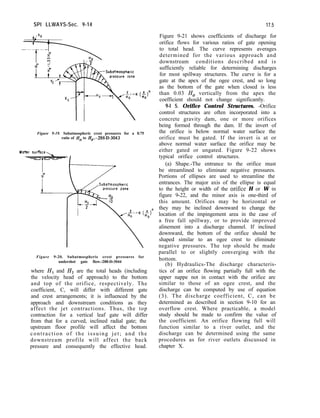
  • 320.
    288 Statement must beprepared by the agency having jurisdiction over project planning and submitted through proper channels to appropriate governmental agencies and interested private entities for review and comments. The term environment is meant here to include the earth resources of land, water, air, and vegetation and manmade structures which surround or are directly related to the proposed structure, The term ecology is meant to encompass the pattern of relationships that exist between organisms (plant, animal, and human) and their environment. 15-2. Planning Operations. -One of the most important aspects of dealing correctly and completely with the ecological and environmental impact of any structure is proper planning. If possible, an environmental team should be formed consisting of representatives from groups who will be affected by the structure and experts from various scientific fields who can contribute their ideas and experience. The team approach w i l l h e l p assure that environmental DESIGN OF GRAVITY DAMS considerations are placed in proper perspective with other vital issues such as reliability, cost, and safety, and that the relative advantages and disadvantages of each proposal are carefully weighed. It should also assure that the project is compatible with the natural environment. A suggested list of participants is given below: (1) Concerned local and community officials. (2) Design personnel. (3) Environment and ecology experts. (4) Fish biologists and wildlife experts. (5) Building architects. (6) Landscape architects. (7) Recreational consultants. This team should be responsible for the submittal of an ecological and environmental report to the designers with a list of criteria which the designs should encompass. Some of the topics which should be discussed in the report are covered briefly in this chapter. Since each site will present unique problems, only a general outline of the most important considerations is provided herein. B. FISH AND WILDLIFE CONSIDERATIONS 15-3. General.-The placement of a dam and its reservoir within the environment should be done with due consideration to the effects on the fish and wildlife populations of the specific area. These considerations often involve complex problems of feeding patterns and mobility, and where possible an expert in this field should be consulted. The Fish and Wildlife Service of the Department of the Interior, the Forest Service of the Department of Agriculture, and appropriate State agencies can supply considerable expertise on the environmental impact of a proposed structure. It should be remembered that dams and reservoirs can be highly advantageous in that they provide a year-round supply of drinking water for wildlife, breeding grounds for waterfowl, and spawning areas for fish. At the time of design, as many benefits as practicable to fish, wildlife, and waterfowl populations should be included and provisions should be made for the future protection of these populations. The following sections discuss some of the items which affect fish and wildlife and outline what can be done to aid them. 15-4. Ecological and Environmental Considerations for Fish. -Critically important to the survival of fish population are three items: (1) water quality, (2) water temperature, and (3) mobility. Water quality is obviously important to the survival of fish, and an effort should be made to see that the quantity of pollutants which enter the stream during construction and the reservoir after completion is kept to the minimum. Strict regulations concerning pollutants should be instituted and enforced. Quantities of degradable, soluble, or toxic pollutants should not be left within the reservoir area after construction. Heavy pesticide runoffs can cause
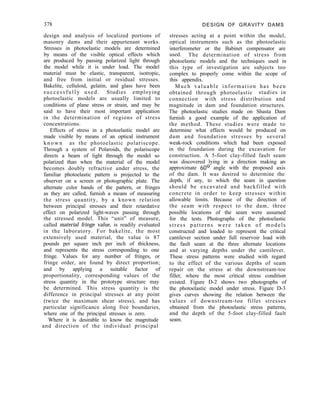
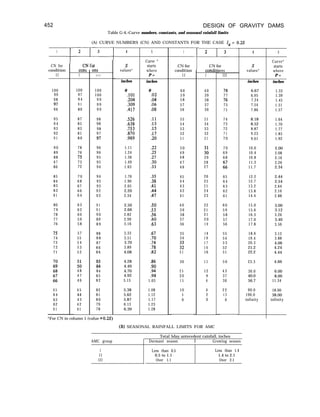
  • 321.
    ECOLOGICAL CONSIDERATIONS-Sec. 15-4 fishkills, and some means such as a holding pond or contour ditches should be used to reduce their presence and steps taken to eventually eliminate them. Substances that can cloud or darken the water interfere with the ability of sight-feeding fish to forage, and should not be allowed to enter the water. In mining areas where heavy erosion often occurs, careful consideration must be given to the effects of siltation which may rapidly reduce the reservoir capacity. Consideration must also be given to the acidic character of the water since it can cause fish kills. Control dams may be the solution, and in one case the Bureau of Reclamation has constructed an off-reservoir dam to reduce the rapid sedimentation of the main reservoir and to limit the amount of acidic inflow to an acceptable level. The temperature of the water controls timing of migration, breeding, and hatching and affects the appetite, growth, rate of heartbeat, and oxygen requirements of all fish. Each species of fish has an optimum temperature range within which it can survive, and consideration must be given to the temperature range which will exist both in the reservoir and in the stream below the dam due to the resefioir releases. For example, if a low dam is constructed in a mountainous area, the cool water entering the shallow reservoir can be warmed by the sun during the summer months to an undesirable extent. The warm temperatures of the shallow water within the lake and also of the downstream releases could then prevent the spawning of cold water species of fish such as trout. To remedy this problem, care must be taken to provide sufficiently deep reservoir areas where cold water will remain, and to use an outlet works which is capable of selectively withdrawing the colder water from the lower reservoir depths. Federal and State fish and wildlife agencies should be consulted as to the correct depth for the outlets in a specific area. Figure 15-l shows the selective withdrawal outlet works to be used at Pueblo Dam in Colorado. Figure 15-2 shows a selective withdrawal outlet works used at Folsom Dam in California. Movable shutters were placed 289 Trashracks. seats.ond qmdes not shorn 8 P L A N - F I S H H A T C H E R Y O U T L E T W O R K S ....-I S E C T I O N A - A Figure 15-I. Selective withdrawal outlet at Pueblo Dam in Colorado. Water can be withdrawn at any of four levels.-288-D-3104 upstream from the trashracks. By manipulation of the shutters water may be drawn from the desired level. The Bureau of Reclamation has used selective withdrawal outlet works at several locations to create favorable temperatures for fish spawning downstream of the dam. Further information concerning these structures is available in references [ 1 I and [2] .l Another reason for providing adequate reservoir depth, in addition to creating favorable conditions for spawning, is to prevent fish kill in the winter due to extreme cold. However, shallow reservoir areas are sometimes required to develop a warm water fishery or for waterfowl habitats. Although salmon are commonly thought of as the only migrators, other species of fish such ‘Numbers in brackets refer to items in the bibliography, section 15-l 2.
  • 322.
    290 , A ,--TOPOf oaraoet DESIGN OF GRAVITY DAMS tack trashrockS UPSTREAM ELEVATION HALF SECTION A-A Max w s El 475 I Deck EI 18050 - superstructure SHUTTERS ON TRASHRACK SHGTTiRS DOWN SHCiTTERSUP Figure 15-2. Selective withdrawal outlet at Folsom Dam in California. This outlet makes use of an adjustable shutter arrangement.-288-D-3105 as shad, steelhead trout, and other trout also require mobility considerations. The most common method for allowing fish to pass by a dam is use of the fish ladder. Figure 15-3 shows the fish ladder used by the Bureau of Reclamation on the Red Bluff Diversion Dam in California. Specific design requirements for fish ladders may be obtained from the Forest Service, the Fish and Wildlife Service, or appropriate State agencies. Where practicable, fish should be prohibited from entering spillways, outlet pipes, penstocks, and other restricted areas by use of fish screens. Where fish populations are concerned, care should be taken to avoid the destruction of vegetation in the reservoir area since this becomes a food source after the reservoir is filled. Certain amounts of standing trees or tree debris left in the reservoir area can provide a habitat for several species of fish as can brush Figure 15-3. Fish ladder used on the left abutment of R e d B l u f f D i v e r s i o n D a m i n California.-P602-200-4543NA piles, which are staked down to prevent them from being washed away, Figure 15-4 shows a reservoir in which trees have been left standing to benefit the fish population. Although certain aquatic plants are desirable for water birds, such as ducks, coots, and wading birds, they can be detrimental to fish production and should be controlled when necessary. Shallow shorelines in the inlet portions of the reservoir can be deepened to eliminate the growth of any plant life found not useful. I n n e w l y constructed reservoirs, arrangements should be made for stocking with the appropriate type or types of fish. Consultation with a fisheries expert is recommended to determine the correct type of fish and the proper time for stocking them. The oxygen content of some reservoirs can decrease with time and an examination of available reservoir reaeration devices may prove helpful. The oxygen content of the reservoir water may be increased during release from the reservoir by the use of reaeration devices such as the U-tube [ 31. Reaeration is also aided by increasing the contact of the water released in the spillways and outlet works with air. A
  • 323.
    ECOLOGICAL CONSIDERATIONS-Sec. 15-5291 Figure 15-4. An aerial view of a small reservoir with trees left at the water’s edge to provide a fish habitat.-288-D-2869 bibliography of reaeration devices compiled by feeding areas, (2) loss of habitat, and (3) the Bureau of Reclamation is contained in limitation of mobility. The severity of each of reference [4] . these effects can be significantly reduced. In some cases, fish hatcheries can be built in conjunction with the dam. Figure 15-5 shows the hatchery below Nimbus Dam in California. Canals also may provide spawning areas for fish, although considerable cost and special equipment may be required. Figure 15-6 shows an artist’s conception of the “grave1 cleaner” which will be provided at a salmon spawning area in the Tehama-Colusa Canal in California. Special gravel and special gravel sizes were required in the canal bottom to facilitate spawning. 15 -5. Environmental Considerations for Wildlife. -Three common detrimental effects of reservoirs on wildlife involve: (1) removal of When reservoirs inundate wildlife feeding areas, new areas should be planted to lessen the impact and, if possible, new types of grasses which are suitable and which provide more food per unit area should be planted. In addition, the new feeding areas can sometimes be irrigated with reservoir water to cause rapid, heavy growth. If the reservoir water is not immediately needed for irrigation, the water level can be left below the normal water surface to allow sufficient time for the feeding areas which are to be flooded to be replaced by areas of new growth. Where flooding of the homes of a large number of smaller animals such as muskrat and
  • 324.
    292 DESIGN OFGRAVITY DAMS Figure 15.5. Fish hatchery at Nimbus Dam in California.-AR2964-W Figure 15-6. An artist’s conception of the gravel cleaner to be used at a salmon spawning area on t h e T e h a m a - C o l u s a C a n a l i n California.-P602-D54534-520 beaver will occur, consideration should be given to adjusting the required excavation, reducing the reservoir water levels, or relocating the dam so that the number of animals affected will be minimized. It may also be possible to provide special dikes and drainage conditions which can lessen the effect. Problems in this area are difficult to solve and the advice of a specialist should be sought. Provisions for ducks, geese, and other waterfowl at reservoirs can be made by planting vegetation beneficial to nesting and by leaving areas of dense grass and weeds at the water’s edge. If suitable areas already exist at the damsite, an effort should be made to selectively excavate to leave the habitat in place. Assistance concerning the appropriate reservoir treatment can be obtained from the Fish and Wildlife Service of the Department of the Interior, the Forest Service of the Department of Agriculture, and appropriate State agencies.
  • 325.
    ECOLOGICAL CONSIDERATIONS-Sec. 15-6 C.RECREATIONAL CONSIDERATIONS 293 15-6. General. -The nation’s increase in population, the decrease in working hours, and the great mobility of large numbers of people have caused a significant increase in the use of reservoirs for recreational activities. These activities include fishing, boating, water skiing, swimming, scuba diving, camping, picnicking, and just simply enjoying the outdoor experience of the reservoir setting. Many of the reservoirs constructed in past years have become the recreation centers of the present, and this will undoubtedly be repeated in the future. Provisions should be made to obtain the maximum recreational benefits from the completed reservoir, and a future development plan should provide for area modifications as the recreation use increases. 15 - 7 . Recreational Development. - Considerations for recreational development should start when project planning is begun and should be integrated into the total site plan. Areas of significant natural beauty should be left intact if possible, and recreational facilities should be developed around them. Boat ramps and boat docking facilities are beneficial to-most reservoir areas and should be constructed at the same time as the dam. Figure 15-7 shows the docking facilities at the Bureau of Reclamation’s Canyon Ferry Reservoir in Montana. Camping facilities for truck campers, trailers, and tenters, and picnicking areas can often be provided at reasonably low costs. Trash facilities should be provided at convenient locations to help in litter control, and the excessive use of signs and billboards near the reservoir area should be prohibited. The signs which are used should be blended with the surroundings. Toilet facilities should be available at all camping grounds and proper sewage disposal facilities should be installed, especially where the possibility of reservoir pollution exists. If the reservoir is near a population center it may prove advantageous to provide bicycle paths, equestrian paths, and foot paths for public use. At the damsite or nearby, a reservoir viewing location and possibly a visitors’ center should be built. Exhibits showing the history of the project, local history, or other appropriate exhibits can enhance the visitors’ enjoyment of the reservoir. These centers should be aesthetically designed to fit the location. Figure 15-8 shows a viewing area at Glen Canyon Dam. Buildings adjacent to the reservoir should be of low profile and blend with the reservoir surroundings; however, in some cases it may be desirable to contrast the buildings with their surroundings. Fishing benefits can be maximized by stocking the reservoir with several types of fish and by replenishing these stocks yearly. Proper maintenance requirements for the recreation areas should be instituted after completion of the dam and reservoir complex, and should include repair of broken and damaged equipment, repainting, and rebuilding to meet expanded facility demands. Trash should be removed from the campgrounds and adjacent recreation facilities at regular intervals, and the possibility of recycling aluminum and other metal products should be explored. Recreational areas which are overused should be rotated to prevent their deterioration, and single areas which receive exceptionally heavy use should be fenced off completely for short intervals to prevent their ruination. Protection of the reservoir banks from sloughing may be required for steep slopes, and excessive erosion at any part of the site should be prevented. D. DESIGN CONSIDERATIONS 15-8. General. -Design requirements should goals: (1) keeping the natural beauty of the be devoted to the accomplishment of three surrounding area intact, (2) creating
  • 326.
    294 DESIGN OF GRAVITYDAMS Figure 15 7. Boat docking facilities at Canyon Ferry Reservoir in Montana.-P296-600-949 aesthetically satisfying structures and landscapes, and (3) causing minimal disturbance to the area ecology. Designers should try to accomplish these goals in the most economical way. The following paragraphs discuss some items to be considered during design and will provide some practical suggestions for designers. Many of the items discussed here should be considered during the project planning stages and the critical decisions made at that time. If it is necessary to excavate rock abutments above the crest of the dam, consideration should be given to the use of presplitting techniques since they leave clean, aesthetic surfaces. As discussed in sections 15-6 and 15-7, a scenic overlook should be provided for viewing the dam and reservoir. The overlook should have adequate parking a n d , i f practicable, a visitors’ center. The diversion schemes (see ch. V), should be such that excessive silt created during construction will not find its way into the downstream water. Materials from excavations should be placed in the reservoir area upstream of the dam to prevent unsightly waste areas in the downstream approaches. In some cases, boat ramps, picnic areas, or view locations can be constructed with excavated material. Where foundation conditions permit it, spillway structures of a type which minimizes the required surface excavations on the dam abutments should be used. (See ch. IX.) If a section of canal is constructed in connection with a dam, spoil piles should be shaped to the natural landscape slopes along the canal length; this material can also be used t o c o n s t r u c t recreation areas where appropriate. Pipelines should be buried as should electrical wiring; where this is not possible, the pipelines and electrical apparatus should be painted to blend with their
  • 327.
    ECOLOGICAL CONSIDERATIONS-Sec. 15-9295 Figure 1.5-8. Viewing area at Glen Canyon Dam in Arizona.-P557400-1133 background. Protective railings used on the made to utilize or preserve them, and dam crest and on bridges near the site should additional right-of-way should be obtained to be low enough so that the reservoir may be include any such adjacent areas. seen from a passenger car. Access roads to the damsite and roads used 15-9. Landscape Considerations. -As much by the contractor during construction should natural vegetation as possible should be left in be kept to a minimum, and those roads not place. If significant areas of natural beauty planned for use after completion of the dam exist near the project, every effort should be
  • 328.
    296 should be obliteratedand replanted with grass or other natural vegetation. Access roads subject to excessive erosion should have protective surfacing. Roads which are required for maintenance of the dam or appurtenant works should be protectively fenced if excessive visitor usage will cause erosion. Erosion control should be started at the beginning of the job. Roads and cut slopes should be provided with terraces, berms, or other check structures if excessive erosion is likely. Exploratory trenches which are adjacent to the damsite should be refilled and reseeded. Quarry operations and rock excavations should be performed with care. The minimum amount of material should be removed, correct blasting techniques should be used, unsightly waste areas should not be left, and final rock slopes for the completed excavation should be shaped to have a pleasing appearance. Presplitting and/or controlled blasting should be considered for final slope cutting to permit a clean, pleasing view. Road relocations near the dam can often eliminate deep cuts in hillsides, allow scenic alinements, and provide reservoir viewing locations. Adequate road drainage should be used and slopes should be cut so that reseeding operations will be convenient. For projects where power transmission lines will be required the publications “Environmental Criteria for Electric Transmission Systems” [ 51 and “Environmental Considerations in Design of Transmission Lines” [61 will provide many helpful suggestions which will lessen their environmental impact. 1 S-10. Protective Considerations.-At locations where accidents are most likely to occur, protective devices and warning systems should be installed. The most dangerous locations at a damsite are near the spillway (especially if it is a chute type), the outlet works intake tower, and the stilling basins of both the spillway and outlet works. Any portion of the spillway and outlet works stilling basins which might prove hazardous should be fenced off and marked by warning signs. Canals with steep side slopes which prevent a person or an animal from climbing out are DESIGN OF GRAVITY DAMS extremely dangerous, as also are siphons. Considerable information concerning canal safety is contained in the Bureau’s publication “Reducing Hazards to People and Animals on Reclamation Canals”[ 71 . W h e n t h e p r o j e c t e n c o m p a s s e s t h e generation of electricity, the problems of providing adequate safety precautions are considerably increased and the advice of an expert in that field should be sought. 15 - 11. Construction Considerations. -The e n v i r o n m e n t a l a n d ecological design requirements presented in the specifications are converted from an abstraction into a reality by the builder. The contractor and his personnel should be informed that this is a most important step in the planning, design, and construction sequence. In this regard, a preconstruction conference may be invaluable in assuring an understanding of the job requirements by the builder and in enlisting his cooperation. The owner should insure compliance by having competent inspectors and by having specifications which clearly spell out the construction requirements. Excessive air and water pollution during construction should be prevented, and specifications covering these items are included in appendix I; they should provide a framework for the inclusion of other important environmental provisions. The builder should also institute safety precautions during construction, and the publication “Safety and Health Regulations for Construction” [ 81 will provide helpful information. The builder should be encouraged to bring forward any obvious defects in the environmental considerations which he encounters during construction and to suggest improvements. Construction campsites should be placed within the reservoir area below normal water level. All trees, shrubs, and grassland areas which are to be protected should be staked or roped off. Any operations which would affect a large wildlife population should be moved to a different location if at all possible. Large volumes of water should not be taken from the stream if there are prior downstream commitments, and the water going downstream should be muddied as little as possible and kept
  • 329.
    ECOLOGICAL CONSIDERATIONS-Sec. 15-12297 pollution free; siltation ponds may be needed in extreme cases. The builder should be required to remove or bury all trash and debris collected during the construction period and to remove all temporary buildings. Every opportunity should be taken to use the timber in the reservoir area for commercial operations. The burning of trees cleared within the reservoir area should be prevented if excessive air pollution will result or if State laws prevent it. At Pueblo Dam in Colorado, the Bureau required that all brush and timber smaller than 7 inches in diameter be chipped into mulch and stockpiled for future use on the reseeded areas. The chipping operation at Pueblo Dam is shown in figure 15-9. Slightly larger timber can be cut into firewood for use at camping and recreation areas, and still larger timber can be channeled into some commercial use such as production of lumber, wallboard, or boxes. A temporary viewing site for the project, having signs which show the completed project and explain its purpose, is helpful in promoting good community relations. [II f21 131 [41 [51 161 [71 Figure 15-9. Chipping operations at Pueblo Dam in Colorado. All brush and timber smaller than 7 inches in diameter are chipped and stored for use as a mulch on reseeded areas.-P382-700-790 NA E. BIBLIOGRAPHY 15-12. Bibliography. “Register of Selective Withdrawal Works in United States,” Task Committee on Outlet Works, Committee on Hydraulic Structures, Journal of the Hydraulics Division, ASCE, vol. 96, No. HY9, September 1970, pp. 1841-1872. Austin, G. H., Gray, D. A., and Swain, D. G., “Multilevel Outlet Works at Four Existing Reservoirs,” Journal of the Hydraulics Division, ASCE, vol. 95, No. HY6, November 1970, pp. 1793-1808. Speece, R. E., and Orosco, R., “Design of U-Tube Aeration Systems,” Journal of the Sanitary Engineering Division, ASCE, vol. 96, No. SA3, June 1970, pp. 715-725. K i n g , D . L . , “ R e a e r a t i o n o f S t r e a m s a n d Reservoirs-Analysis and Bibliography,” REC-OCE-70-55, Bureau of Reclamation, December 1970. U.S. Department of the Interior and U.S. Department of Agriculture, “Environmental Criteria for Electric Transmission Systems,” Government Printing Office, Washington. D.C., 1970. Brenman, H., and Covington, D. A., “Environmental Considerations in Design of Transmission Lines,” ASCE N a t i o n a l M e e t i n g on Transportation Engineering, Washington, D.C., July 1969. Latham. H. S.. and Verzuh. J. M.. “Reducing Hazards to P e o p l e ’ a n d A n i m a l s o n R e c l a m a t i o n C a n a l s , ” REC-OCE-70-2, Bureau of Reclamation, January 1970. [8] Bureau of Reclamation, “Safety and Health Regulations l for Construction,” latest edition. -> “Environmental Quality-Preservation and Enhancement.” Reclamation Instructions. Series 350, Part 376. 1969. U.S. DepartmentoftheInterior,“Man-AnEndangeredSpecies,” Government Printing Office, Washington, D.C., 1968. “River of Life, Water: The Environmental Challenge,” Government Printing Office, Washington, D.C., 1970. -, “The Population Challenge-What It Means to America,” Government Printing Office, Washington, D.C., 1966. “The Third Wave,” Thington, D.C., 1967. Government Printing Office, Benson, N. G. (editor), “A Century of Fisheries in North America,” American Fisheries Society, Washington, D.C., 1970. Clawson, M., and Knetsch, J. L., “Economics of Outdoor Recreation,” The John Hopkins Press, Baltimore, Md., 1966. Dasmann, R. E., “Environmental Conservation,” John Wiley & Sons, Inc., New York, N.Y., 1968. Dober, R. P., “Environmental Design,” Van Nostrand Reinhold Co., New York, N.Y., 1969. “Environmental Quality,” First annual report of the Council on Environmental Quality, Government Printing Office, Washington, D.C., August 1970. *References without numbers are not mentioned in text.
  • 330.
    298 DESIGN OFGRAVITY DAMS Flawn, P. T., “Environmental Geology: Conservation, Land-Use Planning, and Resources Management,” Harper &Row, New York, N.Y., 1970. McCullough, C. A., and Nicklen, R. R., “Control of Water Pollution During Dam Construction,” Journal of the Sanitary Engineering Division, ASCE, vol. 97, No. SAL, February 1971, pp. 81-89. Prokopovich, N. P., “Siltation and Pollution Problems in Spring Creek, Shasta County, California,” Journal of American Water Works Association, vol. 57, No. 8, August 1965, pp. 986-995. Reid, G. K., “Ecology of Inland Water and Estuaries,” Van Nostrand Reinhold Co., New York, N.Y., 1961. “Report of the Committee on Water Quality Criteria,” U.S. Department of the Interior, Federal Water Pollution Control Administration, April 1, 1968. Seaman, E. A., “Small Fish Pond Problem-Management Chart,” Technical Publication No. 2, West Virginia Conservation Commission, Charleston, W. Va. Smith, G. (editor), “Conservation of Natural Resources,” third edition, John Wiley & Sons, Inc., New York, N.Y., 1965. “Transactions,” American Fisheries Society, Washington, D.C. U.S. Department of the Interior, “Quest for Quality,” Government Printing Office, Washington, D.C., 1965. Vernberg, .I. F., and Vernberg, W. B., “The Animal and the Environment,” Holt, Reinhart & Winston. Inc.. New York, N.Y. 1970. Watt, K. E., “Ecology and Resources Management; A Qualitative Approach,” McGraw-Hill, New York, N.Y., 1968. Wing, L. W., “Practice of Wildlife Conservation,” John Wiley & Sons, New York, N.Y., 1951.
  • 331.
    <<Appendix A The GravityMethod of Stress and Stability Analysis A- 1. Example of Gravity Analysis- Frian t Dam. -The example presented in this appendix was taken from the gravity analysis of the revised Friant Dam. Friant Dam was constructed during the period 1939 to 1942 and is located in the Central Valley of California. A plan, elevation, and sections of the dam are shown on figure A- 1. The assumptions and constants used for the analysis are given below: (1) Unit weight of water = 62.5 pounds per cubic foot. (2) Unit weight of concrete = 150 pounds per cubic foot. (3) Unit shear resistance of both concrete and rock = 450 pounds per square inch. (4) Coefficient of internal friction of concrete, or of concrete on rock = 0.65. (5) Weight of l&foot drumgate = 5,000 pounds per linear foot. (6) Top of nonoverflow section, elevation 582. (7) Crest of spillway section, elevation 560. (8) Normal reservoir water surface, elevation 578. (9) Tailwater surface, elevation 305. (10) Horizontal component of assumed earthquake has an acceleration of 0.1 gravity, a period of vibration of 1 second, and a direction which is at right angles to axis of dam. Note. Figure A-2 is a graph showing values of the coefficient KE, which was used to determine hydrodynamic effects for the example given. However, this procedure is not consistent with current practice. A discussion of the coefficient C, , which is presentIy used to determine hydrodynamic pressures, is given in set tion 4-3 4. ( 1 1) Vertical component of assumed earthquake shock has an acceleration of 0.1 gravity and a period of 1 second. (12) For combined effects, horizontal and vertical accelerations are assumed to occur simultaneously. (13) Uplift pressure on the base or on any horizontal section varies from full-reservoir pressure at the upstream face to zero, or tailwater pressure, at the downstream face, and is considered to act over two-thirds the area of the section. Uplift is assumed to be unaffected by earthquake shock, and to have no effect on stresses in the interior of the dam. Note. This uplift assumption is no longer used by the Bureau of Reclamation. See section 3-9 for uplift assumptions now in use. A-2. List of Conditions Studied. -A list of conditions studied for Friant Dam for both the nonoverflow and the overflow section is tabulated below: ( 1) Reservoir empty. (2) Reservoir full. (3) Reservoir empty plus earthquake. (4) Reservoir full plus earthquake. Loads for reservoir empty are dead loads consisting of the weight of the dam and gates. Loads for full-reservoir operation include, in addition to dead loads, the vertical and horizontal components of normal waterloads on the faces of the dam. Loads for earthquake effects with reservoir empty include inertia forces caused by acceleration of the mass of dead loads. Loads for earthquake effects with reservoir full include, in addition to the above, the inertia force of the mass of water and the hydrodynamic force caused by the movement 299
  • 332.
    300 DESIGN OFGRAVITY DAMS t‘O” El. 38001-,q ” f . : + :,-Gantry crane 600 TOP Spillway crest, r, c,-nn ,’ OP Of Parapet, El. 5850 305.0 Grout.c”rtainT-m’y SECTION B-B DAL -r ‘d Trashmck-structure(sb, n C-C El. 452.0 n D-D El.433.2t El 450.1 SECTION C-C 6 D-D El 431.25 v-- )I ’ li Roadway---*y/ PLAN Figure A-I. Friant Dan-plan and sections. -288-D-3156
  • 333.
    -7 Example: To findpressure change at A CURVES FOR COEFFICIENT K, General Formula : pE= K,c,A m FOR COMPUTING CHANGE IN PRESSURE Q=400’ h = 3 0 0 A =.I O N I N C L I N E D F A C E S OFDAMS c,lGiT = 1,878 DUE TO EARTHQUAKE SHOCK From curve for h = 300 I ‘nd L= 40, find K= .834 then pE = ,834 x 1,878 = 1,566 Ib./sq.ft. I. = HORIZONTAL DISTANCE IN FEET TO POINT ON FACE FROM INTERSECTION OF WATER SURFACE AND FACE OF DAM Figure A-2. Curves for coefficient KE for computing change in pressure due to earthquake shock. -288-D-3157
  • 334.
    302 of the damagainst the water of the reservoir. Uplift forces are assumed to be unaffected by earthquake shocks. The effects of earthquake were studied for each of the following directions of the acceleration: (1) Horizontal upstream. (2) Horizontal downstream. (3) Vertical upward. (4) Vertical downward. (5) Horizontal upstream plus vertical upward. (6) Horizontal upstream plus vertical downward. (7) Horizontal downstream plus vertical up ward. (8) Horizontal downstream plus vertical downward. A-3. Computations and Forms. -Computa- tions for the gravity analysis of the nonoverflow section of Friant Dam are shown as figures A-3 to A-9, inclusive. These are for reservoir-full conditions with earthquake accelerations upstream and upward. Equations used are shown at the top of the forms. Standard forms are used. A-4. Final Results. -Final results are given on figures A-l 0 to A- 18, inclusive, which show normal and shear stresses, stability factors, and principal stresses for each loading condition on the overflow and nonoverflow sections. A-5. Summary and Conclusions. -Following is a summary of results and conclusions obtained from the gravity analysis of Friant Dam. These are presented for the purpose of showing the type of information usually obtained from such an analysis. ( 1 ) T h e a n a l y s e s o f t h e m a x i m u m nonoverflow and spillway sections of Friant Dam indicate stresses and stability factors within safe limits for all loading conditions. (2) The maximum compressive stress, maximum horizontal shear stress, and DESIGN OF GRAVITY DAMS minimum shear-friction factor all occur for normal full-reservoir operation during earthquake accelerations “horizontal upstream” and “vertical upward.” (3) The maximum tensile stress occurs for reservoir-empty conditions combined with e a r t h q u a k e acceleration “horizontal downstream” acting alone or in conjunction with earthquake acceleration “vertical upward. ” (4) The maximum sliding factor occurs for normal full-reservoir conditions combined with earthquake accelerations “horizontal upstream” and “vertical downward.” (5) Points of application of resultant forces on the bases and horizontal sections of the nonoverflow and spillway sections are well within the middle-third for most loading conditions. (6) Maximum stresses occur at the downstream face of the maximum nonoverflow section; the maximum compressive and shear stresses occur at the base elevation, and the maximum tensile stress occurs at elevation 400. Maximum direct stresses all act parallel to the face. (7) The maximum sliding factor occurs at elevation 400 and the minimum shear-friction factor occurs at the base elevation of the nonoverflow section. (8) The maximum compressive stress is 409 pounds per square inch and the maximum tensile stress is 46 pounds per square inch. (9) The maximum horizontal shear stress is 192 pounds per square inch. The maximum sliding factor is 0.999, and the minimum shear-friction factor is 5.45. (10) Since tensile stresses occur at points not subjected to water pressure, the possibility of uplift forces acting in tension cracks is eliminated. Complete results for nonoverflow and spillway sections are tabulated in table A-l.
  • 335.
    THE GRAVITY METHOD-Sec.A-5 FRIANT DAM NONOVERF VERTICAL PLANE )I3 921,167.32 46/,88992 51, 895.117 Y 132.3 112.3 72.3 32.3 0 y2 I( 503.29 /2,6//.29 5,22729 (043.29 Y3 2,3/5,68527 /,416,24287 37/:93307 33,698.267 Y I82 3 I47 3 I073 67.3 2 7 3 0 y 2 y233.29 Z/,69729 l/,51329 4,529.29 745 29 y 3 6>058,428.77 3,/96,0/0,82/,235,376.02 304,821.22 20,346.4/7 y 217.3 211 8 171.8 131.8 918 51 8 Il. 8 0 )I2 4<2/9.29 44,85924 29,5/5.24 l(371.24 8,42724 2,683.24 139.24 V3 10260 752 9.501.1875.0707182 2.289529.4 773620.63138.99183 1.643.032 Figure A-3. Friant Dam study-values and powers of y. -DS2-2(6)
  • 336.
    FRIANT D AM NONOL!ERFLL?W. S E C T I O N . R E S E R V O I R W . S . EL..578. ._ T A I L W A T E R E L . .NONE.. S T U D Y N o , ..z GRAVITY STRESS ANALYSIS OF MAXIMUM PARALLEL-SIDE CANTILEVER INCLUDING EFFECTS OF TAILWATER AND HORIZONTAL EARTHQUAKE EARTHQUAKE NORMAL STRESS ON HORIZONTAL PLANES &=a+by By..J.T.R Date.?r5:.94. ./SP ,. a=0 0 = .434,03 ,,=f(ZW)- + (ZM) I I I c I I_ I I I I CT7 Pounds b =+M) Check: (for y =T), 0,” = +(,IW) t -$xM) I ELEV. T tJ IC _ --..-a. per Square Foot 7 T3 xw EM b ’ V E R T I C A L P L A N E us. 6 5 4 3 2 I 0.s cr,,- Reservoir Fuli .036~630,036i008,05~55~2.0~56589,784,4 ili,R80 - 1 7 0 , 7 0 0 /00676,20 2,7084 4 , 7 3 3 5 5438 2,7‘?394 __--__ _~_ 500 .016,05/,364 .00(545877,7 0>%4L?626,&Y3 481r490 2,945200 i&60,38 3> I22 5 6 6 , 0 4 2 8 2 11,983 12,285 3,i7256 450 .OlO,277,492 0,3633,76,,04 0,%13,026,948 1,139,800 14,328,OOO ESSSO,/l 2,618 75 6,344 8 13,896 8 20,144 2,633 76 400 .00<25~57~CLl~342,792,70 $as;l82,05(3 2,086,900 -39,701,OOO 205732,62 78 4 7 2,115 9244 14,101 22,758O 29,204 2,164 78 350 L-__---------- l6,llE.O 23, 005,~5;163,5.0~~8~54i~66 O)Ol~Yl?J7ll,6 3,594,OOO 86>900,000 1%123,84 4,028 66 10,070 0 I650 30,213.Y 35,246 4,025 67 315 .004,60/,932,8.0~2~066,7/ $00l,169,4504,925,000 732,780,OOO ~5+?86,875,740.60 6,646 7 lZ,889.2 19,132.6 2~5/76~/ 3i,Pi9 37704 I 3gs275 5,792.60 Figure A-4. Friant Dam study-normal stresses on horizontal planes. -DS2-2(7)
  • 337.
    F.!?IANT.. D AM NONOVERFLOW. S E C T I O N . R E S E R V O I R W . S . EL..5?8 TAILWATER E L . N.QlvE. ., S T U D Y N o . . ? . . ’ 2 GRAVITY STRESS ANALYSIS OF MAXIMUM PARALLEL-SIDE CANTILEVER m -A INCLUDING EFFECTS OF TAILWATER AND HORIZONTAL EARTHQUAKE G) EA R TH WA KE SHEAR STRESS ON HORIZONTAL AND VERTICAL PLANES Tzy =Tyz = a,+ b,y + c,y2 By.. J..!.!?.. ..Dote .?.mr.6rW. Tzyv=- (9”-P’*PE)tan9, a, = Tzy,= (ozo- p’k’tp: 1 tan QD b, = - [ ~~(“)+q(~~yu’t~(~~yDl] Cl = +Jw)+$~~~y,) t $(T~yo) z =I I I : I (t Use (t) sign if horizontal earthquake acceleration is upstream.) (ruse t-J siqn if horizontal earthquake acceleration is upstream.) Q=.. -137 432,33 -/36,314,55 0 3,4/55 9,919 3 /5, /// w Figure A-5. Friant Dam study-shear stresses on horizontal and vertical planes. -DS2-2(8) z
  • 338.
    .F.R!AN.?- .DAM NONOVE:RFCOW.S E C T I O N . RESERVOIR W.S. EL. .5.?.8.. TAILWATER EL. .!??!!6.. _. S T U D Y N O . .3 (&= 150 GRAVITY STRESS ANALYSIS OF MAXIMUM PARALLEL-SIDE CANTILEVER W 0 0 = ..4%?3.J INCLUDING EFFECTS OFTAILWATER AND HORIZONTAL EARTHQUAKE m EARTHQUAKE (ACGELI PARTIAL DERIVATIVES FOR OBTAINING CJy By. H. .9 W Date .?.: !? r.40. T[tUse(t)sign if horizonfol eorthquoke occelerotion is upstream) ftUse(-)sign if horizontol eorthquoke occelerotion is upstream) ( *W -omitted if water oh face is absent) 1 * = tan@, (0 @ auzu +* a a tan cu )+ a2 ( P -0s” +_tpE) atan D - - a2 - a2 az I a ton% _ A tonQu - _ atan@D Atan@D ah _ PE A a P’E = A P’r a2 A Z a2 A Z -5-T' A Z a2 A Z ELEV + + + -$ + -$ +- K, K, F K, K, ado;0 apE atOn+ aT --‘+J*y$!?xp& h(&+&L a2 az Reservocr Fuii 5 5 0 - 70/.140'43i55/8,/53 0 0 0 %8Ei;293 7 I5 T 2,783. 47 Note. K, , K2 a n d K3 n o t r e q u i r e d a b o v e + + 5 0 0 Ei 4 0 0 because U.5 Face IS vertlcai - - - - 642,47(85/51476,99 0 0 0 62.283>693 7 15 T 5046 36 + 4 5 0 - - - - 668224>~Wl5675<77 0 + 0 0 65976935 7 l5T q/9.45 --__-. - c 4 0 0 - - 682646/68l56580,5? L - - - 0 0 0 65.854399 7 15T 15,354 50 Figure A-6. Friant Dam study-partial derivatives for obtaining 0~. -DS2-2(9)
  • 339.
    WITH EARTHQUAKE 2 ZNTERMEDIATECOMPUTATIONS FOR OBTAINING STRESSES- GRAVITY ANALYSIS OF FRIANT DAM m FigureA-7. Friant Dam study-intermediate computations for obtaining stresses. -DSZ-2(10) z
  • 340.
    ~RWT D AM NONOVERFLOW..SECTION. R E S E R V O I R W.S. EL.??.. T A I L W A T E R EL.MY?JE .,.. S T U D Y N o . 3.. i GRAVITY STRESS ANALYSIS OF MAXI MUM PARALLEL-SIDE CANTI LEVER I N C L U D I N G E F F E C T S O F T A I L W A T E R A N D H O R I Z O N T A L E A R T H Q U A K E EARTHQUAKE -X NORMAL STRESS ON VERTICAL PLANES Cy=a2+ b,y + c2y2 + d,y3 B y . H.PW D a t e P:?-40., aa, a 3T;' a2 s=-g y4 xv t+ &zyu [ ( ) ( (*Use(t) sign If horuontol earthquake occelerotion is upstream ) (% Use (-) sign if horizontal earthquake acceleration is upstream ) 1 a,= Up= a,tan *,+ p’?*pL b = b tan+ 2 I 0 t da, +‘Aho az- c c,= c,tan @ ti * D 2 a2 Check far y = T ; a,“=( P **&Zyutan9, abl ELEV. 2 az ac, 0y Pounds per Square Foot az b, CL? d, VERTICAL PLANE u s 6 5 T 4 3 2 I D S Fyu Reservoir Fu// 5 5 0 -?5.887,293~1.807,619 -683,605>49 177.356,02 32 304,768-227,868, 5 2>373.97 1914.9 2,619. 5 2373.9 5 0 0 +62.203,893 +2.957,829,61b31,935,70 23 349,901 t861,795,3 010,645,07 6,142 86 6143 9 5,941. 2 6,042.5 6,111 9 4 50 ;5 976,939 1.875,786,3 bl3,285>57935.754.699if752,996,4 -004,428,53 9,759 95 906 9.5 9,667.6 10,171.5 9.760.0 4 00 +65856,399 %436,296,4 -007,680,134i5.346,232 +627,728,0 :002,560,05 13,393 0 13,594.1 13,493.g 13r494 5 i4,lOC8 13,370.o 3 5 0 37 f ~006,934,037~05.710,09 4 3 9 , 6 9 5 516,354,8 ?957,897,7 002,311, 35 15,110 75 15,KJ5.4 14,988.3 13,896 6 15,105 9 17,120.9 15.907.8 3 I 5 &620,433 lf219,767 005,044,313 &,099,lS3 ,4 .?99,784,2 .ti,681,44 18, 127.0 18,127 7 1 7 , 1 2 1 4 16,114.lJ 15,109.7 16,/12 8 18J27.1 19,135.g 18,351.O - Figure A-8. Friant Dam study-normal stresses on vertical planes. -DS2-2(11)
  • 341.
    THE GRAVITY METHOD-Sec.A-5 309 LE - 55c . .F.!?!4.N?.. . DAM. .hQ’K?W?F4.QH!, . . SECTION. RES. W.S. E1.3.W. . . TAILWATER EL.&%?!‘E. STUDY No.3. GRAVITY STRESS ANALYSIS OF MAXIMUM PARALLEL-SIDE CANTILEVER RESERVOIR FULL WlTH EARTHGUAKE PRINCIPAL STRESSES SY..H.P.W. Dote.4.~,6:68. 5 0 0 9 &;fj 7,4693, I72 56 65 2,847 6,/l/ -14.05 217,841 2,988 8,959.7 6 5 b 3,/32.6 304 I I I I I 1 I I&7, 2 2 2 0 1 2 4 127 UP2 6,//1.&?6 9,376 6 77 8 0 4 2 6 5 I 0 Ton2iepjI 0 b32 3 6 2 1-2745.07, I Figure A-9. Friant Dam study-principal stresses. -DS2-2(12)
  • 342.
    M A XI M U M N O N - O V E R F L O W S E C T I O N UPSTREAM FACE M A X I M U M S P I L L W A Y S E C T I O N HORIZONTAL SECTION DOWNSTREAM FACE 1 Resulton+-concrete weight only. Resultant-water pressure and weaght. ‘, Resultant-wok pressure, weight and uploft. S,,ding f,,ctor; Horlmntal Force Weight-UplIft Sheor-fr,ct,on Factor= (Weight-UplIft) x Coefficient of Internal Fr~ctaon + Horlzontol Areo I Umt Shear Rerlrtonce Horizontal Force Unat weight of concrete =I% pounds per cubic foot. Unit sheor rewstonce ‘450 pounds per square inch. Coefflclent of Internal frlctlon = 0 65 Upllft pressure varies 0s a straight line from reservoir water pressure ot upstream face to zero ortollwoter pressure ot downstream face, octang over two-thards the area of the horIzonto section. Total l o a d corrled by vertlcol con+,lever 1 REVISED DESIGN) G R A V I T Y &NALYSES MAXIMVM NON-OVERFLOW AND SPILLWAY SECTlONS RESERVOIR EMPTY AND NORMAL FVLL RESERVOIR OPERATION N O R M A L CONDITIONS All norm01 stresses ore compressive except those preceded by o negative r~gn, which ore tens!le. Positive sheor stresses ore caused by shear forces octlng thus P Negatwe sheor stress.% ore caused by shear forces octmg th”I -. Weight of gate included in onolya~a of sp~ilroy section Figure A-IO. Friant Dam study-gravity analyses for normal conditions.
  • 343.
    NORMAL RES. W.S. EL. 578 IOR - MAL RES.W. S. EL. 578 -----yj Pounds oer “are Inch )OWNSTREA Resultant-concrete weight and earthquake (horizontal upstream). Resuitoti-mncnte weight and earthquake (horizontal downstream) Aesulfont-&r pressure,w$ght,ond earthquake (horizontal upstream) i ~su~tOnt-WoHkd,~~~,~o~~g~,u~i~,U~ earthquake (hor~zon~f Upstim). Resultant-water pessure, ueight,and earthquake (horizontal dounslrwm). & Resultant- voter pressure,~eight,uplift,ond ~arthquake!horlzontol dcwnstreom). Sliding factor= Weigh-Uplift Shrehidion Fahrz(Wagi+ Uplift) x Coefficient of Interml Friction + Hcwontol Are0 x Unit Sheor Res&.mce Horizoniul Force Unitveightof concrete : 150 pounds per cubic foot. Unit sheor rewstance 2 450 pounds persquze inch. Coefficient d inten-4 friction = 0.65 Upl~fl pressure varies 05 o straight line from reserwir water pressure otupstrmm face to zero or toilwater pressure ot downstream face, acting Over two-thuds the oreo of the horizontal section; assumed to be unaffected by earthquake Horizontal earthquake acceleration : 0.1 gravity, period: I second. Total load carried by vertical cantilever All normal stresses ore compressive exceptthose preceded by o negative sign, which ore tensile. Posltlve shear stressesore caused by shear forces atlng thus e. Negative shear st~~~sesoremused by shear forces acting thus-. * Including wrihquohe occelertion (horizontal upstrewn). ** Including wr+i?quake ocseleratnon (tnrizcntol downstream). Weightof gate included in analysis of spillway section. F R I A N T D A M lRE”lSED DESIGN) Figure A-l 1. Friant Dam study-gravity analyses with horizontal earthquake acdeleration.
  • 344.
    r :h NORMAL RES. W.S.EL.576 RESERVOIR EMPTY HORU. “EW,CC. STRESS “ORll STRE.33 PARClLEL SHEAl TOt=ACE STRES Pounds Pounds ‘Per Sauore Inch MAXIMUM NON-OVERFLOW SECTION c UPSTREAM FACE MAXIMUM SPILLWAY SECTION HORIZONTAL SECTION DOWNSTREAM FACE b Resultant -concrete weight and earthquake (vertical upward),colncldes with 1 Resultant -concrete weight and earthquake (vertlcol downward). rResultont-waterpress”re,welgM and eorthquoke(vertlcoI upward),coincldes wtt, Resultant-woterprea”Te.welgh+ and ear+hquoke(vert,cal downward). jReSult~“t-woterpressure,welght,upllft,and earthquake (vertical upward). i Resultant-woterpresure,veight,uplift,pndearthqu~ke(vert~col &wnvard) Sliding factor = Honzontol Force Waghi-Upllft Shear-fr,ct,on Factor = ( Weight -UPlift) x Coefficient of Internal Frlctlon +Horizontol Area x Unit SheorResistonce. Horizontal Force Unitwetght ofconcrete= poundspercubtcfoot. UnltsheOrreslstanCe’45Opoundspersquore~nch.Coefficientof lnternol friction =O 65. UplIft pressure vor~es oso strolght line from reservoir water pressure atupstreom face to zero or tollwater pressure ot downstream face octlng over two-thirds theoreo of the horlzontal sectton; assumed to be unaffected byearthquake. Vertical eorthquoke occeieration = 0 I g , Perlod = I second Total load cowled by vertlcol contllever All normal stresses are Compressive except those preceded byo negotlve sign, whlchare tensile Posltlve sheor stresses ore caused by shear forces acting thus _ Negative shear Stresses ore caused by sheor forces octlng thus +=== + lncludmg eorthquoke acceleration lverticai upward). xx lncludlng earthquake acceleration (vertical downward) Weight of gote ancluded in analysis of spillway sectton. Figure A-12. Friant Dam study-gravity analyses with vertical earthquake acceleration.
  • 345.
    RESERVOIR EMPTY /NORMAL RES. W.S. EL.578 1 3MAL RES. W. S. EL.? 17E L m ; Pi I 1 MAXIMUM NON-OVERFLOW SECTION i jEl z+s 3RIZONTAL ! A 1 243.29’ MAXIMUM SPILLWAY SECTION DOWNSTREAM FACE STUDY NO.5 ALL RESULTANT FORCES INCLUDE VERTICAL EARTHQUAKE ACCELERATION UPWARD. I~ ~Resultant-Concrete weight and eorthquake(horlrontol upstream). i Resultant-concrete weight and earthquake (horizontal downstream) IResultant-water pressure, weight,and earthquake (horizontal upstream). >Resultant-water pressure weight and earthquake (horizontal downstream). {Resultant-water pressure, weight, uplift,and earthquoke(horizontal upstreoml. ‘+Resultant-voter pr&re, ieight, uplift, and earthquake (horizontal downstream). Horizontal Force (Weight-Uplift)xCoefficient of Internal Friction +Horizontal Area x Unit Sheor Resistance CENTRAL VlLLEY PROJECT-CILIFORWIA Sliding factor = Weight-Up,ift Shear-friction Factor ;- - KENNETT DlVlSlON Horizontal Force Unit weight of concrete =I50 pounds per cubic foot. Unit shear resistonce ‘450 pounds per square Inch. Coefficient of internal friction = 0.65. Uplift pressure varies 0s 0 straight line from reservoir water pressure at upstream face to zero or tailwater pressure ot downstream face, acting over FRIANT D A M ( REVISED DESIGN 1 GRAVITY ANALYSES two-thirds the ores of the horizontal section; assumed to be unaffected by eorthquoke. MAXINUN NON-OVERFLOW AND SPILLWAY SECTIONS Vertical eorthquoke acceleration and horizontal earthquake occelerotion = 0.1 gravity, period = I second. RESERVOIR EMPTY AND NORMAL FULL RESERVOIR OPERATIC Total load catraed by vertical contllever. W&T” “ORIZONTAL ,ND VERTICAL EARTHQUAKE EFFECTS All normal stresses ore compressive except those preceded by 0 negative sag”, which ore tenslIe. “ERTtCAL ACCELERATION UPWARD Positive shear stresses ore caused by sheor forces acting thus d Negative sheor stresses ore caused by sheor forces acting thus L *Including earthquake occelerot~on (horuontal upstream and vertlcol upword). Dn*w* ,T” U.IITlS0.d~‘ Weight of gote included in analysis of spillway section. **Including earthquake occelerotion (horizontal downstream and vertical upward). T”.CSD. .?! * .D?.’ “LCO”Ys*oco C”fCILD..$CW.. . . . . “OYLD 1 DE..*..c0~Lo~~~~*rr.. l.l..O 1 2j4-D-4, IN 61 Figure A-13. Friant Dam study-gravity analyses with horizontal and vertical earthquake effects, vertical acceleration upward.
  • 346.
    Pounds Per SaucIre Inch MAXIMUM NON-OVERFLOW SECTION i mI f MAXIMUM SPILLWAY SECTION HORIZONTAL SECTION U PSTREAY FACE DOWNSTREAM FACE .L RESULTANT FORCES INCLUDE VERTICAL EARTHQUAKE ACCELERATION DOWNWARD. qesultont-concrete welqht ond eorthquoke ihor~zontol upstream)!. Resultant-concrete weight and earthquake (horirontol downstream). iesultant-water pressure,wght,ond earthquake (horlzontol upstream):. Resultant-water prerrure,we~ght,and earthquake (hor~zontol downrtreom) iesultant-water pressure,weight, uplift,ond ear+hquake(honzontal upstreoml.? Rerultont-rater pressure,veight,uplin,ond eorthquoke(hon~ntol downe+reoml Horizontal Force idlw factor= Weight-Up,,ft Shear-frltilon Factor= - - ( Weight-Uplift) I Coefficient of lnternol Frxtion+Hor!zontol Area x Unit Shear ResIstonce Hor~zontol Force rlt weaght of concrete= 150 pounds per cublcfmt. Unit sheor res1etance=450 pounds per square Inch. Co&went of internal fr&on=0.65. llif+ presewe vorles (IS o strolght llne from resewow water pressure at uprtreom face to zero or tollwater pressure ot downstream tote, octlng over two-thirds the oreo of the horizontal sectlo”; oewmed to be unaffected by earthquake. !TticoI earthquake occelerotion and horizontal earthquake accelemtion=O.l grovtty , penod = I second. )tol load carried b y vertlcol contllever. II normal stresses ore compresswe except there preceded by o “egotlve r,gn, which ore tenslIe. ,s,twe sheor stresses ore caused by sheor forces octmg thee =c=. Negotwe sheor stresses ore caused by shear forces acting thus w .lnclJdlng earthquake occelemtion lhorlzontol up&earn ond vertical do*n*ordl.**Includlng earthquake occ&&iinlhonzontol da&mom ondvertial do-r Icdght of gote lnclvded I” onolysns of rp~llwoy sectlo”. G R A V I T Y A N A L Y S E S YAxlMuu NON-OVERFLOW AND SPILLWAY SECTIONS RESERVOIR EMPTY AND NORMAL FULL RESERVOIR OPERATIO, WITH HORIZONTAL AND VERTICAL EARTHQUAKE EFFECTS VERTICAL ACCELERATION DOWNWARD 62 Figure A-14. Friant Dam study-gravity analyses with horizontal and vertical earthquake effects, vertical acceleration downward.
  • 347.
    STRESSES IN POUNDSPER SO IN. WIN “.S 6 s 4 1 2 1 0,s EL 1 RESLRVOIR EYPTY .-RESERVOIR w s E L 518 IO.. I a. I I I. I I I Ia RESERVOIR EMPTY NORMAL FULL RESERVOIR OPERATION ’ STRESSES IN POUNDS PER $4 IN. POINTI I us.1 6 I 5 1 4 I 3 I 2 I I IDS Unit weight of concrete =I50 pounds per cub,c foot, Effect of upllft neglected. Total load carried by vertical cantilever. - D e n o t e s compressnon. - D e n o t e s t e n s i o n . U.S.denotes upstream face of sectlon. D.S. denotes downstream face of sectlon Numbers denote vertlcol planes. 0 3 0 0 600 1 1 1 1 I I I I SCALE OF STRESS-POUNDS PER SP.,N. 0 3 0 6 0 Cl 1 1 1 1 1 I SCALE OF FEET OEP.“TYL”T OF 7°C II(,LI,OI a”IF.” OF “ECL.“.TIO” CENTRALVALLE” PROJECT-CALIFORNIA FRIANT DlVlSlON F R I A N T ( R E V I S E D OES?G!? GRAVlI-f ANALYSES OF MAXIMUM NONOVERFLOW SECTION PRINCIPAL STRESSES ESERVOIR EMPTY AND NORMAL FULL RESERVOIR OPERATIO, Figure A-1.5. Friant Dam study-principal stresses on the maximum nonoverflow section, normal conditions.
  • 348.
    STRESSES IN POUNDSPER SQ. IN. POINTI us.1 6 S 4 3 2 I OS. EL. 1 RESERVOlR ENPTY ~-RESERVOIR W.S. EL.578 /TOP OF DAM EL. se1 NORMAL FULL RESERVOI R - . 2’ 4 RESERVOIR EMPTY Unit weight of concrete: 150 pounds per cubic foot Effect of uplift neglected. Total load carried by vertical cantilever. Vertical earthauoke acceleration ond horizontal 0a SCALE OF STRESS POUNDS PER SQUARE INCH earthquoke’acceleratlon: O.lg , period=one second w Denotes compression. C--, Denotes tension U.S denotes upstream face of s&ion 0 SCALE OF FEET D. S. denotes downstream face of sect6on. Numbers denote vertical planes OP ER ATI O N STUDY No.3 ““ITED ,,.,E, GRAVITY ANALYSES OF MAXIMUM NONOVERFu,WSECT,ON P R I N C I P A L STRESSES RESERVOIR EMPTY AND NORMAL FULL RESERVOIR OPERATION WITH HORIZ AND VERT EARTHOUAKE ACCELERAllONS INCLUDED Figure ~-16. Friant Dam study-principal stresses on the maximum nonoverflow section, horizontal and vertical earthquake accelerations included.
  • 349.
    + NORMAL FULL RESERVOIR6PERATION ’ Unit wght of concrete = 150 pounds per cubic Foot Effect of uplIFt neqlected Total load carried by vertical cantMever. - Denotes compresslo” t-+ Denotes tensIon U S denotes upstream Face of section. 0 S denotes downstream Face of sectton. Numbers denote vertical planes. 0 300 600 I I I SCALE OF STRESS-POUNDS PER so IN. 0 a SCALE OF FEET Figure A-l 7. Friant Dam study-principal stresses on the spillway section for normal conditions.
  • 350.
    ! 3-3 STRESSES IN POUNDSPER sa IN I 1.5. RESERVOIR EMPTY NORMAL FULL I~ESERVOIR OPERATION - unit weight of concrete = 150 pounds per WbOC foot. Effect of uplIft neglected. Total load carried by vcrtncol contblever. Vertical earthquake occelerotion end horuzontol. earthquake 0CCClC~,tl0n = 0 Ig , per,od=onc second. 0 4 SCALE OF STRESS -Denotes compre*s,o”. *----c Denotes tensmn. U S. denotes upstream face of section. D S. denotes downstream face of eectbon. Numbers denote vertlcol planer. POUNDS PER SQUARE INCH au SCALE OF FEET STVDY NO 3 . “NlTFO S~.IL, OIP.“TYL”T or T”E ,“rL”,oI lUlLA” OF “LCL.“.TIOY CENTRAL “ALLEY PROJECT-GALIFORNIA FRIANT DlYlSlON F R I A N T D A M (REVISED D E S I G N ) GRAVITY ANALYSES OF MAXIMUM SPILLWAY SECTlOt, PRINCIPAL STRESSES RESERVOIREMPTY AND NORMAL FULL RESERVOIR OPERATION WITH HORIZ ANDVERTEARTHQUAKE ACCELERATlWS ,NCLUDED o”aw* J.1.R. S”.“IITTO H&7& Figure A-18. Friant Dam study-principal stresses on the spillway section, horizontal and verticai earthquake accelerations included.
  • 351.
    Table A-I.-Friant Dam,nonoverflow and spillway sections (revised design)-maximum stresses, s factors. DS2-2(22) I Nonoverf low section Loading conditions A. Normal conditions: I. Reservoir empty 2 3 2 2 64 - - 2. Normal full reservoir operation 2 9 7 none I40 0.704 7. 50 8. Including eorthquake effect: I. Reservoir empty 291 46 80- - 2. Normal full reservoir operotion 4 0 9 none I92 0.999 545 ding factors, and minimum shear-friction Spillwoy section Stre s s, Ibs. per sq. in. MOX. Min. shear- I Direct Max. sliding factor friction Corn p r. Tens. shear factor 2 3 9 none 66 - - 2 9 7 none 139 0.643 7.59 298 24 82 - - 4 0 7 none I90 0 . 9 2 6 5 4 6
  • 353.
    <<Appendix B Trial-load TwistAnalysis-Joints Grouted B-l. Example of Twist Analysis, Joints Grouted-Gmyon Ferry Dam. -Illustrations from a trial-load twist analysis, joints grouted, of a gravity dam are given on the following pages. The dam selected is Canyon Ferry Dam, and the plan, elevation, and selected elements are shown on figure B-l. B-2. Design Data. -The following design data and assumption are presented for Canyon Ferry Dam: (1) Elevation top of dam, 3808.5. (2) Elevation of spillway crest, 3766.0. (3) Maximum and normal reservoir water surface, elevation 3800.0. (4) Minimum tailwater surface with gates closed, elevation 3633.0. (5) Concentrated ice load of 7 tons per linear foot at elevation 3798.75. Provision is to be made so that no ice will form against the radial gates. (6) Sustained modulus of elasticity of concrete in tension and compression, 3,000,OOO pounds per square inch. (7) Sustained modulus of elasticity of foundation and abutment rock, 3,000,OOO pounds per square inch. (8) Maximum horizontal earthquake assumed to have an acceleration of 0.1 gravity, a period of vibration of 1 second, and a direction of vibration normal to the axis of the dam. (9) Maximum vertical earthquake assumed to have an acceleration of 0.1 gravity, a period of vibration of 1 second, and a direction that gives maximum stress conditions in the dam. Note. Figure A-2 is a graph showing values of the coefficient KE, which was used to determine hydrodynamic effects for the example given. However, this procedure is not consistent with current practice. A discussion of the coefficient C, , which is presently used to determine hydrodynamic pressures, is given in section 4-34. ( 10) Poisson’s ratio for concrete and foundation rock, 0.20. (11) Unit weight of water, 62.5 pounds per cubic foot. (12) Unit weight of concrete, 150 pounds per cubic foot. (13) Weight of radial gates, 3,000 pounds per linear foot. (14) Weight of bridge, 5,500 pounds per linear foot. (15) Unit shear resistance of concrete or concrete on rock, 400 pounds per square inch. (16) Coefficient of internal friction of concrete on rock, 0.65. ( 17) Uplift pressure on the base or horizontal sections above the base varies from full-reservoir water pressure at the upstream face to zero or tailwater pressure at the downstream face and acts over two-thirds the area of the base or horizontal sections. Note. This uplift assumption is no longer used by the Bureau of Reclamation. See section 3-9 for uplift assumptions now in use. (18) Effects of spillway bucket are included in the analyses. (19) Effects of increased horizontal thickness of beams in spillway section are included. B-3. Abutment Constants. -The method of determining abutment constants for elements of a concrete dam is shown in section 4-14. B-4. Deflections and Slopes Due to Unit Loads.-Certain data pertaining to unit loads 321
  • 354.
    M I SS O U R I P L A N ABUTMENT SECTION SPILLWAY SECTION DOWNSTREAM ELEVATION ,100KIN‘ UPSTREAM, / 172 95 I7295 MAXIMUM ABUTMENT SECTION MAXIMUM ABUTMENT SECTION MAXIMUM SPILLWAY SECTION (RIGHT SlDE LOOKING “PSTREIY, ABUTMENT SECTION F&ure B-I. Canyon Ferry Dam study-plan, elevation, and maximum sections. g
  • 355.
    TWIST ANALYSIS-JOINTS GROUTED-Sec.B-5 323 are required prior to starting an adjustment. These include beam deflections for each unit triangular load, uniform load, and concentrated load and moment at the dividing plane; the slope of the beam at the abutment and at the dividing plane, due to unit loads; shears and twisted-structure deflections due to unit triangular, uniform, and concentrated shear loads on horizontal elements of the twisted structure; deflections of the vertical elements of the twisted structure due to unit triangular loads; cantilever deflections due to unit triangular normal loads; and shears and rotations of vertical elements of the twisted structure due to unit loads. Typical tabulations of these values are shown on figures B-2 through B-7. Calculations were by equations given in sections 4-29, 4-17, and 4-19. For identification of the cantilevers and beams in these drawings, see figure B-l. In the beam symbols, L means the left portion of the beam and R the right. A aG load is a triangular load with a value.of 1,000 pounds per square foot at the abutment and zero at G, and so on for other loads. Cantilever loads are designated by the elevation at which the load is peaked. B-5. Deflections of Cantilevers due to Initial Loads. -Cantilever deflections due to initial loads must be calculated prior to making a deflection adjustment. These deflections represent the position from which deflections of the cantilevers are measured when subjected to trial loads. Figure B-8 shows a tabulation of deflections due to initial loads on the cantilevers. These were computed by means of equation ( 17) in section 4-l 7. The initial loads are not shown but include loads of the type discussed in the latter part of section 4-16. B-6. Trial-Load Distribution.-The total horizontal waterload is divided by trial between the three structures. However, it must be remembered that the twisted-structure load is split in half (see sec. 4-25), one-half to be placed on the horizontal elements and one-half on the vertical elements. In order to accomplish the trial-load distribution, the horizontal load ordinates must be determined at locations of the vertical elements, as illustrated on figure B-9. By multiplying these ordinates by loads on the horizontal elements, the equivalent loads on the vertical elements are obtained. The first trial-load distribution on elements of the left half of the dam is given on figure B-10, and the sixth and final trial-load distribution for these elements is shown on figure B-l 1. The total waterload at any point must equal the cantilever load plus the loads on the horizontal and vertical twisted elements (or twice the load on the horizontal twisted element) plus the beam load. Accordingly, at elevation 3680 for cantilever G, the total waterload in kips is equal to 7.269 plus (1.9 x 2 x 0) plus (0.8 x 2) plus 0.2, or 9.069. The values for P and M for beam loads are required to provide slope and deflection agreement at the dividing plane. These may be established by trial, or more easily by calculation by assuming approximate values of deflection components from previous trials, and computing the P and M necessary to give the same slope (not equal to zero) and deflection of left and right portions of the beam at the crown. Two equations involving V, and M, are obtained from the conditions that the slope and deflection of the two halves of the beam must be in agreement at the dividing plane. The simultaneous solution of these two equations gives the amount of shear I’, (or P) and moment MC necessary at the crown of the beam to restore continuity in the beam structure. B-7. Cantilever Deflections. -Cantilever deflections due to final trial loads are shown on figure B-l 2 for the left half of the dam. On the upper half of the sheet are deflections due to normal loads. These are obtained by multiplying loads given in the upper right-hand section of figure B-l 1 by corresponding deflections for unit normal loads. On the lower half of the figure are deflections due to shear loads on vertical elements of the twisted structure. These loads are given in the lower right of figure B-l 1. The loads are multiplied by cantilever deflections due to unit shear loads (see fig. B-4) to obtain the values shown. At the bottom of figure B-12 are inserted the values for abutment movements due to beam and twisted-structure elements which have common abutments with the cantilever
  • 356.
    t CANYON FERRY PAM..*.___________.____ __..______._ SECTION. STUDY NO I . . . _ . . . . . . . . . . . ._.__________.___________ _._____. PA.RAL.LEL.r.S~DE CANT~LEVER--STRESS ANALYSlS -rr.-~~!A--L.clA.r2.TWISr...~ _.._ D E F L E C T I O N O F B E A M D U E T O U N I T N O R M A L L O A D S - L E F T S I D E .._. __.______________._ ____._.__.__ . . . ._ . . . ...______.______________._..____...____ ______._ _____.__ _ _...______.__._.__...............~..~~.-_ _ . ...-_..-..._ ._....F_.-._--- --.I--_-. B E A M 3 7 2 5 L . . . . . _...._-__-.._. ______.__-___ _....__. ___._-...._.-.-....-_ . ...I__-...-... _.._-_-_ .---.. -.-~..---.-.------.._....--.....-..~-----. _______By.&:!??: .-Dote...???!.. QY 4 B G D E F G B G i QG -Of562 79 1015,269 -.039,130 -.07j;211 -.086,60% :128,414 ~0~048,408 :0,*379,7t3 OF :0;380,22 bO7,927,0 - .018,741 -.033,597 -.038,074 -.054,736 :0;025,474 :0,=151 ,48 OE :0;333,95 :006,335,5 - .014,5/l - .025,413 - .026.741 -.040.941 :0;020,486 -0;I IO,9 I ,A0 :0:193,j3 -002,368,3 :004,647,4 TOO;: 519,9 :008,399,3 - 0 1 1 , 6 2 4 -0foo~975,o:o,3o29,3ll _ QG ,0;094,75 -.(SOl, 4 7 :Cf998, 3 9 :OOl, 506,9 :OOl,662,5 .002,233,3 :0:002 234) :0@5,188,6 Unif :OU/,257.5 -,OSS,OOO ,126,530 y258.534 :30/,761 :46!,466 @44, 2 3 :001,450,34 Cone. P :@04,169,4 :0:232,51 -.Of692,17 :cOl,534,8 :OOl,@t3,4 :002,945$ :0,6722, 4 6 :O;OlO,l90 Figure B-2. Canyon Ferry Dam study-deflection of a beam due to unit normal loads. -DS2-2(32)
  • 357.
    Figure B-3. CanyonFerry Dam study-deflection of a horizontal element due to unit shear loads.-DS2-2(33)
  • 358.
    PHMLLEL-SIDE CANTILEVER-STRESS . .. . . . . . ._ . ..__._...._ _ .._._ . __.!?EELE~~T?ON~ _ OF .ca! T! Figure B-4. Canyon Ferry Dam study-deflection of a cantilever due to unit shear loads. -DS2-2(34)
  • 359.
    I 3605 3808.5 37623725 3680 3635 2 Y & z 38085 ,003,552,6 :ool,a53,5 -.0,'9tJ2, 3 -.0,'477, 6 -.0:220, 3 -.o,3/19, 5 2l c) 3762 TOO3,904,7 :002,444,7 TOOI, 49/: 9 -.$773,3 -.Of370,9 -.0,"20<6 - z 3725 ml,7/6,5 700/,352,0 T001,032,5 -@632, I -.0,'327, 2 -.0,793, 3 5 Figure B-5. Canyon Ferry Dam study-deflection of a cantilever due to unit normal loads. -DS2-2(35)
  • 360.
    W I h, ____ CANY.C?N...KRR.Y ...DAM . .._..__.... _.._ ____ _.. ._ _. ___. SECTION. STUQY NO. l_.______. _ __._________ cc I AG -198,250 -124,729 -97,108 -71,430 -24,716 - 15,259 0 396.5 A F -143,250 - 72,985 -48,964 -28,593 - 1,571 0 286.5 AE -128,250 -59,357 -36,854 -18,721 0 256.5 A D -,79,250 -18,461 - 4,922 0 158.5 - ^. oc -41,000 0 llnif -396,500 -314,500 -277,500 -238,000 -140,000 -110,000 0 -I_ Cont. P - ~000. 3 --1ooo l----t- I I II I , I I I I i---l I / I - E l e m e n t 3 6 8 0 L I At; I -157.250 -M2.426 l-90.054 I-331.161 -19.237 0 319 5 2 -102,250 - 68,597 -40,059 - 2,200 0 204.5 A E - 87,250 - 54,173 -27,519 0 174.5 Al7 l-38 250 -/lo./98 I 0 I 76.5 I llnif l-3/4.500 ~-277.500 i-238.000 I--140.000 I--110.000 ! 0 / -. -... Cont. P I I- 1,000. I w 1- 1.000 I - I I r/ I I I I E l e m e n t 3 6 3 5 L I AG -138,750 -/02,06/ - 35,315 - 21,802 0 277.5 I OF -83,750 - 48,907 - 2,687 0 167.5 ----J- A E -68,750 -34‘9 24 0 137.5 4D - 19,750 0 39.5 Un if. -277,500 -238,000 -/40,000 - 110,000 0 v) n z 0 n (Cont. P 1 I--1,000. ) I I I I *I-lOO0. ) Figure B-6. Canyon Ferry Dam study-shears in twisted structure due to unit loads. -DS2-2(36)
  • 361.
    CANYON FERRY DAM.2___.__________________________ SECTION. STUDY NO I . . . . . . _ . . . . . _ . . . . ._. * . ...- ___.._. ~_ ._..__._. Figure B-7. Canyon Ferry Dam study-rotations of vertical twisted-structure elements due to unit couple loads. -D,Q-2(37)
  • 362.
    .___ C.A.NYQ.l!..FERffY ...DAM . . . .._...._. .__......_._ SECTION. STUDY NO..! . ..____.____...__._ PARALLEL-SIDE CANTILEVER--STRESS ANALYSIS_-.~.~~AL_LOAD..-T.~!ST:..-..-... _ _ _ _ _ . ..__.D.~FLECTI!!N..OF..CA.I!T!LE.VERS____5!u.E.-To.-!.N!.!:!.AL...r_oaos ______._____.________.______________ _____. __. ..__.__._ _ ~._~______~______.~.~~______~___~.__._~_~~~~__.__.~.~..............~~..~~. ------...---.--.-- _ . . _. . . . - . . - - . . - . ____...13y..&mf?e?I . ..Date???!6 I I Cantilevers Elev. A B c D E F G H I J K L M - Bose of- 36351. :0:5/7, I Figure B-8. Canyon Ferry Dam study-deflections of cantilevers due to initial loads. -DS2-2(38) w w 0
  • 363.
    .__.__ CAN.VQN...F.ER.R.Y.-.DAM .._........__._. ._.. __.. __..._.. SECTION. STUDY NO.../. _____.____.___._.___ CANTILEVER--STRESS I.. PARALLEL-SIDE . .. . . . . . . . ..._..._._.._.. ANALYSIS_.TRlAL--.C.OAD ?-J’!-:.r .__. ____.__ .__.. LQA.D..QRDiNA.T:ES...A7:._CA.N.TILE~E.R~..~.OJ~.T.S..~.LE.~.T...SlD.E ____________ ___ ____ __________ ______ BEAM OR TWISTED- STRUCTURE LOADS .._._.By-.L:fil.S~..Date3-5.~f.6. Cantilevers 3eam L o a d Abf. A B c 3635L D E F G n 4-Ew 1 . 0 765,i2 .596,5! .405,Bl .319,77 .227,9/ 0 -~. cd dD 1 . 0 .‘2 o- .695,78 .477,41 30,42 J/8,98 0 z AC 1. 0 604,70 .320,94 0 AB 1. 0 .4 17,87 0 AG 1 . 0 .845,42 .591,68 6 70,58 ,507,46 .298,5/ .234,54 0 cl - - - A L - /.0 .7 98,05 .569,64 .466,5 7 .3 56,55 .083,57 0 co .-..-4 E 1 . 0 .‘7~E3 .530,40 .4/7,93 .2 9 7,87 0 h v---- 4-D 1 . 0 .666,15 .33/,/7 .171,00 0 --AC 1 . 0 .530,74 0 A B 1 . 0 G AG 1 . 0 .793,/5 .699,87 .6@0,25 .277,43 0 353,09 Ir, AF 1 . 0 .713,75 .584,64 .446,77 ,104,71 0 (1 IJE 1. 0 h .680,3l .536,06 .3 0 82,0/ m .-AD 1 . 0 .482,65 .249,2 1 0 AC 1. 0 0 AG 1 . 0 .882,35 .756,:6 .4 15,i 5 .349,76 0 0 2 - - A F 1 . 0 B/9,07 .625,92 .I 46,70 0 v ----- AE I. 0 .787,97 , .56/,60 0 AD I. 0 .516,34 0 AG 1 . 0 .657,66 .504,50 .3 96,40 0 G AF I. 0 .764,/a .I 79,/o 0 ...~ g AE 1. 0 - - .712,73 0 AD 1. 0 0 Figure B-9. Canyon Ferry Dam study-load ordinates at cantilever points. -DS2-2(39)
  • 364.
    - .__. GU!‘.??i?N...F.E!?.t?Y ...DAM. . . . . . . . .._. _... _._ __ __ . SECTION. STUDY NO. PARALLEL-SIDE CANTILEVER--STRESS ANALYSIS_.T~!ALTLOAD _ ...- . . . . . . . . . . . . . . . ..___..... . . ..TR!AL:.LOADMs ~!.5‘TR!.~.~L!C!N_.I,EF.T...S!~!E . . . . . .._.__. . ..__ mc!A.L...NO..!2. _ _. . . _ _ _ _. __.. __ ___ ______ __ 1 I Horizontal twisted-structure l o a d s 1 Normal cant/lever loads Unif OB’OC dD OE AF LIG Cone, A B G 36351. D 38085 3762 + 1.0 +,973 1.397 1.877 2.093 2.324 3 725 +2 4 +.203 I.806 2.529 3.30/ 3 6 8 0 +3.5 +.069 I. 697 t3.436 3 6 3 5 1t4.0 +.25/ t3.081 3 605 I i-3.0 t 3 762 +.I -565. + 1. 0 1.798 +.570 +.467 +.357 I 3 7 2 5 +a -3,645 t2.4 +I.713 1 'I.403 +1.072 3 6 8 0 c2.0 -6,060 +3.5 f2.867 +2.191 3 6 3 5 +40 -9,478 +4.0 +3 057 3 605 +35 3592 I Figure B-IO. Canyon Ferry Dam study-trial-load distribution (trial NO. 1). -DS2-2(40)
  • 365.
    r CANYON FERRYDAM ..__....___.____ ____ __.__ _ ._____ SECTION. -..._. . . . . . ~ . . . . . . . . . . . . . . . . . . . . ._. STUDY NO I * . . .___._ ._.. ___.______ PARALLEL-SIDE CANTILEVER--STRESS ANALYSIS--.-T.~!AL_LOAD.-.~W!.~T-~..--.. “1 . . . . - . . . . _ _ _. _ _ _ _. . -I TRIAL-LOAD DISTRISUTION-LEFT SIDE . . . . . . . . . . . ...~....~~.......~......... _ ...-_ .-....-._....- _ __-......--........ (FiNAi)-..-...--.- _ .-... _ __................._._____________.__.__._..____._ ___.._________ . . . ~___________~..____.____.~~~.....~~._ _.-_._.-..-...... _ _.... ---.... ---.-_-_..__.--_..----_ . . ...-...---... -..--__-_ .-.-.-_ ---._.-- .---. By.C..R;.S,..Date.4.16.46 2 Horizonfol twisted -structure loods Normal Cantilever loads -2 LIG .!lF’DE AD 1lC bB Unif Cont. A B c 3635L D E F ts G I 3808.5 +.I5 - --./61 -.I35 -.I05 -.066 -.024 +.04 - - & 3762 - t4.0 -4.5 t.2 +.25 +o.os -5. 3.033 3.027 3.020 2.897 2.766 2.296 2.973 -? 2.973 cn 4 -_ 37251+.3 $3.0 -2.0 -2.5 +l.O + .45 -30. 5.053 5.060 4.161 3.200 3.9 10 4.595 + II I I 3680 t1.9 t3.5 -3.0 - .5 + .e -50. t 1.469 i-1.789 i2.130 + 4.257 +5.940 +..--- ,,, 3635 +4.0 -2.5 + 1.7 --I/O. -+I 151 7 +2.662 -+6.4/Z 3605 f8.651 +8.65/ f+ t,3.000 r, 3592 Esttmated-” i/5.288 t12.469 t12.469 z 3762 t.10 -.06 t . 5 9 6 - 5 7 0 . 8 0 +.004 + ,008 + ,070 + ,136 + .384 -t .050 +.050 3725 f. 15 +.I -.I3 6 -5.324.3, t ,250 t ,262 t ,719 jl.206 f .a70 t ,533 + .450 3680 +w +.2 t 2 . 4 7 4 - 1 2 , 7 9 3 +2.700 f- 2.721 +2.744 +2.159 t 1.465 t .800 3635 +4.5 i.2 0 -I;:953 t3.200 t2.975 t-2.416 + 1.700 + 1.700 3605 35921 c,3.500 i E s t i m a t e d - . ’ 0 0 0 Figure B-II. Canyon Ferry Dam study-trial-load distribution (final) -DS2-2(41)
  • 366.
    ,W CANYON FERRY ...DAM . . . . . . . . .._....._... ._____.____. SECTION. STUDY NO...! ______._____________. w P ._........._......._..____.____. PARALLEL-SIDE CANTILEVER--STRESS ANALYSIS~T: _______________.... TRIAL-LOAD.TW!eST __..______ .._..._ . . . ..___...... _. ._.. ______ UNTILE.VeER. ..~-~.~~.ECTlON-.COM~(!NEN.~~-rLEE.T..S!DE. _______ _________ ___ ____ __________ __ -__. (FINAL) _ _ _ _ .__._._._.________ _ _________._._._________._____....________...__________________. .____._._. .____...__..._._... _ ._._...._ . ..By __._._ . . ...Date...._._.-... I I I Canfilever Oy due i-o norirol loads A 6 C 3635L D E F G 3808.5 !7lO~SS - 3 0 6 , 3 0 9 -J/3,045 - :019,684 .029,482 ~ - I structure element. F&we ~-12. Canyon Ferry Dam study-cantilever deflection components (final). -DSZ-2(42) 2
  • 367.
    TWIST ANALYSIS-JOINTS GROUTED-Sec.B-8 335 structure. The three component deflections given on figure B-12 represent the deflections due to trial loads on the structure which must be added algebraically to the deflections due to initial loads (see fig. B-8) to obtain the total deflection of the cantilever structure. These values are shown on Figure B-l 3. It should be noted at this point that the abutment movements of each structure are equal. B-8. Twisted-Structure Deflections. -Shears due to loads on the horizontal elements of the twisted structure and angular rotations of vertical elements due to these shears are shown on figure B-14. Loads on horizontal twisted elements in the upper left of figure B-l 1 operate on unit shears to give the shear at each point in the horizontal twisted-structure element. The shear is divided by negative 1,000 to get units of twist load to operate on the unit rotations given on figure B-7 because the maximum ordinate for a unit twist load was assumed to be minus 1,000 foot-pounds per square foot. At each point where the vertical element and beam have a common base and abutment, it is desirable to note the value of abutment rotation of the vertical element due to load on the beam. These values are obtained for each element from figure B-l 6 and are indicated by asterisks (*) on figure B-14. At the base of element D there is no beam and a value is estimated. In the upper half of figure B-l 5, rotations of vertical elements are integrated from the abutment to the crown using values calculated in figure B-14. Here the abutment rotations of the beams have been included. These are deflections of the horizontal elements due to rotation of vertical elements and abutment rotation of the beams. In the lower half of the figure are given the shear detrusions of horizontal elements due to loads on the beams (see the lower left-hand section of figure B-l 1). Detrusions are obtained by using deflections due to unit shear loads on horizontal elements as shown on figure B-3. The lower half of figure B-16 shows values of shear detrusions due to twisted-structure loads. These are calculated by using deflections due to unit shear loads on horizontal elements, from figure B-3. Not only are these values components o f t h e twisted-structure deflections, but they are also components of deflections of the beam structure, as will be shown later. At the base of the deflection columns for cantilevers A to D, inclusive, on the lower half of figure B-16, the abutment movements of the cantilever and of the beam due to moment only, Jh, are entered for inclusion in the total twisted-structure deflection. Thus, the abutment movement at the base of cantilever A is equal to -.03 ,023 (fig. B-15) plus -.03 ,086, plus -.03 ,430 (fig. B-16) or equal to -.03 ,539. This is equal to the abutment movement at the base of the cantilever structure at A (see fig. B-13). Final twisted-structure deflections are given on figure B-13. These are compared with beam and cantilever deflections given on this same sheet. B - 9. Beam-Structure Deflections. - Deflections of beams due to bending are calculated in the upper half of figure B-16. These are determined by means of beam loads given on figure B-l 1 and unit deflections given on figure B-2. Slopes at the abutment and at the crown are also shown. Slopes at the crown include rotation of the common abutment due to twist loads on the vertical elements, but the slope shown at the abutment is only the rotation due to beam loads. Immediately above each deflection due to bending, the deflection of the beam due to rotation of the vertical element at the abutment is entered. Deflections are calculated by multiplying the slope at the abutment by the horizontal distance to each cantilever. At the abutment of each beam there are also additional movements due to initial, trial normal, and trial shear loads on the cantilevers which are entered at the bottom of figure B-16. Another component of the total beam deflection is due to shear detrusion for twisted-structure loads on horizontal elements. These values were previously calculated for the twisted structure and are shown in the lower half of figure B-16. Total deflections of beams may now be calculated by adding deflections due to bending, rotation, shear detrusion, and abutment movement. For example, the total deflection at the abutment of beam 3762, which coincides with the base of cantilever A,
  • 368.
    ___. ~.~.N.‘CI!N...F~.~.~Y...DAM._____........______._....____._ SECTION.STUDY NO...! PARALLEL-SIDE CANTILEVER--STRESS ANALYSIS- . . .____ _. . . . _ _ __._ _... TR!AL.a?mTW!SI. ._. . __ . . . . _. . . . . . . . . . __ . . ._ _ .?x?TAC . .DEFCECT!ONS7 . . - . . . LEF.Te.S!DE____.._______._________...~~~...~..~. . . __._. ._ . ___ ______ .___ __ _.__ .._ _ _ __ . . ..___. . . .._. . . ..--. . . (NNAL)__________________.___ ___________ _________ _____ I Beam deflection Abf A B G 0 E F G A Eli.5 -.0:034 YOOa49 -.OlO,225 7020,639 -029,166 -037,843 - - -,002,503 3 762 : Of539 -005,198 7013,444 ~021,169 -.028,365 7029,707 1031,175 7oy539 3725 -.00/,895 :009,/Z/ -,016,82/ 7023,437 -.024,414 ~025,152 3680 :004,6/l -YO/2,097 ‘7017,796 -019, I23 -.0/9,594 Figure B-13. Canyon Ferry Dam study-total deflections (final).-DS2-2(43)
  • 369.
    3762 3 7 25 At any point in structure - (000 pounds shear represents one unit of twist load. -38,613 $014,22 -38,479 :03055,688 *Rotation of abutment due to beam loads. -224,025 T~5020,019 Figure B-14. Canyon Ferry Dam study-shears in horizontal elements and rotations of vertical elements due to twistedsbucture load (final). -DS2-2(44) w w -..I
  • 370.
    w I CANYON !W?RY.e..DAM .__...______________ ._______.._. SECTION. STUDY NO.../ .._______________._ _. E . . . . _ _ .- , ..IV * b” Y I ..Y” s -o.- VT.-e-y. ..:.-r...:...-.---.:--..--.-r.-.:.-.; ____ Y-:.-.:.7_; _______.~_____.______ e-w’-,-e._._.__._ - -.-....---. _... Elev. 3 8 0 8 . 5 3762 3 7 2 5 3 6 8 0 3 6 3 5 a+ f.lPX J-09 II9 * Jo9 09* / J - 0 9 d9 * 1 Jn9 n+ A b f. A I .I I 1 *NntP: n d incl~~des rafotions d u e t o - I : /+.0* 0 I .“.” - - - - _ _ _ 5 0 . 5 bezri a b u t m e n t forces :@049,240 :002,474 :0,3022,02 0 7fi 36 -.,-- ___ -___ __^ -2^ -, ^ - 0 D I _” “aI I/./.?, . “ “ I ,,7/ 1 .qO67,640 ~,UU5, iis0 pJ,U3l,Y// 1 lJ I 1. ^ I I I I I 0 ALIT ?3,‘0 2 7,72 0 t c I I - ! 4’.u I-.1.-- __ I-_ ._ 1.0;/33, 46 1.U 16, /t - 3 9 :0,‘//2,36 :0/0,630 :#080,209 304,599 :@040,68 I 1 3 8 . 2 5 1 1 9 . 7 5 1 D 1 ~0:130,09 1026,870 .0,3//2 6 3 b/9, 2 3 6 :0;087, /I a/O, 9 9 9 -&;058,69 TbO3,S 01 ‘-3034 I7 ao/ 2 2 2 , .I > .t t Idan I I I ._ _ 49. a L , .“,YrV>I” .“” ,$, &. ,.“,“-J,Io ,.VL”,LJ-T ,.V,“L,,7J ,.“,“,“,L ,.v,vt,,vT 307,639,6 .O;O/l, 8 2 DO3, 4 7 6 I I5fl I 15.0 I I I 1 bv,v,r.av ,.,,J,87/ Iz:O//,7.2 1^017, 199 lIb:OO9,37 i-h& 0 7 4 .-$OOS, 2 5 303. 74 7 I I I I I 5 5 . 0 1,060 x006,66 :003,724 I I I Tluic)nd- s t r u c t u r e f l y f o r beam loads I c D E F G 161 -.o:oo 7 -.ofo I 4 +0;0/7 - - 3762 - 0,‘023 - 0 , 9 8 2 -.0,‘309 -.0:3 8 0 -,0;4/3 -@4/7 -.0:4 3 I 0 n 3 7 2 5 - .c:15/ -.of714 - 0 0 1 , 0 9 4 bO/,378 :00/,420 -00/,48/ t) 3 6 8 0 3 6 3 5 -.0;752 TCO/, 8 5 8 - 0 0 2 , 4 0 1 :002,4 56 :002,5 51 TOO/, 5 7 7 :002,285 :002,957 202,999 :003,057 Figure B-1.5. Canyon Ferry Dam study-twistedstructure deflection due to rotations of vertical element, and twisted-structure deflection due to beam loads (final). -DSZ-2(45)
  • 371.
    I- CANYON FE R R Y DAM .__.______.._._...__ .__.__._.___ SECTION. STUDY . . . NO.../ .._____..____ _ ______. 12 - I 1 Rotation 1 Beom Ay due to bending and shear due to Beam Ay due to rotation of abutment caused by twist on vertical elements. 2 twist Abf. 1 A ! B c I D 1 E .F -1 G ,b$$[~ds a?c?-?)i? _ #OCR. - G . ! po851 0 +.O;Or4 ! T032,216 ldO9, 324 IT019,646 17028,161 /TO36,838 1 - 1 - p.op 25 ~~0,~085 1 15 - #XL 0 bO/, 031 :002,/9 7 :003,285 :004,678 TOO5,/05 :OC'6,669 3762 :0,30/4 TO7034 :003, 061 :009,465 T0/5,508 :020,851 TOP/,747 :021,708 ~0,'008 fo;ol I 4xL 0 '001,642 ~003,173 7005,134 TOO5,735 -007,938 c, 3725 :0:020 TO:183 :003,740 :008,274 TO//,904 TO/2,187 UJXL 0 302, i63 TOO4,934 :005,782 3680 :0:01028 -0;815 - ~003,455 :004,609 TOO4,896 4XL ABT. -,0:744 :002,591 :003,156 3635 1 :O:OlY 1 1:001,655 /DO&756 1!003,943 ~rOO3,850 I I I I I I I I I , Beam dy, also twlsfed-structure ily (shear detrusionl due to twisted-structure loads. A b f B c D E F G ?yO48 -.0:9Of -.0,'993 ~OOf,OO5 ~001,005 - - 3762 YOTO86 -.0T687 TOO/,363 :001,957 fOO2,417 1002,436 ~002,383 3725 -.0,%87 TOO2,514 :004,149 :005,174 305,267 -005,235 I 3680 I 301,609 x04,292 TOO6,066 ~066,258 7006,301 I I I 1 I I I 1 I I I I I 3635 1 PO/,915 1:002,86/ jPO4,2// 1:004,365 lr004,277 1 _.. _ I Abufmen? movemeqts o f b e o m d u e ,‘s loads o n o t h e r elpnenfs 1 (37621 1 f37251 1 (3680) 1 (3635) 1 1 :0;74/9 /:001,225 1:002,187 [TQ2,428 1 Abutment movements of twlsted structure due to loads on other elements. 1 TO:430 ~'001,257 /1)02,250 ]ToO2,505 ! Figure B-16. Canyon Ferry Dam study-beam deflection due to beam loads and abutment rotations, and deflection of horizontal elements due to twisted-structure loads (final).-DS2-2(46)
  • 372.
    340 is equal to-.03 ,033,974, plus -.03 ,419, plus -.03 ,085,64 ( f i g . B - 1 6 ) , o r -.03,539. Inspection of figure B-13 shows that this agrees with the cantilever and twisted-structure deflections at the same point. B-10. TotaZ Deflections. -Total deflections for the right side of the dam are given on figure B-17. Note that at the crown point, G, the deflections agree closely with those computed for G for the left side of the dam (see fig. B-13). B-l 1. Moment and Shear due to Trial Loads on Beams.-Total bending moments for each beam are calculated by multiplying final beam loads by bending moments in beams due to unit loads. The total shear is obtained by adding the beam load and the twisted-structure l o a d o n the horizontal element, and multiplying the result by the shear due to unit load. These moments and shears are tabulated for the left side of the dam on figure B- 18. B-12. Beam Stresses.-Stresses at the faces of beams due to pure bending are calculated from the well-known formula, uX = + MC/I. No weight is carried by the beams, since it has been assumed that weight is assigned to the cantilevers. Beam stresses are calculated in pounds per square foot, but are tabulated in pounds per square inch. These calculations are not shown due to their simplicity. B- 13. Cantilever Stresses. -Vertical cantilever stresses at the faces are calculated by means of the usual formula, W/A +- Me/I. The inclined cantilever stress parallel to either face of the dam at any point is calculated by dividing the corresponding vertical cantilever stress by the square of the cosine of the angle, #, between the face and a vertical line, and subtracting from this quotient the product of the net normal water pressure and the square of the tangent of the angle 4. (See the lower part of figure 4-2 for equation and method of allowing for earthquake effect.) In the example given here, an upward vertical earthquake acceleration was assumed. Consequently, the effective weight of the dam is found by multiplying by 1.1. The total moment is found by adding algebraically the moments due to weight, horizontal earthquake, vertical waterload, vertical earthquake, ice DESIGN OF GRAVITY DAMS load, and trial load on the cantilever. Stresses at the faces are then calculated, using the formulas mentioned in the preceding paragraph. Principal stresses are calculated by means of equations given on figure 4-3. Stability factors on horizontal planes are computed by formulas previously given in section 4-10. In computing the stability factors on inclined abutment planes, the equivalent horizontal force is the total shearing force due to the sum of the shears from the cantilever element and the abutting horizontal element of the twisted structure. Assuming a unit area on the sloping surface, the total inclined abutment shear is computed by the equation, where : C V= total inclined abutment shear on unit area, V, = shear in horizontal plane at base of cantilever, V, = shear in vertical plane at abutment of horizontal element, and $ = angle between vertical and inclined plane of contact. The total force normal to the inclined abutment plane is equal to the resultant of the total vertical force and horizontal thrust transferred from the vertical cantilever and horizontal element, respectively. This force (see fig. B-l 9) is equal to where : FN = total force normal to inclined abutment plane, U= uplift force, and $J = angle between the vertical and the inclined abutment plane. After the above values have been obtained, the sliding factor is computed by dividing the total inclined abutment shear by the normal
  • 373.
    . ..CA.A!.YON..F.ERRU. ...DAM.._.....__.. ____ ..__ ._.. __ ._ .___ SECTION. STUDY NO I * . . _ _ . . - . . . . . _ . . _ PARALLEL-SIDE CANTILEVER--STRESS ANALYSIS--~/AL-LOAD TWIST . . . . . ..._..__..___. .._____._ .--__....___..___........._.___ _.___._____ ____ _ _ . ..TQ nlL._ BEI4 -4. d.Jvl. _ r-~!s.r.~o_sr-~clCr~~ .~~.~~~X.~.~~Q.lw. .y.mRT--. _ s!QE- ____ _ _ . _ _ ___ _ _ _ _ __ ____ ._...__.__.. _ .__.___.__ _ __...__ _ __.__ _ .__._._.._....... _ . . . .._....... m!MLZ _ . . _ . . . . . . _ . . . _ . _. . . _. __ ._. _. . . _ _ . . _. __._ ...B~..C..R~S.-Date..4~!(?-46 B e a m d e f l e c t i o n Can/i/ever d e f l e c t i o n Abf. ! M 1 K J 1 I H G M L K J 808.5 ~0,3006 7002,408 ~008,/62 -.017,065 T025,7/1 1031,664 - - Too2,9/5 ,009,264 7016,625 7024,270 3762 -.O;ls49 7004,945 :012,494 -Yo20,04/ 7024,672 7026,983 '~031,495 - .Of649 7004,820 :0/l, 121 ~018,237 3725 -.002,/68 7009,2/5 ~016,377 -020,372 ~022,163 ~025,882 -~002,168 :00<379 7013,896 3680 7004,0!8 ~010,172 :014,003 ~015,831 7019,603 r004,OIB 7OOq547 3635r I ~006,033 :009,327 :0/0,912 70/4,019 ?W6,033 Twlsted -structure deflection Abt. M L K J I j H G I H G 3808.5 -.O:OOS Tool,993 TOO7;178 :016,576 :026,/67 ~031,239 - - f031,092 - - 3762 -.Of649 TOO4,670 ~012,365 ~020,548 ~025,360 ~027,278 ~030,503 ~024,027 ~026,447 -030,919 3725 7002,168 :008,698 ~015,580 :020,008 ~021,963 ~025,401 :Ol8,920 7021,739 ~025,570 3680 7004,018 7009,820 ~0013,695 ~015,571 ~018,667 ~013,642 ~016,673 :Ol9,685 3635 7006,033 :009,644 7011,393 -014,419 ~009,2 55 3603 .:011,856 7013,917 7006,758 3592 7007,434 ~008,652 Figure B-I 7. Canyon Ferry Dam study-total beam and twistedstructure deflections (final). -DS2-2(47) w P
  • 374.
    w t-5 . ..__._._..... _.._. PARALLEL-SIDECANTILEVER--STRESS A CJ Y2 0 z 2 c, M = B e a m ffia: lOad5 tim2s unl? m o m e n t ( 5 ‘mes unit s h e a r (!I,) in =I i iz ~~~~~ ~-18. canyon Ferry Dam study-bending moments in beam due to trial loads (final), and total shear in horizontal elements due to trial loads (final). -DS2-2(48) cn
  • 375.
    TWIST ANALYSIS-JOINTS GROUTED-Sec.B-14 343 Figure B-l 9. Force normal to an inclined abutment plane. -DS2-2(49) resisting force. The shear-friction factor is also computed. See section 4-10 for equations and a discussion of these factors. If the computed factors are not within the allowable values, the B-14. Final Results. -Final results of the trial-load twist analysis of Canyon Ferry Dam are given on figures B-20 to B-25, inclusive. dam must be reproportioned to correct this These show load distribution and adjustment on horizontal and vertical elements; stresses in condition. horizontal beams and cantilevers; principal stresses at the faces of the dam; and stability factors for both the twist analysis and the gravity analysis. The following conclusions were made from the twist analysis: (1) Results determined from the trial-load twist analysis show that the maximum compressive principal stress is 263 pounds per square inch and occurs at elevation 3680 at the downstream face of cantilever C. (2) The maximum tensile principal stress occurs at the upstream face of the right abutment of the beam at elevation 3725 and amounts to 146 pounds per square inch. (3) The maximum rock-plane shearing stress occurs at the base of cantilever G, elevation 3592, and also at the left abutment of the beam at elevation 3635, and amounts to 101 pounds per square inch. (4) The maximum sliding factor on horizontal planes is 0.812 and occurs at elevation 3725 in cantilever G. The maximum sliding factor on inclined abutment planes occurs at the base of cantilever L and is 1.197. (5) The minimum shear-friction factor of safety on horizontal planes is 6.78 and occurs at the base elevation of cantilever G. The minimum shear-friction factor on inclined abutment planes is 6.32 and occurs at the base of cantilever C. (7) In order to reduce the extent of diagonal cracking, it is recommended that the concrete in the dam be subcooled 8O F. or more, if possible, below mean annual temperature prior to grouting the contraction joints. (6) Tensile principal stresses which occur at the left and right abutments of the dam at practically all elevations at the upstream face indicate that some diagonal cracking may occur in the concrete in these regions. (8) Maximum compressive stresses in the beams and cantilevers, principal compressive stresses, and rock-plane shear stresses are conservative and well within allowable design limits for good concrete. (9) The maximum sliding factor of 1.197 that occurs at the inclined base of cantilever L indicates that somewhat unsatisfactory stability conditions may be considered to exist at higher elevations along the abutments of the dam if sliding factors are used as the criterion for judging whether or not the dam is safe against failure by sliding. However, if shear-friction factors are used as the criterion instead of the sliding factors, stability conditions in the dam can be considered as being satisfactory. The minimum value for the shear-friction factor calculated from the trial-load twist analysis was 6.32.
  • 376.
    BEAM AT ELEVATION3606.5 BEAM AT ELEVATION 3660 E F G BEAM AT ELEVATION 3762 BEAM AT ELEVATION 3725 BEAM AT ELEVATION 3635 NOTES 0 = Cant,Iever deflecttons x = Deflection of twIsted structure A = Deflectton o f horlzontol beam and stresses Figure B-20. Canyon Ferry Dam study-load distribution and adjustment on horizontal elements.
  • 377.
    H N O TE S For constants,ass”mp+,o”s,ond loadmg candhans see Denver Offlce Drawng No 296-O-66 O=Cantllever deflehon a*?rlrted structure deflectlo” x’Hmzontal beam deflecbn TRI&L LOAD TWISTAN0 BEAM ANALYSIS RESERVOIR FULL-EARTHWAKE INCLUDED-JOINTS GROUTE L O A D D I S T R I B U T I O N A N D A D J U S T M E N T CHECKED j&&q. A~~RO”ED ,“‘““~“““:,“p,qP”,,:“‘“,“.‘,296-D-6f Figure B-21. Canyon Ferry Dam study-load distribution and adjustment on cantilever elements.
  • 378.
    1 CANTILEVER STRESSES Figure B-22.Canyon Ferry Dam study-stresses in horizontal beam elements and in cantilever elements.
  • 379.
    ’ A P R OF I L E L O O K I N G U P S T R E A M / n D I R E C T I O N S O F P R I N C I P A L S T R E S S E S P R O F I L E L O O K I N G U P S T R E A M V A L U E S O F P R I N C I P A L S T R E S S E S STUDY NO I-T N O T E S Principal stresses areoctlng parallel tothefoceof thedam OPI : First princepal stress Ope=Second pr~nupalstress a=Angletlrstpr~ncipoi stress(uPllmokes wth the vert,co,, posltlve angle measured in 0 cltiw~se dlrectlon on the leftsldeof thedom,and I” o counter-clockwise dIrection on the right sIdeof thedam. f Indicates (I compressive stress -: Compression - : Tensmn. All stresses are I” pounds persquore Inch Figure B-23. Canyon Ferry Dam study-principal stresses at upstream face of dam.
  • 380.
    / / II PROFILELOOKING UPSTREAM DIFEC;TIONS O F PRI,NCIPAL N O T E S Pr~nclpal stresses are acting porollel to thefaceof the dam. opt : First prlnclpal stress. up2 ~Second prlnclpol stress O::Anqlefint principal stress(Upl)makes withthe vertical, poslt~veangle measured I” o clockwise direction on the lefts1deofthedam,ond ~nocounter-clockwse dlrection onthe r,ght sdeofthedam P R O F I L E L O O K I N G U P S T R E A M VALUES OF PRINCIPAL STRESSES Figure B-24. Canyon Ferry Dam study-principal stresses at downstream face of dam.
  • 381.
    Cantilever restrolned bythrust on odlocent element Welqht of concrete:l5Opounds percub,c foot Slldlng factors ore forcond~tlon of reserwr wotersurfoce at elevatlon3800Oeorthquoke effect nc,uded and%uplift assumed Ice load 7 tans, II” ft Jomts assumed groufed so that dom con act us monolith NOTES Slldtnq factors and shear frlctlon toctors of safety for grovlty onalysls oreshown on ups+re,,m s,de. Slldlnq factors and sheor friction factors of safety fortrial loadanalysis ore shownondownstream s,de. Shding factors are shown above elevotlonlmes of cantilever Sbeor friction factors ore shown below elevotlon lhnes of canfllever Factors deslgnoted byi:- ore for lncllned abutment piones SItdIng factors,S= Horlzon+o’ Force (for horIzonto planes) Weight - UplIft Shding foctars,S= ~~~?f~~~~~;;;secm lfor abutmentpiones) Sheor trlctlonfoctors of sofety,Q,two-thirds upl,fi= [Weight-UpiMt)x Coefflclent of Internal Friction+BaseAreo x Umt Shear Resistance CANION FERR” PROJECT-YOITAUA Horlzontol Force (for hortzootal planes) C A N Y O N F E R R Y D A M Sheor frtctioo factors of sofety,Q,two-thirds uplIft = (Weight -Upllft)Sec 0xCoefficlent of lnternol Frlctlon + Bose Area x Unit Shear Resistance (fo, abutment p,ones, TRIAL LOAD TWIST AND BEAM ANALYSlS RESERVOIR FULL-EARTHQUAKE INCLUDED-JOINTS GROUTEC Horizontal Force Cwfflclent ot Internal Frtctloo=065,UnttShear ReslstanCe=7OOpounds per squore,“ch SLIDING FACTORS AND SHEAR-FRICTION FACTOR! OF SAFETY FOR TRIAL LOAD AND GRAVITY ANALYSE: Figure B-25. Canyon Ferry Dam study-sliding factors and shear-friction factors of safety for trial-load and gravity analyses.
  • 383.
    <<Appendix C Finite ElementMethod of Analysis A. TWO-DIMENSIONAL FINITE ELEMENT ANALYSIS C- 1. Introduction. -The two-dimensional finite element analysis, discussed in sections 4-36 through 4-44, is illustrated by the following foundation study of the Grand Coulee Forebay Dam. Figure C-l shows a partial grid of section DG through the dam, reservoir, and foundation. C-2. Description of Problem. -Foundation rock under Grand Coulee Forebay Dam and reservoir has a wide range of deformation moduli, with several faults or planes of weakness. One fault area, because of its low modulus, causes the concrete in the dam immediately above it to bridge over the fault causing horizontal tensions. By treating this fault (replacing part of the low-modulus fault material with concrete) these stresses in the dam will be minimized. This study was made to determine the depth of treatment necessary to obtain satisfactory stress. C-3. Grid and Numbering System. -Figure C-l shows a portion of the grid used in this study. The nodes are numbered starting in the upper right corner and from left to right at each elevation. The entire grid has 551 nodal points. The elements are designated by a number in a circle. The numbering starts in the upper right corner and proceeds from left to right in horizontal rows. The entire grid has 517 elements. Numbers in squares designate the material numbers. The boundaries for each material are defined by elements. There are 23 materials assumed in this study. C-4. Input.-Printouts of portions of the input are shown on figures C-2, C-3, and C-4. Figure C-2 shows the number of nodal points, the number of elements, and the number of different materials as indicated above. An acceleration of - 1.0 in the Y-direction is a means of including the weight of the materials. Each material is defined for mass density, moduli of elasticity in compression and tension, and Poisson’s ratio. Figure C-3 is a listing of the nodal points showing type of restraint (if any), X and Y coordinates, load or displacement in the X or Y direction, and temperature. As an example node 19 is free to move in either direction; it is 653.0 feet to the right of the X reference line and 799.0 feet upward from the Y reference line; and a horizontal load of 27.0 kips is acting on the node in a direction to the left. There is no load in the Y direction and no temperature change. Figure C-4 is a listing of the nodes enclosing an element and the element material. As an example, element 45 is bounded by nodes 53, 52, 63, 64 and is composed of material number 6. C-5. Output.-The results of an analysis are given as the displacements of the nodes in the X and Y directions and the stresses in the elements. A printout of displacements for nodes 51 through 100 for the condition of no treatment of the foundation is shown on figure C-5. A similar printout for a loading condition where the foundation is treated for 25 feet is shown on figure C-6. Without treatment, node 69 is displaced 0.007,05 foot in the X direction to the left and 0.037,6 foot downward. After the 351
  • 384.
    Y + t - + X /RES. WA T E R S U R F A C E 1290 M A T E R I A L S E = 1.0 x IO~PSL - Bounded by elements 58,60, 113, 112, 136, 165. E = 2.0 x 10~ psi - Bounded by elements 139, 166,202. E = 3 o x 106 psi - Bounded by elements 65,78,283,270 a n d 1,82,287,288,2. E = 0.5 x 10⁶ psi - Bounded by elements 1 4 0 , 2 3 5 ; 7 9 , 2 8 4 ; 81, 2 8 6 E = 5,750 psi - Bounded by elements 86, 2 8 5 . E = 3.0 x 10~ psi - Bounded by elements 5 . 6 . 5 5 . 4 8 . E = 310 ; 106’psi -Bounded by elements 6 8 , 2 7 7 . E = 3.0 I 10~ ps~ - Bounded by elements 6 4 , 2 6 9 . *NO. E L E M E N T N O . 21 57 - I I I I 1 64 * c ..“r.,.. ,.., cl. +ran+“.an+ -4 a,nm,%n+r H 2 2 6 9 w I I I I-I 17 78 79 80 BI 82 03 84 85 86 87 BB 89 - - I.. .I I , I I , / 9il/99Yoo"/ / - / / 105V - I I Ill0 - // IlOl/ (9oh / / I A I I 65 L N O D E S A T B A S E I 255 290 @ 320 A R E F I X E D I F i g u r e C-l. Grid layout for section DG of Grand Coulee Forebay Dam, including excavated cut slope along canyon wall at right.
  • 385.
    ANALYSIS OF PLANEPROBLEMS PAGE NUMBER 1 z DATE 05/27/70 -I COULEE 3RD “::FOUNDAT I ON= SEC. DG, GRID 9, HYDRO LOAD, NO TREATMENT m z XXXX::XXXYXINPUT DATA XXXXXXXX:::: NOTE-- INPUT UNITS MATCH OUTPUT UNITS UNLESS SPECIFIED 1 DATA PREPARED BY---- DATA CHECKED BY----- COULEE 3RD ““FOUNDATIONX” SEC. DG, GRID 9, HYDRO LOAD, NO TREATMENT NUMBER OF NODAL POINTS------551 NUMBER OF ELEMENTS----------517 NUMBER OF DIFF. MATERIALS--- 23 NUMBER OF PRESSURE CARDS---- -3 X - A C C E L E R A T I O N - - - - - - - - - - - - - - -O.OOOO+OOO Y - A C C E L E R A T I O N - - - - - - - - - - - - - - -1.0000+000 REFERENCE TEMPERATURE------- -O.OOOO+OOO NUMBER OF APPROXIMATIONS---- 1 MATERIAL NUMBER = 1, NUMBER OF TEMPERATURE CARDS q 1, MASF DENSITY = - O . O O O O + o o o TEMPERATURE E(C) NU E(T) G/H2 ALPHA X-STRESS Y-STRESS - 0 . 0 0 0 1 4 4 0 0 0 . 0 0 0 0 0 0 0 0 . 1 3 0 0 0 0 0 1 4 4 0 0 0 . 0 0 0 0 0 0 0 - 0 . 0 0 0 0 0 0 0 - 0 . 0 0 0 0 0 0 0 - 0 . 0 0 0 0 0 0 0 - 0 . 0 0 0 0 0 0 0 MATERIAL NUMBER = 2 , NUMBER OF TEMPERATURE CARDS = 1, MASS DENSITY q - o . o o o o + o o o TEMPERATURE E(C) NU E(T) G/H2 ALPHA X-STRESS Y-STRESS - 0 . 0 0 0 2 8 8 0 0 0 . 0 0 0 0 0 0 0 0 . 1 3 0 0 0 0 0 2 8 8 0 0 0 . 0 0 0 0 0 0 0 - 0 . 0 0 0 0 0 0 0 - 0 . 0 0 0 0 0 0 0 - 0 . 0 0 0 0 0 0 0 - 0 . 0 0 0 0 0 0 0 MATERIAL NUMBER q 3 , NUMBER OF TEMPERATURE CARDS = 1, MASS DENSITY = - o . o o o o + o o o TEMPERATURE E(C) NU E(T) G/H2 ALPHA X-STRESS Y-STRESS - 0 . 0 0 0 4 3 2 0 0 0 . 0 0 0 0 0 0 0 0.1300000 4 3 2 0 0 0 . 0 0 0 0 0 0 0 -0 .ooooooo - 0 . 0 0 0 0 0 0 0 - 0 . 0 0 0 0 0 0 0 - 0 . 0 0 0 0 0 0 0 MATERIAL NUMBER = 4, NUMBER OF TEMPERATURE CARDS = 1, MASS DENSITY = - o . o o o o + o o o TEMPERATURE E(C) NU E(T) G/H2 ALPHA X-STRESS Y-STRESS - 0 . 0 0 0 7 2 0 0 0 . 0 0 0 0 0 0 0 0 . 1 3 0 0 0 0 0 72000 .OOOOOOO -0 .ooooooo - 0 . 0 0 0 0 0 0 0 - 0 . 0 0 0 0 0 0 0 - 0 . 0 0 0 0 0 0 0 MATERIAL NUMBER q 5 , NUMBER OF TEMPERATURE CARDS q 1, MASS DENSITY q -0. oooo+ooo TEMPERATURE E(C) NU E(T) G/H2 ALPHA X-STRESS Y-STRESS - 0 . 0 0 0 8 2 8 . 0 0 0 0 0 0 0 0 . 2 5 0 0 0 0 0 8 2 8 . 0 0 0 0 0 0 0 - 0 . 0 0 0 0 0 0 0 - 0 . 0 0 0 0 0 0 0 - 0 . 0 0 0 0 0 0 0 -0 .ooooooo Figure C-2. Two-dimensional input data-control data and material properties. -288-D-3160 z w
  • 386.
    NODAL POINT TYPEX - O R D I N A T E Y - O R D I N A T E CFT) (FT) 1 1 . 0 0 1081 .DOD 8 8 0 . 0 0 0 2 0 . 0 0 1072 .OOO 859 .DOO 3 0 . 0 0 1 0 7 6 . 5 0 0 8 5 9 . o o o 4 1 . 0 0 1081 .OOD 8 5 9 . o o o 5 0.00 6 2 3 . 0 0 0 8 3 6 . 0 0 0 X L O A D O R D I S P L A C E M E N T Y L O A D OR D I S P L A C E M E N T (KIPS) (FT) (KIPS) (FT) -O.DOOOOOO+DOO -D.DODDODD+OOO -O.OOODOOO+OOO -O.DDOOOOO+OOO o . o o o o o o o + o o o D.DDOODDO+OOO -O.OOOOOOO+OOD -0 .OOOOOOO+ODO -O.OOOODOO+DOO -O.DOOOODO+OOO TEMPERATURE (DEG F) -0. DOD - 0 . 0 0 0 0.000 - 0 . 0 0 0 - 0 . 0 0 0 6 0 . 0 0 6 3 7 . 5 0 0 8 3 6 . 5 0 0 D .OOOOOOO+OOO D.OOOOOOO+OOD 0 . 0 0 0 7 0.00 6 5 2 . 0 0 0 837 .ODO -O.OOOOODO+OOO -O.OOOODOO+OOO - 0 . 0 0 0 a 0 . 0 0 1 0 6 0 . 0 0 0 837 .OOO -0 .DOOOODO+DOO -O.OOOOODD+ODD - 0 . 0 0 0 9 0 . 0 0 1 0 7 0 . 0 0 0 8 3 7 . 0 0 0 D .OOODOOO+ODO o . o o o o o o o + o o o 0 . 0 0 0 10 1 . 0 0 1080.000 8 3 7 . 0 0 0 -D.OOOODOO+DOD - o . o o o o o o o + o o o - 0 . 0 0 0 11 0 . 0 0 6 2 3 . 0 0 0 8 1 9 . 0 0 0 - o . o o o o o o o + o o o -O.OOODOOO+OOO - 0 . 0 0 0 12 0 . 0 0 6 3 8 . 0 0 0 819 .ooo 0 .OOOODOO+OOD O.ODDDODD+OOO 0 . 0 0 0 13 0 . 0 0 653 .DDO 819.000 -1.1250000+000 -D.DOODDOO+DOO - 0 . 0 0 0 14 0 . 0 0 1051 .DDO 819 .ODO 1.1250000+000 -5.06ODDOO-001 - 0 . 0 0 0 15 0.00 1 0 6 5 . 5 0 0 819 .DOO O.DODODDD+OOO O.OOOOOOO+ODO 0 . 0 0 0 16 1 . 0 0 108D.ODO 8 1 9 . 0 0 0 -O.OODODOD+OOO -O.OOOOOOD+OOD - 0 . 0 0 0 17 0 . 0 0 623 .OOO 7 9 9 . o o o -O.OOOOOOD+OOO -O.DODDODO+OOD - 0 . 0 0 0 18 0 . 0 0 6 3 8 . 0 0 0 7 9 9 . o o o o . o o o o o o o + o o o O.OOOOOOO+OOD 0 . 0 0 0 19 0 . 0 0 6 5 3 . 0 0 0 7 9 9 . 0 0 0 -2.7ODOODD+ODl - o . o o o o o o o + o o o - 0 . 0 0 0 2 0 0 . 0 0 1042 .ODD 7 9 9 . o o o 2.7DOODOO+DOl -1.2938000+001 - 0 . 0 0 0 2 1 0.00 1 0 6 1 . 5 0 0 7 9 9 . 0 0 0 O.OOOOOOO+DOO O.OOOODDO+OOD 0 . 0 0 0 2 2 1 . 0 0 1081 .DOO 7 9 9 . 0 0 0 -0 .OODDOOO+ODO -O.OOODODO+OOO - 0 . 0 0 0 2 3 0 . 0 0 6 0 6 . 0 0 0 7 7 1 . o o o -D.OODOOOO+DDD -O.OOOOOOD+ODO - 0 . 0 0 0 2 4 0 . 0 0 6 2 1 . 6 6 7 7 7 1 . 0 0 0 O.OOODDOO+OOO O.OOOOOOO+ODO 0 . 0 0 0 2 5 0 . 0 0 6 3 7 . 3 3 3 7 7 1 . 0 0 0 O.DOODODO+OOO O.OOOOOOO+DOO 0 . 0 0 0 2 6 0 . 0 0 6 5 3 . 0 0 0 7 7 1 . 0 0 0 -7.7000000+001 -O.OOOODDD+DDD - 0 . 0 0 0 2 7 0 . 0 0 1028 .ooo 7 7 1 . o o o 7.7OOODDD+DOl -3.85DOOOO+ODl - 0 . o o o 2 8 0 . 0 0 1 0 5 4 . 5 0 0 7 7 1 . 0 0 0 D.OOOOOOO+OOO O.OOOOOOO+ODD 0 . 0 0 0 2 9 1.00 1081 .DOO 7 7 1 . 0 0 0 -O.DOODOOO+OOO -O.OODOOOO+DOD - 0 . 0 0 0 3 0 0.00 5 8 7 . 0 0 0 7 4 3 . o o o - o . o o o o o o o + o o o - o . o o o o o o o + o o o - 0 . 0 0 0 31 0 . 0 0 6 0 3 . 5 0 0 7 4 3 . o o o O.OODOOOO+OOO D.DOOODDO+OOO 0 . 0 0 0 3 2 0 . 0 0 6 2 0 . 0 0 0 7 4 3 . 0 0 0 0 .DODODOO+OOO O.ODDDDDO+DDD 0 . 0 0 0 3 3 0.00 6 3 6 . 5 0 0 743 .DOO O.OODDOOO+DOO O.OOOOOOO+OD’J 0 . 0 0 0 3 4 0 . 0 0 653 .OOO 743 .ODD -1.2867800+002 -0. DOODDOO+OOO - 0 . 0 0 0 3 5 0 . 0 0 1 0 1 4 . 0 0 0 7 4 3 . 0 0 0 1.28678OO+ODZ -6.3210000+001 - 0 . o o o 3 6 0 . 0 0 1 0 4 7 . 5 0 0 7 4 3 . 0 0 0 o . o o o o o o o + o o o D.OOOODDO+ODO 0 . 0 0 0 3 7 1 . 0 0 1081 .OOD 743 .OOD -D.OOOOOOO+DOD -O.DOOOODD+OOO - 0 . 0 0 0 3 8 0 . 0 0 5 7 0 . 0 0 0 7 1 4 . 0 0 0 -O.DDOOOOO+ODO -O.OOOOOOO+ODO - 0 . 0 0 0 3 9 0.00 5 8 6 . 6 0 0 7 1 4 . 0 0 0 D.DOOOODD+OOO O.OOOOOOD+OOO 0 . 0 0 0 4 0 0.00 6 0 3 . 2 0 0 7 1 4 . 0 0 0 D.DODDOOD+OOO O.OODOOOD+OOO 0 . 0 0 0 4 1 0 . 0 0 6 1 9 . 8 0 0 7 1 4 . 0 0 0 4 2 0.00 6 3 6 . 4 0 0 7 1 4 . 0 0 0 4 3 0 . 0 0 6 5 3 .DOO 7 1 4 . 0 0 0 4 4 0 . 0 0 1000.000 7 1 4 . 0 0 0 4 5 0 . 0 0 1040.500 7 1 4 . 0 0 0 1 . 0 0 1081 .DOO 7 1 4 . 0 0 0 0.00 552 .DDO 6 8 7 . 0 0 0 0 . 0 0 5 6 5 . 0 0 0 687 .OOO 0 . 0 0 5 8 2 . 6 0 0 687 .OOO 0 . 0 0 6 0 0 . 2 0 0 687 .OOO D.ODDDOOD+OOO o . o o o o o o o + o o o o . o o o o o o o + o o o D.OOODOOO+DDO -1.7586800+002 -O.OOOOOOO+OOD 1.7900900+002 -8.7934DOD+DDl 0 .DDOOOOO+DOO O.DOOOOOO+OOO -O.ODOODOO+OOO -O.OOOOOOO+DDO -D.ODOOODD+OOO -O.OODOOOO+OOO -D.OODDOOO+OOO -O.OOOOOOO+ODD 0 . o o o o o o o + o o o o . o o o o o o o + o o o D.OOODDOO+OOO O.OOOOOOO+ODO 0 . 0 0 0 0 . 0 0 0 - 0 . 0 0 0 - 0 . 0 0 0 0 . 0 0 0 4 6 4 7 :; 50 - 0 . 0 0 0 - 0 . 0 0 0 -0.000 0 . 0 0 0 0 . 0 0 0 A N A L Y S I S O F P L A N E P R O B L E M S C O U L E E 3 R D “::FOUNDATION:::: S E C . D G , G R I D 9 , H Y D R O L O A D , N O T R E A T M E N T P A G E N U M B E R 4 D A T E D5/27/70 Figure C-3. Two-dimensional input data-loading and description of section by nodal points. -288-D-3161
  • 387.
    FINITE METHOD-Sec. C-5355 ANALYSIS OF PLANE PROBLEMS P A G E N U M B E R 1 6 DATE 05/2?/?0 COULEE 3RD ::::FOUNDAT I ON::” S E C . D G , G R I D 9 , H Y D R O L O A D , N O T R E A T M E N T ELEMENT NO I J K L MATERIAL i a 9 11 I 9 1 0 1 2 6 7 6 1 2 1 3 7 9 a 1 4 1 5 a 10 9 15 1 6 9 12 11 17 ia 10 1 3 1 2 l a 1 9 11 15 1 4 20 21 1 2 1 6 15 2 1 2 2 13 17 2 3 24 24 14 l a 17 24 2 5 1 5 19 l a 2 5 2 6 1 6 2 1 20 27 2 8 3 17 2 2 2 1 28 2 9 3 ia 2 3 30 3 1 3 1 6 19 24 23 3 1 3 2 6 20 2 5 24 3 2 3 3 6 2 1 2 6 2 5 3 3 34 2 2 2 8 27 35 3 6 2 3 2 9 2 8 36 3 7 24 30 38 3 9 3 9 2 5 3 1 30 3 9 40 25 3 2 3 1 40 4 1 6 27 3 3 3 2 4 1 42 6 2 8 34 3 3 42 43 6 2 9 36 35 44 4 5 3 30 3 7 3 6 45 46 3 3 1 38 4 7 48 48 3 2 3 9 3 8 4 8 4 9 3 3 40 3 9 49 50 34 4 1 40 50 51 35 42 4 1 51 5 2 3 6 4 3 42 5 2 5 3 3 7 45 44 54 5 5 3 8 46 4 5 5 5 56 3 9 47 57 5 8 58 4 0 48 47 5 8 5 9 4 1 4 9 48 42 5 0 4 9 4 3 51 S O 44 52 51 45 5 3 5 2 5 9 60 6 1 i: 60 6 1 66: 64 46 55 54 47 5 6 5 5 48 57 69 4 9 5 8 5 7 S O 5 9 5 8 2 70 70 7 1 66 6 7 70 71 72 Figure C-4. Two-dimensional input data-elements defined by nodal points with material. -288-D-3162
  • 388.
    356 DESIGN OFGRAVITY DAMS ANALYSIS OF PLANE PROBLEMS P A G E N U M B E R 2 8 DATE 05/27/70 C O U L E E 3 R D z=FOUNDATION”” S E C . D G , G R I D 9 , H Y D R O L O A D , N O T R E A T M E N T NODAL POINT DISPLACEMENT--X DISPLACEMENT--Y <FT) (FT) 5 1 -1.9811064-002 - 2 . 0 6 6 7 8 7 8 - 0 0 2 5 2 -1.9941570-002 - 1 . 6 6 0 7 7 3 6 - 0 0 2 5 3 -2.0141816-002 -1.2279052-002 5 4 1.2091843-003 -2.4071188-002 5 5 5.5973499-004 -2.3599376-002 5 6 5 7 5 8 5 9 6 0 o.ooooooo+ooo -1.2884864-002 -1.3239801-002 -1.3559575-002 -1.3979795-002 -2.3429267-002 - 3 . 7 5 6 1 1 3 8 - 0 0 2 - 3 . 5 2 8 8 5 6 7 - 0 0 2 - 3 . 2 8 1 2 6 3 7 - 0 0 2 -2.8402294-002 6 1 -1.3880246-002 - 2 . 4 0 4 6 1 1 2 - 0 0 2 6 2 -1.3516598-002 -1.9974260-002 6 3 -1.3437772-002 -1.6478346-002 6 4 -1.3871664-002 -1.2207339-002 6 5 1.2985815-003 - 2 . 4 0 4 4 6 7 7 - 0 0 2 i! 6 8 6 9 7 0 5.8831362-004 - 2 . 3 5 2 3 8 8 6 - 0 0 2 o.ooooooo+ooo - 2 . 3 3 0 3 2 7 7 - 0 0 2 -2.9159215-003 - 3 . 2 2 5 4 7 6 6 - 0 0 2 -7.0522162-003 - 3 . 7 5 9 7 5 8 3 - 0 0 2 -7.6117066-003 - 3 . 5 8 2 3 4 9 4 - 0 0 2 7 1 -7.5138281-003 - 3 . 4 7 4 2 0 8 0 - 0 0 2 7 2 -7.3896957-003 - 3 . 3 5 7 0 8 7 0 - 0 0 2 7 3 -7.0165442-003 -2.8818410-002 7 4 -6.7566923-003 -2.1328360-002 7 5 -6.9195435-003 -1.8176320-002 7 6 :i 7 9 8 0 - 6 . 8 4 6 7 2 5 4 - 0 0 3 -1.5494703-002 - 6 . 2 6 4 2 4 8 6 - 0 0 3 -1.3235448-002 -6.1773772-003 -1.3248088-002 - 5 . 0 5 4 6 5 6 2 - 0 0 3 -1.3404921-002 -3.9716033-003 -1.3389674-002 81 82 83 8 4 8 5 -3.5272857-003 -3.2858108-003 -3.1882931-003 -3.1574305-003 -3.1735731-003 - 1 . 3 4 2 8 1 5 3 - 0 0 2 -1.3391417-002 -1.3314550-002 -1.3196625-002 -1.2980730-002 86 87 88 89 90 -3.2264351-003 -3.2859588-003 -3.2372784-003 -2.8409063-003 1.1806029-003 -1.2680855-002 -1.2212955-002 -1.1813686-002 -1.2637024-002 - 2 . 5 4 2 6 7 7 7 - 0 0 2 91 1.0295768-003 - 2 . 4 3 5 8 2 4 5 - 0 0 2 92 1.0241282-003 -2.4091306-002 93 5.8904893-004 -2.3338998-002 94 0 .ooooooo+ooo -2.3113335-002 95 - 4 . 0 6 0 0 3 0 6 - 0 0 3 -3.1606605-002 96 - 4 . 5 3 0 8 0 2 7 - 0 0 3 - 3 . 3 7 8 3 5 3 3 - 0 0 2 97 - 5 . 0 3 8 6 2 4 2 - 0 0 3 -3.5799620-002 98 - 5 . 0 9 2 1 5 9 4 - 0 0 3 - 3 . 5 0 5 2 2 3 5 - 0 0 2 99 -3.9714688-003 - 3 . 2 6 3 8 1 0 1 - 0 0 2 100 -3.9967861-003 -3.1880739-002 Figure C-5. Nodal point displacements (no treatment). -288-D-3163
  • 389.
    FINITE METHOD-Sec. C-5357 A N A L Y S I S O F P L A N E P R O B L E M S P A G E N U M B E R 3 D A T E 05/27/70 C O U L E E 3 R D ::XFOUNDATION= S E C . D G , G R I D 9 , H Y D R O L O A D , 2 5 F T T R E A T M E N T N O D A L P O I N T D I S P L A C E M E N T - - X :: 53 54 55 -1.8724543-002 -1.8937366-002 -1.9147395-002 1 . 2 0 3 1 7 2 1 - 0 0 3 5 . 5 5 8 1 5 5 0 - 0 0 4 - 2 . 0 4 1 5 8 0 4 - 0 0 2 -1.7466395-002 -1.4287073-002 -2.4049716-002 -2.3582274-002 56 57 58 6': o . o o o o o o o + o o o -2.3412686-002 -1.3924929-002 -3.1812965-002 -1.4099223-002 -3.0061762-002 -1.4272226-002 -2.8128268-002 -1.4290854-002 -2.5340594-002 -1.4190080-002 -2.2586042-002 -1.4060031-002 -1.9924903-002 -1.4032529-002 -1.7248892-002 -1.4441423-002 -1.3770922-002 1.2863362-003 -2.4022650-002 i; 68 69 70 5.8064917-004 0. ooooooo+ooo -4.8971975-003 -8.6758414-003 -9.3259331-003 -2.3506172-002 -2.3285657-002 -2.9753268-002 -3.2517384-002 -3.0508820-002 71 -9.5034153-003 -2.9319722-002 72 -9.5773006-003 -2.8390606-002 73 -9.7625006-003 -2.4257549-002 74 -9.2909087-003 -2.1070602-002 75 -8.8710655-003 -1.8504728-002 76 77 78 79 80 -8.4077281-003 -7.6451459-003 -7.5582207-003 - 6 . 2 9 3 4 3 3 2 - 0 0 3 -5.0034774-003 -1.6204246-002 -1.4086363-002 -1.4071215-002 -1.3983721-002 -1.3774928-002 81 -4.4302627-003 -1.3719672-002 82 -4.0935786-003 -1.3606782-002 83 -3.9344774-003 -1.3477032-002 84 -3.8588070-003 -1.3316513-002 85 -3.8335854-003 -1.3053523-002 86 -3.8570314-003 -1.2710341-002 87 -3.8942547-003 -1.2192559-002 88 -3.8333803-003 - 1 . 1 7 4 7 1 1 2 - 0 0 2 89 -3.4139745-003 - 1 . 2 5 5 5 0 2 3 - 0 0 2 90 1.1148291-003 - 2 . 5 4 1 1 8 3 0 - 0 0 2 91 9.9502980-004 -2.4338743-002 92 9.9658980-004 -2.4071306-002 93 5.7744601-004 -2.3319313-002 94 0 .ooooooo+ooo -2.3094178-002 95 -5.1226583-003 -2.9567080-002 96 97 98 99 100 -5.5237841-003 - 3 . 0 4 2 2 8 9 3 - 0 0 2 -5.9118189-003 -3.1153132-002 - 5 . 6 4 0 4 3 7 9 - 0 0 3 -3.0135814-002 -5.5543256-003 -2.9776455-002 -5.1357266-003 -2.6788933-002 <FT) D I S P L A C E M E N T - - Y (FT) Figure C-6. Nodal point displacements (25foot treatment). -288-D-3164
  • 390.
    358 25-foot treatment, node69 is displaced 0.008,67 foot to the left and 0.032,5 foot downward. Printouts of stresses for the analysis with the no-treatment condition are shown on figure C-7. This listing gives the element number, the location of the stresses in X and Y ordinates, stresses in the X and Y planes, the shear stress in the XY plane, and the principal stresses with the angle from the horizontal to the maximum stress. In this case, a shear stress along a specified plane and a stress normal to that plane were found. A similar printout for the condition with the foundation treated for 25 feet is shown on figure C-8. Stresses in element 51 are the key to this foundation problem. By treating the foundation, the compressive stresses in element 51 are increased from 8 to 33 pounds per square inch in the horizontal direction, and from 26 to 120 DESIGN OF GRAVITY DAMS pounds per square inch in the vertical direction. Microfilm plots of the grid and stresses are also provided by the computer as part of the regular output. Principal stresses in the dam for the no-treatment condition are shown on figure C-9. Principal stresses shown on figure C- 10 are for the condition where the foundation is treated for 25 feet. These latter principal stresses are derived from the vertical stresses shown on figure C-l 1, the horizontal stresses shown on figure C-12, and the shear stresses shown on figure C- 13. Occasionally the finite element mesh is so fine that sufficient detail cannot be portrayed on the microfilm. In order to gain greater detail of a particular area and its stresses, the area can be plotted to an enlarged scale and more accurate stresses thus obtained. B. THREE-DIMENSIONAL FINITE ELEMENT ANALYSIS C-6. Introduction. -The analysis of the Grand Coulee Forebay Dam demonstrates the capabilities of the three-dimensional finite element system of stress analysis, discussed in sections 4-45 through 4-48. Distribution of stresses around the penstock is of special interest because of the large size of the opening in relation to the size of the block. C-7. Layout and Numbering System.-A three-dimensional drawing of half of a block with the opening for a penstock is shown on figure C-14. To clarify the penstock area, vertical sections normal to the penstock are also shown. Although no foundation is shown, a treated foundation was assumed in the analysis. The block is divided into hexahedron elements. Nodal points are numbered consecutively from left to right starting at the top. There are 588 nodes in the example problem. The elements are numbered starting at the top and follow the general pattern set up for the nodes. There are 374 elements in this example. C-8. Input. -Examples of the required input data are shown on the printouts in figures C-15 through C-l 8. Figure C-l 5 shows the numbers of elements, nodes, boundary nodes, loaded nodes, and different materials. Also shown is the maximum band width expected. Data given for each of the materials are modulus of elasticity, Poisson’s ratio, and the mass density. The nodal points are described using ordinates in the X, Y, and 2 directions as shown on figure C-l 6. For example, node 45 is 14.0 feet from the centerline of the block in the X direction, 19.58 feet from the upstream face in the Y direction, and at 273.0 (elevation 1273) in the 2 direction. The nodal points that enclose the elements, the element material, and the integration rule are shown on figure C-17. Element 41 is bounded by nodal points 49, 55, 103, 97, 50, 56, 104, and 98. It contains material number 1 and is to be integrated by rule 2. Forces or loads are applied at the nodal points. In this problem the loads are due to weight of the concrete, the hydraulic pressure on the upstream face, the uplift pressure at the base of the dam, and the internal pressure in the penstock and gate shaft. An example of
  • 391.
    A N AL Y S I S O F P L A N E P R O B L E M S C O U L E E 3 R 0 xxFOUNOATION”:: S E C . OG, G R I D 9 , H Y D R O L O A D , N O T R E A T M E N T P A G E N U M B E R 4D DATE OS/271 70 E L . N O . X - S T R E S S Y - S T R E S S X Y - S T R E S S MAX-STRESS M I N - S T R E S S A N G L E S H E A R - P L A N E N O R M A L - P L A N E (PSI) (PSI 1 (PSI) (PSI) (PSI) (DEG) <PSI) <PSI) 51 5 6 9 . 2 5 6 4 9 . 5 0 - 8 2 . 9 4 1 3 - 0 0 1 -26.5010+000 -10.1157+000 - 3 7 . 8 8 7 4 - 0 0 1 -31.0064+000 - 2 4 . 0 1 -13.3122+000 -20.2235+000 5 2 5 8 8 . 2 5 6 4 9 . 2 5 -18.2965+000 -18.0532+001 81.2799+000 15.4183+000 -21.4246+001 2 2 . 5 3 29.8317+030 -21.0304+001 5 3 6 0 6 . 7 5 6 4 9 . 0 0 -22.4601+000 -25.5836+001 -65.2115+000 - 5 4 . 7 4 4 9 - 0 0 1 -27.2822+001 - 1 4 . 6 0 -11.4819+001 -20.7597+001 5 4 6 2 5 . 2 5 6 4 9 . 0 0 - 9 2 . 6 9 6 7 - 0 0 1 -14.1428+001 -89.3897+000 35.8131+000 -18.6511+001 - 2 6 . 7 6 -11.0453+001 -87.8800+000 5 5 6 4 3 . 7 5 6 4 9 . 0 0 16.2583+000 33.5292+000 -10.0265+001 12.5530+001 -75.7425+000 - 4 7 . 4 6 -82.5144+000 82.5048+000 5 6 995.1s 6 4 8 . 7 5 -33.7595+000 -26.2658+000 27.2580+000 - 2 4 . 9 8 3 4 - 0 0 1 -57.5269+000 48.91 5 7 1051.38 6 4 8 . 2 5 -34.9132+000 -27.1232+000 68.5384-001 -23.1349+000 -38.9015+000 5 9 . 8 0 5 8 4 8 0 . 0 0 6 2 3 . 0 0 -47.9419+000 -14.3210+000 -24.0107+000 - 1 8 . 2 0 9 9 - 0 0 1 -60.4419+000 - 6 2 . 5 0 5 9 5 1 9 . 0 0 6 2 3 . 0 0 -29.7315+000 -72.1687+000 -32.0523+000 -12.5108+000 -89.3894+000 - 2 8 . 2 5 6 0 5 4 0 . 0 0 6 2 3 . 0 0 - 3 5 . 8 9 6 8 - 0 0 1 -33.0459+000 - 9 3 . 5 0 1 7 - 0 0 1 - 8 7 . 2 3 6 4 - 0 0 2 -35.7632+000 - 1 6 . 2 0 25.4795+000 78.8312-001 -12.3886+000 -38.3674+000 -15.4615+000 -40.3968+000 -31.0719+000 - 4 5 . 6 7 8 5 - 0 0 1 -53.2998+000 -26.3976+000 61 5 4 8 . 7 5 6 2 3 . 0 0 5 6 . 7 4 6 6 - 0 0 2 - 8 6 . 0 3 1 7 - 0 0 2 5 4 . 4 9 9 6 - 0 0 2 7 5 . 1 7 1 8 - 0 0 2 - 1 0 . 4 4 5 7 - 0 0 1 1 8 . 6 8 1 1 . 5 0 3 5 - 0 0 2 - 1 0 . 3 7 1 7 - 0 0 1 6 2 5 6 0 . 9 0 6 2 3 . 0 0 28.7067-001 -14.7545+000 19.5284-001 3 0 . 8 4 4 5 - 0 0 1 -14.9683+000 6 . 2 5 - 2 7 . 1 5 0 9 - 0 0 1 -14.5503+000 6 3 5 8 0 . 2 0 6 2 2 . 7 5 - 4 8 . 5 8 7 0 - 0 0 2 - 2 1 . 8 7 3 7 - 0 0 1 10.5970-001 2 2 . 3 2 7 7 - 0 0 3 -26.9556-001 2 5 . 6 2 4 9 . 2 3 5 2 - 0 0 2 - 2 6 . 0 3 2 4 - 0 0 1 6 4 5 9 9 . 0 0 6 2 2 . 5 0 -76.1447+000 -43.0465+001 -65.8382+000 -64.3064+000 -44.2303+001 - 1 0 . 1 9 -14.5598+001 -37.3811+001 6 5 6 1 7 . 8 0 6 2 2 . 5 0 -30.8871+000 -21.0267+001 -11.7020+000 -30.1269+000 -21.1027+001 - 3 . 7 2 -54.9792+000 -19.2400+001 6 6 6 3 6 . 6 0 6 2 2 . 5 0 21.3056+000 -85.4769+000 - 5 9 . 5 0 0 0 - 0 0 1 21.6361+000 -85.8074+000 - 3 . 1 8 -31.8485+000 -75.3488+000 6 7 6 5 3 . 5 0 6 2 2 . 5 0 14.2442+000 37.3463+000 -44.3987+000 71.6720+000 -20.0815+000 - 5 2 . 2 9 -32.6749+000 57.9981+000 6 8 6 6 1 . 0 0 6 2 2 . 5 0 11.4532+001 -18.7765+000 -73.9562+000 14.7438+001 -51.6827+000 - 2 3 . 9 9 -97.3751+000 27.1316+000 6 9 6 6 5 . 6 7 6 2 6 . 6 7 17.2429+001 -37.2502+000 -77.6679+000 19.8064+001 -62.8853+000 - 1 8 . 2 7 -11.9682+001 15.6296+000 7 0 6 8 5 . 7 8 6 2 2 . 5 0 66.0723+000 -63.1979+000 -33.8962+000 74.4211+000 -71.5467+000 - 1 3 . 8 4 -61.6725+000 -37.5903+000 7 1 7 1 5 . 0 8 6 2 2 . 5 0 32.9545+000 7 2 7 4 4 . 6 4 6 2 2 . 5 0 13.9267+000 7 3 7 7 3 . 6 9 6 2 2 . 5 0 26.2043-001 7 4 8 0 1 . 2 5 6 2 2 . 5 0 - 4 3 . 5 2 3 1 - 0 0 1 7 5 8 2 9 . 5 6 6 2 2 . 5 0 - 9 3 . 4 9 6 7 - 0 0 1 34.4280+000 -74.1262+000 - 6 . 6 9 -37.2800+000 -59.2979+000 14.4141+000 -77.2925+000 - 4 . 1 8 -28.4576+000 -67.3932+000 2 8 . 4 1 1 6 - 0 0 1 -77.6657+000 - 3 . 0 0 -23.6621+000 -69.9767+000 - 4 2 . 4 0 6 3 - 0 0 1 -78.0334+000 - 2 . 2 3 -20.8766+000 -71.5592+000 - 9 2 . 9 2 6 5 - 0 0 1 -77.8196+000 - 1 . 6 5 -18.8145+000 -72.1917+000 7 6 7 7 7 8 EJ 8 5 8 . 8 6 6 2 2 . 5 0 -12.3082+000 8 8 8 . 6 7 6 2 2 . 5 0 -12.6495+000 9 1 7 . 7 2 6 2 2 . 5 0 - 9 0 . 0 4 4 7 - 0 0 1 9 3 6 . 0 0 6 2 2 . 5 0 5 4 . 4 7 6 7 - 0 0 1 9 4 1 . 7 5 6 2 2 . 5 0 4 6 . 3 7 1 3 - 0 0 1 -12.3011+000 -77.7480+000 - 0 . 6 0 -16.9486+000 -73.0169+000 -12.6258+000 -75.7409+000 1.11 -14.7083+000 -72.1037+000 - 8 0 . 9 2 6 9 - 0 0 1 -83.1658+000 6 . 3 3 -1l.l9lO+DOO -81.4587+000 67.8562-001 -43.9310+000 - 9 . 3 5 -19.0493+000 -35.3109+000 8 0 . 7 8 8 9 - 0 0 1 -20.6953+000 - 2 0 . 2 3 -13.5592+000 -11.1185+000 81 9 4 7 . 7 5 6 2 2 . 5 0 - 6 3 . 9 9 9 0 - 0 0 1 8 2 9 7 1 . 0 0 6 2 2 . 5 0 -23.7352+000 8 3 9 9 9 . 5 0 6 2 6 . 6 7 -26.3419+000 8 4 1049.88 6 2 2 . 5 0 -30.7179+000 8 5 4 5 8 . 5 0 6 0 2 . 5 0 -14.0753+000 - 2 6 . 5 1 3 1 - 0 0 1 -24.1297+000 2 4 . 6 9 3 5 . 6 4 8 8 - 0 0 1 -23.5208+000 -11.6653+000 -68.3369+000 2 7 . 4 8 11.9607+000 -65.6888+000 - 8 2 . 1 4 4 9 - 0 0 1 -54.8025+000 3 8 . 5 9 17.0874+000 -47.3397+000 -24.7872+000 -39.6944+000 39.11 5 5 . 5 7 4 1 - 0 0 1 -37.2079+000 90.6109-001 -38.7298+000 - 4 4 . 0 9 -21.0631+000 - 3 5 . 4 9 9 7 - 0 0 1 8 6 8”: 8 9 9 0 4 9 7 . 5 0 6 0 2 . 5 0 -17.5592+000 5 2 8 . 0 0 6 0 2 . 5 0 - 6 7 . 8 6 6 6 - 0 0 1 5 3 9 . 7 5 6 0 2 . 5 0 8 8 . 7 6 8 7 - 0 0 2 5 5 0 . 8 0 6 0 2 . 5 0 -13.1075-001 5 6 9 . 4 0 6 0 2 . 5 0 -49.3957-002 2 1 . 0 5 8 7 - 0 0 1 - 1 1 . 3 6 0 8 - 0 0 1 1 5 . 2 7 4 2 - 0 0 1 - 1 3 . 0 9 7 8 - 0 0 1 5 6 . 2 3 4 5 - 0 0 2 -63.7692+000 - 3 3 . 1 2 -32.7426+000 -27.2534+000 -47.2241+000 - 2 0 . 5 0 -21.7876+000 -31.6852+000 -29.5864-001 2 2 . 1 9 5 5 . 6 8 3 7 - 0 0 2 -28.8843-001 -14.0092+000 0 . 5 0 - 3 0 . 7 8 1 1 - 0 0 1 -13.2132+000 - 3 7 . 0 9 4 9 - 0 0 1 2 9 . 8 2 1 0 . 5 6 2 6 - 0 0 1 - 3 4 . 3 0 0 4 - 0 0 1 91 92 93 94 95 96 97 98 99 100 5 8 8 . 0 0 6 0 2 . 5 0 -50.9808+000 6 0 6 . 6 0 6 0 2 . 5 0 -41.9202+000 6 2 5 . 2 0 6 0 2 . 5 0 -4i.j499+000 6 4 8 . 2 5 6 0 2 . 5 0 -20.0766+000 6 6 6 . 6 7 6 0 0 . 0 0 -16.8373+000 -72.6528+000 -12.5610+000 -76.8051+000 -66.6803-001 -77.4449+000 -42.0971-001 -77.9217+000 - 2 8 . 6 8 5 9 - 0 0 1 -77.7625+000 - 1 9 . 7 6 0 1 - 0 0 1 -77.7409+000 -68.1714-002 -75.7173+000 12.2243-001 -82.2540+000 8 2 . 2 3 0 6 - 0 0 1 -42.5930+000 - 8 1 . 2 8 1 1 - 0 0 1 -17.2536+000 - 9 3 . 3 7 4 7 - 0 0 1 -20.3811+000 81.5241-001 -56.2670+000 23.2021+000 -36.6750+000 22.7138+000 -33.7637+000 72.9640-001 -15.5933+000 -23.8834+000 -44.1041+000 -30.1450+000 -41.5736+000 -15.1161+000 - 2 3 . 1 8 9 1 - 0 0 1 15.6864-001 -14.0082+000 1 1 . 1 1 4 5 - 0 0 2 - 2 6 . 5 3 1 9 - 0 0 1 18.4298-001 -27.7548+001 -10.2420+001 -27.4568+001 - 7 1 . 6 4 6 3 - 0 0 1 -14.6202+001 18.9042+000 -54.3948+000 - 6 3 . 2 3 3 9 - 0 0 1 87.1260-002 -27.6822+000 -14.0913+000 -38.3291+000 -44.9724+000 -39.9128+000 -62.8762+000 -26.3745+000 -73.2695+000 -15.3108+000 -75.7009+000 - 9 6 . 2 4 7 7 - 0 0 1 Figure C- 7. Stresses in elemen -11.5456+000 -31.6983+001 - 2 1 . 0 6 -14.5340+001 -21.1161+001 -41.6998+000 -27.4788+001 - 1 . 7 6 -64.3666+000 -25.5401+001 -38.4338+000 -14.9518+001 9 . 9 5 - 9 7 . 4 1 5 9 - 0 0 1 -14.8657+001 -18.9485+000 -55.5229+000 - 1 0 . 1 1 -14.0558+000 -48.9342+000 21.0808+000 -37.0468+000 - 5 3 . 8 7 -19.5464+000 13.5261+000 6 7 2 . 0 0 6 0 2 . 5 0 -78.4602-001 6 8 4 . 2 8 6 0 2 . 5 0 21.0208+000 7 1 1 . 5 2 6 0 2 . 5 0 19.3361+000 7 4 2 . 4 5 6 0 2 . 5 0 11.4645+000 7 7 3 . 3 8 6 0 2 . 5 0 35.1875-001 27.4874+000 -49.4247+000 - 4 2 . 6 7 -34.7553+000 54.9163-001 39.8104-000 -63.7620+000 - 2 5 . 2 1 -51.0638+000 -20.5953+000 27.0697+000 -70.6098+000 - 1 6 . 3 4 -43.3940+000 -44.1818+000 14.1461+000 -75.9512+000 - 9 . 9 3 -34.4430+000 -59.938D+ODD 4 6 . 7 1 3 4 - 0 0 1 -76.8535+000 - 6 . 8 3 -28.1402+000 -65.5818+000 ts (no treatmenth-288-D-3165
  • 392.
    A N AL Y S I S O F P L A N E P R O B L E M S C O U L E E 3 R D =FOUNDATION:‘:: S E C . D G , G R I D 9 , H Y D R D L O A D , 2 5 F T T R E A T M E N T E L . N O . X - S T R E S S Y - S T R E S S X Y - S T R E S S MAX-STRESS M I N - S T R E S S ANGLE (PSI) < P S I > (PSI) (PSI) (PSI) CDEG) 5 1 569.25 649.50 5 2 5 8 8 . 2 5 6 4 9 . 2 5 5 3 6 0 6 . 7 5 6 4 9 . 0 0 5 4 6 2 5 . 2 5 6 4 9 . 0 0 5 5 6 4 3 . 7 5 6 4 9 . 0 0 5 6 5 7 5 8 i: 9 9 5 . 1 3 6 4 8 . 7 5 1 0 5 1 . 3 8 6 4 8 . 2 5 4 8 0 . 0 0 6 2 3 . 0 0 5 1 9 . 0 0 6 2 3 . 0 0 5 4 0 . 0 0 6 2 3 . 0 0 61 6 2 6 3 :: 5 4 8 . 7 5 6 2 3 . 0 0 5 6 0 . 9 0 6 2 3 . 0 0 5 8 0 . 2 0 6 2 2 . 7 5 5 9 9 . 0 0 6 2 2 . 5 0 6 1 7 . 8 0 6 2 2 . 5 0 6 6 6 3 6 . 6 0 6 2 2 . 5 0 6 7 6 5 3 . 5 0 6 2 2 . 5 0 6 8 6 6 1 . 0 0 6 2 2 . 5 0 6 9 6 6 5 . 6 7 6 2 6 . 6 7 7 0 6 8 5 . 7 8 6 2 2 . 5 0 7 1 7 1 5 . 0 8 6 2 2 . 5 0 7 2 7 4 4 . 6 4 6 2 2 . 5 0 7 3 7 7 3 . 6 9 6 2 2 . 5 0 7 4 8 0 1 . 2 5 6 2 2 . 5 0 7 5 8 2 9 . 5 6 6 2 2 . 5 0 7 6 7 7 7 8 7 9 8 0 8 5 8 . 8 6 6 2 2 . 5 0 -93.7148-001 -77.7381+000 8 8 8 . 6 7 6 2 2 . 5 0 -1D.S079+DOO -75.6816+000 917.72 6 2 2 . 5 0 9 3 6 . 0 0 6 2 2 . 5 0 9 4 1 . 7 5 6 2 2 . 5 0 8 1 9 4 7 . 7 5 6 2 2 . 5 0 8 2 971.00 622.50 8 3 9 9 9 . 5 0 6 2 6 . 6 7 8 4 1049.88 622.50 8 5 4 5 8 . 5 0 6 0 2 . 5 0 8 6 8 7 8 8 8 9 9 0 4 9 7 . 5 0 6 0 2 . 5 0 -13.6288+000 -35.8360+000 5 2 8 . 0 0 6 0 2 . 5 0 29.1846-001 -30.7301+000 5 3 9 . 7 5 6 0 2 . 5 0 68.9677-002 -75.2481-002 3 1 5 5 0 . 8 0 6 0 2 . 5 0 4 5 . 0 9 4 5 - 0 0 1 -13.2139+000 17 91 92 i1 95 5 6 9 . 4 0 6 0 2 . 5 0 -22.6987-002 -15.5964-001 77 5 8 8 . 0 0 6 0 2 . 5 0 -87.3317+000 -47.8188+001 - 3 7 6 0 6 . 6 0 6 0 2 . 5 0 -69.8602+000 -19.5830+001 -101. 625.20 602.50 -41.3323+000 -12.2190+001 -98 648.25 602.50 -83.1921-001 -54.0970+000 -21 6 6 6 . 6 7 6 0 0 . 0 0 -85.5344-001 -41.6698-001 - 3 3 96 97 98 99 100 6 7 2 . 0 0 6 0 2 . 5 0 31.5872-001 -17.2564+000 -42.5064+000 36.6660+000 -50.7637+000 - 3 8 . 2 5 6 8 4 . 2 8 6 0 2 . 5 0 28.6650+000 -46.0280+000 -43.3399+000 48.5297+000 -65.8926+000 - 2 4 . 6 2 7 1 1 . 5 2 6 0 2 . 5 0 26.3567+000 -61.4328+000 -29.6761+000 35.4470+000 -70.5231+000 - 1 7 . 0 3 7 4 2 . 4 5 6 0 2 . 5 0 17.7289+000 -72.5470+000 -17.8019+000 21.1125+DOO -75.9306+000 - 1 0 . 7 6 7 7 3 . 3 8 6 0 2 . 5 0 86.6945-001 -75.3200+000 -11.3828+000 10.1848+000 -76.8353+000 - 7 . 5 8 -32.7145+000 -12.0034+001 74.9617-001 -16.6625+001 20.2207+000 -16.1694+001 21.3625+000 -12.1475+001 26.5266+000 -10.3843+000 -33.1891+000 -26.1342+000 94.2840-001 -31.7080+000 -12.1D41+001 6 . 0 9 -16.8468+000 91.1118-001 -16.8240+001 - 5 . 4 8 -51.0114+000 33.5486+000 -17.5022+001 - 1 4 . 6 4 -76.0907+000 54.3011+000 -15.4413+ODl - 2 3 . 4 1 -91.318O+DOO 10.1235+001 -85.0932+000 - 3 9 . 2 9 27.5627+000 -18.7407-001 -57.4492+000 4 8 . 6 5 69.1634-001 -23.0456+000 -38.6227+000 5 8 . 6 9 -21.7198+000 -88.7067-002 -54.3230+000 - 6 2 . 8 1 -34.0554+000 - 3 0 . 5 6 4 6 - 0 0 1 -75.8422+000 - 3 4 . 6 8 -22.0893+000 14.6001+000 -32.9311+000 -34.18 -13.3666+000 16.1279-001 12.8563+000 14.2610+000 57.3429+000 27.2540+000 -42.8305+000 -12.2501+000 -48.8801+DOO 12.7676+000 -49.6909+000 - 1 5 . 7 0 -49.3844+000 11.91 -25.8539+001 11.83 -25.4292+001 -10.36 -17.8675+001 -15.35 -92.1177+000 - 1 2 . 4 0 -31.5615+000 - 4 1 . 1 4 -50.5182+000 - 2 2 . 0 4 -65.1781+000 - 1 6 . 3 8 -72.8911+000 -13.52 -29.8111+000 49.9952+000 -54.1453+000 77.7183+000 -70.6748+000 15.2636+001 -76.2355+000 21.6555+001 -37.0082+000 89.9309+000 -14.5382+000 45.9591+000 -78.5996-001 22.9293+000 - 5 0 . 2 4 7 2 - 0 0 1 92.8327-001 -34.8766-001 78.7417-002 - 2 4 . 6 5 0 0 - 0 0 1 - 5 3 . 7 2 4 6 - 0 0 1 -10.8770-001 -93.5418-001 88.8498-002 -10.4958+000 80.6889-001 -66.0970-001 -79.2355-001 78.6046-001 -73.6713+000 - 7 . 0 3 -77.2372+000 - 4 . 5 1 -77.5939+000 - 3 . 3 2 -78.0140+000 - 2 . 5 4 -77.8199+000 -1.95 -77.7554+000 -0.91 -75.6937+000 0 . 7 8 -82.8772+000 6 . 1 1 -43.7128+000 - 8 . 9 5 -20.2725+000 -19.30 -91.3237-001 90.0933-001 84.1768-001 -13.9780-001 -23.9913+000 24.09 23.3454+000 -10.7926+000 -68.1687+000 2 7 . 2 3 22.8377+000 - 7 6 . 3 4 7 1 - 0 0 1 -54.6568+000 3 8 . 1 3 7 3 . 6 3 1 2 - 0 0 1 -24.4033+000 -39.6156+000 3 7 . 7 4 -21.4961+000 77.2229-001 -35.3540+000 - 4 3 . 2 1 -25.7387+000 32.9915-001 -10.9243+000 61.5399-001 .5427-002 7 5 . 5 6 4 9 - 0 0 2 :7242-DO2 1196-001 46.7330-001 13.0444-002 -52.7640+000 - 3 3 . 3 3 -33.9657+000 - 1 6 . 5 0 -81.8453-002 11.81 -13.3777+000 5 . 4 7 -19.1712-001 2 4 . 7 0 -34.4if4+000 -27.2529+000 -43.1646+000 -12.0455+000 -26.6169+000 -52.2818+000 -39.8110-002 -17.9328+000 -21.4494-001 -45.9332+000 11.5484+000 -46.6719+000 15.2437+000 -24.6529+001 -20.0826+000 -24.6460+001 - 6 5 . 3 6 5 1 - 0 0 2 -16.5254+001 43.4393+000 -85.5618+000 30.4139+000 15.7429+000 12.4017+001 -21.8999+000 19.4144+001 -42.7663+000 8l.D329+DOO -63.9932+000 44.1654+000 -71.8777+000 22.3087+000 -76.6165+000 89.9168-001 -77.3023+000 6 3 . 2 7 5 4 - 0 0 2 -77.8593+000 - 5 4 . 5 6 4 3 - 0 0 1 -77.7359+000 - 7 4 . 7 3 1 4 - 0 0 1 -82.0137+000 66.1293-001 -42.4652+000 58.1203-001 -17.0752+000 - 5 1 . 6 0 6 7 - 0 0 1 -20.2284+000 -22.8074+000 -56.1539+000 -25.5592+000 -36.7323+000 -30.1020+000 -33.9169+000 -12.4712+000 -15.1605+000 7765+000 -83.7141+OOD -48.1806+ODl - 5 . 4 7 5696+000 -68.9795+000 -19.6711+001 - 4 . 7 6 4612-001 -4D.l5D6+000 -12.3372+001 - 6 . 8 4 2528+000 26.1804-003 -62.4424+000 - 2 1 . 4 4 9891+000 27.6996+000 -40.4200+000 - 4 6 . 8 5 Figure C-8. Stresses in elements (25-foot treatment). -288-D-3166
  • 393.
    F I NI T E M E T H O D - S e c . C - 9 361 PRINCIPAL STRESSES (4~) Indicates tension 1000 PSI. Scale 50 Feet Figure C-9. Grand Coulee Forebay Dam foundation study-microfilm printout showing principal stresses (no treatment). -288-D-3167 load vectors is shown on figure C-18. Nodal point 10 has a load of 4,105 pounds in the positive X direction, 2,711 pounds in the positive Y direction, and 143,590 pounds in the negative 2 direction. C-9. Output. -Displacements of the nodes are given in X, Y, and 2 directions. Shear stresses and stresses normal to each of the three PRINCIPAL STRESSES ($:) Indicates tension 1000 PSI. Scale 50 Feet F i g u r e C - I O . G r a n d C o u l e e Forebay D a m study-microfilm printout showing principal stresses (25foot treatment). -288-D-3168 planes are computed at each node. Some of the stresses of interest at the base of the dam and around the penstock are shown on figure C-19. The maximum compressive stress is about 255 pounds per square inch and the maximum tensile stress, 98 pounds per square inch.
  • 394.
    3 6 2DESIGN OF GRAVITY DAMS -29 VERTICAL STRESSES HORIZONTALSTRESSES (-) lndlcates compression (-) Indicates compression Scale 50Feet Scale 50 Feet -9 - 2 8 - 5 0 - 7 0 - 8 3 - 9 0 -84 -10 F i g u r e C - 1 1 . G r a n d C o u l e e Forebay D a m F i g u r e C - 1 2 . G r a n d C o u l e e Forebay D a m study-microfilm printout showing vertical stresses study-microfilm printout showing horizontal stresses (25-foot treatment). -288-D-3169 (25foot treatment). -288-D-3170
  • 395.
    FINITE METHOD-Sec. C-9363 SHEAR STRESSES Scale 50 Feet F i g u r e C - 1 3 . G r a n d C o u l e e Forebay D a m study-microfilm printout showing shear stresses (25foot treatment). -288-D-3171
  • 396.
    364 DESIGN OFGRAVITY DAMS 199 204 2 4 7 252 2 9 5 300 364 396 439 4 4 4 487 492 SECTION A -A SECTION B - B NUMBER CODE : 148 N o d e N u m b e r @ Element Number q Material Number IBI 186 229 234 277 282 320 352 384 421 426 469 4 7 4 Water three elements deco NOTE : All volume shown is Material Number I, except Material Number 2, water, which rose in the aate slot as shown. 175~180 co,. I 223 228 271 276 316 348 380 415 4 2 0 4 6 3 468 487 JA I33 i d SECTION C -C HALF-BLOCK, THREE- DIMENSIONAL VIEW Figure C-14. Grand Coulee Forebay Dam study-threedimensional finite element grid. -288-D-3172
  • 397.
    FINITE METHOD-Sec. C-9365 G R A N D C O U L E E FOREBAY--FAULT U / S O F H E E L - - L O A D S D U E T O G R A V I T Y , H Y D R O S T A T I C , U P L I F T N U M B E R O F E L E M E N T S - - - - - - - - - - - 3 7 4 N U M B E R O F N O D E S - - - - - - - - - - - - - - 5 8 8 N U M B E R O F B O U N D A R Y N O D E S - - - - - 1 9 4 M A X I M U M B A N D W I D T H - - - - - - - - - - - 1 6 8 N U M B E R O F M A T E R I A L S - - - - - - - - - - 5 N U M B E R O F L O A D E D N O D E S - - - - - - - - 0 M A T E R I A L N U M B E R MODULUS PO1 SSON D E N S I T Y 1 4.320+008 0 . 1 5 1 5 0 . 0 0 2 0 . o o o + o o o 0 . 0 0 0 . 0 0 I 2.880+008 3.880+008 0.13 0.13 0.00 0.00 5 1.728+008 0 . 1 3 0 . 0 0 Figure C-15. Threedimensional input data-control data and material properties. -288-D-3173
  • 398.
    366 DESIGN OFGRAVITY DAMS NODE XORD YORD ZORD 0 .oooo 30.0000 311 .oooo 7.0000 30.0000 311 .oooo 14.0000 30.0000 311 .oooo 27.0000 30.0000 3 1 1 . 0 0 0 0 28 .oooo 30.0000 311 .oooo 6 7 a 9 10 35.0000 0.0000 7.0000 14.0000 17.5000 28 .oooo 35.0000 0.0000 7.0000 14.0000 30.0000 19.5800 19.5800 19.5800 19.5800 3 1 1 . 0 0 0 0 3 1 1 . 0 0 0 0 311 .oooo 311 .oooo 311 .oooo 11 12 13 14 15 19.5800 3 1 1 . 0 0 0 0 19.5800 311 .oooo 14.2800 311 .oooo 14.2800 311 .oooo 14.2800 311 .oooo 16 17 la 19 20 17.5000 28 .oooo 35.0000 0 .oooo 7.0000 1 4 . 0 0 0 0 21 .oooo 28 .oooo 35.0000 0.0000 14.2800 311.0000 14.2800 311.0000 14.2800 311.0000 0.0000 311.0000 0.0000 311.0000 21 22 23 24 25 0.0000 311.0000 0 * 0000 311.0000 0.0000 311.0000 0 .oooo 311.0000 57.9500 230.0000 26 27 28 29 30 57.9500 57.9500 57.9500 57.9500 57.9500 230.0000 230.0000 230.0000 230.0000 230.0000 31 32 33 34 35 7.0000 14.0000 21.0000 28.0000 35.0000 0 .oooo 7.0000 14.0000 21.0000 28.0000 44.9500 250.0000 44.9500 250.0000 44.9500 250.0000 44.9500 250.0000 44.9500 250.0000 36 37 38 39 40 44.9500 30.0000 30.0000 30.0000 30.0000 250.0000 273.0000 273.0000 273.0000 273.0000 41 42 43 44 45 35.0000 0 .oooo 7.0000 14.0000 21.0000 28.0000 35.0000 0 .oooo 7.0000 14.0000 30.0000 273.0000 30.0000 273.0000 19.5800 273.0000 19.5800 273.0000 19.5800 273.0000 46 47 48 49 50 17.5000 2 8 . 0 0 0 0 35.0000 0 .oooo 7.0000 14.0000 17.5000 28 .oooo 35.0000 0 .oooo 19.5800 273.0000 19.5800 273.0000 19.5800 273.0000 14.2800 273.0000 14.2800 273.0000 51 52 53 54 55 14.2800 14.2800 14.2800 1 4 . 2 8 0 0 0 . 0 0 0 0 273.0000 273.0000 273.0000 273.0000 273.0000 56 7.0000 0 .oooo 273.0000 57 14.0000 0 . 0 0 0 0 273.0000 Figure C-16. Threedimensional input data-description of section by nodal points. -288-D-3174
  • 399.
    FINITE METHOD-Sec. C-9367 ELEMENT CONNECTED NODES MATERIAL INT. RULE ii 9 10 11 4 3 3 7 4 4 38 45 39 46 4 0 4 7 41 8 4 4 38 9 45 39 10 46 4 0 11 47 41 12 48 42 6 7 8 1: ; 9 10 11 13 14 15 16 17 49 50 51 :: 43 44 z; 47 8 14 9 1 5 10 16 11 17 12 18 50 51 52 :: 4 4 45 4 6 47 48 11 13 19 5 5 49 14 2 0 5 6 50 12 14 2 0 56 5 0 15 21 5 7 51 13 15 21 57 5 1 16 22 5 8 52 14 16 2 2 5 8 5 2 17 23 59 5 3 15 17 23 5 9 5 3 18 24 6 0 54 3 16 17 18 19 20 61 62 6”: 65 2 5 7 3 67 62 2 6 74 68 26 74 68 63 27 75 69 27 75 69 64 2 8 76 7 0 28 76 7 0 65 29 77 71 29 7 7 71 66 30 78 72 3 3 21 25 22 2 6 2 3 2 7 24 28 25 29 31 :: 34 3 5 79 73 26 3 2 8 0 7 4 80 74 27 3 3 81 7 5 81 75 28 3 4 8 2 76 8 2 7 6 29 3 5 83 77 8 3 77 30 3 6 84 78 26 31 27 32 28 33 2 9 34 30 3 5 37 3 8 2 41 85 79 3 2 38 86 8 0 33 39 87 81 34 4 0 8 8 8 2 35 41 89 8 3 3 6 42 86 8 0 87 81 i: i: 9 0 84 4 4 4 4 31 3 7 43 3 2 38 4 4 3 3 3 9 45 34 4 0 46 3 5 41 47 85 86 8”; 89 3 8 1: 41 42 2 z: 46 9 4 47 95 48 96 86 8 7 88 8 9 9 0 3 3 3 3 3 6 3 7 38 2 43 44 45 46 47 49 50 51 :: 97 91 44 50 98 92 98 92 45 51 99 93 99 93 46 5 2 100 9 4 100 94 47 5 3 101 95 101 95 48 54 102 96 41 42 43 44 45 49 50 51 :: 5 5 103 97 50 56 104 9 8 5 1 5 7 105 99 5 2 5 8 106 100 5 3 5 9 107 101 54 5 6 5 7 58 z: 104 98 105 99 106 100 107 101 108 102 46 61 47 62 48 6 3 49 6 4 50 65 6 7 2 70 71 115 109 116 110 117 111 118 112 119 113 kfz 70 7 1 7 2 116 110 117 111 118 112 119 113 120 114 51 5 2 5 3 54 5 5 67 6”; 7 0 7 1 7 3 121 115 68 7 4 122 116 74 122 116 69 7 5 123 117 7 5 123 117 70 7 6 124 118 7 6 124 118 71 7 7 125 119 7 7 125 119 72 7 8 126 120 56 7 3 7 9 127 121 74 80 128 122 5 7 74 80 128 122 7 5 8 1 129 123 1 1 1 1 1 2 2 2 1 1 1 1 1 1 1 1 1 1 1 1 1 1 1 1 1 1 1 1 1 1 1 1 1 1 1 2 2 2 1 1 1 1 1 1 1 1 1 1 1 1 1 1 1 1 1 1 1 4 4 Figure c-17. Three-dimensional input data-elements defined by nodal points with material.- 288-D-3 175
  • 400.
    368 DESIGN OFGRAVITY DAMS LOAD VECTOR NODE X - L O A D Y - L O A D Z - L O A D o . o o o o + o o o o . o o o o + o o o -5.1970+004 o . o o o o + o o o o . o o o o + o o o -1.0394+005 o.oooo+ooo o . o o o o + o o o -1.1508+005 o . o o o o + o o o 0 . o o o o + o o o -1.0394+005 o . o o o o + o o o o . o o o o + o o o -9.2803+004 6 o . o o o o + o o o o . o o o o + o o o -5.1970+004 7 - 2 . 6 4 9 4 - 0 0 7 5.4220+003 -5.1970+004 8 - 5 . 2 9 8 8 - 0 0 7 1.0844+004 -1.0394+005 9 - 5 . 2 9 8 8 - 0 0 7 8.1331+003 -9.6515+004 10 4.1053+003 2.7110+003 -1.4359+005 11 o . o o o o + o o o o.oooo+ooo -1.7745+005 1 2 o . o o o o + o o o o.oooo+ooo -7.8403+004 13 o . o o o o + o o o -5.4220+003 -7.1221+004 14 o . o o o o + o o o -1.0844+004 -1.4244+005 15 o . o o o o + o o o -8.1331+003 -1.1870+005 16 4.1053+003 -2.7110+003 17 o . o o o o + o o o o.oooo+ooo 18 o . o o o o + o o o 0 .oooo+ooo 19 o . o o o o + o o o 5.4220+003 20 o . o o o o + o o o 1.0844+004 -1.8209+005 -2.322j+OOi -9.7655+004 -7.1221+004 -1.4244+005 21 o . o o o o + o o o 1.0844+004 -1.3057+005 22 o . o o o o + o o o 1.0844+004 -1.4244+005 23 o . o o o o + o o o 1.0844+004 -1.5431+005 24 o . o o o o + o o o 5.4220+003 -7.1222+004 25 o . o o o o + o o o o.oooo+ooo -3.5017+004 26 o . o o o o + o o o o.oooo+ooo -7.0035+004 27 o . o o o o + o o o o.oooo+ooo -7.0035+004 2 8 o . o o o o + o o o o.oooo+ooo -7.0035+004 2 9 o . o o o o + o o o o.oooo+ooo -7.0035+004 30 o . o o o o + o o o o.oooo+ooo -3.5017+004 31 o . o o o o + o o o o.oooo+ooo -5.6622+004 32 o . o o o o + o o o o.oooo+ooo -1.1324+005 33 o . o o o o + o o o o.oooo+ooo -1.1324+005 34 o . o o o o + o o o 0 .oooo+ooo -1.1324+005 35 o . o o o o + o o o o.oooo+ooo -1.1324+005 36 37 38 I: o . o o o o + o o o o . o o o o + o o o o . o o o o + o o o o . o o o o + o o o o . o o o o + o o o 0 .oooo+ooo 0. oooo+ooo o.oooo+ooo o.oooo+ooo o.oooo+ooo -5.6622+004 -1.4149+005 -2.8299+005 -2.7593+005 -2.8299+005 41 o . o o o o + o o o o.oooo+ooo -2.9005+005 42 o . o o o o + o o o 0 .oooo+ooo -1.4149+005 43 -4.5776-006 1.2828+005 -1.0176+005 44 -9.1553-006 2.5656+005 -2.0353+005 45 -9.1553-006 1.9242+005 -1.7456+005 46 9.7124+004 6.4139+004 47 o.oooo+ooo o.oooo+ooo 48 o.oooo+ooo o.oooo+ooo 49 -9.3561-008 -1.2828+005 50 -1.8712-007 -2.5656+005 -2.7761+005 -3.5597+005 -1.5115+005 -1.3307+005 -2.6614+005 51 -1.8712-007 -1.9242+005 -2.2179+005 52 9.7124+004 -6.4139+004 -3.4023+005 53 0. oooo+ooo 0 .oooo+ooo -4.3397+005 54 o.oooo+ooo o.oooo+ooo -1.8246+005 55 o.oooo+ooo 1.2828+005 -1.3307+005 Figure C-18. Threedimensional input data-load vectors. - 288-D-3176
  • 401.
    FINITE METHOD-Sec. C-9 r--trVERTICALS T R E S S 369 ELE HORIZONTAL AND VERTICAL STRESSES AT DOWNSTREAM FACE HORIZONTAL STRESS 3 s psr I I TENSION HORIZONTAL STRESSES / 2 5 5 p s i AT VERTICAL SECTION 62 FEET FROM UPSTREAM FACE 62 FEET FROM UPSTREAM FACE TAL VERTICAL STRESS ON HORIZON VERTICAL STRESS ON HORIZONTAL PLANE - PLANE - ELEVATION II40 ELEVATION II40 E L E V A T I O N II40 E L E V A T I O N II40 Figure C-19. Grand Coulee Forebay Dam study-stresses at nodal points. -288-D-3177 Figure C-19. Grand Coulee Forebay Dam study-stresses at nodal points. -288-D-3177
  • 403.
    <<Appendix D Special Methodsof Nonlinear Stress Analysis D- 1. Introduction. -The systems for determining nonlinear stresses presented here are the “Slab Analogy Method,” “Lattice Analogy Method,” “Experimental Models,” and “Photoelastic Models.” None of these methods, except photoelastic models, are used presently in the Bureau of Reclamation because of their complexity and the time consumed in performing the analyses. These methods are included in the discussion since they were used in some of the examples shown in this manual. M o d e r n t w o - d i m e n s i o n a l a n d three- dimensional finite element methods provide more sophisticated and more economical analyses for the determination of nonlinear stress distribution than the methods mentioned above. The finite element methods are discussed in subchapter E of chapter IV and in appendix C. D-2. Slab Analogy Method. -Although the exact law of nonuniform stress distribution is u n k n o w n , a n a p p r o a c h t o w a r d s a determination of true stresses can be made by means of the theory of elasticity. The “Slab Analogy Method” was developed as a result of a suggestion by H. M. Westergaard in 1930, in connection with the design of Hoover (formerly Boulder) Dam. This method is described in detail in one of the Boulder Canyon Project Final Reports.’ Consequently, the method will be only briefly described here. “‘Stress Studies for Boulder Dam,” Bulletin 4 of Part V, Boulder Canyon Project Final Reports, Bureau of Reclamation, 1939. It is a lengthy, laborious method and is justified only for unusually high and important dams. The analysis is based upon an analogy between an Airy’s surface, which defines the stresses in a two-dimensional elastic structure, and the deflections of an unloaded slab bent by forces and couples applied around its edges. The slab has the same shape as a cantilever set tion including a large block of the foundation. The edges of the slab are bent into a form which corresponds to the stresses at the surface of the structure. The analysis is made by dividing the analogous slab into horizontal and vertical beams which are brought into slope and deflection agreement by trial loads. The curvatures in the slab are then proportional to the shears in the structure, and consequently the moments in the horizontal and vertical beams are proportional to the stresses in the vertical and horizontal directions, respectively. Nonlinear stress investigations by the slab analogy method have been made for three large dams: Hoover, Grand Coulee, and Shasta. Conclusions drawn from several studies of maximum cantilever sections are that stresses in the vicinity of the upstream and downstream edges of the base are greater than those found by the gravity method and warrant special consideration in design. These studies also indicated that nonlinear effects are important within approximately one-third the height of the cantilever, and reach a maximum at the base. The maximum nonlinear effects which were found in the vicinity of the bases of Hoover, 371
  • 404.
    372 DESIGN OFGRAVITY DAMS Grand Coulee, and Shasta Dams are shown in table D-l. The table also shows a comparison between stresses based on linear and nonlinear distribution for the vertical, horizontal, and shear stresses in the regions of the upstream and downstream toes. Since the nonlinear (slab analogy) method bears out the proof by the theory of elasticity that the theoretical maximum shear stresses are infinite at the reentrant corners of the base, the values given are for the maximum computed shear stresses at conjugate beam points nearest the corners. The vertical stresses were the ones which showed the greatest changes when computed by the nonlinear method. The maximum increase in vertical upstream stress was 18 percent, and occurred for Hoover Dam; while the maximum increase in vertical stress at the downstream toe was 64 percent and occurred for the maximum nonoverflow section of Grand Coulee Dam. The studies of Shasta Dam showed the least departure of stresses from the linear law of any nonlinear studies completed to date. The upstream vertical stresses were decreased by approximately 12 percent and the downstream stresses were increased by corresponding amounts. This close agreement of linear and nonlinear stresses was believed to be due to the fact that the batter of the upstream face at the base of the cantilever was 0.5 to 1, which allowed for a better introduction of stresses from the dam into the foundation than would a sharper reentrant. Table D-l shows that horizontal stresses as computed by the nonlinear method may be over twice the values computed by the ordinary linear assumption. This is an important consideration in the design of gallery and drainage systems, outlet works, power penstocks, elevator shafts, and other openings in the dam. The studies show that shear stresses computed by the nonlinear method follow rather closely the parabolic distribution obtained by an ordinary gravity analysis, except of course, at the reentrant corners. D-3. Lattice Analogy Method. -Many of the two-dimensional problems encountered in engineering are difficult or impossible of solution when treated mathematically. Necessity has fostered the approximate “Lattice Analogy Method” of dealing with such problems. This section will describe the method and some of its applications rather than the derivation of formulas involved in its use. As far as practical engineering problems are concerned, the field of application is restricted only by two limitations: (1) The shape of the section must be such that it can be built up, exactly or to a satisfactory approximation, from a limited number of square elements; and (2) the value of Poisson’s ratio must be equal to one-third. The limitation upon Poisson’s ratio is usually unimportant. In many cases, stress distribution is independent of the values of the elastic constants, and in cases where these constants affect the results, the value of one-third will ordinarily be close enough to the true value that only small differences w i l l e x i s t i n stresses or displacements. As in the usual treatment of two-dimensional problems in elasticity, a section of the structure to be analyzed is considered as though it were a slice or plate of unit thickness, in accordance with the generalized theory of plane stress. The plate is simulated in size and shape by a lattice n e t w o r k c o m p o s e d of interconnected elemental square frames, each diagonally connected at the corners. When the plate has irregular boundaries, its outline may be approximated to any desired degree of accuracy depending on the number of frames chosen. As the number is increased, however, the solution becomes more involved so that for any problem a practical decision must be made as to the refinement desired. The validity of the simulation may be shown by demonstrating that in the limit, as the dimensions of the square frames approach zero, the differential equations of equilibrium and compatibility become identical for the lattice and the plate, and t h e b o u n d a r y conditions become expressible in the same form. Thus the two solutions become identical and for obvious reasons the lattice is referred to as analogous to the plate. (a) Conditions to be Satisfied.-In the analogy between the lattice and the plate, three
  • 405.
    TABLE D-l .-Maximumnonlinear stress effects in sections Of various dams.-DS2-2(U) Dam Cantilever Section Loading Condition Region neor Upstream Edge of Base BOULDER GRAND COULEE SHASTA Maximum Maximum Crown Spillwoy Maximum Maximum Maximum Non-Overflow With Bucket Non-Overflow Spillway Non-Overflow Dead Load Dead Load plus Dead Load Dead Load Dead Load Dead Load plus T r i a l Load? plus plus plus plus Full Water Load Water Load Full Water Load Full Water Load Full Water Load Full Water Load plus Eorthquake Maximum Change, vertical normal stress 5 5 5 to 654 261 t o 3 0 2 245 to260 2 2 7 to 204 239 to 172 155 t o III Maximum Chonge, horizontal normal stress 2 3 0 t o 4 0 5 221 t o 7 2 198 to194 2 0 0 t o 120 219 to 48 198 t o 5 4 Maximum C h a n g e , s h e a r stress’. 6 8 to 32 0 t o 160 5to95 -15 t o - 4 8 -9 to -72 3 6 t o 7 3 Region near Downstream Edge of Base Maximum C h a n g e , vertical normoi stress 271 t o 3 7 7 3 3 2 to546 289 to 196 2 4 8 to 282 339 to 371 3 5 6 to 3 9 7 Maximum Change, horizontal normal stress 139 t o 2 9 9 2 2 6 to 4 0 6 184 to 369 179 to 256 199 to 310 2 2 2 to 317 Maximum C h a n g e , s h e a r stress?’ 140 t o 120 190 to 216 195 t o 2 4 0 213 to 297 240 to 109 271 to 318 Notes: ’ Based on trial-load arch dam analysis. ++ T h e o r e t i c a l m a x i m u m s h e a r i s i n f i n i t e a t r e e n t r a n t c o r n e r ; t h e r e f o r e v a l u e g i v e n i s t h e maximum computed stress in vicinity of corner. Figures to left based on gravity stress analysis; f i g u r e s t o r i g h t b a s e d o n n o n l i n e a r Stress OnOlYSiS. (Slab Analogy Method)
  • 406.
    374 DESIGN OFGRAVITY DAMS equilibrium in a second region disturbs the first, but still leaves it approaching final equilibrium. The operations of adjustment are easily applied when each step is confined to a single joint. To illustrate the method, consider the simplest case where the boundary conditions are given in terms of displacements. The procedure of adjustment may be visualized as follows: Consider a lattice actually constructed to a given scale, with elastic members coming together at the corners to form frictionless hinged joints. Lay this lattice out on a horizontal board, and before applying any displacements, completely restrain all joints by nailing them to the board. Next, displace and secure again, the various boundary joints through distances corresponding to their assigned displacements. Then, working in a line of joints adjacent to a displaced boundary, free one joint and allow it to move to a new position of equilibrium and resecure it. Repeat the process at successive joints until all have been adjusted (keeping only the boundary joints fixed in conformity with the given displacements) as many times as is required to give a satisfactory approach to the condition of complete transfer of forces from the interior nails to the members of the lattice. Simple relationships then exist between displacements and stresses. (c) Equations. -Lattice equations for the displacement of an interior joint, an exterior corner joint, a reentrant corner joint, and a boundary joint have been developed in terms of loads at the joint and in terms of displacement of the surrounding joints. These equations are shown on figure D-l. (d) Boundary Conditions. -Boundary conditions for the problem can be given either in terms of loadings or displacements. For the design of structures, estimated or computed loads would probably comprise the boundary conditions, but for structures already built it is more likely that boundary conditions would be given in terms of measured displacements. In either case, the loads or displacements for the plate must be expressed in terms of loads or displacements for the boundary joints of the lattice. However, the adjustment of the lattice fundamental conditions must be satisfied in order that an assemblage of elemental lattices may constitute a plate. These conditions are: (1) The normal and tangential stresses must be distributed throughout the plate in such a way that the forces acting upon each element are in equilibrium with respect to translation and rotation of the element. (2) The extensions and detrusions of the elements r e su lting from these stresses c o n s t i t u t e a single-valued system of displacements. (3) Any special conditions of stress or displacement which are specified at the boundaries must be satisfied. (b) Solution. -Having replaced the plate prototype by a lattice framework, a solution may be devised for the lattice and applied to the plate. The essential concept involved in this solution is a systematic relaxation of restraints at the joints. A description of a relaxing process to aid in an understanding of the adjustment will be given subsequently. After the adjustment of the lattice to remove restraint has been completed, the strains are deduced from relative displacements between successive joints and from these the stresses may be computed. The fundamental device employed in the lattice analogy is the elemental square frame which is composed of six elastic members, two of which are horizontal, two vertical, and two diagonal. The length of the sides is considered unity in the derivation of the lattice formulas. The six members are assumed to be connected at the corners by frictionless joints. The elastic properties of the frame members are so determined that the behavior of the frame under given boundary conditions will correspond exactly to the square element of the plate section with respect to axial elongation, lateral contraction, and shear detrusion. In a lattice network composed of many frames, the amount of work involved in a conventional solution would be tremendous. However, by using a relaxation method, one may deal with a small region in which equilibrium is easily established and the method can consequently be applied to intricate lattice systems. Adjustment of
  • 407.
    SPECIAL NONLINEAR STRESSMETHODS-Sec. D-3 375 h b d INTERIOR- JOINT ha=$Ha+,~ ’ h ( bf b v +4h,+hd-v,+hf+ f v +4h, + h&/h) va=&va+& (4va+ b+ b d+ d + e+ f+ f h h v -h v 4v h v -h +vn) b a BOUNDARY JOINT ho=&,+~(hb+Vb +dh,+ h,j -Vd) Va&Va+&(ha+ hb +Vb - ha+vd + 2Ve) MC EXTERIOR CORNER me REENTRANT CORNEI ho.31 (3Ho-Vo)+$-vd t hb+Vb +3ho) h,~~a~V~)+~~~+4hb+4Vb+I8h,+5hd-5Vd-2V,+4hf+4vf+ghg V,=32E(3V,-H,)C~(3Va+hbtVb-h~) v,=,3,~~-~H~~~~4hb~Vb-2hc-5hd+5Vd +18ve +4hf +4vf-ha) h,v indicate displacements of joint 0. H,V indicate forces per unit thickness at 0 representing body forces at 0 in plane of lattice. E is elastic modulus of prototype material. Figure D-I. Lattice analogy-equations for displacement of joint 0.-103-D-274 is always made by adjusting displacements at the lattice to remove restraint having been the interior joints to remove restraints. completed, the resulting displacements may be (e) Stresses.-Normally, the purpose of applied to the plate. The difference in computing a lattice would be to determine displacements between successive lattice joints stresses in the prototype. The adjustment of will yield strains, and stresses may be
  • 408.
    376 DESIGN OFGRAVITY DAMS The principal limitations placed on application to gravity dam design or other purposes are the time and labor involved in the calculations. The method has been found useful in determining the stress distribution in a body composed of t w o o r m o r e different materials. This represents a problem of great practical importance, especially in the design of reinforced concrete structures. Another problem which is fundamental in the study of concrete structures is that of uniform shrinkage of a two-dimensional section on a rigid foundation. This problem has been analyzed successfully, using the lattice analogy. D-4. Experimental Models. -The use of models is a very valuable addition to the analytical methods used in the design of dams and similar structures. Models are necessary for any careful design development and can be used for checking of theory. All models come under one of two major classifications: (1) similar models, or those that resemble the prototype; and (2) dissimilar models. Principal a m o n g t h e f o r m e r g r o u p a r e t h e two-dimensional and three-dimensional types of elastic displacement models; photoelastic models; and models used in studies employing the slab analogy. In the dissimilar group are those employing such analogies as the membrane, electric, and sand-heap analogies. These last-mentioned types, while of considerable value to stress studies of special problems, do not concern us here, and it is only those model types which have proved adaptable to experimental studies of masonry dam structures that will be discussed. ( a ) T h r e e - D i m e n s i o n a l Models.- Three-dimensional displacement models are those constructed of elastic materials to proportionate size and loading of the prototype so that deformation, structural action, and stress conditions of the latter can be predicted by measurement of displacements of the model. The following conditions must be fulfilled, in order to obtain similarity between a model and its prototype, while at the same time satisfying theoretical considerations and the requirements of practical laboratory procedure: computed from the conventional stress-strain relationship. (1) Restraining forces.-At any time during adjustment of a lattice, the restraining forces at the joints may be computed. For an exact solution, these forces will reduce to zero, and they are, therefore, a measure of the accuracy of the adjustment at any stage. Ordinarily, the computation of the restraining forces involves considerable work so that other methods are used to judge the end of an adjustment. The easiest way is to overadjust the displacements so that reversal occurs in their direction because of passing the end point. (2) Body forces. -The equations previously mentioned concerning displacement at certain joints due to loads at these joints, will apply to the body forces of the structure. Such loads can be introduced into the lattice adjustment by computing the horizontal and vertical components, computing the displacements, and adding these displacements to those produced by displacements of the surrounding joints. Certain limited types of body forces, including gravity forces, may also be handled by Biot’s method of applying fictitious boundary pressures. (3) Thermal stresses. -A system has been devised in which displacements due to temperature change are computed by the application of fictitious body and boundary forces. The determination of the fictitious forces is somewhat involved and will not be given here, and the application of body and boundary forces to a lattice system has already been discussed. ( f) Applicatiotu and Limitations.-The lattice analogy method is used for solving two-dimensional nonlinear stress problems in engineering and has many applications that are involved in the design of masonry dams. The method is adaptable to the computation of stresses in a gravity dam. A section from a gravity dam is normally computed of unit t h i c k n e s s a n d its outline could be approximated by a lattice network made up of squares. As has been pointed out, boundary forces (waterloads), body forces (dead loads), and thermal forces cause no particular difficulty in adjusting lattice displacements.
  • 409.
    SPECIAL NONLINEAR STRESSMETHODS-Sec. D-5 377 (1) The model must be a true scalar representation of the prototype. (2) The loading of the model must be proportional to the loading of the prototype. (3) Upon application of load, resulting strains and deflections must be susceptible of measurement with available laboratory equipment. Because of reduced scale this condition ordinarily requires a higher specific gravity and greatly reduced stiffness in the model compared with the prototype. (4) Because of influence of volume strains on the stress distribution, Poisson’s ratio should be the same for both model and prototype. (5) The model material must be homogeneous, isotropic, and obey Hooke’s law within the working-stress limits, since these conditions are assumed to exist in a monolithic structure such as a concrete dam. (6) Foundations and abutments must be sufficiently extensive to allow freedom for the model to deform in a manner similar to the prototype. (7) If effects of both live load and gravity forces are to be investigated, the ratio of dead weight to live load should be the same in both model and prototype. If the effects of live load only are to be investigated, the results are not affected by the specific gravity of the model, providing Hooke’s law is obeyed and no cracking occurs. If all requirements of similarity are fulfilled, the relations between model and prototype may be expressed in simple mathematical terms of ratios. Overall compliance with this restriction is not always possible in model tests of masonry dams, but since the purpose of many tests made on dam models, such as the Hoover Dam model tests, is to obtain data for verifying analytical methods, some variation from true similarity does not detract greatly from the value of the test. Complete details of model tests for Hoover Dam are given in the Boulder Canyon Project Final Reports.’ (b) Two-Dimensional Displacement Models. -Two-dimensional displacement models are often referred to as cross-sectional or slab models. Acting under two-dimensional stress such a model can be compared directly only to a similar slice through the prototype acting as a separate stressed member, since in the actual structure all interior points are under three-dimensional stress. The model slab, having no forces applied normal to the section, is considered to be in a state of plane stress. A cross-sectional element or cantilever acting as an integral part of a masonry dam is stressed by a more complex system of forces, and is under neither plane stress nor plane strain. A state of plane strain is closely approached, however, in the central cantilever element in a long, straight gravity dam and also in a vertical slice through the foundation under the crown cantilever of an arch dam. Assuming a state of plane strain can be realized, similarity of stress and strain can be had if Poisson’s ratio is the same for model and prototype. For fairly reliable results in the evaluation of stress distribution in the cantilever section of a dam, the usefulness of the two-dimensional model is limited to the straight gravity type of dam, and then only when applied to the central cantilever element. This usefulness is further limited in its application to arch dam cantilevers, to the immediate neighborhood of the base of the crown cantilever, and to that part of the foundation slab contiguous with it. Two-dimensional arch models, while usually failing to give stress and deformation values which can be taken as representative of those occurring in the prototype, have furnished valuable information in connection with the evaluation of abutment rotation and deformation for use in analytical studies. D-S. Photoelastic Models.-Photoelastic models are used extensively by the Bureau for ‘Bulletin 2, “Slab Analogy Experiments,” Bulletin 3, “Model Tests of Boulder Dam,” and Bulletin 6, “Model Tests of Arch a n d C a n t i l e v e r E l e m e n t s , ” P a r t V , T e c h n i c a l Investigations, Boulder Canyon Project Final Reports, 1938-40.
  • 410.
    378 DESIGN OFGRAVITY DAMS stresses acting at a point within the model, optical instruments such as the photoelastic interferometer or the Babinet compensator are used. The determination of stress from photoelastic models and the techniques used in this type of investigation are subjects too complex to properly come within the scope of this appendix. Much valuable information has been obtained through photoelastic studies in connection with stress distribution and magnitude in dam and foundation structures. The photoelastic studies made on Shasta Dam furnish a good example of the application of the method. These studies were made to determine what effects would be produced on dam and foundation stresses by several weak-rock conditions which had been exposed in the foundation during the excavation for construction. A 5-foot clay-filled fault seam was discovered lying in a direction making an approximate 60’ angle with the proposed axis of the dam. It was desired to determine the depth, if any, to which the seam in question should be excavated and backfilled with concrete in order to keep stresses within allowable limits. Because of the direction of the seam with respect to the dam, three possible locations of the seam were assumed for the tests. Photographs of the photoelastic stress patterns were taken of models constructed and loaded to represent the critical cantilever section under full reservoir load with the fault seam at the three alternate locations and at varying depths under the cantilever. These stress patterns were studied with regard to the effect of the various depths of seam repair on the stress at the downstream-toe fillet; where the most critical stress condition existed. Figure D-2 shows two photographs of the photoelastic model under stress. Figure D-3 gives curves showing the relation between the values of downstream-toe fillet stresses obtained from the photoelastic stress patterns, and the depth of the 5-foot clay-filled fault seam. design and analysis of localized portions of masonry dams and their appurtenant works. Stresses in photoelastic models are determined by means of the visible optical effects which are produced by passing polarized light through the model while it is under load. The model material must be elastic, transparent, isotropic, and free from initial or residual stresses. Bakelite, celluloid, gelatin, and glass have been successfully used. Studies employing photoelastic models are usually limited to conditions of plane stress or strain, and may be said to have their most important application in the determination of regions of stress concentrations. Effects of stress in a photoelastic model are made visible by means of an optical instrument k n o w n as the photoelastic polariscope. Through a system of Polaroids, the polariscope directs a beam of light through the model so polarized than when the material of the model becomes doubly refractive under stress, the familiar photoelastic pattern is projected to the observer on a screen or photographic plate. The alternate color bands of the pattern, or fringes as they are called, furnish a means of measuring the stress quantity, by a known relation between principal stresses and their retardative effect on polarized light-waves passing through the stressed model. This “unit” of measure, called material fringe value, is readily evaluated in the laboratory. For bakelite, the most extensively used material, the value is 87 pounds per square inch per inch of thickness, and represents the stress corresponding to one fringe. Values for any number of fringes, or fringe order, are found by direct proportion; and by applying a suitable factor of proportionality, corresponding values of the stress quantity in the prototype structure may be determined. This stress quantity is the difference in principal stresses at any point (twice the maximum shear stress), and has particular significance along free boundaries, where one of the principal stresses is zero. Where it is desirable to know the magnitude and direction of the individual principal
  • 411.
    SPECIAL NONLINEAR STRESSMETHODS-Sec. D-5 379 (a) F A U L T S E A M U N D I S T U R B E D lb) F A U L T S E A M E X C A V A T E D , B A C K F I L L E D 5 2 F E E T Figure D-2. Photoelastic study of foundation fault seam near downstream face of Shasta Dam-reservoir full.-PX-D-74424
  • 412.
    ; 1400~ STRESSES OBTAINEDFOR COMBINED a a DEAD LOAD AND W A T E R LOAD 2 2 ul ul (L 2 1200 cn 2 III I I I I I I z 3 2 ’ 1000 W ;: 0 m , ,- FAULT ZONE IN POSIT10 ?I $ - - 800-- --_ =; ii ‘--FAULT ZONE IN POSITION 1 “.. FjULT ZjNE I N rOSITI0, I 4 0 8 0 I20 180 2 0 0 2 4 0 C U R V E S I N D I C A T E STRESSES EXISTING ALTERNATE FAULT POSITION OF FAULT FOR CURVE CROSS-SECTION OF DAM AT STATION DEPTH”D” TO WHlCH FAULT ZONE IS EXCAVATED AND BACKFILLED WITH CONCRETE S H A S T A D A M PHOTOELASTIC STUDY OF FOUNDATION Figure D-3. Relation of stress at toe of dam to depth and location of fault zone.-DS2-2(58)
  • 413.
    <<Appendix E Comparison ofResults by Gravity and Trial-load Methods E- 1. Stresses and Stability Factors. -Stresses and stability factors for normal and maximum loading conditions for 12 gravity dams are given on figures E-l to E-29, inclusive. All of these dams were analyzed by the “Gravity Method,” and, in addition, three were analyzed by the “Trial-Load Twist Method” and one by the “Trial-Load Arch and Cantilever Method.” These are Grand Coulee, Kortes, and Angostura Dams; and East Park Dam, respectively. For these four dams, stresses obtained by the gravity analysis are shown on the same sheet with stresses obtained by the trial-load analysis. The same arrangement is used for showing stability factors. This facilitates comparison of results obtained by the two methods. E-2. Structural Characteristics of Dams and Maximum Stresses Calculated by the Gravity and Trial-Load Methods. -A tabulation of structural characteristics, maximum stresses, and maximum stability factors for the 12 gravity dams mentioned in the preceding section is shown in table E-l. The 12 dams are divided into four groups in accordance with their relative heights. Structural characteristics are given in the upper half of the sheet. The ratios of crest-length to height, base to top width, and base to height of the crown cantilever define the relative characteristics of each dam. The cantilever profiles are shown for which the maximum stresses are tabulated in the lower half of the figure. The cross-canyon profile is shown for those dams for which a trial-load analysis was made. In the lower half of table E-l is shown the critical stress at the upstream face of each dam. This critical stress is considered to be that stress at the upstream face which is less than water pressure at the same point. In most cases this stress occurs at the base of the crown cantilever. These critical stresses are tabulated for normal loading conditions and maximum loading conditions. The water pressure at the same point is also shown. Examination of critical cantilever stresses at the upstream face for maximum loading conditions reveals that in all cases the water pressure exceeds the stress shown for the designated loading. Tensile stresses are indicated at the upstream face for three dams; namely, Black Canyon, East Park, and Keswick. However, it is felt that this is an exceptional condition with little likelihood of occurrence. The criterion to be used, therefore, is the normal loading condition, for which in no case is the stress at the upstream face below a value of about 40 percent of the water pressure at the same point. M a x i m u m s t r e s s e s p a r a l l e l t o t h e downstream face for normal operating reservoir load and for maximum loading are also shown in table E-l. Maximum stresses computed by the trial-load analysis are given for comparison with gravity stresses. Generally, the two methods show very little stress disagreement in the central section of the dam, but usually show significant differences in stress and stability factors in the region of the abutments. Maximum sliding factors and minimum shear-friction factors are also shown in table E-l for the 12 dams as computed by the gravity and trial-load analyses. These factors are for maximum loading conditions. For 381
  • 414.
    lESERVOlR EMPTl S.EL 4354.5 RMAL RES. W.S. EL.4354.5 ESERVOtR EM’T unds Per PO ** + + + + sq 4 * e +- + 6 I. ** I 7 :L 4282 60’ i 1.J vk 81 co’ 19 60’ MAXIMUM NONOVERFLOW SECTION :Resultont-c~,ete41ght only Resultant-water pressure ond welghtResuttont-water p,essu,e,re,ght and uplift ‘a Resultant-concrete welght md eo,thquoke(vert~cal uprmtd and horIzonto downstream). ‘*Resultant- note, presw,e,we,ght ond earthquake (vertlcol upward and hor~rontot upstreaml.~‘~Resultont-rater p,essu,e,weight,uphft and eorthquoke (vertbcot up*o,d andhorizontot upstream) Uplift pressure vo,,es os o straight hne from reserve,, pressure (It upstream faceto toilsote, pressure OT zero at downstream face, octina over one-halt the mco of the ho,~zon+ol sectloo ““It we;ght of co”crete’t50 pounds per cublctoot All normal stresses are comp,ess,ve except thosepreceded by o negahve slgn,Much ore tensile Posltlve sheor stresses ore caused by sheor forces actmg thus=Qegatlveshear stresses are caused by shear forces octmg IhurL,. Total toad corrled by vertlcot cantlleve,. S,iding Factor= Horizontal F o r c e Wciqht-Uplift ~he,,,-f,,~~,~,, Facto,; (Wemht-Upl,ft)s Coetflclent of Internal Frxtlon+ HWlzontol /Oreo I Umt Sheor Resjstance Coeff!clent of lnternol f,lCtlon=OG5.Un1t sheor ,es,stonce;4a)pounds per squoreinch Weight of bridge and gates included in onatysis f Figures above elevotlon lmes Include earthquake accele,atlons(vertlcal “prrord and horuontot dornstreom, **Figures obOve elevotlOn lhnes Include earthquake occele,otl~s(ve,tlcal uprard and hotuontot upstream) f** Figures above elevation lines include earthquake eccelerotions(verttcol do*nro,d and horizontal uprtrwm) figures below elevation lines ore for normal condttton& q t*IDO*. C”OJEGT - ID.“0 A M E R I C A N F A L L S D A M SRAVITY ANALYSIS -NOttOVERFLOV AR0 SPILLVAY SEtT,O”! RESERVOIR EMPTY AN0 NORMAL FULL RESERVOtR DPERA,,C INCLUDING COMBINED EARTRPUAKE AGCELERAY,ONS Figure E-I. American Falls Dan-gravity analyses of nonoverflow and spillway sections including effects of earthquake accelerations
  • 415.
    63 DOWNST&AM F&E SECTION (Resulta”!-concrete weightonly 4 Resultant-wok, pressure, welqht,and ice 01 elev~t~o” 4354 51 Resultant-water pressu,e,welght,upiift and ice of elevotio” 43545 ; Resultant-wate,pressure.welght and ICY 01 elevatlo” 4343 2 1 Resultant-water p,essu,e,welght,upllft and ,ce of elew,+w” 4343 2. UplIft pressure vpr~es OS a straight hne from reservoir pressure 01 upstream face lo to~lwote, pressure o, zero 01 downstream face, acfing over one-holf the area of Ihe hortzontol sectlo” Unft weioht of concrete= 150 oounds oe, cubic foot All normal stresses ore comb,ess~vk except those preceded by a “egaffve slgn,which ore tenslIe Pas,tive shear st,esses ~,e caused by rhea, forces actmg thuse, Total load cowed by ve,t,col con,~lever. neqatlve shear s1,esses are caused by sheor forces actmg thus= Sl,d,“g Facto,= H$;?;~,‘~~,$$x Sheo,~f,,c,,o” Foclo,. (WeIghI-Uphft)x Coefflclent of I”ter”0l Frict~o” + Ho,~zo”tal Areo I Unit Shea, Res~sfonce. Horllontal Force ““ITED ,IA DLP.Ir*c*I 0s 7°C .““I.” or “LCLl YINIPOMA PROJEC’ A M E R I C A N F A GRAVITY ANALYSIS -NONOVERFLOW AND SPILLWAY SECTIONS NORMAL FULL RESERVOIR OPERATION WITH I C E L O A D Figure E-2. American Falls Dam-gravity analyses of’ nonoverflow and spillway sections, normal conditions with ice load.
  • 416.
    M A XI M U M A B U T M E N T S E C T I O N N O R M A L R E S . W.S.EL. SHEAR MAx++%i2 W A T E R V E R T I C A L F;;;;;; s”:R’,“,“, PRESWRE S T R E S S U P S T R E A M F A C E MAXIMUM NONOVERFLOW SECTION H O R I Z O N T A L S E C T I O N /Resu~ont-welght.‘ResuItont-water pressure and weight. <Resultant-whir pressure,weight and uplift. iResultont-weight and eorthquoke (vertical upward and horizotil downstream).~~ResuItom-water pressure, weight and earthquake (vertical upward and horizontal UpetreOm). (Resultant-water pressure, weight, uplift and eorthquohe (vertical upward and horizontal upstream). Uplift pressure varies os o straight line from resewoir pressure ot upstream face to tollwater pressure or zero at downstream face, acting over one-half the oreo of the horizontal section. Unit weight of concrete=l50lbe. per cufr. All norm01 stresses ore compressive except those preceded by o negative sign, which ore tensile. Positive shear stresses ore caused by sheor forces acting thust; Toto load carried by vertical catiilever. negative shear stresses are caused by sheor forces acting thus=. Sliding Factor= HOrlz0”to Force Weight-Up,ift . Shear-Fn’ction Factor= ’ Weight-Uplift)xCcefficient of Internal Friciion+Horizontal Area xUnit Shear Resistonce HorizontO Force Coefficient of internal Friction=O.& Unit Shear Resistonce=4DOlbs. per eq.in. Silt load to elevation ISIS. Unit weight of silt=i201bs. per cu. ft. Figures above elevation lines ore for normal conditions. *Figures below elevation lines include eartbquahe acceleration (vertical upward and horizontal downstream). +t+cFigures below elevation lines include earthquake occelerotion (vertical upword and horizotil upstream). ic+6-*Figures below elevation lines for sliding factor include eoTtllquoke accelertion(vertical dowward and horirotial upstream). PROPOSED DESIGN GRAVITY ANALYSES OF MAXIMUM ABUTMENT AND RESERWJIR AND WTHDUT 01.1” ,“,,JO C”ECIED Figure E-3. Altus Dan-gravity analyses of maximum abutment and nonoverflow sections.
  • 417.
    - RES. RTICAI TRESS -e I n 3RMI ATER 3SURE Sat MALRES. W.S. EL.15 /?g$$pg Pour - - - - 6 2 ’It* ESERVOIR EMPTY’ $+qgfgg W.S. EL.l562** TRESS ~RALLE I FACE - per - + Ids -r ? Inch _. MAXIMUM UNCONTROLLEO’=SPILLWAY SECTION NORMAL RESERWlR UPSTREAM FACE MAXIMUM CONTROLLED SPILLWAY SECTION HORIZONTAL SECTION DOWNSTREAM FACE ?esul+an+-we~gnt.. Resulton+ - water pressure ond weight. (Resulton+-water pressure, welght,ond upllft. ?esultant-wsight,ond eorthquohe (vert,cal upward and horizontal downstream)7’iReSulfant-water pressure,we~gh+,and earthqwke (uer+ico upword ond horizonto upstream).~Resultont-water pressure,walgh+,upilf+,and mrthquZke(vertn9 upword and horiz~tol upshwm) 111ft pressure varies OS o stratght line from reservoir pressure of upstream face to to~lwater pressure or zero ot downstream fOce,ac+~ng over one-half the area of the horizontal section. ,I+ we@,+ of concrete= Mbs. per cu. ft I nmn~l stresses are compressive exceptthose preceded by o negottve sign, which are tensde. tsitlue sheor stresses are caused by sheor forces octlng thus,-; negotlve shear stresses are caused by Shear forces aC+lng tIIuS C. *aI load corned by vertical cantilever. (Weight-Upl~it)xCoeff~c~en+ o f internal Friction+Honron+al AreoxUnlt Shaor Reslstonce Horizontol Force ding Foc+or= Weigh+-Up,,f+ .Shear-friction Foc+or= Horizontal Force )efflcient of Internal Friction=O.& Un<+ shear resls+ance=400 tbs. per sq in. It load to eiwotion 1515. Unit wejght of silt=lZOIbs. per cu.f t. gures above elevation lines are for normoI condlttons. PROPOSED DESIGN FOR CONCRETE CONSTRUCTlO, Ffgures below elevation hnes lntlude earthquake occelerotton (verttcol upward and horizontal downstream). .* Figures below .?levOt~on line5 include earthquake acceleration(vertical upward and hor~z~ntol upstream). ++Figw?s below elevation lhnes for sliding factor mclude earthquake acceleration (vert~col downward and horizontal upstream). GRAVITY ANALYSES OF MAXIMUM UNCONTROLLED SPILLWAY ANOCONTROLLEO SPILLWAY SECTIONS RESERVOIREMPTY AND NORMAL FULLRESERVOlR CPERATIONW, AND WlTHOUT HORIZONTAL NO YERTlCPlL EARTMUAKE EFFEC, LIRIWL 1 E e I”l”,TTLD 2-g Figure E-4. Altus Dam-gravity analyses of spillway sections.
  • 418.
    NORMAL RES. W.S.EL.587 R E S E R V O I R E M P T Y I I P o u n d s p e r Square I n c h U P S T R E A M F A C E 6 5 F O O T PENSTOCK S E C T I O N H O R I Z O N T A L S E C T I O N O O W N S T R E A H F A C E k Resultant-Concrete weight and ewthqupke(horiront.I downstream and verticoI upword).~ResuI+on+-Waterprers”re,velgh+,ond earth- quake (horizontal upstream and vertical up.grd).~ResuItpnt-Water prcsrurc,rsigh+,upllft,ond earthquake (horIzonto upstream and vertlcol upword).~ResuI+pnt-Water pressure,weight,and ewthq~ofe (horizontal upstream and verticaldawnward)~ Resultant-Water pressun,welght,uplift,and eorthqupke (horlzontpl upstream and vertical downward). Sliding Factor= Horizontal Force Weight-Uplift Shear-fr,c+ion Factor j (WeIghi-Uplltt)xCoefficien+ of internol fric+~on+Horizontol area li Unitshear resistance Horlzontol Force Unit weight of concrete= 150 Ib.per cu ft “n,t sheor res~stpnce = 400 lb. per sq.kn. Coefficient of internal friction = 0.65. Uplift pressure wroes as D straight lane from reservoir water pressure at the upstream face to zero at the downstream foca or tallrater pressure O+ the downstream face of the power plant, acting over two-thirds the prep of the horizontal section;asrumed to be una/facted by earthquake. Vert~col earthquake acceleration and horizontal eprthqueke pccelero+lon=G.l grpvaty; Period = I second. Total load cawed by vertical cantilever. Analyses mode with gates down and penstocks empty. All normal stresses are compressive except those preceded by 0 negative rlgn which are tenslIe. Positive sheor stresses are caused by shear forces octong thus -. Negative shear stresses ore caused by sheorforcer pctlngthur v, Q All flgurel glvenfor reservoir empty include earthquple eccelemtv3n (horizontal downstream and vertical upward). i All figures given above hne for reservoir V.S.EI.587 include eorthquoke accelcra+~on(horlzontal upstream and vertical upward).* All figurer glvan below line for reservoir W.S. El.587 Include eorthquoke occelerption (horizontal upstream and vertical downward). G R A V I T Y A N A L Y S E S - G A T E S D O W N 65 F O O T PENSTOCK S E C T I O N RESERVOIR EMPTY AND NORMAL FULL RESERVOIR OPERATION INCLUDING HORIZONTAL ANDVERTICAL EARTHQUAKE ACCELERATIONS CAUSING THE MOST CRITICAL CONDITIONS Figure E-5. Keswick Powerplant Dam-gravity analyses of penstock section including effects of earthquake accelerations.
  • 419.
    P L AN NOTES Topography and plan layout token from drawing - 22 * 12, No 119 Crown contllever section and protcle taken from drawcng 22 * P R O F I L E AL O N G AXI S L O O K I N G U P S T REAM (OEVEL~PE~) Figure E-6. East Park Dam-plan, elevation, and maximum section.
  • 420.
    ESERVOIR EN qf%J P 56 I13 I 13 I 1.7 UPSTREAM FACE NORMAL RES. W.S. EL. 185 m MAX.FLOOD RES.W.S.EL.190 7 2 2 0.2 17 2 2 0.6 28 7 7 0.9 39 9 9 1.2 4 8 II II 1.5 I 1* I(E - A .BSS I 5.7 I 80 I MAXIMUM NONOVERFLOW SECTION HORIZONTAL SECTION ^ I Resultant-weight I Resultant-water pressure ond weight irieswrcnr-uorer pressure,we,gnr and up,,,,. + Resultant-weight and eorthquake(vertlcal upward ond hwlzontal dornstream).i Resultant-water pressure,welgh+ond eorthquake(vertxal upward ,- 2 EL.60 3.*:- : 4 86 82’ A -2 i ‘, 90.62’ MAXIMUM NONOVERFLOW SECTION 75hL 1 ! * ML I RMAL RES. W.S. EL.185 u HONL WATER VERT’CAL ;,“,‘,“,“, PRESSURE STRESS * I 2 ** 20 ond honzontql upstream) : ReSultqnt-water pressure,we~ght,upllft and earthquake(vert,cal upward and horuonto, upstream). UplIft pressure vor~es 0s q strclght hne from reservou pressure at upstream face to tailwater pressure or zero qt downstream face, octlng over two-thirds the ore0 of the horizontal sectlon Unit we,ght of concrete = 145 lbs. per cu.ft. All normal stresses ore compressive except those preceded by o negative sign, which ore tenslIe. Posltlve sheor stresses are caused by shear forces actmg thus z== ; Total load carried by vertical cantilever. negqtlve shear stresses are caused by shear forces acting thus L. Sledmg Factor = Horlzontol Force Weaght-Uphft Sheor-fr,c+,on Factor= (Weught-Upltft)r Coefficient of Internal Fract!ontHorlzontolAreo x Unit ShearResistance, Coefficient of internal friction = 0 65. Umt Shear resIstonce = 204 Ibs. per sq in Horozontal Force *c Figures below elevation lines Include earthquake acceleration (vertxal upward and horizontal downstream) +*‘* Figures below elevation lanes Include earthquake occelerotion (vertical upword ond horirontol upstream). *L t:-+ Fagures below elevation Ilnes forslhdmg factor Include earthquake occelerotion Ivertical downward ond horlzontol upstream). Figures above elevotlon lines do not Include eorthquoke effects. Figure E-7. East Park Dam-gravity analyses of maximum nonoverflow section.
  • 421.
    Irawing No. 2?D142 for p&,profile and nasonry d abutment VX!k=2,OOapOOpands per square inch. russon’s Rotiofcr nwwyordabutment rock =0.2. rift weight of _^_^^_.. per C” it. eservoir w* El. 187. otailwater. empera+“reLiunges in concrete based on normal wxiation. = Stress at extradm LOADING CONOITIONS’A (Continued ) 187 Earthq&eossm@fa Camnweupqnd _ _ d.mnheanhximtol- 175 &G L--a, Cl..94 j ~:;.@I ly in tte drectim of / 166 me he at centers. ;:-‘;“ 1 1 E=-43 *.-Pm / Increasedwuterpesorn acts emOllY m a11 All orchesanaly;ad qs symmetrical with symmetrical loading. Arch stresses oreactir in hmzmtol directwmr pomlle lathe edges of me orcles. Cantileverstressesoe acting in inclined diracticns~rallelbth edgedmecmk3ws 00 + = Compression = Tension a~= Crown of arch per spare inch: PROFILE ON AXIS LOOKING UPSTREAM E ‘. _ Ho+wONTAL LOAO IN T”O”SANOS‘~ OF W”NOS PER SO”ARE FOOT- I’ BYRLA” OF “LCLLII.TIO” 0 CANTILEVER DEFLECTIONS ORLAND PROJECT-CALIFORNIA X ARCH DEFLECTlOt E A S T P A R K D A M 0 AS CONSTRUCTED -STUDY No 2 TRIAL LOAD ANALYSIS - LOADING COND,T,ONS*A’ RAOIAL OEFLECTlON IN FEET LOAD DISTRIBUTION AND RADIAL ADJUSTMENT D”AW” ac q ,“~“ITTLO I”AcED I. Figure E-8. East Park Dam-stresses, load distribution, and radial deflections from trial-load analysis.
  • 422.
    P L AN PROFILE ON AXIS LOOKING UPSTREAM MAXIMUM NONOVERFLCW S E C T I O N MAXIMUM SPILLWAY SECTION Figure E-9. Angostura Dam-plan, profile, and maximum section.
  • 423.
    how -I/ 3040 PR O F I L E L O O K I N G U P S T R E A M HORIZONTAL BEAM STRESSES t t LOADING CONDITIONS Reservoir water surface at elevotlon 3187 2 Tatlwoter surface at elevotlon 3040 Lht wght of concrete,150 pounds per cube foot Unit weight of water,625 pounds per cubtc foot Modulus of elastlclty for concrete: 3,OOOc)OO Ibs per sq Inch, for rock 600,000 Ibs per sq Inch Poisson’s rot10 for con Crete, 0 2 Joints assumed grouted so dom can act os o monohth All beams analyzed us non-symmetrical wth non-symmetrical loadmg Ice load of 5 tons per linear foot concentrated at elevation 3186.0. Effect of earth embankment included. P R O F I L E L O O K I N G U P S T R E A M CANTILEVER STRESSES EARTHOUAKE ASSUMPTIONS Honzontol accelerotlon upstream, 0 I gravity Vertlcol occeleratlon upward, o I grawty Pertod of vlbrotlon 1 I 0 second External pressure includes earthquake effect and acts equally on 011 contllevers U = Stress at upstream face D : Stress ot downstream face t Indlcotes comprewon - Indicates tensjon All stresses ore I” pounds per square Inch Cantilever stresses are octlnq ,n lncllned dlrectlons parallel to the edges of cantilevers S+= Mawmum shear stress at rock abutment, (+I mdlcates downstream shear For plan proflle and cantilever sectlonr see D e n v e r OffIce orawmg 45,-o-204 T”.CEO J ** Figure E-IO. Angostura Dam-stresses from trial-load beam and cantilever analysis.
  • 424.
    c c For constants, assumptmns,andloading condlhons see Denver Offlce Drowng 454-D-209. Slldlnq factors ore computed for loodlng candltlons a listed on Denver Offloe Drowng 454-O-209 and ,nclude effects of two- th,rds upl,ft &effluent of Internal Frlctlon ~0 65 Unit Shear Res1slqnCe~200 pounds per square ,nch Slldlng factors ond shear frlctlon factors of safety for grovlty anolys~s are shown on upstream side Shdlng factors and sheor frlctmn factors of safety for trIoI load analysts are shown on downstream side Slldlng foctws are shown above elevation hnes of canl~lever Shear-frtctm factors oe shown below elevation lmes of cani,lever Factors desranoted bv x ore for inclined abutment olanes d,,“,IIy ,yI,“I, Shear frlctlon (Weight -UpI nOrl2OnfOl kvce Shear frlctlon factors of scfety, 0, two-thirds uphft = tai pIones (Welght-UpllftlSec+ I Coefflclent of Internal Frichon + Base Area I Un,l Shear Res,stance Hwzontal Force (for lncllned obufment planes) Figure E-II. Angostura Dam-stability factors from trial-load beam and cantilever analysis.
  • 425.
    JNI RES. EMPTY qzgp$j INCH 12 3 3 61 92 107 Bo 85 96 114 0 8 18 Is UPSTREAMFACE MAXIMUM NON-OVERFLOW SECTION 1 38.00' I If 98.50' - I 136.50' MAXIMUM SPILLWAY SECTION .476 HORIZONTAL SECTION DOWNSTREAM FACE i Resultant-concrete weight only. Resultant-woter pressure and weight.Resultont-water pressure, weight, and uplift. Horizontol Force Sliding Factor= Weight-Uplift Shear-friction Factor= b’ei@+Uplift) C ff’ X oe lclent of Internal Friction +Thickness X Unit Shear Resistance Horizontal Force Unit weight of concrete =150 pounds per cubic foot. Unit sheor resistance = 400 pounds per square inch. Coefficient of Internal Friction = 0.65. Uplift pressure varies OS a straight line from reservoir water pressure at upstream face to toilwoter pressure ot downstreom face, acting over one-half area of horizontal section. Total load carried by vertical cantilever. All normal stresses ore compressive except those preceded by o negative Positive shear stresses are caused by sheor forces acting thusti; sign which ore tensile. sheor forces acting thus- negative shear stresses ore caused by BLACK CANYON DIVERSION DAM GRAVITY ANALYSES NON-OVERFLOW AND SPILLWAY SECTIONS RESERVOIR EMPTY AND NORMAL FULL RES. OPERATION Figure E-12. Black Canyon Diversion Dam-stresses for normal conditions from gravity analyses.
  • 426.
    RES. EM M AX I M U M N O N - O V E R F L O W S E C T I O N M A X I M U M S P I L L W A Y S E C T I O N RESERVOII 3 F H O R I Z O N T A L S E C T I O N Resultont-concrete weight and earthquake (horizontol upstream and vertical upword). ’ * Resultant-concrete weight,and earthquake (horizontal dornstreom and vertical upward). Resultant- water pressure, wenght, ond eorthquoke (horizontal upstream and vertical upward). ~Resultont-water pressure, weight, and earthquake (horizontal downstream and vertical upvord).iResultant-uater pressure weight uplift and earthquake (hOrizonto upetreom and vertical upword).i Res Slidang Factor = Horizontal Force, Sheo)r-fric,ion Fac+or =Y’ - .5 Itont-volerpre sure,welght,upllft,ond eorthquoke (horizontaldovnshea;nandJrtical &word). Weight-Uplift Weight UplIft x Coefficient of Internal Friction +Thickness X Unit Shear Resistance. Horizontal Force Unit weight of Concrete = 150 pounds per cubic foot. Unit sheor resistonce =4DD pounds per square inch. Coefficient of internal fricticn = 0.65. UPlift Pressure varies os o straight line from reservoir water pressure ot upstream face to tailvoter pressure of downstream foce,octing over one-half oreo of horizontal section; assumed to be unaffected by earthquake. Vertical earthquake occelerotion and horizontal eorfhquoke occelero+ion -0.1 gravity, period = I second. Total l o a d corned b y vert,coI cantilever. BLACK CANYON DIVERSION DAM GRAVITY ANALYSES-NOKOVERFLOW AND SPILLWAY SECTlONS WITH HORIZONTAL AND VERTICAL EARTHQUAKE EFFECTS V E R T I C A L A C C E L E R A T I O N U P W A R D RESERVOIR EMPTY AND NORMAL FULL RES. OPERATION DRAWN T WL- D O W N S T R E A M F A C E S T U D Y N O . I DEPARTHENT OF THE INTERlOR BUREAU OF RECLAYATION BOISE PROJECT - IDI” All norm01 StresseS ore ComPreSSive except those preceded by o negative sign, which are tensile. Positive shear s1resses ore caused by sheor forces acting thus,; negative sheor stresses ore caused by shear forces acting thus=. CHECKED J.C. c.. *lncludlng earthquake Occelemtion(horirontalupsheomondvert~colupvard).~+lnclrding eorthquakeoccelero+ion (horizontal downstream and vertical upword). DENVER, C~LO. HEET 4 OF s FEB.‘3,‘93713-D-550 Figwe E-13. Black Canyon Diversion Dam-gravity analyses including effects of earthquake, vertical acceleration upward.
  • 427.
    RESERVOIR FULL MOX. RES. EMPTY UPSTREAMFACE YAXtdJY SPILLWAY SECTION .s... c-u HORIZONTP SECTION &Resultant-concrete weightand earthquake (hwizontal upstream and vertlcpt downvord)./Resultant-concrete weight and Bprthg”pke(hprilontol downstream and vertical downward).~Resut+ant-voter prewywaight, and eorthquoke (horizontal upstream and vertical downward). I, Resultant-voter pressure and earthquake (horizontal downstream and vertical dovnward).~Rewl+ant-wrater pressure, weight uplift and earthquake (horizontal upstream an> weight, vertical dovnuard).~ Resultant-rater preSsure.weiah+. uplift. and earthauake (horizonto dovn:+renG and ver+icoI downward). on +Thickness rUnit Shear Resistance . rorce S,iding F,,c+or= Horizontot Force Weight-Uplift . Shear-fric+ion kactbr :(&i&t-UPlift)x Coefi~cien~of Internal Fricti Horizontal I inch. Coefficient of internal friction =0.65. pressur.? ot downstream face, acting Unit weight Of concrete =I50 pounds per cubic foot. Unit shear resistance =4OO pounds per square Uplift pressure varies 0s 0 straight tine from reservoir water pressure 01 upstream face to tailwater Over one-half Oreo of horizontal section; assumed +o be unaffected by Borthquoke. Vertical earthquake accelrrotion and horizontal eorthqwke acceleration = 0. I gravity, period = I second. Total load carried by ver+icaI cantilever. AtI normal stresses ore compressive except those preceded by (1 negative sign, which ore tensile. Khcir:.,^-h”“.-.. ^^^^^ -_- __ __A.. .L..mI. ~~ . . . . ~~.L ..! a* II, 137 41 42 52 2, IL DOWNSTREAM FACE STUDY NO. t DEPARTMENT OFTHE INTERlOR BUREAU OF RECLAMATION BOISE PROJECT-IDAHO BLACK CANYON DIVERSION DAM GRAVITY ANALYSES-NON-OVERFLOW AND SPtLLWAY SECTIONS WITH HORIZONTAL AND VERTICAL EARTHQUAKE EFFECTS VERTtCAL ACCELERATION DOWNWARD RESERVOIR EMPTY AND NORMAL FULL RES.OPERATION Figure E-14. Black Canyon Diversion Dam-gravity analyses including effects of earthquake, vertical acceleration downward.
  • 428.
    PLAN TRIALLOAD PLAN, ELEVATION ANDMAXIMUM SECTION LOCATION Figure E-15. Kortes Dam-plan, elevation, and maximum section.
  • 429.
    ructure deflectmn ett,on w C”rlNGED 0144 0 1.54, UK,” STir.TES I -11.4, “i.0 DEPASTMENT OFTWE ,NTERlOR 0’171 6018 BUREAU OF RECLdMITlON MISSOURI BASIN PROJECT KORTES “NIT- WYOMING K O R T E S D A M TRIAL LOAD TWIST ANALYSIS INCLUDING BEAM ACTlON “iJ5 0:2), 5 9 7 4 MAXIMUM FLOOD CONDITIONS’JOINTS GROUTED BEAM AND CANTILEVER STRESSES,LOAD DlSTRlBUTlOh AND ADJUSTMENT ATOANTILEVER ELEMENTS BEAM AND CANTILEVER STRESSES PROFILE LOOKING UPSTREAM Figure E-I 6. Kortes Dam-stresses and load distribution from trial-load twist analysis.
  • 430.
    0 Cantilever restraIned by thruston od,acen+element Sl,dlng factors and sheat-friction factors of safety forgrwty onolysis ore shown at upstream side Sliding factors and shear-frlctlon factors of safety for+r,a, load onolys5 ore shown at downstream s,de. STUDY NO I TWlST I SItding factors and sheor-fr,cton factors are shown above the eleuatlon l,,,es ?$Stob,l,ty factors are for lncllned abutment pIones CHlMCED FROM 144-D-3548 J-3147 s,,d,ng factor i Ho”zon’al Force (f h Weight-Upltft o r Orlzontol planes) S,,d,ng fac,ot Horlzo”+a’ Force (fat abutment pianes, ‘JWTEO STc,TF5 OLPARTHENT OF T”E INTEWOR IWeIght-Upllft)Sec 0 BLJREI” OF RECLAMATlON Shear-frlc,,on foc+or_(Welqht-Upllft)xCoefflclent of lnternol frlctlon tBose area xUnit shear resIstonce Lfor hor,zonto, p,anes, UlSSO”Rl BASIN PROJECT ncmzontol Force ICORTES UNIT-WYOMING sheor.fr,ction foc+or=(Welght-Upllft)Secmx Coefflctent of rntetnal friction + lncllned base oreo x Unnt shear reslstance(f,, Obu+ment plones) KORTES DAM tior,zontal Force TRIAL LOI TWIST .4NALYSIS lNCL”OlNG BEAM ACTlON Coeft~c,en+ of ,n+erna, fr,ct,on=065.Unlt sheor r.?slstance=400 pounds persquare ,nch U”!tve,gh+ of concrete=150 lb per cu ft MAXIMUM FLOOD CONoITIONS-JOINTS GROUTED UplIft pressurevornes os o strolght l,ne from reserve,, water pressure at the upstream face to zero or tallwater pressure at the SLIDING FACTORS AND SHEAR FRICTION FACTORS downstream face, octlng over two-thirds orea of horIzonto se&on OF SAFETY FOR TRIAL LOAD AND GRAVITY ANALYSES o-.1*1 c G q Ef TRLDLII q * -r * REr,O*YL”DLD llPPlO”ED Y! 0 n Figure E-Z 7. Kortes Dam-stability factors from trial-load twist analysis.
  • 431.
    ABUTMENT SECTION DOWNSTREAM ELEVATION MAXIMUMSPILLWAY SECTION MAXIMUM ABUTMENT SECTION 0 60 120 I I SCALE OF FEET 0 IS0 300 III/1I~~,/l I SCALE OF FEET PLAN AND ELEVATION T R I A L LOAD T W I S T A N A L Y S I S O F HIS,, C A M MAXIMUM R E S E R V O I R W A T E R S U R F A C E PLAN,ELEVATION AND MAXIMUM SECTIONS SHOWING LOCATION OF HORIZONTAL AND VERTICAL ELEMENTS ORPlWN R L.M.. .S”BMITTED. Q?@?-.,... Figure E-18. Marshall Ford Dam-plan, elevation, and maximum sections. 1 5
  • 432.
    9ESERVOIR EMPTY NORMALRES. W. S. EL. ert,COl S t r e s s Horiz W a t e r V e r t i c a l ,“~‘:,e~~, $Ltr UPSTR E AM FACE MAXIMUM NON-OVERFLOW SECTION MAXIMUM SPILLWAY SECTION HORIZONTAL SECTION 1 Resultant-concrete weight only.‘, Resultant-water pressure and weight ‘k Resultant-water pressure,weight,ond uplift. Sliding Factor= Horlzontol Force, Weight- Uplift Shear-friction Factor= (Weight-Uplift)x Coefficientof Internal Friction + Bose Area x Unit Shear Resistance Horizontal Force Unit weight of concrete = 150 pounds per cubicfoot. Unit sheor resistance=300 pounds per square inch. &efficientO f internOl friction = 0 . 6 5 . Uplift pressure varies as a straight line from reservoir water pressure at upstream face to zero or toilwoter pressure at downstream foce,acting over two-thirds the Oreo of the horizontal section. Total load carried by vertical cantilever All normal stresses ore compressive except those preceded by o negative sign, which are tensile. Positive shear stresses ore caused by shear forces acting thus +, Negotive shear stresses ore caused by shear forces acting thus +==. NON-OVERFLOW AND SPILLWAY SECTIONS RESERVOIR EMPTY D R A W N Figure E-I 9. Marshall Ford Dam-gravity analyses for normal conditions.
  • 433.
    RESERVOIR EMPTY NORMALRES. W.S. EL. RESERVOIR EMPT) To Face Stress S+resS toFace S+re Pounds per square Inch NORMAL RES. W.S. EL. w Pounds Pe ‘r s are inch + MAXIMUM NON-OVERFLOW SECTION I t MAXIMUM SPILLWAY SECTION HORIZONTAL SECTION UPSTREAM FACE 4 Resultant-concrete weightandeorthquake(horlzontal upstream ondvertlcol upward). Resultant-concrete werght and earthquake (horizontal downstream and vertical upward) X Resultant - water pressure, werght and earthquoke (horizontal upstream and vertical upward). 1 Resultant-water pressure, weight and earthquake( horizontal downstream and vertical upward). i Resultant- waterpressure,weight,uplift and earthquake i horizontal upstream and verhcal upward). hResultant-waterpressure,weight,uplift and earthquake jlidingFactcr= Horizontal Force downstream ond vertical upward). Weight-Uplift Shear-fnc+ion Foc+or~(Weiqht-Uplift xcaefficient afIntr-~;;tii~~o;c~se Area x UnitShearResistmce Jnitweightafconvete=tso pounds perwbicfad. Unitshear resistance=3aapounds persquare inch. Coefficient of Internal Friction: 0.65. @lift pressurevaries as a stmight line from reservoir water pressureat upstream face to zero or toilwaterpressure atdownstream foce,acting aver two-thirds the area of the horizontal section,assumed to be unaffected by earthquake. Vertical earthquake acceleration and horizontalearthquake acceleratian=o.~g.,periad =ane second. iota1 load carried by vertical cantilever. All normalstresses are compressive except those preceded Positive shearstresses are caused by shear farce acting thus= by a negative sign which are tensile. ,negative shearstresses are caused by shearforces acting thus =. rt Including earthquake acceleratian(harizantal upstream and vertical upward). w&Including earthquake occeleration(harizontal downstream and vertical upward). DOWNSTREAM FACE GRAVITY ANALYSES OF HIGH DAM NON-OVERFLOW AND SPILLWAY SECTIONS RESERVOIR EMPTY AND NORMAL FULL RESERVOlROPERAT,ON WITH HORIZONTAL AND VERTICAL EARTHQUAKE EFFECTS VERTICAL ACCELERATION UPWARD Figure E-20. Marshall Ford Dam-gravity analyses including effects of earthquake, vertical acceleration upward.
  • 434.
    r gESEf?VOIR EMPTY NORMALRES. W. S. EL. ?T+~COI ,“,‘;,‘;z, g;$; water Vertical Stress Horiz Parallel Shear ‘re== lo FDCX s t r e s s pre==m s+r=== to Face s t r e s s NORMAL RES. W. S. EL. RESERVOIR EMPTY , S h e a r - M a x Horiz water vertlcaj pso’;Es;, gory;, ver+,cal S t r e s s Horiz Friction Factor ,“:r”,z; Pressure s t r e s s ,A Facel S+re*s s t r e s s Parallel Shea to Face Stres h P o u n d s per souore Inch P o u n d s p e r square i n c I I I MAXIMUM NON-OVERFLOW SECTION sp+k L UPSTREAM FACE MAXIMUM SPILLWAY SECTION HORIZONTAL SECTION DOWNSTREAM FACE j Resultant-concrete weight and earthquake (horizontal upstream and vertrcol downward). ‘ Resultant-concrete weight and earthquake (horrzontol downstream and vertical downword). Resultant-water pressure,weight ond earthquake (horizontal upstream ond vertical downward). -‘x Resultant-water pressure,weight and eorthquoke(horrzontoI downstream ond vertical downward). 4Resultont-woter pressure, weight,uplift and earthquake (horrzontol upstream ond vertical downword). i Resultant-water pressure, weight, uplift and earthquake (horizontal downstream and vertical downward). Sliding Foctor=Homntol Force, Weight -Uplift Sheor.friction Foctor,(Weiqht-Uplrft)xCoefficient of lnt”,‘;P,‘%;iont~;cs~ AreoxUnit Shear Resistance, t Unrt weight of concrete=150 pounds per cubic foot. Unit Shear Resistance=300 pounds per square inch. Coefficient of Internal Friction=O.65 Uplift pressure varies as o strorght line from reservoir water pressure at upstream face to zero or tollwater pressure at downstream face, acting over two-thirds the Oreo of the horizontol section, assumed to be unaffected by earthquake. Vertical earthquake acceleration ond horizontal earthquake occelerahon = 0 I g , period = one second. Totol lood carried by verhcol cantilever. All normal stresses ore compressive except those preceded by o negative sign which are tensile. Positive shear stresses ore caused by sheor forces acting thus C negative shear stresses ore caused by shear forces acting thus ==G. * lncludrng earthquake occelerotion (horizontol upstream and veriicol downward). ** lncludinq eorthquoke accelerotron(horizontol downstream and vertical downward). Figure E-21. Marshall Ford Dam-gravity analyses including effects of earthquake, vertical acceleration downward.
  • 435.
    IORYAL RESERVOIR OPERATION WA T E R V E R T I C A L STRESS HOMONTAI REWIRE S T R E S S y$;‘ SnEAR STRESS Pounds per square inch t MAXIMUM FLOOD OPERATION 128 112 82 2.9 UPSTREAM FACE NORMAL RESERVOIR OPERATION et ,n,uc 1SHEAR- .I.^-.^.. I .yyI,zoNTAL YAXIYUY WATER VERTICAL RLRALLEL STRESS “OR$,~~AL I EAR STRESS PRES~RE STRESS To FACE STRESS 1 Pounds per s.a”ore mch -I EL.41M 1ssG+, ! , I 195.40’ w .me 7.1 143 29 171 314 143 211.90’ EL.412Q w..375’- -, 22540’ 769 7.0 145 42 187 33, MS 243.70 NOVERFLOW SECTION ‘-TOP OF DAY EL.4414 MAXIMUM FLOOD OPERATION Y A X I Y U Y NONOVERFLOW SECTION HORIZONTAL SECTION D O W N S T R E A M F A C E STUDY No.A BUREAU Resultant -water pressure and uelght. 4 Resultant - water pressure. weloht and uollft. RIO GRAWOE PROJECT-NEW YEXICO-TEXAS ELEPHANT BUTTE DAM GRAVITY ANALYSES OF YAX,U”M NONOVERFLOW SECTION NORMAL FULL RESERVOIR OPERATION AND MAXINUN F L O O D O P E R A T I O N Horizontal F o r c e . - Shdmg Factor = Weiaht-Uo,ift , Shear-frlctlon Factor = I Weight-Upllft)x Coefflclent of Internal Frlctlon + Horuontal Area x Umt Shear ResIstonce Hnr,,“ntnl Fnrrr -r _ _ _ _ _ _ _ Unit welght of concrete = 137 pounds per cubic foot. Unit shear resstonce = 400 pounds per square inch. Coefficient of mternal frlctlon =063. Upllft pressure vow% as a straight Ione from reserva~r water pressure at upstream face to zero or tailwater pressure at downstream face, acting aver two-thirds the area of the horizontal section. Total load carried by vertical cantilever. All normal stresses ore compressive except those preceded by a negative sign, which are tenslIe. Posttwe sheor stresses ore caused by shear forces acting thus w Negatwe shear stresses are caused by shear forces actmg thus +. Figure E-22. Elephant Butte Dam-gravity analyses for maximum flood condition.
  • 436.
    243.78 YAXIYUYNONOVERFLOW S EC T I O N -‘ Resultant-water pressure, weight, and earthquake (harlzcntal upstream) $ Resultant-water pressure, weight, uplift and earthquake (hwuontal upstream). . Resultant-water preswre,weqht,and earthquake(vertlcal upward). 1 Resultant-water Pressure,weqht uplift and earthquake (vertical upward). Resultant-water pressure,weight, and earthquake (horizontal upstream and vertical upward) i Resultant-&oter pressure, wetght, uplift and earthquake (horizontal upstream and vertical uowardl. S,,d,ng Fottor = Horuontal Force. WebhtUplift , Shear.tr,& Fictor = (WelgMUplift)lCoefficlent of Internal Frlctlon + Horizontal Area x Umt Shear Resistance Horizontal Force Unit weight of COnCrete = 137 pounds per cubic foot. Unit shear reststance = 400 pounds per square Inch. Coefflcent of internal friction : 0.65 UPlIft pressure Yarles as a straight line from reservoir water pressure at upstream face to zero or tallwater pressure at downstream face, acting Over two-thirds the Oreo of the howontal SectIon; assumed to be unaffected by earthquake. Vertical earthquake acceleration and horizontal earthquake acceleration = O.lg, period = one second. Total load carried by vertical cant,lever. All norm stresses are compresswe except those preceded by a negatwe sign, which are tensole. Posltlve shear stresses ore caused by shear forces act,ng thus - -. Negotwe shear stresses are caused by shear forces act,ng thus - Earthquake acceleration - +f Horizontal upstream. *Y Vertical upward *+* Horizontal upstream and Vertical upward. * Slldlng factors computed for earthquake acceleration, horlzontol upstream and vertical downward. GRAVITY ANALYSES OF NORMAL FULL RESERVOIR AND VERTICAL EARTHQUAKE EFFECTS AS INDICATED Figure E-23. Elephant Butte Dam-gravity analyses including effects of earthquake accelerations.
  • 437.
    COLUMBIA PLAN ABUTMENT SECTION SPILLWAYSECTION DOWNSTREAM ELEVATION ABUTMENT SECTION I ,200 PLAN AND ELEVATION CSTUOY NO.25-TWIST-C) DEPARTMENT OFTHE ,NTER,OR BUREAU OF REOL4MlTlON COL”MBlABASIN PROJECT VASHINOTON G R A N D COULEE D A M TRIAL LOAD TWIST AND BEAM ANALYSIS ---. 346.9’ lRESERVOlR FULL-EARTHQUAKE INCLUDED-JOINTS GROUTEOl X8.4’ PLAN ,ELEVATIONAND MAXIMUM SECTIONS MAXIMUM SPILLWAY SECTION ‘- Zoo MAXIMUM ABUTMENT SECTION SCALE OF FEET DRAWN, .F.P n: SUBMITTED. eY&?a?IGc/!.T.. ... TRACED J. 9.F.. .~~.RECO*.ENoEo., C H E C K E D 8 . ..APPRO”EO.. . . e. ” - I K,, _ . ..A. m lb Figure E-24. Grand Coulee Dam-plan, elevation, and maximum sections.
  • 438.
    PROFILE LOOKING UPSTREAM HORIZONTALBEAM STRESSES PROFILE LOOKING UPSTREAM CANTILEVER STRESSES NOTES U= Stress at upstream tace D=Stress at downstream face + lndlcates compresston - lndlcates t e n s i o n ( S T U D Y N O 25.TWIST-C) DEPeiRTMENT OFTHE INTERIOR BUREAU O F RECL”MAT,ON COLUMBIA BASIN PROJECT WI?SHlNGTON G R A N D C O U L E E D A M All stresses are in pounds per square Inch Cantliever stresses are acting in Inclined directions parallel to the edges of the cantilevers TRIAL LOAD TWIST AND BEAM ANALYSIS RESERVOIR FULL-EARTHQUAKE INCLUDED-JOINTS GROUTE, STRESSES IN HORIZONTAL BEAM ELEMENTS AND IN CANTILEVER ELEMENTS DRAWN .F D M SVBMITTED S L Y & - Figure E-25. Grand Coulee Dam-stresses from t&-load twist and beam analysis.
  • 439.
    Cantilever restralned by o n adjacent e l e m e n t .688 12.4 +.876 * 9.70 thrust 7321 692 6 7321 68h 732 %a ’ 678 0 116 114 I 1.6 125 x‘7;‘,’ *‘O& 775 67X 775. 630 t9m * 873 ,;,‘“, 9 I3 7.95 978 c *955 ,685, X645 D 786 621 635 803 * 666 * 679 ?A 749 E * 735 Weight o f concrete=155 p o u n d s p e r cubic f o o t Slldlng f a c t o r s o r e f o r condltlon o f reservoir water surface at elevation 1288, earthquohe effect Included, and 4 upllft assumed JOlnts a s s u m e d groutea s o t h a t d a m c o n a c t O S monolith Slldmg Slldlng Sliding factors and shear friction factors of sofety for grovlty analysis ore shown on upstream side factors ond sheor frlctlon factors of safety for trlol load onalysls ore shown on downstreom side factors ore shown obove base line of contllever Sheor frlchon factors ore shown below base hne of conttlever Factors deslgnoted by++ ore for lncllned abutment planes Slldlng factors, S= H~$$cc~~tce (for horlzontol planes) Slldlng factors, S=~we$$$$~~~~ m (for obutment planes) Shear frvztlon factors of safety, Q, two-thirds uplift= (Welqht-Upllft)xCoefflcient of Internal Frlchon + Bose Area xUmt Shear Revstance Horlzontol Force (for horlzontol planes) Shear friction factor of safety, Q,two-thirds uplift= ( Welqht-UplIft) Set 0 XCoefflclent of Internal Friction + Bose Area x Unit Shear ResIstonce Horizontal Force (for abutment planes) Coefflclent o f I n t e r n a l Frlchon =O 6 5 Unit S h e a r Reslstonce=700 p o u n d s p e r square Inch TRIAL LOAD TWIST AND BEAM ANALYSIS RESERVOIR FULL-EARTHQUAKE INCLUDED-JOINTS GROUTE, SLIDING FACTORS AND SHEAR-FRICTION FACTORS Figure E-26. Grand Coulee Dam-stability factors from trial-load twist and beam analysis.
  • 440.
    ESERVOIR E MP T Y NORMAL RES. W.S EL. ,rtico, S t r e s s H o r i z Porollel Shear Wa+er Verhca’ PSZ;:, :hoe$r tress to Face Strees Pressure S+resS t o F a c e S t r e s s NORMAL RES. W.S. EL. Wn+or ,,ar+:m, 4 Resultant- concrete wefght only. $ Resultant-water pressure and weigh? *Resultant-water pressure, weight,and uplift. Sliding Factor = Horizontal Force, Weight-Uplift Shear-friction Foc+or =(Weight- Upllft)x Coefficient of Internal Friction + Horizontal Area X Unit Sheor Reststance. Horizontal Force Unit weight of concrete =154 pounds per Cubic foot Unit sheor resistance :6OO pounds persquore inch Coefficient of Internal Friction = 0 65. Upllft pressure vorles 0s o strolght lhne from reservoir water pressure at upstream face to zero or tailwater pressure ,+ ,in,“nc+ronm lnra “Ai”” *.,a- +.rn-+*:r,tc l *- -, -111,“,.““11. ,“~_)“” .,.I ~ “.=, ^ve^ ..‘ *^l..^^l^l e^^*i^^ I”“-II.lll> ,,,= u,su “I llYllLVlll”l DSCII”II. Total l o a d corrled by vertlcol cantilever. All normoi stresses ore compressive except those preceded by o negative sign, which ore tensile Posltlve sheorstresses ore caused by sheor forces acting thus G== Negative sheor stresses are coused by sheor forces acting thus = Weight of superstrucfure included in analysis of spillway section. a Stablhty factors include effects of splllwoy apron. Figure E-27. Shasta Dam-gravity analyses for normal conditions.
  • 441.
    RESERVOIR EMPTY NORMALRES. W S. EL, vertico, Stress Horiz NORMAL RES. W. S. EL. RESERVOIR EMPT’ S+ress Parallel S h e a r to Face stress Pressure S+resS SItding Shear- Vnxti water l~ert~co~ ~~~,~~,! g,“ttr ~ertlca~ Stress Hor’z to Face Stress RESERVOlR F a c t o r f;;c;;;$+;;3eez: RessureJ S t r e s s +o Face S+ress s t r e s s mra”e’ Shear 1 P o u n d s per Square I n c h VI* El ,065 -~-TOP OF DAM El ,077 50 to Face Stress Pounds per Square Inch 395 425 29 766 ISI 78 DIRECTION OF 226 226 0 116 74 74 0 El 850 EARTHQ”AI(E ACCELERATION 281 281 0 89 186 186 0 781 83 156 194 319 156 38 62 30 345 187 6s 82 135 66 -17 -*a -,4 368 368 0 182 IO8 108 0 Ei 720 796 5.5 254 317 520 254 54 80 43 392 III ,,e 147 242 118 -38 --63 -3, 370 607 296 118 194 95 db 3k3 160 22 36 ,B 418 685 334 163 268 11, 237 389 190 61 101 49 e.71 I 4.8 149 29 45s 744 349 2M 332 162 BD.361 94 199 33 283 441 199 93 ,5?, ,* UPSTREAM FACE MAXIMUM SPILLWAY SECTION HORIZONTAL SECTION DOWNSTREAM FACE ALL RESULTANT FORCES INCLUDE VERTICAL EARTHQUAKE ACCE LE RATION UPWARD. Resultant-concrete weight and earthquake (horizontal upstream).‘r Resultant-concrete weight ond earthquake (horuontol downstream) S T U D Y NO 4 Resultont-water pressure, weight.and eorthquake(horizontoI upstream) ‘s Resultant-water pressure weight,and earthquake (horozontal downstream). ~Resultont-wter Pressure weight,uploft,and eart~oke(hxuontal upstream). ‘Q Resultant-water pressure ‘wght, uplift, and earJ+hquake (honzpntal downstream). OLPIRT*L*T OF 7°C INTEIIOR B”SEA” or IfCLL*~rIO* CENTRAL YALLE” PROJECT-CALIFORNIA SItding Facto, i f+Xi onf 1 +orc We~gh+&f+~ Shear-irction Factor =(Weipht-Vollft)x CcefflClenipf lnternpl Fr’C+lpn ;Horlzontql Area x L’ Shear REST. S H A S T A D A M Unit uelghtof concrete ~154 pounds per cubic foot Umt shear resistance =6OD pounds per square inch Coefficient of Internal friction = 0.65. Horizontal Force G R A V I T Y A N A L Y S E S Uplift ~(essure vDrleS (IS 0 stra,ight line fropl reservoir water pressare (I+ upstream face lo zero or tailwater pressure (1, downstream face, acting over MAXIMUM NON~OVERFLOW ANDSPILLWAY SECTlONS two-thIrdsthe area of the horizontal sectlon; assumed to be unaffected by earthquake RESERVOIR EMPTY AND NORMAL F”LL RESERVOIR OPERAT,~ Vertical earthquake acceleration and horizontal earthquake acceleration = O.lg, period = one second. WITH HORIZONTAL AND VERTICAL EARTHQVAKE EFFEC, Total load carried by vertical cpnt~lever VERTICAL ACCELERATION “PWARD All normal stresses are compressive except those preceded by o negative sign, which ore tensale Pmtwe sheor stresses are caused b shear forces acting thus === OR.*)1 SOL r Negative shear stresses ore caused by shear forces Octmg thus L, *IIncludlng earthquake OCCelerOtiOn honzmtal upstream and vertical upvmrdl w4 Including earthquake acceleration (horizontal downstream andverfical upward) C”LCXEO i )( TRACfD -0 Weight of superstructure included I” analysis of spillway section. @ Stability factors include effects of sp~llvoy apron. Figure E-28. Shasta Dam-gravity analyses including effects of earthquake, vertical acceleration upward.
  • 442.
    I NORMAL RES.W.S. EL. YJg$q$q I Pounds s. W.S. EL. Inch 0’ El. 585 & 54’ : ! t 4o2’ 456! REsERVo’R MAXIMUM NON-OVERFLOW SECTION v s EL. ,065 t - c L + UPSTREAM FACE ALL RESULTANT FORCES INCLUDE VERTICAL EARTHWAKE ACCELERATION DOWNWARD i Resultant- concrete weight and earthquake (hor~rontol upstream) ‘~Resultont-concrete uelght and earthquake (horizontal downstream) > Resultant-water pressure, welgh+,and earthquake (horizontal upstream) i Resultan+- water piessure,welght.and eorthquoke (horizontal downstream) * Resultant-water pressure we~ght,upllf+,ond earthquake (horizontal upstream) HOrizOntol krce 4 Resultant-uaier pressure,welgh+,upiif+,ond earthquake (horlzontol dowetream) Slldlng Factor= We,gh+-Up,,f+ Sheor-fric+ion Factor= (Welqht-Uplifts * Coefficient of Internal Friction + Horizontal Area X Unit Shear Resistance Horlzontol Force Unit uelght of concrete=l%pounds percublcfoot. Unit shear resistance:KXJpounds per square Inch Coefficient of internal friction ~0 65 Upllff pressure vorles OS o strolght line from resewolr water pressure Ot upstream face to zero or toilwoter pressure ot downstream face acting Overfwo-thirds the Oreo of The horizontal sectson; assumed to be unaffected by eorthquoke Ve-ttcai eorthquahe occeieration and hor~zontol eorthquoke occeierot~on ~0 Ig, perNod= one second Totol load carried b y vert~coi can+Mever All normoi stresses ore com~ress~“e except those preceded by o negotlve s,gn, which ore +enz,,e F’Osltive shear s t r e s s e s o r e caused b y sheor f o r c e s octlng thus=== Negative shear stresses are caused by sheor forces oc+,ng thus = ‘*Including eor+hquOke occelermlon (hoiizontol upstream and vertical downward) i*?;imluding earthquake o~~e~erntion(horizontol downstream and wrficol downward) Weight of superstructure mcluded 1” analysis of sp~llwoy section. 62 Stabll~ty factors include effects of splilwoy Opron Figure E-29. Shasta Dam-gravity analyses including effects of earthquake, vertical acceleration downward.
  • 443.
    COMPARISON OF GRAVITY ANDTRIAL-LOAD METHODS-Sec. E-2 TABLE E-l.-Comparison of stresses and stability factors for 12 dams. -DS2-2(T2) C A N T I L E V E R PROFILE ‘ C R I T I C A L N O R M A L ANTILEVER LOdOlNC II 5 S T R E S S , UPSTREAM FACE MAXI MUM NORMeiL LOKING #ANTILEVER ~ S T R E S S , OWNSTREAM MANMUM F A C E LOIDlNG M I N I M U M GRA”ITY SHEAR- PiNdLYSlS 16 2 II 0 8 25 4 6 5 07 84 67 5 45 4 8 5 I 5 89 4 8 FRICTION F A C T O R TRI*L-LOAO _ _. bNALIS,S _ 543 - ; t77 5 86 I LOADING N O R M A L ;ONOITIONS. L O A D I N G R,“sTf;” Res f u l l _ _ + slit tTW Re; f;; ~ ; R,““T’,“” SRAV. A N A L . MIY,MUM U.S. FACE LOllDING N o r m a l f ’ Norm3 +N;rm$j +N;rma$ CJ;rmt, E &IV Ice, + E LOADING N O R M A L Res f u l l 1R e s f u l l _ _ Res f u l l ~ R e s f u l l 1 ~__ Res full Res full Res full ~~ ;ONOITIONS, LOAOINB + T W + s,lt tTW w/o T W .+TW 1 ;RAV. ANAL. M A X I M U M N o r m a l + Norma _ - - - - - - - - Normal Normal Normal NOVd Max Normal Normal Normal N o r m a l N o r m a l O.S. FACE LOP.OlNG EJorIcetE f tE 2 tE 2 tE 3,tE +j Flcod+TWtE +j tE +j tE 3 tEw/oTWtt t, M A X I M U M L O A D I N G N o r m a l + N o r m a l + CONDITIONS, - _ _ :E + T e m p E tIce + _ M a x F l o o d _ _ ~ __ Normal ~~~ T R I A L - L O A D A N A L Y S I S w/O T W Earth + T W tE R E F E R E N C E S Unnumber- Unnumber- Unnumber- Unnumber- Unnumber Tecg4y “,“d”u&b;;;Tech ed Memo’ ed Memo ed Memo ed Memo ed Memo. Oy;,‘,‘, 1 De;:;, Julyg;;, TTecgh7y ‘u,ndn~;~b;;- Tecvl;maTec;y;m 612 4 Aug 25, Feb 28, Apr 8. Sept 3, Sept 21, May 15, June 19, Feb 25, Moy 15, I 1941 1947 1937 1943 I940 1938 1940 1937 1938 ’ That stress which 1s lowest percentage of water pre.sure at the some punt MaxImum compressive and tenslie stresses parallel to the face ore shown as well as water preswe at the point, If water pressure exceeds stress at face for ony qlven loadlnq condltlon ‘; Results by TrIoI-Load Arch and Cantilever Analysis S Horizontal S h e a r Stiess * R e s u l t s b y Trial Load Beam and Cantilever Twist Analysis I = I&ados A r c h S t r e s s + Near Abutment 0 = D o w n s t r e a m F a c e P: Water Pressure U = U p s t r e a m F a c e E- Earthquake T w = Tallwater w/o z WIthout ” C = Under ConstructIon
  • 444.
    412 DESIGN OFGRAVITY DAMS normal loading conditions sliding factors are considerably smaller and shear-friction factors larger (see figs. E-l through E-29, and also figs. A-l 0 through A-14 of app. A). The average maximum sliding factor for the gravity analyses for 12 dams is equal to 0.917 and the minimum shear-friction factor is equal to 7.19. The maximum effects of twist action in seven gravity dams are shown in table E-2. The most noteworthy effects of twist action on stresses and stability factors obtained by trial-load analysis, as compared with those quantities obtained by gravity analysis, may be summarized briefly as follows: (1) An increase in sliding factors along the steeper inclined rock planes which form the bases of the cantilevers in the abutment sections. (2) A decrease in sliding factors in the longer cantilevers whose bases are located in the lower regions of the abutment slopes. (3) A decrease in shear-friction factor of safety along the steeper inclined rock planes at the abutment cantilevers. (4) An increase in shear-friction factor of safety at the high cantilevers near the lower ends of the abutment slopes. (5) Relatively small changes in stresses and stability factors in the longer cantilevers near the central section of the dam where most of the external load is carried by the cantilevers. (6) A decrease in inclined cantilever compressive stresses along the base of the dam at the downstream edges of the abutment sections and as far toward the center of the structure as appreciable portions of external load may be carried by twist action. (7) An increase in inclined cantilever compressive stresses along the base of the dam at the upstream edges of the abutment sections and as far toward the center of the structure as appreciable portions of external load may be carried by twist action. (8) The development of appreciable horizontal compressive stresses at and parallel to the downstream face, decreasing in magnitude from the abutment slopes toward the center of the dam. (9) The development of appreciable horizontal tensile stresses at and parallel to the upstream face of the dam, with possible resultant cracking, decreasing in magnitude and effect from the abutment slopes toward the center of the dam. (10) Wherever the deflection curves of the horizontal elements may indicate the possible existence of relatively high tensile stresses, diagonal cracking may occur. This condition may exist especially near the points of contraflexure of horizontal elements in the upper portions of the dam. It is seen from the above summary that both beneficial and detrimental effects on loads, stresses, and stability factors for straight gravity dams may accrue by twist action. The lateral transfer of load to the abutments causes some reduction in load on the high cantilevers at the lower ends of the abutment slopes. However, the beneficial results of such reductions are usually of minor importance in comparison with the detrimental effects of load increases on the shorter end cantilevers. In some cases, sliding factors at the bases of these shorter cantilevers are increased to more than unity; hence the sections theoretically would move downstream if they were not held in place by the shear resistance and weight of the mass of the dam. Fortunately, shear-friction factors of safety at’the bases of gravity sections increase as the heights of the sections decrease. Consequently, the shear resistance at the bases of the shorter end cantilevers is usually great enough to prevent failure even though the sliding factor in these regions may be greater than unity. Theoretically, it may sometimes be possible to save concrete by reducing slightly the thickness of the cross section at regions where twist action is indicated to be beneficial. In practice, however, it is usually desirable to keep the slopes of the faces constant throughout the length of the dam for economy of construction. Another reason for not making reductions in cross section to allow for
  • 445.
    TABLE E-2.-Maximum effectsof twist action in some gravity dams with principal dimensions of twisted structure. -DS2-2(T3) G E N E R A L D I M E N S I O N S G E N E R A L D I M E N S I O N S A N D D A T A A N D D A T A I NAME OF DAM .t- ‘. r ‘- , ’ “arshall Ford] Davis me?;? .ower-Colo. L o w e r - C o l o . 1 Ariij:jgvodal 8 5 0 4118 3 3 9 0 2 7 0 0 4 0 2 Width a t top o f dam 2 2 I -20 2 7.5 3 0 2 0 3 0 3 2 3 0 8 394 720 216 110 17 I I 0 Remarks: Designed OS Grovrty Dam Radius 700 ft. Concrete Grovil Penstock Sectic Notes: Figures obove Itne-Joints ungrouted. Figures below line- Joints grouted D i m e n s i o n s i n f e e t , S t r e s s e s i n p.s.i, Stresses act parallel to face.
  • 446.
    414 DESIGN OFGRAVITY DAMS the effects of beneficial twist action is that overshadow the beneficial effects of twist effects of nonlinear distribution of stress action. throughout the sections would probably
  • 447.
    <<Appendix F Hydraulic Dataand Tables F-l. Lists of Symbols and Conversion Factors. -The following list includes symbols used in hydraulic formulas given in chapters IX and X and in this appendix. Standard mathematical notations and symbols having only very limited applications have been omitted. Symbol A, a “A! an b c ‘d ‘i Co Cs D d dc dH di dL dl?l d mc dn Description An area; area of a surface; cross-sectional area of flow in an open channel; cross-sectional area of a closed conduit Gross area of a trashrack Net area of a trashrack Bottom width of a channel A coefficient; coefficient of discharge Coefficient of discharge through an orifice Coefficient of discharge for an ogee crest with inclined upstream face Coefficient of discharge for a nappe-shaped ogee crest designed for an Ho head Coefficient of discharge for a partly submerged crest Diameter; conduit diameter; height of a rectangular conduit or passageway; height of a square or rectangular orifice Depth of flow in an open channel; height of an orifice or gate opening Critical depth Depth for high (subcritical) flow stage (alternate to dL) Height of a hydraulic jump (difference in the conjugate depths) Depth for low (supercritical) flow stage (alternate to dH) Mean depth of flow Critical mean depth Depth of flow measured normal to channel bottom Symbol ds dt E Em F Ft f g H HA HI Hz h ha hb hc HD hd HE HEc He Description Depth of scour below tailwater in a plunge pool Depth of flow in a chute at tailwater level Energy Energy of a particle of mass Froude number parameter for defining flow V conditions in a channel, F = .- vs Froude number parameter for flow in a chute at the tailwater level Friction loss coefficient in the Darcy- v2 Weisbach formula hf = $- 2g Acceleration due to the force of gravity Head over a crest; head on center of an orifice opening; head difference at a gate (between the upstream and downstream water surface levels) Absolute head above a datum plane, in channel flow Head above a section in the transition of a drop inlet spillway Head measured to bottom of an orifice opening Head measured to top of an orifice opening Head; height of baffle block; height of end sill Approach velocity head Head loss due to bend Head loss due to contraction Head from reservoir water surface to water surface at a given point in the downstream channel Difference in water surface level, measured from reservoir water surface to the downstream channel water surface Specific energy head Specific energy head at critical flow Total head on a crest, including velocity of approach 415
  • 448.
    416 Symbol he h h; Ahf h, hL =hL AhLU C ( Ah,) Ho ho Hs hs HT ht hv h Vc K k Ka Kb Kc Kc Kex Kg KL KP Kt Kv L AL Description Headloss due to entrance Head loss due to expansion Head loss due to friction Incremental head loss due to friction Head loss due to gates or valves Head losses from all causes Sum of head losses upstream from a section Incremental head loss from all causes Sum of incremental head losses from all causes Design head over ogee crest Head measured from the crest of an ogee to the reservoir surface immediately upstream, not including the velocity of approach (crest shaped for design head Ho) Total head over a sharp-crested weir Head over a sharp-crested weir, not including velocity of approach Total head from reservoir water surface to tailwater, or to center of outlet of a free- discharging pipe Head loss due to trashrack Velocity head; head loss due to exit Critical velocity head A constant factor for various equations; a _ coefficient A constant Abutment contraction coefficient Bend loss coefficient Contraction loss coefficient Entrance loss coefficient Expansion loss coefficient Gate or valve loss coefficient A summary loss coefficient for losses due to all causes Pier contraction coefficient Trashrack loss coefficient Velocity head loss coefficient Length; length of a channel or a pipe; effec- tive length of a crest; length of a hydraulic jump; length of a stilling basin; length of a transition Incremental length; incremental channel length LI, LII, LIII Stilling basin lengths for different hydraulic jump stilling basins L’ Net length of a crest M Momentum *d Momentum in a downstream section *u Momentum in an upstream section AM Difference in momentum between successive sections Symbol m N n P P Q AQ 4 QC qc Qi QO R r Rb Rs s A s S ‘b sws T Tmax Tmin t At Ts T. W. LJ b” yll vc Vt W W DESIGN OF GRAVITY DAMS Description Mass Number of piers on an overflow crest; number of slots in a slotted grating dissipator Exponential constant used in equation for defining crest shapes; coefficient of roughness in the Manning equation Approach height of an ogee weir, hydrostatic pressure of a water prism cross section Unit pressure intensity; unit dynamic pressure on a spillway floor; wetted perimeter of a channel or conduit cross section Discharge; volume rate of flow Incremental change in rate of discharge Unit discharge Critical discharge Critical discharge per unit of width Average rate of inflow Average rate of outflow Radius; radius of a cross section; crest profile radius; vertical radius of curvature of the channel floor profile; radius of a terminal bucket profile Hydraulic radius; radius of abutment rounding Radius of a bend in a channel or pipe Radius of a circular sharp-crested weir Storage Incremental storage Friction slope in the Manning equation; spacing Slope of the channel floor, in profile Slope of the water surface Tailwater depth; width at the water surface in a cross section of an open channel Limiting maximum tailwater depth Limiting minimum tailwater depth Time Increment of time Tailwater sweep-out depth Tailwater; tailwater depth A parameter for defining flow conditions ” in a closed waterway, U = - @ Velocity Incremental change in velocity Velocity of approach Critical velocity Velocity of flow in a channel or chute, at tailwater depth Weight of a mass; width of a stilling basin Unit weight of water; width of chute and baffle blocks in a stilling basin
  • 449.
    HYDRAULIC DATA-Sec. F-2417 and Head.-If it is assumed that streamlines of flow in an open channel are parallel and that velocities at all points in a cross section are equal to the mean velocity V, the energy possessed by the water is made up of two parts: kinetic (or motive) energy and potential (or latent) energy. Referring to figure F-l, if W is the weight of a mass m, the mass possesses Wh, foot-pounds of energy with reference to the datum. Also, it possesses Wh, foot-pounds of energy because of the pressure exerted by the water above it. Thus, the potential energy of the mass m is W(h, + h, ). This value is the same for each particle of mass in the cross section. Assuming uniform velocity, the kinetic Symbol X A X Xc xs Y Y r AY YC YS Z AZ 2 a P 0 Description A coordinate for defining a crest profile; a coordinate for defining a channel profile; a coordinate for defining a conduit entrance Increment of length Horizontal distance from the break point, on the upstream face of an ogee crest, to the apex of the crest Horizontal distance from the vertical upstream face of a circular sharp-crested weir to the apex of the undernappe of the overflow sheet Drop distance measured from the crest of the overflow to the basin floor, for a free overfall spillway A coordinate for defining a crest profile; a coordinate for defining a channel profile; a coordinate for defining a conduit entrance Depth from water surface to the center of gravity of a water prism cross section Difference in elevation of the water surface profile between successive sections in a side channel trough Vertical distance from the break point, on the upstream face of an ogee crest, to the apex of the crest Vertical distance from the crest of a circular sharp-crested weir to the apex of the undernappe of the overflow sheet Elevation above a datum plane Elevation difference of the bottom profile between successive sections in an open channel Ratio, horizontal to vertical, of the slope of the sides of a channel cross section A coefficient; angular variation of the side wall with respect to the structure centerline Deflection angle of bend in a conduit Angle from the horizontal; angle from vertical of the position of an orifice; angle from the horizontal of the edge of the lip of a deflector bucket Table F-l presents conversion factors most frequently used by the designer of concrete dams to convert from one set of units to another-for example, to convert from cubic feet per second to acre-feet. Also included are some basic conversion formulas such as the ones for converting flow for a given time to volume. F-2. Flow in Open Channels. -(a) Energy V2 energy of rri is W T ( >. Thus, the total energy of each mass particle is E, =W(hl+h*+$) (1) Applying the above relationship to the whole discharge Q of the cross section in terms of the unit weight of water w, E=Qw(d+Z+$) (2) where E is total energy per second at the cross section. The portion of equation (2) in the parentheses is termed the absolute head, and is written: (3) Equation (3) is called the Bernoulli equation. The energy in the cross section, referred to the bottom of the channel, is termed the specific energy. The corresponding head is referred to as the specific energy head and is expressed as: V2 HE =d+% Where Q = av, equation (4) can be stated: (4)
  • 450.
    418 DESIGN OFGRAVITY DAMS TABLE F-l .-Conversion factors and formulas. -288-D-3199(1/2) To reduce units in column 1 to units ln column 4, multiply column 1 by column 2 To reduce units ln column 4 to units ln column 1, multlplycolumn 4 by column 31 CONVERSION FACTORS CONVERSION FACTORS Column 1 Column 2 Column 3 Column 4 n o w Column 1 ! Column 2 Column 3 I Column 4 l.ENCTH I n . . . . . . . . . . . . . . . . I 2.54 0.0254 0.3937 Cm. 39.37 M . 60.0 86,400.0 31.536x11 448.83 M, 317.0 1.98347 723.88 725.70 55.54 57.52 59.50 61.49 Jo.0 40.0 38.4 35.7 0.028317 1.699 0.99173 --__-- 7. 4805 ( 10,772.O - - - - - I 1.5472 I “j::9 - - - 645.33 - - - - - I 26.889 1 53.33 I 1.0413 1.0785 1.1157 I 1.1529 13.574 13.612 - - - - - - - 226.24 1 2:; I 5.347 5.128 0.016667 .11574X16-~ .31709X16-~ .2228X16-~ 15472X16-~ :50417 .13813X16- .13778X16--I .018665 .017385 .016806 .016262 ,020 ,025 .626642 .628011 35.31 .5i386 1.0083 0.13368 .92834XlW __-- 0.64632 .1440X16-~ .32585 ---__ 0.15496XlW 0.63719 .01878 0.96032 .927m .a9636 .86738 .073@38 .073467 0.442x10-r .0496 .05li .~--- 0.187 ,195 Cu. ft./mln. Cu. ft./day. cu. rt./yr. Oal./mln. &I./day. Acre-lt./day. Acre-It./365 days. Acre-ft./366 days. Acre-It./28 days. Acre-ft./29 days. Acre-ft./a days. Acre-It./31 days. Miner’s Inch in Idaho, Kans., Nebr., N. Men., N. Dak., 8. Dak., and Utah. MLner’s I n c h In Ark., Callf., Mont., Nev., and Oreg. Mlner’a Inch In Cola. Miner’s I n c h in British Columbia. Cu. m./sec. Cu. m./mln. Acre-ln./hr. Oal./mln. @J./day. __-------- C.f.s. Oal./mln. Acre-ft./day. C.f.s./sq. mile. ____------- C.f.s./sq. mile. Acre-ftJsq. mile. _____------- In. depth/28 days. In. depth/29 days. In. depth/36 days. In. depth/31 days. In. depth/365 days. In. depth/366 days. Oal./min. Miner’s Inch in Calll. Miner’s inch In Cola. Miner’s inch In Callf. Miner’s Inch in Cola. I / I I -- _- - sq. in . .._ _ ____.__ 6.4516 - - - - - - S q . m. ._.____ 10.764 - - - - - - - - - - - - - Sq. miles.. _____.. /640.0 27.8784X101 2.59 30.976X101 _----_ -~__ 43.560.0 Acre.............. 4.646.9 4,840.o Sq. cm. -_-- sq. ft. -____ sq. ft. Acres (1 sec- tion). Sq yd. Sq. km. ---__ sq. ft. sq. m. Sq. yd. cu. In. 081. Imperial gal. - - - cu. rt. Cu. yd. - - - - - cu. in. Liters. - - - - - cu. ft. Acre-ft - - - - - Oal. - - - - cu. ft. Cu. m. cu. ft. --__-- cu. ft. Acre& - - - - - - cu. ft. Acre-ft. 0. 1556 - - - - - .0929 0.3587x10-’ .15625X10- .3228x16-4 ,386 - - - - - - - 0.22957x16-4 .2471X10-3 .2066X16-~ cu. ft./SW. (c.f.s.) (second-feet) (sec.-ft.). “Ol.“HE -- .- ._ .- ._ - - - _ .- ._ .- .- .- .- -__------ Cu. ft./min _..__..._ 1.728.0 c u . ft. .._..___._ 7.4865 6.2321 0.5787X10-S .I3368 lw46 ____- 0.028317 .76456 0.4329X36-’ .26417 - - - - 0.74805~30-1 .32585 0.83311 -7--- .27548X16-~ _--__ 0.81071x10-~ .22957x10-4 - - - - - 0.43044x16-4 .Oll375 0.3587x10+ .15625X16-t l@ gal./day _ ._ _ _ CU.~............ I 35.3145 1.3679 Oal... . _. . . . _. . I 231.0 3.78=“4 Milllon g a l . . 133,681.O 3.0689 In. depth/hr.. ____ In. depth/day ______ I m p e r i a l g a l . 1.2003 Acre-in ._. _ _ _ _ _ 3.636.0 ____-- - - A c r e - f t . ._. 1,233.5 43.560.0 C.f.s./sq. mile----. Acre-ft./day-. In. on 1 sq. mile.. 732.32X10’ 53.33 Ft. on 1 sq. milr.. i 278.584XlOS 640.0 oal.lscc . . . . . .._.. - Bureau o f Reclamation (cu. ft./yr. through 1 sq. ft. under unit gradient). Melnzcr (gal./day through I sq. It. under unit aradl. 48.8 0.02049 Milrs/hr... . .._ M./w __....._.._. Fall in ft./mile...~ 1.4667 3.2808 2.2369 189.39XlO” 0.68182 .304x (44704 5.28XllP Ft./we. - - - - - Ft./see. Milrs/hr. Fall/ft.
  • 451.
    HYDRAULIC DATA-Sec. F-2 TABLEF-l .-Conversion factorsand formulas.-Continued.-288-D-3199(2/2) 419 CONVERSION FACTORS Column 1 Colunln 2 Cdum"3 Column 4 POWER AND ENERnY 0.18182x10-~ 1.3405 0.15303x10⁻³ .0236 1.0 1.0 0 . 7 4 6 - - - 1.3405 Hp.-hr ______._._______._.____ i 198.0X10’ 0.505x10+ 2. 545.0 .393XlW ~-- ~--- ___~ I 8,760.O 0.11416X10⁻³ KW.. _ _. _. _ _ 737.56 .1354x10-2 11.8 .0346 3,412.0 .29308X10-S Ft.-lb./see. KW. Kw.-hr./yr. B.t.u./min. 1 C.f.s.‘falling 6.8 ft. Kw.-hr. Ft.-lb. B.t.“. - - - - - - - - - Kw.-hr./yr. Ft.-lb./set. C.f.s. falling 1 ft. B.t.u./hr. Kw.-hr _....._._..._._._____. 0.975 1.025 Acre& falling 1 ft. ~___ -----_ 778.0 0.1235x10-' Ft.-lb. B.t.u _...__....... _..____... 0.1x10⁻³ 10, CQO Lb. of coal. LO to .634xict-4 12,ooo PRESSURE I 62.425 0.4335 Ft. water at max. density.... .02Q5 .t?J326 773.3 0.01602 2.3087 33.93 1.133 0.1293X10-~ Lb./w& Lb&q. in. Atm. In. Hg at 30” F. Ft. air at 32” F. and atm. pressure. Ft. avg. sea water . . . . . . . .._. 1.026 0.9746 Ft. pure water. Atm.. sea level, 32’ F _.______ -____ 14.697 Millibars.. ._. .._.. I 295.299x10⁻⁴ 75.ax3xlo-~ .068071----- Lb&q. in. 33.663 In. Hg. 1.3331 Mm. Hg Atm ____................._... 29.92 33.48X10-J I”. Hg 0.00136 P.p.m~..................-... .0584 8.345 735.29 Tons/acre-ft. 17.123 G./gal. 0.1198 Lb./lo” gal. Lb~mm~ __.__........ 1 7.OXlOJ 0.14286X16-J 1Qr Om . . . . . . . . . . . . . . . . . .___. 15.432 .0647Q?? Or. ~__--__---~--- Kg.~~...................-... 2.2046 .45359 Lb. I 27.6612 0.03612 Cu. in. 0.11983 3.345 Gal. Lh. water at 39.1” F ..__.... .09983 10.016 Imperial gal. .453617 2.204 L item. .Ol@x? 62.425 Cu. ft. pure water. .01560 64.048 Cu. ft. sea water. Lb. water at 62” F _.......... 0.01604 62.355 .01563 63.976 Cu. ft. pure water cu. ft.. sea water. I FORMULAS YOLUME - Average depth ln inches. or acre-inch per acre =(C.f.s.) (hr.) acres =(@4./min.) (hr.) 450 (acres) = (miner’s in.) (hr.) (40’) (acres) ‘Where 1 miner’s in.= l/40 c.f.s. Use 50 where 1 miner’s in.=l/SO c.f.s. Conversion of inches depth on area to c.f.s. c f,s = (645) (sq. miles) (in. on area) . . (time in hr.) - - POWER AND ENERGY - hp,= (c.f.s.) (head in ft.) 8.8 = (c.f.s.) (pressure in Ib./sq. in.) 3.3 (gal.imin.) (head in ft.) =- 3,960 (gal./min.) (pressure in lb&. in.) =- 1,714 b. hp.= water hp. pump efficiency kw.-hr./l,000 gal. pumped/hr. (head in ft.) (0.00315) =(pump efficiency) (motor efficiency) Kw.-hr. = (plant efficiency) (1.025) (head in ft.) (water in acre-ft.) -___ Load factor= (kw:hr. in time t) (kw. peak load) (time t in hr.) rons/acre-ft.=(unit weight/c”. ft.) (21.78) rons/day = (c.f.s.) (p.p.m.) (0.0027) TEMPERATURE ’ C,=; (” F.-32”) a F.=; o C.+32’
  • 452.
    420 .DESlGN OFGRAVITY DAMS -7 I I h v2 ;1II -i- I d2 / 1 9 - z2 I III i ;ection 2 Sectlon I Her izontot tine I K m - - - - - - - - - - - TV- I ’ I I I I ‘,, _ y I 1 “- 29 I I Datum Figure F-I. Characteristics of open-channel flow.-288-D-2550 HE =d+E 2ga2 (5) For a trapezoidal channel where b is the bottom width and z defines the side slope, if 4 Q is expressed as-& and a is expressed d(b + zd), equation (5) becomes: HE = d + q2 2 (6) Equation (5) is represented in diagrammatic form on figure F-2 to show the relationships between discharge, energy, and depth of flow in an open channel. The diagram is drawn for several values of unit discharge in a rectangular channel. It can be seen that there are two values of d, dH, and d, for each value of HE, except at the point where HE is minimum, where only a single value exists. The depth at energy HE m in is called the critical depth, and the depths for other values of HE are called alternate depths. Those depths lying above the trace through the locus of minimum depths are in the subcritical flow range and are termed subcritical depths, while those lying below the trace are in the supercritical flow range and are termed supercritical depths. Figure F-3 plots the relationships of cl to HE as stated in equation (6) for various values of unit discharge q and side slope z. The curves can be used to quickly determine alternate depths of flow in open channel spillways. (b) Critical Flow. -Critical flow is the term used to describe open channel flow when certain relationships exist between specific energy and discharge and between specific energy and depth. As indicated in section F-2(a) and as demonstrated on figure F-2, critical flow terms can be defined as follows: (1) Critical discharge. -The maximum
  • 453.
    HYDRAULIC DATA-Sec. F-2421 SPECIFIC ENERGY HE, IN FEET H,=,j+++* zgd* where 9 =dischorge per unit width where d,=criticol depth 4, =crit~col discharge per unit width HEmin, -mInimum energy content Figure F-2. Depth of flow and specific energy for rectangular section in open channel.-288-D-255 1 discharge for a given specific energy, or the discharge which will occur with minimum specific energy. (2) Critical depth. -The depth of flow at which the discharge is maximum for a given specific energy, or the depth at which a given discharge occurs with minimum specific energy. (3) Critical velocity. -The mean velocity when the discharge is critical. (4) Critical slope. -That slope which will sustain a given discharge at uniform critical depth in a given channel. (5) Subcritical flow. -Those conditions of flow for which the depths are greater than critical and the velocities are less than critical. (6) Supercritical flow. -Those conditions of flow for which the depths are less than critical and the velocities are greater than critical. More complete discussions of the critical flow theory in relationship to specific energy are given in most hydraulic textbooks [ 1, 2, 3, 4, 51 .r The relationship between cross section and discharge which must exist in order that flow may occur at the critical stage is: Q2 -a3 g-T-- ( 7 ) where: a = cross-sectional area in square feet, and T = water surface width in feet. ‘Ntimbers in brackets refer to items in the bibliography, sec. F-5.
  • 454.
    422 DESIGN OFGRAVITY DAMS Figure F-3. Energydepth curves for rectangular and trapezoidal channels.-288-D-3193
  • 455.
    HYDRAULIC DATA-Sec. F-2 Si n c e Q2 = a2v2, equation (7) can be written: ycy a =- 2g 2T (8) Also, since a = d, T, where d, is the mean depth of flow at the section, and- = 2g hvCy equation (8) can be rewritten: d h,c =+- Then equation (4) can be stated (9) J- 3 4c2 dc= g 423 (19) d, = (201 (23) qc =dc3J2K (24) d Q, = 5.67bdc3j2 (25) HE =d, fm, 2 (10) Q, = 3.087bH, 3/2 C (26) From the foregoing, the following additional relations can be stated: The critical depth for trapezoidal sections is given by the equation: (11) d, =; -;+,/F$ (27) d QC2 =- m~ a2g v, =K (12) where z = the ratio, horizontal to vertical, of the slope of the sides of the channel. (13) Similarly, for the trapezoidal section, (14) vc =/m (28) and Q, =a- C (15) For rectangular sections, if q is the discharge per foot width of channel, the various critical flow formulae are: HE, =7 3dc (16) dc =+HE (17) C vc2 d, =- g (18) Q, = dc3,2J- (2% The solutions of equations (25) and (29) are simplified by use of figure F-4. (c) Manning Formula. -The formula developed by Manning for flow in open channels is used in most of the hydraulic analyses discussed in this text. It is a special form of Chezy’s formula; the complete development is contained in most textbooks on elementary fluid mechanics. The formula is written as follows:
  • 456.
    424 DESIGN OFGRAVITY DAMS 10 /i’ II /A H(A) For channels lessthon 14 feet wide 14i 12 I3 Top wdth of flow, T Chart g,ves values of d, for known values of Q, I” the relatlonshlp Q,=+%iSingle solution lne qves relationship between (1,, b, z. and d, (1s shown P SIDE SLOPES _ r - (B) For channels wider than 14 feet 600 G,v;en Q and bottom wdth, extend lane across chart ond read TOO f for vertlcol side slope For sloping s;des, project horlzontal 800 from vert,col slope readmg to obtain f for dewed slope Example No I cl, = 900 CLS. Bottom w,dth “b”- 12’ Crltlcal depth Side slope “dc ” (feet) 2 I 4 4 Vertical 5 6 Example No 2 Q = 15.000 CfS. Bottom wdth “b’= 30’ Side slope = 2 I Vert,col “d,“= .68b = 20’t “d,” for 2 , = 10.5) (301= 15’ Figure F-4. Critical depth in trapezoidal section.-288-D-3194
  • 457.
    HYDRAULIC DATA-Sec. F-2 1.486 v- y2/3s1/2 n or (30) Q= 1.486 ay2/3sl/2 n (31) where : Q = discharge in cubic feet per second (c.f.s.), a = the cross section of flow area in square feet, I, = the velocity in feet per second, n = a roughness coefficient, Y = the hydraulic radius area (a) = wetted perimeter(p)’ and s = the slope of the energy gradient, The value of the roughness coefficient, n, varies according to the physical roughness of the sides and bottom of the channel and is influenced by such factors as channel curvature, size and shape of cross section, alinement, and type and condition of the material forming the wetted perimeter. Values of n commonly used in the design of artificial channels are as follows: Description of channel Values of n Minimum Maximum Average Earth channels, straight and uniform . . . . Dredged earth channels . . . . . . . Rock channels, straight and uniform . . . Rock channels, jagged and irregular . . . . Concrete lined . . . . Neat cement lined . . Grouted rubble paving . . . . . . . . Corrugated metal . . 0.017 0.025 .025 .035 .012 .OlO i ! .033 .025 .035 .045 .018 .013 I 0.0225 .0275 .033 .045 .014 . . . . . . .017 .023 .030 .025 . :024. . (d) Bernoulli Theorem. -The Bernoulli theorem, which is the principle of conservation of energy applied to open channel flow, may be stated: The absolute head at any section is equal to the absolute head at a section 425 downstream plus intervening losses of head. Referring to figure F- 1, the energy equation (3) can be written: Z2 +dz +h,2 =Z1 +d, +h,, +h, (32) where h, represents all losses in head between section 2 (subscript 2) and section 1 (subscript 1). Such head losses will consist largely of friction loss, but may include minor other losses such as those due to eddy, transition, obstruction, impact, etc. When the discharge at a given cross section of a channel is constant with respect to time, the flow is steady. If steady flow occurs at all sections in a reach, the flow is continuous and Q=alvl =a2v2 (33) Equation (33) is termed the equation of continuity. Equations (32) and (33), solved simultaneously, are the basic formulas used in solving problems of flow in open channels. (e) Hydraulic and Energy Gradients. -The hydraulic gradient in open channel flow is the water surface. The energy gradient is above the hydraulic gradient a distance equal to the velocity head. The fall of the energy gradient for a given length of channel represents the loss of energy, either from friction or from friction and other influences. The relationship of the energy gradient to the hydraulic gradient reflects not only the loss of energy, but also the conversion between potential and kinetic energy. For uniform flow the gradients are parallel and the slope of the water surface represents the friction loss gradient. In accelerated flow the hydraulic gradient is steeper than the energy gradient, indicating a progressive conversion from potential to kinetic energy. In retarded flow the energy gradient is steeper than the hydraulic gradient, indicating a conversion from kinetic to potential energy. The Bernoulli theorem defines the progressive relationships of these energy gradients. For a given reach of channel AL, the average Ah, slope of the energy gradient is x, where Ah, is the cumulative losses through the reach. If
  • 458.
    426 these losses aresolely from friction, Ah, will become nhf and DESIGN OF GRAVITY DAMS V2 nhf = Expressed in terms of the hydraulic properties at each end of the reach and of the roughness coefficient, (34) Ahf=&[(+)2 + (+,qAL (35) If the average friction slope, sf, is equal to partly full flow in closed conduits is similar to that in open channels, and open channel flow formulas are applicable. Hydraulic properties for different flow depths in circular and horseshoe conduits are tabulated in tables F-2 t h r o u g h F - 5 t o f a c i l i t a t e h y d r a u l i c computations for these sections. F-3. Flow in Closed Conduits.-(a) Partly Full Flow in Conduits.-The hydraulics of s2 + s1 nhf - =z and sb is the slope of the channel 2 floor, by substituting sbnL for 2, - z,, and HE for (d + h,), equation (32) may be written: nL = HE1 -HE2 ‘b - sf (36) (f) Chart for Approximating Friction Losses in Chutes.-Figure 9-26 is a nomograph from which approximate friction losses in a channel can be evaluated. To generalize the chart so that it can be applied for differing channel conditions, several approximations are made. First, the depth of flow in the channel is assumed equal to the hydraulic radius; the results will therefore be most applicable to wide, shallow channels. Furthermore, the increase in velocity head is assumed to vary proportionally along the length of the channel. Thus, the data given in the chart are not exact and are intended to serve only as a guide in estimating channel losses. The chart plots the solution of the equation dhf s = z integrated between the limits from zero to L, or Tables F-2 and F-4 give data for determining critical depths, critical velocities, and hydrostatic pressures of the water prism cross section for various discharges and conduit diameters. If the area at critical flow, a,, is represented as kl D2 and the top width of the water prism, T, for critical flow is equal to k2 D, equation (7) can be written: QC' (k, D2 1" -= g k2D ’ or Qc = k3 DSf2 (37) Values of k3, for various flow depths, are tabulated in column 3. The hydrostatic pressure, P, of the water prism cross section is way, where F is the depth from the water surface to the center of gravity of the cross section. If a, = k, D2 and p = k4 D, then P= k5D3 (38) Values of k5, for various flow depths, are tabulated in column 4. Column 2 gives the values of h,c in relation to the conduit diameter, for various flow depths. Tables F-3 and F-5 give areas and hydraulic radii for partly full conduits and coefficients which can be applied in the solution of the nD2 Manning equation. If A = kg 4 and r = k, D, Manning’s equation can be written: where, from the Manning equation, or
  • 459.
    427 HYDRAULIC DATA-Sec. F-3 TABLEF-2.- Velocity head and discharge at critical depths and static pressures in circular conduits partly fill.-288-D-3195 D=Diameterof pipe. d=Depth of flow. h,e=Velocity head for a critical depth of Q.=Dischargewhen the critical depth is d. P=Pressureon cross section of water prism in cubic units of water. To get Pin pounds, when d and D are in feet, multiply by 62.5. - - - - - - - d h 22 D Q. l)r* P d h.0 5 P 03 d 5 ir 5 iT !yc Q. P D DJi2 03 ---P--P-____ ~________ 1 2 3 4 1 2 3 4 1 2 3 4 -~--- - - - ~___~- ~_______ 0.01 0.0033 0.0006 0.0000 0.34 0.1243 0.6657 0.0332 0. 67 0.29i4 2.4464 0.1644 .02 .0067 .om.5 .OOllO .35 1284 .7040 .0356 .68 .3048 2.5182 1700 .03 .0101 .@I55 0001 .36 .1326 .7433 .0381 .69 .3125 2.5912 ,175s .04 .0134 .oQ98 .0002 .37 .1368 .7836 .0407 .70 .3204 2.6656 1816 .05 .01@3 .0153 .ciN3 .38 .1411 .a249 .0434 .71 .3286 2. 7414 1875 .06 .0203 .022u .lxQ5 .39 .1454 .8671 .0462 .72 .3371 2.8188 .1935 .07 .0237 .0298 .ooo7 .40 .1497 .9103 .0491 .73 .3459 2.8977 1996 .08 .0271 .0389 0010 .41 .1541 .9545 .0520 .74 .3552 2.9783 .2058 .09 .0306 .0491 .0013 (42 1586 .9996 .0551 .75 3648 3.0607 2121 1 0 .0341 .0605 .0017 .43 .1631 1.0458 .0583 i6 .3749 3. 1450 2185 . l l .0376 .0731 .0021 .44 .1676 1.0929 .0616 .77 .3555 3. 2314 .2249 .12 .0411 .0868 .0026 .4.5 1723 1.1410 .0650 i8 .3967 3.3200 2314 .13 .0446 1016 .0032 .46 1769 1.1899 .0684 i9 .4055 3.4112 .2380 .14 .0482 1176 ,003s .47 .1817 1.2399 .0720 .80 .4210 3.5050 2447 .15 .0517 .1347 .0045 .48 .1865 1.2908 .0757 .a1 .4343 3.6019 2515 1 6 ,0553 1530 .0053 .49 .1914 1.3427 .0795 .82 .4485 3.7021 .2584 .17 .0589 1724 .0061 .s4 .1964 1.3955 .0833 .83 ,463s 3.8061 .2653 .18 .0626 .!928 .0070 .51 .2014 1.4493 .0873 .84 .4803 3.9144 (2723 .19 .0662 .2144 .0080 .52 .2065 1.5041 .0914 .85 .4982 4.0276 .2794 .2n .06W .2371 .0091 .53 .2117 1.5598 .0956 .86 .5177 4. 1465 .2865 .21 .0736 .2609 .0103 .54 .2170 1.6164 (0998 ,117 .5392 4.2721 .2938 .22 ,0773 .2857 .0115 .55 .2224 1.6735 (1042 .88 .5632 4.4056 .3011 .23 .0811 .3116 .0128 .56 2279 1.7327 1087 .89 .5900 4.5486 .3084 2 4 .0848 .3386 .0143 .57 .2335 1.i923 1133 .90 .6204 4.7033 .3158 2 5 .0887 .3667 .0157 .58 .2393 1.8530 lli9 .91 6555 4.8725 .3233 .26 .0925 .3957 .Oli3 .59 .2451 1. 9146 122i .92 .6966 5.0603 .3308 .27 .0963 .4259 .0190 .60 .2511 1.9773 1276 .93 .7459 5.2726 .3384 .2a 1002 :1042 .4571 .02u7 .61 .2572 2.0409 .1326 .94 .8065 5.5183 ,346O .29 .4893 .0226 .62 .2635 2.1057 .1376 .95 .6841 5.8118 .3537 .30 1081 .5225 .0255 .63 .2699 2.1716 .1428 .96 .9885 6.1787 .3615 .31 1121 .5568 .0266 .64 .2765 2.2386 .1481 .9i 1.1410 6.6692 .3692 .32 1161 .5921 .0287 .65 .2333 2.306i .1534 .98 1.3958 7.4063 .3770 .33 .1202 .6284 .0309 .66 .2902 2.3766 .1589 .99 1.9700 8.8263 .3848 1.00 _...._ . . . . . .3927 Qn 1.4861~ (39) can be written: ~8/3~1/2 =k6- 4 (k7)2’3 = k, (39) Values of k,, for various flow depths, are Qn 1.486r1 tabulated in column 4. If D = kgd, equation &/3sl/2 = Tk6(k,)2’3(kg)8’3 = klo (40)
  • 460.
    428 DESIGN OFGRAVITY DAMS TABLE F-3.-Uniform flow in circular sections ji’owing partly full. -288-D-3196 d=Depth of flow. D=Diameterof pipe. A=Area of flow. r=Hydraulicradius. d 5 - - - -- -- -- d 5 A DZ - - 2 Qn ,jPIS$lt 4 1 3 _-__ 0.01 0.0013 0. co66 o.OwQ7 15.04 0.51 0.4027 0.2531 0.239 1.442 .02 .0037 .0132 Oc031 10.57 .52 .4127 .2562 ,247 1.415 .03 .fM69 .0197 @x74 8.56 .53 .4227 .2592 .255 1.388 .04 .0105 .0262 .00138 7.38 .54 .4327 .2621 .263 1.362 .n5 .0147 0325 .00222 6.55 .55 .4426 .2649 ,271 1.336 0 6 .0192 .0389 .@I328 5.95 .56 .4526 .2676 ,279 1.311 .07 .0242 .0451 .00455 5. 47 .57 .4625 .2iO3 ,287 1.286 .08 .0294 .0513 .00604 5.09 .56 .4724 ,272s ,295 1.262 .09 .0350 .0575 .00775 4.76 .59 .4822 .2753 .303 1.238 1 0 .0409 .0635 .00967 4. 49 ,643 .4920 .2776 .311 1.215 . l l .0470 .0695 .01181 4.25 .61 .5018 .2799 ,319 1.192 .12 .0534 .0755 .01417 4.04 .62 .5115 .2821 ,327 l.liO .13 .06@!l .0813 01674 3.86 .63 5212 .2842 .335 1.148 .I4 .0668 .0871 .01952 3.69 .64 .5303 .2862 ,343 1.126 .15 .0739 .n924 .0225 3.54 .65 .5404 .2882 ,350 1.105 1 6 .OSll .0985 .0257 3.41 .66 .5493 .29no .17 .0885 ,1042 .0291 3.28 .67 .5594 .2917 .18 .0961 .1097 .0327 3. 17 .68 .5687 .2933 1 9 .1039 ,1152 .0365 3.06 .69 .5780 .2948 .20 .1118 .I206 .0406 2.96 .70 .5672 .2962 ,358 1.084 366 : 373 1.064 1.044 ,380 1.024 ,388 1.004 .21 .1199 .I259 (0448 2.87 .n .1281 ,1312 .0492 2. i9 2 3 1365 .1364 .0537 2.71 .24 .1449 .1416 .0585 2.63 .25 .1535 .1466 .0%34 2.56 .71 .5964 .2975 .395 0.985 .72 6054 :6143 .2987 ,402 ,965 .73 .2948 ,409 .947 .74 .6231 .3co8 ,416 ,928 .75 .6319 .3017 ,422 ,910 .26 .1623 .1516 .0636 2.49 .76 .6405 .3024 .27 .1711 1566 .0739 2.42 .77 .6489 .3031 .28 .1800 1614 .0793 2.36 .78 .6573 .3036 .29 1890 .1662 .0849 2.30 .79 .6655 .3039 .30 .1982 .1709 .0907 2. 25 .80 .6736 .3042 ,891 ,873 ,856 ,838 ,821 .31 .2074 .1756 .0966 2.20 .32 .2167 .1802 .1027 2.14 .33 .2260 .1847 .1089 2.09 .34 .2355 .1891 .1153 2.05 .35 .2450 .1935 .1218 2. o