Paper Presentation on
Empty Triangles in Generalized Twisted Drawings of Kn
Presented by:
Nishat Jahan Nishi
Roll No.: SN-2293
MS Student(2021-22)
Presented to:
Dr. Md. Rezaul Karim
Professor
Department of Computer Science and
Engineering
Faculty of Engineering and Technology
Course Code: CSE 504
Course Name: Graph Drawing
1
Outlines of the Presentation
• Introduction
• Conjecture 1
• Objectives
• Empty triangle’s characteristics
• Antipodal vi-cells
• Theorem 2
• Theorem 3
• Lemma 1
• Lemma 2
• Lemma 3
• Theorem 1
• Lemma 5
• Lemma 6
• Claim 1
• Proof of Theorem 1
• Conclusion
2
Introduction
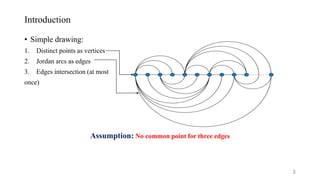
• Simple drawing:
1. Distinct points as vertices
2. Jordan arcs as edges
3. Edges intersection (at most
once)
Assumption: No common point for three edges
3
Introduction(Contd.)
• Isomorphism(Strong Isomorphism)
4
Introduction(Contd.)
• Isomorphism(Weak Isomorphism)
5
Introduction(Contd.)
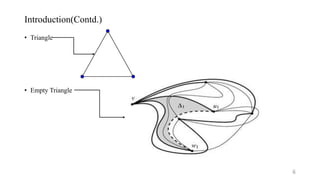
• Triangle
• Empty Triangle
6
Introduction(Contd.)
 c-monotone drawing
Figure 02: Left to right: cylindrical, monotone, strongly c-monotone drawing.
7
Introduction(Contd.)
 c-monotone drawing
Figure 03: A c-monotone drawing D is generalized twisted if there exists a ray r emanating from O that
intersects every edge of D
8
Conjecture 1
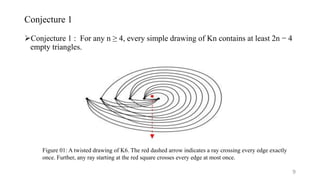
Conjecture 1 : For any n ≥ 4, every simple drawing of Kn contains at least 2n − 4
empty triangles.
Figure 01: A twisted drawing of K6. The red dashed arrow indicates a ray crossing every edge exactly
once. Further, any ray starting at the red square crosses every edge at most once.
9
Objectives
• Study on the number of empty triangles in a special family of generalized twisted
drawings.
• To find a lower bound on the number of empty triangles in a simple drawing of
Kn.
10
Empty triangle’s characteristics
Figure 04: K5 generalized twisted drawing. O and Z have to lie in cells marked with red squares or in
cells with blue crosses.
11
Antipodal vi-cells
Figure 05: All (up to weak isomorphism) generalized twisted drawings of K5 and K6 [4]. O and Z
have to lie in cells marked with red squares or in cells with blue crosses. One possible curve OZ for
each cell pair that could contain O and Z is drawn dashed or dash-dotted (and as ray in c).
12
Theorem 2
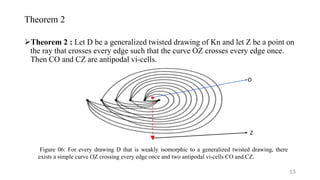
Figure 06: For every drawing D that is weakly isomorphic to a generalized twisted drawing, there
exists a simple curve OZ crossing every edge once and two antipodal vi-cells CO and CZ.
Theorem 2 : Let D be a generalized twisted drawing of Kn and let Z be a point on
the ray that crosses every edge such that the curve OZ crosses every edge once.
Then CO and CZ are antipodal vi-cells.
O
Z
13
Theorem 3
Theorem 3 : Let D be a simple drawing of Kn. Then the following properties are
equivalent.
1. D is weakly isomorphic to a generalized twisted drawing.
2. D contains two antipodal vi-cells.
3. D can be extended by a simple curve c such that c crosses every edge of D
exactly once and does not pass through any vertex.
14
Lemma 1
Lemma 1: Let D be a simple drawing in the plane that is weakly isomorphic to a
generalized twisted drawing of Kn. Let CO and CZ be a pair of antipodal vi-cells
of D. Then the following statements hold.
1. D does not contain three interior-disjoint triangles.
2. Every subdrawing of D induced by four vertices of D contains exactly one
crossing. If p is this crossing in such a subdrawing D′, then the cells CO and CZ
lie in two cells of D′ that are both incident to p and opposite to each other (that
is, they are interior disjoint and the intersection of their boundaries is exactly p).
15
Lemma 1(Contd.)
Proof of Lemma 1:
Figure 7: (a) Proof of Lemma 1(2): CO and CZ have to be either the cells marked with red squares
or the cells with blue crosses.
16
Lemma 2
Lemma 2: Let D be a simple drawing of Kn and let ∆ be a triangle of D with
vertices u, v, w. Let x and y be two vertices on the same side of ∆. If the edge (x,
v) crosses (u, w), then the edge (x, y) can cross at most one of (v, u) and (v, w).
Figure 8: (b) Proof of Lemma 2: The edge (x, y) cannot cross both of the edges (v, u)
and (v, w).
17
Lemma 3
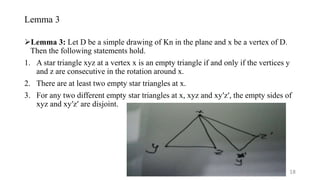
Lemma 3: Let D be a simple drawing of Kn in the plane and x be a vertex of D.
Then the following statements hold.
1. A star triangle xyz at a vertex x is an empty triangle if and only if the vertices y
and z are consecutive in the rotation around x.
2. There are at least two empty star triangles at x.
3. For any two different empty star triangles at x, xyz and xy′z′, the empty sides of
xyz and xy′z′ are disjoint.
18
Theorem 1
Theorem 1 : For any n ≥ 4, every generalized twisted drawing of Kn contains
exactly 2n − 4 empty triangles.
Lemma 4: Let D be a generalized twisted drawing of Kn in the plane with n ≥ 4
and v be a vertex of D. Then v is incident to exactly two empty star triangles at v,
where one has CO on the empty side and the other has CZ on the empty side.
Further, these star triangles have disjoint empty sides.
19
Lemma 5
Lemma 5: Let D be a generalized twisted drawing of Kn with n ≥ 4. Let v be a
vertex on the boundary of CO. Let ∆ be an empty triangle in D that has CO on the
empty side. Then the following statements hold.
1. The vertex v is a vertex of ∆, that is, ∆ = xyv for some x, y.
2. The triangle ∆ = xyv is an empty star triangle at x or y or both.
3. If ∆ = xyz is a star triangle at two vertices, say x and y, then all edges from the
third vertex z, except (z, x) and (z, y), emanate from z to the empty side of ∆ and
cross (x, y).
4. ∆ is a star triangle for at most two of its vertices.
20
Lemma 5(Contd.)
Proof of Lemma 5:
Figure 9: (a) and (b) Illustrations for the proof of Lemma 5(2). (c) Proof of Lemma 5(3): Any
empty triangle of D that has CO on the empty side cannot be a star triangle at three vertices. In
all of (a), (b), and (c), the label CO indicates that the cell CO lies in the interior of the triangle.
For (a) and (b), CO is in addition incident to the vertex v.
21
Lemma 6
Lemma 6: Let D be a generalized twisted drawing of Kn with n ≥ 4. Then D
contains exactly two empty triangles with CO on the empty side that are star
triangles at two vertices.
Figure 10: Proof of Lemma 6: The triangle vxy cannot be a star triangle at v. The label CO indicates that
the cell CO lies in the interior of ∆ and is incident to v. The blue angular markings at vertices indicate that
no further edge emanates from the vertex in this area.
22
Claim 1
Claim 1 Let (a, b) be an edge different from (v, u) and (v, w) that defines part of
the boundary of CO. Then the triangle vab is a star triangle at a and b, and the side
F of vab that contains CO is empty.
Proof of Claim 1: Case 01: Both a and b are different from u and w.
Figure 11: Proof of Claim 1: The case where a and b are different from u and w. The label CO indicates
that the cell CO lies in the interior of ∆ and is incident to v. The blue angular markings at vertices indicate
that no further edge emanates from the vertex in this area.
23
Claim 1(Contd.)
Claim 1 Let (a, b) be an edge different from (v, u) and (v, w) that defines part of
the boundary of CO. Then the triangle vab is a star triangle at a and b, and the side
F of vab that contains CO is empty.
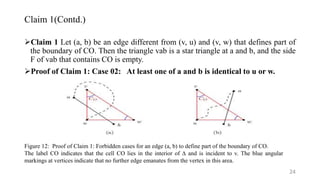
Proof of Claim 1: Case 02: At least one of a and b is identical to u or w.
Figure 12: Proof of Claim 1: Forbidden cases for an edge (a, b) to define part of the boundary of CO.
The label CO indicates that the cell CO lies in the interior of ∆ and is incident to v. The blue angular
markings at vertices indicate that no further edge emanates from the vertex in this area.
24
Proof of Theorem 1
Lemma 7: Let D be a generalized twisted drawing of Kn with n ≥ 4. Then D
contains exactly four empty triangles that are star triangles at two vertices.
Proof of Theorem 1:
i. 2n empty star triangle (by Lemma 4)
ii. Empty star triangles at two vertices have been counted twice(by Lemma 5)
iii. Four empty star triangles at two vertices(by Lemma 7)
25
Conclusion
 For n up to 8
Figure 13: A drawing that is not generalized twisted and has only 2n − 4 empty triangles
[5]. The bold, red edges are edges of seven triangles with pairwise disjoint empty sides.
26
References
[1] B. Abrego, S. Fern´andez-Merchant, A. P. Figueroa, J. J. Montellano-Ballesteros, and E. Rivera-
´Campo. Crossings in twisted graphs. In Collection of Abstracts for the 22nd Japan Conference on
Discrete and Computational Geometry, Graphs, and Games (JCDCG3), pages 21–22, 2019. URL:
http://www.csun.edu/~sf70713/publications/2019_JCDCG3_Twisted_Crossings.pdf.
[2] B. M. Abrego, O. Aichholzer, S. Fern´andez-Merchant, T. Hackl, J. Pammer, A. Pilz, P. Ramos,
´G. Salazar, and B. Vogtenhuber. All good drawings of small complete graphs. In Proc. 31st European
Workshop on Computational Geometry EuroCG ’15, pages 57–60, Ljubljana, Slovenia, 2015. URL:
http://eurocg15.fri.uni-lj.si/pub/eurocg15-book-of-abstracts.pdf#page=65.
[3] O. Aichholzer, M. Balko, T. Hackl, J. Kynˇcl, I. Parada, M. Scheucher, P. Valtr, and B.
Vogtenhuber. A superlinear lower bound on the number of 5-holes. Journal of Combinatorial Theory,
Series A, 173:105236:1–105236:31, 2020. doi:10.1016/j.jcta.2020.105236.
[4] O. Aichholzer, A. Garc´ıa, J. Tejel, B. Vogtenhuber, and A. Weinberger. Twisted ways to find
plane structures in simple drawings of complete graphs. In Proceedings of the 38th International
Symposium on Computational Geometry (SoCG 2022), pages 5:1–5:18, 2022.
doi:10.4230/LIPIcs.SoCG.2022.5
27
References
[5] O. Aichholzer, T. Hackl, A. Pilz, P. Ramos, V. Sacrist´an, and B. Vogtenhuber. Empty triangles in
good drawings of the complete graph. Graphs and Combinatorics, 31(2):335–345,
2015.doi:10.1007/s00373-015-1550-5.
[6] A. Arroyo, D. McQuillan, R. B. Richter, and G. Salazar. Levi’s lemma, pseudolinear drawings of
Kn, and empty triangles. Journal of Graph Theory, pages 443–.459, 2018. doi:10.1002/ jgt.22167.
[7] A. Arroyo, R. B. Richter, G. Salazar, and M. Sullivan. The unavoidable rotation systems, 2019.
URL: https://arxiv.org/abs/1910.12834.
[8] I. B´ar´any and P. Valtr. Planar point sets with a small number of empty convex polygons. Studia
Scientiarum Mathematicarum Hungarica. A Quarterly of the Hungarian Academy of Sciences,
41:243–266, 2004. doi:10.1556/SScMath.41.2004.2.4.
[9] A. P. Figueroa and J. Fres´an-Figueroa. The biplanar tree graph. Bolet´ın de la Sociedad
Matem´atica Mexicana, 26:795–806, 2020. doi:10.1007/s40590-020-00287-y.
[10] R. Fulek and A. J. Ruiz-Vargas. Topological graphs: empty triangles and disjoint matchings. In
Proceedings of the 29th Annual Symposium on Computational Geometry (SoCG’13), pages 259–
266, New York, 2013. ACM. doi:10.1145/2462356.2462394.
28
Thank you
29

Graph Drawing PPT for empty triangles.pptx

  • 1.
    Paper Presentation on EmptyTriangles in Generalized Twisted Drawings of Kn Presented by: Nishat Jahan Nishi Roll No.: SN-2293 MS Student(2021-22) Presented to: Dr. Md. Rezaul Karim Professor Department of Computer Science and Engineering Faculty of Engineering and Technology Course Code: CSE 504 Course Name: Graph Drawing 1
  • 2.
    Outlines of thePresentation • Introduction • Conjecture 1 • Objectives • Empty triangle’s characteristics • Antipodal vi-cells • Theorem 2 • Theorem 3 • Lemma 1 • Lemma 2 • Lemma 3 • Theorem 1 • Lemma 5 • Lemma 6 • Claim 1 • Proof of Theorem 1 • Conclusion 2
  • 3.
    Introduction • Simple drawing: 1.Distinct points as vertices 2. Jordan arcs as edges 3. Edges intersection (at most once) Assumption: No common point for three edges 3
  • 4.
  • 5.
  • 6.
  • 7.
    Introduction(Contd.)  c-monotone drawing Figure02: Left to right: cylindrical, monotone, strongly c-monotone drawing. 7
  • 8.
    Introduction(Contd.)  c-monotone drawing Figure03: A c-monotone drawing D is generalized twisted if there exists a ray r emanating from O that intersects every edge of D 8
  • 9.
    Conjecture 1 Conjecture 1: For any n ≥ 4, every simple drawing of Kn contains at least 2n − 4 empty triangles. Figure 01: A twisted drawing of K6. The red dashed arrow indicates a ray crossing every edge exactly once. Further, any ray starting at the red square crosses every edge at most once. 9
  • 10.
    Objectives • Study onthe number of empty triangles in a special family of generalized twisted drawings. • To find a lower bound on the number of empty triangles in a simple drawing of Kn. 10
  • 11.
    Empty triangle’s characteristics Figure04: K5 generalized twisted drawing. O and Z have to lie in cells marked with red squares or in cells with blue crosses. 11
  • 12.
    Antipodal vi-cells Figure 05:All (up to weak isomorphism) generalized twisted drawings of K5 and K6 [4]. O and Z have to lie in cells marked with red squares or in cells with blue crosses. One possible curve OZ for each cell pair that could contain O and Z is drawn dashed or dash-dotted (and as ray in c). 12
  • 13.
    Theorem 2 Figure 06:For every drawing D that is weakly isomorphic to a generalized twisted drawing, there exists a simple curve OZ crossing every edge once and two antipodal vi-cells CO and CZ. Theorem 2 : Let D be a generalized twisted drawing of Kn and let Z be a point on the ray that crosses every edge such that the curve OZ crosses every edge once. Then CO and CZ are antipodal vi-cells. O Z 13
  • 14.
    Theorem 3 Theorem 3: Let D be a simple drawing of Kn. Then the following properties are equivalent. 1. D is weakly isomorphic to a generalized twisted drawing. 2. D contains two antipodal vi-cells. 3. D can be extended by a simple curve c such that c crosses every edge of D exactly once and does not pass through any vertex. 14
  • 15.
    Lemma 1 Lemma 1:Let D be a simple drawing in the plane that is weakly isomorphic to a generalized twisted drawing of Kn. Let CO and CZ be a pair of antipodal vi-cells of D. Then the following statements hold. 1. D does not contain three interior-disjoint triangles. 2. Every subdrawing of D induced by four vertices of D contains exactly one crossing. If p is this crossing in such a subdrawing D′, then the cells CO and CZ lie in two cells of D′ that are both incident to p and opposite to each other (that is, they are interior disjoint and the intersection of their boundaries is exactly p). 15
  • 16.
    Lemma 1(Contd.) Proof ofLemma 1: Figure 7: (a) Proof of Lemma 1(2): CO and CZ have to be either the cells marked with red squares or the cells with blue crosses. 16
  • 17.
    Lemma 2 Lemma 2:Let D be a simple drawing of Kn and let ∆ be a triangle of D with vertices u, v, w. Let x and y be two vertices on the same side of ∆. If the edge (x, v) crosses (u, w), then the edge (x, y) can cross at most one of (v, u) and (v, w). Figure 8: (b) Proof of Lemma 2: The edge (x, y) cannot cross both of the edges (v, u) and (v, w). 17
  • 18.
    Lemma 3 Lemma 3:Let D be a simple drawing of Kn in the plane and x be a vertex of D. Then the following statements hold. 1. A star triangle xyz at a vertex x is an empty triangle if and only if the vertices y and z are consecutive in the rotation around x. 2. There are at least two empty star triangles at x. 3. For any two different empty star triangles at x, xyz and xy′z′, the empty sides of xyz and xy′z′ are disjoint. 18
  • 19.
    Theorem 1 Theorem 1: For any n ≥ 4, every generalized twisted drawing of Kn contains exactly 2n − 4 empty triangles. Lemma 4: Let D be a generalized twisted drawing of Kn in the plane with n ≥ 4 and v be a vertex of D. Then v is incident to exactly two empty star triangles at v, where one has CO on the empty side and the other has CZ on the empty side. Further, these star triangles have disjoint empty sides. 19
  • 20.
    Lemma 5 Lemma 5:Let D be a generalized twisted drawing of Kn with n ≥ 4. Let v be a vertex on the boundary of CO. Let ∆ be an empty triangle in D that has CO on the empty side. Then the following statements hold. 1. The vertex v is a vertex of ∆, that is, ∆ = xyv for some x, y. 2. The triangle ∆ = xyv is an empty star triangle at x or y or both. 3. If ∆ = xyz is a star triangle at two vertices, say x and y, then all edges from the third vertex z, except (z, x) and (z, y), emanate from z to the empty side of ∆ and cross (x, y). 4. ∆ is a star triangle for at most two of its vertices. 20
  • 21.
    Lemma 5(Contd.) Proof ofLemma 5: Figure 9: (a) and (b) Illustrations for the proof of Lemma 5(2). (c) Proof of Lemma 5(3): Any empty triangle of D that has CO on the empty side cannot be a star triangle at three vertices. In all of (a), (b), and (c), the label CO indicates that the cell CO lies in the interior of the triangle. For (a) and (b), CO is in addition incident to the vertex v. 21
  • 22.
    Lemma 6 Lemma 6:Let D be a generalized twisted drawing of Kn with n ≥ 4. Then D contains exactly two empty triangles with CO on the empty side that are star triangles at two vertices. Figure 10: Proof of Lemma 6: The triangle vxy cannot be a star triangle at v. The label CO indicates that the cell CO lies in the interior of ∆ and is incident to v. The blue angular markings at vertices indicate that no further edge emanates from the vertex in this area. 22
  • 23.
    Claim 1 Claim 1Let (a, b) be an edge different from (v, u) and (v, w) that defines part of the boundary of CO. Then the triangle vab is a star triangle at a and b, and the side F of vab that contains CO is empty. Proof of Claim 1: Case 01: Both a and b are different from u and w. Figure 11: Proof of Claim 1: The case where a and b are different from u and w. The label CO indicates that the cell CO lies in the interior of ∆ and is incident to v. The blue angular markings at vertices indicate that no further edge emanates from the vertex in this area. 23
  • 24.
    Claim 1(Contd.) Claim 1Let (a, b) be an edge different from (v, u) and (v, w) that defines part of the boundary of CO. Then the triangle vab is a star triangle at a and b, and the side F of vab that contains CO is empty. Proof of Claim 1: Case 02: At least one of a and b is identical to u or w. Figure 12: Proof of Claim 1: Forbidden cases for an edge (a, b) to define part of the boundary of CO. The label CO indicates that the cell CO lies in the interior of ∆ and is incident to v. The blue angular markings at vertices indicate that no further edge emanates from the vertex in this area. 24
  • 25.
    Proof of Theorem1 Lemma 7: Let D be a generalized twisted drawing of Kn with n ≥ 4. Then D contains exactly four empty triangles that are star triangles at two vertices. Proof of Theorem 1: i. 2n empty star triangle (by Lemma 4) ii. Empty star triangles at two vertices have been counted twice(by Lemma 5) iii. Four empty star triangles at two vertices(by Lemma 7) 25
  • 26.
    Conclusion  For nup to 8 Figure 13: A drawing that is not generalized twisted and has only 2n − 4 empty triangles [5]. The bold, red edges are edges of seven triangles with pairwise disjoint empty sides. 26
  • 27.
    References [1] B. Abrego,S. Fern´andez-Merchant, A. P. Figueroa, J. J. Montellano-Ballesteros, and E. Rivera- ´Campo. Crossings in twisted graphs. In Collection of Abstracts for the 22nd Japan Conference on Discrete and Computational Geometry, Graphs, and Games (JCDCG3), pages 21–22, 2019. URL: http://www.csun.edu/~sf70713/publications/2019_JCDCG3_Twisted_Crossings.pdf. [2] B. M. Abrego, O. Aichholzer, S. Fern´andez-Merchant, T. Hackl, J. Pammer, A. Pilz, P. Ramos, ´G. Salazar, and B. Vogtenhuber. All good drawings of small complete graphs. In Proc. 31st European Workshop on Computational Geometry EuroCG ’15, pages 57–60, Ljubljana, Slovenia, 2015. URL: http://eurocg15.fri.uni-lj.si/pub/eurocg15-book-of-abstracts.pdf#page=65. [3] O. Aichholzer, M. Balko, T. Hackl, J. Kynˇcl, I. Parada, M. Scheucher, P. Valtr, and B. Vogtenhuber. A superlinear lower bound on the number of 5-holes. Journal of Combinatorial Theory, Series A, 173:105236:1–105236:31, 2020. doi:10.1016/j.jcta.2020.105236. [4] O. Aichholzer, A. Garc´ıa, J. Tejel, B. Vogtenhuber, and A. Weinberger. Twisted ways to find plane structures in simple drawings of complete graphs. In Proceedings of the 38th International Symposium on Computational Geometry (SoCG 2022), pages 5:1–5:18, 2022. doi:10.4230/LIPIcs.SoCG.2022.5 27
  • 28.
    References [5] O. Aichholzer,T. Hackl, A. Pilz, P. Ramos, V. Sacrist´an, and B. Vogtenhuber. Empty triangles in good drawings of the complete graph. Graphs and Combinatorics, 31(2):335–345, 2015.doi:10.1007/s00373-015-1550-5. [6] A. Arroyo, D. McQuillan, R. B. Richter, and G. Salazar. Levi’s lemma, pseudolinear drawings of Kn, and empty triangles. Journal of Graph Theory, pages 443–.459, 2018. doi:10.1002/ jgt.22167. [7] A. Arroyo, R. B. Richter, G. Salazar, and M. Sullivan. The unavoidable rotation systems, 2019. URL: https://arxiv.org/abs/1910.12834. [8] I. B´ar´any and P. Valtr. Planar point sets with a small number of empty convex polygons. Studia Scientiarum Mathematicarum Hungarica. A Quarterly of the Hungarian Academy of Sciences, 41:243–266, 2004. doi:10.1556/SScMath.41.2004.2.4. [9] A. P. Figueroa and J. Fres´an-Figueroa. The biplanar tree graph. Bolet´ın de la Sociedad Matem´atica Mexicana, 26:795–806, 2020. doi:10.1007/s40590-020-00287-y. [10] R. Fulek and A. J. Ruiz-Vargas. Topological graphs: empty triangles and disjoint matchings. In Proceedings of the 29th Annual Symposium on Computational Geometry (SoCG’13), pages 259– 266, New York, 2013. ACM. doi:10.1145/2462356.2462394. 28
  • 29.

Editor's Notes

  • #5 if you were to compare the two drawings, you could find a way to match up the vertices of one drawing with the vertices of the other drawing in such a manner that the edges connect corresponding vertices in both drawings in the same way.
  • #6 Unlike strong isomorphism, in weak isomorphism, the correspondence between vertices doesn't necessarily preserve the exact placement of edges.
  • #7 Triangle: any triangle is crossing free and thus splits the plane (or the sphere) into two connected regions. We call those open regions the sides of the triangle. Empty Triangle: with only 𝑛 vertices in total and 𝑛≥4, it's not possible to have three vertices outside the triangle and still have a triangle in the drawing without overlapping edges (which would violate the definition of a simple drawing).
  • #8 Each vertex of the graph is assigned a distinct point in the plane, and each edge is represented by a monotone curve connecting the endpoints (vertices) of the edge.
  • #9 Each vertex of the graph is assigned a distinct point in the plane, and each edge is represented by a monotone curve connecting the endpoints (vertices) of the edge.
  • #10 A simple drawing is twisted if there is a labeling v1, v2, ..., vn of the vertices such that vi, vj (i < j) crosses vk, vl (k < l) if and only if i < k < l < j or k < i < j < l.
  • #12 Consider any triangle ∆ in a simple drawing of Kn and any pair of vertices a and b that are not vertices of ∆. The vertices a and b lie on the same side of ∆ if and only if the edge (a, b) crosses the boundary of ∆ an even number of times. Thus, ∆ is empty if and only if every edge between two vertices that are not vertices of ∆ crosses ∆ an even number of times.
  • #13 Given a simple drawing D of Kn, two cells of D are called antipodal if for each triangle of D, they lie on different sides. A cell with at least one vertex on its boundary is called a vertex-incident-cell or, for short, a vi-cell.
  • #14 Given a simple drawing D of Kn, two cells of D are called antipodal if for each triangle of D, they lie on different sides. A cell with at least one vertex on its boundary is called a vertex-incident-cell or, for short, a vi-cell.
  • #17 Lemma 1: Let D be a simple drawing in the plane that is weakly isomorphic to a generalized twisted drawing of Kn. Let CO and CZ be a pair of antipodal vi-cells of D. Then the following statements hold. D does not contain three interior-disjoint triangles. Every subdrawing of D induced by four vertices of D contains exactly one crossing. If p is this crossing in such a subdrawing D′, then the cells CO and CZ lie in two cells of D′ that are both incident to p and opposite to each other (that is, they are interior disjoint and the intersection of their boundaries is exactly p).
  • #19 Suppose first that x is the only common vertex to both triangles. As xyz and xy′ z ′ are star triangles of x, no edge incident to x can cross (y, z) or (y ′ , z′ ). Edges incident to x cannot cross each other because the drawing is simple. Thus, of the boundary edges of xyz and xy′ z ′ , the only pair that could cross is (y, z) and (y ′ , z′ ). However, y ′ and z ′ lie on the same side of the triangle xyz, so (y ′ , z′ ) has to cross the boundary of xyz an even number of times. This is not possible if exactly (y, z) and (y ′ , z′ ) cross. Hence, no edges on the boundary of the star triangles cross, and therefore their empty sides are disjoint. Suppose now that one of {y, z} coincides with one of {y ′ , z′}, say z = y ′ , so xyz and xzz′ share the edge (x, z). As before, no edge incident to x can cross (y, z) or (z, z′ ). Moreover, (y, z) and (z, z′ ) cannot cross each other as they share a common endpoint. Thus, again the edges on the boundary of the star triangles cannot cross, so their empty sides are disjoint
  • #20 By Lemma 3(2 and 3), for every vertex v there are at least two empty star triangles at v and the empty sides of any two star triangles at a vertex are disjoint. Any triangle of a generalized twisted drawing has CO on one side and CZ on the other side, and D cannot contain three interior-disjoint triangles by Lemma 1(1). Thus, for any vertex v in a generalized twisted drawing, the following three properties hold. (i) one empty star triangle at v has CO on the empty side, (ii) another empty star triangle at v has CZ on the empty side, and (iii) there cannot be a third empty star triangle at v.
  • #22 Lemma 4: Lemma 5: Let D be a generalized twisted drawing of Kn with n ≥ 4. Let v be a vertex on the boundary of CO. Let ∆ be an empty triangle in D that has CO on the empty side. Then the following statements hold. The vertex v is a vertex of ∆, that is, ∆ = xyv for some x, y. The triangle ∆ = xyv is an empty star triangle at x or y or both. If ∆ = xyz is a star triangle at two vertices, say x and y, then all edges from the third vertex z, except (z, x) and (z, y), emanate from z to the empty side of ∆ and cross (x, y). ∆ is a star triangle for at most two of its vertices.