Himel, Yasin [12-21408-2]
Waliullah,Md[12-21519-2]
Pial,Md.Nazrul Islam [12-21414-2]
Islam,Alamin [12-20486-1]
Patowary,Ashadul[12-21412-2]
Prepared for our course instructor
Rethwan Faiz
Starting With The Name Of AlmightyStarting With The Name Of Almighty
American International University-BangladeshAmerican International University-Bangladesh
Grade laser:
• Accurate & reliable rotating laser
• Allow a rotating laser plane to be sloped to
a specified grade
• Grade lasers facilitate accurate and its
operations are very fast compare to others
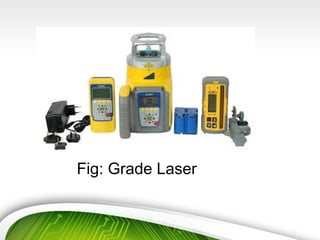
Fig: Grade Laser
Types of grade laser:
• Gas lasers
• Chemical lasers
• Solid-state lasers
• Semiconductor laser
• Gas dynamic laser
• Helium–cadmium
(HeCd) metal-vapor
laser
History of Laser:
• Idea by “Charles Townes & Arthur
Schalow” in 1958.
• Invented by “Theodor Maimon” in
1960.
• Light
• Amplification
• Stimulated
• Emission
• Radiation
Working Principle:
• Monochromatic, coherent & highly
collimated.
• Laser beam have a fixed phase
relationship.
• Lasers has low divergence.
• Focused a very small spot
Features of a grade laser:
• Suitability for machine control
• Remote control capability
• Plane lock
• Automatic axis alignment
• Grade bump
• Vertical Mode
Parameter of a laser & its
characteristic:
• Auto-leveling capability
• Display & controls
• Housing ruggedness
• Rotation speed
• Power supply
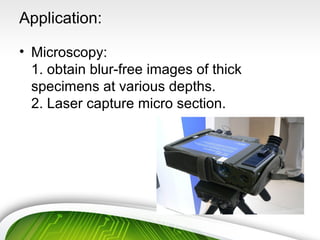
Application:
• Microscopy:
1. obtain blur-free images of thick
specimens at various depths.
2. Laser capture micro section.
Application:
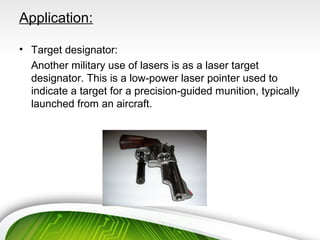
• Target designator:
Another military use of lasers is as a laser target
designator. This is a low-power laser pointer used to
indicate a target for a precision-guided munition, typically
launched from an aircraft.
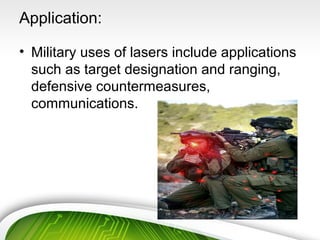
Application:
• Military uses of lasers include applications
such as target designation and ranging,
defensive countermeasures,
communications.
Advantages:
• A wide variety of interferometric techniques
• Laser induced breakdown spectroscopy
• Atmospheric remote sensing
• Investigating nonlinear optics phenomena
• Holographic techniques employing lasers
also contribute to a number of measurement
techniques.
Disadvantages:
• High capital investment.
• Thermal effects. Due to heating, a HAZ may be
present around the hole, particularly with
pyrolitic processes (i.e. those involving heat
generation for material removal via melting and
evaporation).
• With pyrolitic processes, due to the melting and
evaporation of material, a recast layer and dross
build up at the entrance and exit of the hole may
be present. These reduce the repeatability and
quality (for example flow characteristics) of the
holes.
Thank you all for your kind co-operation.Thank you all for your kind co-operation.
Hope you have liked our presentation. GoodHope you have liked our presentation. Good
day to all.day to all.

grade-a-laser-

  • 1.
    Himel, Yasin [12-21408-2] Waliullah,Md[12-21519-2] Pial,Md.NazrulIslam [12-21414-2] Islam,Alamin [12-20486-1] Patowary,Ashadul[12-21412-2] Prepared for our course instructor Rethwan Faiz Starting With The Name Of AlmightyStarting With The Name Of Almighty American International University-BangladeshAmerican International University-Bangladesh
  • 2.
    Grade laser: • Accurate& reliable rotating laser • Allow a rotating laser plane to be sloped to a specified grade • Grade lasers facilitate accurate and its operations are very fast compare to others
  • 3.
  • 4.
    Types of gradelaser: • Gas lasers • Chemical lasers • Solid-state lasers • Semiconductor laser • Gas dynamic laser • Helium–cadmium (HeCd) metal-vapor laser
  • 5.
    History of Laser: •Idea by “Charles Townes & Arthur Schalow” in 1958. • Invented by “Theodor Maimon” in 1960.
  • 6.
    • Light • Amplification •Stimulated • Emission • Radiation
  • 7.
    Working Principle: • Monochromatic,coherent & highly collimated. • Laser beam have a fixed phase relationship. • Lasers has low divergence. • Focused a very small spot
  • 8.
    Features of agrade laser: • Suitability for machine control • Remote control capability • Plane lock • Automatic axis alignment • Grade bump • Vertical Mode
  • 9.
    Parameter of alaser & its characteristic: • Auto-leveling capability • Display & controls • Housing ruggedness • Rotation speed • Power supply
  • 10.
    Application: • Microscopy: 1. obtainblur-free images of thick specimens at various depths. 2. Laser capture micro section.
  • 11.
    Application: • Target designator: Anothermilitary use of lasers is as a laser target designator. This is a low-power laser pointer used to indicate a target for a precision-guided munition, typically launched from an aircraft.
  • 12.
    Application: • Military usesof lasers include applications such as target designation and ranging, defensive countermeasures, communications.
  • 13.
    Advantages: • A widevariety of interferometric techniques • Laser induced breakdown spectroscopy • Atmospheric remote sensing • Investigating nonlinear optics phenomena • Holographic techniques employing lasers also contribute to a number of measurement techniques.
  • 14.
    Disadvantages: • High capitalinvestment. • Thermal effects. Due to heating, a HAZ may be present around the hole, particularly with pyrolitic processes (i.e. those involving heat generation for material removal via melting and evaporation). • With pyrolitic processes, due to the melting and evaporation of material, a recast layer and dross build up at the entrance and exit of the hole may be present. These reduce the repeatability and quality (for example flow characteristics) of the holes.
  • 15.
    Thank you allfor your kind co-operation.Thank you all for your kind co-operation. Hope you have liked our presentation. GoodHope you have liked our presentation. Good day to all.day to all.