Welcome to High School:

      Meeting the

Changes and Challenges
•
    High school counseling

•
    Changes and challenges

•
    Grade-level information

•
    How can I help my child

    transition to high school?
What is the role of the high
            school counselor...


 “Secondary school counselors are
    professional educators with a mental
    health perspective who understand and
    respond to the challenges presented by
    today’s diverse student population.”


 - from the website of ASCA (American School Counselor
 Association)
...helping students feel successful about
          themselves and chool


   •   social and emotional well-being

   •   academic goals

   •   college and career goals
Counselors help
          students...

•   build self-esteem, identity, and
    autonomy
•   learn strategies and skills to make
    good choices (academic, social,
    emotional, college/career)
•   create and maintain healthy
How do we do this?

• Guidance Curriculum: delivered to students in grade-level
  meetings, Flex classes, individual or family meetings (as
  needed)

• Individual Student Planning: help students develop
  personal and academic goals, and future plans
• Responsive Services: meeting individual student needs
  that require counseling, referral, information, or
  intervention
• Systems Support: support from administration and
  teachers (team approach)
Challenges and Changes

•   “Perhaps the only thing more
    difficult than being a teenager is
    parenting one”
•   A time of great development:
    physically, socially, emotionally,
    cognitively
Social Development
•   Trying to understand who they are or who
    they are trying to be
•   Peer group is the strongest influence
•   Increased pressure from peers regarding
    risky behaviors: alcohol, drugs, sex
•   Exploration of boundaries in relationships
    and behavior
Emotional Development
•   ‘Roller Coaster Ride’ of hormones and
    mood swings. Often one heartbeat
    away from laughter or tears.
•   Students are evaluating themselves and
    trying to understand who they are.
•   With change comes uncertainty.
Cognitive Development
•   In tune with technology (digital natives)
•   Respond well to cooperative learning,
    academic variety
•   Increase in cognitive and reasoning
    ability
•   Critical thinking and writing skills are
    emphasized across the HS curriculum
How can I help with the transition
            to high school?
•   Listen to what your child has to say and offer
    your support.

•   Stay connected and communicate. Spend time
    together.
•   Establish (together with your child) clear rules,
    specific expectations, and consequences. This
    sets a tone of respect, trust, and fairness. Review
    them regularly.
•   Respect your teen’s privacy – e.g., knock before
    entering his/her room!
More advice on helping your teen
•   Understand your child is transitioning from
    childhood (needy, dependent) to adulthood
    (freedom, trust, responsibility)
•   Be a parent first, not a pal. Boundaries are
    important -- model them.
•   Stay in touch with teachers. Be aware of and
    engaged in what is going on at school. Follow
    the HS Blog and HS Counselors’ blog.
•   Help monitor sleep (average of 9 hours), diet,
    and exercise, laptop use.
Teenagers are just people trying to
  learn how to make it among the
     adults in the world, who are
  probably not so sure themselves.
Congratulations…
In six months, you will be the
    parent of a high school
           student!
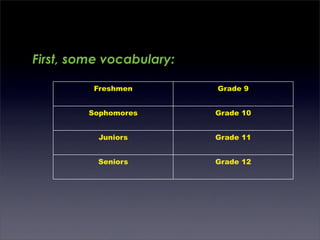
First, some vocabulary:

          Freshmen        Grade 9


         Sophomores       Grade 10


           Juniors        Grade 11


          Seniors         Grade 12
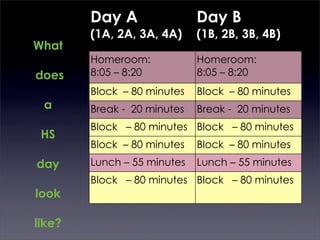
Day A                Day B
        (1A, 2A, 3A, 4A)     (1B, 2B, 3B, 4B)
What
        Homeroom:            Homeroom:
does    8:05 – 8:20          8:05 – 8:20
        Block – 80 minutes   Block – 80 minutes
 a      Break - 20 minutes   Break - 20 minutes
        Block – 80 minutes Block – 80 minutes
 HS
        Block – 80 minutes   Block – 80 minutes
day     Lunch – 55 minutes   Lunch – 55 minutes
        Block – 80 minutes Block – 80 minutes
look

like?
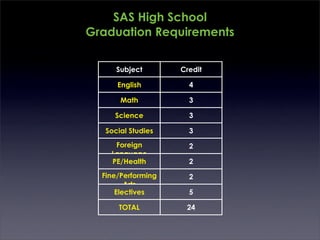
SAS High School
Graduation Requirements


      Subject       Credit

      English         4

       Math           3

     Science          3

   Social Studies     3
     Foreign          2
    Language
    PE/Health         2
  Fine/Performing     2
         Arts
      Electives       5

      TOTAL          24
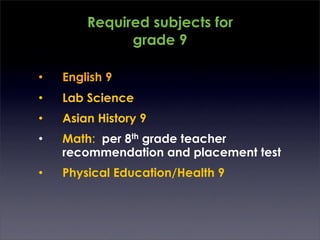
Required subjects for
              grade 9

•   English 9
•   Lab Science
•   Asian History 9
•   Math: per 8th grade teacher
    recommendation and placement test
•   Physical Education/Health 9
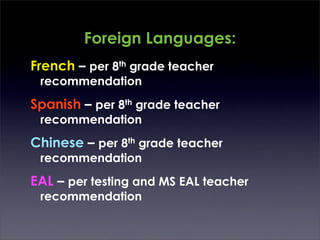
Foreign Languages:
French – per 8th grade teacher
 recommendation
Spanish – per 8th grade teacher
 recommendation
Chinese – per 8th grade teacher
 recommendation
EAL – per testing and MS EAL teacher
 recommendation
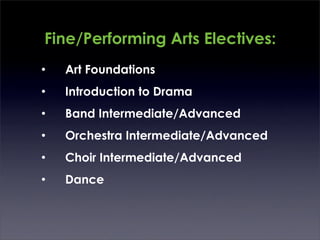
Fine/Performing Arts Electives:
•   Art Foundations
•   Introduction to Drama
•   Band Intermediate/Advanced
•   Orchestra Intermediate/Advanced
•   Choir Intermediate/Advanced
•   Dance
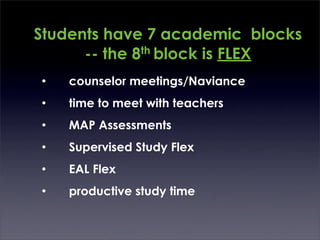
Students have 7 academic blocks
      -- the 8th block is FLEX
•   counselor meetings/Naviance
•   time to meet with teachers
•   MAP Assessments
•   Supervised Study Flex
•   EAL Flex
•   productive study time
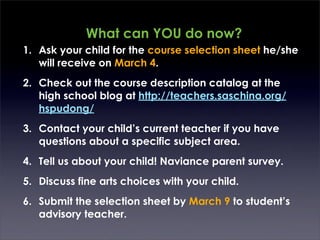
What can YOU do now?
1. Ask your child for the course selection sheet he/she
   will receive on March 4.
2. Check out the course description catalog at the
   high school blog at http://teachers.saschina.org/
   hspudong/
3. Contact your child’s current teacher if you have
   questions about a specific subject area.
4. Tell us about your child! Naviance parent survey.
5. Discuss fine arts choices with your child.
6. Submit the selection sheet by March 9 to student’s
   advisory teacher.
Keep up on high school news by
checking the Dr. Borden’s high
school blog at:

 http://teachers.saschina.org/hspudong
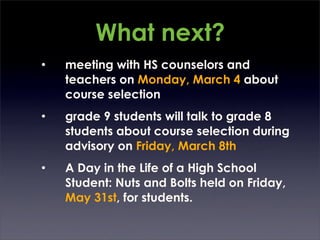
What next?
•   meeting with HS counselors and
    teachers on Monday, March 4 about
    course selection
•   grade 9 students will talk to grade 8
    students about course selection during
    advisory on Friday, March 8th
•   A Day in the Life of a High School
    Student: Nuts and Bolts held on Friday,
    May 31st, for students.

Grade 8 parent presentation 2013

  • 1.
    Welcome to HighSchool: Meeting the Changes and Challenges
  • 2.
    High school counseling • Changes and challenges • Grade-level information • How can I help my child transition to high school?
  • 3.
    What is therole of the high school counselor... “Secondary school counselors are professional educators with a mental health perspective who understand and respond to the challenges presented by today’s diverse student population.” - from the website of ASCA (American School Counselor Association)
  • 4.
    ...helping students feelsuccessful about themselves and chool • social and emotional well-being • academic goals • college and career goals
  • 5.
    Counselors help students... • build self-esteem, identity, and autonomy • learn strategies and skills to make good choices (academic, social, emotional, college/career) • create and maintain healthy
  • 6.
    How do wedo this? • Guidance Curriculum: delivered to students in grade-level meetings, Flex classes, individual or family meetings (as needed) • Individual Student Planning: help students develop personal and academic goals, and future plans • Responsive Services: meeting individual student needs that require counseling, referral, information, or intervention • Systems Support: support from administration and teachers (team approach)
  • 7.
    Challenges and Changes • “Perhaps the only thing more difficult than being a teenager is parenting one” • A time of great development: physically, socially, emotionally, cognitively
  • 8.
    Social Development • Trying to understand who they are or who they are trying to be • Peer group is the strongest influence • Increased pressure from peers regarding risky behaviors: alcohol, drugs, sex • Exploration of boundaries in relationships and behavior
  • 9.
    Emotional Development • ‘Roller Coaster Ride’ of hormones and mood swings. Often one heartbeat away from laughter or tears. • Students are evaluating themselves and trying to understand who they are. • With change comes uncertainty.
  • 10.
    Cognitive Development • In tune with technology (digital natives) • Respond well to cooperative learning, academic variety • Increase in cognitive and reasoning ability • Critical thinking and writing skills are emphasized across the HS curriculum
  • 11.
    How can Ihelp with the transition to high school? • Listen to what your child has to say and offer your support. • Stay connected and communicate. Spend time together. • Establish (together with your child) clear rules, specific expectations, and consequences. This sets a tone of respect, trust, and fairness. Review them regularly. • Respect your teen’s privacy – e.g., knock before entering his/her room!
  • 12.
    More advice onhelping your teen • Understand your child is transitioning from childhood (needy, dependent) to adulthood (freedom, trust, responsibility) • Be a parent first, not a pal. Boundaries are important -- model them. • Stay in touch with teachers. Be aware of and engaged in what is going on at school. Follow the HS Blog and HS Counselors’ blog. • Help monitor sleep (average of 9 hours), diet, and exercise, laptop use.
  • 13.
    Teenagers are justpeople trying to learn how to make it among the adults in the world, who are probably not so sure themselves.
  • 14.
  • 15.
    In six months,you will be the parent of a high school student!
  • 16.
    First, some vocabulary: Freshmen Grade 9 Sophomores Grade 10 Juniors Grade 11 Seniors Grade 12
  • 17.
    Day A Day B (1A, 2A, 3A, 4A) (1B, 2B, 3B, 4B) What Homeroom: Homeroom: does 8:05 – 8:20 8:05 – 8:20 Block – 80 minutes Block – 80 minutes a Break - 20 minutes Break - 20 minutes Block – 80 minutes Block – 80 minutes HS Block – 80 minutes Block – 80 minutes day Lunch – 55 minutes Lunch – 55 minutes Block – 80 minutes Block – 80 minutes look like?
  • 18.
    SAS High School GraduationRequirements Subject Credit English 4 Math 3 Science 3 Social Studies 3 Foreign 2 Language PE/Health 2 Fine/Performing 2 Arts Electives 5 TOTAL 24
  • 19.
    Required subjects for grade 9 • English 9 • Lab Science • Asian History 9 • Math: per 8th grade teacher recommendation and placement test • Physical Education/Health 9
  • 20.
    Foreign Languages: French –per 8th grade teacher recommendation Spanish – per 8th grade teacher recommendation Chinese – per 8th grade teacher recommendation EAL – per testing and MS EAL teacher recommendation
  • 21.
    Fine/Performing Arts Electives: • Art Foundations • Introduction to Drama • Band Intermediate/Advanced • Orchestra Intermediate/Advanced • Choir Intermediate/Advanced • Dance
  • 22.
    Students have 7academic blocks -- the 8th block is FLEX • counselor meetings/Naviance • time to meet with teachers • MAP Assessments • Supervised Study Flex • EAL Flex • productive study time
  • 23.
    What can YOUdo now? 1. Ask your child for the course selection sheet he/she will receive on March 4. 2. Check out the course description catalog at the high school blog at http://teachers.saschina.org/ hspudong/ 3. Contact your child’s current teacher if you have questions about a specific subject area. 4. Tell us about your child! Naviance parent survey. 5. Discuss fine arts choices with your child. 6. Submit the selection sheet by March 9 to student’s advisory teacher.
  • 24.
    Keep up onhigh school news by checking the Dr. Borden’s high school blog at: http://teachers.saschina.org/hspudong
  • 25.
    What next? • meeting with HS counselors and teachers on Monday, March 4 about course selection • grade 9 students will talk to grade 8 students about course selection during advisory on Friday, March 8th • A Day in the Life of a High School Student: Nuts and Bolts held on Friday, May 31st, for students.