Google Quality Raters Update 2025 Checks AI-Generated Content.pdf
Want to rank higher on Google? Discover how Google Quality Raters evaluate websites and what it takes to meet their standards! Learn key insights to boost your SEO game.
Google Quality Raters Update 2025 Checks AI-Generated Content.pdf
1.
1/11
Google Quality RatersUpdate 2025 Checks AI-
Generated Content
textuar.com/blog/google-quality-raters/
Home » Google Quality Raters Update 2025 Checks AI-Generated Content
Let’s be real: You have seen those AI tools promise to “write your blog in 5 seconds!”
Sure, that sounds tempting, right?
However, here is the catch: Google’s latest update is cracking down on lazy, AI-made
content with the Google Quality Raters Update 2025. In other words, if the main content
of your website is full of AI words, it might disappear from search results faster than free
food at a party.
So, what’s going on?
The thought process is simple (and has always been so). Google wants real value for
users. Not fluff. Not copied facts. and not ‘articles’ that sound like a robot reading a book.
To put it in simple words, human writers are not just ‘better’- they are your way to stay on
2.
2/11
Google’s good side.
Whyis human-written content important?
– AI can’t tell stories (like how your team fixed a client’s big problem)
– AI can’t laugh at their own mistakes (or share tips from real-life mess-ups).
– AI can’t make readers feel something (and Google knows that very well).
So, what’s really changed in Google’s rules- and how do you stay ahead? Let us look at
the new rules.
We also see how to avoid the “Lowest” rating trap and why humans have the winning
hand.
What are the Google’s Quality Rater Guidelines?
Google employs the services of 10,000+ third-party rates to examine a site for quality. It
provides the Quality Rater Guidelines as a manual for them to refer to. The objective is to
provide relevant and reliable results to searchers for every search query asked on
Google.
These guidelines help assess –
– Page Quality (EEAT or Expertise, Experience, Authority, and Trust)
– user search intent alignment
Google says that the manual doesn’t directly impact rankings. It helps the algorithm
though, by identifying helpful and relevant content for a search term.
What’s New in Google’s Quality Rater Guidelines
Google made some big changes to their Search Quality Rater Guidelines in January
2025. To start with, they are now paying close attention to AI-created content and how
people might misuse it. After all, Google wants authentic content that truly helps readers.
So, you should prioritize this as well.
Here’s what’s different in the 2025 edition of the Rater’s Guidelines:
1. Google Defines Generative AI
For the first time ever, Google has spelled out what they mean by generative AI in its
guidelines. They describe it as a machine-learning model that creates new content. This
can be text, pictures, or even music based on what it is learned.
Of course, Google admits these tools can be helpful. But at the same time, they also warn
about using them the wrong way. You need to know both sides of the coin.
3.
3/11
2. Spam DefinitionsHave Been Reorganized
Google has changed how they describe spammy web pages. Previously, they have
gotten rid of the old section about auto-generated content. Now, however, they are more
focused on content that takes little effort but is made in huge amounts.
This includes the potential misuse of AI. These updated guidelines match Google’s
search quality changes from last year. So, moving forward, you need to steer clear of
these spammy practices.
a. Expired Domain Abuse (Section 4.6.3)
Buying expired domains just to put low-value content on them is a red flag. Instead, focus
on making fresh, helpful content that readers will surely love.
b. Site Reputation Abuse (Section 4.6.4)
Do not just post other people’s content or third-party content to ride on a website’s good
reputation. Rather, your content should be good enough to stand on its own two feet.
c. Scaled Content Abuse (Section 4.6.5)
Creating a large amount of content with minimal effort is a big problem. Generative AI
tools can be misused for this. So, always put quality first, not quantity.
d. Main Content Created with Little Effort (Section 4.6.6)
This new section targets low-quality content that is not just copied or paraphrased. This
kind of content does not help visitors at all. Therefore, make sure your main content offers
something special.
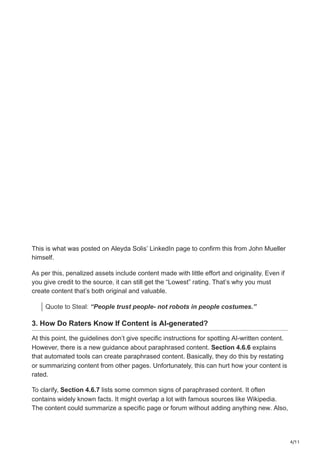
Interestingly, John Mueller from Google pointed out this section specifically. He said
content gets a “Lowest” rating when the text, images, or videos are copied, paraphrased,
made by AI, or just reposted from somewhere else.
4.
4/11
This is whatwas posted on Aleyda Solis’ LinkedIn page to confirm this from John Mueller
himself.
As per this, penalized assets include content made with little effort and originality. Even if
you give credit to the source, it can still get the “Lowest” rating. That’s why you must
create content that’s both original and valuable.
Quote to Steal: “People trust people- not robots in people costumes.”
3. How Do Raters Know If Content is AI-generated?
At this point, the guidelines don’t give specific instructions for spotting AI-written content.
However, there is a new guidance about paraphrased content. Section 4.6.6 explains
that automated tools can create paraphrased content. Basically, they do this by restating
or summarizing content from other pages. Unfortunately, this can hurt how your content is
rated.
To clarify, Section 4.6.7 lists some common signs of paraphrased content. It often
contains widely known facts. It might overlap a lot with famous sources like Wikipedia.
The content could summarize a specific page or forum without adding anything new. Also,
5.
5/11
it might alsouse phrases like “As an AI language model.” So, avoid these pitfalls in your
content.
4. Understanding “Low” vs. “Lowest” Ratings
Luckily, Google clearly explains the difference between “Low” and “Lowest” ratings. This
means raters can better judge content quality. As a result, you need to understand this
difference to create better content.
– Low: Some main content is reused, but with at least some effort to change or
curate it.
– Lowest: Almost all main content is copied or paraphrased with zero effort or
added value.
The Search Quality Rater Guidelines show examples of repackaged content. These
include social media reposts with barely any comments. Pages with embedded videos or
images but minimal discussion also count. So, do “Best” lists based on existing reviews
with little original input. Clearly, Google wants raters to spot thin content that tries to look
original. In the end, this content fails to give users a good experience. That’s why your
content should aim much higher.
5. “Filler” Content
Now, a new section talks about “filler” content. This means fluff that takes up space but
doesn’t help the page’s purpose. Google says filler can bloat content, making a page look
rich while offering little value. Therefore, stay away from fillers in your marketing.
Even if content isn’t harmful, it can get a “Low” rating if it makes helpful material hard to
find. For instance, pages that bury useful info under ads are also in trouble. So are
generic intros and bloated paragraphs. Ultimately, Google wants raters to see how page
layout affects what users are trying to do. Thus, focus on clear, brief, and helpful content.
Google hates fluff. “Say it straight, or don’t say it.”
6. Claims that Are Exaggerated
Additionally, the Google Quality Raters Update 2025 is getting tougher on big claims. This
includes slightly misleading statements about who made a webpage. Believe it or not,
even small exaggerations matter now. Hence, make sure that all your claims are true and
are backed up by facts.
Section 5.6 says false info about a website leads to a “Lowest” rating. Meanwhile, less
obvious bragging, like inflated credentials, can get a “Low” rating. In short, avoid these
tactics in your content.
6.
6/11
Raters should basetheir judgment on the main content, reputation research, and
verifiable credentials. So, they shouldn’t just take claims at face value. Instead, focus on
showing real expertise through your content.
If a rater thinks the creator’s qualifications sound too much like marketing hype, they’ll
give a “Low” rating. Thus, you should focus on providing genuine value and expertise
instead.
Why Human Writers Still Matter
We had mentioned way back in 2023 and still stand by our stance – ChatGPT is an
assistant, not a master. Even in this post, John Mueller had clearly mentioned that it
should be referenced only if you have run out of ideas for your content. Remember, the
keyword here is ‘referenced’ not ‘used’.
With all this in mind, and with Google looking more closely at AI-written content, human
writers are more important than ever. Of course, while AI tools can help create content,
they simply cannot match what human writers bring to the table. This differentiation will
become more prominent with the Google Quality Raters Update 2025.
Their value proposition becomes clear from these points.
7.
7/11
1. Originality andCreativity
To begin, human writers bring fresh ideas and creative thinking to the table. On the other
hand, AI tools can only create content based on what they have seen before. They can’t
truly innovate. Therefore, you need humans.
2. Empathy and Understanding
Human writers can connect with your audience on a personal level. In fact, they produce
content that quite literally speaks to people. AI software just can’t provide that human
touch. So, you have to have real people in order to be able to form meaningful
connections with your audience.
3. Expertise and Insight
Informed human writers can pass on useful information. More importantly, they give an
analysis that no AI tool can. That’s why you need learned humans to give you top-notch,
informative content that people can trust.
After all,
4. Adaptability and Nuance
Human writers can easily alter tones and styles. Not only that, they know language
nuances and can tailor content to perfection. AI tools fall short of these subtleties. That is
why you need human writers for versatile and effective content.
5. Avoiding Penalties
By employing human writers, you can avoid Google penalties. Otherwise, AI-generated
content can be labelled as low-quality as per the Google Quality Raters Update 2025.
This can hurt how well you rank in searches. To stay safe, you need human writers to
make your content Google-friendly.
How Can You Create High-Quality and Google-approved Content?
To create content that Google loves, focus on quality, originality, and reader value. So, to
get started, here are some tips to help you succeed:
1. Focus on E-E-A-T
Google really stresses Expertise, Experience, Authority, and Trust (E-E-A-T). Therefore,
your content must show these qualities. You must provide well-researched, accurate and
trustworthy information that readers can count on.
2. Provide Unique Value
8.
8/11
Your content shouldoffer something special. In other words, it should stand out from the
crowd. This could be a fresh perspective, deep analysis, or practical advice that people
can use. Ideally, try to deliver that readers can’t find anywhere else.
“Write like you’re explaining it to a friend, not a search engine.”
3. Write for Humans, not bots
Create content for real people, not search engines for wins on the Google Quality Raters
Update 2025. With that in mind, write in a clear, engaging way that draws readers in.
Avoid keyword stuffing and other cheap SEO tricks. Ultimately, your content should be
easy and enjoyable to read.
4. Edit and Proofread
Always check your content thoroughly. Even so, simple mistakes can damage your
credibility. Make sure your content is free of grammar errors, typos, and other slips. As a
rule, pay close attention to details that matter.
5. Update Regularly
Keep your content fresh and up to date. Otherwise, outdated content quickly loses
relevance and trust. Regularly review and update what you’ve published. That way, you
stay on top of the latest info and trends in your field.
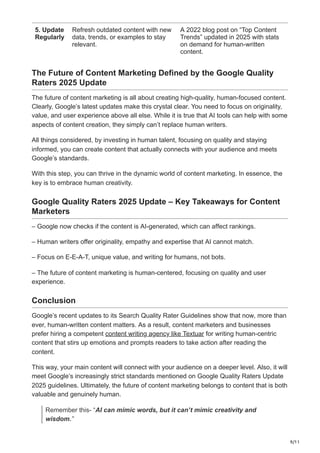
How to Create High-Quality, Google-Approved Content
Key
Strategy
Description Example
1. Focus
on E-E-A-
T
Demonstrate Expertise,
Experience, Authority, and
Trustworthiness through well-
researched, accurate, and reliable
content.
A medical blog citing peer-reviewed
studies and credentials of
contributing doctors.
2.
Provide
Unique
Value
Offer original insights, deep
analysis, or practical solutions that
readers can’t easily find elsewhere.
A local content writing service
(like Textuar) sharing a detailed
guide on “How to Optimize Content
for SEO in 2025.”
3. Write
for
Humans,
Not Bots
Prioritize clarity, engagement, and
natural language over keyword
stuffing. Avoid robotic or overly
SEO-optimized phrasing.
Instead of: “Best content writing
Mumbai,” write: “Need quality and
affordable content in Mumbai?
Here’s how we guarantee it.”
4. Edit
and
Proofread
Eliminate grammar errors, typos,
and awkward phrasing to maintain
credibility.
Using tools like Grammarly or hiring
a professional editor to polish
content.
9.
9/11
5. Update
Regularly
Refresh outdatedcontent with new
data, trends, or examples to stay
relevant.
A 2022 blog post on “Top Content
Trends” updated in 2025 with stats
on demand for human-written
content.
The Future of Content Marketing Defined by the Google Quality
Raters 2025 Update
The future of content marketing is all about creating high-quality, human-focused content.
Clearly, Google’s latest updates make this crystal clear. You need to focus on originality,
value, and user experience above all else. While it is true that AI tools can help with some
aspects of content creation, they simply can’t replace human writers.
All things considered, by investing in human talent, focusing on quality and staying
informed, you can create content that actually connects with your audience and meets
Google’s standards.
With this step, you can thrive in the dynamic world of content marketing. In essence, the
key is to embrace human creativity.
Google Quality Raters 2025 Update – Key Takeaways for Content
Marketers
– Google now checks if the content is AI-generated, which can affect rankings.
– Human writers offer originality, empathy and expertise that AI cannot match.
– Focus on E-E-A-T, unique value, and writing for humans, not bots.
– The future of content marketing is human-centered, focusing on quality and user
experience.
Conclusion
Google’s recent updates to its Search Quality Rater Guidelines show that now, more than
ever, human-written content matters. As a result, content marketers and businesses
prefer hiring a competent content writing agency like Textuar for writing human-centric
content that stirs up emotions and prompts readers to take action after reading the
content.
This way, your main content will connect with your audience on a deeper level. Also, it will
meet Google’s increasingly strict standards mentioned on Google Quality Raters Update
2025 guidelines. Ultimately, the future of content marketing belongs to content that is both
valuable and genuinely human.
Remember this- “AI can mimic words, but it can’t mimic creativity and
wisdom.”
10.
10/11
Keep it real,keep it human- Google (and your readers) will thank you.
FAQs – Google Quality Raters 2025 Update
Q. What’s Google’s new take on AI-generated content?
Google’s 2025 Quality Rater Guidelines clearly target AI-generated content when it’s
created with minimal effort. Hence, content that is AI-produced without adding real value
might receive a “Lowest” rating. While Google recognizes that AI tools as useful, they
caution against misusing them to mass-produce low-quality content.
Q. How do Google’s quality raters spot AI-generated content?
Though there’s no specific playbook for catching AI content, raters look for signs. These
include commonly known facts or big overlaps with sources like Wikipedia. Even
summarization that don’t bring anything new to the table is rated low. Lastly, phrases like
“in today’s times” denote AI content. Content that seems rehashed or repackaged without
original input raises red flags.
Google’s recent updates emphasize prioritizing fresh content, especially in rapidly
evolving topics.
Q. What is the difference between “Low” and “Lowest” ratings?
“Low” ratings apply when people reuse some content but try to change or pick through it.
So, we see that the “Lowest” ratings occur when pretty much everything is copied or
reworded without any effort or added value. Google penalizes content that tries to seem
original but doesn’t give real value to users.
Q. Why do human writers still matter according to the update?
Human writers bring fresh ideas, imagination, understanding, and subtle insights that AI
tools can’t match. They offer genuine expertise, can change their writing style, and form
readers’ emotional connections with the audience. Also, using human writers helps avoid
Google penalties while creating content that truly engages the audiences.
Q. How can I create content that ranks for Google Quality Raters Update
2025?
You need to focus on E-E-A-T (Expertise, Experience, Authority, Trust) by offering well-
researched and correct info. Also, try to give readers unique value and views they can’t
find anywhere else. Another good idea is to write for people, not search engines. Edit
your work and keep your content fresh to stay relevant and trustworthy in your field.
Share This Post
11.
11/11
Textuar Communications
Textuar wasset up in 2011 with a view to provide professional writing service to clients all
over the globe. We have gained extensive exposure across different industry domains in
this short period of time. This in turn has enabled us to add significant and meaningful
value to our clients through our content development proficiency.