Google Cloud Platform For Architects Design And
Manage Powerful Cloud Solutions Raj download

https://ebookbell.com/product/google-cloud-platform-for-
architects-design-and-manage-powerful-cloud-solutions-raj-9979282
Explore and download more ebooks at ebookbell.com
Here are some recommended products that we believe you will be
interested in. You can click the link to download.
Google Cloud Platform For Data Science A Crash Course On Big Data
Machine Learning And Data Analytics Services Dr Shitalkumar R Sukhdeve
https://ebookbell.com/product/google-cloud-platform-for-data-science-
a-crash-course-on-big-data-machine-learning-and-data-analytics-
services-dr-shitalkumar-r-sukhdeve-53726336
Google Cloud Platform For Developers 1st Edition Ted Hunter Steven
Porter
https://ebookbell.com/product/google-cloud-platform-for-
developers-1st-edition-ted-hunter-steven-porter-23421434
Google Cloud Platform For Data Science 2nd Edition Dr Shitalkumar R
Sukhdeve Sandika S Sukhdeve
https://ebookbell.com/product/google-cloud-platform-for-data-
science-2nd-edition-dr-shitalkumar-r-sukhdeve-sandika-s-
sukhdeve-55720200
Google Cloud Platform For Developers Ted Hunter Steven Porter
https://ebookbell.com/product/google-cloud-platform-for-developers-
ted-hunter-steven-porter-232082336
Google Cloud Platform Gcp Professional Cloud Network Engineer
Certification Companion Learn And Apply Network Design Concepts To
Prepare For The Exam 1st Edition Dario Cabianca
https://ebookbell.com/product/google-cloud-platform-gcp-professional-
cloud-network-engineer-certification-companion-learn-and-apply-
network-design-concepts-to-prepare-for-the-exam-1st-edition-dario-
cabianca-50618200
Designing Applications For Google Cloud Platform Create And Deploy
Applications Using Java Ashutosh Shashi
https://ebookbell.com/product/designing-applications-for-google-cloud-
platform-create-and-deploy-applications-using-java-ashutosh-
shashi-50403918
Introduction To Deep Learning For Engineers Using Python And Google
Cloud Platform Tariq M Arif
https://ebookbell.com/product/introduction-to-deep-learning-for-
engineers-using-python-and-google-cloud-platform-tariq-m-arif-48703968
Building Machine Learning And Deep Learning Models On Google Cloud
Platform A Comprehensive Guide For Beginners 1st Ed Ekaba Bisong
https://ebookbell.com/product/building-machine-learning-and-deep-
learning-models-on-google-cloud-platform-a-comprehensive-guide-for-
beginners-1st-ed-ekaba-bisong-10795840
Google Cloud Platform Gcp Professional Cloud Security Engineer
Certification Companion 1st Edition Dario Cabianca
https://ebookbell.com/product/google-cloud-platform-gcp-professional-
cloud-security-engineer-certification-companion-1st-edition-dario-
cabianca-57720420
Discovering Diverse Content Through
Random Scribd Documents
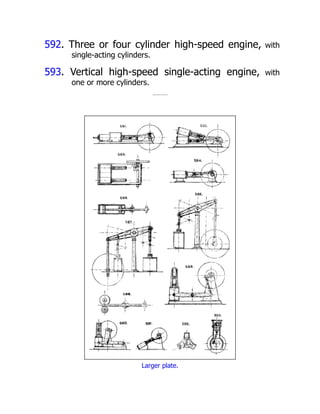
592. Three or four cylinder high-speed engine, with
single-acting cylinders.
593. Vertical high-speed single-acting engine, with
one or more cylinders.
Larger plate.
Section 33.—ENGINES AND BOILERS
COMBINED (see also Boilers, Sec. 6).
VERTICAL ARRANGEMENTS.
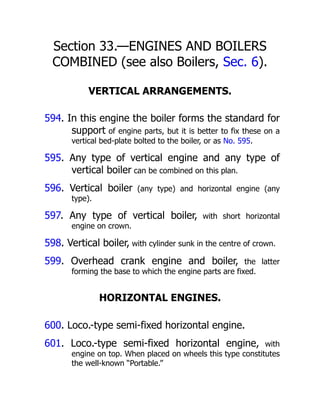
594. In this engine the boiler forms the standard for
support of engine parts, but it is better to fix these on a
vertical bed-plate bolted to the boiler, or as No. 595.
595. Any type of vertical engine and any type of
vertical boiler can be combined on this plan.
596. Vertical boiler (any type) and horizontal engine (any
type).
597. Any type of vertical boiler, with short horizontal
engine on crown.
598. Vertical boiler, with cylinder sunk in the centre of crown.
599. Overhead crank engine and boiler, the latter
forming the base to which the engine parts are fixed.
HORIZONTAL ENGINES.
600. Loco.-type semi-fixed horizontal engine.
601. Loco.-type semi-fixed horizontal engine, with
engine on top. When placed on wheels this type constitutes
the well-known “Portable.”
602. Horizontal semi-fixed boiler, with circular shell and
engine on top. (See No. 72.)
603. Horizontal semi-fixed boiler, with underneath fire-
box. (See No. 71.)
Section 34.—ELLIPTICAL MOTION.
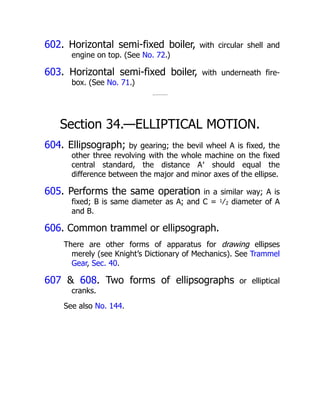
604. Ellipsograph; by gearing; the bevil wheel A is fixed, the
other three revolving with the whole machine on the fixed
central standard, the distance A′ should equal the
difference between the major and minor axes of the ellipse.
605. Performs the same operation in a similar way; A is
fixed; B is same diameter as A; and C = 1⁄2 diameter of A
and B.
606. Common trammel or ellipsograph.
There are other forms of apparatus for drawing ellipses
merely (see Knight’s Dictionary of Mechanics). See Trammel
Gear, Sec. 40.
607 & 608. Two forms of ellipsographs or elliptical
cranks.
See also No. 144.
Larger plate.
Section 35.—ELASTIC WHEELS.
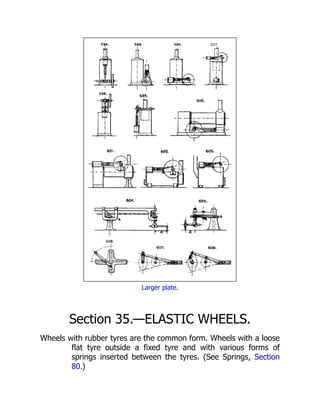
Wheels with rubber tyres are the common form. Wheels with a loose
flat tyre outside a fixed tyre and with various forms of
springs inserted between the tyres. (See Springs, Section
80.)
609. Huxley’s wheel, with spring tyre and jointed spokes.
610. Wheel with double tyres and intermediate springs.
611. Two plans of bent spoke, spring formation.
612. Two plans of bent spoke, spring formation.
613. Has an outer elastic tyre and an inner rigid ring, to
which the tension or compression springs are fixed.
614 & 615. Sections of rubber tyres.
Wheels are also made with rubber rings applied between the boss
and shaft so as to allow a limited amount of elasticity between the
wheel and axle.
Section 36.—EXPANDING AND
CONTRACTING DEVICES.
Common expedients for these purposes are—jointed folding rods, as
a carpenter’s rule; the telescope tube; net work; diagonally
crossed and jointed bars; lattice work; springs (see Section
80); lazy tongs (No. 623).
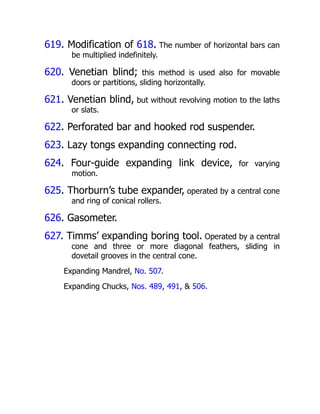
616. Telescopic ram hydraulic lift. (See also No. 1217.)
Consisting of two or more rams sliding within each other.
617. Parallel bar expanding grille, or gate.
618. Parallel bar expanding grille, with lazy tongs motion,
each alternate bar has slotted holes as shown.
619. Modification of 618. The number of horizontal bars can
be multiplied indefinitely.
620. Venetian blind; this method is used also for movable
doors or partitions, sliding horizontally.
621. Venetian blind, but without revolving motion to the laths
or slats.
622. Perforated bar and hooked rod suspender.
623. Lazy tongs expanding connecting rod.
624. Four-guide expanding link device, for varying
motion.
625. Thorburn’s tube expander, operated by a central cone
and ring of conical rollers.
626. Gasometer.
627. Timms’ expanding boring tool. Operated by a central
cone and three or more diagonal feathers, sliding in
dovetail grooves in the central cone.
Expanding Mandrel, No. 507.
Expanding Chucks, Nos. 489, 491, & 506.
Larger plate.
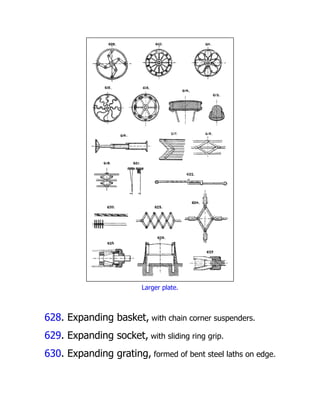
628. Expanding basket, with chain corner suspenders.
629. Expanding socket, with sliding ring grip.
630. Expanding grating, formed of bent steel laths on edge.
631. Bridge or flap between cars, having buffers.
632. Expanding core barrel, in three parts, expanded by a
wedge.
633. Expanding mandril or chuck. See also Section 28.
Expansion Joint, Nos. 1076, 1077.
Expanding Pipes, No. 1079.
Section 37.—FASTENING WHEELS TO
SHAFTS.
Besides the ordinary plan of shrinking them on while hot, the
following are the chief devices in use:—
634. Square shaft and single key.
635. Square shaft and two keys at right angles; two keys
should always be used for a square shaft, unless it has
been machined to fit to the hole.
636. Round shaft and hollow key.
637. Round shaft and flat key.
638. Round shaft and sunk key.
639. Staked fastening, four keys, usually on flats cut on
shaft, but better if slightly sunk into shaft.
640. Set screw. Cannot be depended on for any but light
strains.
641. Taper pin.
642. Split pin; always used where a pin, bolt, or centre is liable
to work loose.
643. Cotter and slot.
644. Screwed pin through shaft and boss of wheel.
645. Octagonal shaft of cast iron, with four keys, or the
four keys may be cast on shaft.
646. Cotter or pin through side of shaft.
647. Large wheels are sometimes wedged with iron and wood
wedges all round on a square or octagonal shaft having
feathers cast on it.
648. Set screw, tapped half into shaft and half into wheel.
649. Screwed shaft, nut and clamping plates; used for
emery wheels, grindstones, circular saws, and milling
cutters.
Larger plate.
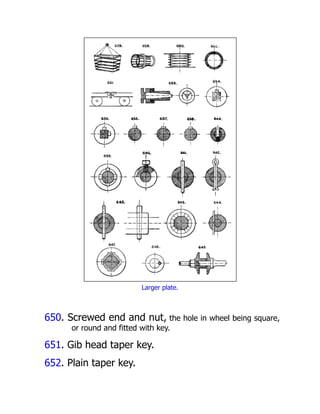
650. Screwed end and nut, the hole in wheel being square,
or round and fitted with key.
651. Gib head taper key.
652. Plain taper key.
653. Taper round pin.
654, 655. Split pins (round).
656. Cotter and split pin.
657. Cotter and nut.
658. Dovetail taper key, or fixing for projection, cutter or
bracket.
659. Self-locking pin; cannot work out.
660. Split collar and ring fastening, sometimes used
instead of a nut and screwed end; the inner ring is in
halves.
661. Piston rod fastening.
662. Locking feather and wedge fastening, for rollers, &c.,
prevents end motion.
663. Railway chair key.
Section 38.—FRICTION GEAR.
Various forms of friction gearing are much used, the chief objection
to this kind of gear being the excess of pressure on the
bearings required to give sufficient grip to drive the gear.
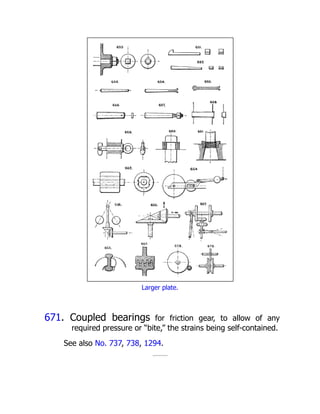
664. The common form of flat-faced friction gear for
hoisting purposes, &c. See No. 1211. The required pressure
is given by a weighted lever.
665. Friction bevils, plain faces, for governor driving, &c.
666. Friction bevils, the pinion being usually of hard leather;
the pressure may be applied in the direction of either of the
arrows.
667. Multiple V gear. A common mistake is to run these too
deep in gear; the narrower the surfaces in contact, short of
the seizing or crushing point, the less the power wasted in
friction.
668. A very small pinion of leather, wood, or rubber
is frequently driven by a large driving wheel for obtaining
high speed with steadiness, for driving dynamos, fans, &c.
669. Disc wheel and rubber pinion, arranged to reverse
motion or vary speed. See No. 1595. The motion is
reversed by throwing either wheel into gear with the pinion,
and the speed varied at will by raising or lowering the
pinion, used for screw presses.
670. Wedge friction gear.
Larger plate.
671. Coupled bearings for friction gear, to allow of any
required pressure or “bite,” the strains being self-contained.
See also No. 737, 738, 1294.
Section 39.—GUIDES, SLIDES, &c.
PISTON-ROD GUIDES.
672. Two bars and crosshead; these must be far enough
apart to allow for the angle of the connecting rod.
673. Four bars, crosshead, and slide blocks; the
connecting rod working between the two pairs of guides.
The bottom guides are often cast solid with the bedplate.
674. Bar and slipper.
675. Adjustable slipper; there are other adjustments for
wear by wedge pieces, similar to No. 19. See also No. 21.
A plain guide bush is sometimes used as No. 682, and a
forked connecting rod with long fork coupled to the
gudgeon or crosshead.
676. Section of No. 673 and alternative crosshead for
two round bar guides.
677. Slide bed and slipper.
678. Section of trunk guide, cast with engine bed and
bored out.
679. Oscillating cylinder piston head guides.
680. Oscillating fulcrum in lieu of guides.
681. Diagonal crosshead and guide bars, to allow the
crank and connecting rod end to pass the guide bars.
VALVE ROD GUIDES.
682, 683, 684, & 685.
GUIDE ROLLERS.
686 & 687. Guide rollers for ropes, &c.
688 & 689. Guide rollers for bars of various sections.
LIFT AND HOIST GUIDES.
690. Cage guided by four corner posts.
691 & 692. Cage runs on two vertical rails, and is
steadied by a third guide. For large cages. Small cages only
require guides on one side, as 692.
Larger plate.
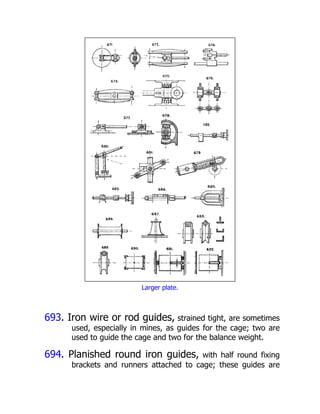
693. Iron wire or rod guides, strained tight, are sometimes
used, especially in mines, as guides for the cage; two are
used to guide the cage and two for the balance weight.
694. Planished round iron guides, with half round fixing
brackets and runners attached to cage; these guides are
equal to planed bars and much less costly; two are usually
sufficient for any cage.
695. T L or ⊔ iron guides, for goods lifts.
696. Wire rope guides, with separate pair of wood guides for
balance weight.
697. Intermediate guides for double cage lifts; for large
cages extra guides at each side should be used.
698. Sloping carriage guides.
699. Vertical bracket cage guides.
MACHINE GUIDE BEDS.
700. Double V bed, with set screw adjustments.
701. Guide bed for planing machine, or any machine where the
bed is not liable to lift in working.
702. Round bar and flat guide bed.
703. Deep V guide; much used for crossheads, tool boxes,
&c., requiring accurate movement.
704. Lathe bed with square guides and adjustments for wear.
705. Planing machine, double V bed.
706. Crosshead for two single bar guides, with renewable
wearing strips and square guide surfaces.
707. Radial slide for tool box, usually of same section as No.
700.
ROPE GUIDES.
708, 709, & 710; in 709 the rope can be threaded without passing
the end through.
Section 40.—GEARING, VARIOUS
DEVICES IN (not otherwise classed).
711. Conical rotatory gear. Applied to reaping machines.
See also Pan Screen, No. 1264.
712. Triangular eccentric, used to obtain a pause of one-
third revolution at each end of the stroke.
713. Face plate worm gear.
714. Double rack and pinion gear.
715. Double gear wheels.
Larger plate.
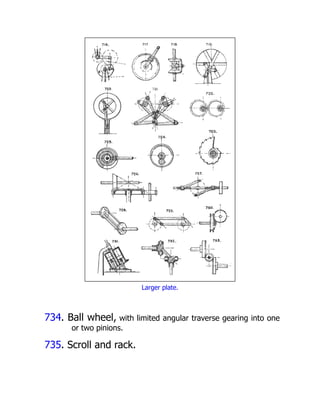
716. Eccentric gearing; the wheel A being fixed on a crank
pin in the driving wheel B, drives the dotted gear at a
speed proportionate to the diameters of the wheels A and
the driven wheel.
717 & 718. Forms of epicyclic or planet gear. Several
modes of driving these may be employed by fixing one or
other of the three wheels, the other two revolving. See
Differential Gear, Section 31.
719. Multiple trammel gear. The pinion is half the diameter
of the wheel, and makes two revolutions to one of the
wheel.
720. Trammel crank gear; the crank revolves once to two
double strokes of the rod.
721. Knight’s noiseless gearing, for two shafts running in
opposite directions. Each shaft has two equal cranks at
right angles, which are coupled by links to rocking arms,
which are also coupled in pairs.
722. Eccentric variable speed toothed gear.
723. Scroll bevil gear.
724. Segment reversing gear, to obtain two speeds in
portions of one revolution, and in opposite directions. See
Reversing Gear, Section 74.
725. Snail wheel, or scroll ratchet.
726. Combined spur and bevil wheel.
727. Double screw gear, for steering gear, &c.
728. Angular ball-jointed crank motion.
729. Crank gearing between two shafts running in the same
direction. See No. 187. The cranks should be similar to Nos.
174 or 175.
730. Snail worm gear.
731. Diagonal engine or pump, with bevil gear revolving
motion and three or more cylinders.
732. Angle coupling on Dr. Hooke’s principle. See No. 292.
733. Worm and crown gear. Used in chaff machines; useful
to obtain a slow feed on two shafts in opposite directions.
Larger plate.
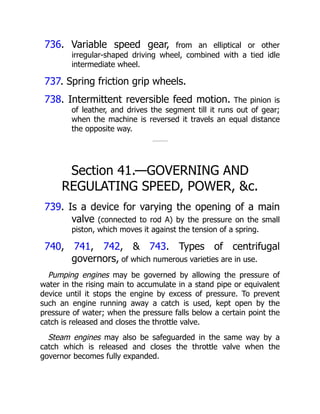
734. Ball wheel, with limited angular traverse gearing into one
or two pinions.
735. Scroll and rack.
736. Variable speed gear, from an elliptical or other
irregular-shaped driving wheel, combined with a tied idle
intermediate wheel.
737. Spring friction grip wheels.
738. Intermittent reversible feed motion. The pinion is
of leather, and drives the segment till it runs out of gear;
when the machine is reversed it travels an equal distance
the opposite way.
Section 41.—GOVERNING AND
REGULATING SPEED, POWER, &c.
739. Is a device for varying the opening of a main
valve (connected to rod A) by the pressure on the small
piston, which moves it against the tension of a spring.
740, 741, 742, & 743. Types of centrifugal
governors, of which numerous varieties are in use.
Pumping engines may be governed by allowing the pressure of
water in the rising main to accumulate in a stand pipe or equivalent
device until it stops the engine by excess of pressure. To prevent
such an engine running away a catch is used, kept open by the
pressure of water; when the pressure falls below a certain point the
catch is released and closes the throttle valve.
Steam engines may also be safeguarded in the same way by a
catch which is released and closes the throttle valve when the
governor becomes fully expanded.
Welcome to our website – the perfect destination for book lovers and
knowledge seekers. We believe that every book holds a new world,
offering opportunities for learning, discovery, and personal growth.
That’s why we are dedicated to bringing you a diverse collection of
books, ranging from classic literature and specialized publications to
self-development guides and children's books.
More than just a book-buying platform, we strive to be a bridge
connecting you with timeless cultural and intellectual values. With an
elegant, user-friendly interface and a smart search system, you can
quickly find the books that best suit your interests. Additionally,
our special promotions and home delivery services help you save time
and fully enjoy the joy of reading.
Join us on a journey of knowledge exploration, passion nurturing, and
personal growth every day!
ebookbell.com

Google Cloud Platform For Architects Design And Manage Powerful Cloud Solutions Raj

  • 1.
    Google Cloud PlatformFor Architects Design And Manage Powerful Cloud Solutions Raj download https://ebookbell.com/product/google-cloud-platform-for- architects-design-and-manage-powerful-cloud-solutions-raj-9979282 Explore and download more ebooks at ebookbell.com

  • 2.
    Here are somerecommended products that we believe you will be interested in. You can click the link to download. Google Cloud Platform For Data Science A Crash Course On Big Data Machine Learning And Data Analytics Services Dr Shitalkumar R Sukhdeve https://ebookbell.com/product/google-cloud-platform-for-data-science- a-crash-course-on-big-data-machine-learning-and-data-analytics- services-dr-shitalkumar-r-sukhdeve-53726336 Google Cloud Platform For Developers 1st Edition Ted Hunter Steven Porter https://ebookbell.com/product/google-cloud-platform-for- developers-1st-edition-ted-hunter-steven-porter-23421434 Google Cloud Platform For Data Science 2nd Edition Dr Shitalkumar R Sukhdeve Sandika S Sukhdeve https://ebookbell.com/product/google-cloud-platform-for-data- science-2nd-edition-dr-shitalkumar-r-sukhdeve-sandika-s- sukhdeve-55720200 Google Cloud Platform For Developers Ted Hunter Steven Porter https://ebookbell.com/product/google-cloud-platform-for-developers- ted-hunter-steven-porter-232082336
  • 3.
    Google Cloud PlatformGcp Professional Cloud Network Engineer Certification Companion Learn And Apply Network Design Concepts To Prepare For The Exam 1st Edition Dario Cabianca https://ebookbell.com/product/google-cloud-platform-gcp-professional- cloud-network-engineer-certification-companion-learn-and-apply- network-design-concepts-to-prepare-for-the-exam-1st-edition-dario- cabianca-50618200 Designing Applications For Google Cloud Platform Create And Deploy Applications Using Java Ashutosh Shashi https://ebookbell.com/product/designing-applications-for-google-cloud- platform-create-and-deploy-applications-using-java-ashutosh- shashi-50403918 Introduction To Deep Learning For Engineers Using Python And Google Cloud Platform Tariq M Arif https://ebookbell.com/product/introduction-to-deep-learning-for- engineers-using-python-and-google-cloud-platform-tariq-m-arif-48703968 Building Machine Learning And Deep Learning Models On Google Cloud Platform A Comprehensive Guide For Beginners 1st Ed Ekaba Bisong https://ebookbell.com/product/building-machine-learning-and-deep- learning-models-on-google-cloud-platform-a-comprehensive-guide-for- beginners-1st-ed-ekaba-bisong-10795840 Google Cloud Platform Gcp Professional Cloud Security Engineer Certification Companion 1st Edition Dario Cabianca https://ebookbell.com/product/google-cloud-platform-gcp-professional- cloud-security-engineer-certification-companion-1st-edition-dario- cabianca-57720420
  • 5.
    Discovering Diverse ContentThrough Random Scribd Documents
  • 6.
    592. Three orfour cylinder high-speed engine, with single-acting cylinders. 593. Vertical high-speed single-acting engine, with one or more cylinders. Larger plate.
  • 7.
    Section 33.—ENGINES ANDBOILERS COMBINED (see also Boilers, Sec. 6). VERTICAL ARRANGEMENTS. 594. In this engine the boiler forms the standard for support of engine parts, but it is better to fix these on a vertical bed-plate bolted to the boiler, or as No. 595. 595. Any type of vertical engine and any type of vertical boiler can be combined on this plan. 596. Vertical boiler (any type) and horizontal engine (any type). 597. Any type of vertical boiler, with short horizontal engine on crown. 598. Vertical boiler, with cylinder sunk in the centre of crown. 599. Overhead crank engine and boiler, the latter forming the base to which the engine parts are fixed. HORIZONTAL ENGINES. 600. Loco.-type semi-fixed horizontal engine. 601. Loco.-type semi-fixed horizontal engine, with engine on top. When placed on wheels this type constitutes the well-known “Portable.”
  • 8.
    602. Horizontal semi-fixedboiler, with circular shell and engine on top. (See No. 72.) 603. Horizontal semi-fixed boiler, with underneath fire- box. (See No. 71.) Section 34.—ELLIPTICAL MOTION. 604. Ellipsograph; by gearing; the bevil wheel A is fixed, the other three revolving with the whole machine on the fixed central standard, the distance A′ should equal the difference between the major and minor axes of the ellipse. 605. Performs the same operation in a similar way; A is fixed; B is same diameter as A; and C = 1⁄2 diameter of A and B. 606. Common trammel or ellipsograph. There are other forms of apparatus for drawing ellipses merely (see Knight’s Dictionary of Mechanics). See Trammel Gear, Sec. 40. 607 & 608. Two forms of ellipsographs or elliptical cranks. See also No. 144.
  • 9.
    Larger plate. Section 35.—ELASTICWHEELS. Wheels with rubber tyres are the common form. Wheels with a loose flat tyre outside a fixed tyre and with various forms of springs inserted between the tyres. (See Springs, Section 80.)
  • 10.
    609. Huxley’s wheel,with spring tyre and jointed spokes. 610. Wheel with double tyres and intermediate springs. 611. Two plans of bent spoke, spring formation. 612. Two plans of bent spoke, spring formation. 613. Has an outer elastic tyre and an inner rigid ring, to which the tension or compression springs are fixed. 614 & 615. Sections of rubber tyres. Wheels are also made with rubber rings applied between the boss and shaft so as to allow a limited amount of elasticity between the wheel and axle. Section 36.—EXPANDING AND CONTRACTING DEVICES. Common expedients for these purposes are—jointed folding rods, as a carpenter’s rule; the telescope tube; net work; diagonally crossed and jointed bars; lattice work; springs (see Section 80); lazy tongs (No. 623). 616. Telescopic ram hydraulic lift. (See also No. 1217.) Consisting of two or more rams sliding within each other. 617. Parallel bar expanding grille, or gate. 618. Parallel bar expanding grille, with lazy tongs motion, each alternate bar has slotted holes as shown.
  • 11.
    619. Modification of618. The number of horizontal bars can be multiplied indefinitely. 620. Venetian blind; this method is used also for movable doors or partitions, sliding horizontally. 621. Venetian blind, but without revolving motion to the laths or slats. 622. Perforated bar and hooked rod suspender. 623. Lazy tongs expanding connecting rod. 624. Four-guide expanding link device, for varying motion. 625. Thorburn’s tube expander, operated by a central cone and ring of conical rollers. 626. Gasometer. 627. Timms’ expanding boring tool. Operated by a central cone and three or more diagonal feathers, sliding in dovetail grooves in the central cone. Expanding Mandrel, No. 507. Expanding Chucks, Nos. 489, 491, & 506.
  • 12.
    Larger plate. 628. Expandingbasket, with chain corner suspenders. 629. Expanding socket, with sliding ring grip. 630. Expanding grating, formed of bent steel laths on edge.
  • 13.
    631. Bridge orflap between cars, having buffers. 632. Expanding core barrel, in three parts, expanded by a wedge. 633. Expanding mandril or chuck. See also Section 28. Expansion Joint, Nos. 1076, 1077. Expanding Pipes, No. 1079. Section 37.—FASTENING WHEELS TO SHAFTS. Besides the ordinary plan of shrinking them on while hot, the following are the chief devices in use:— 634. Square shaft and single key. 635. Square shaft and two keys at right angles; two keys should always be used for a square shaft, unless it has been machined to fit to the hole. 636. Round shaft and hollow key. 637. Round shaft and flat key. 638. Round shaft and sunk key. 639. Staked fastening, four keys, usually on flats cut on shaft, but better if slightly sunk into shaft. 640. Set screw. Cannot be depended on for any but light strains.
  • 14.
    641. Taper pin. 642.Split pin; always used where a pin, bolt, or centre is liable to work loose. 643. Cotter and slot. 644. Screwed pin through shaft and boss of wheel. 645. Octagonal shaft of cast iron, with four keys, or the four keys may be cast on shaft. 646. Cotter or pin through side of shaft. 647. Large wheels are sometimes wedged with iron and wood wedges all round on a square or octagonal shaft having feathers cast on it. 648. Set screw, tapped half into shaft and half into wheel. 649. Screwed shaft, nut and clamping plates; used for emery wheels, grindstones, circular saws, and milling cutters.
  • 15.
    Larger plate. 650. Screwedend and nut, the hole in wheel being square, or round and fitted with key. 651. Gib head taper key. 652. Plain taper key.
  • 16.
    653. Taper roundpin. 654, 655. Split pins (round). 656. Cotter and split pin. 657. Cotter and nut. 658. Dovetail taper key, or fixing for projection, cutter or bracket. 659. Self-locking pin; cannot work out. 660. Split collar and ring fastening, sometimes used instead of a nut and screwed end; the inner ring is in halves. 661. Piston rod fastening. 662. Locking feather and wedge fastening, for rollers, &c., prevents end motion. 663. Railway chair key. Section 38.—FRICTION GEAR. Various forms of friction gearing are much used, the chief objection to this kind of gear being the excess of pressure on the bearings required to give sufficient grip to drive the gear. 664. The common form of flat-faced friction gear for hoisting purposes, &c. See No. 1211. The required pressure is given by a weighted lever.
  • 17.
    665. Friction bevils,plain faces, for governor driving, &c. 666. Friction bevils, the pinion being usually of hard leather; the pressure may be applied in the direction of either of the arrows. 667. Multiple V gear. A common mistake is to run these too deep in gear; the narrower the surfaces in contact, short of the seizing or crushing point, the less the power wasted in friction. 668. A very small pinion of leather, wood, or rubber is frequently driven by a large driving wheel for obtaining high speed with steadiness, for driving dynamos, fans, &c. 669. Disc wheel and rubber pinion, arranged to reverse motion or vary speed. See No. 1595. The motion is reversed by throwing either wheel into gear with the pinion, and the speed varied at will by raising or lowering the pinion, used for screw presses. 670. Wedge friction gear.
  • 18.
    Larger plate. 671. Coupledbearings for friction gear, to allow of any required pressure or “bite,” the strains being self-contained. See also No. 737, 738, 1294.
  • 19.
    Section 39.—GUIDES, SLIDES,&c. PISTON-ROD GUIDES. 672. Two bars and crosshead; these must be far enough apart to allow for the angle of the connecting rod. 673. Four bars, crosshead, and slide blocks; the connecting rod working between the two pairs of guides. The bottom guides are often cast solid with the bedplate. 674. Bar and slipper. 675. Adjustable slipper; there are other adjustments for wear by wedge pieces, similar to No. 19. See also No. 21. A plain guide bush is sometimes used as No. 682, and a forked connecting rod with long fork coupled to the gudgeon or crosshead. 676. Section of No. 673 and alternative crosshead for two round bar guides. 677. Slide bed and slipper. 678. Section of trunk guide, cast with engine bed and bored out. 679. Oscillating cylinder piston head guides. 680. Oscillating fulcrum in lieu of guides. 681. Diagonal crosshead and guide bars, to allow the crank and connecting rod end to pass the guide bars.
  • 20.
    VALVE ROD GUIDES. 682,683, 684, & 685. GUIDE ROLLERS. 686 & 687. Guide rollers for ropes, &c. 688 & 689. Guide rollers for bars of various sections. LIFT AND HOIST GUIDES. 690. Cage guided by four corner posts. 691 & 692. Cage runs on two vertical rails, and is steadied by a third guide. For large cages. Small cages only require guides on one side, as 692.
  • 21.
    Larger plate. 693. Ironwire or rod guides, strained tight, are sometimes used, especially in mines, as guides for the cage; two are used to guide the cage and two for the balance weight. 694. Planished round iron guides, with half round fixing brackets and runners attached to cage; these guides are
  • 22.
    equal to planedbars and much less costly; two are usually sufficient for any cage. 695. T L or ⊔ iron guides, for goods lifts. 696. Wire rope guides, with separate pair of wood guides for balance weight. 697. Intermediate guides for double cage lifts; for large cages extra guides at each side should be used. 698. Sloping carriage guides. 699. Vertical bracket cage guides. MACHINE GUIDE BEDS. 700. Double V bed, with set screw adjustments. 701. Guide bed for planing machine, or any machine where the bed is not liable to lift in working. 702. Round bar and flat guide bed. 703. Deep V guide; much used for crossheads, tool boxes, &c., requiring accurate movement. 704. Lathe bed with square guides and adjustments for wear. 705. Planing machine, double V bed. 706. Crosshead for two single bar guides, with renewable wearing strips and square guide surfaces.
  • 23.
    707. Radial slidefor tool box, usually of same section as No. 700. ROPE GUIDES. 708, 709, & 710; in 709 the rope can be threaded without passing the end through. Section 40.—GEARING, VARIOUS DEVICES IN (not otherwise classed). 711. Conical rotatory gear. Applied to reaping machines. See also Pan Screen, No. 1264. 712. Triangular eccentric, used to obtain a pause of one- third revolution at each end of the stroke. 713. Face plate worm gear. 714. Double rack and pinion gear. 715. Double gear wheels.
  • 24.
    Larger plate. 716. Eccentricgearing; the wheel A being fixed on a crank pin in the driving wheel B, drives the dotted gear at a speed proportionate to the diameters of the wheels A and the driven wheel.
  • 25.
    717 & 718.Forms of epicyclic or planet gear. Several modes of driving these may be employed by fixing one or other of the three wheels, the other two revolving. See Differential Gear, Section 31. 719. Multiple trammel gear. The pinion is half the diameter of the wheel, and makes two revolutions to one of the wheel. 720. Trammel crank gear; the crank revolves once to two double strokes of the rod. 721. Knight’s noiseless gearing, for two shafts running in opposite directions. Each shaft has two equal cranks at right angles, which are coupled by links to rocking arms, which are also coupled in pairs. 722. Eccentric variable speed toothed gear. 723. Scroll bevil gear. 724. Segment reversing gear, to obtain two speeds in portions of one revolution, and in opposite directions. See Reversing Gear, Section 74. 725. Snail wheel, or scroll ratchet. 726. Combined spur and bevil wheel. 727. Double screw gear, for steering gear, &c. 728. Angular ball-jointed crank motion. 729. Crank gearing between two shafts running in the same direction. See No. 187. The cranks should be similar to Nos. 174 or 175.
  • 26.
    730. Snail wormgear. 731. Diagonal engine or pump, with bevil gear revolving motion and three or more cylinders. 732. Angle coupling on Dr. Hooke’s principle. See No. 292. 733. Worm and crown gear. Used in chaff machines; useful to obtain a slow feed on two shafts in opposite directions.
  • 27.
    Larger plate. 734. Ballwheel, with limited angular traverse gearing into one or two pinions. 735. Scroll and rack.
  • 28.
    736. Variable speedgear, from an elliptical or other irregular-shaped driving wheel, combined with a tied idle intermediate wheel. 737. Spring friction grip wheels. 738. Intermittent reversible feed motion. The pinion is of leather, and drives the segment till it runs out of gear; when the machine is reversed it travels an equal distance the opposite way. Section 41.—GOVERNING AND REGULATING SPEED, POWER, &c. 739. Is a device for varying the opening of a main valve (connected to rod A) by the pressure on the small piston, which moves it against the tension of a spring. 740, 741, 742, & 743. Types of centrifugal governors, of which numerous varieties are in use. Pumping engines may be governed by allowing the pressure of water in the rising main to accumulate in a stand pipe or equivalent device until it stops the engine by excess of pressure. To prevent such an engine running away a catch is used, kept open by the pressure of water; when the pressure falls below a certain point the catch is released and closes the throttle valve. Steam engines may also be safeguarded in the same way by a catch which is released and closes the throttle valve when the governor becomes fully expanded.
  • 29.
    Welcome to ourwebsite – the perfect destination for book lovers and knowledge seekers. We believe that every book holds a new world, offering opportunities for learning, discovery, and personal growth. That’s why we are dedicated to bringing you a diverse collection of books, ranging from classic literature and specialized publications to self-development guides and children's books. More than just a book-buying platform, we strive to be a bridge connecting you with timeless cultural and intellectual values. With an elegant, user-friendly interface and a smart search system, you can quickly find the books that best suit your interests. Additionally, our special promotions and home delivery services help you save time and fully enjoy the joy of reading. Join us on a journey of knowledge exploration, passion nurturing, and personal growth every day! ebookbell.com