Adjectives & Adverbs


                    The Brenham Writing Room
Created by D. Herring with some additions in 1/2013 by another source
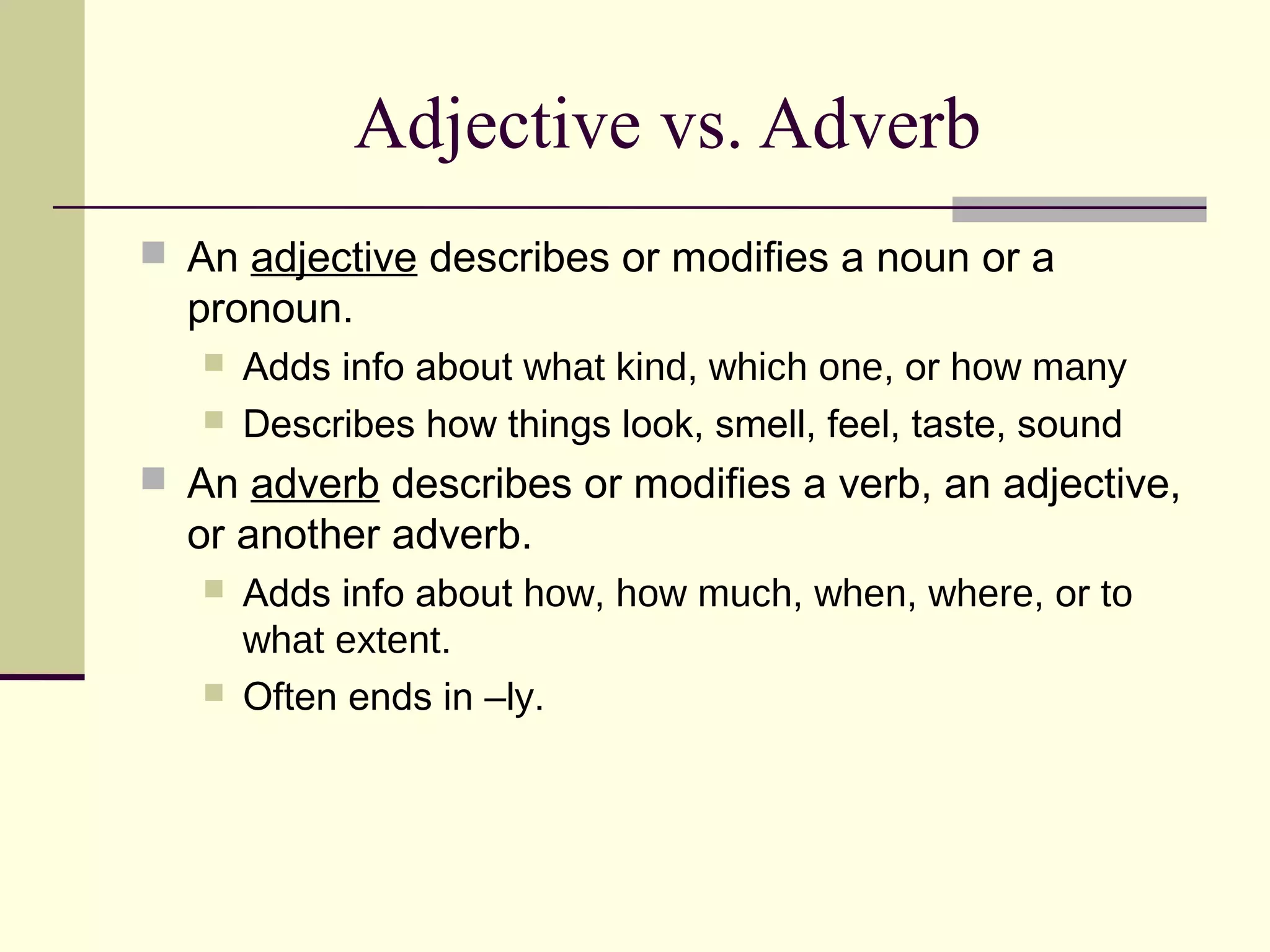
Adjective vs. Adverb
 An adjective describes or modifies a noun or a
  pronoun.
      Adds info about what kind, which one, or how many
      Describes how things look, smell, feel, taste, sound
 An adverb describes or modifies a verb, an adjective,
  or another adverb.
      Adds info about how, how much, when, where, or to
       what extent.
      Often ends in –ly.
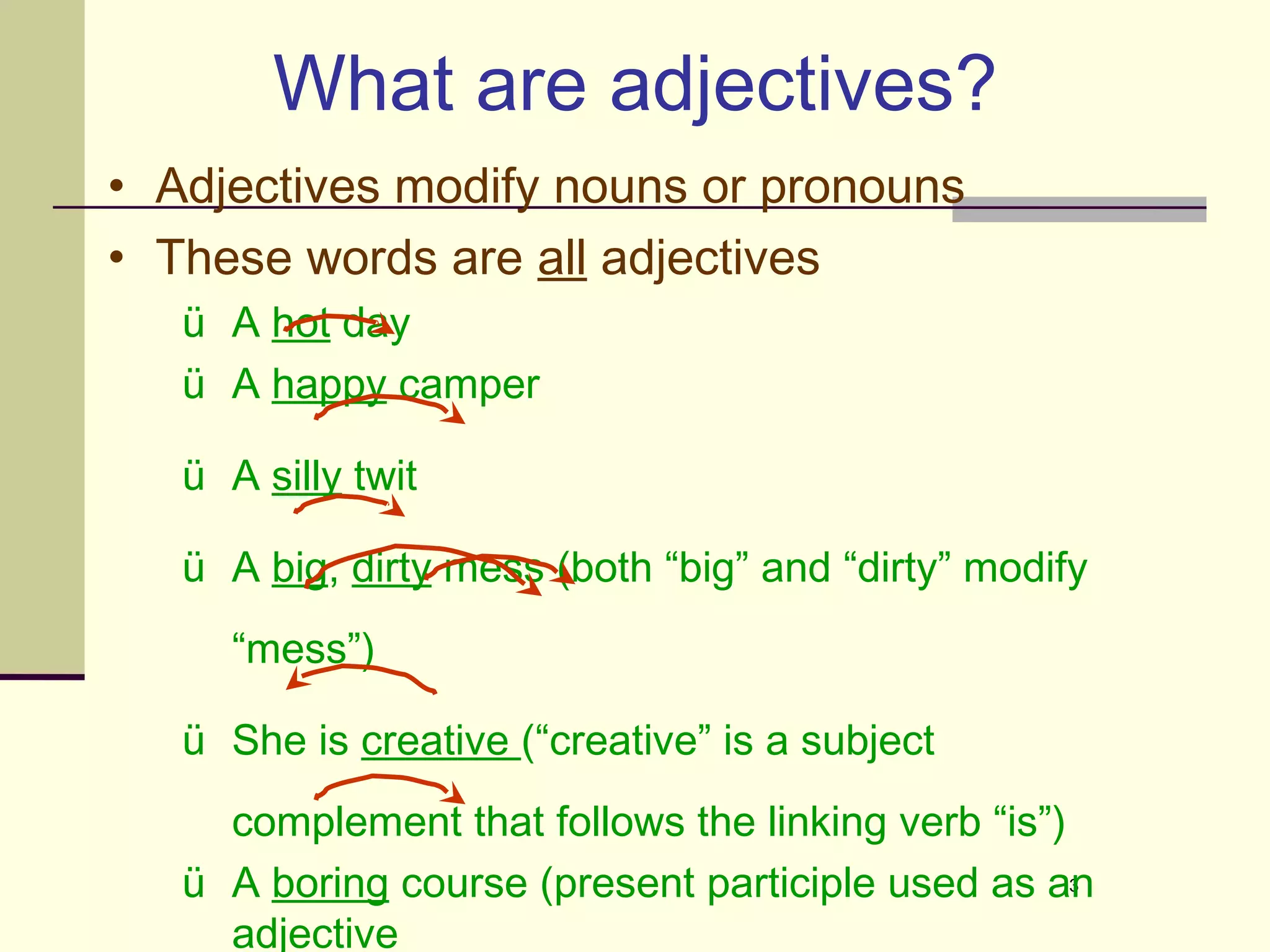
What are adjectives?
• Adjectives modify nouns or pronouns
• These words are all adjectives
   ü A hot day
   ü A happy camper

   ü A silly twit

   ü A big, dirty mess (both “big” and “dirty” modify
     “mess”)

   ü She is creative (“creative” is a subject
     complement that follows the linking verb “is”)
   ü A boring course (present participle used as an 3


     adjective
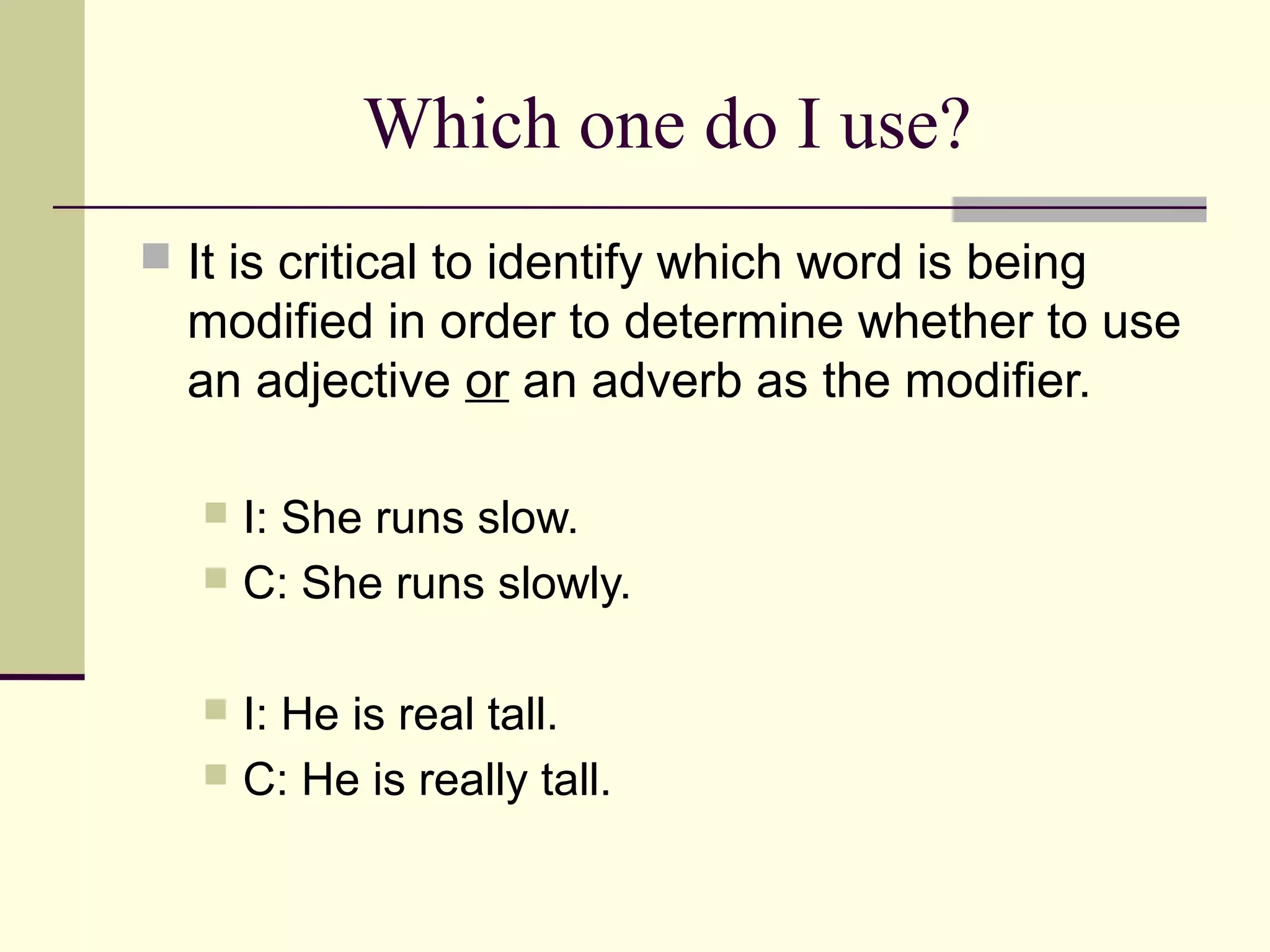
Which one do I use?
 It is critical to identify which word is being
  modified in order to determine whether to use
  an adjective or an adverb as the modifier.

    I: She runs slow.
    C: She runs slowly.


    I: He is real tall.
    C: He is really tall.
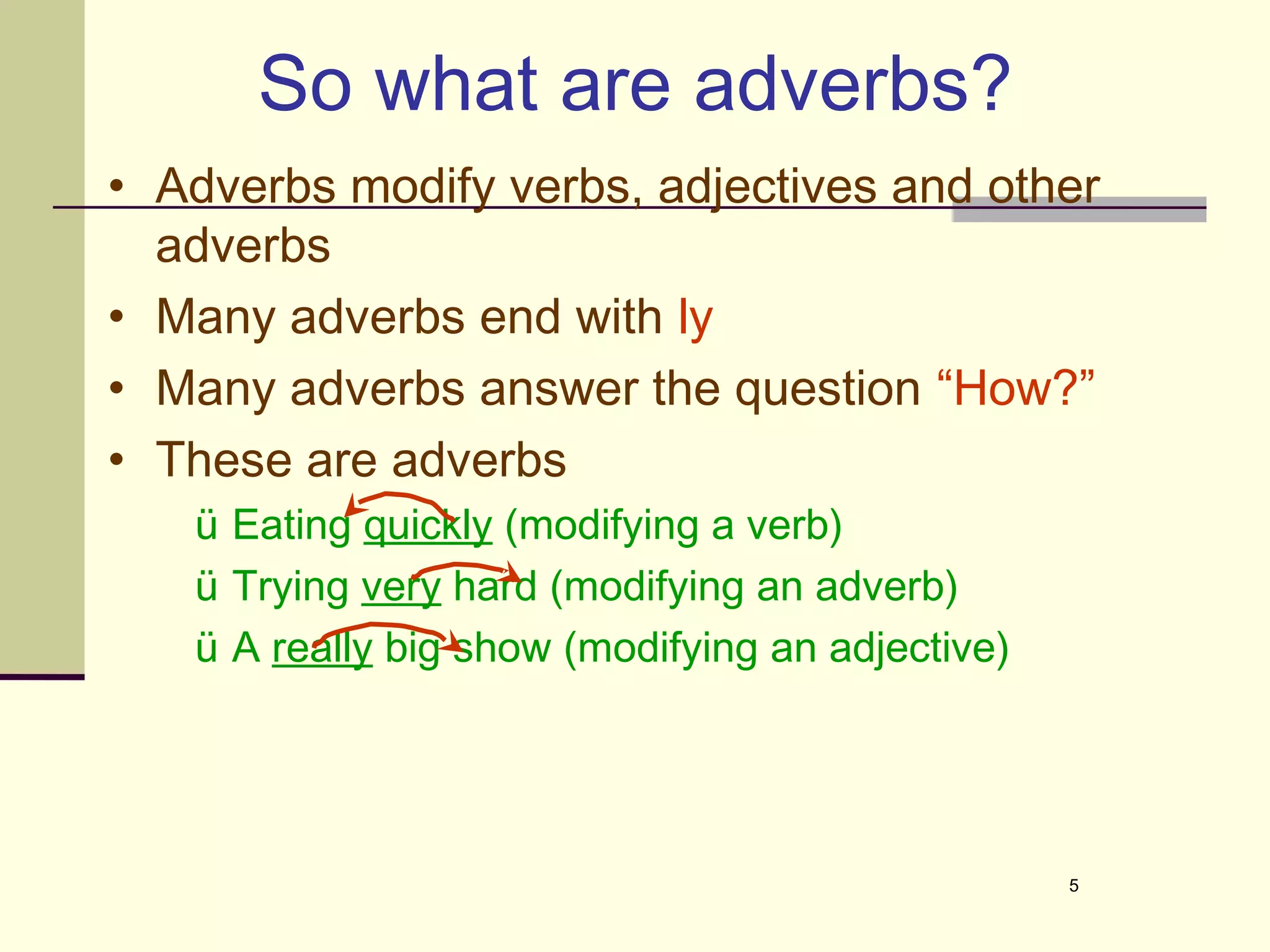
So what are adverbs?
• Adverbs modify verbs, adjectives and other
  adverbs
• Many adverbs end with ly
• Many adverbs answer the question “How?”
• These are adverbs
   ü Eating quickly (modifying a verb)
   ü Trying very hard (modifying an adverb)
   ü A really big show (modifying an adjective)


                                                  5
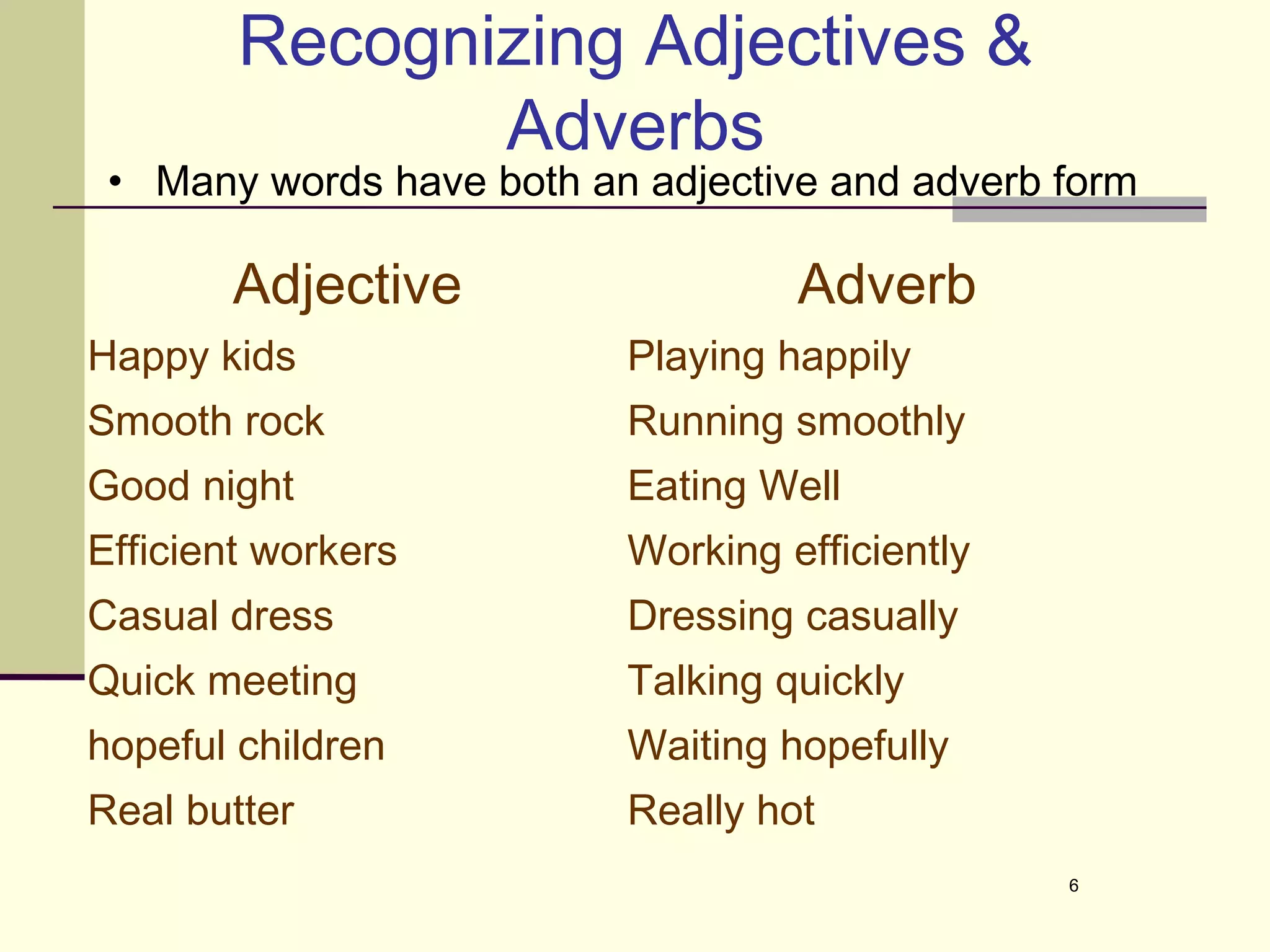
Recognizing Adjectives &
               Adverbs
 • Many words have both an adjective and adverb form

       Adjective                   Adverb
Happy kids                Playing happily
Smooth rock               Running smoothly
Good night                Eating Well
Efficient workers         Working efficiently
Casual dress              Dressing casually
Quick meeting             Talking quickly
hopeful children          Waiting hopefully
Real butter               Really hot
                                                6
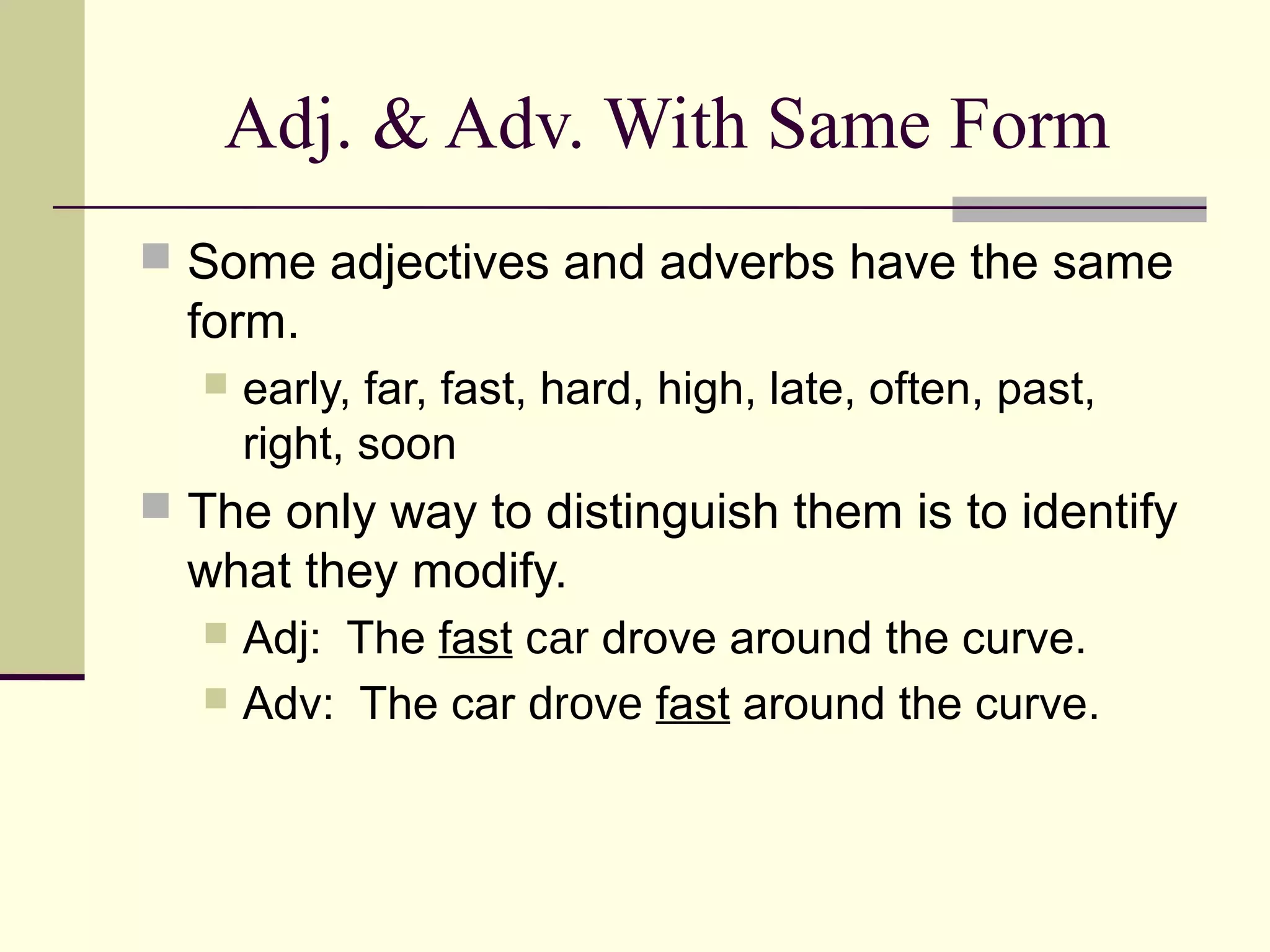
Adj. & Adv. With Same Form
 Some adjectives and adverbs have the same
  form.
     early, far, fast, hard, high, late, often, past,
      right, soon
 The only way to distinguish them is to identify
  what they modify.
   Adj: The fast car drove around the curve.
   Adv: The car drove fast around the curve.
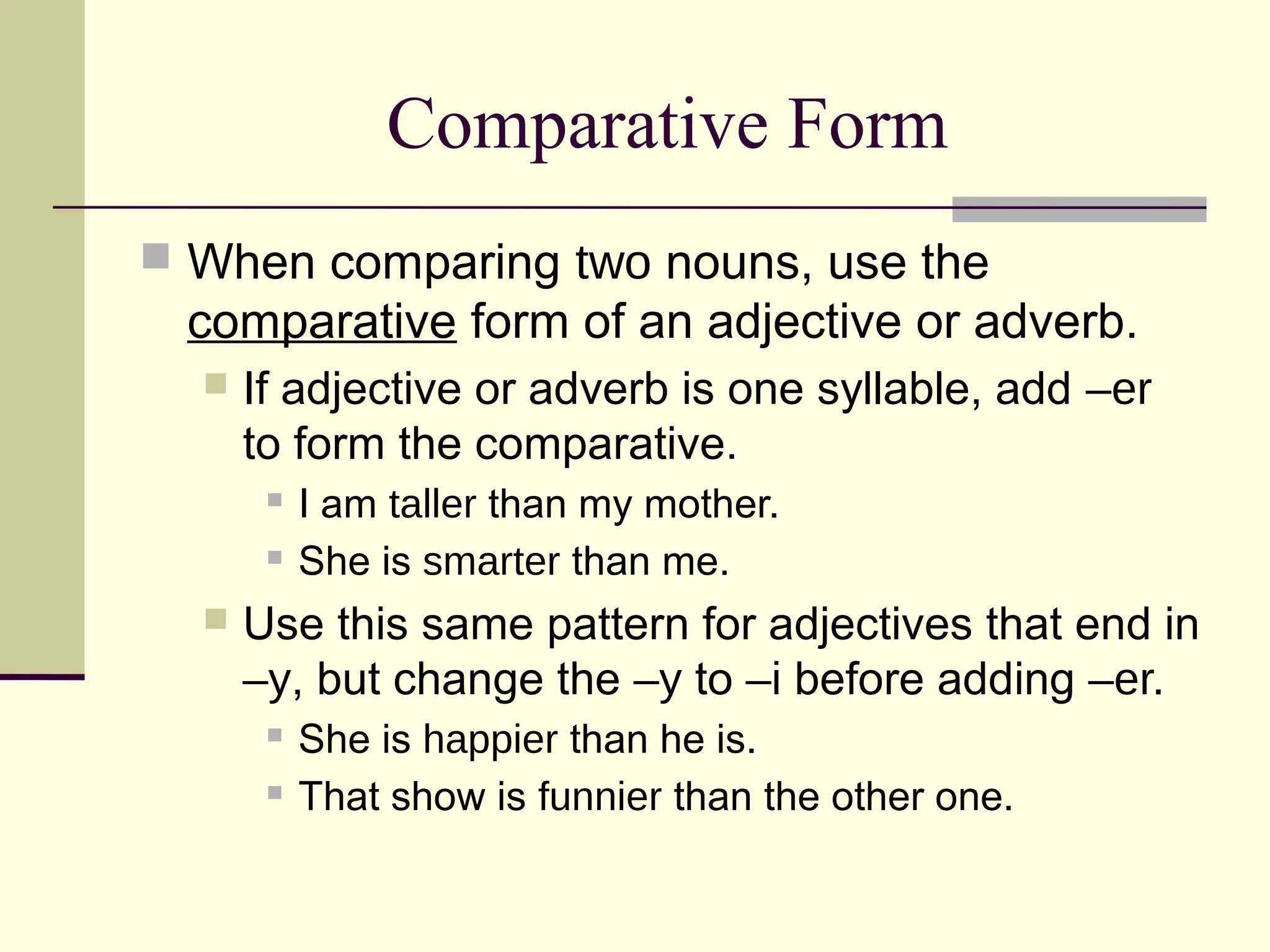
Comparative Form
 When comparing two nouns, use the
 comparative form of an adjective or adverb.
     If adjective or adverb is one syllable, add –er
      to form the comparative.
          I am taller than my mother.
          She is smarter than me.
     Use this same pattern for adjectives that end in
      –y, but change the –y to –i before adding –er.
          She is happier than he is.
          That show is funnier than the other one.
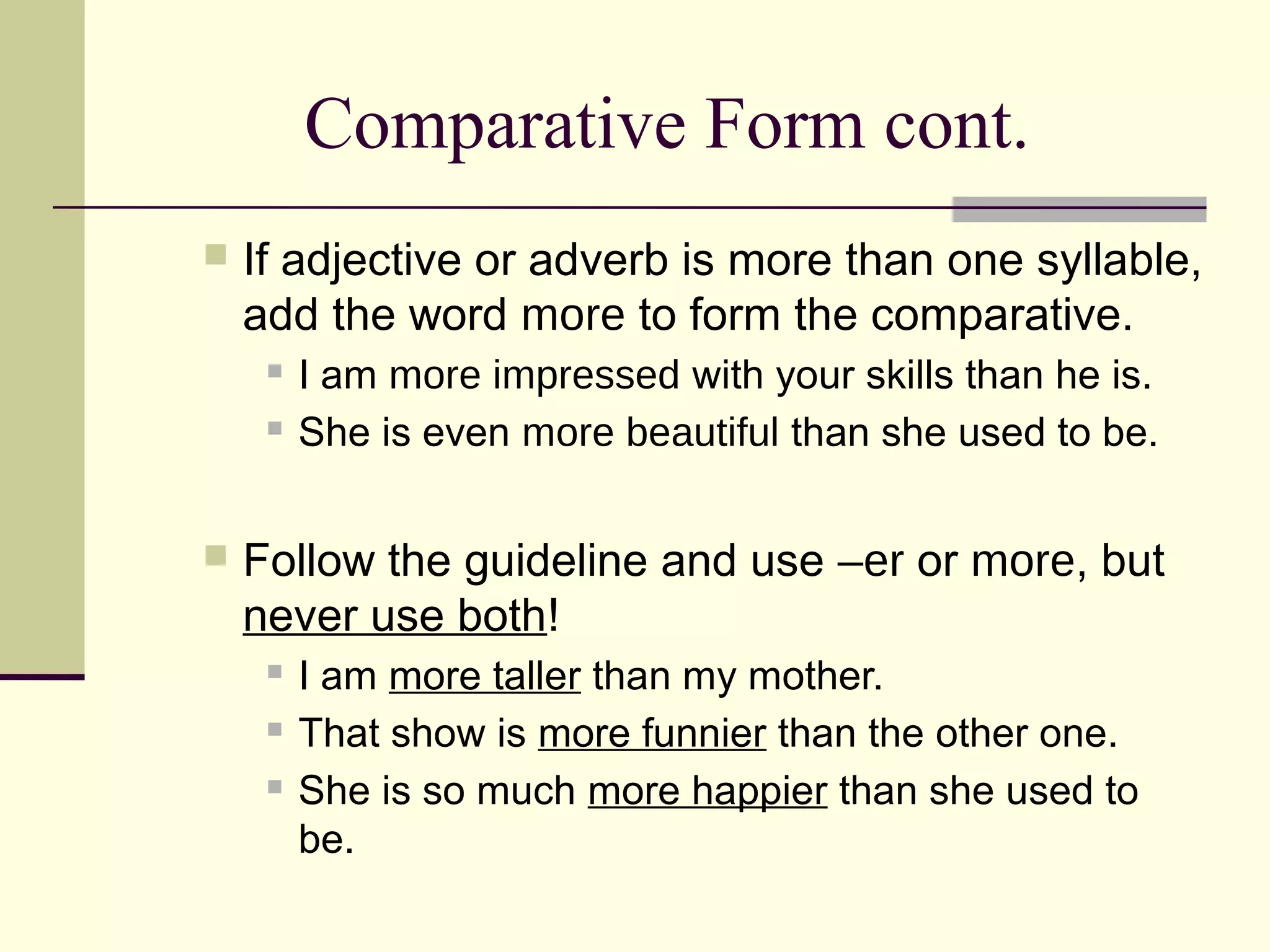
Comparative Form cont.
   If adjective or adverb is more than one syllable,
    add the word more to form the comparative.
        I am more impressed with your skills than he is.
        She is even more beautiful than she used to be.


   Follow the guideline and use –er or more, but
    never use both!
        I am more taller than my mother.
        That show is more funnier than the other one.
        She is so much more happier than she used to
         be.
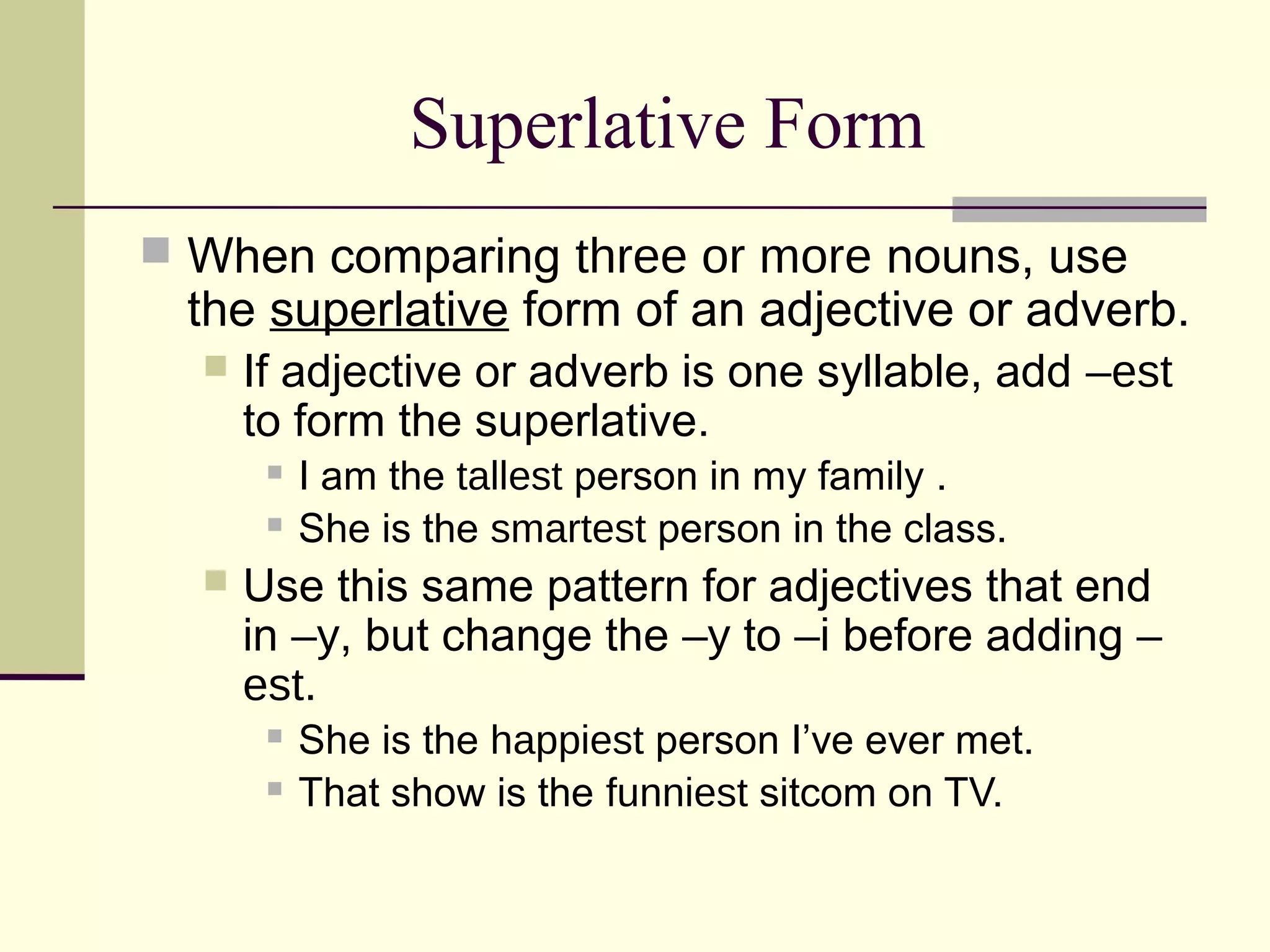
Superlative Form
 When comparing three or more nouns, use
 the superlative form of an adjective or adverb.
     If adjective or adverb is one syllable, add –est
      to form the superlative.
          I am the tallest person in my family .
          She is the smartest person in the class.
     Use this same pattern for adjectives that end
      in –y, but change the –y to –i before adding –
      est.
          She is the happiest person I’ve ever met.
          That show is the funniest sitcom on TV.
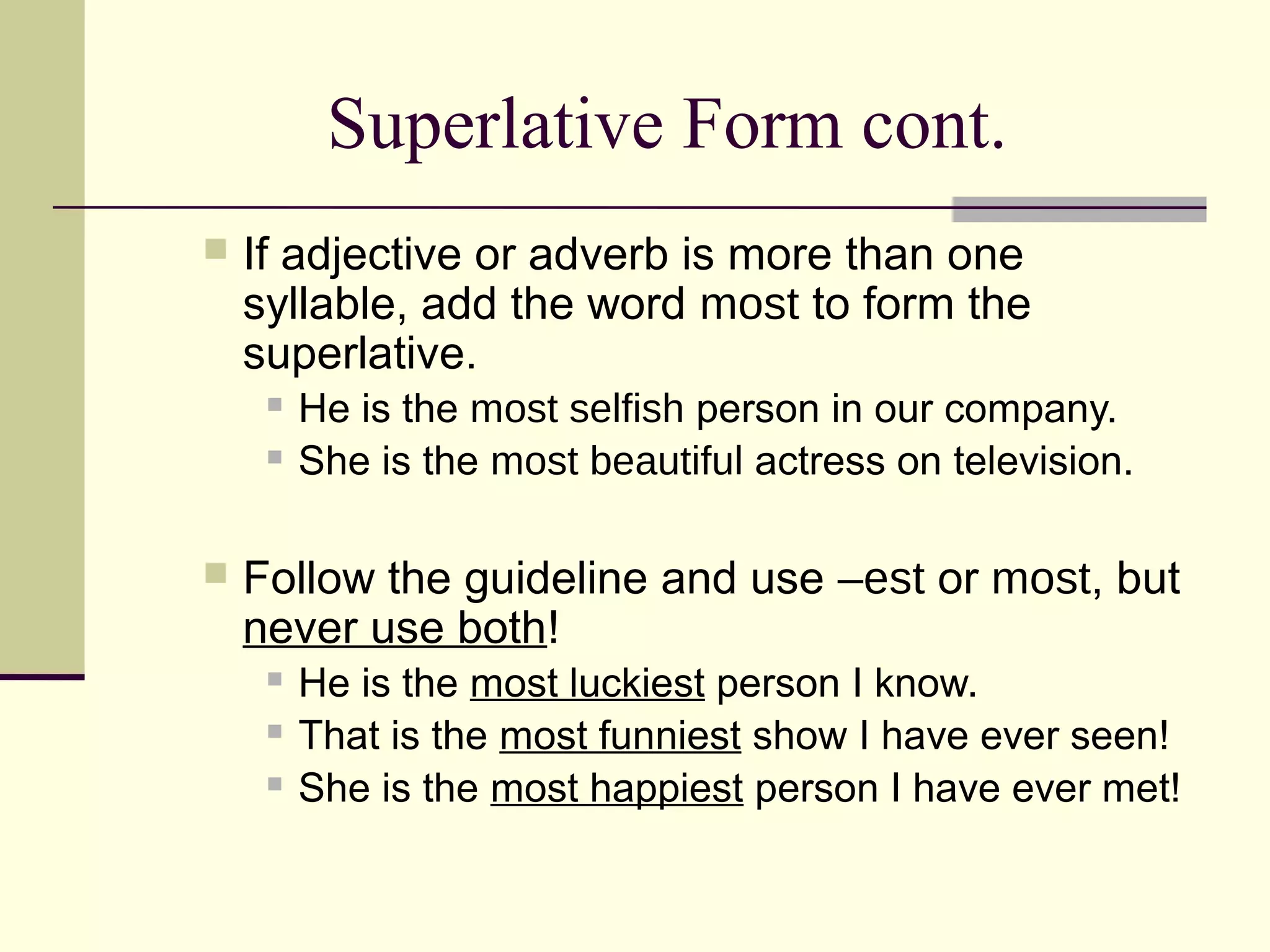
Superlative Form cont.
   If adjective or adverb is more than one
    syllable, add the word most to form the
    superlative.
        He is the most selfish person in our company.
        She is the most beautiful actress on television.

   Follow the guideline and use –est or most, but
    never use both!
        He is the most luckiest person I know.
        That is the most funniest show I have ever seen!
        She is the most happiest person I have ever met!
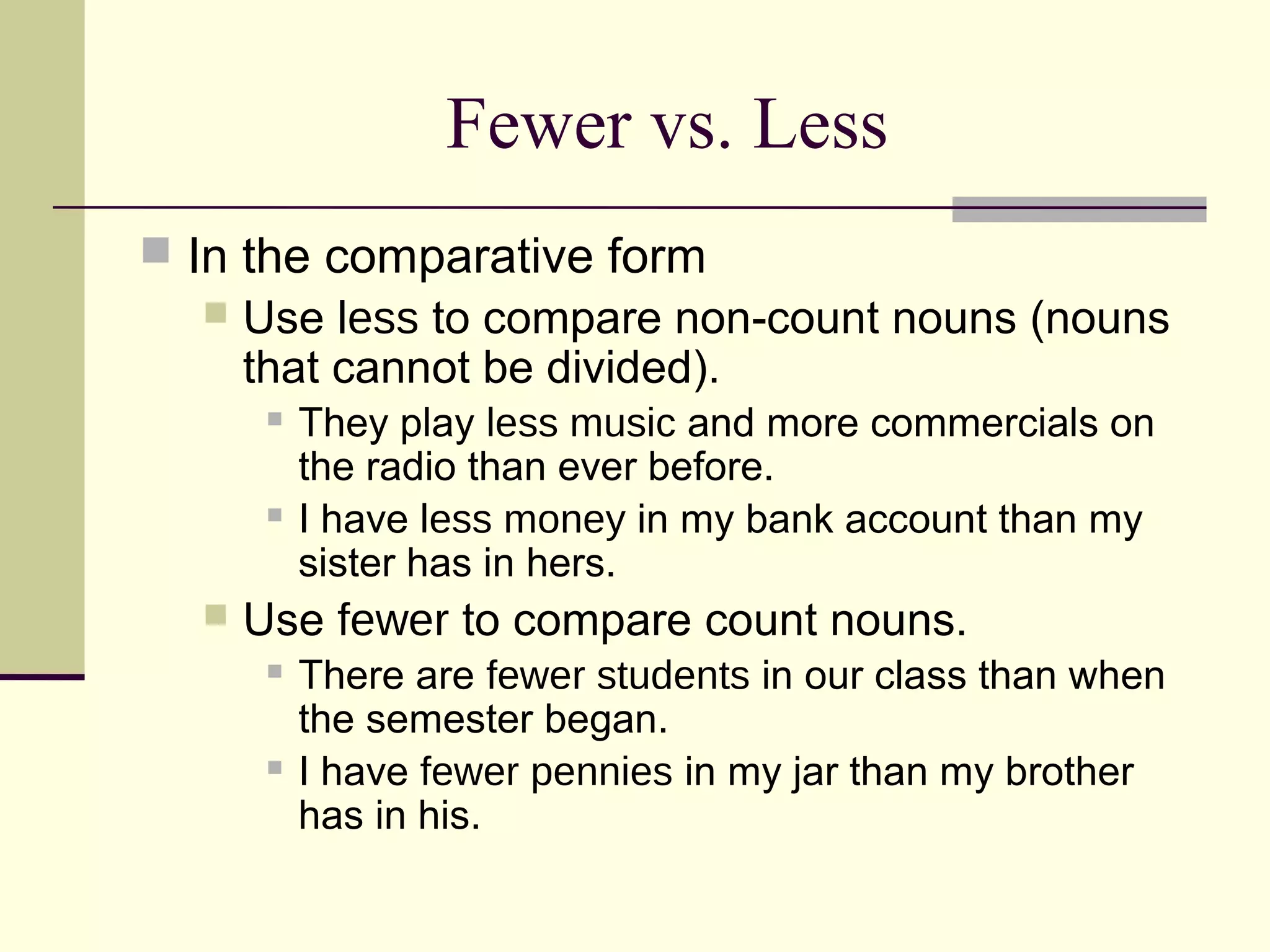
Fewer vs. Less
 In the comparative form
     Use less to compare non-count nouns (nouns
      that cannot be divided).
          They play less music and more commercials on
           the radio than ever before.
          I have less money in my bank account than my
           sister has in hers.
     Use fewer to compare count nouns.
          There are fewer students in our class than when
           the semester began.
          I have fewer pennies in my jar than my brother
           has in his.
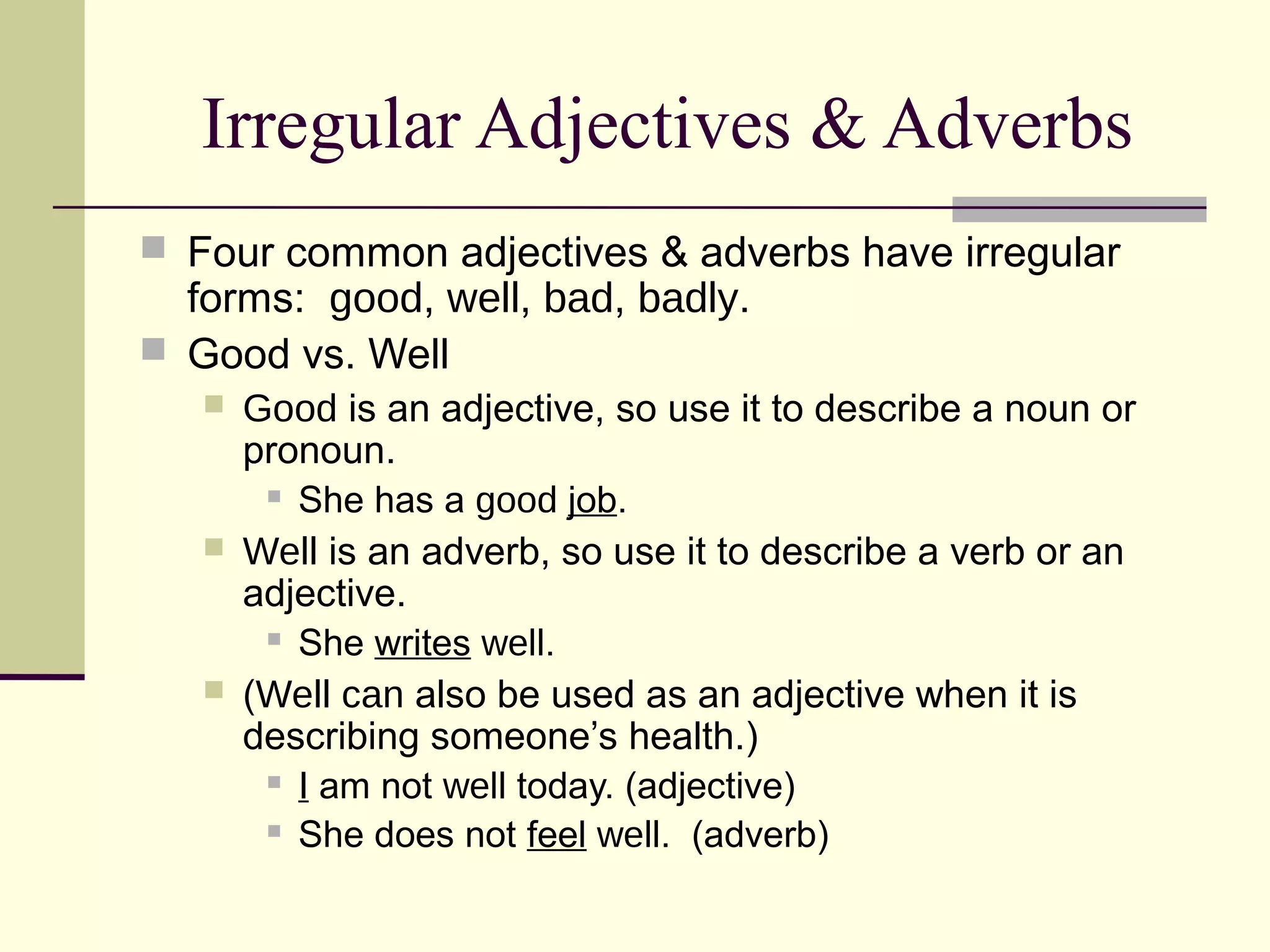
Irregular Adjectives & Adverbs
 Four common adjectives & adverbs have irregular
  forms: good, well, bad, badly.
 Good vs. Well
      Good is an adjective, so use it to describe a noun or
       pronoun.
         She has a good job.

      Well is an adverb, so use it to describe a verb or an
       adjective.
         She writes well.

      (Well can also be used as an adjective when it is
       describing someone’s health.)
         I am not well today. (adjective)

         She does not feel well. (adverb)
Irregular Adjectives & Adverbs
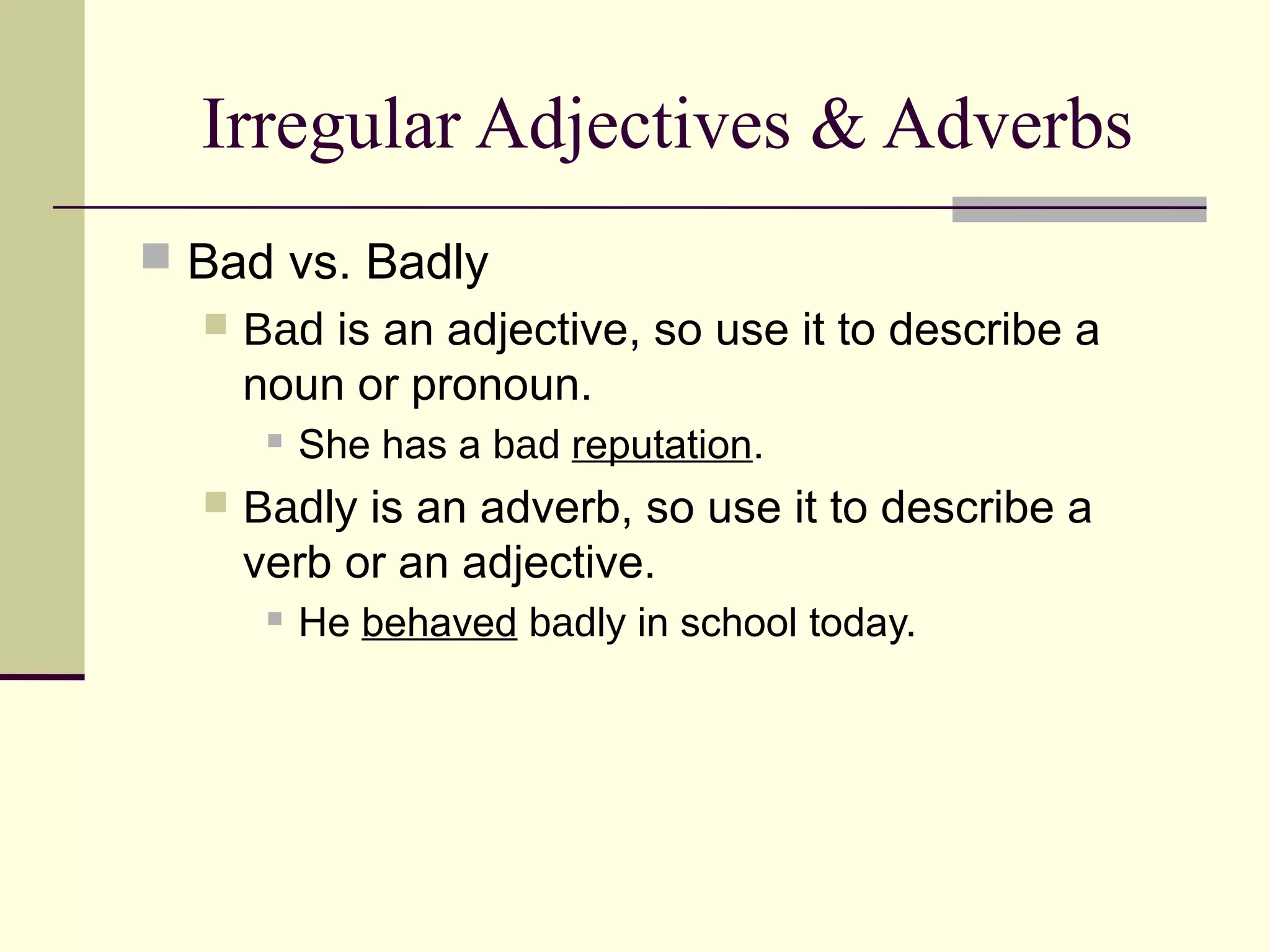
 Bad vs. Badly
     Bad is an adjective, so use it to describe a
      noun or pronoun.
          She has a bad reputation.
     Badly is an adverb, so use it to describe a
      verb or an adjective.
          He behaved badly in school today.
Irregular Adjectives & Adverbs
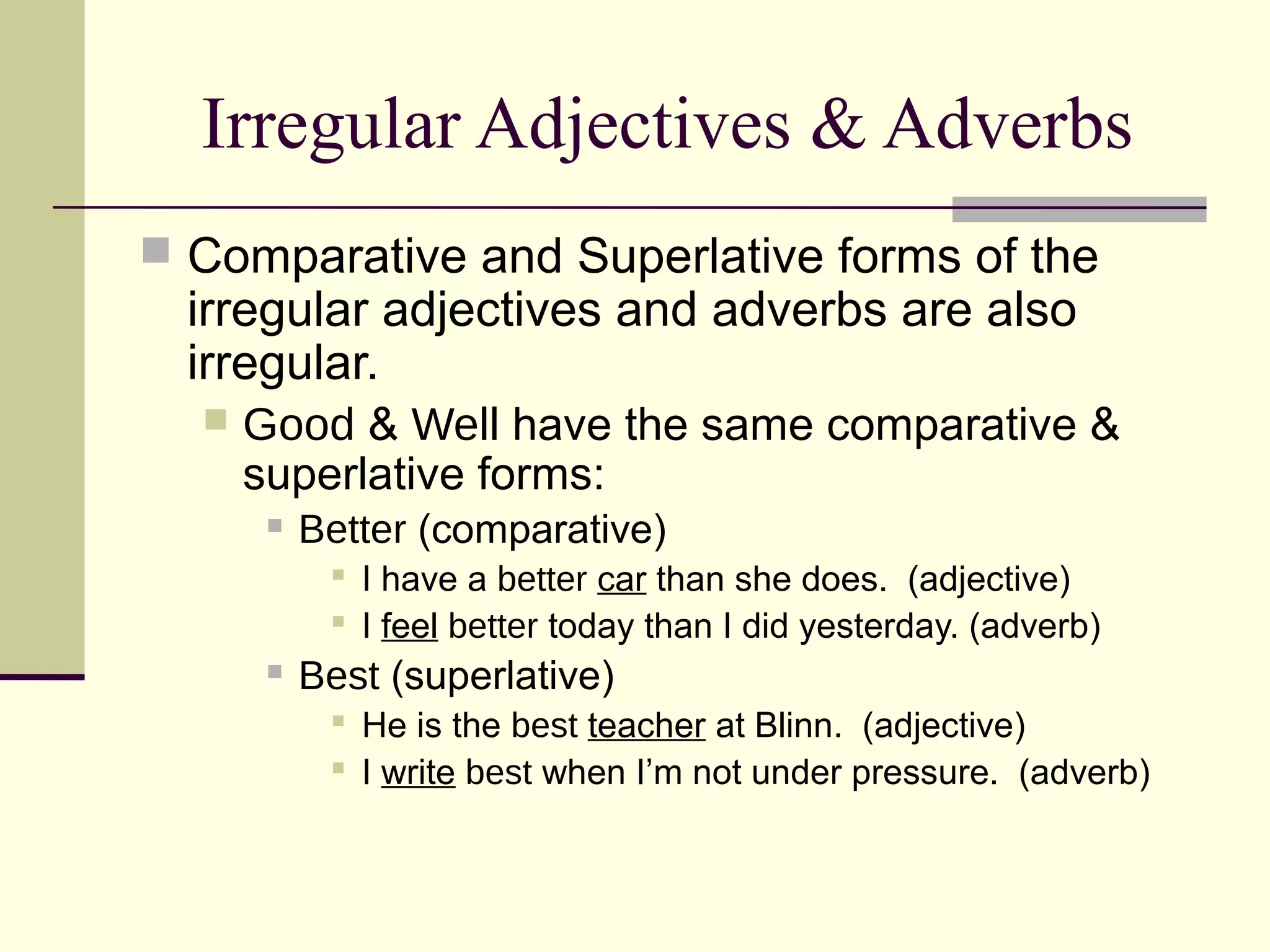
 Comparative and Superlative forms of the
  irregular adjectives and adverbs are also
  irregular.
     Good & Well have the same comparative &
      superlative forms:
          Better (comparative)
             I have a better car than she does. (adjective)
             I feel better today than I did yesterday. (adverb)
          Best (superlative)
             He is the best teacher at Blinn. (adjective)
             I write best when I’m not under pressure. (adverb)
Irregular Adjectives & Adverbs
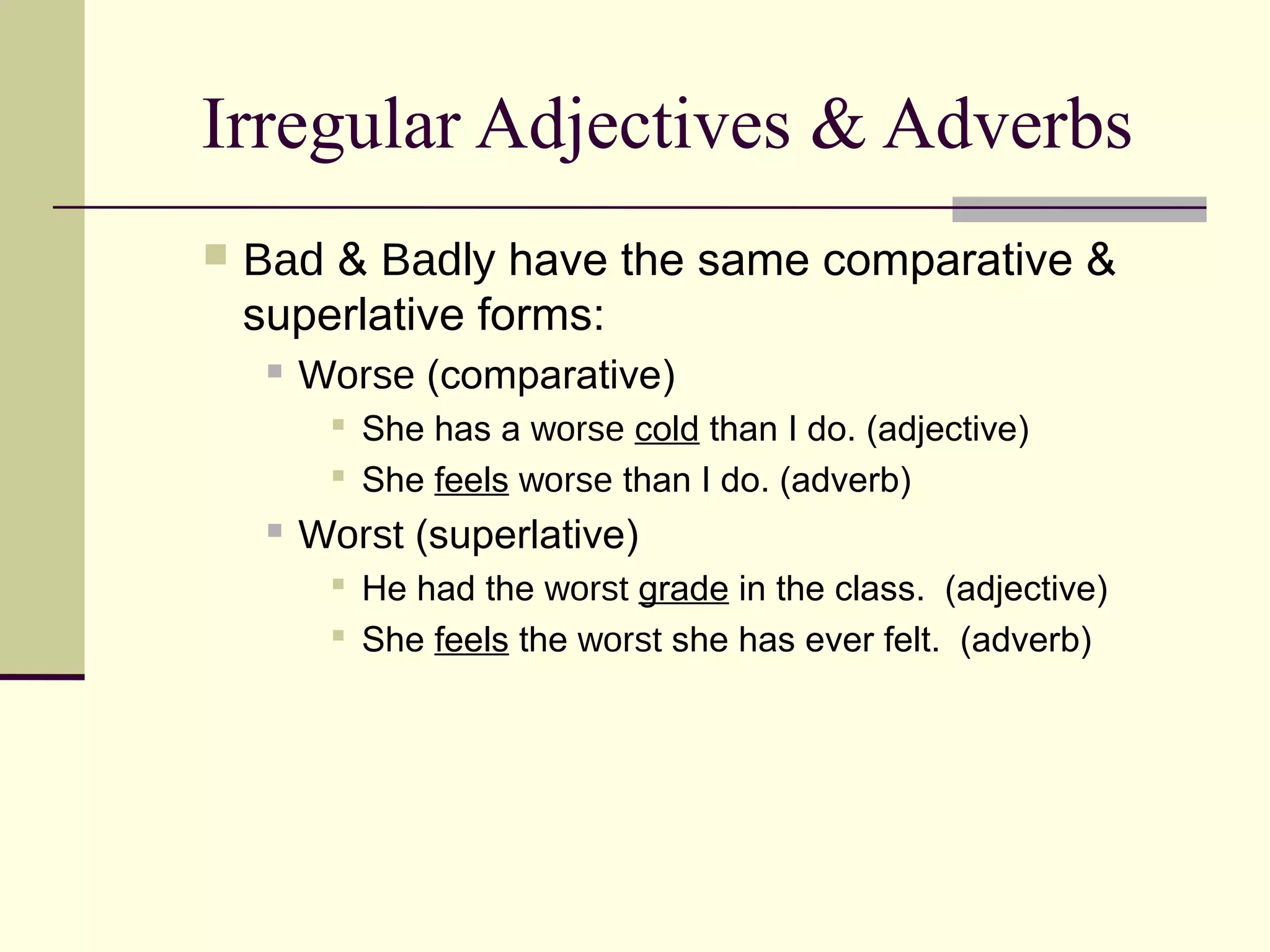
   Bad & Badly have the same comparative &
    superlative forms:
        Worse (comparative)
           She has a worse cold than I do. (adjective)
           She feels worse than I do. (adverb)
        Worst (superlative)
           He had the worst grade in the class. (adjective)
           She feels the worst she has ever felt. (adverb)
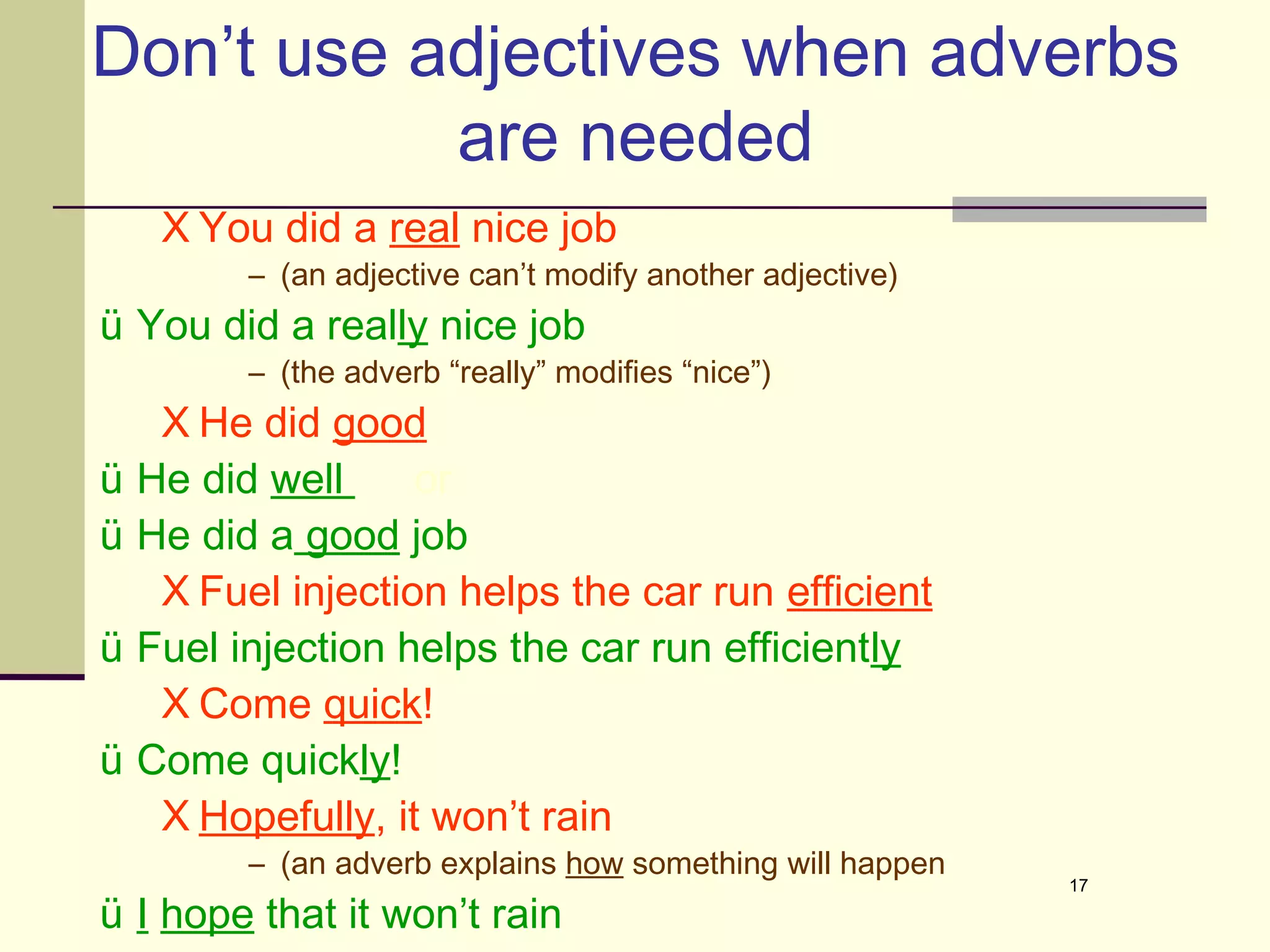
Don’t use adjectives when adverbs
           are needed
     X You did a real nice job
          – (an adjective can’t modify another adjective)
ü You did a really nice job
          – (the adverb “really” modifies “nice”)
     X He did good
ü   He did well     or
ü   He did a good job
     X Fuel injection helps the car run efficient
ü   Fuel injection helps the car run efficiently
     X Come quick!
ü   Come quickly!
     X Hopefully, it won’t rain
          – (an adverb explains how something will happen
                                                            17

ü I hope that it won’t rain
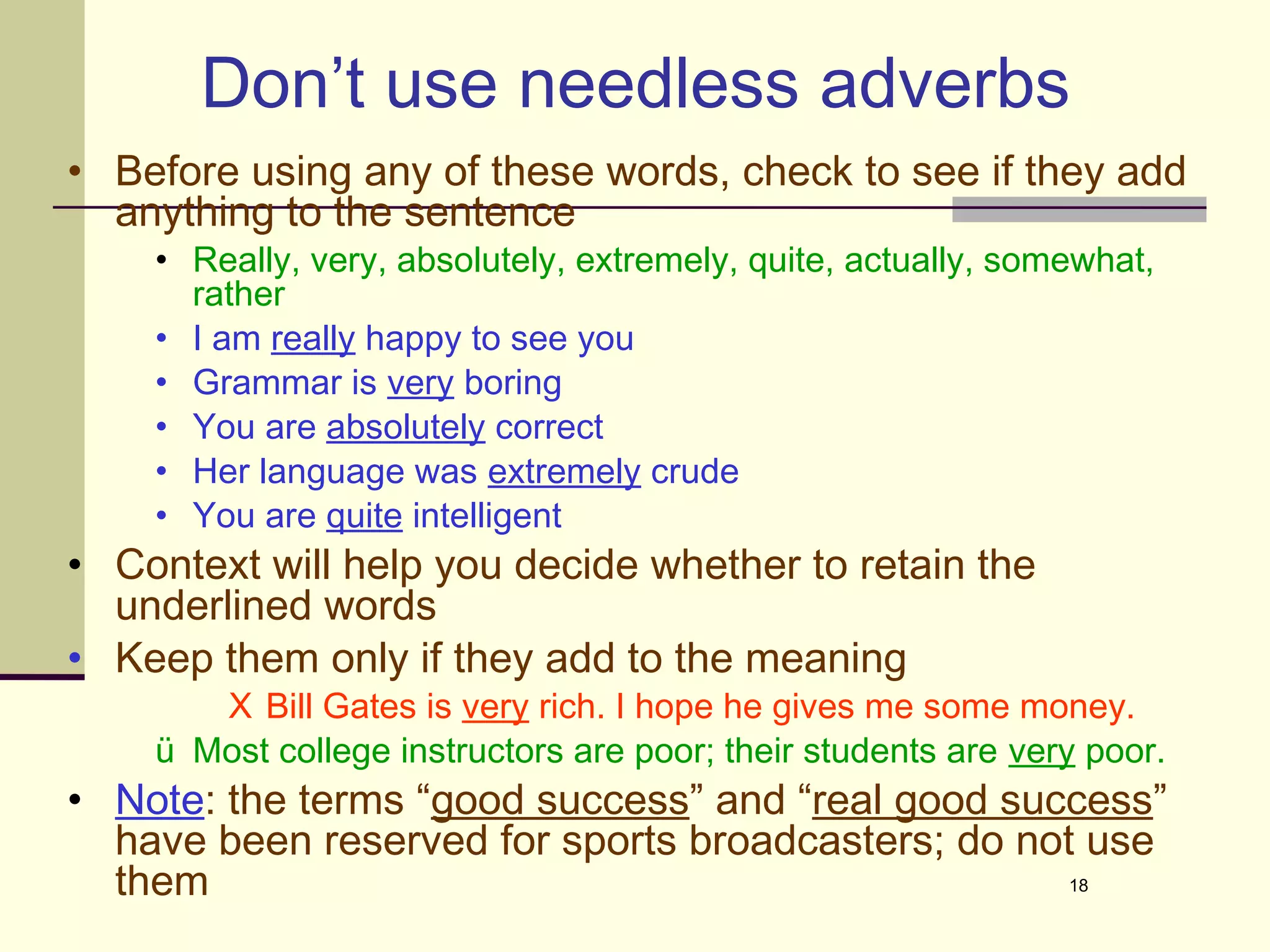
Don’t use needless adverbs
• Before using any of these words, check to see if they add
  anything to the sentence
    • Really, very, absolutely, extremely, quite, actually, somewhat,
      rather
    • I am really happy to see you
    • Grammar is very boring
    • You are absolutely correct
    • Her language was extremely crude
    • You are quite intelligent
• Context will help you decide whether to retain the
  underlined words
• Keep them only if they add to the meaning
       X Bill Gates is very rich. I hope he gives me some money.
    ü Most college instructors are poor; their students are very poor.
• Note: the terms “good success” and “real good success”
  have been reserved for sports broadcasters; do not use
  them                                              18
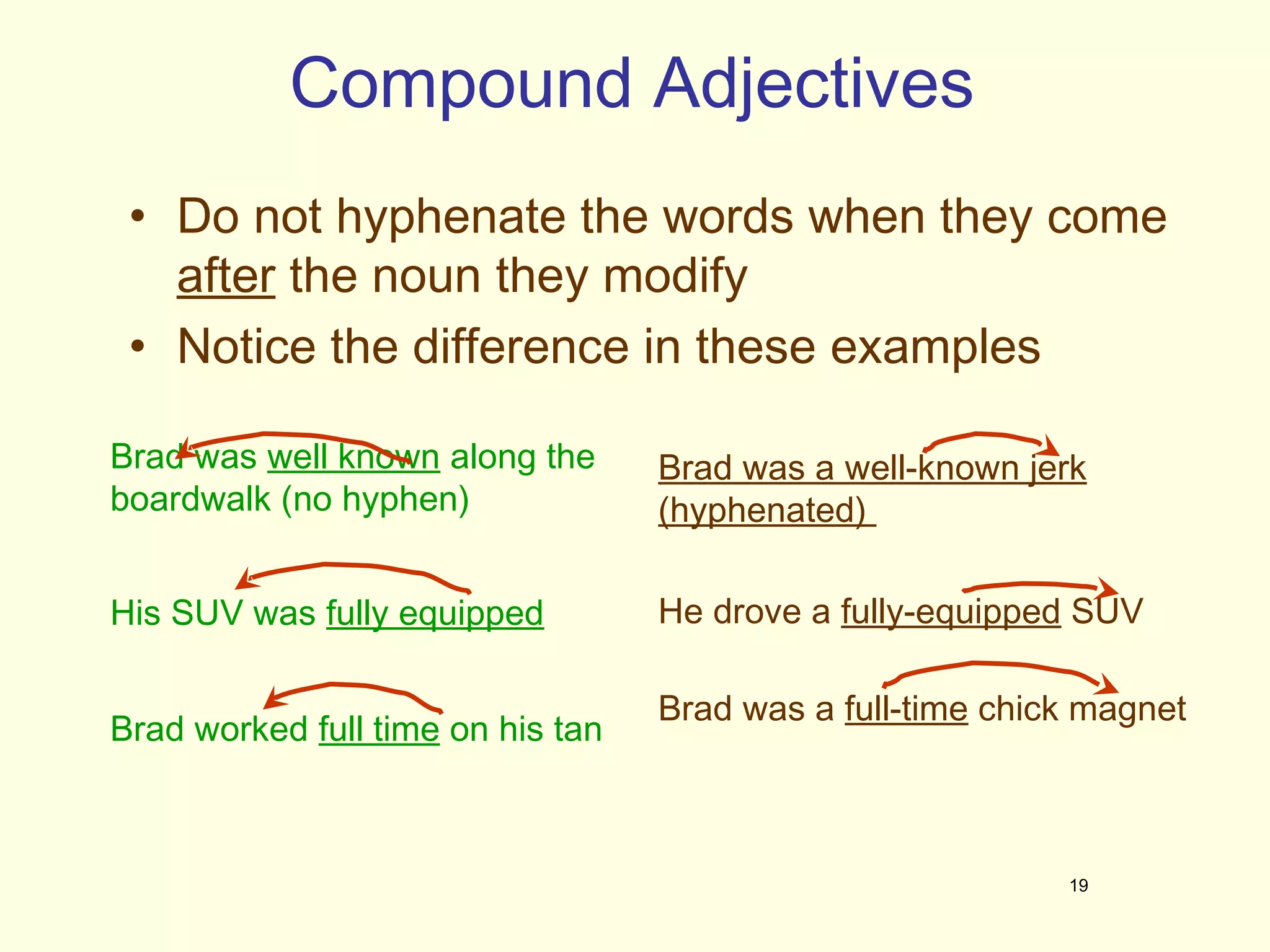
Compound Adjectives
 • Do not hyphenate the words when they come
   after the noun they modify
 • Notice the difference in these examples

Brad was well known along the      Brad was a well-known jerk
boardwalk (no hyphen)              (hyphenated)

His SUV was fully equipped         He drove a fully-equipped SUV

                                   Brad was a full-time chick magnet
Brad worked full time on his tan


                                                            19

Good,well, bad, badly modifiers cont...

  • 1.
    Adjectives & Adverbs The Brenham Writing Room Created by D. Herring with some additions in 1/2013 by another source
  • 2.
    Adjective vs. Adverb An adjective describes or modifies a noun or a pronoun.  Adds info about what kind, which one, or how many  Describes how things look, smell, feel, taste, sound  An adverb describes or modifies a verb, an adjective, or another adverb.  Adds info about how, how much, when, where, or to what extent.  Often ends in –ly.
  • 3.
    What are adjectives? •Adjectives modify nouns or pronouns • These words are all adjectives ü A hot day ü A happy camper ü A silly twit ü A big, dirty mess (both “big” and “dirty” modify “mess”) ü She is creative (“creative” is a subject complement that follows the linking verb “is”) ü A boring course (present participle used as an 3 adjective
  • 4.
    Which one doI use?  It is critical to identify which word is being modified in order to determine whether to use an adjective or an adverb as the modifier.  I: She runs slow.  C: She runs slowly.  I: He is real tall.  C: He is really tall.
  • 5.
    So what areadverbs? • Adverbs modify verbs, adjectives and other adverbs • Many adverbs end with ly • Many adverbs answer the question “How?” • These are adverbs ü Eating quickly (modifying a verb) ü Trying very hard (modifying an adverb) ü A really big show (modifying an adjective) 5
  • 6.
    Recognizing Adjectives & Adverbs • Many words have both an adjective and adverb form Adjective Adverb Happy kids Playing happily Smooth rock Running smoothly Good night Eating Well Efficient workers Working efficiently Casual dress Dressing casually Quick meeting Talking quickly hopeful children Waiting hopefully Real butter Really hot 6
  • 7.
    Adj. & Adv.With Same Form  Some adjectives and adverbs have the same form.  early, far, fast, hard, high, late, often, past, right, soon  The only way to distinguish them is to identify what they modify.  Adj: The fast car drove around the curve.  Adv: The car drove fast around the curve.
  • 8.
    Comparative Form  Whencomparing two nouns, use the comparative form of an adjective or adverb.  If adjective or adverb is one syllable, add –er to form the comparative.  I am taller than my mother.  She is smarter than me.  Use this same pattern for adjectives that end in –y, but change the –y to –i before adding –er.  She is happier than he is.  That show is funnier than the other one.
  • 9.
    Comparative Form cont.  If adjective or adverb is more than one syllable, add the word more to form the comparative.  I am more impressed with your skills than he is.  She is even more beautiful than she used to be.  Follow the guideline and use –er or more, but never use both!  I am more taller than my mother.  That show is more funnier than the other one.  She is so much more happier than she used to be.
  • 10.
    Superlative Form  Whencomparing three or more nouns, use the superlative form of an adjective or adverb.  If adjective or adverb is one syllable, add –est to form the superlative.  I am the tallest person in my family .  She is the smartest person in the class.  Use this same pattern for adjectives that end in –y, but change the –y to –i before adding – est.  She is the happiest person I’ve ever met.  That show is the funniest sitcom on TV.
  • 11.
    Superlative Form cont.  If adjective or adverb is more than one syllable, add the word most to form the superlative.  He is the most selfish person in our company.  She is the most beautiful actress on television.  Follow the guideline and use –est or most, but never use both!  He is the most luckiest person I know.  That is the most funniest show I have ever seen!  She is the most happiest person I have ever met!
  • 12.
    Fewer vs. Less In the comparative form  Use less to compare non-count nouns (nouns that cannot be divided).  They play less music and more commercials on the radio than ever before.  I have less money in my bank account than my sister has in hers.  Use fewer to compare count nouns.  There are fewer students in our class than when the semester began.  I have fewer pennies in my jar than my brother has in his.
  • 13.
    Irregular Adjectives &Adverbs  Four common adjectives & adverbs have irregular forms: good, well, bad, badly.  Good vs. Well  Good is an adjective, so use it to describe a noun or pronoun.  She has a good job.  Well is an adverb, so use it to describe a verb or an adjective.  She writes well.  (Well can also be used as an adjective when it is describing someone’s health.)  I am not well today. (adjective)  She does not feel well. (adverb)
  • 14.
    Irregular Adjectives &Adverbs  Bad vs. Badly  Bad is an adjective, so use it to describe a noun or pronoun.  She has a bad reputation.  Badly is an adverb, so use it to describe a verb or an adjective.  He behaved badly in school today.
  • 15.
    Irregular Adjectives &Adverbs  Comparative and Superlative forms of the irregular adjectives and adverbs are also irregular.  Good & Well have the same comparative & superlative forms:  Better (comparative)  I have a better car than she does. (adjective)  I feel better today than I did yesterday. (adverb)  Best (superlative)  He is the best teacher at Blinn. (adjective)  I write best when I’m not under pressure. (adverb)
  • 16.
    Irregular Adjectives &Adverbs  Bad & Badly have the same comparative & superlative forms:  Worse (comparative)  She has a worse cold than I do. (adjective)  She feels worse than I do. (adverb)  Worst (superlative)  He had the worst grade in the class. (adjective)  She feels the worst she has ever felt. (adverb)
  • 17.
    Don’t use adjectiveswhen adverbs are needed X You did a real nice job – (an adjective can’t modify another adjective) ü You did a really nice job – (the adverb “really” modifies “nice”) X He did good ü He did well or ü He did a good job X Fuel injection helps the car run efficient ü Fuel injection helps the car run efficiently X Come quick! ü Come quickly! X Hopefully, it won’t rain – (an adverb explains how something will happen 17 ü I hope that it won’t rain
  • 18.
    Don’t use needlessadverbs • Before using any of these words, check to see if they add anything to the sentence • Really, very, absolutely, extremely, quite, actually, somewhat, rather • I am really happy to see you • Grammar is very boring • You are absolutely correct • Her language was extremely crude • You are quite intelligent • Context will help you decide whether to retain the underlined words • Keep them only if they add to the meaning X Bill Gates is very rich. I hope he gives me some money. ü Most college instructors are poor; their students are very poor. • Note: the terms “good success” and “real good success” have been reserved for sports broadcasters; do not use them 18
  • 19.
    Compound Adjectives •Do not hyphenate the words when they come after the noun they modify • Notice the difference in these examples Brad was well known along the Brad was a well-known jerk boardwalk (no hyphen) (hyphenated) His SUV was fully equipped He drove a fully-equipped SUV Brad was a full-time chick magnet Brad worked full time on his tan 19