This document discusses different types of conjunctions and their uses. It begins by defining conjunctions as words that connect parts of a sentence. It then discusses coordinating conjunctions like and, but, or, yet, for, nor and so. It provides examples of how these conjunctions are used with or without commas. The document also discusses subordinating conjunctions like than and then. It provides guidance on using these words correctly and avoiding common errors. It concludes by discussing correlative conjunctions that combine with other words and always appear in pairs to join equal elements.
Definition of conjunctions as words that connect parts of a sentence.
Introduction to coordinating conjunctions (and, but, or, yet, for, nor, so) and their punctuation rules.
Guidance on using commas with conjunctions and examples showing their grammatical roles.Less common conjunctions like 'nor', 'yet', 'for', and 'so', with specific uses and examples.
Clarifying the uses of 'then' vs. 'than', with rules and examples for proper usage.
Distinguishing 'like' (a preposition) from 'as' (a conjunction) with proper usages.Guidance on the use of 'that' in sentences, when to omit it, and maintaining clarity.
Introduction to correlative conjunctions, including examples and rules for proper pairing.
Conjunctions
Definition
Some words aresatisfied spending an evening at
home, alone, eating ice-cream right out of the box,
watching Seinfeld re-runs on TV, or reading a good
book. Others aren't happy unless they're out on the
town, mixing it up with other words; they're joiners
and they just can't help themselves. A conjunction
is a joiner, a word that connects (conjoins) parts of
a sentence.
2.
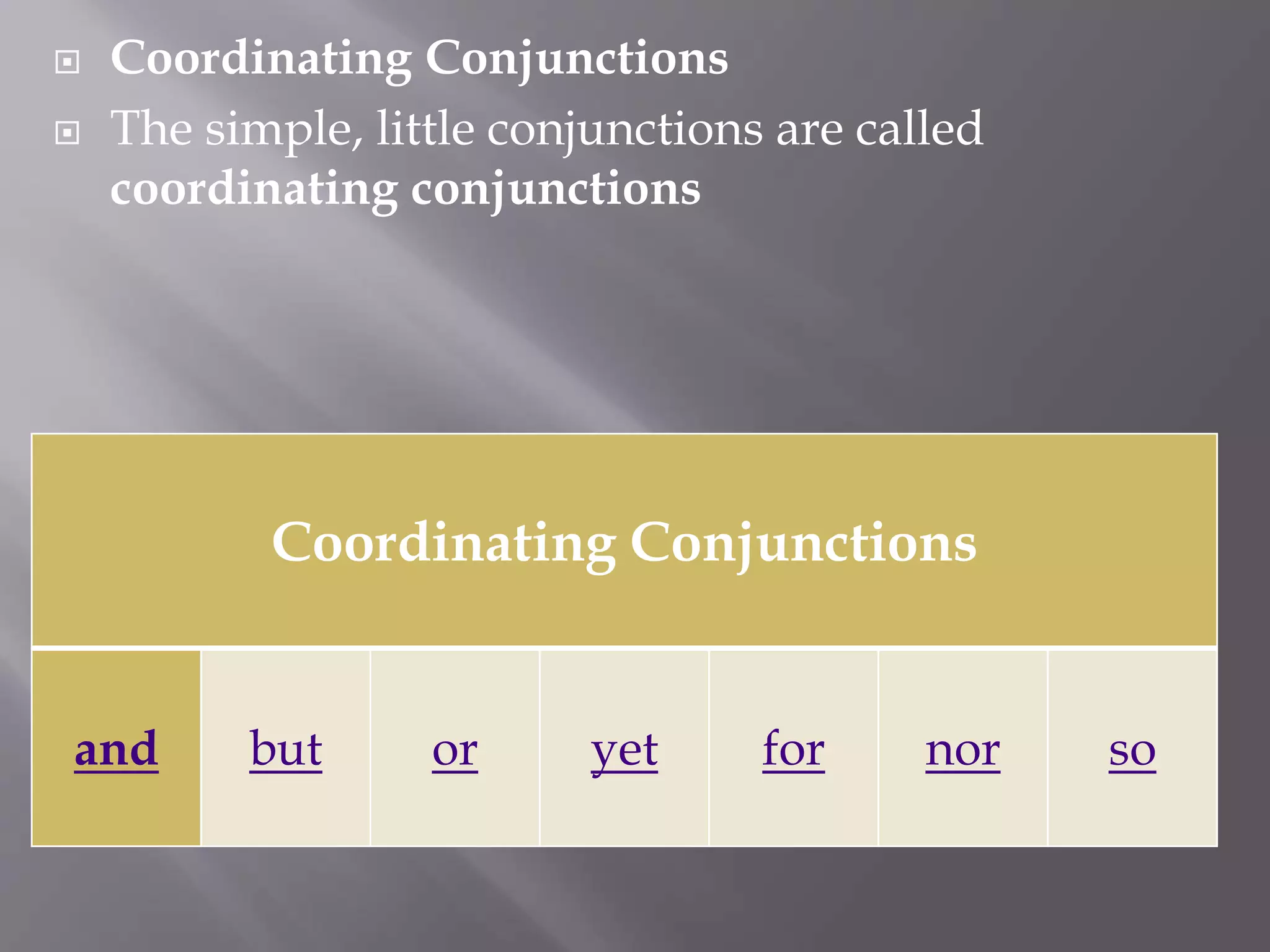
Coordinating Conjunctions
The simple, little conjunctions are called
coordinating conjunctions
Coordinating Conjunctions
and but or yet for nor so
3.
-It may helpyou remember these conjunctions by
recalling that they all have fewer than four letters.
Also, remember the acronym FANBOYS: For-And-
Nor-But-Or-Yet-So. Be careful of the words then and
now; neither is a coordinating conjunction, so what
we say about coordinating conjunctions' roles in a
sentence and punctuation does not apply to those
two words.
-When a coordinating conjunction connects two
independent clauses, it is often (but not always)
accompanied by a comma:
Ex-Sok wants to play for fun, but he has had trouble
meeting the academic requirements.
-When the two independent clauses connected by a
coordinating conjunction are nicely balanced or
brief, many writers will omit the comma:
4.
Ex. Sok hasa great jump shot but he isn't quick on
his feet.
-The comma is always correct when used to
separate two independent clauses connected by a
coordinating conjunction. See Punctuation
Between Two Independent Clauses for further
help.
-A comma is also correct when and is used to
attach the last item of a serial list, although many
writers (especially in newspapers) will omit that
final comma:
Ex. Sok spent his summer studying basic math,
writing, and reading comprehension.
5.
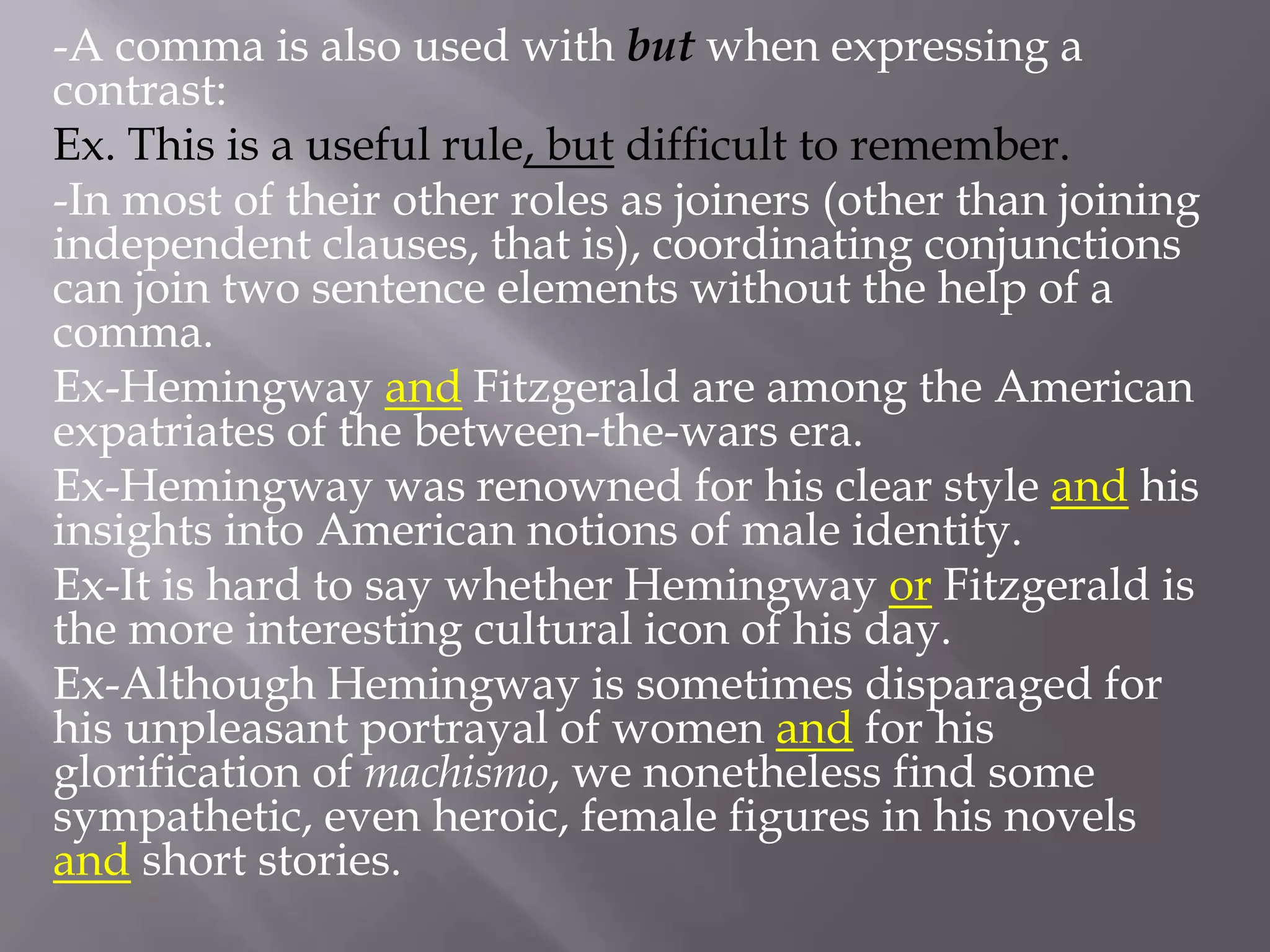
-A comma isalso used with but when expressing a
contrast:
Ex. This is a useful rule, but difficult to remember.
-In most of their other roles as joiners (other than joining
independent clauses, that is), coordinating conjunctions
can join two sentence elements without the help of a
comma.
Ex-Hemingway and Fitzgerald are among the American
expatriates of the between-the-wars era.
Ex-Hemingway was renowned for his clear style and his
insights into American notions of male identity.
Ex-It is hard to say whether Hemingway or Fitzgerald is
the more interesting cultural icon of his day.
Ex-Although Hemingway is sometimes disparaged for
his unpleasant portrayal of women and for his
glorification of machismo, we nonetheless find some
sympathetic, even heroic, female figures in his novels
and short stories.
6.
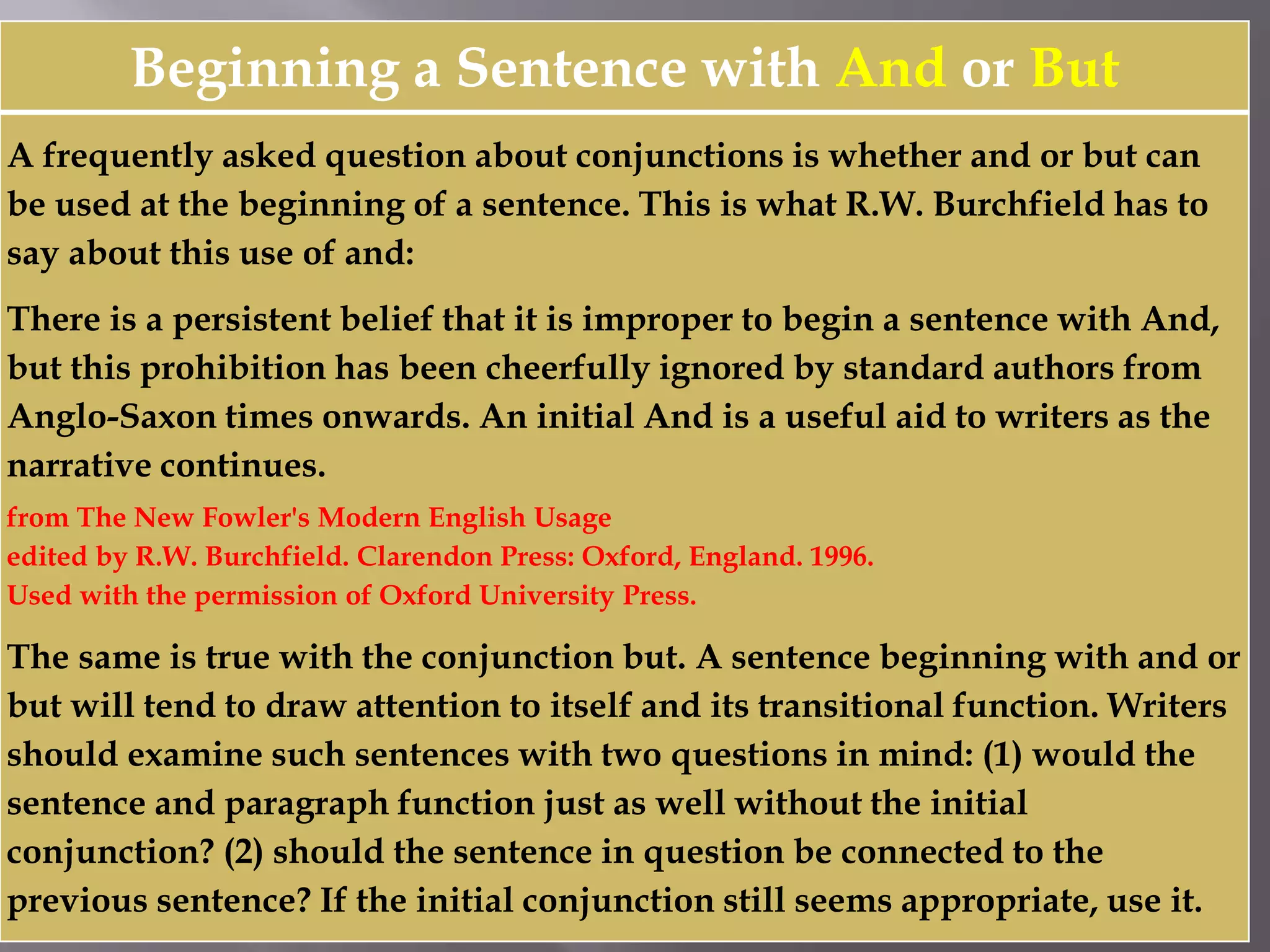
Beginning a Sentencewith And or But
A frequently asked question about conjunctions is whether and or but can
be used at the beginning of a sentence. This is what R.W. Burchfield has to
say about this use of and:
There is a persistent belief that it is improper to begin a sentence with And,
but this prohibition has been cheerfully ignored by standard authors from
Anglo-Saxon times onwards. An initial And is a useful aid to writers as the
narrative continues.
from The New Fowler's Modern English Usage
edited by R.W. Burchfield. Clarendon Press: Oxford, England. 1996.
Used with the permission of Oxford University Press.
The same is true with the conjunction but. A sentence beginning with and or
but will tend to draw attention to itself and its transitional function. Writers
should examine such sentences with two questions in mind: (1) would the
sentence and paragraph function just as well without the initial
conjunction? (2) should the sentence in question be connected to the
previous sentence? If the initial conjunction still seems appropriate, use it.
7.
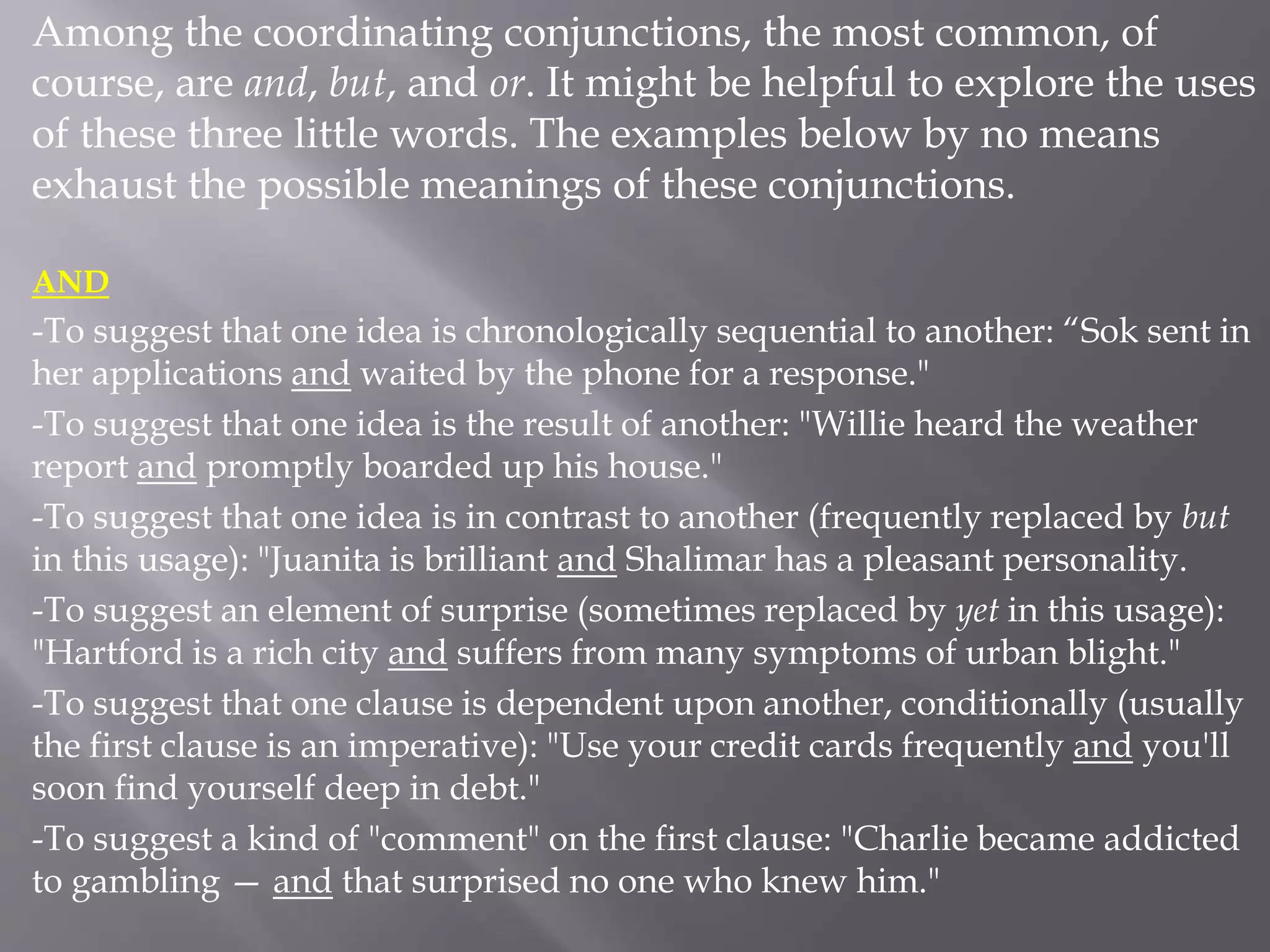
Among the coordinatingconjunctions, the most common, of
course, are and, but, and or. It might be helpful to explore the uses
of these three little words. The examples below by no means
exhaust the possible meanings of these conjunctions.
AND
-To suggest that one idea is chronologically sequential to another: “Sok sent in
her applications and waited by the phone for a response."
-To suggest that one idea is the result of another: "Willie heard the weather
report and promptly boarded up his house."
-To suggest that one idea is in contrast to another (frequently replaced by but
in this usage): "Juanita is brilliant and Shalimar has a pleasant personality.
-To suggest an element of surprise (sometimes replaced by yet in this usage):
"Hartford is a rich city and suffers from many symptoms of urban blight."
-To suggest that one clause is dependent upon another, conditionally (usually
the first clause is an imperative): "Use your credit cards frequently and you'll
soon find yourself deep in debt."
-To suggest a kind of "comment" on the first clause: "Charlie became addicted
to gambling — and that surprised no one who knew him."
8.
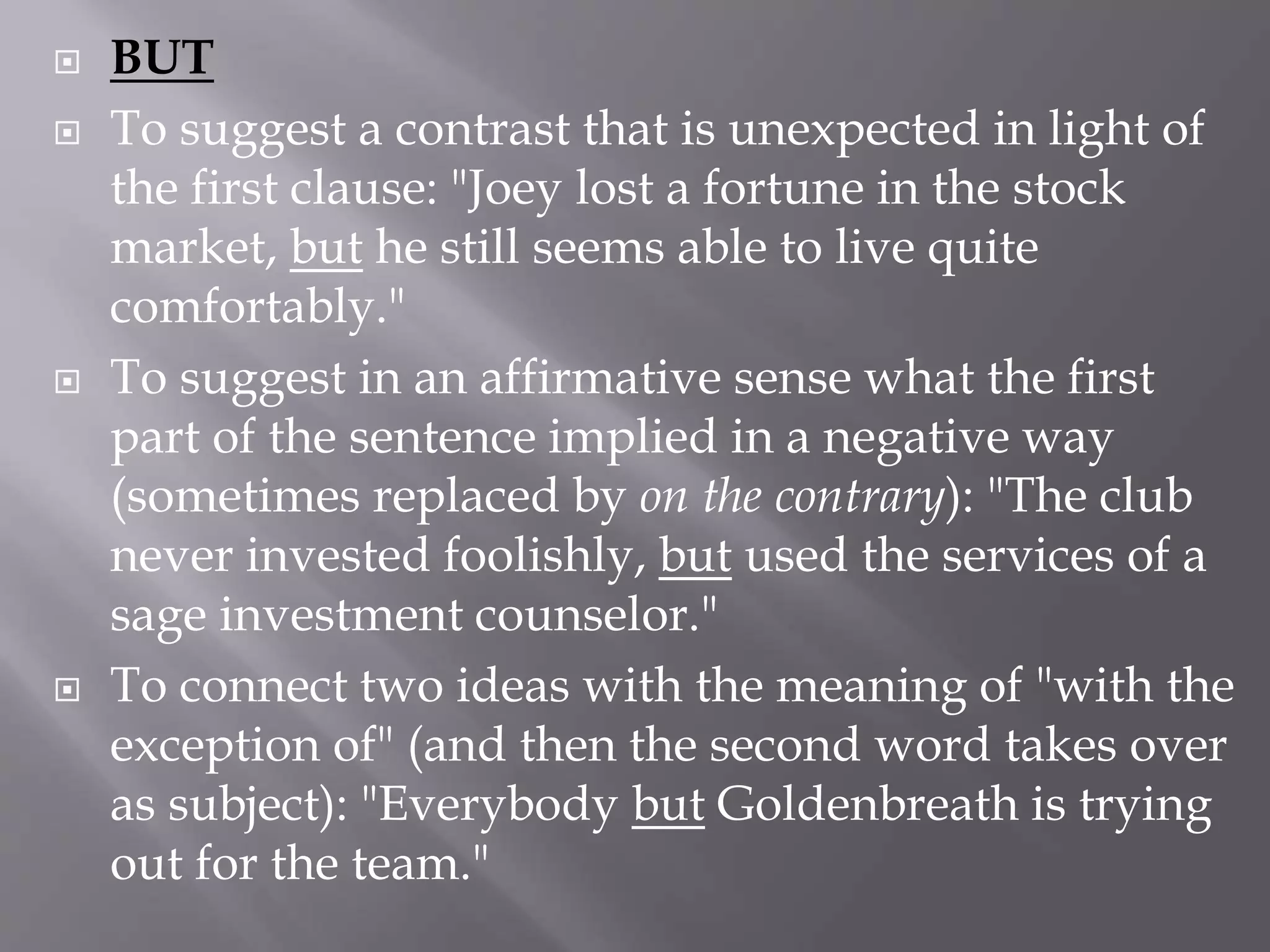
BUT
Tosuggest a contrast that is unexpected in light of
the first clause: "Joey lost a fortune in the stock
market, but he still seems able to live quite
comfortably."
To suggest in an affirmative sense what the first
part of the sentence implied in a negative way
(sometimes replaced by on the contrary): "The club
never invested foolishly, but used the services of a
sage investment counselor."
To connect two ideas with the meaning of "with the
exception of" (and then the second word takes over
as subject): "Everybody but Goldenbreath is trying
out for the team."
9.
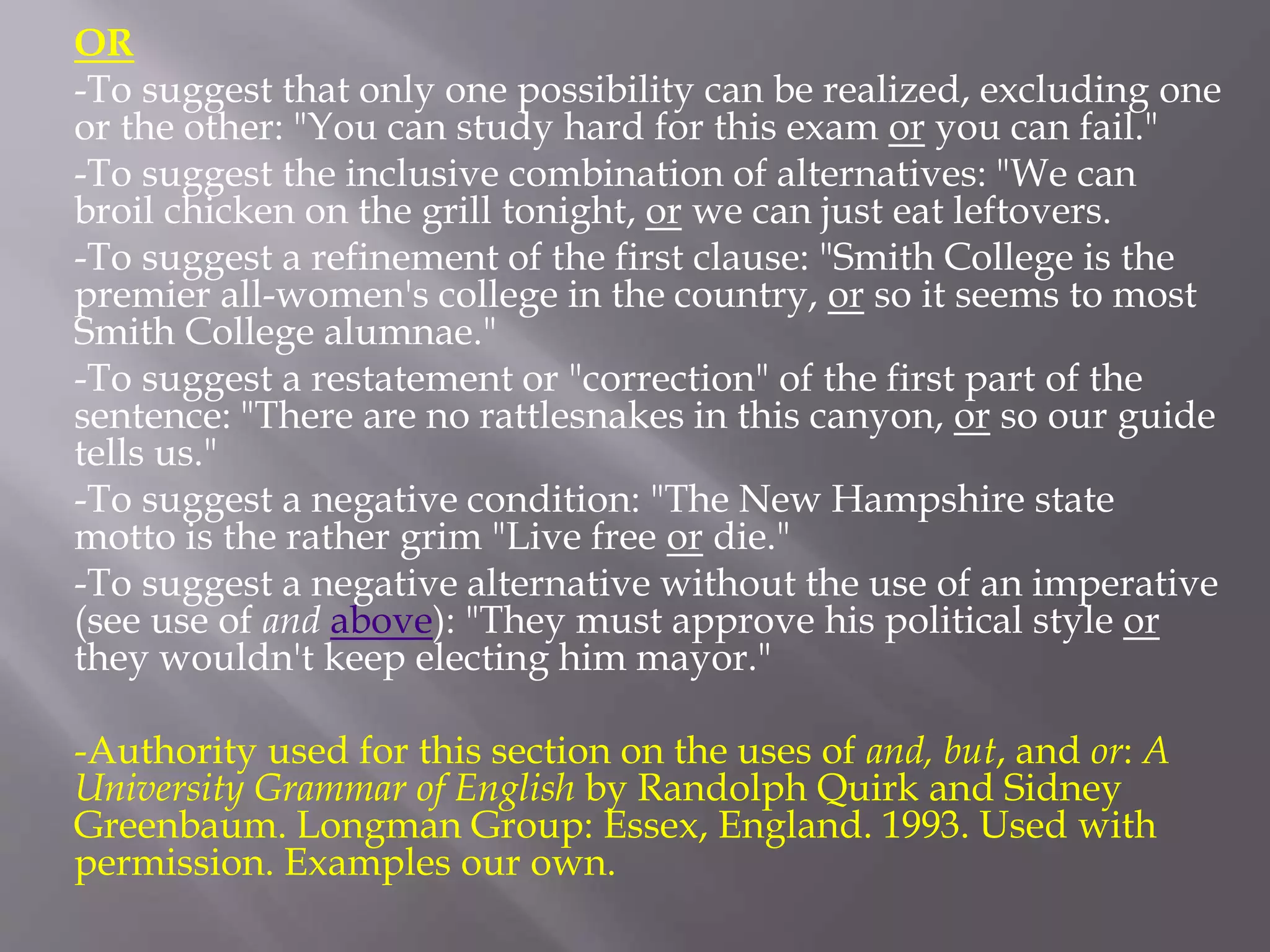
OR
-To suggest thatonly one possibility can be realized, excluding one
or the other: "You can study hard for this exam or you can fail."
-To suggest the inclusive combination of alternatives: "We can
broil chicken on the grill tonight, or we can just eat leftovers.
-To suggest a refinement of the first clause: "Smith College is the
premier all-women's college in the country, or so it seems to most
Smith College alumnae."
-To suggest a restatement or "correction" of the first part of the
sentence: "There are no rattlesnakes in this canyon, or so our guide
tells us."
-To suggest a negative condition: "The New Hampshire state
motto is the rather grim "Live free or die."
-To suggest a negative alternative without the use of an imperative
(see use of and above): "They must approve his political style or
they wouldn't keep electing him mayor."
-Authority used for this section on the uses of and, but, and or: A
University Grammar of English by Randolph Quirk and Sidney
Greenbaum. Longman Group: Essex, England. 1993. Used with
permission. Examples our own.
10.
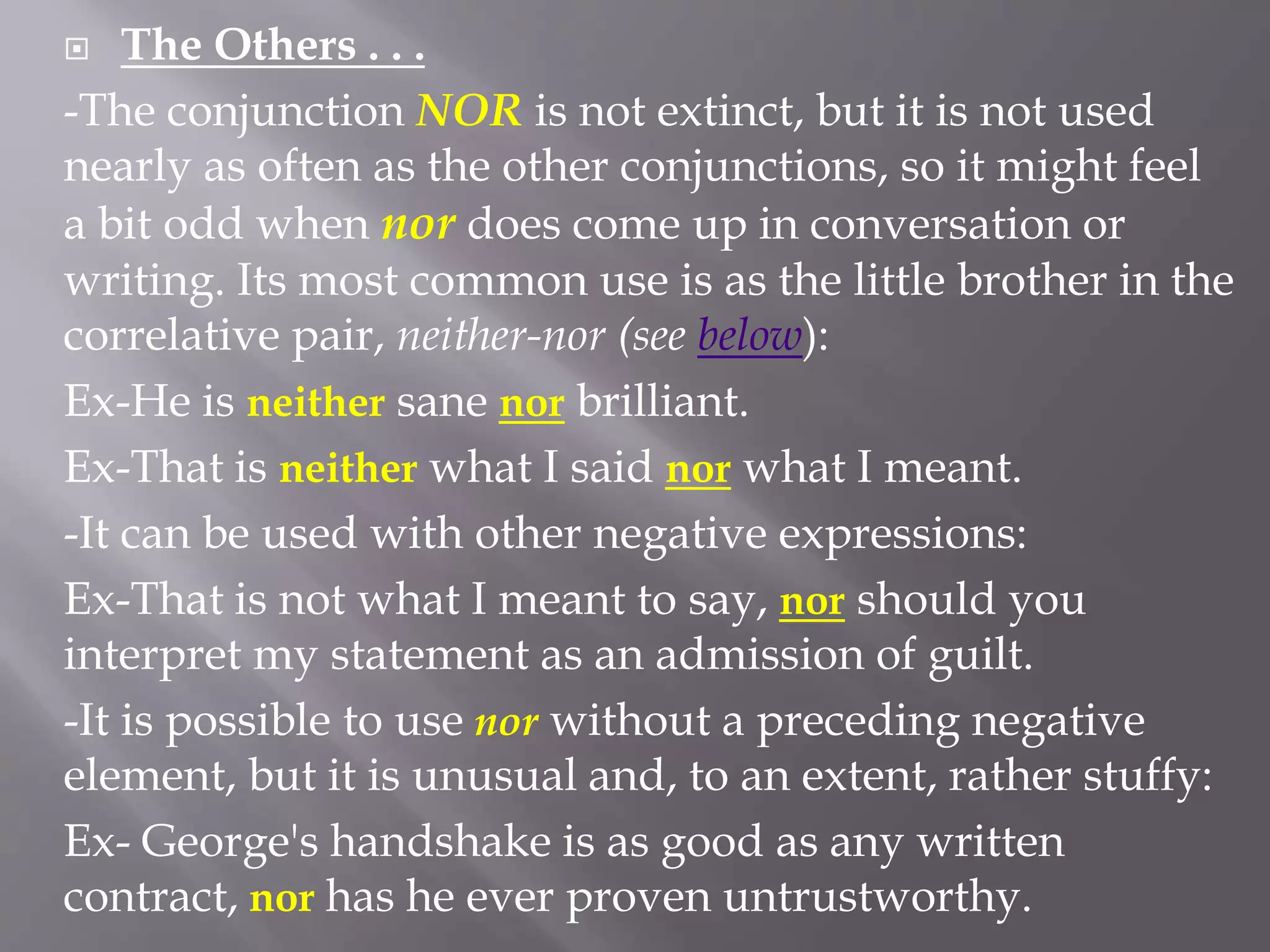
The Others. . .
-The conjunction NOR is not extinct, but it is not used
nearly as often as the other conjunctions, so it might feel
a bit odd when nor does come up in conversation or
writing. Its most common use is as the little brother in the
correlative pair, neither-nor (see below):
Ex-He is neither sane nor brilliant.
Ex-That is neither what I said nor what I meant.
-It can be used with other negative expressions:
Ex-That is not what I meant to say, nor should you
interpret my statement as an admission of guilt.
-It is possible to use nor without a preceding negative
element, but it is unusual and, to an extent, rather stuffy:
Ex- George's handshake is as good as any written
contract, nor has he ever proven untrustworthy.
11.
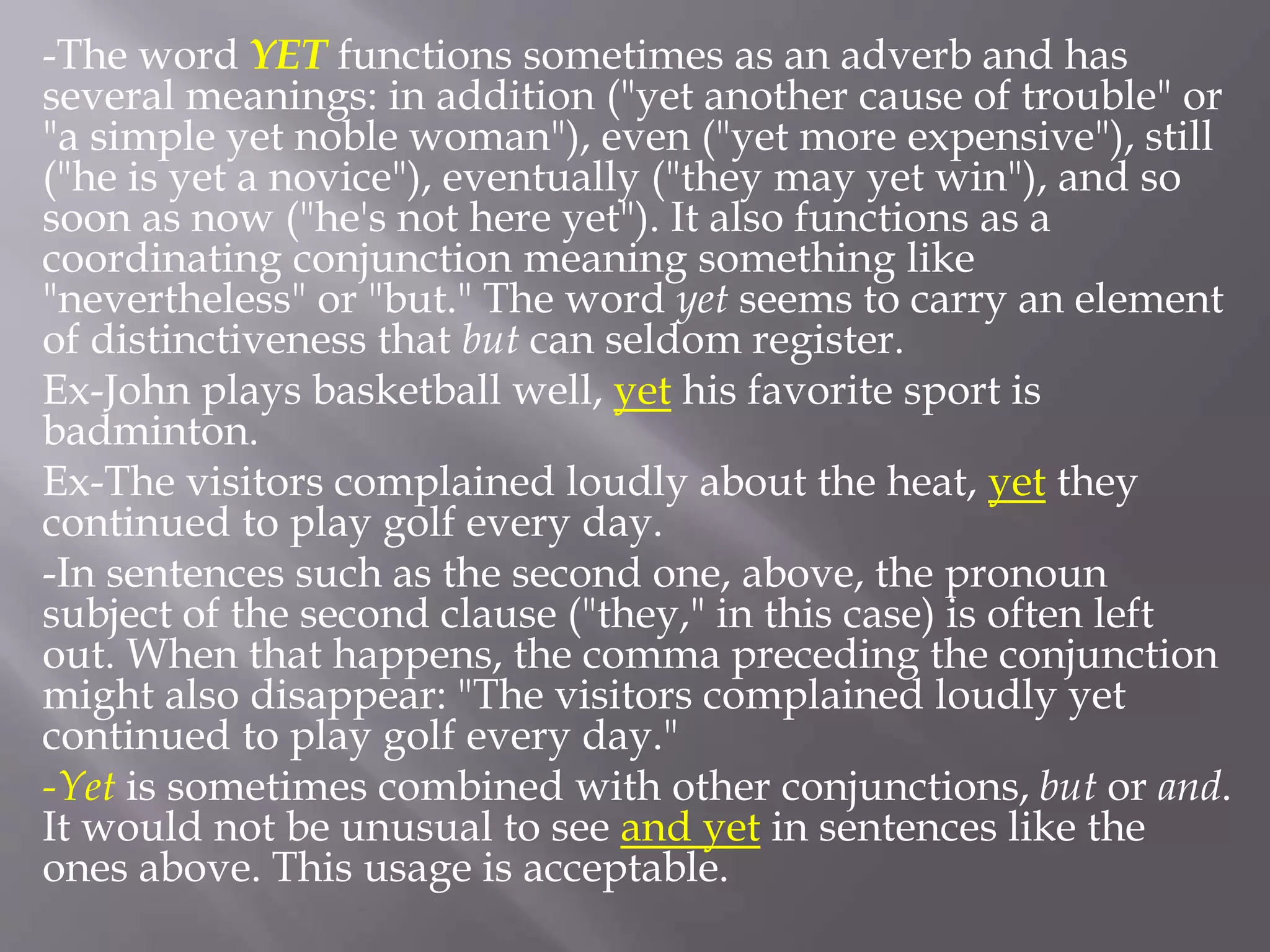
-The word YETfunctions sometimes as an adverb and has
several meanings: in addition ("yet another cause of trouble" or
"a simple yet noble woman"), even ("yet more expensive"), still
("he is yet a novice"), eventually ("they may yet win"), and so
soon as now ("he's not here yet"). It also functions as a
coordinating conjunction meaning something like
"nevertheless" or "but." The word yet seems to carry an element
of distinctiveness that but can seldom register.
Ex-John plays basketball well, yet his favorite sport is
badminton.
Ex-The visitors complained loudly about the heat, yet they
continued to play golf every day.
-In sentences such as the second one, above, the pronoun
subject of the second clause ("they," in this case) is often left
out. When that happens, the comma preceding the conjunction
might also disappear: "The visitors complained loudly yet
continued to play golf every day."
-Yet is sometimes combined with other conjunctions, but or and.
It would not be unusual to see and yet in sentences like the
ones above. This usage is acceptable.
12.
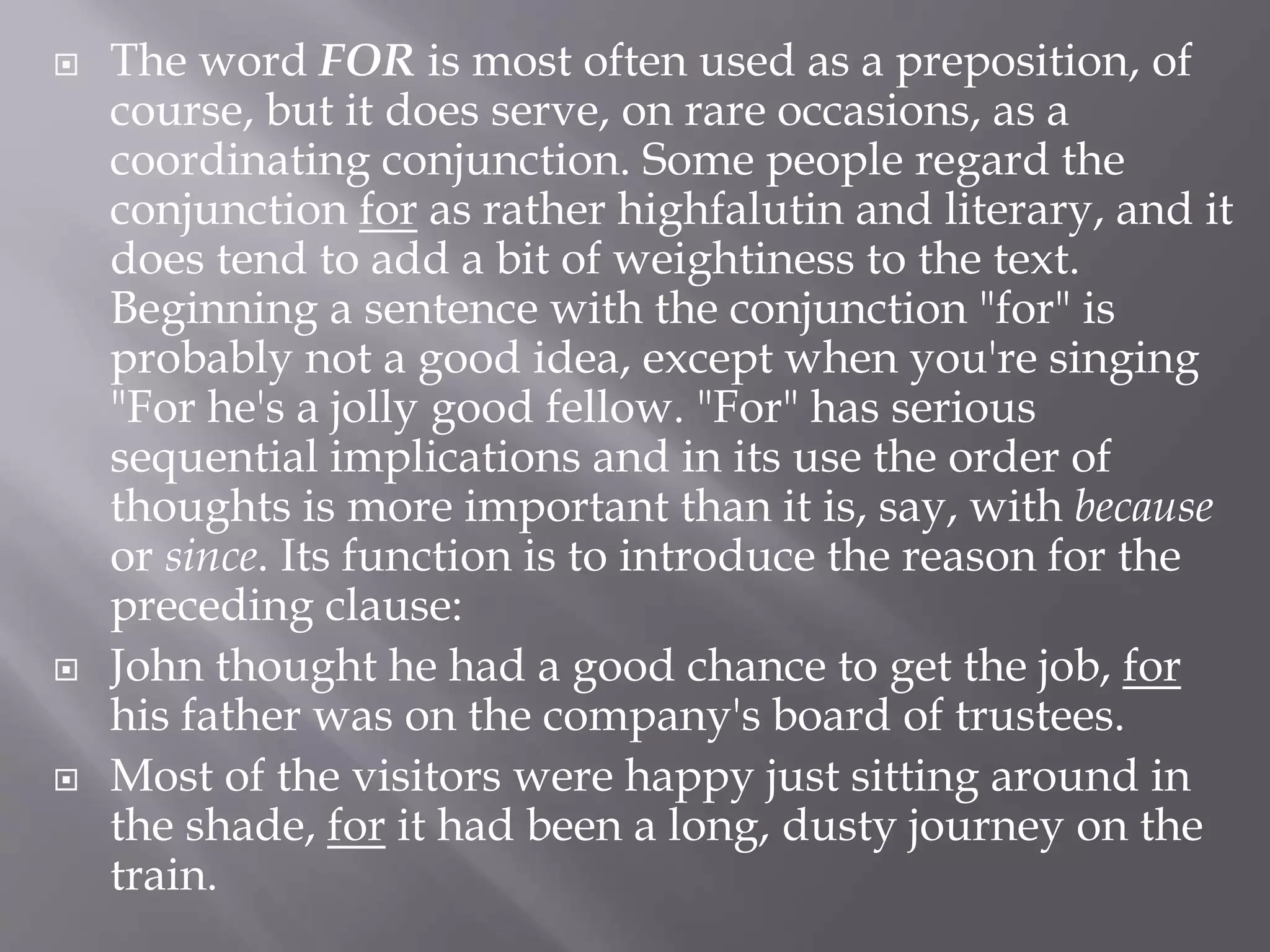
The wordFOR is most often used as a preposition, of
course, but it does serve, on rare occasions, as a
coordinating conjunction. Some people regard the
conjunction for as rather highfalutin and literary, and it
does tend to add a bit of weightiness to the text.
Beginning a sentence with the conjunction "for" is
probably not a good idea, except when you're singing
"For he's a jolly good fellow. "For" has serious
sequential implications and in its use the order of
thoughts is more important than it is, say, with because
or since. Its function is to introduce the reason for the
preceding clause:
John thought he had a good chance to get the job, for
his father was on the company's board of trustees.
Most of the visitors were happy just sitting around in
the shade, for it had been a long, dusty journey on the
train.
13.
Be carefulof the conjunction SO. Sometimes it can
connect two independent clauses along with a comma,
but sometimes it can't. For instance, in this sentence,
Soto is not the only Olympic athlete in his family, so
are his brother, sister, and his Uncle Chet.
where the word so means "as well" or "in addition,"
most careful writers would use a semicolon between
the two independent clauses. In the following sentence,
where so is acting like a minor-league "therefore," the
conjunction and the comma are adequate to the task:
Soto has always been nervous in large gatherings, so it
is no surprise that he avoids crowds of his adoring
fans.
Sometimes, at the beginning of a sentence, so will act as
a kind of summing up device or transition, and when it
does, it is often set off from the rest of the sentence
with a comma:
So, the sheriff peremptorily removed the child from the
custody of his parents.
14.
The Case ofThen and Than
In some parts of the United States, we are told, then and than
not only look alike, they sound alike. Like a teacher with
twins in her classroom, you need to be able to distinguish
between these two words; otherwise, they'll become
mischievous. They are often used and they should be used
for the right purposes.
Than is used to make comparisons. In the sentence "Piggy
would rather be rescued then stay on the island," we have
employed the wrong word because a comparison is being
made between Piggy's two choices; we need than instead. In
the sentence, "Other than Pincher Martin, Golding did not
write another popular novel," the adverbial construction
"other than" helps us make an implied comparison; this
usage is perfectly acceptable in the United States but careful
writers in the UK try to avoid it (Burchfield).
15.
-Generally, the onlyquestion about than arises
when we have to decide whether the word is
being used as a conjunction or as a preposition. If
it's a preposition (and Merriam-Webster's
dictionary provides for this usage), then the word
that follows it should be in the object form.
Ex-He's taller and somewhat more handsome
than me.
Ex-Just because you look like him doesn't mean
you can play better than him.
-Most careful writers, however, will insist that
than be used as a conjunction; it's as if part of the
clause introduced by than has been left out:
Ex-He's taller and somewhat more handsome
than I [am handsome].
Ex-You can play better than he [can play].
16.
-In formal, academictext, you should probably use than as
a conjunction and follow it with the subject form of a
pronoun (where a pronoun is appropriate).
-Than is a conjunction, but it is not one of the little
conjunctions listed at the top of this page. We can use the
FANBOYS conjunctions to connect two independent
clauses; usually, they will be accompanied (preceded) by a
comma. Too many students think that than works the
same way: "Caesar invaded Gaul, then he turned his
attention to England." You can tell the difference between
then and a coordinating conjunction by trying to move the
word around in the sentence. We can write "he then
turned his attention to England"; "he turned his attention,
then, to England"; he turned his attention to England
then." The word can move around within the clause. Try
that with a conjunction, and you will quickly see that the
conjunction cannot move around. "Caesar invaded Gaul,
and then he turned his attention to England." The word
and is stuck exactly there and cannot move like
17.
then, which ismore like an adverbial conjunction (or
conjunctive adverb — see below) than a coordinating
conjunction. Our original sentence in this paragraph
— "Caesar invaded Gaul, then he turned his attention
to England" — is a comma splice, a faulty sentence
construction in which a comma tries to hold together
two independent clauses all by itself: the comma
needs a coordinating conjunction to help out, and the
word then simply doesn't work that way.
18.
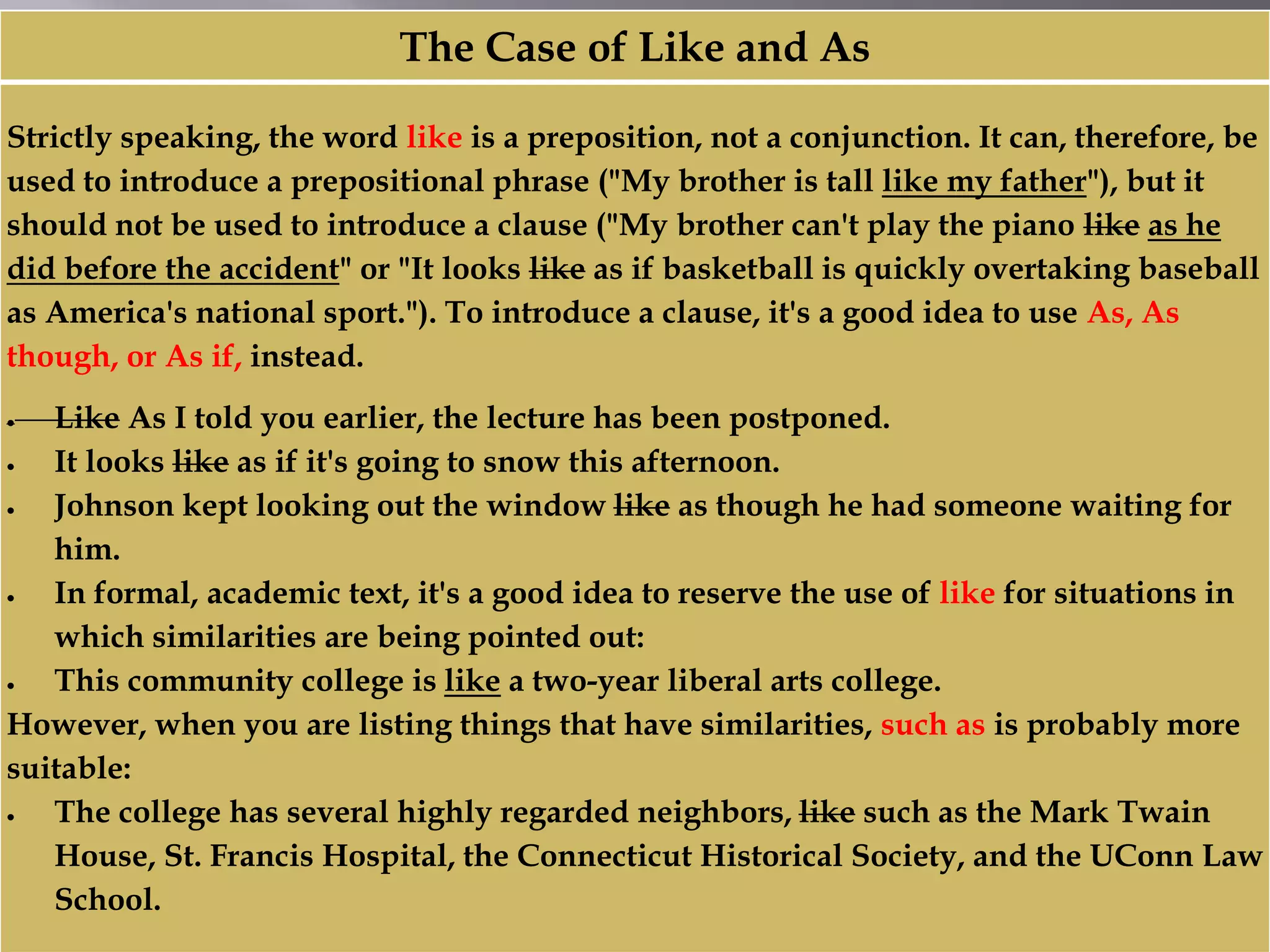
The Case ofLike and As
Strictly speaking, the word like is a preposition, not a conjunction. It can, therefore, be
used to introduce a prepositional phrase ("My brother is tall like my father"), but it
should not be used to introduce a clause ("My brother can't play the piano like as he
did before the accident" or "It looks like as if basketball is quickly overtaking baseball
as America's national sport."). To introduce a clause, it's a good idea to use As, As
though, or As if, instead.
Like As I told you earlier, the lecture has been postponed.
It looks like as if it's going to snow this afternoon.
Johnson kept looking out the window like as though he had someone waiting for
him.
In formal, academic text, it's a good idea to reserve the use of like for situations in
which similarities are being pointed out:
This community college is like a two-year liberal arts college.
However, when you are listing things that have similarities, such as is probably more
suitable:
The college has several highly regarded neighbors, like such as the Mark Twain
House, St. Francis Hospital, the Connecticut Historical Society, and the UConn Law
School.
19.
Omitting That
The wordthat is used as a conjunction to connect a
subordinate clause to a preceding verb. In this
construction that is sometimes called the "expletive
that." Indeed, the word is often omitted to good effect,
but the very fact of easy omission causes some editors
to take out the red pen and strike out the conjunction
that wherever it appears. In the following sentences,
we can happily omit the that (or keep it, depending on
how the sentence sounds to us):
Isabel knew [that] she was about to be fired.
She definitely felt [that] her fellow employees
hadn't supported her.
I hope [that] she doesn't blame me.
20.
-Sometimes omitting thethat creates a break in the flow of a
sentence, a break that can be adequately bridged with the use
of a comma:
-The problem is, that production in her department has
dropped.
-Remember, that we didn't have these problems before she
started working here.
-As a general rule, if the sentence feels just as good without
the that, if no
-ambiguity results from its omission, if the sentence is more
efficient or elegant without it, then we can safely omit the that.
Theodore Bernstein lists three conditions in which we should
maintain the conjunction that:
21.
-When a timeelement intervenes between the verb and
the clause: "The boss said yesterday that production in
this department was down fifty percent." (Notice the
position of "yesterday.")
-When the verb of the clause is long delayed: "Our
annual report revealed that some losses sustained by
this department in the third quarter of last year were
worse than previously thought." (Notice the distance
between the subject "losses" and its verb, "were.")
-When a second that can clear up who said or did what:
"The CEO said that Isabel's department was slacking off
and that production dropped precipitously in the fourth
quarter." (Did the CEO say that production dropped or
was the drop a result of what he said about Isabel's
department? The second that makes the sentence clear.)
22.
Correlative Conjunctions
-Some conjunctionscombine with other words to
form what are called correlative conjunctions. They
always travel in pairs, joining various sentence
elements that should be treated as grammatically
equal.
Ex-She led the team not only in statistics but also by
virtue of her enthusiasm.
EX-Polonius said, "Neither a borrower nor a lender
be."
EX- Whether you win this race or lose it doesn't
matter as long as you do your best.
-Correlative conjunctions sometimes create problems
in parallel form.
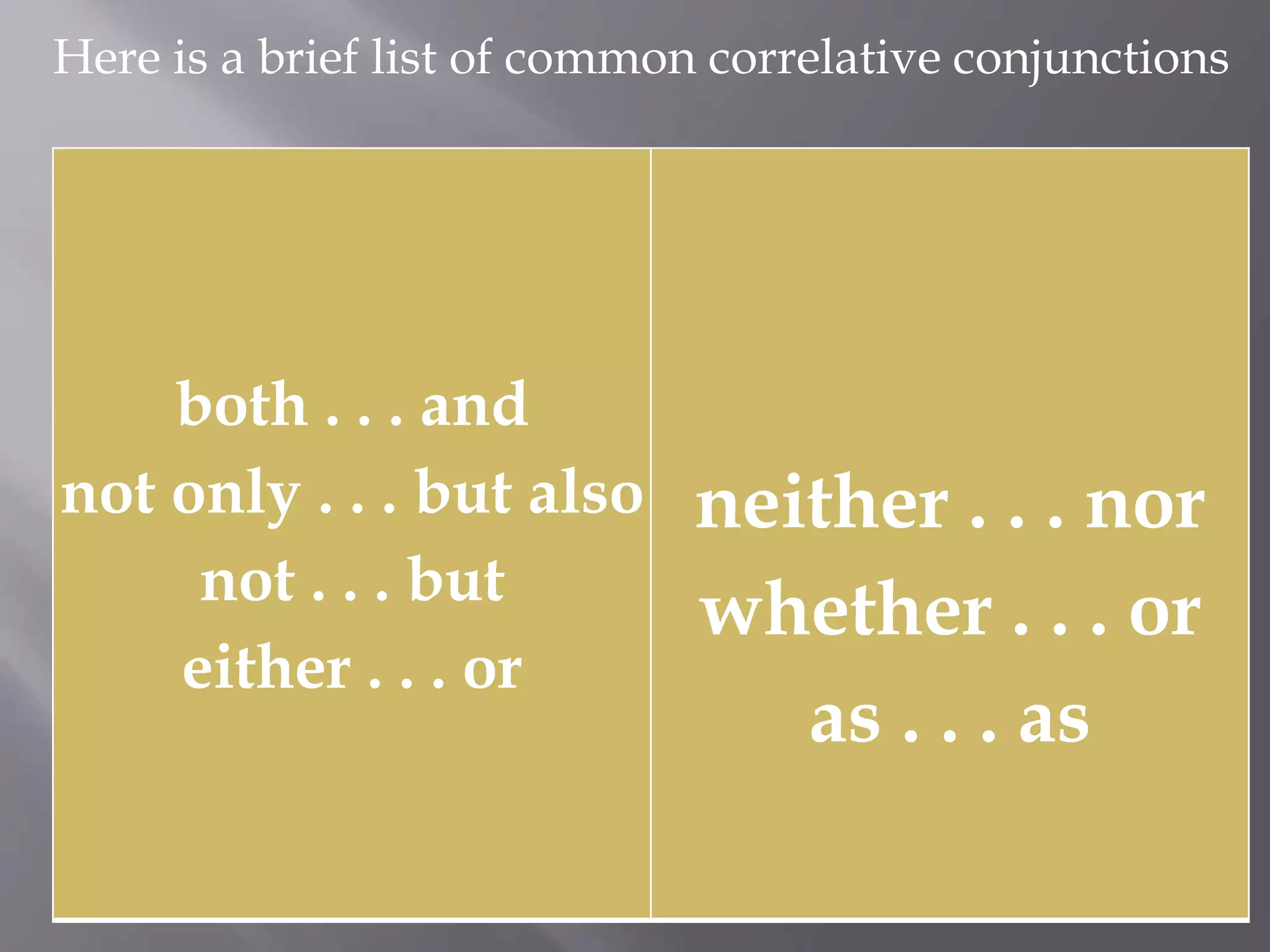
23.
Here is abrief list of common correlative conjunctions
both . . . and
not only . . . but also
not . . . but
either . . . or
neither . . . nor
whether . . . or
as . . . as
![-Generally, the only question about than arises
when we have to decide whether the word is
being used as a conjunction or as a preposition. If
it's a preposition (and Merriam-Webster's
dictionary provides for this usage), then the word
that follows it should be in the object form.
Ex-He's taller and somewhat more handsome
than me.
Ex-Just because you look like him doesn't mean
you can play better than him.
-Most careful writers, however, will insist that
than be used as a conjunction; it's as if part of the
clause introduced by than has been left out:
Ex-He's taller and somewhat more handsome
than I [am handsome].
Ex-You can play better than he [can play].](https://image.slidesharecdn.com/andandbutpresentation-150320072414-conversion-gate01/75/And-and-but-presentation-15-2048.jpg)
![Omitting That
The word that is used as a conjunction to connect a
subordinate clause to a preceding verb. In this
construction that is sometimes called the "expletive
that." Indeed, the word is often omitted to good effect,
but the very fact of easy omission causes some editors
to take out the red pen and strike out the conjunction
that wherever it appears. In the following sentences,
we can happily omit the that (or keep it, depending on
how the sentence sounds to us):
Isabel knew [that] she was about to be fired.
She definitely felt [that] her fellow employees
hadn't supported her.
I hope [that] she doesn't blame me.](https://image.slidesharecdn.com/andandbutpresentation-150320072414-conversion-gate01/75/And-and-but-presentation-19-2048.jpg)