(Our God is a Covenant God)
Week  10
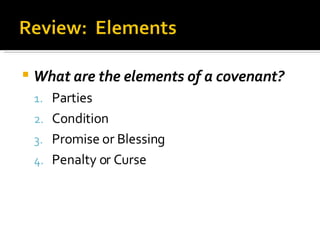
What are the elements of a covenant? Parties Condition Promise or Blessing Penalty or Curse
God Relating to Mankind
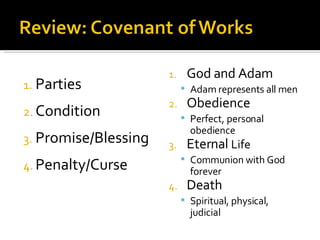
Parties Condition Promise/Blessing Penalty/Curse God and Adam Adam represents all men Obedience Perfect, personal obedience Eternal  Life Communion with God forever Death Spiritual, physical, judicial
Two aspects to Covenant of Grace: Eternal Focus is on  the Triune God   and His will Man’s inability to do anything In time Focus is on  man  and his need for redemption
Parties : God the Father & God the Son Promises  of the Father to the Son: assist the Son in work of atonement give the Son a people exalt the Son above all others
Parties : God the Father and Jesus Christ, as representative of the elect Promises : Be a God to His people Give His people a new heart Forgive their sins and make them holy Condition : Faith in Christ
What is it like?
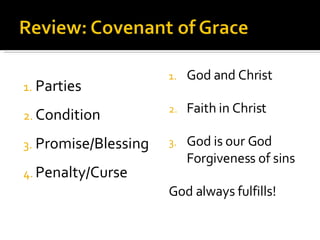
Parties Condition Promise/Blessing Penalty/Curse God and Christ Faith in Christ God is our God Forgiveness of sins God always fulfills!
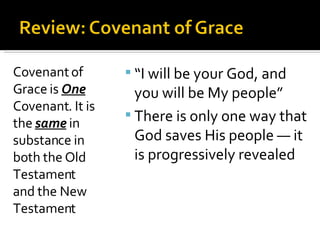
Covenant of Grace is  One  Covenant. It is the  same  in substance in both the Old Testament and the New Testament “ I will be your God, and you will be My people” There is only one way that God saves His people — it is progressively revealed
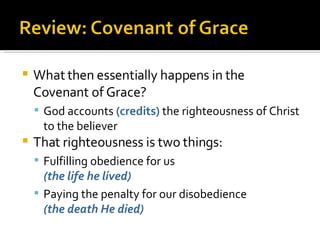
What then essentially happens in the Covenant of Grace? God accounts  (credits)  the righteousness of Christ to the believer That righteousness is two things: Fulfilling obedience for us (the life he lived) Paying the penalty for our disobedience  (the death He died)
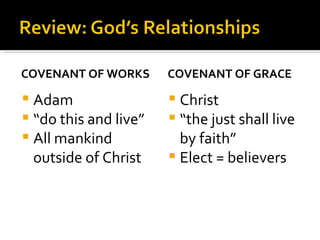
COVENANT OF WORKS Adam “ do this and live” All mankind outside of Christ COVENANT OF GRACE Christ “ the just shall live by faith” Elect = believers
 
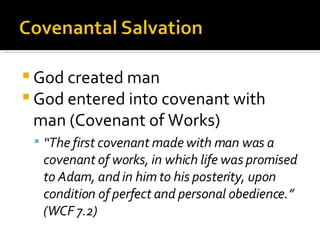
God created man God entered into covenant with man (Covenant of Works) “ The first covenant made with man was a covenant of works, in which life was promised to Adam, and in him to his posterity, upon condition of perfect and personal obedience.” (WCF 7.2)
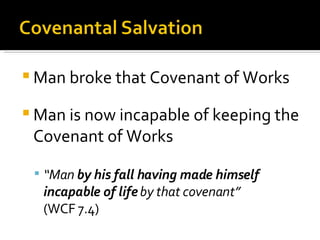
Man broke that Covenant of Works Man is now incapable of keeping the Covenant of Works “ Man  by his fall having made himself incapable of life  by that covenant”  (WCF 7.4)
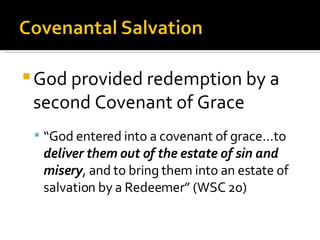
God provided redemption by a second Covenant of Grace “ God entered into a covenant of grace...to  deliver them out of the estate of sin and misery , and to bring them into an estate of salvation by a Redeemer” (WSC 20)
The condition of the second covenant is faith (a  saving  faith) “ He freely offers to sinners life and salvation by Jesus Christ,  requiring of them faith  in Him that they may be saved”  (WCF 7.3)
 
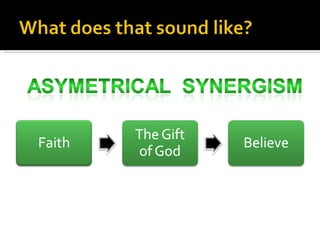
God provides faith to those in the Covenant of Grace “ promising to give to all those that are ordained to life His Holy Spirit, to  make them  willing  and  able  to believe”   (WCF 7.3)
How is it related to the gospel? Does it really make a difference for evangelism? Isn’t evangelism much simpler than that?
 
Because salvation is  covenantal , the gospel (or the “good news”) must be covenantal “ Covenant Theology is not just about continuity of the Old and New Testaments… Covenant Theology  is   the   gospel .” (J. Ligon Duncan,  The Theology of the Gospel )
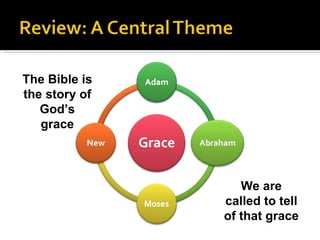
The Bible is the story of God’s grace We are called to tell of that grace
Only a covenantal view of salvation properly shows the role of the Trinity in salvation: The Father -- eternal covenantal love in sending His own Son as a sacrifice The Son  -- covenantal unreserved sacrifice (Romans 8:32) The Holy Spirit -- covenantally applying the purpose of the Father and work of the Son
Only a covenantal view of salvation fully explains:  (1) man’s need of grace as a lost covenant-breaker (2) the source of grace God’s provision in the work of Christ (3) the means of grace the administration of God’s covenant
Only a covenantal view of the atonement properly shows us that it was: Designed by the eternal love of God the willing work of the Son accomplished by uniting the believer with Christ
Evangelism is nothing more than telling others about God’s way of salvation How do we know what God’s way of salvation is? We can only know salvation through the what the Scriptures say about salvation We dare not trust in “tradition” or “methods”
 
What is the gospel as it is presented from modern non-covenantal and Arminian perspective? Do not begin with God, begin with man and his need “ are you unhappy? God has a wonderful plan for your life!”
What is the gospel as it is presented from modern non-covenantal and Arminian perspective? Do not talk about the Law of God Law = bad; grace = good “ Don’t turn men off by talking about the Law”
Faith is something man must do on his own as a result of his will “ God has done His part, now you must do yours” Repentance is not necessary for salvation, it is a “second work” for “spiritual” Christians “ Carnal Christian” teaching says that Christ can be Savior without being Lord
Man is saved by “accepting Christ as his personal savior” and “asking Jesus into his heart” Where do either of these phrases appear in the Bible A hint: they don’t
The individual is always the focus Don’t talk about church, or responsibility or a covenant community – focus on what Jesus can do for  me .
Do I really need to be a theologian to evangelize? Isn’t the gospel only telling men they are sinners and asking them to confess their sins and ask for forgiveness?
YES!
The true promise of salvation is not health, wealth, happiness or even freedom from the penalty of sin What is the true promise then? The same that it has been from Genesis to Revelation, from Adam to this very day “ I will be their God, and they shall be my people” (Hebrews 8:10)
The Biblical ground of salvation is  union   with   Christ Only by being united with Christ as our covenantal head ( cf . Romans 5) can we escape the wrath of God Through union with Christ we have  communion   with   God
Covenantal Spiritual Cannot happen outside of election (2 Timothy 1:9) It is the work of the Spirit (1 Corinthians 12:13) Vital (John 15:4; Galatians 2:20)
This union is effectuated by: Faith in Christ Repentance Diligent use of the means God has provided
Saving faith continues; it is not a single act made by a single decision and then forgotten. (John 15:1-8; John 8:31-36) Saving faith is not merely an  external  profession of faith; it involves an  internal  change of heart and an  internal  union with Christ.
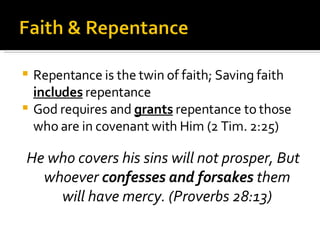
Repentance is the twin of faith; Saving faith  includes  repentance God requires and  grants  repentance to those who are in covenant with Him (2 Tim. 2:25) He who covers his sins will not prosper, But whoever  confesses and forsakes  them will have mercy. (Proverbs 28:13)
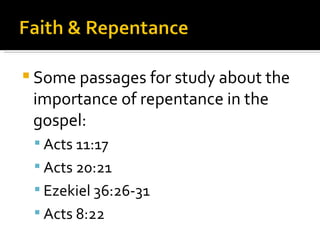
Some passages for study about the importance of repentance in the gospel: Acts 11:17 Acts 20:21 Ezekiel 36:26-31 Acts 8:22
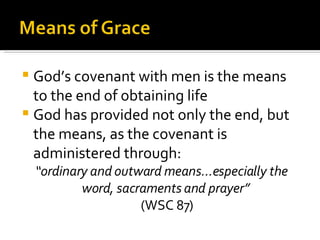
God’s covenant with men is the means to the end of obtaining life God has provided not only the end, but the means, as the covenant is administered through: “ ordinary and outward means...especially the word, sacraments and prayer”   (WSC 87)
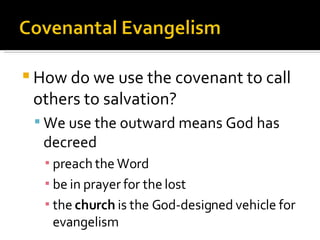
How do we use the covenant to call others to salvation? We use the outward means God has decreed preach the Word be in prayer for the lost the  church  is the God-designed vehicle for evangelism
How do we use the covenant to call others to salvation? We speak of a covenant God who always keeps His covenant every time you see a funeral, you see God keeping His covenant of works We speak of the conditions that God has decreed Saving faith is the condition-- it includes repentance to life
Avoid the error of Arminianism It is not that half the work is God’s and half is man’s If we are saved it must be by covenantal union with Christ We cannot remain independent and be in covenant with God How can two walk together unless they are agreed? Repentance is necessary (Acts 26:17-20)
Avoid the error of Hyper-Calvinism There is an outward as well as inward call There is a “free offer;” it is the administration of the covenant Man does have responsibility-- he must fulfill the conditions of the covenant
NEXT WEEK:

God Has A Plan 10 Evangelism

  • 1.
    (Our God isa Covenant God)
  • 2.
  • 3.
    What are theelements of a covenant? Parties Condition Promise or Blessing Penalty or Curse
  • 4.
  • 5.
    Parties Condition Promise/BlessingPenalty/Curse God and Adam Adam represents all men Obedience Perfect, personal obedience Eternal Life Communion with God forever Death Spiritual, physical, judicial
  • 6.
    Two aspects toCovenant of Grace: Eternal Focus is on the Triune God and His will Man’s inability to do anything In time Focus is on man and his need for redemption
  • 7.
    Parties : Godthe Father & God the Son Promises of the Father to the Son: assist the Son in work of atonement give the Son a people exalt the Son above all others
  • 8.
    Parties : Godthe Father and Jesus Christ, as representative of the elect Promises : Be a God to His people Give His people a new heart Forgive their sins and make them holy Condition : Faith in Christ
  • 9.
  • 10.
    Parties Condition Promise/BlessingPenalty/Curse God and Christ Faith in Christ God is our God Forgiveness of sins God always fulfills!
  • 11.
    Covenant of Graceis One Covenant. It is the same in substance in both the Old Testament and the New Testament “ I will be your God, and you will be My people” There is only one way that God saves His people — it is progressively revealed
  • 12.
    What then essentiallyhappens in the Covenant of Grace? God accounts (credits) the righteousness of Christ to the believer That righteousness is two things: Fulfilling obedience for us (the life he lived) Paying the penalty for our disobedience (the death He died)
  • 13.
    COVENANT OF WORKSAdam “ do this and live” All mankind outside of Christ COVENANT OF GRACE Christ “ the just shall live by faith” Elect = believers
  • 14.
  • 15.
    God created manGod entered into covenant with man (Covenant of Works) “ The first covenant made with man was a covenant of works, in which life was promised to Adam, and in him to his posterity, upon condition of perfect and personal obedience.” (WCF 7.2)
  • 16.
    Man broke thatCovenant of Works Man is now incapable of keeping the Covenant of Works “ Man by his fall having made himself incapable of life by that covenant” (WCF 7.4)
  • 17.
    God provided redemptionby a second Covenant of Grace “ God entered into a covenant of grace...to deliver them out of the estate of sin and misery , and to bring them into an estate of salvation by a Redeemer” (WSC 20)
  • 18.
    The condition ofthe second covenant is faith (a saving faith) “ He freely offers to sinners life and salvation by Jesus Christ, requiring of them faith in Him that they may be saved” (WCF 7.3)
  • 19.
  • 20.
    God provides faithto those in the Covenant of Grace “ promising to give to all those that are ordained to life His Holy Spirit, to make them willing and able to believe” (WCF 7.3)
  • 21.
    How is itrelated to the gospel? Does it really make a difference for evangelism? Isn’t evangelism much simpler than that?
  • 22.
  • 23.
    Because salvation is covenantal , the gospel (or the “good news”) must be covenantal “ Covenant Theology is not just about continuity of the Old and New Testaments… Covenant Theology is the gospel .” (J. Ligon Duncan, The Theology of the Gospel )
  • 24.
    The Bible isthe story of God’s grace We are called to tell of that grace
  • 25.
    Only a covenantalview of salvation properly shows the role of the Trinity in salvation: The Father -- eternal covenantal love in sending His own Son as a sacrifice The Son -- covenantal unreserved sacrifice (Romans 8:32) The Holy Spirit -- covenantally applying the purpose of the Father and work of the Son
  • 26.
    Only a covenantalview of salvation fully explains: (1) man’s need of grace as a lost covenant-breaker (2) the source of grace God’s provision in the work of Christ (3) the means of grace the administration of God’s covenant
  • 27.
    Only a covenantalview of the atonement properly shows us that it was: Designed by the eternal love of God the willing work of the Son accomplished by uniting the believer with Christ
  • 28.
    Evangelism is nothingmore than telling others about God’s way of salvation How do we know what God’s way of salvation is? We can only know salvation through the what the Scriptures say about salvation We dare not trust in “tradition” or “methods”
  • 29.
  • 30.
    What is thegospel as it is presented from modern non-covenantal and Arminian perspective? Do not begin with God, begin with man and his need “ are you unhappy? God has a wonderful plan for your life!”
  • 31.
    What is thegospel as it is presented from modern non-covenantal and Arminian perspective? Do not talk about the Law of God Law = bad; grace = good “ Don’t turn men off by talking about the Law”
  • 32.
    Faith is somethingman must do on his own as a result of his will “ God has done His part, now you must do yours” Repentance is not necessary for salvation, it is a “second work” for “spiritual” Christians “ Carnal Christian” teaching says that Christ can be Savior without being Lord
  • 33.
    Man is savedby “accepting Christ as his personal savior” and “asking Jesus into his heart” Where do either of these phrases appear in the Bible A hint: they don’t
  • 34.
    The individual isalways the focus Don’t talk about church, or responsibility or a covenant community – focus on what Jesus can do for me .
  • 35.
    Do I reallyneed to be a theologian to evangelize? Isn’t the gospel only telling men they are sinners and asking them to confess their sins and ask for forgiveness?
  • 36.
  • 37.
    The true promiseof salvation is not health, wealth, happiness or even freedom from the penalty of sin What is the true promise then? The same that it has been from Genesis to Revelation, from Adam to this very day “ I will be their God, and they shall be my people” (Hebrews 8:10)
  • 38.
    The Biblical groundof salvation is union with Christ Only by being united with Christ as our covenantal head ( cf . Romans 5) can we escape the wrath of God Through union with Christ we have communion with God
  • 39.
    Covenantal Spiritual Cannothappen outside of election (2 Timothy 1:9) It is the work of the Spirit (1 Corinthians 12:13) Vital (John 15:4; Galatians 2:20)
  • 40.
    This union iseffectuated by: Faith in Christ Repentance Diligent use of the means God has provided
  • 41.
    Saving faith continues;it is not a single act made by a single decision and then forgotten. (John 15:1-8; John 8:31-36) Saving faith is not merely an external profession of faith; it involves an internal change of heart and an internal union with Christ.
  • 42.
    Repentance is thetwin of faith; Saving faith includes repentance God requires and grants repentance to those who are in covenant with Him (2 Tim. 2:25) He who covers his sins will not prosper, But whoever confesses and forsakes them will have mercy. (Proverbs 28:13)
  • 43.
    Some passages forstudy about the importance of repentance in the gospel: Acts 11:17 Acts 20:21 Ezekiel 36:26-31 Acts 8:22
  • 44.
    God’s covenant withmen is the means to the end of obtaining life God has provided not only the end, but the means, as the covenant is administered through: “ ordinary and outward means...especially the word, sacraments and prayer” (WSC 87)
  • 45.
    How do weuse the covenant to call others to salvation? We use the outward means God has decreed preach the Word be in prayer for the lost the church is the God-designed vehicle for evangelism
  • 46.
    How do weuse the covenant to call others to salvation? We speak of a covenant God who always keeps His covenant every time you see a funeral, you see God keeping His covenant of works We speak of the conditions that God has decreed Saving faith is the condition-- it includes repentance to life
  • 47.
    Avoid the errorof Arminianism It is not that half the work is God’s and half is man’s If we are saved it must be by covenantal union with Christ We cannot remain independent and be in covenant with God How can two walk together unless they are agreed? Repentance is necessary (Acts 26:17-20)
  • 48.
    Avoid the errorof Hyper-Calvinism There is an outward as well as inward call There is a “free offer;” it is the administration of the covenant Man does have responsibility-- he must fulfill the conditions of the covenant
  • 49.

Editor's Notes

  • #2 12/16/2007 Week 3