GO compiler:
what isGO
compiler?
The Go Compiler is a tool that converts your Go program (the code you write in the Go
programming language) into a machine-readable file that a computer can understand
and execute. Think of it as a translator that takes the human-readable Go code and turns
it into something the computer can run.
2.
History of GO
compiler.
TheProblem:
In 2007, the creators of Go at Google — Robert Griesemer, Rob Pike, and Ken Thompson
— wanted to solve problems with existing programming languages like C++ and Java.
These languages were complex and slow when it came to building large programs and
systems.
The Solution:
They decided to create a new language that would be simple to use, efficient to compile,
and easy to scale for large projects like Google's massive infrastructure. This new
language became Go.
3.
The First Version:
Thefirst version of Go was officially released in 2009. It included a compiler (called the Go
Compiler or gc) to turn Go code into a program the computer can run.
4.
1. Fast Compilation
Whatit means:
Go is known for its quick compilation. This means that the Go compiler turns your code
into an executable program much faster than many other programming languages.
Why it's helpful:
When you're working on a project, you don’t want to wait long for your code to be
converted into a program. Go's fast compiler saves you time, especially when you’re
building larger applications.
Features of GO
compiler :
5.
Features of GO
compiler:
2. Cross-Platform Support
What it means:
With the Go compiler, you can write your code on one operating system (like
Windows) and compile it to run on other operating systems like macOS or Linux
without changing your code.
Why it's helpful:
You can write Go code once and then easily run it on different computers, whether they’re
running Windows, macOS, or Linux. This is great for creating software that works for a
wide range of users.
6.
Features of GO
compiler:
3. Static Linking
What it means:
The Go compiler creates standalone programs. This means everything your program
needs to run is bundled together into one file.
Why it's helpful:
You don't have to worry about installing extra libraries or dependencies to run your Go
program. The compiled program contains everything it needs to run, making it easier to
share with others.
7.
Features of GO
compiler:
4. Concurrency Support
What it means:
Go has built-in support for running multiple tasks at the same time (called concurrency).
The Go compiler makes it easy to write programs that can do many things simultaneously
without causing problems.
Why it's helpful:
If you're building something that needs to handle many tasks at once, like a web server,
Go makes it easier to write the code. The Go compiler helps manage all these tasks
without slowing down your program.
8.
Features of GO
compiler:
5. Optimized Performance
What it means:
The Go compiler creates efficient code that runs quickly on your computer.
Why it's helpful:
Whether you’re building a small app or a large system, the Go compiler optimizes your
program to run as fast as possible, making your applications more responsive and
resource-effi
cient.
9.
Features of GO
compiler:
6. Easy Debugging
What it means:
The Go compiler works well with debugging tools like Delve, which help you find and fix
problems in your code.
Why it's helpful:
If something goes wrong in your program, the Go compiler helps you troubleshoot and
debug it easily. This is important for writing stable and error-free applications.
10.
Working of GO
Compiler:
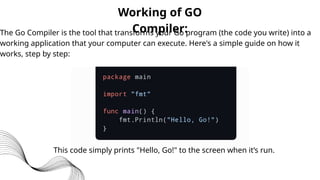
TheGo Compiler is the tool that transforms your Go program (the code you write) into a
working application that your computer can execute. Here's a simple guide on how it
works, step by step:
This code simply prints "Hello, Go!" to the screen when it’s run.
11.
Working of GO
Compiler:
TheGo compiler breaks down your Go code and does the following:
1. Lexical Analysis: It breaks your code into small parts, like keywords (func, main),
operators (+, -), and other symbols.
2. Syntax Checking: It checks that your code follows the correct rules, like making sure
every opening bracket { has a closing one }.
12.
Working of GO
Compiler:
3.Machine Code Generation: It translates your Go code into machine code — instructions
that your computer can understand and execute.
What is machine code?
Machine code is the set of instructions that the computer’s processor understands. It’s a
lower-level language that is fast and efficient for computers to execute.



![[DSC Europe 25] Andrzej Kowalczyk - AI - how to start small and grow in the f...](https://cdn.slidesharecdn.com/ss_thumbnails/oy1zmo94qv6vpcqjvno2-andrzej-kowalczyk-ai-how-to-start-small-and-grow-in-the-future-1-260119121559-cf093b23-thumbnail.jpg?width=640&height=640&fit=bounds)


![[DSC Europe 25] Elena Menshikova - AI-Powered Operational Excellence: Revolut...](https://cdn.slidesharecdn.com/ss_thumbnails/es6nholbqy3zaao2c2yd-2-elena-menshikova-data-ai-in-decision-making-260115093812-4fba8b38-thumbnail.jpg?width=640&height=640&fit=bounds)


![[DSC Europe 25] Ivan Lukovic & Marija Djukic - From Data to Value: Why Maturi...](https://cdn.slidesharecdn.com/ss_thumbnails/ahrfps8xr6knowwhacxh-1-ivan-marija-dsc-2025-ld-v1-presentation-260115093812-be21adfc-thumbnail.jpg?width=640&height=640&fit=bounds)
![[DSC Europe 25] Slobodan Dolinic - Smart and Intelligent Green Region.pptx](https://cdn.slidesharecdn.com/ss_thumbnails/0bribinjsp6ghwtvsvor-2-sigre-slobodan-dolinic-260115093812-c9c10e90-thumbnail.jpg?width=640&height=640&fit=bounds)


