GO!
By: Emily Joseph, Shriya Shah, and Sneha Nannapaneni
How it Works
Go is an ancient East Asian board game renowned for its simplicity of rules yet strategic
depth. Our digital version of two-player Go brings this timeless game to your fingertips,
offering an immersive experience for players of all levels.
The object of the game is to control more territory on the board than your opponent by
strategically placing stones to surround empty intersections and capture your
opponent's stones. Traditionally there are three board sizes: 9x9, 13x13, and 19x19
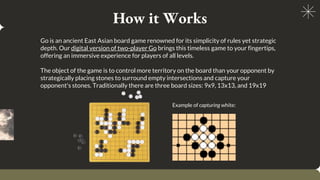
Example of capturing white:
How to Win
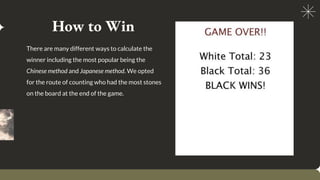
There are many different ways to calculate the
winner including the most popular being the
Chinese method and Japanese method. We opted
for the route of counting who had the most stones
on the board at the end of the game.
Example of capturing white:
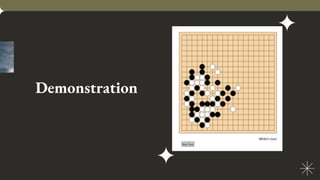
Demonstration
Board Class
Go Class
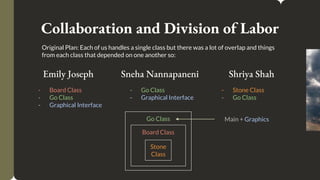
Collaboration and Division of Labor
- Board Class
- Go Class
- Graphical Interface
- Go Class
- Graphical Interface
- Stone Class
- Go Class
Emily Joseph Sneha Nannapaneni Shriya Shah
Stone
Class
Main + Graphics
Original Plan: Each of us handles a single class but there was a lot of overlap and things
from each class that depended on one another so:
Advanced Data Structures,
Algorithms, and Concepts
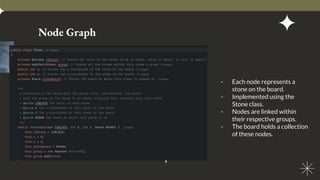
Node Graph
- Each node represents a
stone on the board.
- Implemented using the
Stone class.
- Nodes are linked within
their respective groups.
- The board holds a collection
of these nodes.
Linked List
- Generates a new board with
each move.
- Utilizes a Linked List to
store all board states.
- Facilitates validation of
moves by accessing past
boards efficiently.
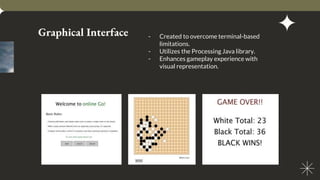
Graphical Interface - Created to overcome terminal-based
limitations.
- Utilizes the Processing Java library.
- Enhances gameplay experience with
visual representation.

Go Board Game Design Process Presentation

  • 1.
    GO! By: Emily Joseph,Shriya Shah, and Sneha Nannapaneni
  • 2.
    How it Works Gois an ancient East Asian board game renowned for its simplicity of rules yet strategic depth. Our digital version of two-player Go brings this timeless game to your fingertips, offering an immersive experience for players of all levels. The object of the game is to control more territory on the board than your opponent by strategically placing stones to surround empty intersections and capture your opponent's stones. Traditionally there are three board sizes: 9x9, 13x13, and 19x19 Example of capturing white:
  • 3.
    How to Win Thereare many different ways to calculate the winner including the most popular being the Chinese method and Japanese method. We opted for the route of counting who had the most stones on the board at the end of the game. Example of capturing white:
  • 4.
  • 5.
    Board Class Go Class Collaborationand Division of Labor - Board Class - Go Class - Graphical Interface - Go Class - Graphical Interface - Stone Class - Go Class Emily Joseph Sneha Nannapaneni Shriya Shah Stone Class Main + Graphics Original Plan: Each of us handles a single class but there was a lot of overlap and things from each class that depended on one another so:
  • 6.
  • 7.
    Node Graph - Eachnode represents a stone on the board. - Implemented using the Stone class. - Nodes are linked within their respective groups. - The board holds a collection of these nodes.
  • 8.
    Linked List - Generatesa new board with each move. - Utilizes a Linked List to store all board states. - Facilitates validation of moves by accessing past boards efficiently.
  • 9.
    Graphical Interface -Created to overcome terminal-based limitations. - Utilizes the Processing Java library. - Enhances gameplay experience with visual representation.

Editor's Notes