WORKFORCE DEVELOPMENT FRAMEWORK GOVERNMENT OF THE NORTHWEST TERRITORIES 1
Workforce
Development
Framework
A. INTRODUCTION...........................................................3
The Role of Workforce Development ...............................................................4
B. 
WORKFORCE DEVELOPMENT FRAMEWORK.........6
1. Formal and Directed Learning........................................................................8
2. Self-Directed Skill Development .................................................................10
3. Learning through Experience.......................................................................12
4. Learning Through People.............................................................................16
C. 
CONTINUOUS IMPROVEMENT...............................18
Operating Context...........................................................................................18
Areas for Action .............................................................................................20
D. CONCLUSION.............................................................21
APPENDIX: RESOURCES AND INFORMATION...........22
CONTENTS
WORKFORCE DEVELOPMENT FRAMEWORK GOVERNMENT OF THE NORTHWEST TERRITORIES 3
The framework provides the structure for
GNWT employees and managers to plan for
and participate in education and training
programs and activities and in employment
support services. These activities will allow
our employees to effectively undertake the
responsibilities of their existing position and
to develop skills and abilities that may lead
to opportunities for advancement within the
GNWT. Managers within each department
are responsible for working with employees
on learning and development activities to
ensure that its employees have the necessary
capabilities to achieve the government’s
goals efficiently and effectively.
Managers and employees will need
to consider the best way to apply the
components outlined in the framework to
best match their particular context and
environment. This framework will provide
information and tools that will help prepare
employees with the required competencies
needed for job performance.
The Workforce Development Framework outlines the
Government of the Northwest Territories (GNWT) overall
approach to learning and development with the goals of:
A. INTRODUCTION
•	Providing a model for learning and development to foster a learning culture across the GNWT;
•	Improving awareness for employees and managers of approaches to workforce development; and
•	Identifying areas for continuous improvement in the GNWT approach to workforce development.
GOVERNMENT OF THE NORTHWEST TERRITORIES WORKFORCE DEVELOPMENT FRAMEWORK
4
Workforce development encompasses a wide range of activities designed to improve the capabilities
of employees. Capabilities comprise not only the technical skills and knowledge people have, but
also their attributes, attitudes and behaviors. Learning and development activities can be designed
to deliver specific skills in a short period of time to meet an immediate need, or designed to achieve
broader requirements over a longer period.
Workforce development plays an important role in recruitment and retention and in achieving broad
human resource goals for the GNWT. Developing employee’s capabilities help to achieve the overall
goals of a competent and well trained public service that is able to effectively and efficiently deliver
programs and services to the residents of the Northwest Territories, along with the goal of achieving
a representative public service.
Everyone has a role in workforce development.
Employees need to consider their personal
learning goals and take advantage of the
various pathways available to them. Managers
need to work with employees to further identify
learning opportunities and develop a learning
plan. Departments need to develop an overall
approach to employee development, including
aligning with succession planning, and the
Human Resource Branch of the Department of
Finance needs to ensure the programs, services,
and supports are in place to support workforce
development.
Employee learning and development within
the GNWT should mainly be facilitated
through performance development, which is
a combination of performance management
and employee development that is based on the
GNWT’s Competency Model.
The GNWT Competency Model forms the basis
of strategic human resource processes, such as
attraction, selection, retention, performance
management, development, and succession
planning. A competency is not only about skills
and abilities, but also the behaviours that are
characteristics of success for each position. The
GNWT Competency Model is applicable to all
positions within the GNWT.
The GNWT Competency Model consists of six
competencies that have been organized into two
clusters as follows:
•	Leadership Excellence
Authentic Leadership:
Includes our own behaviours and includes
how we take responsibility for our own
actions and how we contribute to a positive
work environment.
THE ROLE OF WORKFORCE DEVELOPMENT
WORKFORCE DEVELOPMENT FRAMEWORK GOVERNMENT OF THE NORTHWEST TERRITORIES 5
Systems Thinking:
Includes how we link our work to
divisional and departmental objectives and
understanding how our work contributes to
achieving government wide objectives.
Engaging Others: Includes how we connect
and work with others in the organization
including working cross departmentally
and sharing information and expertise as
appropriate.
•	Management Excellence

Action Management: Includes effectively
managing and completing responsibilities,
setting goals and objectives, and identifying
ways to improve performance.

People Management: Includes acting as a
team player, supporting and developing
other employees, giving clear direction
as appropriate, and giving constructive
feedback to others.

Sustainable Management: Includes using
and managing resources, including financial
resources, responsibly and effectively, and
improving sustainability practices.
As noted the GNWT has a performance
development program that facilitates workforce
development. It includes Learning Plans as a tool
to plan and manage learning goals as they relate
to achieving work objectives and/ or competency
development. Developing a Learning Plan
requires that employees and their managers:
1.	 Identify a learning goal, the competency
to be developed or work objective to be
achieved;
2.	 Identify the learning experience needed
to develop that ability; and
3.	 Identify the support required to develop
and apply that ability.
While opportunities for workforce development
may take place outside of the performance
development system, it is critical for the broad
based effectiveness of the GNWT Workforce
Development Program that employees and
managers develop Learning Plans and include
them as part of the annual performance
development process.
GOVERNMENT OF THE NORTHWEST TERRITORIES WORKFORCE DEVELOPMENT FRAMEWORK
6
The delivery of employee learning and development
opportunities allows the GNWT to support GNWT-wide
priorities, provide quality services to the public, and
to retain, attract and develop a skilled, qualified and
representative workforce.
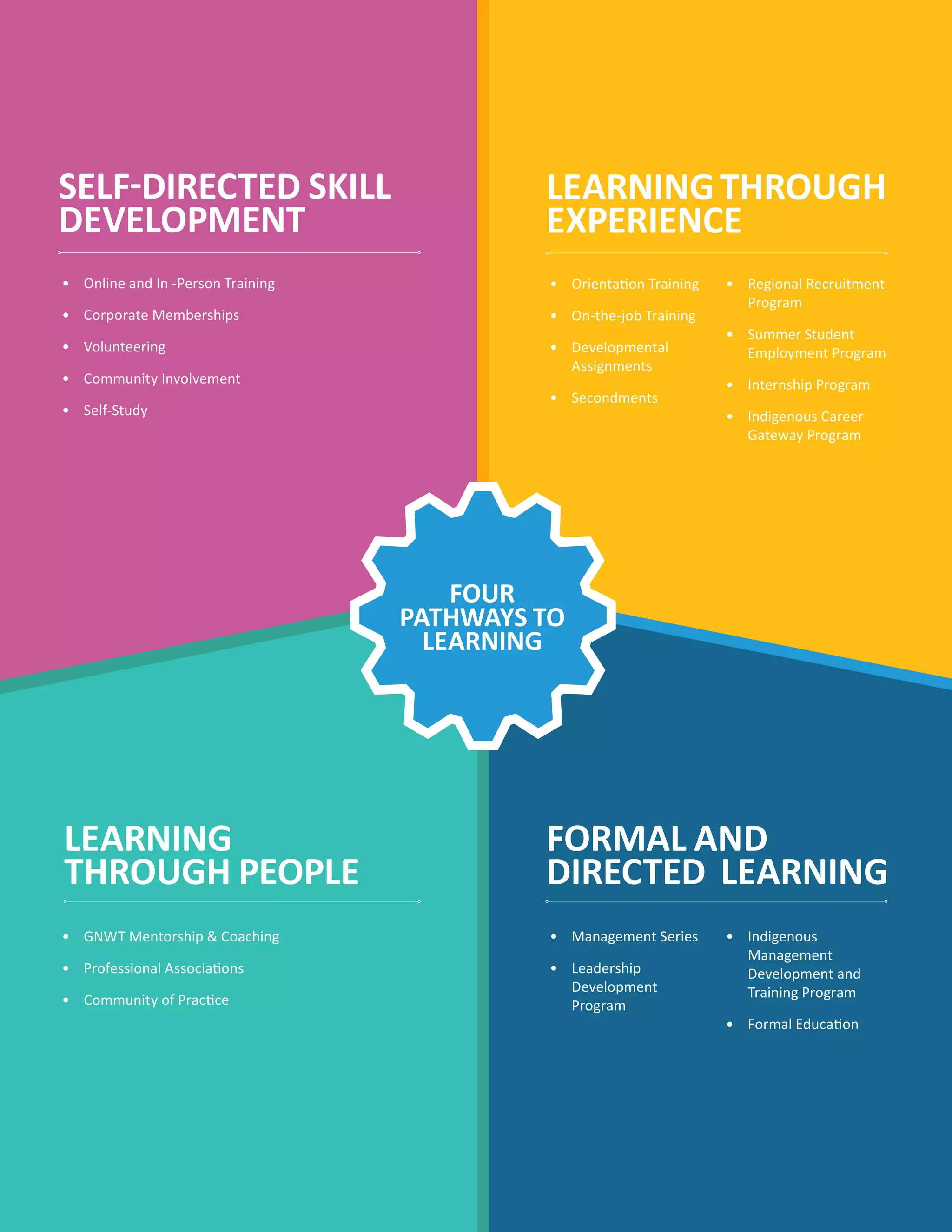
Within the GNWT, there are 4 primary pathways to
employee learning and development. The 4 primary
pathways are outlined in the illustrated diagram
to the right:
B. 
WORKFORCE DEVELOPMENT
FRAMEWORK
WORKFORCE DEVELOPMENT FRAMEWORK GOVERNMENT OF THE NORTHWEST TERRITORIES 7
FOUR
PATHWAYS TO
LEARNING
SELF-DIRECTED SKILL
DEVELOPMENT
•	 Online and In -Person Training
•	 Corporate Memberships
•	 Volunteering
•	 Community Involvement
•	 Self-Study
LEARNINGTHROUGH
EXPERIENCE
•	 Orientation Training
•	 On-the-job Training
•	 Developmental
Assignments
•	 Secondments
•	 Regional Recruitment
Program
•	 Summer Student
Employment Program
•	 Internship Program
•	 Indigenous Career
Gateway Program
LEARNING
THROUGH PEOPLE
•	 GNWT Mentorship  Coaching
•	 Professional Associations
•	 Community of Practice
FORMAL AND
DIRECTED LEARNING
•	 Management Series
•	 Leadership
Development
Program
•	 Indigenous
Management
Development and
Training Program
•	 Formal Education
GOVERNMENT OF THE NORTHWEST TERRITORIES WORKFORCE DEVELOPMENT FRAMEWORK
8
Formal learning includes the following features that, if taken together, create the formality
of the learning situation:
•	A specified curriculum
•	Taught by a designated teacher or a group of teachers
•	With the learning achievements of individual learners being assessed and/or certified.
Under formal and directed learning, the
GNWT utilizes formal training programs
that include a variety of methods to appeal
to various learning styles. Formal learning
ensures that GNWT employees acquire the
same information at the same time.
These include the following programs:
Management Series
The Management Series ensures managers
have a consistent knowledge base of their
occupational area, to provide managers with
information that assists with their overall
management competency of employees.
The Management Series offers a blend
of mandatory courses in 3 subject areas
(Finance, Policy and Human Resources) that
provide supervisors and managers with
information on the processes and procedures
used by the GNWT, and to provide the
context in which the GNWT operates. The
participants will choose 6 elective courses
from the 5 subject areas (Finance, Policy,
Human Resources, Communications and
Coaching) that are consistent with their
learning needs and/or with their general
interest.
The Management Series is open to all
territorial public service supervisors and
managers except those covered by the
Northwest Territories’ Territorial Teachers
Association Collective Agreement and
employees in the Northwest Territories
Power Corporation. To be eligible for this
program, participants must be current
GNWT managers/supervisors.
The Management Series is intended to be
completed within a 2 year frame. The cost for
application to the Management Series is $300
per participant for the entire course (which
includes all mandatory and elective courses).
1 FORMAL AND DIRECTED LEARNING
WORKFORCE DEVELOPMENT FRAMEWORK GOVERNMENT OF THE NORTHWEST TERRITORIES 9
Leadership Development Program
The purpose of the Leadership Development
Program is to assist the GNWT in succession
planning by providing managers and
emerging managers with knowledge and
skills to further enhance their existing
management competencies, and to prepare
them for future roles and/or advancement
within the GNWT. The GNWT has partnered
with the University Of Alberta School Of
Business, Executive Education, to create
the program and design it with the GNWT
Competency Model.
There are three streams within the
program; the content of each stream is
adapted to a specific level of management:
•	Emerging Managers: The 8 day program is
specifically designed to meet the needs of
current front-line supervisors. As well as
staff who are expected to lead projects and
teams or are preparing for future growth
opportunities in management within the
GNWT. The modules include Authentic
Leadership  Managing People, Engaging
Others, Action Management  Sustainability
and Systems Thinking.
•	Managers: The 9 day program is designed
to help managers enhance their leadership
skills. It promotes the opportunity to learn
from colleagues and develop networks
that are vital for success in a changing
work environment. The modules include
Transformational Leadership, Building
Collaborative Relationships  Creating Trust,
Strategic  Systems Thinking and Leading
Change.
•	Executive and Senior Managers: The 6
day program is a comprehensive strategic
approach to leadership development and
leadership continuity, which has been
designed with the recognition that senior
leaders are a corporate resource within the
GNWT. The modules include Enhancing Your
Leadership Abilities, Engaging Others, Action
Management  Sustainability and Systems
Thinking.
The fee for all Leadership Development
Program streams is $300 per participant
per day. In addition, any travel and related
expenses associated with attendance are
the sole responsibility of the employee’s
department. The program usually runs twice
a year and employees can register through
the My HR Learning and Development
Calendar.
Indigenous Management
Development and Training Program
The Indigenous Management Development
and Training Program supports the
professional development of Indigenous
Aboriginal employees within the GNWT.
This will include supporting Indigenous
Aboriginal employees with career
advancement by creating opportunities
for further development; providing
opportunities to gain experience in multiple
GOVERNMENT OF THE NORTHWEST TERRITORIES WORKFORCE DEVELOPMENT FRAMEWORK
10
professional fields in order to create a
unique and versatile career path; and by
creating workplace training opportunities
for occupations that are in labour market
demand.
Formal Education
The GNWT recognizes the need to develop
a stable and competent workforce capable
of administering Government policies and
programs efficiently and effectively. The
GNWT encourages career development by
offering the following:
•	Education Leave Education leave is time off
to undertake full-time post-secondary studies
for at least one academic year at a recognized
university, community college or technical
institute. An academic year is two full
program semesters, completed in succession,
or completed within a 12-month period.
•	Short Term Education Leave Employees may
apply for leave of less than one academic
year to take advanced or supplementary
professional, technical or academic education
or training. Periods of short-term education
leave may not be linked together to provide a
full education leave benefit.
•	Tuition/Course Fees Deputy Heads or their
designates may approve reimbursement of
tuition/course fees for courses taken on an
employee’s personal time when the course
is of value to the employee’s work and the
employee provides evidence of successful
completion of the course.
2 SELF-DIRECTED SKILL DEVELOPMENT
Through self-directed development, GNWT employees take the initiative in determining their
learning needs with their Supervisor, formulating learning goals, choosing and implementing
appropriate learning strategies, and evaluating learning outcomes.
The GNWT encourages its employees to engage in self-directed skill development as the
process enables employees to manage their growth and development. The GNWT self-directed
skill development options include:
Online and In-Person Training Courses
The GNWT offers valuable online and in-
person educational resources to employees.
The GNWT My HR Learning and Development
Calendar offer courses, workshops and
online learning opportunities available to all
GNWT employees. The GNWT learning and
development catalogue is grouped under the
WORKFORCE DEVELOPMENT FRAMEWORK GOVERNMENT OF THE NORTHWEST TERRITORIES 11
following topic areas:
•	Business Effectiveness
•	Communications
•	Diversity and Inclusion
•	Health, Safety and Wellness
•	Leadership Development
•	Personal Effectiveness
•	Service Excellence
•	Technology Training
Corporate Memberships
Corporate memberships are resources
that provide employees with learning
and development tools (i.e. memberships
and informational databases). Corporate
memberships allow GNWT employees to
gain exposure across industries, access to
resources, peer networking and knowledge
portals. Corporate memberships encourage
engagement through knowledge sharing,
researching and learning opportunities
across disciplines.
Volunteering
Volunteering within the GNWT provides
employees with an opportunity to expand or
sharpen their skill sets and stay connected
to the industry in which they are interested
in. Volunteering on departmental projects
and committees allows GNWT employees
to pursue interests and acquire experience
they may not have accumulated in their
current profession. Examples of volunteer
opportunities include participating on:
•	Health and Safety Committees
•	Departmental Social Committees
•	Interdepartmental Working Groups
Volunteering opportunities are presented
when the needs arise, either internally
within a department or via cross-
departmental initiatives.
Community Involvement
Often core skills can be developed outside
of the workplace. Individuals who become
involved in various community activities
may build a broader perspective, and
develop additional skills and knowledge.
These could include speaking at community
functions, serving on community boards,
service groups, or professional associations,
participating in fund raising, managing
budgets, doing volunteer work, sports and so
on. Individuals then apply the skills learned
back on the job.
Self-Study
Self-study is usually used jointly with
other development activities. Self-study
involves using any kind of resources (i.e.,
books, professional writings, professional
discussions, etc.) to increase skill sets, add
to knowledge, change values or attitudes
or to satisfy an interest area to improve
competency levels.
GOVERNMENT OF THE NORTHWEST TERRITORIES WORKFORCE DEVELOPMENT FRAMEWORK
12
3 LEARNING THROUGH EXPERIENCE
The GNWT encourages hands on learning and knowledge sharing. Experiential learning
immerses learners in an experience and then encourages reflection on the experience in order
to develop new skills, new attitudes, or new ways of thinking. The skill set and experiences
gained through experiential education programs form a foundation that can be applied and
adapted to various work scenarios. The GNWT Learning through Experience programs are
highlighted below:
Orientation training
Learning in a workplace usually begins with
an employee orientation. This is where new
employees learn how things work, where
things are, who’s who and what role they will
play on the team. The GNWT Onboarding
Program is designed to attract employees,
reaffirm their employment decision,
acclimatize them to the organization’s
culture and prepare them to contribute at a
desired level as quickly as possible.
Employee orientation is part of a long-term
investment in a new employee. It is an initial
process that provides easy access to basic
information, programs and services, gives
clarification and allows new employees to
take an active role in the organization. It is
important that our employee orientation
program takes into consideration the culture
and values of the GNWT and provides the
tools necessary for employees to integrate
into the GNWT organizational culture and
their new role in the organization.
On-the-job-Training
On-the-job training with a supervisor or
co-worker providing instruction right at
the workstation is the primary method of
training in most workplaces. On-the-job
training provides immediate connection
between learning and the work. Even though
on-the-job training is often referred to as
information training, it still requires careful
preparation and support to be done well.
Clear objectives should be set for what the
trainee will be able to do, how they will
demonstrate what they have done, and to
expected standards. The training (and the
learning) will be more consistent if a training
checklist is prepared in advance to help guide
what will be covered.
Developmental Assignments
The GNWT transfer assignment provides
an opportunity for an employee to gain
a broader range of work experience, and
therefore have knowledge and skills to
WORKFORCE DEVELOPMENT FRAMEWORK GOVERNMENT OF THE NORTHWEST TERRITORIES 13
meet the changing demands of the work
environment. This is done by providing
short-term assignments for employees
in their home department, or another
department within the public service.
Transfer assignments are used to:
•	Meet immediate operational requirements.
•	Contribute to an employee’s career
development.
•	Redeploy an affected employee.
•	Address unique human resource
considerations.
•	Cover acting periods greater than six weeks.
The term of a transfer assignment done
through open competition, including
extensions, shall not exceed three years.
Deputy Heads of the Receiving and
Employing Departments may extend the
transfer assignment by one year through
mutual agreement of all parties. Consult
with your Client Service Manager for more
information.
Transfer assignments are available to
employees who have indeterminate or term
positions; and have successfully completed
the probationary period in their current
position.
Secondments
A secondment opportunity promotes and
facilitates the exchange of employees
through temporary assignments between
the GNWT and other organizations, such as
non-governmental organizations, private
sector, other governmental agencies,
Indigenous governments and organizations.
The GNWT has a Building Capacity in
Indigenous Governments Program to support
secondment arrangements with Indigenous
governments in all regions to help develop
human resource capacity.
A secondment increases the GNWT’s access
to specialized knowledge, skill diversity and
expertise. The objective of a secondment is
one or more of the following:
•	To provide a mechanism for organizations
to work together to meet short-term human
resource needs when those needs cannot
be effectively met through the regular
recruitment process.
•	To support the development of an employee’s
knowledge, skills, abilities and experience.
•	To improve the knowledge base between
the GNWT and other organizations, for the
purpose of creating and supporting informed
policy development, improved services and
to strengthen the GNWT’s relationships and
partnerships with other organizations.
•	To contribute to the objectives of the GNWT’s
social and economic policy.
GOVERNMENT OF THE NORTHWEST TERRITORIES WORKFORCE DEVELOPMENT FRAMEWORK
14
•	To increase the GNWT’s access to and
acquisition of specialized knowledge,
diverse skills, expertise, technology and best
practices.
To be considered for a secondment, a
GNWT employee must have indeterminate
employment status, completed the
probationary period, formally requested and
been granted approval from the Deputy Head
of the employing department.
Secondments apply to all departments,
boards and agencies of the GNWT except
the NWT Power Corporation. The maximum
term of a secondment, including extensions,
shall not exceed three years. Consult with
your Client Service Manager for more
information.
Regional Recruitment Program
The purpose of the Regional Recruitment
Program is to fill regional job vacancies
by supporting and assisting departments,
boards and agencies in the recruitment and
development of Northern residents through
up to one year of on-the-job training.
The Regional Recruitment Program links
vacant regional positions with potential
employees. Financial and human resources
are available to departments, boards and
agencies to support on-the-job training for
program participants through a structured
and managed approach. On-the-job training
focuses on unique support and development
for individual trainees to assist in identifying
candidates, developing/implementing
training plans and supporting trainees while
they are participating in on-the-job training.
During the training period, trainees receive
80% of the position’s salary. The remaining
20% supports the employee’s training and
development plan, which might include
travel to other communities to train under
experienced employees or attend specialized
courses. Funding is available from the
Department of Finance to assist with the
costs of implementing the trainee’s learning
and development plan (over and above the
20% supported by the home department,
board or agency).
A minimal application process allows
departments, boards and agencies to submit
applications to the Program year-round.
Consult with your Client Service Managers
for more information.
Summer Student Employment Program
Through the Summer Student Employment
Program (SSEP), qualified, post-secondary
Northern students are recruited for short
term casual contracts during the summer
months. Students receive valuable work
experience and have the opportunity to apply
WORKFORCE DEVELOPMENT FRAMEWORK GOVERNMENT OF THE NORTHWEST TERRITORIES 15
their theoretical and academic knowledge
in a practical, real world context and gain
exposure to the GNWT as a potential
employer upon completion of their post-
secondary studies.
Hiring Managers identify summer student
employment opportunities based on
operational need. Wherever possible, Hiring
Managers in consultation with their HR
representative try to hire students in a
particular field of study that is in alignment
with the department’s mandate.
Departmental requests to the SSEP may be
submitted at any time however, departments
are encouraged to submit requests by
February 28. Requests received by this
deadline will ensure that all required
paperwork is completed for students to
begin employment. Consult with your Client
Service Managers for more information.
Internship Program
Through the Internship Program,
departments recruit qualified, post-
secondary Northern graduates into positions
in a line of work related to their field of study.
Interns receive valuable work experience
and have the opportunity to apply their
theoretical and academic knowledge in
a practical, real world context and gain
exposure to the GNWT as an employer.
The deadline for Departmental applications
to the Internship Program is November 30.
Applications received by this deadline ensure
that the application review and approval
process is completed so that the majority
of Interns can start their placements
each spring.
Funding is available to provide for up to 40
Intern placements each fiscal year (April 1 to
March 31) from the Department of Finance.
There is no restriction on the number of
Intern placements that departments can
provide for, without accessing funding
support from the Department of Finance.
The Department of Finance provides funding
to departments, on a prorated basis, of
$3,300 per month for up to a maximum of 24
months per internship placement. All costs
over and above the maximum allotment are
the responsibility of the hiring department.
Departments may access funding through
application to the program, by the
application deadline November 30. Consult
with your Client Service Managers for more
information.
Indigenous Career Gateway Program
The Indigenous Career Gateway Program will
increase the number of Indigenous
Aboriginals working for the GNWT. The
program will support Indigenous Aboriginal
people to obtain and maintain long-term,
sustainable employment within the GNWT
by creating workplace training opportunities
in entry level positions; creating meaningful
GOVERNMENT OF THE NORTHWEST TERRITORIES WORKFORCE DEVELOPMENT FRAMEWORK
16
work experience for students following the
conclusion of their studies; and by fostering
an environment that values development,
diversity and professional growth
opportunities. Consult with your Client
Service Managers for more information.
4 LEARNING THROUGH PEOPLE
GNWT employees learn from others through a variety of collaborative learning activities and
interaction with peers. The GNWT Learning through People programs need to be developed.
Proposed programs are listed below.
GNWT Mentorship and Coaching
The GNWT is committed to supporting
mentorship connections in the workplace.
Mentoring is about building a developmental
relationship where the mentor provides the
mentee with guidance, advice and assistance
that could aid in the development of specific
skills and knowledge to enhance the less-
experienced person’s professional and personal
growth.
Mentoring is a useful and effective way to
develop top emerging talent (Mentees) and
keep the most knowledgeable and experienced
performers (Mentors) engaged and energized.
As well as the transferal of critical business
knowledge and skills, mentoring helps to
develop a pipeline of future leaders who
understand the skills and attitudes required
to succeed within the GNWT.
The GNWT Coaching for Success program
delivers training for employees to build an
understanding of the fundamental principles
of coaching, while fostering an appreciation
for the value, benefit and efficacy of successful
coaching relationships. Coaching is an approach
to personal and professional development by
building supportive relationships in workplace
settings and working toward shared goals.
This Coaching for Success course builds
fundamental coaching skills and techniques
by shifting the focus from past employee
performance to future employee development.
Traditional management styles usually do not
focus on continuous employee development
and rather, are based on a problem-solving
approach. Coaching instead emphasizes
the consideration of employee training
and development needs through positivity,
motivation and overall development.
WORKFORCE DEVELOPMENT FRAMEWORK GOVERNMENT OF THE NORTHWEST TERRITORIES 17
Professional Associations
Professional memberships provide GNWT
employees with exposure to the standards and
best practices of their profession, continuous
learning opportunities and the opportunity to
network with other professional members.
Supporting employees in maintaining
professional affiliations, designations and
credentials demonstrates the GNWT’s
commitment to ensuring our employees adhere
to professional qualifications and requirements
where applicable. Managers should encourage
employees to invest in their respective member
associations (where applicable) as a form of
career development. Benefits of engaging with
professional associations are listed below:
•	Development, opportunities or educational
and personal growth for the employee
(Certifications and learning and development).
•	Research and metrics available to specific
industry.
•	Ability to stay current on legislative and day to
day policy issues that impact the profession.
•	Access to articles and information on key
initiatives related to the profession.
•	Networking with fellow professionals.
Community of Practice
A community of practice is a group of people
who share the same profession. The GNWT
supports and encourages employees to share
their expertise in formal and informal settings.
It is through the process of sharing information
and experiences with the group that members
learn from each other, and have an opportunity
to develop personally and professionally.
The GNWT Yammer account is an enterprise
social networking service used for private
communication within organizations.
Yammer can serve as the central hub for team
collaboration. Yammer can be used to share
and collaborate with network of co-workers,
tap into knowledge across the GNWT, and
engaging employees. . Other social media sites
for sharing ideas include LinkedIn, Twitter and
Facebook. Within the GNWT, Community of
Practice programs needs to be developed.
17
WORKFORCE DEVELOPMENT FRAMEWORK GOVERNMENT OF THE NORTHWEST TERRITORIES
GOVERNMENT OF THE NORTHWEST TERRITORIES WORKFORCE DEVELOPMENT FRAMEWORK
18
C. CONTINUOUS IMPROVEMENT
OPERATING CONTEXT
The GNWT is impacted by changing demands for services, technological advancements,
resident expectations around service delivery, and demographic shifts in the population. Each
of these components needs to be considered in relation to workforce development.
As has been noted workforce development plays an
important role in recruitment and retention and in
achieving broad human resource goals for the GNWT.
While the GNWT has the components in place for
effective workforce development, there is always room
for improvement and the need for evolving our approach
over time. In this section, additional operating context is
provided along with some of the key actions that are being
advanced to continue to improve.
WORKFORCE DEVELOPMENT FRAMEWORK GOVERNMENT OF THE NORTHWEST TERRITORIES 19
There has been growth in the public service
over the last five years and that can be
largely attributed to increased demand for
health care services related to the aging
population. The NWT senior’s population
is increasing at a rate of approximately 5%
annually. This increased demand has meant
increased health related jobs from nursing
to home care to support for long term
care facilities and health administration.
Additionally, devolution of responsibility
for land administration and management in
2014-15 has added additional demands for
regulatory and technical positions.
The nature of the public service also changes
over time. Technology is impacting our
workplace and the skills and abilities need
to evolve as well. Recent changes to move
to more of a paperless environment in
administration and in program management
require that the workforce changes as well
in terms of technical skills and abilities.
These changes are also reflected in the way
residents expect services to be delivered
with a greater demand for on-line services
and dependence on technology for delivery of
education and health services, for example.
These trends have led to a greater need for
skilled staff. Currently, 77.7% of positions
within the GNWT are occupations that are
typically filled by employees with a post-
secondary education. While there is always
the opportunity for equivalencies, workforce
development is a critical piece to ensuring
employees are able to advance within the
organization and that the GNWT will have
the capacity to meet its objectives.
Some key metrics on workforce development
activities within the GNWT include:
•	In 2018-19, a total of 145 training courses were
delivered to GNWT employees through on-line
and in-person training opportunities.
•	There were 498 transfer assignments initiated
in 2018-19. These provided opportunities for
employees to develop skills and abilities.
•	A total of 51 residents have been hired through
the Regional Recruitment Program. The
Indigenous Career Gateway Program has been
launched in 2018-19.
•	The GNWT hired 371 summer students in
2018-19. There were 41 interns hired within
the GNWT in 2018-19 and an additional 32
graduates are expected to be hired in 2019-20.
•	There are 17 employees being supported with
education leave currently.
•	A total of 498 employees have participated in
the Leadership Development program over the
last four years.
•	There are targeted training funds for teachers,
health care professionals and college educators.
Overall, the GNWT invests about $5 million
annually in training.
(Please note: Data information is based on term/indeterminate GNWT employees, excluding relief employees)
GOVERNMENT OF THE NORTHWEST TERRITORIES WORKFORCE DEVELOPMENT FRAMEWORK
20 GOVERNMENT OF THE NORTHWEST TERRITORIES WORKFORCE DEVELOPMENT FRAMEWORK
20
AREAS FOR ACTION
In order to build on the workforce
development activities within the GNWT,
the following actions will be advanced:
•	Development and implementation of the
learning management module within the
Human Resource Information System to better
monitor implementation of employee training
and development activities.
•	Increased emphasis by managers on the
development of training plans and reflecting
employee training activities as part of the
annual performance development process.
•	Continued expansion of on-line learning
opportunities to ensure opportunities for
employees located in the regional centers
and communities and allow employees
to participate in training as operational
requirements allow.
•	Further support and development for a formal
mentorship program within the GNWT.
•	Improved monitoring and reporting on
departmental specific supports provided to
staff for external training and development
opportunities.
•	Promote a culture shift to coaching employees
and peers within the GNWT, including
expanding Coaching for Success training and the
linkage to future developmental opportunities.
•	Promote linkages between workforce
development and succession planning as part of
departmental human resource planning.
•	Complete a review of social media platforms
such as Yammer to promote community
of practice for mentorship/ coaching and
professional development opportunities.
•	Develop an on-going process to identify
additional workforce development activities
and evaluate existing programs to ensure
effectiveness.
WORKFORCE DEVELOPMENT FRAMEWORK GOVERNMENT OF THE NORTHWEST TERRITORIES 21
D. CONCLUSION
It is widely acknowledged that effective
workforce development planning will have
a positive impact and will lead to more
effective business performance.
A robust workforce development effort
requires collaboration with staff across
multiple levels and areas of responsibility
within departments, boards and agencies.
The Workforce Development Framework
provides the tools required to educate, train
and support the development of our public
service employees. Successful uptake of these
programs will result in opportunities for our
employees to advance within the organization,
and ultimately provide the GNWT with
the human resources required to meet the
demands of an aging workforce and implement
appropriate succession planning strategies.
GOVERNMENT OF THE NORTHWEST TERRITORIES WORKFORCE DEVELOPMENT FRAMEWORK
22
GNWT Resources  Information
APPENDIX
Learning and Development Policy
•	 LD Policy
Formal  Directed Learning
•	 Management Series
•	 Leadership Development Program
•	 Indigenous Management
Development and Training Program
•	 Formal Education: Education Leave
•	 Formal Education: Short term
Education Leave
•	 Formal Education: Tuition/Course
Fees
Self-Directed Skill Development
•	 Online and In-Person Training
Courses
•	 Corporate Memberships
•	 Volunteering
•	 Community Involvement
•	 Self-Study
Learning through Experience
•	 Orientation Training
•	 On-the-job Training
•	 Developmental Assignments
•	 Secondments
• 
Building Capacity in Indigenous
Governments Program
•	 Regional Recruitment Program
•	 Summer Student Employment
Program
•	 Internship Program
•	 Indigenous Career Gateway
Program
Learning through People
•	 GNWT Mentorship and Coaching:
Coaching Success
•	 GNWT Mentorship and Coaching:
Coaching Fundamentals
•	 Professional Associations: Excluded
Employees
•	 Professional Associations:
Northwest Territories Teacher’
Association
•	 Professional Associations: Senior
Managers
•	 Professional Associations: UNW
Employees
•	 Community of Practice
Other
•	 Key Performance Measures
and Indicators Report
•	 GNWT Competency Model
WORKFORCE DEVELOPMENT FRAMEWORK GOVERNMENT OF THE NORTHWEST TERRITORIES 23
GOVERNMENT OF THE NORTHWEST TERRITORIES WORKFORCE DEVELOPMENT FRAMEWORK
24

GNWT - Workforce Development Framework.pdf

  • 1.
    WORKFORCE DEVELOPMENT FRAMEWORKGOVERNMENT OF THE NORTHWEST TERRITORIES 1 Workforce Development Framework
  • 2.
    A. INTRODUCTION...........................................................3 The Roleof Workforce Development ...............................................................4 B. WORKFORCE DEVELOPMENT FRAMEWORK.........6 1. Formal and Directed Learning........................................................................8 2. Self-Directed Skill Development .................................................................10 3. Learning through Experience.......................................................................12 4. Learning Through People.............................................................................16 C. CONTINUOUS IMPROVEMENT...............................18 Operating Context...........................................................................................18 Areas for Action .............................................................................................20 D. CONCLUSION.............................................................21 APPENDIX: RESOURCES AND INFORMATION...........22 CONTENTS
  • 3.
    WORKFORCE DEVELOPMENT FRAMEWORKGOVERNMENT OF THE NORTHWEST TERRITORIES 3 The framework provides the structure for GNWT employees and managers to plan for and participate in education and training programs and activities and in employment support services. These activities will allow our employees to effectively undertake the responsibilities of their existing position and to develop skills and abilities that may lead to opportunities for advancement within the GNWT. Managers within each department are responsible for working with employees on learning and development activities to ensure that its employees have the necessary capabilities to achieve the government’s goals efficiently and effectively. Managers and employees will need to consider the best way to apply the components outlined in the framework to best match their particular context and environment. This framework will provide information and tools that will help prepare employees with the required competencies needed for job performance. The Workforce Development Framework outlines the Government of the Northwest Territories (GNWT) overall approach to learning and development with the goals of: A. INTRODUCTION • Providing a model for learning and development to foster a learning culture across the GNWT; • Improving awareness for employees and managers of approaches to workforce development; and • Identifying areas for continuous improvement in the GNWT approach to workforce development.
  • 4.
    GOVERNMENT OF THENORTHWEST TERRITORIES WORKFORCE DEVELOPMENT FRAMEWORK 4 Workforce development encompasses a wide range of activities designed to improve the capabilities of employees. Capabilities comprise not only the technical skills and knowledge people have, but also their attributes, attitudes and behaviors. Learning and development activities can be designed to deliver specific skills in a short period of time to meet an immediate need, or designed to achieve broader requirements over a longer period. Workforce development plays an important role in recruitment and retention and in achieving broad human resource goals for the GNWT. Developing employee’s capabilities help to achieve the overall goals of a competent and well trained public service that is able to effectively and efficiently deliver programs and services to the residents of the Northwest Territories, along with the goal of achieving a representative public service. Everyone has a role in workforce development. Employees need to consider their personal learning goals and take advantage of the various pathways available to them. Managers need to work with employees to further identify learning opportunities and develop a learning plan. Departments need to develop an overall approach to employee development, including aligning with succession planning, and the Human Resource Branch of the Department of Finance needs to ensure the programs, services, and supports are in place to support workforce development. Employee learning and development within the GNWT should mainly be facilitated through performance development, which is a combination of performance management and employee development that is based on the GNWT’s Competency Model. The GNWT Competency Model forms the basis of strategic human resource processes, such as attraction, selection, retention, performance management, development, and succession planning. A competency is not only about skills and abilities, but also the behaviours that are characteristics of success for each position. The GNWT Competency Model is applicable to all positions within the GNWT. The GNWT Competency Model consists of six competencies that have been organized into two clusters as follows: • Leadership Excellence Authentic Leadership: Includes our own behaviours and includes how we take responsibility for our own actions and how we contribute to a positive work environment. THE ROLE OF WORKFORCE DEVELOPMENT
  • 5.
    WORKFORCE DEVELOPMENT FRAMEWORKGOVERNMENT OF THE NORTHWEST TERRITORIES 5 WORKFORCE DEVELOPMENT FRAMEWORK GOVERNMENT OF THE NORTHWEST TERRITORIES 5 Systems Thinking: Includes how we link our work to divisional and departmental objectives and understanding how our work contributes to achieving government wide objectives. Engaging Others: Includes how we connect and work with others in the organization including working cross departmentally and sharing information and expertise as appropriate. • Management Excellence Action Management: Includes effectively managing and completing responsibilities, setting goals and objectives, and identifying ways to improve performance. People Management: Includes acting as a team player, supporting and developing other employees, giving clear direction as appropriate, and giving constructive feedback to others. Sustainable Management: Includes using and managing resources, including financial resources, responsibly and effectively, and improving sustainability practices. As noted the GNWT has a performance development program that facilitates workforce development. It includes Learning Plans as a tool to plan and manage learning goals as they relate to achieving work objectives and/ or competency development. Developing a Learning Plan requires that employees and their managers: 1. Identify a learning goal, the competency to be developed or work objective to be achieved; 2. Identify the learning experience needed to develop that ability; and 3. Identify the support required to develop and apply that ability. While opportunities for workforce development may take place outside of the performance development system, it is critical for the broad based effectiveness of the GNWT Workforce Development Program that employees and managers develop Learning Plans and include them as part of the annual performance development process.
  • 6.
    GOVERNMENT OF THENORTHWEST TERRITORIES WORKFORCE DEVELOPMENT FRAMEWORK 6 The delivery of employee learning and development opportunities allows the GNWT to support GNWT-wide priorities, provide quality services to the public, and to retain, attract and develop a skilled, qualified and representative workforce. Within the GNWT, there are 4 primary pathways to employee learning and development. The 4 primary pathways are outlined in the illustrated diagram to the right: B. WORKFORCE DEVELOPMENT FRAMEWORK
  • 7.
    WORKFORCE DEVELOPMENT FRAMEWORKGOVERNMENT OF THE NORTHWEST TERRITORIES 7 FOUR PATHWAYS TO LEARNING SELF-DIRECTED SKILL DEVELOPMENT • Online and In -Person Training • Corporate Memberships • Volunteering • Community Involvement • Self-Study LEARNINGTHROUGH EXPERIENCE • Orientation Training • On-the-job Training • Developmental Assignments • Secondments • Regional Recruitment Program • Summer Student Employment Program • Internship Program • Indigenous Career Gateway Program LEARNING THROUGH PEOPLE • GNWT Mentorship Coaching • Professional Associations • Community of Practice FORMAL AND DIRECTED LEARNING • Management Series • Leadership Development Program • Indigenous Management Development and Training Program • Formal Education
  • 8.
    GOVERNMENT OF THENORTHWEST TERRITORIES WORKFORCE DEVELOPMENT FRAMEWORK 8 Formal learning includes the following features that, if taken together, create the formality of the learning situation: • A specified curriculum • Taught by a designated teacher or a group of teachers • With the learning achievements of individual learners being assessed and/or certified. Under formal and directed learning, the GNWT utilizes formal training programs that include a variety of methods to appeal to various learning styles. Formal learning ensures that GNWT employees acquire the same information at the same time. These include the following programs: Management Series The Management Series ensures managers have a consistent knowledge base of their occupational area, to provide managers with information that assists with their overall management competency of employees. The Management Series offers a blend of mandatory courses in 3 subject areas (Finance, Policy and Human Resources) that provide supervisors and managers with information on the processes and procedures used by the GNWT, and to provide the context in which the GNWT operates. The participants will choose 6 elective courses from the 5 subject areas (Finance, Policy, Human Resources, Communications and Coaching) that are consistent with their learning needs and/or with their general interest. The Management Series is open to all territorial public service supervisors and managers except those covered by the Northwest Territories’ Territorial Teachers Association Collective Agreement and employees in the Northwest Territories Power Corporation. To be eligible for this program, participants must be current GNWT managers/supervisors. The Management Series is intended to be completed within a 2 year frame. The cost for application to the Management Series is $300 per participant for the entire course (which includes all mandatory and elective courses). 1 FORMAL AND DIRECTED LEARNING
  • 9.
    WORKFORCE DEVELOPMENT FRAMEWORKGOVERNMENT OF THE NORTHWEST TERRITORIES 9 Leadership Development Program The purpose of the Leadership Development Program is to assist the GNWT in succession planning by providing managers and emerging managers with knowledge and skills to further enhance their existing management competencies, and to prepare them for future roles and/or advancement within the GNWT. The GNWT has partnered with the University Of Alberta School Of Business, Executive Education, to create the program and design it with the GNWT Competency Model. There are three streams within the program; the content of each stream is adapted to a specific level of management: • Emerging Managers: The 8 day program is specifically designed to meet the needs of current front-line supervisors. As well as staff who are expected to lead projects and teams or are preparing for future growth opportunities in management within the GNWT. The modules include Authentic Leadership Managing People, Engaging Others, Action Management Sustainability and Systems Thinking. • Managers: The 9 day program is designed to help managers enhance their leadership skills. It promotes the opportunity to learn from colleagues and develop networks that are vital for success in a changing work environment. The modules include Transformational Leadership, Building Collaborative Relationships Creating Trust, Strategic Systems Thinking and Leading Change. • Executive and Senior Managers: The 6 day program is a comprehensive strategic approach to leadership development and leadership continuity, which has been designed with the recognition that senior leaders are a corporate resource within the GNWT. The modules include Enhancing Your Leadership Abilities, Engaging Others, Action Management Sustainability and Systems Thinking. The fee for all Leadership Development Program streams is $300 per participant per day. In addition, any travel and related expenses associated with attendance are the sole responsibility of the employee’s department. The program usually runs twice a year and employees can register through the My HR Learning and Development Calendar. Indigenous Management Development and Training Program The Indigenous Management Development and Training Program supports the professional development of Indigenous Aboriginal employees within the GNWT. This will include supporting Indigenous Aboriginal employees with career advancement by creating opportunities for further development; providing opportunities to gain experience in multiple
  • 10.
    GOVERNMENT OF THENORTHWEST TERRITORIES WORKFORCE DEVELOPMENT FRAMEWORK 10 professional fields in order to create a unique and versatile career path; and by creating workplace training opportunities for occupations that are in labour market demand. Formal Education The GNWT recognizes the need to develop a stable and competent workforce capable of administering Government policies and programs efficiently and effectively. The GNWT encourages career development by offering the following: • Education Leave Education leave is time off to undertake full-time post-secondary studies for at least one academic year at a recognized university, community college or technical institute. An academic year is two full program semesters, completed in succession, or completed within a 12-month period. • Short Term Education Leave Employees may apply for leave of less than one academic year to take advanced or supplementary professional, technical or academic education or training. Periods of short-term education leave may not be linked together to provide a full education leave benefit. • Tuition/Course Fees Deputy Heads or their designates may approve reimbursement of tuition/course fees for courses taken on an employee’s personal time when the course is of value to the employee’s work and the employee provides evidence of successful completion of the course. 2 SELF-DIRECTED SKILL DEVELOPMENT Through self-directed development, GNWT employees take the initiative in determining their learning needs with their Supervisor, formulating learning goals, choosing and implementing appropriate learning strategies, and evaluating learning outcomes. The GNWT encourages its employees to engage in self-directed skill development as the process enables employees to manage their growth and development. The GNWT self-directed skill development options include: Online and In-Person Training Courses The GNWT offers valuable online and in- person educational resources to employees. The GNWT My HR Learning and Development Calendar offer courses, workshops and online learning opportunities available to all GNWT employees. The GNWT learning and development catalogue is grouped under the
  • 11.
    WORKFORCE DEVELOPMENT FRAMEWORKGOVERNMENT OF THE NORTHWEST TERRITORIES 11 following topic areas: • Business Effectiveness • Communications • Diversity and Inclusion • Health, Safety and Wellness • Leadership Development • Personal Effectiveness • Service Excellence • Technology Training Corporate Memberships Corporate memberships are resources that provide employees with learning and development tools (i.e. memberships and informational databases). Corporate memberships allow GNWT employees to gain exposure across industries, access to resources, peer networking and knowledge portals. Corporate memberships encourage engagement through knowledge sharing, researching and learning opportunities across disciplines. Volunteering Volunteering within the GNWT provides employees with an opportunity to expand or sharpen their skill sets and stay connected to the industry in which they are interested in. Volunteering on departmental projects and committees allows GNWT employees to pursue interests and acquire experience they may not have accumulated in their current profession. Examples of volunteer opportunities include participating on: • Health and Safety Committees • Departmental Social Committees • Interdepartmental Working Groups Volunteering opportunities are presented when the needs arise, either internally within a department or via cross- departmental initiatives. Community Involvement Often core skills can be developed outside of the workplace. Individuals who become involved in various community activities may build a broader perspective, and develop additional skills and knowledge. These could include speaking at community functions, serving on community boards, service groups, or professional associations, participating in fund raising, managing budgets, doing volunteer work, sports and so on. Individuals then apply the skills learned back on the job. Self-Study Self-study is usually used jointly with other development activities. Self-study involves using any kind of resources (i.e., books, professional writings, professional discussions, etc.) to increase skill sets, add to knowledge, change values or attitudes or to satisfy an interest area to improve competency levels.
  • 12.
    GOVERNMENT OF THENORTHWEST TERRITORIES WORKFORCE DEVELOPMENT FRAMEWORK 12 3 LEARNING THROUGH EXPERIENCE The GNWT encourages hands on learning and knowledge sharing. Experiential learning immerses learners in an experience and then encourages reflection on the experience in order to develop new skills, new attitudes, or new ways of thinking. The skill set and experiences gained through experiential education programs form a foundation that can be applied and adapted to various work scenarios. The GNWT Learning through Experience programs are highlighted below: Orientation training Learning in a workplace usually begins with an employee orientation. This is where new employees learn how things work, where things are, who’s who and what role they will play on the team. The GNWT Onboarding Program is designed to attract employees, reaffirm their employment decision, acclimatize them to the organization’s culture and prepare them to contribute at a desired level as quickly as possible. Employee orientation is part of a long-term investment in a new employee. It is an initial process that provides easy access to basic information, programs and services, gives clarification and allows new employees to take an active role in the organization. It is important that our employee orientation program takes into consideration the culture and values of the GNWT and provides the tools necessary for employees to integrate into the GNWT organizational culture and their new role in the organization. On-the-job-Training On-the-job training with a supervisor or co-worker providing instruction right at the workstation is the primary method of training in most workplaces. On-the-job training provides immediate connection between learning and the work. Even though on-the-job training is often referred to as information training, it still requires careful preparation and support to be done well. Clear objectives should be set for what the trainee will be able to do, how they will demonstrate what they have done, and to expected standards. The training (and the learning) will be more consistent if a training checklist is prepared in advance to help guide what will be covered. Developmental Assignments The GNWT transfer assignment provides an opportunity for an employee to gain a broader range of work experience, and therefore have knowledge and skills to
  • 13.
    WORKFORCE DEVELOPMENT FRAMEWORKGOVERNMENT OF THE NORTHWEST TERRITORIES 13 meet the changing demands of the work environment. This is done by providing short-term assignments for employees in their home department, or another department within the public service. Transfer assignments are used to: • Meet immediate operational requirements. • Contribute to an employee’s career development. • Redeploy an affected employee. • Address unique human resource considerations. • Cover acting periods greater than six weeks. The term of a transfer assignment done through open competition, including extensions, shall not exceed three years. Deputy Heads of the Receiving and Employing Departments may extend the transfer assignment by one year through mutual agreement of all parties. Consult with your Client Service Manager for more information. Transfer assignments are available to employees who have indeterminate or term positions; and have successfully completed the probationary period in their current position. Secondments A secondment opportunity promotes and facilitates the exchange of employees through temporary assignments between the GNWT and other organizations, such as non-governmental organizations, private sector, other governmental agencies, Indigenous governments and organizations. The GNWT has a Building Capacity in Indigenous Governments Program to support secondment arrangements with Indigenous governments in all regions to help develop human resource capacity. A secondment increases the GNWT’s access to specialized knowledge, skill diversity and expertise. The objective of a secondment is one or more of the following: • To provide a mechanism for organizations to work together to meet short-term human resource needs when those needs cannot be effectively met through the regular recruitment process. • To support the development of an employee’s knowledge, skills, abilities and experience. • To improve the knowledge base between the GNWT and other organizations, for the purpose of creating and supporting informed policy development, improved services and to strengthen the GNWT’s relationships and partnerships with other organizations. • To contribute to the objectives of the GNWT’s social and economic policy.
  • 14.
    GOVERNMENT OF THENORTHWEST TERRITORIES WORKFORCE DEVELOPMENT FRAMEWORK 14 • To increase the GNWT’s access to and acquisition of specialized knowledge, diverse skills, expertise, technology and best practices. To be considered for a secondment, a GNWT employee must have indeterminate employment status, completed the probationary period, formally requested and been granted approval from the Deputy Head of the employing department. Secondments apply to all departments, boards and agencies of the GNWT except the NWT Power Corporation. The maximum term of a secondment, including extensions, shall not exceed three years. Consult with your Client Service Manager for more information. Regional Recruitment Program The purpose of the Regional Recruitment Program is to fill regional job vacancies by supporting and assisting departments, boards and agencies in the recruitment and development of Northern residents through up to one year of on-the-job training. The Regional Recruitment Program links vacant regional positions with potential employees. Financial and human resources are available to departments, boards and agencies to support on-the-job training for program participants through a structured and managed approach. On-the-job training focuses on unique support and development for individual trainees to assist in identifying candidates, developing/implementing training plans and supporting trainees while they are participating in on-the-job training. During the training period, trainees receive 80% of the position’s salary. The remaining 20% supports the employee’s training and development plan, which might include travel to other communities to train under experienced employees or attend specialized courses. Funding is available from the Department of Finance to assist with the costs of implementing the trainee’s learning and development plan (over and above the 20% supported by the home department, board or agency). A minimal application process allows departments, boards and agencies to submit applications to the Program year-round. Consult with your Client Service Managers for more information. Summer Student Employment Program Through the Summer Student Employment Program (SSEP), qualified, post-secondary Northern students are recruited for short term casual contracts during the summer months. Students receive valuable work experience and have the opportunity to apply
  • 15.
    WORKFORCE DEVELOPMENT FRAMEWORKGOVERNMENT OF THE NORTHWEST TERRITORIES 15 their theoretical and academic knowledge in a practical, real world context and gain exposure to the GNWT as a potential employer upon completion of their post- secondary studies. Hiring Managers identify summer student employment opportunities based on operational need. Wherever possible, Hiring Managers in consultation with their HR representative try to hire students in a particular field of study that is in alignment with the department’s mandate. Departmental requests to the SSEP may be submitted at any time however, departments are encouraged to submit requests by February 28. Requests received by this deadline will ensure that all required paperwork is completed for students to begin employment. Consult with your Client Service Managers for more information. Internship Program Through the Internship Program, departments recruit qualified, post- secondary Northern graduates into positions in a line of work related to their field of study. Interns receive valuable work experience and have the opportunity to apply their theoretical and academic knowledge in a practical, real world context and gain exposure to the GNWT as an employer. The deadline for Departmental applications to the Internship Program is November 30. Applications received by this deadline ensure that the application review and approval process is completed so that the majority of Interns can start their placements each spring. Funding is available to provide for up to 40 Intern placements each fiscal year (April 1 to March 31) from the Department of Finance. There is no restriction on the number of Intern placements that departments can provide for, without accessing funding support from the Department of Finance. The Department of Finance provides funding to departments, on a prorated basis, of $3,300 per month for up to a maximum of 24 months per internship placement. All costs over and above the maximum allotment are the responsibility of the hiring department. Departments may access funding through application to the program, by the application deadline November 30. Consult with your Client Service Managers for more information. Indigenous Career Gateway Program The Indigenous Career Gateway Program will increase the number of Indigenous Aboriginals working for the GNWT. The program will support Indigenous Aboriginal people to obtain and maintain long-term, sustainable employment within the GNWT by creating workplace training opportunities in entry level positions; creating meaningful
  • 16.
    GOVERNMENT OF THENORTHWEST TERRITORIES WORKFORCE DEVELOPMENT FRAMEWORK 16 work experience for students following the conclusion of their studies; and by fostering an environment that values development, diversity and professional growth opportunities. Consult with your Client Service Managers for more information. 4 LEARNING THROUGH PEOPLE GNWT employees learn from others through a variety of collaborative learning activities and interaction with peers. The GNWT Learning through People programs need to be developed. Proposed programs are listed below. GNWT Mentorship and Coaching The GNWT is committed to supporting mentorship connections in the workplace. Mentoring is about building a developmental relationship where the mentor provides the mentee with guidance, advice and assistance that could aid in the development of specific skills and knowledge to enhance the less- experienced person’s professional and personal growth. Mentoring is a useful and effective way to develop top emerging talent (Mentees) and keep the most knowledgeable and experienced performers (Mentors) engaged and energized. As well as the transferal of critical business knowledge and skills, mentoring helps to develop a pipeline of future leaders who understand the skills and attitudes required to succeed within the GNWT. The GNWT Coaching for Success program delivers training for employees to build an understanding of the fundamental principles of coaching, while fostering an appreciation for the value, benefit and efficacy of successful coaching relationships. Coaching is an approach to personal and professional development by building supportive relationships in workplace settings and working toward shared goals. This Coaching for Success course builds fundamental coaching skills and techniques by shifting the focus from past employee performance to future employee development. Traditional management styles usually do not focus on continuous employee development and rather, are based on a problem-solving approach. Coaching instead emphasizes the consideration of employee training and development needs through positivity, motivation and overall development.
  • 17.
    WORKFORCE DEVELOPMENT FRAMEWORKGOVERNMENT OF THE NORTHWEST TERRITORIES 17 Professional Associations Professional memberships provide GNWT employees with exposure to the standards and best practices of their profession, continuous learning opportunities and the opportunity to network with other professional members. Supporting employees in maintaining professional affiliations, designations and credentials demonstrates the GNWT’s commitment to ensuring our employees adhere to professional qualifications and requirements where applicable. Managers should encourage employees to invest in their respective member associations (where applicable) as a form of career development. Benefits of engaging with professional associations are listed below: • Development, opportunities or educational and personal growth for the employee (Certifications and learning and development). • Research and metrics available to specific industry. • Ability to stay current on legislative and day to day policy issues that impact the profession. • Access to articles and information on key initiatives related to the profession. • Networking with fellow professionals. Community of Practice A community of practice is a group of people who share the same profession. The GNWT supports and encourages employees to share their expertise in formal and informal settings. It is through the process of sharing information and experiences with the group that members learn from each other, and have an opportunity to develop personally and professionally. The GNWT Yammer account is an enterprise social networking service used for private communication within organizations. Yammer can serve as the central hub for team collaboration. Yammer can be used to share and collaborate with network of co-workers, tap into knowledge across the GNWT, and engaging employees. . Other social media sites for sharing ideas include LinkedIn, Twitter and Facebook. Within the GNWT, Community of Practice programs needs to be developed. 17 WORKFORCE DEVELOPMENT FRAMEWORK GOVERNMENT OF THE NORTHWEST TERRITORIES
  • 18.
    GOVERNMENT OF THENORTHWEST TERRITORIES WORKFORCE DEVELOPMENT FRAMEWORK 18 C. CONTINUOUS IMPROVEMENT OPERATING CONTEXT The GNWT is impacted by changing demands for services, technological advancements, resident expectations around service delivery, and demographic shifts in the population. Each of these components needs to be considered in relation to workforce development. As has been noted workforce development plays an important role in recruitment and retention and in achieving broad human resource goals for the GNWT. While the GNWT has the components in place for effective workforce development, there is always room for improvement and the need for evolving our approach over time. In this section, additional operating context is provided along with some of the key actions that are being advanced to continue to improve.
  • 19.
    WORKFORCE DEVELOPMENT FRAMEWORKGOVERNMENT OF THE NORTHWEST TERRITORIES 19 There has been growth in the public service over the last five years and that can be largely attributed to increased demand for health care services related to the aging population. The NWT senior’s population is increasing at a rate of approximately 5% annually. This increased demand has meant increased health related jobs from nursing to home care to support for long term care facilities and health administration. Additionally, devolution of responsibility for land administration and management in 2014-15 has added additional demands for regulatory and technical positions. The nature of the public service also changes over time. Technology is impacting our workplace and the skills and abilities need to evolve as well. Recent changes to move to more of a paperless environment in administration and in program management require that the workforce changes as well in terms of technical skills and abilities. These changes are also reflected in the way residents expect services to be delivered with a greater demand for on-line services and dependence on technology for delivery of education and health services, for example. These trends have led to a greater need for skilled staff. Currently, 77.7% of positions within the GNWT are occupations that are typically filled by employees with a post- secondary education. While there is always the opportunity for equivalencies, workforce development is a critical piece to ensuring employees are able to advance within the organization and that the GNWT will have the capacity to meet its objectives. Some key metrics on workforce development activities within the GNWT include: • In 2018-19, a total of 145 training courses were delivered to GNWT employees through on-line and in-person training opportunities. • There were 498 transfer assignments initiated in 2018-19. These provided opportunities for employees to develop skills and abilities. • A total of 51 residents have been hired through the Regional Recruitment Program. The Indigenous Career Gateway Program has been launched in 2018-19. • The GNWT hired 371 summer students in 2018-19. There were 41 interns hired within the GNWT in 2018-19 and an additional 32 graduates are expected to be hired in 2019-20. • There are 17 employees being supported with education leave currently. • A total of 498 employees have participated in the Leadership Development program over the last four years. • There are targeted training funds for teachers, health care professionals and college educators. Overall, the GNWT invests about $5 million annually in training. (Please note: Data information is based on term/indeterminate GNWT employees, excluding relief employees)
  • 20.
    GOVERNMENT OF THENORTHWEST TERRITORIES WORKFORCE DEVELOPMENT FRAMEWORK 20 GOVERNMENT OF THE NORTHWEST TERRITORIES WORKFORCE DEVELOPMENT FRAMEWORK 20 AREAS FOR ACTION In order to build on the workforce development activities within the GNWT, the following actions will be advanced: • Development and implementation of the learning management module within the Human Resource Information System to better monitor implementation of employee training and development activities. • Increased emphasis by managers on the development of training plans and reflecting employee training activities as part of the annual performance development process. • Continued expansion of on-line learning opportunities to ensure opportunities for employees located in the regional centers and communities and allow employees to participate in training as operational requirements allow. • Further support and development for a formal mentorship program within the GNWT. • Improved monitoring and reporting on departmental specific supports provided to staff for external training and development opportunities. • Promote a culture shift to coaching employees and peers within the GNWT, including expanding Coaching for Success training and the linkage to future developmental opportunities. • Promote linkages between workforce development and succession planning as part of departmental human resource planning. • Complete a review of social media platforms such as Yammer to promote community of practice for mentorship/ coaching and professional development opportunities. • Develop an on-going process to identify additional workforce development activities and evaluate existing programs to ensure effectiveness.
  • 21.
    WORKFORCE DEVELOPMENT FRAMEWORKGOVERNMENT OF THE NORTHWEST TERRITORIES 21 WORKFORCE DEVELOPMENT FRAMEWORK GOVERNMENT OF THE NORTHWEST TERRITORIES 21 D. CONCLUSION It is widely acknowledged that effective workforce development planning will have a positive impact and will lead to more effective business performance. A robust workforce development effort requires collaboration with staff across multiple levels and areas of responsibility within departments, boards and agencies. The Workforce Development Framework provides the tools required to educate, train and support the development of our public service employees. Successful uptake of these programs will result in opportunities for our employees to advance within the organization, and ultimately provide the GNWT with the human resources required to meet the demands of an aging workforce and implement appropriate succession planning strategies.
  • 22.
    GOVERNMENT OF THENORTHWEST TERRITORIES WORKFORCE DEVELOPMENT FRAMEWORK 22 GNWT Resources Information APPENDIX Learning and Development Policy • LD Policy Formal Directed Learning • Management Series • Leadership Development Program • Indigenous Management Development and Training Program • Formal Education: Education Leave • Formal Education: Short term Education Leave • Formal Education: Tuition/Course Fees Self-Directed Skill Development • Online and In-Person Training Courses • Corporate Memberships • Volunteering • Community Involvement • Self-Study Learning through Experience • Orientation Training • On-the-job Training • Developmental Assignments • Secondments • Building Capacity in Indigenous Governments Program • Regional Recruitment Program • Summer Student Employment Program • Internship Program • Indigenous Career Gateway Program Learning through People • GNWT Mentorship and Coaching: Coaching Success • GNWT Mentorship and Coaching: Coaching Fundamentals • Professional Associations: Excluded Employees • Professional Associations: Northwest Territories Teacher’ Association • Professional Associations: Senior Managers • Professional Associations: UNW Employees • Community of Practice Other • Key Performance Measures and Indicators Report • GNWT Competency Model
  • 23.
    WORKFORCE DEVELOPMENT FRAMEWORKGOVERNMENT OF THE NORTHWEST TERRITORIES 23 WORKFORCE DEVELOPMENT FRAMEWORK GOVERNMENT OF THE NORTHWEST TERRITORIES 23
  • 24.
    GOVERNMENT OF THENORTHWEST TERRITORIES WORKFORCE DEVELOPMENT FRAMEWORK 24