Page 1 of8
GMP revision chapter 8 (Complaints and Product Recall), Generally we suggest to consider a risk based approach whenever possible
ORIGINAL TEXT BPI's Comments and suggestions
Complaints and Product Recall Complaints, Quality Defects and Product Recalls
Principle
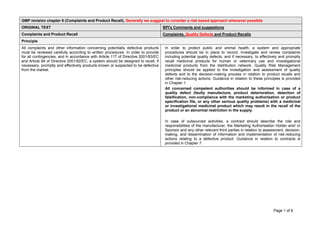
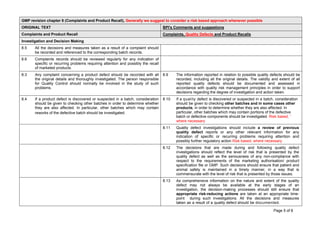
All complaints and other information concerning potentially defective products
must be reviewed carefully according to written procedures. In order to provide
for all contingencies, and in accordance with Article 117 of Directive 2001/83/EC
and Article 84 of Directive 2001/82/EC, a system should be designed to recall, if
necessary, promptly and effectively products known or suspected to be defective
from the market.
In order to protect public and animal health, a system and appropriate
procedures should be in place to record, investigate and review complaints
including potential quality defects, and if necessary, to effectively and promptly
recall medicinal products for human or veterinary use and investigational
medicinal products from the distribution network. Quality Risk Management
principles should be applied to the investigation and assessment of quality
defects and to the decision-making process in relation to product recalls and
other risk-reducing actions. Guidance in relation to these principles is provided
in Chapter 1.
All concerned competent authorities should be informed in case of a
quality defect (faulty manufacture, product deterioration, detection of
falsification, non-compliance with the marketing authorisation or product
specification file, or any other serious quality problems) with a medicinal
or investigational medicinal product which may result in the recall of the
product or an abnormal restriction in the supply.
In case of outsourced activities, a contract should describe the role and
responsibilities of the manufacturer, the Marketing Authorisation Holder and/ or
Sponsor and any other relevant third parties in relation to assessment, decision-
making, and dissemination of information and implementation of risk-reducing
actions relating to a defective product. Guidance in relation to contracts is
provided in Chapter 7.
2.
Page 2 of8
GMP revision chapter 8 (Complaints and Product Recall), Generally we suggest to consider a risk based approach whenever possible
ORIGINAL TEXT BPI's Comments and suggestions
Complaints and Product Recall Complaints, Quality Defects and Product Recalls
Personnel and Organization
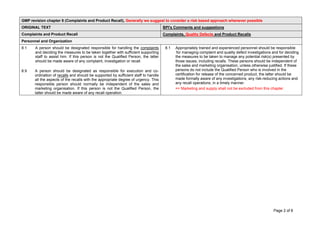
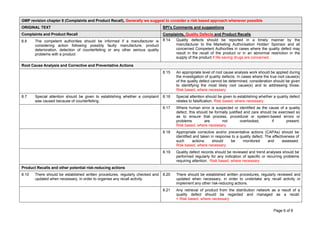
8.1 A person should be designated responsible for handling the complaints
and deciding the measures to be taken together with sufficient supporting
staff to assist him. If this person is not the Qualified Person, the latter
should be made aware of any complaint, investigation or recall.
8.9 A person should be designated as responsible for execution and co-
ordination of recalls and should be supported by sufficient staff to handle
all the aspects of the recalls with the appropriate degree of urgency. This
responsible person should normally be independent of the sales and
marketing organisation. If this person is not the Qualified Person, the
latter should be made aware of any recall operation.
8.1 Appropriately trained and experienced personnel should be responsible
for managing complaint and quality defect investigations and for deciding
the measures to be taken to manage any potential risk(s) presented by
those issues, including recalls. These persons should be independent of
the sales and marketing organisation, unless otherwise justified. If these
persons do not include the Qualified Person who is involved in the
certification for release of the concerned product, the latter should be
made formally aware of any investigations, any risk-reducing actions and
any recall operations, in a timely manner.
=> Marketing and supply shall not be excluded from this chapter
3.
Page 3 of8
GMP revision chapter 8 (Complaints and Product Recall), Generally we suggest to consider a risk based approach whenever possible
ORIGINAL TEXT BPI's Comments and suggestions
Complaints and Product Recall Complaints, Quality Defects and Product Recalls
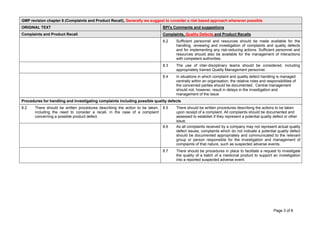
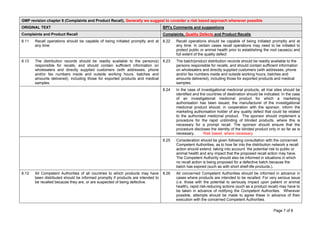
8.2 Sufficient personnel and resources should be made available for the
handling, reviewing and investigation of complaints and quality defects
and for implementing any risk-reducing actions. Sufficient personnel and
resources should also be available for the management of interactions
with competent authorities.
8.3 The use of inter-disciplinary teams should be considered, including
appropriately trained Quality Management personnel.
8.4 In situations in which complaint and quality defect handling is managed
centrally within an organisation, the relative roles and responsibilities of
the concerned parties should be documented. Central management
should not, however, result in delays in the investigation and
management of the issue
Procedures for handling and investigating complaints including possible quality defects
8.2 There should be written procedures describing the action to be taken,
including the need to consider a recall, in the case of a complaint
concerning a possible product defect.
8.5 There should be written procedures describing the actions to be taken
upon receipt of a complaint. All complaints should be documented and
assessed to establish if they represent a potential quality defect or other
issue.
8.6 As all complaints received by a company may not represent actual quality
defect issues, complaints which do not indicate a potential quality defect
should be documented appropriately and communicated to the relevant
group or person responsible for the investigation and management of
complaints of that nature, such as suspected adverse events.
8.7 There should be procedures in place to facilitate a request to investigate
the quality of a batch of a medicinal product to support an investigation
into a reported suspected adverse event.
4.
Page 4 of8
GMP revision chapter 8 (Complaints and Product Recall), Generally we suggest to consider a risk based approach whenever possible
ORIGINAL TEXT BPI's Comments and suggestions
Complaints and Product Recall Complaints, Quality Defects and Product Recalls
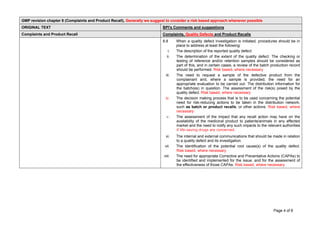
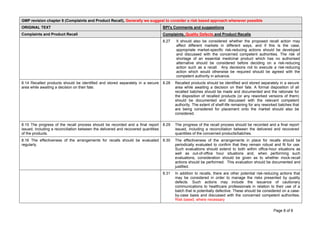
8.8 When a quality defect investigation is initiated, procedures should be in
place to address at least the following:
i. The description of the reported quality defect.
ii. The determination of the extent of the quality defect. The checking or
testing of reference and/or retention samples should be considered as
part of this, and in certain cases, a review of the batch production record
should be performed. Risk based, where necessary
iii. The need to request a sample of the defective product from the
complainant and, where a sample is provided, the need for an
appropriate evaluation to be carried out. The distribution information for
the batch(es) in question. The assessment of the risk(s) posed by the
quality defect. Risk based, where necessary
iv. The decision making process that is to be used concerning the potential
need for risk-reducing actions to be taken in the distribution network,
such as batch or product recalls, or other actions. Risk based, where
necessary
v. The assessment of the impact that any recall action may have on the
availability of the medicinal product to patients/animals in any affected
market and the need to notify any such impacts to the relevant authorities
if life-saving drugs are concerned.
vi. The internal and external communications that should be made in relation
to a quality defect and its investigation.
vii. The identification of the potential root cause(s) of the quality defect.
Risk based, where necessary
viii. The need for appropriate Corrective and Preventative Actions (CAPAs) to
be identified and implemented for the issue, and for the assessment of
the effectiveness of those CAPAs. Risk based, where necessary
5.
Page 5 of8
GMP revision chapter 8 (Complaints and Product Recall), Generally we suggest to consider a risk based approach whenever possible
ORIGINAL TEXT BPI's Comments and suggestions
Complaints and Product Recall Complaints, Quality Defects and Product Recalls
Investigation and Decision Making
8.5 All the decisions and measures taken as a result of a complaint should
be recorded and referenced to the corresponding batch records.
8.6 Complaints records should be reviewed regularly for any indication of
specific or recurring problems requiring attention and possibly the recall
of marketed products.
8.3 Any complaint concerning a product defect should be recorded with all
the original details and thoroughly investigated. The person responsible
for Quality Control should normally be involved in the study of such
problems.
8.9 The information reported in relation to possible quality defects should be
recorded, including all the original details. The validity and extent of all
reported quality defects should be documented and assessed in
accordance with quality risk management principles in order to support
decisions regarding the degree of investigation and action taken.
8.4 If a product defect is discovered or suspected in a batch, consideration
should be given to checking other batches in order to determine whether
they are also affected. In particular, other batches which may contain
reworks of the defective batch should be investigated.
8.10 If a quality defect is discovered or suspected in a batch, consideration
should be given to checking other batches and in some cases other
products, in order to determine whether they are also affected. In
particular, other batches which may contain portions of the defective
batch or defective components should be investigated. Risk based, ˆ
where necessary
8.11 Quality defect investigations should include a review of previous
quality defect reports or any other relevant information for any
indication of specific or recurring problems requiring attention and
possibly further regulatory action Risk based, where necessary
8.12 The decisions that are made during and following quality defect
investigations should reflect the level of risk that is presented by the
quality defect as well as the seriousness of any non-compliance with
respect to the requirements of the marketing authorisation/ product
specification file or GMP. Such decisions should ensure that patient and
animal safety is maintained in a timely manner, in a way that is
commensurate with the level of risk that is presented by those issues.
8.13 As comprehensive information on the nature and extent of the quality
defect may not always be available at the early stages of an
investigation, the decision-making processes should still ensure that
appropriate risk-reducing actions are taken at an appropriate time-
point during such investigations. All the decisions and measures
taken as a result of a quality defect should be documented.
6.
Page 6 of8
GMP revision chapter 8 (Complaints and Product Recall), Generally we suggest to consider a risk based approach whenever possible
ORIGINAL TEXT BPI's Comments and suggestions
Complaints and Product Recall Complaints, Quality Defects and Product Recalls
8.8 The competent authorities should be informed if a manufacturer is
considering action following possibly faulty manufacture, product
deterioration, detection of counterfeiting or any other serious quality
problems with a product
8.14 Quality defects should be reported in a timely manner by the
manufacturer to the Marketing Authorisation Holder/ Sponsor and all
concerned Competent Authorities in cases where the quality defect may
result in the recall of the product or in an abnormal restriction in the
supply of the product if life-saving drugs are concerned.
Root Cause Analysis and Corrective and Preventative Actions
8.15 An appropriate level of root cause analysis work should be applied during
the investigation of quality defects. In cases where the true root cause(s)
of the quality defect cannot be determined, consideration should be given
to identifying the most likely root cause(s) and to addressing those.
Risk based, where necessary
8.7 Special attention should be given to establishing whether a complaint
was caused because of counterfeiting.
8.16 Special attention should be given to establishing whether a quality defect
relates to falsification. Risk based, where necessary
8.17 Where human error is suspected or identified as the cause of a quality
defect, this should be formally justified and care should be exercised so
as to ensure that process, procedural or system-based errors or
problems are not overlooked, if present.
Risk based, where necessary
8.18 Appropriate corrective and/or preventative actions (CAPAs) should be
identified and taken in response to a quality defect. The effectiveness of
such actions should be monitored and assessed.
Risk based, where necessary
8.19 Quality defect records should be reviewed and trend analyses should be
performed regularly for any indication of specific or recurring problems
requiring attention. Risk based, where necessary
Product Recalls and other potential risk-reducing actions
8.10 There should be established written procedures, regularly checked and
updated when necessary, in order to organise any recall activity.
8.20 There should be established written procedures, regularly reviewed and
updated when necessary, in order to undertake any recall activity or
implement any other risk-reducing actions.
8.21 Any retrieval of product from the distribution network as a result of a
quality defect should be regarded and managed as a recall.
= Risk based, where necessary
7.
Page 7 of8
GMP revision chapter 8 (Complaints and Product Recall), Generally we suggest to consider a risk based approach whenever possible
ORIGINAL TEXT BPI's Comments and suggestions
Complaints and Product Recall Complaints, Quality Defects and Product Recalls
8.11 Recall operations should be capable of being initiated promptly and at
any time.
8.22 Recall operations should be capable of being initiated promptly and at
any time. In certain cases recall operations may need to be initiated to
protect public or animal health prior to establishing the root cause(s) and
full extent of the quality defect
8.13 The distribution records should be readily available to the person(s)
responsible for recalls, and should contain sufficient information on
wholesalers and directly supplied customers (with addresses, phone
and/or fax numbers inside and outside working hours, batches and
amounts delivered), including those for exported products and medical
samples.
8.23 The batch/product distribution records should be readily available to the
persons responsible for recalls, and should contain sufficient information
on wholesalers and directly supplied customers (with addresses, phone
and/or fax numbers inside and outside working hours, batches and
amounts delivered), including those for exported products and medical
samples.
8.24 In the case of investigational medicinal products, all trial sites should be
identified and the countries of destination should be indicated. In the case
of an investigational medicinal product for which a marketing
authorisation has been issued, the manufacturer of the investigational
medicinal product should, in cooperation with the sponsor, inform the
marketing authorisation holder of any quality defect that could be related
to the authorised medicinal product. The sponsor should implement a
procedure for the rapid unblinding of blinded products, where this is
necessary for a prompt recall. The sponsor should ensure that the
procedure discloses the identity of the blinded product only in so far as is
necessary. Risk based, where necessary
8.25 Consideration should be given following consultation with the concerned
Competent Authorities, as to how far into the distribution network a recall
action should extend, taking into account the potential risk to public or
animal health and any impact that the proposed recall action may have.
The Competent Authority should also be informed in situations in which
no recall action is being proposed for a defective batch because the
batch has expired (such as with short shelf-life products.).
8.12 All Competent Authorities of all countries to which products may have
been distributed should be informed promptly if products are intended to
be recalled because they are, or are suspected of being defective.
8.26 All concerned Competent Authorities should be informed in advance in
cases where products are intended to be recalled. For very serious issue
(i.e. those with the potential to seriously impact upon patient or animal
health), rapid risk-reducing actions (such as a product recall) may have to
be taken in advance of notifying the Competent Authorities. Wherever
possible, attempts should be made to agree these in advance of their
execution with the concerned Competent Authorities.
8.
Page 8 of8
GMP revision chapter 8 (Complaints and Product Recall), Generally we suggest to consider a risk based approach whenever possible
ORIGINAL TEXT BPI's Comments and suggestions
Complaints and Product Recall Complaints, Quality Defects and Product Recalls
8.27 It should also be considered whether the proposed recall action may
affect different markets in different ways, and if this is the case,
appropriate market-specific risk-reducing actions should be developed
and discussed with the concerned competent authorities. The risk of
shortage of an essential medicinal product which has no authorised
alternative should be considered before deciding on a risk-reducing
action such as a recall. Any decisions not to execute a risk-reducing
action which would otherwise be required should be agreed with the
competent authority in advance.
8.14 Recalled products should be identified and stored separately in a secure
area while awaiting a decision on their fate.
8.28 Recalled products should be identified and stored separately in a secure
area while awaiting a decision on their fate. A formal disposition of all
recalled batches should be made and documented and the rationale for
the disposition of recalled products (or any reworked versions of them)
should be documented and discussed with the relevant competent
authority. The extent of shelf-life remaining for any reworked batches that
are being considered for placement onto the market should also be
considered.
8.15 The progress of the recall process should be recorded and a final report
issued, including a reconciliation between the delivered and recovered quantities
of the products.
8.29 The progress of the recall process should be recorded and a final report
issued, including a reconciliation between the delivered and recovered
quantities of the concerned products/batches.
8.16 The effectiveness of the arrangements for recalls should be evaluated
regularly.
8.30 The effectiveness of the arrangements in place for recalls should be
periodically evaluated to confirm that they remain robust and fit for use.
Such evaluations should extend to both within office-hour situations as
well as out-of-office hour situations and, when performing such
evaluations, consideration should be given as to whether mock-recall
actions should be performed. This evaluation should be documented and
justified.
8.31 In addition to recalls, there are other potential risk-reducing actions that
may be considered in order to manage the risks presented by quality
defects. Such actions may include the issuance of cautionary
communications to healthcare professionals in relation to their use of a
batch that is potentially defective. These should be considered on a case-
by-case basis and discussed with the concerned competent authorities.
Risk based, where necessary