GLP open science meeting 2014, Berlin
Agent Based Mapping
for assessing
socio-economic networks
of mountain tourism as a coupled HES
Tobias Luthe, Romano Wyss
Background
Regional economies are comprising businesses, directly and
indirectly tied together, e.g. by collaborations between
business actors.
Such economies are natural resources dependent
social-economic-ecological systems (SEES).
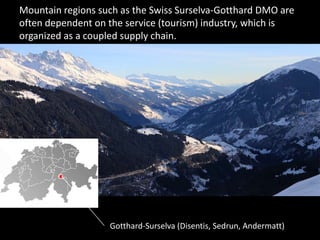
Mountain regions such as the Swiss Surselva-Gotthard DMO are
often dependent on the service (tourism) industry, which is
organized as a coupled supply chain.
Gotthard-Surselva (Disentis, Sedrun, Andermatt)
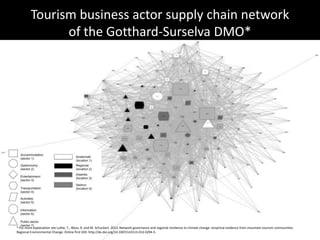
Tourism business actor supply chain network
of the Gotthard-Surselva DMO*
* For more explanation see Luthe, T., Wyss, R. and M. Schuckert. 2012. Network governance and regional resilience to climate change: empirical evidence from mountain tourism communities.
Regional Environmental Change. Online first DOI: http://dx.doi.org/10.1007/s10113-012-0294-5.
Background
Mountain HES have to cope with global change impacts.
Resilience of such systems can be assessed based on network
metrics and their interpretations from a network governance
angle.
Planning resilience and sustainable development in a tourism
geography context requires understanding of the regional and
local socio-economic interrelations and dependencies of the
supply chain, and its ecological embeddedness.
Network governance in a tourism HES
Each (tourism) business is dependent on the other, while still being
competitors: tourists experience the whole supply chain.
Improving network governance is partly dependent on the
awareness of economic dependencies (e.g. distribution of risk and
benefit).
Data to construct and analyse social networks of tourism businesses is
easy to retrieve.
Data to display economic dependencies between regional tourism
actors rarely exists: money flows are global and often no direct
money flows between supply chain actors are available in a
service industry.
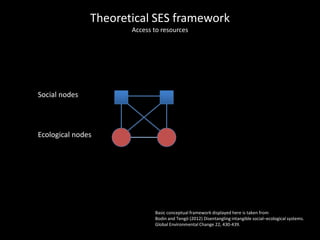
Theoretical SES framework
Access to resources
Social nodes
Ecological nodes
Basic conceptual framework displayed here is taken from
Bodin and Tengö (2012) Disentangling intangible social–ecological systems.
Global Environmental Change 22, 430-439.
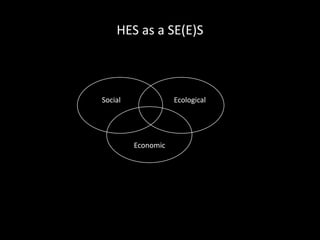
HES as a SE(E)S
Social Ecological
Economic
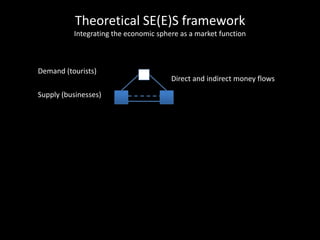
Theoretical SE(E)S framework
Integrating the economic sphere as a market function
Supply (businesses)
Demand (tourists)
Direct and indirect money flows
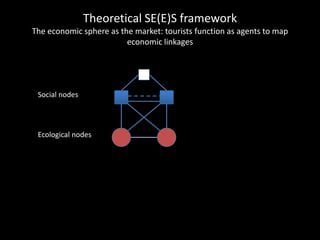
Theoretical SE(E)S framework
The economic sphere as the market: tourists function as agents to map
economic linkages
Social nodes
Ecological nodes
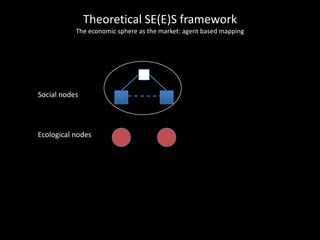
Theoretical SE(E)S framework
The economic sphere as the market: agent based mapping
Social nodes
Ecological nodes
Questions
How can the economic dependencies be included in SE(E)S analysis of
mountain HES?
> How can indirect economic dependencies between tourism supply chain
actors be analysed?
> Can tourists (‚feeding‘ from the supply chain, while being the businesses
‚pray‘) function as agents, indirectly connecting the supply chain by their
spendings and ‚mapping‘ the economic ties?
What additional information delivers the economic network compared to the
collaborative network?
Data collection
Tourists visiting the region for a typical one week stay
filled out a daily questionnaire, noting their spendings in CHF
throughout the businesses of the tourism supply chain.
In total, 43 Agents (tourists) from six hotels in the three
communities indirectly connect 70 businesses with 547 links.
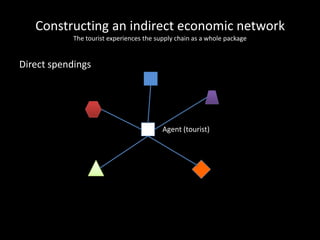
Constructing an indirect economic network
The tourist experiences the supply chain as a whole package
Direct spendings
Agent (tourist)
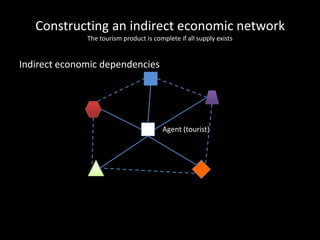
Constructing an indirect economic network
The tourism product is complete if all supply exists
Indirect economic dependencies
Agent (tourist)
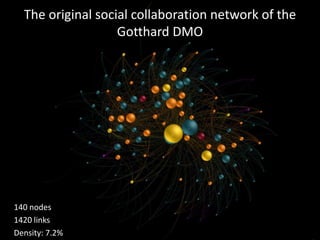
The original social collaboration network of the
Gotthard DMO
140 nodes
1420 links
Density: 7.2%
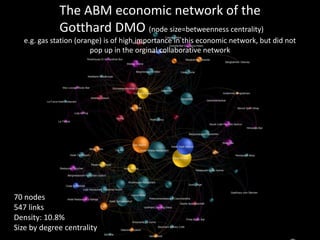
The ABM economic network of the
Gotthard DMO (node size=betweenness centrality)
e.g. gas station (orange) is of high importance in this economic network, but did not
pop up in the orginal collaborative network
70 nodes
547 links
Density: 10.8%
Size by degree centrality
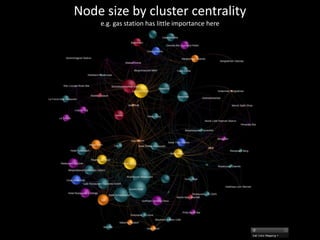
Node size by cluster centrality
e.g. gas station has little importance here
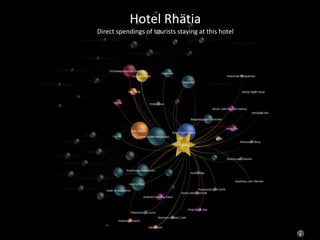
ABM economic network of the Gotthard DMOHotel Rhätia
Direct spendings of tourists staying at this hotel
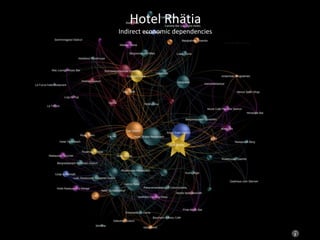
ABM economic network of the Gotthard DMOHotel Rhätia
Indirect economic dependencies
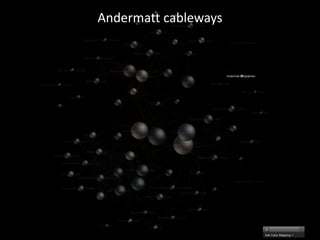
Andermatt cableways
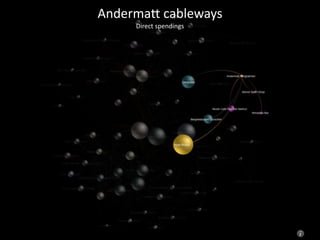
ABM economic network of the Gotthard DMOAndermatt cableways
Direct spendings
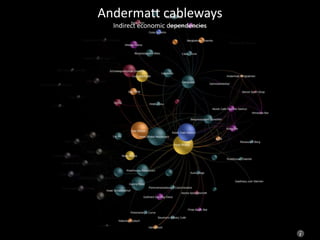
ABM economic network of the Gotthard DMOAndermatt cableways
Indirect economic dependencies
Results and Discussion
An explorative indirect regional economic network was mapped by tourists as
agents; further network metrics can be analyzed
Supply chain interconnections could be displayed
Insights on tourists‘ (agents) consumption behavior could be derived
Different centralities (e.g. degree, cluster, bridging) provide insights on actor
roles from various perspectives, different to the collaborative network
Sample limited to only a small number of hotels
Economic actor weights (=tourists‘ spendings) are of limited value
Better understanding regional competition and dependencies
Economic network is an additional source of information to social
collaborative network, e.g. for planning cooperations and resilience
Possibility of distributing subsidies in a regional, systemic understanding
One step further from social networks to socio-economic-ecological
networks
Conclusions
Tobias.Luthe@htwchur.ch
Romano.Wyss@htwchur.ch
Exploring Agent Based Mapping

Agent Based Mapping for assessing socio-economic networks of mountain tourism as a coupled HES

  • 1.
    GLP open sciencemeeting 2014, Berlin Agent Based Mapping for assessing socio-economic networks of mountain tourism as a coupled HES Tobias Luthe, Romano Wyss
  • 2.
    Background Regional economies arecomprising businesses, directly and indirectly tied together, e.g. by collaborations between business actors. Such economies are natural resources dependent social-economic-ecological systems (SEES).
  • 3.
    Mountain regions suchas the Swiss Surselva-Gotthard DMO are often dependent on the service (tourism) industry, which is organized as a coupled supply chain. Gotthard-Surselva (Disentis, Sedrun, Andermatt)
  • 4.
    Tourism business actorsupply chain network of the Gotthard-Surselva DMO* * For more explanation see Luthe, T., Wyss, R. and M. Schuckert. 2012. Network governance and regional resilience to climate change: empirical evidence from mountain tourism communities. Regional Environmental Change. Online first DOI: http://dx.doi.org/10.1007/s10113-012-0294-5.
  • 5.
    Background Mountain HES haveto cope with global change impacts. Resilience of such systems can be assessed based on network metrics and their interpretations from a network governance angle. Planning resilience and sustainable development in a tourism geography context requires understanding of the regional and local socio-economic interrelations and dependencies of the supply chain, and its ecological embeddedness.
  • 6.
    Network governance ina tourism HES Each (tourism) business is dependent on the other, while still being competitors: tourists experience the whole supply chain. Improving network governance is partly dependent on the awareness of economic dependencies (e.g. distribution of risk and benefit). Data to construct and analyse social networks of tourism businesses is easy to retrieve. Data to display economic dependencies between regional tourism actors rarely exists: money flows are global and often no direct money flows between supply chain actors are available in a service industry.
  • 7.
    Theoretical SES framework Accessto resources Social nodes Ecological nodes Basic conceptual framework displayed here is taken from Bodin and Tengö (2012) Disentangling intangible social–ecological systems. Global Environmental Change 22, 430-439.
  • 8.
    HES as aSE(E)S Social Ecological Economic
  • 9.
    Theoretical SE(E)S framework Integratingthe economic sphere as a market function Supply (businesses) Demand (tourists) Direct and indirect money flows
  • 10.
    Theoretical SE(E)S framework Theeconomic sphere as the market: tourists function as agents to map economic linkages Social nodes Ecological nodes
  • 11.
    Theoretical SE(E)S framework Theeconomic sphere as the market: agent based mapping Social nodes Ecological nodes
  • 12.
    Questions How can theeconomic dependencies be included in SE(E)S analysis of mountain HES? > How can indirect economic dependencies between tourism supply chain actors be analysed? > Can tourists (‚feeding‘ from the supply chain, while being the businesses ‚pray‘) function as agents, indirectly connecting the supply chain by their spendings and ‚mapping‘ the economic ties? What additional information delivers the economic network compared to the collaborative network?
  • 13.
    Data collection Tourists visitingthe region for a typical one week stay filled out a daily questionnaire, noting their spendings in CHF throughout the businesses of the tourism supply chain. In total, 43 Agents (tourists) from six hotels in the three communities indirectly connect 70 businesses with 547 links.
  • 14.
    Constructing an indirecteconomic network The tourist experiences the supply chain as a whole package Direct spendings Agent (tourist)
  • 15.
    Constructing an indirecteconomic network The tourism product is complete if all supply exists Indirect economic dependencies Agent (tourist)
  • 16.
    The original socialcollaboration network of the Gotthard DMO 140 nodes 1420 links Density: 7.2%
  • 17.
    The ABM economicnetwork of the Gotthard DMO (node size=betweenness centrality) e.g. gas station (orange) is of high importance in this economic network, but did not pop up in the orginal collaborative network 70 nodes 547 links Density: 10.8% Size by degree centrality
  • 18.
    Node size bycluster centrality e.g. gas station has little importance here
  • 19.
    ABM economic networkof the Gotthard DMOHotel Rhätia
  • 20.
    ABM economic networkof the Gotthard DMOHotel Rhätia Direct spendings of tourists staying at this hotel
  • 21.
    ABM economic networkof the Gotthard DMOHotel Rhätia Indirect economic dependencies
  • 22.
  • 23.
    ABM economic networkof the Gotthard DMOAndermatt cableways Direct spendings
  • 24.
    ABM economic networkof the Gotthard DMOAndermatt cableways Indirect economic dependencies
  • 25.
    Results and Discussion Anexplorative indirect regional economic network was mapped by tourists as agents; further network metrics can be analyzed Supply chain interconnections could be displayed Insights on tourists‘ (agents) consumption behavior could be derived Different centralities (e.g. degree, cluster, bridging) provide insights on actor roles from various perspectives, different to the collaborative network Sample limited to only a small number of hotels Economic actor weights (=tourists‘ spendings) are of limited value
  • 26.
    Better understanding regionalcompetition and dependencies Economic network is an additional source of information to social collaborative network, e.g. for planning cooperations and resilience Possibility of distributing subsidies in a regional, systemic understanding One step further from social networks to socio-economic-ecological networks Conclusions
  • 27.

Editor's Notes

  • #14 Standard categories in tourismresearchRef. ?
  • #17 Standard categories in tourismresearchRef. ?
  • #18 Standard categories in tourismresearchRef. ?
  • #19 Standard categories in tourismresearchRef. ?
  • #20 Standard categories in tourismresearchRef. ?
  • #21 Standard categories in tourismresearchRef. ?
  • #22 Standard categories in tourismresearchRef. ?
  • #23 Standard categories in tourismresearchRef. ?
  • #24 Standard categories in tourismresearchRef. ?
  • #25 Standard categories in tourismresearchRef. ?