Business Process Management The way we see it


Global Business Process
Management Report
Contents

    Foreword								                                                    3

    About the study							                                              4

    Executive summary							                                            6

    The key to BPM success: BPM as a C-level concern			                 8

    How may I help you? The key benefits of BPM				                    10

    	        Cost efficiency						                                     10
    	        Business agility						                                    12
    	        Compliance 						                                         14
    	        Customer-centricity					                                  15
    	        Social media strategy					                                19
    	        Staff satisfaction					                                   20

    Show me the money: BPM and Return on Investment			                 21

    Speculating to accumulate: BPM as a counter-cyclical investment	   23

    Barriers to BPM implementation					                                25

    Key conclusions and recommendations					                           29

    Capgemini sector and country focus					                            32

    	        Financial services					                                   33
    	        Public sector						                                       36
    	        Manufacturing, automotive and life sciences		             38
    	        Consumer products and retail				                          40
    	        Telecommunications, media and entertainment		             42

    	        United Kingdom						                                      45
    	        United States						                                       46
    	        Australia						                                           47
    	        Germany						                                             48
    	        Italy							                                              49
    	        France					                                               50
    	        Spain							                                              51
    	        Nordic Region						                                       52
    	        Netherlands				                                           53

    Acknowledgements							                                            54


2
Foreword
Welcome to the Capgemini Global            BPM become an integral and                  barriers to success. Management
Business Process Management                key part of this proposition.               of change in such endeavours is a
(BPM) Report. This report is an                                                        key part in enabling the appropriate
exploration of key trends in BPM as        Business Process Management is              alignment of business and technology
seen by CXOs across a broad selection      becoming ever more relevant to both         to support their transformation
of sectors and geographies. BPM            large and small organizations in the        efforts. I hope that you find this report
is perhaps at a tipping point – it’s       current economic climate. At a time         of benefit in the further adoption of
certainly at an exciting stage in its      when many different market sectors are      Business Process Management.
evolution. As both an engineer and         facing slow revenue growth, customer
an Operational Research practitioner       churn and increased pressures
in my early career, and subsequently       on costs, BPM becomes a critical
as a consultant, I have seen BPM           weapon in the battle for efficiency         Bob Scott
through its development over the           and effectiveness in processes.             Senior Vice President
last 26 years. BPM has its roots in        Furthermore, in a challenging and           Global Head of BPM
management practices such as Total         changing business environment               Capgemini
Quality Management, Business               that is characterized by uncertainty,
Process Reengineering & Model Based        it allows organizations to adapt, be
Development; but the advent of the new     more agile and fleet of foot. Capgemini
generation of sophisticated modelling      are seeing strong demand for BPM
and process execution technologies         services in markets such as USA,
has greatly enhanced BPM’s power           UK, the Netherlands and France;
to truly transform businesses. This        and there are clear signs of increased
has created one of the most rapidly        interest in other geographies such as,
growing and attractive market sectors      Germany, Sweden, Spain, Italy and
for both services and technology. We       Australia. In sector terms, the financial
see BPM as a critical management           services industry has led the way in
discipline that when executed against      BPM adoption over the recent past,
clear, cross organizational business       driven by increased focus on customer-
objectives, can deliver exceptional        centricity and regulatory compliance.
value to that organization. However,       Other sectors, public sector, utilities,
we also see that the potential for BPM     telco, retail and manufacturing are now
is not well understood. Our decision to    not only catching up, but are starting
conduct this global survey was driven      to use BPM in new ways to create new
by our discussions with our clients,       business models to serve customers
to understand their current position,      and outsmart the competition.
their understanding, how its value
was measured, how it is used and           The research findings also show
prioritized within their Business and      however that this is a complex
Technology Transformation efforts.         landscape, and we are not seeing
                                           adoption of BPM in a clear and
This research confirms our belief          consistent way. This report also looks
that BPM needs to be a jointly owned       at some of the barriers to adoption,
Business and IT discipline. It also        with organizational silos being a
demonstrates that it is starting to gain   major obstacle. Waters are further
significant traction in the market         muddied by fragmented budgets, lack
and investments are starting to pay        of clear governance and ownership
dividends to the early adopters. At        and internal politics. The objective
Capgemini we are being asked by            of our investment in this research
our clients to help them simplify          project was to shed some light on
and improve their business models          these elements with a view to assisting
and the technology that supports           organizations to create strategies that
them and we are already seeing             avoid or at least mitigate some of these


3
About the study
Capgemini worked with FreshMinds,       Only participants from firms with        The second, qualitative phase of the
a UK-based research firm, to conduct    more than 1,000 employees were           research comprised a series of in-depth
the primary research for this study.    eligible for the survey. 55% of survey   qualitative interviews with senior
The research process consisted of       participants were drawn from             business and IT professionals drawn
two complementary phases.               enterprise companies with 10,000+        from the networks of both Capgemini
                                        employees, 16% from large companies      and FreshMinds Research. These
During the initial quantitative phase   with 5,001-10,000 employees and          individuals were selected to represent
of the research, a 30 minute online     29% from mid-size companies              a cross-section of geographies and
survey was completed by over 1,100      with 1,001-5,000 employees.              sectors, and were selected for their
CXOs, senior business managers, IT                                               practical experience of Business
directors and managers, and other       Respondents were drawn quite             Process Management initiatives.
senior business decision-makers.        evenly from 11 markets:
                                                                                 In each section of the report, our
All major industries were               •	   Australia                           insights are based on the quantitative
represented in the study:                                                        findings from the primary research,
                                        •	   Brazil                              illustrated by graphical representations
•	   Distribution and transport                                                  of the data. These are supported and
                                        •	   France                              illustrated by anecdotal findings
•	   Financial services                                                          and quotations from the qualitative
                                        •	   Germany                             interviews that comprised the
•	   Public sector                                                               secondary phase of the research. In the
                                        •	   India                               sections labelled ‘Capgemini view’ we
•	   Manufacturing, automotive                                                   have added supplementary analysis
     and life sciences                  •	   Netherlands                         that is drawn from our consultants’
                                                                                 experience of working on BPM projects.
•	   Education and science              •	   Italy

•	   Consumer products and retail       •	   Spain

•	   Telecommunications, media          •	   Nordic Region
     and entertainment
                                        •	   UK
•	   Utilities, energy and chemicals
                                        •	   USA
•	   Professional services

•	   Healthcare


4
5
Global Business Process
Management Report
Executive Summary
Capgemini’s Business Process Management research examines
current practice in BPM, the benefits being achieved and the
barriers to success. A key theme is the relationship between
executive-level sponsorship of BPM and its success.
The purpose of our research is to               survey respondents who have both                   say that their business processes are
help organizations understand what              knowledge and practical experience                 either “managed” or “optimized” − the
is involved in realizing the benefits           of the topic, 82% believe that BPM                 top two levels of process maturity
of BPM, and avoid the pitfalls that             should be treated as a C-level concern.            as defined by our maturity model.
many have already encountered.
                                                There is a correlation between process
BPM has an increasingly high profile,           maturity and treating BPM as a C-level
with a growing belief among large               topic. 68% of survey respondents
organizations that BPM should                   who state that BPM is an important
be sponsored at a senior level. Of              agenda item at managerial level also


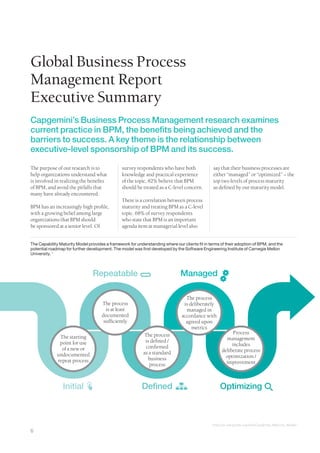
The Capability Maturity Model provides a framework for understanding where our clients fit in terms of their adoption of BPM, and the
potential roadmap for further development. The model was first developed by the Software Engineering Institute of Carnegie Mellon
University. 1


                                Repeatable                                     Managed

                                                                                 The process
                                     The process                                is deliberately
                                       is at least                               managed in
                                     documented                                accordance with
                                      sufficiently                               agreed upon
                                                                                    metrics
                                                           The process                                        Process
              The starting                                                                                management
              point for use                                 is defined /
                                                            confirmed                                        includes
               of a new or                                                                              deliberate process
             undocumented                                  as a standard
                                                             business                                     optimization /
             repeat process                                                                               improvement
                                                              process


                 Initial                                  Defined                                      Optimizing


                                                                                               1
                                                                                                   http://en.wikipedia.org/wiki/Capability_Maturity_Model

6
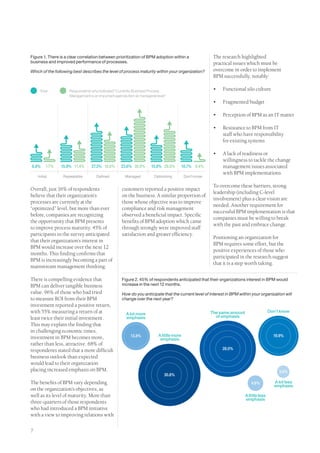
Figure 1. There is a clear correlation between prioritization of BPM adoption within a                    The research highlighted
business and improved performance of processes.                                                           practical issues which must be
Which of the following best describes the level of process maturity within your organization?             overcome in order to implement
                                                                                                          BPM successfully, notably:

     Total           Respondents who indicated “Currently Business Process                                •	   Functional silo culture
                     Management is an important agenda item at managerial level”
                                                                                                          •	   Fragmented budget

                                                                                                          •	   Perception of BPM as an IT matter

                                                                                                          •	   Resistance to BPM from IT
                                                                                                               staff who have responsibility
                                                                                                               for existing systems

                                                                                                          •	   A lack of readiness or
                                                                                                               willingness to tackle the change
6.8%      1.7%   15.9% 11.4%      27.3% 18.8%       23.6% 38.9%        15.8% 28.8%         10.7% 0.4%          management issues associated
                                                                                                               with BPM implementations
    Initial       Repeatable         Defined           Managed          Optimizing          Don’t know

                                                                                                          To overcome these barriers, strong
Overall, just 16% of respondents                     customers reported a positive impact
                                                                                                          leadership (including C-level
believe that their organization’s                    on the business. A similar proportion of
                                                                                                          involvement) plus a clear vision are
processes are currently at the                       those whose objective was to improve
                                                                                                          needed. Another requirement for
“optimized” level, but more than ever                compliance and risk management
                                                                                                          successful BPM implementation is that
before, companies are recognizing                    observed a beneficial impact. Specific
                                                                                                          companies must be willing to break
the opportunity that BPM presents                    benefits of BPM adoption which came
                                                                                                          with the past and embrace change.
to improve process maturity. 45% of                  through strongly were improved staff
participants in the survey anticipated               satisfaction and greater efficiency.
                                                                                                          Positioning an organization for
that their organization’s interest in
                                                                                                          BPM requires some effort, but the
BPM would increase over the next 12
                                                                                                          positive experiences of those who
months. This finding confirms that
                                                                                                          participated in the research suggest
BPM is increasingly becoming a part of
                                                                                                          that it is a step worth taking.
mainstream management thinking.

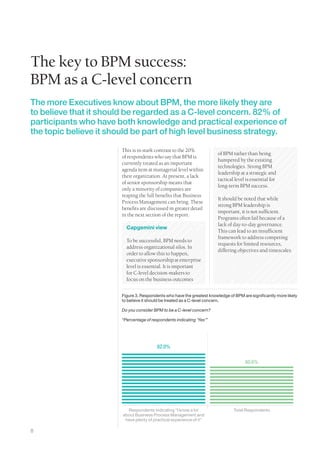
There is compelling evidence that                    Figure 2. 45% of respondents anticipated that their organizations interest in BPM would
BPM can deliver tangible business                    increase in the next 12 months.
value. 96% of those who had tried                    How do you anticipate that the current level of interest in BPM within your organization will
to measure ROI from their BPM                        change over the next year?
investment reported a positive return,
with 55% measuring a return of at                                                                        The same amount                   Don’t know
                                                       A lot more
least twice their initial investment.                  emphasis                                            of emphasis
This may explain the finding that
in challenging economic times,
                                                          13.8%            A little more                                                     19.9%
investment in BPM becomes more,                                             emphasis
rather than less, attractive. 68% of
respondents stated that a more difficult                                                                       28.0%
business outlook than expected
would lead to their organization
placing increased emphasis on BPM.                                                                                                              3.0%
                                                                              30.8%
The benefits of BPM vary depending                                                                                            4.6%           A lot less
                                                                                                                                             emphasis
on the organization’s objectives, as
well as its level of maturity. More than                                                                                   A little less
                                                                                                                           emphasis
three-quarters of those respondents
who had introduced a BPM initiative
with a view to improving relations with


7
The key to BPM success:
BPM as a C-level concern
The more Executives know about BPM, the more likely they are
to believe that it should be regarded as a C-level concern. 82% of
participants who have both knowledge and practical experience of
the topic believe it should be part of high level business strategy.

                        This is in stark contrast to the 20%
                                                                         of BPM rather than being
                        of respondents who say that BPM is
                                                                         hampered by the existing
                        currently treated as an important
                                                                         technologies. Strong BPM
                        agenda item at managerial level within
                                                                         leadership at a strategic and
                        their organization. At present, a lack
                                                                         tactical level is essential for
                        of senior sponsorship means that
                                                                         long-term BPM success.
                        only a minority of companies are
                        reaping the full benefits that Business
                                                                         It should be noted that while
                        Process Management can bring. These
                                                                         strong BPM leadership is
                        benefits are discussed in greater detail
                                                                         important, it is not sufficient.
                        in the next section of the report.
                                                                         Programs often fail because of a
                                                                         lack of day-to-day governance.
                          Capgemini view
                                                                         This can lead to an insufficient
                                                                         framework to address competing
                          To be successful, BPM needs to
                                                                         requests for limited resources,
                          address organizational silos. In
                                                                         differing objectives and timescales.
                          order to allow this to happen,
                          executive sponsorship at enterprise
                          level is essential. It is important
                          for C-level decision-makers to
                          focus on the business outcomes


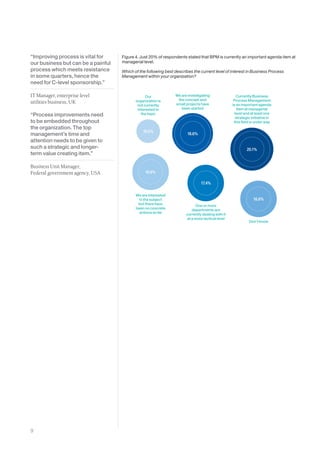
                        Figure 3. Respondents who have the greatest knowledge of BPM are significantly more likely
                        to believe it should be treated as a C-level concern.

                        Do you consider BPM to be a C-level concern?

                        “Percentage of respondents indicating ‘Yes’”


                                          82.0%

                                                                                       60.6%


                          Respondents indicating “I know a lot                   Total Respondents
                        about Business Process Management and
                         have plenty of practical experience of it”

8
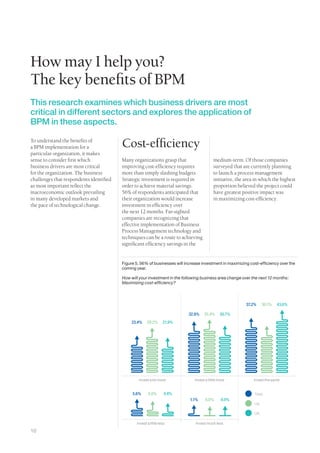
“Improving process is vital for     Figure 4. Just 20% of respondents stated that BPM is currently an important agenda item at
our business but can be a painful   managerial level.
process which meets resistance      Which of the following best describes the current level of interest in Business Process
in some quarters, hence the         Management within your organization?
need for C-level sponsorship.”

IT Manager, enterprise level                     Our            We are investigating                 Currently Business
                                           organization is       the concept and                   Process Management
utilities business, UK                                          small projects have               is an important agenda
                                            not currently
                                            interested in          been started                       item at managerial
“Process improvements need                    the topic                                             level and at least one
                                                                                                     strategic initiative in
to be embedded throughout                                                                          this field is under way
the organization. The top
                                               10.5%
management’s time and                                                  18.6%
attention needs to be given to
such a strategic and longer-                                                                               20.1%
term value creating item.”

Business Unit Manager,
Federal government agency, USA                  16.6%

                                                                               17.4%

                                           We are interested
                                             in the subject                                                    16.8%
                                            but there have                 One or more
                                           been no concrete              departments are
                                             actions so far           currently dealing with it
                                                                      at a more tactical level
                                                                                                             Don’t know


9
How may I help you?
The key benefits of BPM
This research examines which business drivers are most
critical in different sectors and explores the application of
BPM in these aspects.

To understand the benefits of
a BPM implementation for a               Cost-efficiency
particular organization, it makes
sense to consider first which            Many organizations grasp that                     medium-term. Of those companies
business drivers are most critical       improving cost-efficiency requires                surveyed that are currently planning
for the organization. The business       more than simply slashing budgets.                to launch a process management
challenges that respondents identified   Strategic investment is required in               initiative, the area in which the highest
as most important reflect the            order to achieve material savings.                proportion believed the project could
macroeconomic outlook prevailing         56% of respondents anticipated that               have greatest positive impact was
in many developed markets and            their organization would increase                 in maximizing cost-efficiency.
the pace of technological change.        investment in efficiency over
                                         the next 12 months. Far-sighted
                                         companies are recognizing that
                                         effective implementation of Business
                                         Process Management technology and
                                         techniques can be a route to achieving
                                         significant efficiency savings in the


                                         Figure 5. 56% of businesses will increase investment in maximizing cost-efficiency over the
                                         coming year.

                                         How will your investment in the following business area change over the next 12 months:
                                         Maximizing cost-efficiency?


                                                                                                           37.2%    30.1%   43.0%

                                                                            32.8%    35.4%      30.7%
                                              23.4%    29.2%      21.9%


                                                  Invest a lot more            Invest a little more            Invest the same


                                              5.6%      5.0%       4.4%                                        Total
                                                                            1.1%      0.0%      0.0%
                                                                                                               US

                                                                                                               UK

                                                Invest a little less           Invest much less

10
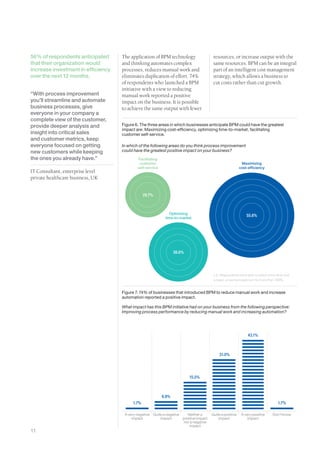
56% of respondents anticipated      The application of BPM technology                    resources, or increase output with the
that their organization would       and thinking automates complex                       same resources. BPM can be an integral
increase investment in efficiency   processes, reduces manual work and                   part of an intelligent cost management
over the next 12 months.            eliminates duplication of effort. 74%                strategy, which allows a business to
                                    of respondents who launched a BPM                    cut costs rather than cut growth.
                                    initiative with a view to reducing
“With process improvement           manual work reported a positive
you’ll streamline and automate      impact on the business. It is possible
business processes, give            to achieve the same output with fewer
everyone in your company a
complete view of the customer,
provide deeper analysis and         Figure 6. The three areas in which businesses anticipate BPM could have the greatest
                                    impact are: Maximizing cost-efficiency, optimizing time-to-market, facilitating
insight into critical sales         customer self-service.
and customer metrics, keep
everyone focused on getting         In which of the following areas do you think process improvement
new customers while keeping         could have the greatest positive impact on your business?
the ones you already have.”                 Facilitating
                                             customer                                                       Maximizing
                                            self-service                                                   cost-efficiency
IT Consultant, enterprise level
private healthcare business, UK


                                                29.7%


                                                              Optimizing
                                                                                                               55.8%
                                                            time-to-market


                                                                  38.8%


                                                                                         n.b. Respondents were able to select more than one
                                                                                         answer, so percentages sum to more than 100%.


                                    Figure 7. 74% of businesses that introduced BPM to reduce manual work and increase
                                    automation reported a positive impact.

                                    What impact has this BPM initiative had on your business from the following perspective:
                                    Improving process performance by reducing manual work and increasing automation?


                                                                                                                43.1%


                                                                                             31.0%


                                                                          15.5%


                                                           6.9%
                                         1.7%                                                                                      1.7%

                                     A very negative Quite a negative   Neither a       Quite a positive    A very positive     Don’t know
                                         impact          impact       positive impact       impact              impact
                                                                      nor a negative
                                                                          impact
11
Business Agility
In uncertain economic times, business agility is important. As
technology cycles move ever more quickly, businesses are constantly
striving to cut cycle times: two thirds of respondents (66%) identified
optimizing time-to-market as an important business driver.

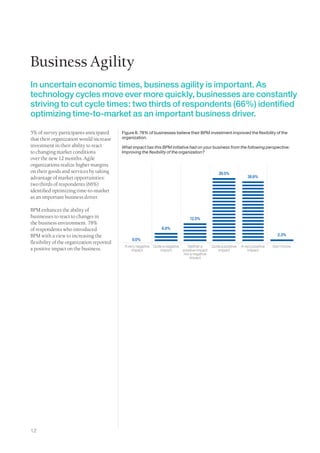
5% of survey participants anticipated      Figure 8. 78% of businesses believe their BPM investment improved the flexibility of the
that their organization would increase     organization.
investment in their ability to react       What impact has this BPM initiative had on your business from the following perspective:
to changing market conditions              Improving the flexibility of the organization?
over the new 12 months. Agile
organizations realize higher margins
on their goods and services by taking                                                              39.5%
advantage of market opportunities:                                                                                    38.6%
two thirds of respondents (66%)
identified optimizing time-to-market
as an important business driver.

BPM enhances the ability of
businesses to react to changes in                                                12.5%
the business environment. 78%
of respondents who introduced                                    6.8%
BPM with a view to increasing the                                                                                                     2.3%
                                                0.0%
flexibility of the organization reported
                                            A very negative Quite a negative   Neither a       Quite a positive   A very positive   Don’t know
a positive impact on the business.              impact          impact       positive impact       impact             impact
                                                                             nor a negative
                                                                                 impact


12
“Taking the attitude that ‘it has
 Capgemini view                         Rules management
                                                                               always worked like this’ is no
                                                                               way to compete. We are a lean
 Any organization looking to            Organizations manage their
                                                                               organization, constantly trying to
 achieve business agility must          interactions with the external
                                                                               stay ahead of the competition.”
 embrace three key concepts that        world through documented and
 we like to call “the agile agenda”:    agreed policies and procedures:
                                                                               Customer Services Manager, medium-
                                        processes are just one example.
                                                                               sized manufacturing business, Sweden
 •	   Process management                Business rules are explicit policies
                                        embedded within processes.
 •	   Rule management
                                        The ease with which these rules
 •	   Integration and automation        can be adapted to comply with
                                        regulatory or market pressure can
 Process management                     often be a source of competitive
                                        advantage. Organizations that
 To be agile, organizations             know the value of rules often use
 must also be in control of             decision engines to find, update,
 their process assets. Processes        deploy, and maintain rules
 must be documented and                 across processes in real time.
 understood. They must be visible
 and measured continuously –            BPM is moving into an
 ideally in real time – to ensure       unstructured, collaborative age.
 compliance with shifting market        Rules management will be the
 and regulatory objectives.             way to stay properly governed,
                                        visible, and compliant, while
 Business Process Management            dynamically keeping processes on
 (BPM) solutions provide modeling       track with changing and complex
 capabilities that make processes       desired outcomes, goals and KPIs.
 explicit as models. These models
 are created by, or in collaboration    It will become increasingly
 with, end users. More importantly,     important to set rules properly
 they can be updated by users           in order to manage BPM for
 without recourse to IT.                increased agility. There will
                                        be a premium on managing
 Regardless of who makes changes,       uncertainty, and on making better
 the agility comes from the fact that   decisions about business rules.
 the changes are made to explicit       Simulation and optimization
 models rather than changes to          techniques can help, and so can
 lines and lines of arcane code.        real-time analysis and response.


13
Compliance
Compliance is at the forefront of the minds of business
decision-makers. Large organizations face great pressure to
demonstrate their adherence to rules in an ongoing fashion.


More than 77% of respondents         70% of participants indicated that
who introduced BPM with a view       responding to changes to legislation                    implementation of BPM. Interest
to improving compliance and risk     is an important consideration for their                 in BPM is also growing rapidly
management reported that the         business. If companies do not have                      in traditionally heavily regulated
initiative had a positive impact     an agile, flexible system for handling                  industries such as life sciences and
on their business in this regard.    compliance it can be a costly business.                 aerospace. Application of BPM can
                                                                                             allow businesses a great advantage
                                     Within BPM systems, companies can                       in terms of accommodating new
“In the past, there were stand-      build compliance into their business                    legislation quickly and with
alone systems followed in            rules. Processes produce automated                      minimum disruption. BPM allows
each department and there            reports, demonstrating adherence                        companies to isolate specific rules
was no cohesive or effective         to legislation in an immediate, cost-                   that may be subject to change and
coordination between these           efficient way. More than 77% of                         treat them in a certain way, so that
systems. For every purchase          respondents who introduced BPM                          instead of having to rebuild an
order, for example, people from      with a view to improving compliance                     application or process each time
three different departments used     and risk management reported that                       legislation changes, it is possible
to be involved and there was a       the initiative had a positive impact                    to retain the 80-90% of rules that
chance of violating commercial       on their business in this regard.                       hardly change. For example, a
or legal laws as compliance was                                                              BPM application can be adjusted
only taken into consideration          Capgemini view                                        to reflect new tax legislation at
at the end of the process,                                                                   the end of each tax year, without
rather than at every stage.”           Rafts of new legislation in sectors                   having to rewrite the entire system.
                                       such as banking and insurance are
Deputy General Manager of Finance,     providing the impetus for the
large utilities business, India

                                     Figure 9. 77% of businesses that introduced BPM to improve compliance and risk
                                     management reported a positive impact.

                                     What impact has this BPM initiative had on your business from the following
                                     perspective: Improvement of compliance and risk management?


                                                                                                                39.0%
                                                                                             38.1%


                                                                           12.7%

                                                           6.8%
                                                                                                                                2.5%
                                          0.8%

                                      A very negative Quite a negative   Neither a       Quite a positive   A very positive   Don’t know
                                          impact          impact       positive impact       impact             impact
                                                                       nor a negative
                                                                           impact


14
Customer-centricity
For consumer-facing businesses, the advent of new technology
has radically changed the way in which they engage with
their customers. In the age of always-on, ubiquitous access,
companies have to respond faster than ever before.

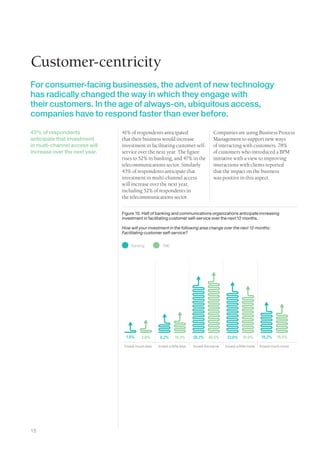
43% of respondents             41% of respondents anticipated                        Companies are using Business Process
anticipate that investment     that their business would increase                    Management to support new ways
in multi-channel access will   investment in facilitating customer self-             of interacting with customers. 78%
increase over the next year.   service over the next year. The figure                of customers who introduced a BPM
                               rises to 52% in banking, and 47% in the               initiative with a view to improving
                               telecommunications sector. Similarly                  interactions with clients reported
                               43% of respondents anticipate that                    that the impact on the business
                               investment in multi-channel access                    was positive in this aspect.
                               will increase over the next year,
                               including 52% of respondents in
                               the telecommunications sector.


                               Figure 10. Half of banking and communications organizations anticipate increasing
                               investment in facilitating customer self-service over the next 12 months.

                               How will your investment in the following area change over the next 12 months:
                               Facilitating customer self-service?


                                    Banking          TME


                                 1.8%     2.6%      8.2%      10.3%       38.2%   40.5%      33.6%     31.0%       18.2%    15.5%

                                Invest much less   Invest a little less   Invest the same   Invest a little more   Invest much more


15
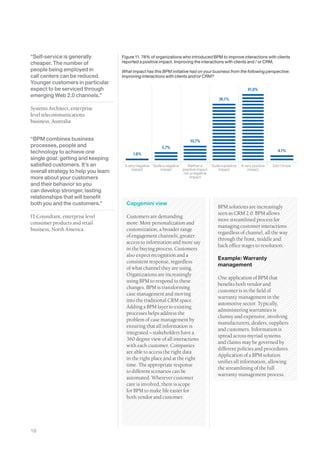
“Self-service is generally           Figure 11. 78% of organizations who introduced BPM to improve interactions with clients
cheaper. The number of               reported a positive impact. Improving the interactions with clients and / or CRM.
people being employed in             What impact has this BPM initiative had on your business from the following perspective:
call centers can be reduced.         Improving interactions with clients and/or CRM?
Younger customers in particular
expect to be serviced through                                                                                   41.8%
emerging Web 2.0 channels.”
                                                                                             36.1%

Systems Architect, enterprise
level telecommunications
business, Australia


“BPM combines business                                                     10.7%
processes, people and                                      5.7%
technology to achieve one                                                                                                       4.1%
                                          1.6%
single goal: getting and keeping
satisfied customers. It’s an          A very negative Quite a negative   Neither a       Quite a positive   A very positive   Don’t know
                                          impact          impact       positive impact       impact             impact
overall strategy to help you learn                                     nor a negative
more about your customers                                                  impact
and their behavior so you
can develop stronger, lasting
relationships that will benefit
both you and the customers.”           Capgemini view
                                                                                             BPM solutions are increasingly
                                                                                             seen as CRM 2.0. BPM allows
IT Consultant, enterprise level        Customers are demanding
                                                                                             more streamlined process for
consumer products and retail           more: More personalization and
                                                                                             managing customer interactions
business, North America                customization, a broader range
                                                                                             regardless of channel, all the way
                                       of engagement channels, greater
                                                                                             through the front, middle and
                                       access to information and more say
                                                                                             back office stages to resolution.
                                       in the buying process. Customers
                                       also expect recognition and a
                                                                                             Example: Warranty
                                       consistent response, regardless
                                                                                             management
                                       of what channel they are using.
                                       Organizations are increasingly
                                                                                             One application of BPM that
                                       using BPM to respond to these
                                                                                             benefits both vendor and
                                       changes. BPM is transforming
                                                                                             customer is in the field of
                                       case management and moving
                                                                                             warranty management in the
                                       into the traditional CRM space.
                                                                                             automotive sector. Typically,
                                       Adding a BPM layer to existing
                                                                                             administering warranties is
                                       processes helps address the
                                                                                             clumsy and expensive, involving
                                       problem of case management by
                                                                                             manufacturers, dealers, suppliers
                                       ensuring that all information is
                                                                                             and customers. Information is
                                       integrated – stakeholders have a
                                                                                             spread across myriad systems
                                       360 degree view of all interactions
                                                                                             and claims may be governed by
                                       with each customer. Companies
                                                                                             different policies and procedures.
                                       are able to access the right data
                                                                                             Application of a BPM solution
                                       in the right place and at the right
                                                                                             unifies all information, allowing
                                       time. The appropriate response
                                                                                             the streamlining of the full
                                       to different scenarios can be
                                                                                             warranty management process.
                                       automated. Wherever customer
                                       care is involved, there is scope
                                       for BPM to make life easier for
                                       both vendor and customer.


16
Case Study – Business Process
Management and customer-centricity
Challenge: A Dutch software business which sells book-keeping
and HR software wanted to improve customer retention.

The company redesigned its complaints procedure,            Benefits of the approach
adopting BPM software and thinking to improve
internal communication between departments                  This rigorous complaints procedure has delivered tangible
and external engagement with customers.                     business value. There is a higher level of customer retention.
                                                            Complaints are far less likely to result in the cancellation of
What the process looked like before                         subscriptions. In fact, the rate of subscription cancellation
                                                            is actually 7% lower for customers who complained and
For years the company had no central customer service       had their problem addressed than for those who did not
department. Customers were directed in an ad hoc fashion    complain in the first place. Finally, there is a greater culture
to either sales or product departments, depending on        of cross-departmental collaboration within the organization.
the nature of their complaint. The lack of process led
to departments shifting responsibility for complaints.
Employees gave inconsistent answers to customers
posing similar questions due to lack of documented          “Everyone in the organization was trying to
procedure, causing confusion and further complaints.        avoid taking any responsibility, saying ‘it’s
                                                            not our department, it’s their department who
What it looks like now                                      should be dealing with it.’ That was a major
                                                            issue – no one wanted to say to the customer,
The company created a team dedicated to customer            ‘I’ll take responsibility, I’ll make sure this goes
service. Customers are presented with a telephone menu      well, I’ll make sure that you’re happy’.”
as soon as they dial in so that their complaint can be
categorized. Customer services representatives note         Complaints Manager
down the details of problems in a case file. Cases are
divided into ‘dissatisfactions’ and ‘complaints’ (which
are more serious). Notifications are then sent to agents
in departments such as technical support and sales with     “We now invest the time to make customers
the relevant expertise who follow up on the issues. The     happy: a fundamental part of this is working as a
more serious ‘complaints’ are dealt with at managerial      company, not just as departments who are out for
level. All agents have access to the same case file and     themselves and care only about their targets.”
all interactions are logged ensuring seamless sharing
of information. The success of the execution of the         Complaints Manager
complaints procedure is measured quantitatively.

Issues encountered

Staff were initially resistant to this new process, which
was perceived as bureaucratic. The sales department
felt that handling complaints management hindered
them in meeting targets. Different departments were
unused to working collaboratively to solve problems.


17
18
Social media strategy
One area that was investigated in our BPM research
was the level of emphasis that companies are placing on
both the threat and opportunity from social media.

53% of respondents believe this                                                             “We need to introduce a system
business driver will become more              technology has already had an                 to handle social media. At the
important for their business over the         impact on customer’s daily lives              moment one team writes down
next 12 months. This figure rises             and is here to stay. Through social           mentions on post-its before
to 60% in the United States, the              listening and an effective Business           handing them over to another
market which sets the pace in terms           Process Management system,                    team to respond. You can
of harnessing new forms of media              organizations ability to listen to the        guess how efficient this is.”
to improve business processes.                conversation and respond through
                                              changing business processes will              Business Unit Manager, large
Anecdotal evidence from the research,         become a major differentiator.                insurance business, Spain
illustrated by the quotations,                It is essential to combine social
shows how some large businesses               media data with unstructured                  “The power of social media
have been caught off-guard by the             and structured data from other                is rapidly increasing, which
revolutionary effect that social              sources to provide a holistic                 means that it will become a
media has had, and in particular              and representative picture of                 focal point for all mass market
the way that B2C organizations                what your customers are saying.               businesses. Market trends will
interact with their customers.                A social media strategy that is               be dictated by social media
                                              supported by an organization that             trends, and the public view of a
There has been some complacency               is able to rapidly alter business             company will be determined by
in engaging with and investing in             processes, listen to and identify             its social media interaction.”
social media. It is clear that businesses     and manage risk early on, and
must develop a social media strategy.         also provide sales opportunities              Enterprise Architect, enterprise level
Organizations can no longer dictate the       will be an effective one.                     automotive business, Germany
terms of engagement with customers –
it is now customers who are in control
of the conversation. In light of this
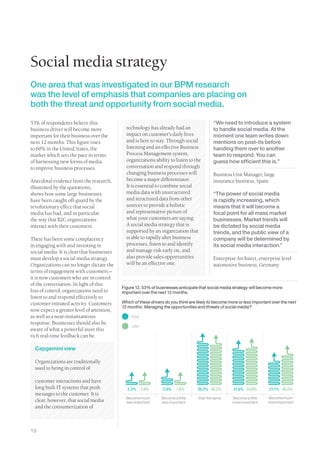
                                            Figure 12. 53% of businesses anticipate that social media strategy will become more
loss of control, organizations need to      important over the next 12 months.
listen to and respond effectively to
customer-initiated activity. Customers      Which of these drivers do you think are likely to become more or less important over the next
                                            12 months: Managing the opportunities and threats of social media?
now expect a greater level of attention,
as well as a near-instantaneous                 Total
response. Businesses should also be
                                                 USA
aware of what a powerful asset this
rich real-time feedback can be.

  Capgemini view

  Organizations are traditionally
  used to being in control of

  customer interactions and have
  long built IT systems that push             2.3%      1.8%     5.9%    1.8%       39.2% 36.3%        31.6% 33.6%        21.1% 26.5%
  messages to the customer. It is
                                              Become much        Become a little    Stay the same     Become a little    Become much
  clear, however, that social media           less important     less important                       more important     more important
  and the consumerization of


19
Staff satisfaction
Large organizations are engaged in a continuous effort to create
and sustain a rewarding working environment that mobilizes and
motivates their staff. An important benefit of improved processes
that emerged from this research is the impact on staff satisfaction.

“The previous management           75% of those organizations within
underestimated process             our sample that launched a BPM                          but also in terms of improving job
development. Processes             initiative with a view to improving                     satisfaction for the teams involved.
weren’t documented. We             staff satisfaction reported that the                    Alongside traditional ROI models
had to repeat the same steps       project had had a positive impact                       companies should consider the
over and over again to reach       in this regard. Strikingly, not one                     ease of use of resultant systems,
a solution. Money and time         respondent reported that the initiative                 the reduced cost of training
were wasted, staff weren’t         had had a negative impact.                              and the improved retention
motivated and customers were                                                               of valuable team members.
frustrated. Now we’ve improved       Capgemini view
our processes, all our staff are                                                           The quantitative research
convinced of the benefits.”          Enhanced staff satisfaction is an                     findings show that Business
                                     interesting ‘hidden benefit’ of                       Process Management initiatives
Department Officer, enterprise       process improvement. Enhanced                         can have a positive impact
level insurance company, France      staff experience is rarely built into                 on many different parts of an
                                     business cases for BPM investment.                    organization. The next section of
                                     However, removing laborious                           the research demonstrates how
                                     manual workflows, reducing the                        BPM ultimately delivers value in
                                     need for ad-hoc intervention and                      terms of Return on Investment.
                                     making it easier for staff to operate
                                     efficiently, can have clear benefits,
                                     not just in terms of productivity


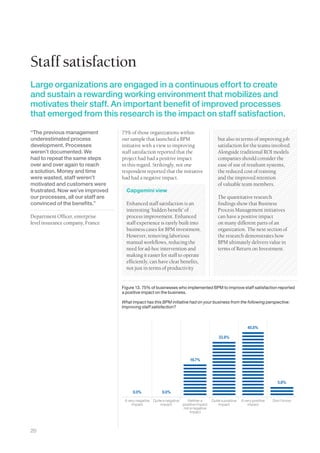
                                   Figure 13. 75% of businesses who implemented BPM to improve staff satisfaction reported
                                   a positive impact on the business.

                                   What impact has this BPM initiative had on your business from the following perspective:
                                   Improving staff satisfaction?


                                                                                                              40.8%

                                                                                           33.8%


                                                                         19.7%


                                                                                                                              5.6%

                                        0.0%             0.0%
                                    A very negative Quite a negative   Neither a       Quite a positive   A very positive   Don’t know
                                        impact          impact       positive impact       impact             impact
                                                                     nor a negative
                                                                         impact


20
Show me the money:
BPM and Return on Investment
The research demonstrates clearly that investment in Business
Process Management can yield tangible business value.
Of those respondents who had tried to measure ROI from
BPM, a remarkable 96% reported a positive return, with 55%
measuring a return of at least twice their initial investment.

“We consolidated by centralizing   In the past, businesses found it difficult   Figure 14. Just 39% of respondents have
the IT infrastructure so that      to quantify the Return on Investment         attempted to measure ROI from BPM in a
                                                                                formal way.
we didn’t have hundreds of         from BPM programs as the benefits
little silos everywhere. This      were various and wide-ranging.               Have you attempted to measure
wasn’t a management power          It can be a challenge to measure             Return on Investment (ROI) from this
                                                                                BPM initiative in a formal way?
trip, it was about saving a lot    intangible but essential elements of
of money. Ultimately, from         BPM, such as cultural change and
an economic perspective,           employee behavior. Indeed, our                   Yes          No          Don’t know

all the departments win.”          research shows that businesses are
                                   still learning how to assess the value
Senior VP for IT, consumer         of a BPM investment, with only 39%
                                                                                38.7%                                  29.0%
products and retail Business, UK   of respondents stating that they have
                                   tried to measure ROI in a formal way.


                                     Capgemini view

                                     Setting the business case for
                                     organizations is often challenging.
                                     Getting the appropriate balance
                                                                                                               32.3%
                                     between the different objectives
                                     across the organization is key
                                     and rarely an easy task. However
                                     once objectives are set, and
                                     measurements in place, we have
                                     seen BPM programs delivering
                                     significant ROI. In addition,
                                     it is important to measure
                                     quantitative and qualitative
                                     factors when implementing BPM,
                                     and to track those measures
                                     through to completion of the
                                     project. Those results in turn
                                     inspire further change.


21
Figure 15. 96% of respondents calculated a positive ROI from investment in BPM.
 Examples of Return on
 Investment                             What level of ROI did you calculate for the BPM investment?


 Cost reduction and                       Negative Return
                                           on Investment                1.9%
 efficiency gains:
                                               No Return on
 BPM can help lower the cost                    Investment              1.9%
 of running, changing, and
 executing processes.                   Up to 1.5 times ROI                              12.4%

 A North American                         Between 1.5 and
                                              2 times ROI                                                 24.8%
 insurance organization:
                                           Between 2 and                                              22.2%
 •	   Gained 40% cost reduction               3 times ROI
      over a five year period
                                           Between 3 and                                12.0%
                                              4 times ROI
 •	   Reduced training time
      from as long as two                  Between 4 and
                                                                                      9.0%
                                              5 times ROI
      weeks to just one day
                                            Between 5 and                      4.1%
 •	   Gained ability to execute the           10 times ROI
      First Notice of Loss (FNOL)
      process with greater efficiency          Greater than
                                               10 times ROI              2.2%
      and accuracy as a result of
      increased automation
                                                Don’t know                            9.0%

 •	   Introduced real-time analytics
      of overall claims operations
                                          An automotive company:
 •	   Reduced FNOL Total Cost of
      Ownership by approximately          •	     Improved their cycle
      $12 million over the four years            time by 50%
      following implementation
                                          A worldwide engineering
 •	   Was able to offer its               organization:
      customers a market-leading
      claims experience                   •	     Ran a global operation to
                                                 optimize and harmonize the
 A public sector organization:                   leading business processes
                                                 and support, leading
 •	   Used sophisticated case                    to precise supply chain
      management to achieve                      planning and processing
      a win-back time of 70
      minutes per case                    •	     Achieved real-time, end-
                                                 to-end transparency
 Increase in competitiveness
 and agility                              •	     Established a more accurate
                                                 process, with accelerated
 BPM reduces time-to-market for                  supply chain performance and
 new products and services.                      improved competitiveness

 A global banking organization:

 •	   Reduced time-to-market for
      new product release from
      nine months to four months

22
Speculating to accumulate:
BPM as a counter-cyclical investment
The high level of Return on Investment that BPM can
potentially deliver, discussed in the previous section of
the report, perhaps explains why interest in BPM actually
increases in relatively challenging market conditions.

“Growth via demand will be         68% of respondents who were seriously      Figure 16. 68% of respondents considering
difficult, so we have to improve   considering investment in BPM state        a BPM investment state that a more
                                                                              challenging economic climate over
profitability by enhancing         that a more challenging economic           the next 12 months would increase the
our internal processes.”           climate would increase the attention       attention their organization paid to process
                                   paid to process improvement. In            improvement to process improvement.
Risk Manager, enterprise level     theory this is a simple equation: at       If the economic climate in your sector
manufacturing business, UK         a time when it is difficult to acquire     proved more challenging over the next 12
                                   new business, process improvement          months, what impact do you anticipate
                                                                              this would have on your organization’s
                                   offers a way to boost the bottom           attitude to process improvement?
                                   line by making cost savings.
                                                                                  We will pay a lot more attention
                                   However, challenging conditions can
                                                                                  We will pay a little more attention
                                   create barriers to BPM adoption. If
                                   employees are concerned about job              It will not impact on the attention paid

                                   security and their personal well-being,        We will pay a little less attention
                                   BPM is more likely to be perceived as a        We will pay a lot less attention
                                   threat rather than an opportunity. 44%
                                                                                  Don’t know
                                   of respondents in the survey stated
                                   that resistance from staff responsible
                                                                                                   6.4%
                                   for existing systems such as SAP and                   2.5%
                                                                                                                             31.5%
                                   CRM within their organization was               5.6%
                                   a barrier to process improvement.2
                                                                              17.9%
                                   Bottom line pressures can lead to a
                                   reductive focus on costs rather than
                                   an emphasis on the bigger picture.
                                   Money allocated to IT could be spent
                                   maintaining outdated systems that
                                   have no place in a modern technology
                                   environment. This is often a false
                                   economy. The BPM institute blog
                                                                                                        36.1%
                                   uses an apt analogy to explain the
                                   likely consequence of trying to cut
                                   operational and process-related costs
                                   in the face of a downturn: “These
                                   organizations are just starving
                                   themselves, and it will likely come back
                                   to haunt them as the core infrastructure
                                   of the company – the corporate
                                   metabolism, is crippled to the point
                                   where it cannot function effectively.”3


23
“Even with the current economic         46% of survey respondents identified
climate, middle and senior              a lack of change readiness or
management still find it difficult      willingness at their organization as
to embrace culture change,              a barrier to improving processes.4
move with the times and take            Reactive companies that are not
advantage of the efficiencies           ready to confront changing times will
and cost savings that can               not be able to introduce successful
be delivered by BPM.”                   BPM. In order for a company to
                                        successfully deploy BPM, the
Process Manager, local                  company must be able to embrace
government agency, UK                   change across the organization.

                                        In the following section of this
                                        report ways in which barriers
“Companies in a defensive mode          to BPM adoption can be broken
simply aim to survive. BPM will         down are examined further.
seem too daunting for them –
rather than investing in new tools
and processes, they will cut IT           Capgemini view
budgets and try and muddle
through with legacy tools in their        BPM is not simply an out-of-
existing format for a little longer.”     the-box technological solution
                                          that can be introduced at will.
Process Manager, enterprise               BPM is a discipline that requires
level telecommunications                  the adoption of a new cultural
business, North America                   mindset. In a downturn, BPM is
                                          attractive to companies that are
                                          offensively orientated, and looking
                                          to push their business to grow. In
                                          order to introduce effective BPM,
                                          an organization must be receptive
                                          to change, willing to break its
                                          mould and become something
                                          different. Executive sponsorship
                                          is key to driving this forward.

                                          One of the trends we have
                                          observed (though not suitable
                                          for all programs) is towards short
                                          term investments with fast ROI.
                                          BPM projects are often iterative
                                          – lasting 6-10 weeks per project,
                                          with each phase linked to a value
                                          based objective. In this context
                                          budget allocation is easier.


                                        2 See Figure 21
                                        3 http://www.bpminstitute.org/resources/white-papers/
                                        bpm-ea-two-smart-investments-recession
                                        4 See Figure 22


24
Barriers to BPM implementation
The research highlighted various practical issues which prevent
organizations from successfully implementing BPM.

Five barriers in particular               team all have their own targets and
                                                                                                            business domain. It requires will
were identified:                          priorities. It requires a different
                                                                                                            and impetus to transcend ways
                                          way of looking at processes to make
                                                                                                            of working that are constructed
•	   Functional silo culture              them end-to-end more effective.
                                                                                                            around existing bureaucratic
                                                                                                            structures. Vision and leadership
•	   Fragmented budget
                                                                                                            from a senior level is essential
                                              Capgemini view
                                                                                                            for long-term BPM success.
•	   Perception of BPM as an IT item
                                                                                                            BPM-driven ways of working
                                              BPM implementation renders the
                                                                                                            can then add value to a business
•	   Resistance to BPM from IT                greatest value when it is applied
                                                                                                            by linking functional silos and
     staff who have responsibility            across organizations and across
                                                                                                            eradicating the inefficiency of
     for existing systems                     applications. However initiatives
                                                                                                            different business units working
                                              tend to deal with one subset of
                                                                                                            in competition with one another
•	   A lack of change readiness               processes because it is much easier
                                                                                                            on disconnected projects.
     or willingness                           to gain sponsorship for a process
                                              improvement initiative within a
All these internal barriers to
cooperation must be addressed
in order to achieve commonality
of purpose, which can directly
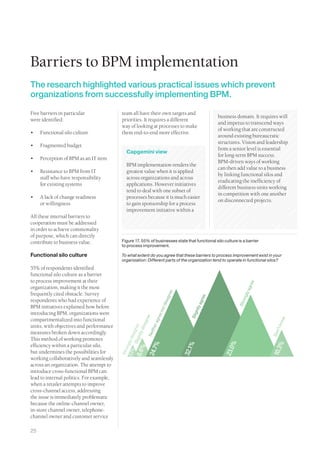
contribute to business value.             Figure 17. 55% of businesses state that functional silo culture is a barrier
                                          to process improvement.

Functional silo culture                   To what extent do you agree that these barriers to process improvement exist in your
                                          organization: Different parts of the organization tend to operate in functional silos?
55% of respondents identified
functional silo culture as a barrier
to process improvement at their
                                                                                                                                   e
                                                                                                                               gre


organization, making it the most
                                                                                                                           ly a
                                                                                  ee


frequently cited obstacle. Survey
                                                                                                                        ong
                                                                              agr


                                                                                                       ee


respondents who had experience of
                                                                                                   agr
                                                                          dis


                                                                                                                       Str


BPM initiatives explained how before
                                                                                              htly
                                                                      nor


introducing BPM, organizations were
                                                                                          Slig
                                                                 re e
                                                                   e


compartmentalized into functional
                                                               gre


                                                                                                                                                w
                                                             r ag


                                                                                                                                             kno
                                                           isa


units, with objectives and performance
                                          6.6% lightly dee
                                                       ithe


                                                                                                                                         n’t
                                                         r


measures broken down accordingly.
                                                     sag


                                                                                                                                       Do
                                                    Ne


This method of working promotes
                                          3.2% gly di
                                                  S


                                                                                                                   %


                                                                                                                                            %
                                                %


                                                                                           %


efficiency within a particular silo,
                                               on


                                                                                                              23.0
                                          24.7


                                                                                                                                       10.3
                                                                                       32.1


but undermines the possibilities for
                                           Str


working collaboratively and seamlessly
across an organization. The attempt to
introduce cross-functional BPM can
lead to internal politics. For example,
when a retailer attempts to improve
cross-channel access, addressing
the issue is immediately problematic
because the online-channel owner,
in-store channel owner, telephone-
channel owner and customer service

25
“In telecoms, the new buzzword          Perception of BPM as an IT item
                                                                                                              Capgemini view
is an “integrated supply chain”,
how to take everything from             The survey findings indicate that
                                                                                                              BPM programs need to be driven
manufacturing, procurement,             there is little consensus across
                                                                                                              by a collaborative team of IT
logistics etc. and put that all         organizations as to who should
                                                                                                              and business. Business should
together under one ownership.           take primary responsibility for
                                                                                                              drive the business case, the
In practice it never works like         process improvement. In different
                                                                                                              process design and outcomes,
that. At the moment we have             organizations across the sample, this
                                                                                                              and IT needs to supply the
an operations organization,             was borne variously by IT, business
                                                                                                              infrastructure, core systems
a procurement organization,             management, operations, or even
                                                                                                              and integration expertise. BPM
a logistics organization                dedicated process management
                                                                                                              brings the two – business and IT –
and a delivery function all             units. In many instances, budget
                                                                                                              together, to make those decisions
operating in different silos.           is fragmented across departments,
                                                                                                              jointly. It also creates a common
All departments affected by a           which can undermine the
                                                                                                              environment which serves to
process should work together.”          effectiveness of attempts to launch
                                                                                                              eliminate the communication
                                        coherent, cross-functional process
                                                                                                              barriers that traditional tools
Head of Logistics, enterprise           management initiatives.
                                                                                                              and methods tend to amplify.
level telecommunications
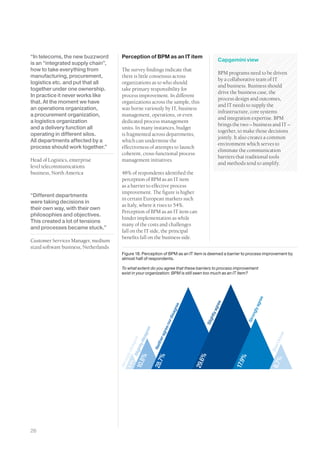
business, North America                 48% of respondents identified the
                                        perception of BPM as an IT item
                                        as a barrier to effective process
                                        improvement. The figure is higher
“Different departments
                                        in certain European markets such
were taking decisions in
                                        as Italy, where it rises to 54%.
their own way, with their own
                                        Perception of BPM as an IT item can
philosophies and objectives.
                                        hinder implementation as while
This created a lot of tensions
                                        many of the costs and challenges
and processes became stuck.”
                                        fall on the IT side, the principal
                                        benefits fall on the business side.
Customer Services Manager, medium
sized software business, Netherlands
                                        Figure 18. Perception of BPM as an IT item is deemed a barrier to process improvement by
                                        almost half of respondents.

                                        To what extent do you agree that these barriers to process improvement
                                        exist in your organization: BPM is still seen too much as an IT item?
                                                                                                                                          e
                                                                                                                                      gre
                                                                                                                ee
                                                                                         ee


                                                                                                                                  ly a
                                                                                                            agr
                                                                                     agr


                                                                                                                               ong
                                                                                                       htly
                                                                                 dis


                                                                                                                              Str
                                                                                                   Slig
                                                                             nor
                                                                             re e
                                                               e
                                                           gre


                                                                         r ag


                                                                                                                                                       w
                                                       isa


                                                                                                                                                    kno
                                                      re e


                                                                     ithe
                                       10.8 htly d
                                                   sag


                                                                                                                                                n’t
                                                                   Ne


                                                                                                                                              Do
                                       4.4% gly di
                                              Slig


                                                                                                   %
                                                                       %
                                            %


                                                                                                                          %


                                                                                                                                              8.7%
                                           on


                                                                                              29.6
                                                                   28.7


                                                                                                                     17.9
                                       Str


26
Figure 19. Allocation for process improvement is often split across organizations.             Resistance from staff
                                                                                               responsible for existing systems
Which parts of the business hold the budget for process improvement?

                                                                                               One potential hurdle to BPM
                                                                                               implementation is that BPM gives
                                                                                               power to the business side of an
                                                                                               organization rather than the IT
             19.5%                                                                             department. 44% of respondents found
                                                                                 19.9%
                                                                                               that resistance from staff responsible
                                                                                               for existing systems was a barrier to
                                                                                               successful process improvement.
                                                                                               IT departments will naturally be
                IT                                                             Operations      protective of current tools, and
                                                       27.1%
                                                                                               argue that these can achieve value.

                                                                                                 Capgemini view
             15.3%
                                                                                                 The introduction of BPM
                                                                                  19.5%
                                               Senior business
                                                                                                 technology will change the
                                                management                                       applications landscape and there
         Individual                                                                              will often be internal resistance to
       business units
                                                                                                 this. Ultimately, BPM technology
                                     12.7%                                       Finance         will serve to create value for the
                                                                                                 organization as a whole and create
         4.6%
                                                                                                 alignment between business
     HR manager                                                                                  and IT. However, it is important
                             Dedicated process                     21.0%
                             management unit                                                     to engage the CIO and IT staff
                                                                                                 in BPM strategy to ensure that
                                                                                                 these stakeholders do not feel
n.b. Respondents were able to select more than one                                               they are relinquishing control. In
answer, as budgets can be split across departments,                                              forward-thinking organizations
hence the overall percentage response sums to more               Don’t know
than 100%.                                                                                       where staff view change as
                                                                                                 an opportunity rather than a
                                                                                                 threat there is the best chance of
Figure 20. There is little consensus across organizations as to who should take primary
responsibility for process improvement.                                                          successful BPM implementation.

Which of the following take primary responsibility for process optimization?

                                                                                               “The biggest challenge we had
                                                                                               was actually the human aspect,
                                                                                               not the systems and technical
                                                                    13.1%                      aspect. We were suddenly
            16.3%                                                                     3.1%
                                                                                               saying ‘you’re not in charge
                                                                                  HR manager   of the network anymore, we
                                                                  Operations                   are.’ You’ve got to make sure
                                           18.2%                                               everyone’s ok about it before
              IT                                                                               you can move forward.”
                                                                 3.6%
                                                                                     15.6%     Senior VP for IT, consumer
                                    Senior business            Finance                         products and retail, UK
                                     management

                12.8%
                                                                     5.3%         Don’t know

                                               11.9%
                                                                   None of
                                                                  the above
           Individual
         business units
                                      Dedicated process
                                      management unit
27
“There was opposition in                  Figure 21. 44% of respondents found that resistance from staff responsible for existing
the company from different                systems was a barrier to successful process improvement.
departments. People were                  To what extent do you agree that these barriers to process improvement exist in your
worried because their discretion          organization: There is resistance from IT staff who have responsibility for existing systems
over their systems was being              (SAP, CRM)?
wiped out. There was also
concern that manpower would
be declared surplus as we put


                                                                                                 ee


                                                                                                                            ee


                                                                                                                                                     e
                                                                                             agr
systems in place to do the work


                                                                                                                                                 gre
                                                                                                                        agr
                                                                                         dis
they had done previously.”


                                                                                                                                             ly a
                                                                                                                   htly
                                                                                     nor


                                                                                                                                          ong
                                                                                                               Slig
                                                                                     re e


                                                                                                                                      Str
Deputy General Manager of Finance,


                                                                  ee


                                                                                 r ag
large utilities business, India

                                                              agr


                                                                                                                                                                   w
                                                                             ithe


                                                                                                                                                                kno
                                                          dis
                                                          e


                                                                           Ne


                                                                                                                                                            n’t
                                                     htly
                                                      gre


                                                                                                                                                          Do
Lack of change readiness
                                                  isa

                                                 Slig
                                              ly d


/ willingness


                                                                                                                                      %


                                                                                                                                                              %
                                                    %

                                                                               %


                                                                                                           %
                                           ong
                                                6.6%


                                                                                                                                                          10.5
                                                12.4


                                                                                                                                 15.9
                                                                          27.0


                                                                                                       27.7
                                          Str


46% of respondents identified a lack of
change readiness or change willingness
at their organization as a barrier to
BPM adoption. Organizations which         Figure 22. 46% of respondents identified a lack of change readiness or change willingness
have adequately functioning processes     at their organization as a barrier to BPM adoption.
can easily become complacent, and         To what extent do you agree that these barriers to process improvement exist in your
fail to acknowledge the need for          organization: There is a lack of change readiness and/or change willingness in the
continuous improvement, leaving           organization?
them vulnerable to being overtaken
by the competition. Companies
with an apparently well-functioning


                                                                                                                                                      e
                                                                                                                                                  gre
                                                                                                 ee


application landscape can lack the
                                                                                                                       ee
                                                                                             agr


                                                                                                                                              ly a
                                                                                                                   agr


vision and appetite for a step change.
                                                                                         dis


                                                                                                                                           ong
                                                                                                              htly
                                                                                     nor


                                                                                                                                          Str
                                                                                                          Slig


  Capgemini view
                                                                                     re e
                                                                     ee


                                                                                 r ag


                                                                                                                                                                     w
                                                                 agr


                                                                                                                                                                  kno
  A BPM implementation may
                                                                             ithe
                                                             dis
                                                            re e


                                                                                                                                                              n’t
  appear to offer radical change for
                                                                           Ne
                                                        htly


                                                                                                                                                            Do
                                             6.4% y disag


  marginal return. Whereas when
                                                    Slig


  implemented carefully, it can offer
                                                                               %


                                                                                                          %


                                                                                                                                     %
                                                   l


                                                                                                                                                               %
                                                ong


                                                 %

                                                                          25.2


                                                                                                      29.5


                                                                                                                                 16.5


                                                                                                                                                           10.7


  organizations a step change in the
                                            11.7
                                           Str


  way they are able to do business.

  Large organizations that are               processes, minimizing disruption
  accustomed to acting in a                  and ensuring continuity while
  particular way can also be wary            facilitating process improvement.
  of overhauling and updating                Business process and rules are
  processes because business rules           captured and made explicit, and
  and business knowledge may be              systems become self-documenting.
  embedded into long-standing                Staff with the appropriate
  processes. In some instances               authorizations can then maintain
  these rules may not be formally            and amend processes and rules
  documented, so stakeholders are            that are no longer hidden away
  concerned that when migrating              in arcane coding languages.
  to new system, the full range
  of functionality may not be                Capgemini recommendations
  captured. The great strength of            for breaking down barriers and
  BPM is that it captures and builds         successfully implementing BPM
  on existing ways of working,               are summarized on the next page.
  renewing rather than usurping old
28
Key conclusions and recommendations
BPM offers high value through process optimization – but first,
organizations need to create the conditions for success

At a time when many market sectors are facing slow                Define strategic objectives for BPM
revenue growth, customer churn, and increased
pressures on costs, BPM is a critical weapon in the battle        BPM succeeds best when it is executed against clear business
for efficient, effective processes that cost less. It allows      objectives. Organizations embark on BPM programs for
organizations to become more customer-centric, and to             different reasons, and so each business must identify and
respond in a more agile way to business challenges and            prioritize its own strategic objectives up front. Involving
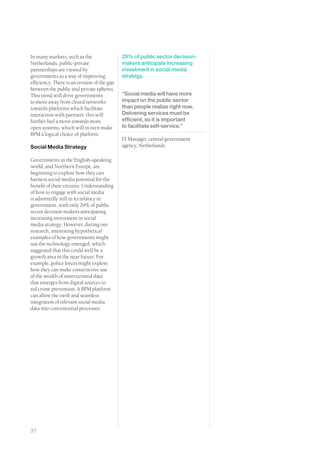
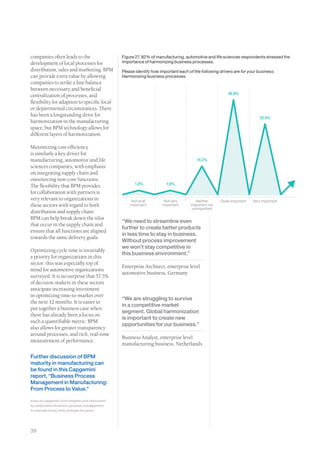
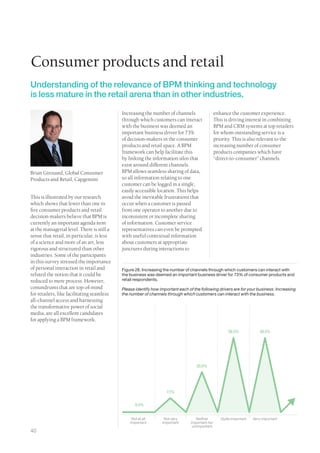
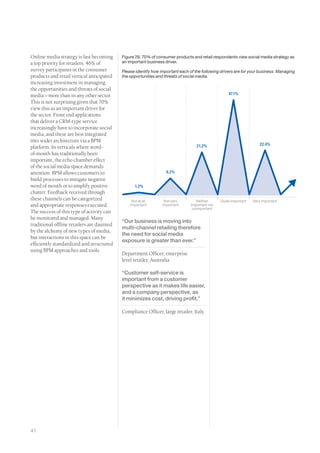
opportunities, however uncertain the business environment.        senior management in this process is an important way to
Other benefits include better regulatory compliance,              ensure that they take ownership of the subsequent program.
even where regulations are altering almost daily.
                                                                  Possible objectives can be grouped into three clusters:
All this adds up to an exceptional ROI for successful
BPM programs – one that can often make it                         1. Cost reduction, efficiency, and effectiveness
possible to buck gloomy economic trends.
                                                                  2. Customer-centricity and agility, for example
Before an organization can realize BPM’s potential,               in adapting to changing market conditions
there are usually some challenges to overcome. These
typically include a silo-based organizational structure and       3. Compliance with rapidly-evolving regulations
culture, resistance to change on the part of stakeholders,
and fragmented process improvement budgets.                       Objectives should relate to the business as a whole,
                                                                  and not just to individual functions. Setting the right
Below, we make some recommendations for                           objectives, and then managing against them, helps the
positioning an organization to overcome the                       organization to work as a single entity, rather than in silos.
challenges and realize BPM’s promise.
                                                                  Build a business case for BPM
Get C-level sponsorship
                                                                  The business case for a given BPM initiative will vary
Strong vision and leadership at the C-level are the key to        depending on the organization’s objectives, as well as its
overcoming barriers between organizational silos to create an     maturity with regard to BPM. Involving senior managers
environment for BPM success. Without senior management            in the process of building the business case, as opposed
sponsorship, a BPM initiative is usually doomed before            to simply presenting them with the end result, will
it even starts. Securing C-level sponsorship can itself be        help to gain C-level ownership of BPM initiatives.
difficult, particularly if the people who really “get” BPM find
it hard to communicate the potential in business terms. The       The business case should balance the requirements of
process of jointly defining objectives and a business case, as    different parts of the organization as far as possible. On
recommended below, can improve communication and build            the benefits side, it should take account of “soft” benefits
the vital senior buy-in.                                          such as improved staff satisfaction and retention, and
                                                                  reduced cost of training, as well as financial benefits.

                                                                  A crucial element of the business case should be a
                                                                  roadmap with delivery milestones, to show when benefits
                                                                  will be realized. Goals should be clear, measureable,
                                                                  and realistic. For those organizations starting out on
                                                                  BPM, our recommendation is to think big, start small,
                                                                  and scale rapidly. It is similarly important to measure
                                                                  post-implementationto establish when benefits
                                                                  are actually realized and recognize success.


29
Establish governance                                           Realize and communicate benefits

 Successful BPM requires governance at an operational          It is critical to track and manage BPM progress against
level. The CIO needs to provide vision and direction,          the business case, ensuring that objectives are being met,
and be willing to do so if he or she has engaged in the        milestones achieved, and benefits realized. Measurement
process of objectives definition and business case             needs to be qualitative (e.g. through customer and
construction described above. Even so, a senior executive      staff satisfaction surveys) as well as quantitative (e.g.
is unlikely to be able to provide the constant day-today       through measurement of cost reductions) – both types of
involvement and decision-making that is required.              measurement will have been defined in the business case.
Day-to-day decisions on projects and programs therefore
need to be made by a well structured, cross-functional         Demonstrating value early on in a project is the best way to
team of IT and business representatives, mediated by a         support the case for continuing it. In addition, demonstrating
steering committee of senior sponsors and stakeholders.        success on one project is likely to inspire others to follow suit.

Integrate new and existing technology                          Give BPM organization-wide reach

BPM depends on the correct alignment of technology             Although success breeds success, organization-wide
solutions with the business case. New BPM tools                adoption of BPM is rare unless patches of success and
and suites are likely to be implemented, but most              fragmented budgets are brought together to create
organizations will also need to take into account a            organization-wide awareness, enable a repeatable
complex landscape of legacy back office applications.          experience and reuse of components to build
                                                               momentum and further reduce costs. One way to
Usually there is no need for dramatic “rip and replace”        do this is by setting up a center of excellence. Again,
systems migrations. Instead, the emphasis will be on           C-level sponsorship is essential to make it happen.
leveraging the investment in existing solutions using BPM to
augment, and plug execution gaps in, legacy applications..     In summary
In other words, the deployment of an agile BPM layer can
modernize, and extend the functionality of, legacy systems.    To achieve the potential value of BPM, organizations
                                                               must first create the conditions for success. That means
Manage cultural change                                         securing and using senior sponsorship, rigorously
                                                               defining organization-wide strategic objectives
BPM is not an out-of-the-box technical solution. It requires   and a business case, and putting in place the right
the adoption of a new culture and mindset on the part          governance structures and the right technology. The
of both business (who will operate the new processes)          BPM process must be purposefully managed throughout
and IT (who are responsible for existing systems).             to ensure that the intended benefits are realized and
Both of these groups will need to adopt a new model of         communicated. Budgets and resources may need to be
collaborative working. We strongly believe that BPM as a       integrated and/or centralized to achieve wider reach.
discipline needs to be jointly owned by business and IT.
                                                               C-level commitment and strong change management skills
It follows that stakeholders from both business and IT         are essential to bring about the required cultural change,
must be ready and willing to embrace change. Initially         including the move to greater cross-functional collaboration.
there is often resistance, but if C-level managers have
taken ownership of BPM it will be easier to gain the           Under the right conditions, BPM can deliver exceptional
commitment of other staff members. Even so, managing           value that more than justifies the effort involved,
cultural change is one of the most challenging aspects         as the experience of early adopters confirms.
of BPM implementation, particularly where internal
politics get in the way of cross-functional collaboration.


30
31
Capgemini sector and country focus
BPM as a management discipline can offer organizations –
both private and public sector – a way of underpinning their
processes in order to deliver high value to the business.

In the second section of the report,       The sectors profiled are:           We also explore BPM trends and
we take an in-depth look at the                                                practices from a regional perspective
application of BPM in five specific        •	   Financial services             in the following geographies:
market sectors that are of particular
interest. The level of BPM adoption,       •	   Public sector                  •	   United Kingdom
and drivers of interest in BPM thinking,
vary across market verticals.              •	   Manufacturing, automotive      •	   United States
                                                and life sciences
                                                                               •	   Australia
                                           •	   Consumer products and retail
                                                                               •	   Germany
                                           •	   Telecommunications, media
                                                and entertainment              •	   Italy

                                                                               •	   France

                                                                               •	   Spain

                                                                               •	   The Nordics

                                                                               •	   The Netherlands


32
Financial services
Our survey shows that the financial services sector leads the
way in adoption of Business Process Management software and
approaches: 65% of financial services decision-makers that
participated in the survey stated that their organization had launched
a BPM initiative of some description, while 52% anticipated that
greater emphasis would be placed on BPM over the next year.

                                            Figure 23. More than half of financial services respondents believe their organization will
                                            place greater emphasis on BPM over the next year.

                                            How do you anticipate that the current level of interest in BPM within your organization will
                                            change over the next year?

                                                A lot more emphasis will
                                                 be placed on Business                                                18.8%
                                                  Process Management
                                                       over the next year

                                              A little more emphasis will
                                                  be placed on Business                                                               32.7%
                                                   Process Management
Nicholas Kitson, Head of Business                       over the next year
Process Management, Global
                                            The same amount of emphasis
Financial Services Unit, Capgemini              will be placed on Business
                                            Process Management over the                                                       27.3%
                                                                  next year

The effects of the global financial             A little less emphasis will
                                                  be placed on Business
crisis still loom over financial services          Process Management                        4.2%
providers. Shortcomings in regulation                     over the next year
of the sector have been brought                   A lot less emphasis will
into sharp focus by the economic                  be placed on Business                   3.6%
                                                  Process Management
downturn, which has also forced                          over the next year
financial players of all stripes to
reassess their cost position and the                          Don’t know                                 13.3%
ways in which they fight for market
share. Players in banking, insurance
and capital markets have all been           Solvency II. The problem facing                   62% of decision-makers in the
forced to scrutinize their processes        these financial institutions is how               financial services sector indicate
and Business Process Management             to gain and maintain compliance                   that responding to changes in
thinking has become more relevant           in a fluid regulatory environment,                legislation will become a more
than ever to these institutions.            while at the same time satisfying the             important driver for their business
                                            demands of customers for swift and                over the next 12 months.
Financial services                          efficient service. 62% of decision-
and compliance                              makers in the financial services
                                            sector that participated in the survey            “FSA legislation has become
The past few years have witnessed           anticipated that responding to                    tighter and this impacts
vociferous demand for the creation          changes in legislation would become               the sales process and the
of new legislation in financial             a more important driver for their                 techniques in place.”
services. By 2013, banks will need          business over the next 12 months.
to demonstrate their compliance                                                               Process Manager,
to the new Basel III standards on                                                             large insurance business, UK
capital adequacy; similarly, by 2014,
insurance companies will need
to demonstrate compliance with

33
“We talk to people around risk,    BPM allows financial services to           controlled approach to the credit
compliance, Solvency, Basel...     fuse regulations with processes.           process by facilitating continuity of
they understand the issues         Organizations can build compliance to      work across different departments
and they know they will need to    these new regulations into a repeatable,   and different channels. Furthermore,
do something around it. They       measurable framework. This eliminates      BPM also allows the business to
grasp that there’s a deadline      the need to impose compliance              monitor how efficiently and accurately
by which they need to address      controls manually in an ad-hoc fashion,    these processes are carried out.
these issues and if they don’t     reducing error and minimizing
they will be punished.”            time and resources that need to be         Since the downturn, insurance
                                   dedicated to regulatory demands.           companies have been under pressure
Capgemini BPM specialist, Spain                                               to reduce operational and acquisition
                                   BPM allows financial services firms        costs to assure sustainable growth
                                   to respond to government demands           and profits. Legacy IT infrastructure
73% of financial services          by demonstrating compliance                at insurance companies is unable to
decision-makers who took part      automatically. BPM also allows             handle the increasing complexity
in the survey anticipated that     continuous change and different            in claims processing that is driven
maximizing cost-efficiency         layers of customization: this means        by a combination of technological
would become a more                that rules can be refined to meet          innovation, a challenging external
important business priority        different requirements in geography        environment and regulatory change.
over the next 12 months.           or product. It also affords firms the      Processes frequently require multiple
                                   scope and flexibility to meet elements     hand-offs and duplication and
                                   of future compliance which have yet        redundancy are rife. This explains
“We want to replace things
                                   to be precisely defined, and to model      why insurers are embracing BPM
that don’t work, maximizing
                                   these intelligently in advance to see      technology, which unpicks the knots
cost-efficiency by paying more
                                   what the implications may be.              that form in historically evolved
now to save more later.”
                                                                              processes, enhancing process
                                   Financial services and                     efficiency and cost effectiveness
Business Analyst,
                                   cost-efficiency                            and allowing measurement of the
large insurance business, USA
                                                                              success of claims processes.
                                   In the aftermath of the economic
                                   downturn, financial institutions are
“Harmonizing processes
                                   focusing on cost reduction. Business
across different divisions and
                                   Process Management allows financial
subsidiaries will save costs.”
                                   services companies to automate
                                   labor-intensive manual tasks, saving
Compliance Officer,
                                   times and resources and boosting
enterprise level bank, Australia
                                   efficiency. 73% of financial services
                                   firms in the survey anticipated
                                   that maximizing cost-efficiency
                                   would become a more important
                                   priority over the next 12 months.

                                   In the retail banking sector,
                                   incorporating front-end activities like
                                   Loan Origination into BPM systems
                                   ensures superior integration with
                                   back office functions. When this type
                                   of process is carried out manually,
                                   there is inevitable duplication of work
                                   and inaccuracy. The disconnection
                                   between separate back office and point
                                   of sales systems causes unnecessary
                                   re-checking by staff at different parts
                                   of the process, while the ongoing
                                   battle to reconcile different pieces
                                   of paper leads to errors. BPM allows
                                   banks to build a standardized, quality

34
Financial services and                   The Capgemini World Insurance                   From the perspective of customers
customer-centricity                      Report 2011 states: “Insurers’                  of a bank, running processes like
                                         reputations live or die by their ability        mortgage and loan applications in a
In these leaner times, both banks        to process claims efficiently and               BPM tool speeds up the process and
and insurance companies are              effectively.”5 A bad claims experience          eliminates the kind of mechanical
fighting to increase market share.       drives clients to competitors, a                errors which damage perception of a
Consequently, they are working on        dynamic that is especially costly for           brand. It can also increase the scope
topics related to customer front end,    insurers given that it costs seven times        for cross-channel service provision,
many of which can be driven by a         as much to acquire a new customer               for example the sending of text
BPM solution. 79% of respondents         as it does to serve an existing one.            messages to confirm transactions.
from financial services firms in         BPM joins up different business units,
the survey stated that increasing        streamlining claims processes by                5 Capgemini World Insurance Report, 2011
the number of channels through           removing internal barriers and sharing
which customers can interact with        salient information across different
the business is an important driver.     parts of a business, largely automating
Similarly, 78% of these respondents      much of the claims process. From the
stated that facilitating customer self   customer perspective, this removal of
service is an important driver.          manual work and duplication leads to
                                         shorter claims-processing time, and a
                                         more accurate and transparent claims
                                         calculation – the end result is greater
                                         customer satisfaction and retention.


                                         Figure 24. Facilitating customer self-service and enhancing multi-channel access are key
                                         business drivers for financial services organizations.

                                         Please identify how important each of the following drivers are for your business: Increasing
                                         the number of channels through which customers can interact with the business; Facilitating
                                         customers self-service.


                                                          4.2%        1.2%
                                                          Not very    Not at all
                                                          important   important
                                          15.8% Neither
                                          important nor
                                                                                         34.5%
                                          unimportant
                                                                                         Very
                                                                                         important

                                                               Increasing
                                                             no of channels
                                                              for customer
                                                               interaction


                                                                                                        3.6%
                                                       44.2%                          6.7%              Not at all
                                                       Quite important                Not very          important
                                                                                      important                                38.2%
                                                                                                                               Very
                                                                                                                               important
                                                                         11.5% Neither
                                                                         important nor
                                                                         unimportant              Facilitating
                                                                                                   customer
                                                                                                  self-service


                                                                                           40.0%
                                                                                           Quite important


35
Public sector
Governments are facing considerable pressures in 2012.
The economic downturn in many countries means that
public sector spending is constrained. Legislation is
constantly changing, and technological change means
that citizens expect a greater say in decision-making.

                                             is frequently invoked. At the moment            The systems that governments use,
                                             public sector agencies in many markets          for example to process welfare claims,
                                             are facing unprecedented budgetary              are under constant strain as time-
                                             pressures. More than one in three               consuming manual intervention is
                                             public sector respondents anticipated           needed to keep up with the moving
                                             that maximizing cost-efficiency would           target of legislation. The adoption of a
                                             become much more important to their             joined-up BPM approach eliminates
                                             organization over the next 12 months.           the cracks that appear in hand-offs
                                             In countries which are facing seriously         between people and departments that
Nico Kaptein, Operations Director,           reduced government spending, this               lead to costly waste. BPM can also give
Global Public Security, Capgemini            figure is much higher – in the UK,              government agencies the ability to
                                             more than two in three public sector            change rules dynamically to keep up
                                             decision-makers anticipated that                with the latest directives, eliminating
Governments must attempt to deliver          maximizing cost-efficiency would                mistakes and reducing work.
more efficient and transparent citizen       become much more important.
services whilst driving down costs,
but they are regularly hamstrung in
                                             Figure 25. Maximizing cost-efficiency will become more important to public sector
this attempt by outdated technologies        organizations over the next 12 months.
and outmoded ways of working. This
context explains the growing relevance       Which of these drivers do you think are likely to become more or less important over the next
                                             12 months: maximizing cost efficiency?
of BPM paradigms to the public sector.

Citizen-centricity

Many governments are increasingly
focusing on delivering an enhanced
level of citizen-centric service.
Citizens expect the kind of 24 hour,                                                                             30.7%
                                                              35.5%
multi-channel service they are used
to receiving in the private sector. In
healthcare, for example, good case
management practice can be applied
to treatment of patients, which can
require the contribution of a spectrum                                                                      Stay the same
of different people with specialized                  Much more important
roles. BPM can address the information                                                                                      5.2%
silos that exist within enormously
complicated organizations like tax                                                                                 A little less important
bodies allowing continuity of work                                                        27.8%
by different agents in the process.
                                                                                                                         2.8%
The elimination of waste is a                                                                                    Much less important
perennially hot topic in the public
sector, and the idea of efficiency savings                                       A little more important

36
In many markets, such as the                 29% of public sector decision-
Netherlands, public-private                  makers anticipate increasing
partnerships are viewed by                   investment in social media
governments as a way of improving            strategy.
efficiency. There is an erosion of the gap
between the public and private spheres.
This trend will drive governments            “Social media will have more
to move away from closed networks            impact on the public sector
towards platforms which facilitate           than people realize right now.
interaction with partners: this will         Delivering services must be
further fuel a move towards more             efficient, so it is important
open systems, which will in turn make        to facilitate self-service.”
BPM a logical choice of platform.
                                             IT Manager, central government
Social Media Strategy                        agency, Netherlands

Governments in the English-speaking
world, and Northern Europe, are
beginning to explore how they can
harness social media potential for the
benefit of their citizens. Understanding
of how to engage with social media
is admittedly still in its infancy in
government, with only 29% of public
sector decision-makers anticipating
increasing investment in social
media strategy. However, during our
research, interesting hypothetical
examples of how governments might
use the technology emerged, which
suggested that this could well be a
growth area in the near future. For
example, police forces might explore
how they can make constructive use
of the wealth of unstructured data
that emerges from digital sources to
aid crime prevention. A BPM platform
can allow the swift and seamless
integration of relevant social media
data into conventional processes.


37
Manufacturing, automotive
and life sciences
The survey findings show that decision-makers in the sector
Capgemini groups together as manufacturing, automotive and life
sciences are relatively more likely than the rest of the sample to have
knowledge and experience of Business Process Management.

                                           Process to Value” explains, at these             Three key business priorities
                                           companies “years of globalization and            emerge from the research for large
                                           expansion – some organic, but much               manufacturing, automotive and
                                           of it through mergers and acquisitions           life sciences organizations:
                                           – have resulted in complexity in
                                           the value chain, redundancy in                   •	   Harmonizing business processes
                                           systems and processes, and a lack
                                           of transparency and flexibility in               •	   Maximizing cost-efficiency
                                           processes”. The pressure to move from a
Ard Jan Vethman,                           heterogeneous, non-integrated systems            •	   Optimizing time-to-market
Principal Consultant,                      landscape to a unified environment
Manufacturing, Automotive and              is often acute and affects the whole             82.3% of respondents in the
Life Sciences, Capgemini                   business, hence the importance of                sample stressed the importance of
                                           strategic sponsorship at the top level.          harmonizing business processes.
                                                                                            This is no surprise, as organic growth
One survey participant in three                                                             in different parts of multinational
stated that they “know a lot about
Business Process Management and
have plenty of practical experience of
                                           Figure 26. In the manufacturing, automotive and life sciences sector, one respondent in
it.” This demonstrates the relevance       three has extensive knowledge of BPM.
of the discipline to the manufacturing
industry, which is addressing the need     How would you describe your level of knowledge of Business Process Management?
to reduce costs, boost operational
                                                  I do not have much
efficiency and optimize time-to-market        knowledge or practical                                   15.9%
in the wake of the economic downturn.         experience of Business
                                               Process Management

The manufacturing, automotive and
                                              I have some knowledge
life sciences vertical is advanced in             of Business Process                                           19.5%
                                                  Management but no
having process ownership that goes           practical experience of it
all the way to board-level. This is
illustrated by the fact that respondents      I have some knowledge
in this sector, more than any other,              of Business Process
                                                                                                                           28.3%
                                             Management and limited
are likely to stress that decisions          practical experience of it
regarding process improvement
should be taken at the C-level. 72%        I know a lot about Business
of respondents in manufacturing,                Process Management                                                                   31.9%
                                                     and have plenty of
automotive and life sciences indicate         practical experience of it
that they believe BPM should be treated
as a C-level concern, compared with
61% of the overall sample. As the                          Don’t know                4.4%
Capgemini report “Business Process
Management in Manufacturing: From


38
companies often leads to the                   Figure 27. 82% of manufacturing, automotive and life sciences respondents stressed the
development of local processes for             importance of harmonizing business processes.
distribution, sales and marketing. BPM         Please identify how important each of the following drivers are for your business:
can provide extra value by allowing            Harmonizing business processes.
companies to strike a fine balance
between necessary and beneficial
centralization of processes, and                                                                        46.9%
flexibility for adaption to specific local
or departmental circumstances. There
has been a longstanding drive for
                                                                                                                        35.4%
harmonization in the manufacturing
space, but BPM technology allows for
different layers of harmonization.

Maximizing cost-efficiency
is similarly a key driver for
manufacturing, automotive and life                                                     14.2%
sciences companies, with emphasis
on integrating supply chain and
outsourcing non-core functions.
The flexibility that BPM provides                     1.8%            1.8%
for collaboration with partners is
very relevant to organizations in                   Not at all       Not very         Neither      Quite important   Very important
these sectors with regard to both                  important        important      important nor
                                                                                    unimportant
distribution and supply chain.
BPM can help break down the silos
                                               “We need to streamline even
that occur in the supply chain and
                                               further to create better products
ensure that all functions are aligned
                                               in less time to stay in business.
towards the same delivery goals.
                                               Without process improvement
                                               we won’t stay competitive in
Optimizing cycle time is invariably
                                               this business environment.”
a priority for organizations in this
sector: this was especially top of
                                               Enterprise Architect, enterprise level
mind for automotive organizations
                                               automotive business, Germany
surveyed. It is no surprise that 57.5%
of decision-makers in these sectors
anticipate increasing investment
in optimizing time-to-market over
                                               “We are struggling to survive
the next 12 months. It is easier to
                                               in a competitive market
put together a business case when
                                               segment. Global harmonization
there has already been a focus on
                                               is important to create new
such a quantifiable metric. BPM
                                               opportunities for our business.”
also allows for greater transparency
around processes, and rich, real-time
                                               Business Analyst, enterprise level
measurement of performance.
                                               manufacturing business, Netherlands

Further discussion of BPM
maturity in manufacturing can
be found in this Capgemini
report, “Business Process
Management in Manufacturing:
From Process to Value.”

www.uk.capgemini.com/insights-and-resources/
by-publication/business-process-management-
in-manufacturing-from-process-to-value/


39
Consumer products and retail
Understanding of the relevance of BPM thinking and technology
is less mature in the retail arena than in other industries.

                                            Increasing the number of channels                   enhance the customer experience.
                                            through which customers can interact                This is driving interest in combining
                                            with the business was deemed an                     BPM and CRM systems at top retailers
                                            important business driver for 73%                   for whom outstanding service is a
                                            of decision-makers in the consumer                  priority. This is also relevant to the
                                            products and retail space. A BPM                    increasing number of consumer
                                            framework can help facilitate this                  products companies which have
                                            by linking the information silos that               “direct-to-consumer” channels.
                                            exist around different channels.
Brian Girouard, Global Consumer             BPM allows seamless sharing of data,
Products and Retail, Capgemini              so all information relating to one
                                            customer can be logged in a single,
                                            easily accessible location. This helps
This is illustrated by our research         avoid the inevitable frustrations that
which shows that fewer than one in          occur when a customer is passed
five consumer products and retail           from one operator to another due to
decision-makers believe that BPM is         inconsistent or incomplete sharing
currently an important agenda item          of information. Customer service
at the managerial level. There is still a   representatives can even be prompted
sense that retail, in particular, is less   with useful contextual information
of a science and more of an art, less       about customers at appropriate
rigorous and structured than other          junctures during interactions to
industries. Some of the participants
in this survey stressed the importance
of personal interaction in retail and       Figure 28. Increasing the number of channels through which customers can interact with
refuted the notion that it could be         the business was deemed an important business driver for 73% of consumer products and
reduced to mere process. However,           retail respondents.
conundrums that are top-of-mind             Please identify how important each of the following drivers are for your business: Increasing
for retailers, like facilitating seamless   the number of channels through which customers can interact with the business.
all-channel access and harnessing
the transformative power of social
media, are all excellent candidates
for applying a BPM framework.

                                                                                                       36.5%            36.5%


                                                                                   20.0%


                                                                   7.1%


                                                   0.0%


                                                 Not at all       Not very         Neither         Quite important   Very important
                                                important        important      important nor
                                                                                 unimportant
40
Online media strategy is fast becoming      Figure 29. 70% of consumer products and retail respondents view social media strategy as
a top priority for retailers. 46% of        an important business driver.
survey participants in the consumer         Please identify how important each of the following drivers are for your business: Managing
products and retail vertical anticipated    the opportunities and threats of social media.
increasing investment in managing
the opportunities and threats of social
media – more than in any other sector.                                                              47.1%
This is not surprising given that 70%
view this as an important driver for
the sector. Front end applications
that deliver a CRM-type service
increasingly have to incorporate social
media, and these are best integrated
into wider architecture via a BPM
                                                                                   21.2%                             22.4%
platform. In verticals where word-
of-mouth has traditionally been
important, the echo chamber effect
of the social media space demands
attention. BPM allows customers to                                 8.2%
build processes to mitigate negative
word of mouth or to amplify positive               1.2%
chatter. Feedback received through
these channels can be categorized                Not at all       Not very         Neither      Quite important   Very important
and appropriate responses executed.             important        important      important nor
                                                                                 unimportant
The success of this type of activity can
be monitored and managed. Many
                                            “Our business is moving into
traditional offline retailers are daunted
                                            multi-channel retailing therefore
by the alchemy of new types of media,
                                            the need for social media
but interactions in this space can be
                                            exposure is greater than ever.”
efficiently standardized and structured
using BPM approaches and tools.
                                            Department Officer, enterprise
                                            level retailer, Australia

                                            “Customer self-service is
                                            important from a customer
                                            perspective as it makes life easier,
                                            and a company perspective, as
                                            it minimizes cost, driving profit.”

                                            Compliance Officer, large retailer, Italy


41
Telecommunications, media
and entertainment
The telecommunications, media and entertainment (TME)
sector has lagged behind other sectors such as banking and
manufacturing in adoption of BPM thinking and technology.


                                          Figure 30. Half of respondents in the communications sector anticipate increased interest in
                                          BPM at their organization over the next 12 months.

                                          How do you anticipate that the current level of interest in BPM within your organization will
                                          change over the next year?


                                                      16.4%
Jean-Marc Steffann,
Vice President, Global Telecom, Media
and Entertainment, Capgemini                                                                   34.5%
                                               A lot more emphasis


Our research shows that the sector may
                                                                                                                            0.9%
catch up quickly as half of decision-
makers anticipate increased interest                                                                                 A lot less emphasis
in BPM from their organization in                       23.3%
the near future. The TME industry                                                     A little more emphasis
is facing a number of challenges
that are fuelling interest in BPM.
                                                                                     3.4%

The research findings show that more             The same amount                                                       21.6%
                                                   of emphasis              A little less emphasis
than two in three telecommunications,
media and entertainment companies
anticipate that maximizing cost-
efficiency will become increasingly
important. The market is highly                                                                                     Don’t know
saturated and revenue is likely to
remain flat. Resulting pressure
on margins is forcing TME                 will come under further pressure,
players to focus on operational           as both businesses and consumers
efficiency and cost reduction.            look to cut back on expenses and
                                          the risk of non-payment increases.
BPM allows TME companies to
reduce costs by automating processes,     This is reflected by the finding that 72%
integrating front and back office         of companies in the sector state that a
functions and connecting all the          challenging economic climate over the
inputs necessary to complete a task. If   next 12 months will prompt greater
there is a further market downturn in     interest in process improvement.
developed markets, TME companies


42
Product convergence in the                 This will provide another                                    “We are thinking closely about
telecommunications, media and              incentive for TME companies to                               what BPM can do for us right
entertainment spaces, enabled by           migrate from cumbersome, closed                              now. The size and age of our
regulatory change, means that TME          legacy systems towards an open                               organization means that there
companies are increasingly trying to       architecture that allows efficient                           are a multitude of separate siloed
sell convergent triple play or quadruple   integration with other parties.                              processes and systems which
play products. Major players who                                                                        have proved difficult to replace
originated in different spaces are                                                                      without negatively impacting
jostling to offer mobile, fixed line,                                                                   customers. We currently have
Broadband, and Pay TV. This case                                                                        parallel streams of systems
management challenge is compounded                                                                      and processes for legacy
by increased customer demand to                                                                         customers and new or migrated
access accounts via multiple channels,                                                                  customers which is difficult, not
from store to Smartphone app – more                                                                     to mention costly, to manage.”
than half of decision-makers who
participated in the research anticipate                                                                 Systems Architect, enterprise
investing more in facilitating multi-                                                                   level telecommunications
channel access for their customers.                                                                     company, Australia
This necessitates radical changes to
systems architecture as companies
                                           Figure 31. 72% of companies in the communications sector state that a challenging
attempt to reconcile several pre-          economic climate over the next 12 months will prompt greater interest in process
existing processes for account             improvement.
creation and account management.
                                           If the economic climate in your sector proved more challenging over the next 12 months,
BPM allows businesses to handle            what impact do you anticipate this would have on your organization’s attitude to process
the complexity of required account         improvement?
management processes. Information
silos that have traditionally existed          We will pay a lot more attention
around different products, or between          We will pay a little more attention
channels, can be broken down, and
                                               It will not impact on the attention paid
each customer interaction treated                                                                           8.3%
as part of a seamless dialogue.                We will pay a little less attention
                                                                                                 1.7%
                                               We will pay a lot less attention           1.7%
Consumer behavior is constantly                Don’t know                                                                               36.7%
changing in this market as technology
evolves: TME companies consequently
need to bring products to market
                                                                               16.7%
as quickly as possible if they are to
secure their share of the benefits.
66% of respondents at these
companies anticipated that reducing
time-to-market would become a
more important priority for their
organization in the next 12 months.
This shows that companies urgently
need to invest in infrastructure to
support shorter cycle times. The use
of a BPM framework allows telecoms                                                                                 35.0%
players to maximize business agility
and respond swiftly to market
opportunities. The development of
these new products also means that
TME companies are being forced
to join forces with an array of new
partners, from applications developers
to financial services companies.


43
44
Country analysis
                                         significant opportunity for process        over the next year. Market conditions
                                         improvement. 1 in 5 of the survey          which are tougher than anticipated
                                         participants stated that BPM is an         will put pressure on margins, forcing
                                         important agenda item at managerial        businesses to scrutinize their cost
                                         level which is consistent with the         position further. Indeed, of those
                                         broader picture across the sample.         businesses that are considering a BPM
                                                                                    implementation, 89% state that more
                                         The research suggests that there may be    challenging economic conditions
                                         some opportunities for BPM to flourish.    will prompt them to pay greater
Lee Beardmore, Head of Business          The UK is a world leader in financial      attention to process improvement.
Process Management, Capgemini, UK        services, which comprises roughly
                                         10% of the country’s economy. The
                                         sector, whose revenue growth has been      44% of the survey respondents
                                         driven in part by a generation’s worth     anticipate that the level of interest
United Kingdom                           of deregulation, now faces the prospect    in BPM within the organization
                                         of both increased oversight, and cost-     will increase within the next year.
Fundamental changes are taking place     cutting as a response to tougher market
in the UK economy as the country         conditions. Consequently, much of the
                                                                                    67% of survey respondents in
struggles to recover from the economic   BPM adoption in the UK has occurred
                                                                                    the public sector believe that
downturn and avoid further recession.    in the financial services sector.
                                                                                    maximizing cost-efficiency will
The British media talks loudly about
                                                                                    become much more important
an “Age of Austerity”. The private       Agencies in the public sector in the
                                                                                    over the next 12 months.
sector is contending with a great deal   UK, which is witnessing the greatest
of market uncertainty, while jobs        retrenchment in government spending
are being cut from the public sector,    since the 1940s, are becoming
and the influential financial sector     increasingly aware of and receptive to
is contending with new regulatory        the benefits that a BPM approach can
pressure. Driving growth, responding     confer. Two-thirds of public sector
to market contraction and gaining        survey respondents indicated that
new efficiencies from the workforce      maximizing cost-efficiency would
all demand new ways of working.          continue to grow in importance
The research indicates that BPM will     over the next 12 months, which is
have a role to play in addressing such   driving interest in BPM investments.
challenges. Indeed, 44% of survey        The incumbent government is
respondents anticipated that interest    also particularly interested in
in BPM within their organization         public and private organizations
would increase within the next year,     partnering to deliver state services.
while 1 in 3 anticipates that their      This impetus towards collaboration
organization will launch a major         drives interest in moving away from
BPM initiative in the same period.       closed legacy systems towards the
                                         more open kind of environment
The research indicates that knowledge    that can be facilitated by BPM.
of Business Process Management in
the UK is not as developed as in more    There is still plenty of conjecture as
mature markets such as the USA.          to how the UK economy will fare in
Only 16% of the UK decision-makers       the medium term; macroeconomic
who participated in the research         events in the Eurozone and the wider
had plenty of practical experience       global economy will impact on the
of the topic, compared with 28%          prospects for recovery. Consequently,
in Germany and 32% in the USA.           more than three in four UK businesses
Interestingly only 9% stated that        believe that ability to react to changes
their processes are ‘Optimizing’         in market conditions will be an
which indicates that the UK still has    important driver of business success

45
that participated in the survey state that   technology from consumer facing
                                            their processes are optimizing. This         organizations, as the line between
                                            rises to 1 in 3 (32%) of US companies        BPM and CRM becomes blurred.
                                            with more than 10,000 employees.             As with other trends in BPM, US
                                                                                         organizations will lead the way.
                                            US companies are relatively more likely
                                            to invest in BPM implementation in
                                            both good times and bad. When the            50% of US survey participants
                                            economy is buoyant, new paradigms            indicated that interest in BPM
                                            drive interest in upgrading systems          within their organization would
Venkat Bharadwaj, Head of
                                            at forward thinking companies                increase over the next year.
Business Process Management,
Capgemini, North America                    who want to extend competitive
                                            advantage. A good example is the
                                                                                         66% of US survey respondents
                                            emergence of social media. 60% of US
                                                                                         indicated that harnessing the
United States                               businesses anticipate that harnessing
                                                                                         opportunities and managing the
                                            the opportunities and managing the
                                                                                         threats of social media would
The economic crisis of recent years,        threats of social media will become
                                                                                         be an important business driver
triggered by crisis in the capital          a more important business driver for
                                                                                         for them over the next year.
markets, had a widespread impact            them over the next year – a greater
across market sectors and regions           proportion than in any other market.
in the United States. However,              Social media strategy can be effectively
the most recent economic and                standardised and structured using BPM
financial indicators show that              approaches and tools. Alternatively,
recovery is underway. US business           BPM affords companies the business
continues to evolve and innovate,           agility to react to difficult economic
and the world’s biggest economy             times. The recent downturn has caused
remains the world leader in many            many large organizations to refocus on
important market verticals.                 ‘Lean’ principles – the legacy of this is
                                            that 65% of US companies anticipate
The US is indisputably the world’s          increasing investment in maximizing
biggest market for BPM. Analysts            cost-efficiency in the coming year.
estimated that until 2010 North
America accounted for more than half        The US economy is very diverse, and
of the global BPM market by revenue.        there are several sectors in which
The top 3 BPM software vendors, Pega,       BPM adoption is prevalent. As in
IBM and Oracle, are headquartered           many other countries, financial
in the United States. The research          services has led the way in terms
findings support the idea that the BPM      of BPM adoption. US insurers have
market is relatively mature. They also      harnessed the power of BPM platforms
demonstrate that in many areas interest     to simplify claims processing and
in BPM approaches will continue to          enhance case management. In the
develop. 1 in 2 USA survey participants     aerospace and automotive sectors,
indicated that interest in BPM within       open BPM systems allows massive US
their organization would increase           companies to collaborate effectively
over the next year, while 43% stated        with their legions of suppliers. High-
that their organization intended to         tech companies working in heavily
launch a BPM initiative in that period.     regulated areas such as life sciences
                                            are attracted to BPM as it allows
Process knowledge and process               them to demonstrate easily their
maturity are rather more developed          compliance to new regulations.
within large US organizations than
elsewhere. An illustration of this is the   In the next few years, there is likely to
fact that a quarter of US organizations     be a broader trend of interest in BPM

46
country. However, relatively tight           Australian government, on the other
                                          regulation allowed Australia to survive      hand is keen to put the dividend
                                          the worst ravages of the financial crisis,   it has reaped from commodities
                                          and Australian lawmakers believe that        exports to good use, and has money
                                          their approach to risk management            to invest in improving systems.
                                          is the best way to safeguard banks
                                          and other industries. Compliance is
                                          consequently a major consideration           53% of Australian companies
                                          for Australian companies. 51% of             believe their organization
                                          Australian companies believe that            will pay more attention to
Scott Foster, Head of Business Process
                                          responding to regulatory changes will        BPM over the next year.
Management, Capgemini, Australia
                                          be very important for their business
                                          over the next 12 months. 47% of
                                                                                       51% of Australian companies
                                          respondents at Australian companies
                                                                                       believe that responding to
Australia                                 anticipated that their organization
                                                                                       regulatory changes will be very
                                          would increase investment in
                                                                                       important for their business
Australia has a dynamic economy,          compliance over the next 12 months.
                                                                                       over the next 12 months.
which did not succumb to the              This trend will be a key driver of
global crisis of 2008. The country is     interest in BPM. BPM allows customers
currently benefiting from a resources     to remain compliant to regulation
boom, with mines working flat out         and, crucially, to demonstrate this
to meet Asian demand for a variety        compliance automatically in a way that
of commodities. The Australian            does not significantly impact on costs.
government will soon be running a
budget surplus, and will be considering   Australian manufacturing is
the areas in which to invest to ensure    struggling, due to the high value
that the country remains in good          of the dollar, while the cash-rich
economic shape in the longer term.        commodities sector has its own
                                          priorities and ways of working. Interest
The level of process maturity at          in BPM paradigms in Australia is
Australian organizations is not as        therefore led by the financial services
advanced as at their US counterparts.     sector and government agencies.
17% of Australian companies state that    Australia is a regional financial services
their process management includes         hub and the sector is very mature.
deliberate process optimization.          Despite the robust national economy,
Large Australian companies have           Australian banks view economic events
traditionally relied on outsourcing       elsewhere in the world with trepidation
business processes to Asia. However,      due to the hyper-globalized nature of
as the cost of BPO rises rapidly year     finance. Significant recent job cuts at
by year, Australian companies need        Australian banks demonstrate that
to step back and consider a different     companies are paying attention to their
approach to managing their processes.     cost position and bank executives are
This appears to be driving interest       increasingly attracted to the potential
in Business Process Management.           benefits of process efficiency.
More than half the respondents
in the sample anticipate that their       Banks want to drive out costs by
organization will pay more attention      standardizing back office functions
to BPM over the next 12 months, and       which have lots of duplication,
24% state that a lot more emphasis        benefiting from reuse where
will be placed on the approach.           possible. 46% of respondents from
                                          Australian banks anticipate that
Economic commentators have posited        their organization will launch a
that Australia is a heavily regulated     BPM initiative in the next year. The

47
services sector is quite advanced. Both    to concerns as to how the software
                                          banking and insurance businesses           will fit into existing architecture.
                                          are prioritizing their ability to          Companies with well-functioning
                                          remain compliant, and investing            infrastructure are not necessarily ready
                                          in aspects of customer experience.         for the step change that BPM implies.
                                          Both compliance and CRM can be
                                          enhanced by addressing them via
                                          a BPM solution. A third (36%) of           38% of German companies
                                          German participants in the research        state that their processes are
                                          expect that the level of interest in BPM   either ‘Managed’ or ‘Optimizing’.
Matthias Jungkeit, Business
                                          at their organization will increase        This rises to 79% among
Process Management Consultant,
                                          over the next 12 months. While this        German companies for whom
Capgemini, Germany
                                          represents a significant increase in       BPM is an important agenda
                                          interest, this figure is slightly lower    item at managerial level.
Germany                                   than elsewhere, for example the
                                          English-speaking markets. This can
                                                                                     36% of German participants
In recent years the German economy        perhaps be explained by the balance
                                                                                     in the research expect that
has consistently outperformed the         and health of the German economy.
                                                                                     the level of interest in BPM at
rest of the Eurozone. Recent events
                                                                                     their organization will increase
elsewhere in Europe have led to a         The German exporting industries, the
                                                                                     in the next 12 months.
relative slowdown in the past few         envy of much of the developed world,
months, but Germany remains               are in a strong enough position to
without doubt one of the leading          prioritize investing in driving revenue
nations in industrialized production.     over reviewing their internal processes.
The continued success of German           Interest in BPM from the state sector
companies depends on their ability to     in Germany is also relatively low at the
introduce technological innovations       moment, due in part to challenging
at competitive cost levels.               public sector procurement processes.

German industries have achieved           In Germany, 45% of respondents stated
success in part through harnessing the    that they believed that BPM should
latest methods of working, and German     be treated as a C-level concern. This
companies are under constant pressure     is a lower figure than in, say, the US,
to streamline services. However, just     (65%) or Australia (69%). This may be
38% of German companies state that        because BPM is still viewed too much
their processes are either ‘Managed’ or   as an IT item in Germany: only 11%
‘Optimizing’, the two most developed      of German organizations stated that
levels of the capability maturity         senior business management takes
model. The fact that this figure rises    responsibility for improving processes.
to 79% among German companies for         Similarly, only 10% of respondents
whom BPM is an important agenda           indicated that they understand
item at managerial level demonstrates     BPM to be a “holistic management
the inextricable link between BPM         approach”. This is a lower proportion
approaches and process maturity.          than elsewhere and may ultimately
                                          undermine attempts to introduce
More than a quarter (28%) of              BPM, as while the major benefits of
German participants in this survey        BPM are delivered on the business
indicated that they had both extensive    side, the barriers are on the IT side.
knowledge and practical experience
of BPM techniques, which shows that       Anecdotal evidence suggests that in
BPM thinking is being adopted in          Germany IT decision-makers can
parts of the market. As in many other     resist attempts to introduce BPM, due
markets, interest from the financial

48
efficiency over the next year. Given       responsibility for process optimization.
                                           the uncertain market conditions in         If applied correctly BPM could deliver
                                           Italy, and likelihood of significant       benefits by breaking down the barrier
                                           changes to the rigid regulatory            that exists in a lot of Italian companies
                                           environment, large organizations           between business and IT, creating
                                           in the country know that they need         a more coherent flow across large
                                           to increase their business agility.        organizations and driving efficiency.
                                           Nearly half (47%) of the Italian survey
                                           respondents anticipated increasing
                                           investment in reacting to changes in       47% of Italian companies
Alessandro Czimeg, Head of Business
                                           market conditions, while a similar         believe that the level of interest
Process Management, Capgemini, Italy
                                           figure (46%) envisaged increasing          in BPM in their organization will
                                           investment in responding to legislative    increase over the next year.
                                           changes. BPM allows companies to
Italy                                      adapt rapidly and cost effectively to
                                           changes in the business environment.       More than half of Italian
Italy has faced well documented                                                       respondents indicated that
economic challenge in recent times.        During the research for this report,       the perception of BPM as
The country has been in financial          there was anecdotal evidence of            an IT item was a barrier
trouble since 2008. These ongoing          burgeoning interest in BPM in a            to process improvement
issues are a consequence of, among         variety of market verticals in different   within their organization.
other factors, a lack of productivity      parts of the country. In Northern
and competitiveness in the Italian         Italy, manufacturing companies are         Only 14% indicated that
work place and a rigid regulatory          interested in potential applications       Senior Business Management
environment. Italy still has some          of BPM with regard to automating           takes primary responsibility
world-class companies, and the             and accelerating processes, and for        for process optimization
foundations of a strong export sector,     increasing transparency of processes       at their organization.
but the country is increasingly trying     and monitoring KPIs. In Milan, there
to reform its working practices in order   is growing interest among financial
to achieve an economic resurgence.         services companies around compliance
                                           and improving interactions with
19% of Italian survey respondents          customers. Telecommunications
indicated that the processes at their      companies, often based in Rome, are
organization are ‘Optimized’. The          also increasingly interested in the
figure rises to 23% at organizations       benefits that can be delivered via BPM.
with more than 10,000 employees.           In contrast, interest in BPM in the
These figures are slightly higher than     public sector is relatively undeveloped,
international averages that emerged        due to budgetary constraints.
from this research, but they still
indicate that there is scope to drive      One factor undermining the effective
value and efficiency through process       adoption of BPM thinking in Italy
improvement. Almost half (47%)             is the widespread perception of
of Italian companies believe that          BPM as an IT item. More than half
the level of interest in BPM at their      of Italian respondents agreed that
organization will increase over the        the perception of Business Process
next year, which suggests that even in     Management as an IT item was a
a tough economic climate, far-sighted      barrier to process improvement
large organizations are willing to         within their organization. Only 12%
invest in innovations which will save      of Italian decision-makers view BPM
them money in the long term. Indeed,       as a holistic management approach
59% of Italian survey respondents          and in only 14% of organizations does
indicated that they would be increasing    Business Management take primary
investment in maximizing cost-

49
Interest in BPM in France is growing:       Major manufacturing companies, for
                                         39% of organizations in the survey          example in the world of aerospace, rely
                                         anticipated that the amount of interest     on numerous collaborative workflows
                                         paid to Business Process Management         in order to achieve the design of
                                         at their organization would increase        high-tech products. Application
                                         within the next year. But the discipline    of BPM software and thinking can
                                         is yet to gain widespread support and       ensure that their workflows are
                                         sponsorship at managerial level within      seamlessly joined up and that work
                                         French organizations, which hinders         is automated and performance
Alain Robbe, Executive Director,         effective adoption. 11% of respondents      measured wherever possible.
Capgemini, France                        say that Business Process Management
                                         is currently an important agenda item
                                         at managerial level. This contrasts with    Just 11% of French respondents
                                         the fact that two third of respondents      state that Business Process
France                                   believe it should be treated as a C-level   Management is currently
                                         concern. Many of the BPM projects           an important agenda item
During the early stages of the recent    that French participants referred to        at managerial level.
economic downturn, the French            had taken place within a business
economy proved more resilient than       area rather than cross-organization or
                                                                                     54% of French respondents
many others, thanks in part to the       cross-application. This stems from the
                                                                                     stated that functional
protection of European and French        limitations of functional silo culture,
                                                                                     silo culture is a barrier to
regulations. However, as the crisis      which makes it difficult to carry out
                                                                                     BPM implementation at
in the Eurozone has rumbled on, the      far-reaching transformation projects.
                                                                                     their organization.
French economy has looked more           More than half (54%) of French
vulnerable. France has lost its top      participants agreed that functional
credit rating, and French firms are      silo culture is a barrier to BPM
facing a credit squeeze. The gap in      implementation at their organization.
industrial competitiveness between       Recognition of this situation may
France and Germany is growing wider.     generate important opportunities
There is pressure in the country for     to help companies migrate to a
an overhaul of corporate practices at    process-centric organization.
large organizations and receptiveness
to new ways of running a company.        The telecommunications sector is
                                         one area in which there has been
The level of process maturity at         some interest in BPM in the French
French companies is relatively lower     market. When it comes to fulfilment
than elsewhere. Just 9% of French        of complicated multi-channel
participants in the survey indicated     propositions BPM allows handling
that their processes are optimizing.     superior delivery of service and
Strikingly 19% of French companies       enhanced Customer Relationship
with 10,000 or more employees stated     Management. There is also a growing
that their processes are ‘Chaotic’       interest in the benefits of BPM in
(the least advanced category on the      the public sector in France. BPM
Capability Maturity Model), while        can potentially facilitate efficiency
just 7% of these companies stated that   case management, through the
their processes are ‘Optimizing’ (the    digitalization of records, for example
most advanced category). Nevertheless,   with regard to private healthcare.
French decision-makers are aware         A further business trend which is
of the importance of having clear        driving interest in BPM in France is the
business processes, and there is         increasing trend towards businesses
an opportunity to help them in the       collaborating with other firms in
conception, implementation and           order to become more competitive.
automation of their processes.

50
A further barrier to BPM                   50% of Spanish survey
                                           implementation is the rejection of BPM     respondents indicated that
                                           by IT departments. There is a sense        staff who have responsibility
                                           that in Spain, business people grasp the   for existing assets such as SAP
                                           value of BPM, but IT decision-makers       or CRM systems are resistant
                                           are deterred by the pain involved in       to process improvement.
                                           transforming current systems and
                                           training staff. IT are understandably
                                           protective of existing systems: one        One in three Spanish decision-
                                           in two participants stated that staff      makers anticipates that the
Jorge Villaverde, Financial Services
                                           who have responsibility for existing       level of interest paid to BPM by
Sector, Capgemini, Spain
                                           assets such as SAP or CRM systems are      their organization will increase
                                           resistant to process improvement. This     over the next 12 months.
                                           illustrates how companies can react
Spain                                      defensively when faced with the threat
                                                                                      35% of Spanish businesses are
                                           of a difficult business environment.
                                                                                      anticipating investing more in
Having enjoyed an extended boom
                                                                                      cost-efficiency over the next year.
period in the decade up until the          There is some interest in BPM
global financial crisis, the Spanish       adoption in Spain among companies
economy has suffered recently as           that are weathering the downturn
a result of economic turbulence in         more effectively. One in three (36%)
the Eurozone. The country is in            decision-makers anticipates that
recession and the government recently      the level of interest paid to BPM by
announced the most austere budget in       their organization will increase over
the country’s history in an attempt to     the next 12 months. 35% of Spanish
bring down the level of public sector      businesses are anticipating investing
debt. Private sector firms in Spain face   more in driving costs out of the
a challenging business environment.        business in the next year: BPM can
                                           allow organizations to drive cost out
Only 14% of businesses in Spain state      of the business in the medium term.
that their processes management            Companies that make a strategic
includes deliberate process                investment in new infrastructure now
management and improvement.                will be well placed to take advantage
Knowledge of BPM in Spain is also          of the upturn when it comes around.
in its infancy. Only 12% of survey
participants state that they both          The greatest interest in Business
know a lot about the subject and           Process Management in Spain comes
have plenty of practical experience        from financial services companies.
of it. A fundamental barrier to            Banks are interested in ways in which
BPM investment in Spain is that            BPM can help eliminate cumbersome
organizations are putting investment       manual back office processes, for
around new technologies and IT             example requests to increase credit
approaches on hold, as they cannot         limits. Insurance companies are
access capital. Companies must             similarly interested in enhancing
cut costs and make do with dated           customer experience, for example by
infrastructure. Almost half the            facilitating multi-channel access.
sample, (47%), state that they do
not have the budget to optimize
their processes. In the public sector,
certain BPM implementations that
had been considered have been put
aside because of cash constraints.


51
BPM initiative over the next year.          35% of respondents in the
                                                                                         Nordics indicated that they
                                             Interest in BPM thinking in the             are anticipating an increased
                                             Nordics is being driven by the financial    level of interest in BPM at their
                                             services sector and the public sector.      organization over the next year.
                                             In countries such as Norway and
                                             Sweden, as opposed to Spain and Italy
                                             the government has money to invest          38% of decision-makers
                                             in expansive infrastructure projects.       anticipate that they will launch a
                                             There are lots of initiatives afoot at      BPM initiative over the next year.
Jonas Schlyter, Head of
Business Process Management,                 a local government level in Sweden
Capgemini, Nordic Region                     for improving citizen-centricity and
                                                                                         62% of Nordic decision-
                                             delivering citizens the kind of 24-hour,
                                                                                         makers state that BPM should
                                             multi-channel access to services that
                                                                                         be a C-Level concern.
Nordic Region                                they receive in the service sector. These
                                             can be delivered by BPM solutions.
The Nordic countries have fared better       BPM also allows municipalities
than their European neighbours during        to streamline service provision,
the economic crisis. Norway has used         eliminating manual work and the             “From the point of view of a
its oil fund to stimulate various sectors,   duplication of effort. In the financial     local government agency,
while Sweden’s state finances provided       services sector, business priorities        eGovernment solutions are
solid protection. Banks in the region        such as cost-cutting and adhering           an important tool for driving
are well capitalized and public sector       to regulatory change in an efficient        both citizen satisfaction
debt is low by European standards.           fashion are driving interest in BPM.        and cost reduction.”

13% of Nordic participants in the            Many Nordic decision-makers                 CIO, Municipality, Sweden
survey stated that process management        that participated in the survey
at their organization includes               acknowledged that C-level engagement
                                                                                         “The COO and CIO need to
deliberate process improvement,              is central to the success of a BPM
                                                                                         manage ways of working, and
although the figure rises to 19%             implementation. 62% stated that
                                                                                         to identify what performance
among enterprise level organizations.        BPM should be a C-level concern
                                                                                         information is needed, which
A quarter of Nordic decision-makers          compared to just 8% who do not
                                                                                         is why they should involve
(24%) state that BPM is an important         think it should be. This suggests
                                                                                         themselves in BPM.”
agenda item at managerial level within       that Nordic organizations may have
their organization, which is a greater       the senior level impetus required to
                                                                                         Information Manager,
proportion than in the UK (20%) but          implement BPM over the coming years.
                                                                                         Financial Services
slightly less than in the USA (29%).
However, just 9% of participants state       One potential barrier to process
that they know a lot about BPM and           improvement in the Nordics is the
have plenty of practical experience of       gap between business and IT. It
the approach, which is considerably          can potentially be difficult to get
less than in markets such as Germany         Business and IT on the same page.
(28%) and the USA (32%).                     IT departments are more likely to
                                             be sceptical about the value of BPM.
While the Nordic countries are not           48% of Nordic decision-makers
early adopters of Business Process           agree that resistance from IT staff
Management paradigms, they                   who have responsibility for existing
may well be quick learners. 35%              systems such as SAP and CRM can be
of businesses are anticipating an            a barrier to process improvement.
increased level of interest in BPM
at their organization over the next
year, while 38% of decision-makers
anticipate that they will launch a

52
mature markets like Spain (12%).           identify facilitating customer self-
                                          This shows that BPM paradigms have         service as an important business driver,
                                          begun to gain traction in many sectors.    while 57% believe that it is important
                                          There are, however, some barriers to       to increase the number of channels
                                          BPM adoption, which stem from the          through which customers can interact
                                          tradition of investment in process         with the business. A BPM framework
                                          at Dutch companies. Many of the            can help by addressing the information
                                          investments have been in functional        silos around the different channels.
                                          applications for just one part of the
Roger de Ruiter, Head of                  process, and not having an end-to-
                                          end focus. This is exemplified by the      52% of Dutch participants who
Business Process Management,
                                          research which shows that 46% of           are considering launching a
Capgemini, The Netherlands
                                          the Dutch decision-makers surveyed         process improvement initiative
                                          identify function silo culture as a        believe it could have greatest
Netherlands                               barrier to process improvement.            impact in terms of harmonizing
                                          We have seen that many Dutch               business processes.
The Netherlands is recognized as          businesses have invested heavily in
being a mature market in terms of         their existing systems. This can often
                                                                                     One in six Dutch survey
BPM adoption. Dutch businesses            lead to decision-makers requiring
                                                                                     respondents states that they
have traditionally been leaders in        convincing of how BPM can extend
                                                                                     have extensive knowledge and
embracing innovative technology           their existing investment leading to
                                                                                     practical experience of BPM.
and have therefore implemented            increased flexibility and agility.
generations of applications throughout
the 1990s and 2000s. There is a long-     As in other markets, the Dutch             Roger de Ruiter, Capgemini
established tradition of harnessing       financial sector is taking the lead in     BPM Head in the Netherlands
technology to support processes. This     terms of adoption of BPM thinking          summarized the benefits of
tradition presents both interesting       and software. Interest in BPM in the       using BPM to cut through the
opportunities and barriers regarding      public sector is also growing rapidly in   clutter of existing application
the adoption of BPM paradigms.            the Netherlands. There is interesting      landscapes in the following way:
                                          scope for application of BPM paradigms
Large Dutch organizations have            in fields as diverse as police, public     “With BPM there is no longer
typically extended their applications     healthcare provision and customs.          a difference between IT &
in a piecemeal fashion over time as       Capgemini BPM experts have observed        Business; it’s your Business, and
technology has evolved, extending and     how pressure on budgets in the             your customers will notice it.”
building on core applications which       Public sector has driven an interest in
ultimately means that companies will      efficiency and reorganization of work.
have complex application landscapes.      Challenging market conditions in the
In the Netherlands, more than half        Netherlands are driving further interest
the people who are considering            in BPM. 70% of survey participants
introducing a BPM initiative state        stated that a business environment in
that the principal benefit will be to     their sector that was more challenging
harmonize business processes. A           than expected would prompt them to
BPM layer allows organizations to         increase the amount of consideration
achieve centralization of common          they give to process improvement.
processes while allowing a level
of flexibility where desirable.           Capgemini experts observe that
                                          the convergence of BPM, ECM and
One in six Dutch survey respondents       CRM technology is more advanced
states that they have extensive           in the Netherlands than elsewhere.
knowledge and practical experience        Customer-facing organizations are
of BPM. This is a similar figure to the   increasingly redesigning their front
UK (16%) and rather more than less        office and CRM functions, in a BPM
                                          tool. 60% of Dutch organizations

53
Acknowledgements
We would like to acknowledge the
team of collaborators who were
instrumental in creating this report:

Initial thanks go to the Netherlands
team led by Roeland Loggen, who
created the Netherlands survey in 2010,
and whose thinking we leveraged.

For project management, analysis
and report content: James Cope
and James Bakewell at FreshMinds,
and the team at Capgemini:
Nicholas Kitson, Tim Arkin;

Sector leads: Brian Girouard, Ard-
Jan Vethman, Nico Kaptein, Jean-
Marc Steffann, Nicholas Kitson.

Country leads: Jonas Schlyter,
Matthias Jungkeit, Scott Foster,
Roger de Ruiter, Venkat Bharawaj,
Lee Beardmore, Alessandro Czimeg,
Jorge Villaverde, Alain Robbe.

For marketing and communications:
Nikki Gordon Jones, Hester Decouz.

For executive sponsorship: Bob Scott

We would like to thank all the panel
and interview participants for their
time and willingness to share openly
their challenges around BPM


© 2012 Capgemini. All Rights Reserved. Rightshore® is a trademark belonging to Capgemini. No part of this document
may be modified, deleted or expanded by any process or means without prior written permission from Capgemini.


54
About Capgemini
With around 120,000 people in 40 countries, Capgemini is one of the world’s foremost providers
of consulting, technology and outsourcing services. The Group reported 2011 global revenues of
EUR 9.7 billion.
Together with its clients, Capgemini creates and delivers business and technology solutions that
fit their needs and drive the results they want. A deeply multicultural organization, Capgemini has
developed its own way of working, the Collaborative Business Experience™, and draws on Right-
shore®, its worldwide delivery model.
Rightshore® is a trademark belonging to Capgemini


For more information, please contact:

Bob Scott: BPM Global Service Line Leader
bob.scott@capgemini.com
Nikki Gordon Jones: BPM Marketing Manager
nikki.gordonjones@capgemini.com
Hester Decouz: Press Office
hester.decouz@capgemini.com


www.capgemini.com/globalbpmreport

Global Business Process Management report

  • 1.
    Business Process ManagementThe way we see it Global Business Process Management Report
  • 2.
    Contents Foreword 3 About the study 4 Executive summary 6 The key to BPM success: BPM as a C-level concern 8 How may I help you? The key benefits of BPM 10 Cost efficiency 10 Business agility 12 Compliance 14 Customer-centricity 15 Social media strategy 19 Staff satisfaction 20 Show me the money: BPM and Return on Investment 21 Speculating to accumulate: BPM as a counter-cyclical investment 23 Barriers to BPM implementation 25 Key conclusions and recommendations 29 Capgemini sector and country focus 32 Financial services 33 Public sector 36 Manufacturing, automotive and life sciences 38 Consumer products and retail 40 Telecommunications, media and entertainment 42 United Kingdom 45 United States 46 Australia 47 Germany 48 Italy 49 France 50 Spain 51 Nordic Region 52 Netherlands 53 Acknowledgements 54 2
  • 3.
    Foreword Welcome to theCapgemini Global BPM become an integral and barriers to success. Management Business Process Management key part of this proposition. of change in such endeavours is a (BPM) Report. This report is an key part in enabling the appropriate exploration of key trends in BPM as Business Process Management is alignment of business and technology seen by CXOs across a broad selection becoming ever more relevant to both to support their transformation of sectors and geographies. BPM large and small organizations in the efforts. I hope that you find this report is perhaps at a tipping point – it’s current economic climate. At a time of benefit in the further adoption of certainly at an exciting stage in its when many different market sectors are Business Process Management. evolution. As both an engineer and facing slow revenue growth, customer an Operational Research practitioner churn and increased pressures in my early career, and subsequently on costs, BPM becomes a critical as a consultant, I have seen BPM weapon in the battle for efficiency Bob Scott through its development over the and effectiveness in processes. Senior Vice President last 26 years. BPM has its roots in Furthermore, in a challenging and Global Head of BPM management practices such as Total changing business environment Capgemini Quality Management, Business that is characterized by uncertainty, Process Reengineering & Model Based it allows organizations to adapt, be Development; but the advent of the new more agile and fleet of foot. Capgemini generation of sophisticated modelling are seeing strong demand for BPM and process execution technologies services in markets such as USA, has greatly enhanced BPM’s power UK, the Netherlands and France; to truly transform businesses. This and there are clear signs of increased has created one of the most rapidly interest in other geographies such as, growing and attractive market sectors Germany, Sweden, Spain, Italy and for both services and technology. We Australia. In sector terms, the financial see BPM as a critical management services industry has led the way in discipline that when executed against BPM adoption over the recent past, clear, cross organizational business driven by increased focus on customer- objectives, can deliver exceptional centricity and regulatory compliance. value to that organization. However, Other sectors, public sector, utilities, we also see that the potential for BPM telco, retail and manufacturing are now is not well understood. Our decision to not only catching up, but are starting conduct this global survey was driven to use BPM in new ways to create new by our discussions with our clients, business models to serve customers to understand their current position, and outsmart the competition. their understanding, how its value was measured, how it is used and The research findings also show prioritized within their Business and however that this is a complex Technology Transformation efforts. landscape, and we are not seeing adoption of BPM in a clear and This research confirms our belief consistent way. This report also looks that BPM needs to be a jointly owned at some of the barriers to adoption, Business and IT discipline. It also with organizational silos being a demonstrates that it is starting to gain major obstacle. Waters are further significant traction in the market muddied by fragmented budgets, lack and investments are starting to pay of clear governance and ownership dividends to the early adopters. At and internal politics. The objective Capgemini we are being asked by of our investment in this research our clients to help them simplify project was to shed some light on and improve their business models these elements with a view to assisting and the technology that supports organizations to create strategies that them and we are already seeing avoid or at least mitigate some of these 3
  • 4.
    About the study Capgeminiworked with FreshMinds, Only participants from firms with The second, qualitative phase of the a UK-based research firm, to conduct more than 1,000 employees were research comprised a series of in-depth the primary research for this study. eligible for the survey. 55% of survey qualitative interviews with senior The research process consisted of participants were drawn from business and IT professionals drawn two complementary phases. enterprise companies with 10,000+ from the networks of both Capgemini employees, 16% from large companies and FreshMinds Research. These During the initial quantitative phase with 5,001-10,000 employees and individuals were selected to represent of the research, a 30 minute online 29% from mid-size companies a cross-section of geographies and survey was completed by over 1,100 with 1,001-5,000 employees. sectors, and were selected for their CXOs, senior business managers, IT practical experience of Business directors and managers, and other Respondents were drawn quite Process Management initiatives. senior business decision-makers. evenly from 11 markets: In each section of the report, our All major industries were • Australia insights are based on the quantitative represented in the study: findings from the primary research, • Brazil illustrated by graphical representations • Distribution and transport of the data. These are supported and • France illustrated by anecdotal findings • Financial services and quotations from the qualitative • Germany interviews that comprised the • Public sector secondary phase of the research. In the • India sections labelled ‘Capgemini view’ we • Manufacturing, automotive have added supplementary analysis and life sciences • Netherlands that is drawn from our consultants’ experience of working on BPM projects. • Education and science • Italy • Consumer products and retail • Spain • Telecommunications, media • Nordic Region and entertainment • UK • Utilities, energy and chemicals • USA • Professional services • Healthcare 4
  • 5.
  • 6.
    Global Business Process ManagementReport Executive Summary Capgemini’s Business Process Management research examines current practice in BPM, the benefits being achieved and the barriers to success. A key theme is the relationship between executive-level sponsorship of BPM and its success. The purpose of our research is to survey respondents who have both say that their business processes are help organizations understand what knowledge and practical experience either “managed” or “optimized” − the is involved in realizing the benefits of the topic, 82% believe that BPM top two levels of process maturity of BPM, and avoid the pitfalls that should be treated as a C-level concern. as defined by our maturity model. many have already encountered. There is a correlation between process BPM has an increasingly high profile, maturity and treating BPM as a C-level with a growing belief among large topic. 68% of survey respondents organizations that BPM should who state that BPM is an important be sponsored at a senior level. Of agenda item at managerial level also The Capability Maturity Model provides a framework for understanding where our clients fit in terms of their adoption of BPM, and the potential roadmap for further development. The model was first developed by the Software Engineering Institute of Carnegie Mellon University. 1 Repeatable Managed The process The process is deliberately is at least managed in documented accordance with sufficiently agreed upon metrics The process Process The starting management point for use is defined / confirmed includes of a new or deliberate process undocumented as a standard business optimization / repeat process improvement process Initial Defined Optimizing 1 http://en.wikipedia.org/wiki/Capability_Maturity_Model 6
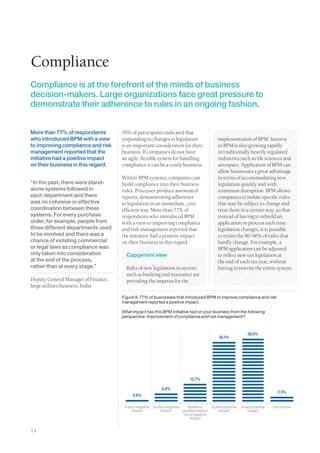
  • 7.
    Figure 1. Thereis a clear correlation between prioritization of BPM adoption within a The research highlighted business and improved performance of processes. practical issues which must be Which of the following best describes the level of process maturity within your organization? overcome in order to implement BPM successfully, notably: Total Respondents who indicated “Currently Business Process • Functional silo culture Management is an important agenda item at managerial level” • Fragmented budget • Perception of BPM as an IT matter • Resistance to BPM from IT staff who have responsibility for existing systems • A lack of readiness or willingness to tackle the change 6.8% 1.7% 15.9% 11.4% 27.3% 18.8% 23.6% 38.9% 15.8% 28.8% 10.7% 0.4% management issues associated with BPM implementations Initial Repeatable Defined Managed Optimizing Don’t know To overcome these barriers, strong Overall, just 16% of respondents customers reported a positive impact leadership (including C-level believe that their organization’s on the business. A similar proportion of involvement) plus a clear vision are processes are currently at the those whose objective was to improve needed. Another requirement for “optimized” level, but more than ever compliance and risk management successful BPM implementation is that before, companies are recognizing observed a beneficial impact. Specific companies must be willing to break the opportunity that BPM presents benefits of BPM adoption which came with the past and embrace change. to improve process maturity. 45% of through strongly were improved staff participants in the survey anticipated satisfaction and greater efficiency. Positioning an organization for that their organization’s interest in BPM requires some effort, but the BPM would increase over the next 12 positive experiences of those who months. This finding confirms that participated in the research suggest BPM is increasingly becoming a part of that it is a step worth taking. mainstream management thinking. There is compelling evidence that Figure 2. 45% of respondents anticipated that their organizations interest in BPM would BPM can deliver tangible business increase in the next 12 months. value. 96% of those who had tried How do you anticipate that the current level of interest in BPM within your organization will to measure ROI from their BPM change over the next year? investment reported a positive return, with 55% measuring a return of at The same amount Don’t know A lot more least twice their initial investment. emphasis of emphasis This may explain the finding that in challenging economic times, 13.8% A little more 19.9% investment in BPM becomes more, emphasis rather than less, attractive. 68% of respondents stated that a more difficult 28.0% business outlook than expected would lead to their organization placing increased emphasis on BPM. 3.0% 30.8% The benefits of BPM vary depending 4.6% A lot less emphasis on the organization’s objectives, as well as its level of maturity. More than A little less emphasis three-quarters of those respondents who had introduced a BPM initiative with a view to improving relations with 7
  • 8.
    The key toBPM success: BPM as a C-level concern The more Executives know about BPM, the more likely they are to believe that it should be regarded as a C-level concern. 82% of participants who have both knowledge and practical experience of the topic believe it should be part of high level business strategy. This is in stark contrast to the 20% of BPM rather than being of respondents who say that BPM is hampered by the existing currently treated as an important technologies. Strong BPM agenda item at managerial level within leadership at a strategic and their organization. At present, a lack tactical level is essential for of senior sponsorship means that long-term BPM success. only a minority of companies are reaping the full benefits that Business It should be noted that while Process Management can bring. These strong BPM leadership is benefits are discussed in greater detail important, it is not sufficient. in the next section of the report. Programs often fail because of a lack of day-to-day governance. Capgemini view This can lead to an insufficient framework to address competing To be successful, BPM needs to requests for limited resources, address organizational silos. In differing objectives and timescales. order to allow this to happen, executive sponsorship at enterprise level is essential. It is important for C-level decision-makers to focus on the business outcomes Figure 3. Respondents who have the greatest knowledge of BPM are significantly more likely to believe it should be treated as a C-level concern. Do you consider BPM to be a C-level concern? “Percentage of respondents indicating ‘Yes’” 82.0% 60.6% Respondents indicating “I know a lot Total Respondents about Business Process Management and have plenty of practical experience of it” 8
  • 9.
    “Improving process isvital for Figure 4. Just 20% of respondents stated that BPM is currently an important agenda item at our business but can be a painful managerial level. process which meets resistance Which of the following best describes the current level of interest in Business Process in some quarters, hence the Management within your organization? need for C-level sponsorship.” IT Manager, enterprise level Our We are investigating Currently Business organization is the concept and Process Management utilities business, UK small projects have is an important agenda not currently interested in been started item at managerial “Process improvements need the topic level and at least one strategic initiative in to be embedded throughout this field is under way the organization. The top 10.5% management’s time and 18.6% attention needs to be given to such a strategic and longer- 20.1% term value creating item.” Business Unit Manager, Federal government agency, USA 16.6% 17.4% We are interested in the subject 16.8% but there have One or more been no concrete departments are actions so far currently dealing with it at a more tactical level Don’t know 9
  • 10.
    How may Ihelp you? The key benefits of BPM This research examines which business drivers are most critical in different sectors and explores the application of BPM in these aspects. To understand the benefits of a BPM implementation for a Cost-efficiency particular organization, it makes sense to consider first which Many organizations grasp that medium-term. Of those companies business drivers are most critical improving cost-efficiency requires surveyed that are currently planning for the organization. The business more than simply slashing budgets. to launch a process management challenges that respondents identified Strategic investment is required in initiative, the area in which the highest as most important reflect the order to achieve material savings. proportion believed the project could macroeconomic outlook prevailing 56% of respondents anticipated that have greatest positive impact was in many developed markets and their organization would increase in maximizing cost-efficiency. the pace of technological change. investment in efficiency over the next 12 months. Far-sighted companies are recognizing that effective implementation of Business Process Management technology and techniques can be a route to achieving significant efficiency savings in the Figure 5. 56% of businesses will increase investment in maximizing cost-efficiency over the coming year. How will your investment in the following business area change over the next 12 months: Maximizing cost-efficiency? 37.2% 30.1% 43.0% 32.8% 35.4% 30.7% 23.4% 29.2% 21.9% Invest a lot more Invest a little more Invest the same 5.6% 5.0% 4.4% Total 1.1% 0.0% 0.0% US UK Invest a little less Invest much less 10
  • 11.
    56% of respondentsanticipated The application of BPM technology resources, or increase output with the that their organization would and thinking automates complex same resources. BPM can be an integral increase investment in efficiency processes, reduces manual work and part of an intelligent cost management over the next 12 months. eliminates duplication of effort. 74% strategy, which allows a business to of respondents who launched a BPM cut costs rather than cut growth. initiative with a view to reducing “With process improvement manual work reported a positive you’ll streamline and automate impact on the business. It is possible business processes, give to achieve the same output with fewer everyone in your company a complete view of the customer, provide deeper analysis and Figure 6. The three areas in which businesses anticipate BPM could have the greatest impact are: Maximizing cost-efficiency, optimizing time-to-market, facilitating insight into critical sales customer self-service. and customer metrics, keep everyone focused on getting In which of the following areas do you think process improvement new customers while keeping could have the greatest positive impact on your business? the ones you already have.” Facilitating customer Maximizing self-service cost-efficiency IT Consultant, enterprise level private healthcare business, UK 29.7% Optimizing 55.8% time-to-market 38.8% n.b. Respondents were able to select more than one answer, so percentages sum to more than 100%. Figure 7. 74% of businesses that introduced BPM to reduce manual work and increase automation reported a positive impact. What impact has this BPM initiative had on your business from the following perspective: Improving process performance by reducing manual work and increasing automation? 43.1% 31.0% 15.5% 6.9% 1.7% 1.7% A very negative Quite a negative Neither a Quite a positive A very positive Don’t know impact impact positive impact impact impact nor a negative impact 11
  • 12.
    Business Agility In uncertaineconomic times, business agility is important. As technology cycles move ever more quickly, businesses are constantly striving to cut cycle times: two thirds of respondents (66%) identified optimizing time-to-market as an important business driver. 5% of survey participants anticipated Figure 8. 78% of businesses believe their BPM investment improved the flexibility of the that their organization would increase organization. investment in their ability to react What impact has this BPM initiative had on your business from the following perspective: to changing market conditions Improving the flexibility of the organization? over the new 12 months. Agile organizations realize higher margins on their goods and services by taking 39.5% advantage of market opportunities: 38.6% two thirds of respondents (66%) identified optimizing time-to-market as an important business driver. BPM enhances the ability of businesses to react to changes in 12.5% the business environment. 78% of respondents who introduced 6.8% BPM with a view to increasing the 2.3% 0.0% flexibility of the organization reported A very negative Quite a negative Neither a Quite a positive A very positive Don’t know a positive impact on the business. impact impact positive impact impact impact nor a negative impact 12
  • 13.
    “Taking the attitudethat ‘it has Capgemini view Rules management always worked like this’ is no way to compete. We are a lean Any organization looking to Organizations manage their organization, constantly trying to achieve business agility must interactions with the external stay ahead of the competition.” embrace three key concepts that world through documented and we like to call “the agile agenda”: agreed policies and procedures: Customer Services Manager, medium- processes are just one example. sized manufacturing business, Sweden • Process management Business rules are explicit policies embedded within processes. • Rule management The ease with which these rules • Integration and automation can be adapted to comply with regulatory or market pressure can Process management often be a source of competitive advantage. Organizations that To be agile, organizations know the value of rules often use must also be in control of decision engines to find, update, their process assets. Processes deploy, and maintain rules must be documented and across processes in real time. understood. They must be visible and measured continuously – BPM is moving into an ideally in real time – to ensure unstructured, collaborative age. compliance with shifting market Rules management will be the and regulatory objectives. way to stay properly governed, visible, and compliant, while Business Process Management dynamically keeping processes on (BPM) solutions provide modeling track with changing and complex capabilities that make processes desired outcomes, goals and KPIs. explicit as models. These models are created by, or in collaboration It will become increasingly with, end users. More importantly, important to set rules properly they can be updated by users in order to manage BPM for without recourse to IT. increased agility. There will be a premium on managing Regardless of who makes changes, uncertainty, and on making better the agility comes from the fact that decisions about business rules. the changes are made to explicit Simulation and optimization models rather than changes to techniques can help, and so can lines and lines of arcane code. real-time analysis and response. 13
  • 14.
    Compliance Compliance is atthe forefront of the minds of business decision-makers. Large organizations face great pressure to demonstrate their adherence to rules in an ongoing fashion. More than 77% of respondents 70% of participants indicated that who introduced BPM with a view responding to changes to legislation implementation of BPM. Interest to improving compliance and risk is an important consideration for their in BPM is also growing rapidly management reported that the business. If companies do not have in traditionally heavily regulated initiative had a positive impact an agile, flexible system for handling industries such as life sciences and on their business in this regard. compliance it can be a costly business. aerospace. Application of BPM can allow businesses a great advantage Within BPM systems, companies can in terms of accommodating new “In the past, there were stand- build compliance into their business legislation quickly and with alone systems followed in rules. Processes produce automated minimum disruption. BPM allows each department and there reports, demonstrating adherence companies to isolate specific rules was no cohesive or effective to legislation in an immediate, cost- that may be subject to change and coordination between these efficient way. More than 77% of treat them in a certain way, so that systems. For every purchase respondents who introduced BPM instead of having to rebuild an order, for example, people from with a view to improving compliance application or process each time three different departments used and risk management reported that legislation changes, it is possible to be involved and there was a the initiative had a positive impact to retain the 80-90% of rules that chance of violating commercial on their business in this regard. hardly change. For example, a or legal laws as compliance was BPM application can be adjusted only taken into consideration Capgemini view to reflect new tax legislation at at the end of the process, the end of each tax year, without rather than at every stage.” Rafts of new legislation in sectors having to rewrite the entire system. such as banking and insurance are Deputy General Manager of Finance, providing the impetus for the large utilities business, India Figure 9. 77% of businesses that introduced BPM to improve compliance and risk management reported a positive impact. What impact has this BPM initiative had on your business from the following perspective: Improvement of compliance and risk management? 39.0% 38.1% 12.7% 6.8% 2.5% 0.8% A very negative Quite a negative Neither a Quite a positive A very positive Don’t know impact impact positive impact impact impact nor a negative impact 14
  • 15.
    Customer-centricity For consumer-facing businesses,the advent of new technology has radically changed the way in which they engage with their customers. In the age of always-on, ubiquitous access, companies have to respond faster than ever before. 43% of respondents 41% of respondents anticipated Companies are using Business Process anticipate that investment that their business would increase Management to support new ways in multi-channel access will investment in facilitating customer self- of interacting with customers. 78% increase over the next year. service over the next year. The figure of customers who introduced a BPM rises to 52% in banking, and 47% in the initiative with a view to improving telecommunications sector. Similarly interactions with clients reported 43% of respondents anticipate that that the impact on the business investment in multi-channel access was positive in this aspect. will increase over the next year, including 52% of respondents in the telecommunications sector. Figure 10. Half of banking and communications organizations anticipate increasing investment in facilitating customer self-service over the next 12 months. How will your investment in the following area change over the next 12 months: Facilitating customer self-service? Banking TME 1.8% 2.6% 8.2% 10.3% 38.2% 40.5% 33.6% 31.0% 18.2% 15.5% Invest much less Invest a little less Invest the same Invest a little more Invest much more 15
  • 16.
    “Self-service is generally Figure 11. 78% of organizations who introduced BPM to improve interactions with clients cheaper. The number of reported a positive impact. Improving the interactions with clients and / or CRM. people being employed in What impact has this BPM initiative had on your business from the following perspective: call centers can be reduced. Improving interactions with clients and/or CRM? Younger customers in particular expect to be serviced through 41.8% emerging Web 2.0 channels.” 36.1% Systems Architect, enterprise level telecommunications business, Australia “BPM combines business 10.7% processes, people and 5.7% technology to achieve one 4.1% 1.6% single goal: getting and keeping satisfied customers. It’s an A very negative Quite a negative Neither a Quite a positive A very positive Don’t know impact impact positive impact impact impact overall strategy to help you learn nor a negative more about your customers impact and their behavior so you can develop stronger, lasting relationships that will benefit both you and the customers.” Capgemini view BPM solutions are increasingly seen as CRM 2.0. BPM allows IT Consultant, enterprise level Customers are demanding more streamlined process for consumer products and retail more: More personalization and managing customer interactions business, North America customization, a broader range regardless of channel, all the way of engagement channels, greater through the front, middle and access to information and more say back office stages to resolution. in the buying process. Customers also expect recognition and a Example: Warranty consistent response, regardless management of what channel they are using. Organizations are increasingly One application of BPM that using BPM to respond to these benefits both vendor and changes. BPM is transforming customer is in the field of case management and moving warranty management in the into the traditional CRM space. automotive sector. Typically, Adding a BPM layer to existing administering warranties is processes helps address the clumsy and expensive, involving problem of case management by manufacturers, dealers, suppliers ensuring that all information is and customers. Information is integrated – stakeholders have a spread across myriad systems 360 degree view of all interactions and claims may be governed by with each customer. Companies different policies and procedures. are able to access the right data Application of a BPM solution in the right place and at the right unifies all information, allowing time. The appropriate response the streamlining of the full to different scenarios can be warranty management process. automated. Wherever customer care is involved, there is scope for BPM to make life easier for both vendor and customer. 16
  • 17.
    Case Study –Business Process Management and customer-centricity Challenge: A Dutch software business which sells book-keeping and HR software wanted to improve customer retention. The company redesigned its complaints procedure, Benefits of the approach adopting BPM software and thinking to improve internal communication between departments This rigorous complaints procedure has delivered tangible and external engagement with customers. business value. There is a higher level of customer retention. Complaints are far less likely to result in the cancellation of What the process looked like before subscriptions. In fact, the rate of subscription cancellation is actually 7% lower for customers who complained and For years the company had no central customer service had their problem addressed than for those who did not department. Customers were directed in an ad hoc fashion complain in the first place. Finally, there is a greater culture to either sales or product departments, depending on of cross-departmental collaboration within the organization. the nature of their complaint. The lack of process led to departments shifting responsibility for complaints. Employees gave inconsistent answers to customers posing similar questions due to lack of documented “Everyone in the organization was trying to procedure, causing confusion and further complaints. avoid taking any responsibility, saying ‘it’s not our department, it’s their department who What it looks like now should be dealing with it.’ That was a major issue – no one wanted to say to the customer, The company created a team dedicated to customer ‘I’ll take responsibility, I’ll make sure this goes service. Customers are presented with a telephone menu well, I’ll make sure that you’re happy’.” as soon as they dial in so that their complaint can be categorized. Customer services representatives note Complaints Manager down the details of problems in a case file. Cases are divided into ‘dissatisfactions’ and ‘complaints’ (which are more serious). Notifications are then sent to agents in departments such as technical support and sales with “We now invest the time to make customers the relevant expertise who follow up on the issues. The happy: a fundamental part of this is working as a more serious ‘complaints’ are dealt with at managerial company, not just as departments who are out for level. All agents have access to the same case file and themselves and care only about their targets.” all interactions are logged ensuring seamless sharing of information. The success of the execution of the Complaints Manager complaints procedure is measured quantitatively. Issues encountered Staff were initially resistant to this new process, which was perceived as bureaucratic. The sales department felt that handling complaints management hindered them in meeting targets. Different departments were unused to working collaboratively to solve problems. 17
  • 18.
  • 19.
    Social media strategy Onearea that was investigated in our BPM research was the level of emphasis that companies are placing on both the threat and opportunity from social media. 53% of respondents believe this “We need to introduce a system business driver will become more technology has already had an to handle social media. At the important for their business over the impact on customer’s daily lives moment one team writes down next 12 months. This figure rises and is here to stay. Through social mentions on post-its before to 60% in the United States, the listening and an effective Business handing them over to another market which sets the pace in terms Process Management system, team to respond. You can of harnessing new forms of media organizations ability to listen to the guess how efficient this is.” to improve business processes. conversation and respond through changing business processes will Business Unit Manager, large Anecdotal evidence from the research, become a major differentiator. insurance business, Spain illustrated by the quotations, It is essential to combine social shows how some large businesses media data with unstructured “The power of social media have been caught off-guard by the and structured data from other is rapidly increasing, which revolutionary effect that social sources to provide a holistic means that it will become a media has had, and in particular and representative picture of focal point for all mass market the way that B2C organizations what your customers are saying. businesses. Market trends will interact with their customers. A social media strategy that is be dictated by social media supported by an organization that trends, and the public view of a There has been some complacency is able to rapidly alter business company will be determined by in engaging with and investing in processes, listen to and identify its social media interaction.” social media. It is clear that businesses and manage risk early on, and must develop a social media strategy. also provide sales opportunities Enterprise Architect, enterprise level Organizations can no longer dictate the will be an effective one. automotive business, Germany terms of engagement with customers – it is now customers who are in control of the conversation. In light of this Figure 12. 53% of businesses anticipate that social media strategy will become more loss of control, organizations need to important over the next 12 months. listen to and respond effectively to customer-initiated activity. Customers Which of these drivers do you think are likely to become more or less important over the next 12 months: Managing the opportunities and threats of social media? now expect a greater level of attention, as well as a near-instantaneous Total response. Businesses should also be USA aware of what a powerful asset this rich real-time feedback can be. Capgemini view Organizations are traditionally used to being in control of customer interactions and have long built IT systems that push 2.3% 1.8% 5.9% 1.8% 39.2% 36.3% 31.6% 33.6% 21.1% 26.5% messages to the customer. It is Become much Become a little Stay the same Become a little Become much clear, however, that social media less important less important more important more important and the consumerization of 19
  • 20.
    Staff satisfaction Large organizationsare engaged in a continuous effort to create and sustain a rewarding working environment that mobilizes and motivates their staff. An important benefit of improved processes that emerged from this research is the impact on staff satisfaction. “The previous management 75% of those organizations within underestimated process our sample that launched a BPM but also in terms of improving job development. Processes initiative with a view to improving satisfaction for the teams involved. weren’t documented. We staff satisfaction reported that the Alongside traditional ROI models had to repeat the same steps project had had a positive impact companies should consider the over and over again to reach in this regard. Strikingly, not one ease of use of resultant systems, a solution. Money and time respondent reported that the initiative the reduced cost of training were wasted, staff weren’t had had a negative impact. and the improved retention motivated and customers were of valuable team members. frustrated. Now we’ve improved Capgemini view our processes, all our staff are The quantitative research convinced of the benefits.” Enhanced staff satisfaction is an findings show that Business interesting ‘hidden benefit’ of Process Management initiatives Department Officer, enterprise process improvement. Enhanced can have a positive impact level insurance company, France staff experience is rarely built into on many different parts of an business cases for BPM investment. organization. The next section of However, removing laborious the research demonstrates how manual workflows, reducing the BPM ultimately delivers value in need for ad-hoc intervention and terms of Return on Investment. making it easier for staff to operate efficiently, can have clear benefits, not just in terms of productivity Figure 13. 75% of businesses who implemented BPM to improve staff satisfaction reported a positive impact on the business. What impact has this BPM initiative had on your business from the following perspective: Improving staff satisfaction? 40.8% 33.8% 19.7% 5.6% 0.0% 0.0% A very negative Quite a negative Neither a Quite a positive A very positive Don’t know impact impact positive impact impact impact nor a negative impact 20
  • 21.
    Show me themoney: BPM and Return on Investment The research demonstrates clearly that investment in Business Process Management can yield tangible business value. Of those respondents who had tried to measure ROI from BPM, a remarkable 96% reported a positive return, with 55% measuring a return of at least twice their initial investment. “We consolidated by centralizing In the past, businesses found it difficult Figure 14. Just 39% of respondents have the IT infrastructure so that to quantify the Return on Investment attempted to measure ROI from BPM in a formal way. we didn’t have hundreds of from BPM programs as the benefits little silos everywhere. This were various and wide-ranging. Have you attempted to measure wasn’t a management power It can be a challenge to measure Return on Investment (ROI) from this BPM initiative in a formal way? trip, it was about saving a lot intangible but essential elements of of money. Ultimately, from BPM, such as cultural change and an economic perspective, employee behavior. Indeed, our Yes No Don’t know all the departments win.” research shows that businesses are still learning how to assess the value Senior VP for IT, consumer of a BPM investment, with only 39% 38.7% 29.0% products and retail Business, UK of respondents stating that they have tried to measure ROI in a formal way. Capgemini view Setting the business case for organizations is often challenging. Getting the appropriate balance 32.3% between the different objectives across the organization is key and rarely an easy task. However once objectives are set, and measurements in place, we have seen BPM programs delivering significant ROI. In addition, it is important to measure quantitative and qualitative factors when implementing BPM, and to track those measures through to completion of the project. Those results in turn inspire further change. 21
  • 22.
    Figure 15. 96%of respondents calculated a positive ROI from investment in BPM. Examples of Return on Investment What level of ROI did you calculate for the BPM investment? Cost reduction and Negative Return on Investment 1.9% efficiency gains: No Return on BPM can help lower the cost Investment 1.9% of running, changing, and executing processes. Up to 1.5 times ROI 12.4% A North American Between 1.5 and 2 times ROI 24.8% insurance organization: Between 2 and 22.2% • Gained 40% cost reduction 3 times ROI over a five year period Between 3 and 12.0% 4 times ROI • Reduced training time from as long as two Between 4 and 9.0% 5 times ROI weeks to just one day Between 5 and 4.1% • Gained ability to execute the 10 times ROI First Notice of Loss (FNOL) process with greater efficiency Greater than 10 times ROI 2.2% and accuracy as a result of increased automation Don’t know 9.0% • Introduced real-time analytics of overall claims operations An automotive company: • Reduced FNOL Total Cost of Ownership by approximately • Improved their cycle $12 million over the four years time by 50% following implementation A worldwide engineering • Was able to offer its organization: customers a market-leading claims experience • Ran a global operation to optimize and harmonize the A public sector organization: leading business processes and support, leading • Used sophisticated case to precise supply chain management to achieve planning and processing a win-back time of 70 minutes per case • Achieved real-time, end- to-end transparency Increase in competitiveness and agility • Established a more accurate process, with accelerated BPM reduces time-to-market for supply chain performance and new products and services. improved competitiveness A global banking organization: • Reduced time-to-market for new product release from nine months to four months 22
  • 23.
    Speculating to accumulate: BPMas a counter-cyclical investment The high level of Return on Investment that BPM can potentially deliver, discussed in the previous section of the report, perhaps explains why interest in BPM actually increases in relatively challenging market conditions. “Growth via demand will be 68% of respondents who were seriously Figure 16. 68% of respondents considering difficult, so we have to improve considering investment in BPM state a BPM investment state that a more challenging economic climate over profitability by enhancing that a more challenging economic the next 12 months would increase the our internal processes.” climate would increase the attention attention their organization paid to process paid to process improvement. In improvement to process improvement. Risk Manager, enterprise level theory this is a simple equation: at If the economic climate in your sector manufacturing business, UK a time when it is difficult to acquire proved more challenging over the next 12 new business, process improvement months, what impact do you anticipate this would have on your organization’s offers a way to boost the bottom attitude to process improvement? line by making cost savings. We will pay a lot more attention However, challenging conditions can We will pay a little more attention create barriers to BPM adoption. If employees are concerned about job It will not impact on the attention paid security and their personal well-being, We will pay a little less attention BPM is more likely to be perceived as a We will pay a lot less attention threat rather than an opportunity. 44% Don’t know of respondents in the survey stated that resistance from staff responsible 6.4% for existing systems such as SAP and 2.5% 31.5% CRM within their organization was 5.6% a barrier to process improvement.2 17.9% Bottom line pressures can lead to a reductive focus on costs rather than an emphasis on the bigger picture. Money allocated to IT could be spent maintaining outdated systems that have no place in a modern technology environment. This is often a false economy. The BPM institute blog 36.1% uses an apt analogy to explain the likely consequence of trying to cut operational and process-related costs in the face of a downturn: “These organizations are just starving themselves, and it will likely come back to haunt them as the core infrastructure of the company – the corporate metabolism, is crippled to the point where it cannot function effectively.”3 23
  • 24.
    “Even with thecurrent economic 46% of survey respondents identified climate, middle and senior a lack of change readiness or management still find it difficult willingness at their organization as to embrace culture change, a barrier to improving processes.4 move with the times and take Reactive companies that are not advantage of the efficiencies ready to confront changing times will and cost savings that can not be able to introduce successful be delivered by BPM.” BPM. In order for a company to successfully deploy BPM, the Process Manager, local company must be able to embrace government agency, UK change across the organization. In the following section of this report ways in which barriers “Companies in a defensive mode to BPM adoption can be broken simply aim to survive. BPM will down are examined further. seem too daunting for them – rather than investing in new tools and processes, they will cut IT Capgemini view budgets and try and muddle through with legacy tools in their BPM is not simply an out-of- existing format for a little longer.” the-box technological solution that can be introduced at will. Process Manager, enterprise BPM is a discipline that requires level telecommunications the adoption of a new cultural business, North America mindset. In a downturn, BPM is attractive to companies that are offensively orientated, and looking to push their business to grow. In order to introduce effective BPM, an organization must be receptive to change, willing to break its mould and become something different. Executive sponsorship is key to driving this forward. One of the trends we have observed (though not suitable for all programs) is towards short term investments with fast ROI. BPM projects are often iterative – lasting 6-10 weeks per project, with each phase linked to a value based objective. In this context budget allocation is easier. 2 See Figure 21 3 http://www.bpminstitute.org/resources/white-papers/ bpm-ea-two-smart-investments-recession 4 See Figure 22 24
  • 25.
    Barriers to BPMimplementation The research highlighted various practical issues which prevent organizations from successfully implementing BPM. Five barriers in particular team all have their own targets and business domain. It requires will were identified: priorities. It requires a different and impetus to transcend ways way of looking at processes to make of working that are constructed • Functional silo culture them end-to-end more effective. around existing bureaucratic structures. Vision and leadership • Fragmented budget from a senior level is essential Capgemini view for long-term BPM success. • Perception of BPM as an IT item BPM-driven ways of working BPM implementation renders the can then add value to a business • Resistance to BPM from IT greatest value when it is applied by linking functional silos and staff who have responsibility across organizations and across eradicating the inefficiency of for existing systems applications. However initiatives different business units working tend to deal with one subset of in competition with one another • A lack of change readiness processes because it is much easier on disconnected projects. or willingness to gain sponsorship for a process improvement initiative within a All these internal barriers to cooperation must be addressed in order to achieve commonality of purpose, which can directly contribute to business value. Figure 17. 55% of businesses state that functional silo culture is a barrier to process improvement. Functional silo culture To what extent do you agree that these barriers to process improvement exist in your organization: Different parts of the organization tend to operate in functional silos? 55% of respondents identified functional silo culture as a barrier to process improvement at their e gre organization, making it the most ly a ee frequently cited obstacle. Survey ong agr ee respondents who had experience of agr dis Str BPM initiatives explained how before htly nor introducing BPM, organizations were Slig re e e compartmentalized into functional gre w r ag kno isa units, with objectives and performance 6.6% lightly dee ithe n’t r measures broken down accordingly. sag Do Ne This method of working promotes 3.2% gly di S % % % % efficiency within a particular silo, on 23.0 24.7 10.3 32.1 but undermines the possibilities for Str working collaboratively and seamlessly across an organization. The attempt to introduce cross-functional BPM can lead to internal politics. For example, when a retailer attempts to improve cross-channel access, addressing the issue is immediately problematic because the online-channel owner, in-store channel owner, telephone- channel owner and customer service 25
  • 26.
    “In telecoms, thenew buzzword Perception of BPM as an IT item Capgemini view is an “integrated supply chain”, how to take everything from The survey findings indicate that BPM programs need to be driven manufacturing, procurement, there is little consensus across by a collaborative team of IT logistics etc. and put that all organizations as to who should and business. Business should together under one ownership. take primary responsibility for drive the business case, the In practice it never works like process improvement. In different process design and outcomes, that. At the moment we have organizations across the sample, this and IT needs to supply the an operations organization, was borne variously by IT, business infrastructure, core systems a procurement organization, management, operations, or even and integration expertise. BPM a logistics organization dedicated process management brings the two – business and IT – and a delivery function all units. In many instances, budget together, to make those decisions operating in different silos. is fragmented across departments, jointly. It also creates a common All departments affected by a which can undermine the environment which serves to process should work together.” effectiveness of attempts to launch eliminate the communication coherent, cross-functional process barriers that traditional tools Head of Logistics, enterprise management initiatives. and methods tend to amplify. level telecommunications business, North America 48% of respondents identified the perception of BPM as an IT item as a barrier to effective process improvement. The figure is higher “Different departments in certain European markets such were taking decisions in as Italy, where it rises to 54%. their own way, with their own Perception of BPM as an IT item can philosophies and objectives. hinder implementation as while This created a lot of tensions many of the costs and challenges and processes became stuck.” fall on the IT side, the principal benefits fall on the business side. Customer Services Manager, medium sized software business, Netherlands Figure 18. Perception of BPM as an IT item is deemed a barrier to process improvement by almost half of respondents. To what extent do you agree that these barriers to process improvement exist in your organization: BPM is still seen too much as an IT item? e gre ee ee ly a agr agr ong htly dis Str Slig nor re e e gre r ag w isa kno re e ithe 10.8 htly d sag n’t Ne Do 4.4% gly di Slig % % % % 8.7% on 29.6 28.7 17.9 Str 26
  • 27.
    Figure 19. Allocationfor process improvement is often split across organizations. Resistance from staff responsible for existing systems Which parts of the business hold the budget for process improvement? One potential hurdle to BPM implementation is that BPM gives power to the business side of an organization rather than the IT 19.5% department. 44% of respondents found 19.9% that resistance from staff responsible for existing systems was a barrier to successful process improvement. IT departments will naturally be IT Operations protective of current tools, and 27.1% argue that these can achieve value. Capgemini view 15.3% The introduction of BPM 19.5% Senior business technology will change the management applications landscape and there Individual will often be internal resistance to business units this. Ultimately, BPM technology 12.7% Finance will serve to create value for the organization as a whole and create 4.6% alignment between business HR manager and IT. However, it is important Dedicated process 21.0% management unit to engage the CIO and IT staff in BPM strategy to ensure that these stakeholders do not feel n.b. Respondents were able to select more than one they are relinquishing control. In answer, as budgets can be split across departments, forward-thinking organizations hence the overall percentage response sums to more Don’t know than 100%. where staff view change as an opportunity rather than a threat there is the best chance of Figure 20. There is little consensus across organizations as to who should take primary responsibility for process improvement. successful BPM implementation. Which of the following take primary responsibility for process optimization? “The biggest challenge we had was actually the human aspect, not the systems and technical 13.1% aspect. We were suddenly 16.3% 3.1% saying ‘you’re not in charge HR manager of the network anymore, we Operations are.’ You’ve got to make sure 18.2% everyone’s ok about it before IT you can move forward.” 3.6% 15.6% Senior VP for IT, consumer Senior business Finance products and retail, UK management 12.8% 5.3% Don’t know 11.9% None of the above Individual business units Dedicated process management unit 27
  • 28.
    “There was oppositionin Figure 21. 44% of respondents found that resistance from staff responsible for existing the company from different systems was a barrier to successful process improvement. departments. People were To what extent do you agree that these barriers to process improvement exist in your worried because their discretion organization: There is resistance from IT staff who have responsibility for existing systems over their systems was being (SAP, CRM)? wiped out. There was also concern that manpower would be declared surplus as we put ee ee e agr systems in place to do the work gre agr dis they had done previously.” ly a htly nor ong Slig re e Str Deputy General Manager of Finance, ee r ag large utilities business, India agr w ithe kno dis e Ne n’t htly gre Do Lack of change readiness isa Slig ly d / willingness % % % % % ong 6.6% 10.5 12.4 15.9 27.0 27.7 Str 46% of respondents identified a lack of change readiness or change willingness at their organization as a barrier to BPM adoption. Organizations which Figure 22. 46% of respondents identified a lack of change readiness or change willingness have adequately functioning processes at their organization as a barrier to BPM adoption. can easily become complacent, and To what extent do you agree that these barriers to process improvement exist in your fail to acknowledge the need for organization: There is a lack of change readiness and/or change willingness in the continuous improvement, leaving organization? them vulnerable to being overtaken by the competition. Companies with an apparently well-functioning e gre ee application landscape can lack the ee agr ly a agr vision and appetite for a step change. dis ong htly nor Str Slig Capgemini view re e ee r ag w agr kno A BPM implementation may ithe dis re e n’t appear to offer radical change for Ne htly Do 6.4% y disag marginal return. Whereas when Slig implemented carefully, it can offer % % % l % ong % 25.2 29.5 16.5 10.7 organizations a step change in the 11.7 Str way they are able to do business. Large organizations that are processes, minimizing disruption accustomed to acting in a and ensuring continuity while particular way can also be wary facilitating process improvement. of overhauling and updating Business process and rules are processes because business rules captured and made explicit, and and business knowledge may be systems become self-documenting. embedded into long-standing Staff with the appropriate processes. In some instances authorizations can then maintain these rules may not be formally and amend processes and rules documented, so stakeholders are that are no longer hidden away concerned that when migrating in arcane coding languages. to new system, the full range of functionality may not be Capgemini recommendations captured. The great strength of for breaking down barriers and BPM is that it captures and builds successfully implementing BPM on existing ways of working, are summarized on the next page. renewing rather than usurping old 28
  • 29.
    Key conclusions andrecommendations BPM offers high value through process optimization – but first, organizations need to create the conditions for success At a time when many market sectors are facing slow Define strategic objectives for BPM revenue growth, customer churn, and increased pressures on costs, BPM is a critical weapon in the battle BPM succeeds best when it is executed against clear business for efficient, effective processes that cost less. It allows objectives. Organizations embark on BPM programs for organizations to become more customer-centric, and to different reasons, and so each business must identify and respond in a more agile way to business challenges and prioritize its own strategic objectives up front. Involving opportunities, however uncertain the business environment. senior management in this process is an important way to Other benefits include better regulatory compliance, ensure that they take ownership of the subsequent program. even where regulations are altering almost daily. Possible objectives can be grouped into three clusters: All this adds up to an exceptional ROI for successful BPM programs – one that can often make it 1. Cost reduction, efficiency, and effectiveness possible to buck gloomy economic trends. 2. Customer-centricity and agility, for example Before an organization can realize BPM’s potential, in adapting to changing market conditions there are usually some challenges to overcome. These typically include a silo-based organizational structure and 3. Compliance with rapidly-evolving regulations culture, resistance to change on the part of stakeholders, and fragmented process improvement budgets. Objectives should relate to the business as a whole, and not just to individual functions. Setting the right Below, we make some recommendations for objectives, and then managing against them, helps the positioning an organization to overcome the organization to work as a single entity, rather than in silos. challenges and realize BPM’s promise. Build a business case for BPM Get C-level sponsorship The business case for a given BPM initiative will vary Strong vision and leadership at the C-level are the key to depending on the organization’s objectives, as well as its overcoming barriers between organizational silos to create an maturity with regard to BPM. Involving senior managers environment for BPM success. Without senior management in the process of building the business case, as opposed sponsorship, a BPM initiative is usually doomed before to simply presenting them with the end result, will it even starts. Securing C-level sponsorship can itself be help to gain C-level ownership of BPM initiatives. difficult, particularly if the people who really “get” BPM find it hard to communicate the potential in business terms. The The business case should balance the requirements of process of jointly defining objectives and a business case, as different parts of the organization as far as possible. On recommended below, can improve communication and build the benefits side, it should take account of “soft” benefits the vital senior buy-in. such as improved staff satisfaction and retention, and reduced cost of training, as well as financial benefits. A crucial element of the business case should be a roadmap with delivery milestones, to show when benefits will be realized. Goals should be clear, measureable, and realistic. For those organizations starting out on BPM, our recommendation is to think big, start small, and scale rapidly. It is similarly important to measure post-implementationto establish when benefits are actually realized and recognize success. 29
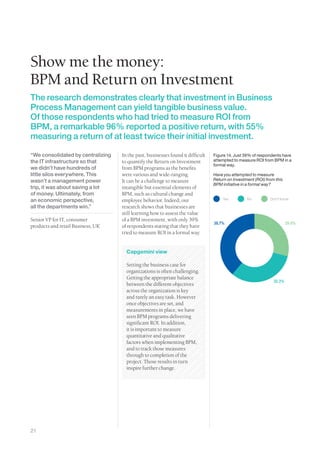
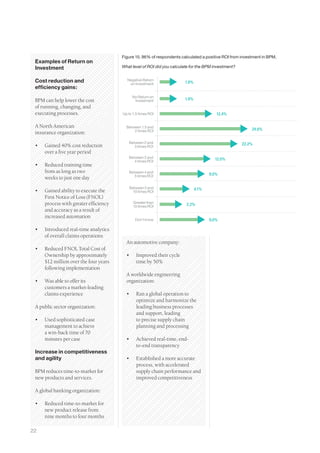
  • 30.
    Establish governance Realize and communicate benefits Successful BPM requires governance at an operational It is critical to track and manage BPM progress against level. The CIO needs to provide vision and direction, the business case, ensuring that objectives are being met, and be willing to do so if he or she has engaged in the milestones achieved, and benefits realized. Measurement process of objectives definition and business case needs to be qualitative (e.g. through customer and construction described above. Even so, a senior executive staff satisfaction surveys) as well as quantitative (e.g. is unlikely to be able to provide the constant day-today through measurement of cost reductions) – both types of involvement and decision-making that is required. measurement will have been defined in the business case. Day-to-day decisions on projects and programs therefore need to be made by a well structured, cross-functional Demonstrating value early on in a project is the best way to team of IT and business representatives, mediated by a support the case for continuing it. In addition, demonstrating steering committee of senior sponsors and stakeholders. success on one project is likely to inspire others to follow suit. Integrate new and existing technology Give BPM organization-wide reach BPM depends on the correct alignment of technology Although success breeds success, organization-wide solutions with the business case. New BPM tools adoption of BPM is rare unless patches of success and and suites are likely to be implemented, but most fragmented budgets are brought together to create organizations will also need to take into account a organization-wide awareness, enable a repeatable complex landscape of legacy back office applications. experience and reuse of components to build momentum and further reduce costs. One way to Usually there is no need for dramatic “rip and replace” do this is by setting up a center of excellence. Again, systems migrations. Instead, the emphasis will be on C-level sponsorship is essential to make it happen. leveraging the investment in existing solutions using BPM to augment, and plug execution gaps in, legacy applications.. In summary In other words, the deployment of an agile BPM layer can modernize, and extend the functionality of, legacy systems. To achieve the potential value of BPM, organizations must first create the conditions for success. That means Manage cultural change securing and using senior sponsorship, rigorously defining organization-wide strategic objectives BPM is not an out-of-the-box technical solution. It requires and a business case, and putting in place the right the adoption of a new culture and mindset on the part governance structures and the right technology. The of both business (who will operate the new processes) BPM process must be purposefully managed throughout and IT (who are responsible for existing systems). to ensure that the intended benefits are realized and Both of these groups will need to adopt a new model of communicated. Budgets and resources may need to be collaborative working. We strongly believe that BPM as a integrated and/or centralized to achieve wider reach. discipline needs to be jointly owned by business and IT. C-level commitment and strong change management skills It follows that stakeholders from both business and IT are essential to bring about the required cultural change, must be ready and willing to embrace change. Initially including the move to greater cross-functional collaboration. there is often resistance, but if C-level managers have taken ownership of BPM it will be easier to gain the Under the right conditions, BPM can deliver exceptional commitment of other staff members. Even so, managing value that more than justifies the effort involved, cultural change is one of the most challenging aspects as the experience of early adopters confirms. of BPM implementation, particularly where internal politics get in the way of cross-functional collaboration. 30
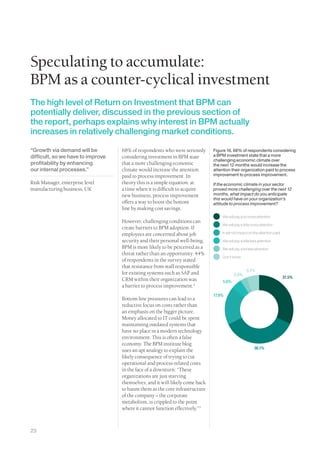
  • 31.
  • 32.
    Capgemini sector andcountry focus BPM as a management discipline can offer organizations – both private and public sector – a way of underpinning their processes in order to deliver high value to the business. In the second section of the report, The sectors profiled are: We also explore BPM trends and we take an in-depth look at the practices from a regional perspective application of BPM in five specific • Financial services in the following geographies: market sectors that are of particular interest. The level of BPM adoption, • Public sector • United Kingdom and drivers of interest in BPM thinking, vary across market verticals. • Manufacturing, automotive • United States and life sciences • Australia • Consumer products and retail • Germany • Telecommunications, media and entertainment • Italy • France • Spain • The Nordics • The Netherlands 32
  • 33.
    Financial services Our surveyshows that the financial services sector leads the way in adoption of Business Process Management software and approaches: 65% of financial services decision-makers that participated in the survey stated that their organization had launched a BPM initiative of some description, while 52% anticipated that greater emphasis would be placed on BPM over the next year. Figure 23. More than half of financial services respondents believe their organization will place greater emphasis on BPM over the next year. How do you anticipate that the current level of interest in BPM within your organization will change over the next year? A lot more emphasis will be placed on Business 18.8% Process Management over the next year A little more emphasis will be placed on Business 32.7% Process Management Nicholas Kitson, Head of Business over the next year Process Management, Global The same amount of emphasis Financial Services Unit, Capgemini will be placed on Business Process Management over the 27.3% next year The effects of the global financial A little less emphasis will be placed on Business crisis still loom over financial services Process Management 4.2% providers. Shortcomings in regulation over the next year of the sector have been brought A lot less emphasis will into sharp focus by the economic be placed on Business 3.6% Process Management downturn, which has also forced over the next year financial players of all stripes to reassess their cost position and the Don’t know 13.3% ways in which they fight for market share. Players in banking, insurance and capital markets have all been Solvency II. The problem facing 62% of decision-makers in the forced to scrutinize their processes these financial institutions is how financial services sector indicate and Business Process Management to gain and maintain compliance that responding to changes in thinking has become more relevant in a fluid regulatory environment, legislation will become a more than ever to these institutions. while at the same time satisfying the important driver for their business demands of customers for swift and over the next 12 months. Financial services efficient service. 62% of decision- and compliance makers in the financial services sector that participated in the survey “FSA legislation has become The past few years have witnessed anticipated that responding to tighter and this impacts vociferous demand for the creation changes in legislation would become the sales process and the of new legislation in financial a more important driver for their techniques in place.” services. By 2013, banks will need business over the next 12 months. to demonstrate their compliance Process Manager, to the new Basel III standards on large insurance business, UK capital adequacy; similarly, by 2014, insurance companies will need to demonstrate compliance with 33
  • 34.
    “We talk topeople around risk, BPM allows financial services to controlled approach to the credit compliance, Solvency, Basel... fuse regulations with processes. process by facilitating continuity of they understand the issues Organizations can build compliance to work across different departments and they know they will need to these new regulations into a repeatable, and different channels. Furthermore, do something around it. They measurable framework. This eliminates BPM also allows the business to grasp that there’s a deadline the need to impose compliance monitor how efficiently and accurately by which they need to address controls manually in an ad-hoc fashion, these processes are carried out. these issues and if they don’t reducing error and minimizing they will be punished.” time and resources that need to be Since the downturn, insurance dedicated to regulatory demands. companies have been under pressure Capgemini BPM specialist, Spain to reduce operational and acquisition BPM allows financial services firms costs to assure sustainable growth to respond to government demands and profits. Legacy IT infrastructure 73% of financial services by demonstrating compliance at insurance companies is unable to decision-makers who took part automatically. BPM also allows handle the increasing complexity in the survey anticipated that continuous change and different in claims processing that is driven maximizing cost-efficiency layers of customization: this means by a combination of technological would become a more that rules can be refined to meet innovation, a challenging external important business priority different requirements in geography environment and regulatory change. over the next 12 months. or product. It also affords firms the Processes frequently require multiple scope and flexibility to meet elements hand-offs and duplication and of future compliance which have yet redundancy are rife. This explains “We want to replace things to be precisely defined, and to model why insurers are embracing BPM that don’t work, maximizing these intelligently in advance to see technology, which unpicks the knots cost-efficiency by paying more what the implications may be. that form in historically evolved now to save more later.” processes, enhancing process Financial services and efficiency and cost effectiveness Business Analyst, cost-efficiency and allowing measurement of the large insurance business, USA success of claims processes. In the aftermath of the economic downturn, financial institutions are “Harmonizing processes focusing on cost reduction. Business across different divisions and Process Management allows financial subsidiaries will save costs.” services companies to automate labor-intensive manual tasks, saving Compliance Officer, times and resources and boosting enterprise level bank, Australia efficiency. 73% of financial services firms in the survey anticipated that maximizing cost-efficiency would become a more important priority over the next 12 months. In the retail banking sector, incorporating front-end activities like Loan Origination into BPM systems ensures superior integration with back office functions. When this type of process is carried out manually, there is inevitable duplication of work and inaccuracy. The disconnection between separate back office and point of sales systems causes unnecessary re-checking by staff at different parts of the process, while the ongoing battle to reconcile different pieces of paper leads to errors. BPM allows banks to build a standardized, quality 34
  • 35.
    Financial services and The Capgemini World Insurance From the perspective of customers customer-centricity Report 2011 states: “Insurers’ of a bank, running processes like reputations live or die by their ability mortgage and loan applications in a In these leaner times, both banks to process claims efficiently and BPM tool speeds up the process and and insurance companies are effectively.”5 A bad claims experience eliminates the kind of mechanical fighting to increase market share. drives clients to competitors, a errors which damage perception of a Consequently, they are working on dynamic that is especially costly for brand. It can also increase the scope topics related to customer front end, insurers given that it costs seven times for cross-channel service provision, many of which can be driven by a as much to acquire a new customer for example the sending of text BPM solution. 79% of respondents as it does to serve an existing one. messages to confirm transactions. from financial services firms in BPM joins up different business units, the survey stated that increasing streamlining claims processes by 5 Capgemini World Insurance Report, 2011 the number of channels through removing internal barriers and sharing which customers can interact with salient information across different the business is an important driver. parts of a business, largely automating Similarly, 78% of these respondents much of the claims process. From the stated that facilitating customer self customer perspective, this removal of service is an important driver. manual work and duplication leads to shorter claims-processing time, and a more accurate and transparent claims calculation – the end result is greater customer satisfaction and retention. Figure 24. Facilitating customer self-service and enhancing multi-channel access are key business drivers for financial services organizations. Please identify how important each of the following drivers are for your business: Increasing the number of channels through which customers can interact with the business; Facilitating customers self-service. 4.2% 1.2% Not very Not at all important important 15.8% Neither important nor 34.5% unimportant Very important Increasing no of channels for customer interaction 3.6% 44.2% 6.7% Not at all Quite important Not very important important 38.2% Very important 11.5% Neither important nor unimportant Facilitating customer self-service 40.0% Quite important 35
  • 36.
    Public sector Governments arefacing considerable pressures in 2012. The economic downturn in many countries means that public sector spending is constrained. Legislation is constantly changing, and technological change means that citizens expect a greater say in decision-making. is frequently invoked. At the moment The systems that governments use, public sector agencies in many markets for example to process welfare claims, are facing unprecedented budgetary are under constant strain as time- pressures. More than one in three consuming manual intervention is public sector respondents anticipated needed to keep up with the moving that maximizing cost-efficiency would target of legislation. The adoption of a become much more important to their joined-up BPM approach eliminates organization over the next 12 months. the cracks that appear in hand-offs In countries which are facing seriously between people and departments that Nico Kaptein, Operations Director, reduced government spending, this lead to costly waste. BPM can also give Global Public Security, Capgemini figure is much higher – in the UK, government agencies the ability to more than two in three public sector change rules dynamically to keep up decision-makers anticipated that with the latest directives, eliminating Governments must attempt to deliver maximizing cost-efficiency would mistakes and reducing work. more efficient and transparent citizen become much more important. services whilst driving down costs, but they are regularly hamstrung in Figure 25. Maximizing cost-efficiency will become more important to public sector this attempt by outdated technologies organizations over the next 12 months. and outmoded ways of working. This context explains the growing relevance Which of these drivers do you think are likely to become more or less important over the next 12 months: maximizing cost efficiency? of BPM paradigms to the public sector. Citizen-centricity Many governments are increasingly focusing on delivering an enhanced level of citizen-centric service. Citizens expect the kind of 24 hour, 30.7% 35.5% multi-channel service they are used to receiving in the private sector. In healthcare, for example, good case management practice can be applied to treatment of patients, which can require the contribution of a spectrum Stay the same of different people with specialized Much more important roles. BPM can address the information 5.2% silos that exist within enormously complicated organizations like tax A little less important bodies allowing continuity of work 27.8% by different agents in the process. 2.8% The elimination of waste is a Much less important perennially hot topic in the public sector, and the idea of efficiency savings A little more important 36
  • 37.
    In many markets,such as the 29% of public sector decision- Netherlands, public-private makers anticipate increasing partnerships are viewed by investment in social media governments as a way of improving strategy. efficiency. There is an erosion of the gap between the public and private spheres. This trend will drive governments “Social media will have more to move away from closed networks impact on the public sector towards platforms which facilitate than people realize right now. interaction with partners: this will Delivering services must be further fuel a move towards more efficient, so it is important open systems, which will in turn make to facilitate self-service.” BPM a logical choice of platform. IT Manager, central government Social Media Strategy agency, Netherlands Governments in the English-speaking world, and Northern Europe, are beginning to explore how they can harness social media potential for the benefit of their citizens. Understanding of how to engage with social media is admittedly still in its infancy in government, with only 29% of public sector decision-makers anticipating increasing investment in social media strategy. However, during our research, interesting hypothetical examples of how governments might use the technology emerged, which suggested that this could well be a growth area in the near future. For example, police forces might explore how they can make constructive use of the wealth of unstructured data that emerges from digital sources to aid crime prevention. A BPM platform can allow the swift and seamless integration of relevant social media data into conventional processes. 37
  • 38.
    Manufacturing, automotive and lifesciences The survey findings show that decision-makers in the sector Capgemini groups together as manufacturing, automotive and life sciences are relatively more likely than the rest of the sample to have knowledge and experience of Business Process Management. Process to Value” explains, at these Three key business priorities companies “years of globalization and emerge from the research for large expansion – some organic, but much manufacturing, automotive and of it through mergers and acquisitions life sciences organizations: – have resulted in complexity in the value chain, redundancy in • Harmonizing business processes systems and processes, and a lack of transparency and flexibility in • Maximizing cost-efficiency processes”. The pressure to move from a Ard Jan Vethman, heterogeneous, non-integrated systems • Optimizing time-to-market Principal Consultant, landscape to a unified environment Manufacturing, Automotive and is often acute and affects the whole 82.3% of respondents in the Life Sciences, Capgemini business, hence the importance of sample stressed the importance of strategic sponsorship at the top level. harmonizing business processes. This is no surprise, as organic growth One survey participant in three in different parts of multinational stated that they “know a lot about Business Process Management and have plenty of practical experience of Figure 26. In the manufacturing, automotive and life sciences sector, one respondent in it.” This demonstrates the relevance three has extensive knowledge of BPM. of the discipline to the manufacturing industry, which is addressing the need How would you describe your level of knowledge of Business Process Management? to reduce costs, boost operational I do not have much efficiency and optimize time-to-market knowledge or practical 15.9% in the wake of the economic downturn. experience of Business Process Management The manufacturing, automotive and I have some knowledge life sciences vertical is advanced in of Business Process 19.5% Management but no having process ownership that goes practical experience of it all the way to board-level. This is illustrated by the fact that respondents I have some knowledge in this sector, more than any other, of Business Process 28.3% Management and limited are likely to stress that decisions practical experience of it regarding process improvement should be taken at the C-level. 72% I know a lot about Business of respondents in manufacturing, Process Management 31.9% and have plenty of automotive and life sciences indicate practical experience of it that they believe BPM should be treated as a C-level concern, compared with 61% of the overall sample. As the Don’t know 4.4% Capgemini report “Business Process Management in Manufacturing: From 38
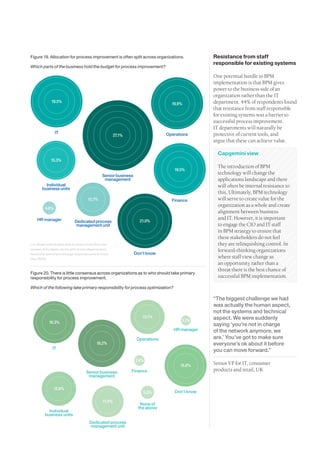
  • 39.
    companies often leadsto the Figure 27. 82% of manufacturing, automotive and life sciences respondents stressed the development of local processes for importance of harmonizing business processes. distribution, sales and marketing. BPM Please identify how important each of the following drivers are for your business: can provide extra value by allowing Harmonizing business processes. companies to strike a fine balance between necessary and beneficial centralization of processes, and 46.9% flexibility for adaption to specific local or departmental circumstances. There has been a longstanding drive for 35.4% harmonization in the manufacturing space, but BPM technology allows for different layers of harmonization. Maximizing cost-efficiency is similarly a key driver for manufacturing, automotive and life 14.2% sciences companies, with emphasis on integrating supply chain and outsourcing non-core functions. The flexibility that BPM provides 1.8% 1.8% for collaboration with partners is very relevant to organizations in Not at all Not very Neither Quite important Very important these sectors with regard to both important important important nor unimportant distribution and supply chain. BPM can help break down the silos “We need to streamline even that occur in the supply chain and further to create better products ensure that all functions are aligned in less time to stay in business. towards the same delivery goals. Without process improvement we won’t stay competitive in Optimizing cycle time is invariably this business environment.” a priority for organizations in this sector: this was especially top of Enterprise Architect, enterprise level mind for automotive organizations automotive business, Germany surveyed. It is no surprise that 57.5% of decision-makers in these sectors anticipate increasing investment in optimizing time-to-market over “We are struggling to survive the next 12 months. It is easier to in a competitive market put together a business case when segment. Global harmonization there has already been a focus on is important to create new such a quantifiable metric. BPM opportunities for our business.” also allows for greater transparency around processes, and rich, real-time Business Analyst, enterprise level measurement of performance. manufacturing business, Netherlands Further discussion of BPM maturity in manufacturing can be found in this Capgemini report, “Business Process Management in Manufacturing: From Process to Value.” www.uk.capgemini.com/insights-and-resources/ by-publication/business-process-management- in-manufacturing-from-process-to-value/ 39
  • 40.
    Consumer products andretail Understanding of the relevance of BPM thinking and technology is less mature in the retail arena than in other industries. Increasing the number of channels enhance the customer experience. through which customers can interact This is driving interest in combining with the business was deemed an BPM and CRM systems at top retailers important business driver for 73% for whom outstanding service is a of decision-makers in the consumer priority. This is also relevant to the products and retail space. A BPM increasing number of consumer framework can help facilitate this products companies which have by linking the information silos that “direct-to-consumer” channels. exist around different channels. Brian Girouard, Global Consumer BPM allows seamless sharing of data, Products and Retail, Capgemini so all information relating to one customer can be logged in a single, easily accessible location. This helps This is illustrated by our research avoid the inevitable frustrations that which shows that fewer than one in occur when a customer is passed five consumer products and retail from one operator to another due to decision-makers believe that BPM is inconsistent or incomplete sharing currently an important agenda item of information. Customer service at the managerial level. There is still a representatives can even be prompted sense that retail, in particular, is less with useful contextual information of a science and more of an art, less about customers at appropriate rigorous and structured than other junctures during interactions to industries. Some of the participants in this survey stressed the importance of personal interaction in retail and Figure 28. Increasing the number of channels through which customers can interact with refuted the notion that it could be the business was deemed an important business driver for 73% of consumer products and reduced to mere process. However, retail respondents. conundrums that are top-of-mind Please identify how important each of the following drivers are for your business: Increasing for retailers, like facilitating seamless the number of channels through which customers can interact with the business. all-channel access and harnessing the transformative power of social media, are all excellent candidates for applying a BPM framework. 36.5% 36.5% 20.0% 7.1% 0.0% Not at all Not very Neither Quite important Very important important important important nor unimportant 40
  • 41.
    Online media strategyis fast becoming Figure 29. 70% of consumer products and retail respondents view social media strategy as a top priority for retailers. 46% of an important business driver. survey participants in the consumer Please identify how important each of the following drivers are for your business: Managing products and retail vertical anticipated the opportunities and threats of social media. increasing investment in managing the opportunities and threats of social media – more than in any other sector. 47.1% This is not surprising given that 70% view this as an important driver for the sector. Front end applications that deliver a CRM-type service increasingly have to incorporate social media, and these are best integrated into wider architecture via a BPM 21.2% 22.4% platform. In verticals where word- of-mouth has traditionally been important, the echo chamber effect of the social media space demands attention. BPM allows customers to 8.2% build processes to mitigate negative word of mouth or to amplify positive 1.2% chatter. Feedback received through these channels can be categorized Not at all Not very Neither Quite important Very important and appropriate responses executed. important important important nor unimportant The success of this type of activity can be monitored and managed. Many “Our business is moving into traditional offline retailers are daunted multi-channel retailing therefore by the alchemy of new types of media, the need for social media but interactions in this space can be exposure is greater than ever.” efficiently standardized and structured using BPM approaches and tools. Department Officer, enterprise level retailer, Australia “Customer self-service is important from a customer perspective as it makes life easier, and a company perspective, as it minimizes cost, driving profit.” Compliance Officer, large retailer, Italy 41
  • 42.
    Telecommunications, media and entertainment Thetelecommunications, media and entertainment (TME) sector has lagged behind other sectors such as banking and manufacturing in adoption of BPM thinking and technology. Figure 30. Half of respondents in the communications sector anticipate increased interest in BPM at their organization over the next 12 months. How do you anticipate that the current level of interest in BPM within your organization will change over the next year? 16.4% Jean-Marc Steffann, Vice President, Global Telecom, Media and Entertainment, Capgemini 34.5% A lot more emphasis Our research shows that the sector may 0.9% catch up quickly as half of decision- makers anticipate increased interest A lot less emphasis in BPM from their organization in 23.3% the near future. The TME industry A little more emphasis is facing a number of challenges that are fuelling interest in BPM. 3.4% The research findings show that more The same amount 21.6% of emphasis A little less emphasis than two in three telecommunications, media and entertainment companies anticipate that maximizing cost- efficiency will become increasingly important. The market is highly Don’t know saturated and revenue is likely to remain flat. Resulting pressure on margins is forcing TME will come under further pressure, players to focus on operational as both businesses and consumers efficiency and cost reduction. look to cut back on expenses and the risk of non-payment increases. BPM allows TME companies to reduce costs by automating processes, This is reflected by the finding that 72% integrating front and back office of companies in the sector state that a functions and connecting all the challenging economic climate over the inputs necessary to complete a task. If next 12 months will prompt greater there is a further market downturn in interest in process improvement. developed markets, TME companies 42
  • 43.
    Product convergence inthe This will provide another “We are thinking closely about telecommunications, media and incentive for TME companies to what BPM can do for us right entertainment spaces, enabled by migrate from cumbersome, closed now. The size and age of our regulatory change, means that TME legacy systems towards an open organization means that there companies are increasingly trying to architecture that allows efficient are a multitude of separate siloed sell convergent triple play or quadruple integration with other parties. processes and systems which play products. Major players who have proved difficult to replace originated in different spaces are without negatively impacting jostling to offer mobile, fixed line, customers. We currently have Broadband, and Pay TV. This case parallel streams of systems management challenge is compounded and processes for legacy by increased customer demand to customers and new or migrated access accounts via multiple channels, customers which is difficult, not from store to Smartphone app – more to mention costly, to manage.” than half of decision-makers who participated in the research anticipate Systems Architect, enterprise investing more in facilitating multi- level telecommunications channel access for their customers. company, Australia This necessitates radical changes to systems architecture as companies Figure 31. 72% of companies in the communications sector state that a challenging attempt to reconcile several pre- economic climate over the next 12 months will prompt greater interest in process existing processes for account improvement. creation and account management. If the economic climate in your sector proved more challenging over the next 12 months, BPM allows businesses to handle what impact do you anticipate this would have on your organization’s attitude to process the complexity of required account improvement? management processes. Information silos that have traditionally existed We will pay a lot more attention around different products, or between We will pay a little more attention channels, can be broken down, and It will not impact on the attention paid each customer interaction treated 8.3% as part of a seamless dialogue. We will pay a little less attention 1.7% We will pay a lot less attention 1.7% Consumer behavior is constantly Don’t know 36.7% changing in this market as technology evolves: TME companies consequently need to bring products to market 16.7% as quickly as possible if they are to secure their share of the benefits. 66% of respondents at these companies anticipated that reducing time-to-market would become a more important priority for their organization in the next 12 months. This shows that companies urgently need to invest in infrastructure to support shorter cycle times. The use of a BPM framework allows telecoms 35.0% players to maximize business agility and respond swiftly to market opportunities. The development of these new products also means that TME companies are being forced to join forces with an array of new partners, from applications developers to financial services companies. 43
  • 44.
  • 45.
    Country analysis significant opportunity for process over the next year. Market conditions improvement. 1 in 5 of the survey which are tougher than anticipated participants stated that BPM is an will put pressure on margins, forcing important agenda item at managerial businesses to scrutinize their cost level which is consistent with the position further. Indeed, of those broader picture across the sample. businesses that are considering a BPM implementation, 89% state that more The research suggests that there may be challenging economic conditions some opportunities for BPM to flourish. will prompt them to pay greater Lee Beardmore, Head of Business The UK is a world leader in financial attention to process improvement. Process Management, Capgemini, UK services, which comprises roughly 10% of the country’s economy. The sector, whose revenue growth has been 44% of the survey respondents driven in part by a generation’s worth anticipate that the level of interest United Kingdom of deregulation, now faces the prospect in BPM within the organization of both increased oversight, and cost- will increase within the next year. Fundamental changes are taking place cutting as a response to tougher market in the UK economy as the country conditions. Consequently, much of the 67% of survey respondents in struggles to recover from the economic BPM adoption in the UK has occurred the public sector believe that downturn and avoid further recession. in the financial services sector. maximizing cost-efficiency will The British media talks loudly about become much more important an “Age of Austerity”. The private Agencies in the public sector in the over the next 12 months. sector is contending with a great deal UK, which is witnessing the greatest of market uncertainty, while jobs retrenchment in government spending are being cut from the public sector, since the 1940s, are becoming and the influential financial sector increasingly aware of and receptive to is contending with new regulatory the benefits that a BPM approach can pressure. Driving growth, responding confer. Two-thirds of public sector to market contraction and gaining survey respondents indicated that new efficiencies from the workforce maximizing cost-efficiency would all demand new ways of working. continue to grow in importance The research indicates that BPM will over the next 12 months, which is have a role to play in addressing such driving interest in BPM investments. challenges. Indeed, 44% of survey The incumbent government is respondents anticipated that interest also particularly interested in in BPM within their organization public and private organizations would increase within the next year, partnering to deliver state services. while 1 in 3 anticipates that their This impetus towards collaboration organization will launch a major drives interest in moving away from BPM initiative in the same period. closed legacy systems towards the more open kind of environment The research indicates that knowledge that can be facilitated by BPM. of Business Process Management in the UK is not as developed as in more There is still plenty of conjecture as mature markets such as the USA. to how the UK economy will fare in Only 16% of the UK decision-makers the medium term; macroeconomic who participated in the research events in the Eurozone and the wider had plenty of practical experience global economy will impact on the of the topic, compared with 28% prospects for recovery. Consequently, in Germany and 32% in the USA. more than three in four UK businesses Interestingly only 9% stated that believe that ability to react to changes their processes are ‘Optimizing’ in market conditions will be an which indicates that the UK still has important driver of business success 45
  • 46.
    that participated inthe survey state that technology from consumer facing their processes are optimizing. This organizations, as the line between rises to 1 in 3 (32%) of US companies BPM and CRM becomes blurred. with more than 10,000 employees. As with other trends in BPM, US organizations will lead the way. US companies are relatively more likely to invest in BPM implementation in both good times and bad. When the 50% of US survey participants economy is buoyant, new paradigms indicated that interest in BPM drive interest in upgrading systems within their organization would Venkat Bharadwaj, Head of at forward thinking companies increase over the next year. Business Process Management, Capgemini, North America who want to extend competitive advantage. A good example is the 66% of US survey respondents emergence of social media. 60% of US indicated that harnessing the United States businesses anticipate that harnessing opportunities and managing the the opportunities and managing the threats of social media would The economic crisis of recent years, threats of social media will become be an important business driver triggered by crisis in the capital a more important business driver for for them over the next year. markets, had a widespread impact them over the next year – a greater across market sectors and regions proportion than in any other market. in the United States. However, Social media strategy can be effectively the most recent economic and standardised and structured using BPM financial indicators show that approaches and tools. Alternatively, recovery is underway. US business BPM affords companies the business continues to evolve and innovate, agility to react to difficult economic and the world’s biggest economy times. The recent downturn has caused remains the world leader in many many large organizations to refocus on important market verticals. ‘Lean’ principles – the legacy of this is that 65% of US companies anticipate The US is indisputably the world’s increasing investment in maximizing biggest market for BPM. Analysts cost-efficiency in the coming year. estimated that until 2010 North America accounted for more than half The US economy is very diverse, and of the global BPM market by revenue. there are several sectors in which The top 3 BPM software vendors, Pega, BPM adoption is prevalent. As in IBM and Oracle, are headquartered many other countries, financial in the United States. The research services has led the way in terms findings support the idea that the BPM of BPM adoption. US insurers have market is relatively mature. They also harnessed the power of BPM platforms demonstrate that in many areas interest to simplify claims processing and in BPM approaches will continue to enhance case management. In the develop. 1 in 2 USA survey participants aerospace and automotive sectors, indicated that interest in BPM within open BPM systems allows massive US their organization would increase companies to collaborate effectively over the next year, while 43% stated with their legions of suppliers. High- that their organization intended to tech companies working in heavily launch a BPM initiative in that period. regulated areas such as life sciences are attracted to BPM as it allows Process knowledge and process them to demonstrate easily their maturity are rather more developed compliance to new regulations. within large US organizations than elsewhere. An illustration of this is the In the next few years, there is likely to fact that a quarter of US organizations be a broader trend of interest in BPM 46
  • 47.
    country. However, relativelytight Australian government, on the other regulation allowed Australia to survive hand is keen to put the dividend the worst ravages of the financial crisis, it has reaped from commodities and Australian lawmakers believe that exports to good use, and has money their approach to risk management to invest in improving systems. is the best way to safeguard banks and other industries. Compliance is consequently a major consideration 53% of Australian companies for Australian companies. 51% of believe their organization Australian companies believe that will pay more attention to Scott Foster, Head of Business Process responding to regulatory changes will BPM over the next year. Management, Capgemini, Australia be very important for their business over the next 12 months. 47% of 51% of Australian companies respondents at Australian companies believe that responding to Australia anticipated that their organization regulatory changes will be very would increase investment in important for their business Australia has a dynamic economy, compliance over the next 12 months. over the next 12 months. which did not succumb to the This trend will be a key driver of global crisis of 2008. The country is interest in BPM. BPM allows customers currently benefiting from a resources to remain compliant to regulation boom, with mines working flat out and, crucially, to demonstrate this to meet Asian demand for a variety compliance automatically in a way that of commodities. The Australian does not significantly impact on costs. government will soon be running a budget surplus, and will be considering Australian manufacturing is the areas in which to invest to ensure struggling, due to the high value that the country remains in good of the dollar, while the cash-rich economic shape in the longer term. commodities sector has its own priorities and ways of working. Interest The level of process maturity at in BPM paradigms in Australia is Australian organizations is not as therefore led by the financial services advanced as at their US counterparts. sector and government agencies. 17% of Australian companies state that Australia is a regional financial services their process management includes hub and the sector is very mature. deliberate process optimization. Despite the robust national economy, Large Australian companies have Australian banks view economic events traditionally relied on outsourcing elsewhere in the world with trepidation business processes to Asia. However, due to the hyper-globalized nature of as the cost of BPO rises rapidly year finance. Significant recent job cuts at by year, Australian companies need Australian banks demonstrate that to step back and consider a different companies are paying attention to their approach to managing their processes. cost position and bank executives are This appears to be driving interest increasingly attracted to the potential in Business Process Management. benefits of process efficiency. More than half the respondents in the sample anticipate that their Banks want to drive out costs by organization will pay more attention standardizing back office functions to BPM over the next 12 months, and which have lots of duplication, 24% state that a lot more emphasis benefiting from reuse where will be placed on the approach. possible. 46% of respondents from Australian banks anticipate that Economic commentators have posited their organization will launch a that Australia is a heavily regulated BPM initiative in the next year. The 47
  • 48.
    services sector isquite advanced. Both to concerns as to how the software banking and insurance businesses will fit into existing architecture. are prioritizing their ability to Companies with well-functioning remain compliant, and investing infrastructure are not necessarily ready in aspects of customer experience. for the step change that BPM implies. Both compliance and CRM can be enhanced by addressing them via a BPM solution. A third (36%) of 38% of German companies German participants in the research state that their processes are expect that the level of interest in BPM either ‘Managed’ or ‘Optimizing’. Matthias Jungkeit, Business at their organization will increase This rises to 79% among Process Management Consultant, over the next 12 months. While this German companies for whom Capgemini, Germany represents a significant increase in BPM is an important agenda interest, this figure is slightly lower item at managerial level. Germany than elsewhere, for example the English-speaking markets. This can 36% of German participants In recent years the German economy perhaps be explained by the balance in the research expect that has consistently outperformed the and health of the German economy. the level of interest in BPM at rest of the Eurozone. Recent events their organization will increase elsewhere in Europe have led to a The German exporting industries, the in the next 12 months. relative slowdown in the past few envy of much of the developed world, months, but Germany remains are in a strong enough position to without doubt one of the leading prioritize investing in driving revenue nations in industrialized production. over reviewing their internal processes. The continued success of German Interest in BPM from the state sector companies depends on their ability to in Germany is also relatively low at the introduce technological innovations moment, due in part to challenging at competitive cost levels. public sector procurement processes. German industries have achieved In Germany, 45% of respondents stated success in part through harnessing the that they believed that BPM should latest methods of working, and German be treated as a C-level concern. This companies are under constant pressure is a lower figure than in, say, the US, to streamline services. However, just (65%) or Australia (69%). This may be 38% of German companies state that because BPM is still viewed too much their processes are either ‘Managed’ or as an IT item in Germany: only 11% ‘Optimizing’, the two most developed of German organizations stated that levels of the capability maturity senior business management takes model. The fact that this figure rises responsibility for improving processes. to 79% among German companies for Similarly, only 10% of respondents whom BPM is an important agenda indicated that they understand item at managerial level demonstrates BPM to be a “holistic management the inextricable link between BPM approach”. This is a lower proportion approaches and process maturity. than elsewhere and may ultimately undermine attempts to introduce More than a quarter (28%) of BPM, as while the major benefits of German participants in this survey BPM are delivered on the business indicated that they had both extensive side, the barriers are on the IT side. knowledge and practical experience of BPM techniques, which shows that Anecdotal evidence suggests that in BPM thinking is being adopted in Germany IT decision-makers can parts of the market. As in many other resist attempts to introduce BPM, due markets, interest from the financial 48
  • 49.
    efficiency over thenext year. Given responsibility for process optimization. the uncertain market conditions in If applied correctly BPM could deliver Italy, and likelihood of significant benefits by breaking down the barrier changes to the rigid regulatory that exists in a lot of Italian companies environment, large organizations between business and IT, creating in the country know that they need a more coherent flow across large to increase their business agility. organizations and driving efficiency. Nearly half (47%) of the Italian survey respondents anticipated increasing investment in reacting to changes in 47% of Italian companies Alessandro Czimeg, Head of Business market conditions, while a similar believe that the level of interest Process Management, Capgemini, Italy figure (46%) envisaged increasing in BPM in their organization will investment in responding to legislative increase over the next year. changes. BPM allows companies to Italy adapt rapidly and cost effectively to changes in the business environment. More than half of Italian Italy has faced well documented respondents indicated that economic challenge in recent times. During the research for this report, the perception of BPM as The country has been in financial there was anecdotal evidence of an IT item was a barrier trouble since 2008. These ongoing burgeoning interest in BPM in a to process improvement issues are a consequence of, among variety of market verticals in different within their organization. other factors, a lack of productivity parts of the country. In Northern and competitiveness in the Italian Italy, manufacturing companies are Only 14% indicated that work place and a rigid regulatory interested in potential applications Senior Business Management environment. Italy still has some of BPM with regard to automating takes primary responsibility world-class companies, and the and accelerating processes, and for for process optimization foundations of a strong export sector, increasing transparency of processes at their organization. but the country is increasingly trying and monitoring KPIs. In Milan, there to reform its working practices in order is growing interest among financial to achieve an economic resurgence. services companies around compliance and improving interactions with 19% of Italian survey respondents customers. Telecommunications indicated that the processes at their companies, often based in Rome, are organization are ‘Optimized’. The also increasingly interested in the figure rises to 23% at organizations benefits that can be delivered via BPM. with more than 10,000 employees. In contrast, interest in BPM in the These figures are slightly higher than public sector is relatively undeveloped, international averages that emerged due to budgetary constraints. from this research, but they still indicate that there is scope to drive One factor undermining the effective value and efficiency through process adoption of BPM thinking in Italy improvement. Almost half (47%) is the widespread perception of of Italian companies believe that BPM as an IT item. More than half the level of interest in BPM at their of Italian respondents agreed that organization will increase over the the perception of Business Process next year, which suggests that even in Management as an IT item was a a tough economic climate, far-sighted barrier to process improvement large organizations are willing to within their organization. Only 12% invest in innovations which will save of Italian decision-makers view BPM them money in the long term. Indeed, as a holistic management approach 59% of Italian survey respondents and in only 14% of organizations does indicated that they would be increasing Business Management take primary investment in maximizing cost- 49
  • 50.
    Interest in BPMin France is growing: Major manufacturing companies, for 39% of organizations in the survey example in the world of aerospace, rely anticipated that the amount of interest on numerous collaborative workflows paid to Business Process Management in order to achieve the design of at their organization would increase high-tech products. Application within the next year. But the discipline of BPM software and thinking can is yet to gain widespread support and ensure that their workflows are sponsorship at managerial level within seamlessly joined up and that work French organizations, which hinders is automated and performance Alain Robbe, Executive Director, effective adoption. 11% of respondents measured wherever possible. Capgemini, France say that Business Process Management is currently an important agenda item at managerial level. This contrasts with Just 11% of French respondents the fact that two third of respondents state that Business Process France believe it should be treated as a C-level Management is currently concern. Many of the BPM projects an important agenda item During the early stages of the recent that French participants referred to at managerial level. economic downturn, the French had taken place within a business economy proved more resilient than area rather than cross-organization or 54% of French respondents many others, thanks in part to the cross-application. This stems from the stated that functional protection of European and French limitations of functional silo culture, silo culture is a barrier to regulations. However, as the crisis which makes it difficult to carry out BPM implementation at in the Eurozone has rumbled on, the far-reaching transformation projects. their organization. French economy has looked more More than half (54%) of French vulnerable. France has lost its top participants agreed that functional credit rating, and French firms are silo culture is a barrier to BPM facing a credit squeeze. The gap in implementation at their organization. industrial competitiveness between Recognition of this situation may France and Germany is growing wider. generate important opportunities There is pressure in the country for to help companies migrate to a an overhaul of corporate practices at process-centric organization. large organizations and receptiveness to new ways of running a company. The telecommunications sector is one area in which there has been The level of process maturity at some interest in BPM in the French French companies is relatively lower market. When it comes to fulfilment than elsewhere. Just 9% of French of complicated multi-channel participants in the survey indicated propositions BPM allows handling that their processes are optimizing. superior delivery of service and Strikingly 19% of French companies enhanced Customer Relationship with 10,000 or more employees stated Management. There is also a growing that their processes are ‘Chaotic’ interest in the benefits of BPM in (the least advanced category on the the public sector in France. BPM Capability Maturity Model), while can potentially facilitate efficiency just 7% of these companies stated that case management, through the their processes are ‘Optimizing’ (the digitalization of records, for example most advanced category). Nevertheless, with regard to private healthcare. French decision-makers are aware A further business trend which is of the importance of having clear driving interest in BPM in France is the business processes, and there is increasing trend towards businesses an opportunity to help them in the collaborating with other firms in conception, implementation and order to become more competitive. automation of their processes. 50
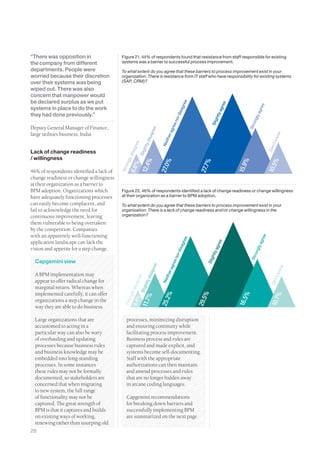
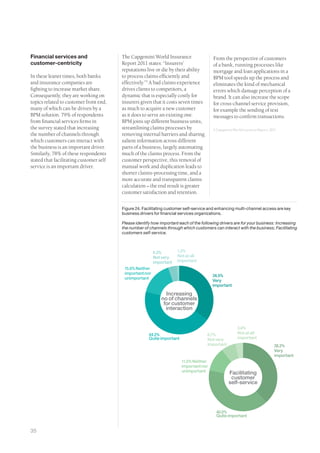
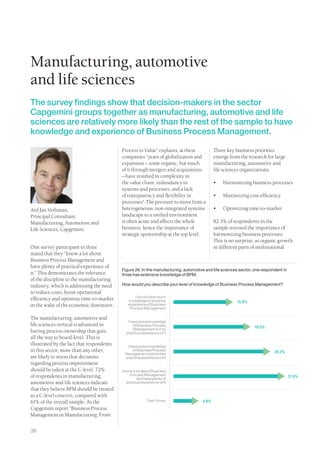
  • 51.
    A further barrierto BPM 50% of Spanish survey implementation is the rejection of BPM respondents indicated that by IT departments. There is a sense staff who have responsibility that in Spain, business people grasp the for existing assets such as SAP value of BPM, but IT decision-makers or CRM systems are resistant are deterred by the pain involved in to process improvement. transforming current systems and training staff. IT are understandably protective of existing systems: one One in three Spanish decision- in two participants stated that staff makers anticipates that the Jorge Villaverde, Financial Services who have responsibility for existing level of interest paid to BPM by Sector, Capgemini, Spain assets such as SAP or CRM systems are their organization will increase resistant to process improvement. This over the next 12 months. illustrates how companies can react Spain defensively when faced with the threat 35% of Spanish businesses are of a difficult business environment. anticipating investing more in Having enjoyed an extended boom cost-efficiency over the next year. period in the decade up until the There is some interest in BPM global financial crisis, the Spanish adoption in Spain among companies economy has suffered recently as that are weathering the downturn a result of economic turbulence in more effectively. One in three (36%) the Eurozone. The country is in decision-makers anticipates that recession and the government recently the level of interest paid to BPM by announced the most austere budget in their organization will increase over the country’s history in an attempt to the next 12 months. 35% of Spanish bring down the level of public sector businesses are anticipating investing debt. Private sector firms in Spain face more in driving costs out of the a challenging business environment. business in the next year: BPM can allow organizations to drive cost out Only 14% of businesses in Spain state of the business in the medium term. that their processes management Companies that make a strategic includes deliberate process investment in new infrastructure now management and improvement. will be well placed to take advantage Knowledge of BPM in Spain is also of the upturn when it comes around. in its infancy. Only 12% of survey participants state that they both The greatest interest in Business know a lot about the subject and Process Management in Spain comes have plenty of practical experience from financial services companies. of it. A fundamental barrier to Banks are interested in ways in which BPM investment in Spain is that BPM can help eliminate cumbersome organizations are putting investment manual back office processes, for around new technologies and IT example requests to increase credit approaches on hold, as they cannot limits. Insurance companies are access capital. Companies must similarly interested in enhancing cut costs and make do with dated customer experience, for example by infrastructure. Almost half the facilitating multi-channel access. sample, (47%), state that they do not have the budget to optimize their processes. In the public sector, certain BPM implementations that had been considered have been put aside because of cash constraints. 51
  • 52.
    BPM initiative overthe next year. 35% of respondents in the Nordics indicated that they Interest in BPM thinking in the are anticipating an increased Nordics is being driven by the financial level of interest in BPM at their services sector and the public sector. organization over the next year. In countries such as Norway and Sweden, as opposed to Spain and Italy the government has money to invest 38% of decision-makers in expansive infrastructure projects. anticipate that they will launch a There are lots of initiatives afoot at BPM initiative over the next year. Jonas Schlyter, Head of Business Process Management, a local government level in Sweden Capgemini, Nordic Region for improving citizen-centricity and 62% of Nordic decision- delivering citizens the kind of 24-hour, makers state that BPM should multi-channel access to services that be a C-Level concern. Nordic Region they receive in the service sector. These can be delivered by BPM solutions. The Nordic countries have fared better BPM also allows municipalities than their European neighbours during to streamline service provision, the economic crisis. Norway has used eliminating manual work and the “From the point of view of a its oil fund to stimulate various sectors, duplication of effort. In the financial local government agency, while Sweden’s state finances provided services sector, business priorities eGovernment solutions are solid protection. Banks in the region such as cost-cutting and adhering an important tool for driving are well capitalized and public sector to regulatory change in an efficient both citizen satisfaction debt is low by European standards. fashion are driving interest in BPM. and cost reduction.” 13% of Nordic participants in the Many Nordic decision-makers CIO, Municipality, Sweden survey stated that process management that participated in the survey at their organization includes acknowledged that C-level engagement “The COO and CIO need to deliberate process improvement, is central to the success of a BPM manage ways of working, and although the figure rises to 19% implementation. 62% stated that to identify what performance among enterprise level organizations. BPM should be a C-level concern information is needed, which A quarter of Nordic decision-makers compared to just 8% who do not is why they should involve (24%) state that BPM is an important think it should be. This suggests themselves in BPM.” agenda item at managerial level within that Nordic organizations may have their organization, which is a greater the senior level impetus required to Information Manager, proportion than in the UK (20%) but implement BPM over the coming years. Financial Services slightly less than in the USA (29%). However, just 9% of participants state One potential barrier to process that they know a lot about BPM and improvement in the Nordics is the have plenty of practical experience of gap between business and IT. It the approach, which is considerably can potentially be difficult to get less than in markets such as Germany Business and IT on the same page. (28%) and the USA (32%). IT departments are more likely to be sceptical about the value of BPM. While the Nordic countries are not 48% of Nordic decision-makers early adopters of Business Process agree that resistance from IT staff Management paradigms, they who have responsibility for existing may well be quick learners. 35% systems such as SAP and CRM can be of businesses are anticipating an a barrier to process improvement. increased level of interest in BPM at their organization over the next year, while 38% of decision-makers anticipate that they will launch a 52
  • 53.
    mature markets likeSpain (12%). identify facilitating customer self- This shows that BPM paradigms have service as an important business driver, begun to gain traction in many sectors. while 57% believe that it is important There are, however, some barriers to to increase the number of channels BPM adoption, which stem from the through which customers can interact tradition of investment in process with the business. A BPM framework at Dutch companies. Many of the can help by addressing the information investments have been in functional silos around the different channels. applications for just one part of the Roger de Ruiter, Head of process, and not having an end-to- end focus. This is exemplified by the 52% of Dutch participants who Business Process Management, research which shows that 46% of are considering launching a Capgemini, The Netherlands the Dutch decision-makers surveyed process improvement initiative identify function silo culture as a believe it could have greatest Netherlands barrier to process improvement. impact in terms of harmonizing We have seen that many Dutch business processes. The Netherlands is recognized as businesses have invested heavily in being a mature market in terms of their existing systems. This can often One in six Dutch survey BPM adoption. Dutch businesses lead to decision-makers requiring respondents states that they have traditionally been leaders in convincing of how BPM can extend have extensive knowledge and embracing innovative technology their existing investment leading to practical experience of BPM. and have therefore implemented increased flexibility and agility. generations of applications throughout the 1990s and 2000s. There is a long- As in other markets, the Dutch Roger de Ruiter, Capgemini established tradition of harnessing financial sector is taking the lead in BPM Head in the Netherlands technology to support processes. This terms of adoption of BPM thinking summarized the benefits of tradition presents both interesting and software. Interest in BPM in the using BPM to cut through the opportunities and barriers regarding public sector is also growing rapidly in clutter of existing application the adoption of BPM paradigms. the Netherlands. There is interesting landscapes in the following way: scope for application of BPM paradigms Large Dutch organizations have in fields as diverse as police, public “With BPM there is no longer typically extended their applications healthcare provision and customs. a difference between IT & in a piecemeal fashion over time as Capgemini BPM experts have observed Business; it’s your Business, and technology has evolved, extending and how pressure on budgets in the your customers will notice it.” building on core applications which Public sector has driven an interest in ultimately means that companies will efficiency and reorganization of work. have complex application landscapes. Challenging market conditions in the In the Netherlands, more than half Netherlands are driving further interest the people who are considering in BPM. 70% of survey participants introducing a BPM initiative state stated that a business environment in that the principal benefit will be to their sector that was more challenging harmonize business processes. A than expected would prompt them to BPM layer allows organizations to increase the amount of consideration achieve centralization of common they give to process improvement. processes while allowing a level of flexibility where desirable. Capgemini experts observe that the convergence of BPM, ECM and One in six Dutch survey respondents CRM technology is more advanced states that they have extensive in the Netherlands than elsewhere. knowledge and practical experience Customer-facing organizations are of BPM. This is a similar figure to the increasingly redesigning their front UK (16%) and rather more than less office and CRM functions, in a BPM tool. 60% of Dutch organizations 53
  • 54.
    Acknowledgements We would liketo acknowledge the team of collaborators who were instrumental in creating this report: Initial thanks go to the Netherlands team led by Roeland Loggen, who created the Netherlands survey in 2010, and whose thinking we leveraged. For project management, analysis and report content: James Cope and James Bakewell at FreshMinds, and the team at Capgemini: Nicholas Kitson, Tim Arkin; Sector leads: Brian Girouard, Ard- Jan Vethman, Nico Kaptein, Jean- Marc Steffann, Nicholas Kitson. Country leads: Jonas Schlyter, Matthias Jungkeit, Scott Foster, Roger de Ruiter, Venkat Bharawaj, Lee Beardmore, Alessandro Czimeg, Jorge Villaverde, Alain Robbe. For marketing and communications: Nikki Gordon Jones, Hester Decouz. For executive sponsorship: Bob Scott We would like to thank all the panel and interview participants for their time and willingness to share openly their challenges around BPM © 2012 Capgemini. All Rights Reserved. Rightshore® is a trademark belonging to Capgemini. No part of this document may be modified, deleted or expanded by any process or means without prior written permission from Capgemini. 54
  • 55.
    About Capgemini With around120,000 people in 40 countries, Capgemini is one of the world’s foremost providers of consulting, technology and outsourcing services. The Group reported 2011 global revenues of EUR 9.7 billion. Together with its clients, Capgemini creates and delivers business and technology solutions that fit their needs and drive the results they want. A deeply multicultural organization, Capgemini has developed its own way of working, the Collaborative Business Experience™, and draws on Right- shore®, its worldwide delivery model. Rightshore® is a trademark belonging to Capgemini For more information, please contact: Bob Scott: BPM Global Service Line Leader bob.scott@capgemini.com Nikki Gordon Jones: BPM Marketing Manager nikki.gordonjones@capgemini.com Hester Decouz: Press Office hester.decouz@capgemini.com www.capgemini.com/globalbpmreport