Structure and Properties
of Glass Fiber
By
Salman Hassan
Muhammad Rahman Sajid
Glass Fiber
Introduction:
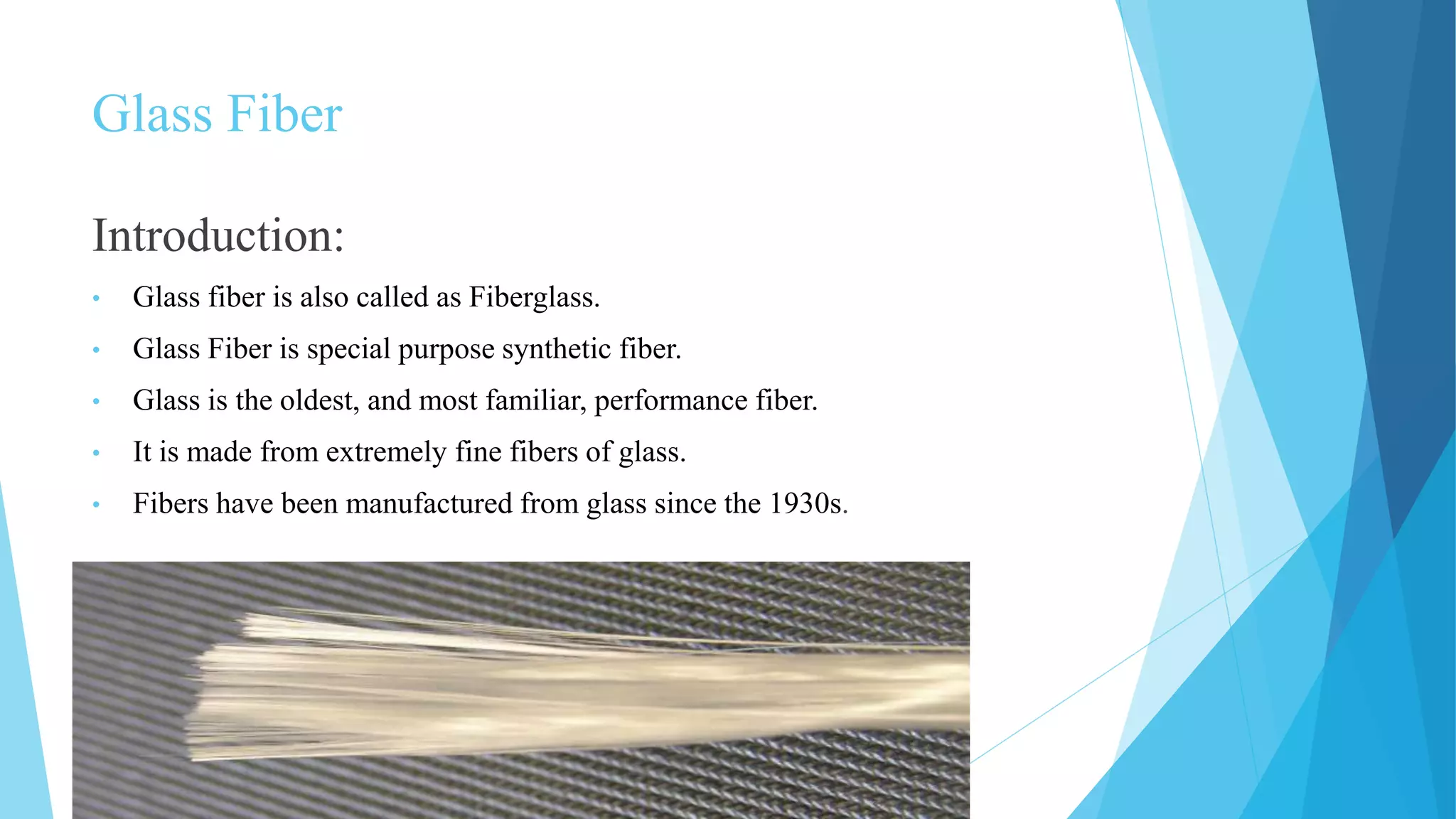
• Glass fiber is also called as Fiberglass.
• Glass Fiber is special purpose synthetic fiber.
• Glass is the oldest, and most familiar, performance fiber.
• It is made from extremely fine fibers of glass.
• Fibers have been manufactured from glass since the 1930s.
Structure:
• Glass describes range of material made by fusing together
one or more of the oxides of silicon, boron or phosphorus
with certain oxide like potassium, magnesium, calcium.
• Basic part of Glass fiber is Silica “SiO2”.
• In its pure form, it exists as polymer, (SiO2)n.
Structure:
• In the polymer it forms SiO4 groups which are configured as a tetrahedron with
the silicon atom at the center, and four oxygen atoms at the corners. These atoms then
form a network bonded at the corners by sharing the oxygen atoms
Chemical Composition of Glass Fiber:
Properties:
Dimensional Stability:
Glass fiber is a dimensionally stable engineering material. Glass fiber does
not stretch or shrink after exposure to extremely high or low temperatures.
Moisture Resistance:
Glass fibers do not absorb moisture or change physically or chemically when
exposed to water.
Properties:
Specific Gravity:
E glass fiber has a specific gravity of 2.54 and S glass has 2.49.
High Strength:
The high strength-to-weight ratio of glass fiber makes it a superior material in
applications where high strength and minimum weight are required.
Properties:
Thermal Properties:
Glass has an excellent resistance to the effects of heat over a wide range of
temperature. Glass is completely inflammable and this is the important
factors in its textile application.
Electrical Properties:
Glass fiber is an excellent material for electrical insulation and it has
important use in the electric field. E glass made for this purpose.
Properties:
Chemical Properties:
Glass has a excellent resistant to most of the chemicals.
It is attacked by alkalis and also by some strong mineral acids and by
phosphorous acid.
Effect of Organic Solvent:
Glass fiber is not attacked by organic solvents.
Properties:
Optical Properties:
Refractive index of glass will range from approximately 0.003 to 0.006. Glass
is transparent medium and opaque towards ultra violet transmission.
Radiation Properties:
E Glass and S-2 Glass fibers have excellent resistance to all types of nuclear
radiation.
Alpha and beta radiation have almost no effect, while gamma radiation and
neutron bombardment produce a 5 to 10% decrease in tensile strength.
Any Question
?
Glass fiber

Glass fiber

  • 2.
    Structure and Properties ofGlass Fiber By Salman Hassan Muhammad Rahman Sajid
  • 3.
    Glass Fiber Introduction: • Glassfiber is also called as Fiberglass. • Glass Fiber is special purpose synthetic fiber. • Glass is the oldest, and most familiar, performance fiber. • It is made from extremely fine fibers of glass. • Fibers have been manufactured from glass since the 1930s.
  • 4.
    Structure: • Glass describesrange of material made by fusing together one or more of the oxides of silicon, boron or phosphorus with certain oxide like potassium, magnesium, calcium. • Basic part of Glass fiber is Silica “SiO2”. • In its pure form, it exists as polymer, (SiO2)n.
  • 5.
    Structure: • In thepolymer it forms SiO4 groups which are configured as a tetrahedron with the silicon atom at the center, and four oxygen atoms at the corners. These atoms then form a network bonded at the corners by sharing the oxygen atoms
  • 6.
  • 7.
    Properties: Dimensional Stability: Glass fiberis a dimensionally stable engineering material. Glass fiber does not stretch or shrink after exposure to extremely high or low temperatures. Moisture Resistance: Glass fibers do not absorb moisture or change physically or chemically when exposed to water.
  • 8.
    Properties: Specific Gravity: E glassfiber has a specific gravity of 2.54 and S glass has 2.49. High Strength: The high strength-to-weight ratio of glass fiber makes it a superior material in applications where high strength and minimum weight are required.
  • 9.
    Properties: Thermal Properties: Glass hasan excellent resistance to the effects of heat over a wide range of temperature. Glass is completely inflammable and this is the important factors in its textile application. Electrical Properties: Glass fiber is an excellent material for electrical insulation and it has important use in the electric field. E glass made for this purpose.
  • 10.
    Properties: Chemical Properties: Glass hasa excellent resistant to most of the chemicals. It is attacked by alkalis and also by some strong mineral acids and by phosphorous acid. Effect of Organic Solvent: Glass fiber is not attacked by organic solvents.
  • 11.
    Properties: Optical Properties: Refractive indexof glass will range from approximately 0.003 to 0.006. Glass is transparent medium and opaque towards ultra violet transmission. Radiation Properties: E Glass and S-2 Glass fibers have excellent resistance to all types of nuclear radiation. Alpha and beta radiation have almost no effect, while gamma radiation and neutron bombardment produce a 5 to 10% decrease in tensile strength.
  • 12.