Dr.N.G.P. Institute of Technology
(Approved by AICTE, New Delhi & Affiliated to Anna University, Chennai)
Recognized by UGC & Accredited by NAAC
Accredited by NBA (BME,CSE,ECE,EEE,MECH)
Dr. N.G.P – Kalapatti Road, Coimbatore – 48, Tamilnadu
Phone: 0422 – 2369105, Fax: 0422 – 2369106, Email:info@drngpit.ac.in, Web:
www.drngpit.ac.in
Computational Intelligence
1
Topics to be covered
1. Introduction to AI
2. Why AI ?
3. Goals of AI
4. Applications of AI
5. Subfields of Artificial Intelligence
2
Introduction to AI
• According to the father of Artificial Intelligence, John
McCarthy, it is
“The science and engineering of making intelligent
machines, especially intelligent computer programs”
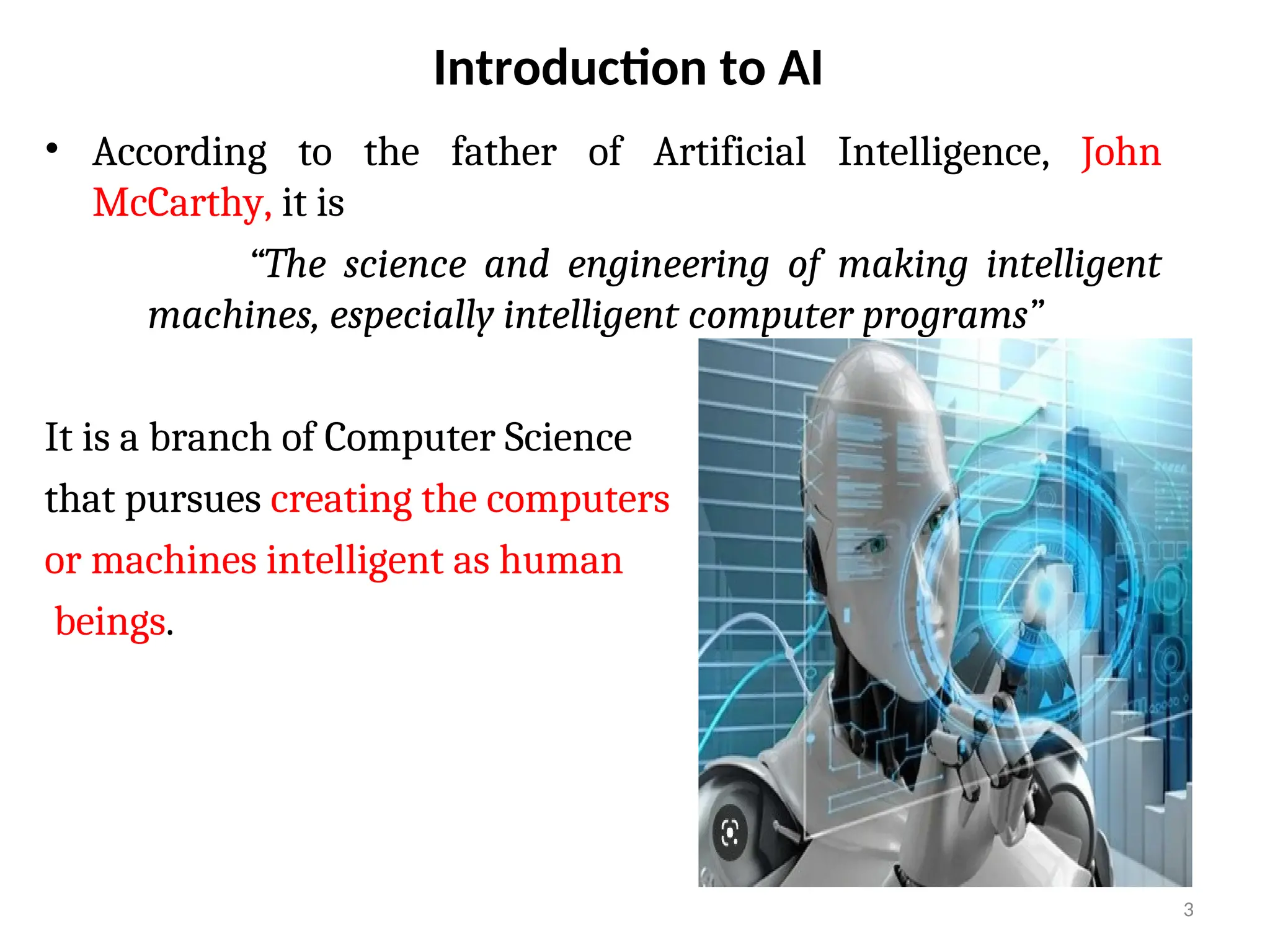
It is a branch of Computer Science
that pursues creating the computers
or machines intelligent as human
beings.
3
 One of the booming technologies of computer science is
Artificial Intelligence (AI).
 AI is now all around us. It is currently working with a variety of
subfields, ranging from general to specific, such as self-driving
cars, playing chess, proving theorems, playing music, Painting,
etc.
4
 AI holds a tendency to cause a machine to work as a
human.
 Artificial Intelligence is composed of two
words Artificial and Intelligence, where Artificial
defines "man-made," and Intelligence
defines "thinking power", hence AI means "a man-
made thinking power."
5
• So, we can define AI as: "It is a branch of computer
science by which we can create intelligent machines
which can behave like a human, think like humans,
and able to make decisions."
6
• Intelligence is the computational part of the ability to achieve
goals.
• Intelligent behaviour is depicted by perceiving one’s
environment, relates to tasks involving higher mental
processes like
• Creativity,
• Solving problems
• Pattern recognition
• Classification
• Learning , Induction and Deduction
• Building analogies
• Optimization
• Language processing,
• knowledge and many more.
7
AI Categories
(i) Systems that think like humans. -Cognitive model
(ii) Systems that act like humans. - Alan Turing
(iii) Systems that think rationally. –logic (laws of thought)
(iv) Systems that act rationally. Rational Agents
8
History of AI
9
Why AI ?
With the help of AI
• We can create software or devices which can solve real-world
problems very easily and with accuracy such as health issues,
marketing, traffic issues, etc.
• We can create your personal virtual Assistant, such as Cortana,
Google Assistant, Siri, etc.
• We can build such Robots which can work in an environment
where survival of humans can be at risk.
Therefore AI opens a path for other new technologies, new
devices, and new Opportunities.
10
Goals of Artificial Intelligence
• Replicate human intelligence
• Solve Knowledge-intensive tasks
• An intelligent connection of perception and action
• Building a machine which can perform tasks that requires human
intelligence such as:
– Proving a theorem
– Playing chess
– Plan some surgical operation
– Driving a car in traffic
• Creating some system which can exhibit intelligent behavior, learn
new things by itself, demonstrate, explain, and can advise to its user.
11
Application of AI
12
• Healthcare Industries are applying AI to make a
better and faster diagnosis than humans. AI can help
doctors with diagnoses and can inform when patients
are worsening so that medical help can reach to the
patient before hospitalization.
• AI can be used for gaming purpose. The AI machines
can play strategic games like chess, where the
machine needs to think of a large number of possible
places.
13
• The finance industry is implementing automation, chatbot,
adaptive intelligence, algorithm trading, and machine
learning into financial processes.
• The security of data is crucial for every company and cyber-
attacks are growing very rapidly in the digital world. AI can
be used to make your data more safe and secure.
• Some examples such as AEG bot, AI2 Platform, are used to
determine software bug and cyber-attacks in a better way.
14
• Social Media sites such as Facebook, Twitter, and Snapchat
contain billions of user profiles, which need to be stored and
managed in a very efficient way.
• AI can organize and manage massive amounts of data. AI can
analyze lots of data to identify the latest trends, hashtag, and
requirement of different users.
15
• AI is capable of doing various travel related works
such as from making travel arrangement to
suggesting the hotels, flights, and best routes to the
customers.
• Travel industries are using AI-powered chatbots
which can make human-like interaction with
customers for better and fast response.
• Various Industries are currently working for
developing self-driven cars which can make your
journey more safe and secure. 16
• Automotive industries are using AI to provide virtual assistant
to their user for better performance. Such as Tesla has
introduced TeslaBot, an intelligent virtual assistant.
• Artificial Intelligence has a remarkable role in Robotics.
Usually, general robots are programmed such that they can
perform some repetitive task, but with the help of AI, we can
create intelligent robots which can perform tasks with their
own experiences without pre-programmed.
17
• Humanoid Robots are best examples for AI in robotics,
recently the intelligent Humanoid robot named as Erica and
Sophia has been developed which can talk and behave like
humans.
• Now a day's agriculture is becoming Digital, and AI is
emerging in this field. Agriculture is applying AI as
agriculture robotics, solid and crop monitoring, predictive
analysis. AI in agriculture can be very helpful for farmers.
18
Subfields of Artificial Intelligence
• Machine learning is the art of studying algorithms that learn
from examples and experiences. Machine learning is based on
the idea that some patterns in the data were identified and
used for future predictions.
• Deep Learning: Deep learning is a sub-field of machine
learning. Deep learning does not mean the machine learns
more in-depth knowledge; it uses different layers to learn from
the data.
The depth of the model is represented by the number of layers in
the model. For instance, the Google LeNet model for image
recognition counts 22 layers. 19
20
• Natural Language Processing: A neural network is a group of
connected I/O units where each connection has a weight
associated with its computer programs.
• Expert Systems: An expert system is an interactive and reliable
computer-based decision-making system that uses facts and
heuristics to solve complex decision-making problems
• Fuzzy Logic: Fuzzy Logic is defined as a many-valued logic form
that may have truth values of variables in any real number
between 0 and 1.
21
Problem, Problem space and Search
 In AI, Search techniques are universal problem-solving
methods.
 Rational agents or Problem-solving agents in AI mostly used
these search strategies or algorithms to solve a specific problem
and provide the best result.
 Problem-solving agents are the goal-based agents and use atomic
representation.
To do this :
 Define the problem accurately including detailed specifications
and what constitutes a suitable solution.
22
 Scrutinize the problem carefully, for some features may have
a central affect on the chosen method of solution.
 Segregate and represent the background knowledge needed in
the solution of the problem.
 Choose the best solving techniques for the problem to solve a
solution.
23
Problem Solving Process
Problem solving has been the key area of concern for Artificial
Intelligence. It’s a process of generating solutions from observed
data.
• a ‘problem’ is characterized by a set of goals,
• a set of objects, and
• a set of operations.
A ‘problem space’ is an abstract space. It encompasses all valid
states that can be generated by the application of any
combination of operators on any combination of objects.
• The problem space may contain one or more solutions.
• A solution is a combination of operations and objects that achieve
the goals.
• A ‘search’ refers to the search for a solution in a problem space.
• Search proceeds with different types of search control strategies.
DFS ,BFS are the two common search
24
Problem Definition
– A problem is defined by its ‘elements’ and their ‘relations’. To
provide a formal description of a problem, we need to do the
following:
1. Define a state space
2. Specify one or more states that describe possible situations –initial
states
3. Specify one or more states that would be acceptable solution to the
problem. These states are called Goal states
4. Specify a set of rules that describe the actions (operators) available.
25
Search
– The problem can be solved by using the rules, in
combination with an appropriate control strategy, to move
through the problem space until a path from an initial state
to a goal state is found. This process is known as ‘search’.
– A problem space is represented by a directed graph, where
nodes represent search state and paths represent the
operators applied to change the state.
26
27
A search problem consists of:
– A State Space. Set of all possible states where you can be.
– A Start State. The state from where the search begins.
– A Goal Test. A function that looks at the current state
returns whether or not it is the goal state.
28
30
The uninformed search does not contain any domain knowledge
such as closeness, the location of the goal. It operates in a brute-
force way as it only includes information about how to traverse
the tree and how to identify leaf and goal nodes.
Uninformed search applies a way in which search tree is searched
without any information about the search space like initial state
operators and test for the goal
 Informed search algorithms use domain
knowledge. In an informed search, problem
information is available which can guide the search.
 Informed search strategies can find a solution more
efficiently than an uninformed search strategy.
 Informed search is also called a Heuristic search.
Heuristic is a function that estimates how close a
state is to the goal state.
31
Agents
 An agent can be anything that perceive its environment
through sensors and act upon that environment through
actuators. An Agent runs in the cycle of perceiving, thinking,
and acting.
33
• Sensor is a device which detects the change in the environment
and sends the information to other electronic devices. An agent
observes its environment through sensors.
• Actuators are the component of machines that converts
energy into motion. The actuators are only responsible for
moving and controlling a system. An actuator can be an electric
motor, gears, rails, etc.
• Effectors: Effectors are the devices which affect the
environment. Effectors can be legs, wheels, arms, fingers, wings,
fins, and display screen.
34
Example for agent
• Software: This Agent has file contents, keystrokes, and
received network packages that function as sensory input,
then act on those inputs, displaying the output on a screen.
• Human: Yes, we’re all agents. Humans have eyes, ears, and
other organs that act as sensors, and hands, legs, mouths, and
other body parts act as actuators.
• Robotic: Robotic agents have cameras and infrared range
finders that act as sensors, and various servos and motors
perform as actuators.
35
 Intelligent agents in AI are autonomous entities that act upon
an environment using sensors and actuators to achieve their
goals.
 In addition, intelligent agents may learn from the environment
to achieve those goals.
 Driverless cars and the Siri virtual assistant are examples of
intelligent agents in AI.
These are the main four rules all AI agents must adhere to:
• Rule 1: An AI agent must be able to perceive the environment.
36
• Rule 2: The environmental observations must be used to
make decisions.
• Rule 3: The decisions should result in action.
• Rule 4: The action taken by the AI agent must be a rational.
Rational actions are actions that maximize performance and
yield the best positive outcome.
37
Functions of an AI Agent
Agents perform these functions continuously:
• Perceiving dynamic conditions in the environment
• Acting to affect conditions in the environment
• Using reasoning to interpret perceptions
• Problem-solving
• Drawing inferences
• Determining actions and their outcomes
38
Types of Agents
Agents can be grouped into five classes based on their degree of
perceived intelligence and capability :
• Simple Reflex Agents
• Model-Based Reflex Agents
• Goal-Based Agents
• Utility-Based Agents
• Learning Agent
39

Introduction to ARTIFICIAL INTELLIGENCES

  • 1.
    Dr.N.G.P. Institute ofTechnology (Approved by AICTE, New Delhi & Affiliated to Anna University, Chennai) Recognized by UGC & Accredited by NAAC Accredited by NBA (BME,CSE,ECE,EEE,MECH) Dr. N.G.P – Kalapatti Road, Coimbatore – 48, Tamilnadu Phone: 0422 – 2369105, Fax: 0422 – 2369106, Email:info@drngpit.ac.in, Web: www.drngpit.ac.in Computational Intelligence 1
  • 2.
    Topics to becovered 1. Introduction to AI 2. Why AI ? 3. Goals of AI 4. Applications of AI 5. Subfields of Artificial Intelligence 2
  • 3.
    Introduction to AI •According to the father of Artificial Intelligence, John McCarthy, it is “The science and engineering of making intelligent machines, especially intelligent computer programs” It is a branch of Computer Science that pursues creating the computers or machines intelligent as human beings. 3
  • 4.
     One ofthe booming technologies of computer science is Artificial Intelligence (AI).  AI is now all around us. It is currently working with a variety of subfields, ranging from general to specific, such as self-driving cars, playing chess, proving theorems, playing music, Painting, etc. 4
  • 5.
     AI holdsa tendency to cause a machine to work as a human.  Artificial Intelligence is composed of two words Artificial and Intelligence, where Artificial defines "man-made," and Intelligence defines "thinking power", hence AI means "a man- made thinking power." 5
  • 6.
    • So, wecan define AI as: "It is a branch of computer science by which we can create intelligent machines which can behave like a human, think like humans, and able to make decisions." 6
  • 7.
    • Intelligence isthe computational part of the ability to achieve goals. • Intelligent behaviour is depicted by perceiving one’s environment, relates to tasks involving higher mental processes like • Creativity, • Solving problems • Pattern recognition • Classification • Learning , Induction and Deduction • Building analogies • Optimization • Language processing, • knowledge and many more. 7
  • 8.
    AI Categories (i) Systemsthat think like humans. -Cognitive model (ii) Systems that act like humans. - Alan Turing (iii) Systems that think rationally. –logic (laws of thought) (iv) Systems that act rationally. Rational Agents 8
  • 9.
  • 10.
    Why AI ? Withthe help of AI • We can create software or devices which can solve real-world problems very easily and with accuracy such as health issues, marketing, traffic issues, etc. • We can create your personal virtual Assistant, such as Cortana, Google Assistant, Siri, etc. • We can build such Robots which can work in an environment where survival of humans can be at risk. Therefore AI opens a path for other new technologies, new devices, and new Opportunities. 10
  • 11.
    Goals of ArtificialIntelligence • Replicate human intelligence • Solve Knowledge-intensive tasks • An intelligent connection of perception and action • Building a machine which can perform tasks that requires human intelligence such as: – Proving a theorem – Playing chess – Plan some surgical operation – Driving a car in traffic • Creating some system which can exhibit intelligent behavior, learn new things by itself, demonstrate, explain, and can advise to its user. 11
  • 12.
  • 13.
    • Healthcare Industriesare applying AI to make a better and faster diagnosis than humans. AI can help doctors with diagnoses and can inform when patients are worsening so that medical help can reach to the patient before hospitalization. • AI can be used for gaming purpose. The AI machines can play strategic games like chess, where the machine needs to think of a large number of possible places. 13
  • 14.
    • The financeindustry is implementing automation, chatbot, adaptive intelligence, algorithm trading, and machine learning into financial processes. • The security of data is crucial for every company and cyber- attacks are growing very rapidly in the digital world. AI can be used to make your data more safe and secure. • Some examples such as AEG bot, AI2 Platform, are used to determine software bug and cyber-attacks in a better way. 14
  • 15.
    • Social Mediasites such as Facebook, Twitter, and Snapchat contain billions of user profiles, which need to be stored and managed in a very efficient way. • AI can organize and manage massive amounts of data. AI can analyze lots of data to identify the latest trends, hashtag, and requirement of different users. 15
  • 16.
    • AI iscapable of doing various travel related works such as from making travel arrangement to suggesting the hotels, flights, and best routes to the customers. • Travel industries are using AI-powered chatbots which can make human-like interaction with customers for better and fast response. • Various Industries are currently working for developing self-driven cars which can make your journey more safe and secure. 16
  • 17.
    • Automotive industriesare using AI to provide virtual assistant to their user for better performance. Such as Tesla has introduced TeslaBot, an intelligent virtual assistant. • Artificial Intelligence has a remarkable role in Robotics. Usually, general robots are programmed such that they can perform some repetitive task, but with the help of AI, we can create intelligent robots which can perform tasks with their own experiences without pre-programmed. 17
  • 18.
    • Humanoid Robotsare best examples for AI in robotics, recently the intelligent Humanoid robot named as Erica and Sophia has been developed which can talk and behave like humans. • Now a day's agriculture is becoming Digital, and AI is emerging in this field. Agriculture is applying AI as agriculture robotics, solid and crop monitoring, predictive analysis. AI in agriculture can be very helpful for farmers. 18
  • 19.
    Subfields of ArtificialIntelligence • Machine learning is the art of studying algorithms that learn from examples and experiences. Machine learning is based on the idea that some patterns in the data were identified and used for future predictions. • Deep Learning: Deep learning is a sub-field of machine learning. Deep learning does not mean the machine learns more in-depth knowledge; it uses different layers to learn from the data. The depth of the model is represented by the number of layers in the model. For instance, the Google LeNet model for image recognition counts 22 layers. 19
  • 20.
  • 21.
    • Natural LanguageProcessing: A neural network is a group of connected I/O units where each connection has a weight associated with its computer programs. • Expert Systems: An expert system is an interactive and reliable computer-based decision-making system that uses facts and heuristics to solve complex decision-making problems • Fuzzy Logic: Fuzzy Logic is defined as a many-valued logic form that may have truth values of variables in any real number between 0 and 1. 21
  • 22.
    Problem, Problem spaceand Search  In AI, Search techniques are universal problem-solving methods.  Rational agents or Problem-solving agents in AI mostly used these search strategies or algorithms to solve a specific problem and provide the best result.  Problem-solving agents are the goal-based agents and use atomic representation. To do this :  Define the problem accurately including detailed specifications and what constitutes a suitable solution. 22
  • 23.
     Scrutinize theproblem carefully, for some features may have a central affect on the chosen method of solution.  Segregate and represent the background knowledge needed in the solution of the problem.  Choose the best solving techniques for the problem to solve a solution. 23
  • 24.
    Problem Solving Process Problemsolving has been the key area of concern for Artificial Intelligence. It’s a process of generating solutions from observed data. • a ‘problem’ is characterized by a set of goals, • a set of objects, and • a set of operations. A ‘problem space’ is an abstract space. It encompasses all valid states that can be generated by the application of any combination of operators on any combination of objects. • The problem space may contain one or more solutions. • A solution is a combination of operations and objects that achieve the goals. • A ‘search’ refers to the search for a solution in a problem space. • Search proceeds with different types of search control strategies. DFS ,BFS are the two common search 24
  • 25.
    Problem Definition – Aproblem is defined by its ‘elements’ and their ‘relations’. To provide a formal description of a problem, we need to do the following: 1. Define a state space 2. Specify one or more states that describe possible situations –initial states 3. Specify one or more states that would be acceptable solution to the problem. These states are called Goal states 4. Specify a set of rules that describe the actions (operators) available. 25
  • 26.
    Search – The problemcan be solved by using the rules, in combination with an appropriate control strategy, to move through the problem space until a path from an initial state to a goal state is found. This process is known as ‘search’. – A problem space is represented by a directed graph, where nodes represent search state and paths represent the operators applied to change the state. 26
  • 27.
  • 28.
    A search problemconsists of: – A State Space. Set of all possible states where you can be. – A Start State. The state from where the search begins. – A Goal Test. A function that looks at the current state returns whether or not it is the goal state. 28
  • 30.
    30 The uninformed searchdoes not contain any domain knowledge such as closeness, the location of the goal. It operates in a brute- force way as it only includes information about how to traverse the tree and how to identify leaf and goal nodes. Uninformed search applies a way in which search tree is searched without any information about the search space like initial state operators and test for the goal
  • 31.
     Informed searchalgorithms use domain knowledge. In an informed search, problem information is available which can guide the search.  Informed search strategies can find a solution more efficiently than an uninformed search strategy.  Informed search is also called a Heuristic search. Heuristic is a function that estimates how close a state is to the goal state. 31
  • 33.
    Agents  An agentcan be anything that perceive its environment through sensors and act upon that environment through actuators. An Agent runs in the cycle of perceiving, thinking, and acting. 33
  • 34.
    • Sensor isa device which detects the change in the environment and sends the information to other electronic devices. An agent observes its environment through sensors. • Actuators are the component of machines that converts energy into motion. The actuators are only responsible for moving and controlling a system. An actuator can be an electric motor, gears, rails, etc. • Effectors: Effectors are the devices which affect the environment. Effectors can be legs, wheels, arms, fingers, wings, fins, and display screen. 34
  • 35.
    Example for agent •Software: This Agent has file contents, keystrokes, and received network packages that function as sensory input, then act on those inputs, displaying the output on a screen. • Human: Yes, we’re all agents. Humans have eyes, ears, and other organs that act as sensors, and hands, legs, mouths, and other body parts act as actuators. • Robotic: Robotic agents have cameras and infrared range finders that act as sensors, and various servos and motors perform as actuators. 35
  • 36.
     Intelligent agentsin AI are autonomous entities that act upon an environment using sensors and actuators to achieve their goals.  In addition, intelligent agents may learn from the environment to achieve those goals.  Driverless cars and the Siri virtual assistant are examples of intelligent agents in AI. These are the main four rules all AI agents must adhere to: • Rule 1: An AI agent must be able to perceive the environment. 36
  • 37.
    • Rule 2:The environmental observations must be used to make decisions. • Rule 3: The decisions should result in action. • Rule 4: The action taken by the AI agent must be a rational. Rational actions are actions that maximize performance and yield the best positive outcome. 37
  • 38.
    Functions of anAI Agent Agents perform these functions continuously: • Perceiving dynamic conditions in the environment • Acting to affect conditions in the environment • Using reasoning to interpret perceptions • Problem-solving • Drawing inferences • Determining actions and their outcomes 38
  • 39.
    Types of Agents Agentscan be grouped into five classes based on their degree of perceived intelligence and capability : • Simple Reflex Agents • Model-Based Reflex Agents • Goal-Based Agents • Utility-Based Agents • Learning Agent 39