.
.
.
.
.
.
.
.
.
.
.
.
.
.
.
.
.
.
.
.
.
.
.
.
.
.
.
.
.
.
.
.
.
.
.
.
.
.
.
.
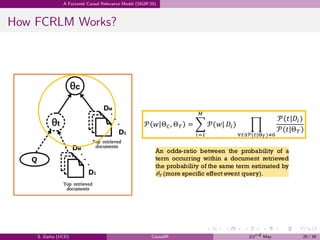
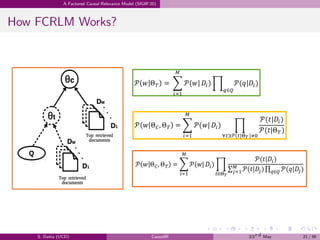
A Factored CausalRelevance Model (SIGIR’20)
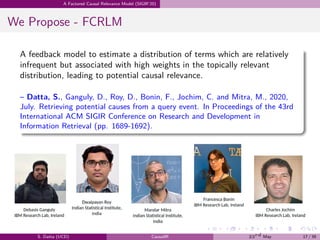
We Propose - FCRLM
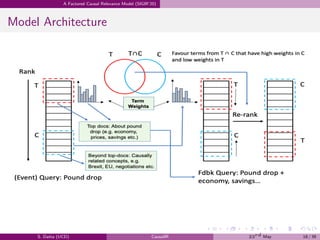
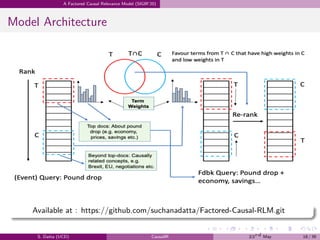
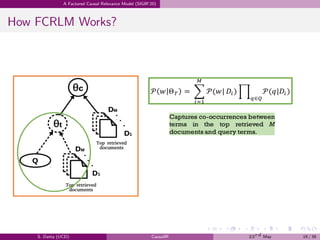
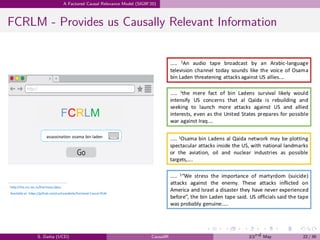
A feedback model to estimate a distribution of terms which are relatively
infrequent but associated with high weights in the topically relevant
distribution, leading to potential causal relevance.
– Datta, S., Ganguly, D., Roy, D., Bonin, F., Jochim, C. and Mitra, M., 2020,
July. Retrieving potential causes from a query event. In Proceedings of the 43rd
International ACM SIGIR Conference on Research and Development in
Information Retrieval (pp. 1689-1692).
S. Datta (UCD) CausalIR 23rd May 17 / 39
.
.
.
.
.
.
.
.
.
.
.
.
.
.
.
.
.
.
.
.
.
.
.
.
.
.
.
.
.
.
.
.
.
.
.
.
.
.
.
.
A Factored CausalRelevance Model (SIGIR’20)
CAIR - A Shared Task
For Dataset :
https://github.com/suchanadatta/CAIR-
DataSet.git
Datta, S., Ganguly, D., Roy, D., Greene,
D., Jochim, C. and Bonin, F., 2020,
December. Overview of the
Causality-driven Adhoc Information
Retrieval (CAIR) task at FIRE-2020. In
Forum for Information Retrieval Evaluation
(pp. 14-17).
Datta, S., Ganguly, D., Roy, D., Greene,
D., 2021, December. Overview of the
Causality-driven Adhoc Information
Retrieval (CAIR) task at FIRE-2021. In
Forum for Information Retrieval Evaluation
(pp. 25-27).
S. Datta (UCD) CausalIR 23rd May 24 / 39
.
.
.
.
.
.
.
.
.
.
.
.
.
.
.
.
.
.
.
.
.
.
.
.
.
.
.
.
.
.
.
.
.
.
.
.
.
.
.
.
A ‘Pointwise-Query, Listwise-Document’-basedQPP Approach (SIGIR’22)
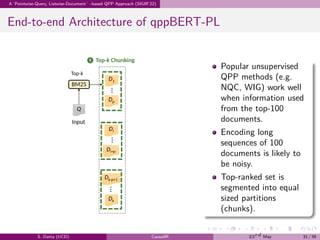
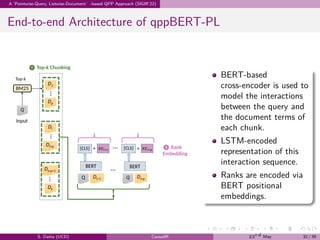
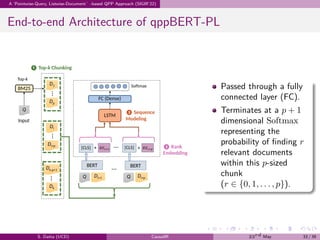
We propose - qppBERT-PL
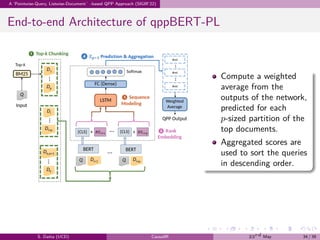
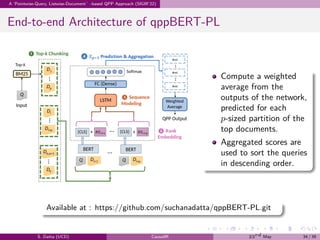
An end-to-end neural cross-encoder-based approach - trained pointwise on
individual queries, but listwise over the top ranked documents (split into
chunks).
– Datta, S., MacAvaney, S., Ganguly, D., Greene, D. A ‘Pointwise-Query,
Listwise-Document’based Query Performance Prediction Approach (to appear in
the proceedings of SIGIR’22).
S. Datta (UCD) CausalIR 23rd May 29 / 39
35.
.
.
.
.
.
.
.
.
.
.
.
.
.
.
.
.
.
.
.
.
.
.
.
.
.
.
.
.
.
.
.
.
.
.
.
.
.
.
.
.
A ‘Pointwise-Query, Listwise-Document’-basedQPP Approach (SIGIR’22)
What do we Propose? - qppBERT-PL
A novel architecture and objective function for a pointwise neural QPP.
Transformed the pointwise QPP objective into a classification task, not a
regression model.
Models the top-ranked documents as a sequence of chunks (Listwise), not
as a whole set.
Incorporates the relative Positions (or ranks) of the top documents.
S. Datta (UCD) CausalIR 23rd May 30 / 39
.
.
.
.
.
.
.
.
.
.
.
.
.
.
.
.
.
.
.
.
.
.
.
.
.
.
.
.
.
.
.
.
.
.
.
.
.
.
.
.
Concluding Remarks
Concluding Remarks
FCRLM- a feedback model to estimate a distribution of terms which are
relatively infrequent but associated with high weights in the topically relevant
distribution, leading to potential causal relevance.
We would like to incorporate adaptive feedback as a feature that would help
users deciding whether or not to use feedback.
qppBERT-PL - the first contribution in QPP that transforms the pointwise
QPP objective into a classification task.
We are interested in exploring ways to aggregate information from short
passages and predict QPP scores for longer documents.
S. Datta (UCD) CausalIR 23rd May 38 / 39