Trio:  A System for  Data ,  Uncertainty , and  Lineage Search “stanford trio” DATA UNCERTAINTY LINEAGE
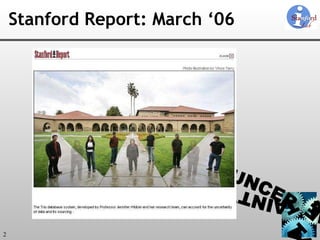
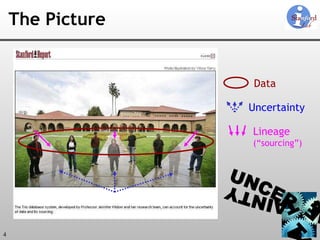
Stanford Report: March ‘06
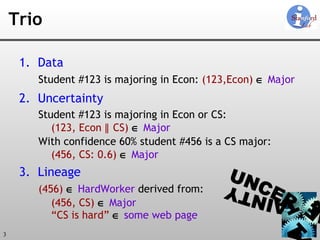
Trio Data Student #123 is majoring in Econ:   (123,Econ)     Major Uncertainty Student #123 is majoring in Econ or CS: (123, Econ  ∥  CS)     Major With confidence 60% student #456 is a CS major: (456, CS: 0.6)     Major Lineage (456)      HardWorker   derived from: (456, CS)     Major “ CS is hard”     some web page
The Picture Data Uncertainty Lineage (“sourcing”)
Why Uncertainty + Lineage? Many applications seem to need both Information extraction systems Scientific and sensor data management Information integration Deduplication (data cleaning) Approximate query processing
Why Uncertainty + Lineage? From a technical standpoint, it turns out that  lineage... Enables simple and consistent representation of uncertain data Correlates uncertainty in query results with uncertainty in the input data Can make computation over uncertain data more efficient
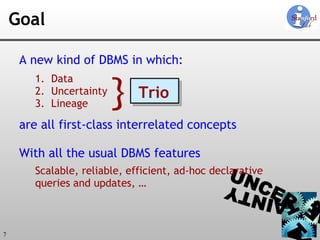
Goal A new kind of DBMS in which: Data Uncertainty Lineage are all first-class interrelated concepts With all the usual DBMS features Scalable, reliable, efficient, ad-hoc declarative  queries and updates, … Trio   }
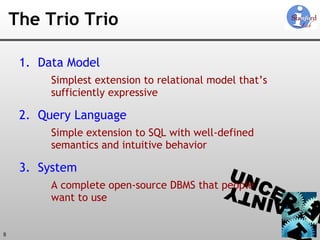
The Trio Trio Data Model Simplest extension to relational model that’s sufficiently expressive Query Language Simple extension to SQL with well-defined semantics and intuitive behavior System A complete open-source DBMS that people  want to use
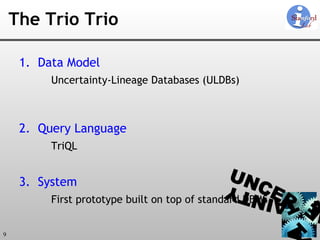
The Trio Trio Data Model Uncertainty-Lineage Databases (ULDBs)   Query Language TriQL System First prototype built on top of standard DBMS
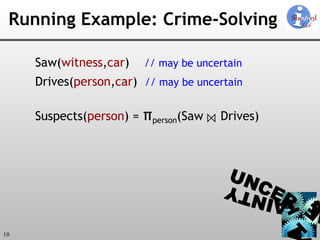
Running Example: Crime-Solving Saw( witness , car )  // may be uncertain Drives( person , car )  // may be uncertain Suspects( person )   =  π person (Saw  ⋈  Drives)
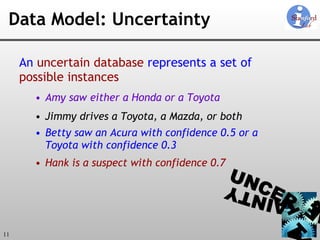
Data Model: Uncertainty An  uncertain database  represents a set of possible instances Amy saw either a Honda or a Toyota Jimmy drives a Toyota, a Mazda, or both Betty saw an Acura with confidence 0.5 or a Toyota with confidence 0.3 Hank is a suspect with confidence 0.7
Our Model for Uncertainty 1. Alternatives 2. ‘?’ (Maybe) Annotations 3. Confidences
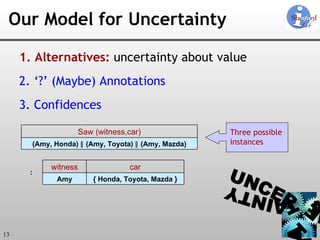
Our Model for Uncertainty 1. Alternatives:   uncertainty about value 2. ‘?’ (Maybe) Annotations 3. Confidences = Three possible instances (Amy, Honda)  ∥  (Amy, Toyota)  ∥  (Amy, Mazda) Saw (witness,car) { Honda, Toyota, Mazda } car Amy witness
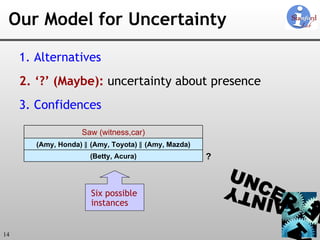
Our Model for Uncertainty 1. Alternatives 2.   ‘?’ (Maybe):  uncertainty about presence 3. Confidences Six possible instances ? (Amy, Honda)  ∥  (Amy, Toyota)  ∥  (Amy, Mazda) (Betty, Acura) Saw (witness,car)
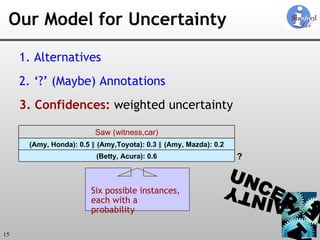
Our Model for Uncertainty 1. Alternatives 2. ‘?’ (Maybe) Annotations 3. Confidences:  weighted uncertainty ? Six possible instances, each with a probability (Amy, Honda): 0.5  ∥  (Amy,Toyota): 0.3  ∥  (Amy, Mazda): 0.2 (Betty, Acura): 0.6 Saw (witness,car)
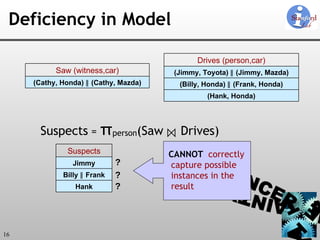
Deficiency in Model Suspects   =  π person (Saw  ⋈  Drives) ? ? ? Does not correctly capture possible instances in the result CANNOT (Cathy, Honda)  ∥  (Cathy, Mazda) Saw (witness,car) (Billy, Honda)  ∥ (Frank, Honda) (Hank, Honda) (Jimmy, Toyota)  ∥ (Jimmy, Mazda) Drives (person,car) Jimmy Billy  ∥ Frank Hank Suspects
Lineage to the Rescue Lineage (provenance): “where data came from” Internal lineage External lineage In Trio: A function   λ  from alternatives to other  alternatives (or external sources)
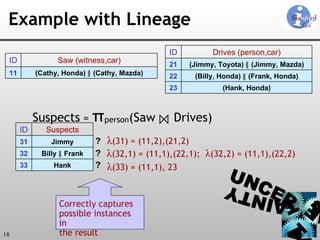
Example with Lineage ? ? ? Suspects   =  π person (Saw  ⋈  Drives) λ (31) = (11,2),(21,2) λ (32,1) = (11,1),(22,1);  λ (32,2) = (11,1),(22,2) λ (33) = (11,1), 23 11 ID (Cathy, Honda)  ∥  (Cathy, Mazda) Saw (witness,car) 23 22 21 ID (Billy, Honda)  ∥ (Frank, Honda) (Hank, Honda) (Jimmy, Toyota)  ∥ (Jimmy, Mazda) Drives (person,car) 33 32 31 ID Jimmy Billy  ∥ Frank Hank Suspects Correctly captures possible instances in the result
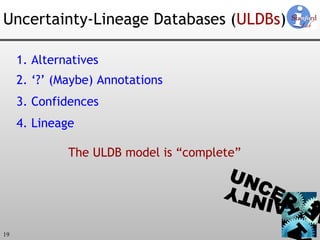
Uncertainty-Lineage Databases ( ULDBs ) 1. Alternatives 2. ‘?’ (Maybe) Annotations 3. Confidences 4. Lineage The ULDB model is “complete”
Querying ULDBs Simple extension to SQL Formal semantics, intuitive meaning Query uncertainty, confidences, and lineage TriQL
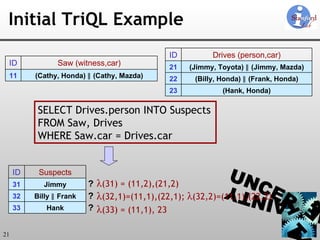
Initial TriQL Example SELECT Drives.person INTO Suspects FROM Saw, Drives WHERE Saw.car = Drives.car ? ? ? λ (31) = (11,2),(21,2) λ (32,1)=(11,1),(22,1);  λ (32,2)=(11,1),(22,2) λ (33) = (11,1), 23 11 ID (Cathy, Honda)  ∥  (Cathy, Mazda) Saw (witness,car) 23 22 21 ID (Billy, Honda)  ∥ (Frank, Honda) (Hank, Honda) (Jimmy, Toyota)  ∥ (Jimmy, Mazda) Drives (person,car) 33 32 31 ID Jimmy Billy  ∥ Frank Hank Suspects
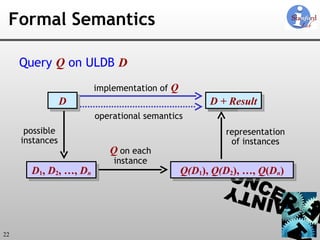
Formal Semantics Query  Q   on ULDB  D D D 1 ,  D 2 , …,  D n possible instances Q   on each instance representation of instances Q(D 1 ),  Q(D 2 ), …,  Q ( D n ) D’ implementation of  Q operational semantics D + Result
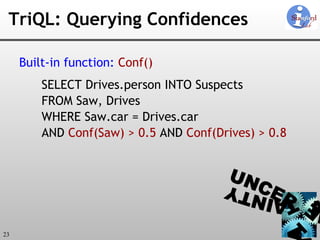
TriQL: Querying Confidences Built-in function:   Conf() SELECT Drives.person INTO Suspects FROM Saw, Drives WHERE Saw.car = Drives.car AND  Conf(Saw) > 0.5  AND  Conf(Drives) > 0.8
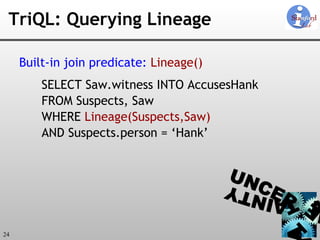
TriQL: Querying Lineage Built-in join predicate:   Lineage() SELECT Saw.witness INTO AccusesHank FROM Suspects, Saw WHERE  Lineage(Suspects,Saw) AND Suspects.person = ‘Hank’
Operational Semantics Over conventional relational database: For each tuple in cross-product of  X 1 , X 2 , ..., X n Evaluate the  predicate If true, project  attr-list  to create result tuple If  INTO  clause, insert into  table SELECT attr-list [ INTO table ] FROM X 1 , X 2 , ..., X n WHERE predicate
Operational Semantics Over ULDB: For each tuple in cross-product of  X 1 , X 2 , ..., X n Create “super tuple”  T  from all combinations of alternatives Evaluate  predicate  on each alternative in  T   ; keep only the true ones Project  attr-list  on each alternative to create result tuple Details:  ‘?’, lineage, confidences SELECT attr-list [ INTO table ] FROM X 1 , X 2 , ..., X n WHERE predicate
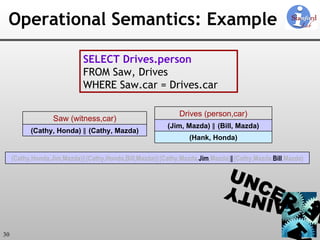
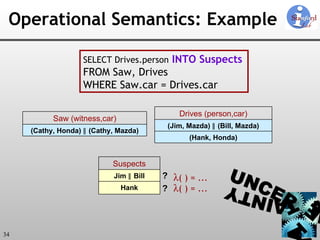
Operational Semantics: Example SELECT Drives.person FROM Saw, Drives WHERE Saw.car = Drives.car (Cathy, Honda)  ∥  (Cathy, Mazda) Saw (witness,car) (Hank, Honda) (Jim, Mazda)  ∥ (Bill, Mazda) Drives (person,car)
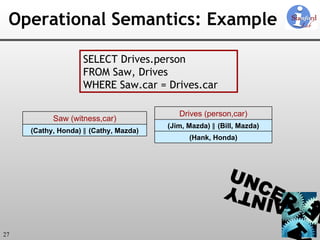
Operational Semantics: Example SELECT Drives.person FROM Saw, Drives WHERE Saw.car = Drives.car (Cathy, Honda)  ∥  (Cathy, Mazda) Saw (witness,car) (Hank, Honda) (Jim, Mazda)  ∥ (Bill, Mazda) Drives (person,car) (Cathy,Honda,Jim,Mazda) ∥ (Cathy,Honda,Bill,Mazda) ∥ (Cathy,Mazda,Jim,Mazda) ∥ (Cathy,Mazda,Bill,Mazda)
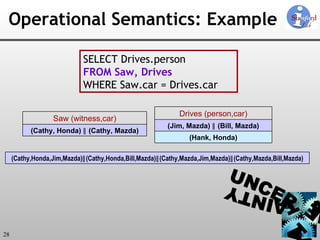
Operational Semantics: Example SELECT Drives.person FROM Saw, Drives WHERE Saw.car = Drives.car (Cathy, Honda)  ∥  (Cathy, Mazda) Saw (witness,car) (Hank, Honda) (Jim, Mazda)  ∥ (Bill, Mazda) Drives (person,car) (Cathy,Honda,Jim,Mazda) ∥ (Cathy,Honda,Bill,Mazda) ∥ (Cathy,Mazda, Jim ,Mazda) ∥ (Cathy,Mazda, Bill ,Mazda)
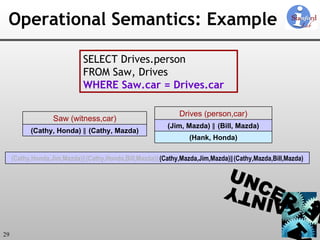
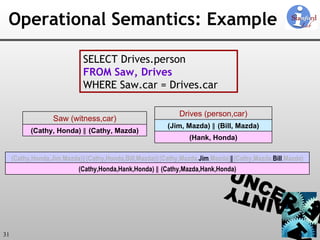
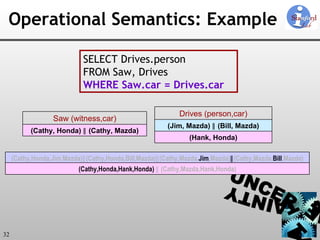
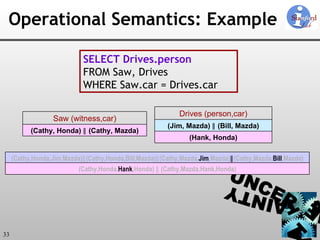
Operational Semantics: Example SELECT Drives.person FROM Saw, Drives WHERE Saw.car = Drives.car (Cathy,Honda,Jim,Mazda) ∥ (Cathy,Honda,Bill,Mazda) ∥ (Cathy,Mazda, Jim ,Mazda) ∥ (Cathy,Mazda, Bill ,Mazda) (Cathy, Honda)  ∥  (Cathy, Mazda) Saw (witness,car) (Hank, Honda) (Jim, Mazda)  ∥ (Bill, Mazda) Drives (person,car) (Cathy,Honda,Hank,Honda)  ∥  (Cathy,Mazda,Hank,Honda)
Operational Semantics: Example SELECT Drives.person FROM Saw, Drives WHERE Saw.car = Drives.car (Cathy,Honda,Jim,Mazda) ∥ (Cathy,Honda,Bill,Mazda) ∥ (Cathy,Mazda, Jim ,Mazda) ∥ (Cathy,Mazda, Bill ,Mazda) (Cathy, Honda)  ∥  (Cathy, Mazda) Saw (witness,car) (Hank, Honda) (Jim, Mazda)  ∥ (Bill, Mazda) Drives (person,car) (Cathy,Honda, Hank ,Honda)   ∥  (Cathy,Mazda,Hank,Honda)
Operational Semantics: Example SELECT Drives.person   INTO Suspects FROM Saw, Drives WHERE Saw.car = Drives.car ? ? λ ( ) = ... λ ( ) = ... (Cathy, Honda)  ∥  (Cathy, Mazda) Saw (witness,car) (Hank, Honda) (Jim, Mazda)  ∥ (Bill, Mazda) Drives (person,car) Jim  ∥ Bill Hank Suspects
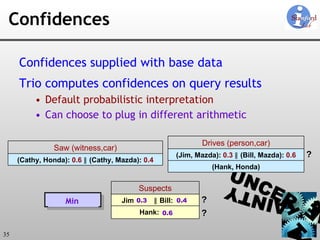
Confidences Confidences supplied with base data Trio computes confidences on query results Default probabilistic interpretation Can choose to plug in different arithmetic ? ? ? 0.3  0.4  0.6  Probabilistic Min (Cathy, Honda):   0.6   ∥  (Cathy, Mazda):   0.4 Saw (witness,car) (Hank, Honda) (Jim, Mazda):  0.3   ∥ (Bill, Mazda):  0.6 Drives (person,car) Jim:  0.12   ∥ Bill:  0.24 Hank:  0.6 Suspects
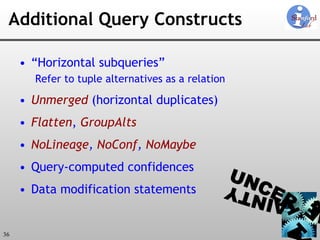
Additional Query Constructs “ Horizontal subqueries” Refer to tuple alternatives as a relation Unmerged  (horizontal duplicates) Flatten ,  GroupAlts NoLineage ,  NoConf ,  NoMaybe Query-computed confidences Data modification statements
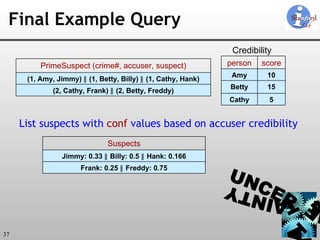
Final Example Query Credibility List suspects with  conf  values based on accuser credibility (1, Amy, Jimmy)  ∥  (1, Betty, Billy)  ∥  (1, Cathy, Hank) (2, Cathy, Frank)  ∥  (2, Betty, Freddy) PrimeSuspect (crime#, accuser, suspect) Cathy Betty Amy person 15 5 10 score Jimmy: 0.33  ∥ Billy: 0.5 ∥ Hank: 0.166 Frank: 0.25  ∥ Freddy: 0.75 Suspects
Final Example Query Credibility SELECT suspect, score/[sum(score)] as conf FROM (SELECT suspect, (SELECT score FROM Credibility C WHERE C.person = P.accuser) FROM PrimeSuspect P) (1, Amy, Jimmy)  ∥  (1, Betty, Billy)  ∥  (1, Cathy, Hank) (2, Cathy, Frank)  ∥  (2, Betty, Freddy) PrimeSuspect (crime#, accuser, suspect) Cathy Betty Amy person 15 5 10 score Jimmy: 0.33  ∥ Billy: 0.5 ∥ Hank: 0.166 Frank: 0.25  ∥ Freddy: 0.75 Suspects
Final Example Query Credibility SELECT suspect, score/[sum(score)]  as conf FROM (SELECT suspect, (SELECT score FROM Credibility C WHERE C.person = P.accuser) FROM PrimeSuspect P) (1, Amy, Jimmy)  ∥  (1, Betty, Billy)  ∥  (1, Cathy, Hank) (2, Cathy, Frank)  ∥  (2, Betty, Freddy) PrimeSuspect (crime#, accuser, suspect) Cathy Betty Amy person 15 5 10 score Jimmy: 0.33  ∥ Billy: 0.5 ∥ Hank: 0.166 Frank: 0.25  ∥ Freddy: 0.75 Suspects
Final Example Query Credibility SELECT suspect,  score/[sum(score)]   as conf FROM (SELECT suspect, (SELECT score FROM Credibility C WHERE C.person = P.accuser) FROM PrimeSuspect P) (1, Amy, Jimmy)  ∥  (1, Betty, Billy)  ∥  (1, Cathy, Hank) (2, Cathy, Frank)  ∥  (2, Betty, Freddy) PrimeSuspect (crime#, accuser, suspect) Cathy Betty Amy person 15 5 10 score Jimmy: 0.33  ∥ Billy: 0.5 ∥ Hank: 0.166 Frank: 0.25  ∥ Freddy: 0.75 Suspects
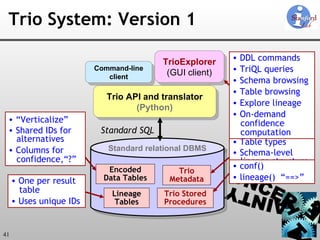
Trio System: Version 1 Standard relational DBMS Trio API and translator (Python) Command-line client Trio Metadata TrioExplorer (GUI client) Trio Stored Procedures Encoded Data Tables Lineage Tables Standard SQL “ Verticalize” Shared IDs for alternatives Columns for  confidence,“?” One per result table Uses unique IDs Table types Schema-level lineage structure conf() lineage()  “==>” DDL commands TriQL queries Schema browsing Table browsing Explore lineage On-demand confidence computation
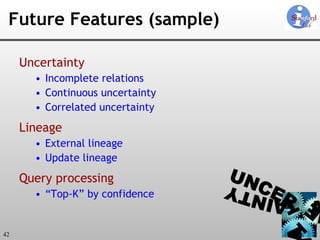
Future Features (sample) Uncertainty Incomplete relations Continuous uncertainty Correlated uncertainty Lineage External lineage Update lineage Query processing “Top-K” by confidence
but don’t forget the lineage… DATA UNCERTAINTY LINEAGE

Mazda Trio Notes

  • 1.
    Trio: ASystem for Data , Uncertainty , and Lineage Search “stanford trio” DATA UNCERTAINTY LINEAGE
  • 2.
  • 3.
    Trio Data Student#123 is majoring in Econ: (123,Econ)  Major Uncertainty Student #123 is majoring in Econ or CS: (123, Econ ∥ CS)  Major With confidence 60% student #456 is a CS major: (456, CS: 0.6)  Major Lineage (456)  HardWorker derived from: (456, CS)  Major “ CS is hard”  some web page
  • 4.
    The Picture DataUncertainty Lineage (“sourcing”)
  • 5.
    Why Uncertainty +Lineage? Many applications seem to need both Information extraction systems Scientific and sensor data management Information integration Deduplication (data cleaning) Approximate query processing
  • 6.
    Why Uncertainty +Lineage? From a technical standpoint, it turns out that lineage... Enables simple and consistent representation of uncertain data Correlates uncertainty in query results with uncertainty in the input data Can make computation over uncertain data more efficient
  • 7.
    Goal A newkind of DBMS in which: Data Uncertainty Lineage are all first-class interrelated concepts With all the usual DBMS features Scalable, reliable, efficient, ad-hoc declarative queries and updates, … Trio }
  • 8.
    The Trio TrioData Model Simplest extension to relational model that’s sufficiently expressive Query Language Simple extension to SQL with well-defined semantics and intuitive behavior System A complete open-source DBMS that people want to use
  • 9.
    The Trio TrioData Model Uncertainty-Lineage Databases (ULDBs) Query Language TriQL System First prototype built on top of standard DBMS
  • 10.
    Running Example: Crime-SolvingSaw( witness , car ) // may be uncertain Drives( person , car ) // may be uncertain Suspects( person ) = π person (Saw ⋈ Drives)
  • 11.
    Data Model: UncertaintyAn uncertain database represents a set of possible instances Amy saw either a Honda or a Toyota Jimmy drives a Toyota, a Mazda, or both Betty saw an Acura with confidence 0.5 or a Toyota with confidence 0.3 Hank is a suspect with confidence 0.7
  • 12.
    Our Model forUncertainty 1. Alternatives 2. ‘?’ (Maybe) Annotations 3. Confidences
  • 13.
    Our Model forUncertainty 1. Alternatives: uncertainty about value 2. ‘?’ (Maybe) Annotations 3. Confidences = Three possible instances (Amy, Honda) ∥ (Amy, Toyota) ∥ (Amy, Mazda) Saw (witness,car) { Honda, Toyota, Mazda } car Amy witness
  • 14.
    Our Model forUncertainty 1. Alternatives 2. ‘?’ (Maybe): uncertainty about presence 3. Confidences Six possible instances ? (Amy, Honda) ∥ (Amy, Toyota) ∥ (Amy, Mazda) (Betty, Acura) Saw (witness,car)
  • 15.
    Our Model forUncertainty 1. Alternatives 2. ‘?’ (Maybe) Annotations 3. Confidences: weighted uncertainty ? Six possible instances, each with a probability (Amy, Honda): 0.5 ∥ (Amy,Toyota): 0.3 ∥ (Amy, Mazda): 0.2 (Betty, Acura): 0.6 Saw (witness,car)
  • 16.
    Deficiency in ModelSuspects = π person (Saw ⋈ Drives) ? ? ? Does not correctly capture possible instances in the result CANNOT (Cathy, Honda) ∥ (Cathy, Mazda) Saw (witness,car) (Billy, Honda) ∥ (Frank, Honda) (Hank, Honda) (Jimmy, Toyota) ∥ (Jimmy, Mazda) Drives (person,car) Jimmy Billy ∥ Frank Hank Suspects
  • 17.
    Lineage to theRescue Lineage (provenance): “where data came from” Internal lineage External lineage In Trio: A function λ from alternatives to other alternatives (or external sources)
  • 18.
    Example with Lineage? ? ? Suspects = π person (Saw ⋈ Drives) λ (31) = (11,2),(21,2) λ (32,1) = (11,1),(22,1); λ (32,2) = (11,1),(22,2) λ (33) = (11,1), 23 11 ID (Cathy, Honda) ∥ (Cathy, Mazda) Saw (witness,car) 23 22 21 ID (Billy, Honda) ∥ (Frank, Honda) (Hank, Honda) (Jimmy, Toyota) ∥ (Jimmy, Mazda) Drives (person,car) 33 32 31 ID Jimmy Billy ∥ Frank Hank Suspects Correctly captures possible instances in the result
  • 19.
    Uncertainty-Lineage Databases (ULDBs ) 1. Alternatives 2. ‘?’ (Maybe) Annotations 3. Confidences 4. Lineage The ULDB model is “complete”
  • 20.
    Querying ULDBs Simpleextension to SQL Formal semantics, intuitive meaning Query uncertainty, confidences, and lineage TriQL
  • 21.
    Initial TriQL ExampleSELECT Drives.person INTO Suspects FROM Saw, Drives WHERE Saw.car = Drives.car ? ? ? λ (31) = (11,2),(21,2) λ (32,1)=(11,1),(22,1); λ (32,2)=(11,1),(22,2) λ (33) = (11,1), 23 11 ID (Cathy, Honda) ∥ (Cathy, Mazda) Saw (witness,car) 23 22 21 ID (Billy, Honda) ∥ (Frank, Honda) (Hank, Honda) (Jimmy, Toyota) ∥ (Jimmy, Mazda) Drives (person,car) 33 32 31 ID Jimmy Billy ∥ Frank Hank Suspects
  • 22.
    Formal Semantics Query Q on ULDB D D D 1 , D 2 , …, D n possible instances Q on each instance representation of instances Q(D 1 ), Q(D 2 ), …, Q ( D n ) D’ implementation of Q operational semantics D + Result
  • 23.
    TriQL: Querying ConfidencesBuilt-in function: Conf() SELECT Drives.person INTO Suspects FROM Saw, Drives WHERE Saw.car = Drives.car AND Conf(Saw) > 0.5 AND Conf(Drives) > 0.8
  • 24.
    TriQL: Querying LineageBuilt-in join predicate: Lineage() SELECT Saw.witness INTO AccusesHank FROM Suspects, Saw WHERE Lineage(Suspects,Saw) AND Suspects.person = ‘Hank’
  • 25.
    Operational Semantics Overconventional relational database: For each tuple in cross-product of X 1 , X 2 , ..., X n Evaluate the predicate If true, project attr-list to create result tuple If INTO clause, insert into table SELECT attr-list [ INTO table ] FROM X 1 , X 2 , ..., X n WHERE predicate
  • 26.
    Operational Semantics OverULDB: For each tuple in cross-product of X 1 , X 2 , ..., X n Create “super tuple” T from all combinations of alternatives Evaluate predicate on each alternative in T ; keep only the true ones Project attr-list on each alternative to create result tuple Details: ‘?’, lineage, confidences SELECT attr-list [ INTO table ] FROM X 1 , X 2 , ..., X n WHERE predicate
  • 27.
    Operational Semantics: ExampleSELECT Drives.person FROM Saw, Drives WHERE Saw.car = Drives.car (Cathy, Honda) ∥ (Cathy, Mazda) Saw (witness,car) (Hank, Honda) (Jim, Mazda) ∥ (Bill, Mazda) Drives (person,car)
  • 28.
    Operational Semantics: ExampleSELECT Drives.person FROM Saw, Drives WHERE Saw.car = Drives.car (Cathy, Honda) ∥ (Cathy, Mazda) Saw (witness,car) (Hank, Honda) (Jim, Mazda) ∥ (Bill, Mazda) Drives (person,car) (Cathy,Honda,Jim,Mazda) ∥ (Cathy,Honda,Bill,Mazda) ∥ (Cathy,Mazda,Jim,Mazda) ∥ (Cathy,Mazda,Bill,Mazda)
  • 29.
    Operational Semantics: ExampleSELECT Drives.person FROM Saw, Drives WHERE Saw.car = Drives.car (Cathy, Honda) ∥ (Cathy, Mazda) Saw (witness,car) (Hank, Honda) (Jim, Mazda) ∥ (Bill, Mazda) Drives (person,car) (Cathy,Honda,Jim,Mazda) ∥ (Cathy,Honda,Bill,Mazda) ∥ (Cathy,Mazda,Jim,Mazda) ∥ (Cathy,Mazda,Bill,Mazda)
  • 30.
    Operational Semantics: ExampleSELECT Drives.person FROM Saw, Drives WHERE Saw.car = Drives.car (Cathy, Honda) ∥ (Cathy, Mazda) Saw (witness,car) (Hank, Honda) (Jim, Mazda) ∥ (Bill, Mazda) Drives (person,car) (Cathy,Honda,Jim,Mazda) ∥ (Cathy,Honda,Bill,Mazda) ∥ (Cathy,Mazda, Jim ,Mazda) ∥ (Cathy,Mazda, Bill ,Mazda)
  • 31.
    Operational Semantics: ExampleSELECT Drives.person FROM Saw, Drives WHERE Saw.car = Drives.car (Cathy,Honda,Jim,Mazda) ∥ (Cathy,Honda,Bill,Mazda) ∥ (Cathy,Mazda, Jim ,Mazda) ∥ (Cathy,Mazda, Bill ,Mazda) (Cathy, Honda) ∥ (Cathy, Mazda) Saw (witness,car) (Hank, Honda) (Jim, Mazda) ∥ (Bill, Mazda) Drives (person,car) (Cathy,Honda,Hank,Honda) ∥ (Cathy,Mazda,Hank,Honda)
  • 32.
    Operational Semantics: ExampleSELECT Drives.person FROM Saw, Drives WHERE Saw.car = Drives.car (Cathy,Honda,Jim,Mazda) ∥ (Cathy,Honda,Bill,Mazda) ∥ (Cathy,Mazda, Jim ,Mazda) ∥ (Cathy,Mazda, Bill ,Mazda) (Cathy, Honda) ∥ (Cathy, Mazda) Saw (witness,car) (Hank, Honda) (Jim, Mazda) ∥ (Bill, Mazda) Drives (person,car) (Cathy,Honda,Hank,Honda) ∥ (Cathy,Mazda,Hank,Honda)
  • 33.
    Operational Semantics: ExampleSELECT Drives.person FROM Saw, Drives WHERE Saw.car = Drives.car (Cathy,Honda,Jim,Mazda) ∥ (Cathy,Honda,Bill,Mazda) ∥ (Cathy,Mazda, Jim ,Mazda) ∥ (Cathy,Mazda, Bill ,Mazda) (Cathy, Honda) ∥ (Cathy, Mazda) Saw (witness,car) (Hank, Honda) (Jim, Mazda) ∥ (Bill, Mazda) Drives (person,car) (Cathy,Honda, Hank ,Honda) ∥ (Cathy,Mazda,Hank,Honda)
  • 34.
    Operational Semantics: ExampleSELECT Drives.person INTO Suspects FROM Saw, Drives WHERE Saw.car = Drives.car ? ? λ ( ) = ... λ ( ) = ... (Cathy, Honda) ∥ (Cathy, Mazda) Saw (witness,car) (Hank, Honda) (Jim, Mazda) ∥ (Bill, Mazda) Drives (person,car) Jim ∥ Bill Hank Suspects
  • 35.
    Confidences Confidences suppliedwith base data Trio computes confidences on query results Default probabilistic interpretation Can choose to plug in different arithmetic ? ? ? 0.3 0.4 0.6 Probabilistic Min (Cathy, Honda): 0.6 ∥ (Cathy, Mazda): 0.4 Saw (witness,car) (Hank, Honda) (Jim, Mazda): 0.3 ∥ (Bill, Mazda): 0.6 Drives (person,car) Jim: 0.12 ∥ Bill: 0.24 Hank: 0.6 Suspects
  • 36.
    Additional Query Constructs“ Horizontal subqueries” Refer to tuple alternatives as a relation Unmerged (horizontal duplicates) Flatten , GroupAlts NoLineage , NoConf , NoMaybe Query-computed confidences Data modification statements
  • 37.
    Final Example QueryCredibility List suspects with conf values based on accuser credibility (1, Amy, Jimmy) ∥ (1, Betty, Billy) ∥ (1, Cathy, Hank) (2, Cathy, Frank) ∥ (2, Betty, Freddy) PrimeSuspect (crime#, accuser, suspect) Cathy Betty Amy person 15 5 10 score Jimmy: 0.33 ∥ Billy: 0.5 ∥ Hank: 0.166 Frank: 0.25 ∥ Freddy: 0.75 Suspects
  • 38.
    Final Example QueryCredibility SELECT suspect, score/[sum(score)] as conf FROM (SELECT suspect, (SELECT score FROM Credibility C WHERE C.person = P.accuser) FROM PrimeSuspect P) (1, Amy, Jimmy) ∥ (1, Betty, Billy) ∥ (1, Cathy, Hank) (2, Cathy, Frank) ∥ (2, Betty, Freddy) PrimeSuspect (crime#, accuser, suspect) Cathy Betty Amy person 15 5 10 score Jimmy: 0.33 ∥ Billy: 0.5 ∥ Hank: 0.166 Frank: 0.25 ∥ Freddy: 0.75 Suspects
  • 39.
    Final Example QueryCredibility SELECT suspect, score/[sum(score)] as conf FROM (SELECT suspect, (SELECT score FROM Credibility C WHERE C.person = P.accuser) FROM PrimeSuspect P) (1, Amy, Jimmy) ∥ (1, Betty, Billy) ∥ (1, Cathy, Hank) (2, Cathy, Frank) ∥ (2, Betty, Freddy) PrimeSuspect (crime#, accuser, suspect) Cathy Betty Amy person 15 5 10 score Jimmy: 0.33 ∥ Billy: 0.5 ∥ Hank: 0.166 Frank: 0.25 ∥ Freddy: 0.75 Suspects
  • 40.
    Final Example QueryCredibility SELECT suspect, score/[sum(score)] as conf FROM (SELECT suspect, (SELECT score FROM Credibility C WHERE C.person = P.accuser) FROM PrimeSuspect P) (1, Amy, Jimmy) ∥ (1, Betty, Billy) ∥ (1, Cathy, Hank) (2, Cathy, Frank) ∥ (2, Betty, Freddy) PrimeSuspect (crime#, accuser, suspect) Cathy Betty Amy person 15 5 10 score Jimmy: 0.33 ∥ Billy: 0.5 ∥ Hank: 0.166 Frank: 0.25 ∥ Freddy: 0.75 Suspects
  • 41.
    Trio System: Version1 Standard relational DBMS Trio API and translator (Python) Command-line client Trio Metadata TrioExplorer (GUI client) Trio Stored Procedures Encoded Data Tables Lineage Tables Standard SQL “ Verticalize” Shared IDs for alternatives Columns for confidence,“?” One per result table Uses unique IDs Table types Schema-level lineage structure conf() lineage() “==>” DDL commands TriQL queries Schema browsing Table browsing Explore lineage On-demand confidence computation
  • 42.
    Future Features (sample)Uncertainty Incomplete relations Continuous uncertainty Correlated uncertainty Lineage External lineage Update lineage Query processing “Top-K” by confidence
  • 43.
    but don’t forgetthe lineage… DATA UNCERTAINTY LINEAGE