




E
                                                       C
                                                      U
                                                   D
                                                  O
                                                  R
                                                EP
                                              R
                                            R
                                           O
                                          R
                                       TE
                                      AL
                               T
                              O
                           N
                       O
                     -D


                                       ®
                   L
                 IA
                RE
              AT
            M
          D
        TE
        H
    IG


               GLOBAL STRATEGY FOR
    R


        ASTHMA MANAGEMENT AND PREVENTION
PY
O


                       UPDATED 2009
C
E
                                                                              C
                                                                             U
                                                                          D
                                                                         O
                                                                         R
                                                                     EP
                                                                     R
                                                             R
                                                            O
                                                       R
                                                    TE
                                               AL
                                          T
                                         O
                                      N
                               O
                             -D
                       L
                     IA
                 E  R
              AT
            M
          D
        TE
        H
    IG
    R
PY
O
C


              Global Strategy for Asthma Management and Prevention
              The GINA reports are available on www.ginasthma.org.
Global Strategy for Asthma Management and Prevention 2009 (update)


    GINA ExEcutIvE commIttEE*                                                            GINA ScIENcE commIttEE*


                                                                                                                                        E
    Eric D. Bateman, MD, Chair                                                           Mark FitzGerald, MD, Chair


                                                                                                                                       C
    University Cape Town Lung Institute                                                  University of British Columbia


                                                                                                                                      U
    Cape Town, South Africa                                                              Vancouver, BC, Canada


                                                                                                                                   D
    Louis-Philippe Boulet, MD                                                            Neil Barnes, MD
    Hôpital Laval                                                                        London Chest Hospital


                                                                                                                                  O
    Sainte-Foy , Quebec, Canada                                                          London, England, UK


                                                                                                                                  R
    Alvaro A. Cruz, MD                                                                   Peter J. Barnes, MD


                                                                                                                                EP
    Federal University of Bahia                                                          National Heart and Lung Institute
    School of Medicine                                                                   London, England, UK
    Salvador, Brazil


                                                                                                                             R
                                                                                         Eric D. Bateman, MD
    Mark FitzGerald, MD                                                                  University Cape Town Lung Institute


                                                                                                                    R
    University of British Columbia                                                       Cape Town, South Africa
    Vancouver, BC, Canada


                                                                                                                   O
                                                                                         Allan Becker, MD
    Tari Haahtela, MD                                                                    University of Manitoba


                                                                                                           R
    Helsinki University Central Hospital                                                 Winnipeg, Manitoba, Canada
    Helsinki, Finland


                                                                                                        TE
                                                                                         Jeffrey M. Drazen, MD
    Mark L. Levy, MD                                                                     Harvard Medical School


                                                                                                 AL
    University of Edinburgh                                                              Boston, Massachusetts, USA
    London England, UK
                                                                                         Robert F. Lemanske, Jr., M.D.
    Paul O'Byrne, MD                                                                     University of Wisconsin
                                                                                          T
    McMaster University                                                                  School of Medicine
                                                                                         O
    Ontario, Canada                                                                      Madison, Wisconsin, USA
                                                                                    N

    Ken Ohta, MD, PhD                                                                    Paul O'Byrne, MD
    Teikyo University School of Medicine                                                 McMaster University
                                                                       O


    Tokyo, Japan                                                                         Ontario, Canada
                                                                     -D


    Pierluigi Paggiaro, MD                                                               Ken Ohta, MD, PhD
    University of Pisa                                                                   Teikyo University School of Medicine
    Pisa, Italy                                                                          Tokyo, Japan
                                                         L
                                                       IA


    Soren Erik Pedersen, M.D.                                                            Soren Erik Pedersen, M.D.
    Kolding Hospital                                                                     Kolding Hospital
                                                      R


    Kolding, Denmark                                                                     Kolding, Denmark
                                             E


    Manuel Soto-Quiroz, MD                                                               Emilio Pizzichini, MD
    Hospital Nacional de Niños                                                           Universidade Federal de Santa Catarina
                                          AT


    San José, Costa Rica                                                                 Florianópolis, SC, Brazil
                                     M


    Gary W. Wong, MD                                                                     Helen K. Reddel, MD
    Chinese University of Hong Kong                                                      Woolcock Institute of Medical Research
    Hong Kong ROC                                                                        Camperdown, NSW, Australia
                          D
                        TE


                                                                                         Sean D. Sullivan, PhD
                                                                                         Professor of Pharmacy, Public Health
                                                                                         University of Washington
                   H


                                                                                         Seattle, Washington, USA
             IG


                                                                                         Sally E. Wenzel, M.D.
                                                                                         University of Pittsburgh
        R


                                                                                         Pittsburgh, Pennsylvania, USA
PY


                                                                                         Heather J. Zar, MD
                                                                                         University of Cape Town
                                                                                         Cape Town, South Africa
O
C


    *Disclosures for members of GINA Executive and Science Committees can be found at:                                                 i
    http://www.ginasthma.com/Committees.asp?l1=7&l2=2
PREFACE
    Asthma is a serious global health problem. People of all       In spite of these dissemination efforts, international


                                                                                                                        E
    ages in countries throughout the world are affected by this    surveys provide direct evidence for suboptimal asthma


                                                                                                                       C
    chronic airway disorder that, when uncontrolled, can place     control in many countries, despite the availability of
    severe limits on daily life and is sometimes fatal. The        effective therapies. It is clear that if recommendations


                                                                                                                      U
    prevalence of asthma is increasing in most countries,          contained within this report are to improve care of people


                                                                                                                D
    especially among children. Asthma is a significant burden,     with asthma, every effort must be made to encourage


                                                                                                               O
    not only in terms of health care costs but also of lost        health care leaders to assure availability of and access to


                                                                                                            R
    productivity and reduced participation in family life.         medications, and develop means to implement effective


                                                                                                     EP
                                                                   asthma management programs including the use of
    During the past two decades, we have witnessed many            appropriate tools to measure success.
    scientific advances that have improved our understanding


                                                                                                  R
    of asthma and our ability to manage and control it             In 2002, the GINA Report stated that “it is reasonable to
    effectively. However, the diversity of national health care


                                                                                           R
                                                                   expect that in most patients with asthma, control of the
    service systems and variations in the availability of asthma   disease can, and should be achieved and maintained.”


                                                                                          O
    therapies require that recommendations for asthma care         To meet this challenge, in 2005, Executive Committee
    be adapted to local conditions throughout the global


                                                                                  R
                                                                   recommended preparation of a new report not only to
    community. In addition, public health officials require        incorporate updated scientific information but to implement


                                                                               TE
    information about the costs of asthma care, how to             an approach to asthma management based on asthma
    effectively manage this chronic disorder, and education        control, rather than asthma severity. Recommendations to


                                                                         AL
    methods to develop asthma care services and programs           assess, treat and maintain asthma control are provided in
    responsive to the particular needs and circumstances           this document. The methods used to prepare this
    within their countries.                                         T
                                                                   document are described in the Introduction.
                                                                   O
    In 1993, the National Heart, Lung, and Blood Institute         It is a privilege for me to acknowledge the work of the
                                                                   N

    collaborated with the World Health Organization to             many people who participated in this update project, as
    convene a workshop that led to a Workshop Report:
                                                        O


                                                                   well as to acknowledge the superlative work of all who
    Global Strategy for Asthma Management and Prevention.          have contributed to the success of the GINA program.
                                                      -D


    This presented a comprehensive plan to manage asthma
    with the goal of reducing chronic disability and premature     The GINA program has been conducted through
    deaths while allowing patients with asthma to lead
                                             L


                                                                   unrestricted educational grants from AstraZeneca,
    productive and fulfilling lives.
                                           IA


                                                                   Boehringer Ingelheim, Chiesi Group, Cipla,
                                                                   GlaxoSmithKline, Meda Pharma, Merck Sharp & Dohme,
                                          R


    At the same time, the Global Initiative for Asthma (GINA)
                                                                   Mitsubishi Tanabe Pharma, Novartis, Nycomed and
    was implemented to develop a network of individuals,
                                    E


                                                                   PharmAxis. The generous contributions of these
    organizations, and public health officials to disseminate
                                 AT


                                                                   companies assured that Committee members could meet
    information about the care of patients with asthma while at
                                                                   together to discuss issues and reach consensus in a
    the same time assuring a mechanism to incorporate the
                              M


                                                                   constructive and timely manner. The members of the
    results of scientific investigations into asthma care.
    Publications based on the GINA Report were prepared            GINA Committees are, however, solely responsible for the
                     D


    and have been translated into languages to promote             statements and conclusions presented in this publication.
                   TE


    international collaboration and dissemination of
    information. To disseminate information about asthma           GINA publications are available through the Internet
                H


    care, a GINA Assembly was initiated, comprised of asthma       (http://www.ginasthma.org).
           IG


    care experts from many countries to conduct workshops
    with local doctors and national opinion leaders and to hold
         R


    seminars at national and international meetings. In
PY


    addition, GINA initiated an annual World Asthma Day (in
    2001) which has gained increasing attention each year to
                                                                   Eric Bateman, MD
O


    raise awareness about the burden of asthma, and to
    initiate activities at the local/national level to educate     Chair, GINA Executive Committee
C


    families and health care professionals about effective         University of CapeTown Lung Institute
    methods to manage and control asthma.                          Cape Town, South Africa

    ii
GLOBAL STRATEGY FOR ASTHMA MANAGEMENT AND PREVENTION
                             Table of Contents
    PREFACE .........................................................................ii    CLINICAL DIAGNOSIS...................................................16


                                                                                                                                                                   E
                                                                                             Medical History...........................................................16


                                                                                                                                                                  C
    METHODOLOGY AND SUMMARY OF NEW                                                             Symptoms ..............................................................16


                                                                                                                                                                 U
     RECOMMENDATION, 2007 UPDATE .........................vi                                   Cough variant asthma ............................................16


                                                                                                                                                        D
                                                                                               Exercise-Induced bronchospasm ...........................17
    INTRODUCTION ..............................................................x             Physical Examination .................................................17


                                                                                                                                                       O
                                                                                             Tests for Diagnosis and Monitoring ............................17


                                                                                                                                                  R
    CHAPTER 1. DEFINITION AND OVERVIEW..................1                                      Measurements of lung function...............................17


                                                                                                                                          EP
                                                                                               Spirometry ..............................................................18
    KEY POINTS ....................................................................2           Peak expiratory flow ...............................................18


                                                                                                                                     R
                                                                                               Measurement of airway responsiveness.................19
    DEFINITION .....................................................................2          Non-Invasive markers of airway inflammation ........19


                                                                                                                           R
                                                                                               Measurements of allergic status .............................19


                                                                                                                          O
    THE BURDEN OF ASTHMA.............................................3
      Prevalence, Morbidity and Mortality .............................3                   DIAGNOSTIC CHALLENGES AND


                                                                                                              R
      Social and Economic Burden .......................................3                   DIFFERENTIAL DIAGNOSIS.......................................20


                                                                                                           TE
                                                                                              Children 5 Years and Younger ...................................20
    FACTORS INFLUENCING THE DEVELOPMENT AND
                                                                                              Older Children and Adults ..........................................20
     EXPRESSION OF ASTHMA..........................................4


                                                                                                   AL
                                                                                              The Elderly .................................................................21
      Host Factors................................................................4
                                                                                              Occupational Asthma .................................................21
        Genetic.....................................................................4
                                                                                            T Distinguishing Asthma from COPD ............................21
        Obesity .....................................................................5
                                                                                           O
        Sex ...........................................................................5
                                                                                           CLASSIFICATION OF ASTHMA.....................................22
      Environmental Factors ................................................5
                                                                                           N

        Allergens ..................................................................5        Etiology ......................................................................22
                                                                                             Phenotype..................................................................22
                                                                            O


        Infections ..................................................................5
        Occupational sensitizers...........................................5                 Asthma Control ..........................................................22
                                                                          -D


        Tobacco smoke ........................................................6              Asthma Severity .........................................................23
        Outdoor/Indoor air pollution ......................................6
                                                                                           REFERENCES ...............................................................23
                                                            L


        Diet...........................................................................7
                                                          IA


    MECHANISMS OF ASTHMA............................................7                      CHAPTER 3. ASTHMA MEDICATIONS ........................27
                                                         R


      Airway Inflammation In Asthma ....................................7
                                                E


         Inflammatory cells ....................................................7          KEY POINTS ..................................................................28
                                             AT


         Inflammatory mediators ............................................7
         Structural changes in the airways .............................8                  INTRODUCTION ............................................................28
                                       M


      Pathophysiology...........................................................8
         Airway hyperresponsiveness....................................8                   ASTHMA MEDICATIONS: ADULTS ...............................28
                           D


      Special Mechanisms ....................................................8               Route of Administration ..............................................28
         Acute exacerbations .................................................8              Controller Medications................................................29
                         TE


         Nocturnal asthma .....................................................9               Inhaled glucocorticosteroids ...................................29
         Irreversible airflow limitation .....................................9                Leukotriene modifiers .............................................30
                    H


         Difficult-to-treat asthma ............................................9               Long-acting inhaled 2-agonists .............................30
             IG


         Smoking and asthma................................................9                   Theophylline ...........................................................31
                                                                                               Cromones: sodium cromoglycate and
        R


    REFERENCES .................................................................9                     nedocromil sodium........................................31
PY


                                                                                               Long-acting oral 2-agonists...................................32
    CHAPTER 2. DIAGNOSIS AND CLASSIFICATION .....15                                            Anti-IgE ..................................................................32
O


                                                                                               Systemic glucocorticosteroids ................................32
    KEY POINTS ..................................................................16
C


                                                                                               Oral anti-allergic compounds ..................................32
    INTRODUCTION ............................................................16                Other controller therapies .......................................32
                                                                                               Allergen-specific immunotherapy............................33

                                                                                                                                                                           iii
Reliever Medications ...................................................34
           Rapid-acting inhaled 2-agonists............................34                ASTHMA PREVENTION.................................................54
           Systemic glucocorticosteroids ................................34
           Anticholinergics ......................................................34    PREVENTION OF ASTHMA SYMPTOMS AND


                                                                                                                                                                E
           Theophylline ...........................................................35      EXACERBATIONS....................................................55
           Short-acting oral 2-agonists..................................35


                                                                                                                                                               C
                                                                                           Indoor Allergens .......................................................55
         Complementary and Alternative Medicine ...................35                        Domestic mites.......................................................55


                                                                                                                                                              U
                                                                                             Furred animals .......................................................55


                                                                                                                                                     D
    ASTHMA TREATMENT: CHILDREN .............................35                               Cockroaches ..........................................................55


                                                                                                                                                    O
      Route of Administration ..............................................35               Fungi ......................................................................56


                                                                                                                                                R
      Controller Medications................................................36            Outdoor Allergens ......................................................56
        Inhaled glucocorticosteroids ...................................36                Indoor Air Pollutants ..................................................56


                                                                                                                                       EP
        Leukotriene modifiers .............................................38             Outdoor Air Pollutants ................................................56
        Long-acting inhaled 2-agonists .............................38                    Occupational Exposures ............................................56


                                                                                                                                  R
        Theophylline ...........................................................39        Food and Food Additives ...........................................56
        Cromones: sodium cromoglycate and nedocromil


                                                                                                                        R
                                                                                          Drugs .........................................................................57
               sodium .........................................................39         Influenza Vaccination .................................................57


                                                                                                                       O
        Long-acting oral 2-agonists...................................39                  Obesity.......................................................................57


                                                                                                           R
        Systemic glucocorticosteroids ................................39                  Emotional Stress ........................................................57
      Reliever Medications ...................................................40          Other Factors That May Exacerbate Asthma .............57


                                                                                                        TE
        Rapid-acting inhaled 2-agonists and short-acting
             oral 2-agonists ..............................................40           COMPONENT 3: ASSESS, TREAT AND MONITOR


                                                                                                AL
        Anticholinergics ......................................................40        ASTHMA......................................................................57

    REFERENCES ...............................................................40         T
                                                                                        KEY POINTS ..................................................................57
                                                                                        O
    CHAPTER 4. ASTHMA MANAGEMENT AND
                                                                                        N

                                                                                        INTRODUCTION ............................................................57
    PREVENTION ................................................................49
                                                                         O


                                                                                        ASSESSING ASTHMA CONTROL.................................58
    INTRODUCTION ............................................................50
                                                                       -D


                                                                                        TREATING TO ACHIEVE CONTROL.............................58
    COMPONENT 1: DEVELOP PATIENT/                                                         Treatment Steps for Achieving Control........................58
                                                           L


     DOCTOR PARTNERSHIP...........................................50                         Step 1: As-needed reliever medication ..................58
                                                         IA


                                                                                             Step 2: Reliever medication plus a single
    KEY POINTS ..................................................................50              controller .........................................................60
                                                        R


                                                                                             Step 3: Reliever medication plus one or two
                                               E


    INTRODUCTION ............................................................50                  controllers .......................................................60
                                            AT


                                                                                             Step 4: Reliever medication plus two or more
    ASTHMA EDUCATION...................................................51                        controllers .......................................................61
                                       M


      At the Initial Consultation...........................................52               Step 5: Reliever medication plus additional
      Personal Asthma Action Plans ..................................52                          controller options ............................................61
                           D


      Follow-up and Review ...............................................52
                         TE


      Improving Adherence ................................................52            MONITORING TO MAINTAIN CONTROL ......................61
      Self-Management in Children ....................................52                 Duration and Adjustments to Treatment ......................61
                     H


                                                                                         Stepping Down Treatment When Asthma Is
              IG


    THE EDUCATION OF OTHERS.....................................53                        Controlled.................................................................62
                                                                                         Stepping Up Treatment In Response To Loss Of
          R


    COMPONENT 2: IDENTIFY AND REDUCE EXPOSURE                                             Control .....................................................................62
PY


     TO RISK FACTORS ....................................................54              Difficult-to-Treat-Asthma .............................................63
O


    KEY POINTS ..................................................................54
                                                                                        COMPONENT 4 - MANAGE ASTHMA
C


    INTRODUCTION ............................................................54          EXACERBATIONS ......................................................64


    iv
Utilization and Cost of Health Care Resources.........89
    KEY POINTS ..................................................................64             Determining the Economic Value of Interventions in
                                                                                                 Asthma ...................................................................90
    INTRODUCTION ............................................................64


                                                                                                                                                                  E
                                                                                           GINA DISSEMINATION/IMPLEMENTATION


                                                                                                                                                                 C
    ASSESSMENT OF SEVERITY.......................................65                          RESOURCES ............................................................90


                                                                                                                                                                U
    MANAGEMENT–COMMUNITY SETTINGS ...................65                                    REFERENCES ...............................................................91


                                                                                                                                                       D
      Treatment...................................................................66


                                                                                                                                                      O
        Bronchodilators ......................................................66


                                                                                                                                                  R
        Glucocorticosteroids ...............................................66


                                                                                                                                         EP
    MANAGEMENT–ACUTE CARE SETTINGS ..................66
      Assessment ................................................................66


                                                                                                                                    R
      Treatment....................................................................68


                                                                                                                          R
          Oxygen...................................................................68
          Rapid-acting inhaled 2–agonists...........................68


                                                                                                                         O
          Epinephrine ............................................................68


                                                                                                             R
      Additional bronchodilators ...........................................68


                                                                                                          TE
          Systemic glucocorticosteroids ................................68
          Inhaled glucocorticosteroids ...................................69
          Magnesium.............................................................69


                                                                                                   AL
          Helium oxygen therapy...........................................69
          Leukotriene modifiers .............................................69             T
          Sedatives ...............................................................69
                                                                                           O
     Criteria for Discharge from the Emergency
                                                                                           N

        Department vs. Hospitalization.................................69
                                                                            O


    COMPONENT 5. SPECIAL CONSIDERATIONS ..........70
                                                                          -D


     Pregnancy.....................................................................70
     Surgery .........................................................................70
     Rhinitis, Sinusitis, And Nasal Polyps .............................71
                                                            L


         Rhinitis ...................................................................71
                                                          IA


         Sinusitis ..................................................................71
                                                         R


         Nasal polyps...........................................................71
     Occupational Asthma ....................................................71
                                                E


     Respiratory Infections ...................................................72
                                             AT


     Gastroesophageal Reflux..............................................72
     Aspirin-Induced Asthma ................................................72
                                       M


     Anaphylaxis and Asthma...............................................73
                           D


    REFERENCES ...............................................................73
                         TE


    CHAPTER 5. IMPLEMENTATION OF ASTHMA
                    H


     GUIDELINES IN HEALTH SYSTEMS .........................87
             IG


    KEY POINTS ..................................................................88
        R
PY


    INTRODUCTION ............................................................88
O


    GUIDELINE IMPLEMENTATION STRATEGIES ............88
    ECONOMIC VALUE OF INTERVENTIONS AND
C


      GUIDELINE IMPLEMENTATION IN ASTHMA...........89


                                                                                                                                                                           v
METHODOLOGY AND SUMMARY OF NEW
               RECOMMENDATIONS GLOBAL STRATEGY FOR


                                                                                                                                                                E
              ASTHMA MANAGEMENT AND PREVENTION: 2009


                                                                                                                                                               C
                                                                                                                                                              U
                            UPDATE*


                                                                                                                                                      D
                                                                                                                                                     O
    When the Global Initiative for Asthma (GINA) program was                               discuss each publication that was felt would have an
    initiated in 1993, the primary goal was to produce                                     impact on asthma management and prevention by at least


                                                                                                                                                 R
    recommendations for asthma management based on the                                     1 member of the Committee, and to reach a consensus on


                                                                                                                                        EP
    best scientific information available. Its first report,                               the changes in the report. In the absence of consensus
    NHLBI/WHO Workshop Report: Global Strategy for                                         disagreements were decided by an open vote of the full


                                                                                                                                    R
    Asthma Management and Prevention was issued in 1995                                    committee.
    and revised in 2002 and 2006. These reports, and their


                                                                                                                          R
    companion documents, have been widely distributed and                                  Summary of Recommendations in the 2009 Update:


                                                                                                                         O
    translated into many languages. The 2006 report was                                    Between July 1, 2008 and June 30, 2009, 392 articles met
    based on research published through June, 2006 and can                                 the search criteria; 10 additional publications were brought


                                                                                                              R
    be found on the GINA website (www.ginasthma.org).                                      to the attention of the committee. Of the 402 articles, 23


                                                                                                           TE
                                                                                           papers were identified as having an impact on the GINA
    The GINA Science Committee was established in 2002 to                                  Report (updated 2009) that was posted on the website in
    review published research on asthma management and                                     December 2009 either by: 1) confirming, that is, adding to


                                                                                                    AL
    prevention, to evaluate the impact of this research on                                 or replacing an existing reference, or 2) modifying, that is,
    recommendations in the GINA documents related to                                       changing the text or introducing a concept requiring a new
    management and prevention, and to post yearly updates
                                                                                          Trecommendation to the report. The summary is reported
                                                                                         O
    on the GINA website. The first update of the 2006 report                               in three segments: A) Modifications in the text; B)
    (2007 update) included the impact of publications from                                 References that provided confirmation or an update of
                                                                                     N

    July 1, 2006 through June 30, 2007; the 2008 updated                                   previous recommendations; and C) Changes or
                                                                        O


    included the impact of publications from July 1, 2007                                  modifications to the text.
    through June 30, 2008. This 2009 update includes the
                                                                      -D


    impact of publications from July 1, 2008 through June 30,                              Asthma in Children 5 Years and Younger: In 2008, a
    2009.                                                                                  number of pediatric experts developed a report which
                                                          L


                                                                                           focused on asthma care in children 5 years and younger.
                                                        IA


    Methods: The methodology used to produce this 2009                                     The Global Strategy for Asthma Management and
    update included a Pub Med search using search fields                                   Prevention in Children 5 Years and Younger was released
                                                       R


    established by the Committee: 1) asthma, All Fields, All                               in early 2009 (can be found on www.ginasthma.org).
                                              E


    ages, only items with abstracts, Clinical Trial, Human,                                Accordingly, the Executive Summary “Managing Asthma in
                                           AT


    sorted by Authors; and 2) asthma AND systematic, All                                   Children 5 Years and Younger” that appeared on pages
    fields, ALL ages, only items with abstracts, Human, sorted                             xiv – xvii is deleted – see section C.
    by author. In addition, publications in peer review journals
                                      M


    not captured by Pub Med could be submitted to individual                               Asthma Control: In review of the published literature, the
                          D


    members of the Committee providing an abstract and the                                 Committee determined that many changes were required
    full paper were submitted in (or translated into) English.                             in the segment “Classification of Asthma.” Accordingly, a
                        TE


                                                                                           new segment appears beginning on page 22 – see section
    All members of the Committee received a summary of                                     D.1).
                   H


    citations and all abstracts. Each abstract was assigned to
             IG


    at least two Committee members, although all members                                   Evidence Reviews: In the preparation of GINA reports,
    were offered the opportunity to provide an opinion on any                              including this 2009 update, levels of evidence has been
         R


    abstract. Members evaluated the abstract or, up to her/his                             completed using four categories as described on page xiii.
PY


    judgment, the full publication, by answering specific written                          The committee has had extensive discussions internally,
    questions from a short questionnaire, and to indicate if the                           as well as with proponents of a new methodology for
    scientific data presented impacted on recommendations in                               describing recommendations (the GRADE system). The
O


    the GINA report. If so, the member was asked to                                        implications for the widespread adaptation of this system
C


    specifically identify modifications that should be made. The                           has been explored by the Committee with regard to
    entire GINA Science Committee met twice yearly to                                      resource implications, especially given the already

    vi
    * The Global Strategy for Asthma Management and Prevention (updated 2009), the updated Pocket Guides and the complete list of references examined by the Committee are
      available on the GINA website www.ginasthma.org.
    † Members (2008-2009): M. FitzGerald, Chair; P. Barnes, N. Barnes, E. Bateman, A. Becker, J. Drazen, R. Lemanske, P. O’Byrne, K. Ohta, S. Pedersen, E. Pizzichini, H.
      Reddel, S. Sullivan, S. Wenzel, H. Zar.
rigorous method of reviewing the literature and updating           AS, Buist AS, et al. Asthma drug use and the
    recommendations that is currently in place. The                    development of Churg-Strauss syndrome (CSS).
    committee has decided that it would be inappropriate to            Pharmcoepidemiology and Drug Safety. 2007;16:620-26.
    implement this methodology for all the recommendations


                                                                                                                              E
    within GINA and recommended instead to use the method-             Pg 31, left column, paragraph 1, insert: …does not


                                                                                                                             C
    ology, selectively, especially where the balance between           increase the risk of asthma-related hospitalizations214 …


                                                                                                                            U
    efficacy and cost effectiveness is unclear or where there is       Reference 214. Jaeschke R, O'Byrne PM, Mejza F, Nair
    controversy with regard to the recommendation. The                 P, Lesniak W, Brozek J, Thabane L, Cheng J,


                                                                                                                      D
    Committee applied GRADE to two questions (see section              Schünemann HJ, Sears MR, Guyatt G. The safety of long-


                                                                                                                     O
    D.2) and will continue to explore the use of GRADE-like            acting beta-agonists among patients with asthma using


                                                                                                                 R
    methodology for issues that require more in-depth                  inhaled corticosteroids: systematic review and


                                                                                                           EP
    evaluation.                                                        metaanalysis. Am J Respir Crit Care Med. 2008 Nov
                                                                       15;178(10):1009-16. Epub 2008 Sep 5.
    A. Modifications in the text:


                                                                                                       R
                                                                       Pg 34, left column, end of paragraph 1, insert: Data on a


                                                                                               R
    Pg 19, right column, insert end of first paragraph: although       human monoclonal antibody against tumor necrosis factor
    it has been shown that the use of FeNo as a measure of             (TNF)-alpha suggest that the risk benefit equation does


                                                                                              O
    asthma control does not improve control or enable                  not favor the use of this class of treatments in severe


                                                                                      R
    reduction in dose of inhaled glucocorticosteroid55.                asthma216. Reference 216. Wenzel SE, Barnes PJ,
    Reference 55. Szefler SJ, Mitchell H, Sorkness CA,                 Bleecker ER, Bousquet J, Busse W, Dahlén SE, et al; T03


                                                                                   TE
    Gergen PJ, O'Connor GT, Morgan WJ, et al. Management               Asthma Investigators. A randomized, double-blind,
    of asthma based on exhaled nitric oxide in addition to             placebo-controlled study of tumor necrosis factor-alpha


                                                                             AL
    guideline-based treatment for inner-city adolescents and           blockade in severe persistent asthma. Am J Respir Crit
    young adults: a randomised controlled trial. Lancet. 2008          Care Med. 2009 Apr 1;179(7):549-58. Epub 2009 Jan 8.
    Sep 20;372(9643):1065-72.                                           T
                                                                       Pg 35, right column, beginning of paragraph 4, insert:
                                                                       O
    Pg 30, left column, line 6, insert: although there appear to       Dietary supplements, including selenium therapy197 are not
                                                                       N

    be differences in response according to                            of proven benefit and the use of a low sodium diet as an
    symptom/inflammation phenotype212. Reference 212.                  adjunctive therapy to normal treatment has no additional
                                                           O


    Haldar P, Pavord ID, Shaw DE, Berry MA, Thomas M,                  therapeutic benefit in adults with asthma. In addition it has
                                                         -D


    Brightling CE, Wardlaw AJ, Green RH. Cluster analysis              no effect on bronchial reactivity to methacholine217.
    and clinical asthma phenotypes. Am J Respir Crit Care              Reference 217. Pogson ZE, Antoniak MD, Pacey SJ,
    Med. 2008 Aug 1;178(3):218-24. Epub 2008 May 14                    Lewis SA, Britton JR, Fogarty AW. Does a low sodium
                                                L


                                                                       diet improve asthma control? A randomized controlled trial.
                                              IA


    Pg 30, left column, line 11 from end, insert: A meta-              Am J Respir Crit Care Med. 2008 Jul 15;178(2):132-8.
                                             R


    analysis of case-control studies of non-vertebral fractures        Epub 2008 May 1.
    in adults using inhaled glucocorticosteroids (BDP or
                                       E


    equivalent) indicated that in older adults, the relative risk of   Pg 38, Figure 3.6, delete last statement and insert:
                                    AT


    non-vertebral fractures increases by about 12% for each            Inhaled glucocorticosteroid use has the potential for
    1000 µg/day increase in the dose BDP or equivalent but             reducing bone mineral accretion in male children
                               M


    that the magnitude of this risk was considerably less than         progressing through puberty, but this risk is likely to be out-
    other common risk factors for fracture in the older                weighed by the ability to reduce the amount of oral
                      D


    adult213. Reference 213. Weatherall M, James K, Clay               corticosteroids used in these children218. Reference 218.
                    TE


    J, Perrin K, Masoli M, Wijesinghe M, Beasley R. Dose-              Kelly HW, Van Natta ML, Covar RA, Tonascia J, Green
    response relationship for risk of non-vertebral fracture with      RP, Strunk RC; CAMP Research Group. Effect of long-
                H


    inhaled corticosteroids. Clin Exp Allergy. 2008                    term corticosteroid use on bone mineral density in
           IG


    Sep;38(9):1451-8. Epub 2008 Jun 3.                                 children: a prospective longitudinal assessment in the
                                                                       childhood Asthma Management Program (CAMP) study.
       R


    Pg 30, right column, last paragraph delete last sentence           Pediatrics. 2008 Jul;122(1):e53-61.
    and references 52-54 and replace with: No association
PY


    was found between Churg-Strauss syndrome and                       Pg 39, left column, end of first paragraph, insert:
    leukotriene modifiers, after controlling for asthma drug use,      Montelukast has not been demonstrated to be an effective
O


    although it is not possible to rule out modest associations        inhaled glucocorticosteroid sparing alternative in children
C


    given that Churg-Strauss syndrome is so rare and so                with moderate-to-severe persistent asthma219. Reference
    highly correlated with asthma severity52. New Reference            219. Strunk RC, Bacharier LB, Phillips BR, Szefler SJ,
    52. Harrold LR, Patterson K, Andrade SE, Dube T, Go                Zeiger RS, Chinchilli VM, et al.; CARE Network.

                                                                                                                                   vii
Azithromycin or montelukast as inhaled corticosteroid-         blockers, within 24 hours of hospital admission, for an
    sparing agents in moderate-to-severe childhood asthma          acute coronary event, have lower in-hospital mortality
    study. J Allergy Clin Immunol. 2008 Dec;122(6):1138-           rates366, 367. Reference 366. Babu KS, Gadzik F, Holgate
    1144.e4. Epub 2008 Oct 25.                                     ST. Absence of respiratory effects with ivabradine in


                                                                                                                           E
                                                                   patients with asthma. Br J Clin Pharmacol. 2008


                                                                                                                          C
    Pg 51, right column, end of last paragraph, insert: Lay        Jul;66(1):96-101. Epub 2008 Mar 13. Reference 367.


                                                                                                                         U
    educators can be recruited and trained to deliver a discrete   Olenchock BA, Fonarow GG, Pan W, Hernandez A,


                                                                                                                  D
    area of respiratory care (for example, asthma self-            Cannon CP; Get With The Guidelines Steering Committee.
    management education) with comparable outcomes to              Current use of beta blockers in patients with reactive


                                                                                                                 O
    those achieved by primary care based practice nurses362        airway disease who are hospitalized with acute coronary


                                                                                                              R
    (Evidence B).                                                  syndromes. Am J Cardiol. 2009 Feb 1;103(3):295-300.


                                                                                                       EP
    Reference 362. Partridge MR, Caress AL, Brown C,               Epub 2008 Nov 19.
    Hennings J, Luker K, Woodcock A, Campbell M. Can lay
    people deliver asthma self-management education as             Pg 62, left column, last paragraph, delete sentence and


                                                                                                    R
    effectively as primary care based practice nurses?             replace with: However, this is more likely to lead to loss of


                                                                                            R
    Thorax. 2008 Sep;63(9):778-83. Epub 2008 Feb 15.)              asthma control137, 368 (Evidence B). Reference 368:
                                                                   Godard P, Greillier P, Pigearias B, Nachbaur G,


                                                                                           O
    Pg 52, right column, last paragraph, delete first sentence     Desfougeres JL, Attali V. Maintaining asthma control in


                                                                                  R
    and replace with: Although interventions for enhancing         persistent asthma: comparison of three strategies in a 6-
    medication adherence have been developed363, studies of        month double-blind randomised study. Respir Med. 2008


                                                                               TE
    adults and children with asthma34 have shown that around       Aug;102(8):1124-31. Epub 2008 Jul 7.
    50% of those on long-term therapy fail to take medications


                                                                         AL
    as directed at least part of the time. Reference 363.          Pg 72, left column, end of third paragraph, insert: Adults
    Haynes RB, Ackloo E, Sahota N, McDonald HP, Yao X.             with asthma may be at increased risk of serious
    Interventions for enhancing medication adherence.               T
                                                                   pneumococcal disease370. Reference 370. Juhn YJ, Kita
                                                                   O
    Cochrane Database Syst Rev. 2008 Apr 16;(2):CD000011           H, Yawn BP, Boyce TG, Yoo KH, McGree ME, Weaver AL,
                                                                   Wollan P, Jacobson RM. Increased risk of serious
                                                                   N

    Pg 55, left column, end of first paragraph, insert: Patients   pneumococcal disease in patients with asthma. J Allergy
    with well-controlled asthma are less likely to experience      Clin Immunol. 2008 Oct;122(4):719-23. Epub 2008 Sep
                                                         O


    exacerbations than those whose asthma is not well-             13.
                                                       -D


    controlled364.
    Reference 364: Bateman ED, Bousquet J, Busse WW,               Pg 89, right column, first paragraph, insert: Use of
    Clark TJ, Gul N, Gibbs M, Pedersen S; GOAL Steering            administrative datasets (e.g., dispensing records) or urgent
                                              L


    Committee and Investigators. Stability of asthma control       health care utilization can help to identify at-risk patients or
                                            IA


    with regular treatment: an analysis of the Gaining Optimal     to audit the quality of health care23. Reference 23.
                                           R


    Asthma controL (GOAL) study. Allergy. 2008                     Bereznicki BJ, Peterson GM, Jackson SL, Walters EH,
                                     E


    Jul;63(7):932-8.                                               Fitzmaurice KD, Gee PR. Data-mining of medication
                                                                   records to improve asthma management. Med J Aust.
                                  AT


    Pg 56, left column, end of third paragraph delete as           2008 Jul 7;189(1):21-5.
    indicated and insert: Installation of non-polluting, more
                              M


    effective heating (heat pump, wood pellet burner, flued        B. References that provided confirmation or update of
    gas) in the homes of children with asthma does not             previous recommendations:
                     D


    significantly improve lung function but does significantly
                   TE


    reduce symptoms of asthma, days off school, healthcare         Pg 24: Right column, replace reference 32. Horvath I,
    utilization, and visits to a pharmacist365.                    Hunt J, Barnes PJ, Alving K, Antczak A, Baraldi E, et al.
                H


    Reference 365. Howden-Chapman P, Pierse N, Nicholls            Exhaled breath condensate: methodological
                                                                   recommendations and unresolved questions. Eur Respir J
           IG


    S, Gillespie-Bennett J, Viggers H, Cunningham M, et al.
    Effects of improved home heating on asthma in community        2005;26:523-48.
           R


    dwelling children: randomized controlled trial. BMJ. 2008
                                                                   Pg 30: Left column, insert reference 211. O'Byrne PM,
PY


    Sep 23;337:a1411. doi: 10.1136/bmj.a1411.
                                                                   Naya IP, Kallen A, Postma DS, Barnes PJ. Increasing
    Pg 57, left column, end of first paragraph, insert: Beta       doses of inhaled corticosteroids compared to adding long-
O


    blockers have a proven benefit in the management of            acting inhaled beta2-agonists in achieving asthma control.
C


    patients with acute coronary syndromes and for secondary       Chest. 2008 Dec;134(6):1192-9. Epub 2008 Aug 8.
    prevention of coronary events. Data suggest that patients
    with asthma who receive newer more cardio-selective beta

    viii
Pg 31: right column, insert reference 215. Cates CJ,          Asthma Management and Prevention in Children 5 Years
    Cates MJ. Regular treatment with salmeterol for chronic       and Younger. Available at www.ginasthma.org
    asthma: serious adverse events. Cochrane Database of
    Systematic Reviews 2008, Issue 3. Art. No.: CD006363          Pg 61, right column, second paragraph: Change Evidence


                                                                                                                     E
                                                                  A to Evidence B.


                                                                                                                    C
    Pg 70, right column, second paragraph, insert reference


                                                                                                                   U
    369. Tata LJ, Lewis SA, McKeever TM, Smith CJ, Doyle          Pg 70, right column, second paragraph, first phrase delete
    P, Smeeth L, Gibson JE, Hubbard RB. Effect of maternal        and replace with: Although there is a general concern


                                                                                                             D
    asthma, exacerbations and asthma medication use on            about the use of any medication in pregnancy,….


                                                                                                            O
    congenital malformations in offspring: a UK population-


                                                                                                         R
    based study. Thorax. 2008 Nov;63(11):981-7. Epub 2008         D. Committee recommended changes:


                                                                                                   EP
    Aug 4.
                                                                  1. Asthma Control: Based on a number of recent
    Pg 70, right column, second paragraph, replace reference      publications, the Committee recommended significant


                                                                                                R
    268. Bakhireva LN, Schatz M, Jones KL, Chambers CD;           changes to the section on Classification of Asthma, pages
    Organization of Teratology Information Specialists            22 – 23. Figure 2-4 has been deleted. Former Figure 2-5


                                                                                         R
    Collaborative Research Group. Asthma control during           (now appears as Figure 2-4), has been modified. This


                                                                                        O
    pregnancy and the risk of preterm delivery or impaired        modified Figure also appears on page 58 (as Figure 4.3-
    fetal growth. Ann Allergy Asthma Immunol. 2008                1).


                                                                                R
    Aug;101(2):137-43


                                                                             TE
                                                                  2. Grading Evidence: The GINA Science Committee is
    Pg 71, left column, third paragraph, replace reference 279.   developing a system to identify recommendations where


                                                                        AL
    Shaaban R, Zureik M, Soussan D, Neukirch C, Heinrich J,       there maybe controversy or debate between efficacy and
    Sunyer J, et al. Rhinitis and onset of asthma: a              cost. In addition there are some recommendations that
    longitudinal population-based study. Lancet. 2008 Sep         have a less robust evidence base. In this context we see a
                                                                   T
    20;372(9643):1049-57.                                         possible role for the GRADE methodology providing a
                                                                  O
                                                                  framework collate the evidence and create evidence
                                                                  N

    Pg 78, delete reference 150.                                  tables. To assess the feasibility of this approach two
                                                                  questions were reviewed in 2009 to begin the work:
                                                       O


    C. Changes or modifications to the text.
                                                     -D


                                                                  a. In adults with asthma, does monoclonal anti-IgE,
    Pg xiv – xvii: Delete section Executive Summary:                 omalizumab, compared to placebo improve patient out-
    Managing Asthma in Children 5 Years and Younger. This            comes?
                                            L


    has been replaced with new report Global Strategy for
                                          IA


    Asthma Management and Prevention in Children 5 Years          b. In adults with acute exacerbations of asthma, does
    and Younger.                                                     intravenous magnesium sulphate compared to placebo
                                         R


                                                                     improve patient important outcomes?
                                      E


    Pg 28, left column line 10, delete: and other systemic
                                   AT


    steroid-sparing therapies.                                    Evidence tables were produced and are being evaluated
                                                                  and the results from this work are being prepared for
    Pg 29, Figure 3-1: Change Fluticasone to Fluticasone          publication. Further information will be provided in the
                             M


    propionate.                                                   2010 update.
                    D


    Pg 31, left column, end of paragraph 2, insert: See
                  TE


    Appendix B, GINA Pocket Guide updated 2009 for
    information on Asthma Combination Medications For
               H


    Adults and Children 5 Years and Older.
          IG


    Pg 31, left column, beginning of paragraph 3, insert:
       R


    …when used as a combination medication with inhaled
PY


    glucocorticosteroids…

    Pg 37, Figure 3-4: Change Fluticasone to Fluticasone
O


    propionate.
C


    Pg 59, Figure 4.3-2: Modifications to clarify wording on
    Figure; modify lower segment to read Global Strategy for

                                                                                                                             ix
INTRODUCTION
    Asthma is a serious public health problem throughout the       aim to enhance communication with asthma specialists,


                                                                                                                          E
    world, affecting people of all ages. When uncontrolled,        primary-care health professionals, other health care


                                                                                                                         C
    asthma can place severe limits on daily life, and is           workers, and patient support organizations. The Executive
    sometimes fatal.                                               Committee continues to examine barriers to implementation


                                                                                                                        U
                                                                   of the asthma management recommendations, especially


                                                                                                                 D
    In 1993, the Global Initiative for Asthma (GINA) was           the challenges that arise in primary-care settings and in


                                                                                                                O
    formed. Its goals and objectives were described in a 1995      developing countries.


                                                                                                             R
    NHLBI/WHO Workshop Report, Global Strategy for


                                                                                                      EP
    Asthma Management and Prevention. This Report                  While early diagnosis of asthma and implementation of
    (revised in 2002), and its companion documents, have           appropriate therapy significantly reduce the socioeconomic
    been widely distributed and translated into many               burdens of asthma and enhance patients’ quality of life,


                                                                                                   R
    languages. A network of individuals and organizations          medications continue to be the major component of the


                                                                                           R
    interested in asthma care has been created and several         cost of asthma treatment. For this reason, the pricing of
    country-specific asthma management programs have               asthma medications continues to be a topic for urgent


                                                                                          O
    been initiated. Yet much work is still required to reduce      need and a growing area of research interest, as this has


                                                                                  R
    morbidity and mortality from this chronic disease.             important implications for the overall costs of asthma


                                                                               TE
                                                                   management.
    In January 2004, the GINA Executive Committee
    recommended that the Global Strategy for Asthma                Moreover, a large segment of the world’s population lives


                                                                         AL
    Management and Prevention be revised to emphasize              in areas with inadequate medical facilities and meager
    asthma management based on clinical control, rather than       financial resources. The GINA Executive Committee
                                                                    T
    classification of the patient by severity. This important      recognizes that “fixed” international guidelines and “rigid”
                                                                   O
    paradigm shift for asthma care reflects the progress that      scientific protocols will not work in many locations. Thus,
                                                                   N

    has been made in pharmacologic care of patients. Many          the recommendations found in this Report must be
    asthma patients are receiving, or have received, some          adapted to fit local practices and the availability of health
                                                        O


    asthma medications. The role of the health care                care resources.
                                                      -D


    professional is to establish each patient’s current level of
    treatment and control, then adjust treatment to gain and       As the GINA Committees expand their work, every effort
    maintain control. This means that asthma patients should       will be made to interact with patient and physician groups
                                             L


    experience no or minimal symptoms (including at night),        at national, district, and local levels, and in multiple health
                                           IA


    have no limitations on their activities (including physical    care settings, to continuously examine new and innovative
                                          R


    exercise), have no (or minimal) requirement for rescue         approaches that will ensure the delivery of the best asthma
    medications, have near normal lung function, and               care possible. GINA is a partner organization in a program
                                    E


    experience only very infrequent exacerbations.                 launched in March 2006 by the World Health Organization,
                                 AT


                                                                   the Global Alliance Against Chronic Respiratory Diseases
    FUTURE CHALLENGES                                              (GARD). Through the work of the GINA Committees, and
                             M


                                                                   in cooperation with GARD initiatives, progress toward
    In spite of laudable efforts to improve asthma care over the   better care for all patients with asthma should be
                     D


    past decade, a majority of patients have not benefited from    substantial in the next decade.
                   TE


    advances in asthma treatment and many lack even the
    rudiments of care. A challenge for the next several years      METHODOLOGY
               H


    is to work with primary health care providers and public
          IG


    health officials in various countries to design, implement,    A. Preparation of yearly updates: Immediately
    and evaluate asthma care programs to meet local needs.         following the release of an updated GINA Report in 2002,
        R


    The GINA Executive Committee recognizes that this is a         the Executive Committee appointed a GINA Science
PY


    difficult task and, to aid in this work, has formed several    Committee, charged with keeping the Report up-to-date
    groups of global experts, including: a Dissemination Task      by reviewing published research on asthma management
O


    Group; the GINA Assembly, a network of individuals who         and prevention, evaluating the impact of this research on
    care for asthma patients in many different health care         the management and prevention recommendations in the
C


    settings; and regional programs (the first two being GINA      GINA documents, and posting yearly updates of these
    Mesoamerica and GINA Mediterranean). These efforts             documents on the GINA website. The first update was

    x
posted in October 2003, based on publications from              as possible, while at the same time recognizing that one of
    January 2000 through December 2002. A second update             the values of the GINA Report has been to provide
    appeared in October 2004, and a third in October 2005,          background information about asthma management and
    each including the impact of publications from January          the scientific information on which management


                                                                                                                          E
    through December of the previous year.                          recommendations are based.


                                                                                                                         C
                                                                                                                        U
    The process of producing the yearly updates began with a        In January 2006, the Committee met again for a two-day


                                                                                                                  D
    Pub Med search using search fields established by the           session during which another in-depth evaluation of each


                                                                                                                 O
    Committee: 1) asthma, All Fields, All ages, only items with     chapter was conducted. At this meeting, members
    abstracts, Clinical Trial, Human, sorted by Authors; and        reviewed the literature that appeared in 2005—using the


                                                                                                             R
    2) asthma AND systematic, All fields, ALL ages, only items      same criteria developed for the update process. The list


                                                                                                       EP
    with abstracts, Human, sorted by Author. In addition,           of 285 publications from 2005 that were considered is
    peer-reviewed publications not captured by Pub Med could        posted on the GINA website. At the January meeting, it


                                                                                                   R
    be submitted to individual members of the Committee             was clear that work remaining would permit the report to
    providing an abstract and the full paper were submitted in      be finished during the summer of 2006 and, accordingly,


                                                                                            R
    (or translated into) English.                                   the Committee requested that as publications appeared


                                                                                           O
                                                                    throughout early 2006, they be reviewed carefully for their
    All members of the Committee received a summary of              impact on the recommendations. At the Committee’s next


                                                                                   R
    citations and all abstracts. Each abstract was assigned to      meeting in May, 2006 publications meeting the search


                                                                                TE
    two Committee members, and an opportunity to provide an         criteria were considered and incorporated into the current
    opinion on any single abstract was offered to all members.      drafts of the chapters, where appropriate. A final meeting


                                                                          AL
    Members evaluated the abstract or, up to her/his                of the Committee was held in September 2006, at which
    judgment, the full publication, by answering specific written   publications that appear prior to July 31, 2006 were
    questions from a short questionnaire, indicating whether         T
                                                                    considered for their impact on the document.
                                                                    O
    the scientific data presented affected recommendations in
    the GINA Report. If so, the member was asked to                 Periodically throughout the preparation of this report,
                                                                    N

    specifically identify modifications that should be made.        representatives from the GINA Science Committee have
                                                         O


    The entire GINA Science Committee met on a regular              met with members of the GINA Assembly (May and
    basis to discuss each individual publication that was           September, 2005 and May 2006) to discuss the overall
                                                       -D


    judged by at least one member to have an impact on              theme of asthma control and issues specific to each of the
    asthma management and prevention recommendations,               chapters. The GINA Assembly includes representatives
                                              L


    and to reach a consensus on the changes in the Report.          from over 50 countries and many participated in these
                                            IA


    Disagreements were decided by vote.                             interim discussions. In addition, members of the Assembly
                                                                    were invited to submit comments on a DRAFT document
                                           R


    The publications that met the search criteria for each          during the summer of 2006. Their comments, along with
                                     E


    yearly update (between 250 and 300 articles per year)           comments received from several individuals who were
                                  AT


    mainly affected the chapters related to clinical                invited to serve as reviewers, were considered by the
    management. Lists of the publications considered by the         Committee in September, 2006.
                              M


    Science Committee each year, along with the yearly
    updated reports, are posted on the GINA website,                Summary of Major Changes
                     D


    www.ginasthma.org.
                   TE


                                                                    The major goal of the revision was to present information
    B. Preparation of new 2006 report: In January 2005,             about asthma management in as comprehensive manner
                H


    the GINA Science Committee initiated its work on this new       as possible but not in the detail that would normally be
           IG


    report. During a two-day meeting, the Committee                 found in a textbook. Every effort has been made to select
    established that the main theme of the new report should        key references, although in many cases, several other
       R


    be the control of asthma. A table of contents was               publications could be cited. The document is intended to
PY


    developed, themes for each chapter identified, and writing      be a resource; other summary reports will be prepared,
    teams formed. The Committee met in May and September            including a Pocket Guide specifically for the care of infants
    2005 to evaluate progress and to reach consensus on             and young children with asthma.
O


    messages to be provided in each chapter. Throughout its
C


    work, the Committee made a commitment to develop a
    document that would: reach a global audience, be based
    on the most current scientific literature, and be as concise
                                                                                                                               xi
Some of the major changes that have been made in this                 • No (twice or less/week) need for reliever treatment
    report include:                                                       • Normal or near-normal lung function results
                                                                          • No exacerbations
    1. Every effort has been made to produce a more


                                                                                                                              E
    streamlined document that will be of greater use to busy            9. Emphasis is given to the concept that increased use,


                                                                                                                             C
    clinicians, particularly primary care professionals. The            especially daily use, of reliever medication is a warning of


                                                                                                                            U
    document is referenced with the up-to-date sources so that          deterioration of asthma control and indicates the need to


                                                                                                                      D
    interested readers may find further details on various              reassess treatment.


                                                                                                                     O
    topics that are summarized in the report.


                                                                                                                 R
                                                                        10. The roles in therapy of several medications have
    2. The whole of the document now emphasizes asthma                  evolved since previous versions of the report:


                                                                                                           EP
    control. There is now good evidence that the clinical                 • Recent data indicating a possible increased risk of
    manifestations of asthma—symptoms, sleep disturbances,                  asthma-related death associated with the use of long-


                                                                                                       R
    limitations of daily activity, impairment of lung function, and         acting 2-agonists in a small group of individuals has
    use of rescue medications—can be controlled with


                                                                                                R
                                                                            resulted in increased emphasis on the message that
    appropriate treatment.                                                  long-acting 2-agonists should not be used as


                                                                                               O
                                                                            monotherapy in asthma, and must only be used in
    3. Updated epidemiological data, particularly drawn from


                                                                                       R
                                                                            combination with an appropriate dose of inhaled
    the report Global Burden of Asthma, are summarized.
                                                                            glucocorticosteroid.


                                                                                    TE
    Although from the perspective of both the patient and
                                                                          • Leukotriene modifiers now have a more prominent
    society the cost to control asthma seems high, the cost of
                                                                            role as controller treatment in asthma, particularly in


                                                                              AL
    not treating asthma correctly is even higher.
                                                                            adults. Long-acting oral 2-agonists alone are no
                                                                            longer presented as an option for add-on treatment at
    4. The concept of difficult-to-treat asthma is introduced and        T
    developed at various points throughout the report. Patients             any step of therapy, unless accompanied by inhaled
                                                                        O
    with difficult-to-treat asthma are often relatively insensitive         glucocorticosteroids.
                                                                        N

    to the effects of glucocorticosteroid medications, and may            • Monotherapy with cromones is no longer given as an
    sometimes be unable to achieve the same level of control                alternative to monotherapy with a low dose of inhaled
                                                            O


    as other asthma patients.                                               glucocorticosteroids in adults.
                                                          -D


                                                                          • Some changes have been made to the tables of
    5. Lung function testing by spirometry or peak expiratory               equipotent daily doses of inhaled glucocorticosteroids
    flow (PEF) continues to be recommended as an aid to                     for both children and adults.
                                                 L


    diagnosis and monitoring. Measuring the variability of
                                               IA


    airflow limitation is given increased prominence, as it is key to   11. The six-part asthma management program detailed in
                                                                        previous versions of the report has been changed. The
                                              R


    both asthma diagnosis and the assessment of asthma control.
                                                                        current program includes the following five components:
                                       E


    6. The previous classification of asthma by severity into               Component 1. Develop Patient/Doctor Partnership
                                    AT


    Intermittent, Mild Persistent, Moderate Persistent, and Severe          Component 2. Identify and Reduce Exposure to Risk
    Persistent is now recommended only for research purposes.                               Factors
                                M


                                                                            Component 3. Assess, Treat, and Monitor Asthma
    7. Instead, the document now recommends a classification                Component 4. Manage Asthma Exacerbations
                      D


    of asthma by level of control: Controlled, Partly Controlled,           Component 5. Special Considerations
                    TE


    or Uncontrolled. This reflects an understanding that asthma
    severity involves not only the severity of the underlying           12. The inclusion of Component 1 reflects the fact that
                 H


    disease but also its responsiveness to treatment, and that          effective management of asthma requires the development
           IG


    severity is not an unvarying feature of an individual               of a partnership between the person with asthma and his
    patient’s asthma but may change over months or years.               or her health care professional(s) (and parents/caregivers,
          R


                                                                        in the case of children with asthma). The partnership is
PY


    8. Throughout the report, emphasis is placed on the                 formed and strengthened as patients and their health care
    concept that the goal of asthma treatment is to achieve             professionals discuss and agree on the goals of treatment,
    and maintain clinical control. Asthma control is defined as:
O


                                                                        develop a personalized, written self-management action
                                                                        plan including self-monitoring, and periodically review the
C


      • No (twice or less/week) daytime symptoms                        patient’s treatment and level of asthma control. Education
      • No limitations of daily activities, including exercise          remains a key element of all doctor-patient interactions.
      • No nocturnal symptoms or awakening because of asthma

    xii
13. Component 3 presents an overall concept for asthma         evidence levels2 and plans to review and consider the
    management oriented around the new focus on asthma             possible introduction of this approach in future reports and
    control. Treatment is initiated and adjusted in a continuous   extending it to evaluative and diagnostic aspects of care.


                                                                                                                                      E
    cycle (assessing asthma control, treating to achieve
    control, and monitoring to maintain control) driven by the


                                                                                                                                     C
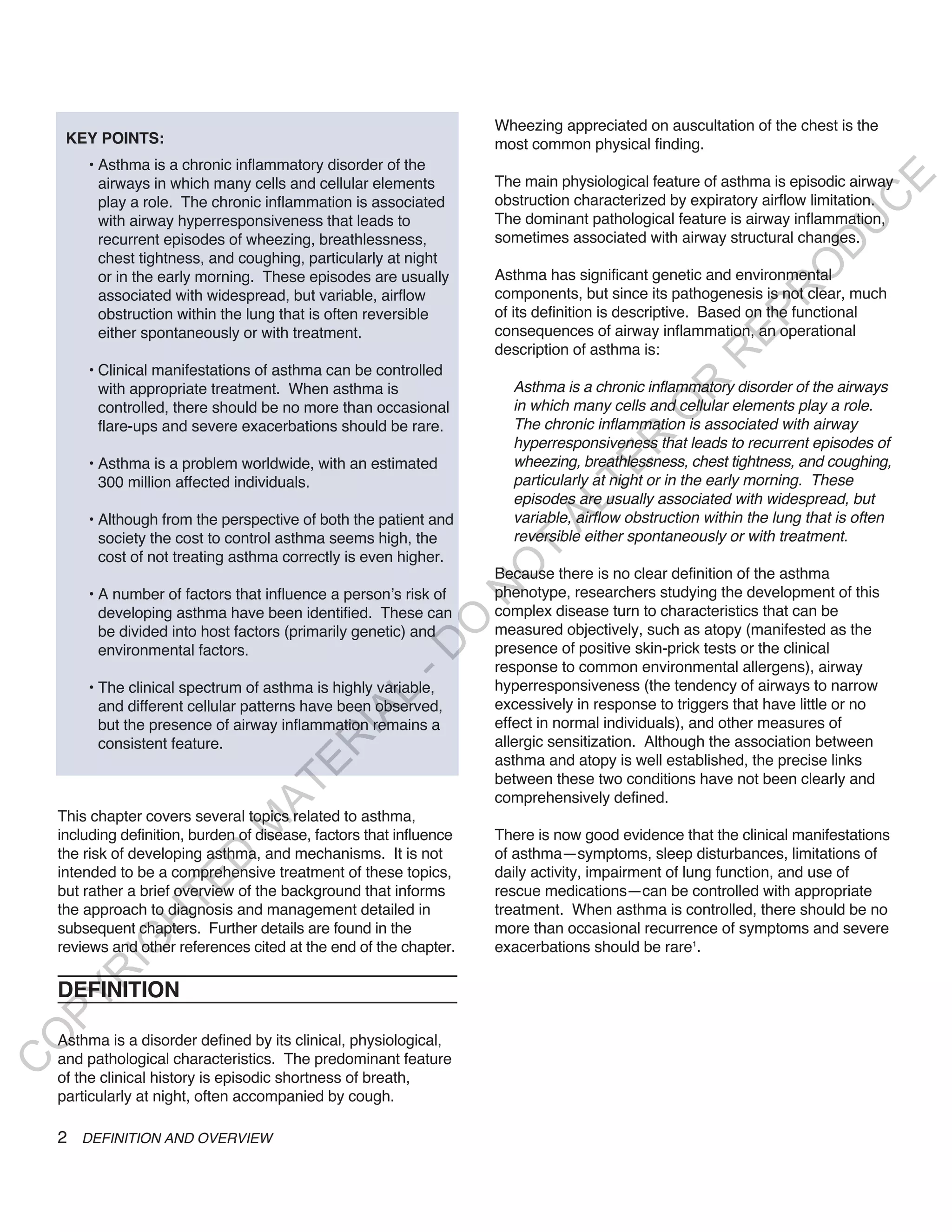
    patient’s level of asthma control.                             Table A. Description of Levels of Evidence


                                                                                                                                    U
                                                                   Evidence           Sources of                       Definition


                                                                                                                          D
                                                                   Category           Evidence
    14. Treatment options are organized into five “Steps”


                                                                                                                         O
                                                                       A      Randomized controlled trials    Evidence is from endpoints of
    reflecting increasing intensity of treatment (dosages and/or              (RCTs). Rich body of data.      well designed RCTs that


                                                                                                                    R
    number of medications) required to achieve control. At all                                                provide a consistent pattern of
                                                                                                              findings in the population for
    Steps, a reliever medication should be provided for as-


                                                                                                              EP
                                                                                                              which the recommendation
    needed use. At Steps 2 through 5, a variety of controller                                                 is made. Category A requires
                                                                                                              substantial numbers of studies
    medications are available.


                                                                                                         R
                                                                                                              involving substantial numbers
                                                                                                              of participants.


                                                                                               R
    15. If asthma is not controlled on the current treatment                  Randomized controlled trials    Evidence is from endpoints of
                                                                       B
    regimen, treatment should be stepped up until control is                  (RCTs). Limited body of data.   intervention studies that


                                                                                              O
                                                                                                              include only a limited number
    achieved. When control is maintained, treatment can be                                                    of patients, posthoc or


                                                                                   R
    stepped down in order to find the lowest step and dose of                                                 subgroup analysis of RCTs, or
                                                                                                              meta-analysis of RCTs. In
    treatment that maintains control.


                                                                                TE
                                                                                                              general, Category B pertains
                                                                                                              when few randomized trials
                                                                                                              exist, they are small in size,
    16. Although each component contains management


                                                                           AL
                                                                                                              they were undertaken in a
    advice for all age categories where these are considered                                                  population that differs from the
                                                                                                              target population of the recom-
    relevant, special challenges must be taken into account in                                                mendation, or the results are
    making recommendations for managing asthma in children
                                                                    T                                         somewhat inconsistent.
                                                                   O
    in the first 5 years of life. Accordingly, an Executive
                                                                       C      Nonrandomized trials.           Evidence is from outcomes of
                                                                   N

    Summary has been prepared—and appears at the end of                       Observational studies.          uncontrolled or nonrandomized
    this introduction—that extracts sections on diagnosis and                                                 trials or from observational
                                                        O


    management for this very young age group.                                                                 studies.
                                                      -D


                                                                       D      Panel consensus judgment.       This category is used only in
    17. It has been demonstrated in a variety of settings that                                                cases where the provision of
    patient care consistent with evidence-based asthma guide-                                                 some guidance was deemed
                                                                                                              valuable but the clinical
                                             L


    lines leads to improved outcomes. However, in order to                                                    literature addressing the
                                           IA


    effect changes in medical practice and consequent                                                         subject was insufficient to
                                                                                                              justify placement in one of the
    improvements in patient outcomes, evidence-based
                                          R


                                                                                                              other categories. The Panel
    guidelines must be implemented and disseminated at                                                        Consensus is based on
                                    E


                                                                                                              clinical experience or
    national and local levels. Thus, a chapter has been                                                       knowledge that does not meet
                                 AT


    added on implementation of asthma guidelines in health                                                    the above-listed criteria.
    systems that details the process and economics of
                             M


    guideline implementation.                                      REFERENCES
                                                                   1. Jadad AR, Moher M, Browman GP, Booker L, Sigouis C,
                     D


    LEVELS OF EVIDENCE                                             Fuentes M, et al. Systematic reviews and meta-analyses
                   TE


                                                                   on treatment of asthma: critical evaluation. BMJ
    In this document, levels of evidence are assigned to           2000;320:537-40.
               H


    management recommendations where appropriate in                2. Guyatt G, Vist G, Falck-Ytter Y, Kunz R, Magrini N,
          IG


    Chapter 4, the Five Components of Asthma Management.           Schunemann H. An emerging consensus on grading
    Evidence levels are indicated in boldface type enclosed in     recommendations? Available from URL:
       R


    parentheses after the relevant statement—e.g., (Evidence A).   http://www.evidence-basedmedicine.com.
PY


    The methodological issues concerning the use of evidence
    from meta-analyses were carefully considered1.
O


    This evidence level scheme (Table A) has been used in
C


    previous GINA reports, and was in use throughout the
    preparation of this document. The GINA Science
    Committee was recently introduced to a new approach to
                                                                                                                                           xiii
C
    O
     PY
        R
          IG
            H
                TE
                  D
                      M
                       AT
                          ER
                            IA
                              L
                                  -D
                                    O
                                        N
                                         O
                                          T
                                              AL
                                                TE
                                                   R
                                                       O
                                                        R
                                                            R
                                                                EP
                                                                     R
                                                                         O
                                                                          D
                                                                              U
                                                                               C
                                                                                E
C
    O
     PY
        R
          IG
            H
                TE
                  D
                      M
                        AT
                           E R
                              IA
                                L
                                     -D
                                       O
                                             N
                                                    O
                                                     T
                                                         AL
                                                           TE
                                                              R
                                                                  O
                                                                  1


                                                                   R
                               and                                     R
                                                                            CHAPTER


                                                                           EP
                                                                                R
                  oveRview
                                       definition


                                                                                    O
                                                                                     D
                                                                                         U
                                                                                          C
                                                                                           E
Wheezing appreciated on auscultation of the chest is the
     KEY POINTS:                                                      most common physical finding.
        • Asthma is a chronic inflammatory disorder of the
                                                                      The main physiological feature of asthma is episodic airway


                                                                                                                           E
          airways in which many cells and cellular elements
                                                                      obstruction characterized by expiratory airflow limitation.


                                                                                                                          C
          play a role. The chronic inflammation is associated
          with airway hyperresponsiveness that leads to               The dominant pathological feature is airway inflammation,


                                                                                                                         U
          recurrent episodes of wheezing, breathlessness,             sometimes associated with airway structural changes.


                                                                                                                   D
          chest tightness, and coughing, particularly at night


                                                                                                                  O
          or in the early morning. These episodes are usually         Asthma has significant genetic and environmental


                                                                                                               R
          associated with widespread, but variable, airflow           components, but since its pathogenesis is not clear, much
          obstruction within the lung that is often reversible        of its definition is descriptive. Based on the functional


                                                                                                        EP
          either spontaneously or with treatment.                     consequences of airway inflammation, an operational
                                                                      description of asthma is:


                                                                                                     R
        • Clinical manifestations of asthma can be controlled
                                                                        Asthma is a chronic inflammatory disorder of the airways


                                                                                             R
          with appropriate treatment. When asthma is
          controlled, there should be no more than occasional           in which many cells and cellular elements play a role.


                                                                                            O
          flare-ups and severe exacerbations should be rare.            The chronic inflammation is associated with airway


                                                                                     R
                                                                        hyperresponsiveness that leads to recurrent episodes of
        • Asthma is a problem worldwide, with an estimated              wheezing, breathlessness, chest tightness, and coughing,


                                                                                  TE
          300 million affected individuals.                             particularly at night or in the early morning. These
                                                                        episodes are usually associated with widespread, but


                                                                            AL
        • Although from the perspective of both the patient and         variable, airflow obstruction within the lung that is often
          society the cost to control asthma seems high, the            reversible either spontaneously or with treatment.
          cost of not treating asthma correctly is even higher.
                                                                       T
                                                                      O
                                                                      Because there is no clear definition of the asthma
                                                                      phenotype, researchers studying the development of this
                                                                      N

        • A number of factors that influence a person’s risk of
          developing asthma have been identified. These can           complex disease turn to characteristics that can be
                                                          O


          be divided into host factors (primarily genetic) and        measured objectively, such as atopy (manifested as the
                                                        -D


          environmental factors.                                      presence of positive skin-prick tests or the clinical
                                                                      response to common environmental allergens), airway
        • The clinical spectrum of asthma is highly variable,         hyperresponsiveness (the tendency of airways to narrow
                                               L


          and different cellular patterns have been observed,         excessively in response to triggers that have little or no
                                             IA


          but the presence of airway inflammation remains a           effect in normal individuals), and other measures of
                                                                      allergic sensitization. Although the association between
                                            R


          consistent feature.
                                                                      asthma and atopy is well established, the precise links
                                      E


                                                                      between these two conditions have not been clearly and
                                   AT


                                                                      comprehensively defined.
    This chapter covers several topics related to asthma,
                               M


    including definition, burden of disease, factors that influence   There is now good evidence that the clinical manifestations
    the risk of developing asthma, and mechanisms. It is not          of asthma—symptoms, sleep disturbances, limitations of
                      D


    intended to be a comprehensive treatment of these topics,         daily activity, impairment of lung function, and use of
                    TE


    but rather a brief overview of the background that informs        rescue medications—can be controlled with appropriate
    the approach to diagnosis and management detailed in              treatment. When asthma is controlled, there should be no
                H


    subsequent chapters. Further details are found in the             more than occasional recurrence of symptoms and severe
           IG


    reviews and other references cited at the end of the chapter.     exacerbations should be rare1.
       R


    DEFINITION
PY
O


    Asthma is a disorder defined by its clinical, physiological,
    and pathological characteristics. The predominant feature
C


    of the clinical history is episodic shortness of breath,
    particularly at night, often accompanied by cough.

    2 DEFINITION AND OVERVIEW
Social and Economic Burden
    THE BURDEN OF ASTHMA
    Prevalence, Morbidity, and Mortality                                     Social and economic factors are integral to understanding
                                                                             asthma and its care, whether viewed from the perspective


                                                                                                                                                E
    Asthma is a problem worldwide, with an estimated 300                     of the individual sufferer, the health care professional, or


                                                                                                                                               C
    million affected individuals2,3. Despite hundreds of reports             entities that pay for health care. Absence from school and


                                                                                                                                              U
    on the prevalence of asthma in widely differing                          days lost from work are reported as substantial social and


                                                                                                                                        D
    populations, the lack of a precise and universally accepted              economic consequences of asthma in studies from the


                                                                                                                                       O
    definition of asthma makes reliable comparison of reported               Asia-Pacific region, India, Latin America, the United
                                                                             Kingdom, and the United States9-12.


                                                                                                                                  R
    prevalence from different parts of the world problematic.
    Nonetheless, based on the application of standardized


                                                                                                                          EP
    methods to measure the prevalence of asthma and                          The monetary costs of asthma, as estimated in a variety
    wheezing illness in children3 and adults4, it appears that               of health care systems including those of the United


                                                                                                                      R
    the global prevalence of asthma ranges from 1% to 18% of                 States13-15 and the United Kingdom16 are substantial.
    the population in different countries (Figure 1-1)2,3. There             In analyses of economic burden of asthma, attention


                                                                                                            R
    is good evidence that international differences in asthma                needs to be paid to both direct medical costs (hospital


                                                                                                           O
    symptom prevalence have been reduced, particularly in                    admissions and cost of medications) and indirect, non-
                                                                             medical costs (time lost from work, premature death)17.


                                                                                                R
    the 13-14 year age group, with decreases in prevalence in
    North America and Western Europe and increases in                        For example, asthma is a major cause of absence from


                                                                                             TE
    prevalence in regions where prevalence was previously                    work in many countries4-6,121, including Australia, Sweden,
    low. Although there was little change in the overall                     the United Kingdom, and the United States16,18-20.


                                                                                     AL
    prevalence of current wheeze, the percentage of children                 Comparisons of the cost of asthma in different regions
    reported to have had asthma increased significantly, possi-              lead to a clear set of conclusions:
    bly reflecting greater awareness of this condition and/or
                                                                              T
                                                                             O
    changes in diagnostic practice. The increases in asthma                  • The costs of asthma depend on the individual patient’s
    symptom prevalence in Africa, Latin America and parts of                   level of control and the extent to which exacerbations
                                                                           N

    Asia indicate that the global burden of asthma is                          are avoided.
                                                                         O


    continuing to rise, but the global prevalence differences                • Emergency treatment is more expensive than planned
                                                                       -D


    are lessening126. The World Health Organization has                        treatment.
    estimated that 15 million disability-adjusted life years
                                                                             • Non-medical economic costs of asthma are substantial.
    (DALYs) are lost annually due to asthma, representing 1%
                                                                       L


    of the total global disease burden2. Annual worldwide                    • Guideline-determined asthma care can be cost effective.
                                                                     IA


    deaths from asthma have been estimated at 250,000 and                    • Families can suffer from the financial burden of treating
    mortality does not appear to correlate well with prevalence
                                                                    R


                                                                               asthma.
    (Figure 1-1)2,3. There are insufficient data to determine the
                                                       E


    likely causes of the described variations in prevalence                  Although from the perspective of both the patient and
                                                    AT


    within and between populations.                                          society the cost to control asthma seems high, the cost of
                                                                             not treating asthma correctly is even higher122. Proper
                                             M


     Figure 1-1. Asthma Prevalence and Mortality2, 3
                                                                             treatment of the disease poses a challenge for individuals,
                                                                             health care professionals, health care organizations, and
                             D


                                                                             governments. There is every reason to believe that the
                           TE


                                                                             substantial global burden of asthma can be dramatically
                                                                             reduced through efforts by individuals, their health care
                      H


                                                                             providers, health care organizations, and local and
             IG


                                                                             national governments to improve asthma control.
        R


                                                                             Detailed reference information about the burden of asthma
PY


                                                                             can be found in the report Global Burden of Asthma* .
                                                                             Further studies of the social and economic burden of
O


                                                                             asthma and the cost effectiveness of treatment are needed
                                                                             in both developed and developing countries.
C


                                                                             *(http://www.ginasthma.org/ReportItem.asp?l1=2&l2=2&intId=94).
     Permission for use of this figure obtained from J. Bousquet.

                                                                                                                 DEFINITION AND OVERVIEW       3
asthma in developed than in developing nations, in poor
    FACTORS INFLUENCING THE                                         compared to affluent populations in developed nations,
    DEVELOPMENT AND EXPRESSION                                      and in affluent compared to poor populations in developing
    OF ASTHMA                                                       nations—likely reflect lifestyle differences such as


                                                                                                                          E
                                                                    exposure to allergens, access to health care, etc.


                                                                                                                         C
                                                                                                                        U
    Factors that influence the risk of asthma can be divided        Much of what is known about asthma risk factors comes


                                                                                                                  D
    into those that cause the development of asthma and             from studies of young children. Risk factors for the


                                                                                                                 O
    those that trigger asthma symptoms; some do both.               development of asthma in adults, particularly de novo in
                                                                    adults who did not have asthma in childhood, are less


                                                                                                             R
    The former include host factors (which are primarily
    genetic) and the latter are usually environmental factors       well defined.


                                                                                                       EP
    (Figure 1-2)21. However, the mechanisms whereby they
    influence the development and expression of asthma are          The lack of a clear definition for asthma presents a


                                                                                                    R
    complex and interactive. For example, genes likely              significant problem in studying the role of different risk
    interact both with other genes and with environmental           factors in the development of this complex disease,


                                                                                            R
    factors to determine asthma susceptibility22,23. In addition,   because the characteristics that define asthma (e.g.,


                                                                                           O
    developmental aspects—such as the maturation of the             airway hyperresponsiveness, atopy, and allergic
                                                                    sensitization) are themselves products of complex


                                                                                   R
    immune response and the timing of infectious exposures
    during the first years of life—are emerging as important        gene-environment interactions and are therefore both


                                                                                TE
    factors modifying the risk of asthma in the genetically         features of asthma and risk factors for the development
    susceptible person.                                             of the disease.


                                                                          AL
                                                                    Host Factors
     Figure 1-2. Factors Influencing the Development                 T
     and Expression of Asthma                                       Genetic. Asthma has a heritable component, but it is not
                                                                    O
                                                                    simple. Current data show that multiple genes may be
                                                                    N

     HOST FACTORS                                                   involved in the pathogenesis of asthma24,25, and different
      Genetic, e.g.,
                                                          O


                                                                    genes may be involved in different ethnic groups. The
       • Genes pre-disposing to atopy                               search for genes linked to the development of asthma has
                                                        -D


       • Genes pre-disposing to airway hyperresponsiveness          focused on four major areas: production of allergen-
      Obesity                                                       specific IgE antibodies (atopy); expression of airway
      Sex
                                               L


                                                                    hyperresponsiveness; generation of inflammatory
                                             IA


                                                                    mediators, such as cytokines, chemokines, and growth
     ENVIRONMENTAL FACTORS                                          factors; and determination of the ratio between Th1 and
                                            R


      Allergens                                                     Th2 immune responses (as relevant to the hygiene
                                      E


       • Indoor: Domestic mites, furred animals (dogs, cats,        hypothesis of asthma)26.
                                   AT


         mice), cockroach allergen, fungi, molds, yeasts
       • Outdoor: Pollens, fungi, molds, yeasts                     Family studies and case-control association analyses have
                               M


      Infections (predominantly viral)                              identified a number of chromosomal regions associated
      Occupational sensitizers                                      with asthma susceptibility. For example, a tendency to
                     D


      Tobacco smoke                                                 produce an elevated level of total serum IgE is co-inherited
                   TE


       • Passive smoking                                            with airway hyperresponsiveness, and a gene (or genes)
       • Active smoking                                             governing airway hyperresponsiveness is located near a
      Outdoor/Indoor Air Pollution
                H


                                                                    major locus that regulates serum IgE levels on
      Diet                                                          chromosome 5q27. However, the search for a specific
           IG


                                                                    gene (or genes) involved in susceptibility to atopy or
       R


    Additionally, some characteristics have been linked to an       asthma continues, as results to date have been
                                                                    inconsistent24,25.
PY


    increased risk for asthma, but are not themselves true
    causal factors. The apparent racial and ethnic differences
                                                                    In addition to genes that predispose to asthma there are
O


    in the prevalence of asthma reflect underlying genetic
    variances with a significant overlay of socioeconomic and       genes that are associated with the response to asthma
C


    environmental factors. In turn, the links between asthma        treatments. For example, variations in the gene encoding
    and socioeconomic status—with a higher prevalence of            the beta-adrenoreceptor have been linked to differences in


    4 DEFINITION AND OVERVIEW
subjects’ responses to 2-agonists28. Other genes of            In the case of dogs and cats, some epidemiologic studies
    interest modify the responsiveness to glucocorticosteroids29   have found that early exposure to these animals may protect
    and leukotriene modifiers30. These genetic markers will        a child against allergic sensitization or the development of
    likely become important not only as risk factors in the        asthma46-48, but others suggest that such exposure may


                                                                                                                            E
    pathogenesis of asthma but also as determinants of             increase the risk of allergic sensitization47,49-51. This issue


                                                                                                                           C
    responsiveness to treatment28,30-33.                           remains unresolved.


                                                                                                                          U
                                                                                                                   D
    obesity. Obesity has also been shown to be a risk factor       The prevalence of asthma is reduced in children raised in
                                                                   a rural setting, which may be linked to the presence of


                                                                                                                  O
    for asthma. Certain mediators such as leptins may affect
    airway function and increase the likelihood of asthma          endotoxin in these environments52.


                                                                                                              R
    development34,35.


                                                                                                        EP
                                                                   infections. During infancy, a number of viruses have been
    Sex. Male sex is a risk factor for asthma in children. Prior   associated with the inception of the asthmatic phenotype.


                                                                                                    R
    to the age of 14, the prevalence of asthma is nearly twice     Respiratory syncytial virus (RSV) and parainfluenza virus
    as great in boys as in girls36. As children get older the      produce a pattern of symptoms including bronchiolitis that


                                                                                            R
    difference between the sexes narrows, and by adulthood         parallel many features of childhood asthma53,54. A number


                                                                                           O
    the prevalence of asthma is greater in women than in men.      of long-term prospective studies of children admitted to the
    The reasons for this sex-related difference are not clear.     hospital with documented RSV have shown that


                                                                                   R
    However, lung size is smaller in males than in females at      approximately 40% will continue to wheeze or have


                                                                                TE
    birth37 but larger in adulthood.                               asthma into later childhood53. On the other hand, evidence
                                                                   also indicates that certain respiratory infections early in life,
                                                                   including measles and sometimes even RSV, may protect


                                                                          AL
    Environmental Factors
                                                                   against the development of asthma55,56. The data do not
    There is some overlap between environmental factors that       allow specific conclusions to be drawn. Parasite infections
                                                                    T
    influence the risk of developing asthma, and factors that      do not in general protect against asthma, but infection with
                                                                   O
                                                                   hookworm may reduce the risk123.
    cause asthma symptoms—for example, occupational
                                                                   N

    sensitizers belong in both categories. However, there are
                                                                   The “hygiene hypothesis” of asthma suggests that exposure
    some important causes of asthma symptoms—such as air
                                                        O


                                                                   to infections early in life influences the development of a
    pollution and some allergens—which have not been clearly
                                                      -D


                                                                   child’s immune system along a “nonallergic” pathway, leading
    linked to the development of asthma. Risk factors that
                                                                   to a reduced risk of asthma and other allergic diseases.
    cause asthma symptoms are discussed in detail in
                                                                   Although the hygiene hypothesis continues to be investigated,
    Chapter 4.2.
                                             L


                                                                   this mechanism may explain observed associations between
                                           IA


                                                                   family size, birth order, day-care attendance, and the risk of
    allergens. Although indoor and outdoor allergens are well
                                                                   asthma. For example, young children with older siblings and
                                          R


    known to cause asthma exacerbations, their specific role       those who attend day care are at increased risk of infections,
                                    E


    in the development of asthma is still not fully resolved.      but enjoy protection against the development of allergic
                                 AT


    Birth-cohort studies have shown that sensitization to house    diseases, including asthma later in life57-59.
    dust mite allergens, cat dander, dog dander38,39, and
    Aspergillus mold40 are independent risk factors for asthma-
                              M


                                                                   The interaction between atopy and viral infections appears
    like symptoms in children up to 3 years of age. However,       to be a complex relationship60, in which the atopic state can
                     D


    the relationship between allergen exposure and                 influence the lower airway response to viral infections, viral
    sensitization in children is not straightforward. It depends
                   TE


                                                                   infections can then influence the development of allergic
    on the allergen, the dose, the time of exposure, the child’s   sensitization, and interactions can occur when individuals
    age, and probably genetics as well.
                H


                                                                   are exposed simultaneously to both allergens and viruses.
           IG


    For some allergens, such as those derived from house           occupational sensitizers. Over 300 substances have
    dust mites and cockroaches, the prevalence of
       R


                                                                   been associated with occupational asthma61-65, which is
    sensitization appears to be directly correlated with           defined as asthma caused by exposure to an agent
PY


    exposure38,41. However, although some data suggest that        encountered in the work environment. These substances
    exposure to house dust mite allergens may be a causal          include highly reactive small molecules such as
O


    factor in the development of asthma42, other studies have      isocyanates, irritants that may cause an alteration in
C


    questioned this interpretation43,44. Cockroach infestation     airway responsiveness, known immunogens such as
    has been shown to be an important cause of allergic            platinum salts, and complex plant and animal biological
    sensitization, particularly in inner-city homes45.             products that stimulate the production of IgE (Figure 1-3).

                                                                                                 DEFINITION AND OVERVIEW          5
others to develop occupational asthma in response to the
      Figure 1-3. Examples of Agents Causing Asthma in
      Selected Occupations*                                                                     same exposures are not well identified. Very high
                                                                                                exposures to inhaled irritants may cause “irritant induced
     Occupation/occupational field         Agent                                                asthma” (formerly called the reactive airways dysfunctional


                                                                                                                                                         E
                                           Animal and Plant Proteins                            syndrome) even in non-atopic persons. Atopy and


                                                                                                                                                        C
     Bakers                                Flour, amylase                                       tobacco smoking may increase the risk of occupational


                                                                                                                                                       U
     Dairy farmers                         Storage mites                                        sensitization, but screening individuals for atopy is of


                                                                                                                                                D
     Detergent manufacturing               Bacillus subtilis enzymes                            limited value in preventing occupational asthma73. The
     Electrical soldering                  Colophony (pine resin)


                                                                                                                                               O
                                                                                                most important method of preventing occupational asthma
     Farmers                               Soybean dust
                                                                                                is elimination or reduction of exposure to occupational


                                                                                                                                            R
     Fish food manufacturing               Midges, parasites
                                                                                                sensitizers.


                                                                                                                                     EP
     Food processing                       Coffee bean dust, meat tenderizer, tea, shellfish,
                                           amylase, egg proteins, pancreatic enzymes,
                                           papain                                               tobacco smoke. Tobacco smoking is associated with


                                                                                                                                 R
     Granary workers                       Storage mites, Aspergillus, indoor ragweed, grass
                                                                                                accelerated decline of lung function in people with asthma,
     Health care workers                   Psyllium, latex
                                                                                                increases asthma severity, may render patients less


                                                                                                                         R
     Laxative manufacturing                Ispaghula, psyllium
                                                                                                responsive to treatment with inhaled74,124 and systemic75


                                                                                                                        O
     Poultry farmers                       Poultry mites, droppings, feathers
     Research workers, veterinarians Locusts, dander, urine proteins
                                                                                                glucocorticosteroids, and reduces the likelihood of asthma
                                                                                                being controlled76.


                                                                                                                R
     Sawmill workers, carpenters           Wood dust (western red cedar, oak, mahogany,
                                           zebrawood, redwood, Lebanon cedar, African


                                                                                                             TE
                                           maple, eastern white cedar)
                                                                                                Exposure to tobacco smoke both prenatally and after birth
     Shipping workers                      Grain dust (molds, insects, grain)
                                                                                                is associated with measurable harmful effects including a


                                                                                                       AL
     Silk workers                          Silk worm moths and larvae
                                           Inorganic chemicals
                                                                                                greater risk of developing asthma-like symptoms in early
     Beauticians                           Persulfate                                           childhood. However, evidence of increased risk of allergic
     Plating                               Nickel salts                                         diseases is uncertain77, 78. Distinguishing the independent
                                                                                                 T
                                                                                                contributions of prenatal and postnatal maternal smoking
                                                                                                O
     Refinery workers                      Platinum salts, vanadium
                                           Organic chemicals                                    is problematic79. However, studies of lung function
                                                                                                N

     Automobile painting                   Ethanolamine, dissocyanates                          immediately after birth have shown that maternal smoking
                                                                                          O


     Hospital workers                      Disinfectants (sulfathiazole, chloramines,           during pregnancy has an influence on lung development37.
                                           formaldehyde, glutaraldehyde), latex
                                                                                                Furthermore, infants of smoking mothers are 4 times more
                                                                                        -D


     Manufacturing                         Antibiotics, piperazine, methyldopa, salbutamol,
                                           cimetidine                                           likely to develop wheezing illnesses in the first year of life80.
     Rubber processing                     Formaldehyde, ethylene diamine, phthalic anhydride   In contrast, there is little evidence (based on meta-
                                                                       L


     Plastics industry                     Toluene dissocyanate, hexamethyl dissocyanate,       analysis) that maternal smoking during pregnancy has an
                                           dephenylmethyl isocyanate, phthalic anhydride,
                                                                     IA


                                           triethylene tetramines, trimellitic anhydride,       effect on allergic sensitization78. Exposure to
                                           hexamethyl tetramine, acrylates                      environmental tobacco smoke (passive smoking)
                                                                    R


    *See http://www.bohrf.org.uk for a comprehensive list of known sensitizing agents
                                                                                                increases the risk of lower respiratory tract illnesses in
                                                        E


                                                                                                infancy81 and childhood82.
                                                     AT


    Occupational asthma arises predominantly in adults66, 67,
                                                                                                outdoor/indoor air pollution. The role of outdoor air
    and occupational sensitizers are estimated to cause about
                                               M


                                                                                                pollution in causing asthma remains controversial83.
    1 in 10 cases of asthma among adults of working age68.
                                                                                                Children raised in a polluted environment have diminished
    Asthma is the most common occupational respiratory
                               D


                                                                                                lung function84, but the relationship of this loss of function
    disorder in industrialized countries69. Occupations
                             TE


                                                                                                to the development of asthma is not known.
    associated with a high risk for occupational asthma include
    farming and agricultural work, painting (including spray
                       H


                                                                                                Outbreaks of asthma exacerbations have been shown to
    painting), cleaning work, and plastic manufacturing62.
                                                                                                occur in relationship to increased levels of air pollution,
               IG


                                                                                                and this may be related to a general increase in the level
    Most occupational asthma is immunologically mediated
          R


                                                                                                of pollutants or to specific allergens to which individuals
    and has a latency period of months to years after the onset
                                                                                                are sensitized85-87. However, the role of pollutants in the
PY


    of exposure70. IgE-mediated allergic reactions and cell-
                                                                                                development of asthma is less well defined. Similar
    mediated allergic reactions are involved71, 72.
                                                                                                associations have been observed in relation to indoor
O


                                                                                                pollutants, e.g., smoke and fumes from gas and biomass
    Levels above which sensitization frequently occurs have
C


                                                                                                fuels used for heating and cooling, molds, and cockroach
    been proposed for many occupational sensitizers.
                                                                                                infestations.
    However, the factors that cause some people but not

    6 DEFINITION AND OVERVIEW
diet. The role of diet, particularly breast-feeding, in
                                                                        Figure 1-4: Inflammatory Cells in Asthmatic Airways
    relation to the development of asthma has been
    extensively studied and, in general, the data reveal that           Mast cells: Activated mucosal mast cells release
    infants fed formulas of intact cow's milk or soy protein have       bronchoconstrictor mediators (histamine, cysteinyl leukotrienes,


                                                                                                                                      E
    a higher incidence of wheezing illnesses in early childhood         prostaglandin D2)93. These cells are activated by allergens


                                                                                                                                     C
    compared with those fed breast milk88.                              through high-affinity IgE receptors, as well as by osmotic stimuli


                                                                                                                                    U
                                                                        (accounting for exercise-induced bronchoconstriction). Increased
                                                                        mast cell numbers in airway smooth muscle may be linked to


                                                                                                                             D
    Some data also suggest that certain characteristics of
                                                                        airway hyperresponsiveness94.
    Western diets, such as increased use of processed foods


                                                                                                                            O
    and decreased antioxidant (in the form of fruits and vegetables),   Eosinophils, present in increased numbers in the airways,


                                                                                                                       R
    increased n-6 polyunsaturated fatty acid (found in margarine        release basic proteins that may damage airway epithelial cells.


                                                                                                                EP
    and vegetable oil), and decreased n-3 polyunsaturated               They may also have a role in the release of growth factors and
                                                                        airway remodeling95.
    fatty acid (found in oily fish) intakes have contributed to


                                                                                                            R
    the recent increases in asthma and atopic disease89.                T lymphocytes, present in increased numbers in the airways,
                                                                        release specific cytokines, including IL-4, IL-5, IL-9, and IL-13,


                                                                                                   R
                                                                        that orchestrate eosinophilic inflammation and IgE production by
    MECHANISMS OF ASTHMA


                                                                                                  O
                                                                        B lymphocytes96. An increase in Th2 cell activity may be due in
                                                                        part to a reduction in regulatory T cells that normally inhibit Th2


                                                                                        R
                                                                        cells. There may also be an increase in inKT cells, which release
    Asthma is an inflammatory disorder of the airways, which            large amounts of T helper 1 (Th1) and Th2 cytokines97.


                                                                                     TE
    involves several inflammatory cells and multiple mediators          Dendritic cells sample allergens from the airway surface and
    that result in characteristic pathophysiological changes21,90.      migrate to regional lymph nodes, where they interact with


                                                                              AL
    In ways that are still not well understood, this pattern of         regulatory T cells and ultimately stimulate production of Th2
    inflammation is strongly associated with airway hyper-              cells from naïve T cells98.
    responsiveness and asthma symptoms.                                  T
                                                                        Macrophages are increased in number in the airways and may
                                                                        O
                                                                        be activated by allergens through low-affinity IgE receptors to
    Airway Inflammation In Asthma                                       release inflammatory mediators and cytokines that amplify the
                                                                        N

                                                                        inflammatory response99.
                                                             O


    The clinical spectrum of asthma is highly variable, and             Neutrophil numbers are increased in the airways and sputum of
    different cellular patterns have been observed, but the
                                                           -D


                                                                        patients with severe asthma and in smoking asthmatics, but the
    presence of airway inflammation remains a consistent                pathophysiological role of these cells is uncertain and their
    feature. The airway inflammation in asthma is persistent            increase may even be due to glucocorticosteroid therapy100.
                                                 L


    even though symptoms are episodic, and the relationship
                                               IA


    between the severity of asthma and the intensity of
    inflammation is not clearly established91,92. The                   Figure 1-5: Airway Structural Cells Involved in the
                                              R


                                                                        Pathogenesis of Asthma
    inflammation affects all airways including in most patients
                                       E


    the upper respiratory tract and nose but its physiological
                                    AT


                                                                        Airway epithelial cells sense their mechanical environment,
    effects are most pronounced in medium-sized bronchi.                express multiple inflammatory proteins in asthma, and release
    The pattern of inflammation in the airways appears to be            cytokines, chemokines, and lipid mediators. Viruses and air
                                M


    similar in all clinical forms of asthma, whether allergic,          pollutants interact with epithelial cells.
    non-allergic, or aspirin-induced, and at all ages.
                      D


                                                                        Airway smooth muscle cells express similar inflammatory
                                                                        proteins to epithelial cells101.
                    TE


    inflammatory cells. The characteristic pattern of
    inflammation found in allergic diseases is seen in asthma,          Endothelial cells of the bronchial circulation play a role in
                                                                        recruiting inflammatory cells from the circulation into the airway.
                 H


    with activated mast cells, increased numbers of activated
    eosinophils, and increased numbers of T cell receptor
           IG


                                                                        Fibroblasts and myofibroblasts produce connective tissue
    invariant natural killer T cells and T helper 2 lymphocytes         components, such as collagens and proteoglycans, that are
        R


    (Th2), which release mediators that contribute to                   involved in airway remodeling.
PY


    symptoms (Figure 1-4). Structural cells of the airways              Airway nerves are also involved. Cholinergic nerves may be
    also produce inflammatory mediators, and contribute to the          activated by reflex triggers in the airways and cause
    persistence of inflammation in various ways (Figure 1-5).           bronchoconstriction and mucus secretion. Sensory nerves,
O


                                                                        which may be sensitized by inflammatory stimuli including
C


    inflammatory mediators. Over 100 different mediators are            neurotrophins, cause reflex changes and symptoms such as
                                                                        cough and chest tightness, and may release inflammatory
    now recognized to be involved in asthma and mediate the
                                                                        neuropeptides102.
    complex inflammatory response in the airways103 (Figure 1-6).

                                                                                                        DEFINITION AND OVERVIEW               7
Pathophysiology
     Figure 1-6: Key Mediators of Asthma

     Chemokines are important in the recruitment of inflammatory                 Airway narrowing is the final common pathway leading to
     cells into the airways and are mainly expressed in airway                   symptoms and physiological changes in asthma. Several


                                                                                                                                            E
     epithelial cells104. Eotaxin is relatively selective for eosinophils,       factors contribute to the development of airway narrowing


                                                                                                                                           C
     whereas thymus and activation-regulated chemokines (TARC)                   in asthma (Figure 1-8).


                                                                                                                                          U
     and macrophage-derived chemokines (MDC) recruit Th2 cells.


                                                                                                                                   D
     Cysteinyl leukotrienes are potent bronchoconstrictors and                    Figure 1-8: Airway Narrowing in Asthma
     proinflammatory mediators mainly derived from mast cells and eosinophils.


                                                                                                                                  O
     They are the only mediator whose inhibition has been associated
                                                                                  Airway smooth muscle contraction in response to multiple


                                                                                                                              R
     with an improvement in lung function and asthma symptoms105.
                                                                                  bronchoconstrictor mediators and neurotransmitters is the


                                                                                                                       EP
     Cytokines orchestrate the inflammatory response in asthma and                predominant mechanism of airway narrowing and is largely
     determine its severity106. Key cytokines include IL-1 and TNF-oc,            reversed by bronchodilators.


                                                                                                                   R
     which amplify the inflammatory response, and GM-CSF, which                   Airway edema is due to increased microvascular leakage in
     prolongs eosinophil survival in the airways. Th2-derived cytokines           response to inflammatory mediators. This may be particularly


                                                                                                           R
     include IL-5, which is required for eosinophil differentiation and           important during acute exacerbations.
     survival; IL-4, which is important for Th2 cell differentiation; and


                                                                                                          O
     IL-13, needed for IgE formation.                                             Airway thickening due to structural changes, often termed
                                                                                  “remodeling,” may be important in more severe disease and is


                                                                                                 R
     Histamine is released from mast cells and contributes to                     not fully reversible by current therapy.
     bronchoconstriction and to the inflammatory response.


                                                                                              TE
                                                                                  Mucus hypersecretion may lead to luminal occlusion (“mucus
     Nitric oxide (NO), a potent vasodilator, is produced predominantly           plugging”) and is a product of increased mucus secretion and
     from the action of inducible nitric oxide synthase in airway epithelial


                                                                                        AL
                                                                                  inflammatory exudates.
     cells107. Exhaled NO is increasingly being used to monitor the
     effectiveness of asthma treatment, because of its reported
     association with the presence of inflammation in asthma108.                 airway hyperresponsiveness. Airway hyperresponsive-
                                                                                  T
                                                                                 ness, the characteristic functional abnormality of asthma,
                                                                                 O
     Prostaglandin D2 is a bronchoconstrictor derived predominantly
     from mast cells and is involved in Th2 cell recruitment to the airways.     results in airway narrowing in a patient with asthma in
                                                                                 N

                                                                                 response to a stimulus that would be innocuous in a
                                                                     O


    Structural changes in the airways. In addition to the                        normal person. In turn, this airway narrowing leads to
    inflammatory response, there are characteristic structural                   variable airflow limitation and intermittent symptoms. Airway
                                                                   -D


    changes, often described as airway remodeling, in the                        hyperresponsiveness is linked to both inflammation and re-
    airways of asthma patients (Figure 1-7). Some of these                       pair of the airways and is partially reversible with therapy.
                                                       L


    changes are related to the severity of the disease and may                   Its mechanisms (Figure 1-9) are incompletely understood.
                                                     IA


    result in relatively irreversible narrowing of the airways109, 110.
    These changes may represent repair in response to                             Figure 1-9: Mechanisms of Airway Hyperresponsiveness
                                                    R


    chronic inflammation.
                                            E


                                                                                  Excessive contraction of airway smooth muscle may result
                                         AT


     Figure 1-7: Structural Changes in Asthmatic Airways                          from increased volume and/or contractility of airway smooth
                                                                                  muscle cells112.
     Subepithelial fibrosis results from the deposition of collagen fibers
                                    M


                                                                                  Uncoupling of airway contraction as a result of inflammatory
     and proteoglycans under the basement membrane and is seen in
                                                                                  changes in the airway wall may lead to excessive narrowing of the
     all asthmatic patients, including children, even before the onset of
                        D


                                                                                  airways and a loss of the maximum plateau of contraction found in
     symptoms but may be influenced by treatment. Fibrosis occurs in
                                                                                  normal ariways when bronchoconstrictor substances are inhaled113.
                      TE


     other layers for the airway wall, with deposition of collagen and
     proteoglycans.                                                               Thickening of the airway wall by edema and structural changes
                                                                                  amplifies airway narrowing due to contraction of airway smooth
                  H


     Airway smooth muscle increases, due both to hypertrophy
                                                                                  muscle for geometric reasons114.
            IG


     (increased size of individual cells) and hyperplasia (increased cell
     division), and contributes to the increased thickness of the airway          Sensory nerves may be sensitized by inflammation, leading to
     wall111. This process may relate to disease severity and is caused
        R


                                                                                  exaggerated bronchoconstriction in response to sensory stimuli.
     by inflammatory mediators, such as growth factors.
PY


     Blood vessels in airway walls proliferate the influence of growth           Special Mechanisms
     factors such as vascular endothelial growth factor (VEGF) and
O


     may contribute to increased airway wall thickness.
                                                                                 acute exacerbations. Transient worsening of asthma
C


     Mucus hypersecretion results from increased numbers of goblet               may occur as a result of exposure to risk factors for
     cells in the airway epithelium and increased size of submucosal             asthma symptoms, or “triggers,” such as exercise, air
     glands.


    8 DEFINITION AND OVERVIEW
pollutants115, and even certain weather conditions, e.g.,              3.   Beasley R. The Global Burden of Asthma Report, Global Initiative
    thunderstorms116. More prolonged worsening is usually                       for Asthma (GINA). Available from http://www.ginasthma.org 2004.
    due to viral infections of the upper respiratory tract                 4.   Yan DC, Ou LS, Tsai TL, Wu WF, Huang JL. Prevalence and
    (particularly rhinovirus and respiratory syncytial virus)117                severity of symptoms of asthma, rhinitis, and eczema in 13- to


                                                                                                                                       E
    or allergen exposure which increase inflammation in the                     14-year-old children in Taipei, Taiwan. Ann Allergy Asthma


                                                                                                                                      C
    lower airways (acute or chronic inflammation) that may                      Immunol 2005;95(6):579-85.


                                                                                                                                     U
    persist for several days or weeks.                                     5.   Ko FW, Wang HY, Wong GW, Leung TF, Hui DS, Chan DP,


                                                                                                                              D
                                                                                et al. Wheezing in Chinese schoolchildren: disease severity


                                                                                                                             O
    nocturnal asthma. The mechanisms accounting for the                         distribution and management practices, a community-based
    worsening of asthma at night are not completely                             study in Hong Kong and Guangzhou. Clin Exp Allergy


                                                                                                                         R
    understood but may be driven by circadian rhythms of                        2005;35(11):1449-56.


                                                                                                                  EP
    circulating hormones such as epinephrine, cortisol, and                6.   Carvajal-Uruena I, Garcia-Marcos L, Busquets-Monge R,
    melatonin and neural mechanisms such as cholinergic                         Morales Suarez-Varela M, Garcia de Andoin N, Batlles-Garrido


                                                                                                              R
    tone. An increase in airway inflammation at night has been                  J, et al. [Geographic variation in the prevalence of asthma
    reported. This might reflect a reduction in endogenous                      symptoms in Spanish children and adolescents. International


                                                                                                      R
    anti-inflammatory mechanisms118.                                            Study of Asthma and Allergies in Childhood (ISAAC) Phase 3,


                                                                                                     O
                                                                                Spain]. Arch Bronconeumol 2005;41(12):659-66.


                                                                                            R
    irreversible airflow limitation. Some patients with severe             7.   Reference deleted
    asthma develop progressive airflow limitation that is not


                                                                                         TE
    fully reversible with currently available therapy. This may            8.   Reference deleted
    reflect the changes in airway structure in chronic asthma119.


                                                                                  AL
                                                                           9.   Mahapatra P. Social, economic and cultural aspects of asthma:
                                                                                an exploratory study in Andra Pradesh, India. Hyderbad, India:
    difficult-to-treat asthma. The reasons why some                             Institute of Health Systems; 1993.
    patients develop asthma that is difficult to manage and
                                                                            T
                                                                           10. Lai CK, De Guia TS, Kim YY, Kuo SH, Mukhopadhyay A,
                                                                           O
    relatively insensitive to the effects of glucocorticosteroids              Soriano JB, et al. Asthma control in the Asia-Pacific region:
                                                                           N

    are not well understood. Common associations are poor                      the Asthma Insights and Reality in Asia-Pacific Study. J Allergy
    compliance with treatment and physchological and                           Clin Immunol 2003;111(2):263-8.
                                                               O


    psychiatric disorders. However, genetic factors may
                                                                           11. Lenney W. The burden of pediatric asthma. Pediatr Pulmonol
                                                             -D


    contribute in some. Many of these patients have difficult-                 Suppl 1997;15:13-6.
    to-treat asthma from the onset of the disease, rather than
    progressing from milder asthma. In these patients airway               12. Neffen H, Fritscher C, Schacht FC, Levy G, Chiarella P,
                                                   L


    closure leads to air trapping and hyperinflation. Although                 Soriano JB, et al. Asthma control in Latin America: the Asthma
                                                 IA


                                                                               Insights and Reality in Latin America (AIRLA) survey. Rev
    the pathology appears broadly similar to other forms of
                                                                               Panam Salud Publica 2005;17(3):191-7.
                                                R


    asthma, there is an increase in neutrophils, more small
    airway involvement, and more structural changes100.
                                        E


                                                                           13. Weiss KB, Gergen PJ, Hodgson TA. An economic evaluation of
                                                                               asthma in the United States. N Engl J Med 1992;326(13):862-6.
                                     AT


    Smoking and asthma. Tobacco smoking makes asthma                       14. Weinstein MC, Stason WB. Foundations of cost-effectiveness
    more difficult to control, results in more frequent
                                 M


                                                                               analysis for health and medical practices. N Engl J Med
    exacerbations and hospital admissions, and produces a                      1977;296(13):716-21.
                       D


    more rapid decline in lung function and an increased risk
                                                                           15. Weiss KB, Sullivan SD. The economic costs of asthma: a review
    of death120. Asthma patients who smoke may have a
                     TE


                                                                               and conceptual model. Pharmacoeconomics 1993;4(1):14-30.
    neutrophil-predominant inflammation in their airways and
    are poorly responsive to glucocorticosteroids125.                      16. Action asthma: the occurrence and cost of asthma. West Sussex,
                 H


                                                                               United Kingdom: Cambridge Medical Publications; 1990.
           IG


                                                                           17. Marion RJ, Creer TL, Reynolds RV. Direct and indirect costs
    REFERENCES
         R


                                                                               associated with the management of childhood asthma. Ann
                                                                               Allergy 1985;54(1):31-4.
PY


    1.   Reddel H, Ware S, Marks G, et al. Differences between asthma
         exacerbations and poor asthma control. Lancet 1999; 353: 364-9.
                                                                           18. Action against asthma. A strategic plan for the Department of
O


    2.   Masoli M, Fabian D, Holt S, Beasley R. The global burden of           Health and Human Services. Washington, DC: Department of
                                                                               Health and Human Services; 2000.
C


         asthma: executive summary of the GINA Dissemination
         Committee report. Allergy 2004;59(5):469-78.                      19. Thompson S. On the social cost of asthma. Eur J Respir Dis
                                                                               Suppl 1984;136:185-91.


                                                                                                           DEFINITION AND OVERVIEW               9
20. Karr RM, Davies RJ, Butcher BT, Lehrer SB, Wilson MR,                37. Martinez FD, Wright AL, Taussig LM, Holberg CJ, Halonen M,
        Dharmarajan V, et al. Occupational asthma. J Allergy Clin                Morgan WJ. Asthma and wheezing in the first six years of life.
        Immunol 1978;61(1):54-65.                                                The Group Health Medical Associates. N Engl J Med
                                                                                 1995;332(3):133-8.
    21. Busse WW, Lemanske RF, Jr. Asthma. N Engl J Med


                                                                                                                                               E
        2001;344(5):350-62.                                                  38. Wahn U, Lau S, Bergmann R, Kulig M, Forster J, Bergmann K,


                                                                                                                                              C
                                                                                 et al. Indoor allergen exposure is a risk factor for sensitization


                                                                                                                                             U
    22. Ober C. Perspectives on the past decade of asthma genetics.              during the first three years of life. J Allergy Clin Immunol
        J Allergy Clin Immunol 2005;116(2):274-8.                                1997;99(6 Pt 1):763-9.


                                                                                                                                     D
                                                                                                                                    O
    23. Holgate ST. Genetic and environmental interaction in allergy         39. Sporik R, Holgate ST, Platts-Mills TA, Cogswell JJ. Exposure
        and asthma. J Allergy Clin Immunol 1999;104(6):1139-46.                  to house-dust mite allergen (Der p I) and the development of


                                                                                                                                R
                                                                                 asthma in childhood. A prospective study. N Engl J Med


                                                                                                                        EP
    24. Holloway JW, Beghe B, Holgate ST. The genetic basis of atopic
                                                                                 1990;323(8):502-7.
        asthma. Clin Exp Allergy 1999;29(8):1023-32.
                                                                             40. Hogaboam CM, Carpenter KJ, Schuh JM, Buckland KF.


                                                                                                                    R
    25. Wiesch DG, Meyers DA, Bleecker ER. Genetics of asthma.
                                                                                 Aspergillus and asthma--any link? Med Mycol 2005;43 Suppl
        J Allergy Clin Immunol 1999;104(5):895-901.
                                                                                 1:S197-202.


                                                                                                           R
    26. Strachan DP. Hay fever, hygiene, and household size. BMJ


                                                                                                          O
                                                                             41. Huss K, Adkinson NF, Jr., Eggleston PA, Dawson C, Van Natta
        1989;299(6710):1259-60.
                                                                                 ML, Hamilton RG. House dust mite and cockroach exposure


                                                                                               R
    27. Postma DS, Bleecker ER, Amelung PJ, Holroyd KJ, Xu J,                    are strong risk factors for positive allergy skin test responses in
                                                                                 the Childhood Asthma Management Program. J Allergy Clin


                                                                                            TE
        Panhuysen CI, et al. Genetic susceptibility to asthma--bronchial
        hyperresponsiveness coinherited with a major gene for atopy.             Immunol 2001;107(1):48-54.
        N Engl J Med 1995;333(14):894-900.


                                                                                     AL
                                                                             42. Sears MR, Greene JM, Willan AR, Wiecek EM, Taylor DR,
    28. Israel E, Chinchilli VM, Ford JG, Boushey HA, Cherniack R,               Flannery EM, et al. A longitudinal, population-based, cohort
        Craig TJ, et al. Use of regularly scheduled albuterol treatment in       study of childhood asthma followed to adulthood. N Engl J Med
        asthma: genotype-stratified, randomised, placebo-controlled
                                                                              T  2003;349(15):1414-22.
                                                                             O
        cross-over trial. Lancet 2004;364(9444):1505-12.
                                                                             43. Sporik R, Ingram JM, Price W, Sussman JH, Honsinger RW,
                                                                             N

    29. Ito K, Chung KF, Adcock IM. Update on glucocorticoid action              Platts-Mills TA. Association of asthma with serum IgE and skin
                                                                                 test reactivity to allergens among children living at high altitude.
                                                                O


        and resistance. J Allergy Clin Immunol 2006;117(3):522-43.
                                                                                 Tickling the dragon's breath. Am J Respir Crit Care Med
                                                              -D


    30. In KH, Asano K, Beier D, Grobholz J, Finn PW, Silverman EK,              1995;151(5):1388-92.
        et al. Naturally occurring mutations in the human 5-lipoxygenase
        gene promoter that modify transcription factor binding and           44. Charpin D, Birnbaum J, Haddi E, Genard G, Lanteaume A,
                                                    L


        reporter gene transcription. J Clin Invest 1997;99(5):1130-7.            Toumi M, et al. Altitude and allergy to house-dust mites. A
                                                                                 paradigm of the influence of environmental exposure on allergic
                                                  IA


    31. Drazen JM, Weiss ST. Genetics: inherit the wheeze. Nature                sensitization. Am Rev Respir Dis 1991;143(5 Pt 1):983-6.
                                                 R


        2002;418(6896):383-4.
                                                                             45. Rosenstreich DL, Eggleston P, Kattan M, Baker D, Slavin RG,
                                         E


    32. Lane SJ, Arm JP, Staynov DZ, Lee TH. Chemical mutational                 Gergen P, et al. The role of cockroach allergy and exposure to
                                      AT


        analysis of the human glucocorticoid receptor cDNA in                    cockroach allergen in causing morbidity among inner-city
        glucocorticoid-resistant bronchial asthma. Am J Respir Cell Mol          children with asthma. N Engl J Med 1997;336(19):1356-63.
        Biol 1994;11(1):42-8.
                                  M


                                                                             46. Platts-Mills T, Vaughan J, Squillace S, Woodfolk J, Sporik R.
    33. Tattersfield AE, Hall IP. Are beta2-adrenoceptor polymorphisms           Sensitisation, asthma, and a modified Th2 response in children
                       D


        important in asthma--an unravelling story. Lancet                        exposed to cat allergen: a population-based cross-sectional
                     TE


        2004;364(9444):1464-6.                                                   study. Lancet 2001;357(9258):752-6.

    34. Shore SA, Fredberg JJ. Obesity, smooth muscle, and airway            47. Ownby DR, Johnson CC, Peterson EL. Exposure to dogs and
                 H


        hyperresponsiveness. J Allergy Clin Immunol 2005;115(5):925-7.           cats in the first year of life and risk of allergic sensitization at 6
            IG


                                                                                 to 7 years of age. JAMA 2002;288(8):963-72.
    35. Beuther DA, Weiss ST, Sutherland ER. Obesity and asthma.
                                                                             48. Gern JE, Reardon CL, Hoffjan S, Nicolae D, Li Z, Roberg KA,
        R


        Am J Respir Crit Care Med 2006;174(2):112-9.
                                                                                 et al. Effects of dog ownership and genotype on immune
PY


    36. Horwood LJ, Fergusson DM, Shannon FT. Social and familial                development and atopy in infancy. J Allergy Clin Immunol
        factors in the development of early childhood asthma.                    2004;113(2):307-14.
        Pediatrics 1985;75(5):859-68.
O


                                                                             49. Celedon JC, Litonjua AA, Ryan L, Platts-Mills T, Weiss ST, Gold
C


                                                                                 DR. Exposure to cat allergen, maternal history of asthma, and
                                                                                 wheezing in first 5 years of life. Lancet 2002;360(9335):781-2.


    10 DEFINITION AND OVERVIEW
50. Melen E, Wickman M, Nordvall SL, van Hage-Hamsten M,                           65. Fabbri LM, Caramori G, Maestrelli P. Etiology of occupational
        Lindfors A. Influence of early and current environmental                           asthma. In: Roth RA, ed. Comprehensive toxicology: toxicology
        exposure factors on sensitization and outcome of asthma in                         of the respiratory system. Cambridge: Pergamon Press;
        pre-school children. Allergy 2001;56(7):646-52.                                    1997:p. 425-35.


                                                                                                                                                     E
    51. Almqvist C, Egmar AC, van Hage-Hamsten M, Berglind N,                          66. Bernstein IL, Chan-Yeung M, Malo JL, Bernstein DI. Definition


                                                                                                                                                    C
        Pershagen G, Nordvall SL, et al. Heredity, pet ownership, and                      and classification of asthma. In: Bernstein IL, Chan-Yeung M,


                                                                                                                                                   U
        confounding control in a population-based birth cohort. J Allergy                  Malo JL, Bernstein DI, eds. Asthma in the workplace. New
                                                                                           York: Marcel Dekker; 1999:p. 1-4.


                                                                                                                                            D
        Clin Immunol 2003;111(4):800-6.


                                                                                                                                           O
    52. Braun-Fahrlander C. Environmental exposure to endotoxin and                    67. Chan-Yeung M, Malo JL. Aetiological agents in occupational
        other microbial products and the decreased risk of childhood                       asthma. Eur Respir J 1994;7(2):346-71.


                                                                                                                                       R
        atopy: evaluating developments since April 2002. Curr Opin


                                                                                                                               EP
        Allergy Clin Immunol 2003;3(5):325-9.                                          68. Nicholson PJ, Cullinan P, Taylor AJ, Burge PS, Boyle C. Evidence
                                                                                           based guidelines for the prevention, identification, and management
    53. Sigurs N, Bjarnason R, Sigurbergsson F, Kjellman B.                                of occupational asthma. Occup Environ Med 2005;62(5):290-9.


                                                                                                                           R
        Respiratory syncytial virus bronchiolitis in infancy is an
        important risk factor for asthma and allergy at age 7. Am J                    69. Blanc PD, Toren K. How much adult asthma can be attributed


                                                                                                                   R
        Respir Crit Care Med 2000;161(5):1501-7.                                           to occupational factors? Am J Med 1999;107(6):580-7.


                                                                                                                  O
    54. Gern JE, Busse WW. Relationship of viral infections to wheezing                70. Sastre J, Vandenplas O, Park HS. Pathogenesis of occupational


                                                                                                        R
        illnesses and asthma. Nat Rev Immunol 2002;2(2):132-8.                             asthma. Eur Respir J 2003;22(2):364-73.


                                                                                                     TE
    55. Stein RT, Sherrill D, Morgan WJ, Holberg CJ, Halonen M, Taussig                71. Maestrelli P, Fabbri LM, Malo JL. Occupational allergy. In:
        LM, et al. Respiratory syncytial virus in early life and risk of wheeze            Holgate ST, Church MK, Lichtenstein LM, eds. Allergy, 2nd


                                                                                              AL
        and allergy by age 13 years. Lancet 1999;354(9178):541-5.                          edition. 2nd Edition ed. London: Mosby International.

    56. Shaheen SO, Aaby P, Hall AJ, Barker DJ, Heyes CB, Shiell                       72. Frew A, Chang JH, Chan H, Quirce S, Noertjojo K, Keown P,
        AW, et al. Measles and atopy in Guinea-Bissau. Lancet                       T      et al. T-lymphocyte responses to plicatic acid-human serum
                                                                                           albumin conjugate in occupational asthma caused by western
                                                                                   O
        1996;347(9018):1792-6.
                                                                                           red cedar. J Allergy Clin Immunol 1998;101(6 Pt 1):841-7.
                                                                                  N

    57. Illi S, von Mutius E, Lau S, Bergmann R, Niggemann B,
        Sommerfeld C, et al. Early childhood infectious diseases and                   73. Bernstein IL, ed. Asthma in the workplace. New York: Marcel
                                                                    O


        the development of asthma up to school age: a birth cohort                         Dekker; 1993.
                                                                  -D


        study. BMJ 2001;322(7283):390-5.
                                                                                       74. Chalmers GW, Macleod KJ, Little SA, Thomson LJ, McSharry
    58. Ball TM, Castro-Rodriguez JA, Griffith KA, Holberg CJ, Martinez                    CP, Thomson NC. Influence of cigarette smoking on inhaled
        FD, Wright AL. Siblings, day-care attendance, and the risk of                      corticosteroid treatment in mild asthma. Thorax 2002;57(3):226-30.
                                                       L


        asthma and wheezing during childhood. N Engl J Med
                                                     IA


                                                                                       75. Chaudhuri R, Livingston E, McMahon AD, Thomson L, Borland
        2000;343(8):538-43.
                                                                                           W, Thomson NC. Cigarette smoking impairs the therapeutic
                                                    R


    59. de Meer G, Janssen NA, Brunekreef B. Early childhood                               response to oral corticosteroids in chronic asthma. Am J Respir
                                            E


        environment related to microbial exposure and the occurrence                       Crit Care Med 2003;168(11):1308-11.
                                         AT


        of atopic disease at school age. Allergy 2005;60(5):619-25.
                                                                                       76. Bateman ED, Boushey HA, Bousquet J, Busse WW, Clark TJ,
    60. Zambrano JC, Carper HT, Rakes GP, Patrie J, Murphy DD,                             Pauwels RA, et al. Can guideline-defined asthma control be
                                    M


        Platts-Mills TA, et al. Experimental rhinovirus challenges in                      achieved? The Gaining Optimal Asthma ControL study. Am J
        adults with mild asthma: response to infection in relation to IgE.                 Respir Crit Care Med 2004;170(8):836-44.
                         D


        J Allergy Clin Immunol 2003;111(5):1008-16.
                                                                                       77. Strachan DP, Cook DG. Health effects of passive smoking. 6.
                       TE


    61. Malo JL, Lemiere C, Gautrin D, Labrecque M. Occupational                           Parental smoking and childhood asthma: longitudinal and case-
        asthma. Curr Opin Pulm Med 2004;10(1):57-61.                                       control studies. Thorax 1998;53(3):204-12.
                  H


    62. Venables KM, Chan-Yeung M. Occupational asthma. Lancet                         78. Strachan DP, Cook DG. Health effects of passive smoking .5.
            IG


        1997;349(9063):1465-9.                                                             Parental smoking and allergic sensitisation in children. Thorax
                                                                                           1998;53(2):117-23.
        R


    63. Chan-Yeung M, Malo JL. Table of the major inducers of
                                                                                       79. Kulig M, Luck W, Lau S, Niggemann B, Bergmann R, Klettke U,
PY


        occupational asthma. In: Bernstein IL, Chan-Yeung M, Malo JL,
        Bernstein DI, eds. Asthma in the workplace. New York: Marcel                       et al. Effect of pre- and postnatal tobacco smoke exposure on
        Dekker; 1999:p. 683-720.                                                           specific sensitization to food and inhalant allergens during the
O


                                                                                           first 3 years of life. Multicenter Allergy Study Group, Germany.
    64. Newman LS. Occupational asthma. Diagnosis, management,                             Allergy 1999;54(3):220-8.
C


        and prevention. Clin Chest Med 1995;16(4):621-36.


                                                                                  11                                  DEFINITION AND OVERVIEW              11
80. Dezateux C, Stocks J, Dundas I, Fletcher ME. Impaired airway        96. Larche M, Robinson DS, Kay AB. The role of T lymphocytes in the
        function and wheezing in infancy: the influence of maternal             pathogenesis of asthma. J Allergy Clin Immunol 2003;111(3):450-63.
        smoking and a genetic predisposition to asthma. Am J Respir
        Crit Care Med 1999;159(2):403-10.                                   97. Akbari O, Faul JL, Hoyte EG, Berry GJ, Wahlstrom J, Kronenberg
                                                                                M, et al. CD4+ invariant T-cell-receptor+ natural killer T cells in


                                                                                                                                          E
    81. Nafstad P, Kongerud J, Botten G, Hagen JA, Jaakkola JJ. The             bronchial asthma. N Engl J Med 2006;354(11):1117-29.


                                                                                                                                         C
        role of passive smoking in the development of bronchial
                                                                            98. Kuipers H, Lambrecht BN. The interplay of dendritic cells, Th2


                                                                                                                                        U
        obstruction during the first 2 years of life. Epidemiology
                                                                                cells and regulatory T cells in asthma. Curr Opin Immunol


                                                                                                                                 D
        1997;8(3):293-7.
                                                                                2004;16(6):702-8.


                                                                                                                                O
    82. Environmental tobacco smoke: a hazard to children. American
                                                                            99. Peters-Golden M. The alveolar macrophage: the forgotten cell
        Academy of Pediatrics Committee on Environmental Health.


                                                                                                                            R
                                                                                in asthma. Am J Respir Cell Mol Biol 2004;31(1):3-7.
        Pediatrics 1997;99(4):639-42.


                                                                                                                     EP
                                                                            100. Wenzel S. Mechanisms of severe asthma. Clin Exp Allergy
    83. American Thoracic Society. What constitutes an adverse health
                                                                                 2003;33(12):1622-8.
        effect of air pollution? Official statement of the American


                                                                                                                 R
        Thoracic Society. Am J Respir Crit Care Med 2000;161(2 Pt           101. Chung KF. Airway smooth muscle cells: contributing to and
        1):665-73.


                                                                                                        R
                                                                                 regulating airway mucosal inflammation? Eur Respir J
                                                                                 2000;15(5):961-8.


                                                                                                       O
    84. Gauderman WJ, Avol E, Gilliland F, Vora H, Thomas D, Berhane
        K, et al. The effect of air pollution on lung development from 10   102. Groneberg DA, Quarcoo D, Frossard N, Fischer A. Neurogenic


                                                                                             R
        to 18 years of age. N Engl J Med 2004;351(11):1057-67.                   mechanisms in bronchial inflammatory diseases. Allergy


                                                                                          TE
                                                                                 2004;59(11):1139-52.
    85. Anto JM, Soriano JB, Sunyer J, Rodrigo MJ, Morell F, Roca J,
        et al. Long term outcome of soybean epidemic asthma after an        103. Barnes PJ, Chung KF, Page CP. Inflammatory mediators of


                                                                                   AL
        allergen reduction intervention. Thorax 1999;54(8):670-4.                asthma: an update. Pharmacol Rev 1998;50(4):515-96.

    86. Chen LL, Tager IB, Peden DB, Christian DL, Ferrando RE,             104. Miller AL, Lukacs NW. Chemokine receptors: understanding
        Welch BS, et al. Effect of ozone exposure on airway responses        T   their role in asthmatic disease. Immunol Allergy Clin North Am
                                                                            O
        to inhaled allergen in asthmatic subjects. Chest                         2004;24(4):667-83, vii.
        2004;125(6):2328-35.
                                                                            N

                                                                            105. Leff AR. Regulation of leukotrienes in the management of asthma:
    87. Marks GB, Colquhoun JR, Girgis ST, Koski MH, Treloar AB,                 biology and clinical therapy. Annu Rev Med 2001;52:1-14.
                                                               O


        Hansen P, et al. Thunderstorm outflows preceding epidemics of
                                                                            106. Barnes PJ. Cytokine modulators as novel therapies for asthma.
                                                             -D


        asthma during spring and summer. Thorax 2001;56(6):468-71.
                                                                                 Annu Rev Pharmacol Toxicol 2002;42:81-98.
    88. Friedman NJ, Zeiger RS. The role of breast-feeding in the
                                                                            107. Ricciardolo FL, Sterk PJ, Gaston B, Folkerts G. Nitric oxide in
        development of allergies and asthma. J Allergy Clin Immunol
                                                   L


                                                                                 health and disease of the respiratory system. Physiol Rev
        2005;115(6):1238-48.
                                                 IA


                                                                                 2004;84(3):731-65.
    89. Devereux G, Seaton A. Diet as a risk factor for atopy and
                                                R


                                                                            108. Smith AD, Taylor DR. Is exhaled nitric oxide measurement a
        asthma. J Allergy Clin Immunol 2005;115(6):1109-17.                      useful clinical test in asthma? Curr Opin Allergy Clin Immunol
                                         E


    90. Tattersfield AE, Knox AJ, Britton JR, Hall IP. Asthma. Lancet            2005;5(1):49-56.
                                      AT


        2002;360(9342):1313-22.                                             109. James A. Airway remodeling in asthma. Curr Opin Pulm Med
                                                                                 2005;11(1):1-6.
                                 M


    91. Cohn L, Elias JA, Chupp GL. Asthma: mechanisms of disease
        persistence and progression. Annu Rev Immunol 2004;22:789-          110. Vignola AM, Mirabella F, Costanzo G, Di Giorgi R, Gjomarkaj
                       D


        815.                                                                     M, Bellia V, et al. Airway remodeling in asthma. Chest
                                                                                 2003;123(3 Suppl):417S-22S.
                     TE


    92. Bousquet J, Jeffery PK, Busse WW, Johnson M, Vignola AM.
        Asthma. From bronchoconstriction to airways inflammation and        111. Hirst SJ, Martin JG, Bonacci JV, Chan V, Fixman ED, Hamid
                 H


        remodeling. Am J Respir Crit Care Med 2000;161(5):1720-45.               QA, et al. Proliferative aspects of airway smooth muscle.
                                                                                 J Allergy Clin Immunol 2004;114(2 Suppl):S2-17.
            IG


    93. Galli SJ, Kalesnikoff J, Grimbaldeston MA, Piliponsky AM,
        Williams CM, Tsai M. Mast cells as "tunable" effector and           112. Black JL. Asthma--more muscle cells or more muscular cells?
        R


        immunoregulatory cells: recent advances. Annu Rev Immunol                Am J Respir Crit Care Med 2004;169(9):980-1.
PY


        2005;23:749-86.
                                                                            113. McParland BE, Macklem PT, Pare PD. Airway wall remodeling:
    94. Robinson DS. The role of the mast cell in asthma: induction of           friend or foe? J Appl Physiol 2003;95(1):426-34.
O


        airway hyperresponsiveness by interaction with smooth
        muscle? J Allergy Clin Immunol 2004;114(1):58-65.                   114. Wang L, McParland BE, Pare PD. The functional
C


                                                                                 consequences of structural changes in the airways: implications
    95. Kay AB, Phipps S, Robinson DS. A role for eosinophils in airway          for airway hyperresponsiveness in asthma. Chest 2003;123
        remodelling in asthma. Trends Immunol 2004;25(9):477-82.                 (3 Suppl):356S-62S.

    12 DEFINITION AND OVERVIEW
115. Tillie-Leblond I, Gosset P, Tonnel AB. Inflammatory events in
         severe acute asthma. Allergy 2005;60(1):23-9.

    116. Newson R, Strachan D, Archibald E, Emberlin J, Hardaker P,
         Collier C. Acute asthma epidemics, weather and pollen in


                                                                                                              E
         England, 1987-1994. Eur Respir J 1998;11(3):694-701.


                                                                                                             C
                                                                                                            U
    117. Tan WC. Viruses in asthma exacerbations. Curr Opin Pulm
         Med 2005;11(1):21-6.


                                                                                                        D
                                                                                                       O
    118. Calhoun WJ. Nocturnal asthma. Chest 2003;123(3
         Suppl):399S-405S.


                                                                                                    R
                                                                                               EP
    119. Bumbacea D, Campbell D, Nguyen L, Carr D, Barnes PJ,
         Robinson D, et al. Parameters associated with persistent airflow
         obstruction in chronic severe asthma. Eur Respir J


                                                                                            R
         2004;24(1):122-8.


                                                                                       R
    120. Thomson NC, Chaudhuri R, Livingston E. Asthma and cigarette


                                                                                      O
         smoking. Eur Respir J 2004;24(5):822-33.

    121. Asher MI, Montefort S, Bjorksten B, Lai CK, Strachan DP,


                                                                                     R
         Weiland SK, Williams H; ISAAC Phase Three Study Group.


                                                                                  TE
         Worldwide time trends in the prevalence of symptoms of
         asthma, allergic rhinoconjunctivitis, and eczema in childhood:


                                                                                 AL
         ISAAC Phases One and Three repeat multicountry cross-
         sectional surveys. Lancet 2006 Aug 26;368(9537):733-43.

    122. Accordini S, Bugiani M, Arossa W, Gerzeli S, Marinoni A,
         Olivieri M, Pirina P, Carrozzi L, Dallari R, De Togni A, de Marco
                                                                              T
                                                                             O
         R. Poor control increases the economic cost of asthma. A
                                                                             N

         multicentre population-based study. Int Arch Allergy Immunol
         2006;141(2):189-98.
                                                                 O


    123. Leonardi-Bee J, Pritchard D, Britton J. Asthma and current
                                                               -D


         intestinal parasite infection: systematic review and meta-
         analysis. Am J Respir Crit Care Med 2006 Sep 1;174(5):514-23
                                                    L


    124. Lazarus SC, Chinchilli VM, Rollings NJ, Boushey HA,
                                                  IA


         Cherniack R, Craig TJ, Deykin A, DiMango E, Fish JE, Ford JG,
         Israel E, Kiley J, Kraft M, Lemanske RF Jr, Leone FT, Martin
                                                 R


         RJ, Pesola GR, Peters SP, Sorkness CA, Szefler SJ, Wechsler
                                         E


         ME, Fahy JV; National Heart Lung and Blood Institute's Asthma
                                      AT


         Clinical Research Network. Smoking affects response to
         inhaled corticosteroids or leukotriene receptor antagonists in
         asthma. Am J Respir Crit Care Med 2007 Apr 15;175(8):783-90.
                                  M


    125. Chaudhuri R, Livingston E, McMahon AD, Lafferty J, Fraser I,
                        D


         Spears M, McSharry CP, Thomson NC. Effects of smoking
         cessation on lung function and airway inflammation in smokers
                      TE


         with asthma. Am J Respir Crit Care Med 2006 Jul
         15;174(2):127-33.
                  H


    126. Pearce N, Aït-Khaled N, Beasley R, Mallol J, Keil U, Mitchell E,
            IG


         Robertson C; and the ISAAC Phase Three Study Group.
         Worldwide trends in the prevalence of asthma symptoms:
        R


         phase III of the International Study of Asthma and Allergies in
PY


         Childhood (ISAAC). Thorax 2007 Sep;62(9):758-66. Epub
         2007 May 15.
O
C


                                                                                         DEFINITION AND OVERVIEW   13
C
                                 O
                                  PY
                                     R
                                       IG
                                         H
                                             TE
                                               D
                                                   M


14 DEFINITION AND OVERVIEW
                                                    AT
                                                       ER
                                                         IA
                                                           L
                                                               -D
                                                                 O
                                                                     N
                                                                      O
                                                                       T
                                                                           AL
                                                                             TE
                                                                                R
                                                                                    O
                                                                                     R
                                                                                         R
                                                                                             EP
                                                                                                  R
                                                                                                      O
                                                                                                       D
                                                                                                           U
                                                                                                            C
                                                                                                             E
C
    O
     PY
        R
          IG
            H
                TE
                  D
                      M
                             AT
                                E  R
                                    IA
                                      L
                                          -D
                                            O
                                                 N
                                                       O
                                                        T
                                                            AL
                                                              TE
                                                                 R
                                                                     O
                                                                     2


                                                                      R
                                    and                                   R
                                                                               CHAPTER


                                                                              EP
                                                                                   R
                                           diaGnoSiS


                                                                                       O
                  CLaSSifiCation                                                        D
                                                                                            U
                                                                                             C
                                                                                              E
KEY POINTS:                                                            CLINICAL DIAGNOSIS
         • A clinical diagnosis of asthma is often prompted
                                                                            Medical History


                                                                                                                                        E
           by symptoms such as episodic breathlessness,
           wheezing, cough, and chest tightness.


                                                                                                                                       C
                                                                            Symptoms. A clinical diagnosis of asthma is often prompted


                                                                                                                                      U
         • Measurements of lung function (spirometry or peak                by symptoms such as episodic breathlessness, wheezing,


                                                                                                                               D
           expiratory flow) provide an assessment of the severity           cough, and chest tightness1. Episodic symptoms after an
                                                                            incidental allergen exposure, seasonal variability of


                                                                                                                              O
           of airflow limitation, its reversibility, and its variability,
           and provide confirmation of the diagnosis of asthma.             symptoms and a positive family history of asthma and


                                                                                                                          R
                                                                            atopic disease are also helpful diagnostic guides. Asthma


                                                                                                                   EP
         • Measurements of allergic status can help to identify             associated with rhinitis may occur intermittently, with the
           risk factors that cause asthma symptoms in                       patient being entirely asymptomatic between seasons or it


                                                                                                               R
           individual patients.                                             may involve seasonal worsening of asthma symptoms or
                                                                            a background of persistent asthma. The patterns of these


                                                                                                       R
         • Extra measures may be required to diagnose                       symptoms that strongly suggest an asthma diagnosis are


                                                                                                      O
           asthma in children 5 years and younger and in the                variability; precipitation by non-specific irritants, such as
           elderly, and occupational asthma.                                smoke, fumes, strong smells, or exercise; worsening at


                                                                                            R
                                                                            night; and responding to appropriate asthma therapy.


                                                                                         TE
         • For patients with symptoms consistent with asthma,               Useful questions to consider when establishing a
           but normal lung function, measurement of airway                  diagnosis of asthma are described in Figure 2-1.


                                                                                   AL
           responsiveness may help establish the diagnosis.
                                                                             Figure 2-1. Questions to Consider in the Diagnosis
         • Asthma has been classified by severity in previous                of Asthma
                                                                             T
           reports. However, asthma severity may change over
                                                                            O
                                                                             • Has the patient had an attack or recurrent attacks of wheezing?
           time, and depends not only on the severity of the                 • Does the patient have a troublesome cough at night?
                                                                            N

           underlying disease but also its responsiveness to                 • Does the patient wheeze or cough after exercise?
           treatment.
                                                                O


                                                                             • Does the patient experience wheezing, chest tightness, or
                                                                               cough after exposure to airborne allergens or pollutants?
                                                              -D


         • To aid in clinical management, a classification of                • Do the patient's colds “go to the chest” or take more than 10
           asthma by level of control is recommended.                          days to clear up?
                                                                             • Are symptoms improved by appropriate asthma treatment?
                                                    L


         • Clinical control of asthma is defined as:
                                                  IA


                                                                            In some sensitized individuals, asthma may be
          - No (twice or less/week) daytime symptoms                        exacerbated by seasonal increases in specific
                                                 R


          - No limitations of daily activites, inlcuding exercise           aeroallergens2. Examples include Alternaria, and birch,
                                         E


          - No nocturnal symptoms or awakening because                      grass, and ragweed pollens.
                                      AT


            of asthma
          - No (twice or less/week) need for reliever treatment             Cough-variant asthma. Patients with cough-variant
                                 M


          - Normal or near-normal lung function                             asthma3 have chronic cough as their principal, if not only,
          - No exacerbations                                                symptom. It is particularly common in children, and is
                       D


                                                                            often more problematic at night; evaluations during the
                     TE


                                                                            day can be normal. For these patients, documentation of
                                                                            variability in lung function or of airway hyperresponsiveness,
    INTRODUCTION
                 H


                                                                            and possibly a search for sputum eosinophils, are
                                                                            particularly important4. Cough-variant asthma must be
           IG


    A correct diagnosis of asthma is essential if appropriate               distinguished from so-called eosinophilic bronchitis in
       R


    drug therapy is to be given. Asthma symptoms may be                     which patients have cough and sputum eoinophils but
    intermittent and their significance may be overlooked by                normal indices of lung function when assessed by
PY


    patients and physicians, or, because they are non-specific,             spirometry and airway hyperresponsiveness5.
    they may result in misdiagnosis (for example of wheezy
O


    bronchitis, COPD, or the breathlessness of old age). This               Other diagnoses to be considered are cough-induced by
C


    is particularly true among children, where misdiagnoses                 angiotensin-converting-enzyme (ACE) inhibitors,
    include various forms of bronchitis or croup, and lead to               gastroesophageal reflux, postnasal drip, chronic sinusitis,
    inappropriate treatment.                                                and vocal cord dysfunction6.

    16 DIAGNOSIS AND CLASSIFICATION
exercise-induced bronchoconstriction. Physical                   Tests for Diagnosis and Monitoring
    activity is an important cause of asthma symptoms for
    most asthma patients, and for some it is the only cause.         Measurements of lung function. The diagnosis of
    Exercise-induced bronchoconstriction typically develops          asthma is usually based on the presence of characteristic


                                                                                                                            E
    within 5-10 minutes after completing exercise (it rarely         symptoms. However, measurements of lung function,


                                                                                                                           C
    occurs during exercise). Patients experience typical             and particularly the demonstration of reversibility of lung


                                                                                                                          U
    asthma symptoms, or sometimes a troublesome cough,               function abnormalities, greatly enhance diagnostic


                                                                                                                    D
    which resolve spontaneously within 30-45 minutes. Some           confidence. This is because patients with asthma


                                                                                                                   O
    forms of exercise, such as running, are more potent              frequently have poor recognition of their symptoms and
    triggers7. Exercise-induced bronchoconstriction may occur        poor perception of symptom severity, especially if their


                                                                                                                R
    in any climatic condition, but it is more common when the        asthma is long-standing10. Assessment of symptoms such


                                                                                                         EP
    patient is breathing dry, cold air and less common in hot,       as dyspnea and wheezing by physicians may also be
    humid climates8.                                                 inaccurate. Measurement of lung function provides an


                                                                                                     R
                                                                     assessment of the severity of airflow limitation, its
    Rapid improvement of post-exertional symptoms after              reversibility and its variability, and provides confirmation of


                                                                                              R
    inhaled 2-agonist use, or their prevention by pretreatment       the diagnosis of asthma. Although measurements of lung


                                                                                             O
    with an inhaled 2-agonist before exercise, supports a            function do not correlate strongly with symptoms or other
    diagnosis of asthma. Some children with asthma present           measures of disease control in either adults11 or children12,


                                                                                     R
    only with exercise-induced symptoms. In this group, or           these measures provide complementary information about


                                                                                  TE
    when there is doubt about the diagnosis, exercise testing        different aspects of asthma control.
    is helpful. An 8-minute running protocol is easily


                                                                            AL
    performed in clinical practice and can establish a firm          Various methods are available to assess airflow limitation,
    diagnosis of asthma9.                                            but two methods have gained widespread acceptance for
                                                                     use in patients over 5 years of age. These are spirometry,
                                                                      T
    Physical Examination                                             particularly the measurement of forced expiratory volume
                                                                     O
                                                                     in 1 second (FEV1) and forced vital capacity (FVC), and
                                                                     N

    Because asthma symptoms are variable, the physical               peak expiratory flow (PEF) measurement.
                                                           O


    examination of the respiratory system may be normal.
    The most usual abnormal physical finding is wheezing on          Predicted values of FEV1, FVC, and PEF based on age,
                                                         -D


    auscultation, a finding that confirms the presence of airflow    sex, and height have been obtained from population
    limitation. However, in some people with asthma,                 studies. These are being continually revised, and with the
                                                L


    wheezing may be absent or only detected when the                 exception of PEF for which the range of predicted values is
                                              IA


    person exhales forcibly, even in the presence of significant     too wide, they are useful for judging whether a given value
    airflow limitation. Occasionally, in severe asthma               is abnormal or not.
                                             R


    exacerbations, wheezing may be absent owing to severely
                                      E


    reduced airflow and ventilation. However, patients in this       The terms reversibility and variability refer to changes in
                                   AT


    state usually have other physical signs reflecting the           symptoms accompanied by changes in airflow limitation
    exacerbation and its severity, such as cyanosis, drowsiness,     that occur spontaneously or in response to treatment. The
                               M


    difficulty speaking, tachycardia, hyperinflated chest, use of    term reversibility is generally applied to rapid improvements
    accessory muscles, and intercostal recession.                    in FEV1 (or PEF), measured within minutes after inhalation
                      D


                                                                     of a rapid-acting bronchodilator—for example after 200-400
                    TE


    Other clinical signs are only likely to be present if patients   ug salbutamol (albuterol)13—or more sustained improvement
    are examined during symptomatic periods. Features of             over days or weeks after the introduction of effective
                H


    hyperinflation result from patients breathing at a higher        controller treatment such as inhaled glucocorticosteroids13.
    lung volume in order to increase outward retraction of the       Variability refers to improvement or deterioration in
           IG


    airways and maintain the patency of smaller airways              symptoms and lung function occurring over time.
       R


    (which are narrowed by a combination of airway smooth            Variability may be experienced over the course of one day
    muscle contraction, edema, and mucus hypersecretion).            (when it is called diurnal variability), from day to day, from
PY


    The combination of hyperinflation and airflow limitation in      month to month, or seasonally. Obtaining a history of
    an asthma exacerbation markedly increases the work               variability is an essential component of the diagnosis of
O


    of breathing.                                                    asthma. In addition, variability forms part of the
C


                                                                     assessment of asthma control.


                                                                                           DIAGNOSIS AND CLASSIFICATION          17
Spirometry is the recommended method of measuring                                                                                                                      as the amplitude (the difference between the maximum
    airflow limitation and reversibility to establish a diagnosis of                                                                                                       and the minimum value for the day), expressed as a
    asthma. Measurements of FEV1 and FVC are undertaken                                                                                                                    percentage of the mean daily PEF value, and averaged
    during a forced expiratory maneuver using a spirometer.                                                                                                                over 1-2 weeks19. Another method of describing PEF


                                                                                                                                                                                                                                                                                     E
    Recommendations for the standardization of spirometry                                                                                                                  variability is the minimum morning pre-bronchodilator PEF


                                                                                                                                                                                                                                                                                    C
    have been published13-15. The degree of reversibility in                                                                                                               over 1 week, expressed as a percent of the recent best


                                                                                                                                                                                                                                                                                   U
    FEV1 which indicates a diagnosis of asthma is generally                                                                                                                (Min%Max) (Figure 2-2)19. This latter method has been


                                                                                                                                                                                                                                                                  D
    accepted as ≥ 12% and ≥ 200 ml from the pre-bronchodilator                                                                                                             suggested to be the best PEF index of airway lability for


                                                                                                                                                                                                                                                                 O
    value13. However most asthma patients will not exhibit                                                                                                                 clinical practice because it requires only a once-daily
    reversibility at each assessment, particularly those on                                                                                                                reading, correlates better than any other index with airway


                                                                                                                                                                                                                                                            R
    treatment, and the test therefore lacks sensitivity.                                                                                                                   hyperresponsiveness, and involves a simple calculation.


                                                                                                                                                                                                                                                 EP
    Repeated testing at different visits is advised.


                                                                                                                                                                                                                                                 R
    Spirometry is reproducible, but effort-dependent. Therefore,                                                                                                                Figure 2-2. Measuring PEF Variability*
    proper instructions on how to perform the forced expiratory


                                                                                                                                                                                                                              R
                                                                                                                                                                                       Inhaled glucocorticosteroids
    maneuver must be given to patients, and the highest value                                                                                                                                  commenced


                                                                                                                                                                                                                             O
    of three recordings taken. As ethnic differences in                                                                                                                                 800

    spirometric values have been demonstrated, appropriate


                                                                                                                                                                                                                    R
                                                                                                                                                                                        700
    predictive equations for FEV1 and FVC should be


                                                                                                                                                                                                                 TE
    established for each patient. The normal range of values                                                                                                                            600

    is wider and predicted values are less reliable in young


                                                                                                                                                                                                    AL
                                                                                                                                                                           PEF L/min    500
    people (< age 20) and in the elderly (> age 70). Because
    many lung diseases may result in reduced FEV1, a useful                                                                                                                             400


    assessment of airflow limitation is the ratio of FEV1 to                                                                                                                T           300

    FVC. The FEV1/FVC ratio is normally greater than 0.75 to
                                                                                                                                                                           O
                                                                                                                                                                                        200
    0.80, and possibly greater than 0.90 in children. Any
                                                                                                                                                                           N

                                                                                                                                                                                                   310/700                         500/710                           620/720
                                                                                                                                                                                                    = 44%                           = 70%                             = 86%
    values less than these suggest airflow limitation.                                                                                                                                  100
                                                            O


                                                                                                                                                                                          0
    Peak expiratory flow measurements are made using a                                                                                                                                        -1             0   1     2       3             4   5      6        7             8   9   10
                                                          -D


                                                                                                                                                                                                                      Weeks of Inhaled Glucocorticosteroid Treatment
    peak flow meter and can be an important aid in both
                                                                                                                                                                                 *PEF chart of a 27-year-old man with long-standing, poorly controlled asthma, before
    diagnosis and monitoring of asthma. Modern PEF meters                                                                                                                        and after the start of inhaled glucocorticosteroid treatment. With treatment, PEF
                                                L


    are relatively inexpensive, portable, plastic, and ideal for                                                                                                                 levels increased, and PEF variability decreased, as seen by the increase in Min%Max
                                                                                                                                                                                 (lowest morning PEF/highest PEF %) over 1 week.
                                              IA


    patients to use in home settings for day-to-day objective
    measurement of airflow limitation. However,
                                             R


    measurements of PEF are not interchangeable with other                                                                                                                 PEF monitoring is valuable in a subset of asthmatic
                                       E


    measurements of lung function such as FEV1 in either                                                                                                                   patients and can be helpful:
                                    AT


    adults16 or children17. PEF can underestimate the degree
                                                                                                                                                                                  • To confirm the diagnosis of asthma. Although
    of airflow limitation, particularly as airflow limitation and
                                                                                                                                                                                    spirometry is the preferred method of documenting
                               M


    gas trapping worsen. Because values for PEF obtained
                                                                                                                                                                                    airflow limitation, a 60 L/min (or 20% or more of pre-
    with different peak flow meters vary and the range of
                                                                                                                                                                                    bronchodilator PEF) improvement after inhalation of a
                      D


    predicted values is too wide, PEF measurements should
                                                                                                                                                                                    bronchodilator20, or diurnal variation in PEF of more
                    TE


    preferably be compared to the patient’s own previous best
                                                                                                                                                                                    than 20% (with twice daily readings, more than 10% 21)
    measurements18 using his/her own peak flow meter. The
                                                                                                                                                                                    suggests a diagnosis of asthma.
                H


    previous best measurement is usually obtained when the
    patient is asymptomatic or on full treatment and serves                                                                                                                       • To improve control of asthma, particularly in patients
           IG


    as a reference value for monitoring the effects of changes                                                                                                                      with poor perception of symptoms10. Asthma
       R


    in treatment.                                                                                                                                                                   management plans which include self-monitoring of
                                                                                                                                                                                    symptoms or PEF for treatment of exacerbations have
PY


    Careful instruction is required to reliably measure PEF                                                                                                                         been shown to improve asthma outcomes22. It is easier
    because PEF measurements are effort-dependent. Most                                                                                                                             to discern the response to therapy from a PEF chart
O


    commonly, PEF is measured first thing in the morning                                                                                                                            than from a PEF diary, provided the same chart format
C


    before treatment is taken, when values are often close to                                                                                                                       is consistently used23.
    their lowest, and last thing at night when values are usually     Inhaled glucocorticosteroids


                                                                       800


                                                                       700


                                                                       600
                                                                              commenced
                                                          PEF L/min


                                                                       500


                                                                       400


                                                                       300


                                                                       200
                                                                                  310/700                         500/710                           620/720

                                                                       100
                                                                                   = 44%                           = 70%                             = 86%


                                                                         0
                                                                             -1             0   1     2       3             4   5      6        7             8   9   10
                                                                                                     Weeks of Inhaled Glucocorticosteroid Treatment


    higher. One method of describing diurnal PEF variability is

    18 DIAGNOSIS AND CLASSIFICATION
• To identify environmental (including occupational)                                   non-invasive markers of airway inflammation. The
       causes of asthma symptoms. This involves the patient                                 evaluation of airway inflammation associated with asthma
       monitoring PEF daily or several times each day over                                  may be undertaken by examining spontaneously produced
       periods of suspected exposure to risk factors in the home                            or hypertonic saline-induced sputum for eosinophilic or


                                                                                                                                                   E
       or workplace, or during exercise or other activities that                            neutrophilic inflammation30. In addition, levels of exhaled


                                                                                                                                                  C
       may cause symptoms, and during periods of non-exposure.                              nitric oxide (FeNO)31 and carbon monoxide (FeCO)32 have


                                                                                                                                                 U
                                                                                            been suggested as non-invasive markers of airway


                                                                                                                                           D
                                                                                            inflammation in asthma. Levels of FeNO are elevated in
    Measurement of airway responsiveness. For patients


                                                                                                                                          O
                                                                                            people with asthma (who are not taking inhaled gluco-
    with symptoms consistent with asthma, but normal lung                                   corticosteroids) compared to people without asthma, yet


                                                                                                                                      R
    function, measurements of airway responsiveness to                                      these findings are not specific for asthma. Neither sputum


                                                                                                                                EP
    direct airway challenges such as inhaled methacholine and                               eosinophilia nor FeNO have been evaluated prospectively
    histamine or indirect airway challenges such as inhaled                                 as an aid in asthma diagnosis, but these measurements
    mannitol60 or exercise challenge may help establish a


                                                                                                                            R
                                                                                            are being evaluated for potential use in determining
    diagnosis of asthma24. Measurements of airway                                           optimal treatment33,34,56, although it has been shown that the


                                                                                                                     R
    responsiveness reflect the “sensitivity” of the airways to                              use of FeNo as a measure of asthma control does not


                                                                                                                    O
    factors that can cause asthma symptoms, sometimes                                       improve control or enable reduction in dose of inhaled
    called “triggers,” and the test results are usually expressed                           glucocorticosteroid55.


                                                                                                            R
    as the provocative concentration (or dose) of the agonist


                                                                                                         TE
    causing a given fall (often 20%) in FEV1 (Figure 2-3).
    These tests are sensitive for a diagnosis of asthma, but                                Measurements of allergic status. Because of the strong
                                                                                            association between asthma and allergic rhinitis, the


                                                                                                   AL
    have limited specificity25. This means that a negative test
    can be useful to exclude a diagnosis of persistent asthma                               presence of allergies, allergic diseases, and allergic rhinitis
    in a patient who is not taking inhaled glucocorticosteroid                              in particular, increases the probability of a diagnosis of
    treatment, but a positive test does not always mean that a
                                                                                             T
                                                                                            asthma in patients with respiratory symptoms. Moreover,
                                                                                            O
    patient has asthma26. This is because airway                                            the presence of allergies in asthma patients (identified by
                                                                                            skin testing or measurement of specific IgE in serum) can
                                                                                            N

    hyperresponsiveness has been described in patients with
    allergic rhinitis27 and in those with airflow limitation caused                         help to identify risk factors that cause asthma symptoms in
                                                                              O


    by conditions other than asthma, such as cystic fibrosis28,                             individual patients. Deliberate provocation of the airways
                                                                            -D


    bronchiectasis, and chronic obstructive pulmonary disease                               with a suspected allergen or sensitizing agent may be
    (COPD)29.                                                                               helpful in the occupational setting, but is not routinely
                                                                                            recommended, because it is rarely useful in establishing a
                                                              L


                                                                                            diagnosis, requires considerable expertise and can result
                                                            IA


                                                                                            in life-threatening bronchospasm35.
     Figure 2-3. Measuring Airway Responsiveness*
                                                           R


                                                                                            Skin tests with allergens represent the primary diagnostic
                                                 E


                                                                                            tool in determining allergic status. They are simple and
                                              AT


                                                                                            rapid to perform, and have a low cost and high sensitivity.
                                                                                            However, when improperly performed, skin tests can lead
                                        M


                                                                                            to falsely positive or negative results. Measurement of
                                                                                            specific IgE in serum does not surpass the reliability of
                           D


                                                                                            results from skin tests and is more expensive. The main
                         TE


                                                                                            limitation of methods to assess allergic status is that a
                                                                                            positive test does not necessarily mean that the disease is
                    H


                                                                                            allergic in nature or that it is causing asthma, as some
             IG


                                                                                            individuals have specific IgE antibodies without any
                                                                                            symptoms and it may not be causally involved. The
        R


                                                                                            relevant exposure and its relation to symptoms must be
PY


                                                                                            confirmed by patient history. Measurement of total IgE in
                                                                                            serum has no value as a diagnostic test for atopy.
O


     *Airway responsiveness to inhaled methacholine or histamine in a normal subject, and
C


     in asthmatics with mild, moderate, and severe airway hyperresponsiveness.
     Asthmatics have an increased sensitivity and an increased maximal broncho- constric-
     tor response to the agonist. The response to the agonist is usually expressed as the
     provocative concentration causing a 20% decline in FEV1 (PC20).


                                                                                                                 DIAGNOSIS AND CLASSIFICATION           19
Alternative causes of recurrent wheezing must be
    DIAGNOSTIC CHALLENGES AND                                       considered and excluded. These include:
    DIFFERENTIAL DIAGNOSIS
                                                                     • Chronic rhino-sinusitis


                                                                                                                           E
    The differential diagnosis in patients with suspected            • Gastroesophageal reflux


                                                                                                                          C
    asthma differs among different age groups: infants,              • Recurrent viral lower respiratory tract infections


                                                                                                                         U
    children, young adults, and the elderly.                         • Cystic fibrosis


                                                                                                                  D
                                                                     • Bronchopulmonary dysplasia
    Children 5 years and Younger


                                                                                                                 O
                                                                     • Tuberculosis
    The diagnosis of asthma in early childhood is challenging


                                                                                                              R
                                                                     • Congenital malformation causing narrowing of the
    and has to be based largely on clinical judgment and an            intrathoracic airways


                                                                                                       EP
    assessment of symptoms and physical findings. Since              • Foreign body aspiration
    the use of the label “asthma” for wheezing in children has       • Primary ciliary dyskinesia syndrome


                                                                                                    R
    important clinical consequences, it must be distinguished        • Immune deficiency
    from other causes persistent and recurrent wheeze.


                                                                                            R
                                                                     • Congenital heart disease


                                                                                           O
    Episodic wheezing and cough is very common even in
                                                                    Neonatal onset of symptoms (associated with failure to
    children who do not have asthma and particularly in those


                                                                                   R
                                                                    thrive), vomiting-associated symptoms, or focal lung or
    under age 336. Three categories of wheezing have been
                                                                    cardiovascular signs suggest an alternative diagnosis and


                                                                                TE
    described in children 5 years and younger:
                                                                    indicate the need for further investigations.
     • Transient early wheezing, which is often outgrown in


                                                                          AL
       the first 3 years. This is often associated with             A useful method for confirming the diagnosis of asthma in
       prematurity and parental smoking.                            children 5 years and younger is a trial of treatment with
     • Persistent early-onset wheezing (before age 3). These
                                                                     T
                                                                    short-acting bronchodilators and inhaled glucocorticosteroids.
                                                                    O
                                                                    Marked clinical improvement during the treatment and
       children typically have recurrent episodes of wheezing
                                                                    deterioration when treatment is stopped supports a
                                                                    N

       associated with acute viral respiratory infections, have
                                                                    diagnosis of asthma. Use of spirometry and other
       no evidence of atopy37 and, unlike children in the next
                                                         O


                                                                    measures recommended for older children and adults
       category of late onset wheezing/asthma, have no family
                                                                    such as airway responsiveness and markers of airway
                                                       -D


       history of atopy. The symptoms normally persist
                                                                    inflammation is difficult and several require complex
       through school age and are still present at age 12 in a
                                                                    equipment41 making them unsuitable for routine use.
       large proportion of children. The cause of the episode
                                              L


                                                                    However, children 4 to 5 years old can be taught to use a
       is usually the respiratory syncytial virus in children
                                            IA


                                                                    PEF meter, but to ensure reliability parental supervision is
       younger than age 2, while other viruses predominate in
                                                                    required42.
                                           R


       older preschool children.
                                     E


     • Late-onset wheezing/asthma. These children have              Older Children and Adults
                                  AT


       asthma which often persists throughout childhood and
       into adult life38, 39. They typically have an atopic         A careful history and physical examination, together with
                              M


       background, often with eczema, and airway pathology          the demonstration of reversible and variable airflow
       is characteristic of asthma.                                 obstruction (preferably by spirometry), will in most
                     D


                                                                    instances confirm the diagnosis. The following categories
    The following categories of symptoms are highly
                   TE


                                                                    of alternative diagnoses need to be considered:
    suggestive of a diagnosis of asthma: frequent episodes of
    wheeze (more than once a month), activity-induced cough           • Hyperventilation syndrome and panic attacks
                H


    or wheeze, nocturnal cough in periods without viral
                                                                      • Upper airway obstruction and inhaled foreign bodies43
           IG


    infections, absence of seasonal variation in wheeze, and
    symptoms that persist after age 3. A simple clinical index        • Vocal cord dysfunction44
       R


    based on the presence of a wheeze before the age of 3,           • Other forms of obstructive lung disease, particularly COPD
                                                                      • Non-obstructive forms of lung disease (e.g., diffuse
PY


    and the presence of one major risk factor (parental history
    of asthma or eczema) or two of three minor risk factors             parenchymal lung disease)
    (eosinophilia, wheezing without colds, and allergic rhinitis)     • Non-respiratory causes of symptoms (e.g., left
O


    has been shown to predict the presence of asthma in later           ventricular failure)
C


    childhood38. However, treating children at risk with inhaled    Because asthma is a common disease, it can be found in
    glucocorticosteroids has not been shown to affect the           association with any of the above diagnoses, which
    development of asthma40.                                        complicates the diagnosis as well as the assessment of

    20 DIAGNOSIS AND CLASSIFICATION
severity and control. This is particularly true when asthma       important to confirm the diagnosis objectively. This may
    is associated with hyperventilation, vocal cord dysfunction,      be achieved by specific bronchial provocation testing46,
    or COPD. Careful assessment and treatment of both the             although there are few centers with the necessary facilities
    asthma and the comorbidity is often necessary to establish        for specific inhalation testing. Another method is to


                                                                                                                             E
    the contribution of each to a patient’s symptoms.                 monitor PEF at least 4 times a day for a period of 2 weeks


                                                                                                                            C
                                                                      when the patient is working and for a similar period away


                                                                                                                           U
    The Elderly                                                       from work47-50. The increasing recognition that occupational


                                                                                                                    D
                                                                      asthma can persist, or continue to deteriorate, even in the


                                                                                                                   O
    Undiagnosed asthma is a frequent cause of treatable               absence of continued exposure to the offending agent51,
    respiratory symptoms in the elderly, and the frequent             emphasizes the need for an early diagnosis so that


                                                                                                                R
    presence of comorbid diseases complicates the diagnosis.          appropriate strict avoidance of further exposure and


                                                                                                         EP
    Wheezing, breathlessness, and cough caused by left                pharmacologic intervention may be applied. Recent
    ventricular failure is sometimes labeled “cardiac asthma,”        publications provide an evidence-based approach to the


                                                                                                      R
    a misleading term, the use of which is discouraged. The           identification of occupational asthma and compare specific
    presence of increased symptoms with exercise and at               inhalation challenge testing with alternative tests for


                                                                                              R
    night may add to the diagnostic confusion because these           confirming the responsible agents52,61.


                                                                                             O
    symptoms are consistent with either asthma or left
    ventricular failure. Use of beta-blockers, even topically         Distinguishing Asthma from COPD


                                                                                     R
    (for glaucoma) is common in this age group. A careful


                                                                                  TE
    history and physical examination, combined with an ECG            Both asthma and COPD are major chronic obstructive
    and chest X-ray, usually clarifies the picture. In the elderly,   airways diseases that involve underlying airway


                                                                            AL
    distinguishing asthma from COPD is particularly difficult,        inflammation. COPD is characterized by airflow limitation
    and may require a trial of treatment with bronchodilators         that is not fully reversible, is usually progressive, and is
    and/or oral/inhaled glucocorticosteroids.                         associated with an abnormal inflammatory response of the
                                                                       T
                                                                      lungs to noxious particles or gases. Individuals with
                                                                      O
    Asthma treatment and assessment and attainment of                 asthma who are exposed to noxious agents (particularly
                                                                      N

    control in the elderly are complicated by several factors:        cigarette smoking) may develop fixed airflow limitation and
                                                           O


    poor perception of symptoms, acceptance of dyspnea as             a mixture of “asthma-like” inflammation and “COPD-like”
    being “normal” in old age, and reduced expectations of            inflammation. Thus, even though asthma can usually be
                                                         -D


    mobility and activity.                                            distinguished from COPD, in some individuals who develop
                                                                      chronic respiratory symptoms and fixed airflow limitation,
                                               L


    Occupational Asthma                                               it may be difficult to differentiate the two diseases. A
                                             IA


                                                                      symptom-based questionnaire for differentiating COPD
    Asthma acquired in the workplace is a diagnosis that is           and asthma for use by primary health care professionals
                                            R


    frequently missed. Because of its insidious onset,                is available53,54.
                                      E


    occupational asthma is often misdiagnosed as chronic
                                   AT


    bronchitis or COPD and is therefore either not treated at all
                                                                      CLASSIFICATION OF ASTHMA
    or treated inappropriately. The development of new
                               M


    symptoms of rhinitis, cough, and/or wheeze particularly in
    non-smokers should raise suspicion. Detection of asthma           Etiology
                      D


    of occupational origin requires a systematic inquiry about
                    TE


    work history and exposures. The diagnosis requires a              Many attempts have been made to classify asthma
    defined history of occupational exposure to known or              according to etiology, particularly with regard to
                                                                      environmental sensitizing agents. However, such a
                H


    suspected sensitizing agents; an absence of asthma
    symptoms before beginning employment; or a definite               classification is limited by the existence of patients in
           IG


    worsening of asthma after employment. A relationship              whom no environmental cause can be identified. Despite
                                                                      this, an effort to identify an environmental cause for
       R


    between symptoms and the workplace (improvement in
    symptoms away from work and worsening of symptoms on              asthma (for example, occupational asthma) should be part
PY


    returning to work) can be helpful in establishing a link          of the initial assessment to enable the use of avoidance
    between suspected sensitizing agents and asthma45.                strategies in asthma management. Describing patients as
O


                                                                      having allergic asthma is usually of little benefit in guiding
C


    Since the management of occupational asthma frequently            treatment, unless a single specific trigger agent can be
    requires the patient to change his or her job, the diagnosis      identified.
    carries considerable socioeconomic implications and it is

                                                                                           DIAGNOSIS AND CLASSIFICATION          21
Phenotype                                                                                         to achieve and maintain control for prolonged periods64
                                                                                                      with due regard to the safety of treatment, potential for
    There is increasing awareness of heterogeneity in the                                             adverse effects, and the cost of treatment required to
    manifestations of asthma and in its response to treatment.                                        achieve this goal. Therefore, the assessment of asthma


                                                                                                                                                             E
    This is often described in terms of ‘phenotypes’57,58, the                                        control should include not only control of the clinical


                                                                                                                                                            C
    characteristics which result from the interaction between a                                       manifestations (symptoms, night waking, reliever use,


                                                                                                                                                           U
    patient’s genetic makeup and their environment. Several                                           activity limitation, lung function), but also control of the


                                                                                                                                                     D
    different clinical phenotypes are recognized on the basis of                                      expected future risk to the patient such as exacerbations,
                                                                                                      accelerated decline in lung function, and side-effects of


                                                                                                                                                    O
    cluster analysis of clinical and other features of asthma,
    e.g. aspirin-induced asthma, exacerbation-prone asthma                                            treatment. In general, the achievement of good clinical


                                                                                                                                                R
    and the search for distinctive pathological or molecular                                          control of asthma leads to reduced risk of exacerbations65.


                                                                                                                                          EP
    features which could explain these clinical patterns                                              However, certain patients may continue to experience
    continues. Most work has been done on inflammatory                                                exacerbations in spite of adequate interval control.


                                                                                                                                      R
    phenotypes, identified using sputum induction. Patients                                           Smokers are less likely to achieve control and remain at
    with eosinophilic and non-eosinophilic phenotypes have                                            risk of exacerbations66. It should be noted that inhaled


                                                                                                                               R
    been shown to differ in their clinical response to inhaled                                        corticosteroids both improve clinical control and reduce


                                                                                                                              O
    glucocorticosteroids59,60, and at a group level, inflammatory                                     future risk, but some pharmacological agents are more
                                                                                                      effective in improving features of clinical control, while oth-
    markers may be predictive of risk of exacerbation after


                                                                                                                     R
                                                                                                      ers are relatively more effective at reducing exacerbations.
    glucocorticosteroid reduction61. Inflammatory phenotypes


                                                                                                                  TE
                                                                                                      Thus, for some patient phenotypes, treatment may be
    appear to be moderately stable over time, although data
                                                                                                      selected to address the predominant problem.
    are limited62,63. At present, since few clinicians have


                                                                                                             AL
    access to qualified sputum laboratories, identification of
                                                                                                      Figure 2-4 describes the clinical characteristics of
    the inflammatory phenotype is most likely to be useful for
                                                                                                      Controlled, Partly Controlled and Uncontrolled asthma.
    patients with severe asthma or in the context of research.                                         T
                                                                                                      This is a working scheme based on current opinion and
                                                                                                      O
                                                                                                      has not been formally validated. However, this
    Asthma Control
                                                                                                      N

                                                                                                      classification has been shown to correlate well with the
                                                                                                      Asthma Control Test67 and with assessment of asthma
    Asthma control may be defined in a variety of ways. In lay
                                                                                       O


                                                                                                      control according to the US National Expert Panel Report
    terms, control may indicate disease prevention, or even
                                                                                     -D


                                                                                                      3 guidelines68,69. In clinical practice, this classification
    cure. However, in asthma, where neither of these are real-                                        should be used in conjunction with an assessment of the
    istic options at present, it refers to control of the                                             patient’s clinical condition and the potential risks and bene-
    manifestations of disease. The aim of treatment should be
                                                                     L


                                                                                                      fits of changing treatment.
                                                                   IA
                                                                  R


     Figure 2-4. Levels of Asthma Control
                                                      E


    Characteristic                                      Controlled                                     Partly Controlled                 Uncontrolled
                                                   AT


                                                        (All of the following)                         (Any measure present in any week)
    Daytime symptoms                                     Twice or less/week                            More than twice/week                Three or more features
                                             M


                                                                                                                                           of partly controlled
    Limitations of activities                           None                                           Any                                 asthma present in
                             D


    Nocturnal symptoms/awakening None                                                                  Any                                 any week*†
                           TE


    Need for reliever/                                   Twice or less/week                            More than twice/week
    rescue treatment
                      H


    Lung function (PEF or FEV1)‡                        Normal                                         <80% predicted or personal best
              IG


                                                                                                       (if known)
        R


    B. Assessment of Future Risk (risk of exacerbations, instability, rapid decline in lung function, side-effects)
PY


    Features that are associated with increased risk of adverse events in the future include:
    Poor clinical control, frequent exacerbations in past year, ever admission to critical care for asthma, low FEV1, exposure to cigarette
O


    smoke, high dose medications.
C


    * Any exacerbation should prompt review of maintenance treatment to ensure that it is adequate.
    † By definition, an exacerbation in any week makes that an uncontrolled asthma week.
    ‡ Lung function testing is not reliable for children 5 years and younger.


    22 DIAGNOSIS AND CLASSIFICATION
Several standardized measures for assessing clinical             Asthma Severity
    control of asthma have been developed, which score the
    goals of treatment as continuous variables and provide           For patients not receiving inhaled glucocorticosteroid
    numerical values to distinguish different levels of control.     treatment, previous GINA documents subdivided asthma


                                                                                                                            E
    Examples of validated instruments are the Asthma Control         by severity based on the level of symptoms, airflow


                                                                                                                           C
    Questionnaire (ACQ) (www.qoltech.co.uk/Asthma1.htm)70,           limitation, and lung function variability into four categories:


                                                                                                                          U
    the Asthma Control Test (ACT)                                    Intermittent, Mild Persistent, Moderate Persistent, or


                                                                                                                    D
    (www.asthmacontrol.com)71, the Childhood Asthma Control          Severe Persistent, although this classification was often
    Test (C-ACT)72, the Asthma Therapy Assessment                    erroneously applied to patients already on treatment79. A


                                                                                                                   O
    Questionnaire (ATAQ) (www.ataqinstrument.com)73, and             copy of this classification system is archived at


                                                                                                               R
    the Asthma Control Scoring System74. Few of these                www.ginasthma.com. It is important to recognize,


                                                                                                         EP
    instruments include a measure of lung function. They are         however, that asthma severity involves both the severity of
    being promoted for use not only in research but for patient      the underlying disease and its responsiveness to


                                                                                                     R
    care as well, even in the primary care setting. Some are         treatment80. Thus, asthma could present with severe
    suitable for self-assessment of asthma control by                symptoms and airflow obstruction, but become completely


                                                                                              R
    patients75, and some are available in many languages, on         controlled with low-dose treatment. In addition, severity is


                                                                                             O
    the Internet, and in paper form and may be completed by          not a static feature of an individual patient’s asthma, but
    patients prior to, or during, consultations with their health    may change over months or years. The main limitation of


                                                                                     R
    care provider. They have the potential to improve the            this previous method of classification of asthma severity


                                                                                  TE
    assessment of asthma control, providing a reproducible           was its poor value in predicting what treatment would be
    objective measure that may be charted over time (week by         required and what a patient’s response to that treatment
    week or month by month) and representing an                      might be. For this reason, an assessment of asthma


                                                                            AL
    improvement in communication between patient and                 control at initial presentation and periodically during
    health care professional. Their value in clinical use, as dis-   treatment is more relevant and useful81.
    tinct from research settings, has yet to be demonstrated
                                                                      T
                                                                     O
    but will likely become evident in coming years. All of these     In view of these limitations, asthma severity is now by
                                                                     N

    tools are subject to copyright restrictions, and some have       consensus classified on the basis of the intensity of
    fees associated with their use in research.                      treatment required to achieve good asthma control79,80.
                                                         O


                                                                     Mild asthma is asthma that can be well-controlled with low
                                                       -D


    There is considerable interest in controlling not only the       intensity treatment such as low-dose inhaled
    clinical manifestations of asthma, but also the                  glucocorticosteroids, leukotriene modifiers or cromones.
    inflammatory and patho-physiological features of the             Severe asthma is asthma that requires high intensity
                                              L


    disease. There is evidence that reducing inflammation            treatment, e.g. GINA Step 4, to maintain good control, or
                                            IA


    with controller therapy achieves good clinical control and       where good control is not achieved despite high intensity
    reduces the risk of exacerbations. In addition,                  treatment82. It is recognized that different asthma
                                           R


    inflammatory and patho-physiological markers may be pre-         phenotypes may have different levels of responsiveness to
                                     E


    dictors of future risk of exacerbations and decline in lung      conventional treatment. As phenotype-specific treatment
                                  AT


    function, independent of the patient’s level of clinical         becomes available, asthma which was previously
    control66,76. Biomarker-guided treatment appears, primarily,     considered to be severe could become mild.
                              M


    to be of value in asthma phenotypes in which there is
    dissociation between measures of clinical control and            Terminology around asthma severity is confusing because
                     D


    airway inflammation. For example, treatment based on the         “severity” is also used to describe the magnitude of airway
                   TE


    proportion of eosinophils in sputum has resulted in a            obstruction or the intensity of symptoms. Patients will
    reduction of exacerbations or minimization of doses of           often perceive their asthma as severe if they have intense
    inhaled glucocorticosteroids in patients with uncontrolled       or frequent symptoms, but it is important to convey that
                H


    asthma in spite of moderate levels of treatment77,78.            this may merely represent inadequate treatment. Because
           IG


                                                                     the terms “control” and “severity” are used in other
    However, in primary care, because of the cost and/or             contexts in lay language, it is important that health
       R


    unavailability of tests such as endobronchial biopsy and         professionals communicate clearly how the words are
PY


    measurement of sputum eosinophils and exhaled nitric             used in the context of asthma.
    oxide30-34, the current recommendation is that treatment
O


    should be aimed at controlling the clinical features of
C


    disease, including lung function abnormalities.


                                                                                          DIAGNOSIS AND CLASSIFICATION           23
REFERENCES                                                                  16. Sawyer G, Miles J, Lewis S, Fitzharris P, Pearce N, Beasley R.
                                                                                    Classification of asthma severity: should the international guide-
    1.   Levy ML, Fletcher M, Price DB, Hausen T, Halbert RJ, Yawn                  lines be changed? Clin Exp Allergy 1998;28(12):1565-70.
         BP. International Primary Care Respiratory Group (IPCRG)
                                                                                17. Eid N, Yandell B, Howell L, Eddy M, Sheikh S. Can peak


                                                                                                                                              E
         Guidelines: diagnosis of respiratory diseases in primary care.
         Prim Care Respir J 2006;15(1):20-34.                                       expiratory flow predict airflow obstruction in children with


                                                                                                                                             C
                                                                                    asthma? Pediatrics 2000;105(2):354-8.


                                                                                                                                            U
    2.   Yssel H, Abbal C, Pene J, Bousquet J. The role of IgE in
         asthma. Clin Exp Allergy 1998;28 Suppl 5:104-9.                        18. Reddel HK, Marks GB, Jenkins CR. When can personal best


                                                                                                                                     D
                                                                                    peak flow be determined for asthma action plans? Thorax


                                                                                                                                    O
    3.   Corrao WM, Braman SS, Irwin RS. Chronic cough as the sole                  2004;59(11):922-4.
         presenting manifestation of bronchial asthma. N Engl J Med


                                                                                                                                R
         1979;300(12):633-7.                                                    19. Reddel HK, Salome CM, Peat JK, Woolcock AJ. Which index of


                                                                                                                         EP
                                                                                    peak expiratory flow is most useful in the management of stable
    4.   Gibson PG, Fujimura M, Niimi A. Eosinophilic bronchitis: clinical          asthma? Am J Respir Crit Care Med 1995;151(5):1320-5.
         manifestations and implications for treatment. Thorax


                                                                                                                     R
         2002;57(2):178-82.                                                     20. Dekker FW, Schrier AC, Sterk PJ, Dijkman JH. Validity of peak
                                                                                    expiratory flow measurement in assessing reversibility of airflow


                                                                                                            R
    5.   Gibson PG, Dolovich J, Denburg J, Ramsdale EH, Hargreave                   obstruction. Thorax 1992;47(3):162-6.


                                                                                                           O
         FE. Chronic cough: eosinophilic bronchitis without asthma.
         Lancet 1989;1(8651):1346-8.                                            21. Boezen HM, Schouten JP, Postma DS, Rijcken B. Distribution
                                                                                    of peak expiratory flow variability by age, gender and smoking


                                                                                                 R
    6.   Irwin RS, Boulet LP, Cloutier MM, Fuller R, Gold PM, Hoffstein             habits in a random population sample aged 20-70 yrs. Eur


                                                                                              TE
         V, et al. Managing cough as a defense mechanism and as a                   Respir J 1994;7(10):1814-20.
         symptom. A consensus panel report of the American College of
                                                                                22. Gibson PG, Powell H. Written action plans for asthma: an


                                                                                       AL
         Chest Physicians. Chest 1998;114(2 Suppl Managing):133S-81S.
                                                                                    evidence-based review of the key components. Thorax
    7.   Randolph C. Exercise-induced asthma: update on                             2004;59(2):94-9.
         pathophysiology, clinical diagnosis, and treatment. Curr Probl
                                                                                 T
                                                                                23. Reddel HK, Vincent SD, Civitico J. The need for standardisation
                                                                                O
         Pediatr 1997;27(2):53-77.
                                                                                    of peak flow charts. Thorax 2005;60(2):164-7.
                                                                                N

    8.   Tan WC, Tan CH, Teoh PC. The role of climatic conditions and
                                                                                24. Cockcroft DW. Bronchoprovocation methods: direct challenges.
         histamine release in exercise- induced bronchoconstriction.
                                                                   O


                                                                                    Clin Rev Allergy Immunol 2003;24(1):19-26.
         Ann Acad Med Singapore 1985;14(3):465-9.
                                                                 -D


                                                                                25. Cockcroft DW, Murdock KY, Berscheid BA, Gore BP. Sensitivity
    9.   Anderson SD. Exercise-induced asthma in children: a marker
                                                                                    and specificity of histamine PC20 determination in a random
         of airway inflammation. Med J Aust 2002;177 Suppl:S61-3.
                                                                                    selection of young college students. J Allergy Clin Immunol
                                                      L


    10. Killian KJ, Watson R, Otis J, St Amand TA, O'Byrne PM.                      1992;89(1 Pt 1):23-30.
                                                    IA


        Symptom perception during acute bronchoconstriction. Am J
                                                                                26. Boulet LP. Asymptomatic airway hyperresponsiveness: a
        Respir Crit Care Med 2000;162(2 Pt 1):490-6.
                                                   R


                                                                                    curiosity or an opportunity to prevent asthma? Am J Respir Crit
                                                                                    Care Med 2003;167(3):371-8.
                                           E


    11. Kerstjens HA, Brand PL, de Jong PM, Koeter GH, Postma DS.
                                        AT


        Influence of treatment on peak expiratory flow and its relation to
                                                                                27. Ramsdale EH, Morris MM, Roberts RS, Hargreave FE.
        airway hyperresponsiveness and symptoms. The Dutch CNSLD
                                                                                    Asymptomatic bronchial hyperresponsiveness in rhinitis.
        Study Group. Thorax 1994;49(11):1109-15.
                                   M


                                                                                    J Allergy Clin Immunol 1985;75(5):573-7.
    12. Brand PL, Duiverman EJ, Waalkens HJ, van Essen-Zandvliet
                                                                                28. van Haren EH, Lammers JW, Festen J, Heijerman HG, Groot
                        D


        EE, Kerrebijn KF. Peak flow variation in childhood asthma:
                                                                                    CA, van Herwaarden CL. The effects of the inhaled
        correlation with symptoms, airways obstruction, and
                      TE


                                                                                    corticosteroid budesonide on lung function and bronchial
        hyperresponsiveness during long-term treatment with inhaled
                                                                                    hyperresponsiveness in adult patients with cystic fibrosis.
        corticosteroids. Dutch CNSLD Study Group. Thorax
                                                                                    Respir Med 1995;89(3):209-14.
                  H


        1999;54(2):103-7.
            IG


                                                                                29. Ramsdale EH, Morris MM, Roberts RS, Hargreave FE.
    13. Pellegrino R, Viegi G, Brusasco V, Crapo RO, Burgos F,
                                                                                    Bronchial responsiveness to methacholine in chronic bronchitis:
        Casaburi R, et al. Interpretative strategies for lung function tests.
         R


                                                                                    relationship to airflow obstruction and cold air responsiveness.
        Eur Respir J 2005;26(5):948-68.
PY


                                                                                    Thorax 1984;39(12):912-8.
    14. Standardization of Spirometry, 1994 Update. American Thoracic
                                                                                30. Pizzichini MM, Popov TA, Efthimiadis A, Hussack P, Evans S,
        Society. Am J Respir Crit Care Med 1995;152(3):1107-36.
O


                                                                                    Pizzichini E, et al. Spontaneous and induced sputum to
                                                                                    measure indices of airway inflammation in asthma. Am J Respir
C


    15. Standardized lung function testing. Official statement of the
        European Respiratory Society. Eur Respir J Suppl 1993;16:1-100.             Crit Care Med 1996;154(4 Pt 1):866-9.


    24 DIAGNOSIS AND CLASSIFICATION
31. Kharitonov S, Alving K, Barnes PJ. Exhaled and nasal nitric         47. Chan-Yeung M, Desjardins A. Bronchial hyperresponsiveness
        oxide measurements: recommendations. The European                       and level of exposure in occupational asthma due to western
        Respiratory Society Task Force. Eur Respir J 1997;10(7):1683-93.        red cedar (Thuja plicata). Serial observations before and after
                                                                                development of symptoms. Am Rev Respir Dis
    32. Horvath I, Hunt J, Barnes PJ, Alving K, Antczak A, Baraldi E, et


                                                                                                                                         E
                                                                                1992;146(6):1606-9.
        al. Exhaled breath condensate: methodological


                                                                                                                                        C
        recommendations and unresolved questions. Eur Respir J              48. Cote J, Kennedy S, Chan-Yeung M. Sensitivity and specificity


                                                                                                                                       U
        2005;26:523-48.                                                         of PC20 and peak expiratory flow rate in cedar asthma.
                                                                                J Allergy Clin Immunol 1990;85(3):592-8.


                                                                                                                                D
    33. Green RH, Brightling CE, McKenna S, Hargadon B, Parker D,


                                                                                                                               O
        Bradding P, et al. Asthma exacerbations and sputum eosinophil       49. Vandenplas O, Malo JL. Inhalation challenges with agents
        counts: a randomised controlled trial. Lancet                           causing occupational asthma. Eur Respir J 1997;10(11):2612-29.


                                                                                                                           R
        2002;360(9347):1715-21.


                                                                                                                    EP
                                                                            50. Bright P, Burge PS. Occupational lung disease. 8. The
    34. Smith AD, Cowan JO, Brassett KP, Herbison GP, Taylor DR.                diagnosis of occupational asthma from serial measurements of
        Use of exhaled nitric oxide measurements to guide treatment in          lung function at and away from work. Thorax 1996;51(8):857-63.


                                                                                                                R
        chronic asthma. N Engl J Med 2005;352(21):2163-73.
                                                                            51. Chan-Yeung M, MacLean L, Paggiaro PL. Follow-up study of


                                                                                                       R
    35. Hoeppner VH, Murdock KY, Kooner S, Cockcroft DW. Severe                 232 patients with occupational asthma caused by western red


                                                                                                      O
        acute "occupational asthma" caused by accidental allergen               cedar (Thuja plicata). J Allergy Clin Immunol 1987;79(5):792-6.
        exposure in an allergen challenge laboratory. Ann Allergy


                                                                                             R
        1985;55:36-7.                                                       52. Nicholson PJ, Cullinan P, Taylor AJ, Burge PS, Boyle C.
                                                                                Evidence based guidelines for the prevention, identification,


                                                                                          TE
    36. Wilson NM. Wheezy bronchitis revisited. Arch Dis Child                  and management of occupational asthma. Occup Environ Med
        1989;64(8):1194-9.                                                      2005;62(5):290-9.


                                                                                   AL
    37. Martinez FD. Respiratory syncytial virus bronchiolitis and the      53. Price DB, Tinkelman DG, Halbert RJ, Nordyke RJ, Isonaka S,
        pathogenesis of childhood asthma. Pediatr Infect Dis J 2003;22          Nonikov D, et al. Symptom-based questionnaire for identifying
        (2 Suppl):S76-82.                                                    T  COPD in smokers. Respiration 2006;73(3):285-95.
                                                                            O
    38. Castro-Rodriguez JA, Holberg CJ, Wright AL, Martinez FD.            54. Tinkelman DG, Price DB, Nordyke RJ, Halbert RJ, Isonaka S,
                                                                            N

        A clinical index to define risk of asthma in young children with        Nonikov D, et al. Symptom-based questionnaire for
        recurrent wheezing. Am J Respir Crit Care Med 2000;162                  differentiating COPD and asthma. Respiration 2006;73(3):296-305.
                                                                 O


        (4 Pt 1):1403-6.
                                                                            55. Szefler SJ, Mitchell H, Sorkness CA, Gergen PJ, O'Connor GT,
                                                               -D


    39. Sears MR, Greene JM, Willan AR, Wiecek EM, Taylor DR,                   Morgan WJ, et al. Management of asthma based on exhaled nitric
        Flannery EM, et al. A longitudinal, population-based, cohort            oxide in addition to guideline-based treatment for inner-city
        study of childhood asthma followed to adulthood. N Engl J Med           adolescents and young adults: a randomised controlled trial.
                                                    L


        2003;349(15):1414-22.                                                   Lancet. 2008 Sep 20;372(9643):1065-72.
                                                  IA


    40. Guilbert TW, Morgan WJ, Zeiger RS, Mauger DT, Boehmer SJ,           56. Shaw DE, Berry MA, Thomas M, Green RH, Brightling CE,
                                                 R


        Szefler SJ, et al. Long-term inhaled corticosteroids in preschool       Wardlaw AJ, Pavord ID. The use of exhaled nitric oxide to guide
                                          E


        children at high risk for asthma. N Engl J Med                          asthma management: a randomized controlled trial. Am J Respir
                                       AT


        2006;354(19):1985-97.                                                   Crit Care Med 2007;176:231-7.

    41. Frey U, Stocks J, Sly P, Bates J. Specification for signal          57. Bel EH. Clinical phenotypes of asthma. Curr Opin Pulm Med
                                  M


        processing and data handling used for infant pulmonary                  2004;10:44-50.
        function testing. ERS/ATS Task Force on Standards for Infant
                        D


        Respiratory Function Testing. European Respiratory Society/         58. Wenzel SE. Asthma: defining of the persistent adult phenotypes.
        American Thoracic Society. Eur Respir J 2000;16(5):1016-22.             Lancet 2006;368:804-13.
                      TE


    42. Sly PD, Cahill P, Willet K, Burton P. Accuracy of mini peak flow    59. Berry M, Morgan A, Shaw DE, Parker D, Green R, Brightling C,
                  H


        meters in indicating changes in lung function in children with          Bradding P, Wardlaw AJ, Pavord ID. Pathological features and
        asthma. BMJ 1994;308(6928):572-4.                                       inhaled corticosteroid response of eosinophilic and non-
            IG


                                                                                eosinophilic asthma. Thorax 2007;62:1043-9.
    43. Mok Q, Piesowicz AT. Foreign body aspiration mimicking
        R


        asthma. Intensive Care Med 1993;19(4):240-1.                        60. Pavord ID, Brightling CE, Woltmann G, Wardlaw AJ. Non-
PY


                                                                                eosinophilic corticosteroid unresponsive asthma. Lancet
    44. Place R, Morrison A, Arce E. Vocal cord dysfunction. J Adolesc          1999;353:2213-4.
        Health 2000;27(2):125-9.
O


                                                                            61. Jatakanon A, Lim S, Barnes PJ. Changes in sputum eosinophils
    45. Tarlo SM, Liss GM. Occupational asthma: an approach to                  predict loss of asthma control. Am J Respir Crit Care Med
C


        diagnosis and management. CMAJ 2003;168(7):867-71.                      2000;161:64-72.

    46. Tarlo SM. Laboratory challenge testing for occupational
        asthma. J Allergy Clin Immunol 2003;111(4):692-4.
                                                                                                    DIAGNOSIS AND CLASSIFICATION               25
62. Simpson JL, Scott R, Boyle MJ, Gibson PG. Inflammatory                  76. van Rensen EL, Sont JK, Evertse CE, Willems LN, Mauad T,
        subtypes in asthma: assessment and identification using                     Hiemstra PS, Sterk PJ. Bronchial CD8 cell infiltrate and lung
        induced sputum. Respirology 2006;11:54-61.                                  function decline in asthma. Am J Respir Crit Care Med
                                                                                    2005;172:837-41.


                                                                                                                                                 E
    63. van Veen IH, Ten Brinke A, Gauw SA, Sterk PJ, Rabe KF, Bel EH.
        Consistency of sputum eosinophilia in difficult-to-treat asthma: a 5-   77. Haldar P, Pavord ID, Shaw DE, Berry MA, Thomas M, Brightling


                                                                                                                                                C
        year follow-up study. J Allergy Clin Immunol 2009;124:615-7, 617            CE, Wardlaw AJ, Green RH. Cluster analysis and clinical asthma


                                                                                                                                               U
        e1-2.                                                                       phenotypes. Am J Respir Crit Care Med 2008;178:218-24.


                                                                                                                                        D
    64. Bateman ED, Boushey HA, Bousquet J, Busse WW, Clark TJ,                 78. Jayaram L, Pizzichini MM, Cook RJ, Boulet LP, Lemiere C,


                                                                                                                                       O
        Pauwels RA, Pedersen SE. Can guideline-defined asthma control               Pizzichini E, Cartier A, Hussack P, Goldsmith CH, Laviolette M,


                                                                                                                                  R
        be achieved? The Gaining Optimal Asthma ControL study. Am J                 Parameswaran K, Hargreave FE. Determining asthma treatment
        Respir Crit Care Med 2004;170:836-44.                                       by monitoring sputum cell counts: effect on exacerbations. Eur


                                                                                                                           EP
                                                                                    Respir J 2006;27:483-94.
    65. Bateman ED, Bousquet J, Keech ML, Busse WW, Clark TJ,
        Pedersen SE. The correlation between asthma control and health          79. Taylor DR, Bateman ED, Boulet LP, Boushey HA, Busse WW,


                                                                                                                      R
        status: the GOAL study. Eur Respir J 2007;29:56-62.                         Casale TB, Chanez P, Enright PL, Gibson PG, de Jongste JC,


                                                                                                             R
                                                                                    Kerstjens HA, Lazarus SC, Levy ML, O'Byrne PM, Partridge MR,
    66. Osborne ML, Pedula KL, O'Hollaren M, Ettinger KM, Stibolt T, Buist          Pavord ID, Sears MR, Sterk PJ, Stoloff SW, Szefler SJ, Sullivan


                                                                                                            O
        AS, Vollmer WM. Assessing future need for acute care in adult               SD, Thomas MD, Wenzel SE, Reddel HK. A new perspective on
        asthmatics: the Profile of Asthma Risk Study: a prospective health          concepts of asthma severity and control. Eur Respir J


                                                                                                  R
        maintenance organization-based study. Chest 2007;132:1151-61.               2008;32:545-54.


                                                                                               TE
    67. Thomas M, Kay S, Pike J, Williams A, Rosenzweig JR, Hillyer EV,         80. Cockcroft DW, Swystun VA. Asthma control versus asthma
        Price D. The Asthma Control Test (ACT) as a predictor of GINA               severity. J Allergy Clin Immunol 1996;98:1016-8.


                                                                                        AL
        guideline-defined asthma control: analysis of a multinational cross-
        sectional survey. Prim Care Respir J 2009;18:41-9.                      81. Chen H, Gould MK, Blanc PD, Miller DP, Kamath TV, Lee JH,
                                                                                 T  Sullivan SD. Asthma control, severity, and quality of life: quantifying
    68. National Heart, Lung, and Blood Institute. National Asthma                  the effect of uncontrolled disease. J Allergy Clin Immunol
                                                                                O
        Education and Prevention Program. Expert Panel Report 3:                    2007;120:396-402.
        Guidelines for the Diagnosis and Management of Asthma. August
                                                                                N

        2007. Available from:                                                   82. Proceedings of the ATS workshop on refractory asthma: current
        www.nhlbi.nih.gov/guidelines/asthma/asthgdln                                 understanding, recommendations, and unanswered questions.
                                                                   O


                                                                                     American Thoracic Society. Am J Respir Crit Care Med
                                                                 -D


    69. Khalili B, Boggs PB, Shi R, Bahna SL. Discrepancy between                    2000;162:2341-51.
        clinical asthma control assessment tools and fractional exhaled
        nitric oxide. Ann Allergy Asthma Immunol 2008;101:124-9.
                                                      L


    70. Juniper EF, Guyatt GH, Cox FM, Ferrie PJ, King DR. Development
                                                    IA


        and validation of the Mini Asthma Quality of Life Questionnaire. Eur
                                                   R


        Respir J 1999;14:32-8.
                                           E


    71. Nathan RA, Sorkness CA, Kosinski M, Schatz M, Li JT, Marcus P,
                                        AT


        Murray JJ, Pendergraft TB. Development of the asthma control
        test: a survey for assessing asthma control. J Allergy Clin Immunol
        2004;113:59-65.
                                   M


    72. Liu AH, Zeiger R, Sorkness C, Mahr T, Ostrom N, Burgess S,
                        D


        Rosenzweig JC, Manjunath R. Development and cross-sectional
                      TE


        validation of the Childhood Asthma Control Test. J Allergy Clin
        Immunol 2007;119:817-25.
                  H


    73. Vollmer WM, Markson LE, O'Connor E, Sanocki LL, Fitterman L,
            IG


        Berger M, Buist AS. Association of asthma control with health care
        utilization and quality of life. Am J Respir Crit Care Med
        R


        1999;160:1647-52.
PY


    74. Boulet LP, Boulet V, Milot J. How should we quantify asthma
        control? A proposal. Chest 2002;122:2217-23.
O


    75. Schatz M, Mosen DM, Kosinski M, Vollmer WM, Magid DJ,
C


        O'Connor E, Zeiger RS. Validity of the Asthma Control Test
        completed at home. Am J Manag Care 2007;13:661-7.


    26 DIAGNOSIS AND CLASSIFICATION
C
    O
     PY
        R
          IG
            H
                TE
                  D
                      M
                       AT
                          ER
                            IA
                              L
                                           -D
                                             O
                                                 N
                                                      O
                                                       T
                                                           AL
                                                             TE
                                                                R
                                                                    O
                                                                    3


                                                                     R
                                                                         R
                                             aStHMa
                                                                              CHAPTER


                                                                             EP
                                                                                  R
                                                                                      O
                              tReatMentS

                                                                                       D
                                                                                           U
                                                                                            C
                                                                                             E
KEY POINTS:
                                                                    ASTHMA MEDICATIONS: ADULTS
        • Medications to treat asthma can be classified as
                                                                    Route of Administration


                                                                                                                                               E
          controllers or relievers. Controllers are medications
          taken daily on a long-term basis to keep asthma


                                                                                                                                              C
          under clinical control chiefly through their anti-        Asthma treatment for adults can be administered in


                                                                                                                                             U
          inflammatory effects. Relievers are medications           different ways—inhaled, orally or parenterally (by


                                                                                                                                    D
          used on an as-needed basis that act quickly to            subcutaneous, intramuscular, or intravenous injection).
                                                                    The major advantage of inhaled therapy is that drugs are


                                                                                                                                   O
          reverse bronchoconstriction and relieve its symptoms.
                                                                    delivered directly into the airways, producing higher local


                                                                                                                              R
        • Asthma treatment can be administered in different         concentrations with significantly less risk of systemic


                                                                                                                     EP
          ways—inhaled, orally, or by injection. The major          side effects.
          advantage of inhaled therapy is that drugs are


                                                                                                                R
          delivered directly into the airways, producing higher     Inhaled medications for asthma are available as pressurized
          local concentrations with significantly less risk of      metered-dose inhalers (MDIs), breath-actuated MDIs, dry


                                                                                                      R
          systemic side effects.                                    powder inhalers (DPIs), soft mist inhalers, and nebulized


                                                                                                     O
                                                                    or “wet” aerosols* . Inhaler devices differ in their efficiency
        • Inhaled glucocorticosteroids are the most effective       of drug delivery to the lower respiratory tract, depending


                                                                                        R
          controller medications currently available.               on the form of the device, formulation of medication,


                                                                                     TE
                                                                    particle size, velocity of the aerosol cloud or plume (where
        • Rapid-acting inhaled 2-agonists are the                   applicable), and ease with which the device can be used


                                                                             AL
          medications of choice for relief of                       by the majority of patients. Individual patient preference,
          bronchoconstriction and for the pretreatment of           convenience, and ease of use may influence not only the
          exercise-induced bronchoconstriction, in both adults      efficiency of drug delivery but also patient adherence to
                                                                     T
          and children of all ages.                                 treatment and long-term control.
                                                                    O
                                                                    N

        • Increased use, especially daily use, of reliever          Pressurized MDIs (pMDIs) require training and skill to
          medication is a warning of deterioration of asthma
                                                         O


                                                                    coordinate activation of the inhaler and inhalation.
          control and indicates the need to reassess                Medications in these devices can be dispensed as a
                                                       -D


          treatment.                                                suspension in chlorofluorocarbons (CFCs) or as a solution
                                                                    in hydrofluoroalkanes (HFAs). For a pMDI containing
                                              L


                                                                    CFCs, the use of a spacer (holding chamber) improves
                                            IA


    INTRODUCTION                                                    drug delivery, increases lung deposition, and may reduce
                                                                    local and systemic side effects1. However, CFC inhaler
                                           R


                                                                    devices are being phased out due to the impact of CFCs
                                     E


    The goal of asthma treatment is to achieve and maintain         upon the atmospheric ozone layer, and are being replaced
    clinical control. Medications to treat asthma can be
                                  AT


                                                                    by HFA devices. For pMDIs containing bronchodilators,
    classified as controllers or relievers. Controllers are         the switch from CFC to HFA inhalers does not result in a
    medications taken daily on a long-term basis to keep
                              M


                                                                    change in efficacy at the same nominal dose2. However,
    asthma under clinical control chiefly through their anti-       for some glucocorticosteroids, the HFA formulations
                     D


    inflammatory effects. They include inhaled and systemic         provide an aerosol of smaller particle size that results in
    glucocorticosteroids, leukotriene modifiers, long-acting
                   TE


                                                                    less oral deposition (with associated reduction in oral side
    inhaled 2-agonists in combination with inhaled                  effects), and correspondingly greater lung deposition.
    glucocorticosteroids, sustained-release theophylline,
                H


                                                                    This may result in greater systemic efficacy at equivalent
    cromones, and anti-IgE. Inhaled glucocorticosteroids are        ex-actuator doses, but also greater systemic exposure
           IG


    the most effective controller medications currently             and risk of side effects3-5. Clinicians are advised to consult
    available. Relievers are medications used on an as-
       R


                                                                    the package inserts of each product to confirm the
    needed basis that act quickly to reverse                        recommended dose equivalent to currently used drugs.
PY


    bronchoconstriction and relieve its symptoms. They              Some of these comparisons are provided in Figure 3-1.
    include rapid-acting inhaled 2-agonists, inhaled
O


    anticholinergics, short-acting theophylline, and short-acting
C


    oral 2-agonists.


                                                                    *Information on various inhaler devices available can be found on the GINA Website
    28 ASTHMA TREATMENTS                                            (http://www.ginasthma.org).
Pressurized MDIs may be used by patients with asthma                                         clinical control follows within weeks to months in a
    of any severity, including during exacerbations. Breath-                                     proportion of patients14,15.
    actuated aerosols may be helpful for patients who have
    difficulty using the “press and breathe” pressurized MDI6.                                   Inhaled glucocorticosteroids differ in potency and


                                                                                                                                                                E
    Soft mist inhalers appear to require less coordination.                                      bioavailability, but because of relatively flat dose-response


                                                                                                                                                               C
    Dry powder inhalers are generally easier to use, but they                                    relationships in asthma relatively few studies have been


                                                                                                                                                              U
    require a minimal inspiratory flow rate and may prove                                        able to confirm the clinical relevance of these differences191.


                                                                                                                                                     D
    difficult for some patients. DPIs differ with respect to the                                 Figure 3-1 lists approximately equipotent doses of different


                                                                                                                                                    O
    fraction of ex-actuator dose delivered to the lung. For                                      inhaled glucocorticosteroids based upon the available
    some drugs, the dose may need to be adjusted when                                            efficacy literature, but the categorization into dosage


                                                                                                                                                R
    switching from an MDI to a DPI7. Nebulized aerosols are                                      categories does not imply that clear dose-response


                                                                                                                                         EP
    rarely indicated for the treatment of chronic asthma in adults8.                             relationships have been demonstrated for each drug.


                                                                                                                                   R
                                                                                                 The efficacy of some products varies when administered
                                                                                                 via different inhaler devices16. Most of the benefit from
    CONTROLLER MEDICATIONS


                                                                                                                          R
                                                                                                 inhaled glucocorticosteroids is achieved in adults at


                                                                                                                         O
                                                                                                 relatively low doses, equivalent to 400 ug of budesonide
    inhaled glucocorticosteroids*                                                                per day17. Increasing to higher doses provides little further


                                                                                                                      R
                                                                                                 benefit in terms of asthma control but increases the risk of


                                                                                                                   TE
    Role in therapy - Inhaled glucocorticosteroids are currently                                 side effects17,18. However, there is marked individual
    the most effective anti-inflammatory medications for the                                     variability of responsiveness to inhaled glucocorticosteroids


                                                                                                           AL
    treatment of persistent asthma. Studies have demonstrated                                    and because of this and the recognized poor adherence to
    their efficacy in reducing asthma symptoms9, improving                                       treatment with inhaled glucocorticosteroids, many patients
    quality of life9, improving lung function9, decreasing airway                                T
                                                                                                 will require higher doses to achieve full therapeutic benefit.
    hyperresponsiveness10, controlling airway inflammation11,
                                                                                                O
                                                                                                 As tobacco smoking reduces the responsiveness to
    reducing frequency and severity of exacerbations12, and                                      inhaled glucocorticosteroids, higher doses may be
                                                                                           N

    reducing asthma mortality13. However, they do not cure                                       required in patients who smoke.
    asthma, and when they are discontinued deterioration of
                                                                             O
                                                                           -D


     Figure 3-1. Estimated Equipotent Daily Doses of Inhaled Glucocorticosteroids for Adults                                         †


                         Drug                          Low Daily Dose ( g)                     Medium Daily Dose ( g)              High Daily Dose ( g)‡
                                                             L


        Beclomethasone dipropionate                             200 - 500                                >500 - 1000                     >1000 - 2000
                                                           IA


        Budesonide*                                             200 - 400                                 >400 - 800                      >800 - 1600
                                                          R


        Ciclesonide*                                            80 - 160                                  >160 - 320                      >320 - 1280
                                                E


        Flunisolide                                            500 - 1000                               >1000 - 2000                          >2000
                                             AT


        Fluticasone propionate                                  100 - 250                                 >250 - 500                      >500 - 1000
                                        M


        Mometasone furoate*                                     200 - 400                                 >400 - 800                      >800 - 1200
        Triamcinolone acetonide                                400 - 1000                               >1000 - 2000                          >2000
                          D


     † Comparisons based upon efficacy data.
                        TE


     ‡ Patients considered for high daily doses except for short periods should be referred to a specialist for assessment to consider alternative combinations of
     controllers. Maximum recommended doses are arbitrary but with prolonged use are associated with increased risk of systemic side effects.
                    H


     * Approved for once-daily dosing in mild patients.
             IG


     Notes
        R


     • The most important determinant of appropriate dosing is the clinician’s judgment of the patient’s response to therapy. The clinician must monitor the patient’s
       response in terms of clinical control and adjust the dose accordingly. Once control of asthma is achieved, the dose of medication should be carefully titrated to
PY


       the minimum dose required to maintain control, thus reducing the potential for adverse effects.
     • Designation of low, medium, and high doses is provided from manufacturers’ recommendations where possible. Clear demonstration of dose-response
O


       relationships is seldom provided or available. The principle is therefore to establish the minimum effective controlling dose in each patient, as higher doses
       may not be more effective and are likely to be associated with greater potential for adverse effects.
C


     • As CFC preparations are taken from the market, medication inserts for HFA preparations should be carefully reviewed by the clinician for the equivalent
       correct dosage.

    *In this section recommendations for doses of inhaled glucocorticosteroids are given as “ /day budesonide or
    equivalent,” because a majority of the clinical literature on these medications uses this standard.
                                                                                                                                    ASTHMA TREATMENTS                   29
To reach clinical control, add-on therapy with another          prospective studies30-32. One difficulty in establishing the
    class of controller is preferred over increasing the dose       clinical significance of such adverse effects lies in
    of inhaled glucocorticosteroids211. There is, however, a        dissociating the effect of high-dose inhaled
    clear relationship between the dose of inhaled gluco-           glucocorticosteroids from the effect of courses of oral


                                                                                                                           E
    corticosteroids and the prevention of severe acute              glucocorticosteroids taken by patients with severe asthma.


                                                                                                                          C
    exacerbations of asthma12, although there appear to be          There is no evidence that use of inhaled


                                                                                                                         U
    differences in response according to symptom/                   glucocorticosteroids increases the risk of pulmonary


                                                                                                                  D
    inflammation phenotype212. Therefore, some patients with        infections, including tuberculosis, and inhaled gluco-


                                                                                                                 O
    severe asthma may benefit from long-term treatment with         corticosteroids are not contraindicated in patients with
    higher doses of inhaled glucocorticosteroids.                   active tuberculosis33.


                                                                                                              R
                                                                                                       EP
    Side effects: Local adverse effects from inhaled                Leukotriene modifiers.
    glucocorticosteroids include oropharyngeal candidiasis,


                                                                                                    R
    dysphonia, and occasionally coughing from upper airway          Role in therapy - Leukotriene modifiers include cysteinyl-
    irritation. For pressurized MDIs the prevalence of these        leukotriene 1 (CysLT1) receptor antagonists (montelukast,


                                                                                            R
    effects may be reduced by using certain spacer devices1.        pranlukast, and zafirlukast) and a 5-lipoxygenase inhibitor


                                                                                           O
    Mouth washing (rinsing with water, gargling, and spitting       (zileuton). Clinical studies have demonstrated that
    out) after inhalation may reduce oral candidiasis. The use      leukotriene modifiers have a small and variable broncho-


                                                                                   R
    of prodrugs that are activated in the lungs but not in the      dilator effect, reduce symptoms including cough34, improve


                                                                                TE
    pharynx (e.g., ciclesonide)19, and new formulations and         lung function, and reduce airway inflammation and asthma
    devices that reduce oropharyngeal deposition, may               exacerbations35-37. They may be used as an alternative


                                                                          AL
    minimize such effects without the need for a spacer or          treatment for adult patients with mild persistent asthma38-40,
    mouth washing.                                                  and some patients with aspirin-sensitive asthma respond
                                                                    well to leukotriene modifiers41. However, when used alone
                                                                     T
    Inhaled glucocorticosteroids are absorbed from the lung,        as controller, the effect of leukotriene modifiers are
                                                                    O
    accounting for some degree of systemic bioavailability.         generally less than that of low doses of inhaled
                                                                    N

    The risk of systemic adverse effects from an inhaled            glucocorticosteroids, and, in patients already on inhaled
    glucocorticosteroid depends upon its dose and potency,
                                                         O


                                                                    glucocorticosteroids, leukotriene modifiers cannot
    the delivery system, systemic bioavailability, first-pass       substitute for this treatment without risking the loss of
                                                       -D


    metabolism (conversion to inactive metabolites) in the          asthma control42,43. Leukotriene modifiers used as add-on
    liver, and half-life of the fraction of systemically absorbed   therapy may reduce the dose of inhaled glucocorticosteroids
    drug (from the lung and possibly gut)20. Therefore, the
                                              L


                                                                    required by patients with moderate to severe asthma44, and
    systemic effects differ among the various inhaled
                                            IA


                                                                    may improve asthma control in patients whose asthma is
    glucocorticosteroids. Several comparative studies have          not controlled with low or high doses of inhaled
                                           R


    demonstrated that ciclesonide, budesonide, and fluticasone      glucocorticosteroids43,45-47. With the exception of one
                                     E


    propionate at equipotent doses have less systemic effect20-     study that demonstrated equivalence in preventing
      . Current evidence suggests that in adults, systemic
                                  AT


    23
                                                                    exacerbations48, several studies have demonstrated that
    effects of inhaled glucocorticosteroids are not a problem at    leukotriene modifiers are less effective than long-acting
    doses of 400 g or less budesonide or equivalent daily.
                              M


                                                                    inhaled 2-agonists as add-on therapy49-51,192. A controlled
                                                                    release formulation of zileuton allows this medication to be
    The systemic side effects of long-term treatment with high
                     D


                                                                    used on a twice daily basis with effects equivalent to that
    doses of inhaled glucocorticosteroids include easy
                   TE


                                                                    of standard zileuton used four times a day203.
    bruising24, adrenal suppression1,20, and decreased bone
    mineral density25,26. A meta-analysis of case-control
                H


                                                                    Side effects - Leukotriene modifiers are well tolerated,
    studies of non-vertebral fractures in adults using inhaled
                                                                    and few if any class-related effects have so far been
           IG


    glucocorticosteroids (BDP or equivalent) indicated that in
                                                                    recognized. Zileuton has been associated with liver
    older adults, the relative risk of non-vertebral fractures
       R


                                                                    toxicity204, and monitoring of liver tests is recommended
    increases by about 12% for each 1000 µg/day increase in
                                                                    during treatment with this medication. No association was
PY


    the dose BDP or equivalent but that the magnitude of this
                                                                    found between Churg-Strauss syndrome and leukotriene
    risk was considerably less than other common risk factors
                                                                    modifiers after controlling for asthma drug use, although it
O


    for fracture in the older adult213. Inhaled
                                                                    is not possible to rule out modest associations given that
    glucocorticosteroids have also been associated with
C


                                                                    Churg-Strauss syndrome is so rare and so highly
    cataracts27 and glaucoma in cross-sectional studies28,29, but
                                                                    correlated with asthma severity52.
    there is no evidence of posterior-subcapsular cataracts in

    30 ASTHMA TREATMENTS
Long-acting inhaled 2-agonists.                                                        Side effects - Therapy with long-acting inhaled 2-agonists
                                                                                           causes fewer systemic adverse effects—such as
    Role in therapy - Long-acting inhaled 2-agonists,                                      cardiovascular stimulation, skeletal muscle tremor, and
    including formoterol and salmeterol, should not be used                                hypokalemia—than oral therapy. The regular use of rapid-


                                                                                                                                                     E
    as monotherapy in asthma as these medications do not                                   acting 2-agonists in both short and long acting forms may


                                                                                                                                                    C
    appear to influence the airway inflammation in asthma.                                 lead to relative refractoriness to 2-agonists74. Data


                                                                                                                                                   U
    They are most effective when combined with inhaled                                     indicating a possible increased risk of asthma-related


                                                                                                                                            D
    glucocorticosteroids55,56,193, and this combination therapy is                         death associated with the use of salmeterol in a small


                                                                                                                                           O
    the preferred treatment when a medium dose of inhaled                                  group of individuals75 led to advisories from the US Food
    glucocorticosteroid alone fails to achieve control of                                  and Drug Administration (FDA)‡ and Health Canada § that


                                                                                                                                       R
    asthma. Addition of long-acting inhaled 2-agonists to a                                long-acting 2-agonists are not a substitute for inhaled or


                                                                                                                                 EP
    daily regimen of inhaled glucocorticosteroids improves                                 oral glucocorticosteroids, and should only be used in
    symptom scores, decreases nocturnal asthma, improves                                   combination with an appropriate dose of inhaled


                                                                                                                             R
    lung function, decreases the use of rapid-acting inhaled                               glucocorticosteroid as determined by a physician215. A
      2-agonists , reduces the number of exacerbations               ,                     meta-analysis of all studies of salmeterol added to inhaled
                 57-59                                       12,57-62


                                                                                                                     R
    does not increase the risk of asthma-related                                           glucocorticosteroids has concluded that this combination


                                                                                                                    O
    hospitalizations214, and achieves clinical control of asthma                           does not increase the risk for asthma-related deaths or
    in more patients, more rapidly, and at a lower dose of                                 intubations when compared to inhaled glucocorticosteroids


                                                                                                           R
    inhaled glucocortico- steroids than inhaled                                            alone205. No influence of 2-adrenergic receptor


                                                                                                        TE
    glucocorticosteroids given alone63.                                                    phenotypes upon the efficacy or safety of long-acting
                                                                                             2-agonist therapy has been observed when administered


                                                                                                  AL
    This greater efficacy of combination treatment has led to                              in combination with inhaled glucocorticosteroids whether
    the development of fixed combination inhalers that deliver                             by the single inhaler for maintenance and relief method or
    both glucocorticosteroid and long-acting 2-agonist                                     at a regular fixed dose in adults206.
                                                                                           T
    simultaneously (fluticasone propionate plus salmeterol,
                                                                                          O
    budesonide plus formoterol). Controlled studies have                                   theophylline.
                                                                                     N

    shown that delivering this therapy in a combination inhaler
                                                                        O


    is as effective as giving each drug separately64, 65. Fixed                            Role in therapy - Theophylline is a bronchodilator and,
    combination inhalers are more convenient for patients, may                             when given in a lower dose, has modest anti-inflammatory
                                                                      -D


    increase compliance66, and ensure that the long-acting 2-                              properties77-79. It is available in sustained-release
    agonist is always accompanied by a glucocorticosteroid.                                formulations that are suitable for once- or twice-daily
                                                          L


    In addition, combination inhalers containing formoterol and                            dosing. Data on the relative efficacy of theophylline as a
                                                        IA


    budesonide may be used for both rescue and maintenance.                                long-term controller is lacking. However, available
    Both components of budesonide-formoterol given as                                      evidence suggests that sustained-release theophylline has
                                                       R


    needed contribute to enhanced protection from severe                                   little effect as a first-line controller80. It may provide benefit
                                              E


    exacerbations in patients receiving combination therapy for                            as add-on therapy in patients who do not achieve control
                                           AT


    maintenance67,194 and provide improvements in asthma                                   on inhaled glucocorticosteroids alone81-83. Additionally in
    control at relatively low doses of treatment67-70. (See                                such patients the withdrawal of sustained-release
                                      M


    Appendix B, GINA Pocket Guide updated 2009 for                                         theophylline has been associated with deterioration of
    information on Asthma Combination Medications For                                      control84. As add-on therapy, theophylline is less effective
                          D


    Adults and Children 5 Years and Older.)                                                than long-acting inhaled 2-agonists85,86.
                        TE


    Long-acting 2-agonists when used as a combination                                      Side effects - Side effects of theophylline, particularly at
                   H


    medication with inhaled glucocorticosteroids, may also be                              higher doses (10 mg/kg body weight/day or more), are
    used to prevent exercise-induced bronchospasm, and for                                 significant and reduce their usefulness. Side effects can
             IG


    this purpose may provide longer protection than rapid-                                 be reduced by careful dose selection and monitoring, and
        R


    acting inhaled 2-agonists71. Salmeterol and formoterol                                 generally decrease or disappear with continued use.
    provide a similar duration of bronchodilation and protection                           Adverse effects include gastrointestinal symptoms, loose
PY


    against bronchoconstrictors, but there are pharmacological                             stools, cardiac arrhythmias, seizures, and even death.
    differences between them. Formoterol has a more rapid                                  Nausea and vomiting are the most common early events.
O


    onset of action than salmeterol72, 73, which may make                                  Monitoring is advised when a high dose is started, if the
C


    formoterol suitable for symptom relief as well as symptom                              patient develops an adverse effect on the usual dose,
    prevention68.                                                                          when expected therapeutic aims are not achieved, and

    ‡ http://www.hc-sc.gc.ca/dhp-mps/medeff/advisories-avis/prof/2003/serevent_hpc-cps_e.html
    § www.hc-sc.gc.ca/dhp-mps/medeff/advisories-avis/prof/2003/serevent_hpc-cps_e.html                                       ASTHMA TREATMENTS            31
when conditions known to alter theophylline metabolism           medications, and fewer exacerbations90,91. Further
    exist. For example, febrile illness, pregnancy, and              investigations will likely provide additional clarification of
    anti-tuberculosis medications87 reduce blood levels of           the role of anti-IgE in other clinical settings.
    theophylline, while liver disease, congestive heart failure,


                                                                                                                              E
    and certain drugs including cimetidine, some quinolones,         Side effects: As indicated by several studies involving


                                                                                                                             C
    and some macrolides increase the risk of toxicity. Lower         asthma patients ages 12 years and older207, who were


                                                                                                                            U
    doses of theophylline, which have been demonstrated to           already receiving treatment with glucocorticosteroids


                                                                                                                     D
    provide the full anti-inflammatory benefit of this drug82, are   (inhaled and/or oral) and long-acting 2-agonists89, anti-


                                                                                                                    O
    associated with less frequent side effects, and plasma           IgE appears to be safe as add-on therapy92-94.
    theophylline levels in patients on low-dose therapy need


                                                                                                                 R
    not be measured unless overdose is suspected.                    Systemic glucocorticosteroids.


                                                                                                          EP
    Cromones: sodium cromoglycate and nedocromil                     Role in therapy - Long-term oral glucocorticosteroid


                                                                                                      R
    sodium.                                                          therapy (that is, for periods longer than two weeks as a
                                                                     glucocorticosteroid “burst”) may be required for severely


                                                                                              R
    Role in therapy – The role of sodium cromoglycate and            uncontrolled asthma, but its use is limited by the risk of


                                                                                             O
    nedocromil sodium in long-term treatment of asthma in            significant adverse effects. The therapeutic index
    adults is limited. Efficacy has been reported in patients        (effect/side effect) of long-term inhaled glucocortico-


                                                                                     R
    with mild persistent asthma and exercise-induced                 steroids is always more favorable than long-term systemic


                                                                                  TE
    bronchospasm. Their anti-inflammatory effect is weak             glucocorticosteroids in asthma95,96. If oral glucocortico-
    and they are less effective than a low dose of inhaled           steroids have to be administered on a long-term basis,


                                                                            AL
    glucocorticosteroid88.                                           attention must be paid to measures that minimize the
                                                                     systemic side effects. Oral preparations are preferred over
    Side effects - Side effects are uncommon and include              T
                                                                     parenteral (intramuscular or intravenous) for long-term
    coughing upon inhalation and sore throat. Some patients
                                                                     O
                                                                     therapy because of their lower mineralocorticoid effect,
    find the taste of nedocromil sodium unpleasant.                  relatively short half-life, and lesser effects on striated
                                                                     N

                                                                     muscle, as well as the greater flexibility of dosing that permits
                                                           O


    Long-acting oral 2-agonists.                                     titration to the lowest acceptable dose that maintains control.
                                                         -D


    Role in therapy - Long acting oral 2-agonists include            Side effects - The systemic side effects of long-term oral
    slow release formulations of salbutamol, terbutaline, and        or parenteral glucocorticosteroid treatment include
                                               L


    bambuterol, a prodrug that is converted to terbutaline in        osteoporosis, arterial hypertension, diabetes, hypothalamic-
                                             IA


    the body. They are used only on rare occasions when              pituitary-adrenal axis suppression, obesity, cataracts,
    additional bronchodilation is needed.
                                            R


                                                                     glaucoma, skin thinning leading to cutaneous striae and
                                                                     easy bruising, and muscle weakness. Patients with asthma
                                      E


    Side effects - The side effect profile of long acting oral
                                                                     who are on long-term systemic glucocorticosteroids in any
                                   AT


      2-agonists is higher than that of inhaled 2-agonists, and      form should receive preventive treatment for osteoporosis
    includes cardiovascular stimulation (tachycardia), anxiety,
                                                                     (Figure 3-2)97-99. Although it is rare, withdrawal of oral
                               M


    and skeletal muscle tremor. Adverse cardiovascular
                                                                     glucocorticosteroids can elicit adrenal failure or unmask
    reactions may also occur with the combination of oral
                                                                     underlying disease, such as Churg-Strauss Syndrome54,100.
                      D


      2-agonists and theophylline. Regular use of long-acting        Caution and close medical supervision are recommended
                    TE


    oral 2-agonists as monotherapy is likely to be harmful
                                                                     when considering the use of systemic glucocorticosteroids
    and these medications must always be given in
                                                                     in patients with asthma who also have tuberculosis,
                H


    combination with inhaled glucocorticosteroids.
                                                                     parasitic infections, osteoporosis, glaucoma, diabetes,
           IG


    anti-ige.                                                        severe depression, or peptic ulcers. Fatal herpes virus
                                                                     infections have been reported among patients who are
       R


    Role in therapy - Anti-IgE (omalizumab) is a treatment           exposed to these viruses while taking systemic
PY


    option limited to patients with elevated serum levels of IgE.    glucocorticosteroids, even short bursts.
    Its current indication is for patients with severe allergic
O


    asthma89 who are uncontrolled on inhaled glucocortico-           oral anti-allergic compounds.
C


    steroids, although the dose of concurrent treatment has
    varied in different studies. Improved asthma control is          Role in therapy - Several oral anti-allergic compounds
    reflected by fewer symptoms, less need for reliever              have been introduced in some countries for the treatment

    32 ASTHMA TREATMENTS
Figure 3-2. Glucocorticosteroids and Osteoporosis

     Asthma patients on high-dose inhaled glucocorticosteroids or oral glucocorticosteroids at any dose are considered at risk of developing
     osteoporosis and fractures, but it is not certain whether this risk exists for patients on lower doses of inhaled glucocorticosteroids 1. Physicians


                                                                                                                                                                  E
     should consider monitoring patients who are at risk. The following summarizes monitoring and management but more detailed guidelines for


                                                                                                                                                                 C
     the management of steroid-induced osteoporosis are available2,3.


                                                                                                                                                                U
     Screening - Chest X-rays should be reviewed for the presence of vertebral fractures. Wedging, compressions, and cod-fishing of vertebral


                                                                                                                                                        D
     bodies are synonymous with fractures, and indicate those who are at the highest risk for future fractures. In men, this may be a better predictor
     of fracture risk than bone mineral density (BMD). BMD measurements by dual energy X-ray absorptiomety (DXA scan) should be undertaken in:


                                                                                                                                                       O
      • Any patient with asthma who has been taking oral glucocorticosteroids for over 6 months duration at a mean daily dose of 7.5 mg


                                                                                                                                                  R
        prednisone/prednisolone or above.


                                                                                                                                          EP
      • Post-menopausal women taking over 5 mg prednisone/prednisolone daily for more than 3 months.
      • Any patient with asthma and a history of vertebral or other fractures that may be related to osteoporosis.
     Bone density measurements should also be offered to:


                                                                                                                                     R
      • Post-menopausal women taking > 2 mg inhaled BDP or equivalent daily


                                                                                                                           R
      • Any patient who is receiving frequent short courses of high-dose oral glucocorticosteroids


                                                                                                                          O
     Osteoporosis is present if the bone density in lumbar spine or femoral neck shows :
      • T-score below -2.5 (2.5 standard deviations below the mean value of young normal subjects of the same sex in patients 19-69 years).


                                                                                                               R
      • Z-score below -1 (1 standard deviation below the predicted value for age and sex).


                                                                                                            TE
     follow-up scanning - Repeat scanning should be done:
      • In 2 years in those whose initial scan was not osteoporotic but in whom treatment (as above) with oral glucocorticosteroids continues.


                                                                                                    AL
      • In 1 year for those with osteoporosis on the first scan who are started on osteoporosis treatment.
     Management
                                                                                           T
      • General measures include avoidance of smoking, regular exercise, use of the lowest dose of oral glucocorticosteroid possible, and a good
        dietary intake of calcium.
                                                                                          O
      • For women with osteoporosis up to 10 years post-menopausal offer bisphosphonates or hormone therapy4,5,6 (Evidence A).
                                                                                     N

      • For men, pre-menopausal women, and women more than 10 years since menopause consider treatment with a bisphosphonate7 (Evidence A).
                                                                        O


     References
     1. Goldstein MF, Fallon JJ, Jr., Harning R. Chronic glucocorticoid therapy-induced osteoporosis in patients with obstructive lung disease. Chest 1999; 116:1733-1749.
                                                                      -D


     2. Eastell R, Reid DM, Compston J, Cooper C, Fogelman I, Francis RM et al. A UK Consensus Group on management of glucocorticoid-induced osteoporosis:
        an update. J Intern Med 1998; 244:271-292.
     3. Sambrook PN, Diamond T, Ferris L, Fiatarone-Singh M, Flicker L, MacLennan A et al. Corticosteroid induced osteoporosis. Guidelines for treatment. Aust Fam
                                                          L


        Physician 2001; 30:793-796.
                                                        IA


     4. Rossouw JE, Anderson GL, Prentice RL, LaCroix AZ, Kooperberg C, Stefanick ML et al. Risks and benefits of estrogen plus progestin in healthy
        postmenopausal women: principal results From the Women's Health Initiative randomized controlled trial. JAMA. 2002;288:321-33.
                                                       R


     5. Cauley JA, Robbins J, Chen Z, Cummings SR, Jackson RD, LaCroix AZ, LeBoff M, Lewis CE, McGowan J, Neuner J, Pettinger M, Stefanick ML, Wactawski-
                                              E


        Wende J, Watts NB. "Effects of Estrogen Plus Progestin on Risk of Fracture and Bone Mineral Density." JAMA 2003;290(13):1729-1738.
     6. Brown JP, Josse RG. 2002 clinical practice guidelines for the diagnosis and management of osteoporosis in Canada. CMAJ. 2002;167:S1-34.
                                           AT


     7. Homik J, Cranney A, Shea B, Tugwell P, Wells G, Adachi R et al. Bisphosphonates for steroid induced osteoporosis. Cochrane Database Syst Rev 2000;CD001347.
                                     M


    of mild to moderate allergic asthma. These include                                     with severe asthma have been proposed. These
                         D


    tranilast, repirinast, tazanolast, pemirolast, ozagrel,                                medications should be used only in selected patients
    celatrodast, amlexanox, and ibudilast. In general, their                               under the supervision of an asthma specialist, as their
                       TE


    anti-asthma effect appears to be limited101, but studies on                            potential steroid-sparing effects may not outweigh the risk
    the relative efficacy of these compounds are needed                                    of serious side effects. Two meta-analyses of the steroid-
                   H


    before recommendations can be made about their role in                                 sparing effect of low-dose methotrexate showed a small
            IG


    the long-term treatment of asthma.                                                     overall benefit, but a relatively high frequency of adverse
                                                                                           effects102,103. This small potential to reduce the impact of
        R


    Side effects - Sedation is a potential side effect of some of                          glucocorticosteroid side effects is probably insufficient to
PY


    these medications.                                                                     offset the adverse effects of methotrexate104. Cyclosporin105
                                                                                           and gold106,107 have also been shown to be effective in
O


    other controller therapies.                                                            some patients. The macrolide, troleandromycin, has a
C


                                                                                           small steroid-sparing effect when used with systemic
    Role in therapy - Various therapeutic regimens to reduce                               methylprednisolone, but its effect may result from the
    the dose of oral glucocorticosteroids required by patients                             macrolide decreasing metabolism of the glucocortico-

                                                                                                                                      ASTHMA TREATMENTS                  33
steroid and therefore not improving safety. However, other         anaphylactic reactions, which may be life threatening, as
    effects of the long-term use of macrolides in asthma               well as severe exacerbations of asthma. Deaths from
    remain under study108. The use of intravenous                      specific immunotherapy have occurred in patients with
    immunoglobulin is not recommended109-111. Data on a                severe asthma.


                                                                                                                            E
    human monoclonal antibody against tumor necrosis factor


                                                                                                                           C
    (TNF)-alpha suggest that the risk benefit equation does            Reliever Medications


                                                                                                                          U
    not favor the use of this class of treatments in severe


                                                                                                                    D
    asthma216.                                                         Reliever medications act quickly to relieve


                                                                                                                   O
                                                                       bronchoconstriction and its accompanying acute symptoms.
    Side effects - Macrolide use is frequently associated with


                                                                                                                R
    nausea, vomiting, and abdominal pain and occasionally              Rapid-acting inhaled 2-agonists.


                                                                                                          EP
    liver toxicity. Methotrexate also causes gastrointestinal
    symptoms, and on rare occasions hepatic and diffuse                Role in therapy - Rapid-acting inhaled 2-agonists are the


                                                                                                      R
    pulmonary parenchymal disease, and hematological and               medications of choice for relief of bronchospasm during
    teratogenic effects.                                               acute exacerbations of asthma and for the pretreatment of


                                                                                               R
                                                                       exercise-induced bronchoconstriction. They include


                                                                                              O
    allergen-specific immunotherapy.                                   salbutamol, terbutaline, fenoterol, levalbuterol HFA209,
                                                                       reproterol, and pirbuterol. Formoterol, a long-acting 2-


                                                                                      R
    Role in therapy - The role of specific immunotherapy in            agonist, is approved for symptom relief because of its


                                                                                   TE
    adult asthma is limited. Appropriate immunotherapy                 rapid onset of action, but it should only be used for this
    requires the identification and use of a single well-defined       purpose in patients on regular controller therapy with


                                                                             AL
    clinically relevant allergen. The later is administered in         inhaled glucocorticosteroids.
    progressively higher doses in order to induce tolerance. A
    Cochrane review112 that examined 75 randomized controlled          Rapid-acting inhaled 2-agonists should be used only on
                                                                        T
                                                                       an as-needed basis at the lowest dose and frequency
                                                                       O
    trials of specific immunotherapy compared to placebo
                                                                       required. Increased use, especially daily use, is a warning
                                                                       N

    confirmed the efficacy of this therapy in asthma in reducing
                                                                       of deterioration of asthma control and indicates the need to
    symptom scores and medication requirements, and improving
                                                           O


                                                                       reassess treatment. Similarly, failure to achieve a quick and
    allergen-specific and non-specific airway hyperresponsiveness.
                                                                       sustained response to 2-agonist treatment during an exacer-
                                                         -D


    Similar modest effects were identified in a systematic review of
                                                                       bation mandates medical attention, and may indicate the
    sublingual immunotherapy (SLIT)196. Specific immunotherapy
                                                                       need for short-term treatment with oral glucocorticosteroids.
    has long-term clinical effects and the potential of preventing
                                                L


    development of asthma in children with allergic rhino
                                              IA


                                                                       Side effects - Use of oral 2-agonists given in standard
    conjunctivitis up to 7 years after treatment termination208.
                                                                       doses are associated with more adverse systemic effects
                                             R


                                                                       such as tremor and tachycardia than occur with inhaled
    However, in view of the relatively modest effect of
                                      E


                                                                       preparations.
    allergen-specific immunotherapy compared to other
                                   AT


    treatment options, these benefits must be weighed against
                                                                       Systemic glucocorticosteroids.
    the risk of adverse effects and the inconvenience of the
                               M


    prolonged course of injection therapy, including the
                                                                       Role in therapy - Although systemic glucocorticosteroids
    minimum half-hour wait required after each injection.
                      D


                                                                       are not usually thought of as reliever medications, they are
    Specific immunotherapy should be considered only after
                    TE


                                                                       important in the treatment of severe acute exacerbations
    strict environmental avoidance and pharmacologic
                                                                       because they prevent progression of the asthma
    intervention, including inhaled glucocorticosteroids, have
                H


    failed to control a patient’s asthma113. There are no studies      exacerbation, reduce the need for referral to emergency
           IG


    that compare specific immunotherapy with pharmacologic             departments and hospitalization, prevent early relapse
    therapy for asthma. The value of immunotherapy using               after emergency treatment, and reduce the morbidity of the
       R


    multiple allergens does not have support.                          illness. The main effects of systemic glucocorticosteroids
PY


                                                                       in acute asthma are only evident after 4 to 6 hours. Oral
    Side effects - Local and systemic side effects may occur in        therapy is preferred and is as effective as intravenous
                                                                       hydrocortisone114. A typical short course of oral gluco-
O


    conjunction with specific immunotherapy administration.
                                                                       corticosterods for an exacerbation is 40-50 mg115
C


    Reactions localized to the injection site may range from a
    minimal immediate wheal and flare to a large, painful,             prednisolone given daily for 5 to 10 days depending on the
    delayed allergic response. Systemic effects may include            severity of the exacerbation. When symptoms have


    34 ASTHMA TREATMENTS
subsided and lung function has approached the patient’s             Short-acting oral 2-agonists.
    personal best value, the oral glucocorticosteroids can be
    stopped or tapered, provided that treatment with inhaled            Short-acting oral 2-agonists are appropriate for use in the
    glucocorticosteroids continues116. Intramuscular injection          few patients who are unable to use inhaled medication.


                                                                                                                             E
    of glucocorticosteroids has no advantage over a short               However, their use is associated with a higher prevalence


                                                                                                                            C
    course of oral glucocorticosteroids in preventing relapse114,116.   of adverse effects.


                                                                                                                           U
                                                                                                                     D
    Side effects - Adverse effects of short-term high-dose              Complementary And Alternative Medicine


                                                                                                                    O
    systemic therapy are uncommon but include reversible
    abnormalities in glucose metabolism, increased appetite,            The roles of complementary and alternative medicine in


                                                                                                                 R
    fluid retention, weight gain, rounding of the face, mood            adult asthma treatment are limited because these


                                                                                                           EP
    alteration, hypertension, peptic ulcer, and aseptic necrosis        approaches have been insufficiently researched and their
    of the femur.                                                       effectiveness is largely unproven. Generally, these


                                                                                                       R
                                                                        therapies have not been validated by conventional


                                                                                                R
    anticholinergics.                                                   standards. Although the psychotherapeutic role of the
                                                                        therapist forms part of the placebo effect of all treatments,


                                                                                               O
    Role in therapy - Anticholinergic bronchodilators used in           this aspect is viewed as an integral part of the so-called


                                                                                       R
    asthma include ipratropium bromide and oxitropium                   holistic approach used by practitioners of complementary
    bromide. Inhaled ipratropium bromide is a less effective            and alternative methods, and mitigates against


                                                                                    TE
    reliever medication in asthma than rapid-acting inhaled 2-          performance of the large, multicenter, placebo-controlled
    agonists. A meta-analysis of trials of inhaled ipratropium          randomized studies required to confirm efficacy. However,


                                                                              AL
    bromide used in association with an inhaled 2-agonist in            without these the relative efficacy of these alternative
    acute asthma showed that the anticholinergic produces a             measures will remain unknown120.
                                                                         T
    statistically significant, albeit modest, improvement in
                                                                        O
    pulmonary function, and significantly reduces the risk of           Complementary and alternative therapies include
                                                                        N

    hospital admission117. The benefits of ipratropium bromide          acupuncture, homeopathy, herbal medicine, Ayurvedic
    in the long-term management of asthma have not been                 medicine, ionizers, osteopathy and chiropractic
                                                            O


    established, although it is recognized as an alternative            manipulation, and speleotherapy among others. Apart
                                                          -D


    bronchodilator for patients who experience such adverse             from those mentioned below, there have been no
    effects as tachycardia, arrhythmia, and tremor from rapid-          satisfactory studies from which conclusions about their effi-
    acting 2-agonists.                                                  cacy can be drawn.
                                                 L
                                               IA


    Side effects - Inhalation of ipratropium or oxitropium can          Dietary supplements, including selenium therapy197 are not
                                              R


    cause a dryness of the mouth and a bitter taste. There is           of proven benefit and the use of a low sodium diet as an
                                       E


    no evidence for any adverse effects on mucus secretion118.          adjunctive therapy to normal treatment has no additional
                                                                        therapeutic benefit in adults with asthma. In addition, it
                                    AT


    theophylline.                                                       has no effect on bronchial reactivity to methacholine217. A
                                                                        single controlled trial of chiropractic spinal manipulation
                                M


    Role in therapy - Short-acting theophylline may be                  failed to show benefit of this therapy in asthma121, and a
                      D


    considered for relief of asthma symptoms119. The role of            systematic review of homeopathy found only three relevant
    theophylline in treating exacerbations remains controversial.       trials with inconclusive results. Although one study of the
                    TE


    Short-acting theophylline may provide no additive                   Butyeko breathing method suggested minor benefit, a later
    bronchodilator effect over adequate doses of rapid-acting           study of two physiologically-contrasting breathing
                 H


      2-agonists, but it may benefit respiratory drive.                 techniques showed similar improvements in reliever and
           IG


                                                                        inhaled glucocorticosteroids use in both groups,
    Side effects - Theophylline has the potential for significant       suggesting that perceived improvement with these
        R


    adverse effects, although these can generally be avoided            methods are the result of non-physiological factors122. A
PY


    by appropriate dosing and monitoring. Short-acting                  randomized controlled trial indicated that the practice of
    theophylline should not be administered to patients already         Sahaja yoga has limited beneficial effects on asthma for
O


    on long-term treatment with sustained-release theophylline          some objective and subjective measures, although there
C


    unless the serum concentration of theophylline is known to          were no significant differences between the intervention
    be low and/or can be monitored.                                     and control groups at the 2 month follow up assessment198.


                                                                                                        ASTHMA TREATMENTS         35
An integrated breathing and relaxation technique                                   drug output characteristics are preferable. If these are not
    (Papworth method) appears to ameliorate respiratory                                available or feasible, a homemade spacer (for example, one
    symptoms, dysfunctional breathing and adverse mood but                             made from a 500 ml plastic cold drink bottle) may be used126.
    there is no evidence of effect on objective measures of                            Nebulizers have rather imprecise dosing, are expensive,


                                                                                                                                                                    E
    respiratory function210.                                                           are time consuming to use and care for, and require


                                                                                                                                                                   C
                                                                                       maintenance. They are mainly reserved for children who


                                                                                                                                                                  U
    Side effects - Acupuncture-associated hepatitis B, bilateral                       cannot use other inhaler devices. In severe acute asthma


                                                                                                                                                        D
    pneumothorax, and burns have been described. Side                                  exacerbations a nebulizer is often used, although an MDI
                                                                                       with a spacer is equally effective127.


                                                                                                                                                       O
    effects of other alternative and complementary medicines
    are largely unknown. However, some popular herbal


                                                                                                                                                  R
    medicines could potentially be dangerous, as exemplified                             Figure 3-3: Choosing an Inhaler Device for


                                                                                                                                         EP
    by the occurrence of hepatic veno-occlusive disease                                  Children with Asthma*
    associated with the consumption of the commercially                                 Age Group                    Preferred Device               Alternate Device


                                                                                                                                    R
    available herb comfrey. Comfrey products are sold as
                                                                                        Younger than 4 years Pressurized metered-                   Nebulizer with face
    herbal teas and herbal root powders, and their toxicity is


                                                                                                                         R
                                                                                                             dose inhaler plus                      mask
    due to the presence of pyrrolizidine alkaloids.                                                          dedicated spacer


                                                                                                                        O
                                                                                                             with face mask
                                                                                        4 – 6 years                  Pressurized metered-           Nebulizer with


                                                                                                           R
    ASTHMA TREATMENT: CHILDREN**                                                                                     dose inhaler plus              mouthpiece


                                                                                                        TE
                                                                                                                     dedicated spacer
                                                                                                                     with mouthpiece
    Route of Administration


                                                                                               AL
                                                                                        Older than 6 years           Dry powder inhaler,   Nebulizer with
                                                                                                                     or breath-actuated    mouthpiece
    Inhaled therapy is the cornerstone of asthma treatment for                                                       pressurized metered-
    children of all ages. Almost all children can be taught to                          T                            dose inhaler, or
    effectively use inhaled therapy. Different age groups                                                            pressurized metered-
                                                                                       O
    require different inhalers for effective therapy, so the                                                         dose inhaler with
                                                                                       N

                                                                                                                     spacer and mouthpiece
    choice of inhaler must be individualized. Information about
    the lung dose for a particular drug formulation is seldom                          *Based on efficacy of drug delivery, cost effectiveness, safety, ease of use, and
                                                                             O


    available for children, and marked differences exist                               convenience.
                                                                           -D


    between the various inhalers. This should be considered
                                                                                       Controller Medications
    whenever one inhaler device is substituted with another.
    In addition, the choice of inhaler device should include
                                                             L


                                                                                       Controller medications for children include inhaled and
                                                           IA


    consideration of the efficacy of drug delivery, cost, safety,                      systemic glucocorticosteroids, leukotriene modifiers, long-
    ease of use, convenience, and documentation of its use in                          acting inhaled 2-agonists, theophylline, cromones, and
                                                          R


    the patient’s age group123-125. In general, a metered-dose                         long-acting oral 2-agonists.
                                                 E


    inhaler (MDI) with spacer is preferable to nebulized
                                              AT


    therapy due to its greater convenience, more effective lung                        inhaled glucocorticosteroids.
    deposition, lower risk of side effects, and lower cost.
                                                                                       Role in Therapy - Inhaled glucocorticosteroids are the
                                        M


    Based on these considerations, a general strategy for
    choosing inhalers in children is given in Figure 3-3.                              most effective controller therapy, and are therefore the
                                                                                       recommended treatment for asthma for children of all
                           D


    Spacers retain large drug particles that would normally
    be deposited in the oropharynx, reducing oral and                                  ages. Figure 3-4 lists approximately equipotent doses of
                         TE


    gastrointestinal absorption and thus systemic availability of                      different inhaled glucocorticosteroids administered via
    the inhaled drug. This is mainly important when inhaled                            different inhalation devices for children older than 5 years..
                    H


    glucocorticosteroids with first-pass metabolism
             IG


    (beclomethasone dipropionate, flunisolide, triamcinolone,                          Children older than 5 years. Dose-response studies and
    and budesonide) are given via pressurized MDI. Use of a                            dose titration studies in children128,129 demonstrate marked
        R


    spacer also reduces oropharyngeal side effects. During                             and rapid clinical improvements in symptoms and lung
PY


    acute asthma attacks, an MDI should always be used with                            function at low doses of inhaled glucocorticosteroids (e.g.,
    a spacer, as in this situation a child may be unable to                            100-200 g budesonide daily)130-134, and mild disease is
O


    correctly coordinate inhalation with actuation of the MDI.                         well controlled by such doses in the majority of patients132.
                                                                                       Early intervention with inhaled budesonide is associated
C


    Commercially produced spacers with well-characterized
                                                                                       with improved asthma control and less additional asthma
    **See also the “Asthma Medications: Adults” section at the beginning of this
    chapter for more information on the therapeutic role and side effects of various   medication use211. Some patients require higher doses
    therapies. In this section, only information specific to children is provided.

    36 ASTHMA TREATMENTS
Figure 3-4. Estimated Equipotent Daily Doses of Inhaled Glucocorticosteroids for Children Older than 5 Years
                        Drug                          Low Daily Dose ( g)                  Medium Daily Dose ( g)                    High Daily Dose ( g)‡
         Beclomethasone dipropionate                         100 - 200                             >200 - 400                                 >400


                                                                                                                                                              E
         Budesonide*                                         100 - 200                             >200 - 400                                 >400


                                                                                                                                                             C
         Budesonide-Neb                                      250 - 500                             >500 - 1000                                >1000


                                                                                                                                                            U
         Ciclesonide*                                         80 - 160                             >160 - 320                                 >320


                                                                                                                                                    D
         Flunisolide                                         500 - 750                             >750 - 1250                                >1250


                                                                                                                                                   O
         Fluticasone propionate                              100 - 200                             >200 - 500                                 >500


                                                                                                                                               R
         Mometasone furoate*                                 100 - 200                             >200 - 400                                 >400


                                                                                                                                       EP
         Triamcinolone acetonide                             400 - 800                             >800 - 1200                                >1200


                                                                                                                                  R
     † Comparisons based upon efficacy data.
     ‡ Patients considered for high daily doses except for short periods should be referred to a specialist for assessment to consider alternative combinations of


                                                                                                                         R
     controllers. Maximum recommended doses are arbitrary but with prolonged use are associated with increased risk of systemic side effects.


                                                                                                                        O
     * Approved for once-daily dosing in mild patients.

     Notes


                                                                                                             R
     • The most important determinant of appropriate dosing is the clinician’s judgment of the patient’s response to therapy. The clinician must monitor the


                                                                                                          TE
       patient’s response in terms of clinical control and adjust the dose accordingly. Once control of asthma is achieved, the dose of medication should be
       carefully titrated to the minimum dose required to maintain control, thus reducing the potential for adverse effects.


                                                                                                  AL
     • Designation of low, medium, and high doses is provided from manufacturers’ recommendations where possible. Clear demonstration of dose-
       response relationships is seldom provided or available. The principle is therefore to establish the minimum effective controlling dose in each patient,
       as higher doses may not be more effective and are likely to be associated with greater potential for adverse effects.
                                                                                         T
     • As CFC preparations are taken from the market, medication inserts for HFA preparations should be carefully reviewed by the clinician for the correct
       equivalent dosage.
                                                                                        O
                                                                                    N

    (400 g/day) to achieve optimal asthma control and                                     The clinical benefits of intermittent systemic or inhaled
    effective protection against exercise-induced asthma.                                 glucocorticosteroids for children with intermittent, viral-
                                                                       O


    Only a minority of patients require treatment with high                               induced wheeze remain controversial. While some
                                                                     -D


    doses of inhaled glucocorticosteroids133,134. In children                             studies in older children found small benefits, a study in
    older than 5 years, maintenance treatment with inhaled                                young children found no effects on wheezing symptoms139.
    glucocorticosteroids controls asthma symptoms, reduces                                There is no evidence to support the use of maintenance
                                                         L


    the frequency of acute exacerbations and the number of                                low-dose inhaled glucocorticosteroids for preventing early
                                                       IA


    hospital admissions, improves quality of life, lung function,                         transient wheezing136,139,199.
                                                      R


    and bronchial hyperresponsiveness, and reduces
                                             E


    exercise-induced bronchoconstriction10. Symptom control                               Side effects - The majority of studies evaluating the
    and improvements in lung function occur rapidly (after 1 to                           systemic effects of inhaled glucocorticosteroids have been
                                          AT


    2 weeks), although longer treatment (over the course of                               undertaken in children older than 5 years.
    months) and sometimes higher doses may be required
                                     M


    to achieve maximum improvements in airway hyper-                                      Growth. When assessing the effects of inhaled gluco-
                         D


    responsiveness10. When glucocorticosteroid treatment                                  corticosteroids on growth in children with asthma, it
    is discontinued, asthma control deteriorates within weeks                             is important to consider potential confounding factors.
                       TE


    to months10.                                                                          For example, many children with asthma receiving inhaled
                                                                                          glucocorticosteroids experience a reduction in growth rate
                   H


    Children 5 years and younger. Treatment with inhaled
                                                                                          toward the end of the first decade of life140. This reduced
    glucocorticosteroids in children 5 years and younger with
            IG


                                                                                          growth rate continues into the mid-teens and is associated
    asthma generally produces similar clinical effects as in
                                                                                          with a delay in the onset of puberty. The pre-pubertal
        R


    older children, but dose-response relationships have
                                                                                          deceleration of growth velocity resembles growth
    been less well studied. The clinical response may differ
PY


                                                                                          retardation. However, the delay in pubertal growth is also
    depending on the inhaler and the child’s ability to use the
                                                                                          associated with a delay in skeletal maturation, so that the
    inhaler correctly. With use of a spacer device, a low-dose
O


                                                                                          child’s bone age corresponds to his or her height140,141.
    inhaled glucocorticosteroid results in near-maximum
C


                                                                                          Ultimately, adult height is not decreased, although it is
    benefits in the majority of patients136,137. Use of inhaled
                                                                                          reached at a later than normal age. The use of 400 µg
    glucocorticosteroids does not induce remission of asthma
                                                                                          inhaled budesonide or equivalent per day to control
    and it returns when treatment is stopped138.

                                                                                                                                   ASTHMA TREATMENTS                 37
asthma has less impact on growth than does low                                Hypothalamic-pituitary-adrenal (HPA) axis. Though
    socioeconomic status141. A summary of the findings of                         differences exist between the various inhaled
    studies on inhaled glucocorticosteroids and growth is                         glucocorticosteroids and inhaler devices, treatment with
    provided in Figure 3-5.                                                       inhaled glucocorticosteroid doses of less than 200 g


                                                                                                                                           E
                                                                                  budesonide or equivalent daily is normally not associated


                                                                                                                                          C
     Figure 3-5. Summary: Glucocorticosteroids and                                with any significant suppression of the HPA axis in


                                                                                                                                         U
     Growth in Children140-142                                                    children135. At higher doses, small changes in HPA axis


                                                                                                                                  D
                                                                                  function can be detected with sensitive methods148. The
     • Uncontrolled or severe asthma adversely affects growth and


                                                                                                                                 O
       final adult height.
                                                                                  clinical relevance of these findings is not known, since
                                                                                  there have not been reports of adrenal crisis in clinical


                                                                                                                              R
     • No long-term controlled studies have reported any statistically or
       clinically significant adverse effects on growth of 100 to 200 g           trials of inhaled glucocorticosteroids in children. However,


                                                                                                                       EP
       per day of inhaled glucocorticosteroids.                                   adrenal crisis has been reported in children treated with
     • Growth retardation may be seen with all inhaled                            excessively high doses of inhaled glucocorticosteroids150.


                                                                                                                   R
       glucocorticosteroids when a high dose is administered.
     • Growth retardation in both short- and medium-term studies is               Cataracts. Inhaled glucocorticosteroids have not been


                                                                                                           R
       dose dependent.                                                            associated with an increased occurrence of cataract


                                                                                                          O
     • Important differences seem to exist between the growth-                    development in children30,135.
       retarding effects of various inhaled glucocorticosteroids and


                                                                                                  R
       inhalers.                                                                  Central nervous system effects. Although isolated case


                                                                                               TE
     • Different age groups seem to differ in their susceptibility to the         reports have suggested that hyperactive behavior,
       growth-retarding effects of inhaled glucocorticosteroids; children         aggressiveness, insomnia, uninhibited behavior, and


                                                                                         AL
       aged 4 to 10 are more susceptible than adolescents.
                                                                                  impaired concentration may be seen with inhaled
     • Glucocorticosteroid-induced changes in growth rate during the
                                                                                  glucocorticosteroid treatment, no increase in such effects
       first year of treatment appear to be temporary.
                                                                                  has been found in two long-term controlled trials of inhaled
                                                                                   T
     • Children with asthma treated with inhaled glucocorticosteroids
                                                                                  budesonide involving more than 10,000 treatment years132,135.
                                                                                  O
       attain normal adult height (predicted from family members) but at
                                                                                  N

       a later age.
                                                                                  Oral candidiasis, hoarseness, and bruising. Clinical thrush
                                                                     O


                                                                                  is seldom a problem in children treated with inhaled or
    Bones. The potential clinically relevant adverse effects of                   systemic glucocorticosteroids. This side effect seems to
                                                                   -D


    inhaled glucocorticosteroids on bones in children are                         be related to concomitant use of antibiotics, high daily
    osteoporosis and fracture. Several cross-sectional and                        doses, dose frequency, and inhaler device. Spacers
                                                       L


    longitudinal epidemiologic studies have assessed the                          reduce the incidence of oral candidiasis151. Mouth rinsing
                                                     IA


    effects of long-term inhaled glucocorticosteroid treatment                    is beneficial152. The occurrence of hoarseness or other
    on these outcomes132,135,143-149. The conclusions are                         noticeable voice changes during budesonide treatment is
                                                    R


    summarized in Figure 3-6.                                                     similar to placebo30. Treatment with an average daily dose
                                            E


                                                                                  of 500 g budesonide for 3 to 6 years is not associated
                                         AT


      Figure 3-6. Summary: Bones and                                              with an increased tendency to bruise30.
      Glucocorticosteroids in Children10,143,144
                                    M


                                                                                  Dental side effects. Inhaled glucocorticosteroid treatment
      • No studies have reported any statistically significant increased of
                                                                                  is not associated with increased incidence of caries.
        risk of fractures in children taking inhaled glucocorticosteroids.
                        D


                                                                                  However, the increased level of dental erosion reported in
      • Oral or systemic glucocorticosteroid use increases the risk of
                      TE


        fracture. The risk of fracture increases along with the number of
                                                                                  children with asthma153 may be due to a reduction in oral
        treatments, with a 32% increase at four courses ever. Use of              pH that may result from inhalation of 2-agonists154.
                  H


        inhaled glucocorticosteroids reduces the need for systemic courses.
                                                                                  Other local side effects. The long-term use of inhaled
            IG


      • Controlled longitudinal studies of 2 to 5 years’ duration and
        several cross-sectional studies found no adverse effects of               glucocorticosteroids is not associated with an increased
       R


        inhaled glucocorticosteroid treatment on bone mineral density.            incidence of lower respiratory tract infections, including
                                                                                  tuberculosis.
PY


      • Inhaled glucocorticosteroid use has the potential for reducing
        bone mineral accretion in male children progressing through
        puberty, but this risk is likely to be outweighed by the ability to re-   Leukotriene modifiers.
O


        duce the amount of oral corticosteroids used in these children218.
C


                                                                                  Children older than 5 years. Leukotriene modifiers provide
                                                                                  clinical benefit in children older than 5 years at all levels of
                                                                                  severity155-159, but generally less than that of low-dose inhaled

    38 ASTHMA TREATMENTS
glucocorticosteroids160. Leukotriene modifiers provide partial   Combination products containing an inhaled glucocortico-
    protection against exercise-induced bronchoconstriction          steroid and a long-acting inhaled 2-agonist are preferred
    within hours after administration with no loss of                to long-acting inhaled 2-agonist and inhaled glucocortico-
    bronchoprotective effect200. As add-on treatment in              steroids administered by separate inhalers. Fixed


                                                                                                                            E
    children whose asthma is insufficiently controlled by low        combination inhalers ensure that the long-acting 2-


                                                                                                                           C
    doses of inhaled glucocorticosteroids, leukotriene               agonist is always accompanied by a glucocorticosteroid.


                                                                                                                          U
    modifiers provide moderate clinical improvements,


                                                                                                                   D
    including a significant reduction in exacerbations161,162.       Children 5 years or younger. The effect of long-acting


                                                                                                                  O
    Combination therapy is less effective in controlling asthma      inhaled 2-agonists has not yet been adequately studied.
    in children with moderate persistent asthma than                 Combination therapy with budesonide and formoterol used


                                                                                                               R
    increasing to moderate doses of inhaled                          both as maintenance and rescue has been shown to


                                                                                                        EP
    glucocorticosteroids201. Montelukast has not been                reduce asthma exacerbations in children ages 4 years and
    demonstrated to be an effective inhaled                          older with moderate to severe asthma202.


                                                                                                     R
    glucocorticosteroid sparing alternative in children with
    moderate-to-severe persistent asthma219.                         Side effects - Although long-acting inhaled 2-agonists


                                                                                             R
                                                                     are well-tolerated in children, even after long-term use,


                                                                                            O
    Children 5 years and younger. In addition to the efficacy        because of inconsistency of reports on their effects on
    as described above163,164, leukotriene modifiers reduce viral-   exacerbations of asthma, they are not the recommended


                                                                                    R
    induced asthma exacerbations in children ages 2-5 with a         option when more than one controller is required170. If


                                                                                 TE
    history of intermittent asthma164.                               used, long-acting 2-agonists should only be used in
                                                                     combination with an appropriate dose of inhaled gluco-


                                                                           AL
    Side effects - No safety concerns have been demonstrated         corticosteroid as determined by a physician, preferably in
    from the use of leukotriene modifiers in children.               a fixed combination inhaler.

    Long-acting inhaled 2-agonists.
                                                                      T
                                                                     theophylline.
                                                                     O
                                                                     N

    Role in therapy - Long-acting inhaled 2-agonists are             Role in therapy - Theophylline has been shown to be
                                                          O


    primarily used as add-on therapy in children older than          effective as monotherapy and as add-on treatment to
    5 years whose asthma is insufficiently controlled by             inhaled or oral glucocorticosteroids in children older than
                                                        -D


    medium doses of inhaled glucocorticosteroids or as single-       5 years. It is significantly more effective than placebo at
    dose therapy before vigorous exercise. Monotherapy with          controlling day and night symptoms and improving lung
                                               L


    long-acting inhaled 2-agonists should be avoided75.              function172-174. Maintenance treatment offers a marginal
                                             IA


                                                                     protective effect against exercise-induced broncho-
    Children older than 5 years. Long-acting inhaled 2-              constriction175. Add-on treatment with theophylline has
                                            R


    agonists have mainly been studied in children older than         been found to improve asthma control and reduce the
                                     E


    5 years as add-on therapy for patients whose asthma is           maintenance glucocorticosteroid dose necessary in
                                  AT


    not controlled on low to high doses of inhaled glucocortico-     children with severe asthma treated with inhaled or oral
    steroids. Significant improvements in peak flow and other        glucocorticosteroids176,177. A few studies in children 5 years
                              M


    lung function measurements have been found in most               and younger also suggest some clinical benefit. However,
    studies55,165-169. However, their effects on other outcomes      the efficacy of theophylline is less than that of low-dose
                     D


    such as symptoms and need for reliever medication have           inhaled glucocorticosteroids.
                   TE


    been less consistent and have only been observed in
    about half of the trials conducted. Add-on treatment with        Most clinical evidence regarding the use of theophylline in
                H


    long-acting inhaled 2-agonists has not been shown to             children has been obtained from studies in which plasma
    reduce the frequency of exacerbations170. Inhalation of a        theophylline levels were maintained within the therapeutic
           IG


    single dose of long-acting inhaled 2-agonist effectively         range of 55-110 µmol/L (5-10 µg/ml). Further studies
       R


    blocks exercise-induced bronchoconstriction for several          suggest that its controller functions may occur at lower
    hours171. With daily therapy the duration of the protection is   plasma levels (corresponding to doses of around 10
PY


    somewhat reduced171, but is still longer than that provided      mg/kg/day). Sustained-release products are preferable
    by short-acting 2-agonists.                                      for maintenance therapy, since they enable twice-daily
O


                                                                     dosing. Sustained-release products with reliable
C


                                                                     absorption profiles and complete bioavailability with and
                                                                     without concomitant food intake are preferred.


                                                                                                     ASTHMA TREATMENTS          39
Theophylline elimination may vary up to tenfold between          the therapeutic response monitored to limit side effects185.
    individuals. Measurement of plasma theophylline levels is        Long-acting oral B2-agonist therapy offers little or no
    not necessary in otherwise healthy children when doses           protection against exercise-induced bronchoconstriction.
    less than 10 mg/kg/day are used. However, when higher


                                                                                                                                 E
    doses are used or when drugs that may increase                   Systemic glucocorticosteroids.


                                                                                                                                C
    theophylline levels are also used chronically, plasma


                                                                                                                               U
    theophylline levels should be measured two hours before          Because of the side effects of prolonged use, oral


                                                                                                                        D
    administration of the next dose once steady state has            glucocorticosteroids in children with asthma should be
    been reached (after 3 days).                                     restricted to the treatment of acute severe exacerbations,


                                                                                                                       O
                                                                     whether viral-induced or otherwise.


                                                                                                                   R
    Side effects - The most common side effects of theophylline


                                                                                                            EP
    are anorexia, nausea, vomiting, and headache178. Mild            Reliever Medications
    central nervous stimulation, palpitations, tachycardia,


                                                                                                        R
    arrhythmias, abdominal pain, diarrhea, and, rarely, gastric      Rapid-acting inhaled ß2-agonists and short-acting oral
    bleeding may also occur. These side effects are mainly seen at    2-agonists.


                                                                                                R
    doses higher than 10 mg/kg/day. The risk of adverse effects


                                                                                               O
    is reduced if treatment is initiated with daily doses around     Role in therapy - Rapid-acting inhaled 2-agonists are the
    5 mg/kg/day and then gradually increased to 10 mg/kg/day.        most effective bronchodilators available and therefore the


                                                                                     R
    Severe overdosing with theophylline can be fatal.                preferred treatment for acute asthma in children of all


                                                                                  TE
                                                                     ages. The inhaled route results in more rapid broncho-
    Cromones: sodium cromoglycate and nedocromil sodium.             dilation at a lower dose and with fewer side effects than
                                                                     oral or intravenous administration186. Furthermore, inhaled


                                                                            AL
    Role in therapy - Sodium cromoglycate and nedocromil             therapy offers significant protection against exercise-
    sodium have a limited role in the long-term treatment of         induced bronchoconstriction and other challenges for 0.5 to
    asthma in children. One meta-analysis has concluded that
                                                                      T
                                                                     2 hours (long acting 2-agonists offer longer protection)187.
                                                                     O
    long-term treatment with sodium cromoglycate is not              This is not seen after systemic administration188. Oral therapy
                                                                     is rarely needed and reserved mainly for young children
                                                                     N

    significantly better than placebo for management of asthma
    in children179. Another has confirmed superiority of low dose    who cannot use inhaled therapy.
                                                          O


    inhaled glucocorticosteroids over sodium cromoglycate in
                                                                     Side effects - Skeletal muscle tremor, headache, palpitations,
                                                        -D


    persistent asthma, but as there were no placebo arms in
    these studies, the efficacy of sodium cromoglycate cannot        and some agitation are the most common complaints
    be confirmed from the studies reviewed; no between               associated with high doses of 2-agonists in children.
                                               L


    treatment difference in safety was observed180.                  These complaints are more common after systemic
                                             IA


                                                                     administration and disappear with continued treatment189.
    Nedocromil sodium has been shown to reduce
                                            R


    exacerbations, but its effect on other asthma outcomes is        anticholinergics.
                                     E


    not superior to placebo135. A single dose of sodium
                                  AT


    cromoglycate or nedocromil sodium attenuates broncho-            Role in therapy - Inhaled anticholinergics are not recommended
    spasm induced by exercise or cold air181. Studies of the         for long-term management of asthma in children190.
                              M


    use of these medications in children 5 years and younger
    are sparse and results are conflicting.
                     D


                                                                     REFERENCES
                   TE


    Side effects - Cough, throat irritation, and broncho-
    constriction occur in a small proportion of patients treated
    with sodium cromoglycate. A bad taste, headache, and
                H


                                                                     1.   Brown PH, Greening AP, Crompton GK. Large volume spacer
    nausea are the most common side effects of nedocromil182.             devices and the influence of high dose beclomethasone
           IG


                                                                          dipropionate on hypothalamo-pituitary-adrenal axis function.
    Long-acting oral 2-agonists.                                          Thorax 1993;48(3):233-8.
       R
PY


                                                                     2.   Dolovich M. New delivery systems and propellants. Can Respir
       Treatment with long-acting oral 2-agonist such as                  J 1999;6(3):290-5.
    slow release formulations of salbutamol, terbutaline, and
O


    bambuterol reduces nocturnal symptoms of asthma183,184.          3.   Leach CL, Davidson PJ, Boudreau RJ. Improved airway
                                                                          targeting with the CFC-free HFA-beclomethasone metered- dose
C


    Due to their potential side effects of cardiovascular stimula-
                                                                          inhaler compared with CFC-beclomethasone. Eur Respir J
    tion, anxiety, and skeletal muscle tremor, their use is not           1998;12(6):1346-53.
    encouraged. If used, dosing should be individualized, and

    40 ASTHMA TREATMENTS
4.   Harrison LI, Soria I, Cline AC, Ekholm BP. Pharmacokinetic             17. Powell H, Gibson PG. Inhaled corticosteroid doses in asthma:
         differences between chlorofluorocarbon and                                 an evidence-based approach. Med J Aust 2003;178(5):223-5.
         chlorofluorocarbon-free metered dose inhalers of
         beclomethasone dipropionate in adult asthmatics. J Pharm               18. Szefler SJ, Martin RJ, King TS, Boushey HA, Cherniack RM,
                                                                                    Chinchilli VM, et al. Significant variability in response to inhaled


                                                                                                                                               E
         Pharmacol 1999;51(11):1235-40.
                                                                                    corticosteroids for persistent asthma. J Allergy Clin Immunol


                                                                                                                                              C
    5.   Juniper EF, Price DB, Stampone PA, Creemers JP, Mol SJ,                    2002;109(3):410-8.


                                                                                                                                             U
         Fireman P. Clinically important improvements in asthma-
         specific quality of life, but no difference in conventional clinical   19. Lipworth BJ, Kaliner MA, LaForce CF, Baker JW, Kaiser HB,


                                                                                                                                      D
         indexes in patients changed from conventional beclomethasone               Amin D, et al. Effect of ciclesonide and fluticasone on


                                                                                                                                     O
         dipropionate to approximately half the dose of extrafine                   hypothalamic-pituitary-adrenal axis function in adults with mild-
                                                                                    to-moderate persistent asthma. Ann Allergy Asthma Immunol


                                                                                                                                 R
         beclomethasone dipropionate. Chest 2002;121(6):1824-32.
                                                                                    2005;94(4):465-72.


                                                                                                                         EP
    6.   Langley PC. The technology of metered-dose inhalers and
         treatment costs in asthma: a retrospective study of breath             20. Lipworth BJ. Systemic adverse effects of inhaled corticosteroid
                                                                                    therapy: A systematic review and meta-analysis. Arch Intern


                                                                                                                     R
         actuation versus traditional press-and- breathe inhalers. Clin
         Ther 1999;21(1):236-53.                                                    Med 1999;159(9):941-55.


                                                                                                            R
    7.   Newman SP. A comparison of lung deposition patterns between            21. Barnes PJ. Efficacy of inhaled corticosteroids in asthma.


                                                                                                           O
         different asthma inhalers. J Aerosol Med 1995;8 Suppl 3:21-6S.             J Allergy Clin Immunol 1998;102(4 Pt 1):531-8.


                                                                                                 R
    8.   Newman SP. Inhaler treatment options in COPD. Eur Respir               22. Kamada AK, Szefler SJ, Martin RJ, Boushey HA, Chinchilli VM,
                                                                                    Drazen JM, et al. Issues in the use of inhaled glucocorticoids.


                                                                                              TE
         Rev 2005;14(96):102-8.
                                                                                    The Asthma Clinical Research Network. Am J Respir Crit Care
    9.   Juniper EF, Kline PA, Vanzieleghem MA, Ramsdale EH,                        Med 1996;153(6 Pt 1):1739-48.


                                                                                        AL
         O'Byrne PM, Hargreave FE. Effect of long-term treatment with
         an inhaled corticosteroid (budesonide) on airway hyper-                23. Lee DK, Bates CE, Currie GP, Cowan LM, McFarlane LC,
                                                                                    Lipworth BJ. Effects of high-dose inhaled fluticasone propionate
         responsiveness and clinical asthma in nonsteroid-dependent              T  on the hypothalamic-pituitary-adrenal axis in asthmatic patients
         asthmatics. Am Rev Respir Dis 1990;142(4):832-6.
                                                                                O
                                                                                    with severely impaired lung function. Ann Allergy Asthma
    10. The Childhood Asthma Management Program Research                            Immunol 2004;93(3):253-8.
                                                                                N

        Group. Long-term effects of budesonide or nedocromil in
                                                                                24. Mak VH, Melchor R, Spiro SG. Easy bruising as a side-effect of
        children with asthma. N Engl J Med 2000;343(15):1054-63.
                                                                   O


                                                                                    inhaled corticosteroids. Eur Respir J 1992;5(9):1068-74.
                                                                 -D


    11. Jeffery PK, Godfrey RW, Adelroth E, Nelson F, Rogers A,
                                                                                25. Effect of inhaled triamcinolone on the decline in pulmonary
        Johansson SA. Effects of treatment on airway inflammation and
                                                                                    function in chronic obstructive pulmonary disease. N Engl J
        thickening of basement membrane reticular collagen in asthma.
                                                                                    Med 2000;343(26):1902-9.
                                                      L


        A quantitative light and electron microscopic study. Am Rev
                                                    IA


        Respir Dis 1992;145(4 Pt 1):890-9.                                      26. Pauwels RA, Yernault JC, Demedts MG, Geusens P. Safety
                                                                                    and efficacy of fluticasone and beclomethasone in moderate to
                                                   R


    12. Pauwels RA, Lofdahl CG, Postma DS, Tattersfield AE, O'Byrne
                                                                                    severe asthma. Belgian Multicenter Study Group. Am J Respir
        P, Barnes PJ, et al. Effect of inhaled formoterol and budesonide
                                           E


                                                                                    Crit Care Med 1998;157(3 Pt 1):827-32.
        on exacerbations of asthma. Formoterol and Corticosteroids
                                        AT


        Establishing Therapy (FACET) International Study Group.                 27. Ernst P, Baltzan M, Deschenes J, Suissa S. Low-dose inhaled
        N Engl J Med 1997;337(20):1405-11.                                          and nasal corticosteroid use and the risk of cataracts. Eur
                                   M


                                                                                    Respir J 2006;27(6):1168-74.
    13. Suissa S, Ernst P, Benayoun S, Baltzan M, Cai B. Low-dose
        inhaled corticosteroids and the prevention of death from asthma.
                        D


                                                                                28. Garbe E, LeLorier J, Boivin JF, Suissa S. Inhaled and nasal
        N Engl J Med 2000;343(5):332-6.                                             glucocorticoids and the risks of ocular hypertension or open-
                      TE


                                                                                    angle glaucoma. JAMA 1997;277(9):722-7.
    14. Waalkens HJ, Van Essen-Zandvliet EE, Hughes MD, Gerritsen
        J, Duiverman EJ, Knol K, et al. Cessation of long-term
                  H


                                                                                29. Cumming RG, Mitchell P, Leeder SR. Use of inhaled
        treatment with inhaled corticosteroid (budesonide) in children              corticosteroids and the risk of cataracts. N Engl J Med
            IG


        with asthma results in deterioration. The Dutch CNSLD Study                 1997;337(1):8-14.
        Group. Am Rev Respir Dis 1993;148(5):1252-7.
         R


                                                                                30. Agertoft L, Larsen FE, Pedersen S. Posterior subcapsular
    15. Jayasiri B, Perera C. Successful withdrawal of inhaled
PY


                                                                                    cataracts, bruises and hoarseness in children with asthma
        corticosteroids in childhood asthma. Respirology 2005;10:385-8.             receiving long-term treatment with inhaled budesonide. Eur
                                                                                    Respir J 1998;12(1):130-5.
O


    16. National Heart, Lung, and Blood Institute, Guidelines for
        Diagnosis and Management of Asthma.                                     31. Toogood JH, Markov AE, Baskerville J, Dyson C. Association
C


        http://www.nhlbi.nih.gov/guidelines/asthma/ Date last updated:              of ocular cataracts with inhaled and oral steroid therapy during
        July 2007. Date last accessed, July 15, 2007.                               long-term treatment of asthma. J Allergy Clin Immunol
                                                                                    1993;91(2):571-9.

                                                                                                                      ASTHMA TREATMENTS              41
32. Simons FE, Persaud MP, Gillespie CA, Cheang M, Shuckett               45. Virchow JC, Prasse A, Naya I, Summerton L, Harris A.
        EP. Absence of posterior subcapsular cataracts in young                   Zafirlukast improves asthma control in patients receiving high-
        patients treated with inhaled glucocorticoids. Lancet                     dose inhaled corticosteroids. Am J Respir Crit Care Med
        1993;342(8874):776-8.                                                     2000;162(2 Pt 1):578-85.


                                                                                                                                           E
    33. Bahceciler NN, Nuhoglu Y, Nursoy MA, Kodalli N, Barlan IB,            46. Price DB, Hernandez D, Magyar P, Fiterman J, Beeh KM,


                                                                                                                                          C
        Basaran MM. Inhaled corticosteroid therapy is safe in                     James IG, et al. Randomised controlled trial of montelukast plus


                                                                                                                                         U
        tuberculin-positive asthmatic children. Pediatr Infect Dis J              inhaled budesonide versus double dose inhaled budesonide in
                                                                                  adult patients with asthma. Thorax 2003;58(3):211-6.


                                                                                                                                  D
        2000;19:215-8.


                                                                                                                                 O
    34. Dicpinigaitis PV, Dobkin JB, Reichel J. Antitussive effect of the     47. Vaquerizo MJ, Casan P, Castillo J, Perpina M, Sanchis J,
        leukotriene receptor antagonist zafirlukast in subjects with              Sobradillo V, et al. Effect of montelukast added to inhaled


                                                                                                                             R
        cough-variant asthma. J Asthma 2002;39(4):291-7.                          budesonide on control of mild to moderate asthma. Thorax


                                                                                                                      EP
                                                                                  2003;58(3):204-10.
    35. Lipworth BJ. Leukotriene-receptor antagonists. Lancet
        1999;353(9146):57-62.                                                 48. Bjermer L, Bisgaard H, Bousquet J, Fabbri LM, Greening AP,


                                                                                                                  R
                                                                                  Haahtela T, et al. Montelukast and fluticasone compared with
    36. Drazen JM, Israel E, O'Byrne PM. Treatment of asthma with                 salmeterol and fluticasone in protecting against asthma


                                                                                                         R
        drugs modifying the leukotriene pathway. N Engl J Med                     exacerbation in adults: one year, double blind, randomised,


                                                                                                        O
        1999;340(3):197-206.                                                      comparative trial. BMJ 2003;327(7420):891.


                                                                                               R
    37. Barnes NC, Miller CJ. Effect of leukotriene receptor antagonist       49. Nelson HS, Busse WW, Kerwin E, Church N, Emmett A,
        therapy on the risk of asthma exacerbations in patients with              Rickard K, et al. Fluticasone propionate/salmeterol combination


                                                                                            TE
        mild to moderate asthma: an integrated analysis of zafirlukast            provides more effective asthma control than low-dose inhaled
        trials. Thorax 2000;55(6):478-83.                                         corticosteroid plus montelukast. J Allergy Clin Immunol


                                                                                     AL
                                                                                  2000;106(6):1088-95.
    38. Noonan MJ, Chervinsky P, Brandon M, Zhang J, Kundu S,
        McBurney J, et al. Montelukast, a potent leukotriene receptor         50. Fish JE, Israel E, Murray JJ, Emmett A, Boone R, Yancey SW,
        antagonist, causes dose-related improvements in chronic                T  et al. Salmeterol powder provides significantly better benefit
                                                                              O
        asthma. Montelukast Asthma Study Group. Eur Respir J                      than montelukast in asthmatic patients receiving concomitant
        1998;11(6):1232-9.                                                        inhaled corticosteroid therapy. Chest 2001;120(2):423-30.
                                                                              N

    39. Reiss TF, Chervinsky P, Dockhorn RJ, Shingo S, Seidenberg B,          51. Ringdal N, Eliraz A, Pruzinec R, Weber HH, Mulder PG, Akveld
                                                                 O


        Edwards TB. Montelukast, a once-daily leukotriene receptor                M, et al. The salmeterol/fluticasone combination is more
                                                               -D


        antagonist, in the treatment of chronic asthma: a multicenter,            effective than fluticasone plus oral montelukast in asthma.
        randomized, double-blind trial. Montelukast Clinical Research             Respir Med 2003;97(3):234-41.
        Study Group. Arch Intern Med 1998;158(11):1213-20.
                                                    L


                                                                              52. Harrold LR, Patterson K, Andrade SE, Dube T, Go AS, Buist
    40. Leff JA, Busse WW, Pearlman D, Bronsky EA, Kemp J,                        AS, et al. Asthma drug use and the development of Churg-
                                                  IA


        Hendeles L, et al. Montelukast, a leukotriene-receptor                    Strauss syndrome (CSS). Pharmcoepidemiology and Drug
        antagonist, for the treatment of mild asthma and exercise-
                                                 R


                                                                                  Safety. 2007;16:620-26
        induced bronchoconstriction. N Engl J Med 1998;339(3):147-52.
                                          E


                                                                              53. Reference deleted
                                       AT


    41. Dahlen B, Nizankowska E, Szczeklik A, Zetterstrom O,
        Bochenek G, Kumlin M, et al. Benefits from adding the 5-              54. Reference deleted
        lipoxygenase inhibitor zileuton to conventional therapy in
                                  M


        aspirin-intolerant asthmatics. Am J Respir Crit Care Med              55. Lemanske RF, Jr., Sorkness CA, Mauger EA, Lazarus SC,
        1998;157 (4 Pt 1):1187-94.                                                Boushey HA, Fahy JV, et al. Inhaled corticosteroid reduction
                        D


                                                                                  and elimination in patients with persistent asthma receiving
    42. Bleecker ER, Welch MJ, Weinstein SF, Kalberg C, Johnson M,                salmeterol: a randomized controlled trial. JAMA
                      TE


        Edwards L, et al. Low-dose inhaled fluticasone propionate                 2001;285(20):2594-603.
        versus oral zafirlukast in the treatment of persistent asthma.
                  H


        J Allergy Clin Immunol 2000;105(6 Pt 1):1123-9.                       56. Lazarus SC, Boushey HA, Fahy JV, Chinchilli VM, Lemanske
                                                                                  RF, Jr., Sorkness CA, et al. Long-acting beta2-agonist
            IG


    43. Laviolette M, Malmstrom K, Lu S, Chervinsky P, Pujet JC,                  monotherapy vs continued therapy with inhaled corticosteroids
        Peszek I, et al. Montelukast added to inhaled beclomethasone              in patients with persistent asthma: a randomized controlled trial.
        R


        in treatment of asthma. Montelukast/Beclomethasone Additivity             JAMA 2001;285(20):2583-93.
PY


        Group. Am J Respir Crit Care Med 1999;160(6):1862-8.
                                                                              57. Pearlman DS, Chervinsky P, LaForce C, Seltzer JM, Southern
    44. Lofdahl CG, Reiss TF, Leff JA, Israel E, Noonan MJ, Finn AF, et           DL, Kemp JP, et al. A comparison of salmeterol with albuterol in
O


        al. Randomised, placebo controlled trial of effect of a leukotriene       the treatment of mild-to- moderate asthma. N Engl J Med
C


        receptor antagonist, montelukast, on tapering inhaled                     1992;327(20):1420-5.
        corticosteroids in asthmatic patients. BMJ 1999;319(7202):87-90.


    42 ASTHMA TREATMENTS
58. Kesten S, Chapman KR, Broder I, Cartier A, Hyland RH, Knight         70. Vogelmeier C, D'Urzo A, Pauwels R, Merino JM, Jaspal M,
        A, et al. A three-month comparison of twice daily inhaled                Boutet S, et al. Budesonide/formoterol maintenance and
        formoterol versus four times daily inhaled albuterol in the              reliever therapy: an effective asthma treatment option? Eur
        management of stable asthma. Am Rev Respir Dis 1991;144                  Respir J 2005;26(5):819-28.


                                                                                                                                          E
        (3 Pt 1):622-5.
                                                                             71. Nelson JA, Strauss L, Skowronski M, Ciufo R, Novak R,


                                                                                                                                         C
    59. Wenzel SE, Lumry W, Manning M, Kalberg C, Cox F, Emmett                  McFadden ER, Jr. Effect of long-term salmeterol treatment on


                                                                                                                                        U
        A, et al. Efficacy, safety, and effects on quality of life of            exercise-induced asthma. N Engl J Med 1998;339(3):141-6.


                                                                                                                                 D
        salmeterol versus albuterol in patients with mild to moderate
        persistent asthma. Ann Allergy Asthma Immunol                        72. Palmqvist M, Persson G, Lazer L, Rosenborg J, Larsson P,


                                                                                                                                O
        1998;80(6):463-70.                                                       Lotvall J. Inhaled dry-powder formoterol and salmeterol in
                                                                                 asthmatic patients: onset of action, duration of effect and


                                                                                                                            R
    60. Shrewsbury S, Pyke S, Britton M. Meta-analysis of increased              potency. Eur Respir J 1997;10(11):2484-9.


                                                                                                                     EP
        dose of inhaled steroid or addition of salmeterol in symptomatic
        asthma (MIASMA). BMJ 2000;320(7246):1368-73.                         73. van Noord JA, Smeets JJ, Raaijmakers JA, Bommer AM,
                                                                                 Maesen FP. Salmeterol versus formoterol in patients with


                                                                                                                 R
    61. Woolcock A, Lundback B, Ringdal N, Jacques LA. Comparison                moderately severe asthma: onset and duration of action. Eur
        of addition of salmeterol to inhaled steroids with doubling of the       Respir J 1996;9(8):1684-8.


                                                                                                        R
        dose of inhaled steroids. Am J Respir Crit Care Med


                                                                                                       O
        1996;153(5):1481-8.                                                  74. Newnham DM, McDevitt DG, Lipworth BJ. Bronchodilator
                                                                                 subsensitivity after chronic dosing with eformoterol in patients


                                                                                              R
    62. Greening AP, Ind PW, Northfield M, Shaw G. Added salmeterol              with asthma. Am J Med 1994;97(1):29-37.
        versus higher-dose corticosteroid in asthma patients with


                                                                                           TE
        symptoms on existing inhaled corticosteroid. Allen & Hanburys        75. Nelson HS, Weiss ST, Bleecker ER, Yancey SW, Dorinsky PM.
        Limited UK Study Group. Lancet 1994;344(8917):219-24.                    The Salmeterol Multicenter Asthma Research Trial: a


                                                                                    AL
                                                                                 comparison of usual pharmacotherapy for asthma or usual
    63. Bateman ED, Boushey HA, Bousquet J, Busse WW, Clark TJ,                  pharmacotherapy plus salmeterol. Chest 2006;129(1):15-26.
        Pauwels RA, et al. Can guideline-defined asthma control be
                                                                             76. Reference deleted.
                                                                              T
        achieved? The Gaining Optimal Asthma ControL study. Am J
                                                                             O
        Respir Crit Care Med 2004;170(8):836-44.                             77. Sullivan P, Bekir S, Jaffar Z, Page C, Jeffery P, Costello J.
                                                                             N

                                                                                 Anti-inflammatory effects of low-dose oral theophylline in atopic
    64. Lalloo UG, Malolepszy J, Kozma D, Krofta K, Ankerst J,
                                                                                 asthma. Lancet 1994;343(8904):1006-8.
        Johansen B, et al. Budesonide and formoterol in a single
                                                                 O


        inhaler improves asthma control compared with increasing the         78. Kidney J, Dominguez M, Taylor PM, Rose M, Chung KF,
                                                               -D


        dose of corticosteroid in adults with mild-to-moderate asthma.           Barnes PJ. Immunomodulation by theophylline in asthma.
        Chest 2003;123(5):1480-7.                                                Demonstration by withdrawal of therapy. Am J Respir Crit Care
                                                                                 Med 1995;151(6):1907-14.
    65. Kips JC, O'Connor BJ, Inman MD, Svensson K, Pauwels RA,
                                                    L


        O'Byrne PM. A long-term study of the antiinflammatory effect of
                                                  IA


                                                                             79. Barnes PJ. Theophylline: new perspectives for an old drug. Am
        low-dose budesonide plus formoterol versus high-dose                     J Respir Crit Care Med 2003;167(6):813-8.
        budesonide in asthma. Am J Respir Crit Care Med 2000;161(3 Pt
                                                 R


        1):996-1001.                                                         80. Dahl R, Larsen BB, Venge P. Effect of long-term treatment with
                                          E


                                                                                 inhaled budesonide or theophylline on lung function, airway
                                       AT


    66. Stoloff SW, Stempel DA, Meyer J, Stanford RH, Carranza                   reactivity and asthma symptoms. Respir Med 2002;96(6):432-8.
        Rosenzweig JR. Improved refill persistence with fluticasone
        propionate and salmeterol in a single inhaler compared with other    81. Rivington RN, Boulet LP, Cote J, Kreisman H, Small DI,
                                  M


        controller therapies. J Allergy Clin Immunol 2004;113(2):245-51.         Alexander M, et al. Efficacy of Uniphyl, salbutamol, and their
                                                                                 combination in asthmatic patients on high-dose inhaled
                        D


    67. Rabe KF, Pizzichini E, Stallberg B, Romero S, Balanzat AM,               steroids. Am J Respir Crit Care Med 1995;151(2 Pt 1):325-32.
        Atienza T, et al. Budesonide/formoterol in a single inhaler for
                      TE


        maintenance and relief in mild-to-moderate asthma: a                 82. Evans DJ, Taylor DA, Zetterstrom O, Chung KF, O'Connor BJ,
        randomized, double-blind trial. Chest 2006;129(2):246-56.                Barnes PJ. A comparison of low-dose inhaled budesonide plus
                  H


                                                                                 theophylline and high- dose inhaled budesonide for moderate
    68. O'Byrne PM, Bisgaard H, Godard PP, Pistolesi M, Palmqvist M,
            IG


                                                                                 asthma. N Engl J Med 1997;337(20):1412-8.
        Zhu Y, et al. Budesonide/formoterol combination therapy as
        both maintenance and reliever medication in asthma. Am J             83. Ukena D, Harnest U, Sakalauskas R, Magyar P, Vetter N,
        R


        Respir Crit Care Med 2005;171(2):129-36.                                 Steffen H, et al. Comparison of addition of theophylline to
PY


                                                                                 inhaled steroid with doubling of the dose of inhaled steroid in
    69. Scicchitano R, Aalbers R, Ukena D, Manjra A, Fouquert L,                 asthma. Eur Respir J 1997;10(12):2754-60.
        Centanni S, et al. Efficacy and safety of budesonide/formoterol
O


        single inhaler therapy versus a higher dose of budesonide in         84. Baba K, Sakakibara A, Yagi T, Niwa S, Hattori T, Koishikawa I,
C


        moderate to severe asthma. Curr Med Res Opin                             et al. Effects of theophylline withdrawal in well-controlled
        2004;20(9):1403-18.                                                      asthmatics treated with inhaled corticosteroid. J Asthma
                                                                                 2001;38(8):615-24.


                                                                                                                  ASTHMA TREATMENTS                43
85. Davies B, Brooks G, Devoy M. The efficacy and safety of             98. Campbell IA, Douglas JG, Francis RM, Prescott RJ, Reid DM.
        salmeterol compared to theophylline: meta- analysis of nine             Five year study of etidronate and/or calcium as prevention and
        controlled studies. Respir Med 1998;92(2):256-63.                       treatment for osteoporosis and fractures in patients with asthma
                                                                                receiving long term oral and/or inhaled glucocorticoids. Thorax
    86. Wilson AJ, Gibson PG, Coughlan J. Long acting beta-agonists


                                                                                                                                         E
                                                                                2004;59(9):761-8.
        versus theophylline for maintenance treatment of asthma.


                                                                                                                                        C
        Cochrane Database Syst Rev 2000;2.                                  99. Eastell R, Reid DM, Compston J, Cooper C, Fogelman I,


                                                                                                                                       U
                                                                                Francis RM, et al. A UK Consensus Group on management of
    87. Ahn HC, Lee YC. The clearance of theophylline is increased              glucocorticoid-induced osteoporosis: an update. J Intern Med


                                                                                                                                D
        during the initial period of tuberculosis treatment. Int J Tuberc       1998;244(4):271-92.


                                                                                                                               O
        Lung Dis 2003;7(6):587-91.
                                                                            100. Guillevin L, Pagnoux C, Mouthon L. Churg-strauss syndrome.


                                                                                                                           R
                                                                                 Semin Respir Crit Care Med 2004;25(5):535-45.


                                                                                                                   EP
    88. Szefler SJ, Nelson HS. Alternative agents for anti-inflammatory     101. Kurosawa M. Anti-allergic drug use in Japan--the rationale and
        treatment of asthma. J Allergy Clin Immunol 1998;102                     the clinical outcome. Clin Exp Allergy 1994;24(4):299-306.


                                                                                                                R
        (4 Pt 2):S23-35.
                                                                            102. Aaron SD, Dales RE, Pham B. Management of steroid-


                                                                                                       R
    89. Humbert M, Beasley R, Ayres J, Slavin R, Hebert J, Bousquet              dependent asthma with methotrexate: a meta- analysis of
        J, et al. Benefits of omalizumab as add-on therapy in patients


                                                                                                      O
                                                                                 randomized clinical trials. Respir Med 1998;92(8):1059-65.
        with severe persistent asthma who are inadequately controlled
        despite best available therapy (GINA 2002 step 4 treatment):


                                                                                             R
                                                                            103. Marin MG. Low-dose methotrexate spares steroid usage in
        INNOVATE. Allergy 2005;60(3):309-16.                                     steroid-dependent asthmatic patients: a meta-analysis. Chest


                                                                                          TE
                                                                                 1997;112(1):29-33.
    90. Milgrom H, Fick RB, Jr., Su JQ, Reimann JD, Bush RK,
        Watrous ML, et al. Treatment of allergic asthma with


                                                                                   AL
                                                                            104. Davies H, Olson L, Gibson P. Methotrexate as a steroid sparing
        monoclonal anti-IgE antibody. rhuMAb- E25 Study Group.                   agent for asthma in adults. Cochrane Database Syst Rev
        N Engl J Med 1999;341(26):1966-73.                                       2000;2.

    91. Busse W, Corren J, Lanier BQ, McAlary M, Fowler-Taylor A,
                                                                             T
                                                                            105. Lock SH, Kay AB, Barnes NC. Double-blind, placebo-controlled
                                                                            O
        Cioppa GD, et al. Omalizumab, anti-IgE recombinant                       study of cyclosporin A as a corticosteroid-sparing agent in
                                                                            N

        humanized monoclonal antibody, for the treatment of severe               corticosteroid-dependent asthma. Am J Respir Crit Care Med
        allergic asthma. J Allergy Clin Immunol 2001;108(2):184-90.              1996;153(2):509-14.
                                                                  O


    92. Bousquet J, Wenzel S, Holgate S, Lumry W, Freeman P, Fox            106. Bernstein IL, Bernstein DI, Dubb JW, Faiferman I, Wallin B. A
                                                                -D


        H. Predicting response to omalizumab, an anti-IgE antibody, in           placebo-controlled multicenter study of auranofin in the
        patients with allergic asthma. Chest 2004;125(4):1378-86.                treatment of patients with corticosteroid-dependent asthma.
                                                                                 Auranofin Multicenter Drug Trial. J Allergy Clin Immunol
                                                     L


    93. Holgate ST, Chuchalin AG, Hebert J, Lotvall J, Persson GB,               1996;98(2):317-24.
                                                   IA


        Chung KF, et al. Efficacy and safety of a recombinant anti-
        immunoglobulin E antibody (omalizumab) in severe allergic           107. Nierop G, Gijzel WP, Bel EH, Zwinderman AH, Dijkman JH.
                                                  R


        asthma. Clin Exp Allergy 2004;34(4):632-8.                               Auranofin in the treatment of steroid dependent asthma: a
                                          E


                                                                                 double blind study. Thorax 1992;47(5):349-54.
    94. Djukanovic R, Wilson SJ, Kraft M, Jarjour NN, Steel M, Chung
                                       AT


        KF, et al. Effects of treatment with anti-immunoglobulin E          108. Richeldi L, Ferrara G, Fabbri L, Lasserson T, Gibson P.
        antibody omalizumab on airway inflammation in allergic                   Macrolides for chronic asthma. Cochrane Database Syst Rev
                                  M


        asthma. Am J Respir Crit Care Med 2004;170(6):583-93.                    2005(3):CD002997.

    95. Mash B, Bheekie A, Jones PW. Inhaled vs oral steroids for           109. Kishiyama JL, Valacer D, Cunningham-Rundles C, Sperber K,
                        D


        adults with chronic asthma. Cochrane Database Syst Rev                   Richmond GW, Abramson S, et al. A multicenter, randomized,
                      TE


        2000;2.                                                                  double-blind, placebo-controlled trial of high-dose intravenous
                                                                                 immunoglobulin for oral corticosteroid-dependent asthma. Clin
    96. Toogood JH, Baskerville J, Jennings B, Lefcoe NM, Johansson
                  H


                                                                                 Immunol 1999;91(2):126-33.
        SA. Bioequivalent doses of budesonide and prednisone in
            IG


        moderate and severe asthma. J Allergy Clin Immunol                  110. Salmun LM, Barlan I, Wolf HM, Eibl M, Twarog FJ, Geha RS,
        1989;84(5 Pt 1):688-700.                                                 et al. Effect of intravenous immunoglobulin on steroid
        R


                                                                                 consumption in patients with severe asthma: a double-blind,
    97. Recommendations for the prevention and treatment of
PY


                                                                                 placebo-controlled, randomized trial. J Allergy Clin Immunol
        glucocorticoid- induced osteoporosis. American College of                1999;103(5 Pt 1):810-5.
        Rheumatology Task Force on Osteoporosis Guidelines.
O


        Arthritis Rheum 1996;39(11):1791-801.                               111. Jakobsson T, Croner S, Kjellman NI, Pettersson A, Vassella C,
                                                                                 Bjorksten B. Slight steroid-sparing effect of intravenous
C


                                                                                 immunoglobulin in children and adolescents with moderately
                                                                                 severe bronchial asthma. Allergy 1994;49(6):413-20.


    44 ASTHMA TREATMENTS
112. Abramson MJ, Puy RM, Weiner JM. Allergen immunotherapy              128. Shapiro G, Bronsky EA, LaForce CF, Mendelson L, Pearlman
         for asthma. Cochrane Database Syst Rev 2003(4):CD001186.                 D, Schwartz RH, et al. Dose-related efficacy of budesonide
                                                                                  administered via a dry powder inhaler in the treatment of
    113. Bousquet J, Lockey R, Malling HJ, Alvarez-Cuesta E, Canonica             children with moderate to severe persistent asthma. J Pediatr
         GW, Chapman MD, et al. Allergen immunotherapy: therapeutic               1998;132(6):976-82.


                                                                                                                                            E
         vaccines for allergic diseases. World Health Organization.


                                                                                                                                           C
         American academy of Allergy, Asthma and Immunology. Ann             129. Agertoft L, Pedersen S. A randomized, double-blind dose
                                                                                  reduction study to compare the minimal effective dose of


                                                                                                                                          U
         Allergy Asthma Immunol 1998;81(5 Pt 1):401-5.
                                                                                  budesonide Turbuhaler and fluticasone propionate Diskhaler.


                                                                                                                                   D
    114. Harrison BD, Stokes TC, Hart GJ, Vaughan DA, Ali NJ,                     J Allergy Clin Immunol 1997;99(6 Pt 1):773-80.


                                                                                                                                  O
         Robinson AA. Need for intravenous hydrocortisone in addition        130. Pedersen S, O'Byrne P. A comparison of the efficacy and safety
         to oral prednisolone in patients admitted to hospital with severe


                                                                                                                              R
                                                                                  of inhaled corticosteroids in asthma. Allergy 1997;52(39):1-34.
         asthma without ventilatory failure. Lancet 1986;1(8474):181-4.


                                                                                                                      EP
                                                                             131. Adams NP, Bestall JB, Malouf R, Lasserson TJ, Jones PW.
    115. Rowe BH, Edmonds ML, Spooner CH, Diner B, Camargo CA,                    Inhaled beclomethasone versus placebo for chronic asthma.
         Jr. Corticosteroid therapy for acute asthma. Respir Med                  Cochrane Database Syst Rev 2005(1):CD002738.


                                                                                                                  R
         2004;98(4):275-84.
                                                                             132. Pauwels RA, Pedersen S, Busse WW, Tan WC, Chen YZ,


                                                                                                         R
    116. O'Driscoll BR, Kalra S, Wilson M, Pickering CA, Carroll KB,              Ohlsson SV, et al. Early intervention with budesonide in mild
                                                                                  persistent asthma: a randomised, double-blind trial. Lancet


                                                                                                        O
         Woodcock AA. Double-blind trial of steroid tapering in acute
         asthma. Lancet 1993;341(8841):324-7.                                     2003;361(9363):1071-6.


                                                                                              R
    117. Rodrigo G, Rodrigo C, Burschtin O. A meta-analysis of the           133. Adams NP, Bestall JC, Jones PW, Lasserson TJ, Griffiths B,


                                                                                           TE
         effects of ipratropium bromide in adults with acute asthma.              Cates C. Inhaled fluticasone at different doses for chronic
         Am J Med 1999;107(4):363-70.                                             asthma in adults and children. Cochrane Database Syst Rev
                                                                                  2005(3):CD003534.


                                                                                     AL
    118. Tamaoki J, Chiyotani A, Tagaya E, Sakai N, Konno K. Effect of
         long term treatment with oxitropium bromide on airway               134. Powell H, Gibson PG. High dose versus low dose inhaled
         secretion in chronic bronchitis and diffuse panbronchiolitis.            corticosteroid as initial starting dose for asthma in adults and
         Thorax 1994;49(6):545-8.
                                                                              T   children. Cochrane Database Syst Rev 2004(2):CD004109.
                                                                             O
    119. Weinberger M, Hendeles L. Theophylline in asthma. N Engl J          135. Reference 135 deleted.
                                                                             N

         Med 1996;334(21):1380-8.
                                                                             136. Nielsen KG, Bisgaard H. The effect of inhaled budesonide on
                                                                 O


    120. Hondras MA, Linde K, Jones AP. Manual therapy for asthma.                symptoms, lung function, and cold air and methacholine
                                                                                  responsiveness in 2- to 5-year-old asthmatic children. Am J
                                                               -D


         Cochrane Database Syst Rev 2005(2):CD001002.
                                                                                  Respir Crit Care Med 2000;162(4 Pt 1):1500-6.
    121. Balon JW, Mior SA. Chiropractic care in asthma and allergy.
         Ann Allergy Asthma Immunol 2004;93 (2 Suppl 1):S55-60.              137. Roorda RJ, Mezei G, Bisgaard H, Maden C. Response of
                                                    L


                                                                                  preschool children with asthma symptoms to fluticasone
                                                  IA


    122. Slader CA, Reddel HK, Spencer LM, Belousova EG, Armour                   propionate. J Allergy Clin Immunol 2001;108(4):540-6.
         CL, Bosnic-Anticevich SZ, Thien FC, Jenkins CR. Double blind
                                                 R


                                                                             138. Guilbert TW, Morgan WJ, Zeiger RS, Mauger DT, Boehmer SJ,
         randomised controlled trial of two different breathing techniques
                                                                                  Szefler SJ, et al. Long-term inhaled corticosteroids in preschool
                                          E


         in the management of asthma. Thorax 2006 Aug;61(8):651-6.
                                                                                  children at high risk for asthma. N Engl J Med
                                       AT


    123. Bisgaard H. Delivery of inhaled medication to children. J                2006;354(19):1985-97.
         Asthma 1997;34(6):443-67.
                                                                             139. Bisgaard H, Hermansen MN, Loland L, Halkjaer LB, Buchvald
                                  M


    124. Pedersen S. Inhalers and nebulizers: which to choose and why.            F. Intermittent inhaled corticosteroids in infants with episodic
         Respir Med 1996;90(2):69-77.                                             wheezing. N Engl J Med 2006;354(19):1998-2005.
                        D


                                                                             140. Pedersen S. Do inhaled corticosteroids inhibit growth in
                      TE


    125. Dolovich MB, Ahrens RC, Hess DR, Anderson P, Dhand R,
         Rau JL, et al. Device selection and outcomes of aerosol                  children? Am J Respir Crit Care Med 2001;164(4):521-35.
         therapy: Evidence-based guidelines: American College of
                                                                             141. Agertoft L, Pedersen S. Effect of long-term treatment with
                  H


         Chest Physicians/American College of Asthma, Allergy, and
                                                                                  inhaled budesonide on adult height in children with asthma.
            IG


         Immunology. Chest 2005;127(1):335-71.
                                                                                  N Engl J Med 2000;343(15):1064-9.
    126. Zar HJ, Weinberg EG, Binns HJ, Gallie F, Mann MD. Lung
        R


                                                                             142. Sharek PJ, Bergman DA. Beclomethasone for asthma in children:
         deposition of aerosol—a comparison of different spacers.
                                                                                  effects on linear growth. Cochrane Database Syst Rev 2000;2.
PY


         Arch Dis Child 2000;82(6):495-8.
                                                                             143. Agertoft L, Pedersen S. Bone mineral density in children with
    127. Cates CJ, Crilly JA, Rowe BH. Holding chambers (spacers)                 asthma receiving long-term treatment with inhaled budesonide.
O


         versus nebulisers for beta-agonist treatment of acute asthma.
                                                                                  Am J Respir Crit Care Med 1998;157(1):178-83.
         Cochrane Database Syst Rev 2006(2):CD000052.
C


                                                                                                                   ASTHMA TREATMENTS                 45
144. Hopp RJ, Degan JA, Biven RE, Kinberg K, Gallagher GC.                158. Ng D, Salvio F, Hicks G. Anti-leukotriene agents compared to
         Longitudinal assessment of bone mineral density in children with          inhaled corticosteroids in the management of recurrent and/or
         chronic asthma. Ann Allergy Asthma Immunol 1995;75(2):143-8.              chronic asthma in adults and children. Cochrane Database Syst
                                                                                   Rev 2004(2):CD002314.
    145. Schlienger RG, Jick SS, Meier CR. Inhaled corticosteroids and


                                                                                                                                            E
         the risk of fractures in children and adolescents. Pediatrics        159. Kemp JP, Dockhorn RJ, Shapiro GG, Nguyen HH, Reiss TF,


                                                                                                                                           C
         2004;114(2):469-73.                                                       Seidenberg BC, et al. Montelukast once daily inhibits exercise-


                                                                                                                                          U
                                                                                   induced bronchoconstriction in 6- to 14-year-old children with
    146. van Staa TP, Bishop N, Leufkens HG, Cooper C. Are inhaled                 asthma. J Pediatr 1998;133(3):424-8.


                                                                                                                                   D
         corticosteroids associated with an increased risk of fracture in


                                                                                                                                  O
         children? Osteoporos Int 2004;15(10):785-91.                         160. Vidal C, Fernandez-Ovide E, Pineiro J, Nunez R, Gonzalez-
                                                                                   Quintela A. Comparison of montelukast versus budesonide in


                                                                                                                              R
    147. van Staa TP, Cooper C, Leufkens HG, Bishop N. Children and                the treatment of exercise-induced bronchoconstriction. Ann


                                                                                                                       EP
         the risk of fractures caused by oral corticosteroids. J Bone Miner        Allergy Asthma Immunol 2001;86(6):655-8.
         Res 2003;18(5):913-8.
                                                                              161. Phipatanakul W, Cronin B, Wood RA, Eggleston PA, Shih MC,


                                                                                                                   R
    148. Kemp JP, Osur S, Shrewsbury SB, Herje NE, Duke SP,                        Song L, et al. Effect of environmental intervention on mouse
         Harding SM, et al. Potential effects of fluticasone propionate            allergen levels in homes of inner-city Boston children with


                                                                                                          R
         on bone mineral density in patients with asthma: a 2-year                 asthma. Ann Allergy Asthma Immunol 2004;92(4):420-5.


                                                                                                         O
         randomized, double-blind, placebo-controlled trial. Mayo Clin
         Proc 2004;79(4):458-66.                                              162. Simons FE, Villa JR, Lee BW, Teper AM, Lyttle B, Aristizabal G,
                                                                                   et al. Montelukast added to budesonide in children with


                                                                                               R
    149. Roux C, Kolta S, Desfougeres JL, Minini P, Bidat E. Long-term             persistent asthma: a randomized, double-blind, crossover


                                                                                            TE
         safety of fluticasone propionate and nedocromil sodium on                 study. J Pediatr 2001;138(5):694-8.
         bone in children with asthma. Pediatrics 2003;111(6 Pt 1):
                                                                              163. Knorr B, Franchi LM, Bisgaard H, Vermeulen JH, LeSouef P,


                                                                                     AL
         e706-13.
                                                                                   Santanello N, et al. Montelukast, a leukotriene receptor
    150. Todd G, Dunlop K, McNaboe J, Ryan MF, Carson D, Shields                   antagonist, for the treatment of persistent asthma in children
         MD. Growth and adrenal suppression in asthmatic children              T   aged 2 to 5 years. Pediatrics 2001;108(3):E48.
         treated with high-dose fluticasone propionate. Lancet
                                                                              O
         1996;348(9019):27-9.                                                 164. Bisgaard H, Zielen S, Garcia-Garcia ML, Johnston SL, Gilles L,
                                                                                   Menten J, et al. Montelukast reduces asthma exacerbations in
                                                                              N

    151. Selroos O, Backman R, Forsen KO, Lofroos AB, Niemisto M,                  2- to 5-year-old children with intermittent asthma. Am J Respir
                                                                                   Crit Care Med 2005;171(4):315-22.
                                                                 O


         Pietinalho A, et al. Local side-effects during 4-year treatment
         with inhaled corticosteroids- -a comparison between
                                                               -D


                                                                              165. Russell G, Williams DA, Weller P, Price JF. Salmeterol xinafoate in
         pressurized metered-dose inhalers and Turbuhaler. Allergy
                                                                                   children on high dose inhaled steroids. Ann Allergy Asthma
         1994;49(10):888-90.
                                                                                   Immunol 1995;75(5):423-8.
                                                     L


    152. Randell TL, Donaghue KC, Ambler GR, Cowell CT, Fitzgerald
                                                                              166. Malone R, LaForce C, Nimmagadda S, Schoaf L, House K,
                                                   IA


         DA, van Asperen PP. Safety of the newer inhaled
                                                                                   Ellsworth A, et al. The safety of twice-daily treatment with
         corticosteroids in childhood asthma. Paediatr Drugs
                                                  R


                                                                                   fluticasone propionate and salmeterol in pediatric patients with
         2003;5(7):481-504.                                                        persistent asthma. Ann Allergy Asthma Immunol 2005;95(1):66-71.
                                          E


    153. Shaw L, al-Dlaigan YH, Smith A. Childhood asthma and dental
                                       AT


                                                                              167. Zimmerman B, D'Urzo A, Berube D. Efficacy and safety of
         erosion. ASDC J Dent Child 2000;67(2):102-6, 82.                          formoterol Turbuhaler when added to inhaled corticosteroid
                                                                                   treatment in children with asthma. Pediatr Pulmonol
                                  M


    154. Kargul B, Tanboga I, Ergeneli S, Karakoc F, Dagli E. Inhaler
                                                                                   2004;37(2):122-7.
         medicament effects on saliva and plaque pH in asthmatic
                        D


         children. J Clin Pediatr Dent 1998;22(2):137-40.                     168. Meijer GG, Postma DS, Mulder PG, van Aalderen WM. Long-
                                                                                   term circadian effects of salmeterol in asthmatic children treated
                      TE


    155. Szefler SJ, Phillips BR, Martinez FD, Chinchilli VM, Lemanske             with inhaled corticosteroids. Am J Respir Crit Care Med
         RF, Strunk RC, et al. Characterization of within-subject                  1995;152(6 Pt 1):1887-92.
                  H


         responses to fluticasone and montelukast in childhood asthma.
         J Allergy Clin Immunol 2005;115(2):233-42.                           169. Bisgaard H. Long-acting beta(2)-agonists in management of
            IG


                                                                                   childhood asthma: A critical review of the literature. Pediatr
    156. Ostrom NK, Decotiis BA, Lincourt WR, Edwards LD, Hanson                   Pulmonol 2000;29(3):221-34.
        R


         KM, Carranza Rosenzweig JR, et al. Comparative efficacy and
PY


         safety of low-dose fluticasone propionate and montelukast in         170. Bisgaard H. Effect of long-acting beta2 agonists on
         children with persistent asthma. J Pediatr 2005;147(2):213-20.            exacerbation rates of asthma in children. Pediatr Pulmonol
                                                                                   2003;36(5):391-8.
O


    157. Garcia Garcia ML, Wahn U, Gilles L, Swern A, Tozzi CA, Polos
         P. Montelukast, compared with fluticasone, for control of            171. Simons FE, Gerstner TV, Cheang MS. Tolerance to the
C


         asthma among 6- to 14-year-old patients with mild asthma:                 bronchoprotective effect of salmeterol in adolescents with
         the MOSAIC study. Pediatrics 2005;116(2):360-9.                           exercise-induced asthma using concurrent inhaled
                                                                                   glucocorticoid treatment. Pediatrics 1997;99(5):655-9.

    46 ASTHMA TREATMENTS
172. Katz RM, Rachelefsky GS, Siegel S. The effectiveness of the              1981;36(8):629-32.
         short- and long-term use of crystallized theophylline in
         asthmatic children. J Pediatr 1978;92(4):663-7.                     187. Dinh Xuan AT, Lebeau C, Roche R, Ferriere A, Chaussain M.
                                                                                  Inhaled terbutaline administered via a spacer fully prevents
    173. Bierman CW, Pierson WE, Shapiro GG, Furukawa CT. Is a                    exercise- induced asthma in young asthmatic subjects: a


                                                                                                                                          E
         uniform round-the-clock theophylline blood level necessary for           double-blind, randomized, placebo-controlled study. J Int Med


                                                                                                                                         C
         optimal asthma therapy in the adolescent patient? Am J Med               Res 1989;17(6):506-13.


                                                                                                                                        U
         1988;85(1B):17-20.
                                                                             188. Fuglsang G, Hertz B, Holm EB. No protection by oral terbutaline


                                                                                                                                 D
    174. Pedersen S. Treatment of nocturnal asthma in children with a             against exercise-induced asthma in children: a dose-response


                                                                                                                                O
         single dose of sustained-release theophylline taken after                study. Eur Respir J 1993;6(4):527-30.
         supper. Clin Allergy 1985;15(1):79-85.


                                                                                                                            R
                                                                                                                     EP
    175. Magnussen H, Reuss G, Jorres R. Methylxanthines inhibit
         exercise-induced bronchoconstriction at low serum theophylline      189. Bengtsson B, Fagerstrom PO. Extrapulmonary effects of
                                                                                  terbutaline during prolonged administration. Clin Pharmacol
         concentration and in a dose-dependent fashion. J Allergy Clin


                                                                                                                 R
                                                                                  Ther 1982;31(6):726-32.
         Immunol 1988;81(3):531-7.


                                                                                                        R
                                                                             190. McDonald NJ, Bara AI. Anticholinergic therapy for chronic
    176. Nassif EG, Weinberger M, Thompson R, Huntley W. The value
                                                                                  asthma in children over two years of age. Cochrane Database


                                                                                                       O
         of maintenance theophylline in steroid-dependent asthma.
                                                                                  Syst Rev 2003(3):CD003535.
         N Engl J Med 1981;304(2):71-5.


                                                                                              R
                                                                             191. Adams NP, Jones PW. The dose-response characteristics of
    177. Brenner M, Berkowitz R, Marshall N, Strunk RC. Need for


                                                                                           TE
                                                                                  inhaled corticosteroids when used to treat asthma: an overview
         theophylline in severe steroid-requiring asthmatics. Clin Allergy
                                                                                  of Cochrane systematic reviews. Respir Med 2006
         1988;18(2):143-50.
                                                                                  Aug;100(8):1297-306.


                                                                                    AL
    178. Ellis EF. Theophylline toxicity. J Allergy Clin Immunol 1985;76     192. Deykin A, Wechsler ME, Boushey HA, Chinchilli VM,
         (2 Pt 2):297-301.                                                        Kunselman SJ, Craig TJ, DiMango E, Fahy JV, Kraft M, Leone
    179. Tasche MJ, Uijen JH, Bernsen RM, de Jongste JC, van Der
                                                                              T   F, Lazarus SC, Lemanske RF Jr, Martin RJ, Pesola GR, Peters
                                                                             O
                                                                                  SP, Sorkness CA, Szefler SJ, Israel E; National Heart, Lung,
         Wouden JC. Inhaled disodium cromoglycate (DSCG) as
                                                                                  and Blood Institute's Asthma Clinical Research Network.
                                                                             N

         maintenance therapy in children with asthma: a systematic
                                                                                  Combination therapy with a long-acting beta-agonist and a
         review. Thorax 2000;55(11):913-20.
                                                                                  leukotriene antagonist in moderate asthma. Am J Respir Crit
                                                                 O


    180. Guevara JP, Ducharme FM, Keren R, Nihtianova S, Zorc J.                  Care Med 2007 Feb 1;175(3):228-34.
                                                               -D


         Inhaled corticosteroids versus sodium cromoglycate in children
                                                                             193. Gibson PG, Powell H, Ducharme FM. Differential effects of
         and adults with asthma. Cochrane Database Syst Rev
                                                                                  maintenance long-acting beta-agonist and inhaled
         2006(2):CD003558.
                                                                                  corticosteroid on asthma control and asthma exacerbations.
                                                    L


                                                                                  J Allergy Clin Immunol 2007 Feb;119(2):344-50.
                                                  IA


    181. Spooner CH, Saunders LD, Rowe BH. Nedocromil sodium for
         preventing exercise-induced bronchoconstriction. Cochrane           194. Rabe KF, Atienza T, Magyar P, Larsson P, Jorup C, Lalloo UG.
                                                 R


         Database Syst Rev 2000;2.                                                Effect of budesonide in combination with formoterol for reliever
                                          E


                                                                                  therapy in asthma exacerbations: a randomised controlled,
    182. Armenio L, Baldini G, Bardare M, Boner A, Burgio R, Cavagni G,
                                       AT


                                                                                  double-blind study. Lancet 2006 Aug 26;368(9537):744-53.
         et al. Double blind, placebo controlled study of nedocromil
         sodium in asthma. Arch Dis Child 1993;68(2):193-7.                  195. Bleecker ER, Yancey SW, Baitinger LA, Edwards LD, Klotsman
                                  M


                                                                                  M, Anderson WH, Dorinsky PM. Salmeterol response is not
    183. Kuusela AL, Marenk M, Sandahl G, Sanderud J, Nikolajev K,
                                                                                  affected by beta2-adrenergic receptor genotype in subjects
         Persson B. Comparative study using oral solutions of
                        D


                                                                                  with persistent asthma. J Allergy Clin Immunol 2006
         bambuterol once daily or terbutaline three times daily in 2-5-
                                                                                  Oct;118(4):809-16.
                      TE


         year-old children with asthma. Bambuterol Multicentre Study
         Group. Pediatr Pulmonol 2000;29(3):194-201.                         196. Calamita Z, Saconato H, Pela AB, Atallah AN. Efficacy of
                  H


                                                                                  sublingual immunotherapy in asthma: systematic review of
    184. Zarkovic JP, Marenk M, Valovirta E, Kuusela AL, Sandahl G,
                                                                                  randomized-clinical trials using the Cochrane Collaboration
            IG


         Persson B, et al. One-year safety study with bambuterol once             method. Allergy 2006 Oct;61(10):1162-72.
         daily and terbutaline three times daily in 2-12-year-old children
        R


         with asthma. The Bambuterol Multicentre Study Group. Pediatr        197. Shaheen SO, Newson RB, Rayman MP, Wong AP, Tumilty MK,
         Pulmonol 2000;29(6):424-9.
PY


                                                                                  Phillips JM, Potts JF, Kelly FJ, White PT, Burney PG.
                                                                                  Randomised, double blind, placebo-controlled trial of selenium
    185. Lonnerholm G, Foucard T, Lindstrom B. Oral terbutaline in
                                                                                  supplementation in adult asthma. Thorax 2007 Jun;62(6):483-90.
O


         chronic childhood asthma; effects related to plasma
         concentrations. Eur J Respir Dis 1984;134 Suppl:205-10S.            198. Manocha R, Marks GB, Kenchington P, Peters D, Salome CM.
C


                                                                                  Sahaja yoga in the management of moderate to severe asthma:
    186. Williams SJ, Winner SJ, Clark TJ. Comparison of inhaled and
                                                                                  a randomised controlled trial. Thorax 2002;57:110-5.
         intravenous terbutaline in acute severe asthma. Thorax

                                                                                                                 ASTHMA TREATMENTS              47
199. Murray CS, Woodcock A, Langley SJ, Morris J, Custovic A;               210. Holloway EA, West RJ. Integrated breathing and relaxation
         IFWIN study team. Secondary prevention of asthma by the use                 training (the Papworth method) for adults with asthma in
         of Inhaled Fluticasone propionate in Wheezy INfants (IFWIN):                primary care: a randomised controlled trial. Thorax 2007
         double-blind, randomised, controlled study. Lancet 2006 Aug                 Dec;62(12):1039-42. Epub 2007 Jun 15.


                                                                                                                                               E
         26;368(9537):754-62.
                                                                                211. Busse WW, Pedersen S, Pauwels RA, Tan WC, Chen YZ,


                                                                                                                                              C
    200. de Benedictis FM, del Giudice MM, Forenza N, Decimo F, de                   Lamm CJ, O'Byrne PM; START Investigators Group. The


                                                                                                                                             U
         Benedictis D, Capristo A. Lack of tolerance to the protective               Inhaled Steroid Treatment As Regular Therapy in Early Asthma
         effect of montelukast in exercise-induced bronchoconstriction in            (START) study 5-year follow-up: effectiveness of early


                                                                                                                                     D
         children. Eur Respir J 2006 Aug;28(2):291-5.                                intervention with budesonide in mild persistent asthma. J


                                                                                                                                    O
                                                                                     Allergy Clin Immunol 2008 May;121(5):1167-74.
    201. Jat GC, Mathew JL, Singh M. Treatment with 400 microg of


                                                                                                                                R
                                                                                     Epub 2008 Apr 11.
         inhaled budesonide vs 200 microg of inhaled budesonide and


                                                                                                                         EP
         oral montelukast in children with moderate persistent asthma:
         randomized controlled trial. Ann Allergy Asthma Immunol 2006
                                                                                211. O'Byrne PM, Naya IP, Kallen A, Postma DS, Barnes PJ.


                                                                                                                     R
         Sep;97(3):397-401.
                                                                                     Increasing doses of inhaled corticosteroids compared to adding
    202. Bisgaard H, Le Roux P, Bjamer D, Dymek A, Vermeulen JH,                     long-acting inhaled beta2-agonists in achieving asthma control.


                                                                                                            R
         Hultquist C. Budesonide/formoterol maintenance plus reliever                Chest. 2008 Dec;134(6):1192-9. Epub 2008 Aug 8.


                                                                                                           O
         therapy: a new strategy in pediatric asthma. Chest 2006
         Dec;130(6):1733-43.                                                    212. Haldar P, Pavord ID, Shaw DE, Berry MA, Thomas M,


                                                                                                  R
                                                                                     Brightling CE, Wardlaw AJ, Green RH. Cluster analysis and
    203. Nelson H, Kemp J, Berger W, Corren J, Casale T, Dube L,                     clinical asthma phenotypes. Am J Respir Crit Care Med. 2008


                                                                                               TE
         Walton-Bowen K, LaVallee N, Stepanians M. Efficacy of                       Aug 1;178(3):218-24. Epub 2008 May 14
         zileuton controlled-release tablets administered twice daily in


                                                                                        AL
         the treatment of moderate persistent asthma: a 3-month                 213. Weatherall M, James K, Clay J, Perrin K, Masoli M, Wijesinghe
         randomized controlled study. Ann Allergy Asthma Immuno                      M, Beasley R. Dose-response relationship for risk of non-
         2007 Aug;99(2):178-84.                                                      vertebral fracture with inhaled corticosteroids. Clin Exp Allergy.
                                                                                 T   2008 Sep;38(9):1451-8. Epub 2008 Jun 3.
                                                                                O
    204. Watkins PB, Dube LM, Walton-Bowen K, Cameron CM, Kasten
         LE. Clinical pattern of zileuton-associated liver injury: results of   214. Jaeschke R, O'Byrne PM, Mejza F, Nair P, Lesniak W, Brozek
                                                                                N

         a 12-month study in patients with chronic asthma. Drug Saf                  J, Thabane L, Cheng J, Schünemann HJ, Sears MR, Guyatt G.
         2007;30(9):805-15.                                                          The safety of long-acting beta-agonists among patients with
                                                                   O


                                                                                     asthma using inhaled corticosteroids: systematic review and
                                                                 -D


    205. Bateman E, Nelson H, Bousquet J, Kral K, Sutton L, Ortega H,                metaanalysis. Am J Respir Crit Care Med. 2008 Nov
         Yancey S. Meta-analysis: effects of adding salmeterol to                    15;178(10):1009-16. Epub 2008 Sep 5.
         inhaled corticosteroids on serious asthma-related events. Ann
                                                      L


         Intern Med 2008 Jul 1;149(1):33-42. Epub 2008 Jun 3.                   215. Cates CJ, Cates MJ. Regular treatment with salmeterol for
                                                                                     chronic asthma: serious adverse events. Cochrane Database of
                                                    IA


    206. Bleecker ER, Postma DS, Lawrance RM, Meyers DA, Ambrose                     Systematic Reviews 2008, Issue 3. Art. No.: CD006363
                                                   R


         HJ, Goldman M. Effect of ADRB2 polymorphisms on response
         to long-acting beta2-agonist therapy: a pharmacogenetic                216. Wenzel SE, Barnes PJ, Bleecker ER, Bousquet J, Busse W,
                                           E


         analysis of two randomised studies. Lancet 2007 Dec                         Dahlén SE, et al; T03 Asthma Investigators. A randomized,
                                        AT


         22;370(9605):2118-25.                                                       double-blind, placebo-controlled study of tumor necrosis factor-
                                                                                     alpha blockade in severe persistent asthma. Am J Respir Crit
    207. Bousquet J, Cabrera P, Berkman N, Buhl R, Holgate S, Wenzel                 Care Med. 2009 Apr 1;179(7):549-58. Epub 2009 Jan 8.
                                    M


         S, et al. The effect of treatment with omalizumab, an anti-IgE
         antibody, on asthma exacerbations and emergency medical vis-           217. Pogson ZE, Antoniak MD, Pacey SJ, Lewis SA, Britton JR,
                         D


         its in patients with severe persistent asthma. Allergy                      Fogarty AW. Does a low sodium diet improve asthma control?
                       TE


         2005;60(3):302-8.                                                           A randomized controlled trial. Am J Respir Crit Care Med. 2008
                                                                                     Jul 15;178(2):132-8. Epub 2008 May 1
    208. Jacobsen L, Niggemann B, Dreborg S, Ferdousi HA, Halken S,
                   H


         Høst A, et al; (The PAT investigator group). Specific                  218. Kelly HW, Van Natta ML, Covar RA, Tonascia J, Green RP,
             IG


         immunotherapy has long-term preventive effect of seasonal and               Strunk RC; CAMP Research Group. Effect of long-term
         perennial asthma: 10-year follow-up on the PAT study. Allergy               corticosteroid use on bone mineral density in children: a
        R


         2007 Aug;62(8):943-8.                                                       prospective longitudinal assessment in the childhood Asthma
                                                                                     Management Program (CAMP) study. Pediatrics. 2008
PY


    209. Pearlman DS, Rees W, Schaefer K, Huang H, Andrews WT.                       Jul;122(1):e53-61.
         An evaluation of levalbuterol HFA in the prevention of exercise-
O


         induced bronchospasm. J Asthma 2007 Nov;44(9):729-33.                  219. Strunk RC, Bacharier LB, Phillips BR, Szefler SJ, Zeiger RS,
                                                                                     Chinchilli VM, et al.; CARE Network. Azithromycin or
C


                                                                                     montelukast as inhaled corticosteroid-sparing agents in
                                                                                     moderate-to-severe childhood asthma study. J Allergy Clin
                                                                                     Immunol. 2008 Dec;122(6):1138-1144.e4. Epub 2008 Oct 25.

    48 MECHANISMS OF ASTHMA
C
    O
     PY
        R
          IG
            H
                TE
                  D
                      M
                       AT
                          ER
                            IA
                              L
                                  -D
                                    O
                                        N
                                         O
                                          T
                                              AL
                                                TE
                                                   R
                                                       O
                                                       4


                              and                       R
                                                            R
                                                                EP
                            aStHMa
                                                                     CHAPTER


                                                                     R
                                                                         O
                          PRevention
                                                                          D
                          ManaGeMent


                                                                               U
                                                                                C
                                                                                 E
INTRODUCTION                                                   COMPONENT 1: DEVELOP
    Asthma has a significant impact on individuals, their
                                                                   PATIENT/DOCTOR PARTNERSHIP


                                                                                                                           E
    families, and society. Although there is no cure for


                                                                                                                          C
    asthma, appropriate management that includes a                  KEY POINTS:
    partnership between the physician and the patient/family


                                                                                                                         U
    most often results in the achievement of control.                  • The effective management of asthma requires the


                                                                                                                  D
                                                                         development of a partnership between the person


                                                                                                                 O
    The goals for successful management of asthma are to:                with asthma and his or her health care professional(s)
                                                                         (and parents/caregivers, in the case of children with


                                                                                                              R
                                                                         asthma).


                                                                                                       EP
         • Achieve and maintain control of symptoms
         • Maintain normal activity levels, including exercise         • The aim of this partnership is guided self-


                                                                                                   R
         • Maintain pulmonary function as close to normal as             management—that is, to give people with asthma
           possible                                                      the ability to control their own condition with


                                                                                           R
         • Prevent asthma exacerbations                                  guidance from health care professionals.


                                                                                          O
         • Avoid adverse effects from asthma medications
                                                                       • The partnership is formed and strengthened as


                                                                                  R
         • Prevent asthma mortality.
                                                                         patients and their health care professionals discuss


                                                                               TE
                                                                         and agree on the goals of treatment, develop a
    These goals for therapy reflect an understanding of
                                                                         personalized, written self-management plan
    asthma as a chronic inflammatory disorder of the airways


                                                                         AL
                                                                         including self-monitoring, and periodically review the
    characterized by recurrent episodes of wheezing,
                                                                         patient’s treatment and level of asthma control.
    breathlessness, chest tightness, and coughing. Clinical
    studies have shown that asthma can be effectively
                                                                    T  • Education should be an integral part of all interactions
                                                                   O
    controlled by intervening to suppress and reverse the
                                                                         between health care professionals and patients, and
    inflammation as well as treating the bronchoconstriction
                                                                   N

                                                                         is relevant to asthma patients of all ages.
    and related symptoms. Furthermore, early intervention to
                                                           O


    stop exposure to the risk factors that sensitized the airway       • Personal asthma action plans help individuals with
                                                         -D


    may help improve the control of asthma and reduce                    asthma make changes to their treatment in response
    medication needs. Experience in occupational asthma                  to changes in their level of asthma control, as
    indicates that long-standing exposure to sensitizing agents          indicated by symptoms and/or peak expiratory flow,
                                                L


    may lead to irreversible airflow limitation.                         in accordance with written predetermined guidelines.
                                              IA


    The management of asthma can be approached in
                                             R


    different ways, depending on the availability of the various   INTRODUCTION
                                       E


    forms of asthma treatment and taking into account cultural
                                    AT


    preferences and differing health care systems. The             The effective management of asthma requires the
    recommendations in this chapter reflect the current            development of a partnership between the person with
                                M


    scientific understanding of asthma. They are based as far      asthma and his or her health care professional(s) (and
    as possible on controlled clinical studies, and the text       parents/caregivers in the case of children with asthma).
                       D


    references many of these studies. For those aspects of         The aim of this partnership is to enable patients with
                     TE


    the clinical management of asthma that have not been the       asthma to gain the knowledge, confidence, and skills to
    subject of specific clinical studies, recommendations are      assume a major role in the management of their asthma.
                  H


    based on literature review, clinical experience, and expert    The partnership is formed and strengthened as patients
             IG


    opinion of project members.                                    and their health care professionals discuss and agree on
                                                                   the goals of treatment, develop a personalized, written
          R


    The recommendations for asthma management are laid             self-management action plan including self-monitoring,
                                                                   and periodically review the patient’s treatment and level
PY


    out in five interrelated components of therapy:
                                                                   of asthma control (Figure 4.1-1).
    1.   Develop Patient/Doctor Partnership
O


    2.   Identify and Reduce Exposure to Risk Factors              This approach is called guided self-management and has
C


    3.   Assess, Treat, and Monitor Asthma                         been shown to reduce asthma morbidity in both adults
    4.   Manage Asthma Exacerbations                               (Evidence A) and children (Evidence A). A number of
    5.   Special Considerations.                                   specific systems of guided self-management have been

    50 ASTHMA MANAGEMENT AND PREVENTION
developed1-10 for use in a wide range of settings, including
    primary care1,4,6, hospitals2,3,7,10, emergency departments8,            Figure 4.1-2. Education and the Patient/Doctor
                                                                             Partnership
    and internet-based home monitoring340, and among such
    diverse groups as pregnant women with asthma11, children                 Goal: To provide the person with asthma, their family, and other


                                                                                                                                         E
    and adolescents12,13, and in multi-racial populations14.                 caregivers with suitable information and training so that they can


                                                                                                                                        C
    Guided self-management may involve varying degrees of                    keep well and adjust treatment according to a medication plan


                                                                                                                                       U
    independence, ranging broadly from patient-directed self-                developed with the health care professional.
    management in which patients make changes without


                                                                                                                                D
    reference to their caregiver, but in accordance with a prior             Key components:


                                                                                                                               O
    written action plan, to doctor-directed self-management in
                                                                             q Focus on the development of the partnership


                                                                                                                           R
    which patients rely follow a written action plan, but refer              q Acceptance that this is a continuing process


                                                                                                                    EP
    most major treatment changes to their physician at the                   q A sharing of information
    time of planned or unplanned consultations. Cochrane                     q Full discussion of expectations
    systematic reviews13,15-18 have examined the role of


                                                                                                                R
                                                                             q Expression of fears and concerns
    education and self-management strategies in the care of


                                                                                                       R
    asthma patients.                                                         Provide specific information, training, and advice about:


                                                                                                      O
     Figure 4.1-1. Essential Features of the                                 q Diagnosis
                                                                             q Difference between “relievers” and “controllers”


                                                                                            R
     Doctor-Patient Partnership to Achieve Guided
     Self-Management in Asthma                                               q Potential side effects of medications


                                                                                         TE
                                                                             q Use of inhaler devices
     • Education                                                             q Prevention of symptoms and attacks


                                                                                   AL
     • Joint setting of goals                                                q Signs that suggest asthma is worsening and actions to take
                                                                             q Monitoring control of asthma
     • Self-monitoring. The person with asthma is taught to combine
                                                                             q How and when to seek medical attention
       assessment of asthma control with educated interpretation of          T
       key symptoms
                                                                            O
                                                                             The person then requires:
     • Regular review of asthma control, treatment, and skills by a
                                                                            N

       health care professional                                              q A guided self-management plan
                                                                             q Regular supervision, revision, reward, and reinforcement
                                                                  O


     • Written action plan. The person with asthma is taught which
      medications to use regularly and which to use as needed, and
                                                                -D


      how to adjust treatment in response to worsening asthma control       Good communication is essential as the basis for
     • Self-monitoring is integrated with written guidelines for both the   subsequent good compliance/adherence19-22 (Evidence B).
       long-term treatment of asthma and the treatment of asthma            Key factors that facilitate good communication are23:
                                                     L


       exacerbations.
                                                   IA


                                                                                 • A congenial demeanor (friendliness, humor, and
                                                  R


                                                                                   attentiveness)
    ASTHMA EDUCATION                                                             • Engaging in interactive dialogue
                                          E


                                                                                 • Giving encouragement and praise
                                       AT


    Education should be an integral part of all interactions                     • Empathy, reassurance, and prompt handling of
    between health care professionals and patients, and is                         any concerns
                                  M


    relevant to asthma patients of all ages. Although the focus                  • Giving of appropriate (personalized) information
    of education for small children will be on the parents and                   • Eliciting shared goals
                        D


    caregivers, children as young as 3 years of age can be                       • Feedback and review
                      TE


    taught simple asthma management skills. Adolescents
    may have some unique difficulties regarding adherence                   Teaching health care professionals to improve their
    that may be helped through peer support group education in
                   H


                                                                            communication skills can result in measurably better
    addition to education provided by the health care professional12.       outcomes–including increased patient satisfaction, better
            IG


                                                                            health, and reduced use of health care–and these benefits
    Figure 4.1-2 outlines the key features and components of
        R


                                                                            may be achieved without any increase in consultation
    an asthma education program. The information and skills                 times24. Studies have also shown that patients can be
PY


    training required by each person may vary, and their ability            trained to benefit more from consultations. Patients taught
    or willingness to take responsibility similarly differs. Thus           how to give information to doctors in a clearer manner,
O


    all individuals require certain core information and skills, but        information-seeking techniques, and methods of checking
    most education must be personalized and given to the person
C


                                                                            their understanding of what the doctor had told them gained
    in a number of steps. Social and psychological support may              significant improvements in compliance and overall health25.
    also be required to maintain positive behavioral change.                Lay educators can be recruited and trained to deliver a

                                                                                         ASTHMA MANAGEMENT AND PREVENTION                     51
discrete area of respiratory care (for example, asthma self-    one emergency department visit16-18,23. Less intensive
    management education) with comparable outcomes to               interventions that involve self-management education but
    those achieved by primary care based practice nurses362         not a written plan are less effective15. The efficacy is
    (Evidence B).                                                   similar regardless of whether patients self-adjust their


                                                                                                                            E
                                                                    medications according to an individual written plan or


                                                                                                                           C
    At the Initial Consultation                                     adjustments of medication are made by a doctor15


                                                                                                                          U
                                                                    (Evidence B). Thus, patients who are unable to undertake
    Early in the consultation the person with asthma needs          guided self-management can still achieve benefit from a


                                                                                                                    D
    information about the diagnosis and simple information          structured program of regular medical review. Although


                                                                                                                   O
    about the types of treatment available, the rationale for the   interactive computerized asthma education programs may


                                                                                                               R
    specific therapeutic interventions being recommended, and       improve patient asthma knowledge and symptoms, their


                                                                                                         EP
    strategies for avoiding factors that cause asthma symptoms.     effect on objective clinical outcomes is less consistent353.
    Different inhaler devices can be demonstrated, and the
    person with asthma encouraged to participate in the             Examples of self-management plans that have been


                                                                                                     R
    decision as to which is most suitable for them. Some of         recommended can be found on several Websites


                                                                                             R
    these devices and techniques for their use are illustrated      (UK National Asthma Campaign Plan,
    on the GINA Website (http://www.ginasthma.org). Criteria        www.asthma.org.uk; International Asthma Management


                                                                                            O
    for initial selection of inhaler device include device          Plan “Zone System,” www.nhlbisupport.com/asthma/index.html;
    availability and cost, patient skills, and preferences of the


                                                                                    R
                                                                    New Zealand “Credit Card” System, www.asthmanz.co.nz.
    health professional and patient26-28. Patients should be


                                                                                 TE
    given adequate opportunity to express their expectations        An example of the contents for an asthma plan for patients
    of both their asthma and its treatment. A frank appraisal       to maintain control of asthma is shown in Figure 4.1-3.


                                                                           AL
    should be made of how far their expectations may or may
    not be met, and agreement should be made about specific         Follow-Up and Review
    goals for therapy.                                               T
                                                                    Follow-up consultations should take place at regular
                                                                    O
    At the initial consultation, verbal information should be       intervals. At these visits, the patient’s questions are
                                                                    N

    supplemented by the provision of written or pictorial29, 30     discussed, and any problems with asthma and its initial
    information about asthma and its treatment. The GINA            treatment are reviewed. Inhaler device technique should
                                                         O


    Website (www.ginasthma.org) contains patient                    be assessed regularly, and corrected if inadequate33.
                                                       -D


    educational materials, as well as links to several asthma       Follow-up consultations should also include checking the
    websites. The patient and his or her family should be           person’s adherence/compliance to the medication plan
    encouraged to make a note of any questions that arise           and recommendations for reducing exposure to risk
                                              L


    from reading this information or as a result of the             factors. Symptoms (and where appropriate, home peak
                                            IA


    consultation, and should be given time to address these         flow recordings) noted in the diary are also reviewed
                                           R


    during the next consultation.                                   regularly. After a period of initial training, the frequency of
                                                                    home peak flow and symptom monitoring depends in part
                                     E


    Personal Asthma Action Plans                                    on the level of control of the person’s asthma. Routine
                                  AT


                                                                    follow-up visits may be an effective time to review the
    Personal asthma action plans help individuals with asthma       written self-managment plan and its understanding354.
                              M


    make changes to their treatment in response to changes in       Educational messages should be reviewed and repeated
    their level of asthma control, as indicated by symptoms         or added to if necessary. A single page prompt to
                     D


    and/or peak expiratory flow, in accordance with written         clinicians has been shown to improve the provision of
                   TE


    predetermined guidelines23,31,32.                               preventive care to children with asthma during office
                                                                    visits341.
                H


    The effects were greatest where the intervention involved
    each of the following elements: education, self-monitoring,     Improving Adherence
           IG


    regular review, and patient-directed self-management
       R


    using a written self-management action plan (Evidence           Although interventions for enhancing medication
    A). Patients experience a one-third to two-thirds reduction     adherence have been developed363, studies of adults and
PY


    in hospitalizations, emergency room visits, unscheduled         children with asthma34 have shown that around 50% of
    visits to the doctor for asthma, missed days of work, and       those on long-term therapy fail to take medications as
O


    nocturnal wakening. It has been estimated that the              directed at least part of the time. Patient concern about
C


    implementation of a self-management program in 20               side-effects of inhaled glucocorticosteroids whether real or
    patients prevents one hospitalization, and successful           perceived may influence adherence342. Non-adherence
    completion of such a program by eight patients prevents         may be defined in a nonjudgmental way as the failure of

    52 ASTHMA MANAGEMENT AND PREVENTION
treatment to be taken as agreed upon by the patient and                            about therapy in a way that acknowledges the likelihood of
    the health care professional. Non-adherence may be iden-                           incomplete adherence (e.g., “So that we may plan therapy,
    tified by prescription monitoring, pill counting, or drug                          do you mind telling me how often you actually take the
    assay, but at a clinical level it is best detected by asking                       medicine?”). Specific drug and non-drug factors involved


                                                                                                                                           E
                                                                                       in non-adherence are listed in Figure 4.1-4.


                                                                                                                                          C
     Fig 4.1-3 Example Of Contents Of An Action Plan To                                Self-Management in Children


                                                                                                                                         U
     Maintain Asthma Control
                                                                                       Children with asthma (with the help of their parents/


                                                                                                                                   D
     Your Regular Treatment:                                                           caregivers) also need to know how to manage their own


                                                                                                                                  O
       1. Each day take ___________________________
       2. Before exercise, take _____________________                                  condition. Simple educational interventions (designed to


                                                                                                                               R
                                                                                       teach self-management skills) among children admitted to


                                                                                                                         EP
     WHEN TO INCREASE TREATMENT                                                        the hospital with asthma have been shown to significantly
     Assess your level of Asthma Control
     In the past week have you had:                                                    reduce the readmission rate and reduce morbidity13. A


                                                                                                                     R
        Daytime asthma symptoms more than 2 times ?                    No     Yes      systematic review found that educational programs for the
        Activity or exercise limited by asthma?                        No     Yes      self-management of asthma in children and adolescents


                                                                                                              R
        Waking at night because of asthma?                             No     Yes
        The need to use your [rescue medication] more than 2 times?    No     Yes
                                                                                       led to improvements in lung function and feelings of self-


                                                                                                             O
         If you are monitoring peak flow, peak flow less than______?   No     Yes      control, and reduced absences from school, the number of
     if you answered YeS to three or more of these questions, your asthma is           days with restricted activity, and the number of emergency


                                                                                                      R
     uncontrolled and you may need to step up your treatment.                          department visits13,343. For children, symptom-based action


                                                                                                   TE
     HOW TO INCREASE TREATMENT                                                         plans are more effective than those based on peak
     STEP-UP your treatment as follows and assess improvement every day:               flows355..


                                                                                             AL
     _________________________________ [Write in next treatment step here]
     Maintain this treatment for _____________ days [specify number]
                                                                                       THE EDUCATION OF OTHERS
     WHEN TO CALL THE DOCTOR/CLINIC.                                                    T
     Call your doctor/clinic: _______________ [provide phone numbers]
                                                                                       O
     If you don’t respond in _________ days [specify number]
                                                                                       The education of the general public about asthma is
     ____________________________ [optional lines for additional instruction]
                                                                                       N

                                                                                       helpful in that it enables members of the public to
     EMERGENCY/SEVERE LOSS OF CONTROL                                                  recognize asthma symptoms and their consequences and
                                                                          O


     3If you have severe shortness of breath, and can only speak in short sentences,   encourages those with asthma to seek medical attention
     3If you are having a severe attack of asthma and are frightened,
                                                                        -D


     3If you need your reliever medication more than every 4 hours and are not
                                                                                       and follow their asthma management program. Greater
       improving.                                                                      awareness of asthma is also likely to help dispel
     1. Take 2 to 4 puffs ___________ [reliever medication]                            misconceptions that may exist about the condition and
                                                           L


     2. Take ____mg of ____________ [oral glucocorticosteroid]
                                                                                       reduce feelings of stigmatization on the part of patients.
                                                         IA


     3. Seek medical help: Go to ________________; Address______________
         Phone: _______________________
                                                        R


     4. Continue to use your _________[reliever medication] until you are able         Specific advice about asthma and its management should
        to get medical help.
                                                                                       be offered to school teachers and physical education
                                              E


                                                                                       instructors, and several organizations produce materials
                                           AT


                                                                                       for this purpose. Schools may need advice on improving
     Figure 4.1-4. Factors Involved in Non-Adherence                                   the environment and air quality for children with asthma35.
                                      M


                                                                                       It is also helpful for employers to have access to clear
      Drug factors                  Non-drug factors
                                                                                       advice about asthma. Most occupations are as suitable for
                         D


      Difficulties with inhaler     Misunderstanding or lack of instruction            those with asthma as for those without, but there may be
                       TE


       devices                      Fears about side effects
      Awkward regimes (e.g.,        Dissatisfaction with health care professionals
                                                                                       some circumstances where caution is needed.
       four times daily or          Unexpressed/undiscussed fears or concerns
                   H


       multiple drugs)              Inappropriate expectations
            IG


      Side effects                  Poor supervision, training, or follow-up
      Cost of medication            Anger about condition or its treatment
      Dislike of medication
        R


                                    Underestimation of severity
      Distant pharmacies            Cultural issues
PY


                                    Stigmatization
                                    Forgetfulness or complacency
O


                                    Attitudes toward ill health
                                    Religious issues
C


                                                                                                  ASTHMA MANAGEMENT AND PREVENTION             53
Allergic sensitization can occur prenatally37,38. There is
    COMPONENT 2: IDENTIFY AND REDUCE                                     currently insufficient information on the critical doses and
    EXPOSURE TO RISK FACTORS                                             timing of allergen exposure to permit intervention in this
                                                                         process, and no strategies can be recommended to


                                                                                                                                E
     KEY POINTS:                                                         prevent allergic sensitization prenatally. Prescription of


                                                                                                                               C
                                                                         an antigen-avoidance diet to a high-risk woman during
        • Pharmacologic intervention to treat established


                                                                                                                              U
                                                                         pregnancy is unlikely to reduce substantially her risk of
          asthma is highly effective in controlling symptoms


                                                                                                                        D
          and improving quality of life. However, measures to            giving birth to an atopic child39. Moreover, such a diet may
                                                                         have an adverse effect on maternal and/or fetal nutrition.


                                                                                                                       O
          prevent the development of asthma, asthma
          symptoms, and asthma exacerbations by avoiding


                                                                                                                    R
          or reducing exposure to risk factors should be                 The role of diet, particularly breast-feeding, in relation to


                                                                                                             EP
          implemented wherever possible.                                 the development of asthma has been extensively studied
                                                                         and, in general, infants fed formulas of intact cow’s milk


                                                                                                         R
        • At this time, few measures can be recommended for              or soy protein compared with breast milk have a higher
          prevention of asthma because the development of                incidence of wheezing illnesses in early childhood40.


                                                                                                  R
          the disease is complex and incompletely understood.            Exclusive breast-feeding during the first months after birth


                                                                                                 O
                                                                         is associated with lower asthma rates during childhood41.
        • Asthma exacerbations may be caused by a variety of


                                                                                         R
          risk factors, sometimes referred to as "triggers," including   The “hygiene hypothesis” of asthma, though controversial,


                                                                                      TE
          allergens, viral infections, pollutants, and drugs.            has led to the suggestion that strategies to prevent allergic
                                                                         sensitization should focus on redirecting the immune


                                                                                AL
        • Reducing a patient’s exposure to some categories               response of infants toward a Th1, nonallergic response
          of risk factors improves the control of asthma and             or on modulating T regulator cells42, but such strategies
          reduces medication needs.                                      currently remain in the realm of hypothesis and require
                                                                          T
                                                                         further investigation. The role of probiotics in the prevention
                                                                         O
        • The early identification of occupational sensitizers           of allergy and asthma is also unclear43. Exposure to cats
                                                                         N

          and the removal of sensitized patients from any                has been shown to reduce risk of atopy in some studies44.
          further exposure are important aspects of the
                                                              O


          management of occupational asthma.
                                                                         Exposure to tobacco smoke both prenatally and
                                                            -D


                                                                         postnatally is associated with measurable harmful effects,
                                                                         including effects on lung development45 and a greater risk
    INTRODUCTION                                                         of developing wheezing illnesses in childhood46. Although
                                                  L


                                                                         there is little evidence that maternal smoking during
                                                IA


    Although pharmacologic intervention to treat established
                                                                         pregnancy has an effect on allergic sensitization47, passive
    asthma is highly effective in controlling symptoms and
                                               R


                                                                         smoking increases the risk of allergic sensitization in
    improving quality of life, measures to prevent the
                                       E


                                                                         children47,48. Both prenatal and postnatal maternal smoking
    development of asthma, asthma symptoms, and asthma
                                    AT


                                                                         is problematic49. Pregnant women and parents of young
    by avoiding or reducing exposure to risk factors should be
                                                                         children should be advised not to smoke (Evidence B).
    implemented wherever possible36. At this time, few
                                M


    measures can be recommended for prevention of asthma
                                                                         Once allergic sensitization has occurred, there are
    because the development of the disease is complex and
                      D


                                                                         theoretically still opportunities to prevent the actual
    incompletely understood. This area is a focus of intensive
                                                                         development of asthma. Whether H1-antagonists
                    TE


    research, but until such measures are developed
                                                                         (antihistamines)50,51 or allergen-specific immunotherapy52,53
    prevention efforts must primarily focus on prevention of
                                                                         can prevent the development of asthma in children who
                H


    asthma symptoms and attacks.
                                                                         have other atopic diseases remains an area of investigation,
           IG


                                                                         and these interventions cannot be recommended for wide
    ASTHMA PREVENTION                                                    adoption in clinical practice at this time.
       R
PY


    Measures to prevent asthma may be aimed at the prevention
    of allergic sensitization (i.e., the development of atopy,           PREVENTION OF ASTHMA
                                                                         SYMPTOMS AND EXACERBATIONS
O


    likely to be most relevant prenatally and perinatally), or the
    prevention of asthma development in sensitized people.
C


    Other than preventing tobacco exposure both in utero and             Asthma exacerbations may be caused by a variety of
    after birth, there are no proven and widely accepted                 factors, sometimes referred to as “triggers,” including
    interventions that can prevent the development of asthma.            allergens, viral infections, pollutants, and drugs. Reducing
    54 ASTHMA MANAGEMENT AND PREVENTION
a patient’s exposure to some of these categories of risk         furred animals. Complete avoidance of pet allergens is
    factors (e.g., smoking cessation, reducing exposure to           impossible, as the allergens are ubiquitous and can be
    secondhand smoke, reducing or eliminating exposure to            found in many environments outside the home64, including
    occupational agents known to cause symptoms, and                 schools65, public transportation, and cat-free buildings66.


                                                                                                                                                E
    avoiding foods/additives/drugs known to cause symptoms)          Although removal of such animals from the home is


                                                                                                                                               C
    improves the control of asthma and reduces medication            encouraged, even after permanent removal of the animal it


                                                                                                                                              U
    needs. In the case of other factors (e.g., allergens, viral      can be many months before allergen levels decrease67 and


                                                                                                                                     D
    infections and pollutants), measures where possible              the clinical effectiveness of this and other interventions
    should be taken to avoid these. Because many asthma              remains unproven (Figure 4.2-1).


                                                                                                                                    O
    patients react to multiple factors that are ubiquitous in


                                                                                                                               R
    the environment, avoiding these factors completely is             Figure 4.2-1: Effectiveness of Avoidance Measures


                                                                                                                      EP
    usually impractical and very limiting to the patient. Thus,       for Some Indoor Allergens*
    medications to maintain asthma control have an important                             Measure                          Evidence         Evidence


                                                                                                                 R
    role because patients are often less sensitive to these risk                                                          of effect        of clinical
                                                                                                                         on allergen        benefit
    factors when their asthma is under good control. Patients


                                                                                                      R
                                                                                                                           levels
    with well-controlled asthma are less likely to experience


                                                                                                     O
                                                                     House dust mites
    exacerbations than those whose asthma is not well-
                                                                     Encase bedding in impermeable covers                   Some             None
    controlled364.


                                                                                         R
                                                                                                                                            (adults)
                                                                                                                                             Some


                                                                                      TE
    Indoor Allergens                                                                                                                       (children)

    Among the wide variety of allergen sources in human               Wash bedding in the hot cycle (55-60oC)               Some              None


                                                                              AL
    dwellings are domestic mites, furred animals,                    Replace carpets with hard flooring                     Some              None
    cockroaches, and fungi. However, there is conflicting             Acaricides and/or tannic acid                         Weak              None
    evidence about whether measures to create a low-allergen          T
                                                                      Minimize objects that accumulate dust                 None              None
                                                                     O
    environment in patients’ homes and reduce exposure to             Vacuum cleaners with integral HEPA filter             Weak              None
    indoor allergens are effective at reducing asthma                 and double-thickness bags
                                                                     N

    symptoms54,55. The majority of single interventions have         Remove, hot wash, or freeze soft toys                  None              None
                                                          O


    failed to achieve a sufficient reduction in allergen load to
    lead to clinical improvement55-57. It is likely that no single   Pets
                                                        -D


    intervention will achieve sufficient benefits to be cost          Remove cat/dog from the home                          Weak              None
    effective. However, among inner-city children with atopic        Keep pet from main living areas/bedrooms               Weak              None
                                               L


    asthma, an individualized, home-based, comprehensive             HEPA-filter air cleaners                               Some              None
                                             IA


    environmental intervention decreased exposure to indoor          Wash pet                                               Weak              None
    allergens and resulted in reduced asthma-associated
                                            R


                                                                     Replace carpets with hard flooring                     None              None
    morbidity58. More properly powered and well-designed
                                     E


                                                                     Vacuum cleaners with integral HEPA filter              None              None
    studies of combined allergen-reduction strategies in large       and double-thickness bags
                                  AT


    groups of patients are needed.
                                                                     *Adapted from Custovic A, Wijk RG. The effectiveness of measures to change the
                                                                     indoor environment in the treatment of allergic rhinitis and asthma: ARIA update
                              M


    domestic mites. Domestic mite allergy is a universal             (in collaboration with GA(2)LEN). Allergy 2005;60(9):1112-1115.
    health problem59. Since mites live and thrive in many sites
                     D


    throughout the house, they are difficult to reduce and           Cockroaches. Avoidance measures for cockroaches
                   TE


    impossible to eradicate (Figure 4.2-1). No single measure        include eliminating suitable environments (restricting
    is likely to reduce exposure to mite allergens, and single       havens by caulking and sealing cracks in the plasterwork
                H


    chemical and physical methods aimed at reducing mite             and flooring, controlling dampness, and reducing the
    allergens are not effective in reducing asthma symptoms          availability of food), restricting access (sealing entry sources
           IG


    in adults55,60-62 (Evidence A). One study showed some            such as around paperwork and doors), chemical control,
       R


    efficacy of mattress encasing at reducing airway                 and traps. However, these measures are only partially
    hyperresponsiveness in children63 (Evidence B). An               effective in removing residual allergens68 (Evidence C).
PY


    integrated approach including barrier methods, dust removal,
    and reduction of microhabitats favorable to mites has been       fungi. Fungal exposure has been associated with
O


    suggested, although its efficacy at reducing symptoms            exacerbations from asthma and the number of fungal
C


    has only been confirmed in deprived populations with a           spores can best be reduced by removing or cleaning mold-
    specific environmental exposure58 (Evidence B) and a             laden objects69. In tropical and subtropical climates, fungi
    recommendation for its widespread use cannot be made.            may grow on the walls of the house due to water seepage

                                                                                     ASTHMA MANAGEMENT AND PREVENTION                                   55
and humidity. To avoid this, the walls could be tiled or         and pollution, increases in respirable allergens, and
    cleaned as necessary. Air conditioners and dehumidifiers         changes in temperature/humidity.
    may be used to reduce humidity to levels less than 50%
    and to filter large fungal spores. However, air conditioning     Avoidance of unfavorable environmental conditions is


                                                                                                                             E
    and sealing of windows have also been associated with            usually unnecessary for patients whose asthma is


                                                                                                                            C
    increases in fungal and house dust mite allergens70.             controlled. For patients with asthma that is difficult to
                                                                     control, practical steps to take during unfavorable


                                                                                                                           U
    Outdoor Allergens                                                environmental conditions include avoiding strenuous


                                                                                                                    D
                                                                     physical activity in cold weather, low humidity, or high air


                                                                                                                   O
    Outdoor allergens such as pollens and molds are impossible       pollution; avoiding smoking and smoke-filled rooms; and
    to avoid completely. Exposure may be reduced by closing


                                                                                                                R
                                                                     staying indoors in a climate-controlled environment.
    windows and doors, remaining indoors when pollen and


                                                                                                         EP
    mold counts are highest, and using air conditioning if           Occupational Exposures
    possible. Some countries use radio, television, and the


                                                                                                     R
    Internet to provide information on outdoor allergen levels.      Occupational exposures account for a substantial
    The impact of these measures is difficult to assess.             proportion of adult asthma incidence357. The early


                                                                                              R
                                                                     identification of occupational sensitizers and the removal


                                                                                             O
    Indoor Air Pollutants                                            of sensitized patients from any further exposure are
                                                                     important aspects of the management of occupational


                                                                                    R
    The most important measure in controlling indoor air             asthma (Evidence B). Once a patient has become


                                                                                 TE
    pollutants is to avoid passive and active smoking.               sensitized to an occupational allergen, the level of exposure
    Secondhand smoke increases the frequency and severity            necessary to induce symptoms may be extremely low, and
    of symptoms in children with asthma. Parents/caregivers


                                                                           AL
                                                                     resulting exacerbations become increasingly severe.
    of children with asthma should be advised not to smoke           Attempts to reduce occupational exposure have been
    and not to allow smoking in rooms their children use. In         successful especially in industrial settings, and some potent
    addition to increasing asthma symptoms and causing long-
                                                                      T
                                                                     sensitizers, such as soy castor bean, have been replaced by
                                                                     O
    term impairments in lung function, active cigarette smoking      less allergenic substances80 (Evidence B). Prevention of
                                                                     N

    reduces the efficacy of inhaled and systemic glucocorticos-      latex sensitization has been made possible by the production
    teroids71,72 (Evidence B), and smoking cessation needs to be     of hypoallergenic gloves, which are powder free and have
                                                         O


    vigorously encouraged for all patients with asthma who smoke.    a lower allergen content81,82 (Evidence C). Although more
                                                       -D


    Other major indoor air pollutants include nitric oxide,          expensive than untreated gloves, they are cost effective.
    nitrogen oxides, carbon monoxide, carbon dioxide, sulfur
    dioxide, formaldehyde, and biologicals (endotoxin)73.            Food and Food Additives
                                              L


    Installation of non-polluting, more effective heating (heat
                                                                     Food allergy as an exacerbating factor for asthma is
                                            IA


    pump, wood pellet burner, flued gas) in the homes of
                                                                     uncommon and occurs primarily in young children. Food
    children with asthma does not significantly improve lung
                                           R


                                                                     avoidance should not be recommended until an allergy has
    function but does significantly reduce symptoms of
                                     E


                                                                     been clearly demonstrated (usually by oral challenges)83.
    asthma, days off school, healthcare utilization, and visits to
                                  AT


                                                                     When food allergy is demonstrated, food allergen avoidance
    a pharmacist365.
                                                                     can reduce asthma exacerbations84 (Evidence D).
                                                                     Sulfites (common food and drug preservatives found in
                              M


    Outdoor Air Pollutants
                                                                     such foods as processed potatoes, shrimp, dried fruits,
    Several studies have suggested that outdoor pollutants           beer, and wine) have often been implicated in causing
                     D


    aggravate asthma symptoms74, 356, possibly having an addi-       severe asthma exacerbations but the likelihood of a
                   TE


    tive effect with allergen exposure75. Outbreaks of asthma        reaction is dependent on the nature of the food, the level
    exacerbations have been shown to occur in relationship to        of residual sulfite, the sensitivity of the patient, the form of
                H


    increased levels of air pollution, and this may be related to    residual sulfite and the mechanism of the sulfite-induced
           IG


    a general increase in pollutant levels or to an increase in      reaction85. The role of other dietary substances—including
    specific allergens to which individuals are sensitized76-78.     the yellow dye tartrazine, benzoate, and monosodium
       R


    Most epidemiological studies show a significant                  glutamate—in exacerbating asthma is probably minimal;
PY


    association between air pollutants–such as ozone,                confirmation of their relevance requires double-blind
    nitrogen oxides, acidic aerosols, and particulate                challenge before making specific dietary restrictions.
O


    matter–and symptoms or exacerbations of asthma. On
    occasion, certain weather and atmospheric conditions,            Drugs
C


    e.g., thunderstorms79 favor the development of asthma            Some medications can exacerbate asthma. Aspirin and
    exacerbations by a variety of mechanisms, including dust         other nonsteroidal anti-inflammatory drugs can cause

    56 ASTHMA MANAGEMENT AND PREVENTION
severe exacerbations and should be avoided in patients              may improve, worsen, or remain unchanged during pregnancy103.
    with a history of reacting to these agents86. Beta-blocker          A randomized clinical trial of a self-regulation, telephone
    drugs administered orally or intraocularly may exacerbate           counseling intervention emphasizing sex and gender role factors
    bronchospasm (Evidence A) and close medical supervision             in the management of asthma indicated that a program with a


                                                                                                                                  E
    is essential when these are used by patients with asthma87.         focus on asthma management problems particular to women


                                                                                                                                 C
    Beta blockers have a proven benefit in the management of            can significantly assist female asthma patients358.


                                                                                                                                U
    patients with acute coronary syndromes and for secondary
    prevention of coronary events. Data suggest that patients


                                                                                                                         D
    with asthma who receive newer more cardio-selective beta
                                                                        COMPONENT 3: ASSESS, TREAT,


                                                                                                                        O
    blockers within 24 hours of hospital admission for an acute         AND MONITOR ASTHMA


                                                                                                                    R
    coronary event have lower in-hospital mortality rates366, 367.


                                                                                                             EP
    Influenza Vaccination                                               INTRODUCTION


                                                                                                          R
    Patients with moderate to severe asthma should be advised
    to receive an influenza vaccination every year88 or at least         KEY POINTS:


                                                                                                  R
    when vaccination of the general population is advised.                   • The goal of asthma treatment, to achieve and


                                                                                                 O
    However, routine influenza vaccination of children89 and                   maintain clinical control, can be reached in a
    adults90 with asthma does not appear to protect them from                  majority of patients with a pharmacologic


                                                                                        R
    asthma exacerbations or improve asthma control. Inactivated                intervention strategy developed in partnership
                                                                               between the patient/family and the doctor.


                                                                                     TE
    influenza vaccines are associated with few side effects
    and are safe to administer to asthmatic adults and children
    over the age of 3 years, including those with difficult-to-treat         • Treatment should be adjusted in a continuous cycle


                                                                               AL
    asthma91. There are data to suggest that intranasal                        driven by the patients’ asthma control status. If
    vaccination in children under age 3 may be associated                      asthma is not controlled on the current treatment
    with an increased incidence of asthma exacerbations92.               T     regimen, treatment should be stepped up until
                                                                               control is achieved. When control is maintained for at
                                                                        O
    Obesity                                                                    least three months, treatment can be stepped down.
                                                                        N

    Increases in body mass index (BMI) have been associated with             • In treatment-naïve patients with persistent asthma,
                                                            O


    increased prevalence of asthma, although the mechanisms behind             treatment should be started at Step 2, or, if very sympto-
                                                          -D


    this association are unclear93. Weight reduction in obese                  matic (uncontrolled), at Step 3. For Steps 2 through 5,
    patients with asthma has been demonstrated to improve lung                 a variety of controller medications are available.
    function, symptoms, morbidity, and health status94 (Evidence B).
                                                 L


                                                                             • At each treatment step, reliever medication should
                                               IA


    Emotional Stress
                                                                               be provided for quick relief of symptoms as needed.
                                              R


    Emotional stress may lead to asthma exacerbations, primarily
                                                                             • Ongoing monitoring is essential to maintain control
                                       E


    because extreme emotional expressions (laughing, crying,
    anger, or fear) can lead to hyperventilation and hypocapnia,               and to establish the lowest step and dose of
                                    AT


    which can cause airway narrowing95,96. Panic attacks, which                treatment to minimize cost and maximize safety.
    are rare but not exceptional in some patients with asthma,
                                M


    have a similar effect97,98. However, it is important to note that
    asthma is not primarily a psychosomatic disorder.
                      D


                                                                        The goal of asthma treatment, to achieve and maintain
                                                                        clinical control, can be reached in a majority of patients104,344
                    TE


    Other Factors That May Exacerbate Asthma
                                                                        with a pharmacologic intervention strategy developed in
                                                                        partnership between the patient/family and the doctor.
                H


    Rhinitis, sinusitis, and polyposis are frequently associated
    with asthma and need to be treated. In children, antibiotic         Each patient is assigned to one of five “treatment steps”
           IG


    treatment of bacterial sinusitis has been shown to reduce           depending on their current level of control and treatment is
                                                                        adjusted in a continuous cycle driven by changes in their
        R


    the severity of asthma99. However, sinusitis and asthma
    may simply coexist. Apart from sinusitis, there is little           asthma control status. This cycle involves:
PY


    evidence that bacterial infections exacerbate asthma.
                                                                              • Assessing Asthma Control
    Gastroesophageal reflux can exacerbate asthma, especially
O


    in children, and asthma sometimes improves when the reflux                • Treating to Achieve Control
                                                                              • Monitoring to Maintain Control
C


    is corrected100,101. Many women complain that their asthma
    is worse at the time of menstruation, and premenstrual
    exacerbations have been documented102. Similarly, asthma

                                                                                    ASTHMA MANAGEMENT AND PREVENTION                   57
In this Component, this cycle is described for long-term                                           treatment that maintains control (see Monitoring to
    treatment of asthma. Treatment for exacerbations is                                                Maintain Control below). If asthma is partly controlled, an
    detailed in Component 4.                                                                           increase in treatment should be considered, subject to
                                                                                                       whether more effective options are available (e.g.,


                                                                                                                                                              E
                                                                                                       increased dose or an additional treatment), safety and cost
    ASSESSING ASTHMA CONTROL


                                                                                                                                                             C
                                                                                                       of possible treatment options, and the patient’s satisfaction


                                                                                                                                                            U
                                                                                                       with the level of control achieved. The scheme presented
    Each patient should be assessed to establish his or her


                                                                                                                                                     D
                                                                                                       in Figure 4.3-2 is based upon these principles, but the
    current treatment regimen, adherence to the current                                                range and sequence of medications used in each clinical


                                                                                                                                                    O
    regimen, and level of asthma control. A simplified                                                 setting will vary depending on local availability (for cost or


                                                                                                                                                 R
    scheme for recognizing controlled, partly controlled, and                                          other reasons), acceptability, and preference.


                                                                                                                                           EP
    uncontrolled asthma in a given week is provided in
    Figure 4.3-1. This is a working scheme based on current                                            Treatment Steps for Achieving Control
    opinion and has not been validated. Several composite


                                                                                                                                       R
    control measures (e.g., Asthma Control Test105, Asthma                                             Most of the medications available for asthma patients,


                                                                                                                                 R
    Control Questionnaire106-108, Asthma Therapy Assessment                                            when compared with medications used for other chronic


                                                                                                                                O
    Questionnaire109, Asthma Control Scoring System110)                                                diseases, have extremely favorable therapeutic ratios.
    have been developed and are being validated for various                                            Each step represents treatment options that, although not


                                                                                                                      R
    applications, including use by health care providers to                                            of identical efficacy, are alternatives for controlling asthma.


                                                                                                                   TE
    assess the state of control of their patients’ asthma and                                          Steps 1 to 5 provide options of increasing efficacy, except
    by patients for self-assessments as part of a written                                              for Step 5 where issues of availability and safety influence
    personal asthma action plan. Uncontrolled asthma may                                               the selection of treatment. Step 2 is the initial treatment for


                                                                                                               AL
    progress to the point of an exacerbation, and immediate                                            most treatment-naïve patients with persistent asthma
    steps, described in Component 4, should be taken to                                                symptoms. If symptoms at the initial consultation suggest
    regain control.
                                                                                                        T
                                                                                                       that asthma is severely uncontrolled (Figure 4.3-1),
                                                                                                       O
                                                                                                       treatment should be commenced at Step 3.
                                                                                                       N

    TREATING TO ACHIEVE CONTROL                                                                        At each treatment step, a reliever medication (rapid-onset
                                                                                       O


                                                                                                       bronchodilator, either short-acting or long-acting) should
    The patient’s current level of asthma control and current                                          be provided for quick relief of symptoms. However,
                                                                                     -D


    treatment determine the selection of pharmacologic                                                 regular use of reliever medication is one of the elements
    treatment. For example, if asthma is not controlled on the                                         defining uncontrolled asthma, and indicates that controller
    current treatment regimen, treatment should be stepped
                                                                     L


                                                                                                       treatment should be increased. Thus, reducing or eliminating
    up until control is achieved. If control has been maintained
                                                                   IA


                                                                                                       the need for reliever treatment is both an important goal
    for at least three months, treatment can be stepped down                                           and measure of success of treatment. For Steps 2
                                                                  R


    with the aim of establishing the lowest step and dose of                                           through 5, a variety of controller medications are available.
                                                      E


     Figure 4.3-1. Levels of Asthma Control
                                                   AT


     Characteristic                                      Controlled                                     Partly Controlled                 Uncontrolled
                                            M


                                                         (All of the following)                         (Any measure present in any week)
     Daytime symptoms                                    Twice or less/week                              More than twice/week               Three or more features
                             D


                                                                                                                                            of partly controlled
    Limitations of activities                            None                                            Any
                           TE


                                                                                                                                            asthma present in
    Nocturnal symptoms/awakening None                                                                   Any                                 any week*†
                      H


     Need for reliever/                                  Twice or less/week                              More than twice/week
             IG


     rescue treatment
    Lung function (PEF or FEV1)‡                         Normal                                         < 80% predicted or personal best
        R


                                                                                                        (if known)
PY


     B. Assesment of Future Risk (risk of exacerbations, instability, rapid decline in lung function, side-effect)
O


     Patients with any of the following features are at increased risk of adverse events in the future:
     Poor clinical control, frequent exacerbations in past year*, ever admitted to critical care for asthma, low FEV1, exposure to
C


     cigarette smoke, high dose medication requirement.
     * Any exacerbation should prompt review of maintenance treatment to ensure that it is adequate.
     † By definition, an exacerbation in any week makes that an uncontrolled asthma week.
     ‡ Lung function testing is not reliable for children 5 years and younger.


    58 ASTHMA MANAGEMENT AND PREVENTION
Figure 4.3-2.

                                                                                                                                                                                  Management Approach Based On Control
        sexob dedahs ni nwohs era snoitpo rellortnoc derreferP = ***
                    srotibihni sisehtnys ro tsinogatna rotpeceR =**
                                sdioretsocitrococulg delahni = SCI *

                                                                    enillyhpoeht
                                                                  esaeler deniatsus
                                                                 sulp SCI esod-woL

                                                                 reifidom eneirtokuel              enillyhpoeht
                                                                 sulp SCI esod-woL              esaeler deniatsuS

                                            **reifidom                 SCI esod-hgih                  reifidom                     tnemtaert
                ***snoitpo                 eneirtokueL                  ro-muideM                   eneirtokueL                     EgI-itnA
                rellortnoC

                                              *SCI              tsinoga-2β gnitca-gnol
                                                                                                    tsinoga-2β                  )esod tsewol(
                                        delahni esod-woL          sulp SCI esod-woL
                                                                                               gnitca-gnol sulp SCI        dioretsocitrococulg larO
                                                                                               esod-hgih ro-muideM

                                           eno tceleS                   eno tceleS                erom ro eno tceles
                                                                                                 ,tnemtaert 3 petS oT
                                                                                                                                   rehtie dda
                                                                                                                              ,tnemtaert 4 petS oT

            tsinoga-2β gnitca
                                                                       tsinoga-2β gnitca-dipar dedeen sA
            -dipar dedeen sA

                                                              lortnoc latnemnorivnE
                                                                noitacude amhtsA

                1 petS                      2 petS                        3 petS                      4 petS                       5 petS


                         ecudeR                                 spetS tnemtaerT                                           esaercnI


                                     noitabrecaxE
                                                                           esaercnI


                                                                                                noitabrecaxe sa taerT


                                      dellortnocnU                                             dellortnoc litnu pu petS


                                    dellortnoc yltraP                                   lortnoc niag ot pu gnippets redisnoC


                                       dellortnoC                                      pets gnillortnoc tsewol dnif dna niatniaM
                                                                           ecudeR


                                  lortnoC fo leveL                                              noitcA tnemtaerT


                                    stludA dna stnecselodA ,sraeY 5 nahT redlO nerdlihC roF
                                  lortnoC nO desaB hcaorppA tnemeganaM


                                                                                                                                                                                                                                                                                                        E
                                                                                                                                                                                   For Children Older Than 5 Years, Adolescents and Adults


                                                                                                                                                                                                                                                                                                       C
                                                                                                                                                                                                                                                                                                      U
                                                                                                                                                                                                                         Reduce
                                                                                                                                                                                  Level of Control                                               Treatment Action


                                                                                                                                                                                                                                                                                                D
                                                                                                                                                                                                                                                                                               O
                                                                                                                                                                                      Controlled                                        Maintain and find lowest controlling step


                                                                                                                                                                                                                                                                                      R
                                                                                                                                                                                                                                                                              EP
                                                                                                                                                                                   Partly controlled                                     Consider stepping up to gain control


                                                                                                                                                                                                                                                                           R
                                                                                                                                                                                    Uncontrolled                                                Step up until controlled


                                                                                                                                                                                                                         Increase


                                                                                                                                                                                                                                                                   R
                                                                                                                                                                                    Exacerbation                                                 Treat as exacerbation


                                                                                                                                                                                                                                                                  O
                                                                                                                                                                                                                                                     R
                                                                                                                                                                                                                                                  TE
                                                                                                                                                                         Reduce                               Treatment Steps                                              Increase


                                                                                                                                                                     1                            2                                 3
                                                                                                                                                                                                                                           AL                 4                            5
                                                                                                                                                              Step                         Step                         Step
                                                                                                                                                                                                                                         T             Step                         Step
                                                                                                                                                                                                                                        O
                                                                                                                                                                                                              Asthma education
                                                                                                                                                                                                                           N

                                                                                                                                                                                                            Environmental control
                                                                                                                                                                                                            O


                                                                                                                                                          As needed rapid-
                                                                                                                                                                                                                     As needed rapid-acting β2-agonist
                                                                                                                                                                                                          -D


                                                                                                                                                          acting β2-agonist

                                                                                                                                                                                                                                                  To Step 3 treatment,         To Step 4 treatment,
                                                                                                                                                                                          Select one                  Select one                   select one or more               add either
                                                                                                                                                                                                 L


                                                                                                                                                                                                                                                Medium-or high-dose
                                                                                                                                                                                               IA


                                                                                                                                                                                       Low-dose inhaled         Low-dose ICS plus                                           Oral glucocorticosteroid
                                                                                                                                                                                                                                                ICS plus long-acting
                                                                                                                                                                                            ICS*              long-acting β2-agonist                                             (lowest dose)
                                                                                                                                                                                                                                                     β2-agonist
                                                                                                                                                                                              R


                                                                                                                                                              Controller
                                                                                                                                                                                      E


                                                                                                                                                              options***                  Leukotriene                  Medium-or                     Leukotriene                     Anti-IgE
                                                                                                                                                                                   AT


                                                                                                                                                                                           modifier**                high-dose ICS                     modifier                     treatment

                                                                                                                                                                                                                Low-dose ICS plus                Sustained release
                                                                                                                                                                              M


                                                                                                                                                                                                               leukotriene modifier                theophylline
                                                                                                                                                                  D


                                                                                                                                                                                                               Low-dose ICS plus
                                                                                                                                                                                                               sustained release
                                                                                                                                                                TE


                                                                                                                                                                                                                  theophylline
                                                                                                                                                            H


                                                                                                                                                      * ICS = inhaled glucocorticosteroids
                                                                                                                                                       IG


                                                                                                                                                      **= Receptor antagonist or synthesis inhibitors
                                                                                                                                                      *** = Preferred controller options are shown in shaded boxes
      R


    Alternative reliever treatments include inhaled anticholinergics, short-acting oral 2-agonists, some long-acting 2-agonists, and short-acting theophylline.
PY


    Regular dosing with short and long-acting 2-agonist is not advised unless accompanied by regular use of an inhaled glucocorticosteroid.
O


      For guidelines on management of asthma in children 5 years and younger, please refer to the
C


      Global Strategy for the Diagnosis and management of Asthma in children 5 Years and Younger,
      available at www.ginasthma.org.


                                                                                                                                                                                                                                                 ASTHMA MANAGEMENT AND PREVENTION                      59
Step 1: as-needed reliever medication. Step 1                    patients who are unable or unwilling to use inhaled
    treatment with an as-needed reliever medication is               glucocorticosteroids, or who experience intolerable side
    reserved for untreated patients with occasional daytime          effects such as persistent hoarseness from inhaled
    symptoms (cough, wheeze, dyspnea occurring twice or              glucocorticosteroid treatment and those with concomitant


                                                                                                                              E
    less per week, or less frequently if nocturnal) of short         allergic rhinitis124,125 (Evidence C).


                                                                                                                             C
    duration (lasting only a few hours) comparable with


                                                                                                                            U
    controlled asthma (Figure 4.3-1). Between episodes, the          Other options are available but not recommended for
    patient is asymptomatic with normal lung function and


                                                                                                                     D
                                                                     routine use as initial or first-line controllers in Step 2.
    there is no nocturnal awakening. When symptoms are               Sustained-release theophylline has only weak anti-


                                                                                                                    O
    more frequent, and/or worsen periodically, patients require      inflammatory and controller efficacy126-130 (Evidence B) and


                                                                                                                 R
    regular controller treatment (see Steps 2 or higher) in          is commonly associated with side effects that range from


                                                                                                          EP
    addition to as-needed reliever medication111-113 (Evidence B).   trivial to intolerable131,132. Cromones (nedocromil sodium
                                                                     and sodium cromoglycate) have comparatively low
    For the majority of patients in Step 1, a rapid-acting inhaled   efficacy, though a favorable safety profile133-136 (Evidence A).


                                                                                                      R
     2-agonist is the recommended reliever treatment
                                                         114


                                                                                              R
    (Evidence A). An inhaled anticholinergic, short-acting oral      Step 3: Reliever medication plus one or two
     2-agonist, or short-acting theophylline may be considered


                                                                                             O
                                                                     controllers. At Step 3, the recommended option for
    as alternatives, although they have a slower onset of            adolescents and adults is to combine a low-dose of


                                                                                     R
    action and higher risk of side effects (Evidence A).             inhaled glucocorticosteroid with an inhaled long-acting


                                                                                  TE
                                                                       2-agonist, either in a combination inhaler device or as
    Exercise-induced bronchoconstriction. Physical activity is       separate components137-144 (Evidence A). Because of
    an important cause of asthma symptoms for most asthma            the additive effect of this combination, the low-dose of


                                                                            AL
    patients, and for some it is the only cause. However,            glucocorticosteroid is usually sufficient, and need only
    exercise-induced bronchoconstriction often indicates that        be increased if control is not achieved within 3 or 4
    the patient's asthma is not well controlled, and stepping         T
                                                                     months with this regimen (Evidence A). The long-acting
                                                                     O
    up controller therapy generally results in the reduction of
                                                                       2-agonist formoterol, which has a rapid onset of action
    exercise-related symptoms. For those patients who still
                                                                     N

                                                                     whether given alone145-148 or in combination inhaler with
    experience exercise-induced bronchoconstriction despite          budesonide149,150, has been shown to be as effective as
                                                          O


    otherwise well-controlled asthma, and for those in whom          short-acting 2-agonist in acute asthma exacerbation.
    exercise-induced bronchoconstriction is the only mani-
                                                        -D


                                                                     However its use as monotherapy as a reliever medication
    festation of asthma, a rapid-acting inhaled 2-agonist            is strongly discouraged since it must always be used in
    (short- or long-acting), taken prior to exercise or to relieve   association with an inhaled glucocorticosteroid.
    symptoms that develop after exercise, is recommended115.
                                               L


    A leukotriene modifier116,345 or cromone117 are alternatives
                                             IA


                                                                     For all children but particularly those 5 years and younger,
    (Evidence A). Training and sufficient warm-up also               combination therapy has been less well studied and the
                                            R


    reduce the incidence and severity of exercise-induced            addition of a long-acting 2-agonist may not be as
                                     E


    bronchoconstriction118,119 (Evidence B). Information on          effective as increasing the dose of inhaled glucocortico-
                                  AT


    treatment of exercise-induced asthma in athletes can be          steroids in reducing exacerbations151-153. However, the
    found in a Joint Task Force Report prepared by the               interpretation of some studies is problematic as not all
    European Respiratory Society, the European Academy of
                              M


                                                                     children received concurrent inhaled glucocorticosteroids152,153.
    Allergy and Clinical Immunology, and GA(2)LEN359 and the
    World Anti-Doping Agency website (www.wada-ama.org).
                     D


                                                                     If a combination inhaler containing formoterol and
                   TE


                                                                     budesonide is selected, it may be used for both rescue
    Step 2: Reliever medication plus a single controller.            and maintenance. This approach has been shown to
    Treatment Steps 2 through 5, combine an as-needed                result in reductions in exacerbations and improvements in
                H


    reliever treatment with regular controller treatment. At         asthma control in adults and adolescents at relatively low
           IG


    Step 2, a low-dose inhaled glucocorticosteroid is                doses of treatment154-157 (Evidence A). Whether this
    recommended as the initial controller treatment for asthma       approach can be employed with other combinations of
       R


    patients of all ages111,120 (Evidence A). Equivalent doses of    controller and reliever requires further study.
PY


    inhaled glucocorticosteroids, some of which may be given
    as a single daily dose, are provided in Figure 3-1 for           Another option for both adults and children, but the one
O


    adults and in Figure 3-4 for children older than 5 years..       recommended for children158, is to increase to a medium-
C


                                                                     dose of inhaled glucocorticosteroids104,159-161 (Evidence A).
    Alternative controller medications include leukotriene           For patients of all ages on medium- or high-dose of
    modifiers121-123 (Evidence A), appropriate particularly for      inhaled glucocorticosteroid delivered by a pressurized

    60 ASTHMA MANAGEMENT AND PREVENTION
metered-dose inhaler, use of a spacer device is                        Step 5: Reliever medication plus additional controller
    recommended to improve delivery to the airways, reduce                 options. Addition of oral glucocorticosteroids to other
    oropharyngeal side effects, and reduce systemic                        controller medications may be effective179 (Evidence D)
    absorption162-164 (Evidence A).                                        but is associated with severe side effects180 (Evidence A)


                                                                                                                                   E
                                                                           and should only be considered if the patient’s asthma


                                                                                                                                  C
    Another option at Step 3 is to combine a low-dose inhaled              remains severely uncontrolled on Step 4 medications with


                                                                                                                                 U
    glucocorticosteroid with leukotriene modifiers165-173                  daily limitation of activities and frequent exacerbations.


                                                                                                                          D
    (Evidence A). Alternatively, the use of sustained-release              Patients should be counseled about potential side effects
    theophylline given at low-dose may be considered129                    and all other alternative treatments must be considered.


                                                                                                                         O
    (Evidence B). These options have not been fully studied


                                                                                                                      R
    in children 5 years and younger.                                       Addition of anti-IgE treatment to other controller medications


                                                                                                               EP
                                                                           has been shown to improve control of allergic asthma
    Step 4: Reliever medication plus two or more                           when control has not been achieved on combinations of


                                                                                                            R
    controllers. The selection of treatment at Step 4 depends              other controllers including high-doses of inhaled or oral
    on prior selections at Steps 2 and 3. However, the order in            glucocorticosteroids181-186 (Evidence B).


                                                                                                    R
    which additional medications should be added is based, as


                                                                                                   O
    far as possible, upon evidence of their relative efficacy in           MONITORING TO MAINTAIN CONTROL
    clinical trials. Where possible, patients who are not


                                                                                           R
    controlled on Step 3 treatments should be referred to a
                                                                           When asthma control has been achieved, ongoing


                                                                                        TE
    health professional with expertise in the management
    of asthma for investigation of alternative diagnoses and/or            monitoring is essential to maintain control and to establish
                                                                           the lowest step and dose of treatment necessary, which


                                                                                  AL
    causes of difficult-to-treat asthma.
                                                                           minimizes the cost and maximizes the safety of treatment.
    The preferred treatment at Step 4 is to combine a                      On the other hand, asthma is a variable disease, and treat-
    medium- or high-dose of inhaled glucocorticosteroid
                                                                            T
                                                                           ment has to be adjusted periodically in response to loss of
                                                                           O
                                                                           control as indicated by worsening symptoms or the
    with a long-acting inhaled 2-agonist. However, in
                                                                           development of an exacerbation.
                                                                           N

    most patients, the increase from a medium- to a high-dose
    of inhaled glucocorticosteroid provides relatively little
                                                              O


                                                                           Asthma control should be monitored by the health care
    additional benefit104,159-161,174 (Evidence A), and the high-          professional and preferably also by the patient at regular
                                                            -D


    dose is recommended only on a trial basis for 3 to 6                   intervals, using either a simplified scheme as presented in
    months when control cannot be achieved with medium-                    Figure 4.3-1 or a validated composite measure of control.
    dose inhaled glucocorticosteroid combined with a long-                 The frequency of health care visits and assessments
                                                  L


    acting 2-agonist and/or a third controller (e.g. leukotriene
                                                IA


                                                                           depends upon the patient’s initial clinical severity, and the
    modifiers or sustained-release theophylline )130,175,346               patient’s training and confidence in playing a role in the on-
                                               R


    (Evidence B). Prolonged use of high-dose inhaled                       going control of his or her asthma. Typically, patients are
    glucocorticosteroids is also associated with increased
                                        E


                                                                           seen one to three months after the initial visit, and every
    potential for adverse effects. At medium- and high-doses,              three months thereafter. After an exacerbation, follow-up
                                     AT


    twice-daily dosing is necessary for most but not all inhaled           should be offered within two weeks to one month
    glucocorticosteroids176 (Evidence A). With budesonide,                 (Evidence D).
                                 M


    efficacy may be improved with more frequent dosing (four
    times daily)177 (Evidence B). (Refer to Figure 3-1 for                 Duration and Adjustments to Treatment
                       D


    adults and Figure 3-4 for children older than 5 years for
                     TE


    recommendations on dosing and frequency for different                  For most classes of controller medications, improvement
    inhaled glucocorticosteroids.)                                         begins within days of initiating treatment, but the full benefit
                 H


                                                                           may only be evident after 3 or 4 months187, 360. In severe and
           IG


    Leukotriene modifiers as add-on treatment to medium-to                 chronically undertreated disease, this can take even longer188.
    high-dose inhaled glucocorticosteroids have been shown
        R


    to provide benefit (Evidence A), but usually less than that            The reduced need for medication once control is achieved
PY


    achieved with the addition of a long-acting 2-agonist165-168,175,178   is not fully understood, but may reflect the reversal of
    (Evidence A). The addition of a low-dose of sustained-                 some of the consequences of long-term inflammation of
                                                                           the airways. Higher doses of anti-inflammatory medication
O


    release theophylline130 to medium- or high-dose inhaled
    glucocorticosteroid and long-acting 2-agonist may also                 may be required to achieve this benefit than to maintain it.
C


    provide benefit (Evidence B)129.                                       Alternatively, the reduced need for medication might
                                                                           simply represent spontaneous improvement as part of the
                                                                           cyclical natural history of asthma. Rarely, asthma may go

                                                                                       ASTHMA MANAGEMENT AND PREVENTION                 61
into remission particularly in children aged 5 years and              • When asthma is controlled with inhaled gluco-
    younger and during puberty. Whatever the explanation,                   corticosteroids in combination with controllers
    in all patients the minimum controlling dose of treatment               other than long-acting 2-agonists, the dose of
    must be sought through a process of regular follow-up and               inhaled glucocorticosteroid should be reduced by 50%


                                                                                                                              E
    staged dose reductions.                                                 until a low-dose of inhaled glucocorticosteroid is


                                                                                                                             C
                                                                            reached, then the combination treatment stopped as


                                                                                                                            U
    At other times treatment may need to be increased either                described above (Evidence D).
    in response to loss of control or threat of loss of control


                                                                                                                      D
    (return of symptoms) or an acute exacerbation, which is               • Controller treatment may be stopped if the patient’s


                                                                                                                     O
    defined as a more acute and severe loss of control that                 asthma remains controlled on the lowest dose of


                                                                                                                  R
    requires urgent treatment. (An approach to exacerbations                controller and no recurrence of symptoms occurs for


                                                                                                           EP
    is provided in Component 4.4.)                                          one year (Evidence D).

    Stepping Down Treatment When Asthma Is Controlled                   Stepping Up Treatment In Response To Loss Of Control


                                                                                                        R
                                                                                                R
    There is little experimental data on the optimal timing,            Treatment has to be adjusted periodically in response to
    sequence, and magnitude of treatment reductions in                  worsening control, which may be recognized by the minor


                                                                                               O
    asthma, and the approach will differ from patient to patient        recurrence or worsening of symptoms195. Treatment


                                                                                       R
    depending on the combination of medications and the                 options are as follows:
    doses that were needed to achieve control. These


                                                                                    TE
    changes should ideally be made by agreement between                   • Rapid-onset, short-acting or long-acting 2-
    patient and health care professional, with full discussion of           agonist bronchodilators. Repeated dosing with


                                                                              AL
    potential consequences including reappearance of                        bronchodilators in this class provides temporary relief
    symptoms and increased risk of exacerbations.                           until the cause of the worsening symptoms passes.
                                                                         T  The need for repeated doses over more than one or
                                                                            two days signals the need for review and possible
                                                                        O
    Although further research on stepping down asthma
    treatment is needed, some recommendations can be                        increase of controller therapy.
                                                                        N

    made based on the current evidence:
                                                                          • Inhaled glucocorticosteroids. Temporarily doubling
                                                             O


      • When inhaled glucocorticosteroids alone in medium-                  the dose of inhaled glucocorticosteroids has not been
                                                           -D


        to high-doses are being used, a 50% reduction in dose               demonstrated to be effective, and is no longer
        should be attempted at 3 month intervals189-191 (Evidence B).       recommended194,196 (Evidence A). A four-fold or
                                                                            greater increase has been demonstrated to be
                                                 L


      • Where control is achieved at a low-dose of inhaled                  equivalent to a short course of oral glucocorticosteroids
                                               IA


        glucocorticosteroids alone, in most patients treatment              in adult patients with an acute deterioration195
                                              R


        may be switched to once-daily dosing192,193 (Evidence A).           (Evidence A). The higher dose should be maintained
                                                                            for seven to fourteen days but more research is needed
                                       E


      • When asthma is controlled with a combination of                     in both adults and children to standardize the approach.
                                    AT


        inhaled glucocorticosteroid and long-acting
                                                                          • Combination of inhaled glucocorticosteroids and
          2-agonist, the preferred approach to is to begin by
                                M


        reducing the dose of inhaled glucocorticosteroid by                 rapid and long-acting 2-agonist bronchodilator
        approximately 50% while continuing the long-acting                  (e.g. formoterol) for combined relief and control.
                      D


                                                                            The use of the combination of a rapid and long-acting
          2-agonist (Evidence B). If control is maintained,
                    150
                    TE


        further reductions in the glucocorticosteroid should be               2-agonist (formoterol) and an inhaled glucocortico-
        attempted until a low-dose is reached, when the long-               steroid (budesonide) in a single inhaler both as a
                H


        acting 2-agonist may be stopped (Evidence D). An                    controller and reliever is effective in maintaining a high
                                                                            level of asthma control and reduces exacerbations
           IG


        alternative is to switch the combination treatment to
        once-daily dosing194. A second alternative is to                    requiring systemic glucocorticosteroids and
       R


        discontinue the long-acting 2-agonist at an earlier                 hospitalization111,156,157,197 (Evidence A). The benefit
                                                                            in preventing exacerbations appears to be the
PY


        stage and substitute the combination treatment with
        inhaled glucocorticosteroid monotherapy at the same                 consequence of early intervention at a very early stage
        dose contained in the combination inhaler. However,                 of a threatened exacerbation since studies involving
O


        this is more likely to lead to loss of asthma control137, 368       doubling or quadrupling doses of combination
C


        (Evidence B).                                                       treatment once deterioration is established (for 2 or
                                                                            more days) show some benefit but results are
                                                                            inconsistent195. Because there are no studies using

    62 ASTHMA MANAGEMENT AND PREVENTION
this approach with other combinations of controller                complete cessation. A history of past tobacco smoking
    and relievers, other than budesonide/formoterol, the               is associated with a reduced likelihood of complete
    alternative approaches described in this section should be         asthma control, and this is only partly attributable to
    used for patients on other controller therapies.                   the presence of fixed airflow obstruction. In addition,


                                                                                                                          E
    Combination therapy with budesonide and formoterol used            current smoking reduces the effectiveness of inhaled


                                                                                                                         C
    both as maintenance and rescue has been shown to reduce            and oral glucocorticosteroids199. Counseling and smok-


                                                                                                                        U
    asthma exacerbations in children ages 4 years and older            ing cessation programs should be offered to all asthma


                                                                                                                  D
    with moderate to severe asthma347.                                 patients who smoke.


                                                                                                                 O
       • The usual treatment for an acute exacerbation is a          • Investigate the presence of comorbidities that may


                                                                                                             R
         high-dose of 2-agonist and a burst of systemic                aggravate asthma. Chronic sinusitis, gastroesophageal


                                                                                                       EP
         glucocorticosteroids administered orally or                   reflux, and obesity/obstructive sleep apnea have been
         intravenously. (Refer to Component 4 for more                 reported in higher percentages in patients with difficult-
         information.)


                                                                                                   R
                                                                       to-treat asthma. Psychological and psychiatric
                                                                       disorders should also be considered. If found, these


                                                                                            R
    Following treatment for an exacerbation of asthma,
                                                                       comorbidities should be addressed and treated as
    maintenance treatment can generally be resumed at


                                                                                           O
                                                                       appropriate, although the ability to improve asthma
    previous levels unless the exacerbation was associated
                                                                       control by doing so remains unconfirmed200,348.


                                                                                  R
    with a gradual loss of control suggesting chronic
    undertreatment. In this case, provided inhaler technique


                                                                               TE
                                                                   When these reasons for lack of treatment response have
    has been checked, a step-wise increase in treatment
                                                                   been considered and addressed, a compromise level of
    (either in dose or number of controllers) is indicated.


                                                                          AL
                                                                   control may need to be accepted and discussed with the
                                                                   patient to avoid futile over-treatment (with its attendant
    Difficult-to-Treat Asthma
                                                                   cost and potential for adverse effects). The objective is
                                                                    T
                                                                   then to minimize exacerbations and need for emergency
                                                                   O
    Although the majority of asthma patients can obtain the
    targeted level of control (Figure 4.3-1), some patients will   medical interventions while achieving as high a level of
                                                                   N

    not do so even with the best therapy104. Patients who do       clinical control with as little disruption of activities and as
                                                                   few daily symptoms as possible. For these difficult-to-treat
                                                        O


    not reach an acceptable level of control at Step 4 (reliever
    medication plus two or more controllers) can be                patients, frequent use of rescue medication is accepted, as
                                                      -D


    considered to have difficult-to-treat asthma198. These         is a degree of chronic lung function impairment.
    patients may have an element of poor glucocorticosteroid
                                                                   Although lower levels of control are generally associated
                                              L


    responsiveness, and require higher doses of inhaled
                                                                   with an increased risk of exacerbations, not all patients
                                            IA


    glucocorticosteroids than are routinely used in patients
    whose asthma is easy to control. However, there is             with chronically impaired lung function, reduced activity
                                           R


    currently no evidence to support continuing these high-        levels, and daily symptoms have frequent exacerbations.
                                    E


    doses of inhaled glucocorticosteroids beyond 6 months in       In such patients, the lowest level of treatment that retains
                                 AT


    the hope of achieving better control. Instead, dose            the benefits achieved at the higher doses of treatment
    optimization should be pursued by stepping down to a           should be employed. Reductions should be made
                                                                   cautiously and slowly at intervals not more frequent than 3
                              M


    dose that maintains the maximal level of control achieved
    on the higher dose.                                            to 6 months, as carryover of the effects of the higher dose
                     D


                                                                   may last for several months and make it difficult to assess
    Because very few patients are completely resistant to          the impact of the dose reduction (Evidence D). Referral to
                   TE


    glucocorticosteroids, these medications remain a mainstay      a physician with an interest in and/or special focus on
    of therapy for difficult-to-treat asthma, while additional     asthma may be helpful and patients may benefit from
                H


    diagnostic and generalized therapeutic options can and         phenotyping into categories such as allergic, aspirin-
           IG


    should also be considered:                                     sensitive, and/or eosinophilic asthma201. Patients
                                                                   categorized as allergic might benefit from anti-IgE
       R


      • Confirm the diagnosis of asthma. In particular, the        therapy183, and leukotriene modifiers can be helpful for
PY


        presence of COPD must be excluded. Vocal cord              patients determined to be aspirin sensitive (who are often
        dysfunction must be considered.                            eosinophilic as well)172.
O


      • Investigate and confirm compliance with treatment.
C


        Incorrect or inadequate use of medications remains
        the most common reason for failure to achieve control.
      • Consider smoking, current or past, and encourage

                                                                               ASTHMA MANAGEMENT AND PREVENTION                63
patients with a history of near-fatal asthma and also appears
    COMPONENT 4: MANAGE ASTHMA                                          to be more likely in males. A clinically useful tool to assess
    EXACERBATIONS                                                       the likelihood of asthma-related hospitalizations or
                                                                        emergency department visits in adults with severe or


                                                                                                                                 E
      KEY POINTS:                                                       difficult to treat asthma has been described349.


                                                                                                                                C
                                                                                                                               U
         • Exacerbations of asthma (asthma attacks or acute             Strategies for treating exacerbations, though generalizable,
           asthma) are episodes of progressive increase in


                                                                                                                         D
                                                                        are best adapted and implemented at a local level204,205.
           shortness of breath, cough, wheezing, or chest               Severe exacerbations are potentially life threatening, and


                                                                                                                        O
           tightness, or some combination of these symptoms.            their treatment requires close supervision. Patients with


                                                                                                                    R
                                                                        severe exacerbations should be encouraged to see their
         • Exacerbations are characterized by decreases in


                                                                                                             EP
                                                                        physician promptly or, depending on the organization of
           expiratory airflow that can be quantified and monitored      local health services, to proceed to the nearest clinic or
           by measurement of lung function (PEF or FEV1).


                                                                                                          R
                                                                        hospital that provides emergency access for patients with
                                                                        acute asthma. Close objective monitoring (PEF) of the
         • The primary therapies for exacerbations include the


                                                                                                  R
                                                                        response to therapy is essential.
           repetitive administration of rapid-acting inhaled


                                                                                                 O
           bronchodilators, the early introduction of systemic
                                                                        The primary therapies for exacerbations include—in the
           glucocorticosteroids, and oxygen supplementation.


                                                                                        R
                                                                        order in which they are introduced, depending on severity—


                                                                                     TE
                                                                        repetitive administration of rapid-acting inhaled bronchodilators,
         • The aims of treatment are to relieve airflow
                                                                        early introduction of systemic glucocorticosteroids, and
           obstruction and hypoxemia as quickly as possible,
                                                                        oxygen supplementation202. The aims of treatment are to


                                                                               AL
           and to plan the prevention of future relapses.
                                                                        relieve airflow obstruction and hypoxemia as quickly as
         • Severe exacerbations are potentially life                    possible, and to plan the prevention of future relapses.
                                                                         T
           threatening, and their treatment requires close
                                                                        O
           supervision. Most patients with severe asthma                Patients at high risk of asthma-related death require closer
                                                                        N

           exacerbations should be treated in an acute care             attention and should be encouraged to seek urgent care
           facility. Patients at high risk of asthma-related            early in the course of their exacerbations. These patients
                                                            O


           death also require closer attention.                         include those:
                                                          -D


         • Milder exacerbations, defined by a reduction in                • With a history of near-fatal asthma requiring intubation
           peak flow of less than 20%, nocturnal awakening,                 and mechanical ventilation206
                                                L


           and increased use of short acting 2-agonists can               • Who have had a hospitalization or emergency care
                                              IA


           usually be treated in a community setting.                       visit for asthma in the past year
                                                                          • Who are currently using or have recently stopped
                                             R


                                                                            using oral glucocorticosteroids
                                       E


    INTRODUCTION                                                          • Who are not currently using inhaled
                                    AT


                                                                            glucocorticosteroids207
    Exacerbations of asthma (asthma attacks or acute asthma)              • Who are overdependent on rapid-acting inhaled
                               M


    are episodes of progressive increase in shortness of breath,              2-agonists, especially those who use more than one
    cough, wheezing, or chest tightness, or some combination                canister of salbutamol (or equivalent) monthly208
                      D


    of these symptoms. Exacerbations usually have a                       • With a history of psychiatric disease or psychosocial350
                    TE


    progressive onset but a subset of patients (mostly adults)              problems, including the use of sedatives209
    present more acutely361. Respiratory distress is common.              • With a history of noncompliance with an asthma
                H


    Exacerbations are characterized by decreases in expiratory              medication plan.
    airflow that can be quantified by measurement of lung
           IG


    function (PEF or FEV1)202. These measurements are more              Response to treatment may take time and patients should
        R


    reliable indicators of the severity of airflow limitation than is   be closely monitored using clinical as well as objective
    the degree of symptoms. The degree of symptoms may,                 measurements. The increased treatment should continue
PY


    however, be a more sensitive measure of the onset of an             until measurements of lung function (PEF or FEV1) return
    exacerbation because the increase in symptoms usually               to their previous best (ideally) or plateau, at which time a
O


    precedes the deterioration in peak flow rate203. Still, a           decision to admit or discharge can be made based upon
C


    minority of patients perceive symptoms poorly, and may              these values. Patients who can be safely discharged will
    have a significant decline in lung function without a significant   have responded within the first two hours, at which time
    change in symptoms. This situation especially affects               decisions regarding patient disposition can be made.

    64 ASTHMA MANAGEMENT AND PREVENTION
ASSESSMENT OF SEVERITY                                                      MANAGEMENT–COMMUNITY SETTINGS

    The severity of the exacerbation (Figure 4.4-1) determines                  Most patients with severe asthma exacerbations should


                                                                                                                                          E
    the treatment administered. Indices of severity, particularly               be treated in an acute care facility (such as a hospital


                                                                                                                                         C
    PEF187 (in patients older than 5 years), pulse rate,                        emergency department) where monitoring, including


                                                                                                                                        U
    respiratory rate, and pulse oximetry210, should be                          objective measurement of airflow obstruction, oxygen


                                                                                                                                  D
    monitored during treatment.                                                 saturation, and cardiac function, is possible. Milder
                                                                                exacerbations, defined by a reduction in peak flow of less


                                                                                                                                 O
                                                                                than 20%, nocturnal awakening, and increased use of


                                                                                                                               R
                                                                                                                     EP
      Figure 4.4-1. Severity of Asthma Exacerbations*


                                                                                                                 R
                               Mild                        Moderate                     Severe                   Respiratory arrest
                                                                                                                 imminent


                                                                                                             R
      Breathless               Walking                     Talking                      At rest


                                                                                                            O
                                                           Infant—softer                Infant stops feeding
                                                           shorter cry;


                                                                                                  R
                                                           difficulty feeding


                                                                                               TE
                               Can lie down                 Prefers sitting             Hunched forward
      Talks in                 Sentences                    Phrases                     Words


                                                                                       AL
      Alertness                May be agitated              Usually agitated            Usually agitated         Drowsy or confused
      Respiratory rate         Increased                    Increased                   Often > 30/min
                               Normal rates of breathing in awake children:      T
                                                      Age                          Normal rate
                                                                                O
                                                      < 2 months                   < 60/min
                                                      2-12 months                  < 50/min
                                                                           N

                                                      1-5 years                    < 40/min
                                                      6-8 years                    < 30/min
                                                               O


      Accessory muscles        Usually not                  Usually                     Usually                  Paradoxical thoraco-
                                                             -D


      and suprasternal                                                                                           abdominal movement
      retractions
      Wheeze                   Moderate, often only          Loud                       Usually loud             Absence of wheeze
                               end expiratory
                                                     L
                                                   IA


      Pulse/min.               < 100                         100-120                    >120                     Bradycardia
                               Guide to limits of normal pulse rate in children:
                                                  R


                               Infants                 2-12 months–Normal Rate          < 160/min
                               Preschool               1-2 years                        < 120/min
                                         E


                               School age              2-8 years                        < 110/min
                                      AT


      Pulsus paradoxus         Absent                        May be present             Often present            Absence suggests
                               < 10 mm Hg                    10-25 mm Hg                > 25 mm Hg (adult)       respiratory muscle
                                                                                        20-40 mm Hg (child)      fatigue
                               M


      PEF                      Over 80%                    Approx. 60-80%               < 60% predicted or
      after initial                                                                       personal best
                       D


      bronchodilator                                                                    (< 100 L/min adults)
                     TE


      % predicted or                                                                               or
      % personal best                                                                   response lasts < 2 hrs
      PaO2 (on air)†           Normal                      > 60 mm Hg                   < 60 mm Hg
                   H


                               Test not usually
           IG


                               necessary                                                Possible cyanosis
      and/or
      PaCO2†                   < 45 mm Hg                  < 45 mm Hg                  > 45 mm Hg;
       R


                                                                                       Possible respiratory
PY


                                                                                       failure (see text)
      SaO2% (on air)†          > 95%                      91-95%                       < 90%
                               Hypercapnea (hypoventilation) develops more readily in young children than in
O


                               adults and adolescents.
C


      *Note: The presence of several parameters, but not necessarily all, indicates the general classification of the exacerbation.
      †Note: Kilopascals are also used internationally; conversion would be appropriate in this regard.


                                                                                               ASTHMA MANAGEMENT AND PREVENTION          65
short acting 2-agonists can usually be treated in a                  Assessment
    community setting. If the patient responds to the increase
    in inhaled bronchodilator treatment after the first few              A brief history and physical examination pertinent to the
    doses, referral to an acute care facility is not required, but       exacerbation should be conducted concurrently with the


                                                                                                                                  E
    further management under the direction of a primary care             prompt initiation of therapy. The history should include:


                                                                                                                                 C
    physician may include the use of systemic glucocortico-              severity and duration of symptoms, including exercise


                                                                                                                                U
    steroids. Patient education and review of maintenance                limitation and sleep disturbance; all current medications,


                                                                                                                         D
    therapy should also be undertaken.                                   including dose (and device) prescribed, dose usually
                                                                         taken, dose taken in response to the deterioration, and the


                                                                                                                        O
    Treatment                                                            patient’s response (or lack thereof) to this therapy; time of


                                                                                                                     R
                                                                         onset and cause of the present exacerbation; and risk


                                                                                                              EP
    Bronchodilators. For mild to moderate exacerbations,                 factors for asthma-related death.
    repeated administration of rapid-acting inhaled 2-agonists


                                                                                                          R
    (2 to 4 puffs every 20 minutes for the first hour) is usually        The physical examination should assess exacerbation
    the best and most cost-effective method of achieving rapid           severity by evaluating the patient’s ability to complete a


                                                                                                  R
    reversal of airflow limitation. After the first hour, the dose       sentence, pulse rate, respiratory rate, use of accessory


                                                                                                 O
    of 2-agonist required will depend on the severity of the             muscles, and other signs detailed in Figure 4.4-2. Any
    exacerbation. Mild exacerbations respond to 2 to 4 puffs             complicating factors should be identified (e.g., pneumonia,


                                                                                         R
    every 3 to 4 hours; moderate exacerbations will require 6            atelectasis, pneumothorax, or pneumomediastinum).


                                                                                      TE
    to 10 puffs every 1 or 2 hours. Treatment should also be
    titrated depending upon the individual patient’s response,           Functional assessments such as PEF or FEV1 and arterial
                                                                         oxygen saturation measurements are strongly recommended


                                                                               AL
    and if there is a lack of response or other concern about
    how the patient is responding, the patient should be                 as physical examination alone may not fully indicate the
    referred to an acute care facility.                                  severity of the exacerbation, particularly the degree of
                                                                          T
                                                                         hypoxemia213,214. Without unduly delaying treatment, a
                                                                         O
    Many patients will be able to monitor their PEF after the            baseline PEF or FEV1 measurement should be made
                                                                         N

    initiation of increased bronchodilator therapy.                      before treatment is initiated. Subsequent measurements
    Bronchodilator therapy delivered via a metered-dose                  should be made at intervals until a clear response to
                                                            O


    inhaler (MDI), ideally with a spacer, produces at least an           treatment has occurred.
                                                          -D


    equivalent improvement in lung function as the same dose
                                                                         Oxygen saturation should be closely monitored, preferably
    delivered via nebulizer164,211. At the clinic level, this route of
                                                                         by pulse oximetry. This is especially useful in children
    delivery is the most cost effective212, provided patients are
                                                 L


                                                                         because objective measurements of lung function may be
    able to use an MDI. No additional medication is necessary
                                               IA


                                                                         difficult. Oxygen saturation in children should normally be
    if the rapid-acting inhaled 2-agonist produces a complete
                                                                         greater than 95%, and oxygen saturation less than 92% is
                                              R


    response (PEF returns to greater than 80% of predicted or
                                                                         a good predictor of the need for hospitalization210
                                       E


    personal best) and the response lasts for 3 to 4 hours.
                                                                         (Evidence C).
                                    AT


    Glucocorticosteroids. Oral glucocorticosteroids (0.5 to 1
                                                                         In adults a chest X-ray is not routinely required, but should
    mg of prednisolone/kg or equivalent during a 24-hour
                               M


                                                                         be carried out if a complicating cardiopulmonary process is
    period) should be used to treat exacerbations, especially if
                                                                         suspected, in patients requiring hospitalization, and in
    they develop after instituting the other short-term treatment
                      D


                                                                         those not responding to treatment where a pneumothorax
    options recommended for loss of control (see “Stepping up
                    TE


                                                                         may be difficult to diagnose clinically215. Similarly, in children
    treatment in response to loss of control” in Component 3).
                                                                         routine chest X-rays are not recommended unless there
    If patients fail to respond to bronchodilator therapy, as
                                                                         are physical signs suggestive of parenchymal disease216.
                H


    indicated by persistent airflow obstruction, prompt transfer
           IG


    to an acute care setting is recommended, especially if they
                                                                         Although arterial blood gas measurements are not
    are in a high risk group.
       R


                                                                         routinely required216, they should be completed in patients
                                                                         with a PEF of 30 to 50% predicted, those who do not
PY


    MANAGEMENT–ACUTE CARE SETTINGS                                       respond to initial treatment, or when there is concern
                                                                         regarding deterioration. The patient should continue on
O


    Severe exacerbations of asthma are life-threatening medical          supplemental oxygen while the measurement is made.
C


    emergencies, treatment of which is often most safely undertaken      A PaO2 < 60 mm Hg (8 kPa) and a normal or increased
    in an emergency department. Figure 4.4-2 illustrates the             PaCO2 (especially > 45 mm Hg, 6 kPa) indicates the
    approach to acute care-based management of exacerbations.            presence of respiratory failure.

    66 ASTHMA MANAGEMENT AND PREVENTION
Figure 4.4-2: Management of Asthma Exacerbations in Acute Care Setting

                                                          Initial Assessment (see Figure 4.4-1)


                                                                                                                                           E
        • History, physical examination (auscultation, use of accessory muscles, heart rate, respiratory rate, PEF or FEV1, oxygen
          saturation, arterial blood gas if patient in extremis)


                                                                                                                                          C
                                                                                                                                         U
                                                                   Initial Treatment
        •   Oxygen to achieve O2 saturation ≥ 90% (95% in children)


                                                                                                                                  D
        •   Inhaled rapid-acting 2-agonist continuously for one hour.


                                                                                                                                 O
        •   Systemic glucocorticosteroids if no immediate response, or if patient recently took oral glucocorticosteroid, or if episode is severe.
        •   Sedation is contraindicated in the treatment of an exacerbation.


                                                                                                                             R
                                                                         t


                                                                                                                      EP
                                                            Reassess after 1 Hour
                                       Physical Examination, PEF, O2 saturation and other tests as needed


                                                                                                                  R
                                                                                                          R
                                           t                                                             t


                                                                                                         O
                                                                              Criteria for Severe Episode:
    Criteria for Moderate Episode:                                            • History of risk factors for near fatal asthma
    • PEF 60-80% predicted/personal best                                      • PEF < 60% predicted/personal best


                                                                                                R
    • Physical exam: moderate symptoms, accessory muscle use                  • Physical exam: severe symptoms at rest, chest retraction


                                                                                             TE
    Treatment:                                                                • No improvement after initial treatment
    • Oxygen
                                                                              Treatment:
    • Inhaled 2-agonist and inhaled anticholinergic every 60 min              • Oxygen


                                                                                      AL
    • Oral glucocorticosteroids                                               • Inhaled 2-agonist and inhaled anticholinergic
    • Continue treatment for 1-3 hours, provided there is improvement         • Systemic glucocorticosteroids
                                                                              • Intravenous magnesium
                                                                              T
                                                                             O
                                          t                                                               t
                                                                         N

                                                           Reassess after 1-2 Hours
                                                               O


                        t                                                t                                                 t
                                                             -D


                                                     Incomplete Response within 1-2                    Poor Response within 1-2 Hours:
    Good Response within 1-2 Hours:                                                                    • Risk factors for near fatal asthma
    • Response sustained 60 min after last           Hours:
                                                     • Risk factors for near fatal asthma              • Physical exam: symptoms severe,
      treatment                                      • Physical exam: mild to moderate signs
                                                  L


    • Physical exam normal: No distress                                                                  drowsiness, confusion
                                                     • PEF < 60%                                       • PEF < 30%
                                                IA


    • PEF > 70%
                                                     • O2 saturation not improving                     • PCO2 > 45 mm Hg
    • O2 saturation > 90% (95% children)
                                               R


                                                                                                       • P O2 < 60mm Hg
                                        E


                                                                                                       Admit to Intensive Care
                                                     Admit to Acute Care Setting                       • Oxygen
                                     AT


                                                     • Oxygen                                          • Inhaled 2-agonist + anticholinergic
                                                     • Inhaled 2-agonist ± anticholinergic
                                                                                                       • Intravenous glucocorticosteroids
                                 M


                                                     • Systemic glucocorticosteroid                    • Consider intravenous 2-agonist
                                                     • Intravenous magnesium                           • Consider intravenous theophylline
                                                     • Monitor PEF, O2 saturation, pulse
                       D


                                                                                                       • Possible intubation and mechanical
                                                                                                         ventilation
                     TE


                                                                                                                                       t
                                                                         t                                        t
                 H


                                                                                    Reassess at intervals
                        t                                                                                         t
            IG


    Improved: Criteria for Discharge Home                                                          Poor Response (see above):
      R


    • PEF > 60% predicted/personal best                                                            • Admit to Intensive Care
    • Sustained on oral/inhaled medication
PY


    Home Treatment:                                                                                Incomplete response in 6-12 hours
    • Continue inhaled 2-agonist                                                                   (see above)
O


    • Consider, in most cases, oral glucocorticosteroids                                           • Consider admission to Intensive Care
C


    • Consider adding a combination inhaler                                                          if no improvement within 6-12 hours
    • Patient education: Take medicine correctly
                         Review action plan                                                  t
                                                                                      t


                         Close medical follow-up                                             Improved (see opposite)

                                                                                            ASTHMA MANAGEMENT AND PREVENTION                    67
Treatment                                                           Additional bronchodilators.

    The following treatments are usually administered                   Ipratropium bromide. A combination of nebulized 2-
    concurrently to achieve the most rapid resolution of the            agonist with an anticholinergic (ipratropium bromide)


                                                                                                                             E
    exacerbation217:                                                    may produce better bronchodilation than either drug


                                                                                                                            C
                                                                        alone231 (Evidence B) and should be administered before


                                                                                                                           U
    oxygen. To achieve arterial oxygen saturation of ≥ 90%              methylxanthines are considered. Combination 2-


                                                                                                                     D
    (≥ 95% in children), oxygen should be administered by               agonist/anticholinergic therapy is associated with lower
    nasal cannulae, by mask, or rarely by head box in some              hospitalization rates212,232,233 (Evidence A) and greater


                                                                                                                    O
    infants. PaCO2 may worsen in some patients on 100                   improvement in PEF and FEV1233 (Evidence B). Similar


                                                                                                                 R
    percent oxygen, especially those with more severe airflow           data have been reported in the pediatric literature212


                                                                                                           EP
    obstruction218. Oxygen therapy should be titrated against           (Evidence A). However, once children with asthma are
    pulse oximetry to maintain a satisfactory oxygen saturation219.     hospitalized following intensive emergency department


                                                                                                       R
                                                                        treatment, the addition of nebulized ipratropium bromide to
    Rapid-acting inhaled ß2–agonists. Rapid-acting inhaled              nebulized 2-agonist and systemic glucocorticosteroids


                                                                                                R
      2-agonists should be administered at regular intervals
                                                              220-222
                                                                        appears to confer no extra benefit234.


                                                                                               O
    (Evidence A). Although most rapid-acting 2-agonists
    have a short duration of effect, the long-acting broncho-           Theophylline. In view of the effectiveness and relative


                                                                                       R
    dilator formoterol, which has both a rapid onset of action          safety of rapid-acting 2-agonists, theophylline has a


                                                                                    TE
    and a long duration of effect, has been shown to be                 minimal role in the management of acute asthma235. Its
    equally effective without increasing side effects, though           use is associated with severe and potentially fatal side
    it is considerably more expensive148. The importance of


                                                                              AL
                                                                        effects, particularly in those on long-term therapy with
    this feature of formoterol is that it provides support and          sustained-release theophylline, and their bronchodilator
    reassurance regarding the use of a combination of                   effect is less than that of 2-agonists. The benefit as
    formoterol and budesonide early in asthma exacerbations.
                                                                         T
                                                                        add-on treatment in adults with severe asthma exacer-
                                                                        O
                                                                        bations has not been demonstrated. However, in one
                                                                        N

    A modestly greater bronchodilator effect has been shown             study of children with near-fatal asthma, intravenous
    with levabuterol compared to racemic albuterol in both              theophylline provided additional benefit to patients also
                                                            O


    adults and children with an asthma exacerbation223-226. In a        receiving an aggressive regimen of inhaled and
                                                          -D


    large study of acute asthma in children227, and in adults not       intravenous 2-agonists, inhaled ipatropium bromide, and
    previously treated with glucocorticosteroids226, levabuterol        intravenous systemic glucocorticosteroids236.
    treatment resulted in lower hospitalization rates compared
                                                 L


    to racemic albuterol treatment, but in children the length of       Systemic glucocorticosteroids. Systemic
                                               IA


    hospital stay was no different227.                                  glucocorticosteroids speed resolution of exacerbations and
                                              R


                                                                        should be utilized in the all but the mildest
    Studies of intermittent versus continuous nebulized short-          exacerbations237,238 (Evidence A), especially if:
                                       E


    acting 2-agonists in acute asthma provide conflicting
                                    AT


    results. In a systematic review of six studies228, there were         • The initial rapid-acting inhaled 2-agonist therapy fails
    no significant differences in bronchodilator effect or                  to achieve lasting improvement
                                M


    hospital admissions between the two treatments. In                    • The exacerbation develops even though the patient
    patients who require hospitalization, one study229 found                was already taking oral glucocorticosteroids
                      D


    that intermittent on-demand therapy led to a significantly            • Previous exacerbations required oral
                    TE


    shorter hospital stay, fewer nebulizations, and fewer                   glucocorticosteroids.
    palpitations when compared with intermittent therapy given
    every 4 hours. A reasonable approach to inhaled therapy
                H


                                                                        Oral glucocorticosteroids are usually as effective as those
    in exacerbations, therefore, would be the initial use of
           IG


                                                                        administered intravenously and are preferred because this
    continuous therapy, followed by intermittent on-demand              route of delivery is less invasive and less expensive239,240.
    therapy for hospitalized patients. There is no evidence to
        R


                                                                        If vomiting has occurred shortly after administration of oral
    support the routine use of intravenous 2-agonists in
PY


                                                                        glucocorticosteroids, then an equivalent dose should be
    patients with severe asthma exacerbations230.                       re-administered intravenously. In patients discharged from
                                                                        the emergency department, intramuscular administration
O


    epinephrine. A subcutaneous or intramuscular injection              may be helpful241, especially if there are concerns about
C


    of epinephrine (adrenaline) may be indicated for acute              compliance with oral therapy. Oral glucocorticosteroids
    treatment of anaphylaxis and angioedema, but is not                 require at least 4 hours to produce clinical improvement.
    routinely indicated during asthma exacerbations.                    Daily doses of systemic glucocorticosteroids equivalent to
    68 ASTHMA MANAGEMENT AND PREVENTION
60-80 mg methylprednisolone as a single dose, or 300-400         Leukotriene modifiers. There is little data to suggest a
    mg hydrocortisone in divided doses, are adequate for             role for leukotriene modifiers in acute asthma258.
    hospitalized patients, and 40 mg methylprednisolone or
    200 mg hydrocortisone is probably adequate in most               Sedatives. Sedation should be strictly avoided during


                                                                                                                          E
    cases238,242 (Evidence B). An oral glucocorticosteroid dose      exacerbations of asthma because of the respiratory


                                                                                                                         C
    of 1 mg/kg daily is adequate for treatment of exacerbations      depressant effect of anxiolytic and hypnotic drugs. An


                                                                                                                        U
    in children with mild persistent asthma243. A 7-day course       association between the use of these drugs and avoidable
    in adults has been found to be as effective as a 14-day          asthma deaths209,259 has been demonstrated.


                                                                                                                  D
    course244, and a 3- to 5-day course in children is usually


                                                                                                                 O
    considered appropriate (Evidence B). Current evidence            Criteria for Discharge from the Emergency Department


                                                                                                              R
    suggests that there is no benefit to tapering the dose of        vs. Hospitalization


                                                                                                       EP
    oral glucocorticosteroids, either in the short-term245 or over
    several weeks246 (Evidence B).                                   Criteria for determining whether a patient should be
                                                                     discharged from the emergency department or admitted to


                                                                                                    R
    inhaled glucocorticosteroids. Inhaled glucocortico-              the hospital have been succinctly reviewed and stratified


                                                                                             R
    steroids are effective as part of therapy for asthma             based on consensus260. Patients with a pre-treatment
    exacerbations. In one study, the combination of high-dose        FEV1 or PEF < 25% percent predicted or personal best, or


                                                                                            O
    inhaled glucocorticosteroids and salbutamol in acute             those with a post-treatment FEV1 or PEF < 40% percent


                                                                                    R
    asthma provided greater bronchodilation than salbutamol          predicted or personal best, usually require hospitalization.
    alone247 (Evidence B), and conferred greater benefit than        Patients with post-treatment lung function of 40-60%


                                                                                 TE
    the addition of systemic glucocorticosteroids across all         predicted may be discharged, provided that adequate
    parameters, including hospitalizations, especially for           follow-up is available in the community and compliance is


                                                                           AL
    patients with more severe attacks248.                            assured. Patients with post-treatment lung function
                                                                     ≥ 60% predicted can be discharged.
    Inhaled glucocorticosteroids can be as effective as oral
                                                                      T
                                                                     O
    glucocorticosteroids at preventing relapses249,250. Patients     Management of acute asthma in the intensive care unit is
    discharged from the emergency department on prednisone           beyond the scope of this document and readers are
                                                                     N

    and inhaled budesonide have a lower rate of relapse than         referred to recent comprehensive reviews261.
                                                         O


    those on prednisone alone237 (Evidence B). A high-dose
    of inhaled glucocorticosteroid (2.4 mg budesonide daily in       For patients discharged from the emergency department:
                                                       -D


    four divided doses) achieves a relapse rate similar to 40
    mg oral prednisone daily251 (Evidence A). Cost is a                • At a minimum, a 7-day course of oral glucoco-
                                                                         rticosteroids for adults and a shorter course
                                              L


    significant factor in the use of such high-doses of inhaled
                                                                         (3-5 days) for children should be prescribed, along with
                                            IA


    glucocorticosteroids, and further studies are required to
    document their potential benefits, especially cost                   continuation of bronchodilator therapy.
                                           R


    effectiveness, in acute asthma252.                                 • The bronchodilator can be used on an as-needed
                                     E


                                                                         basis, based on both symptomatic and objective
                                                                         improvement, until the patient returns to his or her pre-
                                  AT


    Magnesium. Intravenous magnesium sulphate (usually
    given as a single 2 g infusion over 20 minutes) is not               exacerbation use of rapid-acting inhaled 2-agonists.
                                                                       • Ipratropium bromide is unlikely to provide additional
                              M


    recommended for routine use in asthma exacerbations,
                                                                         benefit beyond the acute phase and may be quickly
    but can help reduce hospital admission rates in certain
                                                                         discontinued.
                     D


    patients, including adults with FEV1 25-30% predicted at
                                                                       • Patients should initiate or continue inhaled gluco-
                   TE


    presentation, adults and children who fail to respond to
                                                                         corticosteroids.
    initial treatment, and children whose FEV1 fails to improve
                                                                       • The patient’s inhaler technique and use of peak flow
    above 60% predicted after 1 hour of care253,254 (Evidence A).
                H


                                                                         meter to monitor therapy at home should be reviewed.
    Nebulized salbutamol administered in isotonic magnesium
           IG


                                                                         Patients discharged from the emergency department
    sulfate provides greater benefit than if it is delivered in          with a peak flow meter and action plan have a better
    normal saline255,256 (Evidence A). Intravenous magnesium
       R


                                                                         response than patients discharged without these
    sulphate has not been studied in young children.                     resources8.
PY


                                                                       • The factors that precipitated the exacerbation should
    Helium oxygen therapy. A systematic survey of studies                be identified and strategies for their future avoidance
O


    that have evaluated the effect of a combination of helium            implemented.
C


    and oxygen, compared to helium alone, suggests there is            • The patient’s response to the exacerbation should be
    no routine role for this intervention. It might be considered        evaluated. The action plan should be reviewed and
    for patients who do not respond to standard therapy257.              written guidance provided.

                                                                                ASTHMA MANAGEMENT AND PREVENTION               69
• Use of controller therapy during the exacerbation should    Pregnancy
        be reviewed: whether this therapy was increased
        promptly, by how much, and, if appropriate, why oral        During pregnancy the severity of asthma often changes,
        glucocorticosteroids were not added. Consider               and patients may require close follow-up and adjustment


                                                                                                                         E
        providing a short course of oral glucocorticosteroids to    of medications. In approximately one-third of women


                                                                                                                        C
        be on hand for subsequent exacerbations.                    asthma becomes worse; in one-third asthma becomes


                                                                                                                       U
                                                                    less severe; and in the remaining one-third it remains


                                                                                                                 D
      • The patient or family should be instructed to contact       unchanged during pregnancy265-267.


                                                                                                                O
        the primary health care professional or asthma
        specialist within 24 hours of discharge. A follow-up        Although there is a general concern about the use of any


                                                                                                            R
        appointment with the patient's usual primary care           medication in pregnancy, poorly controlled asthma can


                                                                                                      EP
        professional or asthma specialist should be made            have an adverse effect on the fetus, resulting in increased
        within a few days of discharge to assure that treatment     perinatal mortality, increased prematurity, and low birth


                                                                                                   R
        is continued until baseline control parameters,             weight266,267. The overall perinatal prognosis for children
        including personal best lung function, are reached.         born to women with asthma that is well-managed during


                                                                                            R
        Prospective data indicate that patients discharged from     pregnancy is comparable to that for children born to


                                                                                           O
        the emergency department for follow-up with specialist      women without asthma268. For this reason, using
        care do better than patients returned to routine care262.   medications to obtain optimal control of asthma is justified


                                                                                   R
                                                                    even when their safety in pregnancy has not been


                                                                                TE
    An exacerbation severe enough to require hospitalization        unequivocally proven. For most medications used to treat
    may reflect a failure of the patient’s self-management plan.    asthma there is little evidence to suggest an increased risk


                                                                          AL
    Hospitalized patients may be particularly receptive to          to the fetus. Appropriately monitored use of theophylline,
    information and advice about their illness. Health care         inhaled glucocorticosteroids351, 2-agonists, and
    providers should take the opportunity to review patient          T
                                                                    leukotriene modifiers (specifically montelukast) is not
    understanding of the causes of asthma exacerbations,
                                                                    O
                                                                    associated with an increased incidence of fetal
    avoidance of factors that may cause exacerbations               abnormalities369. Inhaled glucocorticosteroids have been
                                                                    N

    (including, where relevant smoking cessation), the              shown to prevent exacerbations of asthma during
                                                         O


    purposes and correct uses of treatment, and the actions         pregnancy269,270 (Evidence B). As in other situations, the
    to be taken to respond to worsening symptoms or peak            focus of asthma treatment must remain on control of
                                                       -D


    flow values263 (Evidence A).                                    symptoms and maintenance of normal lung function271.
                                                                    Acute exacerbations should be treated aggressively in
                                              L


    Referral to an asthma specialist should be considered for       order to avoid fetal hypoxia. Treatment should include
                                            IA


    hospitalized patients. Following discharge from                 nebulized rapid-acting 2-agonists and
    continuous supervision, the patient should be reviewed by       oxygen and systemic glucocorticosteroids should be
                                           R


    the family health care professional or asthma specialist        instituted when necessary.
                                     E


    regularly over the subsequent weeks until personal best
                                  AT


    lung function is reached. Use of incentives improves            While all patients should have adequate opportunity to
    primary care follow up but has shown no effect on long          discuss the safety of their medications, pregnant patients
                              M


    term outcomes264. Patients who come to the emergency            with asthma should be advised that the greater risk to their
    department with an acute exacerbation should be                 baby lies with poorly controlled asthma, and the safety of
                     D


    especially targeted for an asthma education program, if         most modern asthma treatments should be stressed. Even
                   TE


    one is available.                                               with a good patient/health care professional relationship,
                                                                    independent printed material, such as a statement from
                H


    COMPONENT 5: SPECIAL                                            the US National Asthma Education and Prevention
           IG


                                                                    Program on the treatment of asthma during pregnancy272,
    CONSIDERATIONS                                                  will provide important additional reassurance265,273.
       R


    Special considerations are required in managing asthma
PY


                                                                    Surgery
    in relation to pregnancy; surgery; rhinitis, sinusitis, and
    nasal polyps; occupational asthma; respiratory infections;
O


                                                                    Airway hyperresponsiveness, airflow limitation, and
    gastroesophageal reflux; aspirin-induced asthma; and
                                                                    mucus hypersecretion predispose patients with asthma to
C


    anaphylaxis.
                                                                    intraoperative and postoperative respiratory complications.


    70 ASTHMA MANAGEMENT AND PREVENTION
The likelihood of these complications depends on the
    severity of asthma at the time of surgery, the type of           Treatment of rhinitis may improve asthma symptoms286,287
    surgery (thoracic and upper abdominal surgeries pose the         (Evidence A). Anti-inflammatory agents including
    greatest risks), and type of anesthesia (general anesthesia      glucocorticosteroids and cromones as well as leukotriene


                                                                                                                            E
    with endotracheal intubation carries the greatest risk).         modifiers and anticholinergics can be effective in both


                                                                                                                           C
    These variables need to be assessed prior to surgery and         conditions. However, some medications are selectively


                                                                                                                          U
    pulmonary function should be measured. If possible, this         effective against rhinitis (e.g., H1-antagonists) and others


                                                                                                                    D
    evaluation should be undertaken several days before              against asthma (e.g., 2-agonists)288 (Evidence A). Use of


                                                                                                                   O
    surgery to allow time for additional treatment. In particular,   intra-nasal glucocorticosteroids for concurrent rhinitis has
    if the patient’s FEV1 is less than 80% of personal best, a       been found to have a limited benefit in improving asthma


                                                                                                               R
    brief course of oral glucocorticosteroids should be              and reducing asthma morbidity in some but not all


                                                                                                         EP
    considered to reduce airflow limitation274,275 (Evidence C).     studies289-291. Leukotriene modifiers125,292, allergen-specific
    Furthermore, patients who have received systemic                 immunotherapy284,293, and anti-IgE therapy294,295 are effective


                                                                                                     R
    glucocorticosteroids within the past 6 months should have        in both conditions (Evidence A).
    systemic coverage during the surgical period (100 mg


                                                                                              R
    hydrocortisone every 8 hours intravenously). This should         Additional information on this topic from the Allergic


                                                                                             O
    be rapidly reduced 24 hours following surgery, as                Rhinitis and its Impact on Asthma (ARIA) initiative can be
    prolonged systemic glucocorticosteroid therapy may inhibit       found at http://www.whiar.org284.


                                                                                     R
    wound healing276 (Evidence C).


                                                                                  TE
                                                                     Sinusitis. Sinusitis is a complication of upper respiratory
    Rhinitis, Sinusitis, and Nasal Polyps                            infections, allergic rhinitis, nasal polyps, and other forms of


                                                                            AL
                                                                     nasal obstruction. Both acute and chronic sinusitis can
    Upper airway diseases can influence lower airway function        worsen asthma. Clinical features of sinusitis lack
    in some patients with asthma. Although the mechanisms            diagnostic precision296, and CT Scan confirmation is
                                                                      T
                                                                     recommended when available. In children with suspected
                                                                     O
    behind this relationship have not been established,
    inflammation likely plays a similarly critical role in the       rhinosinusitis, antibiotic therapy for 10 days is
                                                                     N

    pathogenesis of rhinitis, sinusitis, and nasal polyps as         recommended297 (Evidence B). Treatment should also
                                                          O


    in asthma.                                                       include medications to reduce nasal congestion, such as
                                                                     topical nasal decongestants or topical nasal or even
                                                        -D


    Rhinitis. The majority of patients with asthma have a            systemic glucocorticosteroids. These agents remain
    history or evidence of rhinitis and up to 30% of patients        secondary to primary asthma therapies279,288.
                                               L


    with persistent rhinitis have or develop asthma277,278.
                                             IA


    Rhinitis frequently precedes asthma, and is both a risk          nasal polyps. Nasal polyps associated with asthma and
    factor for the development of asthma279 and is associated        rhinitis, and sometimes with aspirin hypersensitivity298, are
                                            R


    with increased severity and health resource use in               seen primarily in patients over 40 years old. Between 36%
                                     E


    asthma280. Rhinitis and asthma share several risk factors:       and 96% of aspirin-intolerant patients have polyps, and
                                  AT


    common indoor and outdoor allergens such as house dust           29% to 70% of patients with nasal polyps may have
    mites, animal dander, and, less commonly, pollen affecting       asthma298,299. Children with nasal polyps should be
                              M


    both the nose and bronchi281,282, occupational sensitizers283,   assessed for cystic fibrosis and immotile cilia syndrome.
    and non-specific factors like aspirin. For these reasons,
                     D


    the Allergic Rhinitis and its Impact on Asthma (ARIA)            Nasal polyps are quite responsive to topical
                   TE


    initiative recommends that the presence of asthma must           glucocorticosteroids288. A limited number of patients with
    be considered in all patients with rhinitis, and that in         glucocorticosteroid-refractory polyps may benefit from surgery.
                H


    planning treatment, both should be considered together284.
                                                                     Occupational Asthma
           IG


    Both asthma and rhinitis are considered to be
       R


    inflammatory disorders of the airway, but there are some         Once a diagnosis of occupational asthma is established,
                                                                     complete avoidance of the relevant exposure is ideally an
PY


    differences between the two conditions in mechanisms,
    clinical features, and treatment approach. Although the          important component of management300-302. Occupational
                                                                     asthma may persist even several years after removal from
O


    inflammation of the nasal and bronchial mucosa may be
    similar, nasal obstruction is largely due to hyperemia in        exposure to the causative agent, especially when the
C


    rhinitis, while airway smooth muscle contraction plays a         patient has had symptoms for a long time before cessation
    dominant role in asthma285.                                      of exposure303,304. Continued exposure may lead to increasingly


                                                                                 ASTHMA MANAGEMENT AND PREVENTION                71
severe and potentially fatal asthma exacerbations305, a       Gastroesophageal Reflux
    lower probability of subsequent remission, and, ultimately,
    permanently impaired lung function306. Pharmacologic          The relationship of increased asthma symptoms,
    therapy for occupational asthma is identical to therapy for   particularly at night, to gastroesophageal reflux remains


                                                                                                                         E
    other forms of asthma, but it is not a substitute for         uncertain, although this condition is nearly three times as


                                                                                                                        C
    adequate avoidance. Consultation with a specialist in         prevalent in patients with asthma compared to the general


                                                                                                                       U
    asthma management or occupational medicine is advisable.      population 318,319. Some of these patients also have a hiatal


                                                                                                                D
                                                                  hernia; furthermore, theophylline and oral 2-agonists may
                                                                  increase the likelihood of symptoms by relaxing the lower


                                                                                                               O
    The British Occupational Health Research Foundation
    Guidelines for the prevention, identification, and            esophageal ring.


                                                                                                            R
    management of occupational asthma are available at


                                                                                                     EP
    http://www.bohrf.org.uk/downloads/asthevre.pdf.               A diagnosis of gastroesophageal reflux in patients with
                                                                  asthma can best be made by simultaneously monitoring


                                                                                                  R
    Respiratory Infections                                        esophageal pH and lung function. Medical management
                                                                  should be given for the relief of reflux symptoms as it is


                                                                                          R
    Respiratory infections have an important relationship to      often effective. Patients may be advised to eat smaller,


                                                                                         O
    asthma as they provoke wheezing and increased                 more frequent meals; avoid food or drink between meals
    symptoms in many patients307. Epidemiological studies         and especially at bedtime; avoid fatty meals, alcohol,


                                                                                 R
    have found that infectious microorganisms associated          theophylline, and oral 2-agonists; use proton pump


                                                                              TE
    with increased asthma symptoms are often respiratory          inhibitors or H2-antagonists; and elevate the head of the
    viruses308, but seldom bacteria309. Respiratory syncytial     bed. However, the role of anti-reflux treatment in asthma


                                                                        AL
    virus is the most common cause of wheezing in infancy45,      control is unclear, as it does not consistently improve lung
    while rhinoviruses (which cause the common cold), are the     function, asthma symptoms, nocturnal asthma, or the use
    principal triggers of wheezing and worsening of asthma in     of asthma medications in subjects with asthma but without
                                                                   T
    older children and adults310. Other respiratory viruses,      clear reflux-associated respiratory symptoms. Subgroups
                                                                  O
                                                                  of patients may benefit, but it appears difficult to predict
    such as parainfluenza, influenza, adenovirus, and
                                                                  N

                                                                  which patients will respond to this therapy320.
    coronavirus, are also associated with increased wheezing
                                                        O


    and asthma symptoms311. Adults with asthma may be at
                                                                  Surgery for gastroesophageal reflux is reserved for the
    increased risk of serious pneumococcal disease370.
                                                      -D


                                                                  severely symptomatic patient with well-documented
                                                                  esophagitis and failure of medical management. In patients
    A number of mechanisms have been identified that explain
                                                                  with asthma, it should be demonstrated that the reflux
                                              L


    why respiratory infections trigger wheezing and increased
                                                                  causes asthma symptoms before surgery is advised321,322.
                                            IA


    airway responsiveness, including damage to airway
    epithelium, stimulation of virus-specific IgE antibody,
                                           R


                                                                  Aspirin-Induced Asthma (AIA)
    enhanced mediator release, and the appearance of a late
                                     E


    asthmatic response to inhaled antigen312. Thus, there is      Up to 28% of adults with asthma, but rarely children with
                                  AT


    evidence that viral infections are an “adjuvant” to the       asthma, suffer from asthma exacerbations in response to
    inflammatory response and promote the development of          aspirin and other nonsteroidal anti-inflammatory drugs
                              M


    airway injury by enhancing airway inflammation313.            (NSAIDs). This syndrome is more common in severe
                                                                  asthma323.
                     D


    Treatment of an infectious exacerbation follows the same
                   TE


    principles as treatment of other asthma exacerbations—        The clinical picture and course of aspirin-induced asthma
    that is, rapid-acting inhaled 2-agonists and early            (AIA) are characteristic324. The majority of patients first
                H


    introduction of oral glucocorticosteroids or increases in     experience symptoms, which may include vasomotor
    inhaled glucocorticosteroids by at least four-fold are
           IG


                                                                  rhinitis and profuse rhinorrhea, during the third to fourth
    recommended. Because increased asthma symptoms                decade of life. Chronic nasal congestion evolves, and
       R


    can often persist for weeks after the infection is cleared,   physical examination often reveals nasal polyps. Asthma
    anti-inflammatory treatment should be continued for this      and hypersensitivity to aspirin often develop subsequently.
PY


    full period to ensure adequate control.                       The hypersensitivity to aspirin presents a unique picture:
                                                                  within minutes to one or two hours following ingestion of
O


    The role of chronic infection with Chlamydia pneumoniae       aspirin, an acute, often severe, asthma attack develops,
C


    and Mycoplasma pneumoniae in the pathogenesis or              and is usually accompanied by rhinorrhea, nasal
    worsening of asthma is currently uncertain314. The benefit    obstruction, conjunctival irritation, and scarlet flush of the
    from macrolide antibiotics remains unclear315-317.            head and neck. This may be provoked by a single aspirin

    72 ASTHMA MANAGEMENT AND PREVENTION
or other cyclooxygnease-1 (COX-1) inhibitor and include            Generally, asthma patients, especially those with adult
    violent bronchospasm, shock, loss of consciousness, and            onset asthma and associated upper airway disease (nasal
    even respiratory arrest325,326.                                    polyposis), should be counseled to avoid NSAIDs, taking
                                                                       acetominophen/paracetemol instead.


                                                                                                                                  E
    Persistent marked eosinophilic inflammation, epithelial


                                                                                                                                 C
    disruption, cytokine production, and upregulation of               Anaphylaxis and Asthma


                                                                                                                                U
    adhesion molecules are found in the airways of patients
    with AIA327,328. Airway expression of interleukin-5 (IL-5),


                                                                                                                         D
                                                                       Anaphylaxis is a potentially life-threatening condition that
    which is involved in recruitment and survival of eosinophils,      can both mimic and complicate severe asthma. Effective


                                                                                                                        O
    is also increased328. AIA is further characterized by              treatment of anaphylaxis demands early recognition of the


                                                                                                                    R
    increased activation of cysteinyl leukotriene pathways,            event. The possibility of anaphylaxis should be considered


                                                                                                             EP
    which may be partly explained by a genetic polymorphism            in any setting where medication or biological substances
    of the LTC4 synthase gene found in about 70% percent of            are given, especially by injection. Examples of documented
    patients329. However, the exact mechanism by which


                                                                                                         R
                                                                       causes of anaphylaxis include the administration of
    aspirin triggers bronchoconstriction remains unknown330.           allergenic extracts in immunotherapy, food intolerance


                                                                                                 R
                                                                       (nuts, fish, shellfish, eggs, milk), avian-based vaccines,


                                                                                                O
    The ability of a cyclooxygenase inhibitor to trigger reactions     insect stings and bites, latex hypersensitivity, drugs ( -
    depends on the drug's cyclooxygenase inhibitory potency,           lactam antibiotics, aspirin and NSAIDs, and angiotensin


                                                                                       R
    as well as on the individual sensitivity of the patient329.        converting enzyme (ACE) inhibitors), and exercise.


                                                                                    TE
    A characteristic history of reaction is considered adequate        Symptoms of anaphylaxis include flushing, pruritis,
    for initiating avoidance strategies. However, the diagnosis


                                                                              AL
                                                                       urticaria, and angioedema; upper and lower airway
    can only be confirmed by aspirin challenge, as there are           involvement such as stridor, dyspnea, wheezing, or apnea;
    no suitable in vitro tests for diagnosis. The aspirin challenge    dizziness or syncope with or without hypotension; and
    test is not recommended for routine practice as it is associated
                                                                        T
                                                                       gastrointestinal symptoms such as nausea, vomiting,
                                                                       O
    with a high risk of potentially fatal consequences and must
                                                                       cramping, and diarrhea. Exercise-induced anaphylaxis,
                                                                       N

    only be conducted in a facility with cardiopulmonary
                                                                       often associated with medication or food allergy, is a
    resuscitation capabilities331. Further safeguards are that
                                                                       unique physical allergy and should be differentiated from
                                                           O


    patients should only be challenged when their asthma is in
                                                                       exercise-induced bronchoconstriction338.
    remission and their FEV1 is greater than 70% of predicted
                                                         -D


    or personal best. Bronchial (inhalational) and nasal
                                                                       Airway anaphylaxis could account for the sudden onset of
    challenges with lysine aspirin are safer than oral challenges
                                                                       asthma attacks in severe asthma and the relative
                                                L


    and may be performed in specialized centers332,333.
                                                                       resistance of these attacks to increased doses of 2-
                                              IA


    Once aspirin or NSAID hypersensitivity develops, it is
                                                                       agonists180. If there is a possibility that anaphylaxis is
    present for life. Patients with AIA should avoid aspirin,
                                             R


                                                                       involved in an asthma attack, epinephrine should be the
    products containing it, other analgesics that inhibit COX-1,
                                      E


    and often also hydrocortisone hemisuccinate334. Avoid-             bronchodilator of choice. Prompt treatment for
                                                                       anaphylaxis is crucial and includes oxygen, intramuscular
                                   AT


    ance does not prevent progression of the inflammatory
    disease of the respiratory tract. Where an NSAID is                epinephrine, injectable antihistamine, intravenous
                                                                       hydrocortisone, oropharyngeal airway, and intravenous
                               M


    indicated, a cyclooxygenase-2 (COX-2) inhibitor may be
    considered352 with appropriate physician supervision and           fluid. Preventing a recurrence of anaphylaxis depends on
                                                                       identifying the cause and instructing the patient on
                      D


    observation for at least one hour after administration335
                                                                       avoidance measures and self-administered emergency
                    TE


    (Evidence B). Glucocorticosteroids continue to be the
    mainstay of asthma therapy, but leukotriene modifiers may          treatment with pre-loaded epinephrine syringes339.
    also be useful for additional control of the underlying
                H


    disease332,336 (Evidence B). For NSAID-sensitive patients
           IG


    with asthma who require NSAIDs for other medical                   REFERENCES
    conditions, desensitization may be conducted in the
       R


    hospital under the care of a specialist337. Aspirin                1.   Charlton I, Charlton G, Broomfield J, Mullee MA. Evaluation of
PY


    desensitization has also been used as a treatment for AIA,              peak flow and symptoms only self management plans for control
    but long-term improvements appear to be more common                     of asthma in general practice. BMJ 1990;301(6765):1355-9.
O


    with sinus symptoms than with lower airway disease. After          2.   Cote J, Cartier A, Robichaud P, Boutin H, Malo JL, Rouleau M,
C


    aspirin desensitization, daily ingestion of 600-1200 mg of              et al. Influence on asthma morbidity of asthma education
    aspirin may reduce inflammatory mucosal disease symptoms,               programs based on self-management plans following treatment
    especially in the nose, in most patients with AIA332.                   optimization. Am J Respir Crit Care Med 1997;155(5):1509-14.

                                                                                   ASTHMA MANAGEMENT AND PREVENTION                    73
3.   Ignacio-Garcia JM, Gonzalez-Santos P. Asthma self-management       17. Haby MM, Waters E, Robertson CF, Gibson PG, Ducharme
         education program by home monitoring of peak expiratory flow.          FM. Interventions for educating children who have attended the
         Am J Respir Crit Care Med 1995;151(2 Pt 1): 353-9.                     emergency room for asthma. Cochrane Database Syst Rev 2001;1.

                                                                            18. Gibson PG, Powell H, Coughlan J, Wilson AJ, Hensley MJ,


                                                                                                                                        E
    4.   Jones KP, Mullee MA, Middleton M, Chapman E, Holgate ST.
         Peak flow based asthma self-management: a randomised                   Abramson M, et al. Limited (information only) patient education


                                                                                                                                       C
         controlled study in general practice. British Thoracic Society         programs for adults with asthma. Cochrane Database Syst Rev


                                                                                                                                      U
         Research Committee. Thorax 1995;50(8):851-7.                           2002(2):CD001005.


                                                                                                                               D
    5.   Lahdensuo A, Haahtela T, Herrala J, Kava T, Kiviranta K,           19. Cabana MD, Slish KK, Evans D, Mellins RB, Brown RW, Lin X,


                                                                                                                              O
         Kuusisto P, et al. Randomised comparison of guided self                et al. Impact care education on patient outcomes. Pediatrics
                                                                                2006;117:2149-57.


                                                                                                                          R
         management and traditional treatment of asthma over one year.
         BMJ 1996;312(7033):748-52.


                                                                                                                   EP
                                                                            20. Levy M, Bell L. General practice audit of asthma in childhood.
    6.   Turner MO, Taylor D, Bennett R, FitzGerald JM. A randomized            BMJ (Clin Res Ed) 1984;289(6452):1115-6.
         trial comparing peak expiratory flow and symptom self-


                                                                                                               R
         management plans for patients with asthma attending a primary      21. Ong LM, de Haes JC, Hoos AM, Lammes FB. Doctor-patient
                                                                                communication: a review of the literature. Soc Sci Med


                                                                                                       R
         care clinic. Am J Respir Crit Care Med 1998;157(2):540-6.
                                                                                1995;40(7):903-18.


                                                                                                      O
    7.   Sommaruga M, Spanevello A, Migliori GB, Neri M, Callegari S,
         Majani G. The effects of a cognitive behavioural intervention in   22. Stewart MA. Effective physician-patient communication and


                                                                                             R
                                                                                health outcomes: a review. CMAJ 1995;152(9):1423-33.
         asthmatic patients. Monaldi Arch Chest Dis 1995;50(5):398-402.


                                                                                          TE
                                                                            23. Partridge MR, Hill SR. Enhancing care for people with asthma:
    8.   Cowie RL, Revitt SG, Underwood MF, Field SK. The effect of a
                                                                                the role of communication, education, training and self-
         peak flow-based action plan in the prevention of exacerbations


                                                                                   AL
                                                                                management. 1998 World Asthma Meeting Education and
         of asthma. Chest 1997;112(6):1534-8.
                                                                                Delivery of Care Working Group. Eur Respir J 2000;16(2):333-48.
    9.   Kohler CL, Davies SL, Bailey WC. How to implement an asthma
         education program. Clin Chest Med 1995;16(4):557-65.
                                                                             T
                                                                            24. Clark NM, Cabana MD, Nan B, Gong ZM, Slish KK, Birk NA,
                                                                                Kaciroti N. The clinician-patient partnership paradigm:
                                                                            O
    10. Bailey WC, Richards JM, Jr., Brooks CM, Soong SJ, Windsor               outcomes associated with physician communication behavior.
                                                                            N

        RA, Manzella BA. A randomized trial to improve self-                    Clin Pediatr (Phila) 2008 Jan;47(1):49-57. Epub 2007 Sep 27.
        management practices of adults with asthma. Arch Intern Med
                                                                O


                                                                            25. Cegala DJ, Marinelli T, Post D. The effects of patient
        1990;150(8):1664-8.
                                                                                communication skills training on compliance. Arch Fam Med
                                                              -D


    11. Murphy VE, Gibson PG, Talbot PI, Kessell CG, Clifton VL.                2000;9(1):57-64.
        Asthma self-management skills and the use of asthma
                                                                            26. Chapman KR, Voshaar TH, Virchow JC. Inhaler choice in
                                                    L


        education during pregnancy. Eur Respir J 2005;26(3):435-41.
                                                                                primary care. Eur Respir Rev 2005;14(96):117-22.
                                                  IA


    12. Shah S, Peat JK, Mazurski EJ, Wang H, Sindhusake D, Bruce
                                                                            27. Dolovich MB, Ahrens RC, Hess DR, Anderson P, Dhand R,
                                                 R


        C, et al. Effect of peer led programme for asthma education in
                                                                                Rau JL, et al. Device selection and outcomes of aerosol
        adolescents: cluster randomised controlled trial. BMJ
                                         E


                                                                                therapy: Evidence-based guidelines: American College of
        2001;322(7286):583-5.
                                                                                Chest Physicians/American College of Asthma, Allergy, and
                                      AT


    13. Guevara JP, Wolf FM, Grum CM, Clark NM. Effects of                      Immunology. Chest 2005;127(1):335-71.
        educational interventions for self management of asthma in
                                 M


                                                                            28. Voshaar T, App EM, Berdel D, Buhl R, Fischer J, Gessler T,
        children and adolescents: systematic review and meta-analysis.
                                                                                et al. [Recommendations for the choice of inhalatory systems
        BMJ 2003;326(7402):1308-9.
                       D


                                                                                for drug prescription]. Pneumologie 2001;55(12):579-86.
                     TE


    14. Griffiths C, Foster G, Barnes N, Eldridge S, Tate H, Begum S,       29. Meade CD, McKinney WP, Barnas GP. Educating patients with
        et al. Specialist nurse intervention to reduce unscheduled              limited literacy skills: the effectiveness of printed and
        asthma care in a deprived multiethnic area: the east London
                 H


                                                                                videotaped materials about colon cancer. Am J Public Health
        randomised controlled trial for high risk asthma (ELECTRA).             1994;84(1):119-21.
            IG


        BMJ 2004;328(7432):144.
                                                                            30. Houts PS, Bachrach R, Witmer JT, Tringali CA, Bucher JA,
         R


    15. Powell H, Gibson PG. Options for self-management education              Localio RA. Using pictographs to enhance recall of spoken
        for adults with asthma. Cochrane Database Syst Rev
PY


                                                                                medical instructions. Patient Educ Couns 1998;35(2):83-8.
        2003(1):CD004107.
                                                                            31. Fishwick D, D'Souza W, Beasley R. The asthma self-
O


    16. Gibson PG, Powell H, Coughlan J, Wilson AJ, Abramson M,                 management plan system of care: what does it mean, how is it
        Haywood P, et al. Self-management education and regular                 done, does it work, what models are available, what do patients
C


        practitioner review for adults with asthma. Cochrane Database           want and who needs it? Patient Educ Couns 1997;32(1
        Syst Rev 2003(1):CD001117.                                              Suppl):S21-33.


    74 ASTHMA MANAGEMENT AND PREVENTION
32. Gibson PG, Powell H. Written action plans for asthma: an                 49. Kulig M, Luck W, Lau S, Niggemann B, Bergmann R, Klettke U,
        evidence-based review of the key components. Thorax                          et al. Effect of pre- and postnatal tobacco smoke exposure on
        2004;59(2):94-9.                                                             specific sensitization to food and inhalant allergens during the
                                                                                     first 3 years of life. Multicenter Allergy Study Group, Germany.


                                                                                                                                               E
    33. Newman SP. Inhaler treatment options in COPD. Eur Respir                     Allergy 1999;54(3):220-8.
        Rev 2005;14(96):102-8.


                                                                                                                                              C
                                                                                 50. Iikura Y, Naspitz CK, Mikawa H, Talaricoficho S, Baba M, Sole


                                                                                                                                             U
    34. Coutts JA, Gibson NA, Paton JY. Measuring compliance with                    D, et al. Prevention of asthma by ketotifen in infants with atopic
        inhaled medication in asthma. Arch Dis Child 1992;67(3):332-3.


                                                                                                                                      D
                                                                                     dermatitis. Ann Allergy 1992;68(3):233-6.


                                                                                                                                     O
    35. Franchi M, Carrer P. Indoor air quality in schools: the EFA              51. Allergic factors associated with the development of asthma and
        project. Monaldi Arch Chest Dis 2002;57(2):120-2.                            the influence of cetirizine in a double-blind, randomised,


                                                                                                                                 R
                                                                                     placebo- controlled trial: first results of ETAC. Early Treatment


                                                                                                                         EP
    36. Arshad SH. Primary prevention of asthma and allergy. J Allergy               of the Atopic Child. Pediatr Allergy Immunol 1998;9(3):116-24.
        Clin Immunol 2005;116(1):3-14.
                                                                                 52. Johnstone DE, Dutton A. The value of hyposensitization


                                                                                                                     R
    37. Bousquet J, Yssel H, Vignola AM. Is allergic asthma associated               therapy for bronchial asthma in children- -a 14-year study.
        with delayed fetal maturation or the persistence of conserved                Pediatrics 1968;42(5):793-802.


                                                                                                             R
        fetal genes? Allergy 2000;55(12):1194-7.


                                                                                                            O
                                                                                 53. Moller C, Dreborg S, Ferdousi HA, Halken S, Host A, Jacobsen
    38. Jones CA, Holloway JA, Warner JO. Does atopic disease start                  L, et al. Pollen immunotherapy reduces the development of


                                                                                                  R
        in foetal life? Allergy 2000;55(1):2-10.                                     asthma in children with seasonal rhinoconjunctivitis (the PAT-
                                                                                     study). J Allergy Clin Immunol 2002;109(2):251-6.


                                                                                               TE
    39. Kramer MS. Maternal antigen avoidance during pregnancy for
        preventing atopic disease in infants of women at high risk.              54. Gotzsche PC, Hammarquist C, Burr M. House dust mite control


                                                                                        AL
        Cochrane Database Syst Rev 2000;2.                                           measures in the management of asthma: meta- analysis. BMJ
                                                                                     1998;317(7166):1105-10.
    40. Friedman NJ, Zeiger RS. The role of breast-feeding in the
        development of allergies and asthma. J Allergy Clin Immunol               T
                                                                                 55. Gotzsche PC, Johansen HK, Schmidt LM, Burr ML. House dust
                                                                                 O
        2005;115(6):1238-48.                                                         mite control measures for asthma. Cochrane Database Syst
                                                                                     Rev 2004(4):CD001187.
                                                                                 N

    41. Gdalevich M, Mimouni D, Mimouni M. Breast-feeding and the
        risk of bronchial asthma in childhood: a systematic review with          56. Sheffer AL. Allergen avoidance to reduce asthma-related
                                                                      O


        meta-analysis of prospective studies. J Pediatr 2001;139(2):261-6.           morbidity. N Engl J Med 2004;351(11):1134-6.
                                                                    -D


    42. Robinson DS, Larche M, Durham SR. Tregs and allergic                     57. Platts-Mills TA. Allergen avoidance in the treatment of asthma
        disease. J Clin Invest 2004;114(10):1389-97.                                 and rhinitis. N Engl J Med 2003;349(3):207-8.
                                                        L


    43. Isolauri E, Sutas Y, Kankaanpaa P, Arvilommi H, Salminen S.              58. Morgan WJ, Crain EF, Gruchalla RS, O'Connor GT, Kattan M,
                                                      IA


        Probiotics: effects on immunity. Am J Clin Nutr 2001;73(2                    Evans R, 3rd, et al. Results of a home-based environmental
        Suppl):444S-50S.                                                             intervention among urban children with asthma. N Engl J Med
                                                     R


                                                                                     2004;351(11):1068-80.
                                            E


    44. Ownby DR, Johnson CC, Peterson EL. Exposure to dogs and
        cats in the first year of life and risk of allergic sensitization at 6   59. Platts-Mills TA, Thomas WR, Aalberse RC, Vervloet D, Champman
                                         AT


        to 7 years of age. JAMA 2002;288(8):963-72.                                  MD. Dust mite allergens and asthma: report of a second inter-
                                                                                     national workshop. J Allergy Clin Immunol 1992;89(5):1046-60.
                                    M


    45. Martinez FD, Wright AL, Taussig LM, Holberg CJ, Halonen M,
        Morgan WJ. Asthma and wheezing in the first six years of life.           60. Custovic A, Wijk RG. The effectiveness of measures to change
                         D


        The Group Health Medical Associates. N Engl J Med                            the indoor environment in the treatment of allergic rhinitis and
        1995;332(3):133-8.                                                           asthma: ARIA update (in collaboration with GA(2)LEN). Allergy
                       TE


                                                                                     2005;60(9):1112-5.
    46. Dezateux C, Stocks J, Dundas I, Fletcher ME. Impaired airway
                   H


        function and wheezing in infancy: the influence of maternal              61. Luczynska C, Tredwell E, Smeeton N, Burney P. A randomized
                                                                                     controlled trial of mite allergen-impermeable bed covers in adult
            IG


        smoking and a genetic predisposition to asthma. Am J Respir
        Crit Care Med 1999;159(2):403-10.                                            mite-sensitized asthmatics. Clin Exp Allergy 2003;33(12):1648-53.
        R


    47. Strachan DP, Cook DG. Health effects of passive smoking .5.              62. Woodcock A, Forster L, Matthews E, Martin J, Letley L, Vickers
PY


        Parental smoking and allergic sensitisation in children. Thorax              M, et al. Control of exposure to mite allergen and allergen-
        1998;53(2):117-23.                                                           impermeable bed covers for adults with asthma. N Engl J Med
                                                                                     2003;349(3):225-36.
O


    48. Strachan DP, Cook DG. Health effects of passive smoking. 1.
                                                                                 63. Halken S, Host A, Niklassen U, Hansen LG, Nielsen F,
C


        Parental smoking and lower respiratory illness in infancy and
                                                                                     Pedersen S, et al. Effect of mattress and pillow encasings on
        early childhood. Thorax 1997;52(10):905-14.
                                                                                     children with asthma and house dust mite allergy. J Allergy Clin
                                                                                     Immunol 2003;111(1):169-76.

                                                                                              ASTHMA MANAGEMENT AND PREVENTION                      75
64. Custovic A, Green R, Taggart SC, Smith A, Pickering CA,               78. Marks GB, Colquhoun JR, Girgis ST, Koski MH, Treloar AB,
        Chapman MD, et al. Domestic allergens in public places. II: Dog           Hansen P, et al. Thunderstorm outflows preceding epidemics of
        (Can f1) and cockroach (Bla g 2) allergens in dust and mite, cat,         asthma during spring and summer. Thorax 2001;56(6):468-71.
        dog and cockroach allergens in the air in public buildings. Clin
                                                                              79. Newson R, Strachan D, Archibald E, Emberlin J, Hardaker P,


                                                                                                                                             E
        Exp Allergy 1996;26(11):1246-52.
                                                                                  Collier C. Acute asthma epidemics, weather and pollen in


                                                                                                                                            C
    65. Almqvist C, Larsson PH, Egmar AC, Hedren M, Malmberg P,                   England, 1987-1994. Eur Respir J 1998;11(3):694-701.


                                                                                                                                           U
        Wickman M. School as a risk environment for children allergic
                                                                              80. Nicholson PJ, Cullinan P, Taylor AJ, Burge PS, Boyle C.


                                                                                                                                   D
        to cats and a site for transfer of cat allergen to homes. J Allergy
        Clin Immunol 1999;103(6):1012-7.                                          Evidence based guidelines for the prevention, identification,


                                                                                                                                  O
                                                                                  and management of occupational asthma. Occup Environ Med
    66. Enberg RN, Shamie SM, McCullough J, Ownby DR. Ubiquitous                  2005;62(5):290-9.


                                                                                                                              R
        presence of cat allergen in cat-free buildings: probable


                                                                                                                       EP
        dispersal from human clothing. Ann Allergy 1993;70(6):471-4.          81. Vandenplas O, Delwiche JP, Depelchin S, Sibille Y, Vande
                                                                                  Weyer R, Delaunois L. Latex gloves with a lower protein
    67. Wood RA, Chapman MD, Adkinson NF, Jr., Eggleston PA. The                  content reduce bronchial reactions in subjects with occupational


                                                                                                                   R
        effect of cat removal on allergen content in household-dust               asthma caused by latex. Am J Respir Crit Care Med 1995;151
        samples. J Allergy Clin Immunol 1989;83(4):730-4.                         (3 Pt 1):887-91.


                                                                                                          R
                                                                                                         O
    68. Eggleston PA, Wood RA, Rand C, Nixon WJ, Chen PH, Lukk P.             82. Hunt LW, Boone-Orke JL, Fransway AF, Fremstad CE, Jones RT,
        Removal of cockroach allergen from inner-city homes. J Allergy            Swanson MC, et al. A medical-center-wide, multidisciplinary


                                                                                               R
        Clin Immunol 1999;104(4 Pt 1):842-6.                                      approach to the problem of natural rubber latex allergy. J Occup
                                                                                  Environ Med 1996;38(8):765-70.


                                                                                            TE
    69. Denning DW, O'Driscoll B R, Hogaboam CM, Bowyer P, Niven
        RM. The link between fungi and severe asthma: a summary of            83. Sicherer SH, Sampson HA. 9. Food allergy. J Allergy Clin


                                                                                     AL
        the evidence. Eur Respir J 2006;27(3):615-26.                             Immunol 2006;117(2 Suppl Mini-Primer):S470-5.

    70. Hirsch T, Hering M, Burkner K, Hirsch D, Leupold W, Kerkmann          84. Roberts G, Patel N, Levi-Schaffer F, Habibi P, Lack G. Food
        ML, et al. House-dust-mite allergen concentrations (Der f 1) and       T  allergy as a risk factor for life-threatening asthma in childhood: a
                                                                              O
        mold spores in apartment bedrooms before and after                        case-controlled study. J Allergy Clin Immunol 2003;112(1):168-74.
        installation of insulated windows and central heating systems.
                                                                              N

        Allergy 2000;55(1):79-83.                                             85. Taylor SL, Bush RK, Selner JC, Nordlee JA, Wiener MB,
                                                                                  Holden K, et al. Sensitivity to sulfited foods among sulfite-
                                                                  O


    71. Chaudhuri R, Livingston E, McMahon AD, Thomson L, Borland                 sensitive subjects with asthma. J Allergy Clin Immunol
                                                                -D


        W, Thomson NC. Cigarette smoking impairs the therapeutic                  1988;81(6):1159-67.
        response to oral corticosteroids in chronic asthma. Am J Respir
        Crit Care Med 2003;168(11):1308-11.                                   86. Szczeklik A, Nizankowska E, Bochenek G, Nagraba K, Mejza
                                                                                  F, Swierczynska M. Safety of a specific COX-2 inhibitor in
                                                     L


    72. Chalmers GW, Macleod KJ, Little SA, Thomson LJ, McSharry                  aspirin-induced asthma. Clin Exp Allergy 2001;31(2):219-25.
                                                   IA


        CP, Thomson NC. Influence of cigarette smoking on inhaled
        corticosteroid treatment in mild asthma. Thorax 2002;57(3):226-30.    87. Covar RA, Macomber BA, Szefler SJ. Medications as asthma
                                                  R


                                                                                  triggers. Immunol Allergy Clin North Am 2005;25(1):169-90.
                                          E


    73. Upham JW, Holt PG. Environment and development of atopy.
                                                                              88. Nicholson KG, Nguyen-Van-Tam JS, Ahmed AH, Wiselka MJ,
                                       AT


        Curr Opin Allergy Clin Immunol 2005;5(2):167-72.
                                                                                  Leese J, Ayres J, et al. Randomised placebo-controlled
    74. Barnett AG, Williams GM, Schwartz J, Neller AH, Best TL,                  crossover trial on effect of inactivated influenza vaccine on
                                  M


        Petroeschevsky AL, et al. Air pollution and child respiratory             pulmonary function in asthma. Lancet 1998;351(9099):326-31.
        health: a case-crossover study in Australia and New Zealand.
                        D


        Am J Respir Crit Care Med 2005;171(11):1272-8.                        89. Bueving HJ, Bernsen RM, de Jongste JC, van Suijlekom-Smit
                                                                                  LW, Rimmelzwaan GF, Osterhaus AD, et al. Influenza
                      TE


    75. Dales RE, Cakmak S, Judek S, Dann T, Coates F, Brook JR,                  vaccination in children with asthma: randomized double-blind
        et al. Influence of outdoor aeroallergens on hospitalization for          placebo-controlled trial. Am J Respir Crit Care Med
                  H


        asthma in Canada. J Allergy Clin Immunol 2004;113(2):303-6.               2004;169(4):488-93.
            IG


    76. Anto JM, Soriano JB, Sunyer J, Rodrigo MJ, Morell F, Roca J,          90. Cates CJ, Jefferson TO, Rowe BH. Vaccines for preventing
        et al. Long term outcome of soybean epidemic asthma after an              influenza in people with asthma. Cochrane Database Syst Rev
        R


        allergen reduction intervention. Thorax 1999;54(8):670-4.                 2008 Apr 16;(2):CD000364.
PY


    77. Chen LL, Tager IB, Peden DB, Christian DL, Ferrando RE,               91. The safety of inactivated influenza vaccine in adults and
        Welch BS, et al. Effect of ozone exposure on airway responses             children with asthma. N Engl J Med 2001;345(21):1529-36.
O


        to inhaled allergen in asthmatic subjects. Chest
                                                                              92. Bergen R, Black S, Shinefield H, Lewis E, Ray P, Hansen J,
C


        2004;125(6):2328-35.
                                                                                  et al. Safety of cold-adapted live attenuated influenza vaccine in
                                                                                  a large cohort of children and adolescents. Pediatr Infect Dis J
                                                                                  2004;23(2):138-44.

    76 ASTHMA MANAGEMENT AND PREVENTION
93. Tantisira KG, Litonjua AA, Weiss ST, Fuhlbrigge AL.                 109. Vollmer WM, Markson LE, O'Connor E, Sanocki LL, Fitterman
        Association of body mass with pulmonary function in the                  L, Berger M, et al. Association of asthma control with health
        Childhood Asthma Management Program (CAMP). Thorax                       care utilization and quality of life. Am J Respir Crit Care Med
        2003;58(12):1036-41.                                                     1999;160(5 Pt 1):1647-52.


                                                                                                                                          E
    94. Stenius-Aarniala B, Poussa T, Kvarnstrom J, Gronlund EL,            110. Boulet LP, Boulet V, Milot J. How should we quantify asthma


                                                                                                                                         C
        Ylikahri M, Mustajoki P. Immediate and long term effects of              control? A proposal. Chest 2002;122(6):2217-23.


                                                                                                                                        U
        weight reduction in obese people with asthma: randomised
                                                                            111. O'Byrne PM, Barnes PJ, Rodriguez-Roisin R, Runnerstrom E,


                                                                                                                                 D
        controlled study. BMJ 2000;320(7238):827-32.
                                                                                 Sandstrom T, Svensson K, et al. Low dose inhaled budesonide


                                                                                                                                O
    95. Rietveld S, van Beest I, Everaerd W. Stress-induced                      and formoterol in mild persistent asthma: the OPTIMA randomized
        breathlessness in asthma. Psychol Med 1999;29(6):1359-66.                trial. Am J Respir Crit Care Med 2001;164(8 Pt 1):1392-7.


                                                                                                                            R
                                                                                                                     EP
    96. Sandberg S, Paton JY, Ahola S, McCann DC, McGuinness D,             112. Pauwels RA, Pedersen S, Busse WW, Tan WC, Chen YZ,
        Hillary CR, et al. The role of acute and chronic stress in asthma        Ohlsson SV, et al. Early intervention with budesonide in mild
        attacks in children. Lancet 2000;356(9234):982-7.                        persistent asthma: a randomised, double-blind trial. Lancet


                                                                                                                 R
                                                                                 2003;361(9363):1071-6.
    97. Lehrer PM, Isenberg S, Hochron SM. Asthma and emotion:


                                                                                                        R
        a review. J Asthma 1993;30(1):5-21.                                 113. Zeiger RS, Baker JW, Kaplan MS, Pearlman DS, Schatz M,


                                                                                                       O
                                                                                 Bird S, et al. Variability of symptoms in mild persistent asthma:
    98. Nouwen A, Freeston MH, Labbe R, Boulet LP. Psychological                 baseline data from the MIAMI study. Respir Med


                                                                                             R
        factors associated with emergency room visits among                      2004;98(9):898-905.
        asthmatic patients. Behav Modif 1999;23(2):217-33.


                                                                                          TE
                                                                            114. Using beta 2-stimulants in asthma. Drug Ther Bull 1997;35(1):1-4.
    99. Rachelefsky GS, Katz RM, Siegel SC. Chronic sinus disease


                                                                                   AL
        with associated reactive airway disease in children. Pediatrics     115. Godfrey S, Bar-Yishay E. Exercised-induced asthma revisited.
        1984;73(4):526-9.                                                        Respir Med 1993;87(5):331-44.

    100. Harding SM, Guzzo MR, Richter JE. The prevalence of gastroe-
         sophageal reflux in asthma patients without reflux symptoms.
                                                                             T
                                                                            116. Leff JA, Busse WW, Pearlman D, Bronsky EA, Kemp J,
                                                                                 Hendeles L, et al. Montelukast, a leukotriene-receptor antagonist,
                                                                            O
         Am J Respir Crit Care Med 2000;162(1):34-9.                             for the treatment of mild asthma and exercise-induced
                                                                            N

                                                                                 bronchoconstriction. N Engl J Med 1998;339(3):147-52.
    101. Patterson PE, Harding SM. Gastroesophageal reflux disorders
                                                                O


         and asthma. Curr Opin Pulm Med 1999;5(1):63-7.                     117. Spooner CH, Saunders LD, Rowe BH. Nedocromil sodium for
                                                                                 preventing exercise-induced bronchoconstriction. Cochrane
                                                              -D


    102. Chien S, Mintz S. Pregnancy and menses. In: Weiss EB, Stein             Database Syst Rev 2000;2.
         M, eds. Bronchial asthma Mechanisms and therapeutics.
         Boston: Little Brown; 1993:p. 1085-98.                             118. Reiff DB, Choudry NB, Pride NB, Ind PW. The effect of
                                                   L


                                                                                 prolonged submaximal warm-up exercise on exercise-induced
                                                 IA


    103. Barron WM, Leff AR. Asthma in pregnancy. Am Rev Respir Dis              asthma. Am Rev Respir Dis 1989;139(2):479-84.
         1993;147(3):510-1.
                                                R


                                                                            119. Ram FS, Robinson SM, Black PN. Physical training for asthma.
    104. Bateman ED, Boushey HA, Bousquet J, Busse WW, Clark TJ,
                                         E


                                                                                 Cochrane Database Syst Rev 2000;2.
         Pauwels RA, et al. Can guideline-defined asthma control be
                                      AT


         achieved? The Gaining Optimal Asthma ControL study. Am J           120. Adams NP, Bestall JB, Malouf R, Lasserson TJ, Jones PW.
         Respir Crit Care Med 2004;170(8):836-44.                                Inhaled beclomethasone versus placebo for chronic asthma.
                                 M


                                                                                 Cochrane Database Syst Rev 2005(1):CD002738.
    105. Nathan RA, Sorkness CA, Kosinski M, Schatz M, Li JT, Marcus
         P, et al. Development of the asthma control test: a survey for     121. Drazen JM, Israel E, O'Byrne PM. Treatment of asthma with
                       D


         assessing asthma control. J Allergy Clin Immunol                        drugs modifying the leukotriene pathway. N Engl J Med
                     TE


         2004;113(1):59-65.                                                      1999;340(3):197-206.

    106. Juniper EF, Buist AS, Cox FM, Ferrie PJ, King DR. Validation       122. Barnes NC, Miller CJ. Effect of leukotriene receptor antagonist
                 H


         of a standardized version of the Asthma Quality of Life                 therapy on the risk of asthma exacerbations in patients with
            IG


         Questionnaire. Chest 1999;115(5):1265-70.                               mild to moderate asthma: an integrated analysis of zafirlukast
                                                                                 trials. Thorax 2000;55(6):478-83.
        R


    107. Juniper EF, Bousquet J, Abetz L, Bateman ED. Identifying ‘well-
         controlled’ and ‘not well-controlled’ asthma using the Asthma      123. Bleecker ER, Welch MJ, Weinstein SF, Kalberg C, Johnson M,
PY


         Control Questionnaire. Respir Med 2005.                                 Edwards L, et al. Low-dose inhaled fluticasone propionate
                                                                                 versus oral zafirlukast in the treatment of persistent asthma.
O


    108. Juniper EF, Svensson K, Mork AC, Stahl E. Measurement prop-             J Allergy Clin Immunol 2000;105(6 Pt 1):1123-9.
         erties and interpretation of three shortened versions of the
C


         asthma control questionnaire. Respir Med 2005;99(5):553-8.         124. Wilson AM, Dempsey OJ, Sims EJ, Lipworth BJ. A comparison
                                                                                 of topical budesonide and oral montelukast in seasonal allergic
                                                                                 rhinitis and asthma. Clin Exp Allergy 2001;31(4):616-24.

                                                                                         ASTHMA MANAGEMENT AND PREVENTION                        77
125. Philip G, Nayak AS, Berger WE, Leynadier F, Vrijens F, Dass          139. Pearlman DS, Chervinsky P, LaForce C, Seltzer JM, Southern
         SB, et al. The effect of montelukast on rhinitis symptoms in              DL, Kemp JP, et al. A comparison of salmeterol with albuterol in
         patients with asthma and seasonal allergic rhinitis. Curr Med             the treatment of mild-to- moderate asthma. N Engl J Med
         Res Opin 2004;20(10):1549-58.                                             1992;327(20):1420-5.


                                                                                                                                               E
    126. Dahl R, Larsen BB, Venge P. Effect of long-term treatment with       140. Kesten S, Chapman KR, Broder I, Cartier A, Hyland RH, Knight A,


                                                                                                                                              C
         inhaled budesonide or theophylline on lung function, airway               et al. A three-month comparison of twice daily inhaled formoterol


                                                                                                                                             U
         reactivity and asthma symptoms. Respir Med 2002;96(6):432-8.              versus four times daily inhaled albuterol in the management of


                                                                                                                                     D
                                                                                   stable asthma. Am Rev Respir Dis 1991;144(3 Pt 1):622-5.
    127. Kidney J, Dominguez M, Taylor PM, Rose M, Chung KF,


                                                                                                                                    O
         Barnes PJ. Immunomodulation by theophylline in asthma.               141. Wenzel SE, Lumry W, Manning M, Kalberg C, Cox F, Emmett A,
         Demonstration by withdrawal of therapy. Am J Respir Crit Care             et al. Efficacy, safety, and effects on quality of life of salmeterol


                                                                                                                                R
         Med 1995;151(6):1907-14.                                                  versus albuterol in patients with mild to moderate persistent


                                                                                                                        EP
                                                                                   asthma. Ann Allergy Asthma Immunol 1998;80(6):463-70.
    128. Sullivan P, Bekir S, Jaffar Z, Page C, Jeffery P, Costello J.
         Anti-inflammatory effects of low-dose oral theophylline in atopic    142. Shrewsbury S, Pyke S, Britton M. Meta-analysis of increased


                                                                                                                    R
         asthma. Lancet 1994;343(8904):1006-8.                                     dose of inhaled steroid or addition of salmeterol in symptomatic
                                                                                   asthma (MIASMA). BMJ 2000;320(7246):1368-73.


                                                                                                           R
    129. Evans DJ, Taylor DA, Zetterstrom O, Chung KF, O'Connor BJ,


                                                                                                          O
         Barnes PJ. A comparison of low-dose inhaled budesonide plus          143. Greening AP, Ind PW, Northfield M, Shaw G. Added salmeterol
         theophylline and high- dose inhaled budesonide for moderate               versus higher-dose corticosteroid in asthma patients with


                                                                                                R
         asthma. N Engl J Med 1997;337(20):1412-8.                                 symptoms on existing inhaled corticosteroid. Allen & Hanburys
                                                                                   Limited UK Study Group. Lancet 1994;344(8917):219-24.


                                                                                             TE
    130. Rivington RN, Boulet LP, Cote J, Kreisman H, Small DI,
         Alexander M, et al. Efficacy of Uniphyl, salbutamol, and their       144. Woolcock A, Lundback B, Ringdal N, Jacques LA. Comparison


                                                                                      AL
         combination in asthmatic patients on high-dose inhaled                    of addition of salmeterol to inhaled steroids with doubling of the
         steroids. Am J Respir Crit Care Med 1995;151(2 Pt 1):325-32.              dose of inhaled steroids. Am J Respir Crit Care Med
                                                                                   1996;153(5):1481-8.
    131. Tsiu SJ, Self TH, Burns R. Theophylline toxicity: update. Ann
         Allergy 1990;64(2 Pt 2):241-57.
                                                                               T
                                                                              O
                                                                              145. Pauwels RA, Sears MR, Campbell M, Villasante C, Huang S,
                                                                                   Lindh A, et al. Formoterol as relief medication in asthma: a
                                                                              N

    132. Ellis EF. Theophylline toxicity. J Allergy Clin Immunol 1985;76
                                                                                   worldwide safety and effectiveness trial. Eur Respir J
         (2 Pt 2):297-301.
                                                                                   2003;22(5):787-94.
                                                                 O


    133. Ostergaard P, Pedersen S. The effect of inhaled disodium
                                                               -D


                                                                              146. Ind PW, Villasante C, Shiner RJ, Pietinalho A, Boszormenyi
         cromoglycate and budesonide on bronchial responsiveness to
                                                                                   NG, Soliman S, et al. Safety of formoterol by Turbuhaler as
         histamine and exercise in asthmatic children: a clinical
                                                                                   reliever medication compared with terbutaline in moderate
         comparison. In: Godfrey S, ed. Glucocortiocosteroids in
                                                    L


                                                                                   asthma. Eur Respir J 2002;20(4):859-66.
         childhood asthma. 1987:55-65.
                                                  IA


                                                                              147. Tattersfield AE, Town GI, Johnell O, Picado C, Aubier M,
    134. Francis RS, McEnery G. Disodium cromoglycate compared with
                                                                                   Braillon P, et al. Bone mineral density in subjects with mild
                                                 R


         beclomethasone dipropionate in juvenile asthma. Clin Allergy
                                                                                   asthma randomised to treatment with inhaled corticosteroids
                                          E


         1984;14(6):537-40.
                                                                                   or non-corticosteroid treatment for two years. Thorax
                                       AT


    135. Tasche MJ, Uijen JH, Bernsen RM, de Jongste JC, van der                   2001;56(4):272-8.
         Wouden JC. Inhaled disodium cromoglycate (DSCG) as
                                                                              148. Boonsawat W, Charoenratanakul S, Pothirat C, Sawanyawisuth
                                  M


         maintenance therapy in children with asthma: a systematic
                                                                                   K, Seearamroongruang T, Bengtsson T, et al. Formoterol
         review. Thorax 2000;55(11):913-20.
                                                                                   (OXIS) Turbuhaler as a rescue therapy compared with
                        D


    136. Tasche MJ, van der Wouden JC, Uijen JH, Ponsioen BP, Bernsen              salbutamol pMDI plus spacer in patients with acute severe
                      TE


         RM, van Suijlekom-Smit LW, et al. Randomised placebo-                     asthma. Respir Med 2003;97(9):1067-74.
         controlled trial of inhaled sodium cromoglycate in 1- 4-year-old
         children with moderate asthma. Lancet 1997;350(9084):1060-4.         149. Balanag VM, Yunus F, Yang PC, Jorup C. Efficacy and safety of
                  H


                                                                                   budesonide/formoterol compared with salbutamol in the treatment
            IG


    137. Lemanske RF, Jr., Sorkness CA, Mauger EA, Lazarus SC,                     of acute asthma. Pulm Pharmacol Ther 2006;19(2):139-47.
         Boushey HA, Fahy JV, et al. Inhaled corticosteroid reduction
                                                                              150. Reference deleted
        R


         and elimination in patients with persistent asthma receiving
         salmeterol: a randomized controlled trial. JAMA
PY


                                                                              151. Verberne AA, Frost C, Duiverman EJ, Grol MH, Kerrebijn KF.
         2001;285(20):2594-603.
                                                                                   Addition of salmeterol versus doubling the dose of
                                                                                   beclomethasone in children with asthma. The Dutch Asthma
O


    138. Lazarus SC, Boushey HA, Fahy JV, Chinchilli VM, Lemanske
         RF, Jr., Sorkness CA, et al. Long-acting beta2-agonist                    Study Group. Am J Respir Crit Care Med 1998;158(1):213-9.
C


         monotherapy vs continued therapy with inhaled corticosteroids
                                                                              152. Bisgaard H. Long-acting beta(2)-agonists in management of
         in patients with persistent asthma: a randomized controlled trial.
                                                                                   childhood asthma: A critical review of the literature. Pediatr
         JAMA 2001;285(20):2583-93.
                                                                                   Pulmonol 2000;29(3):221-34.
    78 ASTHMA MANAGEMENT AND PREVENTION
153. Bisgaard H. Effect of long-acting beta2 agonists on exacerbation       166. Lofdahl CG, Reiss TF, Leff JA, Israel E, Noonan MJ, Finn AF,
         rates of asthma in children. Pediatr Pulmonol 2003;36(5):391-8.             et al. Randomised, placebo controlled trial of effect of a
                                                                                     leukotriene receptor antagonist, montelukast, on tapering
    154. O'Byrne PM, Bisgaard H, Godard PP, Pistolesi M, Palmqvist M,                inhaled corticosteroids in asthmatic patients. BMJ
         Zhu Y, et al. Budesonide/formoterol combination therapy as


                                                                                                                                             E
                                                                                     1999;319(7202):87-90.
         both maintenance and reliever medication in asthma. Am J


                                                                                                                                            C
         Respir Crit Care Med 2005;171(2):129-36.                               167. Price DB, Hernandez D, Magyar P, Fiterman J, Beeh KM,


                                                                                                                                           U
                                                                                     James IG, et al. Randomised controlled trial of montelukast plus
    155. Scicchitano R, Aalbers R, Ukena D, Manjra A, Fouquert L,                    inhaled budesonide versus double dose inhaled budesonide in


                                                                                                                                    D
         Centanni S, et al. Efficacy and safety of budesonide/formoterol             adult patients with asthma. Thorax 2003;58(3):211-6.


                                                                                                                                   O
         single inhaler therapy versus a higher dose of budesonide in
         moderate to severe asthma. Curr Med Res Opin                           168. Vaquerizo MJ, Casan P, Castillo J, Perpina M, Sanchis J,


                                                                                                                               R
         2004;20(9):1403-18.                                                         Sobradillo V, et al. Effect of montelukast added to inhaled


                                                                                                                        EP
                                                                                     budesonide on control of mild to moderate asthma. Thorax
    156. Rabe KF, Pizzichini E, Stallberg B, Romero S, Balanzat AM,                  2003;58(3):204-10.
         Atienza T, et al. Budesonide/formoterol in a single inhaler for


                                                                                                                    R
         maintenance and relief in mild-to-moderate asthma: a                   169. Nelson HS, Busse WW, Kerwin E, Church N, Emmett A,
         randomized, double-blind trial. Chest 2006;129(2):246-56.                   Rickard K, et al. Fluticasone propionate/salmeterol combination


                                                                                                           R
                                                                                     provides more effective asthma control than low-dose inhaled


                                                                                                          O
    157. Vogelmeier C, D'Urzo A, Pauwels R, Merino JM, Jaspal M,                     corticosteroid plus montelukast. J Allergy Clin Immunol
         Boutet S, et al. Budesonide/formoterol maintenance and                      2000;106(6):1088-95.


                                                                                                 R
         reliever therapy: an effective asthma treatment option? Eur
         Respir J 2005;26(5):819-28.                                            170. Fish JE, Israel E, Murray JJ, Emmett A, Boone R, Yancey SW,


                                                                                              TE
                                                                                     et al. Salmeterol powder provides significantly better benefit
    158. Ng D, Salvio F, Hicks G. Anti-leukotriene agents compared to                than montelukast in asthmatic patients receiving concomitant


                                                                                       AL
         inhaled corticosteroids in the management of recurrent and/or               inhaled corticosteroid therapy. Chest 2001;120(2):423-30.
         chronic asthma in adults and children. Cochrane Database Syst
         Rev 2004(2):CD002314.                                                  171. Ringdal N, Eliraz A, Pruzinec R, Weber HH, Mulder PG, Akveld
                                                                                 T   M, et al. The salmeterol/fluticasone combination is more
                                                                                O
    159. Pauwels RA, Lofdahl CG, Postma DS, Tattersfield AE, O'Byrne                 effective than fluticasone plus oral montelukast in asthma.
         P, Barnes PJ, et al. Effect of inhaled formoterol and budesonide            Respir Med 2003;97(3):234-41.
                                                                                N

         on exacerbations of asthma. Formoterol and Corticosteroids
         Establishing Therapy (FACET) International Study Group.                172. Dahlen B, Nizankowska E, Szczeklik A, Zetterstrom O,
                                                                   O


         N Engl J Med 1997;337(20):1405-11.                                          Bochenek G, Kumlin M, et al. Benefits from adding the 5-
                                                                 -D


                                                                                     lipoxygenase inhibitor zileuton to conventional therapy in
    160. Szefler SJ, Martin RJ, King TS, Boushey HA, Cherniack RM,                   aspirin-intolerant asthmatics. Am J Respir Crit Care Med
         Chinchilli VM, et al. Significant variability in response to inhaled        1998;157 (4 Pt 1):1187-94.
                                                      L


         corticosteroids for persistent asthma. J Allergy Clin Immunol
         2002;109(3):410-8.                                                     173. Bjermer L, Bisgaard H, Bousquet J, Fabbri LM, Greening AP,
                                                    IA


                                                                                     Haahtela T, et al. Montelukast and fluticasone compared with
    161. Powell H, Gibson PG. Inhaled corticosteroid doses in asthma:
                                                   R


                                                                                     salmeterol and fluticasone in protecting against asthma
         an evidence-based approach. Med J Aust 2003;178(5):223-5.                   exacerbation in adults: one year, double blind, randomised,
                                           E


                                                                                     comparative trial. BMJ 2003;327(7420):891.
                                        AT


    162. Brown PH, Greening AP, Crompton GK. Large volume spacer
         devices and the influence of high dose beclomethasone                  174. Pedersen S, Hansen OR. Budesonide treatment of moderate
         dipropionate on hypothalamo-pituitary-adrenal axis function.                and severe asthma in children: a dose- response study.
                                   M


         Thorax 1993;48(3):233-8.                                                    J Allergy Clin Immunol 1995;95 (1 Pt 1):29-33.
                        D


    163. Cates CC, Bara A, Crilly JA, Rowe BH. Holding chambers                 175. Virchow JC, Prasse A, Naya I, Summerton L, Harris A.
         versus nebulisers for beta-agonist treatment of acute asthma.
                      TE


                                                                                     Zafirlukast improves asthma control in patients receiving high-
         Cochrane Database Syst Rev 2003(3):CD000052.                                dose inhaled corticosteroids. Am J Respir Crit Care Med
                                                                                     2000;162(2 Pt 1):578-85.
                  H


    164. Turner MO, Patel A, Ginsburg S, FitzGerald JM. Bronchodilator
         delivery in acute airflow obstruction. A meta-analysis. Arch
            IG


                                                                                176. Malone R, LaForce C, Nimmagadda S, Schoaf L, House K,
         Intern Med 1997;157(15):1736-44.                                            Ellsworth A, et al. The safety of twice-daily treatment with
        R


                                                                                     fluticasone propionate and salmeterol in pediatric patients with
    165. Laviolette M, Malmstrom K, Lu S, Chervinsky P, Pujet JC,
                                                                                     persistent asthma. Ann Allergy Asthma Immunol 2005;95(1):66-71.
PY


         Peszek I, et al. Montelukast added to inhaled beclomethasone
         in treatment of asthma. Montelukast/Beclomethasone Additivity          177. Toogood JH, Baskerville JC, Jennings B, Lefcoe NM,
         Group. Am J Respir Crit Care Med 1999;160(6):1862-8.
O


                                                                                     Johansson SA. Influence of dosing frequency and schedule
                                                                                     on the response of chronic asthmatics to the aerosol steroid,
C


                                                                                     budesonide. J Allergy Clin Immunol 1982;70(4):288-98.


                                                                                             ASTHMA MANAGEMENT AND PREVENTION                        79
178. Tamaoki J, Kondo M, Sakai N, Nakata J, Takemura H, Nagai A,        192. Boulet LP, Drollmann A, Magyar P, Timar M, Knight A,
         et al. Leukotriene antagonist prevents exacerbation of asthma           Engelstatter R, et al. Comparative efficacy of once-daily
         during reduction of high-dose inhaled corticosteroid. The Tokyo         ciclesonide and budesonide in the treatment of persistent
         Joshi-Idai Asthma Research Group. Am J Respir Crit Care Med             asthma. Respir Med 2006;100(5):785-94.


                                                                                                                                         E
         1997;155(4):1235-40.
                                                                            193. Masoli M, Weatherall M, Holt S, Beasley R. Budesonide once


                                                                                                                                        C
    179. Mash B, Bheekie A, Jones PW. Inhaled vs oral steroids for               versus twice-daily administration: meta-analysis. Respirology


                                                                                                                                       U
         adults with chronic asthma. Cochrane Database Syst Rev                  2004;9(4):528-34.


                                                                                                                                D
         2000;2.
                                                                            194. FitzGerald JM, Becker A, Sears MR, Mink S, Chung K, Lee J, et


                                                                                                                               O
    180. Ayres JG, Jyothish D, Ninan T. Brittle asthma. Paediatr Respir          al. Doubling the dose of budesonide versus maintenance
         Rev 2004;5(1):40-4.                                                     treatment in asthma exacerbations. Thorax 2004;59:550-56.


                                                                                                                           R
                                                                                                                    EP
    181. Milgrom H, Fick RB, Jr., Su JQ, Reimann JD, Bush RK,               195. Reddel HK, Barnes DJ. Pharmacological strategies for self-
         Watrous ML, et al. Treatment of allergic asthma with                    management of asthma exacerbations. Eur Respir J
         monoclonal anti-IgE antibody. rhuMAb- E25 Study Group.                  2006;28(1):182-99.


                                                                                                                R
         N Engl J Med 1999;341(26):1966-73.
                                                                            196. Harrison TW, Oborne J, Newton S, Tattersfield AE. Doubling the


                                                                                                       R
    182. Busse W, Corren J, Lanier BQ, McAlary M, Fowler-Taylor A,               dose of inhaled corticosteroid to prevent asthma exacerbations:


                                                                                                      O
         Cioppa GD, et al. Omalizumab, anti-IgE recombinant                      randomised controlled trial. Lancet 2004;363(9405):271-5.
         humanized monoclonal antibody, for the treatment of severe
                                                                            197. Rabe KF, Atienza T, Magyar P, Larsson P, Jorup C, Lalloo UG.


                                                                                             R
         allergic asthma. J Allergy Clin Immunol 2001;108(2):184-90.
                                                                                 Effect of budesonide in combination with formoterol for reliever


                                                                                          TE
    183. Humbert M, Beasley R, Ayres J, Slavin R, Hebert J, Bousquet             therapy in asthma exacerbations: a randomised controlled, dou-
         J, et al. Benefits of omalizumab as add-on therapy in patients          ble-blind study. Lancet 2006;368(9537):744-53.


                                                                                   AL
         with severe persistent asthma who are inadequately controlled      198. Wenzel S. Severe asthma in adults. Am J Respir Crit Care Med
         despite best available therapy (GINA 2002 step 4 treatment):            2005;172(2):149-60.
         INNOVATE. Allergy 2005;60(3):309-16.
                                                                             T
                                                                            199. Thomson NC, Chaudhuri R, Livingston E. Asthma and cigarette
                                                                            O
    184. Bousquet J, Wenzel S, Holgate S, Lumry W, Freeman P, Fox                smoking. Eur Respir J 2004;24(5):822-33.
         H. Predicting response to omalizumab, an anti-IgE antibody, in
                                                                            N

         patients with allergic asthma. Chest 2004;125(4):1378-86.          200. Leggett JJ, Johnston BT, Mills M, Gamble J, Heaney LG.
                                                                                 Prevalence of gastroesophageal reflux in difficult asthma:
                                                                  O


    185. Holgate ST, Chuchalin AG, Hebert J, Lotvall J, Persson GB,              relationship to asthma outcome. Chest 2005;127(4):1227-31.
                                                                -D


         Chung KF, et al. Efficacy and safety of a recombinant anti-
         immunoglobulin E antibody (omalizumab) in severe allergic          201. Heaney LG, Robinson DS. Severe asthma treatment: need for
         asthma. Clin Exp Allergy 2004;34(4):632-8.                              characterising patients. Lancet 2005;365(9463):974-6.
                                                     L


    186. Djukanovic R, Wilson SJ, Kraft M, Jarjour NN, Steel M, Chung       202. FitzGerald JM, Grunfeld A. Status asthmaticus. In: Lichtenstein
                                                   IA


         KF, et al. Effects of treatment with anti-immunoglobulin E              LM, Fauci AS, eds. Current therapy in allergy, immunology, and
         antibody omalizumab on airway inflammation in allergic                  rheumatology. 5th edition. St. Louis, MO: Mosby; 1996:p. 63-7.
                                                  R


         asthma. Am J Respir Crit Care Med 2004;170(6):583-93.
                                          E


                                                                            203. Chan-Yeung M, Chang JH, Manfreda J, Ferguson A, Becker A.
                                                                                 Changes in peak flow, symptom score, and the use of
                                       AT


    187. Reddel HK, Jenkins CR, Marks GB, et al. Optimal asthma
         control, starting with high doses of inhaled budesonide.                medications during acute exacerbations of asthma. Am J
         Eur Respir J 2000; 16: 226-35.                                          Respir Crit Care Med 1996;154(4 Pt 1):889-93.
                                   M


    188. Sont JK, Willems LN, Bel EH, van Krieken JH, Vandenbroucke         204. Beasley R, Miles J, Fishwick D, Leslie H. Management of
                        D


         JP, Sterk PJ. Clinical control and histopathologic outcome of           asthma in the hospital emergency department. Br J Hosp Med
         asthma when using airway hyperresponsiveness as an                      1996;55(5):253-7.
                      TE


         additional guide to long-term treatment. The AMPUL Study
                                                                            205. FitzGerald JM. Development and implementation of asthma
         Group. Am J Respir Crit Care Med 1999;159(4 Pt 1):1043-51.
                  H


                                                                                 guidelines. Can Respir J 1998;5 Suppl A:85-8S.
    189. Hawkins G, McMahon AD, Twaddle S, Wood SF, Ford I,
            IG


                                                                            206. Turner MO, Noertjojo K, Vedal S, Bai T, Crump S, FitzGerald
         Thomson NC. Stepping down inhaled corticosteroids in asthma:
                                                                                 JM. Risk factors for near-fatal asthma. A case-control study in
         randomised controlled trial. BMJ 2003;326(7399):1115.
        R


                                                                                 hospitalized patients with asthma. Am J Respir Crit Care Med
PY


    190. Powell H, Gibson PG. Initial starting dose of inhaled                   1998;157(6 Pt 1): 1804-9.
         corticosteroids in adults with asthma: a systematic review.
                                                                            207. Ernst P, Spitzer WO, Suissa S, Cockcroft D, Habbick B, Horwitz
         Thorax 2004;59(12):1041-5.
O


                                                                                 RI, et al. Risk of fatal and near-fatal asthma in relation to
                                                                                 inhaled corticosteroid use. JAMA 1992;268(24):3462-4.
C


    191. Powell H, Gibson PG. High dose versus low dose inhaled
         corticosteroid as initial starting dose for asthma in adults and
         children. Cochrane Database Syst Rev 2004(2):CD004109.


    80 ASTHMA MANAGEMENT AND PREVENTION
208. Suissa S, Blais L, Ernst P. Patterns of increasing beta-agonist         223. Gawchik SM, Saccar CL, Noonan M, Reasner DS, DeGraw SS.
         use and the risk of fatal or near- fatal asthma. Eur Respir J                The safety and efficacy of nebulized levalbuterol compared with
         1994;7(9):1602-9.                                                            racemic albuterol and placebo in the treatment of asthma in
                                                                                      pediatric patients. J Allergy Clin Immunol 1999;103(4):615-21.
    209. Joseph KS, Blais L, Ernst P, Suissa S. Increased morbidity and


                                                                                                                                               E
         mortality related to asthma among asthmatic patients who use            224. Lotvall J, Palmqvist M, Arvidsson P, Maloney A, Ventresca GP,


                                                                                                                                              C
         major tranquillisers. BMJ 1996;312(7023):79-82.                              Ward J. The therapeutic ratio of R-albuterol is comparable with


                                                                                                                                             U
                                                                                      that of RS-albuterol in asthmatic patients. J Allergy Clin
    210. Geelhoed GC, Landau LI, Le Souef PN. Evaluation of SaO2 as                   Immunol 2001;108(5):726-31.


                                                                                                                                      D
         a predictor of outcome in 280 children presenting with acute


                                                                                                                                     O
         asthma. Ann Emerg Med 1994;23(6):1236-41.                               225. Milgrom H, Skoner DP, Bensch G, Kim KT, Claus R,
                                                                                      Baumgartner RA. Low-dose levalbuterol in children with


                                                                                                                                 R
    211. Cates CJ, Rowe BH. Holding chambers versus nebulisers for                    asthma: safety and efficacy in comparison with placebo and


                                                                                                                         EP
         beta-agonist treatment of acute asthma. Cochrane Database                    racemic albuterol. J Allergy Clin Immunol 2001;108(6):938-45.
         Syst Rev 2000;2.
                                                                                 226. Nowak R, Emerman C, Hanrahan JP, Parsey MV, Hanania NA,


                                                                                                                     R
    212. Plotnick LH, Ducharme FM. Should inhaled anticholinergics be                 Claus R, et al. A comparison of levalbuterol with racemic
         added to beta2 agonists for treating acute childhood and                     albuterol in the treatment of acute severe asthma exacerbations


                                                                                                             R
         adolescent asthma? A systematic review. BMJ                                  in adults. Am J Emerg Med 2006;24(3):259-67.


                                                                                                            O
         1998;317(7164):971-7.
                                                                                 227. Carl JC, Myers TR, Kirchner HL, Kercsmar CM. Comparison of


                                                                                                  R
    213. Shim CS, Williams MH, Jr. Evaluation of the severity of asthma:              racemic albuterol and levalbuterol for treatment of acute
         patients versus physicians. Am J Med 1980;68(1):11-3.                        asthma. J Pediatr 2003;143(6):731-6.


                                                                                               TE
    214. Atta JA, Nunes MP, Fonseca-Guedes CH, Avena LA, Borgiani                228. Rodrigo GJ, Rodrigo C. Continuous vs intermittent beta-


                                                                                        AL
         MT, Fiorenza RF, et al. Patient and physician evaluation of the              agonists in the treatment of acute adult asthma: a systematic
         severity of acute asthma exacerbations. Braz J Med Biol Res                  review with meta-analysis. Chest 2002;122(1):160-5.
         2004;37(9):1321-30.

    215. Findley LJ, Sahn SA. The value of chest roentgenograms in
                                                                                  T
                                                                                 229. Bradding P, Rushby I, Scullion J, Morgan MD. As-required
                                                                                 O
                                                                                      versus regular nebulized salbutamol for the treatment of acute
         acute asthma in adults. Chest 1981;80(5):535-6.                              severe asthma. Eur Respir J 1999;13(2):290-4.
                                                                                 N

    216. Nowak RM, Tomlanovich MC, Sarkar DD, Kvale PA, Anderson                 230. Travers A, Jones AP, Kelly K, Barker SJ, Camargo CA, Rowe
                                                                   O


         JA. Arterial blood gases and pulmonary function testing in acute             BH. Intravenous beta2-agonists for acute asthma in the
         bronchial asthma. Predicting patient outcomes. JAMA
                                                                 -D


                                                                                      emergency department. Cochrane Database Syst Rev 2001;2.
         1983;249(15):2043-6.
                                                                                 231. Rodrigo G, Rodrigo C, Burschtin O. A meta-analysis of the
    217. Cates C, FitzGerald JM, O'Byrne PM. Asthma. Clin Evidence                    effects of ipratropium bromide in adults with acute asthma.
                                                      L


         2000;3:686-700.                                                              Am J Med 1999;107(4):363-70.
                                                    IA


    218. Chien JW, Ciufo R, Novak R, Skowronski M, Nelson J, Coreno              232. Lanes SF, Garrett JE, Wentworth CE, 3rd, Fitzgerald JM,
                                                   R


         A, et al. Uncontrolled oxygen administration and respiratory                 Karpel JP. The effect of adding ipratropium bromide to
                                           E


         failure in acute asthma. Chest 2000;117(3):728-33.                           salbutamol in the treatment of acute asthma: a pooled analysis
                                        AT


                                                                                      of three trials. Chest 1998;114(2):365-72.
    219. Rodrigo GJ, Rodriquez Verde M, Peregalli V, Rodrigo C.
         Effects of short-term 28% and 100% oxygen on PaCO2 and                  233. Rodrigo GJ, Rodrigo C. First-line therapy for adult patients with
                                   M


         peak expiratory flow rate in acute asthma: a randomized trial.               acute asthma receiving a multiple-dose protocol of ipratropium
         Chest 2003;124(4):1312-7.                                                    bromide plus albuterol in the emergency department. Am J
                        D


                                                                                      Respir Crit Care Med 2000;161(6):1862-8.
    220. Rudnitsky GS, Eberlein RS, Schoffstall JM, Mazur JE, Spivey
                      TE


         WH. Comparison of intermittent and continuously nebulized               234. Goggin N, Macarthur C, Parkin PC. Randomized trial of the
         albuterol for treatment of asthma in an urban emergency                      addition of ipratropium bromide to albuterol and corticosteroid
                  H


         department. Ann Emerg Med 1993;22(12):1842-6.                                therapy in children hospitalized because of an acute asthma
                                                                                      exacerbation. Arch Pediatr Adolesc Med 2001;155(12):1329-34.
            IG


    221. Lin RY, Sauter D, Newman T, Sirleaf J, Walters J, Tavakol M.
         Continuous versus intermittent albuterol nebulization in the            235. Parameswaran K, Belda J, Rowe BH. Addition of intravenous
        R


         treatment of acute asthma. Ann Emerg Med 1993;22(12):1847-53.                aminophylline to beta2-agonists in adults with acute asthma.
PY


                                                                                      Cochrane Database Syst Rev 2000;4.
    222. Reisner C, Kotch A, Dworkin G. Continuous versus frequent
         intermittent nebulization of albuterol in acute asthma: a randomized,   236. Ream RS, Loftis LL, Albers GM, Becker BA, Lynch RE, Mink
O


         prospective study. Ann Allergy Asthma Immunol 1995;75(1):41-7.               RB. Efficacy of IV theophylline in children with severe status
C


                                                                                      asthmaticus. Chest 2001;119(5):1480-8.


                                                                                              ASTHMA MANAGEMENT AND PREVENTION                         81
237. Rowe BH, Bota GW, Fabris L, Therrien SA, Milner RA, Jacono          251. FitzGerald JM, Shragge D, Haddon J, Jennings B, Lee J, Bai
         J. Inhaled budesonide in addition to oral corticosteroids to             T, et al. A randomized controlled trial of high dose, inhaled
         prevent asthma relapse following discharge from the                      budesonide versus oral prednisone in patients discharged from
         emergency department: a randomized controlled trial. JAMA                the emergency department following an acute asthma


                                                                                                                                          E
         1999;281(22):2119-26.                                                    exacerbation. Can Respir J 2000;7(1):61-7.


                                                                                                                                         C
    238. Manser R, Reid D, Abramson M. Corticosteroids for acute             252. Edmonds ML, Camargo CA, Saunders LD, Brenner BE, Rowe


                                                                                                                                        U
         severe asthma in hospitalised patients. Cochrane Database                BH. Inhaled steroids in acute asthma following emergency
                                                                                  department discharge (Cochrane review). Cochrane Database


                                                                                                                                 D
         Syst Rev 2000;2.
                                                                                  Syst Rev 2000;3.


                                                                                                                                O
    239. Ratto D, Alfaro C, Sipsey J, Glovsky MM, Sharma OP. Are
                                                                             253. Rowe BH, Bretzlaff JA, Bourdon C, Bota GW, Camargo CA, Jr.


                                                                                                                            R
         intravenous corticosteroids required in status asthmaticus?
         JAMA 1988;260(4):527-9.                                                  Magnesium sulfate for treating exacerbations of acute asthma


                                                                                                                     EP
                                                                                  in the emergency department. Cochrane Database Syst Rev
    240. Harrison BD, Stokes TC, Hart GJ, Vaughan DA, Ali NJ,                     2000;2.
         Robinson AA. Need for intravenous hydrocortisone in addition


                                                                                                                 R
         to oral prednisolone in patients admitted to hospital with severe   254. FitzGerald JM. Magnesium sulfate is effective for severe acute
                                                                                  asthma treated in the emergency department. West J Med


                                                                                                        R
         asthma without ventilatory failure. Lancet 1986;1(8474):181-4.
                                                                                  2000;172(2):96.


                                                                                                       O
    241. Gries DM, Moffitt DR, Pulos E, Carter ER. A single dose of
                                                                             255. Blitz M, Blitz S, Beasely R, Diner B, Hughes R, Knopp J, et al.
         intramuscularly administered dexamethasone acetate is as
                                                                                  Inhaled magnesium sulfate in the treatment of acute asthma.


                                                                                              R
         effective as oral prednisone to treat asthma exacerbations in
                                                                                  Cochrane Database Syst Rev 2005(4):CD003898.


                                                                                           TE
         young children. J Pediatr 2000;136(3):298-303.
                                                                             256. Blitz M, Blitz S, Hughes R, Diner B, Beasley R, Knopp J, et al.
    242. Rowe BH, Spooner C, Ducharme FM, Bretzlaff JA, Bota GW.
                                                                                  Aerosolized magnesium sulfate for acute asthma: a systematic


                                                                                    AL
         Early emergency department treatment of acute asthma with                review. Chest 2005;128(1):337-44.
         systemic corticosteroids. Cochrane Database Syst Rev 2000;2.
                                                                             257. Colebourn CL, Barber V, Young JD. Use of helium-oxygen mix-
                                                                              T
    243. Kayani S, Shannon DC. Adverse behavioral effects of treatment            ture in adult patients presenting with exacerbations of asthma
                                                                             O
         for acute exacerbation of asthma in children: a comparison of            and chronic obstructive pulmonary disease: a systematic
         two doses of oral steroids. Chest 2002;122(2):624-8.
                                                                             N

                                                                                  review. Anaesthesia 2007 Jan;62(1):34-42.
    244. Hasegawa T, Ishihara K, Takakura S, Fujii H, Nishimura T,           258. Silverman RA, Nowak RM, Korenblat PE, Skobeloff E, Chen Y,
                                                                 O


         Okazaki M, et al. Duration of systemic corticosteroids in the            Bonuccelli CM, et al. Zafirlukast treatment for acute asthma:
                                                               -D


         treatment of asthma exacerbation; a randomized study. Intern             evaluation in a randomized, double-blind, multicenter trial.
         Med 2000;39(10):794-7.                                                   Chest 2004;126(5):1480-9.
    245. O'Driscoll BR, Kalra S, Wilson M, Pickering CA, Carroll KB,
                                                    L


                                                                             259. FitzGerald JM, Macklem P. Fatal asthma. Annu Rev Med
         Woodcock AA. Double-blind trial of steroid tapering in acute             1996;47:161-8.
                                                  IA


         asthma. Lancet 1993;341(8841):324-7.
                                                                             260. Grunfeld A, Fitzgerald JM. Discharge considerations in acute
                                                 R


    246. Lederle FA, Pluhar RE, Joseph AM, Niewoehner DE. Tapering                asthma. Can Respir J 1996;3:322-24.
                                          E


         of corticosteroid therapy following exacerbation of asthma. A
                                                                             261. Rodrigo GJ, Rodrigo C, Hall JB. Acute asthma in adults: a
                                       AT


         randomized, double-blind, placebo-controlled trial. Arch Intern
         Med 1987;147(12):2201-3.                                                 review. Chest 2004;125(3):1081-102.
                                  M


    247. Rodrigo G, Rodrigo C. Inhaled flunisolide for acute severe          262. Zeiger RS, Heller S, Mellon MH, Wald J, Falkoff R, Schatz M.
         asthma. Am J Respir Crit Care Med 1998;157(3 Pt 1):698-703.              Facilitated referral to asthma specialist reduces relapses in
                        D


                                                                                  asthma emergency room visits. J Allergy Clin Immunol
    248. Rodrigo GJ. Comparison of inhaled fluticasone with intravenous           1991;87(6):1160-8.
                      TE


         hydrocortisone in the treatment of adult acute asthma. Am J
         Respir Crit Care Med 2005;171(11):1231-6.                           263. Gibson PG, Coughlan J, Wilson AJ, Abramson M, Bauman A,
                  H


                                                                                  Hensley MJ, et al. Self-management education and regular
    249. Lee-Wong M, Dayrit FM, Kohli AR, Acquah S, Mayo PH.                      practitioner review for adults with asthma. Cochrane Database
            IG


         Comparison of high-dose inhaled flunisolide to systemic                  Syst Rev 2000;(2):CD001117.
         corticosteroids in severe adult asthma. Chest
        R


                                                                             264. Baren JM, Boudreaux ED, Brenner BE, Cydulka RK, Rowe BH,
         2002;122(4):1208-13.
                                                                                  Clark S, et al. Randomized controlled trial of emergency
PY


    250. Nana A, Youngchaiyud P, Charoenratanakul S, Boe J, Lofdahl               department interventions to improve primary care follow-up for
         CG, Selroos O, et al. High-dose inhaled budesonide may                   patients with acute asthma. Chest 2006;129:257-65.
O


         substitute for oral therapy after an acute asthma attack.           265. Schatz M, Harden K, Forsythe A, Chilingar L, Hoffman C,
C


         J Asthma 1998;35(8):647-55.                                              Sperling W, et al. The course of asthma during pregnancy, post
                                                                                  partum, and with successive pregnancies: a prospective
                                                                                  analysis. J Allergy Clin Immunol 1988;81(3):509-17.

    82 ASTHMA MANAGEMENT AND PREVENTION
266. Schatz M. Interrelationships between asthma and pregnancy: a         281. Sears MR, Herbison GP, Holdaway MD, Hewitt CJ, Flannery
         literature review. J Allergy Clin Immunol 1999;103(2 Pt 2):S330-6.        EM, Silva PA. The relative risks of sensitivity to grass pollen,
                                                                                   house dust mite and cat dander in the development of
    267. Demissie K, Breckenridge MB, Rhoads GG. Infant and                        childhood asthma. Clin Exp Allergy 1989;19(4):419-24.
         maternal outcomes in the pregnancies of asthmatic women.


                                                                                                                                              E
         Am J Respir Crit Care Med 1998;158(4):1091-5.                        282. Shibasaki M, Hori T, Shimizu T, Isoyama S, Takeda K, Takita


                                                                                                                                             C
                                                                                   H. Relationship between asthma and seasonal allergic rhinitis in


                                                                                                                                            U
    268. Bakhireva LN, Schatz M, Jones KL, Chambers CD;                            schoolchildren. Ann Allergy 1990;65(6):489-95.
         Organization of Teratology Information Specialists Collaborative


                                                                                                                                    D
         Research Group. Asthma control during pregnancy and the risk         283. Malo JL, Lemiere C, Desjardins A, Cartier A. Prevalence and


                                                                                                                                   O
         of preterm delivery or impaired fetal growth. Ann Allergy                 intensity of rhinoconjunctivitis in subjects with occupational
         Asthma Immunol. 2008 Aug;101(2):137-43.                                   asthma. Eur Respir J 1997;10(7):1513-5.


                                                                                                                               R
                                                                                                                        EP
    269. National Asthma Education Program. Report of the working             284. Bousquet J, Van Cauwenberge P, Khaltaev N. Allergic rhinitis
         group on asthma and pregnancy: management of asthma                       and its impact on asthma. J Allergy Clin Immunol 2001;108
         during preganacy. Bethesda, MD: National Heart, Lung, and                 (5 Suppl):S147-334.


                                                                                                                   R
         Blood Institute. National Institutes of Health; 1993. Report No.:
         NIH Publication Number 93-3279A.                                     285. Bentley AM, Jacobson MR, Cumberworth V, Barkans JR, Moqbel


                                                                                                          R
                                                                                   R, Schwartz LB, et al. Immunohistology of the nasal mucosa in


                                                                                                         O
    270. Wendel PJ, Ramin SM, Barnett-Hamm C, Rowe TF,                             seasonal allergic rhinitis: increases in activated eosinophils and
         Cunningham FG. Asthma treatment in pregnancy: a                           epithelial mast cells. J Allergy Clin Immunol 1992;89(4):877-83.


                                                                                                R
         randomized controlled study. Am J Obstet Gynecol
         1996;175(1):150-4.                                                   286. Pauwels R. Influence of treatment on the nose and/or the lungs.


                                                                                             TE
                                                                                   Clin Exp Allergy 1998;28 Suppl 2:37-40S.
    271. Murphy VE, Gibson PG, Smith R, Clifton VL. Asthma during


                                                                                      AL
         pregnancy: mechanisms and treatment implications. Eur Respir         287. Adams RJ, Fuhlbrigge AL, Finkelstein JA, Weiss ST. Intranasal
         J 2005;25(4):731-50.                                                      steroids and the risk of emergency department visits for
                                                                                   asthma. J Allergy Clin Immunol 2002;109(4):636-42.
    272. NAEPP expert panel report. Managing asthma during                     T
                                                                              288. Dykewicz MS, Fineman S. Executive Summary of Joint Task
                                                                              O
         pregnancy: recommendations for pharmacologic treatment-
         2004 update. J Allergy Clin Immunol 2005;115(1):34-46.                    Force Practice Parameters on Diagnosis and Management of
                                                                              N

                                                                                   Rhinitis. Ann Allergy Asthma Immunol 1998;81(5 Pt 2):463-8.
    273. Schatz M, Zeiger RS, Harden KM, Hoffman CP, Forsythe AB,
                                                                  O


         Chilingar LM, et al. The safety of inhaled beta-agonist              289. Taramarcaz P, Gibson PG. Intranasal corticosteroids for asthma
                                                                                   control in people with coexisting asthma and rhinitis. Cochrane
                                                                -D


         bronchodilators during pregnancy. J Allergy Clin Immunol
         1988;82(4):686-95.                                                        Database Syst Rev 2003(4):CD003570.

    274. Fung DL. Emergency anesthesia for asthma patients. Clin Rev          290. Dahl R, Nielsen LP, Kips J, Foresi A, Cauwenberge P, Tudoric
                                                     L


         Allergy 1985;3(1):127-41.                                                 N, et al. Intranasal and inhaled fluticasone propionate for
                                                   IA


                                                                                   pollen-induced rhinitis and asthma. Allergy 2005;60(7):875-81.
    275. Kingston HG, Hirshman CA. Perioperative management of the
                                                  R


         patient with asthma. Anesth Analg 1984;63(9):844-55.                 291. Corren J, Manning BE, Thompson SF, Hennessy S, Strom BL.
                                          E


                                                                                   Rhinitis therapy and the prevention of hospital care for asthma:
    276. Oh SH, Patterson R. Surgery in corticosteroid-dependent                   a case-control study. J Allergy Clin Immunol 2004;113(3):415-9.
                                       AT


         asthmatics. J Allergy Clin Immunol 1974;53(6):345-51.
                                                                              292. Wilson AM, O'Byrne PM, Parameswaran K. Leukotriene
                                  M


    277. Leynaert B, Bousquet J, Neukirch C, Liard R, Neukirch F.                  receptor antagonists for allergic rhinitis: a systematic review
         Perennial rhinitis: an independent risk factor for asthma in              and meta-analysis. Am J Med 2004;116(5):338-44.
                        D


         nonatopic subjects: results from the European Community
         Respiratory Health Survey. J Allergy Clin Immunol 1999;104           293. Abramson MJ, Puy RM, Weiner JM. Allergen immunotherapy
                      TE


         (2 Pt 1):301-4.                                                           for asthma. Cochrane Database Syst Rev 2003(4):CD001186.

                                                                              294. Vignola AM, Humbert M, Bousquet J, Boulet LP, Hedgecock S,
                  H


    278. Sibbald B, Rink E. Epidemiology of seasonal and perennial
         rhinitis: clinical presentation and medical history. Thorax               Blogg M, et al. Efficacy and tolerability of anti-immunoglobulin E
            IG


         1991;46(12):895-901.                                                      therapy with omalizumab in patients with concomitant allergic
                                                                                   asthma and persistent allergic rhinitis: SOLAR. Allergy
        R


    279. Shaaban R, Zureik M, Soussan D, Neukirch C, Heinrich J,                   2004;59(7):709-17.
PY


         Sunyer J, et al. Rhinitis and onset of asthma: a longitudinal
         population-based study. Lancet. 2008 Sep 20;372(9643):1049-          295. Kopp MV, Brauburger J, Riedinger F, Beischer D, Ihorst G,
         57.                                                                       Kamin W, et al. The effect of anti-IgE treatment on in vitro
O


                                                                                   leukotriene release in children with seasonal allergic rhinitis.
    280. Price D, Zhang Q, Kocevar VS, Yin DD, Thomas M. Effect of a               J Allergy Clin Immunol 2002;110(5):728-35.
C


         concomitant diagnosis of allergic rhinitis on asthma-related
         health care use by adults. Clin Exp Allergy 2005;35(3):282-7.


                                                                                            ASTHMA MANAGEMENT AND PREVENTION                          83
296. Rossi OV, Pirila T, Laitinen J, Huhti E. Sinus aspirates and       312. Weiss ST, Tager IB, Munoz A, Speizer FE. The relationship of
         radiographic abnormalities in severe attacks of asthma. Int Arch        respiratory infections in early childhood to the occurrence of
         Allergy Immunol 1994;103(2):209-13.                                     increased levels of bronchial responsiveness and atopy. Am
                                                                                 Rev Respir Dis 1985;131(4):573-8.
    297. Morris P. Antibiotics for persistent nasal discharge


                                                                                                                                            E
         (rhinosinusitis) in children (Cochrane review). Cochrane           313. Busse WW. Respiratory infections: their role in airway


                                                                                                                                           C
         Database Syst Rev 2000;3.                                               responsiveness and the pathogenesis of asthma. J Allergy Clin


                                                                                                                                          U
                                                                                 Immunol 1990;85(4):671-83.
    298. Larsen K. The clinical relationship of nasal polyps to asthma.


                                                                                                                                   D
         Allergy Asthma Proc 1996;17(5):243-9.                              314. Hansbro PM, Beagley KW, Horvat JC, Gibson PG. Role of


                                                                                                                                  O
                                                                                 atypical bacterial infection of the lung in predisposition/protection
    299. Lamblin C, Tillie-Leblond I, Darras J, Dubrulle F, Chevalier D,         of asthma. Pharmacol Ther 2004;101(3):193-210.


                                                                                                                              R
         Cardot E, et al. Sequential evaluation of pulmonary function and


                                                                                                                      EP
         bronchial hyperresponsiveness in patients with nasal polyposis:    315. Richeldi L, Ferrara G, Fabbri LM, Gibson PG. Macrolides for
         a prospective study. Am J Respir Crit Care Med                          chronic asthma. Cochrane Database Syst Rev
         1997;155(1):99-103.                                                     2002(1):CD002997.


                                                                                                                  R
    300. Bernstein IL, Chan-Yeung M, Malo JL, Bernstein DI. Definition      316. Richeldi L, Ferrara G, Fabbri L, Lasserson T, Gibson P.


                                                                                                         R
         and classification of asthma. In: Bernstein IL, Chan-Yeung M,           Macrolides for chronic asthma. Cochrane Database Syst Rev


                                                                                                        O
         Malo JL, Bernstein DI, eds. Asthma in the workplace. New                2005(3):CD002997.
         York: Marcel Dekker; 1999:p. 1-4.


                                                                                              R
                                                                            317. Johnston SL, Blasi F, Black PN, Martin RJ, Farrell DJ, Nieman
    301. Chan-Yeung M, Desjardins A. Bronchial hyperresponsiveness               RB. The effect of telithromycin in acute exacerbations of


                                                                                           TE
         and level of exposure in occupational asthma due to western             asthma. N Engl J Med 2006;354(15):1589-600.
         red cedar (Thuja plicata). Serial observations before and after


                                                                                    AL
         development of symptoms. Am Rev Respir Dis                         318. Harding SM. Acid reflux and asthma. Curr Opin Pulm Med
         1992;146(6):1606-9.                                                     2003;9(1):42-5.

    302. Bernstein DI, Cohn JR. Guidelines for the diagnosis and             T
                                                                            319. Sontag SJ. Why do the published data fail to clarify the
                                                                                 relationship between gastroesophageal reflux and asthma? Am
                                                                            O
         evaluation of occupational immunologic lung disease: preface.
         J Allergy Clin Immunol 1989;84 (5 Pt 2):791-3.                          J Med 2000;108 Suppl 4A:159-69S.
                                                                            N

    303. Mapp CE, Corona PC, De Marzo N, Fabbri L. Persistent               320. Gibson PG, Henry RL, Coughlan JL. Gastro-oesophageal reflux
                                                                 O


         asthma due to isocyanates. A follow-up study of subjects with           treatment for asthma in adults and children. Cochrane
                                                                                 Database Syst Rev 2000;2.
                                                               -D


         occupational asthma due to toluene diisocyanate (TDI). Am
         Rev Respir Dis 1988;137(6):1326-9.
                                                                            321. Barish CF, Wu WC, Castell DO. Respiratory complications of
    304. Lin FJ, Dimich-Ward H, Chan-Yeung M. Longitudinal decline in            gastroesophageal reflux. Arch Intern Med 1985;145(10):1882-8.
                                                    L


         lung function in patients with occupational asthma due to
                                                  IA


                                                                            322. Nelson HS. Is gastroesophageal reflux worsening your patients
         western red cedar. Occup Environ Med 1996;53(11):753-6.
                                                                                 with asthma. J Resp Dis 1990;11:827-44.
                                                 R


    305. Fabbri LM, Danieli D, Crescioli S, Bevilacqua P, Meli S, Saetta
                                                                            323. Szczeklik A, Stevenson DD. Aspirin-induced asthma: advances
                                          E


         M, et al. Fatal asthma in a subject sensitized to toluene
                                                                                 in pathogenesis, diagnosis, and management. J Allergy Clin
                                       AT


         diisocyanate. Am Rev Respir Dis 1988;137(6):1494-8.
                                                                                 Immunol 2003;111(5):913-21.
    306. Malo JL. Compensation for occupational asthma in Quebec.
                                                                            324. Szczeklik A, Nizankowska E, Duplaga M. Natural history of
                                  M


         Chest 1990;98(5 Suppl):236S-9S.
                                                                                 aspirin-induced asthma. AIANE Investigators. European
                                                                                 Network on Aspirin-Induced Asthma. Eur Respir J
                        D


    307. Gern JE, Lemanske RF, Jr. Infectious triggers of pediatric
         asthma. Pediatr Clin North Am 2003;50(3):555-75, vi.                    2000;16(3):432-6.
                      TE


    308. Busse WW. The role of respiratory viruses in asthma. In:           325. Szczeklik A, Sanak M, Nizankowska-Mogilnicka E, Kielbasa B.
                                                                                 Aspirin intolerance and the cyclooxygenase-leukotriene
                  H


         Holgate S, ed. Asthma: physiology, immunopharmcology and
         treatment. London: Academic Press; 1993:p. 345-52.                      pathways. Curr Opin Pulm Med 2004;10(1):51-6.
            IG


    309. Kraft M. The role of bacterial infections in asthma. Clin Chest    326. Stevenson DD. Diagnosis, prevention, and treatment of
        R


         Med 2000;21(2):301-13.                                                  adverse reactions to aspirin and nonsteroidal anti-inflammatory
                                                                                 drugs. J Allergy Clin Immunol 1984;74(4 Pt 2):617-22.
PY


    310. Grunberg K, Sterk PJ. Rhinovirus infections: induction and
         modulation of airways inflammation in asthma. Clin Exp Allergy     327. Nasser SM, Pfister R, Christie PE, Sousa AR, Barker J,
O


         1999;29 Suppl 2:65-73S.                                                 Schmitz-Schumann M, et al. Inflammatory cell populations in
                                                                                 bronchial biopsies from aspirin- sensitive asthmatic subjects.
C


    311. Johnston SL. Viruses and asthma. Allergy 1998;53(10):922-32.            Am J Respir Crit Care Med 1996;153(1):90-6.


    84 ASTHMA MANAGEMENT AND PREVENTION
328. Sampson AP, Cowburn AS, Sladek K, Adamek L, Nizankowska              342. Boulet LP. Perception of the role and potential side effects of
         E, Szczeklik A, et al. Profound overexpression of leukotriene C4          inhaled corticosteroids among asthmatic patients. Chest
         synthase in bronchial biopsies from aspirin-intolerant asthmatic          1998;113:587-92.
         patients. Int Arch Allergy Immunol 1997;113 (1-3):355-7.
                                                                              343. Bhogal S, Zemek R, Ducharme FM. Written action plans for


                                                                                                                                              E
    329. Szczeklik A, Sanak M. Genetic mechanisms in aspirin-induced               asthma in children. Cochrane Database Syst Rev 2006 Jul


                                                                                                                                             C
         asthma. Am J Respir Crit Care Med 2000;161(2 Pt 2):S142-6.                19;3:CD005306


                                                                                                                                            U
    330. Slepian IK, Mathews KP, McLean JA. Aspirin-sensitive asthma.         344. Bateman ED, Bousquet J, Keech ML, Busse WW, Clark TJ,


                                                                                                                                     D
         Chest 1985;87(3):386-91.                                                  Pedersen SE. The correlation between asthma control and


                                                                                                                                    O
                                                                                   health status: the GOAL study. Eur Respir J 2007 Jan;29(1):56-62
    331. Nizankowska E, Bestynska-Krypel A, Cmiel A, Szczeklik A. Oral


                                                                                                                                R
         and bronchial provocation tests with aspirin for diagnosis of        345. Pearlman DS, van Adelsberg J, Philip G, Tilles SA, Busse W,


                                                                                                                        EP
         aspirin-induced asthma. Eur Respir J 2000;15(5):863-9.                    Hendeles L, Loeys T, Dass SB, Reiss TF. Onset and duration of
                                                                                   protection against exercise-induced bronchoconstriction by a
    332. Szczeklik A, Stevenson DD. Aspirin-induced asthma: advances               single oral dose of montelukast. Ann Allergy Asthma Immunol


                                                                                                                    R
         in pathogenesis and management. J Allergy Clin Immunol                    2006 Jul;97(1):98-104.
         1999;104(1):5-13.


                                                                                                           R
                                                                              346. American Lung Association Asthma Clinical Research Centers.


                                                                                                          O
    333. Milewski M, Mastalerz L, Nizankowska E, Szczeklik A. Nasal                Clinical trial of low-dose theophylline and montelukast in patients
         provocation test with lysine-aspirin for diagnosis of aspirin-            with poorly controlled asthma. Am J Respir Crit Care Med 2007


                                                                                                R
         sensitive asthma. J Allergy Clin Immunol 1998;101(5):581-6.               Feb 1;175(3):235-42.


                                                                                             TE
    334. Szczeklik A, Nizankowska E, Czerniawska-Mysik G, Sek S.              347. Bisgaard H, Le Roux P, Bjamer D, Dymek A, Vermeulen JH,
         Hydrocortisone and airflow impairment in aspirin-induced                  Hultquist C. Budesonide/formoterol maintenance plus reliever


                                                                                      AL
         asthma. J Allergy Clin Immunol 1985;76(4):530-6.                          therapy: a new strategy in pediatric asthma. Chest 2006
                                                                                   Dec;130(6):1733-43.
    335. Dahlen SE, Malmstrom K, Nizankowska E, Dahlen B, Kuna P,
         Kowalski M, et al. Improvement of aspirin-intolerant asthma by
         montelukast, a leukotriene antagonist: a randomized, double-
                                                                               T
                                                                              348. Smith JR, Mugford M, Holland R, Noble MJ, Harrison BD.
                                                                              O
                                                                                   Psycho-educational interventions for adults with severe or
         blind, placebo-controlled trial. Am J Respir Crit Care Med                difficult asthma: a systematic review. J Asthma 2007
                                                                              N

         2002;165(1):9-14.                                                         Apr;44(3):219-41.
                                                                  O


    336. Drazen JM. Asthma therapy with agents preventing leukotriene         349. Miller MK, Lee JH, Blanc PD, Pasta DJ, Gujrathi S, Barron H,
         synthesis or action. Proc Assoc Am Physicians
                                                                -D


                                                                                   Wenzel SE, Weiss ST; TENOR Study Group. TENOR risk
         1999;111(6):547-59.                                                       score predicts healthcare in adults with severe or difficult-to-treat
                                                                                   asthma. Eur Respir J 2006 Dec;28(6):1145-55.
    337. Pleskow WW, Stevenson DD, Mathison DA, Simon RA, Schatz
                                                     L


         M, Zeiger RS. Aspirin desensitization in aspirin-sensitive           350. Serrano J, Plaza V, Sureda B, de Pablo J, Picado C, Bardagi S,
                                                   IA


         asthmatic patients: clinical manifestations and characterization          Lamela J, Sanchis J; Spanish High Risk Asthma Research
         of the refractory period. J Allergy Clin Immunol 1982;69(1 Pt 1):         Group. Alexithymia: a relevant psychological variable in near-
                                                  R


         11-9.                                                                     fatal asthma. Eur Respir J 2006 Aug;28(2):296-302.
                                          E


    338. Sheffer AL, Austen KF. Exercise-induced anaphylaxis. J Allergy
                                       AT


                                                                              351. Rahimi R, Nikfar S, Abdollahi M. Meta-analysis finds use of
         Clin Immunol 1980;66(2):106-11.                                           inhaled corticosteroids during pregnancy safe: a systematic
                                                                                   meta-analysis review. Hum Exp Toxicol 2006 Aug;25(8):447-52.
                                   M


    339. The diagnosis and management of anaphylaxis. Joint Task
         Force on Practice Parameters, American Academy of Allergy,           352. El Miedany Y, Youssef S, Ahmed I, El Gaafary M. Safety of
                        D


         Asthma and Immunology, American College of Allergy, Asthma                etoricoxib, a specific cyclooxygenase-2 inhibitor, in asthmatic
         and Immunology, and the Joint Council of Allergy, Asthma and              patients with aspirin-exacerbated respiratory disease. Ann
                      TE


         Immunology. J Allergy Clin Immunol 1998;101(6 Pt 2):S465-528.             Allergy Asthma Immunol 2006 Jul;97(1):105-9.
                  H


    340. Chan DS, Callahan CW, Hatch-Pigott VB, Lawless A, Proffitt HL,       353. Bussey-Smith KL, Rossen RD. A systematic review of
         Manning NE, Schweikert M, Malone FJ. Internet-based home                  randomized control trials evaluating the effectiveness of
            IG


         monitoring and education of children with asthma is comparable            interactive computerized asthma patient education programs.
         to ideal office-based care: results of a 1-year asthma in-home            Ann Allergy Asthma Immunol 2007 Jun;98(6):507-16.
        R


         monitoring trial. Pediatrics 2007 Mar;119(3):569-78.
PY


                                                                              354. Ring N, Malcolm C, Wyke S, Macgillivray S, Dixon D, Hoskins
    341. Halterman JS, Fisher S, Conn KM, Fagnano M, Lynch K, Marky                G, Pinnock H, Sheikh A. Promoting the use of Personal Asthma
         A, Szilagyi PG. Improved preventive care for asthma: a                    Action Plans: a systematic review. Prim Care Respir J 2007
O


         randomized trial of clinician prompting in pediatric offices. Arch        Oct;16(5):271-83.
C


         Pediatr Adolesc Med 2006 Oct;160(10):1018-25.


                                                                                            ASTHMA MANAGEMENT AND PREVENTION                         85
355. Zemek RL, Bhogal SK, Ducharme FM. Systematic review of               366. Babu KS, Gadzik F, Holgate ST. Absence of respiratory effects
         randomized controlled trials examining written action plans in            with ivabradine in patients with asthma. Br J Clin Pharmacol.
         children: what is the plan? Arch Pediatr Adolesc Med 2008                 2008 Jul;66(1):96-101. Epub 2008 Mar 13.
         Feb;162(2):157-63.
                                                                              367. Olenchock BA, Fonarow GG, Pan W, Hernandez A, Cannon


                                                                                                                                           E
    356. McCreanor J, Cullinan P, Nieuwenhuijsen MJ, Stewart-Evans J,              CP; Get With The Guidelines Steering Committee. Current use


                                                                                                                                          C
         Malliarou E, Jarup L, Harrington R, Svartengren M, Han IK,                of beta blockers in patients with reactive airway disease who are


                                                                                                                                         U
         Ohman-Strickland P, Chung KF, Zhang J. Respiratory effects of             hospitalized with acute coronary syndromes. Am J Cardiol. 2009
                                                                                   Feb 1;103(3):295-300. Epub 2008 Nov 19.


                                                                                                                                  D
         exposure to diesel traffic in persons with asthma. N Engl J Med
         2007 Dec 6;357(23):2348-58.


                                                                                                                                 O
                                                                              368. Godard P, Greillier P, Pigearias B, Nachbaur G, Desfougeres
    357. Kogevinas M, Zock JP, Jarvis D, Kromhout H, Lillienberg L,                JL, Attali V. Maintaining asthma control in persistent asthma:


                                                                                                                             R
         Plana E, et al. Exposure to substances in the workplace and               comparison of three strategies in a 6-month double-blind


                                                                                                                      EP
         new-onset asthma: an international prospective population-                randomised study. Respir Med. 2008 Aug;102(8):1124-31. Epub
         based study (ECRHS-II). Lancet 2007 Jul 28;370(9584):336-41.              2008 Jul 7.


                                                                                                                  R
    358. Clark NM, Gong ZM, Wang SJ, Lin X, Bria WF, Johnson TR. A            369. Tata LJ, Lewis SA, McKeever TM, Smith CJ, Doyle P, Smeeth
         randomized trial of a self-regulation intervention for women with         L, Gibson JE, Hubbard RB. Effect of maternal asthma,


                                                                                                         R
         asthma. Chest 2007 Jul;132(1):88-97. Epub 2007 May 15.                    exacerbations and asthma medication use on congenital


                                                                                                        O
                                                                                   malformations in offspring: a UK population-based study.
    359. Carlsen KH, Anderson SD, Bjermer L, Bonini S, Brusasco V,                 Thorax. 2008 Nov;63(11):981-7. Epub 2008 Aug 4.


                                                                                               R
         Canonica W, Cummiskey J, Delgado L, Del Giacco SR, Drobnic
         F, Haahtela T, Larsson K, Palange P, Popov T, van                    370. Juhn YJ, Kita H, Yawn BP, Boyce TG, Yoo KH, McGree ME,


                                                                                            TE
         Cauwenberge P; European Respiratory Society; European                     Weaver AL, Wollan P, Jacobson RM. Increased risk of serious
         Academy of Allergy and Clinical Immunology; GA(2)LEN.                     pneumococcal disease in patients with asthma. J Allergy Clin


                                                                                     AL
         Treatment of exercise-induced asthma, respiratory and allergic            Immunol. 2008 Oct;122(4):719-23. Epub 2008 Sep 13.
         disorders in sports and the relationship to doping: Part II of the
         report from the Joint Task Force of European Respiratory              T
         Society (ERS) and European Academy of Allergy and Clinical
                                                                              O
         Immunology (EAACI) in cooperation with GA(2)LEN. Allergy
                                                                              N

         2008 May;63(5):492-505.

    360. Bateman ED, Clark TJ, Frith L, Bousquet J, Busse WW,
                                                                  O


         Pedersen SE; Goal Investigators Group. Rate of response of
                                                                -D


         individual asthma control measures varies and may
         overestimate asthma control: an analysis of the goal study. J
         Asthma 2007 Oct;44(8):667-73.
                                                     L
                                                   IA


    361. Ramnath VR, Clark S, Camargo CA Jr. Multicenter study of
         clinical features of sudden-onset versus slower-onset asthma
                                                  R


         exacerbations requiring hospitalization. Respir Care 2007
                                          E


         Aug;52(8):1013-20.
                                       AT


    362. Partridge MR, Caress AL, Brown C, Hennings J, Luker K,
         Woodcock A, Campbell M. Can lay people deliver asthma self-
                                   M


         management education as effectively as primary care based
         practice nurses? Thorax. 2008 Sep;63(9):778-83. Epub 2008
                        D


         Feb 15.
                      TE


    363. Haynes RB, Ackloo E, Sahota N, McDonald HP, Yao X.
         Interventions for enhancing medication adherence. Cochrane
                  H


         Database Syst Rev. 2009 Apr 16;(2):CD000011
            IG


    364. Bateman ED, Bousquet J, Busse WW, Clark TJ, Gul N, Gibbs
         M, Pedersen S; GOAL Steering Committee and Investigators.
        R


         Stability of asthma control with regular treatment: an analysis of
PY


         the Gaining Optimal Asthma controL (GOAL) study. Allergy.
         2008 Jul;63(7):932-8.
O


    365. Howden-Chapman P, Pierse N, Nicholls S, Gillespie-Bennett J,
         Viggers H, Cunningham M, et al. Effects of improved home
C


         heating on asthma in community dwelling children: randomised
         controlled trial. BMJ. 2008 Sep 23;337:a1411. doi:
         10.1136/bmj.a1411.

    86 ASTHMA MANAGEMENT AND PREVENTION
E
                                                 C
                                                U
                                             D
                                            O
                                CHAPTER


                                            R
                                           EP
                                       R
                                       5


                                    R
                                   O
                                   R
                                TE
                            AL
                            T
                           iMPLeMentation
                           O
                       N


                              of aStHMa
                       O
                     -D


                             GUideLineS in
                   L
                 IA


                           HeaLtH SYSteMS
                RE
              AT
            M
          D
        TE
        H
    IG
    R
PY
O
C
An important barrier to the successful translation of
     KEY POINTS:                                                    asthma guidelines into clinical practice is access to
                                                                    available and affordable medication especially for patients
        • In order to effect changes in medical practice and        in less developed economies where the cost of treatment


                                                                                                                          E
          consequent improvements in patient outcomes,              is high in comparison to income and assets.


                                                                                                                         C
          evidence-based guidelines must be implemented
          and disseminated at the national and local levels.


                                                                                                                        U
                                                                    GUIDELINE IMPLEMENTATION


                                                                                                                  D
        • Implementation of asthma guidelines should involve        STRATEGIES


                                                                                                                 O
          a wide variety of professional groups and other


                                                                                                             R
          stakeholders, and take into account local cultural        Implementation of asthma guidelines should begin with the
                                                                    setting of goals and development of strategies for asthma


                                                                                                       EP
          and economic conditions.
                                                                    care through collaboration among diverse professional
        • An important part of the implementation process is        groups including both primary and secondary health care


                                                                                                   R
          to establish a system to evaluate the effectiveness       professionals, public health officials, patients, asthma
                                                                    advocacy groups, and the general public. Goals and


                                                                                            R
          and quality of care.
                                                                    implementation strategies will vary from country to


                                                                                           O
        • Those involved in the adaptation and implementation       country–and within countries–for reasons of economics,
                                                                    culture, and environment. However, common issues are


                                                                                   R
          of asthma guidelines require an understanding of the
                                                                    shown in Figure 5-1.


                                                                                TE
          cost and cost effectiveness of various management
          recommendations in asthma care.
                                                                    The next step is adaptation of guidelines on asthma


                                                                          AL
                                                                    management for local use by teams of local primary and
        • GINA has developed a number of resources and
                                                                    secondary care health professionals. Many low- and
          programs to aid in guideline implementation and
                                                                    middle income countries do not consider asthma a high-
                                                                     T
          dissemination.                                            priority health concern because other, more common
                                                                    O
                                                                    respiratory diseases such as tuberculosis and pneumonia
                                                                    N

                                                                    are of greater public health importance1. Therefore,
    INTRODUCTION                                                    practical asthma guidelines for implementation in low-
                                                         O


                                                                    income countries should have a simple algorithm for
                                                       -D


    It has been demonstrated in a variety of settings that          separating non-infectious from infectious respiratory
    patient care consistent with recommendations in evidence-       illnesses; simple objective measurements for diagnosis
    based asthma guidelines leads to improved outcomes.             and management such as peak flow variability2; available,
                                              L


    Guidelines are designed to ensure that all members of a         affordable, and low-risk medications recommended for
                                            IA


    patient’s health care team are aware of the goals of            asthma control; a simple regime for recognizing severe
                                           R


    treatment and of the different ways of achieving these          asthma; and simple diagnosis and management approaches
                                                                    relevant to the facilities and limited resources available.
                                     E


    goals. They help set standards of clinical care, may serve
    as a basis for audit and payment, and act as a starting
                                  AT


    point for the education of health professionals and patients.   Next, adapted guidelines must be widely disseminated in
                                                                    multiple venues and using multiple formats. This can be
                              M


    However, in order to effect changes in medical practice         accomplished, for example, by publication in professional
    and consequent improvements in patient outcomes,                journals, accompanied by multidisciplinary symposia,
                     D


    evidence-based guidelines must be implemented and               workshops, and conferences involving national and local
                   TE


    disseminated at national and local levels. Dissemination        experts with involvement of the professional and mass
    involves educating clinicians to improve their awareness,       media to raise awareness of the key messages3. The
                H


    knowledge, and understanding of guideline                       most effective interventions to improve professional
                                                                    practice are multifaceted and interactive4,5. However, little
           IG


    recommendations. It is one part of implementation,
    which involves the translation of evidence-based asthma         is known of the cost effectiveness of these interventions6.
       R


    guidelines into real-life practice with improvement of health   Integrated care pathways are being explored as a mean to
    outcomes for the patient. Implementation remains a              improve asthma care in specific settings, such as patients
PY


    difficult problem worldwide. Barriers to implementation         coming to emergency departments22.
    range from poor infrastructure that hampers delivery of
O


    medicines to remote parts of a country, to cultural factors     In some countries, implementation of asthma guidelines
C


    that make patients reluctant to use recommended                 has been done at a national level with government health
    medications (e.g., inhaled preparations), suboptimal use of     department collaboration. A model for an implementation
    medications21, and lack of physician use of guidelines.         program that has improved patient outcomes is provided

    88 IMPLEMENTATION OF ASTHMA GUIDELINES IN HEALTH SYTEMS
and outcome within different sectors of the health care
     Figure 5-1. Checklist of Issues for National or Local                    system. Each country should determine its own minimum
     Asthma Implementation
                                                                              sets of data to audit health outcomes. There are a variety
                                                                              of assessment tools which provide a consistent and


                                                                                                                                    E
     • What is the size of the problem and burden of asthma in this
       country or district?                                                   objective assessment of asthma morbidity or control (e.g.,


                                                                                                                                   C
     • What arrangements will be made for shared care among
                                                                              Asthma Control Test9, Asthma Control Questionnaire10-12,


                                                                                                                                  U
       different health care providers (doctors and nurses, hospital          Asthma Therapy Assessment Questionnaire13). Results of


                                                                                                                            D
       and primary care)?                                                     these assessments should be recorded at each visit,
                                                                              providing a record of the long-term clinical response of the


                                                                                                                           O
     • How will medical care be linked with community health facilities
       and educational initiatives?                                           patient to treatment. Direct feedback provides several


                                                                                                                        R
     • What are the major preventable factors in this country or district
                                                                              benefits—a means for the patient/caregiver to become


                                                                                                                 EP
       that could help prevent asthma from developing or could                familiar with, and sensitized to, satisfactory versus poor
       prevent asthma exacerbations from occurring in those who               control of asthma; a reference point from which to evaluate


                                                                                                              R
       already have asthma?                                                   deteriorating asthma; and an indicator of changes in
     • What preconceived assumptions about asthma and its treatment           asthma control in response to changes in treatment. Use


                                                                                                      R
       and what cultural factors will need special attention?                 of administrative datasets (e.g., dispensing records) or


                                                                                                     O
     • What treatments are currently used?                                    urgent health care utilization can help to identify at-risk
                                                                              patients or to audit the quality of health care23. The
     • How affordable and accessible are medications and services to


                                                                                             R
       the patient?                                                           strategy of culturally appropriate direct feedback of clinical


                                                                                          TE
                                                                              outcomes to physicians about specific health care results
     • What other treatments are available, cheap enough for
       purchase, and stable in local climatic conditions?
                                                                              of their patients may be important for general practitioners
                                                                              who treat many diseases in addition to asthma and thus


                                                                                    AL
     • Can inhaler devices and medicines be standardized to reduce
                                                                              could not be expected to know guidelines in detail and
       cost/storage/availability problems?
                                                                              handle patients accordingly.
     • Who will provide emergency care?                                       T
                                                                             O
     • Which groups of the population are at special risk (e.g., inner-
       city, poor, teenage, minority)?                                        ECONOMIC VALUE OF
                                                                            N

     • Whom can we enlist to help in education (community health              INTERVENTIONS AND GUIDELINE
                                                                  O


       workers/health-promotion facilitators/trained educators currently
       working on other programs/self-help support groups)?                   IMPLEMENTATION IN ASTHMA
                                                                -D


     • Who will take responsibility for the education of health care
       professionals?                                                         Cost is recognized as an important barrier to the delivery
                                                                              of optimal evidence-based health care in almost every
                                                     L


     • Who will take responsibility for the education of people with
                                                                              country, although its impact on patients’ access to
                                                   IA


       asthma and their family members/caregivers?
                                                                              treatments varies widely both between and within
     • How can asthma education and treatment be integrated into
                                                  R


                                                                              countries. At the country or local level, health authorities
       other programs (e.g., child health)?
                                                                              make resource availability and allocation decisions
                                          E


                                                                              affecting populations of asthma patients by considering
                                       AT


    by the national asthma program in Finland, a long-term,                   the balance and tradeoffs between costs and clinical
    comprehensive, multifaceted public health initiative with                 outcomes (benefits and harms), often in relation to
                                  M


    well-defined targets for asthma guideline implementation7,8.              competing public health and medical needs. Treatment
                                                                              costs must also be explicitly considered at each
                       D


    Public health strategies involving a broad coalition of                   consultation between health care provider and patient to
                     TE


    stakeholders in asthma care, including medical societies,
                                                                              assure that cost does not present a barrier to achieving
    health care professionals, patient support groups,
                                                                              asthma control. Thus, those involved in the adaptation
    government, and the private sector, have been
                 H


                                                                              and implementation of asthma guidelines require an
    implemented in Australia (Australian National Asthma
           IG


                                                                              understanding of the cost and cost effectiveness of various
    Campaign, http://www.nationalasthma.org.au), and the
                                                                              management recommendations in asthma care. To this
    United States (National Asthma Education and Prevention
       R


                                                                              end, a short discussion of cost-effectiveness evaluation for
    Program, http://www.nhlbi.nih.gov).
PY


                                                                              asthma care follows.
    An important part of the implementation process is to
                                                                              Utilization and Cost of Health Care Resources
O


    establish a system to evaluate the effectiveness and
C


    quality of care. Evaluation involves surveillance of
                                                                              Between 35 and 50% of medical expenditures for asthma
    traditional epidemiological parameters, such as morbidity                 are a consequence of exacerbations14, an asthma outcome
    and mortality, as well as the specific audit of both process              most view as representing treatment failure. Hospitalization,

                                                                       IMPLEMENTATION OF ASTHMA GUIDELINES IN HEALTH SYTEMS             89
emergency department and unscheduled clinic visits,                Determining the Economic Value of Interventions in
    and use of rescue medication comprise the majority of              Asthma
    exacerbation-related treatment costs. In clinical trials of
    asthma treatments, exacerbations are customarily                   Economic evaluations require the selection of three main


                                                                                                                              E
    characterized by use of health care resources, alone or in         outcome parameters–estimates of treatment-related health


                                                                                                                             C
    combination with symptom and lung function data,                   benefits, treatment-related risks, and treatment-related costs.
    especially when the primary study outcome is reduction in


                                                                                                                            U
                                                                       These parameters can be determined directly from clinical
    the exacerbation frequency or time to an exacerbation              studies or through the application of modeling studies.


                                                                                                                      D
    event. Routine collection of health care resource                  Local evidence requirements for economic evaluations


                                                                                                                     O
    consumption data can be undertaken in the field through            determine the choices of health benefit measures. When
    patient or caregiver self-report. In some circumstances,


                                                                                                                 R
                                                                       the decision to be considered is at the macro-level, for
    automated data from clinical or billing records can


                                                                                                           EP
    substitute for self-report and are more reliable and valid13,15.   example the inclusion of a new treatment in a government-
                                                                       sponsored health care program or the benefits package of
                                                                       a health insurer, economic evaluations require the use of a


                                                                                                       R
    Composite definitions of asthma control16,17 may include
    one or more health care utilization items. These items             common metric such as life years gained, improvement in


                                                                                                R
    typically describe the presence of an exacerbation or an           generic quality of life, or quality-adjusted life years (QALY)


                                                                                               O
    exacerbation-related treatment in precise and valid terms.         gained18. These outcomes support comparison of cost-
    Many of the published composite measures of asthma                 effectiveness ratios across different disease states and


                                                                                      R
    control have included hospitalization and emergency                patient populations. However, in asthma, QALYs are


                                                                                   TE
    treatment data, such as unscheduled or urgent care visits or       difficult to measure, particularly in children where validated
    use of nebulized 2-agonists and/or oral glucocorticosteroids17.    preference measures are not available. Some have
    Although health care utilization elements are essential to any


                                                                              AL
                                                                       advocated the use of clinical measures such as
    pragmatic definition of asthma control, as yet unanswered          symptom-free days or asthma control as the denominator
    in the literature is which of the number of possible health        in economic evaluations19. A unified definition of asthma
    care options (single items or combinations of items) can
                                                                        T
                                                                       control would substantially improve the acceptance of
                                                                       O
    contribute to an acceptable definition of control, and the
                                                                       non-QALY economic evaluations among those interested
    values of each that might be viewed as acceptable control.
                                                                       N

                                                                       in their design and application.
                                                           O


    For studies to evaluate the cost impact of guideline
    implementation or of specific asthma interventions, data on        GINA DISSEMINATION AND
                                                         -D


    costs of implementation (e.g., costs related to dissemination
    and publication of guidelines, costs of health professional        IMPLEMENTATION RESOURCES
    education), preventive pharmacotherapy, diagnostic and
                                                L


    follow-up spirometry, use of devices (spacers, peak flow           Educational materials based on this Global Strategy for
                                              IA


    meters), and routine office visits are required to supplement      Asthma Management and Prevention are available in
                                             R


    data on exacerbation-related treatments. Together, these           several forms, including a pocket guide for health care
                                                                       professionals and one for patients and families. These are
                                      E


    data provide a comprehensive profile of health care resource
    consumption. These data can be acquired in a similar               available on the GINA Website (http://www.ginasthma.org).
                                   AT


    fashion using self-report or from automated databases.             Each year, the GINA Science Committee examines peer-
                                                                       reviewed literature on asthma management and updates
                               M


    Once data on use of health care resources are collected,           various GINA documents. A report of a GINA Working
    costs can be determined by assigning local currency price          Group20 provides a blueprint for implementation strategies.
                      D


    weights to health care resources consumed. Unit price
                    TE


    weights are normally collected from government reports,            Other activities to assist with implementation of asthma
    price audits of local payers, billing records, claims              management recommendations through the GINA
                H


    databases, and patient surveys.                                    program include:
           IG


    Assessment of patient and caregiver travel and waiting
                                                                       Gina website - www.ginasthma.org. The Internet is
         R


    time for medical visits, as well as absences from and
    productivity while at school or work, comprise additional          creating a conduit for the access, sharing, and exchange
PY


    and important outcome measures in asthma. These                    of information and permits the global distribution of
    indirect costs of asthma are substantial, in estimated to be       medical information. Although it is still not widely
O


    roughly 50% of the overall disease burden14. However,              available, especially in low-income countries, the global
                                                                       trend is for increasing use of the Internet for medical
C


    there are no standardized, validated, and culturally
    adapted instruments for assessing these measures in a              education by asthma patients and their health care
    variety of populations.                                            providers. Thus, to facilitate communication with health

    90   IMPLEMENTATION OF ASTHMA GUIDELINES IN HEALTH SYTEMS
professionals, health policy experts, patients, and their        developing countries. Strategies for affordable drug
    families internationally, GINA has maintained a Website          procurement through an Asthma Drug Facility
    since 1995 to provides access to the GINA guideline              (www.GlobalADF.org) are among the goals of GARD and
    documents and educational materials for patients and the         are being pursued actively by one of the partner groups,


                                                                                                                                    E
    public as well as updates of activities and information about    the International Union Against Tuberculosis and Lung


                                                                                                                                   C
    collaborating groups and contacts throughout the world.          Diseases (IUATLD).


                                                                                                                                  U
                                                                                                                           D
    world asthma day. Initiated in 1998, and held on the             REFERENCES


                                                                                                                          O
    first Tuesday in May, World Asthma Day is organized by
    GINA in collaboration with health care groups and asthma


                                                                                                                     R
                                                                     1.   Stewart AW, Mitchell EA, Pearce N, Strachan DP, Weilandon
    educators throughout the world. World Asthma Day                      SK. The relationship of per capita gross national product to the


                                                                                                              EP
    activities focus on dissemination of information about                prevalence of symptoms of asthma and other atopic diseases in
    asthma among the general population, health care                      children (ISAAC). Int J Epidemiol 2001;30(1):173-9.


                                                                                                          R
    professionals, and government officials. For patients with
                                                                     2.   Higgins BG, Britton JR, Chinn S, Cooper S, Burney PG,
    asthma and their relatives, these activities foster an


                                                                                                 R
                                                                          Tattersfield AE. Comparison of bronchial reactivity and peak
    appreciation of the importance of asthma on a local,                  expiratory flow variability measurements for epidemiologic


                                                                                                O
    regional, national, and international level. Activities               studies. Am Rev Respir Dis 1992;145(3):588-93.
    include sporting events; meetings of people with asthma


                                                                                      R
                                                                     3.   Partridge MR, Harrison BD, Rudolph M, Bellamy D, Silverman
    and their families with health professionals; meetings with


                                                                                   TE
                                                                          M. The British Asthma Guidelines--their production,
    local health officials to discuss progress in asthma care;            dissemination and implementation. British Asthma Guidelines
    and reports in print media, radio, and television.                    Co-ordinating Committee. Respir Med 1998;92(8):1046-52.


                                                                            AL
    Information about World Asthma Day can be found on the
    GINA Website.                                                    4.   Davis DA, Thomson MA, Oxman AD, Haynes RB. Changing
                                                                      T   physician performance. A systematic review of the effect of
                                                                          continuing medical education strategies. JAMA 1995;274(9):700-5.
                                                                     O
    Regional initiatives. To examine the formation of
    networks to facilitate the process of guideline                  5.   Bero LA, Grilli R, Grimshaw JM, Harvey E, Oxman AD,
                                                                     N

    implementation, two pilot initiatives have been                       Thomson MA. Closing the gap between research and practice:
                                                          O


    implemented in the Mesoamerica and Mediterranean                      an overview of systematic reviews of interventions to promote
                                                                          the implementation of research findings. The Cochrane
    regions. GINA leaders have been identified in each
                                                        -D


                                                                          Effective Practice and Organization of Care Review Group.
    country in each region who will supervise collaboration               BMJ 1998;317(7156):465-8.
    between GINA and local groups and bring the GINA
                                               L


    guidelines into forms that can be readily used by health         6.   Sullivan SD, Lee TA, Blough DK, Finkelstein JA, Lozano P, Inui
                                             IA


    care professionals and patients in each region.                       TS, et al. A multisite randomized trial of the effects of physician
                                                                          education and organizational change in chronic asthma care:
                                            R


                                                                          cost-effectiveness analysis of the Pediatric Asthma Care
    Gina assembly. To maximize interaction with global
                                     E


                                                                          Patient Outcomes Research Team II (PAC-PORT II). Arch
    asthma-care practitioners, a GINA Assembly was initiated              Pediatr Adolesc Med 2005;159(5):428-34.
                                  AT


    in January 2005. The Assembly provides a forum for
    dialogue among these health care professionals and               7.   Haahtela T, Klaukka T, Koskela K, Erhola M, Laitinen LA.
                              M


    facilitates sharing of information about scientific advances          Asthma programme in Finland: a community problem needs
                                                                          community solutions. Thorax 2001;56(10):806-14.
    and implementation of health education, management,
                     D


    and prevention programs for asthma.                              8.   Haahtela T, Tuomisto LE, Pietinalho A, Klaukka T, Erhola M,
                   TE


                                                                          Kaila M, et al. A 10 year asthma programme in Finland: major
    Global alliance against Chronic Respiratory diseases                  change for the better. Thorax 2006;61(8):663-70.
                H


    (GaRd). GINA is a partner organization of the Global
                                                                     9.   Nathan RA, Sorkness CA, Kosinski M, Schatz M, Li JT, Marcus
    Alliance Against Chronic Respiratory Diseases (GARD),
           IG


                                                                          P, et al. Development of the asthma control test: a survey for
    a World Health Organization initiative                                assessing asthma control. J Allergy Clin Immunol
       R


    (http://www.who.int/respiratory/gard/en/). The goal of                2004;113(1):59-65.
    GARD is to facilitate collaboration among existing
PY


                                                                     10. Juniper EF, Buist AS, Cox FM, Ferrie PJ, King DR. Validation
    governmental and nongovernmental programs interested
                                                                         of a standardized version of the Asthma Quality of Life
    in chronic respiratory diseases to assure more efficient
O


                                                                         Questionnaire. Chest 1999;115(5):1265-70.
    utilization of resources and avoid duplication of efforts. The
C


    participating organizations will develop a comprehensive         11. Juniper EF, Bousquet J, Abetz L, Bateman ED. Identifying ‘well-
    global approach to the prevention and control of chronic             controlled’ and ‘not well-controlled’ asthma using the Asthma
                                                                         Control Questionnaire. Respir Med 2005.
    respiratory diseases, with a special emphasis on

                                                              IMPLEMENTATION OF ASTHMA GUIDELINES IN HEALTH SYTEMS                       91
12. Juniper EF, Svensson K, Mork AC, Stahl E. Measurement
        properties and interpretation of three shortened versions of the
        asthma control questionnaire. Respir Med 2005;99(5):553-8.

    13. Vollmer WM, Markson LE, O'Connor E, Sanocki LL, Fitterman


                                                                                                 E
        L, Berger M, et al. Association of asthma control with health


                                                                                                C
        care utilization and quality of life. Am J Respir Crit Care Med


                                                                                               U
        1999;160(5 Pt 1):1647-52.


                                                                                            D
    14. Weiss KB, Sullivan SD. The health economics of asthma and


                                                                                           O
        rhinitis. I. Assessing the economic impact. J Allergy Clin
        Immunol 2001;107(1):3-8.


                                                                                           R
                                                                                         EP
    15. Vollmer WM, Markson LE, O'Connor E, Frazier EA, Berger M,
        Buist AS. Association of asthma control with health care
        utilization: a prospective evaluation. Am J Respir Crit Care Med


                                                                                       R
        2002;165(2):195-9.


                                                                                     R
    16. Global strategy for asthma management and prevention


                                                                                    O
        (updated 2005): Global Initiative for Asthma (GINA). URL:
        http://www.ginasthma.org; 2005.


                                                                                   R
    17. Bateman ED, Boushey HA, Bousquet J, Busse WW, Clark TJ,


                                                                                TE
        Pauwels RA, et al. Can guideline-defined asthma control be
        achieved? The Gaining Optimal Asthma ControL study. Am J


                                                                               AL
        Respir Crit Care Med 2004;170(8):836-44.

    18. Price MJ, Briggs AH. Development of an economic model to
        assess the cost effectiveness of asthma management                  T
                                                                           O
        strategies. Pharmacoeconomics 2002;20(3):183-94.
                                                                           N

    19. Sullivan S, Elixhauser A, Buist AS, Luce BR, Eisenberg J,
        Weiss KB. National Asthma Education and Prevention Program
                                                                O


        working group report on the cost effectiveness of asthma care.
        Am J Respir Crit Care Med 1996;154(3 Pt 2):S84-95.
                                                              -D


    20. Global Initiative for asthma: Dissemination and Implementation
        of asthma guidelines Report. Available from
                                                   L


        http://wwwginasthmaorg 2002.
                                                 IA


    21. Cazzoletti L, Marcon A, Janson C, Corsico A, Jarvis D, Pin I, et
                                                R


        al; Therapy and Health Economics Group of the European
                                         E


        Community Respiratory Health Survey. Asthma control in
                                      AT


        Europe: a real-world evaluation based on an international popu-
        lation-based study. J Allergy Clin Immunol 2007
        Dec;120(6):1360-7. Epub 2007 Nov 5
                                 M


    22. Cunningham S, Logan C, Lockerbie L, Dunn MJ, McMurray A,
                       D


        Prescott RJ. Effect of an integrated care pathway on acute
        asthma/wheeze in children attending hospital: cluster
                     TE


        randomized trial. J Pediatr 2008 Mar;152(3):315-20. Epub
        2007 Nov 26.
                 H


    23. Bereznicki BJ, Peterson GM, Jackson SL, Walters EH,
            IG


        Fitzmaurice KD, Gee PR. Data-mining of medication records
        to improve asthma management. Med J Aust. 2008 Jul
         R


        7;189(1):21-5
PY
O
C


    92   IMPLEMENTATION OF ASTHMA GUIDELINES IN HEALTH SYTEMS
C
    O
     PY
        R
          IG
            H                                                                       NOTES
                TE
                  D
                      M
                       AT
                          ER
                            IA
                              L
                                  -D
                                    O
                                        N
                                         O
                                          T
                                              AL
                                                TE
                                                   R
                                                       O
                                                        R
                                                            R
                                                                EP
                                                                     R
                                                                         O
                                                                          D
                                                                              U
                                                                               C
                                                                                E
C
    O
     PY
        R
          IG
            H                                                                       NOTES
                TE
                  D
                      M
                       AT
                          ER
                            IA
                              L
                                  -D
                                    O
                                        N
                                         O
                                          T
                                              AL
                                                TE
                                                   R
                                                       O
                                                        R
                                                            R
                                                                EP
                                                                     R
                                                                         O
                                                                          D
                                                                              U
                                                                               C
                                                                                E
C
    O
     PY
        R
          IG
            H                                                                       NOTES
                TE
                  D
                      M
                       AT
                          ER
                            IA
                              L
                                  -D
                                    O
                                        N
                                         O
                                          T
                                              AL
                                                TE
                                                   R
                                                       O
                                                        R
                                                            R
                                                                EP
                                                                     R
                                                                         O
                                                                          D
                                                                              U
                                                                               C
                                                                                E
The Global Initiative for Asthma is supported by educational grants from:


                                                                                              E
                                                                                             C
                                                                                            U
                                                                                         D
                                                                                        O
                                                                                        R
                                                                                       EP
                                                                                   R
                                                                               R
                                                                              O
                                                                        R
                                                                     TE
                                                               AL
                                                       T
                                                      O
                                                   N
                                         O
                                       -D
                               L
                             IA
                      E     R
                   AT
                M
          D
        TE
        H
    IG
    R
PY
O


                               Visit the GINA Web site at www.ginasthma.org
C


                                    www.ginasthma.org/application.asp


                    © 2010 Medical Communications Resources, Inc.

                  Copies of this document are available at www.us-health-network.com

Gina report ASMA - Inglés

  • 1.
    E C U D O R EP R R O R TE AL T O N O -D ® L IA RE AT M D TE H IG GLOBAL STRATEGY FOR R ASTHMA MANAGEMENT AND PREVENTION PY O UPDATED 2009 C
  • 2.
    E C U D O R EP R R O R TE AL T O N O -D L IA E R AT M D TE H IG R PY O C Global Strategy for Asthma Management and Prevention The GINA reports are available on www.ginasthma.org.
  • 3.
    Global Strategy forAsthma Management and Prevention 2009 (update) GINA ExEcutIvE commIttEE* GINA ScIENcE commIttEE* E Eric D. Bateman, MD, Chair Mark FitzGerald, MD, Chair C University Cape Town Lung Institute University of British Columbia U Cape Town, South Africa Vancouver, BC, Canada D Louis-Philippe Boulet, MD Neil Barnes, MD Hôpital Laval London Chest Hospital O Sainte-Foy , Quebec, Canada London, England, UK R Alvaro A. Cruz, MD Peter J. Barnes, MD EP Federal University of Bahia National Heart and Lung Institute School of Medicine London, England, UK Salvador, Brazil R Eric D. Bateman, MD Mark FitzGerald, MD University Cape Town Lung Institute R University of British Columbia Cape Town, South Africa Vancouver, BC, Canada O Allan Becker, MD Tari Haahtela, MD University of Manitoba R Helsinki University Central Hospital Winnipeg, Manitoba, Canada Helsinki, Finland TE Jeffrey M. Drazen, MD Mark L. Levy, MD Harvard Medical School AL University of Edinburgh Boston, Massachusetts, USA London England, UK Robert F. Lemanske, Jr., M.D. Paul O'Byrne, MD University of Wisconsin T McMaster University School of Medicine O Ontario, Canada Madison, Wisconsin, USA N Ken Ohta, MD, PhD Paul O'Byrne, MD Teikyo University School of Medicine McMaster University O Tokyo, Japan Ontario, Canada -D Pierluigi Paggiaro, MD Ken Ohta, MD, PhD University of Pisa Teikyo University School of Medicine Pisa, Italy Tokyo, Japan L IA Soren Erik Pedersen, M.D. Soren Erik Pedersen, M.D. Kolding Hospital Kolding Hospital R Kolding, Denmark Kolding, Denmark E Manuel Soto-Quiroz, MD Emilio Pizzichini, MD Hospital Nacional de Niños Universidade Federal de Santa Catarina AT San José, Costa Rica Florianópolis, SC, Brazil M Gary W. Wong, MD Helen K. Reddel, MD Chinese University of Hong Kong Woolcock Institute of Medical Research Hong Kong ROC Camperdown, NSW, Australia D TE Sean D. Sullivan, PhD Professor of Pharmacy, Public Health University of Washington H Seattle, Washington, USA IG Sally E. Wenzel, M.D. University of Pittsburgh R Pittsburgh, Pennsylvania, USA PY Heather J. Zar, MD University of Cape Town Cape Town, South Africa O C *Disclosures for members of GINA Executive and Science Committees can be found at: i http://www.ginasthma.com/Committees.asp?l1=7&l2=2
  • 4.
    PREFACE Asthma is a serious global health problem. People of all In spite of these dissemination efforts, international E ages in countries throughout the world are affected by this surveys provide direct evidence for suboptimal asthma C chronic airway disorder that, when uncontrolled, can place control in many countries, despite the availability of severe limits on daily life and is sometimes fatal. The effective therapies. It is clear that if recommendations U prevalence of asthma is increasing in most countries, contained within this report are to improve care of people D especially among children. Asthma is a significant burden, with asthma, every effort must be made to encourage O not only in terms of health care costs but also of lost health care leaders to assure availability of and access to R productivity and reduced participation in family life. medications, and develop means to implement effective EP asthma management programs including the use of During the past two decades, we have witnessed many appropriate tools to measure success. scientific advances that have improved our understanding R of asthma and our ability to manage and control it In 2002, the GINA Report stated that “it is reasonable to effectively. However, the diversity of national health care R expect that in most patients with asthma, control of the service systems and variations in the availability of asthma disease can, and should be achieved and maintained.” O therapies require that recommendations for asthma care To meet this challenge, in 2005, Executive Committee be adapted to local conditions throughout the global R recommended preparation of a new report not only to community. In addition, public health officials require incorporate updated scientific information but to implement TE information about the costs of asthma care, how to an approach to asthma management based on asthma effectively manage this chronic disorder, and education control, rather than asthma severity. Recommendations to AL methods to develop asthma care services and programs assess, treat and maintain asthma control are provided in responsive to the particular needs and circumstances this document. The methods used to prepare this within their countries. T document are described in the Introduction. O In 1993, the National Heart, Lung, and Blood Institute It is a privilege for me to acknowledge the work of the N collaborated with the World Health Organization to many people who participated in this update project, as convene a workshop that led to a Workshop Report: O well as to acknowledge the superlative work of all who Global Strategy for Asthma Management and Prevention. have contributed to the success of the GINA program. -D This presented a comprehensive plan to manage asthma with the goal of reducing chronic disability and premature The GINA program has been conducted through deaths while allowing patients with asthma to lead L unrestricted educational grants from AstraZeneca, productive and fulfilling lives. IA Boehringer Ingelheim, Chiesi Group, Cipla, GlaxoSmithKline, Meda Pharma, Merck Sharp & Dohme, R At the same time, the Global Initiative for Asthma (GINA) Mitsubishi Tanabe Pharma, Novartis, Nycomed and was implemented to develop a network of individuals, E PharmAxis. The generous contributions of these organizations, and public health officials to disseminate AT companies assured that Committee members could meet information about the care of patients with asthma while at together to discuss issues and reach consensus in a the same time assuring a mechanism to incorporate the M constructive and timely manner. The members of the results of scientific investigations into asthma care. Publications based on the GINA Report were prepared GINA Committees are, however, solely responsible for the D and have been translated into languages to promote statements and conclusions presented in this publication. TE international collaboration and dissemination of information. To disseminate information about asthma GINA publications are available through the Internet H care, a GINA Assembly was initiated, comprised of asthma (http://www.ginasthma.org). IG care experts from many countries to conduct workshops with local doctors and national opinion leaders and to hold R seminars at national and international meetings. In PY addition, GINA initiated an annual World Asthma Day (in 2001) which has gained increasing attention each year to Eric Bateman, MD O raise awareness about the burden of asthma, and to initiate activities at the local/national level to educate Chair, GINA Executive Committee C families and health care professionals about effective University of CapeTown Lung Institute methods to manage and control asthma. Cape Town, South Africa ii
  • 5.
    GLOBAL STRATEGY FORASTHMA MANAGEMENT AND PREVENTION Table of Contents PREFACE .........................................................................ii CLINICAL DIAGNOSIS...................................................16 E Medical History...........................................................16 C METHODOLOGY AND SUMMARY OF NEW Symptoms ..............................................................16 U RECOMMENDATION, 2007 UPDATE .........................vi Cough variant asthma ............................................16 D Exercise-Induced bronchospasm ...........................17 INTRODUCTION ..............................................................x Physical Examination .................................................17 O Tests for Diagnosis and Monitoring ............................17 R CHAPTER 1. DEFINITION AND OVERVIEW..................1 Measurements of lung function...............................17 EP Spirometry ..............................................................18 KEY POINTS ....................................................................2 Peak expiratory flow ...............................................18 R Measurement of airway responsiveness.................19 DEFINITION .....................................................................2 Non-Invasive markers of airway inflammation ........19 R Measurements of allergic status .............................19 O THE BURDEN OF ASTHMA.............................................3 Prevalence, Morbidity and Mortality .............................3 DIAGNOSTIC CHALLENGES AND R Social and Economic Burden .......................................3 DIFFERENTIAL DIAGNOSIS.......................................20 TE Children 5 Years and Younger ...................................20 FACTORS INFLUENCING THE DEVELOPMENT AND Older Children and Adults ..........................................20 EXPRESSION OF ASTHMA..........................................4 AL The Elderly .................................................................21 Host Factors................................................................4 Occupational Asthma .................................................21 Genetic.....................................................................4 T Distinguishing Asthma from COPD ............................21 Obesity .....................................................................5 O Sex ...........................................................................5 CLASSIFICATION OF ASTHMA.....................................22 Environmental Factors ................................................5 N Allergens ..................................................................5 Etiology ......................................................................22 Phenotype..................................................................22 O Infections ..................................................................5 Occupational sensitizers...........................................5 Asthma Control ..........................................................22 -D Tobacco smoke ........................................................6 Asthma Severity .........................................................23 Outdoor/Indoor air pollution ......................................6 REFERENCES ...............................................................23 L Diet...........................................................................7 IA MECHANISMS OF ASTHMA............................................7 CHAPTER 3. ASTHMA MEDICATIONS ........................27 R Airway Inflammation In Asthma ....................................7 E Inflammatory cells ....................................................7 KEY POINTS ..................................................................28 AT Inflammatory mediators ............................................7 Structural changes in the airways .............................8 INTRODUCTION ............................................................28 M Pathophysiology...........................................................8 Airway hyperresponsiveness....................................8 ASTHMA MEDICATIONS: ADULTS ...............................28 D Special Mechanisms ....................................................8 Route of Administration ..............................................28 Acute exacerbations .................................................8 Controller Medications................................................29 TE Nocturnal asthma .....................................................9 Inhaled glucocorticosteroids ...................................29 Irreversible airflow limitation .....................................9 Leukotriene modifiers .............................................30 H Difficult-to-treat asthma ............................................9 Long-acting inhaled 2-agonists .............................30 IG Smoking and asthma................................................9 Theophylline ...........................................................31 Cromones: sodium cromoglycate and R REFERENCES .................................................................9 nedocromil sodium........................................31 PY Long-acting oral 2-agonists...................................32 CHAPTER 2. DIAGNOSIS AND CLASSIFICATION .....15 Anti-IgE ..................................................................32 O Systemic glucocorticosteroids ................................32 KEY POINTS ..................................................................16 C Oral anti-allergic compounds ..................................32 INTRODUCTION ............................................................16 Other controller therapies .......................................32 Allergen-specific immunotherapy............................33 iii
  • 6.
    Reliever Medications ...................................................34 Rapid-acting inhaled 2-agonists............................34 ASTHMA PREVENTION.................................................54 Systemic glucocorticosteroids ................................34 Anticholinergics ......................................................34 PREVENTION OF ASTHMA SYMPTOMS AND E Theophylline ...........................................................35 EXACERBATIONS....................................................55 Short-acting oral 2-agonists..................................35 C Indoor Allergens .......................................................55 Complementary and Alternative Medicine ...................35 Domestic mites.......................................................55 U Furred animals .......................................................55 D ASTHMA TREATMENT: CHILDREN .............................35 Cockroaches ..........................................................55 O Route of Administration ..............................................35 Fungi ......................................................................56 R Controller Medications................................................36 Outdoor Allergens ......................................................56 Inhaled glucocorticosteroids ...................................36 Indoor Air Pollutants ..................................................56 EP Leukotriene modifiers .............................................38 Outdoor Air Pollutants ................................................56 Long-acting inhaled 2-agonists .............................38 Occupational Exposures ............................................56 R Theophylline ...........................................................39 Food and Food Additives ...........................................56 Cromones: sodium cromoglycate and nedocromil R Drugs .........................................................................57 sodium .........................................................39 Influenza Vaccination .................................................57 O Long-acting oral 2-agonists...................................39 Obesity.......................................................................57 R Systemic glucocorticosteroids ................................39 Emotional Stress ........................................................57 Reliever Medications ...................................................40 Other Factors That May Exacerbate Asthma .............57 TE Rapid-acting inhaled 2-agonists and short-acting oral 2-agonists ..............................................40 COMPONENT 3: ASSESS, TREAT AND MONITOR AL Anticholinergics ......................................................40 ASTHMA......................................................................57 REFERENCES ...............................................................40 T KEY POINTS ..................................................................57 O CHAPTER 4. ASTHMA MANAGEMENT AND N INTRODUCTION ............................................................57 PREVENTION ................................................................49 O ASSESSING ASTHMA CONTROL.................................58 INTRODUCTION ............................................................50 -D TREATING TO ACHIEVE CONTROL.............................58 COMPONENT 1: DEVELOP PATIENT/ Treatment Steps for Achieving Control........................58 L DOCTOR PARTNERSHIP...........................................50 Step 1: As-needed reliever medication ..................58 IA Step 2: Reliever medication plus a single KEY POINTS ..................................................................50 controller .........................................................60 R Step 3: Reliever medication plus one or two E INTRODUCTION ............................................................50 controllers .......................................................60 AT Step 4: Reliever medication plus two or more ASTHMA EDUCATION...................................................51 controllers .......................................................61 M At the Initial Consultation...........................................52 Step 5: Reliever medication plus additional Personal Asthma Action Plans ..................................52 controller options ............................................61 D Follow-up and Review ...............................................52 TE Improving Adherence ................................................52 MONITORING TO MAINTAIN CONTROL ......................61 Self-Management in Children ....................................52 Duration and Adjustments to Treatment ......................61 H Stepping Down Treatment When Asthma Is IG THE EDUCATION OF OTHERS.....................................53 Controlled.................................................................62 Stepping Up Treatment In Response To Loss Of R COMPONENT 2: IDENTIFY AND REDUCE EXPOSURE Control .....................................................................62 PY TO RISK FACTORS ....................................................54 Difficult-to-Treat-Asthma .............................................63 O KEY POINTS ..................................................................54 COMPONENT 4 - MANAGE ASTHMA C INTRODUCTION ............................................................54 EXACERBATIONS ......................................................64 iv
  • 7.
    Utilization and Costof Health Care Resources.........89 KEY POINTS ..................................................................64 Determining the Economic Value of Interventions in Asthma ...................................................................90 INTRODUCTION ............................................................64 E GINA DISSEMINATION/IMPLEMENTATION C ASSESSMENT OF SEVERITY.......................................65 RESOURCES ............................................................90 U MANAGEMENT–COMMUNITY SETTINGS ...................65 REFERENCES ...............................................................91 D Treatment...................................................................66 O Bronchodilators ......................................................66 R Glucocorticosteroids ...............................................66 EP MANAGEMENT–ACUTE CARE SETTINGS ..................66 Assessment ................................................................66 R Treatment....................................................................68 R Oxygen...................................................................68 Rapid-acting inhaled 2–agonists...........................68 O Epinephrine ............................................................68 R Additional bronchodilators ...........................................68 TE Systemic glucocorticosteroids ................................68 Inhaled glucocorticosteroids ...................................69 Magnesium.............................................................69 AL Helium oxygen therapy...........................................69 Leukotriene modifiers .............................................69 T Sedatives ...............................................................69 O Criteria for Discharge from the Emergency N Department vs. Hospitalization.................................69 O COMPONENT 5. SPECIAL CONSIDERATIONS ..........70 -D Pregnancy.....................................................................70 Surgery .........................................................................70 Rhinitis, Sinusitis, And Nasal Polyps .............................71 L Rhinitis ...................................................................71 IA Sinusitis ..................................................................71 R Nasal polyps...........................................................71 Occupational Asthma ....................................................71 E Respiratory Infections ...................................................72 AT Gastroesophageal Reflux..............................................72 Aspirin-Induced Asthma ................................................72 M Anaphylaxis and Asthma...............................................73 D REFERENCES ...............................................................73 TE CHAPTER 5. IMPLEMENTATION OF ASTHMA H GUIDELINES IN HEALTH SYSTEMS .........................87 IG KEY POINTS ..................................................................88 R PY INTRODUCTION ............................................................88 O GUIDELINE IMPLEMENTATION STRATEGIES ............88 ECONOMIC VALUE OF INTERVENTIONS AND C GUIDELINE IMPLEMENTATION IN ASTHMA...........89 v
  • 8.
    METHODOLOGY AND SUMMARYOF NEW RECOMMENDATIONS GLOBAL STRATEGY FOR E ASTHMA MANAGEMENT AND PREVENTION: 2009 C U UPDATE* D O When the Global Initiative for Asthma (GINA) program was discuss each publication that was felt would have an initiated in 1993, the primary goal was to produce impact on asthma management and prevention by at least R recommendations for asthma management based on the 1 member of the Committee, and to reach a consensus on EP best scientific information available. Its first report, the changes in the report. In the absence of consensus NHLBI/WHO Workshop Report: Global Strategy for disagreements were decided by an open vote of the full R Asthma Management and Prevention was issued in 1995 committee. and revised in 2002 and 2006. These reports, and their R companion documents, have been widely distributed and Summary of Recommendations in the 2009 Update: O translated into many languages. The 2006 report was Between July 1, 2008 and June 30, 2009, 392 articles met based on research published through June, 2006 and can the search criteria; 10 additional publications were brought R be found on the GINA website (www.ginasthma.org). to the attention of the committee. Of the 402 articles, 23 TE papers were identified as having an impact on the GINA The GINA Science Committee was established in 2002 to Report (updated 2009) that was posted on the website in review published research on asthma management and December 2009 either by: 1) confirming, that is, adding to AL prevention, to evaluate the impact of this research on or replacing an existing reference, or 2) modifying, that is, recommendations in the GINA documents related to changing the text or introducing a concept requiring a new management and prevention, and to post yearly updates Trecommendation to the report. The summary is reported O on the GINA website. The first update of the 2006 report in three segments: A) Modifications in the text; B) (2007 update) included the impact of publications from References that provided confirmation or an update of N July 1, 2006 through June 30, 2007; the 2008 updated previous recommendations; and C) Changes or O included the impact of publications from July 1, 2007 modifications to the text. through June 30, 2008. This 2009 update includes the -D impact of publications from July 1, 2008 through June 30, Asthma in Children 5 Years and Younger: In 2008, a 2009. number of pediatric experts developed a report which L focused on asthma care in children 5 years and younger. IA Methods: The methodology used to produce this 2009 The Global Strategy for Asthma Management and update included a Pub Med search using search fields Prevention in Children 5 Years and Younger was released R established by the Committee: 1) asthma, All Fields, All in early 2009 (can be found on www.ginasthma.org). E ages, only items with abstracts, Clinical Trial, Human, Accordingly, the Executive Summary “Managing Asthma in AT sorted by Authors; and 2) asthma AND systematic, All Children 5 Years and Younger” that appeared on pages fields, ALL ages, only items with abstracts, Human, sorted xiv – xvii is deleted – see section C. by author. In addition, publications in peer review journals M not captured by Pub Med could be submitted to individual Asthma Control: In review of the published literature, the D members of the Committee providing an abstract and the Committee determined that many changes were required full paper were submitted in (or translated into) English. in the segment “Classification of Asthma.” Accordingly, a TE new segment appears beginning on page 22 – see section All members of the Committee received a summary of D.1). H citations and all abstracts. Each abstract was assigned to IG at least two Committee members, although all members Evidence Reviews: In the preparation of GINA reports, were offered the opportunity to provide an opinion on any including this 2009 update, levels of evidence has been R abstract. Members evaluated the abstract or, up to her/his completed using four categories as described on page xiii. PY judgment, the full publication, by answering specific written The committee has had extensive discussions internally, questions from a short questionnaire, and to indicate if the as well as with proponents of a new methodology for scientific data presented impacted on recommendations in describing recommendations (the GRADE system). The O the GINA report. If so, the member was asked to implications for the widespread adaptation of this system C specifically identify modifications that should be made. The has been explored by the Committee with regard to entire GINA Science Committee met twice yearly to resource implications, especially given the already vi * The Global Strategy for Asthma Management and Prevention (updated 2009), the updated Pocket Guides and the complete list of references examined by the Committee are available on the GINA website www.ginasthma.org. † Members (2008-2009): M. FitzGerald, Chair; P. Barnes, N. Barnes, E. Bateman, A. Becker, J. Drazen, R. Lemanske, P. O’Byrne, K. Ohta, S. Pedersen, E. Pizzichini, H. Reddel, S. Sullivan, S. Wenzel, H. Zar.
  • 9.
    rigorous method ofreviewing the literature and updating AS, Buist AS, et al. Asthma drug use and the recommendations that is currently in place. The development of Churg-Strauss syndrome (CSS). committee has decided that it would be inappropriate to Pharmcoepidemiology and Drug Safety. 2007;16:620-26. implement this methodology for all the recommendations E within GINA and recommended instead to use the method- Pg 31, left column, paragraph 1, insert: …does not C ology, selectively, especially where the balance between increase the risk of asthma-related hospitalizations214 … U efficacy and cost effectiveness is unclear or where there is Reference 214. Jaeschke R, O'Byrne PM, Mejza F, Nair controversy with regard to the recommendation. The P, Lesniak W, Brozek J, Thabane L, Cheng J, D Committee applied GRADE to two questions (see section Schünemann HJ, Sears MR, Guyatt G. The safety of long- O D.2) and will continue to explore the use of GRADE-like acting beta-agonists among patients with asthma using R methodology for issues that require more in-depth inhaled corticosteroids: systematic review and EP evaluation. metaanalysis. Am J Respir Crit Care Med. 2008 Nov 15;178(10):1009-16. Epub 2008 Sep 5. A. Modifications in the text: R Pg 34, left column, end of paragraph 1, insert: Data on a R Pg 19, right column, insert end of first paragraph: although human monoclonal antibody against tumor necrosis factor it has been shown that the use of FeNo as a measure of (TNF)-alpha suggest that the risk benefit equation does O asthma control does not improve control or enable not favor the use of this class of treatments in severe R reduction in dose of inhaled glucocorticosteroid55. asthma216. Reference 216. Wenzel SE, Barnes PJ, Reference 55. Szefler SJ, Mitchell H, Sorkness CA, Bleecker ER, Bousquet J, Busse W, Dahlén SE, et al; T03 TE Gergen PJ, O'Connor GT, Morgan WJ, et al. Management Asthma Investigators. A randomized, double-blind, of asthma based on exhaled nitric oxide in addition to placebo-controlled study of tumor necrosis factor-alpha AL guideline-based treatment for inner-city adolescents and blockade in severe persistent asthma. Am J Respir Crit young adults: a randomised controlled trial. Lancet. 2008 Care Med. 2009 Apr 1;179(7):549-58. Epub 2009 Jan 8. Sep 20;372(9643):1065-72. T Pg 35, right column, beginning of paragraph 4, insert: O Pg 30, left column, line 6, insert: although there appear to Dietary supplements, including selenium therapy197 are not N be differences in response according to of proven benefit and the use of a low sodium diet as an symptom/inflammation phenotype212. Reference 212. adjunctive therapy to normal treatment has no additional O Haldar P, Pavord ID, Shaw DE, Berry MA, Thomas M, therapeutic benefit in adults with asthma. In addition it has -D Brightling CE, Wardlaw AJ, Green RH. Cluster analysis no effect on bronchial reactivity to methacholine217. and clinical asthma phenotypes. Am J Respir Crit Care Reference 217. Pogson ZE, Antoniak MD, Pacey SJ, Med. 2008 Aug 1;178(3):218-24. Epub 2008 May 14 Lewis SA, Britton JR, Fogarty AW. Does a low sodium L diet improve asthma control? A randomized controlled trial. IA Pg 30, left column, line 11 from end, insert: A meta- Am J Respir Crit Care Med. 2008 Jul 15;178(2):132-8. R analysis of case-control studies of non-vertebral fractures Epub 2008 May 1. in adults using inhaled glucocorticosteroids (BDP or E equivalent) indicated that in older adults, the relative risk of Pg 38, Figure 3.6, delete last statement and insert: AT non-vertebral fractures increases by about 12% for each Inhaled glucocorticosteroid use has the potential for 1000 µg/day increase in the dose BDP or equivalent but reducing bone mineral accretion in male children M that the magnitude of this risk was considerably less than progressing through puberty, but this risk is likely to be out- other common risk factors for fracture in the older weighed by the ability to reduce the amount of oral D adult213. Reference 213. Weatherall M, James K, Clay corticosteroids used in these children218. Reference 218. TE J, Perrin K, Masoli M, Wijesinghe M, Beasley R. Dose- Kelly HW, Van Natta ML, Covar RA, Tonascia J, Green response relationship for risk of non-vertebral fracture with RP, Strunk RC; CAMP Research Group. Effect of long- H inhaled corticosteroids. Clin Exp Allergy. 2008 term corticosteroid use on bone mineral density in IG Sep;38(9):1451-8. Epub 2008 Jun 3. children: a prospective longitudinal assessment in the childhood Asthma Management Program (CAMP) study. R Pg 30, right column, last paragraph delete last sentence Pediatrics. 2008 Jul;122(1):e53-61. and references 52-54 and replace with: No association PY was found between Churg-Strauss syndrome and Pg 39, left column, end of first paragraph, insert: leukotriene modifiers, after controlling for asthma drug use, Montelukast has not been demonstrated to be an effective O although it is not possible to rule out modest associations inhaled glucocorticosteroid sparing alternative in children C given that Churg-Strauss syndrome is so rare and so with moderate-to-severe persistent asthma219. Reference highly correlated with asthma severity52. New Reference 219. Strunk RC, Bacharier LB, Phillips BR, Szefler SJ, 52. Harrold LR, Patterson K, Andrade SE, Dube T, Go Zeiger RS, Chinchilli VM, et al.; CARE Network. vii
  • 10.
    Azithromycin or montelukastas inhaled corticosteroid- blockers, within 24 hours of hospital admission, for an sparing agents in moderate-to-severe childhood asthma acute coronary event, have lower in-hospital mortality study. J Allergy Clin Immunol. 2008 Dec;122(6):1138- rates366, 367. Reference 366. Babu KS, Gadzik F, Holgate 1144.e4. Epub 2008 Oct 25. ST. Absence of respiratory effects with ivabradine in E patients with asthma. Br J Clin Pharmacol. 2008 C Pg 51, right column, end of last paragraph, insert: Lay Jul;66(1):96-101. Epub 2008 Mar 13. Reference 367. U educators can be recruited and trained to deliver a discrete Olenchock BA, Fonarow GG, Pan W, Hernandez A, D area of respiratory care (for example, asthma self- Cannon CP; Get With The Guidelines Steering Committee. management education) with comparable outcomes to Current use of beta blockers in patients with reactive O those achieved by primary care based practice nurses362 airway disease who are hospitalized with acute coronary R (Evidence B). syndromes. Am J Cardiol. 2009 Feb 1;103(3):295-300. EP Reference 362. Partridge MR, Caress AL, Brown C, Epub 2008 Nov 19. Hennings J, Luker K, Woodcock A, Campbell M. Can lay people deliver asthma self-management education as Pg 62, left column, last paragraph, delete sentence and R effectively as primary care based practice nurses? replace with: However, this is more likely to lead to loss of R Thorax. 2008 Sep;63(9):778-83. Epub 2008 Feb 15.) asthma control137, 368 (Evidence B). Reference 368: Godard P, Greillier P, Pigearias B, Nachbaur G, O Pg 52, right column, last paragraph, delete first sentence Desfougeres JL, Attali V. Maintaining asthma control in R and replace with: Although interventions for enhancing persistent asthma: comparison of three strategies in a 6- medication adherence have been developed363, studies of month double-blind randomised study. Respir Med. 2008 TE adults and children with asthma34 have shown that around Aug;102(8):1124-31. Epub 2008 Jul 7. 50% of those on long-term therapy fail to take medications AL as directed at least part of the time. Reference 363. Pg 72, left column, end of third paragraph, insert: Adults Haynes RB, Ackloo E, Sahota N, McDonald HP, Yao X. with asthma may be at increased risk of serious Interventions for enhancing medication adherence. T pneumococcal disease370. Reference 370. Juhn YJ, Kita O Cochrane Database Syst Rev. 2008 Apr 16;(2):CD000011 H, Yawn BP, Boyce TG, Yoo KH, McGree ME, Weaver AL, Wollan P, Jacobson RM. Increased risk of serious N Pg 55, left column, end of first paragraph, insert: Patients pneumococcal disease in patients with asthma. J Allergy with well-controlled asthma are less likely to experience Clin Immunol. 2008 Oct;122(4):719-23. Epub 2008 Sep O exacerbations than those whose asthma is not well- 13. -D controlled364. Reference 364: Bateman ED, Bousquet J, Busse WW, Pg 89, right column, first paragraph, insert: Use of Clark TJ, Gul N, Gibbs M, Pedersen S; GOAL Steering administrative datasets (e.g., dispensing records) or urgent L Committee and Investigators. Stability of asthma control health care utilization can help to identify at-risk patients or IA with regular treatment: an analysis of the Gaining Optimal to audit the quality of health care23. Reference 23. R Asthma controL (GOAL) study. Allergy. 2008 Bereznicki BJ, Peterson GM, Jackson SL, Walters EH, E Jul;63(7):932-8. Fitzmaurice KD, Gee PR. Data-mining of medication records to improve asthma management. Med J Aust. AT Pg 56, left column, end of third paragraph delete as 2008 Jul 7;189(1):21-5. indicated and insert: Installation of non-polluting, more M effective heating (heat pump, wood pellet burner, flued B. References that provided confirmation or update of gas) in the homes of children with asthma does not previous recommendations: D significantly improve lung function but does significantly TE reduce symptoms of asthma, days off school, healthcare Pg 24: Right column, replace reference 32. Horvath I, utilization, and visits to a pharmacist365. Hunt J, Barnes PJ, Alving K, Antczak A, Baraldi E, et al. H Reference 365. Howden-Chapman P, Pierse N, Nicholls Exhaled breath condensate: methodological recommendations and unresolved questions. Eur Respir J IG S, Gillespie-Bennett J, Viggers H, Cunningham M, et al. Effects of improved home heating on asthma in community 2005;26:523-48. R dwelling children: randomized controlled trial. BMJ. 2008 Pg 30: Left column, insert reference 211. O'Byrne PM, PY Sep 23;337:a1411. doi: 10.1136/bmj.a1411. Naya IP, Kallen A, Postma DS, Barnes PJ. Increasing Pg 57, left column, end of first paragraph, insert: Beta doses of inhaled corticosteroids compared to adding long- O blockers have a proven benefit in the management of acting inhaled beta2-agonists in achieving asthma control. C patients with acute coronary syndromes and for secondary Chest. 2008 Dec;134(6):1192-9. Epub 2008 Aug 8. prevention of coronary events. Data suggest that patients with asthma who receive newer more cardio-selective beta viii
  • 11.
    Pg 31: rightcolumn, insert reference 215. Cates CJ, Asthma Management and Prevention in Children 5 Years Cates MJ. Regular treatment with salmeterol for chronic and Younger. Available at www.ginasthma.org asthma: serious adverse events. Cochrane Database of Systematic Reviews 2008, Issue 3. Art. No.: CD006363 Pg 61, right column, second paragraph: Change Evidence E A to Evidence B. C Pg 70, right column, second paragraph, insert reference U 369. Tata LJ, Lewis SA, McKeever TM, Smith CJ, Doyle Pg 70, right column, second paragraph, first phrase delete P, Smeeth L, Gibson JE, Hubbard RB. Effect of maternal and replace with: Although there is a general concern D asthma, exacerbations and asthma medication use on about the use of any medication in pregnancy,…. O congenital malformations in offspring: a UK population- R based study. Thorax. 2008 Nov;63(11):981-7. Epub 2008 D. Committee recommended changes: EP Aug 4. 1. Asthma Control: Based on a number of recent Pg 70, right column, second paragraph, replace reference publications, the Committee recommended significant R 268. Bakhireva LN, Schatz M, Jones KL, Chambers CD; changes to the section on Classification of Asthma, pages Organization of Teratology Information Specialists 22 – 23. Figure 2-4 has been deleted. Former Figure 2-5 R Collaborative Research Group. Asthma control during (now appears as Figure 2-4), has been modified. This O pregnancy and the risk of preterm delivery or impaired modified Figure also appears on page 58 (as Figure 4.3- fetal growth. Ann Allergy Asthma Immunol. 2008 1). R Aug;101(2):137-43 TE 2. Grading Evidence: The GINA Science Committee is Pg 71, left column, third paragraph, replace reference 279. developing a system to identify recommendations where AL Shaaban R, Zureik M, Soussan D, Neukirch C, Heinrich J, there maybe controversy or debate between efficacy and Sunyer J, et al. Rhinitis and onset of asthma: a cost. In addition there are some recommendations that longitudinal population-based study. Lancet. 2008 Sep have a less robust evidence base. In this context we see a T 20;372(9643):1049-57. possible role for the GRADE methodology providing a O framework collate the evidence and create evidence N Pg 78, delete reference 150. tables. To assess the feasibility of this approach two questions were reviewed in 2009 to begin the work: O C. Changes or modifications to the text. -D a. In adults with asthma, does monoclonal anti-IgE, Pg xiv – xvii: Delete section Executive Summary: omalizumab, compared to placebo improve patient out- Managing Asthma in Children 5 Years and Younger. This comes? L has been replaced with new report Global Strategy for IA Asthma Management and Prevention in Children 5 Years b. In adults with acute exacerbations of asthma, does and Younger. intravenous magnesium sulphate compared to placebo R improve patient important outcomes? E Pg 28, left column line 10, delete: and other systemic AT steroid-sparing therapies. Evidence tables were produced and are being evaluated and the results from this work are being prepared for Pg 29, Figure 3-1: Change Fluticasone to Fluticasone publication. Further information will be provided in the M propionate. 2010 update. D Pg 31, left column, end of paragraph 2, insert: See TE Appendix B, GINA Pocket Guide updated 2009 for information on Asthma Combination Medications For H Adults and Children 5 Years and Older. IG Pg 31, left column, beginning of paragraph 3, insert: R …when used as a combination medication with inhaled PY glucocorticosteroids… Pg 37, Figure 3-4: Change Fluticasone to Fluticasone O propionate. C Pg 59, Figure 4.3-2: Modifications to clarify wording on Figure; modify lower segment to read Global Strategy for ix
  • 12.
    INTRODUCTION Asthma is a serious public health problem throughout the aim to enhance communication with asthma specialists, E world, affecting people of all ages. When uncontrolled, primary-care health professionals, other health care C asthma can place severe limits on daily life, and is workers, and patient support organizations. The Executive sometimes fatal. Committee continues to examine barriers to implementation U of the asthma management recommendations, especially D In 1993, the Global Initiative for Asthma (GINA) was the challenges that arise in primary-care settings and in O formed. Its goals and objectives were described in a 1995 developing countries. R NHLBI/WHO Workshop Report, Global Strategy for EP Asthma Management and Prevention. This Report While early diagnosis of asthma and implementation of (revised in 2002), and its companion documents, have appropriate therapy significantly reduce the socioeconomic been widely distributed and translated into many burdens of asthma and enhance patients’ quality of life, R languages. A network of individuals and organizations medications continue to be the major component of the R interested in asthma care has been created and several cost of asthma treatment. For this reason, the pricing of country-specific asthma management programs have asthma medications continues to be a topic for urgent O been initiated. Yet much work is still required to reduce need and a growing area of research interest, as this has R morbidity and mortality from this chronic disease. important implications for the overall costs of asthma TE management. In January 2004, the GINA Executive Committee recommended that the Global Strategy for Asthma Moreover, a large segment of the world’s population lives AL Management and Prevention be revised to emphasize in areas with inadequate medical facilities and meager asthma management based on clinical control, rather than financial resources. The GINA Executive Committee T classification of the patient by severity. This important recognizes that “fixed” international guidelines and “rigid” O paradigm shift for asthma care reflects the progress that scientific protocols will not work in many locations. Thus, N has been made in pharmacologic care of patients. Many the recommendations found in this Report must be asthma patients are receiving, or have received, some adapted to fit local practices and the availability of health O asthma medications. The role of the health care care resources. -D professional is to establish each patient’s current level of treatment and control, then adjust treatment to gain and As the GINA Committees expand their work, every effort maintain control. This means that asthma patients should will be made to interact with patient and physician groups L experience no or minimal symptoms (including at night), at national, district, and local levels, and in multiple health IA have no limitations on their activities (including physical care settings, to continuously examine new and innovative R exercise), have no (or minimal) requirement for rescue approaches that will ensure the delivery of the best asthma medications, have near normal lung function, and care possible. GINA is a partner organization in a program E experience only very infrequent exacerbations. launched in March 2006 by the World Health Organization, AT the Global Alliance Against Chronic Respiratory Diseases FUTURE CHALLENGES (GARD). Through the work of the GINA Committees, and M in cooperation with GARD initiatives, progress toward In spite of laudable efforts to improve asthma care over the better care for all patients with asthma should be D past decade, a majority of patients have not benefited from substantial in the next decade. TE advances in asthma treatment and many lack even the rudiments of care. A challenge for the next several years METHODOLOGY H is to work with primary health care providers and public IG health officials in various countries to design, implement, A. Preparation of yearly updates: Immediately and evaluate asthma care programs to meet local needs. following the release of an updated GINA Report in 2002, R The GINA Executive Committee recognizes that this is a the Executive Committee appointed a GINA Science PY difficult task and, to aid in this work, has formed several Committee, charged with keeping the Report up-to-date groups of global experts, including: a Dissemination Task by reviewing published research on asthma management O Group; the GINA Assembly, a network of individuals who and prevention, evaluating the impact of this research on care for asthma patients in many different health care the management and prevention recommendations in the C settings; and regional programs (the first two being GINA GINA documents, and posting yearly updates of these Mesoamerica and GINA Mediterranean). These efforts documents on the GINA website. The first update was x
  • 13.
    posted in October2003, based on publications from as possible, while at the same time recognizing that one of January 2000 through December 2002. A second update the values of the GINA Report has been to provide appeared in October 2004, and a third in October 2005, background information about asthma management and each including the impact of publications from January the scientific information on which management E through December of the previous year. recommendations are based. C U The process of producing the yearly updates began with a In January 2006, the Committee met again for a two-day D Pub Med search using search fields established by the session during which another in-depth evaluation of each O Committee: 1) asthma, All Fields, All ages, only items with chapter was conducted. At this meeting, members abstracts, Clinical Trial, Human, sorted by Authors; and reviewed the literature that appeared in 2005—using the R 2) asthma AND systematic, All fields, ALL ages, only items same criteria developed for the update process. The list EP with abstracts, Human, sorted by Author. In addition, of 285 publications from 2005 that were considered is peer-reviewed publications not captured by Pub Med could posted on the GINA website. At the January meeting, it R be submitted to individual members of the Committee was clear that work remaining would permit the report to providing an abstract and the full paper were submitted in be finished during the summer of 2006 and, accordingly, R (or translated into) English. the Committee requested that as publications appeared O throughout early 2006, they be reviewed carefully for their All members of the Committee received a summary of impact on the recommendations. At the Committee’s next R citations and all abstracts. Each abstract was assigned to meeting in May, 2006 publications meeting the search TE two Committee members, and an opportunity to provide an criteria were considered and incorporated into the current opinion on any single abstract was offered to all members. drafts of the chapters, where appropriate. A final meeting AL Members evaluated the abstract or, up to her/his of the Committee was held in September 2006, at which judgment, the full publication, by answering specific written publications that appear prior to July 31, 2006 were questions from a short questionnaire, indicating whether T considered for their impact on the document. O the scientific data presented affected recommendations in the GINA Report. If so, the member was asked to Periodically throughout the preparation of this report, N specifically identify modifications that should be made. representatives from the GINA Science Committee have O The entire GINA Science Committee met on a regular met with members of the GINA Assembly (May and basis to discuss each individual publication that was September, 2005 and May 2006) to discuss the overall -D judged by at least one member to have an impact on theme of asthma control and issues specific to each of the asthma management and prevention recommendations, chapters. The GINA Assembly includes representatives L and to reach a consensus on the changes in the Report. from over 50 countries and many participated in these IA Disagreements were decided by vote. interim discussions. In addition, members of the Assembly were invited to submit comments on a DRAFT document R The publications that met the search criteria for each during the summer of 2006. Their comments, along with E yearly update (between 250 and 300 articles per year) comments received from several individuals who were AT mainly affected the chapters related to clinical invited to serve as reviewers, were considered by the management. Lists of the publications considered by the Committee in September, 2006. M Science Committee each year, along with the yearly updated reports, are posted on the GINA website, Summary of Major Changes D www.ginasthma.org. TE The major goal of the revision was to present information B. Preparation of new 2006 report: In January 2005, about asthma management in as comprehensive manner H the GINA Science Committee initiated its work on this new as possible but not in the detail that would normally be IG report. During a two-day meeting, the Committee found in a textbook. Every effort has been made to select established that the main theme of the new report should key references, although in many cases, several other R be the control of asthma. A table of contents was publications could be cited. The document is intended to PY developed, themes for each chapter identified, and writing be a resource; other summary reports will be prepared, teams formed. The Committee met in May and September including a Pocket Guide specifically for the care of infants 2005 to evaluate progress and to reach consensus on and young children with asthma. O messages to be provided in each chapter. Throughout its C work, the Committee made a commitment to develop a document that would: reach a global audience, be based on the most current scientific literature, and be as concise xi
  • 14.
    Some of themajor changes that have been made in this • No (twice or less/week) need for reliever treatment report include: • Normal or near-normal lung function results • No exacerbations 1. Every effort has been made to produce a more E streamlined document that will be of greater use to busy 9. Emphasis is given to the concept that increased use, C clinicians, particularly primary care professionals. The especially daily use, of reliever medication is a warning of U document is referenced with the up-to-date sources so that deterioration of asthma control and indicates the need to D interested readers may find further details on various reassess treatment. O topics that are summarized in the report. R 10. The roles in therapy of several medications have 2. The whole of the document now emphasizes asthma evolved since previous versions of the report: EP control. There is now good evidence that the clinical • Recent data indicating a possible increased risk of manifestations of asthma—symptoms, sleep disturbances, asthma-related death associated with the use of long- R limitations of daily activity, impairment of lung function, and acting 2-agonists in a small group of individuals has use of rescue medications—can be controlled with R resulted in increased emphasis on the message that appropriate treatment. long-acting 2-agonists should not be used as O monotherapy in asthma, and must only be used in 3. Updated epidemiological data, particularly drawn from R combination with an appropriate dose of inhaled the report Global Burden of Asthma, are summarized. glucocorticosteroid. TE Although from the perspective of both the patient and • Leukotriene modifiers now have a more prominent society the cost to control asthma seems high, the cost of role as controller treatment in asthma, particularly in AL not treating asthma correctly is even higher. adults. Long-acting oral 2-agonists alone are no longer presented as an option for add-on treatment at 4. The concept of difficult-to-treat asthma is introduced and T developed at various points throughout the report. Patients any step of therapy, unless accompanied by inhaled O with difficult-to-treat asthma are often relatively insensitive glucocorticosteroids. N to the effects of glucocorticosteroid medications, and may • Monotherapy with cromones is no longer given as an sometimes be unable to achieve the same level of control alternative to monotherapy with a low dose of inhaled O as other asthma patients. glucocorticosteroids in adults. -D • Some changes have been made to the tables of 5. Lung function testing by spirometry or peak expiratory equipotent daily doses of inhaled glucocorticosteroids flow (PEF) continues to be recommended as an aid to for both children and adults. L diagnosis and monitoring. Measuring the variability of IA airflow limitation is given increased prominence, as it is key to 11. The six-part asthma management program detailed in previous versions of the report has been changed. The R both asthma diagnosis and the assessment of asthma control. current program includes the following five components: E 6. The previous classification of asthma by severity into Component 1. Develop Patient/Doctor Partnership AT Intermittent, Mild Persistent, Moderate Persistent, and Severe Component 2. Identify and Reduce Exposure to Risk Persistent is now recommended only for research purposes. Factors M Component 3. Assess, Treat, and Monitor Asthma 7. Instead, the document now recommends a classification Component 4. Manage Asthma Exacerbations D of asthma by level of control: Controlled, Partly Controlled, Component 5. Special Considerations TE or Uncontrolled. This reflects an understanding that asthma severity involves not only the severity of the underlying 12. The inclusion of Component 1 reflects the fact that H disease but also its responsiveness to treatment, and that effective management of asthma requires the development IG severity is not an unvarying feature of an individual of a partnership between the person with asthma and his patient’s asthma but may change over months or years. or her health care professional(s) (and parents/caregivers, R in the case of children with asthma). The partnership is PY 8. Throughout the report, emphasis is placed on the formed and strengthened as patients and their health care concept that the goal of asthma treatment is to achieve professionals discuss and agree on the goals of treatment, and maintain clinical control. Asthma control is defined as: O develop a personalized, written self-management action plan including self-monitoring, and periodically review the C • No (twice or less/week) daytime symptoms patient’s treatment and level of asthma control. Education • No limitations of daily activities, including exercise remains a key element of all doctor-patient interactions. • No nocturnal symptoms or awakening because of asthma xii
  • 15.
    13. Component 3presents an overall concept for asthma evidence levels2 and plans to review and consider the management oriented around the new focus on asthma possible introduction of this approach in future reports and control. Treatment is initiated and adjusted in a continuous extending it to evaluative and diagnostic aspects of care. E cycle (assessing asthma control, treating to achieve control, and monitoring to maintain control) driven by the C patient’s level of asthma control. Table A. Description of Levels of Evidence U Evidence Sources of Definition D Category Evidence 14. Treatment options are organized into five “Steps” O A Randomized controlled trials Evidence is from endpoints of reflecting increasing intensity of treatment (dosages and/or (RCTs). Rich body of data. well designed RCTs that R number of medications) required to achieve control. At all provide a consistent pattern of findings in the population for Steps, a reliever medication should be provided for as- EP which the recommendation needed use. At Steps 2 through 5, a variety of controller is made. Category A requires substantial numbers of studies medications are available. R involving substantial numbers of participants. R 15. If asthma is not controlled on the current treatment Randomized controlled trials Evidence is from endpoints of B regimen, treatment should be stepped up until control is (RCTs). Limited body of data. intervention studies that O include only a limited number achieved. When control is maintained, treatment can be of patients, posthoc or R stepped down in order to find the lowest step and dose of subgroup analysis of RCTs, or meta-analysis of RCTs. In treatment that maintains control. TE general, Category B pertains when few randomized trials exist, they are small in size, 16. Although each component contains management AL they were undertaken in a advice for all age categories where these are considered population that differs from the target population of the recom- relevant, special challenges must be taken into account in mendation, or the results are making recommendations for managing asthma in children T somewhat inconsistent. O in the first 5 years of life. Accordingly, an Executive C Nonrandomized trials. Evidence is from outcomes of N Summary has been prepared—and appears at the end of Observational studies. uncontrolled or nonrandomized this introduction—that extracts sections on diagnosis and trials or from observational O management for this very young age group. studies. -D D Panel consensus judgment. This category is used only in 17. It has been demonstrated in a variety of settings that cases where the provision of patient care consistent with evidence-based asthma guide- some guidance was deemed valuable but the clinical L lines leads to improved outcomes. However, in order to literature addressing the IA effect changes in medical practice and consequent subject was insufficient to justify placement in one of the improvements in patient outcomes, evidence-based R other categories. The Panel guidelines must be implemented and disseminated at Consensus is based on E clinical experience or national and local levels. Thus, a chapter has been knowledge that does not meet AT added on implementation of asthma guidelines in health the above-listed criteria. systems that details the process and economics of M guideline implementation. REFERENCES 1. Jadad AR, Moher M, Browman GP, Booker L, Sigouis C, D LEVELS OF EVIDENCE Fuentes M, et al. Systematic reviews and meta-analyses TE on treatment of asthma: critical evaluation. BMJ In this document, levels of evidence are assigned to 2000;320:537-40. H management recommendations where appropriate in 2. Guyatt G, Vist G, Falck-Ytter Y, Kunz R, Magrini N, IG Chapter 4, the Five Components of Asthma Management. Schunemann H. An emerging consensus on grading Evidence levels are indicated in boldface type enclosed in recommendations? Available from URL: R parentheses after the relevant statement—e.g., (Evidence A). http://www.evidence-basedmedicine.com. PY The methodological issues concerning the use of evidence from meta-analyses were carefully considered1. O This evidence level scheme (Table A) has been used in C previous GINA reports, and was in use throughout the preparation of this document. The GINA Science Committee was recently introduced to a new approach to xiii
  • 16.
    C O PY R IG H TE D M AT ER IA L -D O N O T AL TE R O R R EP R O D U C E
  • 17.
    C O PY R IG H TE D M AT E R IA L -D O N O T AL TE R O 1 R and R CHAPTER EP R oveRview definition O D U C E
  • 18.
    Wheezing appreciated onauscultation of the chest is the KEY POINTS: most common physical finding. • Asthma is a chronic inflammatory disorder of the The main physiological feature of asthma is episodic airway E airways in which many cells and cellular elements obstruction characterized by expiratory airflow limitation. C play a role. The chronic inflammation is associated with airway hyperresponsiveness that leads to The dominant pathological feature is airway inflammation, U recurrent episodes of wheezing, breathlessness, sometimes associated with airway structural changes. D chest tightness, and coughing, particularly at night O or in the early morning. These episodes are usually Asthma has significant genetic and environmental R associated with widespread, but variable, airflow components, but since its pathogenesis is not clear, much obstruction within the lung that is often reversible of its definition is descriptive. Based on the functional EP either spontaneously or with treatment. consequences of airway inflammation, an operational description of asthma is: R • Clinical manifestations of asthma can be controlled Asthma is a chronic inflammatory disorder of the airways R with appropriate treatment. When asthma is controlled, there should be no more than occasional in which many cells and cellular elements play a role. O flare-ups and severe exacerbations should be rare. The chronic inflammation is associated with airway R hyperresponsiveness that leads to recurrent episodes of • Asthma is a problem worldwide, with an estimated wheezing, breathlessness, chest tightness, and coughing, TE 300 million affected individuals. particularly at night or in the early morning. These episodes are usually associated with widespread, but AL • Although from the perspective of both the patient and variable, airflow obstruction within the lung that is often society the cost to control asthma seems high, the reversible either spontaneously or with treatment. cost of not treating asthma correctly is even higher. T O Because there is no clear definition of the asthma phenotype, researchers studying the development of this N • A number of factors that influence a person’s risk of developing asthma have been identified. These can complex disease turn to characteristics that can be O be divided into host factors (primarily genetic) and measured objectively, such as atopy (manifested as the -D environmental factors. presence of positive skin-prick tests or the clinical response to common environmental allergens), airway • The clinical spectrum of asthma is highly variable, hyperresponsiveness (the tendency of airways to narrow L and different cellular patterns have been observed, excessively in response to triggers that have little or no IA but the presence of airway inflammation remains a effect in normal individuals), and other measures of allergic sensitization. Although the association between R consistent feature. asthma and atopy is well established, the precise links E between these two conditions have not been clearly and AT comprehensively defined. This chapter covers several topics related to asthma, M including definition, burden of disease, factors that influence There is now good evidence that the clinical manifestations the risk of developing asthma, and mechanisms. It is not of asthma—symptoms, sleep disturbances, limitations of D intended to be a comprehensive treatment of these topics, daily activity, impairment of lung function, and use of TE but rather a brief overview of the background that informs rescue medications—can be controlled with appropriate the approach to diagnosis and management detailed in treatment. When asthma is controlled, there should be no H subsequent chapters. Further details are found in the more than occasional recurrence of symptoms and severe IG reviews and other references cited at the end of the chapter. exacerbations should be rare1. R DEFINITION PY O Asthma is a disorder defined by its clinical, physiological, and pathological characteristics. The predominant feature C of the clinical history is episodic shortness of breath, particularly at night, often accompanied by cough. 2 DEFINITION AND OVERVIEW
  • 19.
    Social and EconomicBurden THE BURDEN OF ASTHMA Prevalence, Morbidity, and Mortality Social and economic factors are integral to understanding asthma and its care, whether viewed from the perspective E Asthma is a problem worldwide, with an estimated 300 of the individual sufferer, the health care professional, or C million affected individuals2,3. Despite hundreds of reports entities that pay for health care. Absence from school and U on the prevalence of asthma in widely differing days lost from work are reported as substantial social and D populations, the lack of a precise and universally accepted economic consequences of asthma in studies from the O definition of asthma makes reliable comparison of reported Asia-Pacific region, India, Latin America, the United Kingdom, and the United States9-12. R prevalence from different parts of the world problematic. Nonetheless, based on the application of standardized EP methods to measure the prevalence of asthma and The monetary costs of asthma, as estimated in a variety wheezing illness in children3 and adults4, it appears that of health care systems including those of the United R the global prevalence of asthma ranges from 1% to 18% of States13-15 and the United Kingdom16 are substantial. the population in different countries (Figure 1-1)2,3. There In analyses of economic burden of asthma, attention R is good evidence that international differences in asthma needs to be paid to both direct medical costs (hospital O symptom prevalence have been reduced, particularly in admissions and cost of medications) and indirect, non- medical costs (time lost from work, premature death)17. R the 13-14 year age group, with decreases in prevalence in North America and Western Europe and increases in For example, asthma is a major cause of absence from TE prevalence in regions where prevalence was previously work in many countries4-6,121, including Australia, Sweden, low. Although there was little change in the overall the United Kingdom, and the United States16,18-20. AL prevalence of current wheeze, the percentage of children Comparisons of the cost of asthma in different regions reported to have had asthma increased significantly, possi- lead to a clear set of conclusions: bly reflecting greater awareness of this condition and/or T O changes in diagnostic practice. The increases in asthma • The costs of asthma depend on the individual patient’s symptom prevalence in Africa, Latin America and parts of level of control and the extent to which exacerbations N Asia indicate that the global burden of asthma is are avoided. O continuing to rise, but the global prevalence differences • Emergency treatment is more expensive than planned -D are lessening126. The World Health Organization has treatment. estimated that 15 million disability-adjusted life years • Non-medical economic costs of asthma are substantial. (DALYs) are lost annually due to asthma, representing 1% L of the total global disease burden2. Annual worldwide • Guideline-determined asthma care can be cost effective. IA deaths from asthma have been estimated at 250,000 and • Families can suffer from the financial burden of treating mortality does not appear to correlate well with prevalence R asthma. (Figure 1-1)2,3. There are insufficient data to determine the E likely causes of the described variations in prevalence Although from the perspective of both the patient and AT within and between populations. society the cost to control asthma seems high, the cost of not treating asthma correctly is even higher122. Proper M Figure 1-1. Asthma Prevalence and Mortality2, 3 treatment of the disease poses a challenge for individuals, health care professionals, health care organizations, and D governments. There is every reason to believe that the TE substantial global burden of asthma can be dramatically reduced through efforts by individuals, their health care H providers, health care organizations, and local and IG national governments to improve asthma control. R Detailed reference information about the burden of asthma PY can be found in the report Global Burden of Asthma* . Further studies of the social and economic burden of O asthma and the cost effectiveness of treatment are needed in both developed and developing countries. C *(http://www.ginasthma.org/ReportItem.asp?l1=2&l2=2&intId=94). Permission for use of this figure obtained from J. Bousquet. DEFINITION AND OVERVIEW 3
  • 20.
    asthma in developedthan in developing nations, in poor FACTORS INFLUENCING THE compared to affluent populations in developed nations, DEVELOPMENT AND EXPRESSION and in affluent compared to poor populations in developing OF ASTHMA nations—likely reflect lifestyle differences such as E exposure to allergens, access to health care, etc. C U Factors that influence the risk of asthma can be divided Much of what is known about asthma risk factors comes D into those that cause the development of asthma and from studies of young children. Risk factors for the O those that trigger asthma symptoms; some do both. development of asthma in adults, particularly de novo in adults who did not have asthma in childhood, are less R The former include host factors (which are primarily genetic) and the latter are usually environmental factors well defined. EP (Figure 1-2)21. However, the mechanisms whereby they influence the development and expression of asthma are The lack of a clear definition for asthma presents a R complex and interactive. For example, genes likely significant problem in studying the role of different risk interact both with other genes and with environmental factors in the development of this complex disease, R factors to determine asthma susceptibility22,23. In addition, because the characteristics that define asthma (e.g., O developmental aspects—such as the maturation of the airway hyperresponsiveness, atopy, and allergic sensitization) are themselves products of complex R immune response and the timing of infectious exposures during the first years of life—are emerging as important gene-environment interactions and are therefore both TE factors modifying the risk of asthma in the genetically features of asthma and risk factors for the development susceptible person. of the disease. AL Host Factors Figure 1-2. Factors Influencing the Development T and Expression of Asthma Genetic. Asthma has a heritable component, but it is not O simple. Current data show that multiple genes may be N HOST FACTORS involved in the pathogenesis of asthma24,25, and different Genetic, e.g., O genes may be involved in different ethnic groups. The • Genes pre-disposing to atopy search for genes linked to the development of asthma has -D • Genes pre-disposing to airway hyperresponsiveness focused on four major areas: production of allergen- Obesity specific IgE antibodies (atopy); expression of airway Sex L hyperresponsiveness; generation of inflammatory IA mediators, such as cytokines, chemokines, and growth ENVIRONMENTAL FACTORS factors; and determination of the ratio between Th1 and R Allergens Th2 immune responses (as relevant to the hygiene E • Indoor: Domestic mites, furred animals (dogs, cats, hypothesis of asthma)26. AT mice), cockroach allergen, fungi, molds, yeasts • Outdoor: Pollens, fungi, molds, yeasts Family studies and case-control association analyses have M Infections (predominantly viral) identified a number of chromosomal regions associated Occupational sensitizers with asthma susceptibility. For example, a tendency to D Tobacco smoke produce an elevated level of total serum IgE is co-inherited TE • Passive smoking with airway hyperresponsiveness, and a gene (or genes) • Active smoking governing airway hyperresponsiveness is located near a Outdoor/Indoor Air Pollution H major locus that regulates serum IgE levels on Diet chromosome 5q27. However, the search for a specific IG gene (or genes) involved in susceptibility to atopy or R Additionally, some characteristics have been linked to an asthma continues, as results to date have been inconsistent24,25. PY increased risk for asthma, but are not themselves true causal factors. The apparent racial and ethnic differences In addition to genes that predispose to asthma there are O in the prevalence of asthma reflect underlying genetic variances with a significant overlay of socioeconomic and genes that are associated with the response to asthma C environmental factors. In turn, the links between asthma treatments. For example, variations in the gene encoding and socioeconomic status—with a higher prevalence of the beta-adrenoreceptor have been linked to differences in 4 DEFINITION AND OVERVIEW
  • 21.
    subjects’ responses to2-agonists28. Other genes of In the case of dogs and cats, some epidemiologic studies interest modify the responsiveness to glucocorticosteroids29 have found that early exposure to these animals may protect and leukotriene modifiers30. These genetic markers will a child against allergic sensitization or the development of likely become important not only as risk factors in the asthma46-48, but others suggest that such exposure may E pathogenesis of asthma but also as determinants of increase the risk of allergic sensitization47,49-51. This issue C responsiveness to treatment28,30-33. remains unresolved. U D obesity. Obesity has also been shown to be a risk factor The prevalence of asthma is reduced in children raised in a rural setting, which may be linked to the presence of O for asthma. Certain mediators such as leptins may affect airway function and increase the likelihood of asthma endotoxin in these environments52. R development34,35. EP infections. During infancy, a number of viruses have been Sex. Male sex is a risk factor for asthma in children. Prior associated with the inception of the asthmatic phenotype. R to the age of 14, the prevalence of asthma is nearly twice Respiratory syncytial virus (RSV) and parainfluenza virus as great in boys as in girls36. As children get older the produce a pattern of symptoms including bronchiolitis that R difference between the sexes narrows, and by adulthood parallel many features of childhood asthma53,54. A number O the prevalence of asthma is greater in women than in men. of long-term prospective studies of children admitted to the The reasons for this sex-related difference are not clear. hospital with documented RSV have shown that R However, lung size is smaller in males than in females at approximately 40% will continue to wheeze or have TE birth37 but larger in adulthood. asthma into later childhood53. On the other hand, evidence also indicates that certain respiratory infections early in life, including measles and sometimes even RSV, may protect AL Environmental Factors against the development of asthma55,56. The data do not There is some overlap between environmental factors that allow specific conclusions to be drawn. Parasite infections T influence the risk of developing asthma, and factors that do not in general protect against asthma, but infection with O hookworm may reduce the risk123. cause asthma symptoms—for example, occupational N sensitizers belong in both categories. However, there are The “hygiene hypothesis” of asthma suggests that exposure some important causes of asthma symptoms—such as air O to infections early in life influences the development of a pollution and some allergens—which have not been clearly -D child’s immune system along a “nonallergic” pathway, leading linked to the development of asthma. Risk factors that to a reduced risk of asthma and other allergic diseases. cause asthma symptoms are discussed in detail in Although the hygiene hypothesis continues to be investigated, Chapter 4.2. L this mechanism may explain observed associations between IA family size, birth order, day-care attendance, and the risk of allergens. Although indoor and outdoor allergens are well asthma. For example, young children with older siblings and R known to cause asthma exacerbations, their specific role those who attend day care are at increased risk of infections, E in the development of asthma is still not fully resolved. but enjoy protection against the development of allergic AT Birth-cohort studies have shown that sensitization to house diseases, including asthma later in life57-59. dust mite allergens, cat dander, dog dander38,39, and Aspergillus mold40 are independent risk factors for asthma- M The interaction between atopy and viral infections appears like symptoms in children up to 3 years of age. However, to be a complex relationship60, in which the atopic state can D the relationship between allergen exposure and influence the lower airway response to viral infections, viral sensitization in children is not straightforward. It depends TE infections can then influence the development of allergic on the allergen, the dose, the time of exposure, the child’s sensitization, and interactions can occur when individuals age, and probably genetics as well. H are exposed simultaneously to both allergens and viruses. IG For some allergens, such as those derived from house occupational sensitizers. Over 300 substances have dust mites and cockroaches, the prevalence of R been associated with occupational asthma61-65, which is sensitization appears to be directly correlated with defined as asthma caused by exposure to an agent PY exposure38,41. However, although some data suggest that encountered in the work environment. These substances exposure to house dust mite allergens may be a causal include highly reactive small molecules such as O factor in the development of asthma42, other studies have isocyanates, irritants that may cause an alteration in C questioned this interpretation43,44. Cockroach infestation airway responsiveness, known immunogens such as has been shown to be an important cause of allergic platinum salts, and complex plant and animal biological sensitization, particularly in inner-city homes45. products that stimulate the production of IgE (Figure 1-3). DEFINITION AND OVERVIEW 5
  • 22.
    others to developoccupational asthma in response to the Figure 1-3. Examples of Agents Causing Asthma in Selected Occupations* same exposures are not well identified. Very high exposures to inhaled irritants may cause “irritant induced Occupation/occupational field Agent asthma” (formerly called the reactive airways dysfunctional E Animal and Plant Proteins syndrome) even in non-atopic persons. Atopy and C Bakers Flour, amylase tobacco smoking may increase the risk of occupational U Dairy farmers Storage mites sensitization, but screening individuals for atopy is of D Detergent manufacturing Bacillus subtilis enzymes limited value in preventing occupational asthma73. The Electrical soldering Colophony (pine resin) O most important method of preventing occupational asthma Farmers Soybean dust is elimination or reduction of exposure to occupational R Fish food manufacturing Midges, parasites sensitizers. EP Food processing Coffee bean dust, meat tenderizer, tea, shellfish, amylase, egg proteins, pancreatic enzymes, papain tobacco smoke. Tobacco smoking is associated with R Granary workers Storage mites, Aspergillus, indoor ragweed, grass accelerated decline of lung function in people with asthma, Health care workers Psyllium, latex increases asthma severity, may render patients less R Laxative manufacturing Ispaghula, psyllium responsive to treatment with inhaled74,124 and systemic75 O Poultry farmers Poultry mites, droppings, feathers Research workers, veterinarians Locusts, dander, urine proteins glucocorticosteroids, and reduces the likelihood of asthma being controlled76. R Sawmill workers, carpenters Wood dust (western red cedar, oak, mahogany, zebrawood, redwood, Lebanon cedar, African TE maple, eastern white cedar) Exposure to tobacco smoke both prenatally and after birth Shipping workers Grain dust (molds, insects, grain) is associated with measurable harmful effects including a AL Silk workers Silk worm moths and larvae Inorganic chemicals greater risk of developing asthma-like symptoms in early Beauticians Persulfate childhood. However, evidence of increased risk of allergic Plating Nickel salts diseases is uncertain77, 78. Distinguishing the independent T contributions of prenatal and postnatal maternal smoking O Refinery workers Platinum salts, vanadium Organic chemicals is problematic79. However, studies of lung function N Automobile painting Ethanolamine, dissocyanates immediately after birth have shown that maternal smoking O Hospital workers Disinfectants (sulfathiazole, chloramines, during pregnancy has an influence on lung development37. formaldehyde, glutaraldehyde), latex Furthermore, infants of smoking mothers are 4 times more -D Manufacturing Antibiotics, piperazine, methyldopa, salbutamol, cimetidine likely to develop wheezing illnesses in the first year of life80. Rubber processing Formaldehyde, ethylene diamine, phthalic anhydride In contrast, there is little evidence (based on meta- L Plastics industry Toluene dissocyanate, hexamethyl dissocyanate, analysis) that maternal smoking during pregnancy has an dephenylmethyl isocyanate, phthalic anhydride, IA triethylene tetramines, trimellitic anhydride, effect on allergic sensitization78. Exposure to hexamethyl tetramine, acrylates environmental tobacco smoke (passive smoking) R *See http://www.bohrf.org.uk for a comprehensive list of known sensitizing agents increases the risk of lower respiratory tract illnesses in E infancy81 and childhood82. AT Occupational asthma arises predominantly in adults66, 67, outdoor/indoor air pollution. The role of outdoor air and occupational sensitizers are estimated to cause about M pollution in causing asthma remains controversial83. 1 in 10 cases of asthma among adults of working age68. Children raised in a polluted environment have diminished Asthma is the most common occupational respiratory D lung function84, but the relationship of this loss of function disorder in industrialized countries69. Occupations TE to the development of asthma is not known. associated with a high risk for occupational asthma include farming and agricultural work, painting (including spray H Outbreaks of asthma exacerbations have been shown to painting), cleaning work, and plastic manufacturing62. occur in relationship to increased levels of air pollution, IG and this may be related to a general increase in the level Most occupational asthma is immunologically mediated R of pollutants or to specific allergens to which individuals and has a latency period of months to years after the onset are sensitized85-87. However, the role of pollutants in the PY of exposure70. IgE-mediated allergic reactions and cell- development of asthma is less well defined. Similar mediated allergic reactions are involved71, 72. associations have been observed in relation to indoor O pollutants, e.g., smoke and fumes from gas and biomass Levels above which sensitization frequently occurs have C fuels used for heating and cooling, molds, and cockroach been proposed for many occupational sensitizers. infestations. However, the factors that cause some people but not 6 DEFINITION AND OVERVIEW
  • 23.
    diet. The roleof diet, particularly breast-feeding, in Figure 1-4: Inflammatory Cells in Asthmatic Airways relation to the development of asthma has been extensively studied and, in general, the data reveal that Mast cells: Activated mucosal mast cells release infants fed formulas of intact cow's milk or soy protein have bronchoconstrictor mediators (histamine, cysteinyl leukotrienes, E a higher incidence of wheezing illnesses in early childhood prostaglandin D2)93. These cells are activated by allergens C compared with those fed breast milk88. through high-affinity IgE receptors, as well as by osmotic stimuli U (accounting for exercise-induced bronchoconstriction). Increased mast cell numbers in airway smooth muscle may be linked to D Some data also suggest that certain characteristics of airway hyperresponsiveness94. Western diets, such as increased use of processed foods O and decreased antioxidant (in the form of fruits and vegetables), Eosinophils, present in increased numbers in the airways, R increased n-6 polyunsaturated fatty acid (found in margarine release basic proteins that may damage airway epithelial cells. EP and vegetable oil), and decreased n-3 polyunsaturated They may also have a role in the release of growth factors and airway remodeling95. fatty acid (found in oily fish) intakes have contributed to R the recent increases in asthma and atopic disease89. T lymphocytes, present in increased numbers in the airways, release specific cytokines, including IL-4, IL-5, IL-9, and IL-13, R that orchestrate eosinophilic inflammation and IgE production by MECHANISMS OF ASTHMA O B lymphocytes96. An increase in Th2 cell activity may be due in part to a reduction in regulatory T cells that normally inhibit Th2 R cells. There may also be an increase in inKT cells, which release Asthma is an inflammatory disorder of the airways, which large amounts of T helper 1 (Th1) and Th2 cytokines97. TE involves several inflammatory cells and multiple mediators Dendritic cells sample allergens from the airway surface and that result in characteristic pathophysiological changes21,90. migrate to regional lymph nodes, where they interact with AL In ways that are still not well understood, this pattern of regulatory T cells and ultimately stimulate production of Th2 inflammation is strongly associated with airway hyper- cells from naïve T cells98. responsiveness and asthma symptoms. T Macrophages are increased in number in the airways and may O be activated by allergens through low-affinity IgE receptors to Airway Inflammation In Asthma release inflammatory mediators and cytokines that amplify the N inflammatory response99. O The clinical spectrum of asthma is highly variable, and Neutrophil numbers are increased in the airways and sputum of different cellular patterns have been observed, but the -D patients with severe asthma and in smoking asthmatics, but the presence of airway inflammation remains a consistent pathophysiological role of these cells is uncertain and their feature. The airway inflammation in asthma is persistent increase may even be due to glucocorticosteroid therapy100. L even though symptoms are episodic, and the relationship IA between the severity of asthma and the intensity of inflammation is not clearly established91,92. The Figure 1-5: Airway Structural Cells Involved in the R Pathogenesis of Asthma inflammation affects all airways including in most patients E the upper respiratory tract and nose but its physiological AT Airway epithelial cells sense their mechanical environment, effects are most pronounced in medium-sized bronchi. express multiple inflammatory proteins in asthma, and release The pattern of inflammation in the airways appears to be cytokines, chemokines, and lipid mediators. Viruses and air M similar in all clinical forms of asthma, whether allergic, pollutants interact with epithelial cells. non-allergic, or aspirin-induced, and at all ages. D Airway smooth muscle cells express similar inflammatory proteins to epithelial cells101. TE inflammatory cells. The characteristic pattern of inflammation found in allergic diseases is seen in asthma, Endothelial cells of the bronchial circulation play a role in recruiting inflammatory cells from the circulation into the airway. H with activated mast cells, increased numbers of activated eosinophils, and increased numbers of T cell receptor IG Fibroblasts and myofibroblasts produce connective tissue invariant natural killer T cells and T helper 2 lymphocytes components, such as collagens and proteoglycans, that are R (Th2), which release mediators that contribute to involved in airway remodeling. PY symptoms (Figure 1-4). Structural cells of the airways Airway nerves are also involved. Cholinergic nerves may be also produce inflammatory mediators, and contribute to the activated by reflex triggers in the airways and cause persistence of inflammation in various ways (Figure 1-5). bronchoconstriction and mucus secretion. Sensory nerves, O which may be sensitized by inflammatory stimuli including C inflammatory mediators. Over 100 different mediators are neurotrophins, cause reflex changes and symptoms such as cough and chest tightness, and may release inflammatory now recognized to be involved in asthma and mediate the neuropeptides102. complex inflammatory response in the airways103 (Figure 1-6). DEFINITION AND OVERVIEW 7
  • 24.
    Pathophysiology Figure 1-6: Key Mediators of Asthma Chemokines are important in the recruitment of inflammatory Airway narrowing is the final common pathway leading to cells into the airways and are mainly expressed in airway symptoms and physiological changes in asthma. Several E epithelial cells104. Eotaxin is relatively selective for eosinophils, factors contribute to the development of airway narrowing C whereas thymus and activation-regulated chemokines (TARC) in asthma (Figure 1-8). U and macrophage-derived chemokines (MDC) recruit Th2 cells. D Cysteinyl leukotrienes are potent bronchoconstrictors and Figure 1-8: Airway Narrowing in Asthma proinflammatory mediators mainly derived from mast cells and eosinophils. O They are the only mediator whose inhibition has been associated Airway smooth muscle contraction in response to multiple R with an improvement in lung function and asthma symptoms105. bronchoconstrictor mediators and neurotransmitters is the EP Cytokines orchestrate the inflammatory response in asthma and predominant mechanism of airway narrowing and is largely determine its severity106. Key cytokines include IL-1 and TNF-oc, reversed by bronchodilators. R which amplify the inflammatory response, and GM-CSF, which Airway edema is due to increased microvascular leakage in prolongs eosinophil survival in the airways. Th2-derived cytokines response to inflammatory mediators. This may be particularly R include IL-5, which is required for eosinophil differentiation and important during acute exacerbations. survival; IL-4, which is important for Th2 cell differentiation; and O IL-13, needed for IgE formation. Airway thickening due to structural changes, often termed “remodeling,” may be important in more severe disease and is R Histamine is released from mast cells and contributes to not fully reversible by current therapy. bronchoconstriction and to the inflammatory response. TE Mucus hypersecretion may lead to luminal occlusion (“mucus Nitric oxide (NO), a potent vasodilator, is produced predominantly plugging”) and is a product of increased mucus secretion and from the action of inducible nitric oxide synthase in airway epithelial AL inflammatory exudates. cells107. Exhaled NO is increasingly being used to monitor the effectiveness of asthma treatment, because of its reported association with the presence of inflammation in asthma108. airway hyperresponsiveness. Airway hyperresponsive- T ness, the characteristic functional abnormality of asthma, O Prostaglandin D2 is a bronchoconstrictor derived predominantly from mast cells and is involved in Th2 cell recruitment to the airways. results in airway narrowing in a patient with asthma in N response to a stimulus that would be innocuous in a O Structural changes in the airways. In addition to the normal person. In turn, this airway narrowing leads to inflammatory response, there are characteristic structural variable airflow limitation and intermittent symptoms. Airway -D changes, often described as airway remodeling, in the hyperresponsiveness is linked to both inflammation and re- airways of asthma patients (Figure 1-7). Some of these pair of the airways and is partially reversible with therapy. L changes are related to the severity of the disease and may Its mechanisms (Figure 1-9) are incompletely understood. IA result in relatively irreversible narrowing of the airways109, 110. These changes may represent repair in response to Figure 1-9: Mechanisms of Airway Hyperresponsiveness R chronic inflammation. E Excessive contraction of airway smooth muscle may result AT Figure 1-7: Structural Changes in Asthmatic Airways from increased volume and/or contractility of airway smooth muscle cells112. Subepithelial fibrosis results from the deposition of collagen fibers M Uncoupling of airway contraction as a result of inflammatory and proteoglycans under the basement membrane and is seen in changes in the airway wall may lead to excessive narrowing of the all asthmatic patients, including children, even before the onset of D airways and a loss of the maximum plateau of contraction found in symptoms but may be influenced by treatment. Fibrosis occurs in normal ariways when bronchoconstrictor substances are inhaled113. TE other layers for the airway wall, with deposition of collagen and proteoglycans. Thickening of the airway wall by edema and structural changes amplifies airway narrowing due to contraction of airway smooth H Airway smooth muscle increases, due both to hypertrophy muscle for geometric reasons114. IG (increased size of individual cells) and hyperplasia (increased cell division), and contributes to the increased thickness of the airway Sensory nerves may be sensitized by inflammation, leading to wall111. This process may relate to disease severity and is caused R exaggerated bronchoconstriction in response to sensory stimuli. by inflammatory mediators, such as growth factors. PY Blood vessels in airway walls proliferate the influence of growth Special Mechanisms factors such as vascular endothelial growth factor (VEGF) and O may contribute to increased airway wall thickness. acute exacerbations. Transient worsening of asthma C Mucus hypersecretion results from increased numbers of goblet may occur as a result of exposure to risk factors for cells in the airway epithelium and increased size of submucosal asthma symptoms, or “triggers,” such as exercise, air glands. 8 DEFINITION AND OVERVIEW
  • 25.
    pollutants115, and evencertain weather conditions, e.g., 3. Beasley R. The Global Burden of Asthma Report, Global Initiative thunderstorms116. More prolonged worsening is usually for Asthma (GINA). Available from http://www.ginasthma.org 2004. due to viral infections of the upper respiratory tract 4. Yan DC, Ou LS, Tsai TL, Wu WF, Huang JL. Prevalence and (particularly rhinovirus and respiratory syncytial virus)117 severity of symptoms of asthma, rhinitis, and eczema in 13- to E or allergen exposure which increase inflammation in the 14-year-old children in Taipei, Taiwan. Ann Allergy Asthma C lower airways (acute or chronic inflammation) that may Immunol 2005;95(6):579-85. U persist for several days or weeks. 5. Ko FW, Wang HY, Wong GW, Leung TF, Hui DS, Chan DP, D et al. Wheezing in Chinese schoolchildren: disease severity O nocturnal asthma. The mechanisms accounting for the distribution and management practices, a community-based worsening of asthma at night are not completely study in Hong Kong and Guangzhou. Clin Exp Allergy R understood but may be driven by circadian rhythms of 2005;35(11):1449-56. EP circulating hormones such as epinephrine, cortisol, and 6. Carvajal-Uruena I, Garcia-Marcos L, Busquets-Monge R, melatonin and neural mechanisms such as cholinergic Morales Suarez-Varela M, Garcia de Andoin N, Batlles-Garrido R tone. An increase in airway inflammation at night has been J, et al. [Geographic variation in the prevalence of asthma reported. This might reflect a reduction in endogenous symptoms in Spanish children and adolescents. International R anti-inflammatory mechanisms118. Study of Asthma and Allergies in Childhood (ISAAC) Phase 3, O Spain]. Arch Bronconeumol 2005;41(12):659-66. R irreversible airflow limitation. Some patients with severe 7. Reference deleted asthma develop progressive airflow limitation that is not TE fully reversible with currently available therapy. This may 8. Reference deleted reflect the changes in airway structure in chronic asthma119. AL 9. Mahapatra P. Social, economic and cultural aspects of asthma: an exploratory study in Andra Pradesh, India. Hyderbad, India: difficult-to-treat asthma. The reasons why some Institute of Health Systems; 1993. patients develop asthma that is difficult to manage and T 10. Lai CK, De Guia TS, Kim YY, Kuo SH, Mukhopadhyay A, O relatively insensitive to the effects of glucocorticosteroids Soriano JB, et al. Asthma control in the Asia-Pacific region: N are not well understood. Common associations are poor the Asthma Insights and Reality in Asia-Pacific Study. J Allergy compliance with treatment and physchological and Clin Immunol 2003;111(2):263-8. O psychiatric disorders. However, genetic factors may 11. Lenney W. The burden of pediatric asthma. Pediatr Pulmonol -D contribute in some. Many of these patients have difficult- Suppl 1997;15:13-6. to-treat asthma from the onset of the disease, rather than progressing from milder asthma. In these patients airway 12. Neffen H, Fritscher C, Schacht FC, Levy G, Chiarella P, L closure leads to air trapping and hyperinflation. Although Soriano JB, et al. Asthma control in Latin America: the Asthma IA Insights and Reality in Latin America (AIRLA) survey. Rev the pathology appears broadly similar to other forms of Panam Salud Publica 2005;17(3):191-7. R asthma, there is an increase in neutrophils, more small airway involvement, and more structural changes100. E 13. Weiss KB, Gergen PJ, Hodgson TA. An economic evaluation of asthma in the United States. N Engl J Med 1992;326(13):862-6. AT Smoking and asthma. Tobacco smoking makes asthma 14. Weinstein MC, Stason WB. Foundations of cost-effectiveness more difficult to control, results in more frequent M analysis for health and medical practices. N Engl J Med exacerbations and hospital admissions, and produces a 1977;296(13):716-21. D more rapid decline in lung function and an increased risk 15. Weiss KB, Sullivan SD. The economic costs of asthma: a review of death120. Asthma patients who smoke may have a TE and conceptual model. Pharmacoeconomics 1993;4(1):14-30. neutrophil-predominant inflammation in their airways and are poorly responsive to glucocorticosteroids125. 16. Action asthma: the occurrence and cost of asthma. West Sussex, H United Kingdom: Cambridge Medical Publications; 1990. IG 17. Marion RJ, Creer TL, Reynolds RV. Direct and indirect costs REFERENCES R associated with the management of childhood asthma. Ann Allergy 1985;54(1):31-4. PY 1. Reddel H, Ware S, Marks G, et al. Differences between asthma exacerbations and poor asthma control. Lancet 1999; 353: 364-9. 18. Action against asthma. A strategic plan for the Department of O 2. Masoli M, Fabian D, Holt S, Beasley R. The global burden of Health and Human Services. Washington, DC: Department of Health and Human Services; 2000. C asthma: executive summary of the GINA Dissemination Committee report. Allergy 2004;59(5):469-78. 19. Thompson S. On the social cost of asthma. Eur J Respir Dis Suppl 1984;136:185-91. DEFINITION AND OVERVIEW 9
  • 26.
    20. Karr RM,Davies RJ, Butcher BT, Lehrer SB, Wilson MR, 37. Martinez FD, Wright AL, Taussig LM, Holberg CJ, Halonen M, Dharmarajan V, et al. Occupational asthma. J Allergy Clin Morgan WJ. Asthma and wheezing in the first six years of life. Immunol 1978;61(1):54-65. The Group Health Medical Associates. N Engl J Med 1995;332(3):133-8. 21. Busse WW, Lemanske RF, Jr. Asthma. N Engl J Med E 2001;344(5):350-62. 38. Wahn U, Lau S, Bergmann R, Kulig M, Forster J, Bergmann K, C et al. Indoor allergen exposure is a risk factor for sensitization U 22. Ober C. Perspectives on the past decade of asthma genetics. during the first three years of life. J Allergy Clin Immunol J Allergy Clin Immunol 2005;116(2):274-8. 1997;99(6 Pt 1):763-9. D O 23. Holgate ST. Genetic and environmental interaction in allergy 39. Sporik R, Holgate ST, Platts-Mills TA, Cogswell JJ. Exposure and asthma. J Allergy Clin Immunol 1999;104(6):1139-46. to house-dust mite allergen (Der p I) and the development of R asthma in childhood. A prospective study. N Engl J Med EP 24. Holloway JW, Beghe B, Holgate ST. The genetic basis of atopic 1990;323(8):502-7. asthma. Clin Exp Allergy 1999;29(8):1023-32. 40. Hogaboam CM, Carpenter KJ, Schuh JM, Buckland KF. R 25. Wiesch DG, Meyers DA, Bleecker ER. Genetics of asthma. Aspergillus and asthma--any link? Med Mycol 2005;43 Suppl J Allergy Clin Immunol 1999;104(5):895-901. 1:S197-202. R 26. Strachan DP. Hay fever, hygiene, and household size. BMJ O 41. Huss K, Adkinson NF, Jr., Eggleston PA, Dawson C, Van Natta 1989;299(6710):1259-60. ML, Hamilton RG. House dust mite and cockroach exposure R 27. Postma DS, Bleecker ER, Amelung PJ, Holroyd KJ, Xu J, are strong risk factors for positive allergy skin test responses in the Childhood Asthma Management Program. J Allergy Clin TE Panhuysen CI, et al. Genetic susceptibility to asthma--bronchial hyperresponsiveness coinherited with a major gene for atopy. Immunol 2001;107(1):48-54. N Engl J Med 1995;333(14):894-900. AL 42. Sears MR, Greene JM, Willan AR, Wiecek EM, Taylor DR, 28. Israel E, Chinchilli VM, Ford JG, Boushey HA, Cherniack R, Flannery EM, et al. A longitudinal, population-based, cohort Craig TJ, et al. Use of regularly scheduled albuterol treatment in study of childhood asthma followed to adulthood. N Engl J Med asthma: genotype-stratified, randomised, placebo-controlled T 2003;349(15):1414-22. O cross-over trial. Lancet 2004;364(9444):1505-12. 43. Sporik R, Ingram JM, Price W, Sussman JH, Honsinger RW, N 29. Ito K, Chung KF, Adcock IM. Update on glucocorticoid action Platts-Mills TA. Association of asthma with serum IgE and skin test reactivity to allergens among children living at high altitude. O and resistance. J Allergy Clin Immunol 2006;117(3):522-43. Tickling the dragon's breath. Am J Respir Crit Care Med -D 30. In KH, Asano K, Beier D, Grobholz J, Finn PW, Silverman EK, 1995;151(5):1388-92. et al. Naturally occurring mutations in the human 5-lipoxygenase gene promoter that modify transcription factor binding and 44. Charpin D, Birnbaum J, Haddi E, Genard G, Lanteaume A, L reporter gene transcription. J Clin Invest 1997;99(5):1130-7. Toumi M, et al. Altitude and allergy to house-dust mites. A paradigm of the influence of environmental exposure on allergic IA 31. Drazen JM, Weiss ST. Genetics: inherit the wheeze. Nature sensitization. Am Rev Respir Dis 1991;143(5 Pt 1):983-6. R 2002;418(6896):383-4. 45. Rosenstreich DL, Eggleston P, Kattan M, Baker D, Slavin RG, E 32. Lane SJ, Arm JP, Staynov DZ, Lee TH. Chemical mutational Gergen P, et al. The role of cockroach allergy and exposure to AT analysis of the human glucocorticoid receptor cDNA in cockroach allergen in causing morbidity among inner-city glucocorticoid-resistant bronchial asthma. Am J Respir Cell Mol children with asthma. N Engl J Med 1997;336(19):1356-63. Biol 1994;11(1):42-8. M 46. Platts-Mills T, Vaughan J, Squillace S, Woodfolk J, Sporik R. 33. Tattersfield AE, Hall IP. Are beta2-adrenoceptor polymorphisms Sensitisation, asthma, and a modified Th2 response in children D important in asthma--an unravelling story. Lancet exposed to cat allergen: a population-based cross-sectional TE 2004;364(9444):1464-6. study. Lancet 2001;357(9258):752-6. 34. Shore SA, Fredberg JJ. Obesity, smooth muscle, and airway 47. Ownby DR, Johnson CC, Peterson EL. Exposure to dogs and H hyperresponsiveness. J Allergy Clin Immunol 2005;115(5):925-7. cats in the first year of life and risk of allergic sensitization at 6 IG to 7 years of age. JAMA 2002;288(8):963-72. 35. Beuther DA, Weiss ST, Sutherland ER. Obesity and asthma. 48. Gern JE, Reardon CL, Hoffjan S, Nicolae D, Li Z, Roberg KA, R Am J Respir Crit Care Med 2006;174(2):112-9. et al. Effects of dog ownership and genotype on immune PY 36. Horwood LJ, Fergusson DM, Shannon FT. Social and familial development and atopy in infancy. J Allergy Clin Immunol factors in the development of early childhood asthma. 2004;113(2):307-14. Pediatrics 1985;75(5):859-68. O 49. Celedon JC, Litonjua AA, Ryan L, Platts-Mills T, Weiss ST, Gold C DR. Exposure to cat allergen, maternal history of asthma, and wheezing in first 5 years of life. Lancet 2002;360(9335):781-2. 10 DEFINITION AND OVERVIEW
  • 27.
    50. Melen E,Wickman M, Nordvall SL, van Hage-Hamsten M, 65. Fabbri LM, Caramori G, Maestrelli P. Etiology of occupational Lindfors A. Influence of early and current environmental asthma. In: Roth RA, ed. Comprehensive toxicology: toxicology exposure factors on sensitization and outcome of asthma in of the respiratory system. Cambridge: Pergamon Press; pre-school children. Allergy 2001;56(7):646-52. 1997:p. 425-35. E 51. Almqvist C, Egmar AC, van Hage-Hamsten M, Berglind N, 66. Bernstein IL, Chan-Yeung M, Malo JL, Bernstein DI. Definition C Pershagen G, Nordvall SL, et al. Heredity, pet ownership, and and classification of asthma. In: Bernstein IL, Chan-Yeung M, U confounding control in a population-based birth cohort. J Allergy Malo JL, Bernstein DI, eds. Asthma in the workplace. New York: Marcel Dekker; 1999:p. 1-4. D Clin Immunol 2003;111(4):800-6. O 52. Braun-Fahrlander C. Environmental exposure to endotoxin and 67. Chan-Yeung M, Malo JL. Aetiological agents in occupational other microbial products and the decreased risk of childhood asthma. Eur Respir J 1994;7(2):346-71. R atopy: evaluating developments since April 2002. Curr Opin EP Allergy Clin Immunol 2003;3(5):325-9. 68. Nicholson PJ, Cullinan P, Taylor AJ, Burge PS, Boyle C. Evidence based guidelines for the prevention, identification, and management 53. Sigurs N, Bjarnason R, Sigurbergsson F, Kjellman B. of occupational asthma. Occup Environ Med 2005;62(5):290-9. R Respiratory syncytial virus bronchiolitis in infancy is an important risk factor for asthma and allergy at age 7. Am J 69. Blanc PD, Toren K. How much adult asthma can be attributed R Respir Crit Care Med 2000;161(5):1501-7. to occupational factors? Am J Med 1999;107(6):580-7. O 54. Gern JE, Busse WW. Relationship of viral infections to wheezing 70. Sastre J, Vandenplas O, Park HS. Pathogenesis of occupational R illnesses and asthma. Nat Rev Immunol 2002;2(2):132-8. asthma. Eur Respir J 2003;22(2):364-73. TE 55. Stein RT, Sherrill D, Morgan WJ, Holberg CJ, Halonen M, Taussig 71. Maestrelli P, Fabbri LM, Malo JL. Occupational allergy. In: LM, et al. Respiratory syncytial virus in early life and risk of wheeze Holgate ST, Church MK, Lichtenstein LM, eds. Allergy, 2nd AL and allergy by age 13 years. Lancet 1999;354(9178):541-5. edition. 2nd Edition ed. London: Mosby International. 56. Shaheen SO, Aaby P, Hall AJ, Barker DJ, Heyes CB, Shiell 72. Frew A, Chang JH, Chan H, Quirce S, Noertjojo K, Keown P, AW, et al. Measles and atopy in Guinea-Bissau. Lancet T et al. T-lymphocyte responses to plicatic acid-human serum albumin conjugate in occupational asthma caused by western O 1996;347(9018):1792-6. red cedar. J Allergy Clin Immunol 1998;101(6 Pt 1):841-7. N 57. Illi S, von Mutius E, Lau S, Bergmann R, Niggemann B, Sommerfeld C, et al. Early childhood infectious diseases and 73. Bernstein IL, ed. Asthma in the workplace. New York: Marcel O the development of asthma up to school age: a birth cohort Dekker; 1993. -D study. BMJ 2001;322(7283):390-5. 74. Chalmers GW, Macleod KJ, Little SA, Thomson LJ, McSharry 58. Ball TM, Castro-Rodriguez JA, Griffith KA, Holberg CJ, Martinez CP, Thomson NC. Influence of cigarette smoking on inhaled FD, Wright AL. Siblings, day-care attendance, and the risk of corticosteroid treatment in mild asthma. Thorax 2002;57(3):226-30. L asthma and wheezing during childhood. N Engl J Med IA 75. Chaudhuri R, Livingston E, McMahon AD, Thomson L, Borland 2000;343(8):538-43. W, Thomson NC. Cigarette smoking impairs the therapeutic R 59. de Meer G, Janssen NA, Brunekreef B. Early childhood response to oral corticosteroids in chronic asthma. Am J Respir E environment related to microbial exposure and the occurrence Crit Care Med 2003;168(11):1308-11. AT of atopic disease at school age. Allergy 2005;60(5):619-25. 76. Bateman ED, Boushey HA, Bousquet J, Busse WW, Clark TJ, 60. Zambrano JC, Carper HT, Rakes GP, Patrie J, Murphy DD, Pauwels RA, et al. Can guideline-defined asthma control be M Platts-Mills TA, et al. Experimental rhinovirus challenges in achieved? The Gaining Optimal Asthma ControL study. Am J adults with mild asthma: response to infection in relation to IgE. Respir Crit Care Med 2004;170(8):836-44. D J Allergy Clin Immunol 2003;111(5):1008-16. 77. Strachan DP, Cook DG. Health effects of passive smoking. 6. TE 61. Malo JL, Lemiere C, Gautrin D, Labrecque M. Occupational Parental smoking and childhood asthma: longitudinal and case- asthma. Curr Opin Pulm Med 2004;10(1):57-61. control studies. Thorax 1998;53(3):204-12. H 62. Venables KM, Chan-Yeung M. Occupational asthma. Lancet 78. Strachan DP, Cook DG. Health effects of passive smoking .5. IG 1997;349(9063):1465-9. Parental smoking and allergic sensitisation in children. Thorax 1998;53(2):117-23. R 63. Chan-Yeung M, Malo JL. Table of the major inducers of 79. Kulig M, Luck W, Lau S, Niggemann B, Bergmann R, Klettke U, PY occupational asthma. In: Bernstein IL, Chan-Yeung M, Malo JL, Bernstein DI, eds. Asthma in the workplace. New York: Marcel et al. Effect of pre- and postnatal tobacco smoke exposure on Dekker; 1999:p. 683-720. specific sensitization to food and inhalant allergens during the O first 3 years of life. Multicenter Allergy Study Group, Germany. 64. Newman LS. Occupational asthma. Diagnosis, management, Allergy 1999;54(3):220-8. C and prevention. Clin Chest Med 1995;16(4):621-36. 11 DEFINITION AND OVERVIEW 11
  • 28.
    80. Dezateux C,Stocks J, Dundas I, Fletcher ME. Impaired airway 96. Larche M, Robinson DS, Kay AB. The role of T lymphocytes in the function and wheezing in infancy: the influence of maternal pathogenesis of asthma. J Allergy Clin Immunol 2003;111(3):450-63. smoking and a genetic predisposition to asthma. Am J Respir Crit Care Med 1999;159(2):403-10. 97. Akbari O, Faul JL, Hoyte EG, Berry GJ, Wahlstrom J, Kronenberg M, et al. CD4+ invariant T-cell-receptor+ natural killer T cells in E 81. Nafstad P, Kongerud J, Botten G, Hagen JA, Jaakkola JJ. The bronchial asthma. N Engl J Med 2006;354(11):1117-29. C role of passive smoking in the development of bronchial 98. Kuipers H, Lambrecht BN. The interplay of dendritic cells, Th2 U obstruction during the first 2 years of life. Epidemiology cells and regulatory T cells in asthma. Curr Opin Immunol D 1997;8(3):293-7. 2004;16(6):702-8. O 82. Environmental tobacco smoke: a hazard to children. American 99. Peters-Golden M. The alveolar macrophage: the forgotten cell Academy of Pediatrics Committee on Environmental Health. R in asthma. Am J Respir Cell Mol Biol 2004;31(1):3-7. Pediatrics 1997;99(4):639-42. EP 100. Wenzel S. Mechanisms of severe asthma. Clin Exp Allergy 83. American Thoracic Society. What constitutes an adverse health 2003;33(12):1622-8. effect of air pollution? Official statement of the American R Thoracic Society. Am J Respir Crit Care Med 2000;161(2 Pt 101. Chung KF. Airway smooth muscle cells: contributing to and 1):665-73. R regulating airway mucosal inflammation? Eur Respir J 2000;15(5):961-8. O 84. Gauderman WJ, Avol E, Gilliland F, Vora H, Thomas D, Berhane K, et al. The effect of air pollution on lung development from 10 102. Groneberg DA, Quarcoo D, Frossard N, Fischer A. Neurogenic R to 18 years of age. N Engl J Med 2004;351(11):1057-67. mechanisms in bronchial inflammatory diseases. Allergy TE 2004;59(11):1139-52. 85. Anto JM, Soriano JB, Sunyer J, Rodrigo MJ, Morell F, Roca J, et al. Long term outcome of soybean epidemic asthma after an 103. Barnes PJ, Chung KF, Page CP. Inflammatory mediators of AL allergen reduction intervention. Thorax 1999;54(8):670-4. asthma: an update. Pharmacol Rev 1998;50(4):515-96. 86. Chen LL, Tager IB, Peden DB, Christian DL, Ferrando RE, 104. Miller AL, Lukacs NW. Chemokine receptors: understanding Welch BS, et al. Effect of ozone exposure on airway responses T their role in asthmatic disease. Immunol Allergy Clin North Am O to inhaled allergen in asthmatic subjects. Chest 2004;24(4):667-83, vii. 2004;125(6):2328-35. N 105. Leff AR. Regulation of leukotrienes in the management of asthma: 87. Marks GB, Colquhoun JR, Girgis ST, Koski MH, Treloar AB, biology and clinical therapy. Annu Rev Med 2001;52:1-14. O Hansen P, et al. Thunderstorm outflows preceding epidemics of 106. Barnes PJ. Cytokine modulators as novel therapies for asthma. -D asthma during spring and summer. Thorax 2001;56(6):468-71. Annu Rev Pharmacol Toxicol 2002;42:81-98. 88. Friedman NJ, Zeiger RS. The role of breast-feeding in the 107. Ricciardolo FL, Sterk PJ, Gaston B, Folkerts G. Nitric oxide in development of allergies and asthma. J Allergy Clin Immunol L health and disease of the respiratory system. Physiol Rev 2005;115(6):1238-48. IA 2004;84(3):731-65. 89. Devereux G, Seaton A. Diet as a risk factor for atopy and R 108. Smith AD, Taylor DR. Is exhaled nitric oxide measurement a asthma. J Allergy Clin Immunol 2005;115(6):1109-17. useful clinical test in asthma? Curr Opin Allergy Clin Immunol E 90. Tattersfield AE, Knox AJ, Britton JR, Hall IP. Asthma. Lancet 2005;5(1):49-56. AT 2002;360(9342):1313-22. 109. James A. Airway remodeling in asthma. Curr Opin Pulm Med 2005;11(1):1-6. M 91. Cohn L, Elias JA, Chupp GL. Asthma: mechanisms of disease persistence and progression. Annu Rev Immunol 2004;22:789- 110. Vignola AM, Mirabella F, Costanzo G, Di Giorgi R, Gjomarkaj D 815. M, Bellia V, et al. Airway remodeling in asthma. Chest 2003;123(3 Suppl):417S-22S. TE 92. Bousquet J, Jeffery PK, Busse WW, Johnson M, Vignola AM. Asthma. From bronchoconstriction to airways inflammation and 111. Hirst SJ, Martin JG, Bonacci JV, Chan V, Fixman ED, Hamid H remodeling. Am J Respir Crit Care Med 2000;161(5):1720-45. QA, et al. Proliferative aspects of airway smooth muscle. J Allergy Clin Immunol 2004;114(2 Suppl):S2-17. IG 93. Galli SJ, Kalesnikoff J, Grimbaldeston MA, Piliponsky AM, Williams CM, Tsai M. Mast cells as "tunable" effector and 112. Black JL. Asthma--more muscle cells or more muscular cells? R immunoregulatory cells: recent advances. Annu Rev Immunol Am J Respir Crit Care Med 2004;169(9):980-1. PY 2005;23:749-86. 113. McParland BE, Macklem PT, Pare PD. Airway wall remodeling: 94. Robinson DS. The role of the mast cell in asthma: induction of friend or foe? J Appl Physiol 2003;95(1):426-34. O airway hyperresponsiveness by interaction with smooth muscle? J Allergy Clin Immunol 2004;114(1):58-65. 114. Wang L, McParland BE, Pare PD. The functional C consequences of structural changes in the airways: implications 95. Kay AB, Phipps S, Robinson DS. A role for eosinophils in airway for airway hyperresponsiveness in asthma. Chest 2003;123 remodelling in asthma. Trends Immunol 2004;25(9):477-82. (3 Suppl):356S-62S. 12 DEFINITION AND OVERVIEW
  • 29.
    115. Tillie-Leblond I,Gosset P, Tonnel AB. Inflammatory events in severe acute asthma. Allergy 2005;60(1):23-9. 116. Newson R, Strachan D, Archibald E, Emberlin J, Hardaker P, Collier C. Acute asthma epidemics, weather and pollen in E England, 1987-1994. Eur Respir J 1998;11(3):694-701. C U 117. Tan WC. Viruses in asthma exacerbations. Curr Opin Pulm Med 2005;11(1):21-6. D O 118. Calhoun WJ. Nocturnal asthma. Chest 2003;123(3 Suppl):399S-405S. R EP 119. Bumbacea D, Campbell D, Nguyen L, Carr D, Barnes PJ, Robinson D, et al. Parameters associated with persistent airflow obstruction in chronic severe asthma. Eur Respir J R 2004;24(1):122-8. R 120. Thomson NC, Chaudhuri R, Livingston E. Asthma and cigarette O smoking. Eur Respir J 2004;24(5):822-33. 121. Asher MI, Montefort S, Bjorksten B, Lai CK, Strachan DP, R Weiland SK, Williams H; ISAAC Phase Three Study Group. TE Worldwide time trends in the prevalence of symptoms of asthma, allergic rhinoconjunctivitis, and eczema in childhood: AL ISAAC Phases One and Three repeat multicountry cross- sectional surveys. Lancet 2006 Aug 26;368(9537):733-43. 122. Accordini S, Bugiani M, Arossa W, Gerzeli S, Marinoni A, Olivieri M, Pirina P, Carrozzi L, Dallari R, De Togni A, de Marco T O R. Poor control increases the economic cost of asthma. A N multicentre population-based study. Int Arch Allergy Immunol 2006;141(2):189-98. O 123. Leonardi-Bee J, Pritchard D, Britton J. Asthma and current -D intestinal parasite infection: systematic review and meta- analysis. Am J Respir Crit Care Med 2006 Sep 1;174(5):514-23 L 124. Lazarus SC, Chinchilli VM, Rollings NJ, Boushey HA, IA Cherniack R, Craig TJ, Deykin A, DiMango E, Fish JE, Ford JG, Israel E, Kiley J, Kraft M, Lemanske RF Jr, Leone FT, Martin R RJ, Pesola GR, Peters SP, Sorkness CA, Szefler SJ, Wechsler E ME, Fahy JV; National Heart Lung and Blood Institute's Asthma AT Clinical Research Network. Smoking affects response to inhaled corticosteroids or leukotriene receptor antagonists in asthma. Am J Respir Crit Care Med 2007 Apr 15;175(8):783-90. M 125. Chaudhuri R, Livingston E, McMahon AD, Lafferty J, Fraser I, D Spears M, McSharry CP, Thomson NC. Effects of smoking cessation on lung function and airway inflammation in smokers TE with asthma. Am J Respir Crit Care Med 2006 Jul 15;174(2):127-33. H 126. Pearce N, Aït-Khaled N, Beasley R, Mallol J, Keil U, Mitchell E, IG Robertson C; and the ISAAC Phase Three Study Group. Worldwide trends in the prevalence of asthma symptoms: R phase III of the International Study of Asthma and Allergies in PY Childhood (ISAAC). Thorax 2007 Sep;62(9):758-66. Epub 2007 May 15. O C DEFINITION AND OVERVIEW 13
  • 30.
    C O PY R IG H TE D M 14 DEFINITION AND OVERVIEW AT ER IA L -D O N O T AL TE R O R R EP R O D U C E
  • 31.
    C O PY R IG H TE D M AT E R IA L -D O N O T AL TE R O 2 R and R CHAPTER EP R diaGnoSiS O CLaSSifiCation D U C E
  • 32.
    KEY POINTS: CLINICAL DIAGNOSIS • A clinical diagnosis of asthma is often prompted Medical History E by symptoms such as episodic breathlessness, wheezing, cough, and chest tightness. C Symptoms. A clinical diagnosis of asthma is often prompted U • Measurements of lung function (spirometry or peak by symptoms such as episodic breathlessness, wheezing, D expiratory flow) provide an assessment of the severity cough, and chest tightness1. Episodic symptoms after an incidental allergen exposure, seasonal variability of O of airflow limitation, its reversibility, and its variability, and provide confirmation of the diagnosis of asthma. symptoms and a positive family history of asthma and R atopic disease are also helpful diagnostic guides. Asthma EP • Measurements of allergic status can help to identify associated with rhinitis may occur intermittently, with the risk factors that cause asthma symptoms in patient being entirely asymptomatic between seasons or it R individual patients. may involve seasonal worsening of asthma symptoms or a background of persistent asthma. The patterns of these R • Extra measures may be required to diagnose symptoms that strongly suggest an asthma diagnosis are O asthma in children 5 years and younger and in the variability; precipitation by non-specific irritants, such as elderly, and occupational asthma. smoke, fumes, strong smells, or exercise; worsening at R night; and responding to appropriate asthma therapy. TE • For patients with symptoms consistent with asthma, Useful questions to consider when establishing a but normal lung function, measurement of airway diagnosis of asthma are described in Figure 2-1. AL responsiveness may help establish the diagnosis. Figure 2-1. Questions to Consider in the Diagnosis • Asthma has been classified by severity in previous of Asthma T reports. However, asthma severity may change over O • Has the patient had an attack or recurrent attacks of wheezing? time, and depends not only on the severity of the • Does the patient have a troublesome cough at night? N underlying disease but also its responsiveness to • Does the patient wheeze or cough after exercise? treatment. O • Does the patient experience wheezing, chest tightness, or cough after exposure to airborne allergens or pollutants? -D • To aid in clinical management, a classification of • Do the patient's colds “go to the chest” or take more than 10 asthma by level of control is recommended. days to clear up? • Are symptoms improved by appropriate asthma treatment? L • Clinical control of asthma is defined as: IA In some sensitized individuals, asthma may be - No (twice or less/week) daytime symptoms exacerbated by seasonal increases in specific R - No limitations of daily activites, inlcuding exercise aeroallergens2. Examples include Alternaria, and birch, E - No nocturnal symptoms or awakening because grass, and ragweed pollens. AT of asthma - No (twice or less/week) need for reliever treatment Cough-variant asthma. Patients with cough-variant M - Normal or near-normal lung function asthma3 have chronic cough as their principal, if not only, - No exacerbations symptom. It is particularly common in children, and is D often more problematic at night; evaluations during the TE day can be normal. For these patients, documentation of variability in lung function or of airway hyperresponsiveness, INTRODUCTION H and possibly a search for sputum eosinophils, are particularly important4. Cough-variant asthma must be IG A correct diagnosis of asthma is essential if appropriate distinguished from so-called eosinophilic bronchitis in R drug therapy is to be given. Asthma symptoms may be which patients have cough and sputum eoinophils but intermittent and their significance may be overlooked by normal indices of lung function when assessed by PY patients and physicians, or, because they are non-specific, spirometry and airway hyperresponsiveness5. they may result in misdiagnosis (for example of wheezy O bronchitis, COPD, or the breathlessness of old age). This Other diagnoses to be considered are cough-induced by C is particularly true among children, where misdiagnoses angiotensin-converting-enzyme (ACE) inhibitors, include various forms of bronchitis or croup, and lead to gastroesophageal reflux, postnasal drip, chronic sinusitis, inappropriate treatment. and vocal cord dysfunction6. 16 DIAGNOSIS AND CLASSIFICATION
  • 33.
    exercise-induced bronchoconstriction. Physical Tests for Diagnosis and Monitoring activity is an important cause of asthma symptoms for most asthma patients, and for some it is the only cause. Measurements of lung function. The diagnosis of Exercise-induced bronchoconstriction typically develops asthma is usually based on the presence of characteristic E within 5-10 minutes after completing exercise (it rarely symptoms. However, measurements of lung function, C occurs during exercise). Patients experience typical and particularly the demonstration of reversibility of lung U asthma symptoms, or sometimes a troublesome cough, function abnormalities, greatly enhance diagnostic D which resolve spontaneously within 30-45 minutes. Some confidence. This is because patients with asthma O forms of exercise, such as running, are more potent frequently have poor recognition of their symptoms and triggers7. Exercise-induced bronchoconstriction may occur poor perception of symptom severity, especially if their R in any climatic condition, but it is more common when the asthma is long-standing10. Assessment of symptoms such EP patient is breathing dry, cold air and less common in hot, as dyspnea and wheezing by physicians may also be humid climates8. inaccurate. Measurement of lung function provides an R assessment of the severity of airflow limitation, its Rapid improvement of post-exertional symptoms after reversibility and its variability, and provides confirmation of R inhaled 2-agonist use, or their prevention by pretreatment the diagnosis of asthma. Although measurements of lung O with an inhaled 2-agonist before exercise, supports a function do not correlate strongly with symptoms or other diagnosis of asthma. Some children with asthma present measures of disease control in either adults11 or children12, R only with exercise-induced symptoms. In this group, or these measures provide complementary information about TE when there is doubt about the diagnosis, exercise testing different aspects of asthma control. is helpful. An 8-minute running protocol is easily AL performed in clinical practice and can establish a firm Various methods are available to assess airflow limitation, diagnosis of asthma9. but two methods have gained widespread acceptance for use in patients over 5 years of age. These are spirometry, T Physical Examination particularly the measurement of forced expiratory volume O in 1 second (FEV1) and forced vital capacity (FVC), and N Because asthma symptoms are variable, the physical peak expiratory flow (PEF) measurement. O examination of the respiratory system may be normal. The most usual abnormal physical finding is wheezing on Predicted values of FEV1, FVC, and PEF based on age, -D auscultation, a finding that confirms the presence of airflow sex, and height have been obtained from population limitation. However, in some people with asthma, studies. These are being continually revised, and with the L wheezing may be absent or only detected when the exception of PEF for which the range of predicted values is IA person exhales forcibly, even in the presence of significant too wide, they are useful for judging whether a given value airflow limitation. Occasionally, in severe asthma is abnormal or not. R exacerbations, wheezing may be absent owing to severely E reduced airflow and ventilation. However, patients in this The terms reversibility and variability refer to changes in AT state usually have other physical signs reflecting the symptoms accompanied by changes in airflow limitation exacerbation and its severity, such as cyanosis, drowsiness, that occur spontaneously or in response to treatment. The M difficulty speaking, tachycardia, hyperinflated chest, use of term reversibility is generally applied to rapid improvements accessory muscles, and intercostal recession. in FEV1 (or PEF), measured within minutes after inhalation D of a rapid-acting bronchodilator—for example after 200-400 TE Other clinical signs are only likely to be present if patients ug salbutamol (albuterol)13—or more sustained improvement are examined during symptomatic periods. Features of over days or weeks after the introduction of effective H hyperinflation result from patients breathing at a higher controller treatment such as inhaled glucocorticosteroids13. lung volume in order to increase outward retraction of the Variability refers to improvement or deterioration in IG airways and maintain the patency of smaller airways symptoms and lung function occurring over time. R (which are narrowed by a combination of airway smooth Variability may be experienced over the course of one day muscle contraction, edema, and mucus hypersecretion). (when it is called diurnal variability), from day to day, from PY The combination of hyperinflation and airflow limitation in month to month, or seasonally. Obtaining a history of an asthma exacerbation markedly increases the work variability is an essential component of the diagnosis of O of breathing. asthma. In addition, variability forms part of the C assessment of asthma control. DIAGNOSIS AND CLASSIFICATION 17
  • 34.
    Spirometry is therecommended method of measuring as the amplitude (the difference between the maximum airflow limitation and reversibility to establish a diagnosis of and the minimum value for the day), expressed as a asthma. Measurements of FEV1 and FVC are undertaken percentage of the mean daily PEF value, and averaged during a forced expiratory maneuver using a spirometer. over 1-2 weeks19. Another method of describing PEF E Recommendations for the standardization of spirometry variability is the minimum morning pre-bronchodilator PEF C have been published13-15. The degree of reversibility in over 1 week, expressed as a percent of the recent best U FEV1 which indicates a diagnosis of asthma is generally (Min%Max) (Figure 2-2)19. This latter method has been D accepted as ≥ 12% and ≥ 200 ml from the pre-bronchodilator suggested to be the best PEF index of airway lability for O value13. However most asthma patients will not exhibit clinical practice because it requires only a once-daily reversibility at each assessment, particularly those on reading, correlates better than any other index with airway R treatment, and the test therefore lacks sensitivity. hyperresponsiveness, and involves a simple calculation. EP Repeated testing at different visits is advised. R Spirometry is reproducible, but effort-dependent. Therefore, Figure 2-2. Measuring PEF Variability* proper instructions on how to perform the forced expiratory R Inhaled glucocorticosteroids maneuver must be given to patients, and the highest value commenced O of three recordings taken. As ethnic differences in 800 spirometric values have been demonstrated, appropriate R 700 predictive equations for FEV1 and FVC should be TE established for each patient. The normal range of values 600 is wider and predicted values are less reliable in young AL PEF L/min 500 people (< age 20) and in the elderly (> age 70). Because many lung diseases may result in reduced FEV1, a useful 400 assessment of airflow limitation is the ratio of FEV1 to T 300 FVC. The FEV1/FVC ratio is normally greater than 0.75 to O 200 0.80, and possibly greater than 0.90 in children. Any N 310/700 500/710 620/720 = 44% = 70% = 86% values less than these suggest airflow limitation. 100 O 0 Peak expiratory flow measurements are made using a -1 0 1 2 3 4 5 6 7 8 9 10 -D Weeks of Inhaled Glucocorticosteroid Treatment peak flow meter and can be an important aid in both *PEF chart of a 27-year-old man with long-standing, poorly controlled asthma, before diagnosis and monitoring of asthma. Modern PEF meters and after the start of inhaled glucocorticosteroid treatment. With treatment, PEF L are relatively inexpensive, portable, plastic, and ideal for levels increased, and PEF variability decreased, as seen by the increase in Min%Max (lowest morning PEF/highest PEF %) over 1 week. IA patients to use in home settings for day-to-day objective measurement of airflow limitation. However, R measurements of PEF are not interchangeable with other PEF monitoring is valuable in a subset of asthmatic E measurements of lung function such as FEV1 in either patients and can be helpful: AT adults16 or children17. PEF can underestimate the degree • To confirm the diagnosis of asthma. Although of airflow limitation, particularly as airflow limitation and spirometry is the preferred method of documenting M gas trapping worsen. Because values for PEF obtained airflow limitation, a 60 L/min (or 20% or more of pre- with different peak flow meters vary and the range of bronchodilator PEF) improvement after inhalation of a D predicted values is too wide, PEF measurements should bronchodilator20, or diurnal variation in PEF of more TE preferably be compared to the patient’s own previous best than 20% (with twice daily readings, more than 10% 21) measurements18 using his/her own peak flow meter. The suggests a diagnosis of asthma. H previous best measurement is usually obtained when the patient is asymptomatic or on full treatment and serves • To improve control of asthma, particularly in patients IG as a reference value for monitoring the effects of changes with poor perception of symptoms10. Asthma R in treatment. management plans which include self-monitoring of symptoms or PEF for treatment of exacerbations have PY Careful instruction is required to reliably measure PEF been shown to improve asthma outcomes22. It is easier because PEF measurements are effort-dependent. Most to discern the response to therapy from a PEF chart O commonly, PEF is measured first thing in the morning than from a PEF diary, provided the same chart format C before treatment is taken, when values are often close to is consistently used23. their lowest, and last thing at night when values are usually Inhaled glucocorticosteroids 800 700 600 commenced PEF L/min 500 400 300 200 310/700 500/710 620/720 100 = 44% = 70% = 86% 0 -1 0 1 2 3 4 5 6 7 8 9 10 Weeks of Inhaled Glucocorticosteroid Treatment higher. One method of describing diurnal PEF variability is 18 DIAGNOSIS AND CLASSIFICATION
  • 35.
    • To identifyenvironmental (including occupational) non-invasive markers of airway inflammation. The causes of asthma symptoms. This involves the patient evaluation of airway inflammation associated with asthma monitoring PEF daily or several times each day over may be undertaken by examining spontaneously produced periods of suspected exposure to risk factors in the home or hypertonic saline-induced sputum for eosinophilic or E or workplace, or during exercise or other activities that neutrophilic inflammation30. In addition, levels of exhaled C may cause symptoms, and during periods of non-exposure. nitric oxide (FeNO)31 and carbon monoxide (FeCO)32 have U been suggested as non-invasive markers of airway D inflammation in asthma. Levels of FeNO are elevated in Measurement of airway responsiveness. For patients O people with asthma (who are not taking inhaled gluco- with symptoms consistent with asthma, but normal lung corticosteroids) compared to people without asthma, yet R function, measurements of airway responsiveness to these findings are not specific for asthma. Neither sputum EP direct airway challenges such as inhaled methacholine and eosinophilia nor FeNO have been evaluated prospectively histamine or indirect airway challenges such as inhaled as an aid in asthma diagnosis, but these measurements mannitol60 or exercise challenge may help establish a R are being evaluated for potential use in determining diagnosis of asthma24. Measurements of airway optimal treatment33,34,56, although it has been shown that the R responsiveness reflect the “sensitivity” of the airways to use of FeNo as a measure of asthma control does not O factors that can cause asthma symptoms, sometimes improve control or enable reduction in dose of inhaled called “triggers,” and the test results are usually expressed glucocorticosteroid55. R as the provocative concentration (or dose) of the agonist TE causing a given fall (often 20%) in FEV1 (Figure 2-3). These tests are sensitive for a diagnosis of asthma, but Measurements of allergic status. Because of the strong association between asthma and allergic rhinitis, the AL have limited specificity25. This means that a negative test can be useful to exclude a diagnosis of persistent asthma presence of allergies, allergic diseases, and allergic rhinitis in a patient who is not taking inhaled glucocorticosteroid in particular, increases the probability of a diagnosis of treatment, but a positive test does not always mean that a T asthma in patients with respiratory symptoms. Moreover, O patient has asthma26. This is because airway the presence of allergies in asthma patients (identified by skin testing or measurement of specific IgE in serum) can N hyperresponsiveness has been described in patients with allergic rhinitis27 and in those with airflow limitation caused help to identify risk factors that cause asthma symptoms in O by conditions other than asthma, such as cystic fibrosis28, individual patients. Deliberate provocation of the airways -D bronchiectasis, and chronic obstructive pulmonary disease with a suspected allergen or sensitizing agent may be (COPD)29. helpful in the occupational setting, but is not routinely recommended, because it is rarely useful in establishing a L diagnosis, requires considerable expertise and can result IA in life-threatening bronchospasm35. Figure 2-3. Measuring Airway Responsiveness* R Skin tests with allergens represent the primary diagnostic E tool in determining allergic status. They are simple and AT rapid to perform, and have a low cost and high sensitivity. However, when improperly performed, skin tests can lead M to falsely positive or negative results. Measurement of specific IgE in serum does not surpass the reliability of D results from skin tests and is more expensive. The main TE limitation of methods to assess allergic status is that a positive test does not necessarily mean that the disease is H allergic in nature or that it is causing asthma, as some IG individuals have specific IgE antibodies without any symptoms and it may not be causally involved. The R relevant exposure and its relation to symptoms must be PY confirmed by patient history. Measurement of total IgE in serum has no value as a diagnostic test for atopy. O *Airway responsiveness to inhaled methacholine or histamine in a normal subject, and C in asthmatics with mild, moderate, and severe airway hyperresponsiveness. Asthmatics have an increased sensitivity and an increased maximal broncho- constric- tor response to the agonist. The response to the agonist is usually expressed as the provocative concentration causing a 20% decline in FEV1 (PC20). DIAGNOSIS AND CLASSIFICATION 19
  • 36.
    Alternative causes ofrecurrent wheezing must be DIAGNOSTIC CHALLENGES AND considered and excluded. These include: DIFFERENTIAL DIAGNOSIS • Chronic rhino-sinusitis E The differential diagnosis in patients with suspected • Gastroesophageal reflux C asthma differs among different age groups: infants, • Recurrent viral lower respiratory tract infections U children, young adults, and the elderly. • Cystic fibrosis D • Bronchopulmonary dysplasia Children 5 years and Younger O • Tuberculosis The diagnosis of asthma in early childhood is challenging R • Congenital malformation causing narrowing of the and has to be based largely on clinical judgment and an intrathoracic airways EP assessment of symptoms and physical findings. Since • Foreign body aspiration the use of the label “asthma” for wheezing in children has • Primary ciliary dyskinesia syndrome R important clinical consequences, it must be distinguished • Immune deficiency from other causes persistent and recurrent wheeze. R • Congenital heart disease O Episodic wheezing and cough is very common even in Neonatal onset of symptoms (associated with failure to children who do not have asthma and particularly in those R thrive), vomiting-associated symptoms, or focal lung or under age 336. Three categories of wheezing have been cardiovascular signs suggest an alternative diagnosis and TE described in children 5 years and younger: indicate the need for further investigations. • Transient early wheezing, which is often outgrown in AL the first 3 years. This is often associated with A useful method for confirming the diagnosis of asthma in prematurity and parental smoking. children 5 years and younger is a trial of treatment with • Persistent early-onset wheezing (before age 3). These T short-acting bronchodilators and inhaled glucocorticosteroids. O Marked clinical improvement during the treatment and children typically have recurrent episodes of wheezing deterioration when treatment is stopped supports a N associated with acute viral respiratory infections, have diagnosis of asthma. Use of spirometry and other no evidence of atopy37 and, unlike children in the next O measures recommended for older children and adults category of late onset wheezing/asthma, have no family such as airway responsiveness and markers of airway -D history of atopy. The symptoms normally persist inflammation is difficult and several require complex through school age and are still present at age 12 in a equipment41 making them unsuitable for routine use. large proportion of children. The cause of the episode L However, children 4 to 5 years old can be taught to use a is usually the respiratory syncytial virus in children IA PEF meter, but to ensure reliability parental supervision is younger than age 2, while other viruses predominate in required42. R older preschool children. E • Late-onset wheezing/asthma. These children have Older Children and Adults AT asthma which often persists throughout childhood and into adult life38, 39. They typically have an atopic A careful history and physical examination, together with M background, often with eczema, and airway pathology the demonstration of reversible and variable airflow is characteristic of asthma. obstruction (preferably by spirometry), will in most D instances confirm the diagnosis. The following categories The following categories of symptoms are highly TE of alternative diagnoses need to be considered: suggestive of a diagnosis of asthma: frequent episodes of wheeze (more than once a month), activity-induced cough • Hyperventilation syndrome and panic attacks H or wheeze, nocturnal cough in periods without viral • Upper airway obstruction and inhaled foreign bodies43 IG infections, absence of seasonal variation in wheeze, and symptoms that persist after age 3. A simple clinical index • Vocal cord dysfunction44 R based on the presence of a wheeze before the age of 3, • Other forms of obstructive lung disease, particularly COPD • Non-obstructive forms of lung disease (e.g., diffuse PY and the presence of one major risk factor (parental history of asthma or eczema) or two of three minor risk factors parenchymal lung disease) (eosinophilia, wheezing without colds, and allergic rhinitis) • Non-respiratory causes of symptoms (e.g., left O has been shown to predict the presence of asthma in later ventricular failure) C childhood38. However, treating children at risk with inhaled Because asthma is a common disease, it can be found in glucocorticosteroids has not been shown to affect the association with any of the above diagnoses, which development of asthma40. complicates the diagnosis as well as the assessment of 20 DIAGNOSIS AND CLASSIFICATION
  • 37.
    severity and control.This is particularly true when asthma important to confirm the diagnosis objectively. This may is associated with hyperventilation, vocal cord dysfunction, be achieved by specific bronchial provocation testing46, or COPD. Careful assessment and treatment of both the although there are few centers with the necessary facilities asthma and the comorbidity is often necessary to establish for specific inhalation testing. Another method is to E the contribution of each to a patient’s symptoms. monitor PEF at least 4 times a day for a period of 2 weeks C when the patient is working and for a similar period away U The Elderly from work47-50. The increasing recognition that occupational D asthma can persist, or continue to deteriorate, even in the O Undiagnosed asthma is a frequent cause of treatable absence of continued exposure to the offending agent51, respiratory symptoms in the elderly, and the frequent emphasizes the need for an early diagnosis so that R presence of comorbid diseases complicates the diagnosis. appropriate strict avoidance of further exposure and EP Wheezing, breathlessness, and cough caused by left pharmacologic intervention may be applied. Recent ventricular failure is sometimes labeled “cardiac asthma,” publications provide an evidence-based approach to the R a misleading term, the use of which is discouraged. The identification of occupational asthma and compare specific presence of increased symptoms with exercise and at inhalation challenge testing with alternative tests for R night may add to the diagnostic confusion because these confirming the responsible agents52,61. O symptoms are consistent with either asthma or left ventricular failure. Use of beta-blockers, even topically Distinguishing Asthma from COPD R (for glaucoma) is common in this age group. A careful TE history and physical examination, combined with an ECG Both asthma and COPD are major chronic obstructive and chest X-ray, usually clarifies the picture. In the elderly, airways diseases that involve underlying airway AL distinguishing asthma from COPD is particularly difficult, inflammation. COPD is characterized by airflow limitation and may require a trial of treatment with bronchodilators that is not fully reversible, is usually progressive, and is and/or oral/inhaled glucocorticosteroids. associated with an abnormal inflammatory response of the T lungs to noxious particles or gases. Individuals with O Asthma treatment and assessment and attainment of asthma who are exposed to noxious agents (particularly N control in the elderly are complicated by several factors: cigarette smoking) may develop fixed airflow limitation and O poor perception of symptoms, acceptance of dyspnea as a mixture of “asthma-like” inflammation and “COPD-like” being “normal” in old age, and reduced expectations of inflammation. Thus, even though asthma can usually be -D mobility and activity. distinguished from COPD, in some individuals who develop chronic respiratory symptoms and fixed airflow limitation, L Occupational Asthma it may be difficult to differentiate the two diseases. A IA symptom-based questionnaire for differentiating COPD Asthma acquired in the workplace is a diagnosis that is and asthma for use by primary health care professionals R frequently missed. Because of its insidious onset, is available53,54. E occupational asthma is often misdiagnosed as chronic AT bronchitis or COPD and is therefore either not treated at all CLASSIFICATION OF ASTHMA or treated inappropriately. The development of new M symptoms of rhinitis, cough, and/or wheeze particularly in non-smokers should raise suspicion. Detection of asthma Etiology D of occupational origin requires a systematic inquiry about TE work history and exposures. The diagnosis requires a Many attempts have been made to classify asthma defined history of occupational exposure to known or according to etiology, particularly with regard to environmental sensitizing agents. However, such a H suspected sensitizing agents; an absence of asthma symptoms before beginning employment; or a definite classification is limited by the existence of patients in IG worsening of asthma after employment. A relationship whom no environmental cause can be identified. Despite this, an effort to identify an environmental cause for R between symptoms and the workplace (improvement in symptoms away from work and worsening of symptoms on asthma (for example, occupational asthma) should be part PY returning to work) can be helpful in establishing a link of the initial assessment to enable the use of avoidance between suspected sensitizing agents and asthma45. strategies in asthma management. Describing patients as O having allergic asthma is usually of little benefit in guiding C Since the management of occupational asthma frequently treatment, unless a single specific trigger agent can be requires the patient to change his or her job, the diagnosis identified. carries considerable socioeconomic implications and it is DIAGNOSIS AND CLASSIFICATION 21
  • 38.
    Phenotype to achieve and maintain control for prolonged periods64 with due regard to the safety of treatment, potential for There is increasing awareness of heterogeneity in the adverse effects, and the cost of treatment required to manifestations of asthma and in its response to treatment. achieve this goal. Therefore, the assessment of asthma E This is often described in terms of ‘phenotypes’57,58, the control should include not only control of the clinical C characteristics which result from the interaction between a manifestations (symptoms, night waking, reliever use, U patient’s genetic makeup and their environment. Several activity limitation, lung function), but also control of the D different clinical phenotypes are recognized on the basis of expected future risk to the patient such as exacerbations, accelerated decline in lung function, and side-effects of O cluster analysis of clinical and other features of asthma, e.g. aspirin-induced asthma, exacerbation-prone asthma treatment. In general, the achievement of good clinical R and the search for distinctive pathological or molecular control of asthma leads to reduced risk of exacerbations65. EP features which could explain these clinical patterns However, certain patients may continue to experience continues. Most work has been done on inflammatory exacerbations in spite of adequate interval control. R phenotypes, identified using sputum induction. Patients Smokers are less likely to achieve control and remain at with eosinophilic and non-eosinophilic phenotypes have risk of exacerbations66. It should be noted that inhaled R been shown to differ in their clinical response to inhaled corticosteroids both improve clinical control and reduce O glucocorticosteroids59,60, and at a group level, inflammatory future risk, but some pharmacological agents are more effective in improving features of clinical control, while oth- markers may be predictive of risk of exacerbation after R ers are relatively more effective at reducing exacerbations. glucocorticosteroid reduction61. Inflammatory phenotypes TE Thus, for some patient phenotypes, treatment may be appear to be moderately stable over time, although data selected to address the predominant problem. are limited62,63. At present, since few clinicians have AL access to qualified sputum laboratories, identification of Figure 2-4 describes the clinical characteristics of the inflammatory phenotype is most likely to be useful for Controlled, Partly Controlled and Uncontrolled asthma. patients with severe asthma or in the context of research. T This is a working scheme based on current opinion and O has not been formally validated. However, this Asthma Control N classification has been shown to correlate well with the Asthma Control Test67 and with assessment of asthma Asthma control may be defined in a variety of ways. In lay O control according to the US National Expert Panel Report terms, control may indicate disease prevention, or even -D 3 guidelines68,69. In clinical practice, this classification cure. However, in asthma, where neither of these are real- should be used in conjunction with an assessment of the istic options at present, it refers to control of the patient’s clinical condition and the potential risks and bene- manifestations of disease. The aim of treatment should be L fits of changing treatment. IA R Figure 2-4. Levels of Asthma Control E Characteristic Controlled Partly Controlled Uncontrolled AT (All of the following) (Any measure present in any week) Daytime symptoms Twice or less/week More than twice/week Three or more features M of partly controlled Limitations of activities None Any asthma present in D Nocturnal symptoms/awakening None Any any week*† TE Need for reliever/ Twice or less/week More than twice/week rescue treatment H Lung function (PEF or FEV1)‡ Normal <80% predicted or personal best IG (if known) R B. Assessment of Future Risk (risk of exacerbations, instability, rapid decline in lung function, side-effects) PY Features that are associated with increased risk of adverse events in the future include: Poor clinical control, frequent exacerbations in past year, ever admission to critical care for asthma, low FEV1, exposure to cigarette O smoke, high dose medications. C * Any exacerbation should prompt review of maintenance treatment to ensure that it is adequate. † By definition, an exacerbation in any week makes that an uncontrolled asthma week. ‡ Lung function testing is not reliable for children 5 years and younger. 22 DIAGNOSIS AND CLASSIFICATION
  • 39.
    Several standardized measuresfor assessing clinical Asthma Severity control of asthma have been developed, which score the goals of treatment as continuous variables and provide For patients not receiving inhaled glucocorticosteroid numerical values to distinguish different levels of control. treatment, previous GINA documents subdivided asthma E Examples of validated instruments are the Asthma Control by severity based on the level of symptoms, airflow C Questionnaire (ACQ) (www.qoltech.co.uk/Asthma1.htm)70, limitation, and lung function variability into four categories: U the Asthma Control Test (ACT) Intermittent, Mild Persistent, Moderate Persistent, or D (www.asthmacontrol.com)71, the Childhood Asthma Control Severe Persistent, although this classification was often Test (C-ACT)72, the Asthma Therapy Assessment erroneously applied to patients already on treatment79. A O Questionnaire (ATAQ) (www.ataqinstrument.com)73, and copy of this classification system is archived at R the Asthma Control Scoring System74. Few of these www.ginasthma.com. It is important to recognize, EP instruments include a measure of lung function. They are however, that asthma severity involves both the severity of being promoted for use not only in research but for patient the underlying disease and its responsiveness to R care as well, even in the primary care setting. Some are treatment80. Thus, asthma could present with severe suitable for self-assessment of asthma control by symptoms and airflow obstruction, but become completely R patients75, and some are available in many languages, on controlled with low-dose treatment. In addition, severity is O the Internet, and in paper form and may be completed by not a static feature of an individual patient’s asthma, but patients prior to, or during, consultations with their health may change over months or years. The main limitation of R care provider. They have the potential to improve the this previous method of classification of asthma severity TE assessment of asthma control, providing a reproducible was its poor value in predicting what treatment would be objective measure that may be charted over time (week by required and what a patient’s response to that treatment week or month by month) and representing an might be. For this reason, an assessment of asthma AL improvement in communication between patient and control at initial presentation and periodically during health care professional. Their value in clinical use, as dis- treatment is more relevant and useful81. tinct from research settings, has yet to be demonstrated T O but will likely become evident in coming years. All of these In view of these limitations, asthma severity is now by N tools are subject to copyright restrictions, and some have consensus classified on the basis of the intensity of fees associated with their use in research. treatment required to achieve good asthma control79,80. O Mild asthma is asthma that can be well-controlled with low -D There is considerable interest in controlling not only the intensity treatment such as low-dose inhaled clinical manifestations of asthma, but also the glucocorticosteroids, leukotriene modifiers or cromones. inflammatory and patho-physiological features of the Severe asthma is asthma that requires high intensity L disease. There is evidence that reducing inflammation treatment, e.g. GINA Step 4, to maintain good control, or IA with controller therapy achieves good clinical control and where good control is not achieved despite high intensity reduces the risk of exacerbations. In addition, treatment82. It is recognized that different asthma R inflammatory and patho-physiological markers may be pre- phenotypes may have different levels of responsiveness to E dictors of future risk of exacerbations and decline in lung conventional treatment. As phenotype-specific treatment AT function, independent of the patient’s level of clinical becomes available, asthma which was previously control66,76. Biomarker-guided treatment appears, primarily, considered to be severe could become mild. M to be of value in asthma phenotypes in which there is dissociation between measures of clinical control and Terminology around asthma severity is confusing because D airway inflammation. For example, treatment based on the “severity” is also used to describe the magnitude of airway TE proportion of eosinophils in sputum has resulted in a obstruction or the intensity of symptoms. Patients will reduction of exacerbations or minimization of doses of often perceive their asthma as severe if they have intense inhaled glucocorticosteroids in patients with uncontrolled or frequent symptoms, but it is important to convey that H asthma in spite of moderate levels of treatment77,78. this may merely represent inadequate treatment. Because IG the terms “control” and “severity” are used in other However, in primary care, because of the cost and/or contexts in lay language, it is important that health R unavailability of tests such as endobronchial biopsy and professionals communicate clearly how the words are PY measurement of sputum eosinophils and exhaled nitric used in the context of asthma. oxide30-34, the current recommendation is that treatment O should be aimed at controlling the clinical features of C disease, including lung function abnormalities. DIAGNOSIS AND CLASSIFICATION 23
  • 40.
    REFERENCES 16. Sawyer G, Miles J, Lewis S, Fitzharris P, Pearce N, Beasley R. Classification of asthma severity: should the international guide- 1. Levy ML, Fletcher M, Price DB, Hausen T, Halbert RJ, Yawn lines be changed? Clin Exp Allergy 1998;28(12):1565-70. BP. International Primary Care Respiratory Group (IPCRG) 17. Eid N, Yandell B, Howell L, Eddy M, Sheikh S. Can peak E Guidelines: diagnosis of respiratory diseases in primary care. Prim Care Respir J 2006;15(1):20-34. expiratory flow predict airflow obstruction in children with C asthma? Pediatrics 2000;105(2):354-8. U 2. Yssel H, Abbal C, Pene J, Bousquet J. The role of IgE in asthma. Clin Exp Allergy 1998;28 Suppl 5:104-9. 18. Reddel HK, Marks GB, Jenkins CR. When can personal best D peak flow be determined for asthma action plans? Thorax O 3. Corrao WM, Braman SS, Irwin RS. Chronic cough as the sole 2004;59(11):922-4. presenting manifestation of bronchial asthma. N Engl J Med R 1979;300(12):633-7. 19. Reddel HK, Salome CM, Peat JK, Woolcock AJ. Which index of EP peak expiratory flow is most useful in the management of stable 4. Gibson PG, Fujimura M, Niimi A. Eosinophilic bronchitis: clinical asthma? Am J Respir Crit Care Med 1995;151(5):1320-5. manifestations and implications for treatment. Thorax R 2002;57(2):178-82. 20. Dekker FW, Schrier AC, Sterk PJ, Dijkman JH. Validity of peak expiratory flow measurement in assessing reversibility of airflow R 5. Gibson PG, Dolovich J, Denburg J, Ramsdale EH, Hargreave obstruction. Thorax 1992;47(3):162-6. O FE. Chronic cough: eosinophilic bronchitis without asthma. Lancet 1989;1(8651):1346-8. 21. Boezen HM, Schouten JP, Postma DS, Rijcken B. Distribution of peak expiratory flow variability by age, gender and smoking R 6. Irwin RS, Boulet LP, Cloutier MM, Fuller R, Gold PM, Hoffstein habits in a random population sample aged 20-70 yrs. Eur TE V, et al. Managing cough as a defense mechanism and as a Respir J 1994;7(10):1814-20. symptom. A consensus panel report of the American College of 22. Gibson PG, Powell H. Written action plans for asthma: an AL Chest Physicians. Chest 1998;114(2 Suppl Managing):133S-81S. evidence-based review of the key components. Thorax 7. Randolph C. Exercise-induced asthma: update on 2004;59(2):94-9. pathophysiology, clinical diagnosis, and treatment. Curr Probl T 23. Reddel HK, Vincent SD, Civitico J. The need for standardisation O Pediatr 1997;27(2):53-77. of peak flow charts. Thorax 2005;60(2):164-7. N 8. Tan WC, Tan CH, Teoh PC. The role of climatic conditions and 24. Cockcroft DW. Bronchoprovocation methods: direct challenges. histamine release in exercise- induced bronchoconstriction. O Clin Rev Allergy Immunol 2003;24(1):19-26. Ann Acad Med Singapore 1985;14(3):465-9. -D 25. Cockcroft DW, Murdock KY, Berscheid BA, Gore BP. Sensitivity 9. Anderson SD. Exercise-induced asthma in children: a marker and specificity of histamine PC20 determination in a random of airway inflammation. Med J Aust 2002;177 Suppl:S61-3. selection of young college students. J Allergy Clin Immunol L 10. Killian KJ, Watson R, Otis J, St Amand TA, O'Byrne PM. 1992;89(1 Pt 1):23-30. IA Symptom perception during acute bronchoconstriction. Am J 26. Boulet LP. Asymptomatic airway hyperresponsiveness: a Respir Crit Care Med 2000;162(2 Pt 1):490-6. R curiosity or an opportunity to prevent asthma? Am J Respir Crit Care Med 2003;167(3):371-8. E 11. Kerstjens HA, Brand PL, de Jong PM, Koeter GH, Postma DS. AT Influence of treatment on peak expiratory flow and its relation to 27. Ramsdale EH, Morris MM, Roberts RS, Hargreave FE. airway hyperresponsiveness and symptoms. The Dutch CNSLD Asymptomatic bronchial hyperresponsiveness in rhinitis. Study Group. Thorax 1994;49(11):1109-15. M J Allergy Clin Immunol 1985;75(5):573-7. 12. Brand PL, Duiverman EJ, Waalkens HJ, van Essen-Zandvliet 28. van Haren EH, Lammers JW, Festen J, Heijerman HG, Groot D EE, Kerrebijn KF. Peak flow variation in childhood asthma: CA, van Herwaarden CL. The effects of the inhaled correlation with symptoms, airways obstruction, and TE corticosteroid budesonide on lung function and bronchial hyperresponsiveness during long-term treatment with inhaled hyperresponsiveness in adult patients with cystic fibrosis. corticosteroids. Dutch CNSLD Study Group. Thorax Respir Med 1995;89(3):209-14. H 1999;54(2):103-7. IG 29. Ramsdale EH, Morris MM, Roberts RS, Hargreave FE. 13. Pellegrino R, Viegi G, Brusasco V, Crapo RO, Burgos F, Bronchial responsiveness to methacholine in chronic bronchitis: Casaburi R, et al. Interpretative strategies for lung function tests. R relationship to airflow obstruction and cold air responsiveness. Eur Respir J 2005;26(5):948-68. PY Thorax 1984;39(12):912-8. 14. Standardization of Spirometry, 1994 Update. American Thoracic 30. Pizzichini MM, Popov TA, Efthimiadis A, Hussack P, Evans S, Society. Am J Respir Crit Care Med 1995;152(3):1107-36. O Pizzichini E, et al. Spontaneous and induced sputum to measure indices of airway inflammation in asthma. Am J Respir C 15. Standardized lung function testing. Official statement of the European Respiratory Society. Eur Respir J Suppl 1993;16:1-100. Crit Care Med 1996;154(4 Pt 1):866-9. 24 DIAGNOSIS AND CLASSIFICATION
  • 41.
    31. Kharitonov S,Alving K, Barnes PJ. Exhaled and nasal nitric 47. Chan-Yeung M, Desjardins A. Bronchial hyperresponsiveness oxide measurements: recommendations. The European and level of exposure in occupational asthma due to western Respiratory Society Task Force. Eur Respir J 1997;10(7):1683-93. red cedar (Thuja plicata). Serial observations before and after development of symptoms. Am Rev Respir Dis 32. Horvath I, Hunt J, Barnes PJ, Alving K, Antczak A, Baraldi E, et E 1992;146(6):1606-9. al. Exhaled breath condensate: methodological C recommendations and unresolved questions. Eur Respir J 48. Cote J, Kennedy S, Chan-Yeung M. Sensitivity and specificity U 2005;26:523-48. of PC20 and peak expiratory flow rate in cedar asthma. J Allergy Clin Immunol 1990;85(3):592-8. D 33. Green RH, Brightling CE, McKenna S, Hargadon B, Parker D, O Bradding P, et al. Asthma exacerbations and sputum eosinophil 49. Vandenplas O, Malo JL. Inhalation challenges with agents counts: a randomised controlled trial. Lancet causing occupational asthma. Eur Respir J 1997;10(11):2612-29. R 2002;360(9347):1715-21. EP 50. Bright P, Burge PS. Occupational lung disease. 8. The 34. Smith AD, Cowan JO, Brassett KP, Herbison GP, Taylor DR. diagnosis of occupational asthma from serial measurements of Use of exhaled nitric oxide measurements to guide treatment in lung function at and away from work. Thorax 1996;51(8):857-63. R chronic asthma. N Engl J Med 2005;352(21):2163-73. 51. Chan-Yeung M, MacLean L, Paggiaro PL. Follow-up study of R 35. Hoeppner VH, Murdock KY, Kooner S, Cockcroft DW. Severe 232 patients with occupational asthma caused by western red O acute "occupational asthma" caused by accidental allergen cedar (Thuja plicata). J Allergy Clin Immunol 1987;79(5):792-6. exposure in an allergen challenge laboratory. Ann Allergy R 1985;55:36-7. 52. Nicholson PJ, Cullinan P, Taylor AJ, Burge PS, Boyle C. Evidence based guidelines for the prevention, identification, TE 36. Wilson NM. Wheezy bronchitis revisited. Arch Dis Child and management of occupational asthma. Occup Environ Med 1989;64(8):1194-9. 2005;62(5):290-9. AL 37. Martinez FD. Respiratory syncytial virus bronchiolitis and the 53. Price DB, Tinkelman DG, Halbert RJ, Nordyke RJ, Isonaka S, pathogenesis of childhood asthma. Pediatr Infect Dis J 2003;22 Nonikov D, et al. Symptom-based questionnaire for identifying (2 Suppl):S76-82. T COPD in smokers. Respiration 2006;73(3):285-95. O 38. Castro-Rodriguez JA, Holberg CJ, Wright AL, Martinez FD. 54. Tinkelman DG, Price DB, Nordyke RJ, Halbert RJ, Isonaka S, N A clinical index to define risk of asthma in young children with Nonikov D, et al. Symptom-based questionnaire for recurrent wheezing. Am J Respir Crit Care Med 2000;162 differentiating COPD and asthma. Respiration 2006;73(3):296-305. O (4 Pt 1):1403-6. 55. Szefler SJ, Mitchell H, Sorkness CA, Gergen PJ, O'Connor GT, -D 39. Sears MR, Greene JM, Willan AR, Wiecek EM, Taylor DR, Morgan WJ, et al. Management of asthma based on exhaled nitric Flannery EM, et al. A longitudinal, population-based, cohort oxide in addition to guideline-based treatment for inner-city study of childhood asthma followed to adulthood. N Engl J Med adolescents and young adults: a randomised controlled trial. L 2003;349(15):1414-22. Lancet. 2008 Sep 20;372(9643):1065-72. IA 40. Guilbert TW, Morgan WJ, Zeiger RS, Mauger DT, Boehmer SJ, 56. Shaw DE, Berry MA, Thomas M, Green RH, Brightling CE, R Szefler SJ, et al. Long-term inhaled corticosteroids in preschool Wardlaw AJ, Pavord ID. The use of exhaled nitric oxide to guide E children at high risk for asthma. N Engl J Med asthma management: a randomized controlled trial. Am J Respir AT 2006;354(19):1985-97. Crit Care Med 2007;176:231-7. 41. Frey U, Stocks J, Sly P, Bates J. Specification for signal 57. Bel EH. Clinical phenotypes of asthma. Curr Opin Pulm Med M processing and data handling used for infant pulmonary 2004;10:44-50. function testing. ERS/ATS Task Force on Standards for Infant D Respiratory Function Testing. European Respiratory Society/ 58. Wenzel SE. Asthma: defining of the persistent adult phenotypes. American Thoracic Society. Eur Respir J 2000;16(5):1016-22. Lancet 2006;368:804-13. TE 42. Sly PD, Cahill P, Willet K, Burton P. Accuracy of mini peak flow 59. Berry M, Morgan A, Shaw DE, Parker D, Green R, Brightling C, H meters in indicating changes in lung function in children with Bradding P, Wardlaw AJ, Pavord ID. Pathological features and asthma. BMJ 1994;308(6928):572-4. inhaled corticosteroid response of eosinophilic and non- IG eosinophilic asthma. Thorax 2007;62:1043-9. 43. Mok Q, Piesowicz AT. Foreign body aspiration mimicking R asthma. Intensive Care Med 1993;19(4):240-1. 60. Pavord ID, Brightling CE, Woltmann G, Wardlaw AJ. Non- PY eosinophilic corticosteroid unresponsive asthma. Lancet 44. Place R, Morrison A, Arce E. Vocal cord dysfunction. J Adolesc 1999;353:2213-4. Health 2000;27(2):125-9. O 61. Jatakanon A, Lim S, Barnes PJ. Changes in sputum eosinophils 45. Tarlo SM, Liss GM. Occupational asthma: an approach to predict loss of asthma control. Am J Respir Crit Care Med C diagnosis and management. CMAJ 2003;168(7):867-71. 2000;161:64-72. 46. Tarlo SM. Laboratory challenge testing for occupational asthma. J Allergy Clin Immunol 2003;111(4):692-4. DIAGNOSIS AND CLASSIFICATION 25
  • 42.
    62. Simpson JL,Scott R, Boyle MJ, Gibson PG. Inflammatory 76. van Rensen EL, Sont JK, Evertse CE, Willems LN, Mauad T, subtypes in asthma: assessment and identification using Hiemstra PS, Sterk PJ. Bronchial CD8 cell infiltrate and lung induced sputum. Respirology 2006;11:54-61. function decline in asthma. Am J Respir Crit Care Med 2005;172:837-41. E 63. van Veen IH, Ten Brinke A, Gauw SA, Sterk PJ, Rabe KF, Bel EH. Consistency of sputum eosinophilia in difficult-to-treat asthma: a 5- 77. Haldar P, Pavord ID, Shaw DE, Berry MA, Thomas M, Brightling C year follow-up study. J Allergy Clin Immunol 2009;124:615-7, 617 CE, Wardlaw AJ, Green RH. Cluster analysis and clinical asthma U e1-2. phenotypes. Am J Respir Crit Care Med 2008;178:218-24. D 64. Bateman ED, Boushey HA, Bousquet J, Busse WW, Clark TJ, 78. Jayaram L, Pizzichini MM, Cook RJ, Boulet LP, Lemiere C, O Pauwels RA, Pedersen SE. Can guideline-defined asthma control Pizzichini E, Cartier A, Hussack P, Goldsmith CH, Laviolette M, R be achieved? The Gaining Optimal Asthma ControL study. Am J Parameswaran K, Hargreave FE. Determining asthma treatment Respir Crit Care Med 2004;170:836-44. by monitoring sputum cell counts: effect on exacerbations. Eur EP Respir J 2006;27:483-94. 65. Bateman ED, Bousquet J, Keech ML, Busse WW, Clark TJ, Pedersen SE. The correlation between asthma control and health 79. Taylor DR, Bateman ED, Boulet LP, Boushey HA, Busse WW, R status: the GOAL study. Eur Respir J 2007;29:56-62. Casale TB, Chanez P, Enright PL, Gibson PG, de Jongste JC, R Kerstjens HA, Lazarus SC, Levy ML, O'Byrne PM, Partridge MR, 66. Osborne ML, Pedula KL, O'Hollaren M, Ettinger KM, Stibolt T, Buist Pavord ID, Sears MR, Sterk PJ, Stoloff SW, Szefler SJ, Sullivan O AS, Vollmer WM. Assessing future need for acute care in adult SD, Thomas MD, Wenzel SE, Reddel HK. A new perspective on asthmatics: the Profile of Asthma Risk Study: a prospective health concepts of asthma severity and control. Eur Respir J R maintenance organization-based study. Chest 2007;132:1151-61. 2008;32:545-54. TE 67. Thomas M, Kay S, Pike J, Williams A, Rosenzweig JR, Hillyer EV, 80. Cockcroft DW, Swystun VA. Asthma control versus asthma Price D. The Asthma Control Test (ACT) as a predictor of GINA severity. J Allergy Clin Immunol 1996;98:1016-8. AL guideline-defined asthma control: analysis of a multinational cross- sectional survey. Prim Care Respir J 2009;18:41-9. 81. Chen H, Gould MK, Blanc PD, Miller DP, Kamath TV, Lee JH, T Sullivan SD. Asthma control, severity, and quality of life: quantifying 68. National Heart, Lung, and Blood Institute. National Asthma the effect of uncontrolled disease. J Allergy Clin Immunol O Education and Prevention Program. Expert Panel Report 3: 2007;120:396-402. Guidelines for the Diagnosis and Management of Asthma. August N 2007. Available from: 82. Proceedings of the ATS workshop on refractory asthma: current www.nhlbi.nih.gov/guidelines/asthma/asthgdln understanding, recommendations, and unanswered questions. O American Thoracic Society. Am J Respir Crit Care Med -D 69. Khalili B, Boggs PB, Shi R, Bahna SL. Discrepancy between 2000;162:2341-51. clinical asthma control assessment tools and fractional exhaled nitric oxide. Ann Allergy Asthma Immunol 2008;101:124-9. L 70. Juniper EF, Guyatt GH, Cox FM, Ferrie PJ, King DR. Development IA and validation of the Mini Asthma Quality of Life Questionnaire. Eur R Respir J 1999;14:32-8. E 71. Nathan RA, Sorkness CA, Kosinski M, Schatz M, Li JT, Marcus P, AT Murray JJ, Pendergraft TB. Development of the asthma control test: a survey for assessing asthma control. J Allergy Clin Immunol 2004;113:59-65. M 72. Liu AH, Zeiger R, Sorkness C, Mahr T, Ostrom N, Burgess S, D Rosenzweig JC, Manjunath R. Development and cross-sectional TE validation of the Childhood Asthma Control Test. J Allergy Clin Immunol 2007;119:817-25. H 73. Vollmer WM, Markson LE, O'Connor E, Sanocki LL, Fitterman L, IG Berger M, Buist AS. Association of asthma control with health care utilization and quality of life. Am J Respir Crit Care Med R 1999;160:1647-52. PY 74. Boulet LP, Boulet V, Milot J. How should we quantify asthma control? A proposal. Chest 2002;122:2217-23. O 75. Schatz M, Mosen DM, Kosinski M, Vollmer WM, Magid DJ, C O'Connor E, Zeiger RS. Validity of the Asthma Control Test completed at home. Am J Manag Care 2007;13:661-7. 26 DIAGNOSIS AND CLASSIFICATION
  • 43.
    C O PY R IG H TE D M AT ER IA L -D O N O T AL TE R O 3 R R aStHMa CHAPTER EP R O tReatMentS D U C E
  • 44.
    KEY POINTS: ASTHMA MEDICATIONS: ADULTS • Medications to treat asthma can be classified as Route of Administration E controllers or relievers. Controllers are medications taken daily on a long-term basis to keep asthma C under clinical control chiefly through their anti- Asthma treatment for adults can be administered in U inflammatory effects. Relievers are medications different ways—inhaled, orally or parenterally (by D used on an as-needed basis that act quickly to subcutaneous, intramuscular, or intravenous injection). The major advantage of inhaled therapy is that drugs are O reverse bronchoconstriction and relieve its symptoms. delivered directly into the airways, producing higher local R • Asthma treatment can be administered in different concentrations with significantly less risk of systemic EP ways—inhaled, orally, or by injection. The major side effects. advantage of inhaled therapy is that drugs are R delivered directly into the airways, producing higher Inhaled medications for asthma are available as pressurized local concentrations with significantly less risk of metered-dose inhalers (MDIs), breath-actuated MDIs, dry R systemic side effects. powder inhalers (DPIs), soft mist inhalers, and nebulized O or “wet” aerosols* . Inhaler devices differ in their efficiency • Inhaled glucocorticosteroids are the most effective of drug delivery to the lower respiratory tract, depending R controller medications currently available. on the form of the device, formulation of medication, TE particle size, velocity of the aerosol cloud or plume (where • Rapid-acting inhaled 2-agonists are the applicable), and ease with which the device can be used AL medications of choice for relief of by the majority of patients. Individual patient preference, bronchoconstriction and for the pretreatment of convenience, and ease of use may influence not only the exercise-induced bronchoconstriction, in both adults efficiency of drug delivery but also patient adherence to T and children of all ages. treatment and long-term control. O N • Increased use, especially daily use, of reliever Pressurized MDIs (pMDIs) require training and skill to medication is a warning of deterioration of asthma O coordinate activation of the inhaler and inhalation. control and indicates the need to reassess Medications in these devices can be dispensed as a -D treatment. suspension in chlorofluorocarbons (CFCs) or as a solution in hydrofluoroalkanes (HFAs). For a pMDI containing L CFCs, the use of a spacer (holding chamber) improves IA INTRODUCTION drug delivery, increases lung deposition, and may reduce local and systemic side effects1. However, CFC inhaler R devices are being phased out due to the impact of CFCs E The goal of asthma treatment is to achieve and maintain upon the atmospheric ozone layer, and are being replaced clinical control. Medications to treat asthma can be AT by HFA devices. For pMDIs containing bronchodilators, classified as controllers or relievers. Controllers are the switch from CFC to HFA inhalers does not result in a medications taken daily on a long-term basis to keep M change in efficacy at the same nominal dose2. However, asthma under clinical control chiefly through their anti- for some glucocorticosteroids, the HFA formulations D inflammatory effects. They include inhaled and systemic provide an aerosol of smaller particle size that results in glucocorticosteroids, leukotriene modifiers, long-acting TE less oral deposition (with associated reduction in oral side inhaled 2-agonists in combination with inhaled effects), and correspondingly greater lung deposition. glucocorticosteroids, sustained-release theophylline, H This may result in greater systemic efficacy at equivalent cromones, and anti-IgE. Inhaled glucocorticosteroids are ex-actuator doses, but also greater systemic exposure IG the most effective controller medications currently and risk of side effects3-5. Clinicians are advised to consult available. Relievers are medications used on an as- R the package inserts of each product to confirm the needed basis that act quickly to reverse recommended dose equivalent to currently used drugs. PY bronchoconstriction and relieve its symptoms. They Some of these comparisons are provided in Figure 3-1. include rapid-acting inhaled 2-agonists, inhaled O anticholinergics, short-acting theophylline, and short-acting C oral 2-agonists. *Information on various inhaler devices available can be found on the GINA Website 28 ASTHMA TREATMENTS (http://www.ginasthma.org).
  • 45.
    Pressurized MDIs maybe used by patients with asthma clinical control follows within weeks to months in a of any severity, including during exacerbations. Breath- proportion of patients14,15. actuated aerosols may be helpful for patients who have difficulty using the “press and breathe” pressurized MDI6. Inhaled glucocorticosteroids differ in potency and E Soft mist inhalers appear to require less coordination. bioavailability, but because of relatively flat dose-response C Dry powder inhalers are generally easier to use, but they relationships in asthma relatively few studies have been U require a minimal inspiratory flow rate and may prove able to confirm the clinical relevance of these differences191. D difficult for some patients. DPIs differ with respect to the Figure 3-1 lists approximately equipotent doses of different O fraction of ex-actuator dose delivered to the lung. For inhaled glucocorticosteroids based upon the available some drugs, the dose may need to be adjusted when efficacy literature, but the categorization into dosage R switching from an MDI to a DPI7. Nebulized aerosols are categories does not imply that clear dose-response EP rarely indicated for the treatment of chronic asthma in adults8. relationships have been demonstrated for each drug. R The efficacy of some products varies when administered via different inhaler devices16. Most of the benefit from CONTROLLER MEDICATIONS R inhaled glucocorticosteroids is achieved in adults at O relatively low doses, equivalent to 400 ug of budesonide inhaled glucocorticosteroids* per day17. Increasing to higher doses provides little further R benefit in terms of asthma control but increases the risk of TE Role in therapy - Inhaled glucocorticosteroids are currently side effects17,18. However, there is marked individual the most effective anti-inflammatory medications for the variability of responsiveness to inhaled glucocorticosteroids AL treatment of persistent asthma. Studies have demonstrated and because of this and the recognized poor adherence to their efficacy in reducing asthma symptoms9, improving treatment with inhaled glucocorticosteroids, many patients quality of life9, improving lung function9, decreasing airway T will require higher doses to achieve full therapeutic benefit. hyperresponsiveness10, controlling airway inflammation11, O As tobacco smoking reduces the responsiveness to reducing frequency and severity of exacerbations12, and inhaled glucocorticosteroids, higher doses may be N reducing asthma mortality13. However, they do not cure required in patients who smoke. asthma, and when they are discontinued deterioration of O -D Figure 3-1. Estimated Equipotent Daily Doses of Inhaled Glucocorticosteroids for Adults † Drug Low Daily Dose ( g) Medium Daily Dose ( g) High Daily Dose ( g)‡ L Beclomethasone dipropionate 200 - 500 >500 - 1000 >1000 - 2000 IA Budesonide* 200 - 400 >400 - 800 >800 - 1600 R Ciclesonide* 80 - 160 >160 - 320 >320 - 1280 E Flunisolide 500 - 1000 >1000 - 2000 >2000 AT Fluticasone propionate 100 - 250 >250 - 500 >500 - 1000 M Mometasone furoate* 200 - 400 >400 - 800 >800 - 1200 Triamcinolone acetonide 400 - 1000 >1000 - 2000 >2000 D † Comparisons based upon efficacy data. TE ‡ Patients considered for high daily doses except for short periods should be referred to a specialist for assessment to consider alternative combinations of controllers. Maximum recommended doses are arbitrary but with prolonged use are associated with increased risk of systemic side effects. H * Approved for once-daily dosing in mild patients. IG Notes R • The most important determinant of appropriate dosing is the clinician’s judgment of the patient’s response to therapy. The clinician must monitor the patient’s response in terms of clinical control and adjust the dose accordingly. Once control of asthma is achieved, the dose of medication should be carefully titrated to PY the minimum dose required to maintain control, thus reducing the potential for adverse effects. • Designation of low, medium, and high doses is provided from manufacturers’ recommendations where possible. Clear demonstration of dose-response O relationships is seldom provided or available. The principle is therefore to establish the minimum effective controlling dose in each patient, as higher doses may not be more effective and are likely to be associated with greater potential for adverse effects. C • As CFC preparations are taken from the market, medication inserts for HFA preparations should be carefully reviewed by the clinician for the equivalent correct dosage. *In this section recommendations for doses of inhaled glucocorticosteroids are given as “ /day budesonide or equivalent,” because a majority of the clinical literature on these medications uses this standard. ASTHMA TREATMENTS 29
  • 46.
    To reach clinicalcontrol, add-on therapy with another prospective studies30-32. One difficulty in establishing the class of controller is preferred over increasing the dose clinical significance of such adverse effects lies in of inhaled glucocorticosteroids211. There is, however, a dissociating the effect of high-dose inhaled clear relationship between the dose of inhaled gluco- glucocorticosteroids from the effect of courses of oral E corticosteroids and the prevention of severe acute glucocorticosteroids taken by patients with severe asthma. C exacerbations of asthma12, although there appear to be There is no evidence that use of inhaled U differences in response according to symptom/ glucocorticosteroids increases the risk of pulmonary D inflammation phenotype212. Therefore, some patients with infections, including tuberculosis, and inhaled gluco- O severe asthma may benefit from long-term treatment with corticosteroids are not contraindicated in patients with higher doses of inhaled glucocorticosteroids. active tuberculosis33. R EP Side effects: Local adverse effects from inhaled Leukotriene modifiers. glucocorticosteroids include oropharyngeal candidiasis, R dysphonia, and occasionally coughing from upper airway Role in therapy - Leukotriene modifiers include cysteinyl- irritation. For pressurized MDIs the prevalence of these leukotriene 1 (CysLT1) receptor antagonists (montelukast, R effects may be reduced by using certain spacer devices1. pranlukast, and zafirlukast) and a 5-lipoxygenase inhibitor O Mouth washing (rinsing with water, gargling, and spitting (zileuton). Clinical studies have demonstrated that out) after inhalation may reduce oral candidiasis. The use leukotriene modifiers have a small and variable broncho- R of prodrugs that are activated in the lungs but not in the dilator effect, reduce symptoms including cough34, improve TE pharynx (e.g., ciclesonide)19, and new formulations and lung function, and reduce airway inflammation and asthma devices that reduce oropharyngeal deposition, may exacerbations35-37. They may be used as an alternative AL minimize such effects without the need for a spacer or treatment for adult patients with mild persistent asthma38-40, mouth washing. and some patients with aspirin-sensitive asthma respond well to leukotriene modifiers41. However, when used alone T Inhaled glucocorticosteroids are absorbed from the lung, as controller, the effect of leukotriene modifiers are O accounting for some degree of systemic bioavailability. generally less than that of low doses of inhaled N The risk of systemic adverse effects from an inhaled glucocorticosteroids, and, in patients already on inhaled glucocorticosteroid depends upon its dose and potency, O glucocorticosteroids, leukotriene modifiers cannot the delivery system, systemic bioavailability, first-pass substitute for this treatment without risking the loss of -D metabolism (conversion to inactive metabolites) in the asthma control42,43. Leukotriene modifiers used as add-on liver, and half-life of the fraction of systemically absorbed therapy may reduce the dose of inhaled glucocorticosteroids drug (from the lung and possibly gut)20. Therefore, the L required by patients with moderate to severe asthma44, and systemic effects differ among the various inhaled IA may improve asthma control in patients whose asthma is glucocorticosteroids. Several comparative studies have not controlled with low or high doses of inhaled R demonstrated that ciclesonide, budesonide, and fluticasone glucocorticosteroids43,45-47. With the exception of one E propionate at equipotent doses have less systemic effect20- study that demonstrated equivalence in preventing . Current evidence suggests that in adults, systemic AT 23 exacerbations48, several studies have demonstrated that effects of inhaled glucocorticosteroids are not a problem at leukotriene modifiers are less effective than long-acting doses of 400 g or less budesonide or equivalent daily. M inhaled 2-agonists as add-on therapy49-51,192. A controlled release formulation of zileuton allows this medication to be The systemic side effects of long-term treatment with high D used on a twice daily basis with effects equivalent to that doses of inhaled glucocorticosteroids include easy TE of standard zileuton used four times a day203. bruising24, adrenal suppression1,20, and decreased bone mineral density25,26. A meta-analysis of case-control H Side effects - Leukotriene modifiers are well tolerated, studies of non-vertebral fractures in adults using inhaled and few if any class-related effects have so far been IG glucocorticosteroids (BDP or equivalent) indicated that in recognized. Zileuton has been associated with liver older adults, the relative risk of non-vertebral fractures R toxicity204, and monitoring of liver tests is recommended increases by about 12% for each 1000 µg/day increase in during treatment with this medication. No association was PY the dose BDP or equivalent but that the magnitude of this found between Churg-Strauss syndrome and leukotriene risk was considerably less than other common risk factors modifiers after controlling for asthma drug use, although it O for fracture in the older adult213. Inhaled is not possible to rule out modest associations given that glucocorticosteroids have also been associated with C Churg-Strauss syndrome is so rare and so highly cataracts27 and glaucoma in cross-sectional studies28,29, but correlated with asthma severity52. there is no evidence of posterior-subcapsular cataracts in 30 ASTHMA TREATMENTS
  • 47.
    Long-acting inhaled 2-agonists. Side effects - Therapy with long-acting inhaled 2-agonists causes fewer systemic adverse effects—such as Role in therapy - Long-acting inhaled 2-agonists, cardiovascular stimulation, skeletal muscle tremor, and including formoterol and salmeterol, should not be used hypokalemia—than oral therapy. The regular use of rapid- E as monotherapy in asthma as these medications do not acting 2-agonists in both short and long acting forms may C appear to influence the airway inflammation in asthma. lead to relative refractoriness to 2-agonists74. Data U They are most effective when combined with inhaled indicating a possible increased risk of asthma-related D glucocorticosteroids55,56,193, and this combination therapy is death associated with the use of salmeterol in a small O the preferred treatment when a medium dose of inhaled group of individuals75 led to advisories from the US Food glucocorticosteroid alone fails to achieve control of and Drug Administration (FDA)‡ and Health Canada § that R asthma. Addition of long-acting inhaled 2-agonists to a long-acting 2-agonists are not a substitute for inhaled or EP daily regimen of inhaled glucocorticosteroids improves oral glucocorticosteroids, and should only be used in symptom scores, decreases nocturnal asthma, improves combination with an appropriate dose of inhaled R lung function, decreases the use of rapid-acting inhaled glucocorticosteroid as determined by a physician215. A 2-agonists , reduces the number of exacerbations , meta-analysis of all studies of salmeterol added to inhaled 57-59 12,57-62 R does not increase the risk of asthma-related glucocorticosteroids has concluded that this combination O hospitalizations214, and achieves clinical control of asthma does not increase the risk for asthma-related deaths or in more patients, more rapidly, and at a lower dose of intubations when compared to inhaled glucocorticosteroids R inhaled glucocortico- steroids than inhaled alone205. No influence of 2-adrenergic receptor TE glucocorticosteroids given alone63. phenotypes upon the efficacy or safety of long-acting 2-agonist therapy has been observed when administered AL This greater efficacy of combination treatment has led to in combination with inhaled glucocorticosteroids whether the development of fixed combination inhalers that deliver by the single inhaler for maintenance and relief method or both glucocorticosteroid and long-acting 2-agonist at a regular fixed dose in adults206. T simultaneously (fluticasone propionate plus salmeterol, O budesonide plus formoterol). Controlled studies have theophylline. N shown that delivering this therapy in a combination inhaler O is as effective as giving each drug separately64, 65. Fixed Role in therapy - Theophylline is a bronchodilator and, combination inhalers are more convenient for patients, may when given in a lower dose, has modest anti-inflammatory -D increase compliance66, and ensure that the long-acting 2- properties77-79. It is available in sustained-release agonist is always accompanied by a glucocorticosteroid. formulations that are suitable for once- or twice-daily L In addition, combination inhalers containing formoterol and dosing. Data on the relative efficacy of theophylline as a IA budesonide may be used for both rescue and maintenance. long-term controller is lacking. However, available Both components of budesonide-formoterol given as evidence suggests that sustained-release theophylline has R needed contribute to enhanced protection from severe little effect as a first-line controller80. It may provide benefit E exacerbations in patients receiving combination therapy for as add-on therapy in patients who do not achieve control AT maintenance67,194 and provide improvements in asthma on inhaled glucocorticosteroids alone81-83. Additionally in control at relatively low doses of treatment67-70. (See such patients the withdrawal of sustained-release M Appendix B, GINA Pocket Guide updated 2009 for theophylline has been associated with deterioration of information on Asthma Combination Medications For control84. As add-on therapy, theophylline is less effective D Adults and Children 5 Years and Older.) than long-acting inhaled 2-agonists85,86. TE Long-acting 2-agonists when used as a combination Side effects - Side effects of theophylline, particularly at H medication with inhaled glucocorticosteroids, may also be higher doses (10 mg/kg body weight/day or more), are used to prevent exercise-induced bronchospasm, and for significant and reduce their usefulness. Side effects can IG this purpose may provide longer protection than rapid- be reduced by careful dose selection and monitoring, and R acting inhaled 2-agonists71. Salmeterol and formoterol generally decrease or disappear with continued use. provide a similar duration of bronchodilation and protection Adverse effects include gastrointestinal symptoms, loose PY against bronchoconstrictors, but there are pharmacological stools, cardiac arrhythmias, seizures, and even death. differences between them. Formoterol has a more rapid Nausea and vomiting are the most common early events. O onset of action than salmeterol72, 73, which may make Monitoring is advised when a high dose is started, if the C formoterol suitable for symptom relief as well as symptom patient develops an adverse effect on the usual dose, prevention68. when expected therapeutic aims are not achieved, and ‡ http://www.hc-sc.gc.ca/dhp-mps/medeff/advisories-avis/prof/2003/serevent_hpc-cps_e.html § www.hc-sc.gc.ca/dhp-mps/medeff/advisories-avis/prof/2003/serevent_hpc-cps_e.html ASTHMA TREATMENTS 31
  • 48.
    when conditions knownto alter theophylline metabolism medications, and fewer exacerbations90,91. Further exist. For example, febrile illness, pregnancy, and investigations will likely provide additional clarification of anti-tuberculosis medications87 reduce blood levels of the role of anti-IgE in other clinical settings. theophylline, while liver disease, congestive heart failure, E and certain drugs including cimetidine, some quinolones, Side effects: As indicated by several studies involving C and some macrolides increase the risk of toxicity. Lower asthma patients ages 12 years and older207, who were U doses of theophylline, which have been demonstrated to already receiving treatment with glucocorticosteroids D provide the full anti-inflammatory benefit of this drug82, are (inhaled and/or oral) and long-acting 2-agonists89, anti- O associated with less frequent side effects, and plasma IgE appears to be safe as add-on therapy92-94. theophylline levels in patients on low-dose therapy need R not be measured unless overdose is suspected. Systemic glucocorticosteroids. EP Cromones: sodium cromoglycate and nedocromil Role in therapy - Long-term oral glucocorticosteroid R sodium. therapy (that is, for periods longer than two weeks as a glucocorticosteroid “burst”) may be required for severely R Role in therapy – The role of sodium cromoglycate and uncontrolled asthma, but its use is limited by the risk of O nedocromil sodium in long-term treatment of asthma in significant adverse effects. The therapeutic index adults is limited. Efficacy has been reported in patients (effect/side effect) of long-term inhaled glucocortico- R with mild persistent asthma and exercise-induced steroids is always more favorable than long-term systemic TE bronchospasm. Their anti-inflammatory effect is weak glucocorticosteroids in asthma95,96. If oral glucocortico- and they are less effective than a low dose of inhaled steroids have to be administered on a long-term basis, AL glucocorticosteroid88. attention must be paid to measures that minimize the systemic side effects. Oral preparations are preferred over Side effects - Side effects are uncommon and include T parenteral (intramuscular or intravenous) for long-term coughing upon inhalation and sore throat. Some patients O therapy because of their lower mineralocorticoid effect, find the taste of nedocromil sodium unpleasant. relatively short half-life, and lesser effects on striated N muscle, as well as the greater flexibility of dosing that permits O Long-acting oral 2-agonists. titration to the lowest acceptable dose that maintains control. -D Role in therapy - Long acting oral 2-agonists include Side effects - The systemic side effects of long-term oral slow release formulations of salbutamol, terbutaline, and or parenteral glucocorticosteroid treatment include L bambuterol, a prodrug that is converted to terbutaline in osteoporosis, arterial hypertension, diabetes, hypothalamic- IA the body. They are used only on rare occasions when pituitary-adrenal axis suppression, obesity, cataracts, additional bronchodilation is needed. R glaucoma, skin thinning leading to cutaneous striae and easy bruising, and muscle weakness. Patients with asthma E Side effects - The side effect profile of long acting oral who are on long-term systemic glucocorticosteroids in any AT 2-agonists is higher than that of inhaled 2-agonists, and form should receive preventive treatment for osteoporosis includes cardiovascular stimulation (tachycardia), anxiety, (Figure 3-2)97-99. Although it is rare, withdrawal of oral M and skeletal muscle tremor. Adverse cardiovascular glucocorticosteroids can elicit adrenal failure or unmask reactions may also occur with the combination of oral underlying disease, such as Churg-Strauss Syndrome54,100. D 2-agonists and theophylline. Regular use of long-acting Caution and close medical supervision are recommended TE oral 2-agonists as monotherapy is likely to be harmful when considering the use of systemic glucocorticosteroids and these medications must always be given in in patients with asthma who also have tuberculosis, H combination with inhaled glucocorticosteroids. parasitic infections, osteoporosis, glaucoma, diabetes, IG anti-ige. severe depression, or peptic ulcers. Fatal herpes virus infections have been reported among patients who are R Role in therapy - Anti-IgE (omalizumab) is a treatment exposed to these viruses while taking systemic PY option limited to patients with elevated serum levels of IgE. glucocorticosteroids, even short bursts. Its current indication is for patients with severe allergic O asthma89 who are uncontrolled on inhaled glucocortico- oral anti-allergic compounds. C steroids, although the dose of concurrent treatment has varied in different studies. Improved asthma control is Role in therapy - Several oral anti-allergic compounds reflected by fewer symptoms, less need for reliever have been introduced in some countries for the treatment 32 ASTHMA TREATMENTS
  • 49.
    Figure 3-2. Glucocorticosteroidsand Osteoporosis Asthma patients on high-dose inhaled glucocorticosteroids or oral glucocorticosteroids at any dose are considered at risk of developing osteoporosis and fractures, but it is not certain whether this risk exists for patients on lower doses of inhaled glucocorticosteroids 1. Physicians E should consider monitoring patients who are at risk. The following summarizes monitoring and management but more detailed guidelines for C the management of steroid-induced osteoporosis are available2,3. U Screening - Chest X-rays should be reviewed for the presence of vertebral fractures. Wedging, compressions, and cod-fishing of vertebral D bodies are synonymous with fractures, and indicate those who are at the highest risk for future fractures. In men, this may be a better predictor of fracture risk than bone mineral density (BMD). BMD measurements by dual energy X-ray absorptiomety (DXA scan) should be undertaken in: O • Any patient with asthma who has been taking oral glucocorticosteroids for over 6 months duration at a mean daily dose of 7.5 mg R prednisone/prednisolone or above. EP • Post-menopausal women taking over 5 mg prednisone/prednisolone daily for more than 3 months. • Any patient with asthma and a history of vertebral or other fractures that may be related to osteoporosis. Bone density measurements should also be offered to: R • Post-menopausal women taking > 2 mg inhaled BDP or equivalent daily R • Any patient who is receiving frequent short courses of high-dose oral glucocorticosteroids O Osteoporosis is present if the bone density in lumbar spine or femoral neck shows : • T-score below -2.5 (2.5 standard deviations below the mean value of young normal subjects of the same sex in patients 19-69 years). R • Z-score below -1 (1 standard deviation below the predicted value for age and sex). TE follow-up scanning - Repeat scanning should be done: • In 2 years in those whose initial scan was not osteoporotic but in whom treatment (as above) with oral glucocorticosteroids continues. AL • In 1 year for those with osteoporosis on the first scan who are started on osteoporosis treatment. Management T • General measures include avoidance of smoking, regular exercise, use of the lowest dose of oral glucocorticosteroid possible, and a good dietary intake of calcium. O • For women with osteoporosis up to 10 years post-menopausal offer bisphosphonates or hormone therapy4,5,6 (Evidence A). N • For men, pre-menopausal women, and women more than 10 years since menopause consider treatment with a bisphosphonate7 (Evidence A). O References 1. Goldstein MF, Fallon JJ, Jr., Harning R. Chronic glucocorticoid therapy-induced osteoporosis in patients with obstructive lung disease. Chest 1999; 116:1733-1749. -D 2. Eastell R, Reid DM, Compston J, Cooper C, Fogelman I, Francis RM et al. A UK Consensus Group on management of glucocorticoid-induced osteoporosis: an update. J Intern Med 1998; 244:271-292. 3. Sambrook PN, Diamond T, Ferris L, Fiatarone-Singh M, Flicker L, MacLennan A et al. Corticosteroid induced osteoporosis. Guidelines for treatment. Aust Fam L Physician 2001; 30:793-796. IA 4. Rossouw JE, Anderson GL, Prentice RL, LaCroix AZ, Kooperberg C, Stefanick ML et al. Risks and benefits of estrogen plus progestin in healthy postmenopausal women: principal results From the Women's Health Initiative randomized controlled trial. JAMA. 2002;288:321-33. R 5. Cauley JA, Robbins J, Chen Z, Cummings SR, Jackson RD, LaCroix AZ, LeBoff M, Lewis CE, McGowan J, Neuner J, Pettinger M, Stefanick ML, Wactawski- E Wende J, Watts NB. "Effects of Estrogen Plus Progestin on Risk of Fracture and Bone Mineral Density." JAMA 2003;290(13):1729-1738. 6. Brown JP, Josse RG. 2002 clinical practice guidelines for the diagnosis and management of osteoporosis in Canada. CMAJ. 2002;167:S1-34. AT 7. Homik J, Cranney A, Shea B, Tugwell P, Wells G, Adachi R et al. Bisphosphonates for steroid induced osteoporosis. Cochrane Database Syst Rev 2000;CD001347. M of mild to moderate allergic asthma. These include with severe asthma have been proposed. These D tranilast, repirinast, tazanolast, pemirolast, ozagrel, medications should be used only in selected patients celatrodast, amlexanox, and ibudilast. In general, their under the supervision of an asthma specialist, as their TE anti-asthma effect appears to be limited101, but studies on potential steroid-sparing effects may not outweigh the risk the relative efficacy of these compounds are needed of serious side effects. Two meta-analyses of the steroid- H before recommendations can be made about their role in sparing effect of low-dose methotrexate showed a small IG the long-term treatment of asthma. overall benefit, but a relatively high frequency of adverse effects102,103. This small potential to reduce the impact of R Side effects - Sedation is a potential side effect of some of glucocorticosteroid side effects is probably insufficient to PY these medications. offset the adverse effects of methotrexate104. Cyclosporin105 and gold106,107 have also been shown to be effective in O other controller therapies. some patients. The macrolide, troleandromycin, has a C small steroid-sparing effect when used with systemic Role in therapy - Various therapeutic regimens to reduce methylprednisolone, but its effect may result from the the dose of oral glucocorticosteroids required by patients macrolide decreasing metabolism of the glucocortico- ASTHMA TREATMENTS 33
  • 50.
    steroid and thereforenot improving safety. However, other anaphylactic reactions, which may be life threatening, as effects of the long-term use of macrolides in asthma well as severe exacerbations of asthma. Deaths from remain under study108. The use of intravenous specific immunotherapy have occurred in patients with immunoglobulin is not recommended109-111. Data on a severe asthma. E human monoclonal antibody against tumor necrosis factor C (TNF)-alpha suggest that the risk benefit equation does Reliever Medications U not favor the use of this class of treatments in severe D asthma216. Reliever medications act quickly to relieve O bronchoconstriction and its accompanying acute symptoms. Side effects - Macrolide use is frequently associated with R nausea, vomiting, and abdominal pain and occasionally Rapid-acting inhaled 2-agonists. EP liver toxicity. Methotrexate also causes gastrointestinal symptoms, and on rare occasions hepatic and diffuse Role in therapy - Rapid-acting inhaled 2-agonists are the R pulmonary parenchymal disease, and hematological and medications of choice for relief of bronchospasm during teratogenic effects. acute exacerbations of asthma and for the pretreatment of R exercise-induced bronchoconstriction. They include O allergen-specific immunotherapy. salbutamol, terbutaline, fenoterol, levalbuterol HFA209, reproterol, and pirbuterol. Formoterol, a long-acting 2- R Role in therapy - The role of specific immunotherapy in agonist, is approved for symptom relief because of its TE adult asthma is limited. Appropriate immunotherapy rapid onset of action, but it should only be used for this requires the identification and use of a single well-defined purpose in patients on regular controller therapy with AL clinically relevant allergen. The later is administered in inhaled glucocorticosteroids. progressively higher doses in order to induce tolerance. A Cochrane review112 that examined 75 randomized controlled Rapid-acting inhaled 2-agonists should be used only on T an as-needed basis at the lowest dose and frequency O trials of specific immunotherapy compared to placebo required. Increased use, especially daily use, is a warning N confirmed the efficacy of this therapy in asthma in reducing of deterioration of asthma control and indicates the need to symptom scores and medication requirements, and improving O reassess treatment. Similarly, failure to achieve a quick and allergen-specific and non-specific airway hyperresponsiveness. sustained response to 2-agonist treatment during an exacer- -D Similar modest effects were identified in a systematic review of bation mandates medical attention, and may indicate the sublingual immunotherapy (SLIT)196. Specific immunotherapy need for short-term treatment with oral glucocorticosteroids. has long-term clinical effects and the potential of preventing L development of asthma in children with allergic rhino IA Side effects - Use of oral 2-agonists given in standard conjunctivitis up to 7 years after treatment termination208. doses are associated with more adverse systemic effects R such as tremor and tachycardia than occur with inhaled However, in view of the relatively modest effect of E preparations. allergen-specific immunotherapy compared to other AT treatment options, these benefits must be weighed against Systemic glucocorticosteroids. the risk of adverse effects and the inconvenience of the M prolonged course of injection therapy, including the Role in therapy - Although systemic glucocorticosteroids minimum half-hour wait required after each injection. D are not usually thought of as reliever medications, they are Specific immunotherapy should be considered only after TE important in the treatment of severe acute exacerbations strict environmental avoidance and pharmacologic because they prevent progression of the asthma intervention, including inhaled glucocorticosteroids, have H failed to control a patient’s asthma113. There are no studies exacerbation, reduce the need for referral to emergency IG that compare specific immunotherapy with pharmacologic departments and hospitalization, prevent early relapse therapy for asthma. The value of immunotherapy using after emergency treatment, and reduce the morbidity of the R multiple allergens does not have support. illness. The main effects of systemic glucocorticosteroids PY in acute asthma are only evident after 4 to 6 hours. Oral Side effects - Local and systemic side effects may occur in therapy is preferred and is as effective as intravenous hydrocortisone114. A typical short course of oral gluco- O conjunction with specific immunotherapy administration. corticosterods for an exacerbation is 40-50 mg115 C Reactions localized to the injection site may range from a minimal immediate wheal and flare to a large, painful, prednisolone given daily for 5 to 10 days depending on the delayed allergic response. Systemic effects may include severity of the exacerbation. When symptoms have 34 ASTHMA TREATMENTS
  • 51.
    subsided and lungfunction has approached the patient’s Short-acting oral 2-agonists. personal best value, the oral glucocorticosteroids can be stopped or tapered, provided that treatment with inhaled Short-acting oral 2-agonists are appropriate for use in the glucocorticosteroids continues116. Intramuscular injection few patients who are unable to use inhaled medication. E of glucocorticosteroids has no advantage over a short However, their use is associated with a higher prevalence C course of oral glucocorticosteroids in preventing relapse114,116. of adverse effects. U D Side effects - Adverse effects of short-term high-dose Complementary And Alternative Medicine O systemic therapy are uncommon but include reversible abnormalities in glucose metabolism, increased appetite, The roles of complementary and alternative medicine in R fluid retention, weight gain, rounding of the face, mood adult asthma treatment are limited because these EP alteration, hypertension, peptic ulcer, and aseptic necrosis approaches have been insufficiently researched and their of the femur. effectiveness is largely unproven. Generally, these R therapies have not been validated by conventional R anticholinergics. standards. Although the psychotherapeutic role of the therapist forms part of the placebo effect of all treatments, O Role in therapy - Anticholinergic bronchodilators used in this aspect is viewed as an integral part of the so-called R asthma include ipratropium bromide and oxitropium holistic approach used by practitioners of complementary bromide. Inhaled ipratropium bromide is a less effective and alternative methods, and mitigates against TE reliever medication in asthma than rapid-acting inhaled 2- performance of the large, multicenter, placebo-controlled agonists. A meta-analysis of trials of inhaled ipratropium randomized studies required to confirm efficacy. However, AL bromide used in association with an inhaled 2-agonist in without these the relative efficacy of these alternative acute asthma showed that the anticholinergic produces a measures will remain unknown120. T statistically significant, albeit modest, improvement in O pulmonary function, and significantly reduces the risk of Complementary and alternative therapies include N hospital admission117. The benefits of ipratropium bromide acupuncture, homeopathy, herbal medicine, Ayurvedic in the long-term management of asthma have not been medicine, ionizers, osteopathy and chiropractic O established, although it is recognized as an alternative manipulation, and speleotherapy among others. Apart -D bronchodilator for patients who experience such adverse from those mentioned below, there have been no effects as tachycardia, arrhythmia, and tremor from rapid- satisfactory studies from which conclusions about their effi- acting 2-agonists. cacy can be drawn. L IA Side effects - Inhalation of ipratropium or oxitropium can Dietary supplements, including selenium therapy197 are not R cause a dryness of the mouth and a bitter taste. There is of proven benefit and the use of a low sodium diet as an E no evidence for any adverse effects on mucus secretion118. adjunctive therapy to normal treatment has no additional therapeutic benefit in adults with asthma. In addition, it AT theophylline. has no effect on bronchial reactivity to methacholine217. A single controlled trial of chiropractic spinal manipulation M Role in therapy - Short-acting theophylline may be failed to show benefit of this therapy in asthma121, and a D considered for relief of asthma symptoms119. The role of systematic review of homeopathy found only three relevant theophylline in treating exacerbations remains controversial. trials with inconclusive results. Although one study of the TE Short-acting theophylline may provide no additive Butyeko breathing method suggested minor benefit, a later bronchodilator effect over adequate doses of rapid-acting study of two physiologically-contrasting breathing H 2-agonists, but it may benefit respiratory drive. techniques showed similar improvements in reliever and IG inhaled glucocorticosteroids use in both groups, Side effects - Theophylline has the potential for significant suggesting that perceived improvement with these R adverse effects, although these can generally be avoided methods are the result of non-physiological factors122. A PY by appropriate dosing and monitoring. Short-acting randomized controlled trial indicated that the practice of theophylline should not be administered to patients already Sahaja yoga has limited beneficial effects on asthma for O on long-term treatment with sustained-release theophylline some objective and subjective measures, although there C unless the serum concentration of theophylline is known to were no significant differences between the intervention be low and/or can be monitored. and control groups at the 2 month follow up assessment198. ASTHMA TREATMENTS 35
  • 52.
    An integrated breathingand relaxation technique drug output characteristics are preferable. If these are not (Papworth method) appears to ameliorate respiratory available or feasible, a homemade spacer (for example, one symptoms, dysfunctional breathing and adverse mood but made from a 500 ml plastic cold drink bottle) may be used126. there is no evidence of effect on objective measures of Nebulizers have rather imprecise dosing, are expensive, E respiratory function210. are time consuming to use and care for, and require C maintenance. They are mainly reserved for children who U Side effects - Acupuncture-associated hepatitis B, bilateral cannot use other inhaler devices. In severe acute asthma D pneumothorax, and burns have been described. Side exacerbations a nebulizer is often used, although an MDI with a spacer is equally effective127. O effects of other alternative and complementary medicines are largely unknown. However, some popular herbal R medicines could potentially be dangerous, as exemplified Figure 3-3: Choosing an Inhaler Device for EP by the occurrence of hepatic veno-occlusive disease Children with Asthma* associated with the consumption of the commercially Age Group Preferred Device Alternate Device R available herb comfrey. Comfrey products are sold as Younger than 4 years Pressurized metered- Nebulizer with face herbal teas and herbal root powders, and their toxicity is R dose inhaler plus mask due to the presence of pyrrolizidine alkaloids. dedicated spacer O with face mask 4 – 6 years Pressurized metered- Nebulizer with R ASTHMA TREATMENT: CHILDREN** dose inhaler plus mouthpiece TE dedicated spacer with mouthpiece Route of Administration AL Older than 6 years Dry powder inhaler, Nebulizer with or breath-actuated mouthpiece Inhaled therapy is the cornerstone of asthma treatment for pressurized metered- children of all ages. Almost all children can be taught to T dose inhaler, or effectively use inhaled therapy. Different age groups pressurized metered- O require different inhalers for effective therapy, so the dose inhaler with N spacer and mouthpiece choice of inhaler must be individualized. Information about the lung dose for a particular drug formulation is seldom *Based on efficacy of drug delivery, cost effectiveness, safety, ease of use, and O available for children, and marked differences exist convenience. -D between the various inhalers. This should be considered Controller Medications whenever one inhaler device is substituted with another. In addition, the choice of inhaler device should include L Controller medications for children include inhaled and IA consideration of the efficacy of drug delivery, cost, safety, systemic glucocorticosteroids, leukotriene modifiers, long- ease of use, convenience, and documentation of its use in acting inhaled 2-agonists, theophylline, cromones, and R the patient’s age group123-125. In general, a metered-dose long-acting oral 2-agonists. E inhaler (MDI) with spacer is preferable to nebulized AT therapy due to its greater convenience, more effective lung inhaled glucocorticosteroids. deposition, lower risk of side effects, and lower cost. Role in Therapy - Inhaled glucocorticosteroids are the M Based on these considerations, a general strategy for choosing inhalers in children is given in Figure 3-3. most effective controller therapy, and are therefore the recommended treatment for asthma for children of all D Spacers retain large drug particles that would normally be deposited in the oropharynx, reducing oral and ages. Figure 3-4 lists approximately equipotent doses of TE gastrointestinal absorption and thus systemic availability of different inhaled glucocorticosteroids administered via the inhaled drug. This is mainly important when inhaled different inhalation devices for children older than 5 years.. H glucocorticosteroids with first-pass metabolism IG (beclomethasone dipropionate, flunisolide, triamcinolone, Children older than 5 years. Dose-response studies and and budesonide) are given via pressurized MDI. Use of a dose titration studies in children128,129 demonstrate marked R spacer also reduces oropharyngeal side effects. During and rapid clinical improvements in symptoms and lung PY acute asthma attacks, an MDI should always be used with function at low doses of inhaled glucocorticosteroids (e.g., a spacer, as in this situation a child may be unable to 100-200 g budesonide daily)130-134, and mild disease is O correctly coordinate inhalation with actuation of the MDI. well controlled by such doses in the majority of patients132. Early intervention with inhaled budesonide is associated C Commercially produced spacers with well-characterized with improved asthma control and less additional asthma **See also the “Asthma Medications: Adults” section at the beginning of this chapter for more information on the therapeutic role and side effects of various medication use211. Some patients require higher doses therapies. In this section, only information specific to children is provided. 36 ASTHMA TREATMENTS
  • 53.
    Figure 3-4. EstimatedEquipotent Daily Doses of Inhaled Glucocorticosteroids for Children Older than 5 Years Drug Low Daily Dose ( g) Medium Daily Dose ( g) High Daily Dose ( g)‡ Beclomethasone dipropionate 100 - 200 >200 - 400 >400 E Budesonide* 100 - 200 >200 - 400 >400 C Budesonide-Neb 250 - 500 >500 - 1000 >1000 U Ciclesonide* 80 - 160 >160 - 320 >320 D Flunisolide 500 - 750 >750 - 1250 >1250 O Fluticasone propionate 100 - 200 >200 - 500 >500 R Mometasone furoate* 100 - 200 >200 - 400 >400 EP Triamcinolone acetonide 400 - 800 >800 - 1200 >1200 R † Comparisons based upon efficacy data. ‡ Patients considered for high daily doses except for short periods should be referred to a specialist for assessment to consider alternative combinations of R controllers. Maximum recommended doses are arbitrary but with prolonged use are associated with increased risk of systemic side effects. O * Approved for once-daily dosing in mild patients. Notes R • The most important determinant of appropriate dosing is the clinician’s judgment of the patient’s response to therapy. The clinician must monitor the TE patient’s response in terms of clinical control and adjust the dose accordingly. Once control of asthma is achieved, the dose of medication should be carefully titrated to the minimum dose required to maintain control, thus reducing the potential for adverse effects. AL • Designation of low, medium, and high doses is provided from manufacturers’ recommendations where possible. Clear demonstration of dose- response relationships is seldom provided or available. The principle is therefore to establish the minimum effective controlling dose in each patient, as higher doses may not be more effective and are likely to be associated with greater potential for adverse effects. T • As CFC preparations are taken from the market, medication inserts for HFA preparations should be carefully reviewed by the clinician for the correct equivalent dosage. O N (400 g/day) to achieve optimal asthma control and The clinical benefits of intermittent systemic or inhaled effective protection against exercise-induced asthma. glucocorticosteroids for children with intermittent, viral- O Only a minority of patients require treatment with high induced wheeze remain controversial. While some -D doses of inhaled glucocorticosteroids133,134. In children studies in older children found small benefits, a study in older than 5 years, maintenance treatment with inhaled young children found no effects on wheezing symptoms139. glucocorticosteroids controls asthma symptoms, reduces There is no evidence to support the use of maintenance L the frequency of acute exacerbations and the number of low-dose inhaled glucocorticosteroids for preventing early IA hospital admissions, improves quality of life, lung function, transient wheezing136,139,199. R and bronchial hyperresponsiveness, and reduces E exercise-induced bronchoconstriction10. Symptom control Side effects - The majority of studies evaluating the and improvements in lung function occur rapidly (after 1 to systemic effects of inhaled glucocorticosteroids have been AT 2 weeks), although longer treatment (over the course of undertaken in children older than 5 years. months) and sometimes higher doses may be required M to achieve maximum improvements in airway hyper- Growth. When assessing the effects of inhaled gluco- D responsiveness10. When glucocorticosteroid treatment corticosteroids on growth in children with asthma, it is discontinued, asthma control deteriorates within weeks is important to consider potential confounding factors. TE to months10. For example, many children with asthma receiving inhaled glucocorticosteroids experience a reduction in growth rate H Children 5 years and younger. Treatment with inhaled toward the end of the first decade of life140. This reduced glucocorticosteroids in children 5 years and younger with IG growth rate continues into the mid-teens and is associated asthma generally produces similar clinical effects as in with a delay in the onset of puberty. The pre-pubertal R older children, but dose-response relationships have deceleration of growth velocity resembles growth been less well studied. The clinical response may differ PY retardation. However, the delay in pubertal growth is also depending on the inhaler and the child’s ability to use the associated with a delay in skeletal maturation, so that the inhaler correctly. With use of a spacer device, a low-dose O child’s bone age corresponds to his or her height140,141. inhaled glucocorticosteroid results in near-maximum C Ultimately, adult height is not decreased, although it is benefits in the majority of patients136,137. Use of inhaled reached at a later than normal age. The use of 400 µg glucocorticosteroids does not induce remission of asthma inhaled budesonide or equivalent per day to control and it returns when treatment is stopped138. ASTHMA TREATMENTS 37
  • 54.
    asthma has lessimpact on growth than does low Hypothalamic-pituitary-adrenal (HPA) axis. Though socioeconomic status141. A summary of the findings of differences exist between the various inhaled studies on inhaled glucocorticosteroids and growth is glucocorticosteroids and inhaler devices, treatment with provided in Figure 3-5. inhaled glucocorticosteroid doses of less than 200 g E budesonide or equivalent daily is normally not associated C Figure 3-5. Summary: Glucocorticosteroids and with any significant suppression of the HPA axis in U Growth in Children140-142 children135. At higher doses, small changes in HPA axis D function can be detected with sensitive methods148. The • Uncontrolled or severe asthma adversely affects growth and O final adult height. clinical relevance of these findings is not known, since there have not been reports of adrenal crisis in clinical R • No long-term controlled studies have reported any statistically or clinically significant adverse effects on growth of 100 to 200 g trials of inhaled glucocorticosteroids in children. However, EP per day of inhaled glucocorticosteroids. adrenal crisis has been reported in children treated with • Growth retardation may be seen with all inhaled excessively high doses of inhaled glucocorticosteroids150. R glucocorticosteroids when a high dose is administered. • Growth retardation in both short- and medium-term studies is Cataracts. Inhaled glucocorticosteroids have not been R dose dependent. associated with an increased occurrence of cataract O • Important differences seem to exist between the growth- development in children30,135. retarding effects of various inhaled glucocorticosteroids and R inhalers. Central nervous system effects. Although isolated case TE • Different age groups seem to differ in their susceptibility to the reports have suggested that hyperactive behavior, growth-retarding effects of inhaled glucocorticosteroids; children aggressiveness, insomnia, uninhibited behavior, and AL aged 4 to 10 are more susceptible than adolescents. impaired concentration may be seen with inhaled • Glucocorticosteroid-induced changes in growth rate during the glucocorticosteroid treatment, no increase in such effects first year of treatment appear to be temporary. has been found in two long-term controlled trials of inhaled T • Children with asthma treated with inhaled glucocorticosteroids budesonide involving more than 10,000 treatment years132,135. O attain normal adult height (predicted from family members) but at N a later age. Oral candidiasis, hoarseness, and bruising. Clinical thrush O is seldom a problem in children treated with inhaled or Bones. The potential clinically relevant adverse effects of systemic glucocorticosteroids. This side effect seems to -D inhaled glucocorticosteroids on bones in children are be related to concomitant use of antibiotics, high daily osteoporosis and fracture. Several cross-sectional and doses, dose frequency, and inhaler device. Spacers L longitudinal epidemiologic studies have assessed the reduce the incidence of oral candidiasis151. Mouth rinsing IA effects of long-term inhaled glucocorticosteroid treatment is beneficial152. The occurrence of hoarseness or other on these outcomes132,135,143-149. The conclusions are noticeable voice changes during budesonide treatment is R summarized in Figure 3-6. similar to placebo30. Treatment with an average daily dose E of 500 g budesonide for 3 to 6 years is not associated AT Figure 3-6. Summary: Bones and with an increased tendency to bruise30. Glucocorticosteroids in Children10,143,144 M Dental side effects. Inhaled glucocorticosteroid treatment • No studies have reported any statistically significant increased of is not associated with increased incidence of caries. risk of fractures in children taking inhaled glucocorticosteroids. D However, the increased level of dental erosion reported in • Oral or systemic glucocorticosteroid use increases the risk of TE fracture. The risk of fracture increases along with the number of children with asthma153 may be due to a reduction in oral treatments, with a 32% increase at four courses ever. Use of pH that may result from inhalation of 2-agonists154. H inhaled glucocorticosteroids reduces the need for systemic courses. Other local side effects. The long-term use of inhaled IG • Controlled longitudinal studies of 2 to 5 years’ duration and several cross-sectional studies found no adverse effects of glucocorticosteroids is not associated with an increased R inhaled glucocorticosteroid treatment on bone mineral density. incidence of lower respiratory tract infections, including tuberculosis. PY • Inhaled glucocorticosteroid use has the potential for reducing bone mineral accretion in male children progressing through puberty, but this risk is likely to be outweighed by the ability to re- Leukotriene modifiers. O duce the amount of oral corticosteroids used in these children218. C Children older than 5 years. Leukotriene modifiers provide clinical benefit in children older than 5 years at all levels of severity155-159, but generally less than that of low-dose inhaled 38 ASTHMA TREATMENTS
  • 55.
    glucocorticosteroids160. Leukotriene modifiersprovide partial Combination products containing an inhaled glucocortico- protection against exercise-induced bronchoconstriction steroid and a long-acting inhaled 2-agonist are preferred within hours after administration with no loss of to long-acting inhaled 2-agonist and inhaled glucocortico- bronchoprotective effect200. As add-on treatment in steroids administered by separate inhalers. Fixed E children whose asthma is insufficiently controlled by low combination inhalers ensure that the long-acting 2- C doses of inhaled glucocorticosteroids, leukotriene agonist is always accompanied by a glucocorticosteroid. U modifiers provide moderate clinical improvements, D including a significant reduction in exacerbations161,162. Children 5 years or younger. The effect of long-acting O Combination therapy is less effective in controlling asthma inhaled 2-agonists has not yet been adequately studied. in children with moderate persistent asthma than Combination therapy with budesonide and formoterol used R increasing to moderate doses of inhaled both as maintenance and rescue has been shown to EP glucocorticosteroids201. Montelukast has not been reduce asthma exacerbations in children ages 4 years and demonstrated to be an effective inhaled older with moderate to severe asthma202. R glucocorticosteroid sparing alternative in children with moderate-to-severe persistent asthma219. Side effects - Although long-acting inhaled 2-agonists R are well-tolerated in children, even after long-term use, O Children 5 years and younger. In addition to the efficacy because of inconsistency of reports on their effects on as described above163,164, leukotriene modifiers reduce viral- exacerbations of asthma, they are not the recommended R induced asthma exacerbations in children ages 2-5 with a option when more than one controller is required170. If TE history of intermittent asthma164. used, long-acting 2-agonists should only be used in combination with an appropriate dose of inhaled gluco- AL Side effects - No safety concerns have been demonstrated corticosteroid as determined by a physician, preferably in from the use of leukotriene modifiers in children. a fixed combination inhaler. Long-acting inhaled 2-agonists. T theophylline. O N Role in therapy - Long-acting inhaled 2-agonists are Role in therapy - Theophylline has been shown to be O primarily used as add-on therapy in children older than effective as monotherapy and as add-on treatment to 5 years whose asthma is insufficiently controlled by inhaled or oral glucocorticosteroids in children older than -D medium doses of inhaled glucocorticosteroids or as single- 5 years. It is significantly more effective than placebo at dose therapy before vigorous exercise. Monotherapy with controlling day and night symptoms and improving lung L long-acting inhaled 2-agonists should be avoided75. function172-174. Maintenance treatment offers a marginal IA protective effect against exercise-induced broncho- Children older than 5 years. Long-acting inhaled 2- constriction175. Add-on treatment with theophylline has R agonists have mainly been studied in children older than been found to improve asthma control and reduce the E 5 years as add-on therapy for patients whose asthma is maintenance glucocorticosteroid dose necessary in AT not controlled on low to high doses of inhaled glucocortico- children with severe asthma treated with inhaled or oral steroids. Significant improvements in peak flow and other glucocorticosteroids176,177. A few studies in children 5 years M lung function measurements have been found in most and younger also suggest some clinical benefit. However, studies55,165-169. However, their effects on other outcomes the efficacy of theophylline is less than that of low-dose D such as symptoms and need for reliever medication have inhaled glucocorticosteroids. TE been less consistent and have only been observed in about half of the trials conducted. Add-on treatment with Most clinical evidence regarding the use of theophylline in H long-acting inhaled 2-agonists has not been shown to children has been obtained from studies in which plasma reduce the frequency of exacerbations170. Inhalation of a theophylline levels were maintained within the therapeutic IG single dose of long-acting inhaled 2-agonist effectively range of 55-110 µmol/L (5-10 µg/ml). Further studies R blocks exercise-induced bronchoconstriction for several suggest that its controller functions may occur at lower hours171. With daily therapy the duration of the protection is plasma levels (corresponding to doses of around 10 PY somewhat reduced171, but is still longer than that provided mg/kg/day). Sustained-release products are preferable by short-acting 2-agonists. for maintenance therapy, since they enable twice-daily O dosing. Sustained-release products with reliable C absorption profiles and complete bioavailability with and without concomitant food intake are preferred. ASTHMA TREATMENTS 39
  • 56.
    Theophylline elimination mayvary up to tenfold between the therapeutic response monitored to limit side effects185. individuals. Measurement of plasma theophylline levels is Long-acting oral B2-agonist therapy offers little or no not necessary in otherwise healthy children when doses protection against exercise-induced bronchoconstriction. less than 10 mg/kg/day are used. However, when higher E doses are used or when drugs that may increase Systemic glucocorticosteroids. C theophylline levels are also used chronically, plasma U theophylline levels should be measured two hours before Because of the side effects of prolonged use, oral D administration of the next dose once steady state has glucocorticosteroids in children with asthma should be been reached (after 3 days). restricted to the treatment of acute severe exacerbations, O whether viral-induced or otherwise. R Side effects - The most common side effects of theophylline EP are anorexia, nausea, vomiting, and headache178. Mild Reliever Medications central nervous stimulation, palpitations, tachycardia, R arrhythmias, abdominal pain, diarrhea, and, rarely, gastric Rapid-acting inhaled ß2-agonists and short-acting oral bleeding may also occur. These side effects are mainly seen at 2-agonists. R doses higher than 10 mg/kg/day. The risk of adverse effects O is reduced if treatment is initiated with daily doses around Role in therapy - Rapid-acting inhaled 2-agonists are the 5 mg/kg/day and then gradually increased to 10 mg/kg/day. most effective bronchodilators available and therefore the R Severe overdosing with theophylline can be fatal. preferred treatment for acute asthma in children of all TE ages. The inhaled route results in more rapid broncho- Cromones: sodium cromoglycate and nedocromil sodium. dilation at a lower dose and with fewer side effects than oral or intravenous administration186. Furthermore, inhaled AL Role in therapy - Sodium cromoglycate and nedocromil therapy offers significant protection against exercise- sodium have a limited role in the long-term treatment of induced bronchoconstriction and other challenges for 0.5 to asthma in children. One meta-analysis has concluded that T 2 hours (long acting 2-agonists offer longer protection)187. O long-term treatment with sodium cromoglycate is not This is not seen after systemic administration188. Oral therapy is rarely needed and reserved mainly for young children N significantly better than placebo for management of asthma in children179. Another has confirmed superiority of low dose who cannot use inhaled therapy. O inhaled glucocorticosteroids over sodium cromoglycate in Side effects - Skeletal muscle tremor, headache, palpitations, -D persistent asthma, but as there were no placebo arms in these studies, the efficacy of sodium cromoglycate cannot and some agitation are the most common complaints be confirmed from the studies reviewed; no between associated with high doses of 2-agonists in children. L treatment difference in safety was observed180. These complaints are more common after systemic IA administration and disappear with continued treatment189. Nedocromil sodium has been shown to reduce R exacerbations, but its effect on other asthma outcomes is anticholinergics. E not superior to placebo135. A single dose of sodium AT cromoglycate or nedocromil sodium attenuates broncho- Role in therapy - Inhaled anticholinergics are not recommended spasm induced by exercise or cold air181. Studies of the for long-term management of asthma in children190. M use of these medications in children 5 years and younger are sparse and results are conflicting. D REFERENCES TE Side effects - Cough, throat irritation, and broncho- constriction occur in a small proportion of patients treated with sodium cromoglycate. A bad taste, headache, and H 1. Brown PH, Greening AP, Crompton GK. Large volume spacer nausea are the most common side effects of nedocromil182. devices and the influence of high dose beclomethasone IG dipropionate on hypothalamo-pituitary-adrenal axis function. Long-acting oral 2-agonists. Thorax 1993;48(3):233-8. R PY 2. Dolovich M. New delivery systems and propellants. Can Respir Treatment with long-acting oral 2-agonist such as J 1999;6(3):290-5. slow release formulations of salbutamol, terbutaline, and O bambuterol reduces nocturnal symptoms of asthma183,184. 3. Leach CL, Davidson PJ, Boudreau RJ. Improved airway targeting with the CFC-free HFA-beclomethasone metered- dose C Due to their potential side effects of cardiovascular stimula- inhaler compared with CFC-beclomethasone. Eur Respir J tion, anxiety, and skeletal muscle tremor, their use is not 1998;12(6):1346-53. encouraged. If used, dosing should be individualized, and 40 ASTHMA TREATMENTS
  • 57.
    4. Harrison LI, Soria I, Cline AC, Ekholm BP. Pharmacokinetic 17. Powell H, Gibson PG. Inhaled corticosteroid doses in asthma: differences between chlorofluorocarbon and an evidence-based approach. Med J Aust 2003;178(5):223-5. chlorofluorocarbon-free metered dose inhalers of beclomethasone dipropionate in adult asthmatics. J Pharm 18. Szefler SJ, Martin RJ, King TS, Boushey HA, Cherniack RM, Chinchilli VM, et al. Significant variability in response to inhaled E Pharmacol 1999;51(11):1235-40. corticosteroids for persistent asthma. J Allergy Clin Immunol C 5. Juniper EF, Price DB, Stampone PA, Creemers JP, Mol SJ, 2002;109(3):410-8. U Fireman P. Clinically important improvements in asthma- specific quality of life, but no difference in conventional clinical 19. Lipworth BJ, Kaliner MA, LaForce CF, Baker JW, Kaiser HB, D indexes in patients changed from conventional beclomethasone Amin D, et al. Effect of ciclesonide and fluticasone on O dipropionate to approximately half the dose of extrafine hypothalamic-pituitary-adrenal axis function in adults with mild- to-moderate persistent asthma. Ann Allergy Asthma Immunol R beclomethasone dipropionate. Chest 2002;121(6):1824-32. 2005;94(4):465-72. EP 6. Langley PC. The technology of metered-dose inhalers and treatment costs in asthma: a retrospective study of breath 20. Lipworth BJ. Systemic adverse effects of inhaled corticosteroid therapy: A systematic review and meta-analysis. Arch Intern R actuation versus traditional press-and- breathe inhalers. Clin Ther 1999;21(1):236-53. Med 1999;159(9):941-55. R 7. Newman SP. A comparison of lung deposition patterns between 21. Barnes PJ. Efficacy of inhaled corticosteroids in asthma. O different asthma inhalers. J Aerosol Med 1995;8 Suppl 3:21-6S. J Allergy Clin Immunol 1998;102(4 Pt 1):531-8. R 8. Newman SP. Inhaler treatment options in COPD. Eur Respir 22. Kamada AK, Szefler SJ, Martin RJ, Boushey HA, Chinchilli VM, Drazen JM, et al. Issues in the use of inhaled glucocorticoids. TE Rev 2005;14(96):102-8. The Asthma Clinical Research Network. Am J Respir Crit Care 9. Juniper EF, Kline PA, Vanzieleghem MA, Ramsdale EH, Med 1996;153(6 Pt 1):1739-48. AL O'Byrne PM, Hargreave FE. Effect of long-term treatment with an inhaled corticosteroid (budesonide) on airway hyper- 23. Lee DK, Bates CE, Currie GP, Cowan LM, McFarlane LC, Lipworth BJ. Effects of high-dose inhaled fluticasone propionate responsiveness and clinical asthma in nonsteroid-dependent T on the hypothalamic-pituitary-adrenal axis in asthmatic patients asthmatics. Am Rev Respir Dis 1990;142(4):832-6. O with severely impaired lung function. Ann Allergy Asthma 10. The Childhood Asthma Management Program Research Immunol 2004;93(3):253-8. N Group. Long-term effects of budesonide or nedocromil in 24. Mak VH, Melchor R, Spiro SG. Easy bruising as a side-effect of children with asthma. N Engl J Med 2000;343(15):1054-63. O inhaled corticosteroids. Eur Respir J 1992;5(9):1068-74. -D 11. Jeffery PK, Godfrey RW, Adelroth E, Nelson F, Rogers A, 25. Effect of inhaled triamcinolone on the decline in pulmonary Johansson SA. Effects of treatment on airway inflammation and function in chronic obstructive pulmonary disease. N Engl J thickening of basement membrane reticular collagen in asthma. Med 2000;343(26):1902-9. L A quantitative light and electron microscopic study. Am Rev IA Respir Dis 1992;145(4 Pt 1):890-9. 26. Pauwels RA, Yernault JC, Demedts MG, Geusens P. Safety and efficacy of fluticasone and beclomethasone in moderate to R 12. Pauwels RA, Lofdahl CG, Postma DS, Tattersfield AE, O'Byrne severe asthma. Belgian Multicenter Study Group. Am J Respir P, Barnes PJ, et al. Effect of inhaled formoterol and budesonide E Crit Care Med 1998;157(3 Pt 1):827-32. on exacerbations of asthma. Formoterol and Corticosteroids AT Establishing Therapy (FACET) International Study Group. 27. Ernst P, Baltzan M, Deschenes J, Suissa S. Low-dose inhaled N Engl J Med 1997;337(20):1405-11. and nasal corticosteroid use and the risk of cataracts. Eur M Respir J 2006;27(6):1168-74. 13. Suissa S, Ernst P, Benayoun S, Baltzan M, Cai B. Low-dose inhaled corticosteroids and the prevention of death from asthma. D 28. Garbe E, LeLorier J, Boivin JF, Suissa S. Inhaled and nasal N Engl J Med 2000;343(5):332-6. glucocorticoids and the risks of ocular hypertension or open- TE angle glaucoma. JAMA 1997;277(9):722-7. 14. Waalkens HJ, Van Essen-Zandvliet EE, Hughes MD, Gerritsen J, Duiverman EJ, Knol K, et al. Cessation of long-term H 29. Cumming RG, Mitchell P, Leeder SR. Use of inhaled treatment with inhaled corticosteroid (budesonide) in children corticosteroids and the risk of cataracts. N Engl J Med IG with asthma results in deterioration. The Dutch CNSLD Study 1997;337(1):8-14. Group. Am Rev Respir Dis 1993;148(5):1252-7. R 30. Agertoft L, Larsen FE, Pedersen S. Posterior subcapsular 15. Jayasiri B, Perera C. Successful withdrawal of inhaled PY cataracts, bruises and hoarseness in children with asthma corticosteroids in childhood asthma. Respirology 2005;10:385-8. receiving long-term treatment with inhaled budesonide. Eur Respir J 1998;12(1):130-5. O 16. National Heart, Lung, and Blood Institute, Guidelines for Diagnosis and Management of Asthma. 31. Toogood JH, Markov AE, Baskerville J, Dyson C. Association C http://www.nhlbi.nih.gov/guidelines/asthma/ Date last updated: of ocular cataracts with inhaled and oral steroid therapy during July 2007. Date last accessed, July 15, 2007. long-term treatment of asthma. J Allergy Clin Immunol 1993;91(2):571-9. ASTHMA TREATMENTS 41
  • 58.
    32. Simons FE,Persaud MP, Gillespie CA, Cheang M, Shuckett 45. Virchow JC, Prasse A, Naya I, Summerton L, Harris A. EP. Absence of posterior subcapsular cataracts in young Zafirlukast improves asthma control in patients receiving high- patients treated with inhaled glucocorticoids. Lancet dose inhaled corticosteroids. Am J Respir Crit Care Med 1993;342(8874):776-8. 2000;162(2 Pt 1):578-85. E 33. Bahceciler NN, Nuhoglu Y, Nursoy MA, Kodalli N, Barlan IB, 46. Price DB, Hernandez D, Magyar P, Fiterman J, Beeh KM, C Basaran MM. Inhaled corticosteroid therapy is safe in James IG, et al. Randomised controlled trial of montelukast plus U tuberculin-positive asthmatic children. Pediatr Infect Dis J inhaled budesonide versus double dose inhaled budesonide in adult patients with asthma. Thorax 2003;58(3):211-6. D 2000;19:215-8. O 34. Dicpinigaitis PV, Dobkin JB, Reichel J. Antitussive effect of the 47. Vaquerizo MJ, Casan P, Castillo J, Perpina M, Sanchis J, leukotriene receptor antagonist zafirlukast in subjects with Sobradillo V, et al. Effect of montelukast added to inhaled R cough-variant asthma. J Asthma 2002;39(4):291-7. budesonide on control of mild to moderate asthma. Thorax EP 2003;58(3):204-10. 35. Lipworth BJ. Leukotriene-receptor antagonists. Lancet 1999;353(9146):57-62. 48. Bjermer L, Bisgaard H, Bousquet J, Fabbri LM, Greening AP, R Haahtela T, et al. Montelukast and fluticasone compared with 36. Drazen JM, Israel E, O'Byrne PM. Treatment of asthma with salmeterol and fluticasone in protecting against asthma R drugs modifying the leukotriene pathway. N Engl J Med exacerbation in adults: one year, double blind, randomised, O 1999;340(3):197-206. comparative trial. BMJ 2003;327(7420):891. R 37. Barnes NC, Miller CJ. Effect of leukotriene receptor antagonist 49. Nelson HS, Busse WW, Kerwin E, Church N, Emmett A, therapy on the risk of asthma exacerbations in patients with Rickard K, et al. Fluticasone propionate/salmeterol combination TE mild to moderate asthma: an integrated analysis of zafirlukast provides more effective asthma control than low-dose inhaled trials. Thorax 2000;55(6):478-83. corticosteroid plus montelukast. J Allergy Clin Immunol AL 2000;106(6):1088-95. 38. Noonan MJ, Chervinsky P, Brandon M, Zhang J, Kundu S, McBurney J, et al. Montelukast, a potent leukotriene receptor 50. Fish JE, Israel E, Murray JJ, Emmett A, Boone R, Yancey SW, antagonist, causes dose-related improvements in chronic T et al. Salmeterol powder provides significantly better benefit O asthma. Montelukast Asthma Study Group. Eur Respir J than montelukast in asthmatic patients receiving concomitant 1998;11(6):1232-9. inhaled corticosteroid therapy. Chest 2001;120(2):423-30. N 39. Reiss TF, Chervinsky P, Dockhorn RJ, Shingo S, Seidenberg B, 51. Ringdal N, Eliraz A, Pruzinec R, Weber HH, Mulder PG, Akveld O Edwards TB. Montelukast, a once-daily leukotriene receptor M, et al. The salmeterol/fluticasone combination is more -D antagonist, in the treatment of chronic asthma: a multicenter, effective than fluticasone plus oral montelukast in asthma. randomized, double-blind trial. Montelukast Clinical Research Respir Med 2003;97(3):234-41. Study Group. Arch Intern Med 1998;158(11):1213-20. L 52. Harrold LR, Patterson K, Andrade SE, Dube T, Go AS, Buist 40. Leff JA, Busse WW, Pearlman D, Bronsky EA, Kemp J, AS, et al. Asthma drug use and the development of Churg- IA Hendeles L, et al. Montelukast, a leukotriene-receptor Strauss syndrome (CSS). Pharmcoepidemiology and Drug antagonist, for the treatment of mild asthma and exercise- R Safety. 2007;16:620-26 induced bronchoconstriction. N Engl J Med 1998;339(3):147-52. E 53. Reference deleted AT 41. Dahlen B, Nizankowska E, Szczeklik A, Zetterstrom O, Bochenek G, Kumlin M, et al. Benefits from adding the 5- 54. Reference deleted lipoxygenase inhibitor zileuton to conventional therapy in M aspirin-intolerant asthmatics. Am J Respir Crit Care Med 55. Lemanske RF, Jr., Sorkness CA, Mauger EA, Lazarus SC, 1998;157 (4 Pt 1):1187-94. Boushey HA, Fahy JV, et al. Inhaled corticosteroid reduction D and elimination in patients with persistent asthma receiving 42. Bleecker ER, Welch MJ, Weinstein SF, Kalberg C, Johnson M, salmeterol: a randomized controlled trial. JAMA TE Edwards L, et al. Low-dose inhaled fluticasone propionate 2001;285(20):2594-603. versus oral zafirlukast in the treatment of persistent asthma. H J Allergy Clin Immunol 2000;105(6 Pt 1):1123-9. 56. Lazarus SC, Boushey HA, Fahy JV, Chinchilli VM, Lemanske RF, Jr., Sorkness CA, et al. Long-acting beta2-agonist IG 43. Laviolette M, Malmstrom K, Lu S, Chervinsky P, Pujet JC, monotherapy vs continued therapy with inhaled corticosteroids Peszek I, et al. Montelukast added to inhaled beclomethasone in patients with persistent asthma: a randomized controlled trial. R in treatment of asthma. Montelukast/Beclomethasone Additivity JAMA 2001;285(20):2583-93. PY Group. Am J Respir Crit Care Med 1999;160(6):1862-8. 57. Pearlman DS, Chervinsky P, LaForce C, Seltzer JM, Southern 44. Lofdahl CG, Reiss TF, Leff JA, Israel E, Noonan MJ, Finn AF, et DL, Kemp JP, et al. A comparison of salmeterol with albuterol in O al. Randomised, placebo controlled trial of effect of a leukotriene the treatment of mild-to- moderate asthma. N Engl J Med C receptor antagonist, montelukast, on tapering inhaled 1992;327(20):1420-5. corticosteroids in asthmatic patients. BMJ 1999;319(7202):87-90. 42 ASTHMA TREATMENTS
  • 59.
    58. Kesten S,Chapman KR, Broder I, Cartier A, Hyland RH, Knight 70. Vogelmeier C, D'Urzo A, Pauwels R, Merino JM, Jaspal M, A, et al. A three-month comparison of twice daily inhaled Boutet S, et al. Budesonide/formoterol maintenance and formoterol versus four times daily inhaled albuterol in the reliever therapy: an effective asthma treatment option? Eur management of stable asthma. Am Rev Respir Dis 1991;144 Respir J 2005;26(5):819-28. E (3 Pt 1):622-5. 71. Nelson JA, Strauss L, Skowronski M, Ciufo R, Novak R, C 59. Wenzel SE, Lumry W, Manning M, Kalberg C, Cox F, Emmett McFadden ER, Jr. Effect of long-term salmeterol treatment on U A, et al. Efficacy, safety, and effects on quality of life of exercise-induced asthma. N Engl J Med 1998;339(3):141-6. D salmeterol versus albuterol in patients with mild to moderate persistent asthma. Ann Allergy Asthma Immunol 72. Palmqvist M, Persson G, Lazer L, Rosenborg J, Larsson P, O 1998;80(6):463-70. Lotvall J. Inhaled dry-powder formoterol and salmeterol in asthmatic patients: onset of action, duration of effect and R 60. Shrewsbury S, Pyke S, Britton M. Meta-analysis of increased potency. Eur Respir J 1997;10(11):2484-9. EP dose of inhaled steroid or addition of salmeterol in symptomatic asthma (MIASMA). BMJ 2000;320(7246):1368-73. 73. van Noord JA, Smeets JJ, Raaijmakers JA, Bommer AM, Maesen FP. Salmeterol versus formoterol in patients with R 61. Woolcock A, Lundback B, Ringdal N, Jacques LA. Comparison moderately severe asthma: onset and duration of action. Eur of addition of salmeterol to inhaled steroids with doubling of the Respir J 1996;9(8):1684-8. R dose of inhaled steroids. Am J Respir Crit Care Med O 1996;153(5):1481-8. 74. Newnham DM, McDevitt DG, Lipworth BJ. Bronchodilator subsensitivity after chronic dosing with eformoterol in patients R 62. Greening AP, Ind PW, Northfield M, Shaw G. Added salmeterol with asthma. Am J Med 1994;97(1):29-37. versus higher-dose corticosteroid in asthma patients with TE symptoms on existing inhaled corticosteroid. Allen & Hanburys 75. Nelson HS, Weiss ST, Bleecker ER, Yancey SW, Dorinsky PM. Limited UK Study Group. Lancet 1994;344(8917):219-24. The Salmeterol Multicenter Asthma Research Trial: a AL comparison of usual pharmacotherapy for asthma or usual 63. Bateman ED, Boushey HA, Bousquet J, Busse WW, Clark TJ, pharmacotherapy plus salmeterol. Chest 2006;129(1):15-26. Pauwels RA, et al. Can guideline-defined asthma control be 76. Reference deleted. T achieved? The Gaining Optimal Asthma ControL study. Am J O Respir Crit Care Med 2004;170(8):836-44. 77. Sullivan P, Bekir S, Jaffar Z, Page C, Jeffery P, Costello J. N Anti-inflammatory effects of low-dose oral theophylline in atopic 64. Lalloo UG, Malolepszy J, Kozma D, Krofta K, Ankerst J, asthma. Lancet 1994;343(8904):1006-8. Johansen B, et al. Budesonide and formoterol in a single O inhaler improves asthma control compared with increasing the 78. Kidney J, Dominguez M, Taylor PM, Rose M, Chung KF, -D dose of corticosteroid in adults with mild-to-moderate asthma. Barnes PJ. Immunomodulation by theophylline in asthma. Chest 2003;123(5):1480-7. Demonstration by withdrawal of therapy. Am J Respir Crit Care Med 1995;151(6):1907-14. 65. Kips JC, O'Connor BJ, Inman MD, Svensson K, Pauwels RA, L O'Byrne PM. A long-term study of the antiinflammatory effect of IA 79. Barnes PJ. Theophylline: new perspectives for an old drug. Am low-dose budesonide plus formoterol versus high-dose J Respir Crit Care Med 2003;167(6):813-8. budesonide in asthma. Am J Respir Crit Care Med 2000;161(3 Pt R 1):996-1001. 80. Dahl R, Larsen BB, Venge P. Effect of long-term treatment with E inhaled budesonide or theophylline on lung function, airway AT 66. Stoloff SW, Stempel DA, Meyer J, Stanford RH, Carranza reactivity and asthma symptoms. Respir Med 2002;96(6):432-8. Rosenzweig JR. Improved refill persistence with fluticasone propionate and salmeterol in a single inhaler compared with other 81. Rivington RN, Boulet LP, Cote J, Kreisman H, Small DI, M controller therapies. J Allergy Clin Immunol 2004;113(2):245-51. Alexander M, et al. Efficacy of Uniphyl, salbutamol, and their combination in asthmatic patients on high-dose inhaled D 67. Rabe KF, Pizzichini E, Stallberg B, Romero S, Balanzat AM, steroids. Am J Respir Crit Care Med 1995;151(2 Pt 1):325-32. Atienza T, et al. Budesonide/formoterol in a single inhaler for TE maintenance and relief in mild-to-moderate asthma: a 82. Evans DJ, Taylor DA, Zetterstrom O, Chung KF, O'Connor BJ, randomized, double-blind trial. Chest 2006;129(2):246-56. Barnes PJ. A comparison of low-dose inhaled budesonide plus H theophylline and high- dose inhaled budesonide for moderate 68. O'Byrne PM, Bisgaard H, Godard PP, Pistolesi M, Palmqvist M, IG asthma. N Engl J Med 1997;337(20):1412-8. Zhu Y, et al. Budesonide/formoterol combination therapy as both maintenance and reliever medication in asthma. Am J 83. Ukena D, Harnest U, Sakalauskas R, Magyar P, Vetter N, R Respir Crit Care Med 2005;171(2):129-36. Steffen H, et al. Comparison of addition of theophylline to PY inhaled steroid with doubling of the dose of inhaled steroid in 69. Scicchitano R, Aalbers R, Ukena D, Manjra A, Fouquert L, asthma. Eur Respir J 1997;10(12):2754-60. Centanni S, et al. Efficacy and safety of budesonide/formoterol O single inhaler therapy versus a higher dose of budesonide in 84. Baba K, Sakakibara A, Yagi T, Niwa S, Hattori T, Koishikawa I, C moderate to severe asthma. Curr Med Res Opin et al. Effects of theophylline withdrawal in well-controlled 2004;20(9):1403-18. asthmatics treated with inhaled corticosteroid. J Asthma 2001;38(8):615-24. ASTHMA TREATMENTS 43
  • 60.
    85. Davies B,Brooks G, Devoy M. The efficacy and safety of 98. Campbell IA, Douglas JG, Francis RM, Prescott RJ, Reid DM. salmeterol compared to theophylline: meta- analysis of nine Five year study of etidronate and/or calcium as prevention and controlled studies. Respir Med 1998;92(2):256-63. treatment for osteoporosis and fractures in patients with asthma receiving long term oral and/or inhaled glucocorticoids. Thorax 86. Wilson AJ, Gibson PG, Coughlan J. Long acting beta-agonists E 2004;59(9):761-8. versus theophylline for maintenance treatment of asthma. C Cochrane Database Syst Rev 2000;2. 99. Eastell R, Reid DM, Compston J, Cooper C, Fogelman I, U Francis RM, et al. A UK Consensus Group on management of 87. Ahn HC, Lee YC. The clearance of theophylline is increased glucocorticoid-induced osteoporosis: an update. J Intern Med D during the initial period of tuberculosis treatment. Int J Tuberc 1998;244(4):271-92. O Lung Dis 2003;7(6):587-91. 100. Guillevin L, Pagnoux C, Mouthon L. Churg-strauss syndrome. R Semin Respir Crit Care Med 2004;25(5):535-45. EP 88. Szefler SJ, Nelson HS. Alternative agents for anti-inflammatory 101. Kurosawa M. Anti-allergic drug use in Japan--the rationale and treatment of asthma. J Allergy Clin Immunol 1998;102 the clinical outcome. Clin Exp Allergy 1994;24(4):299-306. R (4 Pt 2):S23-35. 102. Aaron SD, Dales RE, Pham B. Management of steroid- R 89. Humbert M, Beasley R, Ayres J, Slavin R, Hebert J, Bousquet dependent asthma with methotrexate: a meta- analysis of J, et al. Benefits of omalizumab as add-on therapy in patients O randomized clinical trials. Respir Med 1998;92(8):1059-65. with severe persistent asthma who are inadequately controlled despite best available therapy (GINA 2002 step 4 treatment): R 103. Marin MG. Low-dose methotrexate spares steroid usage in INNOVATE. Allergy 2005;60(3):309-16. steroid-dependent asthmatic patients: a meta-analysis. Chest TE 1997;112(1):29-33. 90. Milgrom H, Fick RB, Jr., Su JQ, Reimann JD, Bush RK, Watrous ML, et al. Treatment of allergic asthma with AL 104. Davies H, Olson L, Gibson P. Methotrexate as a steroid sparing monoclonal anti-IgE antibody. rhuMAb- E25 Study Group. agent for asthma in adults. Cochrane Database Syst Rev N Engl J Med 1999;341(26):1966-73. 2000;2. 91. Busse W, Corren J, Lanier BQ, McAlary M, Fowler-Taylor A, T 105. Lock SH, Kay AB, Barnes NC. Double-blind, placebo-controlled O Cioppa GD, et al. Omalizumab, anti-IgE recombinant study of cyclosporin A as a corticosteroid-sparing agent in N humanized monoclonal antibody, for the treatment of severe corticosteroid-dependent asthma. Am J Respir Crit Care Med allergic asthma. J Allergy Clin Immunol 2001;108(2):184-90. 1996;153(2):509-14. O 92. Bousquet J, Wenzel S, Holgate S, Lumry W, Freeman P, Fox 106. Bernstein IL, Bernstein DI, Dubb JW, Faiferman I, Wallin B. A -D H. Predicting response to omalizumab, an anti-IgE antibody, in placebo-controlled multicenter study of auranofin in the patients with allergic asthma. Chest 2004;125(4):1378-86. treatment of patients with corticosteroid-dependent asthma. Auranofin Multicenter Drug Trial. J Allergy Clin Immunol L 93. Holgate ST, Chuchalin AG, Hebert J, Lotvall J, Persson GB, 1996;98(2):317-24. IA Chung KF, et al. Efficacy and safety of a recombinant anti- immunoglobulin E antibody (omalizumab) in severe allergic 107. Nierop G, Gijzel WP, Bel EH, Zwinderman AH, Dijkman JH. R asthma. Clin Exp Allergy 2004;34(4):632-8. Auranofin in the treatment of steroid dependent asthma: a E double blind study. Thorax 1992;47(5):349-54. 94. Djukanovic R, Wilson SJ, Kraft M, Jarjour NN, Steel M, Chung AT KF, et al. Effects of treatment with anti-immunoglobulin E 108. Richeldi L, Ferrara G, Fabbri L, Lasserson T, Gibson P. antibody omalizumab on airway inflammation in allergic Macrolides for chronic asthma. Cochrane Database Syst Rev M asthma. Am J Respir Crit Care Med 2004;170(6):583-93. 2005(3):CD002997. 95. Mash B, Bheekie A, Jones PW. Inhaled vs oral steroids for 109. Kishiyama JL, Valacer D, Cunningham-Rundles C, Sperber K, D adults with chronic asthma. Cochrane Database Syst Rev Richmond GW, Abramson S, et al. A multicenter, randomized, TE 2000;2. double-blind, placebo-controlled trial of high-dose intravenous immunoglobulin for oral corticosteroid-dependent asthma. Clin 96. Toogood JH, Baskerville J, Jennings B, Lefcoe NM, Johansson H Immunol 1999;91(2):126-33. SA. Bioequivalent doses of budesonide and prednisone in IG moderate and severe asthma. J Allergy Clin Immunol 110. Salmun LM, Barlan I, Wolf HM, Eibl M, Twarog FJ, Geha RS, 1989;84(5 Pt 1):688-700. et al. Effect of intravenous immunoglobulin on steroid R consumption in patients with severe asthma: a double-blind, 97. Recommendations for the prevention and treatment of PY placebo-controlled, randomized trial. J Allergy Clin Immunol glucocorticoid- induced osteoporosis. American College of 1999;103(5 Pt 1):810-5. Rheumatology Task Force on Osteoporosis Guidelines. O Arthritis Rheum 1996;39(11):1791-801. 111. Jakobsson T, Croner S, Kjellman NI, Pettersson A, Vassella C, Bjorksten B. Slight steroid-sparing effect of intravenous C immunoglobulin in children and adolescents with moderately severe bronchial asthma. Allergy 1994;49(6):413-20. 44 ASTHMA TREATMENTS
  • 61.
    112. Abramson MJ,Puy RM, Weiner JM. Allergen immunotherapy 128. Shapiro G, Bronsky EA, LaForce CF, Mendelson L, Pearlman for asthma. Cochrane Database Syst Rev 2003(4):CD001186. D, Schwartz RH, et al. Dose-related efficacy of budesonide administered via a dry powder inhaler in the treatment of 113. Bousquet J, Lockey R, Malling HJ, Alvarez-Cuesta E, Canonica children with moderate to severe persistent asthma. J Pediatr GW, Chapman MD, et al. Allergen immunotherapy: therapeutic 1998;132(6):976-82. E vaccines for allergic diseases. World Health Organization. C American academy of Allergy, Asthma and Immunology. Ann 129. Agertoft L, Pedersen S. A randomized, double-blind dose reduction study to compare the minimal effective dose of U Allergy Asthma Immunol 1998;81(5 Pt 1):401-5. budesonide Turbuhaler and fluticasone propionate Diskhaler. D 114. Harrison BD, Stokes TC, Hart GJ, Vaughan DA, Ali NJ, J Allergy Clin Immunol 1997;99(6 Pt 1):773-80. O Robinson AA. Need for intravenous hydrocortisone in addition 130. Pedersen S, O'Byrne P. A comparison of the efficacy and safety to oral prednisolone in patients admitted to hospital with severe R of inhaled corticosteroids in asthma. Allergy 1997;52(39):1-34. asthma without ventilatory failure. Lancet 1986;1(8474):181-4. EP 131. Adams NP, Bestall JB, Malouf R, Lasserson TJ, Jones PW. 115. Rowe BH, Edmonds ML, Spooner CH, Diner B, Camargo CA, Inhaled beclomethasone versus placebo for chronic asthma. Jr. Corticosteroid therapy for acute asthma. Respir Med Cochrane Database Syst Rev 2005(1):CD002738. R 2004;98(4):275-84. 132. Pauwels RA, Pedersen S, Busse WW, Tan WC, Chen YZ, R 116. O'Driscoll BR, Kalra S, Wilson M, Pickering CA, Carroll KB, Ohlsson SV, et al. Early intervention with budesonide in mild persistent asthma: a randomised, double-blind trial. Lancet O Woodcock AA. Double-blind trial of steroid tapering in acute asthma. Lancet 1993;341(8841):324-7. 2003;361(9363):1071-6. R 117. Rodrigo G, Rodrigo C, Burschtin O. A meta-analysis of the 133. Adams NP, Bestall JC, Jones PW, Lasserson TJ, Griffiths B, TE effects of ipratropium bromide in adults with acute asthma. Cates C. Inhaled fluticasone at different doses for chronic Am J Med 1999;107(4):363-70. asthma in adults and children. Cochrane Database Syst Rev 2005(3):CD003534. AL 118. Tamaoki J, Chiyotani A, Tagaya E, Sakai N, Konno K. Effect of long term treatment with oxitropium bromide on airway 134. Powell H, Gibson PG. High dose versus low dose inhaled secretion in chronic bronchitis and diffuse panbronchiolitis. corticosteroid as initial starting dose for asthma in adults and Thorax 1994;49(6):545-8. T children. Cochrane Database Syst Rev 2004(2):CD004109. O 119. Weinberger M, Hendeles L. Theophylline in asthma. N Engl J 135. Reference 135 deleted. N Med 1996;334(21):1380-8. 136. Nielsen KG, Bisgaard H. The effect of inhaled budesonide on O 120. Hondras MA, Linde K, Jones AP. Manual therapy for asthma. symptoms, lung function, and cold air and methacholine responsiveness in 2- to 5-year-old asthmatic children. Am J -D Cochrane Database Syst Rev 2005(2):CD001002. Respir Crit Care Med 2000;162(4 Pt 1):1500-6. 121. Balon JW, Mior SA. Chiropractic care in asthma and allergy. Ann Allergy Asthma Immunol 2004;93 (2 Suppl 1):S55-60. 137. Roorda RJ, Mezei G, Bisgaard H, Maden C. Response of L preschool children with asthma symptoms to fluticasone IA 122. Slader CA, Reddel HK, Spencer LM, Belousova EG, Armour propionate. J Allergy Clin Immunol 2001;108(4):540-6. CL, Bosnic-Anticevich SZ, Thien FC, Jenkins CR. Double blind R 138. Guilbert TW, Morgan WJ, Zeiger RS, Mauger DT, Boehmer SJ, randomised controlled trial of two different breathing techniques Szefler SJ, et al. Long-term inhaled corticosteroids in preschool E in the management of asthma. Thorax 2006 Aug;61(8):651-6. children at high risk for asthma. N Engl J Med AT 123. Bisgaard H. Delivery of inhaled medication to children. J 2006;354(19):1985-97. Asthma 1997;34(6):443-67. 139. Bisgaard H, Hermansen MN, Loland L, Halkjaer LB, Buchvald M 124. Pedersen S. Inhalers and nebulizers: which to choose and why. F. Intermittent inhaled corticosteroids in infants with episodic Respir Med 1996;90(2):69-77. wheezing. N Engl J Med 2006;354(19):1998-2005. D 140. Pedersen S. Do inhaled corticosteroids inhibit growth in TE 125. Dolovich MB, Ahrens RC, Hess DR, Anderson P, Dhand R, Rau JL, et al. Device selection and outcomes of aerosol children? Am J Respir Crit Care Med 2001;164(4):521-35. therapy: Evidence-based guidelines: American College of 141. Agertoft L, Pedersen S. Effect of long-term treatment with H Chest Physicians/American College of Asthma, Allergy, and inhaled budesonide on adult height in children with asthma. IG Immunology. Chest 2005;127(1):335-71. N Engl J Med 2000;343(15):1064-9. 126. Zar HJ, Weinberg EG, Binns HJ, Gallie F, Mann MD. Lung R 142. Sharek PJ, Bergman DA. Beclomethasone for asthma in children: deposition of aerosol—a comparison of different spacers. effects on linear growth. Cochrane Database Syst Rev 2000;2. PY Arch Dis Child 2000;82(6):495-8. 143. Agertoft L, Pedersen S. Bone mineral density in children with 127. Cates CJ, Crilly JA, Rowe BH. Holding chambers (spacers) asthma receiving long-term treatment with inhaled budesonide. O versus nebulisers for beta-agonist treatment of acute asthma. Am J Respir Crit Care Med 1998;157(1):178-83. Cochrane Database Syst Rev 2006(2):CD000052. C ASTHMA TREATMENTS 45
  • 62.
    144. Hopp RJ,Degan JA, Biven RE, Kinberg K, Gallagher GC. 158. Ng D, Salvio F, Hicks G. Anti-leukotriene agents compared to Longitudinal assessment of bone mineral density in children with inhaled corticosteroids in the management of recurrent and/or chronic asthma. Ann Allergy Asthma Immunol 1995;75(2):143-8. chronic asthma in adults and children. Cochrane Database Syst Rev 2004(2):CD002314. 145. Schlienger RG, Jick SS, Meier CR. Inhaled corticosteroids and E the risk of fractures in children and adolescents. Pediatrics 159. Kemp JP, Dockhorn RJ, Shapiro GG, Nguyen HH, Reiss TF, C 2004;114(2):469-73. Seidenberg BC, et al. Montelukast once daily inhibits exercise- U induced bronchoconstriction in 6- to 14-year-old children with 146. van Staa TP, Bishop N, Leufkens HG, Cooper C. Are inhaled asthma. J Pediatr 1998;133(3):424-8. D corticosteroids associated with an increased risk of fracture in O children? Osteoporos Int 2004;15(10):785-91. 160. Vidal C, Fernandez-Ovide E, Pineiro J, Nunez R, Gonzalez- Quintela A. Comparison of montelukast versus budesonide in R 147. van Staa TP, Cooper C, Leufkens HG, Bishop N. Children and the treatment of exercise-induced bronchoconstriction. Ann EP the risk of fractures caused by oral corticosteroids. J Bone Miner Allergy Asthma Immunol 2001;86(6):655-8. Res 2003;18(5):913-8. 161. Phipatanakul W, Cronin B, Wood RA, Eggleston PA, Shih MC, R 148. Kemp JP, Osur S, Shrewsbury SB, Herje NE, Duke SP, Song L, et al. Effect of environmental intervention on mouse Harding SM, et al. Potential effects of fluticasone propionate allergen levels in homes of inner-city Boston children with R on bone mineral density in patients with asthma: a 2-year asthma. Ann Allergy Asthma Immunol 2004;92(4):420-5. O randomized, double-blind, placebo-controlled trial. Mayo Clin Proc 2004;79(4):458-66. 162. Simons FE, Villa JR, Lee BW, Teper AM, Lyttle B, Aristizabal G, et al. Montelukast added to budesonide in children with R 149. Roux C, Kolta S, Desfougeres JL, Minini P, Bidat E. Long-term persistent asthma: a randomized, double-blind, crossover TE safety of fluticasone propionate and nedocromil sodium on study. J Pediatr 2001;138(5):694-8. bone in children with asthma. Pediatrics 2003;111(6 Pt 1): 163. Knorr B, Franchi LM, Bisgaard H, Vermeulen JH, LeSouef P, AL e706-13. Santanello N, et al. Montelukast, a leukotriene receptor 150. Todd G, Dunlop K, McNaboe J, Ryan MF, Carson D, Shields antagonist, for the treatment of persistent asthma in children MD. Growth and adrenal suppression in asthmatic children T aged 2 to 5 years. Pediatrics 2001;108(3):E48. treated with high-dose fluticasone propionate. Lancet O 1996;348(9019):27-9. 164. Bisgaard H, Zielen S, Garcia-Garcia ML, Johnston SL, Gilles L, Menten J, et al. Montelukast reduces asthma exacerbations in N 151. Selroos O, Backman R, Forsen KO, Lofroos AB, Niemisto M, 2- to 5-year-old children with intermittent asthma. Am J Respir Crit Care Med 2005;171(4):315-22. O Pietinalho A, et al. Local side-effects during 4-year treatment with inhaled corticosteroids- -a comparison between -D 165. Russell G, Williams DA, Weller P, Price JF. Salmeterol xinafoate in pressurized metered-dose inhalers and Turbuhaler. Allergy children on high dose inhaled steroids. Ann Allergy Asthma 1994;49(10):888-90. Immunol 1995;75(5):423-8. L 152. Randell TL, Donaghue KC, Ambler GR, Cowell CT, Fitzgerald 166. Malone R, LaForce C, Nimmagadda S, Schoaf L, House K, IA DA, van Asperen PP. Safety of the newer inhaled Ellsworth A, et al. The safety of twice-daily treatment with corticosteroids in childhood asthma. Paediatr Drugs R fluticasone propionate and salmeterol in pediatric patients with 2003;5(7):481-504. persistent asthma. Ann Allergy Asthma Immunol 2005;95(1):66-71. E 153. Shaw L, al-Dlaigan YH, Smith A. Childhood asthma and dental AT 167. Zimmerman B, D'Urzo A, Berube D. Efficacy and safety of erosion. ASDC J Dent Child 2000;67(2):102-6, 82. formoterol Turbuhaler when added to inhaled corticosteroid treatment in children with asthma. Pediatr Pulmonol M 154. Kargul B, Tanboga I, Ergeneli S, Karakoc F, Dagli E. Inhaler 2004;37(2):122-7. medicament effects on saliva and plaque pH in asthmatic D children. J Clin Pediatr Dent 1998;22(2):137-40. 168. Meijer GG, Postma DS, Mulder PG, van Aalderen WM. Long- term circadian effects of salmeterol in asthmatic children treated TE 155. Szefler SJ, Phillips BR, Martinez FD, Chinchilli VM, Lemanske with inhaled corticosteroids. Am J Respir Crit Care Med RF, Strunk RC, et al. Characterization of within-subject 1995;152(6 Pt 1):1887-92. H responses to fluticasone and montelukast in childhood asthma. J Allergy Clin Immunol 2005;115(2):233-42. 169. Bisgaard H. Long-acting beta(2)-agonists in management of IG childhood asthma: A critical review of the literature. Pediatr 156. Ostrom NK, Decotiis BA, Lincourt WR, Edwards LD, Hanson Pulmonol 2000;29(3):221-34. R KM, Carranza Rosenzweig JR, et al. Comparative efficacy and PY safety of low-dose fluticasone propionate and montelukast in 170. Bisgaard H. Effect of long-acting beta2 agonists on children with persistent asthma. J Pediatr 2005;147(2):213-20. exacerbation rates of asthma in children. Pediatr Pulmonol 2003;36(5):391-8. O 157. Garcia Garcia ML, Wahn U, Gilles L, Swern A, Tozzi CA, Polos P. Montelukast, compared with fluticasone, for control of 171. Simons FE, Gerstner TV, Cheang MS. Tolerance to the C asthma among 6- to 14-year-old patients with mild asthma: bronchoprotective effect of salmeterol in adolescents with the MOSAIC study. Pediatrics 2005;116(2):360-9. exercise-induced asthma using concurrent inhaled glucocorticoid treatment. Pediatrics 1997;99(5):655-9. 46 ASTHMA TREATMENTS
  • 63.
    172. Katz RM,Rachelefsky GS, Siegel S. The effectiveness of the 1981;36(8):629-32. short- and long-term use of crystallized theophylline in asthmatic children. J Pediatr 1978;92(4):663-7. 187. Dinh Xuan AT, Lebeau C, Roche R, Ferriere A, Chaussain M. Inhaled terbutaline administered via a spacer fully prevents 173. Bierman CW, Pierson WE, Shapiro GG, Furukawa CT. Is a exercise- induced asthma in young asthmatic subjects: a E uniform round-the-clock theophylline blood level necessary for double-blind, randomized, placebo-controlled study. J Int Med C optimal asthma therapy in the adolescent patient? Am J Med Res 1989;17(6):506-13. U 1988;85(1B):17-20. 188. Fuglsang G, Hertz B, Holm EB. No protection by oral terbutaline D 174. Pedersen S. Treatment of nocturnal asthma in children with a against exercise-induced asthma in children: a dose-response O single dose of sustained-release theophylline taken after study. Eur Respir J 1993;6(4):527-30. supper. Clin Allergy 1985;15(1):79-85. R EP 175. Magnussen H, Reuss G, Jorres R. Methylxanthines inhibit exercise-induced bronchoconstriction at low serum theophylline 189. Bengtsson B, Fagerstrom PO. Extrapulmonary effects of terbutaline during prolonged administration. Clin Pharmacol concentration and in a dose-dependent fashion. J Allergy Clin R Ther 1982;31(6):726-32. Immunol 1988;81(3):531-7. R 190. McDonald NJ, Bara AI. Anticholinergic therapy for chronic 176. Nassif EG, Weinberger M, Thompson R, Huntley W. The value asthma in children over two years of age. Cochrane Database O of maintenance theophylline in steroid-dependent asthma. Syst Rev 2003(3):CD003535. N Engl J Med 1981;304(2):71-5. R 191. Adams NP, Jones PW. The dose-response characteristics of 177. Brenner M, Berkowitz R, Marshall N, Strunk RC. Need for TE inhaled corticosteroids when used to treat asthma: an overview theophylline in severe steroid-requiring asthmatics. Clin Allergy of Cochrane systematic reviews. Respir Med 2006 1988;18(2):143-50. Aug;100(8):1297-306. AL 178. Ellis EF. Theophylline toxicity. J Allergy Clin Immunol 1985;76 192. Deykin A, Wechsler ME, Boushey HA, Chinchilli VM, (2 Pt 2):297-301. Kunselman SJ, Craig TJ, DiMango E, Fahy JV, Kraft M, Leone 179. Tasche MJ, Uijen JH, Bernsen RM, de Jongste JC, van Der T F, Lazarus SC, Lemanske RF Jr, Martin RJ, Pesola GR, Peters O SP, Sorkness CA, Szefler SJ, Israel E; National Heart, Lung, Wouden JC. Inhaled disodium cromoglycate (DSCG) as and Blood Institute's Asthma Clinical Research Network. N maintenance therapy in children with asthma: a systematic Combination therapy with a long-acting beta-agonist and a review. Thorax 2000;55(11):913-20. leukotriene antagonist in moderate asthma. Am J Respir Crit O 180. Guevara JP, Ducharme FM, Keren R, Nihtianova S, Zorc J. Care Med 2007 Feb 1;175(3):228-34. -D Inhaled corticosteroids versus sodium cromoglycate in children 193. Gibson PG, Powell H, Ducharme FM. Differential effects of and adults with asthma. Cochrane Database Syst Rev maintenance long-acting beta-agonist and inhaled 2006(2):CD003558. corticosteroid on asthma control and asthma exacerbations. L J Allergy Clin Immunol 2007 Feb;119(2):344-50. IA 181. Spooner CH, Saunders LD, Rowe BH. Nedocromil sodium for preventing exercise-induced bronchoconstriction. Cochrane 194. Rabe KF, Atienza T, Magyar P, Larsson P, Jorup C, Lalloo UG. R Database Syst Rev 2000;2. Effect of budesonide in combination with formoterol for reliever E therapy in asthma exacerbations: a randomised controlled, 182. Armenio L, Baldini G, Bardare M, Boner A, Burgio R, Cavagni G, AT double-blind study. Lancet 2006 Aug 26;368(9537):744-53. et al. Double blind, placebo controlled study of nedocromil sodium in asthma. Arch Dis Child 1993;68(2):193-7. 195. Bleecker ER, Yancey SW, Baitinger LA, Edwards LD, Klotsman M M, Anderson WH, Dorinsky PM. Salmeterol response is not 183. Kuusela AL, Marenk M, Sandahl G, Sanderud J, Nikolajev K, affected by beta2-adrenergic receptor genotype in subjects Persson B. Comparative study using oral solutions of D with persistent asthma. J Allergy Clin Immunol 2006 bambuterol once daily or terbutaline three times daily in 2-5- Oct;118(4):809-16. TE year-old children with asthma. Bambuterol Multicentre Study Group. Pediatr Pulmonol 2000;29(3):194-201. 196. Calamita Z, Saconato H, Pela AB, Atallah AN. Efficacy of H sublingual immunotherapy in asthma: systematic review of 184. Zarkovic JP, Marenk M, Valovirta E, Kuusela AL, Sandahl G, randomized-clinical trials using the Cochrane Collaboration IG Persson B, et al. One-year safety study with bambuterol once method. Allergy 2006 Oct;61(10):1162-72. daily and terbutaline three times daily in 2-12-year-old children R with asthma. The Bambuterol Multicentre Study Group. Pediatr 197. Shaheen SO, Newson RB, Rayman MP, Wong AP, Tumilty MK, Pulmonol 2000;29(6):424-9. PY Phillips JM, Potts JF, Kelly FJ, White PT, Burney PG. Randomised, double blind, placebo-controlled trial of selenium 185. Lonnerholm G, Foucard T, Lindstrom B. Oral terbutaline in supplementation in adult asthma. Thorax 2007 Jun;62(6):483-90. O chronic childhood asthma; effects related to plasma concentrations. Eur J Respir Dis 1984;134 Suppl:205-10S. 198. Manocha R, Marks GB, Kenchington P, Peters D, Salome CM. C Sahaja yoga in the management of moderate to severe asthma: 186. Williams SJ, Winner SJ, Clark TJ. Comparison of inhaled and a randomised controlled trial. Thorax 2002;57:110-5. intravenous terbutaline in acute severe asthma. Thorax ASTHMA TREATMENTS 47
  • 64.
    199. Murray CS,Woodcock A, Langley SJ, Morris J, Custovic A; 210. Holloway EA, West RJ. Integrated breathing and relaxation IFWIN study team. Secondary prevention of asthma by the use training (the Papworth method) for adults with asthma in of Inhaled Fluticasone propionate in Wheezy INfants (IFWIN): primary care: a randomised controlled trial. Thorax 2007 double-blind, randomised, controlled study. Lancet 2006 Aug Dec;62(12):1039-42. Epub 2007 Jun 15. E 26;368(9537):754-62. 211. Busse WW, Pedersen S, Pauwels RA, Tan WC, Chen YZ, C 200. de Benedictis FM, del Giudice MM, Forenza N, Decimo F, de Lamm CJ, O'Byrne PM; START Investigators Group. The U Benedictis D, Capristo A. Lack of tolerance to the protective Inhaled Steroid Treatment As Regular Therapy in Early Asthma effect of montelukast in exercise-induced bronchoconstriction in (START) study 5-year follow-up: effectiveness of early D children. Eur Respir J 2006 Aug;28(2):291-5. intervention with budesonide in mild persistent asthma. J O Allergy Clin Immunol 2008 May;121(5):1167-74. 201. Jat GC, Mathew JL, Singh M. Treatment with 400 microg of R Epub 2008 Apr 11. inhaled budesonide vs 200 microg of inhaled budesonide and EP oral montelukast in children with moderate persistent asthma: randomized controlled trial. Ann Allergy Asthma Immunol 2006 211. O'Byrne PM, Naya IP, Kallen A, Postma DS, Barnes PJ. R Sep;97(3):397-401. Increasing doses of inhaled corticosteroids compared to adding 202. Bisgaard H, Le Roux P, Bjamer D, Dymek A, Vermeulen JH, long-acting inhaled beta2-agonists in achieving asthma control. R Hultquist C. Budesonide/formoterol maintenance plus reliever Chest. 2008 Dec;134(6):1192-9. Epub 2008 Aug 8. O therapy: a new strategy in pediatric asthma. Chest 2006 Dec;130(6):1733-43. 212. Haldar P, Pavord ID, Shaw DE, Berry MA, Thomas M, R Brightling CE, Wardlaw AJ, Green RH. Cluster analysis and 203. Nelson H, Kemp J, Berger W, Corren J, Casale T, Dube L, clinical asthma phenotypes. Am J Respir Crit Care Med. 2008 TE Walton-Bowen K, LaVallee N, Stepanians M. Efficacy of Aug 1;178(3):218-24. Epub 2008 May 14 zileuton controlled-release tablets administered twice daily in AL the treatment of moderate persistent asthma: a 3-month 213. Weatherall M, James K, Clay J, Perrin K, Masoli M, Wijesinghe randomized controlled study. Ann Allergy Asthma Immuno M, Beasley R. Dose-response relationship for risk of non- 2007 Aug;99(2):178-84. vertebral fracture with inhaled corticosteroids. Clin Exp Allergy. T 2008 Sep;38(9):1451-8. Epub 2008 Jun 3. O 204. Watkins PB, Dube LM, Walton-Bowen K, Cameron CM, Kasten LE. Clinical pattern of zileuton-associated liver injury: results of 214. Jaeschke R, O'Byrne PM, Mejza F, Nair P, Lesniak W, Brozek N a 12-month study in patients with chronic asthma. Drug Saf J, Thabane L, Cheng J, Schünemann HJ, Sears MR, Guyatt G. 2007;30(9):805-15. The safety of long-acting beta-agonists among patients with O asthma using inhaled corticosteroids: systematic review and -D 205. Bateman E, Nelson H, Bousquet J, Kral K, Sutton L, Ortega H, metaanalysis. Am J Respir Crit Care Med. 2008 Nov Yancey S. Meta-analysis: effects of adding salmeterol to 15;178(10):1009-16. Epub 2008 Sep 5. inhaled corticosteroids on serious asthma-related events. Ann L Intern Med 2008 Jul 1;149(1):33-42. Epub 2008 Jun 3. 215. Cates CJ, Cates MJ. Regular treatment with salmeterol for chronic asthma: serious adverse events. Cochrane Database of IA 206. Bleecker ER, Postma DS, Lawrance RM, Meyers DA, Ambrose Systematic Reviews 2008, Issue 3. Art. No.: CD006363 R HJ, Goldman M. Effect of ADRB2 polymorphisms on response to long-acting beta2-agonist therapy: a pharmacogenetic 216. Wenzel SE, Barnes PJ, Bleecker ER, Bousquet J, Busse W, E analysis of two randomised studies. Lancet 2007 Dec Dahlén SE, et al; T03 Asthma Investigators. A randomized, AT 22;370(9605):2118-25. double-blind, placebo-controlled study of tumor necrosis factor- alpha blockade in severe persistent asthma. Am J Respir Crit 207. Bousquet J, Cabrera P, Berkman N, Buhl R, Holgate S, Wenzel Care Med. 2009 Apr 1;179(7):549-58. Epub 2009 Jan 8. M S, et al. The effect of treatment with omalizumab, an anti-IgE antibody, on asthma exacerbations and emergency medical vis- 217. Pogson ZE, Antoniak MD, Pacey SJ, Lewis SA, Britton JR, D its in patients with severe persistent asthma. Allergy Fogarty AW. Does a low sodium diet improve asthma control? TE 2005;60(3):302-8. A randomized controlled trial. Am J Respir Crit Care Med. 2008 Jul 15;178(2):132-8. Epub 2008 May 1 208. Jacobsen L, Niggemann B, Dreborg S, Ferdousi HA, Halken S, H Høst A, et al; (The PAT investigator group). Specific 218. Kelly HW, Van Natta ML, Covar RA, Tonascia J, Green RP, IG immunotherapy has long-term preventive effect of seasonal and Strunk RC; CAMP Research Group. Effect of long-term perennial asthma: 10-year follow-up on the PAT study. Allergy corticosteroid use on bone mineral density in children: a R 2007 Aug;62(8):943-8. prospective longitudinal assessment in the childhood Asthma Management Program (CAMP) study. Pediatrics. 2008 PY 209. Pearlman DS, Rees W, Schaefer K, Huang H, Andrews WT. Jul;122(1):e53-61. An evaluation of levalbuterol HFA in the prevention of exercise- O induced bronchospasm. J Asthma 2007 Nov;44(9):729-33. 219. Strunk RC, Bacharier LB, Phillips BR, Szefler SJ, Zeiger RS, Chinchilli VM, et al.; CARE Network. Azithromycin or C montelukast as inhaled corticosteroid-sparing agents in moderate-to-severe childhood asthma study. J Allergy Clin Immunol. 2008 Dec;122(6):1138-1144.e4. Epub 2008 Oct 25. 48 MECHANISMS OF ASTHMA
  • 65.
    C O PY R IG H TE D M AT ER IA L -D O N O T AL TE R O 4 and R R EP aStHMa CHAPTER R O PRevention D ManaGeMent U C E
  • 66.
    INTRODUCTION COMPONENT 1: DEVELOP Asthma has a significant impact on individuals, their PATIENT/DOCTOR PARTNERSHIP E families, and society. Although there is no cure for C asthma, appropriate management that includes a KEY POINTS: partnership between the physician and the patient/family U most often results in the achievement of control. • The effective management of asthma requires the D development of a partnership between the person O The goals for successful management of asthma are to: with asthma and his or her health care professional(s) (and parents/caregivers, in the case of children with R asthma). EP • Achieve and maintain control of symptoms • Maintain normal activity levels, including exercise • The aim of this partnership is guided self- R • Maintain pulmonary function as close to normal as management—that is, to give people with asthma possible the ability to control their own condition with R • Prevent asthma exacerbations guidance from health care professionals. O • Avoid adverse effects from asthma medications • The partnership is formed and strengthened as R • Prevent asthma mortality. patients and their health care professionals discuss TE and agree on the goals of treatment, develop a These goals for therapy reflect an understanding of personalized, written self-management plan asthma as a chronic inflammatory disorder of the airways AL including self-monitoring, and periodically review the characterized by recurrent episodes of wheezing, patient’s treatment and level of asthma control. breathlessness, chest tightness, and coughing. Clinical studies have shown that asthma can be effectively T • Education should be an integral part of all interactions O controlled by intervening to suppress and reverse the between health care professionals and patients, and inflammation as well as treating the bronchoconstriction N is relevant to asthma patients of all ages. and related symptoms. Furthermore, early intervention to O stop exposure to the risk factors that sensitized the airway • Personal asthma action plans help individuals with -D may help improve the control of asthma and reduce asthma make changes to their treatment in response medication needs. Experience in occupational asthma to changes in their level of asthma control, as indicates that long-standing exposure to sensitizing agents indicated by symptoms and/or peak expiratory flow, L may lead to irreversible airflow limitation. in accordance with written predetermined guidelines. IA The management of asthma can be approached in R different ways, depending on the availability of the various INTRODUCTION E forms of asthma treatment and taking into account cultural AT preferences and differing health care systems. The The effective management of asthma requires the recommendations in this chapter reflect the current development of a partnership between the person with M scientific understanding of asthma. They are based as far asthma and his or her health care professional(s) (and as possible on controlled clinical studies, and the text parents/caregivers in the case of children with asthma). D references many of these studies. For those aspects of The aim of this partnership is to enable patients with TE the clinical management of asthma that have not been the asthma to gain the knowledge, confidence, and skills to subject of specific clinical studies, recommendations are assume a major role in the management of their asthma. H based on literature review, clinical experience, and expert The partnership is formed and strengthened as patients IG opinion of project members. and their health care professionals discuss and agree on the goals of treatment, develop a personalized, written R The recommendations for asthma management are laid self-management action plan including self-monitoring, and periodically review the patient’s treatment and level PY out in five interrelated components of therapy: of asthma control (Figure 4.1-1). 1. Develop Patient/Doctor Partnership O 2. Identify and Reduce Exposure to Risk Factors This approach is called guided self-management and has C 3. Assess, Treat, and Monitor Asthma been shown to reduce asthma morbidity in both adults 4. Manage Asthma Exacerbations (Evidence A) and children (Evidence A). A number of 5. Special Considerations. specific systems of guided self-management have been 50 ASTHMA MANAGEMENT AND PREVENTION
  • 67.
    developed1-10 for usein a wide range of settings, including primary care1,4,6, hospitals2,3,7,10, emergency departments8, Figure 4.1-2. Education and the Patient/Doctor Partnership and internet-based home monitoring340, and among such diverse groups as pregnant women with asthma11, children Goal: To provide the person with asthma, their family, and other E and adolescents12,13, and in multi-racial populations14. caregivers with suitable information and training so that they can C Guided self-management may involve varying degrees of keep well and adjust treatment according to a medication plan U independence, ranging broadly from patient-directed self- developed with the health care professional. management in which patients make changes without D reference to their caregiver, but in accordance with a prior Key components: O written action plan, to doctor-directed self-management in q Focus on the development of the partnership R which patients rely follow a written action plan, but refer q Acceptance that this is a continuing process EP most major treatment changes to their physician at the q A sharing of information time of planned or unplanned consultations. Cochrane q Full discussion of expectations systematic reviews13,15-18 have examined the role of R q Expression of fears and concerns education and self-management strategies in the care of R asthma patients. Provide specific information, training, and advice about: O Figure 4.1-1. Essential Features of the q Diagnosis q Difference between “relievers” and “controllers” R Doctor-Patient Partnership to Achieve Guided Self-Management in Asthma q Potential side effects of medications TE q Use of inhaler devices • Education q Prevention of symptoms and attacks AL • Joint setting of goals q Signs that suggest asthma is worsening and actions to take q Monitoring control of asthma • Self-monitoring. The person with asthma is taught to combine q How and when to seek medical attention assessment of asthma control with educated interpretation of T key symptoms O The person then requires: • Regular review of asthma control, treatment, and skills by a N health care professional q A guided self-management plan q Regular supervision, revision, reward, and reinforcement O • Written action plan. The person with asthma is taught which medications to use regularly and which to use as needed, and -D how to adjust treatment in response to worsening asthma control Good communication is essential as the basis for • Self-monitoring is integrated with written guidelines for both the subsequent good compliance/adherence19-22 (Evidence B). long-term treatment of asthma and the treatment of asthma Key factors that facilitate good communication are23: L exacerbations. IA • A congenial demeanor (friendliness, humor, and R attentiveness) ASTHMA EDUCATION • Engaging in interactive dialogue E • Giving encouragement and praise AT Education should be an integral part of all interactions • Empathy, reassurance, and prompt handling of between health care professionals and patients, and is any concerns M relevant to asthma patients of all ages. Although the focus • Giving of appropriate (personalized) information of education for small children will be on the parents and • Eliciting shared goals D caregivers, children as young as 3 years of age can be • Feedback and review TE taught simple asthma management skills. Adolescents may have some unique difficulties regarding adherence Teaching health care professionals to improve their that may be helped through peer support group education in H communication skills can result in measurably better addition to education provided by the health care professional12. outcomes–including increased patient satisfaction, better IG health, and reduced use of health care–and these benefits Figure 4.1-2 outlines the key features and components of R may be achieved without any increase in consultation an asthma education program. The information and skills times24. Studies have also shown that patients can be PY training required by each person may vary, and their ability trained to benefit more from consultations. Patients taught or willingness to take responsibility similarly differs. Thus how to give information to doctors in a clearer manner, O all individuals require certain core information and skills, but information-seeking techniques, and methods of checking most education must be personalized and given to the person C their understanding of what the doctor had told them gained in a number of steps. Social and psychological support may significant improvements in compliance and overall health25. also be required to maintain positive behavioral change. Lay educators can be recruited and trained to deliver a ASTHMA MANAGEMENT AND PREVENTION 51
  • 68.
    discrete area ofrespiratory care (for example, asthma self- one emergency department visit16-18,23. Less intensive management education) with comparable outcomes to interventions that involve self-management education but those achieved by primary care based practice nurses362 not a written plan are less effective15. The efficacy is (Evidence B). similar regardless of whether patients self-adjust their E medications according to an individual written plan or C At the Initial Consultation adjustments of medication are made by a doctor15 U (Evidence B). Thus, patients who are unable to undertake Early in the consultation the person with asthma needs guided self-management can still achieve benefit from a D information about the diagnosis and simple information structured program of regular medical review. Although O about the types of treatment available, the rationale for the interactive computerized asthma education programs may R specific therapeutic interventions being recommended, and improve patient asthma knowledge and symptoms, their EP strategies for avoiding factors that cause asthma symptoms. effect on objective clinical outcomes is less consistent353. Different inhaler devices can be demonstrated, and the person with asthma encouraged to participate in the Examples of self-management plans that have been R decision as to which is most suitable for them. Some of recommended can be found on several Websites R these devices and techniques for their use are illustrated (UK National Asthma Campaign Plan, on the GINA Website (http://www.ginasthma.org). Criteria www.asthma.org.uk; International Asthma Management O for initial selection of inhaler device include device Plan “Zone System,” www.nhlbisupport.com/asthma/index.html; availability and cost, patient skills, and preferences of the R New Zealand “Credit Card” System, www.asthmanz.co.nz. health professional and patient26-28. Patients should be TE given adequate opportunity to express their expectations An example of the contents for an asthma plan for patients of both their asthma and its treatment. A frank appraisal to maintain control of asthma is shown in Figure 4.1-3. AL should be made of how far their expectations may or may not be met, and agreement should be made about specific Follow-Up and Review goals for therapy. T Follow-up consultations should take place at regular O At the initial consultation, verbal information should be intervals. At these visits, the patient’s questions are N supplemented by the provision of written or pictorial29, 30 discussed, and any problems with asthma and its initial information about asthma and its treatment. The GINA treatment are reviewed. Inhaler device technique should O Website (www.ginasthma.org) contains patient be assessed regularly, and corrected if inadequate33. -D educational materials, as well as links to several asthma Follow-up consultations should also include checking the websites. The patient and his or her family should be person’s adherence/compliance to the medication plan encouraged to make a note of any questions that arise and recommendations for reducing exposure to risk L from reading this information or as a result of the factors. Symptoms (and where appropriate, home peak IA consultation, and should be given time to address these flow recordings) noted in the diary are also reviewed R during the next consultation. regularly. After a period of initial training, the frequency of home peak flow and symptom monitoring depends in part E Personal Asthma Action Plans on the level of control of the person’s asthma. Routine AT follow-up visits may be an effective time to review the Personal asthma action plans help individuals with asthma written self-managment plan and its understanding354. M make changes to their treatment in response to changes in Educational messages should be reviewed and repeated their level of asthma control, as indicated by symptoms or added to if necessary. A single page prompt to D and/or peak expiratory flow, in accordance with written clinicians has been shown to improve the provision of TE predetermined guidelines23,31,32. preventive care to children with asthma during office visits341. H The effects were greatest where the intervention involved each of the following elements: education, self-monitoring, Improving Adherence IG regular review, and patient-directed self-management R using a written self-management action plan (Evidence Although interventions for enhancing medication A). Patients experience a one-third to two-thirds reduction adherence have been developed363, studies of adults and PY in hospitalizations, emergency room visits, unscheduled children with asthma34 have shown that around 50% of visits to the doctor for asthma, missed days of work, and those on long-term therapy fail to take medications as O nocturnal wakening. It has been estimated that the directed at least part of the time. Patient concern about C implementation of a self-management program in 20 side-effects of inhaled glucocorticosteroids whether real or patients prevents one hospitalization, and successful perceived may influence adherence342. Non-adherence completion of such a program by eight patients prevents may be defined in a nonjudgmental way as the failure of 52 ASTHMA MANAGEMENT AND PREVENTION
  • 69.
    treatment to betaken as agreed upon by the patient and about therapy in a way that acknowledges the likelihood of the health care professional. Non-adherence may be iden- incomplete adherence (e.g., “So that we may plan therapy, tified by prescription monitoring, pill counting, or drug do you mind telling me how often you actually take the assay, but at a clinical level it is best detected by asking medicine?”). Specific drug and non-drug factors involved E in non-adherence are listed in Figure 4.1-4. C Fig 4.1-3 Example Of Contents Of An Action Plan To Self-Management in Children U Maintain Asthma Control Children with asthma (with the help of their parents/ D Your Regular Treatment: caregivers) also need to know how to manage their own O 1. Each day take ___________________________ 2. Before exercise, take _____________________ condition. Simple educational interventions (designed to R teach self-management skills) among children admitted to EP WHEN TO INCREASE TREATMENT the hospital with asthma have been shown to significantly Assess your level of Asthma Control In the past week have you had: reduce the readmission rate and reduce morbidity13. A R Daytime asthma symptoms more than 2 times ? No Yes systematic review found that educational programs for the Activity or exercise limited by asthma? No Yes self-management of asthma in children and adolescents R Waking at night because of asthma? No Yes The need to use your [rescue medication] more than 2 times? No Yes led to improvements in lung function and feelings of self- O If you are monitoring peak flow, peak flow less than______? No Yes control, and reduced absences from school, the number of if you answered YeS to three or more of these questions, your asthma is days with restricted activity, and the number of emergency R uncontrolled and you may need to step up your treatment. department visits13,343. For children, symptom-based action TE HOW TO INCREASE TREATMENT plans are more effective than those based on peak STEP-UP your treatment as follows and assess improvement every day: flows355.. AL _________________________________ [Write in next treatment step here] Maintain this treatment for _____________ days [specify number] THE EDUCATION OF OTHERS WHEN TO CALL THE DOCTOR/CLINIC. T Call your doctor/clinic: _______________ [provide phone numbers] O If you don’t respond in _________ days [specify number] The education of the general public about asthma is ____________________________ [optional lines for additional instruction] N helpful in that it enables members of the public to EMERGENCY/SEVERE LOSS OF CONTROL recognize asthma symptoms and their consequences and O 3If you have severe shortness of breath, and can only speak in short sentences, encourages those with asthma to seek medical attention 3If you are having a severe attack of asthma and are frightened, -D 3If you need your reliever medication more than every 4 hours and are not and follow their asthma management program. Greater improving. awareness of asthma is also likely to help dispel 1. Take 2 to 4 puffs ___________ [reliever medication] misconceptions that may exist about the condition and L 2. Take ____mg of ____________ [oral glucocorticosteroid] reduce feelings of stigmatization on the part of patients. IA 3. Seek medical help: Go to ________________; Address______________ Phone: _______________________ R 4. Continue to use your _________[reliever medication] until you are able Specific advice about asthma and its management should to get medical help. be offered to school teachers and physical education E instructors, and several organizations produce materials AT for this purpose. Schools may need advice on improving Figure 4.1-4. Factors Involved in Non-Adherence the environment and air quality for children with asthma35. M It is also helpful for employers to have access to clear Drug factors Non-drug factors advice about asthma. Most occupations are as suitable for D Difficulties with inhaler Misunderstanding or lack of instruction those with asthma as for those without, but there may be TE devices Fears about side effects Awkward regimes (e.g., Dissatisfaction with health care professionals some circumstances where caution is needed. four times daily or Unexpressed/undiscussed fears or concerns H multiple drugs) Inappropriate expectations IG Side effects Poor supervision, training, or follow-up Cost of medication Anger about condition or its treatment Dislike of medication R Underestimation of severity Distant pharmacies Cultural issues PY Stigmatization Forgetfulness or complacency O Attitudes toward ill health Religious issues C ASTHMA MANAGEMENT AND PREVENTION 53
  • 70.
    Allergic sensitization canoccur prenatally37,38. There is COMPONENT 2: IDENTIFY AND REDUCE currently insufficient information on the critical doses and EXPOSURE TO RISK FACTORS timing of allergen exposure to permit intervention in this process, and no strategies can be recommended to E KEY POINTS: prevent allergic sensitization prenatally. Prescription of C an antigen-avoidance diet to a high-risk woman during • Pharmacologic intervention to treat established U pregnancy is unlikely to reduce substantially her risk of asthma is highly effective in controlling symptoms D and improving quality of life. However, measures to giving birth to an atopic child39. Moreover, such a diet may have an adverse effect on maternal and/or fetal nutrition. O prevent the development of asthma, asthma symptoms, and asthma exacerbations by avoiding R or reducing exposure to risk factors should be The role of diet, particularly breast-feeding, in relation to EP implemented wherever possible. the development of asthma has been extensively studied and, in general, infants fed formulas of intact cow’s milk R • At this time, few measures can be recommended for or soy protein compared with breast milk have a higher prevention of asthma because the development of incidence of wheezing illnesses in early childhood40. R the disease is complex and incompletely understood. Exclusive breast-feeding during the first months after birth O is associated with lower asthma rates during childhood41. • Asthma exacerbations may be caused by a variety of R risk factors, sometimes referred to as "triggers," including The “hygiene hypothesis” of asthma, though controversial, TE allergens, viral infections, pollutants, and drugs. has led to the suggestion that strategies to prevent allergic sensitization should focus on redirecting the immune AL • Reducing a patient’s exposure to some categories response of infants toward a Th1, nonallergic response of risk factors improves the control of asthma and or on modulating T regulator cells42, but such strategies reduces medication needs. currently remain in the realm of hypothesis and require T further investigation. The role of probiotics in the prevention O • The early identification of occupational sensitizers of allergy and asthma is also unclear43. Exposure to cats N and the removal of sensitized patients from any has been shown to reduce risk of atopy in some studies44. further exposure are important aspects of the O management of occupational asthma. Exposure to tobacco smoke both prenatally and -D postnatally is associated with measurable harmful effects, including effects on lung development45 and a greater risk INTRODUCTION of developing wheezing illnesses in childhood46. Although L there is little evidence that maternal smoking during IA Although pharmacologic intervention to treat established pregnancy has an effect on allergic sensitization47, passive asthma is highly effective in controlling symptoms and R smoking increases the risk of allergic sensitization in improving quality of life, measures to prevent the E children47,48. Both prenatal and postnatal maternal smoking development of asthma, asthma symptoms, and asthma AT is problematic49. Pregnant women and parents of young by avoiding or reducing exposure to risk factors should be children should be advised not to smoke (Evidence B). implemented wherever possible36. At this time, few M measures can be recommended for prevention of asthma Once allergic sensitization has occurred, there are because the development of the disease is complex and D theoretically still opportunities to prevent the actual incompletely understood. This area is a focus of intensive development of asthma. Whether H1-antagonists TE research, but until such measures are developed (antihistamines)50,51 or allergen-specific immunotherapy52,53 prevention efforts must primarily focus on prevention of can prevent the development of asthma in children who H asthma symptoms and attacks. have other atopic diseases remains an area of investigation, IG and these interventions cannot be recommended for wide ASTHMA PREVENTION adoption in clinical practice at this time. R PY Measures to prevent asthma may be aimed at the prevention of allergic sensitization (i.e., the development of atopy, PREVENTION OF ASTHMA SYMPTOMS AND EXACERBATIONS O likely to be most relevant prenatally and perinatally), or the prevention of asthma development in sensitized people. C Other than preventing tobacco exposure both in utero and Asthma exacerbations may be caused by a variety of after birth, there are no proven and widely accepted factors, sometimes referred to as “triggers,” including interventions that can prevent the development of asthma. allergens, viral infections, pollutants, and drugs. Reducing 54 ASTHMA MANAGEMENT AND PREVENTION
  • 71.
    a patient’s exposureto some of these categories of risk furred animals. Complete avoidance of pet allergens is factors (e.g., smoking cessation, reducing exposure to impossible, as the allergens are ubiquitous and can be secondhand smoke, reducing or eliminating exposure to found in many environments outside the home64, including occupational agents known to cause symptoms, and schools65, public transportation, and cat-free buildings66. E avoiding foods/additives/drugs known to cause symptoms) Although removal of such animals from the home is C improves the control of asthma and reduces medication encouraged, even after permanent removal of the animal it U needs. In the case of other factors (e.g., allergens, viral can be many months before allergen levels decrease67 and D infections and pollutants), measures where possible the clinical effectiveness of this and other interventions should be taken to avoid these. Because many asthma remains unproven (Figure 4.2-1). O patients react to multiple factors that are ubiquitous in R the environment, avoiding these factors completely is Figure 4.2-1: Effectiveness of Avoidance Measures EP usually impractical and very limiting to the patient. Thus, for Some Indoor Allergens* medications to maintain asthma control have an important Measure Evidence Evidence R role because patients are often less sensitive to these risk of effect of clinical on allergen benefit factors when their asthma is under good control. Patients R levels with well-controlled asthma are less likely to experience O House dust mites exacerbations than those whose asthma is not well- Encase bedding in impermeable covers Some None controlled364. R (adults) Some TE Indoor Allergens (children) Among the wide variety of allergen sources in human Wash bedding in the hot cycle (55-60oC) Some None AL dwellings are domestic mites, furred animals, Replace carpets with hard flooring Some None cockroaches, and fungi. However, there is conflicting Acaricides and/or tannic acid Weak None evidence about whether measures to create a low-allergen T Minimize objects that accumulate dust None None O environment in patients’ homes and reduce exposure to Vacuum cleaners with integral HEPA filter Weak None indoor allergens are effective at reducing asthma and double-thickness bags N symptoms54,55. The majority of single interventions have Remove, hot wash, or freeze soft toys None None O failed to achieve a sufficient reduction in allergen load to lead to clinical improvement55-57. It is likely that no single Pets -D intervention will achieve sufficient benefits to be cost Remove cat/dog from the home Weak None effective. However, among inner-city children with atopic Keep pet from main living areas/bedrooms Weak None L asthma, an individualized, home-based, comprehensive HEPA-filter air cleaners Some None IA environmental intervention decreased exposure to indoor Wash pet Weak None allergens and resulted in reduced asthma-associated R Replace carpets with hard flooring None None morbidity58. More properly powered and well-designed E Vacuum cleaners with integral HEPA filter None None studies of combined allergen-reduction strategies in large and double-thickness bags AT groups of patients are needed. *Adapted from Custovic A, Wijk RG. The effectiveness of measures to change the indoor environment in the treatment of allergic rhinitis and asthma: ARIA update M domestic mites. Domestic mite allergy is a universal (in collaboration with GA(2)LEN). Allergy 2005;60(9):1112-1115. health problem59. Since mites live and thrive in many sites D throughout the house, they are difficult to reduce and Cockroaches. Avoidance measures for cockroaches TE impossible to eradicate (Figure 4.2-1). No single measure include eliminating suitable environments (restricting is likely to reduce exposure to mite allergens, and single havens by caulking and sealing cracks in the plasterwork H chemical and physical methods aimed at reducing mite and flooring, controlling dampness, and reducing the allergens are not effective in reducing asthma symptoms availability of food), restricting access (sealing entry sources IG in adults55,60-62 (Evidence A). One study showed some such as around paperwork and doors), chemical control, R efficacy of mattress encasing at reducing airway and traps. However, these measures are only partially hyperresponsiveness in children63 (Evidence B). An effective in removing residual allergens68 (Evidence C). PY integrated approach including barrier methods, dust removal, and reduction of microhabitats favorable to mites has been fungi. Fungal exposure has been associated with O suggested, although its efficacy at reducing symptoms exacerbations from asthma and the number of fungal C has only been confirmed in deprived populations with a spores can best be reduced by removing or cleaning mold- specific environmental exposure58 (Evidence B) and a laden objects69. In tropical and subtropical climates, fungi recommendation for its widespread use cannot be made. may grow on the walls of the house due to water seepage ASTHMA MANAGEMENT AND PREVENTION 55
  • 72.
    and humidity. Toavoid this, the walls could be tiled or and pollution, increases in respirable allergens, and cleaned as necessary. Air conditioners and dehumidifiers changes in temperature/humidity. may be used to reduce humidity to levels less than 50% and to filter large fungal spores. However, air conditioning Avoidance of unfavorable environmental conditions is E and sealing of windows have also been associated with usually unnecessary for patients whose asthma is C increases in fungal and house dust mite allergens70. controlled. For patients with asthma that is difficult to control, practical steps to take during unfavorable U Outdoor Allergens environmental conditions include avoiding strenuous D physical activity in cold weather, low humidity, or high air O Outdoor allergens such as pollens and molds are impossible pollution; avoiding smoking and smoke-filled rooms; and to avoid completely. Exposure may be reduced by closing R staying indoors in a climate-controlled environment. windows and doors, remaining indoors when pollen and EP mold counts are highest, and using air conditioning if Occupational Exposures possible. Some countries use radio, television, and the R Internet to provide information on outdoor allergen levels. Occupational exposures account for a substantial The impact of these measures is difficult to assess. proportion of adult asthma incidence357. The early R identification of occupational sensitizers and the removal O Indoor Air Pollutants of sensitized patients from any further exposure are important aspects of the management of occupational R The most important measure in controlling indoor air asthma (Evidence B). Once a patient has become TE pollutants is to avoid passive and active smoking. sensitized to an occupational allergen, the level of exposure Secondhand smoke increases the frequency and severity necessary to induce symptoms may be extremely low, and of symptoms in children with asthma. Parents/caregivers AL resulting exacerbations become increasingly severe. of children with asthma should be advised not to smoke Attempts to reduce occupational exposure have been and not to allow smoking in rooms their children use. In successful especially in industrial settings, and some potent addition to increasing asthma symptoms and causing long- T sensitizers, such as soy castor bean, have been replaced by O term impairments in lung function, active cigarette smoking less allergenic substances80 (Evidence B). Prevention of N reduces the efficacy of inhaled and systemic glucocorticos- latex sensitization has been made possible by the production teroids71,72 (Evidence B), and smoking cessation needs to be of hypoallergenic gloves, which are powder free and have O vigorously encouraged for all patients with asthma who smoke. a lower allergen content81,82 (Evidence C). Although more -D Other major indoor air pollutants include nitric oxide, expensive than untreated gloves, they are cost effective. nitrogen oxides, carbon monoxide, carbon dioxide, sulfur dioxide, formaldehyde, and biologicals (endotoxin)73. Food and Food Additives L Installation of non-polluting, more effective heating (heat Food allergy as an exacerbating factor for asthma is IA pump, wood pellet burner, flued gas) in the homes of uncommon and occurs primarily in young children. Food children with asthma does not significantly improve lung R avoidance should not be recommended until an allergy has function but does significantly reduce symptoms of E been clearly demonstrated (usually by oral challenges)83. asthma, days off school, healthcare utilization, and visits to AT When food allergy is demonstrated, food allergen avoidance a pharmacist365. can reduce asthma exacerbations84 (Evidence D). Sulfites (common food and drug preservatives found in M Outdoor Air Pollutants such foods as processed potatoes, shrimp, dried fruits, Several studies have suggested that outdoor pollutants beer, and wine) have often been implicated in causing D aggravate asthma symptoms74, 356, possibly having an addi- severe asthma exacerbations but the likelihood of a TE tive effect with allergen exposure75. Outbreaks of asthma reaction is dependent on the nature of the food, the level exacerbations have been shown to occur in relationship to of residual sulfite, the sensitivity of the patient, the form of H increased levels of air pollution, and this may be related to residual sulfite and the mechanism of the sulfite-induced IG a general increase in pollutant levels or to an increase in reaction85. The role of other dietary substances—including specific allergens to which individuals are sensitized76-78. the yellow dye tartrazine, benzoate, and monosodium R Most epidemiological studies show a significant glutamate—in exacerbating asthma is probably minimal; PY association between air pollutants–such as ozone, confirmation of their relevance requires double-blind nitrogen oxides, acidic aerosols, and particulate challenge before making specific dietary restrictions. O matter–and symptoms or exacerbations of asthma. On occasion, certain weather and atmospheric conditions, Drugs C e.g., thunderstorms79 favor the development of asthma Some medications can exacerbate asthma. Aspirin and exacerbations by a variety of mechanisms, including dust other nonsteroidal anti-inflammatory drugs can cause 56 ASTHMA MANAGEMENT AND PREVENTION
  • 73.
    severe exacerbations andshould be avoided in patients may improve, worsen, or remain unchanged during pregnancy103. with a history of reacting to these agents86. Beta-blocker A randomized clinical trial of a self-regulation, telephone drugs administered orally or intraocularly may exacerbate counseling intervention emphasizing sex and gender role factors bronchospasm (Evidence A) and close medical supervision in the management of asthma indicated that a program with a E is essential when these are used by patients with asthma87. focus on asthma management problems particular to women C Beta blockers have a proven benefit in the management of can significantly assist female asthma patients358. U patients with acute coronary syndromes and for secondary prevention of coronary events. Data suggest that patients D with asthma who receive newer more cardio-selective beta COMPONENT 3: ASSESS, TREAT, O blockers within 24 hours of hospital admission for an acute AND MONITOR ASTHMA R coronary event have lower in-hospital mortality rates366, 367. EP Influenza Vaccination INTRODUCTION R Patients with moderate to severe asthma should be advised to receive an influenza vaccination every year88 or at least KEY POINTS: R when vaccination of the general population is advised. • The goal of asthma treatment, to achieve and O However, routine influenza vaccination of children89 and maintain clinical control, can be reached in a adults90 with asthma does not appear to protect them from majority of patients with a pharmacologic R asthma exacerbations or improve asthma control. Inactivated intervention strategy developed in partnership between the patient/family and the doctor. TE influenza vaccines are associated with few side effects and are safe to administer to asthmatic adults and children over the age of 3 years, including those with difficult-to-treat • Treatment should be adjusted in a continuous cycle AL asthma91. There are data to suggest that intranasal driven by the patients’ asthma control status. If vaccination in children under age 3 may be associated asthma is not controlled on the current treatment with an increased incidence of asthma exacerbations92. T regimen, treatment should be stepped up until control is achieved. When control is maintained for at O Obesity least three months, treatment can be stepped down. N Increases in body mass index (BMI) have been associated with • In treatment-naïve patients with persistent asthma, O increased prevalence of asthma, although the mechanisms behind treatment should be started at Step 2, or, if very sympto- -D this association are unclear93. Weight reduction in obese matic (uncontrolled), at Step 3. For Steps 2 through 5, patients with asthma has been demonstrated to improve lung a variety of controller medications are available. function, symptoms, morbidity, and health status94 (Evidence B). L • At each treatment step, reliever medication should IA Emotional Stress be provided for quick relief of symptoms as needed. R Emotional stress may lead to asthma exacerbations, primarily • Ongoing monitoring is essential to maintain control E because extreme emotional expressions (laughing, crying, anger, or fear) can lead to hyperventilation and hypocapnia, and to establish the lowest step and dose of AT which can cause airway narrowing95,96. Panic attacks, which treatment to minimize cost and maximize safety. are rare but not exceptional in some patients with asthma, M have a similar effect97,98. However, it is important to note that asthma is not primarily a psychosomatic disorder. D The goal of asthma treatment, to achieve and maintain clinical control, can be reached in a majority of patients104,344 TE Other Factors That May Exacerbate Asthma with a pharmacologic intervention strategy developed in partnership between the patient/family and the doctor. H Rhinitis, sinusitis, and polyposis are frequently associated with asthma and need to be treated. In children, antibiotic Each patient is assigned to one of five “treatment steps” IG treatment of bacterial sinusitis has been shown to reduce depending on their current level of control and treatment is adjusted in a continuous cycle driven by changes in their R the severity of asthma99. However, sinusitis and asthma may simply coexist. Apart from sinusitis, there is little asthma control status. This cycle involves: PY evidence that bacterial infections exacerbate asthma. • Assessing Asthma Control Gastroesophageal reflux can exacerbate asthma, especially O in children, and asthma sometimes improves when the reflux • Treating to Achieve Control • Monitoring to Maintain Control C is corrected100,101. Many women complain that their asthma is worse at the time of menstruation, and premenstrual exacerbations have been documented102. Similarly, asthma ASTHMA MANAGEMENT AND PREVENTION 57
  • 74.
    In this Component,this cycle is described for long-term treatment that maintains control (see Monitoring to treatment of asthma. Treatment for exacerbations is Maintain Control below). If asthma is partly controlled, an detailed in Component 4. increase in treatment should be considered, subject to whether more effective options are available (e.g., E increased dose or an additional treatment), safety and cost ASSESSING ASTHMA CONTROL C of possible treatment options, and the patient’s satisfaction U with the level of control achieved. The scheme presented Each patient should be assessed to establish his or her D in Figure 4.3-2 is based upon these principles, but the current treatment regimen, adherence to the current range and sequence of medications used in each clinical O regimen, and level of asthma control. A simplified setting will vary depending on local availability (for cost or R scheme for recognizing controlled, partly controlled, and other reasons), acceptability, and preference. EP uncontrolled asthma in a given week is provided in Figure 4.3-1. This is a working scheme based on current Treatment Steps for Achieving Control opinion and has not been validated. Several composite R control measures (e.g., Asthma Control Test105, Asthma Most of the medications available for asthma patients, R Control Questionnaire106-108, Asthma Therapy Assessment when compared with medications used for other chronic O Questionnaire109, Asthma Control Scoring System110) diseases, have extremely favorable therapeutic ratios. have been developed and are being validated for various Each step represents treatment options that, although not R applications, including use by health care providers to of identical efficacy, are alternatives for controlling asthma. TE assess the state of control of their patients’ asthma and Steps 1 to 5 provide options of increasing efficacy, except by patients for self-assessments as part of a written for Step 5 where issues of availability and safety influence personal asthma action plan. Uncontrolled asthma may the selection of treatment. Step 2 is the initial treatment for AL progress to the point of an exacerbation, and immediate most treatment-naïve patients with persistent asthma steps, described in Component 4, should be taken to symptoms. If symptoms at the initial consultation suggest regain control. T that asthma is severely uncontrolled (Figure 4.3-1), O treatment should be commenced at Step 3. N TREATING TO ACHIEVE CONTROL At each treatment step, a reliever medication (rapid-onset O bronchodilator, either short-acting or long-acting) should The patient’s current level of asthma control and current be provided for quick relief of symptoms. However, -D treatment determine the selection of pharmacologic regular use of reliever medication is one of the elements treatment. For example, if asthma is not controlled on the defining uncontrolled asthma, and indicates that controller current treatment regimen, treatment should be stepped L treatment should be increased. Thus, reducing or eliminating up until control is achieved. If control has been maintained IA the need for reliever treatment is both an important goal for at least three months, treatment can be stepped down and measure of success of treatment. For Steps 2 R with the aim of establishing the lowest step and dose of through 5, a variety of controller medications are available. E Figure 4.3-1. Levels of Asthma Control AT Characteristic Controlled Partly Controlled Uncontrolled M (All of the following) (Any measure present in any week) Daytime symptoms Twice or less/week More than twice/week Three or more features D of partly controlled Limitations of activities None Any TE asthma present in Nocturnal symptoms/awakening None Any any week*† H Need for reliever/ Twice or less/week More than twice/week IG rescue treatment Lung function (PEF or FEV1)‡ Normal < 80% predicted or personal best R (if known) PY B. Assesment of Future Risk (risk of exacerbations, instability, rapid decline in lung function, side-effect) O Patients with any of the following features are at increased risk of adverse events in the future: Poor clinical control, frequent exacerbations in past year*, ever admitted to critical care for asthma, low FEV1, exposure to C cigarette smoke, high dose medication requirement. * Any exacerbation should prompt review of maintenance treatment to ensure that it is adequate. † By definition, an exacerbation in any week makes that an uncontrolled asthma week. ‡ Lung function testing is not reliable for children 5 years and younger. 58 ASTHMA MANAGEMENT AND PREVENTION
  • 75.
    Figure 4.3-2. Management Approach Based On Control sexob dedahs ni nwohs era snoitpo rellortnoc derreferP = *** srotibihni sisehtnys ro tsinogatna rotpeceR =** sdioretsocitrococulg delahni = SCI * enillyhpoeht esaeler deniatsus sulp SCI esod-woL reifidom eneirtokuel enillyhpoeht sulp SCI esod-woL esaeler deniatsuS **reifidom SCI esod-hgih reifidom tnemtaert ***snoitpo eneirtokueL ro-muideM eneirtokueL EgI-itnA rellortnoC *SCI tsinoga-2β gnitca-gnol tsinoga-2β )esod tsewol( delahni esod-woL sulp SCI esod-woL gnitca-gnol sulp SCI dioretsocitrococulg larO esod-hgih ro-muideM eno tceleS eno tceleS erom ro eno tceles ,tnemtaert 3 petS oT rehtie dda ,tnemtaert 4 petS oT tsinoga-2β gnitca tsinoga-2β gnitca-dipar dedeen sA -dipar dedeen sA lortnoc latnemnorivnE noitacude amhtsA 1 petS 2 petS 3 petS 4 petS 5 petS ecudeR spetS tnemtaerT esaercnI noitabrecaxE esaercnI noitabrecaxe sa taerT dellortnocnU dellortnoc litnu pu petS dellortnoc yltraP lortnoc niag ot pu gnippets redisnoC dellortnoC pets gnillortnoc tsewol dnif dna niatniaM ecudeR lortnoC fo leveL noitcA tnemtaerT stludA dna stnecselodA ,sraeY 5 nahT redlO nerdlihC roF lortnoC nO desaB hcaorppA tnemeganaM E For Children Older Than 5 Years, Adolescents and Adults C U Reduce Level of Control Treatment Action D O Controlled Maintain and find lowest controlling step R EP Partly controlled Consider stepping up to gain control R Uncontrolled Step up until controlled Increase R Exacerbation Treat as exacerbation O R TE Reduce Treatment Steps Increase 1 2 3 AL 4 5 Step Step Step T Step Step O Asthma education N Environmental control O As needed rapid- As needed rapid-acting β2-agonist -D acting β2-agonist To Step 3 treatment, To Step 4 treatment, Select one Select one select one or more add either L Medium-or high-dose IA Low-dose inhaled Low-dose ICS plus Oral glucocorticosteroid ICS plus long-acting ICS* long-acting β2-agonist (lowest dose) β2-agonist R Controller E options*** Leukotriene Medium-or Leukotriene Anti-IgE AT modifier** high-dose ICS modifier treatment Low-dose ICS plus Sustained release M leukotriene modifier theophylline D Low-dose ICS plus sustained release TE theophylline H * ICS = inhaled glucocorticosteroids IG **= Receptor antagonist or synthesis inhibitors *** = Preferred controller options are shown in shaded boxes R Alternative reliever treatments include inhaled anticholinergics, short-acting oral 2-agonists, some long-acting 2-agonists, and short-acting theophylline. PY Regular dosing with short and long-acting 2-agonist is not advised unless accompanied by regular use of an inhaled glucocorticosteroid. O For guidelines on management of asthma in children 5 years and younger, please refer to the C Global Strategy for the Diagnosis and management of Asthma in children 5 Years and Younger, available at www.ginasthma.org. ASTHMA MANAGEMENT AND PREVENTION 59
  • 76.
    Step 1: as-neededreliever medication. Step 1 patients who are unable or unwilling to use inhaled treatment with an as-needed reliever medication is glucocorticosteroids, or who experience intolerable side reserved for untreated patients with occasional daytime effects such as persistent hoarseness from inhaled symptoms (cough, wheeze, dyspnea occurring twice or glucocorticosteroid treatment and those with concomitant E less per week, or less frequently if nocturnal) of short allergic rhinitis124,125 (Evidence C). C duration (lasting only a few hours) comparable with U controlled asthma (Figure 4.3-1). Between episodes, the Other options are available but not recommended for patient is asymptomatic with normal lung function and D routine use as initial or first-line controllers in Step 2. there is no nocturnal awakening. When symptoms are Sustained-release theophylline has only weak anti- O more frequent, and/or worsen periodically, patients require inflammatory and controller efficacy126-130 (Evidence B) and R regular controller treatment (see Steps 2 or higher) in is commonly associated with side effects that range from EP addition to as-needed reliever medication111-113 (Evidence B). trivial to intolerable131,132. Cromones (nedocromil sodium and sodium cromoglycate) have comparatively low For the majority of patients in Step 1, a rapid-acting inhaled efficacy, though a favorable safety profile133-136 (Evidence A). R 2-agonist is the recommended reliever treatment 114 R (Evidence A). An inhaled anticholinergic, short-acting oral Step 3: Reliever medication plus one or two 2-agonist, or short-acting theophylline may be considered O controllers. At Step 3, the recommended option for as alternatives, although they have a slower onset of adolescents and adults is to combine a low-dose of R action and higher risk of side effects (Evidence A). inhaled glucocorticosteroid with an inhaled long-acting TE 2-agonist, either in a combination inhaler device or as Exercise-induced bronchoconstriction. Physical activity is separate components137-144 (Evidence A). Because of an important cause of asthma symptoms for most asthma the additive effect of this combination, the low-dose of AL patients, and for some it is the only cause. However, glucocorticosteroid is usually sufficient, and need only exercise-induced bronchoconstriction often indicates that be increased if control is not achieved within 3 or 4 the patient's asthma is not well controlled, and stepping T months with this regimen (Evidence A). The long-acting O up controller therapy generally results in the reduction of 2-agonist formoterol, which has a rapid onset of action exercise-related symptoms. For those patients who still N whether given alone145-148 or in combination inhaler with experience exercise-induced bronchoconstriction despite budesonide149,150, has been shown to be as effective as O otherwise well-controlled asthma, and for those in whom short-acting 2-agonist in acute asthma exacerbation. exercise-induced bronchoconstriction is the only mani- -D However its use as monotherapy as a reliever medication festation of asthma, a rapid-acting inhaled 2-agonist is strongly discouraged since it must always be used in (short- or long-acting), taken prior to exercise or to relieve association with an inhaled glucocorticosteroid. symptoms that develop after exercise, is recommended115. L A leukotriene modifier116,345 or cromone117 are alternatives IA For all children but particularly those 5 years and younger, (Evidence A). Training and sufficient warm-up also combination therapy has been less well studied and the R reduce the incidence and severity of exercise-induced addition of a long-acting 2-agonist may not be as E bronchoconstriction118,119 (Evidence B). Information on effective as increasing the dose of inhaled glucocortico- AT treatment of exercise-induced asthma in athletes can be steroids in reducing exacerbations151-153. However, the found in a Joint Task Force Report prepared by the interpretation of some studies is problematic as not all European Respiratory Society, the European Academy of M children received concurrent inhaled glucocorticosteroids152,153. Allergy and Clinical Immunology, and GA(2)LEN359 and the World Anti-Doping Agency website (www.wada-ama.org). D If a combination inhaler containing formoterol and TE budesonide is selected, it may be used for both rescue Step 2: Reliever medication plus a single controller. and maintenance. This approach has been shown to Treatment Steps 2 through 5, combine an as-needed result in reductions in exacerbations and improvements in H reliever treatment with regular controller treatment. At asthma control in adults and adolescents at relatively low IG Step 2, a low-dose inhaled glucocorticosteroid is doses of treatment154-157 (Evidence A). Whether this recommended as the initial controller treatment for asthma approach can be employed with other combinations of R patients of all ages111,120 (Evidence A). Equivalent doses of controller and reliever requires further study. PY inhaled glucocorticosteroids, some of which may be given as a single daily dose, are provided in Figure 3-1 for Another option for both adults and children, but the one O adults and in Figure 3-4 for children older than 5 years.. recommended for children158, is to increase to a medium- C dose of inhaled glucocorticosteroids104,159-161 (Evidence A). Alternative controller medications include leukotriene For patients of all ages on medium- or high-dose of modifiers121-123 (Evidence A), appropriate particularly for inhaled glucocorticosteroid delivered by a pressurized 60 ASTHMA MANAGEMENT AND PREVENTION
  • 77.
    metered-dose inhaler, useof a spacer device is Step 5: Reliever medication plus additional controller recommended to improve delivery to the airways, reduce options. Addition of oral glucocorticosteroids to other oropharyngeal side effects, and reduce systemic controller medications may be effective179 (Evidence D) absorption162-164 (Evidence A). but is associated with severe side effects180 (Evidence A) E and should only be considered if the patient’s asthma C Another option at Step 3 is to combine a low-dose inhaled remains severely uncontrolled on Step 4 medications with U glucocorticosteroid with leukotriene modifiers165-173 daily limitation of activities and frequent exacerbations. D (Evidence A). Alternatively, the use of sustained-release Patients should be counseled about potential side effects theophylline given at low-dose may be considered129 and all other alternative treatments must be considered. O (Evidence B). These options have not been fully studied R in children 5 years and younger. Addition of anti-IgE treatment to other controller medications EP has been shown to improve control of allergic asthma Step 4: Reliever medication plus two or more when control has not been achieved on combinations of R controllers. The selection of treatment at Step 4 depends other controllers including high-doses of inhaled or oral on prior selections at Steps 2 and 3. However, the order in glucocorticosteroids181-186 (Evidence B). R which additional medications should be added is based, as O far as possible, upon evidence of their relative efficacy in MONITORING TO MAINTAIN CONTROL clinical trials. Where possible, patients who are not R controlled on Step 3 treatments should be referred to a When asthma control has been achieved, ongoing TE health professional with expertise in the management of asthma for investigation of alternative diagnoses and/or monitoring is essential to maintain control and to establish the lowest step and dose of treatment necessary, which AL causes of difficult-to-treat asthma. minimizes the cost and maximizes the safety of treatment. The preferred treatment at Step 4 is to combine a On the other hand, asthma is a variable disease, and treat- medium- or high-dose of inhaled glucocorticosteroid T ment has to be adjusted periodically in response to loss of O control as indicated by worsening symptoms or the with a long-acting inhaled 2-agonist. However, in development of an exacerbation. N most patients, the increase from a medium- to a high-dose of inhaled glucocorticosteroid provides relatively little O Asthma control should be monitored by the health care additional benefit104,159-161,174 (Evidence A), and the high- professional and preferably also by the patient at regular -D dose is recommended only on a trial basis for 3 to 6 intervals, using either a simplified scheme as presented in months when control cannot be achieved with medium- Figure 4.3-1 or a validated composite measure of control. dose inhaled glucocorticosteroid combined with a long- The frequency of health care visits and assessments L acting 2-agonist and/or a third controller (e.g. leukotriene IA depends upon the patient’s initial clinical severity, and the modifiers or sustained-release theophylline )130,175,346 patient’s training and confidence in playing a role in the on- R (Evidence B). Prolonged use of high-dose inhaled going control of his or her asthma. Typically, patients are glucocorticosteroids is also associated with increased E seen one to three months after the initial visit, and every potential for adverse effects. At medium- and high-doses, three months thereafter. After an exacerbation, follow-up AT twice-daily dosing is necessary for most but not all inhaled should be offered within two weeks to one month glucocorticosteroids176 (Evidence A). With budesonide, (Evidence D). M efficacy may be improved with more frequent dosing (four times daily)177 (Evidence B). (Refer to Figure 3-1 for Duration and Adjustments to Treatment D adults and Figure 3-4 for children older than 5 years for TE recommendations on dosing and frequency for different For most classes of controller medications, improvement inhaled glucocorticosteroids.) begins within days of initiating treatment, but the full benefit H may only be evident after 3 or 4 months187, 360. In severe and IG Leukotriene modifiers as add-on treatment to medium-to chronically undertreated disease, this can take even longer188. high-dose inhaled glucocorticosteroids have been shown R to provide benefit (Evidence A), but usually less than that The reduced need for medication once control is achieved PY achieved with the addition of a long-acting 2-agonist165-168,175,178 is not fully understood, but may reflect the reversal of (Evidence A). The addition of a low-dose of sustained- some of the consequences of long-term inflammation of the airways. Higher doses of anti-inflammatory medication O release theophylline130 to medium- or high-dose inhaled glucocorticosteroid and long-acting 2-agonist may also may be required to achieve this benefit than to maintain it. C provide benefit (Evidence B)129. Alternatively, the reduced need for medication might simply represent spontaneous improvement as part of the cyclical natural history of asthma. Rarely, asthma may go ASTHMA MANAGEMENT AND PREVENTION 61
  • 78.
    into remission particularlyin children aged 5 years and • When asthma is controlled with inhaled gluco- younger and during puberty. Whatever the explanation, corticosteroids in combination with controllers in all patients the minimum controlling dose of treatment other than long-acting 2-agonists, the dose of must be sought through a process of regular follow-up and inhaled glucocorticosteroid should be reduced by 50% E staged dose reductions. until a low-dose of inhaled glucocorticosteroid is C reached, then the combination treatment stopped as U At other times treatment may need to be increased either described above (Evidence D). in response to loss of control or threat of loss of control D (return of symptoms) or an acute exacerbation, which is • Controller treatment may be stopped if the patient’s O defined as a more acute and severe loss of control that asthma remains controlled on the lowest dose of R requires urgent treatment. (An approach to exacerbations controller and no recurrence of symptoms occurs for EP is provided in Component 4.4.) one year (Evidence D). Stepping Down Treatment When Asthma Is Controlled Stepping Up Treatment In Response To Loss Of Control R R There is little experimental data on the optimal timing, Treatment has to be adjusted periodically in response to sequence, and magnitude of treatment reductions in worsening control, which may be recognized by the minor O asthma, and the approach will differ from patient to patient recurrence or worsening of symptoms195. Treatment R depending on the combination of medications and the options are as follows: doses that were needed to achieve control. These TE changes should ideally be made by agreement between • Rapid-onset, short-acting or long-acting 2- patient and health care professional, with full discussion of agonist bronchodilators. Repeated dosing with AL potential consequences including reappearance of bronchodilators in this class provides temporary relief symptoms and increased risk of exacerbations. until the cause of the worsening symptoms passes. T The need for repeated doses over more than one or two days signals the need for review and possible O Although further research on stepping down asthma treatment is needed, some recommendations can be increase of controller therapy. N made based on the current evidence: • Inhaled glucocorticosteroids. Temporarily doubling O • When inhaled glucocorticosteroids alone in medium- the dose of inhaled glucocorticosteroids has not been -D to high-doses are being used, a 50% reduction in dose demonstrated to be effective, and is no longer should be attempted at 3 month intervals189-191 (Evidence B). recommended194,196 (Evidence A). A four-fold or greater increase has been demonstrated to be L • Where control is achieved at a low-dose of inhaled equivalent to a short course of oral glucocorticosteroids IA glucocorticosteroids alone, in most patients treatment in adult patients with an acute deterioration195 R may be switched to once-daily dosing192,193 (Evidence A). (Evidence A). The higher dose should be maintained for seven to fourteen days but more research is needed E • When asthma is controlled with a combination of in both adults and children to standardize the approach. AT inhaled glucocorticosteroid and long-acting • Combination of inhaled glucocorticosteroids and 2-agonist, the preferred approach to is to begin by M reducing the dose of inhaled glucocorticosteroid by rapid and long-acting 2-agonist bronchodilator approximately 50% while continuing the long-acting (e.g. formoterol) for combined relief and control. D The use of the combination of a rapid and long-acting 2-agonist (Evidence B). If control is maintained, 150 TE further reductions in the glucocorticosteroid should be 2-agonist (formoterol) and an inhaled glucocortico- attempted until a low-dose is reached, when the long- steroid (budesonide) in a single inhaler both as a H acting 2-agonist may be stopped (Evidence D). An controller and reliever is effective in maintaining a high level of asthma control and reduces exacerbations IG alternative is to switch the combination treatment to once-daily dosing194. A second alternative is to requiring systemic glucocorticosteroids and R discontinue the long-acting 2-agonist at an earlier hospitalization111,156,157,197 (Evidence A). The benefit in preventing exacerbations appears to be the PY stage and substitute the combination treatment with inhaled glucocorticosteroid monotherapy at the same consequence of early intervention at a very early stage dose contained in the combination inhaler. However, of a threatened exacerbation since studies involving O this is more likely to lead to loss of asthma control137, 368 doubling or quadrupling doses of combination C (Evidence B). treatment once deterioration is established (for 2 or more days) show some benefit but results are inconsistent195. Because there are no studies using 62 ASTHMA MANAGEMENT AND PREVENTION
  • 79.
    this approach withother combinations of controller complete cessation. A history of past tobacco smoking and relievers, other than budesonide/formoterol, the is associated with a reduced likelihood of complete alternative approaches described in this section should be asthma control, and this is only partly attributable to used for patients on other controller therapies. the presence of fixed airflow obstruction. In addition, E Combination therapy with budesonide and formoterol used current smoking reduces the effectiveness of inhaled C both as maintenance and rescue has been shown to reduce and oral glucocorticosteroids199. Counseling and smok- U asthma exacerbations in children ages 4 years and older ing cessation programs should be offered to all asthma D with moderate to severe asthma347. patients who smoke. O • The usual treatment for an acute exacerbation is a • Investigate the presence of comorbidities that may R high-dose of 2-agonist and a burst of systemic aggravate asthma. Chronic sinusitis, gastroesophageal EP glucocorticosteroids administered orally or reflux, and obesity/obstructive sleep apnea have been intravenously. (Refer to Component 4 for more reported in higher percentages in patients with difficult- information.) R to-treat asthma. Psychological and psychiatric disorders should also be considered. If found, these R Following treatment for an exacerbation of asthma, comorbidities should be addressed and treated as maintenance treatment can generally be resumed at O appropriate, although the ability to improve asthma previous levels unless the exacerbation was associated control by doing so remains unconfirmed200,348. R with a gradual loss of control suggesting chronic undertreatment. In this case, provided inhaler technique TE When these reasons for lack of treatment response have has been checked, a step-wise increase in treatment been considered and addressed, a compromise level of (either in dose or number of controllers) is indicated. AL control may need to be accepted and discussed with the patient to avoid futile over-treatment (with its attendant Difficult-to-Treat Asthma cost and potential for adverse effects). The objective is T then to minimize exacerbations and need for emergency O Although the majority of asthma patients can obtain the targeted level of control (Figure 4.3-1), some patients will medical interventions while achieving as high a level of N not do so even with the best therapy104. Patients who do clinical control with as little disruption of activities and as few daily symptoms as possible. For these difficult-to-treat O not reach an acceptable level of control at Step 4 (reliever medication plus two or more controllers) can be patients, frequent use of rescue medication is accepted, as -D considered to have difficult-to-treat asthma198. These is a degree of chronic lung function impairment. patients may have an element of poor glucocorticosteroid Although lower levels of control are generally associated L responsiveness, and require higher doses of inhaled with an increased risk of exacerbations, not all patients IA glucocorticosteroids than are routinely used in patients whose asthma is easy to control. However, there is with chronically impaired lung function, reduced activity R currently no evidence to support continuing these high- levels, and daily symptoms have frequent exacerbations. E doses of inhaled glucocorticosteroids beyond 6 months in In such patients, the lowest level of treatment that retains AT the hope of achieving better control. Instead, dose the benefits achieved at the higher doses of treatment optimization should be pursued by stepping down to a should be employed. Reductions should be made cautiously and slowly at intervals not more frequent than 3 M dose that maintains the maximal level of control achieved on the higher dose. to 6 months, as carryover of the effects of the higher dose D may last for several months and make it difficult to assess Because very few patients are completely resistant to the impact of the dose reduction (Evidence D). Referral to TE glucocorticosteroids, these medications remain a mainstay a physician with an interest in and/or special focus on of therapy for difficult-to-treat asthma, while additional asthma may be helpful and patients may benefit from H diagnostic and generalized therapeutic options can and phenotyping into categories such as allergic, aspirin- IG should also be considered: sensitive, and/or eosinophilic asthma201. Patients categorized as allergic might benefit from anti-IgE R • Confirm the diagnosis of asthma. In particular, the therapy183, and leukotriene modifiers can be helpful for PY presence of COPD must be excluded. Vocal cord patients determined to be aspirin sensitive (who are often dysfunction must be considered. eosinophilic as well)172. O • Investigate and confirm compliance with treatment. C Incorrect or inadequate use of medications remains the most common reason for failure to achieve control. • Consider smoking, current or past, and encourage ASTHMA MANAGEMENT AND PREVENTION 63
  • 80.
    patients with ahistory of near-fatal asthma and also appears COMPONENT 4: MANAGE ASTHMA to be more likely in males. A clinically useful tool to assess EXACERBATIONS the likelihood of asthma-related hospitalizations or emergency department visits in adults with severe or E KEY POINTS: difficult to treat asthma has been described349. C U • Exacerbations of asthma (asthma attacks or acute Strategies for treating exacerbations, though generalizable, asthma) are episodes of progressive increase in D are best adapted and implemented at a local level204,205. shortness of breath, cough, wheezing, or chest Severe exacerbations are potentially life threatening, and O tightness, or some combination of these symptoms. their treatment requires close supervision. Patients with R severe exacerbations should be encouraged to see their • Exacerbations are characterized by decreases in EP physician promptly or, depending on the organization of expiratory airflow that can be quantified and monitored local health services, to proceed to the nearest clinic or by measurement of lung function (PEF or FEV1). R hospital that provides emergency access for patients with acute asthma. Close objective monitoring (PEF) of the • The primary therapies for exacerbations include the R response to therapy is essential. repetitive administration of rapid-acting inhaled O bronchodilators, the early introduction of systemic The primary therapies for exacerbations include—in the glucocorticosteroids, and oxygen supplementation. R order in which they are introduced, depending on severity— TE repetitive administration of rapid-acting inhaled bronchodilators, • The aims of treatment are to relieve airflow early introduction of systemic glucocorticosteroids, and obstruction and hypoxemia as quickly as possible, oxygen supplementation202. The aims of treatment are to AL and to plan the prevention of future relapses. relieve airflow obstruction and hypoxemia as quickly as • Severe exacerbations are potentially life possible, and to plan the prevention of future relapses. T threatening, and their treatment requires close O supervision. Most patients with severe asthma Patients at high risk of asthma-related death require closer N exacerbations should be treated in an acute care attention and should be encouraged to seek urgent care facility. Patients at high risk of asthma-related early in the course of their exacerbations. These patients O death also require closer attention. include those: -D • Milder exacerbations, defined by a reduction in • With a history of near-fatal asthma requiring intubation peak flow of less than 20%, nocturnal awakening, and mechanical ventilation206 L and increased use of short acting 2-agonists can • Who have had a hospitalization or emergency care IA usually be treated in a community setting. visit for asthma in the past year • Who are currently using or have recently stopped R using oral glucocorticosteroids E INTRODUCTION • Who are not currently using inhaled AT glucocorticosteroids207 Exacerbations of asthma (asthma attacks or acute asthma) • Who are overdependent on rapid-acting inhaled M are episodes of progressive increase in shortness of breath, 2-agonists, especially those who use more than one cough, wheezing, or chest tightness, or some combination canister of salbutamol (or equivalent) monthly208 D of these symptoms. Exacerbations usually have a • With a history of psychiatric disease or psychosocial350 TE progressive onset but a subset of patients (mostly adults) problems, including the use of sedatives209 present more acutely361. Respiratory distress is common. • With a history of noncompliance with an asthma H Exacerbations are characterized by decreases in expiratory medication plan. airflow that can be quantified by measurement of lung IG function (PEF or FEV1)202. These measurements are more Response to treatment may take time and patients should R reliable indicators of the severity of airflow limitation than is be closely monitored using clinical as well as objective the degree of symptoms. The degree of symptoms may, measurements. The increased treatment should continue PY however, be a more sensitive measure of the onset of an until measurements of lung function (PEF or FEV1) return exacerbation because the increase in symptoms usually to their previous best (ideally) or plateau, at which time a O precedes the deterioration in peak flow rate203. Still, a decision to admit or discharge can be made based upon C minority of patients perceive symptoms poorly, and may these values. Patients who can be safely discharged will have a significant decline in lung function without a significant have responded within the first two hours, at which time change in symptoms. This situation especially affects decisions regarding patient disposition can be made. 64 ASTHMA MANAGEMENT AND PREVENTION
  • 81.
    ASSESSMENT OF SEVERITY MANAGEMENT–COMMUNITY SETTINGS The severity of the exacerbation (Figure 4.4-1) determines Most patients with severe asthma exacerbations should E the treatment administered. Indices of severity, particularly be treated in an acute care facility (such as a hospital C PEF187 (in patients older than 5 years), pulse rate, emergency department) where monitoring, including U respiratory rate, and pulse oximetry210, should be objective measurement of airflow obstruction, oxygen D monitored during treatment. saturation, and cardiac function, is possible. Milder exacerbations, defined by a reduction in peak flow of less O than 20%, nocturnal awakening, and increased use of R EP Figure 4.4-1. Severity of Asthma Exacerbations* R Mild Moderate Severe Respiratory arrest imminent R Breathless Walking Talking At rest O Infant—softer Infant stops feeding shorter cry; R difficulty feeding TE Can lie down Prefers sitting Hunched forward Talks in Sentences Phrases Words AL Alertness May be agitated Usually agitated Usually agitated Drowsy or confused Respiratory rate Increased Increased Often > 30/min Normal rates of breathing in awake children: T Age Normal rate O < 2 months < 60/min 2-12 months < 50/min N 1-5 years < 40/min 6-8 years < 30/min O Accessory muscles Usually not Usually Usually Paradoxical thoraco- -D and suprasternal abdominal movement retractions Wheeze Moderate, often only Loud Usually loud Absence of wheeze end expiratory L IA Pulse/min. < 100 100-120 >120 Bradycardia Guide to limits of normal pulse rate in children: R Infants 2-12 months–Normal Rate < 160/min Preschool 1-2 years < 120/min E School age 2-8 years < 110/min AT Pulsus paradoxus Absent May be present Often present Absence suggests < 10 mm Hg 10-25 mm Hg > 25 mm Hg (adult) respiratory muscle 20-40 mm Hg (child) fatigue M PEF Over 80% Approx. 60-80% < 60% predicted or after initial personal best D bronchodilator (< 100 L/min adults) TE % predicted or or % personal best response lasts < 2 hrs PaO2 (on air)† Normal > 60 mm Hg < 60 mm Hg H Test not usually IG necessary Possible cyanosis and/or PaCO2† < 45 mm Hg < 45 mm Hg > 45 mm Hg; R Possible respiratory PY failure (see text) SaO2% (on air)† > 95% 91-95% < 90% Hypercapnea (hypoventilation) develops more readily in young children than in O adults and adolescents. C *Note: The presence of several parameters, but not necessarily all, indicates the general classification of the exacerbation. †Note: Kilopascals are also used internationally; conversion would be appropriate in this regard. ASTHMA MANAGEMENT AND PREVENTION 65
  • 82.
    short acting 2-agonistscan usually be treated in a Assessment community setting. If the patient responds to the increase in inhaled bronchodilator treatment after the first few A brief history and physical examination pertinent to the doses, referral to an acute care facility is not required, but exacerbation should be conducted concurrently with the E further management under the direction of a primary care prompt initiation of therapy. The history should include: C physician may include the use of systemic glucocortico- severity and duration of symptoms, including exercise U steroids. Patient education and review of maintenance limitation and sleep disturbance; all current medications, D therapy should also be undertaken. including dose (and device) prescribed, dose usually taken, dose taken in response to the deterioration, and the O Treatment patient’s response (or lack thereof) to this therapy; time of R onset and cause of the present exacerbation; and risk EP Bronchodilators. For mild to moderate exacerbations, factors for asthma-related death. repeated administration of rapid-acting inhaled 2-agonists R (2 to 4 puffs every 20 minutes for the first hour) is usually The physical examination should assess exacerbation the best and most cost-effective method of achieving rapid severity by evaluating the patient’s ability to complete a R reversal of airflow limitation. After the first hour, the dose sentence, pulse rate, respiratory rate, use of accessory O of 2-agonist required will depend on the severity of the muscles, and other signs detailed in Figure 4.4-2. Any exacerbation. Mild exacerbations respond to 2 to 4 puffs complicating factors should be identified (e.g., pneumonia, R every 3 to 4 hours; moderate exacerbations will require 6 atelectasis, pneumothorax, or pneumomediastinum). TE to 10 puffs every 1 or 2 hours. Treatment should also be titrated depending upon the individual patient’s response, Functional assessments such as PEF or FEV1 and arterial oxygen saturation measurements are strongly recommended AL and if there is a lack of response or other concern about how the patient is responding, the patient should be as physical examination alone may not fully indicate the referred to an acute care facility. severity of the exacerbation, particularly the degree of T hypoxemia213,214. Without unduly delaying treatment, a O Many patients will be able to monitor their PEF after the baseline PEF or FEV1 measurement should be made N initiation of increased bronchodilator therapy. before treatment is initiated. Subsequent measurements Bronchodilator therapy delivered via a metered-dose should be made at intervals until a clear response to O inhaler (MDI), ideally with a spacer, produces at least an treatment has occurred. -D equivalent improvement in lung function as the same dose Oxygen saturation should be closely monitored, preferably delivered via nebulizer164,211. At the clinic level, this route of by pulse oximetry. This is especially useful in children delivery is the most cost effective212, provided patients are L because objective measurements of lung function may be able to use an MDI. No additional medication is necessary IA difficult. Oxygen saturation in children should normally be if the rapid-acting inhaled 2-agonist produces a complete greater than 95%, and oxygen saturation less than 92% is R response (PEF returns to greater than 80% of predicted or a good predictor of the need for hospitalization210 E personal best) and the response lasts for 3 to 4 hours. (Evidence C). AT Glucocorticosteroids. Oral glucocorticosteroids (0.5 to 1 In adults a chest X-ray is not routinely required, but should mg of prednisolone/kg or equivalent during a 24-hour M be carried out if a complicating cardiopulmonary process is period) should be used to treat exacerbations, especially if suspected, in patients requiring hospitalization, and in they develop after instituting the other short-term treatment D those not responding to treatment where a pneumothorax options recommended for loss of control (see “Stepping up TE may be difficult to diagnose clinically215. Similarly, in children treatment in response to loss of control” in Component 3). routine chest X-rays are not recommended unless there If patients fail to respond to bronchodilator therapy, as are physical signs suggestive of parenchymal disease216. H indicated by persistent airflow obstruction, prompt transfer IG to an acute care setting is recommended, especially if they Although arterial blood gas measurements are not are in a high risk group. R routinely required216, they should be completed in patients with a PEF of 30 to 50% predicted, those who do not PY MANAGEMENT–ACUTE CARE SETTINGS respond to initial treatment, or when there is concern regarding deterioration. The patient should continue on O Severe exacerbations of asthma are life-threatening medical supplemental oxygen while the measurement is made. C emergencies, treatment of which is often most safely undertaken A PaO2 < 60 mm Hg (8 kPa) and a normal or increased in an emergency department. Figure 4.4-2 illustrates the PaCO2 (especially > 45 mm Hg, 6 kPa) indicates the approach to acute care-based management of exacerbations. presence of respiratory failure. 66 ASTHMA MANAGEMENT AND PREVENTION
  • 83.
    Figure 4.4-2: Managementof Asthma Exacerbations in Acute Care Setting Initial Assessment (see Figure 4.4-1) E • History, physical examination (auscultation, use of accessory muscles, heart rate, respiratory rate, PEF or FEV1, oxygen saturation, arterial blood gas if patient in extremis) C U Initial Treatment • Oxygen to achieve O2 saturation ≥ 90% (95% in children) D • Inhaled rapid-acting 2-agonist continuously for one hour. O • Systemic glucocorticosteroids if no immediate response, or if patient recently took oral glucocorticosteroid, or if episode is severe. • Sedation is contraindicated in the treatment of an exacerbation. R t EP Reassess after 1 Hour Physical Examination, PEF, O2 saturation and other tests as needed R R t t O Criteria for Severe Episode: Criteria for Moderate Episode: • History of risk factors for near fatal asthma • PEF 60-80% predicted/personal best • PEF < 60% predicted/personal best R • Physical exam: moderate symptoms, accessory muscle use • Physical exam: severe symptoms at rest, chest retraction TE Treatment: • No improvement after initial treatment • Oxygen Treatment: • Inhaled 2-agonist and inhaled anticholinergic every 60 min • Oxygen AL • Oral glucocorticosteroids • Inhaled 2-agonist and inhaled anticholinergic • Continue treatment for 1-3 hours, provided there is improvement • Systemic glucocorticosteroids • Intravenous magnesium T O t t N Reassess after 1-2 Hours O t t t -D Incomplete Response within 1-2 Poor Response within 1-2 Hours: Good Response within 1-2 Hours: • Risk factors for near fatal asthma • Response sustained 60 min after last Hours: • Risk factors for near fatal asthma • Physical exam: symptoms severe, treatment • Physical exam: mild to moderate signs L • Physical exam normal: No distress drowsiness, confusion • PEF < 60% • PEF < 30% IA • PEF > 70% • O2 saturation not improving • PCO2 > 45 mm Hg • O2 saturation > 90% (95% children) R • P O2 < 60mm Hg E Admit to Intensive Care Admit to Acute Care Setting • Oxygen AT • Oxygen • Inhaled 2-agonist + anticholinergic • Inhaled 2-agonist ± anticholinergic • Intravenous glucocorticosteroids M • Systemic glucocorticosteroid • Consider intravenous 2-agonist • Intravenous magnesium • Consider intravenous theophylline • Monitor PEF, O2 saturation, pulse D • Possible intubation and mechanical ventilation TE t t t H Reassess at intervals t t IG Improved: Criteria for Discharge Home Poor Response (see above): R • PEF > 60% predicted/personal best • Admit to Intensive Care • Sustained on oral/inhaled medication PY Home Treatment: Incomplete response in 6-12 hours • Continue inhaled 2-agonist (see above) O • Consider, in most cases, oral glucocorticosteroids • Consider admission to Intensive Care C • Consider adding a combination inhaler if no improvement within 6-12 hours • Patient education: Take medicine correctly Review action plan t t Close medical follow-up Improved (see opposite) ASTHMA MANAGEMENT AND PREVENTION 67
  • 84.
    Treatment Additional bronchodilators. The following treatments are usually administered Ipratropium bromide. A combination of nebulized 2- concurrently to achieve the most rapid resolution of the agonist with an anticholinergic (ipratropium bromide) E exacerbation217: may produce better bronchodilation than either drug C alone231 (Evidence B) and should be administered before U oxygen. To achieve arterial oxygen saturation of ≥ 90% methylxanthines are considered. Combination 2- D (≥ 95% in children), oxygen should be administered by agonist/anticholinergic therapy is associated with lower nasal cannulae, by mask, or rarely by head box in some hospitalization rates212,232,233 (Evidence A) and greater O infants. PaCO2 may worsen in some patients on 100 improvement in PEF and FEV1233 (Evidence B). Similar R percent oxygen, especially those with more severe airflow data have been reported in the pediatric literature212 EP obstruction218. Oxygen therapy should be titrated against (Evidence A). However, once children with asthma are pulse oximetry to maintain a satisfactory oxygen saturation219. hospitalized following intensive emergency department R treatment, the addition of nebulized ipratropium bromide to Rapid-acting inhaled ß2–agonists. Rapid-acting inhaled nebulized 2-agonist and systemic glucocorticosteroids R 2-agonists should be administered at regular intervals 220-222 appears to confer no extra benefit234. O (Evidence A). Although most rapid-acting 2-agonists have a short duration of effect, the long-acting broncho- Theophylline. In view of the effectiveness and relative R dilator formoterol, which has both a rapid onset of action safety of rapid-acting 2-agonists, theophylline has a TE and a long duration of effect, has been shown to be minimal role in the management of acute asthma235. Its equally effective without increasing side effects, though use is associated with severe and potentially fatal side it is considerably more expensive148. The importance of AL effects, particularly in those on long-term therapy with this feature of formoterol is that it provides support and sustained-release theophylline, and their bronchodilator reassurance regarding the use of a combination of effect is less than that of 2-agonists. The benefit as formoterol and budesonide early in asthma exacerbations. T add-on treatment in adults with severe asthma exacer- O bations has not been demonstrated. However, in one N A modestly greater bronchodilator effect has been shown study of children with near-fatal asthma, intravenous with levabuterol compared to racemic albuterol in both theophylline provided additional benefit to patients also O adults and children with an asthma exacerbation223-226. In a receiving an aggressive regimen of inhaled and -D large study of acute asthma in children227, and in adults not intravenous 2-agonists, inhaled ipatropium bromide, and previously treated with glucocorticosteroids226, levabuterol intravenous systemic glucocorticosteroids236. treatment resulted in lower hospitalization rates compared L to racemic albuterol treatment, but in children the length of Systemic glucocorticosteroids. Systemic IA hospital stay was no different227. glucocorticosteroids speed resolution of exacerbations and R should be utilized in the all but the mildest Studies of intermittent versus continuous nebulized short- exacerbations237,238 (Evidence A), especially if: E acting 2-agonists in acute asthma provide conflicting AT results. In a systematic review of six studies228, there were • The initial rapid-acting inhaled 2-agonist therapy fails no significant differences in bronchodilator effect or to achieve lasting improvement M hospital admissions between the two treatments. In • The exacerbation develops even though the patient patients who require hospitalization, one study229 found was already taking oral glucocorticosteroids D that intermittent on-demand therapy led to a significantly • Previous exacerbations required oral TE shorter hospital stay, fewer nebulizations, and fewer glucocorticosteroids. palpitations when compared with intermittent therapy given every 4 hours. A reasonable approach to inhaled therapy H Oral glucocorticosteroids are usually as effective as those in exacerbations, therefore, would be the initial use of IG administered intravenously and are preferred because this continuous therapy, followed by intermittent on-demand route of delivery is less invasive and less expensive239,240. therapy for hospitalized patients. There is no evidence to R If vomiting has occurred shortly after administration of oral support the routine use of intravenous 2-agonists in PY glucocorticosteroids, then an equivalent dose should be patients with severe asthma exacerbations230. re-administered intravenously. In patients discharged from the emergency department, intramuscular administration O epinephrine. A subcutaneous or intramuscular injection may be helpful241, especially if there are concerns about C of epinephrine (adrenaline) may be indicated for acute compliance with oral therapy. Oral glucocorticosteroids treatment of anaphylaxis and angioedema, but is not require at least 4 hours to produce clinical improvement. routinely indicated during asthma exacerbations. Daily doses of systemic glucocorticosteroids equivalent to 68 ASTHMA MANAGEMENT AND PREVENTION
  • 85.
    60-80 mg methylprednisoloneas a single dose, or 300-400 Leukotriene modifiers. There is little data to suggest a mg hydrocortisone in divided doses, are adequate for role for leukotriene modifiers in acute asthma258. hospitalized patients, and 40 mg methylprednisolone or 200 mg hydrocortisone is probably adequate in most Sedatives. Sedation should be strictly avoided during E cases238,242 (Evidence B). An oral glucocorticosteroid dose exacerbations of asthma because of the respiratory C of 1 mg/kg daily is adequate for treatment of exacerbations depressant effect of anxiolytic and hypnotic drugs. An U in children with mild persistent asthma243. A 7-day course association between the use of these drugs and avoidable in adults has been found to be as effective as a 14-day asthma deaths209,259 has been demonstrated. D course244, and a 3- to 5-day course in children is usually O considered appropriate (Evidence B). Current evidence Criteria for Discharge from the Emergency Department R suggests that there is no benefit to tapering the dose of vs. Hospitalization EP oral glucocorticosteroids, either in the short-term245 or over several weeks246 (Evidence B). Criteria for determining whether a patient should be discharged from the emergency department or admitted to R inhaled glucocorticosteroids. Inhaled glucocortico- the hospital have been succinctly reviewed and stratified R steroids are effective as part of therapy for asthma based on consensus260. Patients with a pre-treatment exacerbations. In one study, the combination of high-dose FEV1 or PEF < 25% percent predicted or personal best, or O inhaled glucocorticosteroids and salbutamol in acute those with a post-treatment FEV1 or PEF < 40% percent R asthma provided greater bronchodilation than salbutamol predicted or personal best, usually require hospitalization. alone247 (Evidence B), and conferred greater benefit than Patients with post-treatment lung function of 40-60% TE the addition of systemic glucocorticosteroids across all predicted may be discharged, provided that adequate parameters, including hospitalizations, especially for follow-up is available in the community and compliance is AL patients with more severe attacks248. assured. Patients with post-treatment lung function ≥ 60% predicted can be discharged. Inhaled glucocorticosteroids can be as effective as oral T O glucocorticosteroids at preventing relapses249,250. Patients Management of acute asthma in the intensive care unit is discharged from the emergency department on prednisone beyond the scope of this document and readers are N and inhaled budesonide have a lower rate of relapse than referred to recent comprehensive reviews261. O those on prednisone alone237 (Evidence B). A high-dose of inhaled glucocorticosteroid (2.4 mg budesonide daily in For patients discharged from the emergency department: -D four divided doses) achieves a relapse rate similar to 40 mg oral prednisone daily251 (Evidence A). Cost is a • At a minimum, a 7-day course of oral glucoco- rticosteroids for adults and a shorter course L significant factor in the use of such high-doses of inhaled (3-5 days) for children should be prescribed, along with IA glucocorticosteroids, and further studies are required to document their potential benefits, especially cost continuation of bronchodilator therapy. R effectiveness, in acute asthma252. • The bronchodilator can be used on an as-needed E basis, based on both symptomatic and objective improvement, until the patient returns to his or her pre- AT Magnesium. Intravenous magnesium sulphate (usually given as a single 2 g infusion over 20 minutes) is not exacerbation use of rapid-acting inhaled 2-agonists. • Ipratropium bromide is unlikely to provide additional M recommended for routine use in asthma exacerbations, benefit beyond the acute phase and may be quickly but can help reduce hospital admission rates in certain discontinued. D patients, including adults with FEV1 25-30% predicted at • Patients should initiate or continue inhaled gluco- TE presentation, adults and children who fail to respond to corticosteroids. initial treatment, and children whose FEV1 fails to improve • The patient’s inhaler technique and use of peak flow above 60% predicted after 1 hour of care253,254 (Evidence A). H meter to monitor therapy at home should be reviewed. Nebulized salbutamol administered in isotonic magnesium IG Patients discharged from the emergency department sulfate provides greater benefit than if it is delivered in with a peak flow meter and action plan have a better normal saline255,256 (Evidence A). Intravenous magnesium R response than patients discharged without these sulphate has not been studied in young children. resources8. PY • The factors that precipitated the exacerbation should Helium oxygen therapy. A systematic survey of studies be identified and strategies for their future avoidance O that have evaluated the effect of a combination of helium implemented. C and oxygen, compared to helium alone, suggests there is • The patient’s response to the exacerbation should be no routine role for this intervention. It might be considered evaluated. The action plan should be reviewed and for patients who do not respond to standard therapy257. written guidance provided. ASTHMA MANAGEMENT AND PREVENTION 69
  • 86.
    • Use ofcontroller therapy during the exacerbation should Pregnancy be reviewed: whether this therapy was increased promptly, by how much, and, if appropriate, why oral During pregnancy the severity of asthma often changes, glucocorticosteroids were not added. Consider and patients may require close follow-up and adjustment E providing a short course of oral glucocorticosteroids to of medications. In approximately one-third of women C be on hand for subsequent exacerbations. asthma becomes worse; in one-third asthma becomes U less severe; and in the remaining one-third it remains D • The patient or family should be instructed to contact unchanged during pregnancy265-267. O the primary health care professional or asthma specialist within 24 hours of discharge. A follow-up Although there is a general concern about the use of any R appointment with the patient's usual primary care medication in pregnancy, poorly controlled asthma can EP professional or asthma specialist should be made have an adverse effect on the fetus, resulting in increased within a few days of discharge to assure that treatment perinatal mortality, increased prematurity, and low birth R is continued until baseline control parameters, weight266,267. The overall perinatal prognosis for children including personal best lung function, are reached. born to women with asthma that is well-managed during R Prospective data indicate that patients discharged from pregnancy is comparable to that for children born to O the emergency department for follow-up with specialist women without asthma268. For this reason, using care do better than patients returned to routine care262. medications to obtain optimal control of asthma is justified R even when their safety in pregnancy has not been TE An exacerbation severe enough to require hospitalization unequivocally proven. For most medications used to treat may reflect a failure of the patient’s self-management plan. asthma there is little evidence to suggest an increased risk AL Hospitalized patients may be particularly receptive to to the fetus. Appropriately monitored use of theophylline, information and advice about their illness. Health care inhaled glucocorticosteroids351, 2-agonists, and providers should take the opportunity to review patient T leukotriene modifiers (specifically montelukast) is not understanding of the causes of asthma exacerbations, O associated with an increased incidence of fetal avoidance of factors that may cause exacerbations abnormalities369. Inhaled glucocorticosteroids have been N (including, where relevant smoking cessation), the shown to prevent exacerbations of asthma during O purposes and correct uses of treatment, and the actions pregnancy269,270 (Evidence B). As in other situations, the to be taken to respond to worsening symptoms or peak focus of asthma treatment must remain on control of -D flow values263 (Evidence A). symptoms and maintenance of normal lung function271. Acute exacerbations should be treated aggressively in L Referral to an asthma specialist should be considered for order to avoid fetal hypoxia. Treatment should include IA hospitalized patients. Following discharge from nebulized rapid-acting 2-agonists and continuous supervision, the patient should be reviewed by oxygen and systemic glucocorticosteroids should be R the family health care professional or asthma specialist instituted when necessary. E regularly over the subsequent weeks until personal best AT lung function is reached. Use of incentives improves While all patients should have adequate opportunity to primary care follow up but has shown no effect on long discuss the safety of their medications, pregnant patients M term outcomes264. Patients who come to the emergency with asthma should be advised that the greater risk to their department with an acute exacerbation should be baby lies with poorly controlled asthma, and the safety of D especially targeted for an asthma education program, if most modern asthma treatments should be stressed. Even TE one is available. with a good patient/health care professional relationship, independent printed material, such as a statement from H COMPONENT 5: SPECIAL the US National Asthma Education and Prevention IG Program on the treatment of asthma during pregnancy272, CONSIDERATIONS will provide important additional reassurance265,273. R Special considerations are required in managing asthma PY Surgery in relation to pregnancy; surgery; rhinitis, sinusitis, and nasal polyps; occupational asthma; respiratory infections; O Airway hyperresponsiveness, airflow limitation, and gastroesophageal reflux; aspirin-induced asthma; and mucus hypersecretion predispose patients with asthma to C anaphylaxis. intraoperative and postoperative respiratory complications. 70 ASTHMA MANAGEMENT AND PREVENTION
  • 87.
    The likelihood ofthese complications depends on the severity of asthma at the time of surgery, the type of Treatment of rhinitis may improve asthma symptoms286,287 surgery (thoracic and upper abdominal surgeries pose the (Evidence A). Anti-inflammatory agents including greatest risks), and type of anesthesia (general anesthesia glucocorticosteroids and cromones as well as leukotriene E with endotracheal intubation carries the greatest risk). modifiers and anticholinergics can be effective in both C These variables need to be assessed prior to surgery and conditions. However, some medications are selectively U pulmonary function should be measured. If possible, this effective against rhinitis (e.g., H1-antagonists) and others D evaluation should be undertaken several days before against asthma (e.g., 2-agonists)288 (Evidence A). Use of O surgery to allow time for additional treatment. In particular, intra-nasal glucocorticosteroids for concurrent rhinitis has if the patient’s FEV1 is less than 80% of personal best, a been found to have a limited benefit in improving asthma R brief course of oral glucocorticosteroids should be and reducing asthma morbidity in some but not all EP considered to reduce airflow limitation274,275 (Evidence C). studies289-291. Leukotriene modifiers125,292, allergen-specific Furthermore, patients who have received systemic immunotherapy284,293, and anti-IgE therapy294,295 are effective R glucocorticosteroids within the past 6 months should have in both conditions (Evidence A). systemic coverage during the surgical period (100 mg R hydrocortisone every 8 hours intravenously). This should Additional information on this topic from the Allergic O be rapidly reduced 24 hours following surgery, as Rhinitis and its Impact on Asthma (ARIA) initiative can be prolonged systemic glucocorticosteroid therapy may inhibit found at http://www.whiar.org284. R wound healing276 (Evidence C). TE Sinusitis. Sinusitis is a complication of upper respiratory Rhinitis, Sinusitis, and Nasal Polyps infections, allergic rhinitis, nasal polyps, and other forms of AL nasal obstruction. Both acute and chronic sinusitis can Upper airway diseases can influence lower airway function worsen asthma. Clinical features of sinusitis lack in some patients with asthma. Although the mechanisms diagnostic precision296, and CT Scan confirmation is T recommended when available. In children with suspected O behind this relationship have not been established, inflammation likely plays a similarly critical role in the rhinosinusitis, antibiotic therapy for 10 days is N pathogenesis of rhinitis, sinusitis, and nasal polyps as recommended297 (Evidence B). Treatment should also O in asthma. include medications to reduce nasal congestion, such as topical nasal decongestants or topical nasal or even -D Rhinitis. The majority of patients with asthma have a systemic glucocorticosteroids. These agents remain history or evidence of rhinitis and up to 30% of patients secondary to primary asthma therapies279,288. L with persistent rhinitis have or develop asthma277,278. IA Rhinitis frequently precedes asthma, and is both a risk nasal polyps. Nasal polyps associated with asthma and factor for the development of asthma279 and is associated rhinitis, and sometimes with aspirin hypersensitivity298, are R with increased severity and health resource use in seen primarily in patients over 40 years old. Between 36% E asthma280. Rhinitis and asthma share several risk factors: and 96% of aspirin-intolerant patients have polyps, and AT common indoor and outdoor allergens such as house dust 29% to 70% of patients with nasal polyps may have mites, animal dander, and, less commonly, pollen affecting asthma298,299. Children with nasal polyps should be M both the nose and bronchi281,282, occupational sensitizers283, assessed for cystic fibrosis and immotile cilia syndrome. and non-specific factors like aspirin. For these reasons, D the Allergic Rhinitis and its Impact on Asthma (ARIA) Nasal polyps are quite responsive to topical TE initiative recommends that the presence of asthma must glucocorticosteroids288. A limited number of patients with be considered in all patients with rhinitis, and that in glucocorticosteroid-refractory polyps may benefit from surgery. H planning treatment, both should be considered together284. Occupational Asthma IG Both asthma and rhinitis are considered to be R inflammatory disorders of the airway, but there are some Once a diagnosis of occupational asthma is established, complete avoidance of the relevant exposure is ideally an PY differences between the two conditions in mechanisms, clinical features, and treatment approach. Although the important component of management300-302. Occupational asthma may persist even several years after removal from O inflammation of the nasal and bronchial mucosa may be similar, nasal obstruction is largely due to hyperemia in exposure to the causative agent, especially when the C rhinitis, while airway smooth muscle contraction plays a patient has had symptoms for a long time before cessation dominant role in asthma285. of exposure303,304. Continued exposure may lead to increasingly ASTHMA MANAGEMENT AND PREVENTION 71
  • 88.
    severe and potentiallyfatal asthma exacerbations305, a Gastroesophageal Reflux lower probability of subsequent remission, and, ultimately, permanently impaired lung function306. Pharmacologic The relationship of increased asthma symptoms, therapy for occupational asthma is identical to therapy for particularly at night, to gastroesophageal reflux remains E other forms of asthma, but it is not a substitute for uncertain, although this condition is nearly three times as C adequate avoidance. Consultation with a specialist in prevalent in patients with asthma compared to the general U asthma management or occupational medicine is advisable. population 318,319. Some of these patients also have a hiatal D hernia; furthermore, theophylline and oral 2-agonists may increase the likelihood of symptoms by relaxing the lower O The British Occupational Health Research Foundation Guidelines for the prevention, identification, and esophageal ring. R management of occupational asthma are available at EP http://www.bohrf.org.uk/downloads/asthevre.pdf. A diagnosis of gastroesophageal reflux in patients with asthma can best be made by simultaneously monitoring R Respiratory Infections esophageal pH and lung function. Medical management should be given for the relief of reflux symptoms as it is R Respiratory infections have an important relationship to often effective. Patients may be advised to eat smaller, O asthma as they provoke wheezing and increased more frequent meals; avoid food or drink between meals symptoms in many patients307. Epidemiological studies and especially at bedtime; avoid fatty meals, alcohol, R have found that infectious microorganisms associated theophylline, and oral 2-agonists; use proton pump TE with increased asthma symptoms are often respiratory inhibitors or H2-antagonists; and elevate the head of the viruses308, but seldom bacteria309. Respiratory syncytial bed. However, the role of anti-reflux treatment in asthma AL virus is the most common cause of wheezing in infancy45, control is unclear, as it does not consistently improve lung while rhinoviruses (which cause the common cold), are the function, asthma symptoms, nocturnal asthma, or the use principal triggers of wheezing and worsening of asthma in of asthma medications in subjects with asthma but without T older children and adults310. Other respiratory viruses, clear reflux-associated respiratory symptoms. Subgroups O of patients may benefit, but it appears difficult to predict such as parainfluenza, influenza, adenovirus, and N which patients will respond to this therapy320. coronavirus, are also associated with increased wheezing O and asthma symptoms311. Adults with asthma may be at Surgery for gastroesophageal reflux is reserved for the increased risk of serious pneumococcal disease370. -D severely symptomatic patient with well-documented esophagitis and failure of medical management. In patients A number of mechanisms have been identified that explain with asthma, it should be demonstrated that the reflux L why respiratory infections trigger wheezing and increased causes asthma symptoms before surgery is advised321,322. IA airway responsiveness, including damage to airway epithelium, stimulation of virus-specific IgE antibody, R Aspirin-Induced Asthma (AIA) enhanced mediator release, and the appearance of a late E asthmatic response to inhaled antigen312. Thus, there is Up to 28% of adults with asthma, but rarely children with AT evidence that viral infections are an “adjuvant” to the asthma, suffer from asthma exacerbations in response to inflammatory response and promote the development of aspirin and other nonsteroidal anti-inflammatory drugs M airway injury by enhancing airway inflammation313. (NSAIDs). This syndrome is more common in severe asthma323. D Treatment of an infectious exacerbation follows the same TE principles as treatment of other asthma exacerbations— The clinical picture and course of aspirin-induced asthma that is, rapid-acting inhaled 2-agonists and early (AIA) are characteristic324. The majority of patients first H introduction of oral glucocorticosteroids or increases in experience symptoms, which may include vasomotor inhaled glucocorticosteroids by at least four-fold are IG rhinitis and profuse rhinorrhea, during the third to fourth recommended. Because increased asthma symptoms decade of life. Chronic nasal congestion evolves, and R can often persist for weeks after the infection is cleared, physical examination often reveals nasal polyps. Asthma anti-inflammatory treatment should be continued for this and hypersensitivity to aspirin often develop subsequently. PY full period to ensure adequate control. The hypersensitivity to aspirin presents a unique picture: within minutes to one or two hours following ingestion of O The role of chronic infection with Chlamydia pneumoniae aspirin, an acute, often severe, asthma attack develops, C and Mycoplasma pneumoniae in the pathogenesis or and is usually accompanied by rhinorrhea, nasal worsening of asthma is currently uncertain314. The benefit obstruction, conjunctival irritation, and scarlet flush of the from macrolide antibiotics remains unclear315-317. head and neck. This may be provoked by a single aspirin 72 ASTHMA MANAGEMENT AND PREVENTION
  • 89.
    or other cyclooxygnease-1(COX-1) inhibitor and include Generally, asthma patients, especially those with adult violent bronchospasm, shock, loss of consciousness, and onset asthma and associated upper airway disease (nasal even respiratory arrest325,326. polyposis), should be counseled to avoid NSAIDs, taking acetominophen/paracetemol instead. E Persistent marked eosinophilic inflammation, epithelial C disruption, cytokine production, and upregulation of Anaphylaxis and Asthma U adhesion molecules are found in the airways of patients with AIA327,328. Airway expression of interleukin-5 (IL-5), D Anaphylaxis is a potentially life-threatening condition that which is involved in recruitment and survival of eosinophils, can both mimic and complicate severe asthma. Effective O is also increased328. AIA is further characterized by treatment of anaphylaxis demands early recognition of the R increased activation of cysteinyl leukotriene pathways, event. The possibility of anaphylaxis should be considered EP which may be partly explained by a genetic polymorphism in any setting where medication or biological substances of the LTC4 synthase gene found in about 70% percent of are given, especially by injection. Examples of documented patients329. However, the exact mechanism by which R causes of anaphylaxis include the administration of aspirin triggers bronchoconstriction remains unknown330. allergenic extracts in immunotherapy, food intolerance R (nuts, fish, shellfish, eggs, milk), avian-based vaccines, O The ability of a cyclooxygenase inhibitor to trigger reactions insect stings and bites, latex hypersensitivity, drugs ( - depends on the drug's cyclooxygenase inhibitory potency, lactam antibiotics, aspirin and NSAIDs, and angiotensin R as well as on the individual sensitivity of the patient329. converting enzyme (ACE) inhibitors), and exercise. TE A characteristic history of reaction is considered adequate Symptoms of anaphylaxis include flushing, pruritis, for initiating avoidance strategies. However, the diagnosis AL urticaria, and angioedema; upper and lower airway can only be confirmed by aspirin challenge, as there are involvement such as stridor, dyspnea, wheezing, or apnea; no suitable in vitro tests for diagnosis. The aspirin challenge dizziness or syncope with or without hypotension; and test is not recommended for routine practice as it is associated T gastrointestinal symptoms such as nausea, vomiting, O with a high risk of potentially fatal consequences and must cramping, and diarrhea. Exercise-induced anaphylaxis, N only be conducted in a facility with cardiopulmonary often associated with medication or food allergy, is a resuscitation capabilities331. Further safeguards are that unique physical allergy and should be differentiated from O patients should only be challenged when their asthma is in exercise-induced bronchoconstriction338. remission and their FEV1 is greater than 70% of predicted -D or personal best. Bronchial (inhalational) and nasal Airway anaphylaxis could account for the sudden onset of challenges with lysine aspirin are safer than oral challenges asthma attacks in severe asthma and the relative L and may be performed in specialized centers332,333. resistance of these attacks to increased doses of 2- IA Once aspirin or NSAID hypersensitivity develops, it is agonists180. If there is a possibility that anaphylaxis is present for life. Patients with AIA should avoid aspirin, R involved in an asthma attack, epinephrine should be the products containing it, other analgesics that inhibit COX-1, E and often also hydrocortisone hemisuccinate334. Avoid- bronchodilator of choice. Prompt treatment for anaphylaxis is crucial and includes oxygen, intramuscular AT ance does not prevent progression of the inflammatory disease of the respiratory tract. Where an NSAID is epinephrine, injectable antihistamine, intravenous hydrocortisone, oropharyngeal airway, and intravenous M indicated, a cyclooxygenase-2 (COX-2) inhibitor may be considered352 with appropriate physician supervision and fluid. Preventing a recurrence of anaphylaxis depends on identifying the cause and instructing the patient on D observation for at least one hour after administration335 avoidance measures and self-administered emergency TE (Evidence B). Glucocorticosteroids continue to be the mainstay of asthma therapy, but leukotriene modifiers may treatment with pre-loaded epinephrine syringes339. also be useful for additional control of the underlying H disease332,336 (Evidence B). For NSAID-sensitive patients IG with asthma who require NSAIDs for other medical REFERENCES conditions, desensitization may be conducted in the R hospital under the care of a specialist337. Aspirin 1. Charlton I, Charlton G, Broomfield J, Mullee MA. Evaluation of PY desensitization has also been used as a treatment for AIA, peak flow and symptoms only self management plans for control but long-term improvements appear to be more common of asthma in general practice. BMJ 1990;301(6765):1355-9. O with sinus symptoms than with lower airway disease. After 2. Cote J, Cartier A, Robichaud P, Boutin H, Malo JL, Rouleau M, C aspirin desensitization, daily ingestion of 600-1200 mg of et al. Influence on asthma morbidity of asthma education aspirin may reduce inflammatory mucosal disease symptoms, programs based on self-management plans following treatment especially in the nose, in most patients with AIA332. optimization. Am J Respir Crit Care Med 1997;155(5):1509-14. ASTHMA MANAGEMENT AND PREVENTION 73
  • 90.
    3. Ignacio-Garcia JM, Gonzalez-Santos P. Asthma self-management 17. Haby MM, Waters E, Robertson CF, Gibson PG, Ducharme education program by home monitoring of peak expiratory flow. FM. Interventions for educating children who have attended the Am J Respir Crit Care Med 1995;151(2 Pt 1): 353-9. emergency room for asthma. Cochrane Database Syst Rev 2001;1. 18. Gibson PG, Powell H, Coughlan J, Wilson AJ, Hensley MJ, E 4. Jones KP, Mullee MA, Middleton M, Chapman E, Holgate ST. Peak flow based asthma self-management: a randomised Abramson M, et al. Limited (information only) patient education C controlled study in general practice. British Thoracic Society programs for adults with asthma. Cochrane Database Syst Rev U Research Committee. Thorax 1995;50(8):851-7. 2002(2):CD001005. D 5. Lahdensuo A, Haahtela T, Herrala J, Kava T, Kiviranta K, 19. Cabana MD, Slish KK, Evans D, Mellins RB, Brown RW, Lin X, O Kuusisto P, et al. Randomised comparison of guided self et al. Impact care education on patient outcomes. Pediatrics 2006;117:2149-57. R management and traditional treatment of asthma over one year. BMJ 1996;312(7033):748-52. EP 20. Levy M, Bell L. General practice audit of asthma in childhood. 6. Turner MO, Taylor D, Bennett R, FitzGerald JM. A randomized BMJ (Clin Res Ed) 1984;289(6452):1115-6. trial comparing peak expiratory flow and symptom self- R management plans for patients with asthma attending a primary 21. Ong LM, de Haes JC, Hoos AM, Lammes FB. Doctor-patient communication: a review of the literature. Soc Sci Med R care clinic. Am J Respir Crit Care Med 1998;157(2):540-6. 1995;40(7):903-18. O 7. Sommaruga M, Spanevello A, Migliori GB, Neri M, Callegari S, Majani G. The effects of a cognitive behavioural intervention in 22. Stewart MA. Effective physician-patient communication and R health outcomes: a review. CMAJ 1995;152(9):1423-33. asthmatic patients. Monaldi Arch Chest Dis 1995;50(5):398-402. TE 23. Partridge MR, Hill SR. Enhancing care for people with asthma: 8. Cowie RL, Revitt SG, Underwood MF, Field SK. The effect of a the role of communication, education, training and self- peak flow-based action plan in the prevention of exacerbations AL management. 1998 World Asthma Meeting Education and of asthma. Chest 1997;112(6):1534-8. Delivery of Care Working Group. Eur Respir J 2000;16(2):333-48. 9. Kohler CL, Davies SL, Bailey WC. How to implement an asthma education program. Clin Chest Med 1995;16(4):557-65. T 24. Clark NM, Cabana MD, Nan B, Gong ZM, Slish KK, Birk NA, Kaciroti N. The clinician-patient partnership paradigm: O 10. Bailey WC, Richards JM, Jr., Brooks CM, Soong SJ, Windsor outcomes associated with physician communication behavior. N RA, Manzella BA. A randomized trial to improve self- Clin Pediatr (Phila) 2008 Jan;47(1):49-57. Epub 2007 Sep 27. management practices of adults with asthma. Arch Intern Med O 25. Cegala DJ, Marinelli T, Post D. The effects of patient 1990;150(8):1664-8. communication skills training on compliance. Arch Fam Med -D 11. Murphy VE, Gibson PG, Talbot PI, Kessell CG, Clifton VL. 2000;9(1):57-64. Asthma self-management skills and the use of asthma 26. Chapman KR, Voshaar TH, Virchow JC. Inhaler choice in L education during pregnancy. Eur Respir J 2005;26(3):435-41. primary care. Eur Respir Rev 2005;14(96):117-22. IA 12. Shah S, Peat JK, Mazurski EJ, Wang H, Sindhusake D, Bruce 27. Dolovich MB, Ahrens RC, Hess DR, Anderson P, Dhand R, R C, et al. Effect of peer led programme for asthma education in Rau JL, et al. Device selection and outcomes of aerosol adolescents: cluster randomised controlled trial. BMJ E therapy: Evidence-based guidelines: American College of 2001;322(7286):583-5. Chest Physicians/American College of Asthma, Allergy, and AT 13. Guevara JP, Wolf FM, Grum CM, Clark NM. Effects of Immunology. Chest 2005;127(1):335-71. educational interventions for self management of asthma in M 28. Voshaar T, App EM, Berdel D, Buhl R, Fischer J, Gessler T, children and adolescents: systematic review and meta-analysis. et al. [Recommendations for the choice of inhalatory systems BMJ 2003;326(7402):1308-9. D for drug prescription]. Pneumologie 2001;55(12):579-86. TE 14. Griffiths C, Foster G, Barnes N, Eldridge S, Tate H, Begum S, 29. Meade CD, McKinney WP, Barnas GP. Educating patients with et al. Specialist nurse intervention to reduce unscheduled limited literacy skills: the effectiveness of printed and asthma care in a deprived multiethnic area: the east London H videotaped materials about colon cancer. Am J Public Health randomised controlled trial for high risk asthma (ELECTRA). 1994;84(1):119-21. IG BMJ 2004;328(7432):144. 30. Houts PS, Bachrach R, Witmer JT, Tringali CA, Bucher JA, R 15. Powell H, Gibson PG. Options for self-management education Localio RA. Using pictographs to enhance recall of spoken for adults with asthma. Cochrane Database Syst Rev PY medical instructions. Patient Educ Couns 1998;35(2):83-8. 2003(1):CD004107. 31. Fishwick D, D'Souza W, Beasley R. The asthma self- O 16. Gibson PG, Powell H, Coughlan J, Wilson AJ, Abramson M, management plan system of care: what does it mean, how is it Haywood P, et al. Self-management education and regular done, does it work, what models are available, what do patients C practitioner review for adults with asthma. Cochrane Database want and who needs it? Patient Educ Couns 1997;32(1 Syst Rev 2003(1):CD001117. Suppl):S21-33. 74 ASTHMA MANAGEMENT AND PREVENTION
  • 91.
    32. Gibson PG,Powell H. Written action plans for asthma: an 49. Kulig M, Luck W, Lau S, Niggemann B, Bergmann R, Klettke U, evidence-based review of the key components. Thorax et al. Effect of pre- and postnatal tobacco smoke exposure on 2004;59(2):94-9. specific sensitization to food and inhalant allergens during the first 3 years of life. Multicenter Allergy Study Group, Germany. E 33. Newman SP. Inhaler treatment options in COPD. Eur Respir Allergy 1999;54(3):220-8. Rev 2005;14(96):102-8. C 50. Iikura Y, Naspitz CK, Mikawa H, Talaricoficho S, Baba M, Sole U 34. Coutts JA, Gibson NA, Paton JY. Measuring compliance with D, et al. Prevention of asthma by ketotifen in infants with atopic inhaled medication in asthma. Arch Dis Child 1992;67(3):332-3. D dermatitis. Ann Allergy 1992;68(3):233-6. O 35. Franchi M, Carrer P. Indoor air quality in schools: the EFA 51. Allergic factors associated with the development of asthma and project. Monaldi Arch Chest Dis 2002;57(2):120-2. the influence of cetirizine in a double-blind, randomised, R placebo- controlled trial: first results of ETAC. Early Treatment EP 36. Arshad SH. Primary prevention of asthma and allergy. J Allergy of the Atopic Child. Pediatr Allergy Immunol 1998;9(3):116-24. Clin Immunol 2005;116(1):3-14. 52. Johnstone DE, Dutton A. The value of hyposensitization R 37. Bousquet J, Yssel H, Vignola AM. Is allergic asthma associated therapy for bronchial asthma in children- -a 14-year study. with delayed fetal maturation or the persistence of conserved Pediatrics 1968;42(5):793-802. R fetal genes? Allergy 2000;55(12):1194-7. O 53. Moller C, Dreborg S, Ferdousi HA, Halken S, Host A, Jacobsen 38. Jones CA, Holloway JA, Warner JO. Does atopic disease start L, et al. Pollen immunotherapy reduces the development of R in foetal life? Allergy 2000;55(1):2-10. asthma in children with seasonal rhinoconjunctivitis (the PAT- study). J Allergy Clin Immunol 2002;109(2):251-6. TE 39. Kramer MS. Maternal antigen avoidance during pregnancy for preventing atopic disease in infants of women at high risk. 54. Gotzsche PC, Hammarquist C, Burr M. House dust mite control AL Cochrane Database Syst Rev 2000;2. measures in the management of asthma: meta- analysis. BMJ 1998;317(7166):1105-10. 40. Friedman NJ, Zeiger RS. The role of breast-feeding in the development of allergies and asthma. J Allergy Clin Immunol T 55. Gotzsche PC, Johansen HK, Schmidt LM, Burr ML. House dust O 2005;115(6):1238-48. mite control measures for asthma. Cochrane Database Syst Rev 2004(4):CD001187. N 41. Gdalevich M, Mimouni D, Mimouni M. Breast-feeding and the risk of bronchial asthma in childhood: a systematic review with 56. Sheffer AL. Allergen avoidance to reduce asthma-related O meta-analysis of prospective studies. J Pediatr 2001;139(2):261-6. morbidity. N Engl J Med 2004;351(11):1134-6. -D 42. Robinson DS, Larche M, Durham SR. Tregs and allergic 57. Platts-Mills TA. Allergen avoidance in the treatment of asthma disease. J Clin Invest 2004;114(10):1389-97. and rhinitis. N Engl J Med 2003;349(3):207-8. L 43. Isolauri E, Sutas Y, Kankaanpaa P, Arvilommi H, Salminen S. 58. Morgan WJ, Crain EF, Gruchalla RS, O'Connor GT, Kattan M, IA Probiotics: effects on immunity. Am J Clin Nutr 2001;73(2 Evans R, 3rd, et al. Results of a home-based environmental Suppl):444S-50S. intervention among urban children with asthma. N Engl J Med R 2004;351(11):1068-80. E 44. Ownby DR, Johnson CC, Peterson EL. Exposure to dogs and cats in the first year of life and risk of allergic sensitization at 6 59. Platts-Mills TA, Thomas WR, Aalberse RC, Vervloet D, Champman AT to 7 years of age. JAMA 2002;288(8):963-72. MD. Dust mite allergens and asthma: report of a second inter- national workshop. J Allergy Clin Immunol 1992;89(5):1046-60. M 45. Martinez FD, Wright AL, Taussig LM, Holberg CJ, Halonen M, Morgan WJ. Asthma and wheezing in the first six years of life. 60. Custovic A, Wijk RG. The effectiveness of measures to change D The Group Health Medical Associates. N Engl J Med the indoor environment in the treatment of allergic rhinitis and 1995;332(3):133-8. asthma: ARIA update (in collaboration with GA(2)LEN). Allergy TE 2005;60(9):1112-5. 46. Dezateux C, Stocks J, Dundas I, Fletcher ME. Impaired airway H function and wheezing in infancy: the influence of maternal 61. Luczynska C, Tredwell E, Smeeton N, Burney P. A randomized controlled trial of mite allergen-impermeable bed covers in adult IG smoking and a genetic predisposition to asthma. Am J Respir Crit Care Med 1999;159(2):403-10. mite-sensitized asthmatics. Clin Exp Allergy 2003;33(12):1648-53. R 47. Strachan DP, Cook DG. Health effects of passive smoking .5. 62. Woodcock A, Forster L, Matthews E, Martin J, Letley L, Vickers PY Parental smoking and allergic sensitisation in children. Thorax M, et al. Control of exposure to mite allergen and allergen- 1998;53(2):117-23. impermeable bed covers for adults with asthma. N Engl J Med 2003;349(3):225-36. O 48. Strachan DP, Cook DG. Health effects of passive smoking. 1. 63. Halken S, Host A, Niklassen U, Hansen LG, Nielsen F, C Parental smoking and lower respiratory illness in infancy and Pedersen S, et al. Effect of mattress and pillow encasings on early childhood. Thorax 1997;52(10):905-14. children with asthma and house dust mite allergy. J Allergy Clin Immunol 2003;111(1):169-76. ASTHMA MANAGEMENT AND PREVENTION 75
  • 92.
    64. Custovic A,Green R, Taggart SC, Smith A, Pickering CA, 78. Marks GB, Colquhoun JR, Girgis ST, Koski MH, Treloar AB, Chapman MD, et al. Domestic allergens in public places. II: Dog Hansen P, et al. Thunderstorm outflows preceding epidemics of (Can f1) and cockroach (Bla g 2) allergens in dust and mite, cat, asthma during spring and summer. Thorax 2001;56(6):468-71. dog and cockroach allergens in the air in public buildings. Clin 79. Newson R, Strachan D, Archibald E, Emberlin J, Hardaker P, E Exp Allergy 1996;26(11):1246-52. Collier C. Acute asthma epidemics, weather and pollen in C 65. Almqvist C, Larsson PH, Egmar AC, Hedren M, Malmberg P, England, 1987-1994. Eur Respir J 1998;11(3):694-701. U Wickman M. School as a risk environment for children allergic 80. Nicholson PJ, Cullinan P, Taylor AJ, Burge PS, Boyle C. D to cats and a site for transfer of cat allergen to homes. J Allergy Clin Immunol 1999;103(6):1012-7. Evidence based guidelines for the prevention, identification, O and management of occupational asthma. Occup Environ Med 66. Enberg RN, Shamie SM, McCullough J, Ownby DR. Ubiquitous 2005;62(5):290-9. R presence of cat allergen in cat-free buildings: probable EP dispersal from human clothing. Ann Allergy 1993;70(6):471-4. 81. Vandenplas O, Delwiche JP, Depelchin S, Sibille Y, Vande Weyer R, Delaunois L. Latex gloves with a lower protein 67. Wood RA, Chapman MD, Adkinson NF, Jr., Eggleston PA. The content reduce bronchial reactions in subjects with occupational R effect of cat removal on allergen content in household-dust asthma caused by latex. Am J Respir Crit Care Med 1995;151 samples. J Allergy Clin Immunol 1989;83(4):730-4. (3 Pt 1):887-91. R O 68. Eggleston PA, Wood RA, Rand C, Nixon WJ, Chen PH, Lukk P. 82. Hunt LW, Boone-Orke JL, Fransway AF, Fremstad CE, Jones RT, Removal of cockroach allergen from inner-city homes. J Allergy Swanson MC, et al. A medical-center-wide, multidisciplinary R Clin Immunol 1999;104(4 Pt 1):842-6. approach to the problem of natural rubber latex allergy. J Occup Environ Med 1996;38(8):765-70. TE 69. Denning DW, O'Driscoll B R, Hogaboam CM, Bowyer P, Niven RM. The link between fungi and severe asthma: a summary of 83. Sicherer SH, Sampson HA. 9. Food allergy. J Allergy Clin AL the evidence. Eur Respir J 2006;27(3):615-26. Immunol 2006;117(2 Suppl Mini-Primer):S470-5. 70. Hirsch T, Hering M, Burkner K, Hirsch D, Leupold W, Kerkmann 84. Roberts G, Patel N, Levi-Schaffer F, Habibi P, Lack G. Food ML, et al. House-dust-mite allergen concentrations (Der f 1) and T allergy as a risk factor for life-threatening asthma in childhood: a O mold spores in apartment bedrooms before and after case-controlled study. J Allergy Clin Immunol 2003;112(1):168-74. installation of insulated windows and central heating systems. N Allergy 2000;55(1):79-83. 85. Taylor SL, Bush RK, Selner JC, Nordlee JA, Wiener MB, Holden K, et al. Sensitivity to sulfited foods among sulfite- O 71. Chaudhuri R, Livingston E, McMahon AD, Thomson L, Borland sensitive subjects with asthma. J Allergy Clin Immunol -D W, Thomson NC. Cigarette smoking impairs the therapeutic 1988;81(6):1159-67. response to oral corticosteroids in chronic asthma. Am J Respir Crit Care Med 2003;168(11):1308-11. 86. Szczeklik A, Nizankowska E, Bochenek G, Nagraba K, Mejza F, Swierczynska M. Safety of a specific COX-2 inhibitor in L 72. Chalmers GW, Macleod KJ, Little SA, Thomson LJ, McSharry aspirin-induced asthma. Clin Exp Allergy 2001;31(2):219-25. IA CP, Thomson NC. Influence of cigarette smoking on inhaled corticosteroid treatment in mild asthma. Thorax 2002;57(3):226-30. 87. Covar RA, Macomber BA, Szefler SJ. Medications as asthma R triggers. Immunol Allergy Clin North Am 2005;25(1):169-90. E 73. Upham JW, Holt PG. Environment and development of atopy. 88. Nicholson KG, Nguyen-Van-Tam JS, Ahmed AH, Wiselka MJ, AT Curr Opin Allergy Clin Immunol 2005;5(2):167-72. Leese J, Ayres J, et al. Randomised placebo-controlled 74. Barnett AG, Williams GM, Schwartz J, Neller AH, Best TL, crossover trial on effect of inactivated influenza vaccine on M Petroeschevsky AL, et al. Air pollution and child respiratory pulmonary function in asthma. Lancet 1998;351(9099):326-31. health: a case-crossover study in Australia and New Zealand. D Am J Respir Crit Care Med 2005;171(11):1272-8. 89. Bueving HJ, Bernsen RM, de Jongste JC, van Suijlekom-Smit LW, Rimmelzwaan GF, Osterhaus AD, et al. Influenza TE 75. Dales RE, Cakmak S, Judek S, Dann T, Coates F, Brook JR, vaccination in children with asthma: randomized double-blind et al. Influence of outdoor aeroallergens on hospitalization for placebo-controlled trial. Am J Respir Crit Care Med H asthma in Canada. J Allergy Clin Immunol 2004;113(2):303-6. 2004;169(4):488-93. IG 76. Anto JM, Soriano JB, Sunyer J, Rodrigo MJ, Morell F, Roca J, 90. Cates CJ, Jefferson TO, Rowe BH. Vaccines for preventing et al. Long term outcome of soybean epidemic asthma after an influenza in people with asthma. Cochrane Database Syst Rev R allergen reduction intervention. Thorax 1999;54(8):670-4. 2008 Apr 16;(2):CD000364. PY 77. Chen LL, Tager IB, Peden DB, Christian DL, Ferrando RE, 91. The safety of inactivated influenza vaccine in adults and Welch BS, et al. Effect of ozone exposure on airway responses children with asthma. N Engl J Med 2001;345(21):1529-36. O to inhaled allergen in asthmatic subjects. Chest 92. Bergen R, Black S, Shinefield H, Lewis E, Ray P, Hansen J, C 2004;125(6):2328-35. et al. Safety of cold-adapted live attenuated influenza vaccine in a large cohort of children and adolescents. Pediatr Infect Dis J 2004;23(2):138-44. 76 ASTHMA MANAGEMENT AND PREVENTION
  • 93.
    93. Tantisira KG,Litonjua AA, Weiss ST, Fuhlbrigge AL. 109. Vollmer WM, Markson LE, O'Connor E, Sanocki LL, Fitterman Association of body mass with pulmonary function in the L, Berger M, et al. Association of asthma control with health Childhood Asthma Management Program (CAMP). Thorax care utilization and quality of life. Am J Respir Crit Care Med 2003;58(12):1036-41. 1999;160(5 Pt 1):1647-52. E 94. Stenius-Aarniala B, Poussa T, Kvarnstrom J, Gronlund EL, 110. Boulet LP, Boulet V, Milot J. How should we quantify asthma C Ylikahri M, Mustajoki P. Immediate and long term effects of control? A proposal. Chest 2002;122(6):2217-23. U weight reduction in obese people with asthma: randomised 111. O'Byrne PM, Barnes PJ, Rodriguez-Roisin R, Runnerstrom E, D controlled study. BMJ 2000;320(7238):827-32. Sandstrom T, Svensson K, et al. Low dose inhaled budesonide O 95. Rietveld S, van Beest I, Everaerd W. Stress-induced and formoterol in mild persistent asthma: the OPTIMA randomized breathlessness in asthma. Psychol Med 1999;29(6):1359-66. trial. Am J Respir Crit Care Med 2001;164(8 Pt 1):1392-7. R EP 96. Sandberg S, Paton JY, Ahola S, McCann DC, McGuinness D, 112. Pauwels RA, Pedersen S, Busse WW, Tan WC, Chen YZ, Hillary CR, et al. The role of acute and chronic stress in asthma Ohlsson SV, et al. Early intervention with budesonide in mild attacks in children. Lancet 2000;356(9234):982-7. persistent asthma: a randomised, double-blind trial. Lancet R 2003;361(9363):1071-6. 97. Lehrer PM, Isenberg S, Hochron SM. Asthma and emotion: R a review. J Asthma 1993;30(1):5-21. 113. Zeiger RS, Baker JW, Kaplan MS, Pearlman DS, Schatz M, O Bird S, et al. Variability of symptoms in mild persistent asthma: 98. Nouwen A, Freeston MH, Labbe R, Boulet LP. Psychological baseline data from the MIAMI study. Respir Med R factors associated with emergency room visits among 2004;98(9):898-905. asthmatic patients. Behav Modif 1999;23(2):217-33. TE 114. Using beta 2-stimulants in asthma. Drug Ther Bull 1997;35(1):1-4. 99. Rachelefsky GS, Katz RM, Siegel SC. Chronic sinus disease AL with associated reactive airway disease in children. Pediatrics 115. Godfrey S, Bar-Yishay E. Exercised-induced asthma revisited. 1984;73(4):526-9. Respir Med 1993;87(5):331-44. 100. Harding SM, Guzzo MR, Richter JE. The prevalence of gastroe- sophageal reflux in asthma patients without reflux symptoms. T 116. Leff JA, Busse WW, Pearlman D, Bronsky EA, Kemp J, Hendeles L, et al. Montelukast, a leukotriene-receptor antagonist, O Am J Respir Crit Care Med 2000;162(1):34-9. for the treatment of mild asthma and exercise-induced N bronchoconstriction. N Engl J Med 1998;339(3):147-52. 101. Patterson PE, Harding SM. Gastroesophageal reflux disorders O and asthma. Curr Opin Pulm Med 1999;5(1):63-7. 117. Spooner CH, Saunders LD, Rowe BH. Nedocromil sodium for preventing exercise-induced bronchoconstriction. Cochrane -D 102. Chien S, Mintz S. Pregnancy and menses. In: Weiss EB, Stein Database Syst Rev 2000;2. M, eds. Bronchial asthma Mechanisms and therapeutics. Boston: Little Brown; 1993:p. 1085-98. 118. Reiff DB, Choudry NB, Pride NB, Ind PW. The effect of L prolonged submaximal warm-up exercise on exercise-induced IA 103. Barron WM, Leff AR. Asthma in pregnancy. Am Rev Respir Dis asthma. Am Rev Respir Dis 1989;139(2):479-84. 1993;147(3):510-1. R 119. Ram FS, Robinson SM, Black PN. Physical training for asthma. 104. Bateman ED, Boushey HA, Bousquet J, Busse WW, Clark TJ, E Cochrane Database Syst Rev 2000;2. Pauwels RA, et al. Can guideline-defined asthma control be AT achieved? The Gaining Optimal Asthma ControL study. Am J 120. Adams NP, Bestall JB, Malouf R, Lasserson TJ, Jones PW. Respir Crit Care Med 2004;170(8):836-44. Inhaled beclomethasone versus placebo for chronic asthma. M Cochrane Database Syst Rev 2005(1):CD002738. 105. Nathan RA, Sorkness CA, Kosinski M, Schatz M, Li JT, Marcus P, et al. Development of the asthma control test: a survey for 121. Drazen JM, Israel E, O'Byrne PM. Treatment of asthma with D assessing asthma control. J Allergy Clin Immunol drugs modifying the leukotriene pathway. N Engl J Med TE 2004;113(1):59-65. 1999;340(3):197-206. 106. Juniper EF, Buist AS, Cox FM, Ferrie PJ, King DR. Validation 122. Barnes NC, Miller CJ. Effect of leukotriene receptor antagonist H of a standardized version of the Asthma Quality of Life therapy on the risk of asthma exacerbations in patients with IG Questionnaire. Chest 1999;115(5):1265-70. mild to moderate asthma: an integrated analysis of zafirlukast trials. Thorax 2000;55(6):478-83. R 107. Juniper EF, Bousquet J, Abetz L, Bateman ED. Identifying ‘well- controlled’ and ‘not well-controlled’ asthma using the Asthma 123. Bleecker ER, Welch MJ, Weinstein SF, Kalberg C, Johnson M, PY Control Questionnaire. Respir Med 2005. Edwards L, et al. Low-dose inhaled fluticasone propionate versus oral zafirlukast in the treatment of persistent asthma. O 108. Juniper EF, Svensson K, Mork AC, Stahl E. Measurement prop- J Allergy Clin Immunol 2000;105(6 Pt 1):1123-9. erties and interpretation of three shortened versions of the C asthma control questionnaire. Respir Med 2005;99(5):553-8. 124. Wilson AM, Dempsey OJ, Sims EJ, Lipworth BJ. A comparison of topical budesonide and oral montelukast in seasonal allergic rhinitis and asthma. Clin Exp Allergy 2001;31(4):616-24. ASTHMA MANAGEMENT AND PREVENTION 77
  • 94.
    125. Philip G,Nayak AS, Berger WE, Leynadier F, Vrijens F, Dass 139. Pearlman DS, Chervinsky P, LaForce C, Seltzer JM, Southern SB, et al. The effect of montelukast on rhinitis symptoms in DL, Kemp JP, et al. A comparison of salmeterol with albuterol in patients with asthma and seasonal allergic rhinitis. Curr Med the treatment of mild-to- moderate asthma. N Engl J Med Res Opin 2004;20(10):1549-58. 1992;327(20):1420-5. E 126. Dahl R, Larsen BB, Venge P. Effect of long-term treatment with 140. Kesten S, Chapman KR, Broder I, Cartier A, Hyland RH, Knight A, C inhaled budesonide or theophylline on lung function, airway et al. A three-month comparison of twice daily inhaled formoterol U reactivity and asthma symptoms. Respir Med 2002;96(6):432-8. versus four times daily inhaled albuterol in the management of D stable asthma. Am Rev Respir Dis 1991;144(3 Pt 1):622-5. 127. Kidney J, Dominguez M, Taylor PM, Rose M, Chung KF, O Barnes PJ. Immunomodulation by theophylline in asthma. 141. Wenzel SE, Lumry W, Manning M, Kalberg C, Cox F, Emmett A, Demonstration by withdrawal of therapy. Am J Respir Crit Care et al. Efficacy, safety, and effects on quality of life of salmeterol R Med 1995;151(6):1907-14. versus albuterol in patients with mild to moderate persistent EP asthma. Ann Allergy Asthma Immunol 1998;80(6):463-70. 128. Sullivan P, Bekir S, Jaffar Z, Page C, Jeffery P, Costello J. Anti-inflammatory effects of low-dose oral theophylline in atopic 142. Shrewsbury S, Pyke S, Britton M. Meta-analysis of increased R asthma. Lancet 1994;343(8904):1006-8. dose of inhaled steroid or addition of salmeterol in symptomatic asthma (MIASMA). BMJ 2000;320(7246):1368-73. R 129. Evans DJ, Taylor DA, Zetterstrom O, Chung KF, O'Connor BJ, O Barnes PJ. A comparison of low-dose inhaled budesonide plus 143. Greening AP, Ind PW, Northfield M, Shaw G. Added salmeterol theophylline and high- dose inhaled budesonide for moderate versus higher-dose corticosteroid in asthma patients with R asthma. N Engl J Med 1997;337(20):1412-8. symptoms on existing inhaled corticosteroid. Allen & Hanburys Limited UK Study Group. Lancet 1994;344(8917):219-24. TE 130. Rivington RN, Boulet LP, Cote J, Kreisman H, Small DI, Alexander M, et al. Efficacy of Uniphyl, salbutamol, and their 144. Woolcock A, Lundback B, Ringdal N, Jacques LA. Comparison AL combination in asthmatic patients on high-dose inhaled of addition of salmeterol to inhaled steroids with doubling of the steroids. Am J Respir Crit Care Med 1995;151(2 Pt 1):325-32. dose of inhaled steroids. Am J Respir Crit Care Med 1996;153(5):1481-8. 131. Tsiu SJ, Self TH, Burns R. Theophylline toxicity: update. Ann Allergy 1990;64(2 Pt 2):241-57. T O 145. Pauwels RA, Sears MR, Campbell M, Villasante C, Huang S, Lindh A, et al. Formoterol as relief medication in asthma: a N 132. Ellis EF. Theophylline toxicity. J Allergy Clin Immunol 1985;76 worldwide safety and effectiveness trial. Eur Respir J (2 Pt 2):297-301. 2003;22(5):787-94. O 133. Ostergaard P, Pedersen S. The effect of inhaled disodium -D 146. Ind PW, Villasante C, Shiner RJ, Pietinalho A, Boszormenyi cromoglycate and budesonide on bronchial responsiveness to NG, Soliman S, et al. Safety of formoterol by Turbuhaler as histamine and exercise in asthmatic children: a clinical reliever medication compared with terbutaline in moderate comparison. In: Godfrey S, ed. Glucocortiocosteroids in L asthma. Eur Respir J 2002;20(4):859-66. childhood asthma. 1987:55-65. IA 147. Tattersfield AE, Town GI, Johnell O, Picado C, Aubier M, 134. Francis RS, McEnery G. Disodium cromoglycate compared with Braillon P, et al. Bone mineral density in subjects with mild R beclomethasone dipropionate in juvenile asthma. Clin Allergy asthma randomised to treatment with inhaled corticosteroids E 1984;14(6):537-40. or non-corticosteroid treatment for two years. Thorax AT 135. Tasche MJ, Uijen JH, Bernsen RM, de Jongste JC, van der 2001;56(4):272-8. Wouden JC. Inhaled disodium cromoglycate (DSCG) as 148. Boonsawat W, Charoenratanakul S, Pothirat C, Sawanyawisuth M maintenance therapy in children with asthma: a systematic K, Seearamroongruang T, Bengtsson T, et al. Formoterol review. Thorax 2000;55(11):913-20. (OXIS) Turbuhaler as a rescue therapy compared with D 136. Tasche MJ, van der Wouden JC, Uijen JH, Ponsioen BP, Bernsen salbutamol pMDI plus spacer in patients with acute severe TE RM, van Suijlekom-Smit LW, et al. Randomised placebo- asthma. Respir Med 2003;97(9):1067-74. controlled trial of inhaled sodium cromoglycate in 1- 4-year-old children with moderate asthma. Lancet 1997;350(9084):1060-4. 149. Balanag VM, Yunus F, Yang PC, Jorup C. Efficacy and safety of H budesonide/formoterol compared with salbutamol in the treatment IG 137. Lemanske RF, Jr., Sorkness CA, Mauger EA, Lazarus SC, of acute asthma. Pulm Pharmacol Ther 2006;19(2):139-47. Boushey HA, Fahy JV, et al. Inhaled corticosteroid reduction 150. Reference deleted R and elimination in patients with persistent asthma receiving salmeterol: a randomized controlled trial. JAMA PY 151. Verberne AA, Frost C, Duiverman EJ, Grol MH, Kerrebijn KF. 2001;285(20):2594-603. Addition of salmeterol versus doubling the dose of beclomethasone in children with asthma. The Dutch Asthma O 138. Lazarus SC, Boushey HA, Fahy JV, Chinchilli VM, Lemanske RF, Jr., Sorkness CA, et al. Long-acting beta2-agonist Study Group. Am J Respir Crit Care Med 1998;158(1):213-9. C monotherapy vs continued therapy with inhaled corticosteroids 152. Bisgaard H. Long-acting beta(2)-agonists in management of in patients with persistent asthma: a randomized controlled trial. childhood asthma: A critical review of the literature. Pediatr JAMA 2001;285(20):2583-93. Pulmonol 2000;29(3):221-34. 78 ASTHMA MANAGEMENT AND PREVENTION
  • 95.
    153. Bisgaard H.Effect of long-acting beta2 agonists on exacerbation 166. Lofdahl CG, Reiss TF, Leff JA, Israel E, Noonan MJ, Finn AF, rates of asthma in children. Pediatr Pulmonol 2003;36(5):391-8. et al. Randomised, placebo controlled trial of effect of a leukotriene receptor antagonist, montelukast, on tapering 154. O'Byrne PM, Bisgaard H, Godard PP, Pistolesi M, Palmqvist M, inhaled corticosteroids in asthmatic patients. BMJ Zhu Y, et al. Budesonide/formoterol combination therapy as E 1999;319(7202):87-90. both maintenance and reliever medication in asthma. Am J C Respir Crit Care Med 2005;171(2):129-36. 167. Price DB, Hernandez D, Magyar P, Fiterman J, Beeh KM, U James IG, et al. Randomised controlled trial of montelukast plus 155. Scicchitano R, Aalbers R, Ukena D, Manjra A, Fouquert L, inhaled budesonide versus double dose inhaled budesonide in D Centanni S, et al. Efficacy and safety of budesonide/formoterol adult patients with asthma. Thorax 2003;58(3):211-6. O single inhaler therapy versus a higher dose of budesonide in moderate to severe asthma. Curr Med Res Opin 168. Vaquerizo MJ, Casan P, Castillo J, Perpina M, Sanchis J, R 2004;20(9):1403-18. Sobradillo V, et al. Effect of montelukast added to inhaled EP budesonide on control of mild to moderate asthma. Thorax 156. Rabe KF, Pizzichini E, Stallberg B, Romero S, Balanzat AM, 2003;58(3):204-10. Atienza T, et al. Budesonide/formoterol in a single inhaler for R maintenance and relief in mild-to-moderate asthma: a 169. Nelson HS, Busse WW, Kerwin E, Church N, Emmett A, randomized, double-blind trial. Chest 2006;129(2):246-56. Rickard K, et al. Fluticasone propionate/salmeterol combination R provides more effective asthma control than low-dose inhaled O 157. Vogelmeier C, D'Urzo A, Pauwels R, Merino JM, Jaspal M, corticosteroid plus montelukast. J Allergy Clin Immunol Boutet S, et al. Budesonide/formoterol maintenance and 2000;106(6):1088-95. R reliever therapy: an effective asthma treatment option? Eur Respir J 2005;26(5):819-28. 170. Fish JE, Israel E, Murray JJ, Emmett A, Boone R, Yancey SW, TE et al. Salmeterol powder provides significantly better benefit 158. Ng D, Salvio F, Hicks G. Anti-leukotriene agents compared to than montelukast in asthmatic patients receiving concomitant AL inhaled corticosteroids in the management of recurrent and/or inhaled corticosteroid therapy. Chest 2001;120(2):423-30. chronic asthma in adults and children. Cochrane Database Syst Rev 2004(2):CD002314. 171. Ringdal N, Eliraz A, Pruzinec R, Weber HH, Mulder PG, Akveld T M, et al. The salmeterol/fluticasone combination is more O 159. Pauwels RA, Lofdahl CG, Postma DS, Tattersfield AE, O'Byrne effective than fluticasone plus oral montelukast in asthma. P, Barnes PJ, et al. Effect of inhaled formoterol and budesonide Respir Med 2003;97(3):234-41. N on exacerbations of asthma. Formoterol and Corticosteroids Establishing Therapy (FACET) International Study Group. 172. Dahlen B, Nizankowska E, Szczeklik A, Zetterstrom O, O N Engl J Med 1997;337(20):1405-11. Bochenek G, Kumlin M, et al. Benefits from adding the 5- -D lipoxygenase inhibitor zileuton to conventional therapy in 160. Szefler SJ, Martin RJ, King TS, Boushey HA, Cherniack RM, aspirin-intolerant asthmatics. Am J Respir Crit Care Med Chinchilli VM, et al. Significant variability in response to inhaled 1998;157 (4 Pt 1):1187-94. L corticosteroids for persistent asthma. J Allergy Clin Immunol 2002;109(3):410-8. 173. Bjermer L, Bisgaard H, Bousquet J, Fabbri LM, Greening AP, IA Haahtela T, et al. Montelukast and fluticasone compared with 161. Powell H, Gibson PG. Inhaled corticosteroid doses in asthma: R salmeterol and fluticasone in protecting against asthma an evidence-based approach. Med J Aust 2003;178(5):223-5. exacerbation in adults: one year, double blind, randomised, E comparative trial. BMJ 2003;327(7420):891. AT 162. Brown PH, Greening AP, Crompton GK. Large volume spacer devices and the influence of high dose beclomethasone 174. Pedersen S, Hansen OR. Budesonide treatment of moderate dipropionate on hypothalamo-pituitary-adrenal axis function. and severe asthma in children: a dose- response study. M Thorax 1993;48(3):233-8. J Allergy Clin Immunol 1995;95 (1 Pt 1):29-33. D 163. Cates CC, Bara A, Crilly JA, Rowe BH. Holding chambers 175. Virchow JC, Prasse A, Naya I, Summerton L, Harris A. versus nebulisers for beta-agonist treatment of acute asthma. TE Zafirlukast improves asthma control in patients receiving high- Cochrane Database Syst Rev 2003(3):CD000052. dose inhaled corticosteroids. Am J Respir Crit Care Med 2000;162(2 Pt 1):578-85. H 164. Turner MO, Patel A, Ginsburg S, FitzGerald JM. Bronchodilator delivery in acute airflow obstruction. A meta-analysis. Arch IG 176. Malone R, LaForce C, Nimmagadda S, Schoaf L, House K, Intern Med 1997;157(15):1736-44. Ellsworth A, et al. The safety of twice-daily treatment with R fluticasone propionate and salmeterol in pediatric patients with 165. Laviolette M, Malmstrom K, Lu S, Chervinsky P, Pujet JC, persistent asthma. Ann Allergy Asthma Immunol 2005;95(1):66-71. PY Peszek I, et al. Montelukast added to inhaled beclomethasone in treatment of asthma. Montelukast/Beclomethasone Additivity 177. Toogood JH, Baskerville JC, Jennings B, Lefcoe NM, Group. Am J Respir Crit Care Med 1999;160(6):1862-8. O Johansson SA. Influence of dosing frequency and schedule on the response of chronic asthmatics to the aerosol steroid, C budesonide. J Allergy Clin Immunol 1982;70(4):288-98. ASTHMA MANAGEMENT AND PREVENTION 79
  • 96.
    178. Tamaoki J,Kondo M, Sakai N, Nakata J, Takemura H, Nagai A, 192. Boulet LP, Drollmann A, Magyar P, Timar M, Knight A, et al. Leukotriene antagonist prevents exacerbation of asthma Engelstatter R, et al. Comparative efficacy of once-daily during reduction of high-dose inhaled corticosteroid. The Tokyo ciclesonide and budesonide in the treatment of persistent Joshi-Idai Asthma Research Group. Am J Respir Crit Care Med asthma. Respir Med 2006;100(5):785-94. E 1997;155(4):1235-40. 193. Masoli M, Weatherall M, Holt S, Beasley R. Budesonide once C 179. Mash B, Bheekie A, Jones PW. Inhaled vs oral steroids for versus twice-daily administration: meta-analysis. Respirology U adults with chronic asthma. Cochrane Database Syst Rev 2004;9(4):528-34. D 2000;2. 194. FitzGerald JM, Becker A, Sears MR, Mink S, Chung K, Lee J, et O 180. Ayres JG, Jyothish D, Ninan T. Brittle asthma. Paediatr Respir al. Doubling the dose of budesonide versus maintenance Rev 2004;5(1):40-4. treatment in asthma exacerbations. Thorax 2004;59:550-56. R EP 181. Milgrom H, Fick RB, Jr., Su JQ, Reimann JD, Bush RK, 195. Reddel HK, Barnes DJ. Pharmacological strategies for self- Watrous ML, et al. Treatment of allergic asthma with management of asthma exacerbations. Eur Respir J monoclonal anti-IgE antibody. rhuMAb- E25 Study Group. 2006;28(1):182-99. R N Engl J Med 1999;341(26):1966-73. 196. Harrison TW, Oborne J, Newton S, Tattersfield AE. Doubling the R 182. Busse W, Corren J, Lanier BQ, McAlary M, Fowler-Taylor A, dose of inhaled corticosteroid to prevent asthma exacerbations: O Cioppa GD, et al. Omalizumab, anti-IgE recombinant randomised controlled trial. Lancet 2004;363(9405):271-5. humanized monoclonal antibody, for the treatment of severe 197. Rabe KF, Atienza T, Magyar P, Larsson P, Jorup C, Lalloo UG. R allergic asthma. J Allergy Clin Immunol 2001;108(2):184-90. Effect of budesonide in combination with formoterol for reliever TE 183. Humbert M, Beasley R, Ayres J, Slavin R, Hebert J, Bousquet therapy in asthma exacerbations: a randomised controlled, dou- J, et al. Benefits of omalizumab as add-on therapy in patients ble-blind study. Lancet 2006;368(9537):744-53. AL with severe persistent asthma who are inadequately controlled 198. Wenzel S. Severe asthma in adults. Am J Respir Crit Care Med despite best available therapy (GINA 2002 step 4 treatment): 2005;172(2):149-60. INNOVATE. Allergy 2005;60(3):309-16. T 199. Thomson NC, Chaudhuri R, Livingston E. Asthma and cigarette O 184. Bousquet J, Wenzel S, Holgate S, Lumry W, Freeman P, Fox smoking. Eur Respir J 2004;24(5):822-33. H. Predicting response to omalizumab, an anti-IgE antibody, in N patients with allergic asthma. Chest 2004;125(4):1378-86. 200. Leggett JJ, Johnston BT, Mills M, Gamble J, Heaney LG. Prevalence of gastroesophageal reflux in difficult asthma: O 185. Holgate ST, Chuchalin AG, Hebert J, Lotvall J, Persson GB, relationship to asthma outcome. Chest 2005;127(4):1227-31. -D Chung KF, et al. Efficacy and safety of a recombinant anti- immunoglobulin E antibody (omalizumab) in severe allergic 201. Heaney LG, Robinson DS. Severe asthma treatment: need for asthma. Clin Exp Allergy 2004;34(4):632-8. characterising patients. Lancet 2005;365(9463):974-6. L 186. Djukanovic R, Wilson SJ, Kraft M, Jarjour NN, Steel M, Chung 202. FitzGerald JM, Grunfeld A. Status asthmaticus. In: Lichtenstein IA KF, et al. Effects of treatment with anti-immunoglobulin E LM, Fauci AS, eds. Current therapy in allergy, immunology, and antibody omalizumab on airway inflammation in allergic rheumatology. 5th edition. St. Louis, MO: Mosby; 1996:p. 63-7. R asthma. Am J Respir Crit Care Med 2004;170(6):583-93. E 203. Chan-Yeung M, Chang JH, Manfreda J, Ferguson A, Becker A. Changes in peak flow, symptom score, and the use of AT 187. Reddel HK, Jenkins CR, Marks GB, et al. Optimal asthma control, starting with high doses of inhaled budesonide. medications during acute exacerbations of asthma. Am J Eur Respir J 2000; 16: 226-35. Respir Crit Care Med 1996;154(4 Pt 1):889-93. M 188. Sont JK, Willems LN, Bel EH, van Krieken JH, Vandenbroucke 204. Beasley R, Miles J, Fishwick D, Leslie H. Management of D JP, Sterk PJ. Clinical control and histopathologic outcome of asthma in the hospital emergency department. Br J Hosp Med asthma when using airway hyperresponsiveness as an 1996;55(5):253-7. TE additional guide to long-term treatment. The AMPUL Study 205. FitzGerald JM. Development and implementation of asthma Group. Am J Respir Crit Care Med 1999;159(4 Pt 1):1043-51. H guidelines. Can Respir J 1998;5 Suppl A:85-8S. 189. Hawkins G, McMahon AD, Twaddle S, Wood SF, Ford I, IG 206. Turner MO, Noertjojo K, Vedal S, Bai T, Crump S, FitzGerald Thomson NC. Stepping down inhaled corticosteroids in asthma: JM. Risk factors for near-fatal asthma. A case-control study in randomised controlled trial. BMJ 2003;326(7399):1115. R hospitalized patients with asthma. Am J Respir Crit Care Med PY 190. Powell H, Gibson PG. Initial starting dose of inhaled 1998;157(6 Pt 1): 1804-9. corticosteroids in adults with asthma: a systematic review. 207. Ernst P, Spitzer WO, Suissa S, Cockcroft D, Habbick B, Horwitz Thorax 2004;59(12):1041-5. O RI, et al. Risk of fatal and near-fatal asthma in relation to inhaled corticosteroid use. JAMA 1992;268(24):3462-4. C 191. Powell H, Gibson PG. High dose versus low dose inhaled corticosteroid as initial starting dose for asthma in adults and children. Cochrane Database Syst Rev 2004(2):CD004109. 80 ASTHMA MANAGEMENT AND PREVENTION
  • 97.
    208. Suissa S,Blais L, Ernst P. Patterns of increasing beta-agonist 223. Gawchik SM, Saccar CL, Noonan M, Reasner DS, DeGraw SS. use and the risk of fatal or near- fatal asthma. Eur Respir J The safety and efficacy of nebulized levalbuterol compared with 1994;7(9):1602-9. racemic albuterol and placebo in the treatment of asthma in pediatric patients. J Allergy Clin Immunol 1999;103(4):615-21. 209. Joseph KS, Blais L, Ernst P, Suissa S. Increased morbidity and E mortality related to asthma among asthmatic patients who use 224. Lotvall J, Palmqvist M, Arvidsson P, Maloney A, Ventresca GP, C major tranquillisers. BMJ 1996;312(7023):79-82. Ward J. The therapeutic ratio of R-albuterol is comparable with U that of RS-albuterol in asthmatic patients. J Allergy Clin 210. Geelhoed GC, Landau LI, Le Souef PN. Evaluation of SaO2 as Immunol 2001;108(5):726-31. D a predictor of outcome in 280 children presenting with acute O asthma. Ann Emerg Med 1994;23(6):1236-41. 225. Milgrom H, Skoner DP, Bensch G, Kim KT, Claus R, Baumgartner RA. Low-dose levalbuterol in children with R 211. Cates CJ, Rowe BH. Holding chambers versus nebulisers for asthma: safety and efficacy in comparison with placebo and EP beta-agonist treatment of acute asthma. Cochrane Database racemic albuterol. J Allergy Clin Immunol 2001;108(6):938-45. Syst Rev 2000;2. 226. Nowak R, Emerman C, Hanrahan JP, Parsey MV, Hanania NA, R 212. Plotnick LH, Ducharme FM. Should inhaled anticholinergics be Claus R, et al. A comparison of levalbuterol with racemic added to beta2 agonists for treating acute childhood and albuterol in the treatment of acute severe asthma exacerbations R adolescent asthma? A systematic review. BMJ in adults. Am J Emerg Med 2006;24(3):259-67. O 1998;317(7164):971-7. 227. Carl JC, Myers TR, Kirchner HL, Kercsmar CM. Comparison of R 213. Shim CS, Williams MH, Jr. Evaluation of the severity of asthma: racemic albuterol and levalbuterol for treatment of acute patients versus physicians. Am J Med 1980;68(1):11-3. asthma. J Pediatr 2003;143(6):731-6. TE 214. Atta JA, Nunes MP, Fonseca-Guedes CH, Avena LA, Borgiani 228. Rodrigo GJ, Rodrigo C. Continuous vs intermittent beta- AL MT, Fiorenza RF, et al. Patient and physician evaluation of the agonists in the treatment of acute adult asthma: a systematic severity of acute asthma exacerbations. Braz J Med Biol Res review with meta-analysis. Chest 2002;122(1):160-5. 2004;37(9):1321-30. 215. Findley LJ, Sahn SA. The value of chest roentgenograms in T 229. Bradding P, Rushby I, Scullion J, Morgan MD. As-required O versus regular nebulized salbutamol for the treatment of acute acute asthma in adults. Chest 1981;80(5):535-6. severe asthma. Eur Respir J 1999;13(2):290-4. N 216. Nowak RM, Tomlanovich MC, Sarkar DD, Kvale PA, Anderson 230. Travers A, Jones AP, Kelly K, Barker SJ, Camargo CA, Rowe O JA. Arterial blood gases and pulmonary function testing in acute BH. Intravenous beta2-agonists for acute asthma in the bronchial asthma. Predicting patient outcomes. JAMA -D emergency department. Cochrane Database Syst Rev 2001;2. 1983;249(15):2043-6. 231. Rodrigo G, Rodrigo C, Burschtin O. A meta-analysis of the 217. Cates C, FitzGerald JM, O'Byrne PM. Asthma. Clin Evidence effects of ipratropium bromide in adults with acute asthma. L 2000;3:686-700. Am J Med 1999;107(4):363-70. IA 218. Chien JW, Ciufo R, Novak R, Skowronski M, Nelson J, Coreno 232. Lanes SF, Garrett JE, Wentworth CE, 3rd, Fitzgerald JM, R A, et al. Uncontrolled oxygen administration and respiratory Karpel JP. The effect of adding ipratropium bromide to E failure in acute asthma. Chest 2000;117(3):728-33. salbutamol in the treatment of acute asthma: a pooled analysis AT of three trials. Chest 1998;114(2):365-72. 219. Rodrigo GJ, Rodriquez Verde M, Peregalli V, Rodrigo C. Effects of short-term 28% and 100% oxygen on PaCO2 and 233. Rodrigo GJ, Rodrigo C. First-line therapy for adult patients with M peak expiratory flow rate in acute asthma: a randomized trial. acute asthma receiving a multiple-dose protocol of ipratropium Chest 2003;124(4):1312-7. bromide plus albuterol in the emergency department. Am J D Respir Crit Care Med 2000;161(6):1862-8. 220. Rudnitsky GS, Eberlein RS, Schoffstall JM, Mazur JE, Spivey TE WH. Comparison of intermittent and continuously nebulized 234. Goggin N, Macarthur C, Parkin PC. Randomized trial of the albuterol for treatment of asthma in an urban emergency addition of ipratropium bromide to albuterol and corticosteroid H department. Ann Emerg Med 1993;22(12):1842-6. therapy in children hospitalized because of an acute asthma exacerbation. Arch Pediatr Adolesc Med 2001;155(12):1329-34. IG 221. Lin RY, Sauter D, Newman T, Sirleaf J, Walters J, Tavakol M. Continuous versus intermittent albuterol nebulization in the 235. Parameswaran K, Belda J, Rowe BH. Addition of intravenous R treatment of acute asthma. Ann Emerg Med 1993;22(12):1847-53. aminophylline to beta2-agonists in adults with acute asthma. PY Cochrane Database Syst Rev 2000;4. 222. Reisner C, Kotch A, Dworkin G. Continuous versus frequent intermittent nebulization of albuterol in acute asthma: a randomized, 236. Ream RS, Loftis LL, Albers GM, Becker BA, Lynch RE, Mink O prospective study. Ann Allergy Asthma Immunol 1995;75(1):41-7. RB. Efficacy of IV theophylline in children with severe status C asthmaticus. Chest 2001;119(5):1480-8. ASTHMA MANAGEMENT AND PREVENTION 81
  • 98.
    237. Rowe BH,Bota GW, Fabris L, Therrien SA, Milner RA, Jacono 251. FitzGerald JM, Shragge D, Haddon J, Jennings B, Lee J, Bai J. Inhaled budesonide in addition to oral corticosteroids to T, et al. A randomized controlled trial of high dose, inhaled prevent asthma relapse following discharge from the budesonide versus oral prednisone in patients discharged from emergency department: a randomized controlled trial. JAMA the emergency department following an acute asthma E 1999;281(22):2119-26. exacerbation. Can Respir J 2000;7(1):61-7. C 238. Manser R, Reid D, Abramson M. Corticosteroids for acute 252. Edmonds ML, Camargo CA, Saunders LD, Brenner BE, Rowe U severe asthma in hospitalised patients. Cochrane Database BH. Inhaled steroids in acute asthma following emergency department discharge (Cochrane review). Cochrane Database D Syst Rev 2000;2. Syst Rev 2000;3. O 239. Ratto D, Alfaro C, Sipsey J, Glovsky MM, Sharma OP. Are 253. Rowe BH, Bretzlaff JA, Bourdon C, Bota GW, Camargo CA, Jr. R intravenous corticosteroids required in status asthmaticus? JAMA 1988;260(4):527-9. Magnesium sulfate for treating exacerbations of acute asthma EP in the emergency department. Cochrane Database Syst Rev 240. Harrison BD, Stokes TC, Hart GJ, Vaughan DA, Ali NJ, 2000;2. Robinson AA. Need for intravenous hydrocortisone in addition R to oral prednisolone in patients admitted to hospital with severe 254. FitzGerald JM. Magnesium sulfate is effective for severe acute asthma treated in the emergency department. West J Med R asthma without ventilatory failure. Lancet 1986;1(8474):181-4. 2000;172(2):96. O 241. Gries DM, Moffitt DR, Pulos E, Carter ER. A single dose of 255. Blitz M, Blitz S, Beasely R, Diner B, Hughes R, Knopp J, et al. intramuscularly administered dexamethasone acetate is as Inhaled magnesium sulfate in the treatment of acute asthma. R effective as oral prednisone to treat asthma exacerbations in Cochrane Database Syst Rev 2005(4):CD003898. TE young children. J Pediatr 2000;136(3):298-303. 256. Blitz M, Blitz S, Hughes R, Diner B, Beasley R, Knopp J, et al. 242. Rowe BH, Spooner C, Ducharme FM, Bretzlaff JA, Bota GW. Aerosolized magnesium sulfate for acute asthma: a systematic AL Early emergency department treatment of acute asthma with review. Chest 2005;128(1):337-44. systemic corticosteroids. Cochrane Database Syst Rev 2000;2. 257. Colebourn CL, Barber V, Young JD. Use of helium-oxygen mix- T 243. Kayani S, Shannon DC. Adverse behavioral effects of treatment ture in adult patients presenting with exacerbations of asthma O for acute exacerbation of asthma in children: a comparison of and chronic obstructive pulmonary disease: a systematic two doses of oral steroids. Chest 2002;122(2):624-8. N review. Anaesthesia 2007 Jan;62(1):34-42. 244. Hasegawa T, Ishihara K, Takakura S, Fujii H, Nishimura T, 258. Silverman RA, Nowak RM, Korenblat PE, Skobeloff E, Chen Y, O Okazaki M, et al. Duration of systemic corticosteroids in the Bonuccelli CM, et al. Zafirlukast treatment for acute asthma: -D treatment of asthma exacerbation; a randomized study. Intern evaluation in a randomized, double-blind, multicenter trial. Med 2000;39(10):794-7. Chest 2004;126(5):1480-9. 245. O'Driscoll BR, Kalra S, Wilson M, Pickering CA, Carroll KB, L 259. FitzGerald JM, Macklem P. Fatal asthma. Annu Rev Med Woodcock AA. Double-blind trial of steroid tapering in acute 1996;47:161-8. IA asthma. Lancet 1993;341(8841):324-7. 260. Grunfeld A, Fitzgerald JM. Discharge considerations in acute R 246. Lederle FA, Pluhar RE, Joseph AM, Niewoehner DE. Tapering asthma. Can Respir J 1996;3:322-24. E of corticosteroid therapy following exacerbation of asthma. A 261. Rodrigo GJ, Rodrigo C, Hall JB. Acute asthma in adults: a AT randomized, double-blind, placebo-controlled trial. Arch Intern Med 1987;147(12):2201-3. review. Chest 2004;125(3):1081-102. M 247. Rodrigo G, Rodrigo C. Inhaled flunisolide for acute severe 262. Zeiger RS, Heller S, Mellon MH, Wald J, Falkoff R, Schatz M. asthma. Am J Respir Crit Care Med 1998;157(3 Pt 1):698-703. Facilitated referral to asthma specialist reduces relapses in D asthma emergency room visits. J Allergy Clin Immunol 248. Rodrigo GJ. Comparison of inhaled fluticasone with intravenous 1991;87(6):1160-8. TE hydrocortisone in the treatment of adult acute asthma. Am J Respir Crit Care Med 2005;171(11):1231-6. 263. Gibson PG, Coughlan J, Wilson AJ, Abramson M, Bauman A, H Hensley MJ, et al. Self-management education and regular 249. Lee-Wong M, Dayrit FM, Kohli AR, Acquah S, Mayo PH. practitioner review for adults with asthma. Cochrane Database IG Comparison of high-dose inhaled flunisolide to systemic Syst Rev 2000;(2):CD001117. corticosteroids in severe adult asthma. Chest R 264. Baren JM, Boudreaux ED, Brenner BE, Cydulka RK, Rowe BH, 2002;122(4):1208-13. Clark S, et al. Randomized controlled trial of emergency PY 250. Nana A, Youngchaiyud P, Charoenratanakul S, Boe J, Lofdahl department interventions to improve primary care follow-up for CG, Selroos O, et al. High-dose inhaled budesonide may patients with acute asthma. Chest 2006;129:257-65. O substitute for oral therapy after an acute asthma attack. 265. Schatz M, Harden K, Forsythe A, Chilingar L, Hoffman C, C J Asthma 1998;35(8):647-55. Sperling W, et al. The course of asthma during pregnancy, post partum, and with successive pregnancies: a prospective analysis. J Allergy Clin Immunol 1988;81(3):509-17. 82 ASTHMA MANAGEMENT AND PREVENTION
  • 99.
    266. Schatz M.Interrelationships between asthma and pregnancy: a 281. Sears MR, Herbison GP, Holdaway MD, Hewitt CJ, Flannery literature review. J Allergy Clin Immunol 1999;103(2 Pt 2):S330-6. EM, Silva PA. The relative risks of sensitivity to grass pollen, house dust mite and cat dander in the development of 267. Demissie K, Breckenridge MB, Rhoads GG. Infant and childhood asthma. Clin Exp Allergy 1989;19(4):419-24. maternal outcomes in the pregnancies of asthmatic women. E Am J Respir Crit Care Med 1998;158(4):1091-5. 282. Shibasaki M, Hori T, Shimizu T, Isoyama S, Takeda K, Takita C H. Relationship between asthma and seasonal allergic rhinitis in U 268. Bakhireva LN, Schatz M, Jones KL, Chambers CD; schoolchildren. Ann Allergy 1990;65(6):489-95. Organization of Teratology Information Specialists Collaborative D Research Group. Asthma control during pregnancy and the risk 283. Malo JL, Lemiere C, Desjardins A, Cartier A. Prevalence and O of preterm delivery or impaired fetal growth. Ann Allergy intensity of rhinoconjunctivitis in subjects with occupational Asthma Immunol. 2008 Aug;101(2):137-43. asthma. Eur Respir J 1997;10(7):1513-5. R EP 269. National Asthma Education Program. Report of the working 284. Bousquet J, Van Cauwenberge P, Khaltaev N. Allergic rhinitis group on asthma and pregnancy: management of asthma and its impact on asthma. J Allergy Clin Immunol 2001;108 during preganacy. Bethesda, MD: National Heart, Lung, and (5 Suppl):S147-334. R Blood Institute. National Institutes of Health; 1993. Report No.: NIH Publication Number 93-3279A. 285. Bentley AM, Jacobson MR, Cumberworth V, Barkans JR, Moqbel R R, Schwartz LB, et al. Immunohistology of the nasal mucosa in O 270. Wendel PJ, Ramin SM, Barnett-Hamm C, Rowe TF, seasonal allergic rhinitis: increases in activated eosinophils and Cunningham FG. Asthma treatment in pregnancy: a epithelial mast cells. J Allergy Clin Immunol 1992;89(4):877-83. R randomized controlled study. Am J Obstet Gynecol 1996;175(1):150-4. 286. Pauwels R. Influence of treatment on the nose and/or the lungs. TE Clin Exp Allergy 1998;28 Suppl 2:37-40S. 271. Murphy VE, Gibson PG, Smith R, Clifton VL. Asthma during AL pregnancy: mechanisms and treatment implications. Eur Respir 287. Adams RJ, Fuhlbrigge AL, Finkelstein JA, Weiss ST. Intranasal J 2005;25(4):731-50. steroids and the risk of emergency department visits for asthma. J Allergy Clin Immunol 2002;109(4):636-42. 272. NAEPP expert panel report. Managing asthma during T 288. Dykewicz MS, Fineman S. Executive Summary of Joint Task O pregnancy: recommendations for pharmacologic treatment- 2004 update. J Allergy Clin Immunol 2005;115(1):34-46. Force Practice Parameters on Diagnosis and Management of N Rhinitis. Ann Allergy Asthma Immunol 1998;81(5 Pt 2):463-8. 273. Schatz M, Zeiger RS, Harden KM, Hoffman CP, Forsythe AB, O Chilingar LM, et al. The safety of inhaled beta-agonist 289. Taramarcaz P, Gibson PG. Intranasal corticosteroids for asthma control in people with coexisting asthma and rhinitis. Cochrane -D bronchodilators during pregnancy. J Allergy Clin Immunol 1988;82(4):686-95. Database Syst Rev 2003(4):CD003570. 274. Fung DL. Emergency anesthesia for asthma patients. Clin Rev 290. Dahl R, Nielsen LP, Kips J, Foresi A, Cauwenberge P, Tudoric L Allergy 1985;3(1):127-41. N, et al. Intranasal and inhaled fluticasone propionate for IA pollen-induced rhinitis and asthma. Allergy 2005;60(7):875-81. 275. Kingston HG, Hirshman CA. Perioperative management of the R patient with asthma. Anesth Analg 1984;63(9):844-55. 291. Corren J, Manning BE, Thompson SF, Hennessy S, Strom BL. E Rhinitis therapy and the prevention of hospital care for asthma: 276. Oh SH, Patterson R. Surgery in corticosteroid-dependent a case-control study. J Allergy Clin Immunol 2004;113(3):415-9. AT asthmatics. J Allergy Clin Immunol 1974;53(6):345-51. 292. Wilson AM, O'Byrne PM, Parameswaran K. Leukotriene M 277. Leynaert B, Bousquet J, Neukirch C, Liard R, Neukirch F. receptor antagonists for allergic rhinitis: a systematic review Perennial rhinitis: an independent risk factor for asthma in and meta-analysis. Am J Med 2004;116(5):338-44. D nonatopic subjects: results from the European Community Respiratory Health Survey. J Allergy Clin Immunol 1999;104 293. Abramson MJ, Puy RM, Weiner JM. Allergen immunotherapy TE (2 Pt 1):301-4. for asthma. Cochrane Database Syst Rev 2003(4):CD001186. 294. Vignola AM, Humbert M, Bousquet J, Boulet LP, Hedgecock S, H 278. Sibbald B, Rink E. Epidemiology of seasonal and perennial rhinitis: clinical presentation and medical history. Thorax Blogg M, et al. Efficacy and tolerability of anti-immunoglobulin E IG 1991;46(12):895-901. therapy with omalizumab in patients with concomitant allergic asthma and persistent allergic rhinitis: SOLAR. Allergy R 279. Shaaban R, Zureik M, Soussan D, Neukirch C, Heinrich J, 2004;59(7):709-17. PY Sunyer J, et al. Rhinitis and onset of asthma: a longitudinal population-based study. Lancet. 2008 Sep 20;372(9643):1049- 295. Kopp MV, Brauburger J, Riedinger F, Beischer D, Ihorst G, 57. Kamin W, et al. The effect of anti-IgE treatment on in vitro O leukotriene release in children with seasonal allergic rhinitis. 280. Price D, Zhang Q, Kocevar VS, Yin DD, Thomas M. Effect of a J Allergy Clin Immunol 2002;110(5):728-35. C concomitant diagnosis of allergic rhinitis on asthma-related health care use by adults. Clin Exp Allergy 2005;35(3):282-7. ASTHMA MANAGEMENT AND PREVENTION 83
  • 100.
    296. Rossi OV,Pirila T, Laitinen J, Huhti E. Sinus aspirates and 312. Weiss ST, Tager IB, Munoz A, Speizer FE. The relationship of radiographic abnormalities in severe attacks of asthma. Int Arch respiratory infections in early childhood to the occurrence of Allergy Immunol 1994;103(2):209-13. increased levels of bronchial responsiveness and atopy. Am Rev Respir Dis 1985;131(4):573-8. 297. Morris P. Antibiotics for persistent nasal discharge E (rhinosinusitis) in children (Cochrane review). Cochrane 313. Busse WW. Respiratory infections: their role in airway C Database Syst Rev 2000;3. responsiveness and the pathogenesis of asthma. J Allergy Clin U Immunol 1990;85(4):671-83. 298. Larsen K. The clinical relationship of nasal polyps to asthma. D Allergy Asthma Proc 1996;17(5):243-9. 314. Hansbro PM, Beagley KW, Horvat JC, Gibson PG. Role of O atypical bacterial infection of the lung in predisposition/protection 299. Lamblin C, Tillie-Leblond I, Darras J, Dubrulle F, Chevalier D, of asthma. Pharmacol Ther 2004;101(3):193-210. R Cardot E, et al. Sequential evaluation of pulmonary function and EP bronchial hyperresponsiveness in patients with nasal polyposis: 315. Richeldi L, Ferrara G, Fabbri LM, Gibson PG. Macrolides for a prospective study. Am J Respir Crit Care Med chronic asthma. Cochrane Database Syst Rev 1997;155(1):99-103. 2002(1):CD002997. R 300. Bernstein IL, Chan-Yeung M, Malo JL, Bernstein DI. Definition 316. Richeldi L, Ferrara G, Fabbri L, Lasserson T, Gibson P. R and classification of asthma. In: Bernstein IL, Chan-Yeung M, Macrolides for chronic asthma. Cochrane Database Syst Rev O Malo JL, Bernstein DI, eds. Asthma in the workplace. New 2005(3):CD002997. York: Marcel Dekker; 1999:p. 1-4. R 317. Johnston SL, Blasi F, Black PN, Martin RJ, Farrell DJ, Nieman 301. Chan-Yeung M, Desjardins A. Bronchial hyperresponsiveness RB. The effect of telithromycin in acute exacerbations of TE and level of exposure in occupational asthma due to western asthma. N Engl J Med 2006;354(15):1589-600. red cedar (Thuja plicata). Serial observations before and after AL development of symptoms. Am Rev Respir Dis 318. Harding SM. Acid reflux and asthma. Curr Opin Pulm Med 1992;146(6):1606-9. 2003;9(1):42-5. 302. Bernstein DI, Cohn JR. Guidelines for the diagnosis and T 319. Sontag SJ. Why do the published data fail to clarify the relationship between gastroesophageal reflux and asthma? Am O evaluation of occupational immunologic lung disease: preface. J Allergy Clin Immunol 1989;84 (5 Pt 2):791-3. J Med 2000;108 Suppl 4A:159-69S. N 303. Mapp CE, Corona PC, De Marzo N, Fabbri L. Persistent 320. Gibson PG, Henry RL, Coughlan JL. Gastro-oesophageal reflux O asthma due to isocyanates. A follow-up study of subjects with treatment for asthma in adults and children. Cochrane Database Syst Rev 2000;2. -D occupational asthma due to toluene diisocyanate (TDI). Am Rev Respir Dis 1988;137(6):1326-9. 321. Barish CF, Wu WC, Castell DO. Respiratory complications of 304. Lin FJ, Dimich-Ward H, Chan-Yeung M. Longitudinal decline in gastroesophageal reflux. Arch Intern Med 1985;145(10):1882-8. L lung function in patients with occupational asthma due to IA 322. Nelson HS. Is gastroesophageal reflux worsening your patients western red cedar. Occup Environ Med 1996;53(11):753-6. with asthma. J Resp Dis 1990;11:827-44. R 305. Fabbri LM, Danieli D, Crescioli S, Bevilacqua P, Meli S, Saetta 323. Szczeklik A, Stevenson DD. Aspirin-induced asthma: advances E M, et al. Fatal asthma in a subject sensitized to toluene in pathogenesis, diagnosis, and management. J Allergy Clin AT diisocyanate. Am Rev Respir Dis 1988;137(6):1494-8. Immunol 2003;111(5):913-21. 306. Malo JL. Compensation for occupational asthma in Quebec. 324. Szczeklik A, Nizankowska E, Duplaga M. Natural history of M Chest 1990;98(5 Suppl):236S-9S. aspirin-induced asthma. AIANE Investigators. European Network on Aspirin-Induced Asthma. Eur Respir J D 307. Gern JE, Lemanske RF, Jr. Infectious triggers of pediatric asthma. Pediatr Clin North Am 2003;50(3):555-75, vi. 2000;16(3):432-6. TE 308. Busse WW. The role of respiratory viruses in asthma. In: 325. Szczeklik A, Sanak M, Nizankowska-Mogilnicka E, Kielbasa B. Aspirin intolerance and the cyclooxygenase-leukotriene H Holgate S, ed. Asthma: physiology, immunopharmcology and treatment. London: Academic Press; 1993:p. 345-52. pathways. Curr Opin Pulm Med 2004;10(1):51-6. IG 309. Kraft M. The role of bacterial infections in asthma. Clin Chest 326. Stevenson DD. Diagnosis, prevention, and treatment of R Med 2000;21(2):301-13. adverse reactions to aspirin and nonsteroidal anti-inflammatory drugs. J Allergy Clin Immunol 1984;74(4 Pt 2):617-22. PY 310. Grunberg K, Sterk PJ. Rhinovirus infections: induction and modulation of airways inflammation in asthma. Clin Exp Allergy 327. Nasser SM, Pfister R, Christie PE, Sousa AR, Barker J, O 1999;29 Suppl 2:65-73S. Schmitz-Schumann M, et al. Inflammatory cell populations in bronchial biopsies from aspirin- sensitive asthmatic subjects. C 311. Johnston SL. Viruses and asthma. Allergy 1998;53(10):922-32. Am J Respir Crit Care Med 1996;153(1):90-6. 84 ASTHMA MANAGEMENT AND PREVENTION
  • 101.
    328. Sampson AP,Cowburn AS, Sladek K, Adamek L, Nizankowska 342. Boulet LP. Perception of the role and potential side effects of E, Szczeklik A, et al. Profound overexpression of leukotriene C4 inhaled corticosteroids among asthmatic patients. Chest synthase in bronchial biopsies from aspirin-intolerant asthmatic 1998;113:587-92. patients. Int Arch Allergy Immunol 1997;113 (1-3):355-7. 343. Bhogal S, Zemek R, Ducharme FM. Written action plans for E 329. Szczeklik A, Sanak M. Genetic mechanisms in aspirin-induced asthma in children. Cochrane Database Syst Rev 2006 Jul C asthma. Am J Respir Crit Care Med 2000;161(2 Pt 2):S142-6. 19;3:CD005306 U 330. Slepian IK, Mathews KP, McLean JA. Aspirin-sensitive asthma. 344. Bateman ED, Bousquet J, Keech ML, Busse WW, Clark TJ, D Chest 1985;87(3):386-91. Pedersen SE. The correlation between asthma control and O health status: the GOAL study. Eur Respir J 2007 Jan;29(1):56-62 331. Nizankowska E, Bestynska-Krypel A, Cmiel A, Szczeklik A. Oral R and bronchial provocation tests with aspirin for diagnosis of 345. Pearlman DS, van Adelsberg J, Philip G, Tilles SA, Busse W, EP aspirin-induced asthma. Eur Respir J 2000;15(5):863-9. Hendeles L, Loeys T, Dass SB, Reiss TF. Onset and duration of protection against exercise-induced bronchoconstriction by a 332. Szczeklik A, Stevenson DD. Aspirin-induced asthma: advances single oral dose of montelukast. Ann Allergy Asthma Immunol R in pathogenesis and management. J Allergy Clin Immunol 2006 Jul;97(1):98-104. 1999;104(1):5-13. R 346. American Lung Association Asthma Clinical Research Centers. O 333. Milewski M, Mastalerz L, Nizankowska E, Szczeklik A. Nasal Clinical trial of low-dose theophylline and montelukast in patients provocation test with lysine-aspirin for diagnosis of aspirin- with poorly controlled asthma. Am J Respir Crit Care Med 2007 R sensitive asthma. J Allergy Clin Immunol 1998;101(5):581-6. Feb 1;175(3):235-42. TE 334. Szczeklik A, Nizankowska E, Czerniawska-Mysik G, Sek S. 347. Bisgaard H, Le Roux P, Bjamer D, Dymek A, Vermeulen JH, Hydrocortisone and airflow impairment in aspirin-induced Hultquist C. Budesonide/formoterol maintenance plus reliever AL asthma. J Allergy Clin Immunol 1985;76(4):530-6. therapy: a new strategy in pediatric asthma. Chest 2006 Dec;130(6):1733-43. 335. Dahlen SE, Malmstrom K, Nizankowska E, Dahlen B, Kuna P, Kowalski M, et al. Improvement of aspirin-intolerant asthma by montelukast, a leukotriene antagonist: a randomized, double- T 348. Smith JR, Mugford M, Holland R, Noble MJ, Harrison BD. O Psycho-educational interventions for adults with severe or blind, placebo-controlled trial. Am J Respir Crit Care Med difficult asthma: a systematic review. J Asthma 2007 N 2002;165(1):9-14. Apr;44(3):219-41. O 336. Drazen JM. Asthma therapy with agents preventing leukotriene 349. Miller MK, Lee JH, Blanc PD, Pasta DJ, Gujrathi S, Barron H, synthesis or action. Proc Assoc Am Physicians -D Wenzel SE, Weiss ST; TENOR Study Group. TENOR risk 1999;111(6):547-59. score predicts healthcare in adults with severe or difficult-to-treat asthma. Eur Respir J 2006 Dec;28(6):1145-55. 337. Pleskow WW, Stevenson DD, Mathison DA, Simon RA, Schatz L M, Zeiger RS. Aspirin desensitization in aspirin-sensitive 350. Serrano J, Plaza V, Sureda B, de Pablo J, Picado C, Bardagi S, IA asthmatic patients: clinical manifestations and characterization Lamela J, Sanchis J; Spanish High Risk Asthma Research of the refractory period. J Allergy Clin Immunol 1982;69(1 Pt 1): Group. Alexithymia: a relevant psychological variable in near- R 11-9. fatal asthma. Eur Respir J 2006 Aug;28(2):296-302. E 338. Sheffer AL, Austen KF. Exercise-induced anaphylaxis. J Allergy AT 351. Rahimi R, Nikfar S, Abdollahi M. Meta-analysis finds use of Clin Immunol 1980;66(2):106-11. inhaled corticosteroids during pregnancy safe: a systematic meta-analysis review. Hum Exp Toxicol 2006 Aug;25(8):447-52. M 339. The diagnosis and management of anaphylaxis. Joint Task Force on Practice Parameters, American Academy of Allergy, 352. El Miedany Y, Youssef S, Ahmed I, El Gaafary M. Safety of D Asthma and Immunology, American College of Allergy, Asthma etoricoxib, a specific cyclooxygenase-2 inhibitor, in asthmatic and Immunology, and the Joint Council of Allergy, Asthma and patients with aspirin-exacerbated respiratory disease. Ann TE Immunology. J Allergy Clin Immunol 1998;101(6 Pt 2):S465-528. Allergy Asthma Immunol 2006 Jul;97(1):105-9. H 340. Chan DS, Callahan CW, Hatch-Pigott VB, Lawless A, Proffitt HL, 353. Bussey-Smith KL, Rossen RD. A systematic review of Manning NE, Schweikert M, Malone FJ. Internet-based home randomized control trials evaluating the effectiveness of IG monitoring and education of children with asthma is comparable interactive computerized asthma patient education programs. to ideal office-based care: results of a 1-year asthma in-home Ann Allergy Asthma Immunol 2007 Jun;98(6):507-16. R monitoring trial. Pediatrics 2007 Mar;119(3):569-78. PY 354. Ring N, Malcolm C, Wyke S, Macgillivray S, Dixon D, Hoskins 341. Halterman JS, Fisher S, Conn KM, Fagnano M, Lynch K, Marky G, Pinnock H, Sheikh A. Promoting the use of Personal Asthma A, Szilagyi PG. Improved preventive care for asthma: a Action Plans: a systematic review. Prim Care Respir J 2007 O randomized trial of clinician prompting in pediatric offices. Arch Oct;16(5):271-83. C Pediatr Adolesc Med 2006 Oct;160(10):1018-25. ASTHMA MANAGEMENT AND PREVENTION 85
  • 102.
    355. Zemek RL,Bhogal SK, Ducharme FM. Systematic review of 366. Babu KS, Gadzik F, Holgate ST. Absence of respiratory effects randomized controlled trials examining written action plans in with ivabradine in patients with asthma. Br J Clin Pharmacol. children: what is the plan? Arch Pediatr Adolesc Med 2008 2008 Jul;66(1):96-101. Epub 2008 Mar 13. Feb;162(2):157-63. 367. Olenchock BA, Fonarow GG, Pan W, Hernandez A, Cannon E 356. McCreanor J, Cullinan P, Nieuwenhuijsen MJ, Stewart-Evans J, CP; Get With The Guidelines Steering Committee. Current use C Malliarou E, Jarup L, Harrington R, Svartengren M, Han IK, of beta blockers in patients with reactive airway disease who are U Ohman-Strickland P, Chung KF, Zhang J. Respiratory effects of hospitalized with acute coronary syndromes. Am J Cardiol. 2009 Feb 1;103(3):295-300. Epub 2008 Nov 19. D exposure to diesel traffic in persons with asthma. N Engl J Med 2007 Dec 6;357(23):2348-58. O 368. Godard P, Greillier P, Pigearias B, Nachbaur G, Desfougeres 357. Kogevinas M, Zock JP, Jarvis D, Kromhout H, Lillienberg L, JL, Attali V. Maintaining asthma control in persistent asthma: R Plana E, et al. Exposure to substances in the workplace and comparison of three strategies in a 6-month double-blind EP new-onset asthma: an international prospective population- randomised study. Respir Med. 2008 Aug;102(8):1124-31. Epub based study (ECRHS-II). Lancet 2007 Jul 28;370(9584):336-41. 2008 Jul 7. R 358. Clark NM, Gong ZM, Wang SJ, Lin X, Bria WF, Johnson TR. A 369. Tata LJ, Lewis SA, McKeever TM, Smith CJ, Doyle P, Smeeth randomized trial of a self-regulation intervention for women with L, Gibson JE, Hubbard RB. Effect of maternal asthma, R asthma. Chest 2007 Jul;132(1):88-97. Epub 2007 May 15. exacerbations and asthma medication use on congenital O malformations in offspring: a UK population-based study. 359. Carlsen KH, Anderson SD, Bjermer L, Bonini S, Brusasco V, Thorax. 2008 Nov;63(11):981-7. Epub 2008 Aug 4. R Canonica W, Cummiskey J, Delgado L, Del Giacco SR, Drobnic F, Haahtela T, Larsson K, Palange P, Popov T, van 370. Juhn YJ, Kita H, Yawn BP, Boyce TG, Yoo KH, McGree ME, TE Cauwenberge P; European Respiratory Society; European Weaver AL, Wollan P, Jacobson RM. Increased risk of serious Academy of Allergy and Clinical Immunology; GA(2)LEN. pneumococcal disease in patients with asthma. J Allergy Clin AL Treatment of exercise-induced asthma, respiratory and allergic Immunol. 2008 Oct;122(4):719-23. Epub 2008 Sep 13. disorders in sports and the relationship to doping: Part II of the report from the Joint Task Force of European Respiratory T Society (ERS) and European Academy of Allergy and Clinical O Immunology (EAACI) in cooperation with GA(2)LEN. Allergy N 2008 May;63(5):492-505. 360. Bateman ED, Clark TJ, Frith L, Bousquet J, Busse WW, O Pedersen SE; Goal Investigators Group. Rate of response of -D individual asthma control measures varies and may overestimate asthma control: an analysis of the goal study. J Asthma 2007 Oct;44(8):667-73. L IA 361. Ramnath VR, Clark S, Camargo CA Jr. Multicenter study of clinical features of sudden-onset versus slower-onset asthma R exacerbations requiring hospitalization. Respir Care 2007 E Aug;52(8):1013-20. AT 362. Partridge MR, Caress AL, Brown C, Hennings J, Luker K, Woodcock A, Campbell M. Can lay people deliver asthma self- M management education as effectively as primary care based practice nurses? Thorax. 2008 Sep;63(9):778-83. Epub 2008 D Feb 15. TE 363. Haynes RB, Ackloo E, Sahota N, McDonald HP, Yao X. Interventions for enhancing medication adherence. Cochrane H Database Syst Rev. 2009 Apr 16;(2):CD000011 IG 364. Bateman ED, Bousquet J, Busse WW, Clark TJ, Gul N, Gibbs M, Pedersen S; GOAL Steering Committee and Investigators. R Stability of asthma control with regular treatment: an analysis of PY the Gaining Optimal Asthma controL (GOAL) study. Allergy. 2008 Jul;63(7):932-8. O 365. Howden-Chapman P, Pierse N, Nicholls S, Gillespie-Bennett J, Viggers H, Cunningham M, et al. Effects of improved home C heating on asthma in community dwelling children: randomised controlled trial. BMJ. 2008 Sep 23;337:a1411. doi: 10.1136/bmj.a1411. 86 ASTHMA MANAGEMENT AND PREVENTION
  • 103.
    E C U D O CHAPTER R EP R 5 R O R TE AL T iMPLeMentation O N of aStHMa O -D GUideLineS in L IA HeaLtH SYSteMS RE AT M D TE H IG R PY O C
  • 104.
    An important barrierto the successful translation of KEY POINTS: asthma guidelines into clinical practice is access to available and affordable medication especially for patients • In order to effect changes in medical practice and in less developed economies where the cost of treatment E consequent improvements in patient outcomes, is high in comparison to income and assets. C evidence-based guidelines must be implemented and disseminated at the national and local levels. U GUIDELINE IMPLEMENTATION D • Implementation of asthma guidelines should involve STRATEGIES O a wide variety of professional groups and other R stakeholders, and take into account local cultural Implementation of asthma guidelines should begin with the setting of goals and development of strategies for asthma EP and economic conditions. care through collaboration among diverse professional • An important part of the implementation process is groups including both primary and secondary health care R to establish a system to evaluate the effectiveness professionals, public health officials, patients, asthma advocacy groups, and the general public. Goals and R and quality of care. implementation strategies will vary from country to O • Those involved in the adaptation and implementation country–and within countries–for reasons of economics, culture, and environment. However, common issues are R of asthma guidelines require an understanding of the shown in Figure 5-1. TE cost and cost effectiveness of various management recommendations in asthma care. The next step is adaptation of guidelines on asthma AL management for local use by teams of local primary and • GINA has developed a number of resources and secondary care health professionals. Many low- and programs to aid in guideline implementation and middle income countries do not consider asthma a high- T dissemination. priority health concern because other, more common O respiratory diseases such as tuberculosis and pneumonia N are of greater public health importance1. Therefore, INTRODUCTION practical asthma guidelines for implementation in low- O income countries should have a simple algorithm for -D It has been demonstrated in a variety of settings that separating non-infectious from infectious respiratory patient care consistent with recommendations in evidence- illnesses; simple objective measurements for diagnosis based asthma guidelines leads to improved outcomes. and management such as peak flow variability2; available, L Guidelines are designed to ensure that all members of a affordable, and low-risk medications recommended for IA patient’s health care team are aware of the goals of asthma control; a simple regime for recognizing severe R treatment and of the different ways of achieving these asthma; and simple diagnosis and management approaches relevant to the facilities and limited resources available. E goals. They help set standards of clinical care, may serve as a basis for audit and payment, and act as a starting AT point for the education of health professionals and patients. Next, adapted guidelines must be widely disseminated in multiple venues and using multiple formats. This can be M However, in order to effect changes in medical practice accomplished, for example, by publication in professional and consequent improvements in patient outcomes, journals, accompanied by multidisciplinary symposia, D evidence-based guidelines must be implemented and workshops, and conferences involving national and local TE disseminated at national and local levels. Dissemination experts with involvement of the professional and mass involves educating clinicians to improve their awareness, media to raise awareness of the key messages3. The H knowledge, and understanding of guideline most effective interventions to improve professional practice are multifaceted and interactive4,5. However, little IG recommendations. It is one part of implementation, which involves the translation of evidence-based asthma is known of the cost effectiveness of these interventions6. R guidelines into real-life practice with improvement of health Integrated care pathways are being explored as a mean to outcomes for the patient. Implementation remains a improve asthma care in specific settings, such as patients PY difficult problem worldwide. Barriers to implementation coming to emergency departments22. range from poor infrastructure that hampers delivery of O medicines to remote parts of a country, to cultural factors In some countries, implementation of asthma guidelines C that make patients reluctant to use recommended has been done at a national level with government health medications (e.g., inhaled preparations), suboptimal use of department collaboration. A model for an implementation medications21, and lack of physician use of guidelines. program that has improved patient outcomes is provided 88 IMPLEMENTATION OF ASTHMA GUIDELINES IN HEALTH SYTEMS
  • 105.
    and outcome withindifferent sectors of the health care Figure 5-1. Checklist of Issues for National or Local system. Each country should determine its own minimum Asthma Implementation sets of data to audit health outcomes. There are a variety of assessment tools which provide a consistent and E • What is the size of the problem and burden of asthma in this country or district? objective assessment of asthma morbidity or control (e.g., C • What arrangements will be made for shared care among Asthma Control Test9, Asthma Control Questionnaire10-12, U different health care providers (doctors and nurses, hospital Asthma Therapy Assessment Questionnaire13). Results of D and primary care)? these assessments should be recorded at each visit, providing a record of the long-term clinical response of the O • How will medical care be linked with community health facilities and educational initiatives? patient to treatment. Direct feedback provides several R • What are the major preventable factors in this country or district benefits—a means for the patient/caregiver to become EP that could help prevent asthma from developing or could familiar with, and sensitized to, satisfactory versus poor prevent asthma exacerbations from occurring in those who control of asthma; a reference point from which to evaluate R already have asthma? deteriorating asthma; and an indicator of changes in • What preconceived assumptions about asthma and its treatment asthma control in response to changes in treatment. Use R and what cultural factors will need special attention? of administrative datasets (e.g., dispensing records) or O • What treatments are currently used? urgent health care utilization can help to identify at-risk patients or to audit the quality of health care23. The • How affordable and accessible are medications and services to R the patient? strategy of culturally appropriate direct feedback of clinical TE outcomes to physicians about specific health care results • What other treatments are available, cheap enough for purchase, and stable in local climatic conditions? of their patients may be important for general practitioners who treat many diseases in addition to asthma and thus AL • Can inhaler devices and medicines be standardized to reduce could not be expected to know guidelines in detail and cost/storage/availability problems? handle patients accordingly. • Who will provide emergency care? T O • Which groups of the population are at special risk (e.g., inner- city, poor, teenage, minority)? ECONOMIC VALUE OF N • Whom can we enlist to help in education (community health INTERVENTIONS AND GUIDELINE O workers/health-promotion facilitators/trained educators currently working on other programs/self-help support groups)? IMPLEMENTATION IN ASTHMA -D • Who will take responsibility for the education of health care professionals? Cost is recognized as an important barrier to the delivery of optimal evidence-based health care in almost every L • Who will take responsibility for the education of people with country, although its impact on patients’ access to IA asthma and their family members/caregivers? treatments varies widely both between and within • How can asthma education and treatment be integrated into R countries. At the country or local level, health authorities other programs (e.g., child health)? make resource availability and allocation decisions E affecting populations of asthma patients by considering AT by the national asthma program in Finland, a long-term, the balance and tradeoffs between costs and clinical comprehensive, multifaceted public health initiative with outcomes (benefits and harms), often in relation to M well-defined targets for asthma guideline implementation7,8. competing public health and medical needs. Treatment costs must also be explicitly considered at each D Public health strategies involving a broad coalition of consultation between health care provider and patient to TE stakeholders in asthma care, including medical societies, assure that cost does not present a barrier to achieving health care professionals, patient support groups, asthma control. Thus, those involved in the adaptation government, and the private sector, have been H and implementation of asthma guidelines require an implemented in Australia (Australian National Asthma IG understanding of the cost and cost effectiveness of various Campaign, http://www.nationalasthma.org.au), and the management recommendations in asthma care. To this United States (National Asthma Education and Prevention R end, a short discussion of cost-effectiveness evaluation for Program, http://www.nhlbi.nih.gov). PY asthma care follows. An important part of the implementation process is to Utilization and Cost of Health Care Resources O establish a system to evaluate the effectiveness and C quality of care. Evaluation involves surveillance of Between 35 and 50% of medical expenditures for asthma traditional epidemiological parameters, such as morbidity are a consequence of exacerbations14, an asthma outcome and mortality, as well as the specific audit of both process most view as representing treatment failure. Hospitalization, IMPLEMENTATION OF ASTHMA GUIDELINES IN HEALTH SYTEMS 89
  • 106.
    emergency department andunscheduled clinic visits, Determining the Economic Value of Interventions in and use of rescue medication comprise the majority of Asthma exacerbation-related treatment costs. In clinical trials of asthma treatments, exacerbations are customarily Economic evaluations require the selection of three main E characterized by use of health care resources, alone or in outcome parameters–estimates of treatment-related health C combination with symptom and lung function data, benefits, treatment-related risks, and treatment-related costs. especially when the primary study outcome is reduction in U These parameters can be determined directly from clinical the exacerbation frequency or time to an exacerbation studies or through the application of modeling studies. D event. Routine collection of health care resource Local evidence requirements for economic evaluations O consumption data can be undertaken in the field through determine the choices of health benefit measures. When patient or caregiver self-report. In some circumstances, R the decision to be considered is at the macro-level, for automated data from clinical or billing records can EP substitute for self-report and are more reliable and valid13,15. example the inclusion of a new treatment in a government- sponsored health care program or the benefits package of a health insurer, economic evaluations require the use of a R Composite definitions of asthma control16,17 may include one or more health care utilization items. These items common metric such as life years gained, improvement in R typically describe the presence of an exacerbation or an generic quality of life, or quality-adjusted life years (QALY) O exacerbation-related treatment in precise and valid terms. gained18. These outcomes support comparison of cost- Many of the published composite measures of asthma effectiveness ratios across different disease states and R control have included hospitalization and emergency patient populations. However, in asthma, QALYs are TE treatment data, such as unscheduled or urgent care visits or difficult to measure, particularly in children where validated use of nebulized 2-agonists and/or oral glucocorticosteroids17. preference measures are not available. Some have Although health care utilization elements are essential to any AL advocated the use of clinical measures such as pragmatic definition of asthma control, as yet unanswered symptom-free days or asthma control as the denominator in the literature is which of the number of possible health in economic evaluations19. A unified definition of asthma care options (single items or combinations of items) can T control would substantially improve the acceptance of O contribute to an acceptable definition of control, and the non-QALY economic evaluations among those interested values of each that might be viewed as acceptable control. N in their design and application. O For studies to evaluate the cost impact of guideline implementation or of specific asthma interventions, data on GINA DISSEMINATION AND -D costs of implementation (e.g., costs related to dissemination and publication of guidelines, costs of health professional IMPLEMENTATION RESOURCES education), preventive pharmacotherapy, diagnostic and L follow-up spirometry, use of devices (spacers, peak flow Educational materials based on this Global Strategy for IA meters), and routine office visits are required to supplement Asthma Management and Prevention are available in R data on exacerbation-related treatments. Together, these several forms, including a pocket guide for health care professionals and one for patients and families. These are E data provide a comprehensive profile of health care resource consumption. These data can be acquired in a similar available on the GINA Website (http://www.ginasthma.org). AT fashion using self-report or from automated databases. Each year, the GINA Science Committee examines peer- reviewed literature on asthma management and updates M Once data on use of health care resources are collected, various GINA documents. A report of a GINA Working costs can be determined by assigning local currency price Group20 provides a blueprint for implementation strategies. D weights to health care resources consumed. Unit price TE weights are normally collected from government reports, Other activities to assist with implementation of asthma price audits of local payers, billing records, claims management recommendations through the GINA H databases, and patient surveys. program include: IG Assessment of patient and caregiver travel and waiting Gina website - www.ginasthma.org. The Internet is R time for medical visits, as well as absences from and productivity while at school or work, comprise additional creating a conduit for the access, sharing, and exchange PY and important outcome measures in asthma. These of information and permits the global distribution of indirect costs of asthma are substantial, in estimated to be medical information. Although it is still not widely O roughly 50% of the overall disease burden14. However, available, especially in low-income countries, the global trend is for increasing use of the Internet for medical C there are no standardized, validated, and culturally adapted instruments for assessing these measures in a education by asthma patients and their health care variety of populations. providers. Thus, to facilitate communication with health 90 IMPLEMENTATION OF ASTHMA GUIDELINES IN HEALTH SYTEMS
  • 107.
    professionals, health policyexperts, patients, and their developing countries. Strategies for affordable drug families internationally, GINA has maintained a Website procurement through an Asthma Drug Facility since 1995 to provides access to the GINA guideline (www.GlobalADF.org) are among the goals of GARD and documents and educational materials for patients and the are being pursued actively by one of the partner groups, E public as well as updates of activities and information about the International Union Against Tuberculosis and Lung C collaborating groups and contacts throughout the world. Diseases (IUATLD). U D world asthma day. Initiated in 1998, and held on the REFERENCES O first Tuesday in May, World Asthma Day is organized by GINA in collaboration with health care groups and asthma R 1. Stewart AW, Mitchell EA, Pearce N, Strachan DP, Weilandon educators throughout the world. World Asthma Day SK. The relationship of per capita gross national product to the EP activities focus on dissemination of information about prevalence of symptoms of asthma and other atopic diseases in asthma among the general population, health care children (ISAAC). Int J Epidemiol 2001;30(1):173-9. R professionals, and government officials. For patients with 2. Higgins BG, Britton JR, Chinn S, Cooper S, Burney PG, asthma and their relatives, these activities foster an R Tattersfield AE. Comparison of bronchial reactivity and peak appreciation of the importance of asthma on a local, expiratory flow variability measurements for epidemiologic O regional, national, and international level. Activities studies. Am Rev Respir Dis 1992;145(3):588-93. include sporting events; meetings of people with asthma R 3. Partridge MR, Harrison BD, Rudolph M, Bellamy D, Silverman and their families with health professionals; meetings with TE M. The British Asthma Guidelines--their production, local health officials to discuss progress in asthma care; dissemination and implementation. British Asthma Guidelines and reports in print media, radio, and television. Co-ordinating Committee. Respir Med 1998;92(8):1046-52. AL Information about World Asthma Day can be found on the GINA Website. 4. Davis DA, Thomson MA, Oxman AD, Haynes RB. Changing T physician performance. A systematic review of the effect of continuing medical education strategies. JAMA 1995;274(9):700-5. O Regional initiatives. To examine the formation of networks to facilitate the process of guideline 5. Bero LA, Grilli R, Grimshaw JM, Harvey E, Oxman AD, N implementation, two pilot initiatives have been Thomson MA. Closing the gap between research and practice: O implemented in the Mesoamerica and Mediterranean an overview of systematic reviews of interventions to promote the implementation of research findings. The Cochrane regions. GINA leaders have been identified in each -D Effective Practice and Organization of Care Review Group. country in each region who will supervise collaboration BMJ 1998;317(7156):465-8. between GINA and local groups and bring the GINA L guidelines into forms that can be readily used by health 6. Sullivan SD, Lee TA, Blough DK, Finkelstein JA, Lozano P, Inui IA care professionals and patients in each region. TS, et al. A multisite randomized trial of the effects of physician education and organizational change in chronic asthma care: R cost-effectiveness analysis of the Pediatric Asthma Care Gina assembly. To maximize interaction with global E Patient Outcomes Research Team II (PAC-PORT II). Arch asthma-care practitioners, a GINA Assembly was initiated Pediatr Adolesc Med 2005;159(5):428-34. AT in January 2005. The Assembly provides a forum for dialogue among these health care professionals and 7. Haahtela T, Klaukka T, Koskela K, Erhola M, Laitinen LA. M facilitates sharing of information about scientific advances Asthma programme in Finland: a community problem needs community solutions. Thorax 2001;56(10):806-14. and implementation of health education, management, D and prevention programs for asthma. 8. Haahtela T, Tuomisto LE, Pietinalho A, Klaukka T, Erhola M, TE Kaila M, et al. A 10 year asthma programme in Finland: major Global alliance against Chronic Respiratory diseases change for the better. Thorax 2006;61(8):663-70. H (GaRd). GINA is a partner organization of the Global 9. Nathan RA, Sorkness CA, Kosinski M, Schatz M, Li JT, Marcus Alliance Against Chronic Respiratory Diseases (GARD), IG P, et al. Development of the asthma control test: a survey for a World Health Organization initiative assessing asthma control. J Allergy Clin Immunol R (http://www.who.int/respiratory/gard/en/). The goal of 2004;113(1):59-65. GARD is to facilitate collaboration among existing PY 10. Juniper EF, Buist AS, Cox FM, Ferrie PJ, King DR. Validation governmental and nongovernmental programs interested of a standardized version of the Asthma Quality of Life in chronic respiratory diseases to assure more efficient O Questionnaire. Chest 1999;115(5):1265-70. utilization of resources and avoid duplication of efforts. The C participating organizations will develop a comprehensive 11. Juniper EF, Bousquet J, Abetz L, Bateman ED. Identifying ‘well- global approach to the prevention and control of chronic controlled’ and ‘not well-controlled’ asthma using the Asthma Control Questionnaire. Respir Med 2005. respiratory diseases, with a special emphasis on IMPLEMENTATION OF ASTHMA GUIDELINES IN HEALTH SYTEMS 91
  • 108.
    12. Juniper EF,Svensson K, Mork AC, Stahl E. Measurement properties and interpretation of three shortened versions of the asthma control questionnaire. Respir Med 2005;99(5):553-8. 13. Vollmer WM, Markson LE, O'Connor E, Sanocki LL, Fitterman E L, Berger M, et al. Association of asthma control with health C care utilization and quality of life. Am J Respir Crit Care Med U 1999;160(5 Pt 1):1647-52. D 14. Weiss KB, Sullivan SD. The health economics of asthma and O rhinitis. I. Assessing the economic impact. J Allergy Clin Immunol 2001;107(1):3-8. R EP 15. Vollmer WM, Markson LE, O'Connor E, Frazier EA, Berger M, Buist AS. Association of asthma control with health care utilization: a prospective evaluation. Am J Respir Crit Care Med R 2002;165(2):195-9. R 16. Global strategy for asthma management and prevention O (updated 2005): Global Initiative for Asthma (GINA). URL: http://www.ginasthma.org; 2005. R 17. Bateman ED, Boushey HA, Bousquet J, Busse WW, Clark TJ, TE Pauwels RA, et al. Can guideline-defined asthma control be achieved? The Gaining Optimal Asthma ControL study. Am J AL Respir Crit Care Med 2004;170(8):836-44. 18. Price MJ, Briggs AH. Development of an economic model to assess the cost effectiveness of asthma management T O strategies. Pharmacoeconomics 2002;20(3):183-94. N 19. Sullivan S, Elixhauser A, Buist AS, Luce BR, Eisenberg J, Weiss KB. National Asthma Education and Prevention Program O working group report on the cost effectiveness of asthma care. Am J Respir Crit Care Med 1996;154(3 Pt 2):S84-95. -D 20. Global Initiative for asthma: Dissemination and Implementation of asthma guidelines Report. Available from L http://wwwginasthmaorg 2002. IA 21. Cazzoletti L, Marcon A, Janson C, Corsico A, Jarvis D, Pin I, et R al; Therapy and Health Economics Group of the European E Community Respiratory Health Survey. Asthma control in AT Europe: a real-world evaluation based on an international popu- lation-based study. J Allergy Clin Immunol 2007 Dec;120(6):1360-7. Epub 2007 Nov 5 M 22. Cunningham S, Logan C, Lockerbie L, Dunn MJ, McMurray A, D Prescott RJ. Effect of an integrated care pathway on acute asthma/wheeze in children attending hospital: cluster TE randomized trial. J Pediatr 2008 Mar;152(3):315-20. Epub 2007 Nov 26. H 23. Bereznicki BJ, Peterson GM, Jackson SL, Walters EH, IG Fitzmaurice KD, Gee PR. Data-mining of medication records to improve asthma management. Med J Aust. 2008 Jul R 7;189(1):21-5 PY O C 92 IMPLEMENTATION OF ASTHMA GUIDELINES IN HEALTH SYTEMS
  • 109.
    C O PY R IG H NOTES TE D M AT ER IA L -D O N O T AL TE R O R R EP R O D U C E
  • 110.
    C O PY R IG H NOTES TE D M AT ER IA L -D O N O T AL TE R O R R EP R O D U C E
  • 111.
    C O PY R IG H NOTES TE D M AT ER IA L -D O N O T AL TE R O R R EP R O D U C E
  • 112.
    The Global Initiativefor Asthma is supported by educational grants from: E C U D O R EP R R O R TE AL T O N O -D L IA E R AT M D TE H IG R PY O Visit the GINA Web site at www.ginasthma.org C www.ginasthma.org/application.asp © 2010 Medical Communications Resources, Inc. Copies of this document are available at www.us-health-network.com