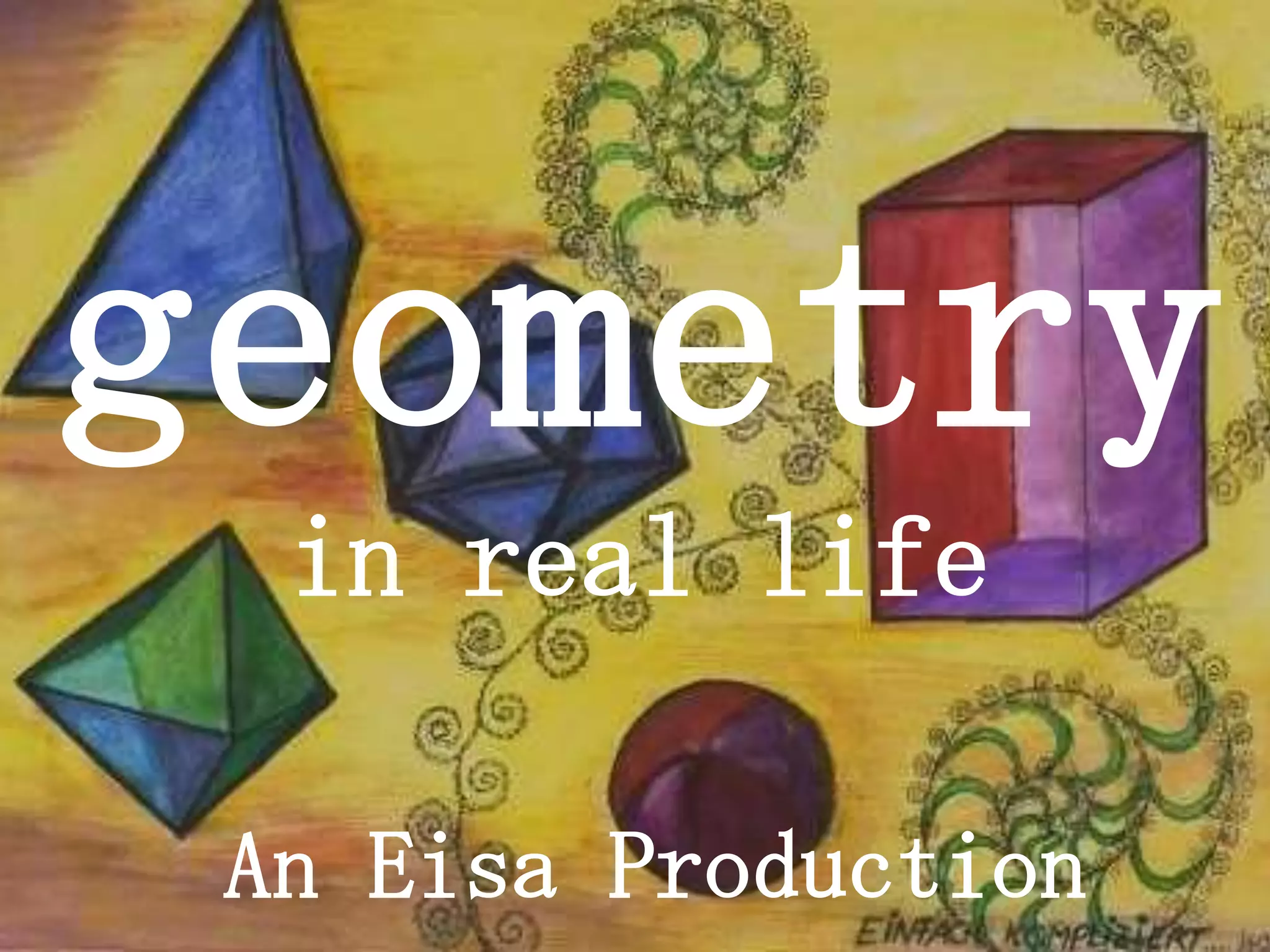
geometry
  in real life

 An Eisa Production
(the boring)
     definition
         noun
a branch of mathematics that deals with
   the measurement, properties, and
 relationships of points, lines, angles,
surfaces, and solids; broadly: the study
  of properties of given elements that
    remain invariant under specified
            transformations
                          Merriam-Webster Dictionary
I bet you didn’t
understand a single
        word!
   Let me make it
 easy for you…
What is Geometry?
• Geometry is one of the classical disciplines
  of math.
• Roughly translating in Greek as "Earth
  Measurement", it is concerned with the
  properties of space and figures.
• It is primarily developed to be a practical
  guide for measuring lengths, areas, and
  volumes, and is still in use up to now.
Enough of the
basics, now
let’s get back to

the   topic.
When do we
 actually use
Geometry?
Topic #1
     Area,
Perimeter and
    Volume
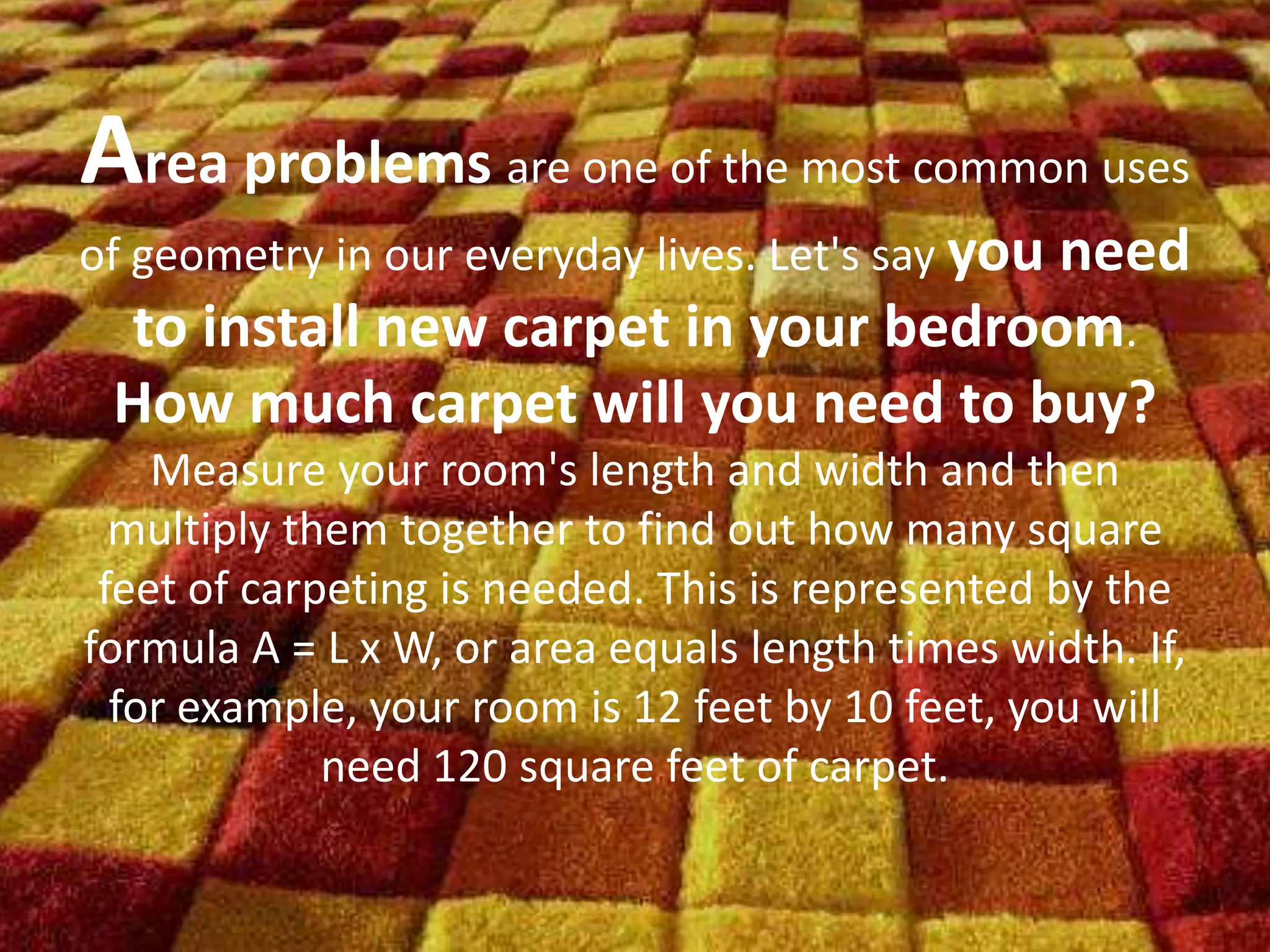
Area problems are one of the most common uses
of geometry in our everyday lives. Let's say you need
 to install new carpet in your bedroom.
 How much carpet will you need to buy?
    Measure your room's length and width and then
  multiply them together to find out how many square
 feet of carpeting is needed. This is represented by the
formula A = L x W, or area equals length times width. If,
  for example, your room is 12 feet by 10 feet, you will
             need 120 square feet of carpet.
Another area problem you may encounter is
        how many cans of paint
determining

  to buy to cover your walls. The
  label on the gallon of paint tells you it will cover 400
   square feet. You measure your walls and find
    that the room you want to paint has walls of the
 following dimensions: 10 ft x 10 ft, 10 ft x 8 ft, 10 ft x
10 ft and 10 ft x 8 ft. So you need to cover the areas of
100 square feet + 80 square feet + 100 square feet + 80
square feet = 360 square feet. Your room can be single
               coated by one can of paint.
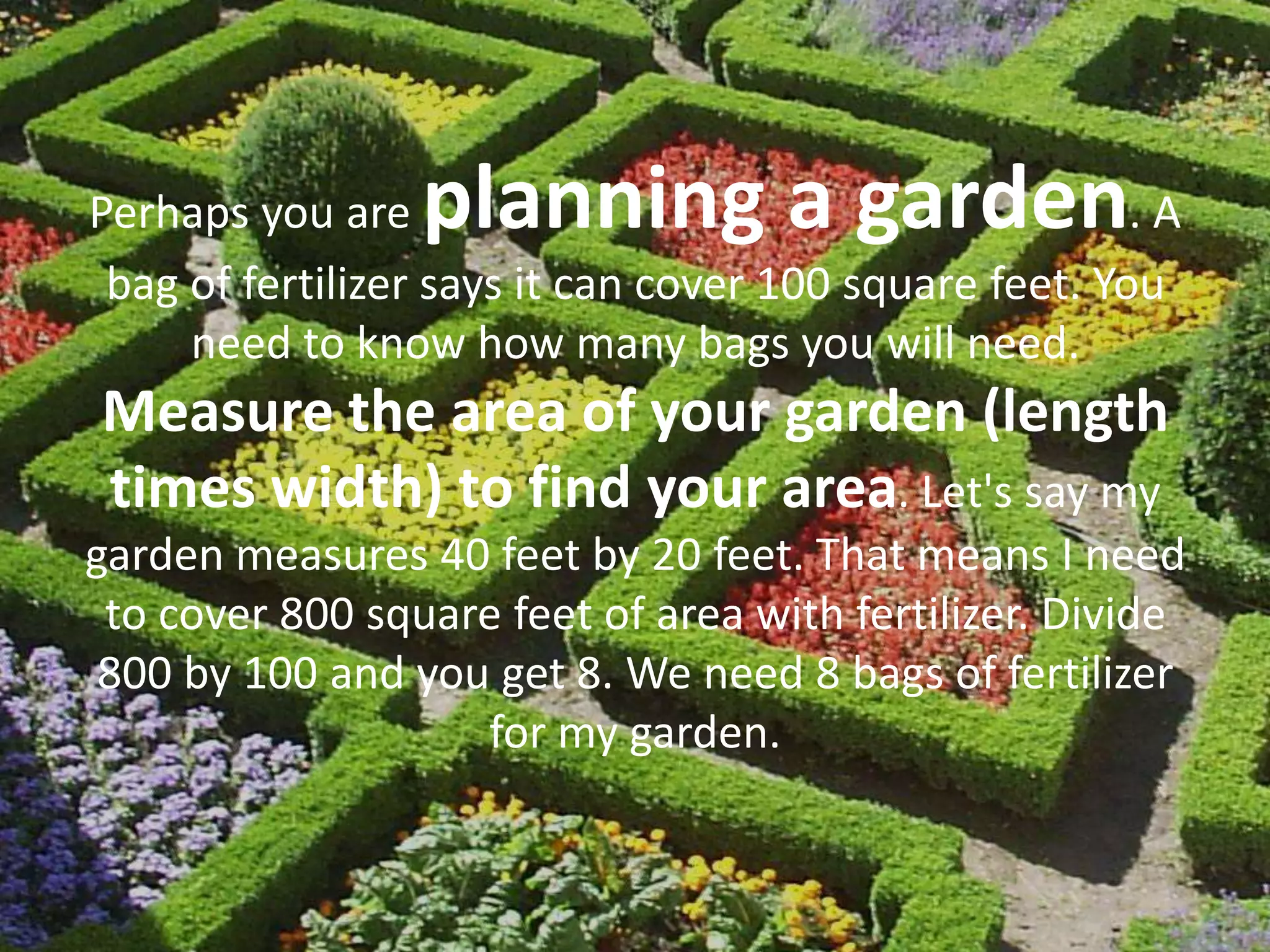
Perhaps you are  planning a garden                      .A
 bag of fertilizer says it can cover 100 square feet. You
     need to know how many bags you will need.
Measure the area of your garden (length
times width) to find your area. Let's say my
garden measures 40 feet by 20 feet. That means I need
 to cover 800 square feet of area with fertilizer. Divide
 800 by 100 and you get 8. We need 8 bags of fertilizer
                   for my garden.
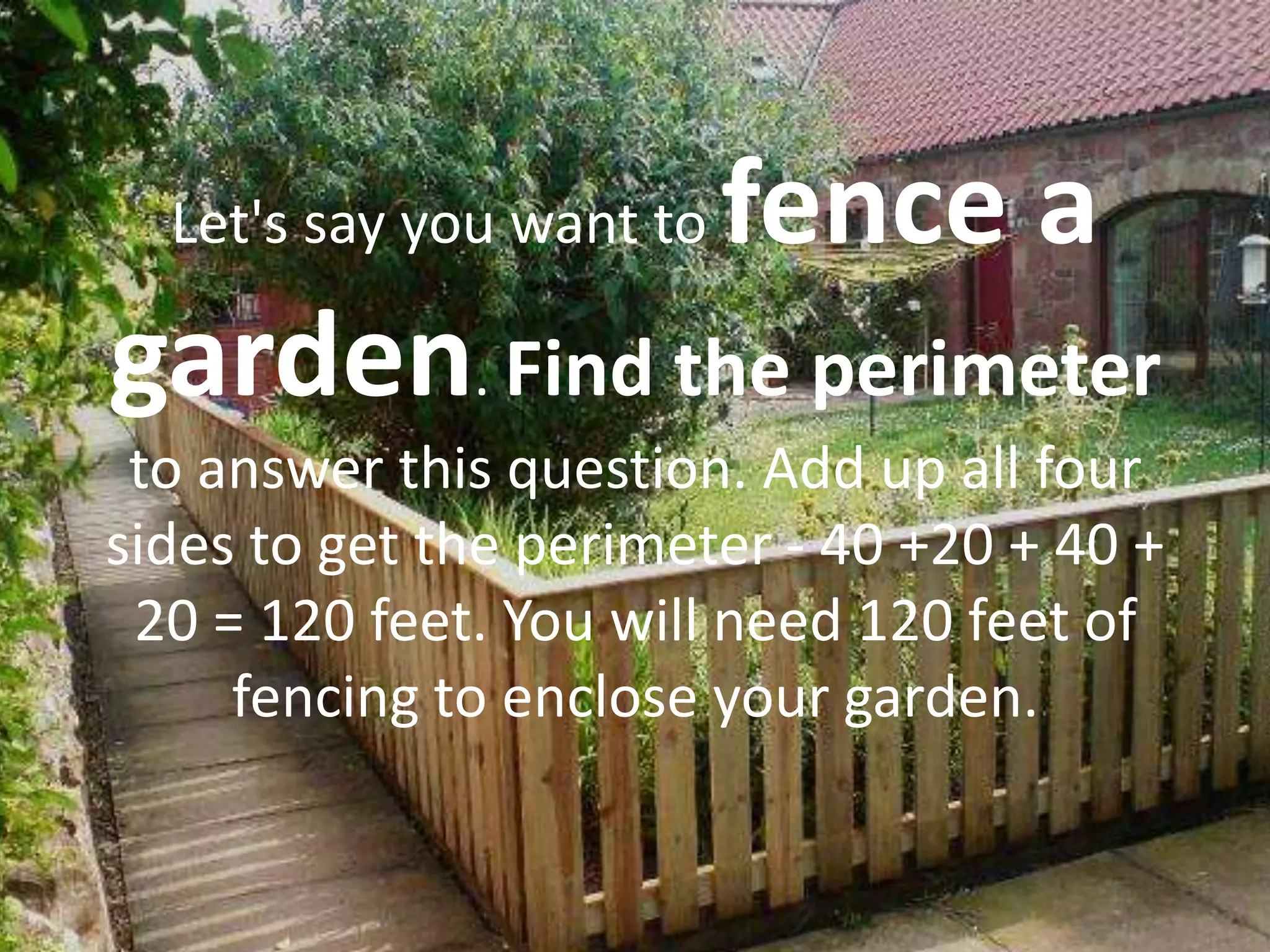
Let's say you want to   fence a
garden. Find the perimeter
 to answer this question. Add up all four
sides to get the perimeter - 40 +20 + 40 +
 20 = 120 feet. You will need 120 feet of
     fencing to enclose your garden.
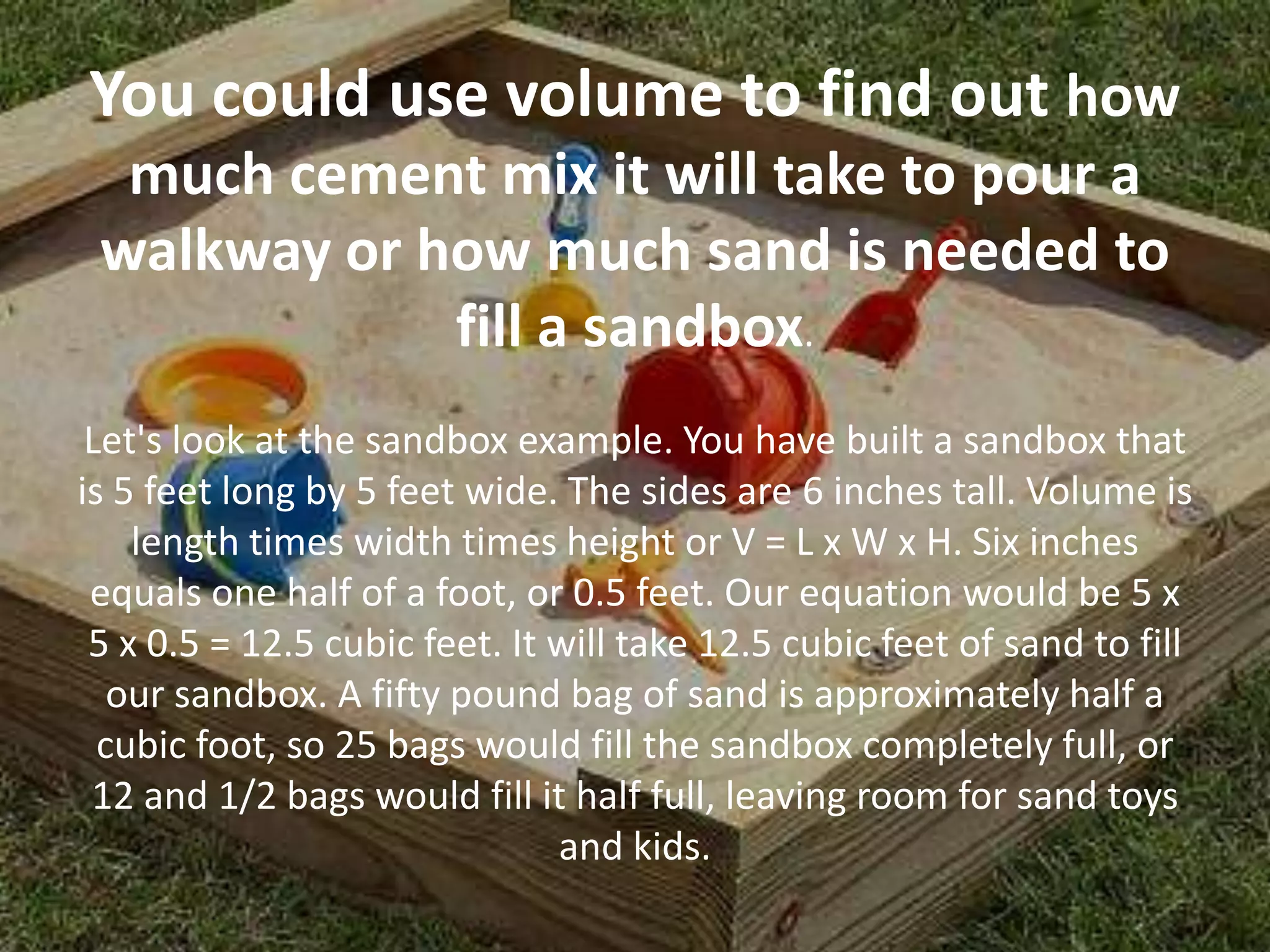
You could use volume to find out how
  much cement mix it will take to pour a
 walkway or how much sand is needed to
             fill a sandbox.
 Let's look at the sandbox example. You have built a sandbox that
is 5 feet long by 5 feet wide. The sides are 6 inches tall. Volume is
    length times width times height or V = L x W x H. Six inches
 equals one half of a foot, or 0.5 feet. Our equation would be 5 x
 5 x 0.5 = 12.5 cubic feet. It will take 12.5 cubic feet of sand to fill
   our sandbox. A fifty pound bag of sand is approximately half a
  cubic foot, so 25 bags would fill the sandbox completely full, or
 12 and 1/2 bags would fill it half full, leaving room for sand toys
                               and kids.
Topic #2
  Uses of
geometry in
  various
occupations
Mechanical Engineer
  A mechanical engineer designs machines
   ranging from tiny gearsets to large
  construction cranes. Using geometry, he
determines the strongest shapes for mechanical
   parts. He calculates the area, weight and
volume of pieces and ensures that a machine's
  thousands of moving parts fit together and
        don't interfere with one other.
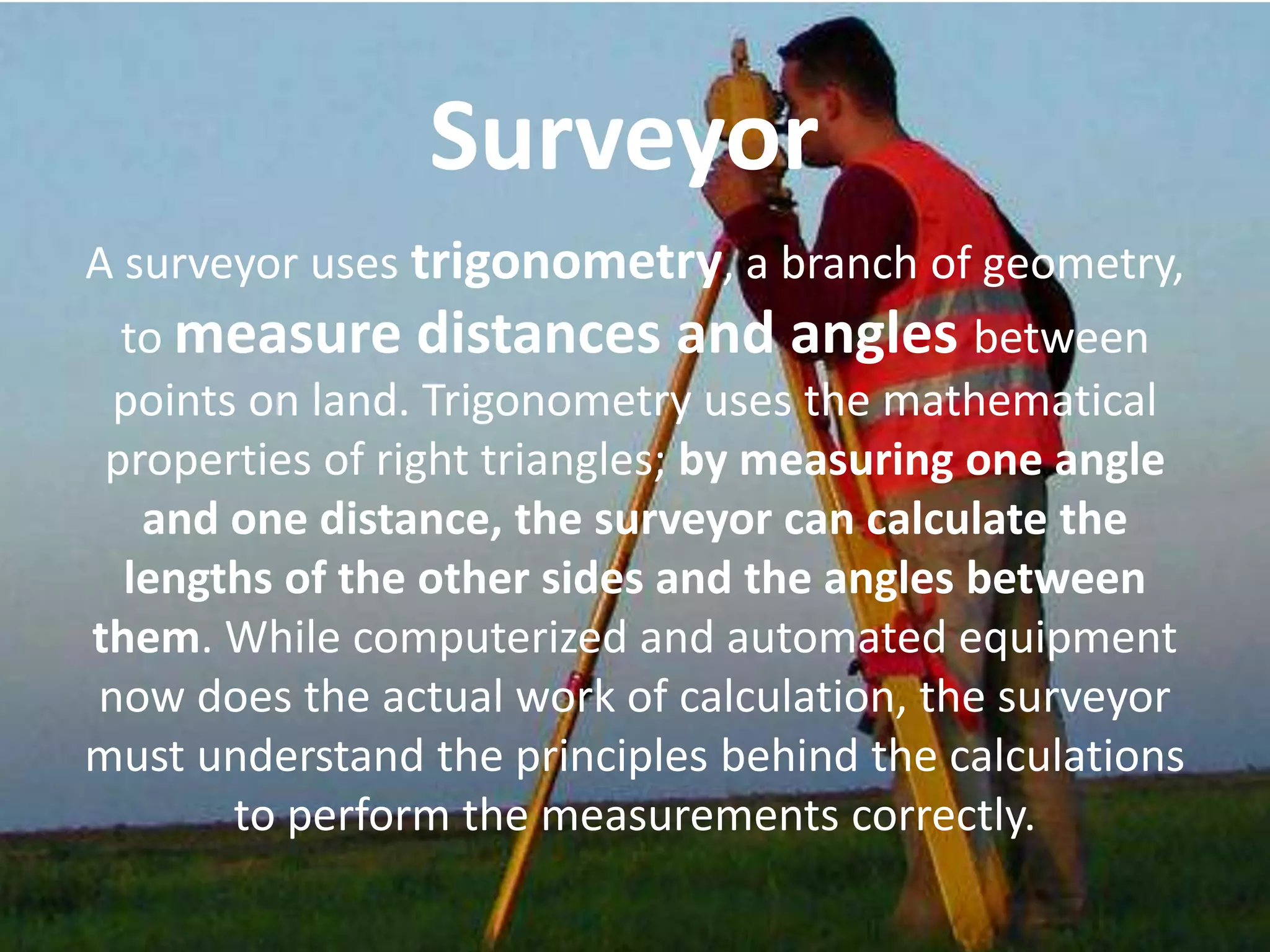
Surveyor
A surveyor uses trigonometry, a branch of geometry,
  to measure distances and angles between
 points on land. Trigonometry uses the mathematical
 properties of right triangles; by measuring one angle
   and one distance, the surveyor can calculate the
  lengths of the other sides and the angles between
them. While computerized and automated equipment
now does the actual work of calculation, the surveyor
must understand the principles behind the calculations
       to perform the measurements correctly.
Mathematician
A mathematician uses sophisticated conceptual
 tools to investigate the properties of shapes.
 Using proofs, which justify geometric ideas in a clear,
    step-by-step manner, he lays the mathematical
      foundations for new ideas in geometry. The
 mathematician then publishes these ideas, and
  people of other occupations adopt them in
 useful ways. The mathematician also educates and
     trains students in using geometry, proofs and
                mathematical concepts.
Astronomer
Many of the ideas an astronomer uses are applications
of geometry. As stars and galaxies form, they settle
into shapes such as spheres and discs that
 conform to their mass, their composition
 and the force of gravity. An astronomer studies
the elliptical orbits of comets, asteroids and planets; to
 find exact answers to questions about their speed and
    location, she uses the mathematical properties of
                          ellipses.
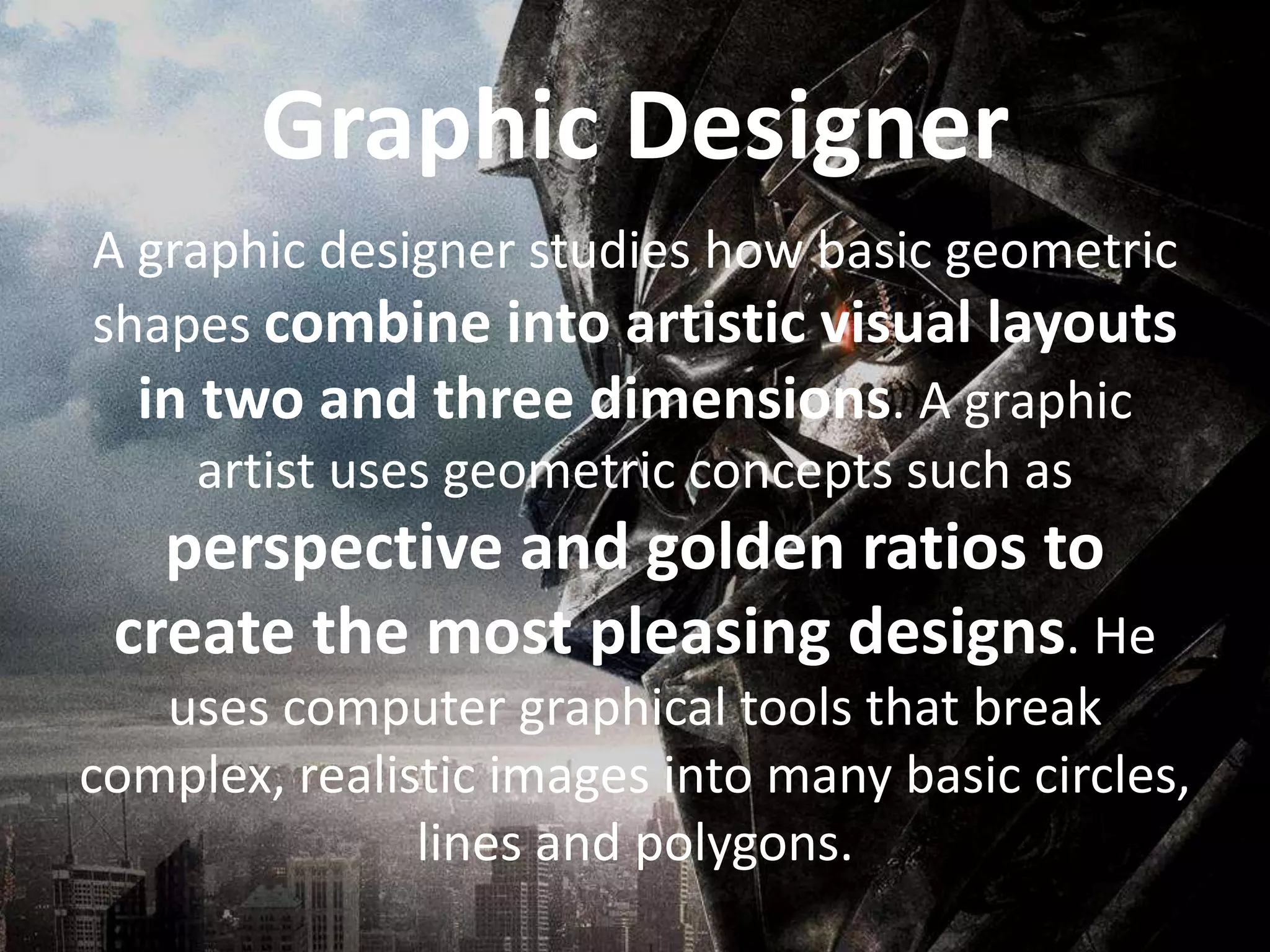
Graphic Designer
A graphic designer studies how basic geometric
shapes combine into artistic visual layouts
  in two and three dimensions. A graphic
     artist uses geometric concepts such as
   perspective and golden ratios to
 create the most pleasing designs. He
   uses computer graphical tools that break
complex, realistic images into many basic circles,
               lines and polygons.
Some more occupations in which
      geometry is used
• Computer imaging, something that is used nowadays for
  creating animations, video games, designing, and stuff like
  that, are created using geometric concepts.
• Also, geometry is used in mapping. Mapping is an essential
  element in professions such as surveying, navigation, and
  astronomy. From sketching to calculating distances, they use
  geometry to accomplish their job.
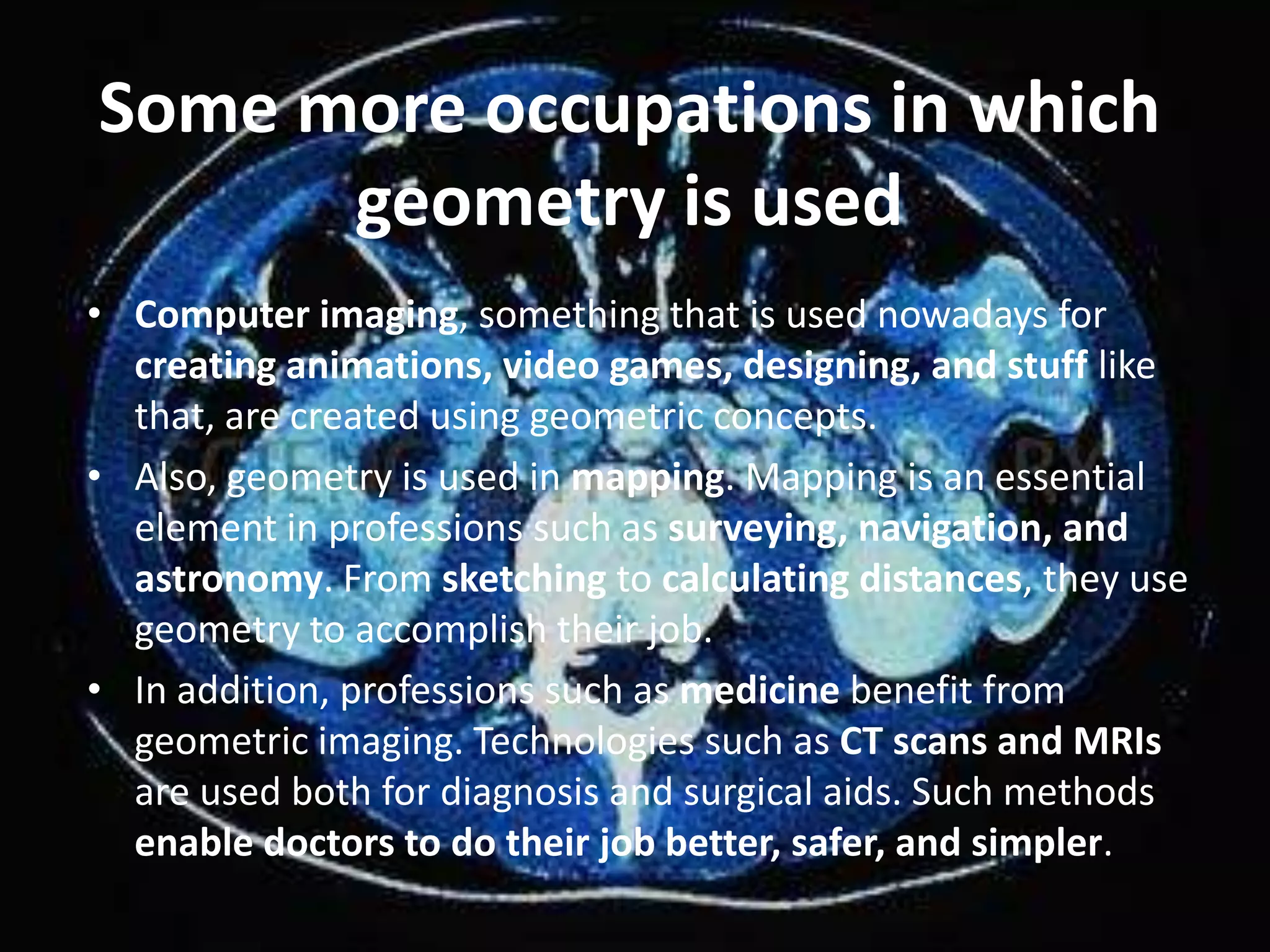
• In addition, professions such as medicine benefit from
  geometric imaging. Technologies such as CT scans and MRIs
  are used both for diagnosis and surgical aids. Such methods
  enable doctors to do their job better, safer, and simpler.
As you can see, geometry
 affects us even in themost
   basic details of our
lives. No matter what the form,
   it helps us understand
specific phenomena and it
 helps us in uplifting the
      quality of life.
Thanks for
   Watching!

Have a nice day!
References
                Information       • teach-nology.com
   Pictures
                                  • e-how.com
   •   artlandia.com                 •   dilbri.com
   •   colourbox.com                 •   wikimedia.org
   •   sciencephoto.com              •   25.media.tumblr.com
   •   bestgamewallpaers.com         •   newonair.nic.in
   •   iau.org                       •   gogeometry.com
   •   4.bp.blogspot.com             •   bcbits.com
   •   philly.com                    •   donrelyea.com
   •   wallpaperbackgrounds.com      •   2.bp.blogspot.com
   •   dennisflood.com               •   shutterstock.com
   •   lowes.com                     •   yoursinfo.com
   •   graniteschools.org

Geometry in Real Life

  • 1.
    geometry inreal life An Eisa Production
  • 2.
    (the boring) definition noun a branch of mathematics that deals with the measurement, properties, and relationships of points, lines, angles, surfaces, and solids; broadly: the study of properties of given elements that remain invariant under specified transformations Merriam-Webster Dictionary
  • 3.
    I bet youdidn’t understand a single word! Let me make it easy for you…
  • 4.
    What is Geometry? •Geometry is one of the classical disciplines of math. • Roughly translating in Greek as "Earth Measurement", it is concerned with the properties of space and figures. • It is primarily developed to be a practical guide for measuring lengths, areas, and volumes, and is still in use up to now.
  • 5.
    Enough of the basics,now let’s get back to the topic.
  • 6.
    When do we actually use Geometry?
  • 7.
    Topic #1 Area, Perimeter and Volume
  • 8.
    Area problems areone of the most common uses of geometry in our everyday lives. Let's say you need to install new carpet in your bedroom. How much carpet will you need to buy? Measure your room's length and width and then multiply them together to find out how many square feet of carpeting is needed. This is represented by the formula A = L x W, or area equals length times width. If, for example, your room is 12 feet by 10 feet, you will need 120 square feet of carpet.
  • 9.
    Another area problemyou may encounter is how many cans of paint determining to buy to cover your walls. The label on the gallon of paint tells you it will cover 400 square feet. You measure your walls and find that the room you want to paint has walls of the following dimensions: 10 ft x 10 ft, 10 ft x 8 ft, 10 ft x 10 ft and 10 ft x 8 ft. So you need to cover the areas of 100 square feet + 80 square feet + 100 square feet + 80 square feet = 360 square feet. Your room can be single coated by one can of paint.
  • 10.
    Perhaps you are planning a garden .A bag of fertilizer says it can cover 100 square feet. You need to know how many bags you will need. Measure the area of your garden (length times width) to find your area. Let's say my garden measures 40 feet by 20 feet. That means I need to cover 800 square feet of area with fertilizer. Divide 800 by 100 and you get 8. We need 8 bags of fertilizer for my garden.
  • 11.
    Let's say youwant to fence a garden. Find the perimeter to answer this question. Add up all four sides to get the perimeter - 40 +20 + 40 + 20 = 120 feet. You will need 120 feet of fencing to enclose your garden.
  • 12.
    You could usevolume to find out how much cement mix it will take to pour a walkway or how much sand is needed to fill a sandbox. Let's look at the sandbox example. You have built a sandbox that is 5 feet long by 5 feet wide. The sides are 6 inches tall. Volume is length times width times height or V = L x W x H. Six inches equals one half of a foot, or 0.5 feet. Our equation would be 5 x 5 x 0.5 = 12.5 cubic feet. It will take 12.5 cubic feet of sand to fill our sandbox. A fifty pound bag of sand is approximately half a cubic foot, so 25 bags would fill the sandbox completely full, or 12 and 1/2 bags would fill it half full, leaving room for sand toys and kids.
  • 13.
    Topic #2 Uses of geometry in various occupations
  • 14.
    Mechanical Engineer A mechanical engineer designs machines ranging from tiny gearsets to large construction cranes. Using geometry, he determines the strongest shapes for mechanical parts. He calculates the area, weight and volume of pieces and ensures that a machine's thousands of moving parts fit together and don't interfere with one other.
  • 15.
    Surveyor A surveyor usestrigonometry, a branch of geometry, to measure distances and angles between points on land. Trigonometry uses the mathematical properties of right triangles; by measuring one angle and one distance, the surveyor can calculate the lengths of the other sides and the angles between them. While computerized and automated equipment now does the actual work of calculation, the surveyor must understand the principles behind the calculations to perform the measurements correctly.
  • 16.
    Mathematician A mathematician usessophisticated conceptual tools to investigate the properties of shapes. Using proofs, which justify geometric ideas in a clear, step-by-step manner, he lays the mathematical foundations for new ideas in geometry. The mathematician then publishes these ideas, and people of other occupations adopt them in useful ways. The mathematician also educates and trains students in using geometry, proofs and mathematical concepts.
  • 17.
    Astronomer Many of theideas an astronomer uses are applications of geometry. As stars and galaxies form, they settle into shapes such as spheres and discs that conform to their mass, their composition and the force of gravity. An astronomer studies the elliptical orbits of comets, asteroids and planets; to find exact answers to questions about their speed and location, she uses the mathematical properties of ellipses.
  • 18.
    Graphic Designer A graphicdesigner studies how basic geometric shapes combine into artistic visual layouts in two and three dimensions. A graphic artist uses geometric concepts such as perspective and golden ratios to create the most pleasing designs. He uses computer graphical tools that break complex, realistic images into many basic circles, lines and polygons.
  • 19.
    Some more occupationsin which geometry is used • Computer imaging, something that is used nowadays for creating animations, video games, designing, and stuff like that, are created using geometric concepts. • Also, geometry is used in mapping. Mapping is an essential element in professions such as surveying, navigation, and astronomy. From sketching to calculating distances, they use geometry to accomplish their job. • In addition, professions such as medicine benefit from geometric imaging. Technologies such as CT scans and MRIs are used both for diagnosis and surgical aids. Such methods enable doctors to do their job better, safer, and simpler.
  • 20.
    As you cansee, geometry affects us even in themost basic details of our lives. No matter what the form, it helps us understand specific phenomena and it helps us in uplifting the quality of life.
  • 21.
    Thanks for Watching! Have a nice day!
  • 22.
    References Information • teach-nology.com Pictures • e-how.com • artlandia.com • dilbri.com • colourbox.com • wikimedia.org • sciencephoto.com • 25.media.tumblr.com • bestgamewallpaers.com • newonair.nic.in • iau.org • gogeometry.com • 4.bp.blogspot.com • bcbits.com • philly.com • donrelyea.com • wallpaperbackgrounds.com • 2.bp.blogspot.com • dennisflood.com • shutterstock.com • lowes.com • yoursinfo.com • graniteschools.org

Editor's Notes

  • #2 http://www.graniteschools.org/depart/teachinglearning/curriculuminstruction/math/secondarymathematics/PublishingImages/geometry.jpg
  • #3 yoursinfo.com
  • #4 shutterstock.com
  • #5 http://www.teach-nology.com/teachers/subject_matter/math/geometry/http://2.bp.blogspot.com
  • #6 donrelyea.com
  • #7 bcbits.com
  • #8 http://gogeometry.com
  • #9 newonair.nic.in
  • #10 http://25.media.tumblr.com
  • #11 wikimedia.org
  • #12 dilbri.com
  • #13 lowes.com
  • #14 dennisflood.com
  • #15 http://wallpaperbackgrounds.com
  • #16 philly.com
  • #17 http://4.bp.blogspot.com
  • #18 iau.org
  • #19 bestgamewallpaers.com
  • #20 Sciencephoto.com
  • #21 colourbox.com
  • #22 artlandia.com