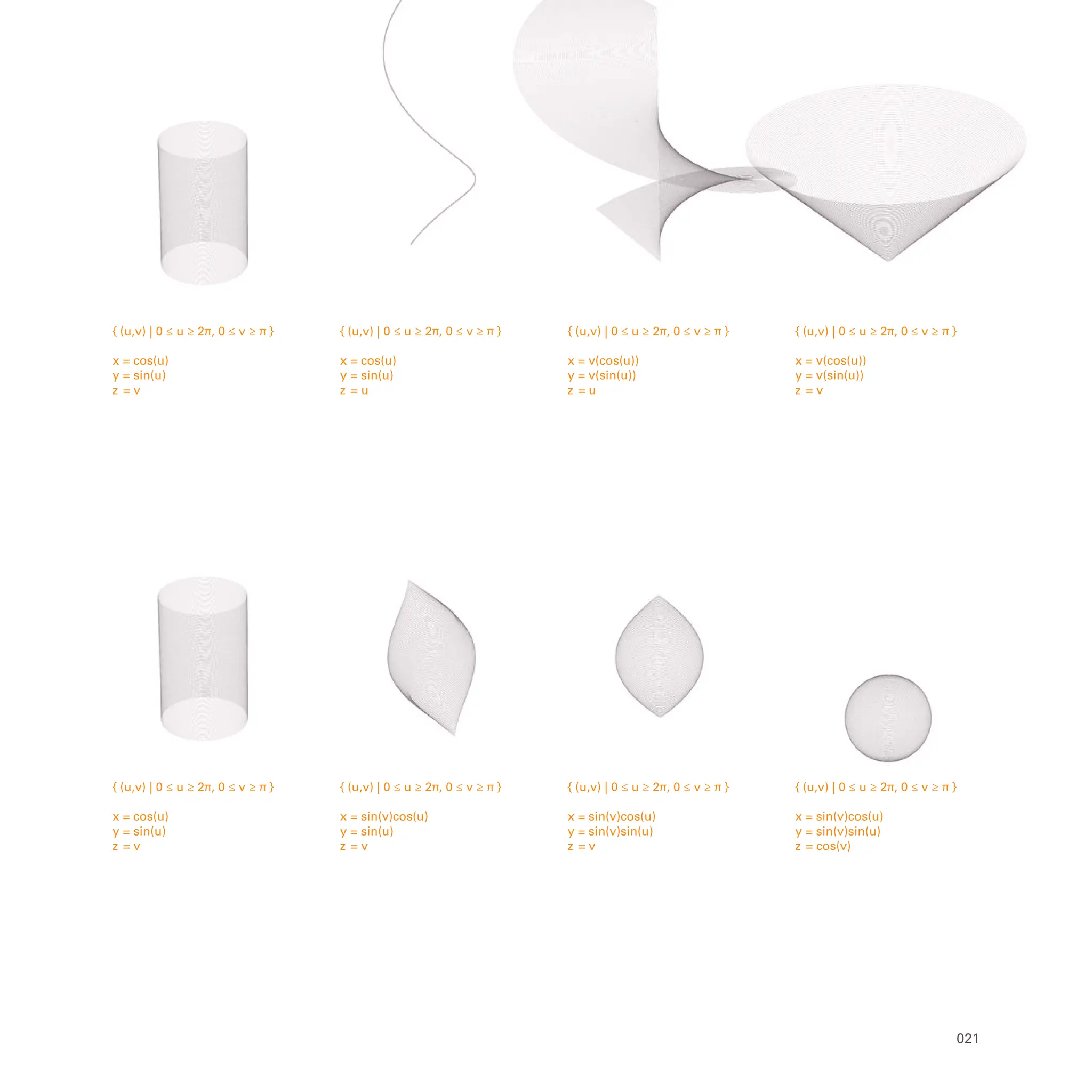
Morphing A Guide To Mathematical Transformations
For Architects And Designers Choma download
https://ebookbell.com/product/morphing-a-guide-to-mathematical-
transformations-for-architects-and-designers-choma-11801692
Explore and download more ebooks at ebookbell.com
Here are some recommended products that we believe you will be
interested in. You can click the link to download.
Morphing A Guide To Mathematical Transformations For Architects And
Designers Joseph Choma
https://ebookbell.com/product/morphing-a-guide-to-mathematical-
transformations-for-architects-and-designers-joseph-choma-7119614
Morphine A Medical Dictionary Bibliography And Annotated Research
Guide To Internet References Icon Health Publications
https://ebookbell.com/product/morphine-a-medical-dictionary-
bibliography-and-annotated-research-guide-to-internet-references-icon-
health-publications-1988418
Celtic Devotions A Guide To Morning And Evening Prayer 1st Edition
Calvin Miller
https://ebookbell.com/product/celtic-devotions-a-guide-to-morning-and-
evening-prayer-1st-edition-calvin-miller-51332776
Electric Bicycles A Guide To Design And Use Ieee Press Series On
Electronics Technology 1st Edition William C Morchin
https://ebookbell.com/product/electric-bicycles-a-guide-to-design-and-
use-ieee-press-series-on-electronics-technology-1st-edition-william-c-
morchin-2267434
A Modern Parents Guide To Nursery Rhymes Because Its Two Oclock In The
Morning And You Cant Remember Twinkle Twinkle Little Star Jennifer
Griffin
https://ebookbell.com/product/a-modern-parents-guide-to-nursery-
rhymes-because-its-two-oclock-in-the-morning-and-you-cant-remember-
twinkle-twinkle-little-star-jennifer-griffin-42347252
A Modern Parents Guide To Nursery Rhymes Because Its Two Oclock In The
Morning And You Cant Remember Twinkle Twinkle Little Star Over 70
Classic Rhymes Jennifer Griffin
https://ebookbell.com/product/a-modern-parents-guide-to-nursery-
rhymes-because-its-two-oclock-in-the-morning-and-you-cant-remember-
twinkle-twinkle-little-star-over-70-classic-rhymes-jennifer-
griffin-42353824
Dont Do That A Childs Guide To Bad Manners Ridiculous Rules And
Inadequate Etiquette Barry Louis Polisar
https://ebookbell.com/product/dont-do-that-a-childs-guide-to-bad-
manners-ridiculous-rules-and-inadequate-etiquette-barry-louis-
polisar-5078408
Will There Really Be A Morning Life A Guide Poems For Key Stage 2 With
Teaching Notes 1st Edition Fred Sedgwick
https://ebookbell.com/product/will-there-really-be-a-morning-life-a-
guide-poems-for-key-stage-2-with-teaching-notes-1st-edition-fred-
sedgwick-51281192
A Step By Step French Study Guide For Beginners Learn French With
Short Stories Phrases While You Sleep Numbers Alphabet In The Car
Morning Meditations 50 Of The Most Used Verbs French Hacking
https://ebookbell.com/product/a-step-by-step-french-study-guide-for-
beginners-learn-french-with-short-stories-phrases-while-you-sleep-
numbers-alphabet-in-the-car-morning-meditations-50-of-the-most-used-
verbs-french-hacking-65330332
Morphing
A Guide to Mathematical
Transformations for
Architects and Designers
Joseph Choma
ToTing-Ting
Morphing
A Guide to Mathematical
Transformations for
Architects and Designers
Joseph Choma
004
Contents
Contents
006 Introduction
014 Transformations
018 Shaping
022 Translating
026 Cutting
030 Rotating
034 Reflecting
038 Scaling
042 Modulating
046 Ascending
050 Spiralling
054 Texturing
058 Bending
062 Pinching
066 Flattening
070 Thickening
074		 Combining
		Transformations
078 Cutting and Spiralling
082 Scaling and Spiralling
086 Modulating and Spiralling
090 Spiralling and Ascending
094 Texturing and Spiralling
098 Bending and Spiralling
102 Spiralling and Bending
106 Pinching and Spiralling
110 Flattening and Spiralling
114 Spiralling and Flattening
118 Spiralling and Thickening
122 Combining
		Shapes
126 A Mound
128 A Meandering Mound
130 A Leaning Mound
132 A Steeper Mound
134 A Creased Mound
136 A Creased and
		 Pinched Mound
138 A Wedge
140 A Ridge and Trench
142 Two Ridges
144 Another Ridge and Trench
146 A Valley
148 Moguls
005
150 Analyzing
154 Japan Pavilion
		 – Shigeru Ban Architects
160 UK Pavilion
		 – Heatherwick Studio
166 Mur Island
		 – Acconci Studio
172 Son-O-House
		 – NOX/Lars Spuybroek
178 Ark Nova
		 – Arata Isozaki and
		 Anish Kapoor
184 Looptecture F
		 – Endo Shuhei
		 Architect Institute
190 Mercedes-Benz Museum
		 – UNStudio
196 Developable
		Surfaces
200 Plane to Cylinder
202 Cylinder with Ascending
204 Cylinder with Texturing 		
		 and Ascending
206 Cylinder with Flattening,
		 Texturing and Ascending
208 Cylinder with Modulating,
		 Flattening and Texturing
210 Plane to Cone
212 Cone with Spiralling
214 Cone with Spiralling
		 and Texturing
216 Cone with Spiralling,
		 Texturing and Modulating
218 Cone with Spiralling,
		 Texturing and More
		Modulating
220 Assumptions
228 Bibliography
231 Acknowledgments
006
Introduction
‘The way in which a problem is
decomposed imposes fundamental
constraints on the way in which people
attempt to solve that problem.’
(Rodney Brooks, 1999)
007
A shape can be defined as anything with
a geometric boundary.Yet, when
describing a shape with mathematics,
precision is crucial.
Dictionaries define words, but these
words do not necessarily define our
understanding of the world in which we
perceive and create.The word ‘cube’ is
defined as a shape whose boundary is
composed of six congruent square faces.
Imagine cutting six square pieces of
paper and gluing the edges together.
The cube, in this case, is created by six
square planes. In mathematics, these
planes are considered discrete elements.
Because each plane in the paper cube
meets the others at a sharp edge,
technically they are not connected, but
are separate parts, each defined by a
unique parametric equation.
Now, imagine a ball of clay. Roll it
around on the tabletop to make it into
a sphere.To flatten it into a cube, the
ball can be simply compressed in
multiple directions (rather than forming
six planar sides that are joined together,
as above). Gradually, the sphere could
transform into a six-sided shape.
Most physical cubes in the world have
a certain degree of rounded corners.
If we accept this definition for a cube,
then a cube could be defined with one
parametric equation.The framework
that is used becomes critical to
deciding how to go about defining
a shape mathematically.
If a shape maintains its topological
continuity, it can be defined by a single
equation. A break in continuity, such as
a sharp edge, requires another equation
to define the other ‘part’
.
Breaking continuity and having sharp
edges can create aesthetic effects
that allow curves to be expressed in
a more objectified manner. Breaking
the continuity of a shape can also
sometimes facilitate the fabrication
of particular geometries out of flat
sheet material. However, the scope
of this guide has been constrained to
the definition of shapes with a single
parametric equation.
A parametric equation is one way of
defining values of coordinates (x, y, z)
for shapes with parameters (u, v, w).
All of the mathematical equations in
this guide are presented as parametric
equations.Think of x, y and z as
dimensions in the Cartesian coordinate
system – like a three-dimensional grid.
Think of u, v and w as a range of values
or parameters rather than a single
integer. A single integer would be like a
single point along a line, while the range
(u, v or w) would define the end points
of that line and then draw all the points
between them.
008
Introduction
Why trigonometry?
Tools inherently constrain the way
individuals design; however, designers
are often unaware of their tools’
influences and biases. Digital tools in
particular are becoming increasingly
complex and filled with hierarchical
symbolic heuristics, creating a black box
in which designers do not understand
what is ‘under the hood’ of the tools
they ‘drive’
. Many contemporary digital
tools use a fixed symbolic interface, like
a visual dictionary.When a designer
wants to create a sphere, he or she
clicks on the sphere icon and draws a
radius.The resulting sphere, defined by a
single symbol, can only be manipulated
as a whole. Like a ball of clay, the sphere
can be stretched, twisted and pulled.
If, however, the shape had been defined
by a parametric equation, it would be
defined by a rule-based logic that
encompasses both the whole sphere
and its parts.When the designer
manipulates the shape’s trigonometry
(or ‘DNA’), it becomes clear that he
or she has a new range of geometric
freedom that could not have been
imagined in the other framework.
Since the designer can manipulate the
smallest building blocks of the shapes,
understanding how each function
influences a particular transformation
becomes straightforward.
The designer is no longer designing
within a black box, but rather within
a transparent box.
Because mathematical models can be
based on a global Cartesian coordinate
system, the designer can constantly
redefine a shape by redefining its
parametric equations, avoiding the
chore of telling the computer how to
redraw it every time. For example, a
smooth continuous surface can be
confined to the boundary of a cube with
a single transformation. Designers can
begin to think and manipulate in a less
linear fashion and constantly redefine
the ‘world’ that they create and perceive.
The Cartesian coordinate system
becomes a blank canvas at which any
type of paint can be thrown!
This pedagogical guide embraces the
thought that all shapes could potentially
be described by the trigonometric
functions of sine and cosine. But the
utility of this guide does not depend on
whether that idea is true or not: this
guide does not invent a new field of
mathematics, but develops a cognitive
narrative within the existing discipline,
emphasizing the interconnected and
plastic nature of shapes.Within this
guide, sine and cosine are the only
functions that are examined.
009
A word of warning: trigonometry may
seem like the tool of a designer’s
dreams, but just because every shape
could be potentially described by
trigonometric functions does not mean
that it is necessarily easy to make every
shape. It is important to remember that
all tools have biases, even mathematics.
For instance, in order to make a cube
with a single parametric equation one
must first make a sphere; therefore,
shapes that are initially round become
easier to produce.
A tool is a device that augments an
individual’s ability to perform a
particular task.
In this context, heuristics refers to the
strategies used to solve problems within
software.Think of heuristics as the rules
that govern how a machine ‘thinks’ and
calculates solutions.
Functions (in mathematics) associate an
input (independent variable) with an
output (dependent variable). For
example if x→y, x would be considered
the independent variable while y would
be considered the dependent variable.
The function would be what makes x
map to y. In trigonometry, sine and
cosine are functions. Note that
trigonometric functions are a type of
periodic functions, whose values repeat
in regular periods or intervals.
A pedagogical guide is neither purely a
technical reference nor a theoretical text,
but rather the teaching of an inquiry
through a series of instructional
frameworks.
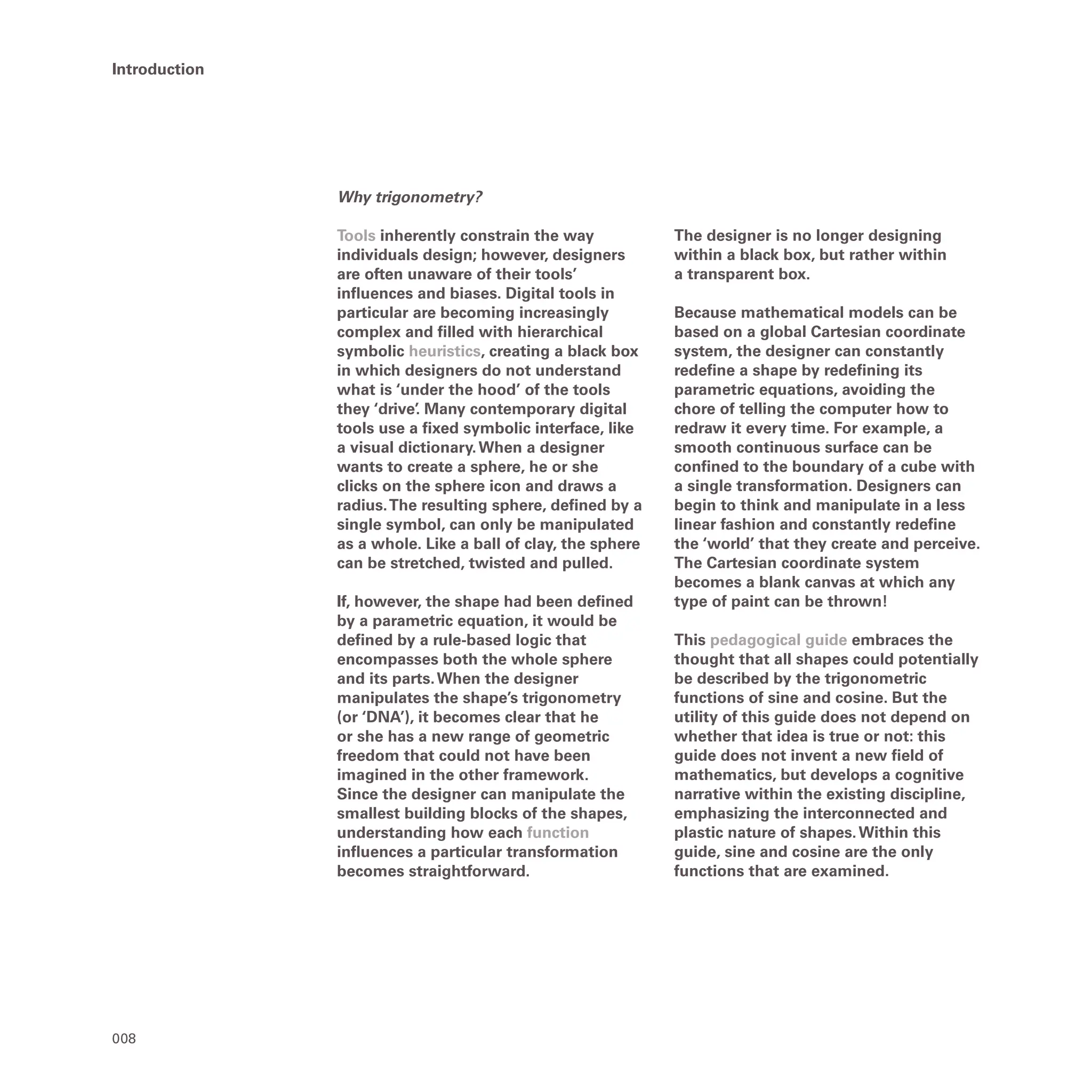
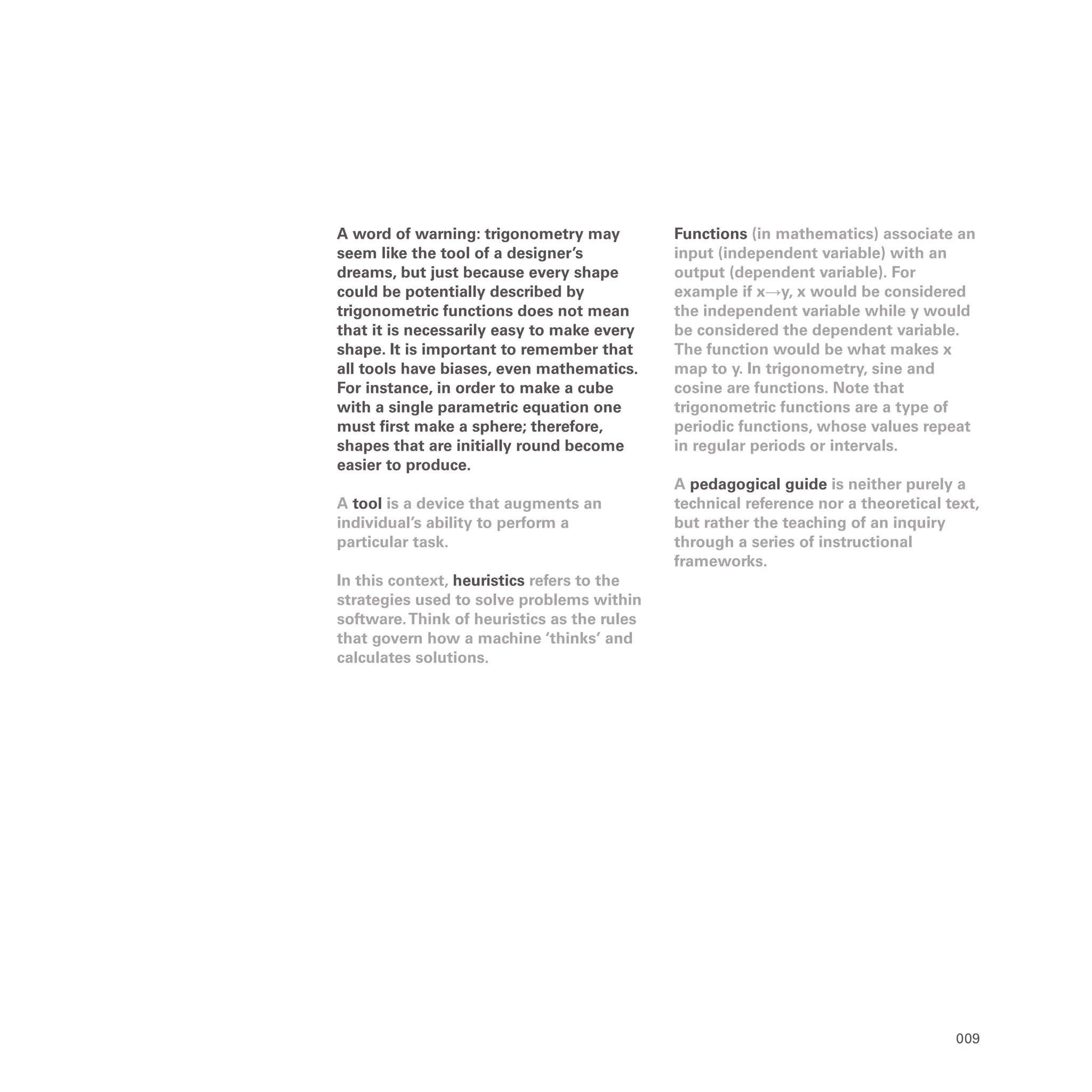
{ (u,v) | 0 ≤ u ≥ 2π, 0 ≤ v ≥ 2π }
x = sin(u)10(cos(v))
y = sin(v)+cos(u)10(cos(v))
z = cos(v)+10(sin(v))sin(u)
010
Introduction
A point of view
As we circle around an object, our
perceptual understanding of it is
transformed.We move in dialogue
with the observed object, as in a dance
performance. Similarly, the pages within
this book document shapes according
to particular, chosen perspectives. Most
of the shapes within this guide are three
dimensional, but their representation is
constrained to the two-dimensional
plane of the page. Some shapes may
be difficult to comprehend in their
entirety because of this singular view.
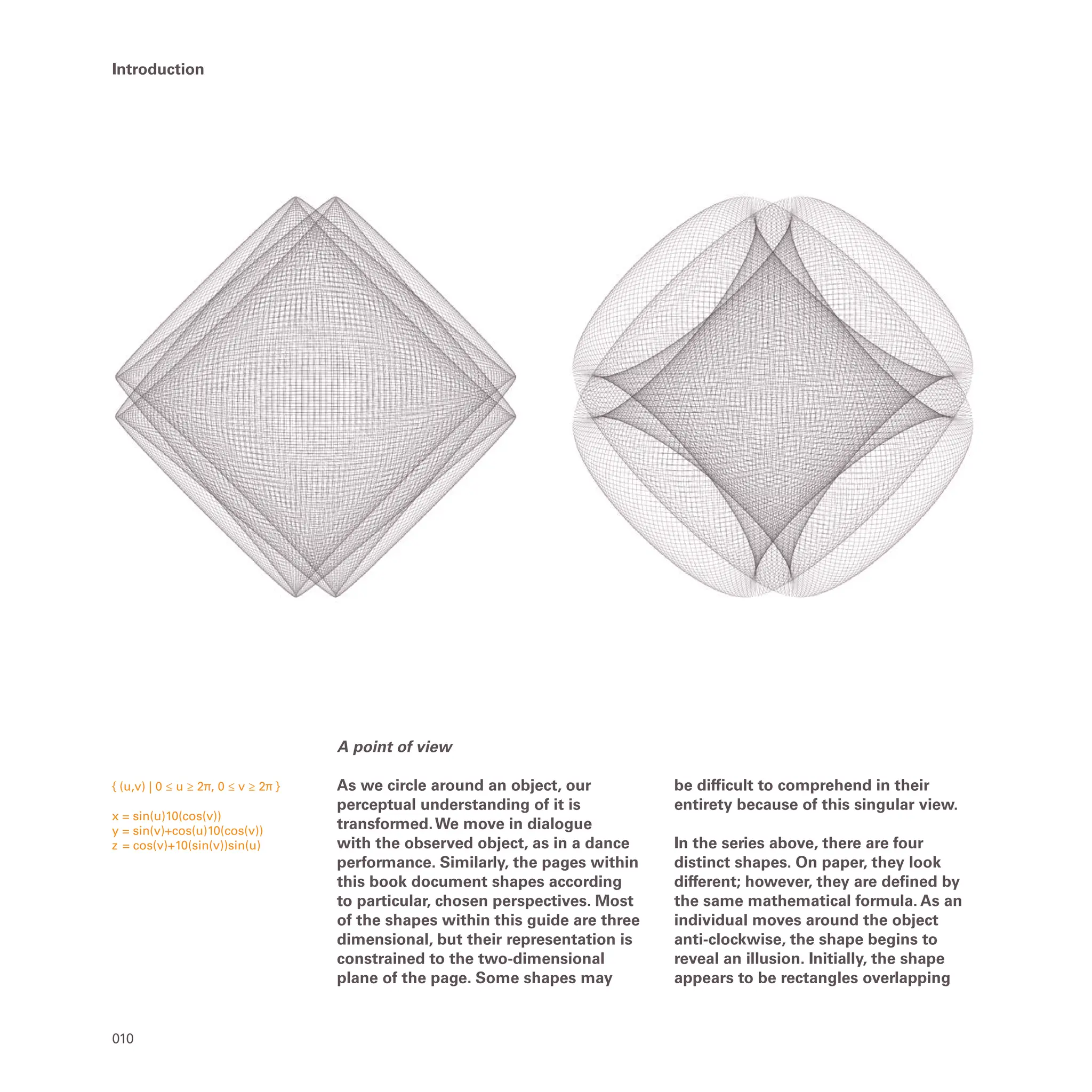
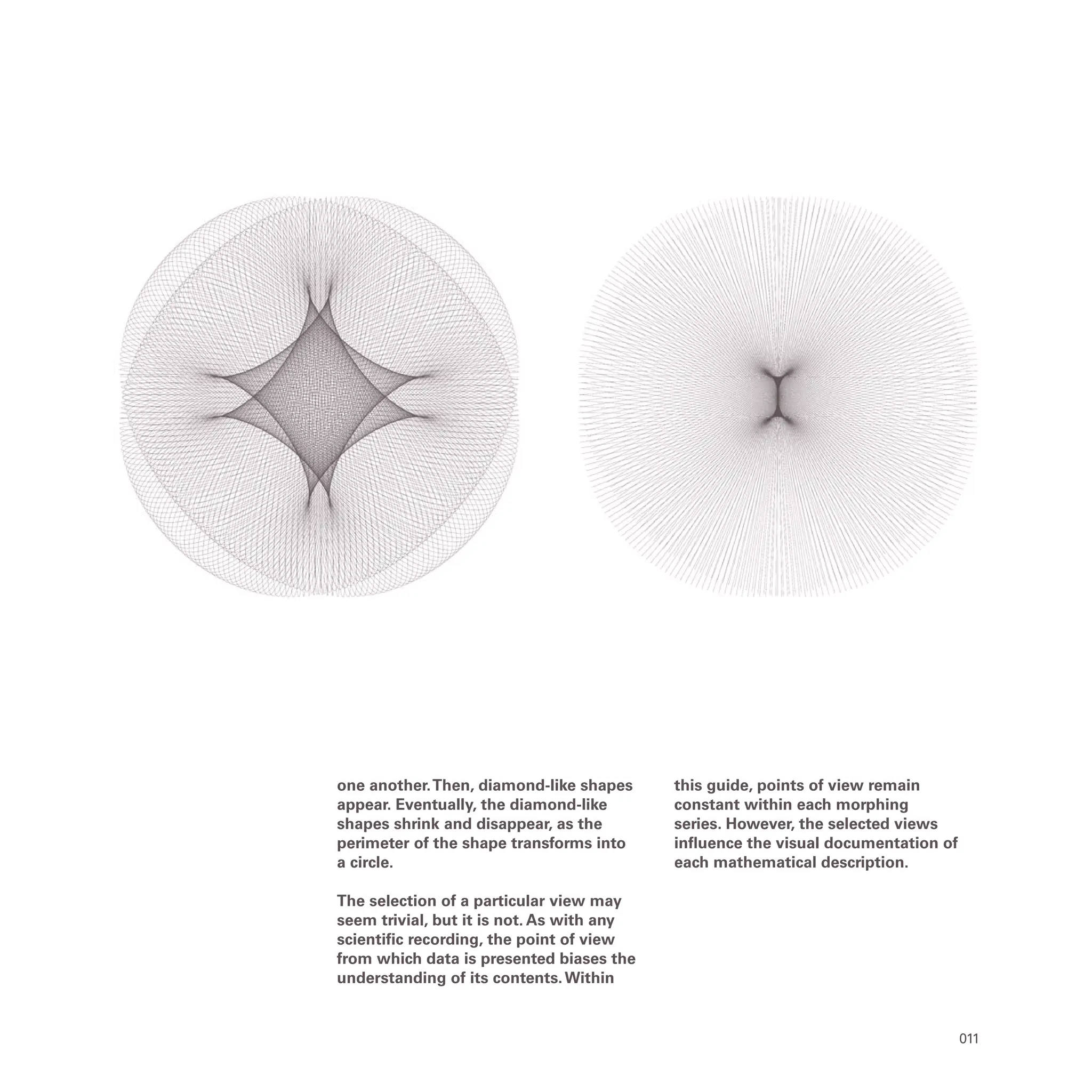
In the series above, there are four
distinct shapes. On paper, they look
different; however, they are defined by
the same mathematical formula. As an
individual moves around the object
anti-clockwise, the shape begins to
reveal an illusion. Initially, the shape
appears to be rectangles overlapping
011
one another.Then, diamond-like shapes
appear. Eventually, the diamond-like
shapes shrink and disappear, as the
perimeter of the shape transforms into
a circle.
The selection of a particular view may
seem trivial, but it is not. As with any
scientific recording, the point of view
from which data is presented biases the
understanding of its contents.Within
this guide, points of view remain
constant within each morphing
series. However, the selected views
influence the visual documentation of
each mathematical description.
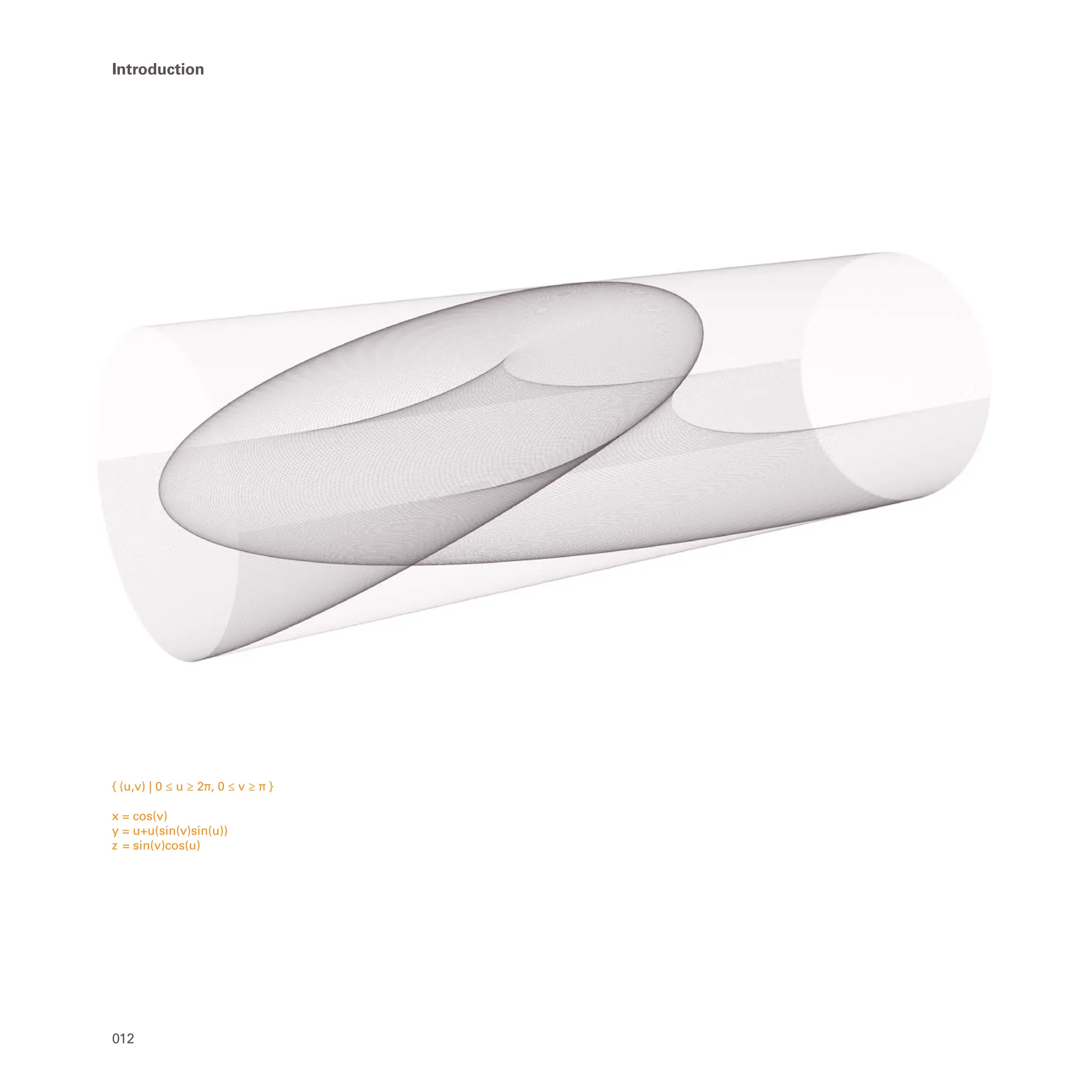
{ (u,v) | 0 ≤ u ≥ 2π, 0 ≤ v ≥ π }
x = cos(v)
y = u+u(sin(v)sin(u))
z = sin(v)cos(u)
012
Introduction
013
Boundaries
A boundary is anything that defines
a limit. Numerically, determining a
boundary may be straightforward, but
perceptually it is often more ambiguous.
Spheres, cylinders, helicoids and cones
are all shapes that, when viewed from
one direction, share a circular profile.
Embedded within each of their
mathematical DNA are the same
functions, which define a circle.
Throughout this guide, simple, known
shapes are transformed into many
shapes which have never been
visualized before. But by starting with
a basic shape, such as a cylinder or
sphere, the boundary condition of the
resultant shape could maintain the
initial signature of the ancestor.
For example, the shape on the left
was a sphere which morphed under
a spiralling and then ascending
mathematical transformation.The
result is a self-intersecting surface,
which is bounded inside a cylinder.
The shape is not recognizable or defined
within the dictionary, yet it shares the
cylinder’s front- and top-view boundary
profiles: the top view of the shape is a
rectangle, while its front view is a circle.
The seemingly foreign shape appears
familiar because of its profile
projections.
As shapes transform throughout this
guide, visualize the shape’s two-
dimensional projections. Like an
architect’s dissection of a building with
plan, section and elevation, complex
shapes can be simplified by analyzing
parts of their parametric equation. As
the coordinates (x, y, z) within the
equation are altered, the projections will
change; which coordinate is altered will
determine which projection will change.
Mathematical transformations refer to
the categorized rules for manipulating
shapes with mathematical operations.
Throughout this book, the names of
transformations and other operations
that are discussed in detail are set in
italics for ease of reference.
Transformations
016
Transformations
‘Evidently, there is scarcely anything that
one can say about a “single sensation”
by itself, but we can often say much more
when we can make comparisons.’
(Marvin Minsky, 1985)
017
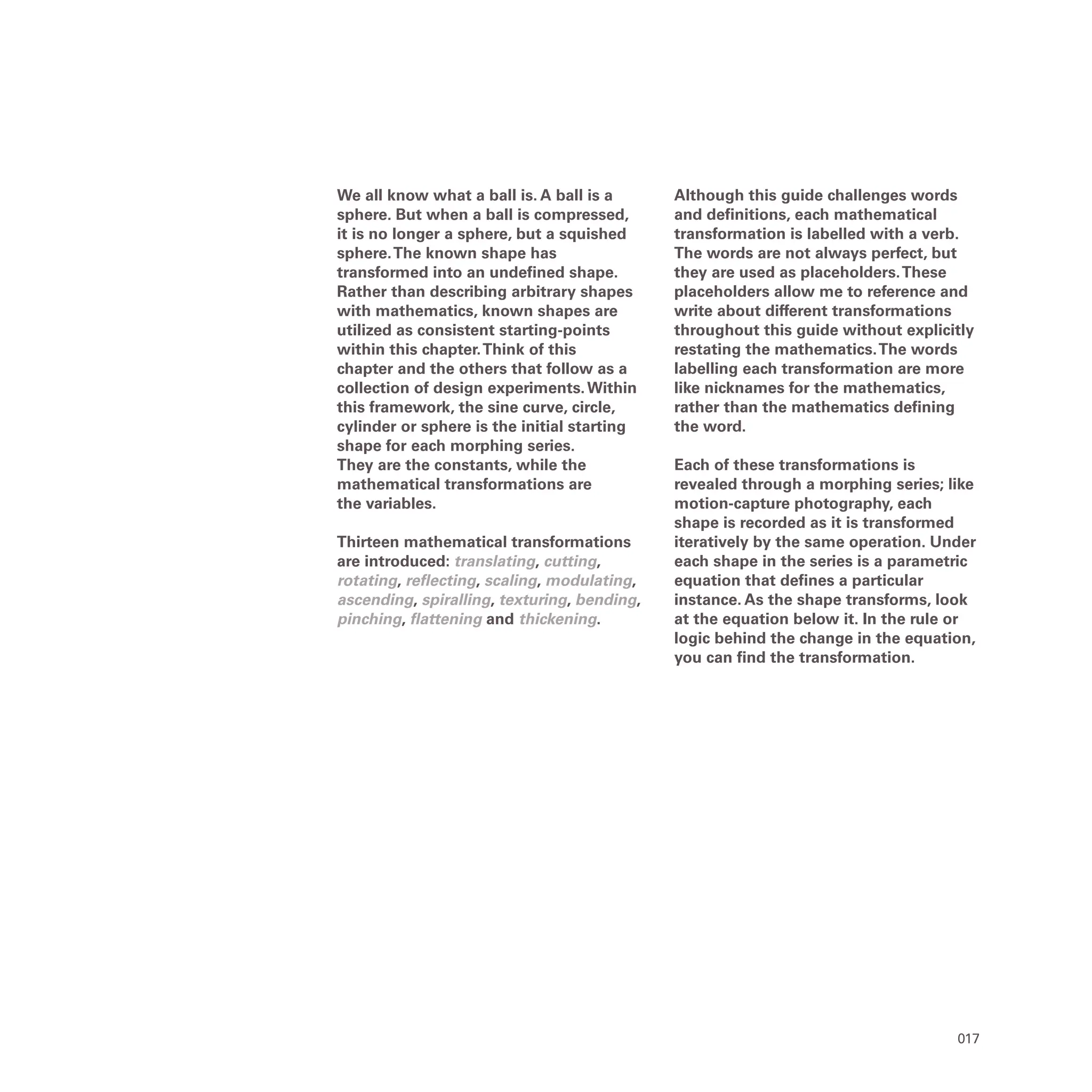
We all know what a ball is. A ball is a
sphere. But when a ball is compressed,
it is no longer a sphere, but a squished
sphere.The known shape has
transformed into an undefined shape.
Rather than describing arbitrary shapes
with mathematics, known shapes are
utilized as consistent starting-points
within this chapter.Think of this
chapter and the others that follow as a
collection of design experiments.Within
this framework, the sine curve, circle,
cylinder or sphere is the initial starting
shape for each morphing series.
They are the constants, while the
mathematical transformations are
the variables.
Thirteen mathematical transformations
are introduced: translating, cutting,
rotating, reflecting, scaling, modulating,
ascending, spiralling, texturing, bending,
pinching, flattening and thickening.
Although this guide challenges words
and definitions, each mathematical
transformation is labelled with a verb.
The words are not always perfect, but
they are used as placeholders.These
placeholders allow me to reference and
write about different transformations
throughout this guide without explicitly
restating the mathematics.The words
labelling each transformation are more
like nicknames for the mathematics,
rather than the mathematics defining
the word.
Each of these transformations is
revealed through a morphing series; like
motion-capture photography, each
shape is recorded as it is transformed
iteratively by the same operation. Under
each shape in the series is a parametric
equation that defines a particular
instance. As the shape transforms, look
at the equation below it. In the rule or
logic behind the change in the equation,
you can find the transformation.
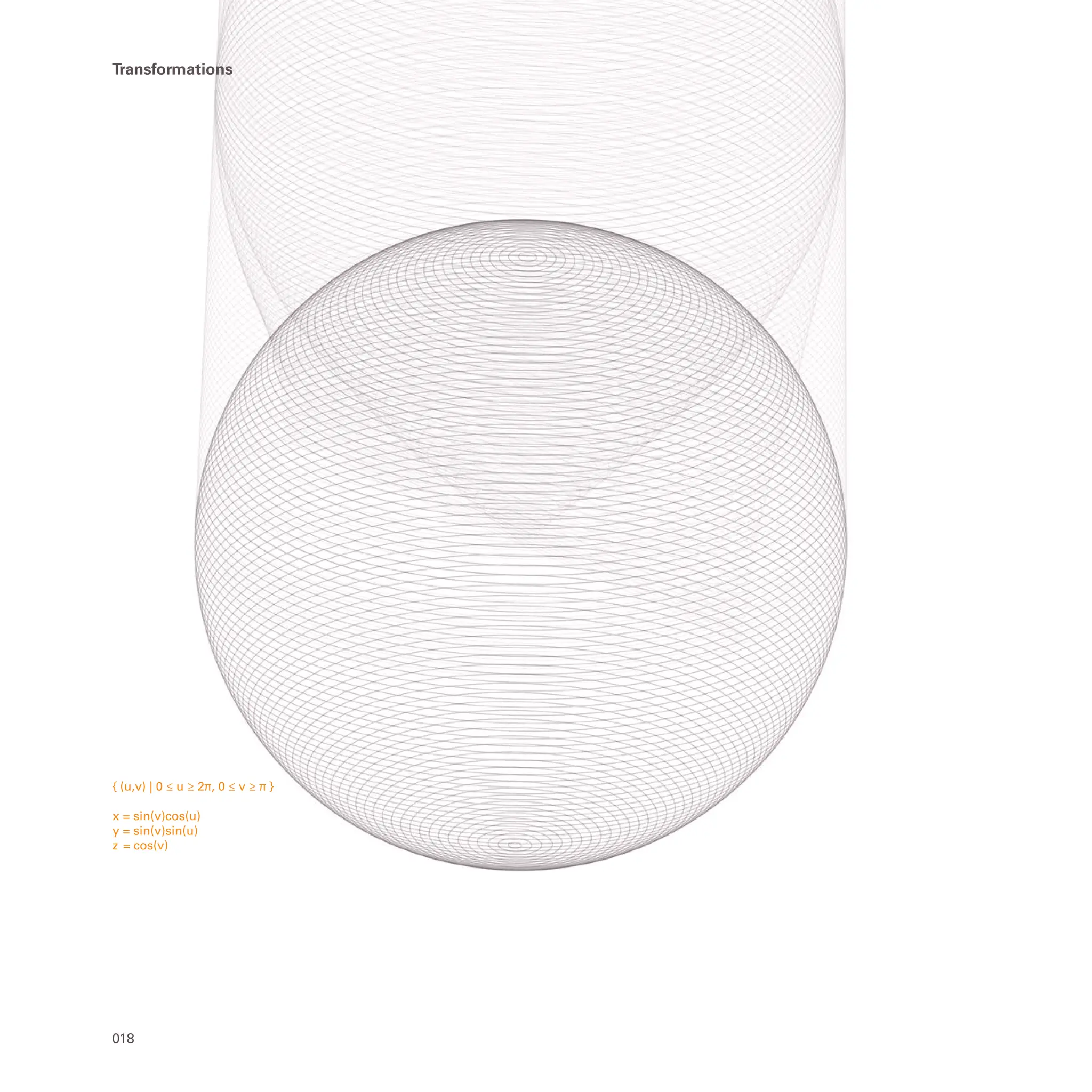
{ (u,v) | 0 ≤ u ≥ 2π, 0 ≤ v ≥ π }
x = sin(v)cos(u)
y = sin(v)sin(u)
z = cos(v)
018
Transformations
019
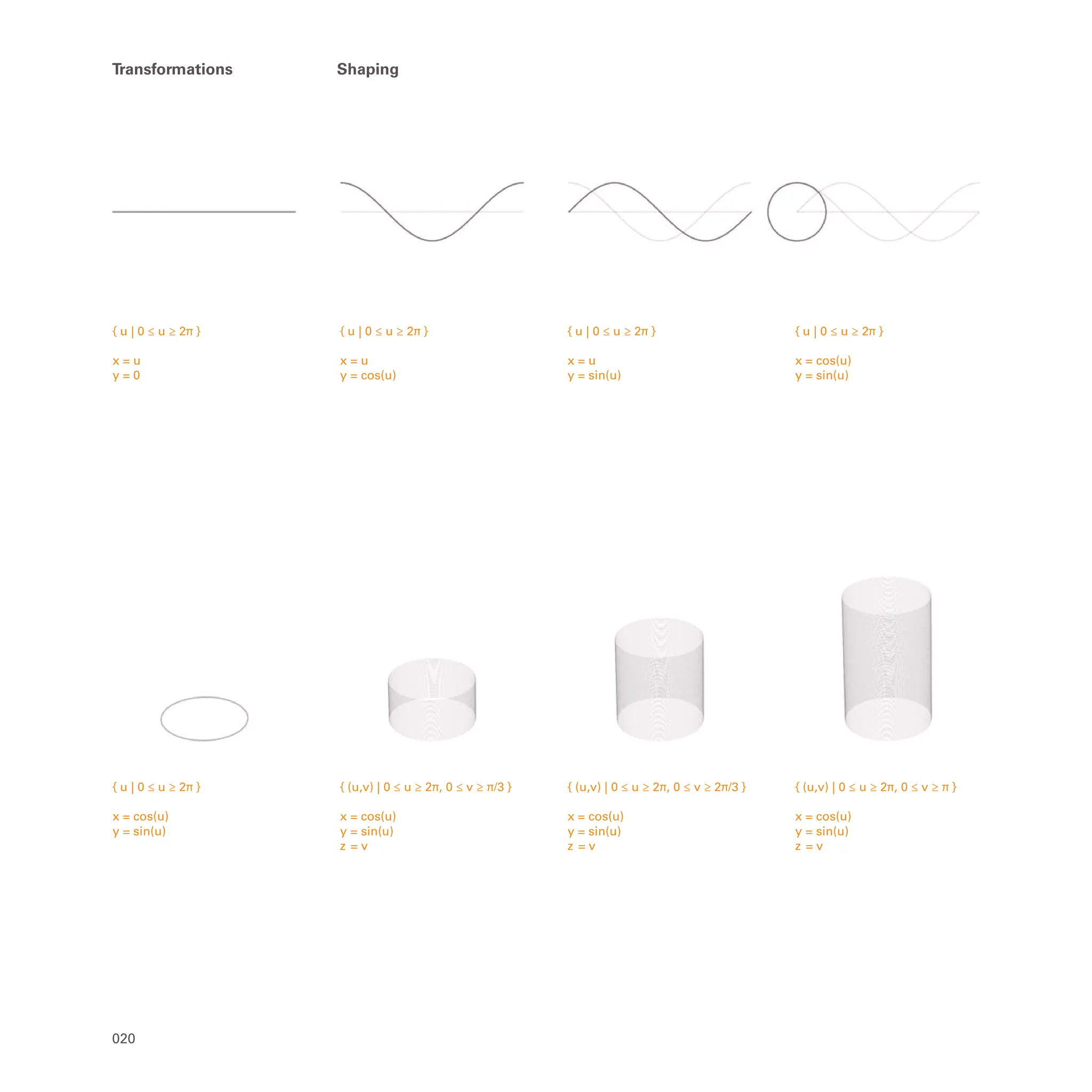
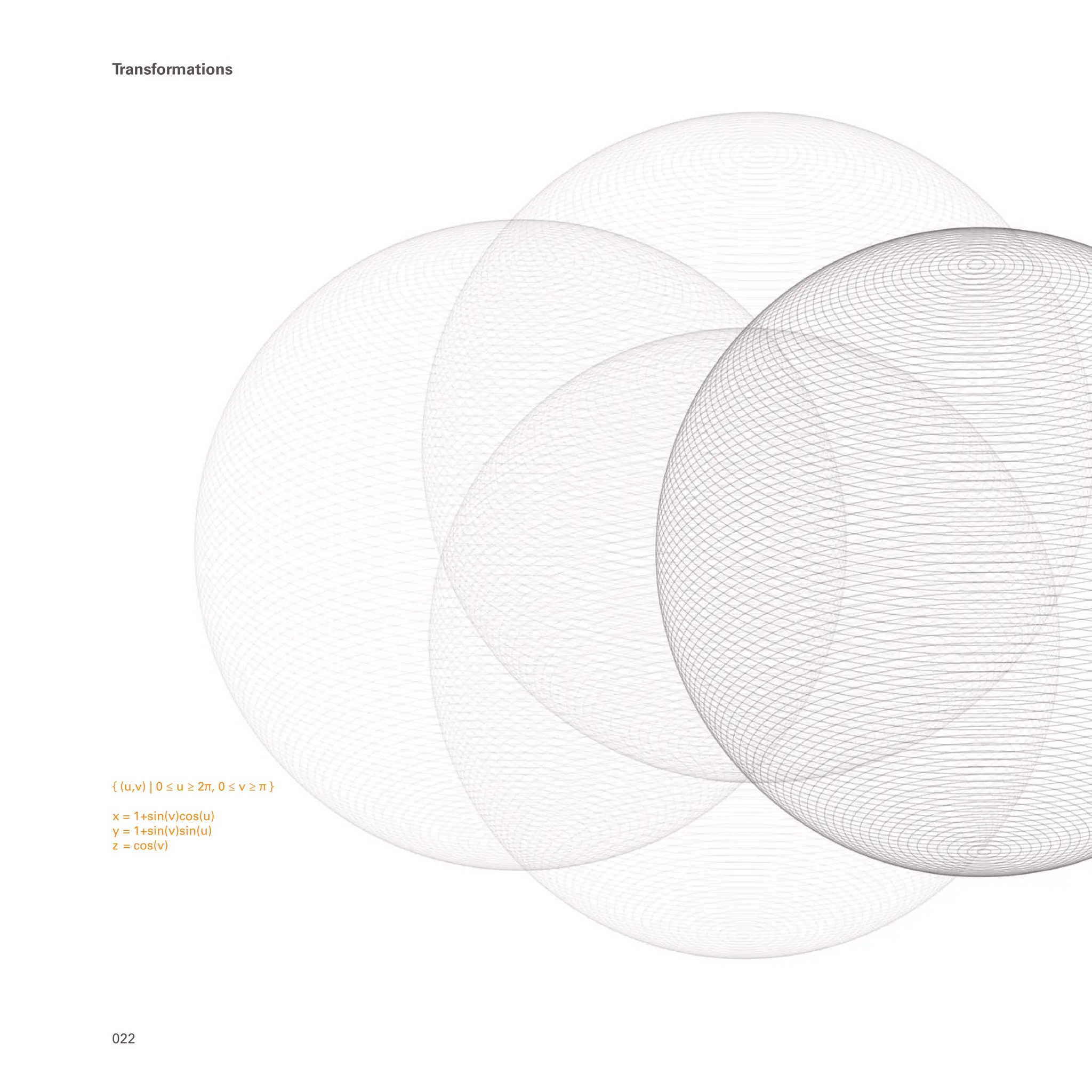
Within shaping, the four starting shapes are introduced:
a sine curve, circle, cylinder and sphere. A sine curve and circle
are defined with two coordinates (x, y), while three-dimensional
shapes (cylinder and sphere) are defined by x, y and z.
A sine curve is simply defined by a function of sine and the
u-parameter. A circle is defined by a function of sine and cosine.
The v-parameter allows the circle to transform into a surface:
a cylinder is an extruded circle, or a circle with a z-coordinate
value of v. A cylinder can easily morph into a helix, helicoid,
cone or sphere.
Shaping
{ u | 0 ≤ u ≥ 2π }
x = cos(u)
y = sin(u)
{ (u,v) | 0 ≤ u ≥ 2π, 0 ≤ v ≥ π/3 }
x = cos(u)
y = sin(u)
z = v
{ (u,v) | 0 ≤ u ≥ 2π, 0 ≤ v ≥ 2π/3 }
x = cos(u)
y = sin(u)
z = v
{ (u,v) | 0 ≤ u ≥ 2π, 0 ≤ v ≥ π }
x = cos(u)
y = sin(u)
z = v
{ u | 0 ≤ u ≥ 2π }
x = cos(u)
y = sin(u)
{ u | 0 ≤ u ≥ 2π }
x = u
y = sin(u)
{ u | 0 ≤ u ≥ 2π }
x = u
y = cos(u)
{ u | 0 ≤ u ≥ 2π }
x = u
y = 0
020
Transformations Shaping
{ (u,v) | 0 ≤ u ≥ 2π, 0 ≤ v ≥ π }
x = sin(v)cos(u)
y = sin(v)sin(u)
z = cos(v)
{ (u,v) | 0 ≤ u ≥ 2π, 0 ≤ v ≥ π }
x = sin(v)cos(u)
y = sin(v)sin(u)
z = v
{ (u,v) | 0 ≤ u ≥ 2π, 0 ≤ v ≥ π }
x = sin(v)cos(u)
y = sin(u)
z = v
{ (u,v) | 0 ≤ u ≥ 2π, 0 ≤ v ≥ π }
x = cos(u)
y = sin(u)
z = v
{ (u,v) | 0 ≤ u ≥ 2π, 0 ≤ v ≥ π }
x = v(cos(u))
y = v(sin(u))
z = v
{ (u,v) | 0 ≤ u ≥ 2π, 0 ≤ v ≥ π }
x = v(cos(u))
y = v(sin(u))
z = u
{ (u,v) | 0 ≤ u ≥ 2π, 0 ≤ v ≥ π }
x = cos(u)
y = sin(u)
z = u
{ (u,v) | 0 ≤ u ≥ 2π, 0 ≤ v ≥ π }
x = cos(u)
y = sin(u)
z = v
021
{ (u,v) | 0 ≤ u ≥ 2π, 0 ≤ v ≥ π }
x = 1+sin(v)cos(u)
y = 1+sin(v)sin(u)
z = cos(v)
022
Transformations
023
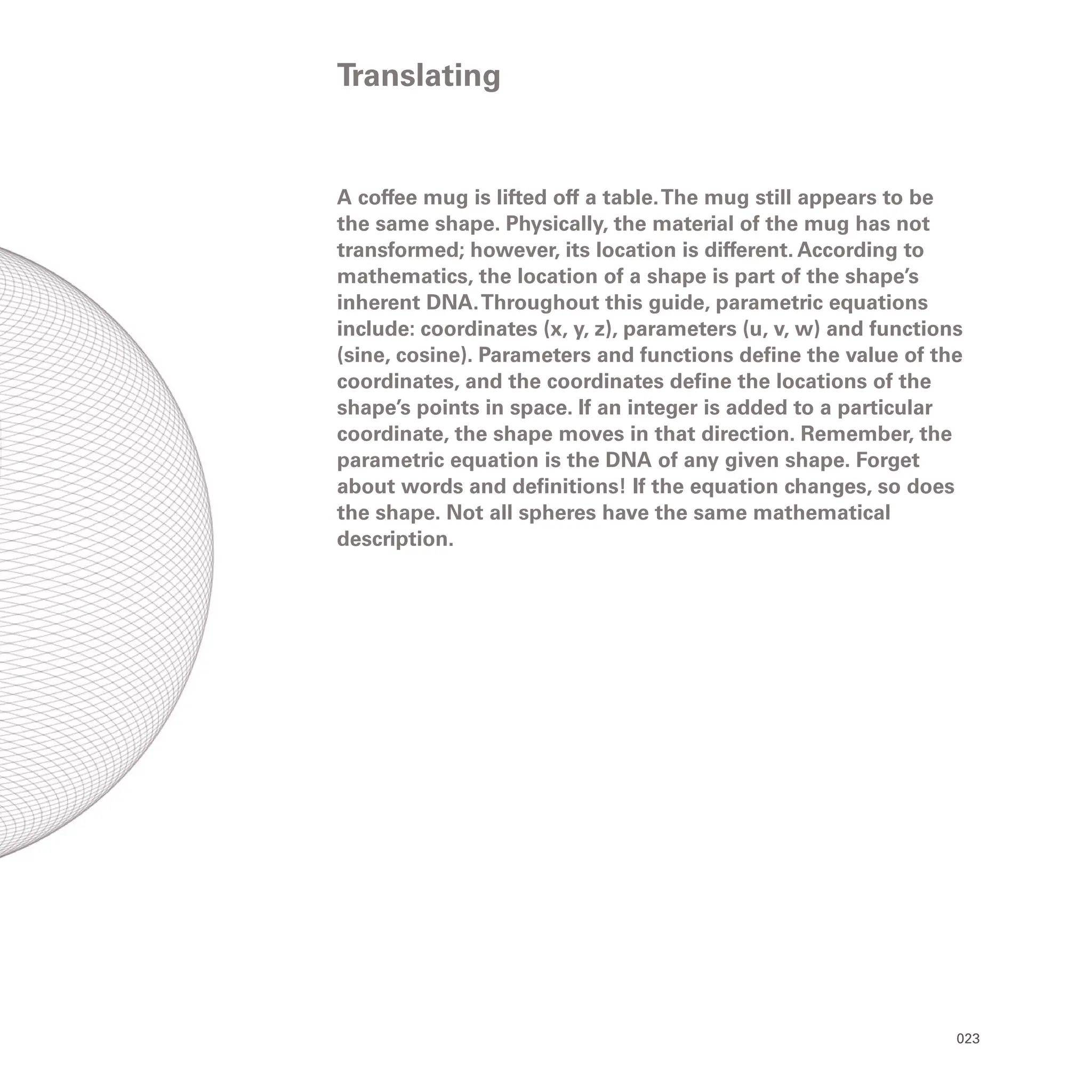
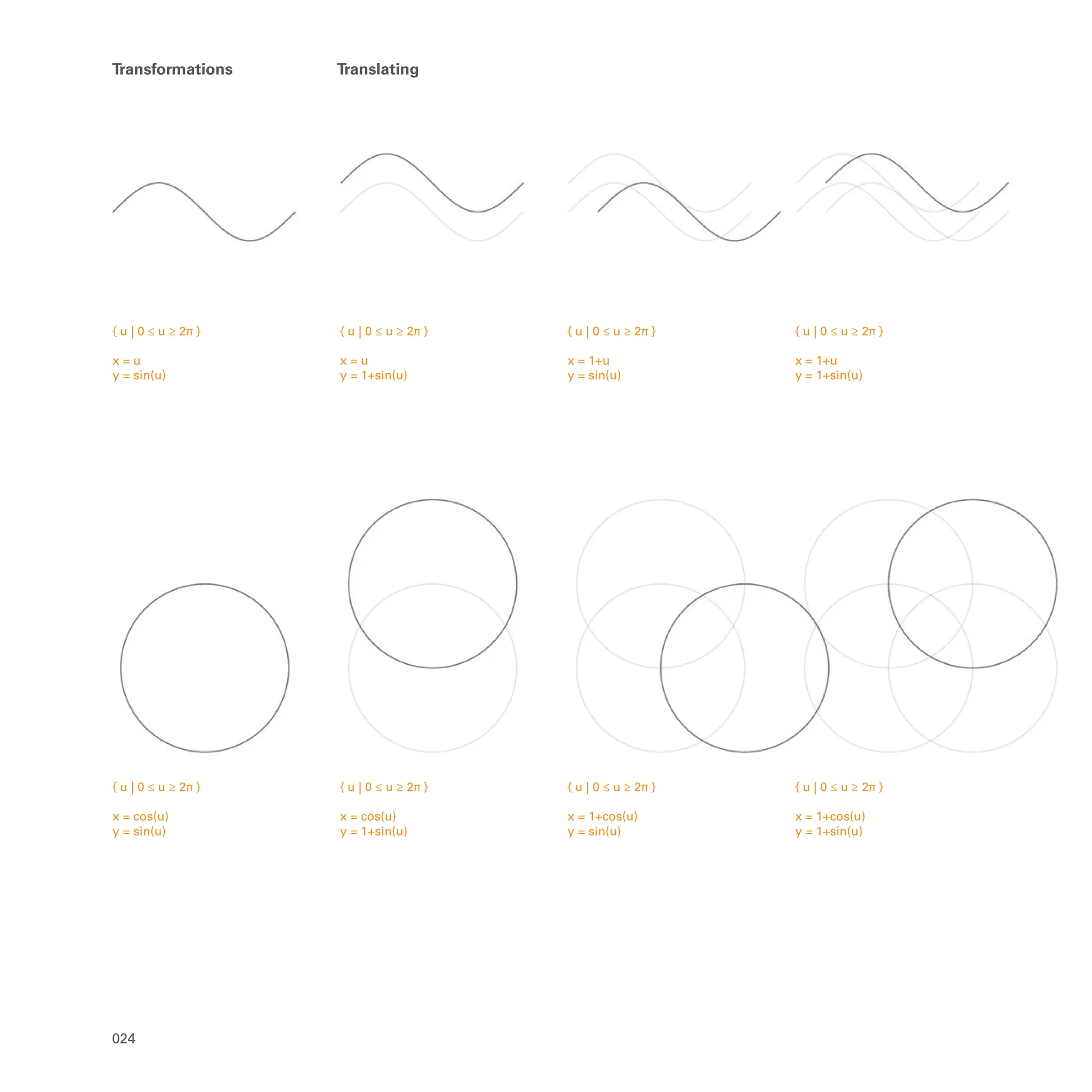
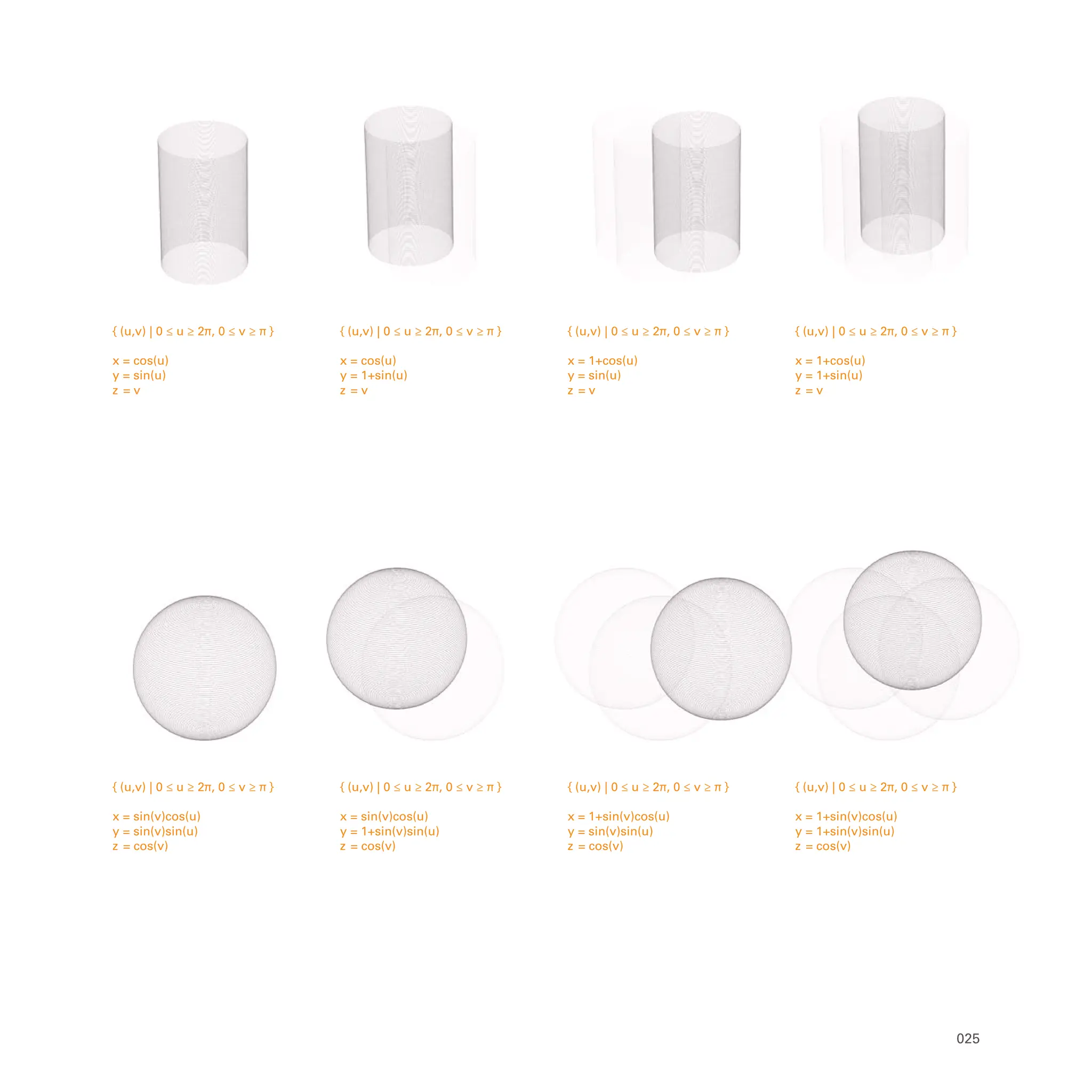
A coffee mug is lifted off a table.The mug still appears to be
the same shape. Physically, the material of the mug has not
transformed; however, its location is different. According to
mathematics, the location of a shape is part of the shape’s
inherent DNA.Throughout this guide, parametric equations
include: coordinates (x, y, z), parameters (u, v, w) and functions
(sine, cosine). Parameters and functions define the value of the
coordinates, and the coordinates define the locations of the
shape’s points in space. If an integer is added to a particular
coordinate, the shape moves in that direction. Remember, the
parametric equation is the DNA of any given shape. Forget
about words and definitions! If the equation changes, so does
the shape. Not all spheres have the same mathematical
description.
Translating
{ u | 0 ≤ u ≥ 2π }
x = cos(u)
y = sin(u)
{ u | 0 ≤ u ≥ 2π }
x = cos(u)
y = 1+sin(u)
{ u | 0 ≤ u ≥ 2π }
x = 1+cos(u)
y = sin(u)
{ u | 0 ≤ u ≥ 2π }
x = 1+cos(u)
y = 1+sin(u)
{ u | 0 ≤ u ≥ 2π }
x = 1+u
y = 1+sin(u)
{ u | 0 ≤ u ≥ 2π }
x = 1+u
y = sin(u)
{ u | 0 ≤ u ≥ 2π }
x = u
y = 1+sin(u)
{ u | 0 ≤ u ≥ 2π }
x = u
y = sin(u)
024
Transformations Translating
{ (u,v) | 0 ≤ u ≥ 2π, 0 ≤ v ≥ π }
x = 1+sin(v)cos(u)
y = 1+sin(v)sin(u)
z = cos(v)
{ (u,v) | 0 ≤ u ≥ 2π, 0 ≤ v ≥ π }
x = 1+sin(v)cos(u)
y = sin(v)sin(u)
z = cos(v)
{ (u,v) | 0 ≤ u ≥ 2π, 0 ≤ v ≥ π }
x = sin(v)cos(u)
y = 1+sin(v)sin(u)
z = cos(v)
{ (u,v) | 0 ≤ u ≥ 2π, 0 ≤ v ≥ π }
x = sin(v)cos(u)
y = sin(v)sin(u)
z = cos(v)
{ (u,v) | 0 ≤ u ≥ 2π, 0 ≤ v ≥ π }
x = 1+cos(u)
y = 1+sin(u)
z = v
{ (u,v) | 0 ≤ u ≥ 2π, 0 ≤ v ≥ π }
x = 1+cos(u)
y = sin(u)
z = v
{ (u,v) | 0 ≤ u ≥ 2π, 0 ≤ v ≥ π }
x = cos(u)
y = 1+sin(u)
z = v
{ (u,v) | 0 ≤ u ≥ 2π, 0 ≤ v ≥ π }
x = cos(u)
y = sin(u)
z = v
025
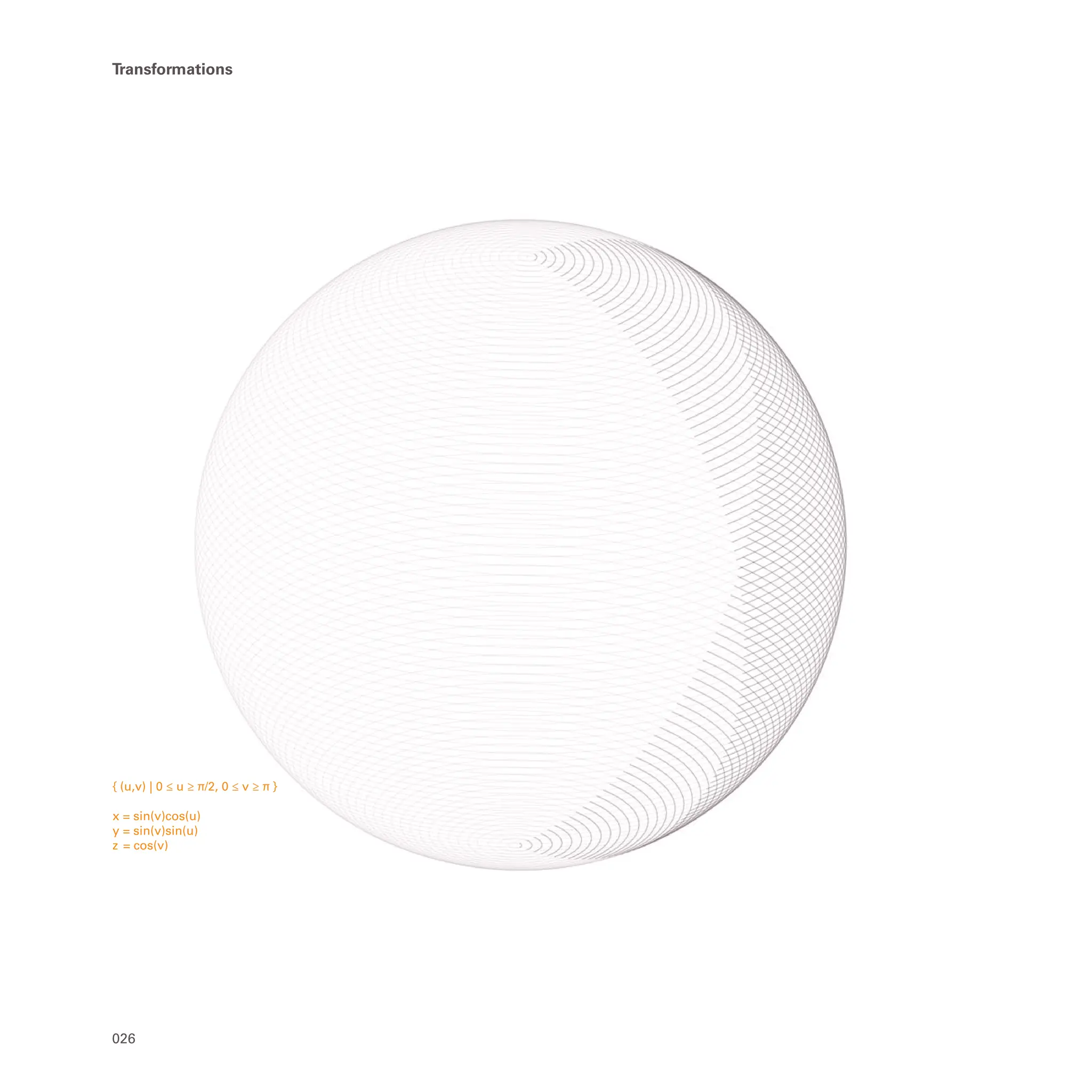
{ (u,v) | 0 ≤ u ≥ π/2, 0 ≤ v ≥ π }
x = sin(v)cos(u)
y = sin(v)sin(u)
z = cos(v)
026
Transformations
027
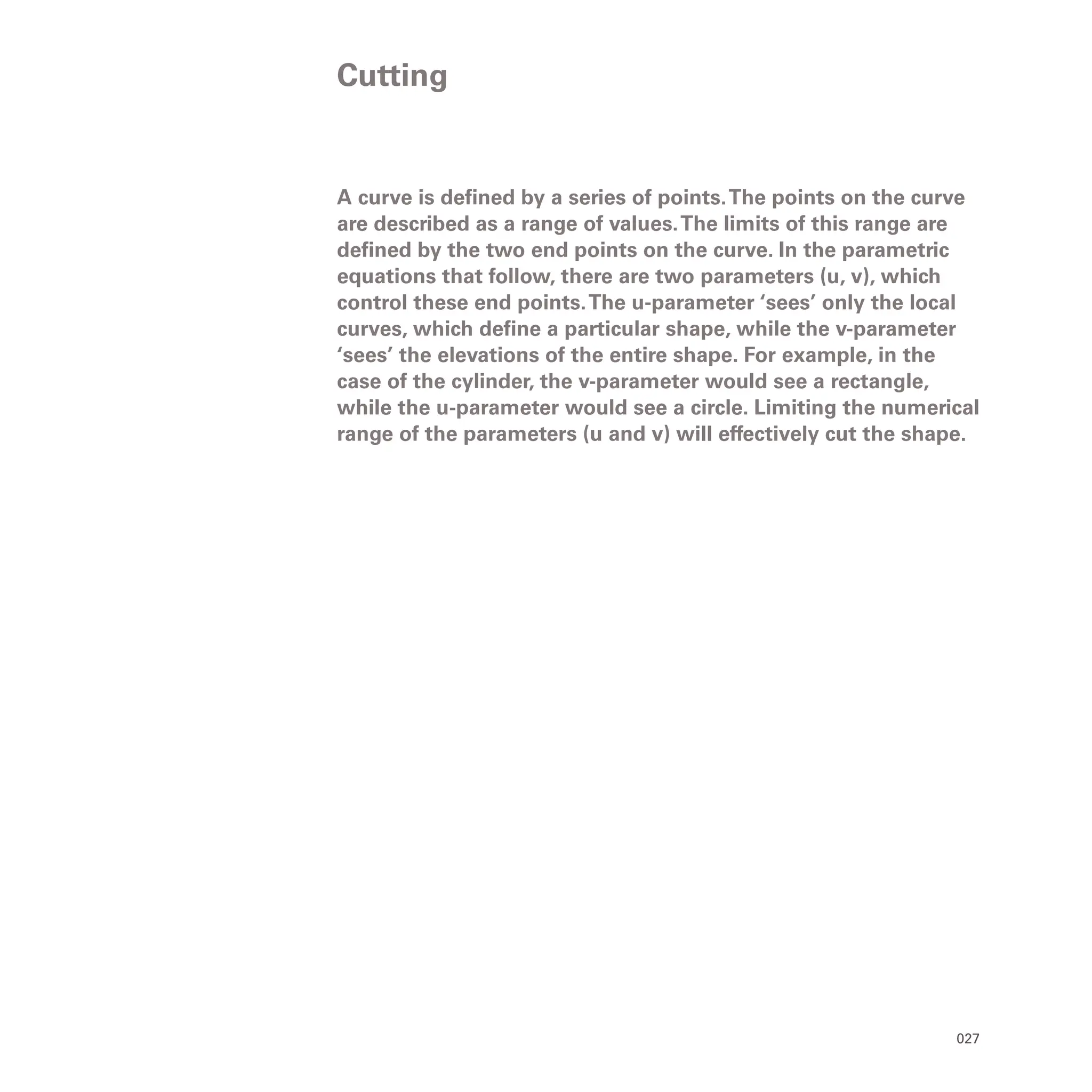
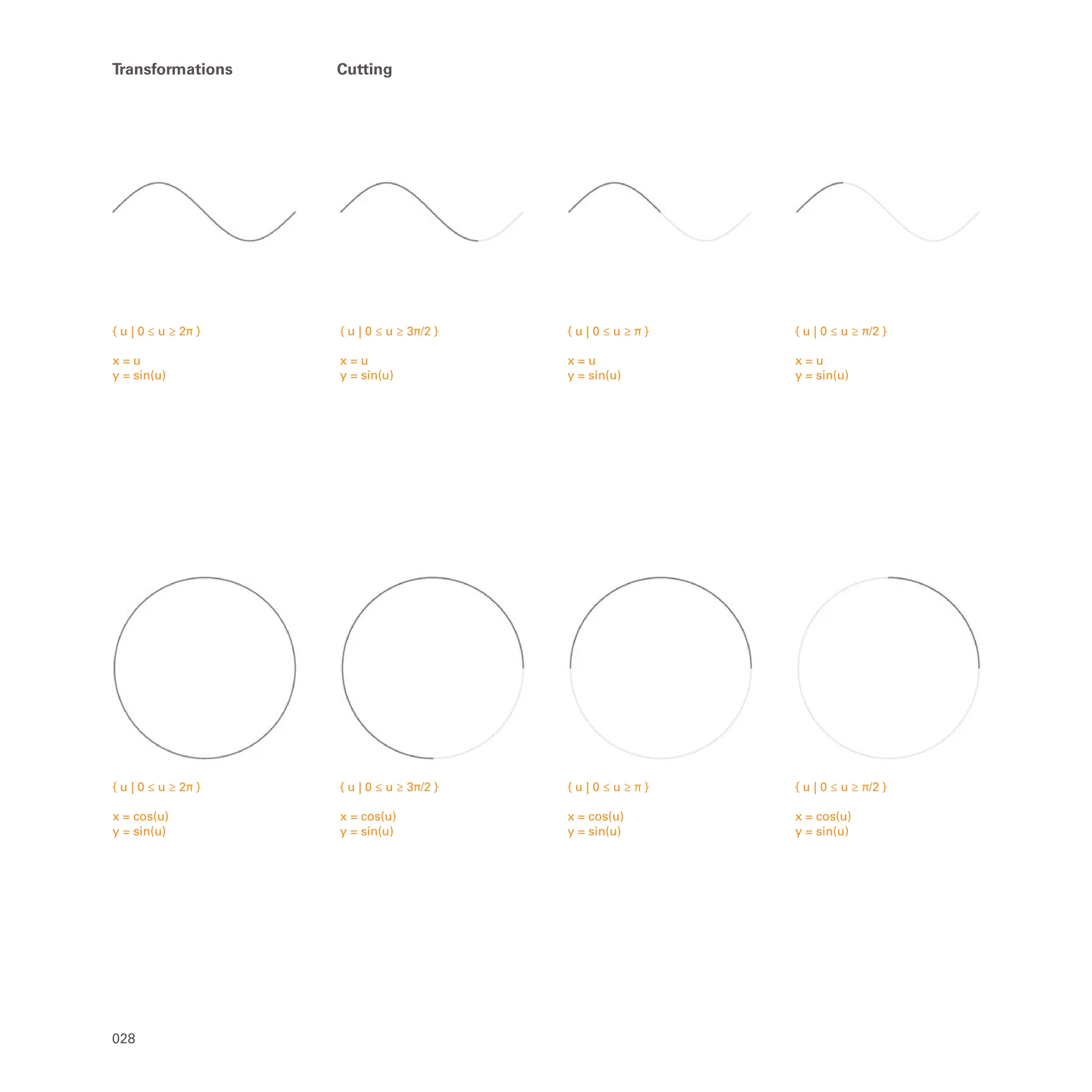
A curve is defined by a series of points.The points on the curve
are described as a range of values.The limits of this range are
defined by the two end points on the curve. In the parametric
equations that follow, there are two parameters (u, v), which
control these end points.The u-parameter ‘sees’ only the local
curves, which define a particular shape, while the v-parameter
‘sees’ the elevations of the entire shape. For example, in the
case of the cylinder, the v-parameter would see a rectangle,
while the u-parameter would see a circle. Limiting the numerical
range of the parameters (u and v) will effectively cut the shape.
Cutting
{ u | 0 ≤ u ≥ 2π }
x = cos(u)
y = sin(u)
{ u | 0 ≤ u ≥ 3π/2 }
x = cos(u)
y = sin(u)
{ u | 0 ≤ u ≥ π }
x = cos(u)
y = sin(u)
{ u | 0 ≤ u ≥ π/2 }
x = cos(u)
y = sin(u)
{ u | 0 ≤ u ≥ π/2 }
x = u
y = sin(u)
{ u | 0 ≤ u ≥ π }
x = u
y = sin(u)
{ u | 0 ≤ u ≥ 3π/2 }
x = u
y = sin(u)
{ u | 0 ≤ u ≥ 2π }
x = u
y = sin(u)
028
Transformations Cutting
{ (u,v) | 0 ≤ u ≥ π/2, 0 ≤ v ≥ π }
x = sin(v)cos(u)
y = sin(v)sin(u)
z = cos(v)
{ (u,v) | 0 ≤ u ≥ π, 0 ≤ v ≥ π }
x = sin(v)cos(u)
y = sin(v)sin(u)
z = cos(v)
{ (u,v) | 0 ≤ u ≥ 3π/2, 0 ≤ v ≥ π }
x = sin(v)cos(u)
y = sin(v)sin(u)
z = cos(v)
{ (u,v) | 0 ≤ u ≥ 2π, 0 ≤ v ≥ π }
x = sin(v)cos(u)
y = sin(v)sin(u)
z = cos(v)
{ (u,v) | 0 ≤ u ≥ π/2, 0 ≤ v ≥ π }
x = cos(u)
y = sin(u)
z = v
{ (u,v) | 0 ≤ u ≥ π, 0 ≤ v ≥ π }
x = cos(u)
y = sin(u)
z = v
{ (u,v) | 0 ≤ u ≥ 3π/2, 0 ≤ v ≥ π }
x = cos(u)
y = sin(u)
z = v
{ (u,v) | 0 ≤ u ≥ 2π, 0 ≤ v ≥ π }
x = cos(u)
y = sin(u)
z = v
029
{ (u,v) | 0 ≤ u ≥ π, 0 ≤ v ≥ π }
x = sin(v)cos(u)
y = cos(π/2)sin(v)sin(u)-sin(π/2)cos(v)
z = sin(π/2)sin(v)sin(u)+cos(π/2)cos(v)
030
Transformations
031
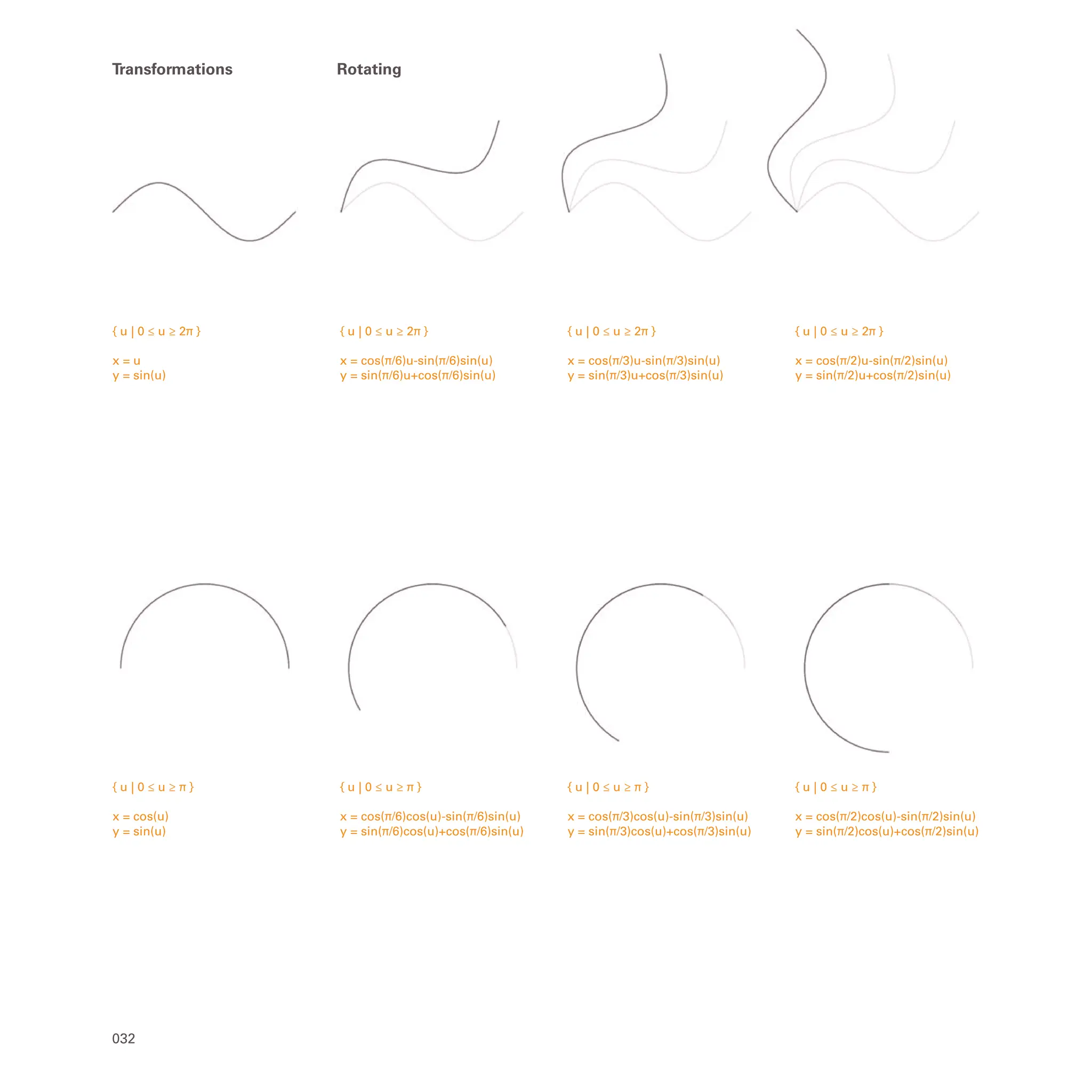
In order to rotate a shape within most software, a rotational
axis must first be defined. Similarly, within mathematics, an
initial geometry is ‘plugged into’ a rotation matrix. Below are a
series of templates to rotate a shape around each axis (x, y, z).
The xa
,ya
, za
within each of the templates below are the initial
descriptions of the original shape, prior to its rotation. For
example, a cylinder is defined by a parametric equation where
xa
= cos(u), ya
= sin(u), and za
= v.To rotate the cylinder, insert
each of these definitions into the templates below.
Typically, we speak and think about rotation in terms of
degrees, not radians.This guide has been written in radians,
but it is easy to move between the two units. Some
common conversions between degrees and radians include:
30 degrees = π/6 radians, 45 degrees = π/4 radians,
60 degrees = π/3 radians, 90 degrees = π/2 radians,
120 degrees = 2π/3 radians, 135 degrees = 3π/4 radians,
150 degrees = 5π/6 radians, 180 degrees = π radians.
Each of the templates below rotates a shape by
π/2 radians (90 degrees).
Rotating
Rotating around z-axis
x = cos(π/2)xa
-sin(π/2)ya
y = sin(π/2)xa
+cos(π/2)ya
z = za
Rotating around y-axis
x = cos(π/2)xa
+sin(π/2)za
y = ya
z = -sin(π/2)xa
+cos(π/2)za
Rotating around x-axis
x = xa
y = cos(π/2)ya
-sin(π/2)za
z = sin(π/2)ya
+cos(π/2)za
{ u | 0 ≤ u ≥ π }
x = cos(u)
y = sin(u)
{ u | 0 ≤ u ≥ π }
x = cos(π/6)cos(u)-sin(π/6)sin(u)
y = sin(π/6)cos(u)+cos(π/6)sin(u)
{ u | 0 ≤ u ≥ π }
x = cos(π/3)cos(u)-sin(π/3)sin(u)
y = sin(π/3)cos(u)+cos(π/3)sin(u)
{ u | 0 ≤ u ≥ π }
x = cos(π/2)cos(u)-sin(π/2)sin(u)
y = sin(π/2)cos(u)+cos(π/2)sin(u)
{ u | 0 ≤ u ≥ 2π }
x = cos(π/2)u-sin(π/2)sin(u)
y = sin(π/2)u+cos(π/2)sin(u)
{ u | 0 ≤ u ≥ 2π }
x = cos(π/3)u-sin(π/3)sin(u)
y = sin(π/3)u+cos(π/3)sin(u)
{ u | 0 ≤ u ≥ 2π }
x = cos(π/6)u-sin(π/6)sin(u)
y = sin(π/6)u+cos(π/6)sin(u)
{ u | 0 ≤ u ≥ 2π }
x = u
y = sin(u)
032
Transformations Rotating
{ (u,v) | 0 ≤ u ≥ π, 0 ≤ v ≥ π }
x = sin(v)cos(u)
y = cos(π/2)sin(v)sin(u)-sin(π/2)cos(v)
z = sin(π/2)sin(v)sin(u)+cos(π/2)cos(v)
{ (u,v) | 0 ≤ u ≥ π, 0 ≤ v ≥ π }
x = sin(v)cos(u)
y = cos(π/3)sin(v)sin(u)-sin(π/3)cos(v)
z = sin(π/3)sin(v)sin(u)+cos(π/3)cos(v)
{ (u,v) | 0 ≤ u ≥ π, 0 ≤ v ≥ π }
x = sin(v)cos(u)
y = cos(π/6)sin(v)sin(u)-sin(π/6)cos(v)
z = sin(π/6)sin(v)sin(u)+cos(π/6)cos(v)
{ (u,v) | 0 ≤ u ≥ π, 0 ≤ v ≥ π }
x = sin(v)cos(u)
y = sin(v)sin(u)
z = cos(v)
{ (u,v) | 0 ≤ u ≥ 2π, 0 ≤ v ≥ π }
x = cos(u)
y = cos(π/2)sin(u)-sin(π/2)v
z = sin(π/2)sin(u)+cos(π/2)v
{ (u,v) | 0 ≤ u ≥ 2π, 0 ≤ v ≥ π }
x = cos(u)
y = cos(π/3)sin(u)-sin(π/3)v
z = sin(π/3)sin(u)+cos(π/3)v
{ (u,v) | 0 ≤ u ≥ 2π, 0 ≤ v ≥ π }
x = cos(u)
y = cos(π/6)sin(u)-sin(π/6)v
z = sin(π/6)sin(u)+cos(π/6)v
{ (u,v) | 0 ≤ u ≥ 2π, 0 ≤ v ≥ π }
x = cos(u)
y = sin(u)
z = v
033
{ (u,v) | 0 ≤ u ≥ π, π/2 ≤ v ≥ π }
x = sin(v)cos(u)
y = cos(π/2)sin(v)sin(u)+sin(π/2)cos(v)
z = sin(π/2)sin(v)sin(u)-cos(π/2)cos(v)
034
Transformations
035
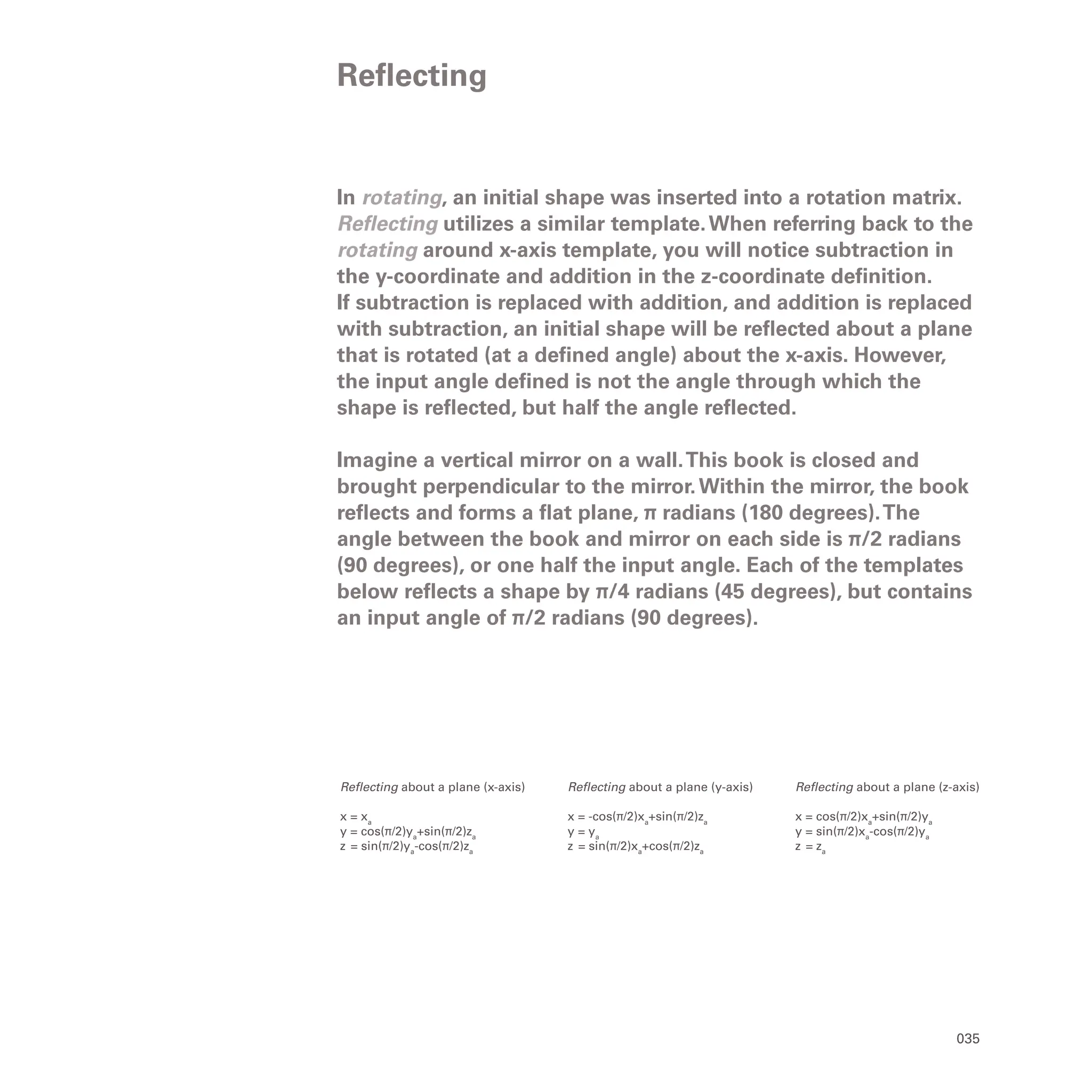
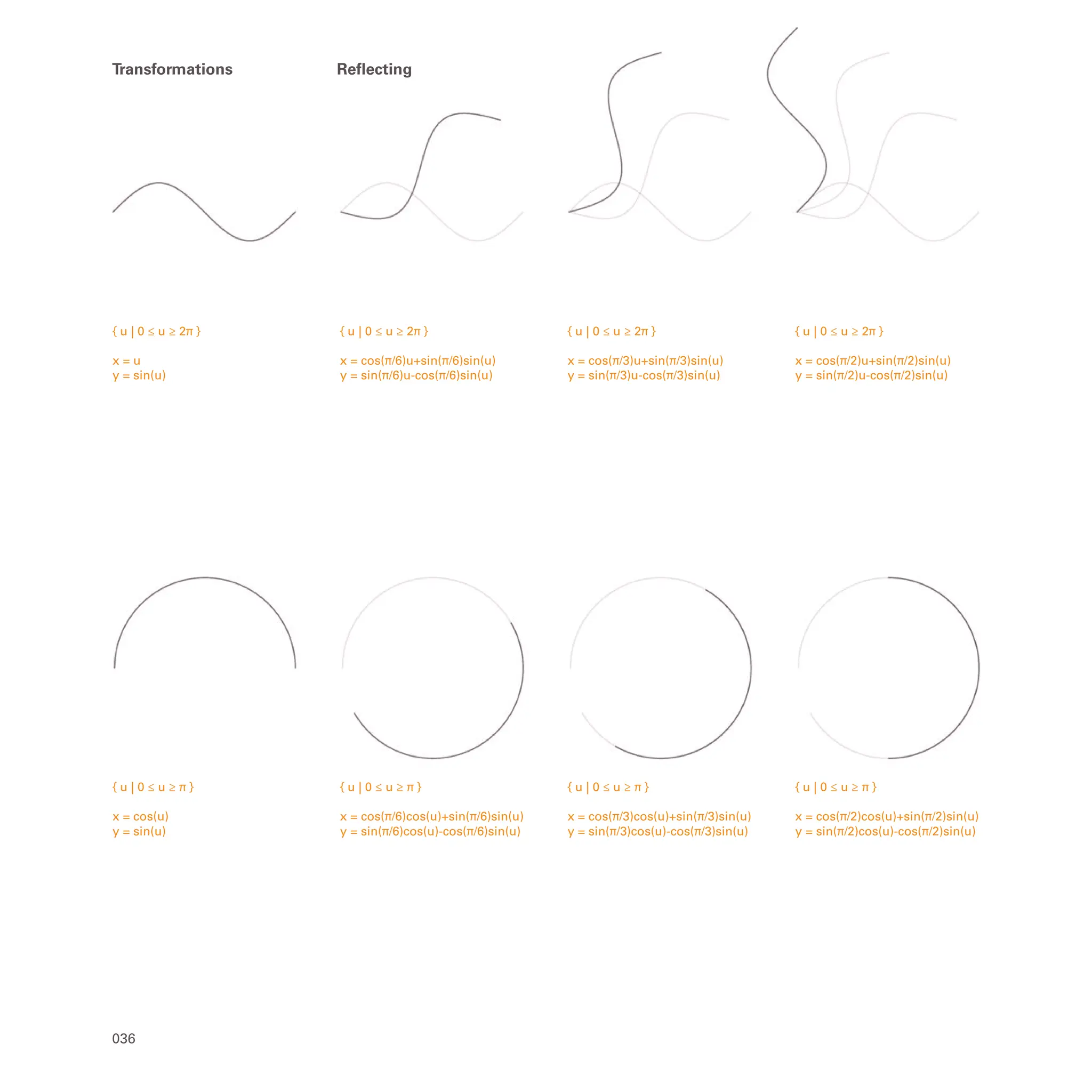
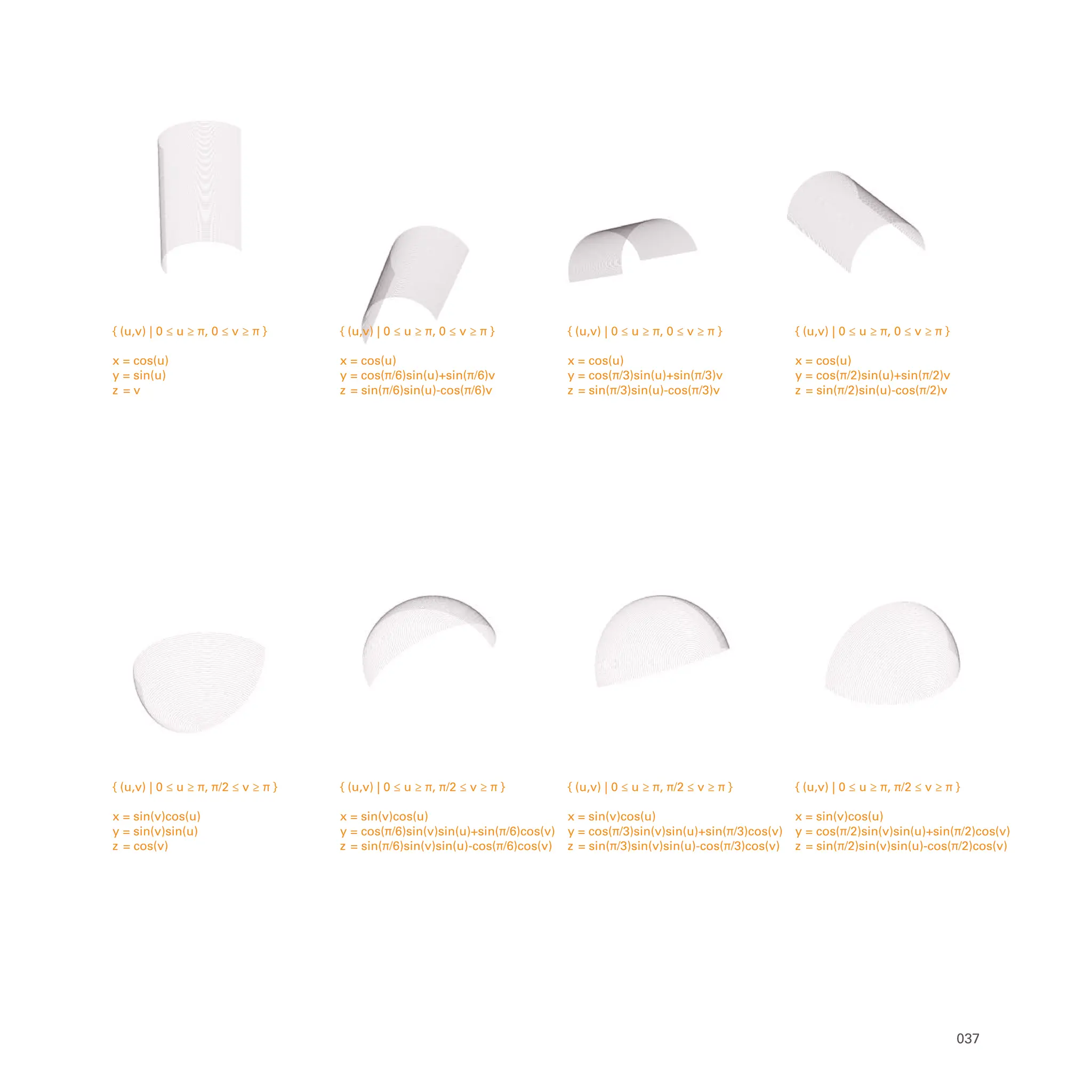
In rotating, an initial shape was inserted into a rotation matrix.
Reflecting utilizes a similar template.When referring back to the
rotating around x-axis template, you will notice subtraction in
the y-coordinate and addition in the z-coordinate definition.
If subtraction is replaced with addition, and addition is replaced
with subtraction, an initial shape will be reflected about a plane
that is rotated (at a defined angle) about the x-axis. However,
the input angle defined is not the angle through which the
shape is reflected, but half the angle reflected.
Imagine a vertical mirror on a wall.This book is closed and
brought perpendicular to the mirror.Within the mirror, the book
reflects and forms a flat plane, π radians (180 degrees).The
angle between the book and mirror on each side is π/2 radians
(90 degrees), or one half the input angle. Each of the templates
below reflects a shape by π/4 radians (45 degrees), but contains
an input angle of π/2 radians (90 degrees).
Reflecting
Reflecting about a plane (z-axis)
x = cos(π/2)xa
+sin(π/2)ya
y = sin(π/2)xa
-cos(π/2)ya
z = za
Reflecting about a plane (y-axis)
x = -cos(π/2)xa
+sin(π/2)za
y = ya
z = sin(π/2)xa
+cos(π/2)za
Reflecting about a plane (x-axis)
x = xa
y = cos(π/2)ya
+sin(π/2)za
z = sin(π/2)ya
-cos(π/2)za
{ u | 0 ≤ u ≥ π }
x = cos(u)
y = sin(u)
{ u | 0 ≤ u ≥ π }
x = cos(π/6)cos(u)+sin(π/6)sin(u)
y = sin(π/6)cos(u)-cos(π/6)sin(u)
{ u | 0 ≤ u ≥ π }
x = cos(π/3)cos(u)+sin(π/3)sin(u)
y = sin(π/3)cos(u)-cos(π/3)sin(u)
{ u | 0 ≤ u ≥ π }
x = cos(π/2)cos(u)+sin(π/2)sin(u)
y = sin(π/2)cos(u)-cos(π/2)sin(u)
{ u | 0 ≤ u ≥ 2π }
x = cos(π/2)u+sin(π/2)sin(u)
y = sin(π/2)u-cos(π/2)sin(u)
{ u | 0 ≤ u ≥ 2π }
x = cos(π/3)u+sin(π/3)sin(u)
y = sin(π/3)u-cos(π/3)sin(u)
{ u | 0 ≤ u ≥ 2π }
x = cos(π/6)u+sin(π/6)sin(u)
y = sin(π/6)u-cos(π/6)sin(u)
{ u | 0 ≤ u ≥ 2π }
x = u
y = sin(u)
036
Transformations Reflecting
{ (u,v) | 0 ≤ u ≥ π, π/2 ≤ v ≥ π }
x = sin(v)cos(u)
y = cos(π/2)sin(v)sin(u)+sin(π/2)cos(v)
z = sin(π/2)sin(v)sin(u)-cos(π/2)cos(v)
{ (u,v) | 0 ≤ u ≥ π, π/2 ≤ v ≥ π }
x = sin(v)cos(u)
y = cos(π/3)sin(v)sin(u)+sin(π/3)cos(v)
z = sin(π/3)sin(v)sin(u)-cos(π/3)cos(v)
{ (u,v) | 0 ≤ u ≥ π, π/2 ≤ v ≥ π }
x = sin(v)cos(u)
y = cos(π/6)sin(v)sin(u)+sin(π/6)cos(v)
z = sin(π/6)sin(v)sin(u)-cos(π/6)cos(v)
{ (u,v) | 0 ≤ u ≥ π, π/2 ≤ v ≥ π }
x = sin(v)cos(u)
y = sin(v)sin(u)
z = cos(v)
{ (u,v) | 0 ≤ u ≥ π, 0 ≤ v ≥ π }
x = cos(u)
y = cos(π/2)sin(u)+sin(π/2)v
z = sin(π/2)sin(u)-cos(π/2)v
{ (u,v) | 0 ≤ u ≥ π, 0 ≤ v ≥ π }
x = cos(u)
y = cos(π/3)sin(u)+sin(π/3)v
z = sin(π/3)sin(u)-cos(π/3)v
{ (u,v) | 0 ≤ u ≥ π, 0 ≤ v ≥ π }
x = cos(u)
y = cos(π/6)sin(u)+sin(π/6)v
z = sin(π/6)sin(u)-cos(π/6)v
{ (u,v) | 0 ≤ u ≥ π, 0 ≤ v ≥ π }
x = cos(u)
y = sin(u)
z = v
037
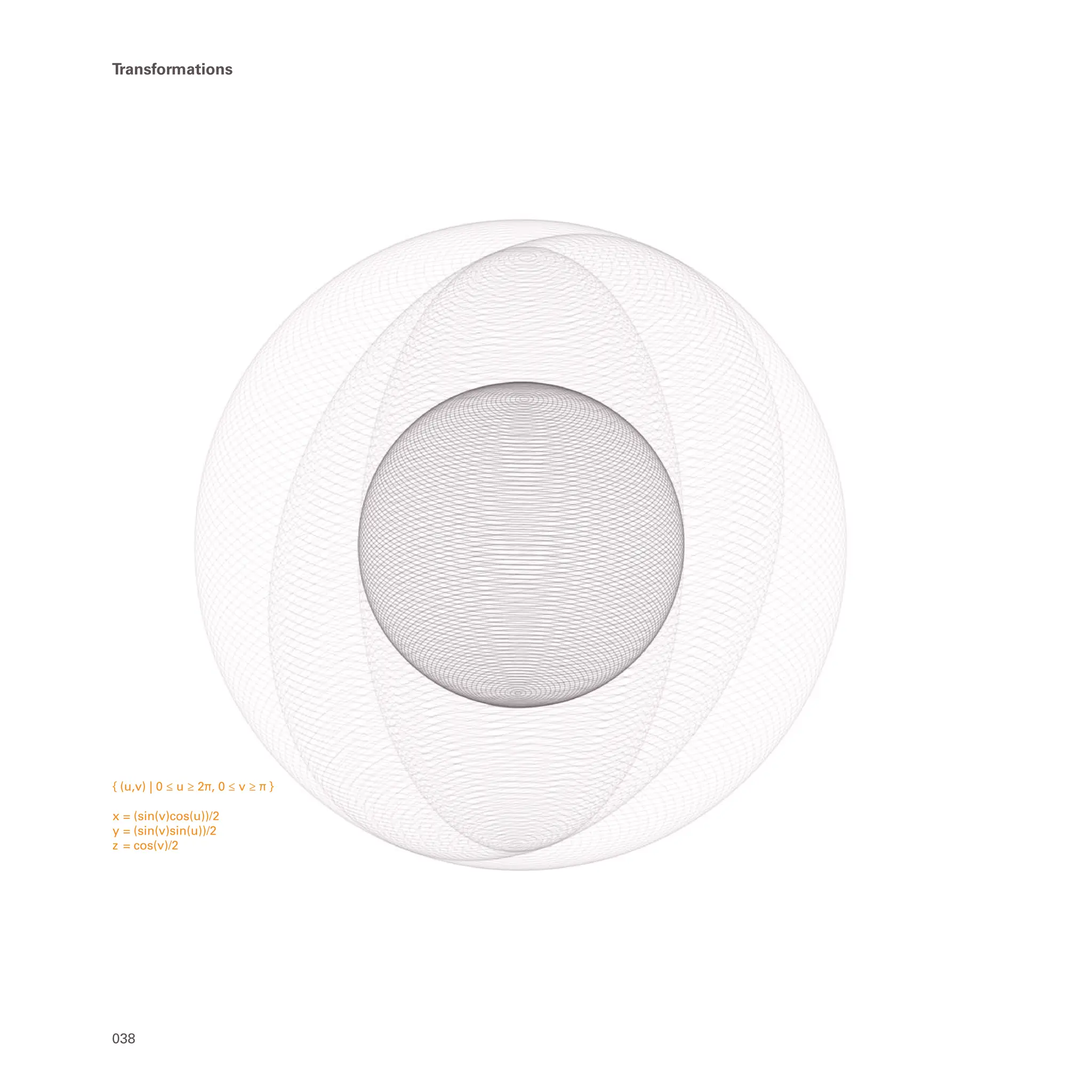
{ (u,v) | 0 ≤ u ≥ 2π, 0 ≤ v ≥ π }
x = (sin(v)cos(u))/2
y = (sin(v)sin(u))/2
z = cos(v)/2
038
Transformations
039
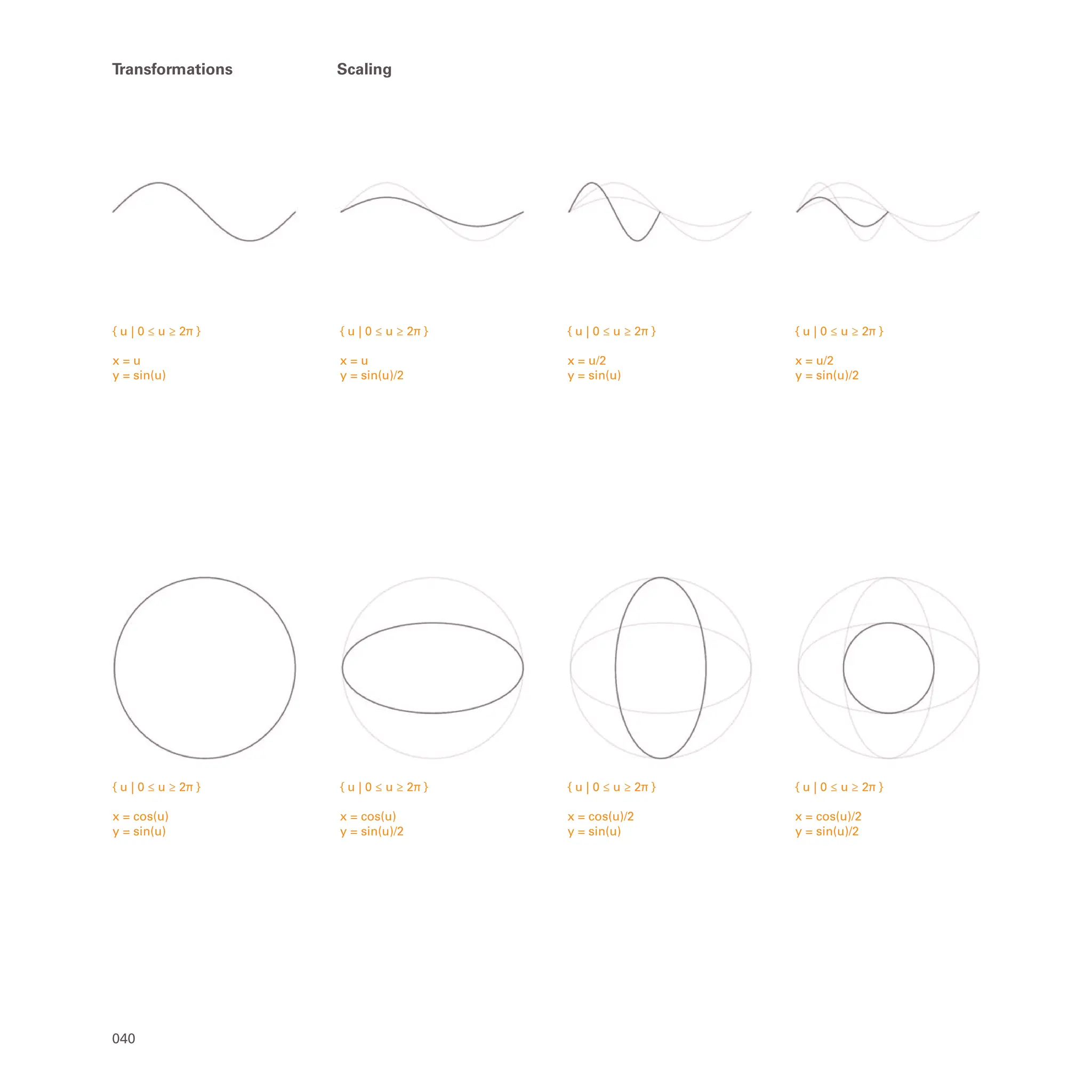
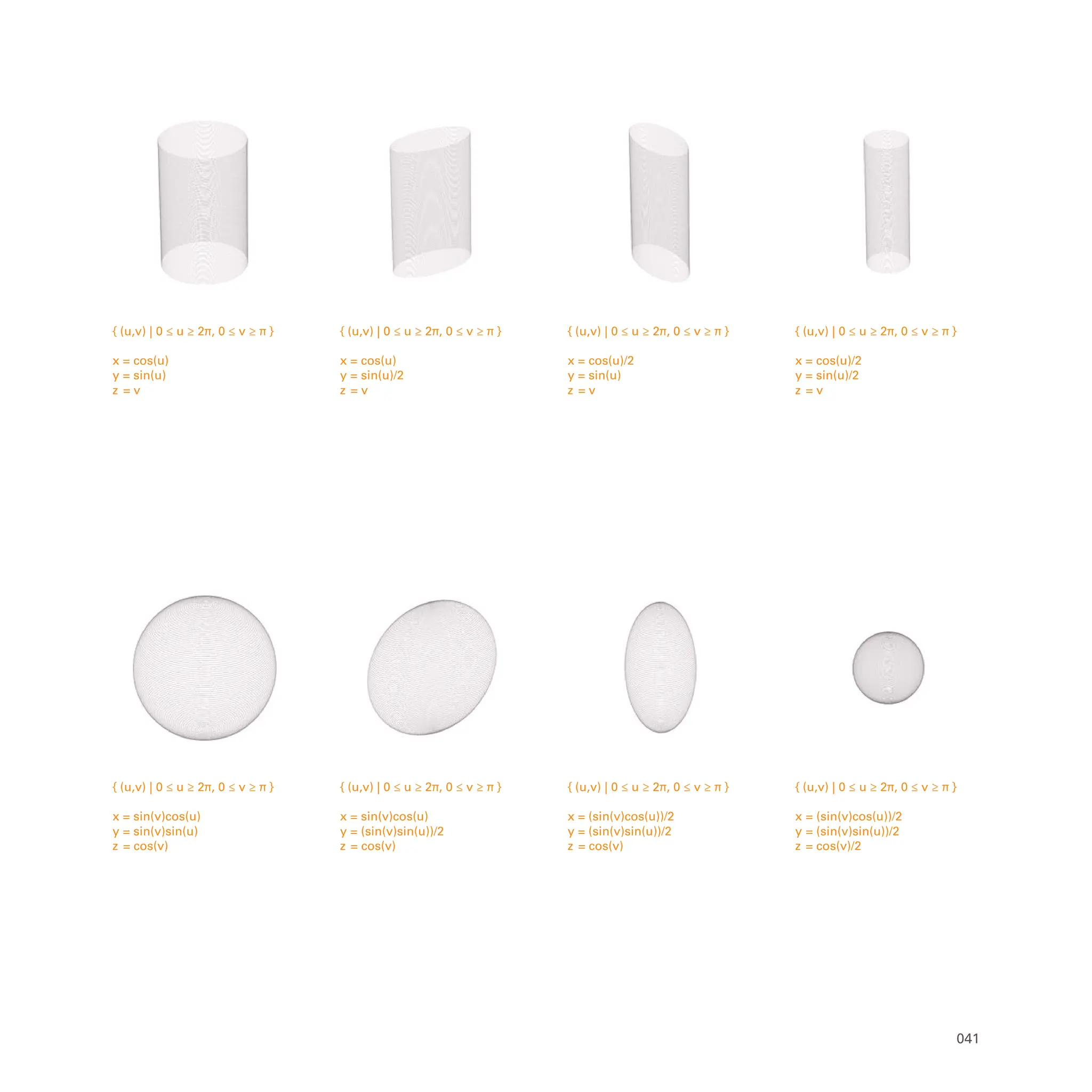
According to basic multiplication, if an integer is multiplied by
another integer, its value increases according to the multiplier.
If an integer is divided by another integer, its value decreases
according to the divider.These same rules apply to scaling
shapes. Multiplying a shape by an integer will scale that shape
accordingly. If only the x-coordinate is multiplied or divided, the
shape will scale only in that axis.
Scaling
{ u | 0 ≤ u ≥ 2π }
x = cos(u)
y = sin(u)
{ u | 0 ≤ u ≥ 2π }
x = cos(u)
y = sin(u)/2
{ u | 0 ≤ u ≥ 2π }
x = cos(u)/2
y = sin(u)
{ u | 0 ≤ u ≥ 2π }
x = cos(u)/2
y = sin(u)/2
{ u | 0 ≤ u ≥ 2π }
x = u/2
y = sin(u)/2
{ u | 0 ≤ u ≥ 2π }
x = u/2
y = sin(u)
{ u | 0 ≤ u ≥ 2π }
x = u
y = sin(u)/2
{ u | 0 ≤ u ≥ 2π }
x = u
y = sin(u)
040
Transformations Scaling
{ (u,v) | 0 ≤ u ≥ 2π, 0 ≤ v ≥ π }
x = (sin(v)cos(u))/2
y = (sin(v)sin(u))/2
z = cos(v)/2
{ (u,v) | 0 ≤ u ≥ 2π, 0 ≤ v ≥ π }
x = (sin(v)cos(u))/2
y = (sin(v)sin(u))/2
z = cos(v)
{ (u,v) | 0 ≤ u ≥ 2π, 0 ≤ v ≥ π }
x = sin(v)cos(u)
y = (sin(v)sin(u))/2
z = cos(v)
{ (u,v) | 0 ≤ u ≥ 2π, 0 ≤ v ≥ π }
x = sin(v)cos(u)
y = sin(v)sin(u)
z = cos(v)
{ (u,v) | 0 ≤ u ≥ 2π, 0 ≤ v ≥ π }
x = cos(u)/2
y = sin(u)/2
z = v
{ (u,v) | 0 ≤ u ≥ 2π, 0 ≤ v ≥ π }
x = cos(u)/2
y = sin(u)
z = v
{ (u,v) | 0 ≤ u ≥ 2π, 0 ≤ v ≥ π }
x = cos(u)
y = sin(u)/2
z = v
{ (u,v) | 0 ≤ u ≥ 2π, 0 ≤ v ≥ π }
x = cos(u)
y = sin(u)
z = v
041
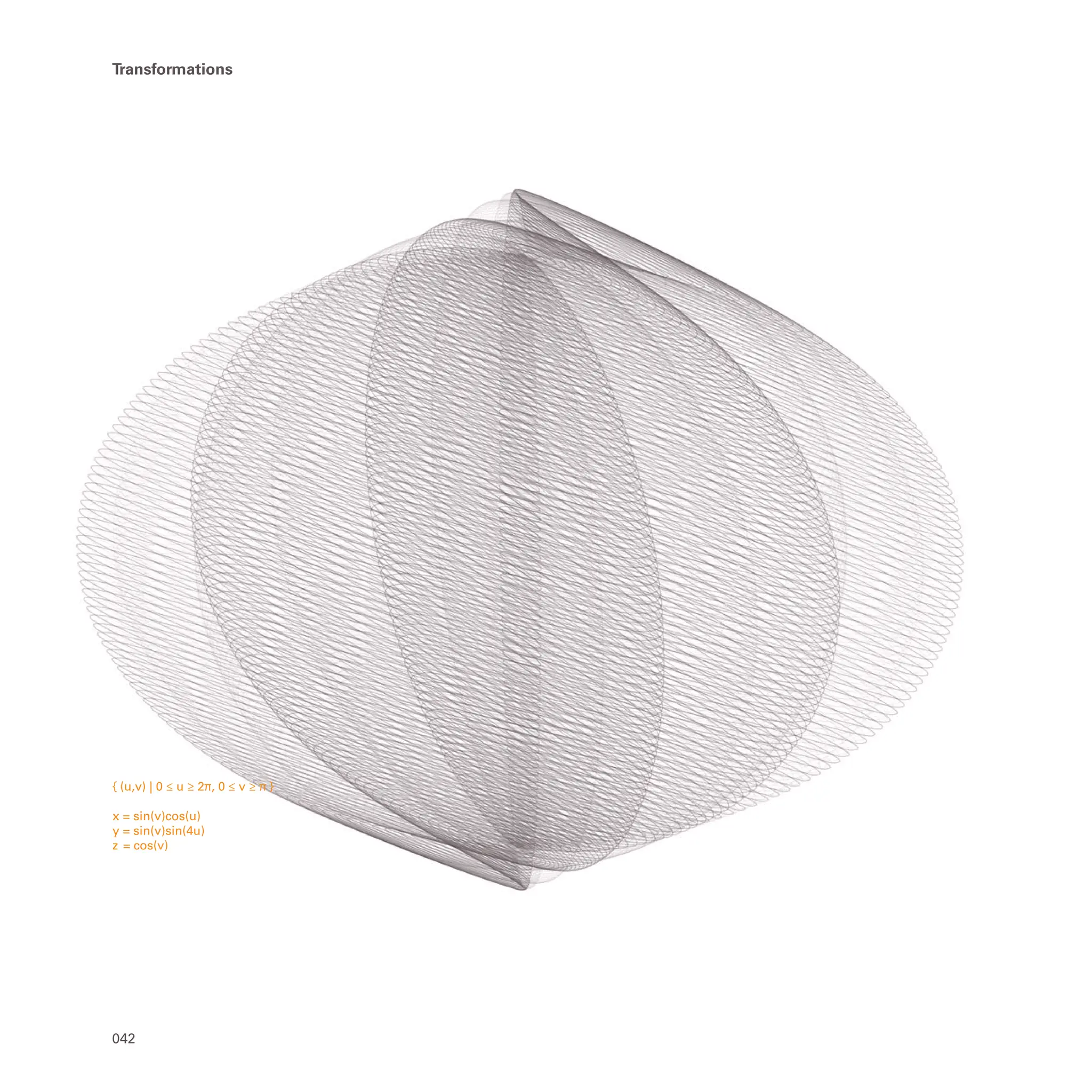
{ (u,v) | 0 ≤ u ≥ 2π, 0 ≤ v ≥ π }
x = sin(v)cos(u)
y = sin(v)sin(4u)
z = cos(v)
042
Transformations
043
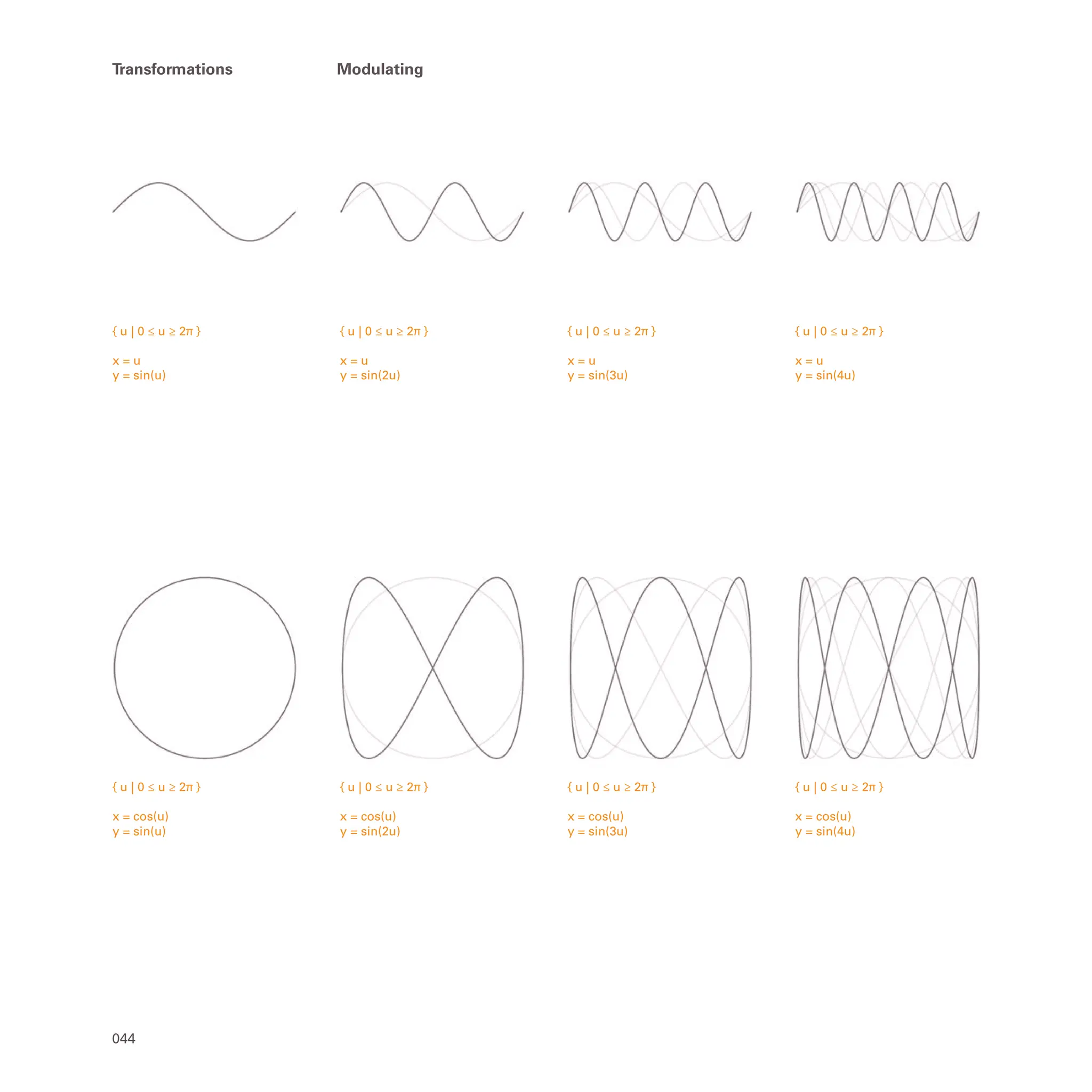
Within the trigonometric functions (sine, cosine) there are
parameters (u, v).Within cutting, these parameters control the
end points of a curve. However, when these parameters are
scaled while embedded inside a trigonometric function [for
example, sin(A(u)), where A is a scaling factor], they control the
frequency of the curve defined. For example, if the parameter is
doubled, the output would yield double the number of periods
over the same length. Multiplying the parameter also multiplies
the frequency of the curve.
Modulating
{ u | 0 ≤ u ≥ 2π }
x = cos(u)
y = sin(u)
{ u | 0 ≤ u ≥ 2π }
x = cos(u)
y = sin(2u)
{ u | 0 ≤ u ≥ 2π }
x = cos(u)
y = sin(3u)
{ u | 0 ≤ u ≥ 2π }
x = cos(u)
y = sin(4u)
{ u | 0 ≤ u ≥ 2π }
x = u
y = sin(4u)
{ u | 0 ≤ u ≥ 2π }
x = u
y = sin(3u)
{ u | 0 ≤ u ≥ 2π }
x = u
y = sin(2u)
{ u | 0 ≤ u ≥ 2π }
x = u
y = sin(u)
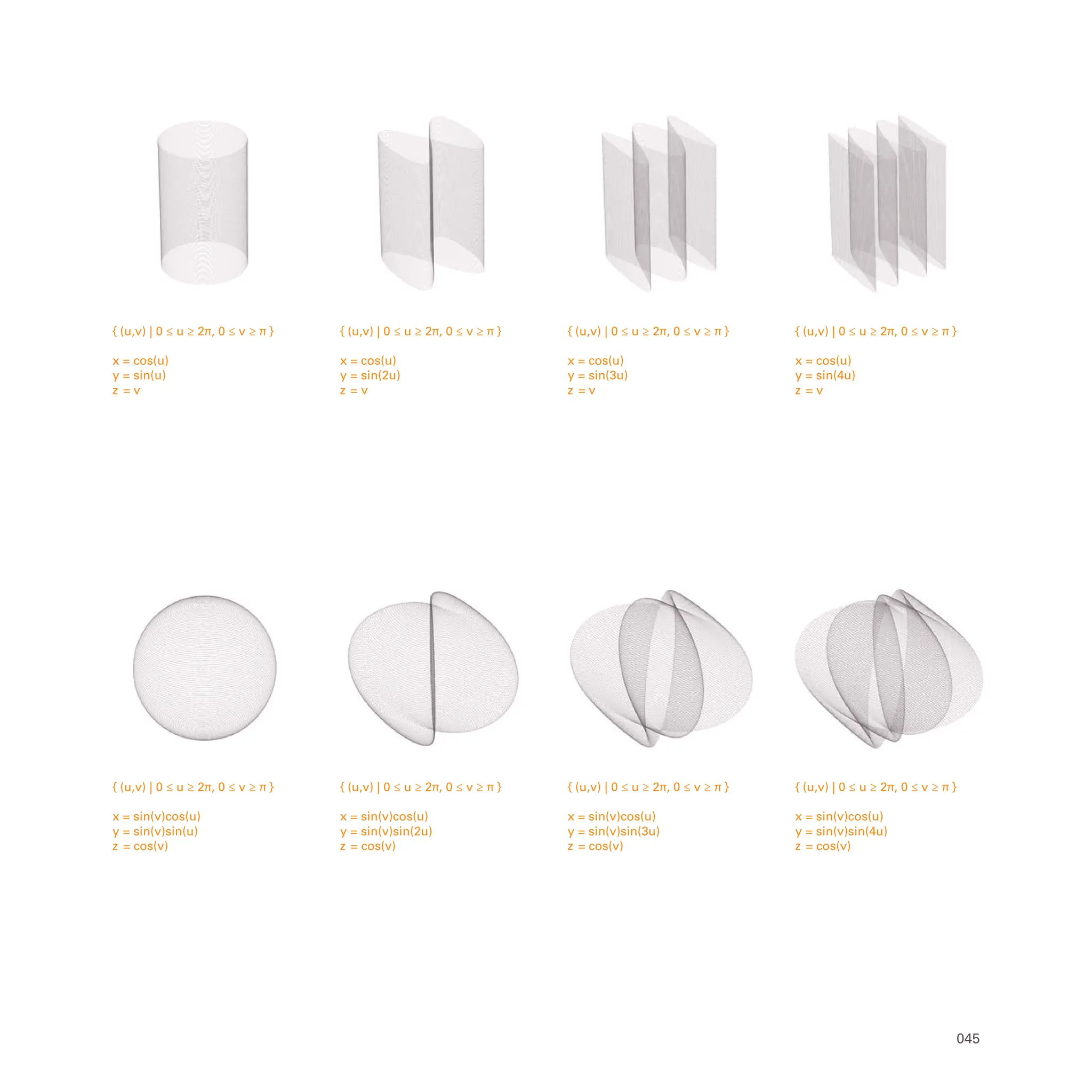
044
Transformations Modulating
{ (u,v) | 0 ≤ u ≥ 2π, 0 ≤ v ≥ π }
x = sin(v)cos(u)
y = sin(v)sin(4u)
z = cos(v)
{ (u,v) | 0 ≤ u ≥ 2π, 0 ≤ v ≥ π }
x = sin(v)cos(u)
y = sin(v)sin(3u)
z = cos(v)
{ (u,v) | 0 ≤ u ≥ 2π, 0 ≤ v ≥ π }
x = sin(v)cos(u)
y = sin(v)sin(2u)
z = cos(v)
{ (u,v) | 0 ≤ u ≥ 2π, 0 ≤ v ≥ π }
x = sin(v)cos(u)
y = sin(v)sin(u)
z = cos(v)
{ (u,v) | 0 ≤ u ≥ 2π, 0 ≤ v ≥ π }
x = cos(u)
y = sin(4u)
z = v
{ (u,v) | 0 ≤ u ≥ 2π, 0 ≤ v ≥ π }
x = cos(u)
y = sin(3u)
z = v
{ (u,v) | 0 ≤ u ≥ 2π, 0 ≤ v ≥ π }
x = cos(u)
y = sin(2u)
z = v
{ (u,v) | 0 ≤ u ≥ 2π, 0 ≤ v ≥ π }
x = cos(u)
y = sin(u)
z = v
045
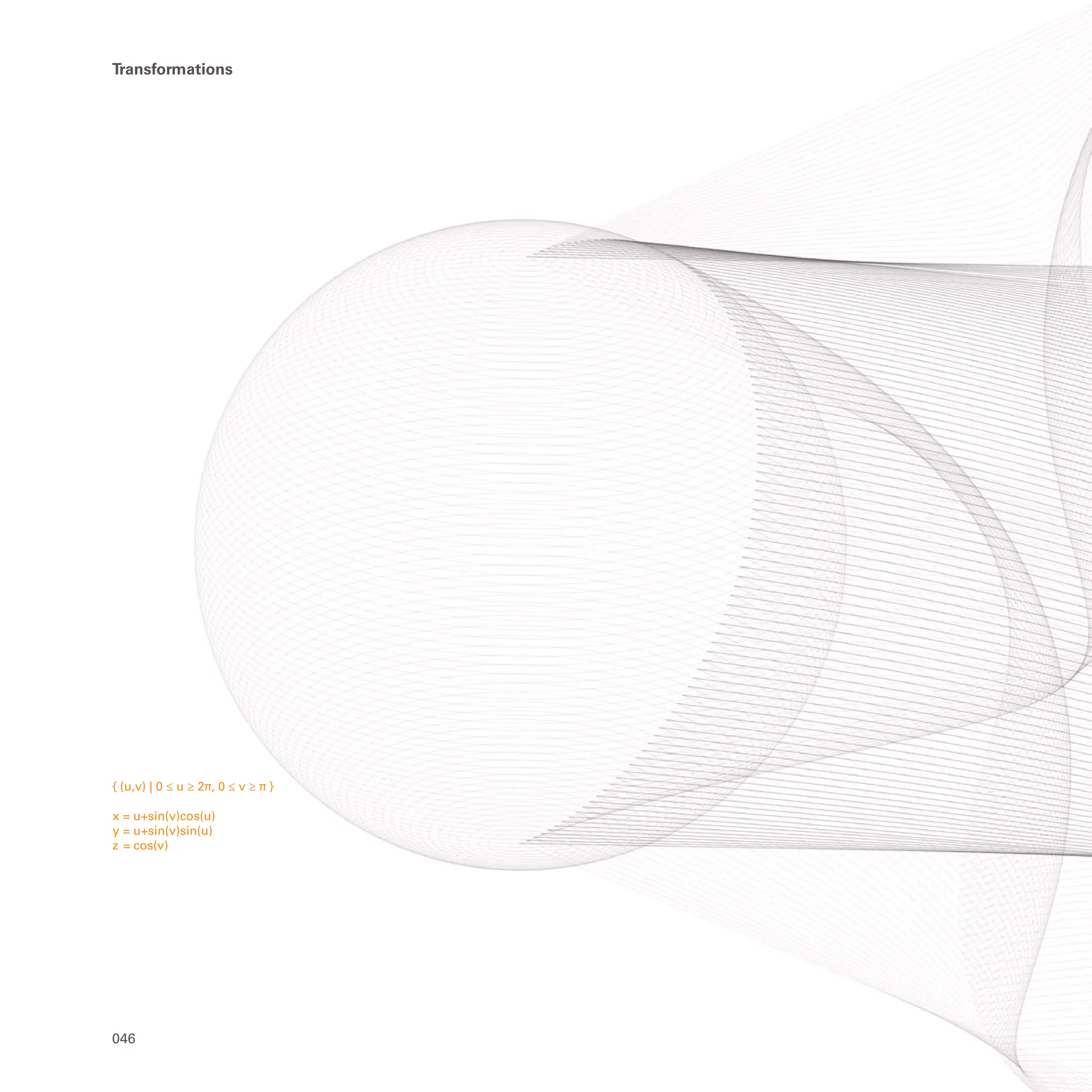
{ (u,v) | 0 ≤ u ≥ 2π, 0 ≤ v ≥ π }
x = u+sin(v)cos(u)
y = u+sin(v)sin(u)
z = cos(v)
046
Transformations
047
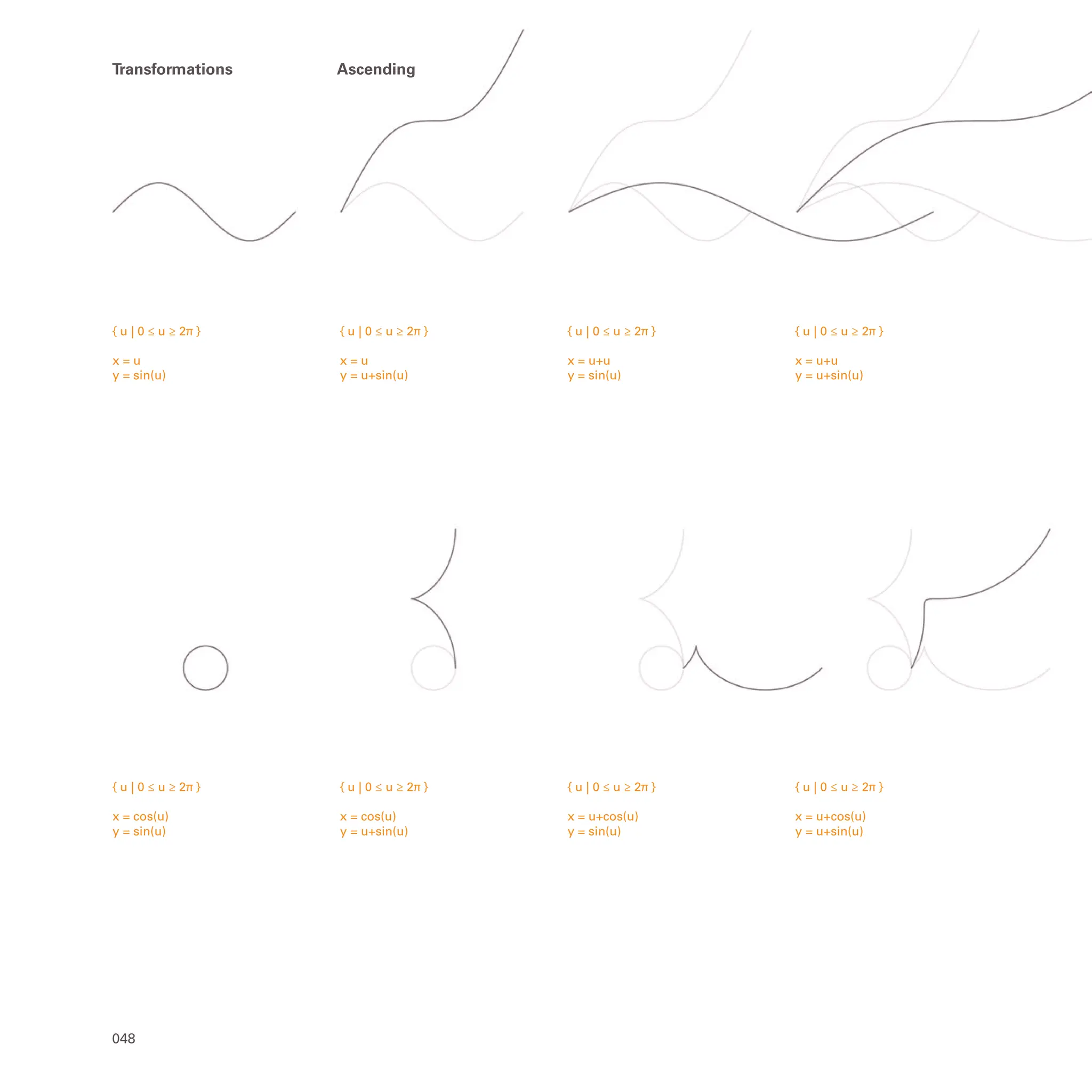
Imagine a piece of graph paper with an x-axis and a y-axis.
If a sine curve was drawn on the x-axis, its period would start
and end on the x-axis. Plotting a sine curve is much like plotting
a horizontal line, with undulations of a specific amplitude and
frequency. Adding a u-parameter outside the trigonometric
function [for example, u+sin(u)] is much like plotting a diagonal
line at an angle to the horizontal. For every cycle the function
completes, it incrementally moves vertically.The centre of the
sine curve would no longer follow the x-axis; instead, it would
follow the newly plotted diagonal line. Adding an integer
to a function would give a linear translation, while adding
a u-parameter would shift the shape and produce a
diagonal trajectory.
Ascending
{ u | 0 ≤ u ≥ 2π }
x = cos(u)
y = sin(u)
{ u | 0 ≤ u ≥ 2π }
x = cos(u)
y = u+sin(u)
{ u | 0 ≤ u ≥ 2π }
x = u+cos(u)
y = sin(u)
{ u | 0 ≤ u ≥ 2π }
x = u+cos(u)
y = u+sin(u)
{ u | 0 ≤ u ≥ 2π }
x = u+u
y = u+sin(u)
{ u | 0 ≤ u ≥ 2π }
x = u+u
y = sin(u)
{ u | 0 ≤ u ≥ 2π }
x = u
y = u+sin(u)
{ u | 0 ≤ u ≥ 2π }
x = u
y = sin(u)
048
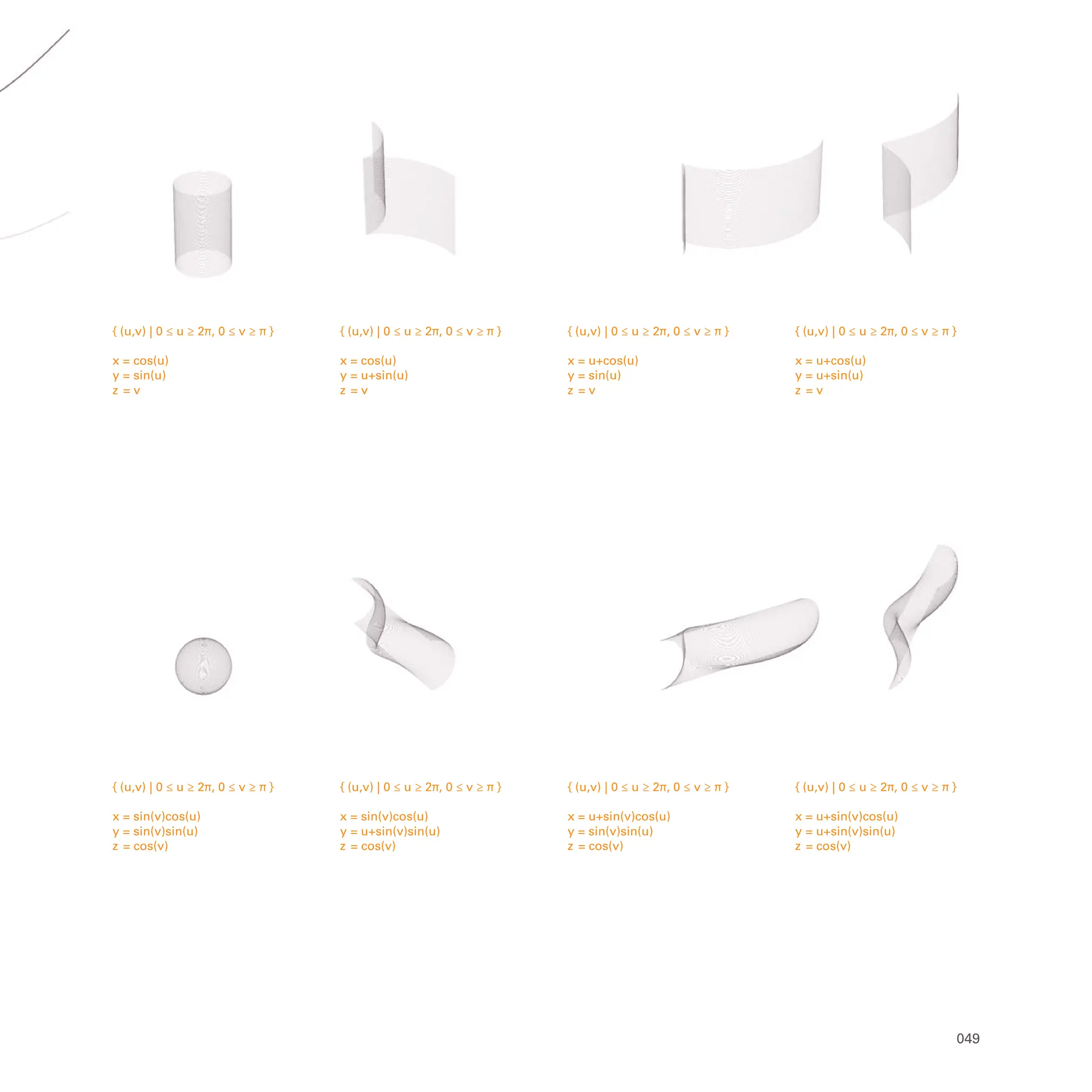
Transformations Ascending
{ (u,v) | 0 ≤ u ≥ 2π, 0 ≤ v ≥ π }
x = u+sin(v)cos(u)
y = u+sin(v)sin(u)
z = cos(v)
{ (u,v) | 0 ≤ u ≥ 2π, 0 ≤ v ≥ π }
x = u+sin(v)cos(u)
y = sin(v)sin(u)
z = cos(v)
{ (u,v) | 0 ≤ u ≥ 2π, 0 ≤ v ≥ π }
x = sin(v)cos(u)
y = u+sin(v)sin(u)
z = cos(v)
{ (u,v) | 0 ≤ u ≥ 2π, 0 ≤ v ≥ π }
x = sin(v)cos(u)
y = sin(v)sin(u)
z = cos(v)
{ (u,v) | 0 ≤ u ≥ 2π, 0 ≤ v ≥ π }
x = u+cos(u)
y = u+sin(u)
z = v
{ (u,v) | 0 ≤ u ≥ 2π, 0 ≤ v ≥ π }
x = u+cos(u)
y = sin(u)
z = v
{ (u,v) | 0 ≤ u ≥ 2π, 0 ≤ v ≥ π }
x = cos(u)
y = u+sin(u)
z = v
{ (u,v) | 0 ≤ u ≥ 2π, 0 ≤ v ≥ π }
x = cos(u)
y = sin(u)
z = v
049
Other documents randomly have
different content
the patient work of their hands and their hearts would almost
certainly be spared.
While Mrs. Dike, with tears in her eyes, was telling us of the things
that had been accomplished here and while the troopers poured in
unceasing streams along the main road beyond the gateway, a
handful of belated refugees crept in under the weathered armorial
bearings on the keystonp of the archway, to be fed and cared for
and then sent along in the first empty truck that came by going
toward Soissons.
In this group of newcomers was an elderly little man in a worn
high hat and a long frock coat with facings of white dust upon its
shiny seams, who looked as though he might be the mayor of some
inconsequential village. He carried two bulging valises and a huge
umbrella. With him was his wife, and she had in one hand a cage
housing two frightened canaries and under the other arm a fat grey
tabby cat which blinked its slitted eyes contentedly.
The most pitiable figure of them all to my way of thinking was an
old woman—yes, a very old woman—she must have been all of
eighty. Alongside one of the buildings I came upon her sitting in a
huddle of her most treasured possessions. She was bent forward,
with her gnarled hands folded in the lap of her dress, which was silk
and shiny, for naturally when she fled from her home she had put on
her back the best that she owned. Under the cope of a queer little
old black bonnet with faded purple cloth flowers upon it her scanty
hair lay in thin neat folds, as white and as soft as silk floss. Her feet
in stiff, new, black shoes showed beneath her broad skirts. Her face,
caving in about the mouth where her teeth were gone and all
crosshatched with wrinkles, was a sweet, kindly, most gentle old
face—the kind of face that we like to think our dead-and-gone
grandmothers must have had.
She sat there ever so patiently in the soft sunlight, waiting for the
truck which would carry her away to some strange place among
stranger folk. When I drew near to her, wishing with all my heart
that I knew enough of her tongue to express to her some of the
thoughts I was thinking, she looked up at me and smiled a friendly
little smile, and then raising her hands in a gesture of resignation
dropped them again in her lap. But it was only with her lips that she
smiled, for all the time her chin was quivering and her faded old blue
eyes were brimming with a sorrow that was past telling in words.
She still sat there as we got into our car and drove off toward the
battle. Looking back, the last thing I saw before we rounded the
corner of the wall was her small black shape vivid in the sunshine.
And I told myself that if I were an artist seeking to put upon canvas
an image that would typify and sum up the spirit of embattled
France to-day I would not paint a picture of a wounded boy soldier;
nor yet one of a winged angel form bearing a naked sword; nor yet
one of the full-throated cock of France, crowing his proud defiance. I
would paint a picture of that brave little old withered woman, with
the lips that smiled and the chin that quivered the while she smiled.
W
CHAPTER VII. AT THE FRONT OF
THE FRONT
HEN the last preceding chapter of mine ended I had
reached a point in the narrative where our little party of
four, travelling in our own little tin flivverette, were just
leaving Blérincourt, being bound still farther west and
aiming, if our abiding luck held out, to reach the front of the Front—
which, I may add, we did.
To be exact we were leaving not one Blérincourt but three. First,
Blérincourt, the town, with its huddle of villagers' homes, housing at
this moment only French troopers and exhausted refugees; second,
Blérincourt, the castle, a mouldering relic of a great house, testifying
by its massive empty walls and its tottering ruin of a gateway to the
fury which laid hold on the peasants of these parts in the days of the
Terror; and, third, Blérincourt, the model colony of model cottages,
which for us held the most personal interest, since it was here the
American women of the American Fund for French Wounded had
during the previous nine months centred their activities relating to
the repopulating of districts in the Aisne country, now for the second
time evacuated and given over again to the savage malice of the
boche.
Behind us as we swung into the main highway lay this grouped
composition of the wrecked château, the tiny old houses of
weathered grey stone and the little frame domiciles, smart and
glistening with fresh paint and fresh varnishing. Before us, within a
space of time and distance to be spanned by not more than half an
hour of steady riding, was somewhere the problematical doorway
through which we hoped to pass into the forward lines of that battle
which the historians of the future, I dare say, will call merely the
Great Battle, knowing their readers require no added phraseology to
distinguish it from the lesser engagements of this war—or in fact of
any war.
We did not ask our way of any whom we met, either of those
going ahead of us or those coming back in counter streams. To
begin with, we deemed it inexpedient to halt long enough to give to
any person in authority a chance for questioning the validity of our
present mission, since, as I already have explained, we carried no
passes qualifying us to traverse this area; and besides there was no
need to ask. The route was marked for us by signs and sounds
without number, plainer than any mileposts could have been: By the
columns of Frenchmen hurrying up to reenforce the decimated
British who until now, at odds of one to five, had borne the buffets
of the tremendous German onslaught; by the never-ending, never-
slackening roar of the heavy guns; by the cloud of dust and powder,
forming a wall against two sides of the horizon, which mounted
upward to mingle its hazes with the hazes of the soft spring
afternoon; by the thin trickling lines of light casualty cases, “walking
wounded,” in the vernacular of the Medical Corps—meaning by that
men who, having had first-aid bandages applied to their hurts at
forward casualty stations, were tramping rearward to find
accommodations for themselves at field hospitals miles away.
At once we were in a maze of traffic to be likened to the
conditions commonly prevalent on lower Fifth Avenue in the height
of the Christmas-shopping season, but with two distinctions: Here on
this chalk-white highroad the movement, nearly all of it, was in one
direction; and instead of omnibuses, delivery vans, carriages and
private automobiles, this vast caravansary was made up of soldiers
afoot, soldiers mounted and soldiers riding; of batteries, horse
drawn and motor drawn; of pontoon bridges in segments; of wagon
trains, baggage trains, provision trains and munition trains; of field
telephone, field telegraph and field wireless outfits upon wheels; of
all the transportable impedimenta and all the myriad items of
movable machinery pertaining to the largest army that has crossed a
corner of France since the days of the first great invasion more than
three and a half years before.
There were ambulances past counting; there were big covered
camions in numbers sufficient to fit out a thousand circuses; there
were horses and donkeys and mules of all the known sizes and
colours; there were so many human shapes in uniforms of horizon
blue that the eye grew weary and the brain rebelled at the task of
trying, even approximately, to compute estimates of the total
strength of the man power here focussed.
Through all this, weaving in and out, our impudent little black bug
of a car scuttled along, with its puny horn honking a constant and
insolent demand for clear passage. At a faster gait than anything in
sight except the cruising aëroplanes above, we progressed upon our
way, with none to halt us and none to turn us back. Where the dust
hung especially thick at a crossroads set in the midst of the wide
plain we almost struck three pedestrians who seemingly did not
heed our hooted warning or take notice of it until we were right
upon them. As they jumped nimbly for the ditch we could see that
all these had staff markings at their throats, and that one, the eldest
of the three, a stoutish gentleman with a short grizzled beard, wore
three stars in a triangle upon his collar. Tin Lizzie had almost
achieved the distinction for herself of having run down a major
general of France.
We did not stop, though, to offer apologies or explanations. With
rare sagacity our driver threw her wide open and darted into the fog,
to take temporary shelter behind a huge supply wagon, which
vehicle we followed for a while after the fashion of a new-foaled colt
trailing its dam.
Proofs began to multiply that we were nearing the zone of live
combat. Until now the only British soldiers we had seen were slightly
wounded men bound afoot for the rear. All at once we found
ourselves passing half a company of khaki-clad Britishers who
travelled across a field over a course parallel to the one we were
taking and who disappeared in a hazel copse beyond. Rifle firing
could be heard somewhere on the far side of the thicket. At a barked
command from an officer who clattered up on horseback a battery of
those doughty little seventy-fives, which the French cherish so
highly, and with such just cause, was leaving the road and taking
station in a green meadow where the timid little wild flowers of a
mild March showed purple and yellow in the rutted and trampled
grass.
With marvellous haste the thing was accomplished almost
instantly. The first gun of the five squatted in the field with its nozzle
slanting toward the northwest, and behind it its four companions
stood, all with their short noses pointing at precisely the same angle,
like bird dogs on a back stand. Suddenly they did what well-broken
bird dogs never do—they barked, one after the other. Almost before
the whining whistle of the shells had died away the gunners were
moving their pieces to a point closer up behind a screen of poplars
and sending a second yelping salvo of shots toward an unseen
target.
We became aware that the component units of the army were
now quitting the roadway to take positions in the back lines. Indeed
those back lines formed themselves while we watched. One battery
after another swung off to the right or to the left and came into
alignment, so that soon we rode between double rows of halted
guns. With our canes we could have touched the artillerymen piling
heaps of projectiles in convenient hollows in the earth close up to
the edges of the road. Big covered wains discharged dusty
infantrymen, who, pausing only long enough to unbuckle their packs
from their shoulders and throw them under the hoods of the
wagons, went at a shambling half-trot through the meadow.
Cavalrymen, not dismounted, as they had mainly been during these
dragging winter months of warfare that was stationary and static,
but with their booted feet once more in their stirrups, cantered off,
bound presumably for the thin woodlands which rimmed the plateau
where the terrain broke away to the banks of the River Oise.
Here again at last was war in the open, as different from battle in
the trenches as football is from trap shooting. The action of it was
spread out before one's eyes, not masked in mud ambuscades. Each
instant our eyes beheld some new and stirring picture, standing out
by reason of its swift vigour from the vaster panorama of which it
was a part. What I had seen of battle formations in the preceding
three weeks had made me think mainly of subway diggin's or of
construction work for a new railroad or of engineering operations in
connection with a dam, say, or a dike. What I saw now most vividly
suggested old-time battle pictures by Meissonier or Détaillé. War, for
the moment at least, had gone back to the aspect which marked it
before both sides dug themselves in to play the game of
counterblasting with artillery and nibbling the foe's toes with raids
and small forays.
Of another thing we were likewise aware, and the realisation of
the fact cheered us mightily. Among the blue uniforms of the French
the greenish buff of the British showed in patches of contrasting
colour that steadily increased in size and frequency. By rare good
luck we had entered the advanced positions at the identical place for
which, blindly, we had been seeking—the place where the most
westerly sector of the French left wing touched the most easterly
sector of the British right wing; and better than that, the place
where the French strength hurrying up to reënforce and if need be
replace decimated divisions of their allies was joined on to and fused
in with the retiring British Army, which, during the preceding three
days, had sustained the main force of the German offensive. It was
here if anywhere that we could count with the best prospects of
success upon boring straight through to the Front, the reason being
that the French might assume the British had given us passage and
the British might assume the French had let us by.
There were perhaps three more miles of brisk travelling for us,
during which I am sure that I saw more than ever I have seen in any
three miles that ever I traversed in my life; and at the end of that
stretch we could tell that we had well-nigh outrun the forward crest
of the French ground swell and had come into the narrower
backwash of the British retreat. A retreat of sorts it may have been,
but a rout it most assuredly was not. We saw companies reduced to
the strength of ten or twelve or twenty men under command of
noncommissioned officers or possibly of a single lieutenant. We saw
individual privates and we saw privates in squads of two or three or
half a dozen men, who in the terrific fighting had become separated
from a command, which possibly had been scattered but which it
was more likely had been practically wiped out. Such men were not
stragglers, nor were they malingerers; they were survivors, atoms
flung backward out of the raging inferno which had swallowed up
whole regiments and whole brigades.
And we took note that every single man of these broken and
decimated detachments was in good humour, though dog tired; and
that every single one of them had kept his accoutrements and his
rifle; and that every single one of them, whether moving under
orders or acting upon his own initiative, was intent upon just two
things and two things only—to get back into the maelstrom from
which temporarily he had been spewed forth, and pump more lead
into the living tidal wave of grey coats. Some that we overtook were
singing, and singing lustily too. Than this no man could ask to see a
finer spectacle of fortitude, of pluck and of discipline, and I am sure
that in his heart each one of us, while having no doubt of the
outcome of the fiery test, prayed that our own soldiers, when their
time of trial by battle came, might under reverses and under
punishment acquit themselves as well as had these British veterans,
Yorkshire and Bedfordshire and Canada, who came trudging along
behind us, swallowing our dust. What impressed us as most
significant of all was that only once that day did we see a scrap of
personal equipment that had been cast aside. This was a cartridge
belt of English make, with its pouches empty and its tough leather
tom almost in two, lying like a broken-backed brown snake in a
ditch.
Already from wounded English soldiers and from exhausted
English hospital workers whom we had seen back in Soissons we
comprehended a measure of appreciation of what these battered
fragments of the forces had been called upon to endure during four
days and five nights. We knew as surely as though we had stopped
to take down the story of each one of the wearied, cheerful, resolute
chaps, that they had their fill of killing the enemy and of seeing their
mates about them blown to bits by high explosives or mowed down
by rifle fire. I recalled what a bedraggled young surgeon, a
Highlander by his accent, had said the night before:
“I crave never to pass through this experience again. I have seen
so much of death since this battle started that I have in me now
contempt not only for death but for life too. I thought last year on
the Somme I saw real fighting. Man, it was but child's play to what I
saw the day before yesterday!
“From the casualty dressing post where I was on duty I could see
the fighting spread out before me like a cinema show. For our
shelter—we were in a concrete dugout—was in the side of a hill with
a wide sweep of lowland below and beyond us, and it was here in
this valley that the Germans came at our people. Between jobs in
the operating theatre—and God knows we had enough of them—I
would slip out for a breath of air, and then I could watch through my
glasses what went on.
“In wave after wave the Germans came on, marching close
together in numbers incredible. They were like ants; they were like
flies; like swarming grasshoppers. At first they tried a frontal attack
against our trenches, but even the Germans, driven on as they must
have been like cattle to the slaughter, couldn't stand what they got
there. Within two hours they charged three times! Each time they
fell back again, and each time they left their dead lying so thickly
behind that finally the ground seemed as though it were covered
with a grey carpet.
“That happened in the first day of their drive against our part of
the line, which was the third line back, the two front lines having
already been taken by them. So on the next day, which was the day
before yesterday, they worked their way round to the south a bit and
tried a flanking advance. Then it was I saw this, just as I'm telling it
to you. I saw them caught by our machine-gun fire and piled up,
heap on heap, until there was a windrow of them before the British
trenches that must have been six feet high.
“They went back, but they came again and again, and they kept
on coming. They climbed right over that wall of their own dead—I
myself watched them scrambling up among the bodies—and they
slid down on the other side and ran right into the wire
entanglements, where those of them that were killed hung in the
wires like garments drying on a line. They died there in such
numbers that they fairly clogged the wires. And still they kept on
coming.
“When our line began to bend in, farther away to the west, we got
orders to evacuate the station; and the men in the trenches where I
had seen the fighting got orders—what were left of them—to fall
back too. They were Scotchmen, these laddies, and they were fairly
mad with the fighting. They didn't want to go, and they refused to
go. I'm told by reliable witnesses that their officers had almost to
use force against them—not to make them keep on fighting but to
make them quit fighting.”
He looked into the coals of the wood fire and shivered.
“Man, it's not war any more; it's just plain slaughter. Mark my
word—there'll never be another war such as this one has been or
another battle such as the one that still goes on yonder. 'Tis not in
flesh and blood to endure its repetition once the hate has been
cooled by a taste of peace.”
The men about us for the most part must have taken part as
actors in scenes such as the young surgeon had described as an
onlooker. But about them there was no sign of reluctance or of
surcease. We realised as thoroughly as though we had been
eyewitnesses to their conduct that they had carried on like brave
men; and without being told we realised, too, that they were made
of the stuff which keeps carrying on as long as there is life left in it.
They were of the breed of the bulldog, and clean strain, at that.
Frenchmen grew fewer in number along the route we travelled;
Britishers became more and more numerous. Where byways crossed
the highroad and in wrecked villages the British already had posted
military policemen to guide the traffic and point out the proper
directions to bodies of men passing through. Those men stood in
midroad giving their orders as calmly and as crisply as though they
had been bobbies on the Strand. Even this emergency John Bull's
military system did not disintegrate. As long as the organism lasted
the organisation would last too. Nowhere was there any suggestion
of confusion or conflict of will. I am prone to think that in the years
to come the chief outstanding fact about the great spring offensive
of 1918 will be not the way the Germans came forward but the way
in which the British fell back.
Until now we had seen only British foot soldiers, and once or twice
officers in motor cars or on horseback; but soon we came upon a
battery of British light artillery. It was jolting across muddy pasture
among the stumps of apple trees which the Germans with malignant
thoroughness had felled before their big retreat of twelve months
before. The place had been an orchard once. Now it was merely so
much waste land, dedicated to uselessness by efficiency and kultur.
The trees, as we could see, had not been blown down by shell fire
or hewn down with axes. They had been neatly and painstakingly
sawed through, clear down to the earth. Some of the butts
measured a foot and a half across, and to have bolls of this size,
fruit trees in this country must have attained great age.
The battery took position and went into immediate action behind a
covert of willows and scrub at the far side of the ruined orchard. At
the moment we did not know that the thicket was a screen along the
southern bank of the Oise. At the left of where the guns were
speaking was a group of empty and shattered cottages stretching
along a single narrow street that ran almost due north and south.
Coming opposite the foot of this street we glimpsed at the other end
of it a glint of running water, and in the same instant, perhaps two
or three miles away farther on across the river, we made out the
twin spires of the cathedral of Noyon, for which, as we know, the
contending armies had striven for forty-eight hours, and which the
evening before had fallen into the enemy's hands. Literally we were
at the front of the Front.
East of the clustered houses of the city a green hill rose above the
tree tops. Across the flanks of this hill we saw grey-blue clumps
moving. At that distance the sight was suggestive of a crawling mass
of larvæ. Over it puffs of smoke, white for shrapnel and black for
explosives, were bursting. We were too far away to observe the
effect of this shelling, but knew that the crawling grey blanket meant
Germans advancing in force down into the valley of the river, and we
knew, too, that they were being punished by Allied guns as they
came on to take up their new position.
C
CHAPTER VIII. A BRIDGE AND AN
AUTOMOBILE TIRE
URIOUSLY enough there was at this moment and at this place
no return fire from the enemy. From this we deduced that the
infantry in their impetuous onrush had so far outtravelled the
heavy and more cumbersome arms of their service that the
artillery had not caught up yet. However, a little later projectiles from
hostile field pieces began to drop on our side of the stream.
Halfway of the length of the street our car halted. It did not seem
the part of wisdom for the four of us to go ahead in a group, so I
walked the rest of the way to spy out the land.
Behind the shattered stone and plaster houses French soldiers
were squatted or lying. In the hope of finding some one who could
speak the only language I knew I continued on until I came to the
last two houses in the row. They overhung the riverbank. Beyond
them were two bridges spanning the little river, one an old steel
bridge with a concrete roadbed, and the other a sagging wooden
structure, evidently built by soldier hands.
The mouth of the military bridge was stopped with a makeshift
barricade thrown together any which way. The backbone of the
barrier was formed of two tree trunks, but they were half hidden
from sight beneath a miscellaneous riffle of upturned motor lorries,
wheelbarrows and clustered household furniture, including many
mattresses that plainly had been filched from the villagers'
abandoned homes. Midway of the main bridge a handful of French
engineers were pottering away, rather leisurely, I thought, at some
job or other. Two Tommies were standing behind one of the
farthermost buildings of the hamlet—a building which in happier
days had been a café. Now it was a broken shell, foul inside with a
litter of wreckage. The men wore the insignia of the Royal Lancers.
As I approached them they saluted, evidently mistaking me, in my
trench coat and uniform cap, for an American officer. That an
American officer should be in this place, so far away from any
American troops, did not seem to surprise them in the least.
“What town is this?” was my first question.
“It's called Pontoise, sir,” answered one of them, giving to the
name a literal rendition very different from the French fashion of
pronouncing this word.
“What's going on out yonder on the bridge?” I inquired next.
“The Frenchmen is minin' it to blow it up, sir. They mined it once
already but the charge didn't explode, sir. Now they're goin' to give it
another try. They'll be letting off the charge pretty soon, sir, I think—
as soon as a few of their men and a few of ours who're over on the
other bank in them bushes 'ave fallen back to this side 'ere.”
“How close are the Germans?” I asked.
I figured they must be uncomfortably close. They were.
“Come along with me, sir, if you don't mind,” quoth my informant.
Quite in the most casual way he led me out from behind the
shelter of the ruined café. As we quitted its protection I could see
over a broken garden wall the British battery down below at the left,
firing as fast as the gunners could serve the pieces. Of all the men in
sight these shirt-sleeved artillerymen were the only ones who
seemed to have any urgent business in hand.
Together we advanced to the barricade, which at the spot where
we halted came up to our middles. Across the top of it my guide
extended a soiled hand.
“The beggars are right there, sir, in them bushes; about a 'undred
and fifty yards away, sir, or two 'undred at the most,” he said with
the manner of a hired guide. “You carn't see them now, sir, but a bit
ago I 'ad a peep at a couple of 'em movin' about. The reason they
ain't firin' over 'ere is because they don't want us to locate 'em, I
think, sir.”
“Oh!” I said, like that. “Oh!”
By mutual but unspoken consent we then retired to our former
position. The imperturbable Tommy fell back in good order, but I
think possibly I may have hurried somewhat. I always was a fairly
brisk walker, anyhow.
Inside the breached building my companions joined me, and while
the shells from the battery and from the other batteries farther away
went racketing over us toward Noyon we held a consultation of war.
Any desire on the part of any one to stay and see what might
happen after the bridge had been blown up was effectually
squelched by the sudden appearance of two British officers coming
through the village toward us. Did they choose to interrogate us
regarding our mission in this parlous vicinity there might be
embarrassment in the situation for us. So we went away from there.
As we departed from the place a certain thing impressed itself
upon my consciousness. The men about me—the two Tommies
certainly, the two officers presumably, and probably the Frenchmen
—had but newly emerged from hard fighting. Of a surety they would
very shortly be engaged in more hard fighting, striving to prevent
the on-moving Germans from crossing the river. Over their head
shells from their own guns were racking the air. Shells from hostile
batteries were beginning to splatter down just beyond. This then
was merely an interval, an interlude between acts of a most dire and
tremendous tragedy.
And yet so firmly had the chance of death and the habit of war
become a part of their daily and their hourly existence that in this
brief resting spell they behaved exactly as men engaged in some
wearing but peaceful labour might behave during a nooning in a
harvest field. No one in sight was crouching in a posture of defence,
with his rifle gripped in nervous hands and his face set and intent.
Here were being exemplified none of the histrionic principles of
applied heroics as we see them on the stage.
The Frenchmen were sprawled at ease behind the walls, their
limbs relaxed, their faces betokening only a great weariness. One or
two actually were asleep with their heads pillowed on their arms.
Those who spoke did so in level, unexcited tones. They might have
been discussing the veriest commonplaces of life. For all I knew to
the contrary, they were discussing commonplaces. The two British
privates leaned upon their rifles, with their tired legs sagging under
them and with cigarette ends in their mouths. One of the officers
was lighting a pipe as we drove past him. One of the Frenchmen
was gnawing at a knuckle of bread.
Indeed there was nothing about the scene, except a knowledge of
the immediate proximity of German skirmishers, which would serve
to invest it with one-tenth of the drama that marked a hundred
other sights we had that day witnessed. Later, though, we learned
we had blundered by chance upon the very spot where the hinge of
the greatest battle of history next day turned.
It was south of Noyon at the Pontoise ford and at other fords
above and below Pontoise that the Germans designed to cross the
river in their onslaught southward against the defences of Paris. But
there they failed, thanks be to British desperation and French
determination; and it was then, according to what students of
strategy among the Allies say, that the hosts of the War Lord altered
the plan of their campaign and faced about to the westward in their
effort to take Amiens and sunder the line of communication between
Paris and Calais—an effort which still is being made as I sit here in
Paris writing these pages for the mail.
The day's journey was not over by any manner of means, but so
far as I personally was concerned its culminating moment passed
when I walked out on the bridge timbers with that matter-of-fact
young Royal Lancer. What followed thereafter was in the nature of a
series of anticlimaxes, and yet we saw a bookful before we rode
back to Soissons for a second night under bombardment in that
sorely beset and beleaguered old city. Before heading back we
cruised for ten kilometres beyond Noyon, going west by south
toward Compiègne.
On this side jaunt we mostly skirted the river, which on our bank
was comparatively calm but which upon the farther bank was being
contended for at the bayonet's point by British and French against
Germans. The sound of the cannonading never ceased for a
moment, and as dusk came on the northern horizon was lit up with
flickering waves of a sullen dull red radiance. The nearer we came to
Compiègne the more numerous were the British, not in squads and
detachments and bits of companies but in regiments and brigades
which preserved their formations even though some of them had
been reduced to skeletons of their former proportions. In the fields
alongside the way the artillerymen were throwing up earthen banks
for the guns; the infantrymen were making low sod walls behind
which they would sleep that night and fight on the morrow. From
every hand came the smell of brewing tea, for, battle or no battle,
the Tommy would have his national beverage. The troop horses
were being properly bestowed in the shaggly thickets, and camp
fires threw off pungent smells of wood burning. For the first time in
a long time the campaign was outdoors, under the skies.
I saw one fagged trooper squatting at the roadside, with a minute
scrap of looking-glass balanced before him in the twigs of a bare
bush, while he painfully but painstakingly was shaving himself in
cold ditch water. He had fought or marched all day, I imagine; his
chances of being sent to eternity in piecemeal before another sunset
were exceedingly good; but he would go, tidied and with scraped
jowls, to whatever fate might await him. And that, except for one
other small thing, was the most typically English thing I witnessed in
the shank of this memorable evening.
The other incident occurred after we had faced about for our
return. In a maze of byroads we got off our course. A lone soldier of
the Bedfordshires—a man near forty, I should say at an offhand
guess—was tramping along. Our driver halted our car and hailed
him. He straightened his weary back and came smartly to a salute.
“We've lost our way,” explained one of us.
He smiled at us whimsically.
“I'm afraid I can't help you, sirs,” he said in the tones of an
educated man. “I've lost my own way no less than six times to-day. I
may add that I'm rather a stranger in these parts myself.”
When we got to Blérincourt with an hour of daylight and another
hour of twilight yet ahead of us we turned north toward Chauny,
which the Germans now held and which the Allies were bombarding
furiously. We had come to a crossroads just back of a small village,
when with a low spiteful hiss of escaping air one of our rear tires
went flat. We stopped to replace the damaged tube with a better
one. Behind us, a quarter of a mile or so away, a British baggage
train was making bivouac for the night. Just in front of us a British
battery was firing over the housetops of the empty village toward
Chauny.
We had the car jacked up and the old tire off the rim and the new
one half on when—bang! the heavens and the world seemed to
come together all about us. What happened was that a big shell of
high explosives, fired from an enemy mortar miles away, had
dropped within seventy, sixty yards of us in a field; what seemed to
happen was that a great plug was pulled out of the air with a
smiting and a crashing and a rending. The earth quivered as though
it had taken a death wound. Our wind shield cracked across under
the force of the concussion. Gravel and bits of clay descended about
us in a pattering shower.
Speaking for myself, I may say that one of the most noticeable
physical effects of having a nine shell exploding in one's immediate
vicinity is a curious sinking sensation at the pit of the stomach,
complicated with a dryness of the mouth and sudden chill in the
feet.
Two more shells dropped within a hundred yards of us before we
got that tire pumped up and departed. Even so, I believe the world's
record for pumping up tires was broken on this occasion. I am in
position to speak with authority on this detail, because I was doing
the pumping.
I
CHAPTER IX. ACES UP!
NSIDE the German lines at the start of the war I met Ingold,
then the first ace of the German aërial outfit; only the Germans
did not call them aces in those days of the beginnings of things.
The party to which I was attached spent the better part of a day
as guests of Herr Hauptmann Ingold and his mates. Later we heard
of his death in action aloft.
Coming over for this present excursion I crossed on the same
steamer with Bishop of Canada—a major of His Britannic Majesty's
forces at twenty-two, and at twenty-three the bearer of the Victoria
Cross and of every other honour almost that King George bestows
for valour and distinguished service, which means dangerous
service. I have forgotten how many boche machines this young man
had, to date, accounted for. Whether the number was forty-seven or
fifty-seven I am not sure. I doubt if Bishop himself knew the exact
figure.
At Paris, after my arrival, and at various places along the Front I
have swapped talk and smoking tobacco with sundry more or less
well-known members of the Lafayette Escadrille and with unattached
aviators of repute and proved ability. From each of these men and
from all of them—Belgians, Italians, Americans, Britishers and
Frenchmen—I brought away an impression of the light-hearted
gallantry, the modesty and the exceeding great competency which
appear to be the outstanding characteristics of those who do their
fighting—and, in a great many instances, their dying—in the air. It
was almost as though the souls of these men had been made
cleaner and as though their spirits had been made to burn with a
whiter flame by reason of the purer element in which they carried on
the bulk of their appointed share in this war business. You somehow
felt that when they left the earth they shook off from their feet a
good part of the dirt of the earth. I do not mean to imply that they
had become superhuman, but that they had acquired, along with
their training for a special and particularised calling, some touch of
the romanticism that attached to the ancient and dutiful profession
of knight-errantry.
Nor is this hard to understand. For a fact the flying men are to-day
the knights-errant of the armies. To them are destined opportunities
for individual achievement and for individual initiative and very often
for individual sacrifice such as are denied the masses of performers
in this war, which in so many respects is a clandestine war and which
in nearly all respects is an anonymous war. I think sometimes that,
more even than the abject stupidity of the enterprise, it is the entire
taking-away of the drama—the colour of theatricalism, the pomp and
the circumstance, the fuss and the feathers—that will make war an
exceedingly unpopular institution for future generations, as it has
been an exceedingly unprofitable if a highly necessary one for this
present generation. When the planet has been purged of militarism,
the parent sin of the whole sinful and monstrous thing, I am
convinced that the sordid, physically filthy drabness that now
envelops the machinery of it will be as potent an agency as the
spreading of the doctrine of democracy in curing civilised mankind of
any desire to make war for war's sake rather than for freedom and
justice.
One has only to see it at first hand in this fourth year of conflict to
realise how completely war has been translated out of its former
elements. It is no longer an exciting outdoor sport for fox-chasing
gentlemen in bright-red coats; no longer a seasonal diversion for
crosscountry riders in buckskin breeches. It is a trade for expert
accountants, for civil-engineering sharps, for rule of thumb, for pick
and shovel and the land surveyor's instruments. As the outward
romance of it has vanished away, in the same proportion the amount
of manual labour necessary to accomplish any desired object has
increased until it is nearly all work and mighty little play—a
combination which makes Jack a dull boy and makes war a far duller
game than it used to be. Of course the chances for heroic
achievements, for the development and the exercise of the traits of
Welcome to our website – the perfect destination for book lovers and
knowledge seekers. We believe that every book holds a new world,
offering opportunities for learning, discovery, and personal growth.
That’s why we are dedicated to bringing you a diverse collection of
books, ranging from classic literature and specialized publications to
self-development guides and children's books.
More than just a book-buying platform, we strive to be a bridge
connecting you with timeless cultural and intellectual values. With an
elegant, user-friendly interface and a smart search system, you can
quickly find the books that best suit your interests. Additionally,
our special promotions and home delivery services help you save time
and fully enjoy the joy of reading.
Join us on a journey of knowledge exploration, passion nurturing, and
personal growth every day!
ebookbell.com

Morphing A Guide To Mathematical Transformations For Architects And Designers Choma

  • 1.
    Morphing A GuideTo Mathematical Transformations For Architects And Designers Choma download https://ebookbell.com/product/morphing-a-guide-to-mathematical- transformations-for-architects-and-designers-choma-11801692 Explore and download more ebooks at ebookbell.com
  • 2.
    Here are somerecommended products that we believe you will be interested in. You can click the link to download. Morphing A Guide To Mathematical Transformations For Architects And Designers Joseph Choma https://ebookbell.com/product/morphing-a-guide-to-mathematical- transformations-for-architects-and-designers-joseph-choma-7119614 Morphine A Medical Dictionary Bibliography And Annotated Research Guide To Internet References Icon Health Publications https://ebookbell.com/product/morphine-a-medical-dictionary- bibliography-and-annotated-research-guide-to-internet-references-icon- health-publications-1988418 Celtic Devotions A Guide To Morning And Evening Prayer 1st Edition Calvin Miller https://ebookbell.com/product/celtic-devotions-a-guide-to-morning-and- evening-prayer-1st-edition-calvin-miller-51332776 Electric Bicycles A Guide To Design And Use Ieee Press Series On Electronics Technology 1st Edition William C Morchin https://ebookbell.com/product/electric-bicycles-a-guide-to-design-and- use-ieee-press-series-on-electronics-technology-1st-edition-william-c- morchin-2267434
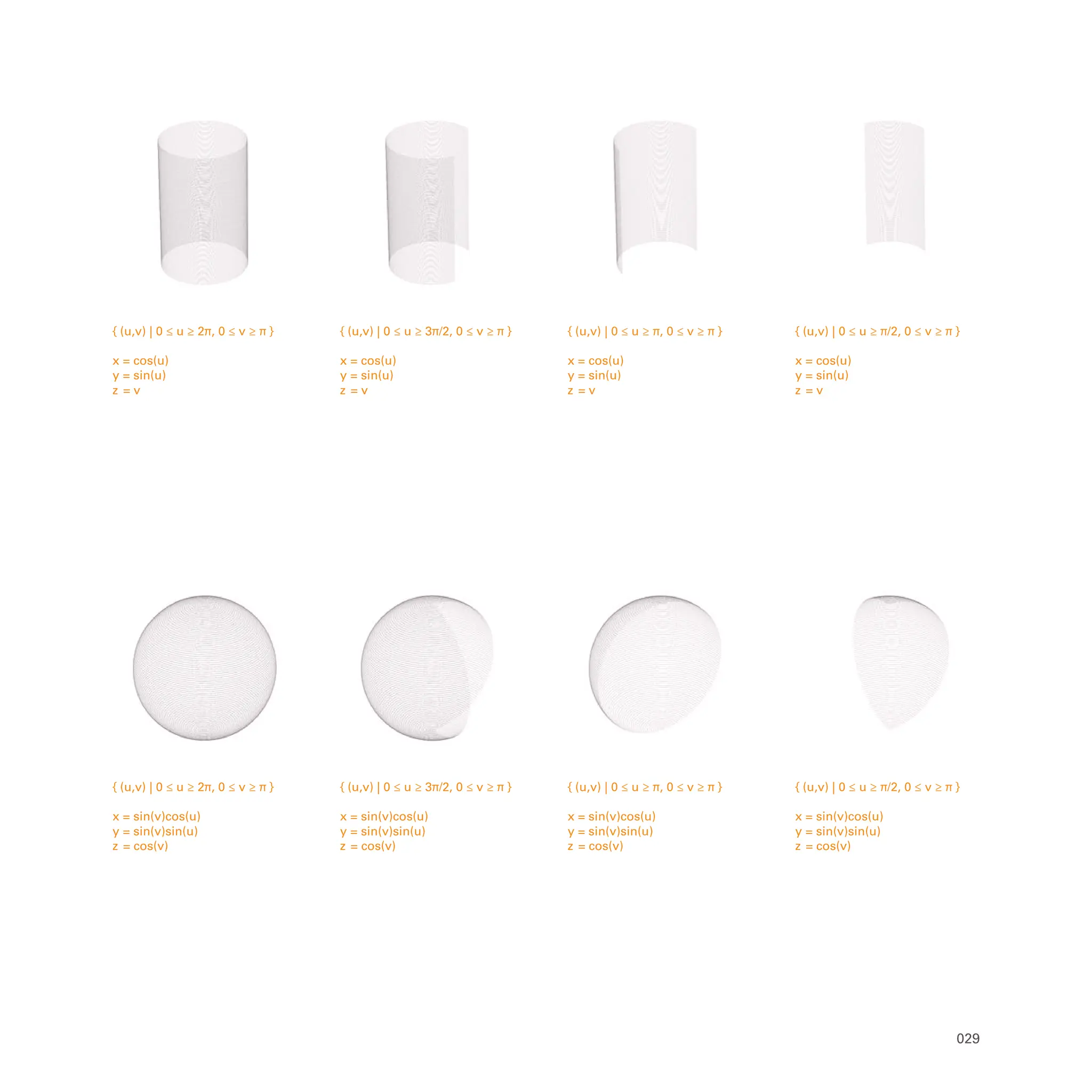
  • 3.
    A Modern ParentsGuide To Nursery Rhymes Because Its Two Oclock In The Morning And You Cant Remember Twinkle Twinkle Little Star Jennifer Griffin https://ebookbell.com/product/a-modern-parents-guide-to-nursery- rhymes-because-its-two-oclock-in-the-morning-and-you-cant-remember- twinkle-twinkle-little-star-jennifer-griffin-42347252 A Modern Parents Guide To Nursery Rhymes Because Its Two Oclock In The Morning And You Cant Remember Twinkle Twinkle Little Star Over 70 Classic Rhymes Jennifer Griffin https://ebookbell.com/product/a-modern-parents-guide-to-nursery- rhymes-because-its-two-oclock-in-the-morning-and-you-cant-remember- twinkle-twinkle-little-star-over-70-classic-rhymes-jennifer- griffin-42353824 Dont Do That A Childs Guide To Bad Manners Ridiculous Rules And Inadequate Etiquette Barry Louis Polisar https://ebookbell.com/product/dont-do-that-a-childs-guide-to-bad- manners-ridiculous-rules-and-inadequate-etiquette-barry-louis- polisar-5078408 Will There Really Be A Morning Life A Guide Poems For Key Stage 2 With Teaching Notes 1st Edition Fred Sedgwick https://ebookbell.com/product/will-there-really-be-a-morning-life-a- guide-poems-for-key-stage-2-with-teaching-notes-1st-edition-fred- sedgwick-51281192 A Step By Step French Study Guide For Beginners Learn French With Short Stories Phrases While You Sleep Numbers Alphabet In The Car Morning Meditations 50 Of The Most Used Verbs French Hacking https://ebookbell.com/product/a-step-by-step-french-study-guide-for- beginners-learn-french-with-short-stories-phrases-while-you-sleep- numbers-alphabet-in-the-car-morning-meditations-50-of-the-most-used- verbs-french-hacking-65330332
  • 6.
    Morphing A Guide toMathematical Transformations for Architects and Designers Joseph Choma
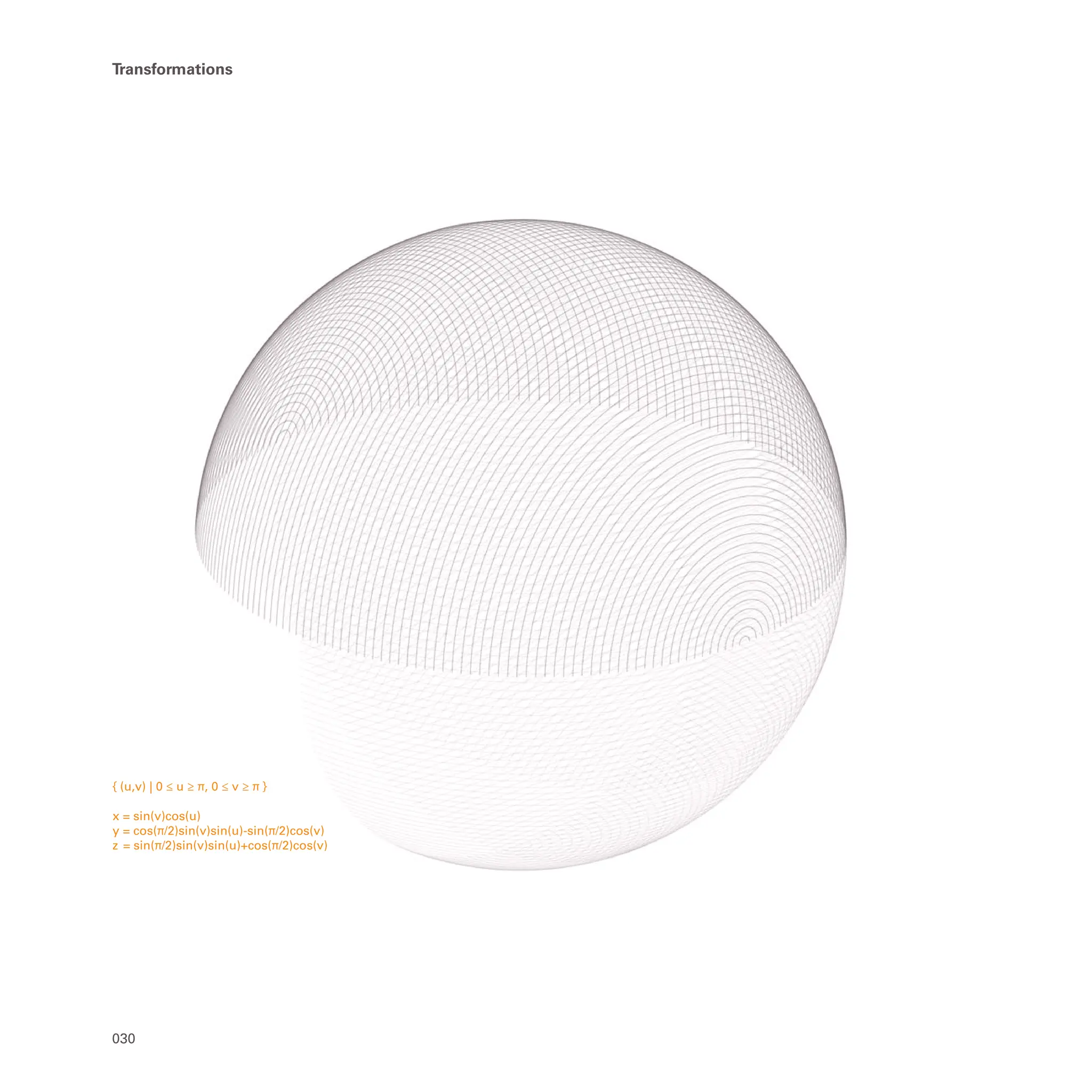
  • 7.
  • 8.
    Morphing A Guide toMathematical Transformations for Architects and Designers Joseph Choma
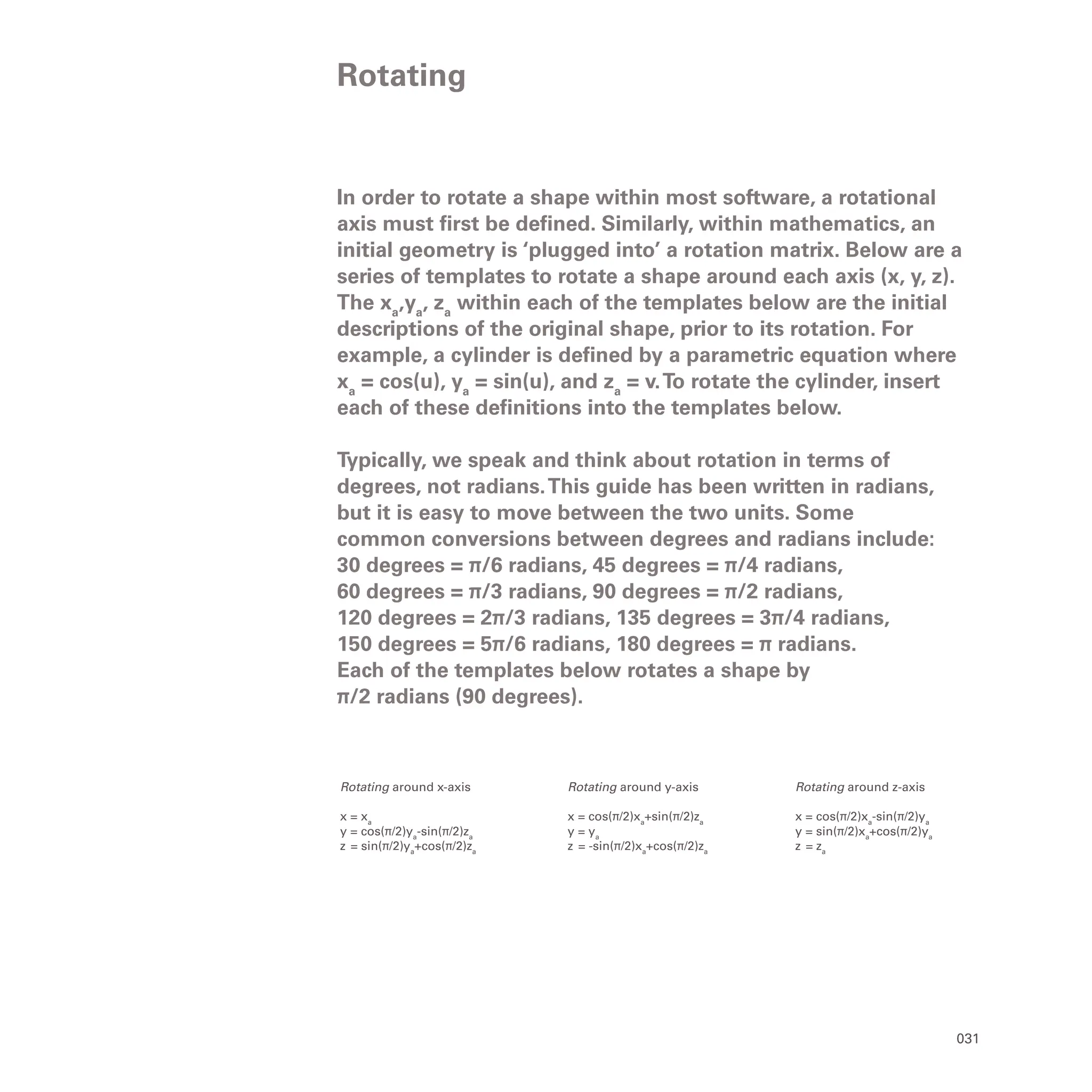
  • 9.
    004 Contents Contents 006 Introduction 014 Transformations 018Shaping 022 Translating 026 Cutting 030 Rotating 034 Reflecting 038 Scaling 042 Modulating 046 Ascending 050 Spiralling 054 Texturing 058 Bending 062 Pinching 066 Flattening 070 Thickening 074 Combining Transformations 078 Cutting and Spiralling 082 Scaling and Spiralling 086 Modulating and Spiralling 090 Spiralling and Ascending 094 Texturing and Spiralling 098 Bending and Spiralling 102 Spiralling and Bending 106 Pinching and Spiralling 110 Flattening and Spiralling 114 Spiralling and Flattening 118 Spiralling and Thickening 122 Combining Shapes 126 A Mound 128 A Meandering Mound 130 A Leaning Mound 132 A Steeper Mound 134 A Creased Mound 136 A Creased and Pinched Mound 138 A Wedge 140 A Ridge and Trench 142 Two Ridges 144 Another Ridge and Trench 146 A Valley 148 Moguls
  • 10.
    005 150 Analyzing 154 JapanPavilion – Shigeru Ban Architects 160 UK Pavilion – Heatherwick Studio 166 Mur Island – Acconci Studio 172 Son-O-House – NOX/Lars Spuybroek 178 Ark Nova – Arata Isozaki and Anish Kapoor 184 Looptecture F – Endo Shuhei Architect Institute 190 Mercedes-Benz Museum – UNStudio 196 Developable Surfaces 200 Plane to Cylinder 202 Cylinder with Ascending 204 Cylinder with Texturing and Ascending 206 Cylinder with Flattening, Texturing and Ascending 208 Cylinder with Modulating, Flattening and Texturing 210 Plane to Cone 212 Cone with Spiralling 214 Cone with Spiralling and Texturing 216 Cone with Spiralling, Texturing and Modulating 218 Cone with Spiralling, Texturing and More Modulating 220 Assumptions 228 Bibliography 231 Acknowledgments
  • 11.
    006 Introduction ‘The way inwhich a problem is decomposed imposes fundamental constraints on the way in which people attempt to solve that problem.’ (Rodney Brooks, 1999)
  • 12.
    007 A shape canbe defined as anything with a geometric boundary.Yet, when describing a shape with mathematics, precision is crucial. Dictionaries define words, but these words do not necessarily define our understanding of the world in which we perceive and create.The word ‘cube’ is defined as a shape whose boundary is composed of six congruent square faces. Imagine cutting six square pieces of paper and gluing the edges together. The cube, in this case, is created by six square planes. In mathematics, these planes are considered discrete elements. Because each plane in the paper cube meets the others at a sharp edge, technically they are not connected, but are separate parts, each defined by a unique parametric equation. Now, imagine a ball of clay. Roll it around on the tabletop to make it into a sphere.To flatten it into a cube, the ball can be simply compressed in multiple directions (rather than forming six planar sides that are joined together, as above). Gradually, the sphere could transform into a six-sided shape. Most physical cubes in the world have a certain degree of rounded corners. If we accept this definition for a cube, then a cube could be defined with one parametric equation.The framework that is used becomes critical to deciding how to go about defining a shape mathematically. If a shape maintains its topological continuity, it can be defined by a single equation. A break in continuity, such as a sharp edge, requires another equation to define the other ‘part’ . Breaking continuity and having sharp edges can create aesthetic effects that allow curves to be expressed in a more objectified manner. Breaking the continuity of a shape can also sometimes facilitate the fabrication of particular geometries out of flat sheet material. However, the scope of this guide has been constrained to the definition of shapes with a single parametric equation. A parametric equation is one way of defining values of coordinates (x, y, z) for shapes with parameters (u, v, w). All of the mathematical equations in this guide are presented as parametric equations.Think of x, y and z as dimensions in the Cartesian coordinate system – like a three-dimensional grid. Think of u, v and w as a range of values or parameters rather than a single integer. A single integer would be like a single point along a line, while the range (u, v or w) would define the end points of that line and then draw all the points between them.
  • 13.
    008 Introduction Why trigonometry? Tools inherentlyconstrain the way individuals design; however, designers are often unaware of their tools’ influences and biases. Digital tools in particular are becoming increasingly complex and filled with hierarchical symbolic heuristics, creating a black box in which designers do not understand what is ‘under the hood’ of the tools they ‘drive’ . Many contemporary digital tools use a fixed symbolic interface, like a visual dictionary.When a designer wants to create a sphere, he or she clicks on the sphere icon and draws a radius.The resulting sphere, defined by a single symbol, can only be manipulated as a whole. Like a ball of clay, the sphere can be stretched, twisted and pulled. If, however, the shape had been defined by a parametric equation, it would be defined by a rule-based logic that encompasses both the whole sphere and its parts.When the designer manipulates the shape’s trigonometry (or ‘DNA’), it becomes clear that he or she has a new range of geometric freedom that could not have been imagined in the other framework. Since the designer can manipulate the smallest building blocks of the shapes, understanding how each function influences a particular transformation becomes straightforward. The designer is no longer designing within a black box, but rather within a transparent box. Because mathematical models can be based on a global Cartesian coordinate system, the designer can constantly redefine a shape by redefining its parametric equations, avoiding the chore of telling the computer how to redraw it every time. For example, a smooth continuous surface can be confined to the boundary of a cube with a single transformation. Designers can begin to think and manipulate in a less linear fashion and constantly redefine the ‘world’ that they create and perceive. The Cartesian coordinate system becomes a blank canvas at which any type of paint can be thrown! This pedagogical guide embraces the thought that all shapes could potentially be described by the trigonometric functions of sine and cosine. But the utility of this guide does not depend on whether that idea is true or not: this guide does not invent a new field of mathematics, but develops a cognitive narrative within the existing discipline, emphasizing the interconnected and plastic nature of shapes.Within this guide, sine and cosine are the only functions that are examined.
  • 14.
    009 A word ofwarning: trigonometry may seem like the tool of a designer’s dreams, but just because every shape could be potentially described by trigonometric functions does not mean that it is necessarily easy to make every shape. It is important to remember that all tools have biases, even mathematics. For instance, in order to make a cube with a single parametric equation one must first make a sphere; therefore, shapes that are initially round become easier to produce. A tool is a device that augments an individual’s ability to perform a particular task. In this context, heuristics refers to the strategies used to solve problems within software.Think of heuristics as the rules that govern how a machine ‘thinks’ and calculates solutions. Functions (in mathematics) associate an input (independent variable) with an output (dependent variable). For example if x→y, x would be considered the independent variable while y would be considered the dependent variable. The function would be what makes x map to y. In trigonometry, sine and cosine are functions. Note that trigonometric functions are a type of periodic functions, whose values repeat in regular periods or intervals. A pedagogical guide is neither purely a technical reference nor a theoretical text, but rather the teaching of an inquiry through a series of instructional frameworks.
  • 15.
    { (u,v) |0 ≤ u ≥ 2π, 0 ≤ v ≥ 2π } x = sin(u)10(cos(v)) y = sin(v)+cos(u)10(cos(v)) z = cos(v)+10(sin(v))sin(u) 010 Introduction A point of view As we circle around an object, our perceptual understanding of it is transformed.We move in dialogue with the observed object, as in a dance performance. Similarly, the pages within this book document shapes according to particular, chosen perspectives. Most of the shapes within this guide are three dimensional, but their representation is constrained to the two-dimensional plane of the page. Some shapes may be difficult to comprehend in their entirety because of this singular view. In the series above, there are four distinct shapes. On paper, they look different; however, they are defined by the same mathematical formula. As an individual moves around the object anti-clockwise, the shape begins to reveal an illusion. Initially, the shape appears to be rectangles overlapping
  • 16.
    011 one another.Then, diamond-likeshapes appear. Eventually, the diamond-like shapes shrink and disappear, as the perimeter of the shape transforms into a circle. The selection of a particular view may seem trivial, but it is not. As with any scientific recording, the point of view from which data is presented biases the understanding of its contents.Within this guide, points of view remain constant within each morphing series. However, the selected views influence the visual documentation of each mathematical description.
  • 17.
    { (u,v) |0 ≤ u ≥ 2π, 0 ≤ v ≥ π } x = cos(v) y = u+u(sin(v)sin(u)) z = sin(v)cos(u) 012 Introduction
  • 18.
    013 Boundaries A boundary isanything that defines a limit. Numerically, determining a boundary may be straightforward, but perceptually it is often more ambiguous. Spheres, cylinders, helicoids and cones are all shapes that, when viewed from one direction, share a circular profile. Embedded within each of their mathematical DNA are the same functions, which define a circle. Throughout this guide, simple, known shapes are transformed into many shapes which have never been visualized before. But by starting with a basic shape, such as a cylinder or sphere, the boundary condition of the resultant shape could maintain the initial signature of the ancestor. For example, the shape on the left was a sphere which morphed under a spiralling and then ascending mathematical transformation.The result is a self-intersecting surface, which is bounded inside a cylinder. The shape is not recognizable or defined within the dictionary, yet it shares the cylinder’s front- and top-view boundary profiles: the top view of the shape is a rectangle, while its front view is a circle. The seemingly foreign shape appears familiar because of its profile projections. As shapes transform throughout this guide, visualize the shape’s two- dimensional projections. Like an architect’s dissection of a building with plan, section and elevation, complex shapes can be simplified by analyzing parts of their parametric equation. As the coordinates (x, y, z) within the equation are altered, the projections will change; which coordinate is altered will determine which projection will change. Mathematical transformations refer to the categorized rules for manipulating shapes with mathematical operations. Throughout this book, the names of transformations and other operations that are discussed in detail are set in italics for ease of reference.
  • 20.
  • 21.
    016 Transformations ‘Evidently, there isscarcely anything that one can say about a “single sensation” by itself, but we can often say much more when we can make comparisons.’ (Marvin Minsky, 1985)
  • 22.
    017 We all knowwhat a ball is. A ball is a sphere. But when a ball is compressed, it is no longer a sphere, but a squished sphere.The known shape has transformed into an undefined shape. Rather than describing arbitrary shapes with mathematics, known shapes are utilized as consistent starting-points within this chapter.Think of this chapter and the others that follow as a collection of design experiments.Within this framework, the sine curve, circle, cylinder or sphere is the initial starting shape for each morphing series. They are the constants, while the mathematical transformations are the variables. Thirteen mathematical transformations are introduced: translating, cutting, rotating, reflecting, scaling, modulating, ascending, spiralling, texturing, bending, pinching, flattening and thickening. Although this guide challenges words and definitions, each mathematical transformation is labelled with a verb. The words are not always perfect, but they are used as placeholders.These placeholders allow me to reference and write about different transformations throughout this guide without explicitly restating the mathematics.The words labelling each transformation are more like nicknames for the mathematics, rather than the mathematics defining the word. Each of these transformations is revealed through a morphing series; like motion-capture photography, each shape is recorded as it is transformed iteratively by the same operation. Under each shape in the series is a parametric equation that defines a particular instance. As the shape transforms, look at the equation below it. In the rule or logic behind the change in the equation, you can find the transformation.
  • 23.
    { (u,v) |0 ≤ u ≥ 2π, 0 ≤ v ≥ π } x = sin(v)cos(u) y = sin(v)sin(u) z = cos(v) 018 Transformations
  • 24.
    019 Within shaping, thefour starting shapes are introduced: a sine curve, circle, cylinder and sphere. A sine curve and circle are defined with two coordinates (x, y), while three-dimensional shapes (cylinder and sphere) are defined by x, y and z. A sine curve is simply defined by a function of sine and the u-parameter. A circle is defined by a function of sine and cosine. The v-parameter allows the circle to transform into a surface: a cylinder is an extruded circle, or a circle with a z-coordinate value of v. A cylinder can easily morph into a helix, helicoid, cone or sphere. Shaping
  • 25.
    { u |0 ≤ u ≥ 2π } x = cos(u) y = sin(u) { (u,v) | 0 ≤ u ≥ 2π, 0 ≤ v ≥ π/3 } x = cos(u) y = sin(u) z = v { (u,v) | 0 ≤ u ≥ 2π, 0 ≤ v ≥ 2π/3 } x = cos(u) y = sin(u) z = v { (u,v) | 0 ≤ u ≥ 2π, 0 ≤ v ≥ π } x = cos(u) y = sin(u) z = v { u | 0 ≤ u ≥ 2π } x = cos(u) y = sin(u) { u | 0 ≤ u ≥ 2π } x = u y = sin(u) { u | 0 ≤ u ≥ 2π } x = u y = cos(u) { u | 0 ≤ u ≥ 2π } x = u y = 0 020 Transformations Shaping
  • 26.
    { (u,v) |0 ≤ u ≥ 2π, 0 ≤ v ≥ π } x = sin(v)cos(u) y = sin(v)sin(u) z = cos(v) { (u,v) | 0 ≤ u ≥ 2π, 0 ≤ v ≥ π } x = sin(v)cos(u) y = sin(v)sin(u) z = v { (u,v) | 0 ≤ u ≥ 2π, 0 ≤ v ≥ π } x = sin(v)cos(u) y = sin(u) z = v { (u,v) | 0 ≤ u ≥ 2π, 0 ≤ v ≥ π } x = cos(u) y = sin(u) z = v { (u,v) | 0 ≤ u ≥ 2π, 0 ≤ v ≥ π } x = v(cos(u)) y = v(sin(u)) z = v { (u,v) | 0 ≤ u ≥ 2π, 0 ≤ v ≥ π } x = v(cos(u)) y = v(sin(u)) z = u { (u,v) | 0 ≤ u ≥ 2π, 0 ≤ v ≥ π } x = cos(u) y = sin(u) z = u { (u,v) | 0 ≤ u ≥ 2π, 0 ≤ v ≥ π } x = cos(u) y = sin(u) z = v 021
  • 27.
    { (u,v) |0 ≤ u ≥ 2π, 0 ≤ v ≥ π } x = 1+sin(v)cos(u) y = 1+sin(v)sin(u) z = cos(v) 022 Transformations
  • 28.
    023 A coffee mugis lifted off a table.The mug still appears to be the same shape. Physically, the material of the mug has not transformed; however, its location is different. According to mathematics, the location of a shape is part of the shape’s inherent DNA.Throughout this guide, parametric equations include: coordinates (x, y, z), parameters (u, v, w) and functions (sine, cosine). Parameters and functions define the value of the coordinates, and the coordinates define the locations of the shape’s points in space. If an integer is added to a particular coordinate, the shape moves in that direction. Remember, the parametric equation is the DNA of any given shape. Forget about words and definitions! If the equation changes, so does the shape. Not all spheres have the same mathematical description. Translating
  • 29.
    { u |0 ≤ u ≥ 2π } x = cos(u) y = sin(u) { u | 0 ≤ u ≥ 2π } x = cos(u) y = 1+sin(u) { u | 0 ≤ u ≥ 2π } x = 1+cos(u) y = sin(u) { u | 0 ≤ u ≥ 2π } x = 1+cos(u) y = 1+sin(u) { u | 0 ≤ u ≥ 2π } x = 1+u y = 1+sin(u) { u | 0 ≤ u ≥ 2π } x = 1+u y = sin(u) { u | 0 ≤ u ≥ 2π } x = u y = 1+sin(u) { u | 0 ≤ u ≥ 2π } x = u y = sin(u) 024 Transformations Translating
  • 30.
    { (u,v) |0 ≤ u ≥ 2π, 0 ≤ v ≥ π } x = 1+sin(v)cos(u) y = 1+sin(v)sin(u) z = cos(v) { (u,v) | 0 ≤ u ≥ 2π, 0 ≤ v ≥ π } x = 1+sin(v)cos(u) y = sin(v)sin(u) z = cos(v) { (u,v) | 0 ≤ u ≥ 2π, 0 ≤ v ≥ π } x = sin(v)cos(u) y = 1+sin(v)sin(u) z = cos(v) { (u,v) | 0 ≤ u ≥ 2π, 0 ≤ v ≥ π } x = sin(v)cos(u) y = sin(v)sin(u) z = cos(v) { (u,v) | 0 ≤ u ≥ 2π, 0 ≤ v ≥ π } x = 1+cos(u) y = 1+sin(u) z = v { (u,v) | 0 ≤ u ≥ 2π, 0 ≤ v ≥ π } x = 1+cos(u) y = sin(u) z = v { (u,v) | 0 ≤ u ≥ 2π, 0 ≤ v ≥ π } x = cos(u) y = 1+sin(u) z = v { (u,v) | 0 ≤ u ≥ 2π, 0 ≤ v ≥ π } x = cos(u) y = sin(u) z = v 025
  • 31.
    { (u,v) |0 ≤ u ≥ π/2, 0 ≤ v ≥ π } x = sin(v)cos(u) y = sin(v)sin(u) z = cos(v) 026 Transformations
  • 32.
    027 A curve isdefined by a series of points.The points on the curve are described as a range of values.The limits of this range are defined by the two end points on the curve. In the parametric equations that follow, there are two parameters (u, v), which control these end points.The u-parameter ‘sees’ only the local curves, which define a particular shape, while the v-parameter ‘sees’ the elevations of the entire shape. For example, in the case of the cylinder, the v-parameter would see a rectangle, while the u-parameter would see a circle. Limiting the numerical range of the parameters (u and v) will effectively cut the shape. Cutting
  • 33.
    { u |0 ≤ u ≥ 2π } x = cos(u) y = sin(u) { u | 0 ≤ u ≥ 3π/2 } x = cos(u) y = sin(u) { u | 0 ≤ u ≥ π } x = cos(u) y = sin(u) { u | 0 ≤ u ≥ π/2 } x = cos(u) y = sin(u) { u | 0 ≤ u ≥ π/2 } x = u y = sin(u) { u | 0 ≤ u ≥ π } x = u y = sin(u) { u | 0 ≤ u ≥ 3π/2 } x = u y = sin(u) { u | 0 ≤ u ≥ 2π } x = u y = sin(u) 028 Transformations Cutting
  • 34.
    { (u,v) |0 ≤ u ≥ π/2, 0 ≤ v ≥ π } x = sin(v)cos(u) y = sin(v)sin(u) z = cos(v) { (u,v) | 0 ≤ u ≥ π, 0 ≤ v ≥ π } x = sin(v)cos(u) y = sin(v)sin(u) z = cos(v) { (u,v) | 0 ≤ u ≥ 3π/2, 0 ≤ v ≥ π } x = sin(v)cos(u) y = sin(v)sin(u) z = cos(v) { (u,v) | 0 ≤ u ≥ 2π, 0 ≤ v ≥ π } x = sin(v)cos(u) y = sin(v)sin(u) z = cos(v) { (u,v) | 0 ≤ u ≥ π/2, 0 ≤ v ≥ π } x = cos(u) y = sin(u) z = v { (u,v) | 0 ≤ u ≥ π, 0 ≤ v ≥ π } x = cos(u) y = sin(u) z = v { (u,v) | 0 ≤ u ≥ 3π/2, 0 ≤ v ≥ π } x = cos(u) y = sin(u) z = v { (u,v) | 0 ≤ u ≥ 2π, 0 ≤ v ≥ π } x = cos(u) y = sin(u) z = v 029
  • 35.
    { (u,v) |0 ≤ u ≥ π, 0 ≤ v ≥ π } x = sin(v)cos(u) y = cos(π/2)sin(v)sin(u)-sin(π/2)cos(v) z = sin(π/2)sin(v)sin(u)+cos(π/2)cos(v) 030 Transformations
  • 36.
    031 In order torotate a shape within most software, a rotational axis must first be defined. Similarly, within mathematics, an initial geometry is ‘plugged into’ a rotation matrix. Below are a series of templates to rotate a shape around each axis (x, y, z). The xa ,ya , za within each of the templates below are the initial descriptions of the original shape, prior to its rotation. For example, a cylinder is defined by a parametric equation where xa = cos(u), ya = sin(u), and za = v.To rotate the cylinder, insert each of these definitions into the templates below. Typically, we speak and think about rotation in terms of degrees, not radians.This guide has been written in radians, but it is easy to move between the two units. Some common conversions between degrees and radians include: 30 degrees = π/6 radians, 45 degrees = π/4 radians, 60 degrees = π/3 radians, 90 degrees = π/2 radians, 120 degrees = 2π/3 radians, 135 degrees = 3π/4 radians, 150 degrees = 5π/6 radians, 180 degrees = π radians. Each of the templates below rotates a shape by π/2 radians (90 degrees). Rotating Rotating around z-axis x = cos(π/2)xa -sin(π/2)ya y = sin(π/2)xa +cos(π/2)ya z = za Rotating around y-axis x = cos(π/2)xa +sin(π/2)za y = ya z = -sin(π/2)xa +cos(π/2)za Rotating around x-axis x = xa y = cos(π/2)ya -sin(π/2)za z = sin(π/2)ya +cos(π/2)za
  • 37.
    { u |0 ≤ u ≥ π } x = cos(u) y = sin(u) { u | 0 ≤ u ≥ π } x = cos(π/6)cos(u)-sin(π/6)sin(u) y = sin(π/6)cos(u)+cos(π/6)sin(u) { u | 0 ≤ u ≥ π } x = cos(π/3)cos(u)-sin(π/3)sin(u) y = sin(π/3)cos(u)+cos(π/3)sin(u) { u | 0 ≤ u ≥ π } x = cos(π/2)cos(u)-sin(π/2)sin(u) y = sin(π/2)cos(u)+cos(π/2)sin(u) { u | 0 ≤ u ≥ 2π } x = cos(π/2)u-sin(π/2)sin(u) y = sin(π/2)u+cos(π/2)sin(u) { u | 0 ≤ u ≥ 2π } x = cos(π/3)u-sin(π/3)sin(u) y = sin(π/3)u+cos(π/3)sin(u) { u | 0 ≤ u ≥ 2π } x = cos(π/6)u-sin(π/6)sin(u) y = sin(π/6)u+cos(π/6)sin(u) { u | 0 ≤ u ≥ 2π } x = u y = sin(u) 032 Transformations Rotating
  • 38.
    { (u,v) |0 ≤ u ≥ π, 0 ≤ v ≥ π } x = sin(v)cos(u) y = cos(π/2)sin(v)sin(u)-sin(π/2)cos(v) z = sin(π/2)sin(v)sin(u)+cos(π/2)cos(v) { (u,v) | 0 ≤ u ≥ π, 0 ≤ v ≥ π } x = sin(v)cos(u) y = cos(π/3)sin(v)sin(u)-sin(π/3)cos(v) z = sin(π/3)sin(v)sin(u)+cos(π/3)cos(v) { (u,v) | 0 ≤ u ≥ π, 0 ≤ v ≥ π } x = sin(v)cos(u) y = cos(π/6)sin(v)sin(u)-sin(π/6)cos(v) z = sin(π/6)sin(v)sin(u)+cos(π/6)cos(v) { (u,v) | 0 ≤ u ≥ π, 0 ≤ v ≥ π } x = sin(v)cos(u) y = sin(v)sin(u) z = cos(v) { (u,v) | 0 ≤ u ≥ 2π, 0 ≤ v ≥ π } x = cos(u) y = cos(π/2)sin(u)-sin(π/2)v z = sin(π/2)sin(u)+cos(π/2)v { (u,v) | 0 ≤ u ≥ 2π, 0 ≤ v ≥ π } x = cos(u) y = cos(π/3)sin(u)-sin(π/3)v z = sin(π/3)sin(u)+cos(π/3)v { (u,v) | 0 ≤ u ≥ 2π, 0 ≤ v ≥ π } x = cos(u) y = cos(π/6)sin(u)-sin(π/6)v z = sin(π/6)sin(u)+cos(π/6)v { (u,v) | 0 ≤ u ≥ 2π, 0 ≤ v ≥ π } x = cos(u) y = sin(u) z = v 033
  • 39.
    { (u,v) |0 ≤ u ≥ π, π/2 ≤ v ≥ π } x = sin(v)cos(u) y = cos(π/2)sin(v)sin(u)+sin(π/2)cos(v) z = sin(π/2)sin(v)sin(u)-cos(π/2)cos(v) 034 Transformations
  • 40.
    035 In rotating, aninitial shape was inserted into a rotation matrix. Reflecting utilizes a similar template.When referring back to the rotating around x-axis template, you will notice subtraction in the y-coordinate and addition in the z-coordinate definition. If subtraction is replaced with addition, and addition is replaced with subtraction, an initial shape will be reflected about a plane that is rotated (at a defined angle) about the x-axis. However, the input angle defined is not the angle through which the shape is reflected, but half the angle reflected. Imagine a vertical mirror on a wall.This book is closed and brought perpendicular to the mirror.Within the mirror, the book reflects and forms a flat plane, π radians (180 degrees).The angle between the book and mirror on each side is π/2 radians (90 degrees), or one half the input angle. Each of the templates below reflects a shape by π/4 radians (45 degrees), but contains an input angle of π/2 radians (90 degrees). Reflecting Reflecting about a plane (z-axis) x = cos(π/2)xa +sin(π/2)ya y = sin(π/2)xa -cos(π/2)ya z = za Reflecting about a plane (y-axis) x = -cos(π/2)xa +sin(π/2)za y = ya z = sin(π/2)xa +cos(π/2)za Reflecting about a plane (x-axis) x = xa y = cos(π/2)ya +sin(π/2)za z = sin(π/2)ya -cos(π/2)za
  • 41.
    { u |0 ≤ u ≥ π } x = cos(u) y = sin(u) { u | 0 ≤ u ≥ π } x = cos(π/6)cos(u)+sin(π/6)sin(u) y = sin(π/6)cos(u)-cos(π/6)sin(u) { u | 0 ≤ u ≥ π } x = cos(π/3)cos(u)+sin(π/3)sin(u) y = sin(π/3)cos(u)-cos(π/3)sin(u) { u | 0 ≤ u ≥ π } x = cos(π/2)cos(u)+sin(π/2)sin(u) y = sin(π/2)cos(u)-cos(π/2)sin(u) { u | 0 ≤ u ≥ 2π } x = cos(π/2)u+sin(π/2)sin(u) y = sin(π/2)u-cos(π/2)sin(u) { u | 0 ≤ u ≥ 2π } x = cos(π/3)u+sin(π/3)sin(u) y = sin(π/3)u-cos(π/3)sin(u) { u | 0 ≤ u ≥ 2π } x = cos(π/6)u+sin(π/6)sin(u) y = sin(π/6)u-cos(π/6)sin(u) { u | 0 ≤ u ≥ 2π } x = u y = sin(u) 036 Transformations Reflecting
  • 42.
    { (u,v) |0 ≤ u ≥ π, π/2 ≤ v ≥ π } x = sin(v)cos(u) y = cos(π/2)sin(v)sin(u)+sin(π/2)cos(v) z = sin(π/2)sin(v)sin(u)-cos(π/2)cos(v) { (u,v) | 0 ≤ u ≥ π, π/2 ≤ v ≥ π } x = sin(v)cos(u) y = cos(π/3)sin(v)sin(u)+sin(π/3)cos(v) z = sin(π/3)sin(v)sin(u)-cos(π/3)cos(v) { (u,v) | 0 ≤ u ≥ π, π/2 ≤ v ≥ π } x = sin(v)cos(u) y = cos(π/6)sin(v)sin(u)+sin(π/6)cos(v) z = sin(π/6)sin(v)sin(u)-cos(π/6)cos(v) { (u,v) | 0 ≤ u ≥ π, π/2 ≤ v ≥ π } x = sin(v)cos(u) y = sin(v)sin(u) z = cos(v) { (u,v) | 0 ≤ u ≥ π, 0 ≤ v ≥ π } x = cos(u) y = cos(π/2)sin(u)+sin(π/2)v z = sin(π/2)sin(u)-cos(π/2)v { (u,v) | 0 ≤ u ≥ π, 0 ≤ v ≥ π } x = cos(u) y = cos(π/3)sin(u)+sin(π/3)v z = sin(π/3)sin(u)-cos(π/3)v { (u,v) | 0 ≤ u ≥ π, 0 ≤ v ≥ π } x = cos(u) y = cos(π/6)sin(u)+sin(π/6)v z = sin(π/6)sin(u)-cos(π/6)v { (u,v) | 0 ≤ u ≥ π, 0 ≤ v ≥ π } x = cos(u) y = sin(u) z = v 037
  • 43.
    { (u,v) |0 ≤ u ≥ 2π, 0 ≤ v ≥ π } x = (sin(v)cos(u))/2 y = (sin(v)sin(u))/2 z = cos(v)/2 038 Transformations
  • 44.
    039 According to basicmultiplication, if an integer is multiplied by another integer, its value increases according to the multiplier. If an integer is divided by another integer, its value decreases according to the divider.These same rules apply to scaling shapes. Multiplying a shape by an integer will scale that shape accordingly. If only the x-coordinate is multiplied or divided, the shape will scale only in that axis. Scaling
  • 45.
    { u |0 ≤ u ≥ 2π } x = cos(u) y = sin(u) { u | 0 ≤ u ≥ 2π } x = cos(u) y = sin(u)/2 { u | 0 ≤ u ≥ 2π } x = cos(u)/2 y = sin(u) { u | 0 ≤ u ≥ 2π } x = cos(u)/2 y = sin(u)/2 { u | 0 ≤ u ≥ 2π } x = u/2 y = sin(u)/2 { u | 0 ≤ u ≥ 2π } x = u/2 y = sin(u) { u | 0 ≤ u ≥ 2π } x = u y = sin(u)/2 { u | 0 ≤ u ≥ 2π } x = u y = sin(u) 040 Transformations Scaling
  • 46.
    { (u,v) |0 ≤ u ≥ 2π, 0 ≤ v ≥ π } x = (sin(v)cos(u))/2 y = (sin(v)sin(u))/2 z = cos(v)/2 { (u,v) | 0 ≤ u ≥ 2π, 0 ≤ v ≥ π } x = (sin(v)cos(u))/2 y = (sin(v)sin(u))/2 z = cos(v) { (u,v) | 0 ≤ u ≥ 2π, 0 ≤ v ≥ π } x = sin(v)cos(u) y = (sin(v)sin(u))/2 z = cos(v) { (u,v) | 0 ≤ u ≥ 2π, 0 ≤ v ≥ π } x = sin(v)cos(u) y = sin(v)sin(u) z = cos(v) { (u,v) | 0 ≤ u ≥ 2π, 0 ≤ v ≥ π } x = cos(u)/2 y = sin(u)/2 z = v { (u,v) | 0 ≤ u ≥ 2π, 0 ≤ v ≥ π } x = cos(u)/2 y = sin(u) z = v { (u,v) | 0 ≤ u ≥ 2π, 0 ≤ v ≥ π } x = cos(u) y = sin(u)/2 z = v { (u,v) | 0 ≤ u ≥ 2π, 0 ≤ v ≥ π } x = cos(u) y = sin(u) z = v 041
  • 47.
    { (u,v) |0 ≤ u ≥ 2π, 0 ≤ v ≥ π } x = sin(v)cos(u) y = sin(v)sin(4u) z = cos(v) 042 Transformations
  • 48.
    043 Within the trigonometricfunctions (sine, cosine) there are parameters (u, v).Within cutting, these parameters control the end points of a curve. However, when these parameters are scaled while embedded inside a trigonometric function [for example, sin(A(u)), where A is a scaling factor], they control the frequency of the curve defined. For example, if the parameter is doubled, the output would yield double the number of periods over the same length. Multiplying the parameter also multiplies the frequency of the curve. Modulating
  • 49.
    { u |0 ≤ u ≥ 2π } x = cos(u) y = sin(u) { u | 0 ≤ u ≥ 2π } x = cos(u) y = sin(2u) { u | 0 ≤ u ≥ 2π } x = cos(u) y = sin(3u) { u | 0 ≤ u ≥ 2π } x = cos(u) y = sin(4u) { u | 0 ≤ u ≥ 2π } x = u y = sin(4u) { u | 0 ≤ u ≥ 2π } x = u y = sin(3u) { u | 0 ≤ u ≥ 2π } x = u y = sin(2u) { u | 0 ≤ u ≥ 2π } x = u y = sin(u) 044 Transformations Modulating
  • 50.
    { (u,v) |0 ≤ u ≥ 2π, 0 ≤ v ≥ π } x = sin(v)cos(u) y = sin(v)sin(4u) z = cos(v) { (u,v) | 0 ≤ u ≥ 2π, 0 ≤ v ≥ π } x = sin(v)cos(u) y = sin(v)sin(3u) z = cos(v) { (u,v) | 0 ≤ u ≥ 2π, 0 ≤ v ≥ π } x = sin(v)cos(u) y = sin(v)sin(2u) z = cos(v) { (u,v) | 0 ≤ u ≥ 2π, 0 ≤ v ≥ π } x = sin(v)cos(u) y = sin(v)sin(u) z = cos(v) { (u,v) | 0 ≤ u ≥ 2π, 0 ≤ v ≥ π } x = cos(u) y = sin(4u) z = v { (u,v) | 0 ≤ u ≥ 2π, 0 ≤ v ≥ π } x = cos(u) y = sin(3u) z = v { (u,v) | 0 ≤ u ≥ 2π, 0 ≤ v ≥ π } x = cos(u) y = sin(2u) z = v { (u,v) | 0 ≤ u ≥ 2π, 0 ≤ v ≥ π } x = cos(u) y = sin(u) z = v 045
  • 51.
    { (u,v) |0 ≤ u ≥ 2π, 0 ≤ v ≥ π } x = u+sin(v)cos(u) y = u+sin(v)sin(u) z = cos(v) 046 Transformations
  • 52.
    047 Imagine a pieceof graph paper with an x-axis and a y-axis. If a sine curve was drawn on the x-axis, its period would start and end on the x-axis. Plotting a sine curve is much like plotting a horizontal line, with undulations of a specific amplitude and frequency. Adding a u-parameter outside the trigonometric function [for example, u+sin(u)] is much like plotting a diagonal line at an angle to the horizontal. For every cycle the function completes, it incrementally moves vertically.The centre of the sine curve would no longer follow the x-axis; instead, it would follow the newly plotted diagonal line. Adding an integer to a function would give a linear translation, while adding a u-parameter would shift the shape and produce a diagonal trajectory. Ascending
  • 53.
    { u |0 ≤ u ≥ 2π } x = cos(u) y = sin(u) { u | 0 ≤ u ≥ 2π } x = cos(u) y = u+sin(u) { u | 0 ≤ u ≥ 2π } x = u+cos(u) y = sin(u) { u | 0 ≤ u ≥ 2π } x = u+cos(u) y = u+sin(u) { u | 0 ≤ u ≥ 2π } x = u+u y = u+sin(u) { u | 0 ≤ u ≥ 2π } x = u+u y = sin(u) { u | 0 ≤ u ≥ 2π } x = u y = u+sin(u) { u | 0 ≤ u ≥ 2π } x = u y = sin(u) 048 Transformations Ascending
  • 54.
    { (u,v) |0 ≤ u ≥ 2π, 0 ≤ v ≥ π } x = u+sin(v)cos(u) y = u+sin(v)sin(u) z = cos(v) { (u,v) | 0 ≤ u ≥ 2π, 0 ≤ v ≥ π } x = u+sin(v)cos(u) y = sin(v)sin(u) z = cos(v) { (u,v) | 0 ≤ u ≥ 2π, 0 ≤ v ≥ π } x = sin(v)cos(u) y = u+sin(v)sin(u) z = cos(v) { (u,v) | 0 ≤ u ≥ 2π, 0 ≤ v ≥ π } x = sin(v)cos(u) y = sin(v)sin(u) z = cos(v) { (u,v) | 0 ≤ u ≥ 2π, 0 ≤ v ≥ π } x = u+cos(u) y = u+sin(u) z = v { (u,v) | 0 ≤ u ≥ 2π, 0 ≤ v ≥ π } x = u+cos(u) y = sin(u) z = v { (u,v) | 0 ≤ u ≥ 2π, 0 ≤ v ≥ π } x = cos(u) y = u+sin(u) z = v { (u,v) | 0 ≤ u ≥ 2π, 0 ≤ v ≥ π } x = cos(u) y = sin(u) z = v 049
  • 55.
    Other documents randomlyhave different content
  • 56.
    the patient workof their hands and their hearts would almost certainly be spared. While Mrs. Dike, with tears in her eyes, was telling us of the things that had been accomplished here and while the troopers poured in unceasing streams along the main road beyond the gateway, a handful of belated refugees crept in under the weathered armorial bearings on the keystonp of the archway, to be fed and cared for and then sent along in the first empty truck that came by going toward Soissons. In this group of newcomers was an elderly little man in a worn high hat and a long frock coat with facings of white dust upon its shiny seams, who looked as though he might be the mayor of some inconsequential village. He carried two bulging valises and a huge umbrella. With him was his wife, and she had in one hand a cage housing two frightened canaries and under the other arm a fat grey tabby cat which blinked its slitted eyes contentedly. The most pitiable figure of them all to my way of thinking was an old woman—yes, a very old woman—she must have been all of eighty. Alongside one of the buildings I came upon her sitting in a huddle of her most treasured possessions. She was bent forward, with her gnarled hands folded in the lap of her dress, which was silk and shiny, for naturally when she fled from her home she had put on her back the best that she owned. Under the cope of a queer little old black bonnet with faded purple cloth flowers upon it her scanty hair lay in thin neat folds, as white and as soft as silk floss. Her feet in stiff, new, black shoes showed beneath her broad skirts. Her face, caving in about the mouth where her teeth were gone and all crosshatched with wrinkles, was a sweet, kindly, most gentle old face—the kind of face that we like to think our dead-and-gone grandmothers must have had. She sat there ever so patiently in the soft sunlight, waiting for the truck which would carry her away to some strange place among stranger folk. When I drew near to her, wishing with all my heart that I knew enough of her tongue to express to her some of the thoughts I was thinking, she looked up at me and smiled a friendly
  • 57.
    little smile, andthen raising her hands in a gesture of resignation dropped them again in her lap. But it was only with her lips that she smiled, for all the time her chin was quivering and her faded old blue eyes were brimming with a sorrow that was past telling in words. She still sat there as we got into our car and drove off toward the battle. Looking back, the last thing I saw before we rounded the corner of the wall was her small black shape vivid in the sunshine. And I told myself that if I were an artist seeking to put upon canvas an image that would typify and sum up the spirit of embattled France to-day I would not paint a picture of a wounded boy soldier; nor yet one of a winged angel form bearing a naked sword; nor yet one of the full-throated cock of France, crowing his proud defiance. I would paint a picture of that brave little old withered woman, with the lips that smiled and the chin that quivered the while she smiled.
  • 59.
    W CHAPTER VII. ATTHE FRONT OF THE FRONT HEN the last preceding chapter of mine ended I had reached a point in the narrative where our little party of four, travelling in our own little tin flivverette, were just leaving Blérincourt, being bound still farther west and aiming, if our abiding luck held out, to reach the front of the Front— which, I may add, we did. To be exact we were leaving not one Blérincourt but three. First, Blérincourt, the town, with its huddle of villagers' homes, housing at this moment only French troopers and exhausted refugees; second, Blérincourt, the castle, a mouldering relic of a great house, testifying by its massive empty walls and its tottering ruin of a gateway to the fury which laid hold on the peasants of these parts in the days of the Terror; and, third, Blérincourt, the model colony of model cottages, which for us held the most personal interest, since it was here the American women of the American Fund for French Wounded had during the previous nine months centred their activities relating to the repopulating of districts in the Aisne country, now for the second time evacuated and given over again to the savage malice of the boche. Behind us as we swung into the main highway lay this grouped composition of the wrecked château, the tiny old houses of weathered grey stone and the little frame domiciles, smart and glistening with fresh paint and fresh varnishing. Before us, within a space of time and distance to be spanned by not more than half an hour of steady riding, was somewhere the problematical doorway through which we hoped to pass into the forward lines of that battle which the historians of the future, I dare say, will call merely the Great Battle, knowing their readers require no added phraseology to
  • 60.
    distinguish it fromthe lesser engagements of this war—or in fact of any war. We did not ask our way of any whom we met, either of those going ahead of us or those coming back in counter streams. To begin with, we deemed it inexpedient to halt long enough to give to any person in authority a chance for questioning the validity of our present mission, since, as I already have explained, we carried no passes qualifying us to traverse this area; and besides there was no need to ask. The route was marked for us by signs and sounds without number, plainer than any mileposts could have been: By the columns of Frenchmen hurrying up to reenforce the decimated British who until now, at odds of one to five, had borne the buffets of the tremendous German onslaught; by the never-ending, never- slackening roar of the heavy guns; by the cloud of dust and powder, forming a wall against two sides of the horizon, which mounted upward to mingle its hazes with the hazes of the soft spring afternoon; by the thin trickling lines of light casualty cases, “walking wounded,” in the vernacular of the Medical Corps—meaning by that men who, having had first-aid bandages applied to their hurts at forward casualty stations, were tramping rearward to find accommodations for themselves at field hospitals miles away. At once we were in a maze of traffic to be likened to the conditions commonly prevalent on lower Fifth Avenue in the height of the Christmas-shopping season, but with two distinctions: Here on this chalk-white highroad the movement, nearly all of it, was in one direction; and instead of omnibuses, delivery vans, carriages and private automobiles, this vast caravansary was made up of soldiers afoot, soldiers mounted and soldiers riding; of batteries, horse drawn and motor drawn; of pontoon bridges in segments; of wagon trains, baggage trains, provision trains and munition trains; of field telephone, field telegraph and field wireless outfits upon wheels; of all the transportable impedimenta and all the myriad items of movable machinery pertaining to the largest army that has crossed a corner of France since the days of the first great invasion more than three and a half years before.
  • 61.
    There were ambulancespast counting; there were big covered camions in numbers sufficient to fit out a thousand circuses; there were horses and donkeys and mules of all the known sizes and colours; there were so many human shapes in uniforms of horizon blue that the eye grew weary and the brain rebelled at the task of trying, even approximately, to compute estimates of the total strength of the man power here focussed. Through all this, weaving in and out, our impudent little black bug of a car scuttled along, with its puny horn honking a constant and insolent demand for clear passage. At a faster gait than anything in sight except the cruising aëroplanes above, we progressed upon our way, with none to halt us and none to turn us back. Where the dust hung especially thick at a crossroads set in the midst of the wide plain we almost struck three pedestrians who seemingly did not heed our hooted warning or take notice of it until we were right upon them. As they jumped nimbly for the ditch we could see that all these had staff markings at their throats, and that one, the eldest of the three, a stoutish gentleman with a short grizzled beard, wore three stars in a triangle upon his collar. Tin Lizzie had almost achieved the distinction for herself of having run down a major general of France. We did not stop, though, to offer apologies or explanations. With rare sagacity our driver threw her wide open and darted into the fog, to take temporary shelter behind a huge supply wagon, which vehicle we followed for a while after the fashion of a new-foaled colt trailing its dam. Proofs began to multiply that we were nearing the zone of live combat. Until now the only British soldiers we had seen were slightly wounded men bound afoot for the rear. All at once we found ourselves passing half a company of khaki-clad Britishers who travelled across a field over a course parallel to the one we were taking and who disappeared in a hazel copse beyond. Rifle firing could be heard somewhere on the far side of the thicket. At a barked command from an officer who clattered up on horseback a battery of those doughty little seventy-fives, which the French cherish so
  • 62.
    highly, and withsuch just cause, was leaving the road and taking station in a green meadow where the timid little wild flowers of a mild March showed purple and yellow in the rutted and trampled grass. With marvellous haste the thing was accomplished almost instantly. The first gun of the five squatted in the field with its nozzle slanting toward the northwest, and behind it its four companions stood, all with their short noses pointing at precisely the same angle, like bird dogs on a back stand. Suddenly they did what well-broken bird dogs never do—they barked, one after the other. Almost before the whining whistle of the shells had died away the gunners were moving their pieces to a point closer up behind a screen of poplars and sending a second yelping salvo of shots toward an unseen target. We became aware that the component units of the army were now quitting the roadway to take positions in the back lines. Indeed those back lines formed themselves while we watched. One battery after another swung off to the right or to the left and came into alignment, so that soon we rode between double rows of halted guns. With our canes we could have touched the artillerymen piling heaps of projectiles in convenient hollows in the earth close up to the edges of the road. Big covered wains discharged dusty infantrymen, who, pausing only long enough to unbuckle their packs from their shoulders and throw them under the hoods of the wagons, went at a shambling half-trot through the meadow. Cavalrymen, not dismounted, as they had mainly been during these dragging winter months of warfare that was stationary and static, but with their booted feet once more in their stirrups, cantered off, bound presumably for the thin woodlands which rimmed the plateau where the terrain broke away to the banks of the River Oise. Here again at last was war in the open, as different from battle in the trenches as football is from trap shooting. The action of it was spread out before one's eyes, not masked in mud ambuscades. Each instant our eyes beheld some new and stirring picture, standing out by reason of its swift vigour from the vaster panorama of which it
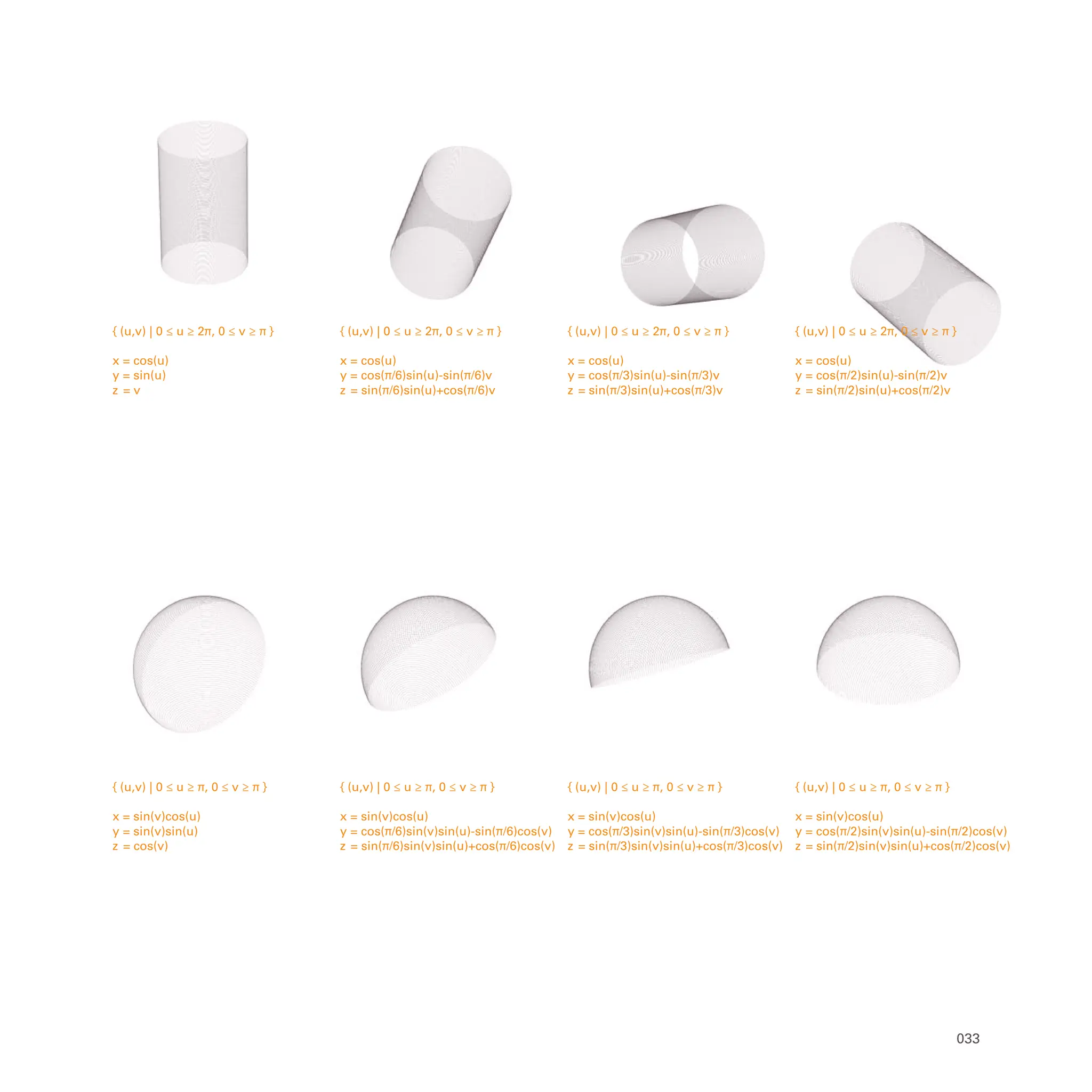
  • 63.
    was a part.What I had seen of battle formations in the preceding three weeks had made me think mainly of subway diggin's or of construction work for a new railroad or of engineering operations in connection with a dam, say, or a dike. What I saw now most vividly suggested old-time battle pictures by Meissonier or Détaillé. War, for the moment at least, had gone back to the aspect which marked it before both sides dug themselves in to play the game of counterblasting with artillery and nibbling the foe's toes with raids and small forays. Of another thing we were likewise aware, and the realisation of the fact cheered us mightily. Among the blue uniforms of the French the greenish buff of the British showed in patches of contrasting colour that steadily increased in size and frequency. By rare good luck we had entered the advanced positions at the identical place for which, blindly, we had been seeking—the place where the most westerly sector of the French left wing touched the most easterly sector of the British right wing; and better than that, the place where the French strength hurrying up to reënforce and if need be replace decimated divisions of their allies was joined on to and fused in with the retiring British Army, which, during the preceding three days, had sustained the main force of the German offensive. It was here if anywhere that we could count with the best prospects of success upon boring straight through to the Front, the reason being that the French might assume the British had given us passage and the British might assume the French had let us by. There were perhaps three more miles of brisk travelling for us, during which I am sure that I saw more than ever I have seen in any three miles that ever I traversed in my life; and at the end of that stretch we could tell that we had well-nigh outrun the forward crest of the French ground swell and had come into the narrower backwash of the British retreat. A retreat of sorts it may have been, but a rout it most assuredly was not. We saw companies reduced to the strength of ten or twelve or twenty men under command of noncommissioned officers or possibly of a single lieutenant. We saw individual privates and we saw privates in squads of two or three or
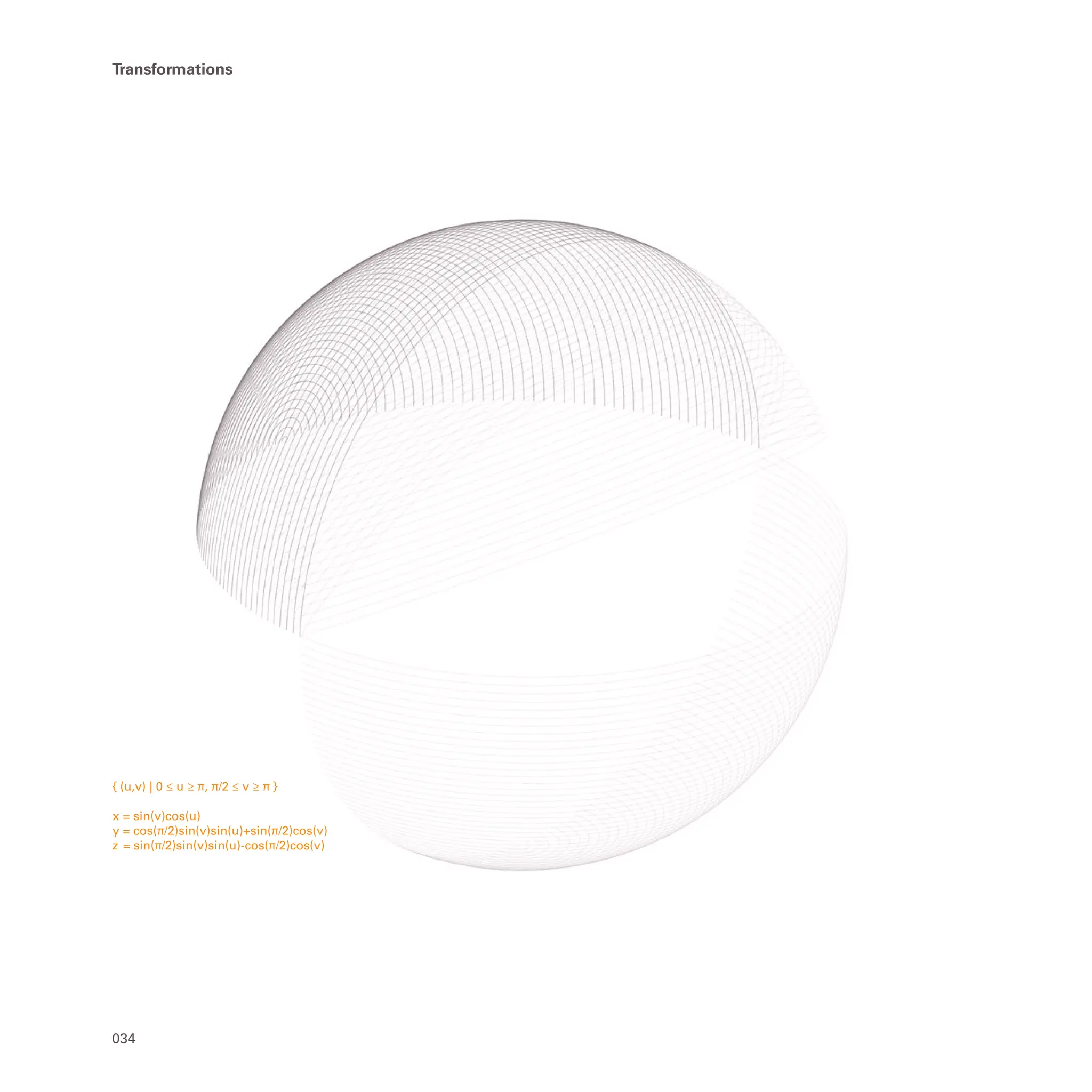
  • 64.
    half a dozenmen, who in the terrific fighting had become separated from a command, which possibly had been scattered but which it was more likely had been practically wiped out. Such men were not stragglers, nor were they malingerers; they were survivors, atoms flung backward out of the raging inferno which had swallowed up whole regiments and whole brigades. And we took note that every single man of these broken and decimated detachments was in good humour, though dog tired; and that every single one of them had kept his accoutrements and his rifle; and that every single one of them, whether moving under orders or acting upon his own initiative, was intent upon just two things and two things only—to get back into the maelstrom from which temporarily he had been spewed forth, and pump more lead into the living tidal wave of grey coats. Some that we overtook were singing, and singing lustily too. Than this no man could ask to see a finer spectacle of fortitude, of pluck and of discipline, and I am sure that in his heart each one of us, while having no doubt of the outcome of the fiery test, prayed that our own soldiers, when their time of trial by battle came, might under reverses and under punishment acquit themselves as well as had these British veterans, Yorkshire and Bedfordshire and Canada, who came trudging along behind us, swallowing our dust. What impressed us as most significant of all was that only once that day did we see a scrap of personal equipment that had been cast aside. This was a cartridge belt of English make, with its pouches empty and its tough leather tom almost in two, lying like a broken-backed brown snake in a ditch. Already from wounded English soldiers and from exhausted English hospital workers whom we had seen back in Soissons we comprehended a measure of appreciation of what these battered fragments of the forces had been called upon to endure during four days and five nights. We knew as surely as though we had stopped to take down the story of each one of the wearied, cheerful, resolute chaps, that they had their fill of killing the enemy and of seeing their mates about them blown to bits by high explosives or mowed down
  • 65.
    by rifle fire.I recalled what a bedraggled young surgeon, a Highlander by his accent, had said the night before: “I crave never to pass through this experience again. I have seen so much of death since this battle started that I have in me now contempt not only for death but for life too. I thought last year on the Somme I saw real fighting. Man, it was but child's play to what I saw the day before yesterday! “From the casualty dressing post where I was on duty I could see the fighting spread out before me like a cinema show. For our shelter—we were in a concrete dugout—was in the side of a hill with a wide sweep of lowland below and beyond us, and it was here in this valley that the Germans came at our people. Between jobs in the operating theatre—and God knows we had enough of them—I would slip out for a breath of air, and then I could watch through my glasses what went on. “In wave after wave the Germans came on, marching close together in numbers incredible. They were like ants; they were like flies; like swarming grasshoppers. At first they tried a frontal attack against our trenches, but even the Germans, driven on as they must have been like cattle to the slaughter, couldn't stand what they got there. Within two hours they charged three times! Each time they fell back again, and each time they left their dead lying so thickly behind that finally the ground seemed as though it were covered with a grey carpet. “That happened in the first day of their drive against our part of the line, which was the third line back, the two front lines having already been taken by them. So on the next day, which was the day before yesterday, they worked their way round to the south a bit and tried a flanking advance. Then it was I saw this, just as I'm telling it to you. I saw them caught by our machine-gun fire and piled up, heap on heap, until there was a windrow of them before the British trenches that must have been six feet high. “They went back, but they came again and again, and they kept on coming. They climbed right over that wall of their own dead—I
  • 66.
    myself watched themscrambling up among the bodies—and they slid down on the other side and ran right into the wire entanglements, where those of them that were killed hung in the wires like garments drying on a line. They died there in such numbers that they fairly clogged the wires. And still they kept on coming. “When our line began to bend in, farther away to the west, we got orders to evacuate the station; and the men in the trenches where I had seen the fighting got orders—what were left of them—to fall back too. They were Scotchmen, these laddies, and they were fairly mad with the fighting. They didn't want to go, and they refused to go. I'm told by reliable witnesses that their officers had almost to use force against them—not to make them keep on fighting but to make them quit fighting.” He looked into the coals of the wood fire and shivered. “Man, it's not war any more; it's just plain slaughter. Mark my word—there'll never be another war such as this one has been or another battle such as the one that still goes on yonder. 'Tis not in flesh and blood to endure its repetition once the hate has been cooled by a taste of peace.” The men about us for the most part must have taken part as actors in scenes such as the young surgeon had described as an onlooker. But about them there was no sign of reluctance or of surcease. We realised as thoroughly as though we had been eyewitnesses to their conduct that they had carried on like brave men; and without being told we realised, too, that they were made of the stuff which keeps carrying on as long as there is life left in it. They were of the breed of the bulldog, and clean strain, at that. Frenchmen grew fewer in number along the route we travelled; Britishers became more and more numerous. Where byways crossed the highroad and in wrecked villages the British already had posted military policemen to guide the traffic and point out the proper directions to bodies of men passing through. Those men stood in midroad giving their orders as calmly and as crisply as though they
  • 67.
    had been bobbieson the Strand. Even this emergency John Bull's military system did not disintegrate. As long as the organism lasted the organisation would last too. Nowhere was there any suggestion of confusion or conflict of will. I am prone to think that in the years to come the chief outstanding fact about the great spring offensive of 1918 will be not the way the Germans came forward but the way in which the British fell back. Until now we had seen only British foot soldiers, and once or twice officers in motor cars or on horseback; but soon we came upon a battery of British light artillery. It was jolting across muddy pasture among the stumps of apple trees which the Germans with malignant thoroughness had felled before their big retreat of twelve months before. The place had been an orchard once. Now it was merely so much waste land, dedicated to uselessness by efficiency and kultur. The trees, as we could see, had not been blown down by shell fire or hewn down with axes. They had been neatly and painstakingly sawed through, clear down to the earth. Some of the butts measured a foot and a half across, and to have bolls of this size, fruit trees in this country must have attained great age. The battery took position and went into immediate action behind a covert of willows and scrub at the far side of the ruined orchard. At the moment we did not know that the thicket was a screen along the southern bank of the Oise. At the left of where the guns were speaking was a group of empty and shattered cottages stretching along a single narrow street that ran almost due north and south. Coming opposite the foot of this street we glimpsed at the other end of it a glint of running water, and in the same instant, perhaps two or three miles away farther on across the river, we made out the twin spires of the cathedral of Noyon, for which, as we know, the contending armies had striven for forty-eight hours, and which the evening before had fallen into the enemy's hands. Literally we were at the front of the Front. East of the clustered houses of the city a green hill rose above the tree tops. Across the flanks of this hill we saw grey-blue clumps moving. At that distance the sight was suggestive of a crawling mass
  • 68.
    of larvæ. Overit puffs of smoke, white for shrapnel and black for explosives, were bursting. We were too far away to observe the effect of this shelling, but knew that the crawling grey blanket meant Germans advancing in force down into the valley of the river, and we knew, too, that they were being punished by Allied guns as they came on to take up their new position.
  • 69.
    C CHAPTER VIII. ABRIDGE AND AN AUTOMOBILE TIRE URIOUSLY enough there was at this moment and at this place no return fire from the enemy. From this we deduced that the infantry in their impetuous onrush had so far outtravelled the heavy and more cumbersome arms of their service that the artillery had not caught up yet. However, a little later projectiles from hostile field pieces began to drop on our side of the stream. Halfway of the length of the street our car halted. It did not seem the part of wisdom for the four of us to go ahead in a group, so I walked the rest of the way to spy out the land. Behind the shattered stone and plaster houses French soldiers were squatted or lying. In the hope of finding some one who could speak the only language I knew I continued on until I came to the last two houses in the row. They overhung the riverbank. Beyond them were two bridges spanning the little river, one an old steel bridge with a concrete roadbed, and the other a sagging wooden structure, evidently built by soldier hands. The mouth of the military bridge was stopped with a makeshift barricade thrown together any which way. The backbone of the barrier was formed of two tree trunks, but they were half hidden from sight beneath a miscellaneous riffle of upturned motor lorries, wheelbarrows and clustered household furniture, including many mattresses that plainly had been filched from the villagers' abandoned homes. Midway of the main bridge a handful of French engineers were pottering away, rather leisurely, I thought, at some job or other. Two Tommies were standing behind one of the farthermost buildings of the hamlet—a building which in happier days had been a café. Now it was a broken shell, foul inside with a litter of wreckage. The men wore the insignia of the Royal Lancers.
  • 70.
    As I approachedthem they saluted, evidently mistaking me, in my trench coat and uniform cap, for an American officer. That an American officer should be in this place, so far away from any American troops, did not seem to surprise them in the least. “What town is this?” was my first question. “It's called Pontoise, sir,” answered one of them, giving to the name a literal rendition very different from the French fashion of pronouncing this word. “What's going on out yonder on the bridge?” I inquired next. “The Frenchmen is minin' it to blow it up, sir. They mined it once already but the charge didn't explode, sir. Now they're goin' to give it another try. They'll be letting off the charge pretty soon, sir, I think— as soon as a few of their men and a few of ours who're over on the other bank in them bushes 'ave fallen back to this side 'ere.” “How close are the Germans?” I asked. I figured they must be uncomfortably close. They were. “Come along with me, sir, if you don't mind,” quoth my informant. Quite in the most casual way he led me out from behind the shelter of the ruined café. As we quitted its protection I could see over a broken garden wall the British battery down below at the left, firing as fast as the gunners could serve the pieces. Of all the men in sight these shirt-sleeved artillerymen were the only ones who seemed to have any urgent business in hand. Together we advanced to the barricade, which at the spot where we halted came up to our middles. Across the top of it my guide extended a soiled hand. “The beggars are right there, sir, in them bushes; about a 'undred and fifty yards away, sir, or two 'undred at the most,” he said with the manner of a hired guide. “You carn't see them now, sir, but a bit ago I 'ad a peep at a couple of 'em movin' about. The reason they ain't firin' over 'ere is because they don't want us to locate 'em, I think, sir.” “Oh!” I said, like that. “Oh!”
  • 71.
    By mutual butunspoken consent we then retired to our former position. The imperturbable Tommy fell back in good order, but I think possibly I may have hurried somewhat. I always was a fairly brisk walker, anyhow. Inside the breached building my companions joined me, and while the shells from the battery and from the other batteries farther away went racketing over us toward Noyon we held a consultation of war. Any desire on the part of any one to stay and see what might happen after the bridge had been blown up was effectually squelched by the sudden appearance of two British officers coming through the village toward us. Did they choose to interrogate us regarding our mission in this parlous vicinity there might be embarrassment in the situation for us. So we went away from there. As we departed from the place a certain thing impressed itself upon my consciousness. The men about me—the two Tommies certainly, the two officers presumably, and probably the Frenchmen —had but newly emerged from hard fighting. Of a surety they would very shortly be engaged in more hard fighting, striving to prevent the on-moving Germans from crossing the river. Over their head shells from their own guns were racking the air. Shells from hostile batteries were beginning to splatter down just beyond. This then was merely an interval, an interlude between acts of a most dire and tremendous tragedy. And yet so firmly had the chance of death and the habit of war become a part of their daily and their hourly existence that in this brief resting spell they behaved exactly as men engaged in some wearing but peaceful labour might behave during a nooning in a harvest field. No one in sight was crouching in a posture of defence, with his rifle gripped in nervous hands and his face set and intent. Here were being exemplified none of the histrionic principles of applied heroics as we see them on the stage. The Frenchmen were sprawled at ease behind the walls, their limbs relaxed, their faces betokening only a great weariness. One or two actually were asleep with their heads pillowed on their arms. Those who spoke did so in level, unexcited tones. They might have
  • 72.
    been discussing theveriest commonplaces of life. For all I knew to the contrary, they were discussing commonplaces. The two British privates leaned upon their rifles, with their tired legs sagging under them and with cigarette ends in their mouths. One of the officers was lighting a pipe as we drove past him. One of the Frenchmen was gnawing at a knuckle of bread. Indeed there was nothing about the scene, except a knowledge of the immediate proximity of German skirmishers, which would serve to invest it with one-tenth of the drama that marked a hundred other sights we had that day witnessed. Later, though, we learned we had blundered by chance upon the very spot where the hinge of the greatest battle of history next day turned. It was south of Noyon at the Pontoise ford and at other fords above and below Pontoise that the Germans designed to cross the river in their onslaught southward against the defences of Paris. But there they failed, thanks be to British desperation and French determination; and it was then, according to what students of strategy among the Allies say, that the hosts of the War Lord altered the plan of their campaign and faced about to the westward in their effort to take Amiens and sunder the line of communication between Paris and Calais—an effort which still is being made as I sit here in Paris writing these pages for the mail. The day's journey was not over by any manner of means, but so far as I personally was concerned its culminating moment passed when I walked out on the bridge timbers with that matter-of-fact young Royal Lancer. What followed thereafter was in the nature of a series of anticlimaxes, and yet we saw a bookful before we rode back to Soissons for a second night under bombardment in that sorely beset and beleaguered old city. Before heading back we cruised for ten kilometres beyond Noyon, going west by south toward Compiègne. On this side jaunt we mostly skirted the river, which on our bank was comparatively calm but which upon the farther bank was being contended for at the bayonet's point by British and French against Germans. The sound of the cannonading never ceased for a
  • 73.
    moment, and asdusk came on the northern horizon was lit up with flickering waves of a sullen dull red radiance. The nearer we came to Compiègne the more numerous were the British, not in squads and detachments and bits of companies but in regiments and brigades which preserved their formations even though some of them had been reduced to skeletons of their former proportions. In the fields alongside the way the artillerymen were throwing up earthen banks for the guns; the infantrymen were making low sod walls behind which they would sleep that night and fight on the morrow. From every hand came the smell of brewing tea, for, battle or no battle, the Tommy would have his national beverage. The troop horses were being properly bestowed in the shaggly thickets, and camp fires threw off pungent smells of wood burning. For the first time in a long time the campaign was outdoors, under the skies. I saw one fagged trooper squatting at the roadside, with a minute scrap of looking-glass balanced before him in the twigs of a bare bush, while he painfully but painstakingly was shaving himself in cold ditch water. He had fought or marched all day, I imagine; his chances of being sent to eternity in piecemeal before another sunset were exceedingly good; but he would go, tidied and with scraped jowls, to whatever fate might await him. And that, except for one other small thing, was the most typically English thing I witnessed in the shank of this memorable evening. The other incident occurred after we had faced about for our return. In a maze of byroads we got off our course. A lone soldier of the Bedfordshires—a man near forty, I should say at an offhand guess—was tramping along. Our driver halted our car and hailed him. He straightened his weary back and came smartly to a salute. “We've lost our way,” explained one of us. He smiled at us whimsically. “I'm afraid I can't help you, sirs,” he said in the tones of an educated man. “I've lost my own way no less than six times to-day. I may add that I'm rather a stranger in these parts myself.”
  • 74.
    When we gotto Blérincourt with an hour of daylight and another hour of twilight yet ahead of us we turned north toward Chauny, which the Germans now held and which the Allies were bombarding furiously. We had come to a crossroads just back of a small village, when with a low spiteful hiss of escaping air one of our rear tires went flat. We stopped to replace the damaged tube with a better one. Behind us, a quarter of a mile or so away, a British baggage train was making bivouac for the night. Just in front of us a British battery was firing over the housetops of the empty village toward Chauny. We had the car jacked up and the old tire off the rim and the new one half on when—bang! the heavens and the world seemed to come together all about us. What happened was that a big shell of high explosives, fired from an enemy mortar miles away, had dropped within seventy, sixty yards of us in a field; what seemed to happen was that a great plug was pulled out of the air with a smiting and a crashing and a rending. The earth quivered as though it had taken a death wound. Our wind shield cracked across under the force of the concussion. Gravel and bits of clay descended about us in a pattering shower. Speaking for myself, I may say that one of the most noticeable physical effects of having a nine shell exploding in one's immediate vicinity is a curious sinking sensation at the pit of the stomach, complicated with a dryness of the mouth and sudden chill in the feet. Two more shells dropped within a hundred yards of us before we got that tire pumped up and departed. Even so, I believe the world's record for pumping up tires was broken on this occasion. I am in position to speak with authority on this detail, because I was doing the pumping.
  • 76.
    I CHAPTER IX. ACESUP! NSIDE the German lines at the start of the war I met Ingold, then the first ace of the German aërial outfit; only the Germans did not call them aces in those days of the beginnings of things. The party to which I was attached spent the better part of a day as guests of Herr Hauptmann Ingold and his mates. Later we heard of his death in action aloft. Coming over for this present excursion I crossed on the same steamer with Bishop of Canada—a major of His Britannic Majesty's forces at twenty-two, and at twenty-three the bearer of the Victoria Cross and of every other honour almost that King George bestows for valour and distinguished service, which means dangerous service. I have forgotten how many boche machines this young man had, to date, accounted for. Whether the number was forty-seven or fifty-seven I am not sure. I doubt if Bishop himself knew the exact figure. At Paris, after my arrival, and at various places along the Front I have swapped talk and smoking tobacco with sundry more or less well-known members of the Lafayette Escadrille and with unattached aviators of repute and proved ability. From each of these men and from all of them—Belgians, Italians, Americans, Britishers and Frenchmen—I brought away an impression of the light-hearted gallantry, the modesty and the exceeding great competency which appear to be the outstanding characteristics of those who do their fighting—and, in a great many instances, their dying—in the air. It was almost as though the souls of these men had been made cleaner and as though their spirits had been made to burn with a whiter flame by reason of the purer element in which they carried on the bulk of their appointed share in this war business. You somehow felt that when they left the earth they shook off from their feet a good part of the dirt of the earth. I do not mean to imply that they
  • 77.
    had become superhuman,but that they had acquired, along with their training for a special and particularised calling, some touch of the romanticism that attached to the ancient and dutiful profession of knight-errantry. Nor is this hard to understand. For a fact the flying men are to-day the knights-errant of the armies. To them are destined opportunities for individual achievement and for individual initiative and very often for individual sacrifice such as are denied the masses of performers in this war, which in so many respects is a clandestine war and which in nearly all respects is an anonymous war. I think sometimes that, more even than the abject stupidity of the enterprise, it is the entire taking-away of the drama—the colour of theatricalism, the pomp and the circumstance, the fuss and the feathers—that will make war an exceedingly unpopular institution for future generations, as it has been an exceedingly unprofitable if a highly necessary one for this present generation. When the planet has been purged of militarism, the parent sin of the whole sinful and monstrous thing, I am convinced that the sordid, physically filthy drabness that now envelops the machinery of it will be as potent an agency as the spreading of the doctrine of democracy in curing civilised mankind of any desire to make war for war's sake rather than for freedom and justice. One has only to see it at first hand in this fourth year of conflict to realise how completely war has been translated out of its former elements. It is no longer an exciting outdoor sport for fox-chasing gentlemen in bright-red coats; no longer a seasonal diversion for crosscountry riders in buckskin breeches. It is a trade for expert accountants, for civil-engineering sharps, for rule of thumb, for pick and shovel and the land surveyor's instruments. As the outward romance of it has vanished away, in the same proportion the amount of manual labour necessary to accomplish any desired object has increased until it is nearly all work and mighty little play—a combination which makes Jack a dull boy and makes war a far duller game than it used to be. Of course the chances for heroic achievements, for the development and the exercise of the traits of
  • 78.
    Welcome to ourwebsite – the perfect destination for book lovers and knowledge seekers. We believe that every book holds a new world, offering opportunities for learning, discovery, and personal growth. That’s why we are dedicated to bringing you a diverse collection of books, ranging from classic literature and specialized publications to self-development guides and children's books. More than just a book-buying platform, we strive to be a bridge connecting you with timeless cultural and intellectual values. With an elegant, user-friendly interface and a smart search system, you can quickly find the books that best suit your interests. Additionally, our special promotions and home delivery services help you save time and fully enjoy the joy of reading. Join us on a journey of knowledge exploration, passion nurturing, and personal growth every day! ebookbell.com