Amity Business School
.GEOGRAPHICAL
INDICATION
( INTELLECTUAL PROPERTY )
1
Amity Business School
2
•It is an indication.
•It originates from a definite geographical territory.
• it is used to identify goods having special characteristics
originating from a definite geographical territory
•It is used to identify agricultural, natural or manufactured
goods.
•The manufactured goods should be produced or processed
or prepared in that territory.
•It should have a special quality or reputation or other
characteristics.
Amity Business School
Benefits Of Geographical
Indication
3
•It confers legal protection.
•Prevents unauthorized use of a Registered
Geographical Indication by others.
•It promotes economic prosperity of producers
of goods produced in a geographical territory.
•Boosts the export.
Amity Business School
4
•Can serve as source-identifiers for consumers.
Helps the producers develop consumer loyalty.
•Plays a role in consumer decisions, including
willingness to pay a higher price for regionally
branded food products.
•For example, geographic location is an important
component of wine pricing.
Continued….
Amity Business School
5
EXAMPLES OF GIs
INDIA
•Basmati rice
•Mysore silk
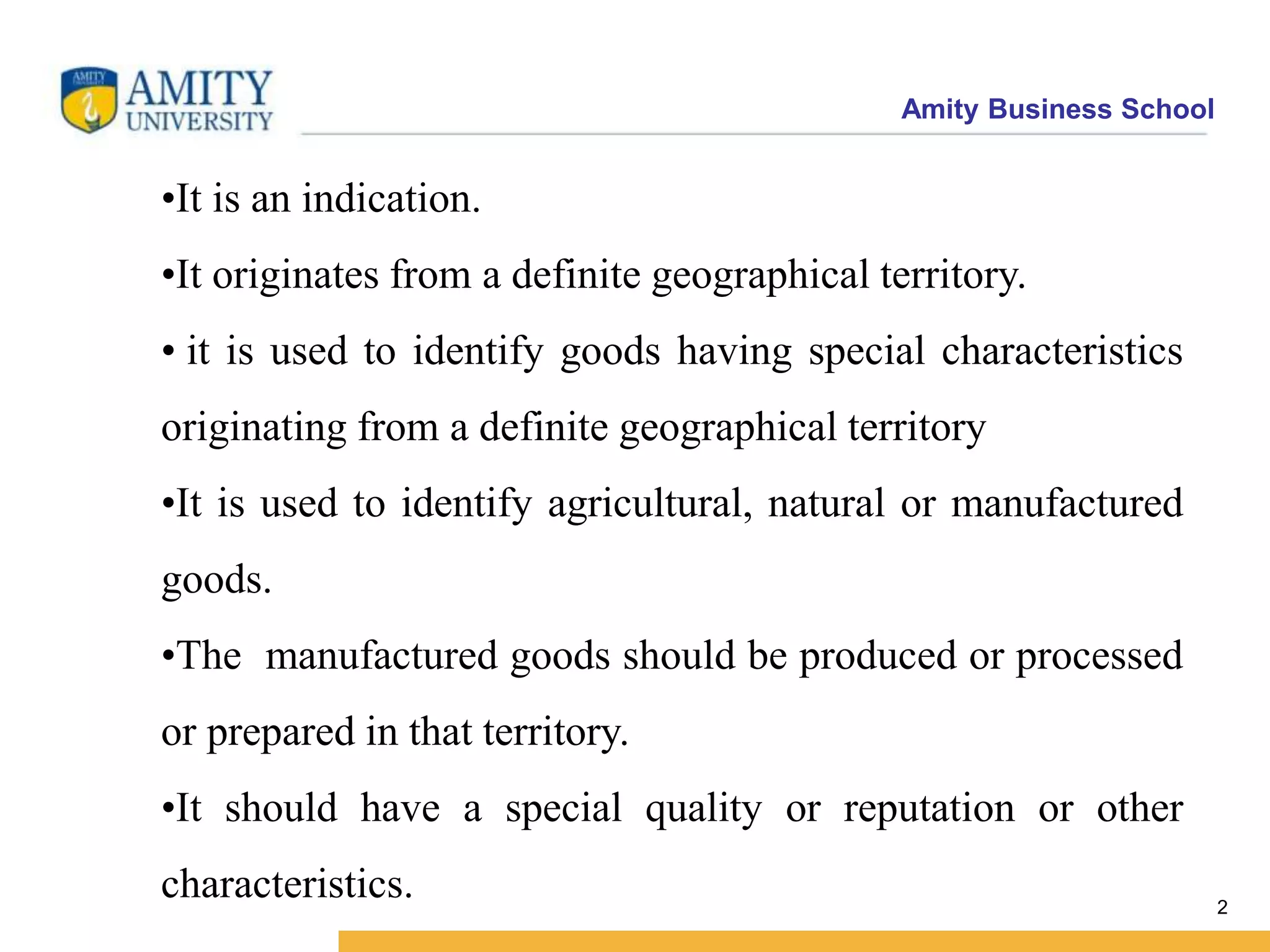
•Mysore sandalwood oil
•Mysore sandal soap
•Mysore jasmine
•Coorg orange
•Madhubani paintings
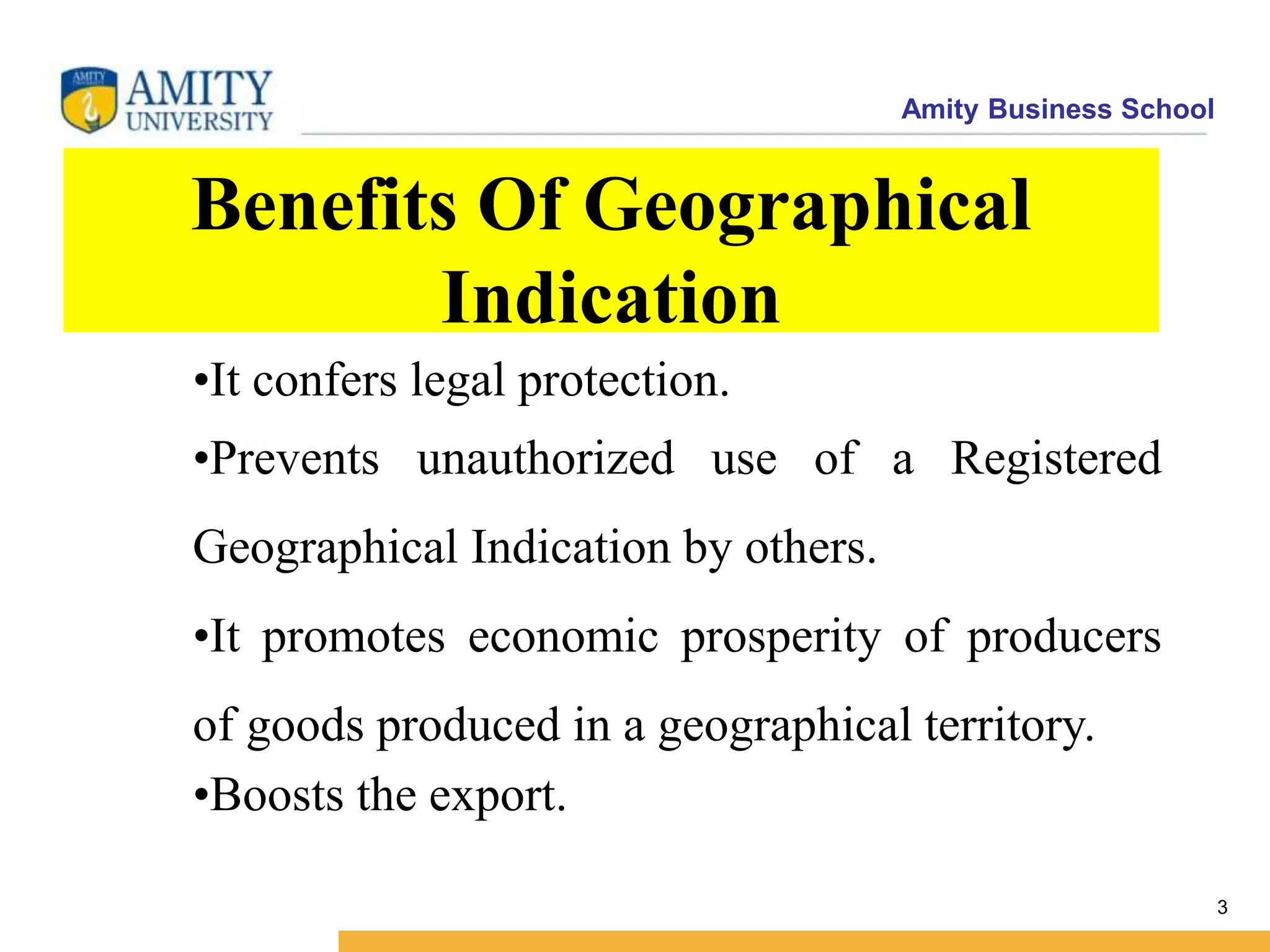
•Darjeeling tea
•Dharwad pedha
•Alphonso mango
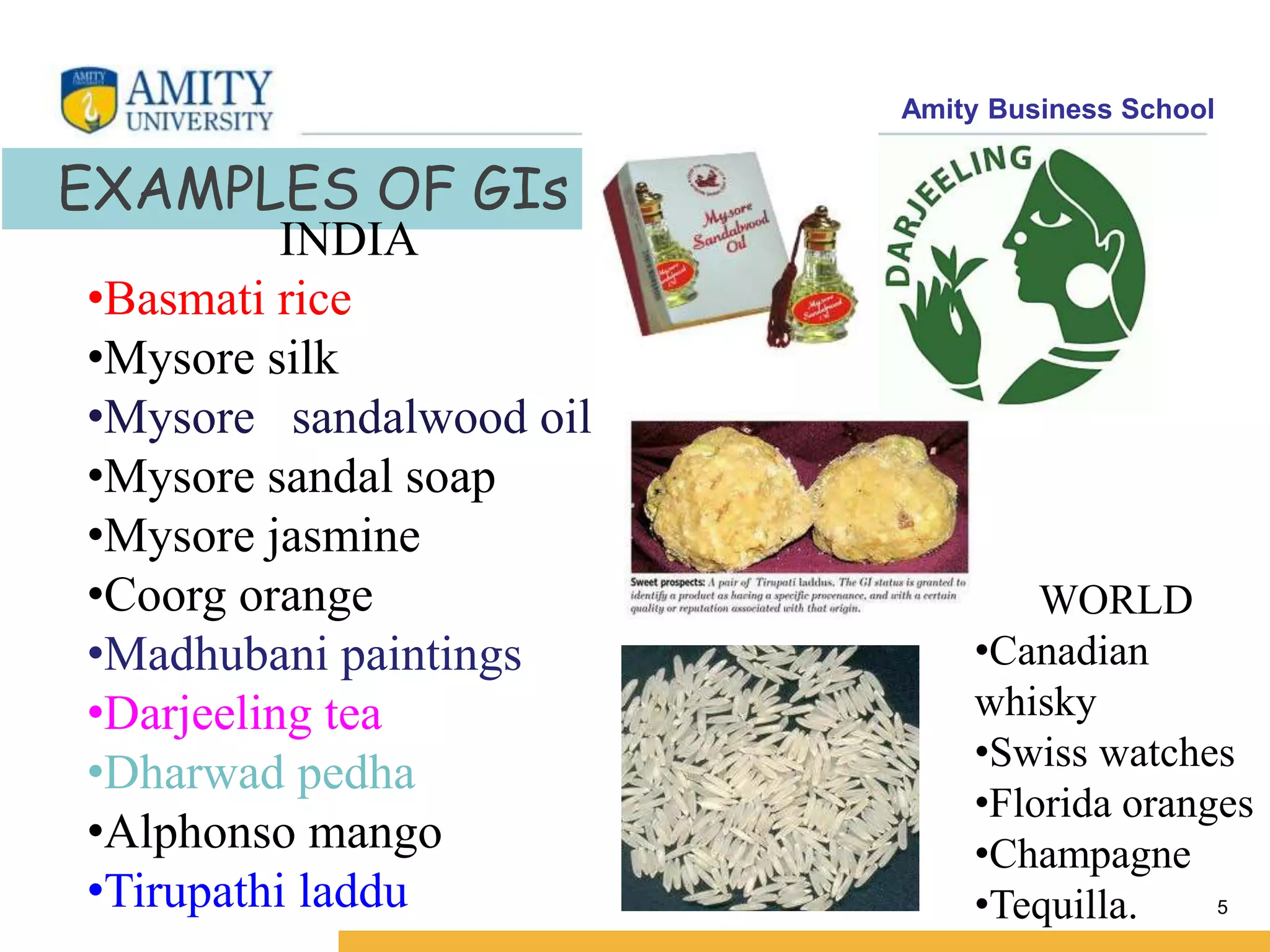
•Tirupathi laddu
WORLD
•Canadian
whisky
•Swiss watches
•Florida oranges
•Champagne
•Tequilla.
Amity Business School
GEOGRAPHICAL
INDICATION IN INDIA
•The Central Government of India has established the Ge
ographical Indications Registry with all India
jurisdiction in Chennai.
•The GI Act is being administered by the Controller Gen
eral of Patents, Designs and Trade Marks ‐ who is
the Registrar of Geographical Indications.
• India, as a member of the World Trade
Organization(WTO), enacted the Geographical Indications
of Goods (Registration and Protection) Act, 1999 has
come into force with effect from 15 September 2003
6
Amity Business School
Agreement on Trade-Related Aspects
of Intellectual Property Rights (1994)
• Two basic obligations on WTO
member governments relating to
GIs in the TRIPS agreement
• Article 22: Prevent misleading
the public as to the geographical
origin of the good.
•Article 23: prevent the use of a
geographical indication identifying
wines not originating in the place. 7
Amity Business School
1. The Agreement on Trade-Related Aspects of Intellectual Property
Rights (TRIPS) is an international legal agreement between all the member
nations of the World Trade Organization (WTO). It sets down minimum
standards for the regulation by national governments of many forms
of intellectual property (IP) as applied to nationals of other WTO member
nations. TRIPS was negotiated at the end of the Uruguay Round of
the General Agreement on Tariffs and Trade (GATT) in 1994 and is
administered by the WTO.
2. The TRIPS agreement introduced intellectual property law into the
international trading system for the first time and remains the most
comprehensive international agreement on intellectual property to date. In
2001, developing countries, concerned that developed countries were
insisting on an overly narrow reading of TRIPS, initiated a round of talks that
resulted in the Doha Declaration. The Doha declaration is a WTO statement
that clarifies the scope of TRIPS, stating for example that TRIPS can and
should be interpreted in light of the goal "to promote access to medicines for
all." 8
TRADE RELATED INTELLECTUAL
PROPERTY RIGHTS (TRIPS)
Amity Business School
THE INDIAN GI ACT
9
India has put in place a sui generis system of protection for GI with
enactment of a law exclusively dealing with protection of GI’s . The
legislations which deals with protection of GI’s in India are ‘The
Geographical Indications of Goods (Registration & Protection) Act, 1999’
(GI Act), and the ‘Geographical Indications of Goods (Registration and
Protection) Rules, 2002 (GI Rules). India enacted its GI legislations for the
country to put in place national intellectual property laws in compliance
with India’s obligations under TRIPS. Under the purview of the GI Act,
which came into force, along with the GI Rules, with effect from 15
September 2003, the central government has established the Geographical
Indications Registry with all-India jurisdiction, at Chennai, where right-
holders can register their GI.
Amity Business School
10
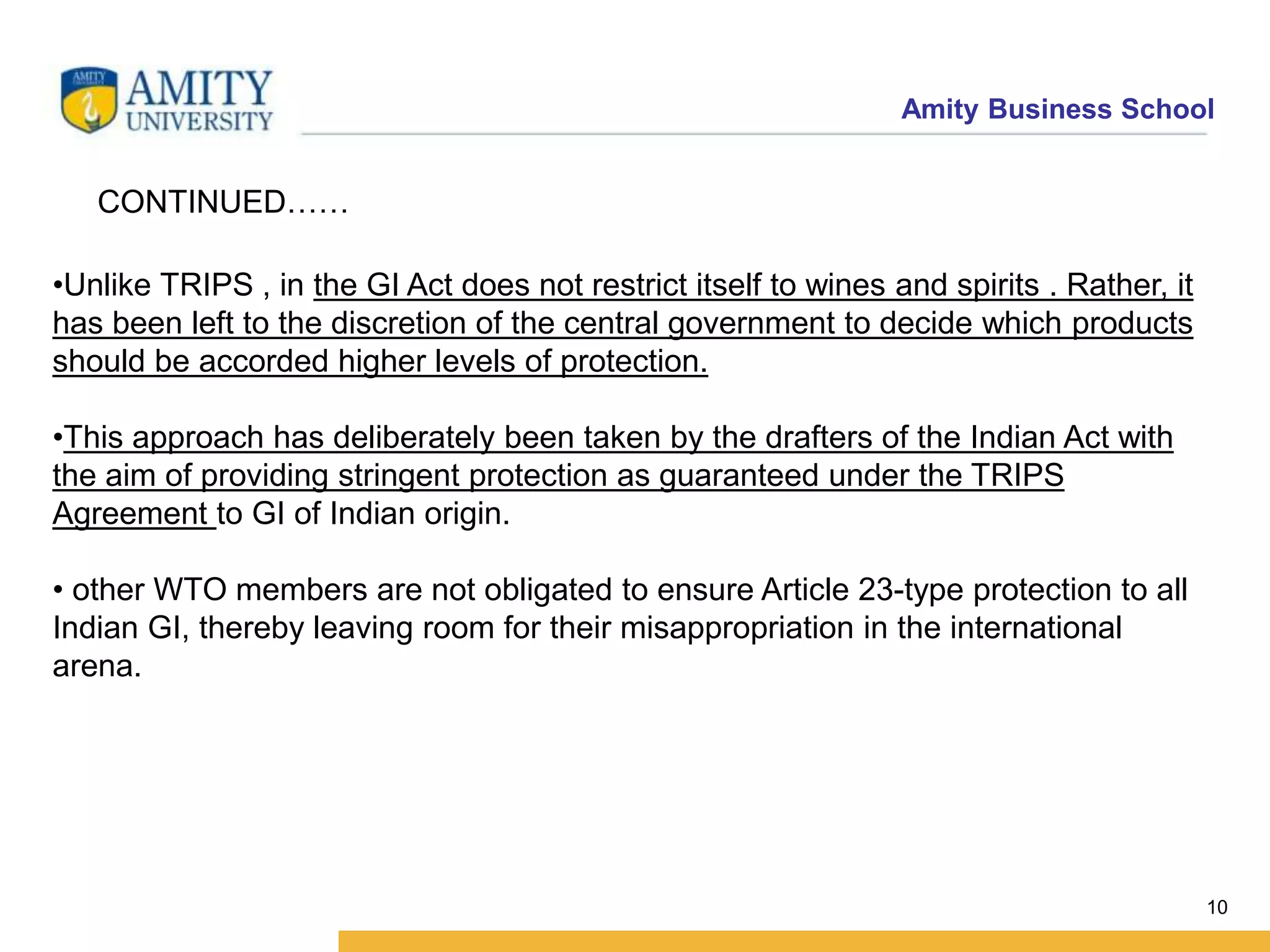
CONTINUED……
•Unlike TRIPS , in the GI Act does not restrict itself to wines and spirits . Rather, it
has been left to the discretion of the central government to decide which products
should be accorded higher levels of protection.
•This approach has deliberately been taken by the drafters of the Indian Act with
the aim of providing stringent protection as guaranteed under the TRIPS
Agreement to GI of Indian origin.
• other WTO members are not obligated to ensure Article 23-type protection to all
Indian GI, thereby leaving room for their misappropriation in the international
arena.
Amity Business School
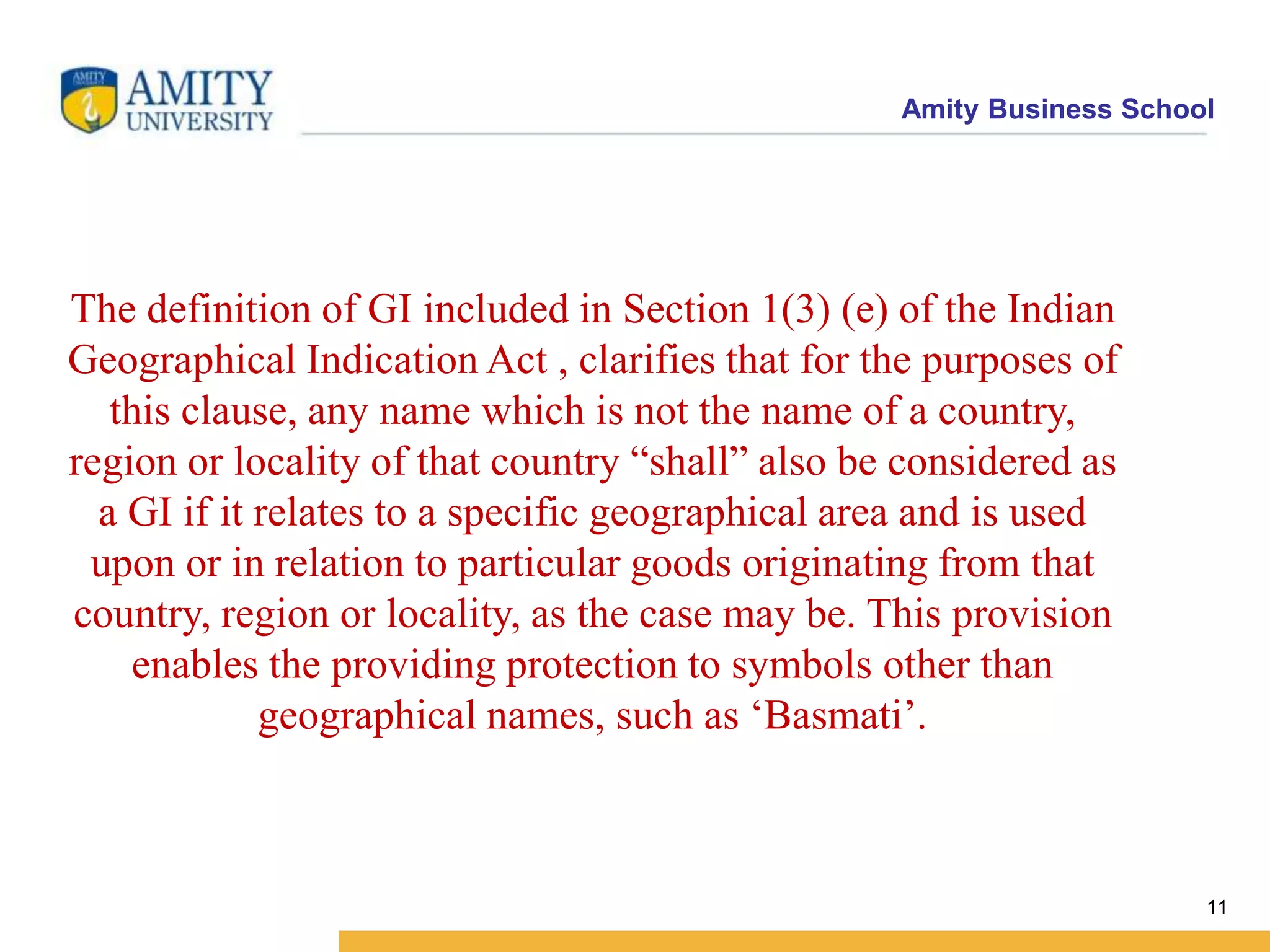
The definition of GI included in Section 1(3) (e) of the Indian
Geographical Indication Act , clarifies that for the purposes of
this clause, any name which is not the name of a country,
region or locality of that country “shall” also be considered as
a GI if it relates to a specific geographical area and is used
upon or in relation to particular goods originating from that
country, region or locality, as the case may be. This provision
enables the providing protection to symbols other than
geographical names, such as ‘Basmati’.
11
Amity Business School
12
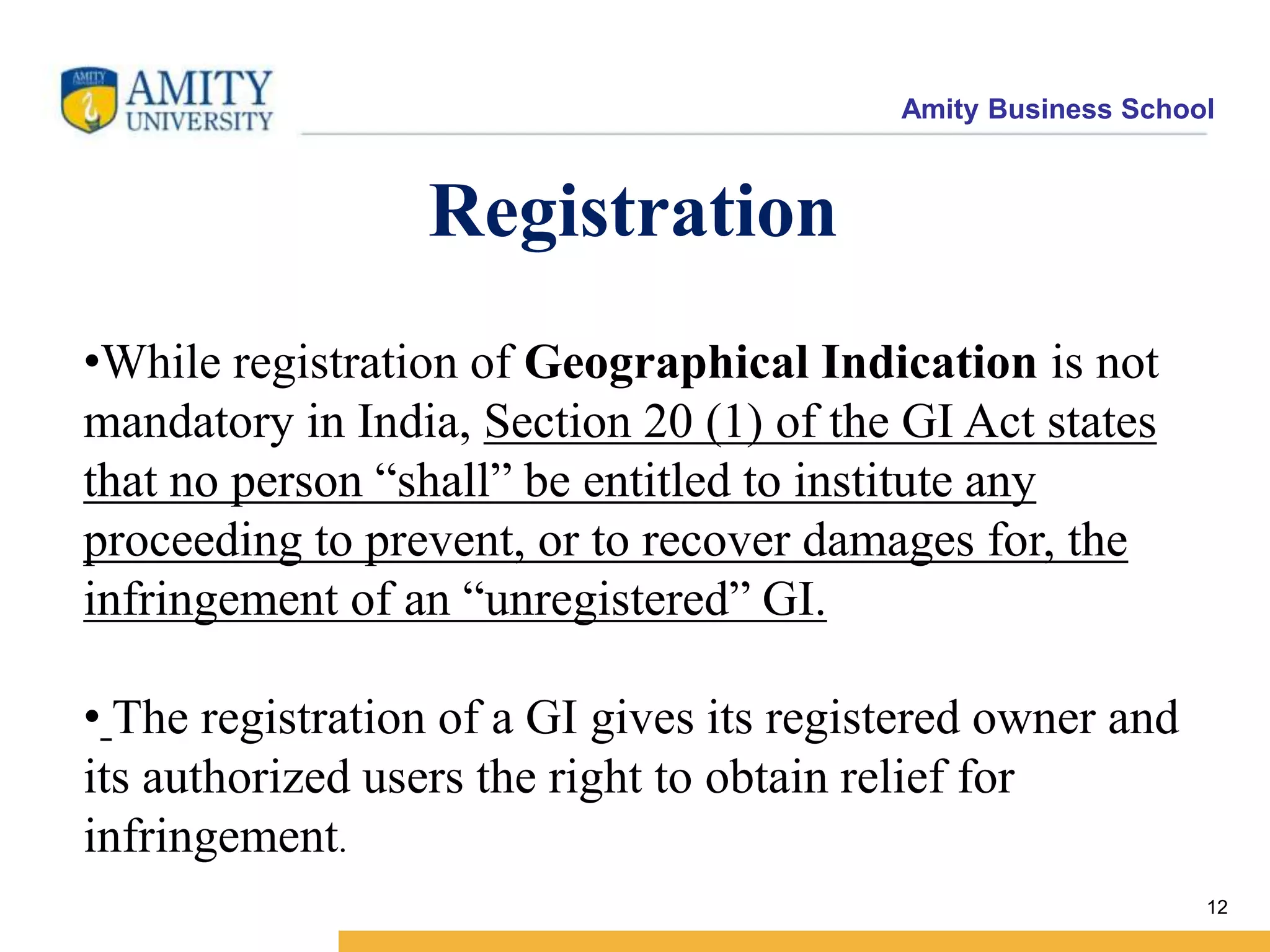
Registration
•While registration of Geographical Indication is not
mandatory in India, Section 20 (1) of the GI Act states
that no person “shall” be entitled to institute any
proceeding to prevent, or to recover damages for, the
infringement of an “unregistered” GI.
• The registration of a GI gives its registered owner and
its authorized users the right to obtain relief for
infringement.
Amity Business School
13
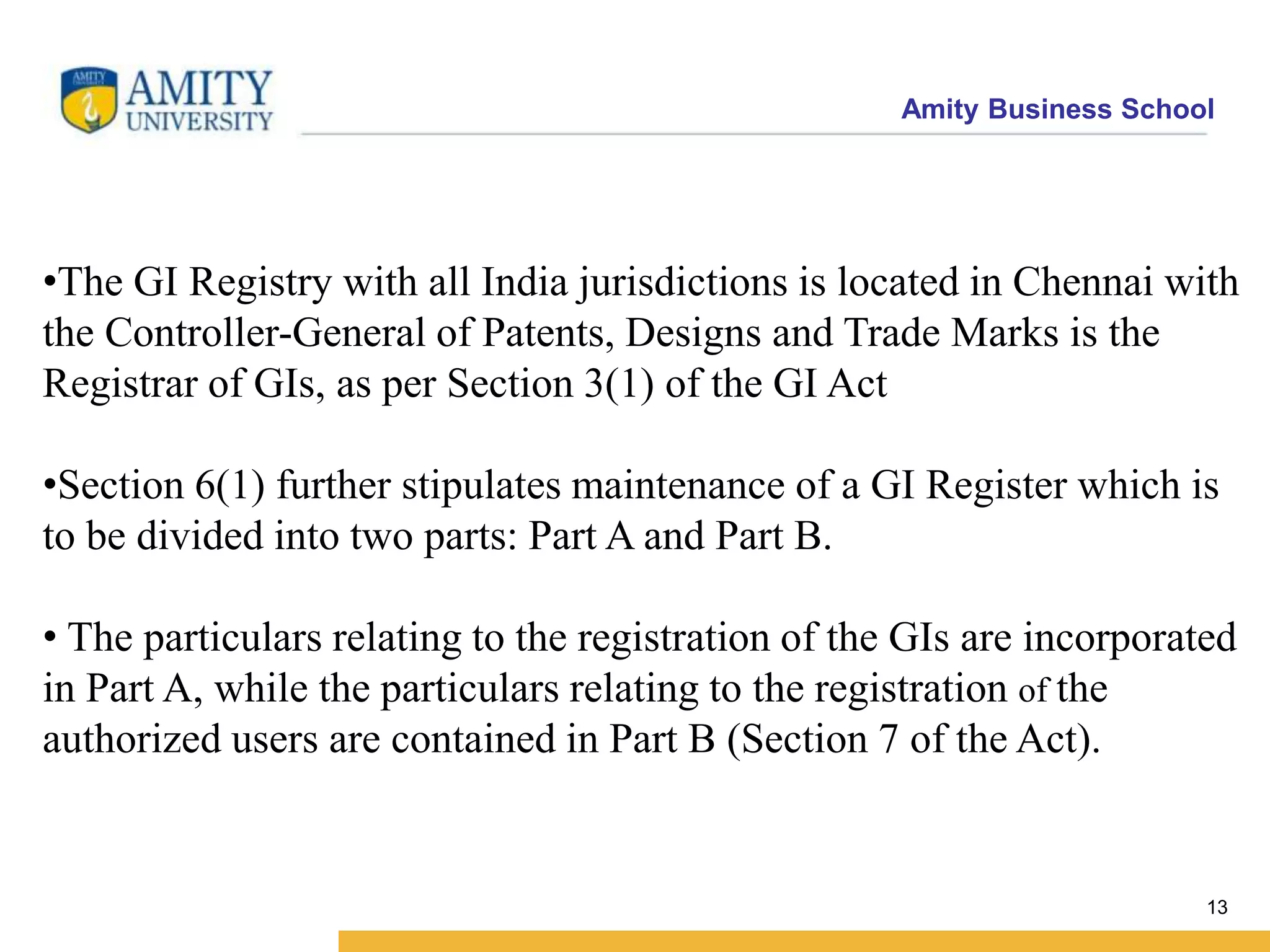
•The GI Registry with all India jurisdictions is located in Chennai with
the Controller-General of Patents, Designs and Trade Marks is the
Registrar of GIs, as per Section 3(1) of the GI Act
•Section 6(1) further stipulates maintenance of a GI Register which is
to be divided into two parts: Part A and Part B.
• The particulars relating to the registration of the GIs are incorporated
in Part A, while the particulars relating to the registration of the
authorized users are contained in Part B (Section 7 of the Act).
Amity Business School
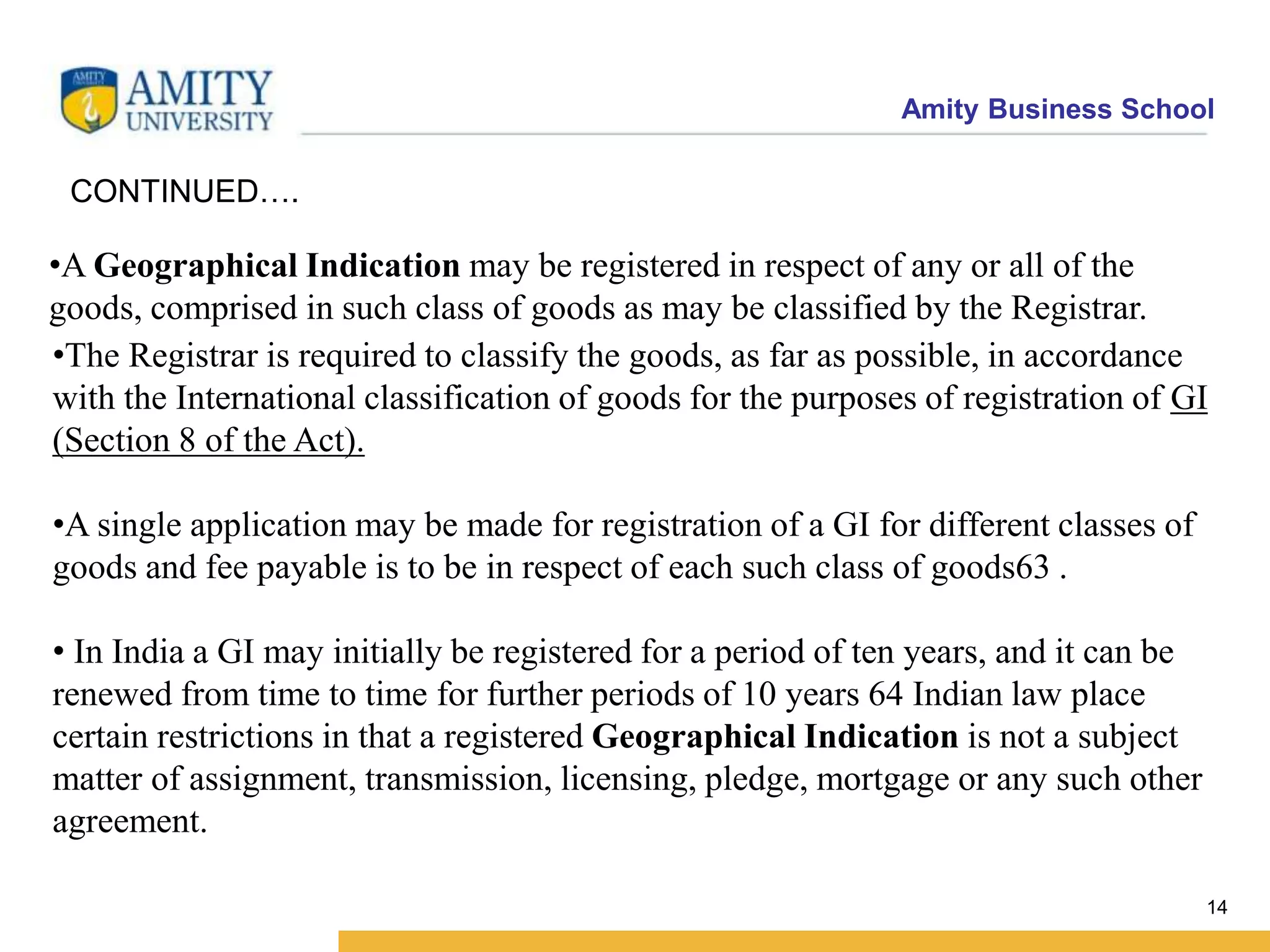
•A Geographical Indication may be registered in respect of any or all of the
goods, comprised in such class of goods as may be classified by the Registrar.
14
CONTINUED….
•The Registrar is required to classify the goods, as far as possible, in accordance
with the International classification of goods for the purposes of registration of GI
(Section 8 of the Act).
•A single application may be made for registration of a GI for different classes of
goods and fee payable is to be in respect of each such class of goods63 .
• In India a GI may initially be registered for a period of ten years, and it can be
renewed from time to time for further periods of 10 years 64 Indian law place
certain restrictions in that a registered Geographical Indication is not a subject
matter of assignment, transmission, licensing, pledge, mortgage or any such other
agreement.
Amity Business School
15
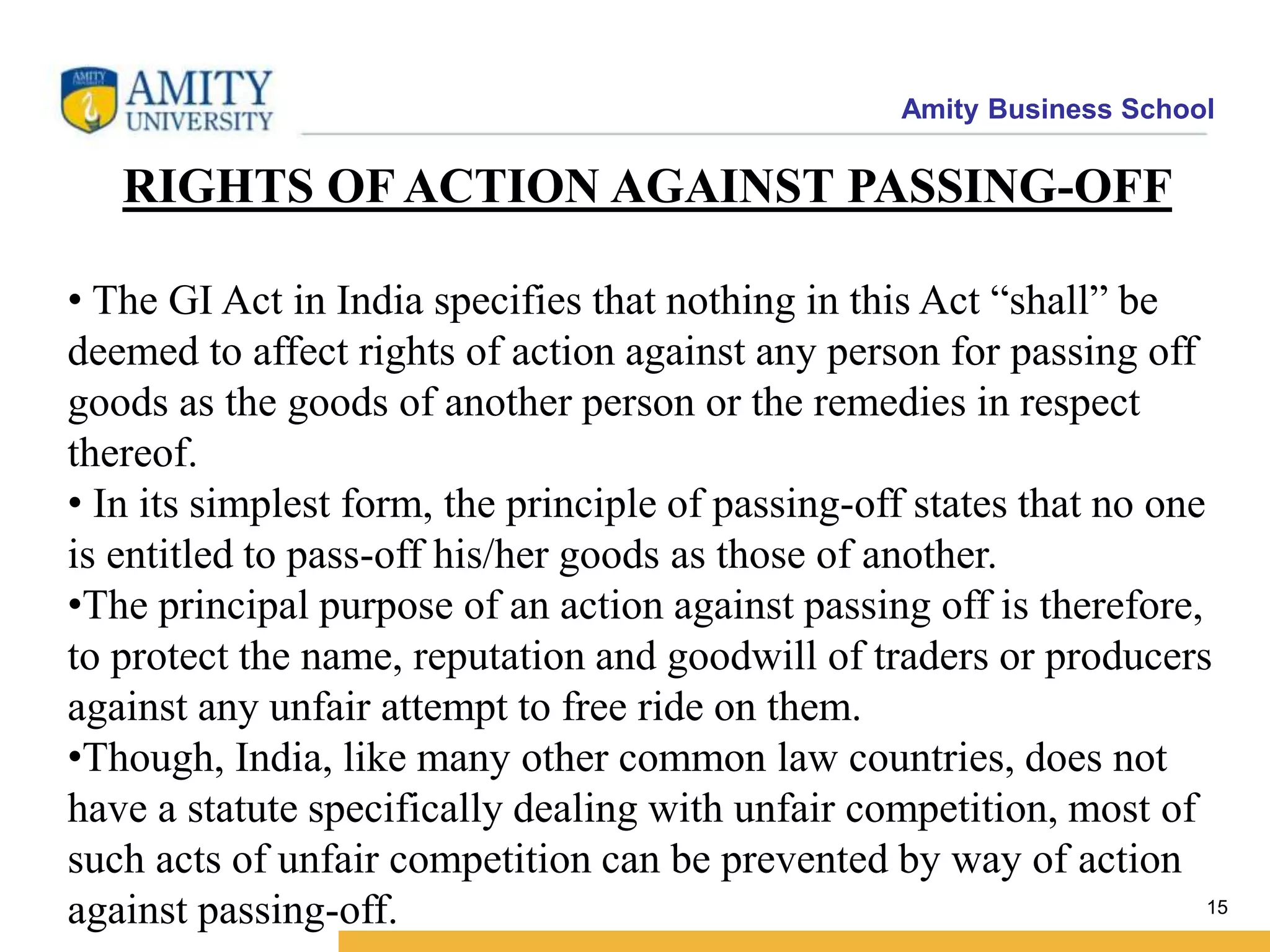
RIGHTS OF ACTION AGAINST PASSING-OFF
• The GI Act in India specifies that nothing in this Act “shall” be
deemed to affect rights of action against any person for passing off
goods as the goods of another person or the remedies in respect
thereof.
• In its simplest form, the principle of passing-off states that no one
is entitled to pass-off his/her goods as those of another.
•The principal purpose of an action against passing off is therefore,
to protect the name, reputation and goodwill of traders or producers
against any unfair attempt to free ride on them.
•Though, India, like many other common law countries, does not
have a statute specifically dealing with unfair competition, most of
such acts of unfair competition can be prevented by way of action
against passing-off.
Amity Business School
• Notably, Article 24 of TRIPS clearly states that in implementing the
TRIPS provisions on GIs, a Member is not required to diminish the
protection of GIs that existed in that Member immediately prior to
the date of entry.
This flexibility has been utilised by India in the GI Act (Section
20(2)) in maintaining the right of action against passing-off, which
has been a part of the common law tradition of India, even prior to
the advent of the TRIPS Agreement.
Any lawsuit relating to infringement of a registered GI or for
passing of an unregistered GI has to be instituted in a district court
having jurisdiction to try the suit. No suit shall be instituted in any
court inferior to a district court [Section 66 of the Geographical
Indications of Goods (Registration and Protection) Act, 1999].
16
Amity Business School
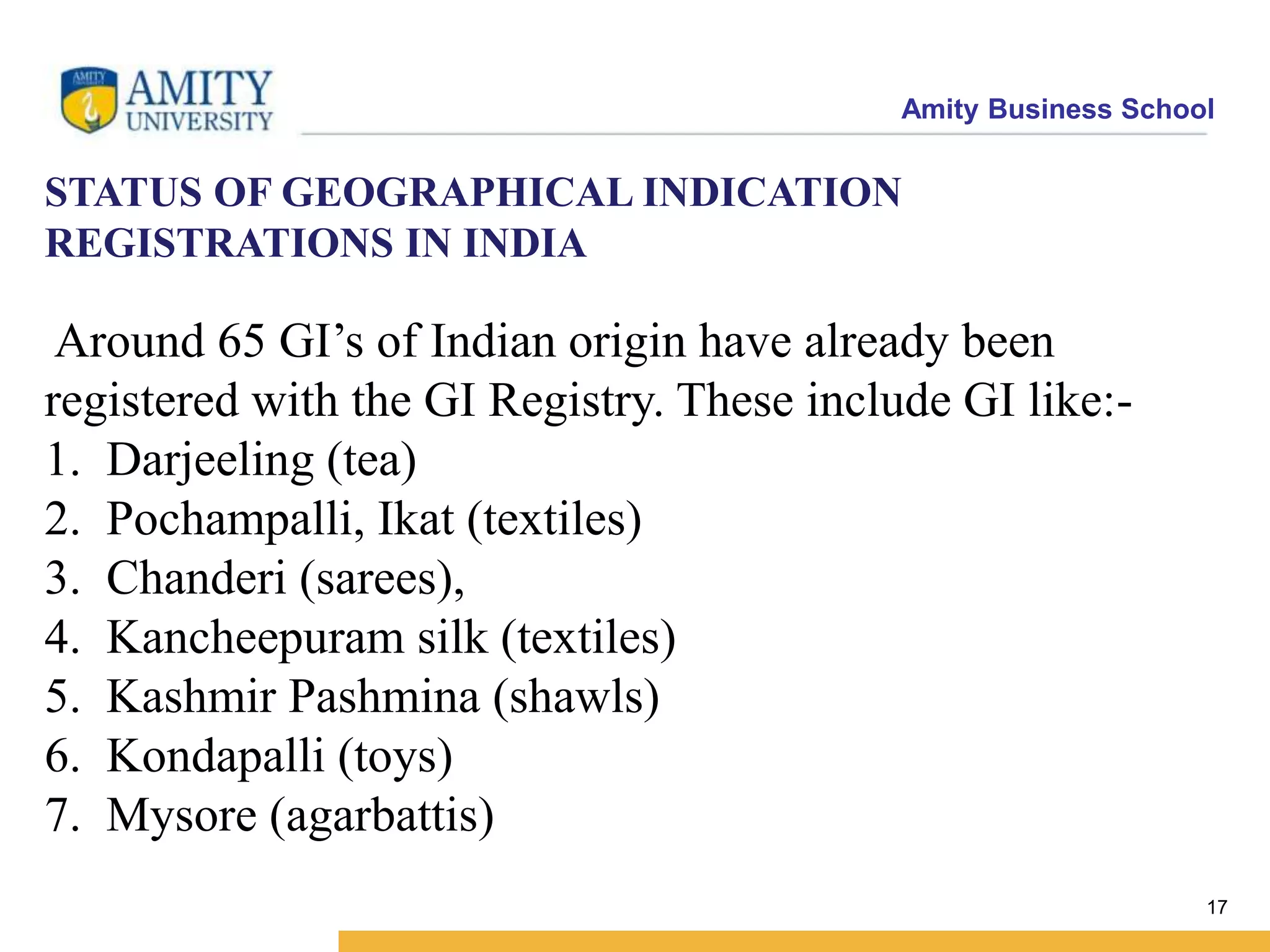
STATUS OF GEOGRAPHICAL INDICATION
REGISTRATIONS IN INDIA
Around 65 GI’s of Indian origin have already been
registered with the GI Registry. These include GI like:-
1. Darjeeling (tea)
2. Pochampalli, Ikat (textiles)
3. Chanderi (sarees),
4. Kancheepuram silk (textiles)
5. Kashmir Pashmina (shawls)
6. Kondapalli (toys)
7. Mysore (agarbattis)
17
Amity Business School
18
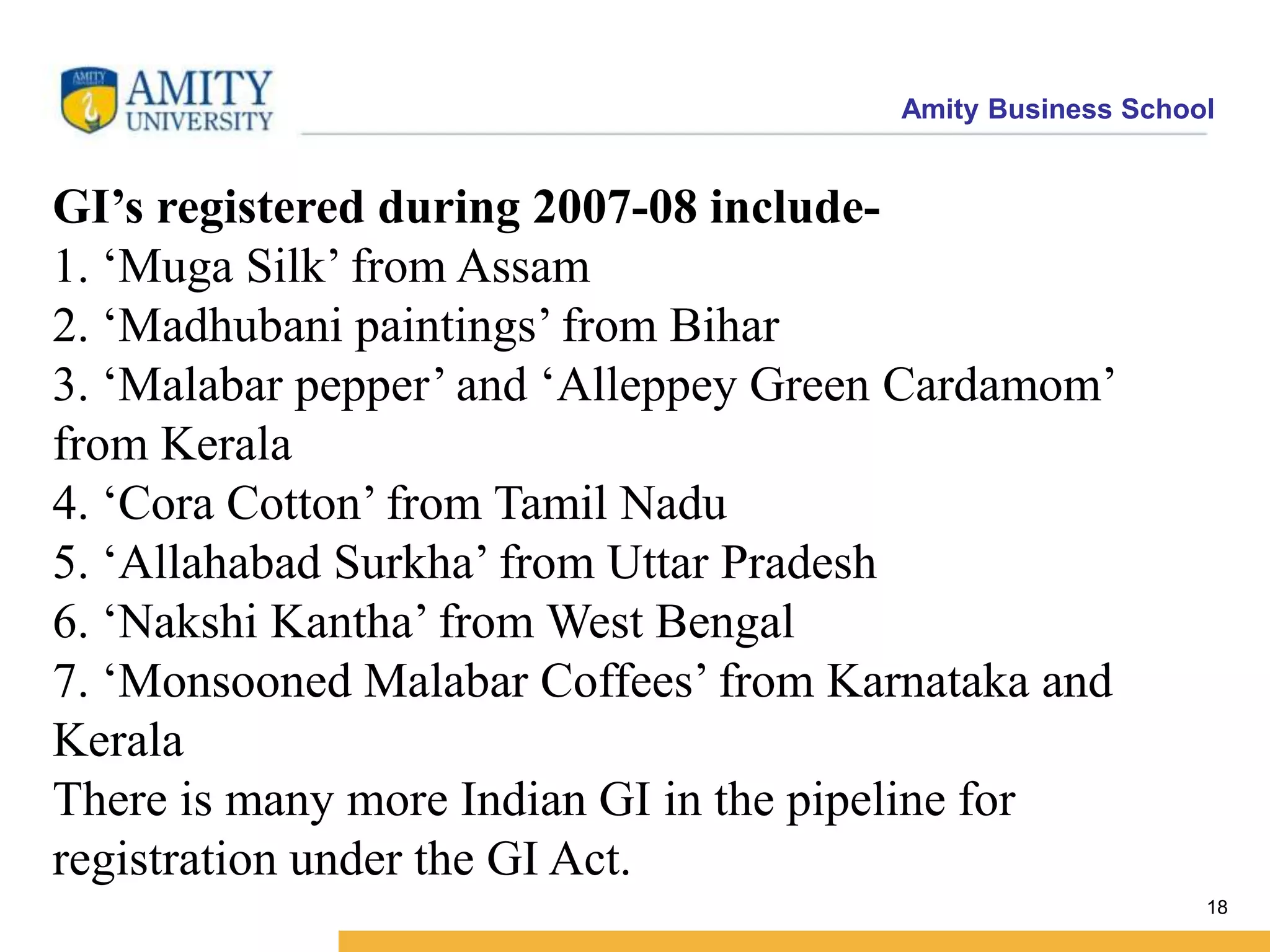
GI’s registered during 2007-08 include-
1. ‘Muga Silk’ from Assam
2. ‘Madhubani paintings’ from Bihar
3. ‘Malabar pepper’ and ‘Alleppey Green Cardamom’
from Kerala
4. ‘Cora Cotton’ from Tamil Nadu
5. ‘Allahabad Surkha’ from Uttar Pradesh
6. ‘Nakshi Kantha’ from West Bengal
7. ‘Monsooned Malabar Coffees’ from Karnataka and
Kerala
There is many more Indian GI in the pipeline for
registration under the GI Act.
Amity Business School
TEA BOARD,INDIA
VS.
I.T.C.LIMITED
20.04.2011
19
Amity Business School
ARGUEMENTS:
20
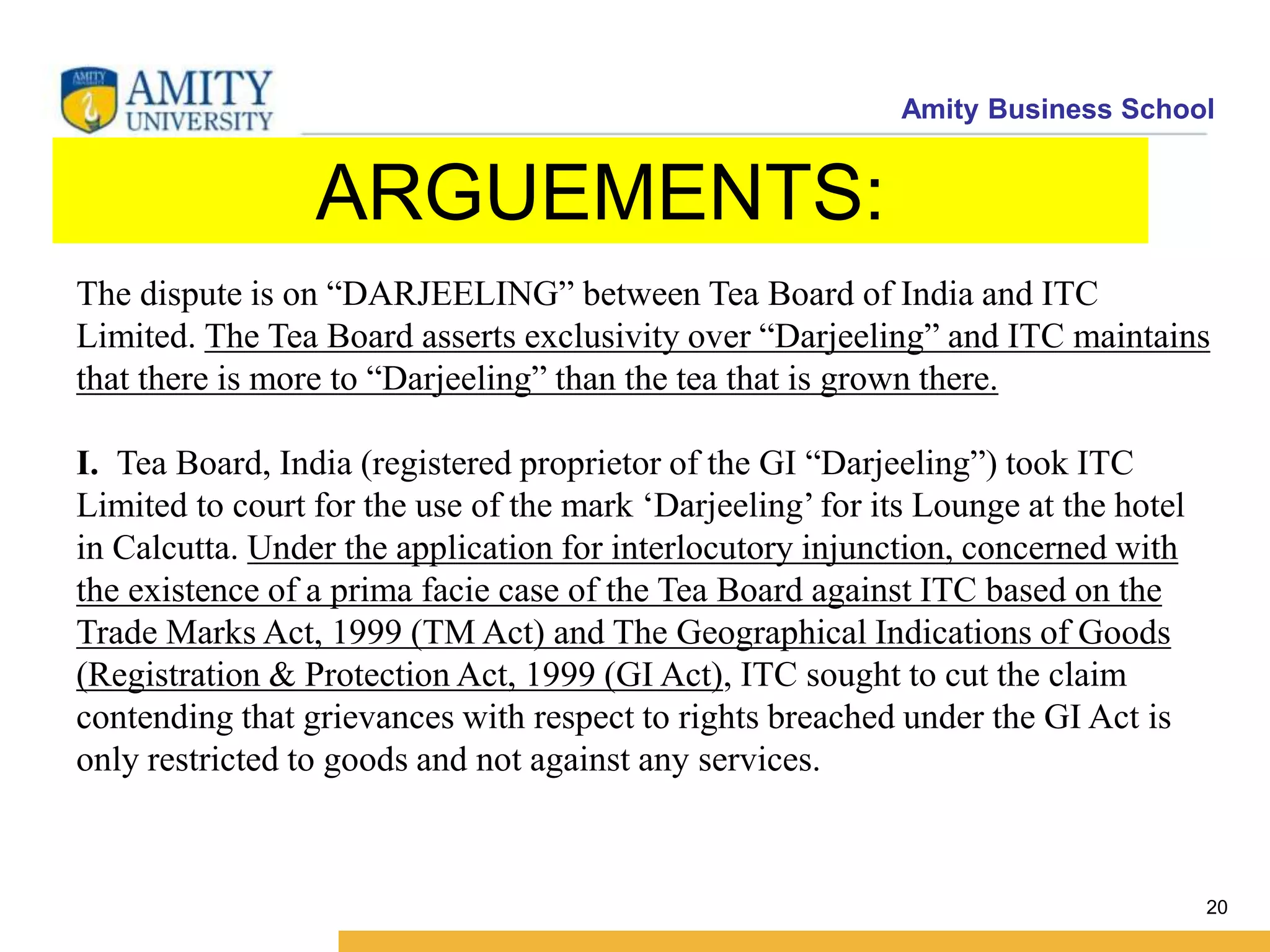
The dispute is on “DARJEELING” between Tea Board of India and ITC
Limited. The Tea Board asserts exclusivity over “Darjeeling” and ITC maintains
that there is more to “Darjeeling” than the tea that is grown there.
I. Tea Board, India (registered proprietor of the GI “Darjeeling”) took ITC
Limited to court for the use of the mark ‘Darjeeling’ for its Lounge at the hotel
in Calcutta. Under the application for interlocutory injunction, concerned with
the existence of a prima facie case of the Tea Board against ITC based on the
Trade Marks Act, 1999 (TM Act) and The Geographical Indications of Goods
(Registration & Protection Act, 1999 (GI Act), ITC sought to cut the claim
contending that grievances with respect to rights breached under the GI Act is
only restricted to goods and not against any services.
Amity Business School
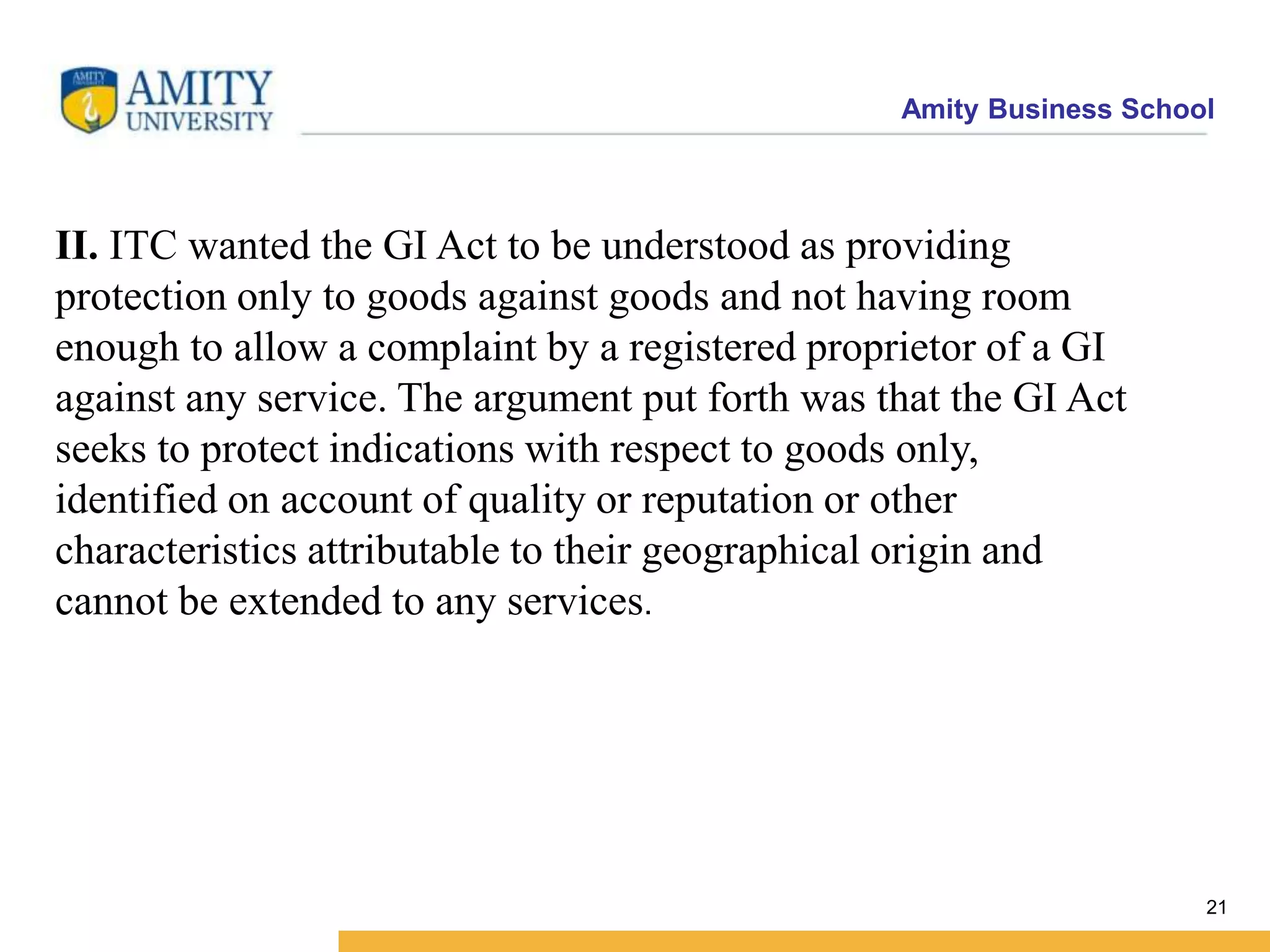
II. ITC wanted the GI Act to be understood as providing
protection only to goods against goods and not having room
enough to allow a complaint by a registered proprietor of a GI
against any service. The argument put forth was that the GI Act
seeks to protect indications with respect to goods only,
identified on account of quality or reputation or other
characteristics attributable to their geographical origin and
cannot be extended to any services.
21
Amity Business School
JUDGEMENT:
22
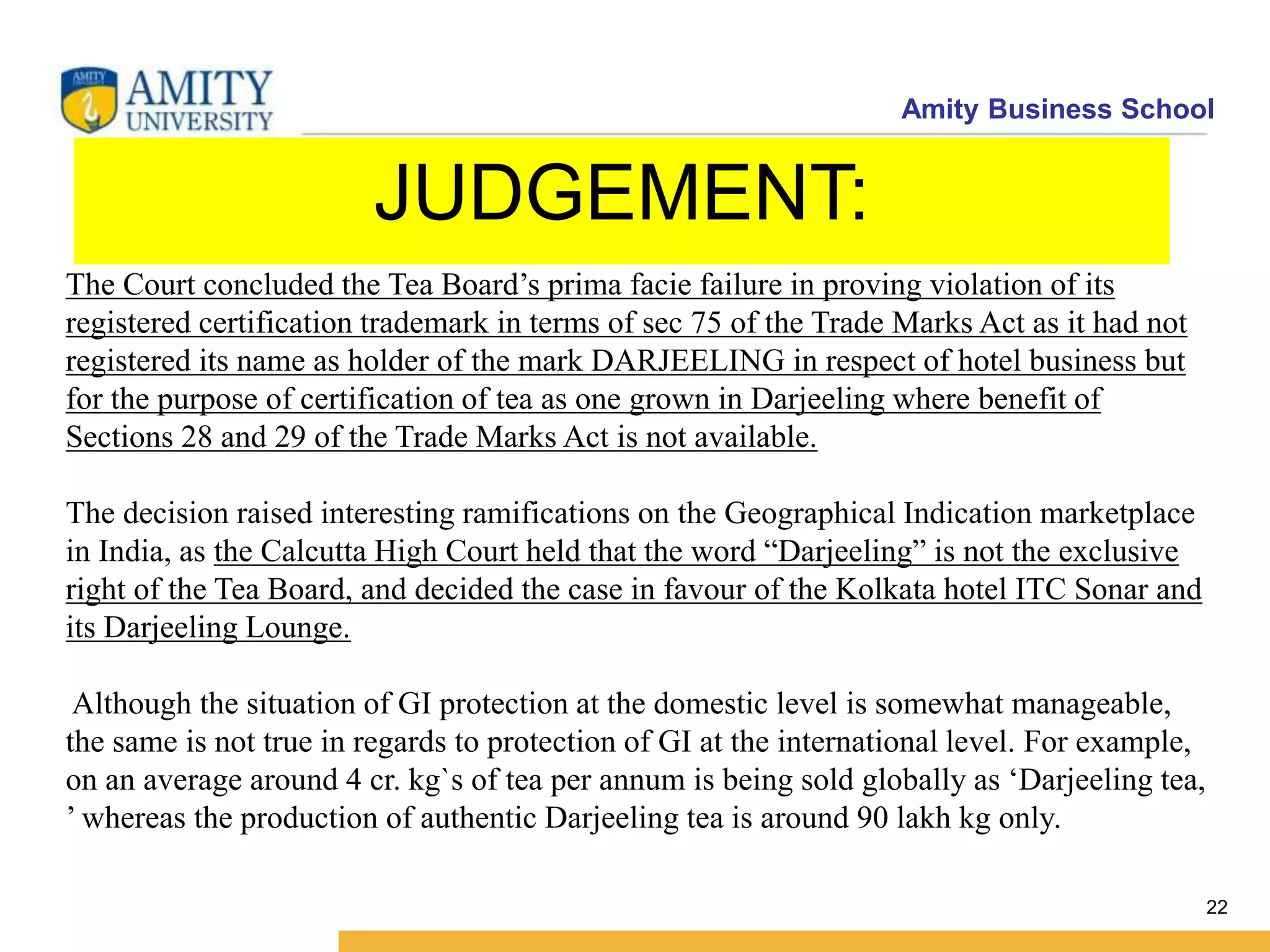
The Court concluded the Tea Board’s prima facie failure in proving violation of its
registered certification trademark in terms of sec 75 of the Trade Marks Act as it had not
registered its name as holder of the mark DARJEELING in respect of hotel business but
for the purpose of certification of tea as one grown in Darjeeling where benefit of
Sections 28 and 29 of the Trade Marks Act is not available.
The decision raised interesting ramifications on the Geographical Indication marketplace
in India, as the Calcutta High Court held that the word “Darjeeling” is not the exclusive
right of the Tea Board, and decided the case in favour of the Kolkata hotel ITC Sonar and
its Darjeeling Lounge.
Although the situation of GI protection at the domestic level is somewhat manageable,
the same is not true in regards to protection of GI at the international level. For example,
on an average around 4 cr. kg`s of tea per annum is being sold globally as ‘Darjeeling tea,
’ whereas the production of authentic Darjeeling tea is around 90 lakh kg only.
Amity Business School
CONCLUSION:
23
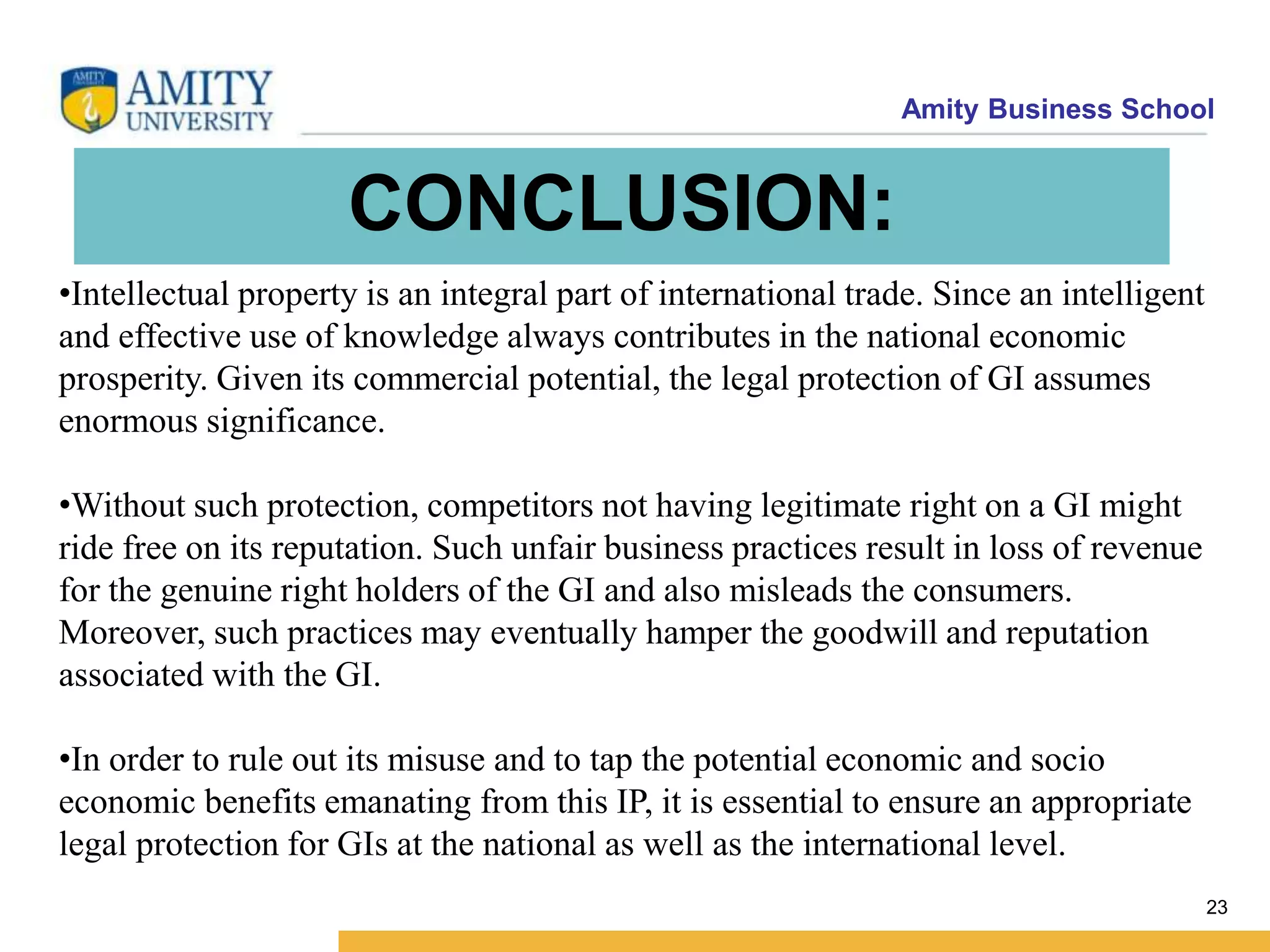
•Intellectual property is an integral part of international trade. Since an intelligent
and effective use of knowledge always contributes in the national economic
prosperity. Given its commercial potential, the legal protection of GI assumes
enormous significance.
•Without such protection, competitors not having legitimate right on a GI might
ride free on its reputation. Such unfair business practices result in loss of revenue
for the genuine right holders of the GI and also misleads the consumers.
Moreover, such practices may eventually hamper the goodwill and reputation
associated with the GI.
•In order to rule out its misuse and to tap the potential economic and socio
economic benefits emanating from this IP, it is essential to ensure an appropriate
legal protection for GIs at the national as well as the international level.
Amity Business School
24
•Infringement of GIs is an issue which is still generating
controversies and the outcome of such controversies are extremely
important from the point of view of a developing country like India,
which has in its possession of number of world famous Geographical
Indications.
•Finally the need of the hour is that the Government of India should
create awareness to rural producers regarding registration of GIs so
that their products will be marketed globally it will generate huge
foreign exchange to exchequer.
Amity Business School
BIBLIOGRAPHY:
25
• http://lawmantra.co.in/protection-of-geographical-indication-gis-from-
infringments-an-indian-perspective/
Amity Business School
26

Geographical Indication of Intellectual Property

  • 1.
  • 2.
    Amity Business School 2 •Itis an indication. •It originates from a definite geographical territory. • it is used to identify goods having special characteristics originating from a definite geographical territory •It is used to identify agricultural, natural or manufactured goods. •The manufactured goods should be produced or processed or prepared in that territory. •It should have a special quality or reputation or other characteristics.
  • 3.
    Amity Business School BenefitsOf Geographical Indication 3 •It confers legal protection. •Prevents unauthorized use of a Registered Geographical Indication by others. •It promotes economic prosperity of producers of goods produced in a geographical territory. •Boosts the export.
  • 4.
    Amity Business School 4 •Canserve as source-identifiers for consumers. Helps the producers develop consumer loyalty. •Plays a role in consumer decisions, including willingness to pay a higher price for regionally branded food products. •For example, geographic location is an important component of wine pricing. Continued….
  • 5.
    Amity Business School 5 EXAMPLESOF GIs INDIA •Basmati rice •Mysore silk •Mysore sandalwood oil •Mysore sandal soap •Mysore jasmine •Coorg orange •Madhubani paintings •Darjeeling tea •Dharwad pedha •Alphonso mango •Tirupathi laddu WORLD •Canadian whisky •Swiss watches •Florida oranges •Champagne •Tequilla.
  • 6.
    Amity Business School GEOGRAPHICAL INDICATIONIN INDIA •The Central Government of India has established the Ge ographical Indications Registry with all India jurisdiction in Chennai. •The GI Act is being administered by the Controller Gen eral of Patents, Designs and Trade Marks ‐ who is the Registrar of Geographical Indications. • India, as a member of the World Trade Organization(WTO), enacted the Geographical Indications of Goods (Registration and Protection) Act, 1999 has come into force with effect from 15 September 2003 6
  • 7.
    Amity Business School Agreementon Trade-Related Aspects of Intellectual Property Rights (1994) • Two basic obligations on WTO member governments relating to GIs in the TRIPS agreement • Article 22: Prevent misleading the public as to the geographical origin of the good. •Article 23: prevent the use of a geographical indication identifying wines not originating in the place. 7
  • 8.
    Amity Business School 1.The Agreement on Trade-Related Aspects of Intellectual Property Rights (TRIPS) is an international legal agreement between all the member nations of the World Trade Organization (WTO). It sets down minimum standards for the regulation by national governments of many forms of intellectual property (IP) as applied to nationals of other WTO member nations. TRIPS was negotiated at the end of the Uruguay Round of the General Agreement on Tariffs and Trade (GATT) in 1994 and is administered by the WTO. 2. The TRIPS agreement introduced intellectual property law into the international trading system for the first time and remains the most comprehensive international agreement on intellectual property to date. In 2001, developing countries, concerned that developed countries were insisting on an overly narrow reading of TRIPS, initiated a round of talks that resulted in the Doha Declaration. The Doha declaration is a WTO statement that clarifies the scope of TRIPS, stating for example that TRIPS can and should be interpreted in light of the goal "to promote access to medicines for all." 8 TRADE RELATED INTELLECTUAL PROPERTY RIGHTS (TRIPS)
  • 9.
    Amity Business School THEINDIAN GI ACT 9 India has put in place a sui generis system of protection for GI with enactment of a law exclusively dealing with protection of GI’s . The legislations which deals with protection of GI’s in India are ‘The Geographical Indications of Goods (Registration & Protection) Act, 1999’ (GI Act), and the ‘Geographical Indications of Goods (Registration and Protection) Rules, 2002 (GI Rules). India enacted its GI legislations for the country to put in place national intellectual property laws in compliance with India’s obligations under TRIPS. Under the purview of the GI Act, which came into force, along with the GI Rules, with effect from 15 September 2003, the central government has established the Geographical Indications Registry with all-India jurisdiction, at Chennai, where right- holders can register their GI.
  • 10.
    Amity Business School 10 CONTINUED…… •UnlikeTRIPS , in the GI Act does not restrict itself to wines and spirits . Rather, it has been left to the discretion of the central government to decide which products should be accorded higher levels of protection. •This approach has deliberately been taken by the drafters of the Indian Act with the aim of providing stringent protection as guaranteed under the TRIPS Agreement to GI of Indian origin. • other WTO members are not obligated to ensure Article 23-type protection to all Indian GI, thereby leaving room for their misappropriation in the international arena.
  • 11.
    Amity Business School Thedefinition of GI included in Section 1(3) (e) of the Indian Geographical Indication Act , clarifies that for the purposes of this clause, any name which is not the name of a country, region or locality of that country “shall” also be considered as a GI if it relates to a specific geographical area and is used upon or in relation to particular goods originating from that country, region or locality, as the case may be. This provision enables the providing protection to symbols other than geographical names, such as ‘Basmati’. 11
  • 12.
    Amity Business School 12 Registration •Whileregistration of Geographical Indication is not mandatory in India, Section 20 (1) of the GI Act states that no person “shall” be entitled to institute any proceeding to prevent, or to recover damages for, the infringement of an “unregistered” GI. • The registration of a GI gives its registered owner and its authorized users the right to obtain relief for infringement.
  • 13.
    Amity Business School 13 •TheGI Registry with all India jurisdictions is located in Chennai with the Controller-General of Patents, Designs and Trade Marks is the Registrar of GIs, as per Section 3(1) of the GI Act •Section 6(1) further stipulates maintenance of a GI Register which is to be divided into two parts: Part A and Part B. • The particulars relating to the registration of the GIs are incorporated in Part A, while the particulars relating to the registration of the authorized users are contained in Part B (Section 7 of the Act).
  • 14.
    Amity Business School •AGeographical Indication may be registered in respect of any or all of the goods, comprised in such class of goods as may be classified by the Registrar. 14 CONTINUED…. •The Registrar is required to classify the goods, as far as possible, in accordance with the International classification of goods for the purposes of registration of GI (Section 8 of the Act). •A single application may be made for registration of a GI for different classes of goods and fee payable is to be in respect of each such class of goods63 . • In India a GI may initially be registered for a period of ten years, and it can be renewed from time to time for further periods of 10 years 64 Indian law place certain restrictions in that a registered Geographical Indication is not a subject matter of assignment, transmission, licensing, pledge, mortgage or any such other agreement.
  • 15.
    Amity Business School 15 RIGHTSOF ACTION AGAINST PASSING-OFF • The GI Act in India specifies that nothing in this Act “shall” be deemed to affect rights of action against any person for passing off goods as the goods of another person or the remedies in respect thereof. • In its simplest form, the principle of passing-off states that no one is entitled to pass-off his/her goods as those of another. •The principal purpose of an action against passing off is therefore, to protect the name, reputation and goodwill of traders or producers against any unfair attempt to free ride on them. •Though, India, like many other common law countries, does not have a statute specifically dealing with unfair competition, most of such acts of unfair competition can be prevented by way of action against passing-off.
  • 16.
    Amity Business School •Notably, Article 24 of TRIPS clearly states that in implementing the TRIPS provisions on GIs, a Member is not required to diminish the protection of GIs that existed in that Member immediately prior to the date of entry. This flexibility has been utilised by India in the GI Act (Section 20(2)) in maintaining the right of action against passing-off, which has been a part of the common law tradition of India, even prior to the advent of the TRIPS Agreement. Any lawsuit relating to infringement of a registered GI or for passing of an unregistered GI has to be instituted in a district court having jurisdiction to try the suit. No suit shall be instituted in any court inferior to a district court [Section 66 of the Geographical Indications of Goods (Registration and Protection) Act, 1999]. 16
  • 17.
    Amity Business School STATUSOF GEOGRAPHICAL INDICATION REGISTRATIONS IN INDIA Around 65 GI’s of Indian origin have already been registered with the GI Registry. These include GI like:- 1. Darjeeling (tea) 2. Pochampalli, Ikat (textiles) 3. Chanderi (sarees), 4. Kancheepuram silk (textiles) 5. Kashmir Pashmina (shawls) 6. Kondapalli (toys) 7. Mysore (agarbattis) 17
  • 18.
    Amity Business School 18 GI’sregistered during 2007-08 include- 1. ‘Muga Silk’ from Assam 2. ‘Madhubani paintings’ from Bihar 3. ‘Malabar pepper’ and ‘Alleppey Green Cardamom’ from Kerala 4. ‘Cora Cotton’ from Tamil Nadu 5. ‘Allahabad Surkha’ from Uttar Pradesh 6. ‘Nakshi Kantha’ from West Bengal 7. ‘Monsooned Malabar Coffees’ from Karnataka and Kerala There is many more Indian GI in the pipeline for registration under the GI Act.
  • 19.
    Amity Business School TEABOARD,INDIA VS. I.T.C.LIMITED 20.04.2011 19
  • 20.
    Amity Business School ARGUEMENTS: 20 Thedispute is on “DARJEELING” between Tea Board of India and ITC Limited. The Tea Board asserts exclusivity over “Darjeeling” and ITC maintains that there is more to “Darjeeling” than the tea that is grown there. I. Tea Board, India (registered proprietor of the GI “Darjeeling”) took ITC Limited to court for the use of the mark ‘Darjeeling’ for its Lounge at the hotel in Calcutta. Under the application for interlocutory injunction, concerned with the existence of a prima facie case of the Tea Board against ITC based on the Trade Marks Act, 1999 (TM Act) and The Geographical Indications of Goods (Registration & Protection Act, 1999 (GI Act), ITC sought to cut the claim contending that grievances with respect to rights breached under the GI Act is only restricted to goods and not against any services.
  • 21.
    Amity Business School II.ITC wanted the GI Act to be understood as providing protection only to goods against goods and not having room enough to allow a complaint by a registered proprietor of a GI against any service. The argument put forth was that the GI Act seeks to protect indications with respect to goods only, identified on account of quality or reputation or other characteristics attributable to their geographical origin and cannot be extended to any services. 21
  • 22.
    Amity Business School JUDGEMENT: 22 TheCourt concluded the Tea Board’s prima facie failure in proving violation of its registered certification trademark in terms of sec 75 of the Trade Marks Act as it had not registered its name as holder of the mark DARJEELING in respect of hotel business but for the purpose of certification of tea as one grown in Darjeeling where benefit of Sections 28 and 29 of the Trade Marks Act is not available. The decision raised interesting ramifications on the Geographical Indication marketplace in India, as the Calcutta High Court held that the word “Darjeeling” is not the exclusive right of the Tea Board, and decided the case in favour of the Kolkata hotel ITC Sonar and its Darjeeling Lounge. Although the situation of GI protection at the domestic level is somewhat manageable, the same is not true in regards to protection of GI at the international level. For example, on an average around 4 cr. kg`s of tea per annum is being sold globally as ‘Darjeeling tea, ’ whereas the production of authentic Darjeeling tea is around 90 lakh kg only.
  • 23.
    Amity Business School CONCLUSION: 23 •Intellectualproperty is an integral part of international trade. Since an intelligent and effective use of knowledge always contributes in the national economic prosperity. Given its commercial potential, the legal protection of GI assumes enormous significance. •Without such protection, competitors not having legitimate right on a GI might ride free on its reputation. Such unfair business practices result in loss of revenue for the genuine right holders of the GI and also misleads the consumers. Moreover, such practices may eventually hamper the goodwill and reputation associated with the GI. •In order to rule out its misuse and to tap the potential economic and socio economic benefits emanating from this IP, it is essential to ensure an appropriate legal protection for GIs at the national as well as the international level.
  • 24.
    Amity Business School 24 •Infringementof GIs is an issue which is still generating controversies and the outcome of such controversies are extremely important from the point of view of a developing country like India, which has in its possession of number of world famous Geographical Indications. •Finally the need of the hour is that the Government of India should create awareness to rural producers regarding registration of GIs so that their products will be marketed globally it will generate huge foreign exchange to exchequer.
  • 25.
    Amity Business School BIBLIOGRAPHY: 25 •http://lawmantra.co.in/protection-of-geographical-indication-gis-from- infringments-an-indian-perspective/
  • 26.