EnvironmentFriendlyandCostEffective
AlternativetoConventionalGradedFilters
P
roviding proper drainagesystem
for structures such as earth re-
taining structures, pavements,
water front structures, canals etc is of
paramount importance. Locking of wa-
ter inside the structure impose extra
water pressure and earth pressure due
to reduction in shear strength of soil.
This reduces stability of structure and
can even lead to catastrophic failure.
Traditionally gravel or aggregate layer
in combination with sand is provided
behind the earth retaining structures,
within earthen dams and as pavement
edge drains. However, the aggregates
used for filter and drainage layers is
becoming scarce commodity in India
and an alternate material is essential to
replace the increasing need of aggre-
gates for such infrastructure projects.
Ban has been imposed in many states
on mining of precious natural resourc-
es / materials.
Conventional graded filters have lot
of disadvantages like: Clogging of filter
layer by fine soil particles, difficulty in
quality construction (as there is a need
to provide proper gradation of aggre-
gate / material depending upon the
fill material) etc. With advancement of
technology in the field of construction,
‘Geosynthetics’ has become a simple
and effective replacement to various
conventional solutions respecting the
safety, technical and functional require-
ments of structure. MacDrain are spe-
cial type of geocomposites that enable
rapid drainage of excess water while
preventing soil particle migration. It is
a geosynthetics product which is used
as an alternate to conventional gravel
drainage layer behind earth retaining
structures, buried structures like base-
ments and culverts, in trace garden,
canal lining and dam applications etc.
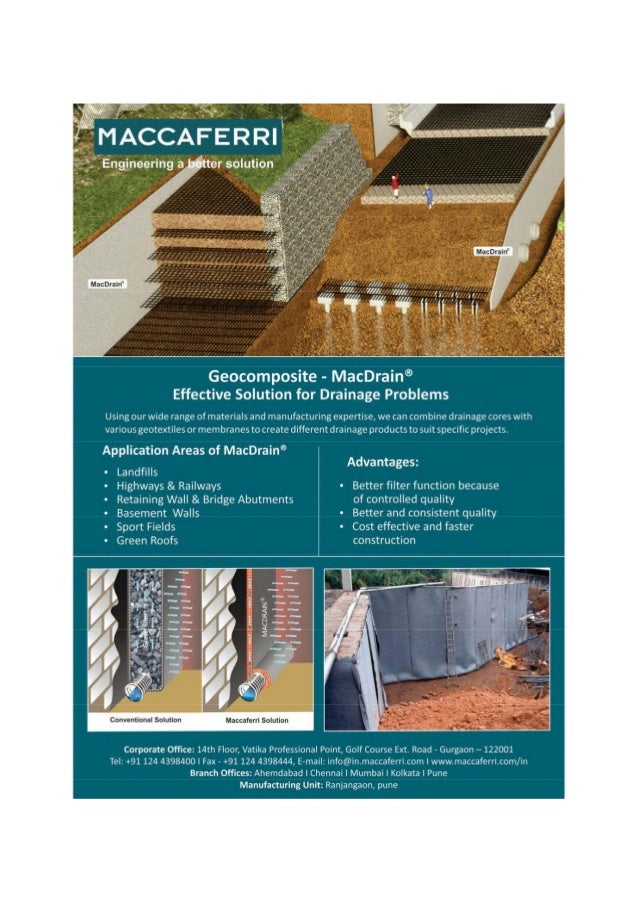
MacDrain is 20 to 50% cheaper com-
pared to conventional graded filter.
MacDrain – (Drainage Composite)
Macdrain is a specifically designed
Geocomposite to meet the drainage
and protection requirements in struc-
turally demanding water draining ap-
plications. MacDrain effectively elimi-
nate hydrostatic pressure by collecting
and conveying groundwater to a drain
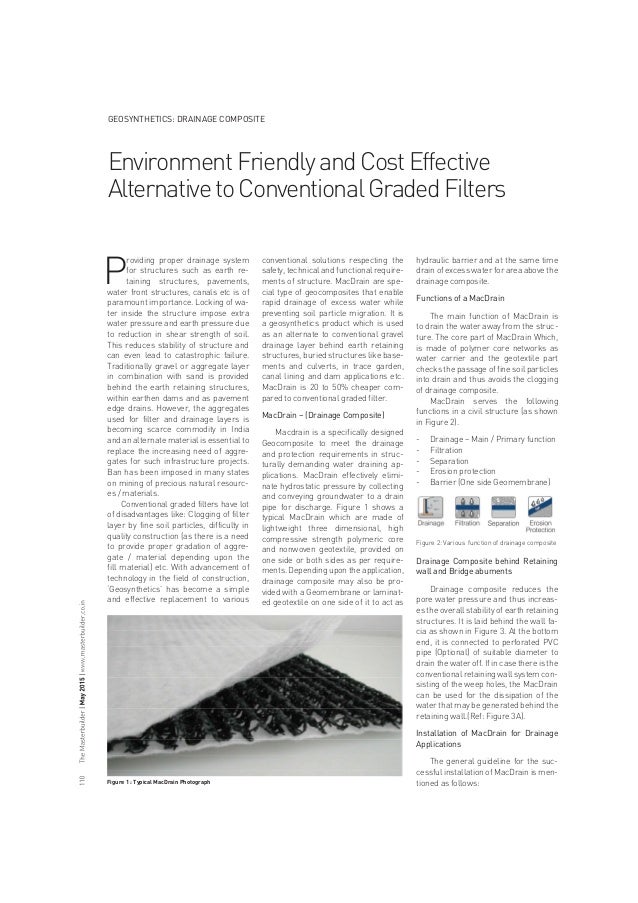
pipe for discharge. Figure 1 shows a
typical MacDrain which are made of
lightweight three dimensional, high
compressive strength polymeric core
and nonwoven geotextile, provided on
one side or both sides as per require-
ments. Depending upon the application,
drainage composite may also be pro-
vided with a Geomembrane or laminat-
ed geotextile on one side of it to act as
hydraulic barrier and at the same time
drain of excess water for area above the
drainage composite.
Functions of a MacDrain
The main function of MacDrain is
to drain the water away from the struc-
ture. The core part of MacDrain Which,
is made of polymer core networks as
water carrier and the geotextile part
checks the passage of fine soil particles
into drain and thus avoids the clogging
of drainage composite.
MacDrain serves the following
functions in a civil structure (as shown
in Figure 2).
- Drainage – Main / Primary function
- Filtration
- Separation
- Erosion protection
- Barrier (One side Geomembrane)
Drainage Composite behind Retaining
wall and Bridge abuments
Drainage composite reduces the
pore water pressure and thus increas-
es the overall stability of earth retaining
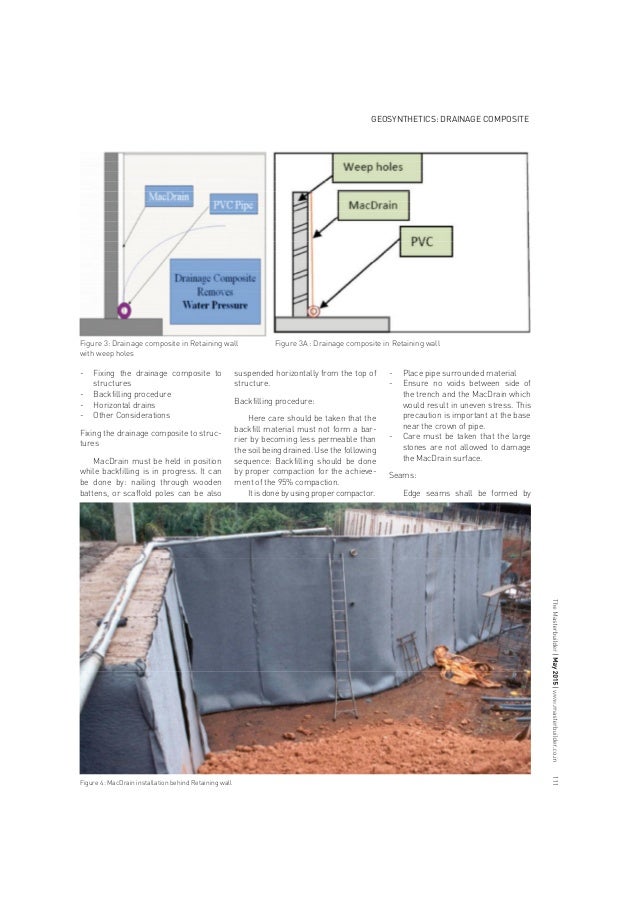
structures. It is laid behind the wall fa-
cia as shown in Figure 3. At the bottom
end, it is connected to perforated PVC
pipe (Optional) of suitable diameter to
drain the water off. If in case there is the
conventional retaining wall system con-
sisting of the weep holes, the MacDrain
can be used for the dissipation of the
water that may be generated behind the
retaining wall.(Ref: Figure 3A).
Installation of MacDrain for Drainage
Applications
The general guideline for the suc-
cessful installation of MacDrain is men-
tioned as follows:
Figure 2: Various function of drainage composite
GEOSYNTHETICS: DRAINAGE COMPOSITE
Figure 1 : Typical MacDrain Photograph
4.
- Fixing thedrainage composite to
structures
- Backfilling procedure
- Horizontal drains
- Other Considerations
Fixing the drainage composite to struc-
tures
MacDrain must be held in position
while backfilling is in progress. It can
be done by: nailing through wooden
battens, or scaffold poles can be also
suspended horizontally from the top of
structure.
Backfilling procedure:
Here care should be taken that the
backfill material must not form a bar-
rier by becoming less permeable than
the soil being drained. Use the following
sequence: Backfilling should be done
by proper compaction for the achieve-
ment of the 95% compaction.
It is done by using proper compactor.
- Place pipe surrounded material
- Ensure no voids between side of
the trench and the MacDrain which
would result in uneven stress. This
precaution is important at the base
near the crown of pipe.
- Care must be taken that the large
stones are not allowed to damage
the MacDrain surface.
Seams:
Edge seams shall be formed by
Figure 4: MacDrain installation behind Retaining wall
Figure 3: Drainage composite in Retaining wall
with weep holes
Figure 3A : Drainage composite in Retaining wall
GEOSYNTHETICS: DRAINAGE COMPOSITE
5.
utilizing the flapof geotextile extending
from the MacDrain edge and lapping
over the top of the geotextile of the adja-
cent course. The geotextile flap shall be
securely fastened to the adjacent fabric
by means of a non watersoluble con-
struction adhesive or any other suitable
method. Where vertical splices are nec-
essary at the end of a drainage compos-
ite roll or panel, a 200-mm continuous
strip of geotextile may be placed, cen-
tered over the seam and continuously
fastened on both sides with non water
soluble construction adhesive or any
other suitable method.
Repairs
If the MacDrain is damaged during
installation by tearing or puncturing,
the damaged section must be cut out
and replaced completely or repaired by
placing a piece of MacDrain that is large
enough to cover the damaged area and
Figure 5: Compaction in progress for MacDrain installation behind Retaining wall
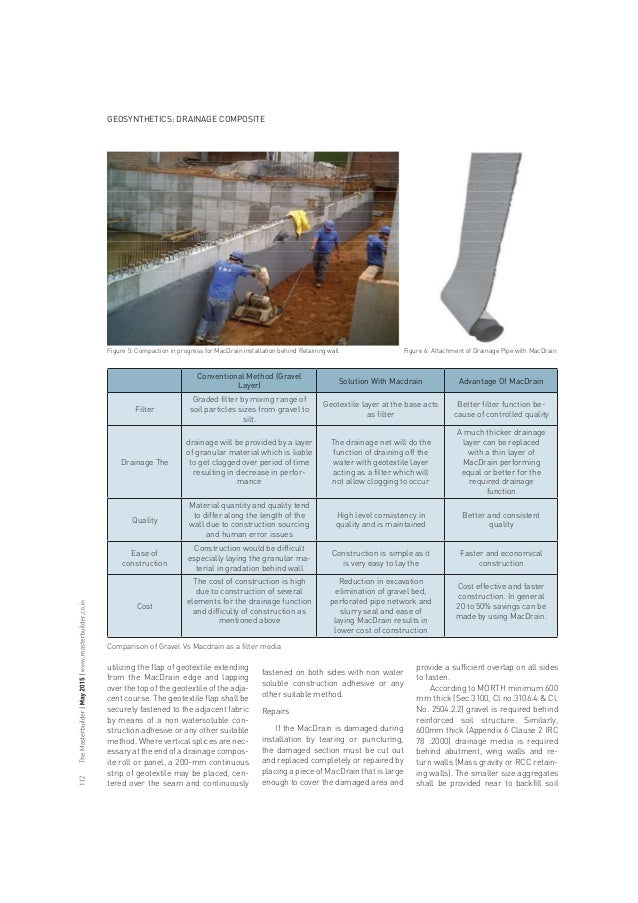
Comparison of Gravel Vs Macdrain as a filter media
Figure 6: Attachment of Drainage Pipe with MacDrain
provide a sufficient overlap on all sides
to fasten.
According to MORTH minimum 600
mm thick (Sec 3100, Cl no.3106.4 & Cl.
No. 2504.2.2) gravel is required behind
reinforced soil structure. Similarly,
600mm thick (Appendix 6 Clause 2 IRC
78 :2000) drainage media is required
behind abutment, wing walls and re-
turn walls (Mass gravity or RCC retain-
ing walls). The smaller size aggregates
shall be provided near to backfill soil
Conventional Method (Gravel
Layer)
Solution With Macdrain Advantage Of MacDrain
Filter
Graded filter by mixing range of
soil particles sizes from gravel to
silt.
Geotextile layer at the base acts
as filter
Better filter function be-
cause of controlled quality
Drainage The
drainage will be provided by a layer
of granular material which is liable
to get clogged over period of time
resulting in decrease in perfor-
mance
The drainage net will do the
function of draining off the
water with geotextile layer
acting as a filter which will
not allow clogging to occur
A much thicker drainage
layer can be replaced
with a thin layer of
MacDrain performing
equal or better for the
required drainage
function
Quality
Material quantity and quality tend
to differ along the length of the
wall due to construction sourcing
and human error issues
High level consistency in
quality and is maintained
Better and consistent
quality
Ease of
construction
Construction would be difficult
especially laying the granular ma-
terial in gradation behind wall
Construction is simple as it
is very easy to lay the
Faster and economical
construction
Cost
The cost of construction is high
due to construction of several
elements for the drainage function
and difficulty of construction as
mentioned above
Reduction in excavation
elimination of gravel bed,
perforated pipe network and
slurry seal and ease of
laying MacDrain results in
lower cost of construction
Cost effective and faster
construction. In general
20 to 50% savings can be
made by using MacDrain.
GEOSYNTHETICS: DRAINAGE COMPOSITE
6.
face and largersize aggregates shall
be provided neat to wall face.
This kind of graded filter placement
is very difficult to achieve. The gradation
of backfill material may also vary from
stretch to stretch and it is very difficult
to consistently match the requirements
unless very stringent quality control
measures are in place.
While MacDrain being factory man-
ufactured product, are easy to install
and suitable for wide range of soil gra-
dation. As the time passes, the fine soil
particles tend to clog the voids of gravel
layer and thus the overall flow capacity
of gravel layer reduces drastically. But
the Macdrain have a filter geotextile lay-
er attached to its drainage core which
shall not allow the fine backfill parti-
cles to clog the drainage net and thus
ensures requires in-plane flow capacity
and proper functioning.
Advantages of Drainage Composite
Drainage composites provide effec-
tive solution over conventional drainage
layer.
Some of the inherent advantages of
drainage composite are:
- Extremely effective solution com-
pared to traditional stone drainage
layer
- Being light in weight, it is easy to
handle and install them quickly.
- Made of PP and PE so durable and
chemical resistant
- High flow capacity as compared to
conventional gravel drain
- Acts as drainage as well as protec-
tion layer due to its high puncture
resistance
- Provides and maintains high flow
paths for water and gases, there-
fore maintains soil stability
- Filtration properties are suitable for
most soil types
- Highly compressive strength core
- Robustness prevents puncturing
and tearing during installation
- Separates and protects structure
from fill material, and much more
effective than conventional gravel
filter which are liable to clogging.
- Since these are factory manufac-
tured products so high quality can
be assured
- Weep holes that are generally pro-
vided intermittently in the conven-
tional system is omitted by using
drainage composite and drainage
pipe and hence provide good aes-
thetic look to the wall.
- The burden on natural resources
for gravel/aggregate is also re-
duced.
- There is also a reduction in emis-
sion of greenhouse gases due to
reduction in blasting and crushing
of rock aggregates.
For further details:
Maccaferri
14th Floor, Vatika Professional
Point, Golf Course Ext. Road –
Gurgaon , Haryana - 122 001
Telephone: +91 - 124 - 439 8400
E-mail: info@in.maccaferri.com
Website : www.maccaferri.com/in
Regional Office:
Ahmedabad : +91- 79-4006 2958
Kolkata : +91- 33 - 4003 3210
Mumbai : +91-22 - 6164 2222
Pune : +91-20 - 4100 1900
Chennai : +91- 44 - 3010 0000
Manufacturing Unit, Ranjangaon-
Pune: +91-2138 -393 000
GEOSYNTHETICS: DRAINAGE COMPOSITE