
Genomics,Transcriptomics,Proteomics,
Metabolomics–Basic conceptsfor clinicians
Dr Prasenjit Mitra
All India Institute of Medical Sciences
Jodhpur
History of OMICS
Hans Winkler (1920) coined the
term “Genome”  Derivation of
modern uses of the term
"omics, although the use of -
ome is older, signifying the
‘‘collectivity’’ of a set of things.
Sanger (1970s) - first Complete
sequencing of genome. Genome
is the most fundamental part of
many omics.
The word genomics is said to be
appeared in the 1980s  Widely
used in the 1990s.
OMICS
‘Omics’  field of study in biology
ending in the suffix -omics such as
genomics, metabolomics, or proteomics.
The related ome addresses the objects of
study of such fields, such as the genome,
metabolome, or proteome respectively.
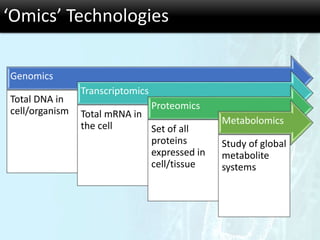
‘Omics’ Technologies
Genomics
Total DNA in
cell/organism
Transcriptomics
Total mRNA in
the cell
Proteomics
Set of all
proteins
expressed in
cell/tissue
Metabolomics
Study of global
metabolite
systems
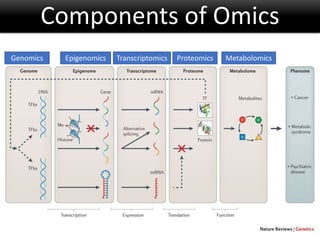
Components of Omics
Genomics Epigenomics Transcriptomics Proteomics Metabolomics
Genomics is the
systematic study of an
organism’s genome
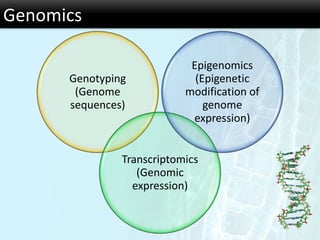
Genomics
Genotyping
(Genome
sequences)
Transcriptomics
(Genomic
expression)
Epigenomics
(Epigenetic
modification of
genome
expression)
Genomics
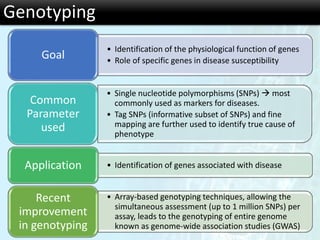
• Identification of the physiological function of genes
• Role of specific genes in disease susceptibility
Goal
• Single nucleotide polymorphisms (SNPs)  most
commonly used as markers for diseases.
• Tag SNPs (informative subset of SNPs) and fine
mapping are further used to identify true cause of
phenotype
Common
Parameter
used
• Identification of genes associated with diseaseApplication
• Array-based genotyping techniques, allowing the
simultaneous assessment (up to 1 million SNPs) per
assay, leads to the genotyping of entire genome
known as genome-wide association studies (GWAS)
Recent
improvement
in genotyping
Genotyping
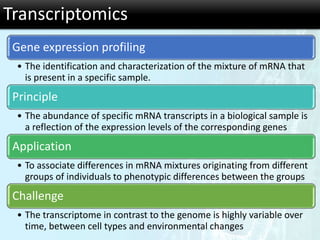
Gene expression profiling
• The identification and characterization of the mixture of mRNA that
is present in a specific sample.
Principle
• The abundance of specific mRNA transcripts in a biological sample is
a reflection of the expression levels of the corresponding genes
Application
• To associate differences in mRNA mixtures originating from different
groups of individuals to phenotypic differences between the groups
Challenge
• The transcriptome in contrast to the genome is highly variable over
time, between cell types and environmental changes
Transcriptomics
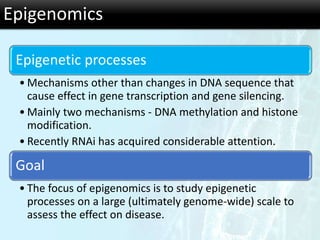
Epigenetic processes
• Mechanisms other than changes in DNA sequence that
cause effect in gene transcription and gene silencing.
• Mainly two mechanisms - DNA methylation and histone
modification.
• Recently RNAi has acquired considerable attention.
Goal
• The focus of epigenomics is to study epigenetic
processes on a large (ultimately genome-wide) scale to
assess the effect on disease.
Epigenomics
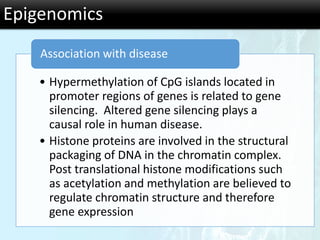
• Hypermethylation of CpG islands located in
promoter regions of genes is related to gene
silencing. Altered gene silencing plays a
causal role in human disease.
• Histone proteins are involved in the structural
packaging of DNA in the chromatin complex.
Post translational histone modifications such
as acetylation and methylation are believed to
regulate chromatin structure and therefore
gene expression
Association with disease
Epigenomics
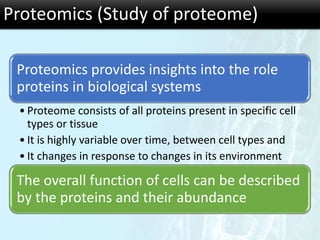
Proteomics provides insights into the role
proteins in biological systems
• Proteome consists of all proteins present in specific cell
types or tissue
• It is highly variable over time, between cell types and
• It changes in response to changes in its environment
The overall function of cells can be described
by the proteins and their abundance
Proteomics (Study of proteome)
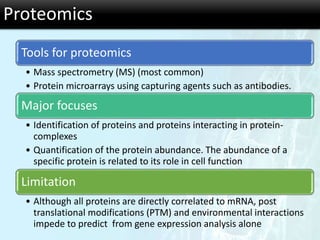
Tools for proteomics
• Mass spectrometry (MS) (most common)
• Protein microarrays using capturing agents such as antibodies.
Major focuses
• Identification of proteins and proteins interacting in protein-
complexes
• Quantification of the protein abundance. The abundance of a
specific protein is related to its role in cell function
Limitation
• Although all proteins are directly correlated to mRNA, post
translational modifications (PTM) and environmental interactions
impede to predict from gene expression analysis alone
Proteomics
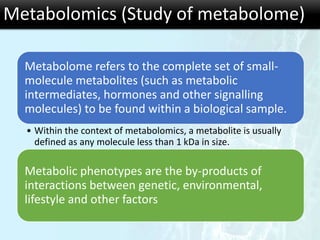
Metabolome refers to the complete set of small-
molecule metabolites (such as metabolic
intermediates, hormones and other signalling
molecules) to be found within a biological sample.
• Within the context of metabolomics, a metabolite is usually
defined as any molecule less than 1 kDa in size.
Metabolic phenotypes are the by-products of
interactions between genetic, environmental,
lifestyle and other factors
Metabolomics (Study of metabolome)
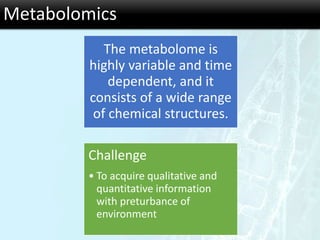
The metabolome is
highly variable and time
dependent, and it
consists of a wide range
of chemical structures.
Challenge
• To acquire qualitative and
quantitative information
with preturbance of
environment
Metabolomics
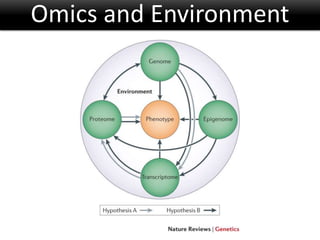
Omics and Environment
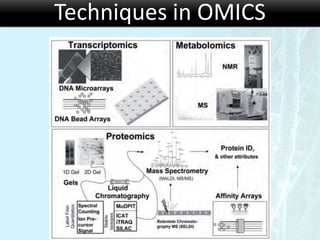
Techniques in OMICS
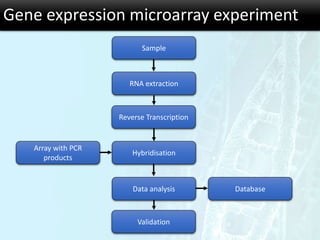
Gene expression microarray experiment
Array with PCR
products
Database
Hybridisation
Data analysis
Validation
Sample
RNA extraction
Reverse Transcription
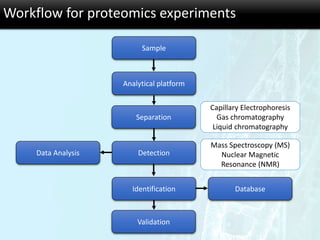
Workflow for proteomics experiments
Data Analysis
Database
Detection
Identification
Validation
Sample
Analytical platform
Separation
Capillary Electrophoresis
Gas chromatography
Liquid chromatography
Mass Spectroscopy (MS)
Nuclear Magnetic
Resonance (NMR)
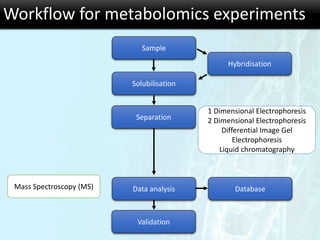
Workflow for metabolomics experiments
1 Dimensional Electrophoresis
2 Dimensional Electrophoresis
Differential Image Gel
Electrophoresis
Liquid chromatography
Database
Hybridisation
Data analysis
Validation
Sample
Solubilisation
Separation
Mass Spectroscopy (MS)
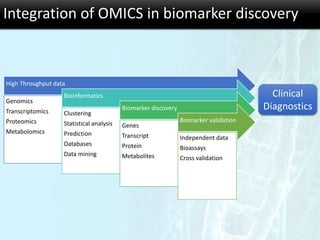
Integration of OMICS in biomarker discovery
High Throughput data
Genomics
Transcriptomics
Proteomics
Metabolomics
Bioinformatics
Clustering
Statistical analysis
Prediction
Databases
Data mining
Biomarker discovery
Genes
Transcript
Protein
Metabolites
Biomarker validation
Independent data
Bioassays
Cross validation
Clinical
Diagnostics
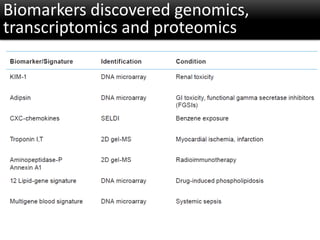
Biomarkers discovered genomics,
transcriptomics and proteomics
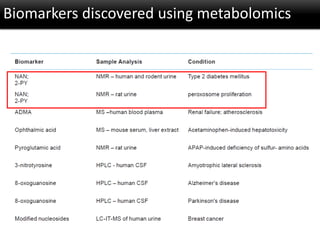
Biomarkers discovered using metabolomics
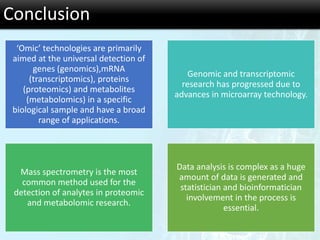
Conclusion
‘Omic’ technologies are primarily
aimed at the universal detection of
genes (genomics),mRNA
(transcriptomics), proteins
(proteomics) and metabolites
(metabolomics) in a specific
biological sample and have a broad
range of applications.
Genomic and transcriptomic
research has progressed due to
advances in microarray technology.
Mass spectrometry is the most
common method used for the
detection of analytes in proteomic
and metabolomic research.
Data analysis is complex as a huge
amount of data is generated and
statistician and bioinformatician
involvement in the process is
essential.
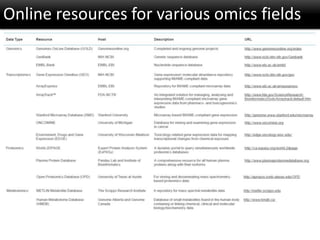
Online resources for various omics fields
Thankyou

Genomics, Transcriptomics, Proteomics, Metabolomics - Basic concepts for clinicians

  • 1.
    Genomics,Transcriptomics,Proteomics, Metabolomics–Basic conceptsfor clinicians DrPrasenjit Mitra All India Institute of Medical Sciences Jodhpur
  • 2.
    History of OMICS HansWinkler (1920) coined the term “Genome”  Derivation of modern uses of the term "omics, although the use of - ome is older, signifying the ‘‘collectivity’’ of a set of things. Sanger (1970s) - first Complete sequencing of genome. Genome is the most fundamental part of many omics. The word genomics is said to be appeared in the 1980s  Widely used in the 1990s.
  • 3.
    OMICS ‘Omics’  fieldof study in biology ending in the suffix -omics such as genomics, metabolomics, or proteomics. The related ome addresses the objects of study of such fields, such as the genome, metabolome, or proteome respectively.
  • 4.
    ‘Omics’ Technologies Genomics Total DNAin cell/organism Transcriptomics Total mRNA in the cell Proteomics Set of all proteins expressed in cell/tissue Metabolomics Study of global metabolite systems
  • 5.
    Components of Omics GenomicsEpigenomics Transcriptomics Proteomics Metabolomics
  • 6.
    Genomics is the systematicstudy of an organism’s genome Genomics
  • 7.
  • 8.
    • Identification ofthe physiological function of genes • Role of specific genes in disease susceptibility Goal • Single nucleotide polymorphisms (SNPs)  most commonly used as markers for diseases. • Tag SNPs (informative subset of SNPs) and fine mapping are further used to identify true cause of phenotype Common Parameter used • Identification of genes associated with diseaseApplication • Array-based genotyping techniques, allowing the simultaneous assessment (up to 1 million SNPs) per assay, leads to the genotyping of entire genome known as genome-wide association studies (GWAS) Recent improvement in genotyping Genotyping
  • 9.
    Gene expression profiling •The identification and characterization of the mixture of mRNA that is present in a specific sample. Principle • The abundance of specific mRNA transcripts in a biological sample is a reflection of the expression levels of the corresponding genes Application • To associate differences in mRNA mixtures originating from different groups of individuals to phenotypic differences between the groups Challenge • The transcriptome in contrast to the genome is highly variable over time, between cell types and environmental changes Transcriptomics
  • 10.
    Epigenetic processes • Mechanismsother than changes in DNA sequence that cause effect in gene transcription and gene silencing. • Mainly two mechanisms - DNA methylation and histone modification. • Recently RNAi has acquired considerable attention. Goal • The focus of epigenomics is to study epigenetic processes on a large (ultimately genome-wide) scale to assess the effect on disease. Epigenomics
  • 11.
    • Hypermethylation ofCpG islands located in promoter regions of genes is related to gene silencing. Altered gene silencing plays a causal role in human disease. • Histone proteins are involved in the structural packaging of DNA in the chromatin complex. Post translational histone modifications such as acetylation and methylation are believed to regulate chromatin structure and therefore gene expression Association with disease Epigenomics
  • 12.
    Proteomics provides insightsinto the role proteins in biological systems • Proteome consists of all proteins present in specific cell types or tissue • It is highly variable over time, between cell types and • It changes in response to changes in its environment The overall function of cells can be described by the proteins and their abundance Proteomics (Study of proteome)
  • 13.
    Tools for proteomics •Mass spectrometry (MS) (most common) • Protein microarrays using capturing agents such as antibodies. Major focuses • Identification of proteins and proteins interacting in protein- complexes • Quantification of the protein abundance. The abundance of a specific protein is related to its role in cell function Limitation • Although all proteins are directly correlated to mRNA, post translational modifications (PTM) and environmental interactions impede to predict from gene expression analysis alone Proteomics
  • 14.
    Metabolome refers tothe complete set of small- molecule metabolites (such as metabolic intermediates, hormones and other signalling molecules) to be found within a biological sample. • Within the context of metabolomics, a metabolite is usually defined as any molecule less than 1 kDa in size. Metabolic phenotypes are the by-products of interactions between genetic, environmental, lifestyle and other factors Metabolomics (Study of metabolome)
  • 15.
    The metabolome is highlyvariable and time dependent, and it consists of a wide range of chemical structures. Challenge • To acquire qualitative and quantitative information with preturbance of environment Metabolomics
  • 16.
  • 17.
  • 18.
    Gene expression microarrayexperiment Array with PCR products Database Hybridisation Data analysis Validation Sample RNA extraction Reverse Transcription
  • 19.
    Workflow for proteomicsexperiments Data Analysis Database Detection Identification Validation Sample Analytical platform Separation Capillary Electrophoresis Gas chromatography Liquid chromatography Mass Spectroscopy (MS) Nuclear Magnetic Resonance (NMR)
  • 20.
    Workflow for metabolomicsexperiments 1 Dimensional Electrophoresis 2 Dimensional Electrophoresis Differential Image Gel Electrophoresis Liquid chromatography Database Hybridisation Data analysis Validation Sample Solubilisation Separation Mass Spectroscopy (MS)
  • 21.
    Integration of OMICSin biomarker discovery High Throughput data Genomics Transcriptomics Proteomics Metabolomics Bioinformatics Clustering Statistical analysis Prediction Databases Data mining Biomarker discovery Genes Transcript Protein Metabolites Biomarker validation Independent data Bioassays Cross validation Clinical Diagnostics
  • 22.
  • 23.
  • 24.
    Conclusion ‘Omic’ technologies areprimarily aimed at the universal detection of genes (genomics),mRNA (transcriptomics), proteins (proteomics) and metabolites (metabolomics) in a specific biological sample and have a broad range of applications. Genomic and transcriptomic research has progressed due to advances in microarray technology. Mass spectrometry is the most common method used for the detection of analytes in proteomic and metabolomic research. Data analysis is complex as a huge amount of data is generated and statistician and bioinformatician involvement in the process is essential.
  • 25.
    Online resources forvarious omics fields
  • 26.

Editor's Notes

  • #10 A gene expression profile provides a quantitative overview of the mRNA transcripts that were present in a sample at the time of collection. Therefore, gene expression profiling can be used to determine which genes are differently expressed as result of changes in environmental conditions. A typical gene expression profiling study includes a group of individuals with similar phenotype (e.g. exposure level, disease status) and compares the gene expression profile of this group to the profile of a reference group matched on selected factors such as age and sex to the group of interest. Studies of this type usually report a set of genes that are differently expressed between the groups
  • #11 DNA methylation is the addition of a methyl group to cytosine in a CpG dinucleotide.
  • #12 DNA methylation is the addition of a methyl group to cytosine in a CpG dinucleotide.
  • #23 N-methylnicotinamide N-methyl 2-pyridine 5 carboximide
  • #24 N-methylnicotinamide N-methyl 2-pyridine 5 carboximide