GENETIC ENGINEERING
AND APPLICATIONS
Louie Jane T. Eleccion
• Define Genetic Engineering.
• Outline the process of genetic engineering involving:
isolation, cutting, transformation, introduction of
base sequence changes and expression.
• Site applications/uses of Genetic Engineering in
different fields (Agriculture and Medicine).
OBJECTIVES
Important Terms
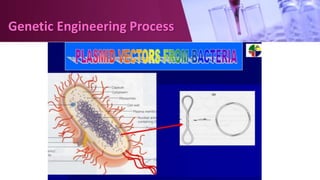
• Plasmid – is a circular bacterial genome which consists a
single DNA, containing non-essential genes but carry
genetic advantages.
• Restriction Enzyme – molecular scissors that cuts DNA
into fragments.
• Recombinant DNA – the term used to describe the
combination of two DNA strands that are constructed
artificially.
GENETIC ENGINEERING
The direct
manipulation of
an organism's genome
using biotechnology.
Biotechnology
• Is any technological application that makes use of
biological systems, living organisms and its
components to create products and other
technological systems with the aim of advancing the
human condition.
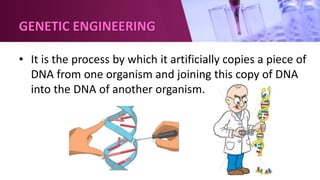
GENETIC ENGINEERING
• It is the process by which it artificially copies a piece of
DNA from one organism and joining this copy of DNA
into the DNA of another organism.
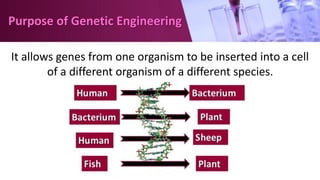
Purpose of Genetic Engineering
It allows genes from one organism to be inserted into a cell
of a different organism of a different species.
Genetic Engineering Processes
OVERVIEW
• Alteration in the segment of a DNA molecule (rDNA).
• Recombinant DNA is joined to other unrelated DNA
in the organism.
• This is called gene splicing.
- tiny segments of a gene are taken out and
replaced by different genes
TRANSGENIC ORGANISMS
• Organisms altered by genetic engineering through
gene transfer—
the movement or insertion of a gene into an
organism that normally does not have a copy
of that gene.
• The organism receives new gene from the other
organism.
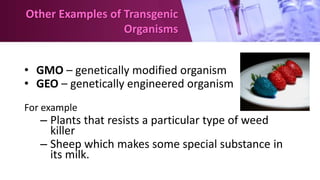
Other Examples of Transgenic
Organisms
• GMO – genetically modified organism
• GEO – genetically engineered organism
For example
– Plants that resists a particular type of weed
killer
– Sheep which makes some special substance in
its milk.
Genetic Engineering Process
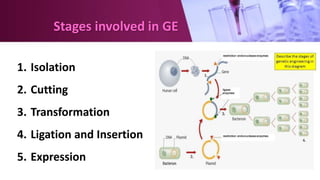
Stages involved in GE
1. Isolation
2. Cutting
3. Transformation
4. Ligation and Insertion
5. Expression
1. ISOLATION
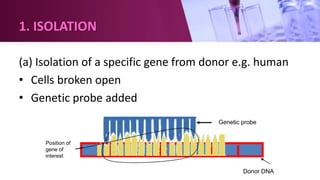
(a) Isolation of a specific gene from donor e.g. human
• Cells broken open
• Genetic probe added
Donor DNA
Genetic probe
Position of
gene of
interest
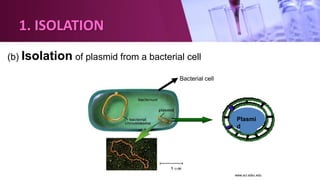
Bacterial cell
Plasmi
d
(b) Isolation of plasmid from a bacterial cell
www.sci.sdsu.edu
1. ISOLATION

2. CUTTING
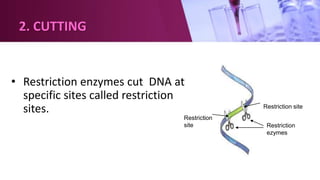
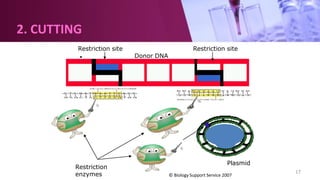
• Restriction enzymes cut DNA at
specific sites called restriction
sites. Restriction site
Restriction
site Restriction
ezymes
2. CUTTING
17
Restriction site Restriction site
Donor DNA
© Biology Support Service 2007
2. CUTTING
Plasmid
Restriction
enzymes
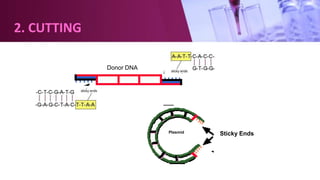
2. CUTTING
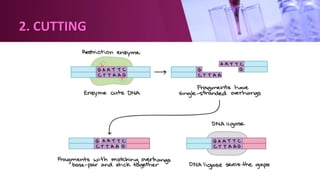
Sticky EndsPlasmid
Donor DNA
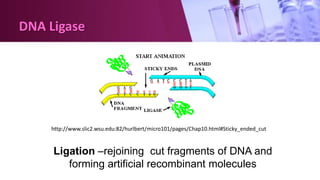
DNA Ligase
http://www.slic2.wsu.edu:82/hurlbert/micro101/pages/Chap10.html#Sticky_ended_cut
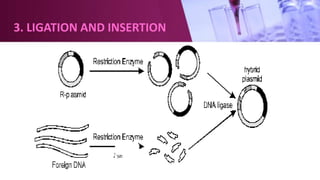
Ligation –rejoining cut fragments of DNA and
forming artificial recombinant molecules
3. LIGATION AND INSERTION
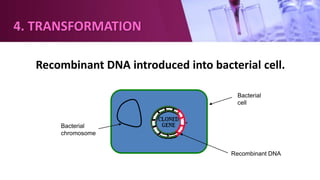
4. TRANSFORMATION
Recombinant DNA introduced into bacterial cell.
Bacterial
chromosome
Bacterial
cell
Recombinant DNA
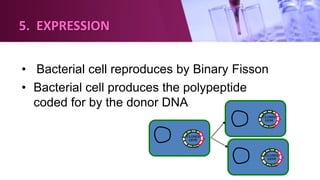
5. EXPRESSION
• Bacterial cell reproduces by Binary Fisson
• Bacterial cell produces the polypeptide
coded for by the donor DNA
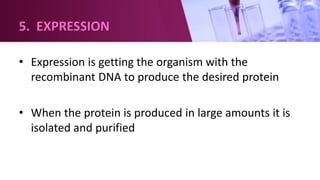
• Expression is getting the organism with the
recombinant DNA to produce the desired protein
• When the protein is produced in large amounts it is
isolated and purified
5. EXPRESSION
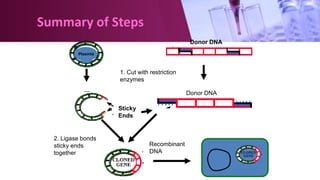
Summary of Steps
1. Cut with restriction
enzymes
Donor DNA
Plasmid
Donor DNA
Sticky
Ends
2. Ligase bonds
sticky ends
together
Recombinant
DNA
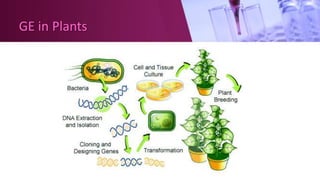
GE in Plants
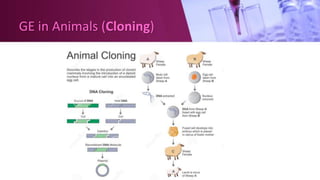
GE in Animals (Cloning)
Animals used in GE
• The human gene to clot blood has been inserted into
the DNA of sheep
• Sheep produce human clotting factor needed for
Haemophiliacs in their milk.
• Goats produce a protein to treat emphysema
Genetic Engineering
APPLICATIONS
AGRICULTURE
MEDICINE
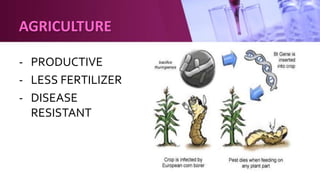
AGRICULTURE
- PRODUCTIVE
- LESS FERTILIZER
- DISEASE
RESISTANT
IMPROVE SEVERAL
AGRICULTURAL CROPS
• TRANSFER OF NITROGEN FIXING GENES
• TRANSFER OF RESISTANCE AGAINST PATHOGENS
• IMPROVEMENT IN QUALITY AND QUANTITY OF
SEED PROTEINS
• TRANSFER OF GENES FOR ANIMAL PROTEINSTO
CROP PLANTS
- GENETIC DISEASES BECOME PREVALENT
- VACCINES
- HORMONES
- GENETHERAPY
- GENE PHARMING
MEDICINE
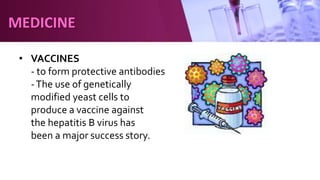
• VACCINES
- to form protective antibodies
-The use of genetically
modified yeast cells to
produce a vaccine against
the hepatitis B virus has
been a major success story.
MEDICINE
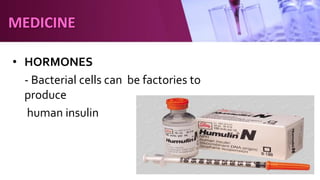
• HORMONES
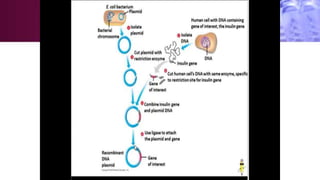
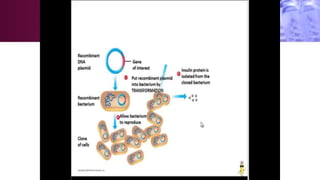
- Bacterial cells can be factories to
produce
human insulin
MEDICINE
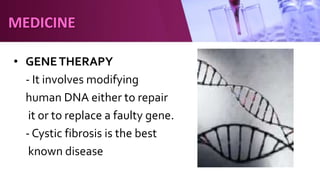
• GENETHERAPY
- It involves modifying
human DNA either to repair
it or to replace a faulty gene.
- Cystic fibrosis is the best
known disease
MEDICINE
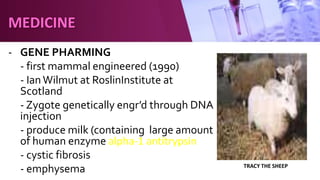
- GENE PHARMING
- first mammal engineered (1990)
- Ian Wilmut at RoslinInstitute at
Scotland
- Zygote genetically engr’d through DNA
injection
- produce milk (containing large amount
of human enzyme alpha-1 antitrypsin
- cystic fibrosis
- emphysema TRACY THE SHEEP
MEDICINE
Thank you 

Genetic Engineering and Application

  • 1.
  • 2.
    • Define GeneticEngineering. • Outline the process of genetic engineering involving: isolation, cutting, transformation, introduction of base sequence changes and expression. • Site applications/uses of Genetic Engineering in different fields (Agriculture and Medicine). OBJECTIVES
  • 3.
    Important Terms • Plasmid– is a circular bacterial genome which consists a single DNA, containing non-essential genes but carry genetic advantages. • Restriction Enzyme – molecular scissors that cuts DNA into fragments. • Recombinant DNA – the term used to describe the combination of two DNA strands that are constructed artificially.
  • 4.
    GENETIC ENGINEERING The direct manipulationof an organism's genome using biotechnology.
  • 5.
    Biotechnology • Is anytechnological application that makes use of biological systems, living organisms and its components to create products and other technological systems with the aim of advancing the human condition.
  • 6.
    GENETIC ENGINEERING • Itis the process by which it artificially copies a piece of DNA from one organism and joining this copy of DNA into the DNA of another organism.
  • 7.
    Purpose of GeneticEngineering It allows genes from one organism to be inserted into a cell of a different organism of a different species.
  • 8.
    Genetic Engineering Processes OVERVIEW •Alteration in the segment of a DNA molecule (rDNA). • Recombinant DNA is joined to other unrelated DNA in the organism. • This is called gene splicing. - tiny segments of a gene are taken out and replaced by different genes
  • 9.
    TRANSGENIC ORGANISMS • Organismsaltered by genetic engineering through gene transfer— the movement or insertion of a gene into an organism that normally does not have a copy of that gene. • The organism receives new gene from the other organism.
  • 10.
    Other Examples ofTransgenic Organisms • GMO – genetically modified organism • GEO – genetically engineered organism For example – Plants that resists a particular type of weed killer – Sheep which makes some special substance in its milk.
  • 11.
  • 12.
    Stages involved inGE 1. Isolation 2. Cutting 3. Transformation 4. Ligation and Insertion 5. Expression
  • 13.
    1. ISOLATION (a) Isolationof a specific gene from donor e.g. human • Cells broken open • Genetic probe added Donor DNA Genetic probe Position of gene of interest
  • 14.
    Bacterial cell Plasmi d (b) Isolationof plasmid from a bacterial cell www.sci.sdsu.edu 1. ISOLATION
  • 15.
    2. CUTTING • Restrictionenzymes cut DNA at specific sites called restriction sites. Restriction site Restriction site Restriction ezymes
  • 16.
  • 17.
    17 Restriction site Restrictionsite Donor DNA © Biology Support Service 2007 2. CUTTING Plasmid Restriction enzymes
  • 18.
  • 19.
  • 20.
    3. LIGATION ANDINSERTION
  • 21.
    4. TRANSFORMATION Recombinant DNAintroduced into bacterial cell. Bacterial chromosome Bacterial cell Recombinant DNA
  • 22.
    5. EXPRESSION • Bacterialcell reproduces by Binary Fisson • Bacterial cell produces the polypeptide coded for by the donor DNA
  • 23.
    • Expression isgetting the organism with the recombinant DNA to produce the desired protein • When the protein is produced in large amounts it is isolated and purified 5. EXPRESSION
  • 24.
    Summary of Steps 1.Cut with restriction enzymes Donor DNA Plasmid Donor DNA Sticky Ends 2. Ligase bonds sticky ends together Recombinant DNA
  • 25.
  • 26.
    GE in Animals(Cloning)
  • 27.
    Animals used inGE • The human gene to clot blood has been inserted into the DNA of sheep • Sheep produce human clotting factor needed for Haemophiliacs in their milk. • Goats produce a protein to treat emphysema
  • 28.
  • 29.
  • 30.
    AGRICULTURE - PRODUCTIVE - LESSFERTILIZER - DISEASE RESISTANT
  • 31.
    IMPROVE SEVERAL AGRICULTURAL CROPS •TRANSFER OF NITROGEN FIXING GENES • TRANSFER OF RESISTANCE AGAINST PATHOGENS • IMPROVEMENT IN QUALITY AND QUANTITY OF SEED PROTEINS • TRANSFER OF GENES FOR ANIMAL PROTEINSTO CROP PLANTS
  • 32.
    - GENETIC DISEASESBECOME PREVALENT - VACCINES - HORMONES - GENETHERAPY - GENE PHARMING MEDICINE
  • 33.
    • VACCINES - toform protective antibodies -The use of genetically modified yeast cells to produce a vaccine against the hepatitis B virus has been a major success story. MEDICINE
  • 34.
    • HORMONES - Bacterialcells can be factories to produce human insulin MEDICINE
  • 37.
    • GENETHERAPY - Itinvolves modifying human DNA either to repair it or to replace a faulty gene. - Cystic fibrosis is the best known disease MEDICINE
  • 38.
    - GENE PHARMING -first mammal engineered (1990) - Ian Wilmut at RoslinInstitute at Scotland - Zygote genetically engr’d through DNA injection - produce milk (containing large amount of human enzyme alpha-1 antitrypsin - cystic fibrosis - emphysema TRACY THE SHEEP MEDICINE
  • 39.