Generative AI Tools in Data-Science to cover complete python
1.
Generative AI Toolsin
Data Science
Empowering Data Scientists and ML Engineers with AI-Driven Workflows
2.
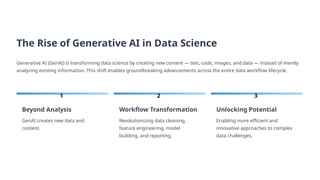
The Rise ofGenerative AI in Data Science
Generative AI (GenAI) is transforming data science by creating new content — text, code, images, and data — instead of merely
analyzing existing information. This shift enables groundbreaking advancements across the entire data workflow lifecycle.
1
Beyond Analysis
GenAI creates new data and
content.
2
Workflow Transformation
Revolutionizing data cleaning,
feature engineering, model
building, and reporting.
3
Unlocking Potential
Enabling more efficient and
innovative approaches to complex
data challenges.
3.
Why Integrate GenAI?
GenAIoffers unique advantages that streamline processes, enhance insights, and accelerate experimentation in data science.
Data Augmentation
Generate synthetic data to robustly train
ML models.
Automation
Reduce manual effort in EDA, feature
engineering, and SQL query generation.
Insight Generation
AI-driven summaries, recommendations,
and visualizations.
Natural Language Interfaces
Query data and systems using plain
English commands.
Experiment Acceleration
Quickly generate hypotheses and test
scripts for rapid iteration.
4.
Key GenAI Toolsfor Data Scientists
ChatGPT / GPT-4 / GPT-5
• Code generation & debugging
• SQL query creation
• Documentation assistance
• Example: "Write Python code to train a logistic regression model on Titanic
dataset."
GitHub Copilot
• AI pair programmer for Python, R, SQL notebooks
• Helps with: Data cleaning scripts, visualization code, ML pipelines
DataRobot AI / H2O.ai
• Automated ML (AutoML) with GenAI enhancements
• Generates explanations and synthetic data
LangChain + LLMs
• Connect GenAI with structured data (databases, APIs, CSVs)
• Build chatbots for data analysis
ChatGPT Plugins & Code Interpreter
• Upload dataset, ask questions, get visualizations & models
• Auto EDA, chart generation, regression/classification
Google Vertex AI / Azure OpenAI / AWS Bedrock
• Enterprise-grade generative AI integration
• Supports large-scale data science workflows with LLMs
GANs (Generative Adversarial Networks)
• Synthetic data generation, image creation, anomaly detection
• Example: Create synthetic medical images for model training
5.
GenAI in Action:Churn Prediction Workflow
Let's walk through a practical scenario: predicting customer churn with GenAI assistance.
Data Understanding
Upload CSV to ChatGPT Code Interpreter or PandasAI. Ask for summary of features and missing values.
Data Cleaning & Feature Engineering
GenAI generates Python code (Pandas/NumPy) for data imputation and transformations.
Model Building
Use Copilot or ChatGPT to generate code for a Random Forest model with feature importance.
Synthetic Data Generation
Utilize GANs or Gretel.ai to create additional synthetic training samples.
Visualization & Reporting
Leverage LLMs to generate Seaborn plots and an executive summary in plain English.
6.
Mini Example: PandasAIin Action
PandasAI empowers you to query your dataframes using natural language, abstracting away complex coding.
from pandasai import SmartDataframe
from pandasai.llm.openai import OpenAIimport
pandas as pddf = pd.read_csv("customer_churn.csv")
llm = OpenAI(api_token="your_api_key")
smart_df = SmartDataframe(df, config={"llm": llm})
# Ask in plain English
print(smart_df.chat("What percentage of customers have churned?"))
The magic: The LLM transparently generates, executes, and returns the result of the Python code based on your plain English
query. This drastically speeds up exploratory data analysis.
7.
Best Practices forGenAI Adoption
Validate All Code
Always review AI-generated code to catch "hallucinations" and ensure
accuracy.
Augment, Don't Replace
Use GenAI to enhance, not substitute, core data science skills and human
judgment.
Combine Expertise
Integrate domain knowledge with GenAI insights for optimal results.
Ensure Data Privacy
Be diligent about data governance when using cloud-based LLMs with
sensitive information.
8.
Your GenAI LearningPath
Embark on your journey into Generative AI with a structured learning approach, building skills incrementally.
Start: Foundation
Utilize ChatGPT/Copilot for basic Python data science tasks
like script generation and debugging.
Next: Conversational Analysis
Explore PandasAI and LangChain to enable natural
language interaction with your data.
Advanced: Custom Models
Dive deeper by training your own GANs or integrating with
enterprise platforms like Vertex AI/Bedrock.
Master: AI-Powered Solutions
Build custom GenAI-powered dashboards, assistants, and
fully integrated data products.
9.
Key Takeaways
• GenAIis a Force Multiplier: It automates routine tasks, accelerates experimentation, and unlocks new forms of insight
generation in data science.
• Diverse Toolset: From LLMs for code generation to GANs for synthetic data, a rich ecosystem of tools supports various data
science needs.
• Strategic Integration: Successful adoption requires validation of AI-generated outputs, a focus on augmentation, and
adherence to data privacy best practices.
• Continuous Learning: The GenAI landscape is rapidly evolving; embracing continuous learning is key to harnessing its full
potential.
10.
Ready to TransformYour Data
Workflows?
Embrace Generative AI to unlock new efficiencies, drive deeper insights,
and innovate faster in your data science initiatives.